26 posts tagged with "sales development"

View All Tags

The Discovery Call Diagnostic: 8 In-Call Signals That Predict If a Deal Will Close [2026]

ยท 12 min read
MarketBetter Team
Content Team, marketbetter.ai

Discovery call diagnostic - 8 in-call signals that predict deal close

Most AEs walk out of a discovery call and write the same recap in CRM: "Good convo. Strong interest. Sending follow-up." Two weeks later half of those deals are in slow-fade limbo, and nobody can explain what changed. Nothing changed. The deal was already dead at minute eight โ€” the AE just didn't notice.

The hard truth: discovery call outcome is mostly decided by what the buyer brings to the table, not what the AE asks. Budget, authority, timing โ€” the classic BANT โ€” are answers buyers give you because you forced the question. Real intent is something you have to listen for, and it shows up fast. If you know what to listen for, you can call the deal in the first 10-15 minutes with surprising accuracy.

This is the diagnostic. Eight signals. Where they show up. What they actually mean. And what to do when you don't see them.

If you want the wider context, this fits between the 15-minute pre-demo prep playbook and the 14-day post-demo AE daily playbook โ€” discovery is the inflection point between the two.

Why "discovery questions" frameworks miss the pointโ€‹

Every sales methodology โ€” MEDDPICC, SPIN, Sandler, GAP โ€” gives you a list of questions to ask. They're fine. The problem is that the AE who's reading off a question list is, by definition, leading the conversation. Leading a discovery call is the opposite of discovery. You're shaping their answers instead of letting them reveal themselves.

The diagnostic flips the model. Instead of asking better questions, you create the conditions for the buyer to talk for 60-70% of the call, and then you score what you hear. The questions matter less. The patterns inside their answers matter enormously.

Eight patterns. If a deal shows 5 or more, it's real. If it shows 2 or fewer, your follow-up is mostly nurture โ€” don't burn AE cycles. The middle is where coaching and multi-threading make the difference.

Signal 1 โ€” They name the trigger before you askโ€‹

The strongest qualifier in any discovery call is a compelling event volunteered without prompting. When a buyer opens with "we just lost our biggest rep and need to ramp two new ones in 60 days" or "our contract with the current vendor is up in November and renewal pricing went up 40%," they are telling you the deal already has a forcing function.

What to listen for: a specific event, a date attached to it, and a cost of doing nothing. Generic statements like "we're always looking to improve" or "we want to grow faster" are not triggers. Triggers have edges. They hurt.

If you don't hear one in the first 10 minutes, ask once: "What made now the right time to take this call?" If the answer is hand-wavy, mark this signal as absent. Don't pretend it's there.

Signal 2 โ€” They say "we" not "I"โ€‹

Pay attention to pronouns. Buyers who frame the problem in first-person singular ("I'm trying to figure outโ€ฆ", "I want to see ifโ€ฆ", "I've been thinking aboutโ€ฆ") are usually exploring on their own. Deals with one-person curiosity at the top of funnel close at a fraction of the rate of deals where the buyer has already framed the project as a team need.

"We" language signals that the conversation has already happened internally. They've talked about this with their VP. The pain has been named in a leadership meeting. The exploration call is one step of a process, not a personal hobby.

Listen for: "we're evaluating," "our team decided," "my CRO asked me to look at," "we agreed we'd shortlist." Each one is a deal-team artifact you didn't have to build yourself. Compare to multi-threading from the discovery stage โ€” if they're already using "we," the deal team is partially formed before you ever pitched.

Signal 3 โ€” They cite specific numbers unpromptedโ€‹

When buyers volunteer numbers without you fishing for them, the deal is already real in their head. "We have 47 SDRs and roughly 8,000 target accounts" is different from "we have a pretty big sales team." The first one means they've measured the problem. The second one means they're guessing.

Numbers to listen for: team headcount, current tool spend, conversion rates, quota attainment, deal sizes, pipeline coverage, churn rate. The specific metric matters less than the act of volunteering it. Buyers who have measured their problem have, almost by definition, already decided it's a problem worth solving.

The inverse signal is just as useful: if a buyer can't (or won't) give you a number for anything quantitative, they haven't done the internal work. The deal is at "interesting topic," not "active project."

Signal 4 โ€” They reference a deadline that isn't yoursโ€‹

Self-imposed deadlines are different from sales-imposed deadlines. "We need to make a decision by end of quarter" said in response to your "what's your timeline?" is a polite answer. "Board meeting in August, I need to have a recommendation by July 15" is a deadline that exists whether or not you're in the picture.

The best deadline signals are tied to events you can verify: a board meeting, a fiscal year cutover, a hiring plan that needs tooling, a vendor contract expiration, a product launch that needs sales infrastructure, a fundraise that requires GTM hardening. Each one creates signal decay on a known curve โ€” the deal has gravity pulling it toward a date.

If you don't hear a deadline, ask: "What happens if this isn't solved in the next 90 days?" If the honest answer is "not much," the deal will drift. Note it.

Signal 5 โ€” They ask about implementationโ€‹

This is the single most underrated signal in B2B sales. Buyers who ask "what does onboarding look like?" or "how long does it take to get a team trained?" or "who would we work with after the contract signs?" are not asking out of curiosity. They are mentally rehearsing what life is like after they buy.

The brain only does that rehearsal when the buying decision has tipped past 50%. You can almost feel it happen on a call โ€” the conversation shifts from "tell me what you do" to "tell me what we'd do." That pivot is everything.

When you hear an implementation question, your job is to answer it precisely and then ask "is the implementation timeline a factor in your decision?" Their answer tells you whether they're sequencing toward a real go-live or just collecting reassurance for a hypothetical purchase. Either way, lean in. This is the highest-leverage signal on this list.

Signal 6 โ€” They name competitors they're also evaluatingโ€‹

It feels counterintuitive โ€” competitors should be a threat, right? In discovery, the opposite is true. A buyer who names two or three competitors they're also looking at is a buyer who has built a shortlist, which means they have budget, authority, and intent. They are buying. The only question is from whom.

A buyer who insists they're "just exploring" and "not really comparing anyone right now" is in a much weaker position. They haven't done the work to scope the market. They're educational. Education calls close at maybe 5-10%. Shortlist calls close at 30-50%.

When you hear competitor names, do three things: (1) ask what they liked about each one โ€” this tells you their evaluation criteria, (2) ask where they are in each conversation โ€” this tells you the order of decision, (3) note the names, because your follow-up content needs to address those specific comparisons. This is where feature-to-feature competitor knowledge earns its keep.

Signal 7 โ€” They mention internal work they've already doneโ€‹

Strong deals have history. By the time they reach you, the buyer has usually built some artifact โ€” a one-pager for their VP, a spreadsheet comparing two or three vendors, a doc summarizing the current tool's gaps, a Slack thread with their team about the project. When they reference these in passing ("I put together a deck for our CRO last week" or "I have a spreadsheet I've been filling out"), they are showing you that the buying process is already running inside their org.

The artifact itself isn't the signal. The fact that they made one is. Internal work means an internal champion is forming, which is the single biggest predictor of whether the deal will survive the champion-goes-quiet moment later in the cycle.

Ask, gently: "Would it help if I sent you a one-pager you can share internally?" or "Want me to put together a version of the comparison for your team?" If they say yes enthusiastically, you have a champion in the making. If they deflect ("oh, I'll handle that myself"), the deal is more single-threaded than it looked.

Signal 8 โ€” They self-propose the next call participantsโ€‹

The cleanest tell of all: at some point in the back half of discovery, the buyer says some version of "I think it would make sense to get our [VP / RevOps lead / IT person / finance partner] on the next call." Not because you asked. Because they're already imagining the next step.

A buyer who is sequencing toward a multi-stakeholder conversation has decided this is a real evaluation. They're showing you who they need to align internally. You should help them. Offer a specific agenda for the next call ("I can prepare a 20-minute demo focused on what your VP will care about, plus 10 minutes for Q&A"). Get the calendar invite while you're still on Zoom.

If the buyer doesn't self-propose, you do it โ€” but treat it as a softer signal. "Who else internally would want to be on the next conversation?" is a fine question. Their willingness to name people is the signal. A vague "let me think about who else should weigh in" is a deferred answer, which means weak coalition. Mark it as half-credit.

Scoring the callโ€‹

After the call, score 0-8. Don't fudge.

ScoreReadAction
6-8 signals presentReal dealMove to multi-threaded demo, prep next call within 5 business days
4-5 signals presentReal but needs workChampion-building plays โ€” share a custom one-pager, line up a peer customer reference
2-3 signals presentEducational / nurtureLong-cycle drip, re-engage on trigger events, do not invest AE hours
0-1 signals presentWrong-fit or wrong-timeMove on. Politely. Open the AE calendar for a real deal

The mistake most AEs make is treating the 2-3 signal calls like the 6-8 signal calls โ€” same follow-up energy, same calendar time, same hope. That's how pipeline math breaks. Most reps don't have a fit problem; they have a discipline problem about where to spend hours.

What to do when you don't see the signalsโ€‹

Two paths. The first is honest disqualification โ€” most AEs are too generous with their own time, and a clean "this isn't the right moment for us, here's what we'd recommend instead" preserves both your hours and your reputation.

The second is to flip the call. If you're at minute 12 and you haven't heard any of the eight, change the conversation: "I want to make sure I'm being useful โ€” can I share what we typically see at companies that look like yours, and you tell me if any of it resonates?" This forces the buyer to either react (which is itself diagnostic) or stay flat (which confirms the call was a research call, not a buying call).

Either way, write the right CRM note. "No compelling event, no deadline, single-threaded, no internal work done โ€” nurture only" is more valuable than "good convo, sending follow-up" โ€” both to you, and to your manager forecasting the quarter.

How signal-driven selling changes discoveryโ€‹

This whole diagnostic gets easier when the AE walks into the call already knowing the buyer's trigger events and signal stack. When you've seen the company hire two new sales leaders, fundraise, and visit your pricing page three times in a week, you don't need to ask "what made now the right time?" โ€” you already know. You can spend the discovery call confirming and deepening instead of starting from zero.

That's the entire premise of signal-based selling: by the time the meeting happens, the AE has a sharpened hypothesis, and the discovery call is about confirming the diagnosis, not running blood tests. Discovery without signals is forensic work. Discovery with signals is consultative work. The outcomes are wildly different.

The bigger arcโ€‹

Discovery is one stage in the signal-to-closed-won sales cycle. The signals you score on the discovery call become the inputs for the 14-day post-demo plan, the SDR-to-AE handoff quality check, and ultimately the forecast call your VP runs every Friday. Sharpening the discovery diagnostic improves every downstream stage. There is no other single hour in the sales process where small changes in skill produce larger changes in outcome.

The teams that win the next two years won't be the ones with the most discovery calls. They'll be the ones who can call the deal at minute 12 and act accordingly โ€” invest where signals are loud, disqualify where they're absent, and stop pretending the middle 40% of pipeline is real.


Want to see what an AE pipeline looks like when discovery is signal-driven from day one? Book a demo โ†’

The Claude SDR Daily Routine: A 90-Minute Morning Block That Replaces 4 Tools [2026]

ยท 10 min read
MarketBetter Team
Content Team, marketbetter.ai

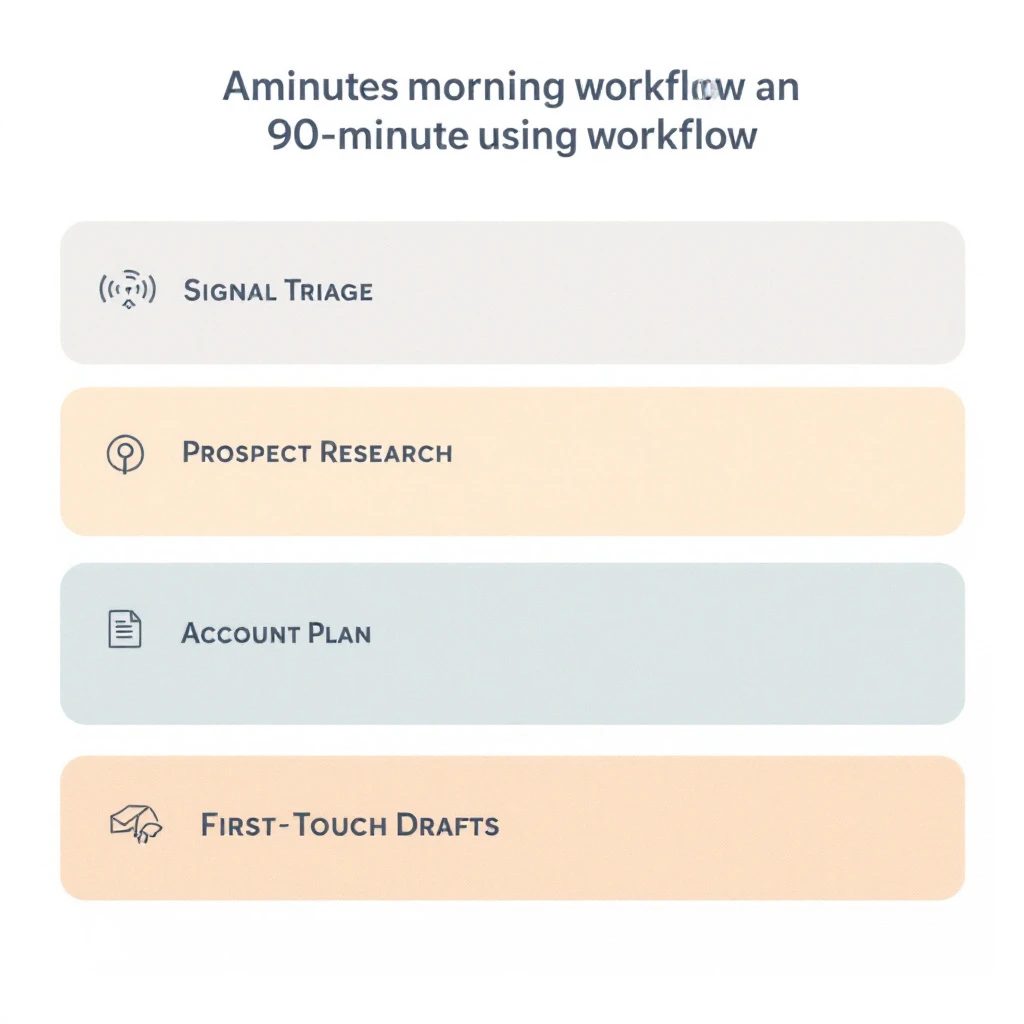
Claude SDR Daily Routine - 90-minute morning block

Most SDRs we talk to use Claude the same way they use ChatGPT โ€” open a tab, paste a question, copy the answer, repeat. That works, but it leaves most of Claude's value on the floor.

The SDRs who get a real multiplier out of Claude don't treat it as a faster Google. They treat it as a morning copilot โ€” a fixed 90-minute block, the same five sub-tasks every day, with prompts they've sharpened over months. The output isn't "AI content." It's a stack of ready-to-send messages, a triaged signal queue, a clean account plan, and an inbox at zero.

This post is the exact routine. Five blocks. The prompts. What they're actually replacing.

If you want the broader strategic case, the complete Claude-for-SDRs pillar guide walks through why Claude wins for SDR work. This post is the operating manual.

The 4 tools this routine replacesโ€‹

Before the breakdown, what the 90 minutes is actually compressing:

Replaced workflowOld timeNew time inside Claude
Prospect research (LinkedIn + company site + news)20-30 min per account4-6 min per account
Sales Navigator list triage30-45 min daily10-15 min
Account plan write-up45-60 min per account8-10 min
Inbox triage + reply drafting45-60 min daily15-20 min

Total replaced: roughly 3 hours of common SDR busywork compressed into a 90-minute block, before your first dial.

The catch: every minute saved comes from prompt structure, not from Claude being magic. The prompts below assume you've fed Claude your ICP, your product positioning, and three or four "good email" examples in a saved project. If you haven't, start here on prospect research and here on cold email personalization.

Block 1 โ€” Signal triage (15 minutes)โ€‹

What you're doing: sorting overnight signals โ€” visitor ID hits, intent topic spikes, job change alerts, replies โ€” into three buckets: call-now, sequence-today, snooze.

Why Claude is good at this: it's pattern recognition over noisy fields, exactly the kind of thing a human gets bored doing by 9:05 AM.

Prompt:

You are my SDR signal triage copilot. I will paste a CSV/list of overnight signals.
For each row, classify into one of: CALL_NOW, SEQUENCE_TODAY, SNOOZE_7D.

Rules:
- CALL_NOW: returning visitor on /pricing or /book-demo, OR open champion at a target account who just changed roles, OR an intent spike on a top-3 use case at an account already in pipeline.
- SEQUENCE_TODAY: first-touch ICP fit signals โ€” new visitor on a product page, fresh intent spike, persona-fit job change at a fit account.
- SNOOZE_7D: weak signals โ€” single page view on /blog, off-ICP firmographics, signals at accounts already in late-stage with another seller.

Return a table with: account, contact, signal, classification, 1-line "why this bucket".
At the bottom, list the CALL_NOW accounts with the strongest "first 90 seconds" opener I should use, referencing the specific signal.

What replaces this otherwise: a 30-minute scroll through Sales Navigator + your visitor ID tool + your intent platform, trying to remember which accounts are already in flight. If you're doing this manually every morning, you're paying the same cost twice โ€” the platform fee and the SDR's morning.

For the deeper case on why signal-first SDRs out-book signal-blind ones, see From Buying Signal to Booked Meeting in 24 Hours.

Block 2 โ€” Targeted prospect research (20 minutes)โ€‹

What you're doing: taking your 3-5 CALL_NOW or top-priority accounts from Block 1 and turning each into a one-screen account brief.

Why batch: a single research session with context loaded once is faster than five context switches.

Prompt (one per account):

Research brief for [ACCOUNT NAME]. I'm an SDR selling [your product, 1 line].
Contact I'm reaching is [NAME, TITLE].

Pull from the company site, recent press, their LinkedIn page posts, and the contact's
LinkedIn activity in the last 90 days. Return:

1. Company snapshot โ€” 2 lines max. What they actually do, not their tagline.
2. Recent "why now" โ€” top 3 events in the last 90 days that justify outreach today.
3. Strategic priorities โ€” what leadership is publicly talking about.
4. Personal hook for [NAME] โ€” something they personally posted, said, or shipped that
I can reference without being weird about it.
5. Three opener angles, ranked by likely reply rate, with the explicit pitch each implies.

If a section has nothing solid, say "no clean signal" โ€” do not invent.

That last instruction matters. Hallucinations are 90% prompt-permission errors. If you give Claude an explicit out, it takes it. If you don't, it fills the gap. (More on that pattern in our writeup on Claude vs ChatGPT for sales teams.)

Block 3 โ€” Account plan drafting (15 minutes)โ€‹

What you're doing: for the 2-3 hottest accounts, converting the research brief into a one-page plan you can drop in your CRM or hand to an AE.

Prompt:

Convert the research brief above into a one-page account plan in this structure:

- Account: name, segment, size, deal-trigger event
- Buying committee โ€” likely roles, who I have, who I'm missing
- Use-case fit โ€” which 1-2 of our use cases match their stated priorities
- Risks โ€” what kills this deal at each stage (no demo, no champion, no budget cycle)
- 14-day plan โ€” day-by-day, what I do, what I expect back, when to escalate to AE
- Discovery questions โ€” 5 I would actually ask on a first call, ranked by signal value

Be specific. No platitudes. If a section is weak, write "needs more research" โ€” do not pad.

This is the step that makes the AE conversation different. Most SDRs hand over a contact and a paragraph. The AEs who book repeat business get a 14-day plan with a discovery agenda. For more on what that handoff actually looks like, see the SDR-to-AE handoff playbook and the 15-minute pre-demo prep playbook.

Block 4 โ€” Inbox at zero (20 minutes)โ€‹

What you're doing: processing replies, scheduling pings, and "soft no" responses. Every reply gets one of four actions: book, nurture, re-engage, archive.

Prompt:

I will paste replies from overnight. For each reply, return:

- Intent classification: HOT, WARM, COLD, NEGATIVE, OUT_OF_OFFICE, REFERRAL
- Suggested action: book meeting / send Loom / soft re-engage in 30d / mark closed-lost / forward to AE
- A 3-sentence draft reply in my voice (matching the examples I gave you in the project), ready to paste.
- A "do not send if" line โ€” the 1-2 conditions that should make me NOT send the draft.

Group output by intent. Put HOT and REFERRAL at the top.

The "do not send if" line is the only reason this block stays at 20 minutes instead of 45. It tells you which drafts to skim past versus which to actually review. Without it, every Claude-drafted reply gets the same level of scrutiny โ€” and you end up reading 30 drafts to decide on 8.

For replies where the prospect went quiet mid-cycle, the Champion Goes Quiet playbook has the specific re-engagement sequences worth pasting in as Claude context.

Block 5 โ€” Personalized first-touch drafts (20 minutes)โ€‹

What you're doing: drafting first-touch sequences for the 8-12 accounts you'll add to your active list today. Three-touch sequence per account: cold email, LinkedIn note, follow-up email.

Prompt:

For each account in the list below, draft a 3-touch personalized outbound sequence:

Touch 1: Cold email, max 90 words. Open with the specific "why now" from the research
brief โ€” not a flattery line. CTA is a soft ask (book 15 min OR a specific question).
Touch 2: LinkedIn note, max 280 chars. Reference touch 1 obliquely, not directly.
Touch 3: 4 days later, plain-text follow-up. New angle, not "just bumping this up."
Reference a different "why now" if one exists.

Voice: match the examples in the project. No "I hope this finds you well." No "saw you
guys are doing great things." Concrete or skip the line.

For each account, also output the 1-line subject line you'd actually open with.

Two non-obvious things matter here:

  1. Voice examples in the project beat any prompt instruction. Telling Claude "write in my voice" without 3-5 saved examples produces marketing copy. With examples, it produces something you'd actually send. We dig into this in the Claude 200K context for sales workflows post.
  2. The "new angle on touch 3" rule is what stops the sequence from feeling like a follow-up. Most AI-generated sequences fail at touch 3 because they reuse the touch-1 hook. Force a different angle and reply rates climb.

What this routine doesn't doโ€‹

It doesn't replace dials. It doesn't replace your call recording review. It doesn't replace 1:1 coaching from your manager. And it doesn't make a bad ICP fit into a good account.

It compresses the administrative and research overhead that's traditionally eaten 60% of an SDR's day, so you can spend more of the remaining day on the things only a human does well: phone, video, and judgment.

The teams getting outsized returns from Claude pair this routine with a platform that surfaces the right signals into the morning queue in the first place. That's the gap MarketBetter fills โ€” every account in your CALL_NOW bucket came from visitor ID, intent, or champion-tracking signals the platform pushed to you, not a list you remembered to check. Claude turns those signals into ready-to-send work in 90 minutes. The rest of your day is selling.

Where to go nextโ€‹

If you want to keep going deeper into Claude-for-SDR specifically:


Want a signal queue that actually fills your CALL_NOW bucket every morning? That's what MarketBetter does for the SDRs running this routine. Book a demo and we'll show you what your morning queue would look like with real visitor ID, intent, and champion-tracking signals running into it.

Claude for SDRs: The Complete Guide to AI-Powered Sales Development [2026]

ยท 14 min read
MarketBetter Team
Content Team, marketbetter.ai

If you're an SDR in 2026 and you're not using Claude for at least a third of your daily workflow, you're getting outworked by people who are.

This isn't speculative. It's the consistent pattern we see across the GTM teams using MarketBetter: the SDRs who pair Claude with their existing tools (Sales Navigator, CRM, sequencer, enrichment) are booking 2โ€“3x more qualified meetings โ€” not because they grind harder, but because Claude eats the parts of the job that used to eat their day.

This pillar is the single page that pulls it all together. It's a map. Each section links into a deeper, hands-on guide so you can go as shallow or as deep as you want.

Use this guide if you want to:

  • Understand which sales tasks Claude is actually good at (and which still need a human)
  • See concrete workflows for prospect research, Sales Navigator, email personalization, and CRM hygiene
  • Compare Claude vs. ChatGPT vs. Codex for SDR work
  • Get a daily routine you can copy and run starting tomorrow

Let's get into it.


What Claude actually is (and why SDRs care)โ€‹

Claude is Anthropic's family of large language models โ€” the same kind of underlying technology behind ChatGPT, but built with a different design philosophy. For sales work, three things matter:

  1. Long context. Claude can hold the equivalent of a 500-page document in working memory. You can drop in a whole company's 10-K, a quarter of call transcripts, or a CSV with 2,000 leads, and ask questions across all of it. Most sales workflows benefit from this more than from raw "intelligence."
  2. Reasoning that holds together. When you ask Claude to compare 30 prospects against your ICP and prioritize them, it doesn't lose the thread halfway through. That matters when the output is a worklist you're about to grind through.
  3. Claude Code. The CLI version of Claude can read files, run scripts, hit APIs, and do real work in a terminal โ€” not just chat. That's what unlocks the workflows in this guide.

If you've never opened Claude Code, start with The AI-Powered SDR: How Claude Code + MarketBetter Changes Everything. It's the on-ramp.

For a deeper head-to-head on which model to use when, see Claude vs ChatGPT for Sales Teams and Codex vs Claude Code for Outbound Sequences.


The five things Claude is genuinely good at for SDRsโ€‹

Most SDR teams trying AI fail because they pick the wrong tasks. AI is not magic โ€” it's a very specific kind of leverage. After watching dozens of GTM teams roll this out, five jobs consistently produce a return.

1. Prospect research at scaleโ€‹

The before: an SDR opens a LinkedIn profile, copies the bio into a doc, hunts for the company's last funding round, reads the latest blog post, then attempts a "personalized" opener. Twenty minutes per prospect, fifteen prospects a day.

The after: Claude reads the LinkedIn profile, the company about page, the last three blog posts, and a Crunchbase entry, then drafts a one-paragraph "what to actually open with" briefing. Two minutes per prospect, sixty prospects a day, and the openers are sharper because Claude can hold all four sources in working memory at once.

Hands-on walkthrough: Claude Code SDR Part 2: Prospect Research and Automate Lead Research with Claude Code.

2. Personalized cold email at volumeโ€‹

There's a chasm between "generic AI-written email" and "actually personalized email." The difference is the inputs. If you hand Claude a job title and a company name, you get generic slop. If you hand it the prospect's last LinkedIn post, a snippet from their company's earnings call, and your ICP framing, you get something a human couldn't tell from a hand-written email โ€” at 30x the speed.

We've broken the workflow down step by step in Claude Code SDR Part 3: Personalized Cold Emails and AI Email Personalization at Scale. Templates that have produced real opens: AI Sales Email Templates with Claude Code.

3. Sales Navigator โ†’ enriched list pipelineโ€‹

Sales Navigator is a goldmine, but it's also a UI nightmare. Most SDRs end up exporting CSVs and gluing tools together. Claude Code can sit in the middle of that pipeline โ€” taking a raw export, hitting enrichment APIs, scoring against ICP, and dropping a ready-to-sequence list into your CRM or MarketBetter campaign.

Full walkthrough: Automate LinkedIn Sales Navigator with Claude Code and Claude Code SDR Part 4: LinkedIn to Pipeline.

4. CRM cleanup and duplicate huntingโ€‹

This is the boring, underrated win. Every SDR org we look at has tens of thousands of dirty records โ€” duplicate companies, inconsistent job titles, missing fields, accounts owned by reps who left two years ago. Claude is unreasonably good at this kind of pattern work because it can hold the whole CSV in context and make consistent, explainable decisions.

For a real example of what dirty data costs you and how to fix it: When CRM Has 3 Records for the Same Company and Claude Code SDR Part 7: CRM Cleanup.

5. Pipeline analysis and reportingโ€‹

The other underrated win. Once a week, drop your CRM export into Claude and ask: "What changed in pipeline this week? Which deals look at risk? Which reps are leaning on a single mega-deal?" In ten minutes you get a weekly business review most ops teams take two days to produce.

Deep dive: AI Pipeline Velocity Optimization with Claude Code and Claude Code SDR Part 6: Lead Scoring.


What Claude is NOT good at (don't waste time here)โ€‹

This is the part most "AI for sales" content skips. The list of things Claude shouldn't be doing in your workflow:

  • Actually sending the email. Claude drafts; your sequencer sends. Mixing the two is how you end up with deliverability problems and brand damage.
  • Live discovery calls. Claude is a research and prep tool, not a replacement for the conversation. The SDRs who try to use it on live calls sound exactly like what they are.
  • Anything that needs a relationship. Referral asks, expansion conversations, exec sponsorship โ€” these are still 100% human. Claude can help you prep, but a Claude-written DM to a CFO will read as Claude-written, and they will clock it instantly.
  • Hard objections you don't understand yet. If you can't articulate why a prospect might say no, Claude can't either. It can help you brainstorm, but it can't shortcut the muscle of actually understanding your market.

We wrote a longer take on this: Why General AI Won't Replace the SDR Stack and Why Open-Source GTM Agents Won't Replace the SDR Platform.


Claude vs. ChatGPT vs. Codex: which one when?โ€‹

Short version of a long argument:

  • ChatGPT โ€” Best for one-off brainstorms and quick rewrites in a browser. The product layer is more mature for non-technical users.
  • Claude (web) โ€” Best when you need to drop in a long document (an RFP, a deck, a transcript) and ask deep questions. The long-context advantage is real.
  • Claude Code โ€” Best when the work is repeatable and touches files, APIs, or your terminal. This is where the 10x leverage lives.
  • Codex / OpenAI CLI โ€” Best when the work leans heavier on code generation than on reading/reasoning over content. Decent for sequencer integrations.

Full comparison matrices: Codex, Claude, ChatGPT for GTM Comparison, Claude vs ChatGPT for Sales Teams, Codex vs Claude Code for Outbound Sequences, and the practical OpenAI Codex CLI GTM Guide.

If your team is debating whether to build something custom or buy a platform, read Build vs Buy: The AI SDR Stack Decision before the next meeting.


The 10-part Claude Code SDR series, in orderโ€‹

If you want the hands-on path, work through the series in order. Each part is ~10 minutes to read and another 15โ€“30 to set up:

  1. Part 1 โ€” The AI-Powered SDR: How Claude Code + MarketBetter Changes Everything
  2. Part 2 โ€” Prospect Research with Claude Code
  3. Part 3 โ€” Personalized Cold Emails at Scale
  4. Part 4 โ€” LinkedIn to Pipeline
  5. Part 5 โ€” Competitive Intelligence
  6. Part 6 โ€” Lead Scoring with AI
  7. Part 7 โ€” CRM Cleanup
  8. Part 8 โ€” Meeting Prep
  9. Part 9 โ€” Follow-up Sequences
  10. Part 10 โ€” The Complete Playbook

Tangential but useful: AI Buyer Persona Research Automation with Claude Code, AI Objection Handler with Claude Code, Multi-language Cold Outreach with AI, and AI Sales Onboarding Automation.


A realistic Claude-powered SDR dayโ€‹

Here's what a 9-to-5 actually looks like for an SDR who has internalized this workflow. Adjust to taste.

9:00 โ€” Triage and target list (30 min)โ€‹

Open Claude Code. Hand it last night's MarketBetter signal feed plus your CRM export. Ask: "Which 25 prospects should I prioritize today, ranked by signal strength and ICP fit, with one sentence each on why?" Paste the output into your day list.

Underlying mechanics covered in: From Buying Signal to Booked Meeting in 24 Hours and Visitor ID to First Outreach in 30 Minutes.

9:30 โ€” Research sprint (45 min)โ€‹

For the top 10 prospects, run a research macro. Claude reads LinkedIn, the company about page, last earnings call (if public), and last 3 blog posts. Produces a one-paragraph "what to open with" briefing per prospect. Total time: ~4 minutes per prospect, parallelized.

10:15 โ€” Personalized outbound block (75 min)โ€‹

For each researched prospect, Claude drafts an email + LinkedIn DM + voicemail script using your templates and the research briefing. You read, edit (always edit), and queue in the sequencer. Expected output: 20โ€“25 outbound touches that don't read as templated.

11:30 โ€” Live calls (90 min)โ€‹

This is human time. Claude shouldn't be on the call. But before each call, give Claude 30 seconds: "Pull the meeting prep brief for [prospect name]." It hands you the angles, the questions you should ask, and the likely objections.

Covered in Claude Code SDR Part 8: Meeting Prep.

1:00 โ€” Lunch (you, not Claude)โ€‹

2:00 โ€” Follow-ups and replies (60 min)โ€‹

For replies that came in overnight, paste them into Claude and ask for a draft response in your voice. Same for follow-ups on cold opens. The model gets better at "your voice" the more you correct it โ€” keep a one-page style doc and feed it in every time.

Workflow: Claude Code SDR Part 9: Follow-up Sequences.

3:00 โ€” Round 2 outbound block (90 min)โ€‹

A second outbound sprint, weighted toward prospects from this morning's research that you didn't get to yet. Same flow as 10:15.

4:30 โ€” Pipeline hygiene + end-of-day reporting (30 min)โ€‹

Claude runs the daily CRM cleanup macro โ€” flags duplicates, missing fields, stale opportunities, and accounts assigned to nobody. You spend ten minutes resolving the top five issues. Then Claude drafts your end-of-day update for your manager from your activity log.

The longer template version of this day: Claude Code SDR Part 10: The Complete Playbook.


Common questionsโ€‹

Do I need to know how to code to use Claude Code?

No. Claude Code is a command-line tool, not a programming language. You type instructions in English. The reason it's powerful for SDRs is that it can read your CSVs and hit web pages โ€” not that you're writing software.

Will my SDR manager freak out about prospects being touched by AI?

If they're paying attention, the question they'll actually care about is the output, not the tool. SDRs using Claude well are not the ones sending mass-templated AI slop โ€” they're the ones sending sharper, more researched messages than the rest of the team. That conversation tends to land on "show me your workflow," not "stop using it."

What about deliverability? Doesn't AI content get flagged?

Email providers don't flag content because "AI wrote it" โ€” they flag patterns: same body across thousands of sends, links to suspicious domains, low engagement, sudden volume spikes. Claude-drafted but human-edited emails sent at SDR cadence don't trigger any of that. If you want to go deep, we wrote about it in the context of why most signal-based selling rollouts fail in 90 days.

How does Claude compare to a purpose-built AI SDR tool like 11x, Regie, or Nooks?

Different categories. Claude is a general-purpose model you wire into your existing tools. Purpose-built AI SDR platforms are end-to-end products that try to replace the SDR seat. We have a strong opinion on this โ€” Why General AI Won't Replace the SDR Stack โ€” and you can see the head-to-heads in our reviews like Landbase Review 2026.

Where does MarketBetter fit?

MarketBetter is the signal and orchestration layer underneath the workflows in this guide. Claude is the research and writing engine; MarketBetter is the system that surfaces which accounts are in-market right now, routes them, and tracks what happens. The 10-part series is named "Claude Code + MarketBetter" for a reason โ€” they're complements, not competitors. See the AI SDR tech stack for the full picture, or how to build an AI SDR with MarketBetter.


Where to start tomorrowโ€‹

If you read nothing else from the links above, do these three things this week:

  1. Read Part 1 and install Claude Code. Twenty minutes.
  2. Pick one workflow from the five above โ€” most teams start with prospect research because the time savings are immediate and obvious.
  3. Run it on your real worklist for one week. Don't try to automate the whole stack at once.

The SDRs who win at this don't move fastest. They move first on the workflow they understand best and then expand from there.

If you want the signal layer that decides which prospects belong in your Claude pipeline in the first place โ€” that's what we built MarketBetter for. Book a demo or keep reading the SDR automation pillar and the B2B intent data pillar for adjacent territory.

SDR Automation in 2026: What to Automate and What to Keep Human

ยท 18 min read
sunder
Founder, marketbetter.ai

Your SDRs are drowning. Not in leadsโ€”in busywork.

According to HubSpot's 2024 Sales Trends Report, the average sales rep spends just 2 hours per day actually selling. The rest? Data entry. Tab-switching. CRM updates. Research rabbit holes. Meeting scheduling. Admin that never ends.

And the numbers get worse when you zoom out: research from SalesSo shows reps spend only 18-30% of their workday on revenue-generating activities, while administrative tasks consume 41% of their time. The result? 83.4% of SDRs fail to consistently hit quota.

That's not a people problem. That's a workflow problem.

This guide breaks down everything you need to know about SDR automation in 2026: what to automate, what to keep human, how to build the right stack, and how to measure whether it's actually working.

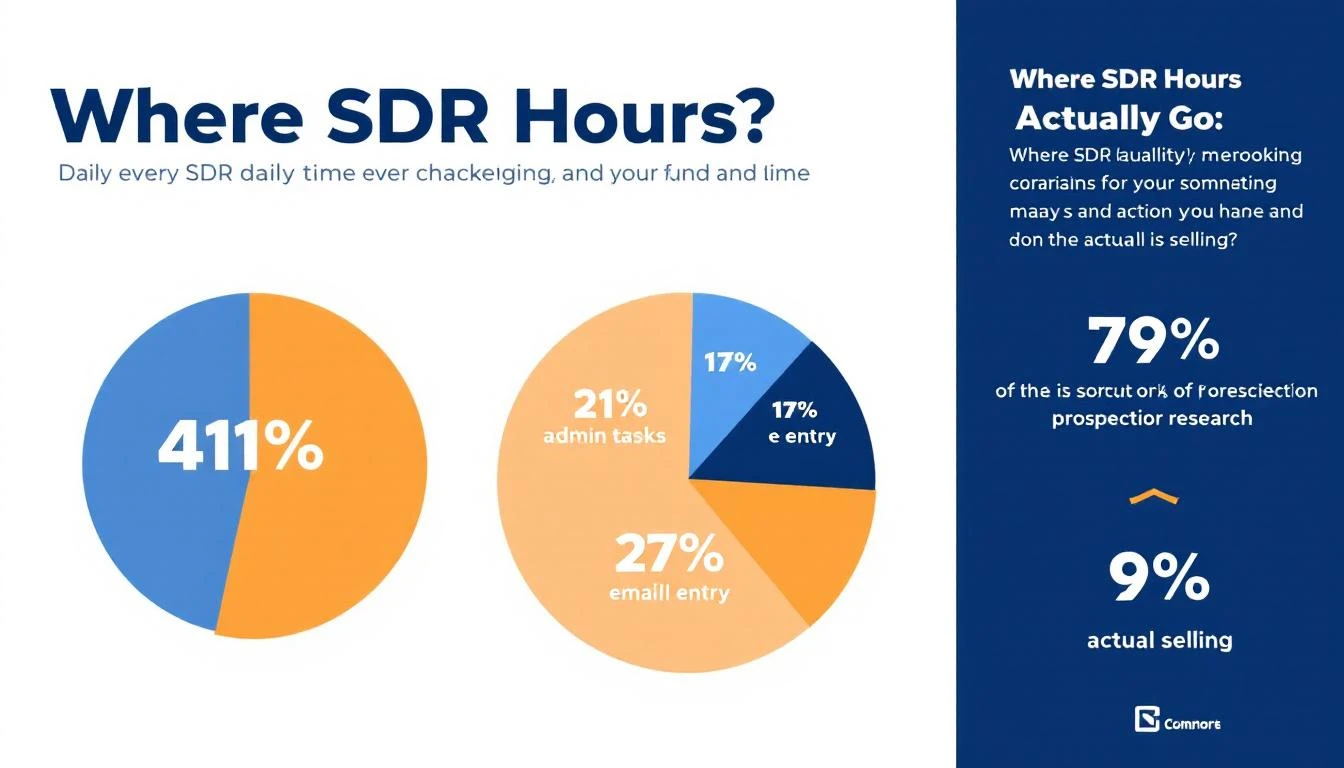
SDR daily time breakdown showing most hours go to admin, not selling


The SDR Productivity Crisis (By the Numbers)โ€‹

Before we talk solutions, let's quantify the problem.

For an SDR earning $60,000 annually, approximately $22,200 is spent on research time alone, according to MarketsandMarkets research. That's 37% of their salary going toward activities that could be automated or dramatically accelerated.

Here's where a typical SDR's 8-hour day actually goes:

ActivityTimeAutomatable?
Prospecting research2.5 hrsโœ… Mostly
Email/message drafting1.5 hrsโœ… Partially
CRM data entry1.5 hrsโœ… Fully
Internal meetings1 hrโŒ Not really
Actual selling (calls, demos, conversations)1.5 hrsโŒ Keep human

That means roughly 5.5 hours per day are spent on tasks that automation can either eliminate or dramatically reduce. And yet most SDR teams are still running the same manual playbook they used in 2020.

The teams that figure this out first don't just save timeโ€”they fundamentally change their unit economics. When your SDRs spend 5 hours selling instead of 1.5, you don't need to hire 3x more reps. You need better workflows.

The Real Cost of Manual SDR Workโ€‹

Let's do the math on a 5-person SDR team:

  • 5 SDRs ร— $60K salary = $300K/year
  • 41% on admin = $123K wasted on non-selling activities
  • At 83.4% missing quota, you're likely generating pipeline from only 1-2 of those reps consistently

Now compare that to a team running proper automation:

  • Same 5 SDRs, but reclaiming even half of that admin time
  • That's the equivalent of adding 2.5 more full-time sellers without a single new hire
  • At average SDR pipeline generation of $3M/year per rep, that's $7.5M in additional pipeline capacity

The ROI case for SDR automation isn't theoretical. It's mathematical.


What Should (and Shouldn't) Be Automatedโ€‹

Here's where most teams get it wrong: they try to automate everything, including the parts that require human judgment. Or they automate the easy stuff (like email sends) while ignoring the high-leverage bottlenecks (like lead prioritization).

โœ… Automate These (High ROI, Low Risk)โ€‹

1. Lead identification and enrichment Stop having SDRs manually research companies. Website visitor identification can tell you exactly which companies are on your site. Enrichment tools fill in the contacts, tech stack, and firmographics automatically.

2. Lead scoring and prioritization Your SDRs shouldn't decide who to call first. A scoring model that weighs intent signals, fit score, and engagement should surface the hottest leads automatically every morning.

3. CRM updates and activity logging Every minute spent updating Salesforce is a minute not spent selling. Auto-log emails, calls, and meeting notes. Period.

4. Email sequencing and follow-ups The first touch, the follow-up cadence, the "checking in" emailsโ€”these should run on autopilot with well-built sequences. Human reps step in when someone replies.

5. Meeting scheduling Calendar links, round-robin routing, timezone detection, confirmation emails. All automatable. All still done manually at most companies.

6. Data hygiene Bounced emails, job changes, company updates. Champion tracking and data validation should run in the background, not eat into selling time.

โŒ Keep These Human (For Now)โ€‹

1. Discovery calls and demos AI can book the meeting. A human should run it. Buyers still want to talk to someone who understands their problem, asks good follow-up questions, and adapts in real-time.

2. Objection handling on live calls Nuance matters. A prospect saying "we're not ready" vs. "we're evaluating competitors" requires completely different responses that AI still struggles with in real-time conversation.

3. Strategic account research for enterprise deals For your top 20 target accounts, you want a human doing deep researchโ€”reading 10-Ks, understanding org charts, finding the real pain. Don't automate your most important deals.

4. Relationship building A personalized LinkedIn message referencing someone's recent podcast appearance can't be templated. The best SDRs earn trust through genuine connection.

โš ๏ธ The Gray Zone (Automate Carefully)โ€‹

Personalized first-touch emails: AI can draft them, but a human should review before sending to high-value prospects. For mid-market and below, AI personalization at scale is increasingly viable.

Call preparation: Automate the research summary, but the rep should actually read it and form their own point of view before dialing.

LinkedIn outreach: Automate connection requests at your peril. Thoughtful, automated follow-up messages after a connection? That works.


The 5 Pillars of SDR Automationโ€‹

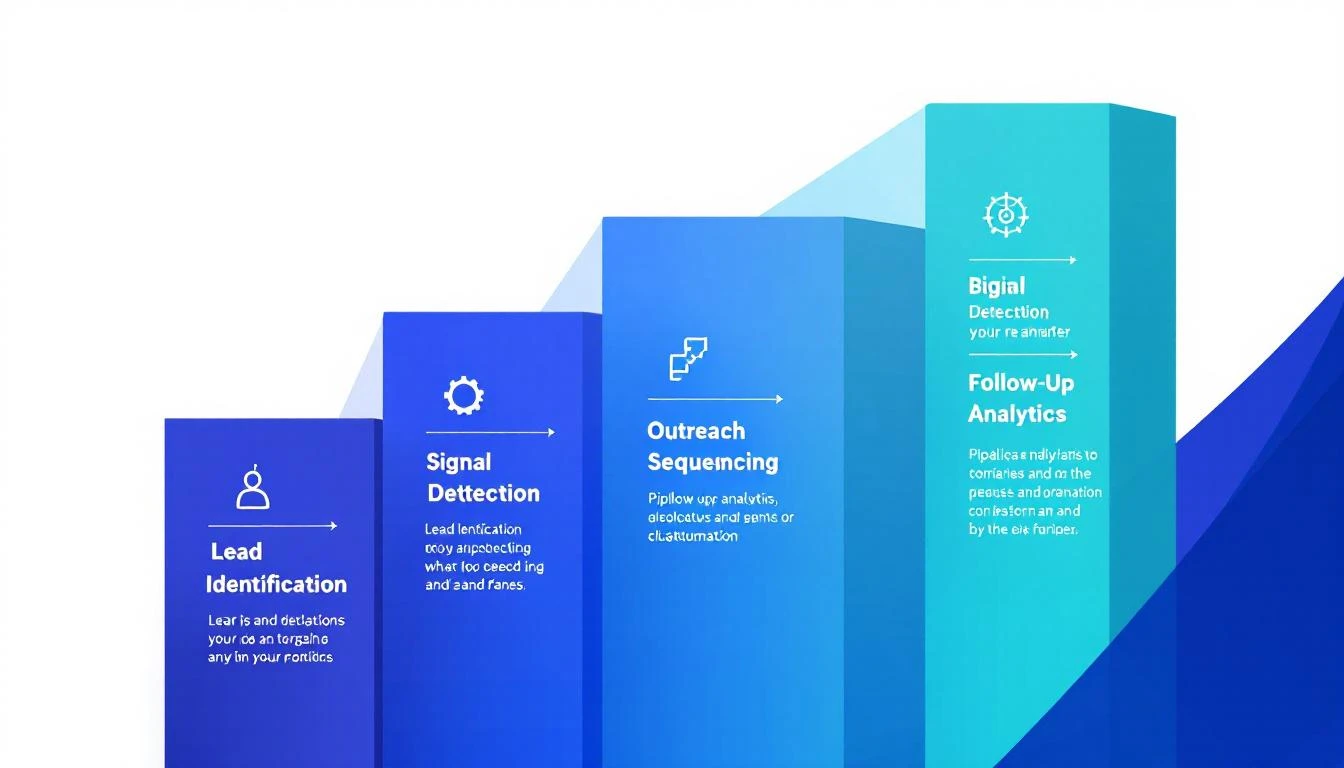
Think of SDR automation not as a single tool, but as five interconnected systems. Miss one, and the whole thing underperforms.

The five pillars of SDR automation: identification, signals, outreach, follow-up, and analytics

Pillar 1: Lead Identificationโ€‹

The question: Who should we be talking to?

This is the foundation. If you're still waiting for form fills to know who's interested, you're seeing maybe 2% of your actual demand. The other 98% visit your site, read your content, and leave without ever raising their hand.

Website visitor identification changes the game by revealing which companies are actively researching you. Combined with enrichment dataโ€”contacts, tech stack, revenue, headcountโ€”your SDRs start each day knowing exactly who showed up.

What good looks like:

  • You know which companies visited your site in the last 24 hours
  • Each company is automatically matched to contacts in your ICP
  • Contact data (email, phone, LinkedIn, title) is pre-enriched
  • Everything flows into your CRM without manual entry

Key metrics: Match rate, enrichment accuracy, time from visit to SDR notification.

Read more: Best Website Visitor Identification Tools in 2026

Pillar 2: Signal Detection and Scoringโ€‹

The question: Who should we talk to first?

Not all leads are equal. A VP of Sales who visited your pricing page three times this week is a fundamentally different prospect than a marketing intern who clicked a blog post once.

Intent signals come in layers:

  • First-party signals: Website visits, content downloads, email opens, chatbot conversations
  • Third-party signals: G2 category research, review site comparisons, competitor keyword searches
  • Behavioral signals: Pricing page visits, demo page bounces, repeat visits within 48 hours

The best SDR automation stacks don't just collect these signalsโ€”they score and prioritize them into a daily action list that tells reps: call this person first, email this person second, skip this one until next week.

This is where most tools stop. They show you a dashboard of signals and say "figure it out." The playbook approach is different: it turns signals into specific actions. Not "Company X visited your site" but "Call Jane Smith, VP Sales at Company X. She visited the pricing page twice. Here's what to say."

Key metrics: Signal-to-meeting conversion rate, time from signal to first touch, speed to lead.

Pillar 3: Outreach Sequencingโ€‹

The question: What do we say, and when?

Once you know who to contact and why, the outreach needs to be multi-channel, well-timed, and personalized enough to not feel automated.

A solid sales cadence in 2026 typically looks like:

  • Day 1: Personalized email referencing their specific signal (site visit, G2 research, etc.)
  • Day 2: LinkedIn connection request with a brief note
  • Day 3: Phone call with voicemail drop
  • Day 5: Follow-up email with relevant case study
  • Day 8: LinkedIn message referencing the email
  • Day 12: Final breakup email

The key insight: the sequence should adapt based on engagement. If someone opens email #1 three times but doesn't reply, the system should automatically escalateโ€”move up the call, adjust the messaging angle, maybe trigger a different sequence entirely.

Cold email templates that worked in 2023 are largely dead. Modern outreach needs to reference real context: what the prospect's company is doing, what they researched on your site, what's happening in their industry. That's where AI-powered personalization becomes essentialโ€”not to replace the human touch, but to make it scalable.

Key metrics: Reply rate by channel, positive reply rate, meetings booked per sequence.

Pillar 4: Follow-Up Automationโ€‹

The question: How do we make sure nothing falls through the cracks?

This is the silent killer of SDR teams. A prospect says "reach out next quarter" and it goes into a mental note that never gets acted on. A demo gets booked but the follow-up email with the case study never sends. A champion changes jobs and nobody notices for three months.

Automated follow-up handles:

  • Post-meeting sequences: Recap email, case study, ROI calculatorโ€”all triggered automatically after a completed call
  • Re-engagement sequences: Prospects who went dark get a fresh touch after 30, 60, 90 days
  • Job change alerts: When a champion moves to a new company, your system flags it and creates a new opportunity
  • Renewal and expansion signals: Existing customers showing research behavior get routed to the right team

The difference between a good SDR and a great one often comes down to follow-up discipline. Automation doesn't make SDRs lazyโ€”it makes the disciplined ones superhuman.

Key metrics: Follow-up compliance rate, re-engagement reply rate, pipeline recovered from dormant leads.

Pillar 5: Pipeline Analyticsโ€‹

The question: Is any of this actually working?

You can't optimize what you don't measure, and most SDR teams measure the wrong things. Activity metrics like "emails sent" and "calls made" are vanity metrics that tell you nothing about pipeline quality.

What matters:

  • Cost per qualified meeting: Total SDR cost (salary + tools + overhead) divided by qualified meetings booked
  • Signal-to-meeting conversion: What percentage of identified signals turn into booked meetings?
  • Speed to lead: How fast does your team respond to high-intent signals? (Under 5 minutes is the target)
  • Pipeline velocity: How quickly do SDR-sourced opportunities move through your funnel?
  • Channel attribution: Which outreach channel (email, phone, LinkedIn, chat) drives the most pipeline?

Good automation platforms track all of this natively. If yours requires you to build dashboards in a separate BI tool, that's a red flag.


Building Your SDR Automation Stack: Step by Stepโ€‹

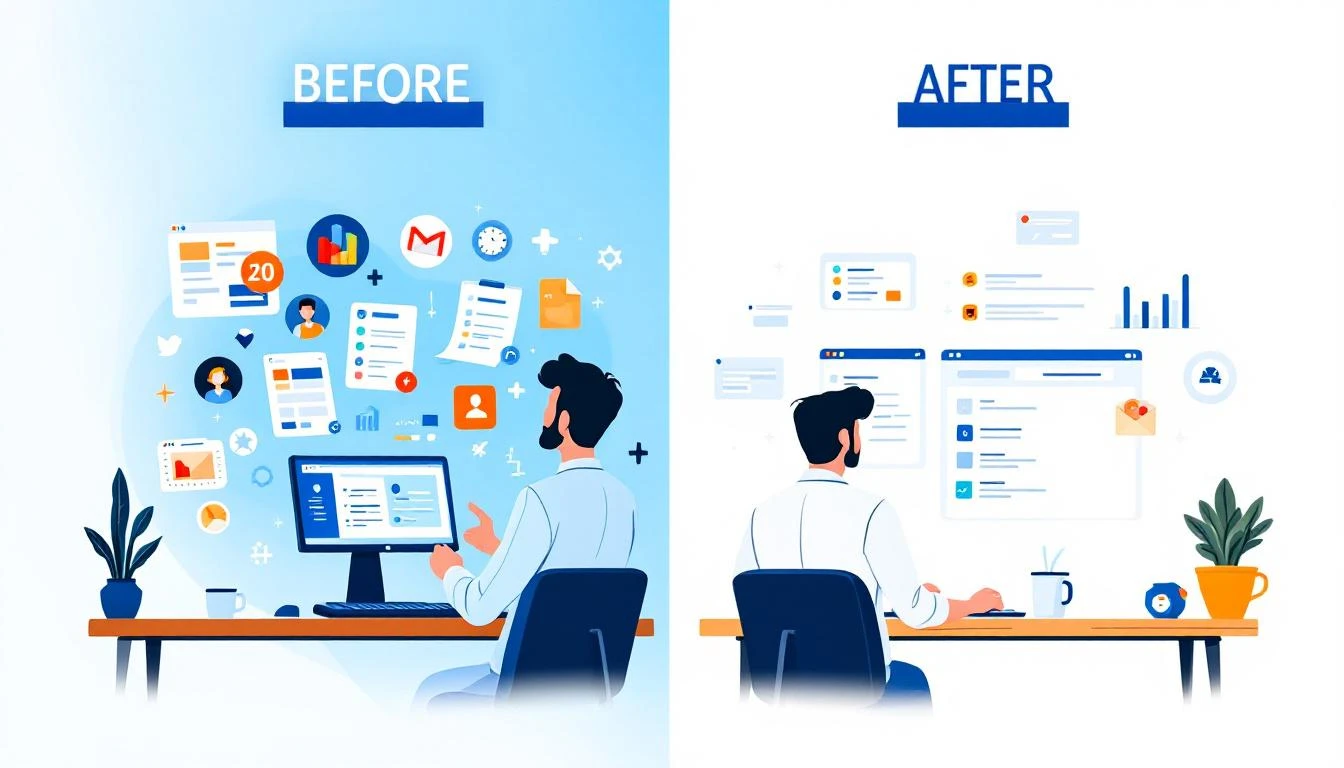
Before and after SDR automation: from 20 tabs to one task list

Here's the practical implementation path, ordered by impact and difficulty.

Phase 1: Foundation (Week 1-2)โ€‹

Goal: Know who's on your site and get them into your CRM automatically.

  1. Deploy website visitor identification. This is the single highest-ROI automation move you can make. Overnight, you go from guessing who's interested to knowing exactly which companies visited and what they looked at.

  2. Set up enrichment. Every identified company should automatically resolve to specific contacts with verified email and phone. Your SDRs should never manually look up a prospect's contact info again.

  3. Connect to your CRM. New leads flow in automatically. No CSV exports. No manual entry. Real-time sync.

Expected impact: 10-20 new qualified leads per week that you were previously missing entirely.

Phase 2: Prioritization (Week 3-4)โ€‹

Goal: Stop letting SDRs decide who to call. Let data decide.

  1. Implement lead scoring based on fit (ICP match) and intent (behavioral signals). Weight pricing page visits and repeat visits heavily.

  2. Build a daily SDR playbook that surfaces the top 20-30 actions each rep should take, ranked by likelihood to convert.

  3. Set up speed-to-lead alerts. When a high-intent prospect hits your site, the assigned SDR should know within minutesโ€”not hours.

Expected impact: 2-3x improvement in meetings booked per rep, because they're calling the right people at the right time.

Phase 3: Outreach (Week 5-8)โ€‹

Goal: Multi-channel sequences that run themselves until a prospect engages.

  1. Build 3-5 core cadences for different scenarios: warm inbound, cold outbound, re-engagement, event follow-up, champion job change.

  2. Set up email automation with personalization tokens that pull from your enrichment dataโ€”not just {First Name}, but references to their industry, tech stack, and recent signals.

  3. Integrate your dialer. Calls should be one-click from the playbook. Call recordings and notes should auto-log to the CRM. Smart dialers with AI-powered voicemail drop save 30+ minutes per day per rep.

Expected impact: 50-70% reduction in time spent on manual outreach setup. Consistent multi-channel coverage for every lead.

Phase 4: Intelligence (Week 9-12)โ€‹

Goal: The system gets smarter over time.

  1. Layer in third-party intent data. G2 research, review site activity, competitor keyword searchesโ€”these signals tell you who's in-market before they ever visit your site.

  2. Implement signal orchestration to combine first-party and third-party signals into unified priority scores.

  3. Set up A/B testing on email templates, call scripts, and sequence timing. Let the data tell you what works, not gut feel.

Expected impact: Pipeline predictability. You can start forecasting how many meetings next month based on current signal volume and conversion rates.


The Playbook Approach vs. The Dashboard Approachโ€‹

This is the most important strategic decision you'll make in SDR automation, and it's one most buyers don't even think about.

The Dashboard Approach (most tools): Here's a dashboard with all your signals, leads, and data. Your SDRs log in, interpret the data, decide who to contact, figure out what channel to use, craft the message, and execute. The tool provides information. The SDR provides the judgment.

The Playbook Approach (where the industry is heading): Here's your task list for today, ranked by priority. Call this personโ€”here's why and what to say. Email this personโ€”here's the draft, customized to their signal. Skip this one, they're not ready yet. The tool provides the action. The SDR provides the execution.

The difference sounds subtle but it's massive:

  • Dashboard approach: SDR opens 6 tabs, spends 20 minutes deciding who to call
  • Playbook approach: SDR opens one screen, starts calling immediately

Teams using the playbook approach consistently report going from 20 tabs to one task list, with dramatic improvements in both productivity and rep satisfaction.

When you're evaluating SDR automation tools, ask this question: "Does this tool tell my SDRs what to do, or just show them data?" The answer reveals everything.


Measuring SDR Automation ROIโ€‹

Don't trust vendors who only show "emails sent" or "contacts enriched." Those are input metrics. Here's how to actually measure ROI:

The Formulaโ€‹

Monthly ROI = (Pipeline Generated - Total Cost) / Total Cost ร— 100

Where:

  • Pipeline Generated = Meetings booked ร— average opportunity value ร— close rate
  • Total Cost = SDR salaries + tool costs + management overhead

Benchmarks Worth Trackingโ€‹

MetricBefore AutomationAfter Automation (Target)
Meetings booked per SDR/month8-1220-30
Time to first touch4-24 hoursUnder 5 minutes
Emails personalized per day15-2575-100
CRM data entry time1.5 hrs/dayNear zero
Quota attainment16.6%40%+

Red Flags Your Automation Isn't Workingโ€‹

  • More emails sent, same reply rate: You automated volume, not quality
  • SDRs still spending 1+ hour on research daily: Your enrichment isn't working
  • No improvement in speed-to-lead: Your routing and alerts are broken
  • Reps don't trust the lead scores: Your scoring model needs recalibration
  • Tool adoption under 60%: Your workflow doesn't match how reps actually work

The 7 Most Common SDR Automation Mistakesโ€‹

1. Automating bad processes If your manual outreach gets 0 replies, automating it just sends 0-reply emails faster. Fix the strategy first.

2. Over-automating personalization "Hi {First_Name}, I noticed {Company_Name} is in the {Industry} space" is not personalization. It's mail merge with extra steps. Real personalization references specific signals and context.

3. Ignoring data quality Automation amplifies whatever you feed it. Bad email data = bounced sequences = domain reputation damage = all your emails go to spam. Invest in data hygiene before scale.

4. Building a Frankenstein stack 8 different tools that barely integrate is worse than 1 tool that does 80% of what you need. The trend toward consolidated platforms exists for a reason.

5. Not measuring what matters If you're celebrating "10,000 emails sent this month" instead of "40 qualified meetings booked," your metrics are broken. Read our SDR metrics guide.

6. Forgetting the human element The best automation makes your SDRs better, not redundant. If your reps feel like button-pushers, you've automated wrong. The goal is to eliminate busywork so they can focus on what humans do best: build relationships and solve problems.

7. Set-and-forget deployment SDR automation needs continuous tuning. Sequences that worked last quarter might underperform now. Scoring models drift as your market evolves. Budget time for monthly optimization.


What's Next: SDR Automation in 2026 and Beyondโ€‹

The landscape is shifting fast. Here's what's coming:

AI SDR agents are getting real. Not the "send 10,000 cold emails" kindโ€”the ones that can hold a genuine conversation, qualify in real-time, and book meetings without human intervention. Salesforce, Qualified, and several startups are making progress here. But we're still early. For most teams in 2026, AI augments SDRs rather than replacing them.

Signal quality matters more than signal volume. As more companies deploy intent data, the competitive advantage shifts from "having signals" to "acting on the right signals, faster than anyone else." Signal quality vs. speed is the new battleground.

Consolidation is accelerating. The days of stitching together 10 point solutions are ending. Buyers want one platform that handles identification โ†’ scoring โ†’ outreach โ†’ analytics. The GTM agent stack is replacing the GTM tool stack.

Outbound isn't deadโ€”it's evolving. The teams claiming outbound is dead are the ones still doing spray-and-pray. Signal-based, relevant, well-timed outbound is working better than ever. The bar is just higher.


Getting Started Todayโ€‹

You don't need to automate everything at once. Start here:

  1. Audit your SDRs' time. Have each rep track their activities for one week. The results will shock you (and justify the investment).

  2. Deploy visitor identification. This is the single biggest unlock. You'll immediately see 10-20x more demand than your forms capture.

  3. Build your first automated cadence. Start with your most common scenarioโ€”probably warm outbound to identified visitors.

  4. Measure ruthlessly. Meetings booked, speed to lead, pipeline generated. Everything else is noise.

The math is simple: SDRs who spend more time selling book more meetings. Automation is how you get there.


Ready to see what SDR automation looks like in practice? Book a demo โ†’ and we'll show you how MarketBetter turns visitor signals into a daily action plan your SDRs will actually use.


Related reading:

The SDR Productivity Crisis: 83% Miss Quota While Selling Just 2 Hours a Day [2026 Data]

ยท 11 min read
MarketBetter Team
Content Team, marketbetter.ai

SDR time allocation breakdown showing only 40% spent on actual selling activities

Here's the number that should alarm every sales leader: 83.4% of SDRs fail to consistently hit quota. Not occasionally miss โ€” consistently fail.

That's not a talent problem. It's a systems problem.

We pulled data from seven major studies published in 2024โ€“2026 โ€” covering 170,000+ leads, 114 B2B companies, and millions of sales activities โ€” to understand why SDR productivity has gotten worse despite a decade of increasingly sophisticated sales technology. The findings reveal a structural crisis hiding in plain sight.

The average SDR sells for roughly two hours a day. The rest disappears into CRM entry, lead research, tool switching, internal meetings, and manual tasks that technology was supposed to eliminate. Meanwhile, the leads they do work sit unanswered for an average of 29 hours โ€” and 63% never get a response at all.

This isn't a collection of disconnected statistics. It's a picture of an industry-wide failure to solve the core SDR problem: too many tools, not enough direction.

The Data: Where SDR Time Actually Goesโ€‹

Salesforce's 2026 State of Sales report dropped the most sobering stat of the year: sales reps spend 60% of their time on non-selling tasks. That means in an 8-hour workday, your SDRs are actively selling for just over 3 hours.

But the reality may be worse. When you break down what "selling" means in practice โ€” and remove time spent on call prep, pre-call research, and post-call logging that most teams still count as "selling" โ€” the actual time spent in live conversations with prospects drops below 2 hours.

Here's how the average SDR day breaks down according to aggregated data from Salesforce, InsideSales, and Bridge Group reports:

Activity% of DayHours (8hr day)
Active selling (calls, emails, demos)40%3.2 hrs
CRM data entry and admin21%1.7 hrs
Lead research and preparation17%1.4 hrs
Internal meetings12%1.0 hrs
Tool switching and context changes10%0.8 hrs

The 10% lost to tool switching is particularly insidious because it's invisible. Nobody tracks how many times an SDR alt-tabs between their CRM, email tool, dialer, LinkedIn, enrichment platform, and sales engagement software. But research on context-switching costs suggests each switch carries a cognitive penalty of 15โ€“25 minutes to fully refocus.

If your SDRs use 7+ tools (the B2B average), they're paying that penalty dozens of times daily.

The Speed-to-Lead Collapseโ€‹

The data on lead response times tells a story of an industry moving backward.

Lead response time decay curve showing conversion probability dropping rapidly after 5 minutes

The Timeline of Declineโ€‹

StudyYearKey Finding
Harvard Business Review201142-hour average response time
Velocify2016Responding within 1 minute = 391% higher conversion
InsideSales2021Only 0.1% of companies respond within 5 minutes
RevenueHero202463% of companies never respond; 29+ hour average
Workato202599%+ fail the 5-minute test; 11h 54m average email

Read that timeline again. In 2011, the average response time was 42 hours. In 2024, it's 29 hours for the companies that respond at all โ€” but 63% don't respond at all. The non-response rate nearly tripled from 23% in 2011 to 63% in 2024.

More tools. More automation. Worse results.

Why It Matters: The Revenue Mathโ€‹

The conversion impact is not linear. It's a cliff.

  • Within 1 minute: 391% higher conversion (Velocify)
  • Within 5 minutes: 9x more likely to convert (InsideSales)
  • Within 1 hour: 7x higher qualification rate vs. waiting longer (HBR)
  • After 24 hours: You're cold-calling someone who's already moved on

And here's the stat that should end every debate about speed to lead: 78% of buyers purchase from the first company that responds. Not the best product. Not the cheapest option. The first one to show up.

When your average response time is 29 hours, you're not competing for the deal. You're already out of it.

The Hidden Bottleneck Nobody Blamesโ€‹

Here's what most teams miss. The Workato study broke response time into two components:

Lead Response Time = Lead Processing Time + Rep Response Time

Most companies blame slow reps. The data shows the opposite. The average SDR responds within minutes of seeing a lead in their queue. But the lead takes hours to get routed to them.

The processing pipeline โ€” enrichment, lead-to-account matching, territory assignment, routing rules, round-robin logic โ€” is where deals go to die. The average personalized email response takes 11 hours and 54 minutes (Workato), and most of that delay is processing, not rep laziness.

You can't coach your way out of a broken routing system.

The Quota Attainment Crisisโ€‹

The headline number โ€” 83.4% of SDRs miss quota โ€” becomes less surprising when you see the underlying metrics:

  • Average meetings booked per month: 15 (Bridge Group)
  • Dials to connect: 18+ attempts per connection
  • Call-back rate: Under 1%
  • Cold email response rate: 1โ€“2%
  • Quality conversations per day: 3.6

That means your average SDR has fewer than 4 real conversations per day. To book 15 meetings from ~72 monthly connects, they need a 21% connect-to-meeting conversion rate. That's achievable for veterans. It's brutal for the 60% of SDRs in their first 12 months.

And tenure compounds the problem. Average SDR tenure is 6โ€“23 months. Just as someone becomes proficient, they promote out or leave. The team is perpetually in ramp mode.

What Top Performers Do Differentlyโ€‹

The data reveals a clear pattern separating the 16.6% who consistently hit quota:

1. They qualify ruthlessly. Companies with thorough qualification processes saw closing ratios jump from 11% to 40% (InsideSales). Top SDRs don't work more leads โ€” they work the right leads.

2. They use signal-based prioritization. Instead of working leads alphabetically or by age, elite SDRs prioritize by intent signals โ€” who's on the website right now, who just changed jobs, who's researching competitors.

3. They batch their day. The "Golden Hours / Platinum Hours" framework separates prime prospecting time (calls and outreach) from admin work. Top reps protect their selling time aggressively.

4. They hit 14.5% meaningful conversation rates with decision-makers โ€” nearly 4x the average โ€” through better targeting and personalization, not more volume.

The $2.7 Billion Waste Problemโ€‹

Let's put a dollar figure on this crisis.

B2B marketers spend over $4.6 billion annually on advertising to generate leads. An estimated $2.7 billion of that is wasted due to slow or nonexistent follow-up (Credofy). You're paying to generate demand and then letting it rot.

At the individual company level, the math is just as ugly. Consider a mid-market B2B company:

MetricValue
Monthly inbound leads200
Average deal value$15,000
Conversion rate (fast response)3%
Conversion rate (slow response)0.15%
Revenue lost monthly$8,550
Revenue lost annually$102,600

That's $100K+ per year lost โ€” not to bad marketing, not to a weak product, but to slow response. For most B2B companies, that's 1โ€“2 SDR salaries that could be funded by simply responding faster.

The AI Inflection Pointโ€‹

The good news: the industry is finally addressing this structurally, not just incrementally.

Comparison of the old SDR workflow with disconnected tools versus the new AI-powered unified workflow

AI adoption in sales has exploded from 39% to 81% in just two years (Salesforce). And the results are significant:

  • 46% productivity increase for teams using AI-powered sales tools
  • 20% increase in pipeline volume with AI implementation
  • 30% improvement in lead conversion rates
  • AI-powered personalization delivers 9.25% appointment rate โ€” better than most manual outreach

Salesforce reported that their own AI SDR agent created 3,200 opportunities in four months by working the low-score leads that human SDRs couldn't justify spending time on.

But here's the nuance the "AI will replace SDRs" crowd misses: AI doesn't replace selling. It replaces the 60% of the day that isn't selling.

The best implementations aren't replacing human SDRs with AI agents. They're using AI to:

  1. Eliminate processing delay โ€” Route, enrich, and prioritize leads in seconds, not hours
  2. Kill the research tax โ€” Pre-populate account context so reps don't spend 17% of their day Googling prospects
  3. Automate admin โ€” CRM updates, activity logging, and follow-up scheduling happen automatically
  4. Provide daily direction โ€” Instead of "here are your 200 leads, figure it out," AI tells the SDR exactly who to call, what to say, and why now

This is the difference between an AI that replaces the SDR and an AI that makes the SDR 3x more effective. The former is a race to commoditized outreach. The latter is how you win.

The Consolidation Imperativeโ€‹

The average B2B sales team uses 7โ€“12 tools across prospecting, enrichment, engagement, dialing, and analytics. At $1,500โ€“$4,000 per user per month, that's an enormous expense delivering a 40% selling rate and 29-hour response times.

The answer isn't another tool. It's fewer tools that do more.

Organizations with well-integrated enablement tech stacks are 42% more likely to boost sales productivity (Highspot). Integration isn't a nice-to-have. It's the difference between 3-hour and 6-hour selling days.

What does the right consolidated stack look like?

  • Signal layer: Website visitor identification, intent data, buying signals in one view
  • Enrichment layer: Contact data, company data, and champion tracking without manual lookups
  • Execution layer: Email, dialer, and multi-channel outreach from one interface
  • Intelligence layer: AI that tells the SDR what to do next โ€” not just shows data and makes them figure it out

This is what "from 20 tabs to one task list" actually means in practice.

What to Do About Itโ€‹

If you're a sales leader reading this data and recognizing your own team, here's the playbook:

1. Audit Your True Selling Timeโ€‹

Have each SDR log their actual activities for one week. Not what the CRM says โ€” what they actually did. You'll likely find selling time closer to 2 hours than the 3.2 you assumed.

2. Measure Lead Processing Time Separatelyโ€‹

Break your response time into processing (system) and rep response (human). Fix the system first โ€” it's usually the bigger bottleneck and doesn't require behavior change.

3. Cut Your Stack, Don't Add To Itโ€‹

Every tool you add increases context-switching cost. Before buying tool #8, ask: can tool #3 do this if I configured it properly? Tool consolidation is the highest-ROI move in sales ops right now.

4. Move From Data Dashboards to Daily Playbooksโ€‹

Your SDRs don't need more data. They need direction. A daily prioritized task list โ€” who to call, what to say, and why today โ€” eliminates the 17% research tax and dramatically improves response times.

5. Adopt AI for the Non-Selling 60%, Not the Selling 40%โ€‹

The highest-impact AI use cases in sales aren't automated email blasts. They're lead routing in seconds instead of hours, automatic enrichment, CRM auto-updates, and intelligent prioritization. Keep humans on the conversations. Let AI handle everything else.

The Bottom Lineโ€‹

The SDR productivity crisis isn't caused by lazy reps. It's caused by:

  • Tool sprawl that eats 10%+ of every day in context switching
  • Processing delays that turn hot leads cold before reps ever see them
  • Data overload without direction โ€” dashboards instead of playbooks
  • Constant ramp from 6โ€“23 month average tenure

The teams solving this aren't buying more tools. They're consolidating into platforms that combine signals, enrichment, and execution into a single daily SDR workflow โ€” and using AI to eliminate the 60% of the day that was never selling to begin with.

The data is clear: the gap between top-performing SDR teams and everyone else is no longer effort. It's architecture.


Want to see what an AI-powered SDR workflow looks like in practice? Book a demo โ†’


Sourcesโ€‹

  • Salesforce State of Sales Report, 2026
  • RevenueHero Lead Response Study, 2024 (1,000+ companies)
  • Workato Lead Response Time Study, 2024โ€“2025 (114 B2B companies)
  • InsideSales.com Lead Response Study, 2021 (55M activities, 5.7M leads)
  • Harvard Business Review (Oldroyd, McElheran, Elkington), 2011 (15K leads)
  • Velocify Lead Response Analysis, 2016 (millions of records)
  • Highspot State of Sales Enablement Report, 2025
  • Bridge Group SDR Metrics and Compensation Report
  • Credofy B2B Lead Response Framework

Best CRM for SDR Teams 2026: 10 Picks Ranked by Email Tracking, Templates & Pipeline Speed

ยท 16 min read
sunder
Founder, marketbetter.ai

Best CRM for SDR Teams 2026 โ€” comparing the top tools for sales development reps

Most CRMs were built for account executives closing deals. Not for SDRs booking meetings.

That's why 62% of SDRs say their CRM slows them down instead of speeding them up. They spend more time logging activities and updating fields than actually selling. The problem isn't laziness โ€” it's that traditional CRMs treat prospecting as an afterthought.

In 2026, the best CRM for SDR teams does three things traditional CRMs don't:

  1. Tells reps WHO to contact (not just stores contacts)
  2. Tells reps WHAT to say (not just tracks emails)
  3. Tells reps WHEN to follow up (not just sets reminders)

We evaluated 10 CRMs specifically through the lens of an SDR manager running a 3-10 person outbound team. Here's what we found.

What SDR Teams Actually Need From a CRMโ€‹

Before the rankings, let's define what matters. SDR workflows are fundamentally different from AE workflows:

SDR NeedAE Need
High-volume prospectingDeal management
Multi-channel sequencingPipeline forecasting
Quick activity loggingContract tracking
Lead routing and prioritizationRevenue reporting
Call + email in one viewStakeholder mapping

Most "best CRM" lists evaluate tools on AE criteria. This guide evaluates purely on SDR workflow fit.

The 7 Criteria We Usedโ€‹

  1. Prospecting speed โ€” How fast can a rep go from "new lead" to "first touch"?
  2. Multi-channel support โ€” Email, phone, LinkedIn, chat from one interface?
  3. Activity auto-logging โ€” Does the CRM log calls/emails automatically, or manually?
  4. Lead prioritization โ€” Does it tell reps who to contact first, or just show a list?
  5. Sequence/cadence support โ€” Built-in or requires add-ons?
  6. Team management โ€” Can managers see rep activity, coach, and redistribute leads?
  7. Price per SDR seat โ€” Total cost including required add-ons, not just the base plan.

The 10 Best CRMs for SDR Teams in 2026โ€‹

1. MarketBetter โ€” Best for AI-Powered SDR Workflowsโ€‹

Price: starting at $99/user/month ( included)

Why SDR teams pick it: MarketBetter isn't a traditional CRM โ€” it's an SDR operating system. Instead of dumping contacts into a database and hoping reps figure out what to do, MarketBetter generates a Daily SDR Playbook that tells each rep exactly who to contact, what channel to use, and what to say.

Key SDR features:

  • Daily Playbook โ€” AI-prioritized task list based on intent signals, website visits, and engagement history
  • Website visitor identification โ€” Know which companies are on your site right now
  • Smart Dialer โ€” Built-in calling with AI-powered call coaching
  • AI Chatbot โ€” Engages visitors and routes qualified leads to SDRs instantly
  • Email automation โ€” Hyper-personalized sequences based on prospect behavior
  • AI SEO tracking โ€” Monitor how AI tools like ChatGPT and Perplexity describe your brand

What G2 reviewers say: 4.97/5 rating with praise for "cutting manual SDR work by 70%" and "2x faster speed-to-lead."

Honest pros:

  • Eliminates the "who do I call next?" problem entirely
  • Combines visitor ID + sequencing + dialer in one platform โ€” no Frankenstein stack
  • Purpose-built for SDR workflows, not retrofitted from an AE CRM

Honest cons:

  • Not a traditional CRM โ€” if you need deal management and pipeline forecasting, you'll still want a CRM alongside it
  • Smaller company than Salesforce/HubSpot (but that means faster support and iteration)

Best for: B2B SDR teams (3-10 reps) that want AI to prioritize their day instead of manually working through lists.

See MarketBetter in action โ†’


2. HubSpot Sales Hub โ€” Best Free CRM for Early-Stage SDR Teamsโ€‹

Price: Free (basic) | $20/user/mo (Starter) | $100/user/mo (Professional) | $150/user/mo (Enterprise)

Why SDR teams pick it: HubSpot's free tier is genuinely useful for small SDR teams getting started. Contact management, email tracking, and basic sequences work without paying a dime. The jump to Professional ($100/user/mo) unlocks the features SDRs actually need โ€” sequences, predictive lead scoring, and calling.

Key SDR features:

  • Email tracking and templates
  • Sequences (Professional+)
  • Built-in calling with recording
  • Meeting scheduling links
  • Lead scoring (Professional+)
  • Activity auto-logging for email and calls

What G2 reviewers say: 4.4/5 (12,000+ reviews). SDRs praise the ease of use but frequently complain about the steep price jump from Starter to Professional.

Honest pros:

  • Free tier is actually usable (not just a demo)
  • Excellent email tracking and template library
  • Huge integration ecosystem

Honest cons:

  • Sequences require Professional ($100/user/mo) โ€” the free/Starter tiers are too limited for real SDR work
  • Gets expensive fast: 5 SDRs on Professional = $500/mo before any add-ons
  • Lead scoring is basic compared to intent-based prioritization tools
  • No website visitor identification without third-party add-on

Best for: Early-stage teams (1-3 SDRs) who want to start free and grow into a paid plan.


3. Salesforce Sales Cloud โ€” Best for Enterprise SDR Teams With Dedicated Opsโ€‹

Price: $25/user/mo (Starter) | $100/user/mo (Professional) | $165/user/mo (Enterprise) | $330/user/mo (Unlimited)

Why SDR teams pick it: Salesforce is the CRM every enterprise already has. SDR teams inherit it, not choose it. The power is in customization โ€” with a dedicated RevOps person, you can build workflows that rival any purpose-built SDR tool. Without one, it's a data entry nightmare.

Key SDR features:

  • Einstein AI lead scoring and activity capture
  • High Velocity Sales add-on for cadences ($75/user/mo extra)
  • Extensive reporting and dashboards
  • Territory and lead routing rules
  • AppExchange marketplace (thousands of SDR add-ons)

What G2 reviewers say: 4.4/5 (23,000+ reviews). Power users love the customization. SDRs consistently complain about complexity and "too many clicks to do simple things."

Honest pros:

  • Most customizable CRM on the market
  • Einstein AI is getting genuinely useful for lead scoring
  • If your company already uses Salesforce, it's the path of least resistance

Honest cons:

  • SDR-specific features (cadences, power dialer) require expensive add-ons โ€” a fully equipped SDR seat costs $240+/mo
  • Requires admin/ops support to configure properly
  • Data entry burden is real โ€” SDRs spend 20-30% of their time updating Salesforce
  • Setup takes weeks to months, not hours

Best for: Enterprise companies (50+ SDRs) with dedicated Salesforce admins who can build custom SDR workflows.


4. Close CRM โ€” Best Built-In Calling Experience for SDR Teamsโ€‹

Price: $29/user/mo (Starter) | $109/user/mo (Professional) | $149/user/mo (Business)

Why SDR teams pick it: Close was built by salespeople who were frustrated with Salesforce. The built-in power dialer is legitimately the best native calling experience in any CRM. If your SDR team is phone-heavy, Close is the obvious choice.

Key SDR features:

  • Built-in power dialer and predictive dialer
  • Automated email sequences
  • Call coaching and recording
  • Pipeline view with drag-and-drop
  • SMS messaging
  • Smart Views (saved lead filters)

What G2 reviewers say: 4.7/5 (1,100+ reviews). "Best calling CRM I've ever used" is a common theme. Users love the speed โ€” minimal clicks between calls.

Honest pros:

  • Power dialer is built-in, not bolted on โ€” zero lag, instant connectivity
  • Fastest CRM for high-volume cold calling
  • Clean UI that SDRs actually enjoy using
  • Transparent pricing with no hidden add-on costs

Honest cons:

  • LinkedIn integration is weak โ€” no native social selling
  • Reporting is solid but not as deep as Salesforce
  • No website visitor identification
  • Limited marketing automation (it's a sales tool, not a marketing platform)

Best for: Phone-first SDR teams doing 50+ dials per day who want a fast, no-BS dialing experience.


5. Pipedrive โ€” Best Visual Pipeline CRM for Small SDR Teamsโ€‹

Price: $19/user/mo (Essential) | $34/user/mo (Advanced) | $64/user/mo (Professional) | $99/user/month (Power)

Why SDR teams pick it: Pipedrive's visual pipeline is intuitive โ€” drag leads between stages, see exactly where everything stands. For SDR teams that need structure without complexity, it's a strong middle ground between spreadsheets and Salesforce.

Key SDR features:

  • Visual drag-and-drop pipeline
  • Email tracking and templates
  • Workflow automation (Advanced+)
  • Built-in calling (via add-on)
  • Smart contact data enrichment
  • Team management and goal tracking

What G2 reviewers say: 4.3/5 (2,000+ reviews). Users praise the ease of setup but note that email sequencing and calling require paid add-ons.

Honest pros:

  • Easiest CRM to set up โ€” takes hours, not weeks
  • Visual pipeline is genuinely helpful for SDR managers tracking rep progress
  • Affordable entry point at $19/user/mo

Honest cons:

  • Email sequences and calling are add-ons, not included
  • No built-in lead scoring โ€” need third-party integration
  • Advanced automation only in higher tiers
  • No website visitor identification or intent signals

Best for: Small SDR teams (2-5 reps) who want a visual, easy-to-use CRM without enterprise complexity.


6. Apollo.io โ€” Best All-in-One Prospecting + CRM Comboโ€‹

Price: Free (basic) | $49/user/mo (Basic) | $79/user/mo (Professional) | $119/user/mo (Organization)

Why SDR teams pick it: Apollo combines a B2B contact database (275M+ contacts) with built-in sequencing and a lightweight CRM. SDRs can find prospects, enroll them in sequences, and track everything without switching tools. The free tier includes 10K export credits.

Key SDR features:

  • 275M+ contact database with email/phone
  • Multi-step email sequences
  • Chrome extension for LinkedIn prospecting
  • Basic CRM with deal tracking
  • AI-powered email writing
  • Intent signals (Organization plan)

What G2 reviewers say: 4.8/5 (7,600+ reviews). Users love the data quality and sequence builder. Common complaints: data accuracy varies by region, and the CRM feels like an afterthought.

Honest pros:

  • Massive contact database included โ€” no need for separate data vendor
  • Sequences are powerful and easy to build
  • Best free tier in the category (10K credits is genuinely useful)
  • Strong LinkedIn integration via Chrome extension

Honest cons:

  • CRM is lightweight โ€” not a replacement for Salesforce/HubSpot for complex deal tracking
  • Data accuracy outside the US can be inconsistent
  • No built-in dialer on lower tiers
  • No website visitor identification โ€” you're doing cold outbound only, no warm signals

Best for: SDR teams that want prospecting data and sequencing in one tool and don't need a heavy CRM.


7. Freshsales โ€” Best Value CRM for Budget-Conscious SDR Teamsโ€‹

Price: Free (3 users) | $11/user/mo (Growth) | $47/user/mo (Pro) | $71/user/mo (Enterprise)

Why SDR teams pick it: Freshsales (part of the Freshworks ecosystem) offers surprisingly solid SDR features at lower prices than HubSpot or Salesforce. The built-in phone, email sequences, and AI lead scoring on the Pro plan make it a strong value play.

Key SDR features:

  • Built-in cloud phone with call recording
  • AI lead scoring (Freddy AI)
  • Email sequences and templates
  • WhatsApp and SMS integration
  • Territory management
  • Activity timeline auto-capture

What G2 reviewers say: 4.5/5 (1,200+ reviews). Users consistently praise the price-to-feature ratio. Complaints center on occasional bugs and slower customer support.

Honest pros:

  • Built-in phone included in Pro plan โ€” no separate dialer subscription
  • Freddy AI lead scoring works well for basic prioritization
  • WhatsApp integration is a differentiator for international SDR teams
  • Significantly cheaper than HubSpot Professional

Honest cons:

  • Smaller ecosystem of integrations compared to HubSpot/Salesforce
  • Freddy AI is improving but still behind Einstein and HubSpot's AI
  • Reporting is adequate but not advanced
  • No website visitor identification

Best for: Budget-conscious SDR teams (3-8 reps) who want built-in calling and AI scoring without the HubSpot/Salesforce price tag.


8. Zoho CRM โ€” Best CRM for SDR Teams Already in the Zoho Ecosystemโ€‹

Price: Free (3 users) | $20/user/mo (Standard) | $35/user/mo (Professional) | $50/user/mo (Enterprise)

Why SDR teams pick it: Zoho CRM is the Swiss Army knife of CRMs. It does everything adequately โ€” email, calling, social, automation โ€” and the pricing is hard to beat. If your company already uses Zoho Workspace, the native integration makes it a no-brainer.

Key SDR features:

  • Zia AI assistant for lead scoring and predictions
  • Built-in telephony (via PhoneBridge)
  • Email and social media integration
  • Blueprint workflow automation
  • SalesSignals real-time notifications
  • Territory management

What G2 reviewers say: 4.1/5 (2,700+ reviews). Users appreciate the value but note the UI feels dated compared to newer CRMs. "Feature-rich but not intuitive" is a common theme.

Honest pros:

  • Best price-to-feature ratio in the market
  • SalesSignals provides real-time engagement notifications across channels
  • Extensive customization without needing a developer
  • Free for 3 users

Honest cons:

  • UI/UX feels older compared to Close, Pipedrive, or HubSpot
  • Setup and customization takes time โ€” steeper learning curve
  • Zia AI is decent but not as advanced as Einstein or HubSpot's AI
  • No native website visitor identification

Best for: SDR teams already using Zoho products who want tight ecosystem integration at an affordable price.


9. Monday CRM โ€” Best for SDR Teams That Want Visual Work Managementโ€‹

Price: Free (2 seats) | $12/seat/mo (Basic) | $17/seat/mo (Standard) | $28/seat/mo (Pro) | $33/seat/mo (Enterprise)

Why SDR teams pick it: Monday CRM evolved from Monday.com's project management roots. It's extremely visual and customizable โ€” SDR managers can build custom dashboards showing rep activity, pipeline health, and lead status without needing ops support.

Key SDR features:

  • Highly customizable boards and views
  • Email tracking and automation
  • Lead scoring (Pro+)
  • Built-in AI for email composition
  • Activity tracking and reporting
  • Native integrations with Gmail and Outlook

What G2 reviewers say: 4.6/5 (900+ reviews for CRM). Users love the visual customization. SDR-specific reviewers note that it "feels more like a project management tool adapted for sales" than a purpose-built CRM.

Honest pros:

  • Most visually customizable CRM โ€” build exactly the views your SDR team needs
  • Quick setup โ€” operational in hours
  • AI email composition is surprisingly good
  • Affordable entry point

Honest cons:

  • No built-in dialer or calling features
  • Sequences are less powerful than Close, HubSpot, or Apollo
  • Born as a project tool โ€” some CRM workflows feel forced
  • No website visitor identification or intent data

Best for: SDR teams that value visual dashboards and custom workflows, and are okay supplementing with separate calling/sequencing tools.


10. Outreach โ€” Best Sales Engagement Platform Doubling as an SDR CRMโ€‹

Price: Custom pricing (typically $100-150/user/mo based on reports)

Why SDR teams pick it: Outreach isn't a CRM โ€” it's a sales engagement platform that many SDR teams use AS their CRM. The sequencing, calling, and analytics are best-in-class for high-volume outbound teams. It integrates with Salesforce or HubSpot as the system of record.

Key SDR features:

  • Advanced multi-step sequences (email, call, LinkedIn, custom tasks)
  • Built-in dialer with call recording
  • AI-powered email assistance
  • Sales intelligence and buyer sentiment analysis
  • Detailed rep performance analytics
  • A/B testing for sequences

What G2 reviewers say: 4.3/5 (3,400+ reviews). Power users call it "the best sequencing tool on the market." Common complaints: expensive, complex onboarding, and occasional deliverability issues.

Honest pros:

  • Most powerful sequencing engine available
  • Analytics and reporting for SDR managers are excellent
  • A/B testing lets you optimize every step of your outreach
  • AI sentiment analysis helps reps know when prospects are engaged

Honest cons:

  • Not a standalone CRM โ€” requires Salesforce/HubSpot underneath
  • Expensive: $100-150/user/mo on top of your CRM cost
  • Complex setup and onboarding (weeks, not days)
  • No website visitor identification

Best for: Large SDR teams (10+) already on Salesforce who want the best-in-class sequencing and coaching platform.


Comparison Table: SDR CRM Features at a Glanceโ€‹

CRMStarting PriceBuilt-in DialerEmail SequencesLead ScoringVisitor IDDaily Playbook
MarketBetter$99/user/monthโœ… Smart Dialerโœ…โœ… AI-poweredโœ…โœ…
HubSpotFreeโ€“$100/userโœ… (Professional)โœ… (Professional)โœ… (Professional)โŒโŒ
Salesforce$25โ€“$330/userAdd-on ($75+)Add-on ($75+)โœ… EinsteinโŒโŒ
Close$29โ€“$149/userโœ… Power Dialerโœ…โŒโŒโŒ
Pipedrive$19โ€“$99/userAdd-onAdd-onโŒโŒโŒ
ApolloFreeโ€“$119/userโœ… (Professional)โœ…โœ… (Organization)โŒโŒ
FreshsalesFreeโ€“$71/userโœ… (Pro)โœ…โœ… Freddy AIโŒโŒ
Zoho CRMFreeโ€“$50/userVia PhoneBridgeโœ…โœ… Zia AIโŒโŒ
Monday CRMFreeโ€“$33/seatโŒLimitedโœ… (Pro)โŒโŒ
Outreach~$100-150/userโœ…โœ… AdvancedโŒโŒโŒ

The Real Problem: SDRs Don't Need Better CRMs โ€” They Need Better Workflowsโ€‹

Here's the uncomfortable truth: no CRM will fix a broken SDR workflow.

If your reps start every morning staring at a list of 500 leads wondering who to call first, a prettier CRM won't help. If they're switching between 6 tabs โ€” CRM, dialer, email tool, LinkedIn, enrichment tool, call recording โ€” a faster CRM won't help either.

The shift happening in 2026 is from CRMs that store data to SDR platforms that drive action. Instead of asking "which CRM should my SDRs use?", forward-thinking sales leaders are asking "how do I eliminate the 70% of SDR time spent on non-selling activities?"

That's the fundamental difference between a CRM approach and a platform approach:

  • CRM approach: Log leads โ†’ SDRs manually prioritize โ†’ SDRs choose channels โ†’ SDRs write messages โ†’ SDRs log activities โ†’ Managers review reports
  • Platform approach: Intent signals detected โ†’ AI prioritizes leads โ†’ Playbook assigns tasks โ†’ AI drafts messages โ†’ Activities auto-logged โ†’ Real-time coaching

The second approach is what MarketBetter was built for. Not to replace your CRM, but to sit on top of it and eliminate the guesswork.

How to Choose the Right CRM for Your SDR Teamโ€‹

Team size mattersโ€‹

  • 1-3 SDRs: Start with HubSpot Free or Apollo Free. You don't need complexity yet.
  • 3-10 SDRs: This is where purpose-built tools like MarketBetter or Close start paying for themselves. The time savings compound with each rep.
  • 10+ SDRs: You probably already have Salesforce. Layer Outreach or MarketBetter on top for SDR-specific workflows.

Channel mix mattersโ€‹

  • Phone-heavy: Close or MarketBetter (both have best-in-class built-in dialers)
  • Email-heavy: Apollo or Outreach (strongest sequence builders)
  • Multi-channel: MarketBetter (email + phone + chat + visitor ID in one platform)
  • LinkedIn-heavy: Apollo (best Chrome extension for LinkedIn prospecting)

Budget mattersโ€‹

  • Under $50/user/mo: Pipedrive, Freshsales, or Zoho
  • $50-150/user/mo: HubSpot Professional, Close Professional, or Apollo Professional
  • $150+/user/mo: Salesforce Enterprise + add-ons, or Outreach + CRM

The total cost calculation most teams forgetโ€‹

Don't compare CRM seat prices in isolation. Calculate the total SDR tech stack cost:

CRM seat ($X/mo)
+ Dialer ($30-100/mo)
+ Email sequencing ($50-100/mo)
+ Data/enrichment ($100-300/mo)
+ Visitor ID ($200-500/mo)
= Real cost per SDR per month

For many teams, buying 4-5 separate tools costs $400-800/user/mo โ€” more than an all-in-one platform that includes everything.

Final Verdictโ€‹

The best CRM for your SDR team depends on where you are:

  • Just starting out? โ†’ HubSpot Free + Apollo Free gets you moving for $0
  • Scaling outbound calling? โ†’ Close gives you the fastest dialing experience
  • Want AI to run the playbook? โ†’ MarketBetter eliminates the guesswork with a daily AI-prioritized task list
  • Enterprise with Salesforce? โ†’ Layer Outreach on top for best-in-class sequencing
  • Budget-constrained? โ†’ Freshsales Pro at $47/user gives you calling + AI scoring at half the HubSpot price

The era of CRMs as glorified address books is over. Your SDRs deserve tools that tell them what to do next โ€” not just where to type notes.


Looking for an SDR platform that goes beyond CRM? Book a demo with MarketBetter and see how the Daily SDR Playbook eliminates 70% of manual prospecting work.

A Modern Sales Process for B2B Outbound Success

ยท 24 min read

Let's be realโ€”the old-school B2B sales funnel is broken. We've all seen the diagrams: a neat, tidy progression from "awareness" down to "purchase." It looks great in a slide deck, but it almost never reflects how B2B buyers actually behave.

Today's buying journey is messy. Prospects bounce between stages, do their own research on the sly, and engage when they want to, not when our funnel says they should.

This is where most traditional sales processes completely fall apart. A rigid, stage-based model puts your SDRs on the back foot, forcing them to wait for a lead to hit some arbitrary MQL score. A modern, actionable sales process for b2b, however, is all about speed and relevance. Itโ€™s a workflow designed to turn buyer signals into pipeline, fast.

We're talking about real buying signalsโ€”like an exec from a target account hitting your pricing page or a key contact clicking on a LinkedIn ad. These are the moments that matter.

Diagram contrasting a linear 'old funnel' process with a dynamic 'signal-driven' network.

From Passive Funnel to Active Workflowโ€‹

Instead of just watching leads trickle down a funnel, the best sales teams build their entire process around prioritized actions. The objective isn't just to nurture; it's to act on the right accounts at the perfect moment. For any sales leader trying to build a predictable pipeline machine, this mental shift is everything. If you want to dig deeper into why older models are failing, you can explore the modern B2B sales funnel.

The cost of sticking to an unstructured process is staggering. A recent study found that 55% of sales leaders directly attribute revenue loss to a poorly defined process. Itโ€™s a huge problem, contributing to the $856 billion US businesses lose annually from bad customer experiences.

This is exactly why SDR task engines are becoming so critical. They turn those buyer signals into a prioritized to-do list for your reps, telling them the next-best action to take right inside their CRM, whether that's Salesforce or HubSpot.

The core difference is focus. A traditional funnel is about classifying leads. A modern process is about orchestrating the next best action for your SDR.

This guide is your playbook for building an outbound sales process that actually drives results. To kick things off, let's look at a side-by-side comparison of the old way versus the new.

This table breaks down the fundamental shift from a passive, linear approach to the dynamic, signal-driven workflow we're building here.

Traditional Funnel vs Modern Process A Quick Comparisonโ€‹

ElementTraditional Process (The Old Way)Modern Process (The Actionable Way)
DriverLinear, predefined stagesReal-time buyer signals and intent data
Rep FocusManual lead qualification and list buildingExecuting prioritized, context-rich tasks
PacingReactive; waits for leads to qualify inProactive; engages accounts at the first sign of intent
TechnologySiloed tools (CRM, dialer, email)Integrated task engine within the CRM
OutcomeInconsistent activity, slow pipeline growthScalable, predictable outbound motion

As you can see, the modern process isn't just a small tweakโ€”it's a complete reimagining of how outbound sales should work, putting your SDRs in a position to win from the very first signal.

Building Your High-Fidelity Target Account Listโ€‹

Any solid outbound sales process doesn't kick off with a slick email template or a clever opening line. It all starts with a much more fundamental question: who, exactly, are we talking to? The quality of your pipeline is a direct result of the quality of your targeting.

Most teams get this partially right. They build an Ideal Customer Profile (ICP) based on industry, company size, and maybe geography. Thatโ€™s a decent start, but itโ€™s like fishing with a giant netโ€”sure, youโ€™ll catch something, but most of it won't be what youโ€™re really after.

To do this right, you need to build a high-fidelity Target Account List (TAL). This isn't some static spreadsheet you pull once a quarter. Think of it as a living, breathing list of companies that not only fit your profile but are also dropping hints they might be ready to buy right now. A crucial first step here is knowing how to identify your target market with real precision.

Blending Data for Smarter Targetingโ€‹

To build a TAL that actually works, you have to look beyond simple firmographics and start layering in more dynamic data. This is how you get a much richer, more accurate picture of your best-fit accounts.

Hereโ€™s a quick look at how the data layers stack up:

Data TypeTraditional Approach (Basic ICP)Modern Approach (High-Fidelity TAL)
FirmographicIndustry, company size, revenue.All of the above, plus growth trends and funding data.
TechnographicDo they use a key competitor or complementary tech?What is their full tech stack? Are they hiring for roles that manage that tech?
Intent DataN/AAre they visiting review sites? Searching for relevant keywords?
Behavioral DataN/AHave they visited your pricing page? Downloaded a whitepaper?

This blended approach completely changes the game. Your TAL goes from being a simple directory to a dynamic watchlist. Youโ€™re no longer just chasing companies that could buy; you're zeroing in on companies actively showing buying behavior. We dive deeper into this strategy in our complete guide to target account selling.

Turning Signals into Triggersโ€‹

Once you have all this rich data, you need to make it actionable. This is where a modern sales process really pulls away from the old way of doing things. Instead of having your reps manually hunt for these signals, you create automated triggers.

Think about it this way: a traditional SDR gets told, "Go find 10 new SaaS accounts to call this week." An SDR in a modern setup gets a prioritized task pushed to them based on a very specific trigger.

Here are a few real-world examples:

  • Hiring Signal: A target account posts a job for a "VP of Sales Operations." Thatโ€™s a massive signal they're investing in the exact area your product solves for.
  • Website Engagement: A key contact from an open opportunity just hit your integrations page. That tells you they're in a late-stage evaluation.
  • Content Consumption: You see that five different people from a target account all downloaded your "State of Outbound Sales" report.

The whole point is to stop guessing and start reacting to real-time buyer behavior. Every signal is a potential door-opener, giving your SDRs the context they need to cut through the noise.

This is exactly what platforms like marketbetter.ai are built forโ€”visualizing these signals and turning raw data into a simple, actionable task list for your team.

This kind of interface translates complex buyer signals into a clear, prioritized workflow. It makes sure your reps are always focused on the accounts most likely to actually engage.

An AI-powered SDR engine like marketbetter.ai is designed to catch these triggers automatically. It keeps an eye on your TAL, and the second a buying signal pops up, it instantly creates and assigns a prioritized task to the right SDR, right inside their CRM.

This completely gets rid of the "what should I do next?" paralysis that drags down so many outbound teams. The system itself orchestrates the very first step of your sales process, ensuring your reps spend their time talking to accounts that are already warmed up. That's the foundation of a truly efficient and scalable outbound machine.

Turning Buyer Signals into Actionable SDR Tasksโ€‹

So, youโ€™ve built a high-fidelity Target Account List (TAL) humming with accounts showing genuine intent. Now what? This is the moment of truthโ€”the handoff where potential energy becomes kinetic action. It's also where a lot of B2B sales processes fall apart.

The old way is pure chaos. An SDR is left to their own devices, scrolling aimlessly through LinkedIn, randomly clicking on CRM records, or just staring at a generic spreadsheet. They waste precious hours just trying to figure out what to do next. That reactive approach isn't just inefficient; it's completely demoralizing.

A modern sales process for B2B, on the other hand, gets rid of the guesswork. Itโ€™s all about a focused, proactive workflow that translates every single buyer signal into a clear, prioritized task. This is how you get your reps spending their time on high-impact activities instead of being stuck in administrative paralysis.

This flow chart breaks down exactly how raw data and signals get converted into specific, actionable tasks for your SDR team.

A process flow for building a B2B target account list from data, signals, and tasks.

The big takeaway here? Data on its own is just noise. It has to be interpreted through the lens of buyer signals to create tasks that actually move the needle.

The Power of a Prioritized Task Inboxโ€‹

Imagine an SDR logging in for the day. Instead of a cluttered dashboard, they see a clean, prioritized task inbox. Their top item isn't some random lead; it's a specific instruction: "Engage with Contact X at Company Y based on their recent G2 activity."

That's the core of an efficient outbound engine. It provides the "what" and the "why" behind every action. All of a sudden, your SDRs stop being researchers and become expert executors.

The difference is night and day.

Workflow ElementChaotic & Reactive (The Old Way)Focused & Proactive (The New Way)
Daily StartScrolling LinkedIn, sifting through CRM lists.Opening a prioritized task inbox.
SDR Focus"Who should I call? What should I say?""Executing Task #1 based on clear context."
Source of TruthScattered notes, browser tabs, memory.A single, native task engine in the CRM.
Manager ConfidenceLow; impossible to know if reps are on track.High; the system ensures consistent execution of plays.

This is a fundamental shift in how your team operates. Youโ€™re moving from a system of vague suggestions to a system of clear direction, giving your team the structure they need to perform at their best, day in and day out. If you want to dive deeper into what these triggers look like, you can learn more about the indicators of interest that drive these tasks.

Structuring the Task Creation Flowโ€‹

So how do you actually make this happen? The real magic is connecting your data sources to a task engine that lives right inside your CRM, whether that's Salesforce or HubSpot. This creates a single source of truth for your entire GTM team.

An SDR task engine like marketbetter.ai is built to automate this exact flow. It listens for the triggers you define and then translates them into concrete tasks for your reps.

Here are a couple of real-world examples:

  • Trigger: A director-level contact at a target account visits your pricing page three times in one week.

  • Task Created: High-Priority Call Task for the assigned SDR: "Call Jane Doe at Acme Corp. Context: She's shown high interest in our pricing this week."

  • Trigger: A target account in the "negotiation" stage of an open deal just hired a new CTO.

  • Task Created: High-Priority Email Task for the Account Executive: "Introduce yourself to new CTO, John Smith, at Globex Inc. to de-risk the deal."

This isn't just about creating a bunch of tasks. It's about creating the right tasks with the right context at precisely the right time. That level of precision gives sales managers total confidence that the team is consistently running the most valuable plays.

This approach is critical for tightening up your deal cycles. The typical B2B sales cycle already drags on for one to three months, with 8% of deals stretching past five months. For big enterprise plays, you could be looking at a grueling six to twelve months. According to research from Intentsify, drawn-out processes are the top reason prospects go dark, a pain point for 28% of sales pros.

Tools that turn intent signals into prioritized tasks and help you craft contextual outreach aren't a luxury anymoreโ€”they're essential for keeping deals from stalling out. By automating task creation based on real-time signals, you ensure no opportunity ever slips through the cracks.

Executing Relevant Outreach That Actually Worksโ€‹

All the great targeting and perfectly prioritized tasks in the world don't mean a thing if your outreach falls flat. This is where your B2B sales process really hits the ground, turning a warm signal into a real conversation. The goal isnโ€™t to just blast another email or make another dial; itโ€™s to connect with genuine relevance and authority.

The line between outreach that gets ignored and outreach that gets a reply is all about context. Anyone can spot a generic, feature-dump email a mile away, and deleting it is even easier. A great message, on the other hand, leads with the buyer's signal, immediately proving youโ€™ve done your homework.

This is where personalization completely flips the script on old-school cold outreach. A mind-blowing 80% of buyers are more likely to purchase when they get a personalized experience. Modern, signal-driven strategies are seeing this play out, hitting close rates around 15%โ€”a massive jump from the typical 2% you get with traditional cold calling. This is exactly why SDR task engines like marketbetter.ai are so powerful; they generate account-specific emails and call scripts right inside Salesforce, helping reps take more high-quality actions every day while keeping your data clean. You can see more compelling B2B sales statistics to get the full picture.

The difference between lazy, generic outreach and a thoughtful, signal-based approach is stark. One gets deleted, the other starts conversations.

Low-Quality vs High-Quality B2B Outreachโ€‹

Outreach ElementLow-Quality (Generic & Inefficient)High-Quality (Relevant & Efficient)
Opening Line"Hi John, my name is Jane from ACME, and we provide...""Hi John, saw the news about your new VP of Sales role at Company Xโ€”congrats."
Core MessageLists product features and asks for a 15-minute demo.Connects the new hire to a common challenge: "Reps often struggle to ramp fast in a new environment..."
Call to Action"Are you free to chat next week?""If scaling the team's outbound motion is a priority, I have a few ideas that helped [Similar Company]."
SDR WorkflowManually writing the email from scratch, then logging it.AI-generated, signal-based draft ready for review and one-click send inside the CRM.

The high-quality version just works better because itโ€™s built on relevance. It shows the prospect that this isn't just another automated blast from a massive listโ€”itโ€™s a thoughtful message prompted by a real event.

Crafting Emails That Cut Through the Noiseโ€‹

Letโ€™s get tactical. The best cold emails are short, direct, and immediately relevant. They don't waste time with fluffy intros or self-serving monologues; they get straight to the "why you, why now."

Imagine your SDR gets a task: "Company X just hired a new VP of Sales, a key persona for us." The outreach has to reflect that specific trigger.

The best outreach feels less like a sales pitch and more like helpful, timely advice from an expert who understands the prospect's world.

The high-quality example in the table above isn't just betterโ€”it's faster. Instead of spending ten minutes digging through LinkedIn and crafting a message from scratch, the SDR gets an AI-generated draft thatโ€™s already 80% of the way there. They add a touch of human personalization and hit send.

A Smarter Workflow for Cold Callingโ€‹

The same principles of relevance and speed apply to cold calling, a task most reps dread because they feel unprepared. A modern B2B sales process replaces that pre-call anxiety with a streamlined "micro-prep" workflow.

This isn't about spending half an hour researching every single prospect. Itโ€™s about having the most critical info surfaced for you at the exact moment you need it.

Here's what that workflow looks like, all from a single screen inside your CRM:

  • Review the Task Context: The SDR instantly sees the buyer signal that triggered the task (e.g., โ€œContact viewed our pricing pageโ€).
  • Generate Talking Points: With one click, an engine like marketbetter.ai generates key talking points based on the prospect's persona and that specific signal. It might suggest an opener like, "Calling as I noticed some activity on our pricing pageโ€”wanted to provide some context on how teams like yours use our Growth tier."
  • Click-to-Dial: The rep uses the integrated dialer to make the call directly from the contact record.
  • Automated Logging: The call outcome, notes, and disposition are automatically logged back to Salesforce. No more manual data entry.

This kind of integrated approach is a game-changer for SDR productivity. Reps aren't jumping between tabs, frantically trying to piece together context before a dial. The system brings the context to them, letting them execute higher-quality outreach, faster.

Ensuring Flawless CRM Data and Performance Insightsโ€‹

Great execution means nothing if you can't measure it. In any modern B2B sales process, there's an ironclad rule: if itโ€™s not in the CRM, it didnโ€™t happen.

But this is exactly where so many outbound engines start to break down. They get crippled by messy, inconsistent, or just plain missing data.

The problem is a classic RevOps headache. When you force SDRs to manually log every call, update every contact, and remember every little detail, things are bound to fall through the cracks. You end up with forgotten notes, wrong call dispositions, and a CRM thatโ€™s more of a burden than a source of truth.

The Pain of Manual vs. The Power of Automatedโ€‹

The difference between manual data entry and an automated system is night and day. Itโ€™s like flying blind versus having a real-time, high-definition view of your entire outbound operation.

One way creates friction and gives you garbage data. The other builds a solid foundation for growth you can count on.

Let's look at how this plays out in the real world:

Data PointManual Logging (The Old Way)Automated Logging (The Modern Way)
Call OutcomeAn SDR marks a call as "Connected" but completely forgets to add notes about the conversation.Every single call outcome, its duration, and even the recording is auto-synced to the contact record.
Email ActivityAn important reply gets buried in an SDR's inbox and never makes it into the CRM.Every email sent and every reply received is automatically logged against the right contact and opportunity.
Task StatusReps rush to batch-update their tasks at 5 PM, often using inaccurate information just to clear their queue.Task completion and outcomes are logged instantly as the rep works through their list.
Manager ViewReporting is a disaster of incomplete data, making it impossible to coach reps on what's actually happening.Dashboards show whatโ€™s really going on, giving a clear picture of whatโ€™s working and what isn't.

This isnโ€™t just about saving a few minutes here and there. It's about building a system of record you can actually trust. When every call, email, and outcome syncs automatically to the right records in Salesforce or HubSpot, you finally unlock real performance insights.

Clean, automated data isn't a "nice-to-have" for RevOps; it's the bedrock of a predictable sales process. Without it, youโ€™re just guessing.

This is a core function of an SDR task engine like marketbetter.ai. By embedding the dialer and email writer directly within the CRM, it guarantees that every single action an SDR takes is captured perfectly. They never even have to think about manual data entry.

Measuring What Truly Mattersโ€‹

Once you have trustworthy data flowing into your CRM, you can finally build dashboards that deliver real insights, not just vanity metrics. Instead of getting bogged down in "dials made," you can focus on the KPIs that actually predict new business.

This is where your reporting comes to life.

A hand-drawn flowchart illustrates a B2B sales process with activities, conversations, meetings, and pipeline sourcing.

Without automated logging, charts like these are filled with lagging, inaccurate information. With it, they become a real-time command center for your sales leaders.

You should be obsessing over these three essential KPIs to measure the health of your outbound engine:

  1. Activities per Rep: This isn't about raw volume. Itโ€™s about tracking the completion of prioritized tasks. Are your reps consistently executing the high-value plays your process is built on? This metric tells you.
  2. Conversation-to-Meeting Rate: This is a crucial efficiency metric. It shows how good your reps are at turning actual conversations into qualified meetings. If this rate is low, itโ€™s a huge red flag that you might need better talk tracks or more coaching.
  3. Pipeline Sourced: This is the bottom line. How much qualified pipeline is your outbound team actually generating? With clean data, you can trace every single dollar of that pipeline back to the specific activities that created it.

When you build your CRM dashboards around these three metrics, you give managers an accurate, real-time view of team performance. It lets you spot problems before they blow up, double down on whatโ€™s working, and coach your reps using hard data instead of just gut feelings.

This is how you turn your B2B sales process from a collection of random activities into a well-oiled, predictable revenue machine.

Your B2B Sales Process Implementation Checklistโ€‹

Alright, let's get down to brass tacks. Turning all this theory into a sales process for B2B that actually worksโ€”and that your team will actually followโ€”takes a clear plan. I've broken it down into a four-pillar checklist that will take your team from being reactive to proactive, jumping on the right signals at the right time.

Think of this as your roadmap for auditing what you have now and figuring out exactly what needs to be done next.

Pillar 1: Get Your Tech Stack in Orderโ€‹

Your tech stack should be a tailwind, not a headwind. When your tools are disjointed, it creates friction that slows everyone down. The goal is to get everything working together so your reps aren't living in a dozen different tabs just to do their job.

  • CRM Integration: Does your SDR task engine, something like marketbetter.ai, plug right into your CRM like Salesforce or HubSpot? If it doesn't live where your reps live, you're setting yourself up for an adoption nightmare.
  • Automatic Data Sync: Are buyer signals from your intent data providers and your own website flowing straight into your task engine automatically? If your team is still messing around with manual CSV uploads, you're losing valuable time and inviting errors.
  • Tool Consolidation: Can your reps fire off calls and emails from the exact same screen where they get their tasks? Making them switch to a separate dialer or email platform is a classic productivity killer.

Pillar 2: Map Out the Processโ€‹

This is where you define the rules of the game. You need to decide exactly which signals trigger which actions for your SDRs. If you don't set clear rules, youโ€™re just creating more chaos for your team, not less.

  • Define Your Triggers: Have you nailed down at least five specific, high-intent buyer signals? Think things like pricing page visits, a key persona changing jobs, or someone checking out your company on a G2 competitor page.
  • Prioritize Ruthlessly: What makes a task a P1 versus a P3? You need rules. An executive from a target account hitting your website is a drop-everything-and-call situation. A junior employee downloading a whitepaper? Not so much.
  • Align Your Playbooks: For every type of task, is there a crystal-clear, documented playbook telling the SDR which sequence or talk track to use? Don't leave them guessing.

A great sales process isn't just a workflow; it's a series of automated "if-this-then-that" rules. If a prospect takes a key action, then an SDR is instantly prompted with the perfect response.

Frequently Asked Questionsโ€‹

Sales leaders are always asking me how they can sharpen their outbound process. The same questions tend to pop up, so let's tackle a few of the most common ones right here.

How Should I Define Our Sales Stages?โ€‹

Stop thinking in terms of those vague, passive funnel states. They donโ€™t help your reps figure out what to do next. A traditional stage like "Consideration" is an abstract concept; a stage like "Multi-Touch Execution" is a clear directive.

For an SDR-driven outbound motion, your stages should be built around the specific actions your team needs to take. Itโ€™s a subtle but powerful shift.

Instead of a passive funnel, think of it as an active workflow:

  • Target Account Identification: This is where you build your TAL, ideally pulling from fresh intent data.
  • Prioritized Engagement: The system flags an account and assigns a specific, signal-driven task to an SDR. No guesswork.
  • Multi-Touch Execution: The rep acts on that taskโ€”sending the hyper-relevant email or making the call.
  • Qualification and Handoff: The meeting gets booked, and the baton is passed cleanly to an Account Executive.

When you frame the process around activities your team can actually control, you give them a clear roadmap to follow every single day.

How Is This Different From a Sales Engagement Platform?โ€‹

This is a great question. We see a lot of teams who have a sales engagement platform like Salesloft or Outreach but still struggle with one fundamental problem: what should my SDR do right now?

Here's an analogy I like to use. Think of your SEP as a library. Itโ€™s a massive building that holds every book (your sequences and playbooks) you could ever need. But an SDR task engine is the expert librarian.

The librarian is constantly watching for new information (real-time buyer signals) and then walks over to your rep, hands them the single most important book to read, and tells them exactly which page to open. Then, it gives them the toolsโ€”like an AI writer or a dialerโ€”to act on that information instantly, right inside the CRM, making sure every detail is logged perfectly.

What Are the Most Important KPIs to Measure?โ€‹

Itโ€™s time to move past vanity metrics. Counting total dials or emails sent is just tracking busywork. A modern outbound process needs to be measured on efficiency and quality, not just volume.

If youโ€™re only going to track a few things, make them these four:

  1. Meaningful Activities per Rep: This isn't just activity; it's the number of completed, prioritized tasks.
  2. Connect Rate: The simplest proof that your team is actually reaching the right people.
  3. Conversation-to-Meeting Rate: This is the truest measure of how effective your messaging and outreach really are.
  4. Outbound Sourced Pipeline: At the end of the day, this is what itโ€™s all about. This is the ultimate yardstick for success.

Heads up: None of this works without clean, reliable CRM data. If your activity logging is manual and messy, you'll never be able to trust your metrics. Itโ€™s the non-negotiable foundation.


Ready to turn your buyer signals into a prioritized, actionable workflow for your SDRs? See how marketbetter.ai provides the task engine, AI-writer, and native Salesforce dialer you need to build a scalable outbound motion.

Get a demo of marketbetter.ai today.

The AI-Powered SDR: How Claude Code + MarketBetter Changes Everything

ยท 12 min read
MarketBetter Team
Content Team, marketbetter.ai

๐ŸŸข Series Difficulty: BASIC (Part 1 of 10) โ€” No AI experience needed. Start here.

There's a quiet revolution happening in sales development, and most SDRs are about to get left behind.

While everyone's talking about AI replacing salespeople, the real story is different: the SDRs who learn to work with AI tools are outperforming their peers by 5-10x. Not because they're better sellers. Because they've eliminated the busywork that eats 70% of their day.

This is the first post in our 10-part series on how SDRs can use Claude Code together with MarketBetter to become radically more effective. No coding background needed. No engineering degree required. Just practical workflows that any sales professional can start using today.

What Is Claude Code (and Why Should You Care)?โ€‹

Let's start simple. Claude Code is an AI assistant built by Anthropic that lives in your terminal โ€” think of it like having a super-smart research analyst sitting next to you, ready to do whatever you ask.

But here's what makes it different from ChatGPT or other AI chatbots: Claude Code can actually do things. It doesn't just generate text. It can:

  • Read and analyze files โ€” drop in a CSV of 500 leads and ask it to prioritize them
  • Search and research โ€” pull together company intel from multiple sources in seconds
  • Write and edit โ€” craft personalized emails, call scripts, and LinkedIn messages
  • Process data โ€” clean up your CRM exports, find duplicates, standardize job titles
  • Build simple tools โ€” create lead scoring models, competitive tracking sheets, and more

Think of it this way: if your current AI tool is a calculator, Claude Code is a full spreadsheet. Same category, completely different capability.

"But I'm Not a Developer..."โ€‹

Good. You don't need to be. The way you interact with Claude Code is by typing plain English. You tell it what you want, and it figures out how to do it.

Here's a real example:

"I have a meeting with the VP of Sales at Acme Corp tomorrow. Pull together everything you can find about them โ€” recent news, their tech stack, any recent job postings, and what their LinkedIn presence looks like. Give me a one-page brief I can review in 5 minutes."

That's it. That's the "prompt." No code. No special syntax. Just tell it what you need like you'd tell a colleague.

The Current SDR Reality (It's Not Pretty)โ€‹

Let's be honest about what most SDRs' days actually look like:

ActivityTime SpentRevenue Impact
Researching prospects2-3 hoursIndirect
Updating CRM1-2 hoursZero
Writing/personalizing emails1-2 hoursModerate
Actual selling (calls, meetings)1-2 hoursHigh
Admin tasks1 hourZero

The math is brutal. Out of an 8-hour day, the average SDR spends less than 2 hours on activities that directly generate revenue. The rest? Research, data entry, email drafting, and the soul-crushing ritual of tabbing between 12 different browser tabs trying to figure out if a prospect is worth calling.

This isn't a "work harder" problem. It's a leverage problem. And AI is the lever.

Enter Claude Code + MarketBetter: The 10x SDR Stackโ€‹

Here's our thesis: when you combine Claude Code's analytical power with MarketBetter's signal-driven platform, you create a workflow that turns an average SDR into a top performer.

Not by making them faster at bad activities. By fundamentally changing which activities they spend time on.

How the Stack Works Togetherโ€‹

MarketBetter is your signal engine. It tells you:

  • Which companies are visiting your website right now
  • Who the actual people are behind those visits (person-level identification)
  • What pages they looked at and how many times they came back
  • When a cold lead suddenly re-engages
  • Which accounts are showing buying intent

Claude Code is your research and execution engine. It:

  • Takes those signals and instantly builds detailed prospect briefs
  • Crafts hyper-personalized outreach based on real research
  • Cleans and enriches your contact data
  • Analyzes patterns in your pipeline
  • Builds custom workflows for your specific sales process

Together, they create a loop:

  1. MarketBetter surfaces the signal โ†’ "Company X visited your pricing page 3 times this week"
  2. Claude Code does the research โ†’ "Here's everything about Company X: they're a 200-person SaaS company, just raised Series B, hiring 5 SDRs, their VP of Sales just posted about outbound challenges on LinkedIn..."
  3. You make the call โ†’ Armed with context that would have taken 30 minutes to gather manually, in 30 seconds
  4. MarketBetter delivers the sequence โ†’ AI-written follow-up sequences triggered by behavior

That's the loop. Signal โ†’ Research โ†’ Action โ†’ Follow-up. And it happens in minutes, not hours.

What This Series Will Coverโ€‹

Over the next nine posts, we're going deep into every part of this workflow. The series is structured as a progression โ€” Basic โ†’ Medium โ†’ Advanced โ€” so you build skills step by step. Each post builds on what you learned in the previous ones, and by the end, you'll have a complete AI-powered SDR workflow.

Here's what's coming:

๐ŸŸข BASIC (Posts 1-3) โ€” Getting Startedโ€‹

These posts assume zero AI experience. If you've never used Claude Code, start here.

Part 2: Prospect Research in 30 Seconds โ€” Your first real use case. Learn how to use Claude Code to build complete account dossiers instantly. Pair with MarketBetter's visitor identification to know exactly who to research and when.

Part 3: Writing Hyper-Personalized Cold Emails at Scale โ€” Build on your research skills to craft emails that genuinely feel personal. Then deploy them through MarketBetter's AI sequences.

๐ŸŸก MEDIUM (Posts 4-6) โ€” Building Your Systemโ€‹

Now that you're comfortable with basic prompts, these posts show you how to build repeatable workflows.

Part 4: LinkedIn-to-Pipeline โ€” Automate your Sales Navigator workflow. Combines the research skills from Part 2 with the email writing from Part 3, plus MarketBetter's Chrome Extension for importing leads.

Part 5: Competitive Intelligence on Autopilot โ€” Monitor what your competitors' customers are saying. Turn insights into targeted outreach using the techniques from earlier posts.

Part 6: Building a Lead Scoring Model โ€” Create simple but effective scoring logic without a data team. Use MarketBetter's daily playbook to act on the scores.

๐Ÿ”ด ADVANCED (Posts 7-9) โ€” Mastering AI-Powered Salesโ€‹

These posts tackle more complex workflows that combine multiple skills. Best tackled after you're comfortable with Parts 1-6.

Part 7: CRM Cleanup in Minutes โ€” Process large datasets, fix dirty data, and build maintenance systems. Clean data powers everything else in this series.

Part 8: Meeting Prep That Doesn't Suck โ€” Build an automated meeting prep system that combines Claude Code research with MarketBetter behavioral data. Multi-step workflows for every meeting on your calendar.

Part 9: Never Let a Lead Go Cold โ€” AI-powered follow-up sequences that combine signal detection, research, and personalized re-engagement. The most sophisticated workflow in the series.

๐Ÿ† CAPSTONE (Post 10) โ€” The Full Playbookโ€‹

Part 10: The Complete AI SDR Playbook โ€” Everything from Posts 1-9, assembled into a complete daily routine. Your minute-by-minute schedule as an AI-powered SDR.

The 5 Principles of the AI-Powered SDRโ€‹

Before we dive into tactics, let's establish the mindset. These five principles guide everything in this series:

1. Signals Over Spray-and-Prayโ€‹

Traditional outbound is a numbers game. AI-powered outbound is an intelligence game. Instead of emailing 200 people and hoping 5 respond, you identify the 20 who are most likely to buy and reach out with perfect context. The result? Higher response rates with less effort.

For a deep dive on this approach, check out our guide to signal-based selling.

2. Research Speed = Revenue Speedโ€‹

The faster you can go from "who is this prospect?" to "here's exactly what to say to them," the more conversations you have. Claude Code compresses research from 20 minutes to 20 seconds. Over a day, that's hours reclaimed for actual selling.

3. Personalization Is a Competitive Moatโ€‹

Generic outreach is dead. When every SDR is using the same templates, the reps who win are the ones who make every touchpoint feel custom. AI lets you achieve true personalization at volume โ€” not "Hi {first_name}, I see you work at {company}" personalization, but "I noticed you just posted about scaling your outbound team, and your company is hiring 3 new SDRs โ€” here's how others in that situation have approached it" personalization.

Learn more in our post on how to write cold emails that actually get replies.

4. Clean Data Is Non-Negotiableโ€‹

AI tools are only as good as the data you feed them. Garbage in, garbage out. That's why Part 7 of this series focuses entirely on using Claude Code to clean your CRM data. It's not sexy, but it's the foundation everything else is built on.

5. The Human Makes the Decisionโ€‹

AI doesn't close deals. People do. The role of AI in this stack is to give you better information faster so you can make better decisions about who to call, what to say, and when to follow up. You're still the one building relationships, reading rooms, and closing business. AI just makes sure you're spending your time on the right prospects.

A Day in the Life: AI-Powered SDR vs. Traditional SDRโ€‹

Let's make this concrete. Here's how the same morning looks for two SDRs:

Traditional SDR: Sarah's Morningโ€‹

  • 8:00 AM โ€” Opens CRM, scrolls through her list of 200 accounts. No idea which ones to prioritize.
  • 8:15 AM โ€” Picks 10 accounts alphabetically (she left off at "M" yesterday). Opens LinkedIn to research the first one.
  • 8:30 AM โ€” Spends 15 minutes on the first account. Finds the VP of Sales on LinkedIn, reads their last 3 posts, checks the company news page, looks up their tech stack on BuiltWith.
  • 8:45 AM โ€” Writes a personalized email. Revises it twice. Sends it.
  • 8:50 AM โ€” Starts researching the second account...
  • 10:00 AM โ€” Has sent 4 personalized emails. Feeling productive but exhausted.

AI-Powered SDR: Marcus's Morningโ€‹

  • 8:00 AM โ€” Opens MarketBetter's daily playbook. Sees that 12 accounts visited the website overnight, 3 of them hit the pricing page, and 1 is a return visitor from a cold lead that went dark 2 months ago.
  • 8:05 AM โ€” Asks Claude Code to research all 12 accounts. Gets back complete dossiers โ€” company overview, key contacts, recent news, tech stack, LinkedIn activity โ€” for all 12 in under 2 minutes.
  • 8:10 AM โ€” Reviews the briefs for the 3 pricing page visitors. Asks Claude Code to draft personalized emails for each based on the research.
  • 8:15 AM โ€” Reviews and tweaks the emails. Sends all 3 through MarketBetter with AI-powered follow-up sequences attached.
  • 8:20 AM โ€” Calls the return visitor. Already knows their website visit history (MarketBetter), their recent LinkedIn activity (Claude Code research), and that they just posted a job opening for a demand gen role (Claude Code found it). Opens with: "Hey, I noticed you're building out your demand gen team โ€” we've been helping companies in your space solve exactly that challenge..."
  • 8:30 AM โ€” Books a meeting. Moves to the next batch.
  • 10:00 AM โ€” Has sent 15 personalized emails, made 8 calls, and booked 2 meetings.

Same two hours. Wildly different outcomes.

Getting Started: What You Needโ€‹

Ready to try this yourself? Here's what you'll need:

  1. Claude Code โ€” Available from Anthropic. You can use it through the terminal or through tools that integrate it. If you're not sure where to start, your team's RevOps or sales ops lead can set it up for you in minutes.

  2. MarketBetter โ€” Sign up to start identifying anonymous website visitors and running AI-powered sequences. Book a demo to see how it works with your existing workflow.

  3. Your existing tools โ€” Claude Code works with the data you already have. CRM exports, lead lists, Sales Navigator searches โ€” it all feeds into the workflow.

That's it. No complex integrations. No months-long implementation. You can start using Claude Code for prospect research today and layer in MarketBetter's signals as you go.

What About Other AI Tools?โ€‹

Fair question. We've written about the differences between Claude Code, ChatGPT, and Codex for sales teams. The short version: Claude Code's ability to handle large amounts of context (up to 200K tokens โ€” think of it as being able to read an entire book at once) and its agentic capabilities make it particularly powerful for sales research and analysis.

That said, the principles in this series apply to any capable AI tool. We focus on Claude Code because it currently offers the best combination of research depth, context handling, and practical utility for SDRs.

Free Tool

Try our AI Lead Generator โ€” find verified LinkedIn leads for any company instantly. No signup required.

Try This Todayโ€‹

Here's your homework before the next post:

Open Claude Code and give it this prompt:

"I'm an SDR at [your company]. We sell [your product] to [your target market]. My biggest time wasters are [list 2-3 things]. Suggest 5 specific ways I could use AI to reclaim that time and spend more of my day on actual selling."

Take the response and highlight the one suggestion that would save you the most time. That's your starting point.

Then read Part 2: Prospect Research in 30 Seconds to learn how to turn Claude Code into your personal research analyst.


This is Part 1 (๐ŸŸข Basic) of our 10-part series on using Claude Code + MarketBetter to become a more effective SDR. Start with Part 2: Prospect Research โ†’

Want to see how MarketBetter's signal-driven platform fits into your sales workflow? Book a demo and we'll show you exactly how it works with your existing tools.

MarketBetter vs AnyBiz: SDR Intelligence Platform vs AI Sales Agent [2026]

ยท 9 min read
MarketBetter Team
Content Team, marketbetter.ai

MarketBetter vs AnyBiz comparison

AnyBiz.io has positioned itself as the ultimate SDR replacement: an AI sales agent that automates email, LinkedIn, and even cold calls across 400+ B2B companies. Their pitch is bold โ€” "hire AI sales agents to generate meetings for any business." With plans ranging from $949 to $1,745/month and a Super Agent tier for enterprises, they're not cheap. But they promise to do the work of an entire SDR team.

MarketBetter takes the opposite approach. Instead of replacing your SDRs, it turns them into pipeline machines by combining website visitor identification, a daily prioritized playbook, smart dialer, AI chatbot, and hyper-personalized email sequences into one platform.

Both claim to generate more pipeline with less effort. But the underlying philosophy โ€” replace your people vs. empower your people โ€” changes everything about the experience. Here's how they actually compare.

Philosophy: Replace SDRs vs. Supercharge SDRsโ€‹

AnyBiz wants to be your SDR. Literally. Their AI agents handle prospecting, email outreach, LinkedIn engagement, and even cold calls autonomously. You set up your ICP, let the agent learn your product, and it goes to work 24/7. The tagline is "it costs you less than a human employee" โ€” and at $949-$1,745/month, that's technically true compared to a $60K+ SDR salary.

MarketBetter wants to make your SDRs the best version of themselves. Every morning, each rep opens a personalized playbook that says: "Here are the 15 highest-priority prospects to contact today, ranked by intent signal strength. Company X just visited your pricing page twice. Company Y's champion just moved to a new role. Here's what to say and which channel to use." The AI does the thinking; the human does the selling.

This philosophical split matters more than any feature comparison. It determines how your sales team operates, how prospects experience your outreach, and ultimately how many deals you close.

Feature-by-Feature Breakdownโ€‹

FeatureMarketBetterAnyBiz
Core approachSDR empowerment platformAutonomous AI sales agent
Website Visitor IDโœ… Identifies companies on your siteโŒ No visitor identification
Daily SDR Playbookโœ… Prioritized daily task list per repโŒ Agent works autonomously
Smart Dialerโœ… Built-in click-to-dialโš ๏ธ AI cold calling (auto, not SDR-controlled)
AI Chatbotโœ… Engages every visitor in real-timeโŒ Not available
Email Sequencesโœ… Hyper-personalized outboundโœ… Multi-channel sequences
LinkedIn Outreachโœ… Includedโœ… Auto connection, messaging, profile views
Brand Awarenessโš ๏ธ Through content + chatbotโœ… Auto-posting on LinkedIn, Facebook, X
Email Infrastructureโœ… Built-in deliverabilityโœ… Managed domains, mailboxes, Warmy.io warm-up
CRM Integrationโœ… HubSpot, Salesforceโš ๏ธ Available but less robust
Landing PagesโŒ Not includedโœ… Personalized landing pages per prospect
Intent Signalsโœ… First-party (visitor ID + chatbot + email)โš ๏ธ Third-party only
Reportingโœ… SDR performance dashboardsโš ๏ธ Limited customization (common G2 complaint)
Human Controlโœ… Full โ€” SDRs control every interactionโš ๏ธ Limited โ€” agent decides autonomously

Pricing: What You're Really Payingโ€‹

AnyBiz Pricingโ€‹

AnyBiz charges based on the volume of leads contacted and channels used:

  • Starter: ~$499/month โ€” Email-only outreach, 1,000 leads contacted/month, 5 domains, 15 mailboxes
  • Business: $949/month โ€” Email + LinkedIn, 3,000 leads contacted/month, 10 domains, 30 mailboxes
  • Expert: $1,745/month โ€” All 3 channels (email + LinkedIn + cold calls), 5,000 leads contacted/month, 15 domains, 45 mailboxes
  • Super Agent: Custom pricing โ€” 8,000 leads/month, 15 domains, 60 mailboxes, priority support

AnyBiz includes email infrastructure management (domains, mailboxes, warm-up via Warmy.io), personalized landing pages, and brand awareness auto-posting. No separate tools needed for cold email infrastructure.

However, at $1,745/month for the Expert plan, you're paying nearly $21,000/year for a tool that still lacks website visitor identification, live chat, and a human-controlled dialer.

MarketBetter Pricingโ€‹

MarketBetter prices by active SDR seats:

  • Standard: $99/user/month โ€” All products included โ€” Daily SDR Playbook, Website Visitor ID, AI Chatbot, Email Automation, AEO, Champion Job Change Tracking, Signal Intelligence. 5M AI credits + 500 enrichment credits per seat. Smart Dialer available as $50/seat add-on.
  • Enterprise: Custom pricing โ€” Everything in Standard + custom integrations, dedicated support, and volume discounts. Unlimited viewers included free on all plans.

At $99/user/month, you get the complete stack: visitor identification, AI chatbot, SDR playbook, email sequences, champion tracking, and enrichment credits. No separate tools to buy. Compare this to AnyBiz's $1,745 Expert plan, which gives you the AI agent but no visitor ID, no chatbot, and no human-controlled dialer.

Where AnyBiz Winsโ€‹

1. True hands-off automation. AnyBiz is genuinely autonomous. If you have zero SDRs and want AI to handle everything from prospecting to cold calling, AnyBiz is more fully automated than most competitors. The agent doesn't wait for human input โ€” it makes decisions, sends messages, and follows up independently.

2. Email infrastructure included. Domains, mailboxes, deliverability warm-up with Warmy.io โ€” all managed for you. This is a real advantage for teams that don't want to deal with email setup and maintenance.

3. Social media auto-posting. AnyBiz's brand awareness feature auto-posts to LinkedIn, Facebook, and X/Twitter. While the content quality is debatable, it's an included feature that MarketBetter doesn't offer.

4. Personalized landing pages. Each prospect gets a custom landing page, which can increase conversion rates on outbound campaigns. This is a creative touch that most AI SDR tools don't include.

5. LinkedIn automation depth. AnyBiz goes beyond just messaging โ€” it auto-connects, views profiles, endorses skills, follows prospects, and likes recent posts. This creates a multi-touch LinkedIn presence that feels more human-like.

Where MarketBetter Winsโ€‹

1. First-party intent signals. MarketBetter identifies the companies visiting your website right now. This is the warmest signal in B2B sales โ€” someone actively researching your product. AnyBiz has zero website visitor identification. It relies entirely on outbound signals and third-party data, meaning it misses the prospects already coming to you.

2. The daily SDR playbook. Instead of an AI agent autonomously deciding who to contact and what to say (and sometimes getting it wrong), MarketBetter gives each SDR a prioritized, actionable list. The AI handles the intelligence; your reps handle the relationships. This means higher-quality conversations and better close rates.

3. Human-controlled smart dialer. Phone is still the highest-converting outbound channel in B2B. MarketBetter's smart dialer lets your reps make warm calls based on intent signals. AnyBiz offers AI cold calling โ€” but automated cold calls have notoriously low conversion rates and can damage your brand if the AI misreads a conversation.

4. AI chatbot captures inbound. While AnyBiz is purely outbound, MarketBetter's chatbot engages every website visitor in real-time. For companies investing in SEO, content, or paid ads, this captures demand that would otherwise bounce โ€” a channel AnyBiz simply doesn't address.

5. Reliability. G2 users report frequent software bugs with AnyBiz that impact critical operations (14 mentions in G2 pros/cons). MarketBetter maintains a 4.97 G2 rating with consistently positive feedback on reliability and support.

6. Reporting depth. AnyBiz users commonly complain about limited reporting and customization options. MarketBetter provides full SDR performance dashboards, campaign analytics, and pipeline attribution โ€” the data revenue leaders need to make decisions.

What Real Users Sayโ€‹

AnyBiz (G2 + Trustpilot Reviews)โ€‹

What they like:

  • Automation saves significant time vs. manual prospecting
  • Good email deliverability with built-in infrastructure
  • Multi-channel approach (email + LinkedIn + calls) is comprehensive

Common complaints:

  • Frequent software bugs impacting functionality during critical operations (14 G2 mentions)
  • Limited reporting โ€” hard to track specific campaign metrics
  • UI could be more intuitive
  • Features feel limited in some areas, need more training resources
  • Auto-generated content sometimes lacks nuance for complex ICPs

MarketBetter (G2 โ€” 4.97 Rating)โ€‹

What they like:

  • Visitor identification uncovers leads competitors miss
  • Daily playbook eliminates SDR decision fatigue
  • Best-in-class support with fast response times
  • 70% less manual SDR work while keeping humans in control

Common complaints:

  • Full value available at $99/user/month โ€” no tier restrictions
  • Initial setup requires ICP configuration time

The Hidden Cost Problemโ€‹

AnyBiz markets itself as cheaper than hiring an SDR. And at $949-$1,745/month, it technically is compared to a $60K salary + benefits. But here's what the math misses:

What AnyBiz doesn't include that you'll still need:

  • Website visitor identification tool ($200-$99/user/month)
  • Live chat / chatbot ($100-$300/month)
  • Human SDRs for phone outreach and complex deals (AI cold calls convert poorly)
  • Better reporting tool to supplement AnyBiz's limited analytics

Total cost of the AnyBiz stack: $1,245-$2,545/month + SDR salaries for phone work

MarketBetter's Standard plan: $99/user/month includes visitor ID, chatbot, dialer, email, playbook, and champion tracking. One invoice. One platform. One login.

When to Choose AnyBizโ€‹

Choose AnyBiz if:

  • You have zero SDRs and no plans to hire โ€” you need fully autonomous outbound
  • Your sales motion is purely email + LinkedIn (no phone outreach needed)
  • You want an AI agent that handles everything without human involvement
  • Social media auto-posting matters to your strategy
  • You're comfortable with autonomous AI decisions about messaging and targeting
  • Bug tolerance is high โ€” you can work around occasional platform issues

When to Choose MarketBetterโ€‹

Choose MarketBetter if:

  • You have SDRs on your team (or plan to hire them) and want to maximize their output
  • Phone outreach is critical to your sales motion
  • You want first-party intent signals from website visitors โ€” not just third-party outbound data
  • You need inbound capture via AI chatbot alongside outbound sequences
  • Reliability matters โ€” you can't afford platform bugs during critical outreach windows
  • You want one platform instead of cobbling together 4-5 tools
  • Human control over every prospect interaction is non-negotiable

The Bottom Lineโ€‹

AnyBiz is for companies that want to remove humans from the SDR equation entirely. It's a competent autonomous agent with solid email infrastructure, LinkedIn automation depth, and genuine hands-off operation. At $949-$1,745/month, it can work for bootstrapped companies with no SDR headcount โ€” if you can tolerate the occasional bugs and limited reporting.

MarketBetter is for companies that believe the best sales teams combine AI intelligence with human relationships. The daily playbook, first-party visitor identification, smart dialer, and AI chatbot create a complete SDR operating system that no autonomous agent can replicate. Your reps sell smarter. Your pipeline grows faster. And every conversation still has a human behind it.

The question isn't which tool has more features. It's whether you trust an AI agent to represent your company โ€” or whether you want AI to empower the humans who do.

See how MarketBetter supercharges your SDR team โ†’


MarketBetter vs Topo.io: Full-Stack SDR Platform vs YC-Backed AI Agent [2026]

ยท 8 min read
MarketBetter Team
Content Team, marketbetter.ai

MarketBetter vs Topo.io comparison

Topo.io launched out of Y Combinator with a simple pitch: an AI agent that runs your outbound playbook so your reps don't have to. Founded by ex-Aircall leaders who scaled ARR from $10M to $110M, the Paris-based startup has attracted 101 G2 reviews and a growing base of European and US sales teams.

MarketBetter takes a fundamentally different approach. Instead of replacing your SDRs with an AI agent, it makes your existing team dramatically more effective โ€” combining website visitor identification, a daily SDR playbook, smart dialer, AI chatbot, and hyper-personalized email sequences into one platform.

Both tools promise to solve the same problem: more pipeline from less manual work. But they solve it in completely different ways. Here's an honest breakdown of when each one makes sense.

The Core Difference: Autonomous Agent vs SDR Operating Systemโ€‹

Topo.io is an autonomous AI agent. You set up your ICP, train it on your product, and it handles prospecting, messaging, and follow-ups. Think of it as hiring a virtual SDR who works 24/7 โ€” finding leads, writing emails, managing replies, and booking meetings. Your human reps barely touch the outbound process.

MarketBetter is an SDR operating system. It doesn't replace your reps โ€” it tells them exactly who to contact, why, and how. Every morning, your SDRs open a prioritized playbook that combines first-party intent signals (website visitors, chatbot conversations, email engagement) with enriched contact data. They use the built-in dialer and email tools to execute. The AI handles the intelligence; humans handle the relationships.

This isn't a subtle difference. It determines your entire sales workflow.

Feature Comparisonโ€‹

FeatureMarketBetterTopo.io
ApproachSDR augmentation platformAutonomous AI SDR agent
Website Visitor IDโœ… Built-in, identifies companies visiting your siteโŒ Relies on third-party intent sources
Daily SDR Playbookโœ… Prioritized task list for each repโŒ Agent works autonomously
Smart Dialerโœ… Built-in click-to-dial with call loggingโŒ Not available (email + LinkedIn only)
AI Chatbotโœ… Engages every website visitorโŒ Not available
Email Sequencesโœ… Hyper-personalized outboundโœ… AI-generated messaging
LinkedIn Outreachโœ… Includedโœ… Included
CRM Integrationโœ… HubSpot, Salesforceโœ… CRM sync + activity logging
Slack Integrationโœ… Notificationsโœ… Agent updates in Slack channel
Intent Signalsโœ… First-party (visitor ID, chatbot, email opens)โœ… Third-party (LinkedIn, G2, GitHub)
Reply Managementโœ… SDR handles with AI suggestionsโœ… Agent classifies and routes replies
Meeting Bookingโœ… SDR books directlyโœ… Agent books automatically
Human in the Loopโœ… SDRs control every conversationโš ๏ธ Optional โ€” agent can run fully autonomously

Pricing Breakdownโ€‹

Topo.io Pricingโ€‹

Topo operates on a usage-based model tied to leads contacted per month:

  • Agent Plan: $900/month โ€” 1,000 leads contacted, ICP training, playbook setup, enriched data, email + LinkedIn campaigns
  • Growth Plan: ~$2,000/month โ€” Expanded lead volume for mid-market teams
  • Pro Plan: Custom pricing โ€” Enterprise features, dedicated support

All plans include audience building, intent signals, data enrichment, messaging, multichannel campaigns, reply management, and email infrastructure. No separate tools to buy โ€” Topo handles domains, mailboxes, and deliverability internally.

At $900/month for 1,000 leads, that works out to $0.90 per lead contacted. For teams that need volume, the Growth plan at ~$2,000/month brings the per-lead cost down significantly.

MarketBetter Pricingโ€‹

MarketBetter prices by active SDR seats:

  • Standard: $99/user/month โ€” All products included โ€” Daily SDR Playbook, Website Visitor ID, AI Chatbot, Email Automation, AEO, Champion Job Change Tracking, Signal Intelligence. 5M AI credits + 500 enrichment credits per seat. Smart Dialer available as $50/seat add-on.
  • Enterprise: Custom pricing โ€” Everything in Standard + custom integrations, dedicated support, and volume discounts. Unlimited viewers included free on all plans.

The key difference: MarketBetter's pricing includes the entire stack โ€” visitor ID, chatbot, dialer, email, enrichment. With Topo, you'd still need separate tools for website visitor identification, phone outreach, and live chat.

Where Topo.io Winsโ€‹

1. Fully autonomous outbound. If you have zero SDRs or a very small team, Topo handles everything. You set it up, train the agent, and it runs. For solo founders or companies that can't justify hiring reps, this is genuinely valuable.

2. Built-in email infrastructure. Topo manages domains, mailboxes, and deliverability for you. No separate Instantly or SmartLead subscription needed. This is a real time-saver for teams that don't want to manage email infrastructure.

3. Slack-native workflow. The agent reports to you in Slack โ€” new responses, hot leads, weekly reports, lead quality insights. For teams that live in Slack, this feels natural.

4. YC pedigree and Aircall DNA. The founding team scaled Aircall to $110M ARR. They understand sales at scale, and the product reflects that operational discipline.

Where MarketBetter Winsโ€‹

1. First-party intent signals. MarketBetter identifies companies visiting your website right now. These are warm signals that no third-party intent provider can match. When someone is reading your pricing page, that lead goes straight to the top of your SDR's playbook. Topo relies on third-party signals from LinkedIn, G2, and GitHub โ€” useful, but not as timely.

2. The daily playbook. Instead of an AI agent running autonomously (and sometimes off-track), MarketBetter gives each SDR a prioritized list of who to contact, why they're a fit, and what to say. Your reps stay in control of every conversation while the AI handles the research and prioritization.

3. Multi-channel with a real dialer. Phone is still the highest-converting outbound channel for B2B sales. MarketBetter includes a smart dialer; Topo is limited to email and LinkedIn. For companies where phone outreach matters, this is a dealbreaker.

4. AI chatbot captures inbound. While Topo focuses exclusively on outbound, MarketBetter's chatbot engages every website visitor in real-time. This captures inbound demand that would otherwise bounce. For companies investing in content and ads, this doubles the return.

5. Human relationships, AI intelligence. MarketBetter's philosophy is that the best SDR teams combine human judgment with AI-powered intelligence. Your reps build real relationships. The AI just makes sure they're talking to the right people at the right time.

What Real Users Sayโ€‹

Topo.io (G2 โ€” 101 reviews)โ€‹

What they like:

  • Easy setup and fast onboarding
  • Agent autonomously handles prospecting
  • Good integration with existing CRM

Common complaints:

  • Multichannel features still limited (some channels "coming soon")
  • Copy can lack deep personalization for complex ICPs
  • Struggles with larger-scale campaigns and datasets
  • Some users report over-hyped reply metrics vs. actual outcomes

MarketBetter (G2 โ€” 4.97 rating)โ€‹

What they like:

  • Visitor identification catches leads they'd never find otherwise
  • Daily playbook eliminates decision fatigue for SDRs
  • Support team is responsive and hands-on

Common complaints:

  • Learning curve for teams switching from manual processes
  • Every feature is included at $99/user/month โ€” no tier gating

When to Choose Topo.ioโ€‹

Choose Topo if:

  • You have no SDR team and need a fully autonomous outbound agent
  • Your sales motion is email + LinkedIn only (no phone outreach needed)
  • You want zero manual effort โ€” set it and let the AI run
  • You're a solo founder or very small team that can't manage SDR workflows
  • You're comfortable with an AI agent making autonomous decisions about who to contact and what to say

When to Choose MarketBetterโ€‹

Choose MarketBetter if:

  • You have SDRs on your team and want to make them 2-3x more productive
  • Phone outreach is part of your sales motion
  • You want to capture inbound demand through visitor ID and chatbot โ€” not just run outbound
  • You need first-party intent signals from your own website traffic
  • You want human control over every conversation with AI-powered prioritization
  • You need a single platform instead of stitching together 4-5 separate tools

The Bottom Lineโ€‹

Topo.io is a solid choice if you're betting on fully autonomous AI outbound. The YC backing, ex-Aircall team, and 101 G2 reviews give it credibility. At $900/month for 1,000 leads contacted, the unit economics can work โ€” especially for teams with no existing SDR headcount.

MarketBetter is the better fit if you believe the future of sales is human SDRs powered by AI intelligence โ€” not AI replacing humans. The combination of visitor identification, daily playbook, smart dialer, chatbot, and email sequences gives your team everything they need in one platform. No separate intent data subscriptions. No external dialer. No standalone chatbot.

The real question: do you want to replace your SDRs or supercharge them?

See MarketBetter in action โ†’