
How to Build a B2B Lead List for Free in 2026 (Step-by-Step, No Credit Card)

Most "free lead list" advice falls into two buckets: download a stale CSV someone scraped in 2023, or sign up for a "free" tool that locks everything useful behind an upgrade wall within 72 hours. Neither builds pipeline.
Here is what actually works: no single free tool gives you a usable lead list, but a stack of free tiers — used in the right order — gets you 200 to 400 verified, ICP-matched contacts per month at exactly zero dollars. This guide walks through the exact workflow: defining your ICP, sourcing accounts, finding contacts, verifying emails, and turning your own website traffic into the highest-intent free lead source you have.

What "Free" Actually Gets You in 2026
Before the workflow, set expectations. Here are the real free-tier limits as of August 2026 — these change often, so we verify them every time we update this post:
| Tool | Free Tier (Monthly) | The Catch |
|---|---|---|
| Apollo.io | ~100 credits, 2 sequences, 250 emails/day | Gmail-only sending, 10 export credits — you can view far more than you can export |
| Hunter.io | 25 email searches, 50 verifications | Searches burn fast; save them for contacts you can't find elsewhere |
| Clay | 100 data credits, 500 actions | 200-row table cap — fine for a weekly batch, not a database |
| LinkedIn (free) | ~300 people searches before the commercial use limit | User-reported 250-350 range; resets the 1st of each month |
| Your website traffic | Unlimited | You need visitor identification to see who's there |
The pattern to notice: every vendor free tier is designed as a demo, not a workflow. The limits are calibrated to run out mid-task. That's why order of operations matters — you spend each tool's quota only on the step where it's irreplaceable. For a deeper tool-by-tool breakdown, see our guide to free B2B lead generation tools we actually tested and the full B2B contact database comparison.
Step 1: Define the ICP Before Touching Any Tool (30 Minutes)
Free quotas punish vague targeting. If your ICP is "B2B companies that need sales tools," you will burn 100 Apollo credits on contacts who never reply.
Write down four filters before you open a single tool:
- Firmographics — industry, employee range (e.g., 50-500), geography
- Trigger — what makes them a buyer now: recent funding, hiring SDRs, a competitor's product sunsetting, new VP of Sales
- Persona — the one or two titles that own the pain (VP Sales, Head of Growth, SDR Manager)
- Disqualifiers — company sizes, industries, or geos you will not sell to, so you never spend a credit on them
The trigger filter is the one most people skip and the one that matters most. A list of 100 companies that just hired their first SDR manager outperforms a list of 1,000 companies that merely match your firmographics. If you want the full framework for trigger-based prospecting, our signal-to-meeting workflow guide covers it in depth.
Step 2: Build the Account List With LinkedIn Free Search (Days 1-2)
Start with accounts, not contacts. LinkedIn's free tier gives you roughly 300 people searches a month before the commercial use limit kicks in — but company searches and 1st-degree connection searches don't count the same way, and the limit resets on the 1st of every month.
The efficient pattern:
- Use company search with industry + headcount filters to build a raw account list (aim for 100-150 accounts)
- Log them in a plain spreadsheet: company, domain, employee count, trigger evidence
- Spend people-searches only on your top 50 accounts — two personas each
- Capture name, title, and profile URL. Do not look for emails on LinkedIn — that's what the next steps are for
If you're pairing LinkedIn research with an AI assistant to speed up qualification notes, we've documented that exact setup in How to Use Claude With LinkedIn Sales Navigator — the workflow works on free LinkedIn too, just with tighter search budgets.
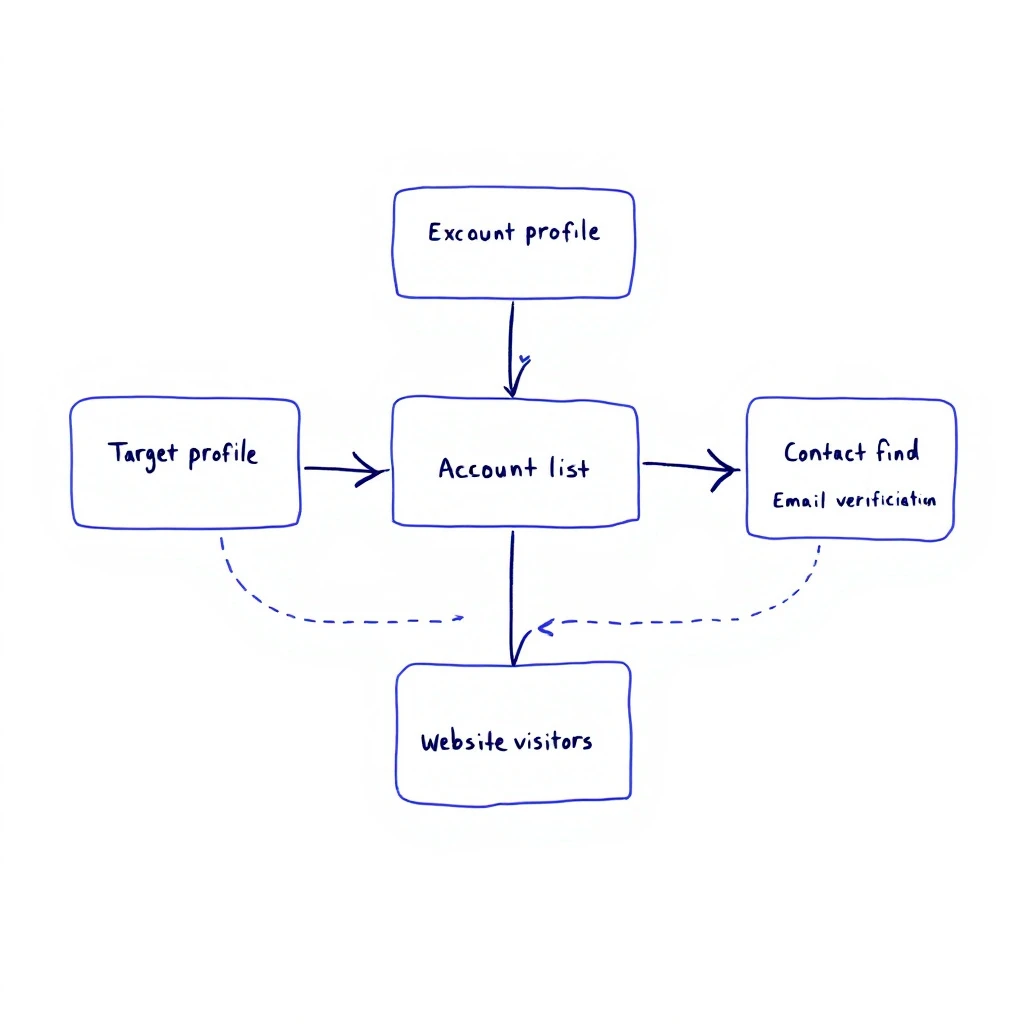
Step 3: Turn Names Into Contacts With Apollo's Free Tier (Days 2-3)
Apollo's free plan gives you around 100 credits a month — a credit is consumed when you unlock a contact's email. This is where your ICP discipline pays off: 100 credits equals 100 contacts, so every unlock should be a persona match at a trigger-active account.
Practical notes from testing:
- Search is free; unlocking is not. Build and filter your list fully before revealing a single email.
- Export credits are separate and tiny (10/month). Work inside Apollo or copy manually — don't plan on bulk CSV exports.
- The 2 free sequences with 250 emails/day are real but sending is Gmail-only on the free tier. Fine for a founder-led motion; a non-starter if your team is on Outlook.
- Prioritize contacts whose emails Apollo shows as verified. Unverified guesses waste both a credit here and a verification in Step 4.
Full plan-by-plan detail, including where the free tier stops making sense, is in our Apollo.io pricing breakdown.
Step 4: Fill Gaps With Hunter, Verify Everything (Day 3)
You'll fail to find perhaps 20-30% of your target contacts in Apollo. That's what Hunter's free tier is for: 25 email searches and 50 verifications per month, no card required.
The order matters:
- Searches (25/month): spend only on high-priority contacts Apollo couldn't unlock. Hunter's domain search often reveals the company's email pattern — once you know it's first.last@domain.com, you can construct the rest yourself for free.
- Verifications (50/month): run every constructed or uncertain email through verification before it ever enters a sequence. A bounce rate above 3-5% damages your sender reputation, and repairing deliverability costs far more than the list was worth.
If you're constructing emails from patterns, verify all of them. Fifty verifications a month covers a weekly batch of about 12 constructed contacts — plenty for this workflow's pace. Our Hunter.io pricing breakdown covers what happens when you outgrow the free tier.
Optional: enrich in Clay. Clay's free plan (100 data credits, 500 actions, 200-row tables) is worth adding once the basic loop works. Use it to append one or two fields you'll actually personalize on — tech stack, recent job posts, funding — not to hoard 40 columns of data you'll never reference in an email.
Step 5: The Free Lead Source Everyone Ignores — Your Own Website
Here's the uncomfortable math: while you're carefully rationing 100 Apollo credits, companies matching your ICP are visiting your website every day, reading your pricing page, and leaving without a trace. Roughly 97% of B2B website visitors never fill out a form.
That traffic is the highest-intent lead source you have, and it's already paid for. Visitor identification tools resolve anonymous traffic to company level — which accounts visited, which pages, how often. A visitor who spent four minutes on your pricing page is worth more than fifty cold contacts from any database, free or paid.
This is the gap in every "free lead list" stack: databases tell you who exists; visitor identification tells you who's in-market right now. If you're new to the category, start with our complete guide to B2B website visitor identification, then compare vendors in the best visitor identification tools roundup — several offer free tiers or trials that identify your first few hundred companies at no cost.
Once identified visitors start flowing, the play is speed: match the visiting company to your ICP, find the right persona (Steps 3-4 above), and reach out while the interest is live. We've documented that end-to-end motion in How to Turn Website Visitors Into Pipeline in 24 Hours.
Step 6: Maintain the List or Watch It Rot
B2B contact data decays at roughly 25-30% per year — people change jobs, companies get acquired, domains die. A free list you built in January is materially wrong by summer. Build maintenance into the monthly rhythm:
- Re-verify before every send. Your 50 monthly Hunter verifications cover this for active segments.
- Purge hard bounces immediately. Never retry a bounced address.
- Track outcomes, not volume. List size is a vanity metric. Replies, meetings, and pipeline dollars are the real scoreboard — our lead generation KPI guide shows how to build that dashboard.
- Refresh triggers monthly. When the LinkedIn search quota resets on the 1st, re-run your trigger searches and rotate stale accounts out.
The Monthly Free-Stack Cadence (Copy This)
| Week | Action | Tools Used |
|---|---|---|
| Week 1 | Refresh triggers, rebuild account list (100-150 accounts) | LinkedIn free search |
| Week 2 | Unlock top 100 contacts, note email patterns | Apollo free |
| Week 3 | Fill gaps, construct + verify emails | Hunter free, Clay free |
| Week 4 | Work identified website visitors, re-verify active segments | Visitor ID, Hunter |
Run this loop and you'll add 200-400 verified, ICP-matched, trigger-active contacts per month without spending a dollar on data. If you want AI to handle the research and drafting layers on top of this stack, our Claude for lead generation playbook shows how to automate the manual parts.
When Free Stops Being Worth It
The free stack costs zero dollars but not zero hours — expect 4-6 hours a month of quota management, manual copying, and gap-filling. That trade makes sense pre-revenue or as a side motion. It stops making sense when:
- You need more than a few hundred net-new contacts a month
- Your team sends from Outlook (Apollo free won't)
- You're spending more time managing quotas than talking to buyers
- Website traffic is growing and you're identifying visitors but can't action them fast enough by hand
That last one is where MarketBetter sits. It identifies the companies visiting your site, matches them to your ICP, finds the right stakeholders, and tells your SDRs exactly what to do next — the signal-to-action layer the free stack makes you assemble by hand every morning.
See what your website traffic is hiding. Book a demo →
FAQ: Free B2B Lead Lists
Can I get a free B2B contact database download?
Not one worth using. Pre-built "free database" downloads are stale (25-30% annual decay), unverified, and often scraped in violation of the source's terms. Sending to them destroys deliverability. Building a smaller, verified list with the free-tier stack above outperforms any free CSV.
What are the best free B2B lead generation tools in 2026?
For contact data: Apollo (about 100 credits/month), Hunter (25 searches + 50 verifications), and Clay (100 data credits) are the strongest free tiers. For intent: your own website via visitor identification. We tested twelve options in our free lead generation tools roundup.
How many leads can I realistically get for free per month?
With the workflow above: 200-400 verified, ICP-matched contacts monthly. The constraint isn't tooling — it's the free-tier quotas (Apollo credits, Hunter searches, LinkedIn's ~300-search commercial use limit) and your hours.
Is scraping LinkedIn a free way to build lead lists?
It violates LinkedIn's terms of service and risks account restriction or bans. Working within the free commercial use limit — roughly 300 people searches a month, prioritized against a tight ICP — is slower but sustainable, and your LinkedIn account is worth more than any single list.
Are free lead lists GDPR-compliant?
The list-building method matters less than what you do with it. B2B outreach under legitimate interest is workable in most jurisdictions if you target business contacts relevant to your offer, disclose who you are, and honor opt-outs immediately. Purchased or scraped consumer-style lists are where compliance problems start.