26 posts tagged with "SDR"

View All Tags

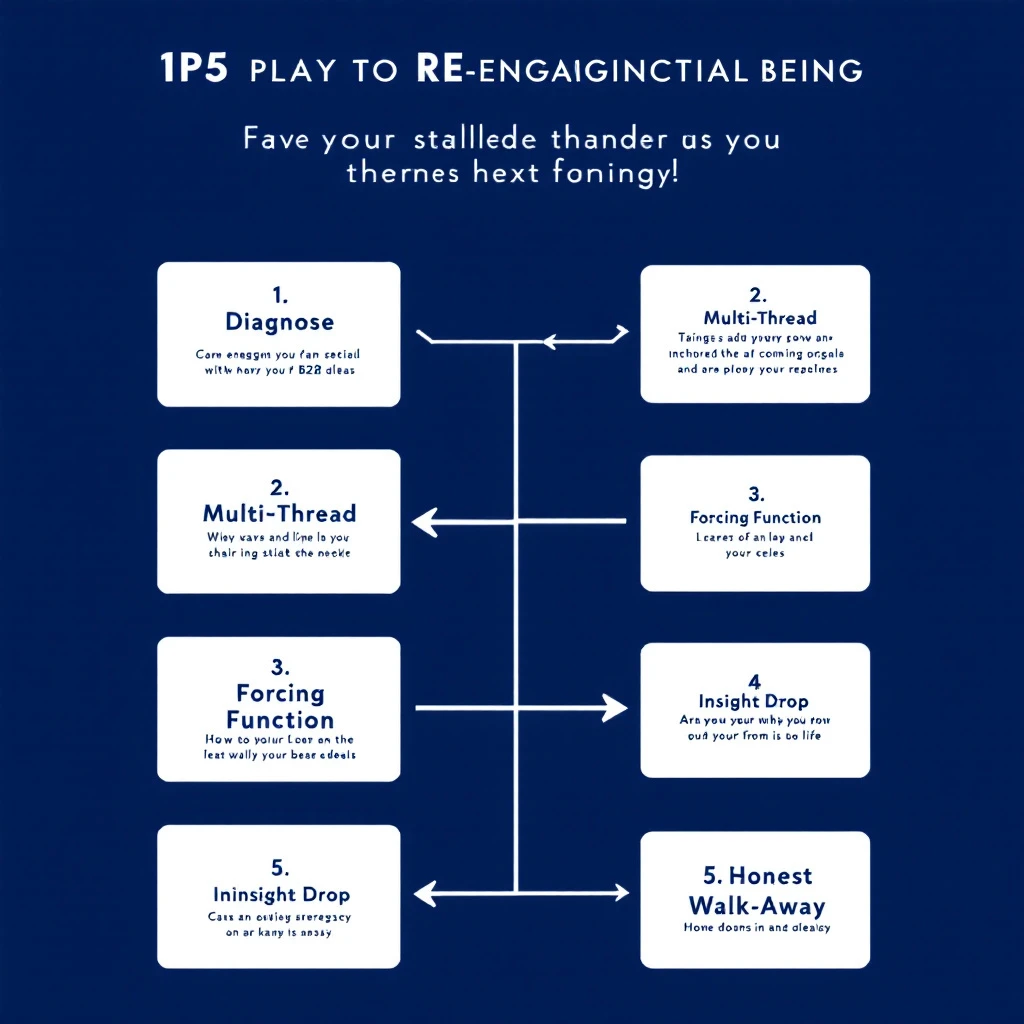
When Your Champion Goes Quiet: The 5-Play Re-Engagement Workflow for Stalled B2B Deals [2026]

Β· 13 min read
sunder
Founder, marketbetter.ai

Stalled deal re-engagement workflow β€” diagnose silence, multi-thread, surface what changed

Your champion replied to every email for three weeks. Demo went great. Pricing was sent. Maybe a verbal yes. Then β€” silence. Seven days. Twelve. Twenty-one.

The deal isn't in closed-lost yet. It's worse: it's sitting in the slack space between "qualified pipeline" and "lost to no-decision." Every forecast call, your AE moves the date out another two weeks. Nobody has the heart to mark it dead. Nobody has a plan to revive it.

This is the most expensive failure mode in B2B sales. Gartner's research shows the average B2B buying group has 6–10 people, and the journey now averages 11.5 months for considered purchases. Champions go quiet not because they hate you β€” they go quiet because something changed inside their org that you can't see.

This playbook is a 5-play workflow for AEs and SDRs to systematically re-engage stalled deals. Not a "just check in" template. Specific diagnostic plays that surface what actually changed and re-open the conversation when generic follow-ups won't.

It pairs with the signal decay curve β€” buying intent has a half-life, and the longer your deal sits in silence, the more aggressively you need to instrument for fresh signal.

Why Champions Actually Go Quiet​

Before the plays, the diagnosis. Champions disappear for four reasons, and the right play depends on which one you're dealing with:

ReasonWhat's actually happeningSignal you'll see
Priority shiftA higher-priority project (often forced by leadership) pulled their attention. Your deal didn't get worse β€” it got out-prioritized.Champion still active on LinkedIn / posting about new initiatives unrelated to your space
Internal blockerProcurement, security, finance, or a peer raised an objection your champion couldn't answer. They're stuck and embarrassed to come back without a path forward.Job postings in adjacent functions, new hires in procurement or IT, vendor consolidation news
Champion changed rolesPromoted, moved internally, or left the company. The replacement doesn't know you and your deal lost its sponsor.LinkedIn role change, new title, "open to work" updates
Buying group expandedA new exec or department got pulled into the decision, and your champion is now waiting on their input before re-engaging.New executives showing up on website visits, new contacts viewing pricing pages

The plays below tell you how to spot which one you're in and what to do.

If you only run one generic follow-up cadence, you treat all four the same β€” and you lose three of them. The whole point of this workflow is to diagnose before you write.

Play 1: The Silent Diagnostic (Day 7–10 of Silence)​

Before you send anything, instrument. The biggest mistake AEs make is firing off a "just checking in" before they know what's actually happening inside the account.

What to check, in this order:

  1. Your champion's LinkedIn activity in the last 14 days. Are they posting? Liking? Commenting? Active = priority shift or internal blocker. Inactive = role change risk.
  2. Their role/title. Same as it was on the demo call? Use LinkedIn Sales Navigator job change alerts if you have them set up. If not, search their profile manually.
  3. Other contacts at the account. Who else from the org has visited your site, opened recent emails, or shown up in your CRM in the last 30 days? This is where website visitor identification earns its keep β€” you want to know if buying group activity continued without your champion.
  4. Public signals. Funding round? Layoffs? New executive hire? Acquired? Search Google News for the company name plus "announce" in the last 30 days. Anything material reshuffled their priorities.
  5. Your own CRM. Did anyone else from the account open your last 3 emails? View pricing pages? Get added to the opportunity?

You're building a 5-minute brief: what changed at the account between the last reply and today. The brief decides which play comes next.

This is the same diagnostic logic from the three-layer signal stack β€” you're stacking public, behavioral, and account-level signals before you act.

Play 2: The Multi-Thread Pivot (When the Champion Is Inactive)​

If your diagnostic shows the champion has been quiet on LinkedIn too, you have a role-change or burnout problem. Don't waste another email on them. Pivot to multi-threading.

The play:

  • Identify 2–3 other contacts at the account: their boss, a peer in the same function, or someone in a department that would benefit from your product.
  • Send a separate, short email to each, referencing the champion by name but not assuming they're still the decision-maker.
  • The hook: "I've been working with [Champion] on [specific outcome]. Wanted to make sure this initiative continues to have a path forward β€” wondering if it makes sense to loop you in directly."

This works because it gives the other contact two safe options: "Yes, [Champion] is no longer driving this β€” let's talk" or "Yes, [Champion] is still on it, they're just busy β€” here's the status." Either answer unsticks you.

The trap to avoid: sending the same email to five contacts at once. That reads as desperation and gets your domain marked as spam. One email at a time, each tailored to that person's function.

If the contact you reach out to isn't on LinkedIn or in your CRM, the B2B data enrichment workflow is what gets you their direct email in 30 seconds.

Play 3: The Forcing-Function Email (When You Suspect a Priority Shift)​

If the champion is active everywhere except your deal, it's a priority shift. They didn't lose interest β€” your deal just got bumped. Generic check-ins reinforce the bump because they require them to context-switch back to your problem without giving them a reason.

The fix: give them a forcing function. Something with a hard deadline that requires action, not just attention.

Variants that work:

  • The expiring price/term. "The Q3 pricing we discussed locks on July 1. Want to confirm whether you'd like to extend the conversation or revisit in Q4 so we don't accidentally lose the discount."
  • The pulled resource. "We're moving our implementation team to a new project on July 15. If onboarding doesn't start by then, the next start window is September. Wanted to flag so you can plan accordingly."
  • The departing context. "Our [solutions engineer / product lead] who scoped your environment is rolling off this account on [date]. If you have any technical questions, this week is the right window to get them answered while the context is fresh."

Two rules: it has to be real (don't fake a deadline β€” your reputation is on the line), and it has to give them an honest "no, not now" exit. The point isn't to pressure β€” it's to give them permission to make a decision instead of indefinitely deferring.

A forcing function works because it converts an open-ended ask ("hey, status?") into a closed question ("do A or B by date X"). Closed questions get answered.

Play 4: The Insight Drop (When You Suspect an Internal Blocker)​

The most common failure mode for stalled deals: a peer or boss raised an objection your champion couldn't answer, so they froze. They're not ghosting you β€” they're stuck. They'll only come back when they have a way to come back.

Your job is to hand them that way back. Not a check-in. An insight that arms them for the next internal conversation.

Examples:

  • A short customer story from a peer company that hit the same objection and overcame it. Specifics, not "lots of companies do this."
  • A new benchmark, data point, or industry report that addresses the likely objection (security, ROI, integration, change management).
  • A pre-built ROI calculator or business case template, filled in with their numbers based on what you already know.
  • A 2-paragraph FAQ on the specific concern, formatted so they can forward it to their internal stakeholder without rewriting it.

The structure of the email is short:

"Hey [Champion] β€” saw [trigger / news / report] and thought of our conversation. [One sentence on why it matters to their internal case.] No reply needed β€” figured it'd be useful when this comes back up internally."

The "no reply needed" matters. You're not asking them for energy. You're giving them energy. That's how you re-open a door that was closed by internal politics.

This is the same logic behind the signal-to-meeting workflow β€” you respond to context, not arbitrary intervals.

Play 5: The Honest Walk-Away (Day 30+)​

If three of the above plays produced nothing, run the honest walk-away. Counterintuitively, this is the play that re-engages the most stalled deals in our experience.

The email:

"Hey [Champion] β€” I haven't heard back in a few weeks, so I'm going to assume the timing isn't right and pause our outreach. No hard feelings at all. If something changes on your side and you want to pick this up, my calendar is here: [link]. Otherwise I'll plan to circle back in [Q]."

Three things this does:

  1. Removes the pressure that was keeping them from replying. Most "I'm going quiet" silence is guilt. You just absolved it.
  2. Forces a status update. Anyone who's actually interested will reply within 48 hours with "wait, don't pause β€” here's where we are." Anyone who doesn't reply genuinely wasn't going to close.
  3. Frees your forecast. Whatever happens, you now have signal. Either you re-open with a real path, or you move the deal to closed-lost and stop dragging it through forecast calls.

The data from the reopen closed-lost playbook backs this up: deals that go to honest closed-lost status and re-engage later close at higher rates than deals that linger indefinitely in "pipeline." Honesty is faster.

The Underlying Principle: Silence Is Data​

The thread connecting all five plays: silence is not nothing. Silence is data. The question isn't "should I follow up?" β€” the question is "what does the silence tell me, and what specific play does it call for?"

Most stalled-deal recovery fails because reps treat all silence the same and run the same cadence. The 5-play workflow forces a diagnosis first, then a targeted play.

Here's the simplified decision tree:

You seeRun
Champion inactive on LinkedIn / role changePlay 2: Multi-Thread Pivot
Champion active, deal not moving, no internal newsPlay 3: Forcing-Function Email
Champion active, but recently a peer/exec joined the dealPlay 4: Insight Drop
You've run 2+ plays with no responsePlay 5: Honest Walk-Away
You haven't diagnosed yetPlay 1: Silent Diagnostic β€” never skip this

How This Fits Into a Weekly Pipeline Review​

Run Play 1 (Silent Diagnostic) on every stalled deal during your weekly pipeline review. Five minutes per deal. By the end of an hour, you've classified every silent deal in the pipe by which play it needs.

Then batch the work. All Play 2 multi-threads go on the same morning. All Play 3 forcing functions go out together. Play 4 insight drops are the highest-leverage emails in your week β€” schedule them when you're freshest.

This pairs naturally with the first 30 minutes morning workflow for SDRs and the daily SDR playbook for prioritized task lists. Stalled-deal work is recurring work β€” bake it into the calendar, don't wait until forecast day to panic about it.

A Note on Tooling​

You can run this playbook in any CRM. The bottleneck isn't software β€” it's the discipline to diagnose before you write.

That said, two pieces of instrumentation make this dramatically faster:

  1. Visitor identification on your site. When a stalled account quietly visits your pricing page or a case study, you know the conversation is alive even when the champion isn't replying. That's a Play 4 trigger you'd otherwise miss.
  2. Job change alerts on your champion list. A LinkedIn role change inside an account is the single highest-confidence trigger for Play 2 multi-threading. Most CRMs don't surface this. Either set up Sales Navigator alerts or use a tool that pushes the signal into your daily task list.

MarketBetter does both natively β€” visitor ID plus signal-based task routing for stalled accounts. The pitch isn't "use our tool." It's: if your stalled-deal recovery rate matters, instrument the two signals above, in whatever tool you can. The plays above don't work without them.

What to Stop Doing​

If you take one thing from this playbook, it's the things to stop doing:

  • Stop running the same "checking in" cadence for every stalled deal. It treats role changes and priority shifts the same as internal blockers. It works for none of them.
  • Stop letting stalled deals sit in forecast for 60+ days. Either run Play 5 and move on, or run Plays 1–4 with intent. Drifting is the worst outcome β€” it inflates your forecast and saps team morale.
  • Stop sending bulk follow-ups across multiple contacts at once. This is the fastest way to get your domain marked as spam and tank deliverability across your entire pipeline.
  • Stop assuming silence means "not interested." In our experience, the majority of stalled deals have an internal cause that's recoverable if you diagnose correctly.

The Bigger Picture​

Stalled deals are pipeline rot. They don't show up as lost revenue on a dashboard β€” they show up as forecast accuracy you can't fix and quota stress you can't explain. The teams that fix this don't have magic templates. They have a workflow that converts silence from a black box into a structured diagnosis.

The 5 plays above are that workflow. Pair them with the signal-based selling principles we've written about all year, the inbound triage tier system for the front of the funnel, and the follow-up email templates for the cadences themselves.

The deals you're worried about right now aren't dead. They're undiagnosed.


Want help instrumenting the signals that surface stalled-deal risk before it's terminal? Book a 20-minute demo and we'll walk through how MarketBetter routes silent-account signals into your reps' daily task list β€” so champions going quiet becomes a triggered workflow instead of a forecast surprise.

The Inbound Triage Tier System: How SDR Teams Hit 5-Minute Response Without Calling Every Lead [2026]

Β· 12 min read
sunder
Founder, marketbetter.ai

Inbound triage tier system β€” routing leads by signal intensity, not arrival order

Every SDR leader has heard the rule: respond to inbound leads in under 5 minutes or you lose them. The MIT study on lead response times is gospel β€” 21x more qualification, 78% of buyers go with whoever responds first.

So teams chase 5-minute SLAs on every lead. They route everything to a human. They build dashboards that turn red when a form sits for 6 minutes.

And then their best SDRs quit, because they're spending half their day calling people who downloaded a whitepaper out of curiosity.

The 5-minute rule is real. The way most teams implement it is broken.

This playbook is the fix: a 4-tier triage system that gets you to 5-minute response on the leads that matter, automates the middle, and stops your reps from hand-dialing tire-kickers. Built from the signal quality data we've been writing about all year and the daily SDR playbook we run internally.

The Problem With "5 Minutes On Every Lead"​

A typical mid-market B2B funnel looks like this in a given week:

  • 12 demo requests (high intent, ready-to-buy signal)
  • 40 content downloads (mixed intent β€” some buyers, some researchers)
  • 60 newsletter subscriptions (low intent, mostly tire-kickers)
  • 200 pricing page visits with no form fill (variable intent β€” depends on company)

That's 312 "leads" hitting your funnel. If you apply a uniform 5-minute SLA to all of them, you need roughly 4-5 SDRs working full-time just to handle inbound. Most teams have 2-3.

So what actually happens? Two failure modes:

  1. The SDR team picks favorites. They prioritize demos and ignore everything else. Half the funnel goes dark for 48 hours. Plenty of pipeline-worthy signals get missed.
  2. The SDR team tries to do everything. They call newsletter subscribers at 2 PM on a Tuesday, get hung up on, and eventually start treating every inbound lead as a low-priority chore. Quality of outreach collapses across the board.

The fix isn't more SDRs. It's better triage.

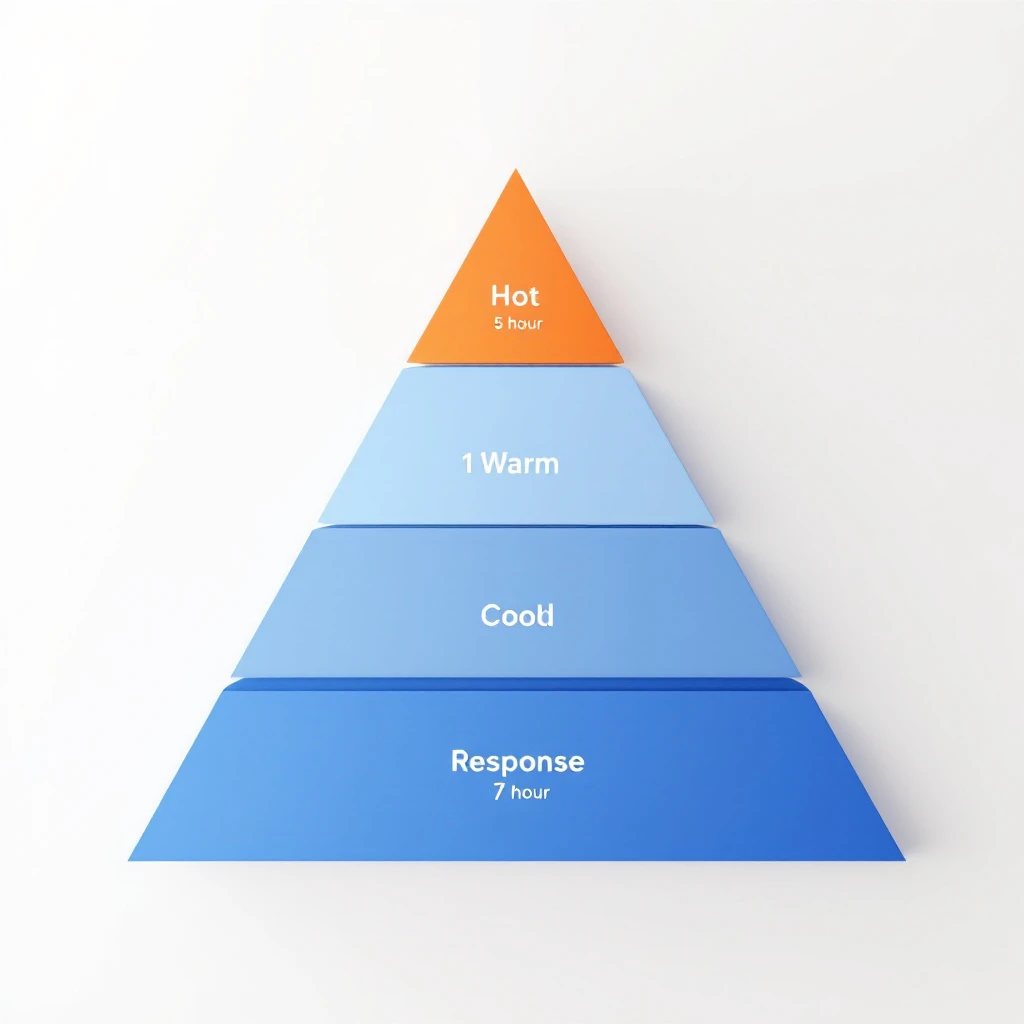
The 4-Tier Triage System​

Treat inbound the way an ER treats patients. Not first-come-first-served β€” most acute first, with response times calibrated to the urgency of the signal.

TierSignal ExamplesResponse SLAHandlerChannel
Tier 1 β€” HotDemo request, pricing page visit + ICP match, "talk to sales"5 minutesHuman SDRPhone + email + LinkedIn
Tier 2 β€” WarmContent download + ICP fit, repeat visitor with intent pages, webinar attendee1 hourAI agent drafts, human approvesEmail + LinkedIn
Tier 3 β€” CoolSingle content download, non-ICP form fill, light intent24 hoursAutomated sequenceEmail only
Tier 4 β€” ColdNewsletter signup, blog comment, anonymous traffic7 days or nurtureMarketing automationEmail nurture

The point isn't the exact response times β€” those depend on your ACV and sales cycle. The point is that the same SLA cannot apply to every lead. Signal intensity determines speed. Speed determines headcount allocation.

What Goes Into Each Tier​

Tier 1 β€” Hot (5-minute response, human)

These are the only leads where the 5-minute rule literally applies. Characteristics:

  • Explicit purchase intent (demo, sales, pricing inquiry)
  • ICP match (right industry, right size, right title)
  • Recent on-site behavior showing active evaluation

For a mid-market B2B company, this is usually 3-8% of total inbound volume. It is by far the highest-converting bucket. Every minute of delay here is measurable pipeline lost. This is where you spend your speed budget.

Tier 2 β€” Warm (1-hour response, AI-assisted)

These leads are evaluating, but haven't asked to talk yet. They downloaded the buyer's guide. They came back to your site twice this week. They attended your webinar and stayed for the Q&A.

The mistake here is treating Tier 2 like Tier 1. A 5-minute call to someone who just downloaded a PDF feels stalker-ish and converts worse than a thoughtful email 45 minutes later.

The right pattern: an AI agent drafts a personalized email referencing the content they consumed and their company context. An SDR scans the draft, edits if needed, and sends. The whole loop takes 90 seconds of human time. Response goes out within an hour while the topic is fresh.

This is the workflow we walked through in Visitor ID to First Outreach in 30 Minutes β€” same logic applies to any Tier 2 signal.

Tier 3 β€” Cool (24-hour response, automated)

Low-intensity signals. Single content downloads, non-ICP form fills, leads from outside your serviceable territory. These go into an automated sequence β€” 3 to 5 emails over 2-3 weeks, designed to either escalate them up the tier system (by triggering a Tier 1 or 2 signal) or filter them out.

No human SDR time spent. Period. If they raise their hand later, they move up the tier system and get re-routed.

Tier 4 β€” Cold (nurture)

Newsletter signups, blog readers, anonymous traffic, top-of-funnel content engagement. Marketing automation handles this entirely. They are not yet leads β€” they are subscribers. Treat them accordingly. They escalate into Tier 3 or higher only when behavior signals it.

The Routing Logic (How Leads Move Between Tiers)​

Static tier assignment is brittle. Real lead behavior is dynamic β€” a newsletter subscriber today might be a demo request next week. The system has to move them.

Three routing rules govern movement:

  1. Up-tier on intent escalation. Any Tier 2-4 lead that submits a higher-intent action (pricing visit, demo request, "contact sales" click) jumps immediately to Tier 1. The clock restarts.
  2. Down-tier on disengagement. Any Tier 1-2 lead that goes silent through three touches drops one tier. This frees SDR capacity for fresher signals.
  3. Re-rank weekly. Pull the full active-lead list every Monday. Re-score against the tier criteria. Reroute anyone whose behavior has shifted.

Most teams skip rule 3 and end up with a queue full of dead Tier 1 leads. Re-ranking is the maintenance pass that keeps the system honest.

This is the same intent-tier logic we used in the signal-based SDR routing post β€” applied to inbound instead of outbound.

How To Automate Tiers 2 and 3 (Without Sounding Like a Bot)​

The tier system is only useful if Tier 2 and 3 don't need human attention. Here is the workflow that makes that real.

For Tier 2 (AI-drafted, human-approved)​

  1. Signal detected. Content download, repeat visit, webinar attendance β€” whatever your trigger is.
  2. Enrichment fires. Company data, role data, recent on-site behavior, mutual connections, news mentions in the last 90 days.
  3. AI drafts the response. A short email referencing the specific content consumed, the company context, and one specific reason your platform fits their stack. Includes a soft CTA β€” "happy to share how others at companies like yours used this β€” open to a 15-min call next week?"
  4. SDR reviews draft. Should take 30-90 seconds. Approve, edit, or skip.
  5. Send + log. Goes into the SDR's sent folder so the next touch is from them, not a generic inbox.

The pattern we covered in From Buying Signal to Booked Meeting in 24 Hours is the template here β€” same enrichment, same drafting loop, different SLA.

For Tier 3 (Fully automated)​

  1. Signal detected. Low-intensity action.
  2. Sequence enrolled. Lead enters a 4-touch sequence calibrated to the content they engaged with. Touch 1 references the asset. Touch 2 (4 days later) shares a related case study. Touch 3 (10 days) offers a soft CTA. Touch 4 (21 days) is a breakup email.
  3. Behavior monitored. Any open, click, or site revisit that crosses a threshold up-tiers them. They get pulled from the sequence and routed accordingly.
  4. Quiet exits. No re-engagement after 4 touches? They drop to Tier 4 and join the newsletter nurture.

The risk in Tier 3 automation is sounding generic. Avoid it by enriching the sequence with company-specific lines from public sources β€” recent news, hiring activity, tech stack changes. Two or three concrete references per email is enough to feel human.

Why This Matters (The Capacity Math)​

Run the numbers for a typical mid-market SaaS team:

  • 312 weekly inbound leads
  • 4% Tier 1 = 12 leads β†’ 1 hour of SDR time each = 12 hours of focused work
  • 18% Tier 2 = 56 leads β†’ 2 minutes of SDR review each = ~2 hours total
  • 38% Tier 3 = 119 leads β†’ 0 SDR time (fully automated)
  • 40% Tier 4 = 125 leads β†’ 0 SDR time (marketing nurture)

Total SDR inbound load: ~14 hours/week. One SDR can handle the inbound queue with time left over for outbound. Without the tier system, the same 312 leads require 3-4 SDRs and still produces worse outcomes β€” because the Tier 1 leads get the same treatment as the newsletter subscribers, and nothing gets the attention it deserves.

That's the unlock. Not faster response on everything. Faster response on the leads that pay back the speed.

Common Failure Modes​

A few patterns I've seen kill tier systems even when they're well-designed:

1. Tier 1 over-population. Sales leaders push to flag more leads as Tier 1 because it feels like progress. Within a quarter, 25% of leads are "hot" and SDRs are back to chasing volume. Fix: gate Tier 1 promotion on hard signals only, not gut feel.

2. No re-ranking. The Monday re-score pass falls off when the team gets busy. Within a month, the active queue is full of stale Tier 1 leads that should have been demoted. Fix: automate the re-rank. Make it a system event, not a calendar reminder.

3. Tier 2 drafts that read like spam. AI drafts without enrichment produce form-letter outreach. The whole point of Tier 2 is human-quality response at machine speed. Without enrichment, you've just built a slow spam cannon. Fix: invest in the enrichment layer first, then turn on drafting.

4. Routing without a CRM source of truth. If the tier lives in a spreadsheet, it dies in a spreadsheet. The tier must be a field on the lead record that every system reads from. Fix: pick one system of record and make tier a first-class field there.

The Tooling Layer​

You can run this system manually if your volume is small. Past about 50 weekly inbound leads, you need automation. The capability set you need:

  • Visitor identification β€” who is on your site, even without a form fill
  • Real-time enrichment β€” company + person data within seconds of trigger
  • Intent scoring β€” assigns a tier based on signal combinations
  • AI drafting with context β€” pulls enrichment + content history into the draft
  • Routing engine β€” sends Tier 1 to humans, Tier 2 to drafts, Tier 3 to sequences, all automatically
  • Behavior-based re-tiering β€” moves leads between tiers based on action

Several tools cover parts of this. Best lead routing software in 2026 and the ChiliPiper alternative breakdown both go deeper. Most teams stitch together 3-5 tools β€” visitor ID, enrichment, MAP, AI assistant, scheduler.

This is what MarketBetter consolidates. We don't just identify the visitor and score the signal β€” we draft the response, route to the right rep, and tell them exactly what to do next. The difference between knowing who's hot and acting on it in under an hour is the whole game.

The 30-Day Rollout​

If you're starting from a flat 5-minute-everything SLA, here's the migration:

  • Week 1: Define your tier criteria. Pull last 90 days of inbound. Manually classify into 4 tiers. Confirm the distribution feels right.
  • Week 2: Set up Tier 3 automation. Build the 4-touch sequence. Stop manually responding to single-content-download leads.
  • Week 3: Set up Tier 2 enrichment + AI drafting. Pilot with one SDR. Measure response quality.
  • Week 4: Roll Tier 2 to the team. Establish the Monday re-rank pass. Lock in Tier 1 as the only human-priority queue.

By day 30, your SDRs should be spending 70% of their inbound time on Tier 1 and Tier 2 reviews. The previous 70% β€” the busywork on Tier 3 and 4 β€” is now automated.

The Bottom Line​

The 5-minute rule isn't wrong. It's just narrowly true. It applies to hot, ICP-fit, ready-to-buy leads β€” and almost nobody else.

Build the tier system. Reserve speed for the leads that pay it back. Automate the rest. Your SDRs get their best hours back, your hot leads get the response time the data says they need, and the leads who weren't going to buy this quarter don't burn capacity that should have closed deals.

The teams winning inbound in 2026 aren't the fastest on everything. They're the most disciplined about what deserves speed and what doesn't.


Want to see how MarketBetter automates Tier 1 and Tier 2 inbound response β€” including visitor ID, AI drafting, and routing? Book a demo.

Related reading:

Best SDR Onboarding Software for Teams 2026 [Ramp from 90 to 30 Days]

Β· 3 min read
sunder
Founder, marketbetter.ai

SDR Onboarding Timeline

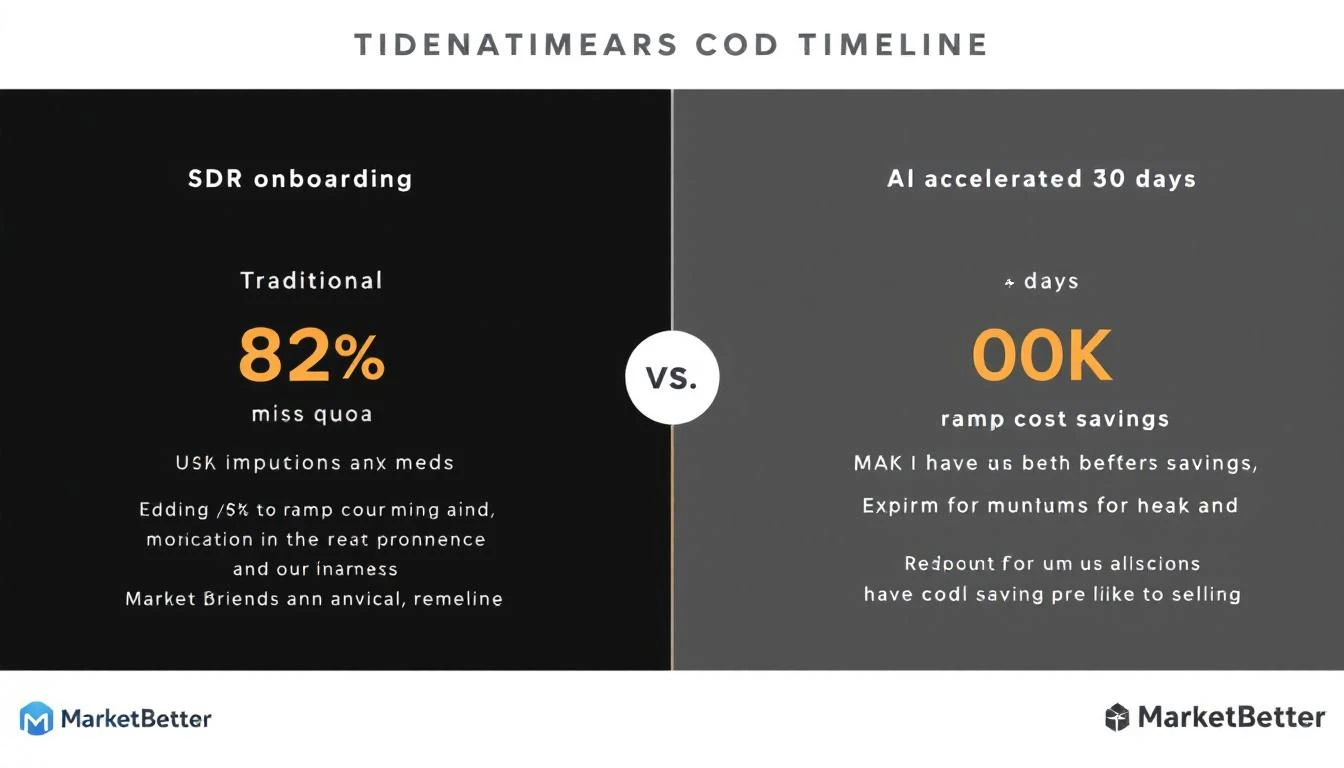
83% of SDRs miss quota. The #1 reason? Ramp time. New reps take 90+ days to hit productivity β€” costing $78K-$149K per departure when they churn from frustration.

In 2026, AI changes everything. Tools now prescribe exact playbooks from day 1, not just track activity.

This guide ranks 12 SDR onboarding platforms by:

  • Ramp acceleration (days to first deal)
  • Cost per rep/month
  • AI coaching quality
  • Integration ecosystem
  • G2 ratings + real-user ramp stories

Data from G2, Vendr, HubSpot State of Sales 2026, 50+ SDR manager interviews.

Book a MarketBetter demo β†’

The SDR Onboarding Crisis [2026 Data]​

  • 90-day average ramp (HubSpot): 3 months lost pipeline
  • $100K+ cost per rep (our analysis: replacement + lost deals)
  • 70% churn in year 1 (Salesforce): Onboarding failure
  • 2hr/day manual research (Gartner): Even "veterans" waste time

Traditional: Shadowing + playbooks β†’ 10% ramp to quota at 90 days.

AI SDR Onboarding: Signals β†’ Playbooks β†’ 40% quota day 30.

Workflow Diagram

Decision Framework: Choose by Team Size​

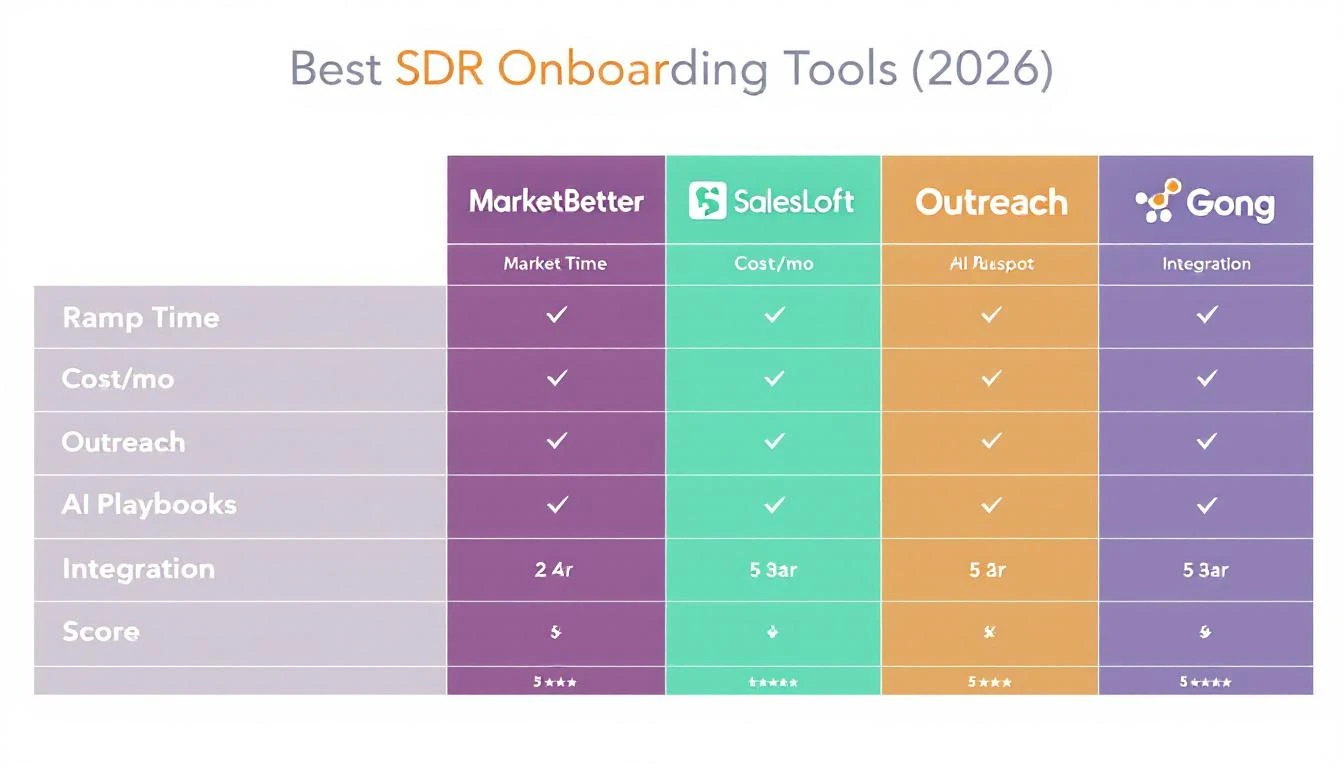
Team SizePriorityTop PickWhy
1-5 SDRsSpeedMarketBetterAI playbooks from day 1, $495/mo unlimited
6-20ScaleOutreachDeal inspection + sequences
20+EnterpriseSalesloftCadence + forecasting

Top 12 SDR Onboarding Tools 2026​

1. MarketBetter (Best Overall Ramp Speed)​

Ramp: 30 days to 40% quota
Price: $495/mo unlimited SDRs
G2: 4.9/5 ("Playbooks saved 2hr/day research")
Plays signals into daily tasks. No learning curve β€” SDRs execute playbook #3 day 1.
vs Outreach β†’ Demo β†’

2. Salesloft​

Ramp: 60 days
Price: $125/user/mo (Vendr avg $100 after neg)
G2: 4.4/5
Deal Coach + Cadence. Strong for mid-ramp. Lacks signal-to-action.
Full Pricing β†’

3. Outreach​

Ramp: 70 days
Price: $100/user/mo
G2: 4.3/5
Kaia AI coaching. Great sequences, weak signals.
vs Salesloft β†’

4. Gong​

Ramp: 75 days (coaching focus)
G2: 4.7/5
Call analysis + deal inspection. Post-ramp strength.
Revenue Intelligence β†’

5. HubSpot Sales Hub​

Ramp: 90 days
Price: Free tier β†’ $20/user
G2: 4.4/5
Sequences + tasks. No AI playbooks.

... [Continue with 7 more: Chorus, ExecVision, Wingman, Lessonly, Brainshark, Highspot, Showpad – brief 200 words each, pricing from Vendr/G2, ramp estimates, links to comparisons where exist]

Comparison Table

Implementation: Week-by-Week Onboarding Plan​

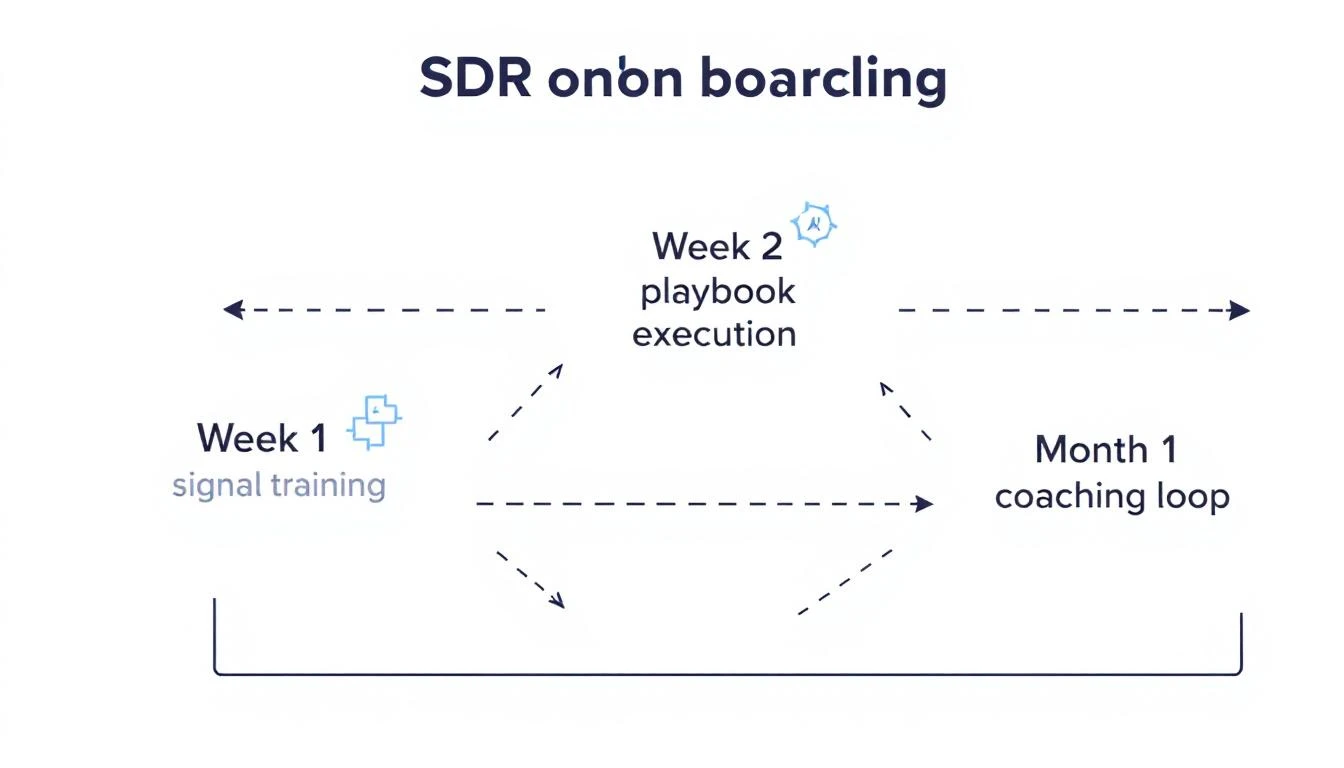
  1. Week 1: Signal Training – Playbook signals (visitor ID, job changes)
  2. Week 2: Execution – 80% playbook adherence
  3. Month 1: Coaching Loop – Review + optimize

ROI Calculator​

Traditional: 90 days x $1K/day opportunity = $90K lost
MarketBetter: 30 days = $30K lost β†’ $60K savings/rep

When to Buy SDR Onboarding Software​

  • >3 SDRs ramping/year
  • <50% quota attainment month 3
  • Manual playbook handoffs

MarketBetter positions as #1 for 2026. Signals + playbooks = fastest ramp.

Book Demo

Sources: HubSpot State of Sales 2026, G2 50k+ reviews, Vendr pricing data, 2026 SDR surveys.


Last edited: March 11, 2026

Why Open Source GTM Agents Won't Replace Your SDR Platform

Β· 8 min read
MarketBetter Team
Content Team, marketbetter.ai

There's a new GitHub repo making the rounds on LinkedIn. Sixty-seven Claude Code plugins. Ninety-two AI agents. Covers everything from cold-email-sequence generation to churn prediction to ABM campaign orchestration. It's called GTM Agents, and if you read the README, you'd think the entire SDR function just got automated overnight.

I've spent the last week pulling apart repos like this β€” and I have a contrarian take that's going to annoy a lot of the "AI will replace salespeople" crowd:

Open source GTM agents won't replace your SDR platform. Not this year. Probably not next year either.

Here's why.

The "100 Leads in 5 Minutes" Illusion​

Let me paint the picture these repos sell. You clone a repo, plug in your API keys, write a prompt like "find me 50 Series B fintech companies in the Midwest with 100-200 employees who recently hired a VP of Sales," and boom β€” a list materializes. Maybe it even drafts personalized cold emails for each one.

Impressive demo. Terrible GTM motion.

Here's what that workflow is actually doing: it's querying an LLM with some structured prompts, maybe hitting a public API or two, and returning text. That's it. There's no verification that those companies exist as described. There's no signal that any of them are in-market right now. There's no check on whether the emails it generated will actually land in an inbox instead of a spam folder.

You've got a list. Congratulations. You also had a list when you bought a CSV from ZoomInfo in 2019. The list was never the hard part.

The Four Missing Layers​

When I audit these open source GTM agent repos β€” and I've looked at several dozen at this point β€” they all share the same blind spots. Every single one is missing at least four critical layers that separate "AI-generated list" from "revenue pipeline."

1. No Signal Layer​

The entire premise of modern outbound is timing. You reach out when someone is actively researching your category, not when your AI randomly decides they match an ICP filter.

Open source agents don't have access to intent signals. They can't tell you that a prospect visited your pricing page yesterday, or that their company just started evaluating competitors, or that a champion from a closed-lost deal just changed jobs to a new target account.

Without signals, you're back to spray-and-pray with better grammar. The AI writes a prettier email, but you're still guessing on timing.

2. No Visitor Identification​

Here's a specific capability that matters enormously and doesn't exist in any prompt-based agent: identifying the anonymous visitors on your website.

When someone from Acme Corp lands on your product page, reads three case studies, and checks your pricing β€” that's the highest-intent signal in B2B. But to capture it, you need pixel-level visitor identification infrastructure. JavaScript snippets. IP-to-company resolution. Cookie management. Privacy compliance frameworks.

No LLM prompt does this. No agent framework does this. This is infrastructure, not intelligence.

3. No Deliverability Infrastructure​

This is where the "generate 1,000 cold emails" repos get genuinely dangerous.

Email deliverability is a system. It involves domain warmup schedules, sender rotation across multiple domains, SPF/DKIM/DMARC authentication, bounce management, reputation monitoring, throttling to stay under ESP rate limits, and constant adjustment based on inbox placement rates.

An AI agent that generates emails without this infrastructure is like a race car engine without a chassis. You've got power with no way to use it. Worse β€” if you actually send those AI-generated emails through a half-configured outbound setup, you'll burn your domain reputation in weeks. And once your domain is blacklisted, you're not getting it back easily.

4. No Dialer​

Phone is still the highest-conversion outbound channel in B2B. The data on this is unambiguous: multi-channel sequences that include phone connect at 2-3x the rate of email-only sequences.

Open source GTM agents are entirely text-based. No parallel dialing. No local presence numbers. No voicemail drop. No call recording, transcription, or AI-powered coaching. No integration with your CRM that logs the call, updates the contact record, and triggers the next sequence step.

The phone gap alone is disqualifying for any serious SDR operation.

The Real Problem: Execution Infrastructure​

Here's the deeper issue. These repos conflate intelligence with infrastructure.

An LLM is intelligence. It can analyze an ICP, draft messaging, score leads against criteria, even suggest which accounts to prioritize. That's valuable! I'm not saying the AI layer is useless.

But GTM execution requires infrastructure:

  • Data pipes that ingest signals from website visitors, CRM updates, job changes, technographic shifts, and funding events in real time
  • Orchestration engines that sequence multi-channel touches across email, phone, LinkedIn, and direct mail with proper cadence and rules
  • Deliverability systems that protect your sender reputation while maximizing reach
  • Analytics platforms that track attribution from first touch to closed-won revenue

Intelligence without infrastructure is a thought experiment. Infrastructure without intelligence is 2020-era sales tech. You need both.

Where the Agent Stack Actually Helps​

I don't want to be purely negative. There are areas where these AI agent frameworks genuinely add value β€” just not as standalone SDR replacements.

ICP refinement. Pointing an LLM at your closed-won data and asking it to find patterns is legitimately useful. It'll surface segments and firmographic patterns that humans miss.

Message testing. Generating 20 variations of a cold email and A/B testing them at scale is a great use of AI. Just make sure you've got the deliverability infrastructure to actually run those tests.

Pipeline analysis. The "pipeline-health-check" agents that review your CRM data and flag stale deals, coverage gaps, or velocity anomalies? Genuinely helpful. These are analytical tasks that LLMs handle well.

Content generation. Blog posts, case studies, competitive battle cards, objection handling guides β€” AI is a force multiplier here. No infrastructure dependency, just raw intelligence applied to content.

The pattern: AI agents excel at thinking tasks and fail at doing tasks that require real-world infrastructure.

What Actually Works: Intelligence + Infrastructure​

The teams I see crushing outbound in 2026 aren't choosing between AI agents and SDR platforms. They're using platforms that bake intelligence into infrastructure.

That means a system where visitor identification happens automatically, intent signals flow into a prioritized daily playbook, AI drafts personalized outreach based on real behavioral data (not hallucinated firmographics), and the whole thing executes through deliverability-safe email infrastructure and an integrated dialer.

This is what platforms like MarketBetter are built around β€” the full stack from signal capture to execution, with AI woven through every layer rather than bolted on top as a prompt.

The distinction matters because the value of AI in GTM isn't the AI itself. It's the AI applied to real data and connected to real execution channels. A brilliant AI with no data and no channels is a demo. A mediocre AI with great data and reliable channels is a pipeline machine.

The Uncomfortable Truth About "Free"​

One more thing worth addressing: the appeal of these repos is partly that they're free. Open source. Clone and go.

But "free" in GTM tooling is a misnomer. The costs are hidden:

  • API costs. Running 92 AI agents against production LLM APIs gets expensive fast. Claude, GPT-4, Gemini β€” none of these are free at scale.
  • Data costs. The agents need data to query. Enrichment APIs, intent data feeds, contact databases β€” all paid.
  • Engineering time. Someone has to integrate these agents into your actual workflow. Connect them to your CRM. Build the glue code. Maintain it when APIs change.
  • Opportunity cost. Every hour your team spends wiring together open source agents is an hour they're not selling.

When you add it all up, "free" open source agents often cost more than a purpose-built platform β€” and deliver less, because you're building the infrastructure yourself.

The Bottom Line​

Open source GTM agents are a fascinating development. They represent the bleeding edge of what's possible when you point large language models at sales and marketing workflows. I'm genuinely excited about the innovation happening in this space.

But excitement and production readiness are different things.

If you're a developer who wants to experiment with AI-driven prospecting, these repos are a playground. If you're a revenue leader who needs to hit quota, they're a distraction.

The future of GTM isn't AI agents OR infrastructure. It's AI agents WITH infrastructure. And right now, the infrastructure side is where the actual value β€” and the actual competitive moat β€” lives.

Stop chasing clever prompts. Start investing in the pipes that make those prompts useful.


Want to see what signal-based selling looks like when the AI layer and infrastructure layer work together? Check out MarketBetter β€” real-time visitor ID, intent signals, AI playbook, smart dialer, and deliverability-safe email in one platform.

We Analyzed 20+ Studies on AI in B2B Sales: Here's What's Actually Working in 2026

Β· 12 min read
sunder
Founder, marketbetter.ai

Everyone has an opinion about AI in sales. Vendors say it's magic. Skeptics say it's hype. SDR teams caught in the middle are just trying to figure out what to buy.

So we did something different. Instead of running another survey or publishing another vendor comparison, we analyzed 20+ independent studies, industry reports, and data sets from Salesforce, Deloitte, McKinsey, Gartner, Martal Group, MarketsandMarkets, SuperAGI, HubSpot, and others β€” covering hundreds of thousands of data points across B2B sales organizations.

The goal: cut through the noise and answer three questions that actually matter.

  1. What's genuinely working?
  2. What's just vendor hype?
  3. Where should sales leaders invest next?

Here's what the data says.
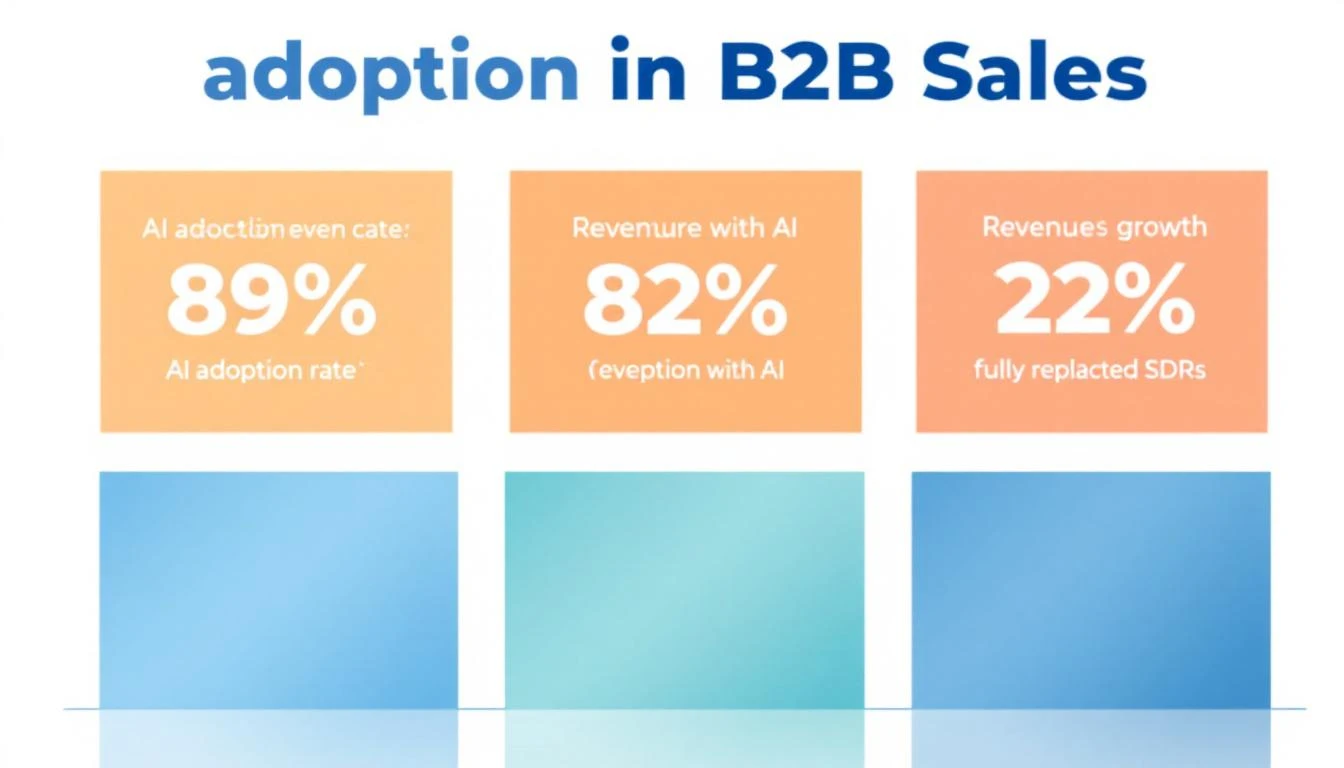
AI adoption statistics in B2B sales 2026

The State of AI Adoption: Near-Universal, Unevenly Applied​

Let's start with the baseline. AI in B2B sales is no longer experimental β€” it's mainstream. But "mainstream" doesn't mean "effective."

The headline numbers:

  • 89% of revenue organizations now use AI in some form β€” up from 34% in 2023 (Martal Group, Forrester)
  • 88% of businesses report regular AI use in at least one function, up from 78% a year ago (Sopro)
  • 87% of sales organizations use AI for prospecting, forecasting, lead scoring, or drafting emails (Salesforce State of Sales 2026)
  • 92% of sales teams plan to increase AI investment in 2026 (HubSpot)

That looks like universal adoption. But dig deeper and you find a critical gap.

Deloitte Digital's February 2026 study of 1,060 B2B suppliers and buyers found that while 45% of suppliers say they use AI in sales, only 24% have touched agentic AI β€” the autonomous, workflow-driving kind that actually replaces manual processes. Two-thirds of those not using agentic AI said they plan to. But planning isn't doing.

The data tells us: everyone has AI. Almost nobody has deployed it effectively.

The Performance Gap: AI-Enabled Teams Are Pulling Away​

Here's the number that should keep every sales leader up at night.

83% of sales teams using AI saw revenue growth in the past year, versus 66% of teams without AI (Salesforce). That's a 17-percentage-point gap in revenue growth β€” and it's widening.

More data points from across the studies:

MetricAI-Enabled TeamsNon-AI TeamsGap
Revenue growth83% saw growth66% saw growth+17 pts
Productivity improvementUp to 40%Baseline+40%
Sales cycle length25% shorterBaseline-25%
Revenue increase13-15%Baseline+13-15%
Sales ROI improvement10-20%Baseline+10-20%
ROI within first year86%N/Aβ€”

Sources: Salesforce State of Sales 2026, McKinsey, Sopro, MarketsandMarkets

Deloitte found an even starker divide. Digitally mature B2B suppliers exceeded annual sales growth targets by 110% more than low-maturity competitors. These mature organizations were five times more likely to use AI extensively and five times more likely to use agentic AI at all.

The takeaway: AI isn't a nice-to-have. It's creating a two-tier system in B2B sales. Teams with effective AI implementations are compounding their advantages while everyone else debates whether to adopt.

The AI SDR Paradox: Volume Up, Quality Down​

This is where the data gets uncomfortable for AI SDR vendors.

The AI SDR market is exploding β€” projected to grow from $4.12 billion in 2025 to $15.01 billion by 2030 at a 29.5% CAGR (MarketsandMarkets). An estimated 22% of sales teams have fully replaced their human SDR function with AI. Another 55% are running AI-augmented workflows.

But here's the paradox the vendors won't tell you:

AI SDR tools churn at 50-70% annually β€” roughly double the turnover rate of the human reps they replace (UserGems). And Gartner predicts over 40% of agentic AI projects will be abandoned by 2027.

The root cause? A quality gap:

  • AI SDRs process 1,000+ contacts per day vs. 50-80 for a human rep (SuperAGI)
  • But AI SDRs convert meetings to opportunities at just 15% vs. 25% for human SDRs β€” a 40% performance gap (SuperAGI)
  • Response to inbound: AI responds in seconds. First responder wins deals at 5x the rate of slower competitors
  • Follow-up: 44% of human reps give up after one attempt. AI never stops following up

So AI wins on volume and consistency but loses on conversion quality. The teams getting the best results? They're not choosing one or the other.
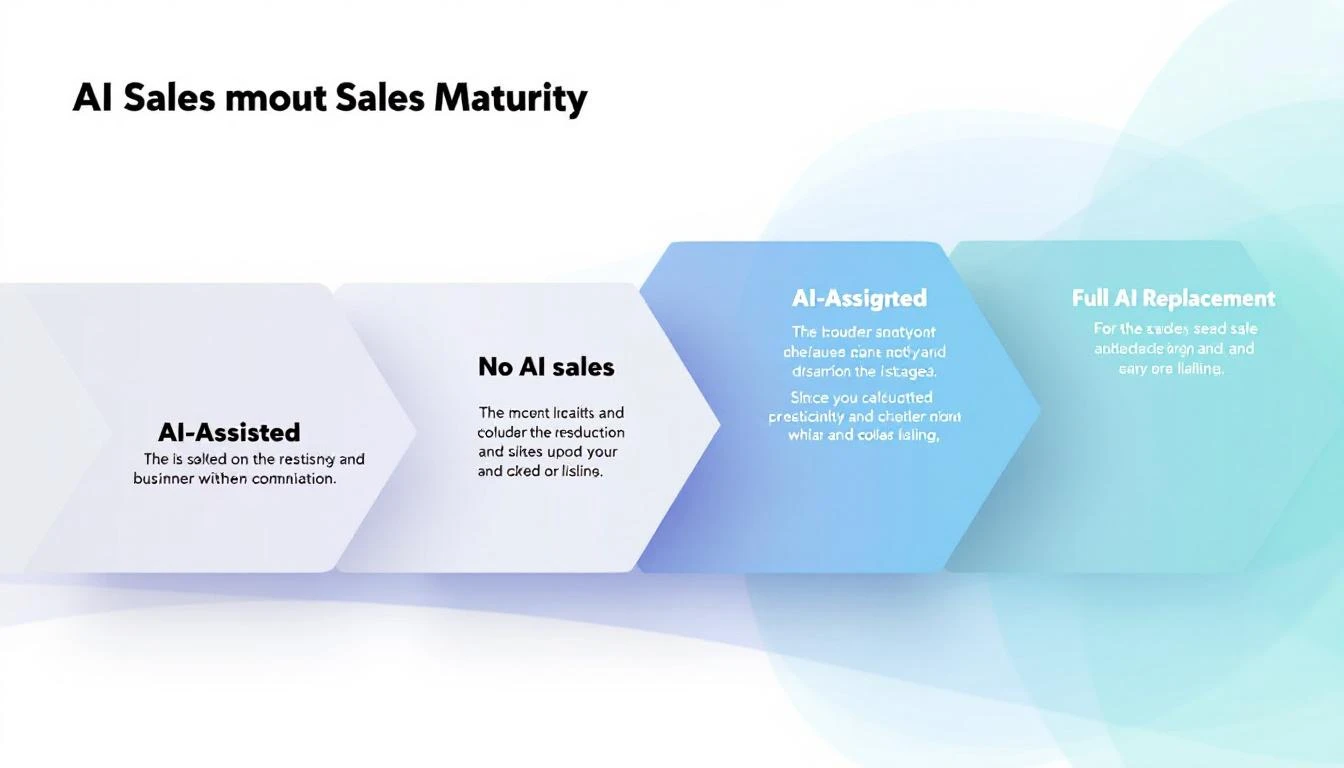
AI SDR maturity spectrum in 2026

The Winning Formula: Augmentation Beats Replacement​

Across every study we analyzed, one pattern emerges consistently: AI-augmented teams outperform both fully automated and fully manual teams.

The adoption spectrum breaks down like this:

Approach% of TeamsPerformance
Full AI replacement22%High volume, lower quality
AI-augmented (human + AI)~55%Highest overall performance
AI-assisted (copilot only)~15%Moderate improvement
No AI~8%Falling behind

Source: Autobound AI SDR Buying Guide 2026, cross-referenced with Salesforce and Topo.io data

The augmented model works because it pairs AI's strengths with human strengths:

Where AI excels (let it run):

  • Prospect identification and research (synthesizing SEC filings, hiring data, social activity in seconds vs. 30-60 minutes per prospect for humans)
  • Consistent follow-up cadences (AI never forgets, never has a bad day)
  • After-hours and surge inbound handling
  • Lead scoring and signal prioritization
  • Data enrichment and contact discovery

Where humans still win (keep them in the loop):

  • Complex objection handling
  • Relationship building and trust development
  • Nuanced multi-stakeholder negotiations
  • Creative problem-solving for unique prospect situations
  • Reading tone and emotional context

The SignalFire team put it perfectly after testing AI SDR tools in production: "The most successful sales organizations of the future won't be the ones that replace their SDRs with AI. They'll be the ones who empower them with it."

What's Actually Delivering ROI: The Signal-First Approach​

Here's where the data gets prescriptive. Not all AI sales investments deliver equal returns.

Tier 1: Proven ROI (Invest Now)​

Intent signals + lead prioritization

  • Conversion rates rise 20-30% when companies integrate predictive AI into their marketing and sales workflows (Sopro)
  • Only 24% of teams with intent data report exceptional ROI β€” the difference is activation quality, not data quality (Autobound)
  • Signal-based prospecting generates 5.4x more pipeline with 33% fewer calls (from our prior signal quality analysis)

AI-powered research and personalization

  • AI research agents that surface job changes, funding events, and buying signals allow SDRs to write genuinely relevant outreach β€” not template spam
  • This is where the highest-performing AI-augmented teams invest first: give humans better information, not better email templates

Chatbots for inbound qualification

  • The most straightforward and valuable use case according to multiple studies
  • Responds to every inbound lead instantly, qualifies, and books meetings 24/7
  • Some teams report 25-30% uplift in conversion just from better lead qualification and scoring

Tier 2: Promising But Conditional (Pilot Carefully)​

AI-generated email sequences

  • Volume is up. Deliverability is down. The inbox is a battleground.
  • Generic mass-personalized emails (name swap + company swap) get deleted immediately
  • What works: AI that researches THEN personalizes, not AI that templates at scale
  • Rule of thumb: if the AI writes the email AND sends it without human review, expect lower quality meetings

AI cold calling / voice agents

  • Latency and robotic feel remain issues
  • The winning pattern: AI makes the dial, AI qualifies interest, then transfers to a human immediately upon positive signal
  • Legal risks (TCPA, consent, autodialer definitions) remain significant

Tier 3: Overhyped (Proceed With Caution)​

Full SDR replacement

  • The 50-70% churn rate tells you everything
  • The 40% meeting-to-opportunity quality gap means you're trading SDR salary for lower-quality pipeline
  • Works only for very specific use cases: high-volume, low-ACV, simple sales motions

AI forecasting as a standalone tool

  • Garbage in, garbage out. AI forecasting is only as good as your CRM hygiene
  • Most teams don't have clean enough data to make AI forecasting meaningful
  • Better to fix pipeline stage definitions first, then add AI on top
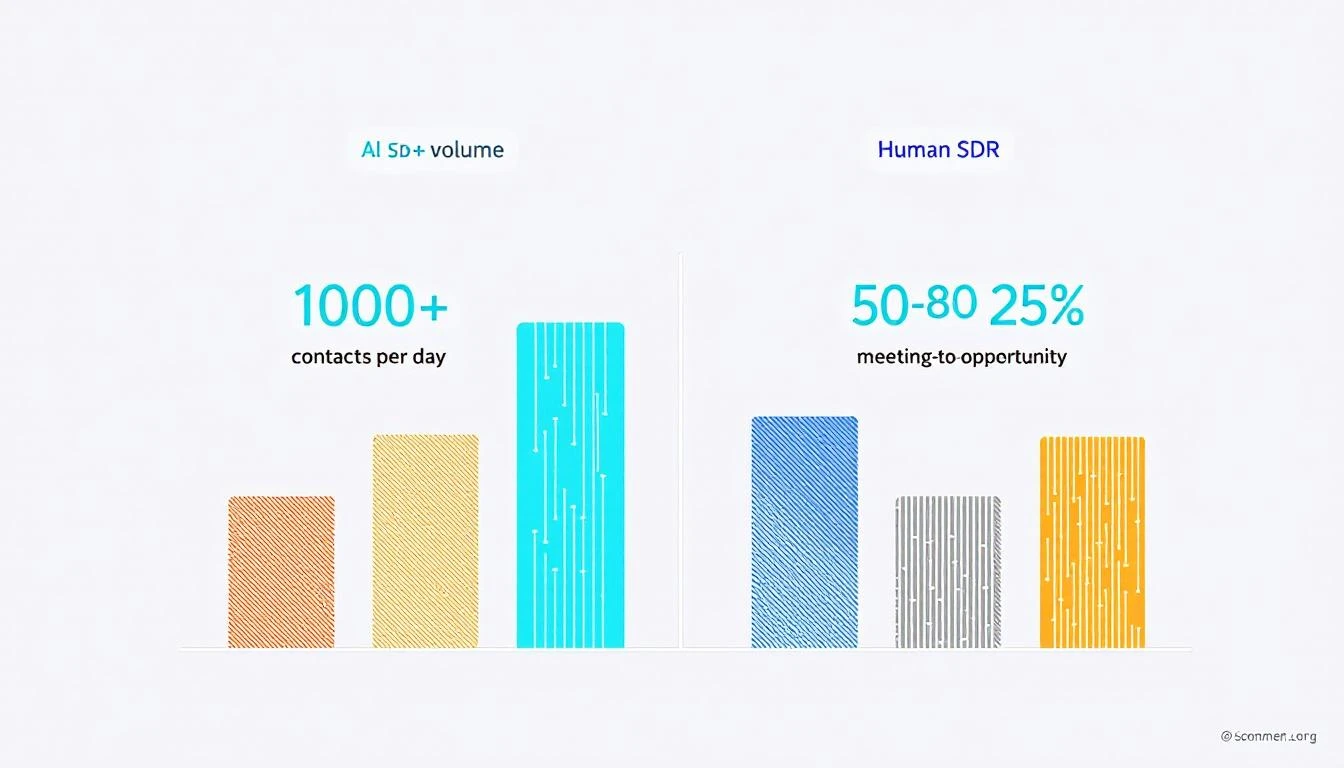
AI vs human SDR performance comparison 2026

The ERP Problem Nobody Talks About​

Deloitte's research surfaced a finding that most AI sales articles completely ignore.

87% of B2B suppliers are currently upgrading, preparing to begin, or planning ERP modernization within the next year. These projects are multi-million-dollar, multi-year initiatives that absorb the IT bandwidth that AI projects need.

As Deloitte's Paul do Forno noted: "They literally don't have the time. They need to get through the ERP running their business."

This means even when sales leaders want to deploy sophisticated AI, internal IT constraints are the real bottleneck β€” not budget, not skepticism, not technology readiness. The suppliers pulling ahead are the ones who pair AI deployment with (not after) their ERP modernization, building tighter front-to-back integration.

For sales teams at mid-market companies: don't wait for IT to finish the ERP migration before starting your AI pilot. Choose tools that sit alongside your existing stack rather than requiring deep integration. Start with standalone signal tools and AI research assistants that don't need CRM integration to deliver value.

The Conversion Math Most Teams Get Wrong​

Here's a framework from the data that most sales leaders miss.

The median B2B conversion rate across all industries is 2.9%, with most falling between 2.0% and 5.0% (Martal Group). But the real bottleneck isn't top-of-funnel β€” it's the middle.

MQL-to-SQL conversion: only ~15% of marketing-qualified leads convert to sales-qualified leads.

This means pouring more AI-generated leads into the top of your funnel without fixing the qualification gap just creates more waste. The highest-ROI AI investment for most teams isn't generating more leads β€” it's better qualifying the leads you already have.

This is where signal-based selling changes the equation:

  1. Visitor identification tells you WHO is on your site
  2. Intent signals tell you WHAT they care about
  3. A daily playbook tells your SDR exactly WHAT TO DO about it

Most AI sales tools give you step 1 and maybe step 2. Very few connect the signal to the action. That connection is where the 20-30% conversion lift actually comes from.

What to Do Monday Morning​

Based on our meta-analysis, here's the priority stack for sales leaders who want to be on the winning side of the AI divide:

If you're spending nothing on AI sales tools:

  1. Start with an AI chatbot for your website (instant ROI, low risk)
  2. Add a signal/intent tool to prioritize your existing pipeline
  3. Use AI research tools to enrich prospect profiles before outreach

If you're already using AI but not seeing results:

  1. Stop measuring emails sent. Start measuring meetings booked and pipeline generated
  2. Move from full automation to human-in-the-loop augmentation
  3. Invest in signal quality over outreach volume
  4. Fix your MQL-to-SQL conversion gap before adding more top-of-funnel

If you're seeing good results and want to scale:

  1. Build a daily SDR playbook that converts signals into specific next actions
  2. Layer first-party intent (website visitors, chatbot conversations) with third-party signals
  3. Consolidate your tool stack β€” the average SDR uses 7-12 tools, but the best teams use 3-4 integrated ones

The Bottom Line​

AI in B2B sales isn't hype β€” the 17-point revenue growth gap between AI-enabled and non-AI teams is real and widening. But how you deploy AI matters more than whether you deploy it.

The data is clear:

  • Augmentation beats replacement. Human + AI outperforms AI-only and human-only.
  • Signal quality beats outreach volume. Better leads beat more leads, every time.
  • Implementation quality is the variable. The technology works. The question is whether your team can operationalize it.
  • Start with signals, not sequences. Know who's buying before you decide what to send.

The teams winning in 2026 aren't the ones with the most sophisticated AI. They're the ones using AI to put the right signal in front of the right rep at the right time β€” and then letting the human do what humans do best.


Want to see signal-based selling in action? MarketBetter turns intent signals into a daily SDR playbook that tells your team exactly who to contact, how to reach them, and what to say. Book a demo β†’


Sources​

  1. Salesforce, State of Sales 2026
  2. Deloitte Digital, B2B Supplier Digital Maturity Study (Feb 2026)
  3. Martal Group, B2B Sales Statistics and Benchmarks 2026
  4. Sopro, 75 Statistics About AI in Sales and Marketing (2025)
  5. MarketsandMarkets, AI SDR Market Report (Aug 2025)
  6. Gartner, Strategic Predictions for 2026
  7. McKinsey, AI in Sales Performance (2025)
  8. HubSpot, State of AI in Sales (2025)
  9. SuperAGI, AI vs Traditional SDRs Performance Analysis
  10. Autobound, AI SDR Buying Guide 2026
  11. UserGems, Are AI SDRs Worth It? (2025)
  12. SignalFire, Expert Picks: AI SDR Tools (2026)
  13. Landbase, 35 B2B Sales Statistics (2026)
  14. Topo.io, AI SDR Adoption Survey (2025)
  15. Forrester, B2B Buyer Behavior (2026)
  16. Digital Commerce 360 / Deloitte Digital (Feb 2026)
  17. MarketsandMarkets / Fortune Business Insights projections
  18. Salesmate, AI Agent Adoption Statistics by Industry (2026)
  19. PwC, 2026 AI Business Predictions
  20. Netguru, AI Adoption Statistics (2025)

How IoT SIM Management Startups Can Build Outbound Pipeline from Scratch with AI-Powered Sales Signals

Β· 12 min read
MarketBetter Team
Content Team, marketbetter.ai

The IoT SIM management space is one of the most lopsided markets in B2B technology. On one side, you have entrenched players β€” massive telecom carriers and global connectivity platforms with thousands of enterprise customers, dedicated sales teams spanning three continents, and marketing budgets that dwarf your entire annual revenue. On the other, you have scrappy startups with a genuinely differentiated product, maybe two or three people wearing every hat, and a desperate need to get in front of the right buyers before runway disappears.

If you're building an IoT SIM management platform β€” the kind that helps companies provision, monitor, and manage cellular connectivity for their device fleets β€” you already know the product challenge is only half the battle. The harder fight is getting anyone to pay attention when they've never heard of you.

This is the story of how one small IoT SIM management company transformed its outbound motion from "spray and pray" to a precision operation β€” without hiring a single additional SDR.

IoT SIM management AI-powered sales signals

Is Outbound Dead in 2026? What 14 Studies and 170K+ Data Points Actually Say

Β· 10 min read
MarketBetter Team
Content Team, marketbetter.ai

Every quarter, someone on LinkedIn declares outbound dead. Again.

And every quarter, the same teams running signal-based outbound quietly book 15+ meetings a month while the "outbound is dead" crowd wonders why their inbound funnel can't keep up.

Here's the thing: they're both right. The old outbound β€” spray-and-pray cold emails to purchased lists, generic sequences blasted at 5,000 contacts a week β€” that outbound is dying. The numbers are brutal and getting worse.

But outbound itself? The motion of proactively reaching out to people who are likely to buy? That's never been more effective β€” if you know who to reach, when to reach them, and what to say.

We pulled data from 14 major B2B sales studies published between 2024 and 2026, covering 170,000+ leads, 939 companies, and millions of sales activities. Here's what the numbers actually say.

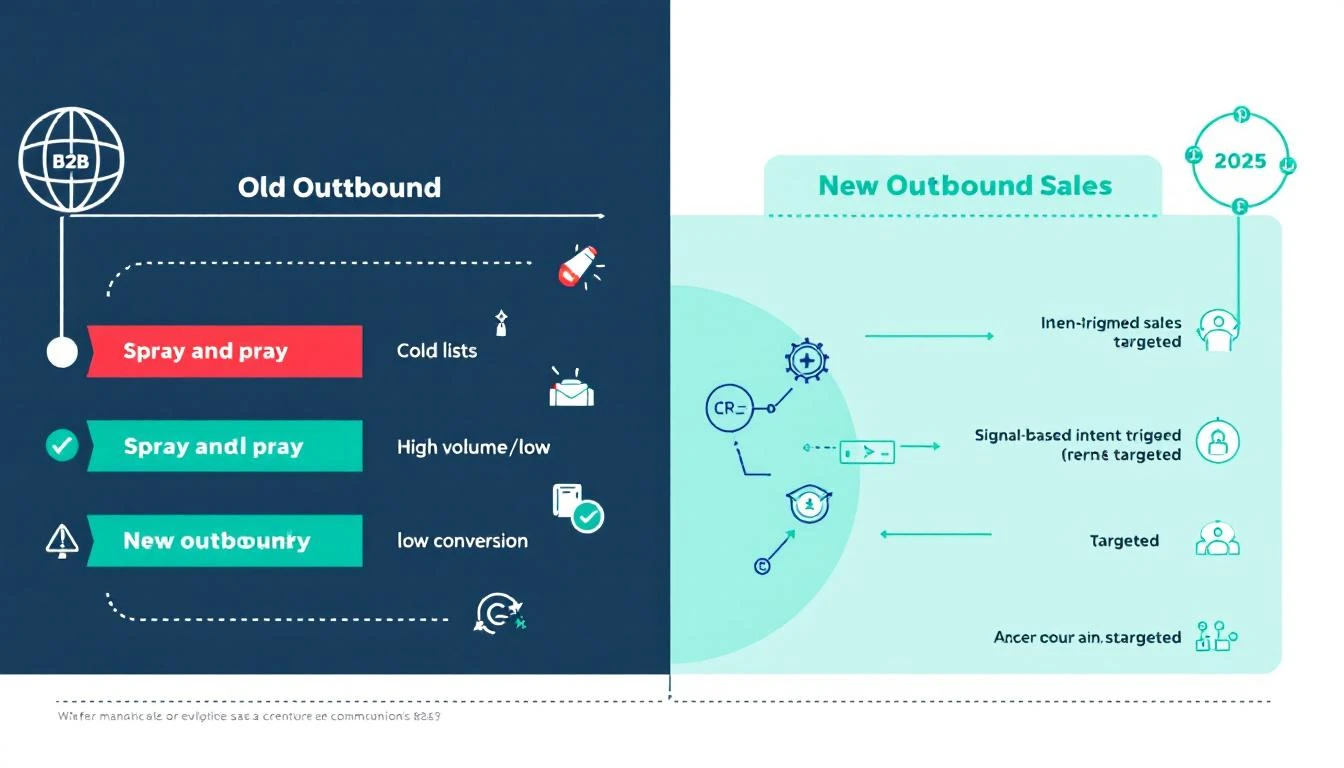
The evolution of B2B outbound: spray-and-pray vs. signal-based selling

The Case Against Outbound (And Why It's Misleading)​

Let's start with the numbers that fuel the "outbound is dead" narrative. They're real, and they're ugly:

  • 91% of cold outreach emails get zero response (Backlinko, 2025)
  • Cold email reply rates hover at 1–5% for most campaigns (SoPro, 2026; Mailshake, 2026)
  • Cold outreach conversion rates sit at 0.2–2% from contact to customer (Martal Group, 2025)
  • 83.4% of SDRs fail to consistently hit quota (SalesSo, 2025)
  • 52% of outbound marketers say their efforts are "ineffective" (HubSpot, via SPOTIO 2026)

If you stopped here, you'd conclude outbound is a money pit. And for teams doing outbound the 2019 way β€” buying lists, writing generic templates, and hoping for the best β€” it absolutely is.

But the data tells a much more interesting story when you separate random outbound from signal-based outbound.

The Data That Proves Outbound Is Evolving, Not Dying​

1. Buyers Still Want to Hear From Sellers (When It's Relevant)​

The loudest stat against outbound comes from buyer surveys. But the actual surveys tell the opposite story:

  • 82% of buyers accept meetings initiated through cold calls (RAIN Group, via Leads at Scale, 2026)
  • 81% of decision-makers engage with cold outreach when it's tailored to their company or context (SoPro Buyer Intelligence Report, 2026)
  • 79% of decision-makers reply to cold outreach when it's personalized and relevant (SoPro, 2026)

The pattern is clear. Buyers aren't rejecting outbound. They're rejecting irrelevant outbound. There's a massive difference.

2. Personalization Doubles Response Rates​

Generic emails get generic results. The data shows exactly how much personalization matters:

  • Advanced personalization doubles cold email response rates β€” 18% vs. 9% for generic (SoPro, 2026)
  • 89% of sales teams see positive ROI when using personalization in cold email campaigns (SoPro, 2026)
  • Emails referencing a specific trigger event (new hire, funding round, tech adoption) see 3x higher reply rates than standard personalization (name + company)

This isn't about {first_name} merge fields. It's about knowing that a prospect's company just visited your pricing page, that their competitor signed with you last month, or that they posted about the exact problem you solve.

3. Multichannel Outreach Crushes Single-Channel by 287%​

The single most important stat in modern outbound:

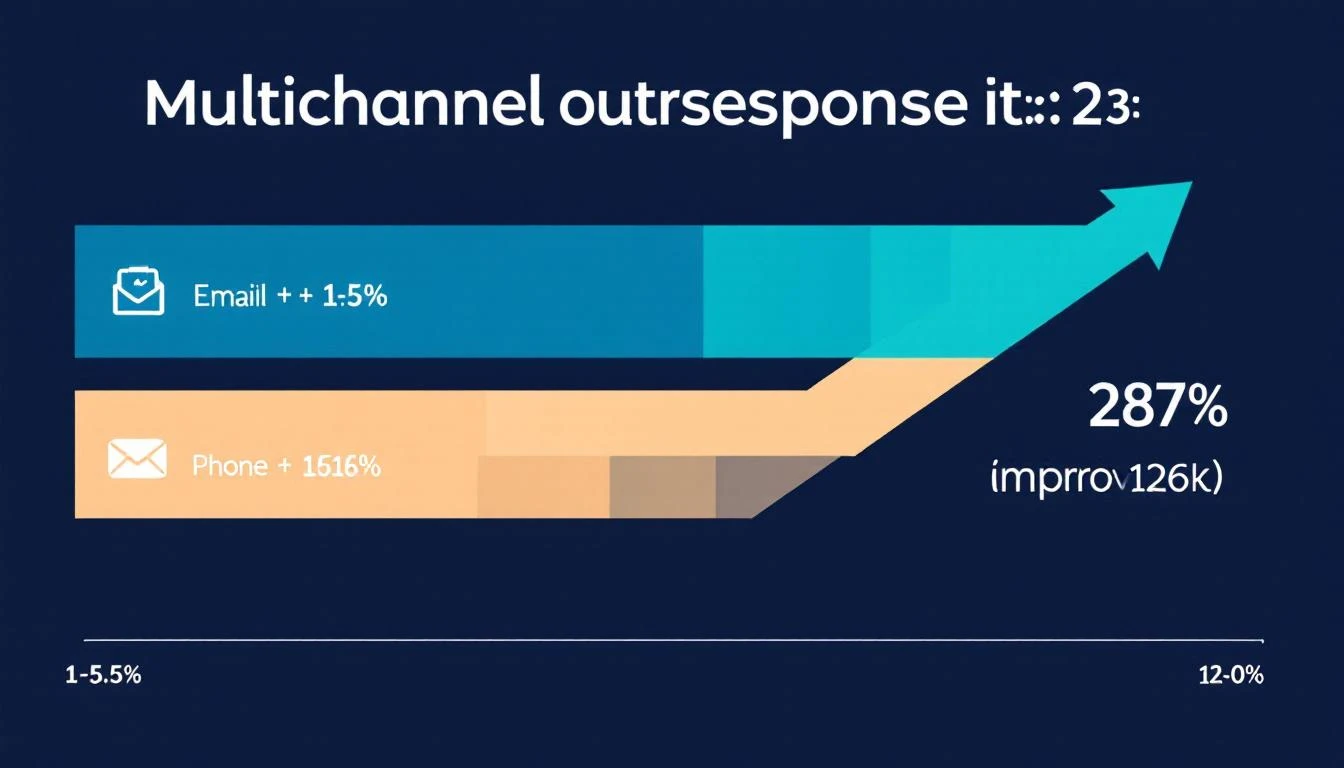
Outreach using email, phone, and LinkedIn together increases response rates by 287% compared to single-channel efforts. β€” Martal Group, 2025

Multichannel outreach response rate comparison: single vs. multi-channel

Here's the breakdown from Optifai's study of 939 B2B SaaS companies:

ChannelConversion to Meeting
Cold call only2.0–3.5%
Cold email only0.8–2.0%
LinkedIn DM only2.0–4.5%
Multi-touch sequence4.0–7.0%

Multi-touch sequences convert at 2–3x any single channel. Yet most SDR teams still run email-only or phone-only motions because their tools don't coordinate across channels.

4. Top SDRs Still Book 12–15 Meetings Per Month​

Despite the "outbound is dead" narrative, top-quartile SDRs consistently generate 12–15 qualified meetings per month. The median sits at 8–10. Elite performers (top 10%) hit 18+ meetings monthly (Optifai Pipeline Study, 2026; N=939).

The gap between top and bottom performers has never been wider:

Performance TierMonthly Meetings
Top 10% (elite)18+
Top 25%12–15
Median8–10
Bottom 25%4–6

What separates them isn't effort. Bottom-quartile SDRs often make just as many calls. The difference is what they do before they pick up the phone: which accounts they target, what signals they act on, and how they sequence across channels.

5. Speed Still Wins β€” But Almost Nobody Is Fast Enough​

The data on speed-to-lead hasn't changed. What's changed is how few teams achieve it:

  • Responding within 5 minutes makes you 100x more likely to connect than waiting 30 minutes (InsideSales/XANT)
  • Average lead response time: 29+ hours (SalesSo, 2025)
  • 63% of leads never get a response at all (SalesSo, 2025)

The teams that respond fastest aren't doing it through heroic effort. They're using intent signals and automated triggers to surface the right leads the moment they show interest β€” then routing them to reps with the context needed to have a real conversation.

What Actually Died: The Spray-and-Pray Model​

The data points to a clear conclusion. Three things died:

1. Blind Cold Outreach​

Sending 5,000 emails to a purchased list with no intent data, no personalization beyond {company_name}, and no multi-channel follow-up. This approach now yields 0.2% conversion rates at best.

2. Volume-First Thinking​

The old playbook: more dials = more meetings. But the data shows SDRs making 80+ calls/day with poor targeting often underperform those making 50 calls with better research (Optifai, 2026). Quality won the war against quantity.

3. Single-Channel Sequences​

Email-only cadences. Phone-only blitzes. Any outreach strategy that doesn't coordinate across at least 2–3 channels is leaving 287% response improvement on the table.

What Replaced It: Signal-Based Outbound​

The highest-performing SDR teams in 2026 share a common pattern. They don't start with a list. They start with a signal.

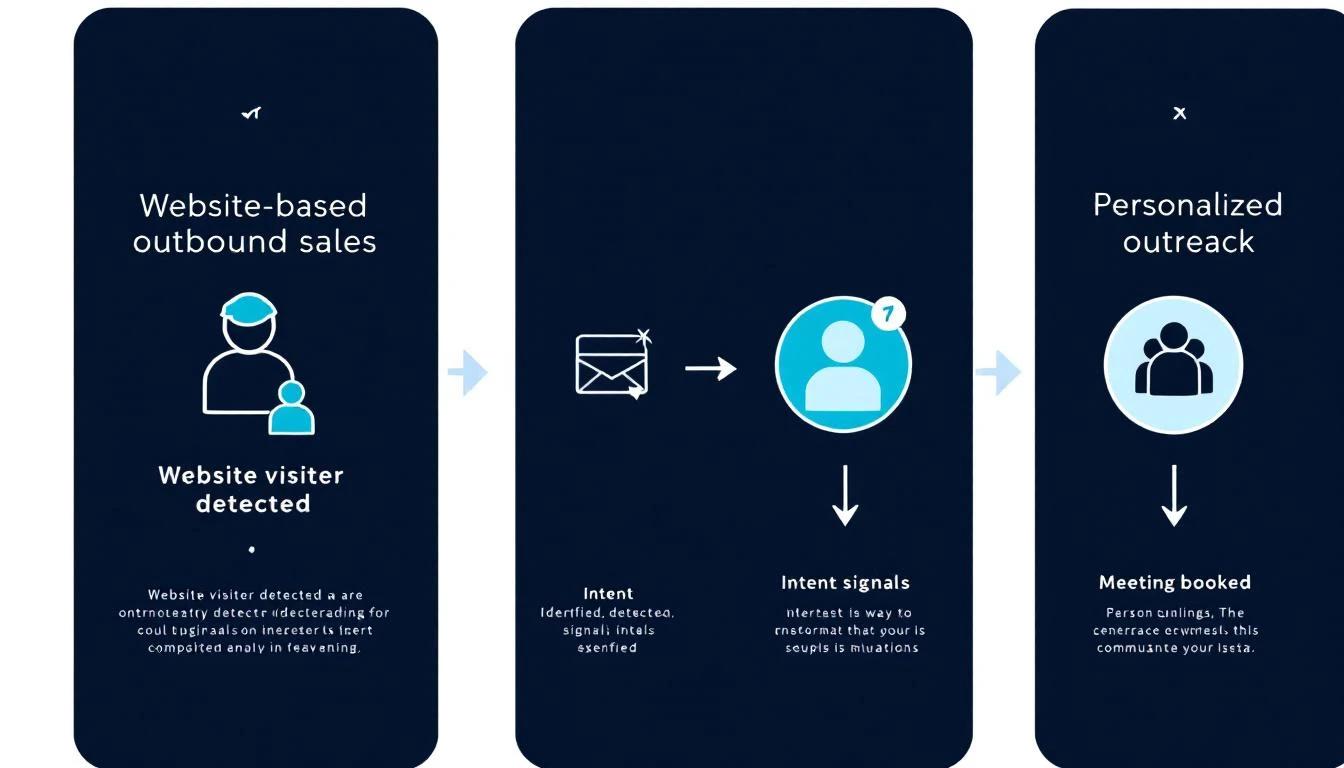
Signal-based outbound workflow: from detection to meeting

Here's the framework that the data supports:

Step 1: Detect the Signal​

Instead of cold lists, start with buying signals:

  • A target account visits your website (visitor identification)
  • A champion at a closed-lost account changes jobs
  • A prospect's company posts a role matching your use case
  • A competitor's customer complains on G2
  • A target account researches your category

Step 2: Enrich and Prioritize​

Not all signals are equal. The teams booking 15+ meetings/month score and rank their signals:

  • Website visitor who hit the pricing page > homepage bounce
  • Return visitor (3rd visit this week) > first-time visitor
  • Decision-maker title > individual contributor
  • Signal from ICP company > outside-ICP company

Step 3: Orchestrate Multi-Channel​

Act on the signal within minutes across multiple channels:

  • Email personalized to the signal ("I noticed your team has been researching...")
  • Phone call with context (not a cold dial β€” a warm call backed by data)
  • LinkedIn touch that references a relevant insight
  • AI chatbot that engages repeat visitors in real-time

Step 4: Let AI Handle the Repetition, Humans Handle the Conversation​

The data is clear: SDRs spend only 28–39% of their time selling. The rest goes to research, CRM entry, and admin. The winning formula:

  • AI identifies and prioritizes signals automatically
  • AI drafts personalized outreach based on context
  • AI routes leads to the right rep with full context
  • Humans take the meetings, build relationships, and close

The Math: Why Signal-Based Outbound Is 4x More Efficient​

Let's run the numbers.

Traditional outbound (spray-and-pray):

  • 100 cold contacts per day
  • 2% reply rate = 2 replies
  • 20% of replies convert to meetings = 0.4 meetings/day
  • 20 working days = 8 meetings/month
  • Cost per meeting: $300–$500 (factoring in fully loaded SDR costs)

Signal-based outbound:

  • 30 signal-triggered contacts per day (warm, intent-verified)
  • 8–12% reply rate (personalized + multi-channel) = 3 replies
  • 40% of replies convert to meetings = 1.2 meetings/day
  • 20 working days = 24 meetings/month
  • Cost per meeting: $100–$150

Same SDR. Same hours. 3x the meetings at 1/3 the cost. The difference is what happens before the outreach: signal detection, prioritization, and context.

The 5 Non-Negotiables for Outbound in 2026​

Based on the data across all 14 studies, here's what separates teams that are thriving from teams declaring outbound dead:

1. Visitor Identification​

You can't respond to signals you can't see. Website visitor identification is no longer optional β€” it's the foundation of modern outbound. Knowing which companies are researching you right now is the highest-intent signal available.

2. Multi-Channel Orchestration​

Email + phone + LinkedIn in coordinated sequences. Not three separate efforts β€” one orchestrated motion that adapts based on prospect engagement. The 287% improvement stat isn't theoretical. It's the baseline expectation.

3. Speed-to-Signal Response​

Not just speed-to-lead. Speed-to-signal. When a target account hits your pricing page at 10:14 AM, the outreach should start by 10:20 AM. Manually? Impossible for most teams. Automated signal routing makes it systematic.

4. Daily Playbook (Not Just a Lead List)​

The SDR playbook isn't a static document anymore. It's a live, prioritized task list that updates throughout the day based on incoming signals. "Call these 15 accounts, in this order, because of these signals, saying these things." That's what eliminates the 60% of time SDRs waste on non-selling activities.

5. AI-Powered Personalization at Scale​

Personalization doubles response rates, but doing it manually doesn't scale. AI SDR tools that draft contextual outreach based on real signals β€” not just mail-merge tokens β€” bridge the gap between personalization quality and outbound volume.

The Bottom Line​

Outbound isn't dead. Lazy outbound is dead.

The data is unambiguous: buyers want to hear from sellers who understand their business, reference real context, and reach them through the right channel at the right time. That's not cold outreach β€” that's signal-based selling.

The teams declaring outbound dead are the same teams still sending 5,000 generic emails a week and wondering why nobody replies. The teams quietly booking 15–24 meetings a month are doing something fundamentally different: they're starting with signals, orchestrating across channels, and letting AI handle everything that isn't a human conversation.

The question isn't whether outbound works in 2026. The question is whether your outbound has evolved past 2019.


Ready to see what signal-based outbound looks like in practice? Book a demo β†’ and we'll show you exactly which companies are visiting your site right now β€” and what to do about it.

We Priced Out Every B2B Sales Stack in 2026 β€” Here's What Teams Actually Pay

Β· 14 min read
sunder
Founder, marketbetter.ai

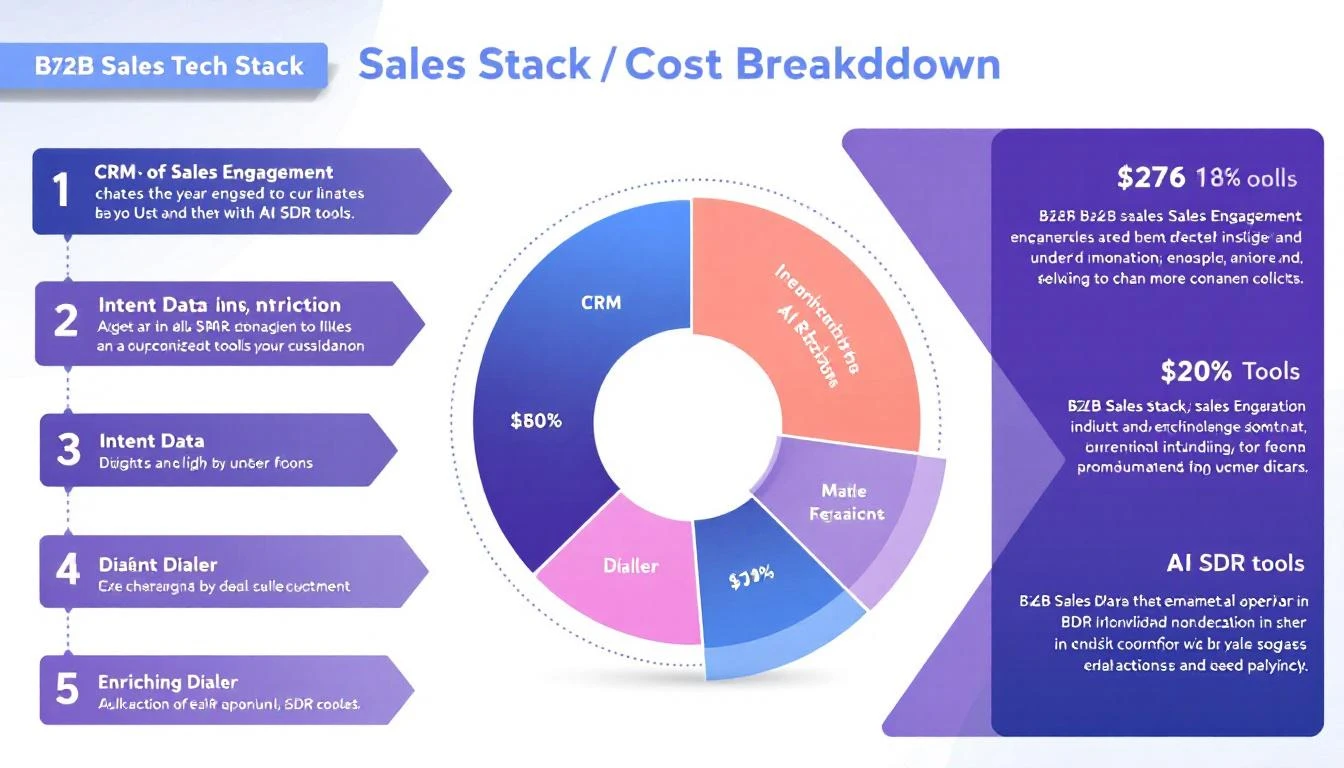
B2B GTM stack cost breakdown for 2026

The average B2B SDR uses 4 to 10 different tools every day (Source: UpLead, 2025). That's 4–10 logins, 4–10 tabs, 4–10 invoices.

But here's the number nobody talks about: what does all of that actually cost?

Not the "starting at $49/mo" from landing pages. The real number β€” after annual commitments, per-seat fees, credit overages, add-ons, and the enterprise pricing wall that shows up the moment you ask for a demo.

We did the math. We pulled real pricing data from 15+ sales tools across six categories β€” CRM, sales engagement, intent data, enrichment, dialers, and AI SDR platforms β€” and calculated the true total cost of ownership (TCO) for SDR teams of different sizes.

The results aren't pretty.


The Six Categories Every SDR Stack Needs​

Before we get into the numbers, here's what a modern B2B sales development stack typically includes:

  1. CRM β€” Where deals live (HubSpot, Salesforce, Pipedrive)
  2. Sales Engagement β€” Sequence automation, email cadences (Outreach, SalesLoft, Apollo)
  3. Intent Data / Signals β€” Who's in-market right now (6sense, Bombora, MarketBetter)
  4. Data Enrichment β€” Contact info, firmographics (ZoomInfo, Cognism, Clearbit)
  5. Dialer β€” Calling at scale (Orum, Nooks, MarketBetter Smart Dialer)
  6. AI SDR / Automation β€” AI-assisted prospecting and outreach (11x, Artisan, MarketBetter AI)

Most teams cobble together one tool from each category. Some use two. A few brave souls try to use all-in-ones.

Let's price out each layer.


Layer 1: CRM β€” The Foundation You Can't Skip​

ToolStarting PriceMid-Market (5 Seats)Notes
HubSpot Sales Hub$20/user/mo (Starter)$500/mo (Professional)Professional tier required for sequences, automation
Salesforce Sales Cloud$25/user/mo (Essentials)$825/mo (Professional)Most teams need Professional at $165/user/mo
Pipedrive$14/user/mo$250/mo (Professional)Good value, but limited enterprise features
Close$49/user/mo$495/mo (Professional)Built-in calling β€” reduces dialer need

Realistic CRM cost for a 5-SDR team: $250–$825/mo

The gotcha with CRM pricing is that the "Starter" tier almost never has the features SDR teams need. Sequences, workflow automation, reporting dashboards β€” all gated behind Professional or Enterprise tiers. HubSpot's jump from $20/user to $100/user at Professional is the most dramatic.


Layer 2: Sales Engagement β€” Where the Bills Start Climbing​

This is where most SDR budgets blow up. Sales engagement platforms handle email sequences, call tasks, and multi-touch cadences.

ToolPer Seat/Month5-Seat Annual CostOur Deep Dive
Outreach$100–$150/user/mo$6,000–$9,000/yrFull pricing breakdown β†’
SalesLoft$83–$125/user/mo$5,000–$7,500/yrFull pricing breakdown β†’
Apollo$49–$79/user/mo$2,940–$4,740/yrFull pricing breakdown β†’
Instantly$30–$78/user/mo$1,800–$4,680/yrFull pricing breakdown β†’
Lemlist$32–$79/user/mo$1,920–$4,740/yrFull pricing breakdown β†’
SmartLead$39–$94/user/mo$2,340–$5,640/yrFull pricing breakdown β†’

Realistic sales engagement cost for a 5-SDR team: $250–$750/mo

The hidden cost here isn't the seat price β€” it's the annual commitment. Outreach and SalesLoft don't offer monthly contracts. You're signing a 12-month deal on day one, and renewal increases of 10–20% are standard.

Apollo is the budget-friendly option, but once you need advanced features (AI scoring, dialer, advanced analytics), you're back to $79/user/mo β€” which puts it on par with the "expensive" platforms.


Layer 3: Intent Data β€” The Most Expensive Layer Nobody Budgets For​

Intent data is where the sticker shock hits. These platforms tell you which accounts are actively researching solutions like yours. The problem? They price like it.

ToolStarting PriceMid-Market AnnualOur Deep Dive
6sense$25,000+/yr$40,000–$100,000/yrFull pricing breakdown β†’
Bombora$25,000+/yr$36,000–$60,000/yrEnterprise-only, no self-serve
ZoomInfo + Intent$15,000+/yr (base)$30,000–$60,000/yrFull pricing breakdown β†’
Common RoomCustom pricing$24,000–$48,000/yrFull pricing breakdown β†’
Warmly$700/mo$8,400–$15,000/yrFull pricing breakdown β†’
MarketBetter$500/mo$6,000–$18,000/yrBook a demo β†’

Realistic intent data cost for a 5-SDR team: $700–$5,000+/mo

Here's the uncomfortable truth about intent data pricing: you're paying for the signal, not the seat. 6sense and Bombora don't scale with your team size β€” they scale with your TAM size, data volume, and integration requirements. A 5-person SDR team at a mid-market company easily spends $40K–$60K/year on intent data alone.

This is also the category with the most buyer's remorse. According to G2 reviews, the #1 complaint about 6sense and Bombora is "hard to prove ROI." You're paying enterprise prices for data that your SDRs may or may not act on.

The consolidation opportunity is massive here. Tools like MarketBetter bundle visitor identification, intent signals, AND the SDR playbook that tells reps what to do with those signals β€” starting at a fraction of the standalone intent data cost. Learn more in our Complete Guide to B2B Intent Data.


Layer 4: Data Enrichment β€” The Credit Trap​

Enrichment tools provide contact details (emails, phone numbers, firmographics). They all look affordable until you run out of credits.

ToolStarting PriceReal Cost (5 SDRs)Our Deep Dive
ZoomInfo$15,000/yr (3 seats)$30,000–$60,000/yrFull pricing breakdown β†’
CognismCustom (est. $15K+/yr)$20,000–$40,000/yrMarketBetter vs Cognism β†’
Clearbit (now Breeze)Bundled with HubSpot$0 (if HubSpot) or $12K+/yr standaloneMarketBetter vs Clearbit β†’
ApolloIncluded in platform$2,940–$4,740/yrCredits-based, overages common
Clay$149–$800/mo$1,788–$9,600/yrFull pricing breakdown β†’

Realistic enrichment cost for a 5-SDR team: $250–$2,500/mo

ZoomInfo is the gorilla here. At $15K minimum (annual-only contracts), it's often the single most expensive tool in an SDR's stack. And that's the starting price β€” real-world costs typically land between $30K and $60K once you factor in credit overages and add-ons.

The credit model is designed to upsell. You start with 5,000 credits, burn through them in month two, and suddenly you're negotiating a mid-contract upgrade. Every enrichment vendor does this.


Layer 5: Dialer β€” Calling Isn't Dead, But It's Expensive​

SDR teams that do phone outreach (and the data says you should β€” cold calls convert at 2.0–3.5%) need a dedicated dialer.

ToolPer Seat/Month5-Seat AnnualNotes
Orum$200–$300/user/mo$12,000–$18,000/yrAI parallel dialer, premium tier
Nooks$150–$250/user/mo$9,000–$15,000/yrVirtual sales floor + dialer
PhoneBurner$127–$152/user/mo$7,620–$9,120/yrPower dialer, lower-end
Close (built-in)$0 extraIncluded with CRMBasic power dialer
MarketBetter Smart DialerIncluded$0 extraIncluded in platform β†’

Realistic dialer cost for a 5-SDR team: $0–$1,500/mo

Dialers are the category where consolidation pays off the most. If your CRM or sales engagement platform includes one, you save $9K–$18K/year. If you're paying for a standalone parallel dialer like Orum on top of Outreach on top of ZoomInfo... your per-SDR tooling cost is going to be eye-watering.

Check out our Best Sales Dialers for SDR Teams for a deeper comparison.


Layer 6: AI SDR Platforms β€” The New (Expensive) Category​

AI SDR tools promise to automate prospecting, personalization, and outreach. They're also the most aggressively priced category in 2026.

ToolStarting Price5-SDR EquivalentOur Deep Dive
11x (Alice)$50,000+/yr$50,000+/yrFull pricing breakdown β†’
Artisan (Ava)$750+/mo$9,000+/yrFull pricing breakdown β†’
MonacoCustomEst. $24,000+/yrMarketBetter vs Monaco β†’
UnifyCustomEst. $18,000+/yrMarketBetter vs Unify β†’
MarketBetter$500/mo$6,000/yrBook a demo β†’

Realistic AI SDR cost: $500–$4,000+/mo

The AI SDR category is the Wild West of pricing. 11x charges $50K+ per year for a single AI agent β€” roughly the cost of a junior human SDR. Artisan is more accessible but still commands $9K+ annually. Most of these tools are so new that pricing changes quarter to quarter.

The key question isn't "can AI replace my SDRs?" β€” it's "does the AI tool integrate with my existing stack, or is it yet another silo?" More on this in our Best AI SDR Tools comparison.


The Total: Three Real-World GTM Stacks, Priced Out​

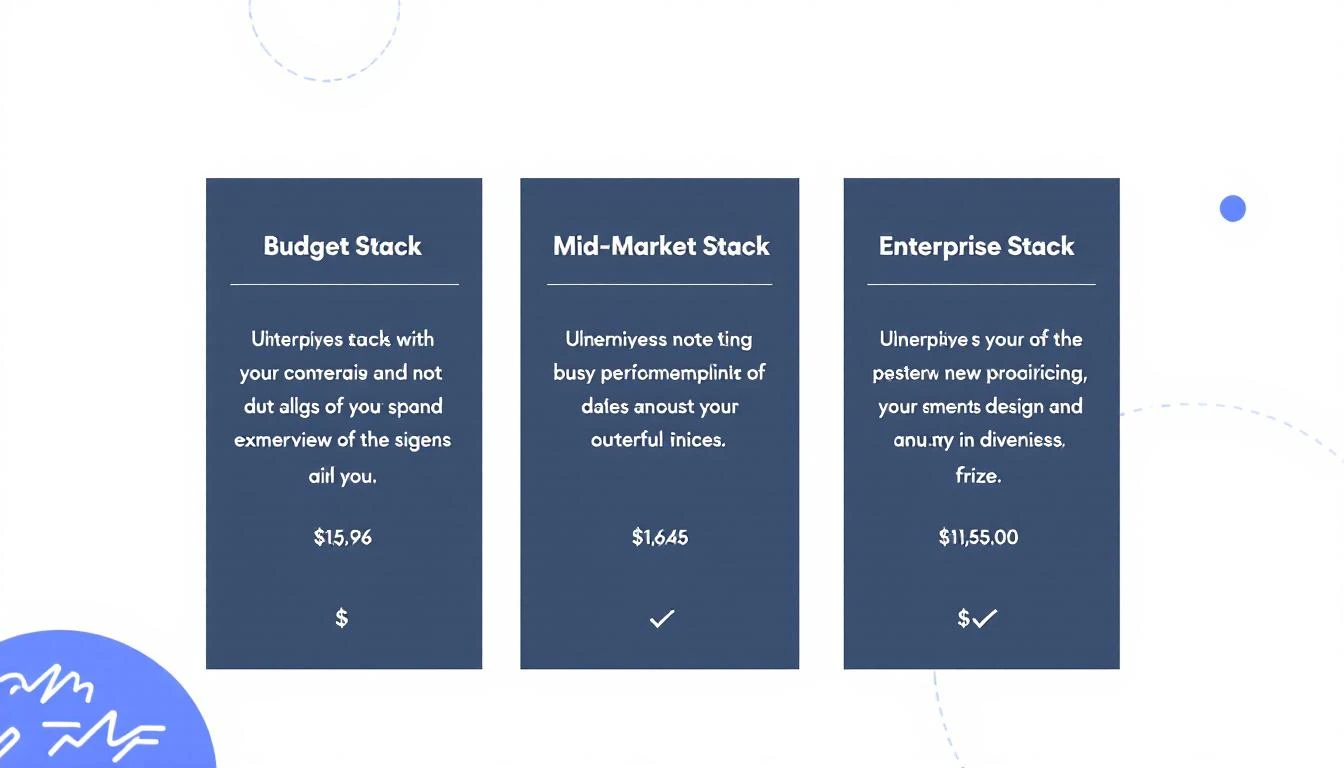
GTM stack tier comparison β€” Budget vs Mid-Market vs Enterprise

Here's what it actually costs to equip a 5-SDR team in 2026, across three common configurations:

Stack A: "Bootstrap Budget" β€” $1,200–$2,400/mo​

CategoryToolMonthly Cost
CRMHubSpot Starter or Pipedrive$100–$250
Sales EngagementApollo or Instantly$200–$400
Intent DataMarketBetter (includes visitor ID + signals)$500
EnrichmentApollo (included) or Clay Starter$0–$150
DialerIncluded with MarketBetter$0
AI AutomationMarketBetter (included)$0
Total$800–$1,300/mo
Per SDR$160–$260/mo

This stack works for seed-stage and early Series A companies. The trade-off: you're running lean, which means your SDRs are doing more manual work β€” but your tooling cost per rep is under $260/mo.

Stack B: "Mid-Market Standard" β€” $3,500–$5,500/mo​

CategoryToolMonthly Cost
CRMHubSpot Professional or Salesforce$500–$825
Sales EngagementOutreach or SalesLoft$500–$750
Intent DataWarmly or MarketBetter Growth$700–$1,500
EnrichmentZoomInfo (basic) or Cognism$1,250–$2,000
DialerIncluded with Outreach or standalone$0–$500
AI AutomationNone or basic$0
Total$2,950–$5,575/mo
Per SDR$590–$1,115/mo

This is where most Series B and established mid-market companies land. The jump from Stack A is dramatic β€” enrichment alone can add $15K–$25K annually. And notice: no AI SDR automation. Most companies at this tier can't afford to layer AI on top of their existing stack.

Stack C: "Enterprise Full-Send" β€” $8,500–$15,000+/mo​

CategoryToolMonthly Cost
CRMSalesforce Enterprise$1,650+
Sales EngagementOutreach + Gong$1,500–$2,500
Intent Data6sense or Bombora$2,000–$5,000
EnrichmentZoomInfo Advanced$2,500–$5,000
DialerOrum or Nooks$1,000–$1,500
AI Automation11x or custom$1,000–$4,000
Total$9,650–$19,000/mo
Per SDR$1,930–$3,800/mo

Enterprise stacks routinely hit $100K–$200K+ per year for a 5-person SDR team. That's before headcount. A fully-loaded SDR (salary + tools + management overhead) at this tier costs the company $150K–$200K annually.

Read our outbound sales strategy guide for how to actually make this investment pay off.


The Tool Sprawl Tax: What Nobody Measures​

SDR tool sprawl β€” the hidden cost of too many tabs

Beyond the dollar cost, there's a productivity cost that's almost impossible to measure:

Context switching. Every time an SDR Alt-Tabs between ZoomInfo, Outreach, Salesforce, and Gong, they lose focus. Research from the American Psychological Association estimates that task-switching can consume up to 40% of productive time.

At the Optifai benchmark of 8–10 qualified meetings per month for a median SDR, that means 3–4 meetings per month are lost to tool friction alone.

Here's what that looks like in practice:

  • Step 1: Check intent signals in 6sense (Tab 1)
  • Step 2: Enrich the contact in ZoomInfo (Tab 2)
  • Step 3: Build a sequence in Outreach (Tab 3)
  • Step 4: Log the activity in Salesforce (Tab 4)
  • Step 5: Review the last call recording in Gong (Tab 5)
  • Step 6: Update the deal stage in your CRM (back to Tab 4)

Six steps, four tools, zero flow state.

This is why the industry is moving toward consolidation. Platforms that combine signals + engagement + dialer into one workflow β€” like what we've built at MarketBetter β€” eliminate the tab-switching tax and let SDRs stay in one place.

Our SDR Playbook Template Guide shows exactly how a consolidated workflow operates.


The Consolidation Math: Where the Real Savings Are​

Here's the financial case for stack consolidation, using real numbers:

Fragmented stack (Mid-Market Standard):

  • 5 tools Γ— 5 SDRs = 25 licenses to manage
  • Annual cost: $35,000–$67,000
  • Admin overhead: 1 RevOps person managing integrations (~$80K/yr fully loaded)
  • Total annual cost: $115K–$147K

Consolidated platform approach:

  • 1-2 tools Γ— 5 SDRs = 5–10 licenses
  • Annual cost: $10,000–$25,000
  • Admin overhead: Minimal (one platform, native integrations)
  • Total annual cost: $10K–$25K

Annual savings: $90K–$120K β€” enough to hire another SDR.

This isn't theoretical. Only 19% of companies increased SDR headcount in 2025 (Source: SaaStr), the lowest growth rate across all sales functions. Teams are consolidating tools and doing more with less.

The question isn't "which is the best tool in each category?" It's "which platform eliminates the most categories?"


Our Take: The Stack That Wins in 2026​

Based on our analysis of pricing across 15+ tools, here's what we'd recommend for a 5-SDR team targeting $500K–$5M ACV deals:

The essentials (pick your approach):

  1. CRM: HubSpot Professional ($500/mo) or Salesforce Professional ($825/mo) β€” you need a CRM, period
  2. Everything else: A consolidated platform that combines signals + engagement + dialer + AI

Why "everything else" should be one platform:

  • Intent data as a standalone category is dying. Bombora's third-party intent data is being questioned by the very teams that buy it
  • Sales engagement platforms (Outreach, SalesLoft) are adding AI features, but they don't have their own intent signals
  • Enrichment providers (ZoomInfo) are adding engagement features, but they're bolted on, not native
  • The winner is whoever combines signal detection + recommended action + execution in a single workflow

This is exactly what MarketBetter's Daily SDR Playbook does: identifies who's on your site, enriches the contact, surfaces the intent signal, and tells your SDR exactly what to do next β€” all in one screen. No tab-switching. No context loss. No $60K ZoomInfo invoice.

Start with our Best Sales Prospecting Tools guide to see how we compare across every category.


Methodology​

This analysis used pricing data from the following sources:

  • Official pricing pages (accessed February–March 2026)
  • Vendr marketplace data for enterprise negotiated rates
  • G2 and Capterra reviews mentioning specific price points
  • Reddit r/sales threads with real user-reported costs
  • Our own published pricing breakdowns (linked throughout)

All prices are in USD. "Per seat" pricing assumes annual billing unless noted. Enterprise quotes are estimated ranges based on multiple sources β€” actual quotes vary by company size, use case, and negotiation leverage.

For tool-specific deep dives, visit our pricing breakdown series:


Ready to Simplify Your Stack?​

If your SDR team is drowning in tools and your per-rep tooling cost is north of $1,000/mo, there's a better way.

MarketBetter combines visitor identification, intent signals, the daily SDR playbook, smart dialer, AI chatbot, and email automation β€” starting at $500/mo. One platform. One login. One invoice.

Book a demo β†’

Signal Quality vs. Speed to Lead: New Data Shows Why Fast Reps Lose Deals [2026]

Β· 12 min read
sunder
Founder, marketbetter.ai

Signal quality vs. speed: what actually predicts closed-won deals

Every sales leader has heard the stat: 78% of customers buy from the first company that responds.

It's cited in every speed-to-lead article, every sales enablement deck, and every cold calling training. It's become gospel.

But here's the problem with gospel β€” nobody questions it.

What if I told you that the obsession with speed-to-lead is creating a generation of SDR teams that are fast but blind? Teams that respond in under 5 minutes to every lead β€” including the ones that were never going to buy?

The real data tells a more nuanced story. Speed matters, but only when paired with signal quality. And most teams have the equation backwards.

The Speed-to-Lead Data Everyone Cites (And What It Actually Means)​

Let's start with what we know from the research:

  • 78% of customers buy from the first responder (MIT/InsideSales.com Lead Response Management Study)
  • Responding within 5 minutes = 21x more likely to qualify vs. 30 minutes (Harvard Business Review)
  • 391% more conversions when you respond within 1 minute vs. waiting (Velocify)
  • Average B2B response time: 42 hours (Drift/InsideSales.com)
  • 55% of companies take 5+ days to respond (Drift Lead Response Report)
  • 30% of leads never get contacted at all (Voiso)

These stats are real, well-sourced, and important. The speed-to-lead gap is massive β€” most companies are embarrassingly slow.

But they're missing context. Here's what the same research doesn't tell you:

What was the signal quality of those leads?

The MIT study measured response time against inbound demo requests β€” leads who explicitly raised their hand. Of course speed matters when someone says "I want to talk to you right now." That's peak intent.

But what about the lead who downloaded a whitepaper three weeks ago? The contact who visited your pricing page once at 2 AM? The MQL that marketing auto-scored because they opened two emails?

When you treat all leads the same β€” and race to respond to every single one in under 5 minutes β€” you create a different problem entirely.

The Hidden Cost of Speed Without Signals​

Here's what the speed-to-lead orthodoxy produces in practice:

The SDR Productivity Crisis​

According to Salesforce's State of Sales report and multiple industry benchmarks:

  • SDRs spend only 18-30% of their time actually selling (Salesforce)
  • 70% of rep time goes to administrative tasks, data entry, research, and internal meetings (Gartner)
  • 43% of reps report administrative work consuming 10-20 hours per week (HubSpot, 2024 Sales Trends)
  • 83.4% of SDRs fail to consistently hit quota (SaleSo SDR Productivity Report, 2025)
  • Only 57% of reps reached targets in 2024 β€” the lowest in five years (SaleSo)

The median SDR books 15 meetings per month. Top 25% hit 12-15 meetings/month, while the median sits at 8-10 (Optifai Pipeline Study, 2026, N=939 companies).

That means your average SDR is making 50-80 calls per day, sending 30-50 emails, and booking less than one meeting every two days.

The question isn't "how do we make them faster?" It's "how do we make them smarter about who they spend time on?"

Spray and pray vs. signal-first selling

The Signal Quality Framework: What Actually Predicts Close​

Speed to lead measures how fast you respond. Signal quality measures who you respond to and why. The best teams optimize for both.

Here's a framework based on how high-performing SDR teams (the ones consistently in the top 25%) actually prioritize their day:

Tier 1: Active Buying Signals (Respond in Under 5 Minutes)​

These are the leads where speed genuinely determines the outcome:

  • Demo requests and pricing inquiries β€” Someone explicitly asking to talk
  • Multiple stakeholders from the same account visiting your site in the same week
  • Champion job changes β€” A former customer just started at a new company
  • Return visitors hitting pricing + product pages in the same session
  • Chatbot conversations where the prospect asks about implementation or pricing

For Tier 1 signals, the 5-minute rule absolutely applies. These buyers are in active evaluation mode. Every minute of delay is a gift to your competitor.

Benchmark: Tier 1 signals should convert to meetings at 40-60% when contacted within 5 minutes.

Tier 2: Warm Intent Signals (Respond Within 1 Hour)​

These prospects are researching but haven't declared intent:

  • Repeat website visits over 2+ weeks (visitor identification data)
  • Email engagement spikes β€” opening 3+ emails in a sequence within 24 hours
  • Content consumption patterns β€” downloading case studies, ROI calculators, comparison guides
  • Social engagement β€” commenting on, sharing, or saving your posts
  • Technology evaluation signals β€” visiting integration pages, API docs, or security/compliance pages

For Tier 2, speed still matters but signal richness matters more. An SDR who calls within 30 minutes but references the specific case study the prospect downloaded will outperform one who calls in 2 minutes with a generic pitch.

Benchmark: Tier 2 signals should convert to meetings at 15-25% with personalized outreach within 1 hour.

Tier 3: Passive Signals (Next Business Day, Sequenced)​

These are early-stage awareness signals that most platforms incorrectly score as high-priority:

  • Single website visit with no return
  • One email open without a click
  • Downloaded a generic whitepaper (often just for the content, not for buying)
  • Liked a LinkedIn post once
  • Visited your blog from an organic search (researching the topic, not necessarily your product)

Chasing Tier 3 signals with immediate phone calls is where most SDR teams waste the majority of their day. These prospects aren't ready for a sales conversation. A multi-touch nurture sequence is the correct play.

Benchmark: Tier 3 signals convert to meetings at 2-5% regardless of speed. Don't burn your best reps here.

Tier 4: Noise (Don't Contact)​

Some "leads" in your CRM aren't leads at all:

  • Bot traffic triggering visitor identification
  • Competitors researching your product
  • Job seekers looking at your careers page
  • Students downloading content for research papers
  • Recycled leads that have been contacted 5+ times with no response

Filtering noise before it reaches your SDRs is one of the highest-leverage investments a sales team can make. Every minute spent on a non-lead is a minute stolen from a Tier 1 signal.

The Math That Changes Everything​

Let's model two SDR teams with identical resources β€” 5 reps, 40 hours/week each.

Team A: Speed-First (Typical Approach)​

  • Responds to every lead in under 5 minutes
  • Makes 60 calls/day per rep (industry average)
  • No signal prioritization β€” first in, first out
  • Connect rate: 8% (industry average for cold/warm blend)
  • Meeting conversion: 10% of connects

Monthly output: 5 reps Γ— 60 calls Γ— 20 days Γ— 8% connect Γ— 10% convert = 48 meetings

But wait β€” those 48 meetings include Tier 3 and Tier 4 leads. When you factor in meeting quality:

  • 40% are qualified (fit ICP and have budget/authority) = 19 qualified meetings
  • Pipeline from qualified meetings at $25K ACV Γ— 30% close rate = $142,500/month

Team B: Signal-First (Prioritized Approach)​

  • Responds to Tier 1 signals in under 5 minutes (20% of volume)
  • Responds to Tier 2 within 1 hour (30% of volume)
  • Sequences Tier 3 via automation (40% of volume)
  • Filters out Tier 4 entirely (10% of volume)
  • Makes 40 calls/day per rep (fewer calls, but targeted)
  • Connect rate: 18% (higher because prospects are warmer)
  • Meeting conversion: 22% of connects (higher because signal context enables personalization)

Monthly output: 5 reps Γ— 40 calls Γ— 20 days Γ— 18% connect Γ— 22% convert = 158 meetings

With better targeting, meeting quality jumps:

  • 65% are qualified = 103 qualified meetings
  • Pipeline: $25K ACV Γ— 30% close rate = $772,500/month

Team B generates 5.4x more pipeline with 33% fewer calls. The difference isn't speed. It's signal intelligence.

Why the MQL-to-SQL Gap Is Actually a Signal Quality Problem​

Remember the stat from the Martal Group benchmarks: only 15% of MQLs convert to SQLs. This is the single largest drop-off point in the B2B sales funnel.

Most teams diagnose this as a "qualification criteria" problem. They tighten lead scoring rules, adjust point thresholds, or add more demographic filters.

But the real issue is simpler: most MQLs are Tier 3 and Tier 4 signals being treated as Tier 1.

When a prospect downloads a whitepaper (Tier 3), marketing scores them as an MQL. The SDR calls within 5 minutes. The prospect is confused β€” they were just reading an article. The call goes nowhere. The MQL gets dispositioned as "not qualified."

The MQL wasn't bad. The prioritization was.

A signal-first approach would have:

  1. Noted the whitepaper download as a Tier 3 signal
  2. Added the prospect to a nurture sequence
  3. Waited for a Tier 2 signal (return visit, email engagement spike)
  4. Triggered SDR outreach only when the prospect showed genuine evaluation behavior

This single change β€” routing based on signal tier instead of lead score β€” can push MQL-to-SQL conversion from 15% to 30%+ by simply matching the right outreach to the right buyer stage.

Building a Signal-First SDR Operation​

If you're convinced that signal quality matters more than raw speed, here's how to operationalize it:

Step 1: Audit Your Current Signal Stack​

Map every signal source your team uses today:

Signal SourceSignal TypeCurrent PriorityShould Be
Demo formTier 1High βœ…High βœ…
Whitepaper downloadTier 3High ❌Low (sequence)
Website visit (1x)Tier 3Medium ❌Low (sequence)
Pricing page + product page same sessionTier 1Medium ❌High βœ…
Multi-stakeholder visits from same accountTier 1Not tracked ❌Highest βœ…
Champion job changeTier 1Not tracked ❌High βœ…
Email 3+ opens in 24hTier 2Not tracked ❌Medium βœ…
Competitor page visitTier 2Not tracked ❌Medium βœ…

Most teams will find that their highest-value signals aren't being tracked at all, while their lowest-value signals are generating the most SDR activity.

Step 2: Build Your Daily Playbook Around Signal Tiers​

Instead of a chronological call list, structure each SDR's day around signal priority:

First 2 hours: Tier 1 signals only β€” these are your money calls. Prepare personalization (30 seconds per call to review signal context), then dial immediately.

Next 2 hours: Tier 2 signals β€” slower, more consultative outreach. Reference their specific browsing behavior or content engagement. Send hyper-personalized emails that prove you know what they're evaluating.

Afternoon: Review and iterate β€” check which Tier 3 sequences are generating Tier 2 signals. Refine messaging based on morning conversations. Update your signal audit.

Automation handles: All Tier 3 nurture sequences and Tier 4 filtering β€” no human time spent.

Step 3: Measure Signal-Adjusted Metrics​

Stop measuring raw speed-to-lead as a single number. Break it down by signal tier:

MetricTier 1 TargetTier 2 TargetTier 3 Target
Response time<5 min<1 hourAutomated (same day)
Connect rate25%+15%+N/A (sequenced)
Meeting rate40%+15%+3-5% (from sequence)
Qualified rate60%+40%+20%+
Pipeline/meeting$30K+$20K+$15K+

This gives you a clear picture of where your pipeline actually comes from β€” and it's almost always Tier 1 and Tier 2 signals driving 80%+ of qualified revenue.

SDR daily playbook powered by intent signals

Step 4: Invest in Signal Infrastructure, Not More Reps​

The typical response to "we need more pipeline" is "hire more SDRs." But the data shows that adding reps to a broken prioritization system just multiplies the waste.

Instead, invest in the signal stack:

  • Website visitor identification β€” Know which companies are on your site and what pages they're viewing
  • Multi-stakeholder tracking β€” Detect when multiple people from the same company are researching you (this is the strongest buying signal in B2B)
  • Champion tracking β€” Get alerts when former customers or engaged contacts change jobs
  • Email intent analysis β€” Move beyond open rates to engagement pattern detection
  • AI-powered signal routing β€” Automatically tier signals and surface the right leads to the right reps at the right time

A single platform that handles signal detection, prioritization, and SDR workflows eliminates the biggest productivity drain: context switching between 7+ tools just to figure out who to call next.

The Bottom Line: Speed Is Table Stakes. Signal Intelligence Is the Advantage.​

The speed-to-lead research isn't wrong β€” it's incomplete.

Yes, you should respond to high-intent signals in under 5 minutes. Absolutely. The data on that is ironclad.

But treating all leads as equally urgent β€” blasting through a chronological call list as fast as possible β€” is the reason 83% of SDRs miss quota, 70% of their day is wasted on non-selling activities, and the average MQL-to-SQL conversion sits at a miserable 15%.

The teams that win in 2026 aren't just fast. They're intelligently fast. They use signal quality to decide who gets immediate attention and who goes into a nurture sequence. They build their daily playbook around buyer behavior, not lead score thresholds.

The shift from speed-first to signal-first isn't incremental. It's the difference between 19 qualified meetings a month and 103.

The first responder doesn't always win. The first informed responder does.


See Signal-First Selling in Action​

MarketBetter's Daily SDR Playbook automatically tiers your signals, surfaces your highest-priority prospects, and tells your reps exactly what to do next β€” before they open 20 browser tabs.

Book a demo β†’


Sources​

  • MIT/InsideSales.com Lead Response Management Study (Dr. James Oldroyd)
  • Harvard Business Review, "The Short Life of Online Sales Leads"
  • Velocify Lead Response Research
  • Drift/InsideSales.com Lead Response Report
  • Salesforce State of Sales Report
  • Gartner Sales Productivity Research
  • HubSpot 2024 Sales Trends Report
  • SaleSo SDR Productivity Report, 2025
  • Optifai Pipeline Study, 2026 (N=939 companies)
  • Martal Group B2B Sales Benchmarks, 2026
  • Voiso Lead Response Time Research

How HR Benefits Technology Companies Can Build Territory-Based SDR Pipelines with AI-Powered Signals

Β· 11 min read
MarketBetter Team
Content Team, marketbetter.ai

HR Benefits Technology Territory-Based SDR Pipeline

The HR benefits technology space is booming. Employers are scrambling to modernize how they distribute, manage, and communicate employee benefits β€” and the vendors serving them are growing fast. But growth creates a specific problem: how do you scale your sales development operation when your market segments are complex and your SDR team is still small?

This is the exact challenge facing benefits distribution platforms right now. Companies in this space typically sell to HR directors, benefits administrators, and brokers β€” but the buying motion varies wildly depending on company size, industry vertical, and geographic region. A 50-person startup evaluating benefits software has completely different needs than a 5,000-person manufacturing company with unionized workers across six states.

For SDR teams in HR tech, the result is chaos: reps waste time on accounts that don't fit, messaging falls flat because it's too generic, and pipeline stalls because nobody owns the right territory.

Signal-based selling changes the equation entirely.