
From Signal to Closed-Won: The Complete B2B Sales Cycle Playbook [2026]

Most B2B sales teams in 2026 are running a sales process that was designed for 2018. SDRs cold-call lists, AEs run generic demos, deals stall in pipeline for weeks, and nobody can articulate why a closed-won deal closed. The reps who win do it through hustle, not process. The reps who do not win, do not win for the same reason — there is no process, so there is nothing to coach.
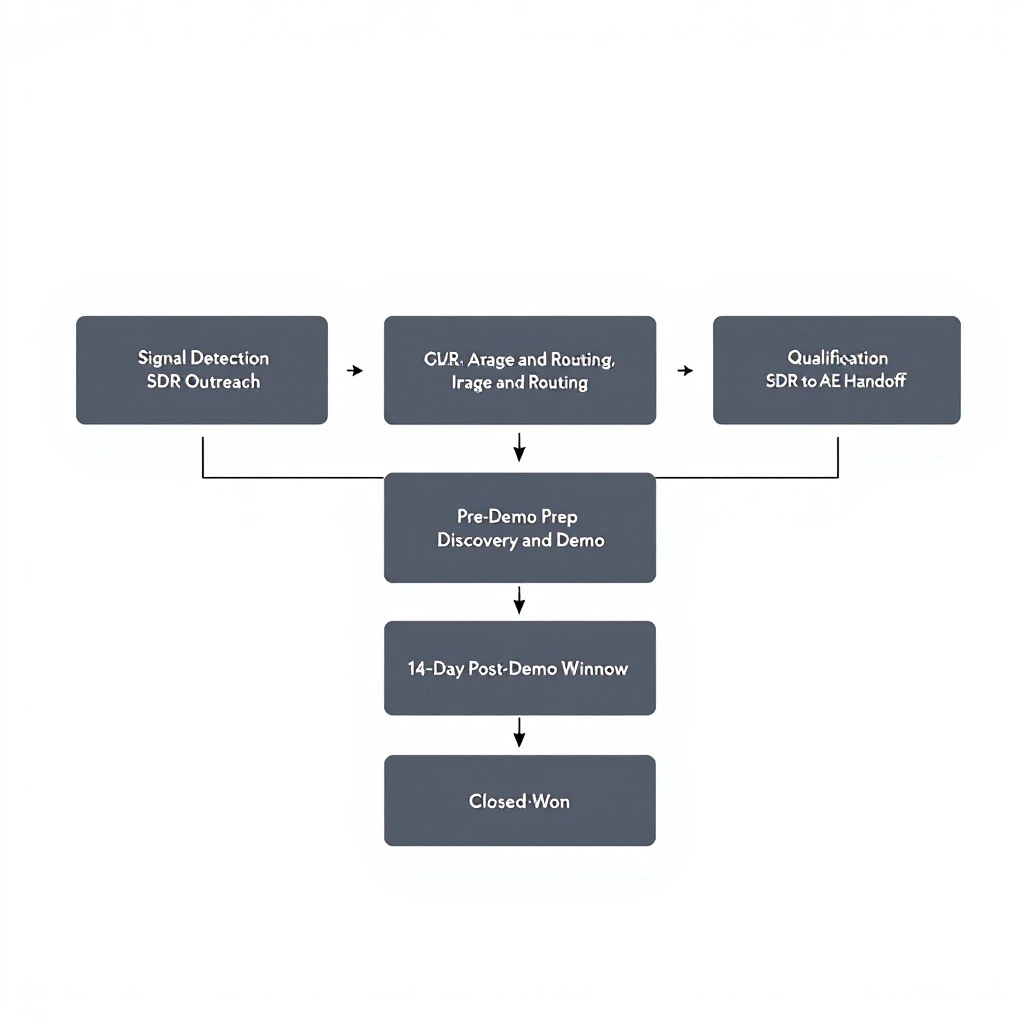
The teams that are pulling ahead this year have done one thing differently. They stopped thinking about sales as a list of activities (calls, emails, demos, follow-ups) and started thinking about it as a sequence of handoffs. Signal to SDR. SDR to AE. AE to demo. Demo to multi-thread. Multi-thread to close. Every handoff is a place where deals die. Every handoff is also a place where operational discipline can save them.
This is the pillar guide to that sequence. It is not a generic "B2B sales tips" article. It is the map of the modern sales cycle — every handoff, the workflow that runs it, and the playbook posts that go deep on each stage. If you run an SDR or AE team, read this end-to-end once, then send it to your reps as the spine of your team's playbook. If you are an individual contributor, this is the framework your top performers are already running, whether or not they have written it down.
The shift: from activity-based to signal-based selling
Before getting into the cycle, it is worth being honest about what has changed in B2B sales in the last two years. If you do not believe the shift is real, the rest of this guide will feel like overkill.
For most of B2B sales history, the constraint was identifying who to sell to. You bought a list, dialed it, and hoped 1 percent of the people on the list had a need. The role of the SDR was largely to manufacture interest where none existed.
That model is collapsing for two reasons. First, buyers will not answer cold calls or read cold emails at the rates they used to. Connect rates on cold dials have dropped to roughly 1 in 200. Reply rates on cold email have dropped below 1 percent in most categories. Second, the data to identify buyers who are already in-market has become cheap and abundant. Website visitor identification, third-party intent data, job change signals, technographic shifts, and content engagement are all available in real time. The new constraint is not finding buyers. It is acting on the signals fast enough to matter.
This is what "signal-based selling" actually means. Not buying an intent data tool. The full operational reorientation of the sales team around the idea that buyers reveal themselves through behavior, and the team's job is to convert that behavior into pipeline before the signal decays. If you want the deeper case for why this matters, we wrote it up here, and the meta-analysis of what is actually working in B2B sales in 2026 sits here.
The rest of this guide is the playbook for running that model.
Stage 1: Signal detection
The cycle starts with a signal. Without it, you are dialing lists.
A signal is any observable behavior that suggests a buyer is in-market. The strongest signals are first-party: a visitor identification hit on your pricing page, a champion who left a competitor and just started at a target account, a returning visitor with three sessions in seven days. Weaker but still useful signals include third-party intent data, content engagement, social comments on competitor posts, and technographic changes.
Not all signals are equal. A pricing page visit from a known account is worth ten newsletter signups. A buying committee with three people on your site this week is worth a hundred random clicks on a LinkedIn ad. Top sales teams understand the relative weight of each signal type and route their SDR time accordingly.
The mechanics of signal detection itself are increasingly commoditized — visitor ID tools, intent data providers, and social listening platforms all exist. The differentiation is in how you stack the signals. Read the three-layer signal stack for the framework on what signals to layer together, and the buying signal hierarchy for which signals actually predict closed-won outcomes versus which ones are just noise.
If you are building this layer from scratch, start with website visitor identification. Our guide to B2B visitor ID walks through the categories, the trade-offs, and how to integrate it. You can pile on intent data and other layers later. Most teams that try to start with everything at once never get anything working.
Stage 2: Triage and routing
Detection is the easy part. Triage is where most teams fail.
The problem: signals come in faster than SDRs can act on them. A mid-sized B2B team can easily generate 200 to 500 signals per week across visitor ID, intent data, content engagement, and inbound demos. If every signal hits every SDR with equal weight, the team drowns. They work the loudest signal of the day, ignore the rest, and the signal half-life problem (covered below) kicks in.
The fix is a tiered triage system. Tier the signals by predicted intent, route the highest tiers to your best SDRs with the tightest SLA, and let the lower tiers go to nurture. The inbound triage tier system walks through the tier definitions and the 5-minute response standard for top-tier inbound. Signal-based SDR routing covers how to route by signal type and territory. Together they are the operating system for everything downstream.
One nuance: triage is only as good as the rubric SDRs use to decide which tier a signal belongs in. If reps disagree about what a tier-1 signal is, you will get inconsistent routing and lose deals to randomness. The signal triage rubric is the artifact that fixes this — a written rubric the SDR team adopts and managers enforce in deal review.
Stage 3: SDR outreach — speed to lead
Once a signal is triaged, the clock starts. This is the speed-to-lead stage, and it is where most teams quietly leak the majority of their pipeline.
Tier-1 signals — pricing page visits, demo form fills, return visits to high-intent pages — should be responded to in under five minutes. This is not a stretch goal. It is a hard requirement. Buyers who fill out a demo form and get a response within five minutes convert at roughly 4x the rate of buyers who get a response within an hour, and 21x the rate of buyers who get a response within a day. The math is brutal and well-documented.
Our complete speed-to-lead guide covers the data, the operational requirements, and the workflow for hitting 5-minute response without staffing a 24/7 team. The short version: route by tier, alert by channel, automate the first touch, and reserve human SDR time for the calls that actually move pipeline.
The other half of SDR outreach is what happens when the signal is hot but the buyer has not raised their hand yet. A buying committee that has visited your site three times this week is in-market, but they have not asked to talk. The SDR's job is to reach out in a way that maps to what they were doing on the site — not generic cold outreach. The signal-to-meeting workflow is the 24-hour playbook for converting that kind of warm signal into a booked meeting before competitors get there.
This is also the stage where the visitor ID to first outreach setup playbook lives. If you cannot get a new visitor ID hit into an SDR's outbound queue in 30 minutes, your entire signal stack is just an expensive dashboard.
Stage 4: Qualification before the handoff
Every signal-driven meeting goes through one more gate before the AE: qualification.
This is the step every team thinks they are doing well and almost no team actually does well. SDR managers know what good qualification looks like — budget, timeline, authority, pain, current tooling, evaluation criteria. The issue is that under pressure to book meetings, SDRs skip qualification, book the meeting anyway, and dump a thin lead on the AE.
Two things prevent this. First, a written rubric that defines what qualified means at your company, used consistently across the SDR team. Second, manager review of the SDR's notes before the handoff fires. If the notes are thin, the handoff does not happen — the SDR re-engages the buyer for clarifying questions first.
If your inbound is high-volume and your SDRs are being told to book everything that moves, the morning workflow that high-performing SDRs run is the discipline that prevents the dump-and-run pattern. The goal is not maximum meetings booked. It is maximum qualified meetings that convert to opportunities.
Stage 5: SDR-to-AE handoff
This is the highest-variance handoff in the entire cycle, and it is the one most teams ignore.
A bad SDR-to-AE handoff looks like this: SDR sends a one-line Slack message ("good lead, on the calendar for Thursday") and a calendar invite. The AE shows up cold, runs generic discovery, and the buyer feels like they are starting over. Half the time the deal dies in discovery for no reason other than the buyer is tired of repeating themselves.
A good handoff looks like this: the SDR writes a structured handoff note in the CRM that includes the buyer's stated problem in their own words, what was already qualified, what is still unclear, the signal context that triggered the outreach, and the proposed demo flow. The AE reads it before the call. The buyer feels like the team is coordinated.
The SDR-to-AE handoff playbook is the 6-step workflow for getting this right. It includes the exact handoff note template, the AE-side checklist before accepting the meeting, and the manager review pattern for catching weak handoffs before they reach the AE's calendar.
If you fix one thing in your sales cycle this quarter, fix this. The leverage is enormous and almost no teams are doing it well.
Stage 6: Pre-demo prep
The 15 minutes before a discovery call are the highest-leverage 15 minutes in the entire deal. Most AEs spend them in traffic.
The reps who consistently close 25 percent of their demos run a structured prep workflow before every call. The reps who close 8 percent of their demos do not. This variance shows up in pipeline math more than any other single factor.
The 15-minute pre-demo prep playbook is the framework: five three-minute blocks covering handoff review, signal context, buying committee mapping, demo customization, and the next-meeting ask. Run it before every discovery call. The discipline matters more than the framework — pick any reasonable structure and use it consistently.
Two things this stage produces that the rest of the cycle depends on. First, a customized demo flow that maps to the specific buyer's stated problem, not the generic demo deck. Second, a written multi-thread plan — who you will ask the buyer to introduce you to, when, and how. Without the second one, you walk out of every demo with a single point of failure.
Stage 7: Discovery and demo
A good discovery call is a controlled diagnostic, not a presentation. The reps who win this stage spend two-thirds of the call asking questions and one-third demoing the three specific moments that map to the buyer's problem.
The mechanics of running discovery well are covered in too many places to re-cover here. The key shift in 2026 is that the bar for personalization has gone up sharply. Buyers expect you to know their stack, their team, their recent funding, and their stated initiatives before the call. Generic discovery questions ("what are your biggest challenges?") signal that you have not done the prep, and buyers check out.
The discovery call should also produce the inputs to multi-threading. By the end of the call you should know: who else is involved in the decision, what their evaluation process looks like, what their timeline is, what budget exists, and what the next step is. If you cannot articulate all five at the end of the call, the call was not discovery — it was a generic demo dressed up as discovery.
Stage 8: The 14-day post-demo window
This is where pipeline goes to die. A buyer comes off a great discovery call, says "send me pricing and we will get back to you," and then disappears. Two weeks later the deal is in best-case purgatory. Six weeks later it is no-decision closed-lost.
The 14 days after a discovery call are the most predictive window in the entire deal. What the AE does in those 14 days determines whether the deal closes at all. Most AEs spend those 14 days on the deals that responded fastest to the previous demo and forget the new one. The buyer takes that as a signal that the AE was not serious, and quietly moves to the vendor who kept the energy up.
The 14-day post-demo AE playbook is the day-by-day workflow for the critical window. It covers what to send on day 1, day 3, day 7, and day 14, when to push for the next meeting, and how to read the buyer's silence as either disinterest or normal procurement-cycle latency.
Running this playbook is the single biggest pipeline conversion lever available to most AE teams. It is also operationally trivial — it is a sequence of seven well-timed actions over two weeks. The reason most teams do not run it is that nobody has written it down.
Stage 9: Multi-threading the buying committee
If you walk out of every demo with one contact, you do not have a deal. You have a single point of failure who can disappear, change roles, or get overruled. Modern B2B deals have three to seven stakeholders involved in the decision. Cover them all or do not be surprised when the deal stalls.
The multi-threading deal team playbook is the 5-stakeholder framework: economic buyer, end user, technical evaluator, executive sponsor, and one or two influencers. It covers when to introduce each one, how to ask the champion to make the introduction without bypassing them, and the language to use in the request.
This is the AE skill that separates 30 percent close rates from 12 percent close rates. It is also the skill most AEs are weakest at, because it feels uncomfortable. The champion seems to be moving the deal forward, so why bother the other stakeholders? Because the champion is not authorized to sign. Because the champion is going to get pulled into another fire next week. Because the technical evaluator you have not met is the one who will quietly veto the deal in the procurement review.
Multi-threading is not a nice-to-have. It is the operational discipline that converts late-stage pipeline.
Stage 10: When the champion goes quiet
Even with great multi-threading, deals stall. The champion stops responding. The email thread goes cold. The AE pings twice and then gives up.
This is the stage at which most teams write off deals that were actually still alive. A champion going quiet rarely means "the deal is dead." It usually means: the champion got pulled into another fire, the company changed priorities, the champion is waiting on internal sign-off they cannot get, or the deal needs to be re-energized through a different stakeholder.
The champion-went-quiet re-engagement playbook is the 5-play workflow for stalled-deal recovery: how to read the silence, when to escalate to the executive sponsor, when to bring in your own exec, when to send the "are you still interested" email correctly, and when to genuinely close-lost and move on.
The teams that run this playbook close roughly 18 to 22 percent of deals they would otherwise have written off as no-decision. The math on that is too good to ignore.
Stage 11: Reopening closed-lost
A no-decision deal from six months ago is one of the highest-quality pipeline sources in your CRM. You already qualified the buyer. You already understand their problem. You already built rapport. The only thing that changed is the buyer's circumstances.
Most teams treat closed-lost deals as dead. They are not. They are dormant. The signal-based selling motion makes them findable again — when a champion job changes, when a competitor announces price increases, when a funding round closes, when a new initiative shows up in 10-K filings.
The reopen closed-lost AE playbook is the framework for systematically working these accounts back into active pipeline. It covers the signal triggers that justify re-engagement, the messaging that does not feel like rehashing, and the timing rules for how often to retry an account that was closed-lost.
If your team is struggling to hit pipeline coverage, this stage alone is usually worth 15 to 25 percent more pipeline within a quarter.
The pacing problem: signal decay
One concept ties this entire cycle together: signal decay.
Buying intent has a half-life. A pricing page visit ten days ago is worth roughly a quarter of what it was worth the day it happened. A job change signal three months stale is barely a signal at all. The whole point of the operational discipline above — 5-minute response, structured handoffs, day-3 follow-ups — is that signals decay fast, and a sales motion that takes 12 days to convert a signal into a meeting is just slow enough to miss every deal.
The signal decay curve walks through the actual decay rates by signal type, and how to set your operational SLAs around them. If you take nothing else from this guide, take this: every step in the cycle above has a clock on it. The team that runs the clock wins. The team that does not, loses to whoever runs it faster.
How the playbook holds together
Every stage above is a piece of a single motion. You cannot run great pre-demo prep on a thin SDR handoff. You cannot run a great 14-day post-demo window if the discovery call was generic. You cannot multi-thread if your champion already went quiet. The cycle is end-to-end or it is not real.
This is why teams who try to fix one stage in isolation rarely see results. SDR speed-to-lead without triage is just more noise. AE prep discipline without good SDR notes is the AE working in the dark. Multi-threading without an executive sponsor relationship is the AE cold-emailing strangers.
The teams that pull ahead are the ones that fix the cycle as a system. They write down each stage. They train the team on each stage. They review each stage in deal review. They coach the handoffs as carefully as they coach the calls. And they instrument the signal decay clock so they can see where deals are dying.
This is what good operational sales discipline looks like in 2026. It is not a single trick. It is the entire cycle, running consistently, every week.
The role of the platform
A reasonable question after reading all this: who is supposed to run all of these workflows?
The honest answer is that without the right platform layer, nobody is. The math does not work. A 25-person SDR-AE team cannot manually run signal triage, 5-minute SLAs, structured handoffs, 15-minute pre-demo prep, day-by-day post-demo workflows, and multi-thread tracking across 200 active deals. The cognitive load is the problem, not the workflow.
This is the gap MarketBetter is built for. The platform watches the signals, runs the triage, surfaces the handoff context the AE needs before the call, prompts the day-3 and day-7 follow-ups in the post-demo window, tracks the buying committee, and flags champions who have gone quiet. The reps still run the calls and write the notes. The platform handles the operational discipline that makes the cycle work.
The shorthand we use: competitors tell you who. MarketBetter tells you who and what to do next. The playbook above is the "what to do next" part. The platform is the layer that makes it operationally feasible to run it.
If you are reading this and recognizing places where your cycle is leaking — weak handoffs, slow speed-to-lead, no post-demo workflow, no multi-thread plan — that gap is the value. Book a demo and we will run the playbook on one of your real accounts so you can see how much pipeline you are leaving on the floor.
Where to go from here
If you are a rep, the highest-leverage move is to run one stage of this cycle well for 30 days. Pick the stage where you know your discipline is weakest — handoffs, prep, post-demo, multi-thread. Run it religiously for a month. The pipeline impact will be visible.
If you are a manager, the highest-leverage move is to build one stage into your weekly deal review. Pick the handoff that is leaking the most pipeline. Make every AE walk through it for every deal, every week. Coach the handoff like you coach calls.
If you are a leader, the highest-leverage move is to treat the cycle as a system. Audit every handoff. Write down the workflow at each one. Measure where deals die. Fix the handoffs, not the calls.
The reps who win in 2026 are not better closers. They are better operators. The cycle above is the operating manual.
Read deeper on each stage:
- The Three-Layer Signal Stack — how to compose first-party, third-party, and behavioral signals into a buyer intelligence layer.
- The Buying Signal Hierarchy — which signals predict closed-won and which are noise.
- B2B Visitor Identification Guide — the foundational signal layer.
- Inbound Triage Tier System — the 5-minute response standard and tier definitions.
- Signal-Based SDR Routing — routing by intent tier and territory.
- Signal Triage Rubric — the artifact that fixes tier disagreement.
- Speed to Lead Guide — the data and the workflow for hitting under-5-minute response.
- Signal-to-Meeting Workflow — the 24-hour SDR motion for warm signals.
- Visitor ID to First Outreach — the 30-minute setup playbook.
- First 30 Minutes SDR Morning Workflow — the discipline that prevents dump-and-run.
- SDR-to-AE Handoff Playbook — the highest-variance handoff in the cycle.
- Pre-Demo Prep Playbook — the 15-minute framework before every discovery call.
- 14-Day Post-Demo Window — the day-by-day AE workflow.
- Multi-Threading Sales Deals — the 5-stakeholder framework.
- Champion Went Quiet Playbook — the 5-play stalled-deal recovery workflow.
- Reopen Closed-Lost Playbook — turning dormant accounts back into active pipeline.
- Signal Decay Curve — why every stage has a clock on it.