
The Buying Signal Hierarchy: Which Signals Actually Predict Closed-Won (And Which Are Just Noise) [2026]

Every signal vendor will tell you their signal is the one that matters. Bombora wants you to believe surge data is the leading indicator. LinkedIn Sales Navigator wants you to believe job changes are. 6sense wants you to believe their AI-blended score is. Lead Forensics wants you to believe it is anonymous website visits.
They cannot all be right. And after sitting next to dozens of B2B sales teams over the last year — watching which signals their reps actually convert from and which ones get ignored — we built the only thing that has ever mattered for an SDR: a hierarchy. A ranking of signals from the highest probability of closing to the lowest.
This post is the framework. It is opinionated. It is built from real deal motions, not vendor decks.
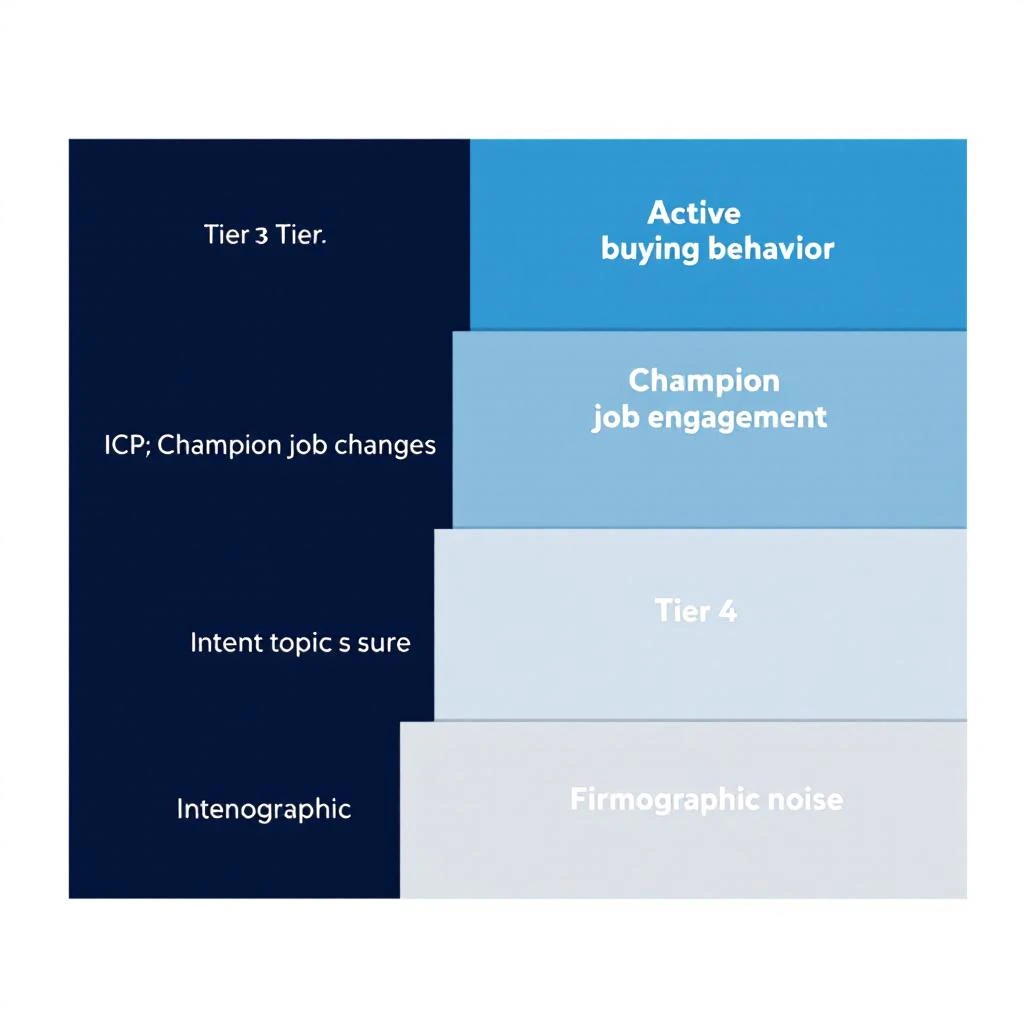
Why a hierarchy and not a score?
Most "signal platforms" output a number. Account X has a buyer intent score of 87. Account Y has a score of 42. Go work on X.
The problem: a score collapses fundamentally different signals into the same currency. A demo request and a job change at a champion account are not the same thing. They live on different planets. One is a buying motion in progress. The other is a leading indicator that might become a buying motion in six months.
When you collapse them, your reps work the high-score accounts at the top of the queue and the actual ready-to-buy signals get buried two screens down. We have seen this happen with real customers using composite scores from 6sense, Bombora, and similar platforms.
A hierarchy fixes this. Every signal has a tier. The rep works Tier 1 before Tier 2. Always.
The five tiers (ranked by closed-won correlation)
Here is the hierarchy. Below the table we break each tier down with conversion ranges, what to do, and what to ignore.
| Tier | Signal Type | Examples | Demo→Closed Range | Time to Act |
|---|---|---|---|---|
| 1 | Active buying behavior | Demo request, pricing page visit, RFP, comparison page view | 20%–40% | Within 5 minutes |
| 2 | Deep engagement from ICP | Repeat website visits, ICP visitor ID, integration page views | 5%–12% | Within 1 hour |
| 3 | Champion-account human signals | Job change at past customer, new champion hire, LinkedIn engagement | 2%–6% | Within 24 hours |
| 4 | Intent topic surges | Bombora surges, G2 category research, AI category awareness | 1%–3% | Within 1 week |
| 5 | Firmographic / news / tech stack | Funding rounds, news mentions, generic tech adoption | <1% | Background only |
The conversion ranges are observed across the B2B SaaS deal motion. Your numbers will vary by deal size, sales cycle, and ICP fit. The order is what matters.
Tier 1: Active buying behavior
This is the only tier where the buyer has self-identified that they are in a buying motion. Everything else is inference.
What counts as Tier 1:
- Demo request, contact form fill, "talk to sales" click
- Pricing page visit (especially the second or third visit)
- Comparison page view ("MarketBetter vs Apollo")
- RFP or vendor questionnaire received
- Trial signup followed by activation
- Calendar booking page abandonment
Why it matters: The prospect has moved from awareness to evaluation. They are deliberately gathering decision-grade information. Nothing else in the hierarchy is closer to revenue.
The brutal math: if a Tier 1 signal takes more than five minutes to reach a rep, half the value evaporates. Drift's 2023 lead response study put the conversion drop at 78% after the first hour. We have seen the same pattern with our own customers. Speed is not a virtue here. It is the entire game.
What to do:
- Auto-route to the owner if the account is in the territory map
- If unowned, route to the next-available rep (round-robin)
- The rep's first outbound action goes out within five minutes — call, then email, then LinkedIn
- The opening line references the specific page or action ("Saw you were on the pricing page — happy to walk through how we scope deals")
This is what our signal-to-meeting in 24 hours workflow is built around. The whole point of compressing the cycle to a day is that Tier 1 signals decay fast.
Tier 2: Deep engagement from ICP
This tier is the gray zone where most reps either over-invest or under-invest. The signal is real, but the buyer has not declared intent.
What counts as Tier 2:
- Anonymous website visitor identified as a target account (via B2B visitor identification)
- Repeat visits within a 7-day window (3+ sessions)
- Integration or technical documentation page views
- Long blog read times on bottom-funnel content
- Webinar attendance with 70%+ watch time
- Document download (ROI calculator, security whitepaper)
Why it matters: The account is researching. They might be early in a project, evaluating quietly, or assigned the boring research task by a VP. The buyer is real, but the timing is uncertain.
Critical filter: this tier is only useful if the visitor is from your ICP. An anonymous visit from a non-ICP company is not Tier 2. It is noise. We have written extensively about turning website visitors into actual pipeline and the ICP filter is the entire trick.
What to do:
- Send the lead to enrichment first — confirm ICP fit, get the right contact persona, pull recent activity
- Run a "warm outbound" sequence: not "do you want a demo" but "noticed your team has been looking at X — happy to share how peers solved that"
- Watch for a Tier 1 escalation in the next 14 days. If it happens, the prep work pays off.
- Tag the account in the CRM with the engagement context so the AE has it for handoff
A common mistake: blasting Tier 2 with the same urgency as Tier 1. The buyer is not ready, and aggressive outreach drives them underground. Calm, value-led messaging works better here.
Tier 3: Champion-account human signals
This is the tier most teams sleep on. Human signals — job changes, new hires, promotions — are noisy in raw form but devastating when filtered correctly.
What counts as Tier 3:
- Past champion takes a new role at a new company
- New VP of Sales or Head of GTM hired at a target account (12–18 month buying window opens)
- Promotion of a known contact at an existing customer (expansion signal)
- Multiple new SDR hires at a target account (suggests outbound investment is coming)
- LinkedIn post engagement from a champion (likes, comments on relevant content)
Why it matters: People buy software they have used before. A champion at a new company is one of the highest-fit outbound motions in B2B. The deal cycle is shorter because the trust transfer is already done.
We unpacked this in detail in job change alerts vs intent signals — the takeaway: champion job changes convert at 3–5x the rate of general job change noise.
What to do:
- Maintain a "champion list" in your CRM — every named contact at every closed-won account, with role and tenure tracked
- When a champion shows a job change, the AE who owned the relationship reaches out personally within 24 hours. Not the SDR. The AE.
- For new-hire signals (VP Sales, Head of GTM), the play is "introduce ourselves before they pick their stack." First 90 days is the only window.
- Do not blast. These are relationship plays, not sequence plays.
Tier 4: Intent topic surges
This is the tier sold the hardest by vendors. Bombora surges, G2 category research, third-party intent. The pitch is always: "the buyer is in market, just reach out."
The reality is messier. Topic surges are a real leading indicator, but the signal-to-noise ratio is low. An account surging on "B2B sales platform" topics might have 200 employees and exactly zero of them are actually evaluating B2B sales platforms — it might just be a marketer doing research.
What counts as Tier 4:
- Bombora surge on relevant topic clusters (Topic A + Topic B together is stronger than either alone)
- G2 buyer intent (visits to your category and competitor pages)
- TrustRadius or Capterra intent data
- AI assistant referrals — when a prospect mentions they "asked ChatGPT for tools like yours"
- Surge in branded search volume from a specific company's IP range
Why it matters: It works, but only as a prioritization signal across a large target list. Use it to decide who to focus account-based outbound on this month. Do not treat it as a "ready to buy" signal.
What to do:
- Use it to build the weekly account-based outbound list (top 25 accounts to prospect this week)
- Layer it with Tier 2 and Tier 3 signals — an account with topic surge + ICP web visits + a new VP is a Tier 2 candidate, not a Tier 4 background item
- Do not run cold outbound that references the intent topic directly. ("I saw you were researching X" is creepy and inaccurate.) Use the topic to frame the value prop, not the opener.
For a deeper view on integrating Tier 4 into a full ABM motion, see our account-based engine playbook for 2026.
Tier 5: Firmographic and news signals
The lowest tier. These are the signals sold as "triggers" by every news-aggregation tool on the market.
What counts as Tier 5:
- Funding rounds, IPO filings, acquisitions
- Layoffs and restructuring news
- New office openings
- Generic tech stack adoption (added Salesforce, switched email providers)
- Press releases, awards, executive quotes in industry articles
Why it matters: Almost not at all, on its own. The closed-won correlation with any single firmographic event is below 1%. But they are useful as enrichment context — a "why now" frame to drop into an outbound message that was already going out for other reasons.
What to do:
- Do not build sequences off Tier 5 signals alone
- Use them as message-level enrichment ("congrats on the Series B" is a fine opener if the rest of the message has substance)
- Track them in the background so the AE has context for discovery calls
The "trigger event spam" pattern — where every rep mass-emails every newly funded company — is what made these signals worthless in the first place.
How to actually run this hierarchy
Building the hierarchy is the easy part. Operationalizing it is where most teams break.
The mistakes we see most often:
1. Mixing tiers into the same daily task list. When a rep opens their morning queue and sees 40 tasks, they cherry-pick. Tier 1 alerts get buried under Tier 4 surge accounts. The fix: tier-aware task ordering, with Tier 1 always at the top. This is the entire premise behind the first 30 minutes of an SDR's morning.
2. Running the same play on every tier. Tier 1 needs a five-minute call. Tier 3 needs a personal note from the AE. Tier 4 needs an account-based plan, not a sequence. Different signals require different motions.
3. Treating signals as forever-valid. Every signal has a decay curve. A demo request is worth 100% of its value in the first hour and maybe 20% at the end of the day. Build expiration into your routing rules.
4. Letting the data live in 11 different tools. We have written about the fragmented B2B lead stack at length. If your visitor ID lives in one tool, intent in another, job changes in a third, and the CRM has none of it, no rep is running the hierarchy. They are running whatever signal happens to be in front of them.
The fix for all four is the same: one prioritized queue, signal-aware, that ranks the rep's work by tier. Not a dashboard. A task list.
The version of this hierarchy that actually works
The hierarchy is a framework. To run it, you need three things:
-
All five tiers ingested into one system. Tier 1 (demo requests, pricing visits) usually lives in marketing tools. Tier 2 (visitor ID, repeat visits) is its own platform. Tier 3 (job changes, hires) is LinkedIn or a dedicated signal tool. Tier 4 (Bombora, G2) is a third. Tier 5 is news APIs. Until they live together, nobody can rank them.
-
A scoring rule per tier, not a global score. Each tier needs its own threshold logic. A Tier 1 demo request is always actionable. A Tier 4 Bombora surge needs to clear an ICP filter and a topic confidence threshold. Same score is not the same action.
-
A rep-level task list, ranked by tier first and recency second. The rep should never have to pick between a Tier 1 and a Tier 4. The system picks for them.
This is what we built MarketBetter to do. The product takes signals from across the stack, tiers them, filters them by ICP, and tells each rep what to do next, in priority order. The differentiator vs intent-only platforms is captured in our comparison of intent signal orchestration vs raw signal feeds — orchestration is what turns the hierarchy from a slide into a workflow.
What this looks like for an AE
The same hierarchy works for AEs, but the actions are different.
Tier 1: Disco call same-day. The buyer is in motion — don't slow them down with a 4-day calendar dance.
Tier 2: Reach out personally with context. Skip the rep handoff if the account is in your book. Engagement on integration pages or technical docs usually means a technical evaluator is sniffing around.
Tier 3: Champion job changes are your highest-leverage activity. Build the muscle of reaching out within 48 hours, every time, no exceptions. We wrote about a related play in the closed-lost re-engagement AE playbook — same logic: warm relationships are pipeline.
Tier 4 and 5: Background. Useful for discovery prep. Not actionable on their own.
What you should change Monday morning
Run this exercise in your next pipeline review:
- Pull last quarter's closed-won deals
- For each deal, identify the first signal that triggered outbound or inbound
- Tag each signal by tier
- Now look at the tier mix
If your closed-won deals are heavily Tier 1 and Tier 2, you are running an effective signal stack. If they are heavily Tier 4 (intent topics) or Tier 5 (firmographic), you have probably been crediting outbound to signals that actually came from word-of-mouth or marketing demand. Common pattern, and worth fixing.
Then ask the harder question: of your current pipeline, what tier of signal sourced each opportunity? If the answer is "we don't track that," that is the first thing to fix. Pipeline you cannot trace back to a signal tier is pipeline you cannot replicate.
The point
Signals are a commodity. Every vendor sells some flavor of intent data. The differentiator is no longer access to signals — it is the discipline to rank them, route them by tier, and prevent reps from working noise while real buyers go cold.
A hierarchy is not glamorous. It is not the AI-powered headline a vendor will lead with on a sales call. But it is the only thing that consistently separates teams that book meetings from teams that send sequences.
Tier 1 first. Always.
Want to see how MarketBetter ranks signals into a real prioritized rep workflow? Book a demo →
Related reading:
- The Signal-to-Meeting Workflow: 24 Hours From Trigger to Booked Call
- Intent Signal Orchestration: The Missing Piece for AI Sales Agents
- MarketBetter vs 6sense and Bombora: Buyer Signal Platforms Compared
- The True Cost of an SDR Stack in 2026
- The First 30 Minutes: The SDR Morning Workflow That Books Meetings
- The B2B Website Visitor Identification Guide
- Job Change Alerts vs Intent Signals: Which Predicts Pipeline?
- The Fragmented B2B Lead Stack That's Killing Pipeline
- The Closed-Lost Re-Engagement Playbook for AEs
- The ABM Playbook: Full-Funnel Account-Based Engine for 2026