The SDR-to-AE Handoff Playbook: Stop Losing Deals Between the Booking and the Discovery Call [2026]

Look at any SDR team's funnel and you will find the same leak. The SDR books a meeting. The AE shows up to discovery. Somewhere in the 72 hours between those two events, a third of the deals quietly die.
Show rate dips. The buyer cools. The AE walks in cold and re-qualifies from scratch. The buyer thinks: "I just told the other person all of this." Trust drops. Discovery becomes a vendor pitch instead of a working session. Pipeline conversion sags by 20-40 percent and nobody can point to a single bad call.
This is the SDR-to-AE handoff gap. It is the most under-engineered handoff in B2B sales, and it is the single highest-leverage thing most teams can fix this quarter.
Below is the 6-step handoff playbook we run with customers. It assumes one thing: that the SDR did real qualification before booking. If you are booking on "interested in learning more," fix that first. Start with the inbound triage tier system and come back here when your bookings have substance.
Why the handoff window matters more than the meeting itself
Most sales orgs treat the handoff as a calendar event: SDR clicks "book," Salesforce updates the opportunity owner, AE gets a notification. Done.
That is not a handoff. That is a baton drop.
A real handoff transfers three things between two humans:
- Context — what the buyer cares about, in their words, with their priorities ranked
- Continuity — the buyer should feel like one team is talking to them, not two separate vendors
- Conviction — the AE should walk in knowing why this is a real opportunity, not "another discovery"
When you nail those three, you stop losing 20-40 percent of booked meetings. Show rates climb. Discovery converts to second meetings at a higher clip. And buyers stop ghosting between the demo and the proposal because they trusted you from minute one.
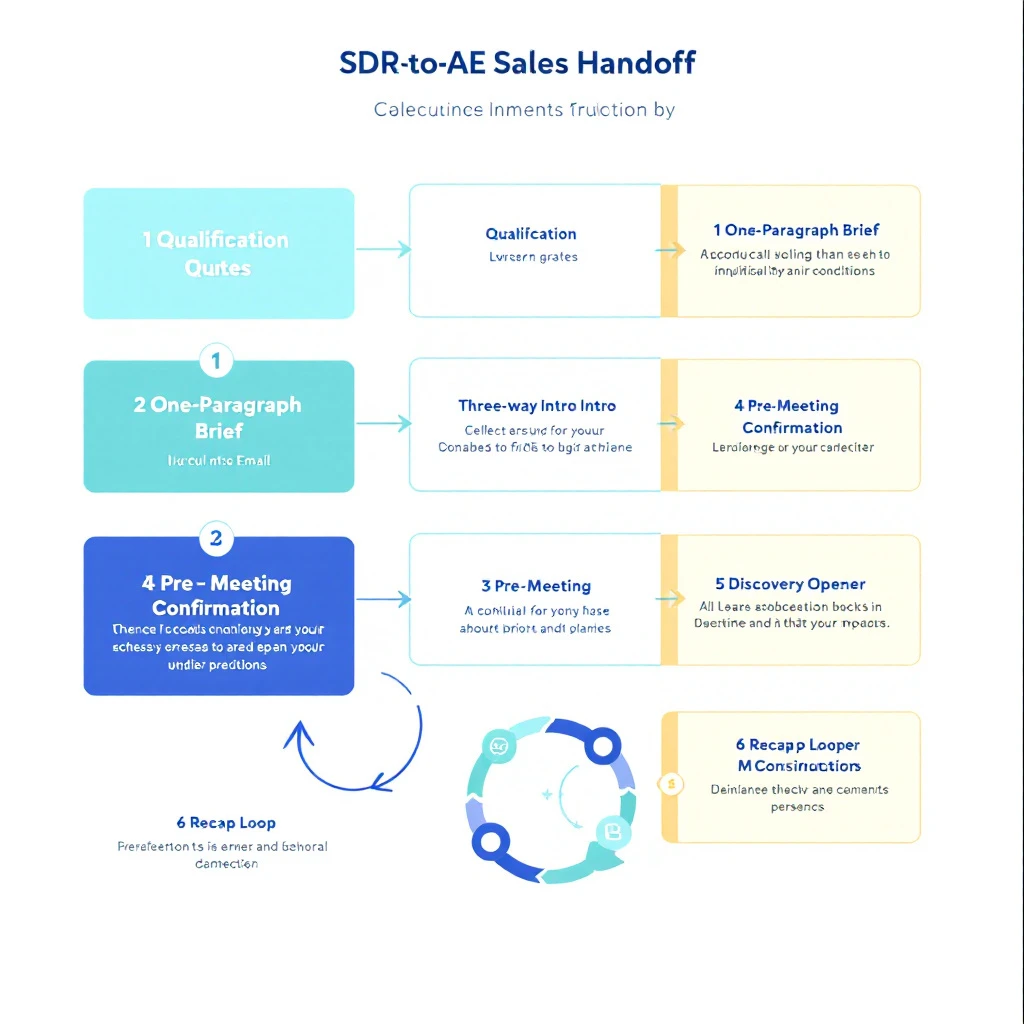
The 6-step handoff playbook
Step 1: Capture the qualification in the buyer's words, not your CRM fields
The most common handoff failure happens in the SDR's notes. The SDR fills in seven Salesforce fields — pain, timeline, budget, decision process, current solution, team size, urgency — and calls it done.
The AE reads those fields ten minutes before discovery and walks in blind. Why? Because the CRM strips the language. The buyer said "our SDRs are spending three hours a day on garbage leads and we're hiring two more in Q3 to keep up." Salesforce stored "Pain: SDR efficiency. Timeline: Q3."
The AE then asks "so tell me about your pain" and the buyer thinks they are starting over.
The fix: SDRs capture three verbatim quotes from every qualification call:
- The pain quote — what the buyer said about why they are looking
- The urgency quote — what is forcing them to act now versus in six months
- The skepticism quote — what they pushed back on or seemed unsure about
These three quotes go in the meeting brief, untouched. The AE reads them five minutes before the call. They walk in with the buyer's exact words in their head and the buyer feels seen from the first sentence.
Step 2: Write a one-paragraph meeting brief, not a 12-field form
CRM forms are for reporting. Briefs are for selling. They are different artifacts and they should look different.
A handoff brief is one paragraph, written by the SDR, that an AE can read in 60 seconds. Format:
"[Buyer name] at [company] runs [team / function]. They came in via [channel] after [trigger event]. Their pain: [verbatim quote]. Their urgency: [verbatim quote — why now]. Their decision process: [who's involved, timeline, what they've already evaluated]. Their pushback: [verbatim skepticism]. The opening I'd take: [SDR's read on what to lead with]."
That last sentence — "the opening I'd take" — is the single most undervalued line in the brief. The SDR talked to this human for 15-30 minutes. They have a read. AEs who ignore that read consistently underperform AEs who use it as a starting hypothesis.
Step 3: Make the introduction a three-way email, not a calendar invite
The calendar invite is the laziest handoff in B2B sales. It tells the buyer: "we use a tool that auto-routes you to whoever has open availability."
The introduction email tells the buyer: "we organized this internally and prepared for you."
Within two hours of booking, the SDR sends a three-way email:
- To: the buyer
- CC: the AE
- Subject: "Intro to [AE first name] for [day]'s call"
- Body: "[Buyer first name], great talking earlier. Connecting you with [AE first name], who'll dig into [the specific topic the buyer cared about] with you on [day]. [AE first name] — [buyer first name] is wrestling with [the one-sentence version of their pain]. I shared the full context but you two should compare notes. Talk [day]."
This email does four things at once. It transfers ownership cleanly. It primes the buyer to expect a real conversation, not a demo. It gives the AE air cover to reach out directly before the meeting. And it builds trust through visible organization.
Step 4: Have the AE send a pre-meeting confirmation 24 hours before
Show rates on cold-booked meetings hover around 60-70 percent. Show rates on meetings where the AE personally sent a pre-meeting confirmation hover around 85-92 percent. The math is simple.
The pre-meeting note is not a calendar reminder. It is a sentence that says "I read your context, I'm prepared, here's what I'd like to cover, push back if I'm off."
"Hey [first name] — [SDR first name] caught me up on [the specific thing they care about]. For tomorrow I'd planned to dig into [topic A] and [topic B], and I want to leave 10 minutes to talk through [the skepticism the buyer raised]. If there's anything you'd add or want to skip, just reply and let me know. Talk tomorrow."
That note does the work of three things: it confirms attendance, it shows preparation, and it gives the buyer a way to redirect the meeting before it starts. Buyers love it because it makes them feel like the meeting is for them, not for you.
Step 5: Start the discovery call by saying what you already know
The single fastest way to lose a deal in the first five minutes is to ask "so tell me what brings you here today" to a buyer who already told the SDR exactly that.
The buyer will repeat themselves. Politely. But the trust you needed is gone. The buyer is now thinking: "do these people actually talk to each other?"
The fix is one of the simplest behavioral changes you can make and almost nobody does it:
"Before I ask anything, let me make sure I have this right. From the conversation with [SDR first name], my understanding is you're [pain in their words], and the thing that's making this urgent right now is [urgency in their words]. What you pushed back on was [skepticism]. Did I get that right, and what's changed since you two talked?"
You just did four things in 30 seconds. You proved your team communicates. You proved you prepared. You gave the buyer permission to correct you. And you opened the door to ask "what's changed since" — which is the single best discovery question in B2B sales because it surfaces new information without making the buyer restart.
Step 6: Close the loop with a written recap the SDR can see
The handoff doesn't end when discovery ends. The SDR needs to know what happened, both to learn and to keep the buyer relationship warm for any future opportunities.
Within 24 hours of discovery, the AE sends a recap email to the buyer and CCs the SDR. The recap names the three things the buyer said they cared about, the proposed next step, and the date by which the AE will follow up. The SDR reading along learns two things: whether their qualification held up, and what the AE heard that they missed. Both make them better at the next handoff.
This is also where you catch handoff failures early. If the AE's recap says "the buyer is now exploring three vendors and wants to see ROI proof," and the SDR brief said "the buyer is committed to switching this quarter," somebody misread the qualification. You want to know that within 24 hours, not in a forecast review six weeks later.
What goes wrong when teams skip these steps
Pattern matching from teams who run a broken handoff:
- Show rates below 70 percent. Buyers cool because nothing happens between the booking and the meeting. The fix is steps 3 and 4 — an intro email and a pre-meeting confirmation.
- AEs complaining that "SDR leads are unqualified." Usually the qualification was fine but the context didn't transfer. The fix is steps 1 and 2 — verbatim quotes in a one-paragraph brief.
- Buyers re-pitching themselves on discovery. Almost always step 5. The AE didn't open by reflecting back what they already knew.
- Deals that stall in the 14 days after demo. Often the buyer never trusted the team. See the 14-day post-demo window playbook for what to do once the deal is already cooling.
- Champions who go quiet two weeks in. Sometimes the handoff was fine but the multi-thread wasn't. See multi-threading the deal team and champion went quiet.
The handoff scorecard
Once you adopt the playbook, score every handoff weekly. Five questions, one point each:
- Did the SDR capture three verbatim quotes in the brief?
- Did the SDR send the three-way intro email within two hours of booking?
- Did the AE send the 24-hour pre-meeting confirmation?
- Did the AE open discovery by reflecting back what they already knew?
- Did the AE send a 24-hour recap CCing the SDR?
A 5/5 handoff converts to second meeting at almost double the rate of a 1/5 handoff. The behaviors are tiny. The compounding effect on pipeline is not.
Where most teams should start
Pick step 5 — the discovery opener that reflects back what the SDR already qualified. It costs nothing, it changes behavior immediately, and it produces visible buyer reactions the AE can feel in the first 30 seconds of the call. Once the AEs feel that, they will pull the rest of the playbook in themselves.
The SDR-to-AE handoff is the cheapest, highest-ROI behavioral change in B2B sales. It does not require new software, new headcount, or a six-month process redesign. It requires three quotes, a paragraph, two emails, one sentence, and a recap. Five minutes of work per deal. Twenty to forty percent more pipeline conversion.
That is the trade.
Want to see how MarketBetter automates the signal-to-handoff workflow so your SDRs and AEs are always working from the same context? Book a demo →
Related reading
- Visitor ID to First Outreach in 30 Minutes: The Setup Playbook
- From Buying Signal to Booked Meeting in 24 Hours
- The Inbound Triage Tier System: 5-Minute Response Without Calling Every Lead
- The 14-Day Post-Demo Window: AE Playbook
- Multi-Threading the Deal Team: The 5-Stakeholder Framework
- Champion Went Quiet: The Stalled-Deal Re-Engagement Playbook