
Q4 Pipeline Planning: The September Math That Decides December

Here is the uncomfortable truth about Q4: by the time most sales teams start "pushing hard for the year-end close" in November, the outcome is already locked in. The median B2B SaaS sales cycle now runs about 84 days — which means a deal that closes on December 15 entered your pipeline around September 22. If your team sells mid-market or enterprise, the window is even tighter: those deals needed to exist in your CRM back in July.
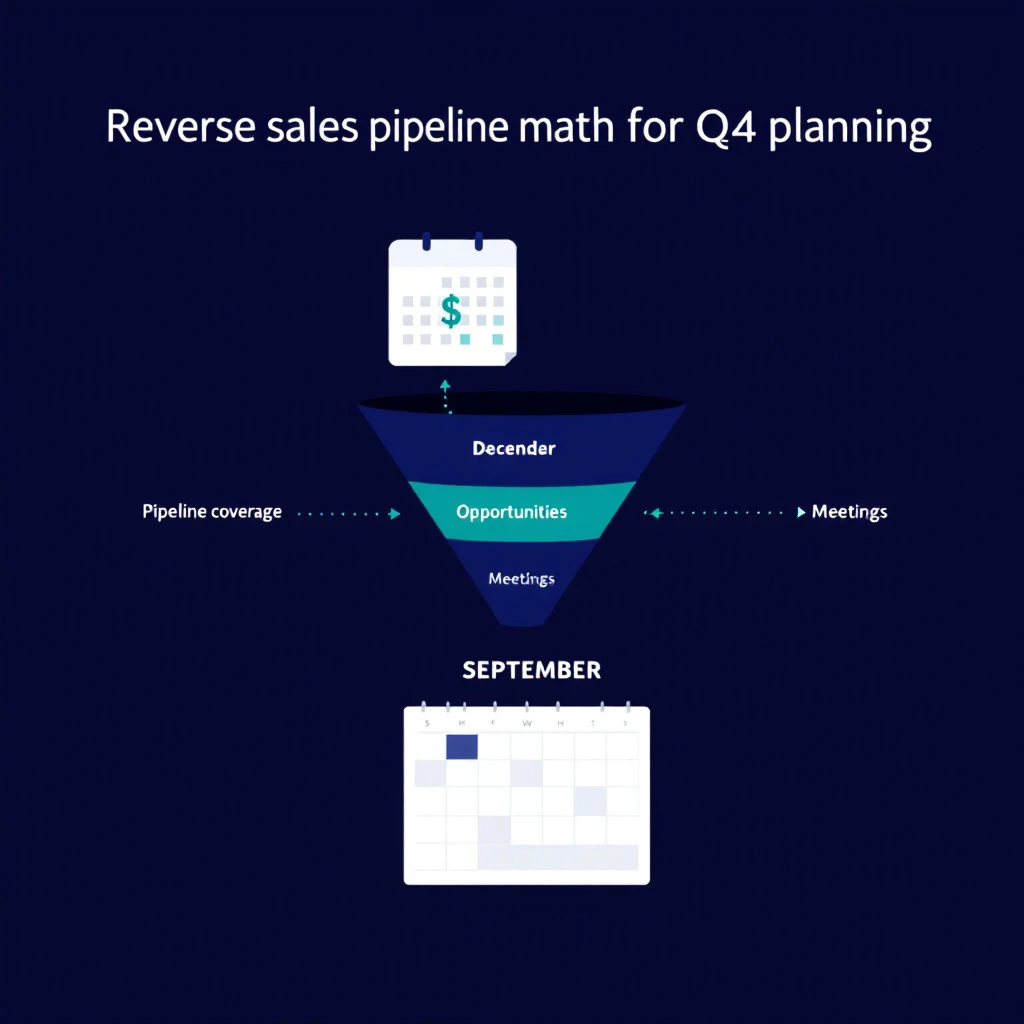
December doesn't decide your Q4. September does. This post walks through the reverse math — from your Q4 number back to what your team needs to do this week — with 2026 benchmarks at every step.
Why September Is the Real End of Quarter
Three numbers explain why the Q4 outcome gets decided now:
-
The 84-day median cycle. B2B SaaS sales cycles have stretched 22% since 2022 — the median now sits around 84 days, with the mean at 134. Larger buying committees (6.8 stakeholders, up from 5.4) and heavier CFO involvement are the main drivers. Count backwards from December 31 and the last realistic entry date for a median deal is early October. For enterprise deals running 90-180 days, the door closed months ago.
-
Q4 has fewer selling days than the calendar suggests. Thanksgiving week, the mid-December slowdown, and the dead week between Christmas and New Year quietly remove two to three weeks of real selling time. A 13-week quarter behaves like a 10-week one. Deals that need "one more meeting" in late December usually get it in January — as a slipped deal.
-
Slipped deals die. Across large CRM datasets, only about 20% of the pipeline that starts a quarter with an in-quarter close date actually closes inside that quarter. And a deal that slips from Q4 to Q1 closes at a lower rate than a comparable deal that was always scheduled for Q1. Pushing a thin Q4 pipeline harder doesn't fix it — it just manufactures slippage.
If your instinct is "we'll make it up with a strong December" — that's the same math that has average quota attainment stuck around 43-47%, with roughly two-thirds of B2B reps missing their number. The teams on the right side of that distribution don't have better Decembers. They have better Septembers.
Step 1: Calculate Your Real Coverage Ratio (It's Probably Not 3x)
The "3x pipeline coverage" rule is the most repeated — and most silently wrong — benchmark in sales. Three dollars of pipeline per dollar of quota only works if you close one in three deals. Most teams don't.
The honest formula:
Required coverage = 1 ÷ your trailing win rate
Average B2B win rates in 2026 sit around 19-21% across all opportunities (roughly 29% for qualified opportunities). Plug that in:
| Your Win Rate | Coverage You Actually Need | $500K Q4 Quota Needs |
|---|---|---|
| 33% | 3.0x | $1.5M pipeline |
| 25% | 4.0x | $2.0M pipeline |
| 20% | 5.0x | $2.5M pipeline |
| 15% | 6.7x | $3.35M pipeline |
Deal size makes it worse. Practitioner benchmarks recommend roughly 3x coverage under $25K ACV, 3.5-4x for $25K-$100K, 5x for $100K-$250K, and 6x+ for enterprise deals above $250K — because win rates fall and cycles stretch as deal size grows.
Two corrections before you trust your number:
- Use your trailing win rate, not the benchmark. Pull the last two full quarters from your CRM. If you closed 18% of sales-accepted opportunities, your coverage target is 5.5x, and no amount of positive thinking changes it.
- Only count real pipeline. Stage 2+ sales-accepted opportunities with a next step on the calendar. Meetings booked, "verbal interest," and opportunities with close dates that have already been pushed twice are not coverage — they're decoration. We covered how to keep inflated opportunities out of your reporting in our guide to building an SDR dashboard that reports in dollars.
Step 2: Find Your Gap — Then Convert It to Activities
Say your team carries a $500K Q4 quota, closes 20% of qualified opportunities, and currently holds $1.4M in real Q4-dated pipeline.
- Required: $500K × 5 = $2.5M
- Current: $1.4M
- Gap: $1.1M to create in September
Now walk the gap backwards through your funnel. Using common 2026 outbound benchmarks — 40-60% of held meetings convert to qualified opportunities (10-30% for pure cold outbound), and a $35K average deal size:
| Funnel Step | Math | Result |
|---|---|---|
| Pipeline gap | — | $1.1M |
| Opportunities needed | $1.1M ÷ $35K avg deal | ~31 opportunities |
| Meetings needed | 31 ÷ 50% meeting-to-opp rate | ~63 meetings held |
| Meetings per SDR (team of 4) | 63 ÷ 4 | ~16 each in September |
Sixteen meetings per SDR in a month is right at the edge of the outbound benchmark (the median outbound SDR books 12-15 qualified meetings per month). That tells you something important: this gap is closable, but only with September fully committed — not discovered as a fire drill during the October QBR.
If the math comes out impossible — say, 40 meetings per rep — you've learned something equally valuable in September instead of December: the gap won't close on activity volume alone. You need bigger deals, better targeting, or another source of warm opportunities. That's a strategy conversation you can still have in September. In December it's a resignation letter.
For a full breakdown of which conversion rates to use at each funnel stage, see our SDR metrics and benchmarks guide.
Step 3: Spend September on the Highest-Yield Sources
A gap you have four weeks to close changes where you should hunt. Cold lists are the slowest, lowest-yield source you have. Work the warm layers first:
1. Website visitors from target accounts. Companies researching you right now are the closest thing to in-market demand you own. Visitor identification tells you which accounts are on your pricing page this week — exactly the deals that can still enter and exit the pipeline before December 31. If you're not running it yet, our website visitor identification guide covers how it works and which tools to consider.
2. Signals with expiration dates. Champion job changes, funding rounds, new leadership hires, tech-stack changes — every one of these is a reason to talk now, which is what a September outreach needs. Speed matters more than polish: the first 24 hours after a signal largely determine whether it becomes a meeting.
3. Closed-lost from Q1-Q2. Deals you lost 6+ months ago on timing or budget are entering a new budget cycle — and here's the September-specific kicker: many buyers have use-it-or-lose-it budget that must be spent before year-end. A deal that stalled in April on "no budget" may close in 45 days in Q4. These re-opened conversations also skip early discovery, shortening the cycle — critical when you only have 84 days of runway. Our signal-to-closed-won playbook covers how to re-enter these conversations without starting from zero.
4. Then — and only then — net-new cold accounts. Cold outbound started in late September mostly builds Q1 pipeline, which you also need. Just don't book it against the Q4 gap in your forecast. If you need fresh accounts to work, here's how to build a B2B lead list for free.
One more thing to protect: qualification discipline. The pressure of a visible gap tempts teams to accept weak meetings to make the activity numbers work. That inflates the top of the funnel in September and shows up as a worse meeting-to-opp rate in October — the gap doesn't close, it just moves down a stage. Keep running your normal discovery qualification bar; the math only works if the meetings are real.
Step 4: The Week-by-Week September Plan
Week 1 (Sept 1-5): Audit and math. Pull trailing win rate, average deal size, and current real Q4-dated pipeline. Compute your coverage target and your gap. Scrub the fiction: any opportunity with a twice-pushed close date gets moved to Q1 or closed-lost. Yes, the pipeline number goes down. It was always going to — better now than in the November forecast call. If your team argues about what "real" means, that's a sign you need written attribution and stage-entry rules — we walk through them in the dashboard guide.
Week 2 (Sept 8-12): Warm sources first. Launch plays against identified website visitors, active signals, and the Q1-Q2 closed-lost list. Set the team's meeting targets from the Step 2 math — per rep, per week, in writing.
Week 3 (Sept 15-19): Mid-month checkpoint. You should be near 50% of the meeting target. If you're at 30%, don't wait for the month-end retro — reallocate now: more signal coverage, tighter ICP filter, manager call reviews on the no-show and no-convert meetings.
Week 4 (Sept 22-30): Last call for median deals. This is the final week a median-cycle deal can enter pipeline and still plausibly close by December 31. Push every stalled "interested, circle back" contact to a scheduled meeting this week. After October 1, new opportunities are Q1 pipeline — forecast them honestly as such. (Your AEs will also thank you: deals entering now are exactly the ones that avoid the December discount squeeze, because they have runway to close before the final week of the quarter.)
The Part Nobody Budgets For: This Is Also 2027 Planning Season
September's pipeline math has a second audience: your CFO. Q4 is when next year's budgets get set, and the same reverse math — quota, win rate, coverage, meetings, capacity — is the honest basis for headcount and tooling asks. If the Step 2 math says your gap isn't closable with current capacity, you have two levers, and both are cheaper to argue for with the math in hand: adding capacity (see the real ROI comparison of AI SDRs vs. a human hire and what AI SDR tools actually cost) or protecting the capacity you have — SDR turnover quietly costs more than almost any tool decision.
The Takeaway
- Your real coverage ratio is 1 ÷ your win rate. At 2026's average win rates (19-21%), that's 4-5x, not 3x.
- The 84-day median cycle makes late September the cutoff for pipeline that can still close this year.
- Convert your gap into meetings per rep per week. If the number is achievable, commit to it now. If it isn't, change strategy now — while "now" still helps.
- Warm sources first: website visitors, live signals, and re-openable closed-lost deals are the only sources fast enough to matter for Q4.
The teams that hit their Q4 number in December are the ones that did this math in September. The rest discover it in the year-end retro.
Want to see which target accounts are on your website right now — while there's still time to close them this year? MarketBetter identifies visiting companies, surfaces buying signals, and tells your SDRs exactly who to contact and what to say. Book a demo →