Let's start with the honest answer, because most articles on this topic won't give it to you: Claude cannot generate leads by itself. It has no built-in contact database, it can't scrape LinkedIn at scale, and if you ask it for "50 CMOs at Series B fintechs," it will happily hallucinate 50 names, half of which don't exist.
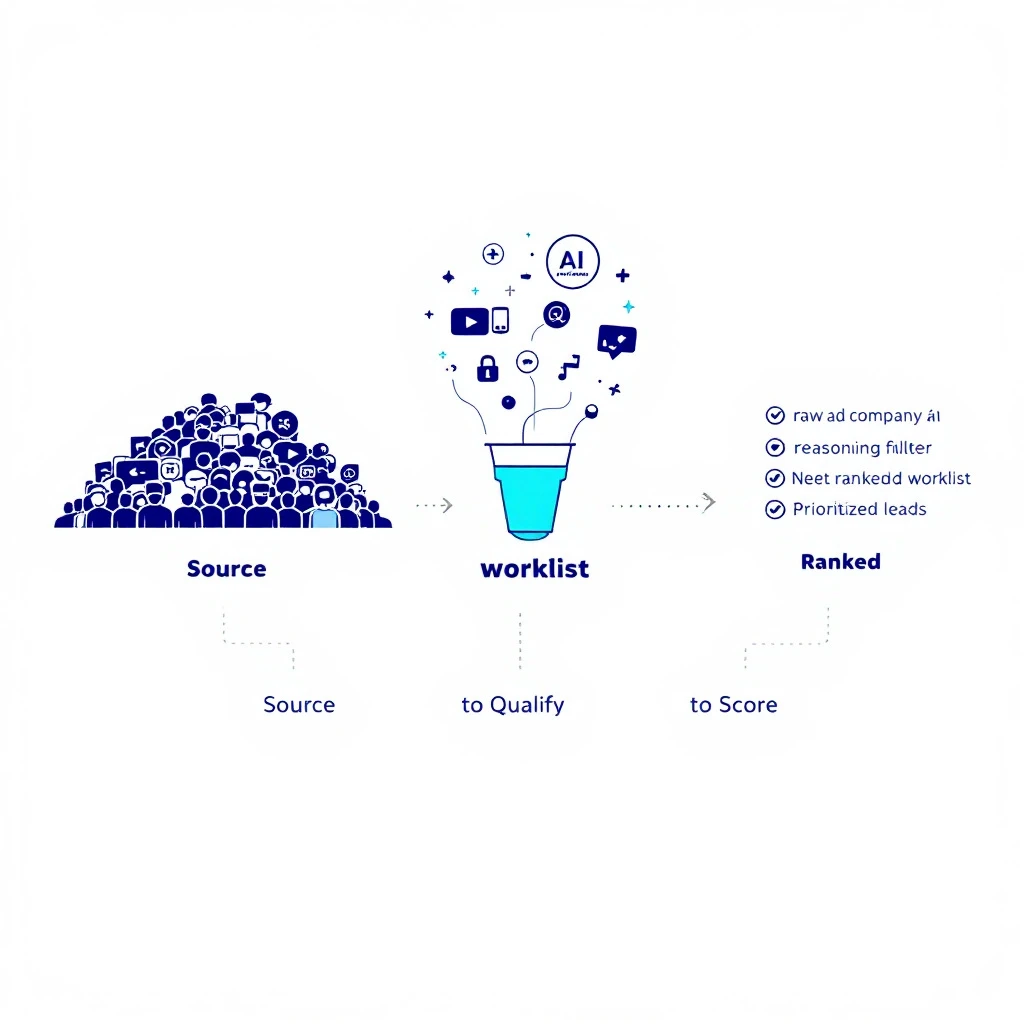
So why is "how to use Claude for lead generation" one of the fastest-growing searches in B2B sales? Because the people asking it have figured out something real: Claude isn't the source of leads — it's the reasoning layer that turns raw, messy, low-quality lists into a prioritized worklist of accounts actually worth your time. That's where 80% of a lead-gen team's hours disappear, and it's exactly the part Claude is world-class at.
This is the step-by-step playbook for doing it right. Five stages, the exact prompts, and a clear line on what Claude can and can't do — so you don't waste a week discovering the limits the hard way.
If you want the broader role-level picture, the complete Claude-for-SDRs pillar guide covers the full SDR job. This post is narrower and deeper: it's specifically about generating and qualifying net-new leads.
Can Claude generate leads? What it actually can and can't do
Set expectations first. This one table saves you the most common mistake.
| Task | Can Claude do it alone? | What you need |
|---|
| Invent a list of companies/contacts | No — it hallucinates | A real data source |
| Define and encode your ICP as a filter | Yes | A clear ICP |
| Qualify 500 raw companies against that ICP | Yes, extremely well | The raw list |
| Score and rank leads by fit and intent | Yes | Fit + signal data |
| Find the right contact and title at a company | Partly | An enrichment tool or source |
| Write the first-touch message | Yes | Research + positioning |
| Pull verified emails at scale | No | An enrichment provider |
The pattern: Claude is the judgment and synthesis engine. You still need a source of raw leads and, usually, an enrichment step for verified contact data. Get those two things feeding Claude and the middle of the funnel — the qualification grind that eats your reps' mornings — collapses from hours to minutes.
For a head-to-head on which model handles this best, see Claude vs ChatGPT for sales teams. Short version: Claude's long context and consistent reasoning across a 2,000-row list is the deciding factor for lead gen specifically.
The 5-stage Claude lead generation workflow
Here's the full pipeline. Each stage feeds the next.
- Encode your ICP — turn "our best customers" into a machine-readable rubric
- Source raw leads — get companies and contacts from a real source
- Qualify at scale — score the raw list against the rubric
- Enrich the winners — find the right person and their context
- Prioritize into a worklist — a ranked queue your reps actually work
Skip stage 1 and everything downstream is garbage. Let's build it.
Stage 1 — Encode your ICP as a machine-readable filter
Most teams "know" their ICP but have never written it down in a way a machine can apply consistently. That's the highest-leverage 20 minutes in this entire process.
Prompt:
You are helping me build a lead qualification rubric.

Here are 8 of our best current customers and why they're great fits:
[paste 8 accounts + one line each on why they closed and stuck]

Here are 4 accounts that looked good but churned or never closed:
[paste 4 + why they failed]

Produce a scoring rubric with:
- 5-7 firmographic criteria (industry, size, tech, funding stage, etc.)
- 2-3 disqualifiers (auto-reject signals)
- A 0-100 scoring formula weighting each criterion
Output it as something I can reuse to score new companies.
The output is a reusable rubric grounded in your real wins and losses — not a generic "50-500 employees, B2B SaaS" guess. Save it. You'll paste it into every qualification run from now on.
For a deeper treatment of turning fit into a repeatable score, see Claude Code SDR Part 6: Lead Scoring.
Stage 2 — Source your raw leads (this is the part Claude can't fake)
Claude needs raw material. You have three honest options for where it comes from:
Option A — LinkedIn Sales Navigator. Build a search that roughly matches your ICP, export or copy the results, and hand them to Claude to qualify. The Sales Navigator + Claude workflow walks through this end to end. Sales Nav gives you breadth; Claude gives you the filtering Sales Nav can't.
Option B — Website visitor identification. This is the highest-intent source that most teams ignore. The companies already researching you are worth ten cold ICP matches. Tools that de-anonymize your traffic turn "someone from a mid-market logistics firm read your pricing page twice" into a named account you can act on today. That's the source we care most about — more on it below.
Option C — Free and low-cost tools. If you're bootstrapping, there's a real stack of free options. We break them down in the best free AI lead generation tools for B2B and the best B2B lead generation tools.
Whatever the source, the output of this stage is a raw list — messy, unqualified, full of noise. That's fine. Stage 3 is where Claude earns its keep.
Stage 3 — Qualify the raw list at scale
This is the magic step. You have 300 raw companies and a rubric from Stage 1. Feed both to Claude.
Prompt:
Here is my ICP scoring rubric:
[paste rubric from Stage 1]

Here is a raw list of 300 companies with the fields I have
(name, industry, employee count, website, any notes):
[paste CSV/list]

For each company:
1. Score it 0-100 against the rubric.
2. Give a one-line reason for the score.
3. Flag any auto-disqualifiers.
Return the top 40 by score as a table, sorted high to low.
Be conservative — if you lack evidence a company fits, score it lower,
don't guess.
That last line matters. Telling Claude to penalize missing evidence instead of inventing it is the single most important instruction for keeping lead-gen output trustworthy. A rep who can trust the top-40 list works it; a rep who's been burned by hallucinated fits ignores the whole thing.
Two minutes of Claude replaces an afternoon of a rep eyeballing a spreadsheet — and it's more consistent, because Claude applies the same rubric to row 300 as it did to row 1. For the underlying research mechanics, see automate lead research with Claude Code and Claude Code SDR Part 2: Prospect Research.
Stage 4 — Enrich the winners
Now you have 40 qualified companies. You need the right person at each and enough context to open a real conversation. Claude can't pull verified emails on its own, but once you feed it enrichment data (from your provider) plus public signals, it synthesizes a briefing no rep has time to write by hand.
Prompt:
For each of these 40 companies, I've pasted the LinkedIn profile of the
most likely buyer plus their company's recent news:
[paste enrichment data]

For each, produce:
- Confirmed best-fit contact + title + why them
- A one-paragraph "why now" briefing (trigger event, pain, angle)
- One specific, non-generic opening line I could actually send
Keep each under 80 words. No filler, no "I hope this finds you well."
You now have 40 fully-briefed, ready-to-work leads. The full breakdown of turning research into first-touch lives in AI for sales prospecting and, for the outreach itself, LinkedIn outreach automation with Claude Code.
Stage 5 — Prioritize into a daily worklist
Forty leads is still too many to work well at once. The last step is ranking them into the order a rep should actually attack — fit plus intent, not fit alone.
Prompt:
Here are my 40 enriched leads with fit scores.
I'm also pasting intent signals where I have them
(site visits, content downloads, job changes, funding):
[paste]

Re-rank all 40 into a single prioritized worklist. Weight recent,
high-intent signals heavily — a medium-fit account that just visited
our pricing page outranks a perfect-fit account that's gone quiet.
Group into: Call today / Sequence this week / Nurture.
That's a lead-generation pipeline that runs in an afternoon and outputs a worklist your reps trust. To wire this into a daily cadence, the Claude SDR daily routine shows the exact 90-minute block. And if deliverability is a concern as you scale outreach, read how to build a prospecting engine without burning your domain first.
The honest limits (and how to work around them)
Because no one else will say it plainly:
- Claude will confidently invent contacts. Never let it be the source. Always give it a real list to work on, never ask it to produce one from nothing.
- It doesn't have live data. "Recent funding" or "current headcount" needs to come from your source or enrichment tool. Claude reasons over data; it doesn't fetch it.
- Verified emails require a real provider. Claude can guess an email pattern; it can't confirm one is deliverable.
- Scoring is only as good as your rubric. Garbage ICP in, garbage worklist out. Stage 1 is not optional.
Work within those lines and Claude is the best qualification-and-synthesis engine your team has ever had. Ignore them and you'll generate a list of ghosts.
Where the leads should really come from
Here's the strategic point most "Claude for lead gen" advice misses. The best raw source isn't a bigger cold list — it's the people already showing intent. Companies visiting your site are further down the buying journey than any cold ICP match, and they've told you what they care about by which pages they read.
That's the gap MarketBetter fills. We de-anonymize your website traffic into named accounts, layer on the buying signals, and — this is the part that matters — tell your reps what to do next, not just who visited. Claude is brilliant at reasoning over a list. MarketBetter makes sure the list is made of real, high-intent companies instead of cold guesses.
Claude tells your SDRs what to do. MarketBetter tells them who to do it for — with the intent data that makes every message land.
Pair the two and the five stages above stop being a manual afternoon and become a system: high-intent leads in, prioritized worklist out, every day.
Start generating better leads
Claude is a force multiplier, not a lead database. Give it a real source, a sharp ICP rubric, and clear instructions, and it will do the qualification work of a small team — consistently, in minutes.
The one thing it can't manufacture is a good source of leads. That's worth solving first.
Want to see high-intent leads flow straight into a Claude-ready worklist? Book a demo →