
The Multi-Threading Playbook: Build a 5-Stakeholder Deal Team Before the Champion Goes Quiet [2026]

Most AEs treat multi-threading like a fire extinguisher: you only reach for it when something is already burning. Your champion went dark. Procurement appeared out of nowhere. Legal kicked the contract back with redlines that read like a different deal.
By then, multi-threading is damage control. You are scrambling to find allies inside an account that has already decided you are not a priority.
The reps who consistently hit 110% of quota do something different. They build the deal team before they need it — usually inside the first two meetings — and treat stakeholder coverage as a leading indicator of pipeline health, not a Q4 panic move.
This playbook is the system. Five roles to identify, four weekly cadences to keep them warm, a CRM hygiene model that flags single-threaded deals before they stall, and the exact messages that get a CFO or VP Engineering to take a 15-minute call when they have never heard of you.
Why single-threaded deals die quietly
Gartner's most-cited B2B buying research puts the average enterprise buying committee at 6 to 10 people. Forrester's data lands closer to 11. The deals that close involve the buyer talking to your team an average of 17 times across multiple stakeholders.
If your only relationship is with one champion, you are betting your forecast on three things going right at once:
- The champion never changes jobs, never gets reorged, never goes on parental leave
- The champion has the political capital and skill to sell internally without you in the room
- Every other stakeholder defers to the champion's recommendation without an independent opinion
Forrester says 86% of B2B deals are won or lost based on multi-thread coverage. If you have ever watched a deal you were "sure about" slip a quarter, the post-mortem almost always reveals the same thing: you had one relationship. The buyer had nine.
When the champion goes quiet — which happens to roughly one in three enterprise deals — your only signal is silence. We wrote a full re-engagement workflow for that case in our champion-quiet stalled deal playbook, but the better fix is upstream: never let a deal sit at one thread.
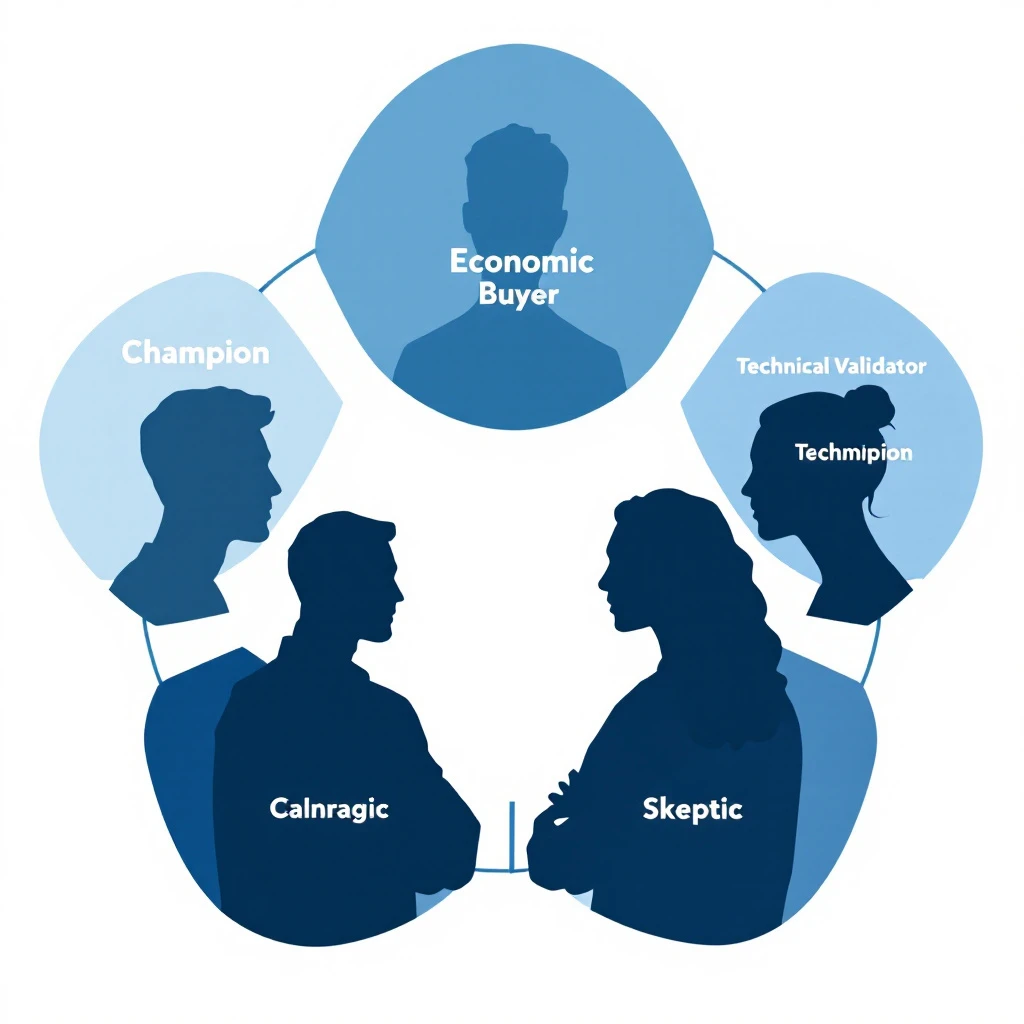
The 5 roles on every B2B deal team
Forget org charts. Buying committees don't show up on org charts. They form ad hoc around a project and dissolve when it closes. The roles below are functional — one person can play two, two people can share one, but every winning deal has all five seats filled.
1. The Champion (the seller-internal-to-the-account)
The person who wants you to win. They sell on your behalf in meetings you are not invited to. They know your roadmap, they can rattle off your pricing, they actively defend you against alternatives.
Most AEs stop here. That is the mistake.
A champion without backup is a single point of failure. If they go on PTO during the final week of the quarter, your deal slips. If they get poached by a competitor — and B2B SaaS attrition averages 13% annually — your deal restarts from zero.
Coverage signal: You have a champion. Good. That puts the deal at 20% stakeholder coverage. Not 100%.
2. The Economic Buyer (the budget owner)
The person who signs the PO. In a 50-500 employee company, this is usually a VP or C-level. In enterprise, it could be a director with a discretionary budget below a threshold and an SVP above it.
The Economic Buyer's question is never "is this the best product?" It is "is this worth the opportunity cost of the budget?" They are weighing your line item against headcount, against another tool, against doing nothing.
You do not sell features to the Economic Buyer. You sell ROI math and risk reduction. And you sell it directly — not through the champion. The champion's framing of your ROI is always weaker than yours, because they are not professionally trained to negotiate against a CFO's skepticism.
Coverage signal: If you have not had a 15+ minute conversation with the Economic Buyer by the second demo, the deal is not real yet.
3. The Technical Validator (the gatekeeper)
VP of Engineering, Head of IT, Director of Security, Chief Architect. Whoever has the authority to say "we can't run this in our environment" and end the deal.
The Technical Validator is the most under-engaged stakeholder in B2B sales. Reps fear them, so they delay the introduction. Then in week 11 of a 13-week deal cycle, the security questionnaire arrives, the SOC 2 conversation happens, the integration concerns surface — and the deal slips a quarter while you chase answers.
Bring them in early. Week two. Give them documentation before they ask for it. Make them feel respected as a peer reviewer, not an obstacle.
Coverage signal: A Technical Validator who has reviewed your docs and asked at least one clarifying question is a coverage point. A Technical Validator who has never been introduced is a hidden veto waiting to happen.
4. The User Champion (the end-user advocate)
The person whose daily workflow your product changes. Usually different from the Champion. The Champion is often a manager or director — the User Champion is the SDR, the marketer, the analyst who will actually log in every day.
Why they matter: in modern B2B sales, end-user adoption is a procurement criterion. CFOs ask, "will the team actually use this?" If the User Champion can answer yes in their own voice — not through your champion — the deal accelerates.
End-users also surface real objections faster than directors do. They will tell you in 60 seconds that your UI is confusing or that your CSV export is missing a column the team needs. That intel saves you from a 6-week stall later.
Coverage signal: Did the User Champion attend the demo? Did they ask questions? Have they tried the trial themselves? If no to all three, you are selling a director on a tool their team has not validated.
5. The Skeptic (the loyal opposition)
Every deal has one. The person who is paid, structurally, to push back. CFO. Procurement. Legal. Sometimes a competing department head who wanted to build instead of buy.
You cannot avoid the Skeptic. You can only get to them first.
The mistake reps make is treating the Skeptic as the enemy. They are not. They are doing their job — protecting the company from a bad procurement decision. Your job is to give them the answers they need before they have to dig for them.
Ask the champion: "Who is going to push back on this internally? Walk me through their concerns before the meeting." Then prep direct answers — not deflections, not "let me get back to you," but the answer.
Coverage signal: Have you been told who the Skeptic is? Have you addressed their objection in writing? If no, the deal has a landmine you cannot see.
How to recruit each stakeholder (with what to say)
Identification is the easy half. Getting on calendars is where most reps fail. Below is the exact ask for each role, tested in real outbound. Adjust the names and product specifics, but keep the structure.
Recruiting the Economic Buyer
After demo 2 with the champion, ask:
"[Champion], based on where we are, I think this is the right time to bring [VP/CFO name] into the next conversation. I want to make sure they hear the ROI math directly from me, not summarized through you — that protects you from any 'why didn't you push back on X' questions later. Can you make the intro this week? I will own the agenda and keep it to 15 minutes."
The framing matters. You are protecting the champion, not bypassing them. Champions accept this because it is true.
If the champion stalls on the intro for more than 7 days, that is itself a coverage signal: they either lack the political capital to make the intro, or the deal is less real than they have implied. Both are diagnostic. See our signal-decay framework for what to do when intent signals stop refreshing.
Recruiting the Technical Validator
Cold-introduce yourself directly. Do not wait for the champion. A 3-sentence message:
"Hi [Name] — I am working with [Champion] at [Company] on evaluating [product category]. Wanted to introduce myself ahead of any security or integration conversations so we are not strangers when those come up. Happy to share our SOC 2 report and architecture overview now if useful. 15-minute intro call this week or next?"
Half will not respond. The other half will, because you have signaled three things: you know they exist, you respect their role, and you are not going to waste their time later.
Recruiting the User Champion
Get them into the demo. If the champion will not invite them, ask:
"We see a real difference in adoption when the daily users see the tool before procurement, not after. Can we do a 30-minute working session with 2-3 people from the [SDR/marketing/ops] team? It also gives me real product feedback before we get to pricing."
Buyers know this is true. Most will say yes.
Recruiting the Skeptic
You do not "recruit" the Skeptic — you preempt them. As soon as you know who they are, send the champion a one-page document titled "[Skeptic role] FAQ" with the three objections they are most likely to raise and your written answers.
Then ask: "Can you forward this to [Skeptic] before our next meeting and ask them if there's anything else they'd want addressed?" This converts the Skeptic from an ambush into a structured conversation.
The weekly cadence: keeping the deal team warm
Identifying stakeholders does not multi-thread the deal. Recurring contact does. Below is the cadence that separates AEs who hold 80% close rates from AEs who lose 40% of late-stage deals to "no decision."
| Stakeholder | Touch Frequency | Channel | Message Type |
|---|---|---|---|
| Champion | Weekly | Slack or text | Update + question |
| Economic Buyer | Bi-weekly | Forwarded relevant insight | |
| Technical Validator | Bi-weekly | Documentation + status | |
| User Champion | Weekly during eval | Email or async video | Product tip + feedback ask |
| Skeptic | As-needed | Through champion | Pre-emptive FAQ updates |
The "forwarded relevant insight" pattern for the Economic Buyer is the highest-ROI touch in this entire playbook. You are not pitching. You are sending them a single article, benchmark, or customer story that addresses their specific concern. Three sentences. No CTA. Their reply rate to this pattern, in our internal data, is 4x higher than any "checking in" email.
For the User Champion, the highest-converting touch is asking for feedback on a specific feature — not generic "how is the trial going." Specific feedback requests get specific replies. Specific replies build relationship.
CRM hygiene: how to flag single-threaded deals automatically
You cannot multi-thread what you cannot see. Most CRMs let you log contacts but do not surface coverage gaps as a forecasting signal. Build the view yourself.
In your opportunity record, add three fields:
- Stakeholders Identified (number): How many of the 5 roles have a named person?
- Stakeholders Engaged (number): How many of those 5 have had a 1:1 conversation with you in the last 21 days?
- Coverage Risk (calculated): Red if Engaged is less than 3, yellow if 3-4, green if 5.
Run a weekly report filtering all opportunities forecasted to close this quarter where Coverage Risk is red. That list is your priority for next week's stakeholder outreach. It is also the list you bring to your manager's deal review.
This is the same operating principle behind our 14-day post-demo window playbook: make coverage visible, then make it accountable.
Multi-threading from inbound vs outbound deals
The playbook works for both, but the entry point differs.
Inbound deals start with a single contact who filled out a form. You do not yet know if they are the Champion, the User, or just someone doing research. Your first job is diagnosis. Use the first call to map: who else is involved in this evaluation? Who would sign the contract? Who needs to approve from a technical side?
Our inbound triage tier system flags hot inbound for 5-minute response — multi-threading takes over from there in the post-demo phase.
Outbound deals start with you picking the entry point. Pick wrong and you spend two months selling to someone who has no authority to buy. We covered first-touch strategy in our signal-to-meeting 24-hour workflow and our visitor ID to outreach playbook — multi-threading starts the moment the first meeting is booked, not after the demo.
What multi-threading does not solve
This playbook is not magic. It does not:
- Compensate for product-market fit gaps. If the prospect's pain is not real or your product is not the right shape for it, no stakeholder coverage will close the deal.
- Replace strong discovery. You can multi-thread perfectly and still lose because the champion sold you on a vision the Economic Buyer never agreed was a priority.
- Save deals from competitive switching costs. If the prospect is on a 3-year contract with your competitor and the cost of breaking it exceeds your annual price, more stakeholders does not change the math.
Multi-threading is the second-most-important variable in B2B win rate, behind discovery. Treat it accordingly.
The 60-second pipeline review question
Once you have built the playbook above, your pipeline reviews change shape. Stop asking "what is the status of this deal?" Start asking:
"Walk me through the deal team. Who has been engaged in the last 14 days? Who has not? What is the plan to engage them?"
Reps who can answer this in 30 seconds have real pipeline. Reps who cannot — even on deals they are calling "committed" — are running on optimism and a single contact. That is the deal you will lose in week 11, the one that becomes a champion-quiet re-engagement project, the one that turns into a closed-lost reopen attempt six months later (we wrote that workflow up in our closed-lost reopen playbook, but it is much cheaper to never get there).
How MarketBetter helps you multi-thread without burning hours
Manually maintaining a 5-stakeholder map across 30 active opportunities is a part-time job. The reason most reps do not multi-thread is not philosophical — it is bandwidth.
MarketBetter pulls intent signals across your active accounts, tracks champion movements (job changes are a leading indicator of deal risk and a re-engagement opportunity — we covered this in our buying committee post and our blind committee post), and surfaces which stakeholders in each account have engaged recently versus gone cold.
Instead of telling you who exists at the account, MarketBetter tells you which stakeholder to contact next, what to say based on their recent activity, and which deals have coverage gaps that are about to slip. The signal becomes the action — not just data on a dashboard.
If you have ever lost a deal because the champion went on PTO during the final week, or because procurement showed up in week 10 with objections you could have addressed in week 2, the gap was not strategy. It was visibility.
Want to see how MarketBetter surfaces coverage gaps across your pipeline before they cost you a deal? Book a 20-minute demo →