5 posts tagged with "AE playbook"

View All Tags

The Discovery Call Diagnostic: 8 In-Call Signals That Predict If a Deal Will Close [2026]

ยท 12 min read
MarketBetter Team
Content Team, marketbetter.ai

Discovery call diagnostic - 8 in-call signals that predict deal close

Most AEs walk out of a discovery call and write the same recap in CRM: "Good convo. Strong interest. Sending follow-up." Two weeks later half of those deals are in slow-fade limbo, and nobody can explain what changed. Nothing changed. The deal was already dead at minute eight โ€” the AE just didn't notice.

The hard truth: discovery call outcome is mostly decided by what the buyer brings to the table, not what the AE asks. Budget, authority, timing โ€” the classic BANT โ€” are answers buyers give you because you forced the question. Real intent is something you have to listen for, and it shows up fast. If you know what to listen for, you can call the deal in the first 10-15 minutes with surprising accuracy.

This is the diagnostic. Eight signals. Where they show up. What they actually mean. And what to do when you don't see them.

If you want the wider context, this fits between the 15-minute pre-demo prep playbook and the 14-day post-demo AE daily playbook โ€” discovery is the inflection point between the two.

Why "discovery questions" frameworks miss the pointโ€‹

Every sales methodology โ€” MEDDPICC, SPIN, Sandler, GAP โ€” gives you a list of questions to ask. They're fine. The problem is that the AE who's reading off a question list is, by definition, leading the conversation. Leading a discovery call is the opposite of discovery. You're shaping their answers instead of letting them reveal themselves.

The diagnostic flips the model. Instead of asking better questions, you create the conditions for the buyer to talk for 60-70% of the call, and then you score what you hear. The questions matter less. The patterns inside their answers matter enormously.

Eight patterns. If a deal shows 5 or more, it's real. If it shows 2 or fewer, your follow-up is mostly nurture โ€” don't burn AE cycles. The middle is where coaching and multi-threading make the difference.

Signal 1 โ€” They name the trigger before you askโ€‹

The strongest qualifier in any discovery call is a compelling event volunteered without prompting. When a buyer opens with "we just lost our biggest rep and need to ramp two new ones in 60 days" or "our contract with the current vendor is up in November and renewal pricing went up 40%," they are telling you the deal already has a forcing function.

What to listen for: a specific event, a date attached to it, and a cost of doing nothing. Generic statements like "we're always looking to improve" or "we want to grow faster" are not triggers. Triggers have edges. They hurt.

If you don't hear one in the first 10 minutes, ask once: "What made now the right time to take this call?" If the answer is hand-wavy, mark this signal as absent. Don't pretend it's there.

Signal 2 โ€” They say "we" not "I"โ€‹

Pay attention to pronouns. Buyers who frame the problem in first-person singular ("I'm trying to figure outโ€ฆ", "I want to see ifโ€ฆ", "I've been thinking aboutโ€ฆ") are usually exploring on their own. Deals with one-person curiosity at the top of funnel close at a fraction of the rate of deals where the buyer has already framed the project as a team need.

"We" language signals that the conversation has already happened internally. They've talked about this with their VP. The pain has been named in a leadership meeting. The exploration call is one step of a process, not a personal hobby.

Listen for: "we're evaluating," "our team decided," "my CRO asked me to look at," "we agreed we'd shortlist." Each one is a deal-team artifact you didn't have to build yourself. Compare to multi-threading from the discovery stage โ€” if they're already using "we," the deal team is partially formed before you ever pitched.

Signal 3 โ€” They cite specific numbers unpromptedโ€‹

When buyers volunteer numbers without you fishing for them, the deal is already real in their head. "We have 47 SDRs and roughly 8,000 target accounts" is different from "we have a pretty big sales team." The first one means they've measured the problem. The second one means they're guessing.

Numbers to listen for: team headcount, current tool spend, conversion rates, quota attainment, deal sizes, pipeline coverage, churn rate. The specific metric matters less than the act of volunteering it. Buyers who have measured their problem have, almost by definition, already decided it's a problem worth solving.

The inverse signal is just as useful: if a buyer can't (or won't) give you a number for anything quantitative, they haven't done the internal work. The deal is at "interesting topic," not "active project."

Signal 4 โ€” They reference a deadline that isn't yoursโ€‹

Self-imposed deadlines are different from sales-imposed deadlines. "We need to make a decision by end of quarter" said in response to your "what's your timeline?" is a polite answer. "Board meeting in August, I need to have a recommendation by July 15" is a deadline that exists whether or not you're in the picture.

The best deadline signals are tied to events you can verify: a board meeting, a fiscal year cutover, a hiring plan that needs tooling, a vendor contract expiration, a product launch that needs sales infrastructure, a fundraise that requires GTM hardening. Each one creates signal decay on a known curve โ€” the deal has gravity pulling it toward a date.

If you don't hear a deadline, ask: "What happens if this isn't solved in the next 90 days?" If the honest answer is "not much," the deal will drift. Note it.

Signal 5 โ€” They ask about implementationโ€‹

This is the single most underrated signal in B2B sales. Buyers who ask "what does onboarding look like?" or "how long does it take to get a team trained?" or "who would we work with after the contract signs?" are not asking out of curiosity. They are mentally rehearsing what life is like after they buy.

The brain only does that rehearsal when the buying decision has tipped past 50%. You can almost feel it happen on a call โ€” the conversation shifts from "tell me what you do" to "tell me what we'd do." That pivot is everything.

When you hear an implementation question, your job is to answer it precisely and then ask "is the implementation timeline a factor in your decision?" Their answer tells you whether they're sequencing toward a real go-live or just collecting reassurance for a hypothetical purchase. Either way, lean in. This is the highest-leverage signal on this list.

Signal 6 โ€” They name competitors they're also evaluatingโ€‹

It feels counterintuitive โ€” competitors should be a threat, right? In discovery, the opposite is true. A buyer who names two or three competitors they're also looking at is a buyer who has built a shortlist, which means they have budget, authority, and intent. They are buying. The only question is from whom.

A buyer who insists they're "just exploring" and "not really comparing anyone right now" is in a much weaker position. They haven't done the work to scope the market. They're educational. Education calls close at maybe 5-10%. Shortlist calls close at 30-50%.

When you hear competitor names, do three things: (1) ask what they liked about each one โ€” this tells you their evaluation criteria, (2) ask where they are in each conversation โ€” this tells you the order of decision, (3) note the names, because your follow-up content needs to address those specific comparisons. This is where feature-to-feature competitor knowledge earns its keep.

Signal 7 โ€” They mention internal work they've already doneโ€‹

Strong deals have history. By the time they reach you, the buyer has usually built some artifact โ€” a one-pager for their VP, a spreadsheet comparing two or three vendors, a doc summarizing the current tool's gaps, a Slack thread with their team about the project. When they reference these in passing ("I put together a deck for our CRO last week" or "I have a spreadsheet I've been filling out"), they are showing you that the buying process is already running inside their org.

The artifact itself isn't the signal. The fact that they made one is. Internal work means an internal champion is forming, which is the single biggest predictor of whether the deal will survive the champion-goes-quiet moment later in the cycle.

Ask, gently: "Would it help if I sent you a one-pager you can share internally?" or "Want me to put together a version of the comparison for your team?" If they say yes enthusiastically, you have a champion in the making. If they deflect ("oh, I'll handle that myself"), the deal is more single-threaded than it looked.

Signal 8 โ€” They self-propose the next call participantsโ€‹

The cleanest tell of all: at some point in the back half of discovery, the buyer says some version of "I think it would make sense to get our [VP / RevOps lead / IT person / finance partner] on the next call." Not because you asked. Because they're already imagining the next step.

A buyer who is sequencing toward a multi-stakeholder conversation has decided this is a real evaluation. They're showing you who they need to align internally. You should help them. Offer a specific agenda for the next call ("I can prepare a 20-minute demo focused on what your VP will care about, plus 10 minutes for Q&A"). Get the calendar invite while you're still on Zoom.

If the buyer doesn't self-propose, you do it โ€” but treat it as a softer signal. "Who else internally would want to be on the next conversation?" is a fine question. Their willingness to name people is the signal. A vague "let me think about who else should weigh in" is a deferred answer, which means weak coalition. Mark it as half-credit.

Scoring the callโ€‹

After the call, score 0-8. Don't fudge.

ScoreReadAction
6-8 signals presentReal dealMove to multi-threaded demo, prep next call within 5 business days
4-5 signals presentReal but needs workChampion-building plays โ€” share a custom one-pager, line up a peer customer reference
2-3 signals presentEducational / nurtureLong-cycle drip, re-engage on trigger events, do not invest AE hours
0-1 signals presentWrong-fit or wrong-timeMove on. Politely. Open the AE calendar for a real deal

The mistake most AEs make is treating the 2-3 signal calls like the 6-8 signal calls โ€” same follow-up energy, same calendar time, same hope. That's how pipeline math breaks. Most reps don't have a fit problem; they have a discipline problem about where to spend hours.

What to do when you don't see the signalsโ€‹

Two paths. The first is honest disqualification โ€” most AEs are too generous with their own time, and a clean "this isn't the right moment for us, here's what we'd recommend instead" preserves both your hours and your reputation.

The second is to flip the call. If you're at minute 12 and you haven't heard any of the eight, change the conversation: "I want to make sure I'm being useful โ€” can I share what we typically see at companies that look like yours, and you tell me if any of it resonates?" This forces the buyer to either react (which is itself diagnostic) or stay flat (which confirms the call was a research call, not a buying call).

Either way, write the right CRM note. "No compelling event, no deadline, single-threaded, no internal work done โ€” nurture only" is more valuable than "good convo, sending follow-up" โ€” both to you, and to your manager forecasting the quarter.

How signal-driven selling changes discoveryโ€‹

This whole diagnostic gets easier when the AE walks into the call already knowing the buyer's trigger events and signal stack. When you've seen the company hire two new sales leaders, fundraise, and visit your pricing page three times in a week, you don't need to ask "what made now the right time?" โ€” you already know. You can spend the discovery call confirming and deepening instead of starting from zero.

That's the entire premise of signal-based selling: by the time the meeting happens, the AE has a sharpened hypothesis, and the discovery call is about confirming the diagnosis, not running blood tests. Discovery without signals is forensic work. Discovery with signals is consultative work. The outcomes are wildly different.

The bigger arcโ€‹

Discovery is one stage in the signal-to-closed-won sales cycle. The signals you score on the discovery call become the inputs for the 14-day post-demo plan, the SDR-to-AE handoff quality check, and ultimately the forecast call your VP runs every Friday. Sharpening the discovery diagnostic improves every downstream stage. There is no other single hour in the sales process where small changes in skill produce larger changes in outcome.

The teams that win the next two years won't be the ones with the most discovery calls. They'll be the ones who can call the deal at minute 12 and act accordingly โ€” invest where signals are loud, disqualify where they're absent, and stop pretending the middle 40% of pipeline is real.


Want to see what an AE pipeline looks like when discovery is signal-driven from day one? Book a demo โ†’

From Signal to Closed-Won: The Complete B2B Sales Cycle Playbook [2026]

ยท 21 min read
sunder
Founder, marketbetter.ai

Most B2B sales teams in 2026 are running a sales process that was designed for 2018. SDRs cold-call lists, AEs run generic demos, deals stall in pipeline for weeks, and nobody can articulate why a closed-won deal closed. The reps who win do it through hustle, not process. The reps who do not win, do not win for the same reason โ€” there is no process, so there is nothing to coach.

The teams that are pulling ahead this year have done one thing differently. They stopped thinking about sales as a list of activities (calls, emails, demos, follow-ups) and started thinking about it as a sequence of handoffs. Signal to SDR. SDR to AE. AE to demo. Demo to multi-thread. Multi-thread to close. Every handoff is a place where deals die. Every handoff is also a place where operational discipline can save them.

This is the pillar guide to that sequence. It is not a generic "B2B sales tips" article. It is the map of the modern sales cycle โ€” every handoff, the workflow that runs it, and the playbook posts that go deep on each stage. If you run an SDR or AE team, read this end-to-end once, then send it to your reps as the spine of your team's playbook. If you are an individual contributor, this is the framework your top performers are already running, whether or not they have written it down.

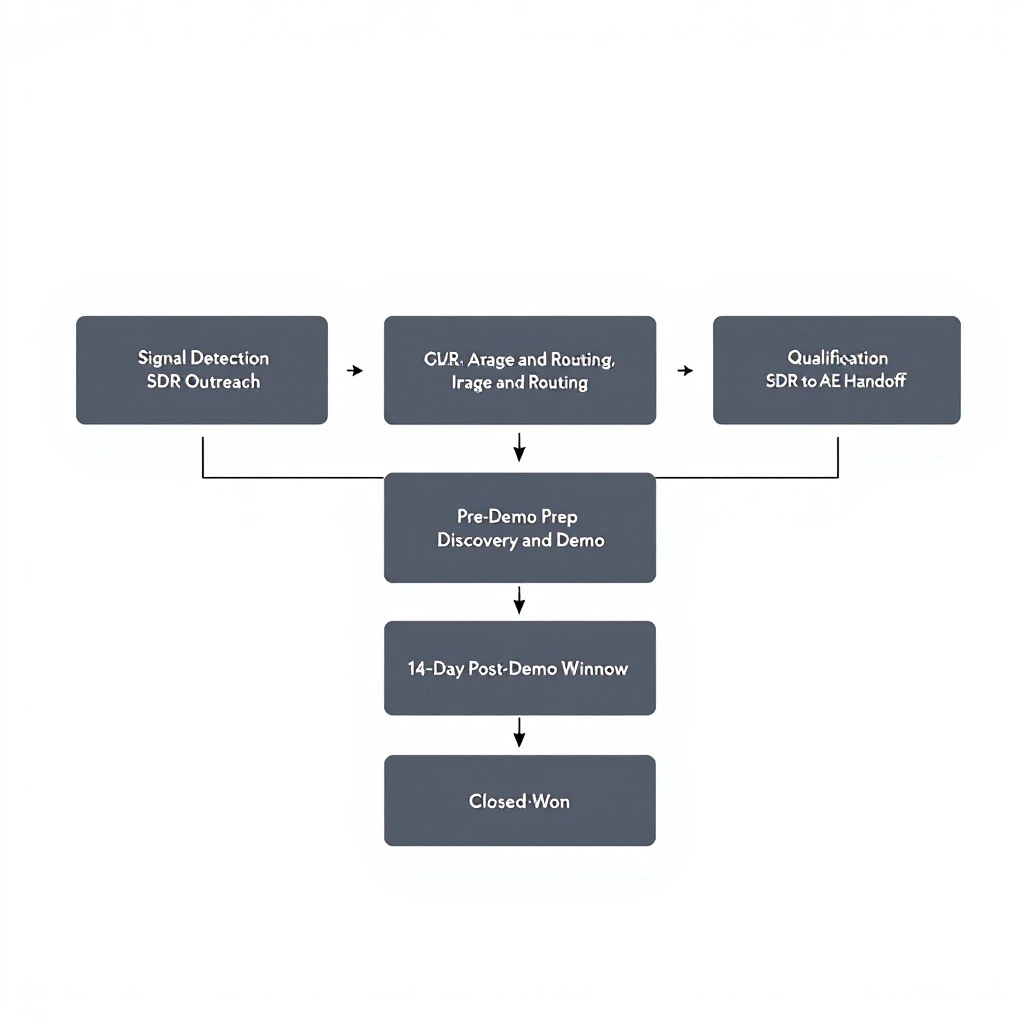
A horizontal flow diagram showing the modern B2B sales cycle in nine stages: signal detection, triage and routing, SDR outreach, qualification, SDR-to-AE handoff, pre-demo prep, discovery and demo, 14-day post-demo window, and closed-won. Each stage is a labeled box connected by arrows, with handoff points highlighted, clean minimalist style on a white background

The shift: from activity-based to signal-based sellingโ€‹

Before getting into the cycle, it is worth being honest about what has changed in B2B sales in the last two years. If you do not believe the shift is real, the rest of this guide will feel like overkill.

For most of B2B sales history, the constraint was identifying who to sell to. You bought a list, dialed it, and hoped 1 percent of the people on the list had a need. The role of the SDR was largely to manufacture interest where none existed.

That model is collapsing for two reasons. First, buyers will not answer cold calls or read cold emails at the rates they used to. Connect rates on cold dials have dropped to roughly 1 in 200. Reply rates on cold email have dropped below 1 percent in most categories. Second, the data to identify buyers who are already in-market has become cheap and abundant. Website visitor identification, third-party intent data, job change signals, technographic shifts, and content engagement are all available in real time. The new constraint is not finding buyers. It is acting on the signals fast enough to matter.

This is what "signal-based selling" actually means. Not buying an intent data tool. The full operational reorientation of the sales team around the idea that buyers reveal themselves through behavior, and the team's job is to convert that behavior into pipeline before the signal decays. If you want the deeper case for why this matters, we wrote it up here, and the meta-analysis of what is actually working in B2B sales in 2026 sits here.

The rest of this guide is the playbook for running that model.

Stage 1: Signal detectionโ€‹

The cycle starts with a signal. Without it, you are dialing lists.

A signal is any observable behavior that suggests a buyer is in-market. The strongest signals are first-party: a visitor identification hit on your pricing page, a champion who left a competitor and just started at a target account, a returning visitor with three sessions in seven days. Weaker but still useful signals include third-party intent data, content engagement, social comments on competitor posts, and technographic changes.

Not all signals are equal. A pricing page visit from a known account is worth ten newsletter signups. A buying committee with three people on your site this week is worth a hundred random clicks on a LinkedIn ad. Top sales teams understand the relative weight of each signal type and route their SDR time accordingly.

The mechanics of signal detection itself are increasingly commoditized โ€” visitor ID tools, intent data providers, and social listening platforms all exist. The differentiation is in how you stack the signals. Read the three-layer signal stack for the framework on what signals to layer together, and the buying signal hierarchy for which signals actually predict closed-won outcomes versus which ones are just noise.

If you are building this layer from scratch, start with website visitor identification. Our guide to B2B visitor ID walks through the categories, the trade-offs, and how to integrate it. You can pile on intent data and other layers later. Most teams that try to start with everything at once never get anything working.

Stage 2: Triage and routingโ€‹

Detection is the easy part. Triage is where most teams fail.

The problem: signals come in faster than SDRs can act on them. A mid-sized B2B team can easily generate 200 to 500 signals per week across visitor ID, intent data, content engagement, and inbound demos. If every signal hits every SDR with equal weight, the team drowns. They work the loudest signal of the day, ignore the rest, and the signal half-life problem (covered below) kicks in.

The fix is a tiered triage system. Tier the signals by predicted intent, route the highest tiers to your best SDRs with the tightest SLA, and let the lower tiers go to nurture. The inbound triage tier system walks through the tier definitions and the 5-minute response standard for top-tier inbound. Signal-based SDR routing covers how to route by signal type and territory. Together they are the operating system for everything downstream.

One nuance: triage is only as good as the rubric SDRs use to decide which tier a signal belongs in. If reps disagree about what a tier-1 signal is, you will get inconsistent routing and lose deals to randomness. The signal triage rubric is the artifact that fixes this โ€” a written rubric the SDR team adopts and managers enforce in deal review.

Stage 3: SDR outreach โ€” speed to leadโ€‹

Once a signal is triaged, the clock starts. This is the speed-to-lead stage, and it is where most teams quietly leak the majority of their pipeline.

Tier-1 signals โ€” pricing page visits, demo form fills, return visits to high-intent pages โ€” should be responded to in under five minutes. This is not a stretch goal. It is a hard requirement. Buyers who fill out a demo form and get a response within five minutes convert at roughly 4x the rate of buyers who get a response within an hour, and 21x the rate of buyers who get a response within a day. The math is brutal and well-documented.

Our complete speed-to-lead guide covers the data, the operational requirements, and the workflow for hitting 5-minute response without staffing a 24/7 team. The short version: route by tier, alert by channel, automate the first touch, and reserve human SDR time for the calls that actually move pipeline.

The other half of SDR outreach is what happens when the signal is hot but the buyer has not raised their hand yet. A buying committee that has visited your site three times this week is in-market, but they have not asked to talk. The SDR's job is to reach out in a way that maps to what they were doing on the site โ€” not generic cold outreach. The signal-to-meeting workflow is the 24-hour playbook for converting that kind of warm signal into a booked meeting before competitors get there.

This is also the stage where the visitor ID to first outreach setup playbook lives. If you cannot get a new visitor ID hit into an SDR's outbound queue in 30 minutes, your entire signal stack is just an expensive dashboard.

Stage 4: Qualification before the handoffโ€‹

Every signal-driven meeting goes through one more gate before the AE: qualification.

This is the step every team thinks they are doing well and almost no team actually does well. SDR managers know what good qualification looks like โ€” budget, timeline, authority, pain, current tooling, evaluation criteria. The issue is that under pressure to book meetings, SDRs skip qualification, book the meeting anyway, and dump a thin lead on the AE.

Two things prevent this. First, a written rubric that defines what qualified means at your company, used consistently across the SDR team. Second, manager review of the SDR's notes before the handoff fires. If the notes are thin, the handoff does not happen โ€” the SDR re-engages the buyer for clarifying questions first.

If your inbound is high-volume and your SDRs are being told to book everything that moves, the morning workflow that high-performing SDRs run is the discipline that prevents the dump-and-run pattern. The goal is not maximum meetings booked. It is maximum qualified meetings that convert to opportunities.

Stage 5: SDR-to-AE handoffโ€‹

This is the highest-variance handoff in the entire cycle, and it is the one most teams ignore.

A bad SDR-to-AE handoff looks like this: SDR sends a one-line Slack message ("good lead, on the calendar for Thursday") and a calendar invite. The AE shows up cold, runs generic discovery, and the buyer feels like they are starting over. Half the time the deal dies in discovery for no reason other than the buyer is tired of repeating themselves.

A good handoff looks like this: the SDR writes a structured handoff note in the CRM that includes the buyer's stated problem in their own words, what was already qualified, what is still unclear, the signal context that triggered the outreach, and the proposed demo flow. The AE reads it before the call. The buyer feels like the team is coordinated.

The SDR-to-AE handoff playbook is the 6-step workflow for getting this right. It includes the exact handoff note template, the AE-side checklist before accepting the meeting, and the manager review pattern for catching weak handoffs before they reach the AE's calendar.

If you fix one thing in your sales cycle this quarter, fix this. The leverage is enormous and almost no teams are doing it well.

Stage 6: Pre-demo prepโ€‹

The 15 minutes before a discovery call are the highest-leverage 15 minutes in the entire deal. Most AEs spend them in traffic.

The reps who consistently close 25 percent of their demos run a structured prep workflow before every call. The reps who close 8 percent of their demos do not. This variance shows up in pipeline math more than any other single factor.

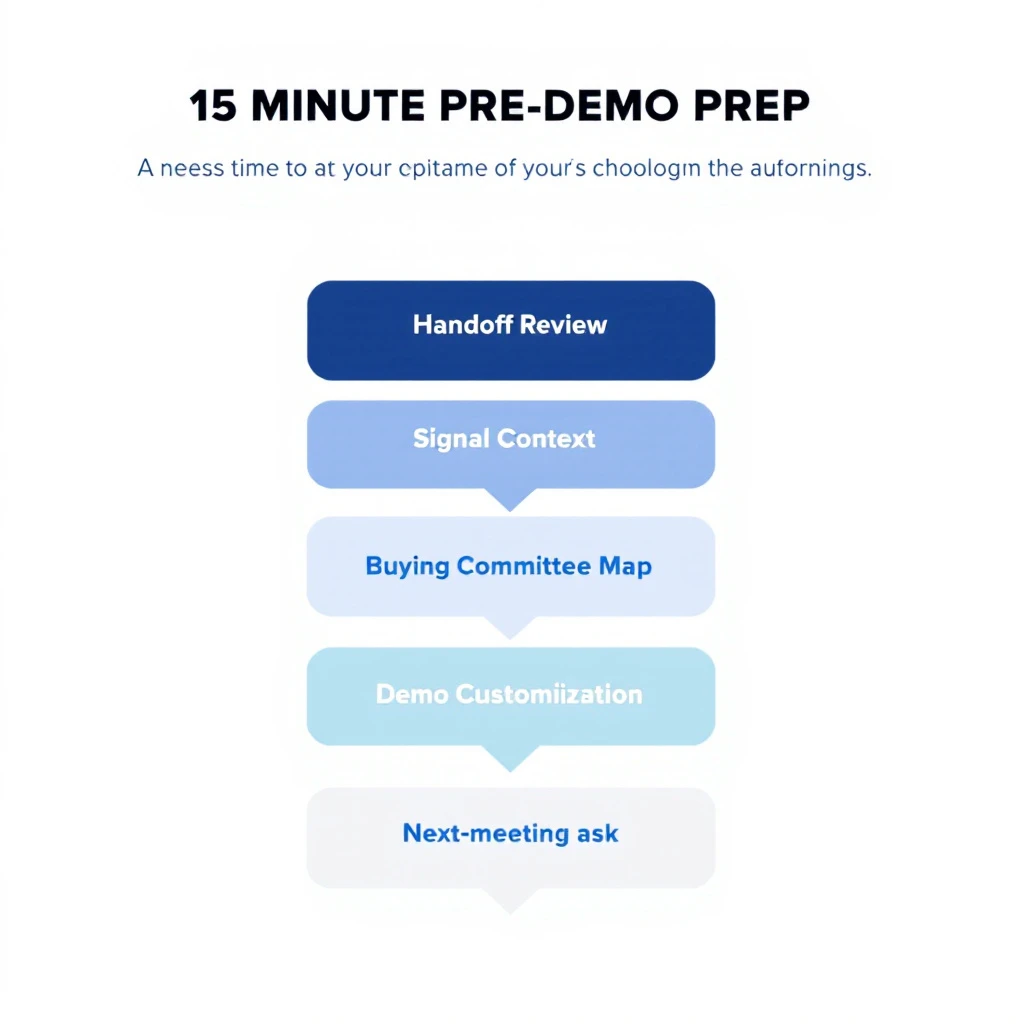
The 15-minute pre-demo prep playbook is the framework: five three-minute blocks covering handoff review, signal context, buying committee mapping, demo customization, and the next-meeting ask. Run it before every discovery call. The discipline matters more than the framework โ€” pick any reasonable structure and use it consistently.

Two things this stage produces that the rest of the cycle depends on. First, a customized demo flow that maps to the specific buyer's stated problem, not the generic demo deck. Second, a written multi-thread plan โ€” who you will ask the buyer to introduce you to, when, and how. Without the second one, you walk out of every demo with a single point of failure.

Stage 7: Discovery and demoโ€‹

A good discovery call is a controlled diagnostic, not a presentation. The reps who win this stage spend two-thirds of the call asking questions and one-third demoing the three specific moments that map to the buyer's problem.

The mechanics of running discovery well are covered in too many places to re-cover here. The key shift in 2026 is that the bar for personalization has gone up sharply. Buyers expect you to know their stack, their team, their recent funding, and their stated initiatives before the call. Generic discovery questions ("what are your biggest challenges?") signal that you have not done the prep, and buyers check out.

The discovery call should also produce the inputs to multi-threading. By the end of the call you should know: who else is involved in the decision, what their evaluation process looks like, what their timeline is, what budget exists, and what the next step is. If you cannot articulate all five at the end of the call, the call was not discovery โ€” it was a generic demo dressed up as discovery.

Stage 8: The 14-day post-demo windowโ€‹

This is where pipeline goes to die. A buyer comes off a great discovery call, says "send me pricing and we will get back to you," and then disappears. Two weeks later the deal is in best-case purgatory. Six weeks later it is no-decision closed-lost.

The 14 days after a discovery call are the most predictive window in the entire deal. What the AE does in those 14 days determines whether the deal closes at all. Most AEs spend those 14 days on the deals that responded fastest to the previous demo and forget the new one. The buyer takes that as a signal that the AE was not serious, and quietly moves to the vendor who kept the energy up.

The 14-day post-demo AE playbook is the day-by-day workflow for the critical window. It covers what to send on day 1, day 3, day 7, and day 14, when to push for the next meeting, and how to read the buyer's silence as either disinterest or normal procurement-cycle latency.

Running this playbook is the single biggest pipeline conversion lever available to most AE teams. It is also operationally trivial โ€” it is a sequence of seven well-timed actions over two weeks. The reason most teams do not run it is that nobody has written it down.

Stage 9: Multi-threading the buying committeeโ€‹

If you walk out of every demo with one contact, you do not have a deal. You have a single point of failure who can disappear, change roles, or get overruled. Modern B2B deals have three to seven stakeholders involved in the decision. Cover them all or do not be surprised when the deal stalls.

The multi-threading deal team playbook is the 5-stakeholder framework: economic buyer, end user, technical evaluator, executive sponsor, and one or two influencers. It covers when to introduce each one, how to ask the champion to make the introduction without bypassing them, and the language to use in the request.

This is the AE skill that separates 30 percent close rates from 12 percent close rates. It is also the skill most AEs are weakest at, because it feels uncomfortable. The champion seems to be moving the deal forward, so why bother the other stakeholders? Because the champion is not authorized to sign. Because the champion is going to get pulled into another fire next week. Because the technical evaluator you have not met is the one who will quietly veto the deal in the procurement review.

Multi-threading is not a nice-to-have. It is the operational discipline that converts late-stage pipeline.

Stage 10: When the champion goes quietโ€‹

Even with great multi-threading, deals stall. The champion stops responding. The email thread goes cold. The AE pings twice and then gives up.

This is the stage at which most teams write off deals that were actually still alive. A champion going quiet rarely means "the deal is dead." It usually means: the champion got pulled into another fire, the company changed priorities, the champion is waiting on internal sign-off they cannot get, or the deal needs to be re-energized through a different stakeholder.

The champion-went-quiet re-engagement playbook is the 5-play workflow for stalled-deal recovery: how to read the silence, when to escalate to the executive sponsor, when to bring in your own exec, when to send the "are you still interested" email correctly, and when to genuinely close-lost and move on.

The teams that run this playbook close roughly 18 to 22 percent of deals they would otherwise have written off as no-decision. The math on that is too good to ignore.

Stage 11: Reopening closed-lostโ€‹

A no-decision deal from six months ago is one of the highest-quality pipeline sources in your CRM. You already qualified the buyer. You already understand their problem. You already built rapport. The only thing that changed is the buyer's circumstances.

Most teams treat closed-lost deals as dead. They are not. They are dormant. The signal-based selling motion makes them findable again โ€” when a champion job changes, when a competitor announces price increases, when a funding round closes, when a new initiative shows up in 10-K filings.

The reopen closed-lost AE playbook is the framework for systematically working these accounts back into active pipeline. It covers the signal triggers that justify re-engagement, the messaging that does not feel like rehashing, and the timing rules for how often to retry an account that was closed-lost.

If your team is struggling to hit pipeline coverage, this stage alone is usually worth 15 to 25 percent more pipeline within a quarter.

The pacing problem: signal decayโ€‹

One concept ties this entire cycle together: signal decay.

Buying intent has a half-life. A pricing page visit ten days ago is worth roughly a quarter of what it was worth the day it happened. A job change signal three months stale is barely a signal at all. The whole point of the operational discipline above โ€” 5-minute response, structured handoffs, day-3 follow-ups โ€” is that signals decay fast, and a sales motion that takes 12 days to convert a signal into a meeting is just slow enough to miss every deal.

The signal decay curve walks through the actual decay rates by signal type, and how to set your operational SLAs around them. If you take nothing else from this guide, take this: every step in the cycle above has a clock on it. The team that runs the clock wins. The team that does not, loses to whoever runs it faster.

How the playbook holds togetherโ€‹

Every stage above is a piece of a single motion. You cannot run great pre-demo prep on a thin SDR handoff. You cannot run a great 14-day post-demo window if the discovery call was generic. You cannot multi-thread if your champion already went quiet. The cycle is end-to-end or it is not real.

This is why teams who try to fix one stage in isolation rarely see results. SDR speed-to-lead without triage is just more noise. AE prep discipline without good SDR notes is the AE working in the dark. Multi-threading without an executive sponsor relationship is the AE cold-emailing strangers.

The teams that pull ahead are the ones that fix the cycle as a system. They write down each stage. They train the team on each stage. They review each stage in deal review. They coach the handoffs as carefully as they coach the calls. And they instrument the signal decay clock so they can see where deals are dying.

This is what good operational sales discipline looks like in 2026. It is not a single trick. It is the entire cycle, running consistently, every week.

The role of the platformโ€‹

A reasonable question after reading all this: who is supposed to run all of these workflows?

The honest answer is that without the right platform layer, nobody is. The math does not work. A 25-person SDR-AE team cannot manually run signal triage, 5-minute SLAs, structured handoffs, 15-minute pre-demo prep, day-by-day post-demo workflows, and multi-thread tracking across 200 active deals. The cognitive load is the problem, not the workflow.

This is the gap MarketBetter is built for. The platform watches the signals, runs the triage, surfaces the handoff context the AE needs before the call, prompts the day-3 and day-7 follow-ups in the post-demo window, tracks the buying committee, and flags champions who have gone quiet. The reps still run the calls and write the notes. The platform handles the operational discipline that makes the cycle work.

The shorthand we use: competitors tell you who. MarketBetter tells you who and what to do next. The playbook above is the "what to do next" part. The platform is the layer that makes it operationally feasible to run it.

If you are reading this and recognizing places where your cycle is leaking โ€” weak handoffs, slow speed-to-lead, no post-demo workflow, no multi-thread plan โ€” that gap is the value. Book a demo and we will run the playbook on one of your real accounts so you can see how much pipeline you are leaving on the floor.

Where to go from hereโ€‹

If you are a rep, the highest-leverage move is to run one stage of this cycle well for 30 days. Pick the stage where you know your discipline is weakest โ€” handoffs, prep, post-demo, multi-thread. Run it religiously for a month. The pipeline impact will be visible.

If you are a manager, the highest-leverage move is to build one stage into your weekly deal review. Pick the handoff that is leaking the most pipeline. Make every AE walk through it for every deal, every week. Coach the handoff like you coach calls.

If you are a leader, the highest-leverage move is to treat the cycle as a system. Audit every handoff. Write down the workflow at each one. Measure where deals die. Fix the handoffs, not the calls.

The reps who win in 2026 are not better closers. They are better operators. The cycle above is the operating manual.


Read deeper on each stage:

The 15-Minute Pre-Demo Prep Playbook: How AEs Turn Booked Demos Into Closed Deals [2026]

ยท 14 min read
sunder
Founder, marketbetter.ai

Ask ten AEs how they prep for a discovery call and you will get ten versions of the same answer: "I skim the calendar invite on the way in." Maybe a glance at LinkedIn. Maybe a check of the CRM if there is time. The actual decision making โ€” what to ask, what to demo, who else to pull in โ€” happens live, in the call, in front of the buyer.

This is why most discovery calls feel generic to buyers. The AE shows up cold, runs the same 12 questions they always run, and demos the same five screens. The buyer politely sits through it, says "send me pricing," and quietly moves you down the list. Two weeks later the deal is dead and nobody can say why.

The fix is not a longer call or a fancier script. It is fifteen minutes of structured prep before the meeting. Done right, this is the highest-leverage 15 minutes in the entire deal. It is what separates AEs who close 25 percent of demos from AEs who close 8 percent.

Below is the exact 15-minute pre-demo prep workflow. It assumes the SDR did real handoff work upstream โ€” if your handoffs are a Slack message that says "good lead, call them," fix that first using the SDR-to-AE handoff playbook, then come back here.

Why 15 minutes of prep is worth more than 60 minutes of follow-upโ€‹

Most sales coaching focuses on what AEs do during and after the demo. Both matter. But the highest variance in deal outcomes happens before the call even starts.

The buyer walks into a discovery call with a hypothesis: "this vendor probably does X, and X is what I need." If the first ten minutes of the call confirm that hypothesis, they lean in. If the first ten minutes contradict it, or even worse, force them to re-explain context they already shared, they check out. You have lost the call by minute eleven and you do not know it yet.

Prep is how you front-load context so that the first ten minutes confirm the buyer's hypothesis. Skip prep and you spend the first half of every discovery call re-qualifying. Do prep well and you spend that time showing the buyer that you already understand their problem better than they do.

This is what the AEs who win consistently get right. They do not have better discovery questions. They have better preparation.

A diagram showing the pre-demo prep workflow with five three-minute segments stacked vertically: handoff review, signal context, buying committee map, demo customization, next-meeting ask, set against a clean white background

The 15-minute frameworkโ€‹

Five three-minute blocks. Run them in order. Do not skip blocks because "the deal is small" or "I know this account." The AEs who think they are above prep are the AEs whose forecasts miss every quarter.

Minutes 0โ€“3: Re-read the SDR's handoff notesโ€‹

Open the CRM. Read every note the SDR wrote on this account, in order. Not just the most recent one. The full thread.

You are looking for three things:

  1. The buyer's stated problem in their own words. Highlight the exact phrasing they used. You will mirror this language back in the first three minutes of the call. If they said "our reps are drowning in leads they cannot triage," you will say "you mentioned your team is drowning in leads โ€” let's start there." This is the cheapest trust signal in sales.
  2. What the SDR already qualified. Budget, timeline, decision criteria, current tooling. Do not re-ask any of this in discovery. The fastest way to lose a buyer is to make them repeat information they already gave your SDR. Discovery is for going deeper, not starting over.
  3. What was left unclear. The gaps in the SDR's notes are what you need to clarify in the first 15 minutes of discovery. Write these down. Three to five gaps, max.

If the SDR's notes are thin, this is a handoff problem, not a prep problem. Flag it to the SDR manager after the call. Then run the signal triage rubric on your inbound to make sure future handoffs come in with real qualification.

Minutes 3โ€“6: Pull the buying signal contextโ€‹

What told you this account was ready to buy? Was it a visitor identification hit on the pricing page? An intent signal from a third-party data provider? A champion who pinged you back after a content download? Each signal type implies a different buyer state.

A pricing-page visitor is further down the funnel than a free-content downloader. A return visitor with three sessions in seven days is hotter than a first-time visitor. A buying committee with three people on your site this week is in active evaluation. Read the buying signal hierarchy if you need a refresher on which signals actually predict closed-won.

Pull two specific signals into your call notes. Reference them naturally in the first ten minutes. Not "I saw you visited our pricing page" โ€” that is creepy. But "it sounds like you are far enough along to be evaluating costs, is that right?" That is the same information, framed as conversation, not surveillance.

Signals also decay. A signal that was hot ten days ago may be cold today. If your handoff is more than seven days old, the buyer's urgency has dropped. Adjust your call energy accordingly. The signal decay curve shows how fast buying intent erodes if you sit on it.

Minutes 6โ€“9: Map the buying committeeโ€‹

Pull up LinkedIn. Identify every person at the company who could possibly be involved in this purchase. Not just the contact on the calendar invite. The full committee.

For a typical B2B SaaS deal in the under 50K range, you are looking at three to five people: an end user, a manager, a budget holder, and one or two influencers. For larger deals, double that. Write the names down. Note their titles. Spend 30 seconds on each LinkedIn profile to learn what they care about.

The buyer on your call is one of these people. The other four to nine are not, and they will decide whether this deal closes. Your job in discovery is not to sell the person on the call. It is to give them ammunition to sell internally to the other people. That is what good demos do.

Plan the multi-thread move now. Who will you ask the buyer to introduce you to? When? How will you frame the ask so it does not feel like you are bypassing them? Run the multi-threading deal team playbook on this account before the call so you know exactly which five stakeholders you need to cover.

If you skip this step, you will leave the demo with one contact and zero leverage. Two weeks later the champion will go quiet and the deal will stall. The mapping you do in these three minutes is what prevents that.

Minutes 9โ€“12: Customize the demo flowโ€‹

Most AEs run the same demo for every buyer. Same five screens. Same demo script. The buyer can tell. They have seen vendors do this before. It signals that you do not understand their specific problem.

Use what you learned in minutes 0โ€“6 to pick three demo moments โ€” not five, not seven, three โ€” that will land hardest for this specific buyer. If their stated problem is inbound triage, lead with the triage workflow. If it is signal aggregation, lead with the signal stack. If it is outbound personalization, lead with the workflow that generates personalized outreach from signals.

Cut the rest. A 25-minute demo that hits three things hard is twice as effective as a 45-minute demo that covers everything shallowly. Buyers do not remember everything. They remember the moments that mapped to their specific problem.

Write down the three demo moments. Write down the transition language between them: "now that you have seen how the triage works, the next question is what your reps do with the highest-tier leads โ€” that is where the playbook comes in." Pre-built transitions keep the demo tight even when the buyer takes you off-script with questions.

Minutes 12โ€“15: Plan the next-meeting askโ€‹

Before the call starts, decide exactly what next-step you will ask for at the end. Not "I will play it by ear." A specific ask, written down.

For a hot deal, the ask is a working session with the buying committee in the next week. For a warm deal, it is a 30-minute deep dive on the specific use case with two more stakeholders. For a cooler deal, it is a follow-up call in seven days with concrete material the buyer can share internally.

Whatever the ask is, prepare two things:

  1. The exact words you will use to make the ask. "Based on what we have talked through, the right next step is X. Can we get that on the calendar before you leave today?" Specificity is everything. "Let me follow up next week" is what bad AEs say at the end of bad calls.
  2. The artifact you will send within four hours of the call. A short recap email with the three things they cared about, the next step on the calendar, and one piece of content tailored to their use case. This is the first move of the 14-day post-demo workflow. Get it right.

If you cannot articulate the next-meeting ask in three minutes of prep, the deal is not as qualified as you think it is.

What to skip in prep (and what to skip in the demo)โ€‹

Three things AEs waste prep time on that do not move deals forward.

Do not read the entire company About page. The buyer is not going to test you on it. A 90-second scan of their homepage is enough. You need to know what they sell and to whom, not who founded the company in 2011.

Do not memorize a full discovery script. Discovery is a conversation, not a survey. The five to seven questions you need will come naturally if you have done the rest of the prep. A memorized script makes you sound like a vendor.

Do not over-prep slides. Discovery calls are not pitch decks. Open with no slides at all. Talk first, demo second, slides only if specifically asked. AEs who lead with slides telegraph that they have not done the prep โ€” they are hiding behind structure because they do not have substance.

The example walkthroughโ€‹

A real prep run, lightly fictionalized.

The account is a 200-person logistics SaaS company. The SDR booked the demo three days ago after the buyer downloaded a guide on outbound personalization. Two people from the company visited the pricing page in the last seven days. The contact on the call is a Director of Sales.

Minutes 0โ€“3: SDR notes say the buyer complained about "outbound that gets ignored even though our list quality is good." Budget was qualified at "under 30K for the first year." Timeline is "Q3 implementation, ideally." Gap: no detail on current tooling or who else is involved in the decision.

Minutes 3โ€“6: Pricing-page traffic from two people implies an active committee. The downloaded content was on personalization, not signal aggregation, so the entry point is workflow, not data. The buyer state is "we have leads, we are not converting them," which maps to outreach quality, not lead supply.

Minutes 6โ€“9: LinkedIn shows three relevant people at the company beyond the Director: a VP of Sales (her boss), a Sales Ops Manager (likely the tool evaluator), and a senior AE who has posted about cold outreach. These four are the buying committee. The ask: introduction to the Sales Ops Manager within the week.

Minutes 9โ€“12: Demo will lead with the workflow that turns a buying signal into a specific outreach action. Then the signal aggregation. Skip the visitor ID workflow entirely โ€” not what they came for. Skip the integrations slide.

Minutes 12โ€“15: Ask at end: "let's get a 30-minute working session next Tuesday with you and your Sales Ops lead โ€” I will walk through how this would plug into your current sequencing tool. Does that calendar work?" Recap email goes out within four hours with one paragraph on the personalization workflow and one link to the signal-to-meeting workflow guide.

That is the prep. Fifteen minutes. The discovery call is now a working session, not a pitch.

Why this matters for managers, not just repsโ€‹

If you manage AEs, the question is not whether your reps are doing this prep. The question is whether you can prove they are.

Ask your top performer how they prep. They will describe some version of this framework, possibly without naming it. Ask your bottom performer. They will say "I look at the calendar invite." The variance in prep is the variance in close rate.

Build prep into the deal review. Before any forecast call, ask the AE what their pre-demo prep was on the deals they are forecasting. If they cannot articulate it, the deal is not real. Move it back to best case.

This is the same discipline you should be running on inbound speed-to-lead and on the SDR-to-AE handoff. The wins in modern B2B sales are no longer in better closing skills. They are in better operational discipline at every handoff. Reps who run the prep win. Teams that enforce the prep scale.

Make the prep run itselfโ€‹

The 15 minutes are non-negotiable. But the data pulling โ€” pulling the signals, mapping the committee, surfacing the SDR notes โ€” should not take five of those minutes. It should take 30 seconds.

This is exactly what MarketBetter is built for. When a meeting is on your calendar, the platform surfaces the relevant signal history, buying committee map, and recommended demo flow before you open the CRM. Your AEs spend their 15 minutes thinking, not searching.

That is the difference between AEs who hit number and AEs who do not. The thinking is the work. Everything else is logistics that software should handle.

Want to see how this works in your sales motion? Book a demo and we will run the pre-demo prep workflow on one of your real accounts.


Related reading:

The SDR-to-AE Handoff Playbook: Stop Losing Deals Between the Booking and the Discovery Call [2026]

ยท 10 min read
sunder
Founder, marketbetter.ai

Look at any SDR team's funnel and you will find the same leak. The SDR books a meeting. The AE shows up to discovery. Somewhere in the 72 hours between those two events, a third of the deals quietly die.

Show rate dips. The buyer cools. The AE walks in cold and re-qualifies from scratch. The buyer thinks: "I just told the other person all of this." Trust drops. Discovery becomes a vendor pitch instead of a working session. Pipeline conversion sags by 20-40 percent and nobody can point to a single bad call.

This is the SDR-to-AE handoff gap. It is the most under-engineered handoff in B2B sales, and it is the single highest-leverage thing most teams can fix this quarter.

Below is the 6-step handoff playbook we run with customers. It assumes one thing: that the SDR did real qualification before booking. If you are booking on "interested in learning more," fix that first. Start with the inbound triage tier system and come back here when your bookings have substance.

Why the handoff window matters more than the meeting itselfโ€‹

Most sales orgs treat the handoff as a calendar event: SDR clicks "book," Salesforce updates the opportunity owner, AE gets a notification. Done.

That is not a handoff. That is a baton drop.

A real handoff transfers three things between two humans:

  1. Context โ€” what the buyer cares about, in their words, with their priorities ranked
  2. Continuity โ€” the buyer should feel like one team is talking to them, not two separate vendors
  3. Conviction โ€” the AE should walk in knowing why this is a real opportunity, not "another discovery"

When you nail those three, you stop losing 20-40 percent of booked meetings. Show rates climb. Discovery converts to second meetings at a higher clip. And buyers stop ghosting between the demo and the proposal because they trusted you from minute one.

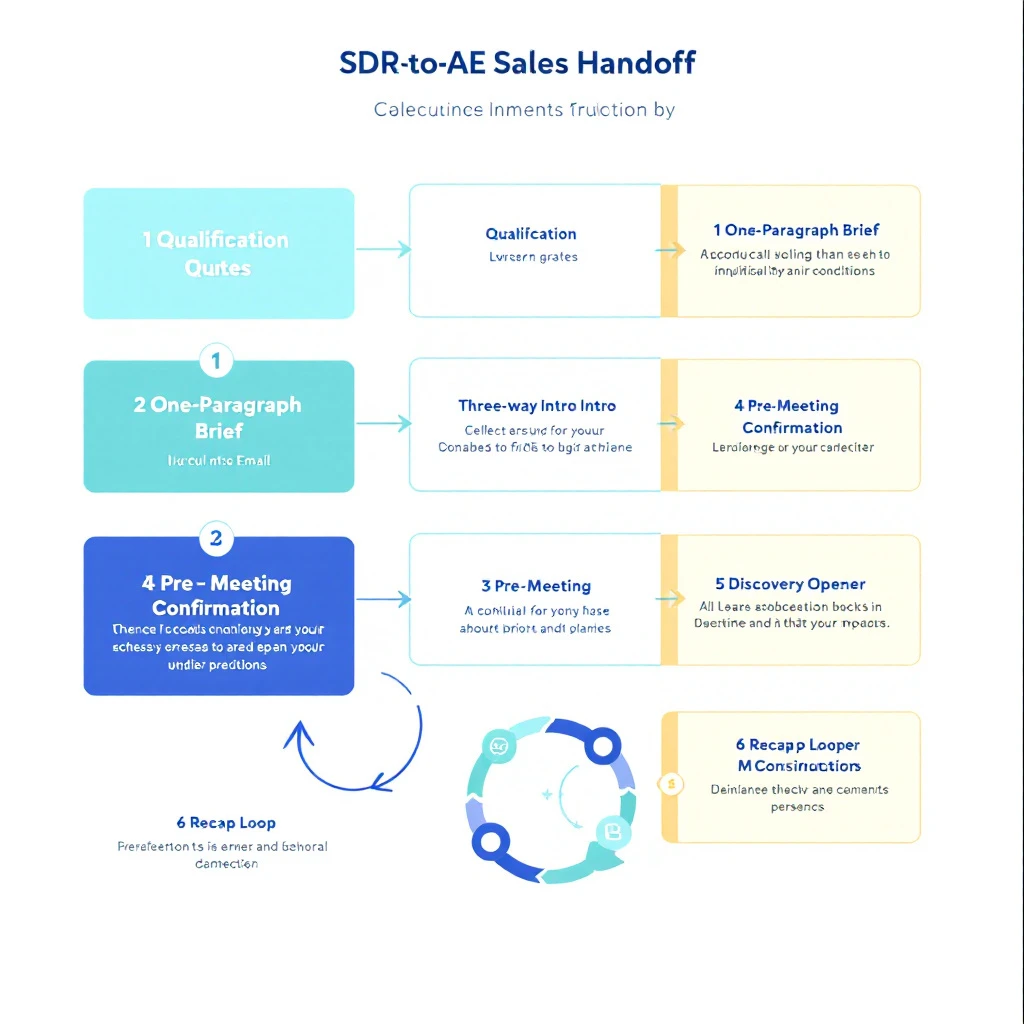
The 6-step handoff playbookโ€‹

Step 1: Capture the qualification in the buyer's words, not your CRM fieldsโ€‹

The most common handoff failure happens in the SDR's notes. The SDR fills in seven Salesforce fields โ€” pain, timeline, budget, decision process, current solution, team size, urgency โ€” and calls it done.

The AE reads those fields ten minutes before discovery and walks in blind. Why? Because the CRM strips the language. The buyer said "our SDRs are spending three hours a day on garbage leads and we're hiring two more in Q3 to keep up." Salesforce stored "Pain: SDR efficiency. Timeline: Q3."

The AE then asks "so tell me about your pain" and the buyer thinks they are starting over.

The fix: SDRs capture three verbatim quotes from every qualification call:

  • The pain quote โ€” what the buyer said about why they are looking
  • The urgency quote โ€” what is forcing them to act now versus in six months
  • The skepticism quote โ€” what they pushed back on or seemed unsure about

These three quotes go in the meeting brief, untouched. The AE reads them five minutes before the call. They walk in with the buyer's exact words in their head and the buyer feels seen from the first sentence.

Step 2: Write a one-paragraph meeting brief, not a 12-field formโ€‹

CRM forms are for reporting. Briefs are for selling. They are different artifacts and they should look different.

A handoff brief is one paragraph, written by the SDR, that an AE can read in 60 seconds. Format:

"[Buyer name] at [company] runs [team / function]. They came in via [channel] after [trigger event]. Their pain: [verbatim quote]. Their urgency: [verbatim quote โ€” why now]. Their decision process: [who's involved, timeline, what they've already evaluated]. Their pushback: [verbatim skepticism]. The opening I'd take: [SDR's read on what to lead with]."

That last sentence โ€” "the opening I'd take" โ€” is the single most undervalued line in the brief. The SDR talked to this human for 15-30 minutes. They have a read. AEs who ignore that read consistently underperform AEs who use it as a starting hypothesis.

Step 3: Make the introduction a three-way email, not a calendar inviteโ€‹

The calendar invite is the laziest handoff in B2B sales. It tells the buyer: "we use a tool that auto-routes you to whoever has open availability."

The introduction email tells the buyer: "we organized this internally and prepared for you."

Within two hours of booking, the SDR sends a three-way email:

  • To: the buyer
  • CC: the AE
  • Subject: "Intro to [AE first name] for [day]'s call"
  • Body: "[Buyer first name], great talking earlier. Connecting you with [AE first name], who'll dig into [the specific topic the buyer cared about] with you on [day]. [AE first name] โ€” [buyer first name] is wrestling with [the one-sentence version of their pain]. I shared the full context but you two should compare notes. Talk [day]."

This email does four things at once. It transfers ownership cleanly. It primes the buyer to expect a real conversation, not a demo. It gives the AE air cover to reach out directly before the meeting. And it builds trust through visible organization.

Step 4: Have the AE send a pre-meeting confirmation 24 hours beforeโ€‹

Show rates on cold-booked meetings hover around 60-70 percent. Show rates on meetings where the AE personally sent a pre-meeting confirmation hover around 85-92 percent. The math is simple.

The pre-meeting note is not a calendar reminder. It is a sentence that says "I read your context, I'm prepared, here's what I'd like to cover, push back if I'm off."

"Hey [first name] โ€” [SDR first name] caught me up on [the specific thing they care about]. For tomorrow I'd planned to dig into [topic A] and [topic B], and I want to leave 10 minutes to talk through [the skepticism the buyer raised]. If there's anything you'd add or want to skip, just reply and let me know. Talk tomorrow."

That note does the work of three things: it confirms attendance, it shows preparation, and it gives the buyer a way to redirect the meeting before it starts. Buyers love it because it makes them feel like the meeting is for them, not for you.

Step 5: Start the discovery call by saying what you already knowโ€‹

The single fastest way to lose a deal in the first five minutes is to ask "so tell me what brings you here today" to a buyer who already told the SDR exactly that.

The buyer will repeat themselves. Politely. But the trust you needed is gone. The buyer is now thinking: "do these people actually talk to each other?"

The fix is one of the simplest behavioral changes you can make and almost nobody does it:

"Before I ask anything, let me make sure I have this right. From the conversation with [SDR first name], my understanding is you're [pain in their words], and the thing that's making this urgent right now is [urgency in their words]. What you pushed back on was [skepticism]. Did I get that right, and what's changed since you two talked?"

You just did four things in 30 seconds. You proved your team communicates. You proved you prepared. You gave the buyer permission to correct you. And you opened the door to ask "what's changed since" โ€” which is the single best discovery question in B2B sales because it surfaces new information without making the buyer restart.

Step 6: Close the loop with a written recap the SDR can seeโ€‹

The handoff doesn't end when discovery ends. The SDR needs to know what happened, both to learn and to keep the buyer relationship warm for any future opportunities.

Within 24 hours of discovery, the AE sends a recap email to the buyer and CCs the SDR. The recap names the three things the buyer said they cared about, the proposed next step, and the date by which the AE will follow up. The SDR reading along learns two things: whether their qualification held up, and what the AE heard that they missed. Both make them better at the next handoff.

This is also where you catch handoff failures early. If the AE's recap says "the buyer is now exploring three vendors and wants to see ROI proof," and the SDR brief said "the buyer is committed to switching this quarter," somebody misread the qualification. You want to know that within 24 hours, not in a forecast review six weeks later.

What goes wrong when teams skip these stepsโ€‹

Pattern matching from teams who run a broken handoff:

  • Show rates below 70 percent. Buyers cool because nothing happens between the booking and the meeting. The fix is steps 3 and 4 โ€” an intro email and a pre-meeting confirmation.
  • AEs complaining that "SDR leads are unqualified." Usually the qualification was fine but the context didn't transfer. The fix is steps 1 and 2 โ€” verbatim quotes in a one-paragraph brief.
  • Buyers re-pitching themselves on discovery. Almost always step 5. The AE didn't open by reflecting back what they already knew.
  • Deals that stall in the 14 days after demo. Often the buyer never trusted the team. See the 14-day post-demo window playbook for what to do once the deal is already cooling.
  • Champions who go quiet two weeks in. Sometimes the handoff was fine but the multi-thread wasn't. See multi-threading the deal team and champion went quiet.

The handoff scorecardโ€‹

Once you adopt the playbook, score every handoff weekly. Five questions, one point each:

  1. Did the SDR capture three verbatim quotes in the brief?
  2. Did the SDR send the three-way intro email within two hours of booking?
  3. Did the AE send the 24-hour pre-meeting confirmation?
  4. Did the AE open discovery by reflecting back what they already knew?
  5. Did the AE send a 24-hour recap CCing the SDR?

A 5/5 handoff converts to second meeting at almost double the rate of a 1/5 handoff. The behaviors are tiny. The compounding effect on pipeline is not.

Where most teams should startโ€‹

Pick step 5 โ€” the discovery opener that reflects back what the SDR already qualified. It costs nothing, it changes behavior immediately, and it produces visible buyer reactions the AE can feel in the first 30 seconds of the call. Once the AEs feel that, they will pull the rest of the playbook in themselves.

The SDR-to-AE handoff is the cheapest, highest-ROI behavioral change in B2B sales. It does not require new software, new headcount, or a six-month process redesign. It requires three quotes, a paragraph, two emails, one sentence, and a recap. Five minutes of work per deal. Twenty to forty percent more pipeline conversion.

That is the trade.


Want to see how MarketBetter automates the signal-to-handoff workflow so your SDRs and AEs are always working from the same context? Book a demo โ†’

SDR-to-AE handoff playbook diagram showing the six-step process from qualification capture through discovery recap

The Multi-Threading Playbook: Build a 5-Stakeholder Deal Team Before the Champion Goes Quiet [2026]

ยท 14 min read
sunder
Founder, marketbetter.ai

Most AEs treat multi-threading like a fire extinguisher: you only reach for it when something is already burning. Your champion went dark. Procurement appeared out of nowhere. Legal kicked the contract back with redlines that read like a different deal.

By then, multi-threading is damage control. You are scrambling to find allies inside an account that has already decided you are not a priority.

The reps who consistently hit 110% of quota do something different. They build the deal team before they need it โ€” usually inside the first two meetings โ€” and treat stakeholder coverage as a leading indicator of pipeline health, not a Q4 panic move.

This playbook is the system. Five roles to identify, four weekly cadences to keep them warm, a CRM hygiene model that flags single-threaded deals before they stall, and the exact messages that get a CFO or VP Engineering to take a 15-minute call when they have never heard of you.

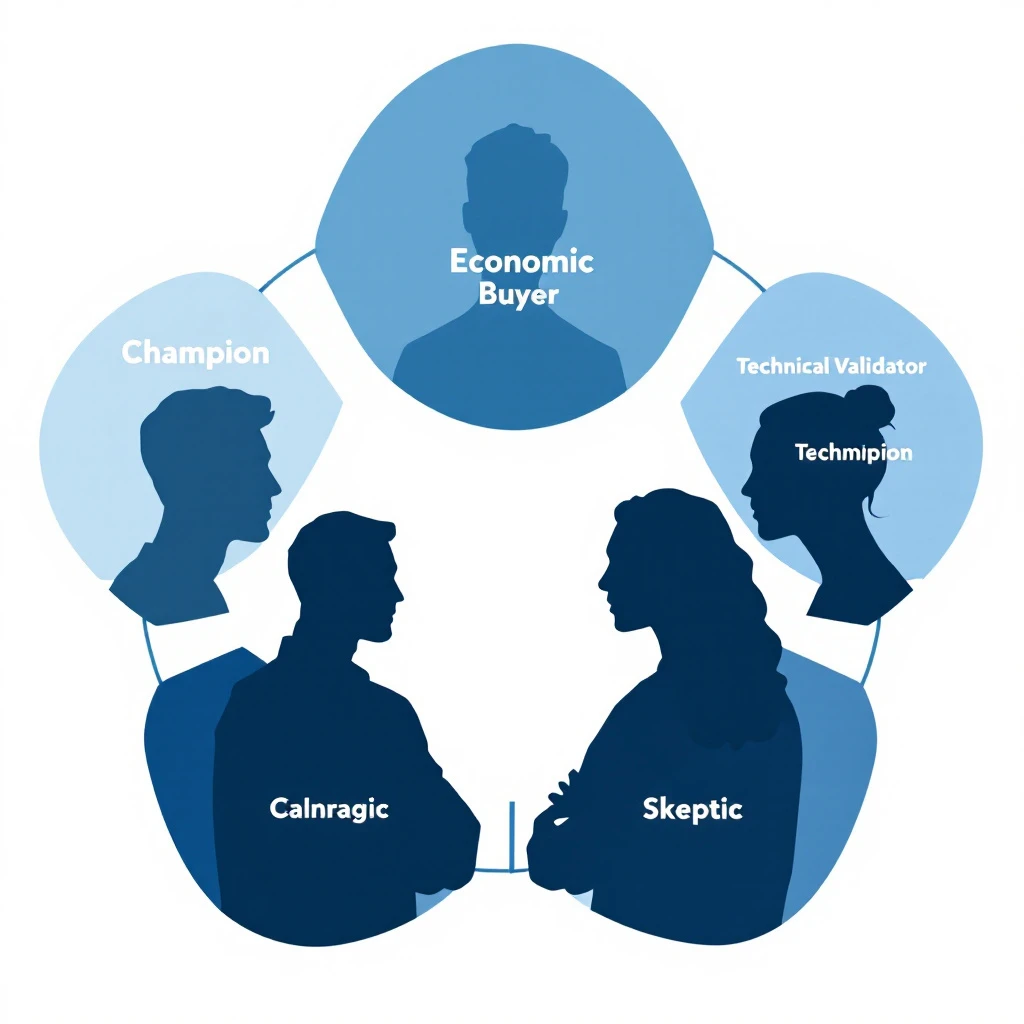
Five-stakeholder deal team diagram

Why single-threaded deals die quietlyโ€‹

Gartner's most-cited B2B buying research puts the average enterprise buying committee at 6 to 10 people. Forrester's data lands closer to 11. The deals that close involve the buyer talking to your team an average of 17 times across multiple stakeholders.

If your only relationship is with one champion, you are betting your forecast on three things going right at once:

  1. The champion never changes jobs, never gets reorged, never goes on parental leave
  2. The champion has the political capital and skill to sell internally without you in the room
  3. Every other stakeholder defers to the champion's recommendation without an independent opinion

Forrester says 86% of B2B deals are won or lost based on multi-thread coverage. If you have ever watched a deal you were "sure about" slip a quarter, the post-mortem almost always reveals the same thing: you had one relationship. The buyer had nine.

When the champion goes quiet โ€” which happens to roughly one in three enterprise deals โ€” your only signal is silence. We wrote a full re-engagement workflow for that case in our champion-quiet stalled deal playbook, but the better fix is upstream: never let a deal sit at one thread.

The 5 roles on every B2B deal teamโ€‹

Forget org charts. Buying committees don't show up on org charts. They form ad hoc around a project and dissolve when it closes. The roles below are functional โ€” one person can play two, two people can share one, but every winning deal has all five seats filled.

1. The Champion (the seller-internal-to-the-account)โ€‹

The person who wants you to win. They sell on your behalf in meetings you are not invited to. They know your roadmap, they can rattle off your pricing, they actively defend you against alternatives.

Most AEs stop here. That is the mistake.

A champion without backup is a single point of failure. If they go on PTO during the final week of the quarter, your deal slips. If they get poached by a competitor โ€” and B2B SaaS attrition averages 13% annually โ€” your deal restarts from zero.

Coverage signal: You have a champion. Good. That puts the deal at 20% stakeholder coverage. Not 100%.

2. The Economic Buyer (the budget owner)โ€‹

The person who signs the PO. In a 50-500 employee company, this is usually a VP or C-level. In enterprise, it could be a director with a discretionary budget below a threshold and an SVP above it.

The Economic Buyer's question is never "is this the best product?" It is "is this worth the opportunity cost of the budget?" They are weighing your line item against headcount, against another tool, against doing nothing.

You do not sell features to the Economic Buyer. You sell ROI math and risk reduction. And you sell it directly โ€” not through the champion. The champion's framing of your ROI is always weaker than yours, because they are not professionally trained to negotiate against a CFO's skepticism.

Coverage signal: If you have not had a 15+ minute conversation with the Economic Buyer by the second demo, the deal is not real yet.

3. The Technical Validator (the gatekeeper)โ€‹

VP of Engineering, Head of IT, Director of Security, Chief Architect. Whoever has the authority to say "we can't run this in our environment" and end the deal.

The Technical Validator is the most under-engaged stakeholder in B2B sales. Reps fear them, so they delay the introduction. Then in week 11 of a 13-week deal cycle, the security questionnaire arrives, the SOC 2 conversation happens, the integration concerns surface โ€” and the deal slips a quarter while you chase answers.

Bring them in early. Week two. Give them documentation before they ask for it. Make them feel respected as a peer reviewer, not an obstacle.

Coverage signal: A Technical Validator who has reviewed your docs and asked at least one clarifying question is a coverage point. A Technical Validator who has never been introduced is a hidden veto waiting to happen.

4. The User Champion (the end-user advocate)โ€‹

The person whose daily workflow your product changes. Usually different from the Champion. The Champion is often a manager or director โ€” the User Champion is the SDR, the marketer, the analyst who will actually log in every day.

Why they matter: in modern B2B sales, end-user adoption is a procurement criterion. CFOs ask, "will the team actually use this?" If the User Champion can answer yes in their own voice โ€” not through your champion โ€” the deal accelerates.

End-users also surface real objections faster than directors do. They will tell you in 60 seconds that your UI is confusing or that your CSV export is missing a column the team needs. That intel saves you from a 6-week stall later.

Coverage signal: Did the User Champion attend the demo? Did they ask questions? Have they tried the trial themselves? If no to all three, you are selling a director on a tool their team has not validated.

5. The Skeptic (the loyal opposition)โ€‹

Every deal has one. The person who is paid, structurally, to push back. CFO. Procurement. Legal. Sometimes a competing department head who wanted to build instead of buy.

You cannot avoid the Skeptic. You can only get to them first.

The mistake reps make is treating the Skeptic as the enemy. They are not. They are doing their job โ€” protecting the company from a bad procurement decision. Your job is to give them the answers they need before they have to dig for them.

Ask the champion: "Who is going to push back on this internally? Walk me through their concerns before the meeting." Then prep direct answers โ€” not deflections, not "let me get back to you," but the answer.

Coverage signal: Have you been told who the Skeptic is? Have you addressed their objection in writing? If no, the deal has a landmine you cannot see.

How to recruit each stakeholder (with what to say)โ€‹

Identification is the easy half. Getting on calendars is where most reps fail. Below is the exact ask for each role, tested in real outbound. Adjust the names and product specifics, but keep the structure.

Recruiting the Economic Buyerโ€‹

After demo 2 with the champion, ask:

"[Champion], based on where we are, I think this is the right time to bring [VP/CFO name] into the next conversation. I want to make sure they hear the ROI math directly from me, not summarized through you โ€” that protects you from any 'why didn't you push back on X' questions later. Can you make the intro this week? I will own the agenda and keep it to 15 minutes."

The framing matters. You are protecting the champion, not bypassing them. Champions accept this because it is true.

If the champion stalls on the intro for more than 7 days, that is itself a coverage signal: they either lack the political capital to make the intro, or the deal is less real than they have implied. Both are diagnostic. See our signal-decay framework for what to do when intent signals stop refreshing.

Recruiting the Technical Validatorโ€‹

Cold-introduce yourself directly. Do not wait for the champion. A 3-sentence message:

"Hi [Name] โ€” I am working with [Champion] at [Company] on evaluating [product category]. Wanted to introduce myself ahead of any security or integration conversations so we are not strangers when those come up. Happy to share our SOC 2 report and architecture overview now if useful. 15-minute intro call this week or next?"

Half will not respond. The other half will, because you have signaled three things: you know they exist, you respect their role, and you are not going to waste their time later.

Recruiting the User Championโ€‹

Get them into the demo. If the champion will not invite them, ask:

"We see a real difference in adoption when the daily users see the tool before procurement, not after. Can we do a 30-minute working session with 2-3 people from the [SDR/marketing/ops] team? It also gives me real product feedback before we get to pricing."

Buyers know this is true. Most will say yes.

Recruiting the Skepticโ€‹

You do not "recruit" the Skeptic โ€” you preempt them. As soon as you know who they are, send the champion a one-page document titled "[Skeptic role] FAQ" with the three objections they are most likely to raise and your written answers.

Then ask: "Can you forward this to [Skeptic] before our next meeting and ask them if there's anything else they'd want addressed?" This converts the Skeptic from an ambush into a structured conversation.

The weekly cadence: keeping the deal team warmโ€‹

Identifying stakeholders does not multi-thread the deal. Recurring contact does. Below is the cadence that separates AEs who hold 80% close rates from AEs who lose 40% of late-stage deals to "no decision."

StakeholderTouch FrequencyChannelMessage Type
ChampionWeeklySlack or textUpdate + question
Economic BuyerBi-weeklyEmailForwarded relevant insight
Technical ValidatorBi-weeklyEmailDocumentation + status
User ChampionWeekly during evalEmail or async videoProduct tip + feedback ask
SkepticAs-neededThrough championPre-emptive FAQ updates

The "forwarded relevant insight" pattern for the Economic Buyer is the highest-ROI touch in this entire playbook. You are not pitching. You are sending them a single article, benchmark, or customer story that addresses their specific concern. Three sentences. No CTA. Their reply rate to this pattern, in our internal data, is 4x higher than any "checking in" email.

For the User Champion, the highest-converting touch is asking for feedback on a specific feature โ€” not generic "how is the trial going." Specific feedback requests get specific replies. Specific replies build relationship.

CRM hygiene: how to flag single-threaded deals automaticallyโ€‹

You cannot multi-thread what you cannot see. Most CRMs let you log contacts but do not surface coverage gaps as a forecasting signal. Build the view yourself.

In your opportunity record, add three fields:

  1. Stakeholders Identified (number): How many of the 5 roles have a named person?
  2. Stakeholders Engaged (number): How many of those 5 have had a 1:1 conversation with you in the last 21 days?
  3. Coverage Risk (calculated): Red if Engaged is less than 3, yellow if 3-4, green if 5.

Run a weekly report filtering all opportunities forecasted to close this quarter where Coverage Risk is red. That list is your priority for next week's stakeholder outreach. It is also the list you bring to your manager's deal review.

This is the same operating principle behind our 14-day post-demo window playbook: make coverage visible, then make it accountable.

Multi-threading from inbound vs outbound dealsโ€‹

The playbook works for both, but the entry point differs.

Inbound deals start with a single contact who filled out a form. You do not yet know if they are the Champion, the User, or just someone doing research. Your first job is diagnosis. Use the first call to map: who else is involved in this evaluation? Who would sign the contract? Who needs to approve from a technical side?

Our inbound triage tier system flags hot inbound for 5-minute response โ€” multi-threading takes over from there in the post-demo phase.

Outbound deals start with you picking the entry point. Pick wrong and you spend two months selling to someone who has no authority to buy. We covered first-touch strategy in our signal-to-meeting 24-hour workflow and our visitor ID to outreach playbook โ€” multi-threading starts the moment the first meeting is booked, not after the demo.

What multi-threading does not solveโ€‹

This playbook is not magic. It does not:

  • Compensate for product-market fit gaps. If the prospect's pain is not real or your product is not the right shape for it, no stakeholder coverage will close the deal.
  • Replace strong discovery. You can multi-thread perfectly and still lose because the champion sold you on a vision the Economic Buyer never agreed was a priority.
  • Save deals from competitive switching costs. If the prospect is on a 3-year contract with your competitor and the cost of breaking it exceeds your annual price, more stakeholders does not change the math.

Multi-threading is the second-most-important variable in B2B win rate, behind discovery. Treat it accordingly.

The 60-second pipeline review questionโ€‹

Once you have built the playbook above, your pipeline reviews change shape. Stop asking "what is the status of this deal?" Start asking:

"Walk me through the deal team. Who has been engaged in the last 14 days? Who has not? What is the plan to engage them?"

Reps who can answer this in 30 seconds have real pipeline. Reps who cannot โ€” even on deals they are calling "committed" โ€” are running on optimism and a single contact. That is the deal you will lose in week 11, the one that becomes a champion-quiet re-engagement project, the one that turns into a closed-lost reopen attempt six months later (we wrote that workflow up in our closed-lost reopen playbook, but it is much cheaper to never get there).

How MarketBetter helps you multi-thread without burning hoursโ€‹

Manually maintaining a 5-stakeholder map across 30 active opportunities is a part-time job. The reason most reps do not multi-thread is not philosophical โ€” it is bandwidth.

MarketBetter pulls intent signals across your active accounts, tracks champion movements (job changes are a leading indicator of deal risk and a re-engagement opportunity โ€” we covered this in our buying committee post and our blind committee post), and surfaces which stakeholders in each account have engaged recently versus gone cold.

Instead of telling you who exists at the account, MarketBetter tells you which stakeholder to contact next, what to say based on their recent activity, and which deals have coverage gaps that are about to slip. The signal becomes the action โ€” not just data on a dashboard.

If you have ever lost a deal because the champion went on PTO during the final week, or because procurement showed up in week 10 with objections you could have addressed in week 2, the gap was not strategy. It was visibility.


Want to see how MarketBetter surfaces coverage gaps across your pipeline before they cost you a deal? Book a 20-minute demo โ†’