10 posts tagged with "original-research"

View All Tags

Your Competitors Are Closing Deals From LinkedIn Comments โ€” Are You Even Watching? [2026]

ยท 12 min read
sunder
Founder, marketbetter.ai

Right now, someone in your ICP just commented on a LinkedIn post about exactly the problem you solve. A prospect posted in a Slack community asking for recommendations in your category. A target account's VP of Sales just shared a screenshot of their tech stack evaluation spreadsheet.

These are buying signals hiding in plain sight โ€” and your team is ignoring every single one of them.

Not because they don't care. Because these signals are buried in social feeds nobody monitors, community channels nobody checks, and dark social conversations nobody can see.

Meanwhile, your competitor's SDR already liked that LinkedIn comment, sent a personalized connection request, and booked a meeting. All before your team's morning standup.

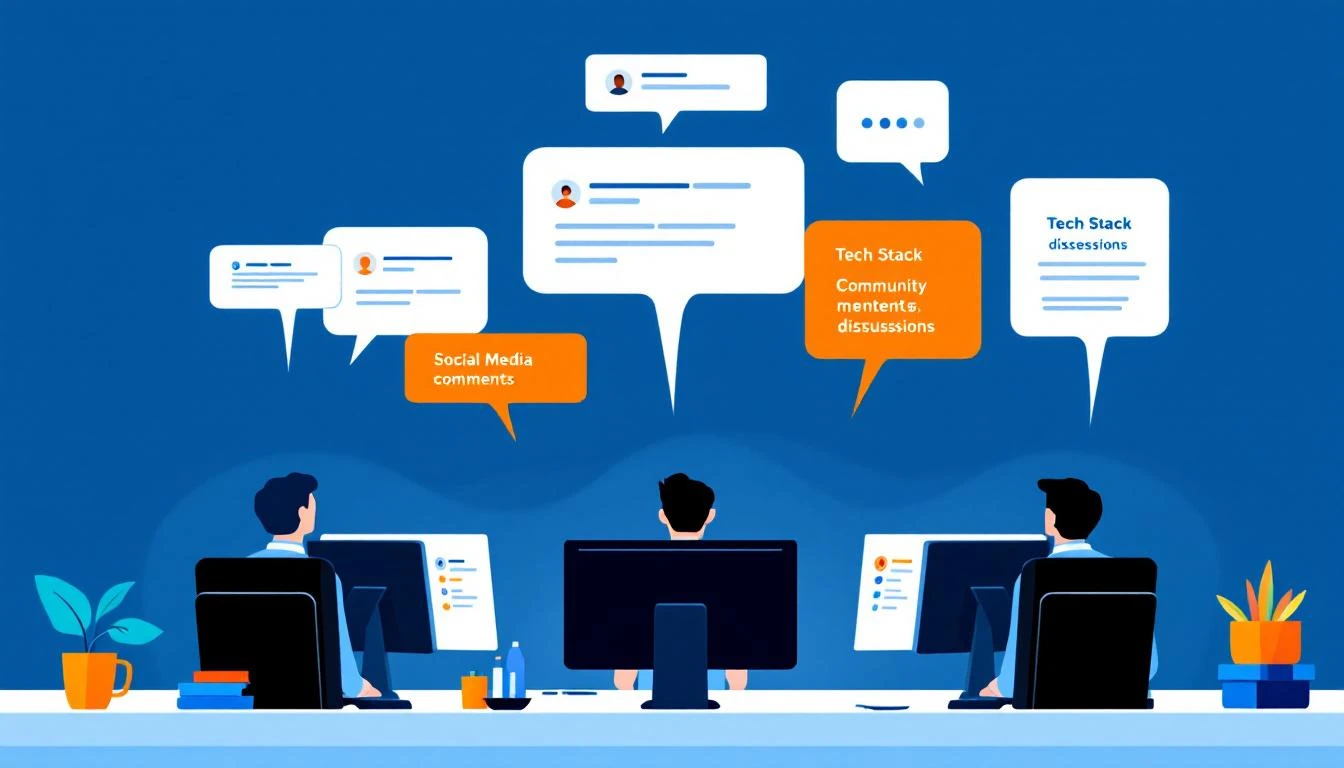
Social buying signals being ignored by sales teams focused only on CRM data

The Data: Where Buyers Talk vs. Where Sellers Lookโ€‹

Here's the fundamental disconnect killing your pipeline:

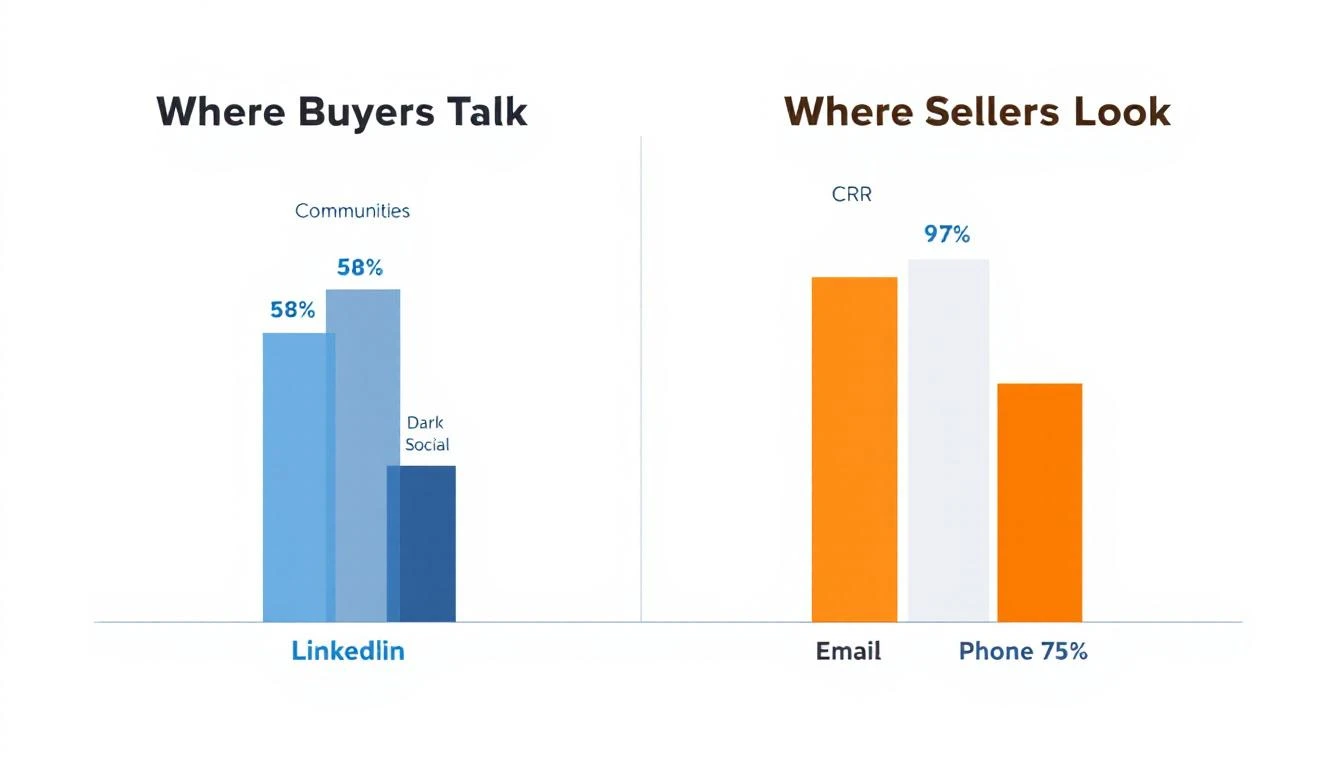
Where B2B buyers are making decisions:

  • 80% of all B2B social leads flow through LinkedIn (LinkedIn Marketing Solutions)
  • 58% of tech B2B purchases are influenced by community forums (Common Room)
  • 70% of B2B content sharing happens in dark social โ€” private Slack channels, WhatsApp groups, LinkedIn DMs (Demand Gen Report)
  • 81% of buyers initiate first contact with sellers, not the other way around

Where most sales teams are looking:

  • CRM dashboards
  • Email open rates
  • Phone connect rates

See the gap?

Your buyers are having real conversations about their problems in LinkedIn comments, Reddit threads, and Slack communities. They're asking peers for vendor recommendations. They're publicly sharing their evaluation criteria. And your sales team is refreshing their CRM waiting for an inbound form fill that's never coming.

84% of Deals Are Decided Before You Even Know About Themโ€‹

6sense's research found that 84% of B2B deals are decided upon first buyer contact. By the time a prospect fills out your demo form, they've already built a shortlist โ€” and if you weren't part of the conversation that shaped it, you're already losing.

The buying journey looks like this:

  1. Awareness โ€” Buyer sees a LinkedIn post about a problem they're experiencing
  2. Research โ€” They comment on that post, engage with replies, save related content
  3. Evaluation โ€” They ask for recommendations in a Slack community or LinkedIn DM group
  4. Shortlist โ€” They visit vendor websites, read comparison posts, check G2 reviews
  5. Decision โ€” They reach out to 2-3 vendors for demos

Steps 1 through 3 are happening entirely in social channels. And most sales teams don't pick up the signal until step 5 โ€” if they're lucky.

Intent data is supposed to solve this, but traditional intent signals (website visits, content downloads, Bombora topics) miss the social layer entirely. They tell you someone at Acme Corp visited your pricing page. They don't tell you that Acme's VP of Sales just commented "We're evaluating exactly this kind of tool right now" on a LinkedIn post about SDR workflow automation.

Which signal would you rather have?

The Social Signal Blindspot: Real Examplesโ€‹

Let's make this concrete. Here are the types of signals your team is missing every single day:

1. LinkedIn Comment Intentโ€‹

A Director of Revenue Operations at a target account comments on a post: "We tried [Competitor X] but the implementation was painful. Looking at alternatives."

That's not engagement. That's a buying signal with competitive displacement intent. If you're not monitoring for mentions of your competitors in LinkedIn conversations, you're leaving pipeline on the table.

2. Community Mentionsโ€‹

Someone posts in a RevOps community: "Anyone using a tool that combines visitor ID with SDR task management? We're drowning in tabs."

This person just described your product. They're actively looking. And they're asking their peers โ€” meaning they trust community recommendations more than your marketing. 73% of decision-makers find thought leadership more trustworthy than traditional marketing materials.

3. Tech Stack Evaluation Postsโ€‹

A VP of Sales shares: "Building out our 2026 tech stack. Currently evaluating intent data providers and SDR platforms. Open to recommendations."

This is an open invitation to sell. But if your SDRs aren't watching for these posts, they'll never see it. And your competitor โ€” the one whose SDR happens to follow this person โ€” will.

4. Job Change Signals + Social Activityโ€‹

A former champion just moved to a new company and immediately started engaging with content about the exact problem you solve. Job change signals are powerful on their own. Combined with social engagement data? That's a warm reactivation opportunity most teams completely miss.

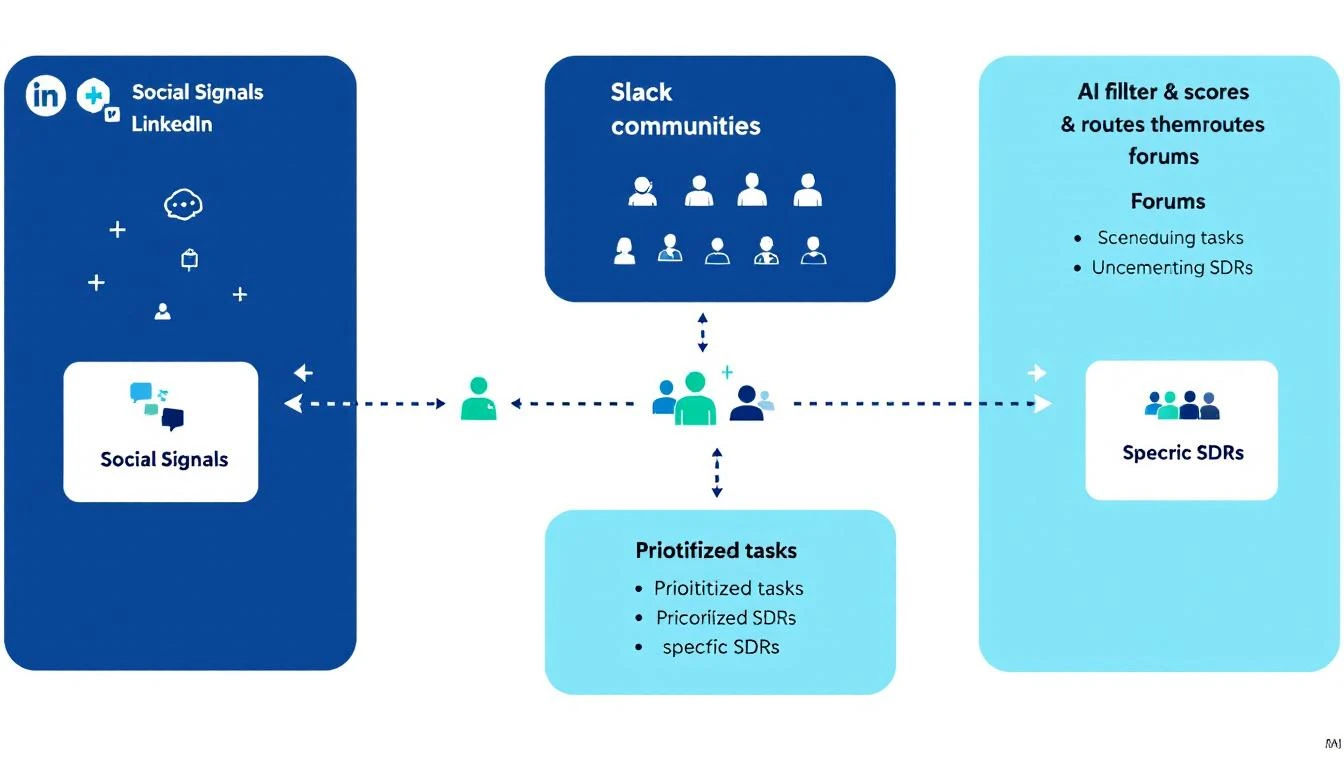
How social signal routing works: from social channels through AI scoring to SDR task assignment

Why SDR Teams Ignore Social Signals (Even When They Know Better)โ€‹

The problem isn't awareness. Most sales leaders know LinkedIn matters. 78% of salespeople who use social selling outperform peers who don't (LinkedIn). Reps with a strong Social Selling Index see 45% more opportunities.

So why aren't teams doing it?

Signal Fatigue Is Realโ€‹

When you tell an SDR to "monitor LinkedIn for buying signals," what actually happens is: they scroll their feed for 5 minutes, see nothing actionable, and go back to their cold call list.

The volume of social content is overwhelming. Without filtering, prioritization, and routing, social signals are just noise. Research shows that reps ignore alerts when they've experienced too many false positives โ€” and unfiltered social feeds are the ultimate false positive machine.

No Workflow Integrationโ€‹

Even when an SDR spots a signal, there's no system to act on it. They screenshot it, maybe paste it in Slack, and it dies there. There's no:

  • Automatic scoring of signal strength
  • Routing to the right rep based on territory or account ownership
  • Context enrichment (who is this person? Are they ICP? What's their company's tech stack?)
  • Task creation with suggested next action

Without workflow integration, social signals are interesting observations, not actionable pipeline.

The "That's Marketing's Job" Problemโ€‹

Most SDR teams have been trained to work from lists, sequences, and cadences. Social selling feels like marketing's territory. But the data says otherwise: social media outreach generates a 42% response rate compared to 26% for email and 23% for phone.

The reps who figure this out are the ones hitting quota. The rest are wondering why their cold emails get ignored.

What Capturing Social Signals Actually Looks Likeโ€‹

Here's the workflow that separates the companies closing deals from LinkedIn comments and the ones still wondering where their pipeline went:

Step 1: Monitor at Scaleโ€‹

You can't manually watch every LinkedIn post, community thread, and social mention. You need automated monitoring of:

  • LinkedIn engagement on posts related to your category keywords
  • Community mentions in Slack groups, Discord servers, Reddit threads, and industry forums
  • Competitor mentions across all social channels
  • ICP account activity โ€” when people at target accounts engage with relevant content

Step 2: Score and Filter With AIโ€‹

Not every LinkedIn comment is a buying signal. "Great post!" is not intent. "We're evaluating tools like this" absolutely is.

AI-powered signal scoring evaluates:

  • Fit: Does this person match your ICP? What's their role, company size, industry?
  • Intent: Is the content they're engaging with related to problems you solve?
  • Timing: Are there multiple signals from the same account? That's a buying committee forming.
  • Competitive context: Are they mentioning competitors? That's displacement opportunity.

Step 3: Route to the Right Repโ€‹

A social signal from a healthcare company in the Northeast shouldn't land on the desk of your West Coast tech SDR. Signal routing means:

  • Territory-based assignment
  • Account owner gets priority
  • Round-robin for unowned accounts
  • Escalation for high-fit, high-intent signals

Step 4: Deliver as an Actionable Taskโ€‹

The SDR shouldn't have to figure out what to do with a social signal. The task should arrive with:

  • Who: Full profile enrichment โ€” name, title, company, ICP fit score
  • What: The specific signal โ€” what they said, where they said it, why it matters
  • Why: AI reasoning on why this is a qualified opportunity
  • How: Suggested next action โ€” connect on LinkedIn, reference their comment, share relevant content

This is the difference between "here's a LinkedIn alert" and "here's a qualified prospect who just expressed intent โ€” here's exactly what to say to them."

The gap between where buyers talk and where sellers look

The Numbers: Social Signal Selling vs. Traditional Outboundโ€‹

Let's compare approaches with real data:

MetricTraditional Cold OutboundSignal-Based Social Selling
Response rate2-5% (cold email)42% (social outreach)
Opportunities createdBaseline+45% (LinkedIn SSI data)
Quota attainment47% of reps hit quota78% of social sellers hit quota
Deal close rate42% (sales-led, 90-day)72% (community-led, 90-day)
Buyer trust level27% trust sales outreach73% trust thought leadership
Time to first meetingDays to weeksHours (real-time signals)

The data is overwhelming. Community-driven deals close at 72% within 90 days compared to 42% for traditional sales-led deals. Social sellers create 45% more opportunities. And the trust gap between cold outreach and warm, signal-based engagement is massive.

Yet most B2B sales teams are still running the 2019 playbook: buy a list, load it into a sequence tool, blast emails, pray for replies.

How MarketBetter Captures Social Signals and Turns Them Into SDR Tasksโ€‹

This is exactly the problem we built MarketBetter to solve. Our platform doesn't just identify who is on your website โ€” it captures signals from across the social landscape and turns them into prioritized, actionable tasks for your SDRs.

Here's how it works:

Community Mention Detection: MarketBetter monitors community channels for mentions related to your product category, competitors, and solution keywords. When someone in an ICP-matching profile mentions a relevant topic, the signal gets captured automatically.

AI Fit Scoring: Every social signal runs through AI that evaluates ICP fit, intent strength, and timing. Not every mention becomes a task โ€” only the ones with real buying potential. The AI provides reasoning for why each signal matters, so your SDR knows exactly why they're reaching out.

Persona-Based Routing: Signals get routed to the right SDR based on territory, account ownership, and persona match. Your enterprise AE gets the VP-level signals. Your mid-market SDR gets the manager-level ones. No one wastes time on signals outside their zone.

Task-Level Actions: Instead of dumping a list of LinkedIn alerts on your team, MarketBetter delivers each signal as a specific task: "Connect with [Name] on LinkedIn. They commented about [topic] in [community]. Reference their interest in [specific problem]. Here's a suggested message."

Your SDRs don't need to become social selling experts. They just need to follow the playbook.

The Competitive Realityโ€‹

Here's what makes this urgent: your competitors are doing this. Not all of them, but the ones winning deals right now.

Companies like Common Room have built entire businesses around community signal capture. Tools like UserGems track job changes as buying triggers. Apollo and 6sense are adding social intent layers.

The difference is that most of these tools give you data. MarketBetter gives you tasks. We don't just tell your SDR that someone at Acme Corp engaged with a relevant LinkedIn post. We tell them exactly who it was, why it matters, what to say, and when to say it.

That's the gap between a signal-based selling platform and a data dashboard you'll check once and forget about.

Getting Started: Three Things You Can Do This Weekโ€‹

You don't need to overhaul your entire sales process to start capturing social signals. Start here:

1. Audit Your Signal Coverageโ€‹

Ask your team: Where are our target buyers having conversations? Map the LinkedIn groups, Slack communities, Reddit threads, and industry forums where your ICP hangs out. If the answer is "we don't know," that's your first problem to solve.

2. Set Up Basic Monitoringโ€‹

At minimum, set LinkedIn alerts for your company name, competitor names, and category keywords. Have one person on your team spend 15 minutes daily scanning these for buying signals. Track what they find. You'll be shocked how much intent is sitting there uncaptured.

3. Build a Signal-to-Task Workflowโ€‹

When someone spots a social signal, what happens next? Define the process: who gets notified, how fast they need to respond, what the outreach should look like. Then ask yourself whether doing this manually is sustainable โ€” or whether you need a platform that does it automatically.

If you're serious about capturing the buying signals your competitors are already acting on, book a demo and see how MarketBetter turns social signals into booked meetings.

The Bottom Lineโ€‹

B2B buying has fundamentally shifted. 70% of the buying journey happens before a prospect talks to sales. Most of that journey is happening in social channels โ€” LinkedIn comments, community threads, peer conversations in dark social.

Your CRM can't see these signals. Your intent data provider probably can't either. And your SDRs definitely aren't monitoring them manually at scale.

The companies that figure out how to capture, score, and route social signals to the right rep at the right time are going to dominate their categories. The ones that keep waiting for inbound form fills are going to wonder where all the deals went.

Your competitors are already closing deals from LinkedIn comments.

The question isn't whether social signals matter. It's whether you're watching.


Ready to stop missing social buying signals? Book a demo โ†’ and see how MarketBetter captures community mentions, scores them with AI, and routes them as actionable SDR tasks.

Your AI SDR Is Blind โ€” It Can't See the Full Buying Committee [2026]

ยท 11 min read
sunder
Founder, marketbetter.ai

Your AI SDR just wrote the perfect cold email to a VP of Engineering.

Personalized opener referencing their latest LinkedIn post. Clean value prop. Smooth CTA. The AI nailed the individual outreach.

One problem: while your AI was crafting that email, it missed everything that actually matters.

The CFO posted about budget cuts on LinkedIn last Thursday. The VP of Operations just opened three job postings for the exact role your product replaces. Procurement published an RFP on their website. And a competitor just got name-dropped in the company's latest earnings call.

Your AI SDR didn't catch any of it. Because it was looking at a contact, not an account.

This is the blind spot killing most AI-powered outreach in 2026 โ€” and the data proves it.

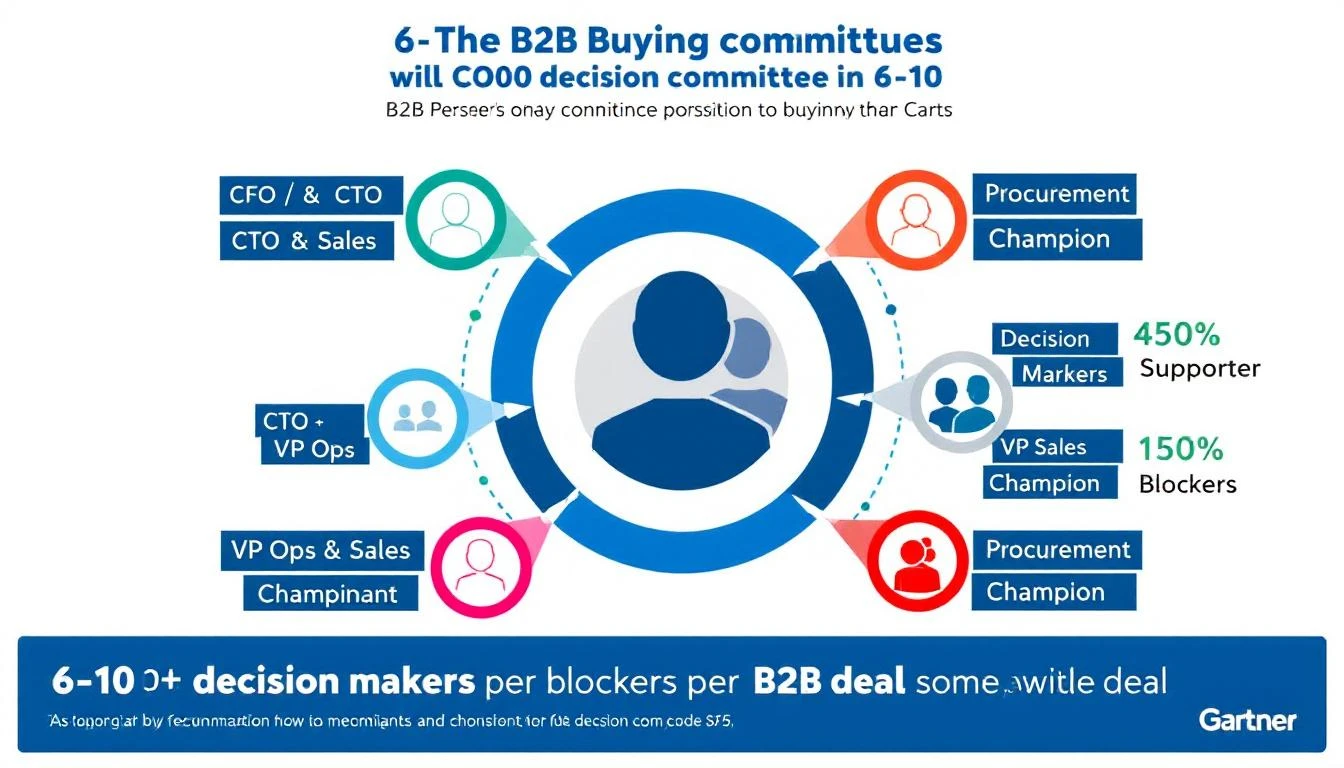
B2B buying committee with 6-10 stakeholders mapped around a deal

The Buying Committee Problem: 6-10 People You're Not Talking Toโ€‹

Here's a stat that should make every sales leader uncomfortable: according to Gartner, the average B2B buying group consists of 6 to 10 decision makers, each armed with 4 to 5 pieces of independently gathered research.

That's not a single decision maker. That's a committee. And the number keeps growing.

Deal ComplexityAverage Buying Group SizeTypical Sales Cycle
Mid-Market SaaS6-8 stakeholders3-4 months
Enterprise Software8-11 stakeholders6+ months
Platform/Infrastructure10-20 stakeholders9-12 months

Yet most AI SDR tools operate on a single axis: one contact, one email, one thread. They scrape a prospect's LinkedIn, pull their job title, maybe reference a recent post โ€” and call it "personalization."

That's not personalization. That's a glorified mail merge with better prompts.

The Information Asymmetry Problem: They Know More About You Than You Know About Themโ€‹

The buying dynamic has completely flipped.

Research from Forrester and 6sense shows that B2B buyers complete 70% of their buying journey before ever contacting a vendor. They've read your G2 reviews. They've compared your pricing page to three competitors. They've asked their network on LinkedIn.

Meanwhile, your AI SDR knows... the prospect's job title and what they posted last week.

The information asymmetry is staggering:

What the buyer knows about you:

  • Your pricing (they found it or asked around)
  • Your G2 reviews and star rating
  • What your competitors say about you
  • Case studies from your website
  • Your CEO's last LinkedIn post

What your AI SDR knows about the buyer:

  • Name, title, company
  • Maybe a LinkedIn post
  • Maybe their company's industry
  • That's it

This gap is why 77% of B2B buyers won't talk to a sales rep until they've done their own research โ€” and why 57% of buyers purchased a tool last year without ever meeting the vendor's sales team.

Your prospects are doing deep research on you. Your AI is doing surface-level research on them. That's a losing position.

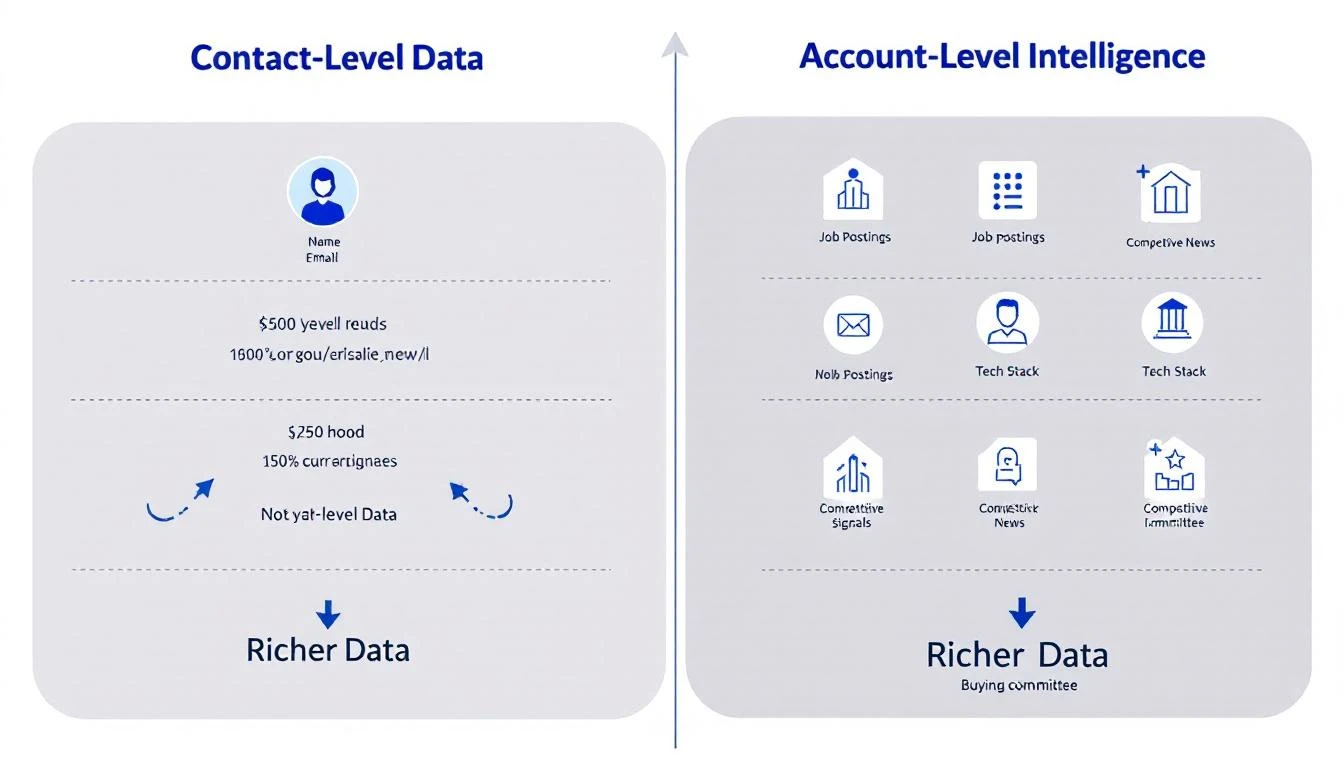
Contact-level data vs account-level intelligence comparison

What Contact-Level Data Misses (Real Examples)โ€‹

Let's make this concrete. Imagine your AI SDR is targeting Acme Corp for a sales automation platform. Here's what contact-level research finds versus account-level intelligence:

Contact-Level Research (What Most AI SDRs Do)โ€‹

Your AI pulls the VP of Sales' LinkedIn profile:

  • "VP of Sales at Acme Corp. Previously at Salesforce. Posted about sales enablement last month."

The AI writes: "Hey Sarah, saw your post about sales enablement โ€” really resonated. We help teams like yours..."

Fine. Generic. Forgettable. Sitting in an inbox with 47 other AI-generated emails that say the same thing.

Account-Level Intelligence (What Changes the Game)โ€‹

With full account research, your SDR sees the complete picture:

  • Job postings: Acme posted 5 SDR roles this month โ€” they're scaling outbound aggressively
  • Company news: Their CEO just announced a $40M Series C with "aggressive growth targets" in the press release
  • Competitive signals: Their job descriptions mention Outreach and Salesloft โ€” they're evaluating tools
  • Financial signals: Q4 earnings showed 30% revenue growth but rising CAC โ€” efficiency pressure is real
  • LinkedIn activity: The CRO posted about needing "more pipeline with the same headcount"
  • Tech stack: They're on HubSpot CRM (you integrate natively)
  • Podcast mentions: The VP of Marketing was on a podcast talking about their shift to product-led growth

Now your outreach looks completely different:

"Sarah โ€” saw Acme is hiring 5 new SDRs while your CRO is talking about doing more with less. That's the exact tension our platform solves. We help teams like yours 3x outbound volume without adding headcount. Given you're on HubSpot, we'd plug right in. Worth 15 minutes?"

That's not a cold email. That's an informed business conversation. The difference is account-level intelligence.

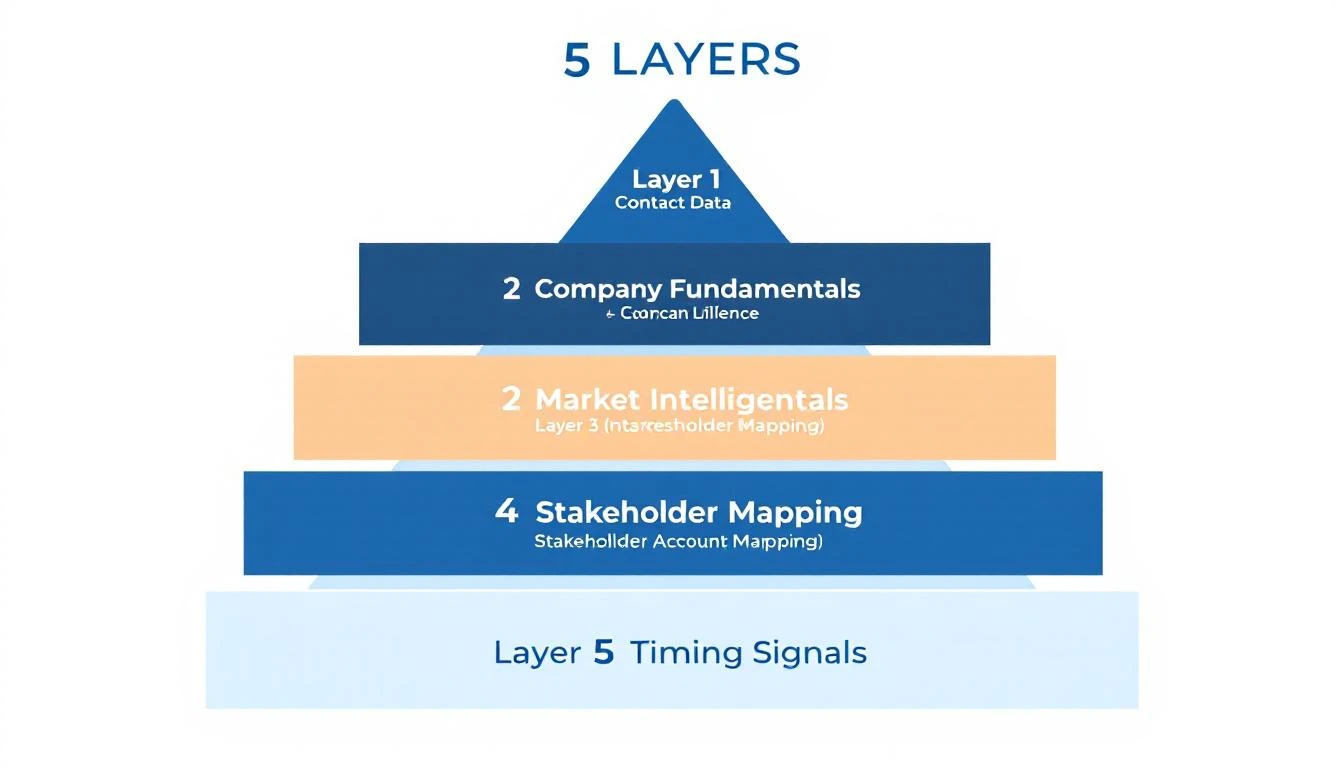
Five layers of account intelligence from contact data to timing signals

The Five Layers of Account Intelligence Your AI SDR Is Missingโ€‹

Most AI SDRs operate on Layer 1. The deals are won on Layers 2-5.

Layer 1: Contact Data (Where Most AI SDRs Stop)โ€‹

Name, title, email, phone, LinkedIn URL, recent posts.

This is table stakes. Every competitor has this data. Every AI SDR can write a "personalized" email from this. It's not a differentiator โ€” it's a commodity.

Layer 2: Company Fundamentalsโ€‹

Revenue, headcount, industry, tech stack, funding history, office locations.

This gets you from "Dear VP of Sales" to "Dear VP of Sales at a 200-person SaaS company that just raised Series B." Better, but still static.

Layer 3: Market Intelligence (Where Real Differentiation Starts)โ€‹

Job postings, company news, press releases, earnings calls, competitive mentions, product launches, partnerships.

This is where the signal lives. A company hiring 10 SDRs is a fundamentally different prospect than one laying off their sales team. Your AI SDR can't tell the difference if it only looks at contacts.

Layer 4: Stakeholder Mappingโ€‹

Who is the economic buyer? Who is the champion? Who is the blocker? What has each stakeholder said publicly about their priorities?

Gartner found that 74% of B2B buying teams experience "unhealthy conflict" during the decision process. Understanding who disagrees โ€” and why โ€” is the difference between a stalled deal and a closed one.

Layer 5: Timing Signalsโ€‹

Intent data, website visits, content consumption patterns, RFP publications, budget cycle indicators, contract renewal dates.

This layer tells you when to engage, not just who to engage. A perfectly personalized email sent at the wrong time is still a wasted email.

The Data: Account Intelligence Changes Outcomesโ€‹

The numbers tell the story clearly. Teams that shift from contact-level to account-level intelligence see measurable improvements across every metric:

Research time reduction: 50-80% less time per account. Instead of SDRs manually researching across 10+ tabs, AI pulls the complete picture into a single view. That's the 20-tabs-to-one-task problem solved.

Pipeline growth: 20-40% increase in qualified pipeline from signal-triggered outreach. When you know a company is actively hiring for the role you replace, your outreach hits differently.

Conversion rates: Teams using signal-qualified leads see 47% higher conversion rates and 43% larger deal sizes compared to contact-only approaches.

Sales velocity: 15-40% faster progression through pipeline stages. When you understand the full buying committee, you can multi-thread from day one instead of discovering the CFO needs to sign off in month three.

The account intelligence market reflects this shift โ€” projected to grow from $2.1B in 2024 to $4.8B by 2029. B2B teams are voting with their budgets.

Why Most AI SDRs Can't Do This (And What To Look For Instead)โ€‹

The majority of AI SDR tools were built contact-first. Their architecture looks like:

  1. Get a list of contacts
  2. Enrich with LinkedIn data
  3. Generate personalized email
  4. Send and track

Account intelligence requires a fundamentally different approach:

  1. Research the account โ€” market intel, job postings, company news, tech stack, competitive mentions
  2. Map the buying committee โ€” identify all relevant stakeholders and their public priorities
  3. Score timing signals โ€” is this account showing buying intent right now?
  4. Generate account-aware outreach โ€” emails that reference company context, not just individual context
  5. Multi-thread strategically โ€” different messages for the champion, the economic buyer, and the technical evaluator

When evaluating SDR tools, ask these questions:

  • "Does this tool research the company or just the contact?" If it only pulls LinkedIn data, it's Layer 1 only.
  • "Can it show me job postings, news, and competitive signals for my target accounts?" This is the minimum for account intelligence.
  • "Does it help me identify and message multiple stakeholders?" Single-threaded outreach dies in committee-driven purchases.
  • "Does it tell me WHEN to reach out, not just WHO?" Intent signals are the timing layer.

The Real Cost of Being Blindโ€‹

Let's do the math.

An SDR sends 100 cold emails per day. With contact-level personalization only, they're essentially guessing:

  • Which accounts are actually in-market right now
  • Whether the person they're emailing has budget authority
  • What the company's real priorities are
  • Who else needs to say yes

Average cold email reply rates in 2026 have dropped to 0.5-1.5% โ€” largely because AI has flooded inboxes with "personalized" messages that all sound the same.

Now imagine those same 100 emails, but filtered through account intelligence:

  • 30 accounts are actually showing buying signals
  • Each email references specific company context (hiring, funding, competitive moves)
  • The SDR multi-threads to 2-3 stakeholders per account with tailored messaging

That's not 100 shots in the dark. That's 30 informed conversations with the right people at the right time. The complete SDR automation guide breaks down how this workflow compounds.

From Contact Personalization to Account Intelligenceโ€‹

The evolution is clear:

2020-2023: The Spray-and-Pray Era Send more emails. Bigger lists. Volume = pipeline.

2023-2025: The AI Personalization Era AI writes "personalized" emails from contact data. Better than templates, but still single-threaded. Everyone has the same tools, so the advantage erodes.

2026+: The Account Intelligence Era AI researches the entire account โ€” market signals, buying committee, timing indicators โ€” and orchestrates multi-stakeholder outreach. The SDR who understands the full picture wins.

The teams that figure this out first will dominate their markets. The teams that keep sending AI-generated cold emails to single contacts will wonder why their reply rates keep dropping.

How MarketBetter Approaches Account Intelligenceโ€‹

We built MarketBetter around a simple thesis: your SDR needs to understand the account, not just the contact.

That means before any outreach goes out, MarketBetter researches:

  • Market intel โ€” Company news, press releases, funding, earnings
  • Job postings โ€” What they're hiring for reveals their priorities
  • Tech stack โ€” What they already use and where you fit
  • Competitive signals โ€” Who they're evaluating or already using
  • Community mentions โ€” Podcast appearances, conference talks, online discussions
  • Buying committee โ€” Multiple stakeholders mapped with context on each

All of this feeds into your SDR's daily task list. Not a dashboard to interpret โ€” actual tasks with the research already done. "Call Sarah at Acme. They're hiring 5 SDRs, their CRO posted about efficiency, and they're on HubSpot. Here's your opening."

That's the difference between an AI SDR that personalizes emails and an AI command center that turns signals into meetings.


The Bottom Lineโ€‹

The average B2B deal has 6-10 decision makers. Your buyers are 70% through their journey before you even know they exist. And every one of your competitors has access to the same contact data and AI email writers you do.

The only sustainable advantage left is knowing more about the account than anyone else โ€” and acting on it faster.

Your AI SDR isn't broken. It's just blind. Give it eyes on the full buying committee, and watch what happens.


Want to see account-level intelligence in action? Book a demo โ†’

Why Your Sales Team Still Calls Leads 3 Days Late โ€” And How to Fix It Today [2026]

ยท 10 min read
sunder
Founder, marketbetter.ai

A prospect visits your pricing page. Downloads your whitepaper. Fills out a demo request form. They're hot. They're interested. They're ready to talk.

Your SDR calls them back three days later.

By then? The prospect already had two demos with competitors, forgot why they filled out your form, and moved on. You lost the deal before your rep even picked up the phone.

This isn't a hypothetical. It's the reality for the majority of B2B sales teams โ€” and the data behind it is brutal.

The Speed-to-Lead Crisis: What the Data Actually Saysโ€‹

Let's start with the number that should keep every VP of Sales up at night:

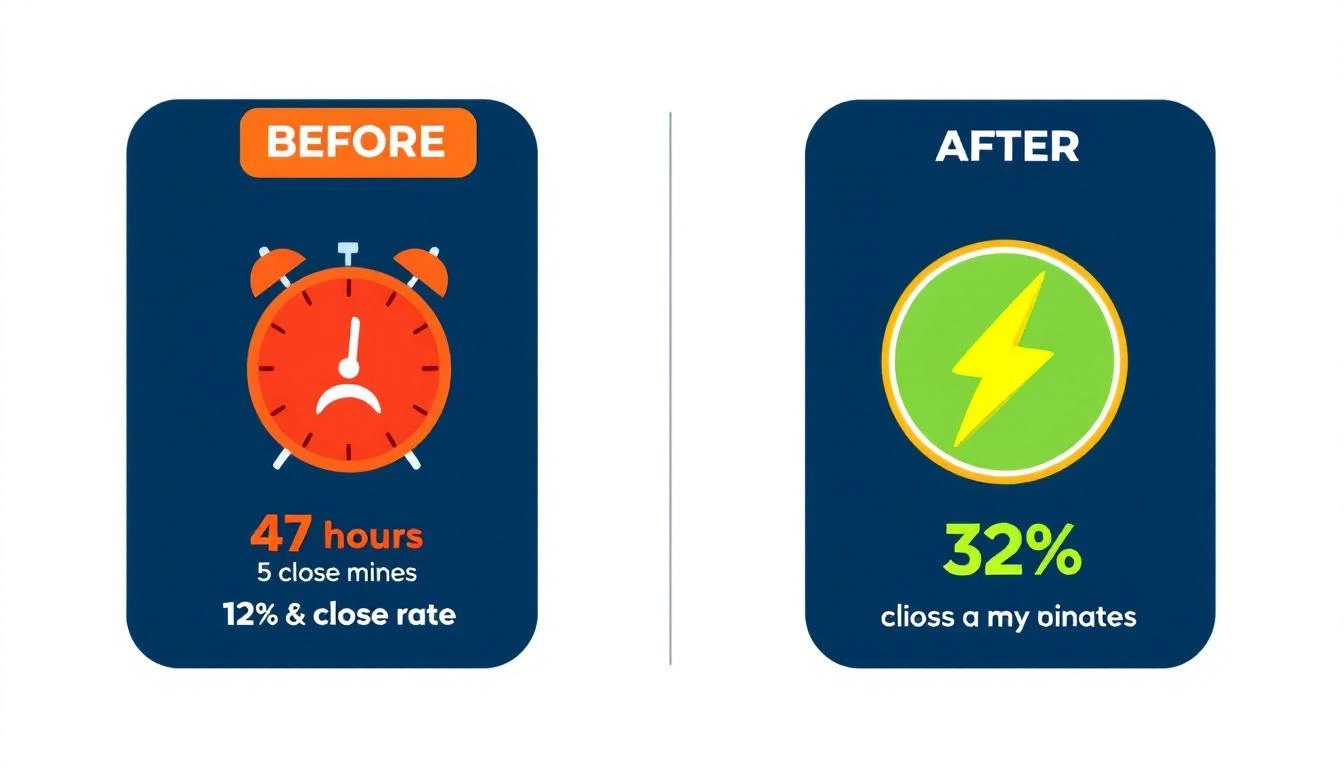
The average B2B lead response time is 47 hours.

That's not a typo. Nearly two full business days pass between a prospect raising their hand and a rep making contact. And it gets worse from there.

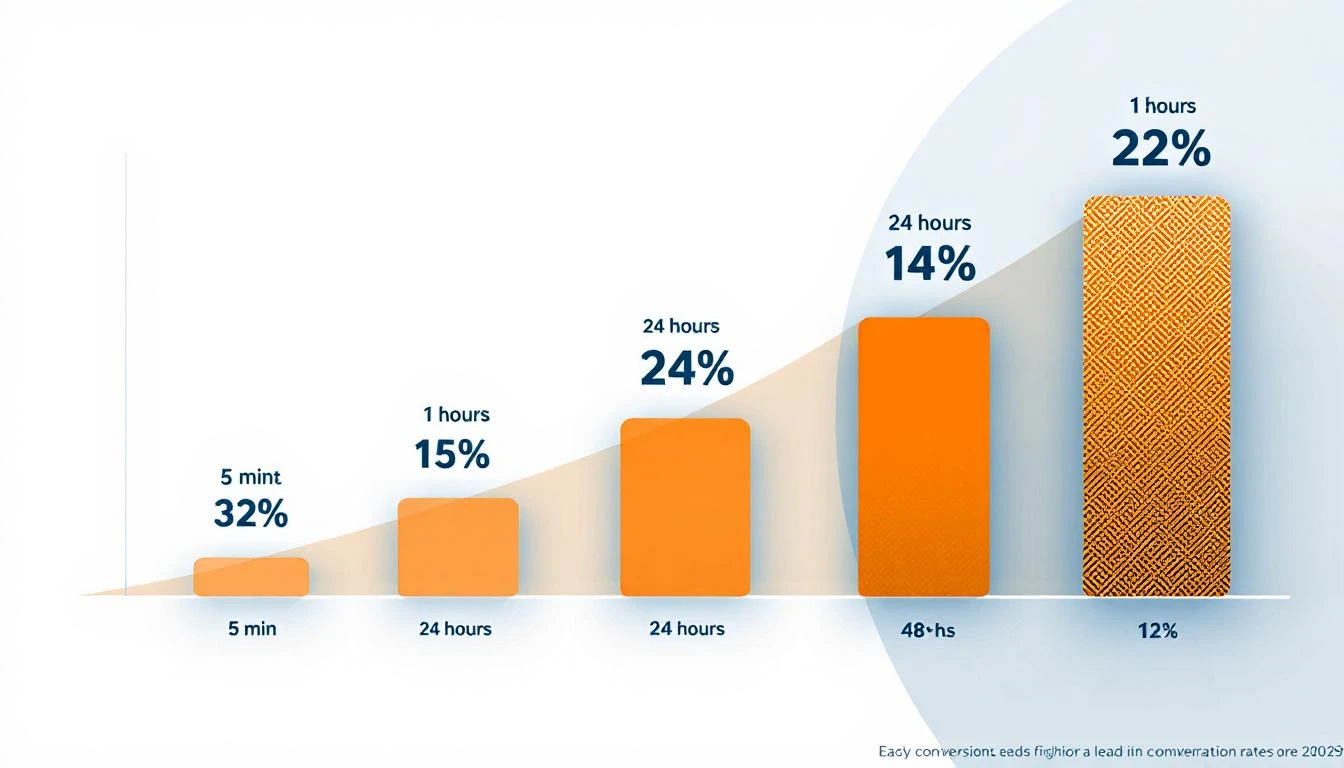
Lead conversion rates decay sharply as response time increases โ€” responding in under 5 minutes yields a 32% close rate vs. 12% after 24 hours

The Harvard Business Review Studyโ€‹

The most cited research on this topic comes from a Harvard Business Review study that analyzed 2.24 million sales leads across hundreds of companies. The findings:

  • Companies that responded within 1 hour were 7x more likely to qualify the lead than those that waited even 60 minutes longer
  • Companies that waited 24+ hours were 60x less likely to qualify the lead compared to first-hour responders
  • The odds of qualifying a lead drop 400% when response time goes from 5 to 10 minutes

Read that last one again. Five extra minutes. Four hundred percent worse odds.

The MIT/InsideSales.com Studyโ€‹

A joint study from MIT and InsideSales.com went even deeper, analyzing over 15,000 leads and 100,000 call attempts:

  • Leads contacted within 5 minutes are 21x more likely to qualify than those contacted after 30 minutes
  • The odds of even making contact with a lead drop 100x between 5 minutes and 30 minutes
  • After 20 hours, every additional dial actually hurts your ability to make contact

The conversion decay curve isn't gradual โ€” it's a cliff. You either catch the lead in the first five minutes, or you're fighting an uphill battle that gets steeper by the minute.

The Close Rate Numbersโ€‹

When you look at actual close rates by response time, the picture is even clearer:

Response TimeClose RateMultiplier
Under 5 minutes32%Baseline
Under 1 hour24%0.75x
Under 24 hours15%0.47x
Over 24 hours12%0.38x

Responding in under 5 minutes gives you a 2.6x higher close rate than waiting a day. And most teams are waiting two days.

The Real Cost: What 47-Hour Response Times Are Costing Youโ€‹

Let's do some math that will make your CFO flinch.

78% of buyers purchase from the company that responds first โ€” not the one with the best product, the lowest price, or the strongest brand. The first responder wins.

If your team generates 100 inbound leads per month and your average deal size is $25,000:

  • At 5-minute response: 32% close rate = 32 deals = $800,000/month
  • At 47-hour response (industry average): ~12% close rate = 12 deals = $300,000/month

That's $500,000 per month left on the table. Not because your product is wrong. Not because your pricing is off. Because your reps called three days late.

And the compounding effects go further:

  • 73% of leads are never contacted at all โ€” they fall through the cracks entirely
  • 44% of salespeople give up after one follow-up, when 80% of deals require 5-12 touchpoints
  • Deals that drag past 6 months have a 60% failure rate, per SiriusDecisions research โ€” and slow initial response extends every subsequent stage

The follow-up gap isn't just a conversion problem. It's a pipeline problem, a revenue problem, and an efficiency problem rolled into one.

Why It Happens: The Anatomy of a 3-Day Delayโ€‹

If the data is this clear, why do teams still respond in 47 hours? Because the problem isn't awareness โ€” it's workflow.

Here's what actually happens when a lead comes in at most B2B companies:

Stage 1: The Signal Gets Lost (0-2 hours)โ€‹

A prospect fills out a form, visits the pricing page, or replies to a cold email. The notification goes to a shared inbox, a Slack channel, or a CRM queue. Nobody owns it yet.

Meanwhile, the intent signal that triggered the action โ€” the pricing page visit, the email open, the LinkedIn profile view โ€” goes completely unnoticed because it's trapped in a separate tool.

Stage 2: Manual Routing Burns Time (2-12 hours)โ€‹

A manager sees the lead in the morning standup. They assign it to an SDR based on territory, round-robin, or whoever seems least busy. The SDR gets a task in their CRM.

But the SDR already has 47 other tasks. They're mid-call-block. They'll get to it after lunch. Or tomorrow.

Stage 3: Research and Scripting (12-48 hours)โ€‹

The SDR finally picks up the lead. Now they need to:

  • Look up the company on LinkedIn
  • Check the CRM for prior engagement
  • Figure out what the prospect actually did (which form? which page?)
  • Write a personalized email
  • Find the right phone number
  • Decide whether to call, email, or send a LinkedIn message

Each step requires switching between 3-5 different tools. We've written about this before โ€” the average SDR juggles 20+ tabs just to work a single lead.

Stage 4: The Attempt (48-72 hours)โ€‹

The SDR finally calls. The prospect doesn't pick up. The SDR sends a generic email. No response. They move on to the next lead.

Total elapsed time: 3 days. Total meaningful touches: 1-2. Result: Lost deal.

The problem isn't lazy reps. It's a broken workflow that forces humans to do things machines should handle โ€” routing, research, scripting, multi-channel coordination โ€” before any actual selling happens.

The Fix: Automated Follow-Up Workflows That Fire in Minutes, Not Daysโ€‹

The solution isn't "tell your SDRs to be faster." They're already buried. The solution is removing the manual steps between signal detection and follow-up action.

Here's what a modern automated follow-up workflow looks like:

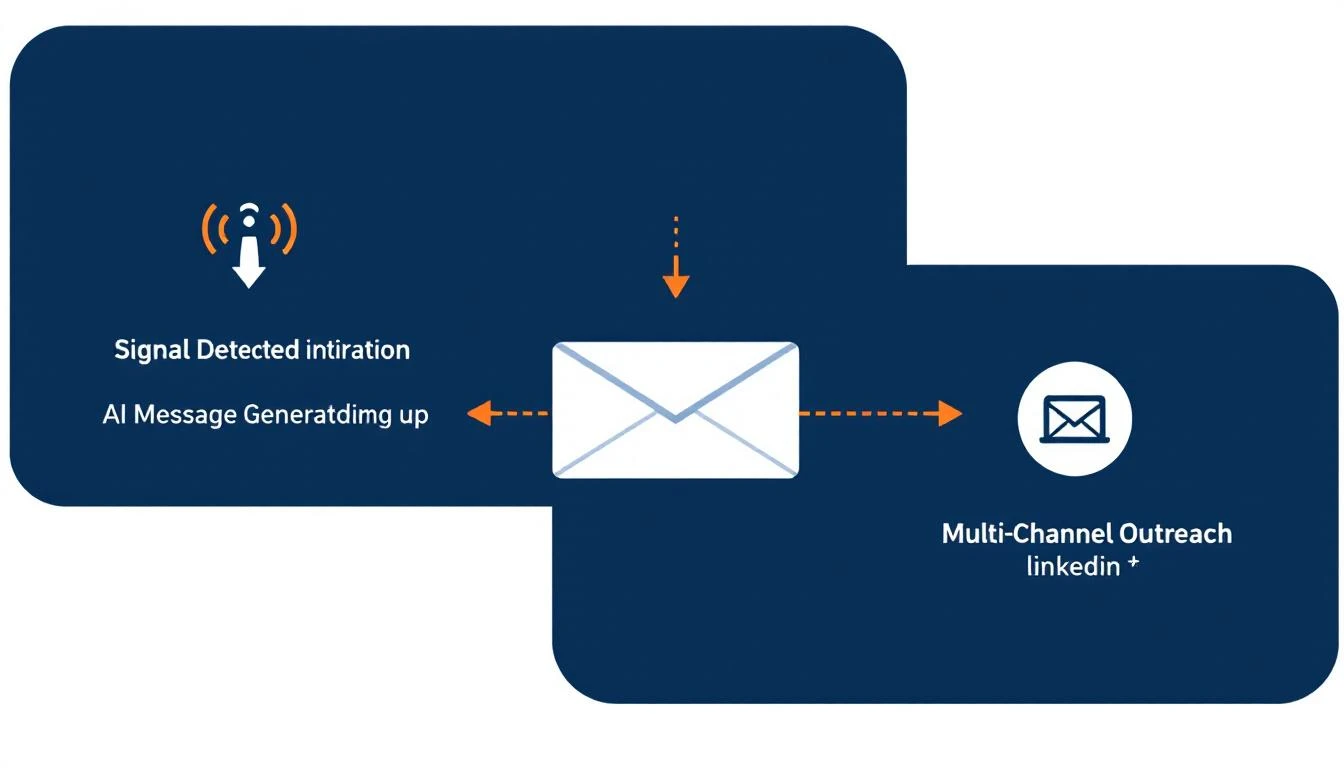
Automated follow-up workflow: detect signal, generate personalized message with AI, fire across email, phone, and LinkedIn simultaneously

1. Detect the Signal Automaticallyโ€‹

Instead of waiting for a human to notice a form fill, the system continuously monitors for buyer signals:

  • Website visits (especially high-intent pages like pricing, case studies, integrations)
  • Email opens, clicks, and replies
  • LinkedIn profile views and engagement
  • Form submissions and content downloads
  • Return visits from previously identified accounts

The system scans for these signals on a rolling window โ€” catching everything from a form fill five minutes ago to a pricing page visit from three days ago that nobody followed up on.

2. Generate the Right Message Instantlyโ€‹

This is where most "automation" tools fail. They send a canned template that screams "you're getting a robot email." Nobody responds.

Modern workflow automation uses AI to generate contextual follow-up messages based on:

  • What the prospect did โ€” "I noticed you were looking at our enterprise pricing" hits different than "Hope this email finds you well"
  • Who they are โ€” Role, company size, industry, prior engagement history
  • What matters to them โ€” Mapping their activity to relevant case studies, features, or ROI data

The result is a personalized message that reads like a human wrote it โ€” because an AI understood the context and generated it in seconds, not the 30 minutes it takes an SDR to manually research and draft.

3. Fire Across Every Channel Simultaneouslyโ€‹

A single-channel follow-up is a coinflip. Multi-channel follow-up is a strategy.

When a signal triggers a workflow, the best systems coordinate across:

  • Email โ€” Personalized message referencing their specific activity
  • Phone โ€” Immediate dial with an AI-generated call script tailored to the prospect's context
  • LinkedIn โ€” Connection request or InMail through integrated campaign tools

All three fire within minutes of the signal, not days. The SDR doesn't have to think about channel strategy โ€” the workflow handles it.

4. Track Everything, Learn, Repeatโ€‹

Every follow-up attempt, every response, every outcome gets logged automatically. No more "did anyone call this lead?" conversations in Slack. No more leads falling through cracks between tools.

The execution history gives managers visibility into:

  • Which signals convert best
  • Which message types get responses
  • Where in the workflow leads stall
  • Which reps need coaching vs. which workflows need tuning

This closes the feedback loop that most sales teams never build โ€” because they're too busy manually logging activities in Salesforce.

What Changes When You Fix Speed-to-Leadโ€‹

The impact isn't theoretical. Here's what the shift looks like in practice:

Before and after: 47-hour response time with 12% close rate vs. 5-minute response time with 32% close rate

Before (manual workflow):

  • Average response time: 47 hours
  • Lead contact rate: 27%
  • Close rate: 12%
  • SDR spends 65% of time on non-selling activities

After (automated follow-up workflows):

  • Average response time: Under 5 minutes
  • Lead contact rate: 90%+
  • Close rate: 32%
  • SDR focuses on conversations, not research and routing

The math works because you're not asking humans to be faster. You're removing the bottlenecks that made them slow:

  • No more manual routing โ€” leads go to the right rep automatically
  • No more research lag โ€” AI generates context and scripts instantly
  • No more channel switching โ€” email, phone, and LinkedIn fire from one workflow
  • No more forgotten leads โ€” the system catches every signal, even ones from days ago that slipped through

The 5-Minute Window Is Non-Negotiableโ€‹

Here's the bottom line: you have 5 minutes.

Not 5 hours. Not "by end of day." Not "we'll get to it in tomorrow's standup." Five minutes.

Every minute after that, your conversion rate decays. After 30 minutes, you've lost 21x your qualifying potential. After an hour, you're 7x behind the first responder. After 24 hours, you're competing against companies that already had discovery calls with your prospect.

The companies winning right now aren't winning because they have better products or bigger teams. They're winning because they built systems that turn signals into action in minutes instead of days.

Your sales cadence shouldn't start when an SDR gets around to it. It should start the moment a buyer raises their hand.

The technology exists today. The data has been clear for over a decade. The only question is whether you'll fix it before your competitors do.


Tired of watching leads go cold? MarketBetter detects buyer signals, generates personalized follow-up, and fires multi-channel outreach โ€” all before your competitor's SDR finishes their coffee. See it in action โ†’

The $150K Problem: What Losing One SDR Actually Costs Your Business [2026 Data]

ยท 8 min read
sunder
Founder, marketbetter.ai

Here's a question most sales leaders never do the math on: What does it actually cost when an SDR walks out the door?

Not the recruiting fee. Not the salary savings during the vacancy. The total cost โ€” including the pipeline that evaporates, the meetings that never happen, the remaining team members who pick up the slack and burn out faster, and the 3-5 months your replacement spends ramping before booking a single qualified meeting.

We built a complete cost model using 2025-2026 benchmark data from The Bridge Group, Xactly, SalesHive, and our own customer conversations. The number we landed on will make you rethink every hiring, retention, and technology decision you make this year.

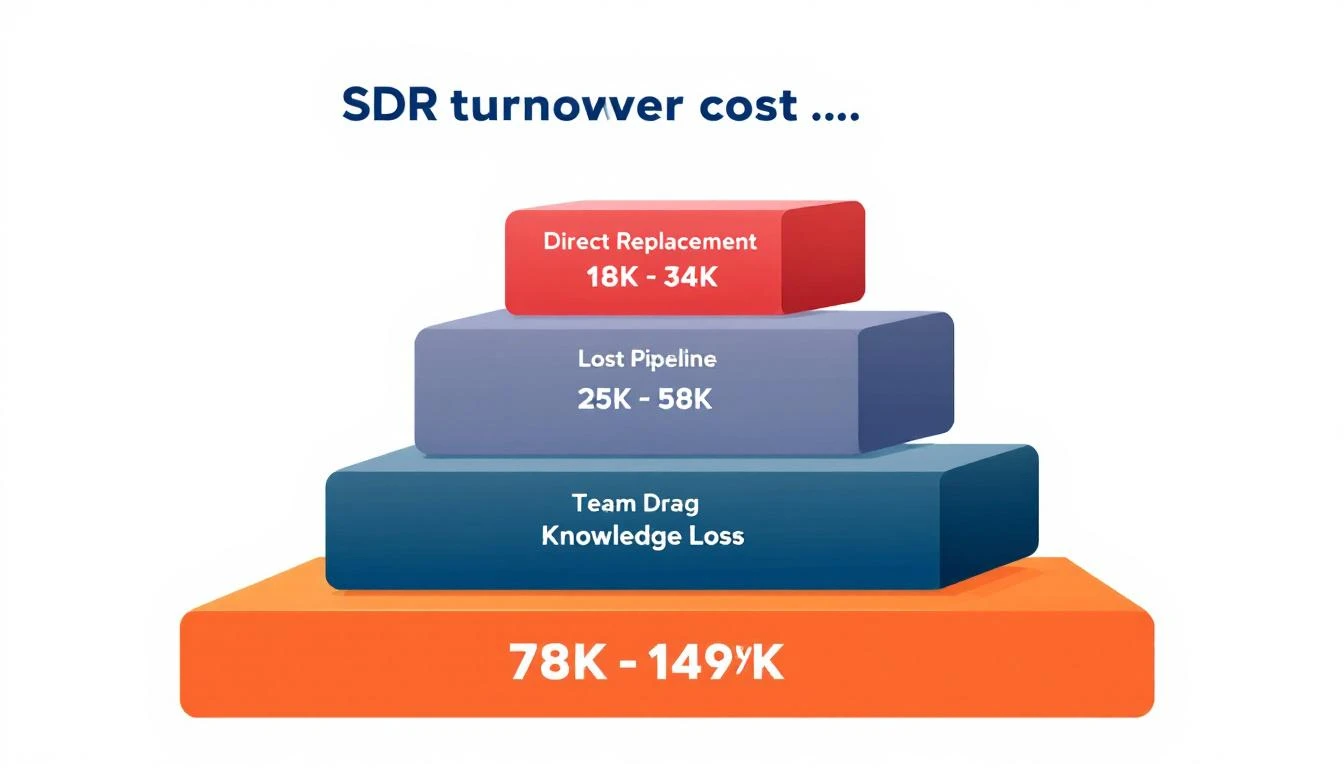
SDR Turnover Cost Breakdown

The Raw Numbersโ€‹

Let's start with the industry benchmarks that feed the model:

MetricBenchmarkSource
Average SDR tenure14-18 monthsBridge Group, SalesHive
Average SDR ramp time3.1-3.2 monthsBridge Group
SDRs who quit within 90 days20%SalesSo Research
SDRs consistently missing quota83.4%SalesSo Research
Average SDR OTE$65K-$85KGlassdoor, Martal
Meetings booked per month (avg)15Industry benchmark
Cost to ramp (total)3x base salaryXactly
Companies with subpar onboarding88%SalesSo Research
Show rate on booked meetings80%Industry benchmark

These numbers alone tell a story. Your average SDR stays 16 months, takes 3.2 months to ramp, and has only 12.8 months of full productivity before the cycle starts again.

But the financial impact is what should keep you up at night.

The Five Layers of Turnover Costโ€‹

Most leaders think about turnover cost as "recruiting fee + salary gap." That captures maybe 30% of the real number. Here are the five actual cost layers:

Layer 1: Direct Replacement Costs โ€” $18,500-$32,000โ€‹

Cost ComponentLow EstimateHigh Estimate
Recruiting (agency or internal)$8,000$15,000
Job posting and sourcing$500$2,000
Interview time (managers + team)$3,000$5,000
Background check and onboarding admin$500$1,000
Training materials and programs$2,500$4,000
New hire tech stack setup$1,000$2,000
First-month salary (zero productivity)$3,000$5,000
Subtotal$18,500$34,000

Agency recruiting fees for SDR roles typically run 15-20% of first-year OTE. Internal recruiting isn't free either โ€” when you factor in recruiter salary, hiring manager time, and team interviews, it costs $8K-$12K per hire.

Layer 2: Lost Pipeline During Vacancy โ€” $25,000-$50,000โ€‹

This is the cost nobody calculates. When an SDR seat is empty:

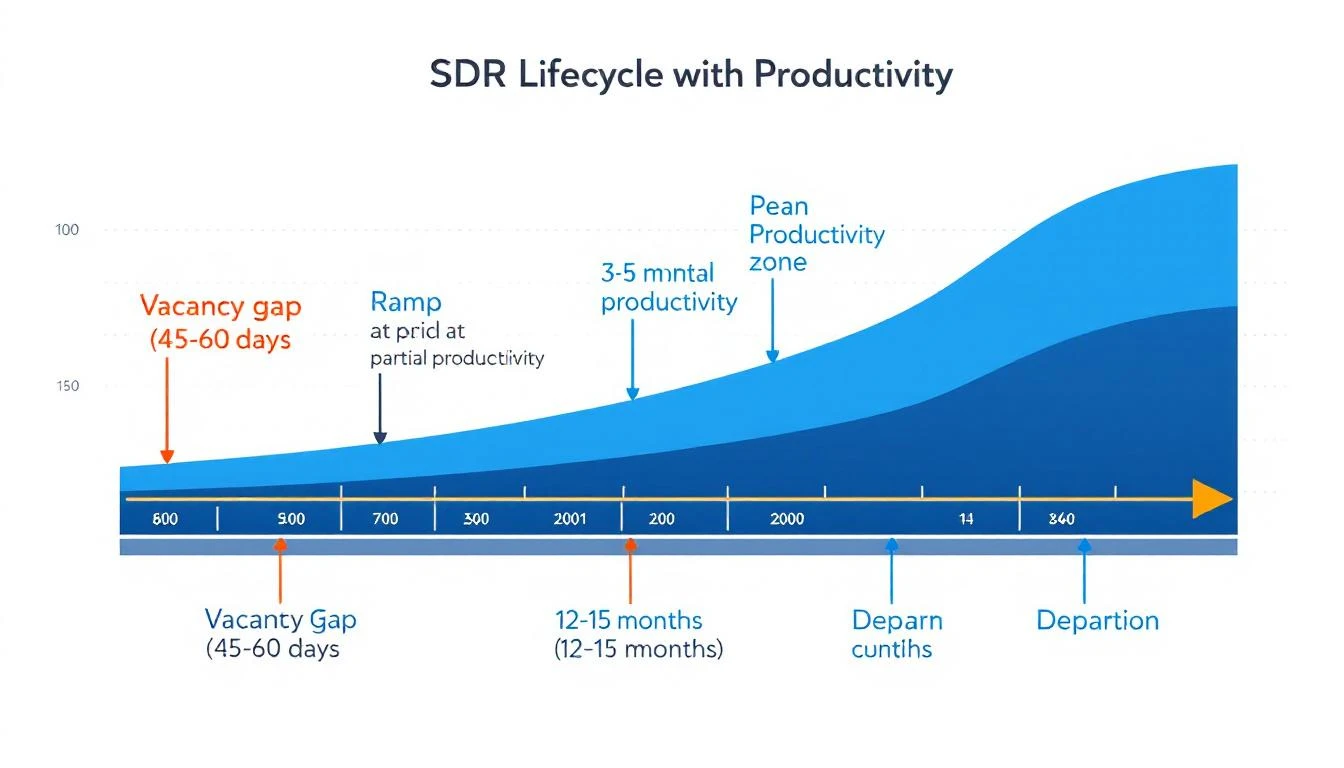
  • Average vacancy length: 45-60 days (time to hire after notice)
  • Meetings not booked: 22-30 meetings (15/month x 1.5-2 months)
  • Pipeline value per meeting: $1,100-$1,700 (based on $22K avg ACV at 5% close rate)
  • Total lost pipeline: $24,200-$51,000

That's not revenue you "don't get." It's pipeline your competitors win because your territory is uncovered. These deals don't wait for you to backfill the role.

And here's the compounding effect: those 22-30 meetings would have generated second and third touches, referrals, and warm follow-ups over the following months. The downstream impact is 2-3x the immediate pipeline loss.

Layer 3: Ramp Period Productivity Loss โ€” $22,000-$38,000โ€‹

Your new hire isn't at zero for 3 months, then magically at 100%. The productivity curve looks like this:

MonthExpected ProductivityMeetings vs. Target
Month 110-15%1-2 meetings
Month 230-40%4-6 meetings
Month 360-70%9-10 meetings
Month 480-85%12-13 meetings
Month 5+90-100%13-15 meetings

Over the first three months, your new SDR books roughly 15-18 meetings instead of the 45 a fully ramped rep would deliver. That's 27-30 missed meetings, worth $29,700-$51,000 in pipeline.

But you're paying full salary during this period: $16,250-$21,250 for three months of sub-target performance. Some of that salary investment is recovered through the meetings they do book, netting a real cost of $22,000-$38,000.

Layer 4: Team Drag โ€” $8,000-$15,000โ€‹

When an SDR leaves, the remaining team absorbs the impact in three ways:

Manager time drain: Your sales manager spends 15-20 hours on exit logistics, coverage planning, interviewing candidates, and onboarding the replacement. At a $120K manager salary, that's $900-$1,200 in diverted management time.

Buddy system tax: The senior SDR assigned to train the new hire loses 10-15% productivity for 6-8 weeks. That's 6-9 missed meetings worth $6,600-$15,300 in pipeline.

Morale ripple: This is the hardest to quantify, but Bridge Group data shows teams that experience turnover see a 5-8% productivity dip across remaining team members for 4-6 weeks. For a 5-person team losing one rep, that's 8-15 missed meetings across the remaining four.

Layer 5: Institutional Knowledge Loss โ€” $5,000-$12,000โ€‹

When an SDR leaves, they take with them:

  • Prospect relationships โ€” warm conversations that go cold
  • Territory intelligence โ€” which accounts respond to what messaging
  • Tribal knowledge โ€” workarounds, objection responses, competitive intel that lives in their head
  • CRM data quality โ€” notes go stale, follow-ups fall through cracks

Even with the best CRM hygiene, we estimate 30-40% of in-flight opportunities degrade or die when the owning rep leaves. For a rep managing 50-100 active prospects, that's 15-40 conversations that restart from scratch.

The Total: $115,000-$195,000 Per Departureโ€‹

LayerLowHigh
Direct replacement$18,500$34,000
Lost pipeline (vacancy)$25,000$50,000
Ramp productivity loss$22,000$38,000
Team drag$8,000$15,000
Knowledge loss$5,000$12,000
Total$78,500$149,000

Wait โ€” that's lower than $150K? Here's the part that pushes it over: the cycle repeats. With average tenure at 16 months, you're doing this calculation again before the replacement's second anniversary.

Annualized over a three-year window with two turnover events (which is statistically likely), the per-seat cost of turnover reaches $157,000-$298,000 โ€” or $52K-$99K per year in perpetual replacement cost, layered on top of salary and tools.

For a 5-person SDR team with industry-average turnover, that's $260K-$500K per year in hidden turnover costs.

SDR Turnover Timeline

What Actually Reduces Turnover (It's Not Ping Pong Tables)โ€‹

The data points to three levers that meaningfully reduce SDR attrition:

1. Faster Ramp = Longer Tenureโ€‹

Companies with structured onboarding programs retain reps 82% longer than those without (SalesSo Research). That's not coincidence โ€” reps who feel productive stay. Reps who flounder for 4-5 months finding their footing leave.

The fastest path to ramp? Give reps fewer decisions to make. A daily SDR playbook that tells them exactly who to contact, in what order, through which channel โ€” that's not micromanagement, it's removing the activation energy that drains new reps.

Teams using AI tools ramp 30% faster and their reps are 3.7x more likely to hit quota (SalesSo Research). Not because AI does the work โ€” because it reduces the cognitive load of figuring out what to do next.

2. Tool Consolidation = Less Burnoutโ€‹

SDRs using 5+ tools spend 30-40% of their day context switching between applications. That's not just wasted time โ€” it's the #1 driver of frustration and burnout.

When we analyzed our customer data, teams that consolidated from 5+ point solutions to an integrated platform saw:

  • 40% reduction in ramp time (less tools to learn)
  • 25% increase in daily activity volume (less time switching)
  • Measurably higher rep satisfaction in quarterly surveys

You can build a full SDR stack for $3,600/rep/year with an all-in-one platform. Compare that to the $6,000-$27,000/rep sprawl stacks we see โ€” and factor in that sprawl drives the burnout that causes turnover.

3. Signal-Based Outreach = Better Win Rates = Happier Repsโ€‹

83.4% of SDRs miss quota. That's not a training problem โ€” it's a targeting problem. Reps cold-calling into the void burn out. Reps reaching out to companies showing active buying signals book meetings and feel successful.

The data is clear: SDRs using intent signals convert at 2-3x the rate of reps doing pure cold outreach. Higher conversion rates mean hitting quota, which means bonuses, which means retention.

The Bottom Lineโ€‹

SDR turnover isn't a "people problem" you solve with better culture. It's an operations problem with a clear financial model.

Every dollar you spend reducing ramp time, simplifying the tool stack, and improving signal quality pays back 5-10x in avoided turnover costs.

Here's the simple math:

  • Reducing one departure per year across a 5-person team saves $115K-$195K
  • That's $9,500-$16,250/month in budget you can reinvest in tools, training, or comp
  • Or roughly 2-3 additional SDR seats worth of tooling budget

The companies that win in 2026 won't be the ones that hire faster. They'll be the ones whose reps don't leave.


MarketBetter cuts SDR ramp time by replacing 5-7 tools with one platform. Daily playbook, visitor ID, email sequences, smart dialer, and AI chatbot โ€” all in one tab. Your new hire's first day is productive, not overwhelming. See how it works โ†’


Methodology: Cost estimates based on published benchmarks from The Bridge Group (2024-2025), Xactly sales compensation data, SalesSo/SalesHive research reports, Glassdoor salary data, and aggregated customer data from MarketBetter users. Pipeline value calculations assume mid-market B2B (50-500 employees, $10K-$50K ACV). Individual results will vary based on market, role level, and geography.

We Analyzed 20+ Studies on AI in B2B Sales: Here's What's Actually Working in 2026

ยท 12 min read
sunder
Founder, marketbetter.ai

Everyone has an opinion about AI in sales. Vendors say it's magic. Skeptics say it's hype. SDR teams caught in the middle are just trying to figure out what to buy.

So we did something different. Instead of running another survey or publishing another vendor comparison, we analyzed 20+ independent studies, industry reports, and data sets from Salesforce, Deloitte, McKinsey, Gartner, Martal Group, MarketsandMarkets, SuperAGI, HubSpot, and others โ€” covering hundreds of thousands of data points across B2B sales organizations.

The goal: cut through the noise and answer three questions that actually matter.

  1. What's genuinely working?
  2. What's just vendor hype?
  3. Where should sales leaders invest next?

Here's what the data says.
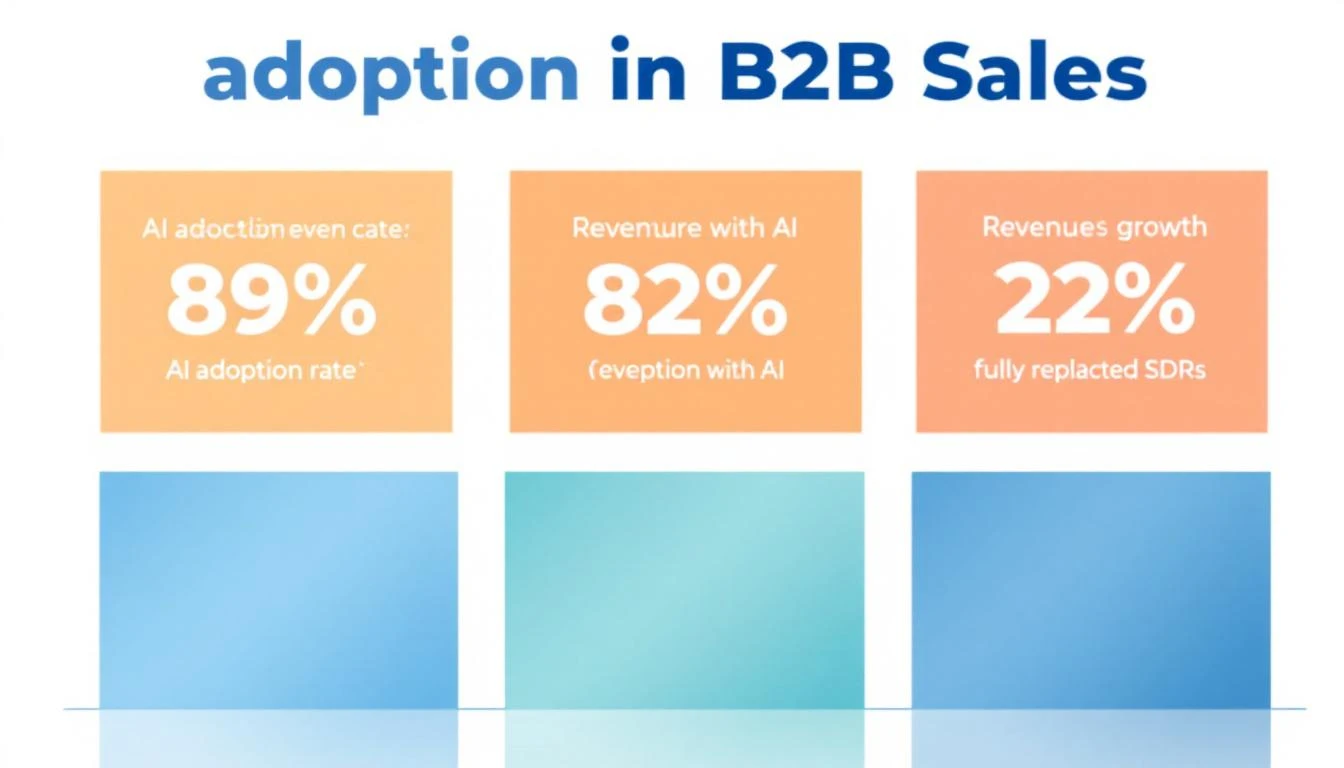
AI adoption statistics in B2B sales 2026

The State of AI Adoption: Near-Universal, Unevenly Appliedโ€‹

Let's start with the baseline. AI in B2B sales is no longer experimental โ€” it's mainstream. But "mainstream" doesn't mean "effective."

The headline numbers:

  • 89% of revenue organizations now use AI in some form โ€” up from 34% in 2023 (Martal Group, Forrester)
  • 88% of businesses report regular AI use in at least one function, up from 78% a year ago (Sopro)
  • 87% of sales organizations use AI for prospecting, forecasting, lead scoring, or drafting emails (Salesforce State of Sales 2026)
  • 92% of sales teams plan to increase AI investment in 2026 (HubSpot)

That looks like universal adoption. But dig deeper and you find a critical gap.

Deloitte Digital's February 2026 study of 1,060 B2B suppliers and buyers found that while 45% of suppliers say they use AI in sales, only 24% have touched agentic AI โ€” the autonomous, workflow-driving kind that actually replaces manual processes. Two-thirds of those not using agentic AI said they plan to. But planning isn't doing.

The data tells us: everyone has AI. Almost nobody has deployed it effectively.

The Performance Gap: AI-Enabled Teams Are Pulling Awayโ€‹

Here's the number that should keep every sales leader up at night.

83% of sales teams using AI saw revenue growth in the past year, versus 66% of teams without AI (Salesforce). That's a 17-percentage-point gap in revenue growth โ€” and it's widening.

More data points from across the studies:

MetricAI-Enabled TeamsNon-AI TeamsGap
Revenue growth83% saw growth66% saw growth+17 pts
Productivity improvementUp to 40%Baseline+40%
Sales cycle length25% shorterBaseline-25%
Revenue increase13-15%Baseline+13-15%
Sales ROI improvement10-20%Baseline+10-20%
ROI within first year86%N/Aโ€”

Sources: Salesforce State of Sales 2026, McKinsey, Sopro, MarketsandMarkets

Deloitte found an even starker divide. Digitally mature B2B suppliers exceeded annual sales growth targets by 110% more than low-maturity competitors. These mature organizations were five times more likely to use AI extensively and five times more likely to use agentic AI at all.

The takeaway: AI isn't a nice-to-have. It's creating a two-tier system in B2B sales. Teams with effective AI implementations are compounding their advantages while everyone else debates whether to adopt.

The AI SDR Paradox: Volume Up, Quality Downโ€‹

This is where the data gets uncomfortable for AI SDR vendors.

The AI SDR market is exploding โ€” projected to grow from $4.12 billion in 2025 to $15.01 billion by 2030 at a 29.5% CAGR (MarketsandMarkets). An estimated 22% of sales teams have fully replaced their human SDR function with AI. Another 55% are running AI-augmented workflows.

But here's the paradox the vendors won't tell you:

AI SDR tools churn at 50-70% annually โ€” roughly double the turnover rate of the human reps they replace (UserGems). And Gartner predicts over 40% of agentic AI projects will be abandoned by 2027.

The root cause? A quality gap:

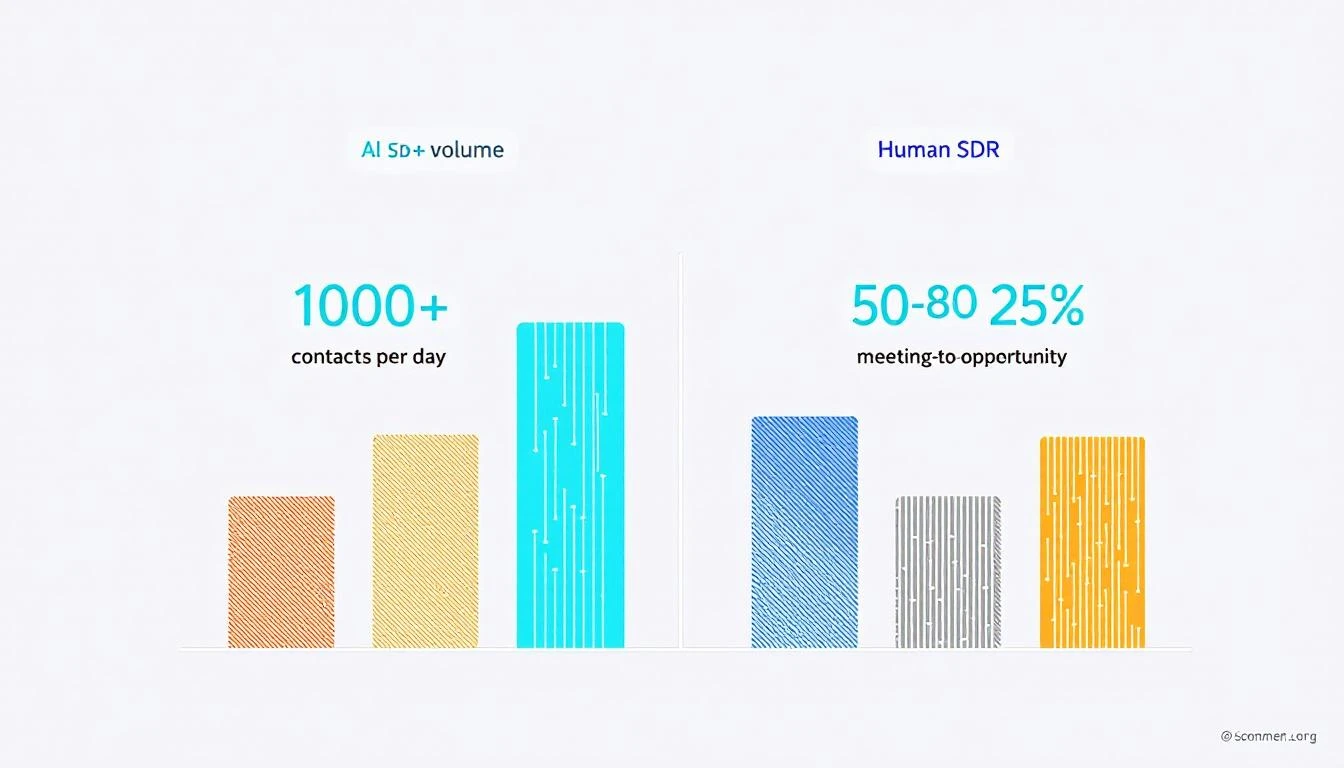
  • AI SDRs process 1,000+ contacts per day vs. 50-80 for a human rep (SuperAGI)
  • But AI SDRs convert meetings to opportunities at just 15% vs. 25% for human SDRs โ€” a 40% performance gap (SuperAGI)
  • Response to inbound: AI responds in seconds. First responder wins deals at 5x the rate of slower competitors
  • Follow-up: 44% of human reps give up after one attempt. AI never stops following up

So AI wins on volume and consistency but loses on conversion quality. The teams getting the best results? They're not choosing one or the other.
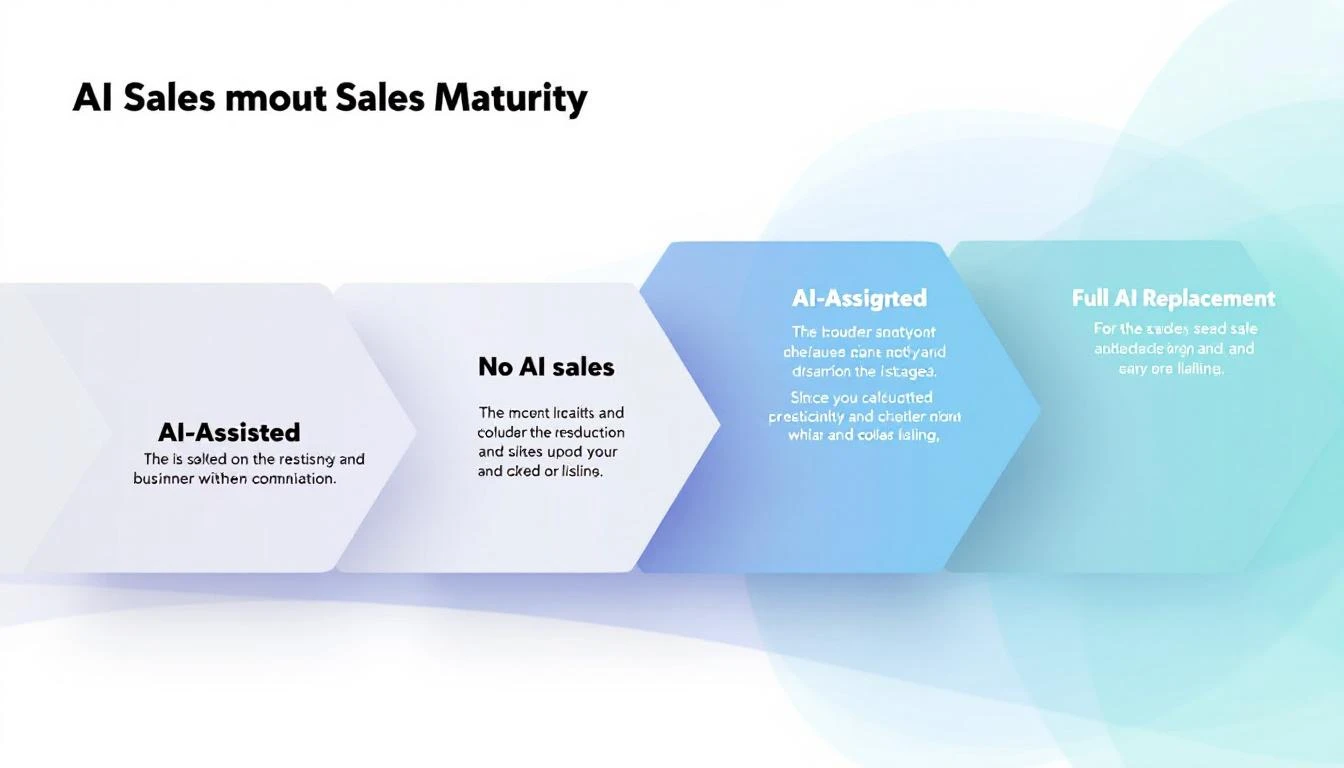
AI SDR maturity spectrum in 2026

The Winning Formula: Augmentation Beats Replacementโ€‹

Across every study we analyzed, one pattern emerges consistently: AI-augmented teams outperform both fully automated and fully manual teams.

The adoption spectrum breaks down like this:

Approach% of TeamsPerformance
Full AI replacement22%High volume, lower quality
AI-augmented (human + AI)~55%Highest overall performance
AI-assisted (copilot only)~15%Moderate improvement
No AI~8%Falling behind

Source: Autobound AI SDR Buying Guide 2026, cross-referenced with Salesforce and Topo.io data

The augmented model works because it pairs AI's strengths with human strengths:

Where AI excels (let it run):

  • Prospect identification and research (synthesizing SEC filings, hiring data, social activity in seconds vs. 30-60 minutes per prospect for humans)
  • Consistent follow-up cadences (AI never forgets, never has a bad day)
  • After-hours and surge inbound handling
  • Lead scoring and signal prioritization
  • Data enrichment and contact discovery

Where humans still win (keep them in the loop):

  • Complex objection handling
  • Relationship building and trust development
  • Nuanced multi-stakeholder negotiations
  • Creative problem-solving for unique prospect situations
  • Reading tone and emotional context

The SignalFire team put it perfectly after testing AI SDR tools in production: "The most successful sales organizations of the future won't be the ones that replace their SDRs with AI. They'll be the ones who empower them with it."

What's Actually Delivering ROI: The Signal-First Approachโ€‹

Here's where the data gets prescriptive. Not all AI sales investments deliver equal returns.

Tier 1: Proven ROI (Invest Now)โ€‹

Intent signals + lead prioritization

  • Conversion rates rise 20-30% when companies integrate predictive AI into their marketing and sales workflows (Sopro)
  • Only 24% of teams with intent data report exceptional ROI โ€” the difference is activation quality, not data quality (Autobound)
  • Signal-based prospecting generates 5.4x more pipeline with 33% fewer calls (from our prior signal quality analysis)

AI-powered research and personalization

  • AI research agents that surface job changes, funding events, and buying signals allow SDRs to write genuinely relevant outreach โ€” not template spam
  • This is where the highest-performing AI-augmented teams invest first: give humans better information, not better email templates

Chatbots for inbound qualification

  • The most straightforward and valuable use case according to multiple studies
  • Responds to every inbound lead instantly, qualifies, and books meetings 24/7
  • Some teams report 25-30% uplift in conversion just from better lead qualification and scoring

Tier 2: Promising But Conditional (Pilot Carefully)โ€‹

AI-generated email sequences

  • Volume is up. Deliverability is down. The inbox is a battleground.
  • Generic mass-personalized emails (name swap + company swap) get deleted immediately
  • What works: AI that researches THEN personalizes, not AI that templates at scale
  • Rule of thumb: if the AI writes the email AND sends it without human review, expect lower quality meetings

AI cold calling / voice agents

  • Latency and robotic feel remain issues
  • The winning pattern: AI makes the dial, AI qualifies interest, then transfers to a human immediately upon positive signal
  • Legal risks (TCPA, consent, autodialer definitions) remain significant

Tier 3: Overhyped (Proceed With Caution)โ€‹

Full SDR replacement

  • The 50-70% churn rate tells you everything
  • The 40% meeting-to-opportunity quality gap means you're trading SDR salary for lower-quality pipeline
  • Works only for very specific use cases: high-volume, low-ACV, simple sales motions

AI forecasting as a standalone tool

  • Garbage in, garbage out. AI forecasting is only as good as your CRM hygiene
  • Most teams don't have clean enough data to make AI forecasting meaningful
  • Better to fix pipeline stage definitions first, then add AI on top
AI vs human SDR performance comparison 2026

The ERP Problem Nobody Talks Aboutโ€‹

Deloitte's research surfaced a finding that most AI sales articles completely ignore.

87% of B2B suppliers are currently upgrading, preparing to begin, or planning ERP modernization within the next year. These projects are multi-million-dollar, multi-year initiatives that absorb the IT bandwidth that AI projects need.

As Deloitte's Paul do Forno noted: "They literally don't have the time. They need to get through the ERP running their business."

This means even when sales leaders want to deploy sophisticated AI, internal IT constraints are the real bottleneck โ€” not budget, not skepticism, not technology readiness. The suppliers pulling ahead are the ones who pair AI deployment with (not after) their ERP modernization, building tighter front-to-back integration.

For sales teams at mid-market companies: don't wait for IT to finish the ERP migration before starting your AI pilot. Choose tools that sit alongside your existing stack rather than requiring deep integration. Start with standalone signal tools and AI research assistants that don't need CRM integration to deliver value.

The Conversion Math Most Teams Get Wrongโ€‹

Here's a framework from the data that most sales leaders miss.

The median B2B conversion rate across all industries is 2.9%, with most falling between 2.0% and 5.0% (Martal Group). But the real bottleneck isn't top-of-funnel โ€” it's the middle.

MQL-to-SQL conversion: only ~15% of marketing-qualified leads convert to sales-qualified leads.

This means pouring more AI-generated leads into the top of your funnel without fixing the qualification gap just creates more waste. The highest-ROI AI investment for most teams isn't generating more leads โ€” it's better qualifying the leads you already have.

This is where signal-based selling changes the equation:

  1. Visitor identification tells you WHO is on your site
  2. Intent signals tell you WHAT they care about
  3. A daily playbook tells your SDR exactly WHAT TO DO about it

Most AI sales tools give you step 1 and maybe step 2. Very few connect the signal to the action. That connection is where the 20-30% conversion lift actually comes from.

What to Do Monday Morningโ€‹

Based on our meta-analysis, here's the priority stack for sales leaders who want to be on the winning side of the AI divide:

If you're spending nothing on AI sales tools:

  1. Start with an AI chatbot for your website (instant ROI, low risk)
  2. Add a signal/intent tool to prioritize your existing pipeline
  3. Use AI research tools to enrich prospect profiles before outreach

If you're already using AI but not seeing results:

  1. Stop measuring emails sent. Start measuring meetings booked and pipeline generated
  2. Move from full automation to human-in-the-loop augmentation
  3. Invest in signal quality over outreach volume
  4. Fix your MQL-to-SQL conversion gap before adding more top-of-funnel

If you're seeing good results and want to scale:

  1. Build a daily SDR playbook that converts signals into specific next actions
  2. Layer first-party intent (website visitors, chatbot conversations) with third-party signals
  3. Consolidate your tool stack โ€” the average SDR uses 7-12 tools, but the best teams use 3-4 integrated ones

The Bottom Lineโ€‹

AI in B2B sales isn't hype โ€” the 17-point revenue growth gap between AI-enabled and non-AI teams is real and widening. But how you deploy AI matters more than whether you deploy it.

The data is clear:

  • Augmentation beats replacement. Human + AI outperforms AI-only and human-only.
  • Signal quality beats outreach volume. Better leads beat more leads, every time.
  • Implementation quality is the variable. The technology works. The question is whether your team can operationalize it.
  • Start with signals, not sequences. Know who's buying before you decide what to send.

The teams winning in 2026 aren't the ones with the most sophisticated AI. They're the ones using AI to put the right signal in front of the right rep at the right time โ€” and then letting the human do what humans do best.


Want to see signal-based selling in action? MarketBetter turns intent signals into a daily SDR playbook that tells your team exactly who to contact, how to reach them, and what to say. Book a demo โ†’


Sourcesโ€‹

  1. Salesforce, State of Sales 2026
  2. Deloitte Digital, B2B Supplier Digital Maturity Study (Feb 2026)
  3. Martal Group, B2B Sales Statistics and Benchmarks 2026
  4. Sopro, 75 Statistics About AI in Sales and Marketing (2025)
  5. MarketsandMarkets, AI SDR Market Report (Aug 2025)
  6. Gartner, Strategic Predictions for 2026
  7. McKinsey, AI in Sales Performance (2025)
  8. HubSpot, State of AI in Sales (2025)
  9. SuperAGI, AI vs Traditional SDRs Performance Analysis
  10. Autobound, AI SDR Buying Guide 2026
  11. UserGems, Are AI SDRs Worth It? (2025)
  12. SignalFire, Expert Picks: AI SDR Tools (2026)
  13. Landbase, 35 B2B Sales Statistics (2026)
  14. Topo.io, AI SDR Adoption Survey (2025)
  15. Forrester, B2B Buyer Behavior (2026)
  16. Digital Commerce 360 / Deloitte Digital (Feb 2026)
  17. MarketsandMarkets / Fortune Business Insights projections
  18. Salesmate, AI Agent Adoption Statistics by Industry (2026)
  19. PwC, 2026 AI Business Predictions
  20. Netguru, AI Adoption Statistics (2025)

Is Outbound Dead in 2026? What 14 Studies and 170K+ Data Points Actually Say

ยท 10 min read
MarketBetter Team
Content Team, marketbetter.ai

Every quarter, someone on LinkedIn declares outbound dead. Again.

And every quarter, the same teams running signal-based outbound quietly book 15+ meetings a month while the "outbound is dead" crowd wonders why their inbound funnel can't keep up.

Here's the thing: they're both right. The old outbound โ€” spray-and-pray cold emails to purchased lists, generic sequences blasted at 5,000 contacts a week โ€” that outbound is dying. The numbers are brutal and getting worse.

But outbound itself? The motion of proactively reaching out to people who are likely to buy? That's never been more effective โ€” if you know who to reach, when to reach them, and what to say.

We pulled data from 14 major B2B sales studies published between 2024 and 2026, covering 170,000+ leads, 939 companies, and millions of sales activities. Here's what the numbers actually say.

The evolution of B2B outbound: spray-and-pray vs. signal-based selling

The Case Against Outbound (And Why It's Misleading)โ€‹

Let's start with the numbers that fuel the "outbound is dead" narrative. They're real, and they're ugly:

  • 91% of cold outreach emails get zero response (Backlinko, 2025)
  • Cold email reply rates hover at 1โ€“5% for most campaigns (SoPro, 2026; Mailshake, 2026)
  • Cold outreach conversion rates sit at 0.2โ€“2% from contact to customer (Martal Group, 2025)
  • 83.4% of SDRs fail to consistently hit quota (SalesSo, 2025)
  • 52% of outbound marketers say their efforts are "ineffective" (HubSpot, via SPOTIO 2026)

If you stopped here, you'd conclude outbound is a money pit. And for teams doing outbound the 2019 way โ€” buying lists, writing generic templates, and hoping for the best โ€” it absolutely is.

But the data tells a much more interesting story when you separate random outbound from signal-based outbound.

The Data That Proves Outbound Is Evolving, Not Dyingโ€‹

1. Buyers Still Want to Hear From Sellers (When It's Relevant)โ€‹

The loudest stat against outbound comes from buyer surveys. But the actual surveys tell the opposite story:

  • 82% of buyers accept meetings initiated through cold calls (RAIN Group, via Leads at Scale, 2026)
  • 81% of decision-makers engage with cold outreach when it's tailored to their company or context (SoPro Buyer Intelligence Report, 2026)
  • 79% of decision-makers reply to cold outreach when it's personalized and relevant (SoPro, 2026)

The pattern is clear. Buyers aren't rejecting outbound. They're rejecting irrelevant outbound. There's a massive difference.

2. Personalization Doubles Response Ratesโ€‹

Generic emails get generic results. The data shows exactly how much personalization matters:

  • Advanced personalization doubles cold email response rates โ€” 18% vs. 9% for generic (SoPro, 2026)
  • 89% of sales teams see positive ROI when using personalization in cold email campaigns (SoPro, 2026)
  • Emails referencing a specific trigger event (new hire, funding round, tech adoption) see 3x higher reply rates than standard personalization (name + company)

This isn't about {first_name} merge fields. It's about knowing that a prospect's company just visited your pricing page, that their competitor signed with you last month, or that they posted about the exact problem you solve.

3. Multichannel Outreach Crushes Single-Channel by 287%โ€‹

The single most important stat in modern outbound:

Outreach using email, phone, and LinkedIn together increases response rates by 287% compared to single-channel efforts. โ€” Martal Group, 2025

Multichannel outreach response rate comparison: single vs. multi-channel

Here's the breakdown from Optifai's study of 939 B2B SaaS companies:

ChannelConversion to Meeting
Cold call only2.0โ€“3.5%
Cold email only0.8โ€“2.0%
LinkedIn DM only2.0โ€“4.5%
Multi-touch sequence4.0โ€“7.0%

Multi-touch sequences convert at 2โ€“3x any single channel. Yet most SDR teams still run email-only or phone-only motions because their tools don't coordinate across channels.

4. Top SDRs Still Book 12โ€“15 Meetings Per Monthโ€‹

Despite the "outbound is dead" narrative, top-quartile SDRs consistently generate 12โ€“15 qualified meetings per month. The median sits at 8โ€“10. Elite performers (top 10%) hit 18+ meetings monthly (Optifai Pipeline Study, 2026; N=939).

The gap between top and bottom performers has never been wider:

Performance TierMonthly Meetings
Top 10% (elite)18+
Top 25%12โ€“15
Median8โ€“10
Bottom 25%4โ€“6

What separates them isn't effort. Bottom-quartile SDRs often make just as many calls. The difference is what they do before they pick up the phone: which accounts they target, what signals they act on, and how they sequence across channels.

5. Speed Still Wins โ€” But Almost Nobody Is Fast Enoughโ€‹

The data on speed-to-lead hasn't changed. What's changed is how few teams achieve it:

  • Responding within 5 minutes makes you 100x more likely to connect than waiting 30 minutes (InsideSales/XANT)
  • Average lead response time: 29+ hours (SalesSo, 2025)
  • 63% of leads never get a response at all (SalesSo, 2025)

The teams that respond fastest aren't doing it through heroic effort. They're using intent signals and automated triggers to surface the right leads the moment they show interest โ€” then routing them to reps with the context needed to have a real conversation.

What Actually Died: The Spray-and-Pray Modelโ€‹

The data points to a clear conclusion. Three things died:

1. Blind Cold Outreachโ€‹

Sending 5,000 emails to a purchased list with no intent data, no personalization beyond {company_name}, and no multi-channel follow-up. This approach now yields 0.2% conversion rates at best.

2. Volume-First Thinkingโ€‹

The old playbook: more dials = more meetings. But the data shows SDRs making 80+ calls/day with poor targeting often underperform those making 50 calls with better research (Optifai, 2026). Quality won the war against quantity.

3. Single-Channel Sequencesโ€‹

Email-only cadences. Phone-only blitzes. Any outreach strategy that doesn't coordinate across at least 2โ€“3 channels is leaving 287% response improvement on the table.

What Replaced It: Signal-Based Outboundโ€‹

The highest-performing SDR teams in 2026 share a common pattern. They don't start with a list. They start with a signal.

Signal-based outbound workflow: from detection to meeting

Here's the framework that the data supports:

Step 1: Detect the Signalโ€‹

Instead of cold lists, start with buying signals:

  • A target account visits your website (visitor identification)
  • A champion at a closed-lost account changes jobs
  • A prospect's company posts a role matching your use case
  • A competitor's customer complains on G2
  • A target account researches your category

Step 2: Enrich and Prioritizeโ€‹

Not all signals are equal. The teams booking 15+ meetings/month score and rank their signals:

  • Website visitor who hit the pricing page > homepage bounce
  • Return visitor (3rd visit this week) > first-time visitor
  • Decision-maker title > individual contributor
  • Signal from ICP company > outside-ICP company

Step 3: Orchestrate Multi-Channelโ€‹

Act on the signal within minutes across multiple channels:

  • Email personalized to the signal ("I noticed your team has been researching...")
  • Phone call with context (not a cold dial โ€” a warm call backed by data)
  • LinkedIn touch that references a relevant insight
  • AI chatbot that engages repeat visitors in real-time

Step 4: Let AI Handle the Repetition, Humans Handle the Conversationโ€‹

The data is clear: SDRs spend only 28โ€“39% of their time selling. The rest goes to research, CRM entry, and admin. The winning formula:

  • AI identifies and prioritizes signals automatically
  • AI drafts personalized outreach based on context
  • AI routes leads to the right rep with full context
  • Humans take the meetings, build relationships, and close

The Math: Why Signal-Based Outbound Is 4x More Efficientโ€‹

Let's run the numbers.

Traditional outbound (spray-and-pray):

  • 100 cold contacts per day
  • 2% reply rate = 2 replies
  • 20% of replies convert to meetings = 0.4 meetings/day
  • 20 working days = 8 meetings/month
  • Cost per meeting: $300โ€“$500 (factoring in fully loaded SDR costs)

Signal-based outbound:

  • 30 signal-triggered contacts per day (warm, intent-verified)
  • 8โ€“12% reply rate (personalized + multi-channel) = 3 replies
  • 40% of replies convert to meetings = 1.2 meetings/day
  • 20 working days = 24 meetings/month
  • Cost per meeting: $100โ€“$150

Same SDR. Same hours. 3x the meetings at 1/3 the cost. The difference is what happens before the outreach: signal detection, prioritization, and context.

The 5 Non-Negotiables for Outbound in 2026โ€‹

Based on the data across all 14 studies, here's what separates teams that are thriving from teams declaring outbound dead:

1. Visitor Identificationโ€‹

You can't respond to signals you can't see. Website visitor identification is no longer optional โ€” it's the foundation of modern outbound. Knowing which companies are researching you right now is the highest-intent signal available.

2. Multi-Channel Orchestrationโ€‹

Email + phone + LinkedIn in coordinated sequences. Not three separate efforts โ€” one orchestrated motion that adapts based on prospect engagement. The 287% improvement stat isn't theoretical. It's the baseline expectation.

3. Speed-to-Signal Responseโ€‹

Not just speed-to-lead. Speed-to-signal. When a target account hits your pricing page at 10:14 AM, the outreach should start by 10:20 AM. Manually? Impossible for most teams. Automated signal routing makes it systematic.

4. Daily Playbook (Not Just a Lead List)โ€‹

The SDR playbook isn't a static document anymore. It's a live, prioritized task list that updates throughout the day based on incoming signals. "Call these 15 accounts, in this order, because of these signals, saying these things." That's what eliminates the 60% of time SDRs waste on non-selling activities.

5. AI-Powered Personalization at Scaleโ€‹

Personalization doubles response rates, but doing it manually doesn't scale. AI SDR tools that draft contextual outreach based on real signals โ€” not just mail-merge tokens โ€” bridge the gap between personalization quality and outbound volume.

The Bottom Lineโ€‹

Outbound isn't dead. Lazy outbound is dead.

The data is unambiguous: buyers want to hear from sellers who understand their business, reference real context, and reach them through the right channel at the right time. That's not cold outreach โ€” that's signal-based selling.

The teams declaring outbound dead are the same teams still sending 5,000 generic emails a week and wondering why nobody replies. The teams quietly booking 15โ€“24 meetings a month are doing something fundamentally different: they're starting with signals, orchestrating across channels, and letting AI handle everything that isn't a human conversation.

The question isn't whether outbound works in 2026. The question is whether your outbound has evolved past 2019.


Ready to see what signal-based outbound looks like in practice? Book a demo โ†’ and we'll show you exactly which companies are visiting your site right now โ€” and what to do about it.

We Priced Out Every B2B Sales Stack in 2026 โ€” Here's What Teams Actually Pay

ยท 14 min read
sunder
Founder, marketbetter.ai

B2B GTM stack cost breakdown for 2026

The average B2B SDR uses 4 to 10 different tools every day (Source: UpLead, 2025). That's 4โ€“10 logins, 4โ€“10 tabs, 4โ€“10 invoices.

But here's the number nobody talks about: what does all of that actually cost?

Not the "starting at $49/mo" from landing pages. The real number โ€” after annual commitments, per-seat fees, credit overages, add-ons, and the enterprise pricing wall that shows up the moment you ask for a demo.

We did the math. We pulled real pricing data from 15+ sales tools across six categories โ€” CRM, sales engagement, intent data, enrichment, dialers, and AI SDR platforms โ€” and calculated the true total cost of ownership (TCO) for SDR teams of different sizes.

The results aren't pretty.


The Six Categories Every SDR Stack Needsโ€‹

Before we get into the numbers, here's what a modern B2B sales development stack typically includes:

  1. CRM โ€” Where deals live (HubSpot, Salesforce, Pipedrive)
  2. Sales Engagement โ€” Sequence automation, email cadences (Outreach, SalesLoft, Apollo)
  3. Intent Data / Signals โ€” Who's in-market right now (6sense, Bombora, MarketBetter)
  4. Data Enrichment โ€” Contact info, firmographics (ZoomInfo, Cognism, Clearbit)
  5. Dialer โ€” Calling at scale (Orum, Nooks, MarketBetter Smart Dialer)
  6. AI SDR / Automation โ€” AI-assisted prospecting and outreach (11x, Artisan, MarketBetter AI)

Most teams cobble together one tool from each category. Some use two. A few brave souls try to use all-in-ones.

Let's price out each layer.


Layer 1: CRM โ€” The Foundation You Can't Skipโ€‹

ToolStarting PriceMid-Market (5 Seats)Notes
HubSpot Sales Hub$20/user/mo (Starter)$500/mo (Professional)Professional tier required for sequences, automation
Salesforce Sales Cloud$25/user/mo (Essentials)$825/mo (Professional)Most teams need Professional at $165/user/mo
Pipedrive$14/user/mo$250/mo (Professional)Good value, but limited enterprise features
Close$49/user/mo$495/mo (Professional)Built-in calling โ€” reduces dialer need

Realistic CRM cost for a 5-SDR team: $250โ€“$825/mo

The gotcha with CRM pricing is that the "Starter" tier almost never has the features SDR teams need. Sequences, workflow automation, reporting dashboards โ€” all gated behind Professional or Enterprise tiers. HubSpot's jump from $20/user to $100/user at Professional is the most dramatic.


Layer 2: Sales Engagement โ€” Where the Bills Start Climbingโ€‹

This is where most SDR budgets blow up. Sales engagement platforms handle email sequences, call tasks, and multi-touch cadences.

ToolPer Seat/Month5-Seat Annual CostOur Deep Dive
Outreach$100โ€“$150/user/mo$6,000โ€“$9,000/yrFull pricing breakdown โ†’
SalesLoft$83โ€“$125/user/mo$5,000โ€“$7,500/yrFull pricing breakdown โ†’
Apollo$49โ€“$79/user/mo$2,940โ€“$4,740/yrFull pricing breakdown โ†’
Instantly$30โ€“$78/user/mo$1,800โ€“$4,680/yrFull pricing breakdown โ†’
Lemlist$32โ€“$79/user/mo$1,920โ€“$4,740/yrFull pricing breakdown โ†’
SmartLead$39โ€“$94/user/mo$2,340โ€“$5,640/yrFull pricing breakdown โ†’

Realistic sales engagement cost for a 5-SDR team: $250โ€“$750/mo

The hidden cost here isn't the seat price โ€” it's the annual commitment. Outreach and SalesLoft don't offer monthly contracts. You're signing a 12-month deal on day one, and renewal increases of 10โ€“20% are standard.

Apollo is the budget-friendly option, but once you need advanced features (AI scoring, dialer, advanced analytics), you're back to $79/user/mo โ€” which puts it on par with the "expensive" platforms.


Layer 3: Intent Data โ€” The Most Expensive Layer Nobody Budgets Forโ€‹

Intent data is where the sticker shock hits. These platforms tell you which accounts are actively researching solutions like yours. The problem? They price like it.

ToolStarting PriceMid-Market AnnualOur Deep Dive
6sense$25,000+/yr$40,000โ€“$100,000/yrFull pricing breakdown โ†’
Bombora$25,000+/yr$36,000โ€“$60,000/yrEnterprise-only, no self-serve
ZoomInfo + Intent$15,000+/yr (base)$30,000โ€“$60,000/yrFull pricing breakdown โ†’
Common RoomCustom pricing$24,000โ€“$48,000/yrFull pricing breakdown โ†’
Warmly$700/mo$8,400โ€“$15,000/yrFull pricing breakdown โ†’
MarketBetter$500/mo$6,000โ€“$18,000/yrBook a demo โ†’

Realistic intent data cost for a 5-SDR team: $700โ€“$5,000+/mo

Here's the uncomfortable truth about intent data pricing: you're paying for the signal, not the seat. 6sense and Bombora don't scale with your team size โ€” they scale with your TAM size, data volume, and integration requirements. A 5-person SDR team at a mid-market company easily spends $40Kโ€“$60K/year on intent data alone.

This is also the category with the most buyer's remorse. According to G2 reviews, the #1 complaint about 6sense and Bombora is "hard to prove ROI." You're paying enterprise prices for data that your SDRs may or may not act on.

The consolidation opportunity is massive here. Tools like MarketBetter bundle visitor identification, intent signals, AND the SDR playbook that tells reps what to do with those signals โ€” starting at a fraction of the standalone intent data cost. Learn more in our Complete Guide to B2B Intent Data.


Layer 4: Data Enrichment โ€” The Credit Trapโ€‹

Enrichment tools provide contact details (emails, phone numbers, firmographics). They all look affordable until you run out of credits.

ToolStarting PriceReal Cost (5 SDRs)Our Deep Dive
ZoomInfo$15,000/yr (3 seats)$30,000โ€“$60,000/yrFull pricing breakdown โ†’
CognismCustom (est. $15K+/yr)$20,000โ€“$40,000/yrMarketBetter vs Cognism โ†’
Clearbit (now Breeze)Bundled with HubSpot$0 (if HubSpot) or $12K+/yr standaloneMarketBetter vs Clearbit โ†’
ApolloIncluded in platform$2,940โ€“$4,740/yrCredits-based, overages common
Clay$149โ€“$800/mo$1,788โ€“$9,600/yrFull pricing breakdown โ†’

Realistic enrichment cost for a 5-SDR team: $250โ€“$2,500/mo

ZoomInfo is the gorilla here. At $15K minimum (annual-only contracts), it's often the single most expensive tool in an SDR's stack. And that's the starting price โ€” real-world costs typically land between $30K and $60K once you factor in credit overages and add-ons.

The credit model is designed to upsell. You start with 5,000 credits, burn through them in month two, and suddenly you're negotiating a mid-contract upgrade. Every enrichment vendor does this.


Layer 5: Dialer โ€” Calling Isn't Dead, But It's Expensiveโ€‹

SDR teams that do phone outreach (and the data says you should โ€” cold calls convert at 2.0โ€“3.5%) need a dedicated dialer.

ToolPer Seat/Month5-Seat AnnualNotes
Orum$200โ€“$300/user/mo$12,000โ€“$18,000/yrAI parallel dialer, premium tier
Nooks$150โ€“$250/user/mo$9,000โ€“$15,000/yrVirtual sales floor + dialer
PhoneBurner$127โ€“$152/user/mo$7,620โ€“$9,120/yrPower dialer, lower-end
Close (built-in)$0 extraIncluded with CRMBasic power dialer
MarketBetter Smart DialerIncluded$0 extraIncluded in platform โ†’

Realistic dialer cost for a 5-SDR team: $0โ€“$1,500/mo

Dialers are the category where consolidation pays off the most. If your CRM or sales engagement platform includes one, you save $9Kโ€“$18K/year. If you're paying for a standalone parallel dialer like Orum on top of Outreach on top of ZoomInfo... your per-SDR tooling cost is going to be eye-watering.

Check out our Best Sales Dialers for SDR Teams for a deeper comparison.


Layer 6: AI SDR Platforms โ€” The New (Expensive) Categoryโ€‹

AI SDR tools promise to automate prospecting, personalization, and outreach. They're also the most aggressively priced category in 2026.

ToolStarting Price5-SDR EquivalentOur Deep Dive
11x (Alice)$50,000+/yr$50,000+/yrFull pricing breakdown โ†’
Artisan (Ava)$750+/mo$9,000+/yrFull pricing breakdown โ†’
MonacoCustomEst. $24,000+/yrMarketBetter vs Monaco โ†’
UnifyCustomEst. $18,000+/yrMarketBetter vs Unify โ†’
MarketBetter$500/mo$6,000/yrBook a demo โ†’

Realistic AI SDR cost: $500โ€“$4,000+/mo

The AI SDR category is the Wild West of pricing. 11x charges $50K+ per year for a single AI agent โ€” roughly the cost of a junior human SDR. Artisan is more accessible but still commands $9K+ annually. Most of these tools are so new that pricing changes quarter to quarter.

The key question isn't "can AI replace my SDRs?" โ€” it's "does the AI tool integrate with my existing stack, or is it yet another silo?" More on this in our Best AI SDR Tools comparison.


The Total: Three Real-World GTM Stacks, Priced Outโ€‹

GTM stack tier comparison โ€” Budget vs Mid-Market vs Enterprise

Here's what it actually costs to equip a 5-SDR team in 2026, across three common configurations:

Stack A: "Bootstrap Budget" โ€” $1,200โ€“$2,400/moโ€‹

CategoryToolMonthly Cost
CRMHubSpot Starter or Pipedrive$100โ€“$250
Sales EngagementApollo or Instantly$200โ€“$400
Intent DataMarketBetter (includes visitor ID + signals)$500
EnrichmentApollo (included) or Clay Starter$0โ€“$150
DialerIncluded with MarketBetter$0
AI AutomationMarketBetter (included)$0
Total$800โ€“$1,300/mo
Per SDR$160โ€“$260/mo

This stack works for seed-stage and early Series A companies. The trade-off: you're running lean, which means your SDRs are doing more manual work โ€” but your tooling cost per rep is under $260/mo.

Stack B: "Mid-Market Standard" โ€” $3,500โ€“$5,500/moโ€‹

CategoryToolMonthly Cost
CRMHubSpot Professional or Salesforce$500โ€“$825
Sales EngagementOutreach or SalesLoft$500โ€“$750
Intent DataWarmly or MarketBetter Growth$700โ€“$1,500
EnrichmentZoomInfo (basic) or Cognism$1,250โ€“$2,000
DialerIncluded with Outreach or standalone$0โ€“$500
AI AutomationNone or basic$0
Total$2,950โ€“$5,575/mo
Per SDR$590โ€“$1,115/mo

This is where most Series B and established mid-market companies land. The jump from Stack A is dramatic โ€” enrichment alone can add $15Kโ€“$25K annually. And notice: no AI SDR automation. Most companies at this tier can't afford to layer AI on top of their existing stack.

Stack C: "Enterprise Full-Send" โ€” $8,500โ€“$15,000+/moโ€‹

CategoryToolMonthly Cost
CRMSalesforce Enterprise$1,650+
Sales EngagementOutreach + Gong$1,500โ€“$2,500
Intent Data6sense or Bombora$2,000โ€“$5,000
EnrichmentZoomInfo Advanced$2,500โ€“$5,000
DialerOrum or Nooks$1,000โ€“$1,500
AI Automation11x or custom$1,000โ€“$4,000
Total$9,650โ€“$19,000/mo
Per SDR$1,930โ€“$3,800/mo

Enterprise stacks routinely hit $100Kโ€“$200K+ per year for a 5-person SDR team. That's before headcount. A fully-loaded SDR (salary + tools + management overhead) at this tier costs the company $150Kโ€“$200K annually.

Read our outbound sales strategy guide for how to actually make this investment pay off.


The Tool Sprawl Tax: What Nobody Measuresโ€‹

SDR tool sprawl โ€” the hidden cost of too many tabs

Beyond the dollar cost, there's a productivity cost that's almost impossible to measure:

Context switching. Every time an SDR Alt-Tabs between ZoomInfo, Outreach, Salesforce, and Gong, they lose focus. Research from the American Psychological Association estimates that task-switching can consume up to 40% of productive time.

At the Optifai benchmark of 8โ€“10 qualified meetings per month for a median SDR, that means 3โ€“4 meetings per month are lost to tool friction alone.

Here's what that looks like in practice:

  • Step 1: Check intent signals in 6sense (Tab 1)
  • Step 2: Enrich the contact in ZoomInfo (Tab 2)
  • Step 3: Build a sequence in Outreach (Tab 3)
  • Step 4: Log the activity in Salesforce (Tab 4)
  • Step 5: Review the last call recording in Gong (Tab 5)
  • Step 6: Update the deal stage in your CRM (back to Tab 4)

Six steps, four tools, zero flow state.

This is why the industry is moving toward consolidation. Platforms that combine signals + engagement + dialer into one workflow โ€” like what we've built at MarketBetter โ€” eliminate the tab-switching tax and let SDRs stay in one place.

Our SDR Playbook Template Guide shows exactly how a consolidated workflow operates.


The Consolidation Math: Where the Real Savings Areโ€‹

Here's the financial case for stack consolidation, using real numbers:

Fragmented stack (Mid-Market Standard):

  • 5 tools ร— 5 SDRs = 25 licenses to manage
  • Annual cost: $35,000โ€“$67,000
  • Admin overhead: 1 RevOps person managing integrations (~$80K/yr fully loaded)
  • Total annual cost: $115Kโ€“$147K

Consolidated platform approach:

  • 1-2 tools ร— 5 SDRs = 5โ€“10 licenses
  • Annual cost: $10,000โ€“$25,000
  • Admin overhead: Minimal (one platform, native integrations)
  • Total annual cost: $10Kโ€“$25K

Annual savings: $90Kโ€“$120K โ€” enough to hire another SDR.

This isn't theoretical. Only 19% of companies increased SDR headcount in 2025 (Source: SaaStr), the lowest growth rate across all sales functions. Teams are consolidating tools and doing more with less.

The question isn't "which is the best tool in each category?" It's "which platform eliminates the most categories?"


Our Take: The Stack That Wins in 2026โ€‹

Based on our analysis of pricing across 15+ tools, here's what we'd recommend for a 5-SDR team targeting $500Kโ€“$5M ACV deals:

The essentials (pick your approach):

  1. CRM: HubSpot Professional ($500/mo) or Salesforce Professional ($825/mo) โ€” you need a CRM, period
  2. Everything else: A consolidated platform that combines signals + engagement + dialer + AI

Why "everything else" should be one platform:

  • Intent data as a standalone category is dying. Bombora's third-party intent data is being questioned by the very teams that buy it
  • Sales engagement platforms (Outreach, SalesLoft) are adding AI features, but they don't have their own intent signals
  • Enrichment providers (ZoomInfo) are adding engagement features, but they're bolted on, not native
  • The winner is whoever combines signal detection + recommended action + execution in a single workflow

This is exactly what MarketBetter's Daily SDR Playbook does: identifies who's on your site, enriches the contact, surfaces the intent signal, and tells your SDR exactly what to do next โ€” all in one screen. No tab-switching. No context loss. No $60K ZoomInfo invoice.

Start with our Best Sales Prospecting Tools guide to see how we compare across every category.


Methodologyโ€‹

This analysis used pricing data from the following sources:

  • Official pricing pages (accessed Februaryโ€“March 2026)
  • Vendr marketplace data for enterprise negotiated rates
  • G2 and Capterra reviews mentioning specific price points
  • Reddit r/sales threads with real user-reported costs
  • Our own published pricing breakdowns (linked throughout)

All prices are in USD. "Per seat" pricing assumes annual billing unless noted. Enterprise quotes are estimated ranges based on multiple sources โ€” actual quotes vary by company size, use case, and negotiation leverage.

For tool-specific deep dives, visit our pricing breakdown series:


Ready to Simplify Your Stack?โ€‹

If your SDR team is drowning in tools and your per-rep tooling cost is north of $1,000/mo, there's a better way.

MarketBetter combines visitor identification, intent signals, the daily SDR playbook, smart dialer, AI chatbot, and email automation โ€” starting at $500/mo. One platform. One login. One invoice.

Book a demo โ†’

Signal Quality vs. Speed to Lead: New Data Shows Why Fast Reps Lose Deals [2026]

ยท 12 min read
sunder
Founder, marketbetter.ai

Signal quality vs. speed: what actually predicts closed-won deals

Every sales leader has heard the stat: 78% of customers buy from the first company that responds.

It's cited in every speed-to-lead article, every sales enablement deck, and every cold calling training. It's become gospel.

But here's the problem with gospel โ€” nobody questions it.

What if I told you that the obsession with speed-to-lead is creating a generation of SDR teams that are fast but blind? Teams that respond in under 5 minutes to every lead โ€” including the ones that were never going to buy?

The real data tells a more nuanced story. Speed matters, but only when paired with signal quality. And most teams have the equation backwards.

The Speed-to-Lead Data Everyone Cites (And What It Actually Means)โ€‹

Let's start with what we know from the research:

  • 78% of customers buy from the first responder (MIT/InsideSales.com Lead Response Management Study)
  • Responding within 5 minutes = 21x more likely to qualify vs. 30 minutes (Harvard Business Review)
  • 391% more conversions when you respond within 1 minute vs. waiting (Velocify)
  • Average B2B response time: 42 hours (Drift/InsideSales.com)
  • 55% of companies take 5+ days to respond (Drift Lead Response Report)
  • 30% of leads never get contacted at all (Voiso)

These stats are real, well-sourced, and important. The speed-to-lead gap is massive โ€” most companies are embarrassingly slow.

But they're missing context. Here's what the same research doesn't tell you:

What was the signal quality of those leads?

The MIT study measured response time against inbound demo requests โ€” leads who explicitly raised their hand. Of course speed matters when someone says "I want to talk to you right now." That's peak intent.

But what about the lead who downloaded a whitepaper three weeks ago? The contact who visited your pricing page once at 2 AM? The MQL that marketing auto-scored because they opened two emails?

When you treat all leads the same โ€” and race to respond to every single one in under 5 minutes โ€” you create a different problem entirely.

The Hidden Cost of Speed Without Signalsโ€‹

Here's what the speed-to-lead orthodoxy produces in practice:

The SDR Productivity Crisisโ€‹

According to Salesforce's State of Sales report and multiple industry benchmarks:

  • SDRs spend only 18-30% of their time actually selling (Salesforce)
  • 70% of rep time goes to administrative tasks, data entry, research, and internal meetings (Gartner)
  • 43% of reps report administrative work consuming 10-20 hours per week (HubSpot, 2024 Sales Trends)
  • 83.4% of SDRs fail to consistently hit quota (SaleSo SDR Productivity Report, 2025)
  • Only 57% of reps reached targets in 2024 โ€” the lowest in five years (SaleSo)

The median SDR books 15 meetings per month. Top 25% hit 12-15 meetings/month, while the median sits at 8-10 (Optifai Pipeline Study, 2026, N=939 companies).

That means your average SDR is making 50-80 calls per day, sending 30-50 emails, and booking less than one meeting every two days.

The question isn't "how do we make them faster?" It's "how do we make them smarter about who they spend time on?"

Spray and pray vs. signal-first selling

The Signal Quality Framework: What Actually Predicts Closeโ€‹

Speed to lead measures how fast you respond. Signal quality measures who you respond to and why. The best teams optimize for both.

Here's a framework based on how high-performing SDR teams (the ones consistently in the top 25%) actually prioritize their day:

Tier 1: Active Buying Signals (Respond in Under 5 Minutes)โ€‹

These are the leads where speed genuinely determines the outcome:

  • Demo requests and pricing inquiries โ€” Someone explicitly asking to talk
  • Multiple stakeholders from the same account visiting your site in the same week
  • Champion job changes โ€” A former customer just started at a new company
  • Return visitors hitting pricing + product pages in the same session
  • Chatbot conversations where the prospect asks about implementation or pricing

For Tier 1 signals, the 5-minute rule absolutely applies. These buyers are in active evaluation mode. Every minute of delay is a gift to your competitor.

Benchmark: Tier 1 signals should convert to meetings at 40-60% when contacted within 5 minutes.

Tier 2: Warm Intent Signals (Respond Within 1 Hour)โ€‹

These prospects are researching but haven't declared intent:

  • Repeat website visits over 2+ weeks (visitor identification data)
  • Email engagement spikes โ€” opening 3+ emails in a sequence within 24 hours
  • Content consumption patterns โ€” downloading case studies, ROI calculators, comparison guides
  • Social engagement โ€” commenting on, sharing, or saving your posts
  • Technology evaluation signals โ€” visiting integration pages, API docs, or security/compliance pages

For Tier 2, speed still matters but signal richness matters more. An SDR who calls within 30 minutes but references the specific case study the prospect downloaded will outperform one who calls in 2 minutes with a generic pitch.

Benchmark: Tier 2 signals should convert to meetings at 15-25% with personalized outreach within 1 hour.

Tier 3: Passive Signals (Next Business Day, Sequenced)โ€‹

These are early-stage awareness signals that most platforms incorrectly score as high-priority:

  • Single website visit with no return
  • One email open without a click
  • Downloaded a generic whitepaper (often just for the content, not for buying)
  • Liked a LinkedIn post once
  • Visited your blog from an organic search (researching the topic, not necessarily your product)

Chasing Tier 3 signals with immediate phone calls is where most SDR teams waste the majority of their day. These prospects aren't ready for a sales conversation. A multi-touch nurture sequence is the correct play.

Benchmark: Tier 3 signals convert to meetings at 2-5% regardless of speed. Don't burn your best reps here.

Tier 4: Noise (Don't Contact)โ€‹

Some "leads" in your CRM aren't leads at all:

  • Bot traffic triggering visitor identification
  • Competitors researching your product
  • Job seekers looking at your careers page
  • Students downloading content for research papers
  • Recycled leads that have been contacted 5+ times with no response

Filtering noise before it reaches your SDRs is one of the highest-leverage investments a sales team can make. Every minute spent on a non-lead is a minute stolen from a Tier 1 signal.

The Math That Changes Everythingโ€‹

Let's model two SDR teams with identical resources โ€” 5 reps, 40 hours/week each.

Team A: Speed-First (Typical Approach)โ€‹

  • Responds to every lead in under 5 minutes
  • Makes 60 calls/day per rep (industry average)
  • No signal prioritization โ€” first in, first out
  • Connect rate: 8% (industry average for cold/warm blend)
  • Meeting conversion: 10% of connects

Monthly output: 5 reps ร— 60 calls ร— 20 days ร— 8% connect ร— 10% convert = 48 meetings

But wait โ€” those 48 meetings include Tier 3 and Tier 4 leads. When you factor in meeting quality:

  • 40% are qualified (fit ICP and have budget/authority) = 19 qualified meetings
  • Pipeline from qualified meetings at $25K ACV ร— 30% close rate = $142,500/month

Team B: Signal-First (Prioritized Approach)โ€‹

  • Responds to Tier 1 signals in under 5 minutes (20% of volume)
  • Responds to Tier 2 within 1 hour (30% of volume)
  • Sequences Tier 3 via automation (40% of volume)
  • Filters out Tier 4 entirely (10% of volume)
  • Makes 40 calls/day per rep (fewer calls, but targeted)
  • Connect rate: 18% (higher because prospects are warmer)
  • Meeting conversion: 22% of connects (higher because signal context enables personalization)

Monthly output: 5 reps ร— 40 calls ร— 20 days ร— 18% connect ร— 22% convert = 158 meetings

With better targeting, meeting quality jumps:

  • 65% are qualified = 103 qualified meetings
  • Pipeline: $25K ACV ร— 30% close rate = $772,500/month

Team B generates 5.4x more pipeline with 33% fewer calls. The difference isn't speed. It's signal intelligence.

Why the MQL-to-SQL Gap Is Actually a Signal Quality Problemโ€‹

Remember the stat from the Martal Group benchmarks: only 15% of MQLs convert to SQLs. This is the single largest drop-off point in the B2B sales funnel.

Most teams diagnose this as a "qualification criteria" problem. They tighten lead scoring rules, adjust point thresholds, or add more demographic filters.

But the real issue is simpler: most MQLs are Tier 3 and Tier 4 signals being treated as Tier 1.

When a prospect downloads a whitepaper (Tier 3), marketing scores them as an MQL. The SDR calls within 5 minutes. The prospect is confused โ€” they were just reading an article. The call goes nowhere. The MQL gets dispositioned as "not qualified."

The MQL wasn't bad. The prioritization was.

A signal-first approach would have:

  1. Noted the whitepaper download as a Tier 3 signal
  2. Added the prospect to a nurture sequence
  3. Waited for a Tier 2 signal (return visit, email engagement spike)
  4. Triggered SDR outreach only when the prospect showed genuine evaluation behavior

This single change โ€” routing based on signal tier instead of lead score โ€” can push MQL-to-SQL conversion from 15% to 30%+ by simply matching the right outreach to the right buyer stage.

Building a Signal-First SDR Operationโ€‹

If you're convinced that signal quality matters more than raw speed, here's how to operationalize it:

Step 1: Audit Your Current Signal Stackโ€‹

Map every signal source your team uses today:

Signal SourceSignal TypeCurrent PriorityShould Be
Demo formTier 1High โœ…High โœ…
Whitepaper downloadTier 3High โŒLow (sequence)
Website visit (1x)Tier 3Medium โŒLow (sequence)
Pricing page + product page same sessionTier 1Medium โŒHigh โœ…
Multi-stakeholder visits from same accountTier 1Not tracked โŒHighest โœ…
Champion job changeTier 1Not tracked โŒHigh โœ…
Email 3+ opens in 24hTier 2Not tracked โŒMedium โœ…
Competitor page visitTier 2Not tracked โŒMedium โœ…

Most teams will find that their highest-value signals aren't being tracked at all, while their lowest-value signals are generating the most SDR activity.

Step 2: Build Your Daily Playbook Around Signal Tiersโ€‹

Instead of a chronological call list, structure each SDR's day around signal priority:

First 2 hours: Tier 1 signals only โ€” these are your money calls. Prepare personalization (30 seconds per call to review signal context), then dial immediately.

Next 2 hours: Tier 2 signals โ€” slower, more consultative outreach. Reference their specific browsing behavior or content engagement. Send hyper-personalized emails that prove you know what they're evaluating.

Afternoon: Review and iterate โ€” check which Tier 3 sequences are generating Tier 2 signals. Refine messaging based on morning conversations. Update your signal audit.

Automation handles: All Tier 3 nurture sequences and Tier 4 filtering โ€” no human time spent.

Step 3: Measure Signal-Adjusted Metricsโ€‹

Stop measuring raw speed-to-lead as a single number. Break it down by signal tier:

MetricTier 1 TargetTier 2 TargetTier 3 Target
Response time<5 min<1 hourAutomated (same day)
Connect rate25%+15%+N/A (sequenced)
Meeting rate40%+15%+3-5% (from sequence)
Qualified rate60%+40%+20%+
Pipeline/meeting$30K+$20K+$15K+

This gives you a clear picture of where your pipeline actually comes from โ€” and it's almost always Tier 1 and Tier 2 signals driving 80%+ of qualified revenue.

SDR daily playbook powered by intent signals

Step 4: Invest in Signal Infrastructure, Not More Repsโ€‹

The typical response to "we need more pipeline" is "hire more SDRs." But the data shows that adding reps to a broken prioritization system just multiplies the waste.

Instead, invest in the signal stack:

  • Website visitor identification โ€” Know which companies are on your site and what pages they're viewing
  • Multi-stakeholder tracking โ€” Detect when multiple people from the same company are researching you (this is the strongest buying signal in B2B)
  • Champion tracking โ€” Get alerts when former customers or engaged contacts change jobs
  • Email intent analysis โ€” Move beyond open rates to engagement pattern detection
  • AI-powered signal routing โ€” Automatically tier signals and surface the right leads to the right reps at the right time

A single platform that handles signal detection, prioritization, and SDR workflows eliminates the biggest productivity drain: context switching between 7+ tools just to figure out who to call next.

The Bottom Line: Speed Is Table Stakes. Signal Intelligence Is the Advantage.โ€‹

The speed-to-lead research isn't wrong โ€” it's incomplete.

Yes, you should respond to high-intent signals in under 5 minutes. Absolutely. The data on that is ironclad.

But treating all leads as equally urgent โ€” blasting through a chronological call list as fast as possible โ€” is the reason 83% of SDRs miss quota, 70% of their day is wasted on non-selling activities, and the average MQL-to-SQL conversion sits at a miserable 15%.

The teams that win in 2026 aren't just fast. They're intelligently fast. They use signal quality to decide who gets immediate attention and who goes into a nurture sequence. They build their daily playbook around buyer behavior, not lead score thresholds.

The shift from speed-first to signal-first isn't incremental. It's the difference between 19 qualified meetings a month and 103.

The first responder doesn't always win. The first informed responder does.


See Signal-First Selling in Actionโ€‹

MarketBetter's Daily SDR Playbook automatically tiers your signals, surfaces your highest-priority prospects, and tells your reps exactly what to do next โ€” before they open 20 browser tabs.

Book a demo โ†’


Sourcesโ€‹

  • MIT/InsideSales.com Lead Response Management Study (Dr. James Oldroyd)
  • Harvard Business Review, "The Short Life of Online Sales Leads"
  • Velocify Lead Response Research
  • Drift/InsideSales.com Lead Response Report
  • Salesforce State of Sales Report
  • Gartner Sales Productivity Research
  • HubSpot 2024 Sales Trends Report
  • SaleSo SDR Productivity Report, 2025
  • Optifai Pipeline Study, 2026 (N=939 companies)
  • Martal Group B2B Sales Benchmarks, 2026
  • Voiso Lead Response Time Research

The SDR Productivity Crisis: 83% Miss Quota While Selling Just 2 Hours a Day [2026 Data]

ยท 11 min read
MarketBetter Team
Content Team, marketbetter.ai

SDR time allocation breakdown showing only 40% spent on actual selling activities

Here's the number that should alarm every sales leader: 83.4% of SDRs fail to consistently hit quota. Not occasionally miss โ€” consistently fail.

That's not a talent problem. It's a systems problem.

We pulled data from seven major studies published in 2024โ€“2026 โ€” covering 170,000+ leads, 114 B2B companies, and millions of sales activities โ€” to understand why SDR productivity has gotten worse despite a decade of increasingly sophisticated sales technology. The findings reveal a structural crisis hiding in plain sight.

The average SDR sells for roughly two hours a day. The rest disappears into CRM entry, lead research, tool switching, internal meetings, and manual tasks that technology was supposed to eliminate. Meanwhile, the leads they do work sit unanswered for an average of 29 hours โ€” and 63% never get a response at all.

This isn't a collection of disconnected statistics. It's a picture of an industry-wide failure to solve the core SDR problem: too many tools, not enough direction.

The Data: Where SDR Time Actually Goesโ€‹

Salesforce's 2026 State of Sales report dropped the most sobering stat of the year: sales reps spend 60% of their time on non-selling tasks. That means in an 8-hour workday, your SDRs are actively selling for just over 3 hours.

But the reality may be worse. When you break down what "selling" means in practice โ€” and remove time spent on call prep, pre-call research, and post-call logging that most teams still count as "selling" โ€” the actual time spent in live conversations with prospects drops below 2 hours.

Here's how the average SDR day breaks down according to aggregated data from Salesforce, InsideSales, and Bridge Group reports:

Activity% of DayHours (8hr day)
Active selling (calls, emails, demos)40%3.2 hrs
CRM data entry and admin21%1.7 hrs
Lead research and preparation17%1.4 hrs
Internal meetings12%1.0 hrs
Tool switching and context changes10%0.8 hrs

The 10% lost to tool switching is particularly insidious because it's invisible. Nobody tracks how many times an SDR alt-tabs between their CRM, email tool, dialer, LinkedIn, enrichment platform, and sales engagement software. But research on context-switching costs suggests each switch carries a cognitive penalty of 15โ€“25 minutes to fully refocus.

If your SDRs use 7+ tools (the B2B average), they're paying that penalty dozens of times daily.

The Speed-to-Lead Collapseโ€‹

The data on lead response times tells a story of an industry moving backward.

Lead response time decay curve showing conversion probability dropping rapidly after 5 minutes

The Timeline of Declineโ€‹

StudyYearKey Finding
Harvard Business Review201142-hour average response time
Velocify2016Responding within 1 minute = 391% higher conversion
InsideSales2021Only 0.1% of companies respond within 5 minutes
RevenueHero202463% of companies never respond; 29+ hour average
Workato202599%+ fail the 5-minute test; 11h 54m average email

Read that timeline again. In 2011, the average response time was 42 hours. In 2024, it's 29 hours for the companies that respond at all โ€” but 63% don't respond at all. The non-response rate nearly tripled from 23% in 2011 to 63% in 2024.

More tools. More automation. Worse results.

Why It Matters: The Revenue Mathโ€‹

The conversion impact is not linear. It's a cliff.

  • Within 1 minute: 391% higher conversion (Velocify)
  • Within 5 minutes: 9x more likely to convert (InsideSales)
  • Within 1 hour: 7x higher qualification rate vs. waiting longer (HBR)
  • After 24 hours: You're cold-calling someone who's already moved on

And here's the stat that should end every debate about speed to lead: 78% of buyers purchase from the first company that responds. Not the best product. Not the cheapest option. The first one to show up.

When your average response time is 29 hours, you're not competing for the deal. You're already out of it.

The Hidden Bottleneck Nobody Blamesโ€‹

Here's what most teams miss. The Workato study broke response time into two components:

Lead Response Time = Lead Processing Time + Rep Response Time

Most companies blame slow reps. The data shows the opposite. The average SDR responds within minutes of seeing a lead in their queue. But the lead takes hours to get routed to them.

The processing pipeline โ€” enrichment, lead-to-account matching, territory assignment, routing rules, round-robin logic โ€” is where deals go to die. The average personalized email response takes 11 hours and 54 minutes (Workato), and most of that delay is processing, not rep laziness.

You can't coach your way out of a broken routing system.

The Quota Attainment Crisisโ€‹

The headline number โ€” 83.4% of SDRs miss quota โ€” becomes less surprising when you see the underlying metrics:

  • Average meetings booked per month: 15 (Bridge Group)
  • Dials to connect: 18+ attempts per connection
  • Call-back rate: Under 1%
  • Cold email response rate: 1โ€“2%
  • Quality conversations per day: 3.6

That means your average SDR has fewer than 4 real conversations per day. To book 15 meetings from ~72 monthly connects, they need a 21% connect-to-meeting conversion rate. That's achievable for veterans. It's brutal for the 60% of SDRs in their first 12 months.

And tenure compounds the problem. Average SDR tenure is 6โ€“23 months. Just as someone becomes proficient, they promote out or leave. The team is perpetually in ramp mode.

What Top Performers Do Differentlyโ€‹

The data reveals a clear pattern separating the 16.6% who consistently hit quota:

1. They qualify ruthlessly. Companies with thorough qualification processes saw closing ratios jump from 11% to 40% (InsideSales). Top SDRs don't work more leads โ€” they work the right leads.

2. They use signal-based prioritization. Instead of working leads alphabetically or by age, elite SDRs prioritize by intent signals โ€” who's on the website right now, who just changed jobs, who's researching competitors.

3. They batch their day. The "Golden Hours / Platinum Hours" framework separates prime prospecting time (calls and outreach) from admin work. Top reps protect their selling time aggressively.

4. They hit 14.5% meaningful conversation rates with decision-makers โ€” nearly 4x the average โ€” through better targeting and personalization, not more volume.

The $2.7 Billion Waste Problemโ€‹

Let's put a dollar figure on this crisis.

B2B marketers spend over $4.6 billion annually on advertising to generate leads. An estimated $2.7 billion of that is wasted due to slow or nonexistent follow-up (Credofy). You're paying to generate demand and then letting it rot.

At the individual company level, the math is just as ugly. Consider a mid-market B2B company:

MetricValue
Monthly inbound leads200
Average deal value$15,000
Conversion rate (fast response)3%
Conversion rate (slow response)0.15%
Revenue lost monthly$8,550
Revenue lost annually$102,600

That's $100K+ per year lost โ€” not to bad marketing, not to a weak product, but to slow response. For most B2B companies, that's 1โ€“2 SDR salaries that could be funded by simply responding faster.

The AI Inflection Pointโ€‹

The good news: the industry is finally addressing this structurally, not just incrementally.

Comparison of the old SDR workflow with disconnected tools versus the new AI-powered unified workflow

AI adoption in sales has exploded from 39% to 81% in just two years (Salesforce). And the results are significant:

  • 46% productivity increase for teams using AI-powered sales tools
  • 20% increase in pipeline volume with AI implementation
  • 30% improvement in lead conversion rates
  • AI-powered personalization delivers 9.25% appointment rate โ€” better than most manual outreach

Salesforce reported that their own AI SDR agent created 3,200 opportunities in four months by working the low-score leads that human SDRs couldn't justify spending time on.

But here's the nuance the "AI will replace SDRs" crowd misses: AI doesn't replace selling. It replaces the 60% of the day that isn't selling.

The best implementations aren't replacing human SDRs with AI agents. They're using AI to:

  1. Eliminate processing delay โ€” Route, enrich, and prioritize leads in seconds, not hours
  2. Kill the research tax โ€” Pre-populate account context so reps don't spend 17% of their day Googling prospects
  3. Automate admin โ€” CRM updates, activity logging, and follow-up scheduling happen automatically
  4. Provide daily direction โ€” Instead of "here are your 200 leads, figure it out," AI tells the SDR exactly who to call, what to say, and why now

This is the difference between an AI that replaces the SDR and an AI that makes the SDR 3x more effective. The former is a race to commoditized outreach. The latter is how you win.

The Consolidation Imperativeโ€‹

The average B2B sales team uses 7โ€“12 tools across prospecting, enrichment, engagement, dialing, and analytics. At $1,500โ€“$4,000 per user per month, that's an enormous expense delivering a 40% selling rate and 29-hour response times.

The answer isn't another tool. It's fewer tools that do more.

Organizations with well-integrated enablement tech stacks are 42% more likely to boost sales productivity (Highspot). Integration isn't a nice-to-have. It's the difference between 3-hour and 6-hour selling days.

What does the right consolidated stack look like?

  • Signal layer: Website visitor identification, intent data, buying signals in one view
  • Enrichment layer: Contact data, company data, and champion tracking without manual lookups
  • Execution layer: Email, dialer, and multi-channel outreach from one interface
  • Intelligence layer: AI that tells the SDR what to do next โ€” not just shows data and makes them figure it out

This is what "from 20 tabs to one task list" actually means in practice.

What to Do About Itโ€‹

If you're a sales leader reading this data and recognizing your own team, here's the playbook:

1. Audit Your True Selling Timeโ€‹

Have each SDR log their actual activities for one week. Not what the CRM says โ€” what they actually did. You'll likely find selling time closer to 2 hours than the 3.2 you assumed.

2. Measure Lead Processing Time Separatelyโ€‹

Break your response time into processing (system) and rep response (human). Fix the system first โ€” it's usually the bigger bottleneck and doesn't require behavior change.

3. Cut Your Stack, Don't Add To Itโ€‹

Every tool you add increases context-switching cost. Before buying tool #8, ask: can tool #3 do this if I configured it properly? Tool consolidation is the highest-ROI move in sales ops right now.

4. Move From Data Dashboards to Daily Playbooksโ€‹

Your SDRs don't need more data. They need direction. A daily prioritized task list โ€” who to call, what to say, and why today โ€” eliminates the 17% research tax and dramatically improves response times.

5. Adopt AI for the Non-Selling 60%, Not the Selling 40%โ€‹

The highest-impact AI use cases in sales aren't automated email blasts. They're lead routing in seconds instead of hours, automatic enrichment, CRM auto-updates, and intelligent prioritization. Keep humans on the conversations. Let AI handle everything else.

The Bottom Lineโ€‹

The SDR productivity crisis isn't caused by lazy reps. It's caused by:

  • Tool sprawl that eats 10%+ of every day in context switching
  • Processing delays that turn hot leads cold before reps ever see them
  • Data overload without direction โ€” dashboards instead of playbooks
  • Constant ramp from 6โ€“23 month average tenure

The teams solving this aren't buying more tools. They're consolidating into platforms that combine signals, enrichment, and execution into a single daily SDR workflow โ€” and using AI to eliminate the 60% of the day that was never selling to begin with.

The data is clear: the gap between top-performing SDR teams and everyone else is no longer effort. It's architecture.


Want to see what an AI-powered SDR workflow looks like in practice? Book a demo โ†’


Sourcesโ€‹

  • Salesforce State of Sales Report, 2026
  • RevenueHero Lead Response Study, 2024 (1,000+ companies)
  • Workato Lead Response Time Study, 2024โ€“2025 (114 B2B companies)
  • InsideSales.com Lead Response Study, 2021 (55M activities, 5.7M leads)
  • Harvard Business Review (Oldroyd, McElheran, Elkington), 2011 (15K leads)
  • Velocify Lead Response Analysis, 2016 (millions of records)
  • Highspot State of Sales Enablement Report, 2025
  • Bridge Group SDR Metrics and Compensation Report
  • Credofy B2B Lead Response Framework

The Real Cost of Building a B2B Sales Tech Stack in 2026: A Data-Driven Breakdown

ยท 12 min read
MarketBetter Team
Content Team, marketbetter.ai

Here's a number that should terrify every VP of Sales: sellers who feel overwhelmed by their tech stack are 43% less likely to hit quota. Not slightly less likely. Nearly half as likely.

Yet somehow, the average B2B sales organization keeps adding tools. More point solutions. More logins. More invoices. The 2025 B2B sales benchmarks show organizations now average 8.3 tools per SDR at roughly $187 per rep per month โ€” and that's the conservative estimate.

We dug into the actual pricing of every major sales tool category to answer a question nobody wants to ask out loud: What does it really cost to equip an SDR team in 2026?

The answer isn't pretty.

B2B Sales Tech Stack Cost Breakdown

The 7 Tool Categories Every SDR Team Pays Forโ€‹

Before we get to the numbers, let's map the categories. A fully equipped outbound SDR team typically needs tools across seven distinct functions:

  1. CRM โ€” The system of record (Salesforce, HubSpot)
  2. Data Provider โ€” Contact and company information (ZoomInfo, Apollo, Cognism)
  3. Sales Engagement โ€” Email sequences, cadences, multi-channel orchestration (Outreach, SalesLoft)
  4. Visitor Identification โ€” Website deanonymization and intent signals (Warmly, Clearbit, 6sense)
  5. Dialer โ€” Power/parallel dialing for phone outreach (Orum, Nooks, Kixie)
  6. Enrichment โ€” Data append, job change tracking, technographic data (Clearbit, Clay, Lusha)
  7. Conversation Intelligence โ€” Call recording, coaching, deal insights (Gong, Chorus)

Some teams add an eighth: chatbot or live chat for inbound conversion. Others add a ninth: ABM/advertising for targeted display campaigns. The sprawl adds up fast.

What Each Category Actually Costsโ€‹

We pulled publicly available pricing data, G2 reviews, analyst reports, and vendor disclosures to build a realistic picture of what each tool category costs per seat, per year. Where vendors hide pricing (looking at you, ZoomInfo and 6sense), we used reported ranges from customer reviews and industry benchmarks.

1. CRM: $0โ€“$1,800/user/yearโ€‹

ToolAnnual Cost Per UserNotes
HubSpot (Free)$0Limited features, fine for tiny teams
HubSpot Sales Hub Pro$1,080/yr ($90/mo)Most common SMB choice
Salesforce Sales Cloud Pro$1,200/yr ($100/mo)Enterprise standard
Salesforce Enterprise$1,980/yr ($165/mo)With forecasting + pipeline inspection
Pipedrive Advanced$396/yr ($33/mo)Budget-friendly alternative

Typical mid-market spend: $1,000โ€“$1,500/user/year

2. Data Provider: $600โ€“$15,000+/user/yearโ€‹

This is where the sticker shock hits. Data is the most expensive variable in any sales stack.

ToolAnnual Cost Per UserNotes
Apollo.io Basic$588/yr ($49/mo)Limited credits, common starter
Apollo.io Professional$1,188/yr ($99/mo)Uncapped emails, better data
Cognism$1,500โ€“$3,000/yr (est.)European data strength
Lusha Pro$432/yr ($36/mo)Phone number focused
ZoomInfo Professional$14,995+/yr (platform)Per-seat pricing unclear, annual contracts
ZoomInfo Advanced$24,995+/yr (platform)With intent data

Typical mid-market spend: $1,200โ€“$5,000/user/year (varies wildly by vendor)

3. Sales Engagement: $1,200โ€“$1,800/user/yearโ€‹

ToolAnnual Cost Per UserNotes
Outreach Standard$1,200โ€“$1,800/yr (est.)Custom pricing, annual only
SalesLoft Advanced$1,500โ€“$1,800/yr (est.)Now owned by Vista Equity
Apollo.io (built-in)Included in data planBasic sequencing
Instantly$360/yr ($30/mo)Email-only, volume play
Reply.io$708/yr ($59/mo)Multi-channel

Typical mid-market spend: $1,200โ€“$1,800/user/year for dedicated engagement platforms

4. Visitor Identification: $4,200โ€“$100,000+/yearโ€‹

This category has the widest pricing range in all of B2B sales tech. It's also where teams often get the least value for their spend.

ToolAnnual Cost (Platform)Notes
Warmly$8,400โ€“$18,000/yr ($700โ€“$1,500/mo)SMB-focused
Clearbit$12,000โ€“$50,000+/yrNow part of HubSpot
6sense Growth$25,000โ€“$60,000+/yrEnterprise ABM platform
6sense Enterprise$60,000โ€“$100,000+/yrFull suite
Demandbase$30,000โ€“$80,000+/yrEnterprise only
RB2B$4,200/yr ($350/mo)Startup, person-level ID

Typical mid-market spend: $8,000โ€“$30,000/year (platform-level, not per seat)

5. Dialer: $600โ€“$1,800/user/yearโ€‹

ToolAnnual Cost Per UserNotes
Orum$1,200โ€“$1,800/yr (est.)AI parallel dialer
Nooks$1,200โ€“$1,500/yr (est.)Virtual sales floor + dialer
Kixie$420/yr ($35/mo)Click-to-call, basic
PhoneBurner$1,668/yr ($139/mo)Power dialer

Typical mid-market spend: $1,000โ€“$1,500/user/year

6. Enrichment: $1,200โ€“$12,000/yearโ€‹

ToolAnnual CostNotes
Clay$4,788โ€“$9,588/yr ($399โ€“$799/mo)Waterfall enrichment, usage-based
Clearbit (standalone)$12,000โ€“$50,000+/yrEnterprise enrichment
Lusha (enrichment)$432โ€“$1,068/yrPhone + email append
People Data LabsUsage-basedAPI pricing

Typical mid-market spend: $3,000โ€“$8,000/year (platform-level)

7. Conversation Intelligence: $1,200โ€“$3,600/user/yearโ€‹

ToolAnnual Cost Per UserNotes
Gong$1,200โ€“$3,600/yr (est.)Market leader, custom pricing
Chorus (ZoomInfo)Bundled with ZoomInfoHard to price standalone
Fireflies.ai Pro$228/yr ($19/mo)AI meeting notes
Clari Copilot$1,200+/yr (est.)Revenue intelligence

Typical mid-market spend: $1,200โ€“$2,400/user/year

The Total: What a 5-Person SDR Team Actually Paysโ€‹

Let's put it all together. Here's what a typical B2B company with 5 SDRs spends across three common stack configurations:

Scenario A: Budget Stack (Startup, Series A)โ€‹

CategoryToolAnnual Cost
CRMHubSpot Sales Hub Starter$900 (2 seats free + 3 paid)
Data + EngagementApollo.io Professional$5,940 (5 ร— $99/mo)
Visitor IDRB2B$4,200
DialerKixie$2,100 (5 ร— $35/mo)
EnrichmentIncluded in Apollo$0
Conversation IntelFireflies.ai$1,140 (5 ร— $19/mo)
Total$14,280/year
Per SDR$2,856/year

Scenario B: Mid-Market Stack (Series B/C, 50-200 employees)โ€‹

CategoryToolAnnual Cost
CRMSalesforce Pro$6,000 (5 ร— $100/mo)
DataZoomInfo Professional$14,995 (platform)
EngagementOutreach$7,500 (5 ร— $125/mo est.)
Visitor IDWarmly$10,800 ($900/mo)
DialerOrum$7,500 (5 ร— $125/mo est.)
EnrichmentClay$5,988 ($499/mo)
Conversation IntelGong$9,000 (5 ร— $150/mo est.)
Total$61,783/year
Per SDR$12,357/year

Scenario C: Enterprise Stack (500+ employees)โ€‹

CategoryToolAnnual Cost
CRMSalesforce Enterprise$9,900 (5 ร— $165/mo)
DataZoomInfo Advanced$24,995 (platform)
EngagementOutreach + SalesLoft$12,000 (some teams run both)
Visitor ID6sense Growth$40,000 (platform)
DialerOrum Enterprise$10,000 (5 seats est.)
EnrichmentClearbit + Clay$18,000
Conversation IntelGong Enterprise$15,000 (5 seats est.)
ABM/AdsDemandbase$30,000
Total$159,895/year
Per SDR$31,979/year

Read that again. An enterprise sales team can easily spend $32,000 per SDR per year on software alone โ€” before salary, benefits, or management overhead.

Fragmented vs Consolidated Tech Stack

The Hidden Costs Nobody Talks Aboutโ€‹

The tool licenses are just the invoice line items. The real costs are harder to see:

Integration Taxโ€‹

Every tool needs to connect to every other tool. CRM syncs with engagement. Engagement syncs with data. Data syncs with enrichment. That's a combinatorial explosion of API connections, each one a potential failure point.

Most mid-market teams spend 10-15 hours per month managing integrations, troubleshooting sync failures, and deduplicating records across platforms. At a RevOps salary, that's $3,000-$5,000/year in hidden labor.

Context-Switching Costโ€‹

Here's the stat that should change how you think about your stack: SDRs spend only 28% of their time actually selling. The rest? Logging activities, switching between tools, finding the right data, and formatting reports.

With 8+ tools, an SDR might tab-switch hundreds of times per day. Each switch costs 23 minutes of refocused attention (according to UC Irvine research on task switching). The cumulative productivity loss is staggering.

Ramp Time Multiplicationโ€‹

Average SDR ramp time is already 3.1-3.2 months. But that assumes they're learning one workflow. When you add 8 separate tools โ€” each with its own UI, its own logic, its own quirks โ€” ramp time quietly extends to 4-5 months.

And with average SDR tenure at just 14-16 months, that means you get roughly 9-10 months of productive output before you start over. You're paying ramp costs every single year for each seat.

Vendor Lock-In and Annual Contractsโ€‹

Most enterprise sales tools require annual contracts with 30-60 day cancellation windows. If a tool isn't working after month 3, you're paying for 9 more months of shelfware. ZoomInfo and 6sense are notorious for this โ€” teams report paying for features they never implemented.

The Real Fully Loaded Cost Per SDRโ€‹

Let's combine tool costs with the human costs from industry benchmarks to see the full picture:

Cost ComponentConservativeMid-RangeEnterprise
Cash compensation (base + variable)$75,000$85,000$95,000
Benefits and payroll taxes (28%)$21,000$23,800$26,600
Tech stack (from scenarios above)$2,856$12,357$31,979
Management + enablement allocation$10,000$18,000$25,000
Recruiting + ramp + turnover (annualized)$10,000$20,000$30,000
Fully Loaded Annual Cost Per SDR$118,856$159,157$208,579

The turnover line is the killer. Replacing a single SDR costs an estimated $100,000+ when you factor in recruiting fees, lost pipeline, onboarding time, and management bandwidth. With average tenure at 14-16 months, you're essentially baking $35,000-$50,000 in annual churn cost into every SDR seat.

SDR Total Cost of Ownership

The Consolidation Opportunityโ€‹

Here's what the data tells us: most of the cost isn't in individual tools โ€” it's in having too many of them.

The hidden costs (integration tax, context-switching, extended ramp, shelfware) dwarf the visible ones. A team running 8 tools at $8,000/year each isn't actually paying $64,000 โ€” it's paying $64,000 + $15,000 in integration labor + $30,000 in lost productivity + $10,000 in extended ramp. The real cost is closer to $119,000.

What if you could collapse 5-6 of those tools into one?

That's the thesis behind platform consolidation in sales tech. Instead of a CRM + separate data provider + separate engagement platform + separate visitor ID + separate dialer + separate enrichment, you run a unified system that handles the full workflow:

  • Signal capture (visitor ID + intent data + job changes) โ†’ no separate 6sense or Warmly subscription
  • Contact enrichment (email + phone + firmographics) โ†’ no separate ZoomInfo or Clearbit contract
  • Sequence orchestration (email + phone + LinkedIn) โ†’ no separate Outreach or SalesLoft license
  • Dialer (click-to-call with AI prep) โ†’ no separate Orum subscription
  • Daily playbook (prioritized actions, not raw data) โ†’ no separate dashboard to interpret

The math gets compelling fast. A mid-market team paying $61,783/year across 7 tools could consolidate to a unified platform at $15,000-$25,000/year โ€” a 60-75% reduction in tool spend, plus the elimination of integration tax, faster ramp, and less context-switching.

The Decision Framework: Should You Consolidate?โ€‹

Not every team should consolidate tomorrow. Here's how to think about it:

Consolidate If...โ€‹

  • You have 6+ tools and your SDRs complain about tab-switching
  • Your RevOps team spends more than 10 hours/month on integration maintenance
  • New SDR ramp takes more than 3 months due to tool complexity
  • You're paying for features you don't use across multiple platforms
  • Your cost per held meeting is above $500

Stay Fragmented If...โ€‹

  • You have a dedicated RevOps team that manages integrations well
  • You've negotiated strong enterprise discounts with existing vendors
  • Your team is 20+ SDRs and switching costs are prohibitive in the short term
  • Specific tools are deeply embedded in your workflow with no alternative

The Audit Checklistโ€‹

Run this audit quarterly to find consolidation opportunities:

  1. List every tool with per-seat cost and actual monthly active users
  2. Identify overlap โ€” are 2+ tools providing the same data or function?
  3. Calculate integration hours โ€” how much RevOps time goes to keeping tools in sync?
  4. Survey your SDRs โ€” which tools do they actually open daily vs. never?
  5. Measure cost per held meeting โ€” the only metric that connects tool spend to pipeline

What the Smartest Teams Are Doing in 2026โ€‹

The trend is unmistakable. Only 19% of companies increased SDR headcount in 2025 โ€” the lowest growth rate across all sales functions (SaaStr). Teams aren't adding reps. They're making existing reps more productive by reducing the cognitive overhead of a fragmented stack.

The winners in 2026 are doing three things differently:

1. Choosing platforms over point solutions. Instead of best-of-breed for every function, they pick one platform that covers 70-80% of their needs and add 1-2 specialized tools for the rest. The integration savings alone pay for the trade-off.

2. Measuring cost per held meeting, not cost per tool. A $50,000/year platform that delivers 200 held meetings ($250 each) beats a $20,000 stack that only delivers 60 ($333 each). Total cost of ownership matters more than line-item pricing.

3. Prioritizing speed to lead over data volume. The MIT/InsideSales study still holds: 35-50% of sales go to the vendor that responds first. A tool that tells you WHO is interesting but useless. A tool that tells you WHO + WHAT TO DO + WHEN is worth 10x more.

The Bottom Lineโ€‹

The average B2B sales team is spending $47,000-$156,000/year on tools for a 5-person SDR team โ€” and getting maybe 60% of the value they're paying for. The other 40% leaks out through integration failures, context-switching, shelfware, and extended ramp times.

The question isn't "which tools should I buy?" It's "how few tools can I run while capturing 90% of the functionality?"

Every tool you eliminate isn't just a canceled invoice. It's one fewer login for your SDRs to remember, one fewer integration to maintain, one fewer vendor to negotiate with, and one less thing standing between your rep and a booked meeting.

The most expensive sales tech stack is the one your team doesn't use.


Ready to Consolidate Your Sales Tech Stack?โ€‹

MarketBetter combines visitor identification, intent signals, email sequences, smart dialer, AI chatbot, and a daily SDR playbook into one platform โ€” starting at $99/user/month.

Stop paying for 8 tools. Start booking meetings with one.

Book a demo โ†’