35 posts tagged with "lead generation"

View All Tags

Best B2B Demand Generation Tools in 2026 [15 Platforms for Pipeline Growth]

· 20 min read
MarketBetter Team
Content Team, marketbetter.ai

Best B2B Demand Generation Tools in 2026

Your marketing team ran 47 campaigns last quarter. Some worked. You think. But you can't actually connect the LinkedIn ads, the webinar, the email sequence, and the blog post to the three deals that closed.

That's the demand generation measurement problem — and it's why most B2B teams are flying blind on what's actually generating pipeline.

The tools in this guide don't just help you run demand gen programs. They help you understand which activities turn into pipeline, which accounts are actually engaged, and where your next 10 deals will come from.

We evaluated 15 platforms across the full demand generation stack — from intent signal capture to campaign execution to pipeline attribution. Here's what actually works for B2B teams in 2026.

What Demand Generation Actually Means in 2026

Demand gen isn't lead gen. Lead gen captures names. Demand gen creates the conditions where prospects want to talk to your sales team.

In 2026, the best demand generation programs share these characteristics:

Signal-first, not spray-and-pray. Instead of blasting 50,000 emails and hoping someone responds, modern demand gen identifies which accounts are already showing interest (website visits, content consumption, competitor research) and focuses resources there.

Multi-channel orchestration. Buyers don't live in one channel. They see your LinkedIn ad, visit your website, download a guide, and attend a webinar — often over weeks. The best tools connect these touchpoints into a coherent journey.

Pipeline attribution, not vanity metrics. Opens and clicks don't pay the bills. The tools that matter in 2026 connect marketing activities to actual pipeline and revenue.

Sales-marketing alignment. Demand gen fails when marketing generates "leads" that sales ignores. The best platforms create a shared view of account engagement so both teams focus on the same targets.

The 15 Best Demand Generation Tools Compared

1. MarketBetter

Best for: B2B teams that want to identify demand signals from their own website and turn them into SDR action.

MarketBetter's approach to demand generation starts where most tools stop — your website. The platform identifies which companies are visiting your site, which pages they're viewing, and how often they return. But unlike standalone visitor ID tools that just hand you a list of company names, MarketBetter connects those signals to your outbound execution.

When a target account visits your pricing page, your SDR gets a prioritized task in their Daily Playbook: "Call [Company] — VP Sales viewed pricing page 3x this week." When multiple stakeholders from the same company engage with your emails, the platform flags the account for multi-threaded outreach.

The AI chatbot captures intent from visitors who aren't ready to fill out a form, creating conversation-driven pipeline that most demand gen tools miss entirely. And the email automation layer lets you run hyper-personalized sequences based on the behavioral signals the platform captures.

This is demand generation as a closed loop: identify intent → prioritize accounts → execute outreach → measure results — all in one platform.

Key demand gen capabilities:

  • Website visitor identification with company-level and page-level detail
  • Daily SDR Playbook turns intent signals into prioritized actions
  • AI chatbot captures demand from anonymous visitors
  • Email automation with behavioral triggers
  • Smart dialer for warm outreach to high-intent accounts
  • Multi-stakeholder engagement tracking

Pricing: $99/user/month - one plan with everything included: visitor ID, AI chatbot, email automation, smart dialer, daily SDR playbook, 5M AI credits + 500 enrichment credits per seat. No contracts.

Why it's different: Most demand gen tools help you create awareness. MarketBetter captures the demand that already exists on your website and converts it into pipeline before competitors know those accounts are in-market.

Book a demo →


2. HubSpot Marketing Hub

Best for: Mid-market teams that want an all-in-one marketing platform with strong CRM integration and content tools.

HubSpot is the default choice for B2B demand generation, and for good reason — the marketing automation, CRM, email, landing pages, and analytics are all tightly integrated. Their content tools make it easy to create blog posts, landing pages, and email campaigns without developer help.

For demand gen specifically, HubSpot's workflow automation lets you build sophisticated nurture sequences based on behavior (page views, email clicks, form fills). Lead scoring helps prioritize which contacts are ready for sales. And attribution reporting connects marketing activities to deal creation and revenue.

Key features:

  • Marketing automation workflows with behavioral triggers
  • Lead scoring and lifecycle management
  • Landing page and form builder
  • Blog, email, and social media management
  • Multi-touch attribution reporting
  • Integration with HubSpot CRM (and 1,000+ integrations)

Pricing: Free (basic), $890/month (Professional, 2,000 contacts), $3,600/month (Enterprise, 10,000 contacts). Contact pricing increases significantly with database size.

Limitations: Gets expensive fast as your contact database grows. Attribution reporting requires Enterprise tier. Some advanced features (like ABM) need separate add-ons.


3. 6sense

Best for: Enterprise teams that want AI-powered account identification and predictive analytics to find in-market accounts.

6sense's Revenue AI platform uses intent data from its B2B network to identify accounts that are actively researching your category — even before they visit your website. Their "Dark Funnel" concept captures buying signals from across the web (third-party content consumption, competitor research, review sites) and scores accounts based on their likelihood to buy.

The platform then orchestrates targeted advertising, email, and sales outreach to those high-intent accounts. For demand gen leaders, 6sense answers the question: "Which accounts should we focus on right now?"

Key features:

  • Predictive analytics identifies in-market accounts
  • Dark Funnel captures third-party intent signals
  • AI-powered ideal customer profile (ICP) modeling
  • Account-based advertising orchestration
  • Sales intelligence for SDR prioritization
  • Revenue AI scores accounts by purchase readiness

Pricing: Not publicly disclosed. Typically $60K-150K+/year for mid-market, $200K+/year for enterprise. Known as one of the more expensive options in the category.

Limitations: Expensive and complex to implement. ROI depends heavily on sales team adoption. Intent data accuracy varies by industry and segment. Significant onboarding period (3-6 months to full value).


4. Demandbase

Best for: ABM-focused teams that want to combine intent data, advertising, and sales intelligence in one platform.

Demandbase (now Demandbase One) merges ABM, advertising, and sales intelligence into a single platform. Their approach combines first-party website data with third-party intent signals to create an account-level view of engagement. The advertising platform targets specific accounts and buying committees, while the sales intelligence layer arms SDRs with account insights.

Their recent acquisition of InsideView strengthened company and contact data. The platform excels at account selection — helping demand gen teams pick the right accounts to target based on fit, intent, and engagement scores.

Key features:

  • Account-based advertising with CTV and programmatic display
  • Intent data from Demandbase's B2B network
  • Account identification and scoring
  • Sales intelligence with buying committee mapping
  • Journey analytics across marketing and sales touchpoints
  • Integration with Salesforce, HubSpot, Marketo

Pricing: Custom pricing. Typically $50K-100K+/year depending on features and account volume. Advertising spend is additional.

Limitations: Complex platform with steep learning curve. Requires dedicated ops support to maintain. Advertising costs add up on top of platform fees.


5. Warmly

Best for: Teams that want real-time visitor identification with automated outreach to hot visitors while they're still on the site.

Warmly identifies website visitors at the contact level (not just company) and triggers real-time outreach — live chat, video calls, or automated emails — while the prospect is still browsing. Their "Warm Leads" approach prioritizes visitors based on how closely they match your ICP and their engagement level.

For demand gen teams, Warmly captures a segment of demand that other tools miss: the visitors who are actively researching but won't fill out a form. The real-time notification system alerts SDRs instantly when a target account is on the website.

Key features:

  • Contact-level website visitor identification
  • Real-time SDR alerts when target accounts visit
  • Automated chat and video call triggers
  • Visitor intent scoring based on behavior
  • Integration with CRM and sales tools
  • Warm outbound sequences triggered by website visits

Pricing: Free tier available (limited features), $700/month (Business), custom pricing (Enterprise). Annual contracts typically required for full features.

Limitations: Visitor identification accuracy varies — not every visitor can be identified at the contact level. Real-time alerts can create noise if not properly configured. No built-in email automation or dialer.


6. Apollo.io

Best for: Teams that want a B2B database + outbound sequencing tool for high-volume prospecting at an affordable price.

Apollo combines a massive B2B contact database (275M+ contacts) with email sequencing, calling, and LinkedIn automation. For demand gen teams focused on outbound, it's a one-stop shop: find contacts, build lists, create sequences, and track engagement.

Their intent data layer shows which accounts are searching for topics related to your product, helping you time outbound outreach to buying windows. The price point makes it accessible for growing teams that can't afford enterprise platforms.

Key features:

  • 275M+ contact database with email and phone
  • Email sequencing with A/B testing
  • Intent data to identify in-market accounts
  • LinkedIn integration for multi-channel outreach
  • Meeting scheduler
  • Analytics and reporting on sequence performance

Pricing: Free tier (limited), $49/user/month (Basic), $79/user/month (Professional), $119/user/month (Organization). Annual billing discounts available.

Limitations: Data quality is inconsistent — email bounce rates can be 10-15% on some segments. Better for outbound than inbound demand gen. Limited ABM capabilities compared to 6sense or Demandbase.


7. ZoomInfo

Best for: Enterprise teams that need the deepest B2B data + intent signals + advertising in one platform.

ZoomInfo is the data backbone of many B2B demand gen programs. Their database of 600M+ professional profiles and 135M+ verified phone numbers is the largest in the industry. Layer on their intent data (ZoomInfo's own network + Bombora partnership), website visitor identification (WebSights), and advertising capabilities, and you have a comprehensive demand gen stack.

For demand gen leaders, ZoomInfo's value is in audience building — creating precise segments based on firmographic, technographic, and intent data, then activating those audiences across email, ads, and sales outreach.

Key features:

  • 600M+ contact database with intent data
  • WebSights website visitor identification
  • FormComplete for shorter lead capture forms
  • Display advertising to target accounts
  • Conversation intelligence (via Chorus acquisition)
  • Workflow automation and enrichment

Pricing: Not publicly disclosed. Typically $15K-40K+/year. Add-ons for intent data, advertising, and advanced features increase costs significantly.

Limitations: Expensive for small teams. Data accuracy, while industry-leading, still has gaps in certain verticals. Platform complexity requires ops support. Many features are add-ons to the base price.


8. Drift (now Salesloft)

Best for: Teams that want conversational marketing to capture and convert website demand in real-time.

Drift (acquired by Salesloft in 2024) pioneered conversational marketing — using AI chatbots and live chat to engage website visitors and route qualified leads to sales reps in real-time. Their approach replaces forms with conversations, reducing friction in the buyer journey.

For demand gen, Drift creates a new pipeline source: visitors who would have bounced without engaging a form. Their AI chatbot qualifies visitors, books meetings, and routes to the right rep based on account, segment, or product interest.

Key features:

  • AI-powered chatbot with conversation playbooks
  • Live chat with intelligent routing
  • Meeting booking directly from chat
  • Account-based personalization
  • Integration with ABM and intent data platforms
  • Video messaging for personalized follow-up

Pricing: Part of Salesloft platform. Custom pricing, typically $1,500-2,500+/month for mid-market. Higher for enterprise.

Limitations: Now bundled with Salesloft's broader platform, which may require buying more than you need. Chatbot effectiveness depends heavily on playbook configuration. Less useful for sites with low traffic.


9. Metadata.io

Best for: Demand gen teams that want to automate paid advertising campaigns with AI-driven audience targeting and budget optimization.

Metadata automates the most tedious parts of paid demand gen — audience building, campaign creation, budget allocation, and A/B testing across Facebook, LinkedIn, and display networks. Their AI tests different audience-creative-channel combinations and automatically shifts budget toward what's generating pipeline (not just clicks).

For demand gen teams running significant ad budgets ($10K+/month), Metadata eliminates the manual work of managing campaigns across platforms while optimizing for pipeline outcomes rather than top-of-funnel metrics.

Key features:

  • AI-driven audience building from CRM data
  • Cross-channel campaign orchestration (LinkedIn, Facebook, display)
  • Automatic budget optimization toward pipeline
  • Creative A/B testing at scale
  • Pipeline and revenue attribution
  • Intent data integration for audience targeting

Pricing: $1,500+/month platform fee plus ad spend. Pricing scales with ad budget and features.

Limitations: Requires significant ad budget to see ROI (minimum $10K/month recommended). Learning curve for non-technical marketers. Less useful for teams focused on organic/outbound demand gen.


10. Qualified

Best for: Salesforce-heavy teams that want conversational marketing with deep ABM integration.

Qualified focuses on B2B conversational demand generation — identifying website visitors, scoring them against your CRM and ABM data, and engaging the highest-value accounts with AI chatbots or live sales conversations. Their Salesforce integration is the deepest in the category, pulling in account data, opportunity status, and campaign history to personalize every interaction.

Key features:

  • AI-powered chatbot with Salesforce-native personalization
  • Real-time visitor identification and ABM scoring
  • Live sales conversations triggered by high-value visits
  • Signals product identifies anonymous buying committee members
  • Meeting booking integrated with rep calendars
  • Deep Salesforce integration (bi-directional)

Pricing: Starts at $3,500/month. Enterprise tiers significantly higher. Annual contracts required.

Limitations: Very expensive for what it does. Salesforce dependency limits flexibility. Primarily a chat/conversation tool — doesn't cover email, ads, or content.


11. Bombora

Best for: Teams that want pure third-party intent data to fuel their demand gen programs across multiple execution tools.

Bombora doesn't execute campaigns — it provides the intent data layer that powers your other demand gen tools. Their Data Co-op collects content consumption signals from 5,000+ B2B websites and shows which companies are researching topics related to your product.

For demand gen teams, Bombora answers the fundamental question: "Which accounts are in-market right now?" You feed that data into your ABM platform, email tool, or advertising system to focus spend on accounts that are actually ready to engage.

Key features:

  • Company Surge data showing topic-level intent
  • Integration with 100+ sales and marketing platforms
  • Company-level intent scoring
  • Topic taxonomy with 12,000+ intent topics
  • Historical intent trending
  • Privacy-compliant data collection

Pricing: Custom pricing. Typically $25K-60K+/year depending on volume and integration complexity.

Limitations: Company-level only — no contact-level identification. Intent data is based on content consumption, which isn't always a buying signal. Requires separate execution tools to act on the data.


12. Clearbit (now part of HubSpot)

Best for: Teams that need real-time data enrichment and website visitor identification integrated with their CRM.

Clearbit (acquired by HubSpot in 2023) provides real-time data enrichment, website visitor identification, and lead scoring. Their Reveal product identifies companies visiting your website, and their enrichment API fills in missing firmographic and technographic data on leads and accounts.

For demand gen teams, Clearbit shortens forms, enriches leads instantly, and helps score and route prospects based on company data that would otherwise require manual research.

Key features:

  • Real-time form enrichment (shorter forms, more conversion)
  • Website visitor identification (Reveal)
  • Company and contact data enrichment API
  • Lead scoring based on fit data
  • Advertising audience building
  • Dynamic personalization for websites and content

Pricing: Now part of HubSpot. Pricing bundled into HubSpot plans. Standalone API pricing varies by volume.

Limitations: Being absorbed into HubSpot may limit standalone availability. Visitor identification is company-level, not contact-level. Data accuracy varies by geography (strongest in US/UK).


13. Leadfeeder (now Dealfront)

Best for: European B2B teams that need GDPR-compliant website visitor identification with CRM integration.

Leadfeeder identifies companies visiting your website and connects those visits to contacts in your CRM. Their focus on European compliance (GDPR, data privacy) makes them the go-to choice for EU-based demand gen teams.

The platform shows which companies visited, which pages they viewed, and how often they return. Integration with CRM tools lets you automatically create leads or update existing accounts based on website activity.

Key features:

  • Website visitor identification (company-level)
  • GDPR-compliant data processing
  • CRM integration (Salesforce, HubSpot, Pipedrive)
  • Custom feeds and alerts for target accounts
  • Visitor scoring based on behavior and fit
  • LinkedIn integration for contact identification

Pricing: Free tier (limited to last 7 days of data), paid plans start at approximately $99/month. Scales with traffic volume.

Limitations: Company-level identification only (no individual contacts without CRM match). Limited outbound execution — primarily a signal tool. Being merged into Dealfront platform, which is still evolving.


14. Common Room

Best for: Product-led growth teams that want to capture demand signals from community, social, and product usage.

Common Room aggregates signals from community platforms (Slack, Discord), social media, GitHub, and product usage to identify potential buyers. For PLG companies, it surfaces users who are highly engaged with your product or community and may be ready for a sales conversation.

Their approach to demand generation is unique — instead of buying intent data or running ads, they help you identify demand that already exists in your community and user base.

Key features:

  • Signal aggregation from 20+ community and social platforms
  • Person-level identity resolution across channels
  • AI-powered lead scoring based on engagement
  • Automated alerts for high-intent prospects
  • CRM integration for lead routing
  • Team collaboration for signal-based selling

Pricing: Free tier available, $625/month (Team), custom pricing (Enterprise).

Limitations: Most valuable for PLG and community-heavy companies. Less useful for traditional B2B sales motions. Signal quality depends on having active community channels.


15. HockeyStack

Best for: Demand gen teams that want multi-touch attribution and pipeline analytics without complex BI setup.

HockeyStack focuses on the measurement side of demand generation — showing which campaigns, content, and channels actually drive pipeline and revenue. Their no-code analytics platform connects data from your website, CRM, ad platforms, and marketing tools to build attribution models.

For demand gen leaders justifying budget, HockeyStack provides the evidence: this webinar generated $500K in pipeline, that LinkedIn campaign influenced 12 deals, this blog post was touched by 30% of closed-won accounts.

Key features:

  • Multi-touch revenue attribution (no code required)
  • Pipeline analytics across marketing and sales touchpoints
  • Account-level journey visualization
  • Campaign ROI reporting with revenue connection
  • Integration with CRM, ad platforms, and marketing tools
  • Custom dashboards and reporting

Pricing: Custom pricing. Typically $1,000-3,000+/month for mid-market.

Limitations: Analytics and attribution only — no campaign execution. Requires clean CRM data for accurate attribution. Still building out some enterprise features.


Demand Generation Tools Comparison Table

PlatformCategoryBest ForStarting PriceKey Strength
MarketBetterSignal + ExecutionSDR teams needing intent-to-action$99/user/monthVisitor ID → SDR Playbook
HubSpotAll-in-One MarketingMid-market full-stack marketingFree-$890/moIntegrated CRM + marketing
6senseABM + IntentEnterprise ABM programs~$60K/yrPredictive intent AI
DemandbaseABM + AdvertisingAccount-based everything~$50K/yrABM + advertising platform
WarmlyVisitor ID + ChatReal-time visitor engagementFree-$700/moReal-time hot lead alerts
ApolloData + OutboundHigh-volume prospectingFree-$49/user/moMassive contact database
ZoomInfoData + IntentEnterprise data needs~$15K/yrDeepest B2B dataset
Drift/SalesloftConversationalChat-driven pipeline~$1,500/moAI conversational marketing
MetadataPaid AdvertisingAutomated ad optimization$1,500/mo + adsAI ad campaign optimization
QualifiedConversational ABMSalesforce-first chat$3,500/moDeep Salesforce integration
BomboraIntent DataPure intent signals~$25K/yrLargest intent co-op
ClearbitEnrichment + IDData enrichmentBundled w/ HubSpotReal-time enrichment
LeadfeederVisitor IDEU/GDPR-compliant trackingFree-$99/moEuropean compliance
Common RoomCommunity SignalsPLG companiesFree-$625/moCommunity signal capture
HockeyStackAttributionPipeline measurement~$1K/moNo-code attribution

Building Your Demand Gen Stack: 3 Approaches

The Lean Stack (Under $2K/month)

For teams with limited budget that need maximum impact:

  • MarketBetter ($99/user/month) — Visitor ID, email automation, SDR playbook
  • Apollo ($49/user/mo) — Contact database for outbound
  • HubSpot (Free) — CRM and basic marketing automation

Total: ~$750-1,000/month | What you get: Signal capture, outbound execution, CRM

The Growth Stack ($5K-15K/month)

For scaling teams that need multi-channel demand gen:

  • MarketBetter ($99/user/month) — Full SDR platform with playbook + dialer
  • HubSpot Professional ($890/mo) — Marketing automation + landing pages
  • Metadata ($1,500/mo) — Automated paid campaigns
  • HockeyStack ($1,000/mo) — Attribution and analytics

Total: ~$5,000/month | What you get: Full-funnel demand gen with pipeline attribution

The Enterprise Stack ($50K+/year)

For large revenue teams running sophisticated ABM programs:

  • 6sense or Demandbase ($60-100K/yr) — ABM + intent
  • ZoomInfo ($15-40K/yr) — Data backbone
  • Qualified or Drift ($42-60K/yr) — Conversational engagement
  • Clari or Gong ($30-50K/yr) — Revenue intelligence

Total: $150-250K/year | What you get: Full-stack ABM with deep AI

The Demand Gen Shift Happening in 2026

Three trends are reshaping demand generation right now:

1. First-party signals over third-party data. With cookie deprecation and data privacy regulations tightening, the companies that capture their own buying signals (website visits, email engagement, chatbot conversations) will have a lasting advantage. Third-party intent data is useful but becoming commoditized.

2. Execution speed matters more than data depth. Having a list of in-market accounts is worthless if your SDRs don't act on it within 24 hours. The tools winning in 2026 don't just identify demand — they operationalize it with automated workflows, prioritized playbooks, and instant notifications.

3. Pipeline attribution drives budget. CMOs are under pressure to prove ROI. The demand gen teams that can show "this campaign generated $2M in pipeline" keep their budgets. The ones reporting on MQLs and click-through rates get cut. Attribution isn't optional anymore.

Building out your demand gen stack? These guides cover adjacent tools and categories:

Free Tool

Try our Marketing Plan Generator — generate a complete AI-powered marketing plan in minutes. No signup required.

Getting Started

If you're rethinking your demand generation stack:

  1. Map your current signal sources. What do you know about buyer behavior today? Where are the blind spots?
  2. Start with identification. Before you can generate demand, you need to capture the demand that already exists. Website visitor identification is the lowest-hanging fruit.
  3. Build the signal-to-action loop. Every signal should trigger a specific SDR action within 24 hours. If it doesn't, it's just data.
  4. Measure pipeline, not leads. Set up attribution from day one. Every campaign should connect to pipeline and revenue.

Want to see how MarketBetter turns website visitors into pipeline? Book a demo →

12 Free B2B Lead Generation Tools Tested in 2026 (Most Force Upgrade in 3 Days)

· 17 min read
sunder
Founder, marketbetter.ai

Best free AI lead generation tools for B2B sales teams 2026

Updated August 2026 — re-verified every free tier, refreshed credit limits and signup requirements, and expanded the guidance on where to get free B2B leads and database access without paying.

The average B2B sales rep spends 64% of their time on non-selling activities — and a huge chunk of that is hunting for leads (Salesforce State of Sales, 2025).

Searching LinkedIn. Guessing email addresses. Cross-referencing company websites with database tools. Building lists manually in spreadsheets. It's the most time-consuming part of the job, and AI is finally making it optional.

In 2026, there are genuinely good free AI lead generation tools that can find contacts, verify emails, enrich profiles, and even draft personalized outreach — without requiring a $10K/year contract with ZoomInfo or a $99/month Apollo subscription.

We tested the free tiers of 12 AI lead generation tools and ranked them by what you can actually accomplish without paying. Here's the honest breakdown.

If you're comparing B2B lead generation tools free vs paid, the short version is this: a handful of these free tiers are genuinely usable long-term, while most are 3-day trials dressed up as "free." We flag which is which. Looking for paid options with bigger databases? See our companion guide to the best B2B lead generation tools of 2026.

What Makes a Good AI Lead Generation Tool?

Before comparing tools, here's what matters:

  1. Data quality — Accurate emails and phone numbers that don't bounce
  2. AI capabilities — Smart filtering, lead scoring, or personalization beyond basic database queries
  3. Free tier generosity — How much can you actually do before hitting a paywall?
  4. LinkedIn integration — Since LinkedIn is the primary B2B prospecting channel, how well does the tool work with it?
  5. Enrichment depth — Beyond email/phone, does it provide company data, tech stack, recent activity?
  6. Ease of use — Can a rep start finding leads in 5 minutes, or does setup take a week?

The 12 Best Free AI Lead Generation Tools

1. MarketBetter AI Lead Generator (Best Free LinkedIn Prospecting)

Website: tools.marketbetter.ai/lead-generator

What it does: Analyze any company and find buyer contacts on LinkedIn — with AI-powered matching to identify the most relevant decision-makers.

How it works:

  1. Enter a company name or URL
  2. AI analyzes the company's size, industry, and org structure
  3. Get a list of buyer contacts with LinkedIn profiles, titles, and relevance scores
  4. Use the results to build targeted outreach lists

Free tier: Completely free. No signup, no credit card, no usage limits for individual company lookups.

Why it's #1 for free:

  • No gates — every other tool on this list either limits free credits, requires signup, or locks key features behind paid plans. MarketBetter's tool is genuinely free.
  • AI-powered buyer identification — doesn't just list employees, it identifies the people most likely to be decision-makers for your product
  • LinkedIn-native — results link directly to LinkedIn profiles for immediate outreach
  • Company context — provides company analysis alongside contact data so you understand the prospect's business before reaching out

Best for: SDRs and AEs who prospect on LinkedIn and need to quickly find the right contacts at target accounts.


2. Apollo.io

Website: apollo.io

What it does: All-in-one sales intelligence and engagement platform with a large contact database.

Free tier highlights:

  • Unlimited email credits (250 emails/day sending limit)
  • 5 mobile number credits/month
  • Basic sequencing (2 active sequences)
  • LinkedIn extension for profile enrichment
  • 275M+ contact database access

Pros:

  • The most generous free tier among established platforms
  • Good data quality with verification
  • Integrated email sequencing
  • LinkedIn Chrome extension works well
  • Buying intent data available

Cons:

  • 5 mobile credits/month is extremely limiting
  • Free plan sequences are basic (no A/B testing, limited steps)
  • Export limits on the free tier
  • Email deliverability can suffer with shared sending infrastructure

Pricing: Free → $49/user/month (Basic) → $79/user/month (Professional)

Best for: Individual reps who primarily need email addresses and basic sequencing.


3. Seamless.AI

Website: seamless.ai

What it does: AI-powered sales lead search engine with real-time contact verification.

Free tier highlights:

  • 50 credits (one credit = one contact lookup)
  • Real-time email and phone verification
  • Chrome extension for LinkedIn
  • Basic list building

Pros:

  • Real-time verification means higher accuracy than static databases
  • Chrome extension is well-designed
  • Good at finding direct dial phone numbers
  • AI-powered company and contact recommendations

Cons:

  • 50 free credits is very limiting — burns through in a single session
  • Aggressive upsell experience
  • Data accuracy can be inconsistent (some users report 70-80% email accuracy)
  • Premium features (buyer intent, data enrichment) locked behind expensive plans

Pricing: Free (50 credits) → $147/month (Basic) → Custom (Pro/Enterprise)

Best for: Reps who need direct dial phone numbers and are willing to pay after the trial.


4. Hunter.io

Website: hunter.io

What it does: Email finding and verification tool. Enter a company domain, get associated email addresses and the email pattern used.

Free tier highlights:

  • 25 searches/month
  • 50 verifications/month
  • Chrome extension
  • Domain search (find all emails at a domain)
  • Email pattern detection

Pros:

  • Simple and focused — does email finding extremely well
  • High accuracy email verification
  • Shows email pattern (e.g., firstname.lastname@company.com) so you can extrapolate
  • API available on free tier (limited)

Cons:

  • 25 searches/month is very limited
  • Email-only — no phone numbers, no LinkedIn enrichment
  • Doesn't provide AI-powered lead recommendations
  • No contact titles or role information on the free tier

Pricing: Free (25 searches) → $34/month (Starter, 500 searches) → $104/month (Growth)

Best for: Marketers and reps who know exactly who they want to email and just need the address.


5. Lusha

Website: lusha.com

What it does: B2B contact and company data platform with LinkedIn integration.

Free tier highlights:

  • 50 email credits/month
  • 5 phone credits/month
  • Chrome extension for LinkedIn
  • Basic prospecting

Pros:

  • Good phone number accuracy (direct dials)
  • Clean Chrome extension for LinkedIn prospecting
  • Intent data available on paid plans
  • GDPR/CCPA compliant data sourcing

Cons:

  • 5 phone credits/month is barely enough to test
  • Free tier doesn't include bulk enrichment
  • Company data is limited on the free plan
  • Smaller database than Apollo or ZoomInfo

Pricing: Free → $36/user/month (Pro) → $59/user/month (Premium)

Best for: European teams who need GDPR-compliant contact data.


6. Snov.io

Website: snov.io

What it does: Email finding, verification, and cold email outreach platform.

Free tier highlights:

  • 50 credits/month
  • Email finder and verifier
  • 100 email recipients in drip campaigns
  • LinkedIn email finder extension

Pros:

  • Combined prospecting and outreach in one tool
  • Technology checker included (identify a company's tech stack)
  • Email warmup on paid plans
  • Good for small teams running complete outbound workflows

Cons:

  • 50 credits/month split across finding and verifying (you burn through quickly)
  • Email accuracy is good but not best-in-class
  • UI can be overwhelming with many features
  • Drip campaign limits on free tier are very tight

Pricing: Free (50 credits) → $30/month (Starter) → $75/month (Pro)

Best for: Solopreneurs and small teams who want prospecting + outreach in one tool.


7. RocketReach

Website: rocketreach.co

What it does: Contact info lookup tool with a database of 700M+ professionals.

Free tier highlights:

  • 5 free lookups
  • Email and phone data
  • Chrome extension
  • Company search

Pros:

  • Large database (700M+ contacts)
  • Good accuracy for senior-level contacts
  • Integrates with many CRMs and tools
  • Straightforward lookup interface

Cons:

  • 5 free lookups is essentially a trial, not a real free tier
  • Pricing jumps steeply ($53/month for Essentials)
  • No AI-powered recommendations
  • Limited enrichment depth

Pricing: Free (5 lookups) → $53/month (Essentials) → $179/month (Pro)

Best for: Occasional lookups for specific, hard-to-find contacts.


8. Kaspr

Website: kaspr.io

What it does: LinkedIn-focused lead generation tool with a Chrome extension that reveals contact data on LinkedIn profiles.

Free tier highlights:

  • 5 phone credits/month
  • 5 direct email credits/month
  • Unlimited B2B email credits
  • LinkedIn Chrome extension
  • Lead list management

Pros:

  • Excellent LinkedIn integration
  • Unlimited B2B emails on the free tier (company emails, not personal)
  • Good European data coverage
  • Simple, focused interface

Cons:

  • B2B emails (company addresses) are less valuable than personal/direct emails
  • Very limited phone and direct email credits on free tier
  • Smaller database than Apollo or ZoomInfo
  • Limited enrichment beyond contact data

Pricing: Free → $49/user/month (Starter) → $79/user/month (Business)

Best for: SDRs who live on LinkedIn and need a quick-access contact finder.


9. Cognism

Website: cognism.com

What it does: Premium B2B sales intelligence with phone-verified mobile numbers (Diamond Data).

Free tier highlights:

  • 25 free leads (one-time, not recurring)
  • Chrome extension trial
  • Limited data access

Pros:

  • Best-in-class phone number accuracy (manually verified "Diamond" data)
  • Strong European and APAC coverage
  • Intent data powered by Bombora
  • GDPR-compliant with do-not-call list checking

Cons:

  • 25 free leads is basically just a trial
  • Expensive paid plans (reportedly $15K-$30K/year)
  • No self-serve pricing — must talk to sales
  • Limited free functionality

Pricing: Free trial (25 leads) → Contact sales (enterprise pricing)

Best for: Enterprise teams with budget who need verified phone numbers for cold calling.


10. Clay

Website: clay.com

What it does: AI-native data enrichment and prospecting platform that pulls from 100+ data providers in a single spreadsheet-style interface.

Free tier highlights:

  • 100 credits/month (recurring)
  • Access to 50+ enrichment sources
  • AI research agent ("Claygent") for custom lookups
  • Waterfall email enrichment (tries multiple providers until it finds a hit)

Pros:

  • Genuinely AI-first — Claygent can answer custom research questions per lead (e.g., "Do they use HubSpot?")
  • Waterfall enrichment beats single-source tools on match rate
  • Templates for common workflows get you started fast
  • Integrates with virtually every CRM and outreach tool

Cons:

  • Steep learning curve — Clay is powerful but not beginner-friendly
  • 100 credits/month burns fast once you enable multiple enrichments per row
  • Costs scale quickly on paid plans as you add providers
  • Overkill if you just need a few emails

Pricing: Free (100 credits) → $149/month (Starter) → $349/month (Explorer)

Best for: RevOps and growth teams who want programmatic, AI-driven enrichment rather than manual lookups.


11. Wiza

Website: wiza.co

What it does: LinkedIn-first email and phone finder that works directly on Sales Navigator searches and individual profiles.

Free tier highlights:

  • 20 credits/month (recurring)
  • Email and phone lookups from LinkedIn profiles
  • Sales Navigator list export
  • Chrome extension

Pros:

  • Exports entire Sales Navigator searches to a verified contact list
  • Real-time verification keeps bounce rates low
  • Clean, focused interface built around LinkedIn
  • Credits refresh monthly rather than one-time

Cons:

  • 20 credits/month is enough to test, not to scale
  • LinkedIn-dependent — less useful if you prospect outside LinkedIn
  • Phone number coverage is thinner than Cognism or Lusha
  • No AI-powered buyer identification

Pricing: Free (20 credits) → $83/month (Email, 100 credits) → $166/month (Email + Phone)

Best for: SDRs running Sales Navigator searches who want to turn a list into verified emails in one click.


12. LinkedIn Sales Navigator (Free Alternatives)

Website: linkedin.com/sales

While Sales Navigator itself isn't free ($99/month), LinkedIn's free features still offer significant prospecting capability:

Free LinkedIn prospecting capabilities:

  • Advanced People Search (limited filters)
  • Company pages with employee lists
  • Boolean search operators
  • InMail credits (limited)
  • Profile viewing with partial data

Pros:

  • First-party data — the most up-to-date professional information available
  • Everyone is on LinkedIn
  • Rich profile data (experience, education, endorsements)
  • Group membership and activity visible

Cons:

  • Commercial use limits — LinkedIn restricts how many profiles you can view
  • No email addresses or phone numbers
  • Free search filters are limited
  • Can't export data natively

Tip: Pair free LinkedIn search with MarketBetter's AI Lead Generator to identify the right contacts at target companies, then connect directly on LinkedIn.

Free Tier Comparison

ToolFree Email CreditsFree Phone CreditsSignup RequiredAI FeaturesLinkedIn Integration
MarketBetterUnlimited lookupsNo✅ AI buyer identification✅ Links to profiles
Apollo.ioUnlimited (250/day)5/monthYesBasic✅ Chrome extension
Seamless.AI50 total50 totalYes✅ Recommendations✅ Chrome extension
Hunter.io25/monthYesNo✅ Chrome extension
Lusha50/month5/monthYesNo✅ Chrome extension
Snov.io50/monthYesNo✅ Chrome extension
RocketReach5 total5 totalYesNo✅ Chrome extension
KasprUnlimited (B2B)5/monthYesNo✅ Chrome extension
Cognism25 total25 totalYes✅ Intent data✅ Chrome extension
Clay100 credits/mo100 credits/moYes✅ AI research agent✅ Via enrichment
Wiza20 credits/mo20 credits/moYesNo✅ Sales Nav export

The Smart Free Prospecting Stack

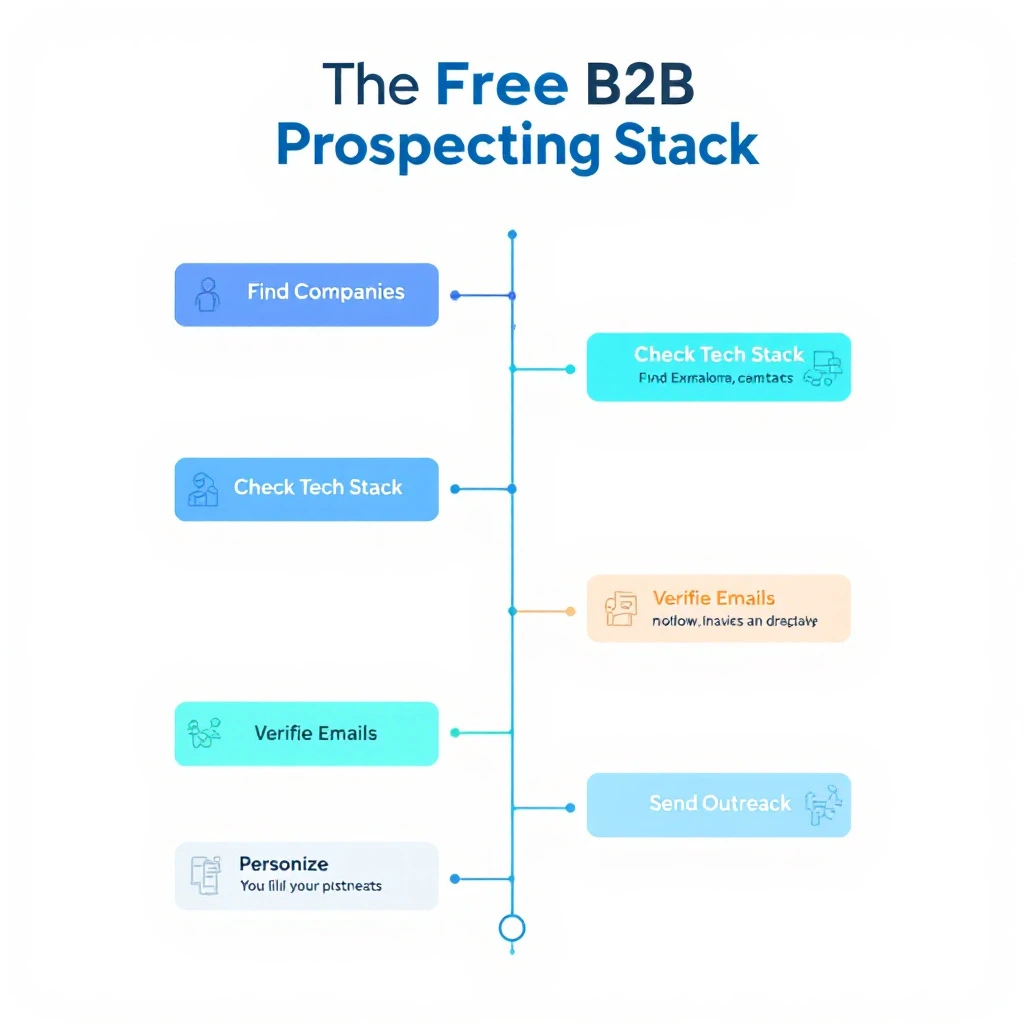
The free B2B prospecting stack: find companies, find contacts, check tech stack, verify emails, personalize, send outreach

You don't need to spend $500/month on sales tools to prospect effectively. Here's a free stack that covers the entire workflow:

1. Find Target Companies

MarketBetter Lookalike Company Finder — enter your best customer, find 50+ similar companies. Free.

2. Find Buyer Contacts

MarketBetter AI Lead Generator — analyze each company, get buyer contacts with LinkedIn profiles. Free.

3. Research Their Tech Stack

MarketBetter Tech Stack Detector — check what tools they use to qualify fit and personalize outreach. Free.

4. Verify Email Addresses

Hunter.io (25 free verifications/month) — confirm email deliverability before sending.

5. Personalize Outreach

MarketBetter GiftDM Copilot — AI-personalized gifts and LinkedIn DMs for top prospects. Free.

6. Send Outreach

Apollo.io free tier (250 emails/day) or LinkedIn free (connection requests + messages).

Total cost: $0/month. Not "free trial" — actually free, ongoing.

For a deeper walkthrough of the research half of this workflow, see how to automate lead research with Claude Code and our complete guide to Claude for SDRs.

Tips for AI-Powered Lead Generation

1. Quality Over Quantity

AI makes it easy to generate hundreds of leads. Resist the temptation. 50 highly-targeted leads will outperform 500 poorly-targeted ones every time.

2. Layer Multiple Data Sources

No single tool has perfect data. Use 2-3 tools to cross-reference and verify contacts. If Apollo and Hunter both show the same email for a contact, you can be confident it's accurate.

3. Personalize Based on AI Insights

The AI in these tools isn't just for finding contacts — it's for understanding them. Use company analysis, tech stack data, and recent activity to craft relevant, personalized messages. If you want a repeatable system for this, our guide on how to use Claude for lead generation walks through the exact prompts, and our AI sales email templates give you first-touch copy to adapt.

4. Respect Privacy and Compliance

GDPR, CCPA, and CAN-SPAM regulations apply regardless of how you source leads. Always include opt-out options, honor unsubscribes, and don't scrape personal data from platforms that prohibit it.

5. Measure What Matters

Track these metrics:

  • Lead-to-reply rate (aim for 5-15%)
  • Reply-to-meeting rate (aim for 30-50% of replies)
  • Data accuracy (bounce rate below 5%)
  • Time to first touch (how fast from lead identification to first outreach)

Frequently Asked Questions

What are the best free B2B lead generation tools in 2026?

For genuinely free, ongoing use (not a 3-day trial), the standouts are MarketBetter's AI Lead Generator (no signup, no credit limits), Apollo.io (unlimited email lookups with a 250/day send cap), and Kaspr (unlimited B2B company emails). Most other free tiers — Seamless, RocketReach, Cognism — are one-time credit trials that force an upgrade within days.

Are there free AI tools for LinkedIn lead generation?

Yes. MarketBetter's AI Lead Generator identifies buyer contacts at any company and links straight to their LinkedIn profiles, Wiza exports Sales Navigator searches into verified email lists, and Kaspr reveals contact data on LinkedIn profiles via its Chrome extension. Pair any of these with LinkedIn's free People Search for a zero-cost LinkedIn prospecting workflow.

What's the best free AI B2B lead generation tool overall?

If "AI" means the tool actually helps you decide who to contact rather than just dumping a database export, MarketBetter's AI Lead Generator leads because it scores and ranks decision-makers by relevance. For AI-driven enrichment across many data sources, Clay is the most powerful, though it has a steeper learning curve.

Where can I get free B2B sales leads?

Start with the free prospecting stack above: find lookalike companies to your best customers, pull buyer contacts for each, verify the emails with Hunter's free tier, then reach out via Apollo's free sending or LinkedIn. That covers sourcing, verification, and outreach for $0/month. For the numbers behind why teams do this, see our breakdown of the true cost of an SDR tech stack and what AI SDR tools actually cost in 2026.

Is there a free B2B leads database?

Not in the way most people picture it — there's no legitimate, unlimited "download the whole B2B database for free" button, and any tool promising one is either a scraped list or a trial in disguise. What actually works is treating free tiers as an on-demand database you query per account: MarketBetter's AI Lead Generator pulls buyer contacts for any company with no signup or credit limit, Apollo gives unlimited email lookups against its database (capped at 250 sends/day), and Kaspr surfaces unlimited B2B company emails. Combine those and you get database-grade coverage for free, sourced account-by-account instead of as one giant export.

Can you get free B2B leads without signing up?

Yes — MarketBetter's AI Lead Generator is the only tool on this list that returns buyer contacts with zero signup, no credit card, and no per-lookup limit. Every other free tier (Apollo, Hunter, Kaspr, Clay, Wiza) requires an account before it shows you any data. If "no signup" is a hard requirement, start there, then layer in an account-gated tool only when you need email verification or bulk export.

Is free AI lead generation good enough, or do you need a paid tool?

For a solo rep or an early-stage team doing under a few hundred touches a month, a well-assembled free stack is genuinely enough. You'll outgrow free tiers when you need bulk exports, verified mobile numbers at scale, or team seats — at which point compare the paid B2B lead generation tools before committing.

Start Finding Leads for Free

The best AI lead generation tool is the one that gets you talking to the right people with the least friction.

Try MarketBetter's free AI Lead Generator →

Enter any company, get AI-identified buyer contacts with LinkedIn profiles. No signup, no credits, no catch.


Build your full prospecting workflow: find similar companies to your best customers, check their tech stack for fit, then use the Conference Scraper to source leads from upcoming trade shows.

How to Scrape Conference Exhibitor Lists in 2026 (Free Tool + 3 Manual Methods)

· 9 min read
sunder
Founder, marketbetter.ai

How to scrape conference exhibitor lists for sales prospecting

It's Tuesday morning. Your sales team is prepping for the biggest trade show of the year. You need a list of every exhibitor, speaker, and sponsor — with company names, booth numbers, descriptions, and ideally contact info — so you can prioritize who to visit and who to prospect before the event.

You go to the conference website. The exhibitor list is there: 400+ companies spread across an interactive floor plan with infinite scroll, lazy-loaded cards, and no export button.

So you start copying and pasting.

Company name. Tab. Description. Tab. Website. Tab. Next company. Repeat 400 times.

This is the reality for thousands of SDRs, AEs, and marketing teams every year. Conference and trade show websites are designed for attendees to browse — not for sales teams to extract. The data is right there, but getting it into a usable format (a spreadsheet, a CSV, your CRM) is absurdly painful.

There's a better way.

Why Conference Lists Are Gold for Sales Teams

Conference exhibitor, speaker, and sponsor lists are among the highest-quality prospecting sources available:

1. Pre-Qualified by Budget

Companies that pay $5,000-$50,000+ for a booth at a trade show have budget. They're investing in growth. That's a buying signal you can't get from a cold database.

2. Industry-Specific Targeting

A cybersecurity conference exhibitor list is a curated list of cybersecurity companies. A SaaS conference speaker list is a roster of SaaS leaders. No filtering required — the conference organizer already did it for you.

3. Timely and Relevant

Conference lists are current. These companies are actively participating in industry events right now, which means they're engaged, investing, and accessible.

4. Multi-Stakeholder Data

Speaker lists give you names of decision-makers. Exhibitor lists give you company profiles. Sponsor lists tell you who has the biggest budgets. Combined, it's a complete prospecting package.

5. Pre-Event Outreach Advantage

The most successful conference prospecting happens before the event. If you can email or LinkedIn-message an exhibitor before the show with "I saw you're exhibiting at [event] — I'll be at Booth 342, would love to connect," your meeting rate goes through the roof.

The Pain of Manual Conference Data Extraction

Let's be honest about what manual extraction looks like:

Time cost: A typical conference with 300 exhibitors takes 4-6 hours to manually copy into a spreadsheet. That's nearly a full working day.

Error rate: Copy-paste errors are inevitable. Company names get truncated, URLs get mangled, descriptions get partially captured.

Format inconsistency: Different conferences structure their data differently. Some have separate pages per exhibitor. Others use interactive maps. Others use accordion-style lists. Each requires a different manual approach.

Dynamic content problems: Many conference sites use JavaScript-heavy frameworks (React, Angular) that render exhibitor data dynamically. You can't even "View Source" to find the data — it's loaded asynchronously.

Repetitive across events: If your team attends 10+ events per year, you're burning 40-60 hours annually just copying exhibitor data. That's a full work week of pure drudgery.

Methods for Extracting Conference Data

Method 1: Manual Copy-Paste (The Hard Way)

Process: Open the conference website, manually select each exhibitor's name, description, and details, paste into a spreadsheet.

Pros: No tools required, works on any site Cons: Extremely time-consuming, error-prone, soul-crushing

Time per event: 4-8 hours for 300 exhibitors

Method 2: Browser Extensions (Semi-Automated)

Tools like Instant Data Scraper (Chrome extension) can detect tables on web pages and export them.

Process: Install the extension, navigate to the exhibitor page, click the extension, hope it detects the right data, export to CSV.

Pros: Free, fast when it works Cons: Only works on simple HTML tables. Fails completely on dynamically-loaded content, interactive maps, and paginated lists. Captures lots of irrelevant data. Requires manual cleanup.

Success rate: Works on maybe 20% of conference websites. Most modern event sites use dynamic rendering that breaks these extensions.

Method 3: Custom Python Scripts (Technical)

For developers, writing a custom scraper using libraries like Scrapy, BeautifulSoup, or Playwright is an option.

Process: Inspect the conference website's HTML structure, write a Python script to extract the relevant elements, handle pagination and dynamic loading, export to CSV.

# Example: Scraping a simple exhibitor list with BeautifulSoup
import requests
from bs4 import BeautifulSoup

url = "https://example-conference.com/exhibitors"
response = requests.get(url)
soup = BeautifulSoup(response.text, 'html.parser')

exhibitors = []
for card in soup.find_all('div', class_='exhibitor-card'):
name = card.find('h3').text.strip()
desc = card.find('p', class_='description').text.strip()
exhibitors.append({'name': name, 'description': desc})

Pros: Highly customizable, handles complex sites, can be reused Cons: Requires programming skills, breaks when site structure changes, needs to be rebuilt for each conference site, can take hours to debug JavaScript-rendered content

Time investment: 2-4 hours to write and debug per conference site

Method 4: Apify Actors (Platform-Dependent)

Apify offers pre-built scrapers ("Actors") for specific conference platforms like Map Your Show, 10times, and Xporience.

Process: Find the right Actor for your conference platform, input the URL, run the scraper, download results.

Pros: Pre-built for specific platforms, handles dynamic content, outputs structured data Cons: Only works for supported platforms (many conference sites aren't covered), requires an Apify account, costs credits for large runs, doesn't work for custom-built conference websites

Pricing: Free tier includes some usage; paid plans from $49/month

Method 5: Web Scraping Services (Expensive)

Companies like WebScrapingExpert and ScrapeHero offer custom scraping as a service.

Process: Submit the conference URL, they build a custom scraper, deliver results in 24-48 hours.

Pros: Hands-off, handles any site Cons: Expensive ($50-$500+ per project), slow turnaround, not practical for frequent use

Method 6: MarketBetter Conference Scraper (Free, Any Site)

MarketBetter's Conference Scraper takes a completely different approach: paste any conference URL and get structured CSVs of speakers, exhibitors, and sponsors.

How it works:

  1. Paste the conference website URL
  2. The AI-powered scraper analyzes the site structure, navigates through exhibitor directories, speaker pages, and sponsor lists
  3. You get downloadable CSVs with structured data: company names, descriptions, booth numbers, speaker names, titles, and topics

Why it's different:

  • Works on any conference website — not limited to specific platforms like Map Your Show or Eventbrite
  • AI-powered navigation — handles dynamic content, infinite scroll, paginated lists, and JavaScript-rendered pages
  • Multiple data types — extracts speakers, exhibitors, AND sponsors in one pass
  • Structured output — clean CSVs ready for import into your CRM or outreach tool
  • Completely free — no account, no credits, no per-use charges

Time per event: 2-5 minutes (versus 4-8 hours manually)

The Conference Prospecting Workflow

Here's the complete workflow for turning conference data into booked meetings:

Step 1: Extract the Data

Use MarketBetter's Conference Scraper to pull exhibitor, speaker, and sponsor lists from your target conference.

Step 2: Enrich with Contact Data

Conference lists give you company names, but you need individual contacts. Use tools like:

  • MarketBetter AI Lead Generator — find buyer contacts at each company on LinkedIn
  • Apollo.io — search for contacts by company and title
  • LinkedIn Sales Navigator — find decision-makers at target companies

Step 3: Prioritize by Fit

Not every exhibitor is a good prospect. Score your list by:

  • Company size — do they fit your ICP?
  • Industry fit — are they in your target vertical?
  • Technology fit — use our Tech Stack Detector to check if they use compatible/competitive technology
  • Sponsor level — Platinum sponsors have bigger budgets than basic exhibitors

Step 4: Pre-Event Outreach

Reach out 2-4 weeks before the event:

Email template:

Hi [Name],

I noticed [Company] is exhibiting at [Conference] — we'll be there too.

[One sentence about what you do and why it's relevant to them]

Would love to grab 15 minutes at the event. Are you available on [day]?

LinkedIn message template:

Hey [Name], saw you're speaking at [Conference] on [topic]. Really looking forward to your session.

We work with companies like [similar company] on [relevant problem]. Would be great to connect while we're both there.

Step 5: At-Event Meetings

With pre-scheduled meetings, your conference ROI multiplies. Instead of wandering the floor hoping for productive conversations, you arrive with a full calendar.

Step 6: Post-Event Follow-Up

Within 48 hours of the event, follow up with everyone you met and everyone who didn't respond to pre-event outreach:

Great connecting at [Conference], [Name]. As discussed, [reference specific conversation point].

Here's [the resource/demo/proposal] I mentioned. Would [date] work for a follow-up call?

Real-World Example: SaaStr Annual

Let's say your team is attending SaaStr Annual, one of the largest SaaS conferences with 300+ exhibitors and 200+ speakers.

Manual approach:

  • Time to extract exhibitor list: ~6 hours
  • Time to extract speaker list: ~3 hours
  • Total data extraction: 9+ hours
  • Result: One messy spreadsheet with inconsistent formatting

MarketBetter Conference Scraper approach:

  • Paste the SaaStr exhibitor page URL
  • Wait 3-5 minutes
  • Download clean CSVs of exhibitors, speakers, and sponsors
  • Total data extraction: 5 minutes
  • Result: Three clean, structured CSVs ready for CRM import

Time saved: 8+ hours per event. Multiply that by 10 events per year, and you've reclaimed 80+ hours of productive selling time.

Tips for Effective Conference Prospecting

Start Early

The best conference prospecting starts 4-6 weeks before the event. Exhibitor lists are usually published 2-3 months in advance. Don't wait until the week before.

Focus on Speakers

Conference speakers are typically senior leaders (VP+) who are active in the industry and open to networking. They're often higher-quality prospects than random booth visitors.

Layer Multiple Data Sources

Combine conference data with:

Track Your Metrics

Measure conference prospecting ROI:

  • Pre-event emails sent
  • Meetings booked before the event
  • Meetings held at the event
  • Deals generated from conference contacts
  • Revenue attributed to conference prospecting

Get Started

Stop manually copying exhibitor data from conference websites. Paste any conference URL into MarketBetter's free Conference Scraper and get structured CSVs of speakers, exhibitors, and sponsors in minutes.

Try the Conference Scraper free →


Once you have your conference list, use our AI Lead Generator to find buyer contacts at each company, or try the GiftDM Copilot to personalize outreach gifts for your top prospects.

11 Best Buyer Intent Data Tools Ranked for B2B SDRs [2026]

· 12 min read
MarketBetter Team
Content Team, marketbetter.ai

Buyer intent data promises to reveal who's ready to buy. But which tools actually deliver for SDR teams?

B2B buyers complete 70% of their research before engaging with sales. By the time they fill out a demo form, they've probably already shortlisted vendors. Intent data tools help you find these buyers earlier — but not all intent data is created equal.

This guide compares the best buyer intent data tools in 2026, with real pricing, actual features, and honest assessments of what works for different team sizes.

How to Write Ad Copy That Closes Deals for SDRs

· 23 min read

Think ad copy is just for the marketing team? Think again.

For a modern Sales Development Representative (SDR), knowing how to write like an expert copywriter is no longer a soft skill—it's a critical tool for hitting quota. It directly translates to more replies, better conversations, and, most importantly, more meetings booked. The same principles that make a LinkedIn ad stop a CEO mid-scroll are the exact same ones that will make your cold email cut through an executive's inbox noise.

In a world of overflowing inboxes, your prospect makes a snap judgment in seconds. Generic, self-centered outreach gets deleted instantly. This is where an SDR who thinks like a copywriter has a massive, unfair advantage over the rep still using templates from 2018.

From Generic Outreach to Compelling Copy

Let's compare two real-world approaches. A standard SDR message is almost always about the sender's company and its product features. It’s lazy, and it doesn't work.

  • Standard SDR Approach (Generic & Ineffective): "Hi [Prospect], I'm with MarketBetter. We have an AI-powered dialer that integrates with Salesforce. I'd love to schedule a demo to show you how it works."

This message is all "we, we, we." It forces the prospect to do the hard work of connecting your features to their problems—and they won't. This is why you get ghosted.

Now, let's rewrite it using a copywriter's mindset, focusing on the prospect's world.

  • Copy-Infused SDR Approach (Actionable & Relevant): "Hi [Prospect], saw your team is hiring three new SDRs. Getting them ramped while hitting quota is tough. Our clients use our AI-assisted workflow inside Salesforce to cut new hire ramp time by 40%. Interested in how?"

See the difference? The second version is a targeted solution. It starts with an observation about their situation (hiring), identifies a specific pain point (slow ramp time), and offers a clear, quantifiable outcome (40% faster ramp time). It grabs attention by making it about them. This is the heart of effective sales enablement best practices that actually connect with buyers.

The Commercial Value of Great Copy

This skill isn't just a "nice-to-have"; it's a high-value discipline with real economic weight behind it. The global copywriting market was valued at a staggering $25.29 billion in 2023 and is only projected to grow.

North America completely dominates this market. That means the performance-driven best practices we're talking about—concise benefit statements, clear calls to action, and a relentless focus on the customer—are forged in the most competitive attention economy on the planet.

Actionable Takeaway for SDRs: By mastering these techniques, you’re not just sending better emails; you’re adopting a proven, multi-billion dollar framework for persuasion. You learn to speak your prospect's language, making your message resonate on a level that generic templates simply can't touch. This shift in mindset is what separates top-performing SDRs from the rest of the pack.

Mastering Your Audience Before You Write

The best SDRs know a secret: killer copy isn't born from a blank page. It’s forged in the prep work you do before a single word gets written. If you want your outreach to actually connect, you have to start with deep customer insight, not just a list of your product’s features.

This is where you stop thinking in terms of generic job titles and start building a hyper-specific Ideal Customer Profile (ICP) for each campaign. Forget "VPs of Sales." Get granular. What are their daily headaches? What exact metric are they on the hook for this quarter? What’s the specific jargon they use with their own team?

This single shift transforms your outreach from a shot in the dark into a precision-guided solution.

Building Your Hyper-Specific ICP

Generic ICPs lead to generic, ignorable outreach. Simple as that. To cut through the inbox noise, you need to think less like a marketer and more like a novelist creating a character. Give your ICP a name, a role, and a set of real-world problems.

What does this actually look like? Let’s compare two ways an SDR might target a sales leader.

  • The Generic Way (Leads to Ignored Emails): VP of Sales at a mid-market SaaS company.
  • The Hyper-Specific Way (Leads to Meetings): "Dana," a newly promoted VP of Sales at a 200-person B2B SaaS firm. Dana is under immense pressure to boost outbound pipeline by 30% this quarter. The problem? Inconsistent CRM hygiene from her junior SDRs is killing her forecasting. She’s constantly complaining about "garbage in, garbage out" reporting.

See the difference? The second profile is a goldmine. You know Dana's core pain point (messy CRM data), her primary goal (30% pipeline growth), and the exact language she uses ("garbage in, garbage out"). This is the raw material for copy that feels like it was written just for her. Before you can write for your audience, you first need to learn how to create impactful B2B buyer personas that feel this real.

Connecting Your ICP to a Single, Compelling Offer

Once you’ve nailed your hyper-specific ICP, your next move is to connect their biggest problem to one irresistible offer. Most SDRs mess this up by leading with their product. Newsflash: your prospect doesn’t care about your tool; they care about their problems.

Your offer isn’t "a demo of our software." It’s the solution to their most urgent issue.

Actionable Takeaway for SDRs: Your offer is the tangible outcome you promise in exchange for their time. Frame it as the direct antidote to their pain. This shifts the conversation from what you're selling to what they're gaining.

Instead of just listing features, you need to frame your offer as a direct solution. Digging into different customer segmentation strategies can help you master aligning the perfect offer with the right audience segment.

Here's a quick look at how this changes the game for your outreach.

SDR Outreach Before vs After Ad Copy Principles

This table breaks down how a typical, feature-first SDR email compares to one infused with the ad copy principles we're talking about. The difference is night and day.

ElementGeneric SDR Outreach (Before)Ad Copy-Infused Outreach (After)
Offer Focus"Want to see a demo of our AI dialer?""Interested in how VPs like you are cutting new hire ramp time by 40%?"
Resource Hook"Check out our new whitepaper.""I have a one-page report on fixing messy CRM data. Mind if I send it over?"
Meeting CTA"Are you free for a call next week?""Got 15 minutes to map out a plan for hitting your Q3 pipeline goal?"

The "After" column works because every offer is a direct response to a specific pain point discovered during your ICP research. This isn't just better messaging—it's a fundamentally different approach.

When you nail this foundation, every headline, bullet point, and call to action you write will be perfectly tuned to resonate, making a reply feel like the only logical next step.

The diagram below shows exactly how this strategic thinking transforms generic emails into outreach that actually starts conversations.

Diagram illustrating the SDR outreach process, moving from generic email to effective outreach using ad copy principles.

This is the bridge between just sending messages and actually booking qualified meetings. It all starts with knowing your audience inside and out.

Crafting Hooks That Earn the Next Sentence

Let's be honest: your prospect's inbox is a warzone. Everyone wants their attention, and your opening line is the only weapon you have to win that first, critical skirmish. For an SDR, that hook isn't just a sentence—it's the gatekeeper that decides whether your message gets read or instantly trashed.

Think about it. The average professional gets slammed with over 120 emails per day. Your hook has to do more than just introduce a topic. It needs to land with enough urgency, curiosity, or value to stop them dead in their tracks. It has to earn you their next 30 seconds.

A hand-drawn sketch of an email inbox, highlighting a subject line 'Cut your reporting time in half next week' with a star and a 'Hook' label.

This is where great SDRs steal directly from the playbooks of top advertisers. A killer ad headline and a killer email subject line are cut from the same cloth. They both make an irresistible promise to the right person at exactly the right time.

Proven Hook Formulas for SDR Outreach

You don't need to reinvent the wheel every time you kick off a new cadence. The best copywriters lean on proven formulas that tap into basic human psychology. Here are a few you can adapt for your outreach right now.

  • The Benefit + Timeframe Hook: This one is a workhorse. It’s powerful because it combines a result they want with a specific, tangible timeline. It feels real and immediately valuable.

    • Email Subject Line: "Cut your reporting time in half by next week?"
    • LinkedIn Opener: "Hey [Name], your post on forecasting sparked a thought. What if your team could get cleaner CRM data in just one sprint?"
  • The Intrigue Hook: This approach weaponizes curiosity. You hint at valuable intel that their competitors might have, creating an urgent need to close that information gap.

    • Email Subject Line: "The one mistake your competitors are making with [Their Industry Challenge]"
    • LinkedIn Opener: "Saw you’re scaling the sales team. There’s a common hiring pitfall I’m seeing at other [Industry] companies—mind if I share?"

Actionable Takeaway for SDRs: The goal of the hook isn't to sell your product. It's to sell the next sentence. Your only job is to create enough momentum to get them to open the message and read past that first line.

Comparing Standard vs Hook-Driven Openers

Let's compare a standard SDR opener—usually polite but completely forgettable—with a hook-driven opener that is sharp, personalized, and almost impossible to ignore.

Outreach TypeStandard Opener (Gets Deleted)Hook-Driven Opener (Gets a Reply)
Email SubjectQuick Question[Prospect's Competitor] mentioned your name
LinkedIn InMailHope you're having a great week!Your recent post on pipeline goals is exactly why I'm reaching out.
Cold Call Intro"Hi, this is [Name] from [Company]...""Hi [Name], I saw your company just raised a Series B—congrats. Scaling the SDR team is likely top of mind."

The hook-driven examples just hit different. Why? Because they’re rooted in the prospect's world—their competitors, their recent activity, their company's big wins. This immediately signals that you've done your homework and your message isn't just another automated blast. If you really want to see these principles in action, studying viral ad copy examples is a masterclass in itself.

At the end of the day, learning how to write ad copy as an SDR is all about becoming an expert in crafting these powerful opening moments. Get the hook right, and you've already won the most important part of the battle.

Building Your Case with Proven Copywriting Formulas

A great hook earns you their attention for a few seconds. A solid structure is what guides them all the way to a "yes."

Once you've hooked them, you can't just throw a list of features at them and hope something sticks. This is the moment to build a logical, persuasive case using the same proven copywriting formulas that drive millions in ad spend.

These aren't abstract marketing theories; they're battle-tested blueprints for structuring a message. They turn a jumble of benefits and pain points into a compelling narrative that makes your solution feel like the only logical next step.

For SDRs in the trenches, two formulas stand out for their raw effectiveness: PAS (Problem-Agitate-Solve) and AIDA (Attention-Interest-Desire-Action).

PAS: The Direct Hit on Pain Points

The PAS formula is arguably the most powerful framework for cold outreach. It’s direct, empathetic, and perfectly suited for the short, punchy nature of a cold email or LinkedIn message. It works because it zeroes in on a problem you know your prospect is wrestling with.

Here’s the breakdown:

  1. Problem: State their problem clearly. Show you get their world.
  2. Agitate: Pour a little salt in the wound. Describe why that problem is so frustrating, costly, or time-consuming. This is the crucial step—it connects the problem to a real, emotional consequence.
  3. Solve: Introduce your solution as the direct, obvious fix for that agitated pain.

Let’s apply this to a 100-word cold email targeting a sales leader who can't get their team to use the CRM properly.

  • (Problem) Getting new SDRs to consistently log activity in Salesforce is a constant battle.
  • (Agitate) This leads to messy pipelines and forecasts you can't trust, forcing you to chase reps for updates right before every leadership meeting.
  • (Solve) Our tool, marketbetter.ai, automates call and email logging directly within Salesforce. Reps stay in their workflow, and you get clean data, instantly. Interested in seeing how?

This email just works. It follows a logical path from a known frustration to a clear resolution. That "Agitate" step is what makes it hit home—it’s not just about a problem, it’s about the headache that problem causes.

AIDA: Building Momentum Toward Action

While PAS is a surgical strike on pain, AIDA is more of a guided journey. It’s fantastic for building on an initial spark of curiosity and turning it into a genuine motivation to act. This formula is your go-to for slightly warmer outreach or when your solution's value needs a little more storytelling.

The AIDA model unfolds like this:

  1. Attention: Grab them with that killer hook we talked about.
  2. Interest: Hold their focus by sharing a fascinating fact or highlighting a highly relevant challenge.
  3. Desire: Now, you paint a picture. Help them visualize a better future where their problem is gone and they're hitting their goals.
  4. Action: Give them a clear, low-friction next step.

Here’s how AIDA could frame a message about slashing SDR ramp time.

  • (Attention) Subject: The 40% faster ramp time question
  • (Interest) Getting a new SDR team to full productivity in under six months is a huge challenge for most sales leaders.
  • (Desire) Imagine if your next hiring class was pipeline-positive in their first quarter, fully equipped with the right messaging and workflows from day one, giving you predictable growth.
  • (Action) Do you have 15 minutes next week to see how VPs at companies like [Competitor] are making that happen?

AIDA works by building emotional momentum. It shifts the prospect's mindset from "What is this?" to "What if I could have that?" This is pure persuasion.

Comparing PAS and AIDA for Real-World Scenarios

So, which one do you use? It completely depends on your audience and the context. One isn't "better," but one will almost always be a better fit for the job at hand. This is how top SDRs choose their weapon.

ScenarioBest FormulaWhy It Works for an SDR
Hyper-Targeted Cold OutreachPAS (Problem-Agitate-Solve)When you've found a specific, high-priority pain point, PAS lets you hit it directly and immediately. It’s efficient and proves you’ve done your homework.
Follow-Up After an Event/WebinarAIDA (Attention-Interest-Desire-Action)You already have their attention. AIDA builds on that initial interest, creates desire for an outcome tied to the event's topic, and drives a relevant action.
When the Pain is ObviousPAS (Problem-Agitate-Solve)Selling a solution to a universal, frustrating problem (like bad data quality)? PAS is the most direct route to showing you have the cure.
Introducing a New ConceptAIDA (Attention-Interest-Desire-Action)If your solution is novel or requires a slight shift in thinking, AIDA gives you the runway to build interest and desire before asking for anything.

Mastering both of these classic structures gives you a versatile toolkit. You'll stop writing random collections of sentences and start crafting carefully constructed arguments designed to get one thing: a response.

Writing Calls to Action That Actually Get a Reply

You've nailed the hook and built a solid case, but it all means nothing if your last sentence is a weak, passive call to action (CTA). For any SDR, the CTA isn't just the end of the message; it's the entire point. A brilliant message that fizzles out with a vague "Let me know if you want to chat" is dead on arrival.

The goal here is to stop making passive suggestions and start writing clear, low-friction CTAs that make responding an easy decision. When a prospect reads your ask, they're doing a quick mental calculation: is the value I'm getting worth the effort it'll take?

Your job is to make that a no-brainer.

Two demo options comparing high versus low friction: 'Book 30-min demo' (high) versus 'See 2-min demo?' (low).

High Friction vs. Low Friction Asks

The single biggest mistake SDRs make is asking for way too much, way too soon. A high-friction CTA demands a serious commitment of time and energy, whereas a low-friction CTA makes saying "yes" almost effortless. The difference in reply rates is staggering.

Let's compare them side-by-side.

CTA TypeExampleProspect's Mental Burden
High Friction"Book a 30-minute demo on my calendar.""I have to find a time, commit half an hour, and sit through a sales pitch."
Low Friction"Interested in seeing how we solve X?""All I have to do is reply 'yes' to show interest."

The low-friction CTA wins every time in cold outreach because it demands next to nothing. It's a simple question that opens the door for a conversation without forcing them to open their calendar. Your first mission is just to get a reply, and a tiny ask is the surest way to get one.

Actionable Takeaway for SDRs: A great CTA matches the size of the request to the level of trust you've earned. For a cold prospect, that trust level is zero. Start small to build momentum.

Matching Your CTA to the Outreach Stage

Not all CTAs are created equal. The right one depends entirely on your goal and where that person is in their journey. Instead of relying on one generic closing line, you need a toolkit of options ready for different scenarios.

Here are two essential types every SDR should master.

  • Interest-Based CTAs: These are your go-to for that first cold touchpoint. The goal isn't to book a meeting; it's simply to confirm they have a problem you can solve or validate their interest. They're low-pressure and keep the focus on providing value upfront.

    • "Mind if I send over a one-pager on how we helped [Competitor] solve this?"
    • "Worth a look, or is this not a priority right now?"
    • "Is fixing messy CRM data something on your radar this quarter?"
  • Time-Based CTAs: Pull these out only after you've established some level of interest. They propose a specific, small time commitment to take the next logical step—and I mean small.

    • "Do you have 15 minutes to review this on Tuesday?"
    • "Happy to walk you through it for 5 minutes if that's easier."

When you align your ask with the prospect’s mindset, you radically increase the odds of getting that reply. But remember, the CTA is just one piece of the puzzle. For more tips on getting that initial engagement, check out our guide on how to improve email open rates. When you apply ad copy principles to your entire message—from subject line to signature—you create a cohesive and compelling reason for them to act.

How to Measure and Optimize Your Ad Copy

Great copy isn't written on gut feelings alone. It's forged in data.

Think of every cold email sequence you send as a mini-experiment. Every open, click, and reply—or lack thereof—is pure, unfiltered feedback from your market. Adopting a performance marketer's mindset means you stop throwing spaghetti at the wall and start building a repeatable process for what actually works to book meetings.

The good news? You don't need a complex analytics suite to get started. The most important metrics are already sitting right there in your outreach tool or CRM. This is how you turn your outreach from a game of chance into a predictable system for hitting your number.

The Only Metrics That Really Matter for SDRs

As an SDR, your goal isn't just to get clicks; it's to start conversations that lead to revenue. It's easy to get lost in vanity metrics, so let's cut through the noise and focus on what directly impacts your pipeline.

These four metrics tell the complete story of your copy's performance:

  • Open Rate: This is your subject line's report card. Plain and simple. If people aren't opening, your hook isn't sharp enough to cut through their crowded inbox.
  • Click-Through Rate (CTR): Are you including a link to a case study or a short video? The CTR tells you how compelling your body copy was.
  • Reply Rate: This is a huge indicator of engagement. It tells you how many people felt compelled enough by your message to actually hit the "reply" button.
  • Positive Reply Rate: This is the money metric for SDRs. It filters out all the "no thanks" and "unsubscribe" responses, showing you how effectively your copy is resonating with genuinely interested prospects and generating pipeline.

Even small wins here are massive. For context, the global average CTR for social media ads often sits around a humble 1.2%–1.4%. Professional copywriters pop the champagne when they achieve a 10–20% lift on metrics like these. Why? Because at scale, those tiny, incremental improvements compound into serious pipeline and revenue.

Want to go deeper? Check out this report on foundational copywriting metrics for more industry benchmarks.

An Actionable A/B Testing Plan for SDRs

"A/B testing" might sound intimidating, but it's really just a disciplined way of answering the question, "Does this work better than that?" The golden rule is to change only one thing at a time. Otherwise, you'll never know what actually caused the change in results.

Here’s an actionable test you can run tomorrow on your email subject line.

  1. Pick One Variable to Test: For this experiment, it's the subject line. Everything else—the body copy, the CTA, the signature—must stay exactly the same for both versions.
  2. Write Two Different Versions:
    • Version A (Benefit-Driven): "Cut new hire ramp time by 40%?"
    • Version B (Intrigue-Driven): "A question about your SDR team"
  3. Split Your Audience: Take your prospect list for the week and divide it right down the middle. Group 1 gets Version A. Group 2 gets Version B.
  4. Check the Results: At the end of the week, look at the open rates. Did Version A get a 35% open rate while Version B only hit 22%? Boom. You have a statistically significant winner and a new control to beat next week.

This simple, data-backed approach is an absolute game-changer. A small 10% lift in your positive reply rate doesn't just feel good on a spreadsheet; it leads to a real, measurable increase in meetings booked over a quarter. You're no longer guessing. You're building a playbook based on what your market is telling you works.

Free Tool

Try our Marketing Plan Generator — generate a complete AI-powered marketing plan in minutes. No signup required.

Your Burning Questions Answered

Stepping into the world of ad copy can feel a little strange, especially if you spend your days living and breathing your CRM. Here are a few no-fluff answers to the questions I hear most often from SDRs just getting started.

I'm Not a Creative Writer. Can I Still Write Good Copy?

Absolutely. Here's a little secret: killer ad copy is 90% strategy and 10% creative flair. It’s not about writing the next great novel; it’s about empathy and precision.

Your real job is to pinpoint your prospect’s biggest professional headache and then articulate your solution in the simplest way possible. That’s it.

Frameworks like PAS (Problem-Agitate-Solve) give you a reliable, logical structure to lean on. You don't need to invent cleverness from thin air. Just focus on what’s in it for them—the benefits, not the features. An actionable first step is to analyze the sales messages you’ve received that actually made you stop and think. Consistency and testing will beat raw creativity every single time.

How Long Should My Outreach Message Actually Be?

When in doubt, go shorter. Always.

For a cold email, think of 100-150 words as a hard ceiling. It’s not a law, but it’s a guardrail that forces you to get straight to the point.

Picture your prospect scrolling through their inbox on their phone between meetings. You have their attention for maybe 30 seconds, max. Your message needs to land its punch fast. Stick to one core idea, one clear benefit, and one specific call-to-action. If you have more to say, let the CTA do the heavy lifting. Something like, "Curious to see how it works? I made a 2-min video for you," is perfect.

What's the Single Biggest Copy Mistake SDRs Make?

Easy. Making the message all about your company.

I see it constantly. "We are a leading provider of..." or "Our features include..." It's an instant trip to the trash folder. Your prospect doesn't care about you or your product—they care about their own problems and their own career.

Your Actionable Check: Your copy has to be ruthlessly customer-centric. Before you hit send, do a quick "us vs. you" check. If the message is full of "we" and "our," it’s a red flag. Rewrite it using "you" and "your." If the benefit to them isn't painfully obvious in the first sentence, start over.


Ready to stop the busywork and start booking more meetings? marketbetter.ai turns buyer signals into prioritized tasks and helps your SDRs execute flawlessly with AI-written emails and a dialer that lives inside Salesforce and HubSpot. See how it works.

12 Best AI Tools for B2B Marketing to Scale Growth in 2026

· 35 min read

In today's B2B landscape, staying competitive means moving faster, personalizing at scale, and proving ROI with data-driven precision. Manual processes and siloed tools just can't keep up with the demands of complex buying cycles. The solution? Artificial intelligence. AI is fundamentally changing how marketers identify target accounts, create compelling content, and engage buyers across the entire customer journey. But with a crowded market, how do you choose the right AI tools for B2B marketing to build a modern, effective tech stack?

This guide cuts through the noise. We provide an in-depth, comparative analysis of the 12 best platforms designed to solve core B2B challenges, from account-based marketing (ABM) execution to sales intelligence and campaign optimization. For B2B teams, the right AI can be the difference between hitting a quota and falling short, especially when integrated into a well-defined sales process. Understanding the fundamentals of outreach remains critical; for a deeper dive on this, A Modern Outbound Lead Generation Playbook provides a solid framework for structuring these efforts.

This resource is designed to be actionable. Instead of generic marketing copy, you'll find a detailed breakdown of each tool, covering:

  • Primary use cases and ideal buyer personas.
  • Key features, honest pros and cons, and pricing tiers.
  • Actionable advice and comparisons to help you decide.

We'll help you navigate platforms like HubSpot, 6sense, and marketbetter.ai to select, pilot, and scale the technology that will drive measurable pipeline growth for your business this year.

1. marketbetter.ai

Best for: All-in-one revenue generation and pipeline acceleration.

marketbetter.ai positions itself not just as another tool, but as a comprehensive AI-native revenue engine designed to replace fragmented martech stacks. It’s a standout choice among ai tools for b2b marketing because it unifies intent data, AI-driven content generation, and multi-channel campaign automation into a single, cohesive platform. This integrated approach directly addresses a major pain point for B2B teams: managing multiple point solutions like Clay, Apollo, and n8n, which often leads to data silos and workflow inefficiencies. By consolidating these functions, it provides a single source of truth for go-to-market execution.

marketbetter.ai platform interface showing analytics and campaign performance

The platform automates the entire top-of-funnel process, from identifying anonymous website visitors and enriching account data to triggering personalized, multi-channel outreach sequences across email, LinkedIn, and even automated voice calls. Its AI continuously optimizes campaigns based on real-time analytics, ensuring that marketing efforts are always directed toward the highest-potential accounts.

Key Features and Differentiators

  • Unified Revenue Engine: Combines intent data, account enrichment, AI personalization, and automated multi-channel sequences in one place. This holistic system replaces the need for separate tools for data, sequencing, and analytics.
  • AI Content & Personalization: Generates hyper-personalized outreach content at scale, moving beyond simple mail-merge fields to create relevant messaging based on account fit, intent signals, and buyer personas.
  • AI Voice Assistant: A unique feature that automates lead qualification and meeting booking over the phone, freeing up sales development representatives (SDRs) to focus on high-value conversations.
  • Rapid Time-to-Value: Offers pre-built playbooks and no-cost, turnkey integrations with major CRMs (Salesforce, HubSpot) and collaboration tools (Slack, Teams), enabling teams to get started in minutes.

Actionable Use Case

A mid-market demand generation manager can use marketbetter.ai to instantly identify high-intent accounts visiting their pricing page. The platform automatically enriches these accounts with firmographic and contact data, scores their fit against the ideal customer profile, and triggers a personalized, multi-channel sequence. An AI-generated email is sent, followed by an automated LinkedIn connection request and a call from the AI voice assistant to qualify interest and book a demo, with every touchpoint logged back to Salesforce.

Pros and Cons

ProsCons
Consolidated Platform: Replaces multiple point tools, reducing martech bloat and providing a single source of truth.Opaque Pricing: No public pricing is available; tailored for mid-market and enterprise budgets, likely excluding smaller startups.
Proven ROI: Strong customer proof points report significant lifts in SQLs, booked meetings, and overall campaign ROI.Requires Change Management: Implementation involves replacing existing workflows and tools, which requires team buy-in.
Deep Automation: Automates up to 80% of outreach tasks, including AI voice calls, freeing up significant team resources.Compliance Considerations: Relies on IP tracking and automation, necessitating a thorough review of privacy and compliance policies.
Enterprise-Ready: Features enterprise-grade security, compliance controls, and strong customer validation (4.97 G2 rating).

Website: https://www.marketbetter.ai

2. HubSpot Marketing Hub

Best for: SMB and mid-market teams seeking a unified CRM and marketing automation platform.

HubSpot Marketing Hub has evolved from a popular inbound marketing tool into a comprehensive platform where AI is deeply embedded across the entire marketing and sales funnel. Unlike standalone AI content generators, HubSpot integrates its AI features directly with its native CRM, allowing B2B teams to create, automate, and analyze campaigns within a single, unified system. This makes it one of the most practical AI tools for B2B marketing for teams seeking an all-in-one solution.

HubSpot Marketing Hub

The platform's AI assists in everything from generating blog post ideas and drafting email copy to optimizing send times and predicting audience segments likely to convert. For B2B marketers, this means less time switching between tools and more time focusing on strategy, as the AI handles repetitive tasks while leveraging customer data for smarter decision-making.

Key Features and Use Cases

  • AI Content Assistant: Draft blog posts, social media updates, and marketing emails directly within the editor. It's particularly useful for overcoming writer's block and generating first drafts that are already SEO-optimized.
  • Predictive Lead Scoring: Automatically identifies and prioritizes high-quality leads based on behavioral data, helping sales teams focus their efforts where it matters most.
  • AI-Powered Reporting: Build custom reports and dashboards by simply asking questions in natural language, uncovering insights without needing to be a data analyst.
  • Smart Automation: The platform's AI optimizes marketing automation workflows by suggesting logical next steps and identifying engagement patterns. If you're looking to dive deeper, you can learn more about AI's role in marketing automation.

How it Compares & Actionable Advice

Compared to Salesforce (Pardot): HubSpot is generally considered more user-friendly and faster to implement, making it a better choice for teams without dedicated Salesforce administrators. Its all-in-one model with a native CRM contrasts with Pardot's reliance on a separate Sales Cloud instance.

Actionable Advice: If your team prioritizes ease of use and needs a single system for both marketing automation and CRM, HubSpot is your top contender. Start with the free tools to understand the ecosystem, and leverage HubSpot Academy's free courses to train your team before upgrading to a paid tier.

ProCon
All-in-one platform with native CRMContact-based pricing can become expensive
Strong educational resources (HubSpot Academy)Advanced AI features are locked in higher tiers
Excellent for teams needing quick time-to-valueLess customizable than some enterprise competitors

Official Website: https://www.hubspot.com/products/marketing/professional

3. Salesforce Marketing Cloud Account Engagement (formerly Pardot)

Best for: Salesforce-centric organizations needing deep marketing and sales alignment.

Salesforce Marketing Cloud Account Engagement, widely known by its former name Pardot, is a B2B marketing automation powerhouse deeply embedded within the Salesforce ecosystem. Its core strength lies in leveraging Einstein AI to bridge the gap between marketing activities and sales outcomes. Unlike more content-focused AI platforms, Pardot excels at using AI to analyze prospect behavior, predict sales readiness, and provide actionable insights directly within the CRM, making it one of the most effective AI tools for B2B marketing for revenue-focused teams.

Salesforce Marketing Cloud Account Engagement (formerly Pardot)

This tight CRM alignment means that every AI-driven insight is immediately actionable for the sales team. The platform moves beyond simple lead generation to focus on pipeline acceleration and proving marketing's contribution to revenue, a critical function for B2B organizations needing to justify their marketing spend. For companies already standardized on Salesforce, adopting Pardot is a natural extension that enriches their existing data with predictive intelligence.

Key Features and Use Cases

  • Einstein Behavior Scoring: Moves beyond traditional scoring by using AI to analyze engagement patterns and identify which prospects are most likely to convert. This allows sales teams to prioritize their outreach with precision.
  • Einstein Campaign Insights: Automatically monitors campaign performance and alerts marketers to significant trends or anomalies, such as an email performing better with a specific audience segment.
  • B2B Marketing Analytics: Provides sophisticated, AI-enhanced dashboards that connect marketing efforts directly to sales pipeline and revenue, enabling true ROI attribution.
  • Native Salesforce Integration: Ensures all data is unified between marketing and sales, eliminating data silos and creating a single source of truth for every customer interaction.

How it Compares & Actionable Advice

Compared to Marketo: Pardot offers tighter, more native integration with Salesforce Sales Cloud, making it the default choice for teams deeply invested in that ecosystem. Marketo provides greater flexibility to integrate with other CRMs and is often seen as more configurable for complex, non-linear nurture campaigns.

Actionable Advice: If "what's in Salesforce" is the ultimate source of truth for your business, Pardot is the most logical choice. Before purchasing, conduct an audit of your Salesforce data quality. Pardot's AI (Einstein) is only as good as the data it analyzes; clean data is a prerequisite for success.

ProCon
Seamless Salesforce CRM alignmentEntry price is higher than many SMB tools
Mature analytics for revenue attributionRequires Salesforce proficiency for best results
Strong governance for complex organizationsAI features are tied to specific, higher-cost editions

Official Website: https://www.salesforce.com/products/marketing-cloud/pricing/b2b-marketing-automation/

4. Adobe Marketo Engage

Best for: Enterprise B2B teams with complex, multi-channel buyer journeys.

Adobe Marketo Engage is an enterprise-grade marketing automation platform designed for complex, long-cycle B2B sales processes. While known for its robust lead management and nurturing capabilities, its AI features, particularly in the Prime tier, elevate it into a powerful tool for large-scale personalization and journey optimization. Unlike platforms built around a central CRM, Marketo focuses on deep marketing automation that integrates with various CRMs, making it a highly configurable hub for sophisticated demand generation teams.

Adobe Marketo Engage

For organizations managing intricate buyer journeys across multiple segments, Marketo's AI provides predictive insights to streamline campaign strategy. It analyzes engagement data to forecast the best content for specific audience segments, moving beyond simple rule-based automation. This makes it one of the more advanced AI tools for B2B marketing for enterprises needing precise control and governance over their marketing programs.

Key Features and Use Cases

  • Predictive Audiences: Utilizes AI to analyze behavioral and firmographic data to automatically identify and build high-potential audience segments for targeted campaigns.
  • AI-Driven Personalization: Powers dynamic content and offers on websites and in emails, ensuring that each prospect receives the most relevant messaging based on their real-time behavior and predictive profile.
  • Intelligent Journey Analytics: Moves beyond standard reporting by using AI to analyze customer journey maps, identifying bottlenecks and opportunities for optimization to accelerate the sales funnel.
  • Account-Based Marketing (ABM) Automation: Combines lead and account-level data to orchestrate complex, multi-touch ABM campaigns, with AI helping to prioritize the most engaged accounts.

How it Compares & Actionable Advice

Compared to HubSpot: Marketo is a more powerful and customizable platform but comes with a significantly steeper learning curve and higher cost. It's built for large marketing operations teams that require granular control over every aspect of their campaigns, whereas HubSpot is designed for broader ease of use.

Actionable Advice: Choose Marketo if you have a dedicated marketing operations team and a need for highly sophisticated, multi-touch nurture programs that span months or even years. To justify the investment, map out your most complex customer journey and use it as a benchmark during the demo process to see if Marketo can truly automate and optimize it.

ProCon
Highly configurable for sophisticated nurture programsPricing is sales-driven and can be significant
Strong ecosystem and enterprise-grade governanceSteeper learning curve than SMB-focused tools
Deep APIs for complex integrationsAI features are primarily in premium add-on packages

Official Website: https://business.adobe.com/products/marketo/value-add-ons

5. 6sense Revenue AI

Best for: Mature B2B teams executing a sophisticated account-based marketing (ABM) strategy.

6sense Revenue AI positions itself as a central nervous system for B2B go-to-market teams, moving beyond simple analytics to proactively identify and engage in-market accounts. Unlike many tools that focus on a single marketing function, 6sense uses AI to unify marketing and sales efforts around a critical metric: revenue. This platform excels at uncovering the "dark funnel" of anonymous buyer research, making it one of the most powerful AI tools for B2B marketing for companies pursuing a sophisticated account-based marketing (ABM) strategy.

6sense Revenue AI

The platform's core strength lies in its ability to predict which accounts are ready to buy, often before they ever fill out a form. For B2B marketers, this means shifting from a reactive, lead-based approach to a proactive, account-centric model. Instead of waiting for hand-raisers, teams can use 6sense's intent data to orchestrate timely, relevant outreach across multiple channels, from targeted ads to personalized emails.

Key Features and Use Cases

  • Predictive Intent and Account Discovery: The AI analyzes billions of data points to identify accounts actively researching solutions like yours. This allows teams to prioritize outreach and tailor messaging based on an account's specific stage in the buying journey.
  • AI Email Agents & Conversational Outreach: 6sense can deploy AI agents to handle initial email conversations, qualify interest, and schedule meetings, freeing up sales development representatives to focus on high-value interactions.
  • LinkedIn Ad Campaign Management: Directly activate and manage targeted LinkedIn ad campaigns based on 6sense's real-time intent data, ensuring ad spend is focused exclusively on accounts that are in-market.
  • Broad Ecosystem Integrations: The platform connects seamlessly with major CRM and MAP systems like Salesforce, HubSpot, and Marketo, making it a powerful layer of intelligence on top of your existing tech stack. For those interested in the mechanisms behind this, you can explore the role of predictive analytics in marketing.

How it Compares & Actionable Advice

Compared to Demandbase: Both are leaders in the ABM space. 6sense is often praised for the accuracy of its predictive analytics and its focus on uncovering anonymous intent signals. Demandbase offers a more integrated B2B advertising DSP (Demand-Side Platform), giving teams more direct control over their ad campaigns within the platform.

Actionable Advice: If your biggest challenge is identifying in-market accounts before they contact you, 6sense is a top contender. To build a business case, ask your sales team for their top 10 dream accounts, then ask the 6sense team to show you the intent signals for those specific accounts during a demo. This makes the value proposition tangible.

ProCon
Strong ABM results reported by usersNo public pricing; enterprise-oriented sales motion
Clear focus on agentic AI to improve GTM efficiencyRequires solid data foundations for best performance
Broad integrations with existing martech stacksCan have a steep learning curve for new users

Official Website: https://6sense.com/solutions/

6. Demandbase One

Best for: Enterprise GTM teams wanting an integrated ABM and advertising platform.

Demandbase One is a comprehensive B2B go-to-market platform built around account-based marketing (ABM) and powered by deep AI-driven account intelligence. Unlike tools focused solely on content or lead generation, Demandbase provides a unified view of target accounts, identifying buying signals across the web and orchestrating actions across sales and marketing channels. This makes it one of the most powerful AI tools for B2B marketing for mature organizations executing sophisticated ABM strategies.

Demandbase One

The platform's AI moves beyond simple lead scoring to map entire buying groups within target companies, tracking intent and engagement signals to pinpoint exactly when an account is ready to buy. For B2B teams, this means shifting from a broad, high-volume approach to a highly targeted, efficient strategy that aligns sales and marketing efforts on the accounts most likely to close.

Key Features and Use Cases

  • AI-Powered Account Intelligence: Identifies in-market accounts by analyzing third-party intent data, website engagement, and CRM activity. It helps marketers discover net-new opportunities and prioritize existing ones.
  • AI-Optimized Advertising: The platform’s B2B-native Demand-Side Platform (DSP) uses AI to target specific buying groups within accounts, optimizing ad spend to reach decision-makers, not just anyone at a target company.
  • Cross-Channel Orchestration: Triggers automated, personalized actions across advertising, sales outreach, and website experiences based on real-time account behavior, ensuring a consistent message.
  • Buying Group & Journey Mapping: AI automatically identifies key personas within a target account and maps their journey, giving sales and marketing teams a clear view of who to engage and when.

How it Compares & Actionable Advice

Compared to 6sense: Demandbase's key differentiator is its tightly integrated, B2B-focused DSP, providing a single platform for both identifying intent and activating advertising campaigns. Teams that want to manage their programmatic advertising in the same place they manage their account intelligence may prefer Demandbase.

Actionable Advice: If a significant portion of your marketing budget is dedicated to display advertising, Demandbase should be on your shortlist. During your evaluation, prepare a list of your top 20 target accounts and ask the vendor to demonstrate how their platform would build an audience and launch an ad campaign targeting the buying committee within those companies.

ProCon
Full-funnel ABM platform with integrated B2B DSPCustom pricing and discovery process required
Explainable AI with configurable scoring modelsBest suited for teams with existing ABM maturity
Strong native integrations with Salesforce and HubSpotCan be complex to implement without dedicated resources

Official Website: https://www.demandbase.com/products/

7. ZoomInfo MarketingOS

Best for: Teams needing a premium data foundation to fuel their ABM and sales campaigns.

ZoomInfo MarketingOS positions itself as an activation layer built directly on top of its industry-leading B2B data foundation. Unlike platforms that require separate data procurement and activation tools, ZoomInfo combines AI-powered audience building, advertising, and website personalization into a cohesive system. This makes it one of the most powerful AI tools for B2B marketing for teams focused on account-based marketing (ABM) who need to activate intelligence at scale.

ZoomInfo MarketingOS

The platform leverages AI to analyze vast datasets, identifying companies and contacts exhibiting purchase intent signals. For B2B marketers, this means moving beyond static lists to dynamic, AI-curated audiences that are actively in-market. This data-first approach ensures that advertising spend and marketing efforts are focused on high-potential accounts, directly connecting intelligence to execution within a single workflow.

Key Features and Use Cases

  • AI-Powered Audience Building: Uses buyer intent signals, predictive scoring, and website visitor tracking to automatically create and refine target account lists for campaigns.
  • Multi-Channel ABM Activation: Natively launch display and social advertising campaigns targeting your AI-generated audiences, ensuring consistent messaging across channels.
  • Website Personalization & Chat: Dynamically adapts your website content and chat experiences for visitors from target accounts, increasing engagement and conversion rates.
  • Data Enrichment & Workflows: Automatically enriches inbound leads from forms with comprehensive company and contact data, enabling faster and more effective follow-up. ZoomInfo is a foundational tool for teams looking to supercharge their outbound lead generation.

How it Compares & Actionable Advice

Compared to Apollo.io: ZoomInfo is the enterprise-grade choice, offering more comprehensive data, particularly for North American markets, and a broader suite of ABM activation features. Apollo.io is the more accessible, SMB-friendly option with transparent pricing and a stronger focus on sales sequencing.

Actionable Advice: If data accuracy and depth are your absolute top priorities and your primary market is North America, ZoomInfo is the industry standard. Before signing a contract, provide a sample list of 50 target contacts or accounts to your sales rep and ask for an enrichment report to validate the data quality against your own records.

ProCon
Vast U.S.-centric B2B data coverageNo public pricing; annual contracts can be costly
Single vendor for data and ABM executionUser feedback often cites strict contract terms
Strong integrations with major sales/marketing toolsData accuracy can vary outside of North America

Official Website: https://www.zoominfo.com/

8. Apollo.io

Best for: SMB and growth teams needing an affordable, all-in-one prospecting and engagement platform.

Apollo.io has positioned itself as an indispensable tool for B2B sales and marketing teams, integrating a massive contact database with powerful AI-driven engagement features. While primarily known for prospecting and data enrichment, its AI capabilities streamline the entire top-of-funnel process, from identifying ideal customers to crafting personalized outreach. This makes it one of the most effective AI tools for B2B marketing for teams focused on high-volume, data-driven outbound campaigns.

The platform's AI assists in writing personalized emails at scale, ensuring each message resonates without manual effort. For B2B marketers, Apollo.io consolidates prospecting, enrichment, and AI-powered sequencing into a single, affordable workflow. This integration allows growth teams to quickly build targeted lists, engage prospects with relevant messaging, and push qualified leads directly into their CRM.

Key Features and Use Cases

  • AI-Assisted Email Writing: Generates personalized email copy based on prospect data, helping teams create effective outreach sequences quickly and overcome writer's block.
  • Intent Data: Uses AI to identify accounts actively researching solutions like yours, allowing marketing and sales to prioritize outreach to the most engaged prospects.
  • Automated Prospecting and Sequencing: Finds contacts matching your Ideal Customer Profile (ICP) and enrolls them into automated, multi-channel sequences that include AI-optimized emails.
  • Data Enrichment and CRM Sync: Keeps your CRM data clean and up-to-date by automatically enriching contact and company records, ensuring your marketing campaigns are built on accurate information.

How it Compares & Actionable Advice

Compared to ZoomInfo: Apollo.io is the scrappy, high-value disruptor to ZoomInfo's enterprise dominance. It offers a very similar feature set (data, sequencing, enrichment) at a much more accessible price point, including a generous free tier. ZoomInfo generally has the edge on data quality, especially in the US, but Apollo is rapidly catching up.

Actionable Advice: If you are a startup or SMB, start with Apollo.io's free plan. It provides enough credits to test the data quality for your specific industry and persona. Use it to build a small, targeted list and run a test sequence. This no-cost pilot will tell you if the platform is a fit before you spend a dollar.

ProCon
Excellent value for SMB and mid-market teamsCredit-based system can become costly at scale
All-in-one prospecting and engagement platformData accuracy can vary and requires ICP validation
Generous free tier for getting startedLess focused on inbound/content than HubSpot

Official Website: https://www.apollo.io/

9. LinkedIn Marketing Solutions

Best for: Reaching specific B2B personas and decision-makers in a professional context.

LinkedIn Marketing Solutions has become an indispensable channel for B2B marketers, and its evolution into one of the most powerful AI tools for B2B marketing is driven by its deep integration of machine learning into its advertising platform. While not a standalone content tool, its AI optimizes ad delivery, audience targeting, and campaign bidding, making it essential for reaching professional audiences with unparalleled precision. The platform leverages AI to connect advertisers with the right buyer groups based on job titles, company data, and user behavior.

The core strength of LinkedIn's AI is its ability to learn from campaign performance in real-time. It automatically adjusts bids and audience delivery to maximize objectives like lead generation or brand awareness. For B2B teams, this means ad spend is more efficiently allocated to high-potential prospects, moving beyond simple demographic targeting to predictive audience optimization. This makes it a must-test paid channel for demand generation and account-based marketing (ABM) strategies.

Key Features and Use Cases

  • Predictive Audiences: AI-powered feature that finds new audiences similar to your existing high-performing customer segments, expanding reach to relevant professionals who are more likely to convert.
  • AI-Optimized Ad Formats: Includes Sponsored Content, Conversation Ads, and Lead Gen Forms. The platform’s AI determines the best ad format and placement to show each user to maximize engagement.
  • Dynamic Bidding Strategies: Automatically manages bids to achieve campaign goals, such as maximizing clicks or conversions, by predicting the likelihood of a user taking a desired action.
  • Creator Collaboration: The platform uses AI to help brands identify and collaborate with relevant industry creators and influencers through programs that enhance credibility and video inventory.

How it Compares & Actionable Advice

Compared to other ad platforms (Google/Meta): LinkedIn's primary advantage is its professional context and data. You can target users by job title, seniority, company size, and industry with a high degree of accuracy unmatched by other platforms. The trade-off is typically a higher cost-per-click (CPC) and cost-per-lead (CPL).

Actionable Advice: Don't just run ads; use LinkedIn's Matched Audiences feature. Upload a list of target accounts from your ABM platform (like 6sense or Demandbase) or your CRM. This allows you to focus your ad spend laser-precisely on the companies you already know are a good fit, dramatically improving your ROI.

ProCon
Unmatched B2B targeting and native lead-gen formsHigher CPMs/CPLs versus other social channels
Strong U.S. reach and brand-safe environmentSelf-serve platform has a significant learning curve
AI-driven audience expansion finds new prospectsManaged services are limited to larger ad spends

Official Website: https://www.linkedin.com/business/marketing

10. G2

Best for: Validating vendor claims with real-world user reviews and competitive analysis.

While not an AI tool itself, G2 is an indispensable resource for discovering, vetting, and comparing them. As the largest B2B software review marketplace, it serves as a critical first step for any marketing team building its tech stack. For those looking for AI tools for B2B marketing, G2 provides an aggregated view of the landscape, complete with user reviews, feature comparisons, and market presence grids that help teams shortlist vendors efficiently.

Instead of relying solely on vendor websites, marketers can use G2 to understand real-world user experiences and how different platforms perform in specific industries or company sizes. This peer-driven insight is invaluable for validating marketing claims and identifying potential drawbacks before committing to a demo or a purchase, making it a crucial due diligence platform.

Key Features and Use Cases

  • Category Grids and Peer Reviews: Use the filterable grids to compare tools based on user satisfaction and market presence. The reviews provide honest, actionable feedback on implementation, support, and feature effectiveness.
  • Price/Feature Summaries: Get a quick, high-level overview of a tool's capabilities and pricing tiers, which helps in creating an initial shortlist without visiting dozens of websites.
  • Vendor and Market Analysis: G2's reports and market presence indicators offer a strategic view of who the established leaders are versus emerging challengers in the AI marketing space.

How it Compares & Actionable Advice

Compared to Capterra: G2's review process is often considered more in-depth, and its Grid reports provide a clearer visualization of a tool's market position (Leader, High Performer, etc.). Capterra has a very broad catalog and is excellent for discovering a wide range of options, particularly for small businesses.

Actionable Advice: Don't just look at the overall score. Use G2's filters to read reviews from users at companies of a similar size and industry to your own. Pay close attention to reviews that mention "Implementation" and "Support," as these are often the areas where a tool's true colors show. Use the "Compare" feature to see a head-to-head breakdown of your top 2-3 choices.

ProCon
Up-to-date peer feedback and market indicatorsSponsored placements exist, so look beyond badges
Efficient research hub before contacting vendorsPricing information may be incomplete; verify on vendor sites
Direct comparisons between competing solutionsReviews can sometimes lack specific B2B context

Official Website: https://www.g2.com/categories/account-based-marketing

11. Capterra

Best for: Discovering a wide range of software options and creating an initial longlist.

While not an AI tool itself, Capterra is an indispensable resource for discovering and vetting them. It serves as a comprehensive B2B software marketplace where marketers can find, compare, and read verified user reviews on hundreds of AI-enabled platforms. For B2B teams just beginning to build their tech stack, it provides a structured way to survey the landscape of AI tools for B2B marketing, moving from broad categories to specific solutions.

The platform’s real value lies in its detailed filtering system and side-by-side comparison features. Marketers can shortlist tools based on pricing models, specific features like lead scoring or content generation, and suitability for small businesses versus enterprise clients. This makes the initial research phase far more efficient than relying on general search engine results.

Key Features and Use Cases

  • Advanced Filtering: Narrow down a vast catalog of AI tools by deployment type (cloud, on-premise), user rating, target business size, and specific marketing functions.
  • Verified User Reviews: Gain insights from real-world users, helping you understand a tool's practical strengths and weaknesses beyond the vendor's marketing copy.
  • Buyers Guides and Comparisons: Access curated reports and articles that break down software categories and directly compare leading products, helping you make an informed decision.
  • Direct Vendor Links: Once you’ve identified a promising tool, Capterra provides direct links to request a demo, start a free trial, or view the vendor’s pricing page.

How it Compares & Actionable Advice

Compared to G2: Capterra's interface is very user-friendly for discovery and is particularly strong for SMB software. Its strength is in the breadth of its listings. G2 provides deeper competitive analysis through its proprietary Grid scoring and is often the go-to for mid-market and enterprise software evaluation.

Actionable Advice: Use Capterra at the very beginning of your search. Start with a broad category like "AI Marketing Tools" and use the filters for "Business Size" and "Key Features" to create a longlist of 5-10 potential vendors. From there, you can visit vendor websites or dive deeper into reviews on a platform like G2.

ProCon
Broad coverage of AI marketing toolsListings can skew toward vendors with active profiles
Verified reviews provide authentic user feedbackTechnical detail varies significantly by listing
Useful for discovering niche or new AI solutionsLacks hands-on testing or expert deep dives

Official Website: https://www.capterra.com/ai-marketing-tools-software/

12. Salesforce AppExchange — Marketing Category

Best for: Salesforce customers looking to enhance their marketing capabilities with vetted, integrated apps.

For B2B teams already embedded in the Salesforce ecosystem, the AppExchange is less a single tool and more a curated gateway to hundreds of specialized applications. It functions as the official marketplace where marketers can find, vet, and install AI-powered apps that integrate seamlessly with Sales Cloud, Service Cloud, and Marketing Cloud. This makes it an essential resource for extending core Salesforce functionality with best-in-class AI tools for B2B marketing without complex integration projects.

Salesforce AppExchange — Marketing category

Unlike discovering tools in the open market, the AppExchange provides a layer of trust and security, as apps undergo a Salesforce security review. Marketers can confidently add capabilities like predictive analytics, account-based marketing intelligence, or advanced content personalization, knowing the data flows directly into their central CRM. This allows for a highly customized marketing stack built around a single source of truth.

Key Features and Use Cases

  • Curated and Vetted Apps: Discover marketing apps with detailed user reviews, ratings, and release histories. This is ideal for finding specialized AI solutions for lead scoring, data enrichment, or analytics that go beyond native Salesforce features.
  • Seamless Integration: Install applications directly into your Salesforce instance, often with just a few clicks. This drastically reduces implementation time and ensures data alignment across sales and marketing teams from day one.
  • Advanced Filtering: Users can filter apps by Salesforce edition, pricing models (including free trials), compliance standards, and specific cloud compatibility, making it easy to find solutions that fit both technical requirements and budget.
  • Consolidated Vendor Management: Procuring apps through the AppExchange simplifies billing and vendor relationships, as many can be managed through your existing Salesforce account.

How it Compares & Actionable Advice

Compared to open market tools: The biggest advantage is guaranteed, pre-built integration with Salesforce. The trade-off can sometimes be a more limited selection or higher cost compared to standalone tools. However, the time and resources saved on custom integration often outweigh the price difference.

Actionable Advice: Before searching the AppExchange, clearly define the specific capability you're missing in your native Salesforce setup (e.g., "We need better lead-to-account matching" or "We need predictive lead scoring"). Use these specific keywords in your search. Always check the "Reviews" and "Last Updated" date to ensure the app is actively maintained and well-regarded by other users.

ProCon
Trusted ecosystem with strong security alignmentBest value is exclusively for Salesforce customers
One-click installs simplify implementationApp overlap is possible; evaluate redundancy
Apps leverage existing CRM data for better ROIFinding the right app requires careful research

Official Website: https://appexchange.salesforce.com/category/marketing

Top 12 AI B2B Marketing Tools — Feature Comparison

ProductCore CapabilitiesUnique Strength ✨Target Audience 👥Pricing & Value 💰Quality ★
marketbetter.ai 🏆AI content, multi‑channel automation, personalization, real‑time analytics✨ Integrated AI revenue engine; AI voice assistant; turnkey CRM writeback👥 Mid‑market → Enterprise B2B marketing teams💰 Enterprise pricing (no public); high ROI focus★4.97 (G2) 🏆
HubSpot Marketing HubAI writing & SEO, automation, native CRM, reporting✨ CRM + marketing in one; large partner ecosystem👥 SMB → Enterprise B2B teams💰 Tiered plans + free tier; predictable pricing★4.5
Salesforce Marketing Cloud Account Engagement (Pardot)Einstein scoring, B2B analytics, lead nurturing✨ Tight Salesforce CRM alignment & governance👥 Salesforce‑centric mid → enterprise💰 Enterprise-priced; higher entry★4.3
Adobe Marketo EngageLead management, advanced nurturing, personalization✨ Highly configurable for complex buyer journeys👥 Enterprise B2B with sophisticated nurture needs💰 Sales‑driven pricing; can be significant★4.1
6sense Revenue AIPredictive intent, in‑market account discovery, AI email agents✨ Agentic AI for ABM & pipeline conversion👥 Midmarket & enterprise ABM teams💰 No public pricing; enterprise sales motion★4.2
Demandbase OneIntent & engagement scoring, B2B DSP, orchestration✨ Full‑funnel ABM + integrated B2B DSP👥 ABM‑mature mid → enterprise teams💰 Custom pricing; discovery required★4.0
ZoomInfo MarketingOSData enrichment, audience building, ad activation✨ Large U.S. B2B dataset + end‑to‑end ABM stack👥 Data‑driven sales & marketing teams💰 No public pricing; annual contracts common★4.1
Apollo.ioProspecting, sequences, enrichment, dialer, AI writing✨ Transparent, low‑entry pricing with free tier👥 SMB & growth/outbound teams💰 Low‑entry + free options; credit limits apply★4.3
LinkedIn Marketing SolutionsSponsored content, Conversation Ads, Lead Gen Forms✨ Unmatched B2B targeting & native lead gen👥 B2B demand gen & ABM advertisers💰 CPM/CPL higher; ROI depends on creative★4.4
G2Peer reviews, category grids, vendor links, buyer insights✨ Real‑time peer feedback & 'Best Of' signals👥 Buyers researching software vendors💰 Free research (vendor promos possible)★4.6
CapterraCatalog, filters, buyer guides, vendor links✨ Easy shortlist & SMB‑friendly discovery👥 SMB buyers & tool evaluators💰 Free to use★4.5
Salesforce AppExchange — MarketingCurated marketing apps, filters, installs, compliance✨ Trusted Salesforce marketplace & governance👥 Organizations on Salesforce💰 Varies by app; many trials available★4.2
Free Tool

Try our Marketing Plan Generator — generate a complete AI-powered marketing plan in minutes. No signup required.

Making Your Choice: A Framework for Selecting the Right AI Marketing Tool

We've explored a comprehensive landscape of AI tools for B2B marketing, from all-in-one platforms like HubSpot and Salesforce Marketing Cloud to specialized powerhouses like 6sense and Demandbase. The sheer number of options can feel overwhelming, but the central takeaway is clear: AI is no longer a futuristic concept but a present-day necessity for driving B2B growth, efficiency, and revenue. The right tool doesn't just automate tasks; it elevates your strategic capabilities.

The key is to move from a general understanding of "what's out there" to a specific diagnosis of "what we need right now." The most successful AI adoption stories begin not with a fascination for technology but with a deep-seated business problem. By anchoring your search in a real-world challenge, you transform a feature comparison exercise into a strategic investment decision.

Your Actionable Selection Framework

Choosing the right AI partner is a critical decision that will shape your marketing team's effectiveness for years to come. Instead of getting lost in feature lists, follow this structured, three-step approach to make a confident and impactful choice.

  1. Identify Your Single Biggest Bottleneck: Before you look at any more demos, look inward. Where is the most significant friction in your marketing funnel?

    • Is it Content Velocity? If your team struggles to produce high-quality, relevant content at scale, platforms with strong generative AI capabilities should be at the top of your list. For more granular guidance, reviewing detailed comparisons of AI marketing tools can offer deeper insights into which platforms excel specifically at content creation.
    • Is it Lead Quality and Intent? If your sales team is wasting cycles on unqualified leads, prioritize Account-Based Marketing (ABM) and intent data platforms like 6sense, Demandbase, or ZoomInfo. These tools are built to pinpoint in-market buyers with precision.
    • Is it Campaign Personalization? If your engagement metrics are flat due to generic messaging, look to tools like Marketo Engage or a unified platform like marketbetter.ai that use AI to deliver hyper-personalized experiences across channels.
    • Is it Proving ROI? If you struggle to connect marketing activities to revenue, you need a solution with robust analytics and attribution modeling, a core strength of integrated CRM and marketing automation platforms.
  2. Audit Your Existing Tech Stack: A new tool must enhance, not complicate, your current workflow.

    • Consolidate or Integrate? Does your team suffer from "tool fatigue"? An all-in-one platform like marketbetter.ai or HubSpot could consolidate costs and data, creating a single source of truth. Conversely, if you have a deeply embedded system like Salesforce, a specialized tool from the AppExchange that integrates seamlessly might be the smarter, lower-friction choice.
    • Check for Native Integrations: Always prioritize tools with pre-built, native integrations for your critical systems (CRM, sales engagement, data warehouses). Custom API work is expensive, time-consuming, and adds a long-term maintenance burden.
  3. Run a Focused Pilot Program: Avoid a full-scale, company-wide rollout from day one. Instead, design a small, controlled experiment to validate the tool’s value.

    • Define Clear Success Metrics: What does success look like in 90 days? Is it a 15% increase in MQL-to-SQL conversion rate? A 20% reduction in content production time? A 10% lift in pipeline from a target account list? Make it specific, measurable, and tied to a business outcome.
    • Select a Champion Team: Empower a small, motivated group of users to pilot the tool. Their feedback will be invaluable for identifying real-world challenges, refining workflows, and building a case for a wider rollout.

By methodically addressing your primary pain point, assessing your tech stack, and validating your choice with a disciplined pilot, you can confidently select and implement one of the powerful AI tools for B2B marketing from this list. This structured approach ensures your investment delivers tangible, measurable business impact and positions your marketing organization for a new era of intelligent growth.


Ready to unify your B2B marketing efforts and see how AI can drive real pipeline? marketbetter.ai integrates powerful AI across content creation, personalization, and analytics into a single, intuitive platform designed to eliminate tool fatigue and prove ROI. Discover how our solution can streamline your entire workflow by visiting marketbetter.ai today.

12 B2B Marketing Channels Ranked by Cost-Per-Lead and Pipeline Impact [2026]

· 29 min read

In the complex B2B landscape, selecting the right marketing channels is the difference between stagnation and exponential growth. While the options are vast, from traditional trade shows to sophisticated ABM plays on LinkedIn, a handful of channels consistently deliver measurable ROI. Choosing where to invest your budget and team's energy is a critical strategic decision that directly impacts lead quality, sales cycle length, and ultimately, revenue.

This guide moves beyond generic advice to provide a comprehensive breakdown of the top marketing channels B2B leaders are leveraging today. We'll offer a direct comparison of each channel's strengths and weaknesses, helping you build a multi-channel strategy that aligns perfectly with your business goals. You won't just learn what the channels are; you'll understand how and when to deploy them effectively.

For each of the twelve channels covered, you will find:

  • Practical Use Cases: Clear scenarios detailing when a specific channel is most effective.
  • Target Audience Alignment: Guidance on matching the channel to your ideal customer profile.
  • Essential KPIs: The key metrics you must track to measure success and justify investment.
  • Actionable Workflows: Step-by-step implementation frameworks to get you started quickly.

Furthermore, we will explore how AI-driven platforms like marketbetter.ai are revolutionizing these channels. You'll see how to use AI to scale content creation, personalize engagement, and optimize campaign performance with unprecedented efficiency, turning your marketing efforts into a predictable growth engine. Let's dive into the channels that will define your success.

1. LinkedIn Marketing & Account-Based Marketing (ABM)

LinkedIn stands as the undisputed champion of B2B social media, but its true power is unlocked when combined with a targeted Account-Based Marketing (ABM) strategy. While broad LinkedIn marketing casts a wide net, ABM focuses marketing and sales resources on a predefined set of high-value target accounts, treating each one as a market of its own. This hybrid approach transforms one of the most effective marketing channels b2b has to offer from a lead generation tool into a precision-guided revenue engine.

Instead of just broadcasting content, ABM on LinkedIn involves creating hyper-personalized campaigns for key decision-makers within specific companies. For example, a company like Salesforce might use LinkedIn Matched Audiences to serve case studies about financial services transformation directly to C-suite executives at major banks, while simultaneously having their account executives engage through personalized InMail.

Strategic Implementation

  • When to Use: Ideal for B2B companies with high-value, long sales cycles where multiple stakeholders are involved in the buying decision. It’s particularly effective for breaking into enterprise-level accounts or specific, lucrative industry verticals.

  • Sample Workflow:

    1. Account Selection: Sales and marketing collaboratively build a target account list using firmographic data and revenue potential. Actionable Tip: Use your CRM data to identify closed-won deals with the highest lifetime value and shortest sales cycles to model your ideal target accounts.
    2. Contact Identification: Use LinkedIn Sales Navigator to map out the buying committee at each target account.
    3. Campaign Activation: Launch a multi-touch campaign featuring sponsored content tailored to the account's pain points, personalized InMail from sales reps, and retargeting ads. To further empower your team, explore practical advice on writing effective LinkedIn posts for B2B sales managers to enhance organic reach.
    4. Measurement & Refinement: Track account-level engagement (not just individual leads) using KPIs like account penetration, engagement score, and pipeline velocity. For those looking to streamline their outreach, you can learn more about automating LinkedIn prospecting on marketbetter.ai.

2. Email Marketing & Nurture Campaigns

Despite the rise of social media, email remains one of the highest-ROI marketing channels b2b offers, especially when paired with automated nurture campaigns. This strategy moves beyond simple email blasts by using segmented, automated sequences to guide prospects through the buyer's journey. Instead of a one-size-fits-all message, nurture campaigns deliver the right content at the right time, building trust and moving leads from awareness to conversion methodically.

For instance, a company like Marketo might use a multi-touch nurture campaign to guide an enterprise prospect who downloaded a whitepaper, sending them a case study a week later, followed by an invitation to a relevant webinar. This is a stark contrast to simply adding them to a generic newsletter, as it tailors the journey to the user's initial interest and engagement level, significantly increasing the likelihood of a sales-qualified lead.

Lead Nurture software dashboard displayed on laptop screen with notebook on wooden desk workspace

Strategic Implementation

  • When to Use: Essential for B2B companies with a considered purchase process and a steady flow of inbound leads. It is highly effective for educating prospects, re-engaging cold leads, and warming up marketing-qualified leads (MQLs) before they are passed to the sales team.

  • Sample Workflow:

    1. Lead Capture & Segmentation: A user downloads a top-of-funnel asset (e.g., an ebook) and is tagged based on their industry, job title, and the content's topic. Actionable Tip: Use hidden fields on your forms to capture source data (e.g., "Source=LinkedIn Ad") to tailor the first nurture email to the context of their visit.
    2. Nurture Sequence Activation: The contact is automatically enrolled in a pre-built 5-7 touchpoint email sequence. The first email delivers the requested asset, subsequent emails offer related case studies, blog posts, and webinar invites.
    3. Lead Scoring & Hand-off: The automation platform tracks engagement (opens, clicks, website visits). Once a lead reaches a predefined score threshold, they are flagged as an MQL and assigned to a sales representative for personalized follow-up.
    4. Optimization: Continuously A/B test subject lines, CTAs, and send times to improve open and click-through rates. Monitor unsubscribe rates to ensure content remains relevant and valuable.

3. Content Marketing & Thought Leadership

Content marketing and thought leadership are foundational marketing channels b2b companies use to build trust and authority long before a sales conversation begins. Instead of a direct sales pitch, this strategy focuses on creating and distributing valuable, relevant content like in-depth blog posts, original research reports, and insightful webinars. This approach attracts and educates target audiences, positioning your brand as the go-to expert in your industry and drawing prospects to you organically.

A prime example is HubSpot, which built its empire by providing an extensive library of free marketing and sales resources, attracting millions of visitors who later become customers. Similarly, McKinsey & Company uses its proprietary research and industry insights to engage C-suite executives, building credibility that directly supports its high-value consulting services. This channel works by trading expertise for attention and trust.

Thought leadership workspace with laptop, microphone, open book, and coffee on wooden desk

Strategic Implementation

  • When to Use: Essential for B2B organizations with complex products or services, long sales cycles, and a need to educate the market. It is particularly powerful for building a long-term, sustainable pipeline and differentiating from competitors on expertise rather than just features or price.

  • Sample Workflow:

    1. Audience & Topic Research: Identify your ideal customer profile's primary pain points and conduct keyword research to find topics with high search intent. Actionable Tip: Interview your sales team and ask, "What are the top 5 questions prospects ask on every demo call?" Turn those answers into your next blog posts.
    2. Content Creation & Pillar Strategy: Develop a "pillar" piece of content, like an ultimate guide or research report, then break it down into smaller assets (blog posts, social media updates, video clips) to maximize its reach.
    3. Gated & Ungated Distribution: Promote ungated content (blogs, articles) broadly to build brand awareness. Use high-value gated content (whitepapers, webinars) to capture leads for nurturing.
    4. Performance Measurement: Track metrics like organic traffic, keyword rankings, time on page, and conversion rates on gated assets. Use tools like Google Analytics to measure how content contributes to lead generation and pipeline influence.

4. Trade Shows, Conferences & Events

Despite the digital shift, in-person and virtual events remain one of the most impactful marketing channels b2b offers for direct engagement. Events provide a unique opportunity to connect with high-intent prospects, demonstrate complex products, and build tangible relationships that are difficult to replicate online. Unlike digital channels that rely on asynchronous communication, events create a focused environment for real-time interaction, competitive analysis, and partnership building, making them a high-stakes, high-reward channel.

From massive industry gatherings like Salesforce's Dreamforce, which attracts over 170,000 attendees, to niche vertical-specific symposiums, events allow companies to get in front of key decision-makers actively seeking solutions. This direct access compresses the sales cycle by enabling on-the-spot qualification and relationship nurturing, moving beyond lead generation to create genuine pipeline momentum.

Strategic Implementation

  • When to Use: Best suited for B2B companies with complex products or services that benefit from in-person demonstrations. It is highly effective for penetrating new markets, strengthening relationships with existing customers, and generating high-quality leads in industries where face-to-face trust is paramount.

  • Sample Workflow:

    1. Event Selection: Research and select events based on the quality and relevance of the attendee list, not just the total number of participants. Prioritize events where your ideal customer profile (ICP) is highly concentrated.
    2. Pre-Event Outreach: Launch a targeted campaign weeks in advance to schedule meetings with key attendees and prospects. Use email and social media to promote your booth number and any special offers. Actionable Tip: Offer a high-value, exclusive "event-only" demo or consultation to incentivize pre-booked meetings.
    3. On-Site Execution: Staff your booth with well-trained team members who can qualify leads effectively. Use lead capture technology to scan badges and immediately segment contacts for follow-up.
    4. Post-Event Nurturing: Initiate a follow-up sequence within 24-48 hours of the event. To maximize your ROI, you can learn more about crafting an effective post-event follow-up strategy on marketbetter.ai.

5. Paid Search Advertising (SEM/Google Ads)

Paid Search Advertising, often called Search Engine Marketing (SEM), is the practice of placing ads on search engines like Google and Bing. This channel captures high-intent prospects at the exact moment they are actively searching for solutions, making it one of the most direct and measurable marketing channels b2b has available. Unlike SEO, which builds organic visibility over time, SEM offers immediate placement at the top of search results for critical keywords.

This channel's power lies in its precision. A company like HubSpot can bid on "CRM software for small business" to capture users in the final stages of their buying journey. Similarly, a specialized SaaS provider like ServiceTitan can run highly targeted ads for keywords such as "HVAC dispatch software," ensuring their budget is spent only on reaching their ideal customer profile. This direct approach delivers qualified traffic straight to dedicated landing pages, accelerating the sales cycle.

Strategic Implementation

  • When to Use: Essential for capturing bottom-of-the-funnel demand where prospects show clear purchase intent. It’s also highly effective for launching new products, promoting time-sensitive offers like webinars, or quickly testing messaging and value propositions in a live market environment.

  • Sample Workflow:

    1. Keyword Research: Build comprehensive keyword lists mapped to different stages of the buyer journey, from problem-aware (e.g., "how to improve customer support") to solution-aware (e.g., "Zendesk competitors").
    2. Campaign Structuring: Organize campaigns using tight themes, such as Single Keyword Ad Groups (SKAGs), to maximize ad relevance and Quality Score. Aggressively use negative keywords to filter out irrelevant clicks. Actionable Tip: Create a negative keyword list from your site search data to see what irrelevant terms users are already searching for on your own website.
    3. Ad & Landing Page Creation: Write compelling ad copy that speaks directly to the searcher's pain point and create a dedicated, high-converting landing page for each ad group to ensure a seamless user experience.
    4. Tracking & Optimization: Implement robust conversion tracking for every stage, from initial form submission to a qualified demo request. Continuously analyze performance data, A/B test ad copy, and adjust bids to maximize return on ad spend (ROAS).

6. Webinars & Virtual Events

Webinars and virtual events have evolved from simple online presentations into powerful, interactive platforms for lead generation and nurturing. Unlike static content like a whitepaper, webinars offer a dynamic, real-time channel to demonstrate expertise, answer questions directly, and build personal connections with a qualified audience. This makes them one of the most effective marketing channels b2b has for engaging prospects in a high-value, educational setting, guiding them from awareness to consideration within a single session.

For instance, a company like HubSpot leverages webinars to attract thousands of marketing professionals by offering expert-led training on relevant topics. Similarly, Gartner uses its webinars to showcase its analyst expertise, reinforcing its authority and generating leads for its research services. The key is to provide genuine value, solving a specific prospect problem rather than delivering a thinly veiled sales pitch.

Strategic Implementation

  • When to Use: This channel is ideal for B2B companies looking to educate prospects on complex solutions, generate high-quality leads, and accelerate pipeline movement. It works exceptionally well for mid-to-bottom-of-funnel engagement, where prospects are actively seeking solutions and detailed information.

  • Sample Workflow:

    1. Topic Selection: Identify a critical pain point your target audience faces and frame the webinar as the solution. Use compelling, benefit-driven titles.
    2. Promotion & Registration: Promote the event across email, social media, and paid channels at least two weeks in advance. Use a dedicated landing page to capture registrations.
    3. Engagement Strategy: During the event, use interactive elements like polls, Q&A sessions, and chat to keep the audience engaged. Present for 45 minutes, leaving 15 minutes for questions. Actionable Tip: Launch a poll at the 10-minute mark asking about attendees' biggest challenge related to the topic; use the results to tailor the rest of your presentation.
    4. Post-Event Follow-up: Within 24 hours, send the recording to all registrants (both attendees and no-shows), segmenting the messaging. Offer attendees a clear next step, like a demo booking, and offer no-shows another chance to engage.
    5. Content Repurposing: Maximize ROI by turning the webinar content into blog posts, short video clips for social media, and a downloadable slide deck.

7. Direct Sales & Outbound Prospecting

Direct sales and outbound prospecting represent one of the most traditional yet enduring marketing channels b2b offers. This hands-on approach involves sales development representatives (SDRs) proactively reaching out to potential customers through channels like phone calls, personalized emails, and direct mail. While often seen as purely a sales function, modern outbound prospecting is a highly strategic marketing channel that combines data intelligence, deep personalization, and multi-touch sequences to engage cold prospects and convert them into qualified opportunities.

This method moves beyond generic cold calling, focusing instead on a value-driven, consultative approach. For instance, a company like Gong uses its own conversation intelligence software to train its SDRs, enabling them to analyze call recordings and refine their objection handling for better outcomes. Similarly, HubSpot’s sales team uses a highly coordinated strategy of warm outreach, leveraging inbound content engagement to fuel their personalized prospecting efforts, demonstrating the powerful synergy between inbound and outbound tactics.

Strategic Implementation

  • When to Use: This channel is indispensable for companies with a high average contract value (ACV), complex products requiring education, or when targeting specific, hard-to-reach enterprise accounts. It is most effective when your ideal customer profile (ICP) is clearly defined and you need to generate high-quality pipeline proactively rather than waiting for inbound leads.

  • Sample Workflow:

    1. ICP & List Building: Define your ideal customer profile and build a highly targeted, verified list of prospects and key decision-makers. Actionable Tip: Don't just build a list; tier it. A-tier gets hyper-personalization, B-tier gets semi-personalized, C-tier gets automated outreach.
    2. Research & Personalization: Before any outreach, research each prospect and their company to identify pain points, recent achievements, or industry trends to tailor your message.
    3. Multi-Touch Cadence: Launch a structured outreach sequence across multiple channels (e.g., email, phone, LinkedIn) over several weeks. A typical cadence involves 5-8 touches.
    4. Engage & Qualify: Focus initial conversations on understanding the prospect's challenges and qualifying their fit. Lead with value and insights, not a hard product pitch.
    5. Measure & Optimize: Track key metrics like connection rate, reply rate, meetings booked, and pipeline generated. Use this data to A/B test messaging and refine your outreach cadence for continuous improvement.

8. Sponsorships & Partnerships

Beyond creating your own content, strategically aligning your brand with established platforms and complementary companies can be one of the most powerful marketing channels b2b has to offer. This channel moves beyond simple advertising by borrowing trust and accessing highly-curated audiences through sponsorships of industry podcasts, newsletters, and events, or through deeper co-marketing partnerships. This approach provides a powerful endorsement, placing your brand directly within the ecosystem your target audience already trusts.

For instance, a cybersecurity firm might sponsor a popular IT leadership podcast, gaining direct access to engaged CIOs and CISOs. Similarly, a project management software like Asana might partner with a time-tracking tool like Harvest for a co-branded webinar, offering a comprehensive productivity solution to a shared audience. This symbiotic relationship provides immediate credibility and a targeted distribution channel that would take years to build independently.

Strategic Implementation

  • When to Use: This channel is highly effective for building brand awareness and credibility within niche markets. It's ideal for startups looking to gain a foothold, or established companies aiming to penetrate a new vertical. Partnerships are particularly valuable when your product's value is enhanced by integration with another tool.

  • Sample Workflow:

    1. Audience & Partner Identification: Pinpoint podcasts, newsletters, and events where your ideal customer profile (ICP) is highly engaged. Simultaneously, identify non-competing companies that serve a similar customer base.
    2. Opportunity Vetting: Analyze the potential partner's audience demographics, engagement rates, and brand alignment. For sponsorships, request a media kit and past performance data. For partnerships, outline a clear joint value proposition. Actionable Tip: Before committing, ask the potential partner for an anonymous case study or reference from a previous sponsor to verify their ROI claims.
    3. Campaign Co-Creation: Work with the sponsor to create an authentic ad read or sponsored segment. For partnerships, develop a joint marketing campaign, such as a co-authored whitepaper, integrated product feature, or a shared booth at a trade show.
    4. Performance Measurement: Track referrals using unique URLs or promo codes. Measure impact through brand lift studies, direct traffic from partner sites, and the number of leads generated from co-marketing activities.

9. Display Advertising & Programmatic Display

Display advertising, often seen as a B2C staple, has evolved into a sophisticated tool for B2B marketers, especially when powered by programmatic technology. Programmatic display uses AI and real-time bidding to automate the purchase of ad space, ensuring visual ads are placed on websites, apps, and networks to reach highly specific professional audiences. This moves beyond simple brand awareness, turning display into one of the more versatile marketing channels b2b marketers can use for retargeting, account-based advertising, and top-of-funnel engagement.

Instead of just blanketing the web, a B2B company like HubSpot can use programmatic display to retarget website visitors who downloaded an e-book, serving them ads for a product demo across relevant industry publications. Similarly, a company like G2 can target users who have recently searched for specific software categories, placing ads on tech news sites they frequent. This targeted approach ensures ad spend is focused on audiences already showing interest or fitting a precise ideal customer profile.

Strategic Implementation

  • When to Use: Excellent for building brand awareness in new markets, retargeting engaged website visitors, and supporting ABM campaigns by keeping your brand in front of target accounts. It is most effective for top-of-funnel and mid-funnel activities where visual reinforcement is key.

  • Sample Workflow:

    1. Audience Definition: Define your target audience using first-party data (website visitors, CRM lists) and third-party data (job titles, company size, industry). Actionable Tip: Build a retargeting audience of users who visited your pricing page but didn't convert, and serve them a testimonial ad to build social proof.
    2. Creative Development: Design multiple ad creative variations (3-5 per campaign) with clear calls-to-action tailored to different stages of the buyer's journey.
    3. Platform & Targeting Setup: Choose a demand-side platform (DSP) and set up campaigns using a mix of targeting methods like contextual (placing ads on industry-relevant sites), lookalike audiences, and direct retargeting.
    4. Optimization & Measurement: Monitor performance using KPIs like view-through conversions, click-through rates (CTR), and cost per acquisition (CPA). Implement frequency capping to prevent ad fatigue and A/B test ad copy and visuals to improve engagement.

Search Engine Optimization (SEO) is the long-game strategy for dominating the digital shelf. Unlike paid channels that stop delivering once the budget runs out, a well-executed SEO strategy builds a durable asset that generates compounding returns over time. It’s about making your website the most authoritative and helpful answer for the complex questions your B2B buyers are asking, transforming organic search into one of the most cost-effective and sustainable marketing channels b2b practitioners can leverage to drive high-intent traffic.

For B2B, SEO isn't just about ranking for product names; it's about capturing intent across the entire buying journey. A company like Stripe, for instance, doesn’t just rank for "payment processing"; it also dominates developer-focused queries like "API documentation for payments," capturing both executive and technical audiences. This approach establishes deep topical authority and builds a moat against competitors.

Computer monitor displaying organic growth chart with upward trend line and colorful pie graph

Strategic Implementation

  • When to Use: Essential for B2B companies in established markets with a high volume of problem-aware search queries. It's a foundational channel for businesses aiming for long-term, scalable growth and brand authority, particularly when the cost-per-click in paid channels is prohibitively high.

  • Sample Workflow:

    1. Buyer Persona Keyword Research: Go beyond simple keywords. Map the entire customer journey and identify the questions, pain points, and comparison terms used by each persona at every stage. Actionable Tip: Use tools like AlsoAsked.com to find the "People Also Ask" questions related to your core keywords and build content that answers them directly.
    2. Pillar & Cluster Content Creation: Develop comprehensive "pillar" pages (e.g., "The Ultimate Guide to CRM Implementation") supported by in-depth "cluster" articles that target niche, long-tail keywords (e.g., "how to migrate data to a new CRM").
    3. Technical & On-Page Optimization: Ensure your site is technically sound with a logical structure, fast load times (Core Web Vitals), and strong internal linking. Optimize every page for its target search intent.
    4. Authority Building: Execute a targeted backlink strategy, focusing on acquiring links from reputable industry publications, partners, and directories to build your site's domain authority and trustworthiness in the eyes of search engines.

11. Customer Referral Programs & Word-of-Mouth

While many B2B marketing channels focus on acquiring new customers from scratch, referral programs leverage your most valuable asset: your existing satisfied clients. This channel transforms happy customers into a powerful extension of your sales team, driving high-quality, high-trust leads through structured incentives and organic advocacy. Unlike colder outbound tactics, referred leads enter the sales process with a pre-established level of trust, drastically shortening sales cycles and increasing conversion rates.

This approach capitalizes on the inherent credibility that comes from a peer recommendation. For example, Dropbox's famous referral program rewarded both the referrer and the new user with extra storage, creating a viral loop that fueled its initial growth. Similarly, B2B companies can offer service credits, gift cards, or exclusive features to incentivize referrals. This transforms word-of-mouth from a passive benefit into an active, scalable one of your core marketing channels b2b.

Strategic Implementation

  • When to Use: Best for B2B companies with a strong base of satisfied, long-term customers and a product or service that delivers clear, demonstrable value. It is particularly effective for businesses looking to lower their customer acquisition cost (CAC) and improve lead quality.

  • Sample Workflow:

    1. Identify Advocates: Use Net Promoter Score (NPS) surveys or customer satisfaction (CSAT) scores to identify your most enthusiastic customers. Actionable Tip: Automatically trigger a referral program invitation email to any customer who gives you a 9 or 10 on an NPS survey.
    2. Define Incentives: Create a clear, compelling two-sided incentive structure that rewards both the referrer for their effort and the new customer for signing up.
    3. Launch & Promote: Make the program highly visible on your website, in email signatures, and through customer newsletters. To effectively manage and scale these programs, consider leveraging the right tools, such as the top referral marketing software platforms that automate tracking and reward fulfillment.
    4. Track & Nurture: Integrate referral tracking into your CRM to attribute new business correctly. Immediately follow up with referred leads with a personalized message acknowledging the referrer.

12. Marketing Automation & Lead Nurturing Platforms

Marketing automation platforms are the central nervous system for modern B2B marketing, orchestrating and scaling personalized communication across multiple touchpoints. Far more than just an email tool, these systems integrate CRM data, web behavior, and content engagement to nurture leads from initial awareness to sales-readiness. They are the engine that powers many other marketing channels b2b professionals rely on, ensuring no qualified lead falls through the cracks.

For instance, a platform like HubSpot can automatically trigger a personalized email sequence when a prospect downloads a whitepaper. Meanwhile, a more enterprise-focused tool like Marketo can build sophisticated, branching nurture streams based on a lead’s industry, job title, and specific content interactions, ensuring each prospect receives the most relevant information at the right time. This automated, intelligent nurturing is crucial for managing long and complex sales cycles.

Strategic Implementation

  • When to Use: Essential for B2B companies with a consistent flow of inbound leads that need systematic nurturing over time. It is particularly powerful for businesses aiming to align sales and marketing teams by creating a standardized, data-driven process for lead handoffs.

  • Sample Workflow:

    1. Define a Lead Scoring Model: Collaboratively with sales, assign point values to demographic data (e.g., job title, company size) and behavioral actions (e.g., webinar attendance, pricing page visits). Actionable Tip: Schedule a quarterly review of your lead scoring model with the sales team. Analyze closed-won deals to see if the scoring accurately predicted success and adjust accordingly.
    2. Build Nurture Streams: Create segmented email and content workflows tailored to different buyer personas and their stage in the funnel. For example, a "Technical Evaluator" gets case studies, while a "C-Suite" contact receives ROI reports.
    3. Set MQL Criteria: Establish a lead score threshold that, once met, automatically qualifies a lead as "Marketing Qualified" and assigns it to a sales representative in the CRM.
    4. Monitor and Optimize: Regularly analyze workflow performance, A/B test email subject lines, and refine lead scoring rules based on which leads convert to customers. To stay ahead of the curve, you can discover a new generation of AI-powered marketing automation tools on marketbetter.ai that further enhance personalization.

B2B Marketing Channels — 12-Point Comparison

ChannelImplementation Complexity 🔄Resource Requirements ⚡Expected Outcomes 📊Ideal Use Cases 💡Key Advantages ⭐
LinkedIn Marketing & ABMHigh — multi-channel setup, personalization workflowsHigh cost + dedicated team; Sales Navigator & ad spendHighly qualified pipeline; strong enterprise ROITargeting C‑suite and named accounts, account expansionPrecise decision‑maker targeting; measurable conversions
Email Marketing & Nurture CampaignsMedium — automation + segmentation setupLow–Medium tool cost; content and list maintenanceHigh ROI; predictable lead progression and conversionsLead nurturing, onboarding, cross‑sell campaignsDirect inbox access; excellent attribution and scale
Content Marketing & Thought LeadershipHigh — editorial strategy and production cadenceHigh time and creative resources; SEO investmentAuthority building, organic traffic, long‑term leadsInbound growth, brand differentiation, sales enablementEvergreen value; improves SEO and trust
Trade Shows, Conferences & EventsHigh — logistics, booth and staffing coordinationVery high cost (booth, travel, materials); time‑intensiveHigh‑quality, relationship‑driven leads; brand visibilityProduct demos, industry leadership, large‑scale networkingFace‑to‑face trust building; immediate feedback
Paid Search (SEM / Google Ads)Medium — campaign structure and ongoing optimizationVariable budget; requires skilled PPC managementImmediate high‑intent traffic and measurable ROICapturing active demand and short‑term lead generationFast visibility; precise intent targeting and tracking
Webinars & Virtual EventsMedium — platform setup and content productionModerate cost; promotion and presenter prep neededEngaged leads; demo-ready prospects; repurposable assetsProduct demos, educational lead capture, thought leadershipHigh engagement; scalable and repurpose‑friendly
Direct Sales & Outbound ProspectingHigh — team hiring, training, and sequence designHigh human resource cost; CRM and data toolsDirect conversions; relationship-driven dealsComplex sales, enterprise or passive prospectsPersonalized outreach; immediate objection handling
Sponsorships & PartnershipsMedium — partner selection and negotiationVariable cost; coordination with partner teamsTargeted brand exposure and third‑party credibilityNiche audience reach, co‑marketing and integrationsEndorsement effect; access to engaged audiences
Display Advertising & ProgrammaticMedium — audience setup and creative testingModerate media spend; programmatic platform feesTop‑of‑funnel awareness and retargeting reachBrand awareness, remarketing, wide reach campaignsScalable reach and frequency; advanced targeting options
SEO & Organic SearchHigh — technical and content strategy over timeModerate ongoing investment in content & devSustainable qualified traffic and improved SERP presenceLong‑term inbound acquisition and competitive categoriesCost‑effective long‑term traffic; high trust signals
Customer Referral Programs & Word‑of‑MouthLow–Medium — program design and trackingLow cost per lead but needs satisfied customersVery high conversion rates and LTV; low CACProduct‑led growth, satisfied customer bases, communityHighest conversion and retention; strong advocacy
Marketing Automation & Lead Nurturing PlatformsHigh — integration, workflows, and data hygieneHigh platform costs + marketing ops resourceScaled personalization, better lead-to-opportunity ratesComplex multi‑channel journeys and enterprise orchestrationScales nurture, analytics, and marketing‑sales alignment

Integrating Your Channels for Maximum Impact

Navigating the landscape of B2B marketing channels can feel like standing at a complex crossroads with a dozen different paths. We've explored the unique strengths of twelve powerful avenues, from the precision of LinkedIn ABM and the authority of content marketing to the direct impact of trade shows and the scalability of SEO. Each channel offers a distinct advantage, whether it's building brand awareness, generating high-quality leads, or nurturing long-term customer relationships.

However, the most crucial takeaway is not which single channel is "best," but how you can weave them together into a cohesive, revenue-generating engine. Treating your marketing channels b2b strategy as a collection of isolated tactics is a recipe for wasted budget and disjointed customer experiences. The real power is unlocked through strategic integration, creating a system where each component amplifies the others.

From Silos to Synergy: Building Your Integrated Strategy

Think of your marketing channels as members of a high-performing team. SEO doesn't just bring in organic traffic; it populates your email nurture campaigns with highly relevant leads. The thought leadership content you create becomes the cornerstone for your webinar presentations, LinkedIn posts, and even the talking points for your direct sales team.

Here’s a practical comparison of a siloed versus an integrated approach:

  • Siloed Approach: A paid search campaign runs to generate leads. Separately, an email team sends out a monthly newsletter. The sales team makes cold calls from a purchased list. The efforts are disconnected, the messaging is inconsistent, and lead quality is often poor because there's no shared context.
  • Integrated Approach: A high-value whitepaper is created (Content Marketing). Its landing page is optimized for search engines (SEO). A targeted Google Ads campaign (Paid Search) drives traffic to it. New leads are entered into a specific nurture sequence (Email Marketing & Automation) that references their initial interest, and high-fit accounts are flagged for personalized outreach by the sales team (ABM & Direct Sales).

This integrated model ensures a seamless journey for your prospects. They encounter your brand across multiple touchpoints, each one building on the last, reinforcing your message and moving them closer to a purchasing decision. This synergy is the hallmark of a mature and effective B2B marketing function.

Actionable Next Steps: Your 30-Day Integration Plan

Mastering the orchestration of these marketing channels b2b is what separates market leaders from the competition. It’s about creating a predictable system for growth. Here’s how to start building that system today:

  1. Conduct a Channel Audit: For the next week, map out every channel you currently use. Identify the primary goal for each (e.g., lead generation, brand awareness, customer retention). More importantly, identify where they overlap and where gaps exist. Are your social media and email content completely separate? Does your sales team know what webinars a prospect has attended?
  2. Identify One Integration "Quick Win": Don't try to connect everything at once. Choose two channels and create a simple workflow. For example, create a dedicated email nurture track specifically for leads who downloaded a guide from a recent paid search campaign. Measure the difference in engagement and conversion.
  3. Centralize Your Data: The biggest barrier to integration is fragmented data. Your CRM, email platform, and ad accounts need to communicate. Explore tools that can unify this data, giving you a single view of the customer journey. This is where AI-driven platforms become invaluable, as they can process cross-channel signals to identify patterns and opportunities you might miss.

By embracing an integrated mindset, you transform your marketing from a series of disjointed activities into a strategic, multi-channel dialogue. You create a more compelling customer experience, shorten your sales cycle, and ultimately prove marketing’s direct and undeniable contribution to the bottom line.


Ready to break down your channel silos and build a truly integrated B2B marketing machine? marketbetter.ai uses AI to unify your data, automate cross-channel workflows, and provide the holistic insights you need to optimize your strategy. See how our platform can connect your marketing channels b2b for maximum impact by visiting marketbetter.ai today.

10 Proven Demand Gen Strategies for B2B Growth in 2026

· 34 min read

In the competitive B2B landscape, simply generating leads is no longer sufficient. The real challenge, and the greatest opportunity, lies in creating sustainable, predictable demand for your solutions. This requires a strategic, multi-channel approach that not only captures existing interest but actively cultivates it where it didn't exist before. The problem many marketing and sales teams face is navigating the overwhelming number of available tactics, from targeted Account-Based Marketing (ABM) to AI-powered predictive analytics.

This guide cuts through the noise. We will explore 10 powerful demand gen strategies, providing actionable comparisons and practical frameworks to help you build a robust and predictable revenue pipeline. Instead of generic advice, you'll find a detailed breakdown of what works, why it works, and how to implement it. We'll detail the pros and cons of each strategy, offer real-world examples, and show you how to measure what truly matters, ensuring your efforts translate directly to business growth. For a broader perspective on scaling your business through demand generation, explore these proven SaaS growth strategies to see how these concepts fit into a larger framework.

Our goal is to equip you with a comprehensive playbook covering the full spectrum of demand creation and capture. You'll learn how to integrate content marketing with paid advertising, leverage social proof to accelerate deals, and use intent data to prioritize your most valuable accounts. Let's dive into the specific tactics that will define B2B marketing success in 2025 and beyond.

1. Account-Based Marketing (ABM): The High-Value Play

Account-Based Marketing (ABM) flips the traditional demand generation funnel on its head. Instead of casting a wide net to capture as many leads as possible (inbound marketing), ABM focuses marketing and sales resources on a predefined set of high-value target accounts. This highly personalized approach is one of the most effective demand gen strategies for businesses with long, complex sales cycles and high-value deals.

Comparison: Think of traditional lead generation as fishing with a net, hoping to catch some relevant fish. ABM is like spear-fishing: you identify the exact fish you want and go after it with precision. While the net might yield more "leads," the spear is far more likely to land the high-value prize.

How to Implement ABM: An Actionable Checklist

An effective ABM program involves a strategic, multi-step process that aligns sales and marketing from the start.

  1. Identify and Select High-Value Accounts: Work with your sales team to define your Ideal Customer Profile (ICP). Use firmographic data (industry, company size, revenue) and intent data to build a target account list. Action Step: Create a shared spreadsheet or CRM dashboard for your top 20 target accounts and assign an owner for each.
  2. Research and Personalize: Map out the key decision-makers and influencers within each account. Research their individual pain points, business goals, and recent company news to create hyper-relevant messaging and content. Action Step: For each target account, create a one-page "briefing doc" summarizing key stakeholders, their challenges, and potential talking points.
  3. Execute Coordinated Campaigns: Launch multi-channel campaigns tailored to each account. This could involve personalized email sequences, targeted social ads on LinkedIn, direct mail packages, and custom-built landing pages or content hubs. Action Step: Design a 30-day "campaign sprint" for one target account, involving at least three different touchpoints (e.g., LinkedIn ad, personalized email, sales call).
  4. Measure and Optimize: Track engagement at the account level, not just individual lead scores. Key metrics include account penetration (number of engaged contacts), pipeline velocity, and ultimately, deal size and close rate. Action Step: Set up an "Account Engagement" dashboard in your CRM to track meetings booked and opportunities created from your target list.

Example in Action

Consider a SaaS company selling enterprise-level cybersecurity software. Instead of running broad ads about "cybersecurity solutions," an ABM campaign would target a specific financial institution.

  • Content: They create a whitepaper titled "How [Target Bank Name] Can Mitigate Q3 Phishing Threats."
  • Ads: LinkedIn ads are run targeting only employees with titles like "CISO," "VP of IT Security," and "Director of Compliance" at that specific bank.
  • Outreach: The sales team follows up with personalized messages referencing the whitepaper and recent industry news relevant to that bank.

This coordinated, high-touch approach builds relevance and trust, shortening the path to a high-value conversation. ABM is resource-intensive but delivers a significantly higher ROI by focusing efforts exclusively on accounts with the greatest revenue potential.

2. Content Marketing: The Engine of Inbound

Content marketing is the foundational practice of creating and distributing valuable, relevant, and consistent content to attract and retain a clearly defined audience. Unlike outbound tactics that interrupt prospects, this approach pulls them in by addressing their questions and solving their problems. As one of the most scalable demand gen strategies, it fuels nearly every other marketing channel by building trust and establishing your brand as an authority.

Comparison: Content marketing is like planting a fruit tree, while paid advertising is like buying fruit from the store. Buying fruit gives you immediate results but stops the moment you stop paying. Planting a tree requires upfront effort and patience, but it eventually produces fruit consistently and at a very low cost for years to come.

Content Marketing

How to Implement Content Marketing: An Actionable Checklist

A successful content marketing program is a strategic, ongoing process, not a one-off campaign. It requires a deep understanding of your customer's needs and a commitment to quality.

  1. Define Your Audience and Topics: Use keyword research and customer interviews to identify pain points and demand signals. Build content pillars around core topics your Ideal Customer Profile (ICP) is actively searching for. Action Step: Identify three core "content pillars" and brainstorm 10 specific blog post titles for each.
  2. Align Content to the Buyer's Journey: Create top-of-funnel content (blog posts, social media updates) to attract new visitors, mid-funnel content (webinars, whitepapers) to capture leads, and bottom-of-funnel content (case studies, demos) to convert them. Action Step: Map your existing content assets to a ToFu/MoFu/BoFu framework and identify the biggest gaps.
  3. Create and Distribute Consistently: Establish a publishing schedule and stick to it. Promote your content across multiple channels, including email newsletters, social media, and industry forums. Repurpose high-performing assets into different formats. Action Step: Take your highest-performing blog post and create three new assets from it: a short video script, an infographic, and a LinkedIn carousel post.
  4. Measure and Analyze Performance: Track key metrics like organic traffic, time on page, conversion rates, and the number of marketing-qualified leads (MQLs) generated from content. Use this data to refine your strategy. For a complete walkthrough, you can learn more about building a powerful content marketing strategy on marketbetter.ai.

Example in Action

Consider a B2B company that sells project management software to marketing agencies. Instead of running ads that say "Buy Our Software," they build a content engine.

  • Content: They publish a comprehensive blog post titled "The 10 Biggest Project Management Challenges for Marketing Agencies in 2024" and create a downloadable "Agency Project Plan Template."
  • Distribution: The blog post is optimized for SEO to capture search traffic, shared on LinkedIn targeting marketing managers, and emailed to their subscriber list.
  • Nurturing: Visitors who download the template are entered into an email nurture sequence that offers more tips and eventually introduces their software as the ultimate solution.

This strategic approach builds an audience, captures intent, and nurtures leads at scale, making it an indispensable component of modern demand generation.

3. Email Marketing and Nurturing Campaigns

Email marketing remains a cornerstone of successful demand generation, serving as the primary channel for building and nurturing long-term relationships with prospects. Unlike one-off campaigns, email nurturing delivers a systematic sequence of targeted messages based on a prospect's behavior, interests, and lifecycle stage. This methodical approach is one of the most cost-effective demand gen strategies for guiding leads through the funnel until they are sales-ready.

Comparison: A single email blast is like a billboard—a one-time message seen by many. An email nurture campaign is like a series of helpful conversations with a guide. The billboard might catch someone's eye, but the guide builds a relationship and leads them to their destination.

How to Implement Email Nurturing: An Actionable Checklist

A powerful email nurturing program requires careful segmentation, automation, and a deep understanding of the buyer's journey.

  1. Segment Your Audience: Group your contacts based on clear criteria like industry, company size, website behavior (e.g., pages visited, content downloaded), or their current stage in the sales funnel. Action Step: Create at least three new segments in your email platform today: "New Subscribers," "Demo Request - No Show," and "Engaged - No Conversion (90 days)."
  2. Map Out Nurture Workflows: Design automated email sequences for each segment. For example, a new lead who downloaded a top-of-funnel ebook should receive a different sequence than a lead who viewed your pricing page. Action Step: Outline a simple 3-email "Welcome Series" workflow for new subscribers, focusing purely on education and value.
  3. Create Valuable Content: Develop content for each stage of the funnel. Early-stage emails might share blog posts and infographics, while later-stage emails could offer case studies, demo invitations, or free trials. Action Step: Identify one case study and one blog post that can be used in a new nurture sequence.
  4. Implement Lead Scoring: Assign points to leads based on their engagement (email opens, link clicks, form submissions). Once a lead reaches a certain score, they are automatically flagged as a Marketing Qualified Lead (MQL) and passed to the sales team. Action Step: Define 5 simple lead scoring rules (e.g., +10 for pricing page visit, +5 for webinar registration) and implement them in your marketing automation platform.

Example in Action

Consider a B2B SaaS company that sells project management software. A new lead signs up for their newsletter.

  • Welcome Sequence: The lead immediately receives a welcome email, followed by a series of three emails over the next week highlighting popular blog posts about productivity tips and team collaboration.
  • Behavioral Trigger: The lead clicks on a link in an email about "Advanced Gantt Chart Features." This action triggers a new, more product-focused nurture track.
  • Nurturing: The lead now receives emails with a case study on how a similar company improved efficiency, a short video tutorial of the Gantt chart feature, and an invitation to a relevant webinar. Improving your click-through and open rates is key to making this strategy work. You can explore how to improve your email open rates to maximize engagement.

This automated, behavior-driven approach ensures the lead receives the right information at the right time, effectively warming them up for a productive sales conversation.

4. Paid Advertising and PPC: Driving Scalable, Targeted Traffic

Paid Advertising, often known as Pay-Per-Click (PPC), is a foundational pillar of modern demand generation. Unlike organic strategies that take time to build momentum, paid channels like Google Ads and LinkedIn Ads offer immediate visibility. This approach allows you to place your brand directly in front of highly specific audiences who are actively searching for solutions or fit your ideal customer profile, making it one of the most scalable demand gen strategies.

Comparison: If organic SEO is like building your own highway to attract traffic over time, PPC is like renting a high-speed teleporter. It gets people to your destination instantly, but you have to pay for every trip, and the traffic stops as soon as your budget runs out.

How to Implement Paid Advertising: An Actionable Checklist

A successful paid advertising program requires a methodical approach that blends creative strategy with data-driven optimization.

  1. Define Objectives and KPIs: Start by establishing clear goals. Are you aiming for demo requests, whitepaper downloads, or webinar sign-ups? Define your target Cost Per Acquisition (CPA) and build your campaign budgets and bidding strategies around this number. Action Step: Define one primary conversion goal (e.g., "Demo Request") and calculate your maximum allowable CPA based on customer lifetime value.
  2. Select Channels and Target Audiences: Choose platforms where your audience is most active. For high-intent search, use Google Ads. For targeting based on job titles and company data, LinkedIn Ads is unparalleled. Action Step: Create one Google Ads campaign for your top 3 bottom-of-funnel keywords, and one LinkedIn Ads campaign targeting 3 key job titles.
  3. Develop Compelling Creative and Offers: Create ads and landing pages with a clear, singular call-to-action (CTA). Your ad copy, creative assets, and the offer itself must be perfectly aligned and speak directly to the pain points of your target audience. Action Step: Write two different versions of ad copy for your primary campaign to A/B test a key message.
  4. Implement Conversion Tracking and Optimize: Proper tracking is non-negotiable. Set up conversion tracking pixels and events to measure what happens after a click. Continuously A/B test ad copy, headlines, landing page designs, and offers to improve your Quality Score and lower your CPA. Action Step: Verify that your conversion tracking is working correctly by using the platform's test/debug tools (e.g., Google Tag Assistant).

Example in Action

Consider a B2B project management software company like Asana or Trello. They want to capture demand from teams looking for better collaboration tools.

  • Ads: They run Google Ads campaigns targeting keywords like "best project management software for marketing teams" and "trello alternative." The ad copy highlights features like "Kanban Boards" and "Automated Workflows."
  • Targeting: On LinkedIn, they target users with titles like "Marketing Manager" or "Head of Operations" at companies within specific industries (e.g., tech, creative agencies) and promote a free trial.
  • Measurement: They track not just free trial sign-ups but also the rate at which those free trials convert into paid subscriptions, allowing them to calculate the true ROI of their campaigns.

This multi-channel paid approach ensures they capture both active search intent and reach relevant passive audiences, driving a consistent flow of qualified leads into their funnel.

5. Webinars and Virtual Events: The Authority Play

Webinars and virtual events are powerful tools for engaging a broad audience in a scalable, interactive format. Unlike static content like whitepapers, live events create a sense of urgency and provide a direct channel for real-time interaction, making them a cornerstone of many modern demand gen strategies. They serve to educate prospects, establish your brand as a thought leader, and generate a high volume of qualified leads through registration data.

Comparison: A whitepaper is like reading a textbook; a webinar is like attending a live lecture with the author. The textbook contains valuable information, but the live lecture is more engaging, allows for questions, and builds a stronger connection with the expert.

Webinars and Virtual Events

How to Implement Webinars and Virtual Events: An Actionable Checklist

Executing a successful virtual event requires careful planning from promotion to post-event follow-up, ensuring maximum attendance and conversion.

  1. Choose a Compelling, Relevant Topic: Select a topic that addresses a critical pain point for your Ideal Customer Profile (ICP). Use benefit-driven titles that promise a clear, valuable takeaway for attendees. Action Step: Brainstorm three potential webinar topics and survey your email list or social media audience to see which one resonates most.
  2. Promote Across Multiple Channels: Begin promotion 3-4 weeks in advance using email marketing, paid social ads, organic social posts, and partner co-marketing. Action Step: Create a simple promotional checklist including 4 emails, 6 social posts, and one paid ad campaign.
  3. Deliver an Engaging Presentation: Keep live webinars concise, ideally under 45 minutes, with 10-15 minutes reserved for a Q&A session. Incorporate polls, interactive elements, and guest speakers. Action Step: Plan at least two interactive poll questions to include in your next webinar presentation to boost audience engagement.
  4. Execute a Strategic Follow-Up: Immediately send the recording to all registrants. Segment your follow-up communication based on attendance: send a "sorry we missed you" email to no-shows and a more sales-focused message to those who attended the full session. Action Step: Draft two separate follow-up email templates: one for attendees and one for registrants who did not attend.

Example in Action

Consider a B2B SaaS company like HubSpot that sells marketing automation software. Instead of just writing a blog post about email marketing, they host a live webinar.

  • Topic: The webinar is titled "5 Data-Backed Email Strategies to Double Your Conversion Rate in 90 Days."
  • Speakers: They invite a well-known email marketing influencer to co-present, leveraging their audience for additional reach.
  • Promotion: The event is promoted to their email list and through targeted LinkedIn ads aimed at "Marketing Managers" and "Demand Generation Specialists."
  • Follow-Up: Attendees receive a link to the recording and a special offer for a demo of HubSpot's email marketing tools.

This approach not only generates thousands of leads but also positions HubSpot as an authority, nurturing prospects with high-value educational content before ever making a direct sales pitch.

6. Social Media Marketing and Thought Leadership

Social media marketing has evolved far beyond simple brand awareness. Today, it’s a powerful engine for demand generation, focused on building authority, nurturing communities, and starting meaningful conversations. Instead of direct selling, this approach uses valuable content and thought leadership to attract and engage potential customers on platforms where they are already active, like LinkedIn and Twitter.

Comparison: Traditional social media marketing is like shouting your message through a megaphone in a crowded square. Thought leadership on social media is like hosting an engaging roundtable discussion in that same square; you attract the right people who want to listen and participate, not just those who hear your noise.

How to Implement Social Media and Thought Leadership: An Actionable Checklist

A successful program requires a consistent, value-driven approach that prioritizes engagement over promotion.

  1. Select the Right Platforms: Don't try to be everywhere. Focus your efforts where your Ideal Customer Profile (ICP) spends their time. For B2B, LinkedIn is often the primary choice, while Twitter (X) is excellent for tech and media audiences. Action Step: Analyze your website traffic sources. Double down on the social platform that already sends you the most engaged visitors.
  2. Develop a Content Strategy: Plan a mix of content types, including educational posts, industry analysis, company news, and behind-the-scenes insights. Action Step: Apply the 80/20 rule: Plan for 80% of your posts to be purely educational/valuable and only 20% to be promotional.
  3. Establish a Consistent Presence: Create a realistic posting schedule and stick to it. Consistency builds anticipation and keeps your brand top-of-mind. Leverage scheduling tools to maintain a steady flow of content. Action Step: Choose one key executive and commit to helping them post three valuable insights on LinkedIn per week for the next month.
  4. Engage and Build Community: Social media is a two-way street. Actively respond to comments, participate in relevant groups, and engage with content from other industry leaders. Action Step: Block 15 minutes in your calendar each day solely for engaging with others' content in your industry (commenting, sharing, etc.).

Example in Action

Consider a B2B FinTech company that wants to establish itself as an authority on digital payment solutions.

  • Content: The company’s CMO regularly posts short, insightful analyses on LinkedIn about emerging payment trends, regulatory changes, and consumer behavior shifts.
  • Engagement: They don’t just post and leave. The team actively comments on posts from financial publications and other industry experts, adding value to the conversation.
  • Community: They create a LinkedIn poll asking, "Which payment friction point is the biggest headache for your e-commerce business?" This sparks a discussion and provides valuable market insights.

This strategy positions the company as a helpful resource, not just a vendor. When a follower's company needs a new payment solution, this FinTech brand is already a known and trusted entity, making it easier to generate a qualified lead.

7. Search Engine Optimization (SEO): The Long-Term Demand Engine

Search Engine Optimization (SEO) is the practice of optimizing your digital content to rank higher in organic search engine results. Unlike paid channels that stop delivering once you stop paying, SEO is one of the most sustainable demand gen strategies, designed to attract high-intent prospects actively searching for the solutions you provide. It builds brand authority and creates a consistent, long-term flow of qualified inbound leads.

Comparison: SEO is like owning a well-located retail store on a busy street. It takes a significant upfront investment to build and establish, but once you're there, you benefit from a constant stream of free, relevant foot traffic. In contrast, paid search is like paying for a pop-up stall at a big event—you get a burst of traffic, but it disappears when the event is over.

How to Implement SEO: An Actionable Checklist

A successful SEO program is an ongoing process of creation, optimization, and analysis, not a one-time project.

  1. Conduct Keyword and Topic Research: Identify the terms your Ideal Customer Profile (ICP) uses to find solutions. Focus on long-tail keywords (e.g., "b2b lead generation software for startups") which have lower competition and higher conversion intent. Action Step: Use a free tool like Google Keyword Planner to find 10 long-tail keywords related to your main product category.
  2. Create High-Value Content: Develop comprehensive content that fully answers the user's search query. This often takes the form of pillar pages, in-depth blog posts, and resource hubs that establish your expertise on a core topic. Action Step: Choose one of your target long-tail keywords and outline a 1,500-word blog post that comprehensively answers the user's query.
  3. Build Authority with Backlinks: Earn links from other reputable websites in your industry. A robust SEO strategy necessitates a deep understanding of your backlink profile, which significantly influences search engine rankings and demonstrates your content's credibility. Action Step: Find one relevant, non-competing industry blog and pitch a guest post idea that would be valuable to their audience.
  4. Optimize for User Experience (UX): Ensure your site is fast, mobile-friendly, and easy to navigate. Search engines prioritize websites that provide a positive experience for users. Action Step: Use Google's PageSpeed Insights tool to test your homepage and identify one key technical improvement you can make this week.

Example in Action

Consider a B2B project management software company. Instead of just targeting the highly competitive term "project management software," their SEO strategy focuses on attracting specific user needs.

  • Content: They create an in-depth guide titled "The Ultimate Guide to Agile Project Management for Remote Teams."
  • Keywords: The guide is optimized for long-tail keywords like "agile workflow for distributed teams" and "best remote project collaboration tools."
  • Backlinks: They share the guide with industry blogs and publications on remote work, earning high-quality backlinks that boost its authority.

This approach attracts a highly qualified audience actively seeking solutions for a specific pain point. By ranking for these intent-driven searches, the company generates a steady stream of demo requests and sign-ups without direct ad spend.

8. Partnership and Co-Marketing: The Audience Amplifier

Partnership and co-marketing is a powerful approach where two or more non-competing companies collaborate on marketing initiatives to reach a shared target audience. Instead of building an audience from scratch, you tap into an established, relevant community built by a trusted partner. This is one of the most cost-effective demand gen strategies for expanding market reach and generating high-quality, referral-based leads.

Comparison: Building your own audience is like throwing a party and trying to convince people to come. Co-marketing is like co-hosting a party with someone who is already popular—you instantly get access to their entire guest list and gain credibility by association.

How to Implement Partnership and Co-Marketing: An Actionable Checklist

A successful co-marketing program is built on mutual trust, clear goals, and a well-defined plan that benefits all parties involved.

  1. Identify and Vet Strategic Partners: Look for companies that share your Ideal Customer Profile (ICP) but are not direct competitors. Analyze their audience size, engagement, and brand reputation. Action Step: Make a list of 10 companies whose products integrate with yours or serve the same customer base.
  2. Establish Clear Goals and Agreements: Define what success looks like for both sides. Is the goal lead generation, brand awareness, or something else? Formalize the partnership with an agreement that outlines responsibilities, resource commitments, and lead sharing processes. Action Step: Draft a one-page partnership proposal outlining a single co-marketing idea (e.g., a joint webinar) with clear "what's in it for them" benefits.
  3. Execute Joint Campaigns: Launch collaborative marketing efforts. Common tactics include co-hosted webinars, joint whitepapers or ebooks, guest blogging on each other's sites, or integrated product promotions. Action Step: Pick your top partner prospect and pitch them the joint webinar idea.
  4. Track, Attribute, and Share Results: Implement a system to track leads generated from the partnership. Use unique tracking links (UTMs) or dedicated landing pages. Regularly review performance against your shared goals. Action Step: Create a simple shared dashboard (e.g., in Google Sheets) to track registrations, attendees, and leads generated from the joint campaign.

Example in Action

Consider a project management software company (like Asana) partnering with a time-tracking software company (like Harvest). Their products are complementary, and their target audience of small to medium-sized businesses overlaps significantly.

  • Content: They co-author an ebook titled "The Ultimate Guide to Maximizing Team Productivity and Profitability," combining insights on project workflows and time management.
  • Webinar: They host a joint webinar demonstrating how to integrate the two tools to create a seamless project management and billing process.
  • Promotion: Both companies promote the ebook and webinar to their respective email lists and social media followers, effectively doubling their promotional reach.

This symbiotic relationship provides immense value to both audiences while generating warm, qualified leads for each company, showcasing the power of strategic collaboration in demand generation.

9. Case Studies and Social Proof: Building Trust Through Results

Case studies and social proof are foundational demand gen strategies that build credibility and reduce buyer friction by showcasing real-world success. Instead of telling prospects your solution works, you show them through the validated experiences of satisfied customers. This approach moves beyond marketing claims and provides concrete evidence of your value proposition in action.

Comparison: Making a marketing claim is like saying, "I'm a great chef." Providing a case study is like showing a 5-star review from a famous food critic with photos of your delicious food. One is an unverified statement; the other is compelling, trustworthy evidence.

How to Implement a Social Proof Strategy: An Actionable Checklist

A powerful social proof engine requires a systematic process for collecting, crafting, and distributing customer stories.

  1. Identify and Recruit Advocates: Work with your customer success and sales teams to identify happy customers who have achieved significant results. Look for clients who represent your Ideal Customer Profile (ICP). Action Step: Create a simple nomination form for your sales and success teams to submit customers who would make a great case study.
  2. Capture the Story: Conduct structured interviews to understand their challenges before your solution, the implementation process, and the specific results they achieved. Focus on gathering hard data. Action Step: Develop a standard list of 10 interview questions focused on "before," "after," and "quantifiable results."
  3. Create and Distribute Assets: Transform the story into multiple formats. A detailed case study can be gated on your website, a video testimonial can be used in social ads, key quotes can become social media graphics. Action Step: From your next case study, extract three powerful quotes and turn them into shareable graphics for LinkedIn.
  4. Integrate Across the Funnel: Weave social proof into every stage of the buyer's journey. Feature logos on your homepage, testimonials on landing pages, and case studies in nurture emails. Action Step: Add a "Customer Success Stories" section to your main product page and feature three compelling customer logos and testimonials.

Example in Action

Consider a project management software company targeting marketing agencies. A generic claim like "our software boosts productivity" is forgettable. A social proof-driven approach is far more compelling.

  • Case Study: They publish a detailed story titled, "How [Agency Name] Reduced Project Delivery Times by 30% with Our Platform." It includes direct quotes from the agency's Director of Operations.
  • Video Testimonial: They create a short, engaging video where the agency's team lead discusses how the software simplified client reporting and improved team collaboration.
  • Sales Enablement: The sales team is armed with a one-page summary of the case study, highlighting the 30% efficiency gain, to share with other agency prospects during discovery calls.

This multi-faceted approach leverages a single customer's success to create a powerful engine of trust, providing prospects with the validation they need to move forward. It’s an indispensable strategy for demonstrating ROI and accelerating the sales cycle.

10. Predictive Analytics and Intent Data: The Proactive Play

Predictive analytics and intent data shift demand generation from a reactive to a proactive model. Instead of waiting for a prospect to fill out a form, this approach uses AI and data science to identify accounts actively researching solutions like yours before they make direct contact. It's one of the most powerful demand gen strategies for prioritizing efforts and engaging prospects at the perfect moment.

Comparison: Traditional demand generation is like having a store and waiting for customers to walk in. Using intent data is like having a security camera that alerts you the moment someone starts looking intently at your store's window display, so you can go out and greet them before they even reach the door.

How to Implement Predictive Analytics and Intent Data: An Actionable Checklist

Integrating this data-driven approach requires a focus on technology, alignment between teams, and a clear activation plan.

  1. Define Your Ideal Signals: Work with sales to identify the topics, keywords, and competitor names that strongly indicate purchase intent. This is what your intent data provider will track across the web. Action Step: List your top 3 competitors and 5 core product-related topics to begin tracking.
  2. Integrate Data Sources: Choose a platform (like 6sense or Demandbase) to aggregate intent signals. Connect it with your CRM and Marketing Automation Platform to enrich existing contact and account records. Action Step: Start with your own first-party data. Create a "high-intent" list in your CRM of contacts who have visited your pricing page more than once in 30 days.
  3. Create Activation Workflows: Build automated plays based on intent spikes. For example, if an account in your ICP shows high intent for a specific topic, automatically add them to a targeted ad campaign and alert the assigned sales representative. Action Step: Set up a simple alert to notify the account owner in your CRM whenever a contact from a target account visits the pricing page.
  4. Measure Impact on Pipeline: Track how accounts with high intent signals convert compared to those without. Key metrics include the speed at which these accounts move through the funnel (pipeline velocity), deal size, and win rates. Action Step: Run a report comparing the sales cycle length for leads flagged with "high intent" versus those that were not.

Example in Action

Imagine a B2B project management software company wants to find new enterprise clients. Instead of just targeting by company size and industry, they use intent data.

  • Signals: They monitor for companies searching for terms like "enterprise agile planning tools," "Asana alternatives," and "project portfolio management."
  • Activation: When a target account, a large retail chain, shows a spike in these searches, they are automatically enrolled in a marketing campaign. The sales team receives an alert flagging this account as "in-market."
  • Outreach: The sales rep engages with a hyper-relevant message: "Noticed your team might be exploring new ways to manage complex projects. We recently helped another major retailer streamline their Q4 launch planning."

This approach ensures marketing and sales focus their limited resources on accounts that are already in a buying cycle, dramatically increasing efficiency and the probability of securing a meeting.

Demand Gen Strategies: 10-Point Comparison

StrategyImplementation Complexity 🔄Resource Requirements ⚡Expected Outcomes 📊Ideal Use CasesKey Advantages ⭐Quick Tip 💡
Account-Based Marketing (ABM)High — cross-team coordination and personalization workflows 🔄High — ABM platforms, data, dedicated sales/marketing resources ⚡Targeted account wins, larger deal sizes, improved ROI 📊Enterprise B2B, high-value account targetingDeep personalization and sales-marketing alignment ⭐Start with 10–20 accounts and use predictive signals 💡
Content MarketingMedium — editorial processes and SEO integration 🔄Medium — writers, designers, SEO tools, distribution budget ⚡Long-term organic traffic growth and steady inbound leads 📊Brand building, education, top-of-funnel demand genBuilds authority and sustainable organic reach ⭐Map content to buyer stages and repurpose formats 💡
Email Marketing & NurturingMedium — automation setup and segmentation 🔄Low–Medium — ESP, CRM integration, creative resources ⚡High ROI and scalable lead nurturing; measurable conversions 📊Lead nurturing, retention, product announcementsDirect, measurable channel with strong ROI ⭐Segment aggressively and A/B test subject lines & timing 💡
Paid Advertising & PPCMedium — campaign setup, bidding, and optimization 🔄Medium–High — ad spend, creative, platform expertise ⚡Immediate visibility and traffic; fast conversion testing 📊Time-sensitive offers, rapid demand generation, remarketingSpeed and scale; precise audience targeting ⭐⚡Define KPIs (CPA/ROAS) and implement proper tracking 💡
Webinars & Virtual EventsMedium — production, promotion, and hosting logistics 🔄Medium — platform, speakers, promotion budget ⚡High-quality leads and reusable content assets; strong engagement 📊Product demos, thought leadership, lead qualificationInteractive education and high lead intent ⭐Promote early, use reminders and repurpose recordings 💡
Social Media & Thought LeadershipMedium — consistent content and community management 🔄Low–Medium — content creators, community managers ⚡Increased brand awareness and audience engagement 📊Executive presence, community building, content amplificationAuthentic engagement and amplified reach ⭐Prioritize LinkedIn for B2B and post consistently (3–5x/week) 💡
Search Engine Optimization (SEO)High — technical, content and ongoing optimization 🔄Medium–High — SEO expertise, content production, tools ⚡Sustainable high-intent organic traffic and long-term leads 📊Long-term demand gen, product-market fit, content-driven growthCost-effective, compounding return over time ⭐Target long-tail keywords and build pillar/cluster content 💡
Partnership & Co‑MarketingMedium — coordination and joint planning required 🔄Low–Medium — shared resources, co-created assets ⚡Expanded reach, shared costs, access to partner audiences 📊Market expansion, complementary audiences, reseller programsCredibility via association and cost-sharing ⭐Choose aligned, non-competing partners and set clear KPIs 💡
Case Studies & Social ProofLow — collect and package customer results 🔄Low — customer interviews, production time ⚡Increased trust, reduced objections, improved close rates 📊Sales enablement, late-stage conversion, trust-buildingConcrete evidence of value; persuasive in decision stage ⭐Include specific metrics and refresh stories regularly 💡
Predictive Analytics & Intent DataHigh — model building, integrations, and validation 🔄High — data subscriptions, analytics tools, skilled staff ⚡Early identification of high-intent prospects; higher conversion efficiency 📊Account prioritization, ABM enablement, sales accelerationPrioritizes outreach and optimizes spend using signals ⭐Begin with first‑party data, enforce data governance and testing 💡
Free Tool

Try our Marketing Plan Generator — generate a complete AI-powered marketing plan in minutes. No signup required.

Unifying Your Strategies for Maximum Impact

Throughout this guide, we've explored ten distinct yet interconnected demand gen strategies, from the precision of Account-Based Marketing to the broad reach of SEO. We’ve detailed how content marketing fuels audience engagement, how paid advertising accelerates visibility, and how predictive analytics provides the intelligence to guide it all. However, executing these tactics in isolation is a common pitfall that limits potential and drains resources. A paid ad campaign without strong, relevant content behind it will fail. A brilliant webinar with no email nurturing to follow up will be forgotten.

The true breakthrough in modern demand generation lies not in mastering a single channel but in building a cohesive, integrated system. The most effective demand gen strategies are not a collection of siloed activities; they are a synchronized engine where each part amplifies the others. This is the difference between simply being busy and being strategically effective. It's the transition from launching sporadic campaigns to building a predictable revenue machine.

From Silos to Synergy: A Practical Blueprint

To achieve this unification, you must consciously build bridges between your marketing functions. Think of it as a flywheel: one strategy’s output becomes another’s input, creating self-sustaining momentum.

Consider this practical comparison:

  • Siloed Approach: The SEO team creates a blog post based on keyword research. The paid media team runs a generic lead gen ad to a landing page. The email team sends a standard welcome sequence to new leads. Each team hits its individual KPIs, but the customer journey is disjointed and inefficient.
  • Unified Approach: The SEO team identifies a high-intent keyword cluster. They collaborate with the content team to create a comprehensive pillar page and a downloadable guide on the topic. The paid media team then uses this guide as the lead magnet for a highly targeted LinkedIn campaign aimed at specific job titles identified through intent data. When a lead downloads the guide, they enter a tailored email nurture sequence that references the content they consumed and offers a related case study, eventually leading to a webinar invitation.

This integrated model creates a seamless, value-driven experience for the prospect. Each touchpoint is relevant, building upon the last and guiding them naturally through the funnel.

Actionable Next Steps: Building Your Integrated Engine

Transitioning from a fragmented to a unified approach requires deliberate action. Don’t try to boil the ocean. Instead, focus on incremental integration.

Here’s where you can start tomorrow:

  1. Conduct a Cross-Functional Audit: Gather your content, paid, SEO, and email leads in one room. Map out a recent campaign from start to finish. Identify the handoffs, the gaps, and the missed opportunities for collaboration. Where could one team’s efforts have better supported another’s?
  2. Choose One Core Campaign to Integrate: Select a single, high-priority initiative, like a new product launch or a push into a new vertical. Design the entire demand generation plan collaboratively from the outset. Define how your content marketing will support your ABM plays and how your paid ads will amplify your top-performing SEO content.
  3. Unify Your Measurement: Move beyond channel-specific metrics (like clicks or open rates) and focus on shared, business-impact KPIs. Track metrics like pipeline velocity, customer acquisition cost (CAC), and marketing-sourced revenue across the entire integrated campaign. This aligns everyone toward a common goal.

Key Takeaway: The ultimate goal is to create a system where your demand gen strategies are no longer competing for budget but are instead compounding each other's results. Every piece of content should have a distribution plan, every paid click should lead to a nurturing opportunity, and every piece of data should inform the next strategic move.

Mastering this integrated approach is what separates high-growth companies from the rest. It ensures that every dollar spent and every hour worked contributes directly to a larger, more powerful revenue engine. The complexity can be daunting, but the right technology can serve as the central nervous system for your entire operation. An AI-powered platform can connect the dots, automate the handoffs, and provide the unified intelligence needed to turn your strategic vision into a measurable reality. The future of demand generation is not about doing more things; it's about making everything you do work together.


Ready to unify your B2B marketing efforts and transform disparate tactics into a predictable revenue engine? marketbetter.ai provides the AI-powered intelligence to orchestrate, measure, and optimize your most critical demand gen strategies from a single platform. Stop managing silos and start building a system by exploring what’s possible at marketbetter.ai today.

B2B Demand Gen: 9 Strategies That Drove $2M Pipeline (2026)

· 32 min read

In the crowded B2B landscape, simply generating 'leads' is no longer enough. The real goal is creating consistent, predictable demand from your ideal customers. This requires moving beyond simple lead capture and building a comprehensive system designed to foster awareness and interest long before a prospect is ready to buy. But which b2b demand generation strategies actually move the needle? From hyper-targeted Account-Based Marketing to scalable Content Marketing, the options are vast and often confusing.

This guide cuts through the noise. We will dissect 10 proven strategies, comparing their strengths and weaknesses and providing actionable frameworks you can implement immediately. You won't find generic advice here. Instead, you'll get practical steps for choosing the right mix of tactics for your specific business goals, measuring success accurately, and leveraging AI to amplify your results. While demand generation focuses on creating awareness and interest, it's built upon the core principles of identifying and engaging potential customers. For a deeper dive into the fundamental concepts that underpin successful demand generation, explore this article on What Is B2B Lead Generation Explained.

Our focus is on building a high-impact demand engine that doesn't just fill the funnel with unqualified names but drives sustainable revenue growth. We will cover a range of approaches, including:

  • Account-Based Marketing (ABM)
  • Content Marketing and Thought Leadership
  • Marketing Automation and Lead Nurturing
  • Paid Search (SEM) and Social Media
  • Webinars, Influencer Marketing, and Direct Outreach

Let's build an engine that truly fuels your business.

1. Account-Based Marketing (ABM)

Account-Based Marketing (ABM) flips the traditional demand generation funnel on its head. Instead of casting a wide net to capture as many leads as possible (a broad-based inbound marketing approach), ABM concentrates marketing and sales resources on a predefined set of high-value target accounts. This strategy treats each account as a market of one, enabling hyper-personalized campaigns that address their specific business challenges and objectives.

Account-Based Marketing (ABM)

The core principle of ABM is the tight alignment between sales and marketing teams. Together, they identify key accounts, map out the decision-making unit within each, and develop coordinated, bespoke messaging delivered across multiple touchpoints. This focused approach is one of the most effective b2b demand generation strategies for companies with long sales cycles and high-value contracts because it eliminates wasted resources on prospects who will never become customers, unlike broader strategies that can attract low-quality leads.

How to Implement ABM

For a comprehensive understanding and effective implementation of ABM, refer to this complete guide to B2B Account-Based Marketing. Here are actionable steps to get started:

  • Actionable Step 1: Identify & Prioritize High-Value Accounts. Collaborate with your sales team to define your Ideal Customer Profile (ICP). Use firmographic data (industry, company size, revenue) and behavioral intent data to select a pilot list of 10-50 target accounts. Your action item: Schedule a workshop with sales to build your ICP and initial account list.
  • Actionable Step 2: Research & Personalize. Go beyond surface-level data. Investigate each account's recent news, strategic goals, and key stakeholders on LinkedIn. Create persona-specific content, such as a tailored case study featuring a similar company or a personalized ad campaign addressing their specific pain points. Your action item: For your top 5 accounts, find a recent press release or executive quote to use as a personalization hook in your outreach.
  • Actionable Step 3: Coordinate Multi-Channel Outreach. Design a unified "play" for each account. For example, launch targeted LinkedIn ads to key decision-makers, followed by a personalized email from a sales rep referencing the ad, and conclude with an invitation to a custom webinar addressing their industry's unique challenges. Your action item: Map out a 3-touch sequence for one target account, defining the channel and message for each step.
  • Actionable Step 4: Measure & Optimize. Shift your focus from individual lead scores to account-level engagement. Track KPIs like the number of engaged contacts within an account, pipeline velocity, and average deal size. Your action item: Set up a dashboard to monitor account engagement metrics instead of just lead volume.

Platforms like 6sense and Demandbase leverage AI to help identify accounts demonstrating purchase intent, making this targeted approach more scalable and precise than ever before.

2. Content Marketing and Thought Leadership

Content Marketing and Thought Leadership is the strategic practice of creating and distributing valuable, relevant, and consistent content to attract and retain a clearly defined audience. Unlike outbound strategies like cold email that interrupt potential customers, this approach draws them in by addressing their pain points, answering their questions, and providing expert insights. This method builds trust and credibility long before a sales conversation ever begins.

By establishing your company and its leaders as go-to experts in your domain, you create a powerful inbound engine. This is one of the most sustainable b2b demand generation strategies because it builds a long-term asset. While paid ads stop delivering results the moment you stop paying, a high-value whitepaper or an authoritative blog post can generate qualified leads for years. Companies like Gartner have built their entire business model on this principle, using their research reports and Magic Quadrant analysis to become an indispensable resource.

How to Implement Content Marketing and Thought Leadership

To build a content engine that drives demand, focus on quality, relevance, and consistency. For a deep dive into creating a successful program, consider the resources from the Content Marketing Institute. Here are actionable steps to get started:

  • Actionable Step 1: Align Content with the Buyer's Journey. Create a content map. A top-of-funnel blog post might address a broad industry challenge (Awareness), a mid-funnel webinar could compare different solutions (Consideration), and a bottom-of-funnel case study can showcase your specific results (Decision). Your action item: List three content ideas, one for each stage of the buyer's journey.
  • Actionable Step 2: Develop a Content Calendar. Plan your content 3-6 months in advance using a shared calendar tool like Asana or Trello. This ensures a consistent publishing schedule and allows you to align content themes with product launches or industry events. A calendar prevents reactive, low-quality content creation. Your action item: Block out your content topics for the next month, assigning deadlines and owners.
  • Actionable Step 3: Use Data and Original Research. Differentiate your content by creating something unique. Conduct a survey of your customers or analyze internal data to produce a proprietary "State of the Industry" report. This type of original research is highly shareable and establishes true thought leadership. Your action item: Identify one piece of internal data that could be turned into a unique industry insight.
  • Actionable Step 4: Repurpose and Distribute. Maximize the value of each content piece with a "create once, distribute forever" mindset. Turn a webinar into a blog post series, create an infographic from a whitepaper's key stats, and share short video clips from an interview on social media. Your action item: Take your last major piece of content and list 3 ways you can repurpose it for different channels.
  • Actionable Step 5: Optimize for Conversion. Every piece of content must have a clear next step. Optimize blog posts with relevant keywords to attract organic traffic and include clear calls-to-action (CTAs) that guide readers to download an ebook, register for a webinar, or schedule a demo. Your action item: Review your top 5 blog posts and ensure each has a relevant and compelling CTA.

3. Marketing Automation and Lead Nurturing

Marketing automation is the engine that powers modern B2B demand generation strategies, allowing you to scale personalized communication without sacrificing quality. It involves using software to automate repetitive marketing tasks, such as email marketing, social media posting, and ad campaigns. This technology, combined with strategic lead nurturing, guides prospects through the sales funnel with targeted messages triggered by their specific behaviors and engagement levels.

The core principle is to deliver the right message to the right person at the right time, automatically. A key comparison is manual vs. automated follow-up: instead of a salesperson manually sending one-off emails, you can build sophisticated workflows that educate and build trust with leads over time. This approach ensures that your sales team engages with prospects only when they are warm, informed, and genuinely ready for a conversation, dramatically improving conversion rates and sales cycle efficiency.

How to Implement Marketing Automation & Lead Nurturing

Platforms like HubSpot, Marketo, and ActiveCampaign are foundational tools for this strategy. For a deeper dive into qualifying leads within these systems, you can explore this playbook on AI lead scoring. Here are actionable steps to get started:

  • Actionable Step 1: Segment Your Audience. Don't send the same message to everyone. Group your contacts based on persona, industry, or specific behaviors (e.g., downloaded an ebook vs. visited the pricing page). This allows for highly relevant messaging. Your action item: Create two audience segments in your marketing platform right now: "Engaged Contacts (Last 90 Days)" and "Unengaged Contacts."
  • Actionable Step 2: Develop Nurture Workflows. Create automated email sequences for key segments. A common workflow is a "Welcome Series" for new subscribers or a "Topic-Specific Nurture" for leads who engaged with content about a particular pain point. Your action item: Outline a simple 3-email welcome series for new newsletter subscribers.
  • Actionable Step 3: Implement Lead Scoring. Assign points to leads based on their attributes (e.g., job title, company size) and actions (e.g., opening an email, requesting a demo). This system helps you prioritize the most sales-ready leads for your team to follow up with. Your action item: Define 5 simple lead scoring rules (e.g., +10 points for visiting the pricing page).
  • Actionable Step 4: Balance Automation with Personalization. Use personalization tokens (like [First Name] and [Company Name]) and dynamic content to make automated communications feel one-to-one. The goal is efficiency, not robotic interaction. Your action item: Review your current automated emails and add at least one new personalization token.
  • Actionable Step 5: Monitor & Optimize. Regularly analyze your workflow performance. Track metrics like email open rates, click-through rates, and conversion rates to identify which messages resonate and which need adjustment. Your action item: Schedule a monthly review of your automation analytics and A/B test one subject line in your highest-volume campaign.

Search Engine Marketing (SEM) is a cornerstone of modern B2B demand generation strategies, focusing on capturing high-intent prospects precisely when they are actively searching for solutions. Unlike content marketing (SEO) which builds organic visibility over time, SEM provides immediate visibility by placing your business in front of motivated buyers on search engines like Google and Bing. This is achieved through paid search campaigns where companies bid on keywords relevant to their products or services.

![Search Engine Marketing (SEM) and Paid Search](https of the most effective b2b demand generation strategies for generating qualified, bottom-of-the-funnel leads. For example, a company like Salesforce bids on keywords such as 'CRM software' to connect directly with businesses ready to invest in a customer relationship management solution.

How to Implement SEM

A successful SEM strategy hinges on precision, relevance, and continuous optimization. While organic SEO builds long-term authority, paid search offers speed and control, allowing you to test messaging and target specific segments with unmatched accuracy. For a deeper dive into platform specifics, this beginner's guide to Google Ads is an excellent starting point.

Here are actionable steps to get started:

  • Actionable Step 1: Target High-Intent Keywords. Focus on commercial and transactional keywords that signal a user is close to making a purchase decision. Think "ServiceTitan pricing" or "best marketing automation platform" rather than broad, top-of-funnel terms like "what is marketing." Your action item: Brainstorm 10 "bottom-of-funnel" keywords that include terms like "software," "platform," "pricing," or "alternative."
  • Actionable Step 2: Structure Your Campaigns Logically. Create highly specific ad groups for different product features or solutions. This allows you to write ultra-relevant ad copy and direct users to dedicated landing pages, which significantly improves conversion rates. Your action item: Sketch out a campaign structure with one campaign and at least three distinct ad groups based on your product's core features.
  • Actionable Step 3: Optimize for Quality Score. Google's Quality Score is a crucial metric that impacts your ad rank and cost-per-click. Improve it by ensuring tight alignment between your keywords, ad copy, and landing page experience. Higher relevance leads to lower costs and better ad positions. Your action item: Review one ad group and ensure the primary keyword appears in the ad headline and on the landing page.
  • Actionable Step 4: Leverage Negative Keywords. Actively build a list of negative keywords to prevent your ads from showing for irrelevant searches (e.g., "free," "jobs," "training"). This simple step is vital for eliminating wasted ad spend. Your action item: Add at least 15 negative keywords to your campaign to filter out unqualified searchers.
  • Actionable Step 5: Measure & Refine. Constantly track key metrics like Click-Through Rate (CTR), Conversion Rate, and Cost Per Lead (CPL). Use A/B testing on ad copy and landing pages to identify what resonates most with your audience. Your action item: Set up conversion tracking for a key action, like a demo request form submission, before you spend a single dollar.

5. Social Media Marketing and LinkedIn Strategy

Social Media Marketing in a B2B context is about more than just broadcasting updates; it's a strategic platform for building brand authority and engaging directly with industry decision-makers. While platforms like Twitter and Facebook have their place, LinkedIn stands out as the cornerstone for most B2B demand generation strategies due to its professional focus and sophisticated targeting capabilities.

This strategy involves sharing valuable content, such as industry insights and educational resources, to attract and engage a relevant professional audience. The key comparison here is B2C vs. B2B social media: while B2C often focuses on viral trends and broad appeal, B2B social media is a long-game focused on establishing credibility and trust. Companies like Slack excel at this by sharing engaging content about their company culture, while executives at Microsoft leverage their personal profiles to share high-level industry insights, positioning the company as a thought leader.

How to Implement a Social Media and LinkedIn Strategy

For B2B marketers looking to automate and scale their outreach, understanding the nuances of platforms like LinkedIn is crucial. For an in-depth look at leveraging automation effectively, explore this guide to LinkedIn prospecting automation. Here are actionable steps to get started:

  • Actionable Step 1: Establish a Consistent Content Cadence. Aim to post 3-5 times per week on LinkedIn to maintain visibility. Mix your content types to keep your feed interesting, including text-based insights, educational videos, company stories, and relevant industry news. Your action item: Create a simple weekly schedule: Monday (Insight), Wednesday (Video), Friday (Company News).
  • Actionable Step 2: Focus on Value, Not Sales (80/20 Rule). Your primary goal should be to educate and inform. Follow the 80/20 rule: 80% of your content should be valuable and non-promotional, while only 20% should directly promote your product or service. This builds trust and positions your brand as a helpful resource, not just a vendor. Your action item: For your next 5 posts, ensure at least 4 are purely educational or insightful.
  • Actionable Step 3: Leverage Employee Advocacy. Your employees are your most powerful brand ambassadors. Create a dedicated Slack channel where you share company posts and encourage team members to engage with and reshare the content to amplify its reach exponentially. Your action item: Ask three colleagues to share your latest company post on their LinkedIn profiles.
  • Actionable Step 4: Engage Authentically. Don’t just post and ghost. Dedicate 15 minutes each day to actively participate in industry-specific groups, respond promptly to comments on your posts, and engage in relevant discussions. This humanizes your brand and builds genuine connections. Your action item: Find two relevant LinkedIn groups in your industry and leave a thoughtful comment on a post.
  • Actionable Step 5: Utilize LinkedIn Ads. Supplement your organic efforts with targeted LinkedIn advertising. Use its powerful demographic and firmographic filters to run awareness campaigns, promote gated content (like an ebook) for lead generation, or drive traffic to a high-value webinar. Your action item: Create a saved audience in LinkedIn Ads Manager that precisely matches your Ideal Customer Profile.

6. Webinars and Virtual Events

Webinars and virtual events are powerhouse b2b demand generation strategies for educating an audience at scale. By hosting live or on-demand sessions, companies can showcase deep subject matter expertise, demonstrate complex products in a controlled environment, and engage directly with hundreds of potential customers simultaneously. This format builds trust and credibility by providing tangible value upfront.

Webinars and Virtual Events

Unlike static content like blog posts, virtual events offer a dynamic, interactive experience that captures high-intent leads. Attendees willingly provide contact information in exchange for access to expert insights, making webinars a highly efficient mechanism for lead capture. A key comparison is lead quality: a webinar registrant who dedicates an hour of their time is often a much more qualified lead than someone who briefly scans a blog post. Industry leaders like HubSpot and Gartner have built massive audiences by consistently delivering high-quality virtual summits and educational webinars.

How to Implement Webinars and Virtual Events

A successful webinar requires more than just a presentation; it demands strategic planning, promotion, and follow-up. While a single event can generate leads, the key is building a consistent program that nurtures prospects over time.

  • Actionable Step 1: Plan and Promote Strategically. Select a topic that solves a specific pain point for your Ideal Customer Profile (ICP). Begin promotion 3-4 weeks in advance using a multi-channel approach that includes email marketing, social media announcements, and paid ads. Your action item: Partner with a complementary business or industry influencer to co-host your next webinar to double your promotional reach.
  • Actionable Step 2: Design for Engagement. Keep the core presentation to 45 minutes to respect attendees' time, leaving 15 minutes for Q&A. Use a mix of high-quality slides, live polls, and Q&A sessions to maintain audience attention. The goal is a two-way conversation, not a one-way lecture. Your action item: Prepare 3 poll questions to launch during your presentation to re-engage the audience.
  • Actionable Step 3: Execute a Powerful Follow-Up. The work isn't over when the webinar ends. Send the recording to all registrants and segment your follow-up based on attendee engagement (e.g., attended live vs. watched replay). For a detailed approach, explore this complete guide to post-event follow-up sequences to convert attendees into qualified opportunities. Your action item: Create two separate follow-up email templates: one for attendees and one for no-shows.
  • Actionable Step 4: Repurpose and Amplify. Maximize your investment by repurposing the event content. Edit the recording into short video clips for social media, convert key insights into a blog post, and use attendee questions to fuel future content ideas. Your action item: Pull out the 5 most interesting audience questions from your Q&A and turn them into a "Top 5 Questions Answered" blog post.

7. Influencer and Partner Marketing

Influencer and Partner Marketing expands your demand generation efforts by leveraging the credibility and reach of third-party voices. Instead of solely relying on your own brand to build trust, you collaborate with industry influencers, analysts, complementary tech vendors, and channel partners who already have an established audience and authority within your target market.

This approach is one of the most scalable b2b demand generation strategies because it creates a network effect. A key comparison is earned vs. owned media: while your blog is owned media, a favorable mention from a respected partner is earned media, acting as powerful social proof that significantly shortens the buyer's consideration phase. Companies like Salesforce and HubSpot have built massive ecosystems around their partner programs, turning their app marketplaces and partner networks into formidable demand generation engines.

How to Implement Influencer and Partner Marketing

To build a program that generates consistent demand, focus on creating mutually beneficial relationships. Here are actionable steps to get started:

  • Actionable Step 1: Identify Strategic Partners. Look for partners with complementary, non-competing solutions and a similar Ideal Customer Profile (ICP). Technology partners and value-added resellers are excellent starting points. Your action item: Make a list of 10 companies that integrate with your product or sell to the same audience.
  • Actionable Step 2: Establish a Co-Marketing "First Date". Before committing to a full partnership, propose a simple, low-effort joint marketing activity. Co-hosting a webinar, writing a joint blog post, or swapping newsletter features are great ways to test the relationship. Your action item: Reach out to one potential partner with a specific proposal for a co-hosted webinar.
  • Actionable Step 3: Build Relationships with Key Analysts. Identify analysts at firms like Gartner or Forrester who cover your industry. Engage them with regular briefings and product updates, well before you need anything from them. Your action item: Follow 3 key industry analysts on LinkedIn and engage with their content.
  • Actionable Step 4: Enable and Empower Your Partners. Don't just sign a partnership agreement and walk away. Provide your partners with a "partner pack" that includes dedicated marketing materials, sales training, and technical support. A well-enabled partner is far more likely to actively promote your solution. Your action item: Create a one-page document that clearly explains your value proposition for a potential partner's customers.
  • Actionable Step 5: Track and Measure Partner ROI. Implement a system to track leads and revenue generated from each partner. Use unique tracking links, dedicated landing pages, or a Partner Relationship Management (PRM) platform to measure the effectiveness of your program. Your action item: Create a unique UTM link for a specific partner to use in their next promotional effort.

8. Paid Advertising (Display, Programmatic, Retargeting)

Paid advertising, particularly through display and programmatic channels, extends your reach far beyond search engine results pages. This strategy places visual ads across a vast network of websites and apps, allowing you to engage with prospects while they are consuming relevant content. This approach moves beyond keyword-based intent to capture attention based on audience characteristics, firmographics, and online behavior.

Unlike paid search which captures existing demand, programmatic and display advertising excel at creating it. Programmatic buying uses automated technology and AI to purchase ad space in real-time, targeting specific user segments with precision. This makes it a highly efficient B2B demand generation strategy for building brand awareness, retargeting website visitors, and supporting Account-Based Marketing (ABM) campaigns by keeping your solution top-of-mind across multiple digital touchpoints.

How to Implement Paid Advertising

Effectively leveraging paid advertising requires a data-driven approach to targeting, creative, and optimization. Here are actionable steps to get started:

  • Actionable Step 1: Define Your Audience & Channels. Use platforms like the Google Display Network for broad reach or more specialized B2B platforms like LinkedIn for precise professional targeting. Layer firmographic data (company size, industry) with behavioral and intent data to create highly specific audience segments. Your action item: Build a target audience on LinkedIn using job titles and industries that match your ICP.
  • Actionable Step 2: Implement Strategic Retargeting. Install tracking pixels (e.g., the LinkedIn Insight Tag or Google Ads tag) on your website to build retargeting audiences. Serve tailored ads to users who have visited specific pages (like your pricing page) but did not convert. Your action item: Create a retargeting audience of all visitors to your "Request a Demo" page who did not complete the form.
  • Actionable Step 3: Align Creative with Funnel Stage. Don't show a "Book a Demo" ad to someone who has never heard of you. Use top-of-funnel ads (brand videos, educational content) for cold audiences and bottom-of-funnel ads (case studies, demo offers) for retargeting lists. Your action item: Design two separate ads: one offering a free guide and another offering a free trial.
  • Actionable Step 4: Test and Optimize Creatives. Develop multiple variations of your banner ads and video ads with different messaging, calls-to-action (CTAs), and imagery. Continuously test to identify which combinations resonate best. Your action item: Launch an A/B test with two different headlines for your highest-traffic ad campaign.
  • Actionable Step 5: Measure Performance & ROI. Implement conversion tracking to attribute leads and pipeline to specific campaigns. Monitor key metrics like viewability, click-through rate (CTR), and cost-per-acquisition (CPA). Your action item: Set up a dashboard to track post-click conversions, not just clicks, for your display campaigns.

Platforms like Demandbase and 6sense integrate predictive intelligence, allowing you to target accounts that are actively researching solutions like yours. This predictive advertising approach transforms display from a purely brand-building tool into a powerful, high-intent demand generation engine.

9. Direct Sales Outreach and Cold Email Campaigns

Direct sales outreach, particularly through cold email, remains a potent and proactive B2B demand generation strategy when executed with precision and personalization. This method involves strategically contacting potential customers who have not previously expressed interest in your product or service. The key comparison is Inbound vs. Outbound: while inbound marketing waits for prospects to come to you, outbound outreach goes directly to them. Modern outreach is a far cry from generic spam; it's a data-driven science focused on creating genuine, one-to-one conversations with a highly targeted audience.

The success of this approach hinges on deep research and hyper-personalization. Sales development teams identify key decision-makers, understand their specific business challenges, and craft compelling messages that offer clear value. Rather than leading with a sales pitch, effective outreach focuses on the prospect's pain points, positioning the sender as a helpful problem-solver. When done correctly, this strategy cuts through the noise and directly generates qualified sales opportunities.

How to Implement Direct Sales Outreach

Building a successful outreach program requires a blend of technology, process, and copywriting skill. Here are actionable steps to get started:

  • Actionable Step 1: Build Hyper-Targeted Prospect Lists. Quality over quantity is paramount. Use tools like Apollo.io or ZoomInfo to build lists based on your Ideal Customer Profile (ICP) and specific "trigger events," like a company hiring a new executive or receiving a round of funding. Your action item: Build a small, high-quality list of 25 prospects who perfectly match your ICP.
  • Actionable Step 2: Craft Personalized, Value-Driven Messages. Avoid feature-dumping. Your email should be short (3-5 sentences) and focused entirely on the prospect. Personalize the opening line by referencing a recent company announcement, a LinkedIn post, or a shared connection. Your action item: Write a cold email template that includes a personalized {IntroLine} placeholder to force customization.
  • Actionable Step 3: Develop a Multi-Touch Sequence. A single email is rarely enough. Create a 5-7 step sequence that mixes channels. A typical flow might be: Email 1 > LinkedIn Connection Request > Email 2 > LinkedIn Message > Call. Use platforms like Outreach or Salesloft to automate the cadence. Your action item: Map out a 4-step sequence on a whiteboard, defining the timing and channel for each touchpoint.
  • Actionable Step 4: Track, Analyze, and Iterate. Meticulously track your open rates, click-through rates, and reply rates. A positive reply rate (over 2-3%) is a key indicator of success. Your action item: Set up A/B testing on your email subject lines in your outreach tool to see what drives higher open rates.

10. Customer Referral and Case Study Marketing

Customer Referral and Case Study Marketing transforms your happiest customers into a powerful engine for demand generation. Instead of relying solely on your own marketing messages, this strategy leverages the authentic voices of satisfied clients to build trust and credibility. It centers on showcasing real-world success and using social proof to validate your solution's value proposition for prospective buyers.

This approach is one of the most cost-effective b2b demand generation strategies because it taps into your most valuable asset: your existing customer base. Comparing referral leads to other sources, they almost always have a higher conversion rate and lower acquisition cost. A strong case study from a peer company often carries more weight with a B2B decision-maker than any polished ad campaign, generating high-quality leads that enter the sales cycle with a higher level of trust.

How to Implement Customer Marketing

Effectively turning customer success into a lead-generation machine requires a systematic approach. Companies like Salesforce have built empires on showcasing customer stories, proving the model's scalability. Here are actionable steps to get started:

  • Actionable Step 1: Systematize Your Request Process. Don't wait for advocacy to happen organically. Build triggers into your customer journey to ask for reviews, testimonials, or case study participation after key success milestones, like a positive Quarterly Business Review (QBR) or achieving a target ROI. Your action item: Create an automated email that goes out 90 days after a customer signs up, asking for a review if their usage metrics are high.
  • Actionable Step 2: Build a Tangible Referral Program. Create a program with clear, appealing incentives for both the referrer and the referred (e.g., "Give $100, Get $100"). This could range from service credits and gift cards to exclusive access to new features. Your action item: Provide referrers with a simple toolkit, including a pre-written email and a unique referral link, to make sharing easy.
  • Actionable Step 3: Quantify Success in Case Studies. Go beyond vague praise. The most effective case studies feature hard metrics. Focus on quantifiable results like "reduced operational costs by 35%" or "increased pipeline by 200%," providing concrete proof of your impact. Your action item: During your next customer interview for a case study, ask specifically: "Can you put a number to that improvement?"
  • Actionable Step 4: Diversify Your Proof Points. Not all prospects are moved by a PDF. Convert your customer stories into multiple formats: create short video testimonials for social media, feature customers in webinars to share their journey, and build an easily searchable case study library on your website. Your action item: Take your best written case study and create a one-page slide summarizing the key results for your sales team to use.

By strategically amplifying your customers' voices, you create a self-sustaining cycle of trust and validation that consistently fuels your pipeline with warm, high-intent leads.

B2B Demand Gen: 10-Strategy Comparison

StrategyImplementation Complexity 🔄Resource & Tech Requirements ⚡Expected Outcomes ⭐📊Ideal Use Cases 💡Key Advantages ⭐
Account-Based Marketing (ABM)High — cross-team orchestration, long setup 🔄Very high — account data, ABM platforms, dedicated teams ⚡High-value wins, higher ROI, shorter close times ⭐📊Enterprise/multi-stakeholder deals, named accounts 💡Hyper-personalization, stronger sales-marketing alignment ⭐
Content Marketing & Thought LeadershipMedium — ongoing editorial process 🔄Medium — skilled creators, SEO/tools, time ⚡Improved authority, organic traffic, long-term leads ⭐📊Top-of-funnel education, brand positioning, inbound growth 💡Evergreen content, lower CPL over time ⭐
Marketing Automation & Lead NurturingHigh — complex workflows, continuous tuning 🔄High — automation platform, CRM integration, data ops ⚡Higher conversion rates, scalable personalization ⭐📊Lead qualification, multi-stage nurture programs 💡Personalization at scale, improved sales efficiency ⭐
SEM & Paid SearchMedium — campaign setup and constant optimization 🔄Medium — ad spend, analytics, landing pages ⚡Immediate visibility, measurable high-intent leads ⭐📊Capture-demand moments, product/service search queries 💡Fast testing, predictable ROI with optimization ⭐
Social Media & LinkedIn StrategyMedium — content cadence and community management 🔄Low–Medium — content, employee advocates, paid boosts ⚡Brand awareness, executive reach, engagement with decision-makers ⭐📊Thought leadership, recruiting, relationship building on LinkedIn 💡Direct access to pros, organic amplification via employees ⭐
Webinars & Virtual EventsMedium–High — production, promotion, scheduling 🔄Medium — event platform, presenters, marketing support ⚡High-quality leads, deep engagement, repeatable content ⭐📊Product demos, education, mid-funnel conversion events 💡Direct interaction, rich lead capture, strong ROI ⭐
Influencer & Partner MarketingMedium — partnership negotiation and coordination 🔄Low–Medium — partner enablement, co-marketing resources ⚡Expanded reach, credibility boost, channel leads ⭐📊Market expansion, co-selling, analyst influence 💡Leverages trust of partners, cost-efficient reach ⭐
Paid Advertising (Display / Programmatic / Retargeting)Medium — targeting, creative testing, placement control 🔄Medium — DSPs, creative production, ad budget ⚡Broad reach, brand recall, retargeted conversions ⭐📊Awareness, remarketing, lookalike audience scaling 💡Scaleable targeting, automated bidding and optimization ⭐
Direct Sales Outreach & Cold EmailMedium — sequence design, personalization effort 🔄Low–Medium — SDRs, prospect data, outreach tools ⚡Predictable pipeline, meetings set, short-term opportunities ⭐📊Targeted prospecting, account entry, early-stage pipeline 💡Direct control of message, quick iterations and feedback ⭐
Customer Referral & Case Study MarketingLow–Medium — program setup and case collection 🔄Low — customer success time, incentives, content production ⚡Highest-quality leads, strong conversion and retention ⭐📊Expand through satisfied customers, trust-driven purchases 💡Best conversion rates, authentic social proof, cost-efficient ⭐
Free Tool

Try our Marketing Plan Generator — generate a complete AI-powered marketing plan in minutes. No signup required.

Unifying Your Strategy: From Tactics to a Revenue-Generating Machine

We’ve explored a comprehensive arsenal of ten powerful B2B demand generation strategies, from the hyper-focused precision of Account-Based Marketing to the broad-reaching influence of Content Marketing and the immediate impact of Paid Search. Each tactic holds immense potential on its own, but viewing them as isolated checklist items is the most common mistake that stalls growth. The true acceleration happens when these individual components are woven into a cohesive, interconnected engine.

The most successful demand generation programs are not just a collection of activities; they are a symphony of orchestrated efforts. Think of it this way: your insightful thought leadership content isn't just a blog post. It's the fuel for your LinkedIn strategy, the core topic for a deep-dive webinar, and the foundational asset for your lead nurturing email sequences. The data from your SEM campaigns, which reveals high-intent keywords, should directly inform your next content cluster. Attendees from your virtual events become the perfect audience for targeted retargeting ads, keeping your brand top-of-mind long after the session ends. This synergy transforms disparate actions into a powerful, self-reinforcing loop that guides prospects seamlessly through their buying journey.

From Silos to Synergy: Actionable Next Steps

To move from tactical execution to strategic orchestration, you must prioritize integration and measurement. A scattered approach where your paid media team, content team, and sales outreach team operate independently will inevitably lead to wasted budget, inconsistent messaging, and missed opportunities. The goal is to build a system where insights from one channel actively improve the performance of another.

Here are your actionable next steps to unify your B2B demand generation strategies:

  • Conduct a Channel Audit: Start by evaluating your current efforts. Which of the ten strategies discussed are you currently using? Map out how they currently interact, or more importantly, where they fail to connect. For instance, is the list from your last webinar being used for a targeted cold email campaign, or is it just sitting in a spreadsheet?
  • Select Your Core Pillars: Don't try to boil the ocean. Choose two or three strategies from this list that best align with your Ideal Customer Profile (ICP), available resources, and business goals. A startup with a limited budget might focus on building a strong foundation with Content Marketing and Direct Sales Outreach, whereas a larger enterprise might prioritize a sophisticated ABM and Marketing Automation stack.
  • Establish a Centralized "Source of Truth": Whether it's a CRM, a marketing automation platform, or a dedicated analytics dashboard, you need one place to view the entire customer journey. This holistic view is critical for attributing revenue correctly and understanding how a lead first discovered you via a paid ad, then engaged with content, and was finally qualified through a webinar.

The Intelligent Future of Demand Generation

This is where technology, particularly AI, becomes a transformative force rather than just an operational tool. Manually connecting these dots, analyzing cross-channel data, and constantly optimizing campaigns is a monumental task. AI-powered platforms are designed to bridge these gaps and elevate your team’s focus from mundane execution to high-level strategy.

Imagine leveraging predictive analytics to identify which accounts in your ABM list are showing the strongest buying signals right now, based on thousands of data points. Picture automatically generating A/B test variations for your paid search ad copy and landing pages, allowing you to find the winning combination exponentially faster. This level of intelligence and automation is no longer a futuristic concept; it’s the new competitive standard for high-performing b2b demand generation strategies. By embracing an integrated, data-driven, and intelligent approach, you transform your marketing from a cost center into the primary engine of predictable, scalable revenue growth.


Ready to stop juggling disconnected tactics and start building a truly intelligent demand generation engine? marketbetter.ai uses advanced AI to help you unify your strategy, from generating high-performance content ideas to predicting which leads will convert. Discover how to orchestrate your marketing efforts and drive measurable results by visiting marketbetter.ai today.

Lead Generation Through Inbound Marketing: 6 Channels That Convert at 3x Outbound [2026]

· 26 min read

Picture this: your marketing working like a powerful magnet, not a loud megaphone. That's the heart of lead generation inbound marketing. It's a philosophy centered on creating genuinely valuable content that naturally pulls interested people right to your digital doorstep. Instead of interrupting their day, you become the solution they're actively looking for.

From Chasing Customers to Earning Their Trust

Inbound completely flips the script on the old business-to-customer dynamic. Outbound marketing is about pushing a message out; inbound marketing is about pulling an audience in. Instead of blasting your message out to a massive, often indifferent audience, you build a hub of resources that people actually want to find. It’s about becoming the answer they’re looking for when they type a question into Google.

The whole strategy is built on a simple, powerful idea: earn attention, don't buy it.

When you consistently put out helpful blog posts, deep-dive guides, or useful tools, you're not just creating content—you're building credibility. People find you on their own terms, start to see you as an expert, and become far more willing to trade their contact info for something you've offered. It feels helpful, not pushy.

The Inbound vs Outbound Difference

The clearest way to really get what lead generation inbound marketing is all about is to see it side-by-side with its old-school counterpart, outbound marketing. They're two completely different ways of thinking and operating. This comparison makes the distinction crystal clear.

Inbound Magnet vs Outbound Megaphone: A Comparison

This table breaks down the core philosophies, methods, and results you can expect from each approach. It’s less about one being "good" and the other "bad," and more about understanding the right tool for the job and when to use it.

AttributeInbound Marketing (The Magnet)Outbound Marketing (The Megaphone)
PhilosophyPull Marketing: Earns attention by providing value and solving problems.Push Marketing: Buys attention by interrupting with promotional messages.
CommunicationTwo-way conversation; focuses on engagement and building relationships.One-way broadcast; company-centric and focused on the sale.
Primary MethodsSEO, blogging, content marketing, social media engagement, and lead magnets.Cold calls, paid ads, TV commercials, direct mail, and email blasts.
Lead QualityGenerates higher-quality, more qualified leads who have a genuine interest.Often produces lower-quality leads who may have little to no initial interest.
Cost-EffectivenessTends to be more cost-effective over time, creating sustainable assets.Can be expensive with costs directly tied to campaign reach and frequency.

As you can see, the inbound "magnet" is all about attraction and long-term value, while the outbound "megaphone" is about immediate, wide-scale broadcasting.

This infographic really drives home the idea of 'Magnetic Marketing,' where your content does the heavy lifting, drawing your ideal customers in.

Infographic about lead generation inbound marketing

The image reinforces how inbound strategies create an attractive force, pulling prospects toward your brand rather than you having to chase them down.

The Three Stages of the Inbound Methodology

The inbound process isn't random; it's a structured journey designed to turn a complete stranger into a raving fan of your brand. It’s built around three core stages.

"The inbound methodology isn't just a funnel; it's a flywheel. By delighting customers, you create advocates who help attract new prospects, creating a self-sustaining growth engine."

Here’s an actionable breakdown of each stage:

  1. Attract: First, you have to draw in the right people with content that positions you as a trusted advisor. This is where your blog posts, social media presence, and SEO efforts shine, making you discoverable when it matters most. Action Step: Identify the top 5 questions your ideal customer asks before buying, and write a detailed blog post answering each one.
  2. Engage: Once you have their attention, you need to offer them real solutions that speak directly to their goals and frustrations. This is where you convert visitors into leads with things like forms, clear calls-to-action (CTAs), and dedicated landing pages. Action Step: Create a simple checklist or template that solves one small problem for your audience and offer it as a free download in exchange for an email.
  3. Delight: This final stage is all about delivering an incredible experience that actually helps customers succeed. When you do this right, they don’t just stay customers—they become promoters, feeding new energy back into your growth flywheel. Action Step: Send a personal follow-up email to a new customer one week after their purchase, offering help and asking for feedback.

To really nail the execution, it's worth digging deeper into specific inbound marketing lead generation tactics, as different strategies work best at each stage. When done right, this entire process builds a reliable pipeline of high-quality leads who actually want to hear from you.

Building Your Inbound Marketing Funnel

Turning a complete stranger into a loyal customer doesn't just happen. It’s a deliberate journey, and the best way to visualize it is as a funnel. Each stage is designed to guide potential customers along a path, building trust and delivering value until they’re ready to become a customer.

This isn’t about forcing people through some rigid, cookie-cutter system. It’s about creating a helpful pathway that meets them exactly where they are.

The classic inbound marketing funnel has four key stages: Attract, Convert, Close, and Delight. Think of it as the roadmap for your entire lead generation effort. Each phase has a specific job, and they all work together to create a smooth, effective customer experience.

Stage 1: Attract Your Ideal Audience

The first step in any lead generation inbound marketing strategy is to pull in the right kind of traffic. You don't want just anyone landing on your site; you want people who are actively searching for the solutions you offer. This is where your content becomes a magnet.

Here's an actionable checklist to make that happen:

  • SEO-Optimized Blog Posts: Write high-quality articles that directly answer the questions your ideal customers are typing into Google. Focus on solving their problems first and foremost, not just pitching your product.
  • Engaging Social Media Content: Share valuable insights, tips, and industry news on the platforms where your audience actually hangs out. The goal isn't just to post, but to start conversations and establish your brand as a go-to resource.
  • Keyword Strategy: Use a tool like Ahrefs or SEMrush to find keywords with good search volume but low competition. Target these to get found faster.

When you create content that’s genuinely tailored to their needs, the visitors who show up are already partially qualified. They found you because you had an answer, which builds your credibility from the very first click.

Stage 2: Convert Visitors Into Leads

Okay, so you've attracted some visitors. Now what? The next goal is to turn them into actual leads. This is that critical moment when an anonymous visitor gives you their contact information, essentially giving you permission to keep the conversation going. To get them to do that, you have to offer something valuable in return.

This value exchange is powered by a few key tools:

  • Compelling Calls-to-Action (CTAs): These are the clear, direct prompts telling visitors what to do next. Use action-packed language like "Download Your Free Guide" or "Get Your Custom Demo" to make clicking irresistible. Pro Tip: A/B test your CTA button colors. Sometimes a simple change from blue to orange can increase clicks.
  • Optimized Landing Pages: A good landing page has one job and one job only: get the visitor to take a specific action. It should be clean and free of distractions, with a killer headline, benefit-driven copy, and a dead-simple form.
  • Frictionless Forms: Keep your forms as short as humanly possible. Only ask for the absolute essentials you need to qualify and contact the lead. Every extra field you add is another reason for someone to bounce.

The conversion process is a value exchange. You must offer something so useful—be it an ebook, a webinar, or a template—that a visitor feels it's a fair trade for their email address.

Stage 3: Close Leads Into Customers

You now have a list of leads. The focus shifts to nurturing them until they’re ready to buy. Let's be real: most leads aren't ready to pull out their credit card right away. The "Close" stage is all about building that relationship and guiding them toward a decision with targeted, personalized communication.

Effective closing tactics lean heavily on automation and segmentation. This ensures you're sending the right message, to the right person, at the right time. Properly executing your customer segmentation strategies is what makes your content feel personal and relevant.

Here are the workhorses of the Close stage:

  1. Automated Email Sequences: Set up a series of emails that deliver more helpful content related to what the lead was interested in initially. For example, if they downloaded your ebook on SEO, your follow-up emails should offer more advanced SEO tips or case studies.
  2. CRM Workflows: Use a Customer Relationship Management (CRM) system like HubSpot or Salesforce to track every interaction a lead has with your brand. This lets you score their engagement, helping your sales team spot the hottest leads who are most likely to buy, so they can focus their energy where it really counts.

This nurturing process ensures that when a lead is finally ready to make a purchase, your brand is the first one they think of.

Stage 4: Delight Customers Into Advocates

The funnel doesn't end when you close a deal. The final—and arguably most important—stage is Delight. This is where you transform satisfied customers into enthusiastic promoters of your brand. A delighted customer becomes your single most powerful marketing asset, generating priceless word-of-mouth leads.

Delighting your customers creates a self-perpetuating cycle of growth, often called the flywheel effect. By delivering an outstanding experience after the sale, you pour fuel back into the "Attract" stage with organic referrals and glowing reviews.

Here are a few actionable ways to delight your customers:

  • Exceptional Customer Service: Be fast, helpful, and proactive with your support. Action Step: Implement a simple customer satisfaction (CSAT) survey after each support interaction to gather real-time feedback.
  • Ongoing Value: Don't disappear after the sale. Keep sharing exclusive content, tips, or updates that help them succeed with your product or service.
  • Feedback and Community: Actively ask for feedback to show you value their opinion, and consider creating communities where they can connect with other users.

By focusing on all four stages, you build more than just a list of leads. You build a sustainable, scalable engine for business growth.

Core Strategies for Inbound Lead Generation

Three pillars representing content creation, SEO, and social media marketing To build an inbound machine that consistently brings in new leads, you need to master three core strategies. These aren't just tactics you can pick and choose; they're pillars that hold each other up.

Think of it like this: content is the engine, SEO is the map that guides people to you, and social media is the highway that distributes your message.

When these three work in harmony, they create a powerful system that attracts, engages, and converts the exact people you want to talk to.

Content Creation: The Fuel for Your Engine

Content is the heart of any solid inbound strategy. It's the value you offer upfront that pulls people toward your brand. Instead of starting with a sales pitch, you’re offering a solution, an answer, or a fresh perspective.

This approach builds trust long before anyone thinks about buying. In fact, 76% of marketers rely on content to generate leads. Companies that publish content consistently—say, around 15 blog posts a month—can see an average of 1,200 new leads monthly. It shows how a good inbound funnel uses content to guide people from discovery to decision.

Here’s a comparison of how different content types work at different funnel stages:

Content TypePrimary GoalBest For
Blog Posts & ArticlesAttracting new visitors via search engines; establishing topical authority.Top-of-funnel awareness and education.
Ebooks & WhitepapersCapturing leads by offering in-depth knowledge in exchange for contact info.Mid-funnel consideration and lead conversion.
Webinars & DemosEngaging qualified leads with interactive, solution-focused content.Bottom-of-funnel decision-making and closing.

Your content needs to hit on the real problems your audience is facing. If they're wrestling with project management, write the definitive guide on it. If they need to fix their sales process, host a webinar with an expert who's been there and done that.

SEO: The Map to Your Destination

Creating fantastic content is only half the battle. If nobody finds it, it might as well not exist. This is where Search Engine Optimization (SEO) comes in. It’s the art and science of making your content visible when potential customers are actively searching for solutions on Google.

But SEO isn't just about cramming keywords into an article anymore. It's about deeply understanding what a searcher wants and structuring your content so that search engines recognize it as the best possible answer.

SEO ensures that your valuable content doesn't just exist—it gets discovered. It connects your solutions to the people who are actively searching for them, turning passive content into an active lead-generation tool.

Here are a few actionable techniques to get started:

  • Keyword Research: Get inside your audience's head. What phrases and questions are they typing into Google? Zero in on long-tail keywords (like "how to generate B2B leads with inbound marketing"), which usually have less competition and signal that someone is closer to making a decision.
  • On-Page Optimization: Make sure your page titles, headers, and meta descriptions include your main keywords. This is like putting a clear label on your content so search engines know exactly what it's about. Action Step: Use a free tool like Yoast SEO or Rank Math to audit and improve the on-page SEO of your top 5 blog posts.
  • Internal Linking: Don't let your articles be dead ends. Link them together where it makes sense. This helps search engines map out your site and, more importantly, keeps visitors engaged by leading them to other helpful resources.

Ultimately, a core goal of inbound marketing is to bring more of the right people to your website. For a closer look, there are tons of practical strategies to increase website traffic you can use to capture more organic visitors.

Social Media Marketing: The Highway to Your Audience

While SEO helps you get found by people who are already looking, social media helps you get in front of audiences where they already hang out. It’s the distribution network that carries your content to new communities and sparks conversations.

Don't make the mistake of trying to be everywhere at once. The real key is to figure out where your ideal customers actually spend their time and build a genuine presence there. A B2B software company will probably get more traction on LinkedIn, while a fashion brand is better off on Instagram.

Here’s how to use social media for lead generation, not just likes:

  1. Share Valuable Content: Don't just drop a link to your latest blog post. Pull out a surprising statistic, turn a key concept into an infographic, or shoot a quick video summary. Adapt your content to feel native to each platform.
  2. Engage with Your Community: Social media is a two-way street. Answer comments, ask questions, and jump into relevant conversations. This shows there are real people behind your logo and builds actual relationships.
  3. Use Targeted Calls-to-Action: Gently guide your followers back to your website. Promote your latest ebook, invite them to a webinar, or ask them to subscribe to your newsletter. Make the next step obvious and valuable. Action Step: Add a link to your latest lead magnet (like an ebook or webinar registration) to your social media bio on your most active platform.

By weaving these three pillars together—Content, SEO, and Social Media—you build a cohesive system for lead generation inbound marketing. Your content offers the value, SEO ensures it's discoverable, and social media delivers it to the right people. That’s how you create a reliable, continuous flow of qualified leads.

Mastering Lead Nurturing and Automation

A marketing automation workflow showing a lead moving through different stages of nurturing

Getting a new lead is just the start of the conversation. The real magic in lead generation inbound marketing happens next—turning that initial spark of interest into actual revenue through smart lead nurturing.

Think of it like tending a garden. A seed (your new lead) needs consistent care—water, sunlight, and the right nutrients—to grow into a healthy plant. In the same way, leads need timely, relevant information to guide them toward a purchase decision.

This whole process is about building a relationship, not just hammering them with a sales pitch. You're the helpful guide, providing the right answers and resources at the perfect moment. That's how you build trust and stay top-of-mind.

From Manual Follow-Up to Automated Workflows

Following up with every single lead by hand is impossible to scale. This is where automation becomes your best friend, letting you deliver personalized experiences to hundreds or even thousands of leads without burning out your team. The comparison is stark: manual follow-up is inconsistent and time-consuming, while automated workflows are reliable, scalable, and data-driven.

Automated email drip campaigns are the workhorse here. These are pre-built sequences of emails that get sent automatically based on what a lead does, like downloading an ebook or visiting your pricing page.

The goal isn't to be salesy. It's to deliver a string of helpful touchpoints that educate the prospect over time. This is a world away from those generic, one-off email blasts that everyone ignores. An automated workflow creates a logical journey.

A well-run nurturing strategy puts the right content in front of the right person at exactly the right time. It transforms a cold lead into an educated, engaged prospect who is actually ready to talk to sales.

Building Your First Nurturing Campaign

Creating a nurturing campaign that works doesn't have to be some overly complex project. It starts with a simple question: what was the lead interested in first? From there, you just map out a logical content path that answers their next likely questions.

Here’s a simple, actionable blueprint you can use today:

  1. Identify the Trigger: What did the lead do? Let's say they downloaded a "Beginner's Guide to SEO." This tells you they're at the top of the funnel, just starting their research.
  2. Email #1 (Day 1): Send an immediate thank-you email with the guide. Keep it short and sweet. No sales pitch.
  3. Email #2 (Day 3): Offer a related piece of content, like a blog post on "5 Common SEO Mistakes to Avoid." This adds more value and builds on their initial interest.
  4. Email #3 (Day 7): Introduce something for the middle of the funnel, like a case study or a webinar invite showing how another company crushed it with their SEO strategy.
  5. Email #4 (Day 12): Gently pivot toward your solution. This email can briefly introduce your product or service as a way to solve the problems you've been talking about, and include a soft call-to-action like, "Ready to see how it works? Schedule a quick demo."

This structured approach ensures you’re building trust before asking for the sale—a core principle of inbound marketing. As you get more advanced, you can explore how things like AI for marketing automation can create even more dynamic and personalized journeys for your leads.

Implementing Lead Scoring to Prioritize Efforts

Not all leads are created equal. Some are just kicking the tires, while others are ready to pull out their credit card. Lead scoring is how you tell them apart. It’s a system for assigning points to leads based on who they are and what they do.

For example, a Marketing Director (demographic info) from a target company might get +10 points. If they then visit your pricing page (a behavior), they could get another +15 points. Once a lead hits a certain score (e.g., 50 points), they get flagged as a "hot lead"—or a Sales Qualified Lead (SQL)—signaling they're ready for a chat with your sales team.

This system stops your sales team from wasting time on unready prospects and lets them focus their energy where it counts. The numbers back this up: companies that excel at lead nurturing generate 50% more sales-ready leads at a 33% lower cost. It just goes to show how targeted follow-ups can dramatically improve both the quality and efficiency of your entire process.

Choosing the Right Inbound Channels

Great inbound marketing isn’t about shouting from every rooftop. It's about finding the few quiet corners where your ideal customers are already listening. Picking your channels strategically means you stop wasting energy and start focusing your budget where it will actually make a difference.

Trying to be a master of every platform is a fast track to burnout and mediocre results. Think of your channels like tools in a workshop. A hammer is perfect for nails, but totally useless for screws. In the same way, the channel that works wonders for a B2C fashion brand might be a complete dead end for a B2B software company.

Your entire goal is to match your channel choice to your audience's behavior and your business goals. This focused approach is what separates high-impact lead generation inbound marketing from campaigns that just add to the noise.

B2B vs. B2C: A Critical Comparison

The first, most critical question you have to answer is whether you're talking to a business or a consumer. Their motivations, how they make decisions, and where they spend their time online are worlds apart. Get this wrong, and nothing else matters.

  • B2B (Business-to-Business): Decisions here are driven by logic, ROI, and efficiency. The sales process is longer, involves a committee of people, and is built on a foundation of trust and professional authority. Channels like LinkedIn and industry-specific forums are goldmines.
  • B2C (Business-to-Consumer): Decisions are often emotional, sparked by entertainment, a desire, or what friends are recommending. The path to purchase is much shorter, more direct, and often impulsive. Visual and community-driven platforms like Instagram, TikTok, and Facebook dominate.

This is the fork in the road. Your entire channel plan starts here.

Comparing Top Inbound Channels

To make this actionable, let’s break down three of the most powerful inbound channels—SEO, LinkedIn, and Email Marketing—and compare how they perform for different businesses.

ChannelBest ForKey StrengthPrimary Weakness
Organic Search (SEO)B2B & B2CCapturing people with high intent who are actively searching for what you sell.It's a long game. You won't see results overnight.
LinkedInB2BTargeting professionals with surgical precision by job title, industry, and company.Pretty ineffective for most B2C; requires consistent, high-value content.
Email MarketingB2B & B2CNurturing the leads you already have and driving repeat business through personalization.You have to build a list first; it can't attract people who don't know you exist.

See the difference? Each channel has a specific job. SEO is your foundation for attracting fresh eyes, LinkedIn is your scalpel for B2B targeting, and email is your engine for turning warm leads into customers.

Prioritizing Your Efforts for Maximum ROI

So, how do you actually choose? Start with your customer persona and your business goals.

A B2B tech company trying to land enterprise clients should be all-in on LinkedIn and creating SEO-driven whitepapers. On the flip side, an e-commerce store selling handcrafted jewelry will get far more mileage from visual platforms and smartly targeted B2C email campaigns.

The data backs this up, especially in the B2B world. For the vast majority of marketers (91%), lead generation is the number one priority. And while companies generate an average of 1,877 leads per month, where those leads come from varies wildly. For B2B, LinkedIn is the undisputed champ—40% of marketers rate it as their most effective platform for high-quality leads. Its native Lead Gen Forms even boast a 13% conversion rate, crushing the performance of a typical landing page. For more on this, check out these insightful lead generation statistics and findings.

The best inbound channel strategy is not about adding more platforms; it's about going deeper into the few that matter most to your audience. Mastery of one or two relevant channels will always outperform a shallow presence on ten.

By choosing your channels with care, you turn your inbound marketing from a scattered mess into a focused, efficient lead generation machine.

Free Tool

Try our AI Lead Generator — find verified LinkedIn leads for any company instantly. No signup required.

Common Questions About Inbound Lead Generation

As you start sketching out your own inbound strategy, the practical questions always bubble up. Getting straight answers to these common hurdles is the key to building momentum and setting expectations that don't lead to burnout.

Let's walk through the questions I hear most often from leaders just starting their inbound journey, from timelines to tactics.

How Long Does It Take to See Results?

This is always question number one, and for good reason. Unlike paid ads that can give you an instant (but temporary) traffic spike, inbound marketing is a long game. Think of it like planting a garden, not setting off a firework.

You might get a few early wins, but it typically takes 6 to 12 months of consistent work to see a real, significant impact. Why so long? Because that's the time it takes to:

  • Build a solid library of content that actually helps your audience.
  • Gain traction in search rankings as your SEO efforts start to compound.
  • Establish real authority and trust in your industry.

The beautiful part is that the results are cumulative. The article you write today can keep generating leads for years to come, turning your marketing efforts into a business asset that actually grows in value.

What's the Difference Between a Lead and a Qualified Lead?

Getting this right is critical for keeping your marketing and sales teams on the same page. If you don't, your sales reps will waste a ton of time chasing people who just aren't ready to talk. Not all leads are created equal.

A lead is basically anyone who's raised their hand and given you their contact info. A qualified lead is someone who not only raised their hand but also fits the profile of your ideal customer. They've been vetted.

Here’s a simple comparison:

AttributeA General LeadA Qualified Lead (MQL/SQL)
Initial ActionShowed initial interest, like downloading a top-of-funnel ebook.Took actions that signal real interest or buying intent.
InformationYou might just have a name and an email.You have more context—job title, company size, specific needs.
Sales ReadinessStill in the research phase; not ready for a sales call.Vetted and deemed a good fit who is likely to become a customer.

The whole point of lead nurturing is to guide those general leads through the process until they become qualified and ready for a real conversation.

Can Inbound Work for Both B2B and B2C Companies?

Absolutely. The core idea—attracting people with valuable content instead of interrupting them—works everywhere. The execution, however, looks completely different. The "why" is the same, but the "how" changes based on the audience.

"Inbound marketing is audience-centric. Whether you're selling software to a CIO or sneakers to a teenager, the goal is to solve their problem and earn their trust. The 'how' is what changes, not the 'why'."

Here’s a quick comparison of how the strategies differ:

  • B2B Inbound: This is all about longer sales cycles and building professional credibility. Channels like LinkedIn and organic search are king. The content is usually deeper—think whitepapers, detailed case studies, and webinars that prove ROI.
  • B2C Inbound: Here, you're often dealing with shorter, more emotional buying decisions. Visual platforms like Instagram and TikTok are huge, along with building communities on places like Facebook. Content is more about engagement—blog posts, influencer collaborations, and user-generated content campaigns.

How Do I Measure Inbound Marketing Success?

Success can't be a gut feeling. You need to track real numbers that tie back to your business goals. Focusing on the right key performance indicators (KPIs) shows you what's working, what's a waste of time, and where you need to double down.

While every business will have its own unique metrics, there are a few essentials every inbound marketer should have on their dashboard. If you want to go deep, you can explore a full list of lead generation key performance indicators that will help you prove your marketing's impact.

At a minimum, keep your eyes on these core metrics:

  1. Website Traffic: Are more of the right people finding you?
  2. Lead Conversion Rate: Of all your visitors, what percentage are turning into leads?
  3. Cost Per Lead (CPL): How much are you spending to get one new lead through your inbound efforts?
  4. Customer Acquisition Cost (CAC): What’s the total cost to turn that lead into a paying customer?
  5. Return on Investment (ROI): The ultimate question: is the money you're making from inbound greater than the money you're spending?

By watching these numbers like a hawk, you can stop guessing and start making data-driven decisions that actually improve your results.


Ready to stop chasing leads and start attracting them with a smarter, more efficient strategy? marketbetter.ai uses an integrated AI platform to help you create high-quality content, automate nurturing workflows, and prove your marketing ROI. See how our AI-powered marketing platform can build your inbound engine by visiting https://www.marketbetter.ai.