
The True Cost of an SDR Stack in 2026: We Priced 50+ Tools — Here's What 5, 10, and 25-Person Teams Actually Spend

If you ask a vendor what their software costs, you will get a number. If you ask a finance team what the same software actually costs after 12 months, you will get a different number. Sometimes by 3x.
We have spent the last six months publishing pricing breakdowns on more than fifty SDR tools — Apollo, Salesloft, Outreach, ZoomInfo, Clay, Nooks, Lead Forensics, Warmly, Common Room, Lavender, 6sense, and dozens more. Every breakdown started the same way: pull the website price, add the hidden fees from Vendr and G2 reviews, then run it across a real team size.
This post pulls all of that together. It is the pillar version. The thing we wished existed when a customer asked us last week, "what should I budget for ten SDRs?"
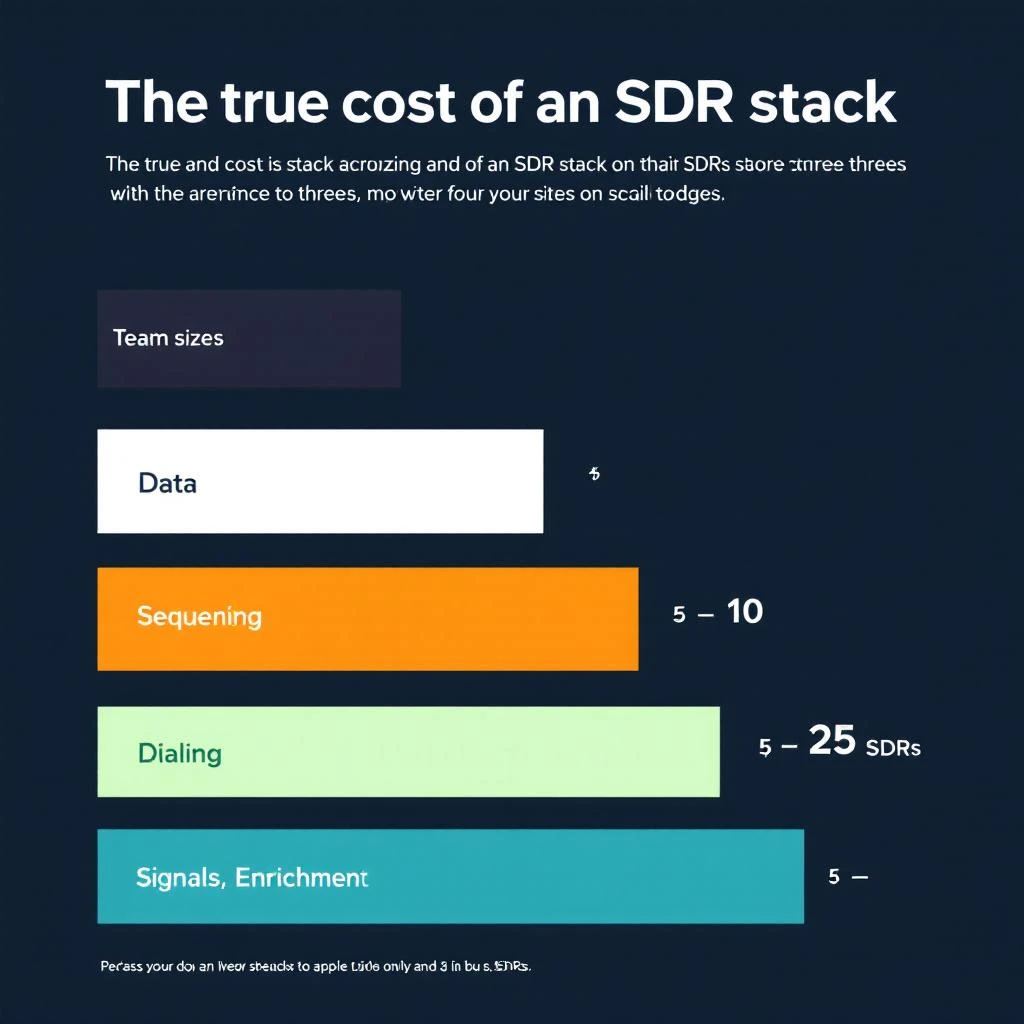
The five layers of an SDR stack (and why it matters for cost)
Every SDR stack we have priced breaks into five functional layers. Most teams pay for at least three of them. The expensive teams pay for all five.
- Data — Contact and account data. ZoomInfo, Apollo, Cognism, Lusha, Clearbit, Seamless, LeadIQ.
- Sequencing & engagement — Email, cadences, tasks. Salesloft, Outreach, Apollo, Reply.io, Smartlead, Instantly, Lemlist, Klenty, Mailshake, Mixmax, Outplay, Woodpecker.
- Dialing & conversation — Parallel dialers, conversation intel. Nooks, Orum, Gong, Chorus, Clari.
- Signals & intent — Visitor ID, intent data, job-change tracking. Warmly, Common Room, 6sense, Bombora, Demandbase, UserGems, Champify, Lead Forensics.
- Enrichment & orchestration — Workflow tools that stitch the rest together. Clay, Unify GTM, AISDR, Regie.ai, Artisan AI, Lavender.
The math problem is that most vendors price the layer they own as if it were the whole stack. ZoomInfo's "$14,995/year minimum" doesn't include sequencing. Salesloft's "$165/user/month" doesn't include data. Clay's "$800/month Pro" doesn't include sending. Stack the layers honestly and the budget gets ugly fast.
Below is what each layer actually costs in 2026, layer by layer, with a real team-size projection at the end.
Layer 1: Data — what a contact actually costs you
The data layer is where SDR budgets start, and where the most surprise costs live. The list price is the number that goes in your slide deck. The per-credit overage is the number that goes on your renewal invoice.
Apollo.io
Apollo is the volume play. The list price looks great until you hit the credit walls.
- Free: $0, 10,000 email credits/month, 5 mobile credits/month
- Basic: $49/user/month annual, $59 monthly
- Pro: $79/user/month
- Organization: $119/user/seat (3-seat minimum)
Real cost for 10 SDRs on Pro: ~$9,480/year, plus mobile credit overages that typically run another 15–25% on top. Full breakdown in our Apollo.io pricing breakdown for 2026.
ZoomInfo
ZoomInfo is the data Cadillac. You pay for the badge.
- Professional: ~$14,995/year (3 users, ~$416/user/month)
- Advanced: ~$25,000–$30,000/year
- Elite: ~$40,000+/year, often $60,000–$100,000 at scale
Credit overages run $0.25–$0.50 per credit on top. Our ZoomInfo pricing analysis shows why growing teams keep leaving.
Cognism, Lusha, Clearbit, Seamless, LeadIQ
The mid-tier data vendors typically land between $35–$120/user/month for usable plans, with credit-based limits that scale roughly linearly with seat count. We've covered them individually in Cognism's breakdown, Lusha's pricing, Clearbit's breakdown, Seamless.ai's pricing, and LeadIQ's pricing.
Honest budget rule: plan on $80–$120/seat/month for usable data, more if you need mobile direct dials at volume.
Layer 2: Sequencing & engagement — where the per-seat tax lives
If data is where the surprise overage costs live, sequencing is where the per-seat tax lives. List price is rarely what you pay.
Salesloft
Salesloft does not publish pricing. They want you to call. Vendr's marketplace data tells the real story.
| Deployment Size | Advanced (Annual) | Per User/Month |
|---|---|---|
| 10 users | ~$21,600 | ~$180 |
| 25 users | ~$54,000 | ~$180 |
| 50 users | ~$108,000 | ~$180 |
| 100 users | ~$180,000–216,000 | ~$150–180 |
Premier sits another 30–50% above Advanced, and the dialer is an add-on. Full cost analysis in our Salesloft pricing breakdown and the SalesLoft small business cost analysis.
Outreach.io
| Module | Cost | Notes |
|---|---|---|
| Engage (sequencing) | $100–$140/user/month | Annual contract |
| Meet (conversation intel) | $30–$50/user/month | Add-on |
| Deal (pipeline) | $30–$50/user/month | Add-on |
| Forecast | $20–$40/user/month | Add-on |
Implementation packages run $5,000 to $25,000+. A 50-user Engage deployment lists at ~$72,000/year before negotiation. See the full Outreach.io pricing breakdown.
Cheaper sequencing: Reply.io, Smartlead, Instantly, Lemlist, Klenty
If you do not need the enterprise badge, the mid-market sequencing space starts at $25–$70/user/month and includes more in the base tier.
- Reply.io pricing — strong AI features, agency-friendly
- Smartlead pricing — deliverability-focused, unlimited inboxes
- Instantly pricing — cold-email-first, deliverability tooling included
- Lemlist pricing — multichannel and personalization
- Klenty pricing — multichannel sequencing for SMB
- Mailshake pricing, Mixmax pricing, Outplay pricing, Woodpecker pricing
Honest budget rule: plan on $130–$170/seat/month for enterprise sequencing (Salesloft/Outreach), or $40–$80/seat/month for mid-market sequencing that covers 80% of the same workflow.
Layer 3: Dialing & conversation — the layer most teams underestimate
Parallel dialers and conversation intelligence are usually positioned as productivity multipliers. The math is real but the per-seat cost is brutal.
Nooks
| Metric | Value |
|---|---|
| Starting price | ~$4,000–$5,000/user/year |
| Monthly equivalent | ~$333–$417/user/month |
A 5-SDR Nooks deployment is $25,000/year base, often $30,000–$35,000 with add-ons. Full breakdown in our Nooks pricing analysis.
Orum, Gong, Chorus, Clari
- Orum pricing — parallel dialer, similar per-seat math to Nooks
- Gong pricing — conversation intelligence at $1,200–$1,600/user/year, often more at enterprise scale
- Clari pricing — forecasting and revenue intelligence, $25,000–$100,000+/year
- Chorus (now Zoominfo Chorus) — often bundled with ZoomInfo Elite
Honest budget rule: if you are paying for parallel dialing AND conversation intel separately, expect $400–$550/seat/month combined. Most SMB teams skip one or the other.
Layer 4: Signals & intent — the line item that doubled in 18 months
Visitor ID and intent data has been the fastest-growing layer in B2B. It is also the layer with the widest pricing spread. Some tools start at $700/month. Others start at $25,000/year.
Warmly
- Free: $0, 500 deanonymized visitors/month
- Business: $700/month starting
- Enterprise: $2,000–$5,000+/month
Visitor ID limits scale with traffic. See the Warmly pricing breakdown for the full tier analysis.
Common Room
- Starter: $1,000/month ($12,000/year minimum)
- Team: $2,500/month ($30,000/year minimum)
- Enterprise: $5,000–$8,000+/month ($60,000+/year)
Full analysis in our Common Room pricing breakdown.
6sense
- Team: ~$15,000–$20,000/year
- Growth: ~$25,000–$60,000/year
- Enterprise: ~$60,000–$100,000+/year
Plus credit-based usage, plus implementation fees. The 6sense pricing analysis walks through what each tier actually unlocks. Bombora, the data layer most intent platforms resell, is its own line item — covered in our Bombora pricing breakdown.
Lead Forensics, Demandbase, UserGems, Champify
- Demandbase pricing — enterprise ABM, $40,000–$100,000+/year typical
- UserGems pricing — job-change tracking, $20,000–$60,000/year typical, see our UserGems vs MarketBetter comparison
- Champify pricing — champion tracking with hidden costs detailed in the hidden cost of champion tracking tools
Honest budget rule: plan on $1,000–$3,000/month minimum for any signals tool that earns its keep. The cheap end is rarely usable; the expensive end requires a real ops function to operationalize.
Layer 5: Enrichment & orchestration — the modern surprise line item
This is the layer that did not exist in most stacks two years ago and now eats $10,000–$50,000/year of a typical SDR budget.
Clay
| Plan | Credits/Month | Monthly | Annual | Per 1,000 Credits |
|---|---|---|---|---|
| Free | 100 | $0 | $0 | — |
| Starter | 2,000 | $149 | $134/mo | ~$75 |
| Explorer | 10,000 | $349 | $314/mo | ~$31 |
| Pro | 50,000 | $800 | $720/mo | ~$16 |
A real SDR team running multi-step Clay workflows typically lands on Pro ($720–800/month) just for enrichment — before any sending. Full math in our Clay pricing breakdown.
AI SDR platforms: 11x, AISDR, Artisan, Regie, Breakout, Amplemarket
- 11x.ai analysis — autonomous AI SDR pricing, typically $1,000–$3,000/month per "agent"
- AISDR pricing — see also our MarketBetter vs AISDR comparison
- Artisan AI analysis
- Regie.ai pricing
- Breakout AI pricing
- Amplemarket pricing
Email coaching: Lavender
| Plan | Monthly | Annual | Includes |
|---|---|---|---|
| Free | $0 | $0 | 5 emails/month |
| Starter | $29 | ~$23 | Email scoring, AI coaching |
| Pro | $49 | ~$39 | Advanced personalization |
| Teams | $69/user | ~$55/user | Team analytics, shared templates |
| Enterprise | ~$89+/user | Custom | Custom AI training |
Honest budget rule: if you run Clay + an AI SDR + Lavender, you are at $1,500–$4,000/month before you have paid for data, sequencing, dialing, or signals.
The team-size math: what 5, 10, and 25 SDRs actually cost
Stack the honest budget rules together and the picture sharpens.
5-SDR team (early-stage outbound, ~$1–3M ARR)
| Layer | Tool choice | Annual cost |
|---|---|---|
| Data | Apollo Pro, 5 seats | ~$4,740 |
| Sequencing | Apollo (bundled) or Smartlead | $0–$3,600 |
| Dialing | Skip or basic Aircall | $0–$3,000 |
| Signals | Warmly Business | ~$8,400 |
| Enrichment | Clay Starter | ~$1,800 |
| Total | ~$14,940–21,540/year |
That is roughly $3,000–$4,300 per SDR per year, or ~$250–$360/SDR/month. Lean and runnable.
10-SDR team (Series A, scaling outbound)
| Layer | Tool choice | Annual cost |
|---|---|---|
| Data | Apollo Org, 10 seats | ~$14,280 |
| Sequencing | Salesloft Advanced, 10 seats | ~$21,600 |
| Dialing | Nooks, 10 seats | ~$45,000 |
| Signals | Common Room Team | ~$30,000 |
| Enrichment | Clay Explorer + Lavender Teams | ~$8,400 |
| Total | ~$119,280/year |
That is roughly $11,900 per SDR per year, or ~$995/SDR/month. The dialing and signals layers each match the cost of the data layer at this scale.
25-SDR team (Series B+, full enterprise stack)
| Layer | Tool choice | Annual cost |
|---|---|---|
| Data | ZoomInfo Advanced + Apollo | ~$45,000 |
| Sequencing | Outreach Engage, 25 seats | ~$36,000–42,000 |
| Dialing + Conv. Intel | Nooks + Gong | ~$110,000–140,000 |
| Signals | 6sense Growth | ~$45,000 |
| Enrichment | Clay Pro + Lavender Teams + 1 AI SDR | ~$30,000 |
| Total | ~$266,000–302,000/year |
That is ~$10,600–$12,100 per SDR per year, or ~$880–$1,000/SDR/month. Enterprise sequencing at scale stays roughly the same per-seat as Salesloft, but the signals and dialing layers grow disproportionately.
Three patterns we see in every honest stack audit
After running this exercise across customers, vendors, and our own data, three patterns repeat.
1. The signals layer is the most overpaid line item. Half the teams we see paying $30,000+/year for Common Room, 6sense, or Demandbase are not operationalizing the data — it shows up in a dashboard nobody opens. The pricing is enterprise-grade because the buyers historically were enterprise. Mid-market teams routinely overpay for the badge.
2. The dialer is the fastest-growing line item. Three years ago, the parallel dialer was a $500/seat-month tool a few power users had. Today it is a $4,000–$5,000/seat-year line item the whole team runs. That shift alone explains why a 10-SDR stack costs 40–50% more than it did in 2023.
3. The enrichment layer eats the savings from cheaper sequencing. Teams that downgrade from Salesloft to Smartlead to save $10,000/year often add Clay Pro and an AI SDR, putting them roughly back where they started — just with a different bill. The total cost of "doing outbound at this scale" has been remarkably stable. The mix has not.
Where MarketBetter sits in this math
We do not pretend to be every layer. We are signals, enrichment, and orchestration in one workspace, with the SDR workflow attached. The thing we replace, in the stacks above, is roughly:
- The signals layer (Warmly/Common Room/Lead Forensics equivalent for company-level visitor ID + intent)
- The orchestration layer (the part of Clay that makes signals actionable)
- The "what to do next" layer the rest of the stack does not have
The dollar value of that consolidation, on the 10-SDR stack above, is around $35,000–$45,000/year — if you replace both signals and orchestration. We are not for everyone. We are particularly good for SDR teams of 5–25 who want one workspace that turns a buyer signal into a specific outbound task, rather than five dashboards that each tell you a different version of the truth.
For the deeper feature comparison, see our breakdowns of MarketBetter vs Warmly, MarketBetter vs Common Room, MarketBetter vs UserGems, MarketBetter vs 6sense and Bombora, and MarketBetter vs Monaco.
How to use this post when you are budgeting
If you are building or auditing an SDR stack right now, the most useful exercise we have seen is a 90-minute zero-base review:
- List every line item. Pull your last 12 months of vendor invoices. Real numbers, not list price.
- Bucket by layer. Use the five-layer model above. If a tool spans layers, count it where it does the most work.
- Score each tool 1–5. "Would my SDR notice if this disappeared on Monday?" If the answer is "no," that tool is a renewal conversation, not a budget conversation.
- Recompute per-SDR cost. Total annual cost / SDR count. Compare to the benchmarks above. If you are 30%+ over the benchmark, ask whether the layer with the biggest spread is the layer with the biggest output. Usually it is not.
- Negotiate the renewal that matters most. The single biggest discount we see SDR teams capture each year is on the signals layer, because the published price has the largest gap to the floor price on Vendr.
The pricing breakdowns linked throughout this post each have a vendor-specific negotiation playbook at the end. The patterns are remarkably consistent: 12-month commits get 10–15% off, 24-month commits get 20–25%, multi-product bundles are where the real money lives.
The shorter version
Running 5 SDRs in 2026 honestly costs $15,000–$22,000/year of software. Running 10 SDRs honestly costs ~$120,000/year. Running 25 SDRs honestly costs $260,000–$300,000/year. The biggest variance, layer by layer, is not the data or the sequencing — it is the signals and the dialing. Both have roughly doubled in 18 months.
If your stack is dramatically below those numbers, you are probably understaffed on tooling. If your stack is dramatically above, you are probably paying enterprise rates on a layer that is not enterprise-grade in your environment.
The best thing you can do this quarter is not buy a new tool. It is to run the five-layer audit on the tools you already pay for.
Want a stack audit on your own numbers? Book a 20-minute walkthrough and we will benchmark your current spend against the 50+ tools in this analysis.