
The 15-Minute Pre-Demo Prep Playbook: How AEs Turn Booked Demos Into Closed Deals [2026]

Ask ten AEs how they prep for a discovery call and you will get ten versions of the same answer: "I skim the calendar invite on the way in." Maybe a glance at LinkedIn. Maybe a check of the CRM if there is time. The actual decision making — what to ask, what to demo, who else to pull in — happens live, in the call, in front of the buyer.
This is why most discovery calls feel generic to buyers. The AE shows up cold, runs the same 12 questions they always run, and demos the same five screens. The buyer politely sits through it, says "send me pricing," and quietly moves you down the list. Two weeks later the deal is dead and nobody can say why.
The fix is not a longer call or a fancier script. It is fifteen minutes of structured prep before the meeting. Done right, this is the highest-leverage 15 minutes in the entire deal. It is what separates AEs who close 25 percent of demos from AEs who close 8 percent.
Below is the exact 15-minute pre-demo prep workflow. It assumes the SDR did real handoff work upstream — if your handoffs are a Slack message that says "good lead, call them," fix that first using the SDR-to-AE handoff playbook, then come back here.
Why 15 minutes of prep is worth more than 60 minutes of follow-up
Most sales coaching focuses on what AEs do during and after the demo. Both matter. But the highest variance in deal outcomes happens before the call even starts.
The buyer walks into a discovery call with a hypothesis: "this vendor probably does X, and X is what I need." If the first ten minutes of the call confirm that hypothesis, they lean in. If the first ten minutes contradict it, or even worse, force them to re-explain context they already shared, they check out. You have lost the call by minute eleven and you do not know it yet.
Prep is how you front-load context so that the first ten minutes confirm the buyer's hypothesis. Skip prep and you spend the first half of every discovery call re-qualifying. Do prep well and you spend that time showing the buyer that you already understand their problem better than they do.
This is what the AEs who win consistently get right. They do not have better discovery questions. They have better preparation.
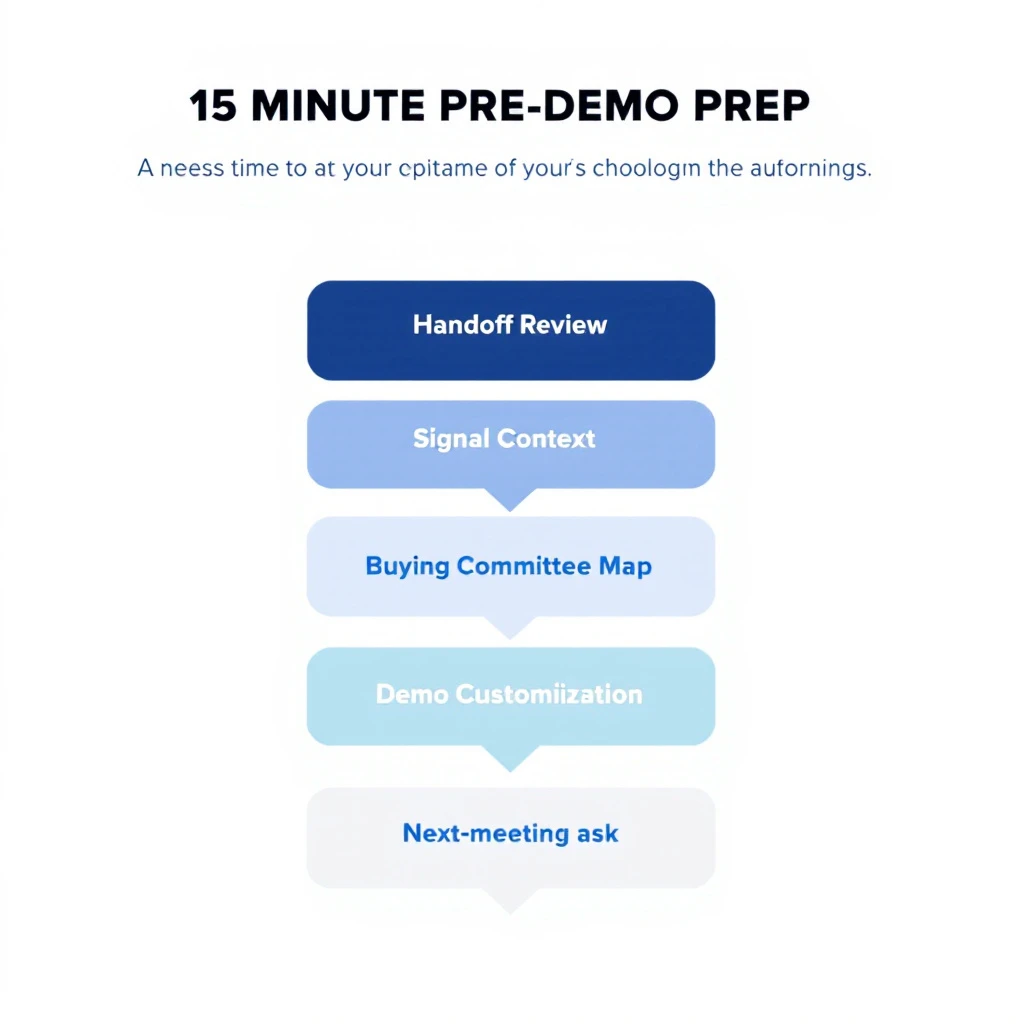
The 15-minute framework
Five three-minute blocks. Run them in order. Do not skip blocks because "the deal is small" or "I know this account." The AEs who think they are above prep are the AEs whose forecasts miss every quarter.
Minutes 0–3: Re-read the SDR's handoff notes
Open the CRM. Read every note the SDR wrote on this account, in order. Not just the most recent one. The full thread.
You are looking for three things:
- The buyer's stated problem in their own words. Highlight the exact phrasing they used. You will mirror this language back in the first three minutes of the call. If they said "our reps are drowning in leads they cannot triage," you will say "you mentioned your team is drowning in leads — let's start there." This is the cheapest trust signal in sales.
- What the SDR already qualified. Budget, timeline, decision criteria, current tooling. Do not re-ask any of this in discovery. The fastest way to lose a buyer is to make them repeat information they already gave your SDR. Discovery is for going deeper, not starting over.
- What was left unclear. The gaps in the SDR's notes are what you need to clarify in the first 15 minutes of discovery. Write these down. Three to five gaps, max.
If the SDR's notes are thin, this is a handoff problem, not a prep problem. Flag it to the SDR manager after the call. Then run the signal triage rubric on your inbound to make sure future handoffs come in with real qualification.
Minutes 3–6: Pull the buying signal context
What told you this account was ready to buy? Was it a visitor identification hit on the pricing page? An intent signal from a third-party data provider? A champion who pinged you back after a content download? Each signal type implies a different buyer state.
A pricing-page visitor is further down the funnel than a free-content downloader. A return visitor with three sessions in seven days is hotter than a first-time visitor. A buying committee with three people on your site this week is in active evaluation. Read the buying signal hierarchy if you need a refresher on which signals actually predict closed-won.
Pull two specific signals into your call notes. Reference them naturally in the first ten minutes. Not "I saw you visited our pricing page" — that is creepy. But "it sounds like you are far enough along to be evaluating costs, is that right?" That is the same information, framed as conversation, not surveillance.
Signals also decay. A signal that was hot ten days ago may be cold today. If your handoff is more than seven days old, the buyer's urgency has dropped. Adjust your call energy accordingly. The signal decay curve shows how fast buying intent erodes if you sit on it.
Minutes 6–9: Map the buying committee
Pull up LinkedIn. Identify every person at the company who could possibly be involved in this purchase. Not just the contact on the calendar invite. The full committee.
For a typical B2B SaaS deal in the under 50K range, you are looking at three to five people: an end user, a manager, a budget holder, and one or two influencers. For larger deals, double that. Write the names down. Note their titles. Spend 30 seconds on each LinkedIn profile to learn what they care about.
The buyer on your call is one of these people. The other four to nine are not, and they will decide whether this deal closes. Your job in discovery is not to sell the person on the call. It is to give them ammunition to sell internally to the other people. That is what good demos do.
Plan the multi-thread move now. Who will you ask the buyer to introduce you to? When? How will you frame the ask so it does not feel like you are bypassing them? Run the multi-threading deal team playbook on this account before the call so you know exactly which five stakeholders you need to cover.
If you skip this step, you will leave the demo with one contact and zero leverage. Two weeks later the champion will go quiet and the deal will stall. The mapping you do in these three minutes is what prevents that.
Minutes 9–12: Customize the demo flow
Most AEs run the same demo for every buyer. Same five screens. Same demo script. The buyer can tell. They have seen vendors do this before. It signals that you do not understand their specific problem.
Use what you learned in minutes 0–6 to pick three demo moments — not five, not seven, three — that will land hardest for this specific buyer. If their stated problem is inbound triage, lead with the triage workflow. If it is signal aggregation, lead with the signal stack. If it is outbound personalization, lead with the workflow that generates personalized outreach from signals.
Cut the rest. A 25-minute demo that hits three things hard is twice as effective as a 45-minute demo that covers everything shallowly. Buyers do not remember everything. They remember the moments that mapped to their specific problem.
Write down the three demo moments. Write down the transition language between them: "now that you have seen how the triage works, the next question is what your reps do with the highest-tier leads — that is where the playbook comes in." Pre-built transitions keep the demo tight even when the buyer takes you off-script with questions.
Minutes 12–15: Plan the next-meeting ask
Before the call starts, decide exactly what next-step you will ask for at the end. Not "I will play it by ear." A specific ask, written down.
For a hot deal, the ask is a working session with the buying committee in the next week. For a warm deal, it is a 30-minute deep dive on the specific use case with two more stakeholders. For a cooler deal, it is a follow-up call in seven days with concrete material the buyer can share internally.
Whatever the ask is, prepare two things:
- The exact words you will use to make the ask. "Based on what we have talked through, the right next step is X. Can we get that on the calendar before you leave today?" Specificity is everything. "Let me follow up next week" is what bad AEs say at the end of bad calls.
- The artifact you will send within four hours of the call. A short recap email with the three things they cared about, the next step on the calendar, and one piece of content tailored to their use case. This is the first move of the 14-day post-demo workflow. Get it right.
If you cannot articulate the next-meeting ask in three minutes of prep, the deal is not as qualified as you think it is.
What to skip in prep (and what to skip in the demo)
Three things AEs waste prep time on that do not move deals forward.
Do not read the entire company About page. The buyer is not going to test you on it. A 90-second scan of their homepage is enough. You need to know what they sell and to whom, not who founded the company in 2011.
Do not memorize a full discovery script. Discovery is a conversation, not a survey. The five to seven questions you need will come naturally if you have done the rest of the prep. A memorized script makes you sound like a vendor.
Do not over-prep slides. Discovery calls are not pitch decks. Open with no slides at all. Talk first, demo second, slides only if specifically asked. AEs who lead with slides telegraph that they have not done the prep — they are hiding behind structure because they do not have substance.
The example walkthrough
A real prep run, lightly fictionalized.
The account is a 200-person logistics SaaS company. The SDR booked the demo three days ago after the buyer downloaded a guide on outbound personalization. Two people from the company visited the pricing page in the last seven days. The contact on the call is a Director of Sales.
Minutes 0–3: SDR notes say the buyer complained about "outbound that gets ignored even though our list quality is good." Budget was qualified at "under 30K for the first year." Timeline is "Q3 implementation, ideally." Gap: no detail on current tooling or who else is involved in the decision.
Minutes 3–6: Pricing-page traffic from two people implies an active committee. The downloaded content was on personalization, not signal aggregation, so the entry point is workflow, not data. The buyer state is "we have leads, we are not converting them," which maps to outreach quality, not lead supply.
Minutes 6–9: LinkedIn shows three relevant people at the company beyond the Director: a VP of Sales (her boss), a Sales Ops Manager (likely the tool evaluator), and a senior AE who has posted about cold outreach. These four are the buying committee. The ask: introduction to the Sales Ops Manager within the week.
Minutes 9–12: Demo will lead with the workflow that turns a buying signal into a specific outreach action. Then the signal aggregation. Skip the visitor ID workflow entirely — not what they came for. Skip the integrations slide.
Minutes 12–15: Ask at end: "let's get a 30-minute working session next Tuesday with you and your Sales Ops lead — I will walk through how this would plug into your current sequencing tool. Does that calendar work?" Recap email goes out within four hours with one paragraph on the personalization workflow and one link to the signal-to-meeting workflow guide.
That is the prep. Fifteen minutes. The discovery call is now a working session, not a pitch.
Why this matters for managers, not just reps
If you manage AEs, the question is not whether your reps are doing this prep. The question is whether you can prove they are.
Ask your top performer how they prep. They will describe some version of this framework, possibly without naming it. Ask your bottom performer. They will say "I look at the calendar invite." The variance in prep is the variance in close rate.
Build prep into the deal review. Before any forecast call, ask the AE what their pre-demo prep was on the deals they are forecasting. If they cannot articulate it, the deal is not real. Move it back to best case.
This is the same discipline you should be running on inbound speed-to-lead and on the SDR-to-AE handoff. The wins in modern B2B sales are no longer in better closing skills. They are in better operational discipline at every handoff. Reps who run the prep win. Teams that enforce the prep scale.
Make the prep run itself
The 15 minutes are non-negotiable. But the data pulling — pulling the signals, mapping the committee, surfacing the SDR notes — should not take five of those minutes. It should take 30 seconds.
This is exactly what MarketBetter is built for. When a meeting is on your calendar, the platform surfaces the relevant signal history, buying committee map, and recommended demo flow before you open the CRM. Your AEs spend their 15 minutes thinking, not searching.
That is the difference between AEs who hit number and AEs who do not. The thinking is the work. Everything else is logistics that software should handle.
Want to see how this works in your sales motion? Book a demo and we will run the pre-demo prep workflow on one of your real accounts.
Related reading:
- The SDR-to-AE Handoff Playbook — the upstream piece. If your handoffs are weak, prep cannot save the deal.
- The 14-Day Post-Demo Window — what happens after a great discovery call.
- Multi-Threading Sales Deals — how to cover the buying committee you mapped in minutes 6–9.
- The Buying Signal Hierarchy — which signals actually predict closed-won.
- Champion Went Quiet Playbook — what to do when the contact on your call goes dark.
- Signal Decay Curve — why aging handoffs cool fast.
- Signal-to-Meeting Workflow — the upstream SDR motion.
- Signal Triage Rubric — how SDR managers enforce real qualification.