
The 4-Question Signal Triage Rubric SDRs Actually Use (2026)

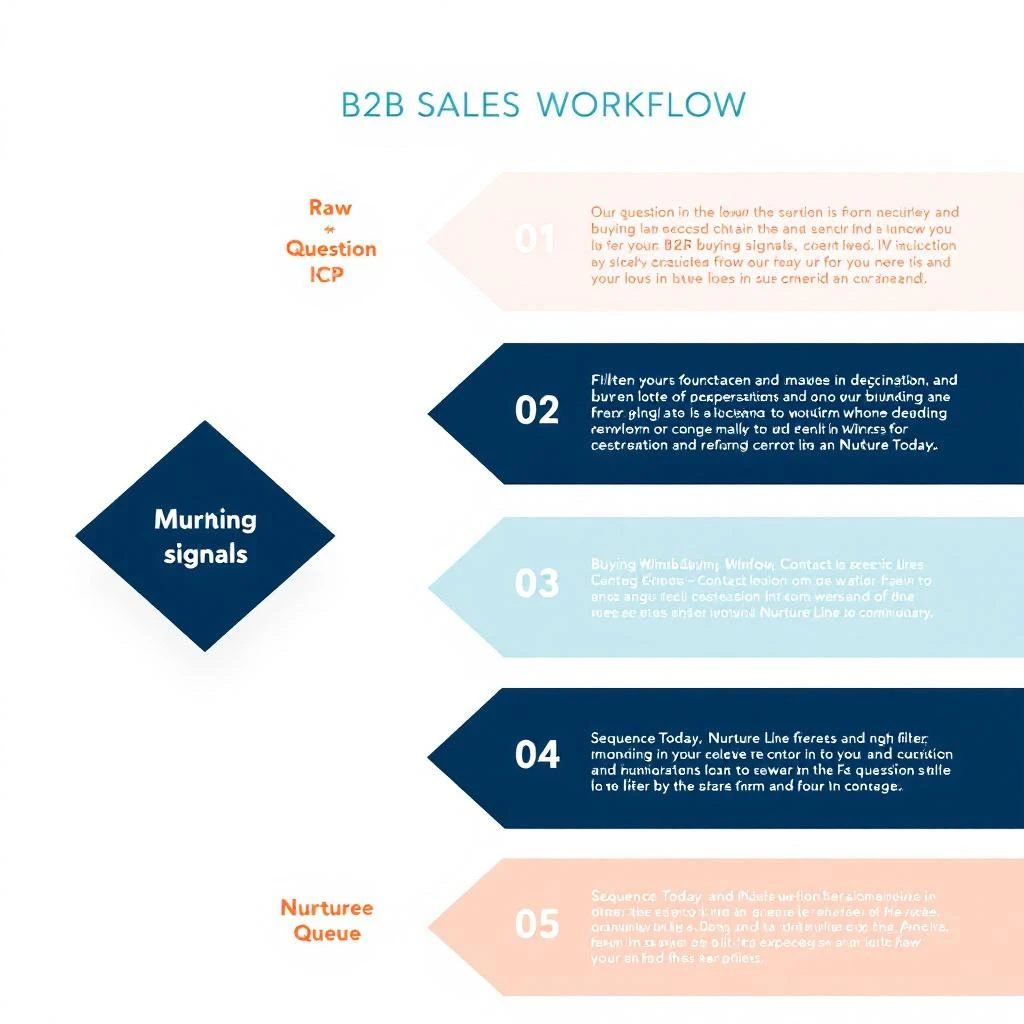
Here is the pattern every signal-based selling rollout follows:
- Week 1: SDRs are excited. New tool, new dashboard, fresh alerts in Slack. Outreach goes up.
- Week 2: Reply rates aren't materially better than the old list. Reps notice they're chasing signals that look hot but go nowhere.
- Week 3: Slack channel mutes. Alerts get ignored. Reps revert to working their old account list.
- Week 4: Manager asks why the new stack isn't producing meetings. Vendor blames "process." Rep blames "data quality." Nothing improves.
We've now seen this loop in healthcare IT staffing, education technology, EHS compliance, and a dozen other categories. The diagnosis is almost always the same — and it isn't the signal source.
The problem is that SDRs are receiving signals faster than they can decide what to do with them, and no one ever taught them how to triage. They get 40 alerts a day. Half are noise. They have no rubric, so they default to the worst one: "pick whichever logo looks coolest."
The fix is not more signals. It's not better routing. It's a 30-second mental rubric every rep applies to every signal before any outreach happens. We'll walk through it below.
If you haven't yet read it, the buying signal hierarchy framework is the input to this rubric — it ranks signals by closed-won correlation. Triage is what happens after a signal is captured and before a rep opens a sequence.
Why "Just Work the Signals" Fails
The default playbook most teams roll out goes like this:
- Buy or build a signal source (visitor ID, intent data, job-change alerts).
- Pipe alerts into Slack.
- Tell reps to "work them."
- Hope.
The hope is doing all the work. Here's what reps actually experience:
- A Slack alert fires: "Acme Corp visited /pricing 3 times this week."
- The rep has no idea if Acme is in ICP, who to contact, what context to use, or whether the visit was a junior intern or a buyer.
- The rep either guesses (and burns the account on a generic email) or skips it (and the signal dies).
In a recent breakdown of why these rollouts fail in 90 days, we found that the absence of a triage step was the single biggest predictor of adoption collapse. Reps don't need more signals. They need permission to say no to bad ones — and a structured way to do it fast.
The 4-Question Rubric
A working rubric has four properties: it's fast (under 30 seconds), repeatable (any rep can apply it), explicit (no judgment calls left ambiguous), and binary (each question is yes/no). Here is the version that has held up across SDR teams we work with.
Question 1: Is the account in ICP — right now?
Not "could be in ICP someday." Not "matches some firmographic filter." Right now. Industry, employee count, geography, tech stack, funding stage. If you can't answer yes in five seconds using the signal payload + your enrichment data, the signal is automatically deprioritized — not killed, just deprioritized.
This question alone removes 40-60% of incoming signals in most teams. Pure ICP filtering at the signal layer is what your signal stack architecture should be doing automatically, but reps still need the explicit check because automation misses things.
Default action if NO: Save the account to a nurture list. Do not sequence today.
Question 2: Is this a buying-window signal, or a research signal?
This is the question almost no rep asks, and it's the one that separates 4% reply rates from 18% reply rates.
A research signal means the account is aware of the category. Examples: visited your blog, read a comparison article, downloaded a whitepaper, watched a webinar. They are educating themselves. Reaching out now and asking "want to book a demo?" is too early — they're not buying, they're learning.
A buying-window signal means the account is evaluating solutions or experiencing a triggering event. Examples: pricing page visits (especially repeat), competitor review reads, demo requests on adjacent tools, new VP of Sales hired, recent funding round, RFP language posted to a job description, integration page visits, sales tax/security/compliance page visits.
The difference matters enormously. Map this against the buying signal hierarchy — Tier 1-2 signals (pricing visits, demo requests on adjacent tools, RFP-language job posts) are buying-window signals. Tier 4-5 (blog visits, generic content downloads) are research signals.
Default action if RESEARCH: Add to a slow-drip educational sequence. Do not call. Do not pitch demo.
Default action if BUYING: Proceed to Question 3.
Question 3: Is there a credible point-of-contact for this signal?
Even a great buying signal goes nowhere if the rep is reaching out to the wrong human. A "pricing page visit from Acme" tells you nothing about who visited. The triage question is: based on what we know about the account, can we identify a credible buyer or buying-committee member to contact in the next 10 minutes?
"Credible" means three things:
- The role plausibly cares about the problem you solve (VP of RevOps, Director of SDRs, Head of Demand Gen — not a junior analyst).
- You have a verified work email or LinkedIn that you can reach them on.
- You have enough context to say something more specific than "saw you visited our site."
If you can't pass all three, you have a routing problem, not a signal problem. Either invest in better contact enrichment or build your account-to-contact mapping into the signal capture layer so reps don't have to do this work cold.
Default action if NO: Send to a research/enrichment task queue. Do not attempt outreach until contact is identified.
Question 4: What is the most specific opening line you can write — without the word "noticed"?
This is the disqualification question, and it's the one that catches lazy outreach.
If the best opening line you can write is Hi {{first_name}}, I noticed you visited our pricing page — the signal is not actionable. You're going to write a forgettable email, the prospect is going to ignore it, and the signal will die unconverted.
A passing answer looks like a sentence that references something specific to this account and signal that an automated tool could not have written: a competitor they're using, a recent press release, a job posting language that implies the pain you solve, a podcast quote from their VP, a LinkedIn post they made last week.
If you can write that sentence in under a minute, the signal passes. If not, the signal goes to a nurture sequence, not a 1:1 outreach attempt. The funnel math from our Monaco Corner experiment was unambiguous: outreach with a specific opening converts 4-6x what generic signal-triggered outreach does.
Default action if YES: Sequence within 4 hours per the signal-to-meeting 24-hour workflow.
Default action if NO: Park the account in a nurture queue and revisit when a stronger signal lands.
The Decision Matrix
Here is the rubric collapsed into a routing matrix you can paste into a Slack pinned message or your CRM playbook field:
| Q1 ICP | Q2 Buying Window | Q3 Contact | Q4 Specific Line | Action |
|---|---|---|---|---|
| Yes | Yes | Yes | Yes | Sequence today, 1:1 outreach within 4 hrs |
| Yes | Yes | Yes | No | Park; add to nurture; revisit next signal |
| Yes | Yes | No | — | Enrichment queue; do not sequence |
| Yes | Research | — | — | Slow-drip educational sequence |
| No | — | — | — | Nurture list; quarterly revisit |
Notice that only one row triggers active outreach. The point of the rubric is to make the "no" decision easy and guilt-free, so reps stop sequencing weak signals out of fear of "missing it."
How to Roll This Out Without Reps Hating It
Three rules that determine whether the rubric sticks.
1. Make it a 30-second check, not a 10-minute exercise.
If applying the rubric takes longer than the outreach itself, reps will stop using it. Use a tiered routing layer to auto-answer Q1 (ICP) and Q3 (contact) before signals ever hit a rep. That leaves them with Q2 and Q4 — the two that actually require human judgment.
2. Build the matrix into your CRM, not a Notion doc.
Reps will not consult a Notion page mid-flow. Put the four questions as required fields on the signal-triggered task. Pre-populate Q1 and Q3 with system data. Force a yes/no on Q2 and Q4 before the task can be marked actioned. This sounds bureaucratic. It's not — it's the difference between rubric-as-policy and rubric-as-reality.
3. Review nurture decisions weekly, not outreach ones.
Most managers review what reps did — outreach sent, meetings booked. The higher-leverage review is what reps didn't do: which signals did they nurture or park, and why? A 15-minute weekly review of the parked queue catches calibration drift (reps being too lenient or too strict) and surfaces signals that should have been actioned. This is the operational habit that keeps the rubric honest.
What Changes in Week 2 (When Most Rollouts Fail)
The original failure pattern — Week 2 reply rates flat, Week 3 alerts ignored — looks different with a rubric in place.
In Week 2 of a triaged rollout, you should see:
- Volume of outreach down by 40-60% — fewer signals make it through the funnel.
- Reply rate up by 2-3x because the signals that do get worked are higher quality.
- Slack alert engagement up because reps trust that flagged signals are worth opening.
- A growing nurture list that the marketing team can run drip campaigns against — instead of weak signals being burned by SDR outreach and never converting.
That last point is underrated. Without a rubric, every weak signal gets burned by a single SDR email. With a rubric, weak signals get fed back into the intent data layer and warmed up properly. The economics are dramatically different.
What This Looks Like Inside MarketBetter
If you're using MarketBetter, the rubric is partially built into the workflow. Visitor ID and intent signals fire into the platform, get scored against your ICP rules, get matched to a credible contact, and arrive at the rep with the equivalent of Q1 and Q3 already answered. The rep's job is Q2 and Q4 — and the system surfaces context (recent funding, job postings, competitor mentions) so the "specific opening line" question is answerable in seconds, not minutes.
This is what we mean when we say "tells you who and what to do." Most signal platforms tell you who. The triage question — and the answer the rep can act on in 30 seconds — is what closes the gap between alert and outreach.
If you want to see how this works end-to-end, book a demo and we'll walk through your live signal stack with the rubric overlaid.
The One-Page Version
If you take nothing else from this:
- Q1: Is the account in ICP right now?
- Q2: Buying window or research?
- Q3: Credible contact?
- Q4: Specific opening line — without the word "noticed"?
Four questions. 30 seconds. The single biggest predictor of whether your signal-based selling investment compounds or collapses by week three.
Related reading:
- The Buying Signal Hierarchy: Tier 1-5 by Closed-Won Correlation
- The 3-Layer Signal Stack: Collection, Correlation, Action
- Signal-Based SDR Routing: Replacing Round-Robin With Intent-Tier Distribution
- Why Most Signal-Based Selling Rollouts Fail in 90 Days
- Visitor ID to First Outreach in 30 Minutes: The Setup Playbook
- Signal to Meeting in 24 Hours: The SDR Workflow
- B2B Intent Data: The Definitive Guide