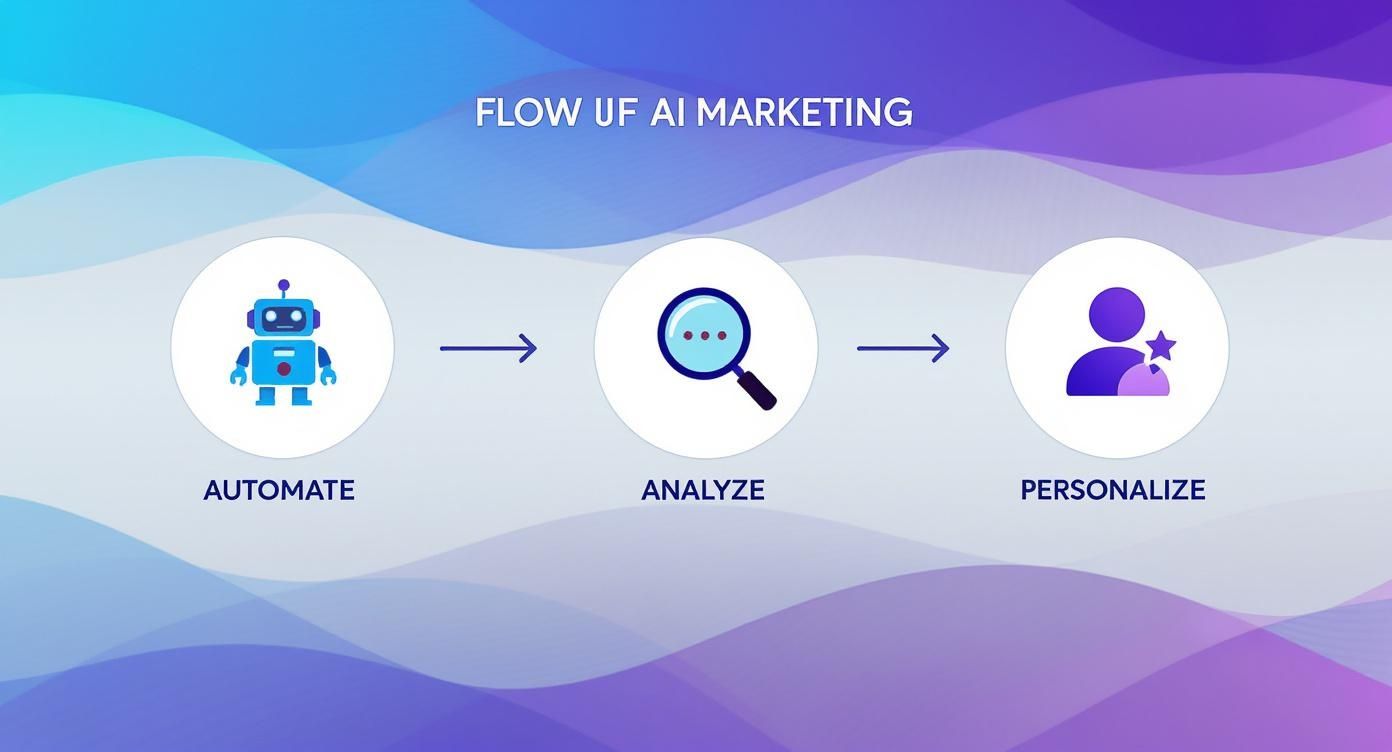
How to Build a B2B Demand Generation Strategy That Fills Pipeline (Step-by-Step)

· 23 min read

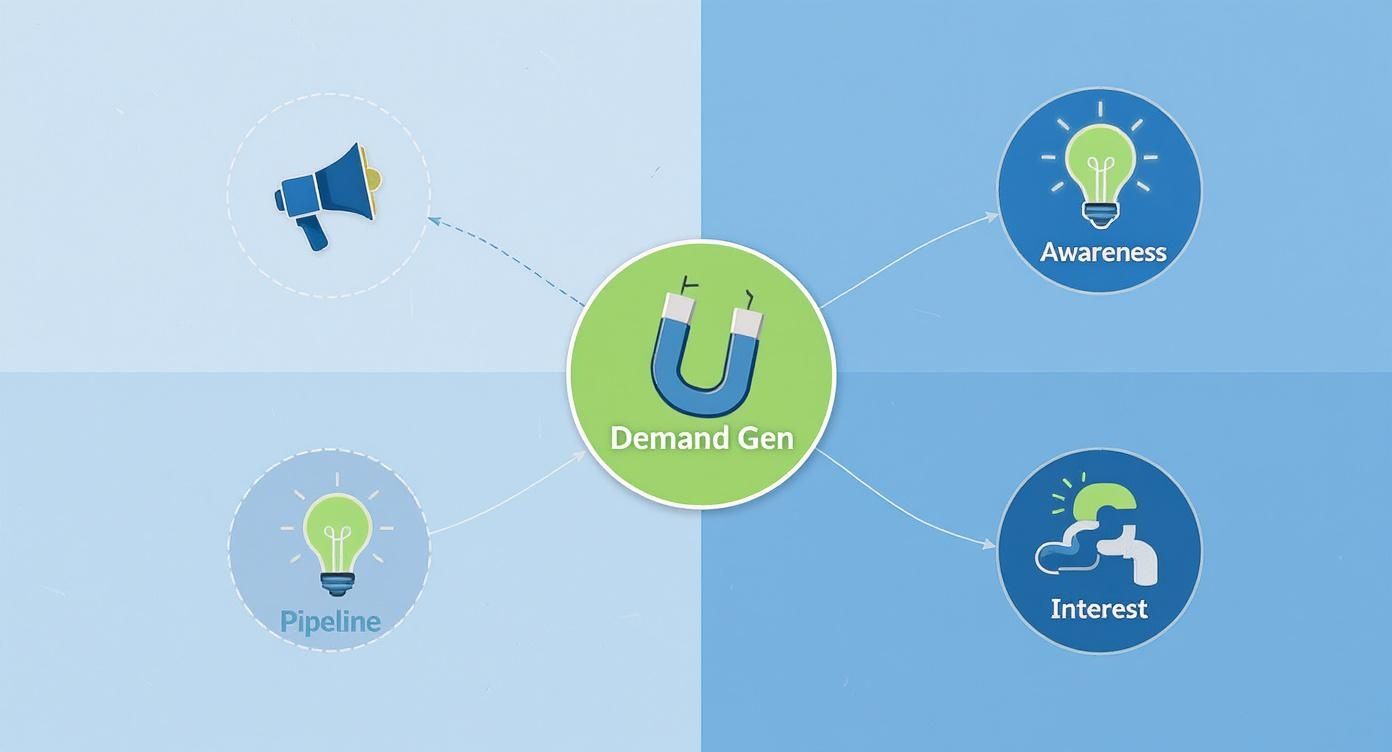
Let's be honest, the term "demand generation" gets thrown around a lot. But a modern B2B demand gen strategy is much more than just a fancy new name for lead gen. It's a completely different way of thinking.

We're talking about a full-funnel approach designed to create genuine interest in what you do long before a prospect even thinks about filling out a form. The goal isn't just to chase leads; it's to build a predictable revenue engine by becoming the go-to resource in your space.

Moving Beyond Leads to Create Real Demand

A group of professionals collaborating on a strategic plan for demand generation.

The old playbook is broken. Gating every piece of content and hammering MQLs is a fast track to burning out your sales team and annoying your potential customers.

Today’s B2B buyers are in the driver's seat. They do their own research, read reviews, and talk to peers. A huge chunk of their decision is made before they ever want to talk to a sales rep. A smart demand generation strategy not only accepts this reality but leans into it.

Instead of just capturing contacts, the focus shifts to creating a groundswell of interest with your Ideal Customer Profile (ICP). It’s about being so consistently helpful and insightful that when a need finally arises, your brand is the only one they think of.

Demand Generation vs. Lead Generation

Getting this distinction right is everything. It dictates your entire marketing motion.

Think of it like this: lead generation is like fishing with a giant net, hoping to catch anything that swims by. Demand generation is like creating the perfect, irresistible habitat that attracts the exact fish you want.

  • Lead Generation (The "Old Way"): This is about capturing contact info. The primary metric is the quantity of leads (MQLs), and it's often a volume game.
    • Action: Gate content, run lead forms, measure cost-per-lead.
    • Outcome: A CRM full of low-quality contacts who aren't ready to buy. Your sales team wastes cycles on dead ends.
  • Demand Generation (The "Modern Way"): This is about educating the market and building brand love. The primary metric is the quality of engagement, which ultimately drives pipeline and revenue.
    • Action: Ungate valuable content, build community, measure pipeline influence.
    • Outcome: A pipeline of educated, high-intent prospects who already understand your value.

"A powerful B2B demand generation strategy helps in building brand awareness while producing highly valuable, engaging content that drives interest and nurtures leads."

This guide is your roadmap for building a strategy that does exactly that. We'll walk through the pillars of this modern approach, from defining your ICP to measuring what actually matters.

For a deeper dive, check out this excellent Full Cycle B2B Marketing Playbook). It’s a fantastic resource for building out your entire marketing function from the ground up.

Build Your Demand Gen on a Bedrock of First-Party Data

Before you even think about launching a campaign, let's talk about the single most critical piece of your B2B demand generation strategy: knowing exactly who you're aiming at. Too many marketers take the easy route, buying third-party data lists. It's a trap. Those lists are often stale, inaccurate, and a great way to burn cash.

The real gold isn't out there—it's already in your systems. Your first-party data is the ground truth.

We're not just talking about basic firmographics like company size or industry. This is about rolling up your sleeves and digging into your CRM, your analytics, and customer feedback to find the rich, behavioral clues that define your absolute best customers.

First-Party vs. Third-Party Data: Not Even a Fair Fight

It's crucial to understand the difference here. Third-party data is basically a commodity. It’s scraped together from countless sources and sold to anyone who will buy it. It's wide but incredibly shallow, lacking any real context about your specific audience.

First-party data, on the other hand, is information you've earned directly from your audience through their actions—website visits, purchase history, webinar sign-ups, and direct conversations.

Data TypeReliability & AccuracyDepth of InsightActionability
First-Party DataHigh (collected directly)Deeply contextual and specificHighly actionable for personalization
Third-Party DataLow to moderate (often outdated)Generic and lacks nuanceLimited for precise targeting

Trusting third-party lists is like trying to find a specific person in a packed stadium with a blurry photo. Using your own data is like having their direct phone number and knowing exactly what they care about.

Actionable Step: Mine Your CRM and Analytics for Gold

Your CRM isn't just a digital Rolodex; it's a collection of stories about your most successful customer relationships. Start right there. Pull a list of your top 10-20 customers and get ready to go deep. The goal is to build a hyper-specific Ideal Customer Profile (ICP), and to do that, you have to ask the right questions.

Look for the hidden patterns:

  • Business Pains: What fire were they trying to put out when they found you? Your sales team's discovery notes and call recordings are treasure troves for this.
  • Buying Committee: Who really signed the check? And who championed the deal internally? Pinpoint the roles of the champion, the economic buyer, and the end-user. This tells you who you actually need to win over.
  • Tech Stack: What other tools are they using? This isn't just trivia—it signals their technical maturity, budget, and potential integration needs, which can qualify them as a great fit.
  • Content Consumption: Which pages did they visit on your site right before they became a customer? Your web analytics will show you which blog posts, case studies, or webinars did the heavy lifting.

Actionable Takeaway: By piecing this together, you stop chasing vague personas like "Marketing Manager at a tech company." Instead, you get a razor-sharp ICP like, "A Marketing Ops Leader at a Series B SaaS company with 50-200 employees, using HubSpot, and struggling to prove marketing ROI." That level of clarity changes everything.

Turning Raw Data Into Actionable Segments

Once you have this rich profile, you can stop shouting one message to everyone. Instead, you can build powerful segments and create tailored content that speaks directly to the specific pains of each group. Your messaging for an enterprise CFO focused on cost savings should be worlds apart from how you talk to a mid-market content manager focused on productivity.

This isn't just theory. Businesses that get serious about their first-party data strategies see a 2x increase in conversion rates and a 30% reduction in customer acquisition costs. S2W Media, for example, reported a 35% jump in engagement rates and a 50% improvement in audience segmentation just by leaning into its own data. You can read more on how first-party data is shaping B2B marketing to see the full picture.

Of course, this data is useless if it's trapped in different systems. This is where a Customer Data Platform (CDP) becomes essential. A well-implemented CDP unifies all those scattered data points—from your website, CRM, and support tools—into a single customer view. This powers everything from smarter ad targeting to more relevant sales outreach. For a practical look at making this happen, check out this guide on Customer Data Platform integration.

Ultimately, grounding your strategy in first-party data isn't just a "best practice." It's your single biggest competitive advantage. It ensures every dollar you spend is aimed squarely at prospects who look just like your best customers, making your entire demand gen engine more efficient and predictable.

Matching Your Content And Channels To Buyers

Once you have a rock-solid Ideal Customer Profile built on real, first-party data, it's time to show up where your buyers actually are. But it’s not about blasting the same generic message everywhere. A smart B2B demand generation strategy is about precision—matching the right content, to the right channel, at the right moment in their journey.

Think of your channels like different tools in a toolkit. Each one has a specific job.

  • LinkedIn is where you build community and establish yourself as an authority. It's the place for nuanced conversations, sharing deep insights, and getting in front of decision-makers at your target accounts. It’s a long game for creating demand.
  • SEO, on the other hand, is your engine for capturing active, high-intent demand. When someone searches "best accounting software for mid-market," they have a problem and they're looking for a solution right now. Ranking for those terms puts you directly in their path when it matters most.

Framing it this way helps you move from "spray and pray" to strategic investment. You use LinkedIn to create demand by educating the market, and you use SEO to capture the demand that's already out there.

Aligning Content Formats With The Buyer's Journey

The goal is to create a content ecosystem that seamlessly guides a prospect from "I think I have a problem" all the way to "this is the solution I'm buying." This means mapping specific assets to the three core phases: Awareness, Consideration, and Decision. A mismatch here can kill a deal before it even starts.

You wouldn't hit someone at the top of the funnel with a detailed pricing sheet. That’s like asking for a commitment on a first date—it’s just too much, too soon.

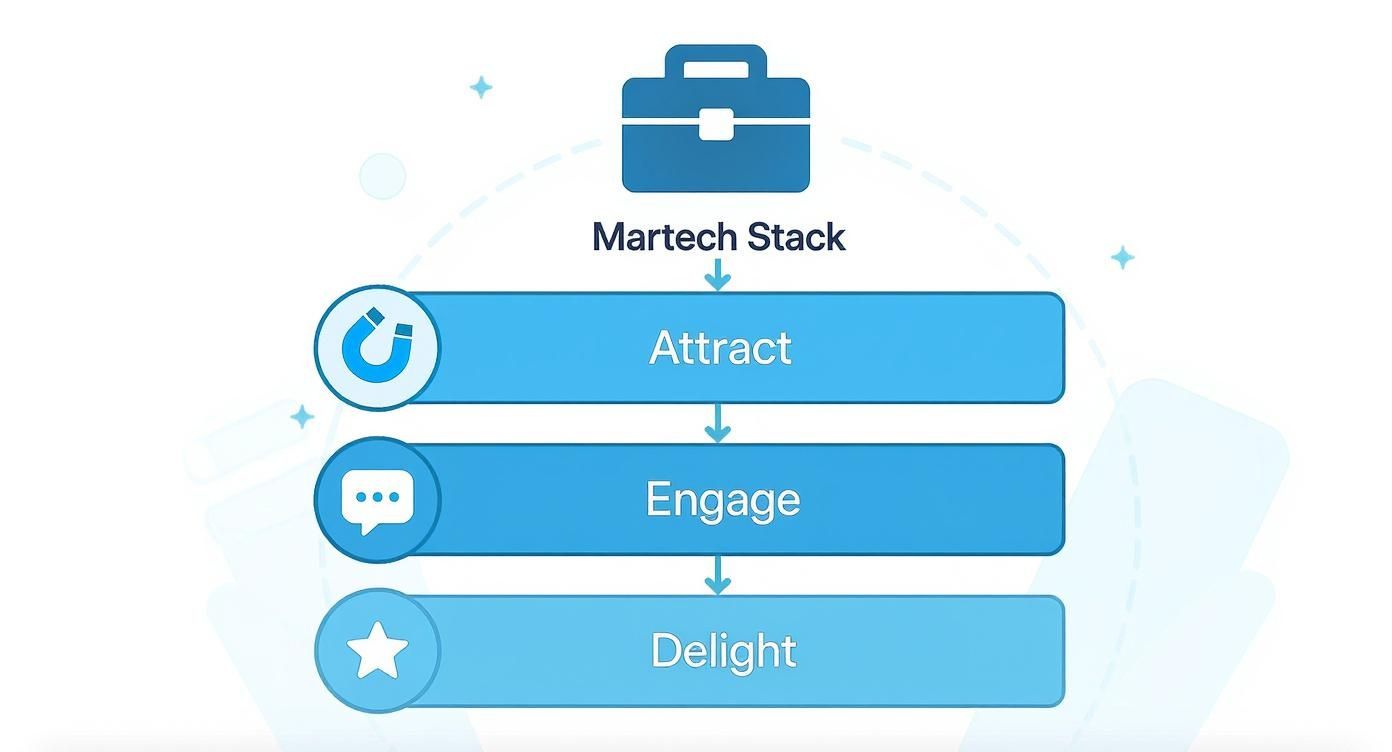
The infographic below shows how to use your internal data to lay the groundwork for this targeted content strategy.
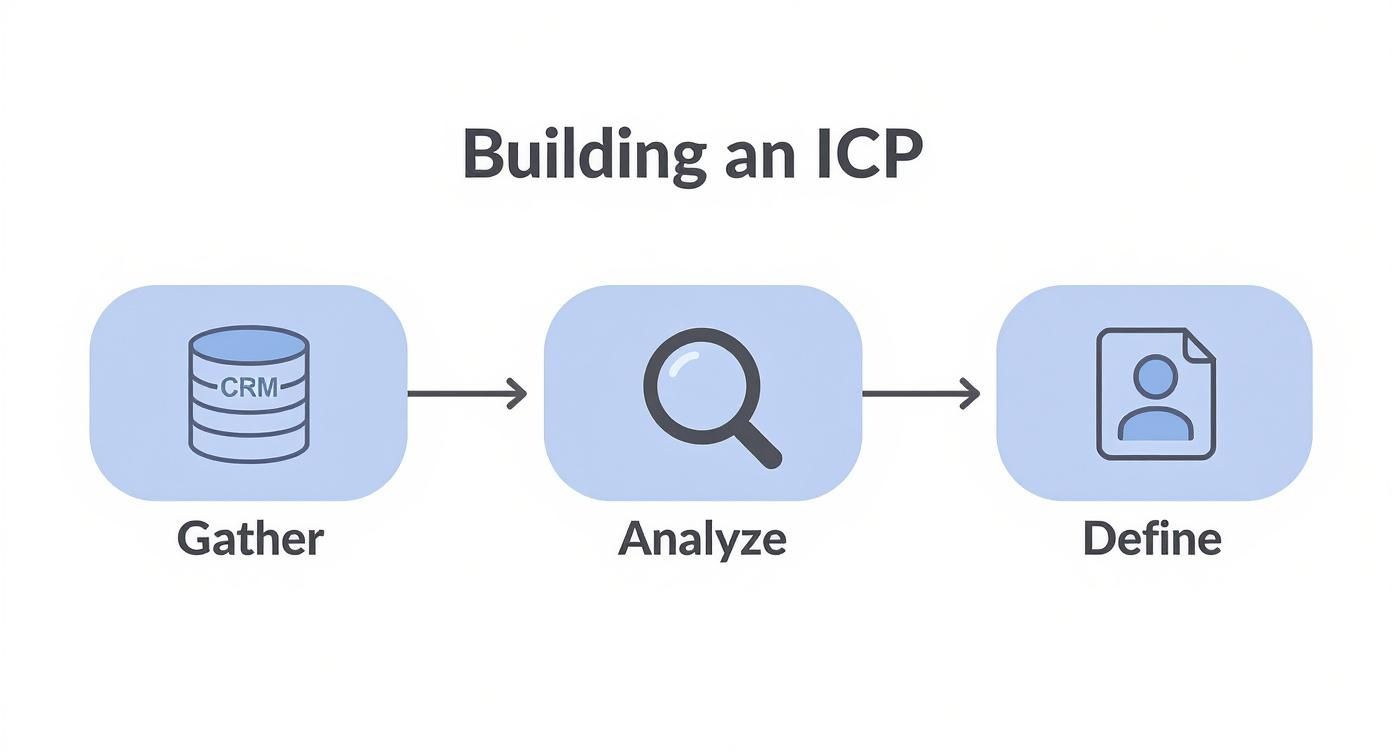
Infographic about b2b demand generation strategy

This process of gathering data, analyzing it, and defining your ICP ensures that every piece of content you create is aimed squarely at the right audience.

To help visualize this, here’s a breakdown of how different content formats fit into the buyer's journey.

Content Format vs Buyer Journey Stage

Buyer's Journey StagePrimary GoalEffective Content FormatsKey Metrics
AwarenessEducate & inform; generate initial interestBlog posts, research reports, infographics, short videos, social media contentWebsite traffic, social shares, backlink acquisition, brand mentions
ConsiderationBuild trust & showcase expertise; provide solutionsWebinars, whitepapers, ebooks, solution briefs, checklistsLead magnet downloads, webinar registrations, email sign-ups, time on page
DecisionValidate choice & remove final barriers; drive actionCase studies, customer testimonials, product demos, comparison guides, ROI calculatorsDemo requests, free trial sign-ups, sales inquiries, conversion rates

By mapping your content this way, you create a logical path for buyers to follow, building their confidence at every step.

Content For The Awareness Stage

At the top of the funnel, you're a teacher, not a salesperson. People in this stage are just starting to put a name to their problem or see a new opportunity. Your content needs to be genuinely helpful and insightful, without a heavy sales pitch.

Here’s what works well:

  • Research Reports & Industry Surveys: This kind of content positions you as an authority. Better yet, others will cite your data, earning you valuable backlinks and organic traffic.
  • Blog Posts & Articles: These are your SEO workhorses. By answering the common questions your ICP is typing into Google, you draw them to your site naturally.
  • Infographics & Short Videos: These are perfect for social channels like LinkedIn. They make complex ideas easy to grasp and are highly shareable.

Nurturing Interest In The Consideration Stage

Okay, they understand their problem. Now they're actively looking at solutions. Your content has to shift gears from general education to showing how your solution helps solve their specific challenges.

This is where you introduce your brand as a credible option. The goal is to build trust and showcase expertise, guiding them deeper into your ecosystem without a hard sell.

This middle stage of the funnel is the perfect home for:

  • Webinars & Virtual Events: These let you do a deep dive on a specific topic and engage with prospects directly, answering their questions in real-time.
  • Whitepapers & Ebooks: Gated assets like these are a classic value exchange. You provide in-depth expertise, and they provide their contact information, turning an anonymous visitor into a known lead.
  • Solution Briefs: These are the bridge between high-level content and product-specific details. They clearly outline what your product does and the exact problems it solves.

Driving Action In The Decision Stage

We're at the bottom of the funnel. Prospects are comparing you against competitors and looking for proof that they're making the right call. Now your content needs to be laser-focused on proving your value and knocking down any final hurdles. This is where social proof and product deep dives are king.

Case studies are the heavyweight champion here. A staggering 57% of marketing leaders point to them as their most effective tool for influencing buyer decisions. The same report also found that 29% of organizations now have a fully integrated approach to brand and demand, which is exactly why this strategic alignment is so critical. You can discover more insights from the 2025 Demand Generation Benchmark Survey to see how top performers are pulling this off.

Content that gets the deal signed includes:

  1. Case Studies & Customer Testimonials: Nothing beats a real success story from a happy customer. It’s concrete proof that your solution delivers on its promises.
  2. Product Demos & Free Trials: Let them get their hands on the wheel. A direct, hands-on experience is one of the fastest ways to show value and de-risk the purchase.
  3. Comparison Guides & ROI Calculators: These tools tackle last-minute objections head-on. They show exactly how you stack up against the competition and demonstrate the tangible financial upside of choosing you.

When you thoughtfully map your content and channels to each stage, you build a journey that feels natural and persuasive, turning strangers into your biggest fans.

Activating Your Strategy With ABM and Intent Data

Having a sharp Ideal Customer Profile and a library of perfectly mapped content is a fantastic start. But a plan sitting on a shelf doesn’t generate pipeline. Now comes the critical part: activation. This is where you use data to find the right accounts and engage them with a level of precision that feels almost unfair to the competition.

This is the moment the game shifts from broad marketing to surgical execution. It’s all about spotting the faint signals of buying intent and acting on them before your competitors even know an opportunity exists.

Spotting Buyers With Intent Data

Imagine knowing which of your target accounts are actively researching solutions like yours right now. That’s the magic of intent data. It tracks the digital footprints companies leave across the web, flagging signals like spikes in research on specific topics, visits to review sites, or even engagement with a competitor’s content.

This insight changes everything. Instead of your sales team burning cycles on a cold list, they can pour their energy into accounts that are already in-market and problem-aware.

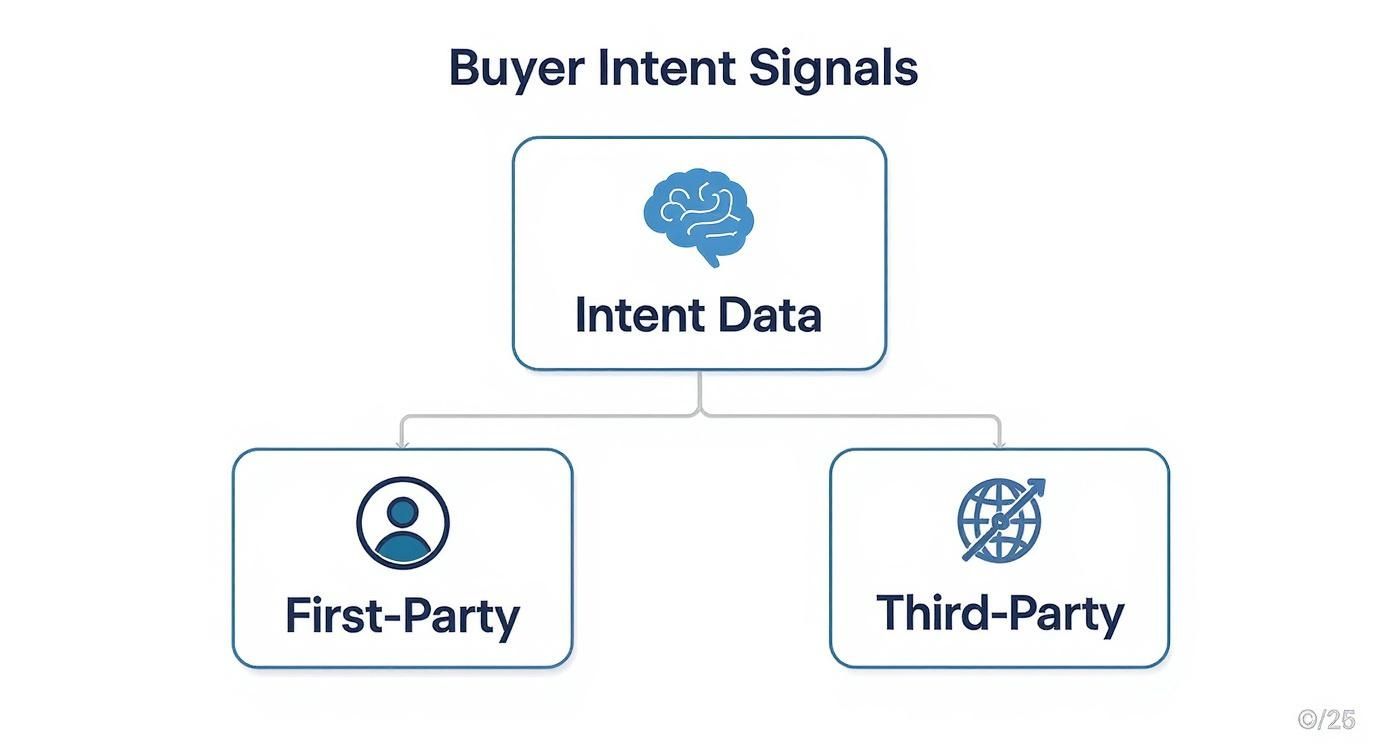
You'll encounter two main flavors of intent data:

  • First-Party Intent: This is the gold you mine from your own properties—your website, your marketing channels. Think of someone who downloaded a whitepaper, attended your webinar, or spent a suspicious amount of time on your pricing page. These are the strongest signals you’ve got.
  • Third-Party Intent: This data comes from providers who monitor activity across millions of online sources. It gives you that crucial wider view, showing you which of your target accounts are researching relevant keywords or topics across the broader internet.

When you blend both, you get a powerful, 360-degree view of an account's real interest level. Our guide on what is behavioral targeting digs deeper into how you can read these digital tea leaves to inform your outreach.

Traditional Demand Gen vs. Account-Based Marketing

With solid intent data in hand, you can pick the right activation model. The two heavy hitters in B2B are traditional demand generation and Account-Based Marketing (ABM), and they’re built for different jobs.

ApproachTarget FocusPrimary GoalBest For
Traditional Demand GenBroad (ICP)Generating a high volume of individual leads (MQLs)High-velocity sales models, lower ACV products, building broad brand awareness
Account-Based Marketing (ABM)Narrow (Named Accounts)Engaging the entire buying committee at high-value accountsComplex sales cycles, high ACV products, breaking into strategic accounts

One isn’t better than the other; they're just different tools. In fact, most of the smartest companies I've seen use a hybrid approach. They run broad demand gen programs to build awareness and catch inbound interest, while simultaneously running hyper-focused ABM plays against a shortlist of their most strategic, high-value accounts.

Actionable Step: Tier Your Accounts for a Hybrid Approach

A really practical way to pull off this hybrid model is to tier your target account list. This lets you allocate your resources—time, budget, and creative energy—where they’ll make the biggest dent.

Here's a simple way to think about it:

  • Tier 1 (The "Big Fish"): These are your top 10-20 dream accounts. They get the full, bespoke, 1:1 ABM treatment. We're talking deep research, highly personalized content, slick direct mail, and tightly coordinated outreach from both sales and marketing.
  • Tier 2 (The Lookalikes): These 50-100 accounts look a lot like your Tier 1 targets. They get a "one-to-few" ABM approach. You might create industry-specific content or run small, targeted digital ad campaigns aimed at the key personas within these companies.
  • Tier 3 (The Wider Net): This is everyone else in your addressable market who fits your ICP. These accounts are handled by your broader, "one-to-many" demand gen efforts—SEO, content marketing, and general social media campaigns.

This tiered system creates a balanced portfolio. It makes sure you're still feeding the top of the funnel with broader programs while giving your most important target accounts the white-glove treatment they deserve.

Aligning Sales and Marketing for Execution

Let's be clear: this entire activation strategy completely falls apart without tight alignment between your sales and marketing teams. They absolutely have to agree on the target account list, the definition of a qualified account, and the rules of engagement.

This is where data becomes the ultimate peacemaker. Research shows that a staggering 98% of B2B marketers believe intent data is essential for finding and engaging high-potential accounts. When both teams are looking at the same intent signals and CRM data, the conversation shifts from "we need more leads" to "how can we best engage the buying committee at Account X?"

By activating your strategy with intent data and a smart ABM framework, you stop marketing at people and start creating meaningful engagements with the right accounts at the perfect time.

Measuring Success and Proving Your ROI

A dashboard displaying key performance indicators and ROI metrics for a B2B marketing campaign.

Getting a sophisticated B2B demand generation strategy off the ground is a massive win, but it’s only half the job. If you can't prove it's actually working, you'll be fighting an uphill battle for budget, trust, and the resources to scale.

The secret is to stop talking about marketing activities and start talking about business outcomes. Your leadership team isn’t losing sleep over clicks or MQLs. They care about one thing: revenue. To prove your worth, you have to speak their language.

Moving Past Vanity Metrics

It's incredibly easy to get lost in a sea of data. Website traffic spikes and social media engagement feel good, but they don't pay the bills. The real story of your success is written much deeper in the funnel.

To show you're making a real impact, your dashboard needs to be built around three metrics that carry serious weight:

  • Marketing-Sourced Pipeline: This is the big one—the total dollar value of every sales opportunity that started with one of your marketing efforts. It's the cleanest line you can draw from your team's work to future revenue.
  • Pipeline Velocity: How quickly are deals moving from that first touchpoint to a signed contract? Speeding this up means a more efficient sales cycle and cash in the bank sooner.
  • Customer Acquisition Cost (CAC): Simply put, how much does it cost you in sales and marketing to land one new customer? If this number is going down over time, your demand engine is getting more efficient.

Focusing on these KPIs completely changes the conversation. You’re no longer saying, "We got 1,000 clicks." You're saying, "We generated $500,000 in new pipeline this quarter." That’s a conversation every executive wants to be a part of.

Choosing The Right Attribution Model

To accurately claim that marketing-sourced pipeline, you need a clear way to connect the dots between your actions and a closed deal. This is where attribution models come into play, and your choice here can completely change the story your data tells.

A first-touch attribution model gives 100% of the credit to the very first interaction. Maybe it was a blog post someone read six months ago. It's simple, but it’s also wildly misleading because it ignores everything that happened in between.

On the other hand, a multi-touch attribution model spreads the credit across several key touchpoints in the buyer's journey. This paints a far more realistic picture of what's actually driving results. For instance, it recognizes that the initial blog post, a mid-funnel webinar, and the final demo request all played a role.

For any B2B company with a sales cycle longer than a few weeks, a multi-touch model is the only way to go. It acknowledges the reality that a single piece of content rarely closes a six-figure deal. If you want to dive deeper, this is a great breakdown of the different multi-touch attribution models available.

Actionable Takeaway: Choosing the right attribution model isn't just a technical exercise. It fundamentally shapes how you value your channels and content, directly influencing your budget allocation and strategic focus.

Actionable Step: Building Your ROI Dashboard

Your goal isn't to build a dashboard with 50 different charts that no one understands. It’s to create a single source of truth that tells a clear, compelling story about performance.

Here's a look at the essential metrics to include in your dashboard.

Key Demand Generation Metrics and Their Business Impact

This table breaks down the metrics that matter most, showing you exactly what they measure and why they're critical for proving the financial return on your efforts.

MetricWhat It MeasuresWhy It Matters for ROI
Marketing-Sourced Pipeline ($)The total value of sales opportunities created by marketing campaigns.Directly ties marketing spend to potential revenue, answering the "what did we get for our money?" question.
Customer Acquisition Cost (CAC)The total cost of sales and marketing to acquire a single new customer.Measures the efficiency of your go-to-market engine; a decreasing CAC shows improving ROI.
Pipeline Velocity (Days)The average time it takes for a lead to become a closed-won deal.Indicates the speed of your revenue cycle. Faster velocity means marketing is delivering more sales-ready opportunities.
Lead-to-Opportunity Rate (%)The percentage of leads that are accepted by sales and converted into a qualified opportunity.A key indicator of lead quality. A high rate proves marketing is delivering prospects who are genuinely interested and a good fit.

Tracking and reporting on these core numbers shifts you from a position of defending your budget to one of demonstrating your value. You'll be armed with hard data that proves your B2B demand generation strategy isn't just a cost center—it's a predictable engine for business growth.

Free Tool

Try our Marketing Plan Generator — generate a complete AI-powered marketing plan in minutes. No signup required.

Common B2B Demand Generation Questions

Even the sharpest marketers run into a few tricky questions when they're deep in the demand generation trenches. Let's tackle some of the most common ones I hear and get you clear, straightforward answers.

Demand Generation vs. Lead Generation: What Is The Real Difference?

This is the big one. Get this wrong, and your whole strategy can go sideways. The simplest way I've found to explain it is creating demand versus capturing it.

  • Lead Generation is purely transactional. It’s about getting contact info to fill the top of the funnel. The key question here is, "How many MQLs did we get?" It's a numbers game, often focused on volume.

  • Demand Generation is the whole strategy. It’s about teaching your market something valuable and building a brand they trust. The goal is to create a pipeline full of educated, high-intent buyers who actually seek you out. The question becomes, "How much qualified pipeline did we create?"

Think of lead generation as a single tactic inside your broader demand generation strategy. If you only chase leads, you end up with a huge list of low-quality contacts that just exhausts your sales team. A real demand gen approach means that when a lead does come in, they already know who you are and understand the problem you solve. If you really want to nail the fundamentals, this guide on What Is Demand Generation Marketing is a great deep dive.

How Do I Get Budget and Buy-In From Leadership?

You have to stop talking like a marketer and start sounding like the CFO. Your leadership team cares about revenue, pipeline, and how efficiently you're spending money—not the marketing activities themselves.

So instead of saying, "I need $50,000 for a new content campaign," you need to reframe it.

Try this: "I'm requesting a $50,000 investment to generate an estimated $500,000 in marketing-sourced pipeline over the next two quarters."

Actionable Takeaway: The key is to connect the dots with a clear, data-backed forecast. Dig into your historical conversion rates and build a model that links every dollar you plan to spend directly to revenue goals. Show them the math.

How Long Until I See Results?

Patience isn't just a virtue here; it's a requirement. This isn't a paid search campaign where you can see results in a few days. A true B2B demand generation engine is a long-term investment.

You'll probably start seeing leading indicators—like a bump in website traffic or more people searching for your brand name—within the first 3-6 months.

But for the metrics that really matter, like marketing-sourced pipeline, you're looking at a 9-12 month timeline. This is especially true if you have a long sales cycle. The most important thing you can do is set this expectation with your leadership team right from the start.


Ready to build a predictable revenue engine? marketbetter.ai uses an integrated AI approach to scale your content creation, optimize campaign performance, and prove your marketing impact with powerful analytics. Transform your demand generation strategy by visiting https://www.marketbetter.ai today.


43 Email Subject Lines With 40%+ Open Rates — Copy-Paste Templates

· 24 min read

In a crowded inbox, the subject line is your one chance to make a first impression. It's the gatekeeper to your message, the single line of text that determines whether your carefully crafted email gets opened, ignored, or sent straight to the trash. Mastering this element isn't just a nice-to-have skill; it's a critical component of any successful email campaign and a core tenet of email subject line best practices. An exceptional subject line can dramatically increase open rates, while a poor one guarantees your message will go unread, no matter how valuable its content.

This guide moves beyond generic advice to provide a comprehensive roundup of 10 actionable, data-backed strategies. We will dissect what works and why, comparing different approaches with clear, real-world examples. You will learn not just the "what" but the "how," with specific steps you can implement immediately to see a measurable lift in your campaign performance. Whether you're a seasoned marketer looking to refine your approach or an entrepreneur trying to cut through the noise, these proven practices will equip you to write subject lines that command attention and drive results. Let's dive into the tactics that will get your emails opened.

1. Keep It Under 50 Characters for Mobile Optimization

With well over half of all emails now opened on mobile devices, brevity isn't just a suggestion; it's a necessity. Mobile email clients like Gmail, Apple Mail, and Outlook have limited screen space, often truncating subject lines after just 25-50 characters. This means a longer subject line like, "Don't Miss Out on Our Biggest Annual Sale Event This Weekend with Exclusive Deals" gets cut off, burying the most compelling information. One of the most critical email subject line best practices is to craft a message that respects these mobile constraints, ensuring your core value proposition is seen immediately.

Keep It Under 50 Characters for Mobile Optimization

This approach directly combats the risk of being ignored in a crowded inbox. A concise, powerful message that displays fully on a smartphone is far more likely to capture attention and earn a click. Research from marketing data leaders like HubSpot and Mailchimp consistently shows a correlation between shorter subject lines and higher engagement, a key factor when you want to improve email open rates.

How to Implement This Strategy: A Comparison

To put this into practice, focus on front-loading your message with the most crucial words. Start with the action, the offer, or the urgency. Compare the following:

  • Weak (71 characters): "A Special Offer for You: Get 25% Off Your Next Purchase Before It Expires"
  • Strong (42 characters): "Jane, claim your 25% off before it's gone"

The strong version is not just shorter; it's more actionable. It personalizes, creates urgency, and communicates the core benefit within the mobile character limit, making it far more effective.

Actionable Tips for Brevity

  • Front-Load Keywords: Place the most impactful words (e.g., "Sale," "Alert," "Free") at the very beginning.
  • Test on Mobile: Use your email marketing platform's preview tool to see exactly how your subject line appears on different devices.
  • Count Every Character: Remember that spaces and punctuation count toward your total.
  • Focus on a Single Goal: Don't try to say everything. The subject line's only job is to get the email opened. The email's body does the rest.

2. Personalize with Recipient's First Name or Company

In an overflowing inbox, a generic subject line is easily overlooked. Personalization cuts through the noise by using recipient data like a first name or company to create a direct, one-to-one connection. This simple act of addressing someone by name leverages a powerful psychological principle: we are hardwired to pay attention when we hear or see our own name. It transforms a mass broadcast into what feels like a personal conversation, making it one of the most effective email subject line best practices for boosting engagement.

Personalize with Recipient's First Name or Company

The data overwhelmingly supports this approach. Studies consistently show that subject lines personalized with a recipient's name can increase open rates by over 26%. This tactic signals to the recipient that the content inside is relevant specifically to them, not just another generic marketing blast. For a deeper dive into making your outreach feel more individual, explore these marketing personalization strategies.

How to Implement This Strategy: A Comparison

To use personalization effectively, integrate merge tags from your CRM or email platform directly into your subject line. The key is to make it feel natural, not automated.

  • Weak (40 characters): "Exclusive beta access for new users"
  • Strong (49 characters): "Michael from Acme Corp: exclusive beta access"

The strong version immediately establishes context and relevance. Michael knows this message is specifically for him and his company, making him far more likely to open it than the generic alternative.

Actionable Tips for Personalization

  • Verify Data Accuracy: Always clean your contact list to avoid embarrassing errors like "Hi [FNAME]" or using outdated company information.
  • Set Fallback Text: Configure a default value (e.g., "there" instead of a first name) to prevent awkward blank spaces if data is missing.
  • Combine Personalization Points: Go beyond the first name. Combine it with their company, city, or a recent action for greater impact (e.g., "John, an idea for your team at Acme").
  • Match Your Brand Voice: Ensure the personalization style fits your brand. A formal B2B brand might use a full name, while a casual B2C brand can stick to a first name.

3. Use Numbers and Statistics to Create Curiosity

Incorporating specific numbers, percentages, or statistics into subject lines makes them feel more concrete, credible, and compelling. The human brain is naturally drawn to digits, which stand out visually in a sea of text. This specificity transforms a vague claim into a tangible promise, triggering curiosity and establishing trust before the email is even opened. This is one of the most effective email subject line best practices for boosting engagement and demonstrating clear value.

This data-driven approach directly counters the ambiguity that often causes readers to skip an email. A subject line like "Improve your workflow" is easily ignored, but "3 hacks to cut your workflow by 45%" presents a specific, measurable outcome that demands attention. Companies like BuzzFeed and Copyblogger have mastered this technique, proving that numbers create headlines that are nearly impossible to ignore.

How to Implement This Strategy: A Comparison

To use this strategy effectively, ground your subject line in a specific, quantifiable benefit you offer inside the email. The number should act as a hook that promises a clear, easy-to-digest solution or piece of information.

  • Weak (42 characters): "Tips to help you save more on your bills"
  • Strong (41 characters): "5 ways to save an extra $200 per month"

The strong version is far more powerful. It provides a specific number of tips ("5") and a quantifiable outcome ("$200 per month"), making the value proposition clear and highly motivating.

Actionable Tips for Using Numbers

  • Front-Load the Number: Place the digit or statistic near the beginning for immediate visual impact (e.g., "5 tips..." vs. "...in 5 steps").
  • Use Odd Numbers: Studies suggest that odd numbers (like 3, 5, or 7) often feel more authentic and less manufactured than even ones.
  • Be Specific with Data: Instead of "Big savings," use "Save 37% this weekend only" to create urgency and credibility.
  • Match the Promise: Ensure the content of your email delivers exactly what the numbered subject line promises. A mismatch will destroy trust.

4. Create Urgency with Time-Bound Language

Tapping into the psychological trigger of FOMO (fear of missing out) is one of the most powerful email subject line best practices you can employ. Time-sensitive language that references deadlines, limited availability, or the need for immediate action motivates subscribers to act now rather than later. Words like "today only," "24 hours left," "final chance," and "expires tonight" create a sense of urgency that can dramatically increase open and click-through rates by compelling readers to prioritize your email over others in a crowded inbox.

Create Urgency with Time-Bound Language

This tactic, popularized by e-commerce giants like Amazon and daily deal platforms such as Groupon, effectively shortens the customer's decision-making cycle. An email with a vague offer might be saved for later and eventually forgotten, but one with a clear, impending deadline demands immediate attention. When a subscriber knows an opportunity is about to disappear, they are far more likely to open the email to avoid missing out.

How to Implement This Strategy: A Comparison

The key is to be specific and genuine with your time constraints. Vague urgency can feel like a marketing ploy, while a concrete deadline feels like a real event.

  • Weak (42 characters): "Our big sale is ending sometime soon"
  • Strong (41 characters): "Final hours: 40% off sale ends at midnight"

The strong version clearly communicates the benefit (40% off) and the specific deadline (midnight), prompting immediate action instead of procrastination.

Actionable Tips for Creating Urgency

  • Be Specific: Use exact times and dates like "ends at 9 PM EST" or "today only" instead of the vague "soon."
  • Maintain Trust: Only create genuine urgency. Using fake deadlines can erode subscriber trust and lead to unsubscribes.
  • Combine with Scarcity: Pair time limits with limited quantities for maximum impact (e.g., "Only 12 spots left & registration closes Friday").
  • Time Your Sends: Send a reminder email 24 hours before and a "final hours" email on the day the offer expires to capture last-minute interest.

5. Ask a Compelling Question to Drive Engagement

Posing a question in a subject line instantly transforms a passive statement into an active invitation for engagement. This technique taps into natural human curiosity, creating a "curiosity loop" that compels recipients to seek the answer inside your email. Unlike a declarative statement, a question feels like the start of a two-way conversation, making your message more personal and less overtly promotional. This is one of the most effective email subject line best practices for cutting through inbox noise.

A question-based subject line encourages subscribers to pause and self-reflect, connecting your email's topic directly to their own challenges or goals. Instead of telling them what you offer, you prompt them to consider a problem they might be facing, making the solution within the email feel like a timely discovery rather than a sales pitch. This approach is highly valued by direct response marketers and platforms like Copyblogger for its ability to drive immediate interaction.

How to Implement This Strategy: A Comparison

The key is to ask a question that resonates with a specific pain point or desire your audience holds. A generic question will be ignored, but one that hits a nerve demands attention.

  • Weak (Statement): "Our software can help you ship 50% faster"
  • Strong (Question): "What if your team could ship 50% faster?"

The question version is more powerful because it encourages the reader to visualize the outcome and its impact on their business, making them far more likely to open the email to learn how.

Actionable Tips for Asking Questions

  • Focus on Pain Points: Frame questions around problems your audience wants to solve (e.g., "Are you losing money on customer churn?").
  • Use 'You' and 'Your': Make the question about the reader by using second-person language for maximum relatability.
  • Keep It Concise: Aim for short, punchy questions that are easy to read and understand on any device.
  • Answer the Question: Your email body must directly address and provide a clear answer or solution to the question asked.
  • A/B Test Vigorously: Test question-based subject lines against benefit-driven statements to see what resonates most with your specific audience.

6. Avoid Spam Trigger Words and Phrases

Even the most brilliantly crafted subject line is useless if it lands in the spam folder. Internet Service Providers (ISPs) use sophisticated algorithms to filter out unwanted mail, and certain words and phrases are major red flags. Using spam triggers like "$$$", "Free gift," or "Act now!" can significantly decrease your deliverability, making this one of the most critical email subject line best practices to master. Think of it as a gatekeeper; avoiding these words helps ensure your message gets a chance to be seen.

This practice is non-negotiable for maintaining a healthy sender reputation and maximizing your campaign's reach. While a single trigger word might not doom your email, a combination of them, especially with excessive punctuation or all-caps, sends a strong signal to spam filters that your message is low-quality. In addition to carefully avoiding spam triggers in your subject lines, understanding the broader reasons for why your emails are going to spam and how to fix it is essential for overall campaign success.

How to Implement This Strategy: A Comparison

The key is to shift from pushy, sales-heavy language to value-driven, benefit-oriented phrasing. Instead of telling subscribers what to do, show them what they'll gain.

  • Weak (Spammy): "FREE!!! Click Here to Claim Your Prize NOW!"
  • Strong (Optimized): "A special reward is waiting for you, Alex"

The strong version removes the aggressive triggers, capitalization, and excessive punctuation. It focuses instead on a personalized and intriguing message that encourages a click without setting off spam filter alarms.

Actionable Tips for Spam Avoidance

  • Focus on Benefit Language: Instead of "Buy now," try "Discover the benefits." Replace "Limited time offer" with "Your discount expires Friday."
  • Limit Punctuation and Symbols: Avoid using multiple exclamation points (!!!), dollar signs ($$$), or unusual special characters. A single exclamation point is usually safe.
  • Use a Spam Checker Tool: Before sending, run your subject line and email copy through a tool like Litmus or Mail-tester.com to get a spam score and identify potential issues.
  • Avoid Deceptive Prefixes: Don't start your subject line with "Re:" or "Fwd:" to trick recipients into thinking it's part of an ongoing conversation. This is a common spam tactic.

7. Segment Audience and Customize Subject Lines by Group

Sending the same generic message to your entire email list is a missed opportunity. Segmentation is the practice of dividing your audience into smaller, specific groups based on demographics, purchase history, or engagement level. One of the most impactful email subject line best practices is tailoring your message to these distinct segments, dramatically increasing relevance and open rates. Instead of a one-size-fits-all approach, you deliver a message that speaks directly to the recipient's relationship with your brand.

This strategy works because a message for a first-time buyer should be fundamentally different from one for a loyal VIP customer. A "Welcome to the family!" subject line would feel out of place for someone who has purchased from you ten times. By customizing your subject line, you acknowledge the customer's unique journey, making them feel seen and valued, which is crucial for building long-term loyalty. To dive deeper, you can explore various customer segmentation strategies to refine your approach.

How to Implement This Strategy: A Comparison

Start by identifying logical segments in your audience. Even simple divisions can yield significant results. Consider the difference in messaging needed for each group.

  • Weak (Generic for all): "Check Out Our Latest Collection & Deals"
  • Strong (Segmented):
    • New Subscribers: "Welcome to the club! Here's your 15% off"
    • VIP Customers: "Alex, your VIP early access starts now"
    • Cart Abandoners: "Did you forget something? Your items are waiting"

The segmented versions are far more personal and contextually relevant, directly addressing the recipient's current status and likely interests.

Actionable Tips for Segmentation

  • Start with 2-3 Core Segments: Begin with simple groups like "new subscribers," "repeat customers," and "inactive users" before adding more complexity.
  • Use Behavioral Triggers: Create automated campaigns for segments based on actions like abandoned carts, products viewed, or recent purchases.
  • Test Segment-Specific Offers: Experiment with different subject line angles for each group. For example, test an urgency-based subject line for cart abandoners versus an exclusivity-based one for VIPs.
  • Monitor Segment Performance: Track open rates, clicks, and conversions for each segment separately to identify your most responsive groups and refine your strategy.

8. A/B Test Subject Lines Systematically and Iteratively

Guesswork has no place in a high-performing email strategy. A/B testing, also known as split testing, is a data-driven method for discovering what truly resonates with your audience. It involves sending two or more variations of a subject line to small, random segments of your email list to see which one performs better. The winning version is then sent to the remainder of your audience, maximizing your campaign's potential. This systematic approach is one of the most powerful email subject line best practices for achieving consistent, measurable improvement over time.

Relying on data instead of intuition removes subjectivity and helps you understand the subtle nuances that drive engagement. By systematically testing elements like personalization, urgency, or question-based phrasing, you build a repository of insights specific to your subscribers. This iterative process ensures your subject line strategy evolves with your audience's preferences, leading to sustained growth in open rates and conversions.

How to Implement This Strategy: A Comparison

The core principle of effective A/B testing is to isolate a single variable. Testing too many changes at once makes it impossible to know what caused the difference in performance.

  • Version A (Statement): "New arrivals: The Spring Collection is here"
  • Version B (Question): "Ready for Spring? See our new collection"

Here, the only significant variable is the format: a direct statement versus an engaging question. By sending each to 10% of your list, you can see which format gets more opens and then send the winner to the remaining 80%.

Actionable Tips for A/B Testing

  • Isolate One Variable: Test only one element at a time (e.g., word order, emoji use, personalization, statement vs. question).
  • Define Success: Decide beforehand if you're measuring opens, clicks, or conversions as your key performance indicator.
  • Use a Significant Sample Size: Test with a large enough segment (ideally at least 1,000 recipients per version) to ensure your results are statistically significant.
  • Document Everything: Keep a log of your tests, including the hypothesis, variations, results, and key learnings to inform future campaigns.
  • Make it a Habit: Make A/B testing a standard part of your pre-send checklist for every major campaign, not a one-off task.

9. Match Subject Line Tone to Brand Voice and Campaign Type

Your subject line is often the first "hello" from your brand in a subscriber's inbox, and its tone sets immediate expectations. A subject line that feels disconnected from your brand's personality or the email's content can create a jarring experience, eroding trust. Aligning your tone consistently is one of the most fundamental email subject line best practices because it builds brand recognition and manages subscriber expectations effectively.

This alignment ensures your message feels authentic and appropriate for its purpose. A playful, emoji-filled subject line for a security alert would feel unprofessional and alarming, just as a dry, corporate tone for a fun holiday promotion would fall flat. The key is to match the energy of the subject line to both your established brand voice and the specific goal of the campaign, whether it’s to inform, sell, or entertain.

How to Implement This Strategy: A Comparison

The first step is to have a clearly defined brand voice. From there, you can adapt it to fit different campaign scenarios, ensuring the core personality remains intact.

  • Brand Voice (Playful & Energetic):
    • Promotional Campaign: "🎉 Psst... Your next favorite outfit is 30% off!"
    • Transactional Email: "🚀 Your order is on its way! Get ready."
  • Brand Voice (Professional & Authoritative):
    • Promotional Campaign: "Q3 Report: Unlock New Industry Benchmarks Today"
    • Transactional Email: "Confirmation: Your Registration for the Annual Summit"

Notice how both examples maintain their core brand identity while adjusting the tone to fit the specific purpose of the email. This consistency builds trust.

Actionable Tips for Tonal Consistency

  • Define Brand Voice: Document your brand’s personality traits (e.g., witty, supportive, formal) and create written guidelines for your team.
  • Match Tone to Intent: Use a serious, direct tone for security updates or policy changes. Employ an enthusiastic, benefit-driven tone for sales and promotions.
  • Audit Past Campaigns: Review your last 10 sent emails. Do the subject lines feel like they all came from the same brand? If not, identify the outliers.
  • Create Campaign Templates: Develop a library of subject line templates for different email types (e.g., newsletters, flash sales, webinars) that are pre-aligned with your brand voice.

10. Front-Load Value and Lead with Benefits, Not Features

Recipients don't open emails to learn about your product's technical specs; they open them to solve a problem or achieve a goal. A core principle of effective email subject line best practices is to immediately answer the recipient's unspoken question: "What's in it for me?" Leading with the outcome or value (the benefit) is far more compelling than describing the mechanism that delivers it (the feature).

This strategy shifts the focus from what your product is to what your customer becomes or achieves by using it. An email recipient in a busy inbox is scanning for relevance and value, not a list of product attributes. A benefit-driven subject line connects directly with their aspirations and pain points, making your message feel less like an advertisement and more like a solution.

How to Implement This Strategy: A Comparison

To apply this, translate every feature into a tangible benefit for the user. Ask yourself how a feature like "AI-powered analytics dashboard" actually helps your customer. The answer might be "Make smarter decisions, faster" or "Uncover hidden revenue opportunities."

  • Weak (Feature-Focused): "Our new software includes a Zapier integration"
  • Strong (Benefit-Focused): "Automate your workflow in 5 minutes"

The second example doesn't even mention the feature by name. Instead, it highlights the ultimate, desirable outcome: saving time and reducing manual effort, which is what the user truly cares about.

Actionable Tips for Benefit-Driven Subject Lines

  • Start with Action Words: Begin with verbs that promise a positive outcome, such as Achieve, Save, Grow, Unlock, or Simplify.
  • Quantify the Benefit: Whenever possible, add specific numbers. "Save 10 hours weekly" is more powerful than "Save time."
  • Translate Features to Benefits: For every feature on your product sheet, write down the corresponding benefit it provides to the customer. Use that benefit in your copy.
  • A/B Test Feature vs. Benefit: Run tests to prove the concept to your team. Pit a feature-led subject line against a benefit-led one and let the data show you what your audience values most.

Top 10 Email Subject Line Best Practices Comparison

Strategy🔄 Implementation Complexity⚡ Resource Requirements📊 Expected Outcomes⭐ Key Advantages💡 Ideal Use Cases
Keep It Under 50 Characters for Mobile OptimizationLow — simple constraint on copyMinimal — copywriting + preview testingBetter mobile visibility; fewer truncations; higher mobile opensEnsures full subject visibility across devicesMobile-heavy audiences, flash promotions, short alerts
Personalize with Recipient's First Name or CompanyMedium — requires merge tags & setupCRM data cleanliness, email platform integration~+26% open rate (average); improved engagementCreates personal relevance and higher CTRsWelcome flows, targeted offers, high-value segments
Use Numbers and Statistics to Create CuriosityLow–Medium — craft & verify dataAccess to accurate metrics/analyticsHigher opens (≈10–30% reported); stands out visuallyAdds specificity and credibility to subject linesListicles, savings offers, data-driven content
Create Urgency with Time-Bound LanguageLow — writing technique but must be truthfulCampaign coordination, timing controlDrives faster clicks/conversions; CTRs +22–42% reportedAccelerates decision-making and conversion velocityFlash sales, limited spots, event reminders
Ask a Compelling Question to Drive EngagementLow — copy-focusedMinimal; A/B testing recommendedOften lifts opens by 20–45%; boosts engagementEncourages mental participation and curiosityRe‑engagement, educational content, problem‑solving offers
Avoid Spam Trigger Words and PhrasesMedium — requires testing & governanceDeliverability tools, authentication (SPF/DKIM/DMARC)Fewer spam placements; improved deliverabilityProtects sender reputation and inbox placementAny high-volume campaign or brand-sensitive sends
Segment Audience and Customize Subject Lines by GroupHigh — segmentation setup and upkeepRobust CRM, data analytics, ongoing maintenanceOpen rates +14–100%; CTRs +50%+ for targeted segmentsHighly relevant messaging; improved ROILifecycle campaigns, VIP offers, churn prevention
A/B Test Subject Lines Systematically and IterativelyMedium–High — disciplined processTesting-capable platform, stat tools, timeContinuous optimization; measurable lift over timeData-driven decisions; reduces guessworkLarge lists, ongoing optimization programs, major sends
Match Subject Line Tone to Brand Voice and Campaign TypeMedium — needs brand guidelines & reviewBrand documentation, team trainingBetter recognition and trust; higher opens when alignedConsistency strengthens brand and recipient trustBrand campaigns, transactional emails, audience-specific sends
Front-Load Value and Lead with Benefits, Not FeaturesMedium — requires customer insightCustomer research, persuasive copywritingOpen rates +25–40% when benefit-focusedAligns expectation with value; attracts quality engagementProduct launches, onboarding, conversion-focused offers
Free Tool

Try our AI Lead Generator — find verified LinkedIn leads for any company instantly. No signup required.

Turn Best Practices into Consistent Results

The journey from a good subject line to a great one is not about finding a single magic formula. Instead, it’s about building a systematic, data-driven approach. Throughout this guide, we've explored ten essential email subject line best practices, moving from foundational principles like mobile-first brevity (under 50 characters) and personalization to more advanced strategies such as audience segmentation and rigorous A/B testing. Each tactic serves a distinct purpose, yet they all work together toward a common goal: earning your audience’s attention in a crowded inbox.

Think of these principles as ingredients in a recipe. A compelling question might drive initial curiosity, but combining it with a specific number can make it irresistible. For example, "Are you making this mistake?" is good, but "Are you making this #1 marketing mistake?" is far more compelling. Similarly, creating urgency with time-bound language is powerful on its own, but when layered with audience segmentation, it becomes laser-focused. A generic "Sale ends Friday" is less impactful than a targeted "Final hours for finance VPs to claim their discount." The true artistry lies in knowing which elements to combine for a specific audience and campaign goal.

From Theory to Action: Your Next Steps

Mastery comes from application. Reading about best practices is the first step, but consistent implementation is what drives real-world results. To transform this knowledge into measurable improvements in your open rates and engagement, consider these actionable next steps:

  • Commit to One New Tactic: Don't try to implement all ten practices at once. For your very next campaign, choose just one new strategy to focus on. If you've never used questions, start there. If personalization has been limited to [First Name], try incorporating their company or industry.
  • Establish a Testing Baseline: Before you can measure improvement, you need to know where you stand. Document your current average open rate. This number will be your benchmark for every A/B test you run, providing clear, quantitative feedback on what works.
  • Build a "Swipe File" of Success: When you see a great subject line in your own inbox, screenshot it and save it. When one of your own A/B tests produces a clear winner, document it. Over time, you'll build a personalized library of proven concepts that resonate specifically with your audience, making future brainstorming sessions faster and more effective.

Ultimately, a powerful subject line is a critical component, but its success is magnified when it's part of a well-oiled machine. To fully leverage the impact of effective subject lines, consider integrating them into a broader, comprehensive B2B email marketing strategy that aligns your messaging, targeting, and goals. By consistently applying and refining these email subject line best practices, you move beyond guesswork and begin to strategically engineer high-performing campaigns that capture attention and drive meaningful action.


Ready to stop guessing and start optimizing? marketbetter.ai uses AI to instantly generate dozens of high-performing subject line variations tailored to your message and audience. Eliminate the manual effort of A/B testing and discover what truly resonates with your customers by visiting marketbetter.ai today.

What Is Marketing Attribution? 6 Models Compared + Which to Use [2026]

· 25 min read

Ever wonder which part of your marketing is actually working? That’s the million-dollar question, and marketing attribution is how you answer it. It’s the framework for figuring out which ads, emails, or social posts get the credit for a sale, so you can stop wasting money and double down on what drives results.

So, What Is Marketing Attribution, Really?

A person at a desk analyzing charts and data on a large screen, representing the process of marketing attribution

Think about a game-winning shot in basketball. Does the player who sank the basket get all the glory? Of course not. You have to credit the point guard who made the perfect pass and the center who set a killer screen. Marketing works the exact same way.

Instead of slapping 100% of the credit on the very last ad a customer clicked before buying, attribution looks at the entire chain of events—the complete "customer journey." And let’s be honest, that journey is never a straight line.

A real-world path might look something like this:

  • The Spark: A potential customer scrolls through social media and sees one of your ads. They’d never heard of you before, but now you’re on their radar.
  • Building Trust: A few weeks go by. They search for a solution on Google, find one of your blog posts, and sign up for your newsletter.
  • The Final Nudge: After getting a couple of emails, a promo offer catches their eye. They click, and finally, they buy.

Without attribution, you might mistakenly think the email campaign did all the heavy lifting. But what about the social ad that started it all? Or the blog post that proved you knew your stuff? Each touchpoint played a part, and figuring out how much of a part is the core job of marketing attribution.

Moving From Guesswork to Proof

At its heart, attribution is about swapping out assumptions for cold, hard data. It gives you a way to answer the tough questions that decide where your budget goes.

For instance, which channel is your opener, and which one is your closer? A "first-touch" model would give all the credit to that initial social media ad. A "last-touch" model would hand it all to the email. The truth, as always, is somewhere in the middle. The actionable insight here is realizing that some channels are great for starting conversations while others are built to close deals.

Marketing attribution is what turns your budget from a blind expense into a strategic investment. It draws a straight line from every dollar you spend to the revenue it brings in, proving marketing’s value to the rest of the business.

By looking at the whole journey, you start to see how different channels team up. This is where the magic happens. You can finally allocate your budget with confidence, doubling down on what works at each stage of the funnel. It’s the difference between just buying ads and funding a high-performance marketing engine that you know gets results.

The Journey From Last-Click To Modern AI Attribution

To really get what marketing attribution is today, you have to know where it came from. The story starts in a much simpler time, with a philosophy that was easy to understand but often dead wrong: the last-click wins.

In a last-click world, the very last thing a customer did before buying got 100% of the credit.

Imagine a customer sees your ad on Instagram, reads your blog a week later, then finally clicks a Google ad to make a purchase. The last-click model gives all the glory to that Google ad, completely ignoring the fact that Instagram and your blog did the heavy lifting to get them there. It was simple, but it created a totally distorted picture of what was actually working. Marketers ended up pouring money into bottom-of-the-funnel tactics and starving the channels that built awareness in the first place.

The Rise of Multi-Touch Models

As the internet exploded in the late ‘90s and early 2000s, the game changed. Suddenly we had search engines, email, and social media. Customer journeys weren’t a straight line anymore; they were a tangled web. It became painfully obvious that the last click wasn't the whole story.

This complexity forced a new way of thinking. Today, that need is baked into modern marketing—surveys show that around 76% of all marketers now use attribution or plan to within a year. You can explore more about the historical importance of marketing attribution to see how these trends took shape over time.

This evolution gave us multi-touch attribution models. The core idea was to acknowledge that multiple interactions lead to a sale and to try and split the credit more fairly. A few popular flavors emerged:

  • Linear Model: This one’s simple. It splits credit equally across every single touchpoint. The problem? It treats a two-second glance at a social post with the same value as an in-depth product demo.
  • Time-Decay Model: This model is a bit smarter. It gives more credit to the touchpoints that happen closer to the conversion. It rightly assumes that the interactions leading right up to the purchase were probably more influential.
  • Position-Based (U-Shaped) Model: This gives the most credit to the very first touch (the introduction) and the very last touch (the decision), then divides the rest among everything in the middle. It values both how someone found you and what finally convinced them to buy.

Entering The Era of Privacy and AI

While multi-touch models were a huge leap forward, they still had a fundamental flaw: they were based on rules that humans made up. More recently, two massive forces have shoved attribution into its next phase: privacy regulations and artificial intelligence.

The death of third-party cookies and a massive consumer push for data privacy have made it much harder to track users across different websites and apps. This data scarcity is forcing everyone to move away from rigid, rule-based models and toward smarter, privacy-first solutions.

This is where AI and machine learning come in. Instead of following a set of predefined rules, modern attribution systems analyze enormous amounts of data—from both customers who converted and those who didn’t—to build custom models on the fly.

Here's the key comparison: a rule-based model like Linear follows a strict, unchanging formula, while an AI model learns and adapts to your specific customer behavior. The AI can tell you why certain touchpoints matter more, not just that they do. They can spot the true influence of each channel without human bias getting in the way and even start to predict future outcomes. This journey, from a simplistic "last-click" view to a predictive, AI-driven analysis, shows just how much attribution has grown up to handle the messy reality of modern marketing.

Comparing The Most Common Marketing Attribution Models

Picking an attribution model is a lot like picking the right tool for a job. A hammer is great for a nail, but it’s completely useless for a screw. In the same way, the right model depends entirely on your business goals, sales cycle, and how your customers actually behave.

Let’s break down the most common ones and put them head-to-head.

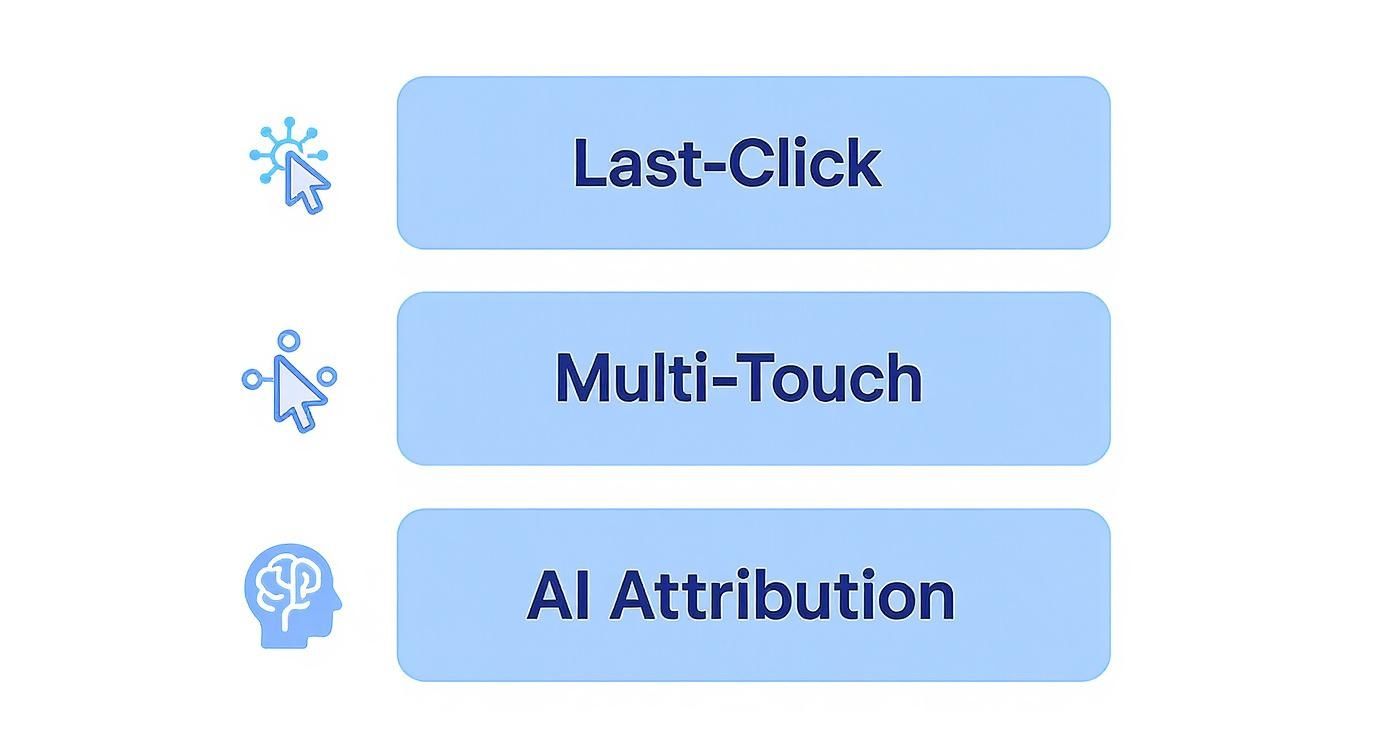
This infographic gives you a quick visual on how attribution has evolved—from dead-simple Last-Click models all the way to the more sophisticated Multi-Touch and AI-driven approaches we have today.

Infographic about what is marketing attribution

You can see a clear progression here. Each new tier builds on the last, giving marketers a much sharper, more complete picture of the customer journey.

To help you sort through the options, we’ve put together a simple comparison table.

Marketing Attribution Model Comparison

This table offers a side-by-side look at the most common models. Use it to understand how each one works, its strengths and weaknesses, and where it fits best in your marketing strategy.

Model TypeHow It WorksProsConsBest For
First-ClickGives 100% of the credit to the very first touchpoint.Simple to implement; highlights top-of-funnel channels.Ignores all subsequent interactions that nurture the lead.Brand awareness campaigns where the initial discovery is key.
Last-ClickGives 100% of the credit to the final touchpoint before conversion.Easy to track; shows what closes the deal.Overvalues bottom-funnel channels and ignores what built initial interest.Short sales cycles, like e-commerce flash sales.
LinearSplits credit equally across all touchpoints in the journey.Provides a balanced view; ensures no channel is ignored.Assumes all touchpoints are equally important, which is rarely true.Marketers wanting a baseline, holistic view of all channel contributions.
Time-DecayGives more credit to touchpoints closer to the conversion.Emphasizes the interactions that push a prospect over the finish line.Can undervalue the crucial top-of-funnel activities that started the journey.Longer sales cycles where late-stage nurturing is critical (e.g., B2B).
U-ShapedSplits credit between the first and last touchpoints, usually 40% each. The middle 20% is shared.Values both the initial discovery and the final conversion action.Minimizes the role of mid-funnel nurturing touchpoints.Lead-generation focused businesses where first and last touches are vital.
W-ShapedAssigns 30% credit each to the first touch, lead creation, and opportunity creation. The last 10% is shared.Gives significant weight to key B2B conversion milestones.Requires sophisticated tracking to identify specific funnel stages accurately.Sales-driven B2B organizations with a clearly defined sales funnel.

Each model tells a different story about your marketing performance. The trick is to choose the one that tells the truest story for your specific business.

Single-Touch Models: The Sprinters

Single-touch models are the simplest of the bunch. They assign 100% of the conversion credit to a single interaction. They're fast, easy to wrap your head around, and often the default setting in many analytics platforms.

  • First-Click Attribution: This model is all about the introduction. It gives every bit of credit to the very first touchpoint a customer had with your brand. Think of it as rewarding the channel that brought someone to the party.

    • Best For: Companies laser-focused on top-of-funnel growth and brand awareness. If your main goal is figuring out what brings new people in the door, this model is your guide.
    • Drawback: It’s blind to everything that happens next. It completely ignores every interaction after that initial discovery, which could be dozens of crucial nurturing steps.
  • Last-Click Attribution: As the polar opposite, this model gives all the glory to the final touchpoint right before a conversion. It’s built to answer one question: "What was the last thing they did before buying?"

    • Best For: Businesses with lightning-fast sales cycles, like an e-commerce store running a flash sale. In those cases, the last ad a customer clicked is probably the most influential one.
    • Drawback: It massively overvalues bottom-of-the-funnel channels (like branded search) and gives zero credit to the channels that built the initial interest and trust.

Multi-Touch Models: The Marathon Runners

Let's be real—most customer journeys aren't a sprint. They're a marathon with multiple key moments along the way. Multi-touch models get this. They distribute credit across various touchpoints, offering a much more balanced and realistic view.

Here are the most common multi-touch approaches:

  • Linear Model: This is the most straightforward multi-touch model. It simply splits credit equally among all touchpoints. If a customer had five interactions before converting, each one gets 20% of the credit.
    • Best For: Getting a general, holistic view of all the channels involved in a conversion. It’s a solid starting point if you just want to make sure no channel is being completely ignored.
    • Drawback: Its biggest weakness is assuming all touchpoints are equally important, which is almost never true. A quick glance at a social media post gets the same credit as an in-depth product demo.

By moving from single-touch to multi-touch, you shift from asking "Which one channel worked?" to "How did my channels work together?" This is a fundamental step toward more strategic marketing.

  • Time-Decay Model: This model operates on the idea that recent interactions are more valuable. It gives more credit to touchpoints that happened closer to the conversion. An interaction one day before the sale gets more weight than one from three weeks prior.

    • Best For: B2B companies or any business with a longer consideration period. In these cases, the final interactions are often what seal the deal.
    • Drawback: It can undervalue those critical top-of-funnel activities that were absolutely essential for getting the journey started in the first place.
  • U-Shaped (Position-Based) Model: This popular model gives 40% of the credit to the first touchpoint (the discovery) and another 40% to the lead-creation touchpoint. The remaining 20% is distributed evenly among all the interactions that happened in between.

    • Best For: Businesses where generating qualified leads is a primary goal. It correctly values both how a lead was found and what specific action turned them into a qualified prospect.
    • Drawback: It tends to minimize the importance of the nurturing touchpoints that happen between that initial contact and the final lead conversion.
  • W-Shaped Model: Taking it a step further, the W-Shaped model assigns 30% credit to the first touch, 30% to the lead-creation touch, and 30% to the opportunity-creation touch. That last 10% is then split among any other interactions.

    • Best For: Sales-driven organizations, especially in B2B, where the journey from a simple lead to a qualified sales opportunity is a distinct and critical stage.
    • Drawback: This one requires more sophisticated tracking. You need to be able to accurately identify that specific "opportunity creation" touchpoint in your sales process.

Want to go deeper on this? To really get into the mechanics, you can explore our comprehensive guide on multi-touch attribution models and see which one aligns best with your customer journey.

How To Implement Your First Attribution Model

A person using a laptop with charts and graphs on the screen, illustrating the process of implementing a marketing attribution model.

Alright, let's move from theory to practice. Getting started with attribution can feel like a massive jump, but it really doesn't have to be. The secret is to think crawl, walk, run.

Forget about building a perfect, hyper-complex system from day one. The real win is starting with the data and tools you already have. This approach keeps things manageable, lets you build a solid foundation, and helps you score some quick wins without getting bogged down by expensive software or massive integration projects.

The goal here is simple: start small, prove the value, and then scale up.

The Crawl Phase: Start With Your Goals

Before you even think about data, you need to be crystal clear on what you're trying to achieve. An attribution model is just a tool to measure what's working—so first, you have to define what "working" actually means for your business.

Are you trying to generate new leads? Drive e-commerce sales? Or maybe just get your name out there?

Your answer points directly to your Key Performance Indicators (KPIs). These are the hard numbers that tell you if you're hitting your goals.

  • For lead generation: You're probably obsessed with Cost Per Lead (CPL) or the raw number of marketing-qualified leads.
  • For e-commerce sales: Your world revolves around Return on Ad Spend (ROAS), Conversion Rate, and Average Order Value (AOV).
  • For brand awareness: You might track metrics like new website visitors, social media engagement, or branded search volume.

Actionable Step: Write down your top 1-2 marketing goals for this quarter. Next to each, list the exact KPI you will use to measure success. This document is now the foundation of your attribution strategy.

The Walk Phase: Gather Your Tools and Data

With your goals locked in, it's time to figure out where the data lives. The good news? Most businesses already have the basic building blocks in place.

1. Identify Your Core Platforms

Your most valuable data is likely scattered across a few key systems:

  • Website Analytics: This is non-negotiable. Google Analytics (GA4) is the standard starting point, giving you a powerful look into user behavior, traffic sources, and on-site conversions.
  • Customer Relationship Management (CRM): Your CRM (think HubSpot or Salesforce) is where the money is. It connects your marketing campaigns to actual leads, deals, and revenue.
  • Advertising Platforms: The dashboards in Google Ads, Meta Ads, and LinkedIn Ads are goldmines for campaign performance, click data, and impressions.

2. Master Your Tracking Mechanisms

Clean, consistent tracking is the absolute backbone of good attribution. Two things are critical here:

  • UTM Parameters: These are simple tags you add to your URLs to tell your analytics platform exactly where traffic came from. A disciplined UTM strategy is arguably the single most important thing you can do for accurate channel tracking.
  • Tracking Pixels: These are little snippets of code from platforms like Meta or Google that you place on your site. They’re essential for tracking conversions and linking them back to specific ad campaigns.

Pulling all this data together is where the magic happens. A solid plan for customer data platform integration can be a game-changer, giving you a single, unified view of the entire customer journey.

The Run Phase: Analyze and Iterate

Now it’s time to put your data to work. Don't overcomplicate it. Start with a simple model that's already built into a tool you use, like Google Analytics.

The Model Comparison Tool in GA4 is a fantastic place to begin. It lets you instantly see how different models—like Last-Click versus Linear or Time-Decay—would assign credit for the same conversion.

This simple comparison can be an eye-opener. You might discover that your organic social media, which looks worthless in a Last-Click model, is actually a key player in introducing new people to your brand when you look at it through a First-Click lens.

Actionable Step: Log in to GA4. Go to Advertising > Attribution > Model comparison. Compare "Last click" with "First click" for a key conversion event. Note which channels over-perform or under-perform between the two models. This is your first attribution insight.

But don't just set it and forget it. Your initial findings are a launchpad for asking smarter questions. "Why is paid search so good at closing deals but terrible at creating initial awareness?" or "Which of our blog posts are doing the heavy lifting in the middle of the journey?"

This cycle of analyzing, questioning, and tweaking is what transforms basic tracking into a real strategic advantage. By starting small and building momentum, you turn attribution from an intimidating concept into an actionable part of how you grow.

Overcoming Today's Biggest Attribution Challenges

Even with the best tools, marketing attribution is rarely a straight shot. It’s a powerful way to prove ROI, sure, but the path to clear insights is almost always bumpy. Marketers are up against some serious hurdles that can derail even the most carefully laid plans. Learning to navigate these obstacles is what separates basic reporting from a true strategic advantage.

The biggest challenge by far? The seismic shift in data privacy. The old days of tracking every user across every corner of the web are officially over.

The New Reality of Data Privacy

Growing privacy concerns from consumers, the introduction of GDPR back in 2018, and Apple’s App Tracking Transparency framework have completely changed the game. The firehose of user-level data has slowed to a trickle, forcing everyone to rethink traditional attribution.

Despite this, 76% of marketers still see attribution as absolutely essential for measuring ROI. They're just adapting to the new privacy rules. You can discover more about the evolution of marketing attribution to see how modern methods are stepping up to estimate channel impact without relying on creepy individual tracking.

This privacy-first world creates a few key headaches:

  • Fragmented Customer Journeys: Without third-party cookies, piecing together a user's journey across their laptop, phone, and work computer is incredibly difficult.
  • Signal Loss: Platforms like Meta and Google are working with less data, which means their built-in conversion tracking isn't as sharp as it used to be.

The modern attribution puzzle isn't about finding a single source of truth anymore. It's about blending different data signals—some precise, some directional—to build the most complete picture possible.

Tackling Common Implementation Roadblocks

Beyond the privacy landscape, a few practical challenges consistently trip up marketing teams. If you don't tackle these head-on, you're building your attribution house on a shaky foundation.

One of the most common culprits is messy data. You have to learn how to improve data quality, because inaccurate or incomplete information makes any model worthless. It leads to flawed conclusions and, ultimately, wasted budget.

Here’s a look at the usual suspects and how to solve them:

ChallengeWhy It's a ProblemActionable Solution
Cross-Device TrackingA customer sees an ad on their phone but buys on their laptop. Without a link, you credit the wrong channel.Implement a unified ID system. The easiest way is to encourage user logins on your site or app, which connects their activity across devices into a single view.
Offline Conversion LagAn online ad drives an in-store purchase, but the sale isn't logged for days, breaking the attribution chain.Use CRM data integration. Connect your point-of-sale system to your CRM to match in-store purchases back to online campaigns using customer emails or phone numbers.
Data SilosMarketing has ad data, sales has CRM data, and support has interaction data. None of it talks.Champion a centralized data platform. Tools like a Customer Data Platform (CDP) or a data warehouse pull all that info into one place, creating a single source of truth.
Long Sales CyclesFor B2B companies, a deal might take six months to close, making it tough to connect the sale to the marketing that started it all.Focus on intermediate KPIs. Instead of only tracking the final sale, give credit to key milestones along the way, like demo requests, whitepaper downloads, or trial sign-ups.

The Future of Attribution With AI and Machine Learning

While the classic attribution models give us a solid rulebook, the future of attribution is way smarter and more adaptive. It's driven by artificial intelligence, and it’s a massive leap from the rigid, one-size-fits-all systems of the past.

This approach is often called algorithmic or data-driven attribution. Instead of a marketer deciding which touchpoints get the most credit, machine learning algorithms dig into your unique customer data and build a custom model from scratch.

Here's the key difference: AI doesn't just look at the journeys of customers who converted. It also analyzes the paths of everyone who didn't convert. By comparing the two, it learns which touchpoints genuinely influence a decision and which ones are just noise along the way. This removes human bias and creates a far more honest picture of what’s actually working.

Beyond Rules to Real Insights

Moving to an AI-powered system isn't just about getting a slightly more accurate report. It’s about fundamentally changing how you understand—and even predict—customer behavior.

An AI model can tell you that for a specific customer segment, your blog posts have a 15% higher impact when they’re seen before a video ad. That’s a powerful, nuanced insight a U-shaped model would completely miss. It takes you beyond simple credit scores and starts revealing the complex relationships between your channels.

AI-driven attribution is the answer to the data scarcity problem created by modern privacy rules. By analyzing patterns and probabilities, it can intelligently fill the gaps left by disappearing third-party cookies, giving you a much clearer view of performance.

Making AI Actionable

This isn't just for mega-corporations with huge data science teams anymore. Modern platforms are making these powerful capabilities more accessible, giving any business a serious competitive edge.

  • Predictive Budgeting: AI models can forecast what will happen if you shift your budget from one channel to another. This lets you optimize your spending before you commit a single dollar. You can see how this works by exploring predictive analytics in marketing.
  • Real-Time Optimization: The system can spot an underperforming campaign as it’s happening and suggest adjustments, turning insights into immediate action. And as technology evolves, new approaches are constantly emerging for unlocking low-latency analytics and GenAI.

By embracing machine learning, marketing attribution stops being a backward-looking report card and becomes a forward-looking strategic engine that guides every decision you make.

Free Tool

Try our Marketing Plan Generator — generate a complete AI-powered marketing plan in minutes. No signup required.

Frequently Asked Questions About Marketing Attribution

Even after you get the hang of the basics, some very practical questions always pop up. Let's tackle a few of the most common ones I hear from teams trying to put attribution into practice.

Marketing Attribution vs. Marketing Mix Modeling

This is probably the biggest point of confusion out there. People hear "marketing measurement" and lump Marketing Attribution and Marketing Mix Modeling (MMM) together, but they’re built for totally different jobs. They operate on different scales and answer different questions.

Here’s a side-by-side comparison to make it clear:

FeatureMarketing AttributionMarketing Mix Modeling (MMM)
FocusUser-level, granular (clicks, views)High-level, aggregated (total sales)
TimeframeShort-term (days, weeks)Long-term (months, years)
ChannelsPrimarily digitalOnline, offline (TV, radio), external factors
Question It Answers"Which digital campaign drove this conversion?""How did our TV budget impact overall revenue?"
Actionable OutcomeTactical campaign optimizationStrategic annual budget allocation

Think of it this way: Attribution helps you tune the engine of your race car during the race. MMM helps you decide whether to build a race car or a pickup truck next year. Both are essential, but for very different purposes.

How Can I Get Started with a Small Business Budget?

You absolutely do not need a five-figure software budget to get started. The key is to begin with the tools you probably already use and just get disciplined with your data.

Your first, most actionable step? Perfect your UTM parameter strategy. Seriously. Consistently tagging every single link in your emails, social posts, and ads is the most powerful thing you can do to clean up your data.

Once that’s locked in, you can jump into the free Model Comparison Tool in Google Analytics 4. This lets you instantly compare how a Last-Click model values your channels versus a Linear or First-Click model. You'll uncover immediate insights without spending a dime.

How Often Should We Change Our Attribution Model?

My advice is simple: don't. Or at least, not often. Constantly switching your model is like changing the rules of a game halfway through—it makes it impossible to compare performance over time, which completely defeats the purpose of having historical data. A good rhythm is to review your model’s effectiveness quarterly or maybe semi-annually.

Only think about a change if something fundamental shifts in your business. Things like:

  • Launching a major new marketing channel.
  • Seeing a radical change in how your customers typically buy from you.
  • Your data consistently shows the model is just plain wrong about crediting important touchpoints.

The goal is consistency for reliable reporting. Your model should reflect your business strategy, so it should only change when that strategy does.


Ready to move beyond basic models and unlock the true potential of your marketing data? marketbetter.ai uses AI-powered attribution to give you a clear, predictive view of what's driving revenue. Stop guessing and start optimizing with a platform built to deliver actionable insights and measurable ROI. Learn how marketbetter.ai can transform your marketing strategy today.

Build Your Modern Marketing Technology Stack: An Actionable Guide

· 28 min read

Your marketing technology stack is the collection of software you use to get your job done—planning campaigns, running them, and figuring out if they actually worked. Think of it less like a random toolbox and more like a custom-built workshop. Each tool has a specific job, but they all work together to build your marketing engine.

What Is a Marketing Technology Stack

Imagine trying to build a house with only a hammer. You might get a wall up, but it would be slow, painful, and probably fall over. Running a modern marketing department without the right set of tools is pretty much the same. A marketing technology stack, or “martech stack,” is the integrated system of technologies that helps you manage, measure, and optimize everything you do.

A good stack isn't just a list of software subscriptions. It's a living system where each tool talks to the others. This creates a single, cohesive view of the entire customer journey. The real goal here is to stop doing things in isolation and start running a data-driven operation. For example, insights from your website analytics should directly inform who you target in your next email campaign.

The Explosive Growth of Marketing Technology

The pressure to build a smart martech stack has grown because the number of tools available has absolutely skyrocketed. A little over a decade ago, marketers had a handful of options. Today, the choices are overwhelming.

This chart from Scott Brinker at Chiefmartec.com shows just how dramatically the landscape has expanded.

What started as a small corner of the software world has ballooned into a massive industry. We've gone from 150 tools in 2011 to a projected 15,384 by 2025. This explosion makes it critical to have a strategy. You can't just collect shiny new objects; you have to pick tools that solve real problems. You can explore the full history of this growth in these martech landscape insights from WebFX.

To put this into perspective, let's look at the core functions a well-built stack should handle for your business.

Core Functions of a Modern Martech Stack

A modern stack isn't just about sending emails or posting on social media. It’s a complete system designed to manage the entire customer lifecycle. Here’s a breakdown of the primary jobs your martech stack should be doing for you, along with a comparison of popular tools for each job.

FunctionDescriptionExample Tools & Comparison
Attraction & AcquisitionTools that help you find new audiences and bring them to your website or properties.SEMrush (SEMrush) vs. Ahrefs (Ahrefs): Both are excellent for SEO, but SEMrush offers broader digital marketing features, while Ahrefs is often praised for its superior backlink data.
Engagement & NurturingSoftware for communicating with leads and customers to build relationships.HubSpot (HubSpot) vs. ActiveCampaign (ActiveCampaign): HubSpot is an all-in-one platform great for teams wanting a unified system. ActiveCampaign offers more powerful automation at a lower price point.
Conversion & SalesPlatforms that turn interested leads into paying customers.Salesforce (Salesforce) vs. Drift (Drift): Salesforce is the industry-standard CRM for managing the entire sales pipeline. Drift specializes in conversational marketing to convert website visitors in real-time.
Analytics & DataTools that measure performance, track behavior, and provide insights for optimization.Google Analytics (Google Analytics) vs. Hotjar (Hotjar): Google Analytics gives you the quantitative "what" (e.g., page views). Hotjar provides the qualitative "why" with heatmaps and session recordings.
Retention & AdvocacySystems designed to keep customers happy and turn them into fans of your brand.Zendesk (Zendesk) vs. Gainsight (Gainsight): Zendesk is focused on reactive customer support (solving tickets). Gainsight is a proactive customer success platform designed to prevent churn.

Ultimately, a strong stack gives you a command center for growth, connecting every marketing activity back to real business results.

Why a Cohesive Stack Is No longer Optional

Years ago, having a few marketing tools gave you an edge. Today, it’s table stakes. A messy, disconnected set of tools creates data silos, endless manual work, and a fractured view of your customer. In contrast, an integrated stack gives you a single source of truth.

A great martech stack isn't about having the most tools; it's about having the right tools working together seamlessly to achieve specific business outcomes.

This synergy is what separates high-performing teams from the rest. It allows you to:

  • Automate Repetitive Tasks: Free up your team from soul-crushing work like data entry or lead routing so they can focus on strategy and creative thinking.
  • Deliver Personalized Experiences: Use unified customer data to create relevant, timely interactions that don't feel creepy or generic.
  • Make Data-Driven Decisions: Get a clear, complete picture of campaign performance to optimize your budget and improve ROI.
  • Achieve Scalable Growth: Build efficient, repeatable processes that can support business growth without needing to hire an army of people to manage it all.

The Building Blocks of a Powerful Martech Stack

A great martech stack isn't just a folder of software subscriptions; it's a living system where every tool has a job and works with the others. Think of it like building a high-performance car. You need an engine for power (your content and automation), a chassis for structure (your CRM), a GPS for direction (your analytics), and diagnostic tools to check performance. Every part is essential, and they have to sync up perfectly to win the race.

Most successful stacks are built around a few foundational jobs that mirror the customer journey. You have to attract new audiences, engage them with something valuable, nurture those relationships, and analyze everything to get smarter. It’s a simple, powerful framework.

This diagram shows how these core pillars—Attract, Engage, and Delight—fit together.

Infographic about marketing technology stack

As you can see, a unified stack is the base that supports everything. It's not just a collection of tools, but a connected system designed to move people from stranger to loyal customer.

Attract Tools for Audience Acquisition

First things first: you have to get in front of the right people. This is the top of your funnel, where your tools are all about discovery and generating demand. If you can't nail this "Attract" layer, even the world's best product will sit on a digital shelf collecting dust.

This category is all about driving traffic and sparking that initial flicker of interest.

  • Search Engine Optimization (SEO) Tools: You can't be found if you don't know what people are searching for. Platforms like Ahrefs or SEMrush are your eyes and ears, helping with keyword research, tracking your rankings, and peeking at what your competitors are doing to win on Google.
  • Paid Advertising Platforms: This is where you pay to play. Google Ads is the king of search advertising, while platforms like LinkedIn Ads or Meta Ads are invaluable for targeting specific demographics and job titles on social media.
  • Content Management Systems (CMS): Your website is your home base. A CMS like WordPress is the engine that runs it, letting you publish the blog posts, landing pages, and resources that draw people in organically. It's absolutely foundational.

Engage and Nurture with Communication Tools

Okay, you've got their attention. Now what? The "Engage" and "Nurture" layers of your stack are where you build a real relationship. This is where you turn anonymous visitors into known leads and start guiding them toward making a decision. It’s all about communication and delivering a great experience.

These tools handle the crucial middle-of-the-funnel dance. A classic point of comparison here is the difference between a simple email tool and a full marketing automation platform.

Tool CategoryPrimary FunctionIdeal ForExample
Email Service Provider (ESP)Simple email broadcasting and list management.Businesses focused on one-way communication like newsletters.Mailchimp
Marketing AutomationComplex, trigger-based workflows and multi-channel nurturing.Companies needing to manage sophisticated customer journeys.HubSpot, Pardot

An ESP is like a megaphone—it’s great for blasting one message out to a big crowd. A marketing automation platform, on the other hand, is like having thousands of personalized conversations at once, responding to what people do with the perfect next message.

Analyze Performance with Data Platforms

The last layer is arguably the most important: analytics. This is the brain of your entire marketing operation. It collects data from all your other tools to tell you what's working, what's a waste of money, and why. Without this, you're just guessing.

Your analytics tools are your single source of truth. They connect all your hard work—every click, every email, every ad—to the metrics that actually matter: revenue and customer lifetime value.

These are the platforms that turn raw data into smart decisions:

  • Web Analytics: Google Analytics is the industry standard for a reason. It tracks website traffic, shows you how users behave, and measures conversion rates. It answers fundamental questions like, "Where are people coming from?" and "Which pages actually turn visitors into leads?"
  • Customer Relationship Management (CRM): A CRM like Salesforce acts as the central database for every lead and customer. It tracks every single interaction, from their first visit to the final sale, giving your marketing and sales teams a complete, unified picture.
  • Customer Data Platforms (CDP): A CDP kicks data management up a notch. It pulls information from multiple sources to build a single, unified profile for each customer that gets richer over time. For any business serious about true personalization at scale, understanding customer data platform integration is a non-negotiable step toward building an advanced, future-proof stack.

How to Choose the Right Martech Tools

With thousands of tools out there, picking the right ones for your stack can feel like navigating a maze in the dark. It’s overwhelming. But a little structure turns this beast of a task into a strategic advantage. It’s not about grabbing the most popular software; it’s about finding the right tools that solve your specific problems and actually move the needle.

The secret? Start with the destination. Before you even glance at a vendor’s website, you need to be crystal clear on what you’re trying to achieve. Are you gunning for more qualified leads? Trying to keep the customers you have? Or maybe just trying to get content out the door without burning out your team? Your goals are your compass.

Define Your Goals and Audit Your Current Stack

First things first: anchor everything to your business objectives. Don't start by asking, "What cool new tool should I buy?" That’s a recipe for a bloated, expensive stack that doesn’t do much. Instead, ask, "What problem are we trying to solve right now?" This simple shift saves you from chasing shiny objects that add zero real value.

Once you know what you're aiming for, take a hard look at the tools you already have. You’d be surprised how many teams have overlapping software or are paying for premium features they never touch. An honest audit shines a light on both gaps and redundancies.

Here’s a simple, actionable audit plan you can execute this week:

  1. List Every Tool: Create a spreadsheet with columns for Tool Name, Monthly Cost, Owner, and Primary Function.
  2. Assign an Owner: Who is responsible for this thing? If no one owns it, that's a red flag.
  3. Define its Job: What problem does this tool solve? (e.g., "Sends weekly newsletters," "Tracks website visitors.") Be specific.
  4. Evaluate Performance: Add columns for "Usage Frequency (Low/Med/High)" and "Is It Working? (Yes/No)". Have the owner fill them out honestly.
  5. Check for Overlap: Sort by "Primary Function." Do you have three different tools that basically do the same thing? Time to consolidate.

This audit gives you a data-backed map of where you need to invest and, just as importantly, where you can cut costs.

All-in-One Platform vs. Best-of-Breed Solution

This is one of the biggest forks in the road you'll hit. Do you build your stack around a single, all-in-one platform, or do you assemble a custom kit of specialized "best-of-breed" tools? Each path has its pros and cons. An all-in-one suite like HubSpot promises simplicity, while a best-of-breed approach gives you best-in-class functionality for every single task.

There’s no universally “correct” answer here. The right choice is all about your team's size, budget, technical chops, and where you see the business going.

Choosing between a platform and point solutions is a classic trade-off between convenience and capability. A platform simplifies your life with everything under one roof, while a best-of-breed approach lets you pick the absolute best tool for every single job.

To help you decide, let's look at how they stack up.

Platform vs. Point Solution: A Comparison for Your Stack

Deciding between an integrated marketing suite and a collection of specialized tools is a critical step. An all-in-one platform offers a unified experience, while a best-of-breed stack provides unparalleled depth in specific areas. This table breaks down the key factors to consider.

FactorAll-in-One Platform (e.g., HubSpot)Best-of-Breed Solution (e.g., Mailchimp + Salesforce)
IntegrationNatively integrated, ensuring seamless data flow between modules.Requires manual integration (often via tools like Zapier), which can be complex.
FunctionalityOften provides broad but less deep features. A "jack of all trades, master of none."Delivers specialized, powerful features for a specific task.
User ExperienceA single, consistent user interface makes training and adoption easier.Multiple interfaces can create a disjointed experience and a steeper learning curve.
CostTypically involves a single, predictable subscription fee. Can be more cost-effective upfront.Costs are spread across multiple vendors, which can add up and be harder to track.
FlexibilityYou're locked into one vendor's ecosystem, which can limit your ability to adapt.Allows you to swap out individual tools as your needs change without disrupting the entire stack.

Ultimately, this choice comes down to your priorities. If you value simplicity and unified data above all else, a platform might be your best bet. If your team needs top-tier performance in every marketing function and has the resources to manage integrations, a best-of-breed approach offers more power and control.

Prioritize Integration and Total Cost of Ownership

No matter which path you take, seamless integration is absolutely non-negotiable. A pile of powerful but disconnected tools just creates data silos and soul-crushing manual work. It completely defeats the purpose of having a "stack." When you're talking to vendors, ask tough questions about their APIs and native integrations with the other tools you can't live without, especially your CRM.

Finally, you have to look beyond the sticker price and understand the Total Cost of Ownership (TCO). The monthly subscription is just the beginning. Hidden costs can easily double your real investment over time.

Think about these factors before signing any contract:

  • Implementation Fees: What are the one-time setup and configuration costs?
  • Training and Onboarding: How much time and money will it take to get your team up to speed?
  • Ongoing Maintenance: Will you need to hire a dedicated admin or bring in developer support?
  • Integration Costs: Will you have to pay for middleware like Zapier just to get your tools talking to each other?

Making the right call means looking at the whole picture. A detailed marketing automation tools comparison can be a lifesaver here, helping you weigh the pros and cons based on these crucial factors. This way, you build a stack that’s not just powerful today, but sustainable for the long haul.

Comparing Real-World Martech Stack Examples

Theory is great, but seeing how martech stacks work in the wild is where it all clicks. The honest truth is there’s no such thing as a "perfect" stack—it's not a one-size-fits-all solution. The tools a scrappy startup cobbles together are worlds away from what a global e-commerce giant needs to run its operation.

To make this real, let's walk through three different blueprints. Each one is built for a specific kind of business, giving you a practical model you can borrow from for your own setup.

Diagram showing different martech stack examples

The Scrappy Startup Stack

When you're an early-stage startup, every penny is precious. The name of the game is speed, affordability, and finding that elusive product-market fit. This stack is all about free or dirt-cheap tools that are easy to pick up without needing a dedicated team to run them.

The goal here is simple: cover the absolute basics. You need to get people to your site, capture some leads, and see what’s working, all without burning through your cash. Integrations are usually just the native ones or whatever you can rig up with simple automation, because speed beats complexity at this stage.

Key Strategy: Squeeze every drop of value out of free plans and easy-to-learn tools. Get the maximum impact for the minimum spend.

Here’s what that often looks like:

  • Analytics: Google Analytics is the bedrock. It's free, powerful, and gives you all the essential data on your website traffic and user behavior. It’s non-negotiable.
  • Content & SEO: WordPress is the go-to for a flexible CMS. Pair it with a freemium tool like Ahrefs' Webmaster Tools to handle basic site audits and keep an eye on your keywords.
  • Communication: The free plan from Mailchimp is perfect for building your first email list and getting newsletters out the door.
  • Social Media: A simple scheduler like Buffer is a lifesaver. It lets you manage and schedule posts across all your platforms from one place, saving you a ton of time.

The B2B Growth Engine Stack

Once a B2B company starts to scale, the focus shifts from just getting by to building a repeatable machine for generating and nurturing high-quality leads. This kind of stack is built around a muscular CRM and marketing automation platform, which acts as the central hub for everything marketing and sales touches.

Data from 2025 backs this up. The most common setup for mid-market B2B companies (50-500 employees) is a combination of HubSpot, LinkedIn Ads, and Google Analytics, used by a whopping 28.5% of them. For the bigger players, Salesforce-centric stacks are the favorite, with 19.8% adoption among companies with over 500 employees. You can dig into more of the numbers behind these popular B2B martech stack configurations here.

A typical B2B growth stack includes:

  • Core Platform: This is usually HubSpot or Salesforce with Pardot. It becomes your single source of truth, handling your CRM, email campaigns, and landing pages.
  • Targeted Ads: LinkedIn Ads is absolutely critical for reaching people with specific job titles and in certain industries, especially for account-based marketing (ABM) plays.
  • Analytics: Google Analytics is still in the mix, giving you that crucial top-of-funnel view of your traffic and conversions.
  • Sales Enablement: Tools like Drift or Intercom get layered on to engage website visitors in real-time, helping you convert high-intent prospects right when they're most interested.

The Enterprise E-commerce Stack

For a massive e-commerce business, the entire game is about personalization at scale. This stack is built to process millions of customer data points to deliver unique, one-to-one experiences that build loyalty and maximize customer lifetime value.

It’s a "best-of-breed" world here. Instead of one tool that does everything okay, they pick the absolute best tool for each specific job and then integrate them into a powerful, unified system.

CategoryTool ExampleStrategic Purpose
Customer DataSegment (CDP)To pull data from every single touchpoint and build a unified, 360-degree view of every customer.
PersonalizationOptimizelyFor running sophisticated A/B tests and dynamically changing content and product recommendations on the fly.
Email & SMSKlaviyoTo run incredibly advanced email and SMS campaigns that are triggered by customer behavior, like purchase history or site activity.
Analytics & BITableauFor diving deep into the data, building custom dashboards, and spotting complex trends that basic analytics tools would miss.

This kind of enterprise stack is all about deep functionality and the ability to handle enormous amounts of data. It gives the business the power to fine-tune every single step of a very complex customer journey.

Weaving AI Into Your Martech Stack

Artificial intelligence isn't some far-off concept anymore—it's the engine running under the hood of the smartest marketing stacks out there. Bringing AI into the mix isn't about chasing the latest shiny object; it’s a strategic move to work smarter, understand customers on a deeper level, and get way more out of your campaigns. The right AI tools act as a force multiplier for your team.

Think of it like giving a smart assistant to every person on your crew. It can spin up a dozen ad variations in minutes, tell you which leads are actually hot, or tailor a website experience for thousands of individual visitors at the same time. This frees up your people to focus on what they do best: big-picture strategy, creative breakthroughs, and building real customer relationships.

An abstract image representing the integration of AI into a marketing technology stack

Putting AI to Work in Your Stack

The adoption of AI in marketing is moving at lightning speed. Recent survey data shows 68.6% of companies are already using generative AI, making it the sixth most popular martech category just a couple of years after it hit the mainstream. This isn't just hype; it's driving real change, with 62.1% of marketers saying they use more tools now than two years ago, mostly because of new AI features.

This explosion in use points to a few no-brainer ways to apply AI.

  • Generative AI for Content Creation: This is where most teams dip their toes in first. Instead of wrestling with a blank page, your team can use AI to kickstart blog outlines, draft a batch of social media posts, or generate killer email subject lines. The trick is to use it for speed and scale, then have a human editor polish it to match your brand's voice and quality standards.
  • Predictive Analytics for Lead Scoring: A lot of modern CRMs use AI to sift through customer behaviors and past data to predict who's most likely to buy. This helps your sales team stop guessing and start focusing their time on prospects who are actually ready to talk, which can dramatically boost conversion rates.
  • Hyper-Personalization at Scale: AI algorithms can watch how a user behaves in real-time to serve up dynamic website content, recommend the perfect next product, or send a message at the exact moment it will land best. We've moved way beyond just dropping a first name into an email—this is about creating a true one-to-one experience for everyone.

AI-Enhanced vs. Traditional Tools: What's the Real Difference?

The gap between a standard tool and an AI-powered one is the difference between doing the work yourself and having an intelligent partner do it for you. A traditional analytics dashboard shows you what happened. An AI-enhanced one tells you why it happened and what you should do next.

FeatureTraditional Marketing ToolAI-Enhanced Marketing Tool
Content CreationManual drafting, requires serious human time for every single piece.Generates initial drafts, outlines, and variations in a matter of seconds.
Lead ScoringRelies on simple, rule-based triggers (e.g., they visited the pricing page).Uses predictive models that analyze hundreds of signals to gauge real intent.
Campaign TargetingBased on broad demographic segments that treat everyone the same.Creates dynamic micro-segments based on what people are doing right now.

The true power of AI in your marketing stack is its ability to chew through massive amounts of data to spot patterns and make predictions that are simply beyond what a human can do. It elevates your stack from a simple system of record to a genuine system of intelligence.

To really nail this, you have to understand the role of AI in a modern data stack. At the end of the day, clean and accessible data is the fuel that makes any AI initiative run.

How to Spot Real AI in Martech Platforms

When you're shopping for new tools or looking at your current ones, don't get fooled by a simple "AI" sticker on the box. You need to dig deeper and figure out what it actually does. Cut through the marketing fluff by asking vendors specific, action-oriented questions. Our guide on using AI for marketing automation can help you identify features that deliver real-world value.

  1. Ask for the "How": Don't be shy. How does this AI feature actually work? Is it learning from your company’s unique data, or is it just a generic model?
  2. Focus on the Outcome: What specific marketing headache does this solve? Can they show you how it will demonstrably save time, cut costs, or increase conversions?
  3. Check for Control: Can you step in and fine-tune or override the AI's suggestions? The best tools are a partnership, combining machine intelligence with human oversight.

By zeroing in on these practical applications and asking the right questions, you can build a marketing technology stack that isn't just powerful, but genuinely intelligent.

Managing Your Stack for Long-Term Success

Getting your marketing technology stack assembled is a huge first step, but the real work starts the day after you launch it. Think of your stack less like a finished building and more like a garden. It needs constant tending—weeding, pruning, and feeding—if you want it to actually produce results. The most powerful stacks aren't the ones with the most logos; they're the ones that are actively managed and refined over time.

This ongoing management is where you’ll find your true return on investment. A neglected stack quickly turns into a tangled mess of outdated data, redundant tools, and frustrated users. A little proactive oversight makes sure your ecosystem runs smoothly, adapts as your business changes, and keeps delivering a real impact.

Establish a Single Source of Truth

The most common point of failure in any martech stack is data chaos. It’s a classic story: your CRM, email platform, and analytics tool all have slightly different versions of the same customer's journey. When that happens, you can't make smart decisions. This is why establishing a single source of truth (SSoT) isn't just a good idea—it's non-negotiable.

Your SSoT is the one platform that holds the master record for all customer data. This is usually your CRM or a dedicated Customer Data Platform (CDP). Every other tool in your stack either pushes data into it or pulls data from it. The goal is simple: make sure everyone is working from the same playbook.

A single source of truth breaks down data silos and builds a unified customer profile. It’s the foundation you need for reliable reporting, effective personalization, and getting marketing and sales to finally speak the same language.

Create Seamless Workflows with Integration

A stack is only as strong as its weakest connection. You can have the most powerful, best-of-breed tools on the market, but they’re almost useless if they can’t talk to each other. This is where integration tools become critical for creating a cohesive workflow instead of just a collection of siloed apps.

Let's look at the two ways data gets moved around:

MethodDescriptionBest For
Manual Data TransferExporting CSV files from one tool and uploading them to another.Very small teams with minimal data. It’s a recipe for errors and just doesn't scale.
Automated IntegrationUsing tools like Zapier or native APIs to build "if-this-then-that" automations.Any team that's serious about efficiency. Think: "When a new lead fills out a form, automatically create a contact in Salesforce."

Automating these handoffs saves countless hours and, more importantly, eliminates the human errors that always creep into manual data entry.

Foster Team Adoption and Clear Ownership

At the end of the day, technology is only half the battle. The human element is just as critical. The best tools in the world won’t do you any good if your team doesn't know how—or why—to use them.

To make sure your stack actually gets used, you have to nail adoption and governance.

  1. Assign Clear Ownership: Every single tool needs a designated owner. This is the go-to person for managing the vendor, training users, and making sure the tool is actually delivering value. No exceptions.
  2. Provide Ongoing Training: A one-and-done onboarding session isn't enough. Tools evolve, features get added, and team members change. Continuous education is the only way to get the most out of your investment.
  3. Regularly Measure Effectiveness: You have to connect your tools to actual performance metrics. Our guide on how to measure marketing effectiveness offers a few frameworks for this. Tying your stack's output to real business results is how you prove its value and justify the ongoing cost.
Free Tool

Try our Tech Stack Detector — instantly detect any company's tech stack from their website. No signup required.

Got Questions About Your Martech Stack? You're Not Alone.

Jumping into the world of marketing technology can feel like alphabet soup. CRM, MAP, CDP… it’s a lot. Getting a handle on the fundamentals helps you build a stack that actually works, making sure every dollar and every hour you invest pays off.

Let's clear up some of the most common questions marketers have.

How Much Should I Actually Budget for This Stuff?

There’s no magic number here, but a solid rule of thumb is to set aside 20-30% of your total marketing budget for technology. But don't get hung up on that exact figure. An e-commerce brand will naturally spend more on analytics and personalization tools, while a B2B company might pour its resources into a killer CRM and marketing automation platform.

The real key? Start with your goals. Figure out your biggest pain points and prioritize the tools that solve those problems first. Don't chase a percentage; chase results.

How Often Should I Re-Evaluate My Stack?

You absolutely need to do a full-blown audit of your marketing technology at least once a year. Things change fast, and what worked last year might be dead weight today.

A more practical rhythm is a quick check-in every quarter. This lets you see what’s being used, spot any tools doing the same job (a classic budget-killer), and make sure everything still lines up with where the business is headed. Regular check-ins are your best defense against "stack bloat"—that sneaky state where you're paying for a bunch of software nobody even logs into.

What's the Real Difference Between a CRM and Marketing Automation?

This one trips people up all the time, but it's pretty simple when you think about it. They work together, but they have very different jobs.

  • A CRM (Customer Relationship Management) is your system of record. Think of it as your entire customer universe in one place. It stores all your customer data and tracks every single interaction, giving your sales and service teams one definitive source of truth. It's all about managing the relationship.

  • Marketing Automation is the engine that acts on that data. It takes all that rich info from the CRM and uses it to run marketing campaigns at scale—things like sending personalized email sequences or showing a specific visitor a unique offer on your website. It’s all about managing communication.

Bottom line: Your CRM holds the "who," and your marketing automation platform handles the "how" and "when" of reaching them.

How Can a Small Business Build a Stack Without Breaking the Bank?

You don't need a Fortune 500 budget to build a powerful martech stack. It’s all about being strategic and starting lean.

The trick is to prioritize ruthlessly and take full advantage of freemium tools. Start with the absolute essentials that offer great free plans. We're talking about tools like Google Analytics for data, Mailchimp for email, and WordPress for your website. Focus on solving one core problem at a time—maybe it’s capturing leads or just understanding your website traffic—and then expand from there.


Ready to build an intelligent, efficient marketing engine? The marketbetter.ai platform integrates AI-powered content creation, campaign optimization, and personalization to help you drive real results and prove your marketing impact. Learn more at marketbetter.ai.

9 Demand Generation Strategies That Build Pipeline — Not Just MQLs [2026]

· 27 min read

Demand generation is all about creating genuine interest and awareness for what you do. It's not just a fancy term for collecting email addresses. It’s about building a brand and an audience that actively seeks you out, turning casual browsers into loyal fans who are actually excited to hear from you.

Done right, this approach moves you away from unpredictable, one-off campaigns and toward building a reliable engine for long-term revenue growth. To make that happen, you need an actionable plan.

What Is Demand Generation and Why It Matters Now

Let's use an analogy. Imagine your business is a new band trying to make it.

You could stand on a street corner, shoving flyers into the hands of everyone who walks by. That's a lot like traditional lead generation—a pure numbers game focused on grabbing as many contacts as possible, hoping a few are a good fit. This approach is reactive and volume-based.

Demand generation is different. It’s like booking a gig, dialing in your sound, and playing music so good that a crowd starts to form on its own. People are drawn in. They start talking about you. They want to know when your next show is and where they can buy your album. You're creating a buzz, a genuine demand, not just interrupting people. This strategy is proactive and quality-based.

This isn’t just a marketing tactic; it's a complete shift in mindset. Today's B2B buyers are smarter and more skeptical than ever. They’ve done their research. They don't want a cold call or a hard sell. They want answers to their problems. A solid demand generation program focuses on educating and helping your ideal customers, building trust long before a sales rep ever enters the picture.

The Big Difference: Demand Generation vs. Lead Generation

It’s easy to get these two mixed up, but they play very different roles in getting a customer from "who are you?" to "take my money."

  • Demand Generation (The "Why"): This is the long game. It’s about building brand awareness and positioning your company as the go-to expert in your space. It answers the question, "Why should I even care about this company or their solution?" The goal is to make the market aware of a problem and excited about your way of solving it.

    • Actionable Step: Start a podcast series interviewing industry leaders about the biggest challenges in your field. Don't mention your product; just provide value.
  • Lead Generation (The "Who"): This is much more direct and short-term. It's about capturing the contact information of people who have shown interest. It answers the question, "Who is interested right now?" The goal is to convert that existing interest into a qualified name and email for your sales team to follow up with.

    • Actionable Step: Offer a downloadable checklist, like "10 Things to Look for in a New SaaS Vendor," behind a simple email form on your highest-trafficked blog post.

Think of it this way: demand generation creates the fertile ground where high-quality leads can actually grow. To see how that second piece works in practice, you can dig into some effective B2B lead generation strategies.

The Evolution Toward a Smarter Funnel

Demand generation has come a long way from just stuffing the top of the funnel with as many names as possible. Over the last decade, it’s matured from a simple volume play into a sophisticated, data-driven strategy that spans the entire customer journey. It's now laser-focused on lead quality and tight alignment with sales.

The massive shift to digital, especially after 2020, cemented this change. Personalized digital experiences became the standard, forcing marketing efforts to be more precise and genuinely helpful than ever before.

The Core Pillars of a Modern Demand Strategy

To build a machine that consistently drums up interest, you need a blueprint. The best demand generation strategies aren't a single action item on a checklist; they're a structured system built on three core pillars: Attract, Engage, and Delight. This isn't just marketing jargon—it’s a framework for moving customers from "Who are you?" to "Where do I sign up?"

Each pillar has a specific job, and each one builds on the last. Think of the Attract stage as your opening act, Engage as the main performance, and Delight as the unforgettable encore that has the crowd chanting your name.

This visual shows you exactly how the pieces fit together—creating awareness, sparking real interest, and ultimately building a sales pipeline you can count on.

Infographic about demand generation strategies

As you can see, a central demand generation engine is what fuels awareness. That awareness then cultivates genuine interest, which in turn feeds a healthy, predictable sales pipeline. It’s a flywheel, not a funnel.

Attract Your Ideal Customers

The first pillar, Attract, is all about capturing attention at the very top of the funnel. This is where you connect with people who might not even realize they have a problem yet, let alone know that you sell the solution. The goal isn't a sales pitch; it's to be genuinely helpful.

Forget about the old-school outbound tactics that interrupt people’s day. This is about drawing them in naturally by solving their problems with valuable, ungated content that proves you know your stuff. Every B2B company that consistently shows up on page one of Google for helpful searches is nailing this pillar.

Key tactics to put to work here include:

  • SEO-Optimized Blog Content: Write articles that directly answer the questions your ideal customers are typing into search engines. This makes you a trusted expert from the very first click.
  • Social Media Advocacy: Get your team involved. When your own experts share company content and their insights on platforms like LinkedIn, it comes across as authentic and builds trust way faster than a branded post.
  • Podcast Appearances or Hosting: Share your knowledge on industry podcasts. It’s a fantastic way to reach new, highly relevant audiences who are already dialed into topics in your niche.

Engage and Nurture Interest

Once you have their attention, the Engage pillar takes over. This is where you turn that flicker of curiosity into a real relationship. You do this by offering even more valuable resources that help prospects dig deeper into their challenges and explore potential solutions.

This stage is all about building trust and showing off your expertise in a more direct way. It's the difference between someone stumbling upon a single blog post versus them subscribing to your newsletter because they can't afford to miss what you say next.

The trick to demand generation is to have no expectation of anything back from your prospects. Only the knowledge that you’re creating a good feeling between them and your brand.

To really nail the engage phase, you have to provide undeniable value. This often means offering more in-depth content or interactive experiences, usually in exchange for a little bit of information, like an email address.

This quick table breaks down the crucial differences between the broad approach of demand gen and the more targeted action of lead gen. Understanding this distinction is key to building a balanced strategy.

Demand Generation vs Lead Generation: A Strategic Comparison

AspectDemand Generation (Building an Audience)Lead Generation (Capturing Contacts)
Primary GoalCreate awareness and educate the market about problems and solutions.Identify and capture contact information from interested prospects.
Audience FocusBroad; targets an entire ideal customer profile (ICP).Narrow; targets individuals who have shown specific buying signals.
Core TacticsSEO, blogging, social media, podcasts, brand advertising.Gated content (eBooks, webinars), contact forms, free trials, demos.
MeasurementWebsite traffic, brand search volume, social engagement, share of voice.Leads, MQLs, SQLs, cost per lead (CPL), conversion rates.
Funnel StageTop of the Funnel (TOFU).Middle of the Funnel (MOFU) and Bottom of the Funnel (BOFU).
TimelineLong-term relationship building; a continuous process.Short-term results-focused; often campaign-based.

In short, demand generation makes people want your solution, while lead generation gives them a way to get it. You can't have one without the other.

Delight and Convert with Proof

The final pillar is Delight. This is where you transform that nurtured interest into real, qualified opportunities for your sales team. By now, your prospects know they have a problem and are aware of the solutions out there. Your job is to convince them that your solution is the best one.

This is all about proof. You stop talking about theoretical problems and start showing how you've solved them for real companies just like them.

Great delight tactics make the decision to talk to sales feel like the obvious next step, not a risky leap. This is where you bring out the heavy hitters: compelling case studies, tailored product demos, and customer testimonials that provide the social proof needed to turn a warm prospect into a new customer.

Building Your Content Engine for Demand

Content is the fuel for every great demand generation strategy. It’s the real, tangible value you give your audience long before they even think about buying. A solid content engine isn't about just churning out random articles; it’s about systematically creating assets that attract, educate, and pull your ideal customer through their entire decision-making process.

Think of it like building a library. A single book is nice, but a well-stocked library with sections covering every possible interest? That becomes an indispensable resource for the entire community. Your content needs to do the same thing—become the go-to resource in your industry, the one future customers learn to depend on.

This requires a real plan, not just a sporadic publishing schedule. You have to map your content to where people are in their journey, from the moment they first realize they have a problem to the point where they’re actively comparing vendors like you.

People collaborating on content creation around a large desk with sticky notes and laptops

Matching Content to the Buyer's Journey

The sharpest content engines align every single asset with a clear purpose. You wouldn’t hand a dense, technical whitepaper to someone who isn’t even sure they have an issue yet. That’s just a waste of everyone’s time. Matching the content format to the funnel stage is how you build real momentum.

Here’s a simple way to break it down:

  • Top of Funnel (Awareness): Your goal here is to attract a broad audience and teach them about the problems you solve—not your product. The content should be easy to find and even easier to share. Think blog posts that nail common questions, snappy short-form videos for social, or infographics that make complex ideas simple.
  • Middle of Funnel (Consideration): Okay, now your audience knows they have a problem and they're starting to look for answers. This is your chance to offer deeper, more practical value. Host webinars, publish detailed guides or eBooks, and create interactive tools like checklists that help them sort through their options.
  • Bottom of Funnel (Decision): By now, they're solution-aware and are sizing you up against the competition. Your content needs to build trust and prove you're the right choice. This is prime time for compelling case studies, customer testimonials, product demos, and no-fluff comparison guides.

Choosing the Right Content Format

Picking between a blog post, a video, or a podcast isn't just a matter of taste. It's a strategic decision based on your audience and what you're trying to achieve. Each format has its own strengths, and making the right call can be the difference between content that lands and content that flops.

A classic debate is video versus written content. They're both incredibly powerful, but they shine in different scenarios.

Comparing Video vs. Blog Posts

FactorVideo ContentBlog Posts (Written Content)
EngagementDelivers a higher emotional punch and grabs attention fast. Perfect for product demos and storytelling.Lets readers skim for highlights or dive deep. Better for technical details, data, and complex info.
SEO ValueA powerhouse for YouTube and Google video results. Descriptions and transcripts can be packed with keywords.The foundation of traditional SEO. It's much easier for search engines to crawl and index for a huge range of keywords.
ComplexityBest for showing how something works and building a personal connection with the presenter.Ideal for explaining complex ideas with charts, data, and step-by-step instructions readers can follow at their own pace.
Action StepUse video to walk someone through your product's UI or to feature powerful customer stories.Use blog posts to create the definitive guide on a topic or to break down industry trends with hard data.

When you get these differences, you can build a much more dynamic and effective content plan. To get even deeper into structuring this, check out our complete guide on building a powerful content marketing strategy.

Scaling Your Content Creation Workflow

Creating great content consistently is tough. The solution? A scalable workflow. It’s what turns the chaos of reactive content creation into a predictable, efficient system that just works.

Here are the four steps to get it done:

  1. Ideation and Research: Start a central backlog for every content idea that pops up. Use tools to dig into keywords and see what your competitors are doing to spot the gaps you can fill.
  2. Prioritization: Score your ideas based on their potential impact, relevance to your audience, and how well they line up with your business goals. A simple scoring system keeps you focused on the topics that will actually move the needle.
  3. Creation and Review: Assign topics to your creators with crystal-clear briefs. Outline the target audience, keywords, and the main takeaways. Set up a straightforward review process to keep quality high and your brand voice consistent.
  4. Distribution and Promotion: Your job isn't over when you hit "publish." That's when the real work starts. Have a distribution checklist for every piece—share it on social, send it to your email list, and think about how you can slice it up into other formats.

The data is clear: content is the absolute cornerstone of modern demand generation. A 2024 survey found that 83% of marketers see content marketing as their single most effective demand gen tactic.

This isn't a niche opinion. 73% of businesses around the world say content is a critical piece of their overall strategy. The most popular formats? Blogs and videos, used by about 95% of marketers, with case studies right behind at 90%. You can dig into more trends and stats on the future of demand generation.

At the end of the day, building a content engine is an investment. You're creating a long-term asset. Every article, video, and guide you create acts like a digital salesperson, working for you 24/7 to attract and educate the customers you haven't even met yet.

Amplifying Your Reach with Multi-Channel Distribution

Creating incredible content is only one side of the coin. The other, arguably more important side, is making sure the right people actually see it. This is where so many strategies fall flat. A "publish and pray" approach just doesn't cut it anymore. Real growth comes from a smart, multi-channel distribution plan that squeezes every last drop of value out of the assets you work so hard to create.

Think of your content as a powerful message you've crafted. You wouldn't just write it down and leave it on your desk, right? Of course not. You need to broadcast it across every channel where your ideal customers are already hanging out. It’s time to stop waiting for them to find you and start actively pushing your content into their world.

SEO vs. Paid Social: A Tale of Two Channels

Two of the heaviest hitters in your distribution arsenal are organic search (SEO) and paid social media. They’re both incredibly powerful, but they play completely different games. Figuring out their unique roles is the key to spending your time and money wisely.

SEO is the long game. It’s all about capturing intent. When someone types a query into Google, they are actively hunting for an answer or a solution to a problem they have right now. By ranking for those keywords, you put your brand directly in their path at the exact moment of need. It's a slow burn, but it builds lasting authority and a steady stream of highly qualified traffic.

  • Actionable Step: Use a keyword research tool to find a long-tail question your customers ask, like "how to integrate CRM with marketing automation," and write the most comprehensive blog post on the internet about it.

Paid social, on the other hand, is built for precision. Platforms like LinkedIn let you bypass the waiting game and put your content directly in front of people based on their job title, industry, or company size. These are folks who perfectly fit your ideal customer profile but probably aren't searching for you... yet. It's the perfect tool for creating awareness and getting in front of niche audiences, fast.

  • Actionable Step: Take your best-performing blog post and run a LinkedIn ad campaign targeting job titles that match your ideal customer, driving traffic to that ungated content.

The secret isn't picking one over the other. The best demand gen programs use SEO to capture existing demand and paid social to create new demand—at the same time.

Expanding Your Distribution Playbook

While SEO and paid ads are your cornerstones, a truly dominant strategy uses a mix of channels to create a surround-sound effect for your brand. This is how you connect with your audience across multiple touchpoints, making your brand feel familiar and credible.

Here’s how a few other channels fit into the puzzle:

  • Email Marketing: This is your home turf. You own this channel, and it’s the best place to nurture the relationships you've already started. Use it to send out your latest blog posts, promote upcoming webinars, or deliver hyper-relevant resources to specific audience segments.
  • Community Engagement: Stop just broadcasting on social media and start participating. Dive into relevant LinkedIn Groups, Slack communities, and niche forums where your audience is already asking questions. Share your content when it’s genuinely helpful, not just as a cheap plug.
  • Strategic Partnerships: Team up with non-competing companies that serve the same audience. Co-hosting a webinar or co-authoring a guide lets you tap into their hard-won audience, giving you an instant reach and a powerful dose of third-party credibility.

A truly integrated strategy weaves these channels together into a seamless customer journey. For a closer look at how the pros pull this off, you can check out these detailed omnichannel marketing examples to see how leading brands connect all the dots.

Key Demand Generation Channels and Their Primary Role

Making smart decisions about where to invest your energy starts with understanding what each channel is best at. This table gives you a quick breakdown of where each channel delivers the most punch in your demand generation funnel.

ChannelPrimary Funnel StageKey ObjectiveActionable Tip
SEO & BloggingTop of Funnel (TOFU)Attract users actively searching for solutions and build organic authority.Create a "pillar page" on a core topic and surround it with related blog posts.
Paid Social MediaTop/Middle of FunnelTarget specific personas with educational content to generate awareness and interest.Retarget website visitors with an invitation to a relevant, high-value webinar.
Email MarketingMiddle/Bottom of FunnelNurture existing contacts with valuable content and guide them toward a decision.Set up a 5-day email course that solves a specific problem for your subscribers.
Community & ForumsTop/Middle of FunnelEstablish expertise and build trust by answering questions in relevant online spaces.Spend 15 minutes a day answering one question in a key LinkedIn Group or subreddit.
Partnerships & Co-MarketingTop of Funnel (TOFU)Access a new, relevant audience and borrow credibility from a trusted partner.Identify one partner and pitch a joint webinar on a topic you both care about.

At the end of the day, a multi-channel approach isn't about being everywhere all at once. It's about being in the right places with the right message, creating a consistent and valuable presence that makes you the only logical choice when your audience is finally ready to buy.

Measuring Demand Generation That Drives Revenue

Creating great content and pushing it out across a dozen channels is a strong start, but it's only half the story. If you can't connect your demand generation strategy to the bottom line, you're just flying blind. It's time to stop chasing vanity metrics like social media likes and start focusing on the KPIs that prove your marketing is actually making the cash register ring.

This isn't just about justifying your budget to the CFO. It's about making smarter, data-backed decisions. By tracking the right key digital marketing performance metrics, you can see exactly what's working, kill what isn't, and fine-tune your entire engine for predictable growth.

A person analyzing charts and graphs on multiple computer screens, representing data-driven marketing decisions.

From Leads to Revenue: The Metrics That Matter

To really get a grip on performance, you have to follow the money. That means tracking a prospect's entire journey, from their very first interaction with your brand all the way to the final sale. The sharpest demand gen teams are obsessed with a handful of core metrics that draw a straight line from marketing activity to sales outcomes.

Here are the essentials you should have on your dashboard:

  • Marketing Qualified Leads (MQLs): This isn't just any lead. It's a prospect who has taken a specific action—like downloading an eBook or joining a webinar—that signals they're more likely to become a customer. They've raised their hand.
  • Sales Qualified Leads (SQLs): An SQL is an MQL that the sales team has looked at and agreed is a legitimate opportunity worth pursuing. That handoff is a make-or-break moment, and the MQL-to-SQL conversion rate tells you how well marketing is setting sales up for the win.
  • Pipeline Velocity: Think of this as the speedometer for your sales process. It measures how quickly leads are zipping through your pipeline and becoming revenue. A faster velocity means a shorter sales cycle and a more efficient money-making machine.
  • Customer Acquisition Cost (CAC): This is the bottom-line number: the total cost of your sales and marketing efforts divided by the number of new customers you brought in. A healthy demand gen strategy should constantly be pushing your CAC down.

A rookie mistake is treating every lead the same. The real win isn't just generating more leads; it's generating leads that convert faster and cost less to acquire. That's how you drive profitability.

Multi-Touch Attribution: The Key to True Insight

For years, marketers lived in a "last-click" world. If a prospect requested a demo after clicking a Google Ad, the ad got 100% of the credit for the sale. Simple, right? But it's also dangerously wrong. This model completely ignores all the other crucial steps, like the blog post that first caught their eye or the webinar that built their trust.

This is where multi-touch attribution changes the game. It’s a way of looking at the entire customer journey and giving credit to the multiple touchpoints that influenced the final decision. It gives you a much clearer, more honest picture of what’s actually working.

Comparing Attribution Models: Last-Click vs. Multi-Touch

FactorLast-Click AttributionMulti-Touch Attribution
FocusGives 100% credit to the final touchpoint before conversion.Distributes credit across multiple touchpoints in the buyer's journey.
Insight LevelSimple to track but highly misleading. Overvalues bottom-funnel tactics.Complex to set up but provides a true, holistic view of what works.
Impact on StrategyLeads to over-investment in direct-response channels like search ads.Allows you to justify and optimize top-of-funnel investments like content and social.
Actionable StepUse for basic, directional insights if you're just starting out.Your Goal: Implement a U-shaped or W-shaped model to properly value both the first and last touches, as well as key mid-journey interactions.

Imagine a buyer who reads three of your blog posts, follows you on LinkedIn for a month, and then finally clicks a retargeting ad to book a demo. Last-click gives all the glory to the ad. A multi-touch model recognizes that the blog and social media work were absolutely essential in getting them to that point.

This kind of insight is a superpower for budget allocation. You might discover that your top-of-funnel content, while not a direct conversion driver, is the secret ingredient filling your pipeline with qualified buyers. To go deeper, you can explore various multi-touch attribution models and find the one that fits your business. Once you understand the whole journey, you can double down on the strategies that deliver real value, every step of the way.

How to Align Sales and Marketing for a Seamless Funnel

Let's be honest. Even the slickest demand generation strategy will completely fall apart if your sales and marketing teams are speaking different languages. When they're not in sync, it's not just a small hiccup—it's a critical failure that bleeds qualified leads, stalls deals, and kills momentum.

The only real fix is to stop thinking of them as two separate departments. You need one unified revenue team, plain and simple.

This whole process kicks off with getting on the same page about what a "good lead" actually is. If marketing's definition is different from sales', you're already set up to fail. This is where a Service Level Agreement (SLA) becomes your best friend.

Forging a Service Level Agreement

Think of an SLA as a peace treaty. It’s a formal contract between sales and marketing that lays out exactly who is responsible for what. This isn't about pointing fingers; it's about creating crystal-clear expectations.

A solid SLA should nail down the specific criteria for a Marketing Qualified Lead (MQL) and what, exactly, sales has to do once that lead is handed over.

A strong SLA must include:

  • A Bulletproof MQL Definition: Get granular. What are the exact demographic, firmographic, and behavioral signals that say a lead is truly ready for a sales conversation?
  • The Handoff Protocol: Map out the literal process of moving a lead from your marketing automation tool into the sales CRM. No gray areas.
  • The Follow-up Cadence: Agree on how fast and how many times sales will attempt to contact each MQL.

This simple document gets rid of the classic back-and-forth—"marketing's leads are junk" versus "sales never follows up." It swaps out assumptions for firm, mutual commitments.

Creating a Unified System

Once you're speaking the same language, it's time to build transparency with the right tech and processes. A shared CRM isn't a nice-to-have; it's non-negotiable. It becomes the single source of truth, giving both teams a complete, real-time picture of every prospect’s journey.

Marketing finally sees which campaigns are creating leads that actually close. And sales gets the full backstory on a lead's every interaction.

This shared view is what makes consistent feedback possible. Sales needs a dead-simple way to give feedback on lead quality right inside the CRM. That data flows back to marketing, who can then sharpen their targeting and messaging. Your demand engine gets smarter with every cycle.

Without this, you're just throwing leads into a black hole. Misalignment is incredibly wasteful; stats show that 44% of sales reps feel they're too swamped to follow up on leads, and old-school tactics are DOA when 97% of people flat-out ignore cold calls. Tightly integrated demand generation strategies are the only way forward. You can dig deeper into these challenges over at Exploding Topics.

Free Tool

Try our Marketing Plan Generator — generate a complete AI-powered marketing plan in minutes. No signup required.

Got Questions About Demand Generation? You're Not Alone.

Even with the best plan laid out, you're going to hit a few forks in the road when you start running a real demand generation playbook. It happens.

Here are straight answers to the two questions that come up most often, designed to give you clarity and keep you moving forward.

How Long Does This Stuff Actually Take to Work?

It's the million-dollar question, and I'll give you the honest answer: it's not an overnight fix. If you're looking for instant form fills, you're thinking about lead gen. Demand gen is a different game entirely—it’s about building an asset, not just running a transaction.

I like to think of it like this:

  • Lead Generation is picking a flower. You get an immediate, tangible result. You run an ad, you get a lead. Simple.
  • Demand Generation is planting a tree. It takes time to grow roots. You have to consistently show up, publish great content, build real authority, and earn the trust of your audience.

You'll see the first green shoots—like more website traffic and better social engagement—within 3-6 months. But the real harvest, the impact on metrics like sales pipeline and customer acquisition cost, usually takes 9-12 months of sticking with it. The reward for your patience? A predictable, sustainable engine that brings you high-quality opportunities month after month.

Should I Gate My Content or Let It All Run Free?

Ah, the great gate debate. The truth is, it's not a simple "either/or" choice. The smart move is "both, but strategically." It all boils down to your goal for a specific piece of content and where your buyer is on their journey.

Let's break it down.

Gated vs. Ungated: The Simple Breakdown

ApproachUngated ContentGated Content
Your Main GoalGetting your name out there, building brand awareness, and being genuinely helpful.Pinpointing interested buyers and getting their contact info.
When to Use ItPerfect for top-of-funnel stuff that educates and attracts: blog posts, infographics, short-form videos.Best for high-value, deep-dive assets that signal buying intent: eBooks, webinars, detailed case studies.
The Bottom LineLeave it ungated when you want to reach the widest possible audience and position your brand as the go-to expert.Gate it when you're offering something so valuable that someone is willing to trade their email for it. This tells you they're serious.

The most effective demand generation strategies don't pick a side; they use both. Ungated content builds your audience. Gated content helps you identify the people in that audience who are ready to talk business.


Ready to stop guessing and start growing? The marketbetter.ai platform uses AI to help you create better content faster, optimize your campaigns for revenue, and personalize every customer interaction. See how you can build a smarter demand engine at https://www.marketbetter.ai.

10 AI in Marketing Examples to Drive Growth in 2026

· 24 min read

Artificial intelligence is no longer a futuristic concept; it's the engine powering today's most successful campaigns. Marketers are moving beyond basic automation to sophisticated AI that predicts customer needs, personalizes experiences at scale, and delivers measurable ROI. This paradigm shift is often realized through advanced marketing automation best practices, which leverage AI to streamline operations and enhance customer engagement. But how does this translate into real-world results?

This article moves past the hype to provide a strategic breakdown of what works. We are diving deep into 10 practical AI in marketing examples, dissecting the specific tactics behind them and showcasing the companies putting them to work. Instead of generic success stories, you will find a clear analysis of replicable strategies.

For each example, we will explore:

  • The Strategic Breakdown: What specific business challenge does the AI solve?
  • Actionable Takeaways: How can you implement similar tactics in your own campaigns?
  • Comparative Insights: What makes one approach more effective than another?

Our goal is to give you a clear roadmap for using these powerful tools to gain a decisive competitive edge. Let's get started.

1. Personalized Email Marketing Campaigns

Email marketing moves beyond generic blasts with AI, using customer data to deliver hyper-relevant messages at the perfect moment. This is a foundational example of AI in marketing, as it transforms a high-volume channel into a personalized conversation. Instead of one-size-fits-all campaigns, AI analyzes behavior, purchase history, and engagement patterns to customize content, subject lines, and send times for each recipient.

Platforms like HubSpot use machine learning to predict the optimal time to send an email to an individual, increasing the likelihood it gets seen. Similarly, Amazon’s recommendation engine emails users with product suggestions based on their browsing and purchase history, creating a highly effective and automated sales funnel.

Strategic Analysis & Actionable Takeaways

This approach is best used when you have a significant amount of customer data but struggle to scale your personalization efforts manually. It directly impacts key metrics by making each communication feel more relevant and less intrusive.

  • Tactical Insight: Use AI-powered dynamic content blocks, like those in Campaign Monitor or Klaviyo. This allows you to show different product recommendations or calls-to-action within a single email template based on a user's segment. A static, rule-based approach might segment users by "recent buyers" vs. "cart abandoners," but AI can create micro-segments on the fly, offering a far more granular and effective level of personalization.

  • Actionable Takeaway: Start by integrating your CRM and e-commerce data with an AI-enabled email platform. Activate a feature like Mailchimp’s "Send Time Optimization" on a small segment of your audience. Compare the open and click-through rates against a control group to measure the immediate impact before rolling it out company-wide. For a deeper dive into improving engagement, explore these strategies to boost your email open rates.

2. Chatbots and Conversational AI

Chatbots and conversational AI have evolved from simple Q&A bots to sophisticated assistants that provide instant, 24/7 customer service and sales support. These tools use natural language processing (NLP) to understand user intent, answer complex questions, qualify leads, and guide users through the purchase journey. They act as the first line of engagement, handling routine tasks and freeing up human agents for more complex issues, making them a cornerstone example of scalable AI in marketing.

Chatbots and Conversational AI

For instance, Sephora's Virtual Artist chatbot offers personalized beauty advice and product recommendations, mimicking an in-store consultation. Similarly, Domino's "Dom" chatbot allows customers to place orders via natural conversation on platforms like Facebook Messenger, streamlining the buying process. These examples demonstrate how AI can create frictionless, on-demand customer experiences that drive sales and loyalty.

Strategic Analysis & Actionable Takeaways

This approach is most effective for businesses with high volumes of repetitive customer inquiries or those looking to engage leads outside of standard business hours. It directly impacts lead conversion rates and customer satisfaction by providing immediate, helpful responses.

  • Tactical Insight: Compare a generic, rule-based "How can I help?" bot against a purpose-driven AI chatbot. A rule-based bot follows a strict script, which can frustrate users with complex queries. In contrast, an AI bot built with Intercom or Drift can understand intent, handle digressions, and proactively engage hesitant buyers on a pricing page with targeted offers, leading to higher conversion rates.

  • Actionable Takeaway: Start small with a rule-based FAQ chatbot for your website's support or contact page. Define 10-15 of your most common customer questions and build clear conversational flows. Ensure there is always a prominent "talk to a human" option to avoid user frustration. Monitor conversation logs weekly to identify where the bot fails and use those insights to refine its responses and expand its capabilities. For an in-depth guide on chatbot implementation, check out these best practices to build an effective chatbot strategy.

3. Predictive Analytics and Lead Scoring

AI moves beyond simple lead capture by analyzing historical data to predict which prospects are most likely to become customers. This is a powerful example of AI in marketing that bridges the gap between marketing and sales. Instead of treating all leads equally, AI algorithms score them based on demographic data, behavioral signals, and past conversion patterns, allowing sales teams to prioritize their efforts with surgical precision.

Salesforce Einstein, for instance, automatically analyzes customer data to create a predictive model unique to each business. It identifies key conversion factors and assigns a score from 1 to 99 to every lead, guiding reps to focus on the hottest prospects. Similarly, HubSpot’s Predictive Lead Scoring uses machine learning to identify common attributes among converted leads and uses those insights to rank new ones.

Strategic Analysis & Actionable Takeaways

This approach is best used when your sales team is overwhelmed with a high volume of leads and needs an efficient way to identify the most promising opportunities. It directly impacts sales cycle length and conversion rates by focusing resources where they will have the greatest effect.

  • Tactical Insight: Compare AI lead scoring to traditional, manual scoring. A manual system might assign points based on static criteria like job title or company size. An AI model, like those in platforms like 6sense, dynamically weighs thousands of signals, including website pages visited and email engagement, creating a more holistic and accurate score that adapts over time.

  • Actionable Takeaway: Begin by defining what a "conversion" means for your model. Is it a signed contract or a demo request? Next, integrate your CRM with a platform that offers AI lead scoring and run a pilot program. Have one sales pod use AI-scored leads while another uses the traditional method. Compare the conversion rates and time-to-close after 30 days to validate the model's accuracy. For a complete guide, review this playbook on AI-powered lead scoring strategies.

4. Dynamic Pricing and Revenue Optimization

AI revolutionizes pricing strategy by shifting from static, manually set prices to dynamic, automated adjustments. This is one of the most impactful AI in marketing examples for businesses with fluctuating demand and inventory. AI algorithms analyze market conditions, competitor pricing, demand patterns, and even customer behavior to set the optimal price in real-time, maximizing revenue and profit margins without constant human intervention.

Ride-sharing giant Uber is a prime example, with its surge pricing algorithm automatically increasing fares during peak demand to balance supply and demand. Similarly, airlines like Delta use AI to adjust ticket prices based on factors like booking time, seat availability, and historical demand data, ensuring each flight generates maximum possible revenue.

Strategic Analysis & Actionable Takeaways

This approach is best suited for e-commerce, travel, and hospitality industries where market factors change rapidly. It directly impacts profitability by capturing the maximum price a customer is willing to pay at any given moment, while also staying competitive to avoid losing sales.

  • Tactical Insight: Compare AI pricing to rule-based dynamic pricing. A rule-based system might simply lower prices when inventory is high. An AI-powered tool like SoftwareOne or Stripe can implement segmented pricing strategies, offering a slightly different price to a first-time visitor versus a loyal, repeat customer by factoring in their price sensitivity and lifetime value.

  • Actionable Takeaway: Start by defining clear pricing rules and boundaries (minimum/maximum price) within your AI tool to prevent brand-damaging fluctuations. Run a limited A/B test on a small product category, comparing the AI-driven dynamic pricing against your standard fixed price. Analyze the impact on conversion rates, revenue, and profit margins over a 30-day period before expanding the strategy. For an overview of AI pricing tools, you can explore resources on platforms like Gartner.

5. AI-Powered Content Creation and Optimization

AI is revolutionizing how marketing content is produced, moving from a purely manual process to a human-AI collaboration. This powerful example of AI in marketing uses natural language generation (NLG) to create ad copy, social media updates, product descriptions, and even first drafts of blog posts at incredible speed. Instead of staring at a blank page, marketers can now generate dozens of variations in seconds, freeing up time for strategy and refinement.

AI-Powered Content Creation and Optimization

Tools like Jasper and Copy.ai analyze vast datasets of existing content to produce human-like text that aligns with specific tones and marketing goals. For instance, HubSpot’s AI can suggest blog topics based on keyword data, while Grammarly uses AI not just for grammar but to optimize for clarity, tone, and engagement, ensuring the final piece resonates with the target audience.

Strategic Analysis & Actionable Takeaways

This approach is best used to overcome creative blocks, scale content production for different channels, and run A/B tests on messaging with minimal effort. It directly impacts productivity and allows for a higher volume of targeted, optimized content.

  • Tactical Insight: Compare using AI for ideation versus final draft creation. Using an AI to generate multiple headline and ad copy variations for a single campaign allows you to rapidly test messages on platforms like Facebook Ads. This is a low-risk, high-reward use case compared to using AI to write an entire article without human oversight, which risks factual errors and a lack of brand voice.

  • Actionable Takeaway: Select a specific, high-volume content need, such as product descriptions for your e-commerce site. Use a tool like Writesonic to generate five different descriptions for a single product. Have a human editor refine the best option to ensure brand voice and accuracy. Compare the engagement and conversion metrics of the AI-assisted content against a purely human-written control group. For more ideas, discover a curated list of AI tools for content marketing.

6. Image and Video Recognition for Ad Optimization

AI's computer vision capabilities are transforming how marketers approach visual content, moving beyond simple A/B testing to deep, automated analysis. This technology analyzes images and videos to identify objects, scenes, and even brand logos, allowing for unprecedented optimization of ad performance. Instead of guessing which visuals resonate, AI can tag, categorize, and predict which creative assets will perform best with specific audience segments.

Leading platforms showcase this powerful application. Facebook's ad platform automatically optimizes image cropping and placement based on what its algorithm predicts will get the most engagement. Similarly, Pinterest’s visual search tool allows users to find products just by taking a photo, a feature powered by sophisticated image recognition. Tools like Clarifai even help brands monitor user-generated content to find organic product placements and gauge visual sentiment.

Strategic Analysis & Actionable Takeaways

This is a key AI in marketing example for brands that rely heavily on visual advertising, such as those in e-commerce, travel, and fashion. It directly improves return on ad spend (ROAS) by ensuring the most compelling visual assets are automatically served to the right people, eliminating creative guesswork and fatigue.

  • Tactical Insight: Compare passive and active AI visual analysis. A passive approach is using AI to automatically tag your existing photo library for easier search. An active approach involves uploading competitor ads or popular organic posts into a tool like Google Cloud Vision. The AI will provide detailed data on the objects, colors, and themes that are trending, giving you a data-backed foundation for your own creative strategy.

  • Actionable Takeaway: Start by using the built-in AI optimization features within your primary ad platform, like Meta’s Advantage+ creative. Upload several distinct visual assets (e.g., product-focused shot, lifestyle image, user-generated content) for a single campaign. Let the platform’s AI determine the best-performing creative for different placements and audiences. Analyze the results to understand your audience’s visual preferences and inform future photoshoots and design work.

7. Customer Sentiment Analysis and Social Listening

AI-powered social listening moves beyond simple keyword tracking by using natural language processing (NLP) to understand the emotion behind customer conversations. Instead of just counting brand mentions, this technology analyzes social media posts, reviews, and support tickets to categorize sentiment as positive, negative, or neutral. This provides a real-time pulse on public perception and brand health.

Tools like Brandwatch and Sprout Social deploy sophisticated algorithms to sift through millions of online conversations, identifying emerging trends and potential PR crises before they escalate. For example, a brand could use sentiment analysis to gauge public reaction to a new campaign, allowing for rapid adjustments based on real-time feedback rather than waiting weeks for survey results. This is a powerful example of AI in marketing that provides invaluable strategic insights.

Strategic Analysis & Actionable Takeaways

This approach is most valuable for brands with a significant online presence that need to manage reputation, track campaign performance, and gather unfiltered product feedback. It transforms raw, unstructured data from social media into a clear dashboard of customer sentiment, enabling proactive rather than reactive strategies.

  • Tactical Insight: Compare AI sentiment analysis to manual monitoring. Manual monitoring is slow, prone to bias, and cannot scale. An AI tool can set up real-time alerts for significant shifts in sentiment. For instance, an alert for a sudden spike in negative mentions of a specific product feature can be sent directly to the product and support teams, enabling a coordinated and rapid response that would be impossible manually.

  • Actionable Takeaway: Start by using a tool like Mention or Hootsuite to track your primary brand name and one key competitor. For 30 days, monitor the overall sentiment score for both. Compare the data to identify your strengths and weaknesses in public perception. Use the negative sentiment drivers as a starting point for your next customer service training or product improvement discussion. This small-scale test provides a clear business case for broader implementation.

8. Programmatic Advertising and Bid Optimization

Programmatic advertising uses AI to automate the buying and placing of digital ads in real time, shifting the process from manual negotiations to instant, data-driven decisions. This is one of the most powerful examples of AI in marketing because it optimizes ad spend for maximum ROI on a massive scale. Instead of buying ad space on specific websites, AI algorithms bid on individual ad impressions based on audience data, context, and campaign goals, ensuring ads reach the right person at the right moment.

Platforms like Google's Performance Max and The Trade Desk leverage machine learning to analyze thousands of signals simultaneously. They determine the optimal bid for each impression, predict its likelihood to convert, and continuously refine targeting parameters. This automates not just the purchase but the strategic allocation of budget across channels, from display to video, to achieve the best results.

Strategic Analysis & Actionable Takeaways

This approach is essential for brands operating in competitive digital landscapes where speed and efficiency determine success. It directly impacts ROAS (Return on Ad Spend) by minimizing wasted impressions and focusing budget on high-converting audiences, a task impossible to manage manually at scale.

  • Tactical Insight: Compare proactive vs. reactive AI targeting. A reactive, keyword-based strategy targets users after they search for a term. A proactive AI approach, common in platforms like Amazon DSP, analyzes purchase signals to build predictive audiences of users likely to buy a certain product category soon, even before they start searching. This proactive targeting is far more effective for capturing demand early.

  • Actionable Takeaway: Start by defining a clear conversion goal in your chosen platform, such as a purchase or lead form submission. Launch a campaign using an automated bidding strategy like Google's "Maximize Conversions." Let the algorithm run for at least two weeks to gather sufficient data, then compare its cost-per-acquisition (CPA) against a campaign using manual bidding to quantify the performance lift. Always balance automation with human oversight by setting brand safety controls and regularly reviewing placement reports.

9. Recommendation Engines and Cross-Sell/Upsell

AI-powered recommendation engines are a cornerstone example of AI in marketing, transforming the customer journey by predicting what a user will want next. These algorithms analyze vast datasets, including past purchases, browsing behavior, and the actions of similar user profiles, to suggest relevant products or content. This not only personalizes the experience but also drives significant revenue through automated cross-selling and upselling.

Recommendation Engines and Cross-Sell/Upsell

The most recognizable examples are Amazon’s "Customers who bought this item also bought" and Netflix’s content suggestion algorithm, which reportedly influences 80% of content watched. Spotify’s "Discover Weekly" playlist uses collaborative filtering to introduce users to new music, fostering loyalty and engagement. These systems move beyond simple popularity-based suggestions to create a truly one-to-one interaction.

Strategic Analysis & Actionable Takeaways

This approach is highly effective for e-commerce, media, and content platforms with large catalogs where users might experience choice paralysis. It directly boosts average order value (AOV) and customer lifetime value (LTV) by surfacing relevant options that the customer might not have discovered on their own.

  • Tactical Insight: Compare generic "top-selling" recommendations against AI-driven "context-aware" suggestions. The former is a blunt instrument. The latter is a precision tool. For example, an AI engine can recommend winter coats to users in colder climates or suggest complementary accessories based on items already in the user's cart, making the recommendation far more timely and persuasive.

  • Actionable Takeaway: Start by implementing a product recommendation app or plugin on your e-commerce platform, such as those available on Shopify or WooCommerce. Configure a simple "frequently bought together" widget on your product pages. A/B test the page with and without the widget to measure its direct impact on AOV and conversion rate before investing in more complex, multi-layered recommendation strategies. For a more sophisticated approach, explore tools that can help you build a personalized customer journey.

10. Marketing Attribution and Multi-Touch Analysis

AI untangles the complex web of customer interactions, moving beyond simplistic "last-click" models to accurately assign value across the entire customer journey. This sophisticated example of AI in marketing analyzes every touchpoint, from the first ad view to the final purchase, to reveal what truly drives conversions. Instead of guessing, marketers can see how a blog post, a social media ad, and an email campaign work together to influence a sale.

Platforms like Google Analytics 4 use data-driven attribution models that apply machine learning to your conversion paths. It compares the paths of customers who convert to those who don't, identifying patterns and assigning credit to the most influential touchpoints. Similarly, Adobe Analytics and Salesforce provide advanced multi-touch attribution, allowing marketers to optimize their media mix based on what's genuinely effective, not just what happened last.

Strategic Analysis & Actionable Takeaways

This approach is crucial for businesses with long sales cycles or those investing across multiple digital channels who need to justify and optimize their marketing spend. It directly impacts budget allocation by providing clear evidence of which channels and campaigns deliver the highest ROI.

  • Tactical Insight: Compare a data-driven AI model to simpler models like linear or time-decay. A B2B company might find that a data-driven model gives more credit to early-funnel content like whitepapers, whereas a last-click model would completely ignore it. This comparison reveals critical biases and helps justify investment in top-of-funnel activities.

  • Actionable Takeaway: Start by ensuring your tracking is comprehensive, using tools like Google Tag Manager or Segment to capture data from every touchpoint. In Google Analytics 4, switch from the default "last click" to the "data-driven" attribution model in your settings. Monitor the "Model comparison" report for 30 days. Note how credit shifts between channels like Organic Search and Paid Social, and use this insight to reallocate a small portion (e.g., 10%) of your budget to the newly identified top performers. For more on optimizing your channel strategy, explore these tips for improving media mix modeling.

10 AI Marketing Examples Compared

SolutionImplementation Complexity 🔄Resource Requirements ⚡Expected Outcomes 📊Ideal Use Cases 💡Key Advantages ⭐
Personalized Email Marketing CampaignsMedium – data pipelines, model tuning, integration 🔄High – historical customer data, CRM integration, analytics ⚡Improved open & conversion rates (20–50% uplift); real-time analytics 📊 ⭐⭐⭐Customer retention, cart recovery, lifecycle campaigns 💡Highly targeted messaging; strong ROI; automated segmentation ⭐
Chatbots and Conversational AIMedium–High – NLU training, multi-channel integration, fallback routing 🔄Medium – training data, platform hosting, handoff systems ⚡24/7 support, faster response times; lower service costs (~30–40%) 📊 ⭐⭐⭐Customer support, lead qualification, FAQ automation 💡Scalable support; faster resolutions; lead capture ⭐
Predictive Analytics and Lead ScoringHigh – model development, CRM integration, retraining 🔄High – 12+ months historical data, data scientists, CRM sync ⚡Shorter sales cycles (20–30%); higher conversion efficiency 📊 ⭐⭐⭐B2B sales prioritization, enterprise lead workflows 💡Focuses sales effort; improves conversion ROI ⭐
Dynamic Pricing and Revenue OptimizationHigh – real-time feeds, guardrails, multi-system integration 🔄Very High – market data, inventory systems, legal/compliance review ⚡Revenue lift (2–25% depending on industry); margin protection 📊 ⭐⭐E‑commerce, travel, ride‑hailing, hospitality 💡Maximizes revenue; inventory-aware pricing; competitive agility ⭐
AI-Powered Content Creation & OptimizationLow–Medium – prompt engineering, editorial workflows 🔄Medium – content editors, SEO tools, review process ⚡Faster content output; cost reduction (40–60%); improved SEO 📊 ⭐⭐Blog production, ad copy, social posts, scaling content ops 💡Rapid draft generation; consistent brand voice at scale ⭐
Image & Video Recognition for Ad OptimizationHigh – CV models, labeled media, integration to ad systems 🔄High – large image/video libraries, compute for training ⚡Improved visual ad performance; reduced manual curation time 📊 ⭐⭐Visual ad scoring, brand safety, product detection in assets 💡Automates visual tagging; enhances targeting and safety ⭐
Customer Sentiment Analysis & Social ListeningMedium – multilingual NLP, pipeline for streams 🔄Medium – social data access, labeling, monitoring tools ⚡Early issue detection; trend insights; improved CX actions 📊 ⭐⭐Reputation management, campaign monitoring, product feedback 💡Real-time brand perception insights; competitive listening ⭐
Programmatic Advertising & Bid OptimizationMedium–High – RTB integration, fraud/safety controls 🔄Medium – DSP access, data feeds, budget controls ⚡Reduced ad waste (20–40%); better ROI and scale across channels 📊 ⭐⭐⭐Performance campaigns, cross-channel scaling, audience buying 💡Automated bid optimization; improved return-on-ad-spend ⭐
Recommendation Engines (Cross-sell/Upsell)High – algorithms, real‑time personalization, data pipelines 🔄High – transaction history, user behavior data, compute ⚡Increased AOV (15–35%); higher CLV; better discovery 📊 ⭐⭐⭐E‑commerce, streaming, personalized product pages 💡Strong uplift in revenue per user; personalized experience ⭐
Marketing Attribution & Multi‑Touch AnalysisHigh – cross-device tracking, data stitching, modeling 🔄High – comprehensive tracking, data warehouse, analytics teams ⚡Clearer channel ROI; improved budget allocation; reduced waste 📊 ⭐⭐Multi-channel campaigns, enterprise media planning, performance analysis 💡Holistic journey insights; better media mix decisions ⭐
Free Tool

Try our Marketing Plan Generator — generate a complete AI-powered marketing plan in minutes. No signup required.

Putting AI to Work: Your Next Steps for a Smarter Strategy

The diverse array of ai in marketing examples we've explored moves beyond theoretical concepts, showcasing a fundamental shift in how modern marketing operates. We’ve seen how leading brands are no longer just experimenting with AI; they are embedding it as a core strategic layer to drive tangible results across the entire customer lifecycle. From the granular personalization in email campaigns to the macro-level insights of multi-touch attribution, AI is the engine powering more intelligent, efficient, and customer-centric marketing.

The common thread connecting these successful implementations is a focus on solving specific, high-value problems. Instead of attempting a massive, all-encompassing AI overhaul, these companies pinpointed a clear pain point, whether it was improving lead quality through predictive scoring or boosting engagement with AI-driven content. This focused approach allows for measurable wins, builds internal confidence, and creates a foundation for broader adoption.

Key Takeaways and Strategic Next Steps

To translate these examples into your own strategy, it's crucial to move from observation to action. The journey doesn't require a team of data scientists from day one. It begins with identifying the most significant friction in your marketing funnel and mapping an AI solution to it.

Here is a simple framework to guide your first steps:

  1. Identify Your Biggest Opportunity: Where are you losing the most revenue or wasting the most resources? Is it in generating qualified leads (look at predictive analytics), creating content at scale (consider AI content creation), or personalizing the customer journey (explore recommendation engines)? Choose one area to start.
  2. Compare and Contrast Solutions: An AI-powered chatbot serves a different purpose than an AI attribution model. The former is a front-end, customer-facing tool designed for real-time engagement, while the latter is a back-end analytical tool for strategic planning. Define your goal first, then select the right tool for the job. To effectively put AI to work and refine your marketing strategy, consider exploring the 12 best AI powered marketing tools available today.
  3. Start Small and Measure Everything: Launch a pilot project with a clear success metric. For example, implement an AI lead scoring model and track the conversion rate of AI-qualified leads versus manually qualified leads over one quarter. Proving ROI on a small scale is the fastest way to get buy-in for larger initiatives.
  4. Integrate and Scale: Once you have a proven success, look for ways to connect your AI tools. Your sentiment analysis data can feed your content creation AI, which in turn personalizes the copy for your programmatic ad campaigns. This integration is where the true power of an AI-driven marketing ecosystem emerges.

The most successful ai in marketing examples reveal that this technology is not about replacing marketers but empowering them. It automates repetitive tasks, uncovers hidden patterns in complex data, and frees up your team to focus on what they do best: strategy, creativity, and building genuine customer relationships. By embracing this technology thoughtfully and strategically, you position your organization to not only keep pace with the competition but to define the future of customer engagement.


Ready to move from theory to execution? marketbetter.ai unifies content creation, campaign optimization, and personalization into a single, intuitive platform. Stop juggling disparate tools and start building a smarter, more cohesive AI-powered marketing strategy by visiting marketbetter.ai to see how you can implement these examples today.

How to Use AI for Marketing: 9 Use Cases With Real ROI Numbers [2026]

· 16 min read

Using AI for marketing isn't about chasing the next shiny object. It’s about making your efforts smarter, faster, and more personal. The actionable goal is to integrate intelligent tools to finally stop the repetitive grunt work and start delivering experiences that actually move the needle.

Putting AI to Work in Your Marketing Strategy

AI in marketing isn't a far-off concept anymore; it's a practical toolkit that gives businesses a serious competitive advantage right now. The core idea is to shift from manual guesswork to data-driven automation. Instead of blasting one generic campaign to thousands, AI lets you create thousands of personalized variations, one for each individual.

This completely changes how marketing teams operate. Mundane tasks—data entry, slicing up email lists, scheduling social media posts—can be handed off to AI. This frees up your team to do what they do best: think strategically and get creative.

But the real magic is in its predictive power.

From Reactive to Proactive Marketing: A Core Comparison

Traditionally, marketers have been reactive. An action (a customer buys something) triggers a reaction (you send a follow-up email). An AI-powered approach flips the script by anticipating what a customer needs before they even know they need it. It analyzes browsing patterns and past purchases to predict their next move, letting you slide the perfect offer in front of them at the perfect moment.

Actionable Tip: To start, identify one reactive process in your marketing (e.g., a generic "welcome" email series). Brainstorm how you could make it proactive using data you already have, like what product category a new subscriber first viewed on your site. Then, find a tool that can automate that personalized first touchpoint.

Understanding how AI-powered advertising strategies can reshape your entire game plan is a great starting point.

The industry is jumping on this, and fast. The AI in marketing market is pegged at roughly $47.32 billion in 2025—a massive leap from just $12.05 billion back in 2020. That explosive growth shows just how quickly businesses are getting on board, with forecasts projecting the market will hit $107.5 billion by 2028.

"Your job will not be taken by AI. It will be taken by a person who knows how to use AI."

This line gets thrown around a lot, but it perfectly nails the current reality. Learning how to use AI for marketing is no longer optional if you want to stay relevant. It's about becoming sharper and more effective at your job.

The Foundational Pillars of AI in Marketing

Bringing AI into your world isn't just about buying new software; it's about fundamentally rethinking your workflow. Most practical applications fall into a few key buckets:

  • Content Creation: Churn out drafts for blogs, social posts, and ad copy in minutes, not hours.
  • Personalization at Scale: Serve up unique website experiences and product recommendations for every single visitor.
  • Campaign Optimization: Let the AI automatically shift ad spend to the channels and audiences that are actually delivering results.
  • Customer Insights: Dig through massive datasets to uncover hidden trends and understand what truly motivates your customers.

Actionable Tip: Pick the one pillar that represents your biggest bottleneck. If content is slow, start there. If ad spend is inefficient, focus there. Trying to implement AI across all four at once is a recipe for failure. Master one, show the ROI, and then expand.

Scale Your Content Creation with AI Assistance

The content treadmill never stops. The constant pressure for more—blog posts, social updates, videos—is overwhelming. This is where learning how to use AI for marketing goes from a "nice to have" to a core survival skill.

AI isn't here to replace your writers. Think of it as a force multiplier—a powerful assistant that handles the grunt work, freeing up your team to focus on what humans do best: strategy, creativity, and connecting with your audience.

Imagine planning your next quarter's entire editorial calendar in a single afternoon. With the right AI tools, you can take a single topic and explode it into a full-blown topic cluster, complete with detailed blog outlines, social media hooks, and even rough video scripts. What used to take weeks of brainstorming can now be done in a few focused hours.

From Blank Page to Polished Draft in Record Time

The old way of creating content is slow: manual keyword research, competitor analysis, outlining, drafting, and endless edits. AI doesn't skip these steps, but it puts them on hyperdrive.

The industry has already caught on. Recent data shows that a staggering 88% of marketers are now using AI in their day-to-day work. Digging deeper, 51% of marketing teams are specifically using AI to sharpen their content creation, from initial keyword discovery all the way to crafting hyper-relevant messages for specific audience segments.

This infographic nails the fundamental workflow.

Infographic about how to use ai for marketing

It’s a simple but powerful flow: AI helps automate the tedious parts, analyzes the data to find what’s working, and then enables you to personalize your message at scale. Each stage builds on the last, creating a smarter, more efficient marketing engine.

Manual vs AI-Assisted Content Creation Workflow

The best way to see the impact is to compare the old and new workflows for producing a single, well-researched blog post. The difference is stark.

TaskManual Approach (Time Est.)AI-Assisted Approach (Time Est.)Key Benefit of AI
Topic Brainstorming & Keyword Research2-4 hours30 minutesInstantly generates hundreds of ideas and validates search intent.
Outline & Structure Creation1-2 hours15 minutesCreates a logical, SEO-friendly structure in seconds.
First Draft Writing4-6 hours1-2 hoursProduces a solid draft, overcoming writer's block.
SEO & Readability Optimization1 hour20 minutesAnalyzes content and suggests improvements in real-time.
Total Time8-13 hours~2-3 hoursFrees up ~75% of your team's time for high-value work.

The takeaway isn't just about moving faster. It's about reallocating your team's brainpower. When AI handles initial research and drafting, your best strategists can pour their energy into refining arguments and adding unique industry insights.

Actionable Tip: Take the table above and create your own. Track the time your team spends on each stage of content creation for one week (the manual way). The following week, introduce an AI content tool for the same tasks. The time-saved data you collect will be the most compelling argument for wider adoption.

If you're ready to make this shift, check out a curated list of the top AI tools for content marketing to find the right platform.

Crafting Hyper-Personalized Customer Journeys

A customer journey map with AI touchpoints illustrated

The days of blasting the same message to everyone are over. Today's customers expect you to know who they are and what they need. This is where AI marketing stops being about saving time and starts being about building loyalty.

True personalization isn't just dropping a {\{first_name\}} into an email. It's about using AI to crunch mountains of customer data in real time: browsing history, past purchases, content clicks, and more. This is how you go from a generic "We miss you!" email to one that says, "Hey, we saw you checking out our winter coats last week. A new style just landed in your size." One is spam, the other is a service.

From Static Pages to Dynamic Experiences

Picture this: two people hit your homepage. One is a new visitor from a social media ad. The other is a loyal customer. Should they see the exact same page? No way. AI is what makes dynamic content more than just a buzzword.

AspectThe Old Way (Static Website)The New Way (AI-Powered)
Homepage ContentEveryone sees the same generic banners and best-sellers.The new visitor gets an intro offer; the loyalist sees new arrivals from their favorite brand.
Product Recommendations"Most Popular" items are shown to all users.Suggestions are based on what that specific user viewed, carted, or bought before.
User ExperienceA one-way street. The site just sits there, presenting info.A two-way conversation. The site reacts and adapts to what the user does.

This isn't a small tweak. It changes your site from a static catalog into a personal shopper.

A Real-World Example: Turning Data Into Revenue

Let's make this tangible. An online clothing store uses an AI tool like MarketBetter.ai to pinpoint customers who are about to churn. The AI isn't just guessing; it's analyzing concrete signals like:

  • Purchase Recency: How long since their last order?
  • Engagement Drop-off: Are they suddenly ignoring emails?
  • Browsing Patterns: Are they looking but never adding to their cart?

Once the AI flags a customer as "high-risk," it kicks off an automated, hyper-personal "win-back" campaign. Maybe it sends an email with a unique discount on an item that person just viewed but didn’t buy.

The goal isn't just to stop a customer from leaving. It's about reminding them why they liked you in the first place by showing you’re actually paying attention.

Actionable Tip: Map out your current customer journey. Identify three key touchpoints (e.g., first website visit, post-purchase, cart abandonment). For each one, write down one way you could use AI-driven personalization to make that specific interaction more relevant and valuable. Start with the easiest one to implement.

Optimizing Ad Campaigns with Predictive Analytics

Digital marketing campaign dashboard showing predictive analytics and optimization metrics

This is where you turn your ad spend from a guessing game into a calculated investment. Instead of launching campaigns based on past performance and gut instinct, predictive analytics gives you an advantage before a single dollar is spent. AI algorithms dig through mountains of data—past campaigns, competitor performance, market trends—to forecast which ad creatives, audiences, and platforms are most likely to deliver.

Intelligent Budget Allocation in Real Time

One of the most immediate pay-offs is intelligent budget allocation. In a typical campaign, you set a budget and check in weekly, making manual tweaks. It’s slow, and you’re leaving money on the table.

AI changes this by watching campaign performance around the clock. The second it spots an ad set or audience segment that's pulling ahead, it automatically shifts more budget toward that winner in real time. This ensures every cent of your ad spend is working as hard as possible.

This isn't a fringe tactic. A global survey found that 80% of companies are using AI in their marketing measurement. To see just how deep this trend runs, you can explore more on how AI will shape the future of marketing.

With predictive analytics, you stop funding underperforming ads and double down on what’s working—often within hours, not weeks.

AI-Driven Multivariate Testing vs. Traditional A/B Testing

For years, A/B testing was the gold standard. You'd test one variable—a headline, an image—and see which version won. It works, but it's slow and limited. AI-driven multivariate testing blows the old model out of the water.

FeatureTraditional A/B TestingAI-Driven Multivariate Testing
Variables TestedTests one or two variables at a time (e.g., headline A vs. B).Simultaneously tests thousands of variations (headlines, images, copy, CTAs).
Speed to InsightCan take weeks or months to gather statistically significant data.Pinpoints winning combinations in a fraction of the time.
OptimizationIdentifies a single "best" version from a limited pool.Discovers the optimal formula of elements for specific audiences.

Think of it this way: A/B testing helps you choose between two paths. AI-powered multivariate testing explores every possible path at once to find the absolute fastest route to your goal.

Actionable Tip: Take your next planned A/B test. Before you launch it, use an AI ad copy generator to create 10 alternative headlines and 5 alternative call-to-actions. Instead of a simple A/B test, run a multivariate test with these new variations. Compare how quickly you find a winning combination versus your traditional A/B test timeline.

Building Your AI Marketing Tech Stack

With a tidal wave of AI tools on the market, figuring out where to start is overwhelming. The key is to sidestep the hype and build a toolkit that solves your actual problems.

Actionable First Step: Don't start by shopping for tools. Start by identifying your single biggest bottleneck. Is it slow content creation? A lack of personalization? An ad budget that feels like a black hole? Your answer is your compass. Not every company needs a massive AI platform. A few specialized tools that play nicely together can deliver more value, faster.

Categorizing Your AI Marketing Tools

Most AI marketing software fits into one of three buckets. Knowing the difference helps you spot gaps and avoid paying for the same feature twice.

  • Comprehensive Platforms: These are the all-in-one marketing clouds like HubSpot or Salesforce. They pack in AI-driven features, from email automation to deep analytics. They’re great for larger teams needing a single source of truth but come with a steep learning curve and price tag.
  • Point Solutions: These are specialists that do one thing incredibly well. Tools like Jasper for generating content fall into this category. They’re usually easier to get started with and can plug a specific hole in your workflow almost instantly.
  • Feature Integrations: This is AI baked into tools you probably already use, like Canva’s Magic Write or Google Analytics' insights. These are fantastic for dipping your toes into AI without adding new software.

To get these tools talking to each other, look at their marketing automation APIs. These connectors let your CRM, email platform, and ad tools share data, turning a collection of separate tools into a cohesive system.

AI Marketing Tool Evaluation Checklist

Choosing the right tool demands discipline. Use a consistent checklist to compare contenders based on what actually matters to your business.

Here’s a simple framework to get you started.

Evaluation CriteriaTool A (e.g., Jasper)Tool B (e.g., MarketBetter.ai)Tool C (e.g., HubSpot AI)
Primary Use CaseBest for high-volume content generation (blogs, social).An integrated platform for content, campaigns, and personalization.A full marketing and sales suite with embedded AI features.
IntegrationConnects with many tools via API but is a standalone product.Designed for deep integration with existing CRMs and ad platforms.Tightly integrated within its own ecosystem. Can be limited with outside tools.
Pricing ModelTiered subscription based on word count and user seats.Tiered subscription based on features and contact volume.Included in higher-tier Professional and Enterprise plans.
Ideal UserContent marketing managers needing to scale production.B2B marketing teams focused on ROI and campaign efficiency.Businesses already invested in the HubSpot ecosystem.

This table makes it clear that there’s no single "best" tool—only the best tool for a specific job.

The most important question isn't "What's the best AI tool?" but rather "What's the best AI tool for us?" Your business goals, existing software, team skills, and budget should be the ultimate deciding factors.

For a deeper look, check out our updated list of the best AI marketing tools to find the right fit for your strategy.

Common Questions Holding Marketers Back from AI

Even when you see the potential, diving into AI can feel like a big leap. Many marketers assume you need a massive budget or a team of data scientists. Let's dismantle those common myths.

Do I Need a Data Science Degree to Use Marketing AI?

Absolutely not. This is the biggest misconception holding people back. Modern AI marketing tools are built for marketers, not coders. All the complex algorithms and data lifting happen under the hood.

Think of it this way: you don't need to be a mechanic to drive a car. You just need to know where you're going. You bring the marketing strategy—your goals, your audience, your campaign ideas—and the AI becomes the engine that gets you there faster.

What's a Realistic AI Budget for a Small Business?

You can put the "we need an enterprise budget" myth to rest. The cost of entry has dropped dramatically, with powerful options at almost every price point.

Here’s a quick comparison:

  • Single-Task Tools: For solving one specific problem like generating social media copy, expect to start in the $20-$50 per month range.
  • Built-in AI Features: Many platforms you already use—think Mailchimp or Canva—now have AI features in existing plans, often starting around $100 per month.
  • All-in-One Platforms: For comprehensive suites, a realistic starting point for a small business could be anywhere from $100 to $300 per month.

The smartest way to start is small. Find your single biggest pain point and find one tool that fixes it. The ROI from that first win will often pay for the next tool.

Measuring the ROI of your AI marketing efforts isn't some mystical art. It’s simple arithmetic: compare the "before" and "after" with cold, hard numbers.

Actionable Tip: The 3-Step ROI Proof Plan

  1. Benchmark: Before you start, benchmark your current performance. What's your average cost per lead? How many hours does it take to write a blog post? Get that baseline number.
  2. Implement & Track: Let the AI tool run for a full quarter.
  3. Compare & Report: Run the numbers again. The proof is in the KPIs:
    • Time Saved: How many hours did your team get back?
    • Performance Lift: Did your click-through rates, conversions, or engagement go up? By how much?
    • Revenue Impact: Can you draw a straight line from an AI-driven campaign to a closed deal?

This data-first approach takes the guesswork out of it. You're no longer feeling like AI is working; you're proving its direct contribution to your bottom line.


Ready to stop guessing and start growing? marketbetter.ai integrates powerful AI across your content, campaigns, and customer journeys to deliver measurable results. See how our AI-powered marketing platform can transform your strategy today.

how to reduce customer churn: Proven strategies for loyalty

· 22 min read

You know that sinking feeling when your recurring revenue number dips? That’s customer churn, and it’s a quiet killer for growth. The only way to really reduce customer churn is to stop guessing and start digging: find out why customers are leaving, turn your entire customer experience into a retention machine, and use data to proactively keep them happy.

Why Your Business Is Leaking Revenue Through Churn

Customer churn is way more than just a lost sale. Think of it as a leak in your revenue bucket. Every time a customer leaves, you’re not just losing their subscription fee; you're losing future revenue, undermining growth, and even hurting team morale. It's a clear signal that there's a disconnect between the value you promised and the experience you're actually delivering.

While everyone loves the thrill of chasing new logos, the real path to sustainable, profitable growth is keeping the customers you already have.

The financial hit is staggering. Globally, businesses lose an estimated $4.7 trillion every single year because of bad customer experiences. That number should tell you one thing: there’s a massive opportunity for companies that get retention right. You can dig into the full findings on customer experience statistics to see the whole picture.

This flow chart breaks down the three core pillars of a solid churn reduction strategy: diagnosing the real problems, transforming the customer journey, and proactively keeping customers engaged.

Infographic about how to reduce customer churn

The key takeaway here is that fighting churn isn’t about panic-driven, one-off fixes. It’s a structured process. You have to understand the "why" before you can start implementing the "how."

For a quick reference, these pillars form the foundation of any effective retention strategy.

Key Churn Reduction Pillars At a Glance

PillarCore FocusActionable First Step
Diagnose Root CausesUnderstanding why customers are leaving.Implement a simple multiple-choice exit survey the next time a customer cancels.
Transform ExperienceBuilding loyalty into every customer interaction.Review your last 20 support tickets for recurring themes and fix the most common issue.
Retain ProactivelyUsing data to predict and prevent churn.Identify one key user action that signals engagement (e.g., creating a report) and track it.

This framework isn't just theory; it's a practical roadmap for turning churn into a manageable—and shrinking—metric.

The True Cost of Losing a Customer

So many businesses track churn as a simple percentage, but that number barely scratches the surface. The real cost is hiding in plain sight.

It’s an old saying because it’s true: acquiring a new customer can cost five times more than keeping an existing one. That means for every customer you lose, you have to work five times harder on sales and marketing just to break even. It’s a hamster wheel you can’t afford to be on.

And the damage doesn't stop at your bank account. Churn also poisons:

  • Team Morale: Nothing burns out a customer success team faster than constantly fighting fires and feeling like they’re in a losing battle.
  • Brand Reputation: Unhappy customers don't just leave quietly. They post reviews and tell their friends, scaring away potential new leads before they even talk to you.
  • Growth Momentum: High churn is like trying to drive with the emergency brake on. Even if your acquisition engine is firing on all cylinders, churn will always slow you down.

Let’s be blunt: You can’t out-sell a high churn rate forever. Eventually, the leak gets too big, the bucket runs dry, and growth grinds to a halt. Making churn reduction a priority isn't optional—it's essential for long-term survival.

Find the Real Reasons Your Customers Are Leaving

You can't fix a leaky bucket if you don't know where the holes are. Before you can slash your churn rate, you have to become a detective and figure out why customers are actually leaving—not just why you think they are. Guesswork leads to wasted effort. Data points you to real solutions.

The goal here is to get past the surface-level excuses. A customer might check the "price" box on their way out, but the real issue was probably that they never understood the product's value in the first place. When value is unclear, any price feels too high. This is where digging a little deeper pays off big.

Craft Exit Surveys That Get Real Answers

When a customer hits "cancel," it’s your last, best shot at getting unvarnished truth. But let's be honest, a generic "Why are you leaving?" survey usually gets ignored or a one-word, useless response. The trick is to make it specific and dead simple to answer. Ditch the open-ended text box. Instead, use a multiple-choice format with a few well-thought-out options and an optional comment field.

Here's a comparison between the old way and the actionable way:

The Vague Way (Low Completion)The Actionable Way (High Completion)
Question: "Please tell us why you're canceling."Question: "What's the main reason you're leaving?"
Format: Large, open text box.Format: Multiple choice options like: "Missing a key feature," "Found a better tool," "Price is too high for the value," "Temporary project ended."
Result: Vague, hard-to-quantify answers like "it didn't work" or no response at all.Result: Clean, structured data you can put into a chart to spot trends immediately.

This small tweak turns a chore into a simple click, boosting your response rate and giving you quantifiable data to work with.

Mine Your Support Tickets for Hidden Clues

Your support desk is a goldmine of churn signals hiding in plain sight. Stop seeing support tickets as just problems to solve; they are patterns waiting to be found. Are people constantly asking how to use the same feature? That isn't a user problem—it's an onboarding or design problem.

A Forrester study found that a staggering 70% of customers churn simply because they feel the company doesn't care about them. Analyzing support tickets is proof that you're listening. It lets you proactively fix the little frustrations that make people feel ignored.

Actionable Step: For the next two weeks, have your support team tag every incoming ticket with a category (e.g., 'Billing Issue', 'Feature X Confusion', 'Bug Report'). At the end, tally up the tags. The biggest pile is your top priority for a fix, whether it's a better help doc or a UX tweak. This is more than just counting tickets; it’s about tagging and categorizing them to spot recurring themes. For a masterclass on turning this raw feedback into strategy, digging into some voice of customer examples is a great next step.

Segment Your Churn Data to Find Hotspots

Not all churn is created equal. One of the most powerful things you can do is slice up your churn data by segment. Break down your churned users into groups and see if any one group is leaving at a higher rate than the others.

You might find, for instance, that customers who came in from a specific Google Ads campaign churn at twice the rate of your organic traffic.

That doesn't mean the ad is garbage. It probably means there’s a massive disconnect between the promise in your ad copy and the reality of your product experience. Maybe the ad over-promised a benefit that users couldn't find right away, leading to a wave of disappointed customers who bailed quickly.

By comparing acquisition channels, user personas, or pricing tiers, you can stop guessing and start taking precise, targeted action to fix the real leaks in your business.

Turn Customer Experience Into Your Best Retention Tool

Once you’ve figured out why customers are leaving, it's time to build a customer experience (CX) so good they wouldn't dream of going anywhere else. A great product might get them in the door, but it’s an exceptional experience that convinces them to stay.

This is where you stop thinking of support as a cost center and start seeing it for what it is: your single most powerful retention tool.

A huge part of that comes down to response time. This isn't just about speed for speed's sake; it's about showing up for customers when they're frustrated and need you most. When you dig into the numbers, it's pretty staggering: a whopping 68% of customer cancellations are tied directly to poor response times.

Flip that around, and the opportunity is clear. Businesses with an average first response time under a single minute see a 42% lower churn rate than their slower competitors. It’s a massive lever to pull.

A customer support agent helping a happy customer at their desk

To make this happen, you have to shift your entire support philosophy from being reactive to proactive.

From Reactive Fixes to Proactive Solutions

The difference between these two approaches is night and day. It fundamentally changes the customer relationship and is the key to actually reducing churn.

AspectReactive Support (The Old Way)Proactive Support (The Better Way)
TriggerCustomer hits a wall and has to contact you.You spot a potential issue and reach out first.
Customer Feeling"Great, now I have to solve this myself.""Wow, they're actually looking out for me."
Business ImpactHigher support costs, customer frustration, churn risk.Lower churn, stronger loyalty, a direct line to product gaps.

Getting proactive isn't as complicated as it might sound. It really starts with using your data to anticipate what your customers need before they even ask.

Actionable Step: Set up a simple alert. For example, if a user logs in 3 times in one day but doesn't perform a key action (like exporting a report), trigger an automated, personalized email. "Hey [Name], just wanted to check in. If you're looking to create your first report, here's a 2-minute video that walks you through it. Let me know if I can help!"

That single, timely outreach can be the difference between a customer who feels lost and one who becomes a lifelong advocate. You’re not just solving a problem; you’re preventing the frustration that causes churn in the first place.

Create a Seamless Omnichannel Experience

Another massive source of friction is a disjointed support journey. Nothing kills goodwill faster than making a customer repeat their entire story every time they switch from a chatbot, to an email, to a live agent. It's infuriating.

An omnichannel experience is the fix. It ensures the conversation flows seamlessly, no matter where it happens.

If a customer starts a chat and needs to escalate to a human, that agent should have the full transcript right in front of them. They should be able to jump in with, "Hi Alex, I see you were having trouble with the new reporting feature. Let's get that sorted out," instead of the dreaded, "How can I help you?"

This is where exploring some of the ultimate CX automation platforms can make a real difference, helping to unify all those conversations into a single thread.

By focusing on speed, proactivity, and seamless conversations, you build a support system that does more than just fix problems—it actively builds loyalty and turns your customer experience into a true competitive advantage.

Nail Your Onboarding to Stop Early Churn

You can win or lose a customer in the first few weeks. It’s a make-or-break period. They’re excited to get going, but they're also on a hair trigger to leave if they get confused, overwhelmed, or just don't see the value you promised.

A shaky onboarding experience is a fast track to churn. A great one, on the other hand, makes your product feel essential from the get-go.

Your goal isn’t to dump a pile of features on them. It’s to get them to their first “aha!” moment as fast as humanly possible—that instant where they see your product solve the exact problem they hired it for. Get this right, and their decision to choose you feels brilliant. In fact, research shows 68% of users stick with businesses that get onboarding and education right. It’s a huge leverage point.

Connect Onboarding to Their Goals

There’s a world of difference between a generic "Welcome!" email and a truly personalized onboarding flow. One is a monologue; the other is a conversation that builds real momentum.

Think about it this way:

AspectThe Generic WayThe Goal-Oriented Way
First Touch"Welcome to our product!" email with a link to a help doc.Asks, "What are you trying to accomplish?" and adapts the next steps.
Product TourA long, one-size-fits-all slog through every single feature.A targeted in-app guide showing them exactly how to hit their stated goal.
The ResultThe user is overwhelmed, unsure where to start, and gets frustrated.The user gets a quick win, feels smart, and is hungry to explore more.

This isn't just about being nice; it's a core part of any real customer retention plan. To see how this fits into the bigger picture, you can find a broader framework in this guide to building a customer success strategy.

Make Your In-App Guidance Actually Helpful

In-app tours and tooltips are fantastic when they’re relevant. But if they're not, they just become annoying pop-ups that people instinctively close.

The secret is context. Don't bombard a new user with a dozen pop-ups the second they log in. Instead, trigger your guidance based on what they're actually doing.

An effective in-app tour shouldn't feel like a lecture. It should feel like a helpful guide showing up at the exact moment you need directions. It anticipates what you need and gives you a shortcut.

Actionable Step: Map out the first key action a user must take to see value. For instance, if you're a project management tool, it might be 'Create First Project'. Build a single, contextual tooltip that only appears the first time they navigate to that page. Ignore everything else until they've completed that one crucial step. That’s infinitely more useful than a generic tour they clicked through three days ago and have already forgotten.

And don't forget the human element. For your high-value customers, a quick check-in call during that first week can uncover problems that no automated system will ever catch. It can be as simple as, "Hey [Name], just calling to see how you're settling in with [Product]. Anything I can help with to get you started?" It shows you care, and it lets you put out fires before they even start.

Use Data to Predict and Prevent Customer Churn

Trying to fix churn after a customer has already hit the "cancel" button is a losing game. It’s like trying to patch a hole in a boat that's already sinking.

The real shift happens when you stop reacting to cancellations and start proactively hunting for the warning signs that pop up long before a customer decides to leave. This is how you get ahead of the problem. You turn churn reduction into a systematic part of your business, not just a series of last-ditch heroics.

Data dashboard showing customer health scores and churn risk indicators

Instead of waiting for that dreaded "we're leaving" email, you have to look for the quiet signals that come first. These are the behavioral breadcrumbs that tell you a customer is slowly disengaging and becoming a flight risk.

Spotting the Early Warning Signs

At-risk customers almost always show their hand through their actions—or more often, their inaction. Your job is to learn how to read the room.

What are you looking for? It's usually a mix of these classic predictors:

  • A Drop in Login Frequency: Someone who used to log in daily but now only shows up once a week is sending a very clear signal. They're drifting.
  • Decline in Key Feature Usage: Are they ghosting the core features that once brought them value? This often means your product is no longer essential to their workflow.
  • A Spike in Support Tickets: A sudden flood of support requests, especially about the same nagging issue, points directly to mounting frustration.
  • Ignoring New Feature Announcements: When your best customers stop caring about your product's evolution, their long-term commitment is probably on the decline.

When you track these behaviors, you stop guessing and start making data-informed moves. And this is the fundamental difference between simply managing churn and actively preventing it.


Proactive vs Reactive Churn Management Strategies

AspectReactive ApproachProactive Approach
TriggerCustomer submits cancellation request or complaintLeading indicators (e.g., low usage, poor health score) are flagged
TimingAt the end of the customer lifecycle (often too late)Early to mid-lifecycle (while there's still time to intervene)
Goal"Save" the account with discounts or last-minute offersUnderstand and resolve the root cause of disengagement
Tools UsedCancellation surveys, support ticket escalationsCustomer health scores, usage analytics, predictive models
OutcomeLow success rate, often results in temporary retention at bestHigher success rate, strengthens the relationship, improves the product

As you can see, the proactive model is where the real leverage is. You're not just firefighting; you're building a more fire-resistant business.

A study by McKinsey found that companies using predictive analytics can slash customer churn by as much as 15%. The earlier you spot someone drifting away, the more time and options you have to bring them back into the fold.

From Raw Data to Actionable Health Scores

Tracking individual metrics is a good start, but the real magic happens when you combine them into a single customer health score. This gives your team a simple, at-a-glance way to prioritize who needs attention right now. Think of it as a credit score for customer loyalty.

A health score rolls up various data points—product usage, support history, survey responses—into a single metric or color code.

For example:

  • A customer with high feature adoption and a recent positive NPS score is Green (Healthy).
  • One with declining logins and an unresolved support ticket might be Yellow (At-Risk).
  • A customer who hasn't logged in for 30 days and ignored your last three emails is squarely in the Red (Critical) zone.

This system turns a mountain of complex data into clear, undeniable action triggers. It’s no longer about who shouts the loudest; it’s about who truly needs your help the most. The insights you gain here are the foundation for using predictive analytics in marketing to not only keep customers but also spot future growth opportunities.

Personalizing Your Intervention

Once you’ve flagged an at-risk account, your response has to be tailored to the problem. A one-size-fits-all email blast just won't cut it.

Consider a tiered approach like this:

  • Low Health Score (Yellow): This is perfect for an automated but personalized email. You could offer a helpful guide, a link to a tutorial for a feature they aren't using, or an invite to a 1-on-1 strategy session to help them get more value.
  • Critical Health Score (Red): This demands a human touch. A red flag should immediately alert a dedicated customer success manager to pick up the phone. The goal isn't to sell them something; it's to listen, diagnose the friction, and actually solve the underlying problem.

By matching the intervention to the risk level, you use your resources far more effectively and show customers you’re genuinely paying attention. You’re not just trying to save a subscription—you're working to rebuild a valuable relationship.

Measure and Improve Your Retention Strategy

Launching a few initiatives to curb customer churn is a solid first move. But that's just the start. If you're not measuring the impact, you're essentially flying blind, guessing which efforts are hitting the mark and which are just wasting time and money.

The real goal is to get into a rhythm—a continuous cycle of testing, learning, and improving that’s fueled by real data.

A person analyzing graphs and charts on a large screen, symbolizing the measurement of retention strategies.

This doesn't mean you need to track every metric under the sun. In fact, that's a great way to get overwhelmed. Instead, focus on a handful of critical numbers that tell the true story of your customer relationships.

Key Retention Metrics to Track

  • Customer Churn Rate: This is your headline number. It’s the percentage of customers you lose over a given period (usually monthly or annually) and gives you the clearest signal of your overall retention health.
  • Revenue Churn Rate: Often more telling than customer churn, this tracks the percentage of monthly recurring revenue (MRR) lost from existing customers. Losing one high-value account can sting a lot more than losing ten smaller ones, and this metric puts that into perspective.
  • Customer Lifetime Value (LTV): This is the total revenue you can reasonably expect from a single customer throughout your relationship. As you get better at reducing churn, your LTV should climb right alongside it.

Churn benchmarks can be all over the map depending on the industry. Media and professional services often boast a healthy 84% retention rate. On the other hand, telecom and financial services might see churn closer to 25%.

Don't be fooled by small numbers, either. What looks like a low 5% monthly churn actually compounds to a staggering 46% annual loss—a quiet but devastating leak in your customer base.

Connect Your Actions to Outcomes

Once you have these core metrics on your dashboard, the next step is to draw a direct line between them and your retention efforts. Did that new onboarding flow you rolled out actually reduce churn in the first 30 days? Did your proactive support calls boost the LTV of at-risk accounts?

Actionable Step: Run a simple A/B test on your next retention campaign. For customers whose subscriptions are about to expire, send half of them a standard reminder email. Send the other half an email that includes a special offer or highlights a new feature they haven't used. Compare the renewal rates after 30 days. This gives you concrete data on what message resonates best.

The idea is to build a playbook of what actually works for your audience, not just what a blog post says should work. To get more ideas for your playbook and make sure your plan is solid, it’s always smart to review some of the top customer retention strategies that have proven successful for others.

Free Tool

Try our Lookalike Company Finder — find companies similar to your best customers in seconds. No signup required.

Got Questions About Cutting Churn? We've Got Answers.

We've walked through the big strategies, but the same handful of questions always pop up. Let's tackle them head-on with some quick, no-fluff answers.

What’s a Good Churn Rate to Aim For?

This is the million-dollar question, and the honest answer is: it depends. A "good" churn rate is completely relative to your industry and business model.

If you're a SaaS company selling to enterprise clients, anything around 1-2% monthly churn is fantastic. But if you're an e-commerce brand, you might see rates closer to 5-7% and still be in great shape.

The real goal isn’t to hit some magic universal number. It's to beat your number from last month. Focus on consistent, incremental improvement rather than chasing someone else’s benchmark.

How Often Should We Be Looking at Churn Metrics?

Don’t just glance at it during a quarterly review. By then, the damage is done.

Your team needs to be digging into churn metrics on a monthly basis, at a minimum. This is how you spot a dangerous trend before it turns into a five-alarm fire.

Even better? Look at leading indicators weekly—things like customer health scores, ticket volume, or product usage. The final churn rate is a lagging indicator; it tells you what already happened. Proactive checks on the early warning signs are what really prevent surprises.

What's the Fastest Way to Make a Dent in Churn?

If you want the biggest impact in the shortest amount of time, fix your onboarding process for new customers.

Early-stage churn is almost always the easiest to solve. It usually boils down to a new user getting confused, not finding that "aha!" moment quickly, or just failing to see the value they were promised. A few simple tweaks to your welcome emails, in-app guides, or initial check-in calls can produce a measurable drop in churn within a single quarter.

Can a Small Business Do This Stuff Without a Huge Budget?

Absolutely. You don't need a massive war chest to fight churn.

Some of the most powerful retention tactics are low-cost or completely free. Think about it:

  • Personally calling a few customers who canceled to understand why.
  • Sending out a simple feedback survey using Google Forms.
  • Improving your help documentation and FAQ pages.

These things cost you time, not a ton of money. A small business might not have enterprise-grade predictive analytics, but you have something the big guys don't: the ability to build genuine, personal relationships. That's a massive competitive advantage.


Ready to turn customer insights into unstoppable growth? marketbetter.ai uses AI to help you create content, personalize engagement, and optimize campaigns at scale, so you can build loyalty and keep your best customers for good. Discover how our AI-powered marketing platform can transform your retention strategy at https://www.marketbetter.ai.

What Is Intent Data? The B2B Buyer Signal That Closes Deals 3x Faster [2026]

· 24 min read

What exactly is intent data?

Imagine you could see the digital footprints your ideal customers leave online before they ever knock on your door. That's the essence of intent data. It’s the collection of online behavioral clues that signal a person or a company is actively researching a solution just like yours, moving you from cold outreach to timely, relevant conversations.

Intent Data At a Glance

To put it simply, intent data is about understanding what your prospects are thinking and needing right now. While traditional data like firmographics tells you who a company is (size, industry), intent data tells you what they're interested in at this moment. Here's a quick comparison:

ConceptSimple ExplanationPrimary Benefit
Intent DataThe digital clues (searches, downloads, visits) showing a buyer is interested in a product or service.Actionable Insight: Focus on active, in-market buyers instead of the entire market.
Digital FootprintThe trail of online activity a person or company leaves behind.Dynamic Context: Provides context and tells a story about a buyer's immediate priorities.
SignalsThe specific actions, like reading a blog post or attending a webinar, that make up the footprint.Specificity: Pinpoint exact topics of interest for highly relevant outreach.

This data moves you from broad assumptions to sharp, specific insights that you can act on immediately.

Understanding The Digital Footprints Of Your Future Customers

A magnifying glass hovering over digital footprints on a computer screen, symbolizing the analysis of intent data

Think of it like digital body language. In a real-world conversation, you can spot engagement through eye contact, posture, and the questions someone asks. You can’t see your prospects online, but their actions—the articles they read, the webinars they join, the terms they search for—tell the same story.

These behaviors are the Understanding Your Digital Footprint: How to Audit Your Online Presence that reveal what a buyer cares about right now. Instead of just relying on static details like company size or industry, intent data gives you a dynamic view into a prospect's current mindset.

From Guesswork To Guided Action

Without intent data, marketing can feel like shouting into a crowded room and hoping the right person hears you. With it, you can start a direct, timely conversation with the people who are already leaning in to listen.

This is what helps you separate the accounts that just look like a good fit from the ones that are actively in-market and ready to have a conversation.

Intent data turns marketing from a guessing game into a targeted strategy. It’s the difference between cold calling a list and reaching out to a prospect just as they’re researching your exact solution.

The impact on your team's efficiency is huge. Sales and marketing can stop wasting time, energy, and budget on accounts that aren't ready and focus on those showing genuine buying signals.

But it’s about more than just efficiency; it’s about creating truly personal experiences. When you know the specific topics an account is researching, you can tailor your messaging to their immediate pains. For a deeper dive into identifying the actual people behind these signals, our guide on person-level identification for B2B marketing is a great next step.

Ultimately, intent data gives you the context you need to engage in a meaningful way. It helps answer the critical questions:

  • Actionable Question: Which of our target accounts are actually looking for a solution now?
  • Actionable Question: What specific challenges or topics are top-of-mind for them?
  • Actionable Question: When is the perfect time to reach out with a message that resonates?

Where Do You Find Buyer Intent Signals That Actually Work?

Not all intent data is created equal. Knowing where to look is what separates a firehose of noise from a handful of genuinely actionable signals. The best insights come from a few different places, each giving you a unique piece of the puzzle about a buyer's journey.

Think of it this way: one source tells you what’s happening inside your own store, while the other tells you what’s happening across the entire shopping mall. You absolutely need both to get the full picture.

Your Own Backyard: First-Party Data

First-party intent data is the gold you mine directly from your own digital properties—your website, your blog, your app. It's the cleanest, most reliable signal of interest in your specific brand because it’s a direct reflection of how people are interacting with you.

These are the digital hand-raises from prospects already in your orbit. They’re kicking the tires and exploring what you have to offer.

Here’s what that looks like and what you can do about it:

  • Website Visits: Someone from a key target account keeps coming back to your pricing page. Action: Trigger an alert for their account owner in your CRM to follow up immediately.
  • Content Engagement: A prospect downloads a case study, signs up for your webinar, or spends ten minutes reading a deep-dive blog post. Action: Enroll them in a nurture campaign focused specifically on the topic of that content.
  • Email Interaction: A contact you've been nurturing suddenly clicks on three different links in your latest newsletter. Action: Increase their lead score and flag them for a personalized email from a sales rep.
  • Product Trials: A user who fits your ideal customer profile (ICP) perfectly signs up for a free trial or requests a demo. Action: Prioritize this lead for immediate, high-touch outreach.

This data is incredibly powerful because it draws a straight line between a person's curiosity and your solution. It’s the difference between knowing someone is shopping for shoes and knowing they are in your store, holding a specific pair in their hands.

The Wider Web: Third-Party Data

First-party data is fantastic, but it only shows you a sliver of the story. The hard truth is that up to 70% of the B2B buyer's journey happens before a prospect ever lands on your website. This is where third-party intent data becomes your secret weapon.

This data is pulled together from millions of sources across the B2B web—think industry publications, software review sites, and online communities. It flags companies that are actively researching topics and keywords relevant to your business, even if they’ve never heard of you.

Third-party data is your early-warning system. It alerts you to accounts that are just starting to look for a solution, letting you get in the door before your competitors even know there's a conversation to be had.

For example, a third-party provider might see that a dozen people from a single target company are suddenly devouring articles about "AI-powered marketing platforms." That spike in anonymous research is a massive signal that a buying cycle is kicking off, giving you the perfect opening to introduce yourself.

First-Party vs. Third-Party Intent Data: A Practical Comparison

So, how do you choose? You don't. You use both. Understanding the strengths and weaknesses of each helps you build a smarter, more complete go-to-market strategy. One tells you who's knocking on your door, while the other tells you who's about to start walking up the driveway.

Here’s a simple breakdown to help you see where each one fits.

AttributeFirst-Party Intent DataThird-Party Intent Data
SourceYour website, CRM, marketing automation tools.External publisher networks, data co-ops, review sites.
Signal TypeDirect engagement with your brand (e.g., demo request, pricing page view).Anonymous research on relevant topics across the web.
AccuracyVery high; you own the data and the context.Can vary by provider; always needs a layer of validation.
ScaleLimited to your known audience and site visitors.Broad; uncovers interest from the entire addressable market.
Best ForPrioritizing known leads, personalizing late-stage conversations.Finding net-new in-market accounts, early-stage prospecting.

The most effective teams blend the two. Third-party data acts like a scout, identifying new accounts to fill the top of your funnel. Then, as those accounts start engaging with you directly, your first-party data helps you prioritize them and tailor your outreach with surgical precision.

How Intent Data Flips the Script for Sales and Marketing Teams

Knowing what intent data is and where it comes from is one thing. But the real game-changer is seeing how these signals totally reshape the way your sales and marketing teams work. It's the difference between cold calling a list and reaching out to someone just as they're looking for what you sell.

This isn't a small tweak; it's a fundamental shift. You move from a reactive, spray-and-pray model to a proactive, surgical one. Instead of blasting generic messages into the void, you can focus every bit of your energy on accounts that are actively waving their hands, signaling they're in the market to buy. The result? A go-to-market engine that's leaner, smarter, and finally in sync.

This infographic gives you a quick visual breakdown of the two main flavors of intent signals—first-party and third-party—and how they work together.

Infographic showing a hierarchy diagram of Buyer Intent Signals, with Intent Data at the top branching into First-Party and Third-Party data sources.

As you can see, the best strategies don't pick one or the other. They blend the deep, specific insights from your own properties with the broad, early-stage awareness you get from tracking activity across the web.

Before Intent Data: A World of Guesswork

Picture a typical B2B sales team running without these insights. Their days are a grind of cold calls and generic email blasts fired off to massive lists. The only qualification is a loose fit with their ideal customer profile. It’s a numbers game, and the odds are not in their favor.

  • Marketing's Grind: The marketing team is working hard, pushing out gated content to generate leads. The problem is, many of these "leads" are just tire-kickers or researchers with zero buying plans, flooding the pipeline with low-quality MQLs.
  • Sales' Frustration: Reps get this mixed bag of leads and start dialing for dollars, but they’re flying blind. They have no idea if a prospect is actually evaluating solutions or just grabbed an ebook. This leads to abysmal connection rates and conversations that die on the vine.

This old way of doing things is inefficient and demoralizing. Marketing can't prove its ROI, and sales reps burn out chasing ghosts.

After Intent Data: Precision and Personalization

Now, let's look at that same team, but armed with intent data. The whole playbook changes.

When you layer in intent signals, your teams stop shouting into the void and start having timely, relevant conversations that actually drive revenue. It completely changes the dynamic from an interruption to a welcome, value-packed conversation.

This isn't a niche strategy anymore; it's becoming the standard. A recent study found that 67% of B2B organizations now use intent data for digital advertising, and 57% use it for lead generation. The impact is undeniable, with companies reporting a 25% jump in sales productivity and revenue after putting these strategies into play.

Here’s what their day-to-day looks like now:

  • Hyper-Personalized Outreach: Marketing sees a target account is suddenly researching "AI-powered analytics." Instantly, they can serve ads and content about that exact topic, making their outreach feel less like an ad and more like a helpful suggestion.
  • A Prioritized Hotlist: Sales no longer gets a random spreadsheet of names. They get a dynamic, prioritized list of accounts showing strong buying signals—like comparing vendors or binge-watching product demos. For a closer look at how to structure this, our guide on sales enablement best practices is a great resource.
  • Dramatically Shorter Sales Cycles: Reps are talking to people who are already problem-aware and solution-hunting. They get to skip the remedial "what we do" pitch and jump right into solving the prospect's specific challenges, closing deals faster.

This targeted approach doesn't just make your team more efficient—it creates a better experience for the customer. Prospects feel seen and understood because every interaction speaks directly to what's on their mind right now. For more on how AI is sharpening these efforts, check out this piece on AI-Powered Lead Generation Strategies. It’s a perfect example of moving from guesswork to a data-guided strategy that delivers real results.

Putting Intent Data to Work with Actionable Playbooks

Knowing about intent data is one thing. Actually using it to generate pipeline? That's the whole ballgame. Without a clear plan, even the most powerful signals are just noise. This is where actionable playbooks come in.

Think of them as simple, repeatable processes that your teams can run to turn those abstract signals into real conversations and opportunities. They’re not complex theories—they're practical workflows for your marketing, sales, and even customer success teams.

A person at a desk looking at a computer screen with charts and graphs, representing the analysis of intent data for actionable insights.

A Playbook for Marketing Hyper-Targeted Campaigns

For marketing teams, the biggest leak is often budget spent on accounts that just aren’t listening. Intent data lets you plug that leak. It helps you focus your ad spend with surgical precision, making sure every dollar goes toward accounts actively researching what you sell.

Here’s a simple playbook for building hyper-targeted ad campaigns that actually work:

  1. Build Your High-Intent Audience: Start with a dynamic list of accounts showing strong third-party intent signals for your core topics. For instance, you could create a list of companies surging on keywords like "customer data platform" or "marketing automation software."
  2. Match Your Content to Their Intent: This is key. Stop serving generic brand ads. If an account is researching "AI-powered analytics," your ad creative and landing page need to speak directly to that pain point. Align your message with their immediate curiosity.
  3. Launch and Nurture: Run targeted ads on platforms like LinkedIn, focusing exclusively on this high-intent audience. Once they click and become first-party contacts, you can move them into nurture sequences with deeper content on the topics you already know they care about.

This isn’t your typical demand gen spray-and-pray. Instead of casting a wide net, you’re using a powerful magnet to attract the very accounts that are already out there looking for you.

The core shift is from an interruptive model to a timely one. You’re no longer hoping the right person sees your ad; you’re ensuring the right ad reaches the right account at the exact moment they need it.

A Playbook for Sales Prioritized Outreach

For sales reps, time is everything. Intent data stops them from wasting hours chasing cold leads and instead points them toward accounts that are actually ready to talk. This playbook is all about prioritizing outreach and personalizing the message.

  • Create an Intent-Based "Hot List": Your reps should start their day with a prioritized list, not an alphabetical one. This list should be ranked by an intent score that combines third-party topic surges with first-party engagement (like someone from their company visiting your pricing page).
  • Arm Reps with Context: Before a rep ever picks up the phone, they should know why an account is on their list. The data should tell them the specific topics being researched, like "competitor A vs. competitor B" or "best CRM for small business."
  • Craft Hyper-Relevant Messaging: With this context, reps can ditch the generic templates. Instead of a bland "just checking in" email, they can lead with something sharp: "I saw your team is exploring solutions for streamlining sales workflows, so I thought you'd find this case study useful."

This simple process transforms a cold call into a warm, helpful conversation. You can see how this works in practice by exploring different AI lead scoring models, which are often fueled by these exact types of signals.

A Playbook for Customer Success Proactive Engagement

Intent data isn't just for landing new logos; it's a secret weapon for retention and expansion. Your customer success team can use it to spot risks and opportunities long before they ever show up in your product analytics.

This playbook focuses on two critical signals: churn risk and upsell potential.

Signal TypeExample Intent SignalActionable CS Playbook
Churn RiskA current customer suddenly starts researching your top competitors or topics like "how to migrate from [Your Product]."Proactively schedule a business review. Get in front of the issue, address their challenges, and reinforce your value before they make a decision.
Upsell OpportunityAn existing customer begins researching topics related to a premium feature or another product line you offer.Reach out with a tailored guide or a quick demo showing how your advanced features solve the exact problem they're looking into.

By monitoring these external signals, your customer success team can shift from being reactive to being truly proactive and strategic. It’s a move that not only cuts churn but also uncovers new revenue from your happiest customers.

Choosing the Right Intent Data Platform for Your Business

Okay, you see the power of intent data. Now for the tricky part: picking the right tool to actually use it. The market for these platforms is blowing up, which is great news and bad news. It shows that intent data isn't a fad; it's a fundamental shift in how smart companies go to market.

In 2023, the B2B buyer intent data tools market was already valued at roughly USD 1.2 billion. The crazy part? It's expected to rocket to USD 4.8 billion by 2032. This explosion means you’ve got options, but you also have to cut through a ton of noise. You can explore the full forecast on the B2B buyer intent data tools market if you want to dig deeper into the numbers.

Picking a platform isn't like buying a list of names. It's an investment in a system that needs to deliver clean, actionable signals. Get it wrong, and you’re just burning cash and frustrating your sales team. Get it right, and you’ve built yourself a serious competitive advantage.

Evaluating Data Quality and Scope

This is the first and most important question you need to ask: where does the data actually come from? Not all intent data is created equal, and a provider's collection method directly shapes the quality of the signals you'll get.

Here’s what to grill potential vendors on:

  • Data Collection Method: Do they use a private data co-op (like Bombora) where publishers opt-in to share visitor data? Or are they just scraping bidstream data from the wild west of ad exchanges? Co-op data is almost always the cleaner, more reliable choice.
  • Topic Coverage: Take a hard look at their topic library. Does it actually map to your industry and what you sell? If you have a niche product, you need a provider that tracks specific, relevant keywords, not just broad, useless categories.
  • Data Freshness: How often is the data pipeline refreshed? Intent signals go stale fast. If the data isn't real-time or close to it, you’re showing up to the party after everyone’s gone home.

Choosing a provider is like choosing a scout for your sales team. You need one who knows the terrain (your industry), has reliable sources, and reports back quickly before the opportunity disappears.

Assessing Platform Integration and Usability

The smartest data on earth is worthless if it's trapped in a silo. If your team has to jump through hoops just to use the information, you’ve taken a step backward. Seamless integration with the tools you already use isn't a nice-to-have; it's the whole point.

Think about it this way—what you want versus what you absolutely need to avoid:

Must-Have FeatureCommon Pitfall to Avoid
Native CRM Integration: The platform should push intent scores and topics right into your Salesforce or HubSpot account records, automatically.Manual CSV Exports: If the workflow involves someone constantly downloading and uploading spreadsheets, run. It’s a recipe for wasted time and stale data.
User-Friendly Interface: Your sales and marketing folks should be able to log in and find what they need without a user manual. The dashboard has to be intuitive.Complex, Unwieldy Platform: Avoid any system that feels like it needs a data scientist to operate it. That just creates a bottleneck that slows everyone down.

Ultimately, the platform has to make your team’s job easier, not add another chore to their list. Before you even think about signing a contract, demand a live demo with your core users in the room. Ask tough questions about their customer support and onboarding.

A real partner will give you the training and resources to make sure your team can hit the ground running. The goal is to find a tool that empowers action, not just one that spits out data.

Building a Winning Intent Data Strategy from the Ground Up

Buying an intent data tool is the easy part. The hard part is knowing what to do with it. It’s like getting a set of professional chef’s knives but having no recipe—you’ve got the right equipment, but you’re still just guessing.

A real strategy is the recipe that turns raw data into actual pipeline. Without one, even the best tool will just sit on the shelf gathering dust.

The first step is to get specific. Vague goals like "get more leads" don't work because they give your team nothing to aim for. You need a clear finish line that everyone can see and measure their progress against.

A much stronger goal sounds like this: "Increase sales-qualified meetings with our top-tier target accounts by 20% in the next quarter." Now that’s a target everyone can rally behind.

Aligning Sales and Marketing for Success

One of the quickest ways for an intent data program to fail is a disconnect between sales and marketing. This happens all the time. Marketing sees a huge spike in research activity, gets excited, and lobs it over the fence to sales.

But if the sales team doesn't trust the signal or understand the context, that lead goes straight to the bottom of the pile. This friction burns time, creates frustration, and makes both teams feel like they’re wasting their effort.

The only way to prevent this is to get both teams in a room to agree on what an "intent-qualified" account actually looks like. You need a unified scoring model that everyone buys into.

A successful intent data strategy is built on a shared language between sales and marketing. When both teams see the same signals and agree on what they mean, you eliminate friction and accelerate the entire sales process.

For instance, you might agree that an account showing a third-party topic surge plus a first-party visit to your pricing page qualifies for immediate sales outreach. That simple definition ensures everyone is on the same page and knows exactly when—and how—to act.

The Pilot Program Approach

Whatever you do, don't try to roll out your new strategy to the entire company at once. That's a classic recipe for disaster. The smart play is to start small with a dedicated pilot program. This lets you test your ideas, iron out the kinks, and prove the value in a controlled setting.

Here’s why a pilot beats a full-scale rollout every time:

AspectFull-Scale RolloutPilot Program
RiskHigh. One misstep can derail the entire GTM team.Low. Failures are contained and become learning opportunities.
SpeedSlow to adapt. Changing course is like turning a battleship.Agile. You can pivot and optimize based on what you learn.
Buy-InHard to get without proven results.Creates internal champions who can vouch for the program's success.
InvestmentLarge upfront commitment of time, budget, and resources.Smaller, manageable initial investment.

Your pilot team should be a small, hand-picked group of your most motivated sales reps and marketers. Give them a clear goal, a specific list of target accounts, and a defined timeline. The wins they generate will become the internal case study you need to get everyone else on board.

Finally, set up strong data governance from day one. You need clear rules for how data is collected, managed, and used. A solid governance plan ensures your intent data remains a reliable, high-value asset that fuels your growth engine for years to come.

Free Tool

Try our AI Lead Generator — find verified LinkedIn leads for any company instantly. No signup required.

Got Questions About Intent Data? We've Got Answers.

Jumping into the world of intent data always brings up a few questions. It’s a powerful idea, but the "how-to" part can feel a bit fuzzy at first. Let's clear up some of the most common things teams ask when they're figuring out what this stuff is and how to actually use it.

Think of this as the practical guide to moving from "what if" to "what's next."

How Is Intent Data Different from Regular Lead Scoring?

It's like the difference between a resume and a live conversation.

Traditional lead scoring is the resume. It’s a snapshot based on static info—things like company size, industry, a person's job title, and maybe some past actions like downloading a whitepaper. It’s a good backward-looking summary of who they are.

Intent data is the live conversation. It tells you what a prospect is thinking about and researching right now. It’s dynamic, it’s about the present, and it’s way more predictive of who is actually ready to buy.

The smartest teams don't pick one over the other; they blend them. When you layer real-time intent signals on top of your existing lead scoring, you create a powerful machine that flags accounts that are both a great fit and actively showing interest.

Can Small Businesses Actually Use Intent Data?

Absolutely. It used to be an enterprise-only game, but that has changed completely. The technology is far more accessible now, and many platforms offer pricing and integrations that play nicely with the CRMs and marketing tools that small and mid-sized businesses already use.

The trick is to start smart, not big:

  • Nail down your ICP: Don't try to track the entire internet. Focus only on the topics and keywords that matter most to your ideal customer.
  • Use your own backyard first: Your own website is a goldmine. Start with affordable tools that track visitor activity there to build a solid foundation of first-party intent.
  • Run a pilot program: Instead of a massive rollout, pick one specific goal. For example, use intent data just to target your top 10 dream accounts. Prove the ROI there, then expand.

How Do You Even Measure the ROI of This Stuff?

Proving the return on your investment is everything—it’s how you get buy-in and justify the spend. You need to connect the dots between your intent data activities and real business results.

First, get a baseline of your performance before you start. Then, measure the lift in a few key areas:

  • Sales Cycle Length: Are deals that started with an intent signal closing faster than your average?
  • Meeting Conversion Rates: What’s the percentage of meetings booked from outreach to high-intent accounts versus your standard outreach?
  • Pipeline Velocity: Is your team moving more qualified deals through the pipeline every quarter?
  • Average Deal Size: Are the deals sourced from intent data turning into larger contracts?

Tracking these numbers gives you the hard evidence you need to show exactly how intent data is impacting the bottom line.


Ready to transform your marketing from guesswork to a data-driven powerhouse? marketbetter.ai integrates powerful AI across your entire marketing strategy, from content creation to campaign optimization. See how you can achieve 5x faster content creation and a 15% improvement in campaign conversions. Learn more and book a demo today!

B2B Marketing Analytics: Your Actionable Guide to Growth

· 24 min read

Let’s get one thing straight: B2B Marketing Analytics isn't just about collecting data. It’s the art and science of turning that raw data—from every campaign, click, and customer chat—into a strategic weapon. For any B2B company navigating long sales cycles and crowded buying committees, it’s the only way to figure out what’s actually moving the needle on revenue.

Decoding B2B Marketing Analytics

Picture your marketing strategy as a complex, cross-country road trip. You could just start driving and hope for the best, but you’ll probably get lost. B2B marketing analytics is your advanced GPS—giving you real-time data, turn-by-turn directions, and traffic alerts to make sure you get where you’re going efficiently.

It’s the engine that transforms a messy spreadsheet of numbers into a clear, strategic roadmap.

Instead of obsessing over surface-level metrics like clicks or social media likes, this discipline zeroes in on what directly connects your work to business outcomes. It’s about answering the tough questions that keep marketers up at night:

  • Which channels are really bringing in qualified leads?
  • How did that webinar series actually impact pipeline speed and deal size?
  • What’s the true ROI on our ad spend this quarter?

This is what moves a team from making decisions on gut feelings to making them based on hard evidence.

Why It’s Non-Negotiable Today

The modern B2B buyer’s journey is a maze. The sales cycle has stretched out, and there are more people and touchpoints involved than ever before. In fact, research shows a typical B2B deal now involves an average of 62 or more touchpoints over six months, with at least seven decision-makers weighing in. You can dig into more of these trends with these 2025 statistics.

Trying to navigate this without analytics is like flying blind. You’d have no idea that a prospect first read a blog post, then attended a webinar a month later, and finally clicked a retargeting ad right before they agreed to a sales call. Each of those interactions is a critical piece of the puzzle.

B2B marketing analytics isn't just about reporting what happened; it’s about understanding why it happened and predicting what will happen next. It provides the proof needed to justify budgets, align with sales, and build a predictable engine for growth.

The Actionable Difference: B2B vs. B2C Analytics

Sure, both B2B and B2C marketers use analytics, but they are playing entirely different games. B2C analytics is often a sprint, focused on high-volume, short-term conversions like an immediate online purchase. It's a numbers game where success is often measured by cost per acquisition for a single transaction.

B2B marketing analytics, on the other hand, is a marathon. It’s built to track long, complex journeys that can span months or even years. The focus here is on lead quality over quantity, and success is measured with metrics like pipeline generation, customer lifetime value (CLV), and account-level engagement—not just one-off transactions. That strategic depth is what separates guesswork from predictable success.

The Essential B2B Marketing Metrics to Track

Let's cut through the noise. Too many teams get lost chasing vanity metrics that look good in a slide deck but don't actually move the needle. True B2B marketing analytics is about focusing on what drives revenue, period.

This section breaks down the core metrics by funnel stage, helping you turn your dashboard from a simple report into a decision-making machine.

Think of it like this: your strategy is the blueprint. That blueprint dictates what data you collect, which in turn generates the insights you need to grow.

Infographic about b2b marketing analytics

This whole process starts with a solid strategy, which guides your data capture, fuels your insights, and ultimately powers real, scalable growth.

Top Of Funnel Metrics

At the top of the funnel, it's all about awareness and initial interest. These metrics tell you which channels are attracting the right prospects. Forget raw traffic; focus on metrics that signal genuine intent.

Key metrics to watch here are MQLs, organic traffic quality, and paid channel performance.

  • Marketing Qualified Leads (MQLs): This is your first real signal of interest. Are people raising their hands by downloading a guide or signing up for a webinar?
  • Organic Traffic: This isn't just about volume. Track which specific blog posts or landing pages generate the most leads to understand which SEO efforts connect with your audience's problems.
  • Paid Traffic: This measures the immediate impact of your ad spend. Compare Cost Per Click (CPC) against Cost Per MQL to see which campaigns are not just cheap, but effective.

Here’s an actionable comparison of these top-of-funnel metrics:

MetricWhat It Really Tells YouHow to Improve It
MQLsLead volume and the quality of your sources.Action: A/B test your landing page headlines and simplify form fields to two or three essential questions.
Organic TrafficKeyword relevance and content reach.Action: Identify your top 5 lead-generating blog posts and create more content around those core topics.
Paid TrafficAd targeting and message-market fit.Action: Pause your bottom 10% of performing ads (by cost per MQL) and reallocate that budget to the top performers.

If your MQL conversion rate dips below 5%, that’s a red flag. It might be time to test a new lead magnet or simplify your forms. A small, data-driven tweak here can boost engagement before you even think about scaling your budget.

But remember, volume alone isn't the goal. Quality is what matters next.

Middle Of Funnel Metrics

Once you have their attention, the middle of the funnel is where you deepen engagement and figure out who is genuinely a good fit. These metrics track the interactions that turn casual interest into qualified conversations.

  1. Sales Qualified Leads (SQLs): These are the MQLs that sales has vetted and accepted. It's the critical handoff point and the ultimate measure of lead quality.
  2. Content Engagement: Are people actually consuming your stuff? Track downloads, video views, and webinar attendance to see what resonates. Compare engagement rates between different content formats (e.g., webinars vs. whitepapers).
  3. Email Open and Click Rates: This shows which nurture sequences are working and which are falling flat. If open rates are high but click rates are low, your subject line works but your call-to-action is weak.

Mid-funnel insights are your secret weapon. They help you optimize your messaging and timing long before a deal is even on the table.

These numbers tell you exactly which assets and channels are moving leads closer to a sale. For instance, if you notice that webinar attendance drives a 20% lift in SQLs compared to ebook downloads, it's a no-brainer—allocate more budget to live events and the follow-up sequences that support them.

Bottom Of Funnel Metrics

This is where the rubber meets the road. Bottom-of-funnel metrics connect your marketing efforts directly to revenue and the speed at which you close deals.

One of the most critical numbers for any B2B marketer to master is their customer acquisition cost (CAC).

  • Customer Acquisition Cost (CAC): How much does it really cost you to win a new customer? This grounds your strategy in financial reality.
  • Customer Lifetime Value (CLV): This reveals the long-term revenue you can expect from each account, telling you who your most valuable customers are. Your goal should be a CLV:CAC ratio of at least 3:1.
  • Pipeline Velocity: How fast are deals moving through your sales stages? This is a key indicator of your sales cycle's health.

A healthy pipeline velocity often means shorter deal cycles. As a rule of thumb, aim to move deals through each stage in under 30 days to maintain momentum. If things are stalling, you know exactly where to look.

To really connect these numbers to overall business performance, check out our guide on calculating marketing ROI.

Best Practices For Metric Management

Knowing the metrics is one thing; managing them effectively is another. Here are actionable steps to take.

  • Talk to sales weekly. Review MQL-to-SQL conversion rates together to spot trends and align on lead quality. Ask them "Why was this lead rejected?" to get direct, actionable feedback.
  • Benchmark your financials monthly. Keep a close eye on CAC and CLV to find opportunities for cost optimization. If CAC is rising, analyze channel performance to cut inefficient spend.
  • Monitor pipeline velocity daily. This allows you to catch bottlenecks before they derail a whole quarter. If deals are stuck in one stage, investigate with sales immediately.
  • Visualize everything. Use simple dashboards to communicate what matters to stakeholders and non-technical teams at a glance.

A metric measured is a metric improved.

Pro Tip: Schedule a standing monthly analytics review with your sales team. This single meeting can solve a ton of cross-departmental friction and uncover powerful insights.

For example, one SaaS firm I know improved its pipeline velocity by 25% in a single quarter just by tightening its SQL criteria based on feedback from these meetings.

By tracking these key metrics, you transform analytics from a reporting chore into a proactive engine for growth.

Building Your B2B Analytics Tech Stack

Your B2B marketing analytics are only as good as the tools you use to collect and connect the data. Building a tech stack isn't about buying the most expensive software on the shelf; it's about creating a single, interconnected system where information flows freely. This gives you a complete, honest picture of the customer journey.

Think of it like assembling a high-performance engine—each part has to work perfectly with the others.

The goal is to build a single source of truth and tear down the data silos that keep your teams guessing. When your web analytics platform, CRM, and marketing automation software are all talking to each other, you can finally connect a blog post someone read six months ago to the deal they just signed today. That unified view is where effective B2B marketing analytics truly begins.

Screenshot from https://analytics.google.com/analytics/web/

A dashboard like this from Google Analytics is ground zero. It lets you see which channels are actually bringing in engaged users, helping you decide where to put your budget and what kind of content to create next.

The Core Pillars of Your Analytics Stack

A powerful, no-nonsense stack is built on four essential tool categories. Each one plays a distinct role, but their real magic is unlocked when they're all hooked together.

  1. Web Analytics Platforms: This is your top-of-funnel lens. Tools like Google Analytics 4 (GA4) are non-negotiable for understanding how people find and interact with your website. They answer critical questions like, "Which blog posts are generating the most MQLs?" or "Why are people bouncing from our pricing page?"

  2. Customer Relationship Management (CRM): Your CRM is the heart of the entire operation. Platforms like Salesforce or HubSpot act as the central database for every lead and customer. This is where you track every touchpoint a contact has with your sales team, from the very first email to the final signature.

  3. Marketing Automation Platforms: This is where you connect marketing actions to actual lead behavior. Tools like Marketo or the automation suites built into HubSpot handle things like lead nurturing, email campaigns, and scoring. They tell you which leads are warming up and are actually ready for a sales conversation.

  4. Business Intelligence (BI) Tools: Once you have data flowing from the other three pillars, you need to make sense of it. BI tools like Looker Studio or Tableau are designed to visualize that data. They pull everything into unified dashboards that make complex information easy for anyone in the company to understand at a glance.

Your tech stack should tell a cohesive story. If your CRM shows a new customer just signed, but your web analytics has no idea where they originally came from, you have a massive blind spot in your B2B marketing analytics strategy.

Choosing Tools That Actually Fit Your Needs

The right tools depend entirely on your company's size, budget, and the complexity of your sales cycle. A startup's needs are a world away from a global enterprise's.

Here’s a practical look at how that breaks down:

Company SizeWeb AnalyticsCRM & Marketing AutomationBI Tool
Small Business / StartupGoogle Analytics 4 (Free)An all-in-one like HubSpot StarterLooker Studio (Free)
Mid-Market CompanyGA4 / MatomoSalesforce integrated with Pardot or MarketoTableau / Power BI
EnterpriseAdobe AnalyticsSalesforce (highly customized) with a dedicated automation platformCustom BI solution

The real key here is integration. A small business running on HubSpot can see a contact's entire journey—from their first ad click to their latest sales call—all in one place. An enterprise, on the other hand, might need a more sophisticated setup to connect a dozen different systems. For a closer look at tying it all together, see our guide on customer data platform integration.

At the end of the day, the best stack isn't the one with the most bells and whistles. It's the one your team actually uses—one that provides clear, actionable insights that get marketing and sales working from the same playbook. Start with your core needs, pick tools that play well together, and build from there.

Choosing the Right B2B Analytics Framework

Having the right tools and metrics is one thing, but they're just pieces of the puzzle. To really turn raw data into a predictable growth engine, you need a strategic framework. Think of it as the operating system for your entire marketing analytics effort, the thing that connects your day-to-day actions directly to business outcomes.

It’s a bit like building a house. Your tech stack is the toolkit, and your metrics are the raw materials—the lumber, pipes, and wires. But the framework? That’s the blueprint. It tells you how to put everything together to build something that actually stands up. Without that blueprint, all you've got is an expensive pile of wood.

In modern B2B, two dominant frameworks shape how we measure success: Multi-Touch Attribution (MTA) and Account-Based Marketing (ABM) analytics. The right choice for you comes down to your business model, how long your sales cycle is, and your overall go-to-market strategy.

Multi-Touch Attribution: Unpacking the Entire Journey

Multi-Touch Attribution (MTA) sets out to solve one of marketing's oldest headaches: figuring out which of your many, many efforts actually helped close a deal. Instead of dumping all the credit on the very last click—like a demo request form—MTA spreads that credit across multiple touchpoints along the buyer's journey.

This is absolutely critical in B2B, where a single deal can involve dozens of interactions stretched out over months. An MTA framework helps you finally see the value in everything, from that first blog post a prospect read six months ago to the webinar they attended right before signing up.

There are several ways to slice this pie, and each model tells a slightly different story:

  • Linear Model: Simple and democratic. It gives equal credit to every single touchpoint along the path. Use this when: Your sales cycle is long and you want to understand the general impact of all channels.
  • U-Shaped Model: Puts the spotlight on two key moments, giving 40% of the credit to the first touch and 40% to the lead conversion touch. The remaining 20% is sprinkled across all the interactions in between. Use this when: Lead generation is your primary marketing goal.
  • W-Shaped Model: Similar to the U-shaped model but adds a third major milestone—the opportunity creation. It gives 30% credit to the first touch, 30% to opportunity creation, and 30% to the close. Use this when: You want to give equal weight to marketing and sales handoff points.

To really get under the hood of how these work in the real world, check out our detailed guide on Multi-Touch Attribution models. Picking the right one helps you see which "assists" are just as valuable as the final "goal."

Account-Based Marketing Analytics: Focusing on High-Value Targets

While MTA is all about the individual's journey, Account-Based Marketing (ABM) analytics flips the script entirely. It focuses all measurement on a hand-picked list of high-value accounts, not individual leads. The core question isn't, "Which channels are generating the most leads?" It’s, "Are we successfully engaging and penetrating our most important target accounts?"

This framework is a perfect fit for companies selling big-ticket items to large organizations with complex buying committees. Here, success isn't about the sheer volume of MQLs; it’s about the depth of engagement across a target account.

Key ABM metrics you'll live and breathe include:

  • Target Account Engagement: Are the key contacts at your target companies actually interacting with your content, ads, and salespeople?
  • Account Penetration: How many of the decision-makers within a single target account have you managed to engage?
  • Pipeline Velocity: How quickly are your target accounts moving from one stage to the next?

This razor-sharp focus is what helps align sales and marketing teams so they can move as one.

Comparing Analytics Frameworks: Multi-Touch Attribution vs. ABM

The debate between MTA and ABM isn't about which one is "better"—it's about which one is better aligned with your strategy. To make the choice clearer, let's put them side-by-side.

FeatureMulti-Touch Attribution (MTA)Account-Based Marketing (ABM) Analytics
Primary FocusTracking the impact of every touchpoint in a lead's journey.Measuring engagement and penetration within high-value target accounts.
Unit of MeasureIndividual leads and conversions.Target accounts and the buying committee within them.
Best ForCompanies with a high volume of inbound leads and diverse marketing channels.Businesses selling high-ticket items to a limited number of large accounts.
Key Question"Which marketing channels are most effective at driving conversions?""Are we deepening our relationships with our most important accounts?"

The rise of AI is also changing how these frameworks get put into practice. A 2025 study found that 62% of B2B marketers are already using AI for brainstorming and content creation, which fuels both the broad-reach campaigns measured by MTA and the highly-targeted plays tracked by ABM. You can dig into more stats on how AI is shaping B2B marketing strategies on seoprofy.com.

Ultimately, the best framework is the one that gives you the clarity to make smarter, data-driven decisions. It’s about turning your analytics into a predictable, repeatable source of revenue.

Common B2B Analytics Mistakes to Avoid

Even with the right tools and a solid framework, a few common pitfalls can completely derail your B2B marketing analytics. I've seen it happen time and again. Knowing what these mistakes are is the first step to sidestepping them and turning potential failures into the kind of learnings that actually sharpen your strategy.

A person looking at a complex chart, representing the challenge of B2B analytics

Think of this section as your troubleshooting guide. We'll walk through the classic blunders that undermine analytics and give you clear, actionable ways to keep your data-driven engine running smoothly.

Focusing on Vanity Metrics Over Revenue

This is probably the most common trap: mistaking activity for progress. It feels great to celebrate a big spike in social media followers or a jump in website traffic, but those numbers are hollow if they don’t connect back to revenue.

The Mistake: Reporting on "impressions" and "likes" instead of "marketing-sourced pipeline" and "cost per SQL." The Fix: Tie every marketing KPI back to a sales outcome. Constantly ask yourself, "How does this metric tie to pipeline?" Instead of just reporting on traffic, report on the traffic that converts to leads. Don't just celebrate ebook downloads; track which of those downloads actually progress to a sales opportunity.

Letting Data Live in Silos

Data silos are the silent killers of any good analytics strategy. When your web analytics, HubSpot CRM, and marketing automation platform aren't talking to each other, you're looking at a fractured, incomplete picture of the customer journey.

The Mistake: Analyzing channel performance in separate platforms without a unified view. You see a Google Ad drove a form fill, but miss the five blog posts and two webinars they engaged with first. The Fix: Make your CRM the central hub. Ensure it pulls in data from all other platforms to create a single, unified customer record that tracks every interaction. This is the only way to see the complete journey from first touch to final sale.

The only solution is integration. Your tech stack needs to operate like a single, cohesive system. Make sure your CRM is the central hub, pulling in data from all your other platforms to create one unified customer record that tracks every single interaction, from the first touch to the final sale.

Suffering From Analysis Paralysis

With so much data at our fingertips, it's incredibly easy to get overwhelmed. Analysis paralysis is what happens when you spend so much time digging through data that you never actually get around to taking action. It's a classic case of majoring in the minors.

The Mistake: Building a dashboard with 50 different charts and trying to monitor everything at once. The Fix: Create focused, role-based dashboards. Your CMO needs a high-level view of ROI and pipeline. A content manager needs to see blog performance and MQLs. They do not need to see the same things.

Actionable Tip: Start each week by identifying one key question you want your data to answer. For example, "Which channel produced the most sales-qualified leads last month?" This targeted approach turns an overwhelming sea of data into a single, actionable insight.

Putting Your B2B Analytics Into Action

A report gathering dust on a drive does no one any good. You need to weave your analytics into daily routines so data becomes your company’s compass rather than just another file in a folder.

This shift moves B2B analytics from a marketing afterthought into a strategic asset that shapes decisions across the board. It takes time, patience, and a clear set of steps—but the payoff is huge.

From Dashboards To Decisions

A dashboard nobody looks at is like a map you never unfold. If the charts confuse more than they clarify, they’ll collect virtual cobwebs.

Focus on role-specific views. Not everyone needs every data point.

  • Leadership Dashboards: Show the link between spend and revenue—pipeline growth, marketing ROI, CAC and CLV trends.
  • Sales Views: Highlight top-performing lead sources and the MQL quality they deliver.
  • Marketing Specialist Panels: Drill into campaign metrics, channel performance, and content engagement for everyday tweaks.

Each team gets a dashboard that feels built just for them. That way, data moves from curiosity to action.

Fostering A Test And Learn Mindset

A mature data culture treats every campaign like a lab experiment. You don’t launch and hope—you state a clear hypothesis, measure the outcome, then iterate.

Say you roll out a new email sequence. Instead of “Let’s see if it works,” frame it this way: “We believe adding a customer story at the mid-funnel stage will boost demo requests by 15%.”

Hit the target? Great. Miss it? You’ve still learned something vital. Data becomes the impartial judge, not a weapon for blame.

The goal is to use data to prove or disprove ideas, not to prove who was right. This approach sparks curiosity, not defensiveness.

Creating Data-Driven Rituals

Insights vanish if they’re not revisited. Build regular check-ins where data is front and center.

Meeting TypeFrequencyAttendeesPrimary Goal
Weekly Stand-upWeeklyMarketing TeamReview last week’s top metrics and make tactical tweaks.
Monthly Strategy ReviewMonthlyMarketing & Sales LeadershipAssess MQL-to-SQL conversion and plan for the next cycle.

Think of these sessions as a habit loop. Weekly stand-ups keep you nimble; monthly reviews align long-term strategy. Over time, your teams will instinctively reach for the data first—no reminders needed.

By turning analytics into a shared practice, you build an organization that learns and adapts. Every major choice hinges on clear, actionable insights, not gut feelings.

Free Tool

Try our Marketing Plan Generator — generate a complete AI-powered marketing plan in minutes. No signup required.

Got Questions About B2B Marketing Analytics? We've Got Answers.

Jumping into B2B marketing analytics can feel like trying to drink from a firehose. But once you get a handle on a few core ideas, everything starts to click. Let's tackle the questions that come up most often, with answers you can actually put to work.

How Do I Choose Between Lead-Based and Account-Based Analytics?

This decision comes down to your sales motion, pure and simple. Think of it as the difference between fishing with a wide net and fishing with a spear.

Lead-based analytics is your wide net. It's the right call when your main job is to pull in a high volume of individual leads from every channel you can. Here, you're obsessed with metrics like MQLs per channel and your cost per lead. This approach is ideal for businesses with a shorter sales cycle and a broad target market.

On the other hand, account-based analytics is like spearfishing. You've already picked out your big-game targets. Your goal isn't volume; it's measuring how deeply you're engaging with those specific accounts. You'll be tracking things like account penetration (how many key contacts have we touched?) and pipeline velocity for your named accounts. This is best for companies with a long sales cycle, high contract values, and a defined set of target companies.

What's a Good MQL-to-SQL Conversion Rate?

Look, benchmarks are all over the place, but a healthy MQL-to-SQL rate usually lands somewhere between 10% and 30%. But honestly, the exact number is less important than its trend. Is it going up or down?

If your rate is dipping below 10%, that's a big red flag for misalignment between marketing and sales. It probably means your MQL definition is way too loose, or the content you're creating just isn't hitting the mark with the right people.

Actionable Fix: Set up a weekly meeting with your sales team. Pull up the list of rejected leads and ask one simple question: Why? That single conversation will give you more actionable insight than a dozen dashboards and help you dial in your targeting almost overnight.

How Often Should I Check My Analytics Dashboards?

Trying to watch everything, every day, is a fast track to burnout. You'll get lost in the noise and miss what actually matters. Instead, use a tiered approach so you're looking at the right data at the right time.

  • Daily Check-ins (5 minutes): This is just for pacing. Focus on your paid campaigns. Are you on track to hit your budget and lead goals for the month? This is all about catching fires before they get out of control.
  • Weekly Reviews (30 minutes): Now you can dig into channel performance. Which blog posts, ads, or emails drove the best engagement last week? This is where you make your tactical tweaks.
  • Monthly & Quarterly Strategy Sessions (1-2 hours): Time to zoom out and look at the big picture. Analyze your Customer Acquisition Cost (CAC), pipeline velocity, and marketing-sourced revenue. These are the meetings that shape your strategy and budget for the next quarter.

This rhythm makes sure you’re reacting quickly to small things while saving the big strategic calls for when you have enough data to move with confidence.


Ready to stop guessing and start building a predictable marketing engine? The marketbetter.ai platform uses AI to connect your data, optimize your campaigns, and give you the clear, actionable insights you need to drive real growth. See how you can transform your B2B marketing analytics by visiting https://www.marketbetter.ai.