22 posts tagged with "B2B marketing"

View All Tags

Boost Growth With AI for B2B Marketing

· 20 min read

AI for B2B marketing taps into advanced algorithms to sift through complex customer data and automate critical tasks at scale. AI systems can spot high-value leads, craft tailored campaigns, and even replace those endless manual spreadsheets. This guide walks you from static lists to live, actionable insights—complete with head-to-head comparisons, clear action steps, and next steps you can implement today.

Why AI Transforms B2B Marketing

AI orchestrating data

Picture a B2B team juggling half a dozen disconnected spreadsheets. Each one feels like its own silo—data everywhere but nowhere in sync.

AI steps in as the conductor, pulling in streams of metrics, spotting hidden patterns, and steering campaigns on the fly.

  • Predictive segmentation replaces manual contact lists
  • Dynamic creatives outpace one-size-fits-all templates
  • Budget shifts in real time versus fixed allocations

At the same time, early adoption bumps like data silos and integration hurdles must be tackled head-on.

Comparing Manual Vs AI-Driven Processes

Old-school workflows drag campaign timelines and mask the insights you need. AI platforms gather every metric under one roof and automate the next best action, slashing cycle times by more than half.

Key takeaway AI-driven B2B marketing boosts efficiency by up to 40% and improves lead conversion.

Action Steps:

  1. Audit existing campaign workflows and identify 2 manual pain points.
  2. Benchmark current cycle times and set target reductions.
  3. Pilot an AI-driven segment or creative test in one campaign.

Adoption speeds differ across teams—often because of where data lives and how smoothly tools connect. Start by:

  • Mapping existing data sources and tagging missing fields
  • Choosing a pilot with obvious ROI potential
  • Monitoring performance weekly and tuning your models

These feedback loops let you refine your approach before scaling up.

Next In This Guide

Up next, we’ll unpack core AI concepts, weigh different implementation methods, and share real-world success stories.

You’ll discover how to gauge shifts in pipeline velocity and content engagement, building a data-driven case for a wider AI rollout.

Pro Tip Align AI metrics with sales KPIs to secure and sustain executive support.

With clear comparisons and a structured roadmap, you’ll deliver measurable results from AI initiatives in B2B marketing.

Understanding AI Concepts for B2B Marketing

Before you dive into vendor demos or write a single line of code, it helps to sketch out a clear picture of AI for B2B marketing. Picture AI as a toolkit brimming with specialized instruments—not a mysterious black box.

At its foundation, AI in this space breaks down into three main approaches:

  • Machine Learning
  • Natural Language Processing
  • Generative AI

Each of these fits specific use cases—from predictive lead scoring to automated content drafts—and choosing the right one starts with matching its strengths to your goals.

Machine Learning As Data Analyst

Machine Learning thrives on data pulled in from your CRM, web analytics, and engagement logs. Over time, it spots patterns in customer behavior and generates lead scores based on things like click paths and firmographic details.

For instance, an ML model might surface accounts with climbing engagement metrics as prime targets.

Key Takeaway
Machine Learning helps you invest in leads where the data signals are loudest—and that focus often translates into higher conversion rates.

Natural Language Processing As Translator

When you’re swimming in customer feedback, email threads, or social media chatter, NLP steps in to make sense of all that unstructured text. By applying sentiment analysis, it identifies enthusiastic advocates and critical detractors.

You could, for example:

  • Tag email sentiment to speed up urgent replies
  • Run social listening to catch emerging industry trends
  • Analyze chatbot transcripts to sharpen automated responses

Generative AI As Creative Partner

Generative AI serves as your idea factory. Feed it brand guidelines and a tone brief, then let it produce:

  • Blog post outlines
  • Ad copy variations
  • Email subject line experiments

Having multiple drafts on tap can dramatically speed up your content workflow.

AI Workflow From Data To Automation

A solid AI workflow ties data capture to real-world action. Here’s the sequence most teams follow:

  1. Data Ingestion: Gather CRM entries, web analytics, and third-party data.
  2. Model Training: Run your cleaned data through ML algorithms to detect patterns.
  3. Model Validation: Compare predictions against actual outcomes and tweak parameters.
  4. Decision Automation: Push lead scores and content suggestions into campaign tools.
  5. Continuous Monitoring: Keep an eye on performance, retrain models, and adjust triggers as new data flows in.

Pro Tip
A tidy, well-structured dataset at the ingestion stage can make or break your model’s accuracy—and the relevance of your campaigns.

According to a survey, 75% of B2B marketers globally already use AI tools for content creation, data analysis, and campaign optimization. 90% report productivity gains, 39% say content performance improved, and 12% note mixed results on quality. Learn more about these insights in the survey on SurferSEO.

To truly leverage AI, B2B marketers must first grasp how it transforms raw data into actionable insights, enabling them to master competitive marketing intelligence.

Check out our guide on predictive analytics in marketing for a detailed workflow from data ingestion to decision automation.

Action Steps

  • Map your top 3 use cases to ML, NLP, and Generative AI.
  • Audit your data sources for completeness and quality.
  • Define success metrics (e.g., lift in conversion rate or time saved).

This framework sets you up to compare different AI approaches side by side—and choose the one that fits your objectives like a glove. Stay tuned for practical checklists and tips coming up next.

Comparing AI Approaches For B2B Marketing

Choosing the right AI tool is like picking the right lens for a camera—you need clarity on what you want to capture. Do you need pinpoint lead scoring or a high-volume content engine? Your objectives and resources should steer the decision.

Below, you’ll find a concept map that lays out three pillars of AI in B2B marketing: machine learning, natural language processing, and generative AI.
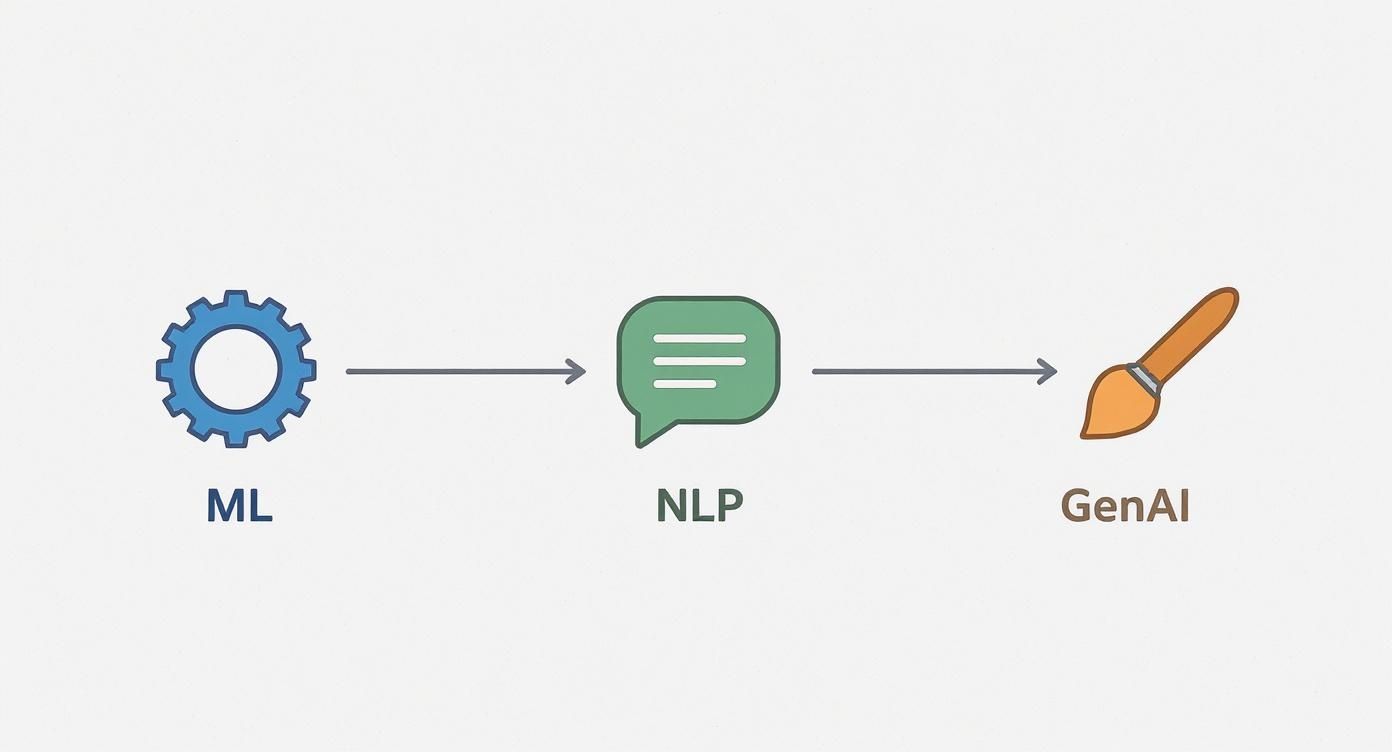
Infographic about ai for b2b marketing

This visual highlights how ML digs into data patterns, NLP handles conversational text, and Gen AI powers large-scale content creation.

Comparison Of AI Approaches

Here’s a side-by-side look at three distinct methods. Use this snapshot to spot which approach matches your goals, budget, and team skills.

ApproachUse CaseProsCons
Rule-Based AILead qualification, workflow automationPredictable outcomes; quick setupRigid rules; struggles with nuance
Machine LearningDemand forecasting, account scoringLearns over time; tackles complexityNeeds clean data; less transparent
Generative AIScalable content creation, personalizationEndless variations; creative flexibilityQuality varies; higher compute cost

Use this table as your quick reference before you dive into vendor pitches.

Real-World Pros And Insights

Rule-based systems often win on speed to launch. Think of simple “if-then” triggers that qualify leads in minutes. A tech firm might set a form-response rule and instantly sort high-value prospects—but if your scenarios shift, those rules can crack.

On the flip side, machine learning layers in adaptability. One B2B team used ML on engagement logs and saw conversion rates climb by 18% over three months. The catch? You’ll need a steady stream of quality data and someone to tune the models.

Generative AI feels a bit like having a junior copywriter on demand. Marketing teams have spun out 50+ email or ad variations in under ten minutes. Still, you’ll want a human in the loop to fact-check and keep the tone on-brand.

And here are a few industry benchmarks to keep in mind:

  • 73% of B2B marketers lean on ML for predictive insights, improving forecast accuracy by 20%
  • Generative AI adoption climbed 45% last year, slashing content production time by half
  • 62% of companies rely on rule-based workflows for basic lead qualification

Decision Checklist

  1. Define Budget Range – Compare implementation and ongoing costs.
  2. Assess Data Readiness – Confirm your CRM and analytics data are clean and tagged.
  3. Evaluate Vendor Expertise – Look for case studies in your vertical.
  4. Pilot A Small Use Case – Start with lead scoring or a few content snippets.
  5. Review Scalability – Make sure the platform grows with your volume and complexity.

Key Takeaway: Match the approach to your team’s data maturity and outcome targets to boost ROI in AI for B2B marketing.

Action Steps

  • Pilot ML vs Gen AI: run both on a sample dataset and compare accuracy and speed.
  • Score rule-based workflows against machine-learned scores to measure lift.
  • Define vendor evaluation criteria based on pros, cons, and benchmarks above.

Vendor Selection Tips

  • Test integration with your CRM (for example, Salesforce or HubSpot) and CMS in a sandbox before signing on
  • Look for security certifications like SOC 2 or ISO 27001 to safeguard sensitive information
  • Confirm access to responsive support and training materials for faster onboarding
  • Compare customization options so you can tweak AI models to your marketing playbook
  • Scan community forums and peer reviews for real-world feedback, warts and all

With these insights and practical steps, you’ll be ready to pick the AI approach that delivers real, measurable value in your next B2B marketing campaign. Next, roll out your pilot, track key metrics, and iterate toward peak performance.

Implementing AI Personalization And Automation

Driving growth in B2B marketing isn’t just about more data—it’s about the right data, at the right time, for the right person. Personalization fuels engagement, and automation keeps your team focused on strategy rather than spreadsheets.

Here’s how to move from raw inputs to campaign-ready audiences:

  • Gather Data Sources: Pull CRM records, web behavior logs, and third-party intent feeds.
  • Segment With AI Models: Group contacts by browsing patterns and firmographic signals.
  • Build Dynamic Workflows: Automate emails, landing pages, and ads that shift based on real-time triggers.
  • Integrate Platforms: Connect your CRM and marketing stack for seamless data flow.
  • Monitor And Adjust: Track performance metrics, retrain models, and enforce privacy measures.

Think of your data as puzzle pieces. Alone, they don’t show much—but when AI spots the edges and corners, suddenly you see the big picture. Timestamped website clicks, whitepaper downloads and form fills often hint at buying intent days before a salesperson even reaches out.

Once your data is in place, AI-driven segmentation carves your audience into hyper-relevant cohorts. Each micro-segment then gets messaging crafted to its exact journey stage—no more guessing which email or offer will stick.

Building Real-Time AI Workflows

Dynamic workflows are where the magic happens: content adapts on the fly, delivering exactly what a prospect needs in that very moment. Picture a user who downloads your ROI case study—within seconds, they’re served a landing page packed with testimonials from companies just like theirs.

  • Select Triggers: Identify actions such as link clicks or form submissions.
  • Design Rules: Map those triggers to specific content variants and offers.
  • Configure Tools: Implement on platforms like Marketo or Pardot for execution.
  • Test Thoroughly: Run A/B experiments to confirm which variants perform best.
  • Launch And Scale: Start small, then widen the net as you monitor engagement.
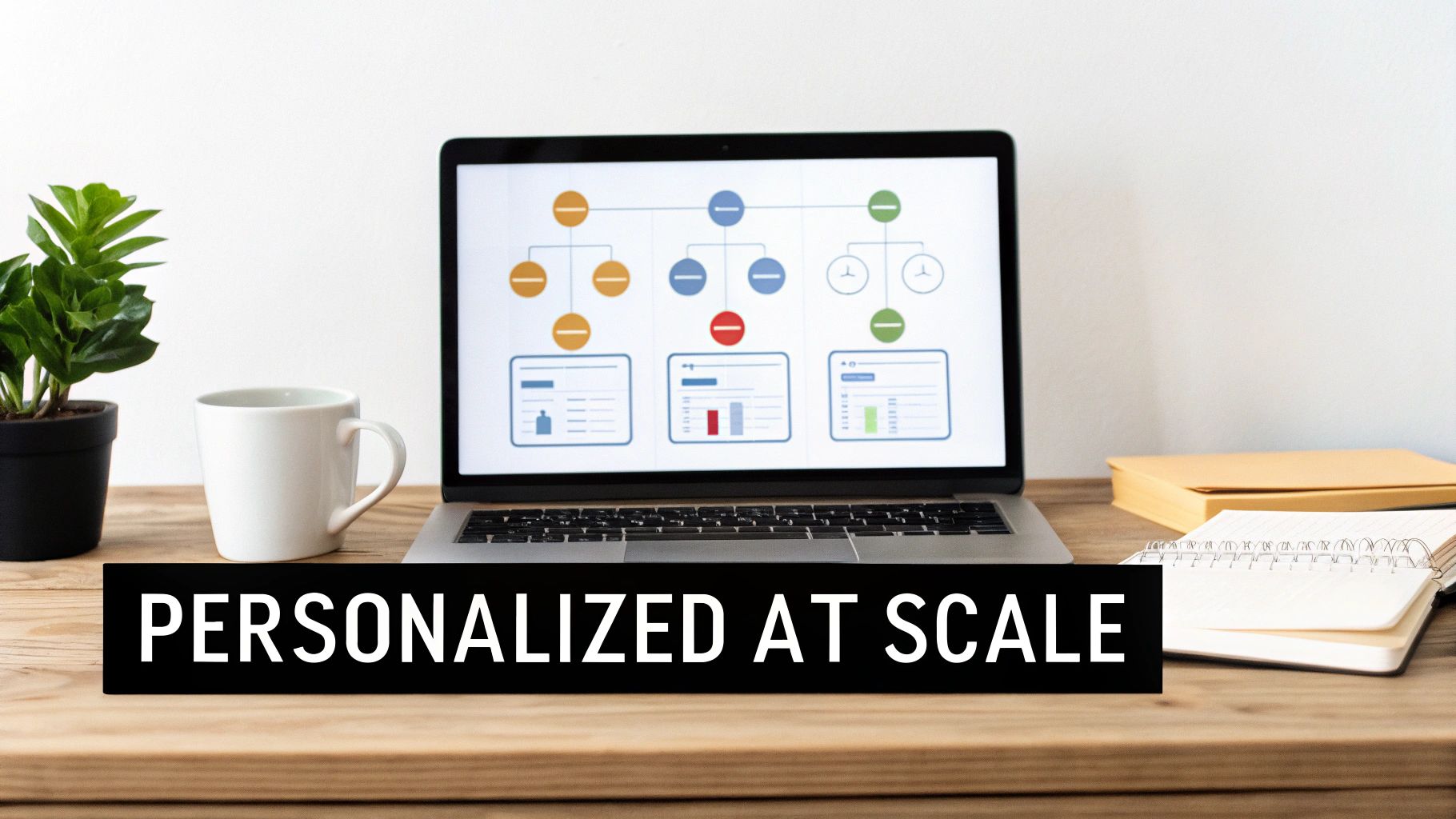
Dynamic AI Workflow

With workflows live, your CRM becomes the central hub. Native connectors in Salesforce or HubSpot push AI scores and segment tags straight into contact records—no manual imports needed.

Always encrypt data at rest and in transit. And don’t skip regular audits of your model inputs to guard against bias or inadvertent PII exposure.

Tracking Key Metrics

Success hinges on clear KPIs: think conversion rate lift, average deal size, and engagement uplift. Start by comparing email click-through rates or account engagement scores before and after AI deployment.

83% of businesses say AI lets them scale personalization more effectively, and 87% agree it boosts automation efficiency. Organizations using AI-powered segmentation see higher engagement rates and are seven times more likely to exceed their goals compared to those without AI. Discover more insights about B2B marketing trends on Adobe

To practically apply ai for b2b marketing, exploring the best sales chatbot platforms can boost conversions and enhance customer interactions.
Check out our guide on AI marketing automation tools for a deep dive into platform comparisons and integration tips.

But remember—over-automation can feel robotic. Build in human reviews and set throttle points so every outreach still sounds like it came from a real person.

Rollout Checklist

  1. Pilot Segment – Start with 500 high-intent accounts for initial testing.
  2. Weekly Reviews – Measure engagement lift, click rates, and automation health.
  3. Data Audit – Confirm segmentation tags, purge stale or duplicate records.
  4. Human Oversight – Schedule spot checks on automated messages.
  5. Privacy Compliance – Validate encryption, consent logs, and data-flow rules.
  6. Scale Gradually – Broaden cohorts once KPIs show 15% lift in engagement.
  7. Document Findings – Share performance reports and lessons learned.
  8. Continuous Optimization – Iterate workflows and segments quarterly based on new insights.

Action Steps

  • Map your key triggers and design 3 workflow scenarios.
  • Test a dynamic email and landing page variation side by side.
  • Schedule bi-weekly performance reviews to refine triggers and content.

Evaluating Financial Impact Of AI In B2B Marketing

Investing in AI without hard figures can leave your finance team uneasy. In B2B marketing, you need clear benchmarks to justify every dollar.

For instance, swapping manual segmentation for AI-driven personalization often cuts campaign costs and lifts close rates. With that kind of proof, allocating budget becomes a whole lot easier.

  • Revenue Increase: Average uplift of 15–30% from predictive lead scoring
  • Cost Reduction: Automated workflows trim marketing spend by 20–25%
  • Lead Volume Boost: AI chatbots drive 10–20% more net leads

Financial Impact Metrics For AI Adoption

Key ROI figures, revenue growth percentages, cost savings, and market projections in one view.

MetricValueSource
Revenue Increase15–30%Industry Benchmarks
Cost Savings20–25%Market Surveys
Market Size Projection$107.5B by 2028DBS Website
Chatbot Adoption57% of B2BDBS Website
Lead Volume from Chatbots10–20% boostDBS Website

These numbers aren’t pulled from thin air. They come from surveys and market studies showing how AI reshapes budgets and performance.

Expert polls reveal that 65% of organizations report higher revenue after rolling out AI in marketing and sales. At the same time, 41% of teams see spending dip, and 26% of chatbot adopters note a 10–20% lift in leads. For the full breakdown, learn more about these findings.

Statistical Highlight
65% revenue growth and 41% cost reduction underscore AI’s measurable impact on marketing budgets.

Building Your Business Case

To get the green light, model different scenarios so stakeholders can see projected returns side by side with costs. Factor in everything: licensing, integration, training, even ongoing maintenance.

Budgets vary by company size. Small teams often plan for $50K–$100K a year. Midsize firms might set aside $200K–$500K, and enterprises frequently budget $1M+.

Follow these steps when you craft your proposal:

  • Calculate licensing and subscription fees
  • Estimate integration and customization expenses
  • Factor in internal training hours and vendor support
  • Account for maintenance, updates, and retraining

For a deeper dive on putting these figures into your spreadsheet, check out our guide on how to calculate marketing ROI.

Scenario Modeling Tips

Start by mapping current marketing costs across each channel. Then layer in AI-related expenses and forecast the gains you expect.

  • Licensing: Compare annual fees and seat-based models
  • Integration: Include setup, testing, and customization costs
  • Training: Estimate internal hours plus vendor-led workshops
  • Maintenance: Plan for periodic retraining and software updates

Run best-case and worst-case scenarios to show how swings in performance affect ROI. A simple sensitivity analysis can reveal which variables matter most.

Tip
Test small shifts—like a 5% change in lead volume—and see how your overall ROI adjusts.

With well-structured scenarios, your finance team will view AI investment as a low-risk, high-reward decision. Keep revisiting these models quarterly, involve sales, IT, and operations, and update your assumptions. That transparency ensures your AI initiatives stay on track as market conditions evolve.

Real World AI Case Studies In B2B Marketing

B2B AI case study overview

There’s nothing like seeing AI in motion to bridge the gap between idea and impact. Below are three stories—one from a mid-sized SaaS vendor, one from a global manufacturer, and one from a boutique consultancy. Each walks through goals, rollout steps, results, and the single insight you can apply right away.

Predictive Lead Scoring For Tech Provider

A mid-sized SaaS company was wrestling with a slow MQL-to-SQL funnel. Their fix? An AI-driven scoring model built on 20 variables spanning firmographics, engagement signals, and buying intent.

  • Data Cleansing: Unified fields, purged duplicates
  • Model Training: Fed historical pipeline data into a supervised ML engine
  • CRM Integration: Pushed fresh scores into Salesforce every 24 hours

In just three months, conversion rates jumped by 18%, and the average hand-off time fell by 30%. The big lesson: without clean, well-labeled data and routine drift checks, even the smartest model will underperform.

Automated Support With Chatbots

A global manufacturing firm faced a torrent of support tickets and sluggish response times. Their answer was an AI chatbot for first-level queries on web and mobile.

They assembled a knowledge base of 5,000 FAQs, trained the bot on past tickets, then linked it to CRM and ERP systems.

“The chatbot handles 65% of incoming questions without any human handoff,” says their operations director. “That freed our engineers to tackle the tough stuff.”

The outcome? A 45% drop in escalations and a shift from 4-hour resolutions to 1.5-hour averages. The secret: continuous updates fueled by agent feedback keep the bot sharp.

Generative AI For Consultancy Content

A boutique B2B consultancy needed to ramp up thought leadership without blowing its budget. They turned to a generative AI platform to draft blogs, white papers, and social posts.

Feed in brand voice guidelines and example articles, and the system spit out first drafts for 50+ assets in under a week.

  • Content Briefing: Defined tone, style, and audience
  • Draft Generation: Automated outlines and supporting copy
  • Human Review: Editors refined facts and brand alignment

This slashed writing time by 70% and tripled output, delivering a 60% cost cut per asset versus an all-manual process. The key? A human-in-the-loop step ensures quality never takes a back seat.

Practical Steps To Adapt These Cases

  1. Audit Data Sources – Confirm your datasets are clean and tagged.
  2. Pilot One Workflow – Start with lead scoring or a chatbot trial.
  3. Embed Human Oversight – Schedule review checkpoints to catch issues early.
  4. Measure Key Metrics – Track conversion lift, resolution times, and content velocity.
  5. Scale Gradually – Expand once you’ve demonstrated ROI.
  6. Review Models Quarterly – Guard against performance drift with retraining.

Key Takeaway: Effective AI in B2B marketing thrives on data readiness, phased pilots, and ongoing human checks.

Free Tool

Try our Marketing Plan Generator — generate a complete AI-powered marketing plan in minutes. No signup required.

Best Practices And Next Steps For AI Integration

Starting an AI initiative without a clear plan is like setting off on a road trip without a map—you’ll burn through resources and still wonder where you’re headed. Here, we’ll walk through how to pilot, govern, and scale AI in your B2B marketing efforts, step by step.

First, get everyone aligned on strategic goals before touching any data or code. That shared vision becomes your decision-making compass and prevents costly detours.

Think of your AI roadmap as a GPS: pick a destination, choose the fastest route, and follow the directions.

“When strategy and technology move in sync, your AI investment turns into an engine, not an expense.”

Pilot Projects And Team Setup

Every major AI deployment should begin with a tight pilot. It helps you validate assumptions fast and spot unexpected hurdles.

Pull together a cross-functional crew—marketing, IT, data science—and secure an executive sponsor who can clear roadblocks.

  • Define Pilot Scope: Select 1–2 high-impact use cases with clear KPIs.
  • Assign Roles: Who handles data ingestion? Who trains models? Who runs campaigns?
  • Set Timelines: Aim for a 6–8 week minimum viable test phase.

“A focused pilot with concrete success criteria accelerates buy-in and minimizes risk.”
– AI Strategy Lead

Once you’ve demonstrated value, evolve that team into a dedicated AI Center of Excellence. This hub will govern standards, share best practices, and oversee multiple projects.

  • AI Program Manager: Coordinates across teams.
  • Data Engineer: Keeps data pipelines clean.
  • ML Engineer: Tunes models and tracks performance.

A Center of Excellence ensures consistency and speeds up growth.

Governing Data And Model Monitoring

Healthy data and robust models require ongoing attention. Without governance, models drift and campaigns plateau.

ElementFocus AreaFrequency
Data Quality ChecksCompleteness & AccuracyWeekly
Bias AuditsFairness & Ethical RisksMonthly
Performance ReviewsKey Metrics & ROIQuarterly

Set up automated alerts for sudden dips in lead scores or relevance. That way, your AI stays sharp and reliable.

Vendor Evaluation And Change Management

Choosing the right AI vendor can make or break your initiative. Rather than chasing features, match platforms to your priorities and workflows.

  1. Identify Must-Have Features: segmentation, predictive analytics, content generation.
  2. Check Security Certifications: SOC 2, ISO 27001.
  3. Request Case Studies: find examples in your industry.
  4. Pilot Integrations: test connectors in your CRM/CMS sandbox.
  5. Negotiate SLAs: agree on uptime and support commitments.

Rolling out new tech also means winning hearts and minds:

  • Communicate benefits early and often.
  • Provide hands-on training sessions.
  • Gather feedback and iterate quickly.
CriteriaImportanceNotes
IntegrationHighNative CRM connectors required
CostMediumFactor TCO over 2 years
SupportHighResponse time under 4 hrs

Continuous Improvement And Ethical Oversight

Adopting AI is a marathon, not a sprint. After launch, establish a cycle of learning and optimization.

  • Quarterly Reviews: Measure results against your baseline.
  • Model Retraining: Refresh algorithms with new datasets.
  • Stakeholder Feedback: Collect input from sales and customer success.
  • Governance Updates: Tighten privacy and ethics policies.

Privacy must be baked in from day one:

  • Consent Audits: Verify opt-in status every quarter.
  • Legal Review: Ensure GDPR and CCPA compliance.
  • Audit Logs: Track data access and processing events.

Think of your AI like a garden—it needs regular watering and weeding to thrive. Ethical guardrails keep you from harvesting bias.

Set realistic timelines based on your maturity level:

Maturity LevelTimelineGoals
Early3–6 monthsPilot and initial team formation
Intermediate6–12 monthsDeploy multiple use cases
Advanced12+ monthsFull Center of Excellence and enterprise scale

By combining structured pilots, strong governance, and continuous iteration, you’ll build a marketing engine that delivers real, lasting AI impact.


Ready to accelerate your marketing with AI? Experience how marketbetter.ai streamlines content creation, campaign optimization, and customer personalization. Start Your Free Trial today and unlock your AI advantage.


10 Lead Scoring Best Practices: The Framework Behind 3x Conversion Rates

· 30 min read

Is your sales team drowning in "qualified" leads that go nowhere? It's a common story. Many businesses implement lead scoring with high hopes, only to create a system that adds noise instead of clarity, fueling friction between sales and marketing. The problem isn't the concept; it's the execution. Generic, "set-and-forget" models ignore the nuances of your ideal customer and fail to capture true buying intent. This leads to wasted sales cycles, missed opportunities, and a frustrating disconnect between effort and results.

A well-oiled lead scoring system is foundational to an efficient revenue engine. It ensures that every lead passed to sales has a high probability of closing, which is a critical step in building a predictable pipeline. For a deeper dive into how this fits into the bigger picture, this comprehensive SaaS sales funnel guide provides excellent context on structuring your entire revenue process for growth. Optimizing lead scoring is the first step to making that funnel work seamlessly.

In this guide, we will move beyond the basics. We'll break down 10 advanced, actionable lead scoring best practices that transform your scoring from a vanity metric into a powerful revenue driver. We'll provide specific comparisons and show you not just what to do, but precisely how to implement these strategies. Get ready to turn your lead flow into a predictable source of high-value pipeline, prove marketing ROI, and achieve scalable growth.

1. Define Clear Lead Scoring Criteria and Weightings

The foundation of any successful lead scoring model is a well-defined set of criteria and a logical weighting system. This practice involves identifying the specific attributes and behaviors that indicate a lead's sales-readiness and then assigning numerical values to each. Without this clarity, your scoring system becomes arbitrary, leading to inconsistent lead quality and a breakdown in trust between marketing and sales. This is one of the most critical lead scoring best practices because it ensures every stakeholder understands precisely what constitutes a "good" lead.

This foundational step transforms lead qualification from a subjective guessing game into a data-driven process. By codifying what your ideal customer profile (ICP) looks like and how they interact with your brand, you create a universal language for evaluating leads across the entire organization.

Define Clear Lead Scoring Criteria and Weightings

How to Implement and Compare Scoring Models

Implementing a criteria-based system requires a collaborative effort, primarily between your marketing and sales departments. The goal is to translate historical conversion data and sales team insights into a mathematical model.

Actionable Steps:

  1. Hold a Sales & Marketing Workshop: Get both teams in a room to analyze the last 10-20 closed-won deals. Identify common job titles, company sizes, industries, and the marketing touchpoints they engaged with before becoming a customer.
  2. Create a Scoring Matrix: Build a simple spreadsheet listing these attributes.
    • Explicit Data: Job Title, Company Size, Industry, Geographic Location.
    • Implicit Data: Website Visits, Email Opens, Content Downloads, Webinar Attendance.
  3. Assign Initial Points: Start with a baseline. A high-value attribute like "Director" title could be +15 points, while a high-intent action like a "Pricing Page Visit" could be +10 points.

Comparison of Weighting Philosophies:

  • Behavior-Heavy Model: This approach prioritizes actions over attributes. For example, a lead with a less-than-ideal title who requests a demo gets a higher score than a C-level executive who only opens a newsletter. This is best for high-volume, transactional sales cycles where recent intent is the strongest buying signal.
  • Fit-Heavy Model: This model prioritizes firmographic and demographic fit. A lead from a Fortune 500 company in your target industry gets a high score even with minimal engagement. This is ideal for account-based marketing (ABM) or enterprise sales where getting into the right account is the primary goal.

Key Insight: The goal isn't to copy a template but to build a model that reflects your unique customer journey. Start simple with 5-10 core criteria, document everything in a shared repository, and plan to review and adjust weights quarterly based on performance data. This iterative process is a hallmark of effective lead scoring.

2. Implement Behavioral Scoring for Engagement Signals

While demographic data tells you if a lead is a good fit, behavioral scoring reveals if they are genuinely interested. This practice involves tracking and scoring a lead's explicit actions, such as website visits, content downloads, email opens, and demo requests. These engagement signals provide real-time insight into a lead's buying intent, complementing static firmographic information. This is one of the most essential lead scoring best practices because it allows you to prioritize leads who are actively seeking a solution right now.

This dynamic layer of scoring transforms your system from a simple filter into a powerful intent-detection engine. By quantifying engagement, you can differentiate between a curious researcher and a motivated buyer, ensuring your sales team focuses its energy on the most promising opportunities.

How to Implement and Compare Scoring Models

Implementing behavioral scoring requires mapping the customer journey and assigning values to key interactions. The goal is to create a hierarchy of actions that correlate with sales-readiness, a process heavily popularized by platforms like HubSpot and Pardot.

Actionable Steps:

  1. List and Categorize Touchpoints: Create three buckets for all possible lead actions.
    • High-Intent Actions (25-50 points): "Contact Sales" form, demo request, pricing page view. These signal an active buying motion.
    • Mid-Intent Actions (10-15 points): Case study download, product webinar attendance, ROI calculator use. These show active research.
    • Low-Intent Actions (1-5 points): Newsletter open, blog post read, social media follow. These indicate top-of-funnel awareness.
  2. Implement in Your Marketing Automation Platform: Build the rules to assign these point values automatically as leads engage.

Comparison of Scoring Logic:

  • Simple Additive Scoring: This is the most common approach. A pricing page visit (+10) plus a demo request (+25) equals a score of 35. It's easy to implement but can be misleading if a lead performs many low-value actions.
  • Multiplicative or Weighted Scoring: A more advanced method where certain combinations are worth more. For example, a pricing page visit from a lead with a "Director" title might trigger a "hot lead" flag, multiplying their score or adding a significant bonus. This better reflects the value of high-fit, high-intent combinations.

Key Insight: Implement score decay to maintain accuracy. A lead who visited your pricing page six months ago is less "hot" than one who did so yesterday. Actionable Tip: Set up an automation rule to subtract 5 points for every 30 days of inactivity. This ensures your data reflects current engagement levels.

3. Align Sales and Marketing on Lead Quality Definitions

Even the most sophisticated lead scoring algorithm will fail if sales and marketing operate with different definitions of a "qualified lead." This practice involves creating a shared, documented understanding of what constitutes a Marketing Qualified Lead (MQL), Sales Accepted Lead (SAL), and Sales Qualified Lead (SQL). This alignment is one of the most crucial lead scoring best practices because it eliminates the friction that causes high-potential leads to be ignored or mishandled, ensuring both teams are working toward the same revenue goals.

This collaborative step shifts the dynamic from a "lead handoff" to a unified revenue engine. By establishing a common language and agreed-upon thresholds, marketing can confidently deliver leads that sales values, and sales can provide clear feedback to refine marketing's efforts.

Align Sales and Marketing on Lead Quality Definitions

How to Implement and Compare Alignment Strategies

Achieving alignment requires proactive communication and creating a formal Service Level Agreement (SLA) between the two departments. The goal is to move beyond assumptions and codify the entire lead management process, from generation to close.

Actionable Steps:

  1. Define and Document Lead Stages: Write down the exact criteria for each stage.
    • MQL: Must have a score of 75+ AND be from a company with >50 employees.
    • SAL: An MQL that sales reviews and accepts within 24 hours. They confirm the contact is reachable and the account is not an existing customer or active opportunity.
    • SQL: An SAL that has a discovery call booked.
  2. Build a Feedback Mechanism: Create a required "Disqualification Reason" field in your CRM for sales to use when rejecting an MQL. Common reasons include "No Budget," "Wrong Contact," or "Unresponsive."

Comparison of Systems:

  • Informal "Handoff" System: Marketing sends leads over a certain score to a general sales queue. Result: Low accountability, high lead rejection rates, and friction as sales claims leads are poor quality while marketing points to high scores.
  • Formal SLA-Driven System: Marketing commits to delivering a specific number of MQLs meeting the agreed-upon criteria. Sales commits to following up within a set timeframe and providing structured feedback. Result: Mutual accountability, a data-driven feedback loop for refining scoring, and higher conversion rates. For more on building this structure, explore our guide on sales enablement best practices.

Key Insight: Create a "lead council" with members from both marketing ops and sales leadership. Hold monthly meetings to review the MQL-to-SQL conversion rate and discuss rejected leads. This creates a formal, data-driven feedback mechanism that allows you to continuously refine scoring criteria and improve lead quality for the entire organization.

4. Incorporate Firmographic and Demographic Data

Beyond a lead's behavior, their inherent characteristics are often the most powerful predictors of future value. This practice involves scoring leads based on who they are (demographic data) and where they work (firmographic data). Attributes like job title, company size, industry, and annual revenue provide crucial context, ensuring you prioritize leads that perfectly match your ideal customer profile (ICP). This is a cornerstone of effective lead scoring best practices because it prevents sales teams from wasting time on enthusiastic but unqualified prospects.

This foundational layer of scoring grounds your model in reality. While high engagement is a positive signal, it means little if the lead is from a company too small to afford your solution or from an industry you don't serve. By systematically scoring these explicit data points, you build a qualification filter that aligns marketing efforts directly with business objectives.

How to Implement and Compare Scoring Models

Implementing firmographic and demographic scoring begins with a crystal-clear definition of your ICP. Sales and marketing must agree on the exact attributes that constitute a high-value lead. This data can be sourced from form submissions or enriched using tools like ZoomInfo, Clearbit, or Apollo.io.

Actionable Steps:

  1. Define Your ICP Tiers: Don't just have one ICP. Create tiers.
    • Tier 1 (Perfect Fit): Assign the highest scores (e.g., +20 for "Director" title, +15 for target industry).
    • Tier 2 (Good Fit): Assign moderate scores (e.g., +10 for "Manager" title, +5 for adjacent industry).
    • Tier 3 (Poor Fit): Assign zero or negative scores.
  2. Automate Data Enrichment: Integrate a tool like Clearbit or ZoomInfo to automatically append firmographic data to new leads. This ensures your scoring is based on accurate, complete information, not just what a lead self-reports on a form.

Comparison of Data Strategies:

  • Relying on Form Fills: This method is free but highly unreliable. Leads often enter inaccurate data for job titles or company sizes.
  • Using a Data Enrichment Tool: This costs money but provides standardized, accurate data. The ROI is realized through more precise scoring, better lead routing, and higher conversion rates. To get this right, you can explore how a customer data platform integration can help centralize this information for more accurate scoring.

Key Insight: Don't be afraid to use negative scoring. If a lead's attributes clearly disqualify them (e.g., student, competitor, wrong country), assign a significant negative score (like -100) to automatically filter them out. This keeps your MQL pipeline clean and focused on revenue-generating opportunities.

5. Use Negative Scoring to Disqualify Unsuitable Leads

While most scoring focuses on rewarding positive signals, an equally powerful practice is to penalize negative ones. This involves applying negative point values to attributes or behaviors that indicate a lead is a poor fit, actively disengaged, or even a competitor. This subtractive approach is one of the most effective lead scoring best practices for filtering out noise and ensuring your sales team's pipeline remains clean and focused on genuine opportunities.

This method actively purges your MQL pool of unqualified contacts, preventing sales from wasting valuable time on leads that will never convert. By automatically downgrading or disqualifying contacts based on specific red flags, you sharpen the accuracy of your entire lead management process.

How to Implement and Compare Negative Scoring Models

Implementing negative scoring requires close collaboration with sales to define undeniable disqualification criteria. The goal is to identify characteristics that consistently correlate with lost deals or customers who are a poor fit for your product or service.

Actionable Steps:

  1. Brainstorm a "Red Flag" List with Sales: Ask them, "What are the instant deal-breakers?"
    • Demographic/Firmographic: Job title contains "Student" or "Intern" (-50), email domain is "gmail.com" (-10), country is outside your service area (-100).
    • Behavioral: Visited "Careers" page (-25), unsubscribed from all emails (-1000).
  2. Create Two Tiers of Negative Scores:
    • Filtering Scores (-10 to -50): These lower a lead's priority but don't remove them entirely.
    • Disqualification Scores (-100 or more): These effectively remove a lead from sales consideration, moving them to a "nurture" or "unqualified" list.

Comparison of Approaches:

  • Aggressive Disqualification: This model uses large negative scores (-100) to immediately remove any lead with a red flag. This is best for teams with very high lead volume who must ruthlessly prioritize. The risk is creating false negatives.
  • Soft Penalty Model: This model uses smaller negative scores (-10 to -20). A competitor visiting the pricing page might get a penalty, but their score won't plummet to zero. This is better for markets where roles are fluid (e.g., a competitor today might be a prospect tomorrow) and you want to keep leads in the system for future nurturing.

Key Insight: Negative scoring isn't just about disqualification; it's about resource allocation. Document your "deal-breaker" criteria with sales leadership and review them quarterly. Start with 3-5 clear negative attributes and create audit trails to monitor for any "false negatives" that were incorrectly disqualified, ensuring your model remains accurate and fair.

6. Establish Lead Score Decay and Re-engagement Mechanisms

A lead's interest is not permanent; it has a shelf life. Implementing a score decay system ensures your lead scoring model reflects current engagement, not past behavior. This practice involves systematically reducing a lead's score over time when they show no new activity, preventing your pipeline from getting clogged with cold, irrelevant contacts. This is one of the most essential lead scoring best practices because it keeps your sales team focused on genuinely active opportunities and maintains the integrity of your MQL threshold.

This mechanism transforms your lead database from a static archive into a dynamic, responsive system. By automatically downgrading disengaged leads, you create a more accurate picture of your active funnel and build triggers for proactive re-engagement before a lead goes completely cold.

Establish Lead Score Decay and Re-engagement Mechanisms

How to Implement and Compare Decay Models

Implementing score decay requires defining rules that align with your typical sales cycle. The goal is to create automated workflows that reduce scores based on inactivity and trigger campaigns to win back attention.

Actionable Steps:

  1. Calculate Your Decay Timeline: Base it on your average sales cycle. A good rule is to start decaying a score after one-third of your sales cycle passes with no engagement. (e.g., for a 90-day cycle, start decay after 30 days of inactivity).
  2. Set the Decay Rate: A common starting point is subtracting 10% of the lead's score per month of inactivity.
  3. Build a Re-engagement Workflow: Create an automation rule that triggers when a lead's score drops below a certain threshold (e.g., from MQL status of 75 down to 40). This trigger should enroll them in a targeted email sequence designed to win them back, such as offering a new piece of content or a special trial.

Comparison of Decay Models:

  • Linear Decay Model: A lead loses a fixed number of points (e.g., -5 points) every week they are inactive. This is simple to implement and works well for shorter sales cycles.
  • Percentage-Based Decay Model: A lead loses a percentage of their current score over time. This is more complex but better reflects reality, as a very "hot" lead (score of 150) cools off faster than a lukewarm one (score of 50). This is better for longer, more variable sales cycles.

Key Insight: Your decay timeline should be directly proportional to your average sales cycle length. A good starting point is to trigger the first score reduction after one-third of your sales cycle passes with no engagement. Create different decay curves for different segments, such as excluding known long-cycle enterprise deals from aggressive decay while applying it to SMB leads.

7. Integrate Intent Data for Predictive Scoring

Relying solely on your own website and email engagement provides an incomplete picture of a lead's interest. Integrating third-party intent data elevates your scoring model from reactive to predictive by revealing buying signals that occur across the wider web. This advanced practice involves tracking which topics and keywords companies are actively researching, indicating a strong, often early, interest in your solution category. This is one of the most powerful lead scoring best practices for identifying in-market buyers before they even visit your site.

This proactive approach transforms your lead qualification by capturing purchase intent that internal behavioral data would otherwise miss. By identifying accounts researching your competitors or complementary solutions, you can engage prospects at the very beginning of their buying journey, gaining a significant competitive advantage.

How to Implement and Compare Intent Data Models

Implementing intent data requires partnering with specialized providers like Bombora, 6sense, or Demandbase to access their vast data co-ops. The goal is to match this external activity with the accounts in your database and score them based on the relevance and intensity of their research.

Actionable Steps:

  1. Define Your Intent Topics: Work with your provider to create a topic cluster that includes:
    • Your Brand Name: To track awareness.
    • Your Top 3 Competitors: To identify competitive bake-offs.
    • Core Problem Keywords: The pain points your solution solves (e.g., "lead attribution," "sales pipeline management").
  2. Integrate and Score: Connect the intent data platform to your marketing automation system. Create a rule to add a significant score (e.g., +40 points) to any lead from an account showing a "surge" on a high-priority topic.
  3. Trigger Sales Alerts: Set up an automation that sends an immediate notification to the account owner in sales when a target account shows a spike in intent, providing them with the context needed for timely outreach.

Comparison of Platforms:

  • Bombora: Excellent for topic-level intent data ("what" they are researching). It identifies when an account's content consumption on a specific topic spikes above its normal baseline.
  • 6sense/Demandbase: These platforms are more holistic, combining intent data with firmographic, technographic, and predictive analytics to tell you "who" is in-market and "when" they are likely to buy. They are often used for more mature ABM strategies. Many find that combining intent data with their internal scoring, as discussed in our guide to predictive analytics in marketing, yields the most accurate results.

Key Insight: Don't replace your existing scoring model; augment it. Weight high-relevance intent signals heavily, often accounting for 40-50% of a lead's total score. Start by activating workflows that trigger alerts to sales when a target account shows a surge in intent on one of your critical topics, enabling timely and hyper-relevant outreach.

8. Implement Account-Based Scoring for Enterprise Sales

Traditional lead scoring focuses on the individual, but in enterprise B2B sales, decisions are rarely made by one person. Account-based scoring shifts the focus from a single contact to the entire buying committee within a target organization. This approach acknowledges that a high score from a junior employee means less than moderate engagement from multiple key decision-makers. This is a crucial one of the lead scoring best practices for businesses with long, complex sales cycles, as it aligns marketing efforts with the reality of how enterprise deals are won.

This strategy transforms qualification by aggregating engagement signals across an entire company. Instead of just tracking one lead, you gain a holistic view of an account's collective interest, ensuring your sales team engages with organizations that are truly showing buying intent, not just individuals doing research.

How to Implement and Compare Scoring Models

Implementing account-based scoring requires mapping out your ideal buying committee and assigning scores based on roles and aggregated actions. Platforms like 6sense and Demandbase are built specifically for this, while tools like Marketo and Salesforce Einstein can be configured to support it.

Actionable Steps:

  1. Map Your Buying Committee: Identify the key personas involved in a purchase decision.
    • Champion (e.g., Manager, Director): End-user who feels the pain point.
    • Decision-Maker (e.g., VP, C-Suite): Controls the budget.
    • Influencer (e.g., IT, Ops): Has a say in the technical requirements.
  2. Weight Personas: Assign a multiplier to each persona's individual score. For example, a Decision-Maker's score could be multiplied by 1.5x, while an Influencer's is 1.2x.
  3. Aggregate at the Account Level: Create a custom "Account Score" field in your CRM that sums the weighted scores of all known contacts at that company. Set MQL thresholds at the account level (e.g., Account Score > 200).

Comparison of Approaches:

  • Lead-Centric Scoring: Prioritizes individuals. A company with one highly active intern (score: 120) would appear "hotter" than a company with three moderately engaged Directors (individual scores: 50 each). This is misleading for enterprise sales.
  • Account-Centric Scoring: In the same scenario, the first account's score remains low because the intern's role is not weighted heavily. The second account's aggregated score would be high, accurately reflecting broad interest from key decision-makers. This provides a far more accurate signal for sales.

Key Insight: The power of account-based scoring is its ability to reveal hidden opportunities. An account might look cold if you only see one contact's score, but aggregating engagement from 8-12 contacts could reveal it's your hottest prospect. Start by identifying the top 2-3 roles in your buying committee and weighting their actions most heavily.

9. Measure and Optimize Lead Scoring Model Performance

Implementing a lead scoring model is not a one-time setup; it is an ongoing process of refinement and validation. This practice involves continuously monitoring your model's effectiveness using key performance indicators (KPIs) like MQL-to-SQL conversion rates, sales cycle length, and win rates. Without consistent measurement, even the most thoughtfully designed model can become outdated and ineffective, leading to poor lead quality and wasted sales efforts. This iterative approach is one of the most crucial lead scoring best practices as it ensures your model adapts to market changes and delivers sustained ROI.

This data-driven feedback loop transforms your lead scoring from a static system into a dynamic strategic asset. By analyzing performance data, you can pinpoint weaknesses, validate assumptions, and make informed adjustments that directly improve sales efficiency and pipeline value.

How to Implement and Compare Performance Metrics

Effective optimization begins with establishing clear baseline metrics before making any changes. This allows you to accurately measure the impact of your adjustments. The core goal is to connect scoring changes to tangible business outcomes.

Actionable Steps:

  1. Create a Lead Scoring Dashboard: Build a report in your CRM or BI tool that tracks:
    • MQL-to-SQL Conversion Rate: The single most important metric for lead quality.
    • Conversion Rate by Score Range: Compare the win rate for leads with scores of 50-75 vs. 75-100 vs. 100+.
    • Sales Cycle Length by Score: Do higher-scoring leads close faster?
  2. Run A/B Tests: Don't guess if a change will work. Test it. For example, create a new scoring rule that gives +10 points for visiting a new case study page. Apply this rule to only 50% of new leads. After a month, compare the MQL-to-SQL conversion rate of the test group against the control group.
  3. Schedule Quarterly Reviews: Set a recurring meeting with sales and marketing leadership to review the dashboard and feedback, and to decide on the next A/B test.

Comparison of Optimization Approaches:

  • Reactive Tuning: Making changes only when sales complains. This leads to inconsistent, knee-jerk adjustments that often fail to address the root cause.
  • Proactive, Data-Driven Optimization: Using performance data and controlled A/B tests to make incremental improvements. This is a more scientific approach that ensures changes are based on evidence, not anecdotes, leading to sustained gains in lead quality and sales efficiency.

Key Insight: Treat your lead scoring model like a product that requires regular updates and feature enhancements. Establish a review cadence (e.g., quarterly) to analyze performance dashboards, gather qualitative feedback from sales, and run controlled experiments to test new scoring logic. The goal is continuous improvement, not one-time perfection.

10. Automate Lead Scoring and Routing Based on Predictive Models

Moving beyond manual rule-setting, predictive lead scoring uses machine learning algorithms to analyze historical conversion data and automatically identify the attributes and behaviors most likely to result in a sale. This advanced practice bypasses the need for constant human calibration by creating a dynamic, self-optimizing model. This is one of the most powerful lead scoring best practices for mature organizations because it scales intelligence across vast datasets and adapts in real-time to shifting market trends.

This automated approach transforms lead scoring from a static, rules-based system into a predictive engine. By learning from every closed-won and closed-lost deal, the model continuously refines its understanding of what makes a high-quality lead, ensuring sales teams are always focused on the opportunities with the highest probability of closing.

How to Implement and Compare Scoring Models

Implementing a predictive model requires clean, comprehensive historical data and a platform with machine learning capabilities. The goal is to train an algorithm to recognize complex patterns that are often invisible to humans.

Comparison of Scoring Models:

  • Rule-Based Scoring: You manually define rules and assign points (e.g., "Job Title is 'VP of Sales' = +15 points").
    • Pros: Transparent, easy to understand, full control.
    • Cons: Brittle, requires constant manual updates, can't uncover hidden correlations.
  • Predictive Scoring: The algorithm analyzes all available data from past conversions to determine their statistical importance. It assigns a score (often a probability from 1-100) based on how closely a new lead matches the profile of past successful customers.
    • Pros: Self-optimizing, highly accurate, uncovers non-obvious patterns.
    • Cons: Can be a "black box," requires large and clean historical data, more expensive.

Actionable Steps for Implementation:

  1. Conduct a Data Audit: Before investing in a tool, ensure you have sufficient data. You need at least 1,000 "converted" records and 1,000 "unconverted" records from the last 1-2 years with consistent data fields.
  2. Choose the Right Platform: Tools like Salesforce Einstein, HubSpot (Enterprise), and dedicated platforms like 6sense offer predictive capabilities. Evaluate based on your existing tech stack and data volume.
  3. Run in Parallel: Don't switch off your rule-based model overnight. Run the predictive model in the background for a month. Compare the quality of leads it identifies against your existing MQLs. Once you validate its accuracy, you can make it the primary system.

Key Insight: Don't abandon your rule-based system immediately. Use it as a baseline to validate the predictive model's accuracy. Before fully committing, ensure you have a large, clean dataset of at least 1,000 conversions (both won and lost) to train the model effectively. Plan to retrain the model quarterly to incorporate new data and maintain its predictive power.

10-Point Lead Scoring Best Practices Comparison

StrategyImplementation Complexity 🔄Resource Requirements ⚡Expected Outcomes ⭐ / 📊Ideal Use CasesKey Advantages / Tip 💡
Define Clear Lead Scoring Criteria and WeightingsMedium 🔄🔄Low–Medium ⚡⚡⭐⭐⭐ — Consistent, scalable qualification; measurable benchmarks 📊Establishing baseline scoring, cross-team alignmentReduces subjectivity; document rules centrally; start with 5–10 criteria 💡
Implement Behavioral Scoring for Engagement SignalsMedium–High 🔄🔄🔄Medium ⚡⚡⚡⭐⭐⭐⭐ — Prioritizes high-intent prospects; improves outreach timing 📊High-volume digital engagement, lead prioritizationCaptures real-time intent; weight demo/trial actions heavily 💡
Align Sales and Marketing on Lead Quality DefinitionsMedium 🔄🔄Low ⚡⚡⭐⭐⭐ — Faster follow-up, improved MQL→SQL conversion 📊Organizations with separate sales & marketing teamsCreates SLAs and accountability; hold monthly reviews and track MQL→SQL rates 💡
Incorporate Firmographic and Demographic DataLow–Medium 🔄🔄Medium ⚡⚡⚡⭐⭐⭐ — Better-fit targeting; fewer wasted outreach efforts 📊ICP-driven targeting, enterprise prospectingFilters poor-fit leads at scale; define ICP and use multiple enrichment sources 💡
Use Negative Scoring to Disqualify Unsuitable LeadsLow 🔄Low ⚡⭐⭐⭐ — Removes clear negatives; saves sales time 📊High-volume inbound lists, initial triagePrevents embarrassing outreach; keep audit trails and a 'review' bucket for borderline cases 💡
Establish Lead Score Decay and Re-engagement MechanismsMedium 🔄🔄🔄Medium ⚡⚡⚡⭐⭐⭐ — Keeps database fresh; can revive stalled leads with campaigns 📊Long sales cycles, large aging databasesTailor decay to sales cycle; trigger re-engagement at key thresholds 💡
Integrate Intent Data for Predictive ScoringHigh 🔄🔄🔄🔄High ⚡⚡⚡⚡⭐⭐⭐⭐ — Detects accounts in buying mode earlier; higher conversion rates 📊ABM, competitive/market-intent detection, enterprise salesWeight topic-level intent heavily; trial providers and combine with firmographics 💡
Implement Account-Based Scoring for Enterprise SalesHigh 🔄🔄🔄🔄High ⚡⚡⚡⚡⭐⭐⭐⭐ — Reflects committee buying behavior; improves win rates for target accounts 📊Enterprise B2B, ABM programsAggregate contact scores to account level; map buying committee roles first 💡
Measure and Optimize Lead Scoring Model PerformanceMedium 🔄🔄🔄Medium ⚡⚡⚡⭐⭐⭐⭐ — Continuous improvement; validates ROI and removes ineffective criteria 📊Mature ops focusing on optimization and growthUse cohort analysis & A/B tests; establish baselines before changes 💡
Automate Lead Scoring and Routing Based on Predictive ModelsHigh 🔄🔄🔄🔄High ⚡⚡⚡⚡⭐⭐⭐⭐ — Scales accuracy and routing; reduces manual maintenance 📊Large historical datasets, teams ready for ML-driven routingEnsure data quality, retrain regularly, use explainable AI and keep backup rules 💡
Free Tool

Try our AI Lead Generator — find verified LinkedIn leads for any company instantly. No signup required.

Putting It All Together: Your Blueprint for a High-Performance Scoring Engine

We've explored ten critical lead scoring best practices, moving from foundational principles to advanced, data-driven strategies. It's clear that modern lead scoring is far more than a simple points system; it's a dynamic, intelligent engine that fuels predictable revenue growth. By transforming raw prospect data into a prioritized queue of sales-ready opportunities, a well-calibrated model becomes the central nervous system of your entire go-to-market strategy.

The journey from a basic, static model to a high-performance engine is an iterative one. A simple model might only track explicit data like job titles and company size. In contrast, a sophisticated system integrates behavioral signals (like repeated pricing page visits), firmographic details (like technology stack), and negative scoring (to filter out students or competitors). The difference is profound: one provides a vague guess, while the other delivers a high-confidence prediction of purchase intent.

From Theory to Action: Your Implementation Roadmap

Mastering this discipline requires moving beyond theoretical knowledge to practical application. The key is to start small, prove value, and build complexity over time. Don't try to implement all ten practices at once. Instead, create a phased rollout plan that aligns with your current resources and strategic priorities.

Here’s a practical, three-stage approach to get started:

  1. Stage 1: Build the Foundation (Weeks 1-4): Your immediate priority is to stop the guesswork.

    • Action: Schedule a mandatory workshop between sales and marketing leaders to formally agree on the definition of a Marketing Qualified Lead (MQL) and Sales Qualified Lead (SQL). This is the cornerstone of all lead scoring best practices.
    • Action: Implement your first scoring model based on core demographic and firmographic data (job title, industry, company size) combined with simple negative scoring to filter out obvious mismatches.
  2. Stage 2: Introduce Dynamic Signals (Weeks 5-12): Now, you can start layering in real-time indicators of interest.

    • Action: Integrate behavioral scoring that tracks high-value actions like demo requests, webinar attendance, and pricing page views. Assign higher scores to these activities than to passive ones like blog reads.
    • Action: Establish a formal sales feedback loop. Create a dedicated Slack channel or a required CRM field for reps to mark leads as "poor fit" or "unqualified," with a mandatory reason. Review this feedback weekly to adjust scoring criteria.
  3. Stage 3: Advanced Optimization & Automation (Ongoing): With a solid model in place, you can focus on predictive capabilities and efficiency.

    • Action: Explore third-party intent data providers to add a predictive layer, scoring leads who are actively researching solutions like yours across the web, even before they visit your site.
    • Action: Automate lead routing based on score thresholds. For example, leads scoring over 100 are instantly assigned to an account executive, while those between 50-99 enter a targeted nurture sequence.

The True Value of a World-Class Scoring Model

Ultimately, a world-class scoring model redefines the relationship between sales and marketing. It shifts conversations from lead quantity to lead quality, fostering a partnership built on mutual trust and shared goals. When sales reps consistently receive leads that are well-informed, actively engaged, and aligned with your ideal customer profile, their productivity soars. They spend less time on fruitless prospecting and more time closing deals.

This data-driven alignment provides marketing with a clear, defensible metric for its contribution to the bottom line. It’s no longer just about generating clicks and downloads; it's about creating pipeline and revenue. To continue refining your approach, exploring additional frameworks can provide fresh perspectives. To further enhance your high-performance scoring engine, delve into these 8 Lead Scoring Best Practices for Peak Conversion to ensure your model is always optimized. By committing to this process of continuous improvement, you build a resilient, scalable system that delivers a powerful competitive advantage.


Ready to replace manual guesswork with an intelligent, automated lead scoring engine? marketbetter.ai integrates firmographic, behavioral, and predictive intent data to build and refine a scoring model that delivers truly sales-ready leads. See how our platform can help you implement these best practices and supercharge your revenue growth at marketbetter.ai.

Customer Onboarding Best Practices: 10 Actionable Tips for B2B Growth

· 26 min read

The moment a customer signs up is your single greatest opportunity to prove your product's value. A generic, one-size-fits-all approach no longer works; to combat churn and create lifelong advocates, you need a strategic, proactive onboarding process. The initial days a user spends with your product set the tone for the entire relationship, directly impacting long-term retention, expansion revenue, and customer lifetime value. A poorly executed onboarding experience leads to confusion, low adoption, and ultimately, a canceled subscription. A great one, however, creates a powerful foundation for success.

This guide moves beyond generic advice to provide a comprehensive breakdown of 10 essential customer onboarding best practices. We'll provide actionable steps for implementation, comparing high-touch, personalized approaches against scalable, tech-touch automation. You will learn how to deliver immediate value, guide users to their "aha!" moment faster, and leverage data to continuously refine your strategy. Each point is designed to be a practical building block for creating a world-class onboarding flow that ensures your customers not only stay, but thrive. For those looking for additional foundational strategies, this guide on 8 Customer Onboarding Best practices offers a strong starting point for refining your core process.

From crafting a personalized welcome to establishing clear success metrics, these frameworks are what separate market leaders from the competition. Let’s dive into the specific, high-impact practices that will transform your new users into loyal champions of your brand.

1. Personalized Welcome Experience

The era of the one-size-fits-all onboarding process is over. A personalized welcome experience tailors the initial customer journey based on specific user attributes like role, industry, team size, or stated goals. Instead of forcing a sales manager and an IT administrator through the same generic product tour, this approach delivers relevant, contextual guidance from the very first interaction, significantly boosting engagement and accelerating time-to-value. This strategy is a cornerstone of modern customer onboarding best practices because it demonstrates that you understand the customer's unique challenges from day one.

Personalized Welcome Experience

Comparison: A generic onboarding flow presents the same features to everyone, like a standard house tour. A personalized flow, in contrast, is like a tour guide who first asks, "Are you more interested in the kitchen or the home office?" and then shows you what's most relevant. For example, Salesforce presents different initial dashboards and guided tours for a sales representative focused on pipeline management versus a marketing lead interested in campaign ROI. This immediate relevance is what drives engagement.

How to Implement a Personalized Welcome

  • Actionable Step 1: Use a "Jobs-to-be-Done" Signup Form. Instead of just asking for name and email, add one dropdown menu: "What do you primarily want to achieve with our product today?" (e.g., "Manage projects," "Analyze data," "Automate reports"). This single data point is the foundation for your personalization.
  • Actionable Step 2: Create Segment-Specific Onboarding Tracks. Based on the user's answer, direct them to a tailored product tour. The "Manage projects" user sees the task creation feature first. The "Analyze data" user is immediately shown how to connect a data source.
  • Actionable Step 3: Trigger Role-Based In-App Messages. Don't stop at the tour. If a user explores a feature popular with their segment (e.g., a marketer looks at email templates), trigger a tooltip saying, "Pro Tip: Marketers often use this feature to A/B test subject lines. Here's how."

By personalizing the welcome experience, you make a powerful first impression, reduce initial friction, and guide users directly to the "aha!" moment that solidifies their decision to stick with your product.

2. Proactive In-App Guidance and Contextual Help

Effective customer onboarding best practices hinge on providing help at the exact moment a user needs it, directly within the application. Proactive in-app guidance eliminates the friction of switching contexts to search a separate knowledge base. This approach uses elements like tooltips, interactive walkthroughs, and embedded help centers to provide answers and guidance precisely when and where questions arise, making the learning process feel intuitive and seamless. This method is crucial because it anticipates user needs and solves problems before they become frustrating roadblocks.

Proactive In-App Guidance and Contextual Help

Comparison: Reactive help is a user getting stuck, leaving your app, searching a help doc, and then returning. Proactive guidance is like a helpful GPS that says, "In 200 feet, you'll need to make a right turn," preventing them from getting lost in the first place. For instance, Intercom embeds a messenger that can deliver proactive tips or connect a user to a live chatbot for immediate assistance without leaving the current screen. This behavioral triggering is far more effective than a generic, time-based tour that treats all users identically.

How to Implement Proactive In-App Guidance

  • Actionable Step 1: Trigger Guidance Behaviorally, Not Temporally. Instead of a tour on day one, trigger a tooltip on "Advanced Filters" only after a user has used the basic search function three times. This ensures the tip is relevant and not overwhelming.
  • Actionable Step 2: Implement an "Actionable Empty State." When a user navigates to a new feature with no data, don't just show "No data to display." Show a button that says "Create Your First Campaign" or a short GIF demonstrating how to populate the screen.
  • Actionable Step 3: Use Product Analytics to Find Friction Points. Identify where users drop off in a workflow. Place a small, non-intrusive help beacon or a short video tutorial link at that exact step to preemptively answer the question that is causing them to leave.
  • Actionable Step 4: Make Help Accessible, Not Intrusive. Ensure users can easily dismiss or opt-out of guidance. An always-on but unobtrusive help widget is often more user-friendly than a series of forced, modal pop-ups.

By integrating contextual help directly into your product, you empower users to learn by doing, dramatically reducing support ticket volume and accelerating their path to proficiency and product adoption.

3. Clear Value Communication and Quick Wins Strategy

The most effective onboarding processes don't just teach users how to use a product; they demonstrate its value as quickly as possible. A quick wins strategy focuses on guiding new customers to an "aha!" moment within their first session. This involves engineering the initial experience around small, achievable milestones that deliver immediate, tangible results. By helping users accomplish a meaningful task right away, you build their confidence and reinforce their decision to choose your solution, making this one of the most critical customer onboarding best practices.

Clear Value Communication and Quick Wins Strategy

Comparison: A feature-dump onboarding is like being handed a 500-page manual for a new car. A quick wins strategy is like the salesperson saying, "Let's just connect your phone via Bluetooth and play your favorite song." The latter immediately proves value and creates a positive emotional connection. For instance, project management tool Asana guides new teams to create their first project and assign a task within minutes, immediately showcasing its core organizational value.

How to Implement a Quick Wins Strategy

  • Actionable Step 1: Identify Your "Aha!" Moment and Work Backward. What is the one action that makes users truly understand your product's value? (e.g., for an analytics tool, it might be seeing the first chart populate with their own data). Engineer your entire initial flow to get them to that point in under 5 minutes.
  • Actionable Step 2: Use Templates and Sample Data. Pre-populate accounts with templates or sample data. This helps users visualize the end state and understand capabilities without needing to input their own information first. Notion's template gallery is a masterclass in this, allowing users to start organizing work instantly instead of facing a blank slate.
  • Actionable Step 3: Gamify Progress with Checklists and Celebrations. Create a "Getting Started" checklist with 3-5 key tasks. As users complete each one, display a congratulatory message or a small animation. This positive reinforcement encourages them to complete the setup process.
  • Actionable Step 4: Track Time-to-First-Value (TTFV). Measure how long it takes for a new user to complete that first key action. Your goal is to continuously optimize and reduce this time, ensuring users see value faster with each iteration of your onboarding.

By focusing on clear value communication and quick wins, you transform the initial user experience from a passive tutorial into an active, value-generating session. This proactive guidance solidifies user buy-in and sets the stage for long-term engagement and retention.

4. Comprehensive Knowledge Base and Self-Service Resources

Empowering customers to find answers independently is a critical, yet often overlooked, component of a successful onboarding strategy. A comprehensive knowledge base provides a centralized hub of documentation, tutorials, and FAQs, allowing users to solve problems on their own schedule. This approach not only reduces the burden on your support team but also caters to users who prefer self-directed learning, fostering a sense of competence and autonomy from the very beginning. This proactive support system is a key pillar of effective customer onboarding best practices, as it scales your ability to guide users 24/7.

Comparison: A weak knowledge base is a static, text-only FAQ page that is rarely updated. A strong one is a dynamic learning center, like Salesforce Trailhead, which gamifies learning with interactive modules and paths. The former is a chore to use; the latter is an engaging experience that users want to explore. It transforms passive documentation into a hands-on tool for mastery.

How to Implement a Self-Service Knowledge Base

  • Actionable Step 1: Structure Content Around User Goals, Not Features. Organize your help center with sections like "Getting Started," "Connecting Your Data," and "Automating Your Workflows" instead of just listing product features. This aligns with the user's mindset and makes information easier to find.
  • Actionable Step 2: Create a Content Mix for Different Learning Styles. For every major workflow, create a short (under 2 minutes) video tutorial, a step-by-step article with screenshots, and a quick GIF for social media. This multi-format approach caters to all user preferences.
  • Actionable Step 3: Analyze "Failed Searches" in Your Help Center. Most knowledge base tools track what users search for and whether they click a result. Regularly review queries that return no results. This is a direct, user-generated list of the content you need to create next.
  • Actionable Step 4: Assign Ownership for Content Freshness. Designate a person or team responsible for reviewing and updating the top 20% most-viewed articles every quarter. This prevents the frustration of users finding outdated information or screenshots.

By building a robust self-service portal, you empower users, improve product adoption, and create a scalable support model that allows your human-led teams to focus on more complex, high-value customer interactions.

5. Dedicated Onboarding Specialist or Customer Success Team

For complex products or high-value accounts, a purely automated onboarding flow is often insufficient. Assigning a dedicated onboarding specialist provides a human touch, guiding users through intricate setups and integrations. This high-touch model transforms onboarding from a passive checklist into a collaborative partnership, ensuring customers achieve their specific goals. This approach is a critical customer onboarding best practice for enterprise B2B SaaS, as it builds trust and demonstrates a deep commitment to the customer's success from the outset.

Comparison: A low-touch model is like a self-checkout lane—efficient for simple transactions but frustrating for complex ones. A high-touch model is like a personal shopper who understands your needs and helps you find the perfect fit. The former scales easily, but the latter is essential for enterprise clients like those of HubSpot, where a dedicated Customer Success Manager helps them navigate the platform's vast capabilities and architect a path to value.

How to Implement a Dedicated Onboarding Team

  • Actionable Step 1: Create a Tiered Onboarding Model. Not every customer needs high-touch support. Define tiers based on ARR or strategic value. For example: Enterprise gets a dedicated specialist, Mid-Market gets group onboarding webinars, and SMB gets a fully automated tech-touch flow.
  • Actionable Step 2: Implement a "Success Plan" Document. During the kickoff call, collaboratively fill out a one-page document with the customer that outlines their main business goals, key success metrics (KPIs), and a timeline for achieving them. This document becomes the north star for the entire onboarding process.
  • Actionable Step 3: Standardize the Sales-to-Success Handoff. Create a mandatory handoff form that sales must complete. It should include the customer's "why" (the pain points they are trying to solve), key stakeholders, and any promises made during the sales process. This prevents customers from having to repeat themselves.
  • Actionable Step 4: Schedule Regular, Proactive Check-ins. Don't wait for the customer to report a problem. Schedule 15-minute check-ins at Day 7, Day 30, and Day 60 to review progress against the success plan, answer questions, and introduce new features relevant to their goals.

By investing in a dedicated onboarding team, you provide the high-touch support necessary for complex solutions, ensuring your most valuable customers are set up for long-term success and advocacy.

6. Data-Driven Onboarding Optimization

The most effective onboarding programs are not built and forgotten; they are living systems that evolve based on user behavior. Data-driven optimization treats your onboarding flow as a product in itself, one that requires continuous measurement, analysis, and iteration. Instead of relying on assumptions, this approach uses analytics and A/B testing to scientifically improve the customer journey, ensuring it remains effective as your product and user base change. This commitment to empirical improvement is a hallmark of superior customer onboarding best practices.

Comparison: Onboarding without data is like driving with a blindfold—you're moving, but you don't know if it's in the right direction. Data-driven onboarding is like having a full GPS dashboard with real-time traffic updates. Dropbox famously used analytics to identify that users who installed the desktop client and added a file were far more likely to convert. They then relentlessly optimized their onboarding to guide every new user through these key actions.

How to Implement Data-Driven Onboarding

  • Actionable Step 1: Define Your "Activation" Metric. First, agree on what "activated" means. Is it inviting a team member? Creating 3 projects? Integrating with Slack? This single, measurable definition is your primary KPI for onboarding success.
  • Actionable Step 2: Build a Simple Onboarding Funnel Report. Using a tool like Amplitude or Mixpanel, map the key steps: Signed Up -> Completed Profile -> Created First Item -> Invited Teammate. This will immediately show you where the biggest drop-offs are occurring.
  • Actionable Step 3: Run a Simple A/B Test on Your Bottleneck. Find the biggest drop-off point in your funnel. Form a hypothesis (e.g., "Changing the button copy from 'Submit' to 'Create My First Project' will increase clicks"). Test this single variable and measure the impact on the conversion rate for that step.
  • Actionable Step 4: Pair Quantitative Data with Qualitative Insights. Use a session recording tool like Fullstory to watch recordings of users who dropped off at your key friction point. This shows you the "why" behind the numbers. Did they look confused? Did they rage-click? Use this insight to inform your next A/B test. Consider incorporating essential user experience testing methods for deeper understanding.

By adopting a data-driven mindset, you transform onboarding from a static checklist into a dynamic, high-performance engine for customer success and retention.

7. Multi-Channel Onboarding Communication

Relying on a single communication channel, like email, for onboarding is a surefire way to miss critical engagement opportunities. Multi-channel onboarding communication meets customers where they are by delivering guidance and support across a variety of platforms—email, in-app messages, SMS, and even webinars. This approach acknowledges that different messages are best suited for different formats. This is a vital customer onboarding best practice because it creates a cohesive and persistent guidance system that adapts to user context and preference, ensuring your message is heard.

Comparison: A single-channel approach is like having only one tool—a hammer. You can use it for everything, but it's not always effective. A multi-channel strategy is like having a full toolbox; you use a hammer for nails, a screwdriver for screws, and a wrench for bolts. For instance, Calendly combines a welcome email series with in-app product tours and proactive webinars, ensuring users receive the right information, in the right format, at the right time.

How to Implement Multi-Channel Onboarding

  • Actionable Step 1: Assign a Purpose to Each Channel. Create a simple channel plan. For example: Email for big-picture education and relationship building. In-app messages for contextual, action-oriented tips. SMS (with permission) for urgent, time-sensitive alerts like a trial expiring.
  • Actionable Step 2: Map Communications to the User Journey. Identify key moments in the first 30 days. Day 1: Welcome email + in-app tour. Day 3: Email with a link to a "getting started" video. Day 7: In-app message prompting them to try an adjacent feature. Day 14: Invitation to a live Q&A webinar.
  • Actionable Step 3: Ensure Message Consistency Across Channels. The tone, branding, and core message should be unified. If an email talks about the "Campaign Builder," the in-app message should use the exact same terminology, not "Workflow Creator." This prevents confusion.
  • Actionable Step 4: Use Automation to Coordinate Touchpoints. A robust communication strategy requires powerful tools. You can explore marketing workflow automation on marketbetter.ai to set up triggers. For example, if a user has not logged in for 3 days after signup, automatically send a "Need help getting started?" email with a link to book time with a specialist.

By adopting a multi-channel approach, you cater to diverse learning styles and user preferences, significantly increasing the odds that your onboarding messages will be received and acted upon. This makes the entire process more resilient, effective, and user-centric.

8. Mobile-First and Progressive Disclosure Design

In a world where many initial interactions happen on a small screen, overwhelming a new user with every feature at once is a surefire way to cause churn. Mobile-first and progressive disclosure design tackles this by prioritizing the mobile experience and revealing complexity gradually. This approach ensures the onboarding journey is clean, focused, and perfectly paced, showing users only what they need to know at each specific stage. This strategy is one of the most critical customer onboarding best practices today because it respects the user's context and cognitive load, especially on mobile.

Comparison: A traditional desktop-down design on mobile is like trying to read a textbook through a keyhole. A mobile-first design presents a single, clear action at a time. Progressive disclosure is the difference between a cluttered airplane cockpit and a modern car dashboard—the essential controls are visible, while advanced options are tucked away until needed. For example, Discord guides new users through creating a server one step at a time, hiding advanced permission settings until a user is ready to explore them.

How to Implement Mobile-First and Progressive Disclosure Design

  • Actionable Step 1: Design the Mobile Sign-Up Flow First. Before designing for desktop, create the mobile onboarding wireframes. Force yourself to focus on only the absolute core functionality and fewest form fields possible. This discipline will lead to a cleaner experience on all platforms.
  • Actionable Step 2: Use an Onboarding Checklist, Not a Forced Tour. Instead of a rigid, multi-step modal that takes over the screen, present a simple checklist (e.g., "1. Create project, 2. Invite team, 3. Assign task"). This gives users control and allows them to discover features at their own pace.
  • Actionable Step 3: Hide Advanced Settings by Default. Place complex or niche settings behind an "Advanced Settings" toggle or link. This declutters the primary interface for new users while still providing power users with the controls they need.
  • Actionable Step 4: Use Visual Cues for Progression. Implement a clear progress bar or step counter (e.g., "Step 2 of 4") at the top of the screen during the initial setup. This manages expectations, shows users the finish line is near, and reduces the likelihood they will abandon the flow.

By adopting a mobile-first mindset and progressively disclosing features, you create a less intimidating and more engaging onboarding experience that guides users to value without overwhelming them.

9. Integration with Existing Tools and Workflows

A new product, no matter how powerful, creates friction if it forces customers to operate in a silo. True adoption happens when your solution seamlessly fits into their existing technology stack and daily routines. Integrating with the tools customers already use is a critical customer onboarding best practice because it eliminates the tedious task of manual data entry and context switching. This approach transforms your product from a separate destination into a connected part of their operational nervous system.

Comparison: A non-integrated product is like a new employee who refuses to talk to their teammates. An integrated product is a team player that shares information freely. Consider how Slack's extensive app marketplace enables teams to pipe notifications from Salesforce, Jira, and Google Drive into a single channel. This makes Slack the central hub, dramatically increasing its stickiness and value.

How to Implement Seamless Integrations

  • Actionable Step 1: Identify Your Top 3 "Keystone" Integrations. Survey your ideal customers and find out which 3 tools they absolutely cannot live without (e.g., their CRM, calendar, or cloud storage). Focus your engineering resources on making these integrations flawless and easy to set up.
  • Actionable Step 2: Make Integration a Core Part of Onboarding. Don't hide the integrations page in settings. During the initial setup, include a step that asks, "What other tools do you use?" and prominently display logos for your key integrations to prompt immediate connection.
  • Actionable Step 3: Provide Pre-Built Integration "Recipes" or Templates. For platforms like Zapier or Make, create pre-built workflows for common use cases (e.g., "When a new deal is created in Salesforce, create a new project in our tool"). This lowers the activation energy and instantly shows users what's possible.
  • Actionable Step 4: Create a Simple Setup Wizard. For your native integrations, build a step-by-step wizard that walks users through authentication and data mapping with clear instructions and visuals. Don't just give them an API key field and a link to documentation.

By weaving your product into a customer's existing workflow, you dramatically reduce friction, enhance the product's stickiness, and accelerate their journey to realizing its full value.

10. Structured Onboarding Milestones and Success Metrics

Effective onboarding isn't a vague journey; it's a structured path with clear, measurable signposts. By establishing structured milestones and success metrics, you transform onboarding from a series of activities into a goal-oriented process. This approach aligns your team's efforts with tangible customer outcomes, creating a transparent roadmap that defines what "successful adoption" looks like. This is a critical customer onboarding best practice because it introduces accountability and allows you to proactively identify and address potential churn risks before they escalate.

Comparison: Onboarding without milestones is like a road trip without a map—you're moving, but you might be going in circles. Structured onboarding is like having a GPS with a clear ETA and defined waypoints. For instance, Asana's onboarding doesn't just show users how to create a task; it sets milestones around a team successfully planning and completing its first project within the platform, demonstrating clear, value-based achievement.

How to Implement Structured Milestones and Metrics

  • Actionable Step 1: Define Your "Onboarding Complete" Criteria. Internally, agree on a set of 3-5 measurable actions a user must take to be considered successfully onboarded (e.g., connected their data, invited 2+ teammates, and created their first report). This provides a clear finish line.
  • Actionable Step 2: Co-create a Success Plan with the Customer. On the kickoff call, work with the customer to define what success looks like for them. Ask: "In 90 days, what needs to have happened for you to feel this was a successful investment?" Document their answers and make those their primary milestones.
  • Actionable Step 3: Create a Shared Progress Dashboard. Use a simple project plan or a shared dashboard to visualize progress against the defined milestones. This creates transparency and a sense of shared accomplishment, keeping both your team and the customer accountable and aligned.
  • Actionable Step 4: Celebrate Milestone Achievement. When a customer hits a key milestone (e.g., "First Campaign Launched"), send a congratulatory email from their Customer Success Manager. This positive reinforcement builds momentum and strengthens the relationship, turning the onboarding process into a series of wins.

By structuring the onboarding journey with clear milestones, you provide customers with a predictable and rewarding path to success, ensuring they realize the full value of your solution and see a direct impact on their business outcomes.

10-Point Customer Onboarding Best Practices Comparison

ItemImplementation Complexity 🔄Resource Requirements 💡Expected Outcomes ⭐📊Ideal Use Cases 💡Key Advantages ⚡
Personalized Welcome ExperienceHigh 🔄 — segmentation, dynamic flowsSignificant — data, analytics, content variantsHigh ⭐📊 — better engagement, faster time‑to‑valueMid‑market to enterprise with varied personasTailored onboarding increases feature adoption ⚡
Proactive In‑App Guidance and Contextual HelpMedium 🔄 — UI integration & triggersModerate — design, content ops, analyticsHigh ⭐📊 — fewer tickets, improved discoveryComplex UIs where users need just‑in‑time helpImmediate contextual support reduces friction ⚡
Clear Value Communication & Quick Wins StrategyLow–Medium 🔄 — UX & messaging designLow — templates, sample data, messagingVery High ⭐📊 — rapid activation & reduced early churnProducts with demonstrable fast ROIFast time‑to‑value builds user confidence ⚡
Comprehensive Knowledge Base & Self‑ServiceMedium 🔄 — content structure & CMSSignificant — content creation & maintenanceHigh ⭐📊 — lower support costs, 24/7 self‑serviceLarge user bases, technical productsScalable support + SEO benefits ⚡
Dedicated Onboarding Specialist / CSM TeamHigh 🔄 — process, staffing, coordinationVery High — hiring, training, time investmentVery High ⭐📊 — improved activation, retention, upsellEnterprise & high‑touch customersPersonalized guidance builds loyalty and ROI ⚡
Data‑Driven Onboarding OptimizationHigh 🔄 — analytics, experiments, governanceSignificant — tools, analysts, test infraHigh ⭐📊 — continuous improvement, measurable ROIScale‑ups focused on growth and metricsEvidence‑based refinements reduce friction ⚡
Multi‑Channel Onboarding CommunicationMedium–High 🔄 — orchestration across channelsModerate–High — content per channel, coordinationHigh ⭐📊 — increased reach and engagementDiverse audiences preferring multiple channelsMultiple touchpoints boost reinforcement ⚡
Mobile‑First & Progressive Disclosure DesignMedium 🔄 — UX design & device testingModerate — mobile design, QA, content tweaksHigh ⭐📊 — improved mobile completion and adoptionMobile‑heavy user bases and consumer appsReduces cognitive load; smooth learning curve ⚡
Integration with Existing Tools & WorkflowsHigh 🔄 — connectors, APIs, authSignificant — engineering, maintenance, QAVery High ⭐📊 — faster setup, seamless workflow fitCustomers relying on existing toolchainsImmediate value by fitting into workflows ⚡
Structured Onboarding Milestones & Success MetricsMedium 🔄 — planning, dashboards, cadenceModerate — templates, dashboards, CSM timeHigh ⭐📊 — accountability, early churn signalsEnterprise implementations and CSM programsAligns goals; enables proactive interventions ⚡
Free Tool

Try our Lookalike Company Finder — find companies similar to your best customers in seconds. No signup required.

From Onboarding to Advocacy: Your Next Steps

We've explored ten foundational customer onboarding best practices, each serving as a critical pillar in building a robust and effective user journey. From the initial personalized welcome that makes a customer feel seen, to the structured milestones that guide them toward proficiency, the path to success is paved with intentional, strategic actions. It's clear that modern onboarding has evolved far beyond a simple product tour. It's an intricate dance of technology, human connection, and data-driven insight.

The core theme connecting these practices is the shift from a reactive, one-size-fits-all approach to a proactive, deeply personalized, and continuous process. A traditional onboarding might simply provide a user with a login and a link to a knowledge base. In contrast, a modern, optimized strategy integrates proactive in-app guidance, establishes clear "quick wins," and leverages multi-channel communication to meet the customer where they are, precisely when they need support. This is the fundamental difference between simply activating a user and truly empowering them.

Synthesizing a Winning Onboarding Strategy

So, where do you begin? The sheer volume of best practices can feel overwhelming, but the key is to view them not as an exhaustive checklist, but as a modular toolkit. Your immediate next step isn't to implement all ten at once. Instead, identify the single greatest point of friction in your current onboarding flow.

  • Actionable First Step: If user drop-off is highest after the initial login, focus on implementing a Personalized Welcome Experience and a Quick Wins Strategy to demonstrate immediate value and build momentum.
  • Actionable First Step: If support tickets are overwhelming your team with basic "how-to" questions, prioritize a Comprehensive Knowledge Base and Proactive In-App Guidance to deflect these repetitive queries and empower users to self-serve.
  • Actionable First Step: If you lack visibility into whether customers are actually succeeding, your first move should be to implement Structured Onboarding Milestones and begin Data-Driven Onboarding Optimization to measure what matters.

By comparing your current state against these best practices, you can pinpoint the areas that will yield the highest return on investment. The goal is to create a flywheel effect: a better onboarding experience reduces churn, which increases customer lifetime value and frees up your success team to focus on high-impact, strategic initiatives rather than basic troubleshooting. This is how you transform onboarding from a cost center into a powerful engine for sustainable growth.

The Lasting Impact of a Flawless First Impression

Ultimately, mastering these customer onboarding best practices is about more than just retention. It's about building a foundation of trust and demonstrating from day one that you are a partner in your customer's success, not just a vendor. A seamless, valuable, and supportive onboarding experience doesn't just create a satisfied customer; it creates a loyal advocate who will champion your product, refer new business, and provide the invaluable feedback needed to keep your innovation cycle turning. The investment you make in those crucial first days and weeks pays dividends for the entire customer lifecycle.


Ready to turn these best practices into an automated, data-driven reality? marketbetter.ai provides the tools to automate personalized communication, track user progress against key milestones, and deliver contextual in-app guidance at scale. See how our platform can help you build an onboarding experience that drives adoption and turns new users into lifelong advocates at marketbetter.ai.

9 Demand Generation Strategies That Build Pipeline — Not Just MQLs [2026]

· 27 min read

Demand generation is all about creating genuine interest and awareness for what you do. It's not just a fancy term for collecting email addresses. It’s about building a brand and an audience that actively seeks you out, turning casual browsers into loyal fans who are actually excited to hear from you.

Done right, this approach moves you away from unpredictable, one-off campaigns and toward building a reliable engine for long-term revenue growth. To make that happen, you need an actionable plan.

What Is Demand Generation and Why It Matters Now

Let's use an analogy. Imagine your business is a new band trying to make it.

You could stand on a street corner, shoving flyers into the hands of everyone who walks by. That's a lot like traditional lead generation—a pure numbers game focused on grabbing as many contacts as possible, hoping a few are a good fit. This approach is reactive and volume-based.

Demand generation is different. It’s like booking a gig, dialing in your sound, and playing music so good that a crowd starts to form on its own. People are drawn in. They start talking about you. They want to know when your next show is and where they can buy your album. You're creating a buzz, a genuine demand, not just interrupting people. This strategy is proactive and quality-based.

This isn’t just a marketing tactic; it's a complete shift in mindset. Today's B2B buyers are smarter and more skeptical than ever. They’ve done their research. They don't want a cold call or a hard sell. They want answers to their problems. A solid demand generation program focuses on educating and helping your ideal customers, building trust long before a sales rep ever enters the picture.

The Big Difference: Demand Generation vs. Lead Generation

It’s easy to get these two mixed up, but they play very different roles in getting a customer from "who are you?" to "take my money."

  • Demand Generation (The "Why"): This is the long game. It’s about building brand awareness and positioning your company as the go-to expert in your space. It answers the question, "Why should I even care about this company or their solution?" The goal is to make the market aware of a problem and excited about your way of solving it.

    • Actionable Step: Start a podcast series interviewing industry leaders about the biggest challenges in your field. Don't mention your product; just provide value.
  • Lead Generation (The "Who"): This is much more direct and short-term. It's about capturing the contact information of people who have shown interest. It answers the question, "Who is interested right now?" The goal is to convert that existing interest into a qualified name and email for your sales team to follow up with.

    • Actionable Step: Offer a downloadable checklist, like "10 Things to Look for in a New SaaS Vendor," behind a simple email form on your highest-trafficked blog post.

Think of it this way: demand generation creates the fertile ground where high-quality leads can actually grow. To see how that second piece works in practice, you can dig into some effective B2B lead generation strategies.

The Evolution Toward a Smarter Funnel

Demand generation has come a long way from just stuffing the top of the funnel with as many names as possible. Over the last decade, it’s matured from a simple volume play into a sophisticated, data-driven strategy that spans the entire customer journey. It's now laser-focused on lead quality and tight alignment with sales.

The massive shift to digital, especially after 2020, cemented this change. Personalized digital experiences became the standard, forcing marketing efforts to be more precise and genuinely helpful than ever before.

The Core Pillars of a Modern Demand Strategy

To build a machine that consistently drums up interest, you need a blueprint. The best demand generation strategies aren't a single action item on a checklist; they're a structured system built on three core pillars: Attract, Engage, and Delight. This isn't just marketing jargon—it’s a framework for moving customers from "Who are you?" to "Where do I sign up?"

Each pillar has a specific job, and each one builds on the last. Think of the Attract stage as your opening act, Engage as the main performance, and Delight as the unforgettable encore that has the crowd chanting your name.

This visual shows you exactly how the pieces fit together—creating awareness, sparking real interest, and ultimately building a sales pipeline you can count on.

Infographic about demand generation strategies

As you can see, a central demand generation engine is what fuels awareness. That awareness then cultivates genuine interest, which in turn feeds a healthy, predictable sales pipeline. It’s a flywheel, not a funnel.

Attract Your Ideal Customers

The first pillar, Attract, is all about capturing attention at the very top of the funnel. This is where you connect with people who might not even realize they have a problem yet, let alone know that you sell the solution. The goal isn't a sales pitch; it's to be genuinely helpful.

Forget about the old-school outbound tactics that interrupt people’s day. This is about drawing them in naturally by solving their problems with valuable, ungated content that proves you know your stuff. Every B2B company that consistently shows up on page one of Google for helpful searches is nailing this pillar.

Key tactics to put to work here include:

  • SEO-Optimized Blog Content: Write articles that directly answer the questions your ideal customers are typing into search engines. This makes you a trusted expert from the very first click.
  • Social Media Advocacy: Get your team involved. When your own experts share company content and their insights on platforms like LinkedIn, it comes across as authentic and builds trust way faster than a branded post.
  • Podcast Appearances or Hosting: Share your knowledge on industry podcasts. It’s a fantastic way to reach new, highly relevant audiences who are already dialed into topics in your niche.

Engage and Nurture Interest

Once you have their attention, the Engage pillar takes over. This is where you turn that flicker of curiosity into a real relationship. You do this by offering even more valuable resources that help prospects dig deeper into their challenges and explore potential solutions.

This stage is all about building trust and showing off your expertise in a more direct way. It's the difference between someone stumbling upon a single blog post versus them subscribing to your newsletter because they can't afford to miss what you say next.

The trick to demand generation is to have no expectation of anything back from your prospects. Only the knowledge that you’re creating a good feeling between them and your brand.

To really nail the engage phase, you have to provide undeniable value. This often means offering more in-depth content or interactive experiences, usually in exchange for a little bit of information, like an email address.

This quick table breaks down the crucial differences between the broad approach of demand gen and the more targeted action of lead gen. Understanding this distinction is key to building a balanced strategy.

Demand Generation vs Lead Generation: A Strategic Comparison

AspectDemand Generation (Building an Audience)Lead Generation (Capturing Contacts)
Primary GoalCreate awareness and educate the market about problems and solutions.Identify and capture contact information from interested prospects.
Audience FocusBroad; targets an entire ideal customer profile (ICP).Narrow; targets individuals who have shown specific buying signals.
Core TacticsSEO, blogging, social media, podcasts, brand advertising.Gated content (eBooks, webinars), contact forms, free trials, demos.
MeasurementWebsite traffic, brand search volume, social engagement, share of voice.Leads, MQLs, SQLs, cost per lead (CPL), conversion rates.
Funnel StageTop of the Funnel (TOFU).Middle of the Funnel (MOFU) and Bottom of the Funnel (BOFU).
TimelineLong-term relationship building; a continuous process.Short-term results-focused; often campaign-based.

In short, demand generation makes people want your solution, while lead generation gives them a way to get it. You can't have one without the other.

Delight and Convert with Proof

The final pillar is Delight. This is where you transform that nurtured interest into real, qualified opportunities for your sales team. By now, your prospects know they have a problem and are aware of the solutions out there. Your job is to convince them that your solution is the best one.

This is all about proof. You stop talking about theoretical problems and start showing how you've solved them for real companies just like them.

Great delight tactics make the decision to talk to sales feel like the obvious next step, not a risky leap. This is where you bring out the heavy hitters: compelling case studies, tailored product demos, and customer testimonials that provide the social proof needed to turn a warm prospect into a new customer.

Building Your Content Engine for Demand

Content is the fuel for every great demand generation strategy. It’s the real, tangible value you give your audience long before they even think about buying. A solid content engine isn't about just churning out random articles; it’s about systematically creating assets that attract, educate, and pull your ideal customer through their entire decision-making process.

Think of it like building a library. A single book is nice, but a well-stocked library with sections covering every possible interest? That becomes an indispensable resource for the entire community. Your content needs to do the same thing—become the go-to resource in your industry, the one future customers learn to depend on.

This requires a real plan, not just a sporadic publishing schedule. You have to map your content to where people are in their journey, from the moment they first realize they have a problem to the point where they’re actively comparing vendors like you.

People collaborating on content creation around a large desk with sticky notes and laptops

Matching Content to the Buyer's Journey

The sharpest content engines align every single asset with a clear purpose. You wouldn’t hand a dense, technical whitepaper to someone who isn’t even sure they have an issue yet. That’s just a waste of everyone’s time. Matching the content format to the funnel stage is how you build real momentum.

Here’s a simple way to break it down:

  • Top of Funnel (Awareness): Your goal here is to attract a broad audience and teach them about the problems you solve—not your product. The content should be easy to find and even easier to share. Think blog posts that nail common questions, snappy short-form videos for social, or infographics that make complex ideas simple.
  • Middle of Funnel (Consideration): Okay, now your audience knows they have a problem and they're starting to look for answers. This is your chance to offer deeper, more practical value. Host webinars, publish detailed guides or eBooks, and create interactive tools like checklists that help them sort through their options.
  • Bottom of Funnel (Decision): By now, they're solution-aware and are sizing you up against the competition. Your content needs to build trust and prove you're the right choice. This is prime time for compelling case studies, customer testimonials, product demos, and no-fluff comparison guides.

Choosing the Right Content Format

Picking between a blog post, a video, or a podcast isn't just a matter of taste. It's a strategic decision based on your audience and what you're trying to achieve. Each format has its own strengths, and making the right call can be the difference between content that lands and content that flops.

A classic debate is video versus written content. They're both incredibly powerful, but they shine in different scenarios.

Comparing Video vs. Blog Posts

FactorVideo ContentBlog Posts (Written Content)
EngagementDelivers a higher emotional punch and grabs attention fast. Perfect for product demos and storytelling.Lets readers skim for highlights or dive deep. Better for technical details, data, and complex info.
SEO ValueA powerhouse for YouTube and Google video results. Descriptions and transcripts can be packed with keywords.The foundation of traditional SEO. It's much easier for search engines to crawl and index for a huge range of keywords.
ComplexityBest for showing how something works and building a personal connection with the presenter.Ideal for explaining complex ideas with charts, data, and step-by-step instructions readers can follow at their own pace.
Action StepUse video to walk someone through your product's UI or to feature powerful customer stories.Use blog posts to create the definitive guide on a topic or to break down industry trends with hard data.

When you get these differences, you can build a much more dynamic and effective content plan. To get even deeper into structuring this, check out our complete guide on building a powerful content marketing strategy.

Scaling Your Content Creation Workflow

Creating great content consistently is tough. The solution? A scalable workflow. It’s what turns the chaos of reactive content creation into a predictable, efficient system that just works.

Here are the four steps to get it done:

  1. Ideation and Research: Start a central backlog for every content idea that pops up. Use tools to dig into keywords and see what your competitors are doing to spot the gaps you can fill.
  2. Prioritization: Score your ideas based on their potential impact, relevance to your audience, and how well they line up with your business goals. A simple scoring system keeps you focused on the topics that will actually move the needle.
  3. Creation and Review: Assign topics to your creators with crystal-clear briefs. Outline the target audience, keywords, and the main takeaways. Set up a straightforward review process to keep quality high and your brand voice consistent.
  4. Distribution and Promotion: Your job isn't over when you hit "publish." That's when the real work starts. Have a distribution checklist for every piece—share it on social, send it to your email list, and think about how you can slice it up into other formats.

The data is clear: content is the absolute cornerstone of modern demand generation. A 2024 survey found that 83% of marketers see content marketing as their single most effective demand gen tactic.

This isn't a niche opinion. 73% of businesses around the world say content is a critical piece of their overall strategy. The most popular formats? Blogs and videos, used by about 95% of marketers, with case studies right behind at 90%. You can dig into more trends and stats on the future of demand generation.

At the end of the day, building a content engine is an investment. You're creating a long-term asset. Every article, video, and guide you create acts like a digital salesperson, working for you 24/7 to attract and educate the customers you haven't even met yet.

Amplifying Your Reach with Multi-Channel Distribution

Creating incredible content is only one side of the coin. The other, arguably more important side, is making sure the right people actually see it. This is where so many strategies fall flat. A "publish and pray" approach just doesn't cut it anymore. Real growth comes from a smart, multi-channel distribution plan that squeezes every last drop of value out of the assets you work so hard to create.

Think of your content as a powerful message you've crafted. You wouldn't just write it down and leave it on your desk, right? Of course not. You need to broadcast it across every channel where your ideal customers are already hanging out. It’s time to stop waiting for them to find you and start actively pushing your content into their world.

SEO vs. Paid Social: A Tale of Two Channels

Two of the heaviest hitters in your distribution arsenal are organic search (SEO) and paid social media. They’re both incredibly powerful, but they play completely different games. Figuring out their unique roles is the key to spending your time and money wisely.

SEO is the long game. It’s all about capturing intent. When someone types a query into Google, they are actively hunting for an answer or a solution to a problem they have right now. By ranking for those keywords, you put your brand directly in their path at the exact moment of need. It's a slow burn, but it builds lasting authority and a steady stream of highly qualified traffic.

  • Actionable Step: Use a keyword research tool to find a long-tail question your customers ask, like "how to integrate CRM with marketing automation," and write the most comprehensive blog post on the internet about it.

Paid social, on the other hand, is built for precision. Platforms like LinkedIn let you bypass the waiting game and put your content directly in front of people based on their job title, industry, or company size. These are folks who perfectly fit your ideal customer profile but probably aren't searching for you... yet. It's the perfect tool for creating awareness and getting in front of niche audiences, fast.

  • Actionable Step: Take your best-performing blog post and run a LinkedIn ad campaign targeting job titles that match your ideal customer, driving traffic to that ungated content.

The secret isn't picking one over the other. The best demand gen programs use SEO to capture existing demand and paid social to create new demand—at the same time.

Expanding Your Distribution Playbook

While SEO and paid ads are your cornerstones, a truly dominant strategy uses a mix of channels to create a surround-sound effect for your brand. This is how you connect with your audience across multiple touchpoints, making your brand feel familiar and credible.

Here’s how a few other channels fit into the puzzle:

  • Email Marketing: This is your home turf. You own this channel, and it’s the best place to nurture the relationships you've already started. Use it to send out your latest blog posts, promote upcoming webinars, or deliver hyper-relevant resources to specific audience segments.
  • Community Engagement: Stop just broadcasting on social media and start participating. Dive into relevant LinkedIn Groups, Slack communities, and niche forums where your audience is already asking questions. Share your content when it’s genuinely helpful, not just as a cheap plug.
  • Strategic Partnerships: Team up with non-competing companies that serve the same audience. Co-hosting a webinar or co-authoring a guide lets you tap into their hard-won audience, giving you an instant reach and a powerful dose of third-party credibility.

A truly integrated strategy weaves these channels together into a seamless customer journey. For a closer look at how the pros pull this off, you can check out these detailed omnichannel marketing examples to see how leading brands connect all the dots.

Key Demand Generation Channels and Their Primary Role

Making smart decisions about where to invest your energy starts with understanding what each channel is best at. This table gives you a quick breakdown of where each channel delivers the most punch in your demand generation funnel.

ChannelPrimary Funnel StageKey ObjectiveActionable Tip
SEO & BloggingTop of Funnel (TOFU)Attract users actively searching for solutions and build organic authority.Create a "pillar page" on a core topic and surround it with related blog posts.
Paid Social MediaTop/Middle of FunnelTarget specific personas with educational content to generate awareness and interest.Retarget website visitors with an invitation to a relevant, high-value webinar.
Email MarketingMiddle/Bottom of FunnelNurture existing contacts with valuable content and guide them toward a decision.Set up a 5-day email course that solves a specific problem for your subscribers.
Community & ForumsTop/Middle of FunnelEstablish expertise and build trust by answering questions in relevant online spaces.Spend 15 minutes a day answering one question in a key LinkedIn Group or subreddit.
Partnerships & Co-MarketingTop of Funnel (TOFU)Access a new, relevant audience and borrow credibility from a trusted partner.Identify one partner and pitch a joint webinar on a topic you both care about.

At the end of the day, a multi-channel approach isn't about being everywhere all at once. It's about being in the right places with the right message, creating a consistent and valuable presence that makes you the only logical choice when your audience is finally ready to buy.

Measuring Demand Generation That Drives Revenue

Creating great content and pushing it out across a dozen channels is a strong start, but it's only half the story. If you can't connect your demand generation strategy to the bottom line, you're just flying blind. It's time to stop chasing vanity metrics like social media likes and start focusing on the KPIs that prove your marketing is actually making the cash register ring.

This isn't just about justifying your budget to the CFO. It's about making smarter, data-backed decisions. By tracking the right key digital marketing performance metrics, you can see exactly what's working, kill what isn't, and fine-tune your entire engine for predictable growth.

A person analyzing charts and graphs on multiple computer screens, representing data-driven marketing decisions.

From Leads to Revenue: The Metrics That Matter

To really get a grip on performance, you have to follow the money. That means tracking a prospect's entire journey, from their very first interaction with your brand all the way to the final sale. The sharpest demand gen teams are obsessed with a handful of core metrics that draw a straight line from marketing activity to sales outcomes.

Here are the essentials you should have on your dashboard:

  • Marketing Qualified Leads (MQLs): This isn't just any lead. It's a prospect who has taken a specific action—like downloading an eBook or joining a webinar—that signals they're more likely to become a customer. They've raised their hand.
  • Sales Qualified Leads (SQLs): An SQL is an MQL that the sales team has looked at and agreed is a legitimate opportunity worth pursuing. That handoff is a make-or-break moment, and the MQL-to-SQL conversion rate tells you how well marketing is setting sales up for the win.
  • Pipeline Velocity: Think of this as the speedometer for your sales process. It measures how quickly leads are zipping through your pipeline and becoming revenue. A faster velocity means a shorter sales cycle and a more efficient money-making machine.
  • Customer Acquisition Cost (CAC): This is the bottom-line number: the total cost of your sales and marketing efforts divided by the number of new customers you brought in. A healthy demand gen strategy should constantly be pushing your CAC down.

A rookie mistake is treating every lead the same. The real win isn't just generating more leads; it's generating leads that convert faster and cost less to acquire. That's how you drive profitability.

Multi-Touch Attribution: The Key to True Insight

For years, marketers lived in a "last-click" world. If a prospect requested a demo after clicking a Google Ad, the ad got 100% of the credit for the sale. Simple, right? But it's also dangerously wrong. This model completely ignores all the other crucial steps, like the blog post that first caught their eye or the webinar that built their trust.

This is where multi-touch attribution changes the game. It’s a way of looking at the entire customer journey and giving credit to the multiple touchpoints that influenced the final decision. It gives you a much clearer, more honest picture of what’s actually working.

Comparing Attribution Models: Last-Click vs. Multi-Touch

FactorLast-Click AttributionMulti-Touch Attribution
FocusGives 100% credit to the final touchpoint before conversion.Distributes credit across multiple touchpoints in the buyer's journey.
Insight LevelSimple to track but highly misleading. Overvalues bottom-funnel tactics.Complex to set up but provides a true, holistic view of what works.
Impact on StrategyLeads to over-investment in direct-response channels like search ads.Allows you to justify and optimize top-of-funnel investments like content and social.
Actionable StepUse for basic, directional insights if you're just starting out.Your Goal: Implement a U-shaped or W-shaped model to properly value both the first and last touches, as well as key mid-journey interactions.

Imagine a buyer who reads three of your blog posts, follows you on LinkedIn for a month, and then finally clicks a retargeting ad to book a demo. Last-click gives all the glory to the ad. A multi-touch model recognizes that the blog and social media work were absolutely essential in getting them to that point.

This kind of insight is a superpower for budget allocation. You might discover that your top-of-funnel content, while not a direct conversion driver, is the secret ingredient filling your pipeline with qualified buyers. To go deeper, you can explore various multi-touch attribution models and find the one that fits your business. Once you understand the whole journey, you can double down on the strategies that deliver real value, every step of the way.

How to Align Sales and Marketing for a Seamless Funnel

Let's be honest. Even the slickest demand generation strategy will completely fall apart if your sales and marketing teams are speaking different languages. When they're not in sync, it's not just a small hiccup—it's a critical failure that bleeds qualified leads, stalls deals, and kills momentum.

The only real fix is to stop thinking of them as two separate departments. You need one unified revenue team, plain and simple.

This whole process kicks off with getting on the same page about what a "good lead" actually is. If marketing's definition is different from sales', you're already set up to fail. This is where a Service Level Agreement (SLA) becomes your best friend.

Forging a Service Level Agreement

Think of an SLA as a peace treaty. It’s a formal contract between sales and marketing that lays out exactly who is responsible for what. This isn't about pointing fingers; it's about creating crystal-clear expectations.

A solid SLA should nail down the specific criteria for a Marketing Qualified Lead (MQL) and what, exactly, sales has to do once that lead is handed over.

A strong SLA must include:

  • A Bulletproof MQL Definition: Get granular. What are the exact demographic, firmographic, and behavioral signals that say a lead is truly ready for a sales conversation?
  • The Handoff Protocol: Map out the literal process of moving a lead from your marketing automation tool into the sales CRM. No gray areas.
  • The Follow-up Cadence: Agree on how fast and how many times sales will attempt to contact each MQL.

This simple document gets rid of the classic back-and-forth—"marketing's leads are junk" versus "sales never follows up." It swaps out assumptions for firm, mutual commitments.

Creating a Unified System

Once you're speaking the same language, it's time to build transparency with the right tech and processes. A shared CRM isn't a nice-to-have; it's non-negotiable. It becomes the single source of truth, giving both teams a complete, real-time picture of every prospect’s journey.

Marketing finally sees which campaigns are creating leads that actually close. And sales gets the full backstory on a lead's every interaction.

This shared view is what makes consistent feedback possible. Sales needs a dead-simple way to give feedback on lead quality right inside the CRM. That data flows back to marketing, who can then sharpen their targeting and messaging. Your demand engine gets smarter with every cycle.

Without this, you're just throwing leads into a black hole. Misalignment is incredibly wasteful; stats show that 44% of sales reps feel they're too swamped to follow up on leads, and old-school tactics are DOA when 97% of people flat-out ignore cold calls. Tightly integrated demand generation strategies are the only way forward. You can dig deeper into these challenges over at Exploding Topics.

Free Tool

Try our Marketing Plan Generator — generate a complete AI-powered marketing plan in minutes. No signup required.

Got Questions About Demand Generation? You're Not Alone.

Even with the best plan laid out, you're going to hit a few forks in the road when you start running a real demand generation playbook. It happens.

Here are straight answers to the two questions that come up most often, designed to give you clarity and keep you moving forward.

How Long Does This Stuff Actually Take to Work?

It's the million-dollar question, and I'll give you the honest answer: it's not an overnight fix. If you're looking for instant form fills, you're thinking about lead gen. Demand gen is a different game entirely—it’s about building an asset, not just running a transaction.

I like to think of it like this:

  • Lead Generation is picking a flower. You get an immediate, tangible result. You run an ad, you get a lead. Simple.
  • Demand Generation is planting a tree. It takes time to grow roots. You have to consistently show up, publish great content, build real authority, and earn the trust of your audience.

You'll see the first green shoots—like more website traffic and better social engagement—within 3-6 months. But the real harvest, the impact on metrics like sales pipeline and customer acquisition cost, usually takes 9-12 months of sticking with it. The reward for your patience? A predictable, sustainable engine that brings you high-quality opportunities month after month.

Should I Gate My Content or Let It All Run Free?

Ah, the great gate debate. The truth is, it's not a simple "either/or" choice. The smart move is "both, but strategically." It all boils down to your goal for a specific piece of content and where your buyer is on their journey.

Let's break it down.

Gated vs. Ungated: The Simple Breakdown

ApproachUngated ContentGated Content
Your Main GoalGetting your name out there, building brand awareness, and being genuinely helpful.Pinpointing interested buyers and getting their contact info.
When to Use ItPerfect for top-of-funnel stuff that educates and attracts: blog posts, infographics, short-form videos.Best for high-value, deep-dive assets that signal buying intent: eBooks, webinars, detailed case studies.
The Bottom LineLeave it ungated when you want to reach the widest possible audience and position your brand as the go-to expert.Gate it when you're offering something so valuable that someone is willing to trade their email for it. This tells you they're serious.

The most effective demand generation strategies don't pick a side; they use both. Ungated content builds your audience. Gated content helps you identify the people in that audience who are ready to talk business.


Ready to stop guessing and start growing? The marketbetter.ai platform uses AI to help you create better content faster, optimize your campaigns for revenue, and personalize every customer interaction. See how you can build a smarter demand engine at https://www.marketbetter.ai.

What Is Intent Data? The B2B Buyer Signal That Closes Deals 3x Faster [2026]

· 24 min read

What exactly is intent data?

Imagine you could see the digital footprints your ideal customers leave online before they ever knock on your door. That's the essence of intent data. It’s the collection of online behavioral clues that signal a person or a company is actively researching a solution just like yours, moving you from cold outreach to timely, relevant conversations.

Intent Data At a Glance

To put it simply, intent data is about understanding what your prospects are thinking and needing right now. While traditional data like firmographics tells you who a company is (size, industry), intent data tells you what they're interested in at this moment. Here's a quick comparison:

ConceptSimple ExplanationPrimary Benefit
Intent DataThe digital clues (searches, downloads, visits) showing a buyer is interested in a product or service.Actionable Insight: Focus on active, in-market buyers instead of the entire market.
Digital FootprintThe trail of online activity a person or company leaves behind.Dynamic Context: Provides context and tells a story about a buyer's immediate priorities.
SignalsThe specific actions, like reading a blog post or attending a webinar, that make up the footprint.Specificity: Pinpoint exact topics of interest for highly relevant outreach.

This data moves you from broad assumptions to sharp, specific insights that you can act on immediately.

Understanding The Digital Footprints Of Your Future Customers

A magnifying glass hovering over digital footprints on a computer screen, symbolizing the analysis of intent data

Think of it like digital body language. In a real-world conversation, you can spot engagement through eye contact, posture, and the questions someone asks. You can’t see your prospects online, but their actions—the articles they read, the webinars they join, the terms they search for—tell the same story.

These behaviors are the Understanding Your Digital Footprint: How to Audit Your Online Presence that reveal what a buyer cares about right now. Instead of just relying on static details like company size or industry, intent data gives you a dynamic view into a prospect's current mindset.

From Guesswork To Guided Action

Without intent data, marketing can feel like shouting into a crowded room and hoping the right person hears you. With it, you can start a direct, timely conversation with the people who are already leaning in to listen.

This is what helps you separate the accounts that just look like a good fit from the ones that are actively in-market and ready to have a conversation.

Intent data turns marketing from a guessing game into a targeted strategy. It’s the difference between cold calling a list and reaching out to a prospect just as they’re researching your exact solution.

The impact on your team's efficiency is huge. Sales and marketing can stop wasting time, energy, and budget on accounts that aren't ready and focus on those showing genuine buying signals.

But it’s about more than just efficiency; it’s about creating truly personal experiences. When you know the specific topics an account is researching, you can tailor your messaging to their immediate pains. For a deeper dive into identifying the actual people behind these signals, our guide on person-level identification for B2B marketing is a great next step.

Ultimately, intent data gives you the context you need to engage in a meaningful way. It helps answer the critical questions:

  • Actionable Question: Which of our target accounts are actually looking for a solution now?
  • Actionable Question: What specific challenges or topics are top-of-mind for them?
  • Actionable Question: When is the perfect time to reach out with a message that resonates?

Where Do You Find Buyer Intent Signals That Actually Work?

Not all intent data is created equal. Knowing where to look is what separates a firehose of noise from a handful of genuinely actionable signals. The best insights come from a few different places, each giving you a unique piece of the puzzle about a buyer's journey.

Think of it this way: one source tells you what’s happening inside your own store, while the other tells you what’s happening across the entire shopping mall. You absolutely need both to get the full picture.

Your Own Backyard: First-Party Data

First-party intent data is the gold you mine directly from your own digital properties—your website, your blog, your app. It's the cleanest, most reliable signal of interest in your specific brand because it’s a direct reflection of how people are interacting with you.

These are the digital hand-raises from prospects already in your orbit. They’re kicking the tires and exploring what you have to offer.

Here’s what that looks like and what you can do about it:

  • Website Visits: Someone from a key target account keeps coming back to your pricing page. Action: Trigger an alert for their account owner in your CRM to follow up immediately.
  • Content Engagement: A prospect downloads a case study, signs up for your webinar, or spends ten minutes reading a deep-dive blog post. Action: Enroll them in a nurture campaign focused specifically on the topic of that content.
  • Email Interaction: A contact you've been nurturing suddenly clicks on three different links in your latest newsletter. Action: Increase their lead score and flag them for a personalized email from a sales rep.
  • Product Trials: A user who fits your ideal customer profile (ICP) perfectly signs up for a free trial or requests a demo. Action: Prioritize this lead for immediate, high-touch outreach.

This data is incredibly powerful because it draws a straight line between a person's curiosity and your solution. It’s the difference between knowing someone is shopping for shoes and knowing they are in your store, holding a specific pair in their hands.

The Wider Web: Third-Party Data

First-party data is fantastic, but it only shows you a sliver of the story. The hard truth is that up to 70% of the B2B buyer's journey happens before a prospect ever lands on your website. This is where third-party intent data becomes your secret weapon.

This data is pulled together from millions of sources across the B2B web—think industry publications, software review sites, and online communities. It flags companies that are actively researching topics and keywords relevant to your business, even if they’ve never heard of you.

Third-party data is your early-warning system. It alerts you to accounts that are just starting to look for a solution, letting you get in the door before your competitors even know there's a conversation to be had.

For example, a third-party provider might see that a dozen people from a single target company are suddenly devouring articles about "AI-powered marketing platforms." That spike in anonymous research is a massive signal that a buying cycle is kicking off, giving you the perfect opening to introduce yourself.

First-Party vs. Third-Party Intent Data: A Practical Comparison

So, how do you choose? You don't. You use both. Understanding the strengths and weaknesses of each helps you build a smarter, more complete go-to-market strategy. One tells you who's knocking on your door, while the other tells you who's about to start walking up the driveway.

Here’s a simple breakdown to help you see where each one fits.

AttributeFirst-Party Intent DataThird-Party Intent Data
SourceYour website, CRM, marketing automation tools.External publisher networks, data co-ops, review sites.
Signal TypeDirect engagement with your brand (e.g., demo request, pricing page view).Anonymous research on relevant topics across the web.
AccuracyVery high; you own the data and the context.Can vary by provider; always needs a layer of validation.
ScaleLimited to your known audience and site visitors.Broad; uncovers interest from the entire addressable market.
Best ForPrioritizing known leads, personalizing late-stage conversations.Finding net-new in-market accounts, early-stage prospecting.

The most effective teams blend the two. Third-party data acts like a scout, identifying new accounts to fill the top of your funnel. Then, as those accounts start engaging with you directly, your first-party data helps you prioritize them and tailor your outreach with surgical precision.

How Intent Data Flips the Script for Sales and Marketing Teams

Knowing what intent data is and where it comes from is one thing. But the real game-changer is seeing how these signals totally reshape the way your sales and marketing teams work. It's the difference between cold calling a list and reaching out to someone just as they're looking for what you sell.

This isn't a small tweak; it's a fundamental shift. You move from a reactive, spray-and-pray model to a proactive, surgical one. Instead of blasting generic messages into the void, you can focus every bit of your energy on accounts that are actively waving their hands, signaling they're in the market to buy. The result? A go-to-market engine that's leaner, smarter, and finally in sync.

This infographic gives you a quick visual breakdown of the two main flavors of intent signals—first-party and third-party—and how they work together.

Infographic showing a hierarchy diagram of Buyer Intent Signals, with Intent Data at the top branching into First-Party and Third-Party data sources.

As you can see, the best strategies don't pick one or the other. They blend the deep, specific insights from your own properties with the broad, early-stage awareness you get from tracking activity across the web.

Before Intent Data: A World of Guesswork

Picture a typical B2B sales team running without these insights. Their days are a grind of cold calls and generic email blasts fired off to massive lists. The only qualification is a loose fit with their ideal customer profile. It’s a numbers game, and the odds are not in their favor.

  • Marketing's Grind: The marketing team is working hard, pushing out gated content to generate leads. The problem is, many of these "leads" are just tire-kickers or researchers with zero buying plans, flooding the pipeline with low-quality MQLs.
  • Sales' Frustration: Reps get this mixed bag of leads and start dialing for dollars, but they’re flying blind. They have no idea if a prospect is actually evaluating solutions or just grabbed an ebook. This leads to abysmal connection rates and conversations that die on the vine.

This old way of doing things is inefficient and demoralizing. Marketing can't prove its ROI, and sales reps burn out chasing ghosts.

After Intent Data: Precision and Personalization

Now, let's look at that same team, but armed with intent data. The whole playbook changes.

When you layer in intent signals, your teams stop shouting into the void and start having timely, relevant conversations that actually drive revenue. It completely changes the dynamic from an interruption to a welcome, value-packed conversation.

This isn't a niche strategy anymore; it's becoming the standard. A recent study found that 67% of B2B organizations now use intent data for digital advertising, and 57% use it for lead generation. The impact is undeniable, with companies reporting a 25% jump in sales productivity and revenue after putting these strategies into play.

Here’s what their day-to-day looks like now:

  • Hyper-Personalized Outreach: Marketing sees a target account is suddenly researching "AI-powered analytics." Instantly, they can serve ads and content about that exact topic, making their outreach feel less like an ad and more like a helpful suggestion.
  • A Prioritized Hotlist: Sales no longer gets a random spreadsheet of names. They get a dynamic, prioritized list of accounts showing strong buying signals—like comparing vendors or binge-watching product demos. For a closer look at how to structure this, our guide on sales enablement best practices is a great resource.
  • Dramatically Shorter Sales Cycles: Reps are talking to people who are already problem-aware and solution-hunting. They get to skip the remedial "what we do" pitch and jump right into solving the prospect's specific challenges, closing deals faster.

This targeted approach doesn't just make your team more efficient—it creates a better experience for the customer. Prospects feel seen and understood because every interaction speaks directly to what's on their mind right now. For more on how AI is sharpening these efforts, check out this piece on AI-Powered Lead Generation Strategies. It’s a perfect example of moving from guesswork to a data-guided strategy that delivers real results.

Putting Intent Data to Work with Actionable Playbooks

Knowing about intent data is one thing. Actually using it to generate pipeline? That's the whole ballgame. Without a clear plan, even the most powerful signals are just noise. This is where actionable playbooks come in.

Think of them as simple, repeatable processes that your teams can run to turn those abstract signals into real conversations and opportunities. They’re not complex theories—they're practical workflows for your marketing, sales, and even customer success teams.

A person at a desk looking at a computer screen with charts and graphs, representing the analysis of intent data for actionable insights.

A Playbook for Marketing Hyper-Targeted Campaigns

For marketing teams, the biggest leak is often budget spent on accounts that just aren’t listening. Intent data lets you plug that leak. It helps you focus your ad spend with surgical precision, making sure every dollar goes toward accounts actively researching what you sell.

Here’s a simple playbook for building hyper-targeted ad campaigns that actually work:

  1. Build Your High-Intent Audience: Start with a dynamic list of accounts showing strong third-party intent signals for your core topics. For instance, you could create a list of companies surging on keywords like "customer data platform" or "marketing automation software."
  2. Match Your Content to Their Intent: This is key. Stop serving generic brand ads. If an account is researching "AI-powered analytics," your ad creative and landing page need to speak directly to that pain point. Align your message with their immediate curiosity.
  3. Launch and Nurture: Run targeted ads on platforms like LinkedIn, focusing exclusively on this high-intent audience. Once they click and become first-party contacts, you can move them into nurture sequences with deeper content on the topics you already know they care about.

This isn’t your typical demand gen spray-and-pray. Instead of casting a wide net, you’re using a powerful magnet to attract the very accounts that are already out there looking for you.

The core shift is from an interruptive model to a timely one. You’re no longer hoping the right person sees your ad; you’re ensuring the right ad reaches the right account at the exact moment they need it.

A Playbook for Sales Prioritized Outreach

For sales reps, time is everything. Intent data stops them from wasting hours chasing cold leads and instead points them toward accounts that are actually ready to talk. This playbook is all about prioritizing outreach and personalizing the message.

  • Create an Intent-Based "Hot List": Your reps should start their day with a prioritized list, not an alphabetical one. This list should be ranked by an intent score that combines third-party topic surges with first-party engagement (like someone from their company visiting your pricing page).
  • Arm Reps with Context: Before a rep ever picks up the phone, they should know why an account is on their list. The data should tell them the specific topics being researched, like "competitor A vs. competitor B" or "best CRM for small business."
  • Craft Hyper-Relevant Messaging: With this context, reps can ditch the generic templates. Instead of a bland "just checking in" email, they can lead with something sharp: "I saw your team is exploring solutions for streamlining sales workflows, so I thought you'd find this case study useful."

This simple process transforms a cold call into a warm, helpful conversation. You can see how this works in practice by exploring different AI lead scoring models, which are often fueled by these exact types of signals.

A Playbook for Customer Success Proactive Engagement

Intent data isn't just for landing new logos; it's a secret weapon for retention and expansion. Your customer success team can use it to spot risks and opportunities long before they ever show up in your product analytics.

This playbook focuses on two critical signals: churn risk and upsell potential.

Signal TypeExample Intent SignalActionable CS Playbook
Churn RiskA current customer suddenly starts researching your top competitors or topics like "how to migrate from [Your Product]."Proactively schedule a business review. Get in front of the issue, address their challenges, and reinforce your value before they make a decision.
Upsell OpportunityAn existing customer begins researching topics related to a premium feature or another product line you offer.Reach out with a tailored guide or a quick demo showing how your advanced features solve the exact problem they're looking into.

By monitoring these external signals, your customer success team can shift from being reactive to being truly proactive and strategic. It’s a move that not only cuts churn but also uncovers new revenue from your happiest customers.

Choosing the Right Intent Data Platform for Your Business

Okay, you see the power of intent data. Now for the tricky part: picking the right tool to actually use it. The market for these platforms is blowing up, which is great news and bad news. It shows that intent data isn't a fad; it's a fundamental shift in how smart companies go to market.

In 2023, the B2B buyer intent data tools market was already valued at roughly USD 1.2 billion. The crazy part? It's expected to rocket to USD 4.8 billion by 2032. This explosion means you’ve got options, but you also have to cut through a ton of noise. You can explore the full forecast on the B2B buyer intent data tools market if you want to dig deeper into the numbers.

Picking a platform isn't like buying a list of names. It's an investment in a system that needs to deliver clean, actionable signals. Get it wrong, and you’re just burning cash and frustrating your sales team. Get it right, and you’ve built yourself a serious competitive advantage.

Evaluating Data Quality and Scope

This is the first and most important question you need to ask: where does the data actually come from? Not all intent data is created equal, and a provider's collection method directly shapes the quality of the signals you'll get.

Here’s what to grill potential vendors on:

  • Data Collection Method: Do they use a private data co-op (like Bombora) where publishers opt-in to share visitor data? Or are they just scraping bidstream data from the wild west of ad exchanges? Co-op data is almost always the cleaner, more reliable choice.
  • Topic Coverage: Take a hard look at their topic library. Does it actually map to your industry and what you sell? If you have a niche product, you need a provider that tracks specific, relevant keywords, not just broad, useless categories.
  • Data Freshness: How often is the data pipeline refreshed? Intent signals go stale fast. If the data isn't real-time or close to it, you’re showing up to the party after everyone’s gone home.

Choosing a provider is like choosing a scout for your sales team. You need one who knows the terrain (your industry), has reliable sources, and reports back quickly before the opportunity disappears.

Assessing Platform Integration and Usability

The smartest data on earth is worthless if it's trapped in a silo. If your team has to jump through hoops just to use the information, you’ve taken a step backward. Seamless integration with the tools you already use isn't a nice-to-have; it's the whole point.

Think about it this way—what you want versus what you absolutely need to avoid:

Must-Have FeatureCommon Pitfall to Avoid
Native CRM Integration: The platform should push intent scores and topics right into your Salesforce or HubSpot account records, automatically.Manual CSV Exports: If the workflow involves someone constantly downloading and uploading spreadsheets, run. It’s a recipe for wasted time and stale data.
User-Friendly Interface: Your sales and marketing folks should be able to log in and find what they need without a user manual. The dashboard has to be intuitive.Complex, Unwieldy Platform: Avoid any system that feels like it needs a data scientist to operate it. That just creates a bottleneck that slows everyone down.

Ultimately, the platform has to make your team’s job easier, not add another chore to their list. Before you even think about signing a contract, demand a live demo with your core users in the room. Ask tough questions about their customer support and onboarding.

A real partner will give you the training and resources to make sure your team can hit the ground running. The goal is to find a tool that empowers action, not just one that spits out data.

Building a Winning Intent Data Strategy from the Ground Up

Buying an intent data tool is the easy part. The hard part is knowing what to do with it. It’s like getting a set of professional chef’s knives but having no recipe—you’ve got the right equipment, but you’re still just guessing.

A real strategy is the recipe that turns raw data into actual pipeline. Without one, even the best tool will just sit on the shelf gathering dust.

The first step is to get specific. Vague goals like "get more leads" don't work because they give your team nothing to aim for. You need a clear finish line that everyone can see and measure their progress against.

A much stronger goal sounds like this: "Increase sales-qualified meetings with our top-tier target accounts by 20% in the next quarter." Now that’s a target everyone can rally behind.

Aligning Sales and Marketing for Success

One of the quickest ways for an intent data program to fail is a disconnect between sales and marketing. This happens all the time. Marketing sees a huge spike in research activity, gets excited, and lobs it over the fence to sales.

But if the sales team doesn't trust the signal or understand the context, that lead goes straight to the bottom of the pile. This friction burns time, creates frustration, and makes both teams feel like they’re wasting their effort.

The only way to prevent this is to get both teams in a room to agree on what an "intent-qualified" account actually looks like. You need a unified scoring model that everyone buys into.

A successful intent data strategy is built on a shared language between sales and marketing. When both teams see the same signals and agree on what they mean, you eliminate friction and accelerate the entire sales process.

For instance, you might agree that an account showing a third-party topic surge plus a first-party visit to your pricing page qualifies for immediate sales outreach. That simple definition ensures everyone is on the same page and knows exactly when—and how—to act.

The Pilot Program Approach

Whatever you do, don't try to roll out your new strategy to the entire company at once. That's a classic recipe for disaster. The smart play is to start small with a dedicated pilot program. This lets you test your ideas, iron out the kinks, and prove the value in a controlled setting.

Here’s why a pilot beats a full-scale rollout every time:

AspectFull-Scale RolloutPilot Program
RiskHigh. One misstep can derail the entire GTM team.Low. Failures are contained and become learning opportunities.
SpeedSlow to adapt. Changing course is like turning a battleship.Agile. You can pivot and optimize based on what you learn.
Buy-InHard to get without proven results.Creates internal champions who can vouch for the program's success.
InvestmentLarge upfront commitment of time, budget, and resources.Smaller, manageable initial investment.

Your pilot team should be a small, hand-picked group of your most motivated sales reps and marketers. Give them a clear goal, a specific list of target accounts, and a defined timeline. The wins they generate will become the internal case study you need to get everyone else on board.

Finally, set up strong data governance from day one. You need clear rules for how data is collected, managed, and used. A solid governance plan ensures your intent data remains a reliable, high-value asset that fuels your growth engine for years to come.

Free Tool

Try our AI Lead Generator — find verified LinkedIn leads for any company instantly. No signup required.

Got Questions About Intent Data? We've Got Answers.

Jumping into the world of intent data always brings up a few questions. It’s a powerful idea, but the "how-to" part can feel a bit fuzzy at first. Let's clear up some of the most common things teams ask when they're figuring out what this stuff is and how to actually use it.

Think of this as the practical guide to moving from "what if" to "what's next."

How Is Intent Data Different from Regular Lead Scoring?

It's like the difference between a resume and a live conversation.

Traditional lead scoring is the resume. It’s a snapshot based on static info—things like company size, industry, a person's job title, and maybe some past actions like downloading a whitepaper. It’s a good backward-looking summary of who they are.

Intent data is the live conversation. It tells you what a prospect is thinking about and researching right now. It’s dynamic, it’s about the present, and it’s way more predictive of who is actually ready to buy.

The smartest teams don't pick one over the other; they blend them. When you layer real-time intent signals on top of your existing lead scoring, you create a powerful machine that flags accounts that are both a great fit and actively showing interest.

Can Small Businesses Actually Use Intent Data?

Absolutely. It used to be an enterprise-only game, but that has changed completely. The technology is far more accessible now, and many platforms offer pricing and integrations that play nicely with the CRMs and marketing tools that small and mid-sized businesses already use.

The trick is to start smart, not big:

  • Nail down your ICP: Don't try to track the entire internet. Focus only on the topics and keywords that matter most to your ideal customer.
  • Use your own backyard first: Your own website is a goldmine. Start with affordable tools that track visitor activity there to build a solid foundation of first-party intent.
  • Run a pilot program: Instead of a massive rollout, pick one specific goal. For example, use intent data just to target your top 10 dream accounts. Prove the ROI there, then expand.

How Do You Even Measure the ROI of This Stuff?

Proving the return on your investment is everything—it’s how you get buy-in and justify the spend. You need to connect the dots between your intent data activities and real business results.

First, get a baseline of your performance before you start. Then, measure the lift in a few key areas:

  • Sales Cycle Length: Are deals that started with an intent signal closing faster than your average?
  • Meeting Conversion Rates: What’s the percentage of meetings booked from outreach to high-intent accounts versus your standard outreach?
  • Pipeline Velocity: Is your team moving more qualified deals through the pipeline every quarter?
  • Average Deal Size: Are the deals sourced from intent data turning into larger contracts?

Tracking these numbers gives you the hard evidence you need to show exactly how intent data is impacting the bottom line.


Ready to transform your marketing from guesswork to a data-driven powerhouse? marketbetter.ai integrates powerful AI across your entire marketing strategy, from content creation to campaign optimization. See how you can achieve 5x faster content creation and a 15% improvement in campaign conversions. Learn more and book a demo today!

B2B Demand Gen: 9 Strategies That Drove $2M Pipeline (2026)

· 32 min read

In the crowded B2B landscape, simply generating 'leads' is no longer enough. The real goal is creating consistent, predictable demand from your ideal customers. This requires moving beyond simple lead capture and building a comprehensive system designed to foster awareness and interest long before a prospect is ready to buy. But which b2b demand generation strategies actually move the needle? From hyper-targeted Account-Based Marketing to scalable Content Marketing, the options are vast and often confusing.

This guide cuts through the noise. We will dissect 10 proven strategies, comparing their strengths and weaknesses and providing actionable frameworks you can implement immediately. You won't find generic advice here. Instead, you'll get practical steps for choosing the right mix of tactics for your specific business goals, measuring success accurately, and leveraging AI to amplify your results. While demand generation focuses on creating awareness and interest, it's built upon the core principles of identifying and engaging potential customers. For a deeper dive into the fundamental concepts that underpin successful demand generation, explore this article on What Is B2B Lead Generation Explained.

Our focus is on building a high-impact demand engine that doesn't just fill the funnel with unqualified names but drives sustainable revenue growth. We will cover a range of approaches, including:

  • Account-Based Marketing (ABM)
  • Content Marketing and Thought Leadership
  • Marketing Automation and Lead Nurturing
  • Paid Search (SEM) and Social Media
  • Webinars, Influencer Marketing, and Direct Outreach

Let's build an engine that truly fuels your business.

1. Account-Based Marketing (ABM)

Account-Based Marketing (ABM) flips the traditional demand generation funnel on its head. Instead of casting a wide net to capture as many leads as possible (a broad-based inbound marketing approach), ABM concentrates marketing and sales resources on a predefined set of high-value target accounts. This strategy treats each account as a market of one, enabling hyper-personalized campaigns that address their specific business challenges and objectives.

Account-Based Marketing (ABM)

The core principle of ABM is the tight alignment between sales and marketing teams. Together, they identify key accounts, map out the decision-making unit within each, and develop coordinated, bespoke messaging delivered across multiple touchpoints. This focused approach is one of the most effective b2b demand generation strategies for companies with long sales cycles and high-value contracts because it eliminates wasted resources on prospects who will never become customers, unlike broader strategies that can attract low-quality leads.

How to Implement ABM

For a comprehensive understanding and effective implementation of ABM, refer to this complete guide to B2B Account-Based Marketing. Here are actionable steps to get started:

  • Actionable Step 1: Identify & Prioritize High-Value Accounts. Collaborate with your sales team to define your Ideal Customer Profile (ICP). Use firmographic data (industry, company size, revenue) and behavioral intent data to select a pilot list of 10-50 target accounts. Your action item: Schedule a workshop with sales to build your ICP and initial account list.
  • Actionable Step 2: Research & Personalize. Go beyond surface-level data. Investigate each account's recent news, strategic goals, and key stakeholders on LinkedIn. Create persona-specific content, such as a tailored case study featuring a similar company or a personalized ad campaign addressing their specific pain points. Your action item: For your top 5 accounts, find a recent press release or executive quote to use as a personalization hook in your outreach.
  • Actionable Step 3: Coordinate Multi-Channel Outreach. Design a unified "play" for each account. For example, launch targeted LinkedIn ads to key decision-makers, followed by a personalized email from a sales rep referencing the ad, and conclude with an invitation to a custom webinar addressing their industry's unique challenges. Your action item: Map out a 3-touch sequence for one target account, defining the channel and message for each step.
  • Actionable Step 4: Measure & Optimize. Shift your focus from individual lead scores to account-level engagement. Track KPIs like the number of engaged contacts within an account, pipeline velocity, and average deal size. Your action item: Set up a dashboard to monitor account engagement metrics instead of just lead volume.

Platforms like 6sense and Demandbase leverage AI to help identify accounts demonstrating purchase intent, making this targeted approach more scalable and precise than ever before.

2. Content Marketing and Thought Leadership

Content Marketing and Thought Leadership is the strategic practice of creating and distributing valuable, relevant, and consistent content to attract and retain a clearly defined audience. Unlike outbound strategies like cold email that interrupt potential customers, this approach draws them in by addressing their pain points, answering their questions, and providing expert insights. This method builds trust and credibility long before a sales conversation ever begins.

By establishing your company and its leaders as go-to experts in your domain, you create a powerful inbound engine. This is one of the most sustainable b2b demand generation strategies because it builds a long-term asset. While paid ads stop delivering results the moment you stop paying, a high-value whitepaper or an authoritative blog post can generate qualified leads for years. Companies like Gartner have built their entire business model on this principle, using their research reports and Magic Quadrant analysis to become an indispensable resource.

How to Implement Content Marketing and Thought Leadership

To build a content engine that drives demand, focus on quality, relevance, and consistency. For a deep dive into creating a successful program, consider the resources from the Content Marketing Institute. Here are actionable steps to get started:

  • Actionable Step 1: Align Content with the Buyer's Journey. Create a content map. A top-of-funnel blog post might address a broad industry challenge (Awareness), a mid-funnel webinar could compare different solutions (Consideration), and a bottom-of-funnel case study can showcase your specific results (Decision). Your action item: List three content ideas, one for each stage of the buyer's journey.
  • Actionable Step 2: Develop a Content Calendar. Plan your content 3-6 months in advance using a shared calendar tool like Asana or Trello. This ensures a consistent publishing schedule and allows you to align content themes with product launches or industry events. A calendar prevents reactive, low-quality content creation. Your action item: Block out your content topics for the next month, assigning deadlines and owners.
  • Actionable Step 3: Use Data and Original Research. Differentiate your content by creating something unique. Conduct a survey of your customers or analyze internal data to produce a proprietary "State of the Industry" report. This type of original research is highly shareable and establishes true thought leadership. Your action item: Identify one piece of internal data that could be turned into a unique industry insight.
  • Actionable Step 4: Repurpose and Distribute. Maximize the value of each content piece with a "create once, distribute forever" mindset. Turn a webinar into a blog post series, create an infographic from a whitepaper's key stats, and share short video clips from an interview on social media. Your action item: Take your last major piece of content and list 3 ways you can repurpose it for different channels.
  • Actionable Step 5: Optimize for Conversion. Every piece of content must have a clear next step. Optimize blog posts with relevant keywords to attract organic traffic and include clear calls-to-action (CTAs) that guide readers to download an ebook, register for a webinar, or schedule a demo. Your action item: Review your top 5 blog posts and ensure each has a relevant and compelling CTA.

3. Marketing Automation and Lead Nurturing

Marketing automation is the engine that powers modern B2B demand generation strategies, allowing you to scale personalized communication without sacrificing quality. It involves using software to automate repetitive marketing tasks, such as email marketing, social media posting, and ad campaigns. This technology, combined with strategic lead nurturing, guides prospects through the sales funnel with targeted messages triggered by their specific behaviors and engagement levels.

The core principle is to deliver the right message to the right person at the right time, automatically. A key comparison is manual vs. automated follow-up: instead of a salesperson manually sending one-off emails, you can build sophisticated workflows that educate and build trust with leads over time. This approach ensures that your sales team engages with prospects only when they are warm, informed, and genuinely ready for a conversation, dramatically improving conversion rates and sales cycle efficiency.

How to Implement Marketing Automation & Lead Nurturing

Platforms like HubSpot, Marketo, and ActiveCampaign are foundational tools for this strategy. For a deeper dive into qualifying leads within these systems, you can explore this playbook on AI lead scoring. Here are actionable steps to get started:

  • Actionable Step 1: Segment Your Audience. Don't send the same message to everyone. Group your contacts based on persona, industry, or specific behaviors (e.g., downloaded an ebook vs. visited the pricing page). This allows for highly relevant messaging. Your action item: Create two audience segments in your marketing platform right now: "Engaged Contacts (Last 90 Days)" and "Unengaged Contacts."
  • Actionable Step 2: Develop Nurture Workflows. Create automated email sequences for key segments. A common workflow is a "Welcome Series" for new subscribers or a "Topic-Specific Nurture" for leads who engaged with content about a particular pain point. Your action item: Outline a simple 3-email welcome series for new newsletter subscribers.
  • Actionable Step 3: Implement Lead Scoring. Assign points to leads based on their attributes (e.g., job title, company size) and actions (e.g., opening an email, requesting a demo). This system helps you prioritize the most sales-ready leads for your team to follow up with. Your action item: Define 5 simple lead scoring rules (e.g., +10 points for visiting the pricing page).
  • Actionable Step 4: Balance Automation with Personalization. Use personalization tokens (like [First Name] and [Company Name]) and dynamic content to make automated communications feel one-to-one. The goal is efficiency, not robotic interaction. Your action item: Review your current automated emails and add at least one new personalization token.
  • Actionable Step 5: Monitor & Optimize. Regularly analyze your workflow performance. Track metrics like email open rates, click-through rates, and conversion rates to identify which messages resonate and which need adjustment. Your action item: Schedule a monthly review of your automation analytics and A/B test one subject line in your highest-volume campaign.

Search Engine Marketing (SEM) is a cornerstone of modern B2B demand generation strategies, focusing on capturing high-intent prospects precisely when they are actively searching for solutions. Unlike content marketing (SEO) which builds organic visibility over time, SEM provides immediate visibility by placing your business in front of motivated buyers on search engines like Google and Bing. This is achieved through paid search campaigns where companies bid on keywords relevant to their products or services.

![Search Engine Marketing (SEM) and Paid Search](https of the most effective b2b demand generation strategies for generating qualified, bottom-of-the-funnel leads. For example, a company like Salesforce bids on keywords such as 'CRM software' to connect directly with businesses ready to invest in a customer relationship management solution.

How to Implement SEM

A successful SEM strategy hinges on precision, relevance, and continuous optimization. While organic SEO builds long-term authority, paid search offers speed and control, allowing you to test messaging and target specific segments with unmatched accuracy. For a deeper dive into platform specifics, this beginner's guide to Google Ads is an excellent starting point.

Here are actionable steps to get started:

  • Actionable Step 1: Target High-Intent Keywords. Focus on commercial and transactional keywords that signal a user is close to making a purchase decision. Think "ServiceTitan pricing" or "best marketing automation platform" rather than broad, top-of-funnel terms like "what is marketing." Your action item: Brainstorm 10 "bottom-of-funnel" keywords that include terms like "software," "platform," "pricing," or "alternative."
  • Actionable Step 2: Structure Your Campaigns Logically. Create highly specific ad groups for different product features or solutions. This allows you to write ultra-relevant ad copy and direct users to dedicated landing pages, which significantly improves conversion rates. Your action item: Sketch out a campaign structure with one campaign and at least three distinct ad groups based on your product's core features.
  • Actionable Step 3: Optimize for Quality Score. Google's Quality Score is a crucial metric that impacts your ad rank and cost-per-click. Improve it by ensuring tight alignment between your keywords, ad copy, and landing page experience. Higher relevance leads to lower costs and better ad positions. Your action item: Review one ad group and ensure the primary keyword appears in the ad headline and on the landing page.
  • Actionable Step 4: Leverage Negative Keywords. Actively build a list of negative keywords to prevent your ads from showing for irrelevant searches (e.g., "free," "jobs," "training"). This simple step is vital for eliminating wasted ad spend. Your action item: Add at least 15 negative keywords to your campaign to filter out unqualified searchers.
  • Actionable Step 5: Measure & Refine. Constantly track key metrics like Click-Through Rate (CTR), Conversion Rate, and Cost Per Lead (CPL). Use A/B testing on ad copy and landing pages to identify what resonates most with your audience. Your action item: Set up conversion tracking for a key action, like a demo request form submission, before you spend a single dollar.

5. Social Media Marketing and LinkedIn Strategy

Social Media Marketing in a B2B context is about more than just broadcasting updates; it's a strategic platform for building brand authority and engaging directly with industry decision-makers. While platforms like Twitter and Facebook have their place, LinkedIn stands out as the cornerstone for most B2B demand generation strategies due to its professional focus and sophisticated targeting capabilities.

This strategy involves sharing valuable content, such as industry insights and educational resources, to attract and engage a relevant professional audience. The key comparison here is B2C vs. B2B social media: while B2C often focuses on viral trends and broad appeal, B2B social media is a long-game focused on establishing credibility and trust. Companies like Slack excel at this by sharing engaging content about their company culture, while executives at Microsoft leverage their personal profiles to share high-level industry insights, positioning the company as a thought leader.

How to Implement a Social Media and LinkedIn Strategy

For B2B marketers looking to automate and scale their outreach, understanding the nuances of platforms like LinkedIn is crucial. For an in-depth look at leveraging automation effectively, explore this guide to LinkedIn prospecting automation. Here are actionable steps to get started:

  • Actionable Step 1: Establish a Consistent Content Cadence. Aim to post 3-5 times per week on LinkedIn to maintain visibility. Mix your content types to keep your feed interesting, including text-based insights, educational videos, company stories, and relevant industry news. Your action item: Create a simple weekly schedule: Monday (Insight), Wednesday (Video), Friday (Company News).
  • Actionable Step 2: Focus on Value, Not Sales (80/20 Rule). Your primary goal should be to educate and inform. Follow the 80/20 rule: 80% of your content should be valuable and non-promotional, while only 20% should directly promote your product or service. This builds trust and positions your brand as a helpful resource, not just a vendor. Your action item: For your next 5 posts, ensure at least 4 are purely educational or insightful.
  • Actionable Step 3: Leverage Employee Advocacy. Your employees are your most powerful brand ambassadors. Create a dedicated Slack channel where you share company posts and encourage team members to engage with and reshare the content to amplify its reach exponentially. Your action item: Ask three colleagues to share your latest company post on their LinkedIn profiles.
  • Actionable Step 4: Engage Authentically. Don’t just post and ghost. Dedicate 15 minutes each day to actively participate in industry-specific groups, respond promptly to comments on your posts, and engage in relevant discussions. This humanizes your brand and builds genuine connections. Your action item: Find two relevant LinkedIn groups in your industry and leave a thoughtful comment on a post.
  • Actionable Step 5: Utilize LinkedIn Ads. Supplement your organic efforts with targeted LinkedIn advertising. Use its powerful demographic and firmographic filters to run awareness campaigns, promote gated content (like an ebook) for lead generation, or drive traffic to a high-value webinar. Your action item: Create a saved audience in LinkedIn Ads Manager that precisely matches your Ideal Customer Profile.

6. Webinars and Virtual Events

Webinars and virtual events are powerhouse b2b demand generation strategies for educating an audience at scale. By hosting live or on-demand sessions, companies can showcase deep subject matter expertise, demonstrate complex products in a controlled environment, and engage directly with hundreds of potential customers simultaneously. This format builds trust and credibility by providing tangible value upfront.

Webinars and Virtual Events

Unlike static content like blog posts, virtual events offer a dynamic, interactive experience that captures high-intent leads. Attendees willingly provide contact information in exchange for access to expert insights, making webinars a highly efficient mechanism for lead capture. A key comparison is lead quality: a webinar registrant who dedicates an hour of their time is often a much more qualified lead than someone who briefly scans a blog post. Industry leaders like HubSpot and Gartner have built massive audiences by consistently delivering high-quality virtual summits and educational webinars.

How to Implement Webinars and Virtual Events

A successful webinar requires more than just a presentation; it demands strategic planning, promotion, and follow-up. While a single event can generate leads, the key is building a consistent program that nurtures prospects over time.

  • Actionable Step 1: Plan and Promote Strategically. Select a topic that solves a specific pain point for your Ideal Customer Profile (ICP). Begin promotion 3-4 weeks in advance using a multi-channel approach that includes email marketing, social media announcements, and paid ads. Your action item: Partner with a complementary business or industry influencer to co-host your next webinar to double your promotional reach.
  • Actionable Step 2: Design for Engagement. Keep the core presentation to 45 minutes to respect attendees' time, leaving 15 minutes for Q&A. Use a mix of high-quality slides, live polls, and Q&A sessions to maintain audience attention. The goal is a two-way conversation, not a one-way lecture. Your action item: Prepare 3 poll questions to launch during your presentation to re-engage the audience.
  • Actionable Step 3: Execute a Powerful Follow-Up. The work isn't over when the webinar ends. Send the recording to all registrants and segment your follow-up based on attendee engagement (e.g., attended live vs. watched replay). For a detailed approach, explore this complete guide to post-event follow-up sequences to convert attendees into qualified opportunities. Your action item: Create two separate follow-up email templates: one for attendees and one for no-shows.
  • Actionable Step 4: Repurpose and Amplify. Maximize your investment by repurposing the event content. Edit the recording into short video clips for social media, convert key insights into a blog post, and use attendee questions to fuel future content ideas. Your action item: Pull out the 5 most interesting audience questions from your Q&A and turn them into a "Top 5 Questions Answered" blog post.

7. Influencer and Partner Marketing

Influencer and Partner Marketing expands your demand generation efforts by leveraging the credibility and reach of third-party voices. Instead of solely relying on your own brand to build trust, you collaborate with industry influencers, analysts, complementary tech vendors, and channel partners who already have an established audience and authority within your target market.

This approach is one of the most scalable b2b demand generation strategies because it creates a network effect. A key comparison is earned vs. owned media: while your blog is owned media, a favorable mention from a respected partner is earned media, acting as powerful social proof that significantly shortens the buyer's consideration phase. Companies like Salesforce and HubSpot have built massive ecosystems around their partner programs, turning their app marketplaces and partner networks into formidable demand generation engines.

How to Implement Influencer and Partner Marketing

To build a program that generates consistent demand, focus on creating mutually beneficial relationships. Here are actionable steps to get started:

  • Actionable Step 1: Identify Strategic Partners. Look for partners with complementary, non-competing solutions and a similar Ideal Customer Profile (ICP). Technology partners and value-added resellers are excellent starting points. Your action item: Make a list of 10 companies that integrate with your product or sell to the same audience.
  • Actionable Step 2: Establish a Co-Marketing "First Date". Before committing to a full partnership, propose a simple, low-effort joint marketing activity. Co-hosting a webinar, writing a joint blog post, or swapping newsletter features are great ways to test the relationship. Your action item: Reach out to one potential partner with a specific proposal for a co-hosted webinar.
  • Actionable Step 3: Build Relationships with Key Analysts. Identify analysts at firms like Gartner or Forrester who cover your industry. Engage them with regular briefings and product updates, well before you need anything from them. Your action item: Follow 3 key industry analysts on LinkedIn and engage with their content.
  • Actionable Step 4: Enable and Empower Your Partners. Don't just sign a partnership agreement and walk away. Provide your partners with a "partner pack" that includes dedicated marketing materials, sales training, and technical support. A well-enabled partner is far more likely to actively promote your solution. Your action item: Create a one-page document that clearly explains your value proposition for a potential partner's customers.
  • Actionable Step 5: Track and Measure Partner ROI. Implement a system to track leads and revenue generated from each partner. Use unique tracking links, dedicated landing pages, or a Partner Relationship Management (PRM) platform to measure the effectiveness of your program. Your action item: Create a unique UTM link for a specific partner to use in their next promotional effort.

8. Paid Advertising (Display, Programmatic, Retargeting)

Paid advertising, particularly through display and programmatic channels, extends your reach far beyond search engine results pages. This strategy places visual ads across a vast network of websites and apps, allowing you to engage with prospects while they are consuming relevant content. This approach moves beyond keyword-based intent to capture attention based on audience characteristics, firmographics, and online behavior.

Unlike paid search which captures existing demand, programmatic and display advertising excel at creating it. Programmatic buying uses automated technology and AI to purchase ad space in real-time, targeting specific user segments with precision. This makes it a highly efficient B2B demand generation strategy for building brand awareness, retargeting website visitors, and supporting Account-Based Marketing (ABM) campaigns by keeping your solution top-of-mind across multiple digital touchpoints.

How to Implement Paid Advertising

Effectively leveraging paid advertising requires a data-driven approach to targeting, creative, and optimization. Here are actionable steps to get started:

  • Actionable Step 1: Define Your Audience & Channels. Use platforms like the Google Display Network for broad reach or more specialized B2B platforms like LinkedIn for precise professional targeting. Layer firmographic data (company size, industry) with behavioral and intent data to create highly specific audience segments. Your action item: Build a target audience on LinkedIn using job titles and industries that match your ICP.
  • Actionable Step 2: Implement Strategic Retargeting. Install tracking pixels (e.g., the LinkedIn Insight Tag or Google Ads tag) on your website to build retargeting audiences. Serve tailored ads to users who have visited specific pages (like your pricing page) but did not convert. Your action item: Create a retargeting audience of all visitors to your "Request a Demo" page who did not complete the form.
  • Actionable Step 3: Align Creative with Funnel Stage. Don't show a "Book a Demo" ad to someone who has never heard of you. Use top-of-funnel ads (brand videos, educational content) for cold audiences and bottom-of-funnel ads (case studies, demo offers) for retargeting lists. Your action item: Design two separate ads: one offering a free guide and another offering a free trial.
  • Actionable Step 4: Test and Optimize Creatives. Develop multiple variations of your banner ads and video ads with different messaging, calls-to-action (CTAs), and imagery. Continuously test to identify which combinations resonate best. Your action item: Launch an A/B test with two different headlines for your highest-traffic ad campaign.
  • Actionable Step 5: Measure Performance & ROI. Implement conversion tracking to attribute leads and pipeline to specific campaigns. Monitor key metrics like viewability, click-through rate (CTR), and cost-per-acquisition (CPA). Your action item: Set up a dashboard to track post-click conversions, not just clicks, for your display campaigns.

Platforms like Demandbase and 6sense integrate predictive intelligence, allowing you to target accounts that are actively researching solutions like yours. This predictive advertising approach transforms display from a purely brand-building tool into a powerful, high-intent demand generation engine.

9. Direct Sales Outreach and Cold Email Campaigns

Direct sales outreach, particularly through cold email, remains a potent and proactive B2B demand generation strategy when executed with precision and personalization. This method involves strategically contacting potential customers who have not previously expressed interest in your product or service. The key comparison is Inbound vs. Outbound: while inbound marketing waits for prospects to come to you, outbound outreach goes directly to them. Modern outreach is a far cry from generic spam; it's a data-driven science focused on creating genuine, one-to-one conversations with a highly targeted audience.

The success of this approach hinges on deep research and hyper-personalization. Sales development teams identify key decision-makers, understand their specific business challenges, and craft compelling messages that offer clear value. Rather than leading with a sales pitch, effective outreach focuses on the prospect's pain points, positioning the sender as a helpful problem-solver. When done correctly, this strategy cuts through the noise and directly generates qualified sales opportunities.

How to Implement Direct Sales Outreach

Building a successful outreach program requires a blend of technology, process, and copywriting skill. Here are actionable steps to get started:

  • Actionable Step 1: Build Hyper-Targeted Prospect Lists. Quality over quantity is paramount. Use tools like Apollo.io or ZoomInfo to build lists based on your Ideal Customer Profile (ICP) and specific "trigger events," like a company hiring a new executive or receiving a round of funding. Your action item: Build a small, high-quality list of 25 prospects who perfectly match your ICP.
  • Actionable Step 2: Craft Personalized, Value-Driven Messages. Avoid feature-dumping. Your email should be short (3-5 sentences) and focused entirely on the prospect. Personalize the opening line by referencing a recent company announcement, a LinkedIn post, or a shared connection. Your action item: Write a cold email template that includes a personalized {IntroLine} placeholder to force customization.
  • Actionable Step 3: Develop a Multi-Touch Sequence. A single email is rarely enough. Create a 5-7 step sequence that mixes channels. A typical flow might be: Email 1 > LinkedIn Connection Request > Email 2 > LinkedIn Message > Call. Use platforms like Outreach or Salesloft to automate the cadence. Your action item: Map out a 4-step sequence on a whiteboard, defining the timing and channel for each touchpoint.
  • Actionable Step 4: Track, Analyze, and Iterate. Meticulously track your open rates, click-through rates, and reply rates. A positive reply rate (over 2-3%) is a key indicator of success. Your action item: Set up A/B testing on your email subject lines in your outreach tool to see what drives higher open rates.

10. Customer Referral and Case Study Marketing

Customer Referral and Case Study Marketing transforms your happiest customers into a powerful engine for demand generation. Instead of relying solely on your own marketing messages, this strategy leverages the authentic voices of satisfied clients to build trust and credibility. It centers on showcasing real-world success and using social proof to validate your solution's value proposition for prospective buyers.

This approach is one of the most cost-effective b2b demand generation strategies because it taps into your most valuable asset: your existing customer base. Comparing referral leads to other sources, they almost always have a higher conversion rate and lower acquisition cost. A strong case study from a peer company often carries more weight with a B2B decision-maker than any polished ad campaign, generating high-quality leads that enter the sales cycle with a higher level of trust.

How to Implement Customer Marketing

Effectively turning customer success into a lead-generation machine requires a systematic approach. Companies like Salesforce have built empires on showcasing customer stories, proving the model's scalability. Here are actionable steps to get started:

  • Actionable Step 1: Systematize Your Request Process. Don't wait for advocacy to happen organically. Build triggers into your customer journey to ask for reviews, testimonials, or case study participation after key success milestones, like a positive Quarterly Business Review (QBR) or achieving a target ROI. Your action item: Create an automated email that goes out 90 days after a customer signs up, asking for a review if their usage metrics are high.
  • Actionable Step 2: Build a Tangible Referral Program. Create a program with clear, appealing incentives for both the referrer and the referred (e.g., "Give $100, Get $100"). This could range from service credits and gift cards to exclusive access to new features. Your action item: Provide referrers with a simple toolkit, including a pre-written email and a unique referral link, to make sharing easy.
  • Actionable Step 3: Quantify Success in Case Studies. Go beyond vague praise. The most effective case studies feature hard metrics. Focus on quantifiable results like "reduced operational costs by 35%" or "increased pipeline by 200%," providing concrete proof of your impact. Your action item: During your next customer interview for a case study, ask specifically: "Can you put a number to that improvement?"
  • Actionable Step 4: Diversify Your Proof Points. Not all prospects are moved by a PDF. Convert your customer stories into multiple formats: create short video testimonials for social media, feature customers in webinars to share their journey, and build an easily searchable case study library on your website. Your action item: Take your best written case study and create a one-page slide summarizing the key results for your sales team to use.

By strategically amplifying your customers' voices, you create a self-sustaining cycle of trust and validation that consistently fuels your pipeline with warm, high-intent leads.

B2B Demand Gen: 10-Strategy Comparison

StrategyImplementation Complexity 🔄Resource & Tech Requirements ⚡Expected Outcomes ⭐📊Ideal Use Cases 💡Key Advantages ⭐
Account-Based Marketing (ABM)High — cross-team orchestration, long setup 🔄Very high — account data, ABM platforms, dedicated teams ⚡High-value wins, higher ROI, shorter close times ⭐📊Enterprise/multi-stakeholder deals, named accounts 💡Hyper-personalization, stronger sales-marketing alignment ⭐
Content Marketing & Thought LeadershipMedium — ongoing editorial process 🔄Medium — skilled creators, SEO/tools, time ⚡Improved authority, organic traffic, long-term leads ⭐📊Top-of-funnel education, brand positioning, inbound growth 💡Evergreen content, lower CPL over time ⭐
Marketing Automation & Lead NurturingHigh — complex workflows, continuous tuning 🔄High — automation platform, CRM integration, data ops ⚡Higher conversion rates, scalable personalization ⭐📊Lead qualification, multi-stage nurture programs 💡Personalization at scale, improved sales efficiency ⭐
SEM & Paid SearchMedium — campaign setup and constant optimization 🔄Medium — ad spend, analytics, landing pages ⚡Immediate visibility, measurable high-intent leads ⭐📊Capture-demand moments, product/service search queries 💡Fast testing, predictable ROI with optimization ⭐
Social Media & LinkedIn StrategyMedium — content cadence and community management 🔄Low–Medium — content, employee advocates, paid boosts ⚡Brand awareness, executive reach, engagement with decision-makers ⭐📊Thought leadership, recruiting, relationship building on LinkedIn 💡Direct access to pros, organic amplification via employees ⭐
Webinars & Virtual EventsMedium–High — production, promotion, scheduling 🔄Medium — event platform, presenters, marketing support ⚡High-quality leads, deep engagement, repeatable content ⭐📊Product demos, education, mid-funnel conversion events 💡Direct interaction, rich lead capture, strong ROI ⭐
Influencer & Partner MarketingMedium — partnership negotiation and coordination 🔄Low–Medium — partner enablement, co-marketing resources ⚡Expanded reach, credibility boost, channel leads ⭐📊Market expansion, co-selling, analyst influence 💡Leverages trust of partners, cost-efficient reach ⭐
Paid Advertising (Display / Programmatic / Retargeting)Medium — targeting, creative testing, placement control 🔄Medium — DSPs, creative production, ad budget ⚡Broad reach, brand recall, retargeted conversions ⭐📊Awareness, remarketing, lookalike audience scaling 💡Scaleable targeting, automated bidding and optimization ⭐
Direct Sales Outreach & Cold EmailMedium — sequence design, personalization effort 🔄Low–Medium — SDRs, prospect data, outreach tools ⚡Predictable pipeline, meetings set, short-term opportunities ⭐📊Targeted prospecting, account entry, early-stage pipeline 💡Direct control of message, quick iterations and feedback ⭐
Customer Referral & Case Study MarketingLow–Medium — program setup and case collection 🔄Low — customer success time, incentives, content production ⚡Highest-quality leads, strong conversion and retention ⭐📊Expand through satisfied customers, trust-driven purchases 💡Best conversion rates, authentic social proof, cost-efficient ⭐
Free Tool

Try our Marketing Plan Generator — generate a complete AI-powered marketing plan in minutes. No signup required.

Unifying Your Strategy: From Tactics to a Revenue-Generating Machine

We’ve explored a comprehensive arsenal of ten powerful B2B demand generation strategies, from the hyper-focused precision of Account-Based Marketing to the broad-reaching influence of Content Marketing and the immediate impact of Paid Search. Each tactic holds immense potential on its own, but viewing them as isolated checklist items is the most common mistake that stalls growth. The true acceleration happens when these individual components are woven into a cohesive, interconnected engine.

The most successful demand generation programs are not just a collection of activities; they are a symphony of orchestrated efforts. Think of it this way: your insightful thought leadership content isn't just a blog post. It's the fuel for your LinkedIn strategy, the core topic for a deep-dive webinar, and the foundational asset for your lead nurturing email sequences. The data from your SEM campaigns, which reveals high-intent keywords, should directly inform your next content cluster. Attendees from your virtual events become the perfect audience for targeted retargeting ads, keeping your brand top-of-mind long after the session ends. This synergy transforms disparate actions into a powerful, self-reinforcing loop that guides prospects seamlessly through their buying journey.

From Silos to Synergy: Actionable Next Steps

To move from tactical execution to strategic orchestration, you must prioritize integration and measurement. A scattered approach where your paid media team, content team, and sales outreach team operate independently will inevitably lead to wasted budget, inconsistent messaging, and missed opportunities. The goal is to build a system where insights from one channel actively improve the performance of another.

Here are your actionable next steps to unify your B2B demand generation strategies:

  • Conduct a Channel Audit: Start by evaluating your current efforts. Which of the ten strategies discussed are you currently using? Map out how they currently interact, or more importantly, where they fail to connect. For instance, is the list from your last webinar being used for a targeted cold email campaign, or is it just sitting in a spreadsheet?
  • Select Your Core Pillars: Don't try to boil the ocean. Choose two or three strategies from this list that best align with your Ideal Customer Profile (ICP), available resources, and business goals. A startup with a limited budget might focus on building a strong foundation with Content Marketing and Direct Sales Outreach, whereas a larger enterprise might prioritize a sophisticated ABM and Marketing Automation stack.
  • Establish a Centralized "Source of Truth": Whether it's a CRM, a marketing automation platform, or a dedicated analytics dashboard, you need one place to view the entire customer journey. This holistic view is critical for attributing revenue correctly and understanding how a lead first discovered you via a paid ad, then engaged with content, and was finally qualified through a webinar.

The Intelligent Future of Demand Generation

This is where technology, particularly AI, becomes a transformative force rather than just an operational tool. Manually connecting these dots, analyzing cross-channel data, and constantly optimizing campaigns is a monumental task. AI-powered platforms are designed to bridge these gaps and elevate your team’s focus from mundane execution to high-level strategy.

Imagine leveraging predictive analytics to identify which accounts in your ABM list are showing the strongest buying signals right now, based on thousands of data points. Picture automatically generating A/B test variations for your paid search ad copy and landing pages, allowing you to find the winning combination exponentially faster. This level of intelligence and automation is no longer a futuristic concept; it’s the new competitive standard for high-performing b2b demand generation strategies. By embracing an integrated, data-driven, and intelligent approach, you transform your marketing from a cost center into the primary engine of predictable, scalable revenue growth.


Ready to stop juggling disconnected tactics and start building a truly intelligent demand generation engine? marketbetter.ai uses advanced AI to help you unify your strategy, from generating high-performance content ideas to predicting which leads will convert. Discover how to orchestrate your marketing efforts and drive measurable results by visiting marketbetter.ai today.

How to Generate Leads for B2B: 11-Step Playbook That Built $2M Pipeline [2026]

· 26 min read

Generating B2B leads isn't just about blasting emails and hoping for the best. It's a two-part play: first, you build a rock-solid strategic foundation, and then you execute hyper-targeted campaigns. The whole process starts with knowing your ideal customer inside and out and ends with handing off sales-ready relationships. Get this right, and lead gen stops being a guessing game and starts being a predictable revenue engine.

Building Your B2B Lead Generation Foundation

Jumping straight into tactics without a plan is like building a house without a blueprint—it’s destined to crumble. To get a steady stream of high-quality B2B leads, you have to lay the groundwork first. This phase isn't about flashy campaigns; it’s about deep strategic work that makes every future marketing dollar you spend more effective.

And this foundational work is critical. Lead generation is still the lifeblood of B2B marketing, with a staggering 91% of marketers calling it their most important goal. Yet, the data shows that up to 80% of new leads never convert into sales. That’s a massive disconnect, and it screams for a quality-first approach, not just chasing volume.

Defining Your Ideal Customer Profile

First things first: you need a razor-sharp Ideal Customer Profile (ICP). This goes way beyond surface-level details like company size or industry. A truly useful ICP is a detailed portrait of the perfect company to sell to—the one that gets the most value from your solution, sticks around the longest, and is your most profitable.

Think of it as the difference between a blurry photo and a high-resolution image. A weak ICP says, "tech companies with 50-200 employees." A strong, actionable one gets specific: "SaaS companies between 75-150 employees in the FinTech space that just hired a VP of Sales and are struggling with CRM data integration." See the difference?

To get that level of clarity, here's what to do:

  • Action Step 1: Analyze Your Best Customers. Pull a list of your top 10 happiest, most successful clients. Interview them. Find the common threads—their business model, their tech stack, the exact problems they were trying to solve before they found you.
  • Action Step 2: Talk to Sales and Success. Schedule 30-minute interviews with your top sales rep and a customer success manager. Ask them: "What are the real pain points that make someone buy?" and "What are the objections that kill a deal in its tracks?"
  • Action Step 3: Map Their Buying Journey. Who’s actually involved in the decision? What content do they need at each stage? Create a simple flowchart that outlines who needs what information, and when, to move a deal forward.

For a deeper dive into organizing your target audience, check out our comprehensive guide on customer segmentation strategies.

Uncovering Market Gaps with Competitor Analysis

Once you know exactly who you're targeting, you need to understand the competitive landscape. The goal isn't to copy your competitors. It's to find the gaps they've left open—the underserved customer needs, the marketing channels they’re ignoring, or the messaging they haven't claimed.

For example, if all your competitors are banging the drum about "enterprise-grade security," you might find an opening by positioning your solution around "effortless implementation for mid-market teams."

Actionable Tactic: Don't just read your competitors' websites. Go to G2 or Capterra and filter their reviews for 1, 2, and 3-star ratings. This is a goldmine for finding unmet needs and common frustrations you can solve. Note down the exact language customers use to describe their problems.

This chart shows what happens when you nail these foundational pieces, comparing metrics like ICP match rate against the crucial MQL-to-SQL handoff.

Infographic about how to generate leads for b2b

The data is clear: a stronger foundation—meaning better ICP alignment and competitor insight—leads directly to a more efficient sales handoff and plugs the leaks in your funnel.

Creating a Sales and Marketing Service Level Agreement

Finally, let's talk about the most common point of failure in B2B lead gen: the chasm between sales and marketing. Marketing generates leads, sales says they’re junk, and the whole process grinds to a halt. This friction kills momentum and wastes a ton of money.

The fix is a formal Service Level Agreement (SLA). This isn’t just a document; it’s a pact between the two teams that defines the rules of engagement. It answers the hard questions:

  • What exactly qualifies a lead as a Marketing Qualified Lead (MQL)? (e.g., Downloaded an eBook AND works at a company of 50+ employees).
  • What actions turn an MQL into a Sales Qualified Lead (SQL)? (e.g., Attended a demo OR requested a price quote).
  • What’s the agreed-upon time for sales to follow up on an SQL? (e.g., 24 hours maximum).
  • What’s the process for handing leads back to marketing for more nurturing? (e.g., A specific "Nurture" status in the CRM).

Getting this shared language and process down on paper eliminates the finger-pointing. It ensures a seamless handoff and transforms your lead generation efforts into a cohesive, revenue-focused machine.

Mastering Inbound Marketing for a Sustainable Lead Flow

Outbound is about chasing. Inbound is about attracting. It’s the difference between knocking on doors and having your ideal customers line up at yours. When you get it right, inbound marketing becomes a powerful magnet—a system that pulls in, engages, and qualifies leads 24/7. It’s no longer a nice-to-have; it’s the core of any predictable B2B growth engine.

A professional working on an inbound marketing strategy on a laptop

The data tells the story. Confidence in old-school outbound is cratering, with just 18% of marketers believing it delivers high-quality leads. The real action is online, where a sharp digital presence is fueling modern B2B growth. If you want to dive deeper, check out these complete B2B sales statistics to see just how much the game has changed.

Before we get into the inbound weeds, it helps to see how it stacks up against its outbound counterpart. They're two sides of the same coin, each with its own strengths.

Inbound vs Outbound Lead Generation Strategies

Here’s a quick breakdown of how these two core approaches compare, from how they work to what they cost and where they shine.

StrategyApproachCost Per LeadSales CycleBest For
Inbound Marketing (SEO, Content)Attracts prospects with helpful content and resources, pulling them into your orbit.Lower over timeLongerBuilding long-term brand authority and a sustainable, scalable lead pipeline.
Outbound Marketing (Cold Calls, Email)Proactively reaches out to a targeted list of prospects, pushing a message out to them.Higher upfrontShorterGenerating immediate meetings and targeting specific high-value accounts (ABM).

Ultimately, the strongest B2B strategies don't choose one or the other—they blend both. But for creating that sustainable, always-on engine, inbound is where you lay the foundation.

B2B SEO: Finding Keywords That Signal Buying Intent

Getting tons of website traffic is a B2C game. For B2B, the only traffic that matters is the right traffic. That means targeting keywords that scream "I have a business problem and I need to solve it now"—the exact problem your product fixes.

A comparison highlights the difference. Someone searching "what is CRM" is just kicking tires (informational intent). But a search for "CRM for manufacturing companies" shows someone actively looking for a solution in their industry (commercial intent). That's a warm lead.

To dig up these high-intent keywords, here's your action plan:

  • Action Step 1: Brainstorm Problem-Based Searches. List the top 5 pain points your product solves. Turn them into "how to" or "fix" queries (e.g., "how to reduce sales cycle length" or "improve marketing attribution").
  • Action Step 2: Hunt for Comparison Keywords. Use an SEO tool to find searches like "[Your Competitor] alternative" or "[Your Product Category] pricing." Anyone searching these is deep in the buying cycle.
  • Action Step 3: Identify Feature-Specific Terms. Look for queries like "salesforce integration for email marketing" that signal a very specific technical need you can fulfill.

Once you have these keywords, don't just throw them on your blog. Your core service and solution pages are your money pages in B2B. Optimize them. This is where serious buyers land to see if you can actually solve their problem.

Content Marketing That Converts

A blog is table stakes. Real B2B content marketing creates high-value assets that prospects will gladly trade their contact information for. These are your lead magnets, and you need to match the format to the buyer.

An engineer will download a dense, 20-page technical white paper. A CFO? They want to plug numbers into an ROI calculator and see the business case in 60 seconds.

Here's a look at how three popular lead magnets stack up in the real world:

Lead Magnet FormatBest ForWhy It WorksDownside
White Papers & eBooksEstablishing deep expertise on complex topics.Positions your brand as a thought leader. Perfect for prospects in the early research phase.Can be a slog to create and might feel less urgent or interactive than other options.
WebinarsDemonstrating your product to an engaged live audience.The real-time interaction is gold. You can answer questions and build personal connections at scale.Takes serious promotion to get people to show up and a confident speaker to keep them engaged.
ROI Calculators & ToolsGrabbing the attention of bottom-of-funnel prospects.These give instant, personalized value and help buyers build a solid business case for your solution.Can be tricky to develop and requires a deep understanding of your customer's financial drivers.

Choosing the right format isn't a trivial decision—it directly impacts the quality and type of leads you generate.

Leveraging LinkedIn for Genuine Authority

LinkedIn isn't just a digital Rolodex. For B2B, it's a powerhouse for building authority, talking directly with prospects, and getting your best content in front of the right eyeballs. The numbers back it up: B2B companies with active blogs generate 67% more leads, and LinkedIn is the number one place to amplify that content.

Actionable Tactic: Don't just post a link and run. Pull a key insight, stat, or quote from your content. Turn it into a native LinkedIn text post that starts a conversation. Then, drop the link to the full article in the first comment. The algorithm favors native content and this approach sparks more engagement.

Let's compare the two approaches:

  • The Passive Approach: A company posts a link: "Check out our new case study!" It gets a handful of likes, mostly from their own employees. Crickets.
  • The Authority-Building Approach: A marketing director pulls the single most surprising statistic from that case study. They write a short post on what that stat means for the industry, ask a smart question, and then drop the link to the full study in the comments. This sparks debate, positions them as an expert, and drives clicks from people who are genuinely interested.

This is how you turn a passive content library into an active conversation starter—generating leads who already see you as someone they can trust.

Executing Targeted Outbound and Paid Campaigns

Inbound marketing is a fantastic long-term play, like planting an orchard. But sometimes, you need fruit now. This is where targeted outbound and paid campaigns come in. They give you the speed and precision to spark conversations with high-value accounts, test new messaging, and keep the pipeline full while your inbound engine gets up to speed.

A digital marketing campaign dashboard showing performance metrics on a screen

Let's be clear: this isn't about spamming the masses. Modern outbound is a surgical strike, not a carpet bomb. When you learn how to generate leads for B2B, you realize it’s all about controlling your timing and targeting with absolute accuracy. Forget those stale, impersonal templates. Success today is built on real personalization and coordinating your outreach across multiple channels.

Crafting Outbound Sequences That Actually Get Replies

The first rule of modern outbound? Stop selling and start a conversation. Your only goal with that first email isn't to close a deal—it's just to get a response. That means shifting away from generic pitches and toward genuinely helpful, personalized outreach.

It all starts with a rock-solid, curated list. Stop buying massive, stale contact databases. Instead, fire up tools like LinkedIn Sales Navigator or ZoomInfo to build a small, hyper-focused list of people who are a perfect match for your Ideal Customer Profile (ICP).

With your list in hand, you can build a multi-step sequence that uses a few different touchpoints. Here's an actionable template:

  • Day 1: Email 1 (The Hook). Lead with a personalized insight. Did their company just announce something? Do you have a shared connection? Did you notice a problem relevant to their role? Start there.
  • Day 3: Email 2 (The Value Add). Send over a helpful resource. This isn't a sales pitch. It’s a relevant case study, a benchmark report, or an interesting article.
  • Day 4: LinkedIn Connection. Send a connection request. Add a short, personalized note that references your email so they have some context.
  • Day 7: Email 3 (The Gentle Nudge). One last, brief follow-up. Just a quick check-in to see if your initial message resonated.

The key is being persistent without being a pest. Every single touchpoint has to deliver some kind of value.

Paid campaigns are your direct, scalable line to buyers, right at the moment they’re looking for what you sell. For most of us in B2B, the two main battlegrounds are Google Ads and LinkedIn Ads. They both get the job done, but they serve completely different strategic purposes.

Figuring out the core differences is the key to spending your budget wisely.

PlatformBest ForAudience TargetingUser Intent
Google AdsCapturing high-intent demand.Based on keywords and search behavior.Active Intent: Users are actively searching for a solution to a problem.
LinkedIn AdsGenerating new demand and ABM.Based on firmographics like job title, industry, and company size.Passive Intent: Users are not actively searching but fit your ideal customer profile.

Actionable Takeaway: Use Google Ads to target people already looking for you (or a solution like yours). Use LinkedIn Ads to target the specific people at the specific companies you want to do business with, even if they aren't looking yet. A mature strategy uses both.

Optimizing Your Paid Campaigns for Maximum ROI

Anyone can launch a campaign. Making it profitable is the hard part. The gap between burning cash and generating quality leads is closed by relentless, obsessive optimization.

Here are actionable tips for each platform:

For Google Ads:

  • Action Step 1: Focus on Long-Tail Keywords. Don’t waste your budget bidding on broad, expensive terms like "CRM software." Get specific. Target phrases like "CRM for small manufacturing firms." The search volume is lower, but the intent—and the lead quality—is sky-high.
  • Action Step 2: Create Hyper-Relevant Landing Pages. Your ad copy and your landing page need to be perfectly in sync. If your ad promises an "ROI calculator," the landing page better have an ROI calculator front and center, not your generic homepage.
  • Action Step 3: Use Negative Keywords Aggressively. Actively block your ads from showing up for search terms you don't want. Add terms like "free," "jobs," or "training" to your negative keyword list. This is one of the easiest ways to protect your budget.

For LinkedIn Ads:

  • Action Step 1: Get Granular with Audience Targeting. Layer those targeting options. Don't just target "Marketing Managers." Target "Marketing Managers" at "SaaS companies" with "100-500 employees" who are members of specific industry groups. The more specific, the better.
  • Action Step 2: Test Compelling Offers. A "Request a Demo" CTA is a big ask. Instead, try offering high-value content—a webinar, an exclusive report, or a free assessment tool. Give them something valuable in exchange for their contact info.
  • Action Step 3: Use Retargeting. Install the LinkedIn Insight Tag on your website. This is crucial. It lets you run specific campaigns targeting people who have already visited your site, keeping your brand top-of-mind with a warm audience.

Leveraging AI and Technology to Scale Your Efforts

Let's be honest: manual effort alone won't get you there. In B2B lead generation, technology is the great equalizer. It’s the force multiplier that lets you work smarter, not just harder.

The right tech stack can turn a series of disconnected actions into a cohesive, humming system. It automates the grunt work and digs up the data insights that actually matter.

A graphic showing AI-powered technology scaling B2B marketing efforts

This isn’t about chasing every shiny new tool. It’s about building a solid foundation with a few core platforms, then layering in AI to get a real competitive edge. The goal is simple: automate the mundane so your team can focus on what humans do best—building relationships.

The Essential B2B Tech Trio

Every serious B2B marketing team runs on a foundational tech stack. This trio is the central nervous system for your entire operation, responsible for capturing data, managing relationships, and figuring out what's actually working.

  • Customer Relationship Management (CRM): This is your single source of truth for every prospect and customer. Think of it as your team's collective memory.
  • Marketing Automation Platform: This is the engine that drives your campaigns, handling everything from email nurturing and lead scoring to landing pages.
  • Analytics Tools: These platforms cut through the noise to show you what’s driving results and what’s a waste of time, helping you make decisions based on data, not guesses.

Many platforms now bundle these functions. HubSpot, for example, is a fantastic all-in-one solution for small to mid-sized businesses that need a system that just works out of the box. On the other end of the spectrum, a platform like Marketo (Adobe) offers incredibly deep customization, making it a better fit for enterprise teams with dedicated ops staff.

It boils down to the classic "ease of use vs. raw power" debate. If you need to get running quickly with a less technical team, HubSpot is a no-brainer. If you have complex workflows and need granular control over every little detail, Marketo provides that power.

Game-Changing AI Applications in Lead Generation

Once your foundation is solid, AI is where you really start to pull away from the competition. It goes way beyond simple automation to make intelligent predictions and personalize interactions in ways that just weren't possible a few years ago.

AI doesn't replace marketers; it gives them superpowers. It handles the repetitive, data-heavy lifting, freeing up your team to be more creative and strategic. The real win is using AI to deliver a better, more relevant experience to your prospects at scale.

Here are three practical ways B2B teams are using AI right now to generate more qualified leads:

  1. Predictive Lead Scoring: Traditional lead scoring relies on rules you set up manually (e.g., "add 10 points if they visit the pricing page"). Predictive scoring is different. It uses AI to analyze historical data from all your won and lost deals, identifying the subtle patterns of your best customers. It then automatically scores new leads based on their likelihood to close, letting your sales team focus only on the absolute hottest prospects.
  2. AI-Powered Personalization: Writing truly personalized emails for hundreds of prospects is a massive time sink. AI tools can analyze a prospect's LinkedIn profile, company news, and industry trends to suggest hyper-relevant opening lines or talking points for your outreach. This gives you the scale of automation with the personal touch that actually gets replies.
  3. Intelligent Chatbots: Forget the clunky, rules-based chatbots of the past. Modern AI chatbots understand natural language, answer complex questions, and qualify visitors in real-time on your website. They can even book meetings directly on a sales rep's calendar, ensuring you never miss an opportunity with a high-intent visitor—even at 2 AM.

Building Your Tech Stack Without Creating Chaos

Adding new tools is exciting, but it can quickly lead to a messy, disconnected system if you're not careful. The key is to start with a clear problem you're trying to solve. Don't buy an AI personalization tool just because it's trendy; buy it because your sales team is struggling to personalize outreach effectively.

Here’s a look at the core categories that make up a powerful B2B lead gen stack.

Essential B2B Lead Generation Tech Stack

Tool CategoryCore FunctionalityExample Tools
CRMManages all prospect and customer interactions and data.Salesforce, HubSpot CRM, Zoho CRM
Marketing AutomationAutomates email campaigns, lead nurturing, and scoring.Marketo, Pardot, ActiveCampaign
AI PersonalizationCreates personalized outreach content at scale.Lavender, Jasper, Regie.ai
Analytics & BITracks and visualizes marketing performance and ROI.Google Analytics, Tableau, Looker Studio

By building your tech stack one piece at a time, you ensure each tool serves a distinct purpose. This strategic approach helps you create an efficient machine for generating B2B leads. To see how these pieces fit together, you can learn more about how to use AI for marketing automation in our detailed guide.

Turning Interest Into Revenue: Funnel Nurturing and Measurement

Getting a lead is the starting line, not the finish line. The real work—and where most deals are won or lost—is in the careful process of guiding that initial flicker of interest into a signed contract. This is where smart nurturing and relentless measurement come into play.

Just tossing a raw lead over the fence to the sales team is a recipe for wasted effort. You need to build trust, educate your prospects, and move them through the funnel until they're not just qualified, but genuinely ready for a sales conversation.

Designing Automated Nurturing Sequences That Actually Work

Good nurturing isn't about spamming prospects with random emails. It’s a strategic, automated sequence designed to deliver the right message at exactly the right time. Your goal is to be a helpful guide, not just another pushy salesperson in their inbox.

One of the biggest mistakes I see is treating every lead the same way. A prospect who downloaded a top-of-funnel eBook needs a completely different conversation than someone who just sat through a 45-minute product demo.

Here’s a direct comparison of how that plays out:

Nurturing ScenarioPrimary GoalContent Focus
Post-Webinar Follow-UpCapitalize on high engagement and drive immediate action.Send the recording, share related resources, and offer a direct call-to-action for a demo.
Cold Lead Re-engagementReignite interest from leads who have gone dark.Offer a new, high-value asset, share a compelling case study, or invite them to a different event.

Think of these sequences as conversation pathways. If someone clicks on a case study about ROI, your next touchpoint should probably focus on financial benefits. If they downloaded a technical white paper, send them more feature-focused information next. It’s all about relevance.

Moving Beyond Vanity Metrics

Knowing how to generate leads for B2B is only half the battle; you have to measure what actually matters. It's way too easy to get mesmerized by vanity metrics like total lead volume or website traffic. Sure, they look great on a slide, but they don’t tell you if you're actually making money.

Actionable Takeaway: Connect your marketing platform to your CRM. This is non-negotiable. You must be able to track performance from the first click to the final close. This allows you to tie every dollar spent back to a measurable business outcome.

To get serious about performance, you need to focus on KPIs that truly signal business health. This isn't just a trend; it's a fundamental shift. A recent look at B2B lead generation metrics shows that while things like clicks are still tracked, 28.6% of marketers now consider direct sales or revenue generated as their most important metric. That’s a clear signal that the focus is on bottom-line impact. You can see more B2B lead generation stats over at databox.com.

This means zeroing in on a handful of business-critical KPIs.

Pinpointing KPIs That Signal Business Health

To really understand if your marketing is working, you need metrics that connect your activities directly to sales outcomes. These are the numbers your CFO and CEO actually care about.

Here are the three you absolutely can't ignore:

  1. Lead-to-Customer Rate: This is the ultimate sniff test for lead quality. It tells you exactly what percentage of the leads you generate become paying customers. If this number is low, you either have a targeting problem (Action: Revisit your ICP) or your nurturing process is broken (Action: Analyze your email sequence performance).
  2. Cost Per Acquisition (CPA): This is the bottom line. It calculates the total cost to acquire one new customer, rolling up everything from ad spend and software licenses to salaries. A healthy business ensures the CPA is significantly lower than a customer's lifetime value (LTV). (Action: If CPA is too high, audit your ad spend for inefficient campaigns).
  3. Sales Cycle Length: How long does it take for a lead to become a customer? Tracking this helps you forecast revenue and spot bottlenecks in your funnel. If your sales cycle is getting longer, it could mean leads aren't being properly qualified before the sales handoff. (Action: Review your MQL/SQL definitions with sales).

When you focus on these metrics, the conversation shifts from "we generated 500 leads" to "we generated $250,000 in new pipeline with a CPA of $5,000." For a comprehensive look at what to track, check out our guide on essential lead generation key performance indicators. This is how you start speaking the language of business impact and prove real marketing ROI.

Free Tool

Try our AI Lead Generator — find verified LinkedIn leads for any company instantly. No signup required.

Common B2B Lead Generation Questions

You're not alone. The world of B2B lead generation is full of the same recurring questions and challenges. Here are some straight answers to the hurdles most marketers hit on the path to building a predictable sales pipeline.

How Long Until I See B2B Lead Generation Results?

This really comes down to a classic speed vs. sustainability trade-off. The timeline depends entirely on the channels you pick.

  • Inbound Marketing (SEO & Content): Think of this as a long-term investment. You're building an asset—organic authority—and that just takes time. Realistically, expect to see a consistent flow of high-quality leads after 6 to 12 months of dedicated effort.
  • Outbound & Paid Ads: These tactics are built for pure speed. A well-tuned LinkedIn or Google Ads campaign can start pulling in leads within a few days. The catch? The moment you turn off the budget, the leads stop.

The smartest approach is usually a blended one. Use paid campaigns to get some immediate wins and sales pipeline flowing while your more sustainable inbound engine is warming up in the background.

What Is the Biggest Mistake in B2B Lead Generation?

The single most common—and most expensive—mistake is the disconnect between sales and marketing. It’s a classic story: marketing generates leads that sales immediately dismisses as unqualified. This misalignment doesn't just waste budget; it creates massive internal friction.

It's no surprise that 85% of B2B marketers point to lead generation as their number one challenge. This siloed thinking is a huge reason why.

Actionable Fix: Implement a formal Service Level Agreement (SLA). Don't think of it as just another document. It's a pact. Schedule a meeting with sales and marketing leadership to agree on the exact definition of a "qualified lead" and map out the handoff process step-by-step.

Getting this alignment in place ensures everyone is pulling in the same direction: revenue.

Should I Focus on Lead Quality or Quantity?

For pretty much every B2B business out there, the answer is simple: quality trumps quantity, every single time.

A massive volume of leads might look great on a marketing dashboard, but it often just buries the sales team in dead-end conversations. That tanks both their morale and their efficiency.

It’s far more effective to focus on attracting a smaller number of high-quality leads who are a perfect match for your Ideal Customer Profile (ICP). This leads to a much smoother sales process and a way higher chance of landing valuable, long-term customers.

Which Lead Generation Channel Has the Best ROI?

There's no magic bullet that works for every single industry, but a couple of channels consistently deliver the best bang for your buck.

Organic search (SEO) and email marketing frequently come out on top. Why? Because they're owned channels. Once you build them up, the long-term costs are significantly lower than paid alternatives.

For companies that need results faster and have the budget for a higher cost per lead, targeted LinkedIn Ads can provide a fantastic return by letting you reach specific decision-makers with surgical precision.

The real key is to test a few channels, see what resonates with your specific audience, and then double down on what works.


Ready to transform your marketing with a platform that scales content, optimizes campaigns, and personalizes customer journeys? marketbetter.ai integrates AI across your entire strategy to drive measurable growth. Discover how our AI-powered marketing platform can help you generate higher-quality B2B leads by visiting us at https://www.marketbetter.ai.

B2B Customer Journey Mapping: 5-Stage Framework + Free Template [2026]

· 24 min read

A B2B customer journey map is your attempt to visualize every single interaction a business customer has with your company. Think of it as a strategic roadmap, charting the course from that first flicker of awareness all the way through to post-purchase loyalty. An effective map pinpoints the key touchpoints, decision-makers, and pain points so you can get marketing, sales, and service singing from the same hymn sheet.

Why Most B2B Journey Maps Fail to Deliver

Let’s be honest. A lot of B2B customer journey maps are just pretty documents. They look great in a quarterly meeting, get pinned to a Miro board, and then... nothing. They gather digital dust. The core problem? Teams treat mapping as a one-and-done project instead of a dynamic, actionable playbook.

This static approach fundamentally misunderstands the B2B buying process. It's not a straight line like buying a pair of sneakers; it's a messy, cyclical process involving multiple stakeholders, ridiculously long evaluation cycles, and a tangled web of interactions. A simple, linear diagram can't capture that reality.

Worse yet, many teams just copy-paste B2C mapping techniques. Compare the two: a B2C map might follow one person buying one thing. A B2B map, however, must account for an entire buying committee—from the engineer who will use the product to the CFO signing the check—and each of them has different goals and headaches. You can get a better handle on these groups by exploring different customer segmentation strategies.

The Digital Shift Changes Everything

The way businesses buy has fundamentally changed. Gartner’s research shows that by 2025, a whopping 80% of B2B sales interactions will happen on digital channels. The days of relying solely on face-to-face meetings are over. Today's buyers expect smart, personalized experiences everywhere they look. For more on this, check out the B2B digital transformation insights on linkgraph.com.

This digital-first world makes static maps obsolete the second you finish them. To be effective, a B2B journey map has to be a living, breathing tool. It needs to be plugged into your CRM, marketing automation, and analytics, evolving right alongside your customers.

The infographic below really drives home what happens when you move from a static diagram to a dynamic, actionable map.

Infographic about b2b customer journey mapping

As you can see, making that shift isn't just a theoretical exercise—it leads to faster sales cycles and gets everyone on the same page.

From Theoretical Diagram to Revenue Driver

The difference between a map that works and one that doesn't comes down to one word: action. An actionable map doesn't just sit there. It forces conversations and guides your strategy.

A successful journey map is not a deliverable; it’s a decision-making tool. It should provoke questions, challenge assumptions, and guide your marketing, sales, and customer success teams toward a unified goal.

Let’s quickly compare the old way versus the right way.

Outdated vs Actionable B2B Journey Maps

Too many maps are built on guesswork and end up in a forgotten folder. A modern, actionable map is a living tool powered by real data that your entire revenue team can use to spot and fix friction.

CharacteristicOutdated ApproachActionable Approach
FormatStatic PDF or slide deckDynamic, cloud-based platform
Data SourceInternal assumptions, workshopsReal-time customer data (CRM, analytics)
Team FocusSiloed (e.g., marketing-only)Cross-functional (sales, marketing, success)
Primary GoalCreate a "finished" documentIdentify and fix friction points continuously

When you stop treating journey mapping as a box-checking exercise and start seeing it as a dynamic, collaborative tool, it transforms. It goes from a theoretical project to a powerful engine for driving real revenue and keeping customers happy.

Building Your B2B Journey Map From Scratch

Group of people working together on a journey map with sticky notes and diagrams on a whiteboard.

Alright, enough with the theory. This is where the real work of B2B customer journey mapping kicks in. Building a map that actually works isn't some abstract whiteboard session; it’s a hands-on process to create a visual playbook your entire company—from sales and marketing right through to customer success—can rally around.

First thing to accept: the B2B buying process is messy. Forget the idea of a neat, linear path. It’s cyclical, confusing, and dragged out by multiple people with competing agendas. Your map has to reflect that chaos to be of any real use.

It all starts with a crystal-clear business goal and a genuine understanding of the people you’re trying to help.

First Things First: What’s the Point?

Before you touch a single sticky note, you have to answer one simple question: Why are we even doing this? Without a clear objective, your journey map will be a fuzzy, aimless document that gathers digital dust. A map designed to shorten a bloated sales cycle looks completely different from one built to stop new customers from churning.

Compare these two very different goals:

  • Goal A: Shrink the Sales Cycle. Here, your map becomes a magnifying glass for friction. You'll hunt for bottlenecks in the consideration phase, pinpoint where decision-makers get stuck, and scrutinize every single interaction from the demo request to the final signature. Your action item might be to create a "competitor comparison" one-pager for champions.
  • Goal B: Drive Product Adoption After the Sale. This map stretches far beyond the "buy" button. It’s all about the first 90 days—the onboarding experience, initial logins, support tickets, and training webinars. The whole point is to find opportunities to deliver value faster. Your action item could be to launch a targeted email nurture sequence for new users.

Tying your map to a specific, measurable outcome is non-negotiable. It’s what keeps this from becoming just another pretty diagram.

You’re Selling to a Committee, Not a Person

This is one of the biggest traps in B2B mapping: focusing on a single buyer persona. B2B deals are almost never made by one individual. You’re selling to a buying committee, a quirky cast of characters who each have their own worries, motivations, and definitions of "success."

For a typical mid-market software purchase, that committee probably looks something like this:

Stakeholder RoleTheir Big QuestionActionable Content to Create for Them
The End User (e.g., Marketing Manager)"Is this going to make my day-to-day job less painful?"Simple tutorials, interactive product tours, and no-nonsense quick-start guides.
The IT Specialist (e.g., Security Lead)"Is this secure? Will it break our existing tech stack?"Hardcore technical docs, security compliance reports, and clear integration guides.
The Economic Buyer (e.g., CFO/VP Finance)"What's the real ROI here, and what's the total cost?"Transparent pricing, case studies with hard numbers, and a solid business case.
The Champion (e.g., Director of Marketing)"How do I convince my boss to sign off on this?"Shareable slides, competitor smackdowns, and a compelling executive summary.

Your journey map has to chart the parallel—and often conflicting—journeys of every single one of these people. The IT lead could be buried in your API documentation at the exact same moment the CFO is scrutinizing your pricing page. Both are critical touchpoints, and they’re happening at the same time.

A truly effective B2B journey map doesn't just track a company logo. It tracks the individuals inside that company as they stumble toward a collective "yes." Nail these micro-journeys, and you'll win the deal.

This multi-threaded view is what gives you the full picture, not just one narrow slice of it.

Map Every Single Touchpoint—Even the Small Ones

With your goal set and your committee profiled, it's time to map out every single interaction a potential customer has with your brand. And I mean every interaction. A touchpoint isn’t just a visit to your homepage; it’s any moment of engagement, big or small.

Start by brainstorming all the possibilities, then group them into the classic journey stages.

1. Awareness Stage Touchpoints

This is where it all begins. A prospect realizes they have a problem and starts poking around for answers. Your job is to be the most helpful resource they find.

  • Content: They stumble upon a blog post you wrote about a common industry headache.
  • Social Media: A targeted LinkedIn ad catches their eye, or they see a smart post from someone on your team.
  • Events: They sign up for a webinar you’re hosting on a relevant topic.
  • Third-Party Sites: They see your name pop up on a review site like G2 or Capterra.

2. Consideration Stage Touchpoints

Okay, now they’re serious. The committee is actively vetting solutions, comparing features, and trying to figure out who to trust.

  • Website: They’re playing with your pricing calculator or digging into a product comparison page.
  • Sales: The first discovery call happens, or they sit through a personalized demo.
  • Product: They sign up for a free trial or click through an interactive demo.
  • Proof: They download a case study that speaks directly to their industry’s challenges.

3. Decision Stage Touchpoints

We’re in the home stretch. The committee is trying to build internal consensus and de-risk the purchase. The focus shifts from "what it does" to "how we justify it."

  • Paperwork: They’re reviewing your formal proposal and negotiating the contract terms.
  • Security: Your team is fielding questions for a security and compliance review.
  • References: They’re on the phone with one of your happy customers.
  • Kickoff: They have their first onboarding call with your customer success team to plan the rollout.

Plotting these touchpoints visually is what makes the journey tangible. You can literally see how different people engage with you at different times. It also shows you where all your data is coming from—each touchpoint is a source of truth. To get more out of that data, it helps to centralize it. You can learn more about pulling it all together with a customer data platform integration. When you connect these dots, the map starts to tell a real story about the path your customers actually take.

Gathering Data That Reveals the Real Story

A person analyzing charts and graphs on multiple computer screens, representing data collection for a journey map.

A journey map built on assumptions is just a pretty diagram. It’s a work of fiction. To create a tool that actually drives decisions, you need to ground it in real data that shows what your buyers are truly thinking, feeling, and doing. The goal isn't just to collect data, but to gather the right data—a mix of hard numbers and human stories.

This means you have to break down the walls between your data silos. Too often, the goldmine of insights in a CRM is completely disconnected from the behavioral trends in web analytics. When you bring these together, you move from a fragmented view to a unified picture of your buyer's actual path.

It’s not easy, especially as B2B interactions get more complex. While 63% of decision-makers see the growing importance of customer experience, a staggering 88% admit they don’t have the resources or know-how to actually improve their digital journeys. You can discover additional insights into B2B journey tracking to see just how wide that gap is. A data-driven mapping process is exactly what closes it.

Combining Quantitative and Qualitative Insights

The best journey maps are built on two types of data: quantitative (the "what") and qualitative (the "why"). If you only have one, you only have half the story.

Compare the two: a purely quantitative map might show a high drop-off rate on your pricing page, but it can't tell you why people are leaving. A purely qualitative map might be full of compelling anecdotes, but you won't know if those problems are widespread or just one-offs.

The real magic happens when you let these two data types inform each other.

Data TypeWhat It Tells YouActionable Source
Quantitative DataWhat customers are doing at scale.Check Google Analytics, CRM reports, marketing automation logs, and heatmaps.
Qualitative DataWhy customers are doing it—their motivations, feelings, and frustrations.Conduct customer interviews, poll the sales team, analyze support tickets, and send surveys.

For example, your Google Analytics might show that prospects from the finance industry spend an average of only 30 seconds on a key feature page (the what). That's an interesting but incomplete fact.

But after interviewing a few of them, you might discover they found the technical jargon confusing and couldn't see how it applied to their compliance needs (the why). That combined insight is what you can actually act on. Your action item: rewrite the page copy to directly address finance compliance.

Uncovering the "Why" with Human Intelligence

While analytics platforms are essential, some of the most valuable data you'll get for a B2B journey map comes from talking to actual people. Your teams on the front lines—and your customers themselves—hold the keys to the emotional and rational drivers behind every decision.

Here are actionable steps to tap into that human intelligence:

  • Interview Your Sales Team: Your reps live and breathe customer objections. Ask them: "At what point in the deal do prospects get confused?" or "What's the one piece of content that champions always ask for to convince their boss?" They know exactly where deals stall and why.
  • Talk to Customer Support: Support agents are a goldmine for post-purchase pain points. Dig through support ticket logs and look for recurring issues during onboarding or implementation. These are the friction points that lead directly to churn.
  • Speak Directly with Customers: This is non-negotiable. You have to talk to them. Interview new customers who just went through the buying process and, if you can, those who chose a competitor. Ask open-ended questions like, "Walk me through the moment you realized you needed a solution like ours," to uncover their initial triggers.

Capturing direct customer feedback isn't just about collecting quotes; it's about understanding their world. By actively listening, you can build a map that reflects their reality, not just your company's internal process.

These conversations provide the rich, nuanced context that raw numbers simply can't. You can find excellent guidance on structuring these discussions by exploring some real-world Voice of the Customer examples. It’s how you ensure your map is built on a foundation of genuine empathy.

Choosing the Right Journey Mapping Tools

A digital dashboard showing various journey mapping tools and analytics charts.

Alright, you've set your goals and done the hard work of gathering data. Now for the fun part: picking the right tech to bring your B2B customer journey mapping to life. This is a critical decision. The right software turns your map from a static diagram that's outdated the second you finish it into a living, breathing tool that actually helps you make better decisions.

The market for these tools is packed, but they really boil down to three main types. Each one serves a different purpose, and the best fit for you will come down to your team's size, budget, and just how complex your sales cycle really is.

Collaborative Whiteboards: Flexible and Visual

First up are the digital whiteboards. Think of platforms like Miro or Mural. These are essentially giant, endless canvases where your team can get together, throw virtual sticky notes around, and sketch out the customer journey from the ground up.

Their biggest selling point is pure flexibility. You're not boxed in by rigid templates, which makes them absolutely perfect for those initial workshops and brainstorming sessions when you're still just trying to figure out the basic stages and touchpoints. They're built for real-time, cross-functional teamwork.

But that strength can also be a weakness. Compare this to a data-driven tool: these maps are built by hand. They won't automatically suck in live data from your CRM or analytics tools. That means they're just a snapshot in time and need constant manual updates to stay useful.

  • Best For: Teams who are brand new to journey mapping, running initial discovery workshops, or just need to visualize a high-level flow.
  • Key Challenge: The lack of direct data integration means maps can get stale fast if you're not disciplined about keeping them updated.

Dedicated Journey Mapping Platforms: Structured and Insightful

Next, you have dedicated journey mapping platforms like Smaply or TheyDo. These tools are purpose-built for one thing: creating, managing, and analyzing customer journeys in a structured way. They come with templates and frameworks designed specifically for mapping out touchpoints, customer emotions, pain points, and opportunities.

Compared to a free-for-all whiteboard, these platforms enforce a more disciplined process. They often have features for building out detailed personas, tying specific journeys to business goals, and pinpointing those crucial "moments of truth." Many can even pull in qualitative feedback from surveys or support tickets, which adds a layer of real-world proof to your map.

The tradeoff? A steeper learning curve and a higher price tag. These are specialist tools for teams who are serious about making journey mapping a core business function. It's less about freeform brainstorming and more about building a systematic, scalable library of customer insights.

A dedicated mapping platform transforms your journey map from a simple picture into a structured database of customer experience insights. It's the right move when you're ready to make this a core, ongoing business process.

All-in-One Analytics and CRM Suites: Data-Rich and Action-Oriented

Finally, we have the all-in-one giants like HubSpot or Salesforce Marketing Cloud. While they aren't just journey mapping tools, their real power comes from tracking and visualizing the journey using actual, live customer data. These systems automatically log every touchpoint—email opens, website visits, content downloads, and sales calls.

This gives you a journey map that is inherently data-driven and always current. You get to see the real paths customers are taking, not just the ones you sketched out in a meeting. The huge benefit here is the direct line from insight to action; you can trigger automated marketing campaigns or sales tasks right from what you learn in the journey.

The main limitation is that these platforms are much better at telling you the "what" (the quantitative data) than the "why" (the qualitative insight). They’ll show you a prospect fell off the map, but they won’t capture the frustration or confusion that caused it. To get the full picture, you almost always have to pair this data with qualitative feedback you've gathered elsewhere.

Making the Right Choice: A Comparative Look

Choosing your tool isn't about finding the "best" one on the market. It's about finding the one that fits what you need right now and where you want to go. A small startup might kick things off with a collaborative whiteboard to get the whole team on the same page, while a big enterprise might need an all-in-one suite to wrangle its complex, multichannel customer interactions.

To make it easier, here's a quick overview of how the different software categories stack up.

Comparison of B2B Journey Mapping Tool Types

Tool TypeBest ForKey FeaturesExample Platforms
Collaborative WhiteboardsInitial workshops, creative brainstorming, and high-level flow design.Infinite canvas, real-time collaboration, drag-and-drop templates.Miro, Mural
Dedicated Mapping PlatformsCreating structured, detailed, and scalable journey repositories.Persona builders, structured templates, insight management, basic integrations.Smaply, TheyDo
All-in-One Analytics & CRM SuitesBuilding dynamic, data-driven maps tied directly to marketing and sales execution.Deep CRM integration, real-time behavioral tracking, marketing automation triggers.HubSpot, Salesforce

At the end of the day, the tool should serve your strategy, not the other way around. Figure out exactly what you want to accomplish first, and then pick the software that will help you see, understand, and act on your B2B customer journey most effectively.

Turning Your Map Into Measurable Results

So you've built your B2B customer journey map. Nice work. But let’s be honest: a map that just hangs on a wall or gets buried in a Google Drive folder is a waste of everyone's time.

The real value isn't in the diagram itself. It's in using that diagram to drive strategic actions that show up in your P&L. A map that guides your daily decisions is a revenue engine. Now it's time to translate those insights into impact.

Finding the Friction Points and Content Gaps

Think of your journey map as a diagnostic tool. Its main job is to show you where the buying process grinds to a halt or breaks down completely. You're not just looking at the touchpoints; you're hunting for the painful, momentum-killing gaps between them.

Maybe your map shows the technical evaluator downloading a whitepaper (a marketing win!) but then waiting a full week before sales ever reaches out. That gap is pure friction. Why the delay? Was the handoff process broken? Did the whitepaper fail to inspire any real urgency?

This is where you have to compare the ideal versus the real journey:

  • Ideal Journey: The evaluator reads the paper, is blown away by its technical depth, and immediately clicks the embedded link to request a demo.
  • Actual Journey: The evaluator reads the paper, has a few unanswered questions, gets pulled into another project, and the initial spark is gone.

The most powerful insights from a journey map don't come from tracking successful touchpoints, but from identifying and quantifying the moments of friction. Each one is a golden opportunity to improve the buyer experience and shorten the sales cycle.

Your analysis will also shine a light on glaring content gaps. Does your map show the CFO stepping in at the decision stage, yet you have zero content that speaks their language—ROI, total cost of ownership, financial risk? That’s a content gap your map just handed you on a silver platter. Your action item: create a downloadable ROI calculator and a case study focused on financial outcomes.

Connecting Your Actions to Business Outcomes

Once you’ve pinpointed the friction and the gaps, the next move is to develop concrete actions and tie them to specific business metrics. This is what separates a fuzzy academic exercise from a revenue-driving strategy. Without that connection, your efforts are just guesswork.

Let’s compare a vague observation with a sharp, metric-driven initiative.

Vague ObservationActionable Initiative
"Our onboarding process seems confusing for new customers.""Implement an interactive, in-app product tour during the first 7 days to reduce support tickets by 20% and improve our 30-day user retention rate."
"Sales and marketing aren't aligned on lead quality.""Redefine the MQL-to-SQL handoff criteria based on journey map insights (e.g., prospects who view the pricing page twice) to increase the SQL conversion rate by 15%."

See the difference? Each action is specific, measurable, and hooks directly into a real business outcome like customer retention or conversion rate. This is how you turn your map from a picture of the past into a concrete plan for the future.

Unlocking Personalization and Attributing Revenue

A detailed journey map is a goldmine for personalization that actually works. When you understand the distinct paths different members of the buying committee take, you can stop blasting generic messages and start delivering tailored content at the perfect moment.

The IT manager gets a security-focused email. The finance lead sees an ad about proven ROI.

This level of precision has a direct and measurable impact on revenue. We’ve seen it firsthand: a precisely targeted LinkedIn ad campaign, informed by journey insights, influenced 35% of new business deals and delivered a 113% Return On Ad Spend (ROAS). Compare that to a less-targeted campaign on another platform, which contributed to just 2% of deals with a pathetic 29% ROAS.

That massive difference shows why connecting detailed journey mapping directly to revenue attribution is non-negotiable. You can dig into more data on how B2B customer journeys directly influence revenue on dreamdata.io. Understanding the journey isn't just about making buyers happy—it's about making smarter investments that generate real returns.

Your map should be the guide for these big strategic decisions. Use it to answer the tough questions:

  • Which channels are actually reaching our economic buyers?
  • What content is most influential during the technical evaluation phase?
  • Where should our sales team jump in for maximum impact?

When you let the map guide everything from ad spend to sales outreach, you create a cohesive and brutally effective buying experience. This is how your B2B customer journey mapping effort becomes a powerful, measurable driver of business growth, directly impacting conversion rates, sales cycle length, and ultimately, customer lifetime value.

Free Tool

Try our Lookalike Company Finder — find companies similar to your best customers in seconds. No signup required.

Common Questions We Hear About B2B Journey Mapping

Even with the best plan in hand, you're going to hit a few roadblocks when building out your first B2B journey map. It’s totally normal. Getting the answers right is what separates a map that actually drives your strategy from one that just ends up as a pretty PDF in a forgotten folder.

Here are a few of the most common questions that pop up and how we've learned to tackle them.

How Often Should I Update My Journey Map?

Think of your journey map less like a framed picture and more like a live dashboard. It's a snapshot in time, and time moves on. Markets shift, your product gets new features, and your buyers' expectations are always climbing. A map from six months ago might already be dangerously out of date.

Here's an actionable schedule:

  • Quarterly: Conduct a major review and refresh of the entire map.
  • Immediately: Revisit the map when a significant event occurs, like a major product launch, entering a new market, or a competitor's big move. This keeps it relevant and, more importantly, actionable.

What’s the Single Biggest Mistake to Avoid?

Easy. Building the map based entirely on internal assumptions.

I’ve seen it happen a dozen times: a team gets together in a conference room, grabs a whiteboard, and starts guessing what the customer journey looks like. What they end up with isn't a customer journey map at all—it's a map of their own internal sales process. It reflects how they want to sell, not how their customers actually buy.

The fix is simple but non-negotiable: ground every single touchpoint and pain point in real data. Use your CRM and analytics for quantitative insights, but the real gold comes from qualitative feedback from actual customer interviews. A map built on evidence is a tool; a map built on guesswork is just a fantasy.

How Do I Map for Multiple Buyer Personas?

This one trips people up all the time, especially in B2B where you're selling to a buying committee of five different people. Trying to cram the CFO, the IT Lead, and the end-user all onto one giant, chaotic map is a recipe for disaster. It becomes useless to everyone.

Here’s a much cleaner, actionable approach.

  1. Create a Foundational Master Journey: Start by outlining the core stages everyone goes through (Awareness, Consideration, etc.). This is your skeleton.
  2. Use Persona "Swimlanes": For each key persona, create a separate horizontal lane on the map. This lets you clearly see how the IT Lead's journey overlaps with the main path and, crucially, where it diverges.
  3. Pinpoint Unique Needs: In each swimlane, document the unique pain points, questions, and decision criteria for that persona at each stage. This gives you the clarity you need to engage each stakeholder effectively.

Ready to move beyond static diagrams and build a dynamic, data-driven journey map that drives real results? marketbetter.ai integrates your customer data, content creation, and campaign analytics into one AI-powered platform, giving you a live view of your B2B customer journey. Optimize every touchpoint with marketbetter.ai.

Inbound Lead Generation: 7 Channels Ranked by Cost-Per-Lead (With Real Numbers) [2026]

· 26 min read

Inbound lead generation isn't about chasing customers. It's about drawing them in.

Think of it as earning attention instead of renting it. In a world saturated with interruptive ads and cold calls, an inbound lead generation strategy focuses on creating genuinely helpful content and experiences that solve your ideal customers' problems. This approach builds trust from the very first interaction, turning strangers into interested prospects and laying the foundation for a sustainable growth engine.

The Magnetic Approach to Attracting Customers

Let's be honest, old-school marketing often feels like shouting into a void. You blast out a generic message and just hope someone, somewhere, is listening. This is the core of outbound: pushing a message out.

Inbound is the polar opposite. It’s a powerful magnet. It pulls in the right people—the ones who are already out there actively searching for the exact solutions you offer. Instead of shoving a sales pitch in their face, you're offering up a helping hand, a useful piece of advice, a solution. You build a relationship first.

This shift completely changes the customer's journey. They find you on their own terms, which makes them far more receptive to what you have to say. It’s a trust-based approach that doesn’t just get you a lead; it creates a loyal customer who might just become your biggest fan.

The Three Stages of the Inbound Flywheel

The whole inbound methodology is powered by a simple, continuous cycle with three stages. Each part is designed to build on the last, creating momentum and a seamless experience that keeps people coming back.

  • Attract: This is all about pulling in the right crowd. You’re not trying to get just any traffic; you want the people who are a perfect fit for your business. Your action item: Start by building a content plan around the problems your ideal customers are trying to solve. Use tools like AnswerThePublic or Google's "People also ask" feature to find the exact questions they're typing into search engines. This is the foundation for valuable blog posts, social media updates, and smart SEO strategies.

  • Engage: Okay, you've got their attention. Now what? The goal here is to offer solutions that line up perfectly with their needs and goals. This is where you might offer a compelling ebook, a deep-dive webinar, or a helpful template in exchange for their contact info. It's the start of a real conversation. Your action item: For every "Attract" stage blog post you create, design a corresponding "Engage" stage asset. For a post on "10 Social Media Tips," offer a downloadable "Social Media Content Calendar Template."

  • Delight: The job isn't done once they become a customer. This final stage is about delivering such an incredible experience that they can't help but tell others about you. Your action item: Set up an automated check-in email 30 days post-purchase asking for feedback or offering advanced tips. This simple action turns a transaction into a relationship and fuels positive reviews.

This chart gives you a real-world look at how this plays out, showing what can happen with an initial 10,000 website visitors as they move through the funnel.

Infographic about inbound lead generation

As you can see, people naturally drop off at each stage. That's totally normal. But it also shows just how critical it is to nail every single interaction, turning more of those initial visitors into leads, and eventually, into your most passionate brand advocates.

Choosing Your Approach: Inbound vs. Outbound

Two arrows pointing in opposite directions representing the different approaches of inbound and outbound lead generation

When you're trying to fill your pipeline, every dollar counts. Getting a handle on the core difference between inbound and outbound lead generation is the first step to spending your budget wisely.

Think of it this way: inbound is a magnet, and outbound is a megaphone.

Inbound marketing acts like a magnet, pulling in prospects who are already out there looking for answers you can provide. Outbound marketing is the megaphone, blasting your message out to a broad audience, hoping to catch the attention of a few.

Both can work, sure. But their methods, costs, and the kind of value they create over time couldn't be more different. An outbound strategy is all about initiating contact—think cold calls, email blasts, or paid ads that interrupt someone's day. It's designed for immediate, if sometimes unpredictable, results.

On the other hand, an effective inbound lead generation strategy is about building valuable assets. We're talking about blog posts, in-depth guides, and webinars that organically attract people who have a problem you can solve. This approach isn't just about getting a lead; it's about building trust and positioning yourself as the go-to expert.

Evaluating Key Business Factors

So, where do you put your money? It really comes down to the quality and longevity you're after.

Outbound campaigns, especially things like paid ads, have a simple on/off switch. The second you stop pumping money into them, the leads dry up. You're essentially renting attention.

Inbound marketing is different. It's about building assets that pay dividends for years. A single, high-ranking blog post can keep attracting qualified leads month after month, long after you hit publish. This is why content marketing consistently delivers three times more leads than traditional marketing, and at a much lower cost. It's an investment that compounds.

The real split is between permission and intent. Inbound leads come to you—they’ve raised their hands by downloading your guide or reading your blog. Outbound often means showing up uninvited, forcing you to convince someone they have a problem in the first place.

This distinction has a massive impact on lead quality. Inbound leads have already done their homework. They've found you. They're naturally warmer and more educated, which almost always leads to shorter sales cycles and better conversion rates than you'll see from a cold outbound list.

A Strategic Comparison of Inbound vs. Outbound Lead Generation

To really nail down which approach (or what mix) is right for you, it helps to see them side-by-side. This table breaks down the core differences between inbound and outbound marketing across key business metrics to inform your strategic planning.

MetricInbound Lead Generation (The Magnet)Outbound Lead Generation (The Megaphone)
ApproachAttracts interested prospects by providing valuable content and solutions. The buyer initiates contact.Proactively reaches out to a broad audience, often interrupting their day. The company initiates contact.
Lead QualityLeads are generally higher-quality and more qualified as they have self-identified a need.Leads are often colder and require significant nurturing and qualification to determine interest.
Cost-EffectivenessTends to be more cost-effective over time, with a lower cost per lead as content assets mature.Can be expensive, with costs directly tied to campaign activity (e.g., ad spend, call volume).
Long-Term ValueCreates sustainable, long-lasting marketing assets (SEO, content) that generate leads continuously.Provides short-term results that typically stop when the campaign ends. It doesn't build lasting assets.
ScalabilityHighly scalable. A single piece of content can serve thousands of prospects without increased effort.Can be resource-intensive to scale, often requiring more budget or a larger sales team to expand reach.
Buyer ControlEmpowers the buyer, allowing them to research and engage on their own terms, building trust.The seller is in control of the interaction, which can sometimes feel intrusive or pushy to the buyer.

Ultimately, a strong marketing engine often uses a blend of both. But understanding where each one shines helps you build a smarter, more sustainable plan for growth.

The Three Pillars of an Inbound Strategy

Three interlocking gears representing SEO, Content, and Social Media as the pillars of an inbound strategy

A powerful inbound lead generation engine isn’t something you just switch on. It’s built on three core pillars that have to work in lockstep: Search Engine Optimization (SEO), Content Marketing, and Social Media Engagement.

Think of it like a three-legged stool. If one leg is shaky or missing entirely, the whole thing topples over. To build a system that reliably pulls in qualified leads, you need to understand how these three elements feed and amplify each other.

Pillar 1: Search Engine Optimization

SEO is what makes you discoverable. It’s the foundation. Without it, the most brilliant content on earth is just shouting into the void. The mission is simple: when your ideal customer types a problem into Google, you need to be one of the first solutions they see.

This work starts way before you write a single headline. The first step is to perform effective keyword research. This isn't just about chasing high-volume terms; it's about getting inside your audience's head to understand the exact questions, pain points, and phrases they use.

For instance, a keyword like "marketing software" is a battleground. But a more specific, high-intent phrase like "AI-powered content creation for B2B tech" is much more likely to attract someone who has a real, immediate need.

Actionable On-Page SEO Checklist

Once you know what terms you're targeting, you have to optimize your content. Here’s a quick checklist to run through for every piece you publish:

  • Title Tag: Get your main keyword in there, preferably near the start. But make it sound human—it needs to earn the click.
  • Meta Description: This doesn't directly impact rankings, but it's your sales pitch in the search results. Write it to persuade someone to choose your link over the nine others on the page.
  • Headings (H1, H2, H3): Use your primary keyword in the main H1 heading. Sprinkle variations throughout your subheadings (H2s, H3s) to give the page a logical structure for both people and search engines.
  • Internal Linking: Weave in links to other relevant blog posts and service pages on your site. This shows search engines how your content is connected and keeps visitors on your site longer.

Pillar 2: Content Marketing

If SEO is the foundation, content is the actual house you build on it. This is where you deliver real value that turns a random visitor into a genuine lead. Here’s the secret to inbound lead generation: great content isn't about selling your product; it's about solving your audience's problems.

The trick is to create different assets for different stages of their journey. A prospect who is just starting to realize they have a problem needs something very different from someone who's already comparing vendors. This is where knowing your audience becomes non-negotiable. To nail this, you have to master identifying and understanding your audience segments. Our guide on customer segmentation strategies is a great place to start.

Creating valuable content isn’t a one-off task; it’s a commitment to becoming the most trusted resource in your industry. When you consistently answer your audience’s questions, they stop seeing you as a vendor and start seeing you as a partner.

Your content library needs variety. Blog posts are fantastic for pulling in top-of-funnel traffic, but you need meatier assets to actually capture leads. Action item: Map your existing content to the buyer's journey (Awareness, Consideration, Decision). You'll likely find you have plenty of "Awareness" content (blogs) but are thin on "Consideration" (comparison guides) or "Decision" (case studies). This gap analysis instantly builds your next content calendar.

  • Ebooks and Whitepapers: These offer a deep dive into a specific topic and are perfect for gating behind an email sign-up form.
  • Webinars: A live, interactive training session establishes your authority like nothing else and lets you engage directly with potential customers.
  • Templates and Checklists: Give away practical, hands-on tools that solve an immediate problem for your audience. They're incredibly effective lead magnets.

Pillar 3: Social Media Engagement

Social media is the megaphone for your content and the handshake for your brand. And for B2B companies, one platform consistently punches above its weight for inbound leads: LinkedIn.

This is where you graduate from just dropping links. It’s about building authority, joining real industry conversations, and funneling highly relevant traffic back to your website. Unlike other platforms built for entertainment, LinkedIn is where professionals and decision-makers go looking for solutions.

The numbers don't lie. Content marketing can generate three times more leads than old-school marketing, and it does so at up to 62% less cost. Pair that with LinkedIn, where 89% of B2B marketers go to generate leads, and you've got a powerhouse combination. In fact, LinkedIn's own Lead Gen Forms boast an average conversion rate of 13%—more than five times higher than what you'd typically see on a landing page.

Here’s how to put it into action:

  1. Share Content with Context: Never just post a link and walk away. Pull out a juicy quote, a surprising stat, or a challenging question to kickstart a conversation.
  2. Engage in Relevant Groups: Find the LinkedIn Groups where your ideal customers hang out. Answer questions and offer real insights, but don't be spammy.
  3. Activate Your Team: Encourage your sales and leadership teams to share company content and build their own professional brands. A post from a person will almost always get more reach than a post from a company page.

Your Essential Inbound Lead Generation Toolkit

A digital illustration showing a toolbox filled with software logos representing CRM, SEO, and marketing automation tools.

Trying to run a modern inbound strategy without the right tech is like trying to build a house with only a hammer. You might get a few boards nailed together, but you’re not building anything that will last. If you want to scale your efforts, manage relationships effectively, and actually prove your ROI, you need to stock your toolbox.

Building the perfect tech stack isn’t about grabbing the most expensive software off the shelf. It’s about picking tools that actually talk to each other, automate the grunt work, and give you clear insights. For any serious B2B team, there are three non-negotiables: a CRM, SEO tools, and Marketing Automation software.

Choosing Your Core CRM Platform

Think of your CRM as the central nervous system for your entire inbound machine. It’s the single source of truth where every bit of lead data lives—from their first anonymous website visit to their most recent call with sales. Getting this decision right is foundational; it impacts everyone.

HubSpot vs. Salesforce: A Quick Comparison

FeatureHubSpotSalesforce (Marketing Cloud)
Core StrengthAn all-in-one platform built from the ground up for inbound marketers. It just works.An incredibly powerful and customizable platform built for complex, large-scale enterprises.
Best ForSMBs and mid-market companies that need a single, unified solution for marketing, sales, and service.Large enterprises with dedicated admin teams who need deep customization and complex integrations.
Learning CurveLow. The interface is intuitive, so teams can get up and running fast without tons of training.High. You often need a certified administrator just to set it up and manage it properly.

For most teams just dipping their toes into inbound lead generation, HubSpot is usually the path of least resistance. Its real power is how seamlessly everything is integrated. The marketing, sales, and service hubs feel like one cohesive system because they were built that way. Salesforce is a beast, but it can often feel like you’re duct-taping different systems together, which takes a lot more technical know-how.

Mastering Visibility with SEO Tools

You can pour your heart into creating the best content in your industry, but if no one can find it, it might as well not exist. SEO tools are your eyes and ears on the ground. They show you what your audience is actually searching for, how your competitors are ranking, and where your biggest opportunities are hiding.

The two heavyweights in this arena are Ahrefs and SEMrush. They both cover the basics—keyword research, backlink analysis, site audits—but they each have their own personality.

  • Ahrefs: This is the gold standard for backlink data. If your strategy is heavily focused on building links and reverse-engineering your competitors' link profiles, Ahrefs gives you an undisputed advantage. It's a specialist's tool.
  • SEMrush: This platform is more of a comprehensive digital marketing suite. It has powerful features that go beyond SEO, covering PPC, content marketing, and social media analytics. It’s a great pick if you want an all-in-one platform to manage your online visibility.

Your choice really comes down to focus. Are you a link-building purist? Go with Ahrefs. Do you need a versatile toolkit that covers the whole marketing landscape? SEMrush is your powerful generalist.

Scaling Engagement with Marketing Automation

If your CRM is the nervous system, marketing automation is the engine that drives everything forward. This is the software that lets you deliver the right message to the right person at the right time, turning lukewarm leads into sales-ready prospects without you having to lift a finger for every email.

It's no surprise the demand for this tech is exploding. The lead generation solutions market in North America was valued at over US$1.22 billion in 2021 and is projected to hit US$3.62 billion by 2028. This growth is being driven by AI-powered lead scoring and automation that makes the whole process more efficient. You can see more on the growth of lead generation technology on growthlist.co.

Automation isn't about replacing the human touch. It's about saving it for the moments that truly matter. It handles the repetitive follow-ups so your team can focus on building real relationships with your most engaged leads.

This is where AI is really starting to shine, especially with intelligent lead scoring. By crunching thousands of data points, these platforms can predict which leads are most likely to buy, helping your sales team focus their energy where it counts. To go deeper, check out our guide on how predictive analytics in marketing is changing the game.

Tools like Marketo or Pardot (now Marketing Cloud Account Engagement) are leaders here, giving you the power to build complex nurturing workflows and align tightly with sales for a seamless handoff.

Measuring Your Inbound Marketing Success

Running an inbound strategy is one thing. Proving it actually works? That’s a whole different ballgame.

To show the real value of all that content, SEO, and social media effort, you have to look past the easy-to-find vanity metrics. Things like social media likes or raw website traffic feel good, but they don't pay the bills. The real focus needs to be on Key Performance Indicators (KPIs) that tie directly to business growth.

Think of it like this: website traffic is just the number of people window-shopping at your store. It’s nice to have a crowd, but it doesn’t tell you who’s actually ready to buy. True measurement for inbound lead generation hones in on the actions that turn those window shoppers into paying customers.

To really nail this, you have to learn how to measure SEO success beyond rankings. It’s a critical shift in mindset that moves the conversation from "Are we visible?" to "Are we profitable?"

Key Metrics That Actually Matter

To get a clear picture of your inbound ROI, you need a dashboard that tracks the right stuff. Forget the noise and start with these three core metrics. Together, they tell the full story, from a prospect's first click to the final sale.

  • Lead Conversion Rate: This is your gut check. It’s the percentage of visitors who take the action you want them to, like filling out a form for an ebook. It tells you flat-out if your content and landing pages are hitting the mark. A low rate? Your offer might be weak, or your form is a pain to fill out.

  • Cost Per Lead (CPL): This one is simple but powerful. It’s how much you’re spending to get one new lead. Just divide your total marketing spend by the number of new leads you generated in that period. This is how you spot which channels are efficient and which ones are just eating your budget.

  • Customer Acquisition Cost (CAC): Here it is—the metric that matters most to your CFO. CAC measures the total cost of winning a new customer, blending all your marketing and sales expenses. For a business to be healthy, your CAC has to be way lower than the lifetime value (LTV) of a customer. No exceptions.

From Metrics to Business Impact

Tracking these numbers is just step one. The real magic happens when you connect them to actual revenue, and that’s where a good CRM is non-negotiable.

There’s a reason 67.8% of marketers use a CRM to store and track their leads. They’re trying to close the gap. While 91% of marketers say lead generation is their top priority, a sobering 80% of those new leads never become customers. That’s a massive disconnect between effort and results.

Let's look at two common scenarios that show why connecting the dots is so important:

ScenarioMarketing's FocusThe ProblemThe Fix
Scenario ADriving huge traffic numbers to the blog.Traffic is high, but no one's converting. The sales team complains the leads are junk.Stop chasing traffic. Focus on Lead Conversion Rate. Go back to your top-performing posts and add stronger calls-to-action and better lead magnets.
Scenario BGenerating a high volume of leads.The lead count is up, but the Customer Acquisition Cost is through the roof. Deals are taking forever to close.Stop treating all leads equally. Use lead scoring to flag the ones ready to talk and use nurturing workflows to warm up the rest.

When you analyze these metrics together, you can diagnose what's broken and make decisions based on data, not guesswork. If your CPL is low but your CAC is high, that’s a red flag waving over the handoff between your marketing and sales teams.

For a deeper dive into setting up these tracking systems, our guide on essential lead generation key performance indicators has you covered. This is how you turn your marketing from a cost center into a predictable revenue engine.

How to Build Your Inbound Lead Generation Plan

Alright, let's get practical. Moving from inbound theory to an actual, documented plan is where the magic happens. A killer inbound lead generation strategy isn't something you stumble into; it’s built, piece by piece, with a clear framework. This is the process that turns your big-picture goals into daily tasks your team can actually run with.

Think of your plan as the architectural blueprint for your marketing engine. Without one, you're just bolting random parts together and hoping for the best. A solid plan ensures every blog post, every keyword, and every email serves a purpose.

Start with Your Ideal Customer Profile

Before you write a single headline, you have to know exactly who you're talking to. Your Ideal Customer Profile (ICP) is more than a vague persona—it’s a razor-sharp portrait of the perfect-fit customer for your business. This is your north star.

To make an ICP that actually works, you have to go deeper than the usual demographics. Dig into the real-world details that define a high-value account for your company.

  • Firmographics: What's the sweet spot for company size, industry, and annual revenue? Are they all in a specific region?
  • Technographics: What’s in their tech stack right now? Are they using tools that compete with yours, or ones that complement it?
  • Pain Points: This is the big one. What specific, nagging business problems are they dealing with that your product was built to solve?

An unfocused plan tries to be everything to everyone and ends up being nothing to anyone. A sharp ICP ensures your resources are aimed at prospects who are most likely to convert, stay, and grow.

The most common mistake I see is an ICP that’s way too broad. "Mid-sized tech companies" is a starting point, not a target. Contrast that with something like: "B2B SaaS companies in North America with 50-200 employees, using Salesforce, who are struggling with slow, inconsistent content creation." Now that gives your team a clear target to aim for.

Audit and Map Your Content

With your ICP locked in, it's time to take stock of your content arsenal. A content audit isn't about judging what you've done in the past. It's a strategic look at what you already have, what you can repurpose, and where the glaring holes are. The whole point is to map every piece of content to a specific stage of the buyer's journey.

Actionable Content Mapping Checklist:

  1. Inventory Your Assets: Get a spreadsheet going and list everything you've got—blog posts, whitepapers, case studies, webinars, the works.
  2. Align with Buyer Stages: Tag each piece of content with its corresponding buyer stage: Awareness, Consideration, or Decision. Does that blog post answer a high-level question? Or does that case study help someone compare their options?
  3. Find the Gaps: Now, where are the holes? It's common to find you're flush with awareness-stage blog posts but have almost nothing for the consideration stage, like comparison guides or ROI calculators. This is your new to-do list.
  4. Build a Content Calendar: Map out your content creation for the next quarter. Assign topics, formats, and due dates to fill the gaps you just found. This ensures you’re consistently publishing valuable stuff for your ICP, no matter where they are in their journey.

Design Your Lead Nurturing Workflow

So, a prospect just downloaded your ebook. Great! But the journey has just begun. A lead nurturing workflow is your automated system for guiding them from that initial interest toward a real sales conversation. This is where your marketing automation platform really earns its keep.

Your workflow needs to feel like a conversation, not a sales pitch. Instead of just spamming them with product features, deliver more value that builds on why they came to you in the first place. For instance, if someone downloaded an ebook on "SEO Basics," your nurture sequence could follow up with an invite to a webinar on "Advanced Link Building," and then maybe offer a free "Content Audit Template."

This step-by-step approach builds trust and quietly qualifies leads over time. By the time that person gets handed off to sales, they're not cold—they're educated, engaged, and ready for a much more productive chat. And that, right there, is how you dramatically improve your conversion rates.

Free Tool

Try our AI Lead Generator — find verified LinkedIn leads for any company instantly. No signup required.

Got Questions? We've Got Answers.

Switching to an inbound strategy always kicks up a few big questions. That's a good thing. Getting clear on the timeline, budget, and team dynamics upfront is the difference between a program that flies and one that fizzles out. Let's tackle the questions that come up most often when B2B teams start this journey.

How Long Until This Inbound Thing Actually Works?

This is always the first question, and the answer requires a total mindset shift. You're not flipping a switch on a paid ad; you're planting an orchard.

You can expect to see the first green shoots—some initial traction—within 3-6 months. But for a predictable, steady harvest of leads, you’re looking at the 6-12 month mark. Why so long? The first few months are all foundational work: deep keyword research, publishing your first pillar pages and blog posts, and getting your lead capture forms dialed in.

Think of it like this: Outbound is a sugar rush. It gives you a quick spike, but it's gone the second you stop spending. Inbound is building a lead-generating asset that works for you 24/7, compounding its value month after month, long after you hit "publish."

How Do We Even Budget for This?

Budgeting for inbound isn't like buying media. You're investing in assets, not ad space. The two biggest line items are almost always talent and technology.

  • Content Creation: This is the fuel for your entire engine and your biggest variable. Are you using in-house experts? Hiring freelance writers? Partnering with an agency? Don't skimp here. Top-tier, genuinely helpful content is non-negotiable.
  • Technology Stack: You'll need a solid CRM and marketing automation platform (like HubSpot), an SEO tool for insights (like Ahrefs or SEMrush), and maybe a few other tools for design or video.
  • Team Resources: You need real people to steer the ship—to manage the strategy, create the content, analyze what's working, and talk to people on social media.

The classic mistake is buying a Ferrari of a tech stack and then trying to run it on lawnmower gas. A powerful platform is useless without high-quality content to feed it.

How Do We Get Marketing and Sales to Actually Work Together?

This is where the rubber meets the road. If marketing is high-fiving over 1,000 new leads but sales is complaining they're all junk, your program is dead on arrival.

The single most powerful thing you can do is lock both teams in a room until they hammer out a Service Level Agreement (SLA).

This isn't just another corporate document. It’s a peace treaty. It forces everyone to agree on a crystal-clear definition of a "qualified lead" and dictates exactly how and when sales will follow up. It replaces finger-pointing with a shared playbook and is the absolute bedrock of any inbound program that actually drives revenue.


Ready to stop chasing leads and start attracting them? marketbetter.ai uses an integrated AI approach to accelerate content creation and scale your inbound efforts. Discover how our platform can help you build a predictable revenue engine by visiting https://www.marketbetter.ai.

10 Actionable Customer Segmentation Strategies for 2026

· 27 min read

In 2025, generic marketing messages are just noise. To capture attention and drive revenue, businesses must understand their customers on a deeper, more actionable level. This isn't about simply knowing who they are, but why they buy, how they behave, and what they truly need. The key to unlocking this understanding lies in deploying effective customer segmentation strategies.

This guide moves beyond surface-level definitions to provide an actionable, comparative roundup of the 10 most powerful approaches available today. We will dissect each strategy, compare its strengths and weaknesses, provide real-world examples, and offer step-by-step guidance on implementation. You will learn not just what each model is, but when to use it, how it compares to others, and the specific data required to make it work.

We will cover everything from foundational models like demographic and behavioral segmentation to more advanced approaches such as value-based and technographic segmentation. Each item is designed to provide a clear, practical framework for immediate application. To gain further insights into applying these methods, especially in a SaaS context, consider exploring this article on Top Customer Segmentation Strategies for SaaS. By the end of this comprehensive listicle, you'll have a clear roadmap for choosing and applying the right segmentation models to personalize your marketing, optimize your campaigns, and achieve measurable, sustainable growth.

1. Demographic Segmentation

Demographic segmentation is one of the most foundational and widely used customer segmentation strategies. It involves dividing your market into distinct groups based on observable, statistical characteristics. This approach operates on the principle that individuals with similar demographic profiles often share similar purchasing habits, needs, and media consumption patterns.

The primary variables used in this method include:

  • Age and Life Cycle Stage: Needs change dramatically from toddler to teenager to adult.
  • Gender: Certain products are inherently marketed differently to men and women.
  • Income and Occupation: Disposable income and professional roles heavily influence spending power and priorities.
  • Education Level and Family Size: These factors can impact lifestyle choices and product needs.

By leveraging this data, which is often readily available through surveys, census data, or analytics platforms, businesses can create broad but effective audience profiles.

When to Use Demographic Segmentation

This strategy is an excellent starting point for nearly any business. It’s particularly effective for mass-market products where broad trends are important. For example, a luxury car brand like Mercedes-Benz targets high-income individuals, while a toy company like LEGO focuses on households with children in specific age brackets. Similarly, AARP tailors its services exclusively for people aged 50 and over, a classic use of age-based demographic segmentation.

Key Insight: While powerful for initial targeting, demographic data reveals who is buying, but not why they are buying. For deeper insights, it must be combined with other segmentation types like psychographic or behavioral.

Actionable Tips for Implementation

  • Go Beyond the Obvious: Instead of just segmenting by "age," create a segment for "Millennials entering homeownership" which combines age with a life-cycle stage for more precise targeting.
  • Combine and Conquer: Layer demographic data with behavioral or geographic insights. A high-income urban Millennial behaves differently from a high-income suburban Gen X-er.
  • Keep Data Fresh: Demographics are not static. People age, change jobs, and move. Regularly update your customer data to ensure your segments remain accurate and relevant.

The following summary box visualizes how key demographic variables can be broken down for analysis.

Infographic showing key data about Demographic Segmentation

This visual breakdown highlights how a market can be segmented into distinct, quantifiable groups, allowing marketers to allocate resources more effectively. These clear distinctions form the basis of many successful customer segmentation strategies.

2. Psychographic Segmentation

Psychographic segmentation moves beyond the "who" of demographics to uncover the "why" behind consumer behavior. It categorizes customers based on psychological attributes like personality, values, attitudes, interests, and lifestyles (often summarized as AIO variables: Activities, Interests, and Opinions). Where demographics provide a skeleton, psychographics add the personality and motivation.

The primary variables used in this method include:

  • Lifestyle: How a person spends their time, from hobbies and entertainment to daily routines.
  • Values and Beliefs: Core principles that guide a person's decisions, such as environmentalism, family, or tradition.
  • Personality Traits: Characteristics like being an introvert, adventurer, or innovator.
  • Interests and Opinions: Attitudes towards social issues, politics, business, and specific products.

By analyzing these deeper motivations, businesses can craft messaging that resonates on an emotional and personal level, fostering stronger brand loyalty.

When to Use Psychographic Segmentation

This strategy is exceptionally powerful for brands in crowded markets where emotional connection is a key differentiator. It's ideal for products tied to identity, status, or personal values. For instance, Patagonia’s success is built on appealing to environmentally conscious outdoor enthusiasts who value sustainability. Similarly, Harley-Davidson targets a specific persona of freedom-seeking individualists, a psychographic profile that transcends age or income. Whole Foods Market also uses this approach by targeting consumers who prioritize health, wellness, and social responsibility in their purchasing decisions.

Key Insight: Psychographic segmentation provides the rich, qualitative context that demographic data lacks. It explains why a high-income, 30-year-old urban professional chooses a specific brand over its direct competitors, revealing their core motivations.

Actionable Tips for Implementation

  • Conduct In-Depth Research: Use surveys with Likert scale questions (e.g., "On a scale of 1-5, how important is sustainability in your purchases?") to quantify attitudes.
  • Leverage Social Media Insights: Monitor social media conversations and followings related to your brand to understand the interests and opinions of your audience.
  • Use Established Frameworks: Consider models like the VALS (Values and Lifestyles) framework as a structured starting point for classifying consumers into psychographic types.
  • Create Rich Personas: Build out your customer personas with psychographic details. Instead of just "Jane, 35," define "Eco-Conscious Jane," who values sustainability and community.

3. Behavioral Segmentation

Behavioral segmentation is one of the most powerful customer segmentation strategies, as it groups customers based on their actions and interactions with your brand. Unlike psychographics, which focuses on internal motivations, this method analyzes observable actions. It operates on the core principle that past behavior is one of the strongest predictors of future actions.

Behavioral Segmentation

The primary variables used in this data-driven approach include:

  • Purchase History: What products they buy, how often, and the average order value.
  • Usage Rate: How frequently they use a product or service (heavy, medium, or light users).
  • Brand Loyalty: Their level of commitment to your brand versus competitors.
  • Benefits Sought: The specific value they look for in a product, such as convenience, price, or quality.
  • Customer Journey Stage: Where they are in the lifecycle, from awareness to loyal advocate.

This method allows businesses to move beyond assumptions and create hyper-personalized marketing campaigns that resonate with demonstrated customer habits.

When to Use Behavioral Segmentation

This strategy is exceptionally effective for e-commerce, SaaS, and any business with a digital footprint where user actions can be easily tracked. For instance, Amazon's recommendation engine is a masterclass in behavioral segmentation, suggesting products based on a user's browsing and purchase history. Similarly, Spotify creates personalized playlists like "Discover Weekly" by analyzing listening habits, while the Starbucks Rewards program segments users by visit frequency and spending to offer tailored rewards.

Key Insight: Behavioral segmentation directly links marketing efforts to measurable actions. It reveals the why behind a purchase by focusing on the triggers and patterns that lead to conversion, making it highly actionable for personalization and retention campaigns.

Actionable Tips for Implementation

  • Implement RFM Analysis: For e-commerce, use Recency, Frequency, and Monetary value to identify your most valuable customers. Target high-RFM customers with loyalty perks and low-RFM customers with re-engagement offers.
  • Track Customer Lifecycle Stages: Segment users based on where they are in their journey. A new user needs onboarding content, while a long-time loyal customer might appreciate an exclusive preview.
  • Leverage Abandoned Cart Data: Create specific, automated email campaigns for users who abandon their carts, offering a reminder, a small discount, or social proof to encourage them to complete the purchase.

4. Geographic Segmentation

Geographic segmentation divides a market based on location, recognizing that customer needs and purchasing habits often vary significantly depending on where they live. While simpler than behavioral or psychographic methods, it provides essential context for product offerings and messaging. It operates on the principle that local culture, weather, and regulations directly influence consumer behavior.

Geographic Segmentation

The primary variables used in this customer segmentation strategy include:

  • Location: Ranging from global regions (e.g., North America, Southeast Asia) down to specific neighborhoods or postal codes.
  • Climate and Season: Weather conditions dictate demand for products like air conditioners, snow blowers, and seasonal apparel.
  • Population Density: Urban, suburban, and rural consumers have vastly different lifestyles, accessibility to stores, and needs.
  • Cultural Preferences: Local traditions and tastes can impact everything from product flavors to marketing messages.

By analyzing these geographic factors, businesses can make their products and campaigns more relevant to the people in a specific area, increasing engagement and sales.

When to Use Geographic Segmentation

This strategy is essential for businesses operating in multiple regions, whether nationally or internationally. It is particularly powerful for retail, food and beverage, and automotive industries. For instance, a fast-food chain like McDonald's adapts its menu to local tastes, offering the McSpicy Paneer in India and the Teriyaki McBurger in Japan. Similarly, The Home Depot stocks hurricane supplies in coastal Florida but prioritizes snow removal equipment in northern states like Minnesota. This approach ensures product offerings align with immediate, location-specific needs.

Key Insight: Geographic segmentation is about more than just language translation; it's about cultural and environmental translation. True success comes from understanding how a location shapes a customer's daily life and purchasing decisions.

Actionable Tips for Implementation

  • Combine with Demographics: Create "geodemographic" segments. For example, target high-income urban dwellers in New York City differently from high-income families in a Dallas suburb.
  • Leverage Localized Marketing: Run geo-targeted ad campaigns on platforms like Google Ads or Facebook to show specific offers to users within a certain radius of your store.
  • Adapt Products and Services: Don't assume a one-size-fits-all product will succeed everywhere. Analyze local climate, preferences, and regulations to make necessary adjustments.
  • Monitor Regional Economics: Keep an eye on local economic conditions, such as employment rates or housing market trends, as they directly affect the purchasing power within a segment.

5. Firmographic Segmentation (B2B)

Firmographic segmentation is the business-to-business (B2B) equivalent of demographic segmentation. It involves classifying organizations into distinct groups based on shared, observable company characteristics. While demographics focus on people, firmographics focus on organizations, providing a crucial framework for B2B targeting.

The primary variables used in this B2B-focused method include:

  • Industry: Classifying companies by their sector (e.g., SaaS, manufacturing, healthcare).
  • Company Size: Measured by annual revenue or number of employees.
  • Location: Geographic concentration, from country and state down to a specific city or region.
  • Organizational Structure: Such as privately held, publicly traded, or non-profit.

By leveraging firmographic data, B2B marketers can move beyond a one-size-fits-all approach and tailor their messaging, product offerings, and sales outreach to the specific context of their target accounts.

When to Use Firmographic Segmentation

This strategy is essential for any B2B company looking to implement an efficient and scalable sales or marketing motion. It is the cornerstone of Account-Based Marketing (ABM) and is crucial for creating Ideal Customer Profiles (ICPs). For instance, Salesforce offers distinct CRM solutions for small businesses versus global enterprises, a classic application of segmentation by company size. Similarly, a cybersecurity firm might focus its efforts on financial services and healthcare companies, industries where data security is a high-stakes priority.

Key Insight: Firmographic data tells you which companies to target, but not who within those companies holds the buying power or what technologies they currently use. It provides the "where to look," but must be layered with other data for precision.

Actionable Tips for Implementation

  • Build Your Ideal Customer Profile (ICP): Define the firmographic attributes of your best customers (e.g., "SaaS companies with 50-200 employees in North America") to focus your acquisition efforts.
  • Segment by Growth Stage: A fast-growing startup has different needs and a more agile buying process than a mature, established enterprise. Tailor your outreach accordingly.
  • Leverage B2B Data Tools: Use platforms like ZoomInfo, Clearbit, or the filters within LinkedIn Sales Navigator to gather accurate firmographic data. You can learn more about how to do this with LinkedIn prospecting automation.
  • Combine with Technographic Data: Enhance firmographic segments by layering in technographic data (the technologies a company uses). Targeting companies that use a complementary or competitive technology stack is a highly effective tactic.

6. Value-Based Segmentation

Value-based segmentation shifts the focus from who the customer is to what they are worth to the business. This highly strategic approach groups customers according to their economic value, which is typically measured by metrics like profitability, revenue potential, and most importantly, customer lifetime value (CLV). Unlike behavioral segmentation, which tracks actions, this model focuses solely on the financial impact of those actions.

The primary variables used in this method include:

  • Customer Lifetime Value (CLV): A prediction of the total profit a business will make from a customer throughout their entire relationship.
  • Average Order Value (AOV): The average amount a customer spends per transaction.
  • Purchase Frequency: How often a customer makes a purchase within a specific timeframe.
  • Profitability per Customer: The net profit attributed to a customer after accounting for all associated costs.

By analyzing these financial metrics, businesses can allocate resources, like marketing spend and customer service attention, much more effectively.

When to Use Value-Based Segmentation

This strategy is indispensable for businesses with varying customer profitability, especially in industries with high customer acquisition costs. It’s perfect for companies looking to optimize their loyalty programs, premium service offerings, and account management resources. For example, an airline’s tiered loyalty program (Silver, Gold, Platinum) is a classic application, offering superior perks to travelers who spend the most. Similarly, financial institutions provide private banking services with dedicated advisors exclusively for their high-net-worth clients, ensuring top-tier retention.

Key Insight: Value-based segmentation allows you to treat your best customers best. It moves marketing away from a one-size-fits-all model toward a system where investment is directly proportional to expected returns.

Actionable Tips for Implementation

  • Develop a CLV Model: Build a robust model that incorporates purchase history, frequency, and churn rate. A crucial aspect of value-based segmentation involves accurately estimating each customer's long-term potential, and further insights can be found on embedding domain knowledge for estimating customer lifetime value.
  • Create Tiered Service Levels: Design exclusive benefits, priority support, or special access for your top-tier customers, as Sephora does with its VIB Rouge program. This enhances loyalty and encourages lower-tier customers to spend more.
  • Identify High-Potential Customers Early: Use predictive analytics and AI-powered tools to spot new customers who exhibit behaviors similar to your existing high-value segment. Discover how you can implement this with AI-powered lead scoring.
  • Target Win-Back Campaigns: Don’t just focus on current high-value customers. Create targeted campaigns to re-engage previously valuable customers who have become inactive.

7. Needs-Based Segmentation

Needs-based segmentation is a powerful customer-centric strategy that groups customers based on the specific problems they are trying to solve or the benefits they are seeking. Instead of focusing on who the customers are (demographics) or what they have done (behavioral), this approach prioritizes the why behind their purchase decisions. It is built on the understanding that customers "hire" products or services to get a job done.

This method requires a deep understanding of customer motivations, pain points, and desired outcomes. Key variables include:

  • Functional Needs: The practical, tangible requirements a customer has (e.g., a car that is fuel-efficient).
  • Emotional Needs: The feelings a customer wants to experience (e.g., feeling secure or successful).
  • Social Needs: How a customer wants to be perceived by others (e.g., seen as environmentally conscious).
  • Specific Pain Points: The frustrations or challenges a customer is currently facing.

By identifying these core needs, businesses can align product development, messaging, and service delivery to provide maximum value to distinct customer groups.

When to Use Needs-Based Segmentation

This strategy is exceptionally effective for product innovation, value proposition design, and competitive markets where differentiation is key. It helps businesses move beyond feature-based competition to create solutions that genuinely resonate. For example, Airbnb successfully caters to diverse traveler needs: budget-conscious backpackers, families needing space, business travelers seeking amenities, and luxury seekers wanting unique experiences. Similarly, Nike offers distinct product lines for various athletic needs, from elite marathon runners to casual gym-goers.

Key Insight: Needs-based segmentation uncovers the true "job" a customer is trying to accomplish. This shifts the focus from selling a product to providing a solution, which builds stronger customer loyalty and pricing power.

Actionable Tips for Implementation

  • Embrace the "Jobs-to-be-Done" Framework: Use this theory, popularized by Clayton Christensen, to uncover the underlying progress your customers are trying to make when they buy your product.
  • Conduct Voice-of-Customer Research: Use in-depth interviews, surveys, and focus groups to directly ask customers about their challenges, goals, and frustrations.
  • Map Features to Needs: Create a clear matrix that links each of your product's features to the specific customer needs it fulfills. This helps prioritize development and refine marketing messages.
  • Build Need-Based Personas: Develop customer personas that are defined by their goals and pain points rather than just their demographic profiles. Understanding these motivations allows for more effective person-level identification and targeting.

The video below offers a deeper dive into the "Jobs-to-be-Done" theory, which is a cornerstone of effective needs-based customer segmentation strategies.

By understanding the "why," you can create more compelling offers and build a more resilient brand that is anchored in solving real customer problems.

8. Technographic Segmentation

Technographic segmentation groups customers based on the technology they use, from their hardware and software stack to their preferred digital platforms. This modern approach is crucial in a tech-driven world, especially for B2B companies, SaaS providers, and digital agencies. It provides a technical layer of insight that firmographic data alone cannot, showing how a company works, not just what it is.

The primary variables used in this method include:

  • Software Stack: CRM, ERP, marketing automation, or analytics platforms currently in use.
  • Hardware: Server infrastructure, mobile devices, or other physical tech.
  • Digital Adoption: Usage of social media platforms, cloud services, or e-commerce technologies.
  • Technical Sophistication: From early adopters of cutting-edge tech to laggards using legacy systems.

By analyzing this data, businesses can pinpoint opportunities, predict needs, and tailor their messaging to a prospect's specific technological environment.

When to Use Technographic Segmentation

This strategy is indispensable for technology companies and B2B marketers. It enables highly targeted and relevant outreach that speaks directly to a prospect’s existing infrastructure. For instance, a cybersecurity firm can target companies using specific cloud platforms known to have certain vulnerabilities. Similarly, HubSpot can identify businesses using a competitor’s marketing automation tool and create a campaign highlighting its superior features and seamless migration process. A Shopify app developer would use it to target merchants who already have a complementary app installed, ensuring a perfect product fit.

Key Insight: Technographic data tells you how a customer operates. This is a powerful advantage over competitors using broader strategies, as it allows you to frame your product not just as a solution, but as the next logical step in their technology evolution.

Actionable Tips for Implementation

  • Leverage Data Tools: Use platforms like BuiltWith, Datanyze, or Clearbit to uncover the technology stacks of your target accounts without manual research.
  • Target Complementary Tech: Identify companies using technologies that integrate well with your own. If you sell a specialized analytics tool, target users of CRMs that you have a native integration with.
  • Segment by Adoption Curve: Classify prospects based on Everett Rogers' "Diffusion of Innovation" theory. Target "early adopters" for beta programs and "early majority" for scalable, proven solutions.
  • Create Competitive Campaigns: Directly target users of competing software. Highlight your key differentiators, offer competitive pricing, or showcase an easier user interface to encourage them to switch.

9. Generational Segmentation

Generational segmentation divides a market based on the shared life experiences of different birth cohorts. This strategy operates on the idea that historical events, technological changes, and cultural shifts during a person's formative years create distinct values, attitudes, and purchasing behaviors. It's a specific application of demographic (age) and psychographic (values) segmentation, combining them into powerful, culturally relevant profiles.

The primary variables in this method group people by their shared context:

  • Baby Boomers (born ~1946-1964): Shaped by post-war optimism and economic growth.
  • Generation X (born ~1965-1980): Known for independence and skepticism, having grown up during a time of social change.
  • Millennials (born ~1981-1996): The first digitally native generation, valuing experiences and authenticity.
  • Generation Z (born ~1997-2012): True digital natives, prioritizing social responsibility, inclusivity, and short-form content.

By analyzing these generational lenses, businesses can tailor messaging, product features, and communication channels to resonate more deeply with each group’s core motivations.

When to Use Generational Segmentation

This approach is highly effective for brands whose products or messaging rely heavily on cultural relevance, values, or communication styles. For instance, TikTok’s entire platform is built around the short-form, trend-driven video content that appeals directly to Gen Z. In contrast, AARP successfully serves Baby Boomers by focusing its products and content on retirement, health, and financial security, which are key concerns for that generation. It's also useful for financial services, where Robinhood captured Millennial and Gen Z investors with its mobile-first, commission-free trading model that challenged traditional brokerage firms.

Key Insight: Generational segmentation provides a powerful cultural context that demographic age data alone lacks. However, it's crucial to avoid broad stereotypes, as individual behavior within a generation can vary significantly.

Actionable Tips for Implementation

  • Avoid Stereotypes: Use generational traits as a starting point, not a rigid rule. A Millennial parent has different needs than a Millennial just entering the workforce.
  • Adapt Communication Channels: Engage Gen Z on platforms like TikTok and Instagram, Millennials through social media and email, and Baby Boomers via Facebook and more traditional channels.
  • Focus on Core Values: Align your brand’s message with the values that define a generation. For Gen Z, this might mean highlighting sustainability and ethical practices.
  • Layer with Other Segments: Combine generational insights with behavioral or psychographic data for a more nuanced and accurate customer profile. A high-income, urban Millennial will have different priorities than a rural one.

10. Occasion-Based Segmentation

Occasion-based segmentation is a powerful strategy that groups customers based on specific moments or situations when they purchase or use a product. This approach moves beyond who the customer is (demographics) or what they think (psychographics) to focus on the context of their buying decision. It is a subset of behavioral segmentation, but it focuses specifically on the timing and triggers of behavior rather than on long-term patterns.

The primary variables in this method revolve around timing and context:

  • Time of Day/Week/Year: Promoting different meal types at different times (e.g., breakfast vs. late-night snacks).
  • Life Events: Targeting customers during major milestones like weddings, graduations, or anniversaries.
  • Holidays and Seasons: Aligning marketing with specific holidays like Valentine's Day or seasonal needs like summer travel.
  • Usage Situation: Differentiating between a product used for a routine personal need versus one purchased as a special gift.

By understanding the context of a purchase, businesses can deliver highly relevant offers and messages precisely when customers are most receptive. This is a key element of effective customer segmentation strategies.

When to Use Occasion-Based Segmentation

This strategy is exceptionally effective for industries where context heavily influences purchasing decisions, such as retail, food and beverage, and travel. For example, a greeting card company like Hallmark segments its entire business around occasions: birthdays, holidays, and sympathy. Similarly, Coca-Cola markets its products differently for a family meal compared to a large social party or on-the-go refreshment. Hotels also use this by targeting business travelers with different packages during the week and leisure travelers on weekends.

Key Insight: Occasion-based segmentation focuses on the purchase trigger rather than the customer profile. It answers the question, "When and why are they buying right now?" This allows for real-time marketing that can capture immediate intent.

Actionable Tips for Implementation

  • Create an Occasion Map: Brainstorm and map out all the potential occasions, both common and unique, where customers might use your product or service.
  • Develop Contextual Messaging: Craft advertising copy, promotions, and creative assets that speak directly to the specific occasion. A "back-to-school" campaign should look and feel different from a "summer vacation" one.
  • Use Predictive Analytics: Leverage data to anticipate upcoming occasions. For instance, send an anniversary promotion to a customer who bought an engagement ring a year ago.
  • Bundle for the Moment: Create product bundles or packages tailored for specific events, like a "game day snack pack" or a "new home essentials kit," to increase the average order value.

Customer Segmentation Strategies Comparison

Segmentation Type🔄 Implementation Complexity⚡ Resource Requirements📊 Expected Outcomes💡 Ideal Use Cases⭐ Key Advantages
Demographic SegmentationLow - straightforward data gatheringLow - census & market researchBasic groupings by age, gender, income; easy targetingConsumer packaged goods, retail, financial servicesSimple, cost-effective, data easily available
Psychographic SegmentationHigh - deep qualitative researchHigh - surveys, interviews, analysisRich insights into motivations and valuesLuxury, lifestyle brands, automotive, travel, hospitalityDeeper customer understanding; emotional connections
Behavioral SegmentationMedium - requires robust trackingMedium to High - analytics toolsActionable, data-driven targeting based on behaviorE-commerce, SaaS, subscriptions, retailHighly measurable; tied to revenue and conversions
Geographic SegmentationLow - location-based dataLow to Medium - GIS, geofencingLocalized marketing; adapts to climate and cultureRetail chains, restaurants, real estate, tourismCost-effective; supports logistics and local adaptation
Firmographic SegmentationMedium - B2B company data collectionMedium - public & proprietary dataTargeted B2B marketing and account prioritizationB2B software, professional services, industrial equipmentFocused on company traits; supports account-based sales
Value-Based SegmentationHigh - requires sophisticated analyticsHigh - predictive modeling toolsMaximized ROI by focusing on high-value customersSubscription services, financial, luxury, B2BOptimizes resource allocation; improves profitability
Needs-Based SegmentationHigh - deep customer research neededHigh - interviews, ethnographyCustomer-centric product innovation and value offersProduct development, SaaS, healthcare, diverse marketsAligns offerings directly with customer needs
Technographic SegmentationMedium to High - tech usage trackingMedium to High - data toolsUnderstanding tech stack and digital maturityB2B SaaS, tech vendors, marketing agencies, IT servicesPrecise targeting for tech compatibility and adoption
Generational SegmentationLow - based on birth cohortsLow - demographic dataCultural and behavioral targeting by generationConsumer goods, media, education, financial servicesCaptures cultural context; guides communication styles
Occasion-Based SegmentationMedium - requires timing & context insightMedium - predictive analyticsTimely, context-relevant marketing; increased frequencyRetail, hospitality, restaurants, event-driven productsSupports seasonal/event campaigns; enhances relevance
Free Tool

Try our Lookalike Company Finder — find companies similar to your best customers in seconds. No signup required.

From Strategy to Action: Implementing Your Segmentation Plan

We’ve explored a comprehensive roundup of the most effective customer segmentation strategies available today, from the foundational demographic and geographic models to the more nuanced behavioral, psychographic, and value-based approaches. Each strategy offers a unique lens through which to view your customer base, providing the clarity needed to move beyond generic, one-size-fits-all marketing.

The core takeaway is this: customer segmentation is not about choosing a single, perfect model. Instead, the most powerful and profitable strategies emerge from the intelligent combination of multiple approaches. True market leadership is achieved not by just knowing about demographic or behavioral segmentation, but by layering them to create a multi-dimensional, actionable customer persona. For example, a B2B company might start with firmographic data (company size, industry) and then layer on technographic insights (what CRM they use) and behavioral signals (which C-level executives engaged with a recent webinar) to identify its most qualified leads.

Synthesizing Your Segmentation Approach

The journey from understanding these strategies to implementing them requires a clear, goal-oriented plan. Simply collecting data is not enough; the value lies in its strategic application. Ask yourself: what business outcome are we trying to achieve? Is it to reduce churn, increase customer lifetime value, or break into a new market? Your answer will determine which segmentation model serves as your foundation.

  • For Boosting Retention: Start with Behavioral Segmentation. Identify at-risk customers based on declining engagement, product usage, or purchase frequency. Then, layer in Value-Based Segmentation to prioritize your efforts on retaining your most profitable customers first.
  • For Acquiring High-Value Customers: Begin with Psychographic and Needs-Based Segmentation. Understand the core motivations, pain points, and desired outcomes of your ideal customer profile. Use this to craft resonant messaging that speaks directly to their aspirations, rather than just their demographic profile.
  • For Driving Cross-Sells and Upsells: A combination of Behavioral and Value-Based Segmentation is key. Analyze past purchase history to identify customers who have bought complementary products before. From there, you can build predictive models to target similar segments with personalized offers.

Putting Your Plan into Action: A Quick Guide

Transitioning from theory to practice can feel daunting, but it can be broken down into manageable steps. The key is to embrace an iterative process of testing, learning, and refining. Segmentation is not a static, "set it and forget it" project.

  1. Define Clear, Measurable Goals: What does success look like? Be specific. "Increase conversion rates for our premium tier by 15% in Q3" is a much stronger goal than "get more customers."
  2. Gather and Consolidate Your Data: Pull information from your CRM, analytics platforms, customer surveys, and sales team feedback. Centralize this data to get a single, unified view of your customer.
  3. Choose Your Primary and Secondary Models: Select a primary segmentation model that aligns directly with your goal. Then, choose one or two secondary models to add depth and precision.
  4. Develop Segment-Specific Campaigns: Create tailored messaging, offers, and content for each of your top 2-3 priority segments. Don't try to target everyone at once.
  5. Test, Measure, and Iterate: Launch your campaigns and closely monitor the results. Use performance data to validate your segments and refine your approach. Did your "high-value, tech-savvy" segment respond as expected? If not, why? Use these insights to continuously improve your customer segmentation strategies.

By moving from abstract knowledge to concrete action, you transform customer data from a passive repository of information into a dynamic engine for sustainable growth. This strategic focus is what separates market leaders from the rest, allowing you to build deeper relationships, deliver exceptional value, and ultimately drive superior business results.


Ready to move beyond manual analysis and unlock the full potential of your customer data? marketbetter.ai uses advanced AI to automate the entire segmentation process, from identifying your most valuable customer groups to launching personalized campaigns at scale. Turn insight into action and see measurable results faster by visiting marketbetter.ai to learn more.