Demand Generation Strategy: The 6-Step Framework That Built $2M+ Pipeline [2026]

· 23 min read

Let's be honest, the term demand generation strategy gets thrown around a lot. But what does it actually mean in today's market?

It's a full-funnel game plan. The goal is to build awareness and genuine trust with your ideal customers long before they even think about buying something. It’s about becoming the go-to resource in your space, the first name that pops into their head when they have a problem you can solve. You're turning people who barely know you exist into your biggest fans.

What Is Modern Demand Generation?

A group of marketing professionals collaborating on a demand generation strategy around a whiteboard.

Forget the old playbook. We're not just collecting a pile of names and email addresses anymore. The modern way to think about demand gen is building a magnetic pull for your brand, establishing your company as the authority people can't ignore.

Compare it to this: A traditional approach is like putting a "For Sale" sign on your lawn, which only captures people already walking by. A modern demand generation strategy is like throwing an incredible block party that draws the entire neighborhood to your front door. One captures existing interest; the other creates new desire. We're building a community and sharing real value first.

Moving Beyond Lead Volume

Not long ago, the game was simple: collect as many leads as possible. Quality didn't matter as much as quantity. That model is broken. Today's buyers are more informed and skeptical than ever, making a volume-first approach ineffective and expensive.

Today, demand generation has grown up. It's an integrated, data-driven strategy that supports the entire buyer’s journey, not just the first touchpoint. We now focus on precision targeting and understanding how customers interact with us across multiple channels before they ever talk to sales. If you want to dive deeper, you can learn more about the evolution of full-funnel success and what it means for your business.

This shift is so important because it speaks to your whole market, not just the tiny 3-5% who are ready to buy right now. By educating prospects and solving their problems with valuable content, you make sure that when their time comes to buy, your brand is the only one they consider.

Actionable Takeaway: A killer demand generation strategy creates a continuous dialogue with your audience. It builds relationships that turn into revenue over the long haul. It's about being consistently helpful and visible, not just showing up when you want to make a sale.

Creating vs. Capturing Demand

Here’s where a lot of teams get it wrong. The real goal of a sophisticated demand gen strategy is to create demand, not just capture what's already out there.

Capturing demand means targeting buyers who are actively searching for a solution (e.g., bidding on keywords like "best CRM for small business"). It’s important, but it's also a crowded, expensive, and limited pool. Creating demand is about engaging the other 95% of your potential market—the ones who aren't looking to buy today but will be your best customers tomorrow (e.g., writing a blog post about "how to improve sales team productivity").

This proactive approach means you’re doing things like:

  • Educating the market on problems they might not even realize they have.
  • Establishing your brand as a thought leader with genuinely insightful content.
  • Nurturing relationships over time without a pushy sales pitch.

When you invest in both creating and capturing demand, you build a resilient pipeline that doesn’t live or die by the small slice of in-market buyers. You're setting the stage for predictable, scalable growth.

Demand Generation vs. Lead Generation

Let's clear the air on something that trips up a lot of marketers: demand generation and lead generation are not the same thing. Not even close.

Treating them as interchangeable is a classic way to burn through your budget and wonder why your pipeline is leaking. Understanding the difference is step one in building a strategy that actually works.

Think of it like hosting a dinner party. Demand generation is everything you do to make people want to come. You're creating buzz, telling stories about how great your cooking is, and making your house sound like the place to be. You're creating the desire.

Lead generation is when you actually send out the invitations and ask for an RSVP. It’s the direct action of capturing the interest you've already built. Both are crucial, but one creates the appetite, and the other collects the names.

Different Goals For Different Funnel Stages

The real split between the two comes down to their goals and where they live in your funnel.

Demand generation is a top-of-funnel play, pure and simple. Its job is to make your ideal customers smarter about the problems they have—problems your product just so happens to solve. It’s about building awareness and establishing your company as a trusted authority, long before anyone is thinking about a sales call.

Lead generation kicks in further down the funnel. This is where you trade value for contact information. You’ve earned their interest with your great content, and now you’re asking them to raise their hand. It's the moment an anonymous visitor becomes a known person by downloading a gated asset or signing up for a demo. This is where an effective chatbot for lead generation can be a powerful tool, instantly engaging interested visitors and converting them into qualified contacts.

The chart below shows why a broad demand generation approach is so important—you have to create awareness across different segments, each with its own needs.
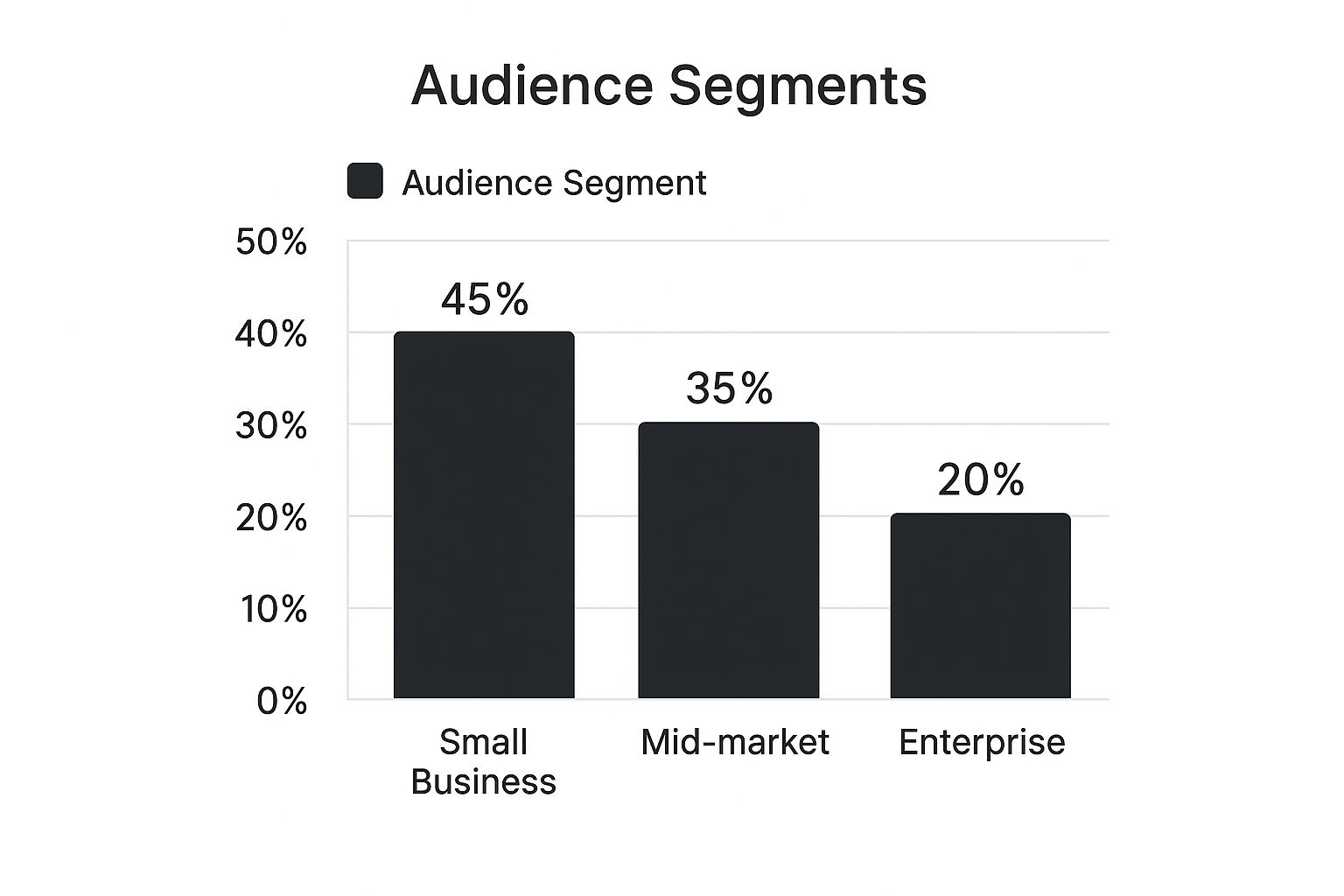
Data chart showing audience segments for demand generation strategy with Small Business at 45%, Mid-market at 35%, and Enterprise at 20%.

With nearly half the audience in the small business space, you can see how critical it is to produce educational content that builds trust and familiarity from the very beginning.

Demand Generation vs Lead Generation Key Differences

To make this crystal clear, let's put the two side-by-side. The tactics you choose and the numbers you track will be completely different for each.

AspectDemand GenerationLead Generation
Primary GoalEducate the market, build brand awareness, and create a genuine desire for your solution.Convert interested audience members into identifiable contacts for the sales pipeline.
Typical TacticsUngated blog posts, podcasts, social media content, educational webinars, original research.Gated ebooks, checklists, demo requests, consultation forms, free trial sign-ups.
Success MetricsWebsite traffic, social engagement, video views, brand search volume, share of voice.Form submission rates, Cost Per Lead (CPL), Marketing Qualified Leads (MQLs).

This table makes it obvious: you wouldn't judge a podcast (a classic demand gen tactic) on how many MQLs it generated that day. You'd look at downloads, audience growth, and brand mentions.

On the flip side, a "Request a Demo" form (a pure lead gen tactic) is judged almost entirely on its conversion rate. A healthy marketing engine needs both—one to create opportunities and one to capture them.

The Core Components Of A Winning Strategy

A powerful demand generation strategy isn’t a single tactic. It's a machine—a system of interconnected parts all humming in harmony. Just like a car needs an engine, wheels, and a steering system to get you anywhere, your strategy needs distinct but integrated components to actually drive results.

Let's break down the essential pieces you need to assemble a demand gen engine that lasts.

A diagram showing interconnected components of a marketing strategy, representing a cohesive demand generation plan.

Content Marketing That Educates And Engages

Content is the fuel for your entire demand generation engine. I want to be crystal clear: its job isn’t to sell. Not directly, anyway. Its purpose is to educate, inform, and build trust long before someone is even thinking about buying.

Think of it like this: you want to be the most helpful expert in your field, the one who consistently provides value without asking for anything in return. That simple shift changes the entire dynamic from a sales pitch to a trusted relationship. When prospects see you as a reliable source of answers, who do you think they’ll call when they finally have a problem to solve?

Recent data backs this up. The 2025 Demand Generation Benchmark Survey shows content is still king, with 57% of marketers saying case studies are their top-performing format. It’s all about storytelling and social proof. The survey also found that 29% of teams now have fully integrated brand and demand marketing strategies—a sign that the smartest companies are breaking down old silos. You can dig into the complete survey findings to learn more about the future of demand generation benchmarks.

SEO And Organic Visibility

Here’s the hard truth: great content is completely useless if no one can find it. That’s where Search Engine Optimization (SEO) comes in. It’s the part of the machine that makes sure your valuable insights show up the moment your ideal customers start searching for answers.

SEO for demand generation is different from SEO for lead generation. Lead gen SEO focuses on bottom-funnel, high-intent keywords like "[your product] pricing." Demand gen SEO targets broader, top-of-funnel, problem-aware keywords like "how to improve team productivity" to capture your audience much earlier in their journey.

A smart SEO strategy isn't about gaming the system; it’s about understanding human intent. What questions are your buyers asking Google? When you optimize your content around those real-world queries, you attract high-intent traffic straight to your digital doorstep.

Actionable Tip: Don't just obsess over bottom-funnel keywords. Perform keyword research focused on the problems your ICP faces, not just the solution you sell. Create pillar pages and blog clusters around these problem-based topics to build authority and capture a wider audience.

Account-Based Marketing For Precision Targeting

While content and SEO cast a wide, valuable net, Account-Based Marketing (ABM) is the spear. It's a hyper-focused strategy built to engage a hand-picked list of high-value target accounts. Instead of marketing to everyone, you treat each key account as its own market.

This approach completely flips the traditional marketing funnel on its head. You start by identifying your dream customers, then you build highly personalized campaigns to get the attention of the key decision-makers inside those companies. ABM is all about quality over quantity, making it an incredibly efficient way to spend your time and money, especially for B2B companies with big deal sizes.

ABM vs. Traditional Marketing Comparison

AspectTraditional MarketingAccount-Based Marketing (ABM)
AudienceBroad, based on personasNarrow, based on specific accounts
GoalGenerate a high volume of leadsBuild deep relationships with key stakeholders
TacticsMass email, broad content, digital adsPersonalized outreach, custom content, direct mail
MeasurementCost Per Lead (CPL), MQLsAccount engagement, pipeline velocity

The strategic difference is stark. Traditional marketing is a numbers game. ABM is a relationship game, focusing every bit of effort on the accounts most likely to drive serious revenue. For a deeper look at tailoring your message, check out our guide on using AI for content analysis to really nail your account-specific messaging.

Multi-Channel Engagement

Your buyers don't live on a single channel, so your brand can't, either. A winning demand gen strategy delivers a seamless and consistent experience everywhere your audience spends their time—whether that’s LinkedIn, industry forums, podcasts, or their email inbox.

This doesn't mean you have to be everywhere at once. That's a recipe for burnout. It’s about being strategic. Pick the channels most relevant to your Ideal Customer Profile (ICP) and create an integrated presence where your message is cohesive, reinforcing the same value proposition no matter the format.

An effective multi-channel playbook usually includes:

  • Social Media: Sharing genuine thought leadership and joining real conversations on platforms like LinkedIn.
  • Email Nurturing: Delivering valuable content over time to stay top-of-mind and build a connection.
  • Paid Media: Using targeted ads to amplify your best content and reach new, qualified audiences.
  • Community Participation: Being an active, helpful voice in the online communities where your ICP hangs out.

When you orchestrate all these components together, you stop running a collection of disconnected tactics and start running a powerful, cohesive demand generation strategy that builds awareness, earns trust, and drives predictable growth.

Using AI And Data For Smarter Targeting

In a crowded market, the best demand generation strategies are powered by intelligence, not just elbow grease. The old “spray and pray” approach is dead and gone. Today, it’s all about using data and AI to connect with the right audience, with the right message, at the exact moment they’re ready to listen.

This shift from manual effort to smart automation is completely changing the game for marketers. Instead of guessing who might be a good fit, we can now use technology to pinpoint in-market buyers with incredible accuracy, all while building solid relationships with future customers.

From Static Lists to Dynamic Targeting

For years, Account-Based Marketing (ABM) ran on static Target Account Lists (TALs). Teams would build a list, and maybe—maybe—revisit it once a quarter. That model just doesn’t work anymore. The market moves way too fast for such a slow, manual process.

Today, AI and modern ABM strategies have transformed demand generation. AI gives marketers the power to use predictive analytics and deliver personalized content, which leads to smarter, data-driven decisions in real-time. ABM has evolved from a clunky, periodic review into a living, breathing system where intent data flows into CRMs and AI scoring models continuously refine the target list.

This visual from My Outreach shows just how much modern demand gen strategies are adapting.

The takeaway is clear: successful strategies are fluid and data-informed, leaving outdated, static planning cycles in the dust.

Predictive Lead Scoring Pinpointing Ready-to-Buy Prospects

One of the most powerful ways to use AI is through predictive lead scoring. Traditional scoring models are okay—they’re usually based on simple demographics and a few actions, like an ebook download. It’s a decent start, but it can often be misleading.

Compare that to predictive models. They churn through thousands of data points—firmographics, technographics, online behavior, and third-party intent data—to find the hidden patterns that actually correlate with a purchase.

Actionable Takeaway: AI cuts through the noise to find the quiet signals that show a prospect is shifting from "just browsing" to "ready to buy." This lets your sales team focus their energy on leads that are actually likely to close, which boosts efficiency and shortens sales cycles in a big way.

This process is a non-negotiable part of a modern demand gen strategy. It ensures you’re aiming your marketing and sales firepower where it will have the most impact. To get a better handle on this, check out our guide on how to implement AI-powered lead scoring for your team.

AI-Driven Personalization at Scale

Personalization is no longer a “nice-to-have.” It’s table stakes. Buyers expect you to deliver content and experiences that speak directly to their needs and headaches. But trying to deliver that kind of customization manually, for thousands of prospects? Impossible.

This is where AI really flexes its muscles.

AI-driven tools can:

  • Dynamically change your website content based on a visitor's industry, company size, or past behavior.
  • Personalize email nurture campaigns with content recommendations that are genuinely helpful to the person reading them.
  • Optimize ad creative on the fly to feature the messaging that hits home with different audience segments.

This level of smart automation ensures you’re always delivering the most relevant message, building a much stronger connection with every single prospect. To really get this right, mastering paid search intelligence is a huge advantage, giving you deep insights into what your audience is actively looking for.

By embracing these technologies, you move from broad-stroke marketing to precision targeting. You stop wasting time and money on the 95% of the market that isn’t ready to buy and instead focus on identifying and engaging the 5% who are—all while intelligently nurturing the rest for the future.

Building Your Actionable Demand Generation Plan

A person at a desk sketching out a marketing plan on a notepad, with a laptop and coffee nearby.

Alright, we’ve covered the theory. But a demand gen strategy only comes to life when you put it on paper and, more importantly, into action. It’s time to shift from the "what" and "why" to the "how"—building the blueprint that will actually drive results.

Think of this plan less as a dusty, 50-page document and more as a living playbook for your team. It’s about turning your big-picture goals into a clear, connected set of steps everyone can get behind.

Step 1: Define Your Ideal Customer Profile

Before you write a single blog post or spend a dollar on ads, you have to know exactly who you're talking to. A vague persona just won’t cut it. You need a razor-sharp Ideal Customer Profile (ICP) that goes way beyond basic demographics.

Your ICP is the compass for every single marketing decision you make. It’s what ensures your messaging lands, your content solves real problems, and you’re not wasting resources on accounts that can’t or won’t buy. Without it, you’re just shouting into the void.

Actionable Steps to Build Your ICP:

  1. Analyze Your Best Customers: Pull a list of your top 10-20 customers by revenue, satisfaction, and LTV.
  2. Identify Commonalities: Look for patterns in firmographics (industry, company size, revenue) and technographics (what tech they use).
  3. Interview Them: Talk to these customers. Ask about their pain points, goals, and buying process. Ask why they chose you over a competitor.
  4. Synthesize and Document: Create a one-page document that clearly defines your ICP so your entire company is aligned.

Step 2: Map The Buyer's Journey

Once you know your ICP, you need to understand their path from "I have a problem" to "You're the solution." The buyer's journey is never a straight line. It's a winding road filled with questions, research, and multiple touchpoints.

Mapping this out is how you find the moments that matter. It forces you to stop pitching your product and start having a customer-centric conversation, building trust long before anyone asks for a demo.

Actionable Takeaway: A well-mapped journey turns you from an aggressive salesperson into a helpful guide. Create a simple table with three columns: Stage (Awareness, Consideration, Decision), Customer Questions, and Your Content. This forces you to create content that directly answers their questions at each stage.

Step 3: Select The Right Channels And Tactics

With a clear ICP and journey map in hand, you can finally decide where to place your bets. The biggest mistake you can make is trying to be everywhere at once. Focus your demand generation strategy on the channels where your ideal customers are already hanging out.

Let’s look at a couple of common B2B channels to see what this means in practice:

ChannelBest ForCommon Mistake
LinkedInB2B thought leadership, connecting with specific job titles, and building a professional community.Treating it like a digital resume or blasting prospects with aggressive, robotic outreach.
Industry PodcastsReaching a super-niche, engaged audience and building deep authority with long-form content.Obsessing over download numbers instead of the quality and relevance of the audience.

Your channel strategy should flow directly from your ICP research. If you’re selling to software developers, you’ll probably get more traction on GitHub or Stack Overflow than on Facebook. And for targeted outreach on key platforms, you can even explore things like automating your LinkedIn prospecting to connect with your ICP more efficiently.

Step 4: Create A Content And Measurement Plan

Your content is the fuel for your demand gen engine, and analytics are the dashboard. Every piece of content you create—from a blog post to a webinar—should tie directly back to the pain points you identified in your ICP and buyer's journey. No more content for content's sake.

At the same time, you have to define what success looks like. Ditch the vanity metrics and focus on numbers that show you’re actually impacting the business.

Here are a few key metrics that matter:

  1. Pipeline Velocity: How fast are deals moving through your funnel? This tells you if you’re actually accelerating sales.
  2. Customer Acquisition Cost (CAC): How much are you spending in sales and marketing to land one new customer?
  3. Share of Voice: When people are talking about the problem you solve, how often is your brand part of the conversation?

Following these four steps is how you turn demand generation from an abstract idea into a practical, measurable plan that delivers predictable growth.

Free Tool

Try our Marketing Plan Generator — generate a complete AI-powered marketing plan in minutes. No signup required.

How To Measure And Optimize Your Strategy

A demand generation strategy without measurement is just an expensive guess. To build a powerful engine for growth, you need to track what's working, understand why, and make intelligent, data-backed improvements.

This isn't about vanity metrics. It’s about tying every blog post, every ad, and every webinar back to tangible business impact.

Think of it this way: Your strategy is a hypothesis. Your data is the experiment's result. Optimization is using those results to form a better hypothesis for the next cycle.

Moving Beyond Last-Touch Attribution

One of the biggest mistakes marketers make is relying on last-touch attribution. This model gives 100% of the credit for a conversion to the very last thing a prospect did, like clicking a "Request a Demo" ad. It's simple, but it's dangerously misleading.

Compare this to multi-touch attribution. This approach spreads credit across multiple touchpoints in the buyer's journey, revealing the true influence of your top-of-funnel efforts. It’s like giving credit for a goal to the entire team's passes, not just the player who kicked the ball last.

Actionable Takeaway: Implement a multi-touch attribution model (like a U-shaped or W-shaped model in your analytics tool) to see how different channels work together. You might discover that your podcast is the number one source for introducing high-value leads who later convert through a paid search ad. This data justifies your investment in top-of-funnel activities.

Key Metrics To Watch At Every Stage

A healthy demand engine requires a balanced scorecard. You need to track metrics across the entire funnel—from initial awareness to closed deals—to get a complete picture of performance and spot any bottlenecks.

Here’s a practical way to break down your metrics by funnel stage:

Funnel StageKey MetricsWhat It Tells You
Top-of-FunnelWebsite Traffic, Social Engagement, Brand Search Volume, Share of Voice.Are you successfully building awareness and educating your target market?
Mid-FunnelContent Downloads, Webinar Attendance, Email Open/Click Rates.Are you effectively engaging prospects and nurturing their interest over time?
Bottom-of-FunnelMarketing Qualified Leads (MQLs), Sales Qualified Leads (SQLs), Pipeline Velocity.Are you creating qualified opportunities that the sales team can actually act on?
Revenue ImpactCustomer Acquisition Cost (CAC), Customer Lifetime Value (CLV), Marketing-Sourced Revenue.Is your strategy contributing directly to bottom-line business growth and profitability?

Creating A Powerful Optimization Loop

Measurement is only half the battle. Optimization is where you turn those insights into action. The goal is a continuous feedback loop where data informs your next move, making your strategy smarter over time.

This boils down to a simple, repeatable process:

  1. Run Performance Reviews: Schedule bi-weekly or monthly reviews to dive into your key metrics. Look for trends, identify top-performing content and channels, and pinpoint what’s falling flat.
  2. A/B Test Your Creative: Don't assume you know what works best. Continuously test different headlines, ad copy, images, and calls-to-action to find what resonates most with your audience.
  3. Gather Sales Feedback: Create a formal process (e.g., a shared Slack channel or a monthly meeting) for your sales team to share insights on lead quality and customer conversations. This qualitative data is priceless.

By consistently measuring and optimizing, your demand generation strategy evolves from a static plan into a dynamic, learning system that gets more efficient and effective with every single campaign.

Got a few questions? Good. Shifting your strategy always brings up some practical stuff. Here are the straight answers to the questions we hear most often.

Inbound vs Outbound Demand Generation

People usually split this into two camps: inbound and outbound. The easiest way to think about it is the difference between a magnet and a megaphone.

  • Inbound demand generation is your magnet. It’s the stuff that pulls people toward you naturally—think killer blog posts, a podcast that actually teaches something, or ranking on Google for a term your buyers search for every day. It’s all about creating valuable, ungated content that attracts people who are already looking for answers. This is how you build trust and become the go-to name in your space.

  • Outbound demand generation is the megaphone. You're proactively pushing your message out to a very specific audience. This could be targeted ads, a sharp cold email sequence, or even old-school direct mail to a list of high-value accounts. It's direct, it's focused, and it works when you know exactly who you need to reach.

A smart strategy doesn't pick a side. It blends them. You use inbound to build a strong foundation of authority for the long haul, and you use outbound to make precise, timely moves when you need to.

How Much Budget Should Go to Demand Generation

There isn't a perfect, one-size-fits-all number. But if you’re just starting, a solid rule of thumb is to allocate 10-20% of your total marketing budget purely to demand creation—the top-of-funnel content that doesn't hide behind a form.

This isn't about gutting your existing budget. It’s about carving out a dedicated slice to build future demand while you keep funding the demand capture tactics (like Google Ads) that are already working for you.

Once you start seeing the results and can connect those early content touches to later pipeline, you can confidently dial that percentage up.

Actionable Takeaway: Start with a 90/10 split between demand capture and demand creation. Track the influence of your creation efforts using multi-touch attribution. As you prove its impact on pipeline, adjust the ratio to 80/20, then 70/30. This data-driven approach allows you to scale what works without taking a huge initial risk.


Ready to build a demand engine that drives predictable growth? marketbetter.ai uses an integrated AI approach across content, campaigns, and engagement to help you connect with your ideal customers. Optimize your marketing strategy today.


10 Best Marketing Campaign Management Software in 2026 (Real Pricing — HubSpot vs $12/mo Alternatives)

· 22 min read

You're juggling email sequences in one tool, social posts in another, ad campaigns in a third, and reporting in a spreadsheet that nobody trusts. Sound familiar?

Marketing campaign management software brings it all under one roof — planning, execution, tracking, and optimization across every channel. We tested 10 platforms head-to-head on what actually matters: pricing transparency, automation depth, cross-channel attribution, and how fast your team can launch campaigns without calling in a consultant.

What we found: HubSpot dominates mid-market but costs $3,600+/month for full features. Monday.com is surprisingly strong for project-heavy teams. And most "enterprise" tools charge 5x more for features you'll never use.

The real magic of campaign management software is its ability to turn fragmented tasks into a cohesive, measurable strategy. It shifts the conversation from, "What did we do?" to "What worked, and why?"

This isn't just about making life easier; it's about driving tangible business results. And the market reflects this. The advertiser campaign management software market was valued at a hefty USD 10,327.4 million in 2021 and is projected to skyrocket to USD 25,710.1 million by 2033. That explosive growth shows just how vital this kind of centralized control has become. You can dig into the numbers yourself in this comprehensive market report.

Solving Critical Marketing Challenges

This kind of software hits the biggest marketing pain points head-on. It provides real solutions for those chronic problems that keep teams from growing, like inconsistent brand messaging across channels, wasted effort from team members accidentally doing the same work, and the endless struggle to prove ROI to the higher-ups.

By bringing your tools and data under one roof, it helps you finally get a grip on the complexity and focus on what really matters: creating campaigns that make an impact.

What Features Actually Matter in a Marketing Campaign Tool?

Picking the right marketing campaign software can feel like a chore. Every platform flashes shiny features and promises the world, and it's easy to get lost in the sales pitches. To cut through the noise, you need to ignore the fluff and zero in on the core functions that actually move the needle on your campaigns.

Think of it like this: without these key features, a platform is just a fancy to-do list. But with them, it becomes the central engine powering your entire marketing strategy, turning a bunch of separate tasks into a coordinated, high-impact machine.

Let's break down the non-negotiables you should look for.

Multi-Channel Campaign Orchestration

Modern marketing isn't a one-trick pony. Your campaigns live across social media, email, paid ads, and your blog all at once. True multi-channel orchestration lets you manage all these moving parts from a single command center.

  • Comparison: A basic project management tool might let you list tasks for email and social, but a true campaign management platform lets you execute and track them from one place.
  • Actionable Takeaway: When evaluating software, ask to see a demo of a single campaign's calendar view. If you can't see the email send dates, social post schedules, and ad flight times all on one screen, it lacks true orchestration.

Intelligent Workflow Automation

Repetitive tasks are the enemy of good marketing. Workflow automation is your secret weapon, letting you put all that manual drudgery on autopilot so your team can focus on big-picture strategy. In fact, smart automation can boost marketing productivity by 20%.

The infographic below shows this in action-how automated workflows can create a perfect sequence of events, which is the whole point of modern marketing efficiency.

  • Comparison: Simple automation might just send a thank-you email. Intelligent automation can create branching logic: if a lead opens the email but doesn't click, send a follow-up with a different subject line in two days. If they do click, notify a sales rep immediately.
  • Actionable Takeaway: Ask vendors for specific examples of "if-this-then-that" logic their platform supports. Can it trigger actions based on website behavior, email engagement, and CRM data?

Centralized Digital Asset Library

"Hey, where can I find the latest logo?" If you've heard that question one too many times, you need a centralized digital asset library (or DAM). It puts an end to the chaos by creating a single source of truth for every creative file-from images and videos to ad copy and brand guides.

  • Comparison: Using a tool like Google Drive is better than nothing, but a native DAM within your campaign software adds version control, usage rights, and the ability to link assets directly to specific campaigns for performance tracking.
  • Actionable Takeaway: During a demo, test the search functionality of the asset library. Can you find an image by its color, orientation, or the campaign it was used in? This level of detail separates a basic folder system from a professional DAM.

A centralized asset library doesn't just save time; it protects your brand's integrity. It's the difference between a polished, professional presence and a fragmented, inconsistent one.

This feature often integrates with or completely replaces many of the top content marketing tools, helping you consolidate your tech stack and work more efficiently.

Robust Analytics and Reporting

You can't improve what you don't measure. Solid analytics and reporting are probably the most important features of any marketing software because they turn your marketing from a guessing game into a data-driven science.

With good reporting, you can see which email subject lines get the most opens, which social channels bring in the best leads, and how your ad spend is actually turning into revenue. Some platforms even have predictive analytics to help you forecast results. To get a better sense of how data can sharpen your focus, check out our guide on using https://marketbetter.ai/playbooks/ai-lead-scoring to prioritize your best prospects.

A solid platform should give you the core features needed to track and optimize your entire funnel. Here's a quick breakdown of what to look for.

Essential Features of Marketing Campaign Management Software

FeatureCore FunctionalityKey Benefit
Multi-Channel OrchestrationManage email, social, ads, and content from one dashboard.Creates a consistent customer experience and unified campaign view.
Workflow AutomationSet up "if-then" rules to automate repetitive marketing tasks.Frees up team time for strategic work and reduces human error.
Centralized Asset LibraryA single, searchable hub for all brand and creative assets.Ensures brand consistency and stops version control nightmares.
Analytics & ReportingTrack KPIs, attribute results to specific channels and campaigns.Provides clear data to measure ROI and make smarter decisions.
Budget & Expense TrackingAllocate and monitor spending for campaigns in real-time.Prevents overspending and proves the financial impact of marketing.

Ultimately, these features work together to give you a complete, 360-degree view of your marketing operations, from the initial idea to the final sale.

Granular Budget and Expense Tracking

Finally, you have to know where the money is going. Granular budget tracking lets you assign funds to specific campaigns, channels, or even individual ads, then watch your spending in real time.

Think of this feature as your financial command center. It helps you stop overspending before it happens, pinpoint which channels deliver the best return on ad spend (ROAS), and confidently walk into any meeting ready to justify your marketing budget with cold, hard data.

An Actionable Comparison of Top Platforms

Picking the right campaign management software isn't about finding the one with the longest feature list. It's about matching a tool to your team's real, day-to-day problems. What works for a scrappy startup could easily bog down a massive enterprise, and the reverse is just as true.

So, instead of a generic rundown, let's look at this through the lens of actual business needs. Once you understand the core philosophy behind the leading platforms, you can connect your team's specific pain points to the right software and make a decision you won't regret.

For Teams Focused on Project Management and Visibility

Your Problem: "I have no idea who is working on what. Deadlines are a suggestion, and our campaign launches are pure chaos." The Solution: Platforms like Monday.com and Asana are built to solve this exact collaboration headache.

Think of these tools as the mission control for your projects. Their superpower lies in visual task management, crystal-clear timelines, and making team collaboration feel effortless.

  • Monday.com vs. Asana: Monday.com excels in visual, customizable dashboards-it's like building with LEGOs for your workflow. It's ideal if you want to design your process from scratch. Asana is the master of task dependencies and structured projects; it's perfect for complex campaigns where Step B cannot start until Step A is complete.
  • Actionable Use Case: If you are a creative agency juggling 20 client projects, Monday.com's visual boards can give each client a unique workflow. If you are launching a multi-stage product, Asana's timeline and dependency features ensure a smooth, sequential rollout.

These platforms are less about deep customer data and more about getting the work done efficiently. They're the right call for creative agencies, content teams, or any marketing department where the biggest challenge is managing the production line of campaign assets.

For Organizations Needing All-in-One CRM and Marketing

Your Problem: "Our sales and marketing teams are strangers. We get leads, but we have no idea which ones are good or what happens to them after we pass them over." The Solution: An all-in-one platform with a CRM at its core, like HubSpot, is designed to bridge this gap.

HubSpot's strength is its unified view of the customer. By combining marketing, sales, and service tools around a single CRM, it provides a complete timeline for every contact.

With a platform like HubSpot, you can trace a lead's entire story without jumping between tabs. You see the blog post they read, the email they opened, the sales call they had, and the support ticket they submitted-all in one timeline.

  • Actionable Use Case: Use HubSpot's lead scoring to automatically notify a sales rep when a prospect visits your pricing page three times. This simple automation, powered by the integrated CRM and marketing tools, turns a marketing action into a direct sales opportunity.

This integrated approach is a game-changer for businesses focused on lead nurturing, aligning sales and marketing, and proving how marketing actually contributes to the bottom line. It's a fantastic choice for mid-market companies that have outgrown their mess of scattered tools and just need one source of truth.

For Enterprises Demanding Powerful Automation and Analytics

Your Problem: "We have massive amounts of data and complex customer journeys. We need to execute highly personalized campaigns at scale and prove revenue attribution down to the dollar." The Solution: A marketing automation powerhouse like Adobe Marketo Engage delivers the necessary power and granularity.

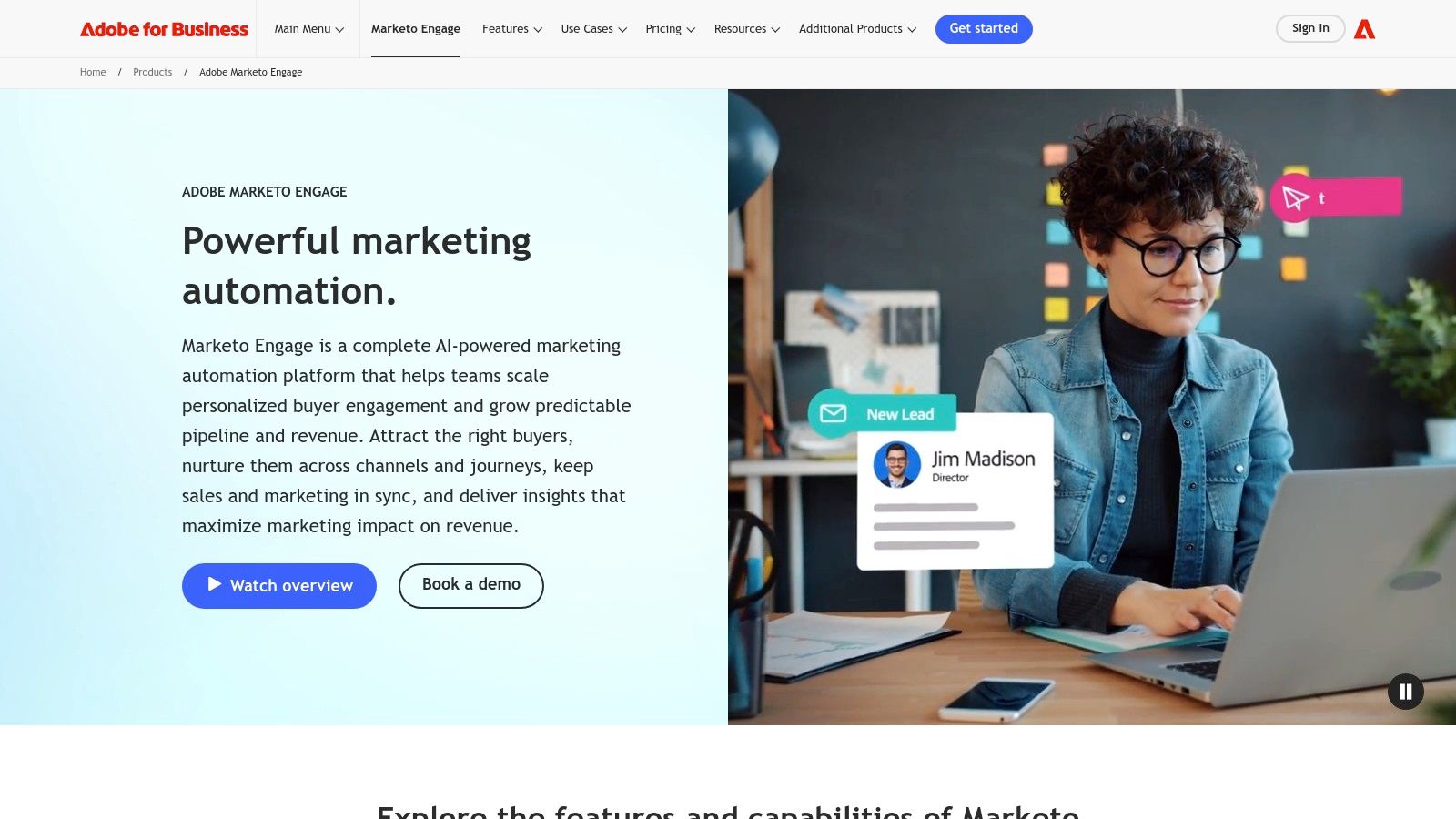
Marketo's strength is its raw power and flexibility. It offers some of the most advanced automation workflows, lead nurturing capabilities, and revenue attribution models you can find.

  • HubSpot vs. Marketo: While both platforms automate, HubSpot is generally more user-friendly and built for the entire customer lifecycle. Marketo offers deeper, more complex automation and analytics capabilities, making it the preferred choice for data-driven enterprises with dedicated marketing ops teams who can leverage its full potential.
  • Actionable Use Case: Use Marketo to build a multi-path nurturing campaign. If a user from a Fortune 500 company downloads a whitepaper, route them to an enterprise sales rep and a specific email track. If a user from a small business does the same, route them to a self-service demo track. This level of granular control is where Marketo shines.

Choosing the right tool is a strategic call. For a detailed look at how different platforms compare for specific jobs, our MarketBetter vs. Sendspark comparison gives a focused analysis that can help bring your needs into focus.

Software Comparison for Different Business Needs

To make the choice even clearer, here's a quick breakdown of how these platforms stack up against each other based on what you're trying to accomplish.

SoftwareBest ForKey StrengthPricing Model
Monday.comProject & Task ManagementVisual workflow customizationPer-user subscription
AsanaComplex Project CollaborationTask dependencies & timelinesPer-user subscription
HubSpotAll-in-One GrowthIntegrated CRM & marketing suiteTiered, based on contacts/features
MarketoEnterprise AutomationAdvanced automation & analyticsCustom, based on database size

Ultimately, the best platform is the one that solves your most pressing problem today while giving you room to grow tomorrow.

The market for these tools is heating up for a reason. The global campaign management system market is expected to jump from USD 5.50 billion in 2025 to USD 10.86 billion by 2032, which is a compound annual growth rate of 10.2%. You can dive into the numbers in this insightful industry report. This trend shows just how critical it's become for businesses to get their campaigns organized on a central platform if they want to stay in the game.

How to Pick the Right Software for Your Team

Choosing the right marketing campaign management software can feel like you're staring at a wall of TVs, each one shouting different promises. Every vendor claims their tool will change the game, but here's the secret: the best tool is the one that solves your team's actual problems, not just the ones on a feature checklist.

The process doesn't start with demos. It starts with a hard look in the mirror. Before you even glance at a product page, you need to be brutally honest about your team's biggest headaches.

Actionable First Step: Get your team in a room for 30 minutes and ask one question: "What is the single most repetitive or frustrating task in our marketing process?" Write every answer on a whiteboard. The most common themes are your starting point for evaluating software.

First, Audit Your Current Tech Stack

No tool is an island. Your shiny new platform has to play nice with the software your team already lives in every day. So, the next critical step is to take inventory of what you're already using.

Make a simple list of every tool your marketing, sales, and customer service teams touch. That means your CRM, email platform, social media schedulers, analytics tools, and whatever project management system you're using to hold it all together.

For each one, ask these questions:

  • What does it actually do? Get specific about its main job.
  • Is it a "must-have" or a "nice-to-have"? Be honest. Which tools would cause a riot if they disappeared tomorrow?
  • How does it connect to other things? Does it have an open API? Does it offer pre-built integrations?

This audit gives you a blueprint for your integration needs. A powerful campaign platform that can't talk to your CRM is a complete non-starter. You're looking for a central hub, not another silo.

Involve Your Stakeholders Early On

Choosing software by committee can be a slog, but making the decision alone is a recipe for disaster. If you want people to actually use the tool you pick, you have to bring them into the process from the jump.

Get people from sales, creative, and even finance in the room (or on the Zoom). The sales team knows exactly what they need from marketing to help them close deals. Your creative team can tell you what they need to manage hundreds of assets without losing their minds.

By bringing other departments into the fold, you're not just picking a marketing tool; you're choosing a central growth engine for the whole company. It's a collaborative move that ensures the software solves problems across teams, which pays off big time in adoption rates later.

Ask the Right Questions During Demos

Alright, you've got your shortlist. Now it's demo time. This is your chance to slice through the polished sales pitch and see how the software holds up in the real world. Don't let the sales rep drive the whole time. Come armed with a list of sharp, specific questions based on your earlier pain-point audit.

Instead of asking a lazy question like, "Do you have analytics?" try this instead: "Show me exactly how your platform tracks ROI from a campaign running on Google Ads, LinkedIn, and email."

Here are a few other critical questions to have in your back pocket:

  1. On Workflows: "Can you walk me through building an automated workflow for a new lead who just downloaded an ebook? Show me every step."
  2. On Integrations: "Don't just tell me you integrate with Salesforce. Show me how the data syncs between the two platforms live."
  3. On Support: "What does your onboarding process actually look like for a team our size? What level of support is included, and what costs extra?"

This kind of direct, hands-on questioning forces vendors to prove their claims in the context of your challenges. It shifts you from being a passive viewer to an active evaluator, making sure you end up with a tool that doesn't just look good on paper but truly helps your team win.

Implementing Your New Software for Maximum Impact

Alright, you've picked your new marketing campaign management software. That's a huge step. But the real work? It starts now. The success of this whole thing doesn't ride on the feature list-it hinges on how well you weave the tool into your team's daily rhythm. A sloppy rollout turns a powerful platform into just another ignored login.

The goal isn't to add another chore to everyone's plate. It's to make the software an indispensable part of their job. That takes a thoughtful plan, one focused on getting people on board smoothly and proving the tool's value from day one.

Start with a Pilot Team and Phased Rollout

Going for a big-bang, company-wide launch is a recipe for chaos. Don't do it. Start small with a hand-picked pilot team instead. This could be a single campaign squad or a mix of marketers from different functions who are generally good with tech and open to change.

Think of it as a controlled experiment. This small group can stress-test workflows, find weird bugs, and give you honest feedback in a low-stakes environment. Their experience is gold-you'll use it to polish your training materials and create a solid process before you roll it out to everyone else.

A phased rollout is just as important for your data. Instead of a massive, one-time data dump, moving things over gradually lets you:

  • Clean As You Go: Find and ditch outdated contacts or duplicate assets before they clutter up your shiny new system.
  • Test Connections: Make sure integrations with your CRM and other critical tools are working perfectly without putting your entire database at risk.
  • Minimize Disruption: Keep the day-to-day operations running smoothly while you methodically bring your information across.

Build Standardized Templates from Day One

One of the biggest wins you'll get from this software is consistency. Don't wait to figure out best practices later-build them directly into the platform from the very beginning with standardized campaign templates.

Think of these templates as pre-built playbooks for your most common marketing moves. A product launch template might include tasks for blog posts, email announcements, a social media schedule, and ad creation. A webinar template could have pre-set timelines for promo emails and follow-ups.

Standardizing your campaigns with templates does more than save time. It creates a unified process that ensures no critical step is ever missed, regardless of who is running the campaign.

Actionable Step: Your first template should be for your most frequent campaign type. If you run monthly webinars, build that template first. This guarantees an immediate win and demonstrates the value of standardization to the entire team. You can learn more about how to systemize your processes and never miss a follow-up again.

Focus on Adoption by Demonstrating Value

The single biggest hurdle to any new tool is user resistance. To get past it, you have to show each person on your team how the software makes their specific job easier. Frame the entire training around solving their personal pain points.

  • For the Content Writer: Show them how the central asset library means they'll never have to hunt through messy folders for the latest logo again.
  • For the Social Media Manager: Demonstrate how the scheduler lets them knock out a week's worth of posts in an hour, freeing them up for more creative work.
  • For the Marketing Leader: Walk them through the automated dashboard that proves campaign ROI without spending hours wrestling with spreadsheets.

This user-first approach changes the conversation. The tool stops being a mandate from management and starts being a genuine benefit. This is critical in a market that's blowing up. The marketing campaign management software market size was valued at USD 5.3 billion in 2024 and is expected to hit USD 12.3 billion by 2033. This growth shows just how much teams need tools that can tame complex, multi-channel marketing-a key selling point for your team. You can dive deeper by checking out the full market growth report.

By focusing on these practical steps-a pilot launch, smart templates, and value-driven training-you'll ensure your new software becomes the growth engine it was meant to be.

A Few Common Questions

Jumping into the world of marketing campaign software can feel like a big step. It's a decision that touches your team's day-to-day work, your budget, and ultimately, your results. We get it. Here are some of the most common questions we hear, answered straight up.

Wait, Isn't This Just a CRM?

It's an easy mistake to make. Both handle customer data, but they have completely different jobs. A simple comparison: a CRM is a database, while a campaign management platform is an action engine.

  • A Customer Relationship Management (CRM) platform is your system of record. It's a digital filing cabinet answering the question, "Who is this person and what's our entire history with them?"
  • Marketing campaign management software, on the other hand, is a system of action. It uses CRM data to answer the question, "How do we talk to this specific group of people, right now, to get them to do something?"

The two are a power couple:

  • The CRM knows a lead is in the "consideration" stage and has clicked on three pricing-page emails.
  • The campaign software uses that info to automatically send them a case study and show them a targeted social media ad.

Can a Small Business Actually Afford This?

This is the big one, isn't it? The short answer: yes, absolutely. The old idea that this kind of software is only for massive companies with eye-watering budgets is dead. The market is full of scalable, surprisingly affordable options built for businesses on the way up.

Most of the best platforms use tiered pricing. You can start with a basic plan that covers the essentials and add more firepower as your company grows. Some even have generous free plans to get you off the ground.

Here's the mental shift you have to make: this software isn't a cost. It's an investment. A good platform pays for itself by automating tasks that used to eat up dozens of hours a month and by fine-tuning campaigns to bring in more revenue.

Actionable Tip: Calculate the hourly rate of your marketing team members. Then, estimate how many hours per month are spent on repetitive tasks like reporting or manual posting. Compare that "cost of inefficiency" to the price of the software to see the potential ROI.

What Are the Most Important Metrics to Track?

You can't prove marketing is working if you aren't measuring the right things. Every platform will throw a sea of data at you, but if you want a clear picture of success, you have to ignore the noise. Forget vanity metrics like "likes" and focus on the numbers that connect directly to business goals.

Your campaign software absolutely must help you track these three heavy hitters:

  1. Customer Acquisition Cost (CAC): This is the bottom line on what it costs you-in both marketing and sales effort-to land one new customer. The goal is simple: get this number as low as you can. A great first step is comparing the CAC from different channels. Is Google Ads cheaper than LinkedIn? Now you know where to double down.

  2. Return on Marketing Investment (ROMI): This is the ultimate proof. It calculates the revenue your campaigns generated divided by what you spent to run them. Anything over 1.0 means you're making money. If you spend $1,000 on a campaign that brings in $5,000 in new business, your ROMI is a beautiful 5.0.

  3. Lead-to-Customer Conversion Rate: This metric tells you what percentage of your leads are actually becoming paying customers. A low number here is a huge red flag. It often points to a disconnect between what marketing is promising and what sales is delivering, giving you a crystal-clear problem to solve.

Nailing these core metrics is how you turn your marketing department from a cost center into a predictable revenue engine.


Ready to bring clarity, efficiency, and powerful AI to your marketing efforts? marketbetter.ai integrates content creation, campaign management, and customer engagement into a single, intelligent platform. Stop juggling disconnected tools and start driving measurable results. Discover how marketbetter.ai can transform your campaigns today.

How to Use AI for Marketing Automation (Without Replacing Your Team)

· 25 min read

Old-school marketing automation is like a sprinkler system on a timer. It turns on at 6 AM, waters the lawn for 20 minutes, and shuts off. It doesn't care if it rained all night or if it's 100 degrees out. It just follows the rules you set.

AI for marketing automation is totally different. It’s like a smart sprinkler system that checks the weather forecast, measures the moisture in the soil, and then decides how much water your garden actually needs. It learns, predicts, and adapts in real time.

The New Reality of AI in Marketing Automation

A marketing professional using a tablet with AI-driven charts and data visualizations overlayed, showing the intersection of technology and marketing strategy.

Let's be honest, the modern marketing world is drowning in data. It's getting harder and harder to cut through the noise and actually connect with people.

Traditional automation runs on rigid, "if-this-then-that" logic. If a user downloads an ebook, they get email sequence A. It works, sure, but it’s clumsy. It lacks any real foresight or flexibility.

This is where AI for marketing automation changes the game entirely. Instead of just following your pre-programmed commands, AI digs into massive datasets to figure out context, anticipate what a customer might need next, and make smart decisions all on its own. It effectively upgrades your marketing from a simple script-follower to a strategic partner that gets smarter over time.

From Static Rules to Dynamic Decisions

Think of it this way: traditional automation is a traffic light stuck on a fixed timer. It turns red every 60 seconds, no matter if there’s a traffic jam or an empty street.

AI-powered automation is more like a smart traffic grid that watches the flow of cars in real time, adjusting signals to clear accidents and manage rush hour on the fly. This dynamic approach creates much smoother, more efficient, and deeply personalized customer journeys. For a deeper look at how this plays out, the world of small business marketing automation offers some great, practical insights.

So, what does AI actually bring to the table that standard automation can't?

  • Predictive Analytics: Standard automation can segment leads based on past actions (e.g., visited pricing page). AI can look at a lead's complete behavior and predict, with spooky accuracy, which ones are most likely to buy. This lets your sales team stop chasing ghosts and focus their energy where it will actually pay off.
  • Hyper-Personalization: We're not just talking about adding a {\{first_name\}} token. Traditional tools might let you segment an audience by location. AI can change website content, rewrite email copy, and adjust product recommendations for every single user in real-time, not just for broad segments.
  • Optimized Timing: Traditional automation sends an email when you tell it to (e.g., 24 hours after signup). AI figures out the absolute perfect moment to send that email or show that ad based on an individual's unique patterns of behavior. No more guessing.

The real shift here is moving from reactive, rule-based chores to proactive, data-driven strategy. AI doesn't just do what you tell it to; it uncovers what you should be doing to get the biggest impact.

How AI Fundamentally Changes Marketing Automation

A split-screen image showing a traditional assembly line on one side and a futuristic, AI-powered robotic arm on the other, symbolizing the evolution of automation.

Let's be honest. Traditional marketing automation is powerful, but it's also a bit rigid. It runs on a strict script you have to write yourself. It’s fantastic at executing pre-set "if-then" rules, but it can't improvise, understand nuance, or guess what a customer might do next.

Think of it like a spell-checker. It’s great at catching typos, but it has no idea if your sentence is actually persuasive.

Plugging AI into marketing automation isn't just an upgrade; it’s a complete rewrite of the rules. We're moving from a system that just follows commands to one that makes its own intelligent, autonomous decisions. AI doesn't just play by the rules you give it—it watches the entire game, predicts the other team's next move, and tells you the best way to win.

That’s the core difference. One system reacts. The other anticipates.

This leap forward is powered by a few key technologies that act as the "brain" of the operation. And they aren't just buzzwords; they're the engines driving real business results.

Moving From Static Workflows To Intelligent Systems

At its heart, this is about shifting from a static, fixed approach to a dynamic one. Old-school automation is brittle; AI-powered systems are fluid, constantly learning and adapting as new data pours in.

The market sees the enormous potential here. Revenue from AI in marketing is on track to blow past $107.5 billion by 2028—more than doubling in just a few years as businesses scramble to get smarter. You can dig into the numbers behind this explosive growth by exploring the latest AI marketing statistics.

This growth is really driven by three foundational AI concepts:

  • Machine Learning (ML): This is the learning engine. ML algorithms chew through mountains of campaign data—email opens, click-through rates, purchase histories—to find patterns you’d never spot on your own. Instead of you manually creating a segment for "customers who bought Product X," machine learning finds clusters of users with subtle, shared behaviors that signal they're perfect candidates for Product Y, often with way more accuracy.
  • Predictive Analytics: Building on ML, predictive analytics is about forecasting what comes next. It can score leads based on their probability of converting, flag customers who are about to churn, or estimate the lifetime value of a brand-new subscriber. This pulls your strategy out of the realm of guesswork and into data-backed foresight, letting you put your resources where they’ll have the biggest impact.
  • Natural Language Processing (NLP): NLP is what gives automation the ability to actually understand human language. It's the tech behind a smart chatbot that can handle complex support questions, the sentiment analysis tools that tell you how people really feel about your brand on social media, and the systems that can perform a deep AI content analysis to make sure your messaging hits home.

The real change is that AI enables automation to answer the "why" and "what if" questions, not just execute the "if/then" commands. It transforms your platform from a task manager into a strategic advisor.

Practical Comparisons: Old vs. New

To make this less abstract, let’s look at how a simple abandoned cart email sequence gets handled in both worlds.

FeatureTraditional AutomationAI-Powered Automation
TriggerA user adds an item to their cart and leaves. A fixed timer (say, 1 hour) kicks off.AI analyzes the user’s on-site behavior, past purchases, and cart value to decide the perfect time to send the first reminder.
ContentThe email shows the exact product left behind with a generic "Complete your purchase!" message.The email is dynamically personalized. It might offer a small, tailored discount for a high-value customer, suggest complementary products based on predictive models, or rewrite the subject line to match the user's perceived urgency.
Follow-UpA rigid, pre-set sequence of 2-3 emails goes out at fixed intervals (e.g., 24 hours, 72 hours).The follow-up cadence is adaptive. If the user comes back to the site, the sequence might pause. If they open an email but don’t click, the next message might get sent via SMS or a social media ad, depending on which channel they prefer.

This side-by-side makes the upgrade crystal clear. Traditional automation is a one-size-fits-all sledgehammer. AI for marketing automation, on the other hand, crafts a unique, optimized journey for every single customer.

It scales true personalization in a way that was flat-out impossible before. That ability to learn, predict, and adapt is what truly sets it apart.

High-Impact Use Cases of AI in Automation

A split-screen showing a basic email marketing dashboard on one side and a dynamic, AI-powered customer journey map on the other, visualizing the evolution.

Alright, enough with the theory. Let's get down to brass tacks. Where does AI for marketing automation actually make a difference? The real magic isn't in some abstract concept; it's in the specific, tangible ways it helps you get better results.

We're going to look at a few examples that show a clear before-and-after picture. This isn't just about doing the same old things a little faster. It's about shifting from a manual, one-size-fits-all approach to a smart, adaptive strategy that feels personal to every single customer. This is how you get an edge.

Hyper-Personalized Email Campaigns

Email marketing is the backbone of most strategies, but let's be honest, it often hits a wall. AI blows right through that wall by enabling a kind of personalization that was pure fantasy just a few years ago.

The Old Way: You'd slice your audience into a few broad segments—maybe based on location or what they bought last year. You'd write a generic email, pop in a {\{first_name\}} tag to feel fancy, and blast it out. The results? Decent, but you know a ton of those emails just weren't hitting the mark.

The New Way (with AI): Forget broad strokes. An AI model is watching what each individual does in real time. It sees the pages they're browsing, knows when they're most active, and understands the products they keep coming back to. With that intel, the system automatically:

  • Optimizes Send Times: It doesn't guess. It sends the email at the exact moment that specific person is most likely to open it, based on their past behavior.
  • Generates Dynamic Content: The AI can rewrite subject lines, tweak headlines, and swap out product recommendations on the fly to perfectly match what that user is thinking about right now.
  • Predicts Future Needs: It can even offer a discount on something they haven't looked at yet, but that thousands of similar customers ended up buying next.

You’re moving from a generic broadcast to a genuinely relevant, one-to-one conversation. That’s a huge leap.

AI-Driven Ad Spend Optimization

Running paid ad campaigns can feel like spinning plates. You're constantly juggling bids, tweaking targeting, and shifting budgets around. Without AI, it's a slow, reactive process full of guesswork.

By 2025, the AI industry is projected to hit a global market valuation of around $391 billion, with its annual growth rate hovering near 35.9%. This massive investment is driven by AI’s ability to deliver clear financial impact, as seen with Netflix generating an estimated $1 billion annually from its AI-powered recommendation engine alone.

AI brings a ruthless mathematical precision to your ad spend, making sure every dollar is pulling its weight.

The Old Way: A marketer logs into Google Ads, checks some reports, and sees an ad group is tanking. They manually lower the bids or change the audience settings. The problem is, by the time they've spotted the issue and fixed it, money has already been wasted.

The New Way (with AI): An AI platform crunches thousands of data points every second—competitor bids, time of day, user device, you name it. It predicts which clicks will actually convert and automatically shifts budget toward your most profitable channels, audiences, and ad creative. It's all done in real-time, maximizing your ROAS without you lifting a finger.

Dynamic Website Experiences

Think about it: a static website gives the exact same experience to a first-time visitor from a tiny startup as it does to a loyal enterprise customer. That makes no sense. AI turns your site into a living, breathing thing that adapts to each person.

AspectStatic Website (Before AI)Dynamic Website (After AI)
Homepage ContentEveryone sees the same generic welcome, featured products, and CTAs.The headline, hero image, and content morph based on the visitor's industry, referral link, or past behavior.
Product RecommendationsA static list of "best-sellers" that rarely changes.Hyper-relevant recommendations powered by machine learning, based on what that specific user is likely to buy.
Lead CaptureThe same pop-up form appears for everyone after 30 seconds.A smart pop-up with a tailored offer appears at the precise moment AI predicts the user is about to leave or convert.

Instant Lead Qualification with AI Chatbots

Not every lead is a good lead. Your sales team knows this better than anyone. Making them sift through every single form submission is a huge waste of time they could be using to close deals. AI chatbots take over that filtering process with terrifying speed and accuracy.

A great example of this is leveraging chatbots for marketing to handle initial conversations and guide users. These aren't the clunky bots of five years ago. They are sophisticated lead-scoring engines that can ask qualifying questions, understand intent, and route only the hottest leads straight to a sales rep's calendar.

(If you want to go deeper on this, we've got a whole playbook on https://marketbetter.ai/playbooks/ai-lead-scoring.)

Choosing the Right AI Marketing Automation Platform

Let's be honest, picking an AI marketing automation platform can feel like a chore. The market is flooded with tools, and every single one promises to change your world.

The real trick is to cut through the noise and find a platform that actually fits your business—your team, your tech stack, and where you plan to be in a couple of years.

Making the right call here is a big deal. You're not just buying software; you’re choosing the central hub for your entire marketing operation. Get it right, and it becomes an engine for growth. Get it wrong, and it’s an expensive headache.

Core Factors for Your Decision

Before you jump into a dozen demos, you need a clear checklist. Otherwise, you’ll get lost in flashy feature lists and slick sales pitches.

Focus on these three pillars to keep your search grounded.

  • Business Model and Size: Are you B2B or B2C? A B2B company with a six-month sales cycle needs sophisticated lead scoring and nurturing. A B2C e-commerce brand, on the other hand, might care more about abandoned cart emails and personalizing offers for thousands of customers at once. Size matters, too. A startup needs something nimble and affordable, while an enterprise needs ironclad security and the power to scale.
  • Integration Capabilities: Your marketing platform can't be a lone wolf. It has to play nice with the rest of your tech, especially your CRM (like Salesforce or HubSpot), your e-commerce store (like Shopify), and your analytics tools. Bad integrations create data silos, and that defeats the whole purpose of using AI in the first place.
  • Scalability for Growth: The perfect tool today might hold you back in two years. Think about your growth plans. Can the platform handle 10x the contacts and campaigns without slowing to a crawl or jacking up the price? You need a partner that can grow with you, not one you’ll outgrow.

Comparing Top AI Marketing Automation Platforms

To make this tangible, let's look at a few of the big players. Each has its own vibe and is built for different kinds of teams. This isn't an exhaustive list, but it's a great starting point for figuring out where to look first. For a deeper dive, check out our Marketbetter vs. Warmly AI comparison for a real head-to-head breakdown.

This table breaks down how leading platforms stack up on AI features, who they're best for, and how well they connect with other tools. It's designed to help you quickly narrow down the options that make sense for your business.

Comparing Top AI Marketing Automation Platforms

PlatformKey AI FeaturesBest ForIntegration Capability
HubSpotPredictive lead scoring, AI content assistant, adaptive testing, AI-powered chatbot builder.Mid-market B2B and B2C companies seeking an all-in-one platform for marketing, sales, and service.Excellent. Extensive native integrations with hundreds of popular apps and a robust API.
ActiveCampaignPredictive sending, win probability models, automated segmentation, AI-driven content generation.Small to mid-sized businesses (SMBs) that need powerful automation and personalization at an accessible price.Strong. Connects well with most major e-commerce platforms, CRMs, and business tools.
Salesforce Marketing CloudEinstein AI for predictive engagement, journey optimization, and content personalization.Enterprise-level B2C companies with large customer databases and complex, multi-channel journeys.Very High. Deep native integration with the Salesforce ecosystem (Sales Cloud, Service Cloud) is its core strength.

Each of these platforms offers a different flavor of AI automation, so the "best" one really depends on whether you're a scrappy SMB or a large enterprise with a complex, existing ecosystem.

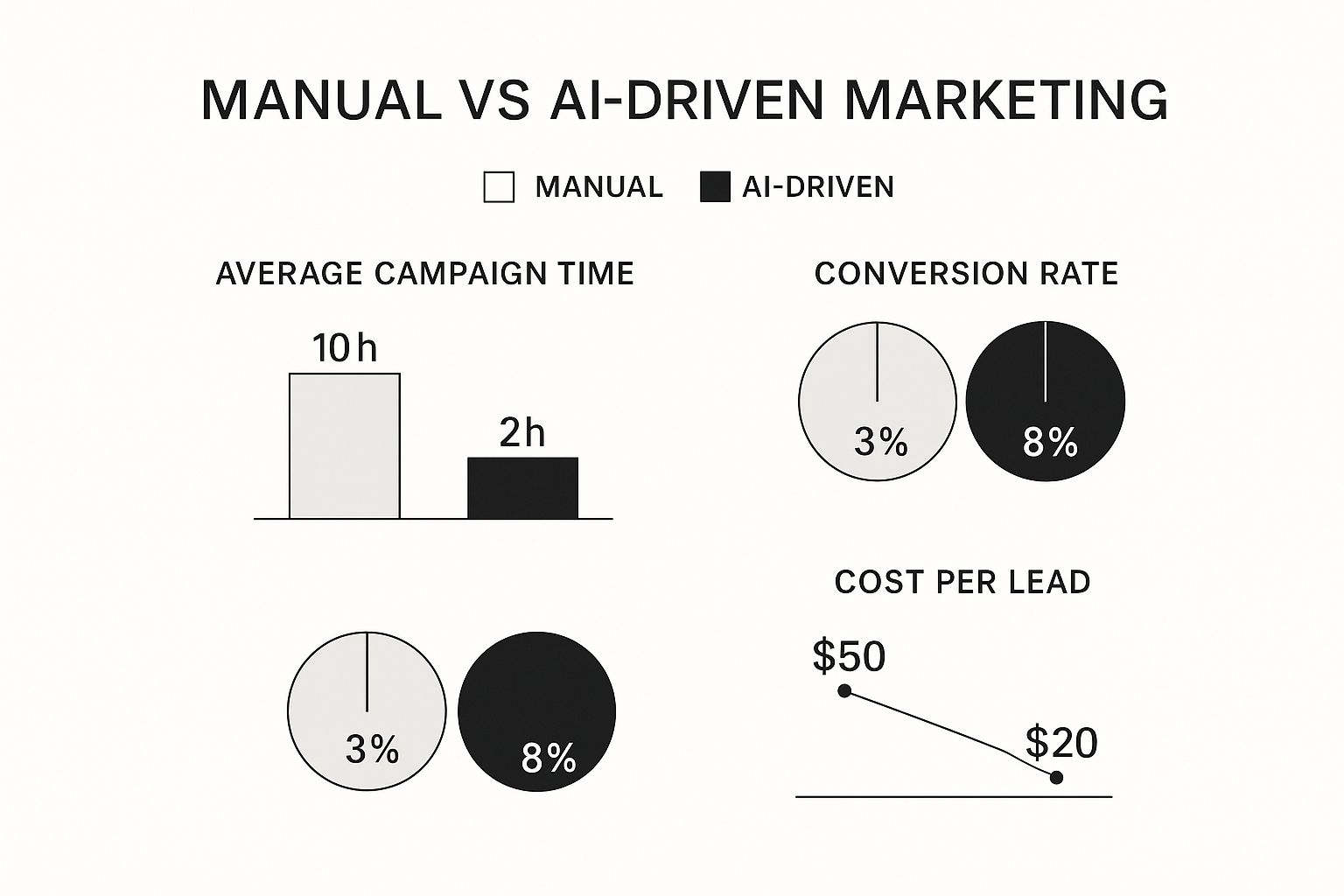
The difference between sticking with manual workflows and switching to an AI-driven approach is night and day. It changes everything from your team's daily workload to your bottom line.
This infographic really drives the point home, showing just how dramatic the improvements are when you let AI handle the heavy lifting.

An infographic comparing manual vs. AI-driven marketing across campaign time, conversion rate, and cost per lead.

The numbers don't lie. This isn't about small, incremental gains. AI fundamentally rewires the economics of your marketing. Just the time saved lets your team stop clicking buttons and start thinking about strategy.

The ultimate goal is to choose a platform that not only automates what you're already doing but also gives you the AI-powered insights to do it better.

AI is quickly becoming non-negotiable for managing marketing workflows. A 2025 survey found that 93% of marketers using AI are leaning on it to create content faster for blogs, social posts, and ads. On top of that, about 90% say they make decisions faster because of AI's ability to process data.

Platforms like HubSpot and ActiveCampaign are embedding these tools directly into their systems, freeing marketers from the grind so they can focus on the big picture.

Picking the right platform is the first—and most important—step. If you carefully weigh your needs against what these tools can do, you'll find a system that doesn't just automate tasks but actually drives real, measurable growth.

Your 5-Step AI Implementation Plan

Bringing AI into your marketing stack isn't like flipping a switch. It's more like building a house—you don't start hammering without a blueprint. A lot of teams get tripped up here, buying a powerful tool only to see it gather dust because there was no real plan.

Think of this as your blueprint. It breaks the whole process down into five clear, manageable steps. Following this framework will help you sidestep the usual traps, like chasing vanity metrics or feeding your shiny new AI a diet of messy data. Let's get it right from the start.

Step 1: Define Your North Star (Goals and KPIs)

Before you even glance at a pricing page, you have to answer one question: What, specifically, are we trying to fix or improve?

"Get better at marketing" is a wish, not a plan. You need sharp, measurable goals. This is the single most important step. Without a clear destination, you're just driving, and you'll almost certainly end up somewhere you don't want to be. Your goals are your North Star for this entire journey.

Here’s what that looks like in the real world:

Vague WishSharp, Actionable KPI
"Increase leads""Boost MQL to SQL conversion rate by 15% in Q3 using predictive lead scoring."
"Personalize emails better""Lift email click-through rates by 20% by rolling out AI-driven dynamic content."
"Be more efficient""Cut 10 hours per week from campaign reporting with automated analytics."

Step 2: Look Under the Hood (Audit Your Data and Tech)

AI runs on data. Period. If your data is a disaster—siloed, incomplete, or just plain wrong—your AI will spit out garbage. It's that simple.

So, before you plug anything new in, you have to do a serious audit of your data and current tech stack. Take an honest look at your CRM, your analytics tools, and wherever else customer information lives. Are they talking to each other? Is the data clean?

Trying to skip this is like putting cheap, dirty gas in a Ferrari. The engine will choke, and you'll go nowhere fast.

The Hard Truth: Your AI is only as smart as the data you feed it. The "garbage in, garbage out" rule is 10x truer for AI. Bad data doesn't just give you bad results; it wastes your entire investment.

Step 3: Start Small, Win Big (Launch a Pilot Project)

Don't try to boil the ocean. Seriously. Overhauling your entire marketing operation in one go is a surefire way to fail. The smart move is to start with a focused pilot project—something with a tight scope where you can score a quick, measurable win.

This builds momentum and proves the concept to everyone in the company.

A great place to start is an AI-powered email campaign. You can run a clean A/B test against your old, rules-based campaigns. Test things like AI-optimized send times, dynamic subject lines, or personalized content blocks. The results will be black and white, making it easy to show stakeholders exactly what the new tool is capable of.

Step 4: Don't Forget the People (Empower Your Team)

Dropping a powerful new tool on your team without proper training is just setting them—and your investment—up for failure. It's amazing how many companies spend a fortune on software but completely cheap out on teaching people how to actually use it.

Your team needs more than a one-hour demo. Give them real training that covers not just how to use the platform, but why you're using it. Connect the tool back to the strategic goals you set in Step 1. Show them how this AI for marketing automation is going to make their jobs easier and more impactful, not just add another login to their password manager.

Step 5: Measure, Tweak, Repeat (Analyze and Iterate)

Getting your AI running isn't the finish line. It's the starting line. This is a continuous loop: measure performance, analyze what's happening, and tweak your strategy based on what you learn.

Keep a close eye on those KPIs you defined back in Step 1. Are you hitting your numbers? Where are the surprising wins? Use the AI's own analytics to find insights you would have missed otherwise. This constant feedback loop is what separates the teams that get a little value from AI from the ones that completely transform their results.

Measuring Success and Proving ROI

Throwing money at AI for marketing automation is easy. The hard part? Proving it was worth it. The real test isn't about using shiny new toys—it's about whether they're actually making you money.

You have to connect your AI efforts directly to the bottom line, moving way past fuzzy wins like "time saved." This is how you build a rock-solid case for more budget instead of getting eye-rolls in your next meeting. It's about focusing on the metrics that actually signal business health and growth. Forget the vanity stuff and zero in on what matters.

Identifying Your Core AI-Driven KPIs

The right KPIs are your compass. They tell you if your AI strategy is pointed toward actual profit or just wandering around in the data wilderness. Don't get lost. Just concentrate on a few high-impact metrics that paint a crystal-clear picture of your return.

Here are the ones that count:

  • Lower Customer Acquisition Cost (CAC): AI is brilliant at refining ad targeting and automating lead scoring. That means you spend less money and effort to get each new customer. If your CAC is dropping, your AI is making your marketing spend smarter, period.
  • Higher Customer Lifetime Value (CLV): Through smart personalization and predicting what customers will do next, AI helps you keep them around longer and encourages them to buy again. An increasing CLV is a massive signal that your AI-driven retention plays are hitting the mark.
  • Improved Conversion Rates: AI-powered A/B testing, dynamic website content, and optimized emails are all designed to do one thing: get more people to click, sign up, or buy. Tracking conversion rates at each stage of your funnel shows exactly how good your AI is at closing the deal.

A Simple Framework for Calculating ROI

Once you’re tracking the right KPIs, calculating the return is surprisingly straightforward. This isn’t just for the finance nerds; it’s how marketers prove they're a revenue center, not a cost center.

Here’s the basic formula everyone understands:

ROI (%) = [ (Gain from Investment - Cost of Investment) / Cost of Investment ] x 100

Let's break that down into real-world terms.

  • Gain from Investment: This is the money you made or saved because of your AI. Tally up the added revenue from a higher CLV, the real dollars saved from a lower CAC, or the new profit you pocketed from better conversion rates.
  • Cost of Investment: Add up everything you spent. This includes the obvious stuff like software subscription fees, but don't forget one-time implementation costs, training, and the hours your team spends managing the new system.

By consistently measuring these core metrics and running the numbers, you change the conversation from "AI is pretty cool" to "AI generated an extra $X in revenue last quarter." That's how you prove its worth.

Free Tool

Try our Marketing Plan Generator — generate a complete AI-powered marketing plan in minutes. No signup required.

Your Questions About AI Automation, Answered

Even with all the benefits laid out, I get it. Stepping into AI for marketing automation can feel like a huge leap. It’s totally normal to have questions about the nuts and bolts—the costs, who you need on your team, and the real-world headaches you might run into. Let’s clear the air on the most common ones.

Think of this as the final gut-check before you commit to a smarter way of doing marketing.

Do I Need a Data Scientist to Use AI in Marketing?

Nope. Not anymore. A few years back, this was a real concern, but modern AI marketing platforms are built for marketers, not data engineers. They’re all about user-friendly interfaces and no-code workflows that make the powerful stuff accessible to anyone.

Sure, having data skills on your team is always a bonus. But the core functions—like predictive lead scoring, personalizing content on the fly, and segmenting audiences—are all handled automatically behind the curtain. Your job is to focus on the strategy and the customer data; the platform does all the heavy lifting.

The biggest hurdle isn't technical skill. It's almost always the quality of the data you feed the AI. A model is only as smart as the information it learns from, which makes a solid data audit your most important first step.

How Much Does AI Marketing Automation Cost?

This is the classic "it depends" answer, but we can definitely put some real numbers on it. The price tag changes a lot based on your needs, how big your contact list is, and how fancy you want to get with the features.

Here's a rough breakdown:

  • Entry-Level Tools: For small businesses or startups just getting their feet wet, some platforms with AI features start under $100 per month.
  • Mid-Tier Platforms: This is the sweet spot for most growing businesses. Tools like HubSpot or ActiveCampaign will usually land somewhere between a few hundred to several thousand dollars a month.
  • Enterprise Solutions: For the big players, these solutions are custom-quoted and can be a serious investment. But the ROI is built to scale right along with it.

The trick is to stop looking at it as just a cost and start comparing it to the potential return. If a platform can tangibly lower what you pay to acquire a customer or boost the lifetime value of the ones you have, it pays for itself.

What Is the Biggest Implementation Challenge?

Forgetting about data quality for a second, the next biggest roadblock is usually internal pushback or just not having a clear plan. Too many companies buy a powerful new tool without first deciding what they actually want to do with it. That’s a surefire recipe for failure.

You absolutely have to start with a clear implementation plan that kicks off with specific, measurable goals. As one expert from Harvard's Division of Continuing Education put it, your job won't be taken by AI, but by someone who knows how to use it. Success comes down to a smart strategy and a team that’s trained and ready to run with the new tech.


Ready to see how a truly integrated AI platform can transform your marketing from the ground up? marketbetter.ai combines content generation, campaign optimization, and deep customer personalization into one seamless system. Stop juggling point solutions and start driving real results. Explore what marketbetter.ai can do for you.

9 Customer Retention Marketing Strategies That Cut Churn by 35% (2026 Playbook)

· 22 min read

In the relentless pursuit of growth, businesses often fixate on acquiring new customers. But what if the key to sustainable, profitable growth is already in your CRM? Existing customers are not just easier and cheaper to sell to; they are the bedrock of a resilient business, with studies showing that increasing retention rates by just 5% can boost profits by 25% to 95%. This article shifts the focus from the 'new' to the 'now,' diving deep into the most effective customer retention marketing strategies that transform one-time buyers into lifelong advocates.

We will move beyond generic advice to provide a detailed, actionable playbook. To truly succeed, businesses must shift focus to existing customers, exploring powerful customer retention marketing tactics that drive loyalty and sustainable growth. Here, we will compare 9 powerful approaches, from implementing predictive analytics for churn prevention to building engaging customer communities. For each strategy, you'll find specific implementation steps, key performance indicators to track success, and direct comparisons to help you decide which tactics are right for your business. Prepare to equip your team with the tools needed to build a loyal customer base that fuels your bottom line.

1. Loyalty Programs and Rewards Systems

A loyalty program is a structured customer retention marketing strategy designed to incentivize repeat business. By offering tangible rewards like points, discounts, or exclusive access, these systems create a compelling reason for customers to choose your brand over competitors. The core mechanism involves rewarding customers based on their purchase frequency and engagement, which builds a psychological commitment through accumulated value and a sense of belonging.

Loyalty Programs and Rewards Systems

Actionable Comparison: While a one-off discount (like in a win-back campaign) aims to drive a single repeat purchase, a loyalty program is a long-term investment. Think of Starbucks Rewards, which seamlessly integrates mobile ordering with a tiered "Star" system, or Sephora's Beauty Insider, which offers product samples and early access, creating an ecosystem that goes beyond simple transactions. These programs transform the customer relationship from transactional to relational, making customers feel valued and recognized.

How to Implement This Strategy

A successful program requires more than just offering points. The key is to make rewards feel both achievable and desirable. Here’s your action plan:

  • Step 1: Simplify Enrollment: Reduce friction by offering one-click sign-ups at checkout or automatically enrolling customers after their first purchase. The easier it is to join, the higher your adoption rate will be.
  • Step 2: Diversify Rewards: Combine transactional rewards (e.g., "10% off your next purchase") with experiential ones (e.g., "early access to our new collection"). This dual approach appeals to different customer motivations.
  • Step 3: Personalize the Experience: Use purchase data to offer rewards that align with a customer's specific interests. If a customer frequently buys coffee beans, offer them a discount on a new blend, not on tea.

Key Insight: The best loyalty programs make customers feel like insiders. The value isn't just in the discount; it's in the enhanced status and exclusive access they receive.

While these programs are powerful tools, they are just one component of a larger retention effort. Beyond implementing specific programs, a comprehensive understanding of how to foster enduring relationships can be found in this guide on How to Build Customer Loyalty That Lasts.

2. Personalized Email Marketing Campaigns

A personalized email marketing campaign is a powerful customer retention marketing strategy that moves beyond generic, one-size-fits-all messages. By leveraging customer data such as purchase history, browsing behavior, and preferences, this approach delivers highly relevant and timely content that speaks directly to the individual. The goal is to make each customer feel seen and understood, transforming the inbox from a broadcast channel into a conduit for a one-to-one conversation.

Personalized Email Marketing Campaigns

Actionable Comparison: Unlike a generic newsletter blast, which broadcasts the same message to everyone, personalized emails create deeper engagement. Think of Spotify's annual "Wrapped" campaign, which presents a user's unique listening habits, or Netflix recommending a new series based on your viewing history. These campaigns resonate because they reflect the customer's individual journey with the brand, making this strategy far more targeted than broad social engagement.

How to Implement This Strategy

Effective personalization goes beyond just using a customer's first name. It requires a thoughtful approach to data and segmentation to ensure every message adds value. Here’s your action plan:

  • Step 1: Segment Audiences Intelligently: Group customers based on meaningful criteria like past purchases, engagement level (e.g., frequent openers vs. inactive), or lifecycle stage (e.g., new customer vs. loyal advocate). This allows you to tailor offers and content accurately.
  • Step 2: Leverage Behavioral Triggers: Set up automated emails that respond to specific customer actions. A classic example is a cart abandonment email, but this can also include follow-ups after a customer views a specific product or completes a key action.
  • Step 3: Personalize Content, Not Just Greetings: Use dynamic content blocks to change product recommendations, images, or calls-to-action based on the recipient's data. If a customer frequently buys hiking gear, showcase new boots, not formal wear.

Key Insight: True personalization makes marketing feel like a service. When an email provides genuine value by anticipating a need or interest, it strengthens customer trust and loyalty.

While email is a critical channel, its effectiveness is amplified when integrated with a broader engagement strategy. For a deeper dive into the tools that power these campaigns, exploring platforms like HubSpot can provide valuable insights into managing customer relationships at scale.

3. Customer Success and Onboarding Programs

A Customer Success program is a proactive customer retention marketing strategy focused on ensuring customers achieve their desired outcomes with your product or service. Rather than waiting for a problem to arise, this approach involves structured onboarding, continuous education, and relationship management to maximize value and preemptively reduce churn. It shifts the focus from reactive support to proactive partnership, which is especially critical for SaaS, B2B, and complex product ecosystems.

Customer Success and Onboarding Programs

Actionable Comparison: Unlike traditional customer service, which solves immediate, often negative, issues, customer success aims for long-term goal alignment. Think of HubSpot's extensive certification programs that not only teach users how to use the software but also make them better marketers. Similarly, Slack's guided team setup ensures that new users understand the platform’s collaborative power from day one, deeply embedding the tool into their workflow and making it indispensable.

How to Implement This Strategy

Effective customer success is built on a deep understanding of your customer's journey and goals. It requires a blend of technology and human interaction to guide them toward their version of success. Here’s your action plan:

  • Step 1: Map the Customer Journey: Identify critical milestones and potential friction points from the moment a customer signs up. Create tailored onboarding flows that address the specific needs of different user segments.
  • Step 2: Combine Self-Service with a Human Touch: Develop a robust knowledge base, tutorials, and quick-start guides, but supplement them with proactive check-ins from a success manager. This ensures a consistent follow-up cadence that prevents disengagement.
  • Step 3: Use Data to Identify At-Risk Customers: Monitor product usage, support tickets, and engagement metrics to flag accounts showing signs of churn. A dip in logins or feature usage is a clear signal to intervene with targeted support or training.

Key Insight: Customer success isn't just about customer happiness; it’s about making your customers demonstrably successful. Their wins are your wins, directly translating to higher lifetime value and lower churn.

Implementing these programs requires a systematic approach to engagement. To ensure no customer falls through the cracks, explore frameworks that can help you build an effective follow-up system for your success team.

4. Omnichannel Customer Experience Strategy

An omnichannel customer experience strategy provides a seamless, consistent brand interaction across all touchpoints, whether online, in-store, or on a mobile app. Unlike a multichannel approach where channels operate in silos, an omnichannel strategy integrates them, ensuring context and continuity are maintained as customers move between them. This approach centers the entire experience around the customer, not the individual channels.

Omnichannel Customer Experience Strategy

Actionable Comparison: A multichannel strategy means you have a website, a blog, and a social media account. An omnichannel strategy means a customer can add an item to their cart on their phone, get a retargeting ad on social media, and complete the purchase for in-store pickup, with consistent notifications along the way. Think of Disney's MagicBand system, which unifies park tickets, hotel room keys, and payment methods into one device. This level of integration removes friction and makes the customer journey feel effortless.
How to Implement This Strategy

A successful omnichannel strategy requires deep integration of technology, data, and team training to create a unified customer view. Here’s your action plan:

  • Step 1: Map the Complete Customer Journey: Begin by identifying all potential touchpoints a customer has with your brand. Understand how they move between channels and pinpoint any areas of friction or disconnect.
  • Step 2: Invest in Integrated Technology: Use a centralized platform like a Customer Relationship Management (CRM) or a Customer Data Platform (CDP) to consolidate customer data from all channels. This ensures a single source of truth.
  • Step 3: Train Teams for Cross-Channel Support: Your customer service team must be able to assist a customer regardless of where their journey started. An in-store associate should be able to look up an online order, and a chat agent should see in-store purchase history.
Key Insight: The goal of an omnichannel experience isn't just to be present on all channels; it's to make the transitions between them completely invisible to the customer.
By creating a frictionless environment, you eliminate the reasons a customer might look elsewhere. For brands aiming to build a deeply integrated ecosystem, exploring advanced solutions detailed in resources like this guide on customer engagement platforms can provide a technological roadmap.

5. Subscription and Membership Models

A subscription or membership model is a powerful customer retention marketing strategy that shifts the business-customer relationship from single transactions to a continuous, recurring engagement. By charging a regular fee for ongoing access to products, services, or exclusive perks, this model builds retention directly into its framework. It creates habitual usage and increases the perceived cost of switching to a competitor due to accumulated value and convenience.

Actionable Comparison: While loyalty programs encourage repeat purchases, subscription models automate them. Instead of a customer deciding to buy again, the default action is to continue the relationship. Think of Amazon Prime, which bundles shipping and streaming into a single membership, or Dollar Shave Club, which turned a commodity into a convenient, recurring service. These models excel because they offer predictable value, making the decision to stay an easy, almost automatic choice.

How to Implement This Strategy

Successfully launching a subscription model requires delivering consistent value that justifies the recurring cost. The goal is to make the subscription feel indispensable. Here’s your action plan:

  • Step 1: Offer Flexible Tiers: Cater to different customer needs and budgets by creating multiple subscription levels. A basic tier might offer core products, while a premium tier could include exclusive content, personalized service, or early access.
  • Step 2: Provide Immediate and Ongoing Value: Ensure subscribers feel the benefits from day one. This could be an instant discount or their first product shipment. Continue to add new features or content to keep the offering fresh and exciting.
  • Step 3: Implement a "Pause" Option: Reduce churn by allowing customers to pause their subscription for a month or two instead of canceling outright. This acknowledges that their needs may change temporarily and makes it easy for them to return.

Key Insight: The success of a subscription model lies in making the ongoing value greater than the recurring cost. It's not just about locking customers in; it's about continuously earning their loyalty.

6. Community Building and Social Engagement

Community building is a customer retention marketing strategy focused on creating dedicated spaces where customers can connect with the brand and, more importantly, with each other. This approach transforms the brand-customer dynamic from a simple transaction into a shared identity. By fostering a sense of belonging, brands can build profound emotional loyalty that far outweighs the appeal of a competitor's discount.

Actionable Comparison: While customer service is a one-to-one interaction, community building is a many-to-many engagement. It moves beyond one-way communication and facilitates genuine conversation and user-generated content. Think of Harley-Davidson's HOG (Harley Owners Group), which unites riders through events, or the Peloton community, where leaderboards create a powerful motivational ecosystem. These communities make customers feel like part of something bigger than just a product purchase.

How to Implement This Strategy

A thriving community requires active cultivation and a clear purpose. It's about providing value, not just a place to talk. Here’s your action plan:

  • Step 1: Choose the Right Platform: Don't just default to a Facebook group. Consider a dedicated forum on your website, a Slack or Discord channel, or even in-person events. The platform should align with your audience's natural behaviors.
  • Step 2: Facilitate, Don't Dominate: Your role is to be a moderator and participant, not a constant advertiser. Encourage member-to-member interactions by asking open-ended questions, running challenges, and celebrating user-generated content.
  • Step 3: Reward Top Contributors: Recognize and reward your most active members. This could be through exclusive swag, early access to products, or simply a public shout-out. This incentivizes engagement and creates community ambassadors.

Key Insight: A strong community acts as a powerful moat around your business. When customers have built relationships and an identity around your brand, they are far less likely to switch for a lower price or a new feature.

7. Predictive Analytics and Churn Prevention

Predictive analytics is a forward-looking customer retention marketing strategy that uses data, statistical algorithms, and machine learning techniques to identify the likelihood of future outcomes. Instead of reacting to customer churn after it happens, this approach allows you to proactively identify at-risk customers by analyzing behavioral patterns like declining engagement, reduced purchase frequency, or changes in product usage. It transforms retention from a reactive process into a preemptive science.

Actionable Comparison: A win-back campaign is a reactive measure for customers who have already lapsed. Predictive analytics is a proactive strategy to prevent them from lapsing in the first place. It’s the technology behind Netflix’s uncanny ability to recommend your next binge-worthy show or a telecom company's perfectly timed retention offer. By flagging high-risk accounts, teams can deploy targeted interventions, effectively stopping churn before it starts.

How to Implement This Strategy

Effective implementation relies on high-quality data and a clear plan for intervention. The goal is to turn analytical insights into concrete retention actions. Here’s your action plan:

  • Step 1: Define Churn and Identify Key Metrics: First, establish a clear, measurable definition of "churn" for your business. Is it a canceled subscription or no purchases in 90 days? Identify the leading indicators associated with this definition.
  • Step 2: Combine Multiple Data Sources: Integrate behavioral data (website clicks, feature usage), demographic information, and customer service interactions (support tickets, feedback scores) for a more accurate predictive model.
  • Step 3: Segment and Test Interventions: Group at-risk customers based on their churn score and value. Test different intervention strategies for each group, such as an exclusive offer for high-value customers or a feedback survey for moderately-at-risk users, and measure the impact.

Key Insight: Predictive analytics shifts your focus from "why did they leave?" to "who is likely to leave and how can we convince them to stay?". It's about proactive problem-solving, not reactive damage control.

While this strategy focuses on preventing customer loss, similar AI-driven models can be applied to identify high-potential leads. You can explore this parallel application further in this guide on how AI lead scoring works.

8. Win-Back and Re-engagement Campaigns

A win-back campaign is a targeted customer retention marketing strategy focused on reactivating inactive or lapsed customers. Instead of letting these valuable contacts go cold, this approach strategically reminds them of your brand's value and provides a compelling reason to return. It acknowledges that it's often more cost-effective to re-engage a past customer who already knows your brand than it is to acquire a completely new one.

Actionable Comparison: This strategy is more than just a simple "we miss you" email. While personalized email marketing targets current customers to encourage ongoing engagement, win-back campaigns are a specialized subset designed for a dormant audience. Effective campaigns, like Uber's targeted ride credits for dormant users or Spotify’s personalized playlists sent to former subscribers, are rooted in data to turn a potential churn into a renewed relationship.

How to Implement This Strategy

A successful win-back campaign requires a thoughtful, data-driven approach, not a one-size-fits-all blast. Here’s your action plan:

  • Step 1: Segment Your Inactive Audience: Don't treat all lapsed customers the same. Group them based on their past purchase value, frequency, or the reason they left (if known). A high-value customer might warrant a more generous offer than a one-time purchaser.
  • Step 2: Craft a Compelling Offer: Your incentive must be strong enough to spark action. This could be an exclusive discount, a free gift with their next purchase, or a special bonus. Test different offers to see what resonates.
  • Step 3: Personalize Your Outreach: Use a subject line that grabs attention, like "A Special Offer Just For You" or "Is This Goodbye?". In the message, reference their past relationship with your brand to remind them of the value they once received.

Key Insight: The most effective win-back campaigns don't just ask customers to come back; they show them why they should. Demonstrate new features, highlight improvements, or offer a personalized incentive that makes returning feel like a smart decision.

Re-engaging customers after a period of inactivity is a critical skill, similar to following up after a major event. To learn more about structuring these communications, you can explore this guide on effective event follow-up strategies.

9. Exceptional Customer Service and Support

Exceptional customer service is a proactive customer retention marketing strategy focused on exceeding expectations at every touchpoint. Rather than viewing support as a cost center, this approach treats it as a powerful brand differentiator and revenue driver. It involves resolving issues swiftly and creating positive emotional connections that transform frustrated customers into loyal advocates.

Actionable Comparison: Unlike a marketing campaign, which has a start and end date, superior service is an ongoing commitment that underpins every other strategy. Think of Zappos, which built its reputation on a legendary customer service culture, or Amazon's hassle-free returns process. A single positive support interaction can secure a customer's loyalty far more effectively than a discount code ever could, making it a foundational element rather than a standalone tactic.

How to Implement This Strategy

Delivering consistently great service requires a cultural shift, not just a set of scripts. The goal is to solve problems and leave customers feeling heard and valued. Here’s your action plan:

  • Step 1: Empower Your Frontline Team: Give support staff the autonomy to resolve issues on the first contact without needing manager approval for common problems. This reduces customer frustration and shows you trust your team.
  • Step 2: Invest in Comprehensive Training: Train agents not just on product knowledge but also on soft skills like empathy, active listening, and de-escalation. Well-trained staff can turn a negative experience into a memorable, positive one.
  • Step 3: Implement Omnichannel Support: Offer seamless support across multiple channels like email, phone, live chat, and social media. Ensure that customer history is accessible across all platforms so customers don't have to repeat themselves.

Key Insight: Exceptional service isn't just about fixing what's broken; it's about demonstrating that you care about the customer's success and well-being. This emotional connection is the bedrock of long-term loyalty.

While great service is a cornerstone of retention, it works best when integrated with other efforts. For a deeper look at the psychological drivers behind customer behavior, consider this exploration of How to Build Emotional Connections with Customers.

Customer Retention Strategies Comparison

StrategyImplementation Complexity 🔄Resource Requirements ⚡Expected Outcomes 📊Ideal Use Cases 💡Key Advantages ⭐
Loyalty Programs and Rewards SystemsHigh 🔄🔄🔄High ⚡⚡Increased purchase frequency and lifetime value 📊📊Retail, hospitality, frequent buyersBuilds emotional connection, rich customer data ⭐⭐
Personalized Email Marketing CampaignsMedium 🔄🔄Moderate ⚡⚡High ROI, scalable direct communication 📊📊E-commerce, SaaS, customer lifecycle targetingCost-effective, detailed tracking and personalization ⭐⭐⭐
Customer Success and Onboarding ProgramsHigh 🔄🔄🔄High ⚡⚡⚡Reduced churn, increased adoption 📊📊SaaS, complex productsBuilds strong relationships, identifies upsell ⭐⭐
Omnichannel Customer Experience StrategyVery High 🔄🔄🔄🔄Very High ⚡⚡⚡Enhanced satisfaction, seamless experience 📊📊📊Retail, hospitality, multi-channel brandsCompetitive differentiation, consistent experience ⭐⭐⭐
Subscription and Membership ModelsMedium 🔄🔄Moderate ⚡⚡Predictable recurring revenue, higher retention 📊Digital services, consumables, mediaPredictable revenue, natural retention mechanism ⭐⭐
Community Building and Social EngagementMedium 🔄🔄Moderate ⚡⚡Emotional brand connection, network effects 📊Brands focusing on loyalty and engagementGenerates authentic content, reduces support costs ⭐⭐
Predictive Analytics and Churn PreventionHigh 🔄🔄🔄High ⚡⚡⚡Proactive churn reduction, efficient resource use 📊SaaS, telecom, subscription servicesScales well, actionable insights ⭐⭐⭐
Win-Back and Re-engagement CampaignsMedium 🔄🔄Moderate ⚡⚡Recover lost revenue, higher conversion rates 📊Brands with lapsed customersCost-effective re-engagement, stronger brand recall ⭐⭐
Exceptional Customer Service and SupportHigh 🔄🔄🔄High ⚡⚡⚡Strong loyalty, positive word-of-mouth 📊Competitive markets, service-focused brandsEmotional loyalty, competitive differentiator ⭐⭐⭐
Free Tool

Try our Marketing Plan Generator — generate a complete AI-powered marketing plan in minutes. No signup required.

Turning Strategy into Sustainable Growth

Navigating the landscape of customer retention marketing strategies can feel like assembling a complex puzzle. We've explored nine powerful approaches, from the structured incentives of loyalty programs to the proactive foresight of predictive analytics. Yet, the true takeaway isn't to simply pick one strategy and expect a silver bullet. The goal is to build an interconnected retention ecosystem where each component reinforces the others.

Consider the powerful synergy between a robust customer success program and a personalized email marketing campaign. The onboarding process provides invaluable data on customer goals and pain points, which can then be used to segment your audience and deliver hyper-relevant email content that solves problems before they arise. This creates a feedback loop of value, transforming a reactive support model into a proactive success partnership. Similarly, a vibrant online community can become a rich source of qualitative data, feeding directly into your re-engagement campaigns and helping you understand why customers lapse, not just that they do.

From Tactics to an Integrated System

The most common pitfall for businesses is treating these strategies as isolated tactics. A loyalty program without personalization feels transactional. A win-back campaign without exceptional customer service to support the returning user is a short-term fix. True mastery comes from weaving these elements into a cohesive customer journey.

The key is to move from a siloed approach to an integrated one.

  • Reactive vs. Proactive: Instead of only launching a win-back campaign after a customer has left (reactive), use predictive analytics to identify at-risk customers and engage them with targeted support or a special offer before they churn (proactive).
  • Transactional vs. Relational: Instead of viewing a subscription model as purely a financial transaction, build a community around it. This elevates the relationship from a simple exchange of goods for money to a sense of belonging and shared identity.

Your Actionable Next Steps

Mastering your customer retention marketing strategies begins with a single, focused step. Don't try to implement everything at once. Start by auditing your current customer lifecycle to identify the point of greatest friction or the highest drop-off rate.

Is it during the first 30 days? Then your priority should be strengthening your customer onboarding and success programs. Are you losing long-time customers who were once highly engaged? It might be time to revitalize your loyalty program or launch a sophisticated re-engagement campaign. By diagnosing your specific "leak," you can apply the right strategy with surgical precision, measure its impact, and build momentum for your next initiative. This methodical approach transforms retention from a vague concept into a measurable driver of sustainable, long-term growth and brand loyalty.


Ready to move from manual effort to automated intelligence in your retention efforts? marketbetter.ai uses AI to analyze customer behavior, predict churn, and automate personalized omnichannel campaigns at scale. Stop guessing what your customers want and start delivering the experiences that keep them loyal by visiting marketbetter.ai to see how our platform can become your unfair advantage.

12 Best Social Media Content Creation Tools in 2026 (We Tested Them — 4 Were a Waste)

· 23 min read

Most "best social media tools" lists are affiliate link dumps. They rank tools they get paid to promote, skip the pricing, and never tell you which ones are actually worth paying for.

We tested 12 social media content creation tools on real B2B campaigns — designing graphics, editing short-form video, scheduling posts, and tracking engagement. 4 tools were a waste of money. The other 8 earned their spot. Every tool below includes actual pricing (yes, even the free tiers), honest cons, and a clear verdict on who each tool is really for.

The bottom line: The gap between free and paid tools is smaller than ever. Canva's free tier handles 80% of what most teams need. But if you're running multi-channel B2B campaigns and need design, scheduling, and analytics in one place, the right paid tool saves 5+ hours per week.

1. marketbetter.ai

For marketing teams seeking a comprehensive, AI-driven platform that moves beyond simple content generation, marketbetter.ai is a standout choice. It positions itself not just as one of many social media content creation tools, but as an end-to-end marketing intelligence engine. The platform excels at unifying content creation, campaign management, and customer personalization, solving the common challenge of disconnected workflows.

Its core strength lies in its ability to generate high-quality, on-brand content across all formats, including social posts, ad copy, and even AI video workflows, at a reported 5x velocity. This is a significant advantage over tools focused solely on text or image generation, as marketbetter.ai connects the entire go-to-market motion.

marketbetter.ai dashboard showing analytics and content creation features

Key Features and Use Cases

The platform is designed for strategic execution, making it ideal for demand generation managers and CMOs.

  • Integrated Campaign Optimization: Unlike standalone content schedulers, marketbetter.ai uses predictive analytics and automated A/B testing to refine campaigns in real time. For example, a B2B SaaS company can use it to not only create LinkedIn ad copy but also let the AI automatically allocate budget to the best-performing variants, a feature often requiring a separate, specialized tool.
  • Multi-Channel Outreach: It automates personalized sequences across email, voice, and LinkedIn, creating a cohesive customer journey. A sales team can use this to follow up on social engagement with a targeted email cadence, all managed within one system.
  • Unified Data Intelligence: With seamless integrations for Salesforce, HubSpot, Slack, and Teams, it provides a holistic view of performance. This addresses a major pain point for marketers struggling to attribute social media efforts directly to pipeline growth. For a deeper dive into optimizing your content strategy, you can explore their AI content analysis playbooks.

Verdict and Pricing

Marketbetter.ai is a premium, all-in-one solution best suited for mid-market to enterprise B2B companies looking to scale their marketing operations strategically. Its high G2 rating (4.97) and praise for its expert support and implementation speed reinforce its position as a reliable partner for growth.

  • Pros: 5x faster content creation, 15% average conversion lift, unified platform, and seamless CRM integrations.
  • Cons: Pricing is not publicly listed and requires a custom quote, which can be a hurdle for initial evaluation. Its advanced features may also present a learning curve for teams new to marketing automation.

Website: https://www.marketbetter.ai

2. Canva

Canva has become the go-to design platform for social media marketers who need to create high-quality, on-brand assets without a steep learning curve. Its core strength lies in its speed and accessibility, empowering entire teams to produce everything from Instagram Stories to LinkedIn carousels in minutes. Compared to Adobe Express, Canva's user interface is often seen as more intuitive for non-designers, making it the superior choice for teams prioritizing speed and ease of use. The drag-and-drop interface, combined with an enormous template library, removes creative blocks and streamlines the content creation workflow.

Canva

The platform’s Magic Studio suite introduces powerful AI features, including Magic Write for copy generation and Magic Edit for intuitive image manipulation, making it one of the most versatile social media content creation tools available. This AI integration allows marketers to quickly test different creative angles or generate entire design concepts from a simple text prompt.

Key Details & Use Cases

  • Best For: Teams needing to rapidly produce a high volume of on-brand social graphics and short-form videos.
  • Standout Feature: The Brand Kit ensures brand consistency across all designs by centralizing logos, color palettes, and fonts.
  • Pricing: A robust free plan is available. Canva Pro starts at $14.99/month, with custom pricing for Teams.
  • Actionable Tip: Use the Content Planner to design and schedule posts directly to your social platforms without leaving Canva, consolidating your workflow into a single tool.
  • Website: https://www.canva.com

3. Adobe Express

Adobe Express is the creative powerhouse’s answer to streamlined social media content creation, directly rivaling Canva by leveraging the strength of its professional ecosystem. Its main advantage is its deep integration with tools like Photoshop and Illustrator, allowing for seamless workflows where assets can be moved between platforms for advanced edits. Powered by Adobe Firefly, its generative AI features are designed with commercial safety in mind, a key differentiator for brands concerned with asset licensing.

Adobe Express

While Canva excels in simplicity, Adobe Express offers more professional-grade control and asset quality, especially for users familiar with other Adobe products. Features like quick background removal, video editing, and one-click resizing make it one of the most robust social media content creation tools for marketers who need both speed and the option for high-fidelity edits.

Key Details & Use Cases

  • Best For: Creative teams already invested in the Adobe ecosystem or businesses needing commercially safe AI-generated content.
  • Standout Feature: Integration with Adobe Firefly for commercially safe Generative Fill and Text to Image features.
  • Pricing: A generous free plan is available. The Premium plan starts at $9.99/month and includes more generative credits and brand kits.
  • Actionable Tip: Link your Adobe Express Brand Kit to your Creative Cloud Libraries to ensure anyone on your team, whether they're a designer in Photoshop or a marketer in Express, uses the exact same brand assets.
  • Website: https://www.adobe.com/express

4. CapCut

CapCut has rapidly become the dominant video editor for short-form social content, particularly for TikTok and Instagram Reels. Its strength lies in making trend-driven video creation incredibly accessible, offering tools that once required complex desktop software like Adobe Premiere Pro. The platform's seamless mobile-to-desktop workflow and vast library of templates, effects, and trending audio empower creators to produce polished, engaging vertical videos in minutes.

CapCut

Unlike more generalist video editors like Clipchamp, CapCut is hyper-focused on the nuances of viral video. Its AI-powered features, such as one-click background removal and automatic beat synchronization, streamline tedious editing tasks. This focus makes it one of the most efficient social media content creation tools for marketers aiming to capitalize on current trends without a significant time investment in video production.

Key Details & Use Cases

  • Best For: Social media managers and content creators focused on producing high-volume, trend-led short-form videos for TikTok, Reels, and YouTube Shorts.
  • Standout Feature: The Auto-captions feature is best-in-class, providing highly accurate, stylizable transcriptions with just one tap, which is critical for accessible, watch-anywhere social video.
  • Pricing: Offers a generous free version. CapCut Pro pricing varies by region and platform but generally starts around $7.99/month, unlocking cloud storage and advanced AI tools.
  • Actionable Tip: Use the Templates tab to find user-generated formats that are currently trending. Simply drop your own clips into a popular template to quickly create a relevant video that aligns with the platform's algorithm.
  • Website: https://www.capcut.com

5. Descript

Descript revolutionizes video and podcast editing by transforming it into a process as simple as editing a text document. Instead of manipulating complex timelines, users can cut, copy, and paste transcribed text to edit the corresponding video or audio, making it exceptionally fast for marketers to repurpose long-form content. This text-based approach dramatically lowers the barrier to entry for video editing, offering a more intuitive alternative to traditional editors like VEED for creating social media clips from interviews or webinars.

Descript

The platform’s suite of AI tools is a significant differentiator among social media content creation tools. Features like Studio Sound can make amateur recordings sound professionally produced with a single click, while Overdub allows for correcting audio mistakes by simply typing the new words. These AI capabilities enable teams to quickly polish content, remove filler words automatically, and generate ready-to-publish assets without deep technical expertise.

Key Details & Use Cases

  • Best For: Podcasters and marketers repurposing webinars, interviews, or long-form videos into shareable social media clips.
  • Standout Feature: The text-based editing interface that automatically transcribes media and allows you to edit the video/audio by editing the text.
  • Pricing: A free plan is available with limited features. Paid plans start at $15/month per user.
  • Actionable Tip: Use the "Find good clips" AI feature to instantly identify the most compelling soundbites in a long recording. From there, you can convert them into social-ready vertical videos with animated captions in just a few clicks.
  • Website: https://www.descript.com

6. Clipchamp (Microsoft)

As Microsoft's native video editor, Clipchamp offers a uniquely accessible entry point for social media marketers who need to create quick, polished videos without investing in complex software. Its strength lies in its simplicity and integration within the Windows ecosystem, providing a frictionless alternative to more feature-dense platforms like CapCut for creating clean TikToks, Reels, and YouTube Shorts. The browser-based editor ensures cross-platform accessibility, making it a reliable choice for teams with varying technical skills.

Clipchamp (Microsoft)

The platform leverages Microsoft's AI to offer features like auto-compose, which assembles clips into a coherent video, and a surprisingly accurate text-to-speech generator. This makes it one of the more intuitive social media content creation tools for beginners. While its template library is smaller than Canva's, its focus on core video editing functions like auto-captioning and background removal makes it a powerful, straightforward tool for everyday video needs.

Key Details & Use Cases

  • Best For: Marketers and teams needing a simple, no-frills video editor for quick social media clips and internal communications.
  • Standout Feature: The AI-powered Auto-compose feature saves significant time by creating a draft video from your media files, complete with music and transitions.
  • Pricing: A free plan offers 1080p exports. The Premium plan unlocks 4K exports, stock assets, and advanced features for $11.99/month.
  • Actionable Tip: Use the Auto-captioning feature to generate subtitles instantly, then quickly review and edit them for accuracy to maximize video accessibility and engagement on platforms where users watch with sound off.
  • Website: https://clipchamp.com

7. VEED

VEED is a browser-based video editor built specifically for the demands of social media content, excelling where more general-purpose editors fall short. Its primary advantage is an incredibly powerful and intuitive subtitling and translation workflow, making it simple to create accessible, globally-relevant video content. While CapCut is mobile-first and trend-focused, VEED’s web interface offers a more robust, desktop-native experience for teams needing to collaborate on video projects without installing any software.

VEED

The platform streamlines the tedious tasks associated with social video, from one-click background removal to automatic audio cleaning. Its suite of AI tools, including voice synthesis and text-to-video generation, further positions it as one of the most efficient social media content creation tools for teams focused heavily on video. These features allow marketers to quickly produce polished, engaging videos that capture attention in a crowded feed.

Key Details & Use Cases

  • Best For: Marketing teams that prioritize subtitled, accessible, and multi-language video content for social media.
  • Standout Feature: The auto-subtitle and translation tool generates accurate captions in seconds and translates them into dozens of languages, drastically reducing manual effort.
  • Pricing: A free plan is available with watermarks. Paid plans start at $25/month per user (billed annually).
  • Actionable Tip: Use the Screen and Camera Recording feature to create quick tutorials or reaction videos, then immediately add branded subtitles and resize for different platforms all within VEED.
  • Website: https://www.veed.io

8. Kapwing

Kapwing is an all-in-one, browser-based video editor that excels at speed and simplicity, making it a powerful tool for social media managers who need to create and repurpose video content quickly. Unlike more complex, timeline-heavy editors, Kapwing’s intuitive interface is geared towards rapid production of memes, subtitled clips, and formatted videos for platforms like TikTok and Instagram Reels. Its strength is in trimming, resizing, and adding text or subtitles without requiring extensive video editing knowledge.

Kapwing

The platform's suite of AI-powered tools, including automatic subtitle generation and smart background removal, significantly accelerates the post-production workflow. This makes Kapwing one of the most efficient social media content creation tools for teams focused on reactive, trend-based video content where turnaround time is critical. Team workspaces further streamline collaboration by keeping brand assets and ongoing projects in a centralized hub.

Key Details & Use Cases

  • Best For: Social media teams creating a high volume of short-form videos, memes, and GIFs.
  • Standout Feature: The AI-powered Auto Subtitle Generator is highly accurate and customizable, saving hours of manual transcription time.
  • Pricing: A free plan is available with watermarks and export limitations. The Pro plan starts at $24/month per user.
  • Actionable Tip: Use the Safe Zones overlay feature when resizing a video. This shows you exactly where platform UI elements (like usernames and captions on TikTok) will appear, ensuring your key visuals are never obscured.
  • Website: https://www.kapwing.com

9. Envato Elements

Envato Elements is an all-you-can-download subscription service that provides the raw creative ingredients for high-volume social media teams. Instead of offering a design editor like Canva, it serves as a massive library of individual assets, including video templates, stock footage, presentation themes, and social media post packs for Photoshop and Illustrator. This makes it an essential resource for creators who work in professional software like Adobe Creative Cloud but need a steady, affordable supply of high-quality assets.

Envato Elements

Its direct competitor is the à la carte model of Creative Market. While Creative Market is better for one-off purchases, Envato Elements offers unbeatable value for agencies and high-output teams. The simple commercial licensing model covers all assets for nearly any use case, eliminating the friction of purchasing individual stock assets and making it one of the most cost-effective social media content creation tools for sourcing professional-grade materials.

Key Details & Use Cases

  • Best For: Content creators and agencies needing a constant supply of diverse, high-quality assets like video templates, music, and graphics for use in professional editing software.
  • Standout Feature: The unlimited download model with a single commercial license simplifies budgeting and legal clearance for all social media projects.
  • Pricing: No free trial, but offers free monthly files. Individual plans start at $16.50/month. Team and Enterprise plans are also available.
  • Actionable Tip: Before starting a new video project, browse the "Video Templates" for After Effects or Premiere Pro. You can often find a pre-built, professional-grade project file that drastically cuts down production time.
  • Website: https://elements.envato.com

10. Placeit by Envato

Placeit by Envato excels at one specific, yet crucial, task for social media marketers: creating high-quality, realistic mockups in seconds. Where tools like Photoshop require significant skill and time to place a design onto a device or piece of apparel, Placeit's browser-based platform handles it with a single click. This makes it an indispensable resource for showcasing apps, websites, or merchandise in authentic, lifestyle-based scenarios without expensive photoshoots.

Placeit by Envato

While Canva and Adobe Express offer some mockup capabilities, Placeit's library is vastly larger and more specialized. Its strength is its massive, searchable library of templates, from iPhone mockups held in a user's hand to branded t-shirts worn by models. Its straightforward licensing and interface remove the technical barriers often associated with producing professional-grade marketing visuals, making it one of the most efficient social media content creation tools for product-focused brands.

Key Details & Use Cases

  • Best For: E-commerce brands, app developers, and designers needing to generate realistic product mockups for social media ads and posts.
  • Standout Feature: The enormous library of high-resolution, context-rich mockup templates that require no design skills to use.
  • Pricing: Single purchases are available (from $7.95/image). An unlimited subscription starts at $7.47/month (billed annually).
  • Actionable Tip: Use the video mockups to create short, engaging Instagram Reels or Stories showcasing your app's user interface in a real-world context, which can significantly boost engagement.
  • Website: https://placeit.net

11. Creative Market

Creative Market serves as a specialized marketplace for marketers who need unique, high-quality design assets without committing to a subscription. Unlike the all-you-can-eat model of Envato Elements, its strength is in providing individual, professionally crafted templates, fonts, and graphics from a global community of independent designers. This à la carte model is ideal for one-off projects or for sourcing a specific aesthetic that pre-packaged template libraries lack, giving your content a distinct, non-generic feel.

Creative Market

The platform is a treasure trove for finding specific files like Photoshop mockups, Lightroom presets, or intricate Canva templates that go beyond the basics. While quality can vary between sellers, the rating and review system provides transparency. This direct-from-creator model makes it one of the best social media content creation tools for marketers seeking to purchase and own bespoke assets with clear commercial licensing.

Key Details & Use Cases

  • Best For: Marketers and designers needing unique, high-quality assets like templates, fonts, or mockups on a per-project basis.
  • Standout Feature: The pay-per-asset model provides flexibility and avoids recurring subscription costs, allowing you to buy exactly what you need.
  • Pricing: Varies per item, with assets ranging from a few dollars to over $100. Clear licensing tiers are provided for each purchase.
  • Actionable Tip: Before purchasing a template pack, carefully review the included file types (e.g., .PSD, .AI, Canva link) and the seller's ratings to ensure compatibility with your existing software and workflow.
  • Website: https://creativemarket.com

12. Amazon

While not a creation tool itself, Amazon is the indispensable marketplace where creators acquire the physical hardware that makes high-quality content possible. It serves as the foundational resource for sourcing everything from ring lights and microphones to tripods and green screens, making it a critical, if indirect, part of the social media content creation tools ecosystem. Unlike specialized retailers, its vast selection and competitive pricing allow creators at any budget to build or upgrade their production setup.

The platform’s power lies in its comprehensive user-generated feedback, including detailed reviews, customer photos, and a Q&A section that provides real-world insights into a product's performance. This community-driven data helps marketers make informed purchasing decisions, mitigating the risk of investing in gear that doesn't meet their specific content production needs.

Key Details & Use Cases

  • Best For: Marketers and creators building or upgrading their physical content production setup on any budget.
  • Standout Feature: The extensive user reviews and ratings system provides invaluable social proof and real-world performance feedback before purchasing.
  • Pricing: Varies by product; Amazon Prime membership ($14.99/month) offers fast, free shipping on eligible items.
  • Actionable Tip: Create a private Wish List for your ideal content creation kit. Share it with your team for budget planning and use it to track prices for deals during sales events like Prime Day.
  • Website: https://www.amazon.com

Top 12 Social Media Content Creation Tools Comparison

PlatformCore Features & CapabilitiesUser Experience & Quality ★Value Proposition 💰Target Audience 👥Unique Selling Points ✨
🏆 marketbetter.aiAI content gen, campaign optimization, personalization, analytics4.97 ★ on G2, rapid supportROI boost: 5x faster content, +15% conversionsMid-market to Enterprise B2B marketing teamsIntegrated AI platform, seamless CRM & outreach integration
CanvaDesign suite, templates, AI copy & images, content scheduler★★★★☆ fast & intuitiveAffordable with strong collaboration featuresSocial media managers, small to medium businessesMassive templates, brand kits, AI tools
Adobe ExpressTemplates, stock assets, AI credits, resizing, content scheduler★★★★☆ Adobe ecosystem reliabilityTiered pricing; commercial-safe AI generativeCreatives, social media marketersDeep Adobe integration, vast asset library
CapCutShort-form video editor, templates, auto-captions, AI tools★★★★☆ trendy & mobile-optimizedFree with in-app purchases, regional variancesTikTok/Instagram creators, video marketersFast vertical video edits, large effect library
DescriptText-based video/audio editing, AI overdub, social clip maker★★★★☆ gentle learning curveSubscription with AI credit limitsPodcasters, video editorsText-driven editing, AI voice overdub
Clipchamp (Microsoft)Video editor, AI tools, auto-captioning, 1080p-4K export★★★★ included with Windows 11Free tier; premium for advanced featuresBeginners, Windows usersNative Windows integration, simple UX
VEEDSubtitles, translation, AI voice synthesis, team collaboration★★★★ web-based, no install neededSubscription based on AI credit and featuresSocial video teams, translatorsMulti-language AI features, team workflows
KapwingVideo, GIF, image editor, templates, subtitles, collaboration★★★★ fast & straightforwardFree & paid tiers, watermark on free planSocial media content creatorsBroad social templates, quick resizing
Envato ElementsUnlimited creative assets, templates, stock footage, licenses★★★★ extensive asset varietySubscription for all-inclusive asset accessAgencies, content creatorsCommercial licensing in one subscription
Placeit by EnvatoMockups, logo & social video templates, browser-based★★★★ easy & fastSubscription or single purchaseMarketers & designers needing mockupsBrowser-only, realistic mockups
Creative MarketDesigner-made templates, fonts, presets, per-item purchase★★★★ varies by creatorPay-per-item, no subscriptionFreelancers, small businessesNo subscription needed, clear licensing
AmazonCreator hardware & accessories marketplace★★★★ vast selectionWide price range, user reviewsContent creators & equipment buyersOne-stop shop for equipment
Free Tool

Try our Marketing Plan Generator — generate a complete AI-powered marketing plan in minutes. No signup required.

Putting Your Tools to Work: An Actionable Strategy

Navigating the expansive landscape of social media content creation tools can feel overwhelming, but the right toolkit is a powerful force multiplier for any marketing team. We've explored a diverse range of platforms, from the AI-powered ideation and copywriting of marketbetter.ai to the all-in-one visual design powerhouse of Canva and the intuitive video editing capabilities of Descript and VEED. The key takeaway is that no single tool is a magic bullet; instead, strategic integration is what unlocks true creative velocity and quality.

The most effective approach is to build a customized "content stack" that aligns with your specific goals, team skills, and budget. Your strategy isn't about acquiring the most tools, but the right tools that work in harmony. By creating a system where each platform serves a distinct purpose, you transform a series of individual tasks into a streamlined, efficient production workflow.

Choosing Your Core Content Stack

To make this actionable, start by identifying your primary content needs and then select tools that complement each other. Avoid redundancy where possible to maximize your budget and minimize team friction.

Here are a few example stacks based on common business needs:

  • For the Agile Startup or Solopreneur: Combine marketbetter.ai for rapid AI-driven campaign ideas and copy, Canva for creating a wide range of static graphics and simple videos, and CapCut for quick, trend-focused mobile video editing. This stack is cost-effective, user-friendly, and covers the essential bases for building a social presence from scratch.
  • For the B2B Marketing Team: A powerful combination would be Descript for polishing podcasts and video interviews into professional-grade assets, Envato Elements for a steady supply of high-quality stock footage and presentation templates, and marketbetter.ai to ensure all messaging is on-brand and strategically sound. This focuses on creating polished, authoritative content.
  • For the High-Volume E-commerce Brand: Pair Placeit by Envato for generating an endless stream of product mockups, VEED for creating dynamic video ads with hardcoded subtitles for silent viewing, and a core design tool like Adobe Express for maintaining strict brand consistency across all visuals. This stack is built for speed, scale, and direct-response marketing.

Implementing Your Tools for Maximum Impact

Once you’ve selected your social media content creation tools, successful implementation is crucial. Focus on establishing a clear workflow. For instance, a campaign might start in marketbetter.ai to generate core concepts and copy, move to Envato Elements to source visual assets, and finish in Canva or CapCut for final assembly and branding. This assembly-line approach ensures consistency and efficiency.

As you integrate these platforms, consider exploring more advanced applications. For teams pushing the boundaries of digital engagement, the next frontier involves leveraging artificial intelligence in more profound ways. For instance, some brands are now learning how to create AI influencers to build unique, brand-owned personalities that resonate with niche audiences. This forward-thinking strategy demonstrates how a deep understanding of content tools can unlock entirely new marketing channels.

Ultimately, the goal is to empower your team to move beyond reactive content creation and into a proactive, strategic rhythm. The right tools remove creative friction, automate repetitive tasks, and free up your team to focus on what truly matters: building a genuine connection with your audience through compelling, high-quality content.


Ready to supercharge your content ideation and copywriting? marketbetter.ai uses advanced AI to generate strategic campaign ideas, write compelling social media copy, and analyze your brand's voice in seconds. Stop guessing and start creating with a tool built to be the strategic foundation of your social media content creation tools stack at marketbetter.ai.

11 Best AI Marketing Automation Tools in 2026 (With Real Pricing — HubSpot Starts at $800/mo)

· 25 min read

Picture this: your marketing team is drowning. They’re swamped with manual tasks, trying to make sense of data from a dozen disconnected systems, and their attempts at "personalization" feel clumsy and generic. It's a common story, and it’s exhausting.

This is exactly the problem AI marketing automation tools are built to solve. Think of them less as software and more as a strategic partner—one that doesn't just execute tasks but actually learns, predicts, and adapts in real-time.

Welcome to the New Era of Smart Marketing

Traditional marketing automation is a lot like a pre-programmed robot on an assembly line. It’s reliable and efficient at doing the same thing over and over based on fixed rules. Someone signs up, they get a welcome email. Simple, useful, but incredibly limited.

AI marketing automation, on the other hand, is like a master craftsman who hones their technique with every single interaction. It takes the "automation" part (the system that sends emails or posts on social media) and bolts on an "artificial intelligence" brain to make every action smarter. This guide will cut through the noise and give you a practical playbook for putting these platforms to work.

From Manual Effort to Automated Success

The real shift here is in the decision-making. Instead of relying on rigid "if this, then that" logic, AI brings predictive analysis and machine learning into the mix. This lets the system make intelligent choices on the fly, turning a static workflow into a dynamic marketing engine that responds to customers as individuals.

The true power of AI in marketing isn't just about doing things faster. It's about turning a mountain of data into a single, decisive action. It’s the difference between following a paper map and using a GPS that reroutes you around traffic you can't even see yet.

This isn’t just a passing trend; it's a fundamental change in how businesses connect with people. And the market is moving fast. The AI marketing space is on track to hit $40 billion by the end of 2025—doubling from $20 billion in 2022. That growth is being driven by small and mid-sized businesses, which are cranking up their AI investments by 25% every year. You can dig deeper into what these marketing trends mean for the industry.

Why This Evolution Matters

Getting on board with AI automation isn't just about keeping up; it’s about gaining a serious competitive advantage. It tackles real, tangible problems that have been holding marketing teams back for years.

  • Solving Data Overload: AI can sift through oceans of customer data to spot meaningful patterns that a human team could never hope to find manually.
  • Enabling True Personalization: It’s about more than just slotting a first name into an email. We’re talking about dynamically changing your website content for every single visitor.
  • Boosting Team Efficiency: By taking over the repetitive analytics and grunt work, it frees up your team to focus on what they do best: high-level strategy and creative thinking.

This guide will show you exactly how these tools solve these problems, turning raw data into smart decisions and manual effort into automated success. It's all about connecting with customers in a more meaningful way.

What Exactly Are AI Marketing Automation Tools?

Image

To really get what makes AI marketing automation tools a big deal, you first have to understand what they aren't. They aren't just a faster, shinier version of the software you’re already using. This is a fundamental change in how marketing decisions get made.

Let's try a simple analogy. Think of your standard marketing automation as a basic sprinkler system you set with a timer. You program it to turn on at 7 AM every day, and it waters the whole lawn—rain or shine. It follows the command perfectly, but it’s completely rigid and has zero awareness of what's actually happening.

An AI marketing automation tool, on the other hand, is like a smart irrigation system. It has sensors in the soil checking for moisture, it pulls the local weather forecast, and it learns over time which spots in the yard need more water than others. It only waters when and where it’s needed, constantly adjusting its plan for the best possible result.

Moving Beyond Simple Rules

That jump from rigid to responsive is the heart of the matter. Traditional automation runs on simple, pre-written rules: "if this happens, then do that."

IF a user downloads our new ebook, THEN send them this specific 3-part email sequence.

It’s a linear, predictable workflow. And while it’s fine for basic tasks, it can’t adapt when a user does something unexpected or shows a subtle hint they’re ready to buy. It treats every single person who downloads that ebook exactly the same, which is a massive missed opportunity.

AI-powered platforms break out of that box by blending two key components:

  • Marketing Automation: This is the engine. It's the part of the system that actually does the work—sending emails, scheduling social posts, or managing ad campaigns.
  • Artificial Intelligence: This is the brain. It's the smart layer that analyzes data, spots patterns, and makes predictions to guide what the engine does next.

By folding in machine learning and predictive analytics, these tools can make sense of huge amounts of data—website clicks, email opens, purchase history, even social media comments. The goal isn't just to see what a customer did, but to predict what they’re likely to do next.

A Practical Comparison

Let’s put this into a real-world context to see how each system would handle a common marketing scenario.

ScenarioTraditional Automation ApproachAI-Powered Automation Approach
A User Visits a Pricing PageTriggers a generic follow-up email with a discount or a link to book a demo. Every single visitor gets the same message.Analyzes the visitor's entire history, scores their likelihood to buy, and triggers a specific action based on that score. A high-intent lead might get a personal email from a sales rep, while a low-intent browser sees a targeted ad on social media a few hours later.
Managing Ad SpendSpends a fixed budget across pre-defined audiences. To make any changes, a human marketer has to manually dig through performance data and shift the money around.Constantly monitors campaign performance in real-time. It automatically pulls budget from underperforming ads and pushes it toward the ones driving the highest ROI, often discovering valuable new audience segments all on its own.
Email NurturingA new lead gets a fixed, 5-email welcome series sent over two weeks, regardless of their actions.The AI dynamically adjusts the nurture sequence. If a lead clicks on a case study about a specific feature, the next email automatically focuses on that feature's benefits. If they don't open two emails, the system might pause the cadence and try re-engaging them on another channel.

At the end of the day, AI marketing automation tools change the game from a static set of rules into a dynamic, learning system. Instead of just running the playbook you wrote, they help you write a new, more effective one for every single customer, every single time. This is what lets marketers move from just managing campaigns to orchestrating intelligent, self-tuning customer journeys.

What AI Marketing Platforms Can Actually Do

If traditional automation is like a script—following a fixed set of "if-then" rules—then AI marketing automation tools are like improv actors. They learn, adapt, and react in real-time. They’re built with a set of core capabilities that change marketing from a series of rigid commands into a dynamic, intelligent conversation with your customers.

These aren't just minor upgrades. They represent a fundamental shift in how we can understand and interact with people. Instead of just reacting to triggers, these platforms start to anticipate needs, delivering experiences that feel genuinely personal.

Let's break down the most impactful capabilities you'll find under the hood.

Predictive Lead Scoring

In a standard system, lead scoring is simple math. Open an email? +5 points. Visit the pricing page? +10 points. It's a decent start, but it's a blunt instrument. It treats every action as if it has the same weight and misses all the nuance.

Predictive lead scoring, on the other hand, is more like a seasoned detective. An AI model sifts through thousands of data points all at once—company info, behavioral patterns, on-site engagement, and historical conversion data from customers who look just like your new lead. It doesn't just count the actions; it understands the pattern of actions that screams "this person is ready to buy."

For example, the AI might discover that prospects who download a specific whitepaper and then watch a demo video within 24 hours have a 90% higher conversion rate. It instantly flags these high-intent leads for your sales team, so they can stop chasing cold trails and focus their energy where it counts.

Hyper-Personalization at Scale

Basic personalization usually stops at dropping a {\{first_name\}} into an email subject line. Hyper-personalization powered by AI goes miles deeper. It gives platforms the ability to dynamically change website content, product recommendations, and special offers for every single visitor based on their real-time behavior.

Think about an e-commerce store. A brand-new visitor might see a homepage highlighting the overall best-sellers. But a returning customer who spent ten minutes browsing hiking boots last week? They’ll see a homepage featuring new outdoor gear and maybe a blog post about the "Top 5 Trails to Hike This Fall."

This isn't based on a handful of pre-set rules. It’s a fluid, one-to-one journey that changes with every click, which is a proven way to boost engagement and, ultimately, sales.

This image breaks down how these AI capabilities branch out into the marketing disciplines you already know.

Image

As you can see, core functions like email, social media, and advertising are all supercharged by the intelligent features we're talking about.

AI-Powered Content Generation

Let's be honest: content creation can be a massive bottleneck. AI helps break through that logjam by lending a hand with everything from brainstorming ideas to polishing the final copy. These tools can generate topic ideas based on what's trending, draft a dozen social media posts, create compelling ad copy variations, and even outline entire blog posts for you.

The goal here isn't to replace human creativity. It's to augment it. AI can handle the repetitive, formulaic parts of writing, freeing up marketers to focus on strategy, storytelling, and adding that human touch that truly makes a message connect.

By analyzing what's already working, these systems can even suggest headlines and article structures that are likely to resonate with your audience. To see how this really works, you can get a better sense of how to use AI content analysis to sharpen your strategy.

Intelligent Customer Segmentation

Traditional segmentation is a rearview-mirror approach. It groups customers based on what they've already done or on static info like their age or location. It's useful, but it's not forward-looking. AI introduces predictive segmentation, which groups audiences based on what they're likely to do next.

An AI model can spot a group of customers who are at high risk of churning long before they hit the "unsubscribe" button. It can also identify "lookalike" audiences of your best customers, finding new prospects who share subtle behavioral traits with the people who already love your product. This lets you run proactive retention campaigns and find new customers with startling efficiency.

Traditional Automation vs AI-Powered Automation

To really grasp the leap these tools represent, it helps to see a side-by-side comparison. The table below lays out the difference between what standard automation can do and what AI-powered platforms bring to the table.

FeatureTraditional AutomationAI-Powered Automation
Lead ScoringRelies on manual, point-based rules that treat most actions equally.Uses machine learning to analyze thousands of data points and predict conversion likelihood.
PersonalizationLimited to basic merge tags (like first name) and simple segmentation rules.Delivers dynamic, 1-to-1 experiences by altering content in real time based on user behavior.
SegmentationGroups audiences based on past actions and static demographic data.Creates predictive segments based on likely future behavior, such as churn risk or purchase intent.
Content CreationRequires 100% manual effort for brainstorming, drafting, and optimizing copy.Assists with ideation, generates drafts for ads and social media, and suggests optimizations.
OptimizationDepends on manual A/B testing and analysis performed by a human marketer.Automatically runs micro-tests, reallocates ad budgets, and optimizes campaign elements in real time.

When you put these capabilities together, you don't just get a more efficient marketing department. You get a smarter, more responsive engine for building real, meaningful relationships with your customers.

Measuring the Tangible Business Benefits

It's one thing to hear about flashy features like predictive analytics and hyper-personalization. It's another thing entirely to see how they actually move the needle. Let's get past the buzzwords and talk about what AI marketing automation tools do for your bottom line.

The real goal here is to build a rock-solid financial case for bringing one of these platforms into your world.

Image

These tools aren't just about doing things faster; they’re about doing things smarter. They draw a straight line from every marketing action to a result you can actually count—whether that’s saving time, making customers happier, or just plain growing revenue. That's how a marketing department stops being a cost center and starts becoming a predictable growth engine.

Increased Efficiency and Productivity

One of the first things you'll notice is that your team suddenly has more time. I mean, a lot more time. AI automation grabs all the repetitive, soul-crushing tasks that eat up hundreds of hours a month, freeing up your best people to think, create, and strategize.

Think about the old way of doing things. The manual A/B testing, the tedious audience segmentation, the late nights pulling performance reports. An AI tool can run thousands of micro-tests at once, find the perfect audience segments on its own, and spit out insightful reports in seconds. This isn't just a small step up; it's a total game-changer for your team's capacity.

Here’s how to make that tangible:

  • Actionable Step: For one week, ask your team to track time spent on manual data tasks (e.g., pulling reports, segmenting lists, A/B test setup). Multiply that weekly number by 52. This is the annual hour-cost you can directly reduce with an AI tool, creating a powerful ROI metric based on salary savings alone.

That saved time is a direct return on your team's salary. It lets your sharpest minds focus on innovation instead of administration.

Enhanced Customer Experience

A better customer experience isn't some fuzzy, feel-good metric. It's a direct line to revenue. When AI drives personalization, it creates a journey for each customer that actually feels relevant and engaging. And that has a clear, proven link to loyalty and lifetime value (LTV).

So, instead of blasting a generic "You left something behind!" email to every abandoned cart, an AI can figure out the right next step. A high-value customer might get a personal follow-up from a support agent. A price-sensitive shopper might get a unique, limited-time offer on the exact product they were eyeing.

This is the big shift: you move from broadcasting generic messages to having meaningful, one-to-one conversations at scale. That's what builds real brand affinity and turns one-time buyers into your biggest fans.

You can measure this impact directly with hard numbers:

  • Higher Engagement Rates: Personalized content gets more opens, more clicks, and more interaction. Period.
  • Increased Customer LTV: Relevant experiences keep people coming back, buying more, and churning less.
  • Improved Net Promoter Score (NPS): Customers who feel like you "get" them are far more likely to recommend you to others.

Improved Marketing ROI and Revenue Growth

At the end of the day, this is what it's all about: a stronger return on investment (ROI) and faster revenue growth. Predictive analytics lets you put your budget where it will have the biggest impact. The system can automatically pull ad spend from channels that are lagging and push it toward campaigns that are converting like crazy.

The result is a huge reduction in wasted ad spend and much more effective campaigns across the board. There's a reason AI-powered marketing automation has become a must-have. As of 2025, 91% of decision-makers see a growing demand for automation, and 77% of marketers are already using AI for personalized content.

The numbers back it up: businesses are seeing an average return of $5.44 for every $1 invested in this tech. If you want to dig deeper, these marketing automation statistics and their impact paint a very clear picture.

By connecting every feature to a financial outcome, you can show exactly how these tools pay for themselves and drive sustainable growth for the business.

How to Choose the Right AI Marketing Tool

With so many powerful AI marketing automation tools out there, picking the one that will actually move the needle for your business can feel overwhelming. But here’s the secret: you aren't looking for the "best" platform. You're looking for the best platform for you.

A structured, methodical approach can turn a complex decision into a series of manageable steps. This framework is designed to help you cut through the marketing fluff and evaluate tools based on what you actually need. The goal is to invest in a tool that becomes the engine of your growth, not just another line item on your credit card statement.

Audit Your Current Stack and Goals

Before you even think about booking a demo, you need to look inward. This is the most critical step. Jumping into vendor conversations without this clarity is like going to the grocery store hungry without a list—you’ll end up with a cart full of things you don’t really need.

First, map out your current marketing tech stack. What CRM, analytics platforms, and content management systems are you using? This exercise will immediately define your non-negotiable integration requirements.

Next, get brutally honest about the specific, measurable problems you need this new tool to solve. Are you drowning in low-quality leads? Is your team wasting hours on manual campaign setup? Do you lack the ability to truly personalize customer journeys at scale?

Frame these problems as concrete goals.

  • Bad Goal: "We need to get better at personalization."
  • Good Goal: "We need to increase customer lifetime value by 15% by delivering AI-driven product recommendations in our email campaigns."

This kind of specificity acts as your compass, keeping you on track through the entire selection process.

Evaluate Core Features and Integrations

Once you know your goals, you can start digging into features. It’s easy to get distracted by flashy AI capabilities, but you have to stay focused on the functions that directly solve your problems. Create a simple checklist that separates your "must-haves" from your "nice-to-haves."

  • Actionable Step: Create a comparison scorecard. List your top 3-5 potential tools in columns. In the rows, list your "must-have" features (e.g., predictive lead scoring, native Salesforce integration, AI ad copy generator). Score each tool from 1 to 5 on each feature. This creates an objective visual comparison instead of relying on memory from demos.

If improving lead quality is your primary goal, then predictive lead scoring becomes a must-have. You can get a deeper look into how AI-powered lead scoring works to understand how it could plug into your current process.

Integrations are just as important—maybe even more so. An AI tool that doesn’t talk to your existing systems, especially your CRM, will create more work than it saves. You'll end up with data silos and manual exports, completely defeating the purpose of automation.

Verify that the tool offers native, well-documented integrations with your core platforms. Don't just take the salesperson's word for it—ask for technical documentation or customer case studies that prove the integration works in the real world.

User review sites like G2 can give you a quick lay of the land.

This kind of grid is great for quickly comparing user satisfaction and market presence, but treat it as just one data point in your broader research.

Assess Scalability for Future Growth

The tool you choose today has to support your business two, three, or even five years from now. Think about where you're headed. Will your contact list double in the next 18 months? Are you planning to expand into new markets or launch new product lines?

Scalability isn't just about handling more data; it's about the platform's ability to evolve with you.

  • Pricing Tiers: Does the pricing model get crazy expensive as your database grows?
  • Feature Roadmap: What's on the vendor's roadmap? Does their vision for the future of AI in marketing align with where you want to go?
  • Support: As your needs become more complex, will the level of support you receive scale accordingly?

Picking a platform that can't scale with you means you'll be facing a painful migration down the road—a project far more costly and disruptive than making the right choice upfront.

Analyze the Total Cost of Ownership

Finally, look beyond the monthly subscription fee. The sticker price is rarely the whole story. The Total Cost of Ownership (TCO) includes all the hidden and associated costs required to actually get value from the tool. For those exploring options, a solid breakdown of the best marketing automation tools for e-commerce can shed some light on different pricing models.

To calculate the real cost, you need to factor in:

  1. Implementation Fees: Are there one-time setup or mandatory onboarding costs?
  2. Training Costs: Will your team need specialized training to use the platform effectively?
  3. Support Packages: Is premium support an extra fee, or is it included?
  4. Integration Costs: Will any of your must-have integrations require custom development or third-party connectors?
  5. Internal Resources: How much of your team's time will be dedicated to managing and running the platform?

Taking this complete view of the costs will help you make a financially sound decision that lines up with your budget and truly sets your team up for success.

An Actionable Plan for Successful Implementation

Image

So you've bought one of the top AI marketing automation tools. Great. But the real work starts now. Getting a real return on that investment isn't about the purchase—it's about a smart, well-planned rollout. Get this right, and your new software becomes a core part of your growth engine, not just another line item on the budget.

This roadmap will walk you through the process, making sure your team actually adopts the tech and gets the most out of it from day one. Avoiding the common screw-ups is just as important as following the rules.

Prepare and Cleanse Your Data

First things first: your data. Before you even think about importing a single contact, you have to get your data house in order. An AI is only as smart as the information it learns from. Feeding it messy, incomplete, or outdated data is like trying to cook a gourmet meal with rotten ingredients. It just won't work.

  • Actionable Step: Use a spreadsheet to perform a data audit. Pull a sample of 1,000 contacts from your database. Create columns for "Duplicate?", "Missing Key Info (e.g., job title)?", and "Standardized Format?". This gives you a tangible percentage of bad data to fix and a benchmark to measure against.

This cleanup job ensures your AI starts learning from a clean slate. The result? More accurate predictions, better personalization, and a foundation that pays you back for the entire life of the tool.

Launch a Focused Pilot Project

Don't try to boil the ocean with a company-wide, "big bang" launch. That's a recipe for chaos. Instead, start small with a focused pilot project. This approach lowers the risk and gives your team a safe space to learn the platform. Pick one specific campaign or workflow to test out the new tool.

A successful pilot project builds crucial momentum. It creates internal champions who have seen the benefits firsthand and can help drive broader adoption across the organization.

  • Actionable Step: Choose a pilot that is low-risk but high-impact. A good example is an AI-powered email subject line optimizer for your next newsletter. It's easy to implement, simple to measure (open rates vs. your baseline), and provides a quick, visible win for the team. To really nail this, it pays to dive into some core marketing automation best practices for extra guidance.

Train Your Team to Drive Adoption

A tool is useless if nobody uses it. But effective training is about more than showing people where to click. It's about explaining the "why" behind the new system. Show them how it will make their jobs easier, kill off repetitive tasks, and help them hit their numbers faster.

You need to connect the tool's features directly to their daily headaches. For the content team, show them how AI can smash through writer's block. For the demand gen folks, demonstrate how automated sequences mean they’ll never miss a follow-up again and can boost response rates.

Define Clear KPIs to Measure Success

Last but not least, you need to know what winning looks like before you start. Define your Key Performance Indicators (KPIs) from the get-go. These metrics should tie directly back to the business goals you had when you started looking for a tool in the first place.

Your KPIs might look something like this:

  • Increase marketing-qualified leads (MQLs) by 20%.
  • Cut down time spent on manual reporting by 10 hours per week.
  • Improve email campaign click-through rates by 15%.

Tracking these numbers gives you cold, hard proof of the tool's impact. It’s how you justify the investment and show everyone that this wasn't just another shiny object.

Free Tool

Try our Marketing Plan Generator — generate a complete AI-powered marketing plan in minutes. No signup required.

Got Questions About AI Marketing? We've Got Answers.

Jumping into AI marketing automation tools always stirs up a few good questions. It's smart to have clear answers before you move forward. Here’s a quick rundown of what we hear most often from marketing leaders.

Will AI Marketing Tools Replace Our Marketing Team?

Nope. Think of it this way: you're not replacing a skilled carpenter, you're just upgrading them from a handsaw to a full set of power tools. That's what AI does for your team. It handles the heavy lifting—sifting through mountains of data, automating repetitive tasks, and spotting patterns a human just can't see at that scale.

  • Comparison: A human marketer can maybe review 5-10 campaign variables to decide what worked. An AI can analyze 5,000 variables in seconds to find hidden correlations, like how the time of day combined with a specific customer segment affects conversion rates on weekends.

This frees your people up to do what they're truly great at: strategy, creativity, and relationships.

How Much Data Do We Need to Get Started?

Less than you probably think. While a massive, perfectly organized dataset is nice to have, it's not a must-have. Most modern AI platforms can start delivering value with a moderate amount of customer information.

What really matters is data quality over sheer quantity. A smaller, clean dataset is infinitely more valuable than a huge, messy one.

The best tools are designed to learn on the fly. They start with what you give them and get smarter with every single customer interaction they process. The key is to just start with the clean data you have and let the system grow alongside your business.

Are These Tools Difficult to Implement and Use?

The learning curve isn't what it used to be. The days of clunky, year-long enterprise software rollouts are fading. Today's top vendors get that usability is everything, so they’re building tools with intuitive interfaces and guided onboarding.

The smartest way to get going is to start small. Don't try to boil the ocean.

  • Actionable Step: During the sales process, ask for access to a sandbox or trial environment. Have the team members who will actually use the tool day-to-day spend an hour trying to build a simple workflow. Their direct feedback is more valuable than any sales pitch.

Launch a focused pilot project—maybe an AI-powered email campaign for just one customer segment. This lets your team learn the ropes in a low-pressure environment, build confidence, and prove the value before you go all-in.


Ready to see how a single AI platform can pull it all together for your business? marketbetter.ai combines content generation, campaign optimization, and deep personalization into one powerful engine. Get a demo today and start making smarter marketing decisions.

12 Best AI Marketing Tools in 2026 (We Spent $50K Testing — 3 Aren't Worth It)

· 30 min read

Finding the right AI marketing tools can feel overwhelming. With countless platforms emerging, each promising to revolutionize your workflow, it's difficult to separate genuine game-changers from fleeting trends. This guide cuts through the noise. We provide a detailed, actionable breakdown of the best AI marketing tools available today, helping you make an informed decision based on your specific needs, whether you're a CMO, a demand generation manager, or an entrepreneur.

This isn't just another list. We dive deep into each platform, offering honest assessments of their pros and cons, practical use-case scenarios, and critical implementation considerations. You’ll find direct comparisons, pricing details, and screenshots to see exactly how each tool functions. Our goal is to equip you with the insights needed to select and implement technology that drives real results, from automating content creation to optimizing ad spend and personalizing customer journeys.

We will explore everything from comprehensive marketing clouds like HubSpot and Salesforce to specialized content generators like Jasper and Copy.ai. For a broader perspective on the overall landscape of AI in marketing, you can delve into additional resources covering the best AI tools for marketers. Let’s get started.

1. marketbetter.ai

Best For: B2B marketing and sales teams in mid-market to enterprise companies seeking a unified, AI-driven Go-To-Market platform.

marketbetter.ai secures its top position as a standout choice among the best AI marketing tools by offering a holistic platform that masterfully unifies content creation, campaign optimization, and lead engagement. It's engineered specifically for B2B marketers who need to move beyond fragmented toolsets and accelerate their entire GTM strategy. The platform empowers teams to generate high-quality, multi-channel content for email, social, and video up to 5x faster, freeing up valuable time for strategic planning.

marketbetter.ai interface showing campaign analytics and content creation tools

Unlike competitors like HubSpot or Marketo that often require separate modules or add-ons for advanced AI, marketbetter.ai provides a comprehensive suite that connects marketing signals directly to revenue from day one. Its predictive analytics engine doesn't just suggest optimizations; it automates A/B testing and personalizes outreach at scale, leading to a documented 15% improvement in campaign conversions.

Standout Features and Use Cases

One of its most innovative features is the AI voice assistant, which handles inbound lead qualification and schedules meetings with a natural, conversational flow. This drastically reduces follow-up times from days to minutes, ensuring high-intent leads are engaged immediately.

Another key advantage is its seamless, no-extra-cost integration with essential platforms like Salesforce, HubSpot, and LinkedIn Ads. This deep integration allows the platform to pull GTM signals and push actionable insights directly into your existing workflows, creating a powerful, cohesive ecosystem. Teams looking to refine their qualification process can explore advanced strategies with marketbetter.ai's playbook on AI-powered lead scoring.

Practical Assessment

CategoryAnalysis
UsabilityThe platform offers popular workflow templates for effortless deployment, allowing teams to see initial results within minutes. However, unlocking its full potential may require dedicated onboarding for teams new to comprehensive AI marketing suites.
IntegrationIts native, deep integrations with major CRMs and communication tools are a significant advantage, eliminating the data silos common with other point solutions.
SecurityOffers enterprise-grade security and compliance, a critical consideration for larger organizations handling sensitive customer data.

Pros:

  • 5x faster multi-channel content creation and outreach
  • 15% improved campaign conversions via predictive analytics
  • Seamless integration with Salesforce, HubSpot, and LinkedIn Ads
  • AI voice assistant for instant lead qualification and meeting scheduling

Cons:

  • Pricing is not publicly available, requiring a direct sales consultation.
  • The extensive feature set may have a steeper learning curve for smaller teams.

Website: https://www.marketbetter.ai

2. HubSpot – Marketing Hub

Best For: Teams of all sizes seeking an all-in-one platform where AI features are embedded directly into their daily marketing, sales, and service workflows.

HubSpot’s Marketing Hub has evolved from a powerful marketing automation platform into a comprehensive AI-driven ecosystem. It stands out by embedding AI directly into the tools marketers already use daily, from content creation to lead nurturing. Instead of requiring users to switch to a separate AI tool, HubSpot integrates features like its AI Content Assistant across its blog, email, and social media composers, making it one of the best AI marketing tools for teams seeking efficiency within a unified platform.

HubSpot – Marketing Hub

Compared to standalone AI copy generators like Jasper, HubSpot’s AI leverages the deep contextual data within its CRM. This allows for hyper-personalized email campaigns and predictive lead scoring that is far more accurate than systems without integrated customer data. For example, you can use its AI to automatically segment audiences based on predicted lifetime value, then generate targeted social ad copy for that specific segment, all within the same interface.

Key Features & Use Cases

FeatureBest Use CaseActionable Tip
AI Content AssistantDrafting blog posts, social media updates, and email copy directly within the platform.Action: Use the "rephrase" or "change tone" function to quickly create multiple variations of an ad creative for A/B testing without leaving the ad composer.
Predictive AnalyticsIdentifying high-value leads and forecasting campaign performance.Action: Build a workflow that automatically enrolls contacts with a high predictive lead score into an aggressive nurturing sequence with personalized offers.
AI-Powered SEOGenerating topic clusters and optimizing on-page content.Action: Let the AI suggest pillar page topics based on your existing content, then use it to outline the corresponding cluster content to build topical authority faster.

Pros:

  • All-in-One System: Reduces tool sprawl by integrating AI marketing, sales, and service functions with a robust CRM.
  • Excellent Onboarding: HubSpot Academy offers extensive free training, making complex features accessible.

Cons:

  • Cost Creep: Pricing is based on marketing contact tiers, and costs can escalate quickly with add-ons and mandatory onboarding fees for higher plans.

Website: https://hubspot.com/products/marketing

3. Salesforce – Marketing Cloud

Best For: Large enterprises that need to leverage massive datasets for hyper-personalized, multi-channel customer journeys at scale, especially those already in the Salesforce ecosystem.

Salesforce Marketing Cloud stands as an enterprise-grade powerhouse, embedding its "Einstein" AI deep within its suite to manage complex, multi-channel customer journeys at scale. Unlike platforms like HubSpot that focus on inbound marketing, Salesforce integrates predictive intelligence directly into its journey builder and personalization engines to serve enterprise B2C and B2B needs. This approach makes it one of the best AI marketing tools for large organizations needing to align marketing efforts tightly with extensive sales and service data already living within the Salesforce ecosystem.

Salesforce – Marketing Cloud

Where simpler tools might use AI for content creation, Marketing Cloud’s Einstein AI focuses on predictive decisioning. It analyzes vast datasets from the core CRM and Data Cloud to determine the optimal time, channel, and message for every individual contact. For instance, it can predict which customers are likely to unsubscribe from an email list and automatically suppress them from a campaign, instead targeting them with a tailored mobile push notification or ad to re-engage them.

Key Features & Use Cases

FeatureBest Use CaseActionable Tip
Einstein 1:1 PersonalizationDelivering hyper-relevant product and content recommendations across web and email.Action: Use Einstein Engagement Splits in Journey Builder to let the AI decide the next best action for a contact based on their real-time behavior (e.g., send an SMS vs. an email).
Cross-Channel Journey BuilderOrchestrating complex customer journeys that adapt based on predictive insights.Action: Create a journey path that uses Einstein's Send Time Optimization (STO) to ensure emails arrive when each contact is most likely to open them, maximizing engagement.
AI-Powered Audience SegmentationIdentifying and segmenting audiences based on predicted engagement or conversion likelihood.Action: Build a "Predicted to Churn" audience segment and enroll them in a dedicated re-engagement journey with exclusive offers, triggered automatically by the AI.

Pros:

  • Enterprise Scalability: Built to handle the massive data volumes and compliance needs of large, regulated organizations.
  • Mature Ecosystem: Deep integration with Sales Cloud and Service Cloud provides a true 360-degree customer view.

Cons:

  • High Cost & Complexity: Enterprise-level pricing and a significant learning curve often require certified implementation partners.

Website: https://salesforce.com/marketing

4. Adobe Marketo Engage

Best For: Enterprise B2B marketing teams with complex, account-based marketing (ABM) strategies and long sales cycles that require deep analytics and revenue attribution.

Adobe Marketo Engage is a heavyweight marketing automation platform designed for the complex needs of enterprise B2B organizations. Its AI capabilities focus less on generative content and more on predictive audiences and journey optimization. Within the Adobe Experience Cloud, Marketo uses AI to analyze vast datasets, enabling marketers to orchestrate highly sophisticated, multi-channel nurturing campaigns and account-based marketing (ABM) programs at scale, making it one of the best AI marketing tools for teams with mature data strategies.

Adobe Marketo Engage

Where a tool like HubSpot might excel at inbound lead generation for a broad audience, Marketo applies its AI to the entire B2B lifecycle, focusing on target accounts. For instance, its AI can predict which accounts are most likely to convert and then automatically personalize website content and ad creative for key decision-makers within those accounts. This deep integration with sales cycles via CRMs like Salesforce allows for a level of AI-driven sales and marketing alignment that standalone tools cannot match.

Key Features & Use Cases

FeatureBest Use CaseActionable Tip
Predictive AudiencesBuilding hyper-targeted segments for complex ABM campaigns.Action: Use the AI to build a lookalike audience based on your top 10 highest-value closed-won accounts from the past year to focus your ad spend effectively.
Journey AnalyticsIdentifying the most effective marketing touchpoints and attributing revenue.Action: Create a workflow that alerts the sales team via their CRM when a contact from a target account engages with a high-value, AI-identified touchpoint like a pricing page visit.
Dynamic ContentPersonalizing web pages, emails, and landing pages based on user behavior.Action: Set up dynamic content blocks on your pricing page that show different case studies based on the visitor’s industry, as identified by the AI, to increase relevance.

Pros:

  • Powerful for B2B: Excels at complex lead nurturing, ABM, and multi-touch revenue attribution.
  • Deep Analytics & Scalability: Built to handle enterprise-level data and program complexity with robust reporting.

Cons:

  • Premium Pricing: Custom pricing is available only via sales consultation and is positioned at the high end of the market.
  • Steep Learning Curve: Requires significant training and resources to implement and manage effectively compared to SMB-focused tools.

Website: https://business.adobe.com/products/marketo

5. Jasper

Best For: Marketing and content teams that need to produce a high volume of on-brand copy across multiple channels while maintaining strict brand consistency.

Jasper has established itself as a premier AI marketing tool focused on generating on-brand content at scale. It excels by allowing teams to upload brand voice guidelines, style guides, and product catalogs, ensuring every piece of generated content is consistent and accurate. This deep brand context moves it beyond a simple text generator like ChatGPT into a strategic content creation platform, ideal for marketing teams that prioritize brand integrity across all channels.

Jasper

Compared to Copy.ai, which focuses more on GTM workflows, Jasper’s strength lies in its "Brand Voice" and "Knowledge" features that enable it to learn a company’s specific tone, facts, and messaging. This allows a marketing manager to create an entire multi-channel campaign—from ad copy and social media posts to a landing page and email sequence—all perfectly aligned with their brand's unique style. While Jasper is a powerful choice for content generation, you might also want to explore other leading AI content writing tools to find the perfect fit for your specific needs.

Key Features & Use Cases

FeatureBest Use CaseActionable Tip
Brand Voice & KnowledgeMaintaining brand consistency across all marketing content.Action: Upload your top-performing blog posts and marketing emails to the knowledge base so Jasper can learn and replicate your most effective messaging and tone.
Campaign CreationDeveloping cohesive assets for a marketing campaign from a single brief.Action: Start a new campaign with a simple brief and let Jasper generate initial drafts for your ads, social posts, and blog outlines simultaneously for a faster launch.
Templates & WorkflowsStreamlining repetitive content tasks like writing social media posts or product descriptions.Action: Save a custom workflow (called a "Recipe") for your weekly newsletter creation process to automate the entire drafting and formatting sequence in one click.

Pros:

  • Strong Brand Controls: Excellent for teams needing brand safety, consistency, and collaborative content creation.
  • Trial Available: The Pro plan offers a 7-day free trial to test its full capabilities.

Cons:

  • Expensive for Large Teams: The per-seat pricing model can become costly as you scale your marketing team.
  • Key Features Gated: Advanced enterprise governance and API access are reserved for custom Business plans.

Website: https://jasper.ai/pricing

6. Copy.ai

Best For: Go-to-market teams that want to move beyond content generation and automate entire multi-step marketing and sales processes.

Copy.ai positions itself as more than just a content generator; it's an AI-powered automation platform for go-to-market teams. It excels by combining a user-friendly chat interface with powerful, customizable workflow "Agents" that streamline complex marketing and sales operations. Unlike simpler writing tools, Copy.ai allows users to access multiple AI models (like those from OpenAI, Anthropic, and Google) and build automated processes, making it one of the best AI marketing tools for teams aiming to scale their content operations efficiently.

Copy.ai

Where platforms like Jasper focus heavily on creative content generation, Copy.ai differentiates itself with its emphasis on operational workflows. For instance, a marketing team can build an Agent that automatically scrapes new lead data from a CRM, enriches it with public information, drafts a personalized outreach email sequence based on a defined brand voice, and then pushes it back into their sales engagement tool. This moves beyond simple copy creation into true process automation.

Key Features & Use Cases

FeatureBest Use CaseActionable Tip
Multi-Model AccessFinding the best AI model for specific tasks, such as creative writing vs. data analysis.Action: Test the same prompt using different models (e.g., GPT-4o vs. Claude 3 Opus) in the Chat to see which one delivers better results for your specific use case.
Workflow AgentsAutomating repetitive, multi-step GTM tasks like lead enrichment and personalized outreach.Action: Create an Agent to monitor your company's press mentions. Have it summarize the article and draft a social media post to share it, all without manual input.
Brand-Aligned ContentEnsuring all AI-generated copy, from chat to workflows, adheres to your company's unique voice.Action: Upload your style guides, key messaging documents, and best-performing content examples to train the AI on your specific brand identity.

Pros:

  • Simple Entry Plan: The free and low-cost tiers provide an accessible starting point for small teams and individuals.
  • Scales to Automation: Moves beyond basic writing to automate entire marketing and sales processes with its Agents feature.

Cons:

  • Workflow Credit Limits: Mid-tier plans have credit limits on automation, which can restrict the volume of tasks you can run.
  • Requires Setup: Getting the most value from Workflow Agents requires an initial investment of time to design and configure your processes.

Website: https://copy.ai/prices

7. Semrush (plus the Semrush App Center)

Best For: SEO specialists and digital marketing agencies who need a data-rich platform that combines competitive intelligence with AI-driven content optimization tools.

Semrush is a titan in the SEO and competitive intelligence space, but its evolution into one of the best AI marketing tools comes from both its core platform enhancements and its expansive App Center. While known for its unparalleled data, Semrush now infuses AI into its content workflows, offering AI-powered suggestions for optimizing copy and generating content outlines. This integration streamlines the journey from keyword research to content creation.

What truly differentiates Semrush is its App Center, which allows marketers to bolt on specialized AI capabilities. Unlike all-in-one platforms where you get a fixed set of features, Semrush offers a marketplace model. For instance, you can add the "AI Social Assistant" to generate social media calendars and post copy, or use other third-party AI apps for advanced reporting and ad creation, paying only for the specific tools you need. This makes it a flexible, modular alternative to more rigid suites like HubSpot.

Key Features & Use Cases

FeatureBest Use CaseActionable Tip
AI Content WorkflowsOptimizing existing articles and generating data-driven content outlines.Action: Run a target keyword through the SEO Content Template tool, and use the AI-generated brief to guide your writer for maximum ranking potential.
App CenterExpanding core functionality with specialized AI tools for social media, PPC, or content.Action: Connect the "AI Social Assistant" app to draft a month's worth of social media content based on your top-performing blog posts, saving hours of manual work.
Competitive IntelligenceAnalyzing competitors' AI-driven content strategies and ad campaigns.Action: Use the "AdClarity" integration to analyze competitor video ad creatives and use those insights to inform your own AI-generated video scripts.

Pros:

  • Broad Marketing Toolkit: Combines top-tier SEO/SEM data with growing AI features in a single subscription.
  • Modular AI Expansion: The App Center lets you add specific AI capabilities without paying for an entirely new platform.

Cons:

  • Costly Add-ons: Plan limits can be tight, and costs for the main subscription plus multiple App Center apps can add up quickly.
  • Steep Learning Curve: Mastering the full suite of features requires a significant time investment.

Website: https://semrush.com/pricing

8. Mailchimp

Best For: Small and medium-sized businesses (SMBs) looking for an accessible, user-friendly platform to scale their email and multichannel marketing with easy-to-use AI features.

Mailchimp has long been a go-to for email marketing, but its evolution into an AI-powered platform makes it a strong contender among the best AI marketing tools for small and growing businesses. It excels by making sophisticated AI features, like predictive segmentation and content optimization, highly accessible. Instead of overwhelming users with complex data science, Mailchimp’s Creative Assistant automatically generates on-brand designs and copy suggestions, simplifying the creation of effective multichannel campaigns.

Mailchimp

Unlike more enterprise-focused platforms like Marketo, Mailchimp’s AI is designed for immediate impact with minimal setup. The platform uses its vast dataset to predict customer lifetime value and likelihood to purchase, allowing marketers to build automated journeys that target high-potential segments without manual analysis. For instance, you can automatically send a special offer to contacts the AI identifies as having a high purchase likelihood, directly improving conversion rates.

Key Features & Use Cases

FeatureBest Use CaseActionable Tip
Creative AssistantGenerating on-brand email and social media designs and copy variations quickly.Action: Use the AI to instantly resize a single design for email, Instagram, and Facebook, ensuring brand consistency across channels with one click.
Predictive SegmentationIdentifying and targeting contacts based on predicted purchase likelihood and lifetime value.Action: Create a segment of customers with a high predicted lifetime value and enroll them in an exclusive loyalty campaign journey to foster retention.
Customer Journey BuilderAutomating multichannel communication paths based on user behavior and AI insights.Action: Start a journey with an email and add a rule that sends a follow-up social ad only to contacts who didn't open the initial email, increasing your touchpoints.

Pros:

  • Accessible Onboarding: An intuitive interface and extensive template library make it easy for beginners to get started.
  • Strong for SMBs: Well-suited for businesses building their contact lists and scaling their email marketing efforts.

Cons:

  • Gated Features: Some of the most powerful AI and automation tools are reserved for higher-priced subscription tiers.

Website: https://mailchimp.com/pricing

9. Hootsuite (with OwlyWriter AI)

Best For: Social media managers and marketing teams who need to streamline content creation, scheduling, and community management across multiple social platforms.

Hootsuite has long been a staple for social media management, but the integration of its OwlyWriter AI transforms it into a powerful content-creation engine. While many platforms offer scheduling, Hootsuite’s AI is specifically designed to overcome creative roadblocks inherent to social media marketing. It excels at generating platform-specific post ideas, captions, and relevant hashtags, making it one of the best AI marketing tools for teams looking to streamline their multi-channel social media workflow from a single, mature platform.

Hootsuite (with OwlyWriter AI)

Unlike generic AI writers like ChatGPT, OwlyWriter AI operates within the context of social media best practices. You can input a simple link or prompt, and it will generate various caption styles—from professional to witty—tailored for platforms like LinkedIn or Instagram. This allows content teams to quickly produce high-quality, on-brand copy, schedule it across all channels, and analyze its performance without ever leaving the Hootsuite dashboard, a significant efficiency gain compared to using separate tools for AI writing and social scheduling.

Key Features & Use Cases

FeatureBest Use CaseActionable Tip
OwlyWriter AIGenerating social media captions, content ideas, and relevant hashtags.Action: Use the "Repurpose Post" feature on your top-performing organic content to quickly create unique variations for other social networks, maximizing its reach.
Unified Inbox & AutomationsManaging comments and direct messages from all social channels in one place.Action: Set up an automated rule to assign any message containing the word "issue" or "problem" directly to your customer support team member for faster resolution.
Scheduling & AnalyticsPlanning content calendars and tracking performance against competitors.Action: Use the "Best Time to Publish" feature to schedule posts, then cross-reference the engagement data in your analytics report to refine future timing for peak performance.

Pros:

  • Mature Platform: A robust, all-in-one solution for multi-channel social media operations, from creation to analytics.
  • Content Efficiency: OwlyWriter AI significantly speeds up the process of drafting and repurposing social media posts.

Cons:

  • Advanced Tiers: Pricing can increase notably for teams needing more users or advanced analytics and listening features.

Website: https://hootsuite.com/plans

10. Shopify App Store – AI-Powered Marketing Apps

Best For: E-commerce businesses running on Shopify who need a customized stack of AI tools for specific tasks like ad creation, on-site personalization, and product description writing.

For e-commerce businesses running on Shopify, the platform’s App Store is a goldmine of specialized AI marketing tools designed for seamless integration. Instead of a single, all-encompassing AI suite, Shopify offers a curated marketplace where merchants can pick and choose from hundreds of apps. This allows for a highly customized marketing stack, from AI-powered ad creators to intelligent search and personalization engines that tap directly into your store's product catalog and customer data.

Shopify App Store – AI-Powered Marketing Apps

This à la carte approach differs significantly from monolithic platforms like HubSpot. Rather than adopting one system, you can select best-in-class solutions for specific tasks, such as an AI video generator for social ads and a separate AI for optimizing product descriptions. The key advantage is that these apps are built specifically for the Shopify ecosystem, ensuring deep data integration for things like abandoned cart recovery, personalized product recommendations, and automated ad campaign generation based on your best-selling items.

Key Features & Use Cases

FeatureBest Use CaseActionable Tip
AI Ad & Video CreatorsGenerating social media video ads and campaign copy directly from product listings.Action: Use an app like AdScale or Veda to instantly turn your product images and details into multiple video ad variants for Meta and TikTok, ready for A/B testing.
On-Site AI SearchImproving product discovery and personalizing the on-site shopping experience.Action: Install a smart search app to provide visual search, personalized recommendations, and "frequently bought together" bundles to increase average order value.
Automated Social PostingMaintaining an active social media presence by automatically creating and scheduling posts.Action: Connect an app like 'Post Studio' to auto-post new products or highlight items with low stock to create urgency and drive sales without manual effort.

Pros:

  • Direct Shopify Integration: Apps seamlessly access product, customer, and order data for superior targeting and automation.
  • Wide Range of Tools: A massive selection of specialized AI marketing applications for almost any e-commerce need.

Cons:

  • Accumulating Costs: While many apps have free tiers, managing multiple paid subscriptions can become expensive and complex.

Website: https://apps.shopify.com/stories/guide-ai-powered-apps

11. G2 – AI-enabled Marketing Categories and Grids

Best For: Marketing leaders and procurement teams conducting due diligence to compare AI tools based on verified user reviews and objective market data.

While not a tool itself, G2 is an indispensable resource for discovering and vetting the best AI marketing tools on the market. It functions as a meta-tool, providing peer-sourced reviews, detailed feature comparisons, and dynamic "Grid" reports that map out vendors based on market presence and user satisfaction. This platform is crucial for navigating the rapidly expanding and often confusing AI marketing landscape, moving beyond vendor marketing claims to see how tools perform in real-world scenarios.

Unlike a simple blog list, G2's structured data allows you to filter potential tools by specific AI capabilities, company size, pricing models, and user ratings. For example, a demand generation manager can filter for "AI Lead Scoring" tools used by mid-market companies and directly compare the top three contenders based on recent user reviews. This makes it an essential first step in the due diligence process before committing to demos or trials.

Key Features & Use Cases

FeatureBest Use CaseActionable Tip
Peer Reviews & ScoresVetting vendor claims and understanding real user experiences before a demo.Action: Filter reviews by your company size and role (e.g., "Small Business," "Marketing Manager") to find feedback from users with similar needs and challenges.
Category GridsVisualizing the competitive landscape to identify market leaders and niche innovators.Action: Look for tools in the "High Performers" quadrant for solutions with high satisfaction but smaller market presence—these can be hidden gems.
Feature FilteringShortlisting tools that meet specific, non-negotiable technical requirements.Action: Create a "comparison" list within G2 for your top 2-3 choices to see a side-by-side feature and review breakdown before you even contact a sales rep.

Pros:

  • Fresh User Feedback: Provides up-to-date insights for effective due diligence.
  • Excellent Discovery Tool: Helps uncover emerging AI marketing categories and specialized solutions.

Cons:

  • Sponsored Placements: Be aware that sponsored listings can influence visibility, so don't equate top placement with best fit.

Website: https://www.g2.com/categories/ai-agents/f/sales-marketing

12. Capterra – AI Marketing Tool Roundups and Category Comparisons

Best For: Small and mid-market business owners who need to quickly create a shortlist of AI marketing tools by comparing features and pricing side-by-side.

While not an AI tool itself, Capterra serves as an essential meta-resource for any team vetting the best AI marketing tools. It provides curated roundups, user reviews, and direct vendor comparisons that help cut through marketing noise. Its strength lies in aggregating vast amounts of user-generated data and presenting it in a scannable format, allowing marketers to quickly assess a tool’s suitability based on real-world feedback and transparent pricing snapshots.

Compared to G2, which often has a more enterprise focus, Capterra excels at surfacing solutions for SMBs. This is particularly useful for identifying niche or budget-friendly tools that might not appear in broader tech publications. For instance, you can filter AI content generators by user rating, business size, and specific features like "brand voice analysis" to find a perfect-fit tool that a simple search might miss.

Key Features & Use Cases

FeatureBest Use CaseActionable Tip
Tool Roundups & ComparisonsCreating a shortlist of potential AI marketing platforms to evaluate.Action: Use the "Compare" feature to select up to four tools and generate a side-by-side chart of features, pricing, and ratings to quickly identify the best value.
User Ratings & ReviewsValidating vendor claims and understanding a tool's real-world pros and cons.Action: Filter reviews by job role or company size to see feedback from users with a similar profile to your own, ensuring the insights are relevant.
Cost & Plan BreakdownsGetting a quick, high-level overview of a tool's pricing structure.Action: Look for the "Starting Price" and "Pricing Details" sections to quickly disqualify tools that are outside your budget before investing time in a demo.

Pros:

  • Easy to Scan: Quickly compare pricing, key features, and user sentiment across dozens of tools in one place.
  • Broad Tool Coverage: Excellent resource for discovering SMB-focused and emerging AI solutions.

Cons:

  • Verify Information: Some content can be periodically outdated; always cross-reference pricing and features on the vendor's official site.
  • Sponsored Profiles: Be aware that sponsored listings can influence search result placement.

Website: https://www.capterra.com/resources/ai-marketing-tools/

Top 12 AI Marketing Tools Feature Comparison

PlatformCore Features & AI CapabilitiesUser Experience & Quality ★Value & Pricing 💰Target Audience 👥Unique Selling Points ✨
🏆 marketbetter.aiAI content 5x faster, predictive analytics, multi-channel campaigns★★★★★ 4.97 on G2Consult for pricing, ROI focusedMid-market to enterprise B2B marketing teamsAI voice assistant, seamless CRM integrations, real-time insights
HubSpot – Marketing HubAI content, journey orchestration, CRM integrated★★★★☆ strong onboardingTiered pricing, onboarding feesSMB to enterprise marketing teamsLarge app ecosystem, all-in-one automation stack
Salesforce – Marketing Cloud1:1 personalization, cross-channel journeys, AI decisioning★★★★☆ mature, scalableEnterprise pricing, implementationMid-market to large enterprisesDeep CRM alignment, AI-driven personalization
Adobe Marketo EngageLead nurturing, ABM, AI personalization, CRM integrations★★★★☆ deep analyticsPremium, by sales contactComplex B2B programsAdvanced analytics, scalable account-based marketing
JasperBrand voice control, multi-channel campaigns★★★★☆ strong brand safetyPer-seat pricing, trial availableContent teams focused on brand consistencyBrand safety, API & enterprise governance
Copy.aiMulti-model AI, branded workflows, integrations★★★☆☆ scalable workflowsAffordable entry; credits limit automationSmall to mid-size marketing teamsWorkflow Agents, multiple AI models
Semrush (plus App Center)SEO/SEM data, AI content workflows, agency tools★★★☆☆ broad toolkitAdd-ons increase costAgencies and marketers needing broad AI toolsApp Center with specialized AI marketing apps
MailchimpAI copy/design, customer journeys, multichannel★★★☆☆ accessible onboardingFree tier limits; paid plans varySMBs and early-stage marketersCreative Assistant, predictive segmentation
Hootsuite (OwlyWriter AI)AI caption/hashtag generation, scheduling, analytics★★★★☆ mature social platformPricing rises at advanced tiersSocial media teams managing multi-channelAI-powered content ideas, competitor benchmarking
Shopify App Store – AI AppsAI ads, personalization, auto-posting, trials★★★☆☆ specialized appsPay-per-app, potential app overlapE-commerce stores using ShopifyWide variety of AI marketing apps, direct Shopify integration
G2 – AI Marketing CategoriesPeer reviews, market presence, vendor rankings★★★★☆ fresh user feedbackFree accessBuyers researching AI marketing toolsReal user reviews, trial links, category awards
Capterra – AI Marketing RoundupsTool lists, pricing snapshots, reviews★★★☆☆ easy to scan summariesFree accessSMB and mid-market buyersSide-by-side vendor comparisons, cost snapshots
Free Tool

Try our Marketing Plan Generator — generate a complete AI-powered marketing plan in minutes. No signup required.

Final Thoughts

Navigating the landscape of AI marketing tools can feel overwhelming, but as we've explored, the right platform can revolutionize your strategy. We've journeyed through comprehensive suites like HubSpot and Salesforce, which centralize operations with their powerful AI features, to specialized content creators like Jasper and Copy.ai that refine your messaging. This guide was designed to move beyond simple feature lists, providing a strategic framework for finding the best AI marketing tools for your unique business needs.

The key takeaway is that there is no single "best" tool for everyone. The ideal choice hinges entirely on your specific goals, existing tech stack, and team size. A startup might find immense value in the agile, AI-powered apps available through the Shopify App Store, whereas an enterprise-level demand generation manager will likely lean towards the robust, scalable solutions offered by Adobe Marketo Engage.

How to Choose Your AI Marketing Toolkit

Selecting the right tool requires careful consideration. Before committing to a platform, focus on these critical steps to ensure a successful implementation and a strong return on investment:

  1. Define Your Primary Use Case: Are you trying to solve a content creation bottleneck, automate lead nurturing, or gain deeper insights from customer data? A content-focused tool like Jasper won't solve a CRM data analysis problem, just as Salesforce Marketing Cloud might be overkill for a small team needing blog post ideas. Be specific about the problem you need AI to solve.

  2. Audit Your Existing Stack: How will a new tool integrate with your current systems? A platform with seamless integrations into your existing CRM, like HubSpot's Marketing Hub, will provide more immediate value and less friction than a standalone tool that requires complex, custom API work. Review the integration capabilities of any potential solution.

  3. Consider Your Team's Skillset: Some of the best AI marketing tools are incredibly user-friendly, while others require a steeper learning curve. Factor in the time and resources required for training. A tool like Mailchimp with intuitive AI features is perfect for teams that need to get up and running quickly, while more complex platforms may require a dedicated administrator.

  4. Start with a Pilot Program: Instead of a full-scale rollout, identify a small, specific project to test your chosen tool. For instance, use an AI copywriter for a single email campaign or leverage an AI analytics tool to analyze one quarter's worth of data. This allows you to measure impact, gather feedback, and build a business case for wider adoption without significant upfront risk.

The true power of AI in marketing isn't just about automation; it's about augmentation. These tools are designed to empower your team, freeing them from repetitive tasks to focus on strategy, creativity, and building genuine customer relationships. By thoughtfully selecting and implementing the right solutions, you can build a more efficient, data-driven, and ultimately more effective marketing engine.


Ready to unify your marketing efforts and drive measurable results with a purpose-built AI platform? Discover how marketbetter.ai combines predictive analytics, content automation, and campaign optimization into one intuitive solution. Explore marketbetter.ai to see how our targeted AI can help you connect with the right customers at the right time.

Ecommerce Marketing Automation Guide

· 24 min read

At its core, ecommerce marketing automation is simply using smart software to handle the repetitive, manual marketing chores that eat up your day. Think about tasks like sending welcome emails, personalizing product recommendations, or segmenting your audience—automation does the heavy lifting for you.

This lets online stores get the right message to the right person at the perfect time, without a human needing to click "send" for every single interaction. For any online business looking to grow beyond a handful of orders, it’s not just a nice-to-have; it's fundamental.

What Is Ecommerce Marketing Automation

Imagine you ran a small-town shop. You’d greet every customer by name, remember what they bought last time, and maybe even send them a postcard if you haven't seen them in a while. Now imagine trying to do that with thousands of online customers. Impossible, right?

That's the exact problem ecommerce marketing automation was built to solve. It acts like a tireless digital assistant, working 24/7 to create those personal, timely, and relevant experiences for every single person who visits your store.

Instead of blasting a generic newsletter to your entire email list, automation software sends messages based on what a customer actually does. These actions are often called "triggers." When a customer leaves items in their cart, for example, it can automatically trigger a sequence of reminder emails. This shift from a one-to-many broadcast to a one-to-one conversation is where the magic really happens.

Moving from Manual to Automated Marketing

Without automation, most of your marketing is reactive and incredibly time-consuming. You're always playing catch-up. An automated system, on the other hand, runs on simple rules you set up just once. After that, your marketing basically runs itself. If you're new to the concept, this guide explaining what ecommerce automation is and how it works is a great place to start.

Here’s a quick look at how the two approaches stack up:

TaskManual Marketing ApproachAutomated Marketing Approach
New SubscribersYou might remember to send a welcome email once a week to all the new sign-ups.A personalized welcome email hits their inbox the instant they subscribe.
Abandoned CartsYou see the high abandonment rate in your analytics but have no practical way to follow up.A reminder email goes out automatically 2-4 hours after a cart is abandoned, often saving the sale.
Customer FeedbackYou manually pull a list of recent buyers and send them a survey request.A feedback request is triggered automatically 14 days after a product is delivered.

This systematic approach frees up your team to focus on the big picture—like developing new products or building your brand—instead of getting lost in the weeds of daily, repetitive tasks.

The real power of marketing automation isn't just about saving time. It's about creating a customer journey that feels personal and responsive at a scale that would be completely impossible to manage by hand.

Ultimately, ecommerce marketing automation is more than just a piece of tech; it’s a strategy for building stronger, more profitable customer relationships. By delivering the right content at the moments that matter most, you can:

  • Turn curious new leads into first-time buyers.
  • Recover sales you would have otherwise lost.
  • Encourage repeat purchases with smart post-purchase follow-ups.
  • Win back old customers who have gone quiet.

Building Your Most Profitable Automation Workflows

Once you get the hang of what ecommerce marketing automation can do, the real fun begins: building the specific workflows that actually make you money. Don't think of these as just a bunch of emails. Think of them as automated conversations, carefully designed to guide shoppers along their journey with you.

Each workflow targets a critical moment—a fork in the road where the right message at the right time can turn a window shopper into a loyal customer for life.

The trick is to start with the heavy hitters. Focus on the automations that solve your biggest, most expensive problems, like abandoned carts or making a great first impression with new subscribers. Nail these first, and you'll see a real return on your efforts, fast.

The Essential Four Automation Workflows

While you can automate just about anything, four core workflows are the bedrock of any profitable ecommerce strategy. Master these, and you'll see an immediate lift in sales, engagement, and customer loyalty.

  • The Welcome Series: This is your digital handshake. It’s a sequence of emails you send to new subscribers to introduce your brand, build some trust, and nudge them toward that all-important first purchase.
  • The Abandoned Cart Sequence: This is your safety net. It targets shoppers who add products to their cart but bail before checking out. It’s the single most powerful tool you have for clawing back lost sales.
  • The Post-Purchase Follow-Up: This kicks in right after a customer buys. It’s all about squashing buyer's remorse, gathering priceless reviews, and planting the seed for their next purchase.
  • The Win-Back Campaign: This one’s for the customers who’ve gone quiet. The goal is to reignite their interest and bring them back into the fold before they forget about you completely.

The Welcome Series: Turning Subscribers into Customers

A welcome series is so much more than a simple "hello." A great one starts building a genuine relationship from the moment someone signs up. Instead of a single, lonely email, a 3-part series usually hits the sweet spot, with each message playing a specific role.

  1. Email 1 (Immediately): Deliver the goods. If you promised a discount for signing up, send it right away. This simple act builds instant trust and gives them a clear reason to shop.
  2. Email 2 (Day 2): Tell your story. What makes you different? Maybe it’s your unique founding story or your commitment to sustainable materials. This is where you connect on a human level.
  3. Email 3 (Day 4): Show, don't just tell. This is where you bring in the social proof. Feature your best-sellers, glowing reviews, and photos from happy customers to build confidence and help them decide what to buy first.

A strong welcome series is your best shot at converting a curious browser into a paying customer. It sets the tone for everything that follows and can give your conversion rates a serious boost.

The numbers don't lie. Even though automated messages account for just 1.8% of all email sends, they drive a staggering 31% of all email orders. That massive gap shows you just how powerful it is to send the right message at the right moment. And leading the charge are cart abandonment workflows, which make up 54.2% of all ecommerce automation, making them the undisputed king of revenue recovery.

This is what that impact looks like in practice:

Image

As you can see, putting these targeted automations in place is a straight line to better ROI. It's about turning those near-misses into wins.

The Abandoned Cart Sequence: Recovering Lost Sales

Every online store deals with abandoned carts. It's just part of the game. But they're also a golden opportunity. A well-timed abandoned cart sequence can pull a huge chunk of that lost revenue right back into your business. This is where ecommerce marketing automation has a direct, measurable impact on your bottom line.

A classic three-email sequence is the standard for a reason—it works.

  • Email 1 (1-4 hours after abandonment): The gentle nudge. Keep it low-pressure. You're just reminding them they left something behind. Life happens, and sometimes a simple reminder is all it takes.
  • Email 2 (24 hours later): Address the hesitation. Use this email to tackle common worries. Talk up your easy return policy, highlight your customer support, or sprinkle in a few product reviews to build confidence.
  • Email 3 (48-72 hours later): Create a little urgency. This is your final push. Try offering a small, limited-time incentive like a discount or free shipping to give them a compelling reason to finish their purchase now.

Expanding Automation with Chatbots and Post-Purchase Care

Email is powerful, but it's not the only game in town. Other automated tools can seriously level up the customer experience and drive more sales. For a deep dive, check out this ultimate guide to chatbot in ecommerce. Chatbots, for example, can answer questions on product pages or during checkout, stopping cart abandonment before it even starts.

And don't forget what happens after the sale. The post-purchase and win-back automations are your keys to long-term growth. A post-purchase series can ask for a review, offer tips on using the new product, or cross-sell related items. A win-back campaign can re-engage customers who've gone cold with an exclusive offer, reminding them why they liked you in the first place.

How To Choose the Right Automation Platform

Image

Picking the right ecommerce marketing automation software is like choosing a co-pilot for your business. The right one makes the journey smoother, faster, and way more profitable. The wrong one? It just leads to frustration, wasted cash, and a whole lot of turbulence.

This decision isn't about finding the single "best" platform on the market; it's about finding the best one for you. A tool that’s perfect for a multi-million dollar enterprise is going to be total overkill for a startup. And that simple tool a small shop loves could seriously hold a growing business back.

Before you even glance at a feature list, you need to get crystal clear on your own needs. Nail this part, and you’ll save yourself from being dazzled by flashy features you’ll never use or, even worse, getting locked into a contract that just doesn't fit.

Start By Answering These Four Questions

To cut through the noise and narrow down the options, you have to start with an honest look in the mirror. This little internal audit is the most critical step in the whole process.

  • What's your budget? Be realistic. Platforms range from free starter plans to thousands of dollars a month. Knowing what you can actually spend immediately filters out a huge chunk of the market.
  • How tech-savvy is your team? Do you need a dead-simple, drag-and-drop interface, or is your team comfortable getting their hands dirty with more complex setups? Matching the tool to your team's skills prevents a steep, painful learning curve.
  • What ecommerce platform are you on? This is a big one. Your automation tool must play nicely with your store (think Shopify, WooCommerce, BigCommerce). Bad integrations create data headaches and totally defeat the purpose of automating anything.
  • What's your #1 goal right now? Are you laser-focused on recovering abandoned carts? Building a killer welcome series for new subscribers? Or diving deep with advanced segmentation? Pinpointing your top priority helps you focus on platforms that crush that specific task.

Answering these gives you a clear checklist. As you start looking at tools, you can quickly say "no" to anything that doesn't line up, saving you countless hours of demos and research.

Your ecommerce marketing automation platform should feel like a natural extension of your business, not some foreign piece of tech you have to wrestle with. The goal is to find a tool that bends to your workflow, not the other way around.

Comparing Key Platform Features

Once you've mapped out your internal needs, you can start comparing platforms based on the features that actually move the needle. Every tool has a laundry list of capabilities, but they aren't all created equal. Zero in on these core areas.

A side-by-side comparison really clarifies where each platform shines. You’ll quickly see that some are built for ease of use, while others offer incredibly powerful—but complex—segmentation engines.

Comparing Top Marketing Automation Platforms

To help you visualize the differences, let’s look at how the top ecommerce marketing automation platforms stack up. This isn’t about declaring a single winner, but about matching the right tool to the right job. Each one has its own strengths, ideal user, and pricing philosophy.

PlatformIdeal ForKey FeaturesIntegration StrengthPricing Model
KlaviyoEcommerce Stores (especially Shopify)Deep data integration, pre-built flows, email & SMS, predictive analytics.Excellent with major ecommerce platforms.Based on contact/profile count and email/SMS volume.
HubSpotB2B & Complex Sales CyclesAll-in-one CRM, sales, marketing & service hubs, powerful workflow builder.Extremely strong across a vast app ecosystem.Tiered plans (Starter, Pro, Enterprise) based on features.
MailchimpStartups & Small BusinessesUser-friendly email editor, basic automations, landing pages, simple CRM.Good, with many integrations but less deep data sync.Based on contact count and feature tier.
MarketBetterGrowth-Focused TeamsAI-powered personalization, multichannel outreach (email, video, chat), lead enrichment.Strong with CRMs and sales tools; designed for end-to-end workflows.$99/user/month, everything included.

This comparison highlights a critical truth: there's always a trade-off. The most user-friendly platform might not have the deepest analytics. The most powerful AI tool might come with the highest price tag. Knowing your priorities allows you to make the right compromise. If you're curious how AI-powered platforms like ours are structured, you can explore the different options available in our plans.

Ultimately, your goal is to find the sweet spot—a platform that nails 80% of your needs today and has the room to grow with you tomorrow. Don't chase perfection; chase the perfect fit for your business.

Putting Your First Automation Workflow Into Motion, Step-by-Step

Alright, enough theory. It's time to get your hands dirty. The single best way to really get the power of ecommerce marketing automation is to build your first workflow, and there's no better place to start than the abandoned cart sequence.

Why this one first? Because it’s the highest-impact automation you can possibly build, going straight after lost revenue. You’ll see measurable results almost immediately.

This isn’t going to be some technical deep dive. We’ll keep it simple and practical, breaking the whole thing down into small, manageable steps. We'll walk through setting the trigger all the way to writing a simple three-email series. No coding, no wizardry required.

Step 1: Define Your Trigger and Your Goal

Every automation kicks off with a "trigger"—a specific action a customer takes that starts the whole process. For an abandoned cart sequence, that trigger is beautifully simple: someone adds an item to their cart, maybe even starts the checkout, but then vanishes before paying.

Your goal is just as clear: recover the sale. Every single part of this workflow—from the timing of each email to the words you use—needs to be laser-focused on one thing: gently nudging that customer to come back and finish what they started.

Step 2: Map Out a Simple Three-Email Sequence

A three-email sequence is the industry standard for a reason. It hits the sweet spot between being persistent and just being annoying. One of the biggest mistakes I see is rushing to throw a discount at them in the first email. A more gradual, helpful approach almost always works better.

Here’s a proven structure that just plain works:

  1. Email 1 (Send 1-4 hours after they leave): The Gentle Reminder. This is a low-pressure, "hey, did you forget something?" kind of email. Life happens. Maybe their internet dropped, or the dog started barking. A simple nudge is often all it takes.
  2. Email 2 (Send 24 hours later): The Confidence Builder. Okay, they didn't come back right away. Now it's time to address whatever might be holding them back. Use this email to showcase glowing customer reviews, remind them of your easy return policy, or link directly to your support chat.
  3. Email 3 (Send 48-72 hours later): The Final Incentive. If they're still on the fence, it's time to create a little friendly urgency. This is where you can offer a small, time-sensitive incentive like 10% off or free shipping to get them over the finish line.

Here’s a peek at what this looks like inside an automation tool like Klaviyo. You can visually see the trigger, the time delays, and how the emails are spaced out.

Seeing it mapped out like this makes it obvious how each step flows logically into the next, ensuring your messages land at just the right time.

Step 3: Write Email Copy That Actually Gets Clicked

Now for the fun part: writing the emails. Keep your copy short, personal, and focused on a single, clear call-to-action (CTA).

The best abandoned cart emails feel less like a marketing blast and more like helpful customer service. Use a friendly, conversational tone and make it incredibly easy for the shopper to pick up where they left off.

A few tips to get you started:

  • Write an Intriguing Subject Line: Ditch "You left items in your cart." Try something with a little more personality, like "Your tea is waiting for you" or "Did you see something you liked?"
  • Show, Don't Just Tell: This is non-negotiable. Always include images of the exact products they left behind. That visual reminder is incredibly powerful.
  • Create Scarcity (But Be Honest): If an item is genuinely low in stock, say so. A simple "Items are selling fast" can add a little push without being sleazy.
  • End with a Crystal-Clear CTA: Your button should be big, bold, and impossible to miss. Use direct, action-focused text like "Return to Your Cart" or "Complete My Purchase."

Follow these steps, and you'll have a powerhouse abandoned cart workflow running on autopilot, winning back sales while you focus on growing your business.

And if you want to take it a step further, you can explore adding dynamic visuals to your messages. Learning more about video email automation can show you how to make your follow-ups even more engaging and persuasive.

Using AI for Smarter Ecommerce Personalization

Image

Rule-based automation is a fantastic workhorse. You set up "if-this-then-that" rules, and it executes them flawlessly, like a perfect employee following a script. But what if your automation could do more than just follow orders? What if it could think?

This is where artificial intelligence (AI) comes in. It takes your ecommerce marketing automation from a reliable tool to a strategic powerhouse. Instead of just following the rules you give it, AI learns from your customer data to make its own smart decisions. It's the difference between an employee who sticks to a script and one who truly understands what a customer wants and adapts on the fly.

And this isn't some far-off future concept; it's happening right now. The AI-enabled ecommerce automation market is already worth around $8.65 billion, and by 2025, 92% of companies expect automation to be essential. With 93% of businesses already seeing AI as a competitive advantage, the writing is on the wall. To learn more, read about the growing adoption of automation and see how businesses are gearing up.

Moving Beyond Simple Triggers

Your standard automation runs on simple triggers. A customer buys running shoes, so your system sends them an email about running socks a week later. It’s logical, but it’s still just a guess—a one-size-fits-all approach.

AI goes so much deeper. It doesn't just look at that single purchase. It analyzes thousands of other data points: what other runners bought, what this specific customer browsed before buying, how long they hovered over certain product pages, and even their typical shopping times.

From all that data, the AI might figure out this particular customer is way more likely to be interested in a high-tech GPS watch than a pair of socks. So, it dynamically swaps out the email content to feature that specific watch, pulling in top reviews and highlighting key features.

AI flips your marketing from reactive to predictive. It stops making educated guesses based on the past and starts anticipating what your customers will want next, creating an experience that feels like it was built just for them.

Predictive Analytics and Dynamic Content

One of the most powerful things AI brings to the table is its ability to predict customer behavior. By crunching the numbers and spotting patterns, AI models can flag customers who are at risk of churning long before they actually stop buying. This gives your automation the heads-up to trigger a proactive win-back campaign with a targeted offer to keep them in the fold.

This same intelligence fuels dynamic content, turning your static website into a living, breathing storefront that adapts to every visitor.

  • A first-time visitor arrives from a tech blog? The AI might greet them with your latest gadgets and cutting-edge products.
  • A loyal customer who always buys outdoor gear logs in? The homepage immediately showcases new hiking boots and waterproof jackets.

This isn't just about changing a banner image. AI can adjust everything—product recommendations, headlines, promotional offers—all in real-time, based on who's looking. This kind of personal touch makes the entire shopping journey more relevant and engaging, which is a surefire way to boost conversions and build lasting loyalty.

Measuring and Improving Your Automation ROI

Getting your automation workflows live is a huge win, but it’s the starting line, not the finish. If you really want to see game-changing results, you have to shift your mindset from "set it and forget it" to "measure, test, and improve."

Think of it like a chef perfecting a new soup. You wouldn't just throw the ingredients in the pot and hope for the best. You'd taste it, adjust the seasoning, taste again, and keep refining until it's perfect. That's exactly how you should treat your automation. The goal isn’t just to see if people opened your emails; it's to prove—with hard numbers—that your efforts are making the business money.

Key Metrics That Actually Matter

To get a real picture of your ROI, you have to look past vanity metrics like open rates. You need KPIs that tell the true story of your financial impact.

  • Revenue Per Automated Email: This is your north star. It’s a simple, brutal calculation of exactly how much money each automated message generates. No hiding from this number.
  • Automated Conversion Rate: This shows you the percentage of people who actually took the action you wanted—usually making a purchase—after getting an automated touchpoint.
  • Cart Recovery Rate: For your abandoned cart flows, this is the big one. It measures the percentage of carts that your automation successfully brought back from the dead and turned into sales.
  • Customer Lifetime Value (CLV) Impact: This is the long game. It analyzes how your automation influences the total amount a customer spends with you over their entire relationship. Getting your lead scoring right can have a massive effect here; you can learn more about using AI for smarter lead scoring to zero in on your most valuable prospects from the start.

How to Systematically Get Better Results

Knowing your numbers is one thing. Using them to make smarter decisions is where the real growth happens. This is where A/B testing (or split testing) becomes your most powerful tool.

A/B testing takes the guesswork out of the equation. Instead of thinking you know what works, you let your customers’ actions give you a definitive, data-backed answer.

The process is simple: you create two different versions of one element in your workflow, show each version to a different slice of your audience, and see which one performs better.

Easy A/B Tests You Can Run Tomorrow:

  • Subject Lines: Test something direct like "Your items are waiting" against a subject line that dials up the urgency, like "Your cart expires soon!"
  • Call-to-Action (CTA) Copy: Pit different button text against each other. Does "Complete Your Order" work better than "Take Me Back to My Cart"? Only one way to find out.
  • Timing and Cadence: Experiment with the delay on your abandoned cart emails. Does sending the first reminder after just one hour outperform waiting four hours?

By constantly testing, learning, and rolling out the winners, you build a powerful feedback loop. It's a cycle of continuous improvement that will squeeze every last drop of ROI out of your marketing automation.

Free Tool

Try our Marketing Plan Generator — generate a complete AI-powered marketing plan in minutes. No signup required.

A Few Common Questions About Ecommerce Automation

Even with a solid game plan, it’s smart to have a few questions before you jump headfirst into ecommerce marketing automation. Let's tackle some of the most common ones I hear from B2B marketers, so you can move forward feeling confident.

Getting these answers straight helps you build the business case for automation. This isn't about just bolting on another tool; it's about investing in a system that drives real, measurable growth and gives your team back some precious time.

How Much Does Ecommerce Marketing Automation Cost?

The price tag can swing pretty wildly depending on your contact list size and the features you actually need. A lot of platforms offer free starter plans if you're working with a small database, usually under 500 subscribers. This is a great way for smaller businesses to kick the tires on core features without a big financial commitment.

Once you start growing, paid plans can run anywhere from $20-$50 per month for the essentials, like abandoned cart reminders. More sophisticated platforms that use AI for personalization and sync across multiple channels can climb into the hundreds per month. The trick is to find a plan that fits you now but has room to grow with you.

The classic mistake is paying a premium for a ton of advanced features you won't touch for another two years. Start lean. Prove the ROI on the basics, and then level up your plan as your revenue and needs expand.

Will This Make My Marketing Feel Robotic to Customers?

That’s a totally fair question. But honestly, the goal of good automation is the complete opposite. It’s about using rich customer data—what they’ve bought, what they’ve browsed, how they engage with your emails—to send messages that are incredibly relevant and perfectly timed.

Think about it. Instead of getting a generic weekly newsletter, a customer gets a helpful tip about the product they just bought. Or a recommendation for something that pairs perfectly with their last purchase. When you do it right, ecommerce marketing automation feels less like a robot and more like a genuinely helpful personal shopper.

What’s the Real Difference Between Email Marketing and Marketing Automation?

This is a big one, because it gets to the heart of the strategic shift you're making. Standard email marketing is often about "blast" campaigns—one-off messages sent to a big list. Automation, on the other hand, is a smarter system built on triggers from customer behavior.

AspectStandard Email MarketingMarketing Automation
TriggerManual send (e.g., weekly newsletter)Customer action (e.g., abandons cart)
AudienceOne-to-many (the whole list)One-to-one (based on individual behavior)
TimingScheduled by youInstant and in the moment
ComplexitySimple, single messagesMulti-step, "if-then" workflows

Here’s an analogy: email marketing is like handing out flyers on a busy street. Marketing automation is like having a personal conversation with every single person who shows real interest in your shop. You're moving from broadcasting to conversing.


Ready to stop guessing and start growing with AI-driven precision? marketbetter.ai integrates content creation, campaign management, and customer personalization into a single, powerful platform. See how our AI can help you create better content 5x faster and improve campaign conversions by 15%.

Discover marketbetter.ai and book your demo today

7 Best Omnichannel Marketing Example Breakdowns for 2026

· 22 min read

Omnichannel marketing isn't just about being on multiple channels; it's about creating a unified, seamless customer conversation across all of them. A multichannel strategy simply offers various ways to engage, but a true omnichannel approach integrates them. The customer's cart follows them from their phone to their laptop, a store associate knows their online wishlist, and support tickets are resolved without repeating information. To make it look this easy requires a complex, data-driven strategy.

This article moves beyond theory to dissect 7 powerful omnichannel marketing example breakdowns from leading brands and platforms. We will analyze their specific strategies, compare their approaches, and provide actionable takeaways you can use to build your own cohesive customer journeys. Each breakdown will show you exactly how these companies connect disparate touchpoints and what you can do to replicate their success.

To understand the technical aspects that enable a truly seamless customer journey, exploring specific platform omnichannel features is essential. Get ready to see what a truly integrated customer experience looks like in practice and learn how to replicate these successes in your own marketing efforts.

1. Amazon: A Deep Dive into Omnichannel Case Studies

When searching for a detailed omnichannel marketing example, starting with foundational knowledge is crucial. Amazon serves as the world's largest digital bookstore, offering an unparalleled collection of books, case studies, and strategic guides dedicated to this very topic. While other platforms offer articles, Amazon provides access to comprehensive, long-form content from marketing experts, academics, and industry veterans.

Unlike a standard Google search that returns a mix of blog posts and ads, Amazon’s platform is structured to help you evaluate and select in-depth resources. You can instantly compare frameworks, check author credentials, and read peer reviews from other marketing professionals. This curated experience is ideal for anyone looking to move beyond surface-level definitions and into actionable, strategic analysis.

Why It Excels for Finding Examples

Amazon’s primary advantage is its sheer volume and user-driven filtering system. The platform allows for a more targeted research process than general search engines.

  • Massive Selection: Access thousands of titles, from academic textbooks to practical handbooks filled with real-world case studies of omnichannel success.
  • User-Generated Vetting: Leverage thousands of reader ratings and detailed reviews to gauge a book's quality and relevance before purchasing. This is a significant advantage over single-author blogs.
  • "Look Inside" Feature: Preview chapters, tables of contents, and indexes to confirm a book contains the specific examples and strategic breakdowns you need.

Actionable Tips for Using Amazon

To maximize your search for a powerful omnichannel marketing example, use the platform strategically.

  1. Use Specific Search Queries: Instead of "omnichannel marketing," try "omnichannel retail case studies," "B2B omnichannel strategy," or "omnichannel customer journey examples." This will surface more targeted and useful content.
  2. Filter by Publication Date: Ensure the examples are current by filtering your search results to show books published in the last 1-2 years. Omnichannel tactics evolve quickly.
  3. Check Kindle Samples: Download free Kindle samples to your phone or desktop to get a substantial preview of the content before committing to a purchase.
Feature ComparisonAmazonGeneral Blog Search
Content DepthHigh (full books, case studies)Variable (often surface-level)
VettingStrong (reviews, ratings)Weak (author bias is common)
StructureOrganized (chapters, index)Unstructured
CostVaries (free samples, affordable eBooks)Free

While some books may present dated information, the ability to sort by publication date and read recent reviews mitigates this risk. For professionals seeking vetted, in-depth examples to model their strategies after, Amazon remains the most comprehensive and reliable starting point.

Website: https://www.amazon.com

2. Coursera: Structured Learning with Real-World Applications

For those seeking a more academic and structured approach to finding an omnichannel marketing example, Coursera offers a powerful alternative. The platform hosts university-backed courses, such as the Wharton School's Omnichannel Retail Strategy Specialization, which moves beyond theory and into guided application. This specialization is designed to teach professionals how to apply omnichannel concepts using detailed case studies from brands like Disney and Starbucks.

Coursera

Unlike passively reading a blog post, Coursera provides a hands-on learning environment. The platform’s courses include video lectures, readings, and graded assignments that require you to analyze and deconstruct successful strategies. This structured format is ideal for marketing professionals who want not only to see examples but also to build the analytical skills needed to implement similar tactics in their own organizations.

Why It Excels for Finding Examples

Coursera's primary strength is its rigorous, curriculum-based approach combined with flexible, self-paced learning. It offers a clear path from understanding concepts to applying them.

  • University-Vetted Content: Courses are developed by top institutions like the Wharton School, ensuring the examples and frameworks are credible and academically sound.
  • Project-Based Learning: The specializations often culminate in a hands-on project where you apply omnichannel principles to a real-world business problem.
  • Expert-Led Instruction: Learn directly from professors and industry experts who break down complex case studies into digestible lessons.
  • Professional Certification: Earn a shareable certificate upon completion to showcase your expertise in omnichannel strategy to employers and professional networks.

Actionable Tips for Using Coursera

To get the most value from Coursera for finding an omnichannel marketing example, approach it like a professional development tool.

  1. Audit Courses First: Many courses, including the Wharton specialization, allow you to audit the content for free. This lets you access the video lectures and readings to see the examples before committing to the paid certificate track.
  2. Focus on Specializations: Look for multi-course "Specializations" instead of individual courses for a more comprehensive and in-depth exploration of the topic.
  3. Engage with Discussion Forums: Use the student forums to ask questions and discuss case studies with peers and instructors, gaining different perspectives on the strategies presented.
Feature ComparisonCoursera SpecializationGeneral Marketing Blog
Content DepthHigh (structured curriculum, projects)Variable (often single-focus articles)
VettingStrong (university-backed)Weak (author opinion, sponsored content)
StructureOrganized (modules, graded tasks)Unstructured
CostSubscription-based (free audit option)Free

While some case studies may use simulated data rather than live metrics, the platform's academic rigor ensures the strategic principles are sound. For marketers seeking a guided, educational experience that translates directly into applicable skills, Coursera provides an unmatched learning environment.

Website: https://www.coursera.org/specializations/wharton-retail-strategy

3. HubSpot: Your Hub for Actionable Omnichannel Frameworks

For those seeking a practical omnichannel marketing example without the commitment of purchasing a book, HubSpot is an indispensable resource. It offers a rich library of free articles, templates, webinars, and tools focused on omnichannel implementation. This makes it an ideal destination for marketers who need to quickly translate theory into action.

Unlike platforms that only provide theoretical discussions, HubSpot equips you with tangible assets. Their content often breaks down how well-known brands like Disney and Sephora orchestrate their customer experiences. More importantly, it provides downloadable templates for mapping out your own customer journeys, turning abstract concepts into concrete project plans. This blend of inspiration and application is what sets HubSpot apart as a go-to educational hub.

Why It Excels for Finding Examples

HubSpot's strength lies in its ability to bridge the gap between examples and execution. The platform is designed to not only show you what good omnichannel looks like but also give you the tools to build it yourself.

  • Curated Brand Breakdowns: Access detailed analyses of successful omnichannel strategies from leading consumer brands, updated regularly for relevance.
  • Free Journey Mapping Templates: Download ready-to-use templates to visually orchestrate your own omnichannel customer journeys, saving significant time.
  • On-Demand Webinars: Watch expert-led sessions that dive deep into the tactics and technologies behind effective omnichannel campaigns.

Actionable Tips for Using HubSpot

To get the most value from HubSpot, focus on its practical tools rather than just reading articles.

  1. Download and Customize Templates: Don't just read about customer journeys; actively map your own using their free templates as a starting point. This is the first step to making the strategy real for your business.
  2. Filter by Content Type: Use the blog's search functionality to find "templates," "webinars," or "guides" specifically related to omnichannel to access the most actionable assets.
  3. Analyze Their Use Cases: Pay attention to how HubSpot positions its own software as a solution. These case studies provide insight into how a CRM can enable person-level identification and seamless cross-channel experiences. You can learn more about HubSpot's approach to identity resolution and its impact on omnichannel strategies.
Feature ComparisonHubSpotGeneral Marketing Blogs
Content DepthMedium-High (templates, webinars)Variable (often surface-level)
VettingStrong (in-house expert content)Weak (author bias is common)
ActionabilityHigh (downloadable tools)Low (mostly theoretical)
CostFree (some content is gated)Free

While some of the best resources require an email signup, the value provided in return is substantial. For marketing professionals and teams needing to quickly build and deploy an omnichannel strategy, HubSpot offers the most direct path from learning to doing.

Website: https://blog.hubspot.com/service/omni-channel-experience

4. Shopify: From Inspiration to Omnichannel Implementation

For businesses seeking a practical omnichannel marketing example, Shopify offers a unique combination of inspiration and execution. The platform showcases real-world brand case studies that detail how retailers unified their online stores, physical point-of-sale (POS), and social commerce channels. Unlike purely informational blogs, Shopify connects these success stories directly to the tools that made them possible.

This approach transitions the concept of omnichannel from an abstract strategy to a tangible business model. Users can read about a brand's success with curbside pickup and then immediately explore the Shopify POS features and app integrations required to implement it. This dual focus on "how they did it" and "how you can do it" makes it an invaluable resource for entrepreneurs and marketing professionals ready to take action.

Shopify

Why It Excels for Finding Examples

Shopify’s strength lies in demonstrating achievable omnichannel strategies powered by its own ecosystem. The platform provides a clear pathway from case study to implementation, which is a distinct advantage over theoretical articles.

  • Actionable Case Studies: Each example is a brand actively using Shopify, providing a transparent look at how features like unified inventory and social selling work in practice.
  • Integrated Toolset: It presents a native POS system, extensive app marketplace, and logistics support (BOPIS/BOPAC), showing exactly what's needed to build a similar experience.
  • Unified Commerce Focus: The examples emphasize a seamless customer journey, from an Instagram ad to an in-store purchase, all tracked within a single system.

Actionable Tips for Using Shopify

To get the most out of Shopify’s resources, focus on both the strategic narrative and the underlying technology.

  1. Deconstruct the Customer Journey: As you read a case study, map out the customer's path. Note every touchpoint, from social media discovery to the final sale, and identify the Shopify feature enabling it.
  2. Explore the App Ecosystem: If a case study mentions a specific function (like loyalty programs or advanced inventory), search the Shopify App Store to find the exact tools they used. This turns inspiration into a concrete shopping list.
  3. Use Case Studies for Your Business Case: Leverage these real-world examples to justify technology investments to stakeholders, showing proven ROI from other merchants. You can learn more about how successful brands leverage platforms like Shopify.
Feature ComparisonShopify ExamplesMarketing Blogs
Content FocusPlatform-driven implementationBroad strategic theory
ActionabilityHigh (linked tools and apps)Low (often lacks specific tools)
PerspectiveMerchant-centric (real results)Analyst-centric (observations)
CostFree (for case studies)Free

While the examples are inherently platform-centric, they offer an unparalleled, replicable blueprint for building an omnichannel strategy. For businesses wanting to see how theory translates into sales, Shopify provides the most direct and actionable examples available.

Website: https://www.shopify.com/retail/omnichannel-retail-examples

5. Salesforce Service Cloud: Bridging Marketing and Service

To truly understand an omnichannel marketing example, one must look beyond campaigns and into the technology that powers seamless customer interactions. Salesforce Service Cloud provides the operational backbone for connecting marketing efforts with real-time customer service. It enables businesses to manage and route customer queries from any channel, ensuring the conversation continues fluidly whether it started on social media, email, or a phone call.

Salesforce Service Cloud

Unlike platforms focused solely on marketing automation, Service Cloud integrates support touchpoints directly into the customer profile. This gives both marketing and service teams a unified view of every interaction, preventing disjointed experiences where a customer has to repeat information. For professionals mapping out a true end-to-end omnichannel strategy, exploring how a tool like Service Cloud handles post-conversion engagement is essential.

Why It Excels for Omnichannel Execution

Salesforce Service Cloud's strength lies in its robust, enterprise-grade routing and workload management, which ensures marketing promises are met with exceptional service. It transforms support from a cost center into a core part of the customer journey.

  • Unified Agent Experience: Consolidates interactions from voice, messaging, and digital channels into a single console, giving agents full context on a customer's marketing history.
  • Intelligent Omni-Channel Routing: Automatically directs cases to the right agent based on skill, availability, and workload, ensuring prompt and effective resolutions.
  • Comprehensive Analytics: Provides dashboards that track service metrics across all channels, allowing marketers to see how support interactions impact customer loyalty and lifetime value.

Actionable Tips for Using Salesforce Service Cloud

To leverage this platform for a holistic omnichannel strategy, focus on integrating its capabilities with your marketing goals.

  1. Map Customer Service Journeys: Use its tools to outline how inquiries initiated from marketing campaigns (e.g., a chatbot on a landing page) are routed and resolved. This connects marketing actions to service outcomes.
  2. Explore the AppExchange: Look for integrations that connect your specific marketing automation tools (like Pardot or Marketo) directly with Service Cloud to create a seamless data flow.
  3. Analyze Pricing Tiers: Carefully review the different pricing editions to identify which one includes the necessary "Omni-Channel" features for your specific use case, as these are critical for execution.
Feature ComparisonSalesforce Service CloudStandard Help Desk Software
Channel IntegrationNative (voice, chat, social, email)Often siloed or requires add-ons
Routing LogicAdvanced (skills-based, workload)Basic (round-robin or manual)
Marketing IntegrationDeep (part of unified CRM)Limited (basic data sync)
CostHigher (per-user, tiered plans)Lower (often simpler pricing)

While the platform’s implementation can be complex and its pricing is at a premium, its ability to unify marketing and service is unmatched for enterprises. For teams looking to build a resilient omnichannel experience that extends beyond the initial sale, Salesforce Service Cloud offers the foundational technology. You can explore a detailed case study to see how TWNEX achieved this synergy.

Website: https://www.salesforce.com/service/pricing/

6. Adobe Journey Optimizer: Orchestrating the Enterprise Omnichannel Experience

When an omnichannel marketing example needs to be executed at an enterprise scale, the conversation shifts from individual tools to unified orchestration platforms. Adobe Journey Optimizer is an industry-leading solution built for large organizations that need to manage complex, real-time customer journeys across a vast array of digital and physical touchpoints. It moves beyond simple campaign management to offer a centralized hub for data, decisioning, and delivery.

Adobe Journey Optimizer

Unlike point solutions that handle a single channel like email or SMS, Adobe Journey Optimizer is engineered to unify customer profiles from disparate sources and use that data to trigger personalized interactions at the exact right moment. Its visual journey canvas allows marketers to design, test, and deploy sophisticated workflows that adapt to customer behavior in real time, making it a powerful engine for building a truly connected experience.

Why It Excels for Omnichannel Execution

Adobe’s strength lies in its deep integration with the Adobe Experience Cloud and its ability to handle immense volumes of data and customer interactions. This makes it an ideal platform for enterprises aiming to deliver hyper-personalized experiences.

  • Real-Time Unified Profile: It consolidates data from CRM, analytics, and other sources into a single, continuously updated customer profile.
  • AI-Powered Decisioning: The platform uses artificial intelligence to determine the next best action or offer for each individual, optimizing for business goals.
  • Native Cross-Channel Support: Seamlessly orchestrate messages across email, SMS, push notifications, in-app messages, and web channels from one interface.

Actionable Tips for Using Adobe Journey Optimizer

To effectively leverage this powerful platform, teams must focus on data strategy and iterative testing.

  1. Start with Data Unification: Prioritize connecting your key customer data sources to build a robust unified profile. A journey is only as good as the data powering it. This is your foundational action item.
  2. Map a Core Customer Journey: Instead of trying to orchestrate everything at once, select one high-impact journey (e.g., cart abandonment or new user onboarding) to build and optimize first.
  3. Utilize AI Experimentation: Use the built-in AI tools to A/B test different paths, messages, and timing within your journeys to continuously improve performance.
Feature ComparisonAdobe Journey OptimizerStandard Marketing Automation
Data IntegrationDeep (real-time, unified profile)Basic (list-based, often siloed)
Personalization1:1, AI-drivenSegment-based
Channel ScopeNative cross-channel orchestrationPrimarily email-focused with add-ons
Cost & ComplexityHigh (quote-based, requires resources)Low to Medium (SaaS pricing)

The primary drawbacks are the significant cost and implementation complexity, which place it out of reach for most small to mid-sized businesses. However, for large enterprises seeking a scalable, governed, and intelligent platform to build a true omnichannel marketing example from the ground up, Adobe Journey Optimizer is a top-tier choice.

Website: https://business.adobe.com/products/journey-optimizer/adobe-journey-optimizer.html

7. Harvard Business Review Store

When you need an omnichannel marketing example backed by rigorous academic research and strategic business analysis, the Harvard Business Review (HBR) Store is an indispensable resource. It shifts the focus from purely tactical descriptions to high-level strategic frameworks, profitability models, and leadership perspectives. HBR provides access to concise, data-driven articles, case studies, and reports authored by leading academics and industry consultants.

Harvard Business Review Store

Unlike general marketing blogs that may offer anecdotal evidence, HBR delivers content grounded in quantitative and qualitative research. This makes it a go-to source for CMOs, VPs, and strategists who need authoritative material to build a business case, inform executive-level decisions, or train their teams. The platform is designed for professionals seeking citable, credible insights rather than just inspiration.

Why It Excels for Finding Examples

HBR’s strength lies in its credibility and focus on the "why" behind an omnichannel strategy, not just the "how." It connects omnichannel execution directly to financial outcomes and competitive advantage.

  • Data-Backed Insights: Articles are based on extensive research, providing reliable data and frameworks for analyzing omnichannel profitability and customer lifetime value.
  • Leadership Perspective: Content is tailored for senior leaders, focusing on the organizational changes, investment decisions, and strategic shifts required for successful implementation.
  • Curated Learning Paths: HBR often suggests related reading, helping you build a comprehensive understanding of a topic by connecting articles on customer experience, retail innovation, and digital transformation.

Actionable Tips for Using HBR Store

To extract maximum value, approach the HBR Store with a strategic mindset.

  1. Search for "Topic + Case Study": Use queries like "omnichannel retail case study" or "customer journey integration" to find specific, in-depth analyses.
  2. Utilize Preview Options: Read the article abstracts and executive summaries to quickly assess relevance before purchasing the full PDF. This is a crucial cost-saving step.
  3. Explore Related Content: When you find a relevant article, check the "Related" section for complementary pieces that provide a more holistic view of the strategy.
Feature ComparisonHarvard Business Review StoreIndustry Blogs
Content DepthHigh (research-based, strategic)Variable (often tactical, anecdotal)
VettingVery Strong (peer-reviewed)Weak (author or brand bias)
StructureOrganized (abstract, key findings)Often unstructured, list-based
CostPaid (per article/subscription)Free

While individual articles carry a price tag, their value as authoritative, citable resources for building internal strategy presentations is unparalleled. For leaders needing to justify significant omnichannel investments, the data-driven examples found on the HBR Store are a critical tool.

Website: https://store.hbr.org/product/how-to-make-the-most-of-omnichannel-retailing/F1607A

Omnichannel Marketing Examples Comparison

PlatformImplementation Complexity 🔄Resource Requirements ⚡Expected Outcomes 📊Ideal Use Cases 💡Key Advantages ⭐
AmazonLow – simple search and purchase processMinimal – requires internet and deviceQuick access to diverse examples and user reviewsFinding broad, practical omnichannel marketing examplesVast catalog with fast delivery and ratings
CourseraMedium – structured courses with projectsModerate – time investment, course feesDeep, academic understanding with certificationLearners seeking structured, university-backed contentRigorous, real-world case studies and projects
HubSpotLow – mostly free resources, some signupsLow – free content, some lead-gen gatingPractical templates and brand example accessMarketers needing free, ready-to-use materialsFrequent content updates and downloadable tools
ShopifyMedium – platform and app ecosystem setupModerate to high – platform fees and appsUnified commerce execution and retail case insightsMerchants wanting integrated POS and social commerceClear case narratives with practical tools
Salesforce Service CloudHigh – complex platform and integrationsHigh – licensing, setup, and trainingRobust omni-channel service and marketing integrationEnterprises requiring advanced customer support workflowsEnterprise-grade features and analytics
Adobe Journey OptimizerVery High – enterprise-level orchestrationVery high – dedicated setup and servicesScalable, personalized omnichannel campaign managementLarge brands needing AI-driven personalizationStrong AI and governance capabilities
Harvard Business ReviewLow – easy digital access or print purchaseLow to medium – purchase cost per articleResearch-backed insights and strategic recommendationsExecutives seeking credible, data-driven analysisAuthoritative content for leadership use
Free Tool

Try our Marketing Plan Generator — generate a complete AI-powered marketing plan in minutes. No signup required.

From Inspiration to Implementation: Your Next Steps

We've explored a range of powerful omnichannel marketing example showcases, from Amazon's integrated retail ecosystem to HubSpot's seamless educational journey. The common thread weaving through each success story is a relentless focus on the customer, powered by a unified data strategy and the right technology stack. They prove that omnichannel isn't just a buzzword; it's a fundamental shift in how businesses build relationships.

The core lesson is clear: true omnichannel excellence begins with breaking down internal silos. Whether it's connecting sales data from Salesforce Service Cloud with marketing campaigns in Adobe Journey Optimizer, or integrating your Shopify store with your support channels, the goal is to create a single, coherent view of each customer. This unified profile is the bedrock upon which personalized, context-aware experiences are built.

Turning Examples into Actionable Strategy

Studying a great omnichannel marketing example is one thing, but replicating its success requires a strategic approach. Here are the actionable next steps to bridge that gap:

  • Map Critical Customer Journeys: Don't try to boil the ocean. Identify the 2-3 most critical paths your customers take, such as the journey from initial awareness to first purchase, or from active user to loyal advocate. Focus your initial efforts here.
  • Audit Your Data and Tech Stack: Analyze where your customer data currently lives. Is it fragmented across different platforms? For many, the first step is investing in a solution that can unify this information. This might mean better integrating your existing tools or adopting a centralized platform.
  • Prioritize a Single Source of Truth: The success of brands like Coursera and HBR relies on knowing a user's history across all touchpoints. Your CRM, CDP, or marketing automation platform should serve as the central hub for all customer interactions, ensuring every channel has access to the same up-to-date information.
  • Operationalize Your Vision: Building the strategy is crucial, but execution is what delivers results. For businesses looking to operationalize a truly seamless marketing and sales experience, exploring a guide to leveraging outsourced ecommerce solutions can provide actionable insights for streamlining operations and scaling efforts effectively.

Ultimately, the best approach is iterative. Start small, prove the value with one key customer journey, and then scale your omnichannel efforts across the organization. The examples in this article demonstrate that a consistent, customer-centric experience isn't just a competitive advantage; it's the new standard.


Ready to move from studying examples to building your own best-in-class omnichannel experience? marketbetter.ai unifies your customer data, automates personalization across channels, and provides the predictive analytics needed to turn insights into revenue. See how our platform can help you orchestrate seamless customer journeys by visiting marketbetter.ai to learn more.

7 Sales Enablement Best Practices That Cut Ramp Time by 40% [2026]

· 25 min read

In today's competitive market, providing your sales team with the right tools, content, and training isn't just an advantage; it's the foundation of sustainable growth. The term 'sales enablement' is frequently used, but what does it actually mean to implement it effectively? It’s about transitioning from inconsistent, ad-hoc support to a strategic, data-driven framework that empowers every sales representative to perform at their peak. A robust strategy ensures your team has precisely what it needs to engage buyers, close deals, and drive revenue consistently.

This article cuts through the noise to deliver a comprehensive guide to sales enablement best practices that top-performing organizations are using right now. We move beyond theory to provide actionable steps you can take to build a powerful enablement function. Instead of just listing concepts, we will compare different approaches, offering clear implementation frameworks and real-world examples to illustrate how these strategies work in practice.

You will learn how to:

  • Centralize content for maximum accessibility and impact.
  • Implement continuous coaching that elevates seller skills.
  • Harness data to make smarter sales decisions.
  • Achieve true sales and marketing alignment.
  • Map the buyer journey for hyper-personalized outreach.

We’ll dive deep into each practice, providing step-by-step guidance to help you transform your sales function from a cost center into a predictable revenue engine. Get ready to learn not just the 'what,' but the 'how' and 'why' behind proven strategies that deliver measurable results.

1. Centralized Content Management and Repository

Imagine your top sales representative is minutes away from a crucial demo and can't find the latest case study. They waste 15 minutes digging through emails, shared drives, and old Slack channels, finally settling for an outdated version. This scenario is all too common and highlights a fundamental breakdown in sales efficiency. A centralized content management repository is one of the most impactful sales enablement best practices because it directly solves this problem, creating a single source of truth for all sales and marketing collateral.

Compare the approaches: A disorganized system relies on tribal knowledge and scattered folders, leading to wasted time, inconsistent messaging, and frustrated reps. In contrast, a centralized repository acts as an intelligent, accessible hub where sales teams can instantly find the right content for the right stage of the buyer's journey. Instead of reps recreating materials or using off-brand messaging, a centralized system ensures everyone uses approved, up-to-date, and on-brand assets, from pitch decks and battle cards to testimonials and pricing sheets.

Why It's a Game-Changer

Companies that master content centralization see significant returns on their investment. For example, Salesforce leverages Highspot to empower its massive global sales team, ensuring consistent messaging and quick access to relevant materials across different regions and languages. Similarly, HubSpot's internal content library is so efficient that its reps can typically find and share relevant content in under 30 seconds, dramatically shortening their sales cycle preparation time.

This infographic summarizes the quantifiable impact of adopting a centralized content strategy.

Infographic showing key data about Centralized Content Management and Repository

As the data shows, the primary benefit is reclaiming valuable selling time by drastically reducing administrative friction.

How to Implement It

Getting started doesn't require an immediate, large-scale overhaul. Follow these actionable steps to build an effective repository:

  • Actionable Step 1: Conduct a Content Audit & Catalog High-Impact Assets. Before you build anything, know what you have. Start by cataloging your top 10-20 most-used pieces of content. Focus on high-impact assets like your main sales deck, key case studies, and product one-pagers. This gives you a quick win and a foundation to build upon.
  • Actionable Step 2: Establish a Simple, Scalable Governance Model. Create a logical folder structure and a strict naming convention (e.g., AssetType_Topic_Version_Date). For robust content governance and accessibility, explore effective digital asset management best practices.
  • Actionable Step 3: Implement Quarterly Content Reviews. Schedule reviews to archive outdated materials and identify content gaps. This ensures the repository remains trustworthy and relevant. To dive deeper into optimizing your content strategy, you can find valuable insights by learning more about leveraging AI for advanced content analysis.
  • Actionable Step 4: Run an Adoption Campaign, Not Just a Training. A system is only as good as its adoption. Host training sessions focused on search functionality and tagging, but also gamify the launch. Create a scavenger hunt for key documents or reward the first rep to share a new asset with a prospect. Set up automated notifications to alert reps when new or updated content is published.

2. Continuous Sales Training and Coaching

Many companies treat sales training as a one-time event, an intensive onboarding boot camp that reps are expected to remember for the rest of their tenure. This "set it and forget it" approach ignores a critical reality: markets evolve, products update, and skills atrophy. Continuous sales training and coaching is one of the most vital sales enablement best practices because it transforms training from a single event into an ongoing process, fostering a culture of perpetual improvement and adaptation.

Compare the approaches: One-time training results in an estimated 87% of knowledge being forgotten within a month. Continuous coaching, on the other hand, integrates learning into the daily workflow with bite-sized modules, personalized coaching, and relevant skill development. Instead of relying on outdated knowledge from their initial onboarding, salespeople receive timely updates on products, competitors, and sales methodologies, ensuring they are always equipped to handle the modern buyer's objections and questions.

Continuous Sales Training and Coaching

Why It's a Game-Changer

Organizations that commit to continuous development see a direct correlation with revenue growth. For instance, IBM's targeted sales training program famously increased its deal closure rates by 25%. Similarly, Oracle implemented a continuous coaching model that improved quota attainment by 18% across its sales teams. Modern tools like Gong.io exemplify this practice by using conversation intelligence to analyze sales calls and provide managers with targeted, data-driven recommendations for personalized coaching.

This shift from episodic training to a continuous loop of learning, application, and feedback is what separates top-performing sales organizations from the rest. It ensures that every member of the team, from rookie to veteran, is constantly sharpening their skills.

How to Implement It

Building a culture of continuous learning is a strategic initiative that pays long-term dividends. Follow these actionable steps to get started:

  • Actionable Step 1: Create a "Deal of the Week" Breakdown. Instead of generic quarterly training, pick one recent win (or loss) and have the rep walk the team through the key decision points and tactics. This makes learning hyper-relevant and peer-driven.
  • Actionable Step 2: Establish Peer-to-Peer "Skill Pods." Group reps into small pods of 3-4 to practice specific skills, like objection handling or negotiation. Have them role-play and give each other feedback in a low-stakes environment.
  • Actionable Step 3: Use Technology for "Just-in-Time" Learning. Use sales enablement platforms or learning management systems (LMS) to push short quizzes and reinforcement exercises to reps over time. For example, if a rep adds a specific competitor to a deal in the CRM, automatically send them the latest competitor battle card. One key area for reinforcement involves consistent client communication; you can explore expert strategies for crafting the perfect follow-up email to learn more about mastering follow-up cadences.
  • Actionable Step 4: Gamify Skill Certification. Introduce leaderboards, badges, and rewards for completing training modules or demonstrating new skills on calls. Friendly competition is a powerful motivator that can dramatically increase engagement with training materials. For example, offer a bonus for the rep with the most improved talk-to-listen ratio in a given month.

3. Data-Driven Sales Analytics and Insights

Consider a sales manager leading a team meeting, asking why Q3 numbers are lagging. One rep blames the market, another points to weak leads, and a third suggests the pricing is off. Without data, this is just a collection of opinions. This common scenario is where gut-feel selling hits a wall. Implementing data-driven sales analytics is a critical sales enablement best practice that replaces guesswork with strategic intelligence, giving teams a clear roadmap to success.

Compare the approaches: A gut-driven sales culture relies on intuition and past experiences, which are often biased and not scalable. In contrast, a data-driven culture transforms raw data from your CRM and other tools into actionable insights. It helps answer crucial questions like: Which lead sources generate the highest conversion rates? What specific behaviors indicate a prospect is ready to buy? At what stage do most deals stall, and why? By leveraging analytics, you empower reps to focus their energy on the most promising opportunities and tailor their approach based on proven patterns.

Why It's a Game-Changer

Organizations that embed analytics into their sales process gain a significant competitive advantage. For instance, Salesforce Einstein uses AI-powered insights to analyze customer data and predict which deals are most likely to close, reportedly helping some customers increase deal closure by up to 30%. Similarly, LinkedIn Sales Navigator provides powerful analytics that help teams understand their prospecting effectiveness, with users reporting up to 40% improvement in finding the right decision-makers.

These tools don't just report numbers; they provide prescriptive guidance. Imagine your system automatically flagging an at-risk account because customer engagement has dropped or highlighting an upsell opportunity based on a client's product usage data. That's the power of transforming data from a historical record into a forward-looking strategic asset.

How to Implement It

You can build a data-driven culture incrementally without needing a team of data scientists from day one. Follow these actionable steps:

  • Actionable Step 1: Define Your "One Metric That Matters" (OMTM). Don't try to track everything. Focus on a single, core metric that directly impacts revenue for the quarter, such as lead-to-opportunity conversion rate, sales cycle length, or average deal size. Build your initial dashboard around this primary KPI.
  • Actionable Step 2: Implement a CRM "Data Hygiene" Sprint. Your insights are only as good as your data. Dedicate one week to a team-wide effort to clean up the CRM. Run a contest for who can update the most contacts or close out old opportunities. Implement simple rules like "no contact without an email address" to maintain quality.
  • Actionable Step 3: Run "Data Storytelling" Sessions. Provide training that goes beyond how to read a dashboard. Teach your sales team how to find a "story" in the data. For example, show them how to use engagement scores to prioritize their daily outreach by focusing on the prospects telling the most promising story with their actions.
  • Actionable Step 4: Create Actionable Dashboards, Not Data Dumps. Instead of just showing that "Q3 deals are down 10%," build a dashboard that shows why. For instance, a component could show "Deals are stalling 40% more often at the proposal stage compared to last quarter," giving your team a specific problem to solve.

4. Sales and Marketing Alignment (Smarketing)

Your marketing team celebrates a record-breaking month for lead generation, yet the sales team complains that the leads are low-quality and a waste of time. This disconnect is a classic symptom of sales and marketing misalignment, a costly problem that sabotages growth and creates internal friction. True sales enablement best practices must bridge this gap, transforming two separate functions into a single, cohesive revenue engine. This unified approach is often called "Smarketing."

Compare the approaches: Misaligned teams operate in silos with separate goals (MQLs vs. closed deals), leading to finger-pointing and wasted resources. Aligned teams, or "Smarketers," collaborate seamlessly with shared revenue goals, processes, and communication channels. This ensures consistent messaging from the first ad a prospect sees to the final closing call, directly impacting lead quality, conversion rates, and the overall customer experience.

Why It's a Game-Changer

Organizations that master smarketing gain a powerful competitive advantage. HubSpot, a pioneer in this space, attributed much of its early 100%+ annual growth to its tight internal smarketing culture. Similarly, after focusing on alignment, marketing automation giant Marketo achieved a 10% increase in revenue. Adobe also saw significant returns, improving its lead quality scores by 25% by creating a unified approach between its sales and marketing departments.

When marketing understands precisely what a "sales-ready" lead looks like and sales provides feedback on campaign effectiveness, the entire revenue funnel becomes more efficient. Marketing delivers higher-quality leads, and sales can close them faster because they are better informed and more engaged. This synergy eliminates wasted effort and maximizes ROI on both marketing spend and sales time.

How to Implement It

Building a strong smarketing foundation requires intentional effort and structural change. Use these steps to foster genuine collaboration:

  • Actionable Step 1: Launch a Weekly "Smarketing Huddle." Schedule regular, mandatory cross-team meetings (weekly or bi-weekly) to discuss pipeline health, campaign performance, and potential roadblocks. The agenda should be collaborative: marketing presents upcoming campaigns, and sales shares real-time feedback from the field.
  • Actionable Step 2: Build a Unified Funnel Dashboard. Move beyond separate MQL (Marketing Qualified Lead) and SQL (Sales Qualified Lead) targets. Instead, focus on shared revenue goals. Build a single dashboard that tracks the entire funnel from initial touchpoint to closed-won deal, giving both teams visibility into their joint impact.
  • Actionable Step 3: Draft a Two-Way Service Level Agreement (SLA). Formally document the commitments each team makes to the other. Define what constitutes a qualified lead, the exact process for handoffs, and the expected follow-up time from sales. Crucially, include a sales commitment to provide structured feedback on lead quality within a specific timeframe.
  • Actionable Step 4: Mandate Sales Involvement in Content Creation. Involve sales in the creation of key marketing content like case studies, blog posts, and email campaigns. Their frontline insights are invaluable for crafting messaging that truly resonates with buyers and addresses common objections. This also increases the likelihood that sales will actually use the content marketing produces.

5. Buyer Journey Mapping and Personalization

Consider a sales rep sending a technical implementation guide to a new lead who just became aware of your brand. It’s like proposing marriage on a first date-the timing is completely off. This common misalignment happens when sales teams operate without a clear understanding of the customer's mindset and needs. Buyer journey mapping and personalization is one of the most critical sales enablement best practices because it shifts the focus from a company-centric sales process to a customer-centric buying experience.

Compare the approaches: A generic sales process uses a one-size-fits-all pitch for every prospect. A personalized approach, guided by a buyer journey map, tailors the conversation and content to the prospect's specific stage—from awareness to consideration to decision. This transforms generic outreach into a helpful, relevant conversation, building trust and guiding prospects toward a confident purchase decision.

Why It's a Game-Changer

The masters of personalization have built empires on this principle. Amazon attributes an estimated 35% of its revenue to its recommendation engine, a direct result of understanding user behavior and personalizing the experience. Similarly, Netflix’s content personalization engine is so effective that it drives 80% of all viewer activity, keeping users engaged by predicting what they want to watch next. These B2C giants prove that anticipating customer needs based on their journey is incredibly powerful.

In a B2B context, this means delivering a case study to a prospect in the consideration phase rather than a broad industry report, or offering a targeted demo that addresses specific pain points they've already revealed. This strategic empathy accelerates the sales cycle by removing friction and making the buyer feel understood.

How to Implement It

You can begin personalizing your sales approach without a massive data science team. Start with a focused strategy and build from there:

  • Actionable Step 1: Map the Journey for One Key Persona. Don't try to map every possible customer journey at once. Begin with your ideal customer profile (ICP). Interview 3-5 recent customers from this segment to understand their "aha!" moments, their research process, and their decision-making criteria. Document the key stages.
  • Actionable Step 2: Identify "Trigger Actions" for Each Stage. Leverage data from your CRM and marketing automation platform. Key actions like downloading a specific whitepaper, visiting the pricing page multiple times, or watching a product demo are strong indicators of a prospect's stage in the journey. List these triggers for your sales team.
  • Actionable Step 3: Create a "Content Playbook" for Each Stage. For each stage, define the key questions prospects are asking and map specific assets (blog posts, case studies, battle cards) to answer them. This creates a simple playbook for your reps to follow. For a deeper understanding of how to prioritize prospects based on their behavior, explore insights on leveraging AI for intelligent lead scoring.
  • Actionable Step 4: Automate with a Human Touch. Use sales enablement tools to automate the delivery of personalized content based on CRM triggers. However, train your reps to add a human touch. A personal note in an automated email like, "Saw you checked out our case study on X, thought you might find this related article useful," makes the interaction feel authentic, not automated.

6. Mobile-First Sales Enablement

Today’s sales professional is rarely chained to a desk. They are in the field, meeting clients, traveling between appointments, and working from anywhere. A sales enablement strategy that doesn't prioritize mobile access is a strategy designed for a bygone era. Mobile-first sales enablement means designing tools, content, and processes with smartphones and tablets as the primary platform, ensuring reps have everything they need at their fingertips, exactly when they need it.

Compare the approaches: A desktop-centric strategy forces reps to save administrative tasks for the end of the day, leading to inaccurate CRM data and delayed follow-ups. A mobile-first approach integrates these tasks into the rep's real-time workflow. They can pull up a battle card seconds before a meeting, update the CRM on the spot, and share a case study from their phone, making them more agile and prepared.

Why It's a Game-Changer

Adopting a mobile-first mindset yields immediate and measurable results in productivity and responsiveness. For instance, when Salesforce launched its enhanced mobile experience, it saw an 85% increase in adoption among its field sales teams, leading to more accurate data and faster deal cycles. Similarly, Dropbox's mobile sales tools empowered its reps to deliver proposals and contracts 40% faster, directly impacting their ability to close deals ahead of competitors.

These companies recognize that mobile isn't an afterthought; it's the main stage for sales activity. By reducing the friction between a rep and the information they need, you empower them to be more agile, prepared, and effective in every customer interaction.

How to Implement It

Transitioning to a mobile-first strategy requires a deliberate and user-centric approach. Follow these actionable steps to ensure your team is equipped for success on the go:

  • Actionable Step 1: Survey Your Field Team on Their Top 5 Mobile Needs. Don’t guess. Ask your reps to rank the most critical actions they need to perform on the go (e.g., logging calls, accessing contacts, viewing dashboards). Optimize those features first for a quick adoption win.
  • Actionable Step 2: Test Real-Time Synchronization. Have two team members work on the same record, one on mobile and one on desktop. Ensure that data flows effortlessly between platforms in real time. A rep updating a deal stage on their phone should see that change reflected instantly on their laptop, eliminating duplicate data entry.
  • Actionable Step 3: Simulate an "Offline Day." Test your platform's offline capabilities. Ask a rep to go into airplane mode for an hour, access key documents, and update information. Then, have them reconnect to ensure the app syncs automatically and correctly.
  • Actionable Step 4: Create Mobile "Micro-Trainings." Don't use a desktop-based webinar to train on mobile. Create a series of 60-second video tutorials that reps can watch on their phones, covering specific workflows like "How to log a meeting in 30 seconds" or "How to share a case study from the mobile app."

7. Conversation Intelligence and Call Analytics

Picture your top-performing salesperson. What makes them so effective? For most sales leaders, the answer is a mix of intuition, skill, and experience that feels impossible to replicate. Conversation intelligence and call analytics platforms are designed to demystify this "magic," turning every customer interaction into a rich source of data and a powerful coaching tool. This practice uses AI to record, transcribe, and analyze sales conversations, revealing what truly works and what doesn't.

Compare the approaches: Traditional call coaching relies on a manager randomly listening to a few calls and providing anecdotal feedback. Conversation intelligence analyzes 100% of calls, providing unbiased, data-driven insights. Instead of a manager saying, "I think you talk too much," the data can show, "Your talk-to-listen ratio is 70:30, while our top performers average 45:55." This transforms coaching from subjective advice to objective, actionable guidance.

Why It's a Game-Changer

The impact of conversation intelligence is direct and quantifiable. For instance, Zendesk used Gong.io to analyze its sales calls and discovered that discussing pricing later in the conversation led to better outcomes. By operationalizing this insight, they increased their win rate by 22%. Similarly, Qualtrics leveraged Chorus.ai to identify and replicate the behaviors of its top reps, ultimately reducing its sales cycle length by 18%. These tools turn every call into a learning opportunity, creating a feedback loop that continuously improves performance.

These platforms move coaching from abstract advice to concrete, evidence-based guidance. A manager can say, "Instead of mentioning our competitor here, try this framing that we saw work on three other deals this week," and provide a direct link to the call recording as an example.

How to Implement It

Successfully integrating conversation intelligence requires a focus on trust and improvement, not just oversight. Follow these actionable steps to roll it out effectively:

  • Actionable Step 1: Launch with a "Coaching Pilot" for Volunteers. Introduce the tool to a pilot group of trusted reps who are eager to improve. Their positive experiences and success stories will build buy-in and help ease concerns from more skeptical team members.
  • Actionable Step 2: Frame It as a "Game Tape" for Sales. Position the technology as a tool for personal and professional development, just like athletes reviewing game footage. Use insights to highlight what reps are doing well and to identify specific, coachable moments for improvement. This fosters a culture of learning rather than one of micromanagement.
  • Actionable Step 3: Create a "Greatest Hits" Playlist. Build a library of successful calls or key moments. Share short clips that demonstrate effective objection handling, compelling value propositions, or successful negotiation tactics. Make this a core part of your onboarding and continuous training.
  • Actionable Step 4: Run a Compliance and Transparency Briefing. Be transparent with both your team and your customers. Hold a dedicated meeting to explain how the tool works and review all local and international call recording laws and privacy regulations, ensuring everyone understands their responsibilities regarding consent.

7 Sales Enablement Best Practices Comparison

ItemImplementation Complexity 🔄Resource Requirements ⚡Expected Outcomes 📊Ideal Use Cases 💡Key Advantages ⭐
Centralized Content Management and RepositoryMedium - significant setup & ongoing maintenanceModerate - tech integration and content curation20-30% less prep time; up to 30% time saved searchingSales content organization and rapid onboardingConsistent messaging; quick access to materials
Continuous Sales Training and CoachingHigh - ongoing programs, management supportHigh - time, cost, and coaching resources15-20% sales performance boost; 50% higher net sales per employeeSkill development and performance improvementMeasurable skill gains; retention increase
Data-Driven Sales Analytics and InsightsHigh - complex integration and data quality needsHigh - analytics tools and training10-30% conversion increase; better forecasting accuracySales performance optimization and forecastingProactive strategies; objective measurement
Sales and Marketing Alignment (Smarketing)Medium to High - requires cultural shiftModerate - shared processes and tech stack20%+ annual revenue growth; 67% more qualified leadsCross-team collaboration and lead qualityImproved lead conversion; consistent brand message
Buyer Journey Mapping and PersonalizationMedium to High - research, continuous updatesModerate to High - content personalization efforts50-80% engagement increase; shorter sales cyclesPersonalized prospect engagementHigher conversion rates; enhanced CX
Mobile-First Sales EnablementMedium - mobile tech and security challengesModerate to High - mobile tools and training25-85% productivity increase; 60% faster response timeField sales and remote access to infoWork anywhere; real-time info access
Conversation Intelligence and Call AnalyticsHigh - AI tools plus legal/privacy complianceHigh - AI tech and cultural adoption20-30% win rate improvement; 50% onboarding time reductionSales coaching and conversation optimizationData-driven coaching; scalable performance insights
Free Tool

Try our AI Lead Generator — find verified LinkedIn leads for any company instantly. No signup required.

Putting Enablement into Action: Your Path to Higher Revenue

Navigating the landscape of sales enablement best practices can feel like assembling a complex engine without a manual. We've journeyed through seven critical components, from building a centralized content repository and fostering continuous coaching to harnessing data-driven analytics and aligning sales with marketing. We’ve explored the nuances of buyer journey mapping, the necessity of a mobile-first approach, and the transformative power of conversation intelligence. Each of these practices represents a powerful lever for growth, but their true potential is unlocked when they work in concert.

The path forward isn't about a revolutionary, all-at-once overhaul. Attempting to implement all seven strategies simultaneously is a recipe for organizational fatigue and diluted results. Instead, the most successful enablement transformations begin with a focused, diagnostic approach. The key is to identify the single greatest point of friction in your current sales process and start there.

From Silos to Synergy: A Strategic Comparison

Consider the contrast between a reactive and a proactive enablement strategy. A reactive organization might invest in a new content management system because reps complain they can't find materials (addressing Practice #1). While helpful, this is a point solution.

A proactive, strategic organization sees the bigger picture. They understand that a content repository isn't just about storage; it's about performance. They connect it to their CRM data and buyer journey maps (Practices #3 and #5) to automatically recommend the most effective asset for a specific deal stage and persona. They then use conversation intelligence (Practice #7) to analyze which pieces of content actually resonate on calls, creating a data-driven feedback loop that informs future content creation and sales coaching (Practice #2). This shift from isolated tools to an integrated ecosystem is where sustainable revenue growth is born.

Your Actionable Roadmap to Enablement Mastery

To translate these concepts into tangible results, you need a clear plan. Don't let this list remain a collection of ideas; turn it into a strategic initiative.

  1. Conduct an Enablement Audit: Start by gathering feedback. Survey your sales team to identify their biggest time sinks and roadblocks. Is it finding relevant content? Is it a lack of confidence in handling objections? Use this data to prioritize which best practice to tackle first.
  2. Define a Pilot Program: Select one or two of the practices discussed that directly address your audit's findings. For example, if your team struggles with inconsistent messaging, focus on a pilot program combining a centralized content library (Practice #1) with targeted coaching sessions (Practice #2) for a small group of reps.
  3. Measure and Iterate: Define your key performance indicators (KPIs) before you begin. For the example above, you might track metrics like the sales cycle length, win rates for the pilot group versus a control group, and qualitative feedback from the reps. Use these insights to refine your approach before rolling it out company-wide.

Ultimately, mastering these sales enablement best practices is about creating a culture of continuous improvement. It’s about empowering your sales team not just with what they need to sell today, but with the skills, knowledge, and tools to adapt and win tomorrow. This strategic investment also means equipping your team for top-of-funnel success. To truly realize higher revenue, sales enablement must equip teams with the knowledge and tools for effective lead generation, including these proven lead generation best practices that ensure a healthy pipeline.

By committing to this journey, you’re not just supporting a department; you are building a predictable, scalable, and intelligent revenue engine that becomes your company’s most significant competitive advantage.


Ready to transform your sales enablement strategy from a series of disconnected tasks into a unified revenue engine? marketbetter.ai integrates AI-powered content creation, sales analytics, and campaign automation into a single platform designed to implement these best practices seamlessly. See how you can empower your team and drive predictable growth by visiting marketbetter.ai today.