25 posts tagged with "signal-based-selling"

View All Tags

How a Utility Energy Monitoring SaaS Built 80% of Their Pipeline Through Visitor Identification

ยท 10 min read
MarketBetter Team
Content Team, marketbetter.ai

Utility Energy SaaS Pipeline

The utility and energy monitoring space is brutally niche. You're selling complex SaaS to a buyer pool that's small, slow-moving, and deeply skeptical of new vendors. Most energy monitoring platforms serve a few hundred target accounts at best โ€” and those accounts are bombarded by every IoT vendor, smart grid consultant, and legacy SCADA provider on the planet.

So how does a small team โ€” we're talking fewer than ten people โ€” build a predictable pipeline without an army of SDRs or a seven-figure ad budget?

One company figured it out. And the answer wasn't more cold calls.

How Healthcare Technology Vendors Use Buyer Intent Signals to Navigate 18-Month Sales Cycles and Win More Contracts

ยท 12 min read
MarketBetter Team
Content Team, marketbetter.ai

How Healthcare Technology Vendors Navigate Long Sales Cycles With Intent Signals

Healthcare technology sales is a different animal.

In most B2B verticals, a sales cycle stretches three to six months. You identify a prospect, build a relationship with a decision-maker, demo the product, negotiate, and close. The process is well-understood and well-tooled.

In healthcare, that timeline doubles or triples. An 18-month sales cycle isn't unusual โ€” it's expected. The buying committee includes clinical stakeholders, IT security teams, compliance officers, procurement departments, and C-suite executives who all need to sign off. Budget cycles are annual and rigid. Vendor evaluation processes involve security questionnaires, HIPAA compliance reviews, and pilot programs that run for months before a purchase decision is even tabled.

Most sales methodologies weren't built for this. And most sales tools actively hurt you in healthcare because they optimize for speed and volume when your actual competitive advantage is precision and persistence.

Here's how one healthcare technology vendor โ€” a company selling into hospital systems, clinics, and health IT departments โ€” rebuilt their pipeline strategy around buyer intent signals instead of outbound volume. The results reshaped how they think about healthcare sales entirely.

The Healthcare Sales Problem Nobody Talks Aboutโ€‹

Every healthcare technology vendor faces the same invisible challenge: you can't tell who's evaluating you.

In faster-moving B2B verticals, buying signals are visible. A prospect requests a demo, downloads a comparison guide, or responds to an email. The timeline from signal to conversation is short enough that you can attribute pipeline directly to specific actions.

In healthcare, the evaluation process is largely invisible to the vendor being evaluated.

Here's what actually happens inside a hospital system considering a new technology purchase:

  1. Month 1-3: A department head identifies a need. They start researching vendors independently โ€” visiting websites, downloading whitepapers, reading peer reviews. The vendor has zero visibility into this activity.

  2. Month 3-6: The department head builds an internal business case. They may involve IT and compliance early to assess feasibility. More website visits, competitive comparisons, and conversations with peers at other health systems. Still no vendor contact.

  3. Month 6-9: A formal evaluation committee forms. The RFP or RFI process begins. The vendor may hear about this for the first time โ€” or the committee may shortlist vendors without ever making direct contact, based entirely on their independent research.

  4. Month 9-12: Vendor demos, security reviews, reference checks, and pilot programs. This is the visible part of the funnel. But by this point, the buyer's preferences are largely formed. You're either the front-runner or you're catching up.

  5. Month 12-18: Budget approval, contract negotiation, legal review, and implementation planning. The slowest phase, often stalled by budget cycles or competing priorities.

The problem is obvious: the first 6-9 months of the buying process happen in the dark. The vendor who figures out what's happening during those invisible months has a structural advantage over every competitor who waits for the RFP to land.

What One Healthcare Tech Vendor Did Differentlyโ€‹

This particular company โ€” a niche healthcare IT vendor with a small sales team โ€” was stuck in the reactive pattern. They'd hear about opportunities when the RFP arrived, scramble to respond, and find themselves competing against vendors who'd been in conversations with the buying committee for months.

Their pipeline was feast-or-famine. When RFPs came in, they'd close at a reasonable rate. But they had no control over when or how many RFPs appeared. Growth was unpredictable and unmanageable.

They made three fundamental changes.

1. Visitor Identification Became Their Early Warning Systemโ€‹

The first breakthrough was implementing website visitor identification not as a lead generation tool but as a buying cycle detection system.

In healthcare, the research phase is long and thorough. A hospital system evaluating technology vendors will visit the vendor's website multiple times over weeks or months. But unlike retail or SMB buyers, they rarely fill out forms or request demos during the research phase. They evaluate silently.

Visitor identification changed the game by revealing which health systems were in the research phase before any form fill, demo request, or RFP:

Signal: A hospital system visits the platform overview page, the pricing page, and the security/compliance documentation within the same week.

  • Old response: Nothing. The vendor had no idea this was happening.
  • New response: The sales rep researches that health system, identifies likely stakeholders (department heads, IT directors, compliance officers), and begins a warm outreach sequence timed to the evaluation window.

Signal: The same hospital system returns to the website 3 weeks later, this time visiting the integration documentation and case studies page.

  • Old response: Still nothing.
  • New response: The rep escalates the account to "active evaluation" status and introduces a peer reference โ€” a similar health system already using the platform โ€” to establish credibility before the committee formalizes.

Signal: Multiple visitors from the same hospital system, visiting different sections of the site within the same month.

  • Old response: Invisible.
  • New response: The rep recognizes this as a committee formation signal โ€” multiple stakeholders researching independently means the evaluation is becoming formal. Time to ensure the right materials (security questionnaires, compliance certifications, implementation timelines) are proactively ready.

This wasn't about generating more leads. It was about seeing the buying cycle 6 months before the RFP landed and using that visibility to enter the conversation as a trusted advisor rather than an unknown vendor responding to a cold request.

2. Stakeholder Mapping Replaced Single-Threaded Sellingโ€‹

Healthcare buying committees are large. Eight to twelve stakeholders is common for a significant technology purchase. The vendor who only knows the department head is at a structural disadvantage โ€” one person cannot champion a purchase through a committee of twelve.

Using visitor identification data and signal-based selling patterns, this healthcare tech vendor built a stakeholder mapping discipline:

When visitor ID shows multiple visitors from one health system:

  • Cross-reference with LinkedIn and the health system's organizational chart
  • Identify which departments are represented (clinical, IT, compliance, procurement)
  • Map the likely decision-making structure
  • Begin relationship-building with multiple stakeholders simultaneously

When a known contact engages (email open, content download):

  • Identify their role in the buying committee
  • Adjust messaging to address their specific concerns (IT cares about integration, compliance cares about HIPAA, clinical cares about workflow impact)
  • Provide role-specific resources rather than generic sales materials

When champion job changes are detected:

  • Healthcare executives move between health systems frequently
  • A champion who left one hospital for another is the warmest possible lead at the new system
  • The vendor tracks these transitions and initiates outreach within the first 90 days at the new role โ€” before the executive has committed to existing vendor relationships

This multi-threaded approach fundamentally changed their win rates. In healthcare, deals rarely die because the product wasn't good enough. They die because the internal champion couldn't build enough consensus across the buying committee. By engaging multiple stakeholders early, the vendor was effectively helping their champion build the business case โ€” even before being formally invited to present.

3. Signal-Based Timing Replaced Calendar-Based Follow-Upโ€‹

The third shift was the subtlest but arguably the most impactful.

Traditional healthcare sales operates on calendar-based cadences: follow up every 30 days, check in quarterly, touch base before budget season. This approach treats every account the same regardless of where they are in the buying process.

Signal-based timing means engaging when the buyer is actively engaged, not when your CRM says it's been 30 days.

Examples from their new workflow:

  • A health system visits three pages in one week after 60 days of silence. This isn't a "check in" moment โ€” it's a re-engagement signal. Something changed internally (new budget approval, leadership change, competitor failure). The rep reaches out within 24 hours with a contextually relevant message.

  • A procurement contact visits the pricing page for the first time. Procurement engagement typically means the evaluation has advanced to budget justification. The rep proactively sends a pricing framework, ROI calculator, and reference customer who can speak to total cost of ownership โ€” before being asked.

  • Website activity drops to zero after months of consistent visits. This isn't "the deal died." In healthcare, it often means the committee is now in internal deliberation (pilots, security review, reference checks). The rep doesn't panic or blast follow-up emails. They send a single, useful touchpoint โ€” an industry report, a relevant regulatory update โ€” to stay top-of-mind without being pushy.

The distinction matters enormously in healthcare. Buyers in this space are sophisticated and have zero tolerance for pushy, out-of-context sales outreach. A rep who reaches out precisely when the buyer is actively researching feels helpful. A rep who follows up because their CRM reminder fired feels like noise.

The Results: What Changed in 12 Monthsโ€‹

After a year of running this signal-based healthcare sales motion:

Time-to-first-meeting compressed by 4 months. By identifying research-phase activity through visitor identification, the team consistently entered conversations months before competitors who waited for RFPs. In healthcare, being first isn't just an advantage โ€” it often determines the shortlist.

Win rate on competitive evaluations increased from 22% to 41%. Multi-stakeholder engagement meant the vendor had relationships across the buying committee, not just with a single champion. When competitors showed up to present, this vendor already had internal advocates in clinical, IT, and compliance.

Pipeline predictability improved dramatically. Instead of waiting for RFPs to appear randomly, the team could see which health systems were in early-stage research, mid-stage evaluation, or late-stage committee review. Pipeline forecasting went from guesswork to data-driven projection.

Average deal size increased 28%. Early engagement gave the vendor time to demonstrate the full platform value โ€” including capabilities the buyer didn't know they needed. Deals that would have been single-department implementations expanded to multi-department rollouts because the vendor had time to educate rather than just respond.

The Playbook: What Healthcare Technology Vendors Should Do Nowโ€‹

If you sell technology into healthcare systems, hospitals, or health IT departments, here's the actionable framework:

Implement Visitor Identification as a Buying Cycle Detectorโ€‹

Don't think of visitor identification as lead generation. Think of it as buying cycle visibility. In healthcare, the research phase is your biggest blindspot. Every hospital system currently evaluating your category is probably visiting your website. You just can't see them yet.

The signal value isn't "someone visited your website." It's the pattern: which pages, how often, how many people from the same organization, and how does activity change over time. That pattern reveals where they are in the 18-month buying cycle.

Build Your Stakeholder Map Before You're Asked to Presentโ€‹

In most healthcare deals, you first meet the buying committee during a formal vendor presentation. By then, preferences are formed. If you can identify and engage multiple stakeholders during the research phase โ€” providing useful, role-specific resources without being salesy โ€” you enter the formal process with relationships already built.

This is especially critical for IT and compliance stakeholders, who typically have veto power over technology purchases but are rarely the ones initiating vendor contact.

Stop Following Up on a Calendar. Start Following Up on Signals.โ€‹

Healthcare buyers are slow and deliberate. They do not appreciate cadence-based follow-ups that ignore their actual buying timeline. A rep who reaches out when the buyer is actively researching is helpful. A rep who reaches out because "it's been 30 days" is annoying.

Intent signal orchestration gives you the ability to time your outreach to the buyer's activity, not your own schedule. In a market where trust is everything, timing is how you build it.

Track Champion Job Changes Religiouslyโ€‹

Healthcare executives rotate between systems. A CIO who championed your platform at one hospital system is your strongest possible lead when they move to another. These transitions are both frequent and high-value in healthcare.

Set up automated champion tracking for every stakeholder who's ever evaluated your platform. When they move, you should know within days โ€” not months.

Invest in Content That Serves the Invisible Evaluation Phaseโ€‹

Most healthcare tech vendors invest heavily in sales materials (pitch decks, ROI calculators, case studies) and ignore the research phase. But the research phase is where buying preferences form.

Create content that healthcare buyers consume during their independent evaluation: detailed security documentation, compliance certifications, integration architecture guides, and peer-authored case studies. Make it ungated โ€” healthcare evaluators don't fill out forms during research. They just leave.

If your security documentation is behind a form, you're losing to the competitor whose documentation is open and thorough.

Why This Matters Nowโ€‹

Healthcare technology spending is accelerating. Digital health, AI diagnostics, telehealth infrastructure, cybersecurity, and clinical workflow automation are all growing categories. Every health system in the country is evaluating multiple technology vendors simultaneously.

But the buying process hasn't changed. It's still slow, committee-driven, and largely invisible to vendors.

The healthcare tech vendors who win in 2026 and beyond won't be the ones with the best product features or the biggest SDR teams. They'll be the ones who can see the buying cycle earlier, engage the right stakeholders sooner, and time their outreach to the buyer's actual evaluation timeline instead of their own arbitrary cadence.

That's not a sales methodology. It's a signal infrastructure. And in a market where deals take 18 months and buying committees have 12 people, the vendor with better signal intelligence doesn't just win more deals โ€” they win them faster, bigger, and more predictably.


Selling healthcare technology and want to see buying signals you're currently missing? Start a free trial or book a demo to see how MarketBetter identifies healthcare buyers in the research phase.


How Global IoT Platforms Coordinate Multi-Language SDR Teams Across 3 Continents With Signal-Based Territory Playbooks

ยท 10 min read
MarketBetter Team
Content Team, marketbetter.ai

How Global IoT Platforms Coordinate Multi-Language SDR Teams

If you sell IoT connectivity into enterprises across multiple continents, you already know the coordination nightmare.

Your EMEA SDR is working a prospect in Germany while your US rep has a contact at the same company's North American headquarters. Meanwhile, your Latin American rep โ€” the one who speaks fluent Spanish and has relationships across Mexico and Colombia โ€” is nurturing leads at the same enterprise's regional offices.

Three reps. Three languages. Three time zones. One account. And none of them know what the others are doing.

This is the reality for every IoT and telecom platform that's scaled past a single-region sales motion. The technology scales globally. The sales coordination doesn't.

Here's how one enterprise IoT connectivity platform with SDRs spanning EMEA, the United States, and Latin America built a signal-based territory system that eliminated handoff chaos and turned their multi-language team from a coordination liability into a compounding advantage.

The Problem: Global Coverage, Local Chaosโ€‹

This particular platform provides cellular connectivity infrastructure to enterprises โ€” the kind of product that naturally attracts multinational buyers. A logistics company in Dallas might need IoT SIMs across warehouses in Mexico, fulfillment centers in Poland, and headquarters in Chicago.

Before implementing signal-based territory playbooks, their sales process looked like this:

Duplicate outreach everywhere. The EMEA rep would cold-email the CTO of a European subsidiary while the US rep was already in conversations with the same company's VP of Operations. Neither knew. The prospect received nearly identical pitches from two different people at the same vendor within 48 hours.

Language mismatches killing deals. Their Latin American pipeline required Spanish-language communication โ€” not just translation, but culturally appropriate messaging for enterprise buyers in Mexico City, Bogotรก, and Sรฃo Paulo. When English-language sequences accidentally fired to LatAm contacts, response rates dropped to near zero.

No signal attribution across regions. When a company's German office visited the pricing page and their US office requested a whitepaper, those signals went to different reps with no connection. The buying committee spanned continents, but the intent picture was fragmented.

Territory disputes consuming manager time. Roughly 30% of their sales manager's week was spent arbitrating "who owns this account" conversations. With global enterprises, the answer was never simple.

The Shift: Territory-Based Signal Routingโ€‹

The transformation started with a deceptively simple principle: signals should route to the right rep automatically, based on territory rules โ€” not manual assignment.

Here's what they built:

1. Geographic Signal Routing by Territoryโ€‹

Every intent signal โ€” website visit, content download, champion job change, email engagement โ€” now routes through territory logic before hitting any rep's queue.

The rules aren't complicated:

  • IP geolocation determines initial territory assignment
  • Company HQ location acts as the tiebreaker for global accounts
  • Language preference (browser language, form submissions) overrides geography for LatAm contacts
  • Named account lists lock strategic accounts to specific reps regardless of signal origin

When a prospect from a German subsidiary visits the platform's pricing page, the signal routes to the EMEA SDR. When that same company's US headquarters downloads a case study, it routes to the US SDR โ€” but both signals appear on a shared account timeline.

2. Multi-Language Playbook Architectureโ€‹

This is where most global sales teams fall apart. They build one English playbook and "translate" it. That doesn't work.

This IoT platform built three native playbooks โ€” not translations, but culturally distinct sequences:

US Playbook: Direct, ROI-focused, shorter sequences (4 touches over 12 days). American enterprise buyers expect specificity early: deployment timelines, integration compatibility, pricing ranges by the second email.

EMEA Playbook: Relationship-first, compliance-conscious, longer nurture (6 touches over 21 days). European buyers โ€” especially in Germany, the Nordics, and the UK โ€” want to understand data residency, GDPR compliance, and existing customer references in their region before engaging in a pricing conversation.

LatAm Playbook (Spanish): Relationship-driven with higher emphasis on personal connection, WhatsApp integration for follow-ups, and references to regional deployments. Their Spanish-speaking SDR wrote these sequences natively โ€” not translated from English โ€” with idioms, cultural references, and business etiquette that resonated in Mexico, Colombia, and Chile.

The results were immediate:

RegionResponse Rate (Before)Response Rate (After)Change
US4.2%7.8%+86%
EMEA3.1%6.4%+106%
LatAm1.8%9.2%+411%

The LatAm improvement was staggering โ€” but predictable. Sending English-language cold emails to Spanish-speaking enterprise buyers in Mexico City was never going to work. The previous "strategy" wasn't a strategy; it was negligence disguised as global coverage.

3. Unified Account Intelligence Across Regionsโ€‹

The real unlock wasn't routing or language โ€” it was the shared account view.

When their visitor identification system detects activity from a global account, every SDR who touches that account sees the full picture:

  • The German office visited the IoT security documentation three times this week
  • The US headquarters downloaded the enterprise pricing guide
  • A director-level contact at the Colombian subsidiary opened every email in the LatAm sequence

Instead of three isolated SDRs working three isolated leads, the team sees one account with buying signals across three regions. The US SDR can reference the European team's interest in security when positioning to the American buyer. The LatAm rep knows the US office is already evaluating pricing, so they can align their timing.

This is signal orchestration at its most practical. Not a buzzword โ€” a necessary coordination layer for any team selling globally.

4. Handoff Protocols That Actually Workโ€‹

Before signal routing, handoffs between regions happened via Slack messages that got lost, forwarded emails that lacked context, and "hey, can you take this?" conversations in team meetings.

Now, territory transfers follow a structured protocol:

  1. Signal triggers handoff suggestion. When a EMEA-routed account shows US-based buying signals (US IP visiting pricing, US phone number on a form), the system flags it for potential territory reassignment.

  2. Context transfers automatically. The receiving SDR gets the full signal history, engagement timeline, and any notes from the originating rep โ€” not a vague "this might be a lead."

  3. Dual ownership for strategic accounts. For enterprises with genuine multi-region buying committees, both reps stay involved. The primary owner is whoever has the strongest champion relationship, and territory designation reflects coordination responsibility rather than credit assignment.

  4. Revenue attribution is shared. This eliminated 90% of territory disputes overnight. When a deal closes with contacts across two regions, both reps get credit. The incentive shifted from "protect my territory" to "help this account advance."

The Numbers: What Changedโ€‹

After six months running territory-based signal playbooks across all three regions:

Pipeline velocity increased 2.4x. Deals moved faster because the right rep engaged the right contact in the right language from the first touch. No more "let me transfer you to my colleague who handles your region."

Average deal size grew 35%. Multi-region visibility meant SDRs could identify and sell into the full global footprint of an account, not just the single office that happened to raise their hand first. A deal that would have been a single-region deployment became a three-continent rollout.

SDR productivity jumped measurably. With automatic signal routing, reps spent zero time figuring out if a lead was "theirs." Signals arrived pre-qualified by territory, pre-assigned by language, and pre-enriched with account context.

LatAm became their fastest-growing region. Having a native Spanish-speaking SDR with culturally appropriate sequences turned Latin America from an afterthought into a primary pipeline source. Within four months, LatAm represented 28% of new pipeline โ€” up from 8%.

What This Means for Your IoT or Telecom Sales Teamโ€‹

If you're selling IoT connectivity, telecom infrastructure, or any technology product across multiple regions, here's the playbook:

Start With Territory Rules, Not More Repsโ€‹

Most global sales teams try to solve coordination problems by hiring more people. That compounds the problem. Before adding headcount, implement signal routing that automatically assigns leads based on geography, language, and named account lists.

Territory planning automation isn't a luxury for global teams โ€” it's table stakes.

Build Native Playbooks, Not Translationsโ€‹

If you have a Spanish-speaking SDR covering Latin America, let them write the LatAm playbook from scratch. Same for EMEA โ€” let your European rep build sequences that reflect how European buyers actually purchase technology.

The performance difference between a translated playbook and a native one is 3-4x in response rates. That's not marginal. That's the difference between a region that generates pipeline and a region you're subsidizing.

Invest in Account-Level Signal Visibilityโ€‹

Individual lead-level signals are useful. Account-level signal aggregation across regions is transformational. When your US SDR can see that the European office is deep in evaluation, they can time their outreach to create a coordinated buying moment instead of a confused one.

This is where visitor identification tools pay for themselves many times over in a global context.

Make Territory Disputes Impossible, Not Adjudicatedโ€‹

If your sales manager spends any meaningful time deciding "who gets credit for this deal," your territory system is broken. Implement shared attribution for multi-region accounts. When both reps benefit from the deal closing, they stop fighting over ownership and start collaborating on advancement.

Don't Underestimate Language as a Pipeline Leverโ€‹

For IoT and telecom companies, Latin America represents massive growth potential. But you can't capture it with English-only outreach. A single fluent Spanish-speaking SDR with proper signal routing and native sequences can outperform a team of three running translated content.

Language isn't a nice-to-have in global sales. It's the single biggest lever most teams haven't pulled.

The Bigger Pictureโ€‹

The IoT connectivity market is inherently global. Your customers deploy across borders. Your competitors sell across continents. The question isn't whether you need multi-region sales capability โ€” it's whether your sales infrastructure can coordinate it without drowning in handoff chaos.

Signal-based territory playbooks aren't about technology. They're about giving every rep โ€” whether they're in Dallas, London, or Mexico City โ€” the same quality of intent data, the same account context, and the same ability to engage the right buyer in the right language at the right time.

The companies that figure this out don't just grow faster. They win the accounts that span continents โ€” the largest, most strategic deals in IoT โ€” because they're the only vendor who shows up coordinated when everyone else shows up fragmented.

That's not a marginal improvement. That's a structural advantage that compounds with every global account you land.


Want to see how signal-based territory routing works for global sales teams? Start a free trial or book a demo to see MarketBetter in action.

Scaling EHS Software Sales Across Europe: How Multi-Market BDR Teams Use Territory-Based Signal Routing to 3x Pipeline Velocity

ยท 12 min read
MarketBetter Team
Content Team, marketbetter.ai

EHS multi-market BDR territory signal routing

Selling safety compliance software in one country is hard enough. Selling it across Europe โ€” where every market has different regulatory frameworks, different languages, different buyer expectations, and different competitive landscapes โ€” is an entirely different category of GTM problem.

Most EHS software companies that expand beyond their home market hit the same wall: their sales infrastructure was built for one country, and it breaks when you stretch it across twelve.

BDRs in London are working leads that should belong to the DACH team. The CRM shows duplicates because HubSpot and Salesforce aren't properly synced. Website visitors from French companies are being routed into English-language email sequences. A safety director in Sweden visits the product page three times in a week, and nobody notices because the signal gets lost in a firehose of unfiltered global traffic.

The result isn't just inefficiency โ€” it's missed revenue. In a market where deals take 6โ€“12 months to close and buyer committees span EHS, operations, IT, and procurement, losing even a few weeks of response time can mean losing the deal entirely.

This is the story of how one European-headquartered EHS compliance platform restructured their entire BDR operation around territory-based signal routing โ€” and tripled their pipeline velocity across EMEA without hiring a single additional rep.

How University Enrollment Teams Use Website Visitor Intelligence to Identify High-Intent Prospective Students

ยท 10 min read
MarketBetter Team
Content Team, marketbetter.ai

Higher education enrollment visitor intelligence

The higher education enrollment funnel is broken in a way that most admissions teams feel but rarely quantify.

Here's the math that should terrify every enrollment VP: the average university website gets tens of thousands of visitors per month during peak recruitment season. Of those, maybe 3โ€“5% fill out an inquiry form. The other 95% browse program pages, check tuition costs, read faculty bios, look at campus life content โ€” and leave without ever identifying themselves.

Your enrollment marketing budget drove them there. Your SEO, your digital ads, your college fair follow-ups, your email campaigns โ€” all of it worked. They showed up. And then they vanished into the anonymous traffic data, indistinguishable from a high school junior seriously evaluating your nursing program and a parent casually browsing during lunch.

The problem isn't traffic. It's identification.

Most universities are spending $1,500โ€“$4,000 per enrolled student in marketing costs. Yet they're making enrollment decisions โ€” where to allocate counselor time, which programs to promote, which geographic markets to invest in โ€” based on the tiny fraction of prospects who voluntarily raise their hand. The silent majority? Invisible.

One institution changed that. And the results reshaped how their entire enrollment team operates.

How Professional Services Firms Replace Word-of-Mouth with Predictable, Signal-Driven Pipeline

ยท 11 min read
MarketBetter Team
Content Team, marketbetter.ai

Every professional services firm hits the same ceiling. Business is good โ€” until the referrals slow down.

You've built something real: expertise that clients rave about, a reputation that precedes you, a network that keeps the pipeline moving. But here's the uncomfortable truth that most services firm owners avoid confronting: referral-based growth is not a strategy. It's luck with a nice suit on.

The moment a key referral partner retires, a whale client churns, or the economy tightens and everyone stops introducing vendors to each other โ€” the pipeline goes cold. And unlike SaaS companies with inbound marketing engines and SDR teams, most services firms have zero infrastructure to generate their own demand.

This isn't a theoretical problem. It's the #1 growth constraint for professional services businesses across every vertical โ€” from investigation firms to boutique consultancies, from specialized staffing agencies to niche advisory practices.

This is the story of how one professional services firm โ€” a mid-sized operation with roughly $750K in annual revenue, a lean team where the founder was simultaneously the lead practitioner, the sales team, and operations โ€” broke the referral dependency entirely.

Professional services firm dashboard showing signal-driven pipeline

The Complete Guide to Selling Into School Districts: How Signal-Driven Outreach Replaces the RFP Grind

ยท 13 min read
MarketBetter Team
Content Team, marketbetter.ai

Selling to school districts is a different beast from selling to enterprise tech companies. And most B2B sales advice โ€” built for SaaS-to-SaaS, startup-to-enterprise motions โ€” is borderline useless for education technology companies navigating the realities of public sector procurement.

Consider what you're dealing with:

  • 13,000+ school districts in the United States, each with its own budget cycle, technology director, and procurement rules
  • Buying windows measured in fiscal years, not quarters โ€” miss the budget planning season and you're waiting 12 months
  • Committee decisions where the technology director likes your product but the superintendent controls the budget and the school board has final approval
  • Geographic territory complexity where your 3 SDRs each own 4,000+ districts across multi-state regions
  • RFP-driven purchasing that rewards lowest-bid compliance over product-market fit

And yet, despite these unique challenges, most edtech companies still try to sell with the same playbook they'd use for selling CRM software to mid-market companies: cold email blasts, LinkedIn connection requests, and conference booth scanning.

This is the story of how one education technology company โ€” an IoT connectivity platform serving over 1,400 school districts nationwide โ€” rebuilt their entire sales motion around buying signals instead of cold outreach. The result: 3x demo volume without adding a single SDR.

Signal-driven selling to school districts with technology overlay

We Analyzed 20+ Studies on AI in B2B Sales: Here's What's Actually Working in 2026

ยท 12 min read
sunder
Founder, marketbetter.ai

Everyone has an opinion about AI in sales. Vendors say it's magic. Skeptics say it's hype. SDR teams caught in the middle are just trying to figure out what to buy.

So we did something different. Instead of running another survey or publishing another vendor comparison, we analyzed 20+ independent studies, industry reports, and data sets from Salesforce, Deloitte, McKinsey, Gartner, Martal Group, MarketsandMarkets, SuperAGI, HubSpot, and others โ€” covering hundreds of thousands of data points across B2B sales organizations.

The goal: cut through the noise and answer three questions that actually matter.

  1. What's genuinely working?
  2. What's just vendor hype?
  3. Where should sales leaders invest next?

Here's what the data says.

AI adoption statistics in B2B sales 2026

The State of AI Adoption: Near-Universal, Unevenly Appliedโ€‹

Let's start with the baseline. AI in B2B sales is no longer experimental โ€” it's mainstream. But "mainstream" doesn't mean "effective."

The headline numbers:

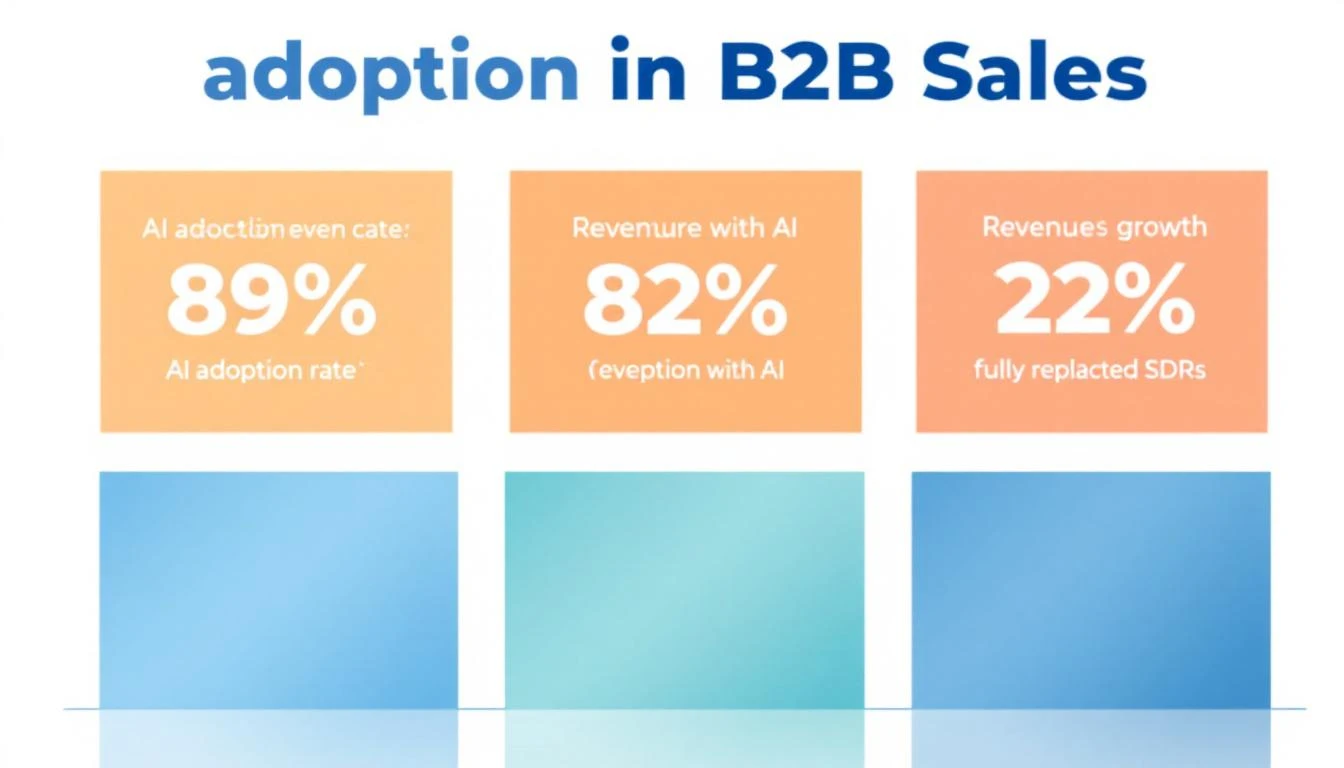
  • 89% of revenue organizations now use AI in some form โ€” up from 34% in 2023 (Martal Group, Forrester)
  • 88% of businesses report regular AI use in at least one function, up from 78% a year ago (Sopro)
  • 87% of sales organizations use AI for prospecting, forecasting, lead scoring, or drafting emails (Salesforce State of Sales 2026)
  • 92% of sales teams plan to increase AI investment in 2026 (HubSpot)

That looks like universal adoption. But dig deeper and you find a critical gap.

Deloitte Digital's February 2026 study of 1,060 B2B suppliers and buyers found that while 45% of suppliers say they use AI in sales, only 24% have touched agentic AI โ€” the autonomous, workflow-driving kind that actually replaces manual processes. Two-thirds of those not using agentic AI said they plan to. But planning isn't doing.

The data tells us: everyone has AI. Almost nobody has deployed it effectively.

The Performance Gap: AI-Enabled Teams Are Pulling Awayโ€‹

Here's the number that should keep every sales leader up at night.

83% of sales teams using AI saw revenue growth in the past year, versus 66% of teams without AI (Salesforce). That's a 17-percentage-point gap in revenue growth โ€” and it's widening.

More data points from across the studies:

MetricAI-Enabled TeamsNon-AI TeamsGap
Revenue growth83% saw growth66% saw growth+17 pts
Productivity improvementUp to 40%Baseline+40%
Sales cycle length25% shorterBaseline-25%
Revenue increase13-15%Baseline+13-15%
Sales ROI improvement10-20%Baseline+10-20%
ROI within first year86%N/Aโ€”

Sources: Salesforce State of Sales 2026, McKinsey, Sopro, MarketsandMarkets

Deloitte found an even starker divide. Digitally mature B2B suppliers exceeded annual sales growth targets by 110% more than low-maturity competitors. These mature organizations were five times more likely to use AI extensively and five times more likely to use agentic AI at all.

The takeaway: AI isn't a nice-to-have. It's creating a two-tier system in B2B sales. Teams with effective AI implementations are compounding their advantages while everyone else debates whether to adopt.

The AI SDR Paradox: Volume Up, Quality Downโ€‹

This is where the data gets uncomfortable for AI SDR vendors.

The AI SDR market is exploding โ€” projected to grow from $4.12 billion in 2025 to $15.01 billion by 2030 at a 29.5% CAGR (MarketsandMarkets). An estimated 22% of sales teams have fully replaced their human SDR function with AI. Another 55% are running AI-augmented workflows.

But here's the paradox the vendors won't tell you:

AI SDR tools churn at 50-70% annually โ€” roughly double the turnover rate of the human reps they replace (UserGems). And Gartner predicts over 40% of agentic AI projects will be abandoned by 2027.

The root cause? A quality gap:

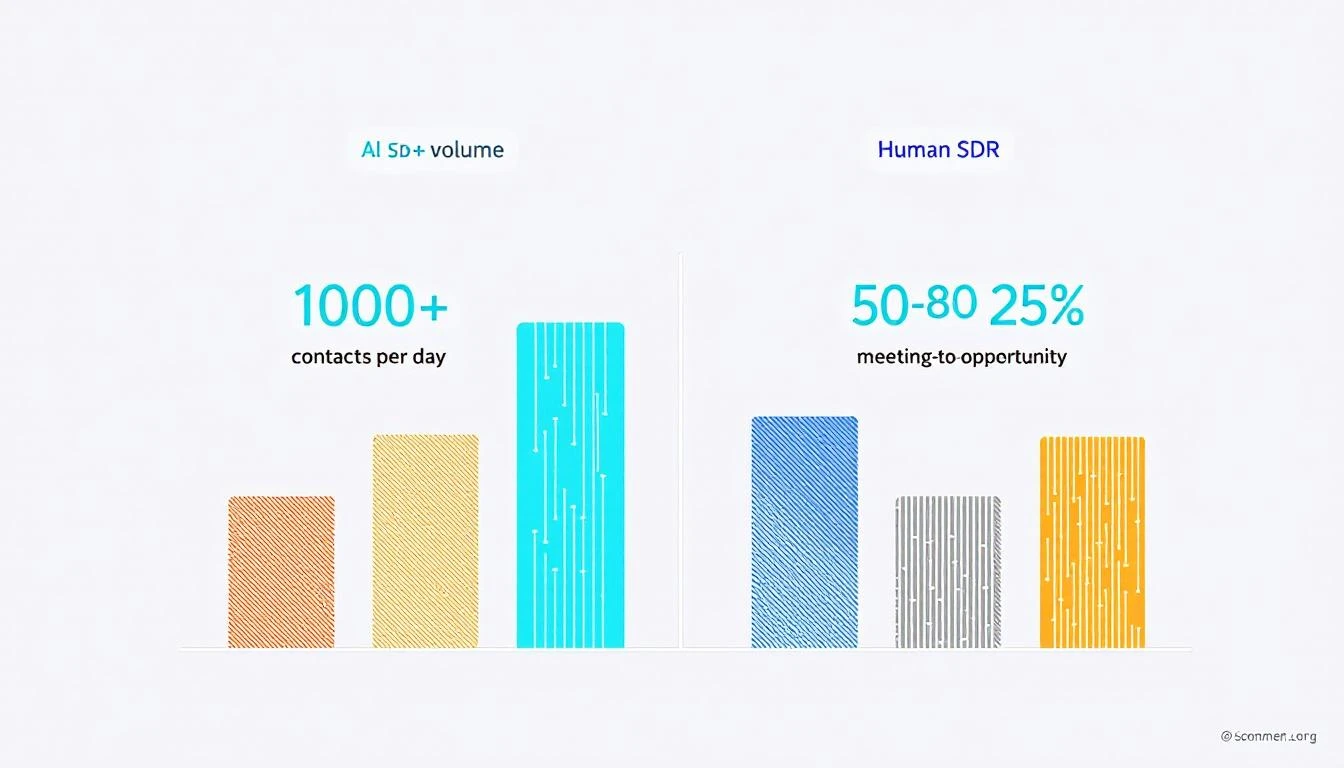
  • AI SDRs process 1,000+ contacts per day vs. 50-80 for a human rep (SuperAGI)
  • But AI SDRs convert meetings to opportunities at just 15% vs. 25% for human SDRs โ€” a 40% performance gap (SuperAGI)
  • Response to inbound: AI responds in seconds. First responder wins deals at 5x the rate of slower competitors
  • Follow-up: 44% of human reps give up after one attempt. AI never stops following up

So AI wins on volume and consistency but loses on conversion quality. The teams getting the best results? They're not choosing one or the other.

AI SDR maturity spectrum in 2026

The Winning Formula: Augmentation Beats Replacementโ€‹

Across every study we analyzed, one pattern emerges consistently: AI-augmented teams outperform both fully automated and fully manual teams.

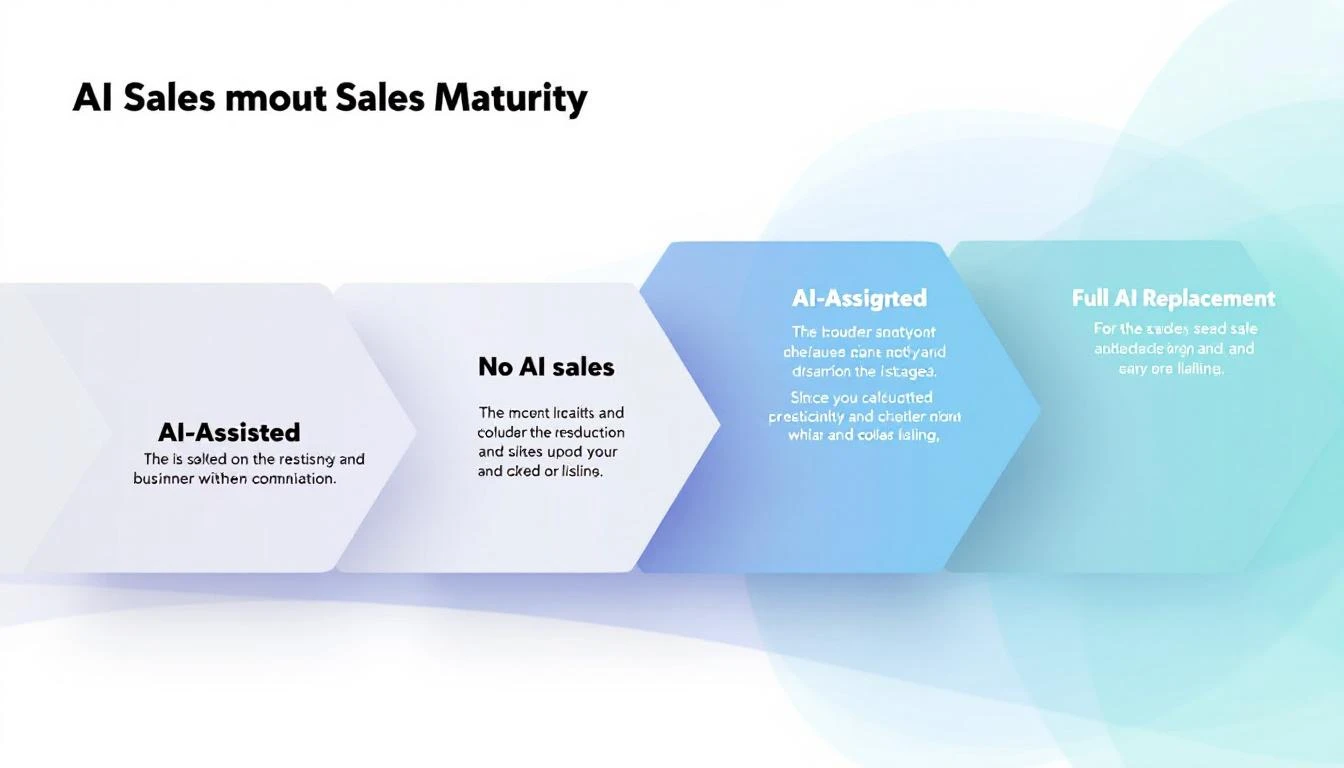
The adoption spectrum breaks down like this:

Approach% of TeamsPerformance
Full AI replacement22%High volume, lower quality
AI-augmented (human + AI)~55%Highest overall performance
AI-assisted (copilot only)~15%Moderate improvement
No AI~8%Falling behind

Source: Autobound AI SDR Buying Guide 2026, cross-referenced with Salesforce and Topo.io data

The augmented model works because it pairs AI's strengths with human strengths:

Where AI excels (let it run):

  • Prospect identification and research (synthesizing SEC filings, hiring data, social activity in seconds vs. 30-60 minutes per prospect for humans)
  • Consistent follow-up cadences (AI never forgets, never has a bad day)
  • After-hours and surge inbound handling
  • Lead scoring and signal prioritization
  • Data enrichment and contact discovery

Where humans still win (keep them in the loop):

  • Complex objection handling
  • Relationship building and trust development
  • Nuanced multi-stakeholder negotiations
  • Creative problem-solving for unique prospect situations
  • Reading tone and emotional context

The SignalFire team put it perfectly after testing AI SDR tools in production: "The most successful sales organizations of the future won't be the ones that replace their SDRs with AI. They'll be the ones who empower them with it."

What's Actually Delivering ROI: The Signal-First Approachโ€‹

Here's where the data gets prescriptive. Not all AI sales investments deliver equal returns.

Tier 1: Proven ROI (Invest Now)โ€‹

Intent signals + lead prioritization

  • Conversion rates rise 20-30% when companies integrate predictive AI into their marketing and sales workflows (Sopro)
  • Only 24% of teams with intent data report exceptional ROI โ€” the difference is activation quality, not data quality (Autobound)
  • Signal-based prospecting generates 5.4x more pipeline with 33% fewer calls (from our prior signal quality analysis)

AI-powered research and personalization

  • AI research agents that surface job changes, funding events, and buying signals allow SDRs to write genuinely relevant outreach โ€” not template spam
  • This is where the highest-performing AI-augmented teams invest first: give humans better information, not better email templates

Chatbots for inbound qualification

  • The most straightforward and valuable use case according to multiple studies
  • Responds to every inbound lead instantly, qualifies, and books meetings 24/7
  • Some teams report 25-30% uplift in conversion just from better lead qualification and scoring

Tier 2: Promising But Conditional (Pilot Carefully)โ€‹

AI-generated email sequences

  • Volume is up. Deliverability is down. The inbox is a battleground.
  • Generic mass-personalized emails (name swap + company swap) get deleted immediately
  • What works: AI that researches THEN personalizes, not AI that templates at scale
  • Rule of thumb: if the AI writes the email AND sends it without human review, expect lower quality meetings

AI cold calling / voice agents

  • Latency and robotic feel remain issues
  • The winning pattern: AI makes the dial, AI qualifies interest, then transfers to a human immediately upon positive signal
  • Legal risks (TCPA, consent, autodialer definitions) remain significant

Tier 3: Overhyped (Proceed With Caution)โ€‹

Full SDR replacement

  • The 50-70% churn rate tells you everything
  • The 40% meeting-to-opportunity quality gap means you're trading SDR salary for lower-quality pipeline
  • Works only for very specific use cases: high-volume, low-ACV, simple sales motions

AI forecasting as a standalone tool

  • Garbage in, garbage out. AI forecasting is only as good as your CRM hygiene
  • Most teams don't have clean enough data to make AI forecasting meaningful
  • Better to fix pipeline stage definitions first, then add AI on top

AI vs human SDR performance comparison 2026

The ERP Problem Nobody Talks Aboutโ€‹

Deloitte's research surfaced a finding that most AI sales articles completely ignore.

87% of B2B suppliers are currently upgrading, preparing to begin, or planning ERP modernization within the next year. These projects are multi-million-dollar, multi-year initiatives that absorb the IT bandwidth that AI projects need.

As Deloitte's Paul do Forno noted: "They literally don't have the time. They need to get through the ERP running their business."

This means even when sales leaders want to deploy sophisticated AI, internal IT constraints are the real bottleneck โ€” not budget, not skepticism, not technology readiness. The suppliers pulling ahead are the ones who pair AI deployment with (not after) their ERP modernization, building tighter front-to-back integration.

For sales teams at mid-market companies: don't wait for IT to finish the ERP migration before starting your AI pilot. Choose tools that sit alongside your existing stack rather than requiring deep integration. Start with standalone signal tools and AI research assistants that don't need CRM integration to deliver value.

The Conversion Math Most Teams Get Wrongโ€‹

Here's a framework from the data that most sales leaders miss.

The median B2B conversion rate across all industries is 2.9%, with most falling between 2.0% and 5.0% (Martal Group). But the real bottleneck isn't top-of-funnel โ€” it's the middle.

MQL-to-SQL conversion: only ~15% of marketing-qualified leads convert to sales-qualified leads.

This means pouring more AI-generated leads into the top of your funnel without fixing the qualification gap just creates more waste. The highest-ROI AI investment for most teams isn't generating more leads โ€” it's better qualifying the leads you already have.

This is where signal-based selling changes the equation:

  1. Visitor identification tells you WHO is on your site
  2. Intent signals tell you WHAT they care about
  3. A daily playbook tells your SDR exactly WHAT TO DO about it

Most AI sales tools give you step 1 and maybe step 2. Very few connect the signal to the action. That connection is where the 20-30% conversion lift actually comes from.

What to Do Monday Morningโ€‹

Based on our meta-analysis, here's the priority stack for sales leaders who want to be on the winning side of the AI divide:

If you're spending nothing on AI sales tools:

  1. Start with an AI chatbot for your website (instant ROI, low risk)
  2. Add a signal/intent tool to prioritize your existing pipeline
  3. Use AI research tools to enrich prospect profiles before outreach

If you're already using AI but not seeing results:

  1. Stop measuring emails sent. Start measuring meetings booked and pipeline generated
  2. Move from full automation to human-in-the-loop augmentation
  3. Invest in signal quality over outreach volume
  4. Fix your MQL-to-SQL conversion gap before adding more top-of-funnel

If you're seeing good results and want to scale:

  1. Build a daily SDR playbook that converts signals into specific next actions
  2. Layer first-party intent (website visitors, chatbot conversations) with third-party signals
  3. Consolidate your tool stack โ€” the average SDR uses 7-12 tools, but the best teams use 3-4 integrated ones

The Bottom Lineโ€‹

AI in B2B sales isn't hype โ€” the 17-point revenue growth gap between AI-enabled and non-AI teams is real and widening. But how you deploy AI matters more than whether you deploy it.

The data is clear:

  • Augmentation beats replacement. Human + AI outperforms AI-only and human-only.
  • Signal quality beats outreach volume. Better leads beat more leads, every time.
  • Implementation quality is the variable. The technology works. The question is whether your team can operationalize it.
  • Start with signals, not sequences. Know who's buying before you decide what to send.

The teams winning in 2026 aren't the ones with the most sophisticated AI. They're the ones using AI to put the right signal in front of the right rep at the right time โ€” and then letting the human do what humans do best.


Want to see signal-based selling in action? MarketBetter turns intent signals into a daily SDR playbook that tells your team exactly who to contact, how to reach them, and what to say. Book a demo โ†’


Sourcesโ€‹

  1. Salesforce, State of Sales 2026
  2. Deloitte Digital, B2B Supplier Digital Maturity Study (Feb 2026)
  3. Martal Group, B2B Sales Statistics and Benchmarks 2026
  4. Sopro, 75 Statistics About AI in Sales and Marketing (2025)
  5. MarketsandMarkets, AI SDR Market Report (Aug 2025)
  6. Gartner, Strategic Predictions for 2026
  7. McKinsey, AI in Sales Performance (2025)
  8. HubSpot, State of AI in Sales (2025)
  9. SuperAGI, AI vs Traditional SDRs Performance Analysis
  10. Autobound, AI SDR Buying Guide 2026
  11. UserGems, Are AI SDRs Worth It? (2025)
  12. SignalFire, Expert Picks: AI SDR Tools (2026)
  13. Landbase, 35 B2B Sales Statistics (2026)
  14. Topo.io, AI SDR Adoption Survey (2025)
  15. Forrester, B2B Buyer Behavior (2026)
  16. Digital Commerce 360 / Deloitte Digital (Feb 2026)
  17. MarketsandMarkets / Fortune Business Insights projections
  18. Salesmate, AI Agent Adoption Statistics by Industry (2026)
  19. PwC, 2026 AI Business Predictions
  20. Netguru, AI Adoption Statistics (2025)

How IoT Connectivity Platforms Use Champion Job Change Signals to Reactivate Dormant Pipeline Worth $500K+

ยท 9 min read
MarketBetter Team
Content Team, marketbetter.ai

If you sell IoT connectivity โ€” cellular modules, SIM management, device platforms โ€” you know a painful truth: your deals die when your champion leaves.

The average enterprise IoT deal takes 6โ€“9 months to close. You've navigated procurement, security reviews, technical evaluations, and pilot programs. Then one morning, your champion's LinkedIn updates to a new title at a new company. Your deal goes cold overnight.

For most IoT sales teams, that's where the story ends. The deal sits in a "closed-lost" or "stalled" bucket. Nobody follows up. The new company your champion joined? Nobody even notices.

But for one global IoT cellular connectivity platform running SDR teams across EMEA, the US, and Latin America, champion job changes became their single highest-converting signal โ€” turning what used to be lost pipeline into a reliable revenue engine.

Here's how they did it.

IoT connectivity champion job change pipeline

The Problem: A Global Team Drowning in Cold Outboundโ€‹

This company โ€” an enterprise IoT cellular connectivity platform โ€” had a familiar setup that wasn't scaling:

  • Three regional SDR teams: EMEA, US, and Latin America (including a Spanish-speaking rep dedicated to the LatAm market)
  • Long sales cycles: 6โ€“12 months for enterprise deals involving hardware integrations
  • High champion turnover: IoT product managers and engineering leads change roles frequently, especially in fast-growing verticals like logistics, fleet management, and smart agriculture
  • CRM full of ghosts: Hundreds of contacts marked as "left company" or "no longer responds" โ€” with no systematic way to track where they went

The sales team was spending 70% of their time on cold outbound. They'd source lists from conferences, scrape LinkedIn, and blast generic sequences. Response rates hovered around 1.2%.

Meanwhile, their best deals โ€” the ones with a warm champion who already understood IoT connectivity โ€” were leaking out the side door every quarter.

The Hidden Cost Nobody Measuredโ€‹

Here's what the leadership team didn't realize until they ran the numbers:

  • 42 champions had left target accounts in the previous 12 months
  • Those champions had been associated with $2.1M in pipeline (at various stages)
  • Of those 42, at least 18 had moved to companies that also needed IoT connectivity
  • Zero of those 18 transitions had been flagged or followed up on

They weren't just losing deals. They were losing their warmest possible pipeline source โ€” people who already knew the product, trusted the team, and had budget authority at a new organization.

The Signal-Based Approach: Champion Tracking Meets Territory Intelligenceโ€‹

The transformation started when the team stopped treating champion departures as losses and started treating them as signals.

Step 1: Map Every Champion to a Job Change Alertโ€‹

Instead of relying on reps to manually check LinkedIn (they didn't), the team implemented automated champion tracking that monitored every contact who had:

  • Attended a demo or technical evaluation
  • Been the primary point of contact on a deal
  • Engaged with more than 3 emails in a sequence
  • Downloaded technical documentation or API specs

When any of these contacts changed jobs, the system flagged it in real time โ€” not weeks later when someone happened to notice.

Step 2: Route Alerts to the Right Regional Repโ€‹

This is where most champion tracking implementations fall apart. The alert fires, but it goes to a general inbox or the wrong rep.

For a global team spanning EMEA, US, and Latin America, routing matters enormously:

  • A champion who moved from a logistics company in Germany to a fleet management startup in Sรฃo Paulo needed to be routed to the Spanish-speaking LatAm rep โ€” not the EMEA SDR who originally owned the relationship
  • A champion who moved from an agriculture IoT company in Iowa to a smart city project in London needed to go to the EMEA team
  • A champion who stayed in the US but moved to a competitor's customer needed special handling โ€” a different playbook entirely

The team built territory-aware routing rules that matched job change alerts against intent signals, ensuring the right rep got the right signal at the right time.

Step 3: Create a Champion Reactivation Playbookโ€‹

Cold outbound to a stranger gets a 1โ€“2% response rate. But reaching out to a former champion who already knows your product? That's a fundamentally different conversation.

The team developed a three-touch playbook specifically for champion job changes:

Touch 1 (Day 1): The Warm Reconnection A personal email from the original account owner, congratulating them on the new role and asking if IoT connectivity is relevant at the new org. No pitch. Just a human check-in.

Touch 2 (Day 4): The Value Reminder A brief message referencing what they'd accomplished together โ€” "You were evaluating our cellular connectivity for your fleet management platform. Does [new company] have similar needs?" This leverages shared history that no competitor can replicate.

Touch 3 (Day 10): The Multi-Channel Follow-Up A LinkedIn connection request from the regional rep (if different from the original contact), plus a phone call using the smart dialer. By this point, they've warmed the contact across three channels.

Step 4: Cross-Reference with Visitor Intelligenceโ€‹

Here's where it got really powerful. The team layered champion job change signals on top of website visitor identification.

When a former champion's new company showed up on the website โ€” visiting the pricing page, the API documentation, or the coverage maps โ€” that was a compound signal. It meant the champion was likely already evaluating IoT connectivity options at their new org and had come back to the platform they already knew.

These compound signals (champion moved + new company visiting website) had a 34% demo booking rate โ€” nearly 30x their cold outbound average.

The Results: From Pipeline Graveyard to Revenue Engineโ€‹

After six months of running the champion reactivation program:

MetricBeforeAfter
Champion job changes detected per quarter038
Reactivation outreach response rateN/A41%
Demos booked from reactivation signals014/quarter
Pipeline reactivated$0$540K
Cold outbound response rate1.2%Unchanged (but volume reduced 40%)
Average deal velocity (reactivated)N/A67 days (vs. 180 days for new prospects)

The most striking finding: deals sourced from champion reactivation closed 2.7x faster than net-new pipeline. Why? Because the champion already understood the technology, had internal credibility at their new organization, and could shortcut the evaluation process.

The LatAm Breakthroughโ€‹

The Spanish-speaking SDR covering Latin America saw the most dramatic results. The LatAm IoT market is relationship-driven โ€” cold outbound from a US-based company rarely converts. But when a former champion who had evaluated the platform in a US role moved to a LatAm company, the warm connection transcended the typical regional trust barrier.

Three of the team's largest LatAm deals in the period came from champion reactivation โ€” all from contacts who had originally engaged through the US team.

Why This Matters for IoT and Telecom Specificallyโ€‹

Champion tracking works in any B2B vertical, but it's disproportionately valuable in IoT and telecom for several reasons:

1. Technical Champions Are Rare and Valuableโ€‹

Not every buyer understands cellular connectivity, eSIM management, or device-to-cloud architecture. When you find someone who does โ€” and who's already been through your technical evaluation โ€” losing them is catastrophic. Champion tracking for startups is especially critical when your total addressable market of qualified technical buyers is small.

2. IoT Has High Switching Costsโ€‹

Once an IoT platform is embedded in a product, switching is expensive. Champions know this. When they move to a new company and need connectivity, they're strongly inclined to go with what they already know โ€” if you reach them first.

3. Global Teams Need Automated Routingโ€‹

IoT companies typically sell across regions with distinct languages, regulations, and buying behaviors. Manual champion tracking doesn't scale across time zones. Automated intent signals with territory-aware routing solve this.

4. Conference-Driven Relationships Compoundโ€‹

IoT is a conference-heavy industry (MWC, CES, Embedded World, IoT World). Champions you met at events two years ago are some of your warmest contacts โ€” but only if you're tracking where they go. Layer event-driven signals on top of job change alerts for maximum coverage.

How to Build Your Own Champion Reactivation Engineโ€‹

If you're selling IoT connectivity, telecom infrastructure, or any technical B2B product with long sales cycles, here's how to get started:

Step 1: Audit Your CRM for Champion Dataโ€‹

Pull every contact from the last 24 months who:

  • Attended a demo or technical call
  • Was the primary contact on a deal (won or lost)
  • Engaged meaningfully with your content or documentation

This is your champion database. For most IoT companies, it's 200โ€“500 contacts.

Step 2: Implement Automated Job Change Monitoringโ€‹

Stop relying on LinkedIn stalking. Set up automated alerts that fire the moment a champion updates their role. The faster you act on a job change, the higher your conversion rate โ€” speed matters more than signal quality in the first 72 hours.

Step 3: Build Territory-Aware Routingโ€‹

If you have regional teams, ensure alerts route to the right rep based on the champion's new company location, not their old one. A champion who moves from EMEA to LatAm shouldn't stay with the EMEA SDR.

Step 4: Create Differentiated Playbooksโ€‹

Champion reactivation is NOT regular outbound. Don't put these contacts into your standard 12-email drip sequence. They deserve a personal, high-touch approach that leverages your shared history.

Step 5: Layer with Visitor Intelligenceโ€‹

The compound signal (champion moved + new company visiting your site) is gold. Make sure your visitor identification system is running so you can catch these overlaps.

The Bottom Lineโ€‹

IoT and telecom companies are sitting on a pipeline goldmine they don't even know about. Every champion who leaves a target account isn't a loss โ€” it's a signal. Every "closed-lost" deal with a departed champion isn't dead โ€” it's dormant, waiting for the right trigger.

The companies that systematically track these movements, route them intelligently across global teams, and activate them with the right playbook are seeing results that make cold outbound look like a rounding error.

Your champions are already out there, starting new roles, evaluating new vendors, and remembering the platforms that treated them well. The only question is whether you'll find them before your competitor does.


MarketBetter combines website visitor identification, champion job change tracking, and AI-powered signal routing to help B2B sales teams โ€” including IoT and telecom companies โ€” build pipeline from their warmest signals. See how it works โ†’

The Complete Guide to B2B Intent Data: From Signals to Pipeline [2026]

ยท 18 min read
sunder
Founder, marketbetter.ai

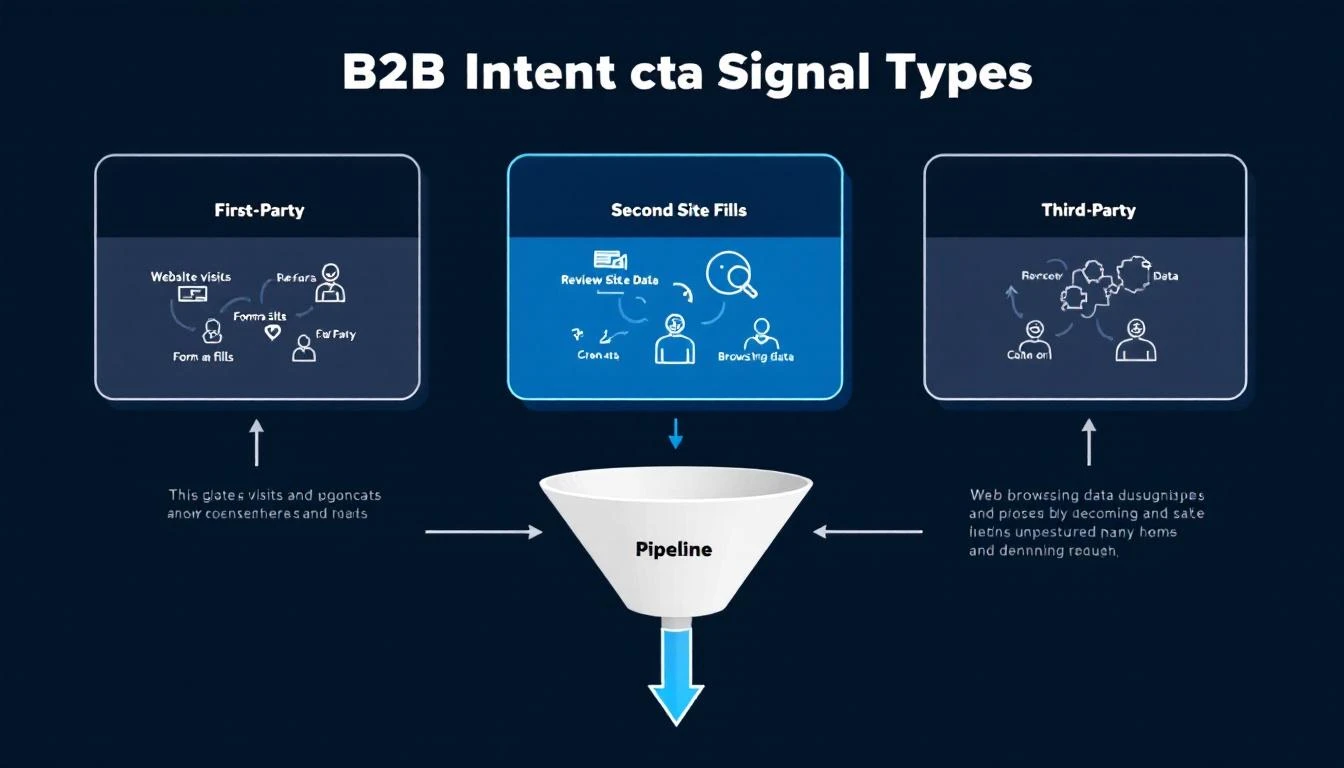
B2B intent data signal types flowing into a sales pipeline

Your best prospects are researching solutions like yours right now. They're reading comparison articles, checking G2 reviews, attending webinars, and visiting your pricing page.

But they haven't filled out a form. They haven't booked a demo. As far as your CRM is concerned, they don't exist.

This is the reality of B2B buying in 2026: up to 70% of the buyer journey happens in the dark funnel โ€” the invisible research phase where buyers evaluate vendors without ever raising their hand. By the time they contact sales, they've already shortlisted 2-3 vendors. If you're not on that shortlist, you're not in the deal.

Intent data changes the equation. Instead of waiting for buyers to come to you, it reveals who's actively researching solutions in your category โ€” so you can engage them while they're still making decisions.

The B2B buyer intent data market is worth an estimated $4.5 billion in 2026, growing at a 15.9% CAGR. But market size doesn't mean market maturity. Most sales teams still get intent data wrong โ€” buying expensive signals they can't activate, drowning SDRs in noise instead of giving them focus.

This guide covers everything: what intent data actually is, the different types and where they come from, how to evaluate providers, implementation frameworks that work, and the mistakes that burn budgets.