122 posts tagged with "Sales Playbooks"

Cold calling scripts, outbound strategies, SDR workflows, and objection handling

View All Tags

A Modern Guide to B2B Indicators of Interest

· 19 min read

Indicators of interest are the digital breadcrumbs your prospects leave behind. They're the actionable clues that tell you what they need, when they need it, and if they're a good fit for your solution.

Think of it this way: old-school outreach is like shouting into a crowded stadium, hoping someone hears you. Signal-based selling is like walking up to the person waving a flag with your logo on it. These indicators let your sales team stop shouting into the void and start talking to people who are already listening.

Beyond Cold Calls: Why Indicators of Interest Matter
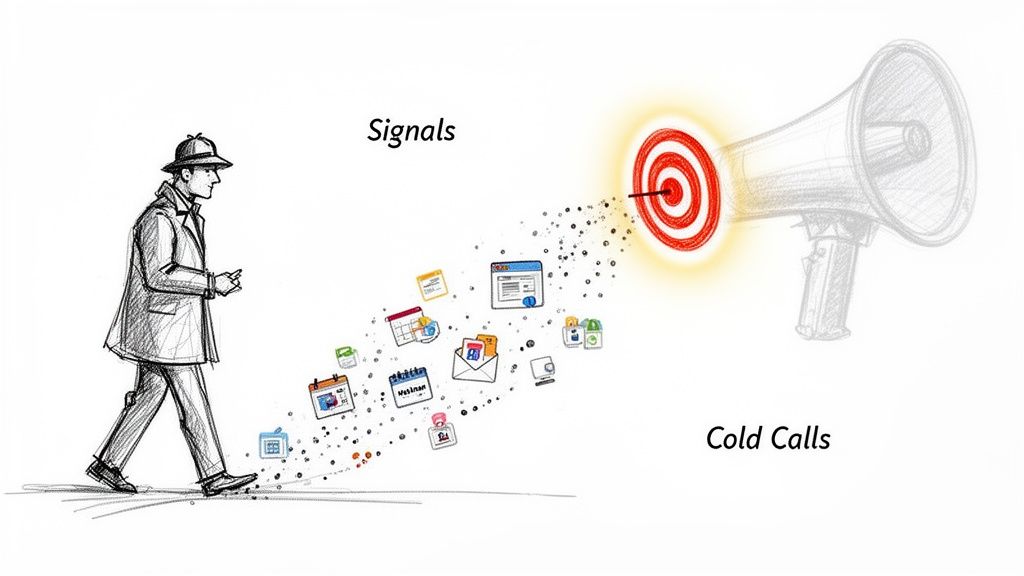
A detective follows digital signals, leading to a targeted bullseye amplified by a megaphone for cold calls.

We've all seen it. An SDR stares at a massive list of cold accounts, feeling the weight of the day ahead. The old playbook is simple: make dozens of calls, send hundreds of generic emails, and just hope something lands. It’s a recipe for burnout, high rejection rates, and a whole lot of wasted energy.

The modern sales motion is a complete strategic shift. It’s less of a brute-force attack and more like a detective following a trail of evidence. Instead of blasting the same message to everyone, top-performing teams hunt for indicators of interest—the subtle hints prospects drop online that show they’re getting ready to buy.

Shifting from Volume to Precision: A Quick Comparison

This isn't just a small tweak; it's a fundamental shift in philosophy. The old way is a numbers game, a relentless focus on activity volume. The new way is a precision game, built on timing and relevance. One is based on luck, the other on evidence.

  • Old Method (Volume): An SDR gets a static list of 200 companies that match your Ideal Customer Profile (ICP). They then spend hours digging for basic info, making cold calls with zero context, and dealing with abysmal connection rates. It's a grind.
  • New Method (Precision): An SDR gets a dynamic, prioritized list. These accounts don't just fit the ICP—they've also just visited your pricing page, downloaded a case study, or had a key decision-maker start a new role.

This one change transforms an SDR from a generic cold caller into a timely, relevant problem-solver. It directly attacks the biggest pain point in sales development: all those wasted hours spent chasing ghosts. You focus your team’s effort exactly where it’s most likely to pay off.

A huge piece of this puzzle is third-party intent data, which tells you what’s happening outside your own website. We break it all down in our guide on what is intent data.

The Four Core Types of Buying Signals
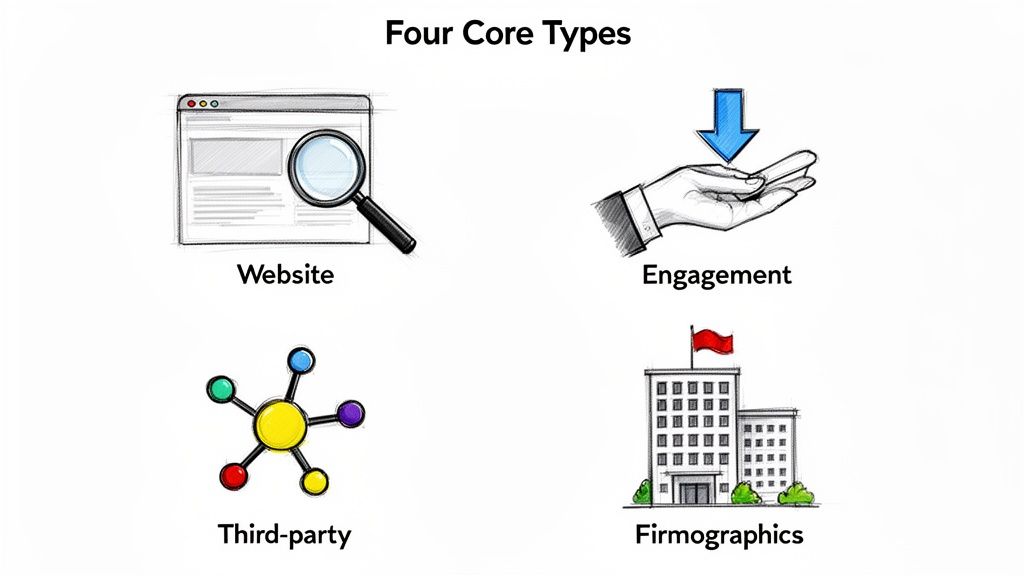
A diagram illustrating four core types: Website, Engagement, Third-party, and Firmographics.

Not all buying signals are created equal. Far from it.

Think of an SDR as a detective. Some clues are faint whispers, while others are practically a signed confession. Learning to tell the difference is what separates top performers from everyone else. It’s the key to knowing where to spend your time and how to craft outreach that actually lands.

These indicators of interest fall into four main buckets, and each one tells you a different part of the prospect's story. If you only look at one, you’re trying to solve a puzzle with most of the pieces missing. The real magic happens when you see how they all fit together.

1. First-Party Website Behavior

These are the most valuable signals, hands down. Why? Because they’re happening on your home turf—your website. This is what a prospect does when they're actively researching your solution. It’s the digital equivalent of someone walking into your store and looking around.

Every click tells a story. A quick visit to your blog suggests mild curiosity. But a long visit to your pricing page? That’s a five-alarm fire. You need to act on that immediately.

A prospect spending more than two minutes on your pricing page is one of the strongest buying signals you can get. That isn't just research; it's serious consideration.

These signals are your secret weapon because your competitors can't see them. It's your head start. Key examples include:

  • High-Intent: Multiple visits to key product or solution pages.
  • High-Intent: Watching a full product demo video.
  • Critical Intent: Starting the "Request a Demo" form but not finishing.

2. Active Engagement Signals

While website behavior is about what prospects do anonymously, active engagement is what happens when they willingly identify themselves. They trade their contact info for something valuable, stepping out from the shadows and turning from a visitor into a known lead.

This is a direct invitation to start a conversation. They've given you permission to reach out, so your follow-up should be timely and directly related to what they engaged with.

For instance, someone downloading a top-of-funnel eBook on industry trends is probably just starting their research. But someone who registers for a product-focused webinar? They're much further along and signaling a deeper interest in what you specifically offer.

3. Third-Party Intent Data

This is where you get to see what your target accounts are doing across the rest of the internet, long before they ever find your website. It’s like seeing the "digital body language" of an entire company.

This data flags when a target account suddenly starts researching topics, problems, or competitors related to your business. Maybe several people from that company are all reading reviews of "sales automation platforms." That’s a massive signal that they’re in-market, giving you a chance to engage a net-new opportunity before anyone else.

4. Strategic Firmographic Triggers

Finally, firmographic triggers aren’t about individual research behavior. They’re about company-level events that create a perfect window of opportunity for a purchase. These are changes at an organization that signal a new need or a fresh budget.

  • New Executive Hire: A new VP of Sales is almost always hired to make changes. They're most open to new tools in their first 90 days.
  • Company Funding: A recent funding round means they have cash to spend on tools that will fuel growth.
  • Hiring Sprees: If a company is posting tons of new sales roles, they're going to need software to support that growing team. Very soon.

To give you a clearer picture of how these signals stack up against each other, here’s a quick comparison.

Comparing the Four Main Types of B2B Buying Signals

This table breaks down each signal type, showing you where it comes from, how strong the intent usually is, and the best way for an SDR to jump on it.

Signal TypeExampleTypical Intent LevelActionable Next Step
Website BehaviorVisited the pricing page 3 timesVery HighImmediate, personalized call/email referencing their potential interest in ROI.
Active EngagementDownloaded an eBook on "AI in Sales"MediumNurturing email sequence offering more resources on the same topic.
Third-Party DataCompany is researching your competitorsHighProactive outreach to key personas, highlighting your unique differentiators.
Firmographic TriggerJust hired a new CMOMedium to HighWelcome/congratulatory email to the new hire, offering relevant industry insights.

Bringing these four types of signals together gives you a complete, 360-degree view of your target accounts. It’s how you move from guessing to knowing exactly who to call and what to say.

For a deeper dive into quantifying these signals, check out this great guide on understanding lead scoring in HubSpot.

How to Turn Raw Signals Into Actionable Outreach

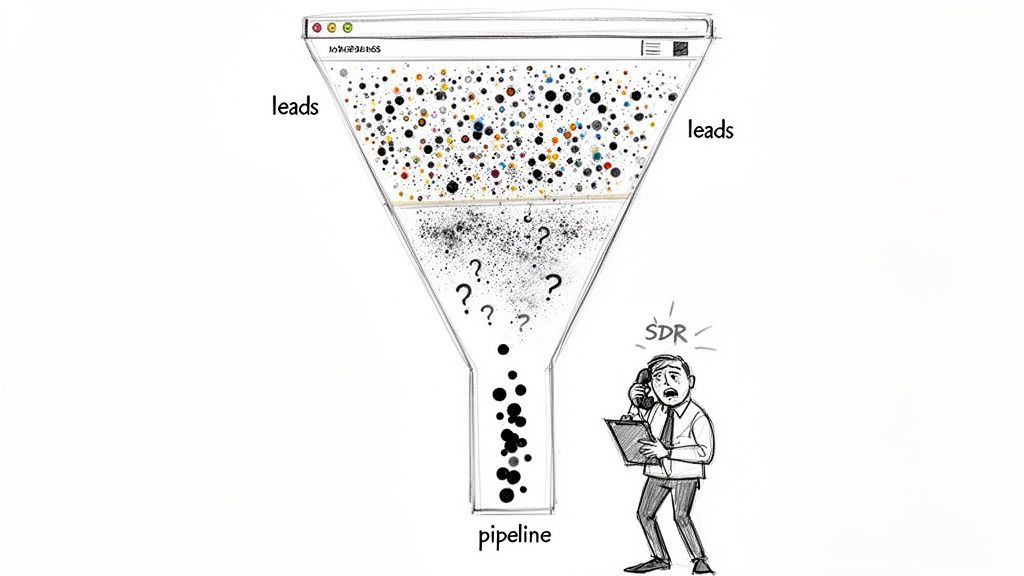
Getting a flood of buying signals feels like a win, but it can quickly turn into a nightmare. When your team is drowning in raw indicators of interest without a clear path forward, they do what anyone would do: they fall back on old habits. They start working through a static, alphabetical list of accounts.

The real trick isn't just collecting signals. It's turning them into a prioritized, actionable game plan for your sales team.

This comes down to a simple but powerful framework that balances two things: fit and interest. "Fit" is all about how well an account matches your Ideal Customer Profile (ICP). "Interest" is about the strength and timing of their recent buying signals. An account that scores high on both? That's your #1 call.

The goal is to get out of reactive mode and into proactive engagement. Stop asking, "What happened last week?" and start giving your team a list that answers, "Who should I call right now, and why?"

This shift is a massive efficiency booster. One of the biggest drags on sales development is all the non-selling work. Recent benchmarks show reps spend just 30% of their week actually selling. The other 70% gets eaten by admin tasks like research and data entry. (If you want to dig into that, this 2025 sales development report has some great insights.) A smart prioritization model gives that time back.

Manual Spreadsheets vs. Automated Workflows: A Comparison

So, how do you actually put this into practice? The difference between a manual and automated approach is the difference between a leaky raft and a speedboat.

  • The Manual Way (Spreadsheet Hell): A RevOps manager spends Monday morning exporting data from a dozen different tools, trying to stitch it all together. They cross-reference CRM data with website analytics and third-party intent scores. It’s a tedious, error-prone mess that’s already stale by the time the SDRs see it. The result is a static list that doesn't adapt to real-time signals.
  • The Automated Way (AI-Driven Workflow): An integrated platform does all this heavy lifting in real-time. It’s constantly processing signals, scoring accounts on fit and interest, and creating prioritized tasks right inside your team's CRM. This delivers a dynamic to-do list where every single action is backed by a specific, timely signal. Reps can see the why and act instantly.

An integrated system transforms a messy spreadsheet into a dynamic engine for outbound lead generation.

Creating a Prioritized Task List

The end result of an automated system is a simple, powerful task list that gives each SDR their next best action. Here’s what that looks like in the real world:

  • Action Plan for Priority 1 (Hot): These are ICP-fit accounts that hit your pricing page in the last 24 hours. Your Action: Immediate, personalized multi-channel outreach (call + email). Reference the potential business case they're building. No exceptions.
  • Action Plan for Priority 2 (Warm): Target accounts where you're seeing multiple contacts researching topics related to your solution. Your Action: Reach out to the most relevant persona, acknowledging their team's research and offering a high-value asset like a competitor comparison guide.
  • Action Plan for Priority 3 (Nurture): Companies that downloaded a top-of-funnel eBook or just hired a new executive. Your Action: Enroll them in a longer-term, educational nurture sequence. The goal is to build trust, not book a meeting tomorrow.

By systematically ranking these indicators of interest, you ensure your team’s most precious resource—their time—is always pointed at the accounts most likely to convert. You're not just giving them data; you're giving them direction.

Building Your Sales Playbook for High-Intent Signals

So, you've prioritized your accounts. The clock is officially ticking. Having a hot lead is great, but it's worthless without a clear, immediate plan of attack. This is where a sales playbook comes in—a set of predefined, actionable steps that turn strong indicators of interest into actual conversations.

The alternative? Leaving it all to chance. Your reps fire off generic, one-size-fits-all emails that get deleted on sight. A solid playbook ensures every high-intent signal is met with a timely, relevant, and context-aware response that acknowledges exactly where that buyer is in their journey.

This flowchart spells out the difference between a disorganized, manual outreach process and a streamlined, signal-based workflow. The contrast is pretty stark.
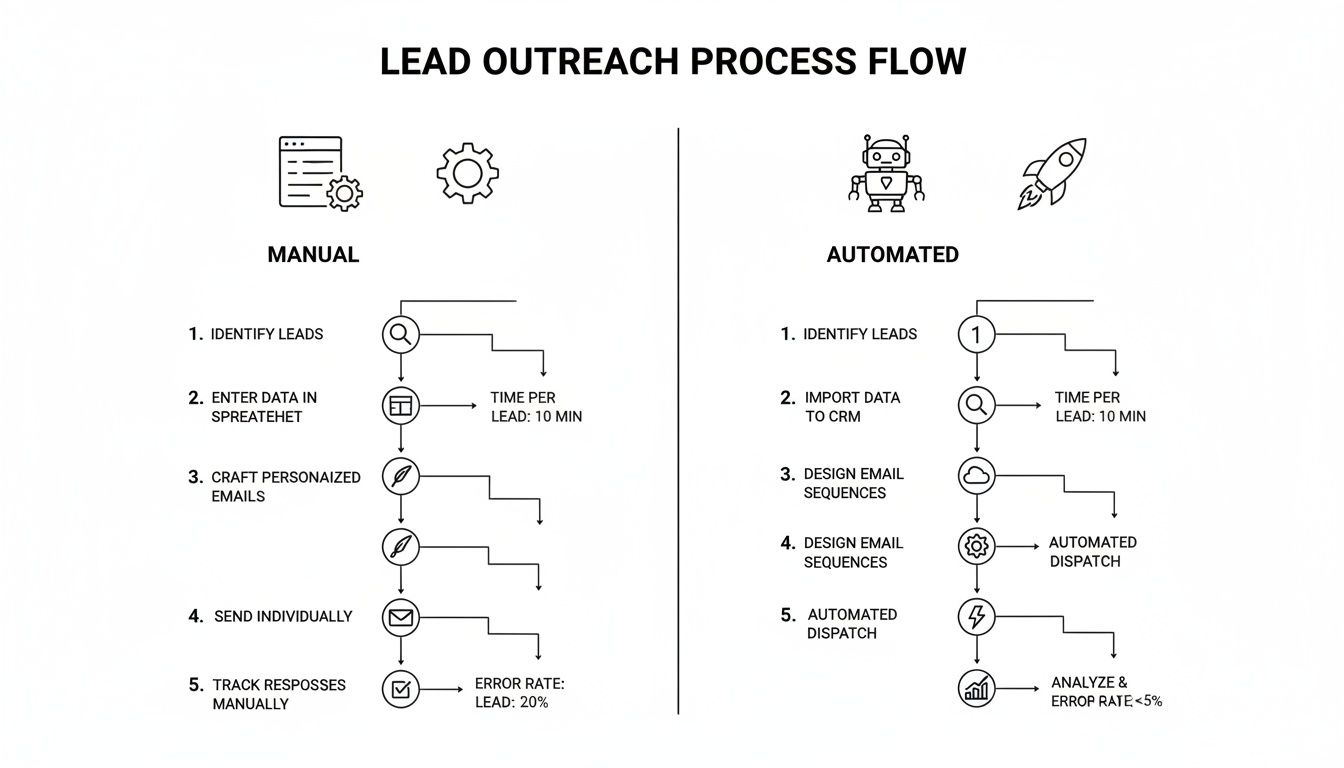
Flowchart comparing manual and automated lead outreach processes, detailing steps, time, and error rates.

It's clear how an automated, signal-first approach cuts through the chaos, turning manual guesswork into an effective system for turning interest into action.

Playbook 1: The Pricing Page Visitor

A visit to your pricing page is one of the loudest buying signals you'll ever get. This person isn't just kicking tires or researching a problem—they are actively evaluating solutions and trying to figure out the investment. Sending a generic "just checking in" email here is a massive own-goal.

Comparing Outreach Approaches

  • The Wrong Way (Generic): A bland email that completely ignores the context. It's self-serving and immediately delete-worthy.
  • The Right Way (Actionable): A helpful, non-pushy multi-touch sequence that acknowledges their journey and provides value.

Actionable Steps for Your Team:

  1. Email Within 1 Hour: Send a helpful, low-pressure email.
    • Subject: Resources for [Their Company Name]
    • Body Snippet: "Hi [Name], often when people are exploring our pricing, they're building a business case for a solution like ours. To help, here’s a one-page guide on calculating the ROI of [Your Solution Category]. Happy to walk you through it if that's helpful."
  2. Follow-up Call (Day 2): Use a value-driven script.
    • Talking Point: "I'm calling because I saw your team was looking into solutions like ours. I'm not trying to sell you right now, but I wanted to be a resource as you evaluate your options. What's the main challenge you're hoping to solve?"

Playbook 2: The New Executive Hire

When a new leader joins a target account, a window of opportunity swings wide open. They have a mandate to make changes and are often most receptive to new ideas and tools within their first 90 days. Your outreach needs to position you as a strategic partner who can help them score early wins.

Comparing Outreach Approaches:

  • The Wrong Way (Generic): Congratulating them and immediately asking for a meeting. This just feels self-serving.
  • The Right Way (Actionable): Congratulating them and offering a valuable, relevant resource that genuinely makes their new job easier.

Actionable Steps for Your Team:

  1. LinkedIn Connection (Day 1): Send a personalized connection request.
    • Note: "Congrats on the new role at [Company]! Looking forward to seeing what you accomplish. I've been following [Topic related to their role] and thought you might find this industry report useful."
  2. Email Follow-up (Day 3): Offer insights, not a sales pitch.
    • Subject: Congrats on the new role!
    • Body Snippet: "Hi [Name], saw the news about your new role—congratulations! Leaders in your position are often tasked with [Key Initiative] in the first 90 days. Here's a quick playbook we put together for C-level execs on achieving that. No pitch, just a resource I thought you'd find valuable."

Pipeline generation is the lifeblood of B2B growth. The median pipeline created by each SDR stands at $2.8 million annually, underscoring their huge revenue impact. Yet, with outbound SDRs averaging 94.4 daily activities, cold call conversion hovers at a dismal 2%. Signal-based playbooks are designed to fix this broken equation. To learn more, explore these key sales statistics that can shape your strategy.

The Right Tech for a Signal-Based Sales Motion
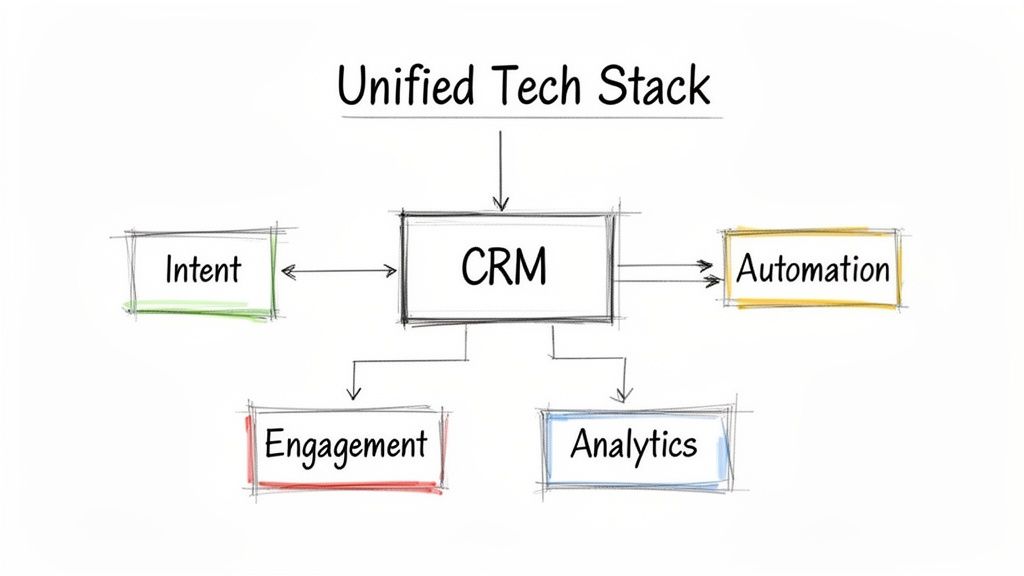
A diagram showing a Unified Tech Stack with CRM at its core, connecting Intent, Automation, Engagement, and Analytics.

A signal-based sales strategy is only as good as the engine running it. Without the right tech, the best indicators of interest just become noise—a flood of data that creates more busywork than actual pipeline.

This is where so many teams stumble. They try to patch together a system with duct tape and good intentions, but it just ends up slowing reps down. You’ve probably seen it: reps juggling separate tools for intent data, sales engagement, and the CRM, constantly switching tabs and copy-pasting info. It's a clunky, infuriating workflow that kills productivity.

A modern, integrated tech stack fixes this by getting all your tools to talk to each other. It’s not about just having the tools; it’s about making them work together as one cohesive machine.

Comparing a Disjointed vs. a Unified Stack

The difference in workflow and results between a disconnected and an integrated tech stack is night and day.

  • Disjointed Stack (The Problem): This creates operational headaches that will absolutely kneecap your sales motion. Intent data lives in one tool, engagement sequences in another, and account history is trapped in the CRM. Reps burn precious hours just trying to connect the dots, and hot signals go cold before anyone can act.
  • Unified Platform (The Solution): This setup transforms the entire workflow by living natively inside your CRM. It connects signal detection, task prioritization, and outreach into one fluid motion. It's the difference between handing your team a box of car parts and giving them the keys to a finely tuned engine.

The core idea is simple: bring the work to the rep, don't make the rep hunt for the work. A platform that automatically creates and prioritizes tasks inside the CRM eliminates the friction that kills momentum.

This native approach just works. It drives adoption because it fits into a rep's existing habits, and it guarantees better data hygiene since activities are logged automatically. Suddenly, leaders have real visibility into what’s driving performance.

This kind of efficiency has never been more critical. We’ve seen 36% of B2B companies downsize their SDR teams as they pivot away from high-volume, low-return outbound. The reason is simple: reps were spending only 36% of their time actually selling.

To get a signal-based motion right, you need the right tools in your corner. For a closer look at what's out there, you can explore this guide on the best LinkedIn automation tools for lead generation that complement an integrated approach. By building a seamless engine, you empower your team to act on the best indicators of interest with speed and precision.

Free Tool

Try our AI Lead Generator — find verified LinkedIn leads for any company instantly. No signup required.

Frequently Asked Questions

Even with a killer strategy, switching to a signal-based sales motion is going to bring up some questions. Here are the straight, actionable answers to the hurdles I see teams hit all the time when they start focusing on indicators of interest.

How Do I Start Without an Intent Data Tool?

Good news: you don't need to drop five figures on a third-party tool to get started. The best signals are already hiding in plain sight on your own website and in your own apps. This is your first-party data, and your competitors can't see it.

Your Action Plan:

  1. Identify Your "Money" Pages: Work with marketing to define which pages signal the highest intent. This is usually your pricing, case study, and integration pages.
  2. Set Up Tracking & Alerts: Use tools like HubSpot or even Google Analytics to create notifications for your sales team when a target account visits these pages.
  3. Launch a Pilot Playbook: Create a simple two-step outreach sequence (email + call) specifically for these high-intent visitors and measure the results for 30 days.

This data is pure gold. Use it.

What's the Biggest Mistake Teams Make?

Easy. Treating every signal like it’s a fire alarm. A lead downloading an industry report is worlds apart from a key decision-maker from a target account hitting your integrations page three times in a week. If you treat them the same, you’ll burn out your reps on low-quality follow-ups.

The key is to avoid signal paralysis by creating a simple hierarchy. Not all clues are created equal; a pricing page visit is a smoking gun, while a blog view is just a footprint. Actionable prioritization is non-negotiable.

Your Action Plan:

  1. Create a Simple Scoring System: Don't overcomplicate it. Give a demo request 10 points, a pricing page view 5 points, and a blog visit 1 point.
  2. Define Thresholds for Action: Decide what score triggers immediate outreach versus what score puts a lead into a nurture sequence.
  3. Train Your Team: Ensure every SDR understands the difference and knows exactly what to do when a "10-point" lead comes in.

How Can I Get My Sales Team to Adopt This?

Adoption comes down to one simple thing: make it easier for them to win. If your new process adds more clicks, more logins, or more confusion to a rep’s day, it’s dead on arrival. The signals have to show up where they already work—inside their CRM.

Frame it as the before-and-after it truly is. The old way was digging through spreadsheets and guessing who to call. The new way is a prioritized to-do list of warm accounts waiting for them every morning.

When you show them how it directly leads to:

  1. Less time wasted on dead-end cold calls.
  2. More time spent talking to people who actually want to hear from them.
  3. Better conversations because they walk in with real context.

...they'll connect the dots pretty fast. Better signals lead to more qualified meetings, which lead straight to bigger commission checks. Adoption won't be a problem.


Stop drowning in data and start closing deals. MarketBetter turns buyer signals into a prioritized to-do list for your SDRs, right inside Salesforce and HubSpot. See how you can build a predictable outbound motion at https://www.marketbetter.ai.
10 Actionable Cold Calling Best Practices for SDRs in 2026

· 29 min read

Cold calling isn't dead; ineffective cold calling is. In an era saturated with automated emails and social media noise, a well-executed, human-to-human phone call can be a powerful differentiator. The game has changed, however. The old approach of high-volume, low-quality dials with generic scripts no longer builds a reliable pipeline. Today’s top-performing Sales Development Representatives (SDRs) operate more like strategic consultants. They research with precision, listen with intent, and treat every dial as a chance to build trust, not just book a meeting.

This guide moves beyond theory to provide 10 battle-tested cold calling best practices designed for modern B2B sales teams. We will break down actionable frameworks, compare outdated tactics with new-school strategies, and provide concrete steps to operationalize each practice. The goal is to transform your outbound motion from a guessing game into a predictable revenue engine. For a complete blueprint to navigating the evolving landscape of outbound outreach, consult this comprehensive cold calling guide.

Throughout this listicle, we’ll explore how to master everything from pre-call research and objection handling to CRM discipline and performance analytics. You will learn how to turn dreaded dials into meaningful conversations that lead to qualified opportunities. We will also highlight how specific tools, like MarketBetter.ai's SDR Task Engine, can supercharge each step, turning these best practices into consistent, daily execution for your team. Let's dive in.

1. Research and Personalize Before Dialing

The days of dialing down a list with a generic, one-size-fits-all script are over. One of the most critical cold calling best practices is to conduct targeted research before you ever pick up the phone. This means going beyond simply knowing a prospect's name and title. It involves understanding their specific role, recent company news, and potential business challenges to craft a highly relevant and personalized opening.

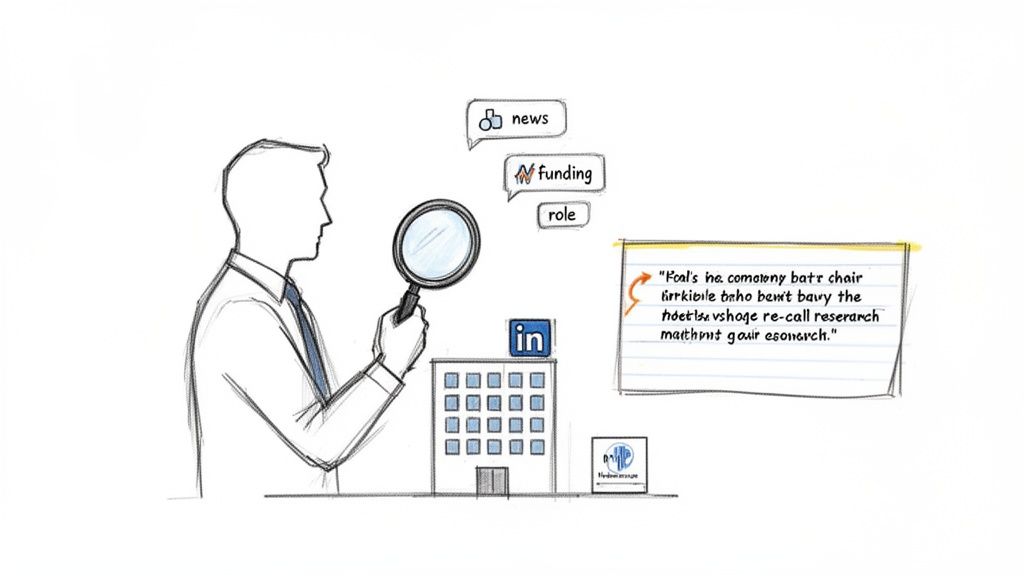
A person researches a company using a magnifying glass, LinkedIn, and various data points.

Unlike a purely volume-based approach that relies on luck, a research-first strategy positions the SDR as a thoughtful problem-solver, not just another salesperson. This shift dramatically improves your chances of capturing a busy prospect’s attention in the crucial first 30 seconds.

How to Implement Pre-Call Research

Effective personalization requires gathering specific intelligence. Instead of just confirming a job title on LinkedIn, look for actionable trigger events or relevant context.

  • Trigger Events: Has their company recently received funding, announced a new product, or posted an earnings report? These events create compelling reasons to call. For example: "I saw your recent Series B announcement and noticed you're expanding your engineering team, which is why I'm calling..."
  • Role-Specific Challenges: What are the common pain points for a Director of Marketing versus a VP of Operations? Tailor your value proposition to their specific world.
  • Intent Data: Leverage tools that signal buying intent, such as website visits, content downloads, or webinar attendance. These "warm" signals provide a natural and timely entry point.

Actionable Tips for Success

To make this practice scalable, integrate it directly into your workflow.

  • Use an AI-Powered Task Engine: Platforms like MarketBetter.ai can auto-generate research summaries and prioritize high-intent prospects, feeding reps the key talking points they need without manual effort.
  • Create a 30-Second "Hook": Based on your research, script a concise opening that immediately explains why you are calling them specifically, right now.
  • Log Research Notes: Keep detailed notes in your CRM (Salesforce, HubSpot) so the entire team can see what research patterns lead to successful conversations. This creates a powerful feedback loop for ongoing personalization strategies. For more detail, you can explore marketing personalization strategies in our recent article.

2. Create and Use Proven Call Scripts and Talk Tracks

The idea of a "call script" often brings to mind robotic, inflexible monologues that kill genuine conversation. However, a modern approach to scripting is one of the most effective cold calling best practices. The goal isn't a rigid, word-for-word document but a flexible talk track: a proven framework that guides reps through openings, value propositions, and objection handling while allowing for natural conversation.

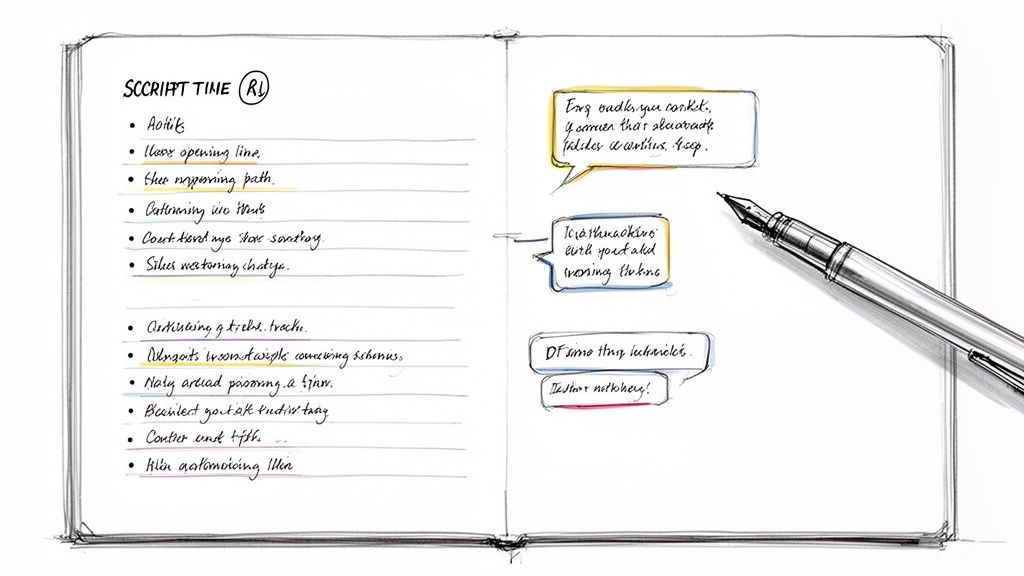
Hand-drawn sketch of an open notebook with a pen, displaying handwritten notes and speech bubbles.

Unlike an improvised call, a well-designed talk track ensures every SDR communicates a consistent, powerful message tailored to specific buyer personas and market segments. It provides a reliable foundation, freeing up the representative's mental energy to actively listen and engage with the prospect, rather than scrambling for what to say next.

How to Implement Talk Tracks

Effective talk tracks are living documents, continuously refined based on call outcomes and feedback. They are built around key conversation milestones, not just a single pitch.

  • Segment-Specific Frameworks: Develop different talk tracks for different industries or company sizes. The pain points of a startup CTO are vastly different from those of a Fortune 500 marketing director, and your script must reflect that.
  • Opening Variations: Don't rely on a single opening line. Create 3-5 variations and test them systematically to see which ones consistently lead to longer conversations. Track conversion rates in your CRM to let data guide your script evolution.
  • Objection Handling Playbooks: The most common objections ("bad timing," "we already use a competitor," "not interested") are predictable. Build your talk track with proven, empathetic responses for each, turning a potential rejection into a new line of discovery.

Actionable Tips for Success

To make this practice effective, integrate it into your team's core sales enablement and coaching rhythm.

  • Practice with Role-Play: Before using a new talk track on live calls, conduct role-play sessions with managers or peers. This builds muscle memory and helps reps internalize the flow so it sounds natural and confident.
  • Build an 8-12 Second Opener: Your initial hook should be concise and impactful. It must include: (1) your name and company, (2) the specific reason for your call (based on research), and (3) a potential benefit relevant to their role.
  • Use AI for Dynamic Talking Points: Instead of a static document, leverage tools like MarketBetter.ai. Its AI Cold Call Workflow can automatically generate persona-specific talking points and objection frameworks based on real-time data, giving reps a dynamic guide for every call.
  • Review Call Recordings: Platforms like Gong and Chorus are invaluable for identifying what language works. Regularly review top-performing calls to extract powerful phrases and objection-handling techniques, then incorporate them back into your team's official talk tracks.

3. Practice Active Listening and Strategic Questioning

The most common cold calling mistake is treating the call as a monologue. A successful interaction isn't about delivering a perfect pitch; it's about starting a genuine conversation. This is where active listening and strategic questioning come in, shifting the dynamic from a sales pitch to a consultative discovery session. This approach builds trust and uncovers the critical business context needed to qualify a prospect effectively.

Unlike a pitch-focused approach that often leads to immediate rejection, consultative questioning demonstrates genuine interest in the prospect's challenges. As data from platforms like Gong shows, top-performing reps consistently talk less and listen more, asking thoughtful questions that guide the conversation toward the prospect's true pain points. This is a core component of modern cold calling best practices.

How to Implement Strategic Questioning

Effective discovery involves moving beyond surface-level queries to questions that reveal deeper business needs. Methodologies like SPIN Selling (Situation, Problem, Implication, Need-Payoff) provide a proven framework for this.

  • Understand the Situation: Start with broad, open-ended questions to grasp their current environment. For example: "Could you walk me through your current process for managing new inbound leads?"
  • Identify the Problem: Once you understand the situation, probe for specific challenges or inefficiencies. Ask: "What are the biggest bottlenecks you're facing with that process?"
  • Explore the Implication: Help the prospect connect the problem to its broader business impact. A powerful question is: "How does that delay in lead follow-up affect your team's ability to hit its pipeline targets?"
  • Present the Need-Payoff: Guide them to see the value of a solution by asking about the positive outcomes. For instance: "If you could automate lead routing and cut response time by 50%, what would that mean for your Q4 revenue goals?"

Actionable Tips for Success

To make this practice a core part of your calling motion, focus on preparation and in-call awareness.

  • Plan 3-5 Core Discovery Questions: Before each call, prepare a short list of open-ended questions tailored to the prospect's role and industry.
  • Follow the 60/40 Rule: Aim to spend 60% of the call listening and only 40% talking. This simple ratio forces you to ask more questions and avoid dominating the conversation.
  • Confirm Your Understanding: After the prospect shares a key challenge, repeat it back to them. For example: "So if I'm hearing you correctly, the main issue is a lack of visibility into your team's activity... is that accurate?"
  • Log Discovery Insights: Use your CRM to capture the key pain points, goals, and challenges uncovered during the call. This context is invaluable for the next-step conversation with an Account Executive.

4. Timing and Sequencing: Call at the Right Time with Strategic Follow-Up

Dialing a prospect at the wrong time is as ineffective as calling without research. One of the most impactful cold calling best practices involves strategic timing and a structured follow-up sequence. This means understanding when your ideal buyer is most likely to answer their phone and building a multi-channel cadence that maintains momentum without overwhelming them.

Unlike a random, high-volume approach that burns through leads, a time-aware strategy maximizes the connect rate for every dial. By coordinating calls with emails and social touches, SDRs create a persistent, professional presence that increases the likelihood of engagement over time.

How to Implement Strategic Timing and Sequencing

Effective sequencing moves beyond just picking a "good" time to call. It involves building a repeatable multi-touch playbook that guides prospects through an engagement journey.

  • Optimal Calling Windows: Landmark research from InsideSales.com and others shows connect rates peak on Tuesdays, Wednesdays, and Thursdays between 10-11 AM and 3-4 PM in the prospect's local time. Mondays are often lost to internal meetings, while Fridays see decreased focus.
  • Structured Follow-Up Cadence: A successful sequence often involves 8-12 touches over 4-6 weeks. A common "call-then-email" tactic involves calling first to create a touchpoint, then immediately sending a concise follow-up email that references the call and summarizes your value proposition.
  • Intent-Based Triggers: The best time to call is right after a prospect shows interest. If a lead visits your pricing page or downloads a whitepaper, that action should trigger an immediate follow-up task in your sales engagement platform.

Actionable Tips for Success

To operationalize this, build timing and sequencing directly into your team's daily workflow.

  • Use an AI-Driven Task Sequencer: Platforms like MarketBetter.ai can auto-create and prioritize daily call tasks based on optimal times and intent signals, ensuring reps always contact the warmest prospects when they are most receptive.
  • Build a Multi-Channel Cadence: Design a clear follow-up sequence, such as: Day 1 (Call + Email), Day 3 (Call), Day 5 (LinkedIn Connection Request), Day 8 (Call). This ensures you never miss a follow-up.
  • Track Your Own Data: While industry benchmarks are a great starting point, use your CRM to track connect rates by day and hour. Identify your team's unique "sweet spot" and adjust your calling blocks accordingly. You can learn more about how to ensure you never miss a follow-up with a structured playbook.

5. Optimize Call-to-Email Integration for Maximum Response

Relying on a single outreach channel is a recipe for low engagement. Modern cold calling best practices demand a multi-channel approach where calls and emails work in tandem. Calls alone suffer from low connect rates, while emails are easily ignored. When combined, they create a powerful synergy: a call builds familiarity, and a follow-up email provides a tangible, easy-to-digest resource that keeps the conversation moving forward.

Unlike isolated outreach attempts, an integrated call-to-email sequence positions your outreach as a persistent, professional effort. This coordinated strategy, championed by platforms like Salesloft and Outreach, has been shown to lift meeting conversion rates by over 25% compared to email-only campaigns. It turns a cold touchpoint into a warm, ongoing dialogue.

How to Implement Call-to-Email Integration

The key is to make the transition from call to email seamless and context-aware. The email should feel like a natural continuation of the phone conversation, not a separate, generic marketing blast.

  • Immediate Follow-Up: After a call (whether you connect, leave a voicemail, or get a quick brush-off), send a relevant email within a few hours. This reinforces your message while the call is still fresh in the prospect's mind.
  • Contextual Reference: Your email must directly reference the call. For example: "Following up on our brief chat about managing your ad spend..." or "As promised, here is the case study I mentioned on the phone..."
  • Templated Workflows: Create pre-built email templates for common call outcomes like "Connected, interested," "Left voicemail," or "Overcame objection." This ensures consistency and speed across the team.

Actionable Tips for Success

To operationalize this practice, embed it directly into your sales engagement tools.

  • Use an Integrated Dialer: A platform like MarketBetter.ai allows reps to dial directly from Salesforce and then use AI to instantly draft a follow-up email based on the call's context. This closes the loop with a single click.
  • Test Call-Referencing Subject Lines: A/B test subject lines like "Following up from our call" or "Quick note, [Prospect Name]" which often have significantly higher open rates than generic alternatives.
  • Map Email Content to Call Outcomes: If a prospect mentioned a specific pain point, your follow-up email should lead with a resource addressing that exact problem. If they were busy, keep it short with a clear call-to-action to book time later. This level of personalization is crucial for effective multi-channel selling.

6. Establish Clear Objection Handling Frameworks

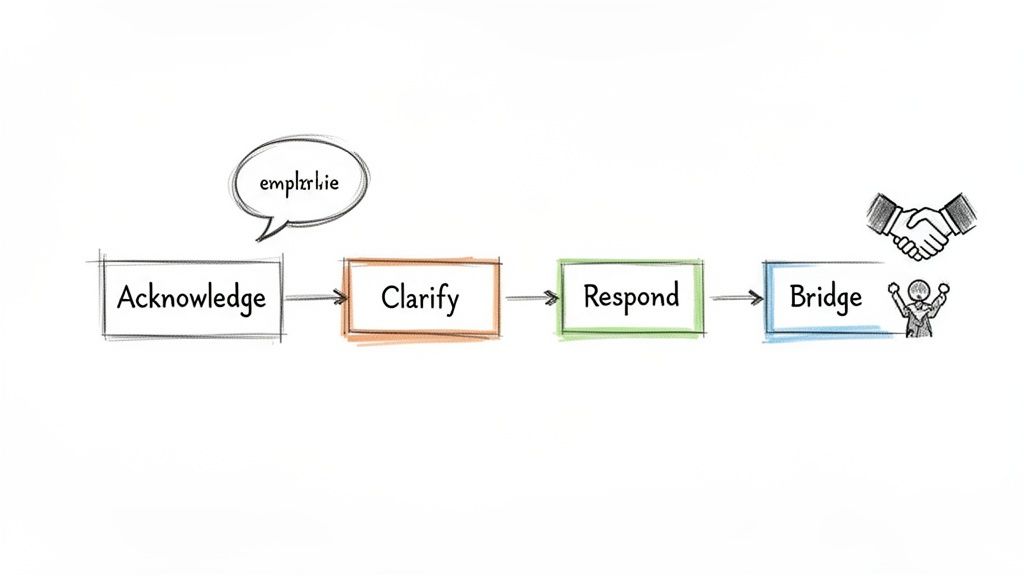
Objections are not rejections; they are requests for more information. One of the most critical cold calling best practices is to treat prospect hesitation as an opportunity to build credibility and deepen the conversation. Rather than relying on rigid, scripted rebuttals, effective frameworks use empathy, clarifying questions, and evidence-based responses to address the underlying concerns behind common objections.

A diagram illustrating a four-step communication process: Acknowledge, Clarify, Respond, and Bridge, with handshake icon.

Unlike an unprepared rep who stumbles and ends the call, an SDR with a structured approach can confidently navigate pushback. This skill turns potential roadblocks into productive discussions, increasing conversion rates and extending call lengths by building trust and demonstrating expertise.

How to Implement Objection Handling Frameworks

A powerful framework addresses the most common objections ('no budget,' 'bad timing,' 'we use a competitor') with predictable, yet flexible, responses. The goal is to acknowledge the concern, reframe the situation, and guide the prospect to the next logical step.

  • "We use [Competitor]": Acknowledge their existing solution, then pivot to a gap. "That's great, so you're already addressing [use case]. What we're finding is that [Competitor] often struggles with Y, which leads to [specific problem]. Would it be worth 15 minutes to explore that gap?"
  • "I'm not interested": Don't accept this at face value; instead, add curiosity and evidence. "I understand. Most people aren't initially. Leaders at [similar company] found they were overlooking X until we showed them [specific metric]. Could I share a quick case study on that?"
  • "Bad timing / No budget": Instead of ending the call, pivot to a future action. "Totally get it. Would it make sense to set up a brief call in [specific month] when budgets typically reopen? I'll send a quick summary so it’s fresh."

Actionable Tips for Success

To make this practice second nature, build a system for continuous improvement. Mastering the art of Overcoming Objection in Sales requires preparation and iteration.

  • Create an "Objection Playbook": Document your top 5-7 objections and develop 2-3 validated responses for each. Every response should include empathy, a clarifying question, a reframe, and a bridge to the next step.
  • Conduct Weekly Role-Plays: Practice handling objections in a live setting. Record these sessions and use them as coaching material to highlight what works and what doesn't.
  • Leverage AI-Powered Insights: Use a tool like MarketBetter.ai to surface common objections specific to an industry or persona and get data-backed response suggestions directly in your workflow.
  • Never Argue: Acknowledge the prospect's concern as valid, even if you disagree. Start with phrases like, "That's a fair point, and I hear that often..." to disarm defensiveness and open the door for a real conversation.

7. Build Credibility Through Social Proof and Brand References

Cold calls inherently start from a position of low trust. To overcome a prospect's natural skepticism, one of the most effective cold calling best practices is to build immediate credibility using social proof. This involves referencing well-known customers, quoting specific results, and citing third-party validation to quickly establish that your solution is a safe and proven choice.

Unlike making abstract claims about your product's benefits, social proof provides tangible evidence from a source the prospect trusts: their peers. This approach, rooted in Robert Cialdini's principles of persuasion, shifts the conversation from "Why should I believe you?" to "How did you help a company like mine?" This single change can reduce initial objections and significantly increase meeting conversion rates.

How to Implement Social Proof

Effective social proof is not just name-dropping; it's about delivering relevant evidence that resonates with the prospect’s specific context. The key is to match your proof points to their industry, size, and challenges.

  • Industry-Specific Logos: Mentioning customers in the same vertical immediately builds relevance. For example: "We've helped over 50 B2B SaaS teams like Acme Corp and TechCorp increase their SDR productivity..."
  • Quantifiable Results: Vague claims are forgettable, but hard numbers are compelling. Instead of saying you "improve efficiency," say, "A similar-sized company, Techco Corp, increased their meeting conversions from 8% to 15% in just three months with our platform."
  • Third-Party Validation: Leverage external credibility from trusted sources. For instance: "Gartner recently recognized us as a leader in Sales Engagement platforms, specifically for our AI-driven task prioritization..."

Actionable Tips for Success

To make social proof a natural part of your talk track, prepare specific references for each target segment.

  • Create a "Proof Sheet": For each target account, pre-identify their industry, size, and potential challenges. Then, map them to your most relevant customer story, case study, or analyst report.
  • Lead with Logos: Introduce credibility within the first 30 seconds. A simple line like, "The reason I'm calling is that we work with other industry leaders like [Competitor] and [Similar Company]..." immediately establishes legitimacy.
  • Leverage Mutual Connections: A warm introduction is the strongest form of social proof. Try, "I noticed you're connected to John Smith at [Reference Company]. He actually led their SDR transformation with us last year."
  • Utilize Your Tech Stack: Use tools like MarketBetter.ai to surface account details and automatically suggest similar customers and relevant outcomes, arming you with customized social proof for every single call.

8. Implement CRM Discipline and Immediate Call Logging

Even the most effective cold call is a wasted effort if the data disappears the moment you hang up. A cornerstone of modern cold calling best practices is implementing religious CRM discipline, where every call outcome is logged immediately and accurately. Without real-time data entry, managers lose visibility into activity, forecasting becomes guesswork, and crucial follow-ups are inevitably missed.

This practice transforms cold calling from a series of isolated conversations into a measurable, scalable process. It provides the data foundation for coaching, performance tracking, and seamless handoffs between SDRs and Account Executives, ensuring no lead falls through the cracks.

How to Implement CRM Discipline

Effective call logging goes beyond simply marking a task as complete. It involves capturing specific outcomes and insights that inform future actions and strategy, turning raw activity into business intelligence.

  • Standardized Call Dispositions: Define a clear taxonomy for call outcomes. Instead of just "Called," use specific dispositions like "Connected - Not Interested," "Left Voicemail," "Scheduled Meeting," or "Wrong Person." This creates clean data for reporting.
  • One-Click Logging: The primary barrier to CRM discipline is friction. Platforms like Outreach and Salesloft often enforce logging before the next dial is available, creating compliance. An even better approach is embedding the process directly into the workflow.
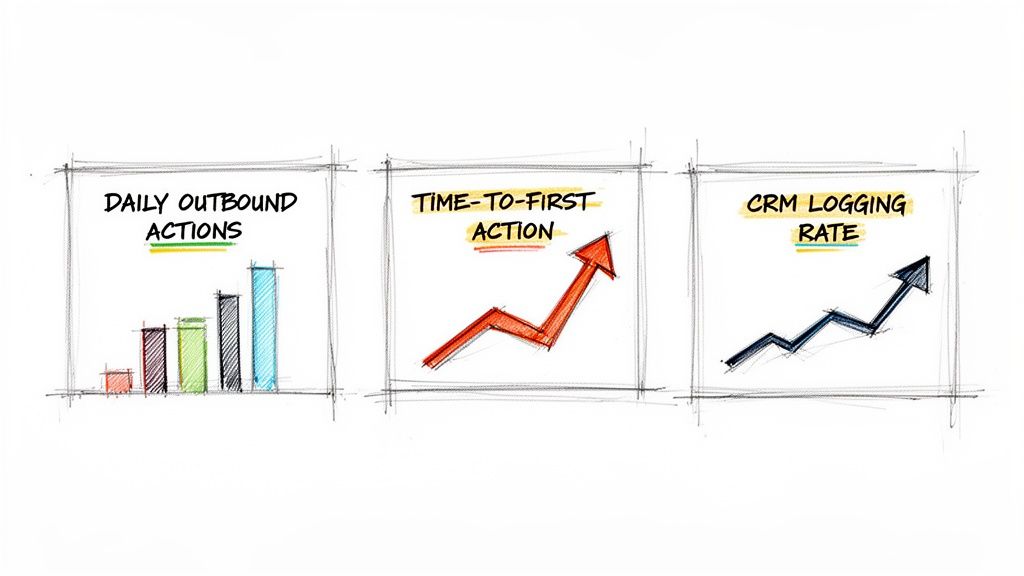
  • Data-Driven Accountability: High-performing teams use CRM data to fuel their RevOps dashboards. They track the entire outbound funnel in real-time: 200 dials → 30 connects (15% connect rate) → 8 qualified meetings booked → 3 deals moved to the pipeline.

Actionable Tips for Success

To make CRM logging an unbreakable habit, build it directly into your sales motion and technology stack.

  • Use a Dialer Inside Your CRM: A platform like MarketBetter.ai, with its dialer built directly inside Salesforce, can auto-populate call outcomes, duration, and dispositions with a single click. This eliminates the friction of manual data entry.
  • Log Calls Within 15 Minutes: Insist that all call notes are logged immediately after the conversation ends. This ensures details about objections, pain points, and next steps are captured while they are still fresh.
  • Create Mandatory Note Templates: Structure your call notes with required fields in your CRM. Include sections for the value proposition offered, the prospect’s key response, any objections raised, and the confirmed next step with a follow-up date.

9. Develop Confidence and Resilience Through Consistent Practice

Cold calling is a psychological marathon, not a sprint. Success demands handling constant rejection, managing call anxiety, and maintaining motivation when conversion rates are low. One of the most essential cold calling best practices is building mental resilience and confidence through consistent, structured practice and a supportive team culture.

Unlike a purely outcome-focused approach that can crush morale, a process-oriented mindset reframes rejection as a necessary part of the sales funnel, not a personal failure. This shift, championed by sales leaders like Jeb Blount, creates high-performing teams that embrace activity and view each dial as a learning opportunity, leading to higher motivation and tenure.

How to Implement a Culture of Resilience

Building this psychological strength requires deliberate, team-wide effort. It involves creating systems that normalize rejection and celebrate the consistent actions that lead to results.

  • Peer Shadowing: New SDRs can sit with top performers for their first week to absorb cadence, language, and objection-handling techniques in a live environment. This accelerates confidence faster than any training manual.
  • Role-Play Sessions: Dedicate weekly time for structured role-play. Focus on one specific skill per session, like navigating a gatekeeper or handling the "we're not interested" objection, to build muscle memory.
  • Celebrate Activity Metrics: Publicly recognize reps for hitting daily dial or connect goals, not just for booking meetings. This reinforces that consistent effort is valued and essential for long-term success.

Actionable Tips for Success

To embed resilience into your team’s DNA, integrate these practices directly into your daily and weekly sales cadence.

  • Set Realistic Daily Goals: Use your CRM data to establish achievable activity targets. When reps see a clear connection between their effort (dials) and outcomes (meetings), their work feels more meaningful.
  • Publicly Recognize Small Wins: Use daily stand-ups or a team leaderboard to give shout-outs for hitting activity milestones. This consistent positive reinforcement maintains momentum.
  • Debrief Difficult Calls: Encourage reps to share and analyze tough calls with a manager or mentor. This normalizes the experience and transforms rejection into a coachable moment.
  • Provide Access to Call Recordings: Use tools like a Salesforce dialer to log all calls. Create a "greatest hits" library of recordings from top performers that new reps can study on-demand.

10. Measure, Analyze, and Iterate on Outbound Performance

A "dial and hope" strategy is unpredictable and unscalable. Top-performing sales organizations treat cold calling not as an art but as a science, which means consistent measurement and data-driven iteration are core to the process. This practice involves tracking the right KPIs, analyzing which behaviors and messages drive outcomes, and running short experiments to continuously improve performance.

Unlike simply monitoring activity volume (like dials per day), an analytical approach connects specific actions to results. This transforms outbound dialing from a guessing game into a predictable engine for revenue, allowing managers to diagnose issues and scale what works. It's the difference between telling a rep to "make more calls" and telling them to "use this specific opening line because it improved our meeting rate by 12% last week."

How to Implement a Data-Driven Iteration Cycle

Building a feedback loop requires a clear framework for measuring, analyzing, and acting on performance data. The goal is to make small, incremental improvements that compound over time.

  • Establish Key Metrics: Track a balanced mix of leading indicators (dials, connects, conversations) and lagging indicators (meetings booked, pipeline influenced). RevOps can build dashboards in your CRM to visualize the funnel from dials → connects → meetings for each rep and sequence.
  • Run A/B Tests: Isolate one variable and test its impact. For example, run a two-week experiment where half the team uses one opening line and the other half uses a new one. Measure the connect-to-meeting conversion rate for each to find the statistical winner.
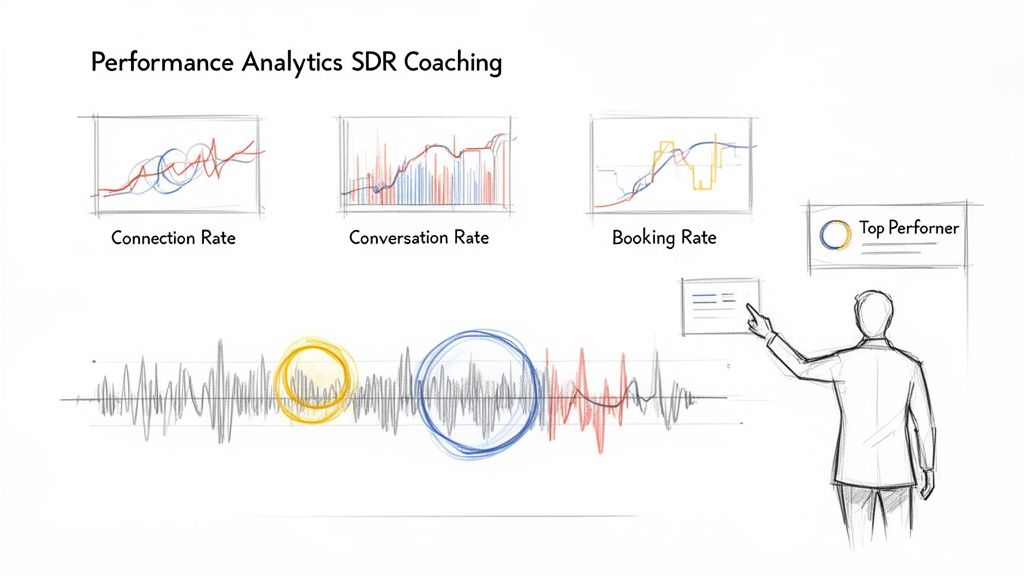
  • Leverage Speech Analytics: Use call intelligence tools like Gong or Chorus to identify the exact phrasing and objection-handling techniques used by top performers. These insights can then be standardized and scaled across the team through updated playbooks and coaching sessions.

Actionable Tips for Success

To make this practice sustainable, embed it into your team's weekly operating rhythm.

  • Focus on a Few Core KPIs: Don't overwhelm reps with dozens of metrics. Focus on 2-3 leading indicators (e.g., conversations per day) and one primary lagging indicator (meetings booked) to keep the team aligned.
  • Maintain CRM Hygiene: Data integrity is everything. Enforce consistent use of call dispositions, required note fields, and tags for experiments so your analysis is based on clean, reliable data.
  • Use an AI-Powered Reporting Engine: Platforms like MarketBetter.ai can connect intent data signals directly to call outcomes, helping you prioritize the behaviors that actually influence pipeline and showing which reps are most effective at converting high-intent leads. For a deeper dive, explore our guide on essential marketing performance metrics.
  • Turn Insights into Action: Review metrics in weekly team meetings. For each rep, identify one specific insight and turn it into a concrete coaching action for the following week.

10-Point Cold Calling Best-Practices Comparison

Technique🔄 Implementation Complexity💡 Resource Requirements⭐ Expected Effectiveness📊 Ideal Use Cases⚡ Key Advantages
Research and Personalize Before DialingMedium–High — ongoing research workflows, filtering requiredIntent data, account intelligence tools, CRM integration, time for prep⭐⭐⭐⭐ — higher connects & richer conversationsAccount-based selling, high-value or enterprise prospects, intent-triggered outreachFaster relevance per dial; higher connect-to-meeting conversion
Create and Use Proven Call Scripts and Talk TracksLow–Medium — build, test, and maintain playbooksScript templates, call recordings, enablement platform, coaching hours⭐⭐⭐⭐ — consistent messaging and faster rampOnboarding new reps, scaling teams, segment-specific outreachConsistency across reps; accelerates ramp and coaching
Practice Active Listening and Strategic QuestioningMedium — behavioral change and training neededSales coaching, role-play, call analytics, time-per-call investment⭐⭐⭐⭐⭐ — better qualification and trust, higher conversion qualityConsultative sales, discovery calls, complex dealsUncovers real pain; reduces wasted demos and improves handoffs
Timing and Sequencing: Call at the Right Time with Strategic Follow-UpMedium — requires orchestration and experimentationCadence tools, timezone/intent data, multi-channel coordination⭐⭐⭐⭐ — significantly higher connect and response ratesHigh-volume SDR programs, multi-region outreach, intent-based follow-upsReduces wasted dials; increases connect rate and sequencing ROI
Optimize Call-to-Email Integration for Maximum ResponseLow–Medium — align templates and timing, automate sendsDialer-CRM integration, email templates, tracking, automation⭐⭐⭐⭐ — improved response and meeting bookingsMulti-touch cadences, follow-up-heavy workflows, PQLsBoosts recall and action; higher combined channel conversions
Establish Clear Objection Handling FrameworksMedium — develop playbook and practice for natural deliveryObjection playbooks, case studies, role-play sessions, coaching⭐⭐⭐⭐ — longer conversations; more "not now" → "next step" movesCompetitive deals, budget/timing objections, early qualificationConverts objections into dialogue; shortens qualification time
Build Credibility Through Social Proof and Brand ReferencesLow–Medium — curate and personalize proof pointsCase studies, customer permissions, analyst references, collateral⭐⭐⭐⭐ — reduces skepticism; increases meeting conversionCold outreach to skeptical buyers, new-market entry, corporate buyersShortens sales cycle; increases trust quickly with minimal effort
Implement CRM Discipline and Immediate Call LoggingMedium — process changes + tooling enforcementCRM dialer, one-click logging, disposition taxonomy, governance⭐⭐⭐⭐ — reliable activity data; better follow-upsScaling teams, RevOps-driven organizations, high-volume outboundReal-time visibility; faster follow-ups and accurate forecasting
Develop Confidence and Resilience Through Consistent PracticeLow–Medium — culture + regular coaching requiredManager time, role-play programs, leaderboards, mental-health support⭐⭐⭐⭐ — higher persistence and long-term performanceHigh-activity SDR teams, onboarding cohorts, high-rejection contextsIncreases rep persistence, reduces churn, accelerates skill growth
Measure, Analyze, and Iterate on Outbound PerformanceHigh — instrumentation, experiments, and governance neededDashboards, A/B testing framework, speech analytics, clean data⭐⭐⭐⭐⭐ — data-driven improvements and predictable scalingTeams optimizing playbooks, RevOps, enterprise scale growthPrioritizes high-impact tactics; speeds optimization and forecasting
Free Tool

Try our AI Lead Generator — find verified LinkedIn leads for any company instantly. No signup required.

Putting It All Together: Your Blueprint for Outbound Excellence

Mastering the art and science of cold calling isn't about memorizing a single perfect script or discovering a "secret" time to dial. As we've explored, achieving sustainable outbound success is about building a comprehensive, repeatable system. The ten cold calling best practices detailed in this guide are not isolated tactics; they are interconnected pillars that support a powerful and predictable pipeline-generation engine.

Think of it like building a high-performance race car. Having a powerful engine (a compelling script) is useless without a strong chassis (solid research), responsive steering (active listening), and a skilled driver (a confident SDR). Each component is critical, and they must work in harmony. A brilliant opening line falls flat without a structured objection-handling framework. A perfectly timed call loses its impact without an integrated, value-driven email follow-up. True excellence lies in the consistent, disciplined execution of these fundamentals, call after call, day after day.

From Disparate Tactics to an Integrated System

The critical shift for any sales team is moving from a tactical, ad-hoc approach to a strategic, integrated one. Let's compare the two mindsets:

  • The Tactical Approach (Common but Ineffective): This team focuses on volume above all. SDRs make hundreds of dials using a generic script, log calls when they remember, and handle objections with improvised, inconsistent responses. They might have a good day here and there, but performance is unpredictable, burnout is high, and there is no clear path to improvement because there's no reliable data to analyze.

  • The Strategic Approach (Your New Blueprint): This team sees each practice as part of a whole.

    • Pre-call research directly informs the personalization in the opening line.
    • Active listening provides the exact ammunition needed for the objection handling framework.
    • CRM discipline and immediate logging create clean data that feeds into performance analysis.
    • This data-driven iteration then helps refine call scripts and talk tracks for the entire team.

This integrated system transforms cold calling from a frustrating numbers game into a measurable, scalable science. It creates a feedback loop where every action informs the next, driving continuous improvement and predictable results.

Your Actionable Next Steps

The journey to mastering these cold calling best practices begins with a single, deliberate step. Don't try to overhaul your entire process overnight. Instead, focus on incremental gains that build momentum.

  1. Conduct a Self-Audit: Review the ten practices outlined. Where is your team strongest? Where are the most significant gaps? A simple team survey or review of call recordings can reveal immediate opportunities for improvement, whether it's weak opening lines or inconsistent CRM logging.
  2. Choose One Area of Focus: Pick one practice to master this month. For example, dedicate the next four weeks to implementing a rigorous pre-call research checklist for every A-tier prospect. Or, focus exclusively on improving CRM hygiene by enforcing immediate call dispositions.
  3. Leverage Technology to Accelerate Progress: Manual processes are the enemy of consistency. The friction of toggling between LinkedIn, your CRM, and your dialer slows reps down and discourages best practices. This is where modern sales tools become indispensable. Platforms like MarketBetter.ai are built to operationalize this blueprint by automating the tedious work. AI-powered call prep surfaces key insights, a native Salesforce dialer eliminates manual logging, and prioritized task queues ensure reps are always focused on the most impactful next action.

By adopting this systematic approach, you elevate your outbound function from a cost center to a strategic growth driver. You build a culture of excellence, empower your reps with the confidence to succeed, and create a predictable pipeline that fuels the entire organization. The path is clear; the only remaining step is to begin.


Ready to transform your team's cold calling from a guessing game into a science? See how marketbetter.ai embeds these best practices directly into your SDRs' workflow with AI-driven prep, a native Salesforce dialer, and intelligent task prioritization. Explore marketbetter.ai and build your blueprint for outbound excellence today.

How to Write Cold Emails That Actually Get Replies

· 25 min read

Here's the truth about writing a cold email that actually gets a reply: be relevant, be specific, and solve a problem for the person on the other end.

It really is that simple. The best cold emails I've ever seen—and the ones my teams have had the most success with—all ditch generic templates. Instead, they favor a short, personalized message that proves you’ve done your homework and respect the recipient's time. This value-first mindset is the foundation of every single high-performing outreach campaign.

Why Most Cold Emails Are Dead on Arrival

Let's be honest: the average B2B professional's inbox is a warzone. Attention is the prize, and the delete button is the most-used weapon. Most cold emails don't just fail; they're deleted before they're even read, disappearing into the digital noise.

So why do they fail so spectacularly? It’s a fundamental disconnect. The sender wants a meeting, but the recipient is too busy to care about a stranger's pitch.

The main culprit is the old spray-and-pray playbook. Blasting thousands of generic, self-absorbed emails is a numbers game that almost always loses. It’s built on interruption, not engagement. It prioritizes sheer volume over quality, hoping something eventually sticks.

That strategy is broken. Imagine firing off hundreds of emails only to watch them vanish without a trace. It’s soul-crushing. According to recent benchmarks, a staggering 95% of cold emails fail to get a response, leaving average reply rates stuck in a dismal 1% to 5% range. You can see the full, painful numbers in this breakdown of cold email statistics. This is the tough reality sales teams are up against every day.

To give you a clearer picture, let's contrast the old way with the new.

Traditional vs Modern Cold Emailing At a Glance

The difference between a failing campaign and a successful one often comes down to the philosophy behind it. Are you interrupting or engaging? Pushing or pulling? Here's how the two approaches stack up.

TacticTraditional Approach (Low Reply Rate)Modern Approach (High Reply Rate)
TargetingLarge, generic lists. "Anyone with a pulse."Highly specific, based on intent signals.
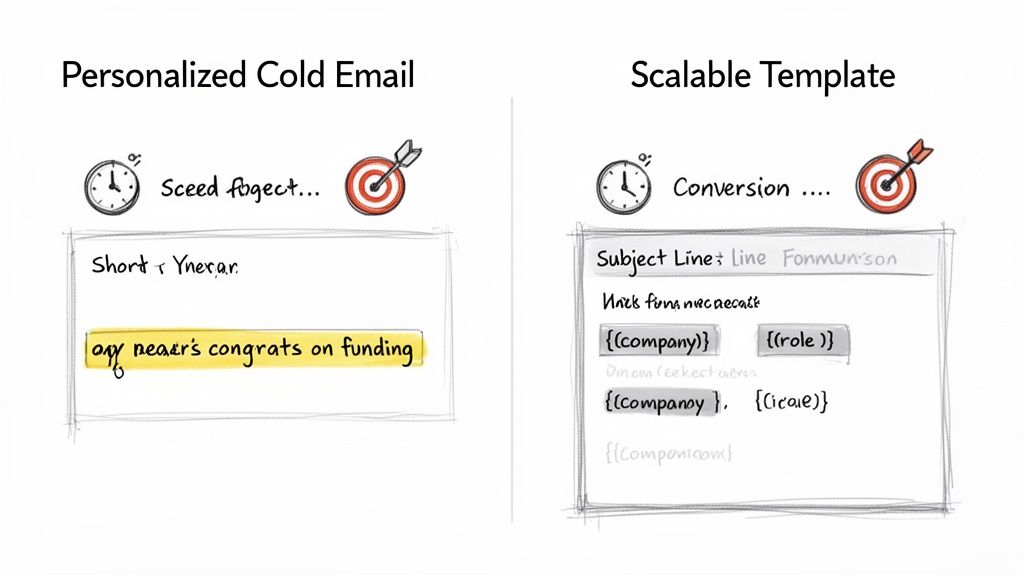
Personalization"Hi {{first_name}}, I saw you work at {{company}}."Mentions a recent project, post, or shared connection.
Value Prop"We do X, Y, and Z." (Features-focused)"I saw you're hiring SDRs, here's an idea for that."
The "Ask""Can I get 30 minutes on your calendar?""Mind if I share a resource that might help?"
Mindset"How can I sell my product?""How can I be immediately helpful?"

The takeaway is simple: the modern approach isn't about volume; it's about precision and genuine value. It respects the recipient's time and intelligence, which is precisely why it works.

The Shift to Modern, Value-First Outreach

Winning at cold email today demands a complete mental shift. Stop asking, "How can I sell my product?"

Instead, ask yourself, "How can I be genuinely helpful to this person, right now?" This one change reframes your entire outreach from a pitch into a conversation. It’s the difference between showing up to a party with a megaphone and quietly offering someone a drink because you noticed their glass was empty.

This modern, value-first approach stands on three pillars:

  • Action Step 1: Target with Signals. Instead of broad lists, focus your energy on prospects who are already showing signs of needing what you have. This could be anything from a recent funding round, a key executive hire, or even them engaging with your content. You’re meeting them where they are.
  • Action Step 2: Personalize Deeply. This goes way beyond {{first_name}}. Reference a specific project they mentioned on a podcast, a recent post they shared on LinkedIn, or a shared connection. Prove you're not a robot.
  • Action Step 3: Make Low-Friction Asks. Instead of demanding a 30-minute meeting out of the blue, make the next step easy. Propose sharing a relevant resource, or just ask a single, insightful question that gets them thinking.

The real goal of a cold email isn't to close a deal. It's to start a conversation. When you lead with value and demonstrate true relevance, you earn the right to their attention. That’s how you turn a cold outreach into a warm opportunity.

Mastering Pre-Outreach Research and Prospecting

A killer cold email is won or lost long before you type a single word.

The biggest mistake I see reps make? They dive straight into writing. It's like trying to navigate a new city without a map. Success isn’t about finding some magical template; it's about doing the hard work upfront—the meticulous research that uncovers why your prospect should give a damn right now.

This groundwork is what separates the top 1% from everyone else. It’s the difference between an email that feels like a targeted, helpful solution and one that gets nuked on sight. Before you can hope to craft a message that resonates, you have to understand who you're talking to and what's happening in their world.

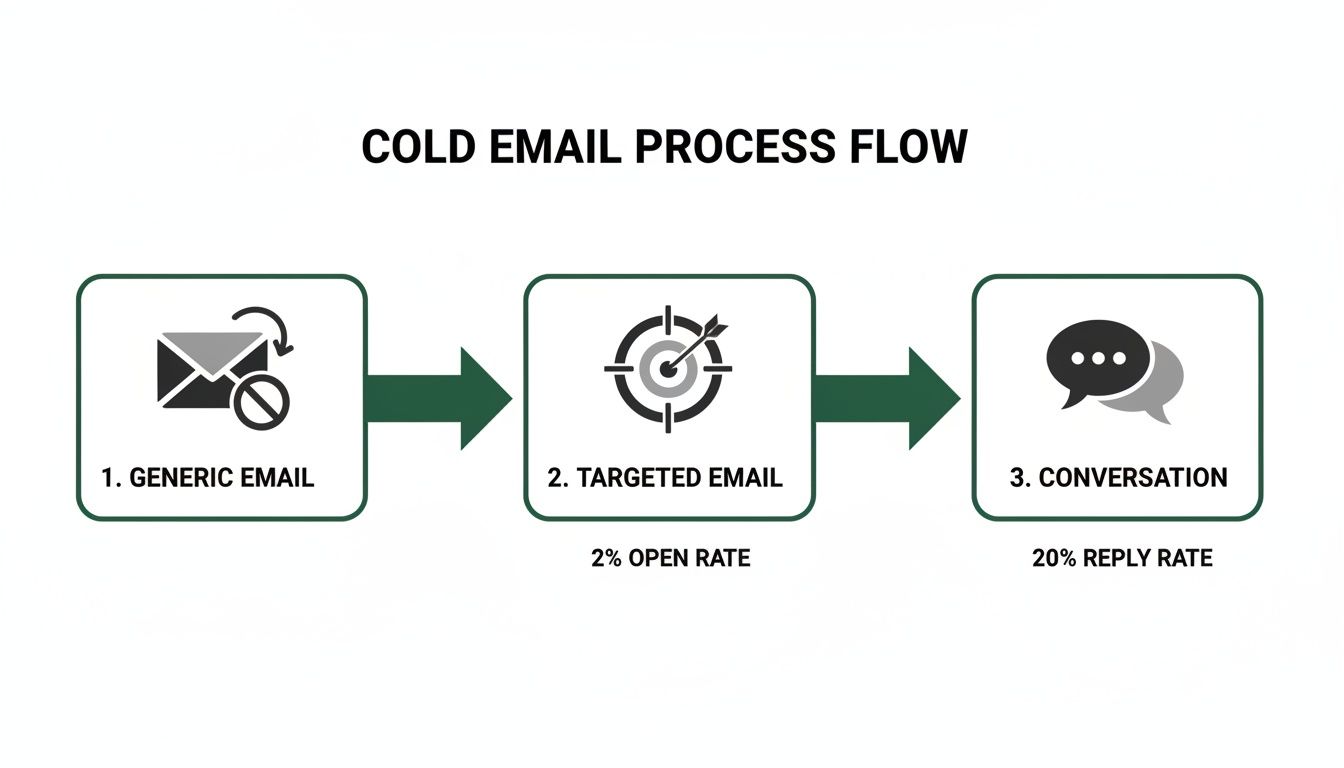
This flowchart nails the journey: you move from generic spam to a targeted message that actually starts a conversation.

Flowchart illustrating a three-step cold email process from generic to targeted emails and conversation.

Effective outreach isn't a random shot in the dark. It’s a deliberate process where solid research turns a cold contact into a warm lead.

Moving Beyond Generic Personas

Most sales teams have buyer personas, but let's be honest, they’re usually too high-level to be useful. "Marketing Manager at a SaaS company with 500+ employees" is a starting point, not a hit list.

Truly effective prospecting goes deeper. It’s about hunting for real-time buying signals that scream, "This person has a problem I can solve today."

Instead of just filtering by title and company size, look for specific trigger events. These are the shifts and changes that create an urgent need for what you sell.

  • Key New Hire: A company just brought on a new VP of Sales. You know they'll be looking to make an impact fast.
  • Recent Funding Announcement: A startup just closed their Series B. That means fresh capital to pour into growth and efficiency tools.
  • Technology Change: You notice they just adopted a tool that integrates perfectly with your platform. That’s your in.
  • Content Engagement: A prospect from a target account downloaded your latest whitepaper or showed up to a webinar. They're already raising their hand.

These signals transform your outreach from a speculative guess into a timely, relevant conversation. Nailing down who you're targeting is crucial. For a deeper dive, check out our guide on https://www.marketbetter.ai/blog/2025/10/22/how-to-create-buyer-personas/ to really sharpen your focus.

Contrasting Manual Workflows with Signal-Based Prospecting

The old way of prospecting is a soul-crushing time sink. It usually involves mindlessly scrolling through LinkedIn Sales Navigator, hoping you stumble upon someone who looks like a decent fit. This is wildly inefficient and almost never uncovers the timely triggers that actually get replies.

Let's break down the difference:

Prospecting MethodManual LinkedIn ScrollingSignal-Based Prospecting
FocusStatic info (title, company size)Dynamic events (hiring, funding, tech stack)
EfficiencyLow; you generate a huge list of low-quality leadsHigh; you build a smaller, hyper-qualified list
RelevanceGeneric and almost always poorly timedHighly relevant and perfectly timed
OutcomeLow reply rates, high rep burnoutHigher reply rates, actual conversations

A signal-based workflow forces you to prioritize your outreach based on who is most likely to buy now. You spend less time digging and more time engaging with prospects who have an active need. The impact on your efficiency and results is massive.

Your Pre-Flight Checklist Before Every Email

Before you even think about hitting "send," run through this quick mental checklist. This simple discipline keeps you honest, stops you from falling back on generic templates, and makes sure every single message has a purpose.

  1. Identify a Specific Pain Point: Based on their role and recent company news, what problem are they likely dealing with right now? Actionable Step: Write it down in one sentence. Example: "The new VP of Sales is under pressure to increase pipeline with the new funding."
  2. Find a Relevant Company Trigger: What just happened that makes your outreach timely? Actionable Step: Link to the press release, job posting, or LinkedIn post in your CRM notes.
  3. Look for a Personal Connection: Did you go to the same school? Follow the same influencers on LinkedIn? Actionable Step: Find one non-work-related detail to build rapport.

The point of research isn't to collect a bunch of random facts. It's to find the one perfect reason to start a conversation. A single, powerful insight is worth more than a dozen generic talking points. It’s the hook that proves your email is worth their time.

Of course, finding the right people is only half the battle. Once you’ve pinpointed your targets and their triggers, knowing how to find business email addresses quickly is what makes sure your perfectly researched message actually gets delivered. This is where your strategy meets execution.

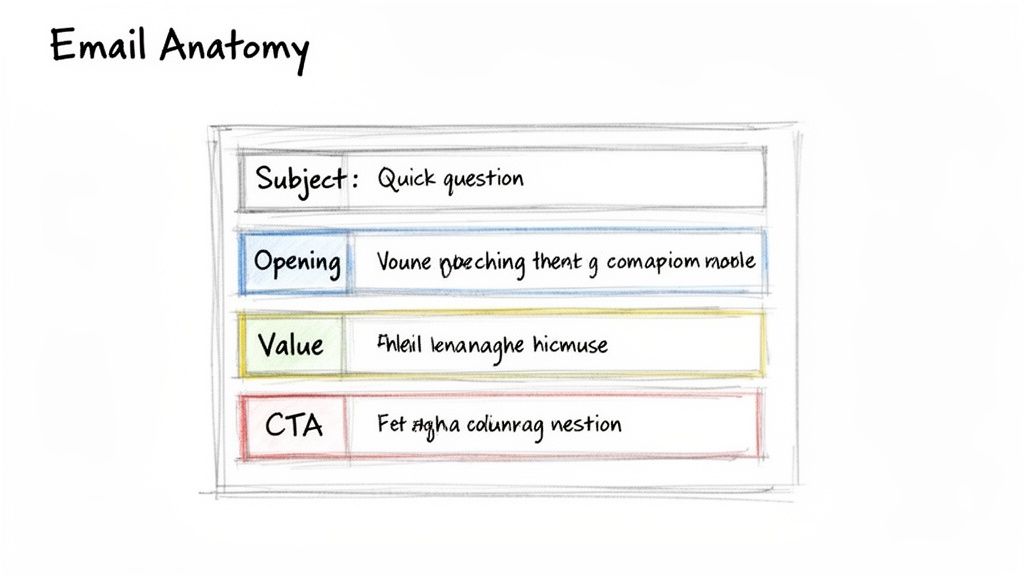
Anatomy of a High-Performing Cold Email

Think of a great cold email less like a work of art and more like a piece of precision engineering. Every single component—from the subject line down to the signature—has a job to do. If one part fails, the whole thing falls flat.

Understanding this anatomy is what separates emails that get replies from those that get archived.

Hand-drawn sketch illustrating email anatomy with sections for subject, opening, value, and call to action.

We're going to dissect a high-performing email, piece by piece, to see what makes it tick. This isn't about finding some magic template. It's about mastering the principles so you can build your own effective outreach, every single time.

The Subject Line: Your Gateway to the Inbox

The subject line has one job and one job only: get the email opened. That’s it. It’s not the place to sell your product, cram in your value prop, or make a grand pitch. Its sole purpose is to spark just enough curiosity to earn a click.

The most common mistake is writing subject lines that scream "marketing email." Anything that feels like a broadcast—using words like "demo," "offer," or a bunch of exclamation points—is a dead giveaway. The best ones are short, feel personal, and read like a quick note from one human to another.

Let's look at the difference.

Subject Line TypeWeak Example (Gets Ignored)Strong Example (Gets Opened)
The Generic Pitch"Quick Question about {{Company}}'s Software""idea re: your new SDR hires"
The "Helpful" Offer"Resource for Sales Leaders at {{Company}}""that podcast w/ Sarah Jones"
The Clickbait Attempt"URGENT: Don't miss this opportunity!""Quick question"

Actionable Step: Before sending, read your subject line aloud. Does it sound like something you'd send to a coworker? If not, rewrite it until it does. For a much deeper dive, our guide on email subject line best practices is worth a read.

The Opening Line: The First Five Seconds

Once they open it, you’ve got about five seconds to prove this isn’t another generic blast. The opening line is where you show you’ve actually done your homework. This is your chance to connect the dots between the research you did and the reason you’re in their inbox.

A weak opener just mashes together personalization tokens like {{company_name}} with a vague, empty compliment. A strong opener, on the other hand, references something specific and timely that proves you have genuine interest.

Here’s what that looks like in the wild:

Weak Opener: "Hi Jane, I saw that you're the VP of Sales at Acme Corp and I was impressed by your company's growth."

Why it fails: This is lazy. Anyone with a LinkedIn account can find this info in ten seconds. It builds zero connection and feels completely templated.

Strong Opener: "Hi Jane, Heard your interview on the SaaS Breakthroughs podcast last week—your point about scaling SDR teams without sacrificing quality really stood out."

Why it works: It’s specific, timely, and shows you actually engaged with their work. It instantly proves this email was written for Jane and Jane alone, earning you the right to her attention for another few sentences.

The Value Proposition: Connect Their Problem to Your Solution

Okay, you have their attention. Now it’s time to build a bridge from their world to yours. Your value prop isn't about rattling off product features; it’s about connecting a problem they have with a solution you provide.

This is where you bring in the trigger event or pain point you uncovered during your research. Your goal is to articulate a clean, concise "problem-solution" statement that hits home.

Let's compare a bad vs. good value prop:

  • Weak Value Prop (Company-Centric): "We provide an AI-powered sales dialer with features like local presence dialing and call recording."
  • Strong Value Prop (Prospect-Centric): "I saw you're hiring five new SDRs in Austin. Teams I work with often find that onboarding so many reps at once stretches their enablement resources thin. We help cut ramp time by 30% by giving them prioritized, signal-based tasks each morning."

Notice how the strong example is grounded in their specific context. It’s not "We do X." It's "Given your situation, you might be facing this problem, and here’s how we solve it."

The Call-to-Action: Ask for Interest, Not a Meeting

This is where most cold emails stumble right at the finish line. After building a great case, reps get greedy and ask for a 30-minute meeting. For a busy executive who has no idea who you are, that’s a high-friction ask. It forces them to open their calendar, find a time, and commit a chunk of their day.

A much better approach is a low-friction call-to-action (CTA). Your goal isn't to book a meeting; it's simply to get a "yes" and start a conversation. You're asking for interest, not a commitment.

Let’s compare the two styles.

CTA TypeHigh-Friction (Weak)Low-Friction (Strong)
The Meeting Ask"Do you have 15 minutes to connect next week?""Mind if I send over a short video explaining how it works?"
The Vague Ask"Let me know your thoughts.""Is this something you’re currently focused on?"
The Open-Ended Ask"When would be a good time to talk?""Worth exploring?"

Actionable Step: End your email with a simple question that can be answered with "yes," "no," or one word. This makes it incredibly easy for your prospect to respond. You aren't trying to close the deal in the first email—you’re just trying to get a signal that they’re open to learning more.

Building Follow-Up Sequences That Convert

Most sales aren't won on the first email. They're won in the follow-up.

It’s a simple truth, but it's exactly where most reps drop the ball, letting perfectly good leads go cold. Your first email is just the opening act. The real work—and the real results—come from a thoughtful sequence that shows persistence without being a pest.

A great follow-up isn't about nagging. It's a strategic, multi-touch effort designed to build familiarity and keep delivering value. You have to assume your prospect is busy and give them multiple, easy ways to engage when the time is right for them.

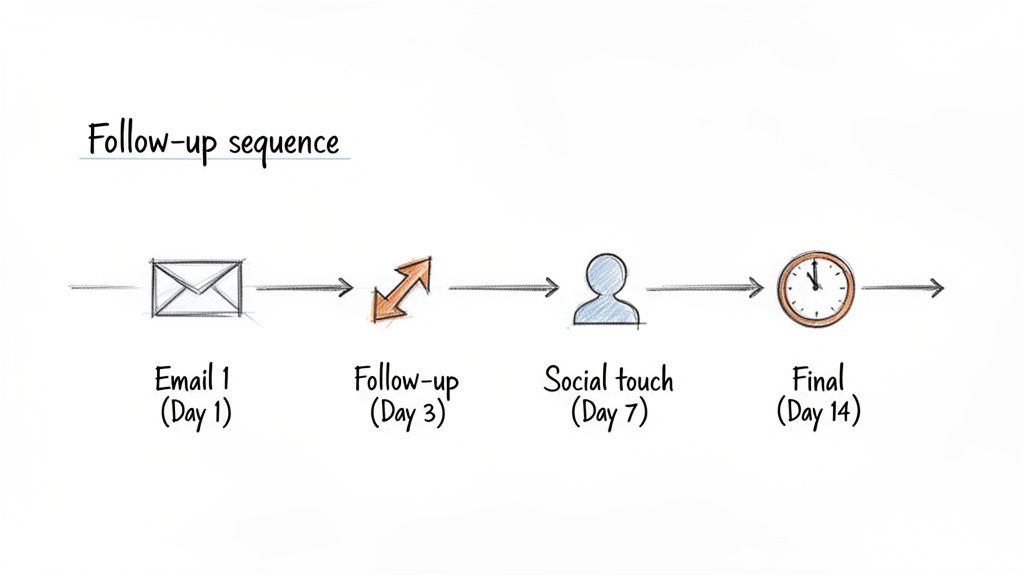
Diagram illustrating a follow-up sequence with steps: Email 1, Follow-up, Social touch, and Final, spread over 14 days.

This isn’t about just sending more emails. It's about making every single touchpoint count. The goal is to stay top-of-mind by being helpful, not annoying.

The Art of the Value-Added Follow-Up

The cardinal sin of following up is the lazy "just bumping this" email. It adds zero value. All it communicates is, "I want something from you." It’s a selfish, ineffective approach that gets you deleted instantly.

A powerful follow-up does the complete opposite. It offers something new, re-engaging the prospect with a fresh insight or a relevant resource. It proves you're still thinking about their specific challenges, not just your own quota.

Let's look at the difference.

Follow-Up TacticThe Lazy "Bump" (Annoying)The Value-Add (Effective)
Email 2 (Day 3)"Just wanted to bump this to the top of your inbox.""Saw your company was featured in TechCrunch for the new launch—thought this case study on post-launch scaling might be useful."
Email 3 (Day 7)"Following up on my last email.""You mentioned hiring new SDRs on LinkedIn; here's a short video on how our top clients cut ramp time by 30%."
Final Email (Day 12)"Is this still a priority for you?""Assuming now isn't the right time. If you ever revisit your outbound strategy, I'm here to help."

The value-add approach repositions you from a random salesperson to a helpful resource. Every touchpoint is a chance to teach, share, or congratulate. That’s how you build trust and make a future conversation feel natural, not forced.

Designing Your Follow-Up Cadence

Your cadence—the timing and channels you use—is just as crucial as the message itself. There's no single magic formula, but a balanced, multi-channel approach consistently crushes a simple email-only sequence.

Actionable Step: Build a simple 14-day, multi-channel cadence in your CRM or sales engagement tool. Here's a proven template:

  • Day 1: Personalized Email 1
  • Day 3: LinkedIn Connection Request (with a brief, non-pitchy note referencing your email)
  • Day 5: Follow-Up Email 2 (offering a new resource)
  • Day 8: LinkedIn Post Like/Comment (genuine engagement, not just a thumbs-up)
  • Day 10: Phone Call (referencing your previous emails and LinkedIn touchpoint)
  • Day 14: Final Follow-Up Email (the friendly breakup)

This multi-channel strategy surrounds the prospect in a subtle, professional way. They see your name in their inbox, on LinkedIn, and maybe hear it on a call, creating a sense of familiarity a linear email sequence just can't match. To get these systems humming, a well-defined workflow is essential. For a deeper dive, this Practical Guide to Workflow Marketing Automation offers great insights into building them.

The goal of a sequence isn't to bombard someone until they surrender. It's to find the right person at the right time with the right message, using different channels to increase your odds of connecting.

Timing and Data-Driven Sequencing

Optimizing when you send your emails can give you a surprising edge. Research shows that smart timing can swing reply rates by up to 30%, with Thursdays often being a sweet spot for engagement. Don't count out the evenings, either; sends between 8-11 PM can catch executives clearing their inboxes.

But the real magic is in the sequence itself. Moving from a single email to a three-email sequence can almost double your chances of getting a response.

This data hammers home why a structured follow-up plan is non-negotiable. For sales teams that can't afford to let opportunities slip through the cracks, our playbook on how to never miss a follow-up provides a battle-tested framework for building and managing these critical sequences right inside your CRM.

By combining a multi-channel approach with smart timing, you turn follow-ups from a chore into a reliable engine for creating conversations and booking meetings.

How to Optimize and Scale Your Outreach Engine

Writing one great cold email is a skill. Building a predictable pipeline from thousands of them? That’s a system. This is where we shift gears from individual art to scientific, scalable execution—a process that separates the high-growth sales teams from everyone else stuck on a revenue rollercoaster.

Scaling isn't about brute force. It's not just "send more emails." It’s about building an intelligent feedback loop where every single send, every call, and every reply makes your entire outreach engine smarter and more efficient. That requires a real commitment to testing, measuring, and integrating your tools.

A/B Testing Your Way to Higher Replies

Guesswork is the enemy of scale. You can't improve what you don't measure, and that’s why disciplined A/B testing is the bedrock of any serious outbound program. The entire game is about isolating one variable at a time, running it against your control, and systematically adopting the winner.

Forget about throwing random ideas at the wall. Focus your tests on the highest-impact elements of your emails.

  • Subject Lines: Test a curiosity-driven subject like "your recent podcast" against a benefit-driven one like "idea for your SDR team." The winner tells you whether your prospects are more motivated by personalization or by a clear value statement.
  • Value Propositions: Pit a problem-focused angle against a gain-focused one. For example, compare "Struggling to keep CRM data clean?" with "A way to get 30% more selling time for your reps." This reveals which pain points really hit home.
  • Calls-to-Action (CTAs): Compare a low-friction "interest check" like "Worth exploring?" against a resource offer like "Mind if I send over a case study?" This helps you find the path of least resistance to starting a real conversation.

The most common mistake in A/B testing is changing too many variables at once. If you test a new subject line and a new CTA in the same email, you'll have no idea which change drove the results. Be patient. Be methodical.

Moving Beyond Vanity Metrics

Open rates feel good, but they're a notoriously unreliable indicator of success. A catchy subject line might get an open, but it doesn’t mean your message actually landed. To truly understand what’s working, you need to track metrics that measure genuine engagement and intent.

This screenshot from marketbetter.ai shows how modern platforms visualize a sales funnel, giving you a clear picture of what's happening at each step.

The real insight comes from tracking the drop-off from one stage to the next. That’s how you pinpoint exactly where your process is breaking down.

To help you diagnose your funnel, we’ve put together a quick guide to the metrics that actually matter.

Key Cold Email Metrics to Track in Your CRM

This table breaks down the essential metrics for measuring your cold email effectiveness. Use it to diagnose problems and find opportunities in your funnel.

MetricWhat It MeasuresActionable Insight
Reply RateThe percentage of recipients who replied.The most basic measure of engagement. If it's low, your core message or CTA is likely off.
Positive Reply RateReplies that express interest, not objections.This filters out the "not interested" noise to show true engagement. A high reply rate but low positive rate means your targeting or value prop is wrong.
Meetings BookedThe ultimate goal—how many conversations were generated.This is your North Star metric. If positive replies don't lead to meetings, your follow-up process or handoff to AEs needs work.
Bounce RateEmails that failed to deliver.A high bounce rate (over 5%) points to a problem with your email list quality or your technical domain setup.

Tracking these numbers in your CRM gives you a clear, honest view of performance. It turns your outreach from a guessing game into a predictable system.

The Technical Side of Deliverability

You can write the world's best cold email, but it's worthless if it lands in the spam folder. Email deliverability is the non-negotiable technical foundation of your entire outreach strategy. Getting it right ensures your messages actually reach the primary inbox.

Three critical records—SPF, DKIM, and DMARC—work together to prove to receiving email servers that you are who you say you are.

  1. SPF (Sender Policy Framework): This is a list of approved servers allowed to send emails on behalf of your domain. Think of it as a bouncer's guest list for your email.
  2. DKIM (DomainKeys Identified Mail): This adds a digital signature to your emails, which the recipient's server can verify. It’s like a tamper-proof seal on an envelope.
  3. DMARC (Domain-based Message Authentication, Reporting & Conformance): This tells receiving servers what to do with emails that fail SPF or DKIM checks—like sending them to spam or rejecting them outright.

Actionable Step: Use a free tool like MXToolbox to check your domain's SPF, DKIM, and DMARC records today. If any are missing or misconfigured, work with your IT team to fix them immediately. This is table stakes for any serious cold email campaign.

Operationalizing Your Playbook in a CRM

Scaling your outreach demands more than just a collection of tools; it requires a truly integrated system. This is where so many teams fall down. Their workflow is a disjointed mess—one tool for prospecting, another for writing, a separate dialer, and then reps manually log everything (or don't) in the CRM.

This fragmented approach is a recipe for chaos. Data gets lost, coaching becomes impossible, and reps waste hours on admin work instead of selling.

A much better way is to operationalize your entire playbook inside your CRM, whether it's Salesforce or HubSpot. By using an integrated task engine and dialer that lives directly inside your system of record, you create a seamless workflow. Reps get prioritized tasks, execute calls and emails with AI assistance, and all activity is automatically logged. This keeps your data clean, gives leaders the visibility they need, and lets you scale a consistent, high-quality process across the entire team.

Free Tool

Try our AI Lead Generator — find verified LinkedIn leads for any company instantly. No signup required.

Your Cold Email Questions, Answered

Even with the best playbook, the real world throws curveballs. When you're in the trenches, practical questions always pop up. Here are some quick, straight-to-the-point answers to the challenges I see reps wrestle with the most.

How Many Emails Should I Send a Day?

When you’re just starting out, forget volume. Quality over quantity isn't just a nice phrase; it's the only thing that works.

Aim for 25 to 50 highly personalized emails per day. That number is the sweet spot—small enough that you can actually do your homework on every single prospect, ensuring every email feels like it was written just for them. It’s a world away from the old "spray and pray" approach of blasting hundreds of generic templates, which is a surefire way to kill your domain reputation and get ignored.

The goal isn't to send the most emails. It's to start the most conversations. A handful of sharp, well-researched emails will beat a hundred lazy ones every single time.

Should I Use a Separate Domain for Outreach?

Yes. Absolutely. Using a secondary domain (like getcompany.com instead of company.com) is one of the smartest defensive moves you can make.

Think of it as a firewall for your brand. If your outreach domain gets flagged for spam—which can happen by mistake or just from high volume—your main corporate domain is completely insulated. That means your critical business emails to customers, partners, and investors keep flowing without a hitch.

It’s just good strategy. Your main domain is your corporate headquarters; the outreach domain is a pop-up shop. You can afford to be more aggressive with the pop-up without risking the entire brand.

How Should I Handle Objections in a Reply?

First, an objection is not a "no." It's a request for more information, and how you handle it is what separates the pros from the amateurs. The key is to validate their point, gently reframe the discussion, and offer a next step that requires almost zero effort on their part.

Let’s look at a couple of common scenarios:

ObjectionThe Weak Response (Defensive)The Strong Response (Empathetic)
"We already have a solution for this.""But our solution is better because of X, Y, and Z.""That's great to hear. Most teams we talk to are using something. We often find we can complement their existing tools by helping with [specific niche problem]. Worth a quick look?"
"Now isn't the right time.""When would be a better time to reconnect?""Totally understand, timing is everything. Mind if I send over a short case study for you to keep on file if priorities shift?"

See the difference? The strong response validates their reality. It keeps the door open by offering value, not by pushing for a meeting. You instantly shift from being a pesky salesperson to a helpful resource, turning a dead end into a long-term opportunity.


Ready to turn your sales team into a predictable pipeline engine? marketbetter.ai embeds an AI-powered task engine and dialer directly inside Salesforce and HubSpot, helping your reps execute faster and smarter. Stop the busywork and start more conversations. Learn more at https://www.marketbetter.ai.
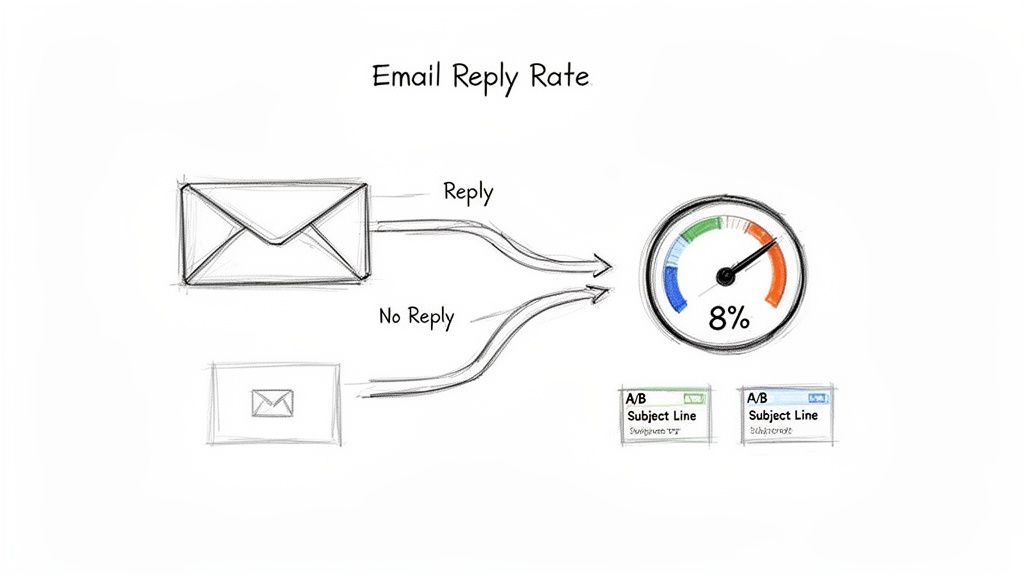
10 Actionable Marketing Key Performance Indicators Examples for 2026

· 29 min read

In the high-stakes world of B2B marketing and sales development, activity without measurement is just noise. The critical difference between a high-growth team and a stagnant one often lies in tracking the right metrics, not just the most obvious ones. Simply monitoring website traffic or social media likes isn't enough; you need to connect marketing efforts directly to sales outcomes and revenue generation. This guide moves beyond vague theory to provide a comprehensive list of actionable marketing key performance indicators examples.

We will provide a detailed breakdown of the KPIs that truly matter for modern demand generation and sales development teams. You won't just get definitions. For each metric, we'll provide the specific formulas for calculation, realistic benchmarks to aim for, and common pitfalls to avoid. More importantly, we'll give you actionable strategies and quick implementation tips to start using these KPIs immediately. This isn't about collecting data for its own sake; it's about transforming that data into your most powerful strategic asset.

This article is designed for sales and marketing leaders who need to prove their impact, drive efficiency, and make data-driven decisions. You will learn precisely how to measure everything from top-of-funnel activity rates and email engagement to sales cycle velocity and the true cost per opportunity. We will explore how to compare different channels, assess rep performance, and optimize your entire go-to-market motion. Let's dive into the essential KPIs that will help you stop guessing, start measuring, and build a predictable revenue engine.

1. Outbound Activity Rate (Calls & Emails Per Rep Per Day)

The Outbound Activity Rate measures the raw volume of outreach a sales development representative (SDR) or business development representative (BDR) completes daily. This foundational KPI tracks meaningful touches, such as calls and personalized emails, which serve as the top-of-the-funnel fuel for pipeline generation. While simple, it's a critical indicator of a team's effort and capacity.

Dashboard visualizing outbound activity with daily touches and performance metrics for three individuals.

This metric helps sales leaders quickly diagnose issues. Low activity could signal a need for better tools, process improvements, or coaching on efficiency. For instance, compare two reps: Rep A averages 15 daily touches while Rep B hits 45. The discrepancy isn't about effort but efficiency. A deeper look might show Rep B uses a tool to automate prep work and logging, while Rep A is bogged down by manual tasks. This comparison makes the case for investing in automation actionable.

Strategic Application & Analysis

Tracking this KPI reveals powerful insights when segmented. An outbound-focused SaaS company, for example, might track calls and emails separately. By comparing the two channels, they could discover that calls convert to meetings at a 3x higher rate than emails. This data provides an actionable insight: shift the team's strategy toward a call-first engagement model for higher-value accounts.

Key Insight: Activity without quality is just noise. The goal isn't simply to maximize touches but to maximize meaningful touches. High activity rates paired with low conversion rates indicate a problem with messaging, targeting, or rep skill.

Actionable Tips for Implementation

  • Automate Non-Selling Tasks: Use tools that auto-log activities in your CRM. This keeps reps focused on outreach, not administrative work, and ensures data accuracy.
  • Set Realistic Targets: Base daily activity goals on historical performance and team capacity, not arbitrary industry benchmarks. A realistic target for a team with complex, research-heavy sales will differ from one with a high-volume, transactional model.
  • Prioritize Smartly: Implement a system, like a prioritized task inbox, to ensure reps always work on the highest-fit accounts first. This aligns effort with potential revenue.
  • Coach with Data: In weekly one-on-ones, review activity dashboards to identify bottlenecks. Is a rep spending too much time researching? Are they struggling with call scripts? Use the data to guide coaching conversations. For a deeper dive, explore these strategies for effective outbound lead generation.

2. Reply Rate (Email Open & Response %)

The Reply Rate is the percentage of cold outreach emails that receive a human response, excluding automated replies. This KPI is a direct measure of message effectiveness, moving beyond simple open rates to gauge genuine prospect engagement. It serves as a crucial leading indicator for outbound success, as a strong reply rate signals that your targeting, subject lines, and messaging are resonating with your audience.

Diagram illustrating email reply rate, showing emails leading to replies or no replies, with an 8% success.

This metric allows managers to pinpoint weak links in the outreach sequence. A low reply rate despite a high open rate, for instance, suggests the subject line works but the email body fails to connect. Compare two reps: one using generic templates sees a 2% reply rate, while another using context-specific emails achieves an 8% rate by referencing recent account intent signals. This clear comparison demonstrates the ROI of personalization and provides a playbook for the underperforming rep.

Strategic Application & Analysis

Segmenting reply rates by persona, industry, or campaign type is essential for optimization. A B2B tech company might compare subject lines: "Quick question" outperforms "Partnership opportunity" by a 2:1 margin when targeting VPs of Engineering, but the opposite is true for C-level executives. This insight allows for the immediate, actionable tailoring of messaging to different buyer personas.

Key Insight: A reply, even a negative one, is valuable data. A "not interested" response provides a learning opportunity to refine targeting or messaging, whereas silence offers no feedback. The goal is to start conversations, not just send emails.

Actionable Tips for Implementation

  • Segment and Test Systematically: Track reply rates by campaign, persona, and industry to identify what messaging works best for specific audiences. A/B test email variants to isolate winning elements.
  • Keep Emails Short and Relevant: Ditch long, generic templates. Test concise 2-to-4-line emails that reference a specific, recent trigger event like new hiring initiatives or company funding.
  • Monitor and Optimize Weekly: Review reply rate trends every week. If a campaign falls below a set threshold (e.g., 3%), immediately flag it for optimization and analysis.
  • Use Account Context: Leverage tools like MarketBetter to automatically find and insert relevant account context, such as recent site visits or tech stack changes, to make your outreach feel personal and timely. For more strategies, check out these tips on how to improve email open rates.

3. Call Connect Rate (Calls Answered / Calls Made %)

The Call Connect Rate measures the percentage of dialed calls that result in a live conversation with the intended prospect, distinguishing it from calls that go to voicemail or are not answered. This is one of the most vital marketing key performance indicators examples for sales development teams, as it directly impacts the ability to qualify leads and book meetings. A low connect rate renders even the highest call volume ineffective.

This metric provides immediate feedback on the effectiveness of a team's dialing strategy and timing. For instance, a sales manager can compare performance based on process: reps using a dedicated call-prep workflow connect at a 20% rate, while unprepared reps on the same team only average 11%. This data provides a clear, actionable business case for adopting standardized preparation processes to improve efficiency and pipeline generation.

Strategic Application & Analysis

Analyzing connect rates by different segments reveals critical patterns that inform strategy. An enterprise sales team, for example, could compare connect rates by Ideal Customer Profile (ICP) segment. They might discover that executives connect at an 18% rate, while IT buyers only answer 8% of the time. This insight leads to an actionable strategy: reallocate resources, shifting the IT buyer outreach to a different channel and focusing call efforts on the more accessible executive personas.

Key Insight: A high connect rate is a direct reflection of strategic timing, accurate data, and compelling outreach. It's not just about when you call, but also who you call and how prepared your reps are for the conversation.

Actionable Tips for Implementation

  • Time Dials Strategically: Experiment with calling during peak windows, typically 9–11 AM and 1–3 PM local time. Track your own data to find the optimal times for your specific industry and personas.
  • Arm Reps Before Dialing: Use call-prep features or checklists to provide reps with key talking points, recent company news, and prospect background information before they ever pick up the phone.
  • Segment Performance: Monitor connect rates by persona, title, and industry. A low rate for a key segment may signal an issue with your data accuracy or value proposition for that audience.
  • Coach the Opening: Listen to call recordings for reps with below-average connect rates (e.g., under 12%). Often, the first 5-10 seconds of the opening statement make the difference between a conversation and a hang-up. Use this data to refine their talk tracks.

4. Conversation-to-Opportunity Rate (Meeting Booked % or SQL Rate)

The Conversation-to-Opportunity Rate, often called the SQL Rate or Meeting Booked Percentage, measures the effectiveness of an SDR's outreach. It calculates the percentage of meaningful conversations (connected calls or positive email replies) that successfully convert into a qualified meeting or a Sales Qualified Lead (SQL). This is one of the most vital marketing key performance indicators examples for bridging top-of-funnel activity with tangible pipeline growth, shifting focus from quantity to quality.

This KPI directly reflects the quality of targeting, messaging, and a rep's qualification skills. A low rate signals a disconnect; perhaps reps are engaging the wrong personas or the value proposition isn't resonating. For instance, compare two outreach approaches: a rep’s SQL rate might jump from 8% with generic outreach to 14% after using a tool to prioritize accounts showing clear buying signals. This comparison proves the power of context-driven engagement and provides an actionable directive to prioritize intent-based leads.

Strategic Application & Analysis

Analyzing this KPI by channel and segment reveals powerful strategic levers. A revenue operations manager could compare the SQL rate by different outreach triggers and discover that tasks generated from "hiring spike" alerts convert at a rate three times higher than standard cold prospecting. This data provides a clear, actionable mandate to reallocate resources and prioritize campaigns targeting companies that are actively expanding their teams.

Key Insight: Not all meetings are created equal. The ultimate goal is to generate qualified pipeline, not just fill calendars. A high meeting-booked rate with a low SQL-accepted rate indicates a qualification gap between the SDR and sales teams.

Actionable Tips for Implementation

  • Define "Qualified" Collaboratively: Work with the sales team to establish firm, mutually agreed-upon criteria for what constitutes a true SQL. This alignment prevents pipeline friction and wasted effort.
  • Track End-to-End Conversion: Monitor the entire sequence from initial task creation to conversation, booking, and final SQL acceptance. This full-funnel view helps pinpoint exactly where prospects are dropping off.
  • Segment for Precision: Analyze your SQL rate by account fit (ICP vs. non-ICP), industry, and persona. Focus your team's energy and resources on the segments that demonstrate the highest conversion potential.
  • Coach on Qualification: Train reps to qualify prospects during the conversation, not just book a meeting with anyone who shows interest. Equip them with questions to uncover pain points, budget authority, and timing.

5. Average Sales Cycle Length & Deal Velocity

The Average Sales Cycle Length measures the time from the first outbound touch, like a call or email, to a key conversion point such as a closed deal. Deal Velocity tracks how quickly deals progress through pipeline stages. These complementary KPIs show how effectively outbound efforts are not just generating leads, but accelerating them toward revenue. A shorter cycle means faster cash flow and quicker feedback loops for campaign optimization.

This metric is essential for connecting top-of-funnel activity to bottom-line results. For instance, a RevOps manager might compare lead sources and discover that Sales Qualified Leads (SQLs) generated from high-intent outbound tasks progress through the pipeline 40% faster than leads from other sources. This insight provides an actionable justification for reallocating budget toward more targeted cold outreach efforts that produce higher-velocity deals.

Strategic Application & Analysis

Analyzing sales cycle length by segment reveals which outreach strategies are most efficient. A B2B SaaS company might track this KPI by outreach channel and compare call-sourced vs. email-sourced deals. If they discover call-sourced deals close in 28 days on average, while email-sourced deals take 35 days, they have a strong, data-backed case for prioritizing a call-first engagement model for high-value target accounts to shorten the time to revenue.

Key Insight: Speed is a competitive advantage. A faster sales cycle doesn't just improve cash flow; it reduces the risk of deals stalling or being lost to competitors. The goal is to identify and eliminate friction points at every stage of the buyer's journey.

Actionable Tips for Implementation

  • Establish a Baseline: Before making any changes, measure your current average sales cycle length to create a benchmark for future optimizations.
  • Segment the Cycle: Break the sales cycle into distinct phases (e.g., first touch to meeting, meeting to SQL, SQL to close) to pinpoint exactly where deals are slowing down.
  • Prioritize High-Intent Leads: Use tools that create outreach tasks based on intent signals rather than random prospecting. Warm leads naturally move through the pipeline faster, compressing your sales cycle.
  • Monitor Velocity Weekly: Track the number of deals created, their current stage, and their age. A weekly review helps you spot bottlenecks before they derail your forecast.
  • Align with Sales: Collaborate with the sales team to understand why SQLs get stuck. Common roadblocks include internal approvals, forecasting issues, or a lack of sales readiness materials.

6. Cost Per Sales Qualified Lead (CPSL) or Cost Per Opportunity

Cost Per Sales Qualified Lead (CPSL) measures the total expense required to generate one opportunity for the sales pipeline through outbound efforts. This efficiency metric connects the investment in your sales development team (salaries, tools, overhead) directly to pipeline value. It answers a critical question for sales leaders: How much does it cost us to create a qualified chance to win business?

This KPI is essential for budgeting, justifying headcount, and evaluating technology investments. Compare your team's efficiency before and after a change. For example, a baseline CPSL might be $400 per opportunity, driven by manual research. After implementing an automation tool, activity rises by 40% with the same team, lowering the CPSL to $280. This comparison demonstrates clear ROI and provides an actionable business case for further investment in sales efficiency.

Strategic Application & Analysis

Analyzing CPSL reveals the true cost-effectiveness of different outreach strategies. For instance, a sales leader can compare CPSL by channel. They might discover that their cold email campaigns produce SQLs at a CPSL of $350, while a call-first sequence results in a CPSL of just $310. This data provides a clear, actionable directive to reallocate rep time and training resources toward more phone-based engagement to optimize the budget.

Key Insight: A declining CPSL is a direct indicator of improving operational efficiency. It proves that your team, processes, and tools are becoming more effective at turning investment into a tangible sales pipeline.

Actionable Tips for Implementation

  • Calculate True Costs: Include all associated expenses in your CPSL calculation: fully-loaded salaries (including benefits and taxes), software licenses, management overhead, and training costs for a complete picture.
  • Segment for Deeper Insights: Don't just track a single, blended CPSL. Break it down by individual rep, team, target industry, or outreach campaign to identify top performers and effective strategies that can be replicated.
  • Set Improvement Targets: Use your baseline CPSL to set quarterly or annual goals. A common objective is to reduce CPSL by a specific percentage, such as 15% year-over-year, driving continuous process improvement.
  • Evaluate Tool ROI: When assessing new sales technology, frame the decision around its potential impact on CPSL. If a tool costs $5,000 per month but reduces CPSL by $100 per lead across 500 monthly SQLs, it generates a net savings of $45,000, making the investment easy to justify.

7. Email Deliverability & Bounce Rate

Email Deliverability measures the percentage of emails that successfully land in a recipient's primary inbox, while Bounce Rate tracks the percentage that fails to be delivered. These interconnected marketing key performance indicators examples are foundational; if your messages don't reach their destination, every other email metric like open and reply rates becomes irrelevant. High bounce rates are a direct threat to your sender reputation, which can get your domain blacklisted by providers.

This KPI is a critical health check for your entire outbound engine. A high bounce rate (over 3-5%) or low deliverability immediately signals a problem with your data quality, sending infrastructure, or content. For instance, compare a stale list to a clean list: a team using a stale list might see an 8% bounce rate and only 60% deliverability. After cleaning the list and implementing an email warm-up protocol, bounces could drop to under 1% and deliverability climb to over 97%, an actionable process that effectively revives a failing campaign.

Strategic Application & Analysis

Analyzing these metrics by campaign or domain provides immediate diagnostic power. Imagine a marketing team comparing two domains in a multi-domain outreach campaign. They notice one domain's performance is lagging significantly. A reputation audit reveals that specific domain has been flagged for spam. The actionable solution is to pause activity on the flagged domain and shift volume to a fresh, properly warmed-up one, restoring overall campaign deliverability from a concerning 70% to a healthy 94%.

Key Insight: Deliverability isn't a "set it and forget it" metric. It's a dynamic score influenced by recipient engagement, list hygiene, and technical setup. Consistently low inbox placement, even without high bounces, indicates that your emails are being filtered to spam, silently killing your ROI.

Actionable Tips for Implementation

  • Validate Lists Relentlessly: Before every single campaign, use an email validation service to scrub your list of invalid, inactive, or risky addresses.
  • Authenticate Your Domain: Properly configure your technical records (SPF, DKIM, and DMARC). These act as your domain's digital passport, proving to email providers that you are a legitimate sender.
  • Implement an Email Warm-Up: Never send high-volume campaigns from a new domain or email address. Start by sending 5-10 emails on day one, then increase the volume by about 10% daily over several weeks to build a positive sender reputation.
  • Monitor Bounce Rates Daily: During any active campaign, watch your bounce rate. If it exceeds 3%, pause the campaign immediately to diagnose the issue, whether it's a bad data segment or a technical block.

8. Rep Ramp Time (Time to Productivity for New SDRs)

Rep Ramp Time measures how long it takes a newly hired sales development representative (SDR) to reach full productivity. This crucial KPI quantifies the efficiency of your onboarding and training processes, directly impacting the return on investment for new hires. A shorter ramp time means a faster contribution to pipeline and revenue, making it a key focus for scaling sales teams.

This metric provides a clear lens into the effectiveness of your sales enablement. For instance, an enterprise sales operations team can compare ramp time by hiring cohort. A pre-implementation cohort could average 85 days to full productivity, while a cohort equipped with an automation tool from day one might reach the same level in just 52 days—a 39% improvement. This comparison provides a clear, actionable case for investing in better onboarding technology.

Strategic Application & Analysis

Analyzing this KPI by cohort or team reveals the impact of training programs, tools, and management styles. A sales manager might compare the progress of reps using different tools. New hires without a structured enablement platform might hit 40% of their activity target by day 30. In contrast, new reps using a platform with an automated task inbox and AI-generated emails might hit 70% in the same timeframe. This demonstrates a clear, actionable link between tooling and performance.

Key Insight: Rep Ramp Time is not just a training metric; it's a financial one. Every day shaved off the ramp period is a day a new hire is generating pipeline and revenue, directly accelerating team-wide goal attainment.

Actionable Tips for Implementation

  • Define 'Full Productivity': Establish a clear, quantifiable benchmark. This could be hitting 80% of a tenured rep's qualified meeting target, a specific activity level, or a target reply rate for three consecutive weeks.
  • Track Cohort Performance: Measure ramp time for groups of hires, not just individuals. This smooths out personal variations and provides a more accurate view of your onboarding process's effectiveness.
  • Automate the Onboarding Playbook: Use tools to build a standardized ramp playbook. A new rep should log in on day one to a prioritized task list, proven outreach sequences, and templated messaging, eliminating guesswork.
  • Implement a Buddy System: Pair each new hire with a top-performing veteran for the first few weeks. This provides a direct line for tactical questions and helps them learn the qualitative aspects of the role faster.

9. CRM Data Quality & Activity Logging Completeness

CRM Data Quality measures the accuracy and completeness of logged sales activities, such as calls and emails, within a CRM like Salesforce or HubSpot. This critical KPI evaluates whether reps are consistently recording interactions with the correct disposition, timing, and context. Poor data quality renders reporting useless, hampers effective coaching, and breaks revenue attribution models.

A diagram illustrating CRM data quality, automation processing communication data into records, achieving 95% completeness.

This metric exposes foundational operational gaps. For example, compare a rep's claimed activity to their logged activity. A rep might claim 50 calls per day, but their CRM only shows 15 logged tasks. Without accurate data, a manager can't distinguish between low effort and poor logging discipline. Implementing an automated tool that reveals the rep's true performance makes the problem visible and coachable. For effective tracking and analysis of your sales performance, accurate and complete CRM data is non-negotiable; exploring options like a dedicated CRM Specialist Virtual Assistant can greatly enhance data quality.

Strategic Application & Analysis

Tracking logging completeness helps RevOps and sales leaders trust their pipeline forecasts. Compare two teams: one without auto-logging might have only 35% of calls logged, leading to inaccurate forecasts. A team with an automation tool could see 94% of calls auto-logged with summaries and dispositions. This comparison highlights the direct impact of automation on forecast accuracy, providing an actionable insight for operational improvement.

Key Insight: Incomplete CRM data is not just a reporting inconvenience; it's a strategic liability. It hides top performer behaviors, masks coaching opportunities, and leads to flawed decisions about which marketing key performance indicators examples are truly driving revenue.

Actionable Tips for Implementation

  • Automate Everything Possible: Use tools with native dialers and email integration to eliminate manual data entry. This removes friction for reps and ensures every touchpoint is captured.
  • Standardize Dispositions: Create a simple, clear taxonomy for call and email outcomes (e.g., Connected, Voicemail, Meeting Set, Follow-Up). This standardizes data for easier analysis.
  • Conduct Weekly Spot-Checks: During one-on-ones, pull a few random contact records and review them for logging completeness. This reinforces accountability and identifies issues early.
  • Show the "Why": Create a dashboard that connects logging compliance to tangible business outcomes. Show the team, "When we log over 90% of activities, our forecast accuracy improves by 15%."

10. Manager Coaching Leverage & Rep Enablement Scalability

Manager Coaching Leverage is a qualitative KPI that measures how effectively sales leaders can scale coaching and replicate top-performer behaviors across their entire team. It assesses the ability to move beyond one-off feedback by systematically identifying winning patterns, codifying them into playbooks, and course-correcting underperformers with data-backed insights. Without visibility into rep outreach, coaching is often based on guesswork; this KPI tracks the shift from anecdotal to analytical enablement.

This metric helps leadership turn individual successes into scalable team-wide strategies. A manager can compare the tactics of a top performer to a struggling rep. One rep has an 11% reply rate while another is at 3%. By reviewing their activities in a centralized tool, the manager can pinpoint exact differences in subject lines or call scripts. This allows them to coach the struggling rep with specific, proven examples—a highly actionable alternative to generic advice.

Strategic Application & Analysis

Analyzing this KPI involves moving from individual performance metrics to team-wide behavioral patterns. A sales leader can compare the call recordings of top reps vs. average reps. They might discover top performers consistently use a specific opener, like, "I noticed you recently hired a new VP of Sales." This observation is then transformed into an actionable playbook for the entire team. After rollout, they can track the team's average meeting booking rate. If it jumps from 4% to 6%, the coaching leverage is tangibly proven.

Key Insight: Scalable enablement isn't about cloning your best rep; it's about isolating and distributing their most effective behaviors. The goal is to create a system where winning tactics are quickly identified, shared, and adopted by everyone.

Actionable Tips for Implementation

  • Schedule Weekly Coaching Reviews: Dedicate time to review 2-3 call recordings and recent email threads for a handful of reps each week. Focus on identifying one winning tactic and one area for improvement.
  • Create Living Playbooks: Use a centralized document or tool to codify what works. Include best-in-class subject lines, opening call scripts, objection-handling phrases, and optimal follow-up sequences.
  • Run Data-Driven Team Huddles: Start weekly meetings by sharing a "winning message of the week." Showcase a specific email or call opener from a top performer and explain why it worked, using data on reply or connection rates.
  • Build an Internal Training Library: Use call recordings and email examples to create an onboarding goldmine for new hires. This allows them to learn from your team's best, real-world examples from day one. To take this further, explore these sales enablement best practices.

Top 10 Marketing KPI Comparison

Metric🔄 Implementation Complexity⚡ Resource Requirements⭐ Expected Outcomes💡 Ideal Use Cases📊 Key Advantages
Outbound Activity Rate (Calls & Emails Per Rep Per Day)Low — simple workflows & auto-loggingModerate — reps + CRM integrationIncreases outbound volume; needs quality controlsHigh-volume SDR/BDR teams focused on pipeline creationClear visibility and easy measurement; motivates execution
Reply Rate (Email Open & Response %)Medium — personalization, A/B testing requiredModerate — copy, intent signals, testing toolsImproves message-market fit and conversion per emailTargeted cold email / account-based outreachDirectly tied to relevance; efficient to optimize via tests
Call Connect Rate (Calls Answered / Calls Made %)Medium — dialer setup & call-prep workflowsHigh — dialing volume, trained reps, schedule blocksDrives live conversations and opportunity creationCall-first outreach and executive prospectingTime-of-day optimization; measurable by disposition
Conversation-to-Opportunity Rate (Meeting Booked % / SQL Rate)Medium–High — needs SQL criteria & end-to-end trackingModerate — coaching, CRM hygiene, qualification processStrong indicator of SDR quality and pipeline contributionTeams prioritizing qualified meetings and revenue attributionAligns SDRs to revenue; surfaces repeatable playbooks
Average Sales Cycle Length & Deal VelocityHigh — cross-team tracking and stage disciplineHigh — analytics, sales ops, coordinationShorter cycles improve cash flow and forecasting accuracyForecasting, enterprise deals, process improvement initiativesReveals bottlenecks; informs resource allocation and pacing
Cost Per Sales Qualified Lead (CPSL)Medium — cost allocation and attribution modelingModerate — finance inputs, tooling, campaign dataQuantifies outbound ROI; supports budget/headcount decisionsTool procurement, hiring justification, channel comparisonClear financial metric to evaluate tool ROI and efficiency
Email Deliverability & Bounce RateHigh — DNS auth, warm-up, ongoing list hygieneModerate — IT support, list-cleaning tools, warm-up timeEnables campaign reach; prevents wasted sends and reputation lossAny email-heavy outreach or large-scale cold campaignsProtects sender reputation; directly impacts campaign ROI
Rep Ramp Time (Time to Productivity for New SDRs)Medium — onboarding playbooks + toolingHigh — training, mentorship, enablement toolsFaster productivity and quicker hiring ROIRapid scaling and frequent new-hire onboardingReduces hiring cost/time; standardizes successful behaviors
CRM Data Quality & Activity Logging CompletenessMedium — integrations, taxonomy and governanceModerate — integration tooling and ops monitoringAccurate reporting, reliable forecasting, better coachingTeams relying on data-driven forecasting and attributionEnables coaching, forecasting and removes manual admin burden
Manager Coaching Leverage & Rep Enablement ScalabilityMedium — analytics, recordings, review workflowsModerate — manager time + platform accessScales coaching impact; speeds adoption of best practicesGrowing teams and formal enablement programsData-driven coaching; codifies top-performer playbooks and metrics

From Metrics to Momentum: Turning KPIs into Your Growth Engine

Navigating the landscape of modern sales and marketing can feel like steering a ship in a storm without a compass. The comprehensive list of marketing key performance indicators examples we've detailed in this article serves as that essential navigation system. Moving beyond mere data collection, the real power lies in transforming these metrics from passive dashboard decorations into an active, intelligent growth engine that drives predictable revenue and empowers your entire team. The journey isn't about tracking every possible number; it's about selecting the vital few that illuminate the path from initial outreach to a closed deal.

The KPIs discussed, from Outbound Activity Rate to CRM Data Quality, are not isolated figures. They represent an interconnected ecosystem where performance in one area directly influences outcomes in another. Think of it as a domino effect: improving your Email Deliverability and Reply Rates (KPIs #7 and #2) directly increases the number of conversations your team has, which in turn boosts your Conversation-to-Opportunity Rate (KPI #4). Similarly, a focus on reducing Rep Ramp Time (KPI #8) ensures that your team scales efficiently, preventing a drop in overall activity and effectiveness as you grow. The most successful demand generation and sales development teams don't just track these metrics; they understand and actively manage these intricate relationships.

Turning Insights into Actionable Strategy

The core challenge for any sales leader, demand generation manager, or VP of Sales is translating raw data into strategic action. It’s the difference between knowing your Call Connect Rate is 5% and understanding why it’s 5% and what levers to pull to improve it. Let’s compare two approaches:

  • The Passive Tracker: This manager sees a low Conversation-to-Opportunity Rate and simply tells the team to "book more meetings." The KPI is a grade, not a guide. This leads to frustration, burnout, and stagnant results.
  • The Active Optimizer: This manager sees the same low rate but digs deeper. They analyze call recordings, review email copy, and use CRM data to see if the issue is lead quality, messaging, or a need for more coaching. They treat the KPI as a diagnostic tool, leading to targeted, effective interventions.

This is where the strategic value of mastering these marketing key performance indicators examples truly shines. They provide the empirical evidence needed to justify strategic shifts, allocate resources effectively, and build a compelling business case for new tools or headcount. When you can clearly demonstrate how a 2% increase in Reply Rate translates directly into a 15% increase in Sales Qualified Leads, you're no longer just managing a team; you're architecting a revenue machine.

Your Roadmap for Implementation and Growth

Embarking on this data-driven journey can feel daunting, but the key is to start small and build momentum. Don't try to overhaul your entire reporting structure overnight. Instead, adopt a phased approach:

  1. Select Your "North Star" KPIs: Choose 2-3 primary indicators from our list that align directly with your most pressing business goal for this quarter. Is it pipeline generation? Then focus on Conversation-to-Opportunity Rate and Cost Per Sales Qualified Lead. Is it team scalability? Prioritize Rep Ramp Time and Manager Coaching Leverage.
  2. Establish a Baseline: Track these selected KPIs for 2-4 weeks without making major changes. This gives you a clear, honest baseline from which to measure future improvements.
  3. Implement and Iterate: Introduce one strategic change at a time. This could be a new email sequence, a refined call script, or a dedicated coaching session. Measure the impact on your North Star KPIs.
  4. Create a Rhythm of Review: Institute a weekly or bi-weekly meeting where the team reviews these key metrics. The focus should not be on judgment but on collaborative problem-solving and celebrating wins.

To truly accelerate this process, integrating technology is crucial. For instance, implementing effective sales and marketing automation strategies can streamline many of the manual tasks associated with tracking and follow-up, freeing your team to focus on high-value conversations. This is how you embed data into your team's DNA, transforming KPIs from a management chore into a shared tool for collective success. Ultimately, mastering these metrics empowers your team with clarity, purpose, and a direct line of sight between their daily efforts and the company's growth.


Ready to move from tracking KPIs to actively improving them? marketbetter.ai is the platform designed to turn your sales development data into your biggest competitive advantage. It automates the tedious parts of tracking and analysis, surfacing the critical insights you need to coach your team and build a predictable pipeline. Stop guessing and start growing by visiting marketbetter.ai to see how you can transform your metrics into momentum.

Top 10 KPIs for Lead Generation to Master in 2026

· 29 min read

In B2B sales, the pressure to generate more leads is relentless. But focusing solely on volume is like celebrating a quarterback who only throws short passes; the stats look busy, but you never score. The real game-changer isn't just generating more leads; it's about creating better pipeline, faster and more efficiently. This requires a shift from vanity metrics to actionable insights that directly connect outbound efforts to revenue. So, what should you be measuring? The answer lies in a balanced scorecard of kpis for lead generation that track cost, speed, quality, and ultimately, business impact.

This guide breaks down the 10 essential KPIs that every Sales Development Representative (SDR), demand generation manager, and VP of Sales needs to master. We'll go beyond simple definitions, providing the specific formulas, industry benchmarks, and actionable steps required to turn raw data into a predictable revenue engine. Each metric is a lever you can pull to refine your process, improve team performance, and make smarter, data-driven decisions.

You'll learn not just what to measure but how to act on those measurements. We’ll compare metrics like Lead Response Time against Meeting Booking Rate to show how one directly influences the other, giving you a holistic view of your outbound funnel. To truly optimize this funnel, it's also crucial to understand the broader landscape of effective and modern top lead generation strategies. By combining the right KPIs with proven tactics, you can build a system that doesn't just fill the pipeline but fills it with opportunities that close.

1. Cost Per Lead (CPL)

Cost Per Lead (CPL) is one of the most fundamental KPIs for lead generation, measuring the total cost-effectiveness of your marketing and sales development efforts. It calculates the average expense incurred to generate a single new lead for your sales pipeline. Understanding this figure is critical for budget allocation, campaign optimization, and proving the ROI of your activities.

A balance scale weighing cost (money) against leads (people), with an upward CPL trend in the background.

This metric directly ties your financial investment to tangible outcomes, answering the simple but vital question: "How much are we paying for each lead?"

How to Calculate and Use CPL

The formula is straightforward, but its components require careful tracking. To accurately calculate CPL and understand the effectiveness of your lead sources, it's crucial to implement essential UTM parameter best practices for flawless tracking.

  • Formula: CPL = Total Marketing & Sales Spend / Total New Leads Generated

  • What to Include: Your "Total Spend" should encompass ad spend, content creation costs, tool subscriptions (like your SDR platform and dialer), and a portion of salaries for the teams involved.

Comparison in Action: A B2B SaaS company finds their outbound SDR team has a CPL of $55. In contrast, their paid advertising CPL is $95. This direct comparison makes the next step actionable: confidently shift more budget toward hiring and enabling SDRs, as it's a 40% more efficient channel for generating leads.

Actionable Tips for CPL Optimization

Merely knowing your CPL isn't enough; you must act on it. Use these strategies to gain deeper insights and improve your lead generation efficiency.

  • Actionable Step: Don't rely on a blended, company-wide CPL. Break it down by channel (outbound, paid social, SEO), campaign, or even target persona. This reveals which specific initiatives deliver the most value and which are draining resources.
  • Actionable Step: Monitor your CPL on a monthly or quarterly basis. A sudden spike could signal an underperforming campaign, a broken tool, or a need for sales rep training. A steady decrease validates your optimization efforts.
  • Actionable Step: A low CPL is useless if the leads don't convert. Always analyze CPL alongside Lead-to-Opportunity Rate. For example, a channel with a $50 CPL that converts 2% of leads to opportunities is less valuable than a channel with a $100 CPL that converts 10% of its leads.

2. Lead Response Time (LRT)

Lead Response Time (LRT) measures the speed at which a sales development representative (SDR) contacts a new lead after it enters your system or shows a high-intent buyer signal. In today's competitive landscape, speed is non-negotiable; research consistently shows that contacting a lead within the first five minutes dramatically increases the odds of qualification and conversion.

Stopwatch indicating rapid time, connected by a lightning bolt to a digital inbox with phone and email icons.

This metric directly correlates sales activity to lead intent, answering the critical question: "Are we engaging prospects while their interest is at its peak?" Tracking LRT is essential among all KPIs for lead generation because it highlights process efficiency and directly impacts pipeline velocity.

How to Calculate and Use LRT

Calculating LRT is simple, but it requires diligent logging of all inbound lead timestamps and first contact attempts. The goal is to minimize the time between these two events.

  • Formula: LRT = Timestamp of First Contact Attempt - Timestamp of Lead Creation/Intent Signal

  • What to Include: "Timestamp of Lead Creation" could be a form submission, a demo request, or an intent data signal. "First Contact Attempt" should be a logged call, email, or social touchpoint.

Comparison in Action: Team A uses a manual process and achieves an LRT of 2-3 hours. Team B uses an automated task inbox and achieves an average LRT of 8 minutes. This speed advantage alone can boost Team B's conversion rates by over 35%, showcasing a clear, actionable ROI on process optimization and automation.

Actionable Tips for LRT Optimization

A low LRT is a competitive advantage. Use these strategies to shorten your response window and capitalize on peak buyer interest.

  • Actionable Step: Set tiered targets based on lead intent. For high-intent signals like demo requests, aim for an LRT under 5 minutes. For lower-intent leads like content downloads, a target of 24 hours is more practical.
  • Actionable Step: Implement an automated escalation workflow. If an assigned rep doesn't meet the LRT target within a set period (e.g., 15 minutes for a high-intent lead), automatically re-route the lead to an available team member or a manager to ensure prompt follow-up.
  • Actionable Step: Use tools that automatically create and prioritize tasks for reps based on lead source and intent. This eliminates manual sorting and reduces the context-switching that causes delays, allowing reps to focus purely on outreach.

3. Lead Quality Score (LQS)

Lead Quality Score (LQS) moves beyond lead volume to prioritize lead value. It's a composite ranking, typically on a 0–100 scale, that predicts a lead's likelihood to convert into a customer. By combining firmographic fit, behavioral signals, and intent data, LQS helps sales development teams focus their energy on the accounts with the highest potential, dramatically improving efficiency and conversion rates.

This metric answers the crucial question: "Which leads should our team work on right now for the best results?" It ensures your most expensive resources, your sales reps, are always working on the most valuable opportunities.

How to Calculate and Use LQS

Unlike simpler KPIs for lead generation, LQS is a weighted composite score rather than a direct formula. You assign points based on various attributes that correlate with successful deals. To master the nuances, you can explore detailed lead scoring best practices to implement today.

  • Formula: LQS = (Weight₁ × Attribute₁) + (Weight₂ × Attribute₂) + ...

  • What to Include: Your attributes should be a mix of:

    • Firmographic: Company size, industry, revenue, tech stack (e.g., uses Salesforce).
    • Behavioral: Website activity (visited pricing page), email engagement (opened 3+ emails), content downloads.
    • Intent: Job changes, recent funding announcements, 3rd-party product searches.

Comparison in Action: Company A routes all leads round-robin. Company B uses an LQS model, automatically routing leads scoring over 80 to senior reps. As a result, Company B sees a 25% higher conversion rate on its top-tier accounts because experienced reps engage them immediately, a direct, actionable outcome of implementing LQS.

Actionable Tips for LQS Optimization

A static LQS model will quickly become obsolete. Use these strategies to build a dynamic, effective scoring system that drives real revenue.

  • Actionable Step: Start with 3-4 high-impact signals like company size, industry, and a key behavioral trigger (e.g., demo request). Add more complex variables only after you can prove a strong correlation between your initial signals and closed-won deals.
  • Actionable Step: Validate your model quarterly. Analyze your closed-won deals against their initial LQS. If low-scoring leads are consistently converting, your model is broken. Use this data to recalibrate your attribute weights.
  • Actionable Step: For reps to trust the system, they need to understand the logic. Create a one-page document explaining what constitutes a "high-quality lead" and share it. This builds buy-in and encourages them to prioritize tasks based on the LQS.

4. Conversations Started / Connect Rate

While tracking outreach volume (dials, emails) is easy, it’s a vanity metric. The Conversations Started or Connect Rate KPI measures the actual effectiveness of that outreach, revealing what percentage of attempts result in a meaningful interaction with a prospect. This metric moves beyond activity to gauge true engagement, separating busy work from productive pipeline building.

This KPI is a direct indicator of your SDR team's ability to break through the noise and capture a prospect's attention, answering the critical question: "Is our outreach actually landing?"

How to Calculate and Use Connect Rate

Tracking this KPI requires diligence in your CRM and sales engagement platform. A "conversation" can be defined as a phone call where you speak to the intended prospect for a minimum duration (e.g., over 90 seconds) or a substantive email reply that isn't an out-of-office message.

  • Formula: Connect Rate = (Total Conversations Started / Total Outreach Attempts) * 100

  • What to Include: "Total Outreach Attempts" includes all dials made and unique emails sent. "Total Conversations Started" includes all live phone conversations and meaningful email replies.

Comparison in Action: An SDR team using generic email templates has a reply rate of 1.2%. After switching to AI-written emails grounded in account-specific context, their reply rate jumps to 2.8%. This seemingly small lift more than doubles the number of conversations started from the same email volume, creating a massive downstream impact on meetings booked and pipeline generated.

Actionable Tips for Connect Rate Optimization

Improving your connect rate is one of the highest-leverage activities for any sales development team. A higher connect rate means more at-bats for your reps without increasing their workload.

  • Actionable Step: Analyze connect rates by lead source and list quality. If one rep's connect rate is low, check if they were assigned a poor-quality list before assuming it's a performance issue. This prevents misattributing problems to the rep instead of the data.
  • Actionable Step: Track connect rates by time of day and day of the week. If you find that calling prospects between 4-5 PM on a Tuesday yields a 30% higher connect rate, immediately block out this time on your team's calendar for focused call blitzes.
  • Actionable Step: Coach reps that a higher connect rate comes from relevance, not volume. Implement a 3-minute pre-call planning checklist for top accounts, including finding one recent company news item and one personal detail from LinkedIn.

5. Pipeline Generated / Pipeline Contribution

While metrics like appointment setting measure activity, Pipeline Generated quantifies the direct revenue impact of your lead generation efforts. It measures the total dollar value of qualified sales opportunities created from a specific channel, such as your SDR team, during a given period. This is one of the most critical KPIs for lead generation because it bridges the gap between marketing or sales development activity and tangible financial outcomes.

This KPI answers the ultimate question from your CFO and board: "How is this team's work contributing to our revenue goals?" Pipeline Contribution takes this a step further by showing the percentage of the total company pipeline created by a specific team, clarifying its strategic importance.

How to Calculate and Use Pipeline Generated

Calculating this metric requires disciplined CRM hygiene and a clear, universally understood definition of what constitutes a "qualified" opportunity.

  • Formula: Pipeline Generated = Sum ($) of All Qualified Opportunities Created in a Period

  • Formula (Contribution): Pipeline Contribution % = (SDR-Generated Pipeline / Total Company Pipeline) * 100

  • What to Include: Your "Qualified Opportunities" should be tied to a specific sales stage, like "Stage 2: Discovery" or "SAL (Sales Accepted Lead)." This ensures you aren't counting unqualified leads and inflating your numbers.

Comparison in Action: A company's SDR team of 8 generates $2.4M in qualified pipeline in a quarter. The total company pipeline for that quarter was $5.3M. This comparison yields a Pipeline Contribution of 45%, providing an actionable data point to justify further investment in headcount and tools for the outbound team.

Actionable Tips for Pipeline Optimization

Tracking pipeline is just the start; using it to drive strategy is what matters. These tips help you turn data into decisions.

  • Actionable Step: Create a written, standardized definition of "pipeline" and ensure it's used across sales and marketing. A common definition is a qualified opportunity that has passed a specific sales stage (e.g., Discovery Confirmed). This prevents ambiguity and ensures data integrity.
  • Actionable Step: Make the 'Opportunity Source' field mandatory in your CRM to clearly distinguish SDR-sourced deals from inbound, partner, or other channels. This is fundamental for accurate contribution reporting.
  • Actionable Step: Don't just report on pipeline generated; compare it to the pipeline that eventually closes. A team creating high pipeline value that rarely converts needs better qualification training, not just a pat on the back for volume.

6. SDR Activity Metrics (Dials, Emails, Tasks Completed)

SDR Activity Metrics are foundational, top-of-the-funnel KPIs for lead generation that measure the raw output of your sales development team. These metrics track the volume of outreach activities, including the number of dials made, emails sent, and tasks completed per representative over a specific period. While they don't measure quality on their own, they are crucial leading indicators of effort, productivity, and pipeline health.

This set of metrics provides a clear, quantifiable view of your team's day-to-day work, answering the critical question: "Is my team putting in the necessary effort to hit their targets?"

How to Calculate and Use SDR Activity Metrics

Tracking these metrics is about diligent logging, often automated by modern sales engagement platforms. Accurate activity tracking is essential for diagnosing performance issues and understanding team capacity.

  • Formula: These are typically direct counts, not formulas. Total Dials, Total Emails Sent, and Total Tasks Completed are summed up per rep, per day, week, or month.

  • What to Include: Your tracking should capture every meaningful outreach attempt. Tools like MarketBetter can automatically log these activities directly into your CRM, which eliminates manual data entry and increases tracked activity by 30-40% compared to manual systems where reps often forget to log tasks.

Comparison in Action: A top-performing SDR averages 45 dials and books 12 meetings weekly. A struggling rep averages 25 dials and books 2 meetings. This direct comparison provides an actionable coaching opportunity. By analyzing the data, the manager can help the struggling rep increase their activity to 40 dials and book 8 meetings within three weeks.

Actionable Tips for SDR Activity Metrics Optimization

Simply demanding more activity is a recipe for burnout. The goal is to drive effective activity that generates results. Use these strategies to refine your approach.

  • Actionable Step: Set realistic, tiered targets based on experience. A new SDR might target 30 dials per day while they learn, whereas a tenured rep could aim for 50. Base these targets on historical data of activity-to-meeting conversion rates.
  • Actionable Step: Correlate activity with outcomes by creating ratio metrics like Dials to Conversation Rate and Emails to Reply Rate. This helps you and your reps identify which activities are productive versus just busy work.
  • Actionable Step: Audit what percentage of assigned tasks your reps are completing. A figure below 80% is an early warning sign of a disengaged rep or an unmanageable workload. You can learn more about how this impacts your overall small business growth strategies.

7. Meeting Booking Rate / Qualified Meeting Rate (QMR)

The Meeting Booking Rate is a crucial outbound KPI, but it's often a vanity metric on its own. It simply tracks what percentage of outreach attempts result in a scheduled meeting. A far more powerful metric is the Qualified Meeting Rate (QMR), which measures meetings booked specifically with qualified decision-makers who have a genuine potential to buy.

This KPI separates raw activity from meaningful progress, answering the critical question: "Are our meetings leading to real sales conversations or just dead-end calls?" Focusing on QMR ensures your sales development team is setting up account executives for success, not just filling their calendars.

How to Calculate and Use QMR

Calculating QMR requires a clear, internally agreed-upon definition of what makes a meeting "qualified." This clarity is essential for accurate tracking and team alignment.

  • Formula: QMR = (Number of Qualified Meetings Booked / Total Meetings Booked) x 100

  • What to Include: A "Qualified Meeting" must meet specific criteria, such as the prospect's title (e.g., Director level or above), their involvement in the buying process, and initial confirmation of budget, authority, need, and timeline (BANT).

Comparison in Action: An SDR team books 100 meetings in a month (Meeting Booking Rate). However, after review, only 65 of those meetings are with actual decision-makers who fit the ideal customer profile. This results in a QMR of 65%. The comparison between the raw number (100) and the qualified number (65) gives a much more accurate, actionable picture of pipeline health.

Actionable Tips for QMR Optimization

Improving your QMR directly enhances sales efficiency and accelerates the sales cycle. Use these strategies to ensure your team is booking conversations that matter.

  • Actionable Step: Create and publish a one-page "Definition of a Qualified Meeting." Specify which titles count, what discovery information must be gathered, and the criteria for a legitimate sales opportunity. This document becomes your SDR team's source of truth.
  • Actionable Step: Train SDRs to probe for budget, timeline, and authority during the initial booking conversation, not just to get a "yes" for a meeting. Role-play these specific qualification questions in team meetings.
  • Actionable Step: Always analyze QMR alongside the Meeting-to-Opportunity conversion rate. A rep with a high QMR but low conversion rate may be misinterpreting qualifying signals, providing a clear coaching moment.

8. Sales Cycle Length / Time to Closed-Won

Sales Cycle Length measures the average time it takes for a lead to become a paying customer, typically from the first meaningful contact to a closed-won deal. This lagging indicator is crucial among KPIs for lead generation because it reveals the velocity of your entire go-to-market motion and the efficiency of the handoff from lead generation to sales execution.

This metric directly answers the question: "How quickly are the leads we generate turning into actual revenue?" A shorter cycle often indicates higher quality leads, better sales qualification, and a smoother internal process.

How to Calculate and Use Sales Cycle Length

The formula is a simple average, but the start and end points must be defined consistently. Tracking this requires tight integration between your CRM and marketing automation platforms.

  • Formula: Sales Cycle Length = (Sum of Days from First Contact to Close for all Deals) / Total Number of Closed-Won Deals

  • What to Include: Your "First Contact" could be an SDR's first email, a demo request, or a content download. "Close" is the date the contract is signed. Consistency is key to meaningful analysis.

Comparison in Action: A company notices that leads sourced by SDRs targeting high-fit accounts close in an average of 45 days. In contrast, leads from broader, low-fit inbound segments take 120 days. This actionable data empowers RevOps to prioritize SDR focus on the accounts that convert faster and more efficiently.

Actionable Tips for Sales Cycle Length Optimization

A long sales cycle can drain resources and delay revenue. Use these strategies to analyze and shorten the time it takes to win a deal.

  • Actionable Step: Segment your sales cycle length reporting by deal size, product line, and lead source. Never blend a $10K SMB deal with a $250K enterprise contract, as their cycles are fundamentally different.
  • Actionable Step: Track two timelines: 'first contact to close' and 'meeting booked to close'. A large gap between these figures indicates a weak point in the initial SDR qualification process, giving you a specific area to focus your coaching.
  • Actionable Step: Correlate cycle length with Customer Lifetime Value (CLV). A long cycle isn't always bad if it results in a high-value, low-churn customer. This comparison prevents you from mistakenly "fixing" a long cycle that is actually profitable.

9. Lead-to-Customer Conversion Rate / Pipeline-to-Revenue Conversion

While top-of-funnel metrics are important, the Lead-to-Customer Conversion Rate is the ultimate indicator of lead quality and sales effectiveness. This KPI measures the percentage of leads that successfully navigate the entire sales funnel to become paying customers. It directly connects early-stage lead generation activities to bottom-line revenue, answering the crucial question: "Are our leads actually turning into business?"

This metric provides a holistic view of your funnel's health. A high rate indicates that marketing is attracting the right audience and sales is effectively closing deals, validating your entire go-to-market strategy. Conversely, a low rate signals a disconnect between the leads generated and the deals being won.

How to Calculate and Use Lead-to-Customer Conversion Rate

Calculating this KPI requires robust tracking from initial lead creation through to the final "closed-won" deal stage in your CRM.

  • Formula: Lead-to-Customer Rate = (Total New Customers in a Period / Total New Leads in the Same Period) x 100

  • What to Include: Ensure "Total New Customers" only includes those originating from the specific lead cohort you are measuring. "Total New Leads" should be the gross number of new leads generated in that period.

Comparison in Action: A company's SDR-sourced leads convert at 3.2%, far surpassing the industry benchmark of 1.8% and their inbound content leads which convert at 1.5%. This 78% uplift provides a clear, actionable justification for investing more in the SDR team's tools and training.

Actionable Tips for Conversion Rate Optimization

Tracking this rate is the first step; improving it requires a granular, data-driven approach. Use these strategies to diagnose funnel leaks and drive more revenue.

  • Actionable Step: Compare the conversion rates of different lead sources. If high-intent website demo requests convert at 10% while cold outbound lists convert at 0.5%, your action is clear: ensure every high-intent lead is handled with top priority. You can learn more about increasing your website conversions to boost this channel.
  • Actionable Step: Isolate funnel stages by tracking micro-conversions like Lead-to-Opportunity and Opportunity-to-Close rates separately. This helps pinpoint whether the bottleneck is in SDR qualification or Account Executive closing execution.
  • Actionable Step: Analyze conversion rates alongside Customer Acquisition Cost (CAC) and Lifetime Value (LTV). A high conversion rate is only good if it's profitable. This comparison ensures you make sound business decisions, not just chase high percentages.

10. CRM Data Quality / Activity Logging Compliance

While not a traditional output metric, CRM Data Quality is a foundational KPI for lead generation that underpins the accuracy of every other metric you track. It measures how consistently and accurately your sales development team logs outreach activities, outcomes, and contextual notes in your CRM. Without clean, reliable data, your reporting becomes guesswork, making it impossible to diagnose problems or prove ROI.

A sketch illustrating data quality with a CRM window, database, and a list of crossed-out items.

This process-oriented KPI answers a critical question: "Can we trust the data we're using to make strategic decisions?" High compliance enables accurate forecasting, effective coaching, and a seamless handoff from SDRs to Account Executives.

How to Calculate and Use CRM Data Quality

This KPI is often measured through audits rather than a single formula. The goal is to track the percentage of activities that are logged correctly against the total number of activities that occurred.

  • Formula: Compliance % = (Number of Correctly Logged Activities / Total Activities Audited) * 100

  • What to Include: Your audit should check for the logging of calls, emails, social touches, and meetings. "Correctly logged" means the activity is recorded, assigned the right outcome (e.g., "Connected," "Voicemail Left"), and includes sufficient context in the notes.

Comparison in Action: A team relying on manual logging has a compliance rate of 60%. After implementing an auto-logging tool, the rate jumps to 95%. This newfound data integrity reveals that one SDR has a "Not Interested" disposition rate of 60% on connected calls, compared to a team average of 20%, instantly flagging a clear and actionable coaching opportunity.

Actionable Tips for CRM Data Quality Optimization

Improving data quality requires a mix of technology, process, and culture. Use these strategies to build a reliable data foundation.

  • Actionable Step: Automate everything possible with tools that auto-log calls, emails, and meetings. Manual data entry is the primary source of errors. Make auto-logging a non-negotiable part of your tech stack.
  • Actionable Step: Create a required, standardized list of outcome codes for every activity (e.g., call outcomes: Connected, Voicemail, No Answer). Train the team on exactly when to use each one to ensure consistency.
  • Actionable Step: Conduct weekly spot-audits. Randomly select 10-15 leads per SDR and verify that all activity is logged accurately. Track the pass/fail rate over time to measure improvement and identify reps who need more training.

Top 10 Lead Generation KPI Comparison

Metric🔄 Implementation Complexity⚡ Resource Requirements⭐ Effectiveness / Expected Outcomes💡 Ideal Use Cases📊 Key Advantages
Cost Per Lead (CPL)Medium — requires cost allocation across tools, salaries, overheadModerate — finance input, CRM tracking, MarketBetter integrations⭐⭐⭐ — clearer spend efficiency; can lower per-lead cost when automatedBudgeting, channel comparison (outbound vs inbound), tool ROI justificationForces SDR ROI accountability; easy benchmarking; highlights efficiency gains
Lead Response Time (LRT)Low–Medium — needs task automation & coverage policiesLow — task automation, dialer, notification workflows⭐⭐⭐⭐ — large conversion uplift when sub-5–10 minutesHigh-intent signals, inbound leads, event follow-up, demosReduces lead decay; improves conversion probability and rep clarity
Lead Quality Score (LQS)High — building and maintaining scoring model and weightsHigh — RevOps, clean data, third‑party intent sources, tuning⭐⭐⭐⭐ — prioritizes high-fit leads; improves conversion ratesPrioritizing SDR tasks, segment targeting, A/B testing routingFocuses rep effort on best leads; aids coaching and dynamic prioritization
Conversations Started / Connect RateLow — metric easy to track; improvement needs training/toolingModerate — list quality, AI prep tools, call/email tooling⭐⭐⭐ — directly lifts pipeline if list and messaging are goodRep coaching, messaging optimization, channel performance testsActionable for coaching; shows outreach relevance vs. raw volume
Pipeline Generated / Pipeline ContributionMedium — needs clear attribution rules and CRM hygieneHigh — strict opp tracking, integrations, RevOps processes⭐⭐⭐⭐ — directly ties SDR motion to revenue impactJustifying SDR spend to leadership; measuring revenue contributionQuantifies dollars created by SDRs; supports ROI and quota modeling
SDR Activity Metrics (Dials, Emails, Tasks)Low — auto-logging simplifies captureModerate — dialer, task system, auto-log tools⭐⭐ — leading indicator of capacity, not qualityCapacity planning, early warning of disengagement, quota settingAutomatable; exposes engagement trends and enables fair benchmarking
Meeting Booking Rate / Qualified Meeting Rate (QMR)Medium — requires qualification criteria and trackingModerate — training, call prep, calendar/booking tools⭐⭐⭐⭐ — predictive of pipeline quality when qualification is strictMeasuring SDR qualification skill; routing high-quality meetings to AEsDistinguishes real buying conversations from gatekeeper activity
Sales Cycle Length / Time to Closed‑WonMedium — calculation simple but influenced by many factorsLow–Moderate — CRM timestamps, segmentation, reporting⭐⭐⭐ — indicates efficiency and cash‑flow speedForecasting, segment analysis, diagnosing sales bottlenecksReveals bottlenecks; supports forecasting and segment strategy
Lead‑to‑Customer / Pipeline‑to‑Revenue ConversionHigh — requires end‑to‑end attribution and long‑range dataHigh — revenue data, CRM discipline, cross-team alignment⭐⭐⭐⭐ — ultimate measure of lead quality and program ROIEvaluating SDR program effectiveness, hiring, CAC/LTV analysisDirect revenue linkage; validates targeting and tooling investments
CRM Data Quality / Activity Logging ComplianceLow–Medium — enforce policies; tooling reduces frictionModerate — auto‑logging tools, audits, RevOps time⭐⭐⭐⭐ — critical for accurate metrics, forecasting, coachingForecasting accuracy, attribution, AE handoffs, coachingEnables reliable reporting, faster handoffs, and accurate ROI measurement
Free Tool

Try our AI Lead Generator — find verified LinkedIn leads for any company instantly. No signup required.

From Data Points to Decisions: Activating Your Lead Gen Insights

Navigating the complex world of B2B sales development requires more than just a list of contacts and a dialer. As we've detailed, mastering a specific set of KPIs for lead generation is the foundational step toward building a predictable revenue engine. From the high-level financial guardrail of Cost Per Lead (CPL) to the granular, on-the-ground reality of SDR Activity Metrics, each KPI tells a part of a larger story about your team's efficiency, effectiveness, and overall impact.

The journey, however, doesn't end with a well-organized dashboard. A dashboard merely diagnoses the symptoms; it doesn't prescribe the cure. The most successful sales organizations treat their KPIs not as historical reports but as real-time signals for immediate action. They have closed the gap between insight and execution, creating a culture of continuous, data-driven improvement.

Moving from Passive Reporting to Active Optimization

The true power of these metrics is unlocked when they are interconnected. A low Meeting Booking Rate isn't just a single problem to solve. It could be a symptom of a much deeper issue.

  • Comparison 1: Is the root cause a poor Lead Quality Score (LQS)? Compare the meeting booking rate for high-LQS leads versus low-LQS leads. If there's a huge disparity, you need to revisit your ICP with marketing.
  • Comparison 2: Is it a slow Lead Response Time (LRT)? Compare the booking rate for leads contacted in under 10 minutes versus those contacted after an hour. A significant drop-off means your routing and notification systems are broken.
  • Comparison 3: Is it a low Conversations Started / Connect Rate? Compare the booking rates of reps with high vs. low connect rates. This isolates the problem to outreach effectiveness, pointing to a need for better scripts or call coaching.

Without this holistic, comparative view, you risk "solving" the wrong problem. You might run a training blitz on objection handling when the real issue is that marketing is sending you unqualified leads. The key is to treat your KPIs as a diagnostic toolkit, not just a report card.

Key Takeaway: Don't analyze KPIs in a vacuum. A decline in one metric is often a leading indicator for another. Map the relationships between your KPIs to find the true root cause of performance issues and avoid wasting resources on surface-level fixes.

Building a System for Action and Accountability

Once you've diagnosed the problem, the next step is swift, decisive action. This is where many teams falter. They see the data, discuss it in a meeting, and then... nothing changes. The chasm between knowing what to do and actually doing it can be vast.

To bridge this gap, your process needs to be systematic. This involves creating a direct feedback loop where data triggers a specific, pre-defined action plan.

  1. Identify the Trigger: A specific KPI falls below a set threshold (e.g., Lead-to-Customer Conversion Rate drops by 15% month-over-month).
  2. Launch a Diagnostic Sprint: Use connected KPIs to investigate why. Are deals stalling at a certain stage, indicating a low Pipeline Generated from a particular campaign? Is the Sales Cycle Length extending for a specific industry vertical?
  3. Implement a Targeted Intervention: Based on the diagnosis, deploy a specific solution. This could be a focused coaching session on discovery calls, an A/B test on email sequences, or a joint sales-marketing workshop to refine lead scoring criteria.
  4. Measure and Iterate: Monitor the initial KPI and related metrics closely to see if your intervention worked. Did the conversion rate recover? Did the sales cycle shorten? Use this new data to inform your next move.

Ultimately, mastering your KPIs for lead generation transforms your sales development function from an unpredictable art into a repeatable science. It empowers your leaders to make strategic decisions based on evidence, not intuition, and enables your SDRs and BDRs to focus their energy where it will have the greatest impact. This data-driven approach is no longer a luxury for elite teams; it is the essential blueprint for sustainable growth and market leadership.


Tired of manually connecting the dots between your CRM data and your team's daily actions? marketbetter.ai embeds an AI-powered execution layer directly into your workflow, automatically turning insights from your lead generation KPIs into prioritized tasks for your team. Stop just tracking metrics and start improving them by visiting marketbetter.ai to see how you can close the gap between data and revenue.

Email Marketing to Generate Leads a B2B Playbook

· 24 min read

When it comes to building a predictable B2B sales pipeline, using email marketing to generate leads is still the most reliable play in the book. It consistently crushes almost every other channel on ROI, transforming what used to be a manual outreach grind into a high-performance system that drives revenue without burning out your team.

Why Email Is Your B2B Lead Generation Engine

In a world overflowing with marketing channels, email is the undisputed workhorse. Social media and paid ads get all the hype, but email gives you a direct, owned channel to your prospects. You're not at the mercy of some algorithm's mood swing or skyrocketing ad costs. It’s the engine that powers predictable pipeline growth.

Let's be real—the main problem for modern sales teams isn't a shortage of potential leads. It's the soul-crushing manual work it takes to actually engage them. This is where a smart, automated email strategy completely changes the game. We're not talking about sending a monthly newsletter. We're talking about building a system that turns your CRM into a powerful task engine that works for you.

Comparing Lead Generation Channels

When you stack email up against the other usual suspects, the numbers make the decision for you. Email consistently outperforms paid media and events, both in cost and in return.

The data is pretty clear: multiple studies across different industries put email marketing’s average ROI somewhere between $36 and $40 in revenue for every single dollar you spend. That's a massive 3,600%–4,000% return.

Now, look at the alternatives. The typical cost per lead for Google Ads has crept up to around $70.11. That's a big reason demand gen teams are leaning so heavily on owned channels like email to keep customer acquisition costs from spiraling. And events? They’re in another league entirely, averaging an eye-watering $811 per lead, making them nearly 10–20 times more expensive. You can dig into more email marketing ROI statistics on porchgroupmedia.com if you want to see the full picture.

This process isn't complicated. It's about a smart, initial investment that pays dividends over and over.

A diagram illustrating the Email ROI Process: Invest in platforms, Automate sequences, and generate Revenue.

The takeaway here is that a small investment in the right tools and a solid strategy creates a scalable, automated system that just keeps producing revenue.

Think of this guide as your tactical playbook for building that exact system. We’re going to get past the high-level theory and give you actionable steps to use email marketing to generate leads that actually convert, turning your outreach into a predictable source of qualified opportunities for your sales team.

Building Your High-Intent Lead List

A killer email campaign doesn't start with a clever subject line. It starts with the right audience.

This is where so many teams go wrong. They chase quantity over quality and end up with a bloated list that produces nothing but dismal open rates and wasted effort. To actually generate leads with email marketing, you have to build a list of high-intent prospects who want to hear from you.

Think of your list as the foundation of your entire lead generation engine. Without a solid, engaged audience, even the most brilliant emails fall on deaf ears. The real goal isn't just collecting email addresses; it's attracting people who fit your ideal customer profile (ICP) and are actively searching for the exact solutions you provide.

Inbound Opt-Ins vs. Targeted Outbound

First things first: how are you going to get these contacts? You’ve got two main paths, each with its own flavor, and your sales development reps (SDRs) will need to master both.

  • Inbound Opt-Ins: These are the folks who willingly trade their email for something valuable you're offering. Because they made the first move, they’re usually higher-intent. They're essentially raising their hand and saying, "I'm interested."
  • Targeted Outbound: This is where you proactively identify and source contacts who perfectly match your ICP but haven't found you yet. It gives you direct control, letting you go after high-value accounts instead of waiting for them to stumble upon you.

For most B2B teams, the sweet spot is a hybrid approach. Use inbound to capture active interest and outbound to strategically target the big fish that might otherwise swim by.

Creating Lead Magnets That Actually Work

A lead magnet is the currency you use to earn an email address. Forget the generic, low-effort PDFs from 2015. High-intent B2B leads are busy, and they're looking for practical value that helps them solve a real problem right now.

Instead of another basic ebook, think about offering something with tangible value:

  • Interactive Calculators: An ROI calculator or a pricing comparison tool gives immediate, personalized insight. It helps a prospect quantify their pain, which is a powerful nudge toward finding a solution.
  • Industry Benchmark Reports: Give them exclusive data they can't get anywhere else. This instantly positions you as an authority and gives your prospect something valuable to share with their team.
  • Exclusive Webinar Recordings: Gate the recordings of your most popular, high-value webinars. The content is already made, and it automatically targets prospects interested in a very specific topic.

The idea is to create something so genuinely useful that your ICP would gladly hand over their contact info for it. It's no wonder that 76.2% of marketers who use opt-in forms prefer pop-ups—they capture that contact information at the absolute peak moment of interest.

Here’s a quick comparison to help you pick the right tool for the job.

Comparing B2B Lead Magnet Effectiveness

This table compares common B2B lead magnets based on their typical target audience, lead quality, and effort to create, helping teams choose the right asset for their goals.

Lead Magnet TypeTarget Funnel StageTypical Lead QualityEffort to CreateBest Use Case
Checklist/TemplateTop/MiddleLow to MediumLowDriving broad top-of-funnel sign-ups with practical, easy-to-digest content.
Ebook/WhitepaperTop/MiddleMediumMediumEducating prospects on a complex problem and positioning your company as an expert.
Webinar/EventMiddleMedium to HighHighEngaging a live audience on a specific topic and generating interactive Q&A.
Benchmark ReportMiddle/BottomHighHighProviding unique industry data that establishes authority and helps in decision-making.
Calculator/ToolBottomVery HighMediumHelping prospects build a business case by quantifying the value of your solution.

Choosing the right magnet isn't just about getting an email; it's about starting the right kind of conversation from the very first interaction.

The Unsexy but Critical Job of Data Hygiene

Building a list is only half the battle. Maintaining it is where the real work begins.

Poor data hygiene—think old contacts, typos, and bounced emails—is a silent killer. It tanks your sender reputation, hurts deliverability, and sends your beautifully crafted emails straight to the spam folder. This is the boring, behind-the-scenes work that makes or breaks an email marketing to generate leads strategy.

Sketch illustrating email marketing and CRM processes through gears, leading to revenue generation.

This is what it looks like when it all works together. A clean, well-managed list is the engine that turns systematic email outreach into actual revenue.

A clean email list isn't a "nice-to-have"—it's a non-negotiable for success. Regularly validating emails and pruning inactive subscribers protects your deliverability and makes sure your message actually reaches the people who matter.

The data backs this up. A full 48% of marketers rank email as their single most effective tactic for lead generation, according to a survey highlighted on EmailToolTester.com. With 74.7% of marketers actively working to grow their lists, the competition for inbox attention is fierce.

Ultimately, your most valuable asset is a list built on high-quality contacts who are showing real buying signals. If you want to get better at spotting those signals, check out our recent guide on what is intent data.

Crafting Nurture Sequences That Actually Convert

So, you got their email address. Great. Now the clock is ticking.

This is that critical window where a prospect goes from casually interested to genuinely sales-ready. Dumping them into your generic monthly newsletter is the fastest way to get ignored, deleted, or worse, marked as spam. Real email marketing to generate leads is all about strategic, automated nurture sequences that deliver the right message at exactly the right time.

This isn't about blasting out content and hoping something sticks. Think of it as building a conversation. A well-designed sequence acts as a digital guide, anticipating a lead's questions, hitting on their pain points, and systematically building trust until they're asking to talk to sales.

Why Most Nurturing Falls Flat

Let's be honest, most nurture sequences are lazy. You see the classic "newsletter" approach all the time—every new subscriber gets the same weekly update, regardless of who they are or what they care about. It's low-effort, sure, but it's also incredibly low-impact. This strategy makes the fatal mistake of treating a brand-new, top-of-funnel lead the same way it treats an MQL who’s been all over your pricing page.

A context-aware sequence, on the other hand, delivers hyper-relevant content based on how that lead entered your world. Someone who downloaded a deep-dive technical case study is in a completely different headspace than someone who signed up for a high-level trends webinar. Your follow-up has to reflect that reality.

The goal of a nurture sequence isn't just to stay top-of-mind; it's to advance the conversation. Each email should build on the last, moving the prospect one step closer to a solution—and a sales meeting.

By tailoring the journey from the very first email, you prove you understand their specific challenges. That’s the bedrock of any real business relationship.

A Welcome Sequence That Works

For new subscribers who just grabbed a lead magnet, those first few emails are everything. This is your shot to make a killer first impression and set the tone for everything that follows. I’ve found a 5-email welcome series, spread over about two weeks, works wonders.

Here’s a simple, proven framework:

  • Email 1 (Immediate): Deliver the Goods. This email has one job: give them the thing they asked for. Keep it short, direct, and focused on value. I like to end with a P.S. that teases what's coming next, like, "P.S. Keep an eye on your inbox tomorrow for a quick tip on how to put this into action."
  • Email 2 (Day 2): Provide Context and a Quick Win. Now, build on the lead magnet. If they downloaded a template, maybe share a 90-second video on how to get the most out of it. The goal is to help them get an immediate win from what you provided.
  • Email 3 (Day 4): Introduce a Related Problem. Time to broaden the conversation. Connect the topic of the lead magnet to a bigger, more strategic business problem that your company just so happens to solve. Link out to a relevant blog post or a customer story.
  • Email 4 (Day 7): Share Social Proof. This is where you build authority. Drop in a powerful customer testimonial, a jaw-dropping statistic, or a short case study that proves your impact. You’re shifting the focus from "what you do" to "what you've done for others."
  • Email 5 (Day 11): The Soft Pivot to a CTA. You've just spent a week and a half delivering pure value. You've earned the right to ask for something small in return. This is where you can introduce a low-friction CTA, like an invitation to a webinar or a suggestion to check out a product tour. The "book a demo" ask can wait.

This structured flow is miles more effective than a random series of emails because it follows a logical narrative designed to educate, build trust, and gently guide them forward.

Nurturing Your Marketing Qualified Leads

The game changes completely when you're nurturing an MQL—someone who has shown clear buying intent by, say, visiting your pricing page three times or requesting a demo. These leads are hot. They need a more direct, but still value-driven, approach. A 7-touchpoint sequence over 3-4 weeks usually hits the sweet spot.

With MQLs, your job is to seamlessly bridge the gap between marketing and sales. The content should be laser-focused on solutions and speak directly to how your product solves their specific problems.

Sequence StageEmail FocusExample Call-to-Action
Emails 1-2Acknowledge their action, provide value related to their interest."Here's a case study from a company in your industry."
Emails 3-4Address common objections, share third-party validation (reviews, awards)."See how we compare to other solutions."
Emails 5-6Make the sales connection clear, highlight the value of a conversation."Would a 15-minute call to discuss [their goal] be helpful?"
Email 7The "breakup" email—a final, friendly offer to help before moving them to a less frequent list."Is this still a priority for you?"

This focused sequence respects their time while making it obvious that the next logical step is a conversation. To accelerate the process of writing compelling, personalized copy for each stage, many teams now use AI email writer tools. These platforms can generate relevant and engaging copy for each touchpoint, saving your team a ton of time.

You can dive deeper into the mechanics of building these sequences in our complete guide to marketing automation workflows.

At the end of the day, a successful nurture sequence is just an automated system for building relationships at scale. It makes sure no lead ever falls through the cracks and that your sales team only spends time with educated, engaged prospects who are ready to talk business.

How To Personalize Email Beyond The First Name

Automating your lead generation shouldn't mean sounding like a robot. Dropping in a {{first_name}} merge tag is a start, but let's be honest—it’s table stakes in a crowded B2B inbox. Real personalization goes way deeper. It’s about turning a generic email blast into a message that feels like a one-to-one conversation.

The real power kicks in when your automation feels human. This means moving past basic mail merge fields and actually using the rich data you have—in your CRM, from your website—to send hyper-relevant content that speaks directly to a lead’s industry, job title, and behavior. This is how you make a prospect feel understood, not just marketed to.

Basic vs. Advanced Personalization: What’s the Difference?

Let's get practical. Basic personalization uses static data points that rarely change, like a name or company. Advanced personalization, on the other hand, is dynamic. It adapts the message based on who the person is and what they’ve actually done.

The gap in impact is massive.

Personalization LevelWhat It UsesExample in ActionProspect's Reaction
BasicStatic CRM fields like {{first_name}} or {{company_name}}."Hi Sarah, wanted to share some info about Acme Corp.""Okay, another generic sales email."
AdvancedBehavioral data (website visits), firmographics (industry), and CRM data (job title)."Hi Sarah, saw you checked out our manufacturing case study. As a VP of Operations, you might find this ROI calculator for production lines useful.""Wow, this is actually relevant to my job and what I was just looking at."

It’s night and day. One feels like a broadcast; the other feels like a helpful, timely conversation. That shift is what builds trust and moves leads down the funnel.

Let Your CRM Data Drive Your Campaigns

Your CRM is a goldmine of context. Every single data point—from job title and industry to the original lead source—is a potential trigger for a highly personalized email. The trick is to connect those data points to specific, automated actions.

Instead of one generic nurture sequence, you can build several smaller, more targeted ones that run automatically:

  • Industry-Specific Content: When a new lead from the "Manufacturing" industry signs up, immediately send them your most popular manufacturing case study. No waiting.
  • Role-Based Nurturing: A "Director of IT" has completely different problems than a "CMO." Your email content should reflect that, speaking their language and hitting their specific pain points.
  • Behavioral Triggers: This is where things get really interesting. A lead visiting your pricing page is a huge buying signal. You can build an automation that triggers a personal email from an SDR 24 hours later, offering to walk them through the different tiers.

The secret to scaling relevance isn't about writing thousands of individual emails. It's about building smart systems that use data to send the right email to the right person automatically.

This is exactly where an SDR task engine like marketbetter.ai shines. It connects these buyer signals directly to prioritized tasks, so your reps know exactly who to email and what to say based on real-time activity, all right inside their CRM.

Use Dynamic Content to Make Every Email Feel Unique

Triggered campaigns are powerful, but what if you could personalize the content inside a single email? That’s the magic of dynamic content. It lets you show different text, images, or calls-to-action to different people, all within the same email campaign.

Here’s a quick example of how a SaaS company might use it in one promotional email:

A visual sequence of email interactions: Email 1 opened, clicked; Email 2 opened; Email 5 with 'CTA: Meeting' clicked.

This screenshot shows a smart automated sequence where engagement dictates the next move. The CTA for a meeting only goes out after the lead is warmed up. It's this kind of smart sequencing, fueled by personalization, that prevents you from asking for the meeting too soon.

So, instead of creating three separate emails for three different industries, you just create one email with a dynamic content block.

  • A lead from the healthcare industry sees a customer testimonial from a hospital.
  • A lead from the finance industry sees a testimonial from a bank.
  • A lead from the retail industry sees one from an e-commerce brand.

The rest of the email is exactly the same, but that one crucial piece of social proof is perfectly tailored to the recipient's world. This move dramatically increases how much your message resonates, all without tripling your workload. If you want to dive deeper into the nuts and bolts, you can learn more about what is dynamic content and how to set it up.

By combining behavioral triggers with dynamic content, you can create a truly personal experience at scale. Suddenly, your email marketing to generate leads feels less like automation and more like a real relationship.

Measuring The Metrics That Matter For Lead Gen

Email lead generation is never a "set it and forget it" game. If you want to prove your efforts are actually working—and frankly, to get more budget—you have to measure what leadership actually cares about. And I'll give you a hint: it’s almost never the open rate.

A disciplined approach to measurement is what separates a guessing game from a predictable revenue engine.

This isn’t about drowning in a sea of data. It’s about zeroing in on the numbers that prove your email marketing to generate leads is creating real business impact, not just a blip of inbox activity.

The Great Divide: Activity vs. Outcome Metrics

The single most common mistake I see teams make is obsessing over "Activity Metrics." These are the easy-to-track vanity numbers like opens and clicks. They tell you if people are engaging, but they don't tell you if they're buying.

"Outcome Metrics," on the other hand, are tied directly to pipeline and sales. These are the numbers that get your VP of Sales to lean in during a meeting. They measure tangible business results, proving your email campaigns are a critical part of the entire sales motion.

Email Lead Gen Metrics: Activity vs Outcome

Most marketers get stuck tracking activity. That's fine for optimizing tactics. But if you want to talk strategy and ROI with leadership, you need to speak the language of outcomes. Here's a quick guide to what to measure, what it really tells you, and who's paying attention.

Metric CategoryExample MetricsWhat It Tells YouWho Cares Most
Activity MetricsOpen Rate, Click-Through Rate (CTR), Unsubscribe Rate, Bounce RateAre people opening and interacting with our emails? Is our list healthy?Marketing Managers, Email Specialists, Content Creators
Outcome MetricsMeetings Booked, Demos Scheduled, Marketing Qualified Leads (MQLs), Sales Qualified Leads (SQLs), Opportunities Created, Pipeline Value, Customer Acquisition Cost (CAC)Is our email outreach creating real sales conversations and revenue opportunities?VP of Sales, CRO, CEO, Sales Development Leaders, RevOps

Both sets of metrics absolutely have their place. Activity metrics help you diagnose why a campaign is or isn't working at a tactical level. But outcome metrics are what prove its strategic value to the business.

A Practical A/B Testing Plan for SDR Teams

A/B testing is your best friend for making small, consistent improvements that add up. Instead of just guessing what works, you let the data tell the story. For sales development teams, this means running disciplined tests on the variables that most directly impact your outcomes.

Forget testing everything at once. Focus your energy on a few high-impact elements.

  • Test Subject Lines for Meetings Booked: Instead of just optimizing for opens, measure success by the number of meetings booked from each email variant. A clever subject line might get more opens, but a direct, value-driven one often gets more meetings.
  • Test the Call-to-Action (CTA): Pit a direct CTA like "Book a 15-min call here" against a softer one like "Interested in learning more?" Track which one leads to more SQLs over a 30-day period.
  • Test the "From" Name: For an outbound sequence, test sending from a specific SDR's name versus a general sender like "The Team at [Company]." That personal touch can make a huge difference in qualified replies.

The goal of A/B testing isn't just to get more clicks; it's to find the specific combination of words and offers that consistently generates more qualified pipeline. Always tie your tests back to a meaningful business outcome.

CRM Integration: The Source of Truth

So how do you actually track outcome metrics like "Opportunities Created" back to a specific email? This is where a clean, seamless integration between your email platform and CRM becomes non-negotiable. Without it, attribution is just a shot in the dark.

When your systems are connected, you see the entire journey unfold.

A lead clicks a link in Email #3 of your nurture sequence. They visit the pricing page, which triggers a high-intent signal. An SDR gets an automatic follow-up task from a tool like marketbetter.ai. That SDR books a meeting, logs it in the CRM, and it becomes a qualified opportunity with a dollar value attached.

This kind of closed-loop reporting is the only way to prove which email campaigns are generating real pipeline. It shifts the conversation from, "Our last email got a 2.7% click-through rate," to something far more powerful: "Our last email generated $75,000 in new sales opportunities."

That’s a conversation every leader wants to have. For a deeper look at which specific performance indicators to monitor, this guide on the essential email campaign performance metrics provides a solid framework for tracking what really drives growth.

Free Tool

Try our AI Lead Generator — find verified LinkedIn leads for any company instantly. No signup required.

Common Questions About Email Lead Generation

Even with the best playbook, you're going to hit a few roadblocks when you get into the weeds. It just happens. Let's tackle some of the most common questions and sticking points that marketers and sales leaders run into when they're really trying to make email generate leads.

Getting these right can be the difference between a stalled campaign and a pipeline that's humming along.

Illustration of email marketing activity (opens, clicks) feeding into a funnel generating meetings and opportunities.

Here are some clear, no-fluff answers to help you push past those hurdles and build a program that actually works.

Is Buying an Email List Ever a Good Idea?

This is the classic question, and the answer comes down to one word: quality.

Buying a static, off-the-shelf list is almost always a terrible idea. Period. Those things are usually stale, packed with people who have no interest in you, and they’re a fast track to getting your domain blacklisted. You're buying volume, not opportunity.

What does work is using a modern data provider to build a highly targeted, compliant list of contacts that perfectly match your ideal customer profile (ICP). Think of it as list acquisition, not list buying. You partner with a service that gives you verified contacts based on real signals—like company size, tech stack, and even buying intent—so you know you're reaching out to people who might actually want to talk.

How Often Should I Email My Leads?

The biggest mistake you can make is blasting your entire list with the same number of emails at the same time. Cadence has to match context. The frequency of your emails should depend entirely on where that lead is in their journey and how much they're engaging.

Here’s a practical way to think about it for different segments:

  • New Inbound Leads: These folks are hot. Hit them with a welcome sequence of 3-5 emails over two weeks. This is your chance to deliver value while you have their full attention.
  • Warm MQLs: They've shown interest, so you can keep the momentum going. A sequence of 5-7 touches over three to four weeks works well here. It’s persistent without being annoying.
  • Cold Outbound Prospects: For a cold audience, you have to earn their attention. Start slow. An initial email, then a follow-up every 4-5 business days, is a solid baseline.

The real key is using automation to let their behavior dictate your next move. If someone clicks a link, that's a signal to follow up sooner. If they go quiet for a few weeks, ease them into a long-term, low-touch nurture track.

Which Is Better An In-House Team or an Agency?

This really comes down to a trade-off between control and specialized horsepower.

An in-house team lives and breathes your product. They get the culture, the nuances, the voice. But building that team is a serious investment in hiring, training, and the right tools.

An agency, on the other hand, gives you instant access to experts who have run this playbook a hundred times. You get their processes and experience on day one, often for less than the cost of a full-time hire. The potential downside? They might not have that deep, intrinsic knowledge of your specific business.

For most B2B companies, a hybrid approach hits the sweet spot. Let your in-house team own the overall strategy and manage the hot, bottom-of-funnel leads. Then, bring in an agency or use powerful tools to handle the heavy lifting of top-of-funnel list building and campaign execution.

This way, you keep control over what matters most while leveraging outside expertise to scale your efforts faster than you could on your own.


Ready to turn buyer signals into prioritized SDR tasks and execute outreach faster? marketbetter.ai provides the AI-powered task engine your team needs to send relevant emails and make smarter calls, all inside Salesforce or HubSpot. See how you can build a consistent outbound motion without the busywork at https://www.marketbetter.ai.
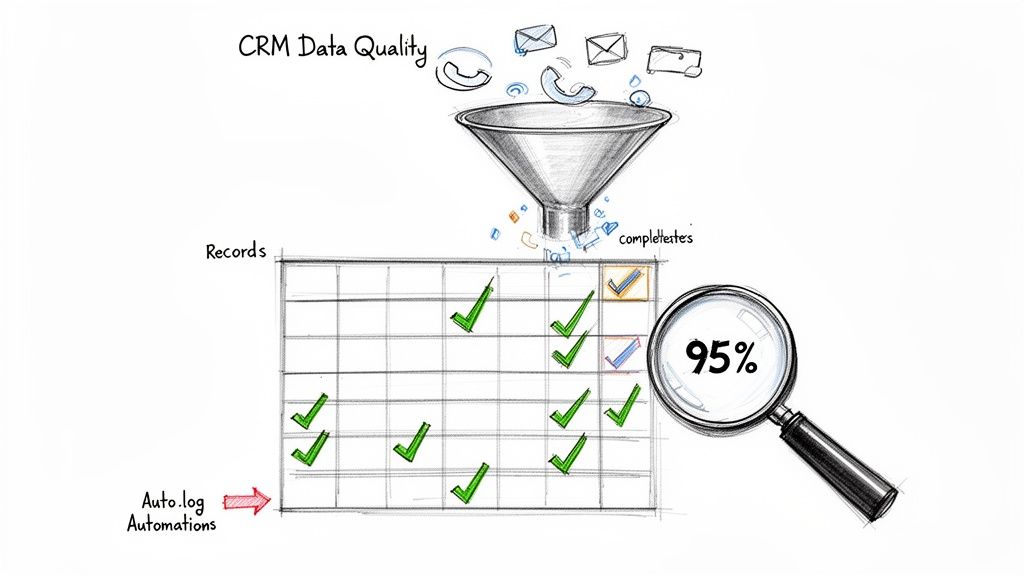
Boost Your Results with Marketing Automation with AI - A Practical Guide

· 20 min read

When we talk about marketing automation with AI, we're not just talking about fancier email software. It’s about using artificial intelligence to handle marketing tasks by turning manual, repetitive work into smart, data-driven workflows. Traditional automation follows rigid "if-then" rules. In contrast, AI-powered automation analyzes real buyer behavior, anticipates customer needs, and personalizes outreach in a way that just isn't humanly possible, telling sales reps the best action to take next to build real pipeline.

From Manual Grind To Intelligent Outbound

Think about the daily life of a typical Sales Development Representative (SDR). It's a grind. Hours are lost to researching leads, writing generic emails that rarely get a reply, and then manually logging every single activity in the CRM. This high-effort, low-reward cycle feels like shouting into a void, just hoping you hit the right person at the right time.

That old-school approach is a world away from what's possible now with AI in the mix. Today's sales teams are flipping the script entirely, ditching the guesswork. Instead of blasting every lead with the same message, they use AI to pick up on critical buying signals—like when a target account lands on your pricing page or a key decision-maker downloads a case study.

Illustration contrasting a messy desk with manual tasks and a man experiencing AI-driven email prioritization based on buyer intent.

The Shift From More To Smarter

The real difference here isn't about sending more emails or making more calls. It's about making sure every single thing an SDR does is timely, relevant, and actually makes an impact. AI becomes a prioritization engine, taking a messy sea of data and turning it into a clean, actionable to-do list. If you want to get a better handle on the fundamentals, here's a practical guide on what sales automation entails.

This isn't just a fleeting trend; it's a massive shift in the market. The global AI in marketing space is on track to hit a staggering $107.5 billion by 2028. What’s more, 88% of marketers report they're already using AI in their daily work. This explosive growth signals a fundamental change in how businesses connect with their customers. You can explore more of these trends with these AI in marketing statistics.

Answering The Most Critical Sales Question

At the end of the day, the goal is to give your sales team intelligence, not just another tool. This reframes AI from some complex, futuristic concept into a practical tool for getting things done.

AI’s true value in sales is its ability to definitively answer the most critical question for any rep at the start of their day: 'What should I do right now to generate real pipeline?' It removes ambiguity and replaces it with data-backed direction.

Instead of staring at a giant, overwhelming list of leads, an SDR sees a prioritized queue. The system tells them: "Contact Jane Doe at Company X; she just spent 10 minutes on our integration page." That's the power of marketing automation with AI—it turns raw data into revenue-generating activity.

Crafting Your AI Automation Game Plan

Jumping into AI-powered automation without a clear strategy is like setting sail without a map—you'll burn through resources and end up completely adrift. Before you write a single check, you need a solid game plan that moves beyond vague goals like "increase sales" and defines specific, measurable outcomes that will actually resonate with leadership.

AI automation game plan showing objectives, data quality, CRM, and strategic steps with arrows.

This is about building a real business case. Instead of a general desire for more pipeline, pinpoint the exact operational bottlenecks you want to crush. This kind of clarity is what turns a cool tech experiment into a strategic investment.

Defining Your North Star Metrics

Your Key Performance Indicators (KPIs) need to be sharp and actionable. These are the numbers that will prove the ROI to the C-suite and justify scaling the program down the line.

Look at the difference between a fuzzy goal and a specific, AI-driven KPI:

Vague GoalActionable AI KPI
"Improve SDR efficiency""Increase meetings booked per SDR by 20% in Q3."
"Get to leads faster""Reduce MQL response time from 4 hours to under 30 minutes."
"Boost outbound activity""Increase personalized outbound emails sent per rep by 40%."

When you focus on metrics like these, you give your team a clear target. It also connects the sales development function directly to revenue, making it way easier to show how your AI automation efforts are actually moving the needle.

The Critical Data and Tech Stack Audit

Let's be blunt: your AI is only as smart as the data you feed it. A crucial first move is a frank audit of your tech stack and, more importantly, your data hygiene. Can an AI tool actually make sense of the information locked inside your Salesforce or HubSpot instance?

Messy, incomplete, or siloed data is the number one reason AI initiatives fall flat.

Before you can automate, you have to aggregate and clean. An AI can’t generate a relevant, personalized email if it doesn’t know a lead’s industry, job title, or recent website activity. Your CRM data is the fuel for the entire engine.

Start by asking the hard questions. This isn't just some technical checklist; it's the foundation of your entire project.

Your Data Readiness Checklist

Use this list to score your current setup. Be honest—finding the gaps now will save you a world of pain later.

  • Data Completeness: Are essential fields like Job Title, Industry, Company Size, and Phone Number filled out for at least 80% of your target accounts?
  • CRM Integration: Is your core activity data (emails, calls, meetings) logged centrally in your CRM? Or is it scattered across disconnected dialers and email clients?
  • Activity Tracking: Can you easily see the last touchpoint with any lead? Is that information reliable, or does it require manual cross-checking?
  • Standardization: Do you have standardized values for fields like Lead Status or Country? Inconsistent data (e.g., "USA," "United States," "U.S.") will absolutely confuse an AI model.
  • Data Accessibility: Can a third-party tool securely tap into your CRM data via an API? Are there permission hurdles or internal IT policies that could kill an integration before it starts?

If you answered "no" to a few of these, your first project isn't buying an AI platform—it's data cleanup. That might mean a data enrichment project or just better training for your team on data entry.

Get your data house in order first. It's the only way to build an AI automation strategy that delivers real, scalable results.

How To Choose The Right AI Sales Platform

Navigating the crowded market of AI sales tools feels overwhelming. Let's be honest, everyone is waving the "AI" flag, but not all of it means the same thing for a B2B sales team. The real trick is to see past the buzzwords and distinguish between tools that just spit out content and those built to drive intelligent sales execution.

Your choice here directly impacts SDR adoption, efficiency, and—most importantly—your pipeline.

The right platform isn't just another tab for your reps to open; it's an engine that lives where they work—inside the CRM. This is the first and most critical filter. If a tool forces your team out of Salesforce or HubSpot to do their job, adoption will plummet, and your data will turn into a fragmented mess.

Beyond Generic Content Creation

The market is flooded with generic AI content writers. They're great at producing an email or a script on command. While that has its place, these tools often lack the deep integration and contextual awareness you need for effective outbound sales.

A true AI sales execution platform does more than just write. It interprets buyer intent signals and turns them into concrete, prioritized tasks for your reps.

Think about the difference this way:

  • A content generator gives your SDR a block of text and says, "Here's something you could send."
  • An execution engine creates a task and says, "Contact this person now because they just visited the pricing page, and here are three AI-generated talking points based on their role and our last interaction."

This distinction is crucial. It shifts the focus from creating more activity to creating smarter activity.

The Litmus Test: CRM Integration and Data Handling

A platform's real power is revealed by how deeply it integrates with your CRM and how it handles your existing data—messy bits and all. Deep, native integration means the tool doesn't just sync with your CRM; it operates as a natural extension of it. This keeps reps efficient and ensures every action is automatically logged, preserving the integrity of your data.

The most important question you can ask during a demo is: "Does this tool keep my reps inside the CRM for their core workflow?" If the answer is no, you're not looking at a sales execution tool. You're looking at another disconnected app that will create more admin work.

On top of that, a sophisticated AI platform should be able to work with imperfect data. It needs to fill in the gaps or make intelligent inferences from incomplete records rather than grinding to a halt. That resilience is the hallmark of a tool built for the realities of B2B sales, not a pristine laboratory environment.

AI Content Generators vs. AI Execution Engines

To make this crystal clear, let's break down the core differences between a generic AI writer and a platform built for sales execution. Understanding these distinctions will help you cut through the noise during vendor evaluations.

Here’s a practical comparison to guide your thinking.

CapabilityGeneric AI Content WriterAI Sales Execution Platform
Primary FunctionCreates text based on prompts.Converts buyer signals into prioritized tasks.
CRM IntegrationSuperficial (copy-paste or basic sync).Deep and native (operates within the CRM).
WorkflowReps must manually find a lead, generate content, then log activity.Automatically creates and prioritizes tasks with AI assistance built-in.
Data HandlingRequires clean, complete data to be effective.Designed to handle and enrich incomplete or messy CRM data.
Main OutputA piece of content (e.g., an email draft).An executable task (e.g., "Call this lead now").
Core ValueSpeeds up the writing process.Increases timely and relevant outbound activity.

Choosing the right platform is more than a tactical decision, especially as marketing automation with AI becomes standard practice. The market reflects this urgency; it's valued at $6.7 billion in 2024 and is projected to more than double to $15.5 billion by 2030. With top-performing automated email workflows generating nearly 9x the revenue of average campaigns, picking an execution-focused tool is a direct investment in your bottom line. You can explore more data on the ROI of AI in marketing to see the impact.

Ultimately, your goal is to equip your sales team with a tool that drives high adoption and delivers results. For a detailed comparison of platforms that get this right, check out our guide on top AI marketing automation tools. By focusing on deep CRM integration, intelligent task creation, and robust data handling, you can select a platform that truly empowers your sales team.

Launching Your First High-Impact AI Workflow

Alright, enough with the strategy. Let's get our hands dirty. The real "aha!" moment with AI in marketing automation comes when you build your first workflow and see it work. So, let's walk through a killer scenario from start to finish: turning a simple website visit into a sales call booked on the calendar.

This isn't about just firing off a notification that gets lost in a sea of Slack messages. It’s about creating a smart, seamless handoff that gives your sales development reps (SDRs) everything they need to act, right inside the CRM they live in all day.

The Trigger: Separating Signal from Noise

Every great workflow starts with a specific, high-intent buyer signal. Forget generic website visits—that's just noise.

For this example, our trigger is razor-sharp: a key decision-maker from a target account visits your pricing page for more than 30 seconds.

Think about that. It’s not just anyone; it's someone who fits your ideal customer profile. They’re not just clicking around; they’re lingering on the page that talks about money. This is what a buying signal looks like. A smart AI platform catches this, instantly cross-references it with your CRM, and confirms it’s a priority account worth chasing.

That’s when the magic starts.

From Signal to an Actionable Task in Seconds

Once the signal is validated, the AI doesn't just ping a channel. That's old-school automation. Instead, it creates a high-priority task directly in Salesforce or HubSpot and assigns it to the right account owner.

This is a huge difference. The task isn't just a simple reminder. It’s a pre-packaged command center for the SDR, loaded with everything they need:

  • Account Context: Key details pulled straight from the CRM—company size, industry, past interactions.
  • Contact Info: The exact person who was on the page, with their title and verified contact details.
  • AI-Generated Talking Points: Quick-fire insights tailored to that person's role and their most likely pain points.

This simple step completely wipes out the 20 minutes of manual research that kills an SDR's momentum. They get a ready-to-go task, rich with context, teed up for them.

Closing the Loop with AI-Assisted Execution

Now the SDR clicks into the task. The AI has already drafted a short, relevant opening script. A one-click dialer is embedded right there, so they can make the call without ever leaving the CRM record.

The whole point of a well-designed AI workflow is to kill the click-and-drag death march. Every second a rep spends switching tabs or logging data is a second they aren't selling. This keeps them focused and fast.

After the call, the AI helps with the final, often-skipped step: logging the outcome. Instead of typing out clunky notes, the rep can use voice-to-text to summarize the chat. The AI then neatly structures these notes, updates the lead status, and even schedules the next follow-up task automatically.

This diagram breaks down how to think about connecting these pieces when you're looking at different platforms.

AI sales platform selection process flowchart: Integrate CRM, Personalize interactions, Execute automated workflows.

It really comes down to three things: deep CRM integration, genuine personalization powered by AI, and a relentless focus on making execution easier for your team.

This whole sequence—from website visit to logged call—closes the loop. Your data stays clean, you know exactly what’s working, and you’ve built a repeatable playbook you can scale across the entire sales floor. For more ideas, we've got a whole list of other marketing automation workflows you can steal from.

As you get going, you can also fold in tools like an AI Newsletter Generator to handle other parts of your content process, freeing up even more time. When you connect all the dots, you create a powerful cycle that just keeps getting better.

Proving The ROI Of Your AI Investment

Buying new tech is the easy part. The real challenge? Walking into a meeting with your leadership team and proving it was worth the money. If you can’t connect your AI automation investment to actual business results, you won’t get the budget to keep it, let alone expand it.

It’s time to get serious about the numbers that matter.

Let's be clear: this isn't a niche trend anymore. A solid 64% of marketers have already brought AI into their automation stack, and 62% say it's essential to their strategy. The market is projected to hit $13.97 billion by 2030. Early adopters are already seeing tangible wins, with 43% optimizing their overall strategy and 37% cleaning up their data quality. You can dig into more of these powerful marketing automation statistics if you need more ammo.

The takeaway is simple: proving ROI isn't just good practice; it's a competitive necessity.

Moving Beyond Vanity Metrics

Forget about email open rates or how many "activities" your reps logged. Those metrics show busyness, not business impact. To build a case that resonates with the C-suite, you need to tie your AI tool directly to pipeline and revenue.

Start by building a dashboard that answers the questions executives actually care about.

  • Time-to-First-Action on MQLs: How fast are we engaging hot leads? AI should shrink this from hours down to minutes.
  • Activity Volume and Quality per Rep: Are reps having better conversations? Track not just the number of calls, but how many of them actually turn into meetings.
  • Pipeline Sourced from AI-Initiated Sequences: This is your golden metric. How much new pipeline can you directly attribute to workflows and tasks kicked off by your AI platform?

When you can confidently say, "Our AI engine generated tasks that directly sourced $250,000 in new pipeline this quarter," you're speaking their language.

A Sample ROI Calculation

You don't need a complex financial model to prove your point. A simple "before and after" comparison is often all it takes to build a powerful business case. Focus on the two things every sales leader cares about: efficiency gains and pipeline growth.

Here’s a simple framework you can steal and adapt:

MetricBefore AI (Monthly)After AI (Monthly)Impact
SDR Admin Time per Day2.5 hours0.5 hours+2 hours selling time
Meetings Booked per Rep812+50% increase
Pipeline from SDRs$100,000$150,000+$50,000 pipeline

This table makes the story crystal clear. A tool like marketbetter.ai doesn't just save time; it converts that reclaimed admin work into more meetings and more pipeline. For a deeper dive, check out our guide on how to calculate marketing ROI.

Your ROI story isn't just about saving money; it's about making money. Frame your investment around how AI unlocks new revenue opportunities by enabling your team to act faster and smarter on key buying signals.

Data Governance and CRM-Native Tools

One last piece of the ROI puzzle often gets overlooked until it's too late: data governance and security. Your IT and leadership teams will absolutely want to know how a new tool handles sensitive customer data. This is where a CRM-native platform gives you a massive, built-in advantage.

By operating directly inside your Salesforce or HubSpot environment, a CRM-native tool eliminates the need to sync massive amounts of data to a separate, third-party database. This drastically reduces security risks, compliance headaches, and the potential for data breaches.

This isn't just a feature; it's a core part of the value proposition. You can assure your leadership that your most valuable asset—your customer data—stays exactly where it belongs.

Free Tool

Try our Marketing Plan Generator — generate a complete AI-powered marketing plan in minutes. No signup required.

Got Questions About AI in Sales? Let's Talk.

Stepping into AI-powered sales automation can feel like a big leap, and it's smart to have questions. Sales leaders are rightfully protective of their teams' workflows and, most importantly, their customer data. You hear the buzz, you see the promises, but you need to know what this looks like on the ground.

It's totally normal to be skeptical. Let's cut through the noise and tackle the real-world concerns I hear from leaders all the time.

Is My Customer Data Secure With An AI Platform?

This is always the first question, and it should be. The thought of plugging your hard-won CRM data into a third-party AI is enough to give anyone pause. The answer, however, really comes down to the architecture of the tool you're considering.

There’s a massive difference between a disconnected tool and a CRM-native platform.

  • Disconnected Tools: A lot of apps require you to sync huge chunks of your customer data to their own servers. This instantly creates another attack vector and a whole new set of headaches around data governance and compliance.
  • CRM-Native Platforms: A much smarter approach is a platform that operates inside your existing Salesforce or HubSpot environment. With this model, your data never leaves its secure home. The AI does its work within your CRM's security walls, which dramatically shrinks your risk profile.

When you're vetting vendors, make this a deal-breaker. Ask them straight up: "Does my customer data leave my CRM instance to be processed?" Their answer will tell you everything you need to know about their security philosophy.

How Do I Get My Reps To Actually Use It?

The graveyard of failed sales tech is littered with powerful tools that were too clunky for anyone to adopt. Your SDRs live and die by their numbers, and any tool that pulls them out of their core workflow or adds even a few extra clicks is dead on arrival.

This is where the design of the tool is everything.

The key to adoption isn't more training; it's making the tool the path of least resistance. The right action needs to be the easiest action.

For example, an AI email writer is useless if a rep has to log into another platform to use it. But if AI-generated suggestions pop up right inside the task they’re already working on in Salesforce? Now you’re saving them time. A dialer is the same story—if it isn't a simple click-to-call button inside the CRM, they'll just pick up their phone.

Where Do I Even Start Without Boiling The Ocean?

The idea of rolling out a massive, company-wide AI initiative is completely overwhelming. Don't do that. The most successful AI implementations I’ve seen all started with a small, focused pilot program.

Find one specific, nagging problem you can measure.

  • Is lead response time killing your conversion rates? Start with a simple workflow that automatically creates and prioritizes tasks for new MQLs the second they come in.
  • Are your reps struggling to personalize outreach at scale? Give a small team an AI email assistant to help them craft more relevant messages.
  • Is your CRM a black hole of activity data? Pilot a simple call-logging workflow that automatically captures call notes and outcomes.

Pick one clear pain point. Prove the value with a small, motivated group. Once you can show a concrete win—like a 25% increase in meetings booked for your pilot team—you’ll have all the evidence and internal buy-in you need to expand it across the floor.


Ready to see how an AI-powered SDR task engine can streamline your outbound motion without pulling your team out of the CRM? marketbetter.ai turns buyer signals into prioritized tasks and helps reps execute faster with AI-assisted emails and calls directly inside Salesforce and HubSpot.

Discover marketbetter.ai today

A Guide to AI Powered Marketing Tools for B2B Sales

· 22 min read

Think of AI-powered marketing tools as an intelligent co-pilot for your sales team. They're designed to handle the grunt work—automating research, prioritizing who to talk to next, and even drafting the first outreach email—turning a flood of raw data into actual sales pipeline.

These aren't just fancy automation scripts. They're intelligent execution engines that let your team deliver hyper-personalized outreach at scale and operate with ridiculous efficiency. For any B2B team under pressure to do more with less, that shift isn't just nice to have; it's critical.

How AI-Powered Marketing Tools Reshape B2B Sales

Sketch of a man using a laptop with transparent AI-powered marketing tools interface for work.

Picture this: your sales development reps (SDRs) walk in, and instead of staring at a messy CRM, they're greeted with a perfectly prioritized task list. An intelligent system has already chewed through all the buyer signals, flagged the most promising prospects, and drafted a relevant, first-touch email for each one.

This is the new reality for high-performing B2B sales teams. The old way just doesn't work anymore.

The core problem for most sales leaders is that their reps spend way too much time on admin and not enough time selling. They get completely bogged down in manual research, data entry, and writing emails from scratch. That inefficiency is a direct hit to pipeline and revenue.

From Manual Busywork to Automated Execution

AI tools build a bridge between all that rich marketing data and real sales action. They translate buyer signals—like a prospect hitting your pricing page or downloading a case study—into a clear, ready-to-go task list for the sales team.

Let's look at the before-and-after comparison.

  • Before AI: A new lead pops into the CRM. The SDR spends 20 minutes digging around on LinkedIn, another 10 minutes finding the right contact, and 15 more writing a generic, hopeful email. Total time per lead: 45 minutes.
  • With AI: The tool flags a high-intent signal, automatically creates a task for the SDR, pulls in key research points, and generates a personalized email draft based on the prospect's industry and persona. The SDR just needs to review, tweak, and hit send. Total time per lead: 5 minutes.

This is a fundamental shift from reactive to proactive outreach. The best platforms don't just dump data on you; they create a workflow that guides the rep to the next best action, which dramatically boosts their daily output and keeps everyone consistent. To really nail this, it helps to understand the basics of what AI automation is and how it works.

The goal isn't to replace SDRs, but to make them superhuman. AI handles the repetitive, soul-crushing tasks, freeing up sellers to focus on what they do best: building relationships, handling tough objections, and closing deals.

The Critical Need for Personalization at Scale

Let's be honest, generic outreach is dead. B2B buyers today expect you to know who they are and understand their problems. But manually personalizing every single interaction is impossible if your team has aggressive targets to hit.

This is where AI really shines. It can analyze massive amounts of data to deliver personalization at a scale no human team could ever match.

  • Context-Aware Messaging: These tools can write email copy that references a prospect's recent company news, their specific role, or common pain points for someone in their industry.
  • Prioritized Engagement: AI algorithms score leads using hundreds of data points, making sure your SDRs are spending their precious time on the accounts that are actually most likely to convert.

By automating the heavy lifting of research and prioritization, these tools empower every single SDR on your team to perform like an A-player. The result? More meaningful conversations and a much healthier sales pipeline.

The Real Engine Driving Sales Performance

To see how these AI marketing tools actually change the game on a sales floor, you have to look past the buzzwords. What matters are the specific capabilities that drive daily performance—the functions that turn a mountain of abstract data into a clear set of actions for your sales development reps (SDRs).

It’s all about replacing guesswork with intelligent guidance. It’s not just about making reps faster; it’s about making them smarter, ensuring they’re doing the right things, at the right time, with the right message. Let's break down the four core capabilities that make this happen.

Intelligent Task Prioritization

The single biggest time sink for an SDR is figuring out what to do next. They spend hours sifting through the CRM, trying to spot a promising lead, cross-referencing marketing engagement, and manually building a call list. Intelligent task prioritization kills that chaos.

Think of it as an expert co-pilot for your sales team. Instead of showing them a messy list of leads, the AI is constantly analyzing intent signals—website visits, content downloads, pricing page views—and comparing them against your ideal customer profile (ICP). It then spits out a prioritized task list, telling your reps exactly who to call next and why.

  • Manual Prioritization: An SDR stares at a list of 200 leads and tries to guess who’s warm. They might pick a few based on job titles, but it's basically a shot in the dark.
  • AI-Driven Prioritization: That same SDR logs in to a pre-built list of the 20 highest-priority tasks for the day. At the top is a prospect who just hit the pricing page twice and downloaded a case study, with all that context right there. No guesswork needed.

Context-Aware Content Generation

Let's be honest: generic, one-size-fits-all email templates are dead on arrival. Buyers can spot them a mile away and hit delete without a second thought. They expect you to have done your homework. AI-powered content generation makes that kind of personalization possible at scale.

This isn't about using stale templates. The AI plugs directly into your CRM, pulling details about a prospect's industry, their role, recent company news, and past interactions. It then drafts a relevant, concise, and compelling email that speaks directly to their world. This doesn't replace the SDR's creativity; it supercharges it, giving them a high-quality starting point they can tweak and send in seconds.

This kind of efficiency is a game-changer. It's no surprise that 88-90% of marketers are already weaving AI into their daily work. The results speak for themselves, with AI-driven copywriting tools boosting ad click-through rates by 38% while slashing cost-per-click by 32%. That translates directly to a faster, healthier pipeline.

Seamless Workflow Execution

The best tools are the ones you forget you're even using. They just work. The most effective ai powered marketing tools are built to live inside the systems your team already uses every day, like your CRM. When the tech is native, adoption skyrockets and reps stay in their flow state.

A tool that pulls a rep out of their core workflow is a tool that won't get used. True execution engines operate inside the CRM, turning insights into immediate, logged actions without any context switching.

This is huge for basic things like logging activities. When an SDR can click-to-dial straight from a Salesforce record and the call notes, outcome, and duration are logged automatically, data hygiene improves overnight. Managers get a crystal-clear view of team activity without having to chase anyone down for updates. Properly mastering marketing automation workflows is the key to making these integrated systems hum.

Actionable Performance Analytics

You can't fix what you can't see. The best AI tools provide performance analytics that go way beyond simple activity counts like "calls made" or "emails sent." Because every single touchpoint is logged and categorized automatically, managers get an unprecedented look at what’s actually working.

This allows sales leaders to answer mission-critical questions with hard data, not just gut feelings:

  • Which email sequences are generating the most positive replies?
  • How many touchpoints does it really take to book a meeting with a VP versus a director?
  • Which of my SDRs are best at handling pricing objections?

This creates a powerful feedback loop. It lets you deliver targeted coaching, refine your sales plays, and track performance with objective metrics. The manager’s role shifts from taskmaster to strategic coach, armed with the data needed to help every single person on the team win.

Comparing AI Tool Categories for Your Sales Team

Let's be honest, picking the right AI tool for your sales team feels like wading through a sea of buzzwords. Every solution promises to revolutionize your outbound motion, but what really matters on the sales floor? For any B2B team, it comes down to three things: CRM data integrity, rep adoption, and pure workflow efficiency.

Not all AI tools are built the same. They generally fall into a few distinct categories, and knowing the difference is the first step to finding something that actually helps your reps book more meetings, instead of just adding another forgotten icon to their desktop.

The Three Main Flavors of Sales AI

Most of the AI tools you'll encounter can be bucketed into three main types. Each one is designed to solve a different core problem. Are you fighting writer's block? Juggling complex outreach sequences? Or are you just trying to get reps to consistently act on the highest-value tasks?

Here’s a simple breakdown:

  1. Standalone 'AI Writers': Think of tools like Jasper. Their entire world is content generation. They are fantastic for brainstorming email copy, writing first drafts for LinkedIn posts, or just getting past a blank page.
  2. All-in-One 'Sales Engagement Platforms': These are the big, comprehensive systems like Outreach. They’re built to manage multi-step, multi-channel sequences with their own dialers, email automation, and analytics. They essentially operate as a separate system of record.
  3. Integrated 'SDR Execution Engines': This is a newer breed of tool, like MarketBetter.ai, designed to live inside your CRM. The whole point is to turn buyer signals into prioritized tasks that reps can execute without ever leaving Salesforce or HubSpot.

This simple decision tree can help you map your primary goal—whether it's raw efficiency or deep personalization—to the right tool category.

Decision guide for AI sales tools, showing paths for efficiency or personalization goals.

The takeaway here is pretty clear: figure out if you're solving for speed or for quality first. That single decision will instantly narrow the field and point you in the right direction.

A Head-to-Head Comparison for Sales Leaders

To make this practical, let's look at these categories through the lens of a sales leader. We'll focus on the stuff that actually impacts your bottom line: how well it plugs into your CRM, how it automates tasks, and how hard it is to get your team to actually use it. This cuts through the feature lists and gets right to the heart of how a tool will perform in the wild.

The table below breaks down the core differences in a way that should resonate with any RevOps leader or SDR manager trying to make a smart investment.

Comparison of AI Marketing Tool Categories for B2B Sales

Tool CategoryPrimary Use CaseCRM Integration LevelKey StrengthCommon Limitation
AI WritersContent creation and brainstormingLow (Requires copy/paste)Creative speedHigh workflow friction; no activity logging
Sales Engagement PlatformsManaging complex, multi-channel sequencesMedium (Syncs data, lives outside CRM)Sequence managementCreates a separate system of record; sync errors
SDR Execution EnginesExecuting prioritized tasks (calls/emails) from within the CRMHigh (Native, embedded in CRM)Seamless rep workflowDependent on the quality of CRM data

This comparison highlights a critical trade-off between creative freedom, sequence complexity, and day-to-day workflow integration. For a deeper, feature-by-feature analysis, check out our complete guide to the best AI marketing tools.

Why an Integrated Approach Often Wins

As you can see, standalone AI writers, while great for crafting a message, introduce a ton of friction. Reps are stuck switching tabs, copying and pasting text back into their email client or CRM. This context-switching kills momentum and makes consistent activity logging a pipe dream, leaving you completely in the dark.

All-in-one platforms solve some of that, but they create a new headache: a separate data silo. Your CRM and your engagement platform become two different sources of truth, which inevitably leads to sync errors and a clunky experience. Reps start living in the engagement tool, and your expensive CRM slowly turns into a dusty, neglected database.

The most effective solution is one that brings the intelligence to where the work already happens—your CRM. An integrated execution engine turns your Salesforce or HubSpot environment into a guided selling machine.

This approach practically eliminates the adoption problem. You're not forcing reps to learn a whole new piece of software; you're just making the one they already use smarter. When an AI-prioritized task pops up on a contact record with a pre-drafted email and a click-to-dial button, reps just do it. That’s how you turn strategy into logged, measurable results and build an outbound motion that actually works.

Your Checklist for Evaluating and Implementing AI Tools

Jumping into AI-powered marketing tools without a plan is a surefire way to burn through your budget and leave your team frustrated. You need a clear framework. Something that helps you cut through the vendor hype and pick a solution that actually solves a problem, not just add another logo to your tech stack.

This isn't about finding the tool with the most features. It's about finding the one that fits into your existing workflow like a glove. A flashy, standalone platform might look incredible in a demo, but if it forces your reps to leave their CRM for every little task, adoption will crater. Real value comes from seamless integration and an immediate, measurable impact.

Key Questions for Vendor Evaluation

Before you even think about booking a demo, get your team in a room and agree on the answers to these questions. This ensures you’re measuring every tool against the same yardstick—one that’s focused on what truly matters for your team's day-to-day.

Integration and Workflow

  • Does it integrate natively with our CRM? Forget about clunky, third-party connectors. A native integration means your data is always in sync and your reps never have to switch tabs.
  • Does it use our existing intent data to prioritize tasks? The tool should work with the signals you already have, not force you into a whole new data ecosystem.
  • How does it handle activity logging? Every single call, email, and outcome needs to be logged automatically to the right contact or account. Manual logging is a non-starter.

User Adoption and Training

  • How fast can a brand-new SDR get up to speed? Look for an intuitive interface that guides the user. A complex tool with a steep learning curve will kill your momentum before it even starts.
  • What does the workflow actually look like from a rep’s perspective? A great tool simplifies their day. It presents a clear list of what to do next, without adding friction.

The most important question is a simple one: "Will this make my reps' lives easier?" If the answer isn't a resounding 'yes,' the tool will fail, no matter how powerful its features look on paper.

A Phased Playbook for Implementation Success

Once you've picked your tool, resist the urge to do a big-bang launch. A slow, methodical rollout is far more effective. It lets you prove value, build internal champions, and iron out any kinks before you go wide.

Step 1: Pilot Program (Weeks 1-4)

Start small. Grab a focused pilot group of 2-3 of your most adaptable SDRs. Don't pick your top performers or your biggest skeptics. You want reps who are open to new processes and will give you honest, constructive feedback.

  • Focus on one specific workflow. For instance, start with just the click-to-dial and automatic call logging features. Don't try to boil the ocean.
  • Define a single, clear success metric. A great one is "Daily Outbound Actions per Rep." Track this for your pilot group and compare it against a control group that isn't using the tool.

Step 2: Gather Feedback and Build Momentum (Weeks 5-6)

After the pilot, it’s time to gather the data—both the numbers and the stories. Interview the pilot group. Did the tool save them time? Was it easy to use? What did they love? What drove them nuts?

Use their success stories and positive feedback to build excitement across the rest of the team. Nothing sells a new tool better than a peer saying, "This thing actually works."

The explosive growth of AI is reshaping B2B sales. The global AI software market, valued at $122 billion in 2024, is set to hit $467 billion by 2030. This boom means unprecedented efficiency is now within reach, with 43% of marketers already automating repetitive tasks. This is mirrored in practice, where marketbetter.ai generates first-touch emails and post-call summaries, freeing up reps for high-value execution. You can discover more insights on the global AI market from ABI Research.

Step 3: Team-Wide Rollout and Training (Weeks 7-8)

Now you’re ready for the full rollout. Turn your pilot group into internal champions who can help train their peers. This kind of peer-to-peer coaching is almost always more effective than a top-down mandate from management.

A well-planned implementation is a key part of building a successful modern marketing tech stack. This structured approach helps you sidestep the common pitfalls of a chaotic rollout, ensuring your new AI tool delivers immediate and lasting value.

Measuring the Real ROI of Your AI Investment

Three hand-drawn charts depicting business metrics for daily outbound actions, time-to-first action, and CRM logging rate.

So, how do you prove that shiny new AI tool is actually pulling its weight? Vanity metrics like "emails sent" won't convince anyone in the C-suite. To justify the spend, you have to draw a straight line from your AI marketing tools to real, tangible business outcomes.

It’s about moving past the buzzwords and focusing on the Key Performance Indicators (KPIs) that matter to your sales development reps (SDRs). The right metrics tell a clear story about efficiency, responsiveness, and data quality—the three pillars of any high-performing outbound team.

Tracking Efficiency Gains with Daily Outbound Actions

The first place you’ll see an AI tool make its mark is on your team's raw output. When reps aren't buried in manual research and data entry, they can finally spend their time on what they were hired to do: sell. That's why Daily Outbound Actions per Rep is such a critical KPI.

This metric isn't just about volume; it's about tracking meaningful activities—calls made, personalized emails sent, social touches—that each SDR completes daily. Before AI, this number is often all over the place, dragged down by prep work. After, you should see a serious, sustained lift.

  • Before AI: An SDR might grind out 40-50 actions a day, with huge chunks of time lost to digging for info.
  • With AI: That same SDR can now hit 80-100+ actions because the tool prioritizes their list and tees up first drafts.

A 25-30% increase in daily actions within the first 60 days is a rock-solid sign of positive ROI. It proves the tool is removing friction from the SDR workflow, plain and simple.

Measuring Responsiveness with Time-to-First-Action

Speed is everything. The moment a high-intent lead lands on your website, the clock starts ticking. Time-to-First-Action on New Leads measures how fast your team jumps on prospects after they raise their hand. A long delay kills momentum and practically hands the deal to your competitors.

AI execution tools are built for this. They automatically create and prioritize tasks from intent signals, closing the gap between marketing interest and sales action. You can measure this by calculating the average time between a lead's creation in your CRM and the first logged activity from an SDR.

Gauging Data Hygiene with CRM Activity Logging Rate

A messy CRM is where revenue goes to die. If activities aren't logged correctly, you have zero visibility into what's working and what isn't. The CRM Activity Logging Rate measures the percentage of outbound actions that are automatically and accurately recorded.

With a native tool, this should be close to 100%. That's a night-and-day difference from manual logging, which is almost always spotty and incomplete. Clean data isn't just an operational nice-to-have; it’s the bedrock of accurate forecasting, effective coaching, and reporting that you can actually trust. For a complete breakdown, check out our guide on how to calculate marketing ROI.

The market is already voting with its budget, with 71% of businesses using generative AI in marketing for everything from content creation to SDR execution. This shift makes perfect sense—AI prioritizes tasks by account fit, boosts activity, and gives managers clear line of sight into rep performance. By tracking these specific KPIs, you can build an undeniable business case for your investment and prove its value across the entire organization.

Common Questions About AI for Sales Teams

Whenever you bring a new tool into a sales floor, especially one with "AI" in the name, you're going to get questions. And a healthy dose of skepticism. That's a good thing. Sales leaders need practical answers, not just buzzwords.

Let's cut through the noise and tackle the most common concerns head-on.

Will AI Replace My Sales Development Reps?

This is always the first question, and it’s the biggest misconception out there. The goal of a smart AI tool isn't replacement; it's empowerment. Think of it as a force multiplier for your SDRs, not a pink slip.

The grunt work that bogs your team down? Manual research, data entry, figuring out who to call next—that's what AI is for. By automating all that prep, your reps are freed up to do what they do best: build rapport, handle tricky objections, and have actual strategic conversations. The result is a sharper, more engaged team that hits its numbers.

We Already Have a Sales Engagement Platform, Do We Need This Too?

It's a fair question, and the confusion makes sense. A Sales Engagement Platform (SEP) like Outreach or Salesloft is great for managing complex, multi-channel sequences. But they often operate as a separate command center from your CRM.

This creates friction. Reps are constantly flipping between tabs, and you're always worried about data sync issues. An integrated SDR execution engine is different. It's built to live natively inside your CRM. Its whole job is to turn buyer signals into a prioritized to-do list and help reps execute those tasks—calls, emails, follow-ups—right there, without ever leaving Salesforce or HubSpot. It complements your strategy by focusing on clean execution and perfect data hygiene.

How Do We Keep AI Content from Sounding Robotic?

The secret to authentic, AI-generated outreach is context. Most generic AI writers pull from the entire internet, which is why their drafts sound so bland and impersonal.

A truly effective tool doesn't guess. It grounds its content generation in specific, relevant data from your CRM. It looks at the prospect’s industry, their persona, recent company news, and past interactions to spin up a draft that is genuinely helpful and sounds like a human wrote it. The AI gives you a solid 80%, and your SDR adds the final 20% of creative polish.

What’s a Realistic Implementation Timeline?

Nothing kills a new tool's momentum faster than a six-month rollout. The best way to get adoption is to chase quick wins. A realistic timeline should be measured in weeks, not months.

You can start small with a pilot group. Focus on a single, high-impact workflow, like automating click-to-dial and call logging. This lets you prove the value fast, build a few internal champions, and then thoughtfully expand from there.


Ready to turn your sales strategy into consistent, measurable action? marketbetter.ai is the AI-powered SDR task engine that lives inside your CRM, helping your team execute with speed and precision. See how it works at https://www.marketbetter.ai.
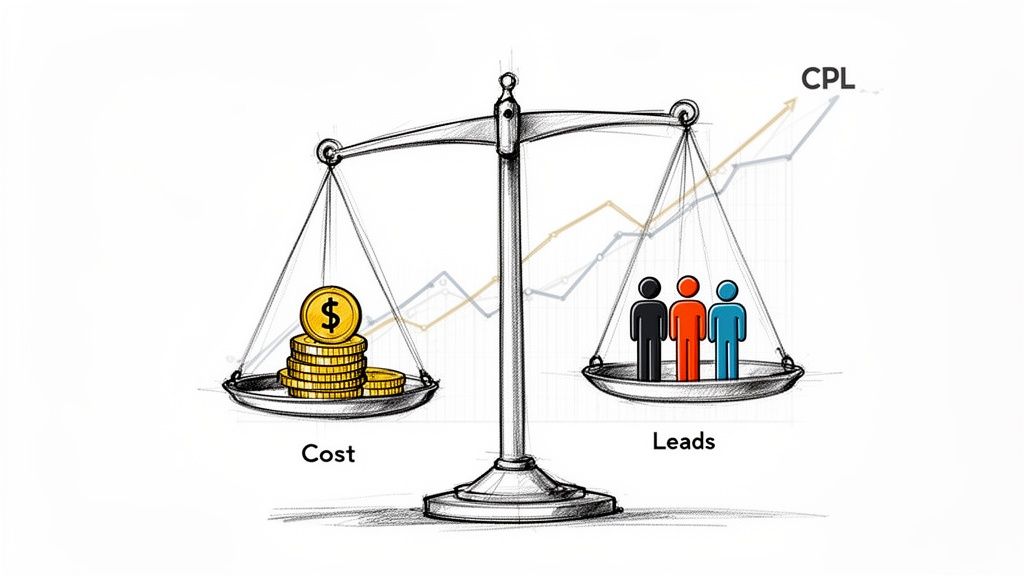
10 Actionable Content Generation Ideas to Supercharge Your SDR Team

· 25 min read

In the world of sales development, the gap between a busy SDR and a productive one is vast. It's not about making more calls or sending more emails; it's about executing the right action, with the right message, at the right time. Yet, most Sales Development Representatives (SDRs) spend hours bogged down in manual research, generic messaging, and administrative tasks like CRM logging. The result is burnout, inconsistent pipeline, and missed quotas. For an SDR, this friction is the difference between hitting quota and falling short.

This article isn't just another list of abstract content generation ideas. It’s a tactical playbook designed specifically for SDRs and their leaders who want to transform their outbound motion. We will break down ten specific, actionable strategies, from AI-powered email and call prep to intent-driven task prioritization, that directly address the daily friction points killing SDR productivity. Many of these strategies leverage AI, and to ensure your AI-generated content is consistently high-quality and effective, it's crucial to follow established prompting guidelines. For a deeper dive on this specific topic, you can review these 10 AI Prompt Best Practices to get the most out of your tools.

Within each of the ten sections, we'll compare the old, manual approach with the new, streamlined method, provide actionable steps for SDRs to implement, and show how integrating these ideas into your CRM workflow can turn administrative time into revenue-generating activity. Prepare to move beyond guesswork and start executing a more intelligent, efficient, and effective sales development strategy.

1. SDR Task Prioritization Frameworks & Best Practices

Transform your daily chaos into a structured, high-impact workflow. Instead of SDRs spending precious time figuring out who to call next from a massive, unsorted list, this idea provides a blueprint for a system that automatically surfaces the highest-potential activities. It addresses a core operational pain point by turning reactive, manual list-building into proactive, signal-driven engagement.

The Old Way vs. The New Way for SDRs:

  • Old Way: SDRs work through an alphabetical or static list of leads in the CRM, treating a CEO who just visited the pricing page with the same urgency as a manager who downloaded a whitepaper six months ago. This leads to wasted calls and missed opportunities.
  • New Way: The SDR's task queue is automatically prioritized based on real-time data. High-priority tasks are surfaced based on intent signals, account fit scores, and recent engagement velocity, ensuring every action is focused on the most likely buyers.

Why This Resonates with SDRs

SDRs are measured on meetings booked and pipeline generated. A well-defined prioritization framework removes the guesswork, directly increasing their productivity and earning potential. It allows them to focus their energy on executing high-quality outreach rather than on administrative decision-making about who to contact next. It’s about working smarter, not just harder.

Actionable Implementation Tips for SDRs

  • Define Your "Hot" Signals: Work with your manager to identify the 2-3 signals that indicate immediate buying intent, such as pricing page visits or demo requests. Keep these top of mind.
  • Time-Block by Priority: Dedicate the first two hours of your day (your "golden hours") exclusively to high-priority tasks. Use later, lower-energy times for medium or low-priority follow-ups.
  • Advocate for Automation: Ask your leadership for tools that automate this prioritization. A platform like marketbetter.ai can synthesize dozens of signals in real-time to create a continuously updated, prioritized task queue, ensuring you always know your next best action.

2. Cold Email Templates That Convert: Account-Specific vs. Scalable Messaging

Elevate your outreach from generic blasts to targeted, high-impact conversations. This idea addresses the fundamental challenge every SDR faces: balancing deep personalization with the need for scalable execution. Instead of choosing between time-consuming manual emails and low-performing generic templates, this provides a blueprint for generating semi-personalized messages that convert.

Image comparing personalized cold email with specific details to a scalable email template using placeholders.

The Old Way vs. The New Way for SDRs:

  • Old Way: An SDR either sends a generic, mail-merge template to 100 people with a low reply rate, or spends 20 minutes manually researching and writing a single, hyper-personalized email. Neither approach is scalable or efficient.
  • New Way: The SDR uses a "hybrid" template that blends proven, persona-level messaging with dynamic, AI-surfaced account details. This allows for personalization at scale, boosting reply rates without killing activity volume.

Why This Resonates with SDRs

SDRs live and die by their reply rates and meetings booked. Generic templates get ignored, but fully manual personalization is a time sink that kills the activity volume needed to hit quota. This hybrid approach gives them the best of both worlds. It boosts engagement without sacrificing speed, directly impacting their pipeline and commission.

Actionable Implementation Tips for SDRs

  • Build Your "Core 4" Templates: Create foundational templates for four key scenarios: initial cold outreach, a warm inbound follow-up, a response to a common objection, and a "break-up" email.
  • Master the "1-2 Punch": Your goal isn't to write a novel. Find just one or two specific data points (e.g., a recent company announcement, a competitor they use) to embed in your template. This shows you've done your homework without taking forever.
  • Use AI for the Hook: Leverage a platform like marketbetter.ai to pull in relevant, timely account signals (like new funding or a key hire) to use as your personalization hook. This makes your personalization meaningful and directly tied to a potential business need.

3. AI-Assisted Cold Call Preparation & Talk Track Generation

Address the challenge of inconsistent and time-consuming call preparation. This idea shows SDRs how to use AI to automatically generate personalized talk tracks, objection handlers, and discovery questions. It tackles the significant pain point of SDRs spending 30-60 minutes daily on manual research, transforming that time into high-quality, targeted conversations.

The Old Way vs. The New Way for SDRs:

  • Old Way: An SDR opens 10 browser tabs to research a prospect's company news, LinkedIn profile, and past CRM interactions, then tries to synthesize this into a coherent opening line on the fly. Call quality is inconsistent and prep time is high.
  • New Way: Before a call, the SDR gets an AI-generated brief with key talking points, relevant company news, and likely pain points. This prep takes seconds, allowing for more calls and higher-quality conversations.

Why This Resonates with SDRs

SDRs are under constant pressure to hit ambitious meeting targets, but manual research creates a bottleneck that limits their call volume and quality. AI-driven call prep directly boosts their efficiency, allowing them to make more informed calls in less time. This not only increases their chances of booking a meeting but also builds their confidence by arming them with the right information for every conversation.

Actionable Implementation Tips for SDRs

  • Treat AI as Your Assistant: Always treat AI-generated talk tracks as a first draft. Review and personalize the points to ensure your tone is authentic and not robotic. The AI does the research; you add the human touch.
  • Practice Your Deviations: The AI script is a guide, not a straitjacket. Role-play with a colleague on when to follow the script and when to deviate to build rapport or explore an unexpected but valuable tangent.
  • Automate Prep & Logging: Use a tool like marketbetter.ai to automate the entire prep-to-log workflow. It can generate pre-call briefs by synthesizing data and then use post-call summaries to improve future recommendations, creating a powerful feedback loop that helps you improve.

4. Native Dialer Integration in Salesforce: Adoption, Workflows, and Impact

Address a major revenue leak caused by clunky dialing tools. Many sales teams invest in powerful dialers, only to see SDRs abandon them because they force reps to switch between windows. This idea tackles that friction head-on, focusing on the principle that "if it's not inside Salesforce, SDRs won't use it." You’ll learn how to build seamless, click-to-dial workflows directly within the environment where you already spend your day.

The Old Way vs. The New Way for SDRs:

  • Old Way: An SDR finds a contact in Salesforce, copies the phone number, pastes it into a separate dialer app, makes the call, then navigates back to Salesforce to manually log the call disposition and create a follow-up task. This adds 30-60 seconds of friction to every single call.
  • New Way: The SDR clicks a "call" button directly on the contact record in Salesforce. The call is made, and the outcome is logged automatically. A follow-up task is created instantly based on the disposition. The entire workflow is seamless and takes seconds.

Why This Resonates with SDRs

SDRs live and die by their activity volume and efficiency. An external dialer adds seconds of friction to every call, which accumulates into hours of wasted time each week. A native dialer eliminates this context switching, allowing them to move from one prospect to the next instantly. This means more conversations, more opportunities to book meetings, and a direct path to hitting their quota and commission goals.

Actionable Implementation Tips for SDRs

  • Advocate for a Native Solution: During team meetings, bring up the time lost to context switching. Frame the request for a native dialer in terms of increased call volume and better data for the team.
  • Master Automated Dispositions: Learn the automated workflows tied to each call disposition. For instance, know that selecting "Connected, Voicemail Left" will automatically schedule a follow-up email task for two days later. Use this to your advantage to build your pipeline effortlessly.
  • Focus on Conversations, Not Clicks: With a native dialer, your mental energy shifts from managing software to managing conversations. Use that extra focus to listen more intently to prospects and ask better follow-up questions.
  • Use a Unified Platform: A tool like marketbetter.ai provides a fully native dialer within its engagement platform. This ensures every call, email, and task lives in one unified system, giving you the streamlined workflow you need to crush your quota.

5. Intent Data & Buyer Signal Integration: From Detection to Action

Shift from broad-based outreach to hyper-targeted engagement by learning to operationalize buyer intent data. This idea addresses a primary SDR challenge: wasting significant effort contacting accounts that have no interest or need. By learning how to source, prioritize, and act on real-time buying signals, you can focus your energy exclusively on accounts actively in the market.

The Old Way vs. The New Way for SDRs:

  • Old Way: An SDR calls down a list of cold accounts, hoping to get lucky and find someone with a current need. The outreach is generic ("I help companies like yours do X") and the connect rates are low.
  • New Way: An SDR receives an alert that a target account is actively researching their competitors. The outreach becomes hyper-relevant ("I saw you were looking at solutions for Y, and wanted to share how we're different").

Why This Resonates with SDRs

SDRs are driven by results, and nothing is more demotivating than calling into a void of disinterest. Intent data gives them a crucial advantage. It provides the "why you, why now" context for every interaction, dramatically increasing the relevance of their outreach and, consequently, their connection and meeting booking rates. This builds their confidence and directly impacts their pipeline contribution.

Actionable Implementation Tips for SDRs

  • Prioritize Your Company's Signals: Pay closest attention to first-party signals from your own website. Someone visiting your pricing page is a much hotter lead than someone who just read a generic blog post.
  • Act with Urgency: Intent data has a short shelf life. When you get a high-priority signal, act on it within hours, not days. Speed is your competitive advantage.
  • Combine with Fit: Stress that intent without firmographic fit is noise. The goal is to find in-market accounts that match your Ideal Customer Profile (ICP). Use a platform like marketbetter.ai to automate this synthesis, combining firmographic and technographic data with real-time intent signals to create a high-priority task list that ensures you only pursue qualified, timely opportunities.

6. SDR Onboarding & Ramp Time Acceleration Through AI Coaching

Reduce your ramp time from a costly 3-4 months down to a highly efficient 4-6 weeks. This idea outlines an AI-powered onboarding process that leverages AI for call coaching, talk track generation, and template creation. It directly helps new SDRs overcome the challenge of slow ramp periods and inconsistent early performance.

The Old Way vs. The New Way for SDRs:

  • Old Way: A new SDR spends weeks shadowing other reps, trying to absorb best practices through osmosis. Feedback from their manager is infrequent and based on a few randomly selected calls.
  • New Way: A new SDR has access to a library of top-performer call recordings with AI-generated notes. Their own calls are automatically analyzed, providing immediate, objective feedback on areas for improvement.

Why This Resonates with SDRs

For a new SDR, the pressure to perform quickly is immense. An AI-guided onboarding process provides a safety net, offering real-time script support, proven email templates, and objective feedback. This structure builds confidence, reduces the anxiety of making early mistakes, and helps them hit their quota and commission targets faster.

Actionable Implementation Tips for SDRs

  • Follow a Structured Playbook: Ask your manager for a clear 4-week onboarding plan. In weeks 1-2, focus on listening to AI-annotated calls from top performers. In weeks 3-4, start dialing with AI-generated talk tracks to guide you.
  • Review Your Own "Game Tape": Just like a pro athlete, review recordings of your own calls. Use AI-generated summaries to quickly identify moments where you handled an objection well or missed a key discovery question.
  • Utilize AI for Prep & Follow-up: As a new rep, lean on a platform like marketbetter.ai to generate pre-call briefs and post-call summaries. This automation frees you up to focus on learning conversation skills rather than on administrative tasks.

7. CRM Activity Logging Automation: From Manual Data Entry to Real-Time Sync

Eliminate one of the most significant time sinks for SDRs by automating CRM activity logging. This idea addresses the universal pain point of manual data entry, a task that frustrates reps and pulls them away from selling. Instead of spending hours logging calls and emails, you can have a system where every touchpoint is automatically captured in real-time.

The Old Way vs. The New Way for SDRs:

  • Old Way: At the end of a long day of calling, the SDR spends 30-45 minutes "doing their admin" by manually logging call notes, email sends, and follow-up tasks in the CRM. It's tedious, error-prone, and takes away from selling time.
  • New Way: The SDR makes calls and sends emails from a platform integrated with the CRM. Every action is logged instantly and automatically, with 100% accuracy. The SDR ends their day with a clean slate, ready for the next day of outreach.

Why This Resonates with SDRs

SDRs are hired to sell, not to perform administrative tasks. Manual CRM logging is a major distraction that pulls them away from high-value activities like calling prospects and writing personalized emails. By automating this process, SDRs get back valuable time, feel less bogged down by repetitive work, and can focus entirely on hitting their quota and increasing their commission.

Actionable Implementation Tips for SDRs

  • Advocate for Full Automation: If your tools only partially automate logging, speak up. Explain to your manager how much more selling time you would have if every call, email, and task were synced automatically.
  • Trust the System: Once automation is in place, resist the urge to double-check every entry. Trust that the system is capturing the data, and reinvest that time and mental energy into your next conversation.
  • Utilize an Integrated Platform: A tool like marketbetter.ai unifies the entire process. Its native CRM integrations can automatically log every call, email, and task outcome, providing a perfectly synced, 100% accurate record of all sales activities without any manual intervention from you.

8. Performance Analytics & Coaching: From Call/Email Data to Actionable Insights

Move beyond surface-level activity metrics like "dials made" and learn from data that truly matters. This idea focuses on using analytics from call transcripts and email performance to identify what top performers do differently and how you can replicate their success. It helps you get personalized, data-driven coaching instead of generic advice.

An illustration of performance analytics for SDR coaching, including charts, audio waveform, and top performer metrics.

The Old Way vs. The New Way for SDRs:

  • Old Way: Coaching is based on gut feelings. A manager might say, "You need to be more confident on the phone," but can't provide specific examples or data to back it up.
  • New Way: Coaching is based on facts. A manager can say, "On your last 10 calls, you spoke for 80% of the time. Top performers on our team speak for less than 50%. Let's work on asking more open-ended questions."

Why This Resonates with SDRs

SDRs crave clear, actionable feedback that helps them book more meetings and hit their quota. Data-driven coaching removes subjectivity and provides a transparent path to improvement. Instead of vague advice, they get specific guidance on proven tactics that directly impact their performance and income.

Actionable Implementation Tips for SDRs

  • Ask for Specific Data: When you meet with your manager, ask for data-backed feedback. Instead of "How am I doing?", ask "What is my talk-to-listen ratio compared to top performers?" or "Which of my email subject lines has the highest open rate?"
  • Learn from the Best: Use call recording libraries to listen to how your team's top reps handle objections or explain the value proposition. Don't just copy them; identify the principles they use and adapt them to your own style.
  • Use Call Highlights for Self-Coaching: Don't wait for your manager. Use a tool like marketbetter.ai to automatically surface key moments from your own calls, like successful objection handling or competitor mentions, to identify what's working and what's not.
  • Tie Your Actions to Outcomes: Understand how specific actions lead to results. Learn more about how to set up and track these crucial marketing and sales performance metrics.

9. Multi-Touch Outreach Sequences: Design, Sequencing, and Frequency Optimization

Move beyond single-channel outreach and learn how to build and optimize multi-touch sequences. This provides you with a strategic playbook for combining email, calls, and LinkedIn into a cohesive outreach plan. It directly addresses the common SDR challenges of "what's my next step?" and "how many times should I reach out?" by replacing sporadic, one-off attempts with a structured, data-driven engagement model.

The Old Way vs. The New Way for SDRs:

  • Old Way: An SDR sends an email, and if they don't get a reply, they might remember to call a few days later. The follow-up is inconsistent and often falls through the cracks.
  • New Way: A prospect is enrolled in a pre-built sequence that automatically schedules tasks. Day 1 is an email, Day 3 is a phone call, Day 5 is a LinkedIn connection request. The SDR simply follows the task list, ensuring persistent and professional follow-up.

Why This Resonates with SDRs

SDRs live and die by their response rates and meetings booked. Multi-touch sequences give them a proven methodology to break through the noise and connect with busy prospects. This content eliminates the guesswork of follow-up, providing a clear path of action for every lead and ensuring no opportunity is left behind due to inconsistent outreach. It empowers them to be more strategic, persistent, and ultimately, more successful.

Actionable Implementation Tips for SDRs

  • Internalize Your Personas: Understand which sequences are designed for which buyer personas. Know that a C-level executive gets a different, more concise sequence than a director-level contact.
  • Add Value with Every Touch: Don't just repeat the same "checking in" message. Your sequence should be designed to offer new value at each step, whether it's sharing a new resource, mentioning a competitor, or referencing a recent company announcement.
  • Trust the Process: Stick to the sequence. It's easy to give up after two or three attempts, but data shows that many connections are made on the 5th, 6th, or even 7th touchpoint.
  • Leverage Automation: A platform like marketbetter.ai can automate sequence enrollment and task management. It can trigger the right sequence based on prospect signals and create call or LinkedIn tasks for you at the appropriate step, ensuring perfect execution every time.

10. Account-Based Outreach Strategy: From ABM Principles to SDR Execution

Shift from a high-volume, low-relevance "spray and pray" model to a strategic, account-focused motion. This involves learning how to execute an Account-Based Marketing (ABM) strategy as an SDR. Instead of treating every lead as an isolated contact, this strategy focuses on penetrating a select list of high-value target accounts with coordinated, multi-threaded outreach.

The Old Way vs. The New Way for SDRs:

  • Old Way: An SDR tries to book a meeting with any contact at any company that vaguely fits the profile, resulting in many low-quality meetings that don't lead to pipeline.
  • New Way: An SDR is assigned a specific list of high-value target accounts. They strategically map out the key decision-makers and engage multiple contacts within the same account with tailored messaging, leading to higher-quality conversations and larger deals.

Why This Resonates with SDRs

SDRs are often frustrated by low response rates from generic outreach. An account-based strategy equips them with the context needed to craft hyper-relevant messages that break through the noise. It empowers them to act as strategic advisors rather than just cold callers, leading to more meaningful conversations, higher conversion rates, and larger deal sizes, which often come with bigger commission checks.

Actionable Implementation Tips for SDRs

  • Become an Expert on Your Accounts: For your assigned target accounts, go deep. Set up Google Alerts for company news, follow their key executives on LinkedIn, and understand their business priorities.
  • Coordinate with Your Team: If multiple SDRs are targeting the same account, coordinate your outreach. The message to a Head of Finance should highlight ROI, while your message to a Head of IT should focus on integration and security. Work together as a team.
  • Think Meetings, Not Meeting: Your goal in an ABM motion isn't just to book one meeting. It's to penetrate the account and build relationships with multiple stakeholders.
  • Measure What Matters: Focus on account-level metrics. Celebrate when your team engages a new decision-maker at a target account or books the first meeting, as these are key milestones in a larger strategic play.

10-Point SDR Content Ideas Comparison

Item🔄 Implementation Complexity⚡ Resource Requirements📊 Expected OutcomesIdeal Use Cases⭐ Key Advantages
SDR Task Prioritization Frameworks & Best PracticesMedium‑High — CRM hygiene, scoring logic, cross‑team alignmentModerate — intent feeds, CRM, analytics, ops timeIncreased daily activity, better connect rates, less decision fatigueSDR teams needing proactive task routing and consistent executionConsistent prioritization; coaching data; higher connect rates ⭐⭐⭐
Cold Email Templates That Convert: Account‑Specific vs. Scalable MessagingLow‑Medium — template design, dynamic fields, CTA logicLow‑Moderate — persona data, template library, A/B testingHigher open/reply rates; faster email productionHigh‑volume outbound that requires scalable personalizationScalable personalization; repeatable testing; reduced time/email ⭐⭐⭐⭐
AI‑Assisted Cold Call Preparation & Talk Track GenerationMedium — integrations (news/CRM), AI tuning, transcript captureModerate‑High — call recording, data sources, AI toolingMuch faster prep; improved first‑touch quality and loggingHigh‑call teams wanting consistent talk tracks and faster prepFaster prep; standardized objection handling; coaching artifacts ⭐⭐⭐⭐
Native Dialer Integration in Salesforce: Adoption, Workflows, and ImpactHigh — native SF integration, admin work, compliance reviewHigh — Salesforce admin, telephony/VoIP, legal/IT supportDramatically higher adoption; near‑complete automatic loggingOrgs that require in‑CRM dialing and maximum adoptionEliminates tab switching; automatic logging; manager visibility ⭐⭐⭐⭐
Intent Data & Buyer Signal Integration: From Detection to ActionMedium‑High — signal sourcing, scoring, real‑time routingHigh — third‑party intent vendors, integrations, RevOps tuningFocused outreach; 2–3x meeting rate uplift when tunedDemand gen + SDR teams prioritizing timing & buying signalsBetter targeting; predictive outreach; signal attribution ⭐⭐⭐⭐
SDR Onboarding & Ramp Time Acceleration Through AI CoachingMedium — structured playbooks + AI coaching flowsModerate — recordings, enablement resources, AI toolsShorter ramp (4–6 weeks); improved early productivityOrganizations scaling SDR hiring and needing repeatable onboardingFaster ramp; repeatable onboarding; reduced manager load ⭐⭐⭐⭐
CRM Activity Logging Automation: From Manual Data Entry to Real‑Time SyncMedium — deep CRM integration, data hygiene, logging rulesModerate — integration engineering, admin, privacy reviewEliminates manual logging; data completeness to 95%+; better attributionRevOps and managers needing trusted pipeline & forecasting dataSaves rep time; accurate attribution; real‑time visibility ⭐⭐⭐⭐
Performance Analytics & Coaching: From Call/Email Data to Actionable InsightsHigh — data infra, transcripts, analytics models, manager trainingHigh — conversation intelligence tools, analytics, coaching timeData‑driven coaching; measurable rep performance gainsEnablement/Heads of SDR scaling coaching across many repsData‑driven coaching; peer benchmarking; early issue detection ⭐⭐⭐⭐
Multi‑Touch Outreach Sequences: Design, Sequencing, and Frequency OptimizationMedium — sequence design, channel logic, breakout rulesModerate — cadence tools, copy variants, testing frameworkHigher multichannel reply rates; optimized touch frequencySDRs running coordinated email+call+social cadencesIncreased engagement; scalable sequencing; channel optimization ⭐⭐⭐⭐
Account‑Based Outreach Strategy: From ABM Principles to SDR ExecutionHigh — account research, multi‑thread coordination, attributionHigh — ABM tooling, dedicated research time, cross‑team alignmentHigher conversion & faster deals for target accountsMid‑market/enterprise ABM motions and high‑value account playsHigher deal quality; multi‑threading; focused pipeline contribution ⭐⭐⭐⭐
Free Tool

Try our Marketing Plan Generator — generate a complete AI-powered marketing plan in minutes. No signup required.

From Ideas to Impact: Activating Your SDR Engine

We've explored a comprehensive arsenal of content generation ideas, moving far beyond generic templates and into the realm of strategic, data-driven outreach. From AI-assisted cold call preparation to multi-touch sequence optimization, the common thread is clear: the most effective SDR teams are those empowered by systems that bridge the gap between insight and action. The challenge isn't a lack of ideas; it's the operational drag that prevents those ideas from being executed consistently and at scale.

For too long, Sales Development Representatives have been forced to act as manual data integrators. They jump between their CRM, a sales engagement platform, intent data dashboards, and prospecting tools, wasting precious time on administrative tasks instead of engaging prospects. This fragmented workflow is where even the most brilliant content generation ideas fail. An SDR might identify a key buyer signal but get bogged down logging activities or finding the right messaging, letting the window of opportunity close.

The Shift from Disparate Tools to a Unified Engine

The traditional approach, using separate tools like Outreach or Salesloft alongside a CRM, has served its purpose. However, it perpetuates a fundamental inefficiency. SDRs operate within one system (the SEP) while the system of record (the CRM) often lags, creating data silos and administrative friction. The future of high-performance sales development lies in a unified, native environment.

Consider the difference in these two workflows:

  • Traditional Workflow: An SDR sees an intent signal in a separate platform. They switch to their CRM to find the contact, then pivot to their SEP to enroll them in a sequence, manually personalizing the first email based on memory or notes. Finally, they return to the CRM to log the activity. This process can take several minutes per prospect, creating significant drag when multiplied across a team.

  • Unified Engine Workflow: An SDR receives a prioritized task directly within Salesforce or HubSpot. This task is automatically generated from an intent signal, pre-populated with an AI-generated, account-specific message, and includes a one-click dialer. The SDR executes the call or sends the email, and the activity is logged instantly and automatically. The entire process takes seconds.

This is the core principle behind an SDR Task Engine. It’s not just about providing better content generation ideas; it's about building a system that delivers those ideas as actionable, prioritized tasks directly into the rep's existing workflow. By automating research, task creation, content generation, and data logging, you fundamentally change the nature of the SDR role from administrative operator to strategic conversationalist.

Activating Your Next Steps for Pipeline Growth

Mastering these concepts transforms your sales development function from a cost center into a predictable revenue engine. By embedding intelligence directly into your CRM, you empower your team to operate with greater speed, precision, and relevance. This isn't just about making reps more efficient; it’s about making them more effective in every single interaction. When SDRs are freed from manual burdens, they have the mental space and time to build rapport, handle objections, and create genuine pipeline opportunities. Your team stops chasing vanity metrics and starts driving measurable impact.


Ready to transform your SDR team's productivity and eliminate workflow friction? See how marketbetter.ai embeds a powerful task engine directly into your CRM, turning signals and content ideas into prioritized, actionable outreach in seconds. Visit marketbetter.ai to learn how we activate your sales engine.

How to Increase Website Conversions: An Actionable Playbook for SDR Leaders

· 27 min read

Getting more people to convert on your website is all about one thing: methodically finding and removing friction for your ideal buyers. For a Sales Development Representative (SDR) leader, this isn't about vanity metrics; it's about turning your website into the team's best qualifier. It’s a blend of digging into buyer-intent data, smoothing out the path to a demo, and writing copy that guides high-value visitors to take the next step. The goal is to make their journey so smooth and obviously valuable that booking a meeting with your SDR feels like the most natural thing to do.

Why Your Website Funnel Is Failing Your SDRs

Sales funnel showing many leads entering, filtering with uncertainty, resulting in a small pipeline, and a stressed SDR.

Let's be real for a second. Your sales development reps (SDRs) are probably drowning in a sea of low-quality "leads." While the marketing team pops champagne over a spike in form fills, your sales floor is telling a completely different story. It’s a story of dead-end calls, ignored emails, and prospects who have no idea who you are and no intention of buying.

This is the classic marketing-sales disconnect that grinds pipeline growth to a halt, leaving your SDRs to do the dirty work of sifting through garbage.

The problem starts with a flawed definition of "conversion." A traditional website funnel treats every action the same. A student downloading a top-of-funnel eBook gets logged with the same initial weight as a direct demo request from a VP at a target account. For an SDR, these two "leads" couldn't be more different, yet they often land in the queue with the same priority.

The result is painful and expensive. SDRs burn their most precious resource—time—chasing ghosts. They spend their days slogging through lists of contacts with zero buying intent, leading to frustration, burnout, and a lot of missed quotas. Your funnel isn't filtering for quality; it’s just collecting names in a spreadsheet and passing the qualification burden to your sales team.

The Volume Game vs. The Quality Signal

The old playbook was all about quantity. The thinking was, if you pour enough "leads" into the top, a predictable number of deals will magically pop out the bottom. For an SDR team, this "spray and pray" model is a recipe for inefficiency.

Think about the difference between these two leads from an SDR's perspective:

  • The Volume Lead: Someone downloads a whitepaper. They could be a competitor, a student doing research, or someone just kicking tires. The lead lands in the SDR's queue with zero context, kicking off a generic, and likely ignored, outreach sequence. This is a cold call with a flimsy excuse.
  • The Quality Signal: Someone from your ideal customer profile (ICP) hits your pricing page twice this week, then watches a 15-minute product demo. That’s not just a lead; it’s a flare going up, signaling real buying intent. For an SDR, this is a hot, contextualized lead that they can engage with a highly relevant message, dramatically increasing the chance of booking a meeting.

Your website needs to be an intelligent filter, not just a digital fishnet. It must learn to tell the difference between passive curiosity and active evaluation, so it can hand-deliver qualified opportunities to your SDRs.

The goal is to turn your website from a generator of noise into a source of clear, actionable signals. That's how you empower your SDRs to spend their time only on the accounts that are actually ready to talk.

From Vague Leads to Actionable Intelligence

When your website conversions aren't aligned with what SDRs actually need, you get a broken system. Marketing hits its MQL number, but the sales team misses its revenue target. Everyone loses.

This is exactly why a quality-first approach to conversion rate optimization (CRO) is so critical for SDR teams. By zeroing in on high-intent actions, you arm your SDRs with the context they need to start conversations that matter. Instead of asking "Are you the right person to talk to?", they can open with "I saw you were looking at our integration with Salesforce; I can show you exactly how that works."

This shift takes more than just tweaking a form field, though that's a good place to start. For some great ideas, check out these actionable conversion rate optimization tips for forms, which are often the last hurdle between you and a great lead.

Ultimately, tying marketing activities to real sales outcomes is the cornerstone of a modern go-to-market motion. This playbook will walk you through turning your site from a lead graveyard into a true pipeline-generating machine for your SDRs.

Build a Conversion Funnel on Trust and Social Proof

A sketch-style image showing a 'Demo Request' button, a testimonial bubble, and crossed-out Google logos.

Let's be blunt. Vague promises of "unparalleled ROI" and generic marketing slogans just don't land with savvy B2B buyers anymore. A VP of RevOps has heard it all before, and their default setting is skepticism. This skepticism is what your SDRs have to overcome on every single call.

To cut through that noise, you have to stop making claims and start proving value. This is where trust and social proof become your SDR team's most valuable assets. Instead of you telling prospects your solution is great, you let their peers do the talking. It’s a fundamental shift that directly fuels your pipeline with warmer, more qualified leads for your SDRs, making their outreach more of a welcome follow-up than a cold interruption.

Moving Beyond the Logo Wall

The old way of showing social proof? The static "logo wall." It's a grid of impressive company logos sitting on a page, and while it's better than nothing, it's a passive approach. It says, "these companies trust us," but it completely misses the prospect's most important question: "So what? What's in it for me?"

A modern, high-conversion strategy embeds social proof right where decisions are actually being made. This isn't about a passive display; it's about making it an active, persuasive part of the user's journey. This approach pre-handles objections and builds credibility before your SDR even says hello.

Just look at the difference in these two scenarios from an SDR's point of view:

The Old Way (Static Logo Wall)The New Way (Contextual Proof)
A prospect browses your "Customers" page and sees a familiar logo.A prospect is on your pricing page, and a testimonial from a peer in their industry appears right next to the "Request a Demo" button.
The SDR gets a generic "website inquiry" lead with zero context and has to start the conversation from scratch, building trust from the ground up.The SDR gets a lead alert showing the prospect engaged with the pricing page and a specific case study, giving them an instant, powerful opening line: "I saw you were checking out how [Similar Company] solved [Problem]..."

The difference is night and day. The first lead is cold. The second is pre-warmed with validation from a source they already trust, making your SDR's job infinitely easier and their conversation far more relevant.

Leveraging Real Stories and User Content

Authentic stories from real customers are your best sales tool, period. These narratives aren't just fluff—they are concrete evidence that your solution solves real-world problems. When you gather them and place them strategically, you build a powerful case for your product before an SDR even sends the first email.

The data absolutely backs this up. An analysis of over 1,200 websites showed that pages featuring User-Generated Content (UGC) have a 3.2% conversion rate. That rate jumps by another 3.8% when visitors simply scroll through it. But the real magic happens when users actually engage with that content—their likelihood of converting doubles, boosting rates by an incredible 102%.

Your goal is to make it impossible for a high-intent prospect to miss relevant social proof at their moment of decision. This isn't bragging; it's reassurance that helps your SDRs close for the meeting.

Here’s how you can put this into action right now to help your team:

  • Case Studies: Turn customer wins into detailed stories. Highlight the specific pain points, the solution you provided, and—most importantly—the quantifiable results. Then, make them easy to find on your relevant feature pages. Your SDRs can use these as powerful follow-up assets.
  • Testimonials and Quotes: Pull the most powerful one-liners from happy customers. Place them next to key CTAs, on landing pages, and even inside your demo request forms. This builds confidence at the exact moment a prospect might hesitate.
  • Reviews and Ratings: Integrate reviews from third-party sites like G2 or Capterra. This adds a layer of unbiased credibility that you just can't create on your own, giving your SDRs third-party validation to reference in their outreach.

When you collect and deploy these assets, you're not just decorating your website. You're building a smarter funnel that filters for intent and validates interest on the fly. To get a better handle on gathering this kind of feedback, check out these powerful voice of customer examples.

This entire approach ensures that when a prospect finally raises their hand, they've already been convinced by people they trust. That’s how you give your SDRs the ultimate advantage: a warmer, more receptive audience.

Focus Your Efforts On High-Converting Channels

Every lead is not created equal.

That’s a truth every SDR leader learns the hard way. Pouring resources into channels that pump up your traffic numbers but deliver low-intent prospects is a fast track to a burnt-out SDR team and a pipeline full of noise. The real key to increasing website conversions that actually close is a surgical focus on the channels that bring you people ready to talk business.

Think about it. Not all traffic is a signal of buying intent. Someone who clicks a paid ad for "sales dialer pricing" is in a completely different headspace than someone who lands on a blog post about "cold calling tips" from a Google search. One is actively shopping for a solution; the other is still in the early research phase. Arming your SDRs means knowing this difference and aligning your entire strategy around it.

Comparing High-Intent B2B Channels

For most B2B tech companies I've worked with, three channels consistently rise to the top for generating real, valuable conversions that SDRs love: paid search, organic search, and targeted email campaigns. Each one requires a completely different playbook because the user's context and expectations are poles apart. Get this wrong, and you're just lighting your ad budget on fire and flooding your SDRs with unqualified leads.

A visitor from a paid ad expects an immediate, relevant answer. They clicked on a promise, and your landing page better deliver on it—instantly. Contrast that with a visitor from organic search, who is often looking for an expert to solve their problem. Your job there is to educate and build trust before you even think about asking for a conversion.

And to really dial in your strategy across these platforms, you'll eventually need to look at advanced marketing platforms that can unify the customer journey.

The single biggest mistake is treating all website visitors the same. A channel-specific strategy acknowledges the visitor's mindset and tailors the experience to match their intent, dramatically increasing the odds of a meaningful conversion that your SDR team can actually close.

This understanding is also crucial for setting realistic benchmarks and knowing where to double down.

B2B Conversion Rate Benchmarks by Channel

This table compares the average conversion rates for key B2B marketing channels, helping you prioritize efforts and set realistic performance goals. More importantly, it shows what each signal means for your SDRs.

ChannelAverage Conversion RateBest ForSDR Action Signal
Paid Search3.2%Capturing immediate, bottom-of-funnel demand.🔥 Hot: High-intent keywords signal an active buying cycle. Follow up immediately.
Organic Search2.7%Building trust and capturing mid-funnel research intent.🌡️ Warm: Solved a problem; now ready for the next step. Nurture with relevant content.
Email Marketing2.6%Nurturing known contacts and driving specific actions.🌡️ Warm: Engaged with targeted content; shows continued interest. Perfect for personalized outreach.
Social Media1.9%Brand awareness and top-of-funnel engagement.🧊 Cold: Typically lower intent unless from a direct offer ad. Route to automated nurture sequences.

While the numbers might seem close on the surface, the quality and intent behind them are vastly different. A 3.2% conversion rate from a "get a demo" paid campaign is infinitely more valuable to an SDR than a 2.7% rate from a "download our guide" organic post. This context is everything.

Paid search is the ultimate high-intent channel. Period. When someone types a specific solution into a search bar, they are waving a flag that says "I am looking to buy." The key to converting this traffic is message matching. The promise you make in your ad copy has to perfectly align with the headline, content, and call-to-action on the landing page. No exceptions.

  • The Landing Page: This isn’t a page on your main website; it’s a direct response to the ad, stripped of all distractions. Kill the main navigation, ditch the footer links—anything that could pull the visitor away from the one thing you want them to do.
  • The Offer: It must be compelling and directly tied to the search query. If your ad says "custom demo," the page is built around booking that demo, not downloading a generic whitepaper.
  • SDR Action Signal: A conversion from a high-intent paid search campaign is a five-alarm fire. This lead should be routed to an SDR immediately, with the full context of the search term and ad they engaged with. This is the definition of a hot lead.

Organic Search: The Trust-Building Engine

Organic search traffic is a different beast. It often has a much broader range of intent, from top-of-funnel research ("what is sales enablement") to bottom-of-funnel evaluation ("marketbetter.ai vs competitor"). Your goal here is to answer the user's question so damn well that you become their trusted authority, naturally guiding them toward a conversion that an SDR can act on.

Unlike a paid landing page, organic content needs to provide deep value upfront. This is where you solve their problem with comprehensive blog posts, tactical guides, or free tools. The conversion point should feel like a logical next step, not a hard sell. For example, a post on "How to Improve SDR Productivity" could lead to a CTA for a free trial of a tool like marketbetter.ai that automates those exact tasks. It just makes sense, and it gives the SDR a perfect, relevant conversation starter.

Targeted Email Campaigns: The Nurturing Path

Email gives you a direct line to a known audience, making it an incredibly powerful channel for nurturing leads and driving specific actions. Here, context is everything. An email to a list of webinar attendees should have a wildly different CTA than one sent to prospects who abandoned your pricing page.

The secret to high-converting emails is segmentation and personalization. Generic email blasts get generic results. By tailoring your message and offer to a specific segment's past behavior, you create a relevant, compelling reason for them to click through and convert—handing your SDRs a pre-warmed lead who has already shown they're paying attention.

Translate Website Signals into SDR Actions

This is where the rubber meets the road. All that hard work on your channels, messaging, and building trust culminates here, turning website traffic into actual pipeline for your SDR team.

Think about it. A prospect downloading a whitepaper is a decent signal. But what about a prospect from one of your target accounts hitting your pricing page three times in a week? That’s not a signal; it's a buying flare, screaming for your team’s immediate attention.

The next critical move is to build a seamless, automated workflow that takes these high-intent moments and turns them directly into prioritized tasks inside your SDR's CRM. This is the bridge that connects marketing insight to sales action, ensuring no hot lead ever goes cold.

No matter how prospects find you—email, organic search, or paid ads—they all land in the same funnel. Your job is to make sure their behavior gets interpreted and acted on, fast.

B2B channel process flow diagram for lead generation via email, organic, and paid channels.

The Old Way vs. The Intent-Driven Workflow

For decades, the SDR workflow was just plain broken. It was all manual lists, guesswork, and brute force. Reps got a spreadsheet from a webinar and started dialing for dollars, completely blind to who was actually interested right now. They spent more time figuring out who to call than having valuable conversations.

Contrast that with a modern, intent-driven approach. Instead of a static list, SDRs get a dynamic queue of tasks prioritized by real-time buyer behavior. The system does the heavy lifting, serving up the next best action with all the context they need to have a meaningful conversation.

The goal is to eliminate the question, "What should I do next?" from your SDR's vocabulary. Their inbox should tell them exactly who to contact, why to contact them, and what to say.

This shift moves your team from a reactive, volume-based model to a proactive, precision-based one. The result? Fewer wasted calls, more meaningful conversations, and a huge boost in both productivity and morale.

Configuring Your System for Actionable Signals

So, how do you make this happen? You set up your system to listen for specific website signals and automatically trigger tasks in your CRM. This isn't about tracking every single page view. It’s about zeroing in on the handful of digital behaviors that scream "buying intent."

Here are a few high-impact triggers you should set up immediately to empower your SDR team:

  • Pricing Page Visits: This is one of the strongest buying signals you can get. Set a trigger to create a high-priority task if a known contact from an ICP account visits this page more than once in a 7-day period.
  • Key Content Downloads: Not all content is created equal. A "Beginner's Guide" download is top-of-funnel noise. An "Implementation Guide" or a "Competitor Comparison" PDF, on the other hand, signals someone much further down the rabbit hole. Flag these for immediate SDR follow-up.
  • Demo or 'How It Works' Video Views: Someone watching a detailed product video is doing serious research. If a prospect watches more than 75% of a key product video, it’s a clear sign they’re actively evaluating you. This is a perfect reason for an SDR to reach out.

Once you configure these triggers, the magic happens. A prospect’s action on your site instantly creates a task in Salesforce or HubSpot. That task needs to include the prospect's name, company, the specific action they took (e.g., "Visited pricing page 3 times"), and a direct link to their record.

From Task Creation to Flawless Execution

Creating the task is only half the battle. To really empower your SDRs, that task needs to be a launchpad for immediate action, not just another notification. This is where tools like marketbetter.ai change the game.

The task doesn’t just report what happened; it tees up the next step. An integrated AI can analyze the signal (like a pricing page visit from a VP of Sales) and instantly generate a context-rich email draft. The SDR opens the task, reviews a sharp, relevant email, and hits send—all within seconds, and without ever leaving their CRM.

Let’s be honest about the two different worlds SDRs can live in. One is a frustrating grind; the other is a high-performance engine.

Manual vs Automated SDR Workflow Comparison

The table below breaks down the day-to-day reality of a traditional, manual process versus a modern, signal-driven workflow. The difference isn't just about efficiency; it's about effectiveness and SDR happiness.

SDR TaskTraditional Manual Process (The Old Way)Automated Workflow (The MarketBetter Way)
PrioritizationSDR sorts through a messy list of 100+ "leads," guessing who is most important based on title alone. Wastes hours on low-intent contacts.System auto-prioritizes the top 5 tasks based on intent signals and account fit. SDRs only work on hot leads.
ResearchRep opens 10 browser tabs to research the prospect and their company from scratch, looking for any hook.The CRM task includes key context like job title, recent company news, and the specific website engagement that triggered the alert.
OutreachSDR copies and pastes a generic template, trying to customize it on the fly. Sounds robotic and gets ignored.AI generates a personalized email draft based on the specific intent signal and persona. Outreach is hyper-relevant and effective.
LoggingRep forgets to log the call or email, creating a data gap for management and losing valuable context.Every email and call is logged automatically to the correct Salesforce or HubSpot record. Nothing falls through the cracks.

Moving to an automated, signal-driven workflow means you’re stripping away the low-value administrative work that can eat up to two-thirds of an SDR's day.

It frees them up to focus exclusively on what they were hired to do: have high-impact conversations with prospects who are actually ready to talk. This is how you stop hoping for pipeline and start building it.

How to Measure Your Conversion Strategy's Impact

Boosting website conversions isn't a project you check off a list. It’s a constant feedback loop, and that loop is powered by cold, hard data.

If you can't measure the impact of your changes, you’re just guessing. For SDR leaders, this is the whole game—proving that your efforts are building real pipeline, not just collecting clicks.

This is about getting brutally honest with your metrics. A jump in form fills is great, but it’s worthless if your SDRs are still complaining about lead quality. The real win is connecting every website action directly to a revenue outcome, so everyone sees exactly what's working and your SDRs trust the leads they receive.

Moving From Vanity Metrics to Revenue KPIs

The old way of measuring success was painfully simple: did the number of "leads" go up? This is exactly how you create a massive disconnect between marketing and sales.

Marketing hits its MQL number, celebrates, and moves on. Meanwhile, the sales team misses quota because those "leads" were just low-intent contacts with no budget and no real interest. Sound familiar?

To fix this, you have to shift the entire conversation from top-of-funnel activity to bottom-of-funnel results. It means tracking the KPIs that your CFO and VP of Sales actually care about—the ones that directly reflect your SDR team's performance.

Stop tracking raw form fills and start tracking metrics that tell a story about pipeline and efficiency. A proper measurement framework gives your sales team confidence that the leads hitting their inbox are actually worth their time.

Here’s how to reframe the conversation from marketing metrics to sales outcomes:

Old Metric (Vanity)New Metric (Revenue-Focused)Why It Matters for SDRs
Form FillsMQL-to-SQL Conversion RateThis is the ultimate test. It shows if marketing is sending leads that your sales team actually accepts and works, proving lead quality.
Website TrafficPipeline Generated from WebsiteDirectly attributes closed-won and open opportunities to specific conversion points, showing which pages generate real money.
Clicks on CTAsCost per Qualified MeetingMeasures the true efficiency of your spend in generating real sales conversations for your reps. This is what your budget should be based on.
Time on PageSales Cycle Length by SourceReveals if certain channels or offers bring in faster-closing deals, helping you prioritize the most efficient sources.

This shift changes everything. You’re no longer debating button colors in a meeting. You're discussing how a single landing page tweak generated $250,000 in new pipeline last quarter for your SDR team.

Running Simple, Hypothesis-Driven A/B Tests

Once you’re tracking the right things, you can start making improvements with real confidence. This is where A/B testing comes in, but not the kind you read about in abstract marketing blogs.

It’s not about guessing. It’s about forming a clear, testable hypothesis and letting the data tell you what your audience actually wants.

A good hypothesis isn't a random idea. It’s a sharp, focused statement: "We believe changing X into Y will result in Z." For an SDR leader, the most powerful tests are often the simplest ones that target high-intent actions.

The best A/B tests aren't about flashy redesigns. They focus on reducing friction and clarifying the value of taking the next step. A tiny change in language can have a massive impact on the quality of leads your SDRs receive.

Here’s a real-world scenario any SDR team can run:

  • Hypothesis: We believe changing our primary landing page CTA from "Learn More" to "Get a Custom Demo" will increase qualified meetings booked. The new language is more specific and signals higher intent.
  • The Test: Use a tool like VWO or the now-retired Google Optimize to show 50% of your traffic the original page and 50% the new version.
  • The Measurement: After a few weeks, you don't just count clicks. You track how many qualified meetings each version produced. This is the only metric that matters to your SDRs.

If Version B ("Get a Custom Demo") generates 30% more qualified meetings, you have an undeniable winner. You’ve just made a data-driven decision that directly helps your SDRs hit their number. It’s a world away from arguing about aesthetics in a conference room.

Attributing Pipeline with Clean CRM Data

Here's the catch: none of this works if your CRM data is a mess. Your Salesforce or HubSpot instance has to be the single source of truth for connecting a website conversion to a sales opportunity. This is the final, critical link in the chain.

It requires setting up proper campaign tracking and attribution models from the start. When a prospect fills out a form, that conversion event needs to be stamped onto their contact record in the CRM. From there, you can trace their entire journey—from the very first touchpoint all the way to a closed-won deal.

With this setup, you can finally answer the questions that change the business:

  • Which blog post generated the most enterprise-level demos last year?
  • Do our LinkedIn Ads convert into higher-value deals than our Google Ads?
  • What is the true ROI of our webinar program in terms of actual revenue, not just registrants?

This level of insight is incredibly empowering. It allows you to confidently scale what works and kill what doesn't. You're no longer spreading your budget thin across a dozen initiatives; you're doubling down on the proven winners that feed your sales team high-quality opportunities.

To truly master this, you need to understand the different frameworks available. You can dive deeper into this topic by reading our complete guide on how to measure marketing effectiveness, which breaks down various attribution models. This is how you stop guessing and start building a predictable, scalable revenue engine.

Free Tool

Try our Marketing Plan Generator — generate a complete AI-powered marketing plan in minutes. No signup required.

Got Questions? We've Got Answers.

When you're trying to dial in a website that actually fuels your sales team, a few common questions always pop up. Let's tackle them head-on, from the perspective of RevOps pros and SDR leaders who need pipeline, not just clicks.

How Is Website Conversion Different for an SDR Team?

This is the big one. For an SDR team, a "conversion" is a totally different beast than what a traditional marketer might track. A marketer might get excited about 1,000 new newsletter sign-ups. For an SDR, that’s mostly noise that clogs up their workflow.

The real difference comes down to two words: intent and quality. An SDR-focused strategy ignores low-commitment actions. Instead, it zeros in on high-intent signals that tell you a prospect is actively kicking the tires—things like repeatedly visiting your pricing page or watching a full product demo.

  • Standard Conversion: Someone downloads a top-of-funnel eBook. This is a low-priority lead that might get a nurture email. An SDR should not be touching this.
  • SDR-Focused Conversion: A visitor from a target account requests a custom demo right after binging a case study. This triggers an immediate, high-priority alert for an SDR to jump on within minutes.

Getting this right is the key to increasing website conversions that actually build a healthy pipeline and make your SDR team more efficient and successful.

What Is a Good B2B Website Conversion Rate?

You'll see benchmarks floating around the 2% to 5% range, but honestly, that number can be a huge distraction for an SDR leader. A "good" conversion rate is all about context. A 10% conversion rate on a whitepaper download means a lot less than a 1% conversion rate on your "Request a Demo" page.

Instead of chasing some generic industry average, get obsessed with improving the conversion rates on your bottom-of-funnel pages. The goal isn’t just more conversions; it's more qualified sales conversations for your reps.

A much better metric to watch is your MQL-to-SQL conversion rate. If that number is going up, your website is doing its job: finding high-quality leads that your SDRs can actually turn into opportunities.

How Can We Get More High-Intent Conversions?

This feels counterintuitive, but the answer is to add a little bit of strategic friction. You want to make it incredibly easy for serious buyers to raise their hands while making it just a little harder for tire-kickers. It's not about being difficult; it's about qualifying in real-time so your SDRs don't have to.

Think about the difference in these two approaches:

ActionLow-Intent Approach (More Noise for SDRs)High-Intent Approach (More Signal for SDRs)
Gated ContentA generic "Download Now" button for an intro guide, open to anyone.A specific "Get the ROI Calculator" CTA that requires a business email, filtering out students and unserious prospects.
Demo RequestA simple form asking only for "Name" and "Email," creating work for your SDRs to qualify.A multi-step form that asks about team size and current challenges to pre-qualify them before they ever hit the SDR's queue.
Homepage CTAA vague "Learn More" button that drops them on a features page.A direct "See How It Works" button that links to an interactive product tour, letting prospects self-educate.

Each of the high-intent plays acts as a filter. Sure, you might get slightly fewer total form fills, but the quality of each lead you hand over to your SDRs will be exponentially higher, giving them a real shot at starting a meaningful conversation.


Ready to stop generating noise and start creating real pipeline? marketbetter.ai turns buyer signals into prioritized SDR tasks and helps your team execute flawlessly with AI-powered emails and a dialer that lives inside your CRM. See how it works.