2 posts tagged with "SDR tips"

View All Tags

The Top 10 Email Subject Line for Sales Strategies That Win in 2026

· 30 min read

In a world of automated outreach and overflowing inboxes, the email subject line for sales has evolved from a simple curiosity trigger into a critical strategic tool. A great subject line doesn't just earn an open; it sets the stage for the entire conversation. It signals relevance, establishes credibility, and aligns your solution with a prospect's most urgent priorities before they even read the first sentence of your message.

Getting this first touchpoint right is foundational. Understanding the strategic importance of your email subject line for sales is key to mastering customer communication, a tech-driven skill every online seller needs. The difference between a subject line like "Quick Question" and one like "Idea for [Prospect's Goal]" is the difference between being ignored and starting a meaningful dialogue. The former is generic and self-serving, while the latter is specific, valuable, and prospect-centric.

This guide goes beyond generic templates that get your emails deleted. We'll dissect 10 battle-tested subject line categories, providing actionable comparisons and tactical breakdowns for each. You will learn:

  • The psychological principles behind high-performing subject lines.
  • How to craft compelling copy for both first-touch and follow-up emails.
  • Actionable strategies for personalizing outreach at scale.
  • Practical A/B testing methods to identify what resonates with your audience.

We will provide specific, replicable examples and analyze why they work, comparing effective and ineffective approaches side-by-side. Get ready to turn your subject lines into your sharpest outbound weapon and book more meetings.

1. Curiosity Gap Subject Lines

Curiosity is a powerful psychological trigger, and a well-crafted email subject line for sales can leverage it to dramatically boost open rates. This strategy, often called creating an "open loop," works by intentionally withholding a key piece of information, compelling the recipient to click and discover the answer. Instead of revealing the full benefit upfront, you create a mystery that can only be solved by opening the email.
A hand-drawn sketch of an open envelope revealing a glowing question mark, with 'Company' label.

Strategic Breakdown

The key to a successful curiosity gap subject line is relevance. Generic clickbait like "You won't believe this" is transparent and damages credibility. Instead, anchor your curiosity in something specific to the prospect's world, such as their company, industry, or a recent action they took. This approach shows you've done your homework and aren't just sending a mass blast.

Examples in Action

  • Weak: "A quick question"
  • Strong: "[First Name], one thought on [Company Name]'s recent launch" — This is highly specific and timely, making the recipient wonder what insight you have about their big news.
  • Weak: "Checking in"
  • Strong: "A question about your [Department]'s process" — This directly targets the recipient's professional role and implies you've identified a potential gap or opportunity.
  • Weak: "Some ideas for you"
  • Strong: "Is this your top priority for Q3?" — This feels personal and urgent, prompting the prospect to open the email to see what "this" refers to.

Actionable Takeaways

To make this strategy work, follow these specific tactics:

  • Deliver Immediately: The email's first sentence must immediately satisfy the curiosity. If you promise a question about their company, ask it right away. Action: Draft your email body first to ensure your subject line has a clear payoff in the opening line.
  • A/B Test Against Benefits: Compare curiosity-driven subject lines (e.g., "A thought on your MQL process") against benefit-driven ones (e.g., "A way to double your MQL conversion"). This helps you understand what resonates with your audience. Action: Run a 100-email test, sending 50 of each type, and measure the reply rate, not just opens. Tools like marketbetter.ai can automate this testing.
  • Context is King: Never use a curiosity gap subject line in a completely cold email without context. It’s most effective when you can reference a recent blog post they read, a webinar they attended, or a mutual connection. Action: Before sending, find one piece of context (LinkedIn post, company news) to anchor your subject line.

2. Personalized Trigger-Based Subject Lines

Moving beyond basic personalization like a first name, trigger-based subject lines reference a specific, recent event related to the prospect or their company. This approach transforms a cold email into a timely, relevant conversation starter. By tying your outreach to a real-world signal like a funding round, new hire, or content download, you demonstrate that you've done your research and have a legitimate reason for reaching out now.

Strategic Breakdown

The power of a trigger-based email subject line for sales lies in its immediacy and context. Unlike a generic benefit-focused subject line, a trigger-based one answers the prospect's unspoken question: "Why are you emailing me today?" This strategy is highly effective because it aligns your solution with a moment of change or growth for the prospect's company, making your message feel less like an interruption and more like a well-timed opportunity.

Examples in Action

  • Weak: "Congratulations!"
  • Strong: "Congrats on the Series B funding, [Company Name]" — This acknowledges a major milestone and positions your outreach as supportive, implying you have a solution that can help them manage their new growth.
  • Weak: "Your new product"
  • Strong: "Saw your new [Product] launch yesterday" — This is incredibly timely and shows you're paying close attention to their business. It creates a natural entry point to discuss how you can support their new offering.
  • Weak: "Hiring update"
  • Strong: "Just noticed [Company Name] is hiring for [Role]" — Referencing a specific job posting allows you to connect your value proposition directly to a stated need, such as improving efficiency for a growing team.

Actionable Takeaways

To execute this strategy effectively, focus on precision and speed:

  • Pair Signal with Substance: The signal you reference in the subject line must be immediately connected to the value you offer in the email's opening sentence. Action: Use this template for your first line: "Saw you [trigger event], which often means companies struggle with [problem you solve]. We help by..."
  • Test Signal Freshness: The impact of a trigger event diminishes over time. A signal from yesterday will almost always outperform one from three weeks ago. Action: Create two email templates—one for signals <48 hours old and another for signals 1-2 weeks old. Measure the difference in reply rates.
  • Leverage Intent Data: Use tools that provide real-time intent signals, such as website visits or content engagement, to automate and scale this process. Action: Set up alerts using a tool like marketbetter.ai to get notified of fresh signals for your target accounts, allowing you to act within hours, not days.

3. Benefit-Driven Subject Lines with a Twist

Leading with a clear, quantifiable benefit is a classic sales approach, but it often gets lost in a sea of generic promises. This strategy revitalizes the benefit-driven email subject line for sales by adding a specific, personalized twist. It moves beyond vague claims like "Increase your ROI" and instead presents a tangible, relevant outcome tied directly to the prospect's company, role, or industry, making it impossible to ignore.
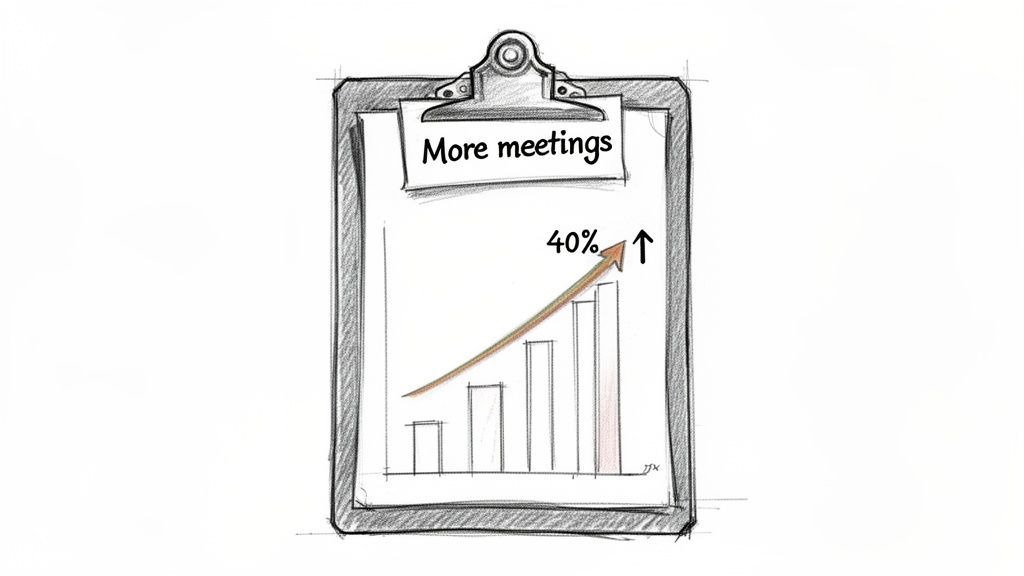
A hand-drawn clipboard displays a chart illustrating a 40% increase in meetings over time.

Strategic Breakdown

The power of this technique comes from its blend of value and specificity. A generic benefit is easy to dismiss, but a benefit grounded in the prospect's reality creates instant credibility and relevance. By including a detail like their industry, a competitor they know, or a metric their role is judged on, you signal that this isn't a mass email. You're speaking their language and promising a solution to a problem they actively face.

Examples in Action

  • Weak: "Increase meetings and save time"
  • Strong: "[Company Name] SDRs: 40% more meetings, 20% less prep time" — This is highly targeted, calling out the company and the specific roles (SDRs) while offering two compelling, quantifiable outcomes.
  • Weak: "How companies save time"
  • Strong: "SaaS companies like [Competitor] cut dialing time by 50%" — This uses social proof by naming a competitor, making the benefit feel achievable and directly relevant to their market.
  • Weak: "Improve team efficiency"
  • Strong: "Cut cold email research time in half for your team" — This focuses on a common pain point (time-consuming research) and promises a significant efficiency gain, which is a key priority for any sales leader.

Actionable Takeaways

To execute this strategy effectively, use these precise tactics:

  • Reinforce Immediately: The first sentence of your email must connect directly to the benefit promised in the subject line. Action: If your subject line claims "40% more meetings," start your email with: "Companies like yours use our platform to get 40% more meetings by..."
  • Segment Your Data: Pull success metrics from customer segments that mirror the prospect's company profile. A claim is more believable if it's from a peer. Action: Create a simple spreadsheet mapping your case studies to industries and company sizes. Refer to it before every outreach sequence.
  • Test Benefit Magnitude: A/B test different numbers. Does "35% more pipeline" get a better open rate than "40% more pipeline"? Sometimes a slightly more conservative number can feel more credible. Action: Run a test comparing a specific number (e.g., 37%) versus a rounded one (e.g., 40%) to see which performs better with your audience.

4. Problem-Agitator Subject Lines

This approach to writing an email subject line for sales goes straight for the pain point. Instead of hinting at a solution, you lead by naming a specific, frustrating problem your prospect likely faces. This strategy works by creating instant relevance and demonstrating empathy, making the recipient feel understood and more inclined to see what you have to say. When you accurately diagnose a prospect's challenge in the subject line, you position yourself as a problem-solver from the very first interaction.

Strategic Breakdown

The power of a problem-agitator subject line lies in its accuracy. A generic guess will fall flat, but a well-researched, specific problem makes your outreach feel less like a cold email and more like a timely intervention. This technique is especially potent for sales development representatives (SDRs) targeting personas with well-defined, industry-standard challenges. By articulating their pain better than they can, you immediately establish credibility and authority.

Examples in Action

  • Weak: "Time management issues?"
  • Strong: "SDRs still spending 3 hours on research daily?" — This is highly specific and quantifiable, calling out a common time-wasting activity that resonates with sales leaders.
  • Weak: "Email problems"
  • Strong: "Cold emails not getting replies? Let's talk why" — A direct and conversational subject line that targets a universal frustration for anyone in a sales or marketing role.
  • Weak: "CRM challenges"
  • Strong: "[Company Name] struggling with call logging in Salesforce?" — This shows you've done your homework by naming the prospect's company and a common CRM-related issue, making it highly personalized.

Actionable Takeaways

To effectively implement this strategy, focus on precision and empathy:

  • Validate the Problem: Before sending, use context clues from job descriptions, LinkedIn posts, or case studies to validate the prospect is likely facing this issue. Action: Spend 2 minutes reviewing the company’s recent job postings for roles you impact. The job description is a goldmine of stated problems.
  • Use Qualifier Language: Avoid absolutes that can seem presumptuous. Words like "likely," "struggling with," or posing it as a question soften the claim and invite dialogue. Action: Change "You are losing deals because..." to "Struggling with [problem]?" to be less accusatory.
  • Compare Against Curiosity: Test a problem-focused subject line like "Low MQL to SQL conversion?" against a curiosity-based one like "A thought on your MQL process." Action: Split your next prospect list in two and send each a different version. Track which one generates more qualified meetings using a platform like marketbetter.ai.
  • Align with High Intent: This strategy is most effective for prospects showing high-intent signals, such as visiting your pricing page or downloading a problem-focused whitepaper. Action: Set up an automated sequence with problem-agitator subject lines that triggers only for high-intent website visitors.

5. Question-Based Subject Lines (Provocative)

Posing a provocative question in an email subject line for sales directly engages the prospect's analytical mind. Unlike curiosity gaps that create a mystery, this approach frames a specific, relevant business problem as a direct question, prompting introspection and positioning your email as a potential solution. It assumes the prospect is already aware of the challenge and invites them into a dialogue about it.

Strategic Breakdown

The power of a question-based subject line lies in its ability to immediately qualify the reader. If the question resonates with a real pain point, the recipient is compelled to open the email to see if you understand their problem and have a credible answer. This method is rooted in consultative selling principles like SPIN, focusing on the problem before ever mentioning a solution. It's a direct challenge to the status quo.

Examples in Action

  • Weak: "Question about your tech stack"
  • Strong: "Is your dialer actually inside Salesforce?" — This is a hyper-specific technical question that instantly segments the audience. A sales leader using a disconnected dialer will feel this pain point immediately.
  • Weak: "Thinking about your challenges"
  • Strong: "[First Name], what's your biggest blocker with cold outreach?" — This open-ended, personalized question invites a genuine response and opens the door for a consultative conversation rather than a hard pitch.
  • Weak: "Can you improve your team?"
  • Strong: "Want to cut your SDR ramp time from 3 months to 6 weeks?" — While a yes/no question, this frames a powerful benefit in a way that feels less like a claim and more like a challenge, daring the recipient to find out how.

Actionable Takeaways

To effectively use this provocative email subject line for sales, apply these tactics:

  • Focus on Measurable Outcomes: Your question should point to a specific business metric or operational inefficiency. Action: Frame your question around time, money, or risk. For example, instead of "Is your process slow?" ask, "How many hours a week do your reps lose to manual data entry?"
  • Prioritize Open-Ended Questions: Questions that can't be answered with a simple "yes" or "no" are more likely to elicit a thoughtful response. Action: For your top-tier accounts, change yes/no questions like "Are you struggling with X?" to open-ended ones like "How are you approaching X in Q3?"
  • Personalize with Persona Data: Tailor your question to the recipient's role. A VP of Sales cares about ramp time, while an SDR manager is focused on daily workflow blockers. Action: For each of your key personas, write down their #1 KPI. Craft three questions that directly relate to improving that KPI.
  • Test Against Direct Statements: Compare a question like "Is your team hitting quota?" against a statement like "A new way to hit quota." Action: Run an A/B test to see if your audience responds better to direct inquiry or bold claims. The results may vary by seniority level.

6. Time-Sensitive / Scarcity Subject Lines

Urgency is a powerful motivator that drives immediate action. A time-sensitive email subject line for sales taps into the psychological principle of scarcity, signaling that an opportunity is limited or a deadline is approaching. This method compels prospects to prioritize your email over others by linking your message to a specific, tangible timeline, preventing it from being archived for "later."

Strategic Breakdown

The effectiveness of this strategy hinges on credibility. Artificial urgency, such as a "limited-time offer" with no real deadline, can erode trust and make your outreach feel like generic marketing spam. The most successful scarcity-based subject lines are anchored to real-world events that are verifiable and relevant to the prospect, such as an upcoming industry conference, a company earnings call, or the end of a fiscal quarter.

Examples in Action

  • Weak: "Urgent: Read now"
  • Strong: "[Company Name] is hiring: quick question about your outbound strategy" — This connects your outreach to a public signal of growth (hiring), creating a timely and relevant reason to discuss their strategy now.
  • Weak: "Meeting before the event?"
  • Strong: "Before [Industry Conference] next week, let's align on your pipeline goals" — This creates a hard, non-negotiable deadline (the conference date), making a pre-event conversation a logical priority.
  • Weak: "End of quarter"
  • Strong: "[First Name], closing window for Q4 planning - 3 weeks left" — This is highly relevant for decision-makers, as it ties directly into their own internal planning cycles and responsibilities.

Actionable Takeaways

To execute this strategy without damaging your reputation, follow these tactics:

  • Anchor to Real Events: Tie your urgency to verifiable public information. Use signal data like hiring trends, technology adoption, or event attendance to justify your timing. Action: Set up Google Alerts for your top 20 accounts for terms like "hiring," "funding," and "launch."
  • Be Transparent: Clearly state the deadline or event in the subject line. Ambiguity undermines the entire premise. Action: Compare "Before the end of the month" with "Before the Nov. 30th deadline." The specific date is almost always more effective.
  • Perfect Your Timing: Send the email 3-5 days before the actual deadline or event. This provides enough time for the prospect to see, open, and act on your message without feeling rushed. Action: Schedule these emails in your sales engagement platform to go out automatically at the optimal time.
  • Pair with Value: The email body must deliver on the urgency. Offer a specific insight or resource that is genuinely more valuable before the deadline passes. Action: Create a "pre-event" one-pager with insights relevant to the conference and attach it to your email to justify the time-sensitive outreach.

7. Social Proof / Authority Subject Lines

Leveraging social proof is a fundamental principle of influence, and it translates powerfully into an email subject line for sales. This strategy works by referencing a credible third party, a well-known customer, or a specific achievement to build instant trust and reduce the recipient's perceived risk. Instead of asking a prospect to believe your claims, you're showing them that their respected peers or competitors already do.
Sketch illustrating trust with a building, three people, a 'Trusted by' banner, and a green checkmark.

Strategic Breakdown

The effectiveness of a social proof subject line hinges on relevance and specificity. A generic "Trusted by thousands" is weak, but mentioning a direct competitor or a similar-tier company in the prospect's industry creates an immediate connection. The prospect's thought process shifts from "Who is this?" to "If my competitor is using this, I need to know why." This tactic borrows authority, making your cold outreach feel more like a warm, relevant introduction.

Examples in Action

  • Weak: "How we help our customers"
  • Strong: "Helps teams at [Competitor/Peer Company] close 30% more deals" — This is a double-win. It names a direct competitor and ties it to a quantifiable, high-value result.
  • Weak: "See how we help companies like yours"
  • Strong: "[Company Name] & [Similar Tier Company] cut SDR ramp time by 50%" — Mentioning a company of similar size or status makes the results feel achievable and directly applicable to the prospect's own challenges.
  • Weak: "As seen in the news"
  • Strong: "Recommended by [Industry Authority or Publication]" — This borrows credibility from a trusted source within the prospect's ecosystem, positioning your solution as vetted and reliable.

Actionable Takeaways

To make this strategy work, follow these specific tactics:

  • Get Permission: Always ensure you have permission before name-dropping a customer. A case study or public testimonial is your best source of approved proof. Action: Create a central repository of approved customer logos and case studies for your sales team to easily access.
  • Test Specificity: A/B test a specific customer name against a broader category. Action: Compare "How [Competitor Company] solved X" with "How SaaS leaders solve X" to see which resonates more with your target persona. The former works best when you have a direct, well-known competitor.
  • Connect to the Body: The social proof in the subject line must be the focal point of your email's opening. Action: Immediately expand on the result you referenced, providing a link to a case study or a direct quote in the first two sentences.

8. Contrarian / Challenger Subject Lines

Inspired by "The Challenger Sale," this advanced email subject line for sales is designed to disrupt the prospect's status quo. Instead of agreeing with common assumptions, it introduces a provocative, contrarian viewpoint that challenges their current thinking. This positions you not as a vendor selling a product, but as a strategic partner with a unique and valuable perspective.

Strategic Breakdown

The goal of a challenger subject line is to make the recipient pause and reconsider a deeply held belief about their business. It works by creating cognitive dissonance, sparking enough curiosity and professional intrigue to earn an open. This approach is not about being aggressive; it's about being insightful and demonstrating that you understand their world so deeply you can identify a flaw in their common strategy.

Examples in Action

  • Weak: "A better way to email"
  • Strong: "Cold email isn't dying. Your approach is." — This directly confronts a common industry complaint and promises a new perspective, making it irresistible for a sales leader struggling with outreach.
  • Weak: "How to grow your sales team"
  • Strong: "[Company Name], you don't need more SDRs - you need better systems" — This challenges a typical solution (hiring more people) and suggests a more efficient, systemic fix, appealing to leaders focused on scalability.
  • Weak: "Sales tips"
  • Strong: "Forget outreach volume. Here's what actually moves the needle." — This speaks directly to the "more is better" mindset and offers a smarter, alternative path to achieving key results.

Actionable Takeaways

To execute this strategy effectively, follow these precise tactics:

  • Earn the Right: Only use this on well-researched, high-value accounts. You must have evidence to support your claim. Action: Reserve this for Tier 1 accounts where you've spent at least 15 minutes researching their specific situation.
  • Back It Up Immediately: The first line of your email must substantiate the claim with a compelling data point or a sharp insight. Action: After "Forget outreach volume," start with "Our data from 1M+ emails shows personalized multi-touch sequences outperform high-volume cadences by 3x."
  • Test Against Safer Bets: A/B test your challenger subject lines against benefit-driven or curiosity-based alternatives. This will show you which segments are receptive to a provocative approach. Action: Use a tool like marketbetter.ai to track which messaging drives meetings, not just opens, as this style can sometimes generate opens from curiosity without buying intent.

9. Reciprocity / Value-First Subject Lines

The principle of reciprocity is a fundamental aspect of human psychology: when someone gives you something of value, you feel an innate obligation to give something back. A well-executed email subject line for sales can trigger this response by leading with genuine, no-strings-attached value. This strategy positions you as a helpful resource rather than just another salesperson, building trust and rapport from the very first interaction.

Strategic Breakdown

The core of this approach is to offer a valuable insight, resource, or piece of data directly in your subject line. Unlike curiosity-based subject lines that create a mystery, this method is transparent about the benefit. The key is that the value must be specific, relevant, and genuinely useful to the prospect's role or industry. Generic offers are easily dismissed, but a targeted piece of analysis shows you understand their challenges and have something tangible to contribute.

Examples in Action

  • Weak: "Some data for you"
  • Strong: "[Company Name]: How your SDR productivity compares" — This offers a competitive benchmark, a highly valuable piece of information for any sales leader looking to optimize their team.
  • Weak: "Free resource"
  • Strong: "[First Name], free analysis of your website's lead capture" — This is incredibly specific and promises a personalized assessment of a critical business function, making it almost irresistible to open.
  • Weak: "Tips for your strategy"
  • Strong: "3 reasons your cold email strategy isn't working (+ fix)" — This subject line not only identifies a common pain point but also promises a solution, framing the email as immediate, actionable advice.

Actionable Takeaways

To effectively implement value-first subject lines, follow these guidelines:

  • Deliver Value Instantly: The value promised must be delivered immediately in the email body. Don't use it as bait to get a click to a blog post. Action: If you promise an analysis, include 2-3 bullet points of your findings directly in the email text itself.
  • Be Hyper-Specific: Vague offers like "Helpful resource inside" are ineffective. Action: Instead of "A report on your industry," try "Data on [competitor]'s marketing spend for Q3."
  • Test Against Pain Points: Compare value-driven subject lines (e.g., "A benchmark for your SDR team") against pain-point-driven ones (e.g., "Frustrated with low SDR meeting rates?"). Action: Use a tool like marketbetter.ai to determine if your audience responds better to a promised gain or the solution to a current problem.
  • Use as a Nurture Tactic: While it can work for a first touch, this strategy is exceptionally powerful in a follow-up sequence. Action: Create a 3-step sequence. Step 1: Intro. Step 2 (if no reply): Follow up with a value-first subject line like "A resource for your [Job Title] role."

10. Role-Specific / Segmented Subject Lines

Speaking directly to a prospect's job function is one of the most effective ways to craft a compelling email subject line for sales. This strategy moves beyond simple name personalization and tailors the message to the specific challenges, goals, and language of a particular role or department. It demonstrates immediate relevance and shows the prospect that you understand their unique world, instantly setting your email apart from generic, one-size-fits-all blasts.

Strategic Breakdown

The power of role-specific subject lines comes from leveraging buyer persona research. Instead of sending the same message to a VP of Sales and a RevOps Manager, you create distinct messaging that addresses their different priorities. A sales leader cares about ramp time and quota attainment, while a RevOps manager is focused on data integrity and process efficiency. Acknowledging this difference in the subject line proves you've done your homework and have a relevant solution.

Examples in Action

  • Weak: "A tool for sales leaders"
  • Strong: "VP of Sales: Cut SDR onboarding from 3 months to 6 weeks" — This subject line combines the recipient's title with a specific, quantifiable outcome directly tied to their responsibilities.
  • Weak: "Fix your Salesforce data"
  • Strong: "RevOps Manager: Salesforce call logging-solved" — This is incredibly direct, naming a common, frustrating pain point for this specific role and offering a definitive solution.
  • Weak: "Help for your SDRs"
  • Strong: "Head of SDR: Your team might be missing this obvious win" — This creates curiosity while speaking the language of a sales development leader who is always looking for an edge to improve team performance.

Actionable Takeaways

To make this strategy work, follow these specific tactics:

  • Create Persona-Specific Variations: Develop 3-5 distinct subject line templates, each one mapped to a key buyer persona. Action: Build a simple "persona card" for each role that lists their top 3 priorities. Write one subject line for each priority.
  • Mirror the Message: The promise made in the role-specific subject line must be the immediate focus of the email body. Action: If your subject line is for a RevOps Manager about Salesforce logging, the first sentence must address that exact topic. Don't bury the lead.
  • Test Against Generic Messaging: A/B test your role-specific subject lines against more general, benefit-driven ones. Action: For your next campaign, send 50% with a generic subject like "A new way to boost sales" and 50% with a role-specific one like "VP of Sales: A new way to boost sales." Measure the reply rate difference.
  • Update Personas Quarterly: Business priorities and pain points shift. Action: Set a recurring calendar reminder to review your persona messaging with your marketing and product teams each quarter to ensure it remains relevant.

10 Sales Email Subject Lines Compared

Subject Line TypeImplementation 🔄 (complexity)Resources 💡 (requirements)Expected Outcomes ⭐📊Ideal Use CasesKey Advantages ⚡
Curiosity Gap Subject LinesModerate — simple copy but needs contextual personalization and strong follow-upLow–Medium — copywriting + some account/context signals⭐📊 Large open lift (often 35–50%+); CTR may be lower if body doesn't deliverCold outreach to new accounts; follow-ups after no response; intent-signaled prospects⚡ Quick to craft, mobile-friendly, drives opens
Personalized Trigger-Based Subject LinesHigh — requires real-time signal integration and validationHigh — intent data, automation, real‑time feeds, verification⭐📊 Very high open/relevance (40–60%+); better replies/connects when accuratePriority accounts, first-touch on fresh intent, signal-driven campaigns⚡ Extremely relevant; reduces unsubscribe risk and fuels conversations
Benefit-Driven Subject Lines with a TwistMedium — needs credible metrics and tailored benefit framingMedium — customer metrics, account research, persona fit⭐📊 Strong open→reply conversion when claims are believableBusy C‑level and manager personas; persona-targeted campaigns; follow-ups⚡ Clear value reduces friction; easy to A/B test
Problem-Agitator Subject LinesMedium–High — needs accurate diagnosis and careful toneMedium — task/context checks, intent signals, persona insight⭐📊 High engagement for accurately identified pains; risk of misfiresMid‑market+/warmed prospects; sequences targeting known pain points⚡ Triggers emotional resonance and prompts conversation
Question-Based Subject Lines (Provocative)Low–Medium — templatable but must be specific and thoughtfulLow–Medium — persona data, focused copywriting⭐📊 Higher cognitive engagement vs. statements; variable opens if genericStrategic accounts, consultative selling, multi‑touch outreach⚡ Invites replies and discovery; easy to personalize at scale
Time‑Sensitive / Scarcity Subject LinesMedium — must tie to real events and timingMedium — event calendars, signal tracking, honest deadlines⭐📊 Increased CTR and immediate action when urgency is genuine; short shelf lifeFollow‑ups tied to events (funding, conferences), seasonal campaigns⚡ Drives fast action and reduces procrastination
Social Proof / Authority Subject LinesMedium — requires verifiable proof and careful selectionMedium–High — case studies, customer lists, approvals, relevant examples⭐📊 Lowers trust barriers; higher replies from decision‑makers evaluating optionsEnterprise/mid‑market outbound; competitor-targeting; evaluation-stage prospects⚡ Builds credibility quickly; boosts reply rates from influencers
Contrarian / Challenger Subject LinesHigh — needs strong research and confident, evidence-backed claimsMedium–High — data, thought leadership, tailored messaging⭐📊 High opens/replies with receptive audiences; risk of alienation if wrongStrategic/high‑value accounts; forward‑thinking personas; thought leadership outreach⚡ Differentiates from competitors; sparks dialogue
Reciprocity / Value‑First Subject LinesMedium — requires creating & delivering genuine value up frontHigh — bespoke analysis, reports, actionable insights⭐📊 Higher trust and engagement; slower path to conversion but better relationshipHigh‑value/complex deals, C‑level relationship building, warmed prospects⚡ Builds rapport and triggers reciprocity; lowers unsubscribe risk
Role‑Specific / Segmented Subject LinesMedium–High — needs segmentation strategy and template maintenanceHigh — persona mapping, list hygiene, dynamic templates, testing⭐📊 Significant relevance lift (20–30%+ open increases) and improved reply qualityMulti‑threaded outreach, complex B2B deals, campaigns targeting multiple stakeholders⚡ Targets the right buyer; improves conversion and reply relevance

From Theory to Execution: Activating Your Subject Line Strategy

You've just explored ten distinct, powerful frameworks for crafting an effective email subject line for sales. We’ve moved beyond generic templates, diving deep into the psychological triggers that drive opens, clicks, and, most importantly, replies. From sparking intrigue with the Curiosity Gap to leveraging timely Personalization and agitating problems your prospect is actively trying to solve, the goal is clear: your subject line is the tip of the spear in your entire sales motion.

The difference between a mediocre and a masterful subject line isn't just a few percentage points on your open rate. It's the difference between being deleted and starting a conversation that leads to a closed deal. The key is to stop thinking in terms of one-off "tricks" and start building a strategic, adaptable system.

Synthesizing the Strategies: From List to Live Cadence

The true power of these examples is unlocked when you see them not as a menu to pick from, but as a toolkit to combine and deploy based on context. A new SDR might start with a straightforward, Benefit-Driven subject line. It's a low-risk, high-clarity approach. In contrast, a seasoned BDR targeting a C-level executive who has ignored previous outreach might deploy a bold Contrarian or a hyper-specific Question-Based subject line to break through the noise.

Actionable Comparison: For a first touch, a Trigger-Based subject line ("Saw you're hiring SDRs") is often superior to a generic Benefit-Driven one ("Improve SDR performance"). The trigger provides immediate, undeniable relevance that the benefit alone lacks. For a follow-up, a Value-First line ("A benchmark for your new SDR team") can re-engage a prospect by offering help instead of just asking for their time again.

Your subject line strategy must be as dynamic as your prospects themselves.

The Litmus Test: Moving Beyond Open Rates

Let’s be brutally honest: open rates are a vanity metric if they don't lead to action. An intriguing subject line that leads to a disappointing email body creates a negative brand impression. Your primary metrics for subject line success should be reply rate and meetings booked. These are the indicators of true engagement.

To get there, you must embrace systematic testing. Don't just test random ideas; test entire strategies against each other. For your next campaign targeting a specific persona, try this:

  • Group A (Control): Use your current best-performing subject line style.
  • Group B (Challenger): Test a completely different framework. If you normally use Benefit-Driven lines like "A better way to manage X," test a Curiosity Gap approach like "question about your Q3 goals."

Actionable Step: Create a simple tracking sheet with columns for "Subject Line," "Strategy Type," "Emails Sent," "Opens," "Replies," and "Meetings Booked." After sending 100 emails for each group, calculate the reply and meeting rates. This data, not just opens, will tell you the real winner.

Activating Your Strategy with Intelligent Workflows

The final, critical piece is operationalizing this intelligence. A brilliant subject line is useless if it’s sent to the wrong person at the wrong time. This is where modern sales tools bridge the gap between theory and revenue. An SDR shouldn't spend an hour searching for the perfect trigger event and another 30 minutes crafting the perfect personalized subject line. The process must be scalable.

Platforms like marketbetter.ai are designed for this exact purpose. They integrate with your CRM to monitor buyer signals, such as a prospect's company posting a relevant job or a key executive engaging with your content. The system then prompts your sales team with an AI-generated, context-aware email and subject line, turning a powerful strategy into a repeatable, daily workflow. This ensures that every high-impact email subject line for sales you've learned about is delivered with perfect timing and relevance, transforming your outbound efforts from a guessing game into a data-driven science.


Ready to stop guessing and start executing a world-class sales email strategy? marketbetter.ai turns the buyer signals and subject line tactics from this article into a prioritized, AI-powered workflow directly inside your CRM. See how you can build a repeatable pipeline-generating machine by visiting marketbetter.ai today.
10 Actionable Cold Calling Best Practices for SDRs in 2026

· 29 min read

Cold calling isn't dead; ineffective cold calling is. In an era saturated with automated emails and social media noise, a well-executed, human-to-human phone call can be a powerful differentiator. The game has changed, however. The old approach of high-volume, low-quality dials with generic scripts no longer builds a reliable pipeline. Today’s top-performing Sales Development Representatives (SDRs) operate more like strategic consultants. They research with precision, listen with intent, and treat every dial as a chance to build trust, not just book a meeting.

This guide moves beyond theory to provide 10 battle-tested cold calling best practices designed for modern B2B sales teams. We will break down actionable frameworks, compare outdated tactics with new-school strategies, and provide concrete steps to operationalize each practice. The goal is to transform your outbound motion from a guessing game into a predictable revenue engine. For a complete blueprint to navigating the evolving landscape of outbound outreach, consult this comprehensive cold calling guide.

Throughout this listicle, we’ll explore how to master everything from pre-call research and objection handling to CRM discipline and performance analytics. You will learn how to turn dreaded dials into meaningful conversations that lead to qualified opportunities. We will also highlight how specific tools, like MarketBetter.ai's SDR Task Engine, can supercharge each step, turning these best practices into consistent, daily execution for your team. Let's dive in.

1. Research and Personalize Before Dialing

The days of dialing down a list with a generic, one-size-fits-all script are over. One of the most critical cold calling best practices is to conduct targeted research before you ever pick up the phone. This means going beyond simply knowing a prospect's name and title. It involves understanding their specific role, recent company news, and potential business challenges to craft a highly relevant and personalized opening.

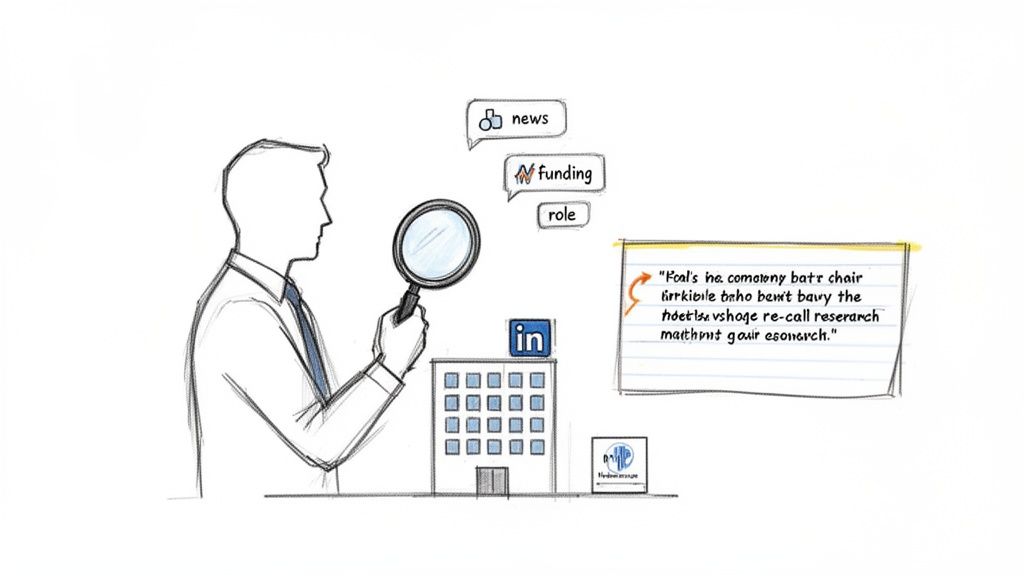
A person researches a company using a magnifying glass, LinkedIn, and various data points.

Unlike a purely volume-based approach that relies on luck, a research-first strategy positions the SDR as a thoughtful problem-solver, not just another salesperson. This shift dramatically improves your chances of capturing a busy prospect’s attention in the crucial first 30 seconds.

How to Implement Pre-Call Research

Effective personalization requires gathering specific intelligence. Instead of just confirming a job title on LinkedIn, look for actionable trigger events or relevant context.

  • Trigger Events: Has their company recently received funding, announced a new product, or posted an earnings report? These events create compelling reasons to call. For example: "I saw your recent Series B announcement and noticed you're expanding your engineering team, which is why I'm calling..."
  • Role-Specific Challenges: What are the common pain points for a Director of Marketing versus a VP of Operations? Tailor your value proposition to their specific world.
  • Intent Data: Leverage tools that signal buying intent, such as website visits, content downloads, or webinar attendance. These "warm" signals provide a natural and timely entry point.

Actionable Tips for Success

To make this practice scalable, integrate it directly into your workflow.

  • Use an AI-Powered Task Engine: Platforms like MarketBetter.ai can auto-generate research summaries and prioritize high-intent prospects, feeding reps the key talking points they need without manual effort.
  • Create a 30-Second "Hook": Based on your research, script a concise opening that immediately explains why you are calling them specifically, right now.
  • Log Research Notes: Keep detailed notes in your CRM (Salesforce, HubSpot) so the entire team can see what research patterns lead to successful conversations. This creates a powerful feedback loop for ongoing personalization strategies. For more detail, you can explore marketing personalization strategies in our recent article.

2. Create and Use Proven Call Scripts and Talk Tracks

The idea of a "call script" often brings to mind robotic, inflexible monologues that kill genuine conversation. However, a modern approach to scripting is one of the most effective cold calling best practices. The goal isn't a rigid, word-for-word document but a flexible talk track: a proven framework that guides reps through openings, value propositions, and objection handling while allowing for natural conversation.

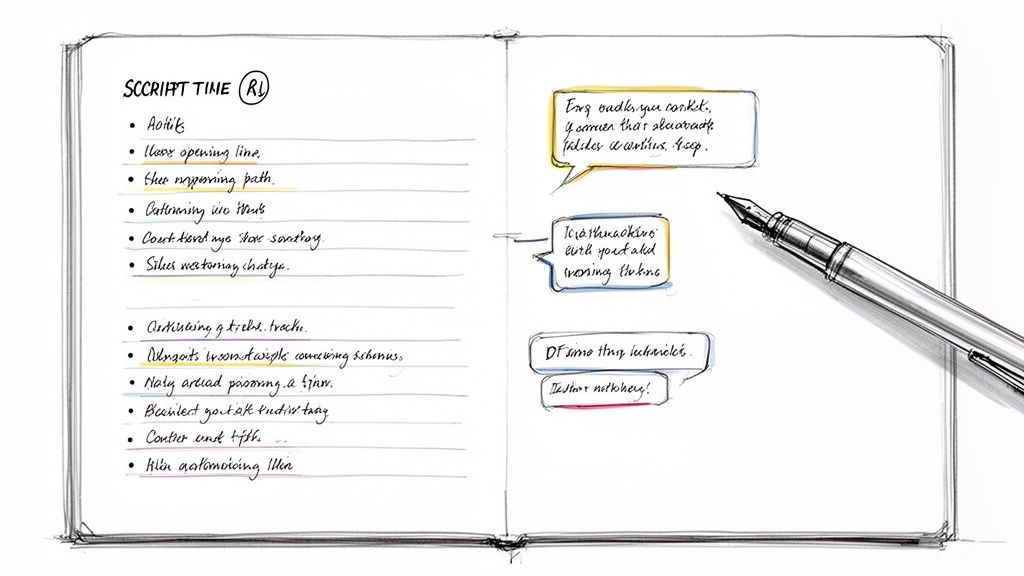
Hand-drawn sketch of an open notebook with a pen, displaying handwritten notes and speech bubbles.

Unlike an improvised call, a well-designed talk track ensures every SDR communicates a consistent, powerful message tailored to specific buyer personas and market segments. It provides a reliable foundation, freeing up the representative's mental energy to actively listen and engage with the prospect, rather than scrambling for what to say next.

How to Implement Talk Tracks

Effective talk tracks are living documents, continuously refined based on call outcomes and feedback. They are built around key conversation milestones, not just a single pitch.

  • Segment-Specific Frameworks: Develop different talk tracks for different industries or company sizes. The pain points of a startup CTO are vastly different from those of a Fortune 500 marketing director, and your script must reflect that.
  • Opening Variations: Don't rely on a single opening line. Create 3-5 variations and test them systematically to see which ones consistently lead to longer conversations. Track conversion rates in your CRM to let data guide your script evolution.
  • Objection Handling Playbooks: The most common objections ("bad timing," "we already use a competitor," "not interested") are predictable. Build your talk track with proven, empathetic responses for each, turning a potential rejection into a new line of discovery.

Actionable Tips for Success

To make this practice effective, integrate it into your team's core sales enablement and coaching rhythm.

  • Practice with Role-Play: Before using a new talk track on live calls, conduct role-play sessions with managers or peers. This builds muscle memory and helps reps internalize the flow so it sounds natural and confident.
  • Build an 8-12 Second Opener: Your initial hook should be concise and impactful. It must include: (1) your name and company, (2) the specific reason for your call (based on research), and (3) a potential benefit relevant to their role.
  • Use AI for Dynamic Talking Points: Instead of a static document, leverage tools like MarketBetter.ai. Its AI Cold Call Workflow can automatically generate persona-specific talking points and objection frameworks based on real-time data, giving reps a dynamic guide for every call.
  • Review Call Recordings: Platforms like Gong and Chorus are invaluable for identifying what language works. Regularly review top-performing calls to extract powerful phrases and objection-handling techniques, then incorporate them back into your team's official talk tracks.

3. Practice Active Listening and Strategic Questioning

The most common cold calling mistake is treating the call as a monologue. A successful interaction isn't about delivering a perfect pitch; it's about starting a genuine conversation. This is where active listening and strategic questioning come in, shifting the dynamic from a sales pitch to a consultative discovery session. This approach builds trust and uncovers the critical business context needed to qualify a prospect effectively.

Unlike a pitch-focused approach that often leads to immediate rejection, consultative questioning demonstrates genuine interest in the prospect's challenges. As data from platforms like Gong shows, top-performing reps consistently talk less and listen more, asking thoughtful questions that guide the conversation toward the prospect's true pain points. This is a core component of modern cold calling best practices.

How to Implement Strategic Questioning

Effective discovery involves moving beyond surface-level queries to questions that reveal deeper business needs. Methodologies like SPIN Selling (Situation, Problem, Implication, Need-Payoff) provide a proven framework for this.

  • Understand the Situation: Start with broad, open-ended questions to grasp their current environment. For example: "Could you walk me through your current process for managing new inbound leads?"
  • Identify the Problem: Once you understand the situation, probe for specific challenges or inefficiencies. Ask: "What are the biggest bottlenecks you're facing with that process?"
  • Explore the Implication: Help the prospect connect the problem to its broader business impact. A powerful question is: "How does that delay in lead follow-up affect your team's ability to hit its pipeline targets?"
  • Present the Need-Payoff: Guide them to see the value of a solution by asking about the positive outcomes. For instance: "If you could automate lead routing and cut response time by 50%, what would that mean for your Q4 revenue goals?"

Actionable Tips for Success

To make this practice a core part of your calling motion, focus on preparation and in-call awareness.

  • Plan 3-5 Core Discovery Questions: Before each call, prepare a short list of open-ended questions tailored to the prospect's role and industry.
  • Follow the 60/40 Rule: Aim to spend 60% of the call listening and only 40% talking. This simple ratio forces you to ask more questions and avoid dominating the conversation.
  • Confirm Your Understanding: After the prospect shares a key challenge, repeat it back to them. For example: "So if I'm hearing you correctly, the main issue is a lack of visibility into your team's activity... is that accurate?"
  • Log Discovery Insights: Use your CRM to capture the key pain points, goals, and challenges uncovered during the call. This context is invaluable for the next-step conversation with an Account Executive.

4. Timing and Sequencing: Call at the Right Time with Strategic Follow-Up

Dialing a prospect at the wrong time is as ineffective as calling without research. One of the most impactful cold calling best practices involves strategic timing and a structured follow-up sequence. This means understanding when your ideal buyer is most likely to answer their phone and building a multi-channel cadence that maintains momentum without overwhelming them.

Unlike a random, high-volume approach that burns through leads, a time-aware strategy maximizes the connect rate for every dial. By coordinating calls with emails and social touches, SDRs create a persistent, professional presence that increases the likelihood of engagement over time.

How to Implement Strategic Timing and Sequencing

Effective sequencing moves beyond just picking a "good" time to call. It involves building a repeatable multi-touch playbook that guides prospects through an engagement journey.

  • Optimal Calling Windows: Landmark research from InsideSales.com and others shows connect rates peak on Tuesdays, Wednesdays, and Thursdays between 10-11 AM and 3-4 PM in the prospect's local time. Mondays are often lost to internal meetings, while Fridays see decreased focus.
  • Structured Follow-Up Cadence: A successful sequence often involves 8-12 touches over 4-6 weeks. A common "call-then-email" tactic involves calling first to create a touchpoint, then immediately sending a concise follow-up email that references the call and summarizes your value proposition.
  • Intent-Based Triggers: The best time to call is right after a prospect shows interest. If a lead visits your pricing page or downloads a whitepaper, that action should trigger an immediate follow-up task in your sales engagement platform.

Actionable Tips for Success

To operationalize this, build timing and sequencing directly into your team's daily workflow.

  • Use an AI-Driven Task Sequencer: Platforms like MarketBetter.ai can auto-create and prioritize daily call tasks based on optimal times and intent signals, ensuring reps always contact the warmest prospects when they are most receptive.
  • Build a Multi-Channel Cadence: Design a clear follow-up sequence, such as: Day 1 (Call + Email), Day 3 (Call), Day 5 (LinkedIn Connection Request), Day 8 (Call). This ensures you never miss a follow-up.
  • Track Your Own Data: While industry benchmarks are a great starting point, use your CRM to track connect rates by day and hour. Identify your team's unique "sweet spot" and adjust your calling blocks accordingly. You can learn more about how to ensure you never miss a follow-up with a structured playbook.

5. Optimize Call-to-Email Integration for Maximum Response

Relying on a single outreach channel is a recipe for low engagement. Modern cold calling best practices demand a multi-channel approach where calls and emails work in tandem. Calls alone suffer from low connect rates, while emails are easily ignored. When combined, they create a powerful synergy: a call builds familiarity, and a follow-up email provides a tangible, easy-to-digest resource that keeps the conversation moving forward.

Unlike isolated outreach attempts, an integrated call-to-email sequence positions your outreach as a persistent, professional effort. This coordinated strategy, championed by platforms like Salesloft and Outreach, has been shown to lift meeting conversion rates by over 25% compared to email-only campaigns. It turns a cold touchpoint into a warm, ongoing dialogue.

How to Implement Call-to-Email Integration

The key is to make the transition from call to email seamless and context-aware. The email should feel like a natural continuation of the phone conversation, not a separate, generic marketing blast.

  • Immediate Follow-Up: After a call (whether you connect, leave a voicemail, or get a quick brush-off), send a relevant email within a few hours. This reinforces your message while the call is still fresh in the prospect's mind.
  • Contextual Reference: Your email must directly reference the call. For example: "Following up on our brief chat about managing your ad spend..." or "As promised, here is the case study I mentioned on the phone..."
  • Templated Workflows: Create pre-built email templates for common call outcomes like "Connected, interested," "Left voicemail," or "Overcame objection." This ensures consistency and speed across the team.

Actionable Tips for Success

To operationalize this practice, embed it directly into your sales engagement tools.

  • Use an Integrated Dialer: A platform like MarketBetter.ai allows reps to dial directly from Salesforce and then use AI to instantly draft a follow-up email based on the call's context. This closes the loop with a single click.
  • Test Call-Referencing Subject Lines: A/B test subject lines like "Following up from our call" or "Quick note, [Prospect Name]" which often have significantly higher open rates than generic alternatives.
  • Map Email Content to Call Outcomes: If a prospect mentioned a specific pain point, your follow-up email should lead with a resource addressing that exact problem. If they were busy, keep it short with a clear call-to-action to book time later. This level of personalization is crucial for effective multi-channel selling.

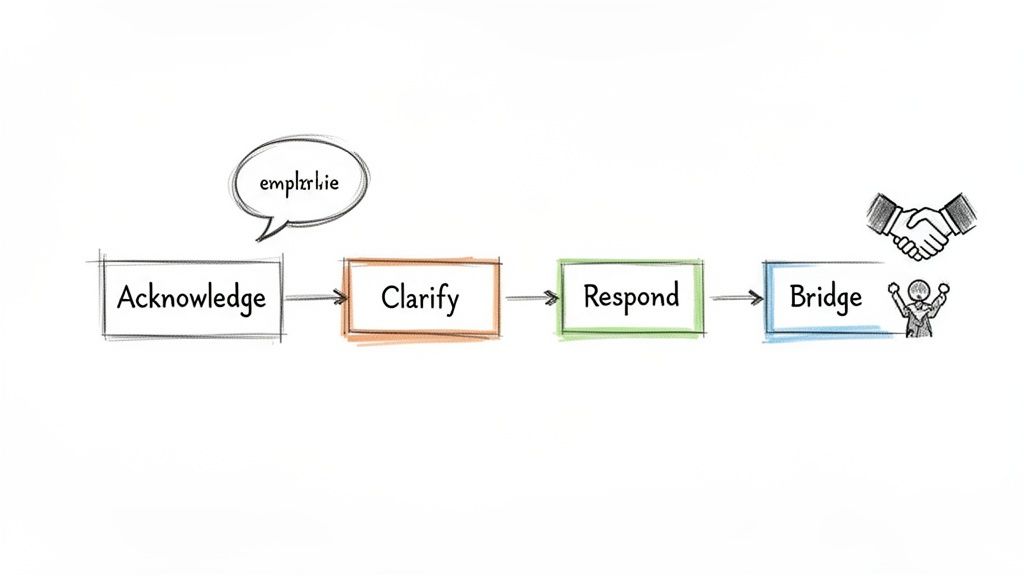
6. Establish Clear Objection Handling Frameworks

Objections are not rejections; they are requests for more information. One of the most critical cold calling best practices is to treat prospect hesitation as an opportunity to build credibility and deepen the conversation. Rather than relying on rigid, scripted rebuttals, effective frameworks use empathy, clarifying questions, and evidence-based responses to address the underlying concerns behind common objections.

A diagram illustrating a four-step communication process: Acknowledge, Clarify, Respond, and Bridge, with handshake icon.

Unlike an unprepared rep who stumbles and ends the call, an SDR with a structured approach can confidently navigate pushback. This skill turns potential roadblocks into productive discussions, increasing conversion rates and extending call lengths by building trust and demonstrating expertise.

How to Implement Objection Handling Frameworks

A powerful framework addresses the most common objections ('no budget,' 'bad timing,' 'we use a competitor') with predictable, yet flexible, responses. The goal is to acknowledge the concern, reframe the situation, and guide the prospect to the next logical step.

  • "We use [Competitor]": Acknowledge their existing solution, then pivot to a gap. "That's great, so you're already addressing [use case]. What we're finding is that [Competitor] often struggles with Y, which leads to [specific problem]. Would it be worth 15 minutes to explore that gap?"
  • "I'm not interested": Don't accept this at face value; instead, add curiosity and evidence. "I understand. Most people aren't initially. Leaders at [similar company] found they were overlooking X until we showed them [specific metric]. Could I share a quick case study on that?"
  • "Bad timing / No budget": Instead of ending the call, pivot to a future action. "Totally get it. Would it make sense to set up a brief call in [specific month] when budgets typically reopen? I'll send a quick summary so it’s fresh."

Actionable Tips for Success

To make this practice second nature, build a system for continuous improvement. Mastering the art of Overcoming Objection in Sales requires preparation and iteration.

  • Create an "Objection Playbook": Document your top 5-7 objections and develop 2-3 validated responses for each. Every response should include empathy, a clarifying question, a reframe, and a bridge to the next step.
  • Conduct Weekly Role-Plays: Practice handling objections in a live setting. Record these sessions and use them as coaching material to highlight what works and what doesn't.
  • Leverage AI-Powered Insights: Use a tool like MarketBetter.ai to surface common objections specific to an industry or persona and get data-backed response suggestions directly in your workflow.
  • Never Argue: Acknowledge the prospect's concern as valid, even if you disagree. Start with phrases like, "That's a fair point, and I hear that often..." to disarm defensiveness and open the door for a real conversation.

7. Build Credibility Through Social Proof and Brand References

Cold calls inherently start from a position of low trust. To overcome a prospect's natural skepticism, one of the most effective cold calling best practices is to build immediate credibility using social proof. This involves referencing well-known customers, quoting specific results, and citing third-party validation to quickly establish that your solution is a safe and proven choice.

Unlike making abstract claims about your product's benefits, social proof provides tangible evidence from a source the prospect trusts: their peers. This approach, rooted in Robert Cialdini's principles of persuasion, shifts the conversation from "Why should I believe you?" to "How did you help a company like mine?" This single change can reduce initial objections and significantly increase meeting conversion rates.

How to Implement Social Proof

Effective social proof is not just name-dropping; it's about delivering relevant evidence that resonates with the prospect’s specific context. The key is to match your proof points to their industry, size, and challenges.

  • Industry-Specific Logos: Mentioning customers in the same vertical immediately builds relevance. For example: "We've helped over 50 B2B SaaS teams like Acme Corp and TechCorp increase their SDR productivity..."
  • Quantifiable Results: Vague claims are forgettable, but hard numbers are compelling. Instead of saying you "improve efficiency," say, "A similar-sized company, Techco Corp, increased their meeting conversions from 8% to 15% in just three months with our platform."
  • Third-Party Validation: Leverage external credibility from trusted sources. For instance: "Gartner recently recognized us as a leader in Sales Engagement platforms, specifically for our AI-driven task prioritization..."

Actionable Tips for Success

To make social proof a natural part of your talk track, prepare specific references for each target segment.

  • Create a "Proof Sheet": For each target account, pre-identify their industry, size, and potential challenges. Then, map them to your most relevant customer story, case study, or analyst report.
  • Lead with Logos: Introduce credibility within the first 30 seconds. A simple line like, "The reason I'm calling is that we work with other industry leaders like [Competitor] and [Similar Company]..." immediately establishes legitimacy.
  • Leverage Mutual Connections: A warm introduction is the strongest form of social proof. Try, "I noticed you're connected to John Smith at [Reference Company]. He actually led their SDR transformation with us last year."
  • Utilize Your Tech Stack: Use tools like MarketBetter.ai to surface account details and automatically suggest similar customers and relevant outcomes, arming you with customized social proof for every single call.

8. Implement CRM Discipline and Immediate Call Logging

Even the most effective cold call is a wasted effort if the data disappears the moment you hang up. A cornerstone of modern cold calling best practices is implementing religious CRM discipline, where every call outcome is logged immediately and accurately. Without real-time data entry, managers lose visibility into activity, forecasting becomes guesswork, and crucial follow-ups are inevitably missed.

This practice transforms cold calling from a series of isolated conversations into a measurable, scalable process. It provides the data foundation for coaching, performance tracking, and seamless handoffs between SDRs and Account Executives, ensuring no lead falls through the cracks.

How to Implement CRM Discipline

Effective call logging goes beyond simply marking a task as complete. It involves capturing specific outcomes and insights that inform future actions and strategy, turning raw activity into business intelligence.

  • Standardized Call Dispositions: Define a clear taxonomy for call outcomes. Instead of just "Called," use specific dispositions like "Connected - Not Interested," "Left Voicemail," "Scheduled Meeting," or "Wrong Person." This creates clean data for reporting.
  • One-Click Logging: The primary barrier to CRM discipline is friction. Platforms like Outreach and Salesloft often enforce logging before the next dial is available, creating compliance. An even better approach is embedding the process directly into the workflow.
  • Data-Driven Accountability: High-performing teams use CRM data to fuel their RevOps dashboards. They track the entire outbound funnel in real-time: 200 dials → 30 connects (15% connect rate) → 8 qualified meetings booked → 3 deals moved to the pipeline.

Actionable Tips for Success

To make CRM logging an unbreakable habit, build it directly into your sales motion and technology stack.

  • Use a Dialer Inside Your CRM: A platform like MarketBetter.ai, with its dialer built directly inside Salesforce, can auto-populate call outcomes, duration, and dispositions with a single click. This eliminates the friction of manual data entry.
  • Log Calls Within 15 Minutes: Insist that all call notes are logged immediately after the conversation ends. This ensures details about objections, pain points, and next steps are captured while they are still fresh.
  • Create Mandatory Note Templates: Structure your call notes with required fields in your CRM. Include sections for the value proposition offered, the prospect’s key response, any objections raised, and the confirmed next step with a follow-up date.

9. Develop Confidence and Resilience Through Consistent Practice

Cold calling is a psychological marathon, not a sprint. Success demands handling constant rejection, managing call anxiety, and maintaining motivation when conversion rates are low. One of the most essential cold calling best practices is building mental resilience and confidence through consistent, structured practice and a supportive team culture.

Unlike a purely outcome-focused approach that can crush morale, a process-oriented mindset reframes rejection as a necessary part of the sales funnel, not a personal failure. This shift, championed by sales leaders like Jeb Blount, creates high-performing teams that embrace activity and view each dial as a learning opportunity, leading to higher motivation and tenure.

How to Implement a Culture of Resilience

Building this psychological strength requires deliberate, team-wide effort. It involves creating systems that normalize rejection and celebrate the consistent actions that lead to results.

  • Peer Shadowing: New SDRs can sit with top performers for their first week to absorb cadence, language, and objection-handling techniques in a live environment. This accelerates confidence faster than any training manual.
  • Role-Play Sessions: Dedicate weekly time for structured role-play. Focus on one specific skill per session, like navigating a gatekeeper or handling the "we're not interested" objection, to build muscle memory.
  • Celebrate Activity Metrics: Publicly recognize reps for hitting daily dial or connect goals, not just for booking meetings. This reinforces that consistent effort is valued and essential for long-term success.

Actionable Tips for Success

To embed resilience into your team’s DNA, integrate these practices directly into your daily and weekly sales cadence.

  • Set Realistic Daily Goals: Use your CRM data to establish achievable activity targets. When reps see a clear connection between their effort (dials) and outcomes (meetings), their work feels more meaningful.
  • Publicly Recognize Small Wins: Use daily stand-ups or a team leaderboard to give shout-outs for hitting activity milestones. This consistent positive reinforcement maintains momentum.
  • Debrief Difficult Calls: Encourage reps to share and analyze tough calls with a manager or mentor. This normalizes the experience and transforms rejection into a coachable moment.
  • Provide Access to Call Recordings: Use tools like a Salesforce dialer to log all calls. Create a "greatest hits" library of recordings from top performers that new reps can study on-demand.

10. Measure, Analyze, and Iterate on Outbound Performance

A "dial and hope" strategy is unpredictable and unscalable. Top-performing sales organizations treat cold calling not as an art but as a science, which means consistent measurement and data-driven iteration are core to the process. This practice involves tracking the right KPIs, analyzing which behaviors and messages drive outcomes, and running short experiments to continuously improve performance.

Unlike simply monitoring activity volume (like dials per day), an analytical approach connects specific actions to results. This transforms outbound dialing from a guessing game into a predictable engine for revenue, allowing managers to diagnose issues and scale what works. It's the difference between telling a rep to "make more calls" and telling them to "use this specific opening line because it improved our meeting rate by 12% last week."

How to Implement a Data-Driven Iteration Cycle

Building a feedback loop requires a clear framework for measuring, analyzing, and acting on performance data. The goal is to make small, incremental improvements that compound over time.

  • Establish Key Metrics: Track a balanced mix of leading indicators (dials, connects, conversations) and lagging indicators (meetings booked, pipeline influenced). RevOps can build dashboards in your CRM to visualize the funnel from dials → connects → meetings for each rep and sequence.
  • Run A/B Tests: Isolate one variable and test its impact. For example, run a two-week experiment where half the team uses one opening line and the other half uses a new one. Measure the connect-to-meeting conversion rate for each to find the statistical winner.
  • Leverage Speech Analytics: Use call intelligence tools like Gong or Chorus to identify the exact phrasing and objection-handling techniques used by top performers. These insights can then be standardized and scaled across the team through updated playbooks and coaching sessions.

Actionable Tips for Success

To make this practice sustainable, embed it into your team's weekly operating rhythm.

  • Focus on a Few Core KPIs: Don't overwhelm reps with dozens of metrics. Focus on 2-3 leading indicators (e.g., conversations per day) and one primary lagging indicator (meetings booked) to keep the team aligned.
  • Maintain CRM Hygiene: Data integrity is everything. Enforce consistent use of call dispositions, required note fields, and tags for experiments so your analysis is based on clean, reliable data.
  • Use an AI-Powered Reporting Engine: Platforms like MarketBetter.ai can connect intent data signals directly to call outcomes, helping you prioritize the behaviors that actually influence pipeline and showing which reps are most effective at converting high-intent leads. For a deeper dive, explore our guide on essential marketing performance metrics.
  • Turn Insights into Action: Review metrics in weekly team meetings. For each rep, identify one specific insight and turn it into a concrete coaching action for the following week.

10-Point Cold Calling Best-Practices Comparison

Technique🔄 Implementation Complexity💡 Resource Requirements⭐ Expected Effectiveness📊 Ideal Use Cases⚡ Key Advantages
Research and Personalize Before DialingMedium–High — ongoing research workflows, filtering requiredIntent data, account intelligence tools, CRM integration, time for prep⭐⭐⭐⭐ — higher connects & richer conversationsAccount-based selling, high-value or enterprise prospects, intent-triggered outreachFaster relevance per dial; higher connect-to-meeting conversion
Create and Use Proven Call Scripts and Talk TracksLow–Medium — build, test, and maintain playbooksScript templates, call recordings, enablement platform, coaching hours⭐⭐⭐⭐ — consistent messaging and faster rampOnboarding new reps, scaling teams, segment-specific outreachConsistency across reps; accelerates ramp and coaching
Practice Active Listening and Strategic QuestioningMedium — behavioral change and training neededSales coaching, role-play, call analytics, time-per-call investment⭐⭐⭐⭐⭐ — better qualification and trust, higher conversion qualityConsultative sales, discovery calls, complex dealsUncovers real pain; reduces wasted demos and improves handoffs
Timing and Sequencing: Call at the Right Time with Strategic Follow-UpMedium — requires orchestration and experimentationCadence tools, timezone/intent data, multi-channel coordination⭐⭐⭐⭐ — significantly higher connect and response ratesHigh-volume SDR programs, multi-region outreach, intent-based follow-upsReduces wasted dials; increases connect rate and sequencing ROI
Optimize Call-to-Email Integration for Maximum ResponseLow–Medium — align templates and timing, automate sendsDialer-CRM integration, email templates, tracking, automation⭐⭐⭐⭐ — improved response and meeting bookingsMulti-touch cadences, follow-up-heavy workflows, PQLsBoosts recall and action; higher combined channel conversions
Establish Clear Objection Handling FrameworksMedium — develop playbook and practice for natural deliveryObjection playbooks, case studies, role-play sessions, coaching⭐⭐⭐⭐ — longer conversations; more "not now" → "next step" movesCompetitive deals, budget/timing objections, early qualificationConverts objections into dialogue; shortens qualification time
Build Credibility Through Social Proof and Brand ReferencesLow–Medium — curate and personalize proof pointsCase studies, customer permissions, analyst references, collateral⭐⭐⭐⭐ — reduces skepticism; increases meeting conversionCold outreach to skeptical buyers, new-market entry, corporate buyersShortens sales cycle; increases trust quickly with minimal effort
Implement CRM Discipline and Immediate Call LoggingMedium — process changes + tooling enforcementCRM dialer, one-click logging, disposition taxonomy, governance⭐⭐⭐⭐ — reliable activity data; better follow-upsScaling teams, RevOps-driven organizations, high-volume outboundReal-time visibility; faster follow-ups and accurate forecasting
Develop Confidence and Resilience Through Consistent PracticeLow–Medium — culture + regular coaching requiredManager time, role-play programs, leaderboards, mental-health support⭐⭐⭐⭐ — higher persistence and long-term performanceHigh-activity SDR teams, onboarding cohorts, high-rejection contextsIncreases rep persistence, reduces churn, accelerates skill growth
Measure, Analyze, and Iterate on Outbound PerformanceHigh — instrumentation, experiments, and governance neededDashboards, A/B testing framework, speech analytics, clean data⭐⭐⭐⭐⭐ — data-driven improvements and predictable scalingTeams optimizing playbooks, RevOps, enterprise scale growthPrioritizes high-impact tactics; speeds optimization and forecasting

Putting It All Together: Your Blueprint for Outbound Excellence

Mastering the art and science of cold calling isn't about memorizing a single perfect script or discovering a "secret" time to dial. As we've explored, achieving sustainable outbound success is about building a comprehensive, repeatable system. The ten cold calling best practices detailed in this guide are not isolated tactics; they are interconnected pillars that support a powerful and predictable pipeline-generation engine.

Think of it like building a high-performance race car. Having a powerful engine (a compelling script) is useless without a strong chassis (solid research), responsive steering (active listening), and a skilled driver (a confident SDR). Each component is critical, and they must work in harmony. A brilliant opening line falls flat without a structured objection-handling framework. A perfectly timed call loses its impact without an integrated, value-driven email follow-up. True excellence lies in the consistent, disciplined execution of these fundamentals, call after call, day after day.

From Disparate Tactics to an Integrated System

The critical shift for any sales team is moving from a tactical, ad-hoc approach to a strategic, integrated one. Let's compare the two mindsets:

  • The Tactical Approach (Common but Ineffective): This team focuses on volume above all. SDRs make hundreds of dials using a generic script, log calls when they remember, and handle objections with improvised, inconsistent responses. They might have a good day here and there, but performance is unpredictable, burnout is high, and there is no clear path to improvement because there's no reliable data to analyze.

  • The Strategic Approach (Your New Blueprint): This team sees each practice as part of a whole.

    • Pre-call research directly informs the personalization in the opening line.
    • Active listening provides the exact ammunition needed for the objection handling framework.
    • CRM discipline and immediate logging create clean data that feeds into performance analysis.
    • This data-driven iteration then helps refine call scripts and talk tracks for the entire team.

This integrated system transforms cold calling from a frustrating numbers game into a measurable, scalable science. It creates a feedback loop where every action informs the next, driving continuous improvement and predictable results.

Your Actionable Next Steps

The journey to mastering these cold calling best practices begins with a single, deliberate step. Don't try to overhaul your entire process overnight. Instead, focus on incremental gains that build momentum.

  1. Conduct a Self-Audit: Review the ten practices outlined. Where is your team strongest? Where are the most significant gaps? A simple team survey or review of call recordings can reveal immediate opportunities for improvement, whether it's weak opening lines or inconsistent CRM logging.
  2. Choose One Area of Focus: Pick one practice to master this month. For example, dedicate the next four weeks to implementing a rigorous pre-call research checklist for every A-tier prospect. Or, focus exclusively on improving CRM hygiene by enforcing immediate call dispositions.
  3. Leverage Technology to Accelerate Progress: Manual processes are the enemy of consistency. The friction of toggling between LinkedIn, your CRM, and your dialer slows reps down and discourages best practices. This is where modern sales tools become indispensable. Platforms like MarketBetter.ai are built to operationalize this blueprint by automating the tedious work. AI-powered call prep surfaces key insights, a native Salesforce dialer eliminates manual logging, and prioritized task queues ensure reps are always focused on the most impactful next action.

By adopting this systematic approach, you elevate your outbound function from a cost center to a strategic growth driver. You build a culture of excellence, empower your reps with the confidence to succeed, and create a predictable pipeline that fuels the entire organization. The path is clear; the only remaining step is to begin.


Ready to transform your team's cold calling from a guessing game into a science? See how marketbetter.ai embeds these best practices directly into your SDRs' workflow with AI-driven prep, a native Salesforce dialer, and intelligent task prioritization. Explore marketbetter.ai and build your blueprint for outbound excellence today.