25 posts tagged with "b2b sales"

View All Tags

Free Lead Lists: 12 B2B Lead Generation Tools Tested [2026]

Β· 17 min read
Sunder Iyer
Founder, marketbetter.ai

Best free AI lead generation tools for B2B sales teams 2026

Updated August 2026 β€” re-verified every free tier, refreshed credit limits and signup requirements, and expanded the guidance on where to get free B2B leads and database access without paying.

Quick answer: The best genuinely free B2B lead generation tools in 2026 are MarketBetter's AI Lead Generator (no signup, no credit limits, AI-ranked buyer contacts), Apollo.io (unlimited email lookups, 250 sends/day), and Kaspr (unlimited B2B company emails). Clay is the most powerful for AI enrichment, and Hunter.io is best for pure email finding. Most other "free" tiers β€” Seamless, RocketReach, Cognism β€” are one-time credit trials that force an upgrade within days. The full breakdown, free-tier limits, and a zero-cost prospecting stack are below.

The average B2B sales rep spends 64% of their time on non-selling activities β€” and a huge chunk of that is hunting for leads (Salesforce State of Sales, 2025).

Searching LinkedIn. Guessing email addresses. Cross-referencing company websites with database tools. Building lists manually in spreadsheets. It's the most time-consuming part of the job, and AI is finally making it optional.

In 2026, there are genuinely good free AI lead generation tools that can find contacts, verify emails, enrich profiles, and even draft personalized outreach β€” without requiring a $10K/year contract with ZoomInfo or a $99/month Apollo subscription.

We tested the free tiers of 12 AI lead generation tools and ranked them by what you can actually accomplish without paying. Here's the honest breakdown.

If you're comparing B2B lead generation tools free vs paid, the short version is this: a handful of these free tiers are genuinely usable long-term, while most are 3-day trials dressed up as "free." We flag which is which. Looking for paid options with bigger databases? See our companion guide to the best B2B lead generation tools of 2026.

What Makes a Good AI Lead Generation Tool?​

Before comparing tools, here's what matters:

  1. Data quality β€” Accurate emails and phone numbers that don't bounce
  2. AI capabilities β€” Smart filtering, lead scoring, or personalization beyond basic database queries
  3. Free tier generosity β€” How much can you actually do before hitting a paywall?
  4. LinkedIn integration β€” Since LinkedIn is the primary B2B prospecting channel, how well does the tool work with it?
  5. Enrichment depth β€” Beyond email/phone, does it provide company data, tech stack, recent activity?
  6. Ease of use β€” Can a rep start finding leads in 5 minutes, or does setup take a week?

The 12 Best Free AI Lead Generation Tools​

1. MarketBetter AI Lead Generator (Best Free LinkedIn Prospecting)​

Website: tools.marketbetter.ai/lead-generator

What it does: Analyze any company and find buyer contacts on LinkedIn β€” with AI-powered matching to identify the most relevant decision-makers.

How it works:

  1. Enter a company name or URL
  2. AI analyzes the company's size, industry, and org structure
  3. Get a list of buyer contacts with LinkedIn profiles, titles, and relevance scores
  4. Use the results to build targeted outreach lists

Free tier: Completely free. No signup, no credit card, no usage limits for individual company lookups.

Why it's #1 for free:

  • No gates β€” every other tool on this list either limits free credits, requires signup, or locks key features behind paid plans. MarketBetter's tool is genuinely free.
  • AI-powered buyer identification β€” doesn't just list employees, it identifies the people most likely to be decision-makers for your product
  • LinkedIn-native β€” results link directly to LinkedIn profiles for immediate outreach
  • Company context β€” provides company analysis alongside contact data so you understand the prospect's business before reaching out

Best for: SDRs and AEs who prospect on LinkedIn and need to quickly find the right contacts at target accounts.


2. Apollo.io​

Website: apollo.io

What it does: All-in-one sales intelligence and engagement platform with a large contact database.

Free tier highlights:

  • Unlimited email credits (250 emails/day sending limit)
  • 5 mobile number credits/month
  • Basic sequencing (2 active sequences)
  • LinkedIn extension for profile enrichment
  • 275M+ contact database access

Pros:

  • The most generous free tier among established platforms
  • Good data quality with verification
  • Integrated email sequencing
  • LinkedIn Chrome extension works well
  • Buying intent data available

Cons:

  • 5 mobile credits/month is extremely limiting
  • Free plan sequences are basic (no A/B testing, limited steps)
  • Export limits on the free tier
  • Email deliverability can suffer with shared sending infrastructure

Pricing: Free β†’ $49/user/month (Basic) β†’ $79/user/month (Professional)

Best for: Individual reps who primarily need email addresses and basic sequencing.


3. Seamless.AI​

Website: seamless.ai

What it does: AI-powered sales lead search engine with real-time contact verification.

Free tier highlights:

  • 50 credits (one credit = one contact lookup)
  • Real-time email and phone verification
  • Chrome extension for LinkedIn
  • Basic list building

Pros:

  • Real-time verification means higher accuracy than static databases
  • Chrome extension is well-designed
  • Good at finding direct dial phone numbers
  • AI-powered company and contact recommendations

Cons:

  • 50 free credits is very limiting β€” burns through in a single session
  • Aggressive upsell experience
  • Data accuracy can be inconsistent (some users report 70-80% email accuracy)
  • Premium features (buyer intent, data enrichment) locked behind expensive plans

Pricing: Free (50 credits) β†’ $147/month (Basic) β†’ Custom (Pro/Enterprise)

Best for: Reps who need direct dial phone numbers and are willing to pay after the trial.


4. Hunter.io​

Website: hunter.io

What it does: Email finding and verification tool. Enter a company domain, get associated email addresses and the email pattern used.

Free tier highlights:

  • 25 searches/month
  • 50 verifications/month
  • Chrome extension
  • Domain search (find all emails at a domain)
  • Email pattern detection

Pros:

  • Simple and focused β€” does email finding extremely well
  • High accuracy email verification
  • Shows email pattern (e.g., firstname.lastname@company.com) so you can extrapolate
  • API available on free tier (limited)

Cons:

  • 25 searches/month is very limited
  • Email-only β€” no phone numbers, no LinkedIn enrichment
  • Doesn't provide AI-powered lead recommendations
  • No contact titles or role information on the free tier

Pricing: Free (25 searches) β†’ $34/month (Starter, 500 searches) β†’ $104/month (Growth)

Best for: Marketers and reps who know exactly who they want to email and just need the address.


5. Lusha​

Website: lusha.com

What it does: B2B contact and company data platform with LinkedIn integration.

Free tier highlights:

  • 50 email credits/month
  • 5 phone credits/month
  • Chrome extension for LinkedIn
  • Basic prospecting

Pros:

  • Good phone number accuracy (direct dials)
  • Clean Chrome extension for LinkedIn prospecting
  • Intent data available on paid plans
  • GDPR/CCPA compliant data sourcing

Cons:

  • 5 phone credits/month is barely enough to test
  • Free tier doesn't include bulk enrichment
  • Company data is limited on the free plan
  • Smaller database than Apollo or ZoomInfo

Pricing: Free β†’ $36/user/month (Pro) β†’ $59/user/month (Premium)

Best for: European teams who need GDPR-compliant contact data.


6. Snov.io​

Website: snov.io

What it does: Email finding, verification, and cold email outreach platform.

Free tier highlights:

  • 50 credits/month
  • Email finder and verifier
  • 100 email recipients in drip campaigns
  • LinkedIn email finder extension

Pros:

  • Combined prospecting and outreach in one tool
  • Technology checker included (identify a company's tech stack)
  • Email warmup on paid plans
  • Good for small teams running complete outbound workflows

Cons:

  • 50 credits/month split across finding and verifying (you burn through quickly)
  • Email accuracy is good but not best-in-class
  • UI can be overwhelming with many features
  • Drip campaign limits on free tier are very tight

Pricing: Free (50 credits) β†’ $30/month (Starter) β†’ $75/month (Pro)

Best for: Solopreneurs and small teams who want prospecting + outreach in one tool.


7. RocketReach​

Website: rocketreach.co

What it does: Contact info lookup tool with a database of 700M+ professionals.

Free tier highlights:

  • 5 free lookups
  • Email and phone data
  • Chrome extension
  • Company search

Pros:

  • Large database (700M+ contacts)
  • Good accuracy for senior-level contacts
  • Integrates with many CRMs and tools
  • Straightforward lookup interface

Cons:

  • 5 free lookups is essentially a trial, not a real free tier
  • Pricing jumps steeply ($53/month for Essentials)
  • No AI-powered recommendations
  • Limited enrichment depth

Pricing: Free (5 lookups) β†’ $53/month (Essentials) β†’ $179/month (Pro)

Best for: Occasional lookups for specific, hard-to-find contacts.


8. Kaspr​

Website: kaspr.io

What it does: LinkedIn-focused lead generation tool with a Chrome extension that reveals contact data on LinkedIn profiles.

Free tier highlights:

  • 5 phone credits/month
  • 5 direct email credits/month
  • Unlimited B2B email credits
  • LinkedIn Chrome extension
  • Lead list management

Pros:

  • Excellent LinkedIn integration
  • Unlimited B2B emails on the free tier (company emails, not personal)
  • Good European data coverage
  • Simple, focused interface

Cons:

  • B2B emails (company addresses) are less valuable than personal/direct emails
  • Very limited phone and direct email credits on free tier
  • Smaller database than Apollo or ZoomInfo
  • Limited enrichment beyond contact data

Pricing: Free β†’ $49/user/month (Starter) β†’ $79/user/month (Business)

Best for: SDRs who live on LinkedIn and need a quick-access contact finder.


9. Cognism​

Website: cognism.com

What it does: Premium B2B sales intelligence with phone-verified mobile numbers (Diamond Data).

Free tier highlights:

  • 25 free leads (one-time, not recurring)
  • Chrome extension trial
  • Limited data access

Pros:

  • Best-in-class phone number accuracy (manually verified "Diamond" data)
  • Strong European and APAC coverage
  • Intent data powered by Bombora
  • GDPR-compliant with do-not-call list checking

Cons:

  • 25 free leads is basically just a trial
  • Expensive paid plans (reportedly $15K-$30K/year)
  • No self-serve pricing β€” must talk to sales
  • Limited free functionality

Pricing: Free trial (25 leads) β†’ Contact sales (enterprise pricing)

Best for: Enterprise teams with budget who need verified phone numbers for cold calling.


10. Clay​

Website: clay.com

What it does: AI-native data enrichment and prospecting platform that pulls from 100+ data providers in a single spreadsheet-style interface.

Free tier highlights:

  • 100 credits/month (recurring)
  • Access to 50+ enrichment sources
  • AI research agent ("Claygent") for custom lookups
  • Waterfall email enrichment (tries multiple providers until it finds a hit)

Pros:

  • Genuinely AI-first β€” Claygent can answer custom research questions per lead (e.g., "Do they use HubSpot?")
  • Waterfall enrichment beats single-source tools on match rate
  • Templates for common workflows get you started fast
  • Integrates with virtually every CRM and outreach tool

Cons:

  • Steep learning curve β€” Clay is powerful but not beginner-friendly
  • 100 credits/month burns fast once you enable multiple enrichments per row
  • Costs scale quickly on paid plans as you add providers
  • Overkill if you just need a few emails

Pricing: Free (100 credits) β†’ $149/month (Starter) β†’ $349/month (Explorer)

Best for: RevOps and growth teams who want programmatic, AI-driven enrichment rather than manual lookups.


11. Wiza​

Website: wiza.co

What it does: LinkedIn-first email and phone finder that works directly on Sales Navigator searches and individual profiles.

Free tier highlights:

  • 20 credits/month (recurring)
  • Email and phone lookups from LinkedIn profiles
  • Sales Navigator list export
  • Chrome extension

Pros:

  • Exports entire Sales Navigator searches to a verified contact list
  • Real-time verification keeps bounce rates low
  • Clean, focused interface built around LinkedIn
  • Credits refresh monthly rather than one-time

Cons:

  • 20 credits/month is enough to test, not to scale
  • LinkedIn-dependent β€” less useful if you prospect outside LinkedIn
  • Phone number coverage is thinner than Cognism or Lusha
  • No AI-powered buyer identification

Pricing: Free (20 credits) β†’ $83/month (Email, 100 credits) β†’ $166/month (Email + Phone)

Best for: SDRs running Sales Navigator searches who want to turn a list into verified emails in one click.


12. LinkedIn Sales Navigator (Free Alternatives)​

Website: linkedin.com/sales

While Sales Navigator itself isn't free ($99/month), LinkedIn's free features still offer significant prospecting capability:

Free LinkedIn prospecting capabilities:

  • Advanced People Search (limited filters)
  • Company pages with employee lists
  • Boolean search operators
  • InMail credits (limited)
  • Profile viewing with partial data

Pros:

  • First-party data β€” the most up-to-date professional information available
  • Everyone is on LinkedIn
  • Rich profile data (experience, education, endorsements)
  • Group membership and activity visible

Cons:

  • Commercial use limits β€” LinkedIn restricts how many profiles you can view
  • No email addresses or phone numbers
  • Free search filters are limited
  • Can't export data natively

Tip: Pair free LinkedIn search with MarketBetter's AI Lead Generator to identify the right contacts at target companies, then connect directly on LinkedIn.

Free Tier Comparison​

ToolFree Email CreditsFree Phone CreditsSignup RequiredAI FeaturesLinkedIn Integration
MarketBetterUnlimited lookupsβ€”Noβœ… AI buyer identificationβœ… Links to profiles
Apollo.ioUnlimited (250/day)5/monthYesBasicβœ… Chrome extension
Seamless.AI50 total50 totalYesβœ… Recommendationsβœ… Chrome extension
Hunter.io25/monthβ€”YesNoβœ… Chrome extension
Lusha50/month5/monthYesNoβœ… Chrome extension
Snov.io50/monthβ€”YesNoβœ… Chrome extension
RocketReach5 total5 totalYesNoβœ… Chrome extension
KasprUnlimited (B2B)5/monthYesNoβœ… Chrome extension
Cognism25 total25 totalYesβœ… Intent dataβœ… Chrome extension
Clay100 credits/mo100 credits/moYesβœ… AI research agentβœ… Via enrichment
Wiza20 credits/mo20 credits/moYesNoβœ… Sales Nav export

The Smart Free Prospecting Stack​

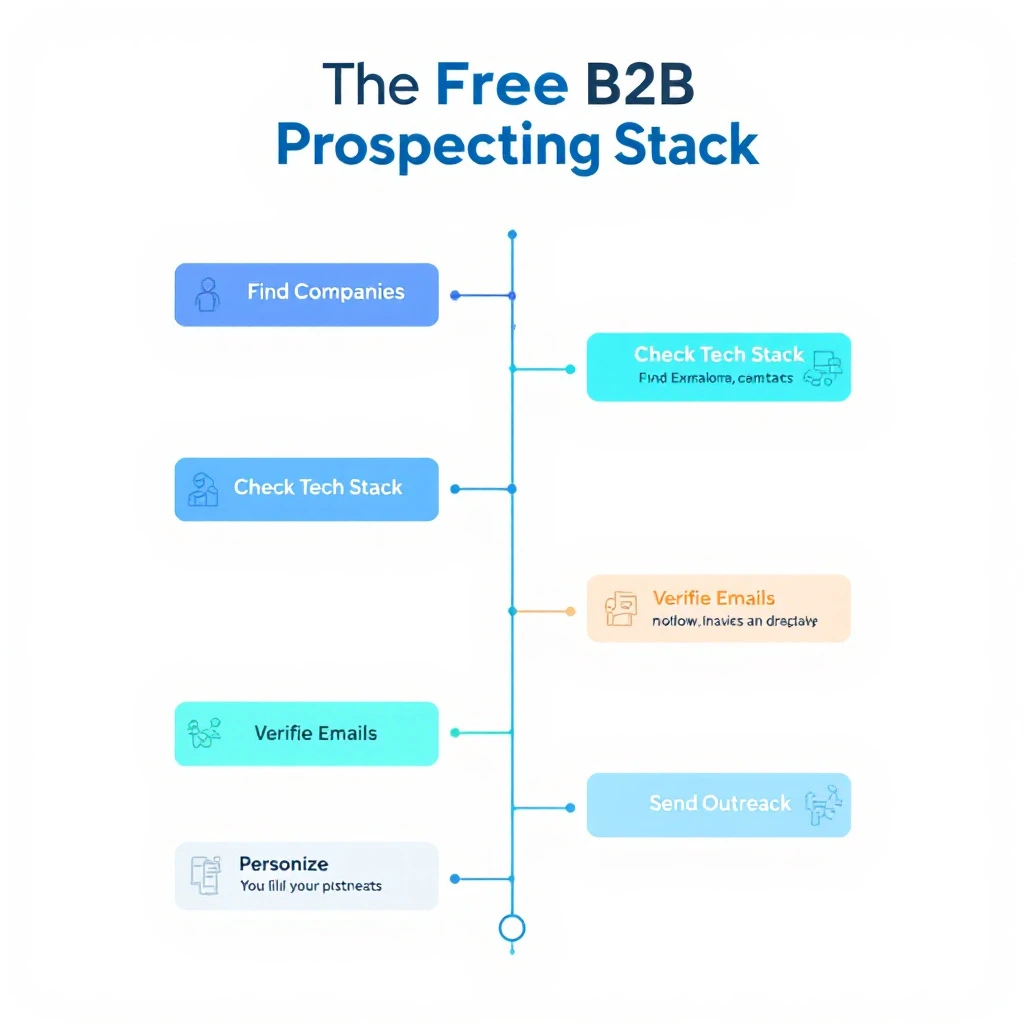
The free B2B prospecting stack: find companies, find contacts, check tech stack, verify emails, personalize, send outreach

You don't need to spend $500/month on sales tools to prospect effectively. Here's a free stack that covers the entire workflow:

1. Find Target Companies​

MarketBetter Lookalike Company Finder β€” enter your best customer, find 50+ similar companies. Free.

2. Find Buyer Contacts​

MarketBetter AI Lead Generator β€” analyze each company, get buyer contacts with LinkedIn profiles. Free.

3. Research Their Tech Stack​

MarketBetter Tech Stack Detector β€” check what tools they use to qualify fit and personalize outreach. Free.

4. Verify Email Addresses​

Hunter.io (25 free verifications/month) β€” confirm email deliverability before sending.

5. Personalize Outreach​

MarketBetter GiftDM Copilot β€” AI-personalized gifts and LinkedIn DMs for top prospects. Free.

6. Send Outreach​

Apollo.io free tier (250 emails/day) or LinkedIn free (connection requests + messages).

Total cost: $0/month. Not "free trial" β€” actually free, ongoing.

For a deeper walkthrough of the research half of this workflow, see how to automate lead research with Claude Code and our complete guide to Claude for SDRs.

Tips for AI-Powered Lead Generation​

1. Quality Over Quantity​

AI makes it easy to generate hundreds of leads. Resist the temptation. 50 highly-targeted leads will outperform 500 poorly-targeted ones every time.

2. Layer Multiple Data Sources​

No single tool has perfect data. Use 2-3 tools to cross-reference and verify contacts. If Apollo and Hunter both show the same email for a contact, you can be confident it's accurate.

3. Personalize Based on AI Insights​

The AI in these tools isn't just for finding contacts β€” it's for understanding them. Use company analysis, tech stack data, and recent activity to craft relevant, personalized messages. If you want a repeatable system for this, our guide on how to use Claude for lead generation walks through the exact prompts, and our AI sales email templates give you first-touch copy to adapt.

4. Respect Privacy and Compliance​

GDPR, CCPA, and CAN-SPAM regulations apply regardless of how you source leads. Always include opt-out options, honor unsubscribes, and don't scrape personal data from platforms that prohibit it.

5. Measure What Matters​

Track these metrics:

  • Lead-to-reply rate (aim for 5-15%)
  • Reply-to-meeting rate (aim for 30-50% of replies)
  • Data accuracy (bounce rate below 5%)
  • Time to first touch (how fast from lead identification to first outreach)

Frequently Asked Questions​

What are the best free B2B lead generation tools in 2026?​

For genuinely free, ongoing use (not a 3-day trial), the standouts are MarketBetter's AI Lead Generator (no signup, no credit limits), Apollo.io (unlimited email lookups with a 250/day send cap), and Kaspr (unlimited B2B company emails). Most other free tiers β€” Seamless, RocketReach, Cognism β€” are one-time credit trials that force an upgrade within days.

Are there free AI tools for LinkedIn lead generation?​

Yes. MarketBetter's AI Lead Generator identifies buyer contacts at any company and links straight to their LinkedIn profiles, Wiza exports Sales Navigator searches into verified email lists, and Kaspr reveals contact data on LinkedIn profiles via its Chrome extension. Pair any of these with LinkedIn's free People Search for a zero-cost LinkedIn prospecting workflow.

What's the best free AI B2B lead generation tool overall?​

If "AI" means the tool actually helps you decide who to contact rather than just dumping a database export, MarketBetter's AI Lead Generator leads because it scores and ranks decision-makers by relevance. For AI-driven enrichment across many data sources, Clay is the most powerful, though it has a steeper learning curve.

Where can I get free B2B sales leads?​

Start with the free prospecting stack above: find lookalike companies to your best customers, pull buyer contacts for each, verify the emails with Hunter's free tier, then reach out via Apollo's free sending or LinkedIn. That covers sourcing, verification, and outreach for $0/month. For the numbers behind why teams do this, see our breakdown of the true cost of an SDR tech stack and what AI SDR tools actually cost in 2026.

Is there a free B2B leads database?​

Not in the way most people picture it β€” there's no legitimate, unlimited "download the whole B2B database for free" button, and any tool promising one is either a scraped list or a trial in disguise. What actually works is treating free tiers as an on-demand database you query per account: MarketBetter's AI Lead Generator pulls buyer contacts for any company with no signup or credit limit, Apollo gives unlimited email lookups against its database (capped at 250 sends/day), and Kaspr surfaces unlimited B2B company emails. Combine those and you get database-grade coverage for free, sourced account-by-account instead of as one giant export.

Can you get free B2B leads without signing up?​

Yes β€” MarketBetter's AI Lead Generator is the only tool on this list that returns buyer contacts with zero signup, no credit card, and no per-lookup limit. Every other free tier (Apollo, Hunter, Kaspr, Clay, Wiza) requires an account before it shows you any data. If "no signup" is a hard requirement, start there, then layer in an account-gated tool only when you need email verification or bulk export.

Is free AI lead generation good enough, or do you need a paid tool?​

For a solo rep or an early-stage team doing under a few hundred touches a month, a well-assembled free stack is genuinely enough. You'll outgrow free tiers when you need bulk exports, verified mobile numbers at scale, or team seats β€” at which point compare the paid B2B lead generation tools before committing.

Start Finding Leads for Free​

The best AI lead generation tool is the one that gets you talking to the right people with the least friction.

Try MarketBetter's free AI Lead Generator β†’

Enter any company, get AI-identified buyer contacts with LinkedIn profiles. No signup, no credits, no catch.


Build your full prospecting workflow: find similar companies to your best customers, check their tech stack for fit, then use the Conference Scraper to source leads from upcoming trade shows.

Breakout vs MarketBetter: AI Chatbot Comparison for B2B Sales Teams

Β· 11 min read
MarketBetter Team
Content Team, marketbetter.ai

If you're evaluating AI chatbots for your B2B sales team, two names keep coming up in different contexts: Breakout (getbreakout.ai) and MarketBetter. Both use AI to help sales teams convert more website visitors. But they approach the problem from very different angles.

Breakout positions itself as "The Inbound AI SDR" β€” a focused chatbot and visitor identification tool designed to turn anonymous traffic into qualified leads. MarketBetter is a full-cycle sales intelligence platform that includes an AI chatbot alongside a smart dialer, email automation, daily playbook, and buying signal detection.

This comparison will help you figure out which one fits your team's needs. We'll be fair to both β€” because the right choice depends on what you're actually trying to solve.


What Is Breakout?​

Breakout is an AI-powered inbound sales tool focused on your website. Their core promise: turn your website into a lead generation machine by identifying visitors, engaging them with AI chatbot blocks, and triggering sales workflows when someone shows buying intent.

Breakout's Core Features​

AI Chatbot Blocks Breakout deploys conversational AI widgets on your website that engage visitors contextually. Instead of a generic "How can I help?" bot, Breakout's chatbot adapts its messaging based on the page the visitor is on, their behavior patterns, and (when identifiable) their company and role.

Anonymous Visitor Identification This is Breakout's headline feature. They identify anonymous website traffic β€” turning "unknown visitor from Acme Corp" into a named contact with company, title, and intent signals. They claim to identify visitors that traditional form-based approaches miss entirely.

Personalized Website Content Based on who's visiting, Breakout can dynamically adjust website content β€” headlines, CTAs, case studies β€” to match the visitor's industry, company size, or use case. A VP of Sales from a mid-market SaaS company sees different messaging than a Marketing Director from an enterprise.

GTM Workflow Triggers When a visitor hits certain intent thresholds (viewed pricing page, spent 3+ minutes on product pages, returned for a third visit), Breakout triggers workflows: Slack alerts to the sales team, CRM record creation, automated follow-up sequences.

Rep Routing and Follow-ups Breakout routes qualified leads to the right rep based on territory, account ownership, or round-robin rules. It also handles personalized follow-up emails after a chat interaction.

What Breakout Claims​

  • 40% lift in website conversions
  • 10x engagement compared to traditional chatbots
  • Anonymous traffic β†’ known leads pipeline
  • CRM enrichment with visitor data

These are strong claims, and early users in the B2B SaaS space have reported positive results, particularly around visitor identification accuracy and chatbot engagement rates.


What Is MarketBetter?​

MarketBetter is a full-cycle B2B sales intelligence platform. While it includes an AI chatbot, the chatbot is one component of a much broader system designed to help SDR and sales teams across the entire sales process β€” not just the website visit.

MarketBetter's Core Features​

AI Chatbot MarketBetter's chatbot engages website visitors with contextual, AI-driven conversations. Similar to Breakout's approach, it adapts based on visitor behavior and identified company data. The chatbot qualifies leads, books meetings, and hands off to human reps when appropriate.

Website Visitor Identification MarketBetter identifies anonymous website visitors at both the company and person level, enriching records with firmographic data, job titles, LinkedIn profiles, and contact information. This data feeds directly into MarketBetter's outreach tools.

Smart Dialer This is where MarketBetter diverges significantly from Breakout. MarketBetter includes a built-in smart dialer that lets SDRs call identified prospects directly from the platform. The dialer prioritizes calls based on buying signals β€” visitors who just viewed your pricing page get called first.

Email Automation MarketBetter automates personalized email sequences triggered by visitor behavior, buying signals, or sales team actions. Emails are AI-generated based on the prospect's company, role, and the pages they visited.

Daily Playbook Every morning, each SDR gets a prioritized list of actions: "Call this prospect who visited pricing yesterday. Email this lead who downloaded a case study. Follow up with this account showing increased activity." It's a signal-based selling workflow built into the platform.

Buying Signal Detection MarketBetter monitors multiple signals beyond just website visits: job changes, company funding rounds, technology adoptions, content engagement, and social activity. These signals feed into lead scoring and prioritization.


Feature-by-Feature Comparison​

AI Chatbot​

Breakout: Purpose-built chatbot with strong contextual awareness. The chatbot block approach (different bots for different pages/contexts) is well-executed. Personalization based on visitor identity is a standout feature.

MarketBetter: Full-featured AI chatbot that integrates with the rest of the platform. The advantage here is that chatbot interactions feed directly into the smart dialer queue, email sequences, and daily playbook. A chatbot conversation that doesn't convert immediately still creates a warm lead that gets followed up on through other channels.

Verdict: Breakout's chatbot may have a slight edge in pure chatbot sophistication β€” it's their entire focus. MarketBetter's chatbot wins on what happens after the conversation, because it connects to outbound tools.

Visitor Identification​

Breakout: Strong visitor identification with anonymous traffic de-anonymization. Company-level identification is reliable; person-level identification depends on their data partnerships and matching algorithms.

MarketBetter: Visitor identification at both company and person level, with enrichment from multiple data sources. The identified visitor data flows into every other MarketBetter feature β€” dialer, email, playbook.

Verdict: Both platforms handle visitor identification well. The difference is in what you do with the data. With Breakout, you export it or trigger workflows. With MarketBetter, the data automatically powers outbound sales actions.

Outbound Sales Tools​

Breakout: Does not include outbound sales tools. Breakout is focused on inbound β€” converting website visitors. For outbound, you'll need separate tools (Outreach, Salesloft, Apollo, etc.).

MarketBetter: Includes a smart dialer, email automation, and a daily sales playbook. SDRs work from a single platform: see who visited the website, call them, email them, track the deal. No switching between tools.

Verdict: MarketBetter wins this category by default. Breakout doesn't compete here β€” it's outside their scope. But for sales teams, this is a critical consideration. If you need outbound tools anyway, using MarketBetter eliminates 2–3 other subscriptions.

Personalization​

Breakout: Website content personalization is a unique feature. Dynamically changing headlines, CTAs, and content based on visitor identity is powerful for conversion optimization. This goes beyond chatbot personalization into the website experience itself.

MarketBetter: Personalization is applied across outreach β€” emails, call scripts, chatbot responses. The personalization is based on a broader set of signals (not just website behavior, but buying signals from multiple sources).

Verdict: Different types of personalization. Breakout personalizes the website. MarketBetter personalizes the outreach. Both are valuable. If your website is your primary conversion channel, Breakout's approach is compelling. If your sales team does significant outbound, MarketBetter's approach covers more ground.

Workflow and Automation​

Breakout: GTM workflow triggers, Slack alerts, CRM enrichment, auto follow-ups. Well-designed for notifying sales teams and keeping CRM data current. Integrates with standard GTM tools.

MarketBetter: Automation is built into the platform rather than triggered outward. The daily playbook is essentially an automated workflow engine: it prioritizes actions, surfaces insights, and tells reps exactly what to do next. Less "alert and integrate" β€” more "do the work for you."

Verdict: Breakout is better if you already have a sales engagement stack and want to plug in a visitor intelligence layer. MarketBetter is better if you want a single platform that handles the workflow end-to-end.


The Real Question: Website Tool or Sales Platform?​

Here's the core difference, stripped of marketing language:

Breakout is a website optimization tool for inbound sales. It makes your website smarter at identifying visitors, engaging them, and converting them. Everything happens on (or triggered by) the website. If a visitor doesn't come to your site, Breakout can't help you reach them.

MarketBetter is a full-cycle sales platform that includes website intelligence. The website is one input. Buying signals, intent data, smart dialing, email automation, and a daily playbook extend the platform's value to the entire sales process β€” before, during, and after the website visit.

When Breakout Makes More Sense​

  • You already have a sales engagement platform (Outreach, Salesloft, etc.) and just need better website conversion
  • Your primary bottleneck is website β†’ lead conversion, not outbound prospecting
  • You want website content personalization as a core capability
  • Your sales motion is heavily inbound β€” most leads come through the website
  • You have a small team and want to maximize the website as a sales channel without adding more tools

When MarketBetter Makes More Sense​

  • You need both inbound and outbound capabilities in one platform
  • Your SDRs do phone outreach and need a smart dialer with AI-driven prioritization
  • You want to reduce tool sprawl β€” replace chatbot + dialer + email tool + intent data with one platform
  • Your sales team needs a daily playbook that tells them exactly who to call, email, and follow up with
  • You want buying signals beyond just website visits β€” job changes, funding, tech adoptions
  • You're building an AI SDR tech stack and want a single foundation

Pricing Considerations​

Breakout positions itself as a premium inbound tool. Pricing is typically based on website traffic volume and feature tier. Contact their sales team for current pricing at getbreakout.ai.

MarketBetter offers full-platform pricing that includes chatbot, visitor identification, smart dialer, email automation, and the daily playbook. For teams that would otherwise need separate tools for each of these functions, the consolidated pricing is typically more cost-effective.

The real cost comparison isn't Breakout vs. MarketBetter in isolation. It's:

  • Breakout + your dialer + your email tool + your intent data provider vs.
  • MarketBetter (all-in-one)

When you factor in the full stack cost, MarketBetter's platform approach often comes out ahead for teams that need outbound capabilities.


Integration and Implementation​

Breakout integrates with CRMs (Salesforce, HubSpot), Slack, and standard GTM tools. Implementation is primarily a JavaScript snippet on your website plus CRM configuration. You can be up and running in a day or two.

MarketBetter integrates with the same CRMs and adds direct integrations for calling (built-in dialer) and email. Implementation includes website tracking, CRM connection, dialer setup, and email configuration. Slightly more involved than Breakout because there's more to set up β€” but you're replacing multiple tools, not adding one.


Free Tool

Try our AI Lead Generator β€” find verified LinkedIn leads for any company instantly. No signup required.

The Bottom Line​

Both Breakout and MarketBetter are strong products solving related but different problems.

Choose Breakout if your primary challenge is converting website visitors into leads and you already have the rest of your sales stack in place. Breakout does one thing β€” inbound visitor conversion β€” and does it well. The website personalization features are a genuine differentiator.

Choose MarketBetter if you want a platform that covers the full sales cycle. Website visitor identification is the starting point, but the smart dialer, email automation, buying signals, and daily playbook extend the value far beyond the website. For teams that are currently stitching together 3–5 tools, MarketBetter consolidates the stack.

The trend in B2B sales is moving toward platform consolidation. SDR teams are drowning in tabs β€” switching between their chatbot, their dialer, their email tool, their CRM, their intent data provider. Tools that combine these functions into a single workflow don't just save money β€” they save the cognitive overhead that kills SDR productivity.

That said, if your inbound machine is your growth engine and you've already solved outbound, Breakout's focused approach is a legitimate choice. Not every team needs the full platform.

Want to see how MarketBetter's full-cycle approach works for your team? Book a demo and bring your current stack β€” we'll show you exactly what consolidation looks like in practice.


Related reading:

The ABM Strategy That Hit 75% of Monthly Meeting Quota in One Day

Β· 15 min read
MarketBetter Team
Content Team, marketbetter.ai

Every ABM team has had this moment.

You've done the work. You've built the account list. You've run the campaigns. Your dashboards are glowing green β€” engagement scores are up, accounts are "warming," and the data says your target list is moving through the funnel.

Then you walk into the sales standup and hear: "So... where are the meetings?"

That's the gap. And it's where most ABM programs quietly die β€” not from bad strategy, but from optimizing for the wrong outcome.

One enterprise ABM leader at a $3B+ company figured this out the hard way. And the moment they changed what they were optimizing for, everything clicked.

"The moment everything got easier was when I stopped optimizing for 'warm accounts' and started optimizing for meetings. If you can get meetings, pipe takes care of itself."

This isn't theory. One prioritization sprint using this approach helped an SDR team hit 75% of their monthly meeting quota in a single day.

Here's exactly how it works.


The Problem: "Warm Accounts" Don't Pay the Bills​

Most ABM programs are built around a version of the same pitch to sales: "We've identified accounts showing intent. These accounts are warm. Go work them."

Sounds reasonable. But here's what actually happens:

  1. Marketing hands over a list of "warm" accounts based on engagement scores, intent data, or some weighted model
  2. Sales looks at the list and shrugs β€” "Great, but who do I call? What do I say? Why should they take my meeting?"
  3. The list sits in a spreadsheet while reps go back to working their own pipeline
  4. Marketing wonders why sales isn't "following up" on perfectly good accounts

The fundamental disconnect: salespeople don't care about warm accounts. They care about meetings. That's the unit of value in their world. Not an engagement score. Not an intent signal. A meeting on the calendar.

"If you optimize for pipe, it takes too long. If you can get meetings, they'll turn into pipe eventually. Sales will figure it out."

When this ABM leader stopped measuring success by "accounts showing engagement" and started measuring by "meetings booked," everything changed β€” not just the metrics, but how the entire GTM team operated.


The Three-Step ABM Machine​

The framework that emerged is deceptively simple. Three steps, executed with discipline every single week.

Step 1: Universe of Accounts, All Scored and Tiered by ICP Fit​

Before you can prioritize, you need to know your universe.

This starts with the classic funnel narrowing:

  • TAM (Total Addressable Market): Every company that could buy your product
  • SAM (Serviceable Addressable Market): The subset you can actually reach and serve
  • ICP Accounts: The companies that look like your best customers β€” right industry, right size, right tech stack, right buying patterns

Every account in your CRM should be scored and tiered by how closely they match your ICP. This isn't a one-time exercise. It's a living model that gets updated as you learn what "good" actually looks like from your closed-won deals.

Why this matters for meetings: You can't prioritize who's most likely to book if you haven't already established who's worth booking with. The ICP tier is your foundation β€” it tells you which meetings are worth chasing and which ones are just activity for activity's sake.

Most teams have this step done (or think they do). The real magic happens in Steps 2 and 3.

Step 2: Weekly Prioritization of People Most Likely to Book a Meeting​

This is where the framework gets sharp.

Every week, the ABM team runs a prioritization sprint. Not on accounts β€” on people. Specific humans at specific companies who are showing signals that they're likely to take a meeting right now.

The signal stack has two layers:

Contact-level signals (signals about the person):

  • Intent data engagement β€” Are they personally researching your category or related topics?
  • Web visitor identification β€” Have they visited your site? Which pages? How many times?
  • Hiring manager activity β€” Are they hiring for roles that suggest they need your solution?
  • Job changer signals β€” Did they recently move to a new company? (Champions in new seats are gold.)
  • Email engagement β€” Are they opening and clicking your emails? Replying?

Account-level signals (signals about the company):

  • Review site intent β€” Is the company actively evaluating solutions on G2, TrustRadius, etc.?
  • News and trigger events β€” Funding rounds, leadership changes, expansion announcements, regulatory shifts
  • Engagement scores β€” Overall account-level interaction with your brand across channels
  • Digital projects and initiatives β€” Are they launching projects that create a need for what you sell?

The output of this weekly sprint isn't a warm account list. It's what we call the MLTBM list β€” "Most Likely to Book a Meeting." A ranked set of 15–20 specific contacts per rep, each with concise "reasons to reach out now" and AI-driven outbound cadences matched to their specific behavior and account context.

This is the key shift. You're not telling sales "this account is warm." You're telling them "this person, at this company, is showing these specific behaviors, and here's the play to get them on the phone."

Step 3: Surround Sound Micro Campaigns​

Once you know who to target and why, you hit them from every angle.

"Surround sound" means the contact sees your brand across multiple channels in a compressed timeframe β€” not with generic brand awareness, but with specific, relevant messaging tied to the exact signal they're showing.

Here's what that looks like in practice:

  • Someone researching your category on review sites? β†’ Email with a comparison guide + LinkedIn connection + retargeting ads featuring customer proof points
  • A champion who just changed jobs? β†’ Congratulatory LinkedIn message + personalized email referencing their previous experience with your solution + phone call from their aligned rep
  • A hiring manager posting roles that suggest they need your product? β†’ Email about how your solution reduces the need for that hire + LinkedIn content about the business case + direct mail if warranted
  • A contact who visited your pricing page twice this week? β†’ Immediate phone call + email with an ROI calculator + chatbot engagement on next visit

The key word is micro. These aren't broad campaigns blasting the same message to 500 accounts. They're tight, 1-to-few plays targeting 10–20 contacts per sprint with highly specific messaging.

The channels: email, LinkedIn, phone, social, direct mail, ads, chatbot β€” whatever combination makes sense for the signal. The point is that when the contact is ready to engage, your brand is already everywhere they look.


Why This Works: The Meeting Math​

Let's break down why optimizing for meetings is fundamentally different from optimizing for warm accounts.

The warm account approach:

  1. Score accounts β†’ 2. Declare them "warm" β†’ 3. Hand to sales β†’ 4. Hope for meetings β†’ 5. Eventually, maybe, pipeline

The meeting-first approach:

  1. Score and tier accounts β†’ 2. Identify specific people showing booking signals β†’ 3. Run surround sound plays β†’ 4. Book meetings β†’ 5. Pipeline follows naturally

The difference isn't just semantic. It changes:

  • What you measure: Meeting conversion rate per signal type, not "account engagement score"
  • How you talk to sales: "Here are 15 people who are likely to book this week and why" vs. "Here are 50 warm accounts"
  • What campaigns you build: Specific micro-plays per signal vs. broad nurture tracks
  • How fast you iterate: Weekly sprints vs. quarterly campaign reviews

And the results speak for themselves. That 75%-of-monthly-quota-in-one-day stat wasn't a fluke. It was the natural outcome of giving SDRs a pre-prioritized list of people who were already showing signals that they wanted to talk.

"The old way was 'the accounts say we're warm now.' But salespeople don't care about warm accounts. They want meetings. The moment I shifted to giving them meetings instead of warm accounts, everything got easier."


The Signal Stack: Building Your "Most Likely to Book" List​

Let's go deeper on how to actually build this signal stack, because this is where execution separates the top ABM programs from everyone else.

Layer 1: Contact Signals (The Person)​

Signal TypeWhat It Tells YouMeeting Likelihood
Web visitor (pricing/demo pages)Active evaluationπŸ”΄ Very High
Job changer (champion at new company)New budget, known advocateπŸ”΄ Very High
Email reply or click-throughDirect engagement🟠 High
Intent data (category research)Early-stage evaluation🟑 Medium-High
Hiring for relevant rolesBuilding the team = building the need🟑 Medium
Social engagement (likes, comments)Awareness, not yet active🟒 Medium-Low

Layer 2: Account Signals (The Company)​

Signal TypeWhat It Tells YouMeeting Likelihood
Review site activity (G2, etc.)Actively comparing solutionsπŸ”΄ Very High
Funding/expansion newsBudget unlocked🟠 High
Engagement score spikeMulti-threaded interest🟠 High
Digital project announcementsCreates a trigger need🟑 Medium-High
Leadership changeNew priorities, new budget🟑 Medium
Industry regulation changeCompliance-driven urgency🟑 Medium

The combination is what matters. A contact showing intent data signals at an account with a spiking engagement score is exponentially more likely to book than either signal alone.

Your weekly sprint should stack-rank contacts by combined signal strength β€” the people at the best-fit accounts showing the most buying behavior right now.


Signal Alpha: The Niche Signals That Only Matter to You​

Here's where the best ABM machines separate themselves from everyone else.

Most signals β€” intent data, job changes, funding rounds β€” are available to every competitor in your space. They're valuable, but they're not unique. Everyone is tracking the same triggers and hitting the same contacts at the same time.

Signal Alpha is the unique advantage you get from niche signals β€” the one or two signals that translate directly to intent for your business alone, because only you understand why they matter.

Think about it:

  • If you sell observability software, your best customers are companies with spikes in "tech stack complexity." A job posting for a Snowflake Engineer signals the company is investing in data infrastructure, which means their stack is getting more complex, which means they need your product. That hiring signal is meaningless to 99% of vendors β€” but it's gold for you.

  • If you sell EHS compliance software, a job posting mentioning "ISO 14001" or "OSHA reporting" at a manufacturing company means they're investing in safety infrastructure. Run ads and outreach talking about how you consolidate compliance across frameworks. Nobody else is tracking that signal.

  • If you sell cloud fax to healthcare systems, a hospital posting for a "HIPAA Compliance Officer" or announcing an Epic migration signals they're modernizing infrastructure. That's your moment.

  • If you sell sales intelligence, companies with a recent increase in the number of ads running across channels might signal they're scaling GTM β€” and struggling with targeting. That's a signal only you care about.

The formula: Find the niche signal β†’ build messaging specifically against it β†’ run outbound + ads to contacts showing that signal.

These niche signals won't appear in any intent data vendor's dashboard. You have to figure them out yourself, based on deep understanding of your best customers' buying journeys. But when you find them, they're devastating β€” because your competitors aren't tracking them, your messaging is hyper-relevant, and your timing is perfect.

How to find your Signal Alpha:

  1. Interview your 5 best customers: "What was happening at your company when you decided to buy?"
  2. Look for patterns β€” was there a hiring wave? A new project? A compliance deadline? A tech migration?
  3. Figure out where that signal shows up publicly (job boards, news, press releases, LinkedIn)
  4. Build tracking for it and add it to your MLTBM prioritization model
  5. Test outbound against it for 2-4 weeks and measure meeting conversion

The best ABM teams aren't just tracking the obvious signals. They're finding the weird, specific, nobody-else-cares-about-this signals that perfectly predict buying intent for their unique product. That's Signal Alpha.


From Weekly to Daily: Accelerating the Playbook​

The enterprise ABM leader who pioneered this framework ran it on a weekly cadence. Weekly prioritization sprints. Weekly campaign launches. Weekly measurement.

But here's the thing about signals: they decay fast. The contact who hit your pricing page on Monday is a hot lead on Tuesday and a cold one by Friday. The job changer who started their new role this morning is most reachable today, not next week.

The logical evolution of this framework is a daily MLTBM playbook β€” the same "most likely to book a meeting" logic, but refreshed every single day, with your Signal Alpha signals baked in.

Imagine this:

Every morning, your SDR team opens a dashboard that shows them exactly who to call, email, and connect with on LinkedIn today β€” ranked by signal strength, with the specific signals listed next to each contact. No research required. No guessing. Just execute.

That's what the daily version of this framework looks like:

  • Web visitor identification feeds you the contact signals in real-time β€” who visited, which pages, how many times
  • Intent data integrations surface contacts actively researching your category
  • The daily playbook is the weekly "most likely to book" list, but regenerated every 24 hours with fresh signal data
  • Multi-channel execution (email + phone + social) is the surround sound campaign, orchestrated from a single platform

This is exactly the approach signal-based selling was built around β€” narrowing your total addressable market to a daily set of prioritized contacts based on live buying signals. And it's the same philosophy behind the ABM frameworks that actually work in practice.

How MarketBetter Makes This Operational​

This three-step ABM machine β€” ICP-tiered accounts, signal-based prioritization, surround sound execution β€” is powerful as a framework. But running it manually is brutal. The weekly sprint alone can eat 4–6 hours of an ABM leader's time, and by the time you've finished prioritizing, the freshest signals are already stale.

MarketBetter was purpose-built to operationalize this exact playbook:

  • Visitor identification captures web visitor signals automatically β€” you know exactly who's hitting your site and which pages they care about
  • The Daily Playbook is your "most likely to book" list, regenerated every day with stacked contact and account signals, so your team always knows who to prioritize
  • Email automation and the smart dialer let your reps execute surround sound campaigns across email and phone from a single screen β€” no tab-switching, no manual logging
  • AI chatbot engages returning visitors in real-time, converting "pricing page visit" signals into live conversations before the contact bounces

Instead of a weekly manual sprint, MarketBetter runs the signal stack continuously and serves up the prioritized output to your reps every morning. The framework stays the same. The execution becomes instant.


Putting It Into Practice: Your First Week​

If you want to test this approach before committing to any tooling, here's a manual version you can run starting Monday:

Day 1 (Monday): Build Your Signal Stack

  • Pull your ICP-tiered account list from your CRM
  • Layer in any intent data you have access to
  • Check your website analytics for visitor signals from target accounts
  • Scan LinkedIn for job changers and new hires at target accounts
  • Review email engagement data from the past 30 days

Day 2 (Tuesday): Run Your First Prioritization Sprint

  • Stack-rank contacts by combined signal strength
  • Select your top 15–20 "most likely to book" contacts
  • For each contact, document the specific signal(s) driving prioritization
  • Share the list with your SDR team β€” not as "warm accounts," but as "here's who to call and why"

Days 3–5 (Wednesday–Friday): Execute Surround Sound

  • Each prioritized contact gets touched across at least 3 channels
  • Messaging is tied to the specific signal (not generic outreach)
  • Track meetings booked, not just activities completed

End of Week: Measure and Iterate

  • How many meetings did the prioritized list generate?
  • Which signal types converted best?
  • What channels drove the most responses?
  • Feed learnings back into next week's sprint

You'll likely see results in the first sprint. The ABM leader who built this system saw it immediately:

"We ran the first prioritization sprint and handed the list to the SDR team. They hit 75% of their monthly meeting quota that day. That's when I knew we were onto something."


Free Tool

Try our Lookalike Company Finder β€” find companies similar to your best customers in seconds. No signup required.

The Bottom Line​

The best ABM programs in the world aren't optimizing for "warm accounts." They're optimizing for meetings.

The framework is three steps:

  1. Build your universe β€” every account scored and tiered by ICP fit
  2. Prioritize people, not accounts β€” weekly (or daily) sprints to identify who's most likely to book, based on stacked contact and account signals
  3. Execute surround sound β€” micro campaigns across every channel, driven by specific signals, compressed into tight windows

The mindset shift is simple but profound: stop telling sales that accounts are warm. Start getting them meetings.

If you can get meetings, pipeline takes care of itself. Sales will figure it out.


Ready to turn your signal stack into a daily meeting machine? See how MarketBetter operationalizes this exact playbook β†’

MarketBetter vs Monaco for B2B Sales Teams: Honest Comparison

Β· 6 min read
MarketBetter Team
Content Team, marketbetter.ai

Every week there's a new AI sales tool claiming to revolutionize B2B sales. Most don't survive the hype cycle. But Monaco β€” which launched February 11, 2026 with $35M in funding from Founders Fund β€” deserves a closer look.

We're not going to pretend Monaco isn't a real competitor. The founding team is excellent (Sam Blond ran sales at Brex, Abishek Viswanathan was CPO at Apollo/Qualtrics, Malay Desai was SVP Eng at Clari). The investor list is elite. The product vision is ambitious.

But we are going to be honest about where each platform wins and loses β€” because B2B sales leaders deserve straight talk, not marketing spin.

Two Different Philosophies​

Monaco's philosophy: Build everything into one AI-native platform. CRM, prospecting database, outbound automation, meeting notes β€” all built from scratch, designed to work together natively. Target early-stage startups and be the only tool they need.

MarketBetter's philosophy: Build the complete SDR command center. Identify who's interested (visitor ID), engage them everywhere (email + phone + chat), and tell reps exactly what to do (daily playbook). Integrate deeply with the CRMs teams already use.

Neither philosophy is wrong. But they lead to very different products.

The Honest Assessment​

Where Monaco Has an Edge​

Let's start with what Monaco does well:

1. Built-in CRM reduces tool sprawl. If you have no CRM, Monaco's native CRM means one fewer integration to manage. For a 3-person startup, simplicity is king.

2. Embedded human expertise is smart. Having experienced salespeople monitor the AI isn't just a feature β€” it's a philosophy. The AI doesn't go rogue. Human judgment stays in the loop. This is more thoughtful than many AI SDR competitors (looking at you, 11x and Artisan).

3. Native prospect database saves a ZoomInfo subscription. Building a contact database from scratch is expensive and hard. If Monaco's data quality is competitive with ZoomInfo or Apollo, that's genuinely valuable.

4. Meeting notetaker is convenient. One less tool to buy. It's not revolutionary, but it's nice.

Where MarketBetter Has the Edge​

1. Website visitor identification is a game-changer Monaco doesn't have. This is the single biggest differentiator. MarketBetter identifies the companies AND individuals visiting your website β€” real-time, person-level data. These are people who are already researching your product. They're warmer than any cold outbound list.

Monaco is entirely outbound-focused. If a prospect is on your website right now, Monaco doesn't know.

2. Multichannel > email-only. MarketBetter covers email, phone (smart dialer), chat (AI chatbot), and LinkedIn. Monaco focuses primarily on email.

In 2026, single-channel outreach doesn't cut it. The average B2B deal requires 8-12 touches across multiple channels. If all your touches are email, you're leaving conversion on the table.

3. AI Chatbot captures inbound 24/7. MarketBetter's FloBot engages website visitors, qualifies leads, and books meetings around the clock. Monaco has no inbound engagement mechanism.

Consider this: inbound leads typically convert 5-10x better than cold outbound. An AI chatbot that captures and qualifies inbound interest isn't a "nice to have" β€” it's essential.

4. Daily SDR Playbook drives rep productivity. Every morning, each SDR gets a prioritized list: who to call, who to email, which deals need attention. This turns unfocused reps into productive machines.

Monaco automates campaigns, but it doesn't structure the SDR's day. There's a difference between "the tool sends emails for you" and "the tool tells you exactly what to do right now."

5. Proven results vs. unproven potential. MarketBetter has a 4.97/5 G2 rating, customers like CallRail and Hologram, and documented case studies. Monaco is in public beta with no public reviews yet.

Being fair: every platform starts at zero. But if you're betting your team's pipeline on a tool, track record matters.

6. Works for B2B teams at every stage. Monaco explicitly targets seed and Series A startups. If you're a 50-person company, a 200-person company, or mid-market, Monaco isn't building for you.

MarketBetter works for teams from startup through mid-market. You won't outgrow it at Series B.

The Feature Matrix (No Spin Edition)​

FeatureMarketBetterMonacoWho Wins
Website visitor identificationβœ…βŒMarketBetter
AI email automationβœ…βœ…Tie
Smart dialerβœ…βŒMarketBetter
AI chatbotβœ…βŒMarketBetter
Daily SDR playbookβœ…βŒMarketBetter
Built-in CRM❌ (integrates)βœ…Monaco
Prospect databaseβœ… (enrichment)βœ… (native)Tie
Meeting notetakerβŒβœ…Monaco
Human-in-the-loopβœ…βœ…Tie
Transparent pricingβœ…βŒMarketBetter
Track record/reviewsβœ… (4.97 G2)❌ (new)MarketBetter
Mid-market readyβœ…βŒMarketBetter

Score: MarketBetter 7 β€” Monaco 2 β€” Tie 3

Real Talk: Who Should Buy What​

Buy Monaco if:

  • You're a seed-stage startup with literally no sales tools
  • You want one platform for everything and don't mind being an early adopter
  • Email is your primary (or only) outreach channel
  • You have a high tolerance for beta-stage rough edges

Buy MarketBetter if:

  • You need to know who's on your website (you do)
  • Your team uses phone, email, AND chat for outreach
  • You want an AI chatbot capturing leads while you sleep
  • Your SDRs need daily structure and prioritization
  • You want proven software with real reviews
  • You need to know the price before you commit
  • You're growing beyond the earliest startup stage

The Bottom Line​

Monaco is a legitimately interesting new product. We respect the team, the vision, and the approach to human-in-the-loop AI. They'll likely improve rapidly with $35M in funding.

But today β€” right now β€” MarketBetter is the more complete, more proven AI sales platform for B2B teams. More channels, more features, more transparency, and a track record of results.

That's the honest comparison.

See the Difference

Talk is cheap. Let us show you. Book a demo and see why B2B teams choose MarketBetter's complete SDR command center.

Free Tool

Try our AI Lead Generator β€” find verified LinkedIn leads for any company instantly. No signup required.

Monaco Just Launched β€” Here's What It Means for B2B Sales

Β· 6 min read
MarketBetter Team
Content Team, marketbetter.ai

Today, February 11, 2026, Monaco officially launched its AI-native sales platform with $35M in the bank.

The coverage has been everywhere β€” TechCrunch, Yahoo Finance, Business Insider. The founding team reads like a B2B sales dream team. The investor list includes the Collison brothers (Stripe), Garry Tan (YC president), and Founders Fund leading the round.

But beyond the headlines, what does Monaco's launch actually mean for B2B sales teams? Here's our take.

What Happened​

Monaco raised $35M in total funding β€” $10M seed and $25M Series A, both led by Founders Fund. The platform is now in public beta.

The founding team:

  • Sam Blond β€” formerly head of sales at Brex, then VC at Founders Fund
  • Brian Blond β€” VC at Human Capital and Sutter Hill Ventures
  • Abishek Viswanathan β€” formerly CPO at Apollo and Qualtrics
  • Malay Desai β€” formerly SVP Engineering at Clari

The product: an all-in-one AI-native sales platform combining CRM, prospect database, email outbound, and meeting notes β€” targeting seed and Series A startups.

Five Things This Means for B2B Sales​

1. AI-Native Sales Tools Are the New Standard​

Monaco's launch isn't just about Monaco. It's a signal that the market has shifted. Building from scratch with AI as the foundation β€” not bolting AI onto legacy software β€” is now the expected approach.

This matters for every existing sales tool. If you're Salesforce, HubSpot, or any incumbent CRM, Monaco's launch is a reminder that AI-native competitors are coming. Fast.

For buyers: Expect every sales platform to accelerate its AI roadmap. Competition drives innovation. You benefit.

2. Human-in-the-Loop Is Winning the Narrative​

Notice what Monaco DIDN'T promise: fully autonomous AI SDRs. Instead, they embedded experienced human salespeople to guide the AI.

This is a deliberate philosophical choice β€” and it's the right one. Sam Blond has seen enough sales tools from the Founders Fund portfolio to know that full automation doesn't work in complex B2B sales. The 11x/Artisan "replace your SDR" approach is fading in favor of "augment your SDR" or "guide your AI."

MarketBetter has been saying this for years. It's good to see the market converge on the same conclusion.

3. The All-in-One Battle Is Heating Up​

Monaco wants to be the only tool a startup needs for sales. That's ambitious β€” and it means every platform that offers a piece of the sales stack is now a competitor.

  • CRM: Salesforce, HubSpot, Attio, Pipedrive
  • Data: ZoomInfo, Apollo, Clearbit
  • Outreach: Outreach, SalesLoft, MarketBetter
  • AI SDR: 11x, Artisan, MarketBetter
  • Meeting notes: Gong, Chorus, Fireflies

Monaco wants to replace all of them. The question is whether one platform can truly do everything well, or whether best-of-breed tools integrated together deliver better results.

History suggests best-of-breed wins for most teams. But all-in-one wins for simplicity-focused teams. Both paths are valid.

4. Startup-Focused Sales Tools Are a Real Category​

Monaco is explicitly building for seed and Series A startups. Not mid-market. Not enterprise. Startups.

This is smart positioning β€” there's a clear underserved segment. Most sales tools are either too expensive (Salesforce, ZoomInfo) or too complex (HubSpot at scale) for a 5-person startup.

But it's also a limitation. Companies grow. If Monaco's ideal customer raises a Series B and hires their 50th employee, will they outgrow the platform? That's the risk of narrow positioning.

Platforms like MarketBetter avoid this by building for startup through mid-market β€” you never outgrow the tool.

5. The Feature Gaps Create Opportunities​

Monaco launched without:

  • Website visitor identification
  • Smart dialer / phone outreach
  • AI chatbot for inbound
  • Daily SDR playbook
  • Published pricing

Each of these gaps is an opportunity for other platforms. If you're evaluating Monaco and need any of these capabilities, you'll either need to supplement with additional tools (defeating the all-in-one promise) or choose a more complete platform.

What Should You Do?​

If you're a B2B sales leader watching Monaco's launch, here's our advice:

If you're a seed-stage startup:​

Monaco is worth evaluating alongside MarketBetter. Consider your specific needs β€” if email-only outbound is sufficient and you want a built-in CRM, Monaco could work. If you need visitor identification, phone, chat, or daily playbook, MarketBetter is more complete.

If you're Series B+:​

Monaco isn't building for you. Continue evaluating platforms that scale with your growth β€” MarketBetter, HubSpot, or purpose-built tools for your specific needs.

If you're already on a sales platform:​

Don't switch based on hype. Evaluate based on gaps. Does your current tool identify website visitors? Does it have an AI chatbot? Daily playbook? Smart dialer? If you're missing these, consider adding MarketBetter to your stack.

If you're watching the space:​

The AI sales category is still early. The winners haven't been decided yet. But the direction is clear: AI-native design, human-in-the-loop philosophy, and multichannel coverage. Look for platforms that check all three boxes.

Our Take​

We respect Monaco's launch. The team is excellent. The approach is philosophically sound. The funding gives them runway to iterate and improve.

But today β€” right now β€” Monaco has significant feature gaps. No visitor identification, no dialer, no chatbot, no daily playbook. For a platform promising to be all-in-one, that's a lot of missing pieces.

MarketBetter offers all of those capabilities today, with proven results (4.97/5 on G2), transparent pricing, and a track record of helping B2B teams drive pipeline.

Monaco's launch is great for the industry. It's great for competition. But if you need results now, don't wait for a beta to mature.

Don't Wait β€” Start Now

MarketBetter is ready today. Visitor identification, AI chatbot, smart dialer, daily playbook β€” all proven, all included. Book a demo and see why teams choose MarketBetter.

Free Tool

Try our AI Lead Generator β€” find verified LinkedIn leads for any company instantly. No signup required.