10 posts tagged with "marketing roi"

View All Tags

A Practical Guide to Business to Business Marketing Automation

· 24 min read

Let's be honest, trying to build a genuine relationship with thousands of potential customers at once is a recipe for disaster. No human team, no matter how dedicated, can remember every single interaction, follow up at just the right moment, or serve up the perfect piece of content to every person, every time.

This is where business-to-business marketing automation comes in. It's not just software; it’s your team's tireless digital 'relationship builder' that works 24/7.

What B2B Marketing Automation Actually Does

Instead of your team getting bogged down in repetitive but critical tasks—like sending follow-up emails, tracking website visits, or segmenting lists by hand—this technology handles it all. It’s the engine that frees up your marketing and sales pros to focus on what they do best: thinking up brilliant strategies, launching creative campaigns, and closing deals with prospects who are already warmed up and engaged.

It’s the secret to scaling your outreach without having to scale your headcount.

From Manual Grind to Automated Nurturing

The real leap here is the shift from one-off actions to a continuous, intelligent system. A manual approach is like sending out individual letters one by one—it’s slow, error-prone, and impossible to scale. Automation, on the other hand, is like building a smart, responsive postal service that delivers personalized messages based on what each recipient actually does.

This flowchart gives you a glimpse into a pretty standard automated workflow. It shows how a system can guide a prospect from their first touchpoint all the way to becoming a sales-ready lead, no hand-holding required.

Person viewing a 'Relationship Builder' flowchart diagram on a laptop, showing business processes.

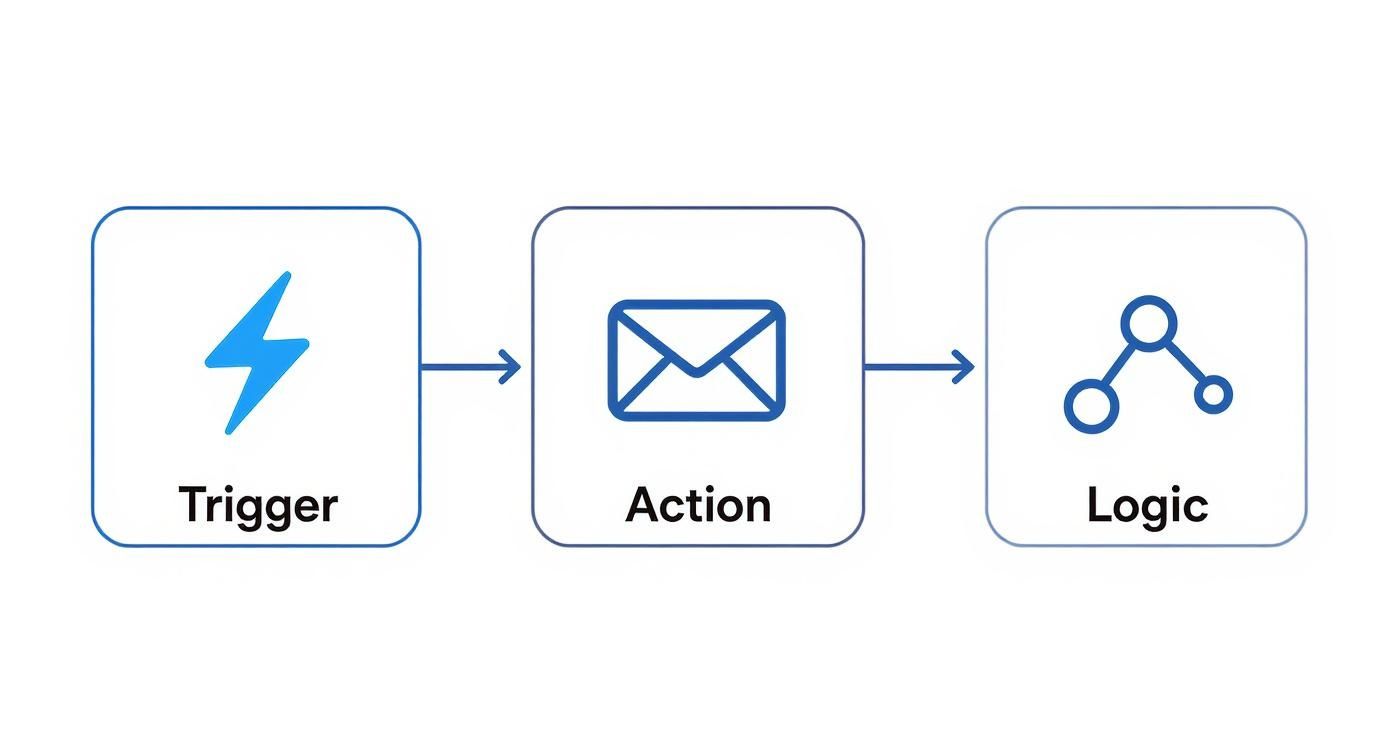
You can see how the system uses triggers (like a download or a page visit) to kick off specific actions. Trying to manage that kind of logic manually across hundreds or thousands of leads? It would be a nightmare.

This power is why its adoption is through the roof. By 2025, it's expected that 76-79% of B2B marketers will be using automation to steer their customer journeys. That's not just a trend; it’s a fundamental shift in how modern B2B marketing gets done, especially with the long, complex sales cycles we all know and love. You can dig into more marketing automation adoption statistics on emailvendorselection.com.

Core Functions and Their Impact

So, what do these platforms really do under the hood? It’s more helpful to think about them not as a list of features, but as solutions to the daily headaches your team faces. The table below compares these core functions to their manual counterparts, highlighting the real-world business impact.

Core Functions of B2B Marketing Automation Platforms

Core FunctionManual Approach (The "Before")Automated Approach (The "After")Business Impact Example
Lead NurturingSending sporadic, one-size-fits-all emails and hoping something sticks.Building a relationship with prospects over time through targeted, automated communication.Sending a series of educational emails to a new lead who downloaded a whitepaper, keeping your brand top-of-mind.
Lead ScoringSales reps manually sift through a list of leads with little context.Automatically qualifying leads by assigning points based on their behavior and demographics.Prioritizing a lead who visited the pricing page and has a "Director" title over a student downloading a single blog post.
Email MarketingSending a generic "e-blast" to your entire contact database.Sending personalized email campaigns at scale, triggered by specific user actions or segments.A prospect who abandons a demo request form receives an automated follow-up email asking if they need help.
Analytics & ReportingGuessing which marketing activities are actually driving revenue.Tracking campaign performance and measuring marketing's contribution to revenue.Identifying which content assets are most effective at converting marketing-qualified leads into sales opportunities.

Ultimately, each of these functions works together to create a smarter, more efficient system that aligns your marketing efforts directly with sales outcomes. It’s about doing more of what works and less of what doesn't.

Calculating the Real ROI of B2B Automation

While the features of marketing automation are great, the question every leader really asks is simple: what’s the return? A new tech investment needs to move past buzzwords and show a clear, bottom-line impact.

Let’s be clear: automation isn’t just about making a marketer’s job easier. It's a revenue engine. It directly boosts the metrics that matter, from the raw number of leads you generate to how good those leads actually are.

From Volume to Value

One of the first things you'll see with automation is an uptick in lead volume. But more leads don't automatically equal more revenue. The real magic is in nurturing those leads with precision until they are genuinely ready for a sales conversation.

This is where automated workflows shine. No one falls through the cracks. The system methodically engages prospects with the right content at the right time, turning lukewarm interest into active buying signals. This process dramatically increases the number of sales-qualified leads (SQLs) you can hand over to your sales team.

Marketing automation isn't a cost center; it's a massive financial multiplier for B2B companies. On average, businesses see a 544% ROI over three years. Put another way, that's about $5.44 back for every $1 you put in.

These aren't just vanity metrics. Businesses that use automation to engage prospects report an 80% increase in leads and a staggering 451% increase in qualified leads. The data speaks for itself.

Accelerating the Sales Cycle

The B2B sales cycle is notoriously long. It often involves a whole committee of decision-makers and a ton of "thinking it over." Marketing automation acts as a powerful accelerator by ensuring reps spend their time on conversations that are most likely to close.

Here's an actionable comparison of a sales cycle with and without automation:

  • Without Automation: A sales rep gets a long list of "leads." They start at the top and call each one, spending valuable time on prospects who aren't ready to buy, while a hot lead at the bottom of the list grows cold.
  • With Automation: The system tracks what people do—like visiting the pricing page or downloading a case study—and scores them accordingly. As soon as a lead hits that "ready" score, they're automatically routed to a sales rep along with a full history of every interaction. Your reps walk into every call with complete context. No more generic pitches. They can have meaningful discussions from the very first hello.

This whole process shaves days, weeks, or even months off the sales cycle. But beyond just understanding the benefits, you have to prove them. The best way to do that is by accurately calculating the return on investment for your marketing.

Ultimately, showing the dollars-and-cents value of your work is what gets you more budget and a seat at the table. For a detailed breakdown of the math, check out our guide on how to calculate marketing ROI. It gives you a clear framework to make the case for automation undeniable.

Choosing Your B2B Automation Platform

Picking the right business-to-business marketing automation platform isn’t just about buying software. It’s a strategic move. Think of it as installing the central nervous system for your entire marketing and sales operation. Get it right, and it will amplify everything you do. Get it wrong, and you're stuck with data silos, frustrated teams, and endless bottlenecks.

Your choice really boils down to your company's specific needs, where you are on your growth journey, and where you want to go. Are you just trying to get foundational tasks like email nurturing and basic segmentation off the ground? Or are you aiming for predictive insights and customer journeys that feel like they were built for one person at a time? Nailing that answer is the first step.

The market is crowded, and every vendor promises the world. Just a quick glance shows how many options are out there.

Two business professionals analyzing a platform checklist and data on tablets during a collaborative meeting.

Each platform offers a different cocktail of features, integrations, and pricing models. That’s why having a clear evaluation plan before you ever book a demo is so critical.

Actionable Checklist for Platform Evaluation

Don't get hypnotized by long feature lists. Instead, tie every feature back to a strategic goal. Use this checklist during your research and demo calls to stay focused on what matters.

  • [ ] CRM Integration: Is it a seamless, native, two-way sync with your CRM (like Salesforce or HubSpot)? This is non-negotiable for aligning sales and marketing.
  • [ ] Lead Scoring Flexibility: Can you build custom scoring models based on both demographics (job title, company size) and behavior (pages visited, content downloaded)? Test its limits.
  • [ ] Reporting and Analytics: Does it have intuitive dashboards that can track campaign performance and, critically, attribute revenue back to your marketing efforts? Can it measure your MQL-to-SQL conversion rate easily?
  • [ ] Workflow Builder Usability: Is the interface for building automated campaigns a drag-and-drop visual editor, or does it require technical expertise? Your marketing team needs to be able to use it without constant help.
  • [ ] Scalability and Pricing: Does the pricing model punish you for success (e.g., steep jumps in cost per contact)? Ensure it can grow with your business without breaking the bank.

If you're trying to weigh your options, a good marketing automation tools comparison guide can be a huge help for seeing how different platforms stack up side-by-side.

Comparing Traditional vs AI-Native Platforms

The biggest shift happening in automation right now is the rise of AI. Traditional platforms are great at following orders—they run on pre-set, rule-based workflows you have to build and maintain. But AI-native systems bring an entirely new layer of intelligence to the table, one that can adapt and optimize on its own.

An AI-native platform doesn't just execute the commands you give it; it learns from your data to suggest better strategies, predict customer behavior, and personalize content at a scale that is impossible for a human team to manage manually.

This isn’t just a minor upgrade; it’s a fundamental difference in how the machine thinks. Here’s a quick breakdown to help you understand the practical differences.

Comparing Traditional vs AI-Native B2B Automation Platforms

FeatureTraditional AutomationAI-Native Automation (e.g., marketbetter.ai)
Workflow LogicFollows rigid "if-this-then-that" rules set by a marketer.Dynamically adapts journeys based on real-time behavior and predictive models.
PersonalizationUses basic segmentation (e.g., by industry or job title).Creates 1:1 personalization using dynamic content and predictive recommendations.
Lead ScoringRelies on manually assigned point values for specific actions.Uses predictive models to score leads based on their likelihood to convert.
AnalyticsProvides historical reports on past campaign performance.Offers predictive insights, forecasting future trends and identifying opportunities.

While a traditional platform can make you more efficient, an AI-native system is built to make your entire marketing operation smarter. You can explore a curated list of modern AI marketing automation tools to see how these advanced capabilities are already being used.

Ultimately, the choice comes down to this: do you need a tool that just follows instructions, or one that helps you write a better playbook?

An Actionable Implementation Roadmap

A beast of a marketing automation platform is like a race car engine sitting on a pallet. It’s got all the power in the world, but it’s useless without a chassis, wheels, and a driver who knows the track. Just buying the software won’t get you to the finish line. Winning depends on a smart, strategic rollout that connects the tech to your team and your process.

This roadmap breaks it all down into simple, manageable phases. The goal isn’t to try and automate everything on day one—that’s a recipe for disaster. It’s about nailing an early, high-impact win to get some momentum and prove this thing actually works.

Phase 1: Laying the Foundation (Weeks 1-2)

Before you even think about building a workflow, you have to decide what a "win" looks like. The number one reason these projects fail is that teams jump into the software without a clear plan. This first part is all about strategy.

Your first few steps need to be focused and collaborative:

  1. Pick One Big Problem: What’s the single most important thing you need to solve? Is it getting more sales-qualified leads (SQLs)? Slashing the time it takes to close a deal? Getting better quality leads in the door? Choose one primary goal for your first pilot project.
  2. Get Sales and Marketing on the Same Page: This is absolutely non-negotiable. Both teams have to agree on exactly what a marketing-qualified lead (MQL) and an SQL are. When everyone shares the same definitions, you kill the classic "marketing keeps sending us junk leads" argument before it starts.
  3. Audit Your Content Arsenal: You can’t nurture anyone without having something valuable to say. Map out your existing assets—whitepapers, case studies, blog posts—and see how they line up with different stages of your buyer’s journey. Find the gaps you’ll need to fill before you launch anything.

The smartest automation strategies start small. Instead of trying to automate the entire customer journey at once, just pick one high-value process. A simple "welcome" series for new subscribers is a perfect place to start. It's easy to build and gives you immediate, measurable engagement right out of the gate.

Phase 2: Data and Technical Setup (Weeks 2-3)

Okay, with the strategy locked in, it’s time to get your hands dirty with the technical stuff. Your automation platform is only as smart as the data you feed it. If it’s garbage in, it will be garbage out, and your entire effort is doomed.

This phase is where you make sure the system actually runs and your messages get delivered.

  • Data Cleanup and Integration: Make this your top priority. Go through your existing contact list and clean it up—get rid of duplicates, fix typos, and standardize your fields. Then, set up a solid, two-way sync with your CRM. This is crucial for making sure marketing and sales are always looking at the same, up-to-the-minute info.
  • Technical Configuration: Grab someone from your IT team to help with the essentials, like setting up your sending domains (SPF/DKIM) to make sure your emails actually hit the inbox. This one step keeps your carefully written messages from getting flagged as spam.

Phase 3: Building Your First Campaign (Weeks 3-4)

Finally, it’s time to build something. Remember that goal from Phase 1? Here’s where you bring it to life. We’ll stick with the lead welcome series example.

Think of this workflow as your digital handshake. It’s the very first impression a new lead gets of your brand, so you want to make it a good one.

Here’s a no-nonsense way to get it done:

  1. Map it Out: Grab a whiteboard and sketch out the journey. What kicks off the sequence (like a form fill)? How many emails are you sending? What’s the timing between each one?
  2. Create Your Assets: Write the email copy, design the templates, and build any landing pages you need. Make sure every single piece of content pushes the user toward a specific action.
  3. Start Simple with Lead Scoring: Don't go crazy here. Just assign points for a few key actions inside this one workflow. For example: +5 points for opening an email, +10 for clicking a link to a case study, and +25 for checking out the pricing page.
  4. Test. Test. And Test Again: Send it to yourself. Send it to your team. Make sure every link works, every personalization tag pulls the right data, and the whole thing fires off exactly as you planned.

By starting with a simple but meaningful campaign, you get a tangible win that builds confidence across the company. That early success becomes the bedrock for all the more complex business to business marketing automation you’ll build later, turning that new software into an engine that actually drives revenue.

Measuring What Matters with Automation KPIs

Putting a new marketing automation system in place without knowing how to measure success is like flying a plane blind. You’re moving, but you have no idea if you’re gaining altitude or heading for the mountains. In the world of B2B marketing automation, success is written in data. You absolutely have to track the right Key Performance Indicators (KPIs) to prove the value of your investment and fine-tune your strategy.

To make this practical, let's break the metrics down into three critical areas. This structure helps you build a performance dashboard that tells a clear story, from the first touchpoint all the way to a closed deal.

This simple flow shows the core steps to getting your automation engine running.
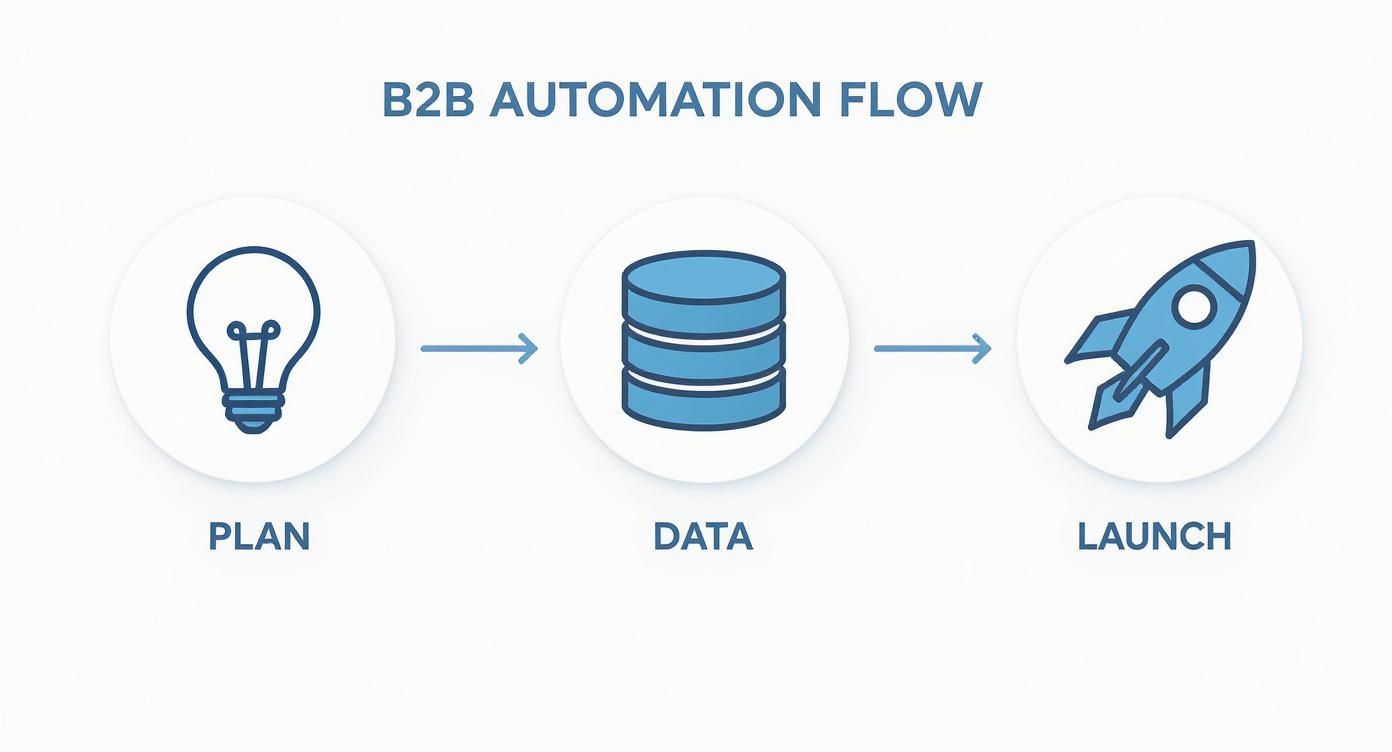
A diagram illustrating the B2B automation flow with three steps: Plan (lightbulb), Data (database), and Launch (rocket).

Each stage builds on the last, making sure that when you finally hit "launch," your campaigns are backed by a solid plan and clean, reliable data.

Gauging Lead Generation Health

This first bucket of KPIs tells you if the top of your funnel is actually working. We're looking at both the volume of leads coming in and, far more importantly, the quality of those leads your automation platform is attracting and sorting.

  • Cost Per Lead (CPL): Think of this as your efficiency baseline. Just divide your total campaign spend by the number of new leads you got. If your CPL is creeping up, it’s a red flag that your targeting might be off or your creative isn't landing.
  • Marketing-Qualified Lead (MQL) to Sales-Qualified Lead (SQL) Conversion Rate: This is the big one. It’s the ultimate test of whether marketing and sales are on the same page. A low conversion rate here almost always means marketing’s idea of a “good lead” isn’t what the sales team needs to actually close business.

These metrics are your foundation. To go a level deeper, check out our guide on essential lead generation key performance indicators.

Analyzing Campaign Effectiveness

Okay, so you've got leads in the door. Now you need to know if your nurture campaigns are doing their job. These metrics measure engagement and tell you if your content is actually resonating with your audience.

An effective automation strategy isn't just about sending emails; it's about starting conversations that guide prospects through their buying journey. If your engagement numbers are flat, your message isn't connecting.

A couple of key metrics to keep a close eye on:

  • Email Engagement Rates: Go beyond basic open rates—they can be misleading. The real story is in your click-through rates (CTR) and, even better, the conversion rates from those clicks. That tells you who’s taking action.
  • Landing Page Conversion Rates: Your landing pages are where value gets exchanged. A low conversion rate is a clear sign of a disconnect between your ad, your offer, and the on-page experience.

Connecting Automation to Revenue

This is where the rubber meets the road. These KPIs draw a straight line from your marketing activities to the company’s bottom line, making the value of your automation platform impossible for leadership to ignore.

The pressure to prove this connection is only growing. By 2025, digital channels are expected to handle about 80% of all B2B sales interactions. On top of that, 74% of sales professionals believe AI will fundamentally change how they work, cementing automation as a non-negotiable part of the sales process. You can discover more insights about sales automation trends from Kixie.com.

To show the real financial impact, focus on these two metrics:

  • Sales Cycle Length: How long does it take to convert a brand-new lead into a paying customer? A good automation system should shrink this timeline by handing off better-qualified, sales-ready leads.
  • Marketing-Influenced Revenue: This metric tallies up the total revenue from all the deals that marketing touched. It’s a powerful way to show exactly how your team’s efforts are fueling the company’s growth.

Common B2B Automation Traps (and How to Sidestep Them)

Even the slickest marketing automation platform can turn into an expensive, dust-gathering subscription if you're not careful. The dream is efficiency and scale. The reality, for many, is a mess of broken workflows and frustrated teams.

So, how do you avoid the potholes? It's not about working harder; it's about starting smarter. Most teams stumble not because of a lack of effort, but because they skip the foundational work.

Fortunately, the biggest traps are well-known, and each one has a clear escape route.

Mistake 1: Trying to Boil the Ocean on Day One

It’s so tempting. You get the keys to your new platform and immediately try to map every "if-then" scenario for the entire customer journey. You sketch out a monstrous, multi-branched workflow that accounts for every possible click, download, and email open.

This is a classic rookie move, and it almost always ends in disaster. What you're left with is a system that's a nightmare to build, impossible to debug, and takes months to produce a single result.

The better way? Start with a single, quick win.

  • Actionable Fix: Pick one high-impact process and nail it. A simple welcome series for new demo requests is a perfect candidate. So is a re-engagement campaign for leads that have gone cold. Get a simple, clean workflow live, prove its value, and build momentum from there.

Mistake 2: Ignoring Your Data Problem

Think of your automation platform as a high-performance engine. Your data is the fuel. Pumping it full of garbage—duplicates, missing fields, inconsistent formatting—is like pouring sand in the gas tank.

It grinds everything to a halt. Worse, it leads to cringe-worthy personalization fails, like calling a CEO by the wrong first name or sending a case study about the wrong industry. Automation doesn't fix bad data; it puts a megaphone to it.

Crucial Takeaway: Your marketing automation tool will only amplify the data problems you already have. Cleaning up your data isn't a "nice-to-have" pre-launch step. It's non-negotiable.

  • Actionable Fix: Before you even think about migrating contacts, do a ruthless data audit. Merge duplicates, standardize job titles, normalize company names, and fill in the blanks. Just as important, set up validation rules on your forms to stop bad data from getting into your system in the first place.

Mistake 3: Using Your New Tool as a Spam Cannon

You just bought a sophisticated platform designed for personalization at scale. The absolute worst thing you can do is upload your entire database and blast everyone with the same generic newsletter.

This is the fastest way to torch your email list and tank your sender reputation. It completely misses the point of automation, which is to deliver the right message to the right person at the right time. Treating your platform like a glorified email-blasting service will send your unsubscribe rates through the roof.

Your goal is to make every touchpoint feel personal, even when a machine is doing the work.

Here’s your actionable plan to avoid being a spammer:

  1. Segment Like a Pro: Don't talk to a CFO the same way you talk to a Head of Engineering. Use your buyer personas to create different communication tracks with content that actually speaks to their specific pains and priorities.
  2. Use Dynamic Content: Most platforms let you swap out blocks of content in an email—like a specific customer quote or a relevant case study—based on the recipient's industry or title. It’s a simple move that makes your outreach feel instantly more relevant.
  3. Map Content to the Buyer’s Journey: Someone who just downloaded their first-ever whitepaper isn't ready for a pricing sheet. Make sure the content you send matches where they are in the decision-making process. Nurture them; don't shove them.

Got Questions About B2B Automation? We've Got Answers.

Even after you see the potential, diving into the world of marketing automation can bring up a few "what ifs" and "how does thats." It's totally normal. Here are the straight answers to the questions we hear most often.

How Much Does B2B Marketing Automation Actually Cost?

This is usually the first question out of the gate, and the honest answer is: it really depends. The price tag is almost always tied to two things: how powerful the platform is and, more importantly, how many contacts you have in your database.

Here’s a rough breakdown:

  • For startups and small businesses: You can get started with core features like email nurturing and simple workflows for $50 to $300 a month.
  • For mid-market companies: As your needs grow, so does the price. Expect to pay somewhere between $800 and $3,000 per month for platforms with deeper CRM integrations, lead scoring, and solid analytics.
  • For enterprise teams: The sky's the limit. Top-tier platforms with predictive AI, custom reporting, and white-glove support can easily run $3,000+ per month.

But remember, cost is only half the equation. If a $1,000-per-month platform helps your team land just one extra $10,000 deal, it’s already paid for itself ten times over.

How Long Will It Take to Get This Running?

This isn't like flipping a switch. A successful rollout is about much more than just the software—it's about your strategy, your data, and getting your team on board. The best approach is always to start small and build from there.

One of the biggest mistakes we see is trying to build the "perfect" system right from day one. Instead, aim for a quick win. You can get a pilot campaign up and running in as little as 2-4 weeks, while a full, company-wide implementation might take 3-6 months.

Your timeline will really hinge on a few key things:

  1. Your Data Quality: Be honest—is your contact data a clean, well-oiled machine or a bit of a mess? Data cleanup can easily be the most time-consuming part of the whole process.
  2. Team Readiness: Is your team excited and trained for new ways of working, or is there some hesitation?
  3. Integration Complexity: Hooking into a standard CRM like Salesforce or HubSpot is usually straightforward. Custom-built systems or complex integrations will definitely add time.

Is Automation Really a Good Fit for a Small Business?

Absolutely. In fact, for a small team, automation isn't just a nice-to-have; it's a force multiplier. It gives a handful of people the power to execute a marketing strategy that would normally require a much, much bigger team.

A small business doesn't need a sprawling enterprise system. A basic platform can handle the crucial but repetitive stuff—like lead follow-ups, welcome emails, and data entry—freeing up your team to focus on building relationships and closing deals. Those are the things you can't automate. The trick is to pick a platform that can grow with you.


Ready to see how an AI-native platform can accelerate your growth without all the complexity? marketbetter.ai brings content creation, campaign optimization, and personalization together in one smart system. Discover the future of B2B marketing.

A Guide to Measuring Marketing Effectiveness

· 26 min read

So, what does “measing marketing effectiveness” actually mean?

It’s about figuring out if your marketing is actually doing its job—if it’s hitting your business goals. It's the only way to draw a straight line from what you spend on a campaign to the real money it brings in. Think of it as the ultimate proof that marketing isn't just a cost center, but a revenue driver.

Why Measuring Marketing Effectiveness Matters

A scenic view of a ferry boat on the ocean, a lighthouse on a grassy hill, and a dirt path.

Let's kill a bad idea right now: marketing is not just another line item on a budget. When it’s done right—and measured properly—marketing is the engine for sustainable growth. But without measurement, you’re just guessing. You're spending money and hoping something good happens.

Imagine your marketing strategy is a ship setting sail. Effectiveness isn’t about how fast the ship is moving, which you might track with things like social media likes, ad impressions, or website clicks. Those are vanity metrics. They look impressive on a report, but they don't tell you if you're actually headed in the right direction.

True effectiveness is about whether you’re actually reaching your destination: concrete business goals like more revenue, a bigger slice of the market, and fiercely loyal customers.

Shifting from Activity to Impact

In a world drowning in data, you can't afford to guess anymore. Measuring marketing effectiveness is non-negotiable. It’s the only way to justify your budget, prove your team’s value to the C-suite, and build a tight feedback loop that makes every campaign better than the last. The entire goal is to connect every dollar spent to a tangible business outcome.

Measuring success and allocating budget are two sides of the same coin. In order to make wise budget allocation decisions, we must understand which efforts have been successful and which have not.

This forces a critical conversation about the numbers we choose to watch. Not all metrics are created equal.

Vanity Metrics vs. Business-Impact Metrics

It's easy to get distracted by numbers that feel good but mean very little. Let's compare the two so you can take action and focus on what really moves the needle.

Metric CategoryExamplesWhat It Actually Tells YouActionable Takeaway
Vanity MetricsSocial Media Likes, Impressions, Page ViewsThis shows surface-level activity. It tells you people saw your content, but offers zero insight into whether it changed their behavior or convinced them to buy.Use these as secondary health indicators, but never as your primary measure of success. High impressions with low clicks means your creative or targeting is off.
Business-Impact MetricsCustomer Acquisition Cost (CAC), Return on Ad Spend (ROAS), Customer Lifetime Value (CLV)This directly links your marketing spend to revenue and profit. It tells you if your campaigns are actually generating real, sustainable growth for the business.Make these the headlines of your reports. If ROAS is low, you have a clear mandate: pause the ad, change the offer, or re-evaluate the channel.

See the difference? One makes you feel busy, while the other makes the business money.

The Foundation for Smart Decisions

At the end of the day, a serious commitment to measuring marketing effectiveness lets you answer the big questions. Which channels are bringing in our most profitable customers? How much should we really invest in that new campaign to hit our revenue targets? Which ad copy is actually working?

Without this data, you’re steering the ship with a blindfold on. This guide is your compass. We’re going to move past the surface-level noise and uncover the metrics that signal true business impact and drive smart, forward-thinking decisions.

Choosing the Right KPIs for Your Marketing Goals

So you're convinced that measuring marketing matters. Great. Now comes the hard part: what, exactly, should you be measuring? It’s incredibly easy to get lost in a sea of data, staring at dozens of dashboards that tell you everything and nothing at the same time.

A focused approach is the only way to win. You need to pick the Key Performance Indicators (KPIs) that actually line up with your real business goals. Think of them as your guideposts—the specific numbers that turn a fuzzy objective like "grow the brand" into something you can actually track and improve.

Your KPIs are the turn-by-turn directions on your GPS. Your business goal is the destination. Without the right directions, you're just driving in circles, burning fuel and getting nowhere. Whether you’re trying to build brand awareness, generate high-quality leads, or keep your existing customers happy, your KPIs have to connect directly to that outcome.

Aligning KPIs with Business Objectives

Different goals demand different yardsticks. A campaign designed to get your name out there is going to look very different on a spreadsheet than one built to drive immediate sales. Let's break down how to map the right KPIs to the right job with actionable steps.

  • Goal: Brand Awareness Your mission is to get your brand in front of a wider, relevant audience. Forget just counting impressions—that's a vanity metric. Instead, focus on numbers that suggest people are actually paying attention.

    • Actionable KPIs: Look at social media engagement rate (not just likes), share of voice (how often your brand is mentioned compared to competitors), and tangible increases in direct and branded search traffic.
    • How to Act on It: If branded search traffic is flat, your awareness campaigns aren't memorable enough. It's time to A/B test your core messaging.
  • Goal: Lead Generation Here, we shift from eyeballs to action. Cost Per Lead (CPL) is a classic starting point, but it's dangerously incomplete. A low CPL doesn't mean much if the leads are junk. The real metric to obsess over is the Lead-to-Customer Conversion Rate. This tells you about lead quality.

    • Actionable KPIs: Track CPL, Lead-to-Customer Rate, and Marketing Qualified Leads (MQLs).
    • How to Act on It: Compare the conversion rates from different channels. A channel with a higher CPL but a much higher lead quality is often a better investment. You'd much rather have 10 leads that convert at 50% than 100 leads that convert at a measly 1%.
  • Goal: Customer Retention & Loyalty It's almost always cheaper to keep a customer than to find a new one. To see how you're doing here, you need to be tracking Customer Lifetime Value (CLV), churn rate (the percentage of customers who leave you over a period), and your repeat purchase rate.

    • Actionable KPIs: Monitor CLV, churn, and repeat purchase rate.
    • How to Act on It: If your churn rate ticks up, immediately survey departing customers to find out why. Is it a product issue? A pricing problem? Use that feedback to prevent more customers from leaving.

Practical KPI Comparisons in Action

The "right" KPIs are completely dependent on your business model. A B2B SaaS company and a direct-to-consumer e-commerce brand are playing two totally different sports, even if they're both running digital ads.

Let's compare two scenarios:

Campaign ScenarioB2B SaaS Company (Free Trial Campaign)E-commerce Brand (Holiday Sale)
Primary GoalAcquire qualified product users who will eventually pay.Drive as much revenue as possible in a short, competitive window.
Key KPIs• Trial Signup Rate
Trial-to-Paid Conversion Rate
• Customer Acquisition Cost (CAC)
Return on Ad Spend (ROAS)
• Average Order Value (AOV)
• Conversion Rate
Actionable DecisionIf the Trial-to-Paid Conversion Rate is low, the problem isn't marketing—it's the product onboarding. Time to work with the product team.If ROAS is below your target, immediately reallocate budget from the worst-performing ad set to the best-performing one. Don't wait.

This shows why you need a tailored measurement dashboard. Stop tracking dozens of metrics. Find the handful that give you a crystal-clear, honest view of how you're performing against your specific goals.

Today, digital channels dominate marketing budgets, but measuring their true impact means looking past simple clicks. It's about connecting what you do with what the business earns. It’s no surprise that 89% of top-performing marketers use strategic metrics like gross revenue, market share, and customer lifetime value (CLV) to prove their campaigns work.

When picking your KPIs, understanding the difference between ROI vs ROAS is absolutely critical. ROAS measures the gross revenue you get back for every dollar you spend on ads, while ROI takes all your costs into account to show you the real profit. Getting this right is the key to making smart, sustainable budget decisions.

So, how do you give credit where it’s due?

Imagine this: a customer sees your Facebook ad on Monday, clicks a Google search result on Thursday, and finally pulls the trigger after opening a promo email on Saturday. Which touchpoint gets the high-five for the sale? This is the exact puzzle that marketing attribution solves.

Think of it like a soccer team scoring a goal. The striker who kicks the ball into the net gets the glory, but what about the midfielders who passed it up the field? Or the defender who started the play? Each one played a part. Attribution is just the process of figuring out how much each player contributed.

Without it, you might give all the credit to the last email and slash the budget for the Facebook ad that started the whole journey. Bad move. Good attribution helps you see the entire field, not just the final kick.

From Simple Guesses to Strategic Insights

Attribution models run the gamut from dead-simple to seriously complex. Each one tells a different story about your customer’s path, and picking the right one boils down to your business goals and how long it takes for someone to buy from you. Let's compare the two most basic models.

  • First-Touch Attribution: This one’s easy. It gives 100% of the credit to the very first interaction a customer had with you.
    • Actionable Use: Use this model to identify which channels are best at generating initial awareness. If you need to fill the top of your funnel, optimize the channels that win here.
  • Last-Touch Attribution: This is the most common model because it's the easiest to track. It hands 100% of the credit to the final touchpoint right before the conversion.
    • Actionable Use: Perfect for understanding which channels are your best "closers." If you need to boost end-of-quarter sales, double down on the channels that score high with last-touch.

But here’s the catch: both of these single-touch models have tunnel vision. They completely ignore everything that happens in the middle of the journey—which, let's be honest, is often where the real magic happens.

Attribution isn't just about counting clicks; it's about understanding influence. The real goal is to see the complete picture of how all your channels work together to turn a stranger into a customer.

The Power of Multi-Touch Attribution

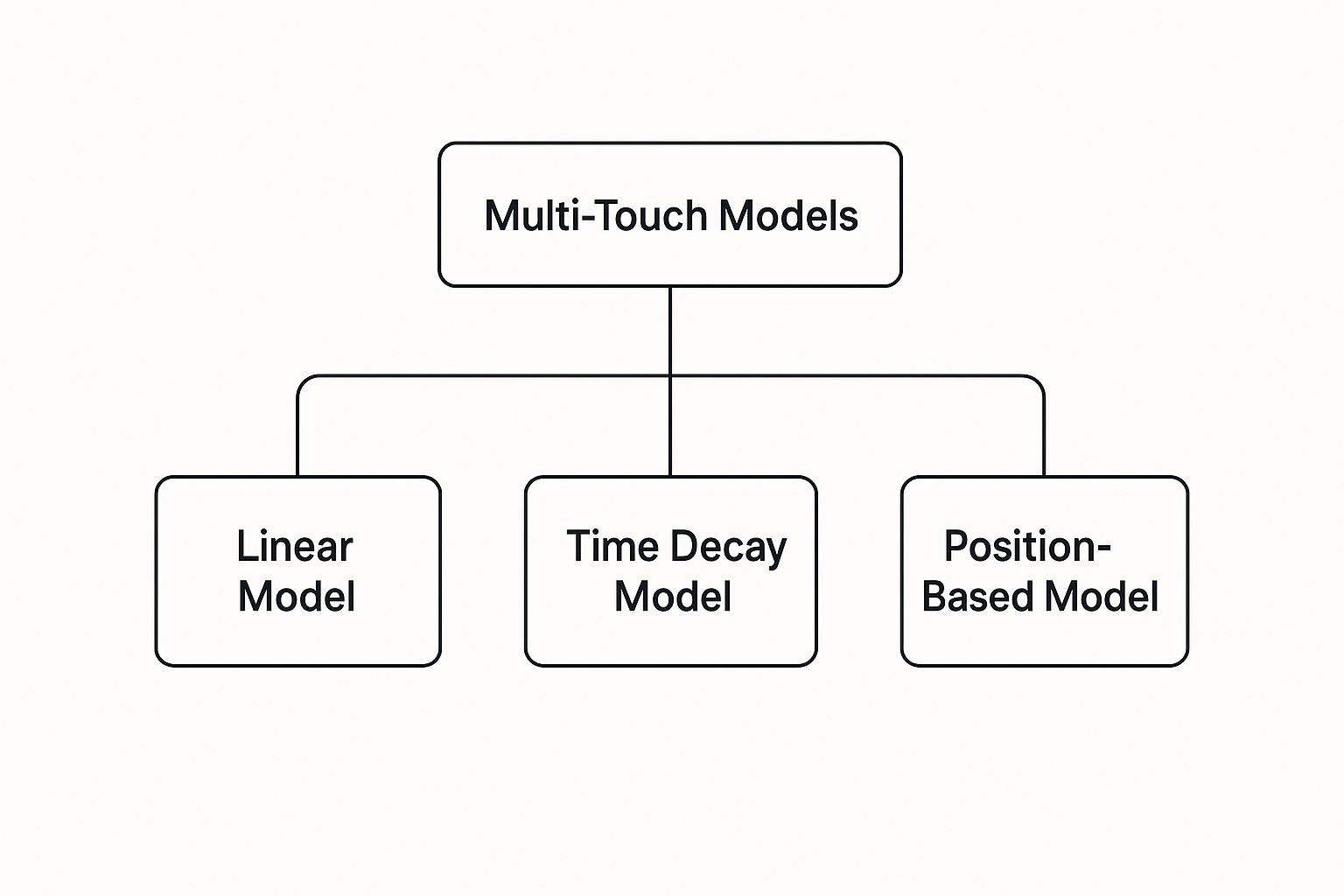
If you’re not selling impulse-buy items, you need a clearer view. For businesses with longer sales cycles, multi-touch attribution provides a much more balanced and accurate picture of what’s actually working. These models spread the credit across multiple touchpoints, acknowledging the reality that most sales are the result of a series of nudges, not a single tap.

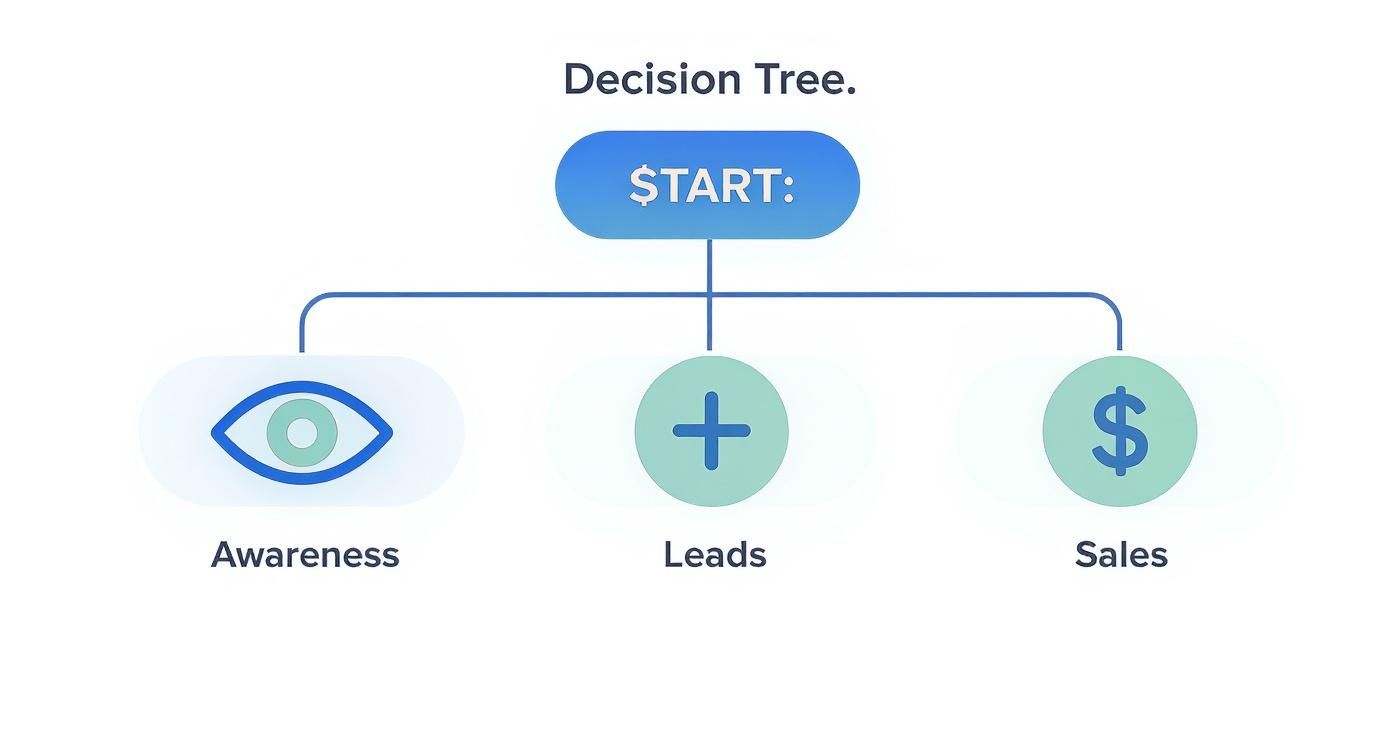
This decision tree helps visualize how different goals—like building awareness, generating leads, or driving sales—demand different ways of measuring success.

A decision tree diagram showing marketing effectiveness, starting with START, branching into Awareness, Leads, and Sales.

As you can see, your main business objective points you down a specific measurement path, making sure you’re tracking the right numbers at every stage of the funnel.

Which Marketing Attribution Model Is Right for You?

Choosing the right model is a big deal. It dictates where you put your budget and how you measure your team's success. To help you figure out what fits, here's a quick comparison of the most common multi-touch models. Each one offers a unique lens through which to view your customer journey.

Attribution ModelHow It WorksBest ForActionable Insight
LinearSpreads credit evenly across every single touchpoint. A simple, democratic approach.B2B companies with long sales cycles where every interaction plays a role in nurturing the lead.Reveals your "workhorse" channels that consistently contribute across the entire journey, even if they don't open or close the deal.
Time-DecayGives more credit to the interactions that happened closer to the sale.Short-term promotional campaigns or B2C sales cycles where recent touchpoints are most influential.Helps you optimize the final steps of the buyer journey by highlighting what nudges people over the finish line.
U-ShapedGives 40% credit to the first touch, 40% to the last, and divides the remaining 20% among the middle touches.Businesses that highly value both lead generation (the first touch) and conversion (the last touch).If a channel appears often in the middle but gets little credit, it might be a great nurturing channel that you're undervaluing.

At the end of the day, there’s no single "best" model that works for everyone. The right choice is the one that best reflects how your customers actually buy. An e-commerce brand with a three-day sales cycle might be perfectly fine with a Last-Touch or Time-Decay model. But a B2B software company with a six-month sales process? They’d get far more truth from a Linear or U-Shaped model.

For a deeper dive into these frameworks, check out our complete guide to multi-touch attribution models.

Advanced Measurement Frameworks for a Holistic View

Attribution models are fantastic, but they're starting to tell an incomplete story. In a world where privacy rules are getting tighter and third-party cookies are disappearing, leaning entirely on user-level tracking is becoming a risky bet. It’s time to zoom out and bring in frameworks that give you the full, top-down picture of what’s really working.

Think of digital attribution like tracking individual plays in a football game—it shows you who passed the ball and who scored. That's crucial stuff. But these advanced frameworks are like the post-game analysis from the skybox, revealing how things like weather, crowd noise, and even team morale influenced the final score. You absolutely need both perspectives to understand what truly drives a win.

These broader methods help you measure the stuff that’s historically been a black box, like the real impact of a billboard or a TV ad, and see how all your marketing efforts sing together.

Marketing Mix Modeling: The Privacy-First Powerhouse

One of the most powerful top-down approaches is Marketing Mix Modeling (MMM). At its core, this is a statistical method that digs through your historical data—sales numbers, ad spend across every single channel, and even external factors—to measure how much each piece contributed to your revenue.

Instead of tracking individuals, MMM looks at aggregated data over time. It’s built to answer the big, strategic questions like, "For every dollar we put into YouTube ads last quarter, how many dollars in sales did we actually get back?" It also cleverly accounts for all the real-world variables that attribution models completely ignore, such as:

  • Seasonality: How do holiday rushes or summer slumps really affect our sales?
  • Promotions: What was the actual sales lift from our 20% off sale, beyond what we would have sold anyway?
  • Competitor Actions: Did our rival's massive new ad campaign put a dent in our performance?
  • Economic Trends: How is something like inflation impacting what our customers are willing to spend?

This kind of analysis is becoming non-negotiable as old-school digital attribution hits a wall. A recent EMARKETER study found that over 61% of marketers are actively trying to improve their measurement with better and faster MMM solutions. That’s a huge signal that the industry is shifting. You can dive deeper into the latest measurement trends and find more great insights over at Analytic Edge.

Incrementality Testing: Uncovering True Causal Impact

While MMM gives you that crucial 30,000-foot view, Incrementality Testing is all about answering a much more direct question: did my marketing campaign cause an increase in sales that wouldn't have happened otherwise? It’s designed to isolate the true "lift" your ads generated.

The most common way to do this is with a classic A/B test or a lift study. Here’s the simple version: you split your target audience into two groups. The "test group" sees your ad, while the "control group" doesn't. By comparing the conversion rates between the two, you can measure the real, causal impact of that specific campaign.

Incrementality moves you beyond correlation to pure causation. It’s the difference between knowing sales went up while your ad was running, and knowing sales went up because your ad was running.

This is the gold standard for proving the worth of channels that are notoriously tough to measure with last-click attribution, like brand awareness campaigns on social media or video platforms.

Combining Frameworks for a 360-Degree View

So, which one is right for you: attribution, MMM, or incrementality? The real answer is, you need all three. They aren't competing with each other; they're answering different questions at different altitudes, giving you a complete measurement toolkit.

Here’s a comparison of how to put them into action:

Measurement FrameworkPrimary Question AnsweredActionable Use CaseKey Limitation
Attribution ModelingWhich touchpoints deserve credit for a specific conversion?Use daily to tweak bids in Google Ads or optimize creative in your social campaigns for better immediate performance.Struggles with offline channels and is increasingly hamstrung by data privacy.
Marketing Mix Modeling (MMM)How did my total marketing budget and outside factors impact overall sales?Use quarterly for high-level budget planning. Decide if you should shift 10% of your budget from paid search to connected TV next year.Less granular and slower to produce insights compared to digital attribution.
Incrementality TestingDid this specific campaign cause a real lift in conversions?Use for major campaign launches to prove the real value of a new channel or strategy before you scale the budget.Can be complex and expensive to run for every single marketing activity you do.

When you weave these frameworks together, you create a powerful, multi-layered measurement strategy. Use MMM for your high-level budget planning, attribution for the daily grind of digital optimization, and incrementality tests to validate the true impact of your most important campaigns. This integrated approach is how you finally get that holistic view of your marketing effectiveness you've been looking for.

Common Measurement Pitfalls and How to Avoid Them

A desk with a laptop, measuring tape, and blueprints, and a sign saying 'AVOID PITFALLS' in the background.

Even with the slickest frameworks and best intentions, it's dangerously easy to fall into a few classic measurement traps. These aren't just small errors; they're the kinds of mistakes that warp your perception of what's working, leading you to pour money into the wrong channels and starve the ones that are actually driving growth.

Good measurement isn't about getting a number—it's about getting the right number. It's about finding the truth. Let's walk through the most common blunders marketers make and, more importantly, how you can sidestep them.

Confusing Correlation with Causation

This is the big one. It's the oldest trap in the book. You launch a new social media campaign, and sales go up. The campaign must have worked, right?

Not so fast. Maybe a competitor fumbled their inventory. Maybe a good news story about your industry created a halo effect. Correlation just means two things happened around the same time. Causation means one thing made the other happen.

How to Fix It: Stop guessing and start proving. Run incrementality tests (like an A/B test) to isolate the true impact of a campaign.

  • Actionable Step: For your next big Facebook campaign, work with their platform to run a brand lift study. Show your ads to a test group but hold them back from a control group. The difference in their behavior is the real, causal lift your marketing generated.

"The goal is to move beyond observing what happened and start proving what you made happen. That shift from correlation to causation is where true measurement confidence is born."

Getting Trapped by Data Silos

Your customer data is everywhere. It’s in Google Analytics, your CRM, social ad platforms, your email tool—a dozen different systems that don't talk to each other. This creates a horribly fragmented view of the customer journey. You see a new lead pop up in Salesforce, but you have no clue which ad, blog post, or email chain brought them there.

This isn’t just messy; it’s misleading. Nielsen data famously revealed that while marketers often rank radio near the bottom for performance, it frequently delivers some of the highest ROI. Why the disconnect? Because last-click attribution on digital channels is easy to see, so we overvalue it and ignore the bigger picture. You can see more of these surprising ROI findings on Nielsen.com.

Overvaluing Short-Term Wins

Metrics like Cost Per Click (CPC) and daily sign-ups are addictive. They give you that instant hit of feedback. But focusing only on these short-term numbers can trick you into killing your most valuable long-term plays.

A top-of-funnel brand campaign isn't meant to drive a sale today. Its job is to build the awareness and trust that fuels all of your other channels tomorrow. If you judge it by immediate conversions, you’ll always conclude it's a failure and cut the budget, kneecapping your future growth.

How to Fix It: Use a balanced scorecard. Judge each marketing activity by its actual goal.

  • Actionable Comparison:
    • Brand Building (e.g., YouTube Pre-Roll): Track things like share of voice, branded search volume, and social engagement. Goal: Increase branded search by 15% this quarter.
    • Direct Response (e.g., Google Search Ad): Here you can focus on ROAS, CPA, and immediate conversion rates. Goal: Achieve a 4:1 ROAS on this campaign.

Ignoring the Offline World

This is a huge blind spot for digital-first teams: if it doesn't have a tracking pixel, it didn't happen. That thinking can be catastrophic.

Imagine you run a podcast sponsorship that’s absolutely killing it. But because your attribution model can't connect listens to purchases, it looks like a zero on your dashboard. So you cut it. You just killed a high-performing channel because it didn't fit into your neat, pixel-based world.

How to Fix It: Get creative with bridging the offline-to-online gap.

  • Actionable Step: For your next podcast ad, use a unique promo code (PODCAST20) and a vanity URL (yoursite.com/podcast). Ask "How did you hear about us?" in your checkout form. Compare the data from all three sources to get a much truer picture of the campaign's impact.

The Future of Marketing Measurement with AI

The frameworks we've covered are solid, but the next chapter in measuring marketing is already being written, and the author is Artificial Intelligence. AI is taking measurement from a backward-looking chore to a forward-looking strategic weapon. It’s making the whole process smarter, faster, and more predictive than ever before.

Imagine running a complex Marketing Mix Model (MMM) not at the end of a quarter, but almost in real-time. That's the kind of power AI puts on the table. AI-powered platforms can chew through colossal datasets to automate analyses that once took data science teams weeks to finish, handing you insights at the speed you actually need them.

This isn't a small tweak. It fundamentally changes how marketers work.

From Reporting to Predicting

The old way of doing things is looking at last month's report to figure out what broke. AI flips that script completely. The game is shifting from reacting to past performance to proactively shaping future outcomes. We're no longer just asking what happened, but what will happen next.

This is possible because AI is a master at spotting patterns and forecasting what comes next. The future of measurement will lean heavily on predictive modeling techniques supercharged by AI, allowing us to anticipate trends with startling accuracy. Marketers can now make calls based not just on history, but on probable futures.

AI doesn't just show you a dashboard of the past; it gives you a roadmap for the future. It’s the difference between looking in the rearview mirror and having a GPS that sees traffic jams before you hit them.

Actionable AI-Powered Optimization

The real magic of AI in marketing measurement isn't just the data—it's the ability to deliver clear, actionable recommendations. It’s about decision intelligence.

Here’s a practical comparison of the old way vs. the AI way:

TaskOld Way (Manual & Reactive)AI Way (Automated & Proactive)
Budget AllocationYou spend hours in spreadsheets trying to guess the best mix for next quarter based on last quarter's data.Before you spend a dollar, AI runs thousands of budget scenarios to show you the likely ROI of shifting 15% of spend from paid search to Connected TV.
Campaign OptimizationYou notice at the end of the week that a social media campaign's CPA has climbed. You pause it after the money is already spent.AI monitors your campaigns in real-time, spots the underperforming ad, and pings you with a recommendation to reallocate funds to a rising star before you waste more budget.

At the end of the day, AI isn’t here to replace the marketer. It's the indispensable partner we’ve been waiting for. It handles the heavy computational lifting, freeing up human minds to focus on what we do best: creativity, brand storytelling, and high-level strategy. By automating complex measurement and offering predictive insights, AI empowers us to make truly intelligent, data-backed decisions that drive real business growth. Learn more about how you can get ahead with our guide to predictive analytics in marketing.

A Few Common Questions We Hear

Even with the best game plan, the real world throws curveballs. Once you start digging into the numbers, practical questions pop up fast. Here are a few of the most common hurdles marketers face, along with some straight talk on how to clear them.

"How in the world do I measure my radio ads or print campaigns?"

Measuring offline marketing can feel like shouting into the void and hoping for the best. But you don't have to guess. The trick is to build a simple, trackable bridge from the physical world to your digital one.

The goal is to give people a unique path to follow. For example, a radio ad could mention a specific URL like yoursite.com/radio that you don't link to anywhere else. Anyone who lands there came from that ad. Simple.

Here’s a comparison of ineffective vs. actionable tracking methods:

The Old Way (Low Visibility)The Smart Way (High Visibility)
Running a generic ad and hoping for a sales bump.Using a unique promo code (RADIO20) so you can directly attribute sales.
Putting your main phone number on a billboard.Setting up a dedicated, trackable phone number just for that billboard campaign.
Just telling people to visit your homepage.Adding a QR code that sends them to a specific, measurable landing page.

By creating these dedicated pathways, you're making the invisible impact of your offline channels show up loud and clear in your analytics.

"I have a small team and an even smaller budget. Where do I even start?"

You don't need a massive budget or a data science team to get this right. In fact, trying to track everything at once is the fastest way to get overwhelmed and do nothing. The key is ruthless focus.

Start with the basics. Google Analytics 4 is free and an absolute powerhouse for understanding your website traffic and what people are doing there. It's your ground zero.

The most important first step? Define your one, single, most critical conversion. Is it a purchase? A demo request? A newsletter signup? Whatever it is, focus all your energy on tracking that one action flawlessly before you do anything else.

Once that’s locked in, you can start layering on other metrics. But for a small team, victory comes from nailing the essentials, not from building a dashboard that looks like a spaceship cockpit.

"What’s more important to track—brand awareness or lead generation?"

This is the classic marketing tug-of-war, but it’s a false choice. You don't pick one. You measure both, but you measure them differently, with different yardsticks. Judging a brand campaign by how many leads it generated today is like judging a fish by its ability to climb a tree.

It's much smarter to create two separate scorecards.

  • Actionable Plan for Brand Awareness: Keep an eye on things like branded search volume (are more people Googling your name?), social media engagement, and direct traffic. Set a quarterly goal to increase branded search queries by 10%.
  • Actionable Plan for Lead Generation: This is where you get clinical. Track the hard numbers: Cost Per Lead (CPL), Lead-to-Customer Conversion Rate, and, of course, Return on Ad Spend (ROAS). Set a monthly goal to keep your CPL below $50.

A healthy marketing engine needs both. Your brand-building efforts fill the top of your funnel, which makes all your lead generation work down the line cheaper and far more effective. They work together.


Stop guessing and start optimizing. marketbetter.ai uses AI to connect your marketing spend to real revenue, giving you the clarity to make smarter budget decisions and prove your impact. Discover how our AI-powered platform can transform your marketing measurement.

A Practical Guide to Building Actionable Marketing Automation Workflows

· 25 min read

Imagine your marketing team had a secret weapon: a super-smart GPS for every single customer. That's what a good marketing automation workflow feels like. Instead of blasting everyone with the same generic map, you're giving each person precise, turn-by-turn directions—a timely email, a perfectly placed offer, or a helpful resource—right when they need it most.

What Are Marketing Automation Workflows, Really?

A diagram showing the flow of a marketing automation workflow, with icons representing user actions and automated responses.

Strip away the jargon, and a marketing automation workflow is just a series of actions you set up to run on autopilot. These actions kick off based on what someone does (or doesn't do), who they are, or simply after a certain amount of time has passed.

Think of it as a set of "if this happens, then do that" rules for your marketing. It’s a massive leap from the old way of doing things.

Instead of a marketer manually sending a one-off email blast to their entire database, a workflow sends a specific, relevant message to one person based on their unique behavior. For instance, if someone downloads your latest ebook, a workflow can instantly send a thank-you note, then follow up a few days later with a case study on a similar topic. Simple, but powerful.

The whole point is to stop thinking in terms of disconnected tasks and start building a smart, cohesive system that nurtures leads and builds real relationships around the clock. It’s your safety net, ensuring no opportunity slips through the cracks and every interaction feels personal.

The Contrast with Manual Marketing

To really get why this matters, let's put it side-by-side with the manual grind most of us are familiar with.

  • Manual Marketing: This is all about one-time campaigns. Think of a holiday sale email sent to your entire list. It’s incredibly labor-intensive, often generic, and a nightmare to scale. A real person has to build, schedule, and send every single message.
  • Automated Workflows: These are always on, running continuously in the background based on individual triggers. They're deeply personal, built to scale, and don't require constant babysitting. Once you build a solid workflow, it can engage thousands of people with tailored messages all at once.

A marketing automation workflow transforms your marketing from a series of broadcasts into a series of conversations. It listens for user signals and responds appropriately, creating a more dynamic and engaging customer journey.

Why This Is an Essential Strategy

The shift from manual to automated isn't just a small step up; it's a game-changer. The numbers don't lie. Companies that use automation to nurture leads see an 80% increase in the number of leads generated. Even more impressive, they see a 451% increase in qualified leads.

Why such a massive jump? Because workflows deliver the right message to the right person at the right time, consistently and at scale. It’s a level of personalization that’s just impossible to achieve manually.

This structured approach doesn't just save your team countless hours; it creates a more reliable and effective customer experience. It frees up your best people to focus on big-picture strategy and creative work instead of getting bogged down in repetitive tasks.

If you want to dig deeper into the core mechanics, this piece on What Is Workflow Automation is a great primer on how these systems work under the hood, even beyond marketing. At the end of the day, it's all about achieving better results with less manual effort.

The Building Blocks of Every Great Workflow

Think of a marketing automation workflow like a recipe. You don’t just start with a finished dish; you start with a few core ingredients. Combine them the right way, and you can create something incredible. The same goes for automation—every complex, elegant journey is built from just four simple parts.

If you can master these elements, you’re on your way to designing workflows that do more than just send messages. They guide customers intelligently.

Let's break them down.

Triggers: The Starting Gun

A trigger is what kicks off your workflow. It's the "if this happens..." part of the equation—the specific signal that tells your system, "Okay, go time." Without a trigger, your workflow just sits there, waiting. It's the starting gun for the race.

Triggers can be based on all sorts of things: what someone does, who they are, or even just the passage of time. A new user signing up for your newsletter? Classic behavioral trigger. A contract renewal date popping up on the calendar? That's a time-based trigger.

  • Actionable Tip: Choose a trigger that signals clear intent. A "downloads pricing guide" trigger is much stronger than a "visits homepage" trigger, allowing you to create a more relevant follow-up.

Actions: The Automated Response

If the trigger is the "if," then the action is the "then." An action is any task your workflow performs automatically once it's been triggered. This is where the machine does the work for you. Sending an email is the most common one, but modern platforms can do so much more.

Actions are the actual output. They can update a contact record in your CRM, ping a sales rep on Slack, or even add someone to a retar.geting audience on Facebook.

A rookie mistake is thinking workflows are just for email. A great workflow coordinates multiple actions—like updating a CRM and sending an SMS—to create a seamless experience for the user.

Delays: The Strategic Pause

Imagine signing up for a webinar and getting five emails in five minutes. You'd feel spammed, and it would come across as totally robotic. This is why delays are so important.

A delay is just a strategic pause you build between actions. It makes the whole conversation feel more natural and human-paced. It's a small detail, but it's critical. Delays give your contacts time to breathe, digest information, or take the action you want them to take.

  • Actionable Tip: Use "wait until a specific time" delays instead of fixed day delays. Sending an email at 9:00 AM in the recipient's time zone will perform better than sending it at 2:00 AM their time.

Conditions: The Intelligent Fork in the Road

This is where your automation goes from basic to brilliant. Conditions (sometimes called logic or branching) create personalized paths for different people inside the same workflow. It's the "if/then" logic that splits the journey.

For instance, a new lead from a Fortune 500 company probably needs a high-touch follow-up from sales. A lead from a small startup? They might be better served with some more educational content. Conditions make that kind of smart routing possible.

Here’s how it changes things:

Workflow ComponentWithout Conditions (Linear)With Conditions (Branched)
TriggerUser downloads an ebook.User downloads an ebook.
Action 1Send a generic follow-up email.Send a follow-up email.
LogicNoneIF user's company size > 500 employees...
Path A ActionN/ATHEN notify a sales rep to call.
Path B ActionN/AELSE add user to a long-term nurture sequence.

This branching logic is the key to creating experiences that feel truly relevant. Of course, to use conditions well, you need a solid grasp of who you're talking to. You can get a head start by exploring different customer segmentation strategies in our guide, which will help you figure out the best criteria for your workflow branches.

Essential Workflow Templates You Can Use Today

Alright, let's move from theory to action. This is where the real fun begins. Knowing what a workflow is is one thing; knowing which ones to build first is another. Instead of staring at a blank screen, you can start with proven blueprints that tackle your biggest marketing goals right out of the gate.

Think of these templates as recipes. They give you the core ingredients and steps, but you can always add your own spice.

This infographic nails the basic pattern you’ll see in every workflow we talk about. It’s a simple, powerful loop: something happens, the system does a task, and then it makes a decision.

Infographic about marketing automation workflows

Get that rhythm down—trigger, action, logic—and you’re ready to build just about anything.

Here are four essential workflows that solve common business problems. I’ll break down what they are, who they’re for, and how to measure if they're actually working.

To make it even clearer, let's quickly compare these four foundational workflows side-by-side before we dive into the details of each.

Comparison of Essential Workflow Types

Workflow TypePrimary GoalTarget AudienceCommon TriggersKey Metric
WelcomeIntroduce the brand, set expectations, and drive initial engagement.New subscribers, trial users, first-time customers.Submitting a form (e.g., newsletter signup).Click-Through Rate (CTR)
Lead NurturingGuide interested prospects toward a sales conversation.Marketing-qualified leads (MQLs) who aren't sales-ready.Downloading mid-funnel content (e.g., case study).MQL-to-SQL Conversion Rate
Re-EngagementReactivate dormant contacts before they're lost for good.Subscribers who haven't opened or clicked in 90+ days.A time-based rule identifying an inactive contact.Re-Engagement Rate
Customer UpsellIncrease customer lifetime value by promoting related products.Existing customers who have made a recent purchase.A specific purchase event or product usage milestone.Repeat Purchase Rate

This table gives you the high-level view. Now, let’s get into the weeds on how to build each one.

The Welcome Workflow

First impressions matter. A lot. The welcome workflow is your handshake, your first hello. It’s your chance to greet new subscribers or customers, tell them what to expect, and get them to take that first small, valuable action. Honestly, if you build only one workflow, make it this one. Engagement is never higher than when someone first signs up.

Actionable Steps to Build It:

  • Trigger: User submits your "newsletter signup" form.
  • Immediate Action: Send a "Welcome & Thank You" email. Deliver the promised asset (like a guide or discount code) instantly.
  • Delay: Wait 2 days.
  • Action: Send a second email that points them to your greatest hits—your most popular blog posts, a helpful video, or a guide on getting started. You're building trust by being useful.
  • Delay: Wait 3 days.
  • Action: Send one last email with a low-commitment ask. Invite them to follow you on social media or check out a customer story.

The main thing to watch here is the click-through rate (CTR) on these first few emails. A high CTR means your new contacts are leaning in and paying attention.

The Lead Nurturing Workflow

Let’s be real: almost no one is ready to buy the second they download your ebook. The lead nurturing workflow is how you build a relationship over time. It’s designed to educate prospects, earn their trust, and gently move them along until they are ready to talk to sales. This isn't about a warm welcome; it's about strategic conversation.

Actionable Steps to Build It:

  1. Trigger: A contact downloads a case study.
  2. Immediate Action: Send them the case study. No delays.
  3. Delay: Wait 4 days. Let them digest it.
  4. Action: Follow up with a related blog post that digs into a pain point the case study solved.
  5. Delay: Wait 5 days.
  6. Action: Send an invitation to an upcoming product demo webinar.
  7. Condition: Did they click the registration link for the demo?
    • If Yes: Perfect. End this workflow and add them to a "Registered for Demo" list.
    • If No: No problem. Send one final, friendly follow-up with a powerful customer testimonial video.

Your north star metric here is the MQL-to-SQL conversion rate. Are these nurtured leads actually turning into real sales opportunities? That’s the only question that matters.

The Re-Engagement Workflow

It happens to the best of us. Over time, some contacts just go quiet. A re-engagement (or "win-back") workflow is your shot at waking them up before they churn for good. This is smart marketing—it costs way less to keep a contact you already have than to find a new one.

A re-engagement campaign isn't just about sending a "we miss you" email. It's a strategic attempt to remind subscribers of the value you offer and give them a compelling reason to stick around.

Actionable Steps to Build It:

  • Trigger: A contact has not opened or clicked an email in 90 days.
  • Action 1: Send an email with a compelling subject line like "Is this goodbye?" or "A special offer to win you back."
  • Delay: Wait 7 days.
  • Condition: Did they open or click the first email?
    • If No: Send a final email asking them to confirm they want to stay subscribed. If no action, automatically tag them for list cleanup.
    • If Yes: Add them back to your main mailing list and send a "welcome back" email with your latest popular content.

Success is measured by the re-engagement rate. It's the percentage of those sleepy contacts who open or click an email in the sequence, signaling they're back in the game.

The Customer Upsell Workflow

The sale is not the end of the relationship; it’s the beginning of the next phase. An upsell workflow focuses on your existing customers to increase their lifetime value (CLV). The goal is to introduce them to other products, premium features, or services that solve their next problem. This is totally different from lead nurturing—you're talking to happy customers, not skeptical prospects.

Actionable Steps to Build It:

  1. Trigger: A customer buys "Product A."
  2. Delay: Wait 14 days. Let them get value from their purchase first.
  3. Action: Send a helpful email with tips on getting the most out of Product A. Reinforce their smart decision.
  4. Delay: Wait 14 days.
  5. Action: Send an email showing how "Product B" is the perfect companion to Product A, perhaps with a short case study.
  6. Action: Follow up with a small, exclusive "thank you" discount on Product B for being a loyal customer.

Here, you’re tracking the repeat purchase rate or upgrade conversion rate. You want to see if your happy customers are willing to invest even more with you.

How to Build Your First Workflow Step by Step

Jumping into marketing automation can feel like trying to pilot a spaceship on your first day. You see all the dials and buttons, and the temptation is to build a complex, multi-layered beast right out of the gate.

Don't do it. The best approach is to start small, build something simple, and get a win on the board.

The goal isn't immediate perfection; it's about building a foundation you can improve upon. This straightforward, five-step process will guide you through launching a workflow that delivers real value without the overwhelm.

Step 1: Define One Clear Goal

Before you even think about logging into your automation tool, stop and ask: What do I actually want to achieve?

A vague goal like "nurture leads" is a recipe for a confusing, ineffective workflow. You have to get specific. What is the single, measurable action you want a contact to take by the end of this journey?

Clarity here is everything. A single, focused goal dictates every trigger, every action, and every piece of content you'll create.

Actionable Tip: Frame your goal using the SMART method (Specific, Measurable, Achievable, Relevant, Time-bound). For example, change "nurture leads" to "Increase demo bookings from blog subscribers by 15% in Q4."

Your goal is your North Star. If a step in your workflow doesn't directly contribute to achieving that goal, it probably doesn't belong there.

Step 2: Map the Customer Journey

Now that you have your destination, it's time to draw the map. Sketch out the ideal path a customer would take to get there.

Seriously, don't do this in your automation software yet. Grab a whiteboard, a notebook, or a simple flowchart tool. This forces you to think from the customer's perspective, not from the tool's limitations.

What are the key touchpoints? What information do they need at each stage? A simple journey map for converting trial users might look like this:

  1. User signs up for a free trial.
  2. They immediately get a welcome email with their login info.
  3. A few days later, they get a quick tip on using a key feature.
  4. After a week, they receive a case study showing what's possible.
  5. Near the end of the trial, an offer to upgrade lands in their inbox.

This process is critical for building marketing automation workflows that feel helpful and timely, not robotic and pushy.

Step 3: Identify Triggers and Segments

With your journey mapped out, it's time to get into the technical "if/then" logic. What specific event kicks off this whole process? This is your trigger. It has to be a clean, unambiguous signal.

Next, think about segmentation. Does everyone who enters this workflow really need the exact same experience? Maybe a trial user from a huge enterprise needs a different message than a user from a two-person startup.

Let's compare two approaches for a simple welcome workflow.

ApproachLinear (No Segmentation)Segmented (Conditional Logic)
TriggerUser signs up for the newsletter.User signs up for the newsletter.
PathAll users get the same three emails.Users are split based on a stated interest (e.g., "sales" vs. "marketing").
ContentGeneral company info and popular blog posts.Each segment receives content tailored to their specific interest.
OutcomeDecent engagement, but feels pretty generic.Higher click-through rates and a far more relevant experience.

Starting with a linear path is perfectly fine for your first workflow. You can always add segmentation later once you start gathering data.

Step 4: Create Your Content and Assets

This is where you build the actual "stuff" your workflow will deliver. We're talking emails, landing pages, forms, or even internal notifications for your sales team.

It's time to write your email copy, design your visuals, and get everything loaded up and ready to go.

Focus on value above all else. Each piece of content should help the user take the next logical step. The adoption of marketing automation is soaring for a reason; recent data shows 79% of marketers automate their customer journey to some extent. This shift is all about creating more efficient and personalized communication at scale.

Step 5: Build, Test, and Launch

Alright, now it's time to jump into your automation software. Recreate the journey you mapped out in Step 2, using the triggers from Step 3 and the content from Step 4.

But before you hit "activate," you have to test it rigorously.

Actionable Checklist for Testing:

  • Enroll Yourself: Use a test email address to go through the workflow from the beginning.
  • Check All Links: Click every single link in every email.
  • Review Delays: Do the pauses between steps feel natural?
  • Verify Personalization: Make sure personalization tokens (like {{first_name}}) are pulling in the right data.
  • Test Logic: If you have conditional splits, test each path to ensure they work as expected.

Once you're confident, launch it. And remember, this is just version one. The real magic comes from measuring its performance and making smart improvements over time. As technology evolves, you'll find more ways to make these processes even smarter. For a deeper look, check out our guide on how AI is transforming marketing automation for a glimpse into what's next.

How to Measure and Optimize Your Workflows

A screenshot from HubSpot's marketing automation software, showing a visual workflow editor with branching logic and performance metrics.

Getting your first marketing automation workflow live is a massive win, but it's the starting pistol, not the finish line. The real magic—and the real growth—happens next.

Think of your workflow not as a static, "set it and forget it" tool, but as a living system that needs a little attention to hit its stride. By constantly measuring what’s working and tweaking what isn’t, you turn a simple tactic into a legitimate growth engine. This is where you shift from just building workflows to perfecting them.

Identifying Your Key Performance Metrics

Before you can make anything better, you have to know what you’re measuring. The right metrics are tied directly to whatever goal you set for that workflow in the first place. Tying your analysis back to that original objective is the only way to know if you're actually succeeding.

Start with these four foundational metrics:

  • Email Open Rate: The percentage of people who actually opened your email. It’s your first and best signal for a killer subject line and brand recognition.
  • Click-Through Rate (CTR): The percentage of openers who clicked a link. This tells you if your message and call-to-action were compelling enough to get someone to act.
  • Conversion Rate: The percentage of contacts who completed the workflow's main goal—like booking that demo or making a purchase. This is the number that really matters.
  • Unsubscribe Rate: The percentage who opted out. A sudden spike here can mean your content is off-target or you're sending emails too often.

But these are just the beginning. To really understand the impact, you need to connect your automation to business results. That's why Return on Investment (ROI) is the ultimate scoreboard. It's not just a vanity metric; over half of businesses expect to see a positive ROI within the first year. And the numbers back it up—research shows the average ROI for marketing automation can climb as high as 544% over three years.

For a deeper dive, our guide on tracking key marketing performance metrics will help you connect the dots between your efforts and the bottom line.

The Art of A/B Testing

So, how do you actually improve those numbers? The single best tool in your optimization toolkit is systematic A/B testing. It's simple: you create two versions of one thing (an A and a B) and show them to different segments of your audience to see which one performs better.

A/B testing is how you take the guesswork out of your strategy. Instead of running on gut feelings, you’re making data-backed decisions that create small, compounding improvements over time.

The key is to test one thing at a time. If you change the subject line and the CTA, you’ll never know which one made the difference.

Here are a few high-impact elements to test right away:

  • Subject Lines: Try a direct, no-nonsense subject line against one that sparks a little curiosity.
  • Email Copy: Test a short, punchy message against a more detailed, story-driven version.
  • Calls-to-Action (CTAs): Does "Book Your Demo" work better than "Learn More"? Test it and find out.
  • Timing and Delays: Experiment with sending emails on different days or changing the delay between steps from three days to five.

Analyzing Reports and Fixing Bottlenecks

Most marketing automation platforms give you detailed reports that show exactly how people are flowing through your sequences. This visual data is a goldmine.

You’re looking for the bottlenecks—the steps with a massive drop-off rate. This is where people are getting stuck or losing interest.

For example, if you see a great open rate on email #1 but a terrible CTR, the problem isn't your subject line; it's the email's content or CTA. If everyone seems to bail after email #2, take a hard look at that message. Is it actually helpful, or just another sales pitch?

By systematically finding these friction points and using A/B tests to smooth them out, you can continuously level up your workflow performance. Companies that nail this kind of intelligent automation have seen productivity jump by 20-30% and customer acquisition costs drop by up to 25%. These aren't small wins; they're game-changers.

A Few Common Questions About Marketing Workflows

Once you start mapping out your own automations, a few questions always pop up. It's just part of the process. Getting good, practical answers to these can be the difference between a workflow that just… runs, and one that actually gets results.

This isn't about textbook definitions. Let's tackle the most common questions marketers have with some real-world advice you can put to work right away.

How Many Emails Should I Put in a Nurturing Workflow?

There's no magic number here, but a great place to start for most nurturing sequences is somewhere between 3-5 emails. The goal isn't to hit a specific number; it's to build momentum and deliver value without becoming a nuisance.

The real answer comes from watching your engagement. If you see a massive drop-off after email #3, your sequence is probably too long or your content isn't hitting the mark. On the flip side, if people are still clicking and opening by the end, you might have room to add another helpful touchpoint.

Think of it like this:

ApproachShort & Punchy (3 Emails)Extended Nurture (5+ Emails)
Best ForLower-commitment goals like getting someone to a webinar or downloading an ebook.Higher-commitment goals, like getting a prospect to book a demo or sign up for a trial.
PacingTighter spacing between sends (maybe 2-3 days apart).More breathing room between emails (like 4-6 days) to avoid burnout.
Content FocusEvery email has one clear job and a single call-to-action.You’re building a story, introducing a few different ideas, and offering a variety of resources.

The takeaway: Start with three. Keep a close eye on your click-through rates and, more importantly, your goal conversions. If folks are still with you at the end, test adding a fourth email that handles a common objection or showcases a quick case study.

What's the Biggest Mistake People Make?

Easy. Overcomplicating it right out of the gate. It happens all the time. Marketers get excited about all the cool things automation can do and immediately try to build a monster workflow with a dozen different branches and "if/then" splits.

While that kind of complexity can be powerful down the road, it's a nightmare to build, test, and fix when you're just starting. This "go big or go home" mindset usually ends with a workflow that's either broken or so tangled that nobody on the team knows what it's actually doing.

The smartest move is to start with a dead-simple, linear workflow that solves one specific problem. Nail the basics. Once that first simple automation is running smoothly and you have some real data, then you can start layering in more complexity and personalization based on how your audience actually behaves.

Can I Use Workflows for More Than Just Email?

Absolutely. In fact, you have to. If you're only thinking about email, you're leaving a huge opportunity on the table. Modern automation tools are built to connect channels, which creates a much more seamless experience for your customers.

Thinking beyond the inbox lets you show up where your customers are. For example, when a high-value lead clicks on your pricing page, a workflow can do a lot more than just send another email.

Here are a few simple, non-email actions to get you started:

  • Update a CRM Property: Automatically change a contact's status from "Lead" to "Marketing Qualified Lead."
  • Notify a Sales Rep: Ping the right sales rep on Slack or via an internal email the moment their lead revisits the pricing page.
  • Manage Ad Audiences: Add a contact to a Facebook Custom Audience for retargeting, or pull them out of it once they buy.
  • Send an SMS Message: Use text messages for urgent things like event reminders or flash sale alerts where you need to cut through the noise.

This is what turns a basic email sequence into a truly smart automation engine.

How Do I Know If My Workflow Is Actually Working?

Success isn't about open rates. The only way to know if your workflow is doing its job is to measure it against the specific goal you set for it in the first place.

If the goal was lead nurturing, your number one metric is the goal conversion rate—what percentage of people who entered the workflow actually completed the final action (like requesting a demo)? If it was a re-engagement campaign, you're looking at the percentage of dormant contacts who clicked a link and came back to life.

Here’s a quick breakdown of what to track for different types of workflows:

Workflow TypePrimary Success MetricSecondary Metrics to Watch
Welcome SeriesClick-through rate on the first few emails.Engagement over the whole series, unsubscribe rate.
Lead NurturingGoal Conversion Rate (e.g., MQL to SQL).Where people are dropping off, what content they click.
Re-EngagementRe-engaged Rate (% who click a link).Unsubscribe rate, positive replies.

Always start by defining what "winning" looks like for that specific campaign. When you track your goal conversion rate alongside your standard email metrics, you get the full story of your workflow's performance and its real impact on the business.


Ready to stop building campaigns from scratch and start scaling your marketing with intelligence? marketbetter.ai provides an integrated AI platform to create, manage, and optimize your workflows faster than ever before. From generating high-performing email copy to personalizing entire customer journeys, our tools are designed to drive real results.

Discover how marketbetter.ai can transform your marketing automation strategy.

10 Proven Demand Gen Strategies for B2B Growth in 2025

· 34 min read

In the competitive B2B landscape, simply generating leads is no longer sufficient. The real challenge, and the greatest opportunity, lies in creating sustainable, predictable demand for your solutions. This requires a strategic, multi-channel approach that not only captures existing interest but actively cultivates it where it didn't exist before. The problem many marketing and sales teams face is navigating the overwhelming number of available tactics, from targeted Account-Based Marketing (ABM) to AI-powered predictive analytics.

This guide cuts through the noise. We will explore 10 powerful demand gen strategies, providing actionable comparisons and practical frameworks to help you build a robust and predictable revenue pipeline. Instead of generic advice, you'll find a detailed breakdown of what works, why it works, and how to implement it. We'll detail the pros and cons of each strategy, offer real-world examples, and show you how to measure what truly matters, ensuring your efforts translate directly to business growth. For a broader perspective on scaling your business through demand generation, explore these proven SaaS growth strategies to see how these concepts fit into a larger framework.

Our goal is to equip you with a comprehensive playbook covering the full spectrum of demand creation and capture. You'll learn how to integrate content marketing with paid advertising, leverage social proof to accelerate deals, and use intent data to prioritize your most valuable accounts. Let's dive into the specific tactics that will define B2B marketing success in 2025 and beyond.

1. Account-Based Marketing (ABM): The High-Value Play

Account-Based Marketing (ABM) flips the traditional demand generation funnel on its head. Instead of casting a wide net to capture as many leads as possible (inbound marketing), ABM focuses marketing and sales resources on a predefined set of high-value target accounts. This highly personalized approach is one of the most effective demand gen strategies for businesses with long, complex sales cycles and high-value deals.

Comparison: Think of traditional lead generation as fishing with a net, hoping to catch some relevant fish. ABM is like spear-fishing: you identify the exact fish you want and go after it with precision. While the net might yield more "leads," the spear is far more likely to land the high-value prize.

How to Implement ABM: An Actionable Checklist

An effective ABM program involves a strategic, multi-step process that aligns sales and marketing from the start.

  1. Identify and Select High-Value Accounts: Work with your sales team to define your Ideal Customer Profile (ICP). Use firmographic data (industry, company size, revenue) and intent data to build a target account list. Action Step: Create a shared spreadsheet or CRM dashboard for your top 20 target accounts and assign an owner for each.
  2. Research and Personalize: Map out the key decision-makers and influencers within each account. Research their individual pain points, business goals, and recent company news to create hyper-relevant messaging and content. Action Step: For each target account, create a one-page "briefing doc" summarizing key stakeholders, their challenges, and potential talking points.
  3. Execute Coordinated Campaigns: Launch multi-channel campaigns tailored to each account. This could involve personalized email sequences, targeted social ads on LinkedIn, direct mail packages, and custom-built landing pages or content hubs. Action Step: Design a 30-day "campaign sprint" for one target account, involving at least three different touchpoints (e.g., LinkedIn ad, personalized email, sales call).
  4. Measure and Optimize: Track engagement at the account level, not just individual lead scores. Key metrics include account penetration (number of engaged contacts), pipeline velocity, and ultimately, deal size and close rate. Action Step: Set up an "Account Engagement" dashboard in your CRM to track meetings booked and opportunities created from your target list.

Example in Action

Consider a SaaS company selling enterprise-level cybersecurity software. Instead of running broad ads about "cybersecurity solutions," an ABM campaign would target a specific financial institution.

  • Content: They create a whitepaper titled "How [Target Bank Name] Can Mitigate Q3 Phishing Threats."
  • Ads: LinkedIn ads are run targeting only employees with titles like "CISO," "VP of IT Security," and "Director of Compliance" at that specific bank.
  • Outreach: The sales team follows up with personalized messages referencing the whitepaper and recent industry news relevant to that bank.

This coordinated, high-touch approach builds relevance and trust, shortening the path to a high-value conversation. ABM is resource-intensive but delivers a significantly higher ROI by focusing efforts exclusively on accounts with the greatest revenue potential.

2. Content Marketing: The Engine of Inbound

Content marketing is the foundational practice of creating and distributing valuable, relevant, and consistent content to attract and retain a clearly defined audience. Unlike outbound tactics that interrupt prospects, this approach pulls them in by addressing their questions and solving their problems. As one of the most scalable demand gen strategies, it fuels nearly every other marketing channel by building trust and establishing your brand as an authority.

Comparison: Content marketing is like planting a fruit tree, while paid advertising is like buying fruit from the store. Buying fruit gives you immediate results but stops the moment you stop paying. Planting a tree requires upfront effort and patience, but it eventually produces fruit consistently and at a very low cost for years to come.

Content Marketing

How to Implement Content Marketing: An Actionable Checklist

A successful content marketing program is a strategic, ongoing process, not a one-off campaign. It requires a deep understanding of your customer's needs and a commitment to quality.

  1. Define Your Audience and Topics: Use keyword research and customer interviews to identify pain points and demand signals. Build content pillars around core topics your Ideal Customer Profile (ICP) is actively searching for. Action Step: Identify three core "content pillars" and brainstorm 10 specific blog post titles for each.
  2. Align Content to the Buyer's Journey: Create top-of-funnel content (blog posts, social media updates) to attract new visitors, mid-funnel content (webinars, whitepapers) to capture leads, and bottom-of-funnel content (case studies, demos) to convert them. Action Step: Map your existing content assets to a ToFu/MoFu/BoFu framework and identify the biggest gaps.
  3. Create and Distribute Consistently: Establish a publishing schedule and stick to it. Promote your content across multiple channels, including email newsletters, social media, and industry forums. Repurpose high-performing assets into different formats. Action Step: Take your highest-performing blog post and create three new assets from it: a short video script, an infographic, and a LinkedIn carousel post.
  4. Measure and Analyze Performance: Track key metrics like organic traffic, time on page, conversion rates, and the number of marketing-qualified leads (MQLs) generated from content. Use this data to refine your strategy. For a complete walkthrough, you can learn more about building a powerful content marketing strategy on marketbetter.ai.

Example in Action

Consider a B2B company that sells project management software to marketing agencies. Instead of running ads that say "Buy Our Software," they build a content engine.

  • Content: They publish a comprehensive blog post titled "The 10 Biggest Project Management Challenges for Marketing Agencies in 2024" and create a downloadable "Agency Project Plan Template."
  • Distribution: The blog post is optimized for SEO to capture search traffic, shared on LinkedIn targeting marketing managers, and emailed to their subscriber list.
  • Nurturing: Visitors who download the template are entered into an email nurture sequence that offers more tips and eventually introduces their software as the ultimate solution.

This strategic approach builds an audience, captures intent, and nurtures leads at scale, making it an indispensable component of modern demand generation.

3. Email Marketing and Nurturing Campaigns

Email marketing remains a cornerstone of successful demand generation, serving as the primary channel for building and nurturing long-term relationships with prospects. Unlike one-off campaigns, email nurturing delivers a systematic sequence of targeted messages based on a prospect's behavior, interests, and lifecycle stage. This methodical approach is one of the most cost-effective demand gen strategies for guiding leads through the funnel until they are sales-ready.

Comparison: A single email blast is like a billboard—a one-time message seen by many. An email nurture campaign is like a series of helpful conversations with a guide. The billboard might catch someone's eye, but the guide builds a relationship and leads them to their destination.

How to Implement Email Nurturing: An Actionable Checklist

A powerful email nurturing program requires careful segmentation, automation, and a deep understanding of the buyer's journey.

  1. Segment Your Audience: Group your contacts based on clear criteria like industry, company size, website behavior (e.g., pages visited, content downloaded), or their current stage in the sales funnel. Action Step: Create at least three new segments in your email platform today: "New Subscribers," "Demo Request - No Show," and "Engaged - No Conversion (90 days)."
  2. Map Out Nurture Workflows: Design automated email sequences for each segment. For example, a new lead who downloaded a top-of-funnel ebook should receive a different sequence than a lead who viewed your pricing page. Action Step: Outline a simple 3-email "Welcome Series" workflow for new subscribers, focusing purely on education and value.
  3. Create Valuable Content: Develop content for each stage of the funnel. Early-stage emails might share blog posts and infographics, while later-stage emails could offer case studies, demo invitations, or free trials. Action Step: Identify one case study and one blog post that can be used in a new nurture sequence.
  4. Implement Lead Scoring: Assign points to leads based on their engagement (email opens, link clicks, form submissions). Once a lead reaches a certain score, they are automatically flagged as a Marketing Qualified Lead (MQL) and passed to the sales team. Action Step: Define 5 simple lead scoring rules (e.g., +10 for pricing page visit, +5 for webinar registration) and implement them in your marketing automation platform.

Example in Action

Consider a B2B SaaS company that sells project management software. A new lead signs up for their newsletter.

  • Welcome Sequence: The lead immediately receives a welcome email, followed by a series of three emails over the next week highlighting popular blog posts about productivity tips and team collaboration.
  • Behavioral Trigger: The lead clicks on a link in an email about "Advanced Gantt Chart Features." This action triggers a new, more product-focused nurture track.
  • Nurturing: The lead now receives emails with a case study on how a similar company improved efficiency, a short video tutorial of the Gantt chart feature, and an invitation to a relevant webinar. Improving your click-through and open rates is key to making this strategy work. You can explore how to improve your email open rates to maximize engagement.

This automated, behavior-driven approach ensures the lead receives the right information at the right time, effectively warming them up for a productive sales conversation.

4. Paid Advertising and PPC: Driving Scalable, Targeted Traffic

Paid Advertising, often known as Pay-Per-Click (PPC), is a foundational pillar of modern demand generation. Unlike organic strategies that take time to build momentum, paid channels like Google Ads and LinkedIn Ads offer immediate visibility. This approach allows you to place your brand directly in front of highly specific audiences who are actively searching for solutions or fit your ideal customer profile, making it one of the most scalable demand gen strategies.

Comparison: If organic SEO is like building your own highway to attract traffic over time, PPC is like renting a high-speed teleporter. It gets people to your destination instantly, but you have to pay for every trip, and the traffic stops as soon as your budget runs out.

How to Implement Paid Advertising: An Actionable Checklist

A successful paid advertising program requires a methodical approach that blends creative strategy with data-driven optimization.

  1. Define Objectives and KPIs: Start by establishing clear goals. Are you aiming for demo requests, whitepaper downloads, or webinar sign-ups? Define your target Cost Per Acquisition (CPA) and build your campaign budgets and bidding strategies around this number. Action Step: Define one primary conversion goal (e.g., "Demo Request") and calculate your maximum allowable CPA based on customer lifetime value.
  2. Select Channels and Target Audiences: Choose platforms where your audience is most active. For high-intent search, use Google Ads. For targeting based on job titles and company data, LinkedIn Ads is unparalleled. Action Step: Create one Google Ads campaign for your top 3 bottom-of-funnel keywords, and one LinkedIn Ads campaign targeting 3 key job titles.
  3. Develop Compelling Creative and Offers: Create ads and landing pages with a clear, singular call-to-action (CTA). Your ad copy, creative assets, and the offer itself must be perfectly aligned and speak directly to the pain points of your target audience. Action Step: Write two different versions of ad copy for your primary campaign to A/B test a key message.
  4. Implement Conversion Tracking and Optimize: Proper tracking is non-negotiable. Set up conversion tracking pixels and events to measure what happens after a click. Continuously A/B test ad copy, headlines, landing page designs, and offers to improve your Quality Score and lower your CPA. Action Step: Verify that your conversion tracking is working correctly by using the platform's test/debug tools (e.g., Google Tag Assistant).

Example in Action

Consider a B2B project management software company like Asana or Trello. They want to capture demand from teams looking for better collaboration tools.

  • Ads: They run Google Ads campaigns targeting keywords like "best project management software for marketing teams" and "trello alternative." The ad copy highlights features like "Kanban Boards" and "Automated Workflows."
  • Targeting: On LinkedIn, they target users with titles like "Marketing Manager" or "Head of Operations" at companies within specific industries (e.g., tech, creative agencies) and promote a free trial.
  • Measurement: They track not just free trial sign-ups but also the rate at which those free trials convert into paid subscriptions, allowing them to calculate the true ROI of their campaigns.

This multi-channel paid approach ensures they capture both active search intent and reach relevant passive audiences, driving a consistent flow of qualified leads into their funnel.

5. Webinars and Virtual Events: The Authority Play

Webinars and virtual events are powerful tools for engaging a broad audience in a scalable, interactive format. Unlike static content like whitepapers, live events create a sense of urgency and provide a direct channel for real-time interaction, making them a cornerstone of many modern demand gen strategies. They serve to educate prospects, establish your brand as a thought leader, and generate a high volume of qualified leads through registration data.

Comparison: A whitepaper is like reading a textbook; a webinar is like attending a live lecture with the author. The textbook contains valuable information, but the live lecture is more engaging, allows for questions, and builds a stronger connection with the expert.

Webinars and Virtual Events

How to Implement Webinars and Virtual Events: An Actionable Checklist

Executing a successful virtual event requires careful planning from promotion to post-event follow-up, ensuring maximum attendance and conversion.

  1. Choose a Compelling, Relevant Topic: Select a topic that addresses a critical pain point for your Ideal Customer Profile (ICP). Use benefit-driven titles that promise a clear, valuable takeaway for attendees. Action Step: Brainstorm three potential webinar topics and survey your email list or social media audience to see which one resonates most.
  2. Promote Across Multiple Channels: Begin promotion 3-4 weeks in advance using email marketing, paid social ads, organic social posts, and partner co-marketing. Action Step: Create a simple promotional checklist including 4 emails, 6 social posts, and one paid ad campaign.
  3. Deliver an Engaging Presentation: Keep live webinars concise, ideally under 45 minutes, with 10-15 minutes reserved for a Q&A session. Incorporate polls, interactive elements, and guest speakers. Action Step: Plan at least two interactive poll questions to include in your next webinar presentation to boost audience engagement.
  4. Execute a Strategic Follow-Up: Immediately send the recording to all registrants. Segment your follow-up communication based on attendance: send a "sorry we missed you" email to no-shows and a more sales-focused message to those who attended the full session. Action Step: Draft two separate follow-up email templates: one for attendees and one for registrants who did not attend.

Example in Action

Consider a B2B SaaS company like HubSpot that sells marketing automation software. Instead of just writing a blog post about email marketing, they host a live webinar.

  • Topic: The webinar is titled "5 Data-Backed Email Strategies to Double Your Conversion Rate in 90 Days."
  • Speakers: They invite a well-known email marketing influencer to co-present, leveraging their audience for additional reach.
  • Promotion: The event is promoted to their email list and through targeted LinkedIn ads aimed at "Marketing Managers" and "Demand Generation Specialists."
  • Follow-Up: Attendees receive a link to the recording and a special offer for a demo of HubSpot's email marketing tools.

This approach not only generates thousands of leads but also positions HubSpot as an authority, nurturing prospects with high-value educational content before ever making a direct sales pitch.

6. Social Media Marketing and Thought Leadership

Social media marketing has evolved far beyond simple brand awareness. Today, it’s a powerful engine for demand generation, focused on building authority, nurturing communities, and starting meaningful conversations. Instead of direct selling, this approach uses valuable content and thought leadership to attract and engage potential customers on platforms where they are already active, like LinkedIn and Twitter.

Comparison: Traditional social media marketing is like shouting your message through a megaphone in a crowded square. Thought leadership on social media is like hosting an engaging roundtable discussion in that same square; you attract the right people who want to listen and participate, not just those who hear your noise.

How to Implement Social Media and Thought Leadership: An Actionable Checklist

A successful program requires a consistent, value-driven approach that prioritizes engagement over promotion.

  1. Select the Right Platforms: Don't try to be everywhere. Focus your efforts where your Ideal Customer Profile (ICP) spends their time. For B2B, LinkedIn is often the primary choice, while Twitter (X) is excellent for tech and media audiences. Action Step: Analyze your website traffic sources. Double down on the social platform that already sends you the most engaged visitors.
  2. Develop a Content Strategy: Plan a mix of content types, including educational posts, industry analysis, company news, and behind-the-scenes insights. Action Step: Apply the 80/20 rule: Plan for 80% of your posts to be purely educational/valuable and only 20% to be promotional.
  3. Establish a Consistent Presence: Create a realistic posting schedule and stick to it. Consistency builds anticipation and keeps your brand top-of-mind. Leverage scheduling tools to maintain a steady flow of content. Action Step: Choose one key executive and commit to helping them post three valuable insights on LinkedIn per week for the next month.
  4. Engage and Build Community: Social media is a two-way street. Actively respond to comments, participate in relevant groups, and engage with content from other industry leaders. Action Step: Block 15 minutes in your calendar each day solely for engaging with others' content in your industry (commenting, sharing, etc.).

Example in Action

Consider a B2B FinTech company that wants to establish itself as an authority on digital payment solutions.

  • Content: The company’s CMO regularly posts short, insightful analyses on LinkedIn about emerging payment trends, regulatory changes, and consumer behavior shifts.
  • Engagement: They don’t just post and leave. The team actively comments on posts from financial publications and other industry experts, adding value to the conversation.
  • Community: They create a LinkedIn poll asking, "Which payment friction point is the biggest headache for your e-commerce business?" This sparks a discussion and provides valuable market insights.

This strategy positions the company as a helpful resource, not just a vendor. When a follower's company needs a new payment solution, this FinTech brand is already a known and trusted entity, making it easier to generate a qualified lead.

7. Search Engine Optimization (SEO): The Long-Term Demand Engine

Search Engine Optimization (SEO) is the practice of optimizing your digital content to rank higher in organic search engine results. Unlike paid channels that stop delivering once you stop paying, SEO is one of the most sustainable demand gen strategies, designed to attract high-intent prospects actively searching for the solutions you provide. It builds brand authority and creates a consistent, long-term flow of qualified inbound leads.

Comparison: SEO is like owning a well-located retail store on a busy street. It takes a significant upfront investment to build and establish, but once you're there, you benefit from a constant stream of free, relevant foot traffic. In contrast, paid search is like paying for a pop-up stall at a big event—you get a burst of traffic, but it disappears when the event is over.

How to Implement SEO: An Actionable Checklist

A successful SEO program is an ongoing process of creation, optimization, and analysis, not a one-time project.

  1. Conduct Keyword and Topic Research: Identify the terms your Ideal Customer Profile (ICP) uses to find solutions. Focus on long-tail keywords (e.g., "b2b lead generation software for startups") which have lower competition and higher conversion intent. Action Step: Use a free tool like Google Keyword Planner to find 10 long-tail keywords related to your main product category.
  2. Create High-Value Content: Develop comprehensive content that fully answers the user's search query. This often takes the form of pillar pages, in-depth blog posts, and resource hubs that establish your expertise on a core topic. Action Step: Choose one of your target long-tail keywords and outline a 1,500-word blog post that comprehensively answers the user's query.
  3. Build Authority with Backlinks: Earn links from other reputable websites in your industry. A robust SEO strategy necessitates a deep understanding of your backlink profile, which significantly influences search engine rankings and demonstrates your content's credibility. Action Step: Find one relevant, non-competing industry blog and pitch a guest post idea that would be valuable to their audience.
  4. Optimize for User Experience (UX): Ensure your site is fast, mobile-friendly, and easy to navigate. Search engines prioritize websites that provide a positive experience for users. Action Step: Use Google's PageSpeed Insights tool to test your homepage and identify one key technical improvement you can make this week.

Example in Action

Consider a B2B project management software company. Instead of just targeting the highly competitive term "project management software," their SEO strategy focuses on attracting specific user needs.

  • Content: They create an in-depth guide titled "The Ultimate Guide to Agile Project Management for Remote Teams."
  • Keywords: The guide is optimized for long-tail keywords like "agile workflow for distributed teams" and "best remote project collaboration tools."
  • Backlinks: They share the guide with industry blogs and publications on remote work, earning high-quality backlinks that boost its authority.

This approach attracts a highly qualified audience actively seeking solutions for a specific pain point. By ranking for these intent-driven searches, the company generates a steady stream of demo requests and sign-ups without direct ad spend.

8. Partnership and Co-Marketing: The Audience Amplifier

Partnership and co-marketing is a powerful approach where two or more non-competing companies collaborate on marketing initiatives to reach a shared target audience. Instead of building an audience from scratch, you tap into an established, relevant community built by a trusted partner. This is one of the most cost-effective demand gen strategies for expanding market reach and generating high-quality, referral-based leads.

Comparison: Building your own audience is like throwing a party and trying to convince people to come. Co-marketing is like co-hosting a party with someone who is already popular—you instantly get access to their entire guest list and gain credibility by association.

How to Implement Partnership and Co-Marketing: An Actionable Checklist

A successful co-marketing program is built on mutual trust, clear goals, and a well-defined plan that benefits all parties involved.

  1. Identify and Vet Strategic Partners: Look for companies that share your Ideal Customer Profile (ICP) but are not direct competitors. Analyze their audience size, engagement, and brand reputation. Action Step: Make a list of 10 companies whose products integrate with yours or serve the same customer base.
  2. Establish Clear Goals and Agreements: Define what success looks like for both sides. Is the goal lead generation, brand awareness, or something else? Formalize the partnership with an agreement that outlines responsibilities, resource commitments, and lead sharing processes. Action Step: Draft a one-page partnership proposal outlining a single co-marketing idea (e.g., a joint webinar) with clear "what's in it for them" benefits.
  3. Execute Joint Campaigns: Launch collaborative marketing efforts. Common tactics include co-hosted webinars, joint whitepapers or ebooks, guest blogging on each other's sites, or integrated product promotions. Action Step: Pick your top partner prospect and pitch them the joint webinar idea.
  4. Track, Attribute, and Share Results: Implement a system to track leads generated from the partnership. Use unique tracking links (UTMs) or dedicated landing pages. Regularly review performance against your shared goals. Action Step: Create a simple shared dashboard (e.g., in Google Sheets) to track registrations, attendees, and leads generated from the joint campaign.

Example in Action

Consider a project management software company (like Asana) partnering with a time-tracking software company (like Harvest). Their products are complementary, and their target audience of small to medium-sized businesses overlaps significantly.

  • Content: They co-author an ebook titled "The Ultimate Guide to Maximizing Team Productivity and Profitability," combining insights on project workflows and time management.
  • Webinar: They host a joint webinar demonstrating how to integrate the two tools to create a seamless project management and billing process.
  • Promotion: Both companies promote the ebook and webinar to their respective email lists and social media followers, effectively doubling their promotional reach.

This symbiotic relationship provides immense value to both audiences while generating warm, qualified leads for each company, showcasing the power of strategic collaboration in demand generation.

9. Case Studies and Social Proof: Building Trust Through Results

Case studies and social proof are foundational demand gen strategies that build credibility and reduce buyer friction by showcasing real-world success. Instead of telling prospects your solution works, you show them through the validated experiences of satisfied customers. This approach moves beyond marketing claims and provides concrete evidence of your value proposition in action.

Comparison: Making a marketing claim is like saying, "I'm a great chef." Providing a case study is like showing a 5-star review from a famous food critic with photos of your delicious food. One is an unverified statement; the other is compelling, trustworthy evidence.

How to Implement a Social Proof Strategy: An Actionable Checklist

A powerful social proof engine requires a systematic process for collecting, crafting, and distributing customer stories.

  1. Identify and Recruit Advocates: Work with your customer success and sales teams to identify happy customers who have achieved significant results. Look for clients who represent your Ideal Customer Profile (ICP). Action Step: Create a simple nomination form for your sales and success teams to submit customers who would make a great case study.
  2. Capture the Story: Conduct structured interviews to understand their challenges before your solution, the implementation process, and the specific results they achieved. Focus on gathering hard data. Action Step: Develop a standard list of 10 interview questions focused on "before," "after," and "quantifiable results."
  3. Create and Distribute Assets: Transform the story into multiple formats. A detailed case study can be gated on your website, a video testimonial can be used in social ads, key quotes can become social media graphics. Action Step: From your next case study, extract three powerful quotes and turn them into shareable graphics for LinkedIn.
  4. Integrate Across the Funnel: Weave social proof into every stage of the buyer's journey. Feature logos on your homepage, testimonials on landing pages, and case studies in nurture emails. Action Step: Add a "Customer Success Stories" section to your main product page and feature three compelling customer logos and testimonials.

Example in Action

Consider a project management software company targeting marketing agencies. A generic claim like "our software boosts productivity" is forgettable. A social proof-driven approach is far more compelling.

  • Case Study: They publish a detailed story titled, "How [Agency Name] Reduced Project Delivery Times by 30% with Our Platform." It includes direct quotes from the agency's Director of Operations.
  • Video Testimonial: They create a short, engaging video where the agency's team lead discusses how the software simplified client reporting and improved team collaboration.
  • Sales Enablement: The sales team is armed with a one-page summary of the case study, highlighting the 30% efficiency gain, to share with other agency prospects during discovery calls.

This multi-faceted approach leverages a single customer's success to create a powerful engine of trust, providing prospects with the validation they need to move forward. It’s an indispensable strategy for demonstrating ROI and accelerating the sales cycle.

10. Predictive Analytics and Intent Data: The Proactive Play

Predictive analytics and intent data shift demand generation from a reactive to a proactive model. Instead of waiting for a prospect to fill out a form, this approach uses AI and data science to identify accounts actively researching solutions like yours before they make direct contact. It's one of the most powerful demand gen strategies for prioritizing efforts and engaging prospects at the perfect moment.

Comparison: Traditional demand generation is like having a store and waiting for customers to walk in. Using intent data is like having a security camera that alerts you the moment someone starts looking intently at your store's window display, so you can go out and greet them before they even reach the door.

How to Implement Predictive Analytics and Intent Data: An Actionable Checklist

Integrating this data-driven approach requires a focus on technology, alignment between teams, and a clear activation plan.

  1. Define Your Ideal Signals: Work with sales to identify the topics, keywords, and competitor names that strongly indicate purchase intent. This is what your intent data provider will track across the web. Action Step: List your top 3 competitors and 5 core product-related topics to begin tracking.
  2. Integrate Data Sources: Choose a platform (like 6sense or Demandbase) to aggregate intent signals. Connect it with your CRM and Marketing Automation Platform to enrich existing contact and account records. Action Step: Start with your own first-party data. Create a "high-intent" list in your CRM of contacts who have visited your pricing page more than once in 30 days.
  3. Create Activation Workflows: Build automated plays based on intent spikes. For example, if an account in your ICP shows high intent for a specific topic, automatically add them to a targeted ad campaign and alert the assigned sales representative. Action Step: Set up a simple alert to notify the account owner in your CRM whenever a contact from a target account visits the pricing page.
  4. Measure Impact on Pipeline: Track how accounts with high intent signals convert compared to those without. Key metrics include the speed at which these accounts move through the funnel (pipeline velocity), deal size, and win rates. Action Step: Run a report comparing the sales cycle length for leads flagged with "high intent" versus those that were not.

Example in Action

Imagine a B2B project management software company wants to find new enterprise clients. Instead of just targeting by company size and industry, they use intent data.

  • Signals: They monitor for companies searching for terms like "enterprise agile planning tools," "Asana alternatives," and "project portfolio management."
  • Activation: When a target account, a large retail chain, shows a spike in these searches, they are automatically enrolled in a marketing campaign. The sales team receives an alert flagging this account as "in-market."
  • Outreach: The sales rep engages with a hyper-relevant message: "Noticed your team might be exploring new ways to manage complex projects. We recently helped another major retailer streamline their Q4 launch planning."

This approach ensures marketing and sales focus their limited resources on accounts that are already in a buying cycle, dramatically increasing efficiency and the probability of securing a meeting.

Demand Gen Strategies: 10-Point Comparison

StrategyImplementation Complexity 🔄Resource Requirements ⚡Expected Outcomes 📊Ideal Use CasesKey Advantages ⭐Quick Tip 💡
Account-Based Marketing (ABM)High — cross-team coordination and personalization workflows 🔄High — ABM platforms, data, dedicated sales/marketing resources ⚡Targeted account wins, larger deal sizes, improved ROI 📊Enterprise B2B, high-value account targetingDeep personalization and sales-marketing alignment ⭐Start with 10–20 accounts and use predictive signals 💡
Content MarketingMedium — editorial processes and SEO integration 🔄Medium — writers, designers, SEO tools, distribution budget ⚡Long-term organic traffic growth and steady inbound leads 📊Brand building, education, top-of-funnel demand genBuilds authority and sustainable organic reach ⭐Map content to buyer stages and repurpose formats 💡
Email Marketing & NurturingMedium — automation setup and segmentation 🔄Low–Medium — ESP, CRM integration, creative resources ⚡High ROI and scalable lead nurturing; measurable conversions 📊Lead nurturing, retention, product announcementsDirect, measurable channel with strong ROI ⭐Segment aggressively and A/B test subject lines & timing 💡
Paid Advertising & PPCMedium — campaign setup, bidding, and optimization 🔄Medium–High — ad spend, creative, platform expertise ⚡Immediate visibility and traffic; fast conversion testing 📊Time-sensitive offers, rapid demand generation, remarketingSpeed and scale; precise audience targeting ⭐⚡Define KPIs (CPA/ROAS) and implement proper tracking 💡
Webinars & Virtual EventsMedium — production, promotion, and hosting logistics 🔄Medium — platform, speakers, promotion budget ⚡High-quality leads and reusable content assets; strong engagement 📊Product demos, thought leadership, lead qualificationInteractive education and high lead intent ⭐Promote early, use reminders and repurpose recordings 💡
Social Media & Thought LeadershipMedium — consistent content and community management 🔄Low–Medium — content creators, community managers ⚡Increased brand awareness and audience engagement 📊Executive presence, community building, content amplificationAuthentic engagement and amplified reach ⭐Prioritize LinkedIn for B2B and post consistently (3–5x/week) 💡
Search Engine Optimization (SEO)High — technical, content and ongoing optimization 🔄Medium–High — SEO expertise, content production, tools ⚡Sustainable high-intent organic traffic and long-term leads 📊Long-term demand gen, product-market fit, content-driven growthCost-effective, compounding return over time ⭐Target long-tail keywords and build pillar/cluster content 💡
Partnership & Co‑MarketingMedium — coordination and joint planning required 🔄Low–Medium — shared resources, co-created assets ⚡Expanded reach, shared costs, access to partner audiences 📊Market expansion, complementary audiences, reseller programsCredibility via association and cost-sharing ⭐Choose aligned, non-competing partners and set clear KPIs 💡
Case Studies & Social ProofLow — collect and package customer results 🔄Low — customer interviews, production time ⚡Increased trust, reduced objections, improved close rates 📊Sales enablement, late-stage conversion, trust-buildingConcrete evidence of value; persuasive in decision stage ⭐Include specific metrics and refresh stories regularly 💡
Predictive Analytics & Intent DataHigh — model building, integrations, and validation 🔄High — data subscriptions, analytics tools, skilled staff ⚡Early identification of high-intent prospects; higher conversion efficiency 📊Account prioritization, ABM enablement, sales accelerationPrioritizes outreach and optimizes spend using signals ⭐Begin with first‑party data, enforce data governance and testing 💡

Unifying Your Strategies for Maximum Impact

Throughout this guide, we've explored ten distinct yet interconnected demand gen strategies, from the precision of Account-Based Marketing to the broad reach of SEO. We’ve detailed how content marketing fuels audience engagement, how paid advertising accelerates visibility, and how predictive analytics provides the intelligence to guide it all. However, executing these tactics in isolation is a common pitfall that limits potential and drains resources. A paid ad campaign without strong, relevant content behind it will fail. A brilliant webinar with no email nurturing to follow up will be forgotten.

The true breakthrough in modern demand generation lies not in mastering a single channel but in building a cohesive, integrated system. The most effective demand gen strategies are not a collection of siloed activities; they are a synchronized engine where each part amplifies the others. This is the difference between simply being busy and being strategically effective. It's the transition from launching sporadic campaigns to building a predictable revenue machine.

From Silos to Synergy: A Practical Blueprint

To achieve this unification, you must consciously build bridges between your marketing functions. Think of it as a flywheel: one strategy’s output becomes another’s input, creating self-sustaining momentum.

Consider this practical comparison:

  • Siloed Approach: The SEO team creates a blog post based on keyword research. The paid media team runs a generic lead gen ad to a landing page. The email team sends a standard welcome sequence to new leads. Each team hits its individual KPIs, but the customer journey is disjointed and inefficient.
  • Unified Approach: The SEO team identifies a high-intent keyword cluster. They collaborate with the content team to create a comprehensive pillar page and a downloadable guide on the topic. The paid media team then uses this guide as the lead magnet for a highly targeted LinkedIn campaign aimed at specific job titles identified through intent data. When a lead downloads the guide, they enter a tailored email nurture sequence that references the content they consumed and offers a related case study, eventually leading to a webinar invitation.

This integrated model creates a seamless, value-driven experience for the prospect. Each touchpoint is relevant, building upon the last and guiding them naturally through the funnel.

Actionable Next Steps: Building Your Integrated Engine

Transitioning from a fragmented to a unified approach requires deliberate action. Don’t try to boil the ocean. Instead, focus on incremental integration.

Here’s where you can start tomorrow:

  1. Conduct a Cross-Functional Audit: Gather your content, paid, SEO, and email leads in one room. Map out a recent campaign from start to finish. Identify the handoffs, the gaps, and the missed opportunities for collaboration. Where could one team’s efforts have better supported another’s?
  2. Choose One Core Campaign to Integrate: Select a single, high-priority initiative, like a new product launch or a push into a new vertical. Design the entire demand generation plan collaboratively from the outset. Define how your content marketing will support your ABM plays and how your paid ads will amplify your top-performing SEO content.
  3. Unify Your Measurement: Move beyond channel-specific metrics (like clicks or open rates) and focus on shared, business-impact KPIs. Track metrics like pipeline velocity, customer acquisition cost (CAC), and marketing-sourced revenue across the entire integrated campaign. This aligns everyone toward a common goal.

Key Takeaway: The ultimate goal is to create a system where your demand gen strategies are no longer competing for budget but are instead compounding each other's results. Every piece of content should have a distribution plan, every paid click should lead to a nurturing opportunity, and every piece of data should inform the next strategic move.

Mastering this integrated approach is what separates high-growth companies from the rest. It ensures that every dollar spent and every hour worked contributes directly to a larger, more powerful revenue engine. The complexity can be daunting, but the right technology can serve as the central nervous system for your entire operation. An AI-powered platform can connect the dots, automate the handoffs, and provide the unified intelligence needed to turn your strategic vision into a measurable reality. The future of demand generation is not about doing more things; it's about making everything you do work together.


Ready to unify your B2B marketing efforts and transform disparate tactics into a predictable revenue engine? marketbetter.ai provides the AI-powered intelligence to orchestrate, measure, and optimize your most critical demand gen strategies from a single platform. Stop managing silos and start building a system by exploring what’s possible at marketbetter.ai today.

B2B Marketing Analytics: Your Actionable Guide to Growth

· 24 min read

Let’s get one thing straight: B2B Marketing Analytics isn't just about collecting data. It’s the art and science of turning that raw data—from every campaign, click, and customer chat—into a strategic weapon. For any B2B company navigating long sales cycles and crowded buying committees, it’s the only way to figure out what’s actually moving the needle on revenue.

Decoding B2B Marketing Analytics

Picture your marketing strategy as a complex, cross-country road trip. You could just start driving and hope for the best, but you’ll probably get lost. B2B marketing analytics is your advanced GPS—giving you real-time data, turn-by-turn directions, and traffic alerts to make sure you get where you’re going efficiently.

It’s the engine that transforms a messy spreadsheet of numbers into a clear, strategic roadmap.

Instead of obsessing over surface-level metrics like clicks or social media likes, this discipline zeroes in on what directly connects your work to business outcomes. It’s about answering the tough questions that keep marketers up at night:

  • Which channels are really bringing in qualified leads?
  • How did that webinar series actually impact pipeline speed and deal size?
  • What’s the true ROI on our ad spend this quarter?

This is what moves a team from making decisions on gut feelings to making them based on hard evidence.

Why It’s Non-Negotiable Today

The modern B2B buyer’s journey is a maze. The sales cycle has stretched out, and there are more people and touchpoints involved than ever before. In fact, research shows a typical B2B deal now involves an average of 62 or more touchpoints over six months, with at least seven decision-makers weighing in. You can dig into more of these trends with these 2025 statistics.

Trying to navigate this without analytics is like flying blind. You’d have no idea that a prospect first read a blog post, then attended a webinar a month later, and finally clicked a retargeting ad right before they agreed to a sales call. Each of those interactions is a critical piece of the puzzle.

B2B marketing analytics isn't just about reporting what happened; it’s about understanding why it happened and predicting what will happen next. It provides the proof needed to justify budgets, align with sales, and build a predictable engine for growth.

The Actionable Difference: B2B vs. B2C Analytics

Sure, both B2B and B2C marketers use analytics, but they are playing entirely different games. B2C analytics is often a sprint, focused on high-volume, short-term conversions like an immediate online purchase. It's a numbers game where success is often measured by cost per acquisition for a single transaction.

B2B marketing analytics, on the other hand, is a marathon. It’s built to track long, complex journeys that can span months or even years. The focus here is on lead quality over quantity, and success is measured with metrics like pipeline generation, customer lifetime value (CLV), and account-level engagement—not just one-off transactions. That strategic depth is what separates guesswork from predictable success.

The Essential B2B Marketing Metrics to Track

Let's cut through the noise. Too many teams get lost chasing vanity metrics that look good in a slide deck but don't actually move the needle. True B2B marketing analytics is about focusing on what drives revenue, period.

This section breaks down the core metrics by funnel stage, helping you turn your dashboard from a simple report into a decision-making machine.

Think of it like this: your strategy is the blueprint. That blueprint dictates what data you collect, which in turn generates the insights you need to grow.

Infographic about b2b marketing analytics

This whole process starts with a solid strategy, which guides your data capture, fuels your insights, and ultimately powers real, scalable growth.

Top Of Funnel Metrics

At the top of the funnel, it's all about awareness and initial interest. These metrics tell you which channels are attracting the right prospects. Forget raw traffic; focus on metrics that signal genuine intent.

Key metrics to watch here are MQLs, organic traffic quality, and paid channel performance.

  • Marketing Qualified Leads (MQLs): This is your first real signal of interest. Are people raising their hands by downloading a guide or signing up for a webinar?
  • Organic Traffic: This isn't just about volume. Track which specific blog posts or landing pages generate the most leads to understand which SEO efforts connect with your audience's problems.
  • Paid Traffic: This measures the immediate impact of your ad spend. Compare Cost Per Click (CPC) against Cost Per MQL to see which campaigns are not just cheap, but effective.

Here’s an actionable comparison of these top-of-funnel metrics:

MetricWhat It Really Tells YouHow to Improve It
MQLsLead volume and the quality of your sources.Action: A/B test your landing page headlines and simplify form fields to two or three essential questions.
Organic TrafficKeyword relevance and content reach.Action: Identify your top 5 lead-generating blog posts and create more content around those core topics.
Paid TrafficAd targeting and message-market fit.Action: Pause your bottom 10% of performing ads (by cost per MQL) and reallocate that budget to the top performers.

If your MQL conversion rate dips below 5%, that’s a red flag. It might be time to test a new lead magnet or simplify your forms. A small, data-driven tweak here can boost engagement before you even think about scaling your budget.

But remember, volume alone isn't the goal. Quality is what matters next.

Middle Of Funnel Metrics

Once you have their attention, the middle of the funnel is where you deepen engagement and figure out who is genuinely a good fit. These metrics track the interactions that turn casual interest into qualified conversations.

  1. Sales Qualified Leads (SQLs): These are the MQLs that sales has vetted and accepted. It's the critical handoff point and the ultimate measure of lead quality.
  2. Content Engagement: Are people actually consuming your stuff? Track downloads, video views, and webinar attendance to see what resonates. Compare engagement rates between different content formats (e.g., webinars vs. whitepapers).
  3. Email Open and Click Rates: This shows which nurture sequences are working and which are falling flat. If open rates are high but click rates are low, your subject line works but your call-to-action is weak.

Mid-funnel insights are your secret weapon. They help you optimize your messaging and timing long before a deal is even on the table.

These numbers tell you exactly which assets and channels are moving leads closer to a sale. For instance, if you notice that webinar attendance drives a 20% lift in SQLs compared to ebook downloads, it's a no-brainer—allocate more budget to live events and the follow-up sequences that support them.

Bottom Of Funnel Metrics

This is where the rubber meets the road. Bottom-of-funnel metrics connect your marketing efforts directly to revenue and the speed at which you close deals.

One of the most critical numbers for any B2B marketer to master is their customer acquisition cost (CAC).

  • Customer Acquisition Cost (CAC): How much does it really cost you to win a new customer? This grounds your strategy in financial reality.
  • Customer Lifetime Value (CLV): This reveals the long-term revenue you can expect from each account, telling you who your most valuable customers are. Your goal should be a CLV:CAC ratio of at least 3:1.
  • Pipeline Velocity: How fast are deals moving through your sales stages? This is a key indicator of your sales cycle's health.

A healthy pipeline velocity often means shorter deal cycles. As a rule of thumb, aim to move deals through each stage in under 30 days to maintain momentum. If things are stalling, you know exactly where to look.

To really connect these numbers to overall business performance, check out our guide on calculating marketing ROI.

Best Practices For Metric Management

Knowing the metrics is one thing; managing them effectively is another. Here are actionable steps to take.

  • Talk to sales weekly. Review MQL-to-SQL conversion rates together to spot trends and align on lead quality. Ask them "Why was this lead rejected?" to get direct, actionable feedback.
  • Benchmark your financials monthly. Keep a close eye on CAC and CLV to find opportunities for cost optimization. If CAC is rising, analyze channel performance to cut inefficient spend.
  • Monitor pipeline velocity daily. This allows you to catch bottlenecks before they derail a whole quarter. If deals are stuck in one stage, investigate with sales immediately.
  • Visualize everything. Use simple dashboards to communicate what matters to stakeholders and non-technical teams at a glance.

A metric measured is a metric improved.

Pro Tip: Schedule a standing monthly analytics review with your sales team. This single meeting can solve a ton of cross-departmental friction and uncover powerful insights.

For example, one SaaS firm I know improved its pipeline velocity by 25% in a single quarter just by tightening its SQL criteria based on feedback from these meetings.

By tracking these key metrics, you transform analytics from a reporting chore into a proactive engine for growth.

Building Your B2B Analytics Tech Stack

Your B2B marketing analytics are only as good as the tools you use to collect and connect the data. Building a tech stack isn't about buying the most expensive software on the shelf; it's about creating a single, interconnected system where information flows freely. This gives you a complete, honest picture of the customer journey.

Think of it like assembling a high-performance engine—each part has to work perfectly with the others.

The goal is to build a single source of truth and tear down the data silos that keep your teams guessing. When your web analytics platform, CRM, and marketing automation software are all talking to each other, you can finally connect a blog post someone read six months ago to the deal they just signed today. That unified view is where effective B2B marketing analytics truly begins.

Screenshot from https://analytics.google.com/analytics/web/

A dashboard like this from Google Analytics is ground zero. It lets you see which channels are actually bringing in engaged users, helping you decide where to put your budget and what kind of content to create next.

The Core Pillars of Your Analytics Stack

A powerful, no-nonsense stack is built on four essential tool categories. Each one plays a distinct role, but their real magic is unlocked when they're all hooked together.

  1. Web Analytics Platforms: This is your top-of-funnel lens. Tools like Google Analytics 4 (GA4) are non-negotiable for understanding how people find and interact with your website. They answer critical questions like, "Which blog posts are generating the most MQLs?" or "Why are people bouncing from our pricing page?"

  2. Customer Relationship Management (CRM): Your CRM is the heart of the entire operation. Platforms like Salesforce or HubSpot act as the central database for every lead and customer. This is where you track every touchpoint a contact has with your sales team, from the very first email to the final signature.

  3. Marketing Automation Platforms: This is where you connect marketing actions to actual lead behavior. Tools like Marketo or the automation suites built into HubSpot handle things like lead nurturing, email campaigns, and scoring. They tell you which leads are warming up and are actually ready for a sales conversation.

  4. Business Intelligence (BI) Tools: Once you have data flowing from the other three pillars, you need to make sense of it. BI tools like Looker Studio or Tableau are designed to visualize that data. They pull everything into unified dashboards that make complex information easy for anyone in the company to understand at a glance.

Your tech stack should tell a cohesive story. If your CRM shows a new customer just signed, but your web analytics has no idea where they originally came from, you have a massive blind spot in your B2B marketing analytics strategy.

Choosing Tools That Actually Fit Your Needs

The right tools depend entirely on your company's size, budget, and the complexity of your sales cycle. A startup's needs are a world away from a global enterprise's.

Here’s a practical look at how that breaks down:

Company SizeWeb AnalyticsCRM & Marketing AutomationBI Tool
Small Business / StartupGoogle Analytics 4 (Free)An all-in-one like HubSpot StarterLooker Studio (Free)
Mid-Market CompanyGA4 / MatomoSalesforce integrated with Pardot or MarketoTableau / Power BI
EnterpriseAdobe AnalyticsSalesforce (highly customized) with a dedicated automation platformCustom BI solution

The real key here is integration. A small business running on HubSpot can see a contact's entire journey—from their first ad click to their latest sales call—all in one place. An enterprise, on the other hand, might need a more sophisticated setup to connect a dozen different systems. For a closer look at tying it all together, see our guide on customer data platform integration.

At the end of the day, the best stack isn't the one with the most bells and whistles. It's the one your team actually uses—one that provides clear, actionable insights that get marketing and sales working from the same playbook. Start with your core needs, pick tools that play well together, and build from there.

Choosing the Right B2B Analytics Framework

Having the right tools and metrics is one thing, but they're just pieces of the puzzle. To really turn raw data into a predictable growth engine, you need a strategic framework. Think of it as the operating system for your entire marketing analytics effort, the thing that connects your day-to-day actions directly to business outcomes.

It’s a bit like building a house. Your tech stack is the toolkit, and your metrics are the raw materials—the lumber, pipes, and wires. But the framework? That’s the blueprint. It tells you how to put everything together to build something that actually stands up. Without that blueprint, all you've got is an expensive pile of wood.

In modern B2B, two dominant frameworks shape how we measure success: Multi-Touch Attribution (MTA) and Account-Based Marketing (ABM) analytics. The right choice for you comes down to your business model, how long your sales cycle is, and your overall go-to-market strategy.

Multi-Touch Attribution: Unpacking the Entire Journey

Multi-Touch Attribution (MTA) sets out to solve one of marketing's oldest headaches: figuring out which of your many, many efforts actually helped close a deal. Instead of dumping all the credit on the very last click—like a demo request form—MTA spreads that credit across multiple touchpoints along the buyer's journey.

This is absolutely critical in B2B, where a single deal can involve dozens of interactions stretched out over months. An MTA framework helps you finally see the value in everything, from that first blog post a prospect read six months ago to the webinar they attended right before signing up.

There are several ways to slice this pie, and each model tells a slightly different story:

  • Linear Model: Simple and democratic. It gives equal credit to every single touchpoint along the path. Use this when: Your sales cycle is long and you want to understand the general impact of all channels.
  • U-Shaped Model: Puts the spotlight on two key moments, giving 40% of the credit to the first touch and 40% to the lead conversion touch. The remaining 20% is sprinkled across all the interactions in between. Use this when: Lead generation is your primary marketing goal.
  • W-Shaped Model: Similar to the U-shaped model but adds a third major milestone—the opportunity creation. It gives 30% credit to the first touch, 30% to opportunity creation, and 30% to the close. Use this when: You want to give equal weight to marketing and sales handoff points.

To really get under the hood of how these work in the real world, check out our detailed guide on Multi-Touch Attribution models. Picking the right one helps you see which "assists" are just as valuable as the final "goal."

Account-Based Marketing Analytics: Focusing on High-Value Targets

While MTA is all about the individual's journey, Account-Based Marketing (ABM) analytics flips the script entirely. It focuses all measurement on a hand-picked list of high-value accounts, not individual leads. The core question isn't, "Which channels are generating the most leads?" It’s, "Are we successfully engaging and penetrating our most important target accounts?"

This framework is a perfect fit for companies selling big-ticket items to large organizations with complex buying committees. Here, success isn't about the sheer volume of MQLs; it’s about the depth of engagement across a target account.

Key ABM metrics you'll live and breathe include:

  • Target Account Engagement: Are the key contacts at your target companies actually interacting with your content, ads, and salespeople?
  • Account Penetration: How many of the decision-makers within a single target account have you managed to engage?
  • Pipeline Velocity: How quickly are your target accounts moving from one stage to the next?

This razor-sharp focus is what helps align sales and marketing teams so they can move as one.

Comparing Analytics Frameworks: Multi-Touch Attribution vs. ABM

The debate between MTA and ABM isn't about which one is "better"—it's about which one is better aligned with your strategy. To make the choice clearer, let's put them side-by-side.

FeatureMulti-Touch Attribution (MTA)Account-Based Marketing (ABM) Analytics
Primary FocusTracking the impact of every touchpoint in a lead's journey.Measuring engagement and penetration within high-value target accounts.
Unit of MeasureIndividual leads and conversions.Target accounts and the buying committee within them.
Best ForCompanies with a high volume of inbound leads and diverse marketing channels.Businesses selling high-ticket items to a limited number of large accounts.
Key Question"Which marketing channels are most effective at driving conversions?""Are we deepening our relationships with our most important accounts?"

The rise of AI is also changing how these frameworks get put into practice. A 2025 study found that 62% of B2B marketers are already using AI for brainstorming and content creation, which fuels both the broad-reach campaigns measured by MTA and the highly-targeted plays tracked by ABM. You can dig into more stats on how AI is shaping B2B marketing strategies on seoprofy.com.

Ultimately, the best framework is the one that gives you the clarity to make smarter, data-driven decisions. It’s about turning your analytics into a predictable, repeatable source of revenue.

Common B2B Analytics Mistakes to Avoid

Even with the right tools and a solid framework, a few common pitfalls can completely derail your B2B marketing analytics. I've seen it happen time and again. Knowing what these mistakes are is the first step to sidestepping them and turning potential failures into the kind of learnings that actually sharpen your strategy.

A person looking at a complex chart, representing the challenge of B2B analytics

Think of this section as your troubleshooting guide. We'll walk through the classic blunders that undermine analytics and give you clear, actionable ways to keep your data-driven engine running smoothly.

Focusing on Vanity Metrics Over Revenue

This is probably the most common trap: mistaking activity for progress. It feels great to celebrate a big spike in social media followers or a jump in website traffic, but those numbers are hollow if they don’t connect back to revenue.

The Mistake: Reporting on "impressions" and "likes" instead of "marketing-sourced pipeline" and "cost per SQL." The Fix: Tie every marketing KPI back to a sales outcome. Constantly ask yourself, "How does this metric tie to pipeline?" Instead of just reporting on traffic, report on the traffic that converts to leads. Don't just celebrate ebook downloads; track which of those downloads actually progress to a sales opportunity.

Letting Data Live in Silos

Data silos are the silent killers of any good analytics strategy. When your web analytics, HubSpot CRM, and marketing automation platform aren't talking to each other, you're looking at a fractured, incomplete picture of the customer journey.

The Mistake: Analyzing channel performance in separate platforms without a unified view. You see a Google Ad drove a form fill, but miss the five blog posts and two webinars they engaged with first. The Fix: Make your CRM the central hub. Ensure it pulls in data from all other platforms to create a single, unified customer record that tracks every interaction. This is the only way to see the complete journey from first touch to final sale.

The only solution is integration. Your tech stack needs to operate like a single, cohesive system. Make sure your CRM is the central hub, pulling in data from all your other platforms to create one unified customer record that tracks every single interaction, from the first touch to the final sale.

Suffering From Analysis Paralysis

With so much data at our fingertips, it's incredibly easy to get overwhelmed. Analysis paralysis is what happens when you spend so much time digging through data that you never actually get around to taking action. It's a classic case of majoring in the minors.

The Mistake: Building a dashboard with 50 different charts and trying to monitor everything at once. The Fix: Create focused, role-based dashboards. Your CMO needs a high-level view of ROI and pipeline. A content manager needs to see blog performance and MQLs. They do not need to see the same things.

Actionable Tip: Start each week by identifying one key question you want your data to answer. For example, "Which channel produced the most sales-qualified leads last month?" This targeted approach turns an overwhelming sea of data into a single, actionable insight.

Putting Your B2B Analytics Into Action

A report gathering dust on a drive does no one any good. You need to weave your analytics into daily routines so data becomes your company’s compass rather than just another file in a folder.

This shift moves B2B analytics from a marketing afterthought into a strategic asset that shapes decisions across the board. It takes time, patience, and a clear set of steps—but the payoff is huge.

From Dashboards To Decisions

A dashboard nobody looks at is like a map you never unfold. If the charts confuse more than they clarify, they’ll collect virtual cobwebs.

Focus on role-specific views. Not everyone needs every data point.

  • Leadership Dashboards: Show the link between spend and revenue—pipeline growth, marketing ROI, CAC and CLV trends.
  • Sales Views: Highlight top-performing lead sources and the MQL quality they deliver.
  • Marketing Specialist Panels: Drill into campaign metrics, channel performance, and content engagement for everyday tweaks.

Each team gets a dashboard that feels built just for them. That way, data moves from curiosity to action.

Fostering A Test And Learn Mindset

A mature data culture treats every campaign like a lab experiment. You don’t launch and hope—you state a clear hypothesis, measure the outcome, then iterate.

Say you roll out a new email sequence. Instead of “Let’s see if it works,” frame it this way: “We believe adding a customer story at the mid-funnel stage will boost demo requests by 15%.”

Hit the target? Great. Miss it? You’ve still learned something vital. Data becomes the impartial judge, not a weapon for blame.

The goal is to use data to prove or disprove ideas, not to prove who was right. This approach sparks curiosity, not defensiveness.

Creating Data-Driven Rituals

Insights vanish if they’re not revisited. Build regular check-ins where data is front and center.

Meeting TypeFrequencyAttendeesPrimary Goal
Weekly Stand-upWeeklyMarketing TeamReview last week’s top metrics and make tactical tweaks.
Monthly Strategy ReviewMonthlyMarketing & Sales LeadershipAssess MQL-to-SQL conversion and plan for the next cycle.

Think of these sessions as a habit loop. Weekly stand-ups keep you nimble; monthly reviews align long-term strategy. Over time, your teams will instinctively reach for the data first—no reminders needed.

By turning analytics into a shared practice, you build an organization that learns and adapts. Every major choice hinges on clear, actionable insights, not gut feelings.

Got Questions About B2B Marketing Analytics? We've Got Answers.

Jumping into B2B marketing analytics can feel like trying to drink from a firehose. But once you get a handle on a few core ideas, everything starts to click. Let's tackle the questions that come up most often, with answers you can actually put to work.

How Do I Choose Between Lead-Based and Account-Based Analytics?

This decision comes down to your sales motion, pure and simple. Think of it as the difference between fishing with a wide net and fishing with a spear.

Lead-based analytics is your wide net. It's the right call when your main job is to pull in a high volume of individual leads from every channel you can. Here, you're obsessed with metrics like MQLs per channel and your cost per lead. This approach is ideal for businesses with a shorter sales cycle and a broad target market.

On the other hand, account-based analytics is like spearfishing. You've already picked out your big-game targets. Your goal isn't volume; it's measuring how deeply you're engaging with those specific accounts. You'll be tracking things like account penetration (how many key contacts have we touched?) and pipeline velocity for your named accounts. This is best for companies with a long sales cycle, high contract values, and a defined set of target companies.

What's a Good MQL-to-SQL Conversion Rate?

Look, benchmarks are all over the place, but a healthy MQL-to-SQL rate usually lands somewhere between 10% and 30%. But honestly, the exact number is less important than its trend. Is it going up or down?

If your rate is dipping below 10%, that's a big red flag for misalignment between marketing and sales. It probably means your MQL definition is way too loose, or the content you're creating just isn't hitting the mark with the right people.

Actionable Fix: Set up a weekly meeting with your sales team. Pull up the list of rejected leads and ask one simple question: Why? That single conversation will give you more actionable insight than a dozen dashboards and help you dial in your targeting almost overnight.

How Often Should I Check My Analytics Dashboards?

Trying to watch everything, every day, is a fast track to burnout. You'll get lost in the noise and miss what actually matters. Instead, use a tiered approach so you're looking at the right data at the right time.

  • Daily Check-ins (5 minutes): This is just for pacing. Focus on your paid campaigns. Are you on track to hit your budget and lead goals for the month? This is all about catching fires before they get out of control.
  • Weekly Reviews (30 minutes): Now you can dig into channel performance. Which blog posts, ads, or emails drove the best engagement last week? This is where you make your tactical tweaks.
  • Monthly & Quarterly Strategy Sessions (1-2 hours): Time to zoom out and look at the big picture. Analyze your Customer Acquisition Cost (CAC), pipeline velocity, and marketing-sourced revenue. These are the meetings that shape your strategy and budget for the next quarter.

This rhythm makes sure you’re reacting quickly to small things while saving the big strategic calls for when you have enough data to move with confidence.


Ready to stop guessing and start building a predictable marketing engine? The marketbetter.ai platform uses AI to connect your data, optimize your campaigns, and give you the clear, actionable insights you need to drive real growth. See how you can transform your B2B marketing analytics by visiting https://www.marketbetter.ai.

Unlocking ROI with Multi-Touch Attribution Models

· 20 min read

Let’s be honest—your marketing data is probably lying to you.

It's not malicious, but if you're only looking at the last click before a sale, you’re missing 90% of the story. This is where multi-touch attribution comes in. Instead of giving all the credit to one single interaction, it spreads the credit across the entire series of touchpoints that led a customer to convert.

Think of it as the difference between crediting only the final goal-scorer in a soccer match versus acknowledging the assists, the passes, and the defensive plays that made the goal possible.

Why Your Marketing Data Is Lying to You

A chart showing various marketing channels and data points connected to a central goal, illustrating the complexity of the modern customer journey.

The modern customer journey is a maze, not a straight line. Someone might see your ad on Instagram, read a blog post a week later, click an email link, and finally convert through a branded Google search.

If you only credit that final search click, your data is telling you to pour all your money into search ads. In reality, Instagram and your blog did the heavy lifting to build awareness and trust. This is the massive blind spot created by single-touch models like last-click or first-click attribution. They’re simple, but they’re wrong.

Before you can fix the problem, you have to admit you have one. This means understanding why your old methods might be flawed, especially if you’re trying to accurately calculate marketing ROI.

The Shift Toward a Complete Picture

Relying on a single touchpoint is like giving all the credit for a championship win to the person who scored the final point. It completely ignores the teamwork and strategy that set up the opportunity. Smart businesses are catching on and moving away from these outdated methods fast.

Multi-touch attribution gives you a far more honest and complete view of the customer journey. It helps you see how different channels work together, so you can finally put your budget where it will actually make a difference.

This isn't just some passing trend; it's a strategic necessity. The multi-touch attribution market, already valued at USD 2.43 billion, is on track to hit USD 4.61 billion by 2030. With over 68% of enterprises already on board, the message is loud and clear: if you don’t understand the full journey, you’re flying blind.

By embracing multi-touch attribution models, you unlock a few key advantages:

  • Identify Hidden Influencers: You can finally see which channels are the unsung heroes of your funnel—the ones assisting conversions even if they don’t get the final click.
  • Optimize Budget Allocation: Stop guessing and start investing confidently in the channels that deliver real value across the entire customer journey.
  • Understand Customer Behavior: Get a true, ground-level view of how people actually interact with your brand before they decide to buy.

Decoding the Core Attribution Models

Once you stop giving 100% of the credit to a single click, you need a system to figure out how that credit gets divided. This is where rule-based multi-touch attribution models come into play. Think of them as different playbooks for assigning value across the entire customer journey.

Each model follows a specific, pre-set logic. To see how they work, let's follow a customer buying a new pair of sneakers:

  1. Touchpoint 1: Sees an ad on Instagram (First Touch).
  2. Touchpoint 2: Clicks a link in an email newsletter.
  3. Touchpoint 3: Reads a blog post about the "Top 5 Running Shoes."
  4. Touchpoint 4: Clicks a branded Google Search ad (Last Touch) and makes the purchase.

Now, let's see how different models would score this exact journey. If you're looking for a deeper dive into the fundamental concepts, this guide on What is Marketing Attribution is a great place to start.

The Linear Model: Equal Credit for All

The Linear model is the simplest and most democratic of the bunch. It’s straightforward: it splits the credit equally among every single touchpoint that played a part in the sale. No favorites, no fuss.

In our sneaker example, the conversion credit would be divided evenly:

  • Instagram Ad: 25%
  • Email Newsletter: 25%
  • Blog Post: 25%
  • Google Search Ad: 25%

Comparison: Unlike a last-click model which would give 100% credit to the Google Search Ad, the Linear model ensures the Instagram ad and blog post are recognized for their role. It's a great starting point for seeing the whole picture.

Actionable Tip: Use the Linear model if you have a long sales cycle and believe every interaction contributes to the final decision. It prevents you from mistakenly cutting the budget for top-of-funnel channels that don't get the final click.

The Time-Decay Model: Credit Where It’s Most Recent

The Time-Decay model works on a simple premise: the closer an interaction is to the sale, the more influential it was. The touchpoints nearest the finish line get the most credit, while earlier touches get progressively less.

For our sneaker purchase, the credit might look something like this:

  • Instagram Ad: 10%
  • Email Newsletter: 20%
  • Blog Post: 30%
  • Google Search Ad: 40%

Comparison: This model is the direct opposite of a first-click approach. It heavily favors closing channels over awareness channels. Compared to the Linear model, it provides a more weighted view based on timing.

Actionable Tip: This model is killer for shorter sales cycles or promotion-driven campaigns, like a weekend flash sale. It gives you a clear signal on which channels are most effective at closing deals, helping you decide where to double down for immediate results.

This infographic breaks down some of the most common multi-touch attribution models, including the ones we've just covered.

Infographic about multi-touch attribution models

As you can see, each framework prioritizes certain stages of the customer journey, which is why picking the right one is so critical.

Position-Based Models: U-Shaped and W-Shaped

Position-based models are all about giving the most weight to specific milestone touchpoints. The two most common variations are the U-Shaped and W-Shaped models.

The U-Shaped model (also called Position-Based) emphasizes the very beginning and the very end of the journey. It assigns 40% of the credit to the first touch, another 40% to the last touch, and sprinkles the remaining 20% across all the interactions in between.

In our sneaker example, the U-Shaped model would assign credit like this:

  • Instagram Ad (First Touch): 40%
  • Email & Blog (Middle Touches): 10% each
  • Google Search Ad (Last Touch): 40%

The W-Shaped model takes this a step further by introducing a third major milestone: the moment a person becomes a qualified lead (like signing up for a demo).

This model typically assigns 30% credit to the first touch, 30% to the lead-creation touch, and 30% to the final conversion touch. The last 10% gets split among the rest. It’s an ideal fit for B2B companies with very distinct, measurable funnel stages.

Comparing Rule-Based Multi-Touch Attribution Models

Choosing a model isn't just a technical decision; it reflects what you value most in your marketing strategy. Do you care more about what starts the conversation, what closes the deal, or the entire journey? This table breaks down the core rule-based models to help you see the differences at a glance.

ModelHow Credit Is AssignedBest ForActionable Insight
LinearCredit is split equally across all touchpoints.Long sales cycles and brand awareness campaigns.Reveals the full path, preventing you from cutting mid-funnel content.
Time-DecayTouchpoints closer to the conversion get more credit.Short, promotion-driven sales cycles.Identifies your strongest "closing" channels for quick wins.
U-Shaped40% to first touch, 40% to last touch, 20% to the middle.Valuing both lead generation and conversion equally.Helps you balance budget between top-of-funnel and bottom-of-funnel tactics.
W-Shaped30% each to first, lead creation, and last touch; 10% to others.B2B marketing with a clear lead qualification stage.Shows which channels are best at creating MQLs, not just initial clicks.

Ultimately, the right model provides actionable insights that align with your business goals. Whether you need to understand top-of-funnel impact or what’s pushing customers over the finish line, there’s a framework that can bring clarity to your data.

Stepping into Data-Driven Attribution

A person interacting with an abstract, glowing interface of data points and machine learning algorithms, symbolizing data-driven attribution.

While the rule-based models we've covered bring some much-needed order to the chaos, they all share a fundamental flaw: they're based on our assumptions. You're the one telling the system what's important—the first touch, the last click, or an even split.

But what if you could take the guesswork out of the equation entirely? What if the data itself could tell you which touchpoints were actually doing the heavy lifting?

That’s the promise of data-driven attribution, often called algorithmic attribution. It’s a massive leap forward from fixed rules to intelligent, adaptive measurement. Think of it as the difference between following a static, pre-written script and having a smart assistant that learns and adjusts from every single customer interaction.

Instead of force-fitting your data into a rigid formula, data-driven models use machine learning to analyze the unique, messy, and complex paths your customers take. The algorithm sifts through thousands of journeys—both those that end in a sale and those that don't—to spot the real patterns. It then assigns credit based on the actual, measured impact each channel has on the final decision.

The Algorithmic Advantage

The single biggest benefit here is accuracy. Period. You move beyond educated guesses and get a custom model built specifically around how your customers behave on your site.

This approach is brilliant at uncovering the true value of those middle-of-the-funnel touchpoints—the ones that play a subtle but critical role in nurturing a lead but rarely get the final credit.

By comparing successful conversion paths against unsuccessful ones, a data-driven model can calculate the real probability of a conversion at each step. This allows for a much more nuanced and accurate distribution of credit than any rule-based system could ever hope to achieve.

Getting this right is becoming non-negotiable. The market is shifting toward advanced AI models that can analyze millions of data points to deliver this kind of insight. For companies that get it right, the payoff is huge—often boosting marketing ROI by 25-40%.

What You Need to Make It Work

Data-driven attribution is powerful, but it’s not a magic wand you can wave over a sparse dataset. Its effectiveness is completely dependent on the quality and, more importantly, the volume of data you feed it.

Before you jump in, you need to be honest about a few things:

  • Data Volume: To get statistically significant results, you need a lot of data. We're talking thousands of conversions and tens of thousands of unique user paths every single month. Without that, the algorithm is just guessing.
  • Technical Chops: A true data-driven model isn't a simple toggle in your analytics tool. It often requires specialized platforms or an in-house team that can manage the complexity.
  • Data Hygiene: The model is only as good as the information it’s fed. Clean, consistent tracking across every single channel is an absolute prerequisite. For a deeper dive into the tech behind this, our guide on person-level identification breaks down how individual journeys are tracked.

If your business has lower conversion volumes or you're just starting out, sticking with a solid rule-based model like Linear or U-Shaped is a perfectly smart and practical first step. But for any organization sitting on a mountain of good data, making the move to a data-driven model is like turning on the lights in a dark room.

Your Action Plan for Choosing the Right Model

Alright, let's get out of the textbook and into the real world. Figuring out which attribution model to use isn't some academic exercise—it's about picking the right tool for the job.

The perfect model for a fast-moving e-commerce brand is going to be completely wrong for a B2B SaaS company with a six-month sales cycle. It's that simple.

Making the right call means taking an honest look at your goals, how your customers actually behave, and what resources you have on hand. Let's walk through a few questions to get you pointed in the right direction.

Your Decision-Making Framework

Your business isn't a generic template, so your attribution model shouldn't be either. Think of these questions as a filter to help you match what your business needs with what each model does best.

1. How Long Is Your Sales Cycle?

This is the big one. The time it takes for someone to go from "who are you?" to "take my money" changes everything.

  • Short Sales Cycle (days to weeks): If customers make decisions fast, the touchpoints right before the sale are usually the most important. The Time-Decay model is built for this. It gives more credit to the last few interactions that got the customer across the finish line. Think about a weekend flash sale—you want to know which last-minute email or retargeting ad sealed the deal.

  • Long Sales Cycle (months to a year): When the journey is a marathon, not a sprint, every touchpoint plays a role. The Linear model is your friend here. It gives equal credit to every interaction, making sure you don't accidentally kill the budget for that blog post that introduced a customer to your brand six months before they finally converted. It prevents short-term thinking.

2. What Are Your Primary Business Goals?

What are you actually trying to accomplish right now? Growing your email list? Driving brand awareness?

Your model has to line up with your strategy. If you're all-in on lead generation, a U-Shaped model makes sense—it credits both the first touch (the lead) and the last touch (the conversion). But if you're running a huge brand awareness campaign, a Linear model might be better to value every single impression and click along the way.

3. How Complex Is Your Customer Journey?

Next, map out how many channels and steps are usually involved before someone buys from you.

  • Simple Journey (a few touchpoints): If your path to purchase is pretty direct—say, a social ad straight to a product page—a U-Shaped model is a fantastic place to start. It gives props to what started the journey and what closed it, which is often all the signal you need.

  • Complex Journey (many touchpoints and clear stages): For businesses with a more defined funnel, like most B2B companies, a W-Shaped or Full-Path model is a much better fit. These models let you assign major credit to those key moments in the middle of the funnel, like when a lead becomes marketing-qualified (MQL) or books a demo.

4. What Are Your Available Resources?

Let’s be real about your data and your team's technical skills.

If you have a massive amount of conversion data (thousands per month) and a data science team on standby, then a Data-Driven model is the holy grail. It ditches the guesswork and builds a custom algorithm based on what your actual customers are doing.

But for most businesses, that's overkill. You can get 90% of the value with only 10% of the complexity by starting with a well-chosen, rules-based model. Don't let the hunt for perfection stop you from making solid progress today.

Your Action Plan for Implementation

An attribution model is only as good as its implementation. Moving from theory to practice requires a clear, actionable roadmap. You need to make sure your data is clean, your goals are defined, and your team is on the same page. This plan will get you from initial setup to analyzing your first results.

A successful rollout isn't just a technical task; it's a strategic one. Careful planning is the only way to avoid common pitfalls like incomplete tracking or picking a tool that can't grow with you.

Define Your Key Conversion Events

Before you can track anything, you have to decide what a "win" actually looks like. Is your main goal a completed purchase? A demo request? A newsletter signup?

Be specific and prioritize. A B2B company might map out its key conversion events like this:

  • Micro-conversion: Whitepaper download
  • Macro-conversion: Demo request submitted
  • Sales conversion: Deal closed-won in the CRM

Defining these events ensures your multi-touch attribution models measure what truly matters to the business. You get actionable insights, not just vanity metrics.

Ensure Clean and Comprehensive Data Collection

Your attribution system is completely dependent on the data you feed it. Inaccurate or incomplete data will lead to flawed conclusions, no matter which model you choose. The principle is simple: garbage in, garbage out.

To keep your data clean, focus on two core areas:

  1. Consistent UTM Tagging: Implement a standardized UTM structure across all your campaigns. This is the only way to accurately track the source, medium, and campaign for every single click, ensuring no touchpoints are miscategorized.
  2. Robust Tracking Pixels: Double-check that your tracking pixels (like those for Google or Meta) are correctly installed on every relevant page. This is non-negotiable for capturing user interactions and building a complete picture of the customer journey.

Here's an example from Google's documentation showing how a data collection tag is implemented.

Screenshot from https://developers.google.com/analytics/devguides/collection/ga4/tag-guide

This little code snippet is the foundation of your data collection. It has to be implemented correctly for every touchpoint to be captured accurately.

Select the Right Attribution Tool

Choosing the right software is a make-or-break step. The global marketing attribution software market is projected to grow at a CAGR of 13.6% from 2025 to 2030, all because companies need to make sense of fragmented digital journeys. The right tool should fit what you need today while having the horsepower to grow with you tomorrow.

A common mistake is picking a tool that's either too simplistic for your needs or way too complex for your team to manage. Your choice should line up with your data volume, technical resources, and business goals.

Analyze, Iterate, and Get Buy-In

Once your system is live and data is flowing, the real work begins. Your first batch of reports won't be the final word; they're your new baseline for understanding performance. Share these initial findings with other teams—especially sales and IT—to get their buy-in and different perspectives. Collaboration is what makes everyone trust the data.

The insights from your attribution model should directly inform your strategy. You can use this data to fine-tune other marketing processes, too. For instance, you might check out our guide on AI-powered lead scoring to see how attribution data can help you prioritize your most valuable leads. The goal is to create a continuous loop: analyze, act, and improve.

Answering Your Top Attribution Questions

You've got the concepts down, but let's be real—moving to a new way of measuring marketing always brings up some practical questions. We get it. Here are some straight, no-fluff answers to the things marketers usually ask when they're ready to see the whole picture.

What Is the Main Difference Between Single-Touch and Multi-Touch Attribution?

Think of it like a soccer game.

Single-touch attribution is like giving 100% of the credit to the player who scored the final goal. The first-touch model gives it to the first player who touched the ball, and the last-touch model gives it to the final scorer. It’s simple, but you completely miss the assists and defensive plays that made the goal possible.

Multi-touch attribution, on the other hand, is like watching the game replay. It distributes credit across all the players who passed the ball, created the opening, and set up the final shot. You get a far more realistic view of how the entire team—your entire marketing mix—worked together to score.

How Much Data Do I Need for a Data-Driven Attribution Model?

This is a big one. Data-driven models are powerful, but they're also data-hungry. Because they rely on algorithms to find patterns, they need a ton of information to produce anything reliable.

There isn't a perfect magic number, but a good rule of thumb is you'll need thousands of conversions and tens of thousands of individual touchpoints every single month. If you're not at that scale, the model's conclusions can be shaky.

Don't have enterprise-level data volume? No problem. That's exactly why rule-based models like Linear or U-Shaped exist. They offer a huge step up from single-touch and give you actionable insights without needing a massive dataset.

For teams with higher data volumes, our case studies on attribution show just how powerful a data-driven approach can be for uncovering hidden channel value.

Can I Use Multi-Touch Attribution Without an Expensive Tool?

Absolutely. You don't need to jump straight to a pricey, dedicated platform, but be prepared for some manual work.

You can actually start with tools you probably already have. Google Analytics, for instance, has built-in multi-touch reports that let you compare different models right out of the box. It’s a great way to dip your toes in the water.

For a more custom setup, you can export your data to a BI tool and build your own models. The main trade-off is time and effort. Dedicated attribution software automates all the messy data collection and number-crunching, which saves a ton of hours, cuts down on human error, and gets you clearer answers, faster.


Ready to stop guessing and start seeing the full picture of your marketing performance? marketbetter.ai provides an integrated AI platform that simplifies multi-touch attribution, helping you optimize your budget and prove your ROI with confidence. Discover how our platform can transform your marketing analytics.

AI for Marketing Automation Unlocked: An Actionable Guide

· 25 min read

Old-school marketing automation is like a sprinkler system on a timer. It turns on at 6 AM, waters the lawn for 20 minutes, and shuts off. It doesn't care if it rained all night or if it's 100 degrees out. It just follows the rules you set.

AI for marketing automation is totally different. It’s like a smart sprinkler system that checks the weather forecast, measures the moisture in the soil, and then decides how much water your garden actually needs. It learns, predicts, and adapts in real time.

The New Reality of AI in Marketing Automation

A marketing professional using a tablet with AI-driven charts and data visualizations overlayed, showing the intersection of technology and marketing strategy.

Let's be honest, the modern marketing world is drowning in data. It's getting harder and harder to cut through the noise and actually connect with people.

Traditional automation runs on rigid, "if-this-then-that" logic. If a user downloads an ebook, they get email sequence A. It works, sure, but it’s clumsy. It lacks any real foresight or flexibility.

This is where AI for marketing automation changes the game entirely. Instead of just following your pre-programmed commands, AI digs into massive datasets to figure out context, anticipate what a customer might need next, and make smart decisions all on its own. It effectively upgrades your marketing from a simple script-follower to a strategic partner that gets smarter over time.

From Static Rules to Dynamic Decisions

Think of it this way: traditional automation is a traffic light stuck on a fixed timer. It turns red every 60 seconds, no matter if there’s a traffic jam or an empty street.

AI-powered automation is more like a smart traffic grid that watches the flow of cars in real time, adjusting signals to clear accidents and manage rush hour on the fly. This dynamic approach creates much smoother, more efficient, and deeply personalized customer journeys. For a deeper look at how this plays out, the world of small business marketing automation offers some great, practical insights.

So, what does AI actually bring to the table that standard automation can't?

  • Predictive Analytics: Standard automation can segment leads based on past actions (e.g., visited pricing page). AI can look at a lead's complete behavior and predict, with spooky accuracy, which ones are most likely to buy. This lets your sales team stop chasing ghosts and focus their energy where it will actually pay off.
  • Hyper-Personalization: We're not just talking about adding a {{first_name}} token. Traditional tools might let you segment an audience by location. AI can change website content, rewrite email copy, and adjust product recommendations for every single user in real-time, not just for broad segments.
  • Optimized Timing: Traditional automation sends an email when you tell it to (e.g., 24 hours after signup). AI figures out the absolute perfect moment to send that email or show that ad based on an individual's unique patterns of behavior. No more guessing.

The real shift here is moving from reactive, rule-based chores to proactive, data-driven strategy. AI doesn't just do what you tell it to; it uncovers what you should be doing to get the biggest impact.

How AI Fundamentally Changes Marketing Automation

A split-screen image showing a traditional assembly line on one side and a futuristic, AI-powered robotic arm on the other, symbolizing the evolution of automation.

Let's be honest. Traditional marketing automation is powerful, but it's also a bit rigid. It runs on a strict script you have to write yourself. It’s fantastic at executing pre-set "if-then" rules, but it can't improvise, understand nuance, or guess what a customer might do next.

Think of it like a spell-checker. It’s great at catching typos, but it has no idea if your sentence is actually persuasive.

Plugging AI into marketing automation isn't just an upgrade; it’s a complete rewrite of the rules. We're moving from a system that just follows commands to one that makes its own intelligent, autonomous decisions. AI doesn't just play by the rules you give it—it watches the entire game, predicts the other team's next move, and tells you the best way to win.

That’s the core difference. One system reacts. The other anticipates.

This leap forward is powered by a few key technologies that act as the "brain" of the operation. And they aren't just buzzwords; they're the engines driving real business results.

Moving From Static Workflows To Intelligent Systems

At its heart, this is about shifting from a static, fixed approach to a dynamic one. Old-school automation is brittle; AI-powered systems are fluid, constantly learning and adapting as new data pours in.

The market sees the enormous potential here. Revenue from AI in marketing is on track to blow past $107.5 billion by 2028—more than doubling in just a few years as businesses scramble to get smarter. You can dig into the numbers behind this explosive growth by exploring the latest AI marketing statistics.

This growth is really driven by three foundational AI concepts:

  • Machine Learning (ML): This is the learning engine. ML algorithms chew through mountains of campaign data—email opens, click-through rates, purchase histories—to find patterns you’d never spot on your own. Instead of you manually creating a segment for "customers who bought Product X," machine learning finds clusters of users with subtle, shared behaviors that signal they're perfect candidates for Product Y, often with way more accuracy.
  • Predictive Analytics: Building on ML, predictive analytics is about forecasting what comes next. It can score leads based on their probability of converting, flag customers who are about to churn, or estimate the lifetime value of a brand-new subscriber. This pulls your strategy out of the realm of guesswork and into data-backed foresight, letting you put your resources where they’ll have the biggest impact.
  • Natural Language Processing (NLP): NLP is what gives automation the ability to actually understand human language. It's the tech behind a smart chatbot that can handle complex support questions, the sentiment analysis tools that tell you how people really feel about your brand on social media, and the systems that can perform a deep AI content analysis to make sure your messaging hits home.

The real change is that AI enables automation to answer the "why" and "what if" questions, not just execute the "if/then" commands. It transforms your platform from a task manager into a strategic advisor.

Practical Comparisons: Old vs. New

To make this less abstract, let’s look at how a simple abandoned cart email sequence gets handled in both worlds.

FeatureTraditional AutomationAI-Powered Automation
TriggerA user adds an item to their cart and leaves. A fixed timer (say, 1 hour) kicks off.AI analyzes the user’s on-site behavior, past purchases, and cart value to decide the perfect time to send the first reminder.
ContentThe email shows the exact product left behind with a generic "Complete your purchase!" message.The email is dynamically personalized. It might offer a small, tailored discount for a high-value customer, suggest complementary products based on predictive models, or rewrite the subject line to match the user's perceived urgency.
Follow-UpA rigid, pre-set sequence of 2-3 emails goes out at fixed intervals (e.g., 24 hours, 72 hours).The follow-up cadence is adaptive. If the user comes back to the site, the sequence might pause. If they open an email but don’t click, the next message might get sent via SMS or a social media ad, depending on which channel they prefer.

This side-by-side makes the upgrade crystal clear. Traditional automation is a one-size-fits-all sledgehammer. AI for marketing automation, on the other hand, crafts a unique, optimized journey for every single customer.

It scales true personalization in a way that was flat-out impossible before. That ability to learn, predict, and adapt is what truly sets it apart.

High-Impact Use Cases of AI in Automation

A split-screen showing a basic email marketing dashboard on one side and a dynamic, AI-powered customer journey map on the other, visualizing the evolution.

Alright, enough with the theory. Let's get down to brass tacks. Where does AI for marketing automation actually make a difference? The real magic isn't in some abstract concept; it's in the specific, tangible ways it helps you get better results.

We're going to look at a few examples that show a clear before-and-after picture. This isn't just about doing the same old things a little faster. It's about shifting from a manual, one-size-fits-all approach to a smart, adaptive strategy that feels personal to every single customer. This is how you get an edge.

Hyper-Personalized Email Campaigns

Email marketing is the backbone of most strategies, but let's be honest, it often hits a wall. AI blows right through that wall by enabling a kind of personalization that was pure fantasy just a few years ago.

The Old Way: You'd slice your audience into a few broad segments—maybe based on location or what they bought last year. You'd write a generic email, pop in a {{first_name}} tag to feel fancy, and blast it out. The results? Decent, but you know a ton of those emails just weren't hitting the mark.

The New Way (with AI): Forget broad strokes. An AI model is watching what each individual does in real time. It sees the pages they're browsing, knows when they're most active, and understands the products they keep coming back to. With that intel, the system automatically:

  • Optimizes Send Times: It doesn't guess. It sends the email at the exact moment that specific person is most likely to open it, based on their past behavior.
  • Generates Dynamic Content: The AI can rewrite subject lines, tweak headlines, and swap out product recommendations on the fly to perfectly match what that user is thinking about right now.
  • Predicts Future Needs: It can even offer a discount on something they haven't looked at yet, but that thousands of similar customers ended up buying next.

You’re moving from a generic broadcast to a genuinely relevant, one-to-one conversation. That’s a huge leap.

AI-Driven Ad Spend Optimization

Running paid ad campaigns can feel like spinning plates. You're constantly juggling bids, tweaking targeting, and shifting budgets around. Without AI, it's a slow, reactive process full of guesswork.

By 2025, the AI industry is projected to hit a global market valuation of around $391 billion, with its annual growth rate hovering near 35.9%. This massive investment is driven by AI’s ability to deliver clear financial impact, as seen with Netflix generating an estimated $1 billion annually from its AI-powered recommendation engine alone.

AI brings a ruthless mathematical precision to your ad spend, making sure every dollar is pulling its weight.

The Old Way: A marketer logs into Google Ads, checks some reports, and sees an ad group is tanking. They manually lower the bids or change the audience settings. The problem is, by the time they've spotted the issue and fixed it, money has already been wasted.

The New Way (with AI): An AI platform crunches thousands of data points every second—competitor bids, time of day, user device, you name it. It predicts which clicks will actually convert and automatically shifts budget toward your most profitable channels, audiences, and ad creative. It's all done in real-time, maximizing your ROAS without you lifting a finger.

Dynamic Website Experiences

Think about it: a static website gives the exact same experience to a first-time visitor from a tiny startup as it does to a loyal enterprise customer. That makes no sense. AI turns your site into a living, breathing thing that adapts to each person.

AspectStatic Website (Before AI)Dynamic Website (After AI)
Homepage ContentEveryone sees the same generic welcome, featured products, and CTAs.The headline, hero image, and content morph based on the visitor's industry, referral link, or past behavior.
Product RecommendationsA static list of "best-sellers" that rarely changes.Hyper-relevant recommendations powered by machine learning, based on what that specific user is likely to buy.
Lead CaptureThe same pop-up form appears for everyone after 30 seconds.A smart pop-up with a tailored offer appears at the precise moment AI predicts the user is about to leave or convert.

Instant Lead Qualification with AI Chatbots

Not every lead is a good lead. Your sales team knows this better than anyone. Making them sift through every single form submission is a huge waste of time they could be using to close deals. AI chatbots take over that filtering process with terrifying speed and accuracy.

A great example of this is leveraging chatbots for marketing to handle initial conversations and guide users. These aren't the clunky bots of five years ago. They are sophisticated lead-scoring engines that can ask qualifying questions, understand intent, and route only the hottest leads straight to a sales rep's calendar.

(If you want to go deeper on this, we've got a whole playbook on https://marketbetter.ai/playbooks/ai-lead-scoring.)

Choosing the Right AI Marketing Automation Platform

Let's be honest, picking an AI marketing automation platform can feel like a chore. The market is flooded with tools, and every single one promises to change your world.

The real trick is to cut through the noise and find a platform that actually fits your business—your team, your tech stack, and where you plan to be in a couple of years.

Making the right call here is a big deal. You're not just buying software; you’re choosing the central hub for your entire marketing operation. Get it right, and it becomes an engine for growth. Get it wrong, and it’s an expensive headache.

Core Factors for Your Decision

Before you jump into a dozen demos, you need a clear checklist. Otherwise, you’ll get lost in flashy feature lists and slick sales pitches.

Focus on these three pillars to keep your search grounded.

  • Business Model and Size: Are you B2B or B2C? A B2B company with a six-month sales cycle needs sophisticated lead scoring and nurturing. A B2C e-commerce brand, on the other hand, might care more about abandoned cart emails and personalizing offers for thousands of customers at once. Size matters, too. A startup needs something nimble and affordable, while an enterprise needs ironclad security and the power to scale.
  • Integration Capabilities: Your marketing platform can't be a lone wolf. It has to play nice with the rest of your tech, especially your CRM (like Salesforce or HubSpot), your e-commerce store (like Shopify), and your analytics tools. Bad integrations create data silos, and that defeats the whole purpose of using AI in the first place.
  • Scalability for Growth: The perfect tool today might hold you back in two years. Think about your growth plans. Can the platform handle 10x the contacts and campaigns without slowing to a crawl or jacking up the price? You need a partner that can grow with you, not one you’ll outgrow.

Comparing Top AI Marketing Automation Platforms

To make this tangible, let's look at a few of the big players. Each has its own vibe and is built for different kinds of teams. This isn't an exhaustive list, but it's a great starting point for figuring out where to look first. For a deeper dive, check out our Marketbetter vs. Warmly AI comparison for a real head-to-head breakdown.

This table breaks down how leading platforms stack up on AI features, who they're best for, and how well they connect with other tools. It's designed to help you quickly narrow down the options that make sense for your business.

Comparing Top AI Marketing Automation Platforms

PlatformKey AI FeaturesBest ForIntegration Capability
HubSpotPredictive lead scoring, AI content assistant, adaptive testing, AI-powered chatbot builder.Mid-market B2B and B2C companies seeking an all-in-one platform for marketing, sales, and service.Excellent. Extensive native integrations with hundreds of popular apps and a robust API.
ActiveCampaignPredictive sending, win probability models, automated segmentation, AI-driven content generation.Small to mid-sized businesses (SMBs) that need powerful automation and personalization at an accessible price.Strong. Connects well with most major e-commerce platforms, CRMs, and business tools.
Salesforce Marketing CloudEinstein AI for predictive engagement, journey optimization, and content personalization.Enterprise-level B2C companies with large customer databases and complex, multi-channel journeys.Very High. Deep native integration with the Salesforce ecosystem (Sales Cloud, Service Cloud) is its core strength.

Each of these platforms offers a different flavor of AI automation, so the "best" one really depends on whether you're a scrappy SMB or a large enterprise with a complex, existing ecosystem.

The difference between sticking with manual workflows and switching to an AI-driven approach is night and day. It changes everything from your team's daily workload to your bottom line.

This infographic really drives the point home, showing just how dramatic the improvements are when you let AI handle the heavy lifting.

An infographic comparing manual vs. AI-driven marketing across campaign time, conversion rate, and cost per lead.

The numbers don't lie. This isn't about small, incremental gains. AI fundamentally rewires the economics of your marketing. Just the time saved lets your team stop clicking buttons and start thinking about strategy.

The ultimate goal is to choose a platform that not only automates what you're already doing but also gives you the AI-powered insights to do it better.

AI is quickly becoming non-negotiable for managing marketing workflows. A 2025 survey found that 93% of marketers using AI are leaning on it to create content faster for blogs, social posts, and ads. On top of that, about 90% say they make decisions faster because of AI's ability to process data.

Platforms like HubSpot and ActiveCampaign are embedding these tools directly into their systems, freeing marketers from the grind so they can focus on the big picture.

Picking the right platform is the first—and most important—step. If you carefully weigh your needs against what these tools can do, you'll find a system that doesn't just automate tasks but actually drives real, measurable growth.

Your 5-Step AI Implementation Plan

Bringing AI into your marketing stack isn't like flipping a switch. It's more like building a house—you don't start hammering without a blueprint. A lot of teams get tripped up here, buying a powerful tool only to see it gather dust because there was no real plan.

Think of this as your blueprint. It breaks the whole process down into five clear, manageable steps. Following this framework will help you sidestep the usual traps, like chasing vanity metrics or feeding your shiny new AI a diet of messy data. Let's get it right from the start.

Step 1: Define Your North Star (Goals and KPIs)

Before you even glance at a pricing page, you have to answer one question: What, specifically, are we trying to fix or improve?

"Get better at marketing" is a wish, not a plan. You need sharp, measurable goals. This is the single most important step. Without a clear destination, you're just driving, and you'll almost certainly end up somewhere you don't want to be. Your goals are your North Star for this entire journey.

Here’s what that looks like in the real world:

Vague WishSharp, Actionable KPI
"Increase leads""Boost MQL to SQL conversion rate by 15% in Q3 using predictive lead scoring."
"Personalize emails better""Lift email click-through rates by 20% by rolling out AI-driven dynamic content."
"Be more efficient""Cut 10 hours per week from campaign reporting with automated analytics."

Step 2: Look Under the Hood (Audit Your Data and Tech)

AI runs on data. Period. If your data is a disaster—siloed, incomplete, or just plain wrong—your AI will spit out garbage. It's that simple.

So, before you plug anything new in, you have to do a serious audit of your data and current tech stack. Take an honest look at your CRM, your analytics tools, and wherever else customer information lives. Are they talking to each other? Is the data clean?

Trying to skip this is like putting cheap, dirty gas in a Ferrari. The engine will choke, and you'll go nowhere fast.

The Hard Truth: Your AI is only as smart as the data you feed it. The "garbage in, garbage out" rule is 10x truer for AI. Bad data doesn't just give you bad results; it wastes your entire investment.

Step 3: Start Small, Win Big (Launch a Pilot Project)

Don't try to boil the ocean. Seriously. Overhauling your entire marketing operation in one go is a surefire way to fail. The smart move is to start with a focused pilot project—something with a tight scope where you can score a quick, measurable win.

This builds momentum and proves the concept to everyone in the company.

A great place to start is an AI-powered email campaign. You can run a clean A/B test against your old, rules-based campaigns. Test things like AI-optimized send times, dynamic subject lines, or personalized content blocks. The results will be black and white, making it easy to show stakeholders exactly what the new tool is capable of.

Step 4: Don't Forget the People (Empower Your Team)

Dropping a powerful new tool on your team without proper training is just setting them—and your investment—up for failure. It's amazing how many companies spend a fortune on software but completely cheap out on teaching people how to actually use it.

Your team needs more than a one-hour demo. Give them real training that covers not just how to use the platform, but why you're using it. Connect the tool back to the strategic goals you set in Step 1. Show them how this AI for marketing automation is going to make their jobs easier and more impactful, not just add another login to their password manager.

Step 5: Measure, Tweak, Repeat (Analyze and Iterate)

Getting your AI running isn't the finish line. It's the starting line. This is a continuous loop: measure performance, analyze what's happening, and tweak your strategy based on what you learn.

Keep a close eye on those KPIs you defined back in Step 1. Are you hitting your numbers? Where are the surprising wins? Use the AI's own analytics to find insights you would have missed otherwise. This constant feedback loop is what separates the teams that get a little value from AI from the ones that completely transform their results.

Measuring Success and Proving ROI

Throwing money at AI for marketing automation is easy. The hard part? Proving it was worth it. The real test isn't about using shiny new toys—it's about whether they're actually making you money.

You have to connect your AI efforts directly to the bottom line, moving way past fuzzy wins like "time saved." This is how you build a rock-solid case for more budget instead of getting eye-rolls in your next meeting. It's about focusing on the metrics that actually signal business health and growth. Forget the vanity stuff and zero in on what matters.

Identifying Your Core AI-Driven KPIs

The right KPIs are your compass. They tell you if your AI strategy is pointed toward actual profit or just wandering around in the data wilderness. Don't get lost. Just concentrate on a few high-impact metrics that paint a crystal-clear picture of your return.

Here are the ones that count:

  • Lower Customer Acquisition Cost (CAC): AI is brilliant at refining ad targeting and automating lead scoring. That means you spend less money and effort to get each new customer. If your CAC is dropping, your AI is making your marketing spend smarter, period.
  • Higher Customer Lifetime Value (CLV): Through smart personalization and predicting what customers will do next, AI helps you keep them around longer and encourages them to buy again. An increasing CLV is a massive signal that your AI-driven retention plays are hitting the mark.
  • Improved Conversion Rates: AI-powered A/B testing, dynamic website content, and optimized emails are all designed to do one thing: get more people to click, sign up, or buy. Tracking conversion rates at each stage of your funnel shows exactly how good your AI is at closing the deal.

A Simple Framework for Calculating ROI

Once you’re tracking the right KPIs, calculating the return is surprisingly straightforward. This isn’t just for the finance nerds; it’s how marketers prove they're a revenue center, not a cost center.

Here’s the basic formula everyone understands:

ROI (%) = [ (Gain from Investment - Cost of Investment) / Cost of Investment ] x 100

Let's break that down into real-world terms.

  • Gain from Investment: This is the money you made or saved because of your AI. Tally up the added revenue from a higher CLV, the real dollars saved from a lower CAC, or the new profit you pocketed from better conversion rates.
  • Cost of Investment: Add up everything you spent. This includes the obvious stuff like software subscription fees, but don't forget one-time implementation costs, training, and the hours your team spends managing the new system.

By consistently measuring these core metrics and running the numbers, you change the conversation from "AI is pretty cool" to "AI generated an extra $X in revenue last quarter." That's how you prove its worth.

Your Questions About AI Automation, Answered

Even with all the benefits laid out, I get it. Stepping into AI for marketing automation can feel like a huge leap. It’s totally normal to have questions about the nuts and bolts—the costs, who you need on your team, and the real-world headaches you might run into. Let’s clear the air on the most common ones.

Think of this as the final gut-check before you commit to a smarter way of doing marketing.

Do I Need a Data Scientist to Use AI in Marketing?

Nope. Not anymore. A few years back, this was a real concern, but modern AI marketing platforms are built for marketers, not data engineers. They’re all about user-friendly interfaces and no-code workflows that make the powerful stuff accessible to anyone.

Sure, having data skills on your team is always a bonus. But the core functions—like predictive lead scoring, personalizing content on the fly, and segmenting audiences—are all handled automatically behind the curtain. Your job is to focus on the strategy and the customer data; the platform does all the heavy lifting.

The biggest hurdle isn't technical skill. It's almost always the quality of the data you feed the AI. A model is only as smart as the information it learns from, which makes a solid data audit your most important first step.

How Much Does AI Marketing Automation Cost?

This is the classic "it depends" answer, but we can definitely put some real numbers on it. The price tag changes a lot based on your needs, how big your contact list is, and how fancy you want to get with the features.

Here's a rough breakdown:

  • Entry-Level Tools: For small businesses or startups just getting their feet wet, some platforms with AI features start under $100 per month.
  • Mid-Tier Platforms: This is the sweet spot for most growing businesses. Tools like HubSpot or ActiveCampaign will usually land somewhere between a few hundred to several thousand dollars a month.
  • Enterprise Solutions: For the big players, these solutions are custom-quoted and can be a serious investment. But the ROI is built to scale right along with it.

The trick is to stop looking at it as just a cost and start comparing it to the potential return. If a platform can tangibly lower what you pay to acquire a customer or boost the lifetime value of the ones you have, it pays for itself.

What Is the Biggest Implementation Challenge?

Forgetting about data quality for a second, the next biggest roadblock is usually internal pushback or just not having a clear plan. Too many companies buy a powerful new tool without first deciding what they actually want to do with it. That’s a surefire recipe for failure.

You absolutely have to start with a clear implementation plan that kicks off with specific, measurable goals. As one expert from Harvard's Division of Continuing Education put it, your job won't be taken by AI, but by someone who knows how to use it. Success comes down to a smart strategy and a team that’s trained and ready to run with the new tech.


Ready to see how a truly integrated AI platform can transform your marketing from the ground up? marketbetter.ai combines content generation, campaign optimization, and deep customer personalization into one seamless system. Stop juggling point solutions and start driving real results. Explore what marketbetter.ai can do for you.

Top Marketing Budget Allocation Best Practices for 2025

· 24 min read

In 2025, allocating your marketing budget effectively isn't just a financial exercise; it's a critical strategic advantage. The difference between a thriving marketing engine and a stalled one often comes down to how and where you invest each dollar. Making the right choices means the difference between capturing market share and losing ground to more agile competitors.

This guide moves beyond generic advice to provide a clear, actionable roundup of eight proven marketing budget allocation best practices. We will compare distinct methodologies, from data-driven historical analysis to the versatile 70-20-10 rule and agile, rebalanced approaches. You will learn not just what these strategies are, but how to implement them with practical steps and real-world examples.

Whether you're a startup founder, a demand generation manager, or a CMO, these insights will help you build a resilient and high-performing budget framework. For instance, a fundamental aspect of marketing budget allocation best practices involves carefully assessing how to approach determining your Google Ads budget to align with overall business objectives. By mastering these techniques, you'll be equipped to optimize spend, maximize ROI, and make smarter, data-informed decisions that drive sustainable growth.

1. Data-Driven Budget Allocation Based on Historical ROI Analysis

The most fundamental of all marketing budget allocation best practices is grounding your decisions in hard data. Instead of relying on assumptions or replicating last year’s plan, this method involves a systematic analysis of historical performance metrics. By examining past return on investment (ROI), customer acquisition cost (CAC), and customer lifetime value (LTV) across every channel, you can confidently direct funds toward strategies with proven success and away from those that underperform.

This approach transforms budgeting from a guessing game into a strategic, evidence-based exercise. It ensures that every dollar is invested with a clear expectation of returns, maximizing efficiency and minimizing wasted spend. Compare this to a "gut-feel" approach, which often leads to overfunding familiar but inefficient channels while overlooking hidden high-performers.

Data-Driven Budget Allocation Based on Historical ROI Analysis

How It Works in Practice

The core principle is simple: fund what works. For example, after a thorough ROI analysis, HubSpot famously shifted 60% of its budget from traditional trade shows to its content marketing engine. The data revealed that content generated leads with three times better quality at a fraction of the cost, a clear signal for reallocation.

Similarly, a company like Warby Parker might analyze its campaign data and discover that its Instagram ad campaigns have a 25% lower CAC than its programmatic display ads. In response, they would strategically increase their social media advertising budget by 40% for the next quarter to capitalize on that efficiency. This data-backed pivot is far more effective than simply spreading the budget evenly across both channels.

Actionable Implementation Tips

To effectively implement data-driven allocation, follow these steps:

  • Implement Robust Attribution Modeling: Don't just credit the last click. Action: Use multi-touch attribution models (linear, time-decay, or U-shaped) to understand the full customer journey and assign proper value to each touchpoint. This prevents you from undervaluing top-of-funnel channels that assist conversions.
  • Standardize Your ROI Calculations: Ensure you use the same formula to calculate ROI across all channels, from paid search to email marketing. Action: Create a shared document defining the ROI formula ((Net Return - Marketing Cost) / Marketing Cost) * 100 and ensure all teams use it for reporting. This creates a level playing field for direct comparison, preventing apples-to-oranges evaluations.
  • Analyze at Least 12 Months of Data: Using a full year of performance data helps smooth out anomalies and account for seasonality. Action: Pull the last 12-18 months of data from your analytics platform. A spike in sales for a retailer in Q4 doesn't mean that channel is superior year-round; historical context is crucial.
  • Automate Your Dashboards: Utilize tools like Google Analytics, HubSpot, or Salesforce Marketing Cloud to create real-time reporting dashboards. Action: Set up a dashboard that pulls key metrics (CAC, CPL, ROI by channel) automatically. This allows for continuous monitoring and agile budget adjustments rather than waiting for quarterly reviews.

2. The 70-20-10 Budget Allocation Rule

One of the most effective marketing budget allocation best practices is to adopt a framework that balances stability with innovation. The 70-20-10 rule provides exactly that: a structured approach to ensure you're protecting your core revenue drivers while simultaneously exploring future growth opportunities. It divides your budget into three distinct categories, preventing over-investment in unproven tactics and under-investment in game-changing experiments.

This model, famously used by Google, guides you to allocate 70% to proven, low-risk activities, 20% to emerging opportunities, and 10% to high-risk experiments. This creates a portfolio that ensures consistent performance today while seeding the ground for tomorrow’s breakthroughs. This structured approach is a clear contrast to chaotic, "shiny object" budgeting where funds are unpredictably diverted to the latest trend without a clear strategy.

The following pie chart visualizes this strategic split, showing how the majority of funds support core strategies while a significant portion is reserved for innovation and growth.

Infographic showing key data about The 70-20-10 Budget Allocation Rule

This visual breakdown clearly illustrates the balanced approach, with the largest slice dedicated to reliable, established marketing channels that form the bedrock of your strategy.

How It Works in Practice

The principle is to create a diversified portfolio of marketing investments. For example, Airbnb might allocate 70% of its budget to proven channels like performance marketing (Google Ads, Meta Ads) and established SEO practices. The next 20% could be directed toward expanding brand awareness campaigns on newer platforms like TikTok or investing in high-production value video content. The final 10% might be used for experimental community-building initiatives or testing nascent AI-driven advertising tools.

Similarly, Coca-Cola might dedicate 70% to traditional TV and outdoor advertising, 20% to scaling up its digital and social media marketing, and 10% to pioneering new technologies like augmented reality experiences or NFT-based loyalty programs.

Actionable Implementation Tips

To effectively implement the 70-20-10 rule, follow these steps:

  • Clearly Define Each Category: Action: Create a spreadsheet listing all your marketing activities. Add a column and categorize each one as "Proven," "Emerging," or "Experimental." Proven channels should have at least 12 months of consistent, positive ROI data. Emerging channels might have promising early results but lack long-term validation.
  • Set Different Success Metrics: Don't judge experiments by the same ROI standards as your core channels. Action: For the 70% bucket, set KPIs like CAC and ROAS. For the 10% bucket, set learning-based KPIs like engagement rates, user feedback scores, or lead quality.
  • Create a Graduation Path: Regularly review your activities. Action: Hold a quarterly review where you decide if an experimental tactic (10%) should be promoted to the emerging bucket (20%) or an emerging channel should become a core part of your proven strategy (70%). For instance, once you validate your experimental channels, you can improve conversion rates by applying AI-powered lead scoring to qualify the new influx of leads.
  • Remain Flexible with Percentages: The 70-20-10 rule is a guideline, not a rigid law. Action: If you are a startup in a rapid growth phase, consider adjusting to a 60-30-10 model to be more aggressive. In contrast, a mature, risk-averse company might prefer an 80-15-5 split.

3. Channel Diversification Strategy

Channel diversification involves strategically spreading your marketing budget across multiple channels to reduce risk, maximize reach, and engage prospects at every stage of the buying journey. Rather than leaning heavily on a single platform—a high-risk approach known as putting "all your eggs in one basket"—this strategy balances investments in social media, paid search, email, events, and more. It creates multiple touchpoints that adapt to shifting audience behaviors and ensures you’re not left vulnerable if one channel underperforms. As one of the top marketing budget allocation best practices, diversification drives resilience and long-term growth.

Channel Diversification Strategy

How It Works in Practice

In practice, brands like Nike maintain a presence across social media, influencer partnerships, traditional advertising, retail collaborations, and direct-to-consumer channels. This mix lets them capture customers at awareness (TV ads), consideration (Instagram Stories), and purchase (Nike app notifications).

Peloton balances spend on connected TV, social media, influencer partnerships, retail showrooms, and referral programs. When Facebook ad costs spiked, Peloton shifted 20 percent of that budget into CTV pilots and saw a 15 percent drop in acquisition cost. This agility is impossible with a single-channel strategy.

Actionable Implementation Tips

  • Action: Start with 3–4 core channels before expanding to avoid diluting resources and focus your efforts effectively.
  • Action: Create a brand style guide to maintain consistent messaging while tailoring creative to each platform’s unique format (e.g., vertical video for TikTok, carousels for Instagram).
  • Action: Implement a UTM tracking system and a multi-touch attribution model in your analytics platform to measure cross-channel impact accurately.
  • Action: Allocate a test budget (5-10%) for small pilot campaigns on new channels, then scale winners by reallocating 30–50% of an underperforming channel's budget.
  • Action: Schedule a quarterly channel audit in your team calendar to formally review performance and reallocate funds from underperforming tactics.

By following this channel diversification strategy, you’ll build a robust, flexible marketing mix that withstands platform shifts, optimizes ROI, and aligns with leading marketing budget allocation best practices.

4. Customer Journey-Based Budget Mapping

Instead of focusing solely on channels, this advanced strategy allocates funds across the different stages of the customer lifecycle. This method ensures you invest appropriately at each phase of the buying process, from initial awareness to post-purchase retention. By mapping your marketing budget allocation to the customer journey, you create a balanced, holistic experience that nurtures leads from prospects into loyal brand advocates.

This approach prevents the common pitfall of over-investing in top-of-funnel acquisition while neglecting the crucial mid-funnel consideration and bottom-funnel conversion stages. Compare this to a channel-based model that might overfund Google Ads (bottom-funnel) while starving the blog and social media channels (top/mid-funnel) that create demand in the first place.

How It Works in Practice

The core principle is to fund the entire customer lifecycle, not just the first touchpoint. For instance, Mailchimp might allocate its budget to support its journey-centric model: 35% on awareness (educational content, podcasts), 25% on consideration (feature comparisons, webinars), 25% on conversion (free trial optimization), and 15% on expansion (premium feature promotion to existing users).

Similarly, Salesforce is known for its massive investment in the awareness stage through its Dreamforce events and thought leadership content. It then allocates significant budget to the consideration and decision stages with targeted product demos and free trials, and finally invests heavily in retention and loyalty through its Trailhead educational platform.

Actionable Implementation Tips

To effectively map your budget to the customer journey, follow these steps:

  • Create Detailed Customer Journey Maps: Action: Hold a workshop with sales and marketing teams to visually map out every touchpoint, from the first ad a prospect sees to the post-purchase follow-up email. This map becomes the blueprint for your budget.
  • Assign Different Metrics to Each Stage: Action: Define your KPIs for each stage. For Awareness, track brand search volume and reach. For Consideration, track webinar sign-ups or case study downloads. For Decision, track conversion rates.
  • Survey Customers to Validate Your Map: Don't rely solely on assumptions. Action: Use a tool like SurveyMonkey or Typeform to ask new customers how they heard about you and what influenced their decision. Their feedback might reveal critical touchpoints you've overlooked.
  • Use Progressive Profiling: Action: Configure your marketing automation forms to ask for more information over time (e.g., ask for company size on the second download). This helps you accurately identify where they are in their journey and allows for more precise, stage-specific marketing efforts.

5. Agile Budget Allocation with Regular Rebalancing

Agile budget allocation involves setting aside a portion of your marketing budget for rapid deployment based on real-time performance data and emerging market opportunities. Rather than locking funds into an annual plan, teams conduct monthly or quarterly reviews and shift spend toward high-momentum channels. This ensures you’re always investing where ROI is peaking, not where projections once indicated.

Agile Budget Allocation with Regular Rebalancing

How It Works in Practice

The key principle is continuous rebalancing. For example:

  • Spotify reallocates up to 20% of its ad spend each month, moving budget between North America and Europe by comparing user acquisition cost (UAC) in real time.
  • Uber shifts digital ad spend between regions when competitor promotions or regulatory changes drive spikes in CPC.
  • Zoom rapidly redeployed 25% of its budget into performance channels during early COVID-19 lockdowns, capturing surging demand almost overnight.

Comparing a static annual plan to this agile approach highlights dramatic differences. Static budgeting can leave you overspending on underperforming channels for months. Agile allocation fixes that by treating your budget as a living document—always tuned to current metrics.

Actionable Implementation Tips

To adopt agile rebalancing, follow these steps:

  • Action: Reserve 15%–25% of your total budget as a "flex fund" for flexible allocation, ensuring you have room to pivot quickly.
  • Action: Set clear triggers for reallocation. For example: "If CPA on LinkedIn Ads increases by over 20% for 7 consecutive days, we reallocate 50% of its remaining monthly budget to Google Ads."
  • Action: Automate real-time dashboards with tools like Google Data Studio or Looker to monitor key metrics and your defined triggers.
  • Action: Establish fast approval workflows so budget shifts under a certain amount (e.g., $5,000) can be signed off by a manager within hours, not days.
  • Action: Maintain a base budget for long-term brand and SEO initiatives to avoid sacrificing stability for short-term gains.

For more on dynamic spending models, Learn more about Agile Budget Allocation with Regular Rebalancing on marketbetter.ai.

When and Why to Use This Approach

Use agile allocation when you operate in fast-moving markets or run multiple concurrent campaigns. It’s ideal for performance-driven teams that need to capitalize on real-time trends, seasonal spikes, or competitor moves. This practice maximizes ROI by ensuring your spend aligns continuously with the highest performing channels.

6. Competitive Intelligence-Informed Budget Allocation

Another one of the most effective marketing budget allocation best practices involves looking outside your organization to inform what happens inside. This method uses systematic competitive intelligence to guide spending decisions, turning your rivals' actions into a strategic roadmap. By monitoring competitor marketing activities, spending patterns, and channel mix, you can identify market gaps, anticipate threats, and capitalize on opportunities they miss.

This approach shifts your budget from a reactive stance to a proactive, strategic offensive. In contrast to an internally focused budget, which can create blind spots, a competitor-informed model ensures your marketing dollars are positioned to win market share and neutralize competitive threats.

How It Works in Practice

The core principle is to invest where you can gain a competitive edge. For example, Samsung famously allocates a significant portion of its mobile advertising budget to coincide with Apple product launches. By bidding heavily on related keywords, they capture high-intent search traffic and directly challenge Apple for attention at a critical moment.

Similarly, Slack strategically ramped up its investment in content marketing and SEO after its competitive intelligence revealed that Microsoft Teams was underinvesting in thought leadership. This allowed Slack to dominate conversations around the future of work, solidifying its brand authority and capturing organic traffic that its larger competitor was ignoring.

Actionable Implementation Tips

To effectively implement competitive intelligence-informed allocation, follow these steps:

  • Utilize Competitive Analysis Tools: Action: Use platforms like SEMrush, Ahrefs, and SimilarWeb to run reports on 3-5 top competitors. Analyze their traffic sources, top-performing keywords, and ad copy to pinpoint their primary channels.
  • Monitor Strategic Signals: Go beyond marketing campaigns. Action: Set up alerts to track competitor job postings (e.g., a "Head of TikTok Marketing" signals a new channel focus) and use a tool to analyze their customer reviews to identify service gaps you can exploit.
  • Analyze Messaging and Positioning: Action: Once a month, review the homepages, blog content, and social media themes of your top competitors. This helps you identify gaps in market positioning, allowing you to allocate budget toward a unique brand voice.
  • Set Up Real-Time Alerts: Action: Use tools like Google Alerts and social media monitoring software (e.g., Brand24) to track mentions of your competitors in real time. This allows you to react swiftly to new campaigns, product launches, or PR crises.

7. Lifetime Value to Customer Acquisition Cost (LTV:CAC) Optimization

Moving beyond short-term ROI, this advanced strategy centers on maximizing long-term profitability. LTV:CAC optimization involves allocating your marketing budget based on the ratio between a customer's lifetime value (LTV) and the cost to acquire them (CAC). By prioritizing channels and segments that yield a higher LTV:CAC ratio, you build a more sustainable and profitable growth engine.

This approach shifts the focus from simply minimizing acquisition costs to investing in customers who will deliver the most value over time. For example, a campaign with a $50 CAC is not necessarily worse than one with a $25 CAC. If the first campaign acquires customers with an LTV of $500 (10:1 ratio) and the second acquires customers with an LTV of $100 (4:1 ratio), the more "expensive" channel is actually more profitable. To effectively optimize your marketing budget for maximum ROI, a fundamental understanding of your customer acquisition cost is essential. For a deeper dive, you can explore this guide on What Is Customer Acquisition Cost Explained.

How It Works in Practice

The goal is to invest in profitable relationships, not just cheap leads. For example, Netflix allocates more marketing spend to channels that acquire subscribers with higher retention rates, even if the initial CAC is slightly higher. A user acquired via a targeted content partnership may cost more upfront but has a lower churn rate, resulting in a superior LTV:CAC ratio compared to a low-cost, low-intent click from a generic display ad.

Similarly, Shopify might discover that acquiring enterprise-level customers through high-touch sales and account-based marketing has a much higher CAC. However, the significantly greater LTV of these clients creates a far more attractive LTV:CAC ratio, justifying a larger budget allocation to these more expensive, higher-value channels.

Actionable Implementation Tips

To effectively implement LTV:CAC optimization, follow these steps:

  • Segment Your Ratios: Don't use a single, blended LTV:CAC ratio. Action: Calculate LTV:CAC for each acquisition channel (e.g., Google Ads vs. Organic Search), customer segment (e.g., SMB vs. Enterprise), and even geographic region to uncover hidden pockets of profitability.
  • Establish a Minimum Threshold: Action: Set a clear minimum LTV:CAC ratio for continued investment, typically 3:1 for healthy SaaS businesses. Channels or campaigns that fall below this benchmark should be flagged for re-evaluation in your next budget review.
  • Include All Acquisition Costs: Your CAC calculation must be comprehensive. Action: Create a checklist of all costs to include in your CAC formula: ad spend, salaries for marketing/sales teams, software costs, and any agency fees.
  • Regularly Update LTV Calculations: Customer behavior and retention rates change over time. Action: Schedule a quarterly or bi-annual task to update your LTV models with fresh data. This ensures your budget decisions are based on current reality, not outdated assumptions. You can also leverage modern tools to supercharge this process; learn more about using AI content analysis to better understand customer value drivers.

8. Seasonality and Market Timing-Based Allocation

Adjusting marketing spend based on seasonal trends and market timing is a core element of marketing budget allocation best practices. By aligning your budget with predictable peaks and troughs, you seize high-conversion windows and avoid wasteful spend during slow periods.

This strategy relies on analyzing historical data to pinpoint when consumers are most active. A static, evenly-spread budget will underperform compared to a dynamic one that concentrates resources at exactly the right moment and even leverages off-peak advantages when competition eases and costs drop.

How It Works in Practice

The process begins with a deep dive into at least three years of performance data. Retailers like Target often allocate 40–50% of their annual marketing budget to Q4 holiday shopping, while TurboTax concentrates 70% of spend between January and April during tax season. Fitness brands such as Peloton ramp up campaigns in January for New Year resolutions and pull back in summer months when demand dips. Similarly, B2B software firms typically cut budgets in December and August when decision-makers are offline.

Comparing these approaches reveals two tactics:

  1. Peak-Period Maximization - Invest heavily when demand spikes to capture maximum market share.
  2. Counter-Cyclical Positioning - Test modest budgets in off-peak windows to capture lower CPMs and reduced competition.

Actionable Implementation Tips

  • Action: Analyze 3+ years of Google Analytics or sales data
    Identify consistent monthly or quarterly patterns to avoid being misled by one-off anomalies.

  • Action: Blend industry and brand cycles
    Create a calendar that overlays sector-wide trends (e.g., Black Friday) with your own historical sales peaks and lulls.

  • Action: Set creative production deadlines 8–12 weeks before peak seasons
    This ensures high-quality assets are ready and prevents last-minute rushes.

  • Action: Allocate 10–15% of your experimental budget to test counter-cyclical ads and measure their cost-efficient reach.

  • Action: Schedule a pre-season kickoff meeting to sync marketing spend with sales, operations, and customer service to manage seasonal capacity.

Using seasonality and market timing-based allocation enhances efficiency, maximizes conversion, and ensures your marketing budget adapts to real-world rhythms rather than static plans.

Marketing Budget Allocation Strategies Comparison

Budget Allocation MethodImplementation Complexity 🔄Resource Requirements 🔄Expected Outcomes 📊Ideal Use Cases 💡Key Advantages ⭐
Data-Driven Budget Allocation Based on Historical ROI AnalysisHigh – Needs robust data & analytics expertiseHigh – Requires analytics infrastructureMaximizes ROI; predictable forecastingCompanies with sufficient historical dataReduces guesswork; focus on proven channels
The 70-20-10 Budget Allocation RuleMedium – Framework is simple, but requires disciplineMedium – Easy to implement across teamsBalanced growth and innovationBusinesses balancing stability and experimentationBalances risk & innovation; easy to understand
Channel Diversification StrategyHigh – Managing multiple channels increases complexityHigh – More resources and expertise requiredRisk reduction; broader reachBrands wanting multi-channel presenceReduces dependence on single channel; cross-channel synergy
Customer Journey-Based Budget MappingHigh – Requires deep customer insightsMedium to High – Needs customer journey mappingBalanced nurture and conversion across stagesBusinesses focusing on full lifecycle marketingOptimizes spend by journey stage; improves experience
Agile Budget Allocation with Regular RebalancingHigh – Demands frequent analysis and agilityHigh – Continuous monitoring and decision makingRapid response and optimizationFast-moving markets with shifting opportunitiesEnables quick adaptation; reduces waste
Competitive Intelligence-Informed Budget AllocationMedium to High – Needs ongoing competitor analysisMedium to High – Requires competitive intelligence toolsStrategic advantage; market-aware allocationHighly competitive markets seeking edgeProvides market context; identifies gaps
Lifetime Value to Customer Acquisition Cost (LTV:CAC) OptimizationHigh – Sophisticated analytics and data integrationHigh – Requires detailed tracking & segment analysisMaximizes long-term profitabilitySubscription and SaaS companies focusing on unit economicsFocuses on profitable customer segments; sustainable growth
Seasonality and Market Timing-Based AllocationMedium – Needs historical data analysisMedium – Requires forecasting & coordinationMaximizes impact during peak periodsSeasonal industries like retail, finance, travelAligns spend with market cycles; reduces waste

Next Steps: Putting These Practices into Action

We've explored eight powerful marketing budget allocation best practices, moving from foundational data analysis to sophisticated, agile frameworks. The journey from a reactive, gut-feel approach to a strategic, data-informed allocation model is the single most significant lever you can pull to maximize marketing ROI. Remember, the goal isn't just to spend money; it's to invest every dollar with precision and purpose.

A reactive budget often pours funds into familiar but underperforming channels, while a strategic budget is dynamic, predictive, and ruthlessly efficient. By embracing these principles, you shift from simply funding activities to architecting growth.

Synthesizing Your Strategy: Key Takeaways

The most successful marketing leaders don't just pick one method; they build a hybrid model tailored to their unique business context. Let's recap the core themes and how they interconnect:

  • Foundation First: Always start with Data-Driven Allocation (Practice #1) and LTV:CAC Optimization (Practice #7). These aren't just best practices; they are non-negotiable prerequisites for intelligent spending. Without understanding past performance and unit economics, every other decision is a guess.

  • Framework for Growth: Layer the 70-20-10 Rule (Practice #2) on top of your data foundation. This framework provides a disciplined structure for balancing proven tactics (your 70%), emerging opportunities (your 20%), and high-risk, high-reward experiments (your 10%). It ensures you exploit current wins while actively searching for future ones.

  • Dynamic and Responsive Allocation: True mastery comes from being agile. Implement Agile Budget Rebalancing (Practice #5) and adjust allocations based on Seasonality (Practice #8). This transforms your budget from a static annual document into a living, breathing tool that responds to real-time market signals and performance data. Compare this to a rigid, set-it-and-forget-it plan that quickly becomes obsolete.

  • Audience and Market Centricity: Finally, ensure your budget is aligned with your customers and competitors. Use Customer Journey Mapping (Practice #4) to fund every touchpoint effectively and leverage Competitive Intelligence (Practice #6) to identify gaps and opportunities your rivals are missing.

Your Action Plan for Smarter Budgeting

Transforming your approach from theory to practice can feel daunting, but you can start today with a few focused steps.

  1. Conduct a Performance Audit: Before planning your next quarter, pull performance data from all active channels. Calculate the ROI and CAC for each one. This initial analysis is your new baseline.
  2. Map Your Customer Journey: Whiteboard the typical path a customer takes from awareness to purchase and advocacy. Identify which channels and content assets support each stage. Are there glaring gaps in your funding?
  3. Pilot the 70-20-10 Model: For one specific campaign or product line, formally allocate your budget using this rule. Designate a small portion for an experimental channel you've been hesitant to try.
  4. Schedule a Monthly Budget Review: Put a recurring meeting on the calendar with key stakeholders. The goal is simple: review performance against targets and decide if any funds need to be reallocated. This simple habit enforces the agility needed for modern marketing.

Mastering these marketing budget allocation best practices is not a one-time task but an ongoing discipline. It's the critical link between your marketing efforts and tangible business outcomes like revenue growth, market share, and profitability. By adopting a more strategic, data-driven, and agile mindset, you empower your team to not just execute campaigns, but to drive predictable and scalable success.


Ready to move beyond spreadsheets and guesswork? marketbetter.ai harnesses the power of AI to automate ROI analysis, model allocation scenarios, and provide real-time rebalancing recommendations based on live performance data. Stop guessing and start investing with confidence by visiting us at marketbetter.ai.

Customer Acquisition Cost Calculator for Smart Marketing

· 18 min read

Trying to grow your business without knowing what it costs to land a single customer is like driving with a blindfold on. It’s a gamble. A customer acquisition cost calculator is what takes the blindfold off, turning your vague marketing spend into a hard number that tells you if your growth strategy is actually working—or just burning cash.

Why You Can't Afford to Ignore Your CAC

Let's be blunt: ignoring your Customer Acquisition Cost (CAC) is one of the fastest ways to run a business into the ground. This isn't just another metric to track. It’s the key indicator of your marketing’s viability and the ultimate guardrail for your profitability. Think of it as a financial health check for your entire growth engine.

When you have a firm grip on your CAC, you stop guessing and start making smart, data-backed moves. This clarity is crucial for a few big reasons:

  • It proves your business model works. A sustainable company has to acquire customers for less than they're worth over their lifetime (their Lifetime Value, or LTV). Without tracking CAC, you have no idea if you're building a profitable business or just a very expensive hobby. For example, if your LTV is $1,000 and your CAC is $1,200, you're losing money on every sale. The business model is broken.
  • It tells you where to put your money. Knowing which channels bring in customers for the lowest cost is a superpower. You can finally double down on what’s working and cut the fat. Comparing the CAC of your Google Ads campaigns versus your content marketing efforts, for instance, shows you exactly where to invest for the best returns.
  • It sharpens your strategy. Are you actually ready to scale up your ad spend? Your CAC gives you the answer. It lets you build a predictable growth plan based on real numbers, not wishful thinking. Actionable Step: Create a simple rule: "We will not scale ad spend on a channel until its CAC is below X."

The Stakes Are Getting Higher

The pressure to nail this metric is more intense than ever. Digital channels are crowded and noisy, which means the price tag for winning a new customer is climbing. Fast. This isn’t just a small bump; it’s a major market shift that’s hitting every single business.

Customer acquisition cost has surged by an astonishing 222% between 2013 and 2025. It’s a brutal combination of rising ad prices and fierce competition, with brands now losing an average of $29 for every new customer they bring in.

This trend makes a customer acquisition cost calculator an essential tool, not a nice-to-have. Tracking this metric is no longer optional—it's about survival.

If you don't have this insight, you're flying blind, pouring money into unprofitable channels while your competitors make smarter, more efficient decisions. The interactive calculator in this guide is your first step toward taking back control, and we've seen firsthand how powerful that can be in our customer acquisition case studies.

Breaking Down the Customer Acquisition Cost Formula

Image

On the surface, the customer acquisition cost formula seems simple enough: divide your total sales and marketing spend by the number of new customers you brought in over a specific time. Easy, right?

But here’s the trap: the real work—and where most businesses stumble—is in figuring out what "total spend" actually means. A lazy calculation that only includes ad spend will give you a dangerously misleading number.

To get a true picture of your CAC, you have to go way beyond your monthly ad budget. You need a full-funnel view of every single dollar that helps win a new customer. For a deeper look at the mechanics, this guide on Customer Acquisition Cost calculation is a great resource for boosting ROI.

Identifying Every Cost Component

So, what exactly should you be adding up? Let’s break down what most people include versus the critical expenses that are too often forgotten.

Commonly Included Costs (The Obvious Stuff):

  • Direct Ad Spend: This is the no-brainer. It’s what you pay Google, Meta, LinkedIn, and any other ad platform.
  • Campaign-Specific Fees: Think agency retainers or one-off project fees for specific marketing campaigns.

Frequently Forgotten Costs (The Stuff That Really Matters):

  • Salaries and Commissions: This is often the biggest line item. The compensation for your entire marketing and sales team absolutely has to be in there.
  • Software and Tools: The monthly or annual fees for your CRM, analytics platforms, email marketing software, and the rest of your tech stack add up.
  • Content Creation Expenses: Paying freelance writers, designers, or video producers? That’s an acquisition cost.
  • Overhead Allocation: A slice of your general business overhead, like office rent or utilities, that supports your sales and marketing teams.

An incomplete cost analysis is worse than no analysis at all. Only counting ad spend might make your CAC look fantastic, but it’s a vanity metric. It creates a false sense of security that leads to terrible budget decisions and kills any chance of sustainable growth.

Putting It Into Practice: A B2B SaaS Example

Let's make this real. Imagine a B2B SaaS company trying to figure out its CAC for the last quarter (Q3). First things first, they have to meticulously gather all their expenses.

Here's their cost breakdown for July, August, and September:

  • Total Ad Spend: $40,000 (running campaigns on LinkedIn and Google Ads)
  • Marketing & Sales Salaries: $75,000 (for their three-person go-to-market team)
  • Software Subscriptions: $5,000 (for their CRM, analytics, and email tools)
  • Content & Creative: $10,000 (for freelance writers and a video editor)

Add it all up, and their Total Sales & Marketing Costs for Q3 come to $130,000.

During that same three-month window, their efforts brought in 260 new paying customers.

Now the math is straightforward: $130,000 / 260 = $500.

Their true CAC for the quarter is $500 per customer. This detailed approach gives them a number they can actually trust and use to make smart decisions. Once you've nailed this, the next step is understanding how person-level identification can refine your attribution to get even more granular.

Your Interactive Customer Acquisition Cost Calculator

Image

Alright, enough with the theory. Let's put this into practice.

All the formulas and principles we've covered come to life with a real tool. This interactive customer acquisition cost calculator is built to give you a fast, clear snapshot of how efficiently your sales and marketing machine is running.

Just plug your numbers into the fields below and get your CAC instantly.

Inputting Your Data: A B2B SaaS Walkthrough

Let's stick with that B2B SaaS company from the last section to see how this works in the real world. They've pulled their numbers for Q3 and are ready to see where they stand.

As a quick reminder, here's what their quarter looked like:

  • Total Sales & Marketing Costs: $130,000 (This bundles everything—salaries, ad spend, software tools, you name it.)
  • New Customers Acquired: 260

They pop those two figures into the calculator. $130,000 in the first field, 260 in the second. Hit 'calculate,' and the magic happens.

Your CAC Result: $500 per customer

That $500 isn't just a random number; it's a critical piece of business intelligence. It tells the team exactly what it cost them, on average, to win each new client last quarter.

Turning Your CAC Into Actionable Insight

So, what does that $500 CAC actually mean for the business? This is where the real analysis begins, comparing the cost to the value.

Let's say their average customer pays $200 a month and sticks around for two years. That gives them a lifetime value (LTV) of $4,800.

When you put the two side-by-side—a $500 cost to acquire a $4,800 customer—you’re looking at a very healthy LTV to CAC ratio of over 9:1. That’s a sign of a highly profitable and sustainable acquisition model.

But what if their LTV was only $600? Suddenly, their 1.2:1 ratio would be a massive red flag. They'd be barely breaking even on each customer, signaling an urgent need to either slash acquisition costs or find a way to increase customer value.

Actionable Step: Use this comparison to set your budget. If your LTV is $4,800, you might set a target CAC of $1,600 (a 3:1 ratio) and approve any channel that comes in under that number.

This is how a simple customer acquisition cost calculator turns two data points into a powerful, actionable directive for your entire growth strategy.

How Your CAC Stacks Up to Industry Benchmarks

So you’ve calculated your Customer Acquisition Cost. That’s a huge first step. But the number itself—say, $50—doesn’t tell you much on its own. Is that good? Bad? A sign you should be popping champagne or a five-alarm fire?

The answer, of course, is: it depends.

A $300 CAC might be a fantastic deal for a B2B SaaS company selling enterprise contracts, but it would sink an e-commerce store selling t-shirts. Context is everything. This is where industry and channel benchmarks become your strategic compass. They help you figure out if you’re winning the race or just spinning your wheels.

Industry Norms and Why They’re All Over the Map

Every industry plays by its own rules, and that dramatically impacts acquisition costs. Factors like the length of the sales cycle, the level of competition, and the average customer value create wildly different financial landscapes. A fintech company, for example, has to navigate heavy regulations and fierce competition, pushing its CAC way higher than a direct-to-consumer retail brand.

In e-commerce, keeping a lid on this cost is more critical than ever, with ad expenses rising and margins getting squeezed. The average CAC for e-commerce businesses globally hovers around $70. But even that number needs a closer look.

  • Food and Beverage: Averages $53
  • Fashion: Sits around $66
  • Jewelry: Can climb to $91 per new customer

You can dig deeper into e-commerce CAC insights to see how these benchmarks are trending. The point is, a one-size-fits-all approach just doesn't work. You have to zoom in on your specific market to get a real sense of how you're performing.

Average Customer Acquisition Cost by Industry and Channel

To give you a clearer picture, it helps to see how CAC varies not just by industry, but also by the channels used to reach customers. Some channels are built for low-cost volume, while others target high-intent buyers at a premium.

Here’s a comparative look at typical CAC values across different sectors and the marketing channels they often rely on.

Industry / ChannelAverage CAC RangeKey Influencing Factors
Travel$7 - $99Seasonality, booking value, competition from aggregators
Retail (E-commerce)$10 - $70Product margin, brand loyalty, return rates
Consumer Goods$22Brand recognition, distribution channels, repeat purchase rate
SaaS$150 - $495+Contract value (LTV), sales cycle length, churn rate
Paid Search (PPC)$50 - $100+Keyword competition, Quality Score, industry
Social Media Ads$30 - $80Platform (e.g., Facebook vs. LinkedIn), targeting precision
Email Marketing$10 - $50List quality, engagement rates, automation sophistication
Content Marketing/SEO$25 - $75Content quality, domain authority, keyword difficulty

Understanding these ranges helps you set realistic goals and identify which levers you can pull to bring your own costs in line. A high CAC in a competitive channel might be perfectly acceptable if it brings in high-value customers, while a low CAC from another might not be worth it if the churn rate is through the roof.

Channel Performance Is a Game Changer

Beyond your industry, the marketing channels you lean on will make or break your CAC. This is where you can get really tactical. Not all channels are created equal, and knowing their individual performance is key to optimizing your budget.

This infographic breaks down the typical customer acquisition cost for three popular channels.

Image

As you can see, something like email marketing is incredibly efficient from a cost perspective, while paid search requires a much bigger investment to acquire each customer.

But this isn't about ditching expensive channels for cheap ones. It's about building the right mix. A high-cost channel like paid search often delivers customers with much higher intent and lifetime value, easily justifying the upfront spend. Your job is to build a balanced portfolio that hits a blended CAC that works for your business model.

Actionable Takeaway: Don't just look at your overall CAC. Break it down channel by channel. If your social media CAC is $80 while the benchmark is $30, that's a clear signal to investigate your ad creative, targeting, or landing page performance immediately.

When you start comparing your numbers to these benchmarks, opportunities jump out. You might discover you’re overspending on an inefficient channel or realize there’s an untapped, low-cost channel your competitors are completely ignoring. This is how you move from just knowing your CAC to actively driving it down.

Actionable Strategies to Lower Your CAC

Image

Alright, you've calculated your Customer Acquisition Cost. That was the diagnosis. Now it's time for the cure.

Driving that number down isn't about gutting your marketing budget until there's nothing left. It’s about making every single dollar work harder. You need smarter, more efficient strategies that pull in the right customers without hitting the brakes on growth.

This means getting beyond the mindset of just pouring more money into ads. The real goal is to build a more effective acquisition engine—the kind that moves you from renting an audience on paid channels to owning one through sustainable, long-term assets.

Double Down on Conversion Rate Optimization

One of the absolute fastest ways to slash your CAC is to get more juice from the traffic you already have. Think about it: every visitor who lands on your site and leaves without converting is a missed opportunity and, very often, wasted ad spend.

This is where Conversion Rate Optimization (CRO) becomes your most powerful lever.

Instead of paying more to attract new eyeballs, you focus on converting a higher percentage of the ones already looking. Following established Conversion Rate Optimization Best Practices isn't just a good idea; it's a direct path to a healthier CAC.

A simple A/B test on a landing page—changing a headline, tweaking a call-to-action button, or simplifying a form—can realistically double its conversion rate. That single action effectively cuts your cost per acquisition for that channel in half without spending one extra penny on ads. Actionable Step: Launch one A/B test this week on your highest-traffic landing page. Test your main headline against a new version focused on a different benefit. Track the results for 14 days.

Build a Referral Engine That Actually Works

Referrals are the gold standard of customer acquisition, period. A customer who comes in through a referral usually has a higher lifetime value and a dramatically lower CAC than someone you brought in through a cold ad campaign.

But a great referral program doesn't just happen by accident. You have to build it with intention.

  • Offer Two-Sided Incentives: Reward both the person referring and the new customer. A classic "Give $20, Get $20" model is way more compelling than a one-sided offer.
  • Make It Effortless: Don't make people hunt for their referral link. Embed it right in their user dashboard, on post-purchase pages, and even in their email signatures.
  • Time Your Ask Perfectly: The best moment to ask for a referral is immediately after a great experience, like a 5-star review or a successful customer support chat.

A referral from a trusted source bypasses most of the skepticism new prospects have, which shortens the sales cycle and shrinks the marketing effort needed to get the deal done.

Shift Focus from Acquisition to Retention

This might sound backward, but one of the smartest ways to make your CAC sustainable is to get obsessive about keeping the customers you already have. The metric that tells this story is the LTV:CAC ratio—the relationship between Customer Lifetime Value and Customer Acquisition Cost.

Let's look at two scenarios:

ScenarioCACCustomer LTVLTV:CAC RatioBusiness Health
Scenario A$200$6003:1Healthy
Scenario B$200$2501.25:1At Risk

In both cases, the cost to land a new customer is identical. But by focusing on retention and boosting LTV, Scenario A has a profitable, scalable model. A higher LTV gives you breathing room, turning what looks like an expensive CAC into a perfectly justifiable investment.

Improving retention through solid onboarding, proactive support, and loyalty programs makes every dollar you spend on acquisition exponentially more valuable. You can also get smarter about identifying which leads are most likely to stick around. For instance, using tools for https://marketbetter.ai/playbooks/ai-lead-scoring helps your team focus on prospects with the highest potential LTV, which directly shores up your overall LTV:CAC ratio.

Common Questions About Calculating CAC

Even with a handy calculator, a few practical questions always pop up once you start digging into the numbers. Getting the details right is what turns CAC from a simple metric into a powerful tool for making smarter business decisions.

Let's walk through some of the most common hurdles people face.

How Often Should I Calculate CAC?

This is probably the first question everyone asks. The best rhythm I've found is a mix of monthly and quarterly check-ins.

  • Monthly calculations are your tactical pulse check. They’re perfect for seeing how a new campaign is performing or spotting weird trends before they snowball into bigger problems.
  • Quarterly calculations give you a more strategic, big-picture view. Looking at a three-month chunk of data smooths out any random monthly spikes or dips. This gives you much more reliable numbers for planning your next quarter's budget.

Actionable Comparison: A monthly check might show a high CAC due to a new, experimental campaign. A quarterly view, however, might reveal that the customers from that campaign have a much higher LTV, justifying the initial cost. Relying only on the monthly snapshot could lead you to prematurely kill a winning strategy.

Should I Segment My CAC by Channel?

Absolutely. In fact, if you're not doing this, you're flying blind.

Calculating a single, blended CAC for the whole business is a decent starting point, but the real gold is in the segmentation. Your blended CAC might look perfectly healthy, but it could be hiding one channel that’s wildly profitable and another that’s just burning cash.

For instance, your CAC from organic search might be $50, while your paid social ads are costing you $250 per customer. Without breaking it down, you'd never see the obvious opportunity to shift your spend for a much better return. For anyone serious about budget optimization, analyzing CAC per channel is non-negotiable.

How Does Geography Impact My CAC?

This is a big one that often gets overlooked. Your acquisition costs can swing wildly from one region to another.

Things like market saturation, the number of local competitors, and even average consumer income all play a huge role. It’s exactly why a one-size-fits-all marketing campaign rarely works when you go national, let alone global.

A great example of this is the average cost per install (CPI) for mobile apps, which is a key part of CAC for many businesses. In North America, the average CPI was $5.28. But in Europe (EMEA) and Asia-Pacific (APAC), those costs were way lower at $1.03 and $0.93, respectively.

Those numbers make it pretty clear why understanding your regional performance is critical. You can dig into more global acquisition cost trends to see how your target markets stack up.

Is It Possible for CAC to Be Too Low?

It sounds a bit crazy, but yes, a super-low CAC can actually be a red flag.

While efficiency is always the goal, a rock-bottom CAC might mean you aren't investing enough to actually grow. It could be a sign that you're only targeting a tiny, easy-to-reach niche and leaving massive market opportunities on the table.

It could also mean you're acquiring low-quality customers—the kind who sign up for a deal and churn out a month later, giving you a very low lifetime value (LTV). The real goal isn't just the lowest possible CAC; it's finding an optimal CAC that fuels sustainable, profitable growth by bringing in the right kind of high-value customers.


Ready to move from spreadsheets to strategy? marketbetter.ai integrates all your marketing data to give you a clear, real-time view of your acquisition costs and campaign performance. See how our AI-powered platform can help you optimize your marketing spend and drive profitable growth. Explore the marketbetter.ai platform today.

9 Content Marketing Best Practices for B2B Success in 2025

· 23 min read

In the crowded B2B marketplace, simply creating content is a losing strategy. The difference between content that drives pipeline and content that gets ignored lies in a sophisticated, data-driven approach. Generic advice no longer cuts it. Success requires moving past the foundational tactics and embracing a modern playbook designed for high-impact results. This guide bypasses the filler to deliver nine essential content marketing best practices tailored for today's B2B marketers who are accountable for proving ROI.

We will provide actionable strategies that combine deep audience understanding with precise execution. Instead of just telling you what to do, we'll show you how with direct comparisons, practical examples, and clear implementation steps for each practice. You'll learn how to transform your content from a simple checklist item into a powerful, results-oriented engine that builds authority and accelerates growth. For a comprehensive overview and updated strategies for the coming year, consider these 9 Content Marketing Best practices for 2025.

This listicle is structured to be a practical resource. Whether you're a demand generation manager looking to increase qualified leads, a CMO proving marketing's value, or an entrepreneur building a brand from scratch, these principles will serve as your roadmap. Each point is designed to help you refine your process, from planning and creation to distribution and measurement, ensuring your efforts translate directly to business outcomes. Let's dive into the strategies that will define high-performing content programs.

1. Know Your Audience Inside and Out

The foundation of all successful content marketing best practices is an unwavering, granular understanding of your audience. Moving beyond basic demographics is crucial. True audience intelligence involves creating detailed buyer personas that encompass psychographics, deep-seated pain points, and professional goals.

Comparison:

  • A common approach is creating a persona with basic demographics: "Marketing Manager, 30-40 years old, lives in North America."
  • An actionable, best-practice approach creates a persona with psychographics: "Ambitious Marketing Manager Maria, who feels overwhelmed by data and wants to prove her team's ROI to get a promotion. She listens to marketing podcasts during her commute and trusts recommendations from industry influencers on LinkedIn." This level of detail ensures every piece of content you create is relevant and precisely targeted.

Know Your Audience Inside and Out

Without this clarity, content creation becomes a guessing game. A company selling project management software, for example, might have two distinct personas: "Project Manager Paula," who is overwhelmed by administrative tasks and needs efficiency tools, and "CTO Charles," who is focused on team productivity metrics and software integration capabilities. Content for Paula would focus on time-saving templates, while content for Charles would highlight API documentation and ROI case studies.

How to Implement This Strategy

To build these actionable personas, combine qualitative and quantitative data.

  • Actionable Step: Conduct Interviews: Schedule 15-minute calls with 5 current customers and 5 ideal prospects. Ask: "What's the biggest challenge you're facing in your role right now?" and "Where do you go to find solutions to professional problems?" Use this direct language to build your personas.
  • Actionable Step: Analyze Data: Log into your website analytics. Identify the top 3 most-viewed blog posts and the top 3 pages where users spend the most time. These topics are clear indicators of what your audience values.
  • Actionable Step: Create Persona Documents: Use a simple template (plenty are free online) to formalize your findings. Give each persona a name, photo, and include direct quotes from your research. Update them quarterly to reflect new insights.

This deep research allows you to move from generic content to highly specific, problem-solving resources. Advanced techniques like person-level identification can further refine this process. You can discover more about using modern data techniques for precise audience targeting to elevate your strategy.

2. Create High-Quality, Original Content

At the core of all effective content marketing best practices is the commitment to creating high-quality, original content. This means moving beyond generic, rehashed articles and producing material that offers genuine value and unique insights.

Comparison:

  • A common approach is writing a "Top 5 Industry Trends" blog post by summarizing articles from other websites. This content is easy to create but offers no unique value and gets lost in the noise.
  • An actionable, best-practice approach is conducting your own survey of 100 industry professionals and publishing a "State of the Industry 2025" report with proprietary data. This original research becomes a valuable asset that attracts backlinks and establishes thought leadership.

Create High-Quality, Original Content

Without this focus on quality, content struggles to cut through the noise. A low-effort blog post summarizing obvious industry news does little to build trust. In contrast, a company like Moz built its authority with its "Whiteboard Friday" series, which offered deep, expert-level SEO education. Similarly, Buffer distinguished itself not with generic social media tips, but with transparent original research on social media trends, establishing a loyal following.

How to Implement This Strategy

To shift from content quantity to quality, integrate originality and value into your creation process.

  • Actionable Step: Conduct Original Research: You don't need a massive budget. Use SurveyMonkey or Google Forms to poll your email list or LinkedIn audience on a pressing industry question. Publish the results as a blog post with charts and analysis.
  • Actionable Step: Invest in Presentation: Use a tool like Canva to create 3-5 custom graphics or data visualizations for your next major content piece. This makes complex information digestible and highly shareable.
  • Actionable Step: Feature True Expertise: Identify one subject matter expert within your company (e.g., a top engineer or a senior salesperson). Record a 20-minute Zoom interview with them about a key customer problem and publish it as a Q&A blog post or a short video.

This commitment to originality directly builds brand equity. By becoming a primary source, you create assets that naturally attract backlinks. You can explore how to leverage AI-powered content analysis to identify content gaps and ensure your topics are truly unique.

3. Develop a Consistent Content Strategy and Calendar

Random acts of content rarely produce meaningful results. The best content marketing practices are built upon a systematic, proactive approach, which is why a documented content strategy and editorial calendar are non-negotiable.

Comparison:

  • A common approach is a reactive process: "We need a blog post for this week. What should we write about?" This leads to ad-hoc, low-impact content.
  • An actionable, best-practice approach is a proactive plan: "Our quarterly theme is 'Improving Sales Efficiency.' This month, we'll publish a pillar page on the topic, two blog posts on specific tactics, a case study video, and a webinar. All assets are planned in our calendar." This integrated approach ensures consistency and builds authority.

Develop a Consistent Content Strategy and Calendar

Without this strategic backbone, teams often fall into the trap of producing content that fails to build momentum. A robust content strategy is the blueprint that guides every decision. Understanding how to develop a comprehensive content marketing strategy is your first step to achieving this level of consistent impact.

How to Implement This Strategy

A practical content calendar is more than just a schedule; it's a central command center for your entire content operation.

  • Actionable Step: Define Core Content Pillars: Meet with your sales and product teams. Brainstorm and agree on the top 3-5 themes that directly address your ideal customer's biggest problems and align with your product's solutions.
  • Actionable Step: Use a Content Management Tool: Start with a simple, free Trello board. Create columns for "Ideas," "In Progress," "In Review," and "Published." Create a card for each piece of content with a due date, assigned owner, and target keyword.
  • Actionable Step: Plan in Advance: Block off four hours this week to map out your content for the next month. Assign a topic and format to each publishing slot. This simple act transforms your process from reactive to proactive.

By documenting your strategy and operationalizing it with a calendar, you ensure every piece of content serves a specific purpose. You can discover more about building structured workflows for consistent outreach and follow-up to complement your content distribution efforts.

4. Optimize Content for Search Engines (SEO)

Creating exceptional content is only half the battle; ensuring it gets found is the other. Search engine optimization (SEO) is the critical practice of enhancing your content's visibility on search engine results pages (SERPs). This is a cornerstone of modern content marketing best practices.

Comparison:

  • A common approach is "keyword stuffing": writing an article and sprinkling a target keyword throughout the text unnaturally.
  • An actionable, best-practice approach is "search intent optimization": analyzing the top-ranking results for a keyword to understand what users actually want. If the top results for "project management software" are all comparison lists, then a list-based article is what you should create to satisfy user intent.

Optimize Content for Search Engines (SEO)

Without a solid SEO strategy, even the most valuable content can remain undiscovered. Companies like Backlinko and Ahrefs have built empires by creating data-driven content meticulously optimized for user search intent, rewarding them with top rankings. Mastering essential content SEO best practices is indispensable.

How to Implement This Strategy

To ensure your valuable content is not just created but also discovered by your target audience, integrate SEO into your workflow.

  • Actionable Step: Focus on Search Intent: Before writing, Google your target keyword. Analyze the top 3-5 results. Are they blog posts, product pages, or videos? What kind of questions do they answer? Structure your content to be a better, more comprehensive version of what's already ranking.
  • Actionable Step: Conduct In-Depth Keyword Research: Use a free tool like Google Keyword Planner or Ubersuggest. Find one primary keyword and 3-5 related long-tail keywords (phrases of three or more words) to include naturally in your headers and body copy for your next article.
  • Actionable Step: Master On-Page SEO: For your next blog post, make sure your primary keyword is in your title tag, meta description, URL, and H1 heading. Add internal links to at least two other relevant articles on your site.

By integrating SEO from the very beginning of the content creation process, you shift from hoping for an audience to strategically building one.

5. Diversify Content Formats and Channels

Relying on a single content format limits reach and engagement. One of the most impactful content marketing best practices is to diversify both the formats you create and the channels you use for distribution.

Comparison:

  • A common approach is publishing a weekly blog post and sharing the link on all social channels. This one-size-fits-all method ignores platform nuances and user preferences.
  • An actionable, best-practice approach is adopting a "create once, distribute many" model. A single webinar is repurposed into a summary blog post, quote graphics for social media, a short video clip for LinkedIn, and a presentation deck for SlideShare. This maximizes the value of a single content effort.

Without a multi-format strategy, you're leaving potential engagement on the table. Consider HubSpot, which excels at this by offering a rich ecosystem of content including its renowned blog, the HubSpot Academy video courses, marketing-focused podcasts, and free downloadable tools. This ensures they capture attention from every type of B2B professional.

How to Implement This Strategy

A successful diversification strategy is built on strategic repurposing and gradual expansion.

  • Actionable Step: Start Small, Then Scale: Don't try to launch everything at once. Pick your best-performing blog post from the last quarter. Use Canva to create a 5-slide carousel for LinkedIn summarizing its key points. Use a tool like Loom to record a 2-minute video of yourself explaining the main concept.
  • Actionable Step: Master Content Repurposing: For your next major content piece (e.g., a whitepaper), create a "Repurposing Checklist" before you even publish. List 5-10 ways you will break it down into smaller assets for different channels.
  • Actionable Step: Match Format to Channel: When planning your next piece of content, explicitly define the primary channel and format. For example: "Topic: 'How to Automate Reporting.' Format: Short vertical video. Channel: LinkedIn." This forces you to think about distribution from the start.

By systematically diversifying your content, you create more entry points for your audience to discover your brand and reinforce key messages through multiple touchpoints.

6. Focus on Storytelling and Emotional Connection

Effective content marketing goes beyond listing features and benefits; it forges an emotional connection through compelling narratives. This involves framing your message within a story to make your brand’s value proposition more memorable and relatable.

Comparison:

  • A common approach is a feature-focused headline: "Our Software Includes Advanced Analytics."
  • An actionable, best-practice approach is a story-focused headline: "How a Marketing Manager Went from 'Data Overload' to 'Revenue Hero' in 90 Days." The second headline creates curiosity and an emotional connection by focusing on a relatable transformation.

Instead of simply stating that your software saves time, tell the story of a project manager who was on the brink of burnout before discovering a new way to reclaim their workday. This narrative approach is far more impactful. Brands like Patagonia excel at this by linking their products to a larger narrative of environmental activism, making a purchase feel like a contribution to a meaningful cause.

How to Implement This Strategy

To integrate storytelling effectively, focus on a clear narrative framework and authentic human elements.

  • Actionable Step: Adopt a Narrative Structure: For your next case study, use the popular StoryBrand framework. Frame the customer as the "hero" with a problem. Position your company as the "guide" with a plan. Show how your product was the tool that helped them succeed.
  • Actionable Step: Show, Don't Just Tell: Instead of saying your service is "reliable," interview a client and ask them to describe a specific time your service prevented a disaster. Use their direct quote in your marketing copy.
  • Actionable Step: Leverage Customer Voices: Reach out to your most successful customer this month and ask if they'd be willing to be featured in a blog post. A story told in their own words is infinitely more powerful than one told by your marketing team.

By focusing on the story, you shift the conversation from what your product does to what your customer can become, creating a powerful and lasting emotional bond.

7. Leverage User-Generated Content and Community Building

One of the most powerful content marketing best practices involves shifting the focus from brand-created content to content created by your audience. Leveraging user-generated content (UGC) and building a vibrant community turns passive consumers into active brand advocates.

Comparison:

  • A common approach is to post polished, brand-created photos of a product on social media.
  • An actionable, best-practice approach is to run a contest encouraging customers to post their own photos using the product with a branded hashtag, then re-sharing the best submissions on the official brand channels. This generates authentic social proof.

This approach builds social proof on a massive scale. When prospects see real people genuinely enjoying and succeeding with your products or services, it carries more weight than any corporate message. For instance, GoPro’s entire marketing model is built on showcasing breathtaking adventure videos shot by its users.

How to Implement This Strategy

To effectively harness UGC and build a community, you must create a framework that encourages participation.

  • Actionable Step: Launch Engaging Campaigns: This week, post a question on your primary social channel asking customers, "How do you use [Your Product] to solve [Specific Problem]?" Feature the best responses in your next email newsletter (with permission).
  • Actionable Step: Curate and Showcase Contributions: Create a simple branded hashtag (e.g., #[YourBrand]InAction). Monitor it weekly. When you find a great post, send a direct message asking, "This is amazing! Do you mind if we feature this on our official page? We'll be sure to credit you."
  • Actionable Step: Foster Community Dialogue: Don't just post content; create a space for conversation. Create a dedicated Slack channel or a private Facebook Group for your power users. Use it to ask for feedback, share exclusive content, and facilitate peer-to-peer discussions.

By systematically encouraging and amplifying your customers' voices, you create a self-sustaining content engine that strengthens brand loyalty and drives peer-to-peer marketing at scale.

8. Measure Performance and ROI Continuously

Creating excellent content is only half the battle; the other half is proving its value. A core component of modern content marketing best practices is the continuous measurement of performance and return on investment (ROI).

Comparison:

  • A common approach is reporting on "vanity metrics": "Our blog got 10,000 page views this month." This metric doesn't connect to business outcomes.
  • An actionable, best-practice approach is reporting on business metrics: "Our blog generated 50 Marketing Qualified Leads this month, influencing $25,000 in sales pipeline." This metric directly demonstrates the business impact of content.

Without consistent measurement, your strategy remains based on assumptions. Data could reveal that short-form video tutorials on LinkedIn are actually generating more qualified leads than resource-intensive whitepapers. This insight allows for a strategic pivot, reallocating resources to what demonstrably works.

How to Implement This Strategy

To build a data-driven content engine, you need a systematic approach to tracking and analysis.

  • Actionable Step: Set Up Foundational Tracking: Go into Google Analytics today. Set up one new "Goal" to track a key conversion, like when a user lands on your "Thank You for Contacting Us" page. This is a simple first step to tracking content-driven leads.
  • Actionable Step: Align Metrics with Business Goals: In your next marketing meeting, ask your sales leader: "What is one metric that would prove to you that content is working?" Align your reporting around their answer, whether it's MQLs, demo requests, or something else.
  • Actionable Step: Create Regular Performance Reports: Create a simple spreadsheet or slide deck template. At the end of each month, pull data on your top 3 performing and bottom 3 performing pieces of content. For each, write one sentence on "Why it worked/didn't work" and one "Action item for next month."

This continuous feedback loop turns your content program from a cost center into a predictable revenue driver. For those looking to dive deeper, the Content Marketing Institute offers extensive resources on establishing effective measurement frameworks.

9. Provide Genuine Value and Solve Problems

The most effective content marketing best practices prioritize the audience’s needs over the brand’s promotional messages. Creating content that genuinely solves problems, teaches new skills, or helps users achieve their goals is the core of this principle.

Comparison:

  • A common approach is a promotional blog post titled: "Why Our Security Suite is the Best." This self-serving content is often ignored.
  • An actionable, best-practice approach is a helpful content piece titled: "The Ultimate Small Business Cybersecurity Checklist." This content solves an immediate problem, earning trust that pays dividends later.

This strategy fundamentally shifts the marketing dynamic from interruption to attraction. For instance, a cybersecurity firm could create a "Small Business Cybersecurity Checklist." This content doesn't directly sell a service but solves an immediate, tangible problem for their target audience, earning trust that pays dividends when that business is ready to invest in a comprehensive security solution.

How to Implement This Strategy

To shift from self-promotion to problem-solving, integrate these tactics into your content creation workflow.

  • Actionable Step: Address Frequently Asked Questions: Ask your top salesperson, "What are the top 3 questions you get on every sales call?" Turn the answer to each question into a separate, detailed blog post.
  • Actionable Step: Create Step-by-Step Tutorials: Identify a common, complex task your customers face. Create a detailed how-to guide with screenshots and clear instructions that walks them through the process from start to finish.
  • Actionable Step: Provide Free Tools and Resources: You don't need a developer. Create a valuable checklist, a simple spreadsheet template, or a downloadable PDF guide that helps your audience solve a recurring problem. Offer it for free on your website.

By consistently providing value without asking for anything in return, you position your brand as a trusted advisor, which is the most sustainable path to long-term growth.

Content Marketing Best Practices Comparison

StrategyImplementation Complexity 🔄Resource Requirements ⚡Expected Outcomes 📊Ideal Use Cases 💡Key Advantages ⭐
Know Your Audience Inside and OutMedium - requires research and data analysisHigh - research tools and ongoing feedbackHigh engagement and conversion rates 📊Brands seeking targeted, personalized messagingStronger emotional connection; efficient content creation
Create High-Quality, Original ContentHigh - needs expertise and timeHigh - professional writing & editingBuilds authority, SEO gains, long-term value 📊Thought leadership and evergreen contentTrusted brand authority; lasting audience value
Develop a Consistent Content Strategy and CalendarMedium - planning and coordinationMedium - content management toolsRegular output; improved team efficiency 📊Teams requiring organized workflowsConsistent brand voice; better strategic planning
Optimize Content for Search Engines (SEO)Medium - technical and content balanceMedium - SEO tools and expertiseIncreased organic traffic; long-term growth 📊Boosting search visibility and organic reachCost-effective traffic growth; domain authority
Diversify Content Formats and ChannelsHigh - multiple formats and channelsHigh - diverse skills and managementBroader reach and higher engagement 📊Multi-segment, multi-channel marketingMaximize ROI via repurposing; audience preference match
Focus on Storytelling and Emotional ConnectionMedium - creative skills and narrativeMedium - creative developmentStronger emotional connection and sharing 📊Brands building loyalty and memorable contentBuilds trust; enhances engagement and recall
Leverage User-Generated Content and Community BuildingMedium - community management requiredMedium - monitoring and engagement toolsAuthentic social proof; increased loyalty 📊Brands fostering community and advocacyCost-effective content; expands reach
Measure Performance and ROI ContinuouslyHigh - setup and ongoing analysisMedium - analytics platformsData-driven optimization and proven ROI 📊Brands prioritizing measurable impactOptimizes resources; identifies high-performing content
Provide Genuine Value and Solve ProblemsMedium - requires expertiseMedium - content development resourcesBuilds trust and loyalty; higher engagement 📊Educational content and problem-solving focusEstablishes brand as trusted advisor; improves reputation

Turning Best Practices into Business Results

Navigating the landscape of modern content marketing can feel like assembling a complex puzzle. We've explored nine distinct yet interconnected pieces, from foundational audience research and strategic calendaring to advanced SEO and the art of storytelling. Implementing these content marketing best practices isn't about checking boxes; it's about building a powerful, integrated system that drives sustainable business growth.

The difference between a content program that merely exists and one that excels lies in the transition from isolated tactics to a cohesive, holistic strategy. Think of it this way: creating high-quality content without understanding your audience is like designing a key for a lock you've never seen. Similarly, distributing diverse content formats without a solid SEO foundation means you're shouting into a void, hoping someone hears you. Each practice we've discussed amplifies the others, creating a flywheel effect where momentum builds over time.

From Theory to Tangible ROI

The true value of mastering these principles is the shift from viewing content as a creative expense to recognizing it as a predictable revenue driver. When you solve genuine problems and provide tangible value, you build trust. When you measure performance relentlessly, you can directly attribute marketing efforts to sales outcomes, making a clear business case for your budget and strategy to stakeholders like your CFO or VP of Sales.

This strategic approach allows you to move beyond vanity metrics like page views and social media likes. Instead, you can focus on what truly matters: lead quality, sales pipeline velocity, customer lifetime value, and, ultimately, return on investment. This is the language that C-suite executives and sales leaders understand and respect.

Your Actionable Path Forward

To avoid overwhelm, don't try to overhaul your entire strategy overnight. Instead, adopt an iterative approach. Here’s a practical roadmap to get started:

  1. Conduct an Immediate Audit: Begin by evaluating your current efforts against the nine practices discussed. Where are the most significant gaps? Are you creating content without a documented strategy? Are you neglecting performance measurement? Identify your top one or two weakest areas.
  2. Prioritize and Focus (The Next 30 Days): Dedicate the next month to strengthening those identified weaknesses. If your audience knowledge is shallow, schedule customer interviews and survey your sales team. If your SEO is lacking, start by optimizing your top five most valuable pieces of existing content. Small, focused wins build momentum.
  3. Integrate and Systematize (The Next Quarter): Once you've shored up your initial weak points, focus on integration. Weave storytelling into your SEO-optimized blog posts. Use insights from your performance data to guide your next content calendar. Develop repeatable processes and workflows that embed these best practices into your team's daily operations.
  4. Embrace Technology as a Force Multiplier: As you scale, manual execution becomes a bottleneck. This is where technology becomes your indispensable partner. Implementing the full spectrum of content marketing best practices consistently and at scale requires sophisticated tools to automate, analyze, and optimize your efforts efficiently.

Ultimately, exceptional content marketing is a commitment to continuous improvement. It's about being relentlessly customer-centric, data-informed, and strategically agile. By weaving these nine core principles into the fabric of your marketing DNA, you transform your content from a simple communication tool into your organization's most valuable asset for attracting, engaging, and converting your ideal customers.


Ready to put these best practices into action with unprecedented speed and intelligence? marketbetter.ai is an AI-powered platform designed to help B2B teams execute a world-class content strategy, from ideation and creation to performance analytics. See how you can build a predictable revenue engine by visiting marketbetter.ai today.