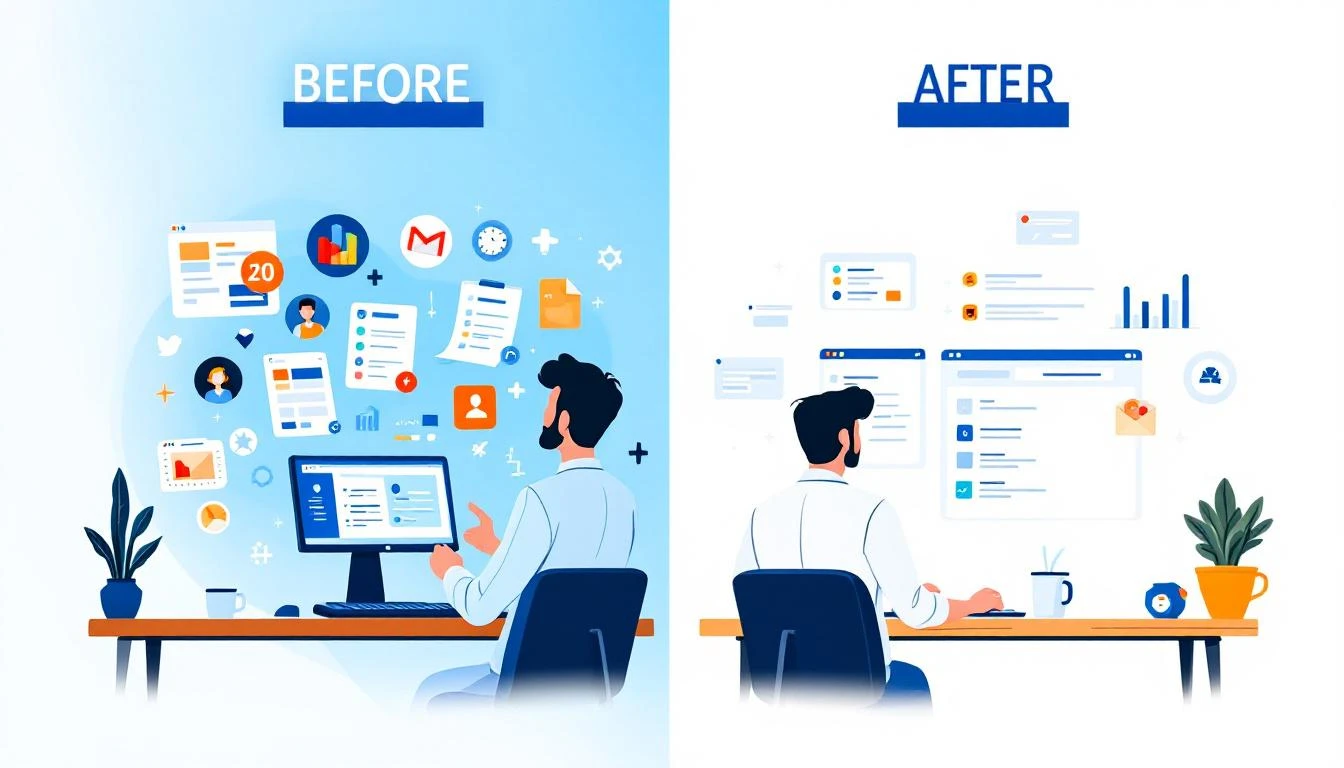
Here's the uncomfortable truth about intent data in 2026: most teams that buy it don't use it well.
They have visitor identification. They have intent signals. They have enrichment tools. And they still take 48+ hours to follow up—if they follow up at all.
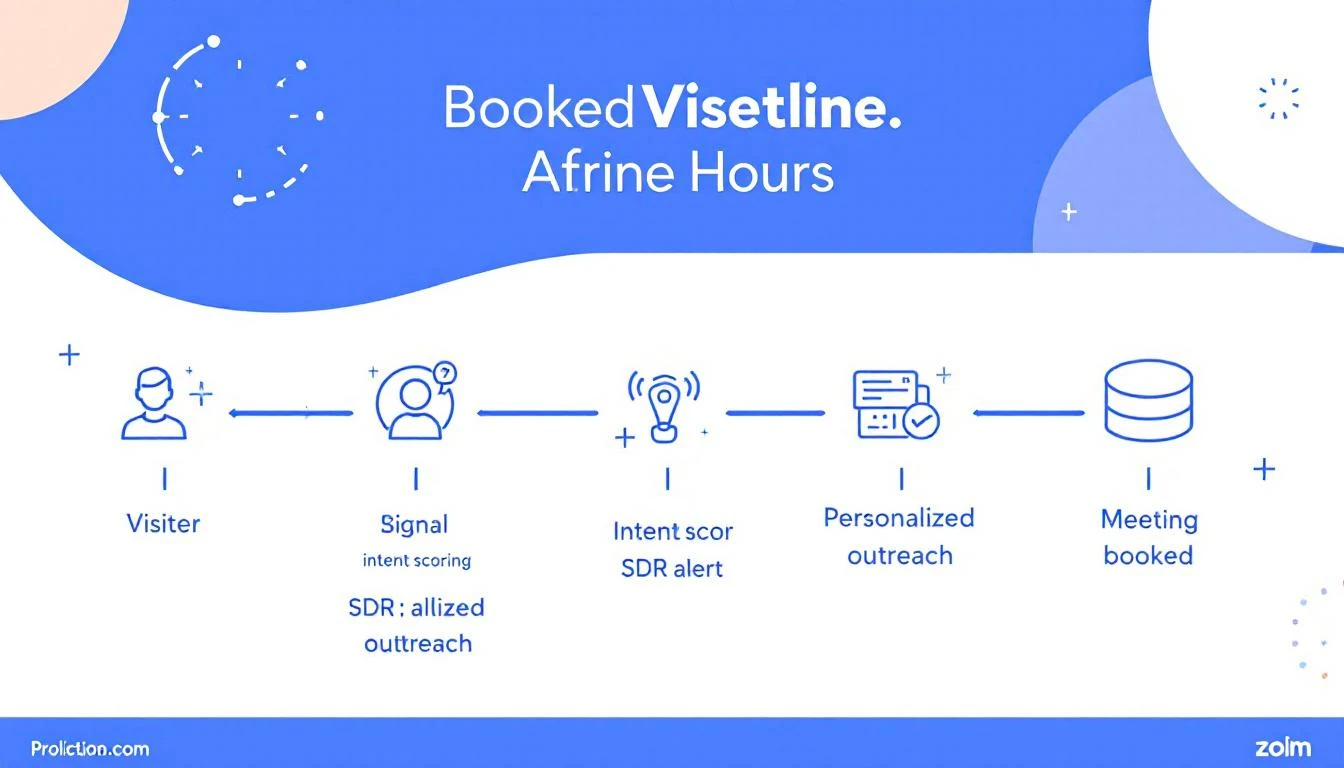
Meanwhile, the teams booking 3-5x more meetings from the same traffic aren't using better data. They're using better workflows. Specifically, they've built a system that moves from signal detection to a booked meeting in under 24 hours.
The data on speed-to-lead is brutal and well-documented:
Responding within 5 minutes makes you 21x more likely to qualify a lead than responding after 30 minutes (InsideSales/XANT research)
78% of B2B buyers purchase from the vendor that responds first (Drift/Salesloft)
After 1 hour, your odds of meaningful contact drop by 10x
After 24 hours, most buying intent has cooled significantly—the prospect has moved on, talked to a competitor, or deprioritized the evaluation
Yet the average B2B company takes 42 hours to respond to an inbound lead. For anonymous visitor signals (which aren't even "leads" in the traditional sense), most companies never respond at all.
This is where most teams already have the tools but lack the filtering logic. You don't need to act on every visitor—you need to act on the right visitors immediately.
What "right" looks like:
Signal Type
Priority
Response Window
Pricing page visit + ICP match
🔴 Critical
Under 1 hour
Multiple page visits in one session
🟠 High
Under 4 hours
Return visitor (2nd+ visit this week)
🟠 High
Under 4 hours
Blog/resource visit + ICP match
🟡 Medium
Same day
Single page bounce
⚪ Low
Nurture sequence
The mistake most teams make: treating all signals equally. A pricing page visit from a VP of Sales at a 200-person SaaS company is not the same as a blog reader from a university. Your system needs to know the difference instantly.
How to set this up:
Configure visitor identification with firmographic filtering—company size, industry, and job title should be immediately visible
Set up real-time alerts for critical signals (pricing page + ICP match should trigger a Slack/Teams notification within minutes)
Auto-enrich identified visitors with company data, recent news, tech stack, and funding info before the SDR even sees the alert
The goal: when your SDR gets the notification, they should have everything they need to personalize outreach in the alert itself. Zero research required.
The SDR who "checks the dashboard when they get around to it" will always lose to the SDR who has a structured morning routine built around intent signals.
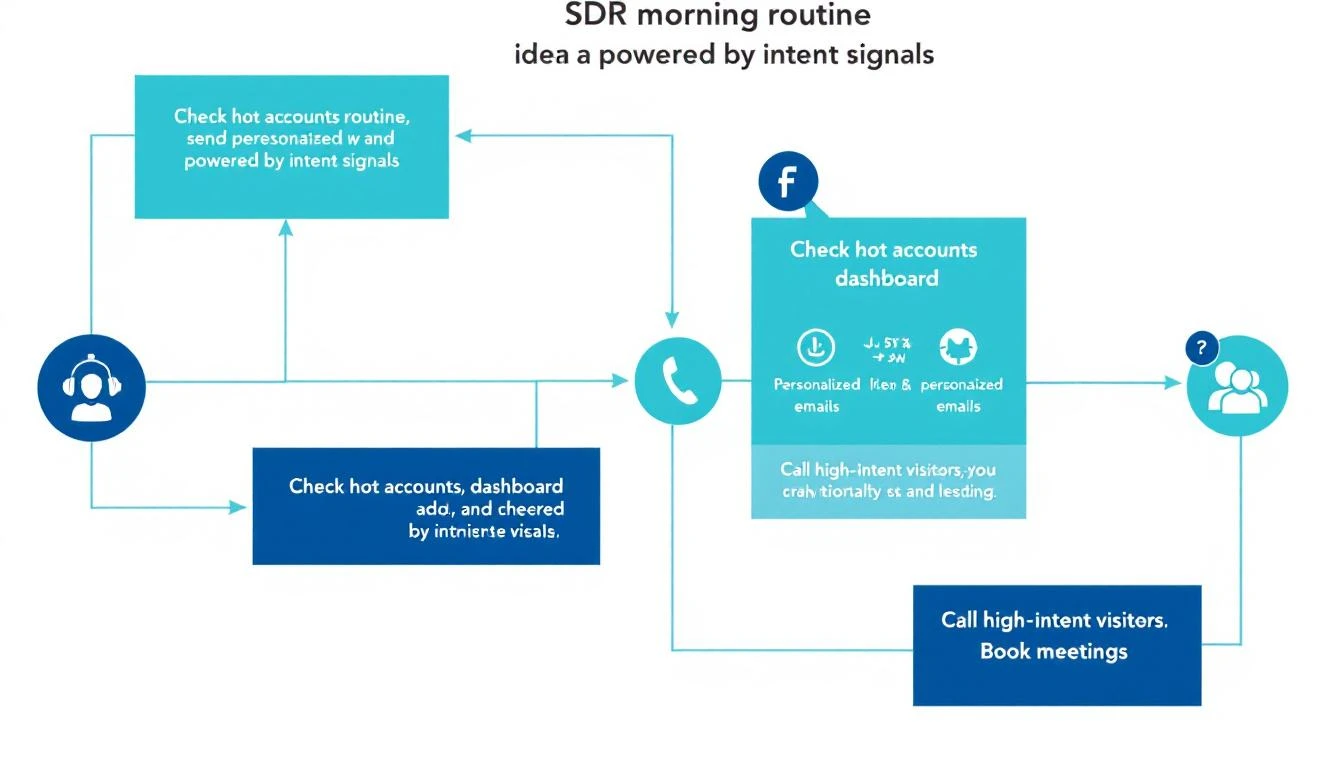
The SDR's First 30 Minutes (Daily Routine):
Open your prioritized queue — not a raw dashboard, but a filtered, ranked list of yesterday's and overnight's high-intent visitors
Review the top 5 accounts — each should show: company name, visitor pages viewed, time on site, firmographic match score, and a suggested talk track
Send personalized outreach to the top 3 — email or LinkedIn, referencing what they were researching (without being creepy about it)
Queue calls for the top 2 — phone is still the fastest path to a meeting for hot signals
Move remaining accounts to automated sequences based on their signal tier
The personalization formula that works:
"Hi {first_name}, I noticed {company_name} has been evaluating {category} solutions. A lot of {industry} teams we work with were dealing with {common pain point}—is that on your radar too?"
Notice what this doesn't say: "I saw you visited our pricing page at 2:47 PM." That's surveillance, not sales. Reference the category and pain point, not the specific behavior.
One email isn't a strategy. The teams converting at the highest rates run a multi-touch sequence within the first 12 hours for critical signals:
Hour 0-1: Personalized email (referencing their research area)
Hour 2-3: LinkedIn connection request with a note (keep it short—compliment something specific about their work)
Hour 4-6: Phone call attempt #1 (leave a voicemail that references the email)
Hour 8-12: Follow-up email with a specific resource relevant to what they were researching
Why multi-touch matters:
Email alone has a 2-5% reply rate
Email + LinkedIn bumps it to 8-12%
Email + LinkedIn + phone pushes it to 15-25% for ICP-matched, high-intent signals
The key insight: each additional channel doesn't just add impressions—it signals seriousness and competence. When a prospect sees your name in their inbox, on LinkedIn, and hears your voice on a voicemail within the same day, you're establishing that you're responsive, professional, and everywhere they need you to be.
By hour 12, you should know which prospects are engaging (opened emails, accepted LinkedIn, visited again) and which went cold.
For engaged prospects:
Send a calendar link with 2-3 specific time slots (not an open calendar—too much friction)
Reference their engagement: "Saw you checked out our case study on {topic}—happy to walk you through how {similar company} got {specific result}. Does Thursday at 2 PM CT work?"
If they visited again after your outreach, call immediately—they're actively evaluating
For cold prospects (no engagement after 12 hours):
Move to a 7-day nurture sequence with value-first content
Set a reminder to re-engage if they visit again (this is where automation earns its keep)
Don't force it—not every signal converts, and that's fine
The math that makes this work:
Let's say your site gets 1,000 B2B visitors per month. With visitor identification at a 20% match rate, that's 200 identified companies. Of those, maybe 40 match your ICP. With the 24-hour framework:
40 ICP-matched signals per month
60% outreach rate (24 contacted per month)
15% meeting conversion rate
= 3-4 new meetings per month from existing traffic alone
That's pipeline from visitors who would have otherwise bounced forever. No ad spend. No cold lists. Just faster execution on signals you're already generating.
The 5 Mistakes That Kill Signal-to-Meeting Velocity
Dashboards are for reporting, not for action. If your SDRs start their day by opening a dashboard and scrolling, you've already lost. They need a prioritized queue that tells them exactly who to contact and in what order.
Every minute an SDR spends researching a prospect is a minute they're not reaching out. Auto-enrichment should deliver company info, recent news, tech stack, funding status, and a suggested talk track before the SDR sees the lead.
MQL gates kill speed. If a VP of Sales at a 300-person SaaS company visits your pricing page, that's a signal worth acting on now—not after marketing scores it, nurtures it, and eventually passes it over in next week's pipeline meeting.
Email-only follow-up is leaving meetings on the table. The data consistently shows that multi-channel sequences (email + LinkedIn + phone) convert 3-5x better than single-channel approaches.
If your SDRs don't report back which signals converted and which didn't, your system never improves. Build a simple closed-loop: signal → outreach → outcome → adjust scoring. Over time, your system gets smarter about which signals actually predict meetings.
1. Signal-to-First-Touch Time
How long between a high-intent signal firing and the SDR's first outreach? Target: under 4 hours for critical signals.
2. Multi-Touch Completion Rate
What percentage of high-priority signals receive the full multi-touch sequence (email + LinkedIn + phone)? Target: 80%+.
3. Signal-to-Meeting Conversion Rate
Of all high-intent signals, how many result in a booked meeting within 7 days? Target: 10-15% for ICP-matched visitors.
4. Pipeline from Signals (Attribution)
How much pipeline can you directly attribute to visitor signals vs. cold outbound vs. inbound forms? This is your ROI metric.
According to HubSpot's 2024 Sales Trends Report, the average sales rep spends just 2 hours per day actually selling. The rest? Data entry. Tab-switching. CRM updates. Research rabbit holes. Meeting scheduling. Admin that never ends.
And the numbers get worse when you zoom out: research from SalesSo shows reps spend only 18-30% of their workday on revenue-generating activities, while administrative tasks consume 41% of their time. The result? 83.4% of SDRs fail to consistently hit quota.
That's not a people problem. That's a workflow problem.
This guide breaks down everything you need to know about SDR automation in 2026: what to automate, what to keep human, how to build the right stack, and how to measure whether it's actually working.
Before we talk solutions, let's quantify the problem.
For an SDR earning $60,000 annually, approximately $22,200 is spent on research time alone, according to MarketsandMarkets research. That's 37% of their salary going toward activities that could be automated or dramatically accelerated.
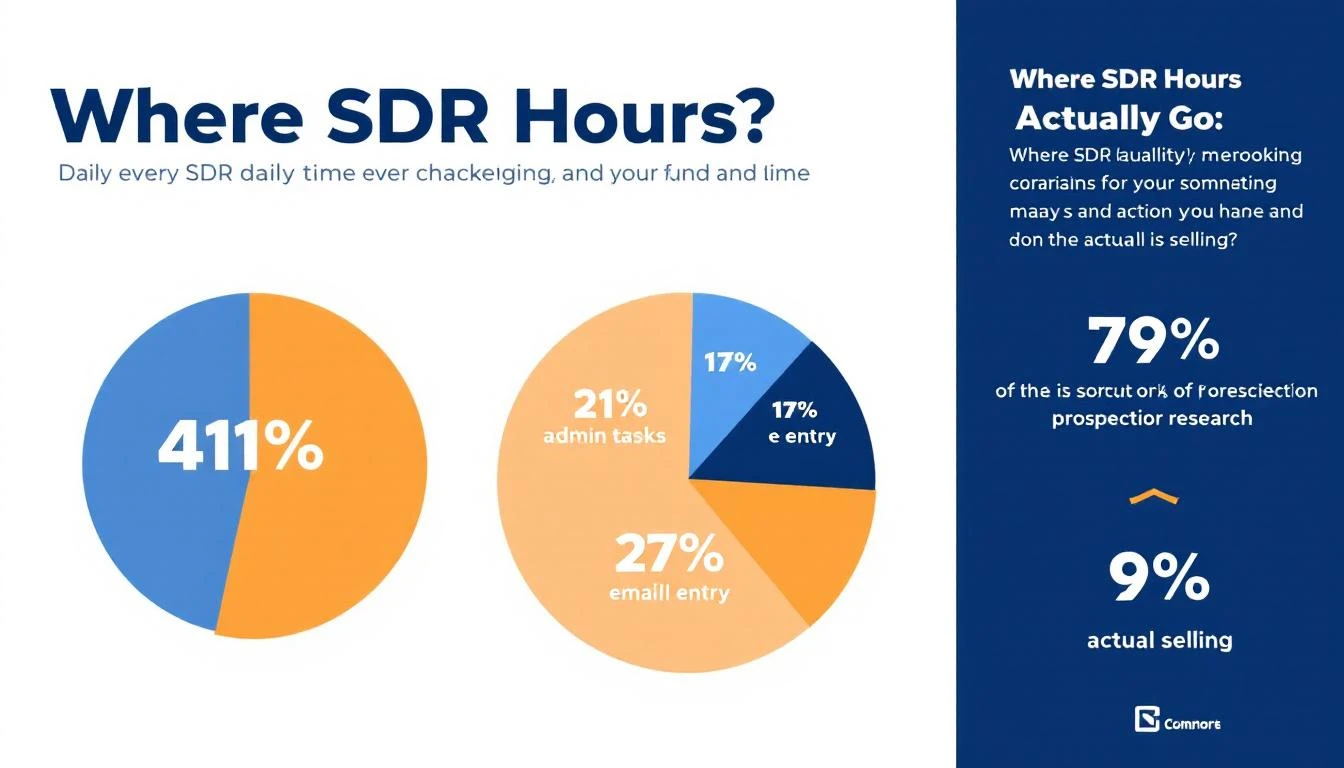
Here's where a typical SDR's 8-hour day actually goes:
Activity
Time
Automatable?
Prospecting research
2.5 hrs
✅ Mostly
Email/message drafting
1.5 hrs
✅ Partially
CRM data entry
1.5 hrs
✅ Fully
Internal meetings
1 hr
❌ Not really
Actual selling (calls, demos, conversations)
1.5 hrs
❌ Keep human
That means roughly 5.5 hours per day are spent on tasks that automation can either eliminate or dramatically reduce. And yet most SDR teams are still running the same manual playbook they used in 2020.
The teams that figure this out first don't just save time—they fundamentally change their unit economics. When your SDRs spend 5 hours selling instead of 1.5, you don't need to hire 3x more reps. You need better workflows.
Here's where most teams get it wrong: they try to automate everything, including the parts that require human judgment. Or they automate the easy stuff (like email sends) while ignoring the high-leverage bottlenecks (like lead prioritization).
1. Lead identification and enrichment
Stop having SDRs manually research companies. Website visitor identification can tell you exactly which companies are on your site. Enrichment tools fill in the contacts, tech stack, and firmographics automatically.
2. Lead scoring and prioritization
Your SDRs shouldn't decide who to call first. A scoring model that weighs intent signals, fit score, and engagement should surface the hottest leads automatically every morning.
3. CRM updates and activity logging
Every minute spent updating Salesforce is a minute not spent selling. Auto-log emails, calls, and meeting notes. Period.
4. Email sequencing and follow-ups
The first touch, the follow-up cadence, the "checking in" emails—these should run on autopilot with well-built sequences. Human reps step in when someone replies.
5. Meeting scheduling
Calendar links, round-robin routing, timezone detection, confirmation emails. All automatable. All still done manually at most companies.
6. Data hygiene
Bounced emails, job changes, company updates. Champion tracking and data validation should run in the background, not eat into selling time.
1. Discovery calls and demos
AI can book the meeting. A human should run it. Buyers still want to talk to someone who understands their problem, asks good follow-up questions, and adapts in real-time.
2. Objection handling on live calls
Nuance matters. A prospect saying "we're not ready" vs. "we're evaluating competitors" requires completely different responses that AI still struggles with in real-time conversation.
3. Strategic account research for enterprise deals
For your top 20 target accounts, you want a human doing deep research—reading 10-Ks, understanding org charts, finding the real pain. Don't automate your most important deals.
4. Relationship building
A personalized LinkedIn message referencing someone's recent podcast appearance can't be templated. The best SDRs earn trust through genuine connection.
Personalized first-touch emails: AI can draft them, but a human should review before sending to high-value prospects. For mid-market and below, AI personalization at scale is increasingly viable.
Call preparation: Automate the research summary, but the rep should actually read it and form their own point of view before dialing.
LinkedIn outreach: Automate connection requests at your peril. Thoughtful, automated follow-up messages after a connection? That works.
This is the foundation. If you're still waiting for form fills to know who's interested, you're seeing maybe 2% of your actual demand. The other 98% visit your site, read your content, and leave without ever raising their hand.
Website visitor identification changes the game by revealing which companies are actively researching you. Combined with enrichment data—contacts, tech stack, revenue, headcount—your SDRs start each day knowing exactly who showed up.
What good looks like:
You know which companies visited your site in the last 24 hours
Each company is automatically matched to contacts in your ICP
Contact data (email, phone, LinkedIn, title) is pre-enriched
Everything flows into your CRM without manual entry
Key metrics: Match rate, enrichment accuracy, time from visit to SDR notification.
Not all leads are equal. A VP of Sales who visited your pricing page three times this week is a fundamentally different prospect than a marketing intern who clicked a blog post once.
The best SDR automation stacks don't just collect these signals—they score and prioritize them into a daily action list that tells reps: call this person first, email this person second, skip this one until next week.
This is where most tools stop. They show you a dashboard of signals and say "figure it out." The playbook approach is different: it turns signals into specific actions. Not "Company X visited your site" but "Call Jane Smith, VP Sales at Company X. She visited the pricing page twice. Here's what to say."
Key metrics: Signal-to-meeting conversion rate, time from signal to first touch, speed to lead.
Day 1: Personalized email referencing their specific signal (site visit, G2 research, etc.)
Day 2: LinkedIn connection request with a brief note
Day 3: Phone call with voicemail drop
Day 5: Follow-up email with relevant case study
Day 8: LinkedIn message referencing the email
Day 12: Final breakup email
The key insight: the sequence should adapt based on engagement. If someone opens email #1 three times but doesn't reply, the system should automatically escalate—move up the call, adjust the messaging angle, maybe trigger a different sequence entirely.
Cold email templates that worked in 2023 are largely dead. Modern outreach needs to reference real context: what the prospect's company is doing, what they researched on your site, what's happening in their industry. That's where AI-powered personalization becomes essential—not to replace the human touch, but to make it scalable.
Key metrics: Reply rate by channel, positive reply rate, meetings booked per sequence.
The question: How do we make sure nothing falls through the cracks?
This is the silent killer of SDR teams. A prospect says "reach out next quarter" and it goes into a mental note that never gets acted on. A demo gets booked but the follow-up email with the case study never sends. A champion changes jobs and nobody notices for three months.
Automated follow-up handles:
Post-meeting sequences: Recap email, case study, ROI calculator—all triggered automatically after a completed call
Re-engagement sequences: Prospects who went dark get a fresh touch after 30, 60, 90 days
Job change alerts: When a champion moves to a new company, your system flags it and creates a new opportunity
Renewal and expansion signals: Existing customers showing research behavior get routed to the right team
The difference between a good SDR and a great one often comes down to follow-up discipline. Automation doesn't make SDRs lazy—it makes the disciplined ones superhuman.
Goal: Know who's on your site and get them into your CRM automatically.
Deploy website visitor identification. This is the single highest-ROI automation move you can make. Overnight, you go from guessing who's interested to knowing exactly which companies visited and what they looked at.
Set up enrichment. Every identified company should automatically resolve to specific contacts with verified email and phone. Your SDRs should never manually look up a prospect's contact info again.
Connect to your CRM. New leads flow in automatically. No CSV exports. No manual entry. Real-time sync.
Expected impact: 10-20 new qualified leads per week that you were previously missing entirely.
Goal: Multi-channel sequences that run themselves until a prospect engages.
Build 3-5 core cadences for different scenarios: warm inbound, cold outbound, re-engagement, event follow-up, champion job change.
Set up email automation with personalization tokens that pull from your enrichment data—not just {First Name}, but references to their industry, tech stack, and recent signals.
Integrate your dialer. Calls should be one-click from the playbook. Call recordings and notes should auto-log to the CRM. Smart dialers with AI-powered voicemail drop save 30+ minutes per day per rep.
Expected impact: 50-70% reduction in time spent on manual outreach setup. Consistent multi-channel coverage for every lead.
Layer in third-party intent data. G2 research, review site activity, competitor keyword searches—these signals tell you who's in-market before they ever visit your site.
Implement signal orchestration to combine first-party and third-party signals into unified priority scores.
Set up A/B testing on email templates, call scripts, and sequence timing. Let the data tell you what works, not gut feel.
Expected impact: Pipeline predictability. You can start forecasting how many meetings next month based on current signal volume and conversion rates.
This is the most important strategic decision you'll make in SDR automation, and it's one most buyers don't even think about.
The Dashboard Approach (most tools): Here's a dashboard with all your signals, leads, and data. Your SDRs log in, interpret the data, decide who to contact, figure out what channel to use, craft the message, and execute. The tool provides information. The SDR provides the judgment.
The Playbook Approach (where the industry is heading): Here's your task list for today, ranked by priority. Call this person—here's why and what to say. Email this person—here's the draft, customized to their signal. Skip this one, they're not ready yet. The tool provides the action. The SDR provides the execution.
The difference sounds subtle but it's massive:
Dashboard approach: SDR opens 6 tabs, spends 20 minutes deciding who to call
Playbook approach: SDR opens one screen, starts calling immediately
Teams using the playbook approach consistently report going from 20 tabs to one task list, with dramatic improvements in both productivity and rep satisfaction.
When you're evaluating SDR automation tools, ask this question: "Does this tool tell my SDRs what to do, or just show them data?" The answer reveals everything.
1. Automating bad processes
If your manual outreach gets 0 replies, automating it just sends 0-reply emails faster. Fix the strategy first.
2. Over-automating personalization
"Hi {First_Name}, I noticed {Company_Name} is in the {Industry} space" is not personalization. It's mail merge with extra steps. Real personalization references specific signals and context.
3. Ignoring data quality
Automation amplifies whatever you feed it. Bad email data = bounced sequences = domain reputation damage = all your emails go to spam. Invest in data hygiene before scale.
4. Building a Frankenstein stack
8 different tools that barely integrate is worse than 1 tool that does 80% of what you need. The trend toward consolidated platforms exists for a reason.
5. Not measuring what matters
If you're celebrating "10,000 emails sent this month" instead of "40 qualified meetings booked," your metrics are broken. Read our SDR metrics guide.
6. Forgetting the human element
The best automation makes your SDRs better, not redundant. If your reps feel like button-pushers, you've automated wrong. The goal is to eliminate busywork so they can focus on what humans do best: build relationships and solve problems.
7. Set-and-forget deployment
SDR automation needs continuous tuning. Sequences that worked last quarter might underperform now. Scoring models drift as your market evolves. Budget time for monthly optimization.
The landscape is shifting fast. Here's what's coming:
AI SDR agents are getting real. Not the "send 10,000 cold emails" kind—the ones that can hold a genuine conversation, qualify in real-time, and book meetings without human intervention. Salesforce, Qualified, and several startups are making progress here. But we're still early. For most teams in 2026, AI augments SDRs rather than replacing them.
Signal quality matters more than signal volume. As more companies deploy intent data, the competitive advantage shifts from "having signals" to "acting on the right signals, faster than anyone else." Signal quality vs. speed is the new battleground.
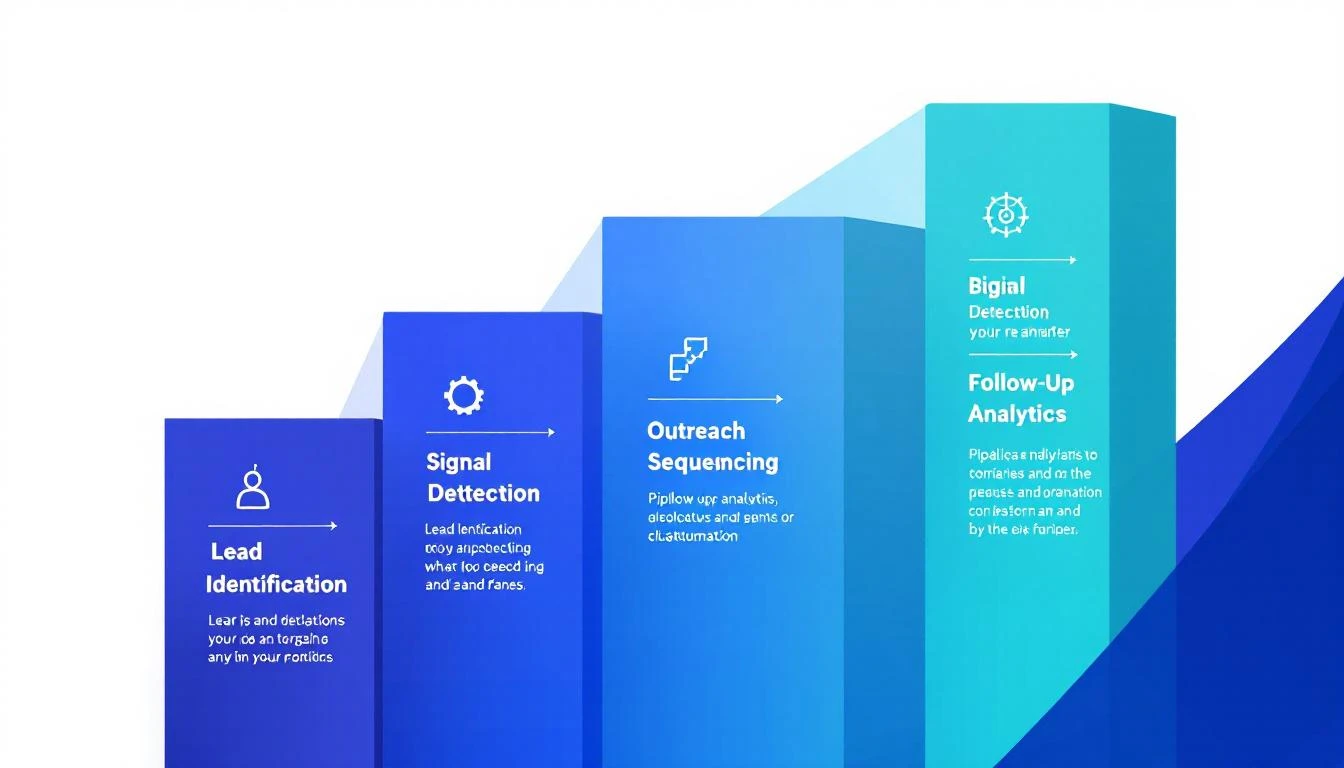
Consolidation is accelerating. The days of stitching together 10 point solutions are ending. Buyers want one platform that handles identification → scoring → outreach → analytics. The GTM agent stack is replacing the GTM tool stack.
Outbound isn't dead—it's evolving. The teams claiming outbound is dead are the ones still doing spray-and-pray. Signal-based, relevant, well-timed outbound is working better than ever. The bar is just higher.
You don't need to automate everything at once. Start here:
Audit your SDRs' time. Have each rep track their activities for one week. The results will shock you (and justify the investment).
Deploy visitor identification. This is the single biggest unlock. You'll immediately see 10-20x more demand than your forms capture.
Build your first automated cadence. Start with your most common scenario—probably warm outbound to identified visitors.
Measure ruthlessly. Meetings booked, speed to lead, pipeline generated. Everything else is noise.
The math is simple: SDRs who spend more time selling book more meetings. Automation is how you get there.
Ready to see what SDR automation looks like in practice?Book a demo → and we'll show you how MarketBetter turns visitor signals into a daily action plan your SDRs will actually use.
Ever wondered what separates top-performing sales teams from the rest? It's rarely just luck or talent. More often than not, it's a sales cadence.
Think of it this way: instead of your reps making random calls and sending sporadic emails, a cadence provides a clear, repeatable playbook. It’s a structured sequence of outreach activities—a mix of calls, emails, and social touches—designed to engage a prospect over a specific period. It’s the difference between guessing what to do next and executing a proven strategy.
Your best sales reps probably already have a personal system. They know just when to follow up, when to switch from email to a phone call, and when to back off. A sales cadence takes that individual expertise, refines it, and turns it into a scalable process that anyone on your team can follow.
Without a structured cadence, your sales development reps (SDRs) are basically flying blind. Every morning, they face the same questions: Who should I call today? Is it too soon to email that person again? This constant decision-making leads to wasted time and, even worse, valuable leads slipping through the cracks. It's a recipe for inconsistent results and rep burnout.
Actionable Comparison:
Without a Cadence: Reps rely on memory and gut feeling. Leads get forgotten, follow-ups are inconsistent, and forecasting is nearly impossible. It's a reactive, high-effort, low-reward system.
With a Cadence: Reps follow a proven, step-by-step process. Every lead receives the right amount of attention, persistence is built-in, and you can predict outcomes. It's a proactive, efficient, high-reward system.
A good cadence isn't a rigid script that kills personalization. It’s a framework that gives reps the confidence to be persistent without feeling like a pest.
So, what does a sales cadence really do? It replaces hope with a plan. We all know that a single touch is rarely enough to book a meeting in B2B sales, yet many reps give up after just one or two attempts.
A well-designed cadence builds persistence directly into the workflow. It ensures every prospect gets the right level of attention, dramatically increasing your odds of connecting at just the right moment. It’s how you systematically earn a conversation.
To put it simply, here are the core pieces that make up a sales cadence.
When you give your team a clear sequence of actions, you free up their mental energy. They stop worrying about the process of outreach and start focusing on the quality of it.
A sales cadence takes the decision fatigue out of prospecting. It lets your reps focus their creativity on personalizing messages and building real rapport, which is where the magic really happens.
This isn't just about making life easier for your SDRs. It’s about building a predictable revenue engine. With a proven cadence, you can accurately forecast how many activities lead to conversations, how many conversations lead to meetings, and how that all translates into pipeline. It’s the foundation for scaling your sales team effectively.
The Building Blocks of a High-Performing Sales Cadence
A great sales cadence isn't just a fancy to-do list. It’s a well-oiled system designed to start real conversations. But to get there, you need to understand what actually goes into one. Mastering these components is what separates the teams booking meetings from the ones just making noise.
The bedrock of any solid cadence is its mix of touchpoints—the different ways you reach out to a prospect. Too many teams lean on email as a crutch, but that's a surefire way to limit your impact.
A truly effective cadence goes multi-channel. It's about intelligently weaving together emails, phone calls, and social media touches (especially on LinkedIn) to connect with people where they actually spend their time. This isn’t about spamming; it's about respecting that modern professionals work across different platforms all day long.
Put a multi-channel cadence up against an email-only sequence, and it's no contest. Relying on email alone is like trying to get someone's attention by whispering in a packed concert hall. You’re fighting for a sliver of attention in an inbox flooded with hundreds of other messages.
A multi-channel approach, on the other hand, gives you more shots on goal. A quick phone call can cut right through the digital clutter. A thoughtful comment on a prospect's LinkedIn post can build rapport before you ever ask for a meeting. This integrated strategy comes across as professional persistence, not pushiness. For example, a well-timed call can be the perfect follow-up to an email you sent—and our guide on writing effective sales call scripts can get you ready for that conversation.
Once you know what you'll do (your touchpoints), you need to figure out when and for how long. Your timing and duration are crucial for building momentum without burning out your prospects.
Timing: This is all about the space you leave between each touch. Hitting them too fast feels aggressive; waiting too long means you’ll be forgotten. The sweet spot is to start with tighter intervals (think 1-2 days apart) to make an initial impact, then gradually space things out.
Duration: This is the total lifespan of the cadence. A warm inbound lead might only need a quick, 10-day sequence. But a cold, high-value account will likely need a more patient 21-day cadence to earn their trust and show your value.
At its core, a sales cadence is a structured workflow built for a specific goal. Understanding the principles of effective workflow management will help you design a sequence that keeps your team on track.
Here’s the final piece of the puzzle, and it's arguably the most important: personalization. Generic, one-size-fits-all messages are dead on arrival. But who has time to manually customize every single touch? The key is to use buyer signals to make your outreach relevant without killing your team's productivity.
A buyer signal is any action a prospect takes that hints at their interest—like visiting your pricing page, downloading a report, or liking one of your company's posts. These are your cues to engage.
Instead of a bland "just checking in" email, you can automate a touchpoint that references what they just did. For instance, if a prospect downloads your case study on manufacturing efficiency, your next email can speak directly to the challenges in that industry. Right away, you've shown you're paying attention and made your message instantly more valuable.
Actionable Tip: Don't wait for a signal. You can create one. For a high-value prospect, spend five minutes on their LinkedIn profile. Find a recent post they commented on or an article they shared. Your opening line is now: "Saw your comment on [Topic] and it got me thinking..." This is infinitely more effective than a generic intro.
Theory is great, but it’s time to get our hands dirty. The real magic of a sales cadence happens when you move from concept to execution. To help you do just that, I've laid out three proven, real-world templates that you can grab and adapt for your B2B team right away.
Think of these as different plays in your sales playbook. You wouldn’t run the same play for every situation on the field, and you shouldn't use the same cadence for every type of lead. Each template is built for a specific scenario, showing how to tweak your timing, tone, and touchpoints based on who you're talking to.
Before we dive in, this visual breaks down the core building blocks you'll be working with—the touchpoints, the timing between them, and the overall duration. A great cadence is a well-choreographed dance, not just a random list of to-dos.
As you can see, it's all about creating a rhythm that combines different channels over a set period to stay top of mind without being annoying.
Template 1: The Inbound Lead Cadence (Speed & Service)
When a warm, inbound lead requests a demo or downloads a guide, the clock starts ticking. They've raised their hand and are expecting a fast, helpful response. This 10-day cadence is assertive but focused on service.
Duration: 10 Days
Total Touches: 8
Goal: Book that discovery call or demo while their interest is high.
Day 1 (AM): Personalized Email. Send an email that directly references their action. "Thanks for downloading our guide on..." shows you're paying attention. End with a simple, clear CTA to book a quick chat.
Day 1 (PM): Phone Call. If the email doesn't get a response, a call later that day shows you're eager to connect. Leave a voicemail that points back to the email you sent.
Day 3: LinkedIn Connection Request. Put a face to the name. Send a connection request with a short note like, "Saw you downloaded our guide—wanted to connect." It's a low-pressure way to open another line of communication.
Day 5: Follow-up Email with Value. Don't just ask for something; give something. Send a related case study or blog post that helps them even more. You're building trust by being a resource.
Day 7: Phone Call. Try them again. They might have been busy before. If you hit voicemail, mention the helpful resource you sent over on Day 5.
Day 8: LinkedIn Message. Pop into their DMs or, even better, comment on a recent post they shared. This shows you’re engaged with their world.
Day 10: Final "Breakup" Email. Politely close the loop. Let them know you won't be reaching out anymore but the door is always open. This often prompts a response from prospects who were interested but busy.
Template 2: The High-Value Outbound Cadence (Patience & Personalization)
When you're targeting big, strategic accounts, you need to play the long game. This isn't about speed; it's about patience, personalization, and earning credibility. This 21-day cadence is designed to demonstrate deep relevance before you ever ask for a meeting.
Duration: 21 Days
Total Touches: 12
Goal: Secure an introductory meeting with a key decision-maker.
Day 1: LinkedIn Profile View & Engagement. The first move is subtle. View their profile. Maybe like or comment on one of their posts. It’s a no-pressure way to get on their radar.
Day 3: Highly Personalized Email. This email needs to prove you've done your homework. Reference a company announcement, a quote from an article they wrote, or a specific project they're working on. For great ideas, check out our guide on writing effective cold email templates.
Day 5: Phone Call. The goal of this first call isn’t to book a meeting. It’s simply to introduce yourself and mention the email you sent, adding a human touch to your outreach.
Day 8: Email with Industry Insight. Send them something genuinely useful and ungated—a report or an article about a big trend in their industry. Position yourself as an expert, not just a seller.
Day 11: LinkedIn Message. Follow up on your last email. A quick message asking for their take on the insight you shared can spark a great conversation.
Day 14: Phone Call & Voicemail. Your second call can be a bit more direct. The voicemail should clearly and concisely state the value you believe you can offer their company.
Day 18: Personalized Video Email. A short, 60-second video of you talking directly to them can cut through the noise like nothing else. Briefly re-introduce yourself and connect your solution to a specific goal you know their company has.
Day 21: Final Call & Email. One last, direct attempt to connect. The ask is clear: a 15-minute meeting to share a specific idea you have for them.
Template 3: The Post-Event Follow-Up Cadence (Context & Speed)
You met someone at a conference or a webinar. You had a great chat. Now what? The window of opportunity is small, and you have to act before the memory of your conversation fades. This quick, 7-day cadence is designed to do exactly that.
The primary goal here is to bridge the gap between a casual event conversation and a formal business discussion. Context is everything; your outreach must immediately reference where and how you met.
Duration: 7 Days
Total Touches: 5
Goal: Turn that hallway chat into a scheduled follow-up call.
Day 1: Personalized Email. This has to go out within 24 hours. Reference your conversation, mention something specific you talked about to jog their memory, and propose the next step.
Day 2: LinkedIn Connection Request. Send a simple connection request with a note: "Great chatting with you at [Event Name] yesterday!"
Day 4: Follow-up Email. No response? Don't start over. Just forward your original email with a simple bump: "Hey, just wanted to bring this to the top of your inbox."
Day 5: Phone Call. A quick call to try and connect live. Again, lead by referencing the event where you met.
Day 7: Final Email. One last, polite attempt. Let them know you'd still love to connect when things free up and that you'll be in touch down the road.
How to Build Your First Sales Cadence Step-by-Step
Building a sales cadence from scratch can feel like a massive undertaking. But it doesn't have to be. Think of it less like composing a symphony and more like following a recipe—if you take it one step at a time, you'll end up with something that just works.
Let's walk through a simple, five-step framework. Each step builds on the one before it, helping you create a sequence that’s both effective and something your team can actually execute consistently. Let's get building.
Before you write a single email or pick up the phone, you need to know exactly what you're trying to accomplish. A cadence without a clear goal is like a road trip with no destination. You'll definitely be busy, but you won't get anywhere useful.
Your goal needs to be specific and measurable. Is the point to book a demo? Get a reply to warm up a cold lead? Drive webinar sign-ups? Each objective demands a totally different playbook.
Goal Comparison: A cadence aimed at booking a meeting will be direct, confident, and include a clear ask for their time. On the other hand, a sequence designed to re-engage a dormant lead might have a softer goal, like getting them to download a new report to start the conversation again.
Pick one primary objective and stick with it. For most B2B sales teams, the end game is simple: book a qualified meeting. That clarity will be your north star for every other decision you make.
You can't start a real conversation if you don't know who you're talking to. Your Ideal Customer Persona (ICP) is the bedrock of your messaging. Sending a generic cadence to everyone is a surefire way to get ignored; a tailored one gets replies.
Go deeper than just job titles and company size. What are their biggest headaches? What does a "win" look like for them? Where do they hang out online to find information?
Your cadence's success hinges on relevance. A CFO cares about ROI and managing risk. A Head of Marketing is thinking about lead gen and brand awareness. You have to speak their language.
Actionable Tip: Create a simple persona doc with three key sections: Pains (what problems keep them up at night?), Gains (what does success look like in their role?), and Channels (where are they active—LinkedIn, specific forums, trade publications?). Use this document as a cheat sheet when writing your messaging.
Next, you have to decide how you're going to reach your prospects. Relying only on email is one of the most common mistakes in sales development. Inboxes are overflowing, so a multi-channel approach isn't a luxury anymore—it's essential. The best cadences mix and match touches across a few key platforms.
The main channels for most B2B sales cadences are:
Email: Still the workhorse of most sequences, perfect for sending detailed info.
Phone Calls: The most direct way to cut through the noise and have a human conversation.
LinkedIn: Great for research, social proof, and more casual connection requests or messages.
Video Messages: A fantastic way to stand out, show you're a real person, and add a personal touch.
A high-value outbound cadence might be something like 40% phone calls, 40% email, and 20% LinkedIn to show you're putting in the effort. An inbound cadence for a younger, tech-focused audience might be 50% email, 30% LinkedIn, and 20% automated in-app prompts. Your persona research from Step 2 should guide this mix.
With your goal, persona, and channels locked in, it's time to map out the entire journey. This is where you design the day-by-day playbook your reps will follow. You need to decide on three critical components:
Sequence: The specific order of your touchpoints (e.g., Email on Day 1, Call on Day 3, LinkedIn message on Day 4).
Timing: The number of days you wait between each touch (e.g., 2 days between the first two steps).
Duration: The total length of the cadence from the first touch to the last (e.g., 21 days).
A good rule of thumb is to start with shorter intervals (1-2 days apart) to build momentum, then slowly increase the time between touches as you go. Research consistently shows it takes an average of 8 touches to get that first meeting, so don't give up too early. A cadence lasting 17-21 days with 8-12 touches is a proven sweet spot for getting results.
This is the final—and most important—piece of the puzzle. You have to actually write the content for each email, create the talk track for each call, and draft the text for each social message. This is where so many teams fall flat by sounding like generic marketing robots.
Remember, the goal is to start a conversation, not just broadcast your pitch.
Focus on them, not you. Instead of "We provide industry-leading solutions for X," try "I saw your team is focused on Y; have you thought about how to solve Z?"
Provide value every single time. Each touchpoint should offer a tiny nugget of insight, a helpful link, or a thought-provoking question.
Keep it short and scannable. Nobody has time to read a wall of text. Get to the point fast and make your ask crystal clear.
Actionable tip: An execution platform like MarketBetter.ai can help operationalize all of this. It can generate context-aware drafts for your emails and even suggest talk tracks for calls, making sure your messaging is personalized without adding hours of manual work. This is how you ensure your team can run a high-quality cadence at scale, right from inside their CRM.
Think your sales cadence is finished once you’ve built it? Think again. The best sales teams treat their cadences not as static documents, but as living, breathing playbooks. They’re constantly being tweaked, tested, and refined. This commitment to continuous improvement is what separates the teams that consistently crush their numbers from the ones that just stay busy.
So, how do you go from just running a cadence to actively improving it? The answer is simple: you start measuring what truly matters and then have the discipline to act on what the data tells you. This isn't about gut feelings or guesswork; it’s about making deliberate, data-backed decisions that actually move the needle.
Before you can fix anything, you have to know what might be broken. This means getting laser-focused on a few key performance indicators (KPIs) that give you a clear, honest picture of what’s working and what’s falling flat.
You can drown in data, so narrow your focus to these essentials:
Email Reply Rate: What percentage of prospects are actually hitting "reply"? If this number is in the basement, your subject lines or message body probably aren't resonating.
Call Connection Rate: How many of your calls connect with a real human being? A low connection rate is a huge red flag for your call timing, the phone numbers you’re using, or your data quality in general.
Meetings Booked Per Cadence: This is the bottom line. How many completed cadences does it take to get one qualified meeting on the calendar? This KPI ties your team's daily grind directly to pipeline generation.
These metrics are the bedrock of your optimization efforts. They tell you exactly where the leaks are in your process. For a much deeper look into the numbers that count, check out our complete guide to SDR metrics and KPIs.
Once you have your baseline numbers, the real fun begins. It's time to start experimenting. A/B testing is a straightforward but incredibly powerful way to pit one version of an outreach element against another to see which one performs better. This is how you stop guessing and start knowing what really works.
Think of your cadence as a recipe. A/B testing is like trying two different seasonings to see which one gets you invited back for dinner.
The golden rule of A/B testing is to only change one variable at a time. If you change both the subject line and the call-to-action, you'll never know which change truly made the difference.
Here’s a look at how you can apply this to your daily outreach:
Element to Test
Version A (Control)
Version B (Variant)
What It Tells You
Email Subject Line
"Idea for [Company Name]"
"Question about your Q3 goals"
Which style of subject line sparks more curiosity and drives higher open rates.
Call-to-Action
"Let me know if you're free for a 15-minute call next week."
"Are you open to a brief chat on Tuesday to discuss this further?"
Which CTA is clearer and more effective at converting interest into a booked meeting.
Voicemail Script
A detailed voicemail explaining your product's value proposition.
A short, simple voicemail referencing an email you just sent.
Which approach is more likely to earn a call back or prompt the prospect to check their inbox.
By methodically testing these small changes, you can rack up some surprisingly significant gains over time.
Here’s the hard truth: all of this measuring and testing is completely useless without one thing—clean, accurate data. If your reps aren't logging every single call, email, and social touch, you're making decisions in the dark. This is exactly where most optimization plans fall apart.
Comparison:
Manual Logging: Reps spend valuable time on data entry, data is often incomplete or inaccurate, and managers can't trust the reports.
Automated Logging: Reps focus 100% on selling, data is perfectly clean and real-time, and managers can make smart decisions based on reliable insights.
Let’s be honest, manually logging every activity is tedious, mind-numbing, and a recipe for errors. That’s why automated CRM logging is non-negotiable for any team that’s serious about getting better. When every touchpoint is captured automatically, you can finally trust the numbers. This clean data becomes the fuel for making smart, informed adjustments to your sales cadence, ensuring your improvements are based on reality, not assumptions.
Even the most carefully designed sales cadence can fall flat. When your reps are grinding away but the pipeline is dry, it’s usually not for a lack of effort. It’s often because a few common, avoidable mistakes have quietly derailed their strategy.
The good news? These errors are easy to identify once you know what to look for. By steering clear of these pitfalls, you can get your outreach back on track and start booking more meetings. Let's dig into the most common cadence killers and how to fix them.
This is the number one reason prospects hit "delete." When an email feels like it was written by a machine for a list of thousands, you’ve already lost. People can spot a generic, self-serving template from a mile away.
This happens when teams get so focused on volume that they forget there’s a human on the other end. That lack of effort communicates one thing: you don’t really care about their business, only yours. That's no way to start a relationship.
The Actionable Fix:
Personalize, but do it at scale. Find one relevant detail you can use across multiple touchpoints. Think of it as "one-to-many" personalization.
Bad: "I saw you're a Director at [Company Name] and I wanted to reach out."
Good: "I noticed your team's new report on supply chain efficiency. We recently helped a similar company solve that exact problem, and it sparked an idea I think you'll find valuable."
That small bit of context shows you've done your homework, instantly setting you apart from the noise.
Most reps throw in the towel way too early. Here's a hard truth: it takes an average of 8 touches to get a meeting, but most reps give up after just two or three tries. If a prospect doesn't reply to your first email, it doesn't mean they're not interested. It just means they're busy.
Stopping too soon means you're leaving money on the table. You're forfeiting opportunities simply because your process lacked the persistence to cut through the noise.
The Actionable Fix:
Build that persistence directly into your cadence. A solid cadence should run for about 17-21 days and include 8-12 touchpoints. This isn't about being annoying; it's about being professionally persistent until you connect at the right time.
Don’t mistake silence for a "no." In B2B sales, silence is usually just silence. A great cadence is the system that turns that silence into a conversation.
Another classic mistake is putting all your eggs in the email basket. Prospects' inboxes are a warzone. Relying only on email is like trying to whisper in a crowded stadium—your message is going to get lost.
A single-channel approach is easy for a busy person to ignore. But when you show up on multiple channels, you demonstrate professional follow-through and meet them where they're most active.
The Actionable Fix:
Vary your outreach methods. A proven mix is to distribute your touches across a few key channels:
40% Email: Perfect for detailed messages and sharing content.
30% Phone Calls: Nothing cuts through the digital clutter like a real conversation.
20% LinkedIn: Great for research, social selling, and more casual touchpoints.
This multi-pronged approach dramatically increases your chances of making a connection.
You can't improve what you don't measure. The final mistake that poisons your results is messy data. If reps aren't logging every call, email, and social touch in the CRM, you’re flying blind. You have no real idea what’s actually working and what's a waste of time.
Let's be honest, reps hate manual data entry. It’s tedious and easy to forget, which means it often doesn't get done. This leaves managers making critical strategy decisions based on guesswork instead of facts.
The Actionable Fix:
Stop relying on manual entry and automate activity logging. An execution-first tool like MarketBetter.ai works right inside Salesforce or HubSpot to automatically log every touch. This keeps your data perfectly clean and gives you the clear insights you need to optimize your cadences for real results.
Even with the best game plan, you're bound to have questions when you start building out a new sales cadence. Let's tackle some of the most common ones I hear from sales teams.
There’s no perfect number that fits every situation, but a good starting range is 8 to 12 touches. The real mistake isn't having too many touches, it's giving up too soon. Most reps stop after just two or three tries, leaving opportunities on the table. The right number depends on who you're contacting.
Warm Inbound Leads: They know you, so you can be more direct. A shorter, 7-10 day cadence with about 8 touches is often enough.
Cold Outbound Prospects: You're building a relationship from scratch. You'll need a more patient approach, something like 12-16 touches spread over 3-4 weeks to build familiarity and earn trust.
What Is the Difference Between a Sales Cadence and a Sequence?
People often use these terms interchangeably, but there's an important difference based on the channels you use.
A sequence is typically an automated, email-only series of messages. A sales cadence is a more holistic, multi-channel playbook that strategically combines emails, phone calls, LinkedIn messages, and even video.
Comparison: Think of a sequence as a single instrument, like a guitar. It can make music, but it's limited. A cadence is the entire band—guitar, drums, bass, vocals—all working together. For complex B2B sales, you almost always want the full band to create a richer, more effective sound.
The temptation to automate everything is strong, but 100% automation is a recipe for being ignored. It removes the human touch that is essential for building a genuine connection.
The sweet spot is a smart blend of automation and human effort.
Automate this: Scheduling tasks, logging activities, and generating first drafts of emails.
Keep this human: The final personalization of an email, the actual phone call, and thoughtful engagement on social media.
This combination of robotic efficiency and human authenticity is what drives real results.
Ready to put your sales cadences into action without all the manual busywork? MarketBetter.ai is an AI-powered SDR task engine that turns buyer signals into a prioritized to-do list for your reps. It helps them execute flawlessly with AI-assisted emails and a dialer, all living right inside Salesforce and HubSpot. Stop guessing and start selling at https://www.marketbetter.ai.
At its core, sales lead generation is the engine of your sales machine. It’s the entire process you build to find and attract potential customers, with the ultimate goal of turning their initial interest into a closed deal. This isn't just about finding names; it's about creating a predictable flow of qualified opportunities for your team.
The game has changed. The old playbook of building static prospect lists and blasting them with generic outreach just doesn't cut it anymore. Winning in 2026 comes down to two things: speed and relevance. It’s no longer enough to find leads. You have to build a system that engages the right person at the exact moment they’re ready to talk.
This is where the 'first-to-respond' principle becomes your biggest competitive advantage. Today’s buyers do their own research and move fast. The vendor who shows up first to answer their questions is the one who usually wins.
You can't overstate how much response time affects your chances of winning a deal. When a prospect signals interest—maybe they visit your pricing page, download a whitepaper, or click an ad—a stopwatch starts. And it’s ticking fast.
The data is pretty staggering. Responding to a new lead within 5 minutes can boost your contact rates by an incredible 900%. What’s more, 78% of buyers will end up going with the company that responded to their inquiry first. This means your sales development team needs a rock-solid process for acting on these buying signals the second they appear. If you want to dig deeper, you can explore more data on how speed impacts sales success.
Actionable Comparison: The old model of sales lead generation was like fishing with a static net, hoping prospects would swim into it. The new reality is more like precision hunting, where you detect movement and react instantly with the right tools.
Of course, knowing you need to be fast and actually being fast are two different things. This new reality creates some serious hurdles for most sales teams.
Even when buyer intent is crystal clear, many sales development representatives (SDRs) are stuck in neutral. They get bogged down by the same frustrating obstacles that kill momentum and let good leads go cold:
Administrative Overload: Reps burn hours just jumping between their CRM, email, phone dialer, and various research tools. All that context-switching is time they aren't spending selling.
Inconsistent Outreach: Without a clear, unified workflow, the quality of outreach is all over the place. One rep's messaging is sharp, another's is off-brand, and the buyer gets a confusing, disjointed experience.
Manual Task Management: Figuring out who to call next, what to say, and when to follow up becomes a manual guessing game. Great opportunities inevitably fall through the cracks.
To break this cycle, you need a different kind of operational backbone—what you might call a 'task engine' built for pure execution. This is where platforms like marketbetter.ai come in. They act as the bridge, taking those fleeting buyer intent signals and instantly turning them into a prioritized to-do list for your SDRs. This is how you move from reactive chaos to proactive, intelligent outreach—and it’s the foundation for everything we'll cover next.
Think of your lead generation strategy like a fishing expedition. You wouldn't use a massive deep-sea net in a tiny creek, and you wouldn't try to catch a specific trophy fish with a worm on a hook. The tools and techniques you use have to match the fish you're after, the water you're in, and how much time you have.
Your approach to finding B2B leads is no different. We'll break down the three core models: Inbound, Outbound, and the game-changing Intent-Driven approach. Understanding how they operate—and how they can work together—is your first real step toward building a pipeline you can count on.
Inbound is all about attracting customers to your front door. You put valuable, helpful content out into the world, and it draws the right people to you naturally. This is your wide-net strategy; you create a strong presence in a productive part of the ocean and let interested prospects swim right in.
This is a long game, for sure. It’s about building brand authority and earning trust, which doesn't happen overnight. But once you get an inbound machine humming, it can become an incredible, self-sustaining source of high-quality leads. A crucial piece is making it incredibly easy for those prospects to take the next step. Looking at high-converting lead generation form examples is a great way to see what works for capturing that interest effectively.
Actionable Inbound Tactics:
Content Marketing: Publish blog posts, whitepapers, and guides that solve a specific problem for your target audience. Action Step: Survey your existing customers about their biggest challenges and build your content calendar around those themes.
Search Engine Optimization (SEO): Getting your website to the top of Google for the terms your prospects are searching for. If they can't find you, you don't exist.
Social Media: Build a community and share your content where your audience already spends their time. Action Step: Identify the top 3 LinkedIn groups or online forums where your ideal customer hangs out and start by answering questions, not pitching.
On the flip side, you have outbound. This is a direct, proactive hunt. Instead of waiting for leads to find you, your sales team goes out and finds them. This is spear fishing—you identify a very specific, high-value target and go right after it with precision.
Outbound is often the quickest way to get some runs on the board, especially if you're a new company or breaking into a new market. You have total control over who you're talking to, making it perfect for targeting accounts that fit your Ideal Customer Profile (ICP). The catch? It demands real skill and personalization. A generic, mass-sent email is the equivalent of throwing your spear into an empty patch of water and hoping for the best.
Actionable Tip: Never send a "just checking in" email. Use an AI-powered tool to find a trigger event—a recent funding round, a new executive hire, a major company announcement—and lead with that in your outreach. It instantly shows you've done your homework and aren't just spamming them.
Now, this is where things get really interesting. The intent-driven approach focuses on prospects who are already showing you they're in the market. It’s like spotting a school of fish literally jumping out of the water. These people are actively researching solutions, visiting your competitors' pricing pages, or searching for highly specific keywords.
This model combines the best of both worlds. You use data to pinpoint these motivated buyers and then deploy targeted, outbound-style tactics to engage them at the perfect moment. This is precisely where tools like the SDR Task Inbox from marketbetter.ai are so critical. They turn those faint signals into concrete tasks, empowering your team to act within minutes, not days.
Comparing Inbound vs Outbound vs Intent-Driven Strategies
So, which one is right for you? The honest answer is that the most successful go-to-market teams don't just pick one; they build a system that blends all three. A startup might lean heavily on outbound to land its first 10 customers, while a market leader can rely on its massive inbound engine.
This table breaks down the core differences to help you decide on the right mix for your team's goals and resources.
Strategy
Methodology
Best For
Pros
Cons
Inbound
Attract leads with valuable content and SEO
Building long-term brand authority and a scalable lead flow
High-quality, educated leads; builds trust; cost-effective over time
Slow to start; requires significant content creation resources
Outbound
Proactively target and contact ideal customer profiles
Fast results; market testing; targeting specific, high-value accounts
Predictable and controllable; immediate feedback loop
Can be perceived as intrusive; lower response rates without personalization
Intent-Driven
Engage prospects who are actively showing buying signals
Capitalizing on timely opportunities and high-intent buyers
Extremely high conversion potential; hyper-relevant outreach
Requires intent data tools; can be more expensive; needs a rapid response process
Ultimately, understanding these models is the foundation. A strong inbound presence fills the top of your funnel, a sharp outbound motion allows you to target dream accounts, and an intent-driven layer ensures you never miss a buyer who's ready to talk right now.
How to Build a Modern SDR Workflow That Actually Works
Having a great strategy is one thing, but turning it into results on the ground requires a solid, repeatable workflow. For Sales Development Representatives (SDRs), their daily process is what separates hitting quota from total burnout. An effective workflow for sales lead generation isn’t about working harder; it’s about focusing your team’s energy where it truly matters.
Unfortunately, I see too many sales teams stuck in the past. The "old way" is a frustrating grind of manual tasks and disconnected tools that just kills momentum. Reps waste hours bouncing between their CRM, LinkedIn, a separate dialer, and their email inbox. All that context switching is a massive productivity drain, which leads to sloppy CRM data and, you guessed it, missed opportunities.
The traditional SDR workflow is reactive and painfully inefficient. A rep starts their day by staring at a static list in Salesforce, randomly picks a name, and then opens five more browser tabs to piece together who the person is and what their company does. By the time they’ve found a tidbit of information, written a semi-personalized email, and logged the activity, a huge chunk of their morning is gone.
The modern workflow, on the other hand, is proactive, integrated, and built for speed. It completely flips the script.
The Old Way (Manual & Fragmented)
The New Way (Automated & Integrated)
Manual Lead Research: SDRs burn hours hunting for trigger events or contact details.
Automated Signal Detection: The system flags high-intent signals for you.
Guesswork Prioritization: Reps decide who to call next based on gut feelings or just going down a list.
Automated Task Prioritization: Tasks are created and ranked based on real data and buying intent.
Disconnected Tooling: Juggling a CRM, dialer, email, and research tabs is the daily reality.
Integrated Execution: All actions—calling, emailing, researching—happen in one unified workspace.
Inconsistent Logging: Manually tracking activities leads to messy data and useless reports.
Automatic Logging: Every touchpoint is logged to the CRM automatically, keeping your data clean.
This shift takes the SDR role from being a glorified data-entry clerk to a strategic operator focused on having high-value conversations.
A truly modern workflow isn't random; it follows a logical, automated sequence. This process ensures every action a rep takes is timely, relevant, and directly connected to a real buying signal. That alone dramatically improves the odds of successful sales lead generation.
This visual breaks down the ideal flow, moving from casting a wide net to targeting the right accounts and engaging them at the perfect moment.
This process shows how modern lead generation funnels broad attraction into precise, high-intent engagement—the very heart of an effective SDR workflow.
Actionable Takeaway: The core principle is simple: convert buying signals into a prioritized to-do list. The system should tell the SDR what to do next, not the other way around.
Platforms like the MarketBetter.ai SDR Task Inbox are built to make this happen. They act as a central command center where signals from different sources—like someone visiting your pricing page or downloading a whitepaper—are automatically converted into prioritized tasks right inside your CRM, whether it's Salesforce or HubSpot. This eliminates the guesswork and administrative drag that slows reps down.
The good news is that AI and automation are fundamentally reshaping how sales teams work. The right tools can slash research time by 50% and have been shown to improve response rates by up to 300% by enabling personalization at scale. The winning formula is human-AI collaboration: let automation handle the grunt work, and free up your reps to focus on creativity, strategy, and building relationships. If you want to dive deeper into the numbers behind this shift, you can discover more insights on emerging lead generation trends here.
This new approach puts your SDRs back in control, letting them do what they do best: connecting with people and filling the pipeline. By embracing an integrated, signal-based workflow, you give your team the tools they need to win.
Let’s be honest. In a world drowning in automated noise, the single biggest hurdle in sales lead generation is simply getting someone to reply. Prospects' inboxes and voicemails are under constant attack, and generic outreach gets deleted in the blink of an eye. This is where a lot of sales teams get nervous, worrying that using AI will just make their messages sound even more robotic and out of touch.
But here's the secret: the goal isn't to avoid automation. It's to use it for surgical precision, not for carpet bombing. A smart, modern outreach strategy throws out the tired, old templates. Instead, it focuses on short, relevant, and context-aware messages that respect a prospect’s time and intelligence.
Most cold emails are dead on arrival because they're selfish and lazy. They drone on about the sender's product without giving a single thought to the recipient's world. A powerful email, on the other hand, is built on a simple three-part framework that immediately signals you've done your homework.
The structure is refreshingly straightforward:
Observation: Kick things off with a specific, recent, and relevant trigger. This is your "why I'm reaching out now."
Value Proposition: Connect that observation directly to a problem you can help them solve.
Call-to-Action (CTA): Suggest a clear, low-effort next step.
This simple shift turns your email from an annoying interruption into a timely, and potentially helpful, suggestion. Getting this right is a game-changer, and a big part of it is mastering the fundamentals of the cold email itself. If you're looking to go deeper on this, you can check out our guide on cold email outreach.
Let's make this real. Say you're selling a project management tool and you notice a target company just announced a major expansion.
Before (Generic & Doomed to Fail):
Subject: Boost Your Team's Productivity
Hi Jane,
I’m John from ProjectFlow. We offer a best-in-class project management solution that helps teams like yours improve efficiency.
Can we schedule a 15-minute demo next week?
This email is all about John and his product. It’s generic, offers zero specific value, and gives Jane no reason to care. Delete.
After (Observation -> Value Prop -> CTA):
Subject: Your recent expansion plans
Hi Jane,
Saw the news about your plans to double the engineering team in Q3. Managing that kind of rapid growth without clear project visibility can often lead to missed deadlines.
Our platform is built to help scaling teams keep complex projects on track as they grow.
Worth a brief chat to see if this is a priority for you?
See the difference? This version is about Jane's world. It uses a real observation (the expansion) to tee up a relevant problem (missed deadlines) and then offers a solution with a simple, no-pressure CTA. This is the line between spam and professional B2B communication. With tools like marketbetter.ai, AI can draft these context-aware emails for your reps in seconds, keeping your brand's quality high without the hours of manual research.
These same principles are just as critical for cold calls. A great call doesn't come from winging it; it comes from a quick but powerful "pre-call ritual" that gives the SDR the right context. The problem is, trying to do this manually for every single call is a massive time-drain, which is why most reps end up skipping this crucial step.
Here's a look at how things change:
The Old Way (Manual Prep)
The New Way (AI-Assisted Ritual)
10-15 mins of frantic research hopping between browser tabs.
30 seconds to review AI-generated talking points.
Generic, one-size-fits-all opening lines that get you hung up on.
A specific opening line based on the prospect's company or role.
Forgetting key points or fumbling through objections.
Pre-loaded objection handling points and key context snippets.
This ritual makes sure every call starts with confidence and relevance. AI-powered tools can instantly pull together a brief with key talking points, like a recent company announcement or a common pain point for that specific industry. This gives your SDR the exact ammunition they need to make the first 30 seconds of the call count. The goal isn't a rigid script; it's a set of smart prompts that helps guide a natural, informed conversation.
Even the most brilliant strategy will fall flat without the right tools to bring it to life. When it comes to sales lead generation, you're not just buying a few apps; you're building a high-performance engine. The only way to do this right is with a "hub-and-spoke" model, where one piece of software acts as the undisputed center of your sales world.
That non-negotiable hub is your Customer Relationship Management (CRM) system. Whether you’re running on a powerhouse like Salesforce or a versatile platform like HubSpot, the CRM is your single source of truth. Every other tool you use must plug into it. If it doesn't, you're just creating data chaos and operational headaches down the line.
So many sales teams end up with a messy, fragmented tech stack without even realizing it. They’ll have one tool for finding emails, a different dialer for calls, a separate app for sending sequences, and task lists living in random spreadsheets. While each tool might do its one job well, the setup creates enormous friction.
This fragmentation is the number one enemy of adoption and clean data. When your reps have to constantly jump between tabs, copy-paste information, and manually log every single activity, they’re going to cut corners. It's not that they're lazy—it's that the workflow is actively working against them and pulling them away from what they should be doing: selling.
A unified, CRM-native approach flips the script entirely. It brings all the essential tools directly into the CRM interface where your reps spend their day. This is the thinking behind a platform like MarketBetter.ai, which embeds the task engine, AI-powered email, and dialer right inside Salesforce or HubSpot.
Fragmented Stack (The Old Way)
Unified Stack (The Modern Way)
Reps constantly switch between 5+ browser tabs.
Reps work from a single, unified inbox within the CRM.
Activity logging is manual, inconsistent, and often forgotten.
All calls, emails, and outcomes are logged automatically.
Reporting is inaccurate due to messy or missing data.
Data is clean and reliable, enabling trustworthy reports.
Onboarding is complex, requiring training on multiple tools.
Onboarding is simpler with a focus on one core workflow.
Tool adoption is low because of high workflow friction.
Adoption is high because the tool simplifies the rep's job.
This comparison drives home a critical point for any sales leader or RevOps pro: the best tech stack isn't the one with the most bells and whistles. It’s the one your team will actually use day in and day out.
To build a truly seamless system for sales lead generation, you need to get three core components working in perfect harmony. Think of it like building a race car—you need a chassis, an engine, and fuel.
The CRM (The Chassis): This is the foundation holding everything together. It houses all your customer data and provides the structure for every sales activity.
Intent Data Source (The Fuel): This tells you where to point your car. Intent data provides the crucial signals—like website visits or keyword searches—that identify which accounts are actively looking for a solution like yours right now.
Task & Execution Engine (The Engine): This is what actually turns the fuel into forward motion. It takes the intent signals, converts them into a prioritized list of tasks, and gives reps the tools (dialer, email) to act on them instantly.
Actionable Takeaway: When these three pillars are tightly integrated, that's when the magic happens. An intent signal is captured automatically, a prioritized task pops up in the SDR's CRM-native workspace, and they can make a call or fire off an email with a single click. Every action is logged back to the CRM without a second thought. This is how you get speed, relevance, and scale.
For teams looking to get more out of their technology, understanding how these pieces fit together is the first and most important step. To explore this further, you can read our complete SDR tech stack guide for a deeper look at choosing and integrating the right tools. The ultimate goal is to create a frictionless workflow that lets your reps focus on what they do best: building relationships and generating pipeline.
You’ve probably heard the old saying, “If you can’t measure it, you can’t improve it.” In B2B sales, that’s not just a cliché—it’s the absolute truth. The catch is that tracking a bunch of numbers isn't the goal. You need to focus on the key performance indicators (KPIs) that tell you what’s actually working, not just the vanity metrics that make a dashboard look busy.
To get reliable data, everything has to talk to each other. Your dialer, your email tools, all of it needs to live inside your CRM. When every touchpoint is logged automatically, you can finally ditch the messy spreadsheets and stop guessing. This is how you get clean data that lets you diagnose performance issues, coach your team effectively, and make decisions that actually move the needle.
It's so easy to get fixated on big, impressive-looking numbers. A sales rep sending 1,000 emails a week might look incredibly productive on paper. But if none of those emails are getting a reply or booking a meeting, all that activity is just noise.
The secret is to think about your metrics in layers. This approach helps you see the complete story of your team’s performance. I like to break them down into three simple groups:
Activity Metrics: This is the raw effort. Think calls made and emails sent.
Efficiency Metrics: This tells you how good that effort is. Are people picking up the phone? Are they replying to emails?
Outcome Metrics: This is the bottom line. Are you booking meetings and generating real pipeline?
Let's look at how these three types of metrics work together. Seeing them side-by-side really clarifies how to spot problems and opportunities in your sales lead generation process.
Metric Category
Key Examples
What It Tells You
Activity Metrics
• Emails Sent, • Dials Made
This is all about volume—the "how much" of your team's daily grind. It's the starting point.
Efficiency Metrics
• Email Reply Rate, • Call Connect Rate
This measures the quality of that work. It's the "how well" that tells you if your activity is effective.
Outcome Metrics
• Meetings Booked, • Pipeline Generated
This is the ultimate impact on the business. It’s the "so what?" that proves your ROI.
Here’s a real-world example: say Dials Made (Activity) are through the roof, but your Connect Rate (Efficiency) is terrible. Your reps are probably calling bad numbers or dialing at the wrong time of day.
On the flip side, what if your Email Reply Rate (Efficiency) is great, but it’s not leading to Meetings Booked (Outcome)? That’s a strong signal that your reps’ call-to-action is weak or they aren't pushing for the meeting. If you want to dig deeper into this, you might be interested in our guide on lead generation KPIs.
When you track these metrics together, you stop guessing and start seeing exactly where your process is breaking down. It gives you the data-driven insights you need to coach your reps and fine-tune your entire sales strategy.
Frequently Asked Questions About Sales Lead Generation
As you start putting all these pieces together, some practical questions always pop up. We hear them all the time. Let’s walk through the most common ones so you can build your process with confidence and sidestep a few common headaches.
How Do I Build a Sales Lead Generation Process from Scratch?
Getting started can feel overwhelming, but it boils down to a few key steps. First things first: get crystal clear on your Ideal Customer Profile (ICP). Who are you actually trying to sell to? Everything else flows from that answer.
Once you know your ICP, you can pick the right channels to find them—maybe that’s inbound content, aggressive outbound prospecting, or tapping into intent data. Then, build a simple tech stack that revolves around your CRM. Don't overcomplicate it. Your CRM is your source of truth, so add a task engine and any execution tools that plug right into it.
Finally, give your SDRs a playbook. It doesn’t have to be perfect, but it should clearly outline the workflow from spotting a signal to starting a conversation. And make sure you’re tracking the core metrics (Activity, Efficiency, and Outcomes) right from the start.
What Is the Difference Between a Sales Engagement Platform and a Task Engine?
This is a great question, and the distinction is really important for building a modern sales motion.
Sales Engagement Platforms (SEPs), like Salesloft or Outreach, are designed for orchestrating complex, long-term outreach campaigns. Think of them as campaign builders. They're fantastic for managing intricate, multi-touch sequences over weeks or months, but they often force reps to work in yet another browser tab, away from the CRM.
A Task Engine, like marketbetter.ai, is all about acting on what’s important right now. It takes buying signals and turns them into a simple, prioritized to-do list that lives directly inside the CRM. The goal isn't to build a 12-step sequence; it’s to empower the rep with the context and tools to take the best next action instantly.
Comparative Summary: The core difference is focus. SEPs are for orchestrating long-term campaigns, while a Task Engine is for executing prioritized, signal-based actions in real-time. Use an SEP to nurture a list of 100 target accounts over a quarter; use a Task Engine to ensure you call the one lead who visited your pricing page 5 minutes ago.
How Can I Ensure My Team Adopts a New Sales Tool?
Great tools are useless if nobody uses them. The secret to adoption is simple: make the rep's job easier, not harder. Any tool that adds friction, requires them to switch between tabs, or forces them to do manual data entry is dead on arrival.
The best bet is to choose tools that live entirely inside your CRM, whether that's Salesforce or HubSpot. This kills the friction of context-switching. When you roll it out, start small with a single use case that gives them a quick win, show them exactly how it saves time, and connect its use to the metrics they care about, like booked meetings.
Ready to transform your sales team's productivity? marketbetter.ai turns buyer signals into a prioritized SDR task engine with AI-powered email and calling—all inside your CRM. Get your demo at https://www.marketbetter.ai.
An AI sales email generator is a smart tool that writes personalized sales emails for you. It’s not just about filling in blanks on a template. Instead, it digs into prospect data, what’s happening at their company, and even real-time buying signals to write messages that actually feel relevant and get a response.
Think of it like the difference between an old paper map and the GPS on your phone. The paper map shows one static route. It can’t tell you about a sudden traffic jam or a new, faster shortcut. That’s exactly how old-school cold emailing works—you blast the same generic message to a huge list and just hope someone, somewhere, bites.
An AI sales email generator is your sales team’s GPS. It’s an intelligent co-pilot for your Sales Development Reps (SDRs), constantly analyzing data to find the quickest, most effective path to a real conversation.
Let’s be honest: SDRs spend way too much of their day on manual tasks. They’re jumping between LinkedIn profiles, company news feeds, and their email drafts, trying to find one little nugget of information to make their message stand out. It’s slow, it’s draining, and it’s nearly impossible to do at scale.
The real issue is that the time they put in doesn't match the results they get out. Reps get stuck doing low-impact work, which leads to a few common problems:
Wasted Time: Hours get eaten up by research and writing instead of actually talking to potential customers.
Low Engagement: Generic-sounding emails land with a thud, leading to dismal open and reply rates that crush team morale.
Mixed Messaging: Without a consistent process, every SDR ends up with their own style, and your company’s voice gets lost in the noise.
Making the Shift from Generic Blasts to Smart Conversations
A good AI sales email generator does more than just spit out words. It connects the dots between different pieces of information to create relevance, and it does it for every single prospect. It’s not just giving you a route; it’s analyzing real-time signals—like a prospect checking out your pricing page or their company landing a new round of funding—to suggest the perfect message for that specific moment.
The market for these tools is growing fast because businesses are seeing real results. Outreach that’s personalized with these kinds of signals is getting 15–25% reply rates. Compare that to the typical 3–5% for standard cold emails, and you’re looking at a potential 5x jump in engagement. You can dig into the numbers behind this shift in the 2026 State of AI Sales Prospecting report.
This table shows the practical difference in how teams operate with and without this technology.
Automated, deep personalization based on real-time data
Productivity
Low; hours spent on research and writing
High; reps focus on engaging warm leads, not drafting
Reply Rates
Typically 3-5%
Often 15-25% with signal-based outreach
Messaging
Inconsistent across the team
Consistent, on-brand, and optimized for performance
Scalability
Extremely difficult to scale personalization
Easily scales relevant messaging across thousands of contacts
The difference is clear. While traditional outreach often feels like shouting into a void, AI-powered outreach is about starting targeted, intelligent conversations. This is why these generators have become an essential piece of the modern sales toolkit, directly solving the long-standing frustrations of outbound sales.
To see the bigger picture, it helps to understand how these tools are evolving into a complete AI sales agent. These systems are fundamentally changing how top-performing sales teams work, turning what was once a manual art form into a science that scales.
The market is flooded with tools that can write an email. It’s a solved problem. From general-purpose AI assistants to features tacked onto marketing platforms, generating text is no longer the bottleneck. But this has created a new kind of confusion where sales leaders mistake content creation for actual sales execution.
A basic AI writer is like a calculator. You give it an input—a prompt—and it spits out a function—a block of text. While that's helpful, it doesn't solve the core operational headaches that drag down sales development teams.
True sales execution is about closing the loop. It’s not just about what an email says, but whether it’s the right message for the right person at the right time. And just as important, making sure every single action is tracked flawlessly. An elite ai sales email generator isn’t just a writer; it’s an execution engine. This engine is built on three core pillars that set it miles apart from simple content tools.
Most AI writers churn out emails that sound plausible but feel completely hollow. They might pull a company name and job title, but they almost always miss the "why now?"—the one thing that actually grabs a prospect's attention. This is where deep contextual personalization changes the entire game.
A real execution engine doesn't just wait for a prompt. It actively pulls in data from multiple sources to understand the complete picture:
Account Context: It knows the prospect’s industry, company size, and the specific business challenges tied to them.
Persona Context: It understands you're emailing a VP of Engineering, not a Marketing Manager, and adjusts the language, pain points, and value props on the fly.
Real-Time Signals: Most critically, it connects outreach to timely buying signals, like a recent funding round, a visit to your pricing page, or a key executive hire.
This multi-layered context is the difference between an email that says, "I see you work at Company X," and one that says, "I saw your team is hiring five new account executives, which often puts a major strain on data hygiene in Salesforce." The first is noise; the second starts a real conversation.
Another huge pitfall of basic AI writers is that they produce long, rambling emails that are totally wrong for modern outbound. Sales is a multi-touch process. Your initial outreach needs to be short, direct, and built to fit into a broader sequence.
A true execution-focused ai sales email generator is designed for this reality. It doesn’t just write one email; it crafts sequence-ready components.
Generating the perfect email draft is only 10% of the battle. The other 90% involves delivering the right message at the right moment and ensuring every action is perfectly logged in your system of record. Without execution, content is just a document.
This means the tool should generate concise, punchy messages and subject lines built for a multi-step cadence. The output isn't a one-off email blast but the first building block in a planned series of interactions. The goal is to get a quick response or move the prospect to the next touchpoint, not to send them a novel they’ll never read.
This last pillar is completely non-negotiable for any serious sales team. If your AI tool operates in a separate browser tab, outside of your CRM, it’s doomed to fail. Why? Because it shatters the workflow your reps live in all day and creates a data black hole.
A top-tier tool is built with native CRM integration, usually for platforms like Salesforce or HubSpot. This isn't just about a simple API connection; it means the entire workflow happens inside the CRM.
Feature Comparison
Basic AI Writer
Execution Engine (CRM-Native)
Workflow Location
Separate tab or application
Directly within Salesforce/HubSpot records
Activity Logging
Manual copy-pasting required
Automatic logging of emails, calls, and outcomes
Data Hygiene
Poor; creates data silos
Excellent; maintains a clean, single source of truth
User Adoption
Low; reps hate switching tabs
High; works within existing rep habits
When a sales rep can click a contact in Salesforce, generate a contextual email, send it, and have the activity logged automatically without ever leaving the page, you’ve hit peak workflow efficiency. This is the ultimate litmus test: does the tool make a rep's job easier inside their primary system, or does it add another tedious step? An execution engine removes steps, making it an indispensable part of the sales process.
Let's move this conversation from theory to reality. Bringing an AI sales email generator into your team’s daily routine isn't about just adding another tool to the pile. It’s about embedding real intelligence directly into the processes they already use. The goal is to create a seamless flow from a buyer "Signal" straight to "Execution," finally solving that nagging "what do I do next?" problem that stalls out so many sales reps.
A truly effective setup automates the grunt work and steers reps toward the actions that actually matter. It all starts with a critical buyer signal—maybe a prospect just visited your pricing page, or their company posted a job for a new marketing director. That signal shouldn't just get buried in a report. It should instantly trigger a prioritized task for an SDR.
And here’s the key: the best systems drop this task right into the SDR’s main workspace, which for most teams is their CRM. Instead of a vague "follow up" reminder, the task is loaded with context. It tells the rep exactly why this specific prospect is a priority right now. This is how you start turning random activity into a smart, structured outbound strategy.
Okay, so the task shows up. What happens next? This is where a powerful, CRM-native AI sales email generator really proves its worth. The SDR clicks the task right inside of Salesforce or HubSpot, and the AI immediately goes to work. It doesn't just pop open a blank email draft; it crafts a highly relevant message on the spot.
Because the AI is already connected to both your CRM and the specific signal that created the task, it understands the full story. The email it generates isn't some generic template. It’s a sharp, relevant message that directly references the signal that caught your attention.
For that pricing page visit: "Saw you were exploring our advanced features—teams often dig into that tier when they're hitting a wall with [common pain point]."
For that new executive hire: "Congrats on bringing on a new VP of Sales. When companies make that move, they're usually laser-focused on scaling their outbound team quickly."
Think about how different this is from the old way. Without an integrated AI, the SDR would have to hunt down the prospect's info, try to find a hook, and then stare at a blank screen while drafting an email. That's a 15-20 minute process for a single lead. With an execution engine, it’s done in seconds.
This screenshot shows what a prioritized task list can look like right inside the CRM. It gives reps a clear roadmap for their day.
The big idea here is that the workflow starts with a clear, prioritized action. We’re taking the guesswork and cognitive load off the SDR’s shoulders so they can just focus on what they do best: executing.
The same click-to-execute principle applies to making calls. The AI can instantly generate a prep sheet with key talking points, recent company news, and likely objections. This arms the rep to have a much smarter conversation, whether they choose to email or dial first.
The final—and arguably most critical—piece is closing the loop. After an SDR sends that AI-generated email or makes a call, the system must automatically log the activity and its outcome right back into the CRM. This is a massive point of failure for tools that live in a separate browser tab.
Manual activity logging is the enemy of good CRM data and accurate reporting. One study found that sales reps spend an average of 4.5 hours per week on manual data entry. That's time they could be using to actually sell. An integrated system gives them that time back.
When an AI sales email generator is truly baked into the workflow, every single action is tracked without the rep lifting a finger. This creates a perfect, unblemished data trail.
A Tale of Two Logging Methods
Logging Method
Manual (Separate Tools)
Automated (CRM-Native)
SDR Action
Rep has to copy-paste email text and manually log call notes. It’s a pain.
Email and call activities are logged automatically the second they happen.
Data Accuracy
Riddled with errors, skipped entries, and inconsistent notes.
Consistently accurate, with standardized dispositions and outcomes.
Adoption
Low. Reps inevitably skip this step when busy, creating huge data gaps.
100% adoption. It’s part of the job, not an extra task.
Manager Visibility
Incomplete. Managers are flying blind, guessing what reps are doing.
Complete. Leaders get a real-time, accurate view of what’s working.
This kind of seamless integration completely changes the SDR role. Reps stop being administrative workers drowning in research and data entry and become strategic operators executing informed plays. And for sales leaders? You finally get the clean, reliable data you need to measure what’s actually driving your pipeline.
Picking the right AI sales email generator is a make-or-break decision. It will directly affect everything from your reps’ daily productivity to the health of your sales pipeline. The market is flooded with tools that look great in a demo but fail to solve the real-world problems your team faces. To see past the slick marketing, you need a practical way to evaluate what really matters.
The single most important distinction is this: are you looking at a tool that just creates content, or one that actually drives your team to execute tasks within their existing workflow? This isn't a small feature difference—it’s a fundamental split in philosophy that will determine whether the tool gets used or gathers dust.
First things first, where does the tool live? Many AI writers operate as standalone apps in a separate browser tab. This is a workflow killer, plain and simple. It forces reps to constantly jump back and forth, pulling them out of their CRM—like Salesforce or HubSpot—just to generate an email, then copy and paste the text back in.
This friction is the #1 reason for low user adoption. Your reps are measured on their activity and results, so any tool that adds clicks and slows them down will get ignored. In contrast, a CRM-native ai sales email generator is built to live right inside your CRM. Reps can generate and send emails, log calls, and complete tasks without ever leaving the contact or lead record they're working on.
A critical question for any vendor should be: “Can my reps execute their entire outreach motion—from task to email to call—without leaving their CRM screen?” If the answer is no, you are setting yourself up for a failed implementation.
Next, you have to understand the tool’s core purpose. Is it just a content generator, or is it a true execution engine? A content generator is pretty straightforward: you give it a prompt, and it spits out text. It's a neat trick, but its usefulness is limited. The real work of figuring out who to email, why now, and what to do next still falls squarely on the sales rep's shoulders.
An execution engine is a different beast entirely. It connects buyer signals (like a job change or a website visit) to prioritized tasks, turning raw data into a clear "to-do" list for your team. It doesn't just write an email; it helps the SDR decide which prospect is worth their attention in the first place.
This is what that process looks like in practice. It's about turning a signal into a completed action.
The key takeaway is that an execution-focused tool doesn't start with a blank text box. It starts with a prioritized action, streamlining the entire sales motion from the initial signal all the way to the final outreach.
Finally, think about whether you need another massive, all-in-one platform or a focused solution that does one job incredibly well. Many large sales engagement platforms are adding AI writing as a feature, but it's often a bolt-on. It rarely has the deep, CRM-native workflow needed to drive real efficiency gains.
A dedicated ai sales email generator that’s built as an execution engine actually complements these larger platforms. It solves the "first-mile" problem: creating a hyper-relevant, personalized message based on a timely signal. That perfectly crafted message can then be pushed into your sequencing tool, making the entire cadence more effective from the very first touch.
To help you cut through the vendor claims, here's a simple checklist to guide your evaluation. Use it to ask the right questions and figure out what a tool can really do for you.
CRM-Native: Operates entirely inside Salesforce or HubSpot.
High user adoption; reps stay in their primary workspace.
Activity Logging
Automatic: Every email, call, and outcome is logged instantly.
Eliminates manual data entry and provides accurate reporting.
Core Function
Execution Engine: Turns signals into prioritized tasks and actions.
Solves the "what to do next" problem for reps.
Output Quality
Sequence-Ready: Creates short, relevant emails for multi-touch cadences.
Matches modern outbound best practices and improves reply rates.
By focusing your evaluation on these practical differentiators, you can cut through the noise. You’ll be much better equipped to choose an ai sales email generator that actually empowers your reps, keeps your CRM data clean, and ultimately helps you build more pipeline.
The real magic of an AI sales email generator comes alive in your prompts. Think of it like this: if you give a world-class chef vague directions, you'll get a decent but generic meal. But if you tell them exactly what ingredients to use and the feeling you want the dish to evoke, you get a masterpiece. The same goes for AI—the quality of your input directly dictates the quality of your output.
While some basic AI tools can feel like a guessing game, a true execution-first platform is built to understand sales context. The point isn’t to spend all your time writing the perfect prompt from scratch. Instead, you just need to feed the AI the key variables, and it will handle the heavy lifting of crafting a relevant, human-sounding message. This is how you generate emails that actually feel personal.
Let’s get practical. Imagine a prospect just spent time on your pricing page. That's a huge buying signal, and your first email needs to be both fast and smart. Forget the generic "just checking in" message; a focused prompt can generate something far better.
The Context:
Prospect: Sarah Jones, Head of Sales Ops at FinCorp
Company: FinCorp, a 500-employee fintech company
Signal: Visited the "Enterprise Plan" pricing page for 3 minutes.
Pain Point: Mid-size fintech firms often struggle with CRM data hygiene as they scale.
The Prompt:
"Write a short, direct email to a Head of Sales Ops who just viewed our Enterprise pricing page. Acknowledge her role and company (FinCorp). Connect the pricing page visit to the common challenge of maintaining CRM data hygiene for scaling fintech teams. CTA is to ask for 15 minutes to discuss their current process."
See how that works? This specific prompt gives the AI all the puzzle pieces it needs to build a message that is timely, relevant, and shows you've done your homework.
Now, what about a lead who went cold? Let's say a few weeks go by, and you see on LinkedIn that their company just announced a big funding round. That's the perfect trigger to re-engage.
Prospect: David Chen, VP of Marketing at Innovate Inc.
Signal: Innovate Inc. just announced a $20M Series B funding round.
Pain Point: After a funding round, marketing teams are under immense pressure to show ROI and grow the pipeline.
The Prompt:
"Draft a concise follow-up email to a VP of Marketing. Congratulate him on Innovate Inc.'s recent Series B funding. Connect the new funding to the increased pressure on marketing to generate measurable pipeline. Offer to share a case study on how a similar company doubled their MQLs. CTA is a soft 'worth a look?'"
This prompt turns a cold follow-up into a timely, strategic touchpoint that speaks directly to a new and urgent business pressure.
Sometimes, you need to send one last, value-packed email before marking a lead as closed-lost. The "break-up" email should be polite but also create a little urgency. When choosing an AI sales email generator, it helps to understand the full landscape of the best cold email software so you know what's possible.
Prospect: Maria Garcia, Director of Demand Gen
History: Engaged with two previous emails but has been unresponsive for 3 weeks.
Value Prop: Your tool saves demand gen teams ~10 hours per week on manual reporting.
The Prompt:
"Write a polite and professional break-up email for a Director of Demand Gen who has gone silent. Reference our previous conversations. Reiterate the core value prop: saving her team 10+ hours a week. State that this will be the last email and ask if closing their file is the right move. Keep it under 75 words."
These examples show that effective prompting isn't about becoming a prompt engineer. It’s about giving the AI specific business context so it can do what it does best. Getting this right will have a direct impact on your outreach quality and, most importantly, your reply rates. For more on this, check out our guide on creating compelling subject lines for sales emails.
Bringing an AI sales email generator into your tech stack isn't just another software expense. It's a strategic investment in the very heart of your revenue engine. For any VP of Sales or RevOps leader, the real question is simple: how do we measure the return?
Sure, higher reply rates are a great starting point, but they don't paint the whole picture. The true value of these tools shows up in core business outcomes—the kind that directly build your pipeline and sharpen your team's efficiency. To see the real impact, you have to look past surface-level engagement and focus on the numbers that matter.
The best metrics are the ones that connect the dots between the tool's function and your bottom line. Here’s what successful sales organizations track to prove the value of their AI sales email generator:
Meetings Booked Per SDR: This is the ultimate output for any outbound team. A great AI tool should directly lift the number of qualified meetings each rep sets, plain and simple. It helps them send better emails, faster.
Pipeline Generated from AI-Assisted Outreach: How much pipeline value can you trace back to emails created with the AI tool? This ties the software directly to revenue and makes its contribution to the sales funnel undeniable.
Reduced SDR Ramp Time: New hires often struggle to find their footing. An AI tool that guides them on what to say and who to reach out to can dramatically shorten that learning curve. Measure the time it takes a new rep to hit their first quota—you should see that window shrink.
Improved CRM Data Hygiene: Automatic activity logging means no more manual data entry errors or missing information. This gives you far more reliable reporting and a cleaner CRM, an operational win that pays dividends for years.
There’s a world of difference between a standalone AI writer and a CRM-native execution engine, especially when it comes to measuring ROI. A separate tool creates a data black hole. Reps copy and paste text, and activities are logged inconsistently, if at all, making it nearly impossible to attribute what's actually working.
A natively integrated system, on the other hand, gives you perfect visibility. Every email sent, every call made, and every outcome is automatically logged right inside your CRM. This creates a crystal-clear picture of your sales process. You can finally answer questions like, "Which email variants are booking the most meetings?" or "Which buyer signals lead to the highest conversion rates?" This is how you turn your outbound efforts into a measurable, scalable machine.
Automation in email-driven sales has become a dominant force for efficiency. Automated outreach now delivers an 18.5x efficiency multiplier compared to one-off campaigns. Despite representing only 2% of total email volume, automated emails are responsible for driving a remarkable 37% of all email-generated sales. You can explore more data on how automation impacts email-driven sales on GenesysGrowth.com.
Ultimately, measuring the return on your AI investment is about connecting those dots. When you focus on metrics like pipeline generated and SDR productivity, you reframe the tool not as a cost, but as a core driver of growth. For a deeper dive into this topic, check out our guide on how to calculate marketing ROI to apply similar principles to your sales tech stack.
Got questions about putting an AI sales email generator to work? You're not alone. Here are the honest answers to the questions we hear most often from sales leaders, RevOps, and the reps on the front lines.
Will an AI Sales Email Generator Replace My SDRs?
Not a chance. In fact, it does the exact opposite—it makes them more effective. A good AI sales email generator takes on the most mind-numbing parts of the job, like digging through data for personalization hooks and drafting the same basic emails over and over.
This doesn't make your reps obsolete; it gives them back their most valuable asset: time. Instead of getting bogged down in repetitive work, they can focus on the activities that actually drive revenue. We're talking about deep personalization, navigating tricky objections, and having real, strategic conversations with high-value prospects. It helps your best people do what they do best, but better.
How Does This Work With Our Sales Engagement Platform?
Think of a modern AI tool as the "brains" that feeds your existing sales engagement platform. It works before your sequence even starts, solving the "what do I even say?" problem that stalls so many reps. It perfectly complements tools like Outreach or Salesloft.
The AI spots a key buying signal, flags it as a priority task for a rep, and then drafts the initial, highly relevant message. That perfectly crafted email can then be dropped right into your team's existing sequences. This way, you know your outreach is hitting the mark from the very first touchpoint.
Our Team Lives and Breathes Salesforce. How Hard Is This to Set Up?
This is exactly what a true CRM-native tool is designed for. Implementation should be surprisingly simple. You can often start with a single, focused workflow, like connecting a specific buyer signal to a task that generates a ready-to-send email with one click.
The real magic is that this all happens inside the interface your reps already use all day, every day.
The goal of a native tool is to work with your team's existing habits, not force them to learn new ones. This approach slashes training time, reduces friction, and boosts the user adoption you need to get a real return on your investment.
Ready to turn your sales team into an execution powerhouse? See how marketbetter.ai builds an AI-powered task and email generator right into Salesforce and HubSpot to drive consistent, high-impact outreach. Get started with MarketBetter.
Forget everything you think you know about cold email. Blasting out thousands of generic emails and hoping for a reply is a recipe for a full spam folder and zero meetings. It's a strategy from 2010, and it just doesn't work anymore.
While you might hear that the average response rate is around 5%, the best B2B sales teams I've worked with are consistently hitting double digits. The secret? They've stopped playing the volume game and started playing the precision game.
Let's get right to it. The "spray and pray" approach is dead. Decision-makers are drowning in emails and have developed a sixth sense for spotting a lazy, impersonal template from a mile away. To break through, your cold email engine needs a complete overhaul. It's less about raw numbers and more about building a strategic, predictable pipeline.
This modern approach stands on three actionable pillars:
Smart Targeting & Intent Signals: You go after accounts actively signaling they're in-market, not just anyone who fits your ICP on paper.
AI-Driven Personalization: You use smart tools to make every email feel like it was written just for them, but without spending hours on each one.
Seamless CRM Integration: Every touchpoint is tracked, every follow-up is on schedule, and your entire process is a well-oiled, measurable machine.
The real gap between average and elite performance is this mindset shift. A team that sends 100 hyper-relevant, well-timed emails to prospects showing real buying intent will run circles around a team blasting 1,000 generic templates. It’s a comparison of effectiveness versus busyness.
It all comes down to respecting the prospect’s time and showing them—in the very first sentence—that you've actually done your homework.
The goal isn't just to get a reply. It's to start a real conversation. That requires you to understand their world and craft a message that proves you get it.
To really nail this, you need to see how cold email fits into the bigger picture. Understanding the nuances of Outbound Marketing vs. Inbound Marketing will help you build a much smarter, more integrated growth strategy.
So, what do good numbers actually look like? Knowing the benchmarks is the only way to know if you're winning or just spinning your wheels. The table below breaks down what separates the average teams from the top-tier players.
A/B test highly personalized, non-generic subject lines.
Response Rate
1% - 5%
8% - 12%+
Reference a specific buying signal in your opening line.
Meeting Booked Rate
0.5% - 2%
3% - 5%+
End with a low-friction, interest-based CTA.
Bounces & Unsubscribes
< 3%
< 1%
Use a verified email data provider and clean your lists quarterly.
While most teams hover in that "Average" column, this playbook is designed to get you firmly into the "Top-Tier" zone. Focusing on the right inputs—targeting, messaging, and timing—is how you turn cold outreach from a frustrating grind into your most predictable source of revenue.
Building Your Targeting and Intent Signal Machine
Great cold outreach doesn't start with a clever subject line. It starts way before that, by figuring out exactly who you should be emailing in the first place.
If you're just blasting emails to anyone who fits a static Ideal Customer Profile (ICP), you’re basically fishing with a giant net in the open ocean. Sure, you might snag something eventually, but you'll burn a ton of time and energy doing it. The game has changed. The best teams build a "machine" that surfaces prospects who aren't just a good fit, but are actively waving their hands, showing they're ready to talk.
This means looking beyond basic firmographics like company size or industry. You need to zero in on dynamic buying signals—real-time triggers that tell you a prospect is in-market right now. These are the little breadcrumbs that separate a "maybe later" lead from a "let's book a call this week" opportunity.
Imagine the difference this makes for your sales reps. Instead of spending an hour digging through LinkedIn, trying to find a reason to reach out, a smart workflow can hand-deliver a prioritized list of high-intent accounts. It gives them all the context they need to jump on the opportunity instantly.
Think of it like this: your ICP tells you who to target, but intent signals tell you when. This comparison is the key to modern outreach.
A static profile might point you to a 500-person tech company. That's a good start. But a dynamic signal points you to the specific 500-person tech company that just hired a new VP of Sales, downloaded your latest whitepaper, and had three engineers poking around your integrations page this week. Which one do you think is going to hit "reply"?
Here’s a quick comparison of the old way versus the new way:
Approach
Traditional Targeting (Static)
Intent-Driven Targeting (Dynamic)
Foundation
Ideal Customer Profile (ICP)
ICP + Real-Time Buying Signals
Timing
When you get around to it
Based on specific prospect actions
Relevance
Broadly relevant (e.g., industry match)
Hyper-relevant (e.g., pricing page visit)
Efficiency
Low; plays the numbers game
High; focuses on quality over quantity
Rep Workflow
"Who should I email next?"
"Here are your 5 best accounts to email now."
This isn't just theory; it's a massive shift. We've seen that companies using well-segmented campaigns, often fueled by intent data, report a 760% increase in revenue compared to teams still sending generic blasts. It just proves that timing and relevance are the whole ballgame. You can dive deeper into what these actions mean by checking out our guide on the top indicators of interest to watch for.
Key Intent Signals to Monitor (And How to Act on Them)
To get your own signal machine humming, you need to know what to listen for. Not all signals are created equal. Some are just early whispers of interest, while others are screaming "I'm ready to buy!"
Here are the signals your team absolutely should be tracking and turning into outreach tasks:
High-Value Website Visits: A visit to your homepage is nice. A visit to your pricing, demo, or comparison page? That's a five-alarm fire.
Action Step: Set up an automated alert that creates a high-priority task in your CRM for the account owner the moment a target account hits these pages.
Content Engagement: When someone from a target account downloads a case study or sits through your webinar, they’re not just browsing. They're actively researching a problem you claim to solve.
Action Step: Create a follow-up sequence specifically referencing the content they engaged with. Example: "Saw you downloaded our guide on X. What did you think of the section about Y?"
Key Hires or Promotions: A new executive, like a VP of Sales or CMO, usually shows up with a budget and a mandate to shake things up in their first 90 days.
Action Step: Use LinkedIn Sales Navigator or other tools to set up alerts for role changes at your target accounts. Reach out within their first month to be part of their new strategy.
Company Growth Triggers: Keep an eye out for news like a fresh funding round, a new office opening, or a sudden spike in job postings for a specific department.
Action Step: Subscribe to industry news alerts and follow target companies. Reference the news directly in your outreach to show you're paying attention.
Third-Party Intent Data: Tools out there can actually show you which of your target accounts are Googling keywords related to your product or checking out your competitors.
Action Step: Integrate this data into your CRM to score accounts. An account showing intent for "sales automation software" should jump to the top of your team's call list.
Crafting Personalized Emails That Actually Get Replies
Alright, you’ve pinpointed your high-intent targets. Now for the hard part: how do you actually start a conversation? The answer isn’t some magic template. It’s genuine, one-to-one personalization that makes your prospect feel like you've actually done your homework.
This is exactly where most cold email outreach strategies completely fall flat. Reps get stuck between two bad options: spending hours digging up research for a single email or just blasting out generic templates that get ignored. The modern playbook uses AI not as a robot writer, but as a hyper-efficient research assistant, letting you personalize at scale.
Think about every email you send as having three simple jobs: grab attention, prove you're relevant, and make it easy to say yes. Most emails bomb on that second point. A great cold email is almost always short, easy to read on a phone, and respects the prospect's time.
Here’s an actionable structure that consistently works:
A Compelling Subject Line: Keep it short and specific. Compare: "Quick Question" (generic) vs. "Question about Acme's recent funding" (specific and intriguing).
A Hyper-Relevant Opening Line: This is your "why you, why now" moment. Reference a specific trigger event—a new hire, a funding announcement, a piece of content they shared.
A Clear Value Proposition: In one sentence, connect their situation to a problem you solve. Frame it as a tangible outcome for them, not a list of your features.
A Low-Friction Call-to-Action (CTA): End with a simple, interest-based question. Compare: "Are you free for a 30-min demo?" (high-friction) vs. "Open to learning how we do this?" (low-friction).
This whole thing should clock in under 100 words. Anything longer and you've lost them.
Generic Template vs AI-Powered Personalization: A Direct Comparison
Let's make this real. Imagine you're reaching out to a VP of Sales. Their company just announced a big Series B funding round and they're hiring a bunch of new sales reps. Here's a look at how AI can turn a generic, low-impact message into something that actually starts a conversation.
.png)
This table really breaks down the difference between the old way and the new, AI-assisted approach.
A side-by-side look shows just how much more impactful a personalized message is. One feels like a mass email, the other feels like a conversation.
Email Component
Generic Template (Low Impact)
AI-Personalized Example (High Impact)
Subject Line
Quick question
Congrats on the Series B
Opening Line
"Hi Jane, I help sales leaders like you..."
"Jane, saw the news on your $40M Series B—congrats. Scaling the SDR team post-funding is a huge undertaking."
Value Prop
"...drive more pipeline with our software."
"We help VPs of Sales at companies like yours ramp new SDRs in under 30 days by automating their call prep and email workflows."
CTA
"Do you have 15 minutes to connect next week?"
"With your hiring plans, is improving new SDR ramp time a priority for Q4?"
The AI-personalized version just feels human. It’s timely, specific, and frames the value around something the prospect is dealing with right now. To really stand out and get replies, you have to master cold email personalization.
The results from this shift aren't small. We've seen advanced personalization double response rates, and even just tailoring a subject line can boost replies by a whopping 140%. One study of 2026 campaigns found that while a typical reply rate hovers around 5.1%, top performers using AI-assisted customization can hit 40-50%.
Actionable Tip: Think of AI as your relevance engine, not your author. The AI finds the "why now" and drafts the first 80%. The SDR’s job is to come in and add that final 20%—the human touch, the strategic angle, the authentic tone.
That combination of machine-powered relevance and human oversight is what separates a mediocre outreach effort from a true pipeline-generation machine.
That first email you send? It’s just the opening line. The real money is made in the follow-up.
It’s shocking how many reps fire off one email and call it a day, but the pipeline is built on persistence. Your prospect is busy. Your first message probably landed at the worst possible time. A single email is a whisper; a smart follow-up sequence is a conversation. This is exactly why you have to ditch the manual, error-prone spreadsheets for tracking follow-ups.
Manual Spreadsheets vs. Automated Workflows: A Stark Comparison
Let's get real about the two ways to manage follow-ups. One is a masterclass in dropping the ball, and the other is a system for predictable engagement.
Approach
Manual Tracking (Spreadsheets)
Automated Workflow (CRM/Sales Tool)
Process
Reps try to remember to log activity, set janky calendar reminders, and guess which step is next.
The system automatically tees up the next email, call, or social touch. No thinking required.
Consistency
All over the place. A busy Tuesday morning means follow-ups are the first thing to get skipped.
100% consistent. Every prospect gets the exact same designed experience, ensuring no one ever falls through the cracks.
Visibility
A black hole. Managers have no clue what’s actually happening or where leads are in the process.
Crystal clear. Every touchpoint is logged in your CRM, giving you a perfect view of rep activity and sequence performance.
Efficiency
Abysmal. Reps spend more time on admin grunt work than actually talking to people and selling.
Through the roof. Automation handles the boring stuff, freeing up your team to focus on having valuable conversations.
Picture this: an SDR sends their first email on Day 1. With an automated workflow, the system automatically creates a call task for them on Day 3 and fires off the next email on Day 5 if there's no reply. All of that gets logged in Salesforce or HubSpot without anyone lifting a finger. That's the difference between hoping for follow-ups and guaranteeing them.
Blueprinting Your Multi-Touch Sequence: An Actionable Template
A killer sequence is more than just a chain of "just checking in" emails. It’s a strategic mix of touchpoints across different channels that shows you’re persistent, not just annoying.
Here’s a simple but brutally effective sequence you can steal and implement today:
Day 1 (Email): The personalized, high-value opener we've been talking about.
Day 3 (Call + Email): Make the call. No answer? Leave a quick voicemail and immediately follow up with an email saying, "Hey, just left you a voicemail..." It doubles the impact.
Day 5 (Social Touch): Pop up on their LinkedIn. This could be a connection request with a brief, non-salesy note or a smart comment on something they shared. It puts your name in front of them in a completely different context.
Day 8 (Email): Send another email, but this time, bring a different piece of value to the table. Maybe it’s a link to a relevant case study or a blog post you know they'd find interesting.
Day 12 (Call): One last call. Keep it quick, professional, and focused on them.
This entire flow hinges on a simple, repeatable process: Research, Personalize, Send.
When you follow up is just as critical as what you say. You need to stay top-of-mind without becoming a nuisance.
Action Step: Space your touches 2-4 days apart as a starting point. Test different cadences to see what works for your audience. For example, try a 1, 3, 7, 14 day sequence and compare its performance to a 1, 2, 4, 8 day sequence.
The data here doesn't lie. One recent analysis found that follow-up emails are responsible for 42% of all replies from cold campaigns. Walking away from that is like leaving two out of every five potential deals on the table. The same report also showed that a sequence of 4-7 emails seems to be the sweet spot for getting the most replies without torching your prospect list. For a deeper dive, check out our guide on effective email follow-ups.
Getting Your Workflow Dialed In with Salesforce and HubSpot
Let’s be honest. You can have the most brilliant cold email strategy on the planet, but it's completely worthless if your reps don't—or can't—actually follow it. A perfect sequence and a killer template mean nothing if emails aren't logged and follow-ups are dropped. This is where your tech stack becomes either your team's greatest asset or their biggest enemy.
The brutal reality for too many sales teams is a messy, disjointed workflow. A rep kicks off their day by juggling a spreadsheet of leads, a separate email tool, a dialer in another tab, and their CRM. This constant context switching isn't just a minor annoyance; it's a silent killer of pipeline and morale.
The real cost of a clunky, fragmented workflow is so much more than a few wasted minutes. When your outreach tools don't talk directly to your CRM, you’re operating with a system that's fundamentally broken. It’s actively working against you.
Think about the two ways this can go: the old, disconnected way versus a modern, CRM-native system.
Bounces between 3-4 tabs to send an email, make a call, and log the activity.
Lives entirely inside Salesforce or HubSpot. Clicks a button to get the next task done.
Data Logging
Manual, inconsistent, and often flat-out forgotten. "If it's not in Salesforce, it didn't happen."
100% automatic. Every email, call, and outcome is logged instantly to the right contact record.
Manager Visibility
A total black box. Reporting is a shot in the dark based on incomplete, messy data.
Crystal clear. Managers see real-time activity and can coach based on what’s actually happening.
Lead Management
Leads constantly fall through the cracks. Follow-ups get missed the second a rep gets busy.
Every lead is tracked. Automated sequences ensure no opportunity is ever left behind.
The difference is night and day. A unified system makes the right way to work the easiest way to work. It takes the administrative burden off your reps' shoulders, which is always the biggest roadblock to consistent execution.
A rep's job is to build pipeline, not to be a data entry clerk. The best sales tools get out of the way and let them focus on high-value conversations, automating the low-value tasks that drain their time and energy.
When you're looking at any tool to power your cold email outreach, don't get distracted by shiny features. Your focus should be on one thing: how deeply and seamlessly it plugs into your team's single source of truth—your CRM. For a deeper dive, check out our complete HubSpot and Salesforce integration guide.
Here’s a simple checklist to guide you. Treat these as absolute deal-breakers.
[ ] Native CRM Integration: Does the tool run insideSalesforce or HubSpot, or does it force reps into yet another platform? If it's not native, adoption is doomed.
[ ] Automatic Data Logging: Are calls, emails, and outcomes logged automatically and in real-time? If you have to ask your reps to log things, it won't get done.
[ ] Workflow Automation: Can it turn buyer intent signals into a prioritized to-do list for your reps? The tool should tell them exactly what to do next.
[ ] Single-Pane-of-Glass View: Can a rep see everything they need—contact details, past activity, intent data—and take action from one single screen?
By embedding your entire outreach process directly into the CRM, you solve the biggest headaches sales leaders face. You kill the manual work, give yourself true visibility, and build a system that lets your reps focus 100% of their energy on what they were hired to do: sell.
Even with the best playbook in hand, the daily grind of outreach always surfaces new questions. Let's tackle some of the most common hurdles that trip up even seasoned sales leaders and their teams.
What’s a “Good” Cold Email Response Rate, Really?
Everyone loves to throw around the industry benchmark of a 5.1% reply rate, but honestly, that number is mostly noise. A "good" rate is all about context. A 2% positive reply rate on a six-figure deal is fantastic; a 10% rate on a low-ACV product might be underperforming.
Instead of getting hung up on some universal number, focus on your own baseline and constant improvement.
Actionable Tip: The real win isn't hitting an arbitrary percentage. It's about consistent, incremental improvement. A/B test one thing at a time—your subject line, your CTA, your opening line—and see what actually moves the needle for your audience. A 1% lift this month, another 1% next month... that's how you build a world-class outreach machine.
How Can We Use AI Without Sounding Like a Robot Wrote It?
This is the million-dollar question, and the answer lies in understanding AI's proper role. You don't want AI to be the salesperson; you want it to be their ridiculously efficient research assistant.
A generic AI will always spit out robotic copy. A purpose-built sales AI acts as a relevance engine, scanning for intent signals—a new exec hire, a funding announcement, a visit to your pricing page—and uses that specific detail to craft a compelling opening line.
Here’s a practical comparison:
Generic AI: "Hi John, I help VPs of Sales like you improve team performance..." (Delete.)
Sales-Context AI: "John, saw you're hiring five new SDRs in Austin. Ramping new reps quickly must be a Q3 priority." (Now we're talking.)
The AI does the first 80% of the work by finding the "why you, why now" and structuring a solid draft. The rep’s job is to come in and add that final 20%—the human touch, the personal nuance, the strategic insight that makes the email feel authentic.
How Do I Get My Team to Actually Log Their Activity?
You don't. Simple as that.
Any process that depends on reps manually entering data is doomed from the start. It’s not a question of if it will fail, but when. The only way to guarantee 100% compliance is to make logging completely automatic.
This means using tools that live and breathe inside your CRM. When the entire workflow—managing tasks, sending emails, making calls—happens right within Salesforce or HubSpot, activity logging just becomes a natural byproduct of doing the job.
Here's a comparison of the two different worlds this creates for a sales manager:
Manual Hell: Your one-on-ones are spent nagging reps to update the CRM, and then you’re forced to coach them based on spotty, unreliable data.
Automated Heaven: You have a clean, real-time dashboard of every single touchpoint. You can coach with confidence, pinpointing exactly where reps are struggling and what’s actually working.
You get the clean data you need for accurate forecasting, and your team gets to focus on selling. Win-win.
Let's be blunt: open rates are a vanity metric. Even a basic reply rate doesn't tell you much. They say nothing about generating pipeline or closing deals. To measure the actual business impact of your cold email outreach, you have to look further down the funnel.
These are the four actionable metrics that truly matter:
Positive Reply Rate: This cuts through the noise of "no thanks" and "unsubscribe" to show you how many prospects are genuinely interested.
Meetings Booked: This is your first real conversion. It tells you if your reps can successfully turn that initial interest into a scheduled conversation.
Sales Qualified Opportunities (SQOs): How many of those meetings convert into legitimate, qualified pipeline for your account executives? This is where you separate activity from progress.
Pipeline Influenced: The big one. This tracks the total dollar value of opportunities that your cold outreach has either sourced directly or played a key role in creating.
When you focus on these downstream metrics, you ensure your team is optimizing for the only thing that really counts: revenue.
Ready to stop the busywork and start building real pipeline? marketbetter.ai turns buyer signals into prioritized tasks and helps your SDRs execute faster with an AI-powered email and call engine that lives directly inside Salesforce and HubSpot. See how it works at marketbetter.ai.
Outbound sales automation uses technology to eliminate the repetitive tasks that drain your sales team's energy. Think of all the manual work—prospecting, data entry, initial outreach—that consumes an SDR's day. Automation assigns these tasks to software, freeing your reps to concentrate on what humans excel at: building relationships and closing deals.
This isn't about replacing salespeople; it’s about making them more effective. This shift transforms your reps from data entry clerks into strategic revenue drivers.
Imagine hiring a world-class chef. In a manual sales world, that chef must first grow the vegetables, forge their own knives, and build an oven before they can even start cooking. This is what most SDRs do—spend the majority of their time on prep work instead of the main event.
Outbound sales automation provides that chef with a fully stocked, professional kitchen. The ingredients are sourced and prepped, the knives are sharp, and the oven is preheated. Now, the chef can apply their true talent. That's the power automation gives your sales team.
The core problem automation solves is the overwhelming volume of non-selling tasks that bog down modern sales teams. SDRs are constantly swamped with administrative work that has little to do with selling.
This manual grind leads to several critical issues:
Wasted Talent: You've hired skilled communicators and turned them into glorified data entry clerks. Actionable Tip: Audit a rep's calendar for one week. If more than 40% of their time is spent on research, logging, and list building, you have a manual work problem that automation can solve.
Inconsistent Output: Prospecting quality varies based on a rep’s mood, energy, and daily focus. Comparison: A manual rep's output might spike on a high-energy day but plummet on others. An automated system ensures a consistent, high-quality baseline of activity every single day.
Slow Pipeline Growth: Your pipeline can only grow as fast as a human can click, copy, and paste. It’s an inherent bottleneck.
Automation is the force multiplier that turns a good sales team into a great one. It eliminates the manual friction that slows down revenue growth, allowing reps to dedicate their skills where they matter most—in conversations with potential customers.
The objective isn't just to do more things; it's to enable more meaningful conversations.
The daily reality for a manual versus an automated outbound team is starkly different. We're not talking about a minor improvement. Studies indicate automation tools can reclaim up to 60% of a rep's time previously lost to manual research and lead enrichment. That's time they can now invest in actual selling conversations.
If you're curious about the nuts and bolts, you can dig deeper into how to effectively automate sales processes and see the real-world impact.
A great automation platform transforms a flood of data into a simple, prioritized action list. It tells the rep exactly who to contact next, why they're a priority, and what to say.
This kind of dashboard turns guesswork into a clear, actionable game plan for every single day.
To get a feel for how this really works, let's compare the two approaches side-by-side.
Manual Outbound vs Automated Outbound At a Glance
The table below breaks down the daily reality for an SDR in both a traditional, manual environment and a modern, automated one. It highlights the stark differences in where they focus their time and what they can achieve.
Activity
Manual SDR Approach (The Old Way)
Automated SDR Approach (The New Way)
Morning Kickoff
Spends 1-2 hours sifting through CRM views, spreadsheets, and emails to build a daily call list.
Logs in to see a pre-prioritized task list based on real-time buying signals and ideal customer profiles.
Research
Manually Googles prospects, scours LinkedIn profiles, and tries to find relevant company news before each call.
Key insights (job changes, tech installs, funding news) are automatically surfaced and attached to the contact record.
Outreach
Juggles copy-pasting email templates, manually dialing numbers, and logging every single activity.
Executes multi-step, multi-channel sequences with a single click. One-click dialing and auto-logging are standard.
Lead Quality
Relies on stale, static lists. Contact data is often outdated or incomplete.
Works with an enriched, verified list of contacts who are actively showing intent.
Focus
"Who should I contact next?" and "Did I log that call?"
"How can I best connect with this person?" and "What's the right message for this prospect?"
Daily Output
40-60 activities (calls/emails).
150-200+ high-quality, targeted activities.
As you can see, the shift is profound. It's not just about doing more; it's about doing the right things with incredible efficiency.
This strategic shift is happening across all channels, with teams adopting advanced LinkedIn automation strategies and other channel-specific tools. It's a fundamental change from being busy to being productive, focusing your team's energy squarely on activities that build pipeline and drive revenue.
The Four Pillars of a Modern Outbound Automation Engine
Real outbound sales automation isn't just a magic button you press. It’s more like a high-performance engine, built on four interconnected pillars that work together to turn raw data into actual sales conversations. Once you understand how these pieces fit, the whole process becomes a lot less mysterious.
Think of it like a modern logistics warehouse. Raw materials (signals) come in, get sorted by importance (prioritized), are assembled into a final product (personalized outreach), and then shipped out with perfect tracking (logged in your CRM). This is the system that separates the top-performing teams from everyone else still stuck doing things the hard way.
Everything starts with signal ingestion. This is how your system pulls in all the crucial buying intent data from different places online. This is the fuel for the engine—it provides the raw material you need to figure out which prospects are actually worth a rep’s time. Instead of just hammering a cold, static list, your team engages with accounts that are actively showing they're interested.
Actionable Tip: Start by identifying your top 3 buying signals. Is it a key hire at a target account? A competitor's customer expressing frustration on social media? A visit to your pricing page? Focus your automation on these high-impact triggers first.
We're talking about capturing triggers like:
A target account checking out your pricing page.
A key decision-maker at one of your dream accounts changing jobs.
A company in your territory landing a new round of funding.
A prospect liking or commenting on your company's latest LinkedIn post.
Without solid signal ingestion, any automation you set up is just a faster way to blast generic messages to the wrong people. Powerful tools plug these different data streams right into your CRM, creating a live, dynamic picture of who's ready to talk. This foundation ensures every single action that follows is built on relevance, not just random activity.
2. Intelligent Task Prioritization: The Air Traffic Controller
Okay, so you've collected a ton of signals. Now what? A flood of raw data is just noise. The next pillar is intelligent task prioritization, which is where AI steps in to act like an air traffic controller for your sales team. It sifts through thousands of signals to surface the "next best action" for each rep.
This turns the daily chaos of "who do I call next?" into a clean, ordered to-do list packed with high-priority activities. The AI is constantly weighing different factors—the strength of the buying signal, how well the prospect fits your ideal customer profile, and any past interactions they've had with your company.
Comparison: A manual rep might prioritize their list alphabetically or by gut feeling. An AI-driven system prioritizes based on data, ensuring that the prospect who just downloaded a case study is contacted before someone who only opened an email last week. This data-driven approach consistently yields better results.
By stacking the deck like this, the system guarantees reps are spending their precious time on the opportunities most likely to close.
With a prioritized list of tasks ready to go, reps move to the third pillar: AI-assisted execution. This is where the system helps the salesperson act on all that insight, quickly and effectively. It’s not about replacing the rep with a robot; it’s about giving them a smart co-pilot to handle all the tedious prep work.
This is what that shift looks like—moving reps away from manual grunt work and toward what they do best: selling.
When a rep clicks a task, the AI can instantly generate a draft email or call script that’s already packed with context. It pulls in the specific signal—like that case study download—and suggests talking points that are directly relevant. This slashes the time spent on manual research and writing messages from a blank page. The rep is still in the driver's seat, free to tweak and personalize the AI’s draft to make sure every interaction has a genuine human touch.
4. Seamless CRM Integration: The System of Record
The final pillar—and honestly, the one that makes or breaks the whole thing—is seamless CRM integration. If your team's activities aren't logged accurately and automatically, the system falls apart. This pillar ensures that every call, email, and social touchpoint is recorded right in your CRM (like Salesforce or HubSpot) without anyone lifting a finger.
A sales tool that lives outside your CRM is destined for failure. Reps will avoid using it, leading to messy data, inaccurate reporting, and a complete lack of visibility for leadership.
Actionable Tip: When evaluating tools, ask one critical question: "Does this tool operate natively within our CRM, or does it rely on a separate tab and API syncs?" Native tools drastically improve adoption and data accuracy.
Automatic logging is the key to clean data. It gives sales leaders a clear, honest picture of what's working so they can coach more effectively and forecast with confidence. For RevOps, it means attribution is correct and the data driving big-picture strategy is actually reliable. This creates a powerful feedback loop where the data from today's activities makes the entire system smarter for tomorrow.
Execution vs. Engagement: Are You Using the Right Tool for the Job?
When you're building out your sales stack, you'll run into two very different kinds of tools: Sales Engagement Platforms (SEPs) and what we call Execution-First Engines. Getting this choice right is absolutely critical. Picking the wrong one doesn't just waste budget—it burns out your reps and turns your CRM into a mess.
A lot of teams think they've got automation handled because they use an SEP like Outreach or Salesloft. And don't get me wrong, those platforms are powerful for what they do. They’re built to manage complex, long-term sequences and act as a library for all your outreach content. They're great for mapping out the "what" and "when" of your strategy.
But here’s the problem in the real world: they often end up as just another browser tab reps have to juggle. This constant back-and-forth between the CRM and the SEP creates friction, slows down the actual work, and makes logging every activity a painful chore.
A traditional Sales Engagement Platform is like a massive, beautifully organized library of recipes. It has thousands of incredible recipes (your email templates, call scripts, sequence steps) and tells you the perfect order to prepare them. But you still have to find all the ingredients, do the prep work, and follow every step yourself. It's a system for planning, not doing.
An Execution-First Engine, on the other hand, is like having an AI-powered chef working right beside you. It doesn't just hand you a recipe. It looks at the ingredients you have on hand, tells you the best dish to make right now, preps everything for you, and guides you through the cooking process step-by-step.
That's the fundamental difference. An execution engine like MarketBetter.ai lives inside your CRM, turning buying signals directly into a prioritized to-do list. It then gives your reps the tools—like an AI email assistant and a native dialer—to act on that task instantly, without ever leaving their main screen.
The single most common objection I hear is, "But we already have a sales engagement platform." This misses the entire point. An execution engine isn't a replacement for your SEP; it's the action layer that makes sure your brilliant strategies are actually carried out with speed and precision.
Here's what that looks like in practice. An execution engine gives your reps a clean, prioritized task list right inside the CRM they already know and use.
There’s no more guesswork and no more toggling between ten different windows just to figure out what to do next.
The philosophy behind each tool creates a wildly different daily reality for your SDRs. One is focused on managing campaigns from a distance, while the other is obsessed with completing the next high-value action as efficiently as humanly possible.
For sales leaders on the hunt for the right solution, it’s vital to understand which problem you’re actually trying to solve. You can dive deeper in our guide to the best sales engagement software.
To really drive the point home, let's look at a side-by-side comparison.
To plan and manage multi-step, multi-channel outreach sequences.
To drive immediate, efficient action on prioritized tasks.
Core Workflow
Reps switch between the CRM and the SEP tab to manage cadences and find tasks.
Reps live inside the CRM and work from a native task list that guides their next action.
Main Function
Acts as a system of record for outreach strategy and content.
Acts as a system of action, turning signals into executed tasks.
Data Logging
Often relies on API syncs that can be delayed or incomplete, risking data gaps.
Natively logs every call and email to the CRM in real-time, ensuring perfect data hygiene.
Rep Experience
"Where do I click next?"—navigating between systems to find information and execute.
"What do I do next?"—following a clear, prioritized list of actions in one place.
At the end of the day, it comes down to this: engagement platforms help you design a better playbook. Execution engines make sure your team can run those plays perfectly, every single time, without the friction that kills momentum and pollutes your CRM.
Your Actionable Roadmap for Implementing Outbound Automation
Jumping into outbound sales automation can feel like a huge, all-or-nothing project. It really doesn't have to be. The teams I've seen succeed don't try to boil the ocean on day one. They take it in phases, delivering value right away to build confidence and momentum.
This "crawl, walk, run" method is all about breaking the process into manageable chunks. It’s designed to get you quick wins, prove the ROI at each step, and make sure your team actually wants to use the new tools instead of fighting them.
This kind of roadmap directly tackles the biggest fear most managers have: that a new system will be a painful, disruptive nightmare. Instead, it's a logical, low-risk path to building a truly optimized outbound engine.
The goal here is simple: solve one big problem with one focused workflow. Forget about complex AI or multi-channel sequences for now. The best place to start is usually with the most broken part of your current process—activity logging.
Think about it. When reps are using dialers and email clients that live outside your CRM, your data is a mess. Calls go unlogged, activities get misattributed, and you have zero visibility into what's actually happening on the ground.
Your first move is to implement a native CRM dialer. This instantly fixes the data problem. Every call, every outcome, every note gets auto-logged to the right record in Salesforce or HubSpot. Automatically.
Actionable Step: Roll out a dialer that works directly inside your CRM. Train your team on just this one feature.
Immediate Win: You get 100% accurate activity logging overnight. This gives you clean data for better coaching and forecasting, which is a massive win in itself.
Comparison: A non-native dialer forces reps to manually log calls, which we all know leads to spotty data and terrible adoption. A native tool makes logging effortless and automatic, guaranteeing data integrity from the start.
This quick win shows immediate value and builds the rock-solid data foundation you need for the next phase.
Once your activity logging is pristine, you can start getting smarter. The "Walk" stage is all about layering in some intelligence to guide your reps' day. This is where you introduce AI-driven task prioritization based on a few key buyer signals.
Don't try to track a dozen signals at once. Just pick one or two that really matter for your business.
A fantastic starting point is tracking past customers who change jobs and land at one of your target accounts. That’s an incredibly warm lead with built-in familiarity.
The "Walk" phase moves your team from reactive outreach to proactive, signal-based selling. It’s the shift from asking "Who should I call?" to being told "Here is exactly who you need to call next, and why."
Another powerful signal is a key prospect from a target account hitting your website’s pricing page. An execution engine can see these signals happen in real-time and automatically create a high-priority task for the right SDR.
Actionable Step: Set up your system to create high-priority tasks based on one or two high-intent signals (like job changers or pricing page visits).
Immediate Win: Your reps' daily activity becomes laser-focused. They spend way less time hunting for people to call and more time engaging prospects who have clearly shown they're interested.
Okay, you’ve got a solid foundation of clean data and prioritized tasks. Now you're ready for the "Run" stage. This is where you bring in the full power of AI-assisted execution to help reps act on their tasks with both speed and quality.
At this point, your system doesn't just tell a rep who to contact—it helps them with what to say. When an SDR clicks on a task, an AI assistant can instantly generate a context-aware email draft or a set of talking points for a call.
The AI pulls in the specific signal (e.g., "Jane Doe just started as VP of Marketing at Acme Corp") and crafts relevant outreach on the spot. But the rep is still in the driver's seat, personalizing the draft before hitting send. This combination of AI efficiency and human oversight is the secret to scaling high-quality outreach without it sounding robotic.
So, you've set up your outbound sales automation. Great. But how do you know if it's actually working? Firing off a ton of emails and feeling busy is one thing; driving real results is another entirely. Flying blind is a recipe for disaster.
To truly understand the impact, you need to ditch the vanity metrics like "emails sent" and focus on what’s really moving the needle. It boils down to two core areas: Rep Efficiency and Pipeline Impact. One tells you if your team is working smarter, and the other tells you if that smart work is turning into money.
These are your leading indicators. They tell you if your reps are spending their time on the right stuff, not just administrative busywork. Think of it as measuring the quality of their hustle.
Daily High-Value Actions per Rep: Don't just count activities. Track the number of truly personalized emails and actual live conversations. If this number is climbing, it means automation is successfully clearing the junk off their plates so they can focus on what they do best: selling.
Time-to-First-Action on New Signals: When a hot signal comes in—someone hits your pricing page or a key contact changes jobs—how fast does your team pounce? This should be measured in minutes, not days. Automation should take this from a sluggish "I'll get to it tomorrow" to an immediate, intelligent action.
New SDR Ramp Time: We've all seen new hires struggle for months to get up to speed. Good automation provides a prioritized workflow and AI-powered messaging that acts like a seasoned coach. Tracking how quickly a new SDR starts consistently hitting their numbers is a powerful way to prove your system's value.
Let’s be clear: the goal isn’t just for reps to do more. It's for them to do more of what matters. These efficiency metrics are your early warning system, showing you whether your automation is empowering your team or just adding to the noise.
Efficiency is great, but it doesn't pay the bills. This is where you connect all that smart activity directly to business outcomes. This is how you prove your ROI.
And the proof is in the pudding. When done right, AI-driven outbound automation delivers a serious punch. We’re talking about 75% of users crediting it for direct growth and companies seeing 13-15% higher revenues after getting it dialed in. This isn't just theory; A/B tests run through automation have been shown to boost email ROI from 23:1 to an incredible 42:1—that's an 82% jump without a single human lifting a finger. You can dig into the research behind these numbers on Artisan's blog about outbound automation's impact.
Here are the bottom-line metrics you need to live and die by:
Connect-to-Meeting Rate: Of all the live conversations your team is having, how many are converting into qualified meetings? This is a crucial measure of interaction quality. A rising rate proves your reps aren't just calling more people; they're having better, more informed conversations thanks to the context provided by your system.
Pipeline Generated from Automated Workflows: This is the big one. You need to be able to point to a specific dollar amount of new pipeline and say, "This came directly from leads sourced, prioritized, and engaged by our automation engine." It’s the kind of hard number that makes leadership sit up and take notice.
CRM Data Accuracy Score: Often ignored, but absolutely critical. Manual data entry is a mess of typos, forgotten logs, and inconsistent notes. A solid automation tool logs every single call, email, and touchpoint perfectly. Run an audit. Compare what’s in your CRM to what actually happened. Your accuracy score should be pushing 100%. Clean data is the foundation of every smart sales decision you'll make from here on out.
Common Pitfalls in Sales Automation and How to Avoid Them
Bringing outbound sales automation into your workflow can feel like giving your sales team a secret weapon. But like any powerful tool, it comes with a few traps for the unwary. Stumbling into these common pitfalls can quickly turn a brilliant investment into a mess of bad data, frustrated reps, and disappointing results.
The key is knowing what to watch out for before you get started.
Getting this right is what separates the teams that crush their numbers from those who just end up creating more noise in the market.
This is easily the most dangerous mistake I see teams make. They treat their automation platform like a slow cooker—set it up once and assume it’ll just keep churning out perfect results forever.
Real outbound automation is a living, breathing system. It needs constant care, feeding, and tweaking. Without that regular attention, your messaging gets stale, your targeting goes sideways, and you completely miss the signals the market is sending back to you.
How to Avoid It:
A/B Test Relentlessly: Always be testing your subject lines, call-to-action, and the core value prop in your messaging. Find out what people actually respond to.
Hold Weekly Performance Reviews: Make it a non-negotiable weekly ritual to dive into the data. Which sequences are booking meetings? Which ones are dead in the water?
Refine Your Signals: As you learn what makes buyers tick, feed that intelligence back into your automation engine. Your system should get smarter over time, not dumber.
The second pitfall is letting the "automation" part of the equation completely overshadow the "human" part. When your AI starts cranking out generic, robotic emails, you’re not just getting ignored—you’re actively hurting your brand.
The goal isn't to replace your reps; it's to give them superpowers. The AI is the co-pilot, not the pilot. It’s also crucial to remember that how you gather your data matters. Always stick to legal web scraping and ethical data practices to keep your outreach compliant and your reputation intact.
A winning automation strategy lets AI do 80% of the grunt work, freeing up your reps to nail the final 20% of personalization that actually builds a connection. This is the secret to preventing burnout and driving real performance.
Finally, we have the most common operational headache: picking a sales tool that lives on a separate island from your CRM. When reps have to constantly jump between Salesforce and some other platform, adoption plummets. It’s clunky, it’s slow, and it guarantees your data will become a disaster as reps stop logging their activities.
This creates a massive black hole. You lose all visibility into what your team is actually doing and what’s driving results.
This is exactly why an execution-first tool like MarketBetter.ai is built to live inside your CRM. By embedding the dialer, task list, and AI assistant directly into the rep's existing workflow, you solve the adoption and data problems from day one. Reps use it because it makes their lives easier, and every single action is logged perfectly.
Even with the clearest plan, you're bound to have a few questions. That's a good thing—it means you're thinking through the details. Here are some of the most common ones we hear from sales leaders.
Absolutely not. At least, not if you're doing it right. The whole point of good automation is to make your reps more human, not less.
Think about it: instead of spending hours digging for data, the AI surfaces the key talking points and drafts a solid, personalized email. This frees up your SDRs to do what they do best—refine the message, nail the tone, and have a genuinely compelling conversation. The AI handles the "what" and "why," so the rep can focus on the "how."
Wait, Isn't This Just a Sales Engagement Platform?
Not quite. While they work together, they solve different problems. A Sales Engagement Platform (SEP) is your system of planning. It's where you build your grand multi-step sequences and map out the customer journey.
An execution-first tool is your system of action. It’s what happens in the moment.
An execution engine is the "do" layer. It sits right in your CRM, sifts through all the buyer signals to tell your reps what to do right now, and gives them the tools—like an AI email writer or a native dialer—to get it done instantly. No context switching, no tab-hopping.
It ensures the brilliant plans you made in your SEP actually get done, and that every single action is logged perfectly.
You'll see a return faster than you might think, especially if you start small. Just by switching to a native CRM dialer that logs calls automatically, you can see a massive improvement in data quality and activity tracking in the first 30 days.
Once you start layering in the AI-powered task lists and messaging assists, you'll see your reps' productivity climb and your meeting-set rates improve within the first quarter. The trick is to tackle your biggest bottleneck first. Get a quick win, then build from there.
Ready to stop planning and start doing? marketbetter.ai turns buyer signals into a perfectly prioritized task list for your SDRs. We give them an AI-powered email writer and a native dialer that lives right inside Salesforce and HubSpot, so they can execute faster than ever.
Most sales cadences fail for a simple reason: they treat every prospect the same. A generic, 10-step email and call sequence copied from a blog post might check a box for activity, but it rarely builds genuine pipeline. The result is a robotic, predictable outreach that gets ignored, deleted, or marked as spam. This happens because the cadence lacks context. It doesn't consider the prospect's industry, their buying intent signals, or their role in the organization.
This guide moves beyond generic templates. Instead of just listing steps, we will dissect ten specific, scenario-based sales cadence examples designed for real-world selling. You will find actionable sequences for everything from responding to high-intent leads to breaking into cold, strategic accounts. We will compare different approaches, showing you when to use a high-touch, multi-threaded cadence versus a quick, automated burst.
Each example provides the exact touchpoint schedule, channel mix, and messaging focus needed for a particular situation. More importantly, we break down the why behind each step, providing the strategic reasoning so you can adapt these frameworks to your own process. This isn't just a list; it's a playbook for building and executing smarter outreach that connects with buyers. We’ll also show how modern tools, like MarketBetter.ai's SDR Task Engine, are critical for managing these context-aware cadences without sacrificing efficiency, helping your team prioritize the right actions at the right time.
This foundational cadence is a workhorse for B2B outbound prospecting. It methodically alternates between email and phone calls over two to three weeks, ensuring consistent, multi-channel exposure without overwhelming the prospect. The sequence is designed to build familiarity and deliver value incrementally, making it one of the most effective sales cadence examples for engaging decision-makers who require multiple touchpoints before responding.
Popularized by sales engagement leaders like Outreach.io and Salesloft, this cadence typically sees reply rates between 18-25% for SaaS companies. Its strength lies in its balanced approach, blending the scalability of email with the personal touch of a phone call.
Unlike single-channel cadences that can be easily ignored, the 5-touch sequence creates a persistent, professional presence. The initial email introduces the core value proposition, while the follow-up call a few days later reinforces the message and adds a human element. Subsequent emails introduce new information, such as a relevant case study or industry insight, preventing the follow-up from feeling like a generic "just checking in" message.
Key Insight: The goal isn't just to get a reply; it's to educate the prospect with each touch. Each step should offer a new piece of value, positioning you as a helpful resource rather than just a seller.
Day 1 (Email 1): Send a highly personalized email. Use MarketBetter's AI Cold Email generator to create an opening line based on the prospect's company news or LinkedIn activity. The call-to-action (CTA) should be a low-friction request, like asking for a 10-minute call.
Day 3 (Call 1): Reference the email you sent. Even if you reach voicemail, a brief message shows diligence. For guidance on what to say, you can find proven frameworks in our guide to crafting effective sales call scripts.
Day 7 (Email 2): Offer a new value proposition. Attach a one-page case study or link to a blog post relevant to their industry.
Day 10 (Call 2): A final attempt to connect live before the last email.
Day 14 (Email 3): The "breakup" email. Politely close the loop and state you won't reach out again unless they indicate interest.
This modern, signal-driven approach flips the traditional calendar-based model on its head. Instead of a fixed schedule, outreach intensity surges when a prospect shows buying intent, such as visiting a pricing page, downloading content, or experiencing a job change. This cadence clusters touches around the precise moment a prospect is most receptive, making it one of the most efficient sales cadence examples for converting warm leads.
Pioneered by intent data leaders like 6sense and Demandbase, this method can produce dramatic results. Customers of these platforms often report a 2-3x lift in response rates when the first touch lands within 24 hours of an intent signal. The strategy's power comes from its timeliness and relevance, meeting buyers where they are in their journey.
This cadence is the direct opposite of a "one-size-fits-all" sequence. While a standard outbound cadence like the 5-Touch model treats all prospects equally, the intent-triggered burst prioritizes immediacy and context for a select few. The first touch isn't a cold introduction; it's a direct response to a prospect's recent action. This context makes the outreach feel less like a sales pitch and more like a helpful, timely intervention. The sequence is short and intense, designed to capitalize on the fleeting window of high interest before a prospect's focus shifts.
Key Insight: Speed and relevance are your primary advantages. The goal is to connect the prospect's recent action to your solution's value proposition immediately, showing you've done your homework and understand their current needs.
Day 1 (Within 24 Hours of Signal): Trigger the first touch immediately. Reference the signal contextually in your email (e.g., "Saw your team just hired a new VP of Sales, a common trigger for reviewing [your solution category]").
Day 2 (Call 1): Follow up with a call. Mention the specific reason for your outreach: "I'm calling about the email I sent yesterday regarding your company's visit to our [feature] page."
Day 4 (Email 2): Send a related piece of content. If they downloaded a whitepaper on Topic A, send a case study about a similar company that succeeded with Topic A.
Day 6 (Social Touch): Engage on LinkedIn. Like or comment on a recent post to create another, less formal touchpoint.
Day 7 (Final Call/Email): Make a final, direct attempt to connect based on the original intent signal. If there's no response, pause the cadence and wait for a new trigger.
This hybrid cadence capitalizes on the high-trust entry point of a warm introduction from a mutual connection. It acknowledges that even the best intros can go unanswered and combines the initial referral with a structured, multi-touch follow-up sequence. This approach ensures that the initial momentum isn't lost, making it one of the most powerful sales cadence examples for high-value or enterprise-level deals.
Foundational to models used by venture-backed startups and relationship-driven sellers, this cadence respects the introduction while adding the necessary persistence. LinkedIn reports that users see up to 60% higher response rates on warm introductions, but without a plan, that advantage can quickly fade. This structured follow-up provides the safety net.
Unlike a pure cold outbound sequence that starts from zero credibility, this cadence begins from a position of trust. The first few follow-ups are not about building trust from scratch but about activating the trust already established by the referrer. The key is to transition smoothly from the introduction to your own value proposition without losing the personal touch of the original connection.
Compared to a longer, more educational cadence, this sequence must be faster and more direct to build on existing momentum. The initial follow-up should happen within three days. Subsequent steps are designed to gently remind the prospect of the introduction and provide compelling reasons to engage directly with you.
Key Insight: A warm introduction gets you in the door, but a structured follow-up gets you the meeting. Don't assume the referral will do all the work; your persistence demonstrates your own professionalism and commitment.
Day 1 (Warm Intro): The mutual connection sends the introductory email, CC'ing you.
Day 3 (Email 1): If no reply, move the referrer to BCC and send your first follow-up. Keep it brief: "Hi [Prospect Name], just moving our conversation to a new thread. Since [Referrer's Name] introduced us, I wanted to share a quick idea about..."
Day 5 (Call 1): Call the prospect, referencing the introduction. "Hi [Prospect Name], [Your Name] calling from [Your Company]. [Referrer's Name] connected us earlier this week regarding..." This has a much higher chance of success than a cold call.
Day 8 (Email 2): Provide a piece of high-value content, like a targeted case study. Frame it as a continuation of the introduction: "Thought you might find this relevant based on what [Referrer's Name] mentioned about your work in..."
Day 12 (Email 3): Send a final, polite check-in before pausing outreach. You can find excellent templates for this in our guide on how to write effective email follow-ups.
This advanced cadence shifts from targeting a single contact to orchestrating a coordinated, multi-stakeholder outreach across a high-value account. Multiple concurrent threads (4-8) run over three to four weeks, with each sequence tailored to a specific persona like a decision-maker, influencer, or champion. The goal is to create multiple entry points and build an internal buying coalition, making this one of the most powerful sales cadence examples for complex, enterprise-level deals.
Pioneered by ABM leaders like Demandbase and 6sense, multi-threading is a core component of modern account-based strategies. Companies like HubSpot and Salesforce use it for their largest accounts, often seeing win rates jump significantly. For instance, Demandbase reports that ABM campaigns can achieve 40-50% win rates, far surpassing the 15% average for traditional outbound.
Unlike linear cadences that can stall if a single contact goes dark, multi-threading creates momentum that is difficult to ignore. The core difference is scope: instead of a 1-to-1 conversation, you are creating a many-to-many dialogue within the account. By engaging a CFO with ROI-focused messaging while simultaneously reaching a CIO with technical integration details, you create internal conversations about your solution. Each thread is distinct but coordinated, building a groundswell of awareness and support within the target organization.
Key Insight: The strategy is to surround the account, not just contact individuals. When multiple stakeholders start hearing about your solution in a context relevant to their roles, the opportunity becomes an internal agenda item rather than an external sales pitch.
Step 1 (Map & Plan): Use LinkedIn and ZoomInfo to validate the account's org chart. Identify the primary decision-maker, key influencers, and potential blockers.
Step 2 (Stagger Outreach): Stagger the first touches to avoid appearing automated. Contact the CFO on Day 1, the CIO on Day 2, and the VP of Sales on Day 3.
Step 3 (Customize Messaging): Use MarketBetter's AI Cold Email generator to create distinct messaging for each persona. For the CFO, focus on TCO and risk reduction; for the VP of Operations, highlight efficiency gains.
Step 4 (Coordinate Internally): Log all interactions at the account level in your CRM, not just the contact level. This gives your entire team a unified view of engagement momentum. Use call-prep AI to brief reps on who else is being contacted before each call.
Step 5 (Track & Optimize): Monitor which persona-specific thread converts fastest. Use these insights to refine your sequencing for future accounts in the same industry or segment.
5. The Linear Escalation Cadence (Low-to-High Touch)
This methodical cadence builds trust by starting with low-friction, less demanding outreach and gradually increasing intensity based on prospect engagement. It respects the prospect's time while maintaining persistence, making it one of the more sophisticated sales cadence examples for high-value targets. The sequence is designed to pause or adapt when a prospect shows interest and escalate to a higher-level contact if initial attempts fail.
Popularized by platforms like HubSpot and Salesloft, this model is a staple for B2B SaaS teams. It's built on the principle that earning a prospect's attention requires a progressive approach, not an immediate, high-pressure ask. This strategy is highly effective for reaching busy decision-makers who delete aggressive sales emails on sight.
The key difference between this and a standard cadence is its dynamic nature. A static, repetitive cadence sends the same type of touch every time, whereas the linear escalation model adapts based on prospect behavior (or lack thereof). The initial touch is intentionally light, often just two or three sentences, making it easy to digest. Subsequent steps add layers of value. If the prospect remains unresponsive, the cadence escalates the touchpoint's intensity, potentially involving a manager for a final, high-impact outreach.
Key Insight: The strategy here is to qualify engagement levels before investing more time and resources. By starting light, you filter out uninterested parties quickly and can focus more personalized, higher-touch efforts on those who are potentially a good fit but haven't yet responded.
Day 1 (Email 1 - Low Touch): Send a very short, personalized email. The CTA should be a micro-commitment, like asking the prospect to "reply with a '1' if this resonates." This reduces the friction of a first reply.
Day 4 (Email 2 - Medium Touch): Add more context. Reference a customer story or a key industry statistic. Keep the email concise but provide a clear piece of value that connects to their business challenges.
Day 8 (Call 1 - Higher Touch): Transition from passive to active outreach. Reference the previous emails. The goal is a brief conversation to see if there's a problem you can help solve.
Day 12 (Email 3 - Escalation Prep): Send a final email from the rep, hinting at executive-level interest. For example, "My CEO noticed your company's recent work and asked me to connect."
Day 15 (Call 2 / Email 4 - Executive Escalation): For large accounts, have a manager or executive send a brief, direct email or make the final call. This change in sender adds significant weight and often generates a response.
6. The Problem-Aware Buyer Cadence (Awareness → Consideration → Decision)
This advanced cadence shifts the focus from a fixed schedule of touches to a dynamic sequence that adapts to the prospect's stage of awareness. Instead of just sending follow-ups, each message is designed to guide the buyer from understanding their problem to considering solutions and finally making a decision. This approach makes it one of the most effective sales cadence examples for complex sales where education is a key part of the process.
This strategy mirrors the inbound marketing principles popularized by HubSpot and is refined with behavioral insights from platforms like Gong. Its power lies in matching the message to the prospect's mindset, which builds trust and positions the seller as a consultative partner.
This cadence contrasts sharply with product-focused sequences. Instead of pitching features from day one, this journey-based approach is helpful first and promotional second. The initial touchpoints focus entirely on diagnosing and validating a business problem, often without even mentioning your solution. As the prospect engages (e.g., clicks a link about the problem), the messaging transitions to introduce a solution category and, finally, your specific product as the best option.
Key Insight: The goal is to advance the prospect's awareness, not just to get a meeting. By aligning your outreach with their natural learning process, you create a path of least resistance from problem to purchase.
Day 1 (Email 1 - Problem Education): Send an email that asks a diagnostic question about a common pain point. Example: "Noticed you're leading growth at [Company Name]. Many VPs of Sales are finding their reps spend less than 30% of their day actually selling. Is this a challenge on your radar?"
Day 4 (Email 2 - Problem Validation): Share a statistic or story that proves the problem is widespread and costly. This builds urgency and shows you understand their world.
Day 8 (Call 1): Reference the problem you highlighted. Ask open-ended questions to explore its impact on their team.
Day 12 (Email 3 - Solution Fit): Now, introduce your solution category. Attach a case study or link to a whitepaper that shows how a similar company solved the problem.
Day 15 (Email 4 - ROI/Proof): Provide hard proof with an ROI calculator or a customer testimonial video. Make the value tangible.
Day 18 (Call 2): Your CTA is now more direct, focused on a demo to see the solution in action.
Day 21 (Email 5): The final touch can be a breakup email or an executive-level introduction to reinforce value and create a final opportunity to connect.
This content-first sequence shifts the focus from pitching features to proving results. It leads with customer success stories, case studies, and third-party validation to persuade research-heavy buyers who require social proof before committing to a conversation. This is one of the most effective sales cadence examples for establishing credibility with skeptical or analytical prospects.
Pioneered in practice by content marketing leaders like HubSpot and enterprise giants like Salesforce, this cadence replaces generic value propositions with concrete evidence. Its power comes from showing, not just telling, prospects how their peers have succeeded, making the potential for their own success feel tangible and achievable.
The core difference here is the messenger. Instead of making claims about your product ("We are the best"), this cadence lets your customers’ results do the talking ("Our customer in your industry achieved X"). Each touchpoint introduces a new piece of evidence, from a detailed case study to a powerful customer quote. This approach methodically builds a case for your solution, appealing to logic and risk aversion by demonstrating a proven track record.
Key Insight: Social proof is a powerful psychological trigger. When prospects see that similar companies have already vetted and succeeded with your solution, it lowers their perceived risk and increases their trust in your brand.
Day 1 (Email 1): Lead with a highly relevant case study. Use MarketBetter's AI to craft an email centered on a success story from the prospect’s industry. Frame it as "How [Similar Company] achieved [Specific Result]."
Day 4 (Email 2): Introduce analyst validation. Reference a high standing in a Gartner Magic Quadrant or Forrester Wave report to establish category leadership.
Day 7 (Email 3): Share direct peer validation. Include a powerful quote or a link to a G2/Capterra review from a customer in a similar role or company size.
Day 10 (Call 1): Reference the social proof you've sent. A good talk track is, "I sent over a case study on [Client Name] and wanted to share how we achieved a similar [Metric] for them."
Day 13 (Email 4): Provide a hard ROI benchmark. Share an anonymized data point, like "Our customers see an average 35% reduction in costs within six months."
Day 15 (Email 5): The "breakup" email. Offer final, exclusive access to a resource library or a custom ROI calculator as a last-ditch value offer.
This two-part cadence serves as a powerful closing sequence for prospects who have gone silent. It leverages psychological principles like loss aversion by sending a final "breakup" email, signaling you're closing their file. This often prompts a response from those with even slight interest, creating a clear path for a more focused re-engagement.
Sales engagement platforms and communities like Pavilion and SalesHacker have validated this tactic, noting that breakup emails can achieve open rates of 20-30%, a significant jump from standard follow-ups. As one of the most effective sales cadence examples for filtering intent, its goal is to either get a definitive "no" or identify a warm lead worth nurturing further.
This is less of a standalone cadence and more of a powerful module you can add to the end of any other sequence. Its function is to create a sense of urgency and finality. By stating your intention to stop contact, you shift the dynamic from chasing to closing the loop. This respectful approach often elicits a response because it gives the prospect control while asking for a simple confirmation. The subsequent re-engagement is then lighter and more consultative, as the prospect has already self-qualified their interest.
Key Insight: The breakup email isn't a passive-aggressive trick; it's an honest re-prioritization of your time. Its effectiveness comes from respecting the prospect's attention and cleanly separating lukewarm leads from those with genuine, albeit delayed, interest.
Day 1 (Email 1 - The Breakup): Wait at least 7 days after your last touch. Send a polite email stating you assume it's not a priority and will be closing their file. Subject lines like "Closing your file?" or "Permission to close your loop?" work well.
Response Handling (Automated Task): Use a MarketBetter task rule to monitor replies. If a prospect responds positively, automatically assign a "Re-engagement Call" task to the rep with a note: "Responded to breakup email. Lead is warm; be consultative."
Day 3 (Call 1 - Re-engagement): For positive responders, make a call. Your goal is to understand what prompted their reply, not to jump back into a hard pitch. Start with, "Thanks for getting back to me, what was on your mind when you replied?"
Day 5 (Email 2 - Re-engagement): Follow up the call with a single, high-value email. Instead of re-entering a long sequence, send a specific resource that addresses the conversation you just had.
60-Day Re-evaluation: For non-responders, add them to a 60-day re-engagement list. Monitor for new intent signals like a job change or company news before reaching out again.
This consultative sequence flips the traditional sales model on its head by front-loading value before ever asking for a meeting. Over several touches, the entire focus is on providing genuinely helpful resources like research, templates, or calculators. This approach builds trust and authority, making it an excellent example of sales cadence examples designed for sophisticated buyers who are tired of direct pitches.
Popularized by executive advisors and thought leaders, this method positions the seller as a trusted expert. It's particularly effective for consulting firms, strategy agencies, and founders who can share unique frameworks or industry playbooks to establish credibility from the first interaction.
This cadence is the antithesis of a pitch-heavy sequence. It disarms prospects by giving without an explicit expectation of return. The initial emails are purely educational, designed to solve a small, specific problem. The critical difference is the call-to-action (CTA). Instead of "Book a demo," the CTA is simply "Read this report" or "Use this template." Only after delivering tangible value multiple times does the cadence transition to a soft ask, which feels earned rather than demanded.
Key Insight: This strategy shifts the dynamic from a sales transaction to a professional relationship. By measuring engagement with your content (clicks, downloads), you can identify highly interested prospects who are essentially qualifying themselves for a conversation.
Day 1 (Email 1): Share a potent, easily digestible piece of value. Use MarketBetter's AI Cold Email generator to frame an industry insight or a key finding from a recent research report you’ve published. The only CTA is to consume the content.
Day 5 (Email 2): Provide a practical tool. This could be a link to a helpful template, a checklist, or an ROI calculator relevant to their role. Frame it as a free resource to help them succeed.
Day 10 (Email 3): Offer another valuable asset. Share a different type of content, like an insider's perspective on a common challenge or an invitation to a non-gated webinar.
Day 14 (Email 4): Make the soft ask. Now that you’ve established a pattern of helpfulness, you can transition. Reference the value provided (e.g., "Following up on the ROI template I shared...") and ask for 15 minutes to discuss how these concepts apply to their specific goals.
This advanced cadence moves beyond a fixed schedule, synthesizing intent signals, account-based marketing (ABM) tactics, and deep personalization. It triggers outreach based on prospect behavior, such as high-intent website visits or content downloads, and coordinates a multi-threaded attack across key personas within the target account. This makes it one of the most dynamic sales cadence examples for modern GTM teams.
Popularized by cross-functional sales and marketing ops teams, this hybrid model prioritizes accounts showing active buying signals. The goal is to deliver a highly relevant, value-first message at the precise moment of interest, dramatically increasing the odds of engagement compared to a purely cold outbound approach.
This cadence combines the best elements of others. Unlike a simple linear cadence, this signal-based approach allocates a rep's time to accounts most likely to convert. It then layers in the multi-threading of ABM to engage multiple stakeholders concurrently, surrounding the buying committee. To build a truly hybrid best-practice cadence, leveraging the capabilities of advanced technology from AI SaaS companies can offer powerful insights for signal interpretation and hyper-personalization.
Key Insight: The cadence isn't a rigid timeline; it's a flexible playbook that activates based on buyer intent. The trigger (the "why you, why now") is the foundation of every touchpoint, making the outreach feel consultative and timely, not intrusive.
Trigger (Intent Signal): A prospect from a target account visits the pricing page or downloads a G2 comparison guide. This signal automatically creates a high-priority task for the assigned rep.
Day 1 (Email 1 - Champion Persona): Send a personalized email to the likely champion (e.g., a manager who would use your software). Reference their activity indirectly: "Saw your company is exploring solutions for [pain point]. Our recent guide on [topic] might be helpful."
Day 2 (LinkedIn Connect - Decision-Maker): Send a connection request to a senior stakeholder (e.g., Director or VP) with a short note referencing your outreach to their colleague. This builds social proof within the account.
Day 4 (Call 1 - Champion Persona): Call the initial contact to discuss the resource you sent. The goal is discovery and qualification.
Day 7 (Email 2 - Multi-Thread): Email the senior stakeholder and CC the champion. Introduce a strategic benefit relevant to their role, such as ROI or efficiency gains, and link it back to the initial conversation. This aligns the entire buying process, a key concept detailed in our guide on the B2B sales process.
Day 10 (High-Value Asset): Share a short, custom-recorded Loom video or a one-page business case tailored to their specific needs.
High — multiple integrated components and playbooks
High — intent, ABM multi-threading, content library, cross-functional ops
Maximized ROI when tuned; reduces wasted touches and scales by cohort
Combines speed (intent), relevance (ABM), and credibility (value-first)
Mature GTM orgs with strong tooling; tip: set clear triggers and measure cohort lift
From Examples to Execution: Activating Your New Cadence Strategy
We've explored a wide spectrum of powerful sales cadence examples, from the direct efficiency of the 5-Touch Email + Call Sequence to the nuanced, high-touch approach of the Account-Based Multi-Threading Cadence. Each example serves a specific purpose, designed for a particular buyer persona, buying signal, or strategic goal. The core lesson is clear: a one-size-fits-all approach to outreach is no longer effective. Your success depends on matching the right sequence to the right situation.
The Problem-Aware Buyer Cadence demonstrates the importance of aligning your outreach with the prospect’s journey, while the Value-First Cadence proves that building trust before making an ask can be a game-changer. These aren't just templates; they are strategic frameworks. The real power comes not from copying them verbatim, but from understanding the psychology behind them and adapting their principles to your unique market and ideal customer profile (ICP). The difference between a high-performing sales team and an average one often lies in this ability to diagnose the sales scenario and prescribe the perfect sequence of touches.
Moving from theory to practice can feel daunting, but it doesn't have to be. The key is to start with a clear, strategic choice based on your specific context. Here is a simple framework to help you select, customize, and launch your first cadence from the examples we've covered:
Define Your Target Segment: Are you targeting individual decision-makers at SMBs or buying committees at enterprise accounts? For individuals, the Linear Escalation Cadence might be perfect. For complex buying committees, the Account-Based Multi-Threading Cadence is the only logical choice.
Assess the Trigger Event: What initiated the outreach? A warm referral demands the Warm Intro + Structured Follow-Up Cadence to maintain personal credibility. An inbound lead who downloaded a whitepaper is a prime candidate for the Intent-Triggered Burst Cadence, capitalizing on their immediate interest.
Evaluate Your Resources: Do you have deep case studies and customer testimonials? Deploy the Case Study + Social Proof Cadence to build credibility from the first touch. Are your SDRs skilled at finding buying signals on social media? You might build a Hybrid Best-Practice Cadence that integrates those insights. For instance, creating a cadence that combines signals from LinkedIn with new prospects sourced through effective Twitter lead generation can open up entirely new channels for engagement.
By answering these three questions, you can confidently choose one of the sales cadence examples from this article as your starting point. Remember, the goal isn't immediate perfection. The goal is to implement a structured process that you can measure, analyze, and systematically improve over time. Start with one cadence, master its execution, track your KPIs, and then expand your playbook.
This strategic approach transforms your outreach from a series of random acts into a predictable, scalable engine for generating pipeline. It ensures every SDR is equipped with a proven process, enabling them to focus their energy on what matters most: building meaningful connections with future customers.
Ready to turn these sales cadence examples into your daily workflow? marketbetter.ai is the platform designed to activate your strategy, automating the tedious tasks so your reps can focus on selling. With its intelligent task prioritization, AI-powered email generation, and a built-in dialer, you can build, launch, and optimize any of these cadences in minutes, not days. See how to put these strategies into action at marketbetter.ai.
Let's be real—the old-school B2B sales funnel is broken. We've all seen the diagrams: a neat, tidy progression from "awareness" down to "purchase." It looks great in a slide deck, but it almost never reflects how B2B buyers actually behave.
Today's buying journey is messy. Prospects bounce between stages, do their own research on the sly, and engage when they want to, not when our funnel says they should.
This is where most traditional sales processes completely fall apart. A rigid, stage-based model puts your SDRs on the back foot, forcing them to wait for a lead to hit some arbitrary MQL score. A modern, actionable sales process for b2b, however, is all about speed and relevance. It’s a workflow designed to turn buyer signals into pipeline, fast.
We're talking about real buying signals—like an exec from a target account hitting your pricing page or a key contact clicking on a LinkedIn ad. These are the moments that matter.
Instead of just watching leads trickle down a funnel, the best sales teams build their entire process around prioritized actions. The objective isn't just to nurture; it's to act on the right accounts at the perfect moment. For any sales leader trying to build a predictable pipeline machine, this mental shift is everything. If you want to dig deeper into why older models are failing, you can explore the modern B2B sales funnel.
The cost of sticking to an unstructured process is staggering. A recent study found that 55% of sales leaders directly attribute revenue loss to a poorly defined process. It’s a huge problem, contributing to the $856 billion US businesses lose annually from bad customer experiences.
This is exactly why SDR task engines are becoming so critical. They turn those buyer signals into a prioritized to-do list for your reps, telling them the next-best action to take right inside their CRM, whether that's Salesforce or HubSpot.
The core difference is focus. A traditional funnel is about classifying leads. A modern process is about orchestrating the next best action for your SDR.
This guide is your playbook for building an outbound sales process that actually drives results. To kick things off, let's look at a side-by-side comparison of the old way versus the new.
This table breaks down the fundamental shift from a passive, linear approach to the dynamic, signal-driven workflow we're building here.
Traditional Funnel vs Modern Process A Quick Comparison
Element
Traditional Process (The Old Way)
Modern Process (The Actionable Way)
Driver
Linear, predefined stages
Real-time buyer signals and intent data
Rep Focus
Manual lead qualification and list building
Executing prioritized, context-rich tasks
Pacing
Reactive; waits for leads to qualify in
Proactive; engages accounts at the first sign of intent
Technology
Siloed tools (CRM, dialer, email)
Integrated task engine within the CRM
Outcome
Inconsistent activity, slow pipeline growth
Scalable, predictable outbound motion
As you can see, the modern process isn't just a small tweak—it's a complete reimagining of how outbound sales should work, putting your SDRs in a position to win from the very first signal.
Any solid outbound sales process doesn't kick off with a slick email template or a clever opening line. It all starts with a much more fundamental question: who, exactly, are we talking to? The quality of your pipeline is a direct result of the quality of your targeting.
Most teams get this partially right. They build an Ideal Customer Profile (ICP) based on industry, company size, and maybe geography. That’s a decent start, but it’s like fishing with a giant net—sure, you’ll catch something, but most of it won't be what you’re really after.
To do this right, you need to build a high-fidelity Target Account List (TAL). This isn't some static spreadsheet you pull once a quarter. Think of it as a living, breathing list of companies that not only fit your profile but are also dropping hints they might be ready to buy right now. A crucial first step here is knowing how to identify your target market with real precision.
To build a TAL that actually works, you have to look beyond simple firmographics and start layering in more dynamic data. This is how you get a much richer, more accurate picture of your best-fit accounts.
Here’s a quick look at how the data layers stack up:
Data Type
Traditional Approach (Basic ICP)
Modern Approach (High-Fidelity TAL)
Firmographic
Industry, company size, revenue.
All of the above, plus growth trends and funding data.
Technographic
Do they use a key competitor or complementary tech?
What is their full tech stack? Are they hiring for roles that manage that tech?
Intent Data
N/A
Are they visiting review sites? Searching for relevant keywords?
Behavioral Data
N/A
Have they visited your pricing page? Downloaded a whitepaper?
This blended approach completely changes the game. Your TAL goes from being a simple directory to a dynamic watchlist. You’re no longer just chasing companies that could buy; you're zeroing in on companies actively showing buying behavior. We dive deeper into this strategy in our complete guide to target account selling.
Once you have all this rich data, you need to make it actionable. This is where a modern sales process really pulls away from the old way of doing things. Instead of having your reps manually hunt for these signals, you create automated triggers.
Think about it this way: a traditional SDR gets told, "Go find 10 new SaaS accounts to call this week." An SDR in a modern setup gets a prioritized task pushed to them based on a very specific trigger.
Here are a few real-world examples:
Hiring Signal: A target account posts a job for a "VP of Sales Operations." That’s a massive signal they're investing in the exact area your product solves for.
Website Engagement: A key contact from an open opportunity just hit your integrations page. That tells you they're in a late-stage evaluation.
Content Consumption: You see that five different people from a target account all downloaded your "State of Outbound Sales" report.
The whole point is to stop guessing and start reacting to real-time buyer behavior. Every signal is a potential door-opener, giving your SDRs the context they need to cut through the noise.
This is exactly what platforms like marketbetter.ai are built for—visualizing these signals and turning raw data into a simple, actionable task list for your team.
This kind of interface translates complex buyer signals into a clear, prioritized workflow. It makes sure your reps are always focused on the accounts most likely to actually engage.
An AI-powered SDR engine like marketbetter.ai is designed to catch these triggers automatically. It keeps an eye on your TAL, and the second a buying signal pops up, it instantly creates and assigns a prioritized task to the right SDR, right inside their CRM.
This completely gets rid of the "what should I do next?" paralysis that drags down so many outbound teams. The system itself orchestrates the very first step of your sales process, ensuring your reps spend their time talking to accounts that are already warmed up. That's the foundation of a truly efficient and scalable outbound machine.
So, you’ve built a high-fidelity Target Account List (TAL) humming with accounts showing genuine intent. Now what? This is the moment of truth—the handoff where potential energy becomes kinetic action. It's also where a lot of B2B sales processes fall apart.
The old way is pure chaos. An SDR is left to their own devices, scrolling aimlessly through LinkedIn, randomly clicking on CRM records, or just staring at a generic spreadsheet. They waste precious hours just trying to figure out what to do next. That reactive approach isn't just inefficient; it's completely demoralizing.
A modern sales process for B2B, on the other hand, gets rid of the guesswork. It’s all about a focused, proactive workflow that translates every single buyer signal into a clear, prioritized task. This is how you get your reps spending their time on high-impact activities instead of being stuck in administrative paralysis.
This flow chart breaks down exactly how raw data and signals get converted into specific, actionable tasks for your SDR team.
The big takeaway here? Data on its own is just noise. It has to be interpreted through the lens of buyer signals to create tasks that actually move the needle.
Imagine an SDR logging in for the day. Instead of a cluttered dashboard, they see a clean, prioritized task inbox. Their top item isn't some random lead; it's a specific instruction: "Engage with Contact X at Company Y based on their recent G2 activity."
That's the core of an efficient outbound engine. It provides the "what" and the "why" behind every action. All of a sudden, your SDRs stop being researchers and become expert executors.
The difference is night and day.
Workflow Element
Chaotic & Reactive (The Old Way)
Focused & Proactive (The New Way)
Daily Start
Scrolling LinkedIn, sifting through CRM lists.
Opening a prioritized task inbox.
SDR Focus
"Who should I call? What should I say?"
"Executing Task #1 based on clear context."
Source of Truth
Scattered notes, browser tabs, memory.
A single, native task engine in the CRM.
Manager Confidence
Low; impossible to know if reps are on track.
High; the system ensures consistent execution of plays.
This is a fundamental shift in how your team operates. You’re moving from a system of vague suggestions to a system of clear direction, giving your team the structure they need to perform at their best, day in and day out. If you want to dive deeper into what these triggers look like, you can learn more about the indicators of interest that drive these tasks.
So how do you actually make this happen? The real magic is connecting your data sources to a task engine that lives right inside your CRM, whether that's Salesforce or HubSpot. This creates a single source of truth for your entire GTM team.
An SDR task engine like marketbetter.ai is built to automate this exact flow. It listens for the triggers you define and then translates them into concrete tasks for your reps.
Here are a couple of real-world examples:
Trigger: A director-level contact at a target account visits your pricing page three times in one week.
Task Created: High-Priority Call Task for the assigned SDR: "Call Jane Doe at Acme Corp. Context: She's shown high interest in our pricing this week."
Trigger: A target account in the "negotiation" stage of an open deal just hired a new CTO.
Task Created: High-Priority Email Task for the Account Executive: "Introduce yourself to new CTO, John Smith, at Globex Inc. to de-risk the deal."
This isn't just about creating a bunch of tasks. It's about creating the right tasks with the right context at precisely the right time. That level of precision gives sales managers total confidence that the team is consistently running the most valuable plays.
This approach is critical for tightening up your deal cycles. The typical B2B sales cycle already drags on for one to three months, with 8% of deals stretching past five months. For big enterprise plays, you could be looking at a grueling six to twelve months. According to research from Intentsify, drawn-out processes are the top reason prospects go dark, a pain point for 28% of sales pros.
Tools that turn intent signals into prioritized tasks and help you craft contextual outreach aren't a luxury anymore—they're essential for keeping deals from stalling out. By automating task creation based on real-time signals, you ensure no opportunity ever slips through the cracks.
All the great targeting and perfectly prioritized tasks in the world don't mean a thing if your outreach falls flat. This is where your B2B sales process really hits the ground, turning a warm signal into a real conversation. The goal isn’t to just blast another email or make another dial; it’s to connect with genuine relevance and authority.
The line between outreach that gets ignored and outreach that gets a reply is all about context. Anyone can spot a generic, feature-dump email a mile away, and deleting it is even easier. A great message, on the other hand, leads with the buyer's signal, immediately proving you’ve done your homework.
This is where personalization completely flips the script on old-school cold outreach. A mind-blowing 80% of buyers are more likely to purchase when they get a personalized experience. Modern, signal-driven strategies are seeing this play out, hitting close rates around 15%—a massive jump from the typical 2% you get with traditional cold calling. This is exactly why SDR task engines like marketbetter.ai are so powerful; they generate account-specific emails and call scripts right inside Salesforce, helping reps take more high-quality actions every day while keeping your data clean. You can see more compelling B2B sales statistics to get the full picture.
The difference between lazy, generic outreach and a thoughtful, signal-based approach is stark. One gets deleted, the other starts conversations.
"Hi John, my name is Jane from ACME, and we provide..."
"Hi John, saw the news about your new VP of Sales role at Company X—congrats."
Core Message
Lists product features and asks for a 15-minute demo.
Connects the new hire to a common challenge: "Reps often struggle to ramp fast in a new environment..."
Call to Action
"Are you free to chat next week?"
"If scaling the team's outbound motion is a priority, I have a few ideas that helped [Similar Company]."
SDR Workflow
Manually writing the email from scratch, then logging it.
AI-generated, signal-based draft ready for review and one-click send inside the CRM.
The high-quality version just works better because it’s built on relevance. It shows the prospect that this isn't just another automated blast from a massive list—it’s a thoughtful message prompted by a real event.
Let’s get tactical. The best cold emails are short, direct, and immediately relevant. They don't waste time with fluffy intros or self-serving monologues; they get straight to the "why you, why now."
Imagine your SDR gets a task: "Company X just hired a new VP of Sales, a key persona for us." The outreach has to reflect that specific trigger.
The best outreach feels less like a sales pitch and more like helpful, timely advice from an expert who understands the prospect's world.
The high-quality example in the table above isn't just better—it's faster. Instead of spending ten minutes digging through LinkedIn and crafting a message from scratch, the SDR gets an AI-generated draft that’s already 80% of the way there. They add a touch of human personalization and hit send.
The same principles of relevance and speed apply to cold calling, a task most reps dread because they feel unprepared. A modern B2B sales process replaces that pre-call anxiety with a streamlined "micro-prep" workflow.
This isn't about spending half an hour researching every single prospect. It’s about having the most critical info surfaced for you at the exact moment you need it.
Here's what that workflow looks like, all from a single screen inside your CRM:
Review the Task Context: The SDR instantly sees the buyer signal that triggered the task (e.g., “Contact viewed our pricing page”).
Generate Talking Points: With one click, an engine like marketbetter.ai generates key talking points based on the prospect's persona and that specific signal. It might suggest an opener like, "Calling as I noticed some activity on our pricing page—wanted to provide some context on how teams like yours use our Growth tier."
Click-to-Dial: The rep uses the integrated dialer to make the call directly from the contact record.
Automated Logging: The call outcome, notes, and disposition are automatically logged back to Salesforce. No more manual data entry.
This kind of integrated approach is a game-changer for SDR productivity. Reps aren't jumping between tabs, frantically trying to piece together context before a dial. The system brings the context to them, letting them execute higher-quality outreach, faster.
Ensuring Flawless CRM Data and Performance Insights
Great execution means nothing if you can't measure it. In any modern B2B sales process, there's an ironclad rule: if it’s not in the CRM, it didn’t happen.
But this is exactly where so many outbound engines start to break down. They get crippled by messy, inconsistent, or just plain missing data.
The problem is a classic RevOps headache. When you force SDRs to manually log every call, update every contact, and remember every little detail, things are bound to fall through the cracks. You end up with forgotten notes, wrong call dispositions, and a CRM that’s more of a burden than a source of truth.
The difference between manual data entry and an automated system is night and day. It’s like flying blind versus having a real-time, high-definition view of your entire outbound operation.
One way creates friction and gives you garbage data. The other builds a solid foundation for growth you can count on.
Let's look at how this plays out in the real world:
Data Point
Manual Logging (The Old Way)
Automated Logging (The Modern Way)
Call Outcome
An SDR marks a call as "Connected" but completely forgets to add notes about the conversation.
Every single call outcome, its duration, and even the recording is auto-synced to the contact record.
Email Activity
An important reply gets buried in an SDR's inbox and never makes it into the CRM.
Every email sent and every reply received is automatically logged against the right contact and opportunity.
Task Status
Reps rush to batch-update their tasks at 5 PM, often using inaccurate information just to clear their queue.
Task completion and outcomes are logged instantly as the rep works through their list.
Manager View
Reporting is a disaster of incomplete data, making it impossible to coach reps on what's actually happening.
Dashboards show what’s really going on, giving a clear picture of what’s working and what isn't.
This isn’t just about saving a few minutes here and there. It's about building a system of record you can actually trust. When every call, email, and outcome syncs automatically to the right records in Salesforce or HubSpot, you finally unlock real performance insights.
Clean, automated data isn't a "nice-to-have" for RevOps; it's the bedrock of a predictable sales process. Without it, you’re just guessing.
This is a core function of an SDR task engine like marketbetter.ai. By embedding the dialer and email writer directly within the CRM, it guarantees that every single action an SDR takes is captured perfectly. They never even have to think about manual data entry.
Once you have trustworthy data flowing into your CRM, you can finally build dashboards that deliver real insights, not just vanity metrics. Instead of getting bogged down in "dials made," you can focus on the KPIs that actually predict new business.
This is where your reporting comes to life.
Without automated logging, charts like these are filled with lagging, inaccurate information. With it, they become a real-time command center for your sales leaders.
You should be obsessing over these three essential KPIs to measure the health of your outbound engine:
Activities per Rep: This isn't about raw volume. It’s about tracking the completion of prioritized tasks. Are your reps consistently executing the high-value plays your process is built on? This metric tells you.
Conversation-to-Meeting Rate: This is a crucial efficiency metric. It shows how good your reps are at turning actual conversations into qualified meetings. If this rate is low, it’s a huge red flag that you might need better talk tracks or more coaching.
Pipeline Sourced: This is the bottom line. How much qualified pipeline is your outbound team actually generating? With clean data, you can trace every single dollar of that pipeline back to the specific activities that created it.
When you build your CRM dashboards around these three metrics, you give managers an accurate, real-time view of team performance. It lets you spot problems before they blow up, double down on what’s working, and coach your reps using hard data instead of just gut feelings.
This is how you turn your B2B sales process from a collection of random activities into a well-oiled, predictable revenue machine.
Alright, let's get down to brass tacks. Turning all this theory into a sales process for B2B that actually works—and that your team will actually follow—takes a clear plan. I've broken it down into a four-pillar checklist that will take your team from being reactive to proactive, jumping on the right signals at the right time.
Think of this as your roadmap for auditing what you have now and figuring out exactly what needs to be done next.
Your tech stack should be a tailwind, not a headwind. When your tools are disjointed, it creates friction that slows everyone down. The goal is to get everything working together so your reps aren't living in a dozen different tabs just to do their job.
CRM Integration: Does your SDR task engine, something like marketbetter.ai, plug right into your CRM like Salesforce or HubSpot? If it doesn't live where your reps live, you're setting yourself up for an adoption nightmare.
Automatic Data Sync: Are buyer signals from your intent data providers and your own website flowing straight into your task engine automatically? If your team is still messing around with manual CSV uploads, you're losing valuable time and inviting errors.
Tool Consolidation: Can your reps fire off calls and emails from the exact same screen where they get their tasks? Making them switch to a separate dialer or email platform is a classic productivity killer.
This is where you define the rules of the game. You need to decide exactly which signals trigger which actions for your SDRs. If you don't set clear rules, you’re just creating more chaos for your team, not less.
Define Your Triggers: Have you nailed down at least five specific, high-intent buyer signals? Think things like pricing page visits, a key persona changing jobs, or someone checking out your company on a G2 competitor page.
Prioritize Ruthlessly: What makes a task a P1 versus a P3? You need rules. An executive from a target account hitting your website is a drop-everything-and-call situation. A junior employee downloading a whitepaper? Not so much.
Align Your Playbooks: For every type of task, is there a crystal-clear, documented playbook telling the SDR which sequence or talk track to use? Don't leave them guessing.
A great sales process isn't just a workflow; it's a series of automated "if-this-then-that" rules. If a prospect takes a key action, then an SDR is instantly prompted with the perfect response.
Sales leaders are always asking me how they can sharpen their outbound process. The same questions tend to pop up, so let's tackle a few of the most common ones right here.
Stop thinking in terms of those vague, passive funnel states. They don’t help your reps figure out what to do next. A traditional stage like "Consideration" is an abstract concept; a stage like "Multi-Touch Execution" is a clear directive.
For an SDR-driven outbound motion, your stages should be built around the specific actions your team needs to take. It’s a subtle but powerful shift.
Instead of a passive funnel, think of it as an active workflow:
Target Account Identification: This is where you build your TAL, ideally pulling from fresh intent data.
Prioritized Engagement: The system flags an account and assigns a specific, signal-driven task to an SDR. No guesswork.
Multi-Touch Execution: The rep acts on that task—sending the hyper-relevant email or making the call.
Qualification and Handoff: The meeting gets booked, and the baton is passed cleanly to an Account Executive.
When you frame the process around activities your team can actually control, you give them a clear roadmap to follow every single day.
How Is This Different From a Sales Engagement Platform?
This is a great question. We see a lot of teams who have a sales engagement platform like Salesloft or Outreach but still struggle with one fundamental problem: what should my SDR do right now?
Here's an analogy I like to use. Think of your SEP as a library. It’s a massive building that holds every book (your sequences and playbooks) you could ever need. But an SDR task engine is the expert librarian.
The librarian is constantly watching for new information (real-time buyer signals) and then walks over to your rep, hands them the single most important book to read, and tells them exactly which page to open. Then, it gives them the tools—like an AI writer or a dialer—to act on that information instantly, right inside the CRM, making sure every detail is logged perfectly.
It’s time to move past vanity metrics. Counting total dials or emails sent is just tracking busywork. A modern outbound process needs to be measured on efficiency and quality, not just volume.
If you’re only going to track a few things, make them these four:
Meaningful Activities per Rep: This isn't just activity; it's the number of completed, prioritized tasks.
Connect Rate: The simplest proof that your team is actually reaching the right people.
Conversation-to-Meeting Rate: This is the truest measure of how effective your messaging and outreach really are.
Outbound Sourced Pipeline: At the end of the day, this is what it’s all about. This is the ultimate yardstick for success.
Heads up: None of this works without clean, reliable CRM data. If your activity logging is manual and messy, you'll never be able to trust your metrics. It’s the non-negotiable foundation.
Ready to turn your buyer signals into a prioritized, actionable workflow for your SDRs? See how marketbetter.ai provides the task engine, AI-writer, and native Salesforce dialer you need to build a scalable outbound motion.
🟡 Series Difficulty: MEDIUM (Part 4 of 10) — Combines research (Part 2) and email writing (Part 3) into a multi-step workflow.
LinkedIn Sales Navigator is the most valuable prospecting tool an SDR has — and also the most underutilized.
Most SDRs use Sales Nav like a phone book. They search for a title + industry, scroll through results, click a few profiles, send a generic connection request, and move on. Maybe they save a lead. Maybe they don't. The process is manual, repetitive, and produces results that rarely justify the subscription cost.
But what if you could take a Sales Nav search, instantly analyze every lead for fit and priority, draft personalized outreach for the top prospects, and import them all into an automated sequence — in less time than it takes to manually research a single lead?
That's the LinkedIn-to-Pipeline workflow. And in Part 4 of our Claude Code + MarketBetter series, we're breaking it down step by step.
What's different about the Medium-level posts: In the Basic posts (Parts 1-3), you learned individual skills — researching a prospect, writing an email. Now we're combining those skills into multi-step workflows. In Part 2, you learned to research one company. In Part 3, you learned to write one email. Here, you'll chain those together: research 20 prospects at once, score them, write outreach for the best ones, and import them into MarketBetter — all in one sitting.
Start with your Sales Nav search. But instead of manually browsing each result, you're going to extract the list and feed it to Claude Code for analysis.
Step 1: Build your Sales Nav search with the right filters:
Title: VP of Sales, CRO, Head of Sales Development
Company size: 50-500 employees
Industry: SaaS, Technology
Geography: United States
Posted on LinkedIn in past 30 days (this is key — active users are more likely to respond)
Step 2: Export or copy the key information from your search results. Most SDRs will have 25-100 results. You need: name, title, company, and company size.
Step 3: Feed this into Claude Code:
"I have a Sales Navigator list of 50 prospects. I sell [your product] to [your ICP]. Analyze this list and:
Score each prospect 1-10 based on likely fit (consider title seniority, company size, industry relevance)
Identify the top 15 I should prioritize
For the top 15, research each company and give me: one key fact about the company, one likely pain point, and a suggested outreach angle
Flag any prospects I should skip and why
Here's the list:
[paste your list]"
Claude Code returns a prioritized, analyzed list in 1-2 minutes. What would have taken hours of manual profile browsing is now done.
This is where MarketBetter's Chrome Extension comes in. Instead of manually adding each prospect to your CRM or sequence tool:
Use the MarketBetter Chrome Extension to import your prioritized leads directly into the platform
MarketBetter enriches the contacts — email addresses, phone numbers, company data
Cross-reference with website visitor data — if any of these LinkedIn prospects have also visited your website, MarketBetter flags them as high-priority warm leads
That cross-reference is gold. Imagine discovering that 3 of your Sales Nav prospects actually visited your pricing page last week. Those aren't cold leads — they're warm leads hiding in plain sight.
Load the emails into MarketBetter sequences. Set up your multi-touch cadence:
Day 1: Personalized first email (Claude Code-written)
Day 1: LinkedIn connection request (sent manually but pre-written)
Day 3: LinkedIn message or comment on their recent post
Day 5: Follow-up email (AI-generated based on first email context)
Day 8: Final touch (different angle or value prop)
MarketBetter handles the email sequence timing and delivery. You handle the LinkedIn touches with pre-written messages. The whole thing runs on autopilot while you focus on conversations.
Total time from Sales Nav search to live, multi-channel sequence: about 20 minutes. For 15 personalized prospects. That's under 90 seconds per prospect.
Got a deal that closed? Use Claude Code to find more prospects just like them:
"I just closed a deal with [Company]. They're a [size] [industry] company. Their VP of Sales, [Name], was the buyer. The pain point was [pain point] and the trigger was [trigger].
Build me a Sales Navigator search criteria that would find 20 more companies like this. Include:
Recommended title filters
Company size range
Industry keywords
Any Boolean search strings I should use
Signals to look for that indicate they have the same pain point"
This turns every closed deal into a prospecting strategy.
Sales Nav shows you who's posting actively on LinkedIn. Use Claude Code to turn their content into outreach angles:
"Here are the 5 most recent LinkedIn posts from [Name], [Title] at [Company]:
Post 1: [topic/summary]
Post 2: [topic/summary]
...
Based on their content themes, write me:
A thoughtful comment I can leave on their next post (not salesy, genuinely adding value)
A LinkedIn DM that references their content and opens a conversation about [your solution area]
A cold email that connects their publicly shared interests to our solution"
This is Level 3 personalization (as we discussed in Part 3) — and it works incredibly well because prospects can verify you actually read their content.
Here's where the workflow gets really powerful. Most SDRs treat LinkedIn and website activity as separate channels. They shouldn't be.
The intelligence loop:
MarketBetter identifies that someone from Acme Corp visited your website
You search Sales Nav for contacts at Acme Corp with the right titles
Claude Code researches each contact and recommends who to reach out to first
You connect on LinkedIn and send a personalized email via MarketBetter
MarketBetter tracks if they return to your website after receiving your outreach
If they do, you know your message landed — time for a call
This multi-signal approach — combining website behavior with LinkedIn outreach — gives you a much clearer picture of prospect intent than either channel alone. For more on signal-based selling, see our comprehensive guide.
InMail vs. Email vs. Connection Request: When to Use What
Claude Code can help you decide which channel to use for each prospect:
"I have 15 prospects to reach out to. Help me decide the best first touch for each one:
LinkedIn connection request: if we share mutual connections or they're active on LinkedIn
LinkedIn InMail: if they're a senior executive and a connection request might feel too casual
Cold email: if I have their email address and they don't seem very active on LinkedIn
Here are the prospects with their LinkedIn activity level and available contact info:
[paste details]"
Claude Code will recommend the optimal channel for each prospect, so you're not wasting InMail credits on someone who'd respond to a connection request, or sending emails to someone who lives on LinkedIn.
Here's a proven weekly rhythm that combines Claude Code research with MarketBetter execution:
Monday — Search and Prioritize:
Run your Sales Nav saved searches for new leads
Feed new results into Claude Code for scoring and analysis
Import top prospects into MarketBetter via Chrome Extension
Tuesday-Wednesday — Connect and Reach Out:
Send LinkedIn connection requests (pre-written by Claude Code)
Launch email sequences in MarketBetter
Engage with prospect content (comments pre-drafted by Claude Code)
Thursday — Follow Up:
Review who accepted connection requests — send personalized DMs
Check MarketBetter for website visit activity from your LinkedIn prospects
Prioritize callbacks for engaged prospects
Friday — Analyze and Iterate:
Review the week's LinkedIn outreach metrics
Ask Claude Code to analyze what worked:
"Here are my outreach results this week. [X] connection requests sent, [Y] accepted, [Z] resulted in conversations. [A] emails sent, [B] opened, [C] replied. What patterns do you see? What should I change next week?"
Open Sales Navigator and run your best saved search
Copy the top 20 results (name, title, company)
Feed them to Claude Code with the analysis prompt from Phase 1 above
Use the prioritized list to draft 5 connection requests or emails
Import the prospects into MarketBetter via the Chrome Extension
Launch your first AI-assisted LinkedIn-to-Pipeline sequence
By Friday, you'll have 20 prospects in a structured, multi-channel outreach cadence — something that would normally take an entire day to set up manually.