37 posts tagged with "visitor identification"

View All Tags

Qualified Pricing 2026: What Piper the AI SDR Actually Costs (Real Numbers from Vendr Deals)

Β· 7 min read
MarketBetter Team
Content Team, marketbetter.ai

Qualified pricing breakdown showing the real cost of Piper the AI SDR in 2026

Qualified hides every dollar. Three plan names β€” Premier, Enterprise, Ultimate β€” three "Schedule a Demo" buttons, zero pricing. The pitch is that Piper, the AI SDR, is a "hire" not a seat, so the math doesn't fit on a public page.

We dug into Vendr deal data, TrustRadius quote dumps, and 2026 buyer reports to reconstruct the real cost.

The short version: Premier lists at ~$68K/year for 25 users. After negotiation, teams land closer to $40K–$50K/year. Enterprise tacks on another ~$27.5K/year. Below: what each tier unlocks, where the add-on fees hide, and the contract terms that compound year two.

Let's break down exactly what you get at each tier and where the hidden costs lurk.


Qualified's Three Pricing Tiers​

Qualified structures pricing around "hiring" Piper the AI SDR Agent. Each tier expands Piper's capabilities rather than adding seat counts like traditional SaaS.

Premier Plan (~$68,000/yr list)​

This is the entry point. You get Piper with core capabilities:

  • Real-time website conversations β€” Piper chats with visitors, qualifies leads, answers questions
  • Meeting scheduling β€” Books meetings directly on your reps' calendars
  • 1:1 personalized email β€” Piper sends follow-up emails autonomously
  • Multi-channel nurture β€” Engages buyers across chat and email
  • Marketing offers β€” Surfaces relevant content and CTAs based on visitor behavior
  • Account-based buying intent β€” Identifies high-intent accounts visiting your site
  • Enterprise SSO β€” Included at every tier

What's missing from Premier: Multi-language support, third-party intent signals, custom data retention, multiple websites/brands, and high-volume handling.

Enterprise Plan (~$95,500/yr list)​

Everything in Premier, plus:

  • Enterprise Reporting API β€” Pull Qualified data into your BI tools
  • Multi-language agent β€” Piper speaks to international buyers
  • Custom cookie and data retention policies β€” For compliance-heavy orgs
  • Third-party research intent signals β€” Layer in signals from Bombora, G2, etc.
  • Salesforce Sandbox support β€” Test configurations without touching production

The Enterprise premium is $27,500/year over Premier. If you need two or more of these add-ons, Enterprise becomes more cost-effective than buying them individually on Premier.

Ultimate Plan (Custom pricing)​

Everything in Enterprise, plus:

  • Multiple agent profiles β€” Different Piper personas for different segments
  • Multiple websites and brands β€” Run Piper across your portfolio
  • Multiple production instances β€” Separate Salesforce orgs supported
  • High-volume websites β€” Handling for sites with massive traffic
  • High-volume contact databases β€” Scale enrichment and outreach

Ultimate pricing is fully custom and negotiated based on volume, complexity, and the number of brands/websites you're running.


What Every Plan Includes​

Regardless of tier, all Qualified plans come with:

  • AI SDR Agent Studio (configure Piper's behavior)
  • Piper Spotlight (real-time visitor intelligence)
  • Account segmentation with waterfall enrichment
  • Salesforce CRM integration + 20 other GTM tools
  • Qualified reporting and analytics
  • Salesforce reporting and analytics
  • Advanced conversation, email, and meeting routing
  • Automated workflow actions and notifications

The Real Cost: What Companies Actually Pay​

Qualified's list prices are just the starting point. According to Vendr's negotiation data:

MetricRange
Premier list price (25 users)~$68,000/yr
Typical negotiated price$40,000–$50,000/yr
Typical discount18–53% off list
Enterprise upgrade premium$27,500/yr
Estimated Enterprise total$67,500–$95,500/yr

Negotiation tips from Vendr:

  1. Frame around cost-per-lead and cost-per-meeting β€” Compare Piper's cost to hiring a human SDR ($65K–$85K salary + benefits + tools)
  2. Start with a 1-year term β€” Maintain flexibility, prove ROI, then negotiate longer terms
  3. Negotiate user expansion, not just percentage discounts β€” Get more seats baked into the deal
  4. Audit Calendar & Email Connections β€” These add-ons can significantly impact total costs. Negotiate a "connection pool" rather than per-connection pricing
  5. Leverage competitive evaluations β€” Mention Drift/Salesloft, HubSpot, and Intercom as anchor pricing

Hidden Costs to Watch For​

Beyond the platform fee, several costs can inflate your total bill:

1. Salesforce Requirement​

Qualified requires Salesforce CRM. If you're on HubSpot, Pipedrive, or another CRM, you can't use Qualified at all. Salesforce costs start at $25/user/month (Starter) and climb to $500/user/month (Unlimited+). That's a significant dependency.

2. Add-On Modules​

Several features available in Enterprise can be purchased as individual add-ons on Premier:

  • AppExchange Chat
  • Calendar & Email Connections (per-connection pricing)
  • Global Teams & Multi-Language
  • Multiple Websites & Brands
  • Signals Third-Party Research Intent
  • Success Architect (dedicated onboarding/strategy support)

Each add-on has its own pricing, and they add up fast. If you need three or more, just upgrade to Enterprise.

3. Implementation and Onboarding​

Qualified offers "Success Architect" services β€” essentially dedicated onboarding support. Basic support is included, but more hands-on assistance costs extra. For enterprise deployments with complex routing and multiple Salesforce instances, expect additional professional services fees.

4. Intent Data Providers​

Third-party intent signals (Bombora, G2 Buyer Intent, etc.) require their own subscriptions. Qualified integrates with them but doesn't include access in its pricing.


Qualified's Total Cost of Ownership​

Here's what a realistic year-one deployment looks like for a mid-market company:

Cost ComponentAnnual Cost
Qualified Premier (negotiated)$40,000–$50,000
Salesforce CRM (10 users)$30,000–$60,000
Calendar & Email add-ons$5,000–$10,000
Intent data provider$15,000–$30,000
Implementation/Success Architect$5,000–$15,000
Total Year 1$95,000–$165,000

For Enterprise tier, add another $27,500 to the Qualified line item.


How Qualified Pricing Compares​

PlatformAnnual CostWhat's Included
Qualified Premier$40K–$68KAI chatbot + email + meeting booking (Salesforce only)
Drift (now Salesloft)$30K–$60KChat + email + video + Salesloft ecosystem
Intercom$5K–$25KChat + help desk + email (broader use case)
HubSpot Sales Hub$6K–$18KCRM + chat + email + sequences (all-in-one)
MarketBetter$6K–$36KVisitor ID + chatbot + smart dialer + email + daily playbook

Qualified is premium-priced because it positions Piper as a "digital employee" rather than software. That framing works for enterprise marketing teams with $100K+ SDR budgets β€” Piper replaces 1–2 headcount and generates pipeline 24/7.

But for mid-market and SMB teams, the total stack cost ($95K–$165K including Salesforce and add-ons) puts Qualified in a different league than most alternatives.


Is Qualified Worth the Price?​

Qualified makes sense if:

  • You're already on Salesforce (non-negotiable requirement)
  • You have enterprise budgets ($50K+ for inbound pipeline tools)
  • Chat-first inbound is your primary pipeline generation strategy
  • You need a best-in-class AI chatbot with deep Salesforce integration
  • You can justify the cost against SDR salaries you'd otherwise pay

Qualified is too expensive if:

  • You're on HubSpot, Pipedrive, or another CRM β€” it literally won't work
  • You need outbound capabilities (dialer, LinkedIn, multi-channel sequences)
  • Your budget is under $40K/year for sales tools
  • You need a complete SDR execution platform, not just chat + email

For teams that need more than chatbot engagement, MarketBetter delivers visitor identification, AI chatbot, smart dialer, email automation, and a daily SDR playbook at a fraction of Qualified's total cost β€” with no CRM lock-in.


The Bottom Line​

Qualified has built an exceptional AI chatbot with Piper. The 4.9/5 G2 rating with 1,400+ reviews speaks for itself. But "exceptional" comes at exceptional prices.

You're looking at $40K–$68K/year just for Qualified, plus $30K–$60K for the required Salesforce stack, plus add-ons. The total cost of ownership easily reaches six figures.

For enterprise marketing teams with budget and Salesforce infrastructure, that's a reasonable investment against SDR salaries. For everyone else, there are strong alternatives that deliver similar outcomes at a fraction of the cost.

Compare your options β†’

Qualified Review 2026: Is Piper the AI SDR Really Worth $68K/Year?

Β· 7 min read
MarketBetter Team
Content Team, marketbetter.ai

Honest review of Qualified and Piper the AI SDR in 2026

Qualified is one of the most talked-about AI SDR platforms on the market. Their AI agent "Piper" sits at the top of G2's AI SDR category with a 4.9/5 rating across 1,400+ reviews. That's an impressive number that very few B2B tools achieve.

But a G2 rating doesn't tell you whether Qualified is the right fit for your team. After analyzing reviews across G2, TrustRadius (37 reviews), Barndoor AI, and SalesForge, plus digging into their pricing model and product limitations, here's our honest take.


The Quick Verdict​

CategoryRatingNotes
AI chatbot quality⭐⭐⭐⭐⭐Best-in-class conversational AI for B2B
Meeting booking⭐⭐⭐⭐⭐Automated scheduling is seamless
Salesforce integration⭐⭐⭐⭐⭐Deepest SFDC integration in the category
Email follow-up⭐⭐⭐⭐Strong, but chat-first positioning
Pricing transparency⭐⭐No public pricing, $40K–$68K+/yr
CRM flexibility⭐Salesforce only β€” non-negotiable
Multi-channel coverage⭐⭐Chat + email only, no dialer or LinkedIn
SMB accessibility⭐Enterprise pricing and complexity

Bottom line: If you're on Salesforce with enterprise budgets and want the best AI chatbot for inbound, Qualified is the clear leader. If you need outbound, multi-channel, or work outside Salesforce β€” look elsewhere.


What Qualified Does Well​

1. Best-in-Class AI Chatbot (Piper)​

Piper isn't just another chatbot widget. It's a genuinely sophisticated AI agent that:

  • Holds real conversations β€” Not scripted decision trees. Piper uses generative AI to respond naturally, reference your knowledge base, and handle objections
  • Qualifies in real time β€” Pulls CRM data, account signals, and visitor behavior to determine fit during the conversation
  • Books meetings autonomously β€” Checks rep availability, handles timezone conversion, sends calendar invites
  • Works 24/7 β€” Captures leads at 2 AM when your SDR team is sleeping

G2 reviewers consistently call out the chat quality as Qualified's strongest feature. Multiple reviewers note that visitors can't tell they're talking to AI.

2. Deep Salesforce Integration​

Qualified was built for Salesforce from day one. The integration goes deeper than most competitors:

  • Reads existing CRM records during conversations
  • Updates lead/contact/opportunity records automatically
  • Routes conversations based on Salesforce territory rules
  • Syncs full conversation transcripts to Salesforce activity history
  • Supports Salesforce Sandbox for testing

For Salesforce-centric revenue teams, this level of native integration eliminates the data gaps and manual logging that plague most chatbot tools.

3. Enterprise-Grade Analytics​

Qualified's reporting capabilities are strong:

  • Pipeline attribution tied to specific Piper conversations
  • Meeting conversion rates by segment, page, and time
  • A/B testing for different Piper configurations
  • Enterprise Reporting API (Enterprise tier) for BI tool integration

4. Customer Success and Support​

Multiple reviewers highlight Qualified's customer success team as exceptional. Dedicated Success Architects help with configuration, optimization, and ongoing strategy. For a $40K+ annual investment, that level of support is expected β€” but it's worth noting that many enterprise tools at similar price points don't deliver the same quality.

5. Recent PiperX Upgrade​

Qualified launched "PiperX" β€” their next-generation agent that adds:

  • Face-to-face video conversations
  • Deeper funnel nurturing across channels
  • Higher-volume handling for enterprise websites

This positions Qualified ahead of competitors still relying on text-only chat.


Where Qualified Falls Short​

1. Salesforce Lock-In (The Biggest Limitation)​

This isn't a minor caveat β€” it's a dealbreaker for most of the market. Qualified requires Salesforce CRM. Period.

If you're on HubSpot, Pipedrive, Close, Freshsales, or any other CRM, you cannot use Qualified. Piper herself has acknowledged this limitation publicly: "Piper works best with a Salesforce-centric tech stack, and probably isn't the best fit if you aren't a Salesforce user."

Given that HubSpot alone has 228,000+ customers and Salesforce has roughly 150,000, this locks out a massive portion of the B2B market.

2. Chat-First Tunnel Vision​

Qualified excels at inbound chat and email. But modern SDR workflows are multi-channel:

  • No smart dialer β€” Can't make calls or handle phone outreach
  • No LinkedIn automation β€” No connection requests, InMails, or social touches
  • No outbound sequences β€” Piper responds to inbound visitors but doesn't prospect
  • No daily playbook β€” Doesn't tell reps what to do beyond chat-originated leads

If your SDR team needs to prospect outbound, follow up by phone, or orchestrate multi-channel sequences, Qualified only covers one piece of the puzzle. You'll need additional tools (Salesloft, Outreach, a dialer) to fill the gaps β€” adding $20K–$50K+ in additional tool costs.

3. Pricing Opacity and Enterprise Cost​

Qualified's pricing page shows three tiers and zero prices. Based on Vendr negotiation data:

  • Premier: ~$68K/yr list, negotiable to $40K–$50K
  • Enterprise: Add $27,500/yr
  • Ultimate: Custom pricing

Plus the Salesforce dependency ($30K–$60K/yr for a 10-person team), add-ons, and professional services. Total cost of ownership easily reaches six figures. For SMBs and mid-market companies, that's prohibitive.

4. Tone and Persona Limitations​

Barndoor AI's analysis flagged that Piper's automated messaging "may struggle to capture nuanced brand voice or adapt to complex prospect personas." While the generative AI is impressive, highly specialized industries (healthcare, legal, financial services) may find the default responses too generic without significant customization work.

5. Overqualification Risk​

AI-powered qualification can be a double-edged sword. Some reviewers note that aggressive qualification criteria can prematurely disqualify leads that a human SDR would have nurtured into opportunities. Getting the qualification balance right requires ongoing tuning and monitoring.

6. Complex Initial Setup​

While Qualified's JavaScript embed is simple to deploy, configuring Piper's behavior β€” routing rules, qualification criteria, Salesforce field mappings, and persona settings β€” takes significant effort. Multiple reviews mention that the initial setup is more complex than expected, though the customer success team helps bridge the gap.


Who Qualified is Built For​

Ideal customer profile:

  • Enterprise B2B companies ($50M+ revenue)
  • Salesforce-native tech stack
  • Marketing-led pipeline generation strategy
  • Budget of $50K+ for inbound pipeline tools
  • High-traffic websites with thousands of monthly visitors
  • Teams replacing or supplementing human SDRs for inbound chat

Notable customers: Asana, Quantum Metric, Bloomreach, NextGen Healthcare, Crunchbase

Investors: Norwest Venture Partners, Redpoint, Salesforce Ventures, Sapphire Ventures, Tiger Global Management


Who Should Look Elsewhere​

Qualified isn't the right fit if you:

  • Use any CRM besides Salesforce β€” It simply won't work
  • Need outbound prospecting β€” Piper handles inbound only
  • Need a complete SDR platform β€” You'll need 2–3 additional tools
  • Have SMB budgets β€” Total cost is $95K–$165K/yr including Salesforce
  • Want multi-channel execution β€” No dialer, no LinkedIn, no SMS

How Qualified Compares​

FeatureQualifiedMarketBetterDrift (Salesloft)Intercom
AI chatbotβœ… Best-in-classβœ… Includedβœ… Strongβœ… Strong
Smart dialerβŒβœ… Built-in❌❌
Daily SDR playbookβŒβœ… Prioritized actions❌❌
Visitor identificationβœ… Account-levelβœ… Person + companyβœ… Account-level❌
Email automationβœ…βœ…βœ…βœ…
LinkedIn automationβŒβœ…βŒβŒ
CRM supportSalesforce onlyHubSpot, Salesforce, moreSalesloft ecosystemMultiple
Starting price~$40K/yr~$6K/yr~$30K/yr~$5K/yr
G2 rating4.9/5 (1,400+)4.97/5 (growing)4.4/54.5/5

For a deeper pricing comparison, read our Qualified pricing breakdown.


The Final Verdict​

Qualified has earned its G2 crown. Piper is the best AI chatbot for B2B sales, and the Salesforce integration is unmatched. If you're an enterprise company on Salesforce with budget for a premium inbound tool, Qualified delivers real pipeline.

But the "best chatbot" isn't the same as the "best SDR platform." Qualified covers chat and email. Modern SDR workflows demand phone, LinkedIn, email, chat, and a unified playbook that ties it all together.

If you want the best chat-only solution: Qualified is it.

If you want a complete SDR execution platform: MarketBetter gives your team visitor identification, AI chatbot, smart dialer, email automation, and a daily playbook β€” all in one platform, at a fraction of Qualified's total cost, with no CRM lock-in.

See how MarketBetter compares β†’

Snitcher Pricing Breakdown 2026: What You'll Actually Pay (Per Plan + Hidden Costs)

Β· 6 min read
MarketBetter Team
Content Team, marketbetter.ai

Snitcher's pricing is refreshingly simple compared to most B2B sales tools. No feature gating, no hidden add-ons, no "call sales for pricing" on their core plans. You pay based on how many companies you identify per month, and every customer gets every feature.

But "simple" doesn't mean there's nothing to analyze. The difference between monthly and annual billing is 38%. The per-identification math matters more than the sticker price. And the cost of Snitcher in context β€” what you'll need alongside it β€” is where the real budget conversation happens.

Here's the full breakdown.


Snitcher Plans at a Glance​

PlanMonthly PriceAnnual PriceTrial
Free Trial$0-14 days, full access
Premium$79/mo$49/mo-
Agency$79/mo$49/mo-

That's it. Two paid plans (Premium and Agency), both the same price. The difference is functionality:

  • Premium is for individual companies identifying their own website visitors
  • Agency is for agencies managing multiple client accounts with centralized billing

What Every Plan Includes​

Snitcher doesn't gate features behind enterprise tiers. Every paying customer gets:

  • Unlimited websites
  • Unlimited users
  • Unlimited history
  • Contact enrichment
  • Visitor activity tracking
  • Exports and all integrations (HubSpot, Salesforce, Pipedrive, Slack, Zapier, API)
  • GA4 enricher
  • Looker Studio connector
  • Campaign tracking
  • Real-time alerts
  • Real-time identifications
  • LinkedIn Ads targeting
  • Custom reporting
  • B2B web analytics
  • Automated workflows
  • Customer support

This is genuinely competitive. Most competitors (Leadfeeder, Warmly, 6sense) reserve features like API access, advanced integrations, or workflow automation for higher-tier plans.


How Snitcher's Pricing Actually Works​

The sticker price ($49 or $79/mo) is the starting price. Your actual cost depends on how many unique companies Snitcher identifies visiting your site each month.

Key Pricing Mechanics​

One company = one count. If 50 employees from Acme Corp visit your site 200 times, that's still one identification. Snitcher counts unique companies, not visits.

Automatic filtering. ISPs, bots, and irrelevant traffic are filtered out before counting. You only pay for real company identifications.

Tiered scaling. As your traffic (and identifications) grow, you move to a higher tier. Snitcher's pricing page uses a slider model β€” the more identifications, the higher the monthly cost.

Estimated Cost Per Tier​

While Snitcher uses a slider (exact tiers aren't publicly listed), based on typical B2B traffic volumes:

Monthly IdentificationsEstimated Monthly Cost (Annual)Cost Per ID
Up to 100~$49/mo$0.49
100-300~$79/mo$0.26-0.79
300-500~$119/mo$0.24-0.40
500-1,000~$179/mo$0.18-0.36
1,000-2,500~$299/mo$0.12-0.30
2,500+CustomDecreasing

Note: These are estimates based on available data. Contact Snitcher for exact tier pricing at your traffic volume.

The cost-per-identification drops as volume increases, which is standard for usage-based SaaS. For a B2B company with 5,000-10,000 monthly website visitors, expect to identify 500-2,000 companies depending on traffic mix (B2B vs B2C, US vs international).


Monthly vs Annual: The 38% Difference​

This is one of the largest monthly-to-annual discounts in the visitor ID category:

BillingPremium PriceAnnual Savings
Monthly$79/mo ($948/yr)β€”
Annual$49/mo ($588/yr)$360/yr (38% off)

If you're committed to using visitor identification (and you should be β€” the data compounds over time), annual billing is a no-brainer. That $360 savings effectively gives you 4.5 free months.


What Snitcher Doesn't Include (Hidden Costs)​

Snitcher is a visitor identification tool. It identifies, enriches, and alerts. It does not:

1. Person-Level Identification​

Snitcher reveals companies, not the specific people visiting. To find the right contact at an identified company, you'll need a separate tool:

  • Apollo: $49-119/user/mo
  • ZoomInfo: $15K+/year
  • Lusha: $49-79/user/mo

Added cost: $50-300/mo per user

2. Outreach and Engagement​

After identifying a company, you need to actually reach out. Snitcher doesn't send emails, make calls, or run sequences:

  • Outreach/SalesLoft: $100-150/user/mo
  • Instantly: $30-78/mo
  • Smartlead: $39-94/mo

Added cost: $30-150/mo per user

3. Live Engagement (Chat)​

Snitcher identifies visitors after they leave (or in real time via alerts). It doesn't engage them while they're on your site:

  • Intercom: $74-150/mo
  • Drift (SalesLoft): ~$2,500/mo
  • HubSpot Chat: Included in HubSpot

Added cost: $74-2,500/mo

4. Calling​

No built-in dialer. If your team needs to call identified visitors:

  • Aircall: $40-70/user/mo
  • Dialpad: $27-35/user/mo
  • Nooks: ~$400/user/mo

Added cost: $27-400/mo per user

Total Cost of a Snitcher-Centered Stack​

For a team of 3 SDRs:

ComponentMonthly Cost
Snitcher (500 IDs)~$179/mo
Contact enrichment (Apollo)$297/mo (3 users)
Email sequences (Instantly)$94/mo
Dialer (Aircall)$210/mo (3 users)
Total~$780/mo

And that's without a chatbot, without a daily playbook, and without pre-meeting briefs. Each rep still has to jump between 4+ tools.

For comparison: MarketBetter at $99/user/month includes visitor ID, enrichment, email automation, and an AI chatbot . At $99/user/month, it adds the daily playbook and smart dialer.


Snitcher vs Competitors: Pricing Comparison​

ToolStarting PricePerson-Level IDAction EngineAll Features Included
Snitcher$49/moβŒβŒβœ…
Leadfeeder$99/mo❌❌❌ (limits on free)
RB2BFreeβœ… (US only)❌❌ (tiered)
Warmly~$700/moβœ…βœ…βŒ (tiered)
MarketBetter$99/user/monthβœ…βœ…βš οΈ (all features included)
6sense~$25K/yrβœ…βš οΈβŒ (tiered)

Snitcher is the clear price leader for company-level identification. No other tool matches its combination of low price + full feature access.


Who Snitcher Pricing Works Best For​

Great fit:​

  • Marketing teams analyzing which companies engage with campaigns
  • Early-stage startups ($0-5M ARR) that need data but can't justify $500+/mo
  • Agencies reporting visitor data to clients
  • Demand gen teams building LinkedIn Ads retargeting audiences

Consider alternatives if:​

  • You need person-level identification (look at RB2B or MarketBetter)
  • Your SDRs need an action engine that prioritizes their day (look at MarketBetter or Warmly)
  • You want one platform instead of 4+ tools stitched together
  • You're spending $500+/mo on the Snitcher stack anyway β€” a consolidated platform might be cheaper

The Bottom Line​

Snitcher offers the best pure-play visitor identification pricing in the market. $49/mo for unlimited users, unlimited websites, and every feature is genuinely hard to beat. Their no-gating approach means you're never hit with "upgrade to unlock API access" surprises.

The real cost question isn't Snitcher's price β€” it's what you'll spend building the rest of the stack around it. If you're already using Outreach and Apollo, adding Snitcher for $49/mo is easy. If you're starting from scratch, compare the total stack cost against an all-in-one platform.

Best for: Teams that already have outreach tools and just need the identification layer.

Consider MarketBetter if: You want visitor ID + daily playbook + email + chatbot + dialer in one platform starting at $99/user/month. Book a demo β†’

Try Snitcher: 14-day free trial, no credit card required β†’

Breakout vs MarketBetter: AI Chatbot Comparison for B2B Sales Teams

Β· 11 min read
MarketBetter Team
Content Team, marketbetter.ai

If you're evaluating AI chatbots for your B2B sales team, two names keep coming up in different contexts: Breakout (getbreakout.ai) and MarketBetter. Both use AI to help sales teams convert more website visitors. But they approach the problem from very different angles.

Breakout positions itself as "The Inbound AI SDR" β€” a focused chatbot and visitor identification tool designed to turn anonymous traffic into qualified leads. MarketBetter is a full-cycle sales intelligence platform that includes an AI chatbot alongside a smart dialer, email automation, daily playbook, and buying signal detection.

This comparison will help you figure out which one fits your team's needs. We'll be fair to both β€” because the right choice depends on what you're actually trying to solve.


What Is Breakout?​

Breakout is an AI-powered inbound sales tool focused on your website. Their core promise: turn your website into a lead generation machine by identifying visitors, engaging them with AI chatbot blocks, and triggering sales workflows when someone shows buying intent.

Breakout's Core Features​

AI Chatbot Blocks Breakout deploys conversational AI widgets on your website that engage visitors contextually. Instead of a generic "How can I help?" bot, Breakout's chatbot adapts its messaging based on the page the visitor is on, their behavior patterns, and (when identifiable) their company and role.

Anonymous Visitor Identification This is Breakout's headline feature. They identify anonymous website traffic β€” turning "unknown visitor from Acme Corp" into a named contact with company, title, and intent signals. They claim to identify visitors that traditional form-based approaches miss entirely.

Personalized Website Content Based on who's visiting, Breakout can dynamically adjust website content β€” headlines, CTAs, case studies β€” to match the visitor's industry, company size, or use case. A VP of Sales from a mid-market SaaS company sees different messaging than a Marketing Director from an enterprise.

GTM Workflow Triggers When a visitor hits certain intent thresholds (viewed pricing page, spent 3+ minutes on product pages, returned for a third visit), Breakout triggers workflows: Slack alerts to the sales team, CRM record creation, automated follow-up sequences.

Rep Routing and Follow-ups Breakout routes qualified leads to the right rep based on territory, account ownership, or round-robin rules. It also handles personalized follow-up emails after a chat interaction.

What Breakout Claims​

  • 40% lift in website conversions
  • 10x engagement compared to traditional chatbots
  • Anonymous traffic β†’ known leads pipeline
  • CRM enrichment with visitor data

These are strong claims, and early users in the B2B SaaS space have reported positive results, particularly around visitor identification accuracy and chatbot engagement rates.


What Is MarketBetter?​

MarketBetter is a full-cycle B2B sales intelligence platform. While it includes an AI chatbot, the chatbot is one component of a much broader system designed to help SDR and sales teams across the entire sales process β€” not just the website visit.

MarketBetter's Core Features​

AI Chatbot MarketBetter's chatbot engages website visitors with contextual, AI-driven conversations. Similar to Breakout's approach, it adapts based on visitor behavior and identified company data. The chatbot qualifies leads, books meetings, and hands off to human reps when appropriate.

Website Visitor Identification MarketBetter identifies anonymous website visitors at both the company and person level, enriching records with firmographic data, job titles, LinkedIn profiles, and contact information. This data feeds directly into MarketBetter's outreach tools.

Smart Dialer This is where MarketBetter diverges significantly from Breakout. MarketBetter includes a built-in smart dialer that lets SDRs call identified prospects directly from the platform. The dialer prioritizes calls based on buying signals β€” visitors who just viewed your pricing page get called first.

Email Automation MarketBetter automates personalized email sequences triggered by visitor behavior, buying signals, or sales team actions. Emails are AI-generated based on the prospect's company, role, and the pages they visited.

Daily Playbook Every morning, each SDR gets a prioritized list of actions: "Call this prospect who visited pricing yesterday. Email this lead who downloaded a case study. Follow up with this account showing increased activity." It's a signal-based selling workflow built into the platform.

Buying Signal Detection MarketBetter monitors multiple signals beyond just website visits: job changes, company funding rounds, technology adoptions, content engagement, and social activity. These signals feed into lead scoring and prioritization.


Feature-by-Feature Comparison​

AI Chatbot​

Breakout: Purpose-built chatbot with strong contextual awareness. The chatbot block approach (different bots for different pages/contexts) is well-executed. Personalization based on visitor identity is a standout feature.

MarketBetter: Full-featured AI chatbot that integrates with the rest of the platform. The advantage here is that chatbot interactions feed directly into the smart dialer queue, email sequences, and daily playbook. A chatbot conversation that doesn't convert immediately still creates a warm lead that gets followed up on through other channels.

Verdict: Breakout's chatbot may have a slight edge in pure chatbot sophistication β€” it's their entire focus. MarketBetter's chatbot wins on what happens after the conversation, because it connects to outbound tools.

Visitor Identification​

Breakout: Strong visitor identification with anonymous traffic de-anonymization. Company-level identification is reliable; person-level identification depends on their data partnerships and matching algorithms.

MarketBetter: Visitor identification at both company and person level, with enrichment from multiple data sources. The identified visitor data flows into every other MarketBetter feature β€” dialer, email, playbook.

Verdict: Both platforms handle visitor identification well. The difference is in what you do with the data. With Breakout, you export it or trigger workflows. With MarketBetter, the data automatically powers outbound sales actions.

Outbound Sales Tools​

Breakout: Does not include outbound sales tools. Breakout is focused on inbound β€” converting website visitors. For outbound, you'll need separate tools (Outreach, Salesloft, Apollo, etc.).

MarketBetter: Includes a smart dialer, email automation, and a daily sales playbook. SDRs work from a single platform: see who visited the website, call them, email them, track the deal. No switching between tools.

Verdict: MarketBetter wins this category by default. Breakout doesn't compete here β€” it's outside their scope. But for sales teams, this is a critical consideration. If you need outbound tools anyway, using MarketBetter eliminates 2–3 other subscriptions.

Personalization​

Breakout: Website content personalization is a unique feature. Dynamically changing headlines, CTAs, and content based on visitor identity is powerful for conversion optimization. This goes beyond chatbot personalization into the website experience itself.

MarketBetter: Personalization is applied across outreach β€” emails, call scripts, chatbot responses. The personalization is based on a broader set of signals (not just website behavior, but buying signals from multiple sources).

Verdict: Different types of personalization. Breakout personalizes the website. MarketBetter personalizes the outreach. Both are valuable. If your website is your primary conversion channel, Breakout's approach is compelling. If your sales team does significant outbound, MarketBetter's approach covers more ground.

Workflow and Automation​

Breakout: GTM workflow triggers, Slack alerts, CRM enrichment, auto follow-ups. Well-designed for notifying sales teams and keeping CRM data current. Integrates with standard GTM tools.

MarketBetter: Automation is built into the platform rather than triggered outward. The daily playbook is essentially an automated workflow engine: it prioritizes actions, surfaces insights, and tells reps exactly what to do next. Less "alert and integrate" β€” more "do the work for you."

Verdict: Breakout is better if you already have a sales engagement stack and want to plug in a visitor intelligence layer. MarketBetter is better if you want a single platform that handles the workflow end-to-end.


The Real Question: Website Tool or Sales Platform?​

Here's the core difference, stripped of marketing language:

Breakout is a website optimization tool for inbound sales. It makes your website smarter at identifying visitors, engaging them, and converting them. Everything happens on (or triggered by) the website. If a visitor doesn't come to your site, Breakout can't help you reach them.

MarketBetter is a full-cycle sales platform that includes website intelligence. The website is one input. Buying signals, intent data, smart dialing, email automation, and a daily playbook extend the platform's value to the entire sales process β€” before, during, and after the website visit.

When Breakout Makes More Sense​

  • You already have a sales engagement platform (Outreach, Salesloft, etc.) and just need better website conversion
  • Your primary bottleneck is website β†’ lead conversion, not outbound prospecting
  • You want website content personalization as a core capability
  • Your sales motion is heavily inbound β€” most leads come through the website
  • You have a small team and want to maximize the website as a sales channel without adding more tools

When MarketBetter Makes More Sense​

  • You need both inbound and outbound capabilities in one platform
  • Your SDRs do phone outreach and need a smart dialer with AI-driven prioritization
  • You want to reduce tool sprawl β€” replace chatbot + dialer + email tool + intent data with one platform
  • Your sales team needs a daily playbook that tells them exactly who to call, email, and follow up with
  • You want buying signals beyond just website visits β€” job changes, funding, tech adoptions
  • You're building an AI SDR tech stack and want a single foundation

Pricing Considerations​

Breakout positions itself as a premium inbound tool. Pricing is typically based on website traffic volume and feature tier. Contact their sales team for current pricing at getbreakout.ai.

MarketBetter offers full-platform pricing that includes chatbot, visitor identification, smart dialer, email automation, and the daily playbook. For teams that would otherwise need separate tools for each of these functions, the consolidated pricing is typically more cost-effective.

The real cost comparison isn't Breakout vs. MarketBetter in isolation. It's:

  • Breakout + your dialer + your email tool + your intent data provider vs.
  • MarketBetter (all-in-one)

When you factor in the full stack cost, MarketBetter's platform approach often comes out ahead for teams that need outbound capabilities.


Integration and Implementation​

Breakout integrates with CRMs (Salesforce, HubSpot), Slack, and standard GTM tools. Implementation is primarily a JavaScript snippet on your website plus CRM configuration. You can be up and running in a day or two.

MarketBetter integrates with the same CRMs and adds direct integrations for calling (built-in dialer) and email. Implementation includes website tracking, CRM connection, dialer setup, and email configuration. Slightly more involved than Breakout because there's more to set up β€” but you're replacing multiple tools, not adding one.


Free Tool

Try our AI Lead Generator β€” find verified LinkedIn leads for any company instantly. No signup required.

The Bottom Line​

Both Breakout and MarketBetter are strong products solving related but different problems.

Choose Breakout if your primary challenge is converting website visitors into leads and you already have the rest of your sales stack in place. Breakout does one thing β€” inbound visitor conversion β€” and does it well. The website personalization features are a genuine differentiator.

Choose MarketBetter if you want a platform that covers the full sales cycle. Website visitor identification is the starting point, but the smart dialer, email automation, buying signals, and daily playbook extend the value far beyond the website. For teams that are currently stitching together 3–5 tools, MarketBetter consolidates the stack.

The trend in B2B sales is moving toward platform consolidation. SDR teams are drowning in tabs β€” switching between their chatbot, their dialer, their email tool, their CRM, their intent data provider. Tools that combine these functions into a single workflow don't just save money β€” they save the cognitive overhead that kills SDR productivity.

That said, if your inbound machine is your growth engine and you've already solved outbound, Breakout's focused approach is a legitimate choice. Not every team needs the full platform.

Want to see how MarketBetter's full-cycle approach works for your team? Book a demo and bring your current stack β€” we'll show you exactly what consolidation looks like in practice.


Related reading:

Best B2B Website Visitor Identification Software 2026 (Real Match Rates: 8-41%)

Β· 32 min read
Sunder Iyer
Founder, marketbetter.ai

Comparison of the 12 best B2B website visitor identification tools and software for 2026

Updated August 2026 β€” re-verified match rates, pricing, and free tiers for all 12 tools.

Short answer: The best B2B website visitor identification software in 2026 depends on what you do after the match. MarketBetter is the top pick for SDR teams (visitor ID plus automated outreach, $99/user/mo flat), RB2B wins for cheap person-level ID in the US, Leadfeeder has the best free company-level tier, and 6sense/Demandbase fit enterprise ABM budgets. Real person-level match rates run 8–41% β€” nowhere near the 80%+ vendors advertise.

98% of your B2B website visitors leave without filling out a form. They read your pricing page, ran a competitor comparison, and vanished. Your CRM never sees them. Your SDR team never knows they were there.

B2B website visitor identification software reveals who those anonymous visitors actually are β€” company name, contact info, even which pages they viewed β€” so your sales team can reach out while intent is hot. Pair it with a signal-to-meeting workflow and a visitor ID setup playbook and you stop bleeding pipeline to anonymous traffic.

But here's what the vendors won't tell you: "80% match rate" usually means 80% of companies identified, not people. Person-level identification is much harder, and most tools quietly inflate their numbers by mixing the two. We tested 12 platforms and tracked the real match rates across company-level and person-level identification, with actual pricing for each β€” see the full B2B intent data tools comparison for adjacent options.

This guide covers the 12 best B2B website visitor identification tools for 2026, with honest match rates, real pricing, and which ones actually turn identified visitors into booked meetings.

⚑ Quick Pick Guide

Limited budget (<$200/mo): RB2B free tier or Leadfeeder free SMB wanting person-level ($100-500/mo): RB2B Pro, Leadpipe, or Snitcher Mid-market teams ($500-2K/mo): Warmly or Koala (PLG) Want action, not just data: MarketBetter β€” book a demo β†’ Enterprise ABM ($50K+/yr): 6sense or Demandbase Already in HubSpot: Clearbit Breeze Already in ZoomInfo: WebSights add-on Already in Instantly: Instantly Pixel (built-in)


Table of Contents​

  1. How Website Visitor Identification Actually Works
  2. The Remote Work Problem Nobody Talks About
  3. Comparison Table: All 12 Tools
  4. MarketBetter | Warmly | Leadfeeder | RB2B | Koala | 6sense | ZoomInfo | Clearbit Breeze | Demandbase | Instantly | Leadpipe | Snitcher
  5. The Real Question: Data vs Action
  6. How to Calculate ROI
  7. Implementation Guide
  8. How to Choose
  9. FAQ

How Website Visitor Identification Actually Works​

Before we compare tools, let's get honest about what these products can (and can't) do.

The Three Identification Methods​

  1. IP-to-Company Matching

    • Matches visitor IP addresses against databases of known business networks
    • Identifies the company, not the individual person
    • Works best for corporate office traffic; struggles with remote workers
    • Most mature technology β€” nearly every tool uses this as a baseline
  2. First-Party Cookie + Data Enrichment

    • Combines browsing behavior with third-party data to infer contact identity
    • Can identify specific people at visiting companies
    • Match rates vary wildly (5-40% depending on traffic source)
    • Privacy regulations increasingly limit cookie-based tracking
  3. Reverse Email Lookup / Identity Graph

    • When visitors have previously engaged (clicked an email, filled a form), systems track return visits
    • Some tools use cross-site identity graphs to match visitors to known profiles
    • Most reliable method, but limited to known contacts or opted-in users
    • B2C-oriented tools (like Leadpipe) lean heavily on this approach

Match Rate Reality Check​

Don't believe vendors claiming 80%+ match rates. Here's what's actually achievable in 2026:

Identification LevelRealistic Match RateNotes
Company-level30-65%Corporate traffic only; remote workers much lower
Person-level5-20%US traffic typically higher than international
Combined (company + person fallback)60-80%What most tools actually deliver

Key insight: Anyone promising 80%+ contact-level identification is likely counting company matches, not individual people. Always ask vendors: "What percentage of my traffic will you identify to a specific person with an email address?"

What Most Guides Get Wrong​

Most comparison articles rank tools by feature count or vendor claims. That's backwards. What actually matters:

  1. Match rate for YOUR traffic β€” A tool that matches 30% of US enterprise traffic might match 5% of international SMB traffic
  2. Data quality β€” 1,000 accurate identifications beat 5,000 stale contacts
  3. What happens next β€” Does the tool just show you names, or does it tell your SDR what to do?
  4. Time to value β€” An enterprise ABM platform that takes 3 months to deploy isn't "better" than a tool that works in 30 minutes

The Remote Work Problem Nobody Talks About​

Here's the elephant in the room that every visitor ID vendor avoids discussing: remote work has fundamentally broken IP-based identification.

Before 2020, most B2B website visitors browsed from corporate office networks. These networks have static IP addresses mapped to company names. Identification was straightforward.

In 2026, over 60% of knowledge workers are remote or hybrid. They browse from home networks, coffee shops, and coworking spaces. These IP addresses map to ISPs like Comcast or AT&T β€” not their employer.

What This Means for Your Match Rates​

Traffic SourceExpected Company-Level Match RateWhy
Enterprise visitors from offices50-65%Static corporate IPs well-mapped
SMB visitors from offices30-45%Smaller firms have less IP coverage in databases
Remote workers at enterprise companies10-20%VPN traffic may still resolve; otherwise lost
Remote workers at SMBs5-10%Residential IPs rarely map to employers
International traffic15-30%US databases are richest; EU/APAC much sparser

The implication: If your target market is SMB companies with remote teams, pure IP-based tools will underperform. You need tools that layer person-level identification (cookies, identity graphs, data enrichment) on top of IP matching.

How Top Tools Handle Remote Work​

  • RB2B and Leadpipe: Use identity graphs and cross-site matching to identify individuals regardless of IP
  • Warmly: Stacks 20+ data providers in a "data waterfall" to compensate for IP gaps
  • 6sense and Demandbase: Add third-party intent data (what companies are researching elsewhere) to supplement weak on-site identification
  • MarketBetter: Combines visitor identification with daily playbook intelligence β€” even when you can't identify every visitor, the AI prioritizes the ones you can identify and tells your SDR exactly what to do with them

Best Website Visitor Identification Tools: Comparison Table​

ToolBest ForID LevelStarting PriceMatch RateSDR Workflow
MarketBetterSDR teams wanting actionCompany + Contact + TasksCustomVaries by sourceβœ… Full
WarmlyReal-time chat engagementCompany (65%) + Person (15%)$700/mo15-25% person⚠️ Partial
LeadfeederEuropean companiesCompany onlyFree / €99/mo10-15%❌ No
RB2BFreemium person-levelPerson (US only)Free / $79/mo10-20% person❌ No
KoalaPLG companiesCompany + Product signalsCustomVaries⚠️ Partial
6senseEnterprise ABMCompany + Intent~$55K/yr median10-20%⚠️ Partial
ZoomInfoEnterprise data teamsCompany + Intent$15K+/yr15-30%⚠️ Partial
Clearbit BreezeHubSpot usersCompany + EnrichmentCredit-based15-20%❌ No
DemandbaseEnterprise ABMCompany + Intent$18K+/yr<30%⚠️ Partial
InstantlyOutbound-first teamsCompany + Contact$37/mo (CRM plan)Varies⚠️ Partial
LeadpipePerson-level at scalePerson + Company$98/moClaims 35%+ person❌ No
SnitcherBudget-friendly company IDCompany only$39/mo30-50% company❌ No

SDR Workflow column explained: βœ… Full = prioritized task lists, AI outreach, dialer built in. ⚠️ Partial = some automation but requires other tools. ❌ No = data only, requires separate tools for execution.


1. MarketBetter​

Best for: SDR teams who want to ACT on visitor data, not just view it

Most visitor identification tools stop at "Company X visited your pricing page." Then your SDR has to:

  • Research the company
  • Find the right decision-maker
  • Prioritize against dozens of other signals
  • Write personalized outreach
  • Actually make the call

That's 15-30 minutes of work per visitor β€” which means 90% of visitor data goes unused.

MarketBetter takes a fundamentally different approach. We don't just identify WHO visited. We identify them, find the decision-maker, score the opportunity, and create a prioritized task for your SDR β€” complete with AI-generated outreach and a click-to-dial button.

Key Features​

  • Website visitor identification via IP-to-company + contact enrichment
  • Daily SDR Playbook with AI-prioritized tasks (not just a dashboard)
  • AI-generated email sequences and call scripts personalized to each prospect
  • Smart dialer with call recording and coaching
  • AI chatbot that qualifies visitors and books meetings 24/7
  • CRM sync with HubSpot and Salesforce
  • Chrome extension for LinkedIn prospecting and real-time enrichment

What Makes It Different​

When your SDR opens MarketBetter each morning, they see exactly:

  • Who to call (prioritized by fit + intent)
  • Why they're a fit (company size, tech stack, recent activity)
  • What to say (AI-drafted outreach based on their browsing behavior)

No research. No prioritization paralysis. Just execute.

"MarketBetter tells you WHO + WHAT TO DO. Other tools just tell you WHO."
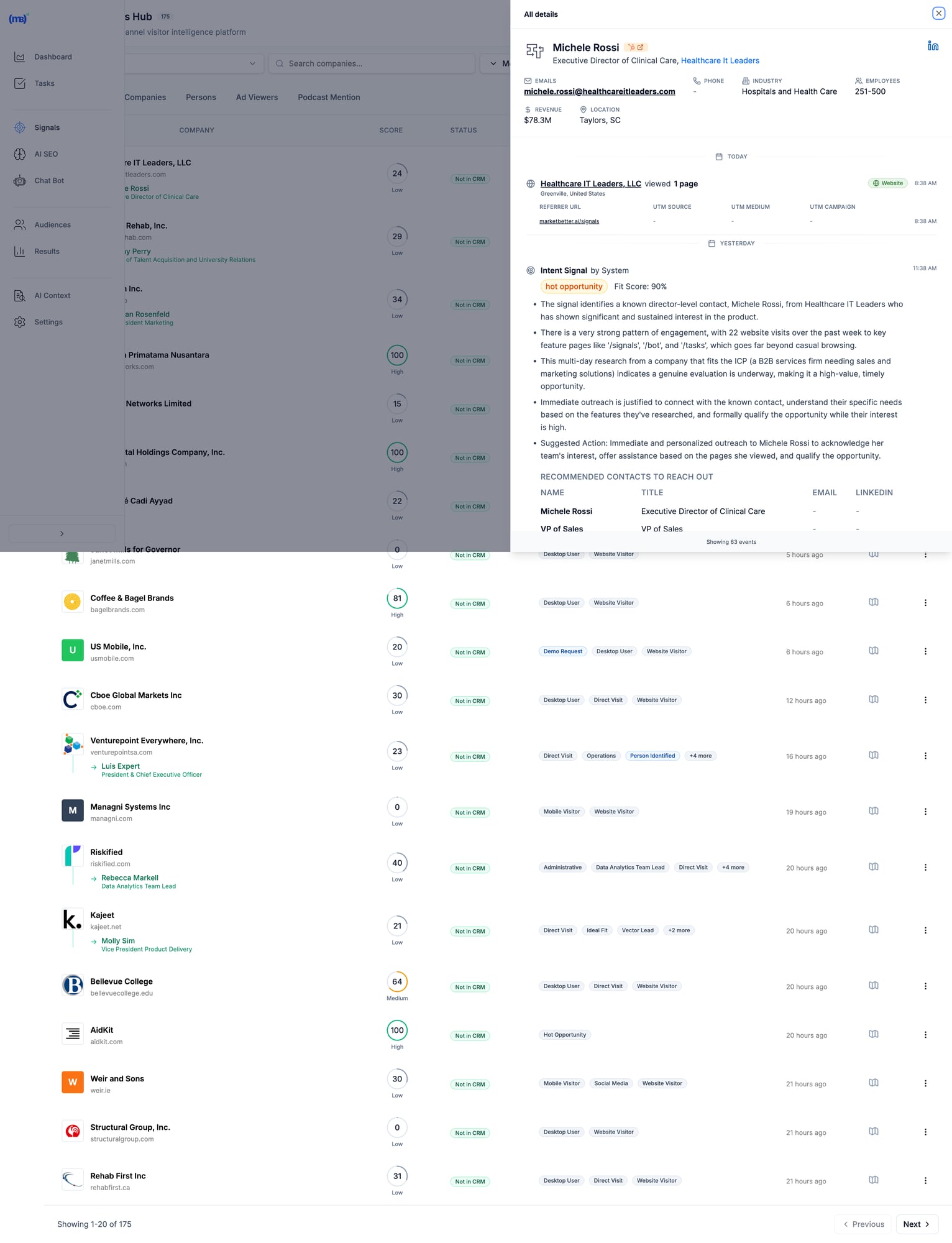
MarketBetter Signals Hub showing visitor intelligence with contact details, intent scores, and recommended actions MarketBetter's Signals Hub shows AI-prioritized visitor signals with intent scoring, identified contacts, and suggested actions β€” all in one view.

Pricing​

Custom based on team size and volume. Transparent pricing β€” no hidden fees or long-term contracts. Book a demo β†’

When MarketBetter Is Better​

βœ… You have an SDR team that needs to execute, not analyze βœ… You want one platform instead of 5+ tools stitched together βœ… Visitor data currently sits unused in dashboards βœ… You care about pipeline, not just "visibility" βœ… Speed-to-lead matters (90% faster lead response)

When To Look Elsewhere​

⚠️ You only need raw data for your existing ABM stack ⚠️ Enterprise with 6sense/Demandbase already deployed and working ⚠️ Pure marketing use case with no SDR execution

Read more: MarketBetter vs Warmly | MarketBetter vs Apollo | MarketBetter vs ZoomInfo | MarketBetter vs 6sense


2. Warmly​

Best for: Companies wanting real-time visitor engagement via chat

Warmly bundles visitor identification with AI chatbot engagement. Their strength is catching visitors while they're still on your site and starting conversations immediately. In 2026, they've expanded with an "AI Data Agent" tier that automates more of the outreach workflow.

Key Features​

  • 65% company-level identification (claimed) via 20+ data providers in a "data waterfall"
  • 15-25% person-level identification via enrichment partnerships
  • AI chatbot for real-time visitor engagement
  • Slack/Teams alerts for high-intent visitors
  • Bombora intent data integration
  • Video calling widget for live sales conversations on-site
  • Orchestrator for automated outreach sequences

Pricing​

PlanPriceWhat You Get
Free$0500 visitors/mo, 10 Bombora signals/week
Startup~$700/moHigher limits, basic automation
Business$1,440-1,740/mo10K-100K visitors, full features
AI Data Agent$10,000/yrAdvanced AI features, automated outreach

When Warmly Is Better​

βœ… Real-time chat engagement is your primary use case βœ… You already have outbound tools (Outreach, Apollo) and need signals βœ… Catching visitors while they're on-site matters most βœ… Budget of $700+/mo for a dedicated visitor ID tool

When To Look Elsewhere​

⚠️ You need a full SDR workflow (no smart dialer, no daily task prioritization) ⚠️ Budget under $700/mo (free tier is very limited) ⚠️ You want person-level at scale (15-25% may not be enough) ⚠️ You need multi-channel execution beyond chat

Read more: MarketBetter vs Warmly Comparison | Warmly Review 2026 | Warmly Pricing Breakdown | Best Warmly Alternatives


3. Leadfeeder (Dealfront)​

Best for: European companies prioritizing GDPR compliance

Dealfront (the merger of Leadfeeder and Echobot) focuses on the European market with strong GDPR compliance. Solid company-level identification with good CRM integrations at a reasonable price. They've been in the visitor ID game longer than most, which means deep integration partnerships.

Key Features​

  • Company-level visitor identification (IP-to-company)
  • GDPR-compliant data handling β€” a real differentiator for EU companies
  • Strong European company database (best coverage outside US)
  • CRM integrations with Salesforce, HubSpot, Pipedrive
  • Lead scoring and filtering by company attributes
  • Google Analytics integration for enhanced insights

Pricing​

PlanPriceWhat You Get
Free€0100 companies/mo, 7-day data retention
Paid€99-165/moUnlimited companies, 365-day retention

Annual billing gives 40% discount. The free tier is genuinely useful for testing.

When Leadfeeder Is Better​

βœ… European market focus (best EU company database in the category) βœ… GDPR compliance is non-negotiable for your team βœ… Budget-conscious teams wanting basic visitor ID to test the concept βœ… Already using Pipedrive or European CRMs

When To Look Elsewhere​

⚠️ You need person-level identification (company-only) ⚠️ US market focus (weaker coverage than US-focused tools) ⚠️ You want SDR workflow, not just data and dashboards ⚠️ You need real-time alerts for high-intent visitors


4. RB2B​

Best for: Freemium person-level identification (US traffic)

RB2B has become the go-to for teams wanting to test person-level identification without a big commitment. Their free tier is genuinely generous, and the Slack integration makes it easy to see results immediately. Founded by Adam Robinson, they've built strong community momentum on LinkedIn.

Key Features​

  • Person-level identification targeting 10-20% match rate
  • Slack notifications with LinkedIn profiles (the "killer feature")
  • Simple setup (just add a script tag β€” 5 minutes)
  • Free tier with 150 credits/month
  • Demandbase partnership for company-level fallback
  • Coworker filtering on Pro plans (remove known contacts)

Pricing​

PlanPriceWhat You Get
Free$0150 credits/mo, company-level only, LinkedIn profiles
Starter$79/moPerson-level identification, basic integrations
Pro$349+/moBusiness emails, all integrations, coworker filtering

Match Rates (Honest Assessment)​

  • Person-level: 10-20% (US traffic only)
  • Company-level: 70-80% when combined with Demandbase fallback
  • International: Not supported for person-level β€” this is a US-only tool

When RB2B Is Better​

βœ… You want to test person-level ID before committing serious budget βœ… US-focused B2B traffic (mandatory β€” doesn't work internationally) βœ… You have existing outreach tools and just need the names βœ… PLG company wanting LinkedIn profiles of engaged users

When To Look Elsewhere​

⚠️ International traffic (US-only for person-level identification) ⚠️ You need workflow, not just names dropped in Slack ⚠️ Business emails required (need Pro at $349+/mo β€” significant jump) ⚠️ You want a complete SDR platform, not a point solution


5. Koala​

Best for: PLG companies tracking product intent signals

Koala stands out by combining website visitor identification with product usage signals. If you have a freemium or trial product, Koala shows you which trial users are showing buying intent β€” a capability most visitor ID tools completely lack.

Key Features​

  • Website + product activity tracking in one unified platform
  • Account scoring based on engagement patterns and product usage
  • Real-time Slack alerts for high-intent accounts
  • CRM sync with automatic enrichment
  • Built for PLG motions (trial β†’ paid conversion signals)
  • ICP scoring to filter noise and focus on fits

Pricing​

Custom pricing based on volume. Free trial available. Generally positioned between SMB tools and enterprise platforms.

When Koala Is Better​

βœ… You have a freemium/trial product (PLG motion is your core GTM) βœ… Product engagement signals matter more than just website visits βœ… You want to identify which trial users are ready for a sales conversation βœ… Engineering resources to implement product-level tracking

When To Look Elsewhere​

⚠️ No freemium/trial product (pure sales-led GTM) ⚠️ You need full SDR workflow (no dialer, no sequences built in) ⚠️ Enterprise ABM programs (better options exist at that budget) ⚠️ Non-technical team (requires dev work to instrument product events)


6. 6sense​

Best for: Large marketing teams running enterprise ABM programs

6sense is a full ABM platform with visitor identification as one component of a broader intent data suite. Powerful but complex β€” built for large marketing teams with dedicated ops resources. In 2026, they've added AI-powered "Revenue AI" features, though the core platform remains enterprise-focused.

Key Features​

  • Account identification via IP + intent signals
  • Predictive buying stage scoring (Awareness β†’ Decision) β€” genuinely useful for ABM
  • Third-party intent data (Bombora + proprietary 6sense data)
  • Multi-channel ABM orchestration (ads, email, sales activation)
  • AI account summaries and recommendations (Revenue AI)
  • Deep CRM integrations with Salesforce, HubSpot
  • Audience creation for targeted advertising

Pricing​

6sense doesn't publish pricing. Based on Vendr and third-party data:

TierTypical CostWhat You Get
Free$050 credits/mo, Chrome extension
Team~$25K-50K/yrBasic platform, limited seats
Growth~$55K/yr (median)Full platform, intent data
Enterprise$100K-200K+/yrAdvanced features, custom integrations

Source: Vendr reports median buyer pays $55,211/year. Implementation takes 1-3 months.

When 6sense Is Better​

βœ… Enterprise budget ($50K+ annually) and you can justify the ROI βœ… Marketing-led ABM programs where you're running coordinated campaigns βœ… You have ops resources to manage the platform (RevOps or dedicated admin) βœ… Multi-channel orchestration across ads + email + sales is the goal

When To Look Elsewhere​

⚠️ SMB or mid-market budget (minimum ~$25K/yr) ⚠️ Sales-first teams (6sense is marketing-first, sales activation is secondary) ⚠️ You want simplicity (3-6 month implementation typical) ⚠️ Contact-level identification priority (6sense is company/account-level)

G2 reviewer feedback:

"My problem with 6sense is that the tool's visitor identification reveals only companies and not individuals."

Read more: MarketBetter vs 6sense | 6sense Review 2026 | 6sense Pricing Breakdown | Best 6sense Alternatives


7. ZoomInfo WebSights​

Best for: Enterprise GTM teams already using ZoomInfo data

ZoomInfo is the 800-pound gorilla of B2B data. WebSights is their visitor identification product, plugging into their massive database of 320M+ contacts and 100M+ company profiles. If you're already paying for ZoomInfo, WebSights is a natural add-on. If you're not, the total cost makes this an enterprise play.

Key Features​

  • Account-level visitor identification with deep company intel
  • Buyer intent signals (1B+ monthly data points)
  • Deep CRM/MAP integrations (native Salesforce, HubSpot, Marketo)
  • Form enrichment for progressive lead capture
  • DSP integration for retargeting ads to identified accounts
  • Copilot AI for account research and outreach drafting

Pricing​

ZoomInfo bundles WebSights with their core platform. Expect:

ComponentTypical Cost
SalesOS$15,000-25,000/yr starting
WebSights add-onIncluded or ~$5K extra
Intent data$9K-20K additional
Engage (sequences/dialer)~$15K additional

Total cost for full suite: $40K-100K+/yr depending on seats and features. Annual contracts, difficult to exit mid-term.

When ZoomInfo Is Better​

βœ… Already a ZoomInfo customer (marginal cost is low) βœ… Enterprise data needs where database size matters βœ… Budget for $15K+ annually βœ… Dedicated ops team to manage the platform

When To Look Elsewhere​

⚠️ SMB budget (minimum $15K/yr for the base platform) ⚠️ You want SDR workflow, not just data enrichment ⚠️ Quick implementation needed (enterprise complexity and training required) ⚠️ Contact data accuracy concerns (G2 reviews flag stale data as #1 issue)

Read more: MarketBetter vs ZoomInfo | ZoomInfo Review 2026 | ZoomInfo Pricing Breakdown | Best ZoomInfo Alternatives


8. Clearbit Breeze (HubSpot)​

Best for: HubSpot users wanting native enrichment

Now owned by HubSpot, Clearbit excels at form enrichment and real-time company identification. If you're already in the HubSpot ecosystem, it's the most seamless option β€” no integration work, no data syncing issues. The rebranding to "Breeze Intelligence" has been a bit confusing, but the core product remains strong.

Key Features​

  • Real-time form enrichment (shorter forms, same data)
  • Company and contact data appending to existing CRM records
  • Native HubSpot integration (zero setup if you're already a customer)
  • Reveal for anonymous visitor identification at account level
  • API for custom enrichment workflows (developers love this)
  • Auto-enrichment triggers based on lifecycle stage changes

Pricing​

Credit-based system integrated into HubSpot. Contact HubSpot for details. Historically:

  • Enterprise plans include Clearbit/Breeze credits
  • Standalone was $12,000+/yr before acquisition
  • Credits consumed per enrichment (form fill, reveal, or API call)

When Clearbit Is Better​

βœ… You're committed to the HubSpot ecosystem (this is a natural extension) βœ… Form enrichment is the priority (reduce form fields, increase conversions) βœ… You want seamless CRM data without export/import workflows βœ… Marketing-first use case with existing HubSpot workflows

When To Look Elsewhere​

⚠️ Not a HubSpot user (ecosystem lock-in makes this pointless) ⚠️ Person-level visitor identification priority (better options exist) ⚠️ You need SDR workflow beyond enrichment (no dialer, no task lists) ⚠️ Budget-conscious (credit system can get expensive at scale)


9. Demandbase​

Best for: Enterprise ABM with advertising + sales intelligence

Demandbase is a full ABM platform competing with 6sense at the enterprise level. Their strength is combining account identification with ABM advertising capabilities β€” if you're running targeted ads to identified accounts, Demandbase's DSP integration is best-in-class.

Key Features​

  • Account identification (AI-powered anonymous visitor reveal)
  • Identity graph (cookies, IP, device IDs, cross-channel matching)
  • Intent data + engagement scoring with proprietary signals
  • ABM advertising platform with native DSP
  • Sales intelligence with account insights and buyer journey mapping
  • GDPR-safe global reach (better international coverage than 6sense)

Pricing​

Demandbase doesn't publish pricing. Based on Vendr and third-party data:

TierTypical Cost
Minimum$18,000+/yr
Median~$65,000/yr
Enterprise$100K+/yr

When Demandbase Is Better​

βœ… Enterprise budget ($50K+ annually) βœ… ABM advertising is part of your strategy (best DSP integration) βœ… Global reach with GDPR compliance matters (stronger internationally than 6sense) βœ… Marketing + sales alignment on target accounts

When To Look Elsewhere​

⚠️ SMB or mid-market budget ⚠️ Person-level identification priority (company/account-level focus) ⚠️ Quick implementation needed (enterprise onboarding) ⚠️ You need SDR workflow, not marketing dashboards


10. Instantly Pixel​

Best for: Outbound-first teams already using Instantly for cold email

Instantly β€” best known as a cold email platform β€” has added website visitor identification via their "Instantly Pixel." If you're already using Instantly for outbound sequences, adding visitor ID data into the same workflow is seamless. It's not the deepest visitor ID tool, but the workflow integration is hard to beat for existing customers.

Key Features​

  • Website visitor identification via pixel tracking
  • Built into Instantly CRM β€” visitor data flows directly into your outreach workflows
  • Custom views for filtered visitor segments (e.g., pricing page visitors only)
  • Contact enrichment from Instantly's B2B database
  • Automated sequence enrollment β€” identified visitors auto-added to campaigns
  • Multi-channel (email + call + SMS from one platform)

Pricing​

Visitor identification is included in Instantly's CRM plans:

PlanPriceWhat You Get
Growth CRM$37/moBasic CRM + visitor tracking
Hyper Growth CRM$97/moAI features + advanced sequences

Note: You may also need a sending plan ($30-78/mo) for the outreach side. Total cost: $67-175/mo for the full stack.

When Instantly Is Better​

βœ… Already using Instantly for cold email (natural extension, no new tools) βœ… Outbound-first GTM where visitor ID supplements cold outreach βœ… Budget-conscious (cheapest "all-in-one" option at $67-175/mo total) βœ… Want email + calling + visitor ID in one platform

When To Look Elsewhere​

⚠️ Visitor ID is your primary need (Instantly's pixel is secondary to their email product) ⚠️ You need deep visitor analytics and segmentation (basic compared to Warmly or 6sense) ⚠️ Enterprise-grade identification with intent data (not their strength) ⚠️ Inbound-first GTM (Instantly is built for outbound)


11. Leadpipe​

Best for: Person-level identification at scale with aggressive pricing

Leadpipe is a newer entrant focused on high-volume person-level identification. They claim 35%+ person-level match rates β€” aggressive but worth testing. Their pricing model is credit-based and straightforward, making it easy to forecast costs.

Key Features​

  • Person-level identification β€” names, emails, phone numbers, LinkedIn profiles
  • Company + contact enrichment in one view
  • Real-time visitor tracking with page-level behavior data
  • Automated list building β€” identified visitors auto-exported to your email tool
  • Simple pixel installation (similar to RB2B)
  • No contract β€” month-to-month pricing

Pricing​

PlanPriceCredits
Starter$98/mo100 identified visitors
Growth$147/mo500 identified visitors
Scale$248/mo1,000 identified visitors
Pro$398/mo2,000 identified visitors
Business$819/mo5,000 identified visitors
Enterprise$1,579/mo10,000 identified visitors

Per-credit cost: $0.16-0.98 depending on volume. 200 free credits to test.

When Leadpipe Is Better​

βœ… Person-level identification is the priority (not just company names) βœ… You want transparent, predictable pricing per identified visitor βœ… High-traffic site where per-credit pricing scales well βœ… Need email addresses + phone numbers for outreach (not just LinkedIn profiles)

When To Look Elsewhere​

⚠️ You need SDR workflow (data-only, no task management or dialer) ⚠️ International traffic (US-focused, like most person-level tools) ⚠️ Enterprise security requirements (newer vendor, less established) ⚠️ You want intent data beyond just page visits


12. Snitcher​

Best for: Budget-friendly company-level identification

Snitcher is a straightforward, no-frills company identification tool starting at just $39/month. No person-level ID, no intent data, no AI β€” just solid IP-to-company matching with clean reporting. Sometimes simple is exactly what you need.

Key Features​

  • Company-level visitor identification via IP matching
  • Google Analytics integration (enhances existing GA data)
  • CRM integrations (Salesforce, HubSpot, Pipedrive)
  • Custom alerts based on company attributes or page visits
  • Clean dashboard with session-level detail
  • GDPR-compliant (EU-based, privacy-first approach)

Pricing​

Usage-based starting at $39/month, scaling with identified companies. Affordable option for teams testing the visitor ID concept before committing to larger platforms.

When Snitcher Is Better​

βœ… Budget under $200/mo and you want to test visitor identification βœ… Company-level is sufficient (you have separate tools for contact finding) βœ… European company wanting GDPR-compliant solution (EU-based) βœ… Clean, simple tool without enterprise complexity

When To Look Elsewhere​

⚠️ You need person-level identification (company-only) ⚠️ You want SDR workflow or outreach automation ⚠️ US-focused team (US-centric tools have better North American coverage) ⚠️ Need intent data or buying stage signals


The Real Question: What Happens AFTER Identification?​

Here's what most comparison guides won't tell you:

Identifying visitors is the easy part.

The hard part is turning that data into action. Most SDRs don't have time to:

  • Research every identified company
  • Find the right decision-maker
  • Write personalized outreach
  • Prioritize who to contact first
  • Actually make the call

That's why 90% of visitor ID data goes unused. It sits in a dashboard. Nobody acts on it. And the tool becomes shelfware within 3 months.

The "Data vs Action" Gap​

Data-First ToolsAction-First Tools
Show you WHO visitedShow you WHO + WHAT TO DO
Require manual researchAuto-enrich with decision-makers
Leave prioritization to youAI-prioritize by fit + intent
Integrate with your sequence toolsInclude sequences + dialer
Dashboards for analysisTasks for execution
Value depends on SDR disciplineValue is built into the workflow

Most tools on this list are data-first. They give you visibility. What happens next is your problem.

MarketBetter is action-first. We turn every visitor into a prioritized task with AI-drafted outreach and click-to-dial. Your SDR opens a list and executes. No research required, no prioritization paralysis.

The Multi-Tool Problem​

Here's how most teams cobble together a visitor ID workflow today:

  1. Visitor identification (RB2B or Warmly) β†’ $79-700/mo
  2. Contact enrichment (Apollo or ZoomInfo) β†’ $49-$15,000/yr
  3. Email sequences (Outreach or Salesloft) β†’ $100-150/seat/mo
  4. Dialer (Orum or Nooks) β†’ $150-200/seat/mo
  5. CRM (HubSpot or Salesforce) β†’ $50-150/seat/mo

Total: $500-2,000+/mo per SDR across 5 different tools, with manual data transfer between each one.

MarketBetter replaces tools 1-4 in one platform. Visitor identification, enrichment, sequences, and dialer β€” with AI connecting them so data flows into action automatically.

See how it works β†’


How to Calculate Visitor Identification ROI​

Before investing in any visitor ID tool, run these numbers:

Step 1: Estimate Your Identifiable Traffic​

MetricYour Number
Monthly website visitors_______
Γ— Realistic match rate (use 15% for company-level)Γ— 0.15
= Identified companies per month_______

Step 2: Estimate Pipeline Impact​

MetricYour Number
Identified companies per month_______
Γ— % that fit your ICP (use 20%)Γ— 0.20
= ICP-fit leads_______
Γ— Outreach-to-meeting rate (use 5%)Γ— 0.05
= Meetings booked per month_______

Step 3: Calculate Revenue​

MetricYour Number
Meetings per month_______
Γ— Demo-to-close rate (use 20%)Γ— 0.20
= New customers per month_______
Γ— Average deal sizeΓ— $_______
= Monthly revenue from visitor ID$_______

Example Scenario​

MetricExample
10,000 monthly visitors
Γ— 15% company match rate= 1,500 identified
Γ— 20% ICP fit= 300 ICP leads
Γ— 5% meeting rate= 15 meetings/month
Γ— 20% close rate= 3 new customers
Γ— $15,000 ACV= $45,000/month revenue

Even at conservative rates, a tool costing $500-2,000/month that generates $45,000 in monthly revenue is a 20-90x return. The math almost always works β€” the question is whether your team will actually act on the data.


Implementation Guide: Getting Started in Under 30 Minutes​

No matter which tool you choose, here's how to get maximum value fast:

Week 1: Install and Baseline​

  1. Add the tracking pixel/script β€” Every tool on this list requires adding a JavaScript snippet to your site. Most take under 5 minutes.
  2. Connect your CRM β€” Sync identified visitors with your existing pipeline. HubSpot and Salesforce integrations are standard.
  3. Set up alerts β€” Configure Slack or email notifications for high-intent page visits (pricing page, demo page, comparison pages).
  4. Establish your baseline β€” How many visitors does the tool identify in the first week? What's your actual match rate?

Week 2: Prioritize and Filter​

  1. Define your ICP filter β€” Set company size, industry, and geography filters so you only see relevant visitors. Without filters, your SDR drowns in noise.
  2. Set up lead scoring β€” Prioritize visitors by behavior: pricing page > blog > homepage. Multiple visits > single visit.
  3. Test outreach on 20 leads β€” Manually reach out to the first batch. Measure response rates. Refine your messaging.

Week 3-4: Automate and Scale​

  1. Build sequences β€” Create automated email sequences triggered by visitor identification events.
  2. Assign territory rules β€” If you have multiple SDRs, set up round-robin or territory-based lead routing.
  3. Measure pipeline β€” Track how many identified visitors become meetings, opportunities, and closed deals.

Common Mistakes to Avoid​

❌ Contacting every identified visitor β€” Most are researchers, not buyers. Filter by ICP and intent signals. ❌ Mentioning you tracked them β€” "I saw you visited our pricing page" is creepy. Frame outreach around their company's challenges. ❌ Setting and forgetting β€” Review match rates and outreach results monthly. Adjust ICP filters as you learn. ❌ Buying enterprise tools for SMB problems β€” A $55K/yr platform won't help if your team has 2 SDRs and 5,000 monthly visitors. ❌ Expecting person-level magic β€” Realistic person-level match rates are 5-20%. If your traffic is low, the absolute number of identified individuals will be small. Supplement with company-level identification + manual prospecting.


How to Choose the Right Visitor ID Tool​

After evaluating all 12 tools, here are the three questions that matter:

1. Do You Need Data or Action?​

If you have a mature ops team that can turn visitor data into SDR workflows (research, enrich, prioritize, sequence, call), tools like ZoomInfo, 6sense, or Warmly give you rich data to feed those workflows.

If you want visitors to become prioritized SDR tasks automatically β€” no manual research, no tool-switching β€” look at MarketBetter.

2. Company-Level or Person-Level?​

  • Company-level (30-65% match rate) = table stakes, every tool on this list does this
  • Person-level (5-20% match rate) = harder, consider RB2B, Leadpipe, Warmly, or MarketBetter

If person-level is critical, verify the vendor's methodology. Many claim high rates by counting company matches in their headline number.

3. What's Your Budget?​

BudgetBest Options
Free/$0RB2B free, Leadfeeder free
Under $200/moSnitcher ($39), RB2B Starter ($79), Leadpipe Starter ($98)
$200-500/moRB2B Pro ($349), Leadpipe Growth ($147-248)
$500-2,000/moWarmly ($700+), MarketBetter, Instantly stack ($67-175)
$2,000+/moMarketBetter, Warmly Business
$25K+/yr6sense, ZoomInfo
$50K+/yr6sense Enterprise, Demandbase, ZoomInfo Enterprise

Decision Framework​

Choose MarketBetter if your SDRs need a daily playbook that tells them who to call, why, and what to say β€” not another dashboard to monitor.

Choose Warmly if real-time chat engagement while visitors are on-site is your highest priority.

Choose RB2B or Leadpipe if you just need person-level data piped into Slack and you'll handle outreach separately.

Choose 6sense or Demandbase if you're running enterprise ABM programs with $50K+ budgets and dedicated RevOps.

Choose ZoomInfo if you already have their data platform and want to add visitor ID as an incremental capability.

Choose Snitcher or Leadfeeder if you want affordable company-level identification to test the concept before scaling up.

Choose Instantly if you're already running cold email campaigns and want to layer in visitor identification without adding another vendor.


Frequently Asked Questions​

What is the best free website visitor identification tool?​

RB2B offers the best free tier for person-level identification (US traffic only, 150 credits/month with LinkedIn profiles). Leadfeeder offers free company-level identification (100 companies/month, 7-day retention). Both are limited but useful for testing the concept before committing budget.

What is a realistic match rate for visitor identification?​

Expect 30-65% for company-level identification and 5-20% for person-level. Rates are higher for corporate office traffic and lower for remote workers. Any vendor claiming 80%+ contact-level match rates is likely counting company matches. Always ask: "What percentage of my traffic will you identify to a specific person with a verified email?"

Do I need visitor identification if I have Google Analytics?​

Google Analytics shows you anonymous traffic patterns β€” pages visited, time on site, traffic sources, conversion funnels. Visitor identification reveals who those visitors are (company names, sometimes individual contacts with emails). They serve completely different purposes. Most teams use both: GA4 for marketing analytics, visitor ID for sales activation.

Is website visitor identification GDPR compliant?​

It depends on the method. IP-to-company matching is generally compliant as it identifies organizations, not individuals. Person-level identification tools must ensure proper consent mechanisms and legal basis for processing. European-focused tools like Leadfeeder (Dealfront) and Snitcher prioritize GDPR compliance. If you operate in the EU, consult your legal team and look for tools with explicit GDPR documentation.

What's the difference between visitor identification and intent data?​

Visitor identification tells you WHO visited your website specifically β€” first-party data. Intent data tells you WHO is researching your category across the web β€” third-party signals from publishers, review sites, etc.

Some tools (6sense, Demandbase, Warmly) combine both. Others focus on one or the other. Intent data is broader but noisier; visitor identification is narrower but higher-signal (they're on YOUR site, not just reading about the category).

How long does implementation take?​

  • Simple tools (RB2B, Leadpipe, Snitcher): 5-30 minutes (add a script tag)
  • Mid-market tools (Warmly, Koala, MarketBetter): 1-2 weeks (includes CRM setup and workflow configuration)
  • Enterprise tools (6sense, Demandbase, ZoomInfo): 1-3 months (training, custom integrations, change management)

Can I use multiple visitor ID tools together?​

Yes, and many teams do. A common stack: RB2B for person-level identification (free tier) + Leadfeeder for company-level (free tier) to test both approaches. Then consolidate into one paid tool once you know which data type (person vs company) drives more pipeline for your specific business.

What's the biggest mistake teams make with visitor identification?​

Buying the tool without a plan for what happens after identification. 90% of visitor ID data goes unused because there's no workflow to turn "Company X visited" into "SDR calls Jane at Company X with this pitch." Before choosing a tool, define your process: Who reviews the data? How fast do they act? What do they say? If you can't answer those questions, the tool won't help β€” you need a workflow-first platform like MarketBetter that handles this automatically.

Should I care about AI features in visitor ID tools?​

In 2026, every tool has slapped "AI" on their marketing. What actually matters: AI for prioritization (which visitors to contact first), AI for personalization (writing outreach based on visitor behavior), and AI for automation (auto-enrolling high-intent visitors into sequences). Skip tools where "AI" just means a chatbot that answers FAQ. Look for AI that saves your SDRs 15-30 minutes per lead.


Free Tool

Try our AI Lead Generator β€” find verified LinkedIn leads for any company instantly. No signup required.

The Bottom Line​

Website visitor identification is only valuable if someone acts on it.

The best tools don't just show you dashboards of anonymous visitors turned into company names. They turn those visitors into prioritized tasks your SDRs execute every day.

Ask yourself: Do you need another dashboard? Or do you need more booked meetings?

If the answer is booked meetings, you need a tool that bridges the gap between "identified visitor" and "SDR picks up the phone." That's what separates a data product from a revenue product.


Ready to turn anonymous visitors into pipeline?

Book a demo with MarketBetter β†’

We'll show you how visitor identification becomes SDR execution β€” not just another data source collecting dust.

Related reading:

MarketBetter vs RB2B: Website Visitor ID vs SDR Workflow [2026]

Β· 8 min read
Sunder Iyer
Founder, marketbetter.ai

RB2B pioneered contact-level website visitor identification. Drop in their script, and within minutes you're getting Slack notifications: "John Smith from Acme Corp just visited your pricing page."

That's powerful. But it's also where RB2B stops.

What happens next? Your SDR has to:

  • Research John's company
  • Figure out if Acme is even in your ICP
  • Find the right decision-maker (maybe John's just a researcher)
  • Write personalized outreach
  • Decide whether to email, call, or connect on LinkedIn
  • Actually reach out before the lead goes cold

That workflow takes 15-30 minutes per visitor. With hundreds of notifications per day, most RB2B leads end up ignored.

MarketBetter takes a different approach. We don't just identify who visitedβ€”we turn every visitor into a prioritized task with AI-generated outreach, decision-maker contacts, and a click-to-dial button.

🎯 Quick Summary
  • Choose RB2B if: You want simple, affordable visitor identification and have the bandwidth to work leads manually
  • Choose MarketBetter if: You want visitor identification PLUS the SDR workflow to actually convert those visitors into meetings

What Each Tool Actually Does​

RB2B: Person-Level Visitor Identification​

RB2B is a specialist. They do one thing well: identify anonymous website visitors at the contact level (not just company level) and push that data to Slack.

How it works:

  1. Install a tracking script on your website
  2. RB2B matches visitors against their database (US only)
  3. Get Slack notifications with LinkedIn profiles and company info
  4. Export to CRM or use integrations to trigger workflows

What you get:

  • Visitor's name and LinkedIn URL
  • Company information
  • Page visit history
  • Email addresses (on paid plans)

What you don't get:

  • Prioritization (which visitor matters most?)
  • Outreach templates
  • Follow-up workflows
  • Calling capabilities
  • AI research or personalization

MarketBetter: Visitor ID + SDR Workflow​

MarketBetter combines visitor identification with an AI-powered SDR command center. We identify visitors AND turn that data into action.

How it works:

  1. Identify company and contact visiting your website
  2. AI scores the opportunity against your ICP
  3. Find decision-makers at that company (not just the visitor)
  4. Create a prioritized task for your SDR
  5. Generate personalized outreach based on AI research
  6. SDR clicks "call" or "send"β€”done

What you get:

  • Everything RB2B offers (visitor ID, company data)
  • AI-prioritized task list
  • Decision-maker discovery (beyond the visitor)
  • AI-generated, personalized outreach
  • Built-in dialer with click-to-call
  • Email sequences and LinkedIn tracking
  • Chatbot with live handoff
  • Pre-meeting intelligence briefs

Feature-by-Feature Comparison​

FeatureRB2BMarketBetter
Website Visitor IDβœ… Contact + Companyβœ… Contact + Company
Person-Level Identificationβœ… US only (15-45% coverage)βœ… Via intent data partners
Company-Level Identificationβœ… Global (via Demandbase)βœ… Global
LinkedIn Profile Enrichmentβœ…βœ…
Email Enrichmentβœ… Paid plans onlyβœ…
Slack/Teams Notificationsβœ…βœ…
CRM Integrationβœ… HubSpot, Salesforce, Zapierβœ… HubSpot, Salesforce (bidirectional)
ICP Filteringβœ… Hot Leads featureβœ… AI scoring
High-Intent Page Taggingβœ… Hot Pagesβœ… Intent signals
AI PrioritizationβŒβœ…
Decision-Maker DiscoveryβŒβœ…
AI-Generated OutreachβŒβœ…
Built-in DialerβŒβœ…
Email SequencesβŒβœ…
ChatbotβŒβœ…
Pre-Meeting BriefsβŒβœ…
SDR Task ManagementβŒβœ…

Pricing Comparison​

RB2B Pricing (2026)​

PlanMonthly PriceResolutions/MonthKey Features
Free$0150Company-level only, Slack only
Starter$79300Person-level, LinkedIn URLs, no email/integrations
Pro$149600Email addresses, all integrations
Pro+$199600Premium coverage (35-45%), up to 3 additional contacts
Scale$299-$8491,250-12,500Volume pricing

Overage fees: $0.25-$0.45 per resolution beyond plan limits.

Note: RB2B's free tier no longer includes contact-level identificationβ€”that requires at least the $79/mo Starter plan.

MarketBetter Pricing​

MarketBetter uses custom pricing based on team size and volume. Contact for a quote, but expect:

  • Higher starting price than RB2B's basic plans
  • Better ROI when you factor in SDR time saved
  • No per-resolution capsβ€”focus on qualified leads, not credit counts

The ROI math: If RB2B costs $199/mo but each lead takes 20 minutes of SDR time to work, you're paying in time instead of money. A $3,000/month SDR working 50 RB2B leads per day is spending 16+ hours on lead research alone.


When to Choose RB2B​

RB2B is the right choice if:

βœ… You're bootstrapped or testing visitor ID for the first time Their free tier (company-level) and $79/mo starter plan let you prove the concept before investing more.

βœ… You already have a robust sales tech stack If you're using Clay, Apollo, Instantly, or HeyReach, you can pipe RB2B data into your existing workflows.

βœ… Your SDRs have the bandwidth for manual research If you're getting fewer than 50 qualified visitors per week, manual follow-up is manageable.

βœ… You only need US person-level identification RB2B excels at US contact identification. International is company-level only.

βœ… You want Slack-first notifications RB2B's Slack integration is excellent. If your sales team lives in Slack, it's a natural fit.


When to Choose MarketBetter​

MarketBetter is the right choice if:

βœ… You want ACTION, not just data Visitor identification without a workflow is just noise. MarketBetter turns every qualified visitor into a prioritized, actionable task.

βœ… Your SDRs are drowning in tabs The average SDR uses 7+ tools daily. MarketBetter consolidates visitor ID, outreach, dialing, and CRM into one workflow.

βœ… You need SDR onboarding speed New SDRs can be productive in days, not months. Just follow the AI-generated tasks.

βœ… You want AI-powered personalization at scale Writing personalized emails for every visitor isn't sustainable. Our AI researches each prospect and drafts outreach that sounds human.

βœ… You need more than visitor ID MarketBetter includes chatbot, dialer, email sequences, and meeting prepβ€”everything an SDR needs, not just one signal.

βœ… You're measuring meetings booked, not leads identified RB2B measures "resolutions." MarketBetter measures pipeline generated.


The Workflow Difference​

Here's what happens when someone visits your pricing page:

With RB2B:​

  1. Slack notification: "Jane Doe from TechCorp visited /pricing"
  2. SDR opens LinkedIn, researches Jane
  3. SDR searches CRMβ€”is TechCorp a known account?
  4. SDR finds Jane is a marketing coordinator (not a decision-maker)
  5. SDR searches for the VP of Sales at TechCorp
  6. SDR writes a personalized email
  7. SDR sends email, maybe connects on LinkedIn
  8. SDR logs activity in CRM

Time spent: 20-30 minutes per visitor

With MarketBetter:​

  1. Visitor identified: Jane Doe, Marketing Coordinator at TechCorp
  2. AI scores TechCorp (ICP fit: 87%)
  3. AI identifies decision-maker: Mike Chen, VP of Sales
  4. Task created for SDR: "Call Mike Chen at TechCorp β€” pricing page visit"
  5. Task includes: AI-generated email, Mike's direct dial, LinkedIn URL
  6. SDR clicks "Call"β€”or approves the email with one click
  7. Activity logged automatically

Time spent: 2-3 minutes per visitor

That's 10x efficiencyβ€”which means your SDR can work 10x more leads.


What Real Users Say​

RB2B Reviews (G2)​

Pros mentioned:

  • "Easy setupβ€”literally 5 minutes"
  • "LinkedIn integration is seamless"
  • "Free tier is generous for testing"
  • "Slack notifications are instant"

Cons mentioned:

  • "Match rates varyβ€”sometimes as low as 10%"
  • "Data quality weaker for SMBs and international"
  • "Still need other tools to actually reach out"
  • "No way to prioritize which visitors matter most"

MarketBetter Reviews (G2)​

Pros mentioned:

  • "Finally, one tool for everything"
  • "SDR onboarding time cut by 70%"
  • "AI outreach is surprisingly good"
  • "29% positive reply rate"
  • "Best support I've experienced"

Cons mentioned:

  • "Higher price point than point solutions"
  • "Takes time to configure ICP filters"

Common Questions​

Can I use both together?​

Technically yes, but it's redundant. MarketBetter already includes visitor identification. Adding RB2B means paying twice for the same signal.

Is RB2B really free?​

The free tier gives you 150 company-level resolutions per month (no person-level). For contact identification, you need at least $79/mo.

Does MarketBetter work outside the US?​

Yes. Company-level identification is global. Person-level varies by region and data partner.

Which has better match rates?​

Match rates depend on your traffic source, not the tool. Both use similar underlying data. The difference is what happens AFTER identification.

Is RB2B GDPR compliant?​

RB2B's person-level identification is US-only, avoiding GDPR. Company-level (via Demandbase) works globally but requires consent tools.


The Bottom Line​

RB2B solves the identification problem. It's affordable, easy to set up, and does one thing well.

MarketBetter solves the pipeline problem. Identification is table stakesβ€”what matters is converting visitors into meetings.

If you're evaluating visitor identification tools, ask yourself: Do I need more data, or do I need more meetings?

RB2B gives you data. MarketBetter gives you meetings.


Free Tool

Try our AI Lead Generator β€” find verified LinkedIn leads for any company instantly. No signup required.

Try MarketBetter​

See how MarketBetter turns visitor identification into booked meetings:

πŸ‘‰ Book a Demo

We'll show you exactly how much SDR time you're currently wastingβ€”and how to get it back.