Cold outbound is dying. Not because outbound doesn't work — but because cold outbound doesn't work.
The numbers tell the story:
Average cold email reply rate: 1–3% (down from 8% in 2020)
Average cold call connect rate: 4.8% (Gong, 2025)
Percentage of buyers who say cold outreach is "irrelevant to their needs": 72% (LinkedIn State of Sales)
Meanwhile, warm outbound — reaching out to prospects who've already shown buying signals — converts at 3–5x higher rates than cold approaches.
The difference isn't the rep. It's not the script. It's not even the product. It's timing and relevance.
Cold outbound interrupts strangers. Warm outbound engages buyers who are already looking.
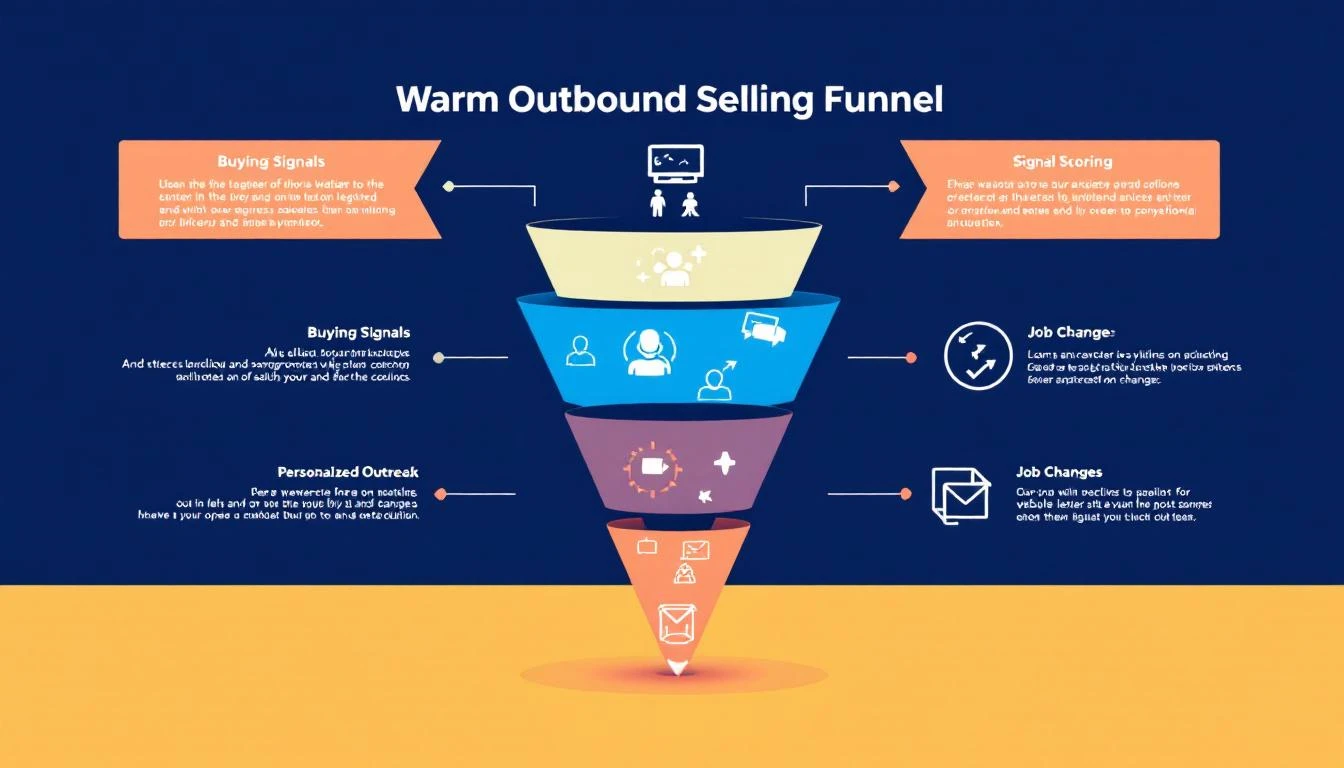
This playbook shows you exactly how to build a warm outbound motion from scratch — what signals to track, how to prioritize them, and how to turn them into meetings.
Warm outbound is proactive sales outreach to prospects who've shown intent or interest signals — but haven't yet raised their hand (filled out a form, requested a demo, etc.).
It sits between two extremes:
Approach
Signal Level
Example
Inbound
Hand-raise
"I want a demo" form fill
Warm Outbound
Intent signals
Visited pricing page 3x, competitor search, champion moved
Cold Outbound
No signal
Random list from a data provider
Warm outbound captures the 95% of buyers who are researching but haven't filled out a form. They're evaluating. They're comparing. They're building internal business cases. They just haven't reached out yet.
Your competitors are waiting for the form fill. You're going to reach them first.
When a company visits your pricing page or demo page multiple times, someone is actively evaluating your product. This is the single highest-converting warm outbound signal.
What it looks like: "3 visitors from Acme Corp viewed your pricing page in the last 48 hours"
Why it matters: They're past awareness. They're doing math. They're probably comparing you.
How to act: Direct call or email to the likely buyer (VP Sales, SDR Manager). Reference their evaluation: "I noticed your team has been evaluating SDR tools — mind if I share how we compare on the areas that usually matter most?"
2. Champion Job Changes
When a previous champion, power user, or customer moves to a new company, you have a built-in referral. They already know your product works.
What it looks like: "Sarah Chen (former AE at Hologram, your customer) just joined TechCorp as VP Sales"
Why it matters: 70% of champions who move will evaluate their previous tools at the new company (UserGems data)
How to act: Personal, non-pushy outreach: "Congratulations on the move to TechCorp. When you're settled in, would love to see if we can help there too."
3. Active Competitor Evaluation
When a prospect is searching for your competitors, reading comparison pages, or visiting G2 comparison pages, they're in active buying mode.
What it looks like: "Prospect searched 'Apollo vs ZoomInfo' and landed on your comparison page"
Why it matters: They're deciding NOW. Not next quarter. Now.
How to act: Fast, relevant outreach that positions your differentiation: "I see you're comparing outbound tools — most teams in [their industry] choose us for [specific differentiator]. Worth 15 minutes?"
Tier 2: Medium-Intent Signals (Act Within 48–72 Hours)
4. Content Engagement Patterns
A single blog post visit means nothing. But a pattern — 3 blog posts about SDR productivity, a whitepaper download, and a webinar registration in the same week — signals active research.
What it looks like: "Director of Sales Ops at DataCorp downloaded your ROI calculator and read 3 SDR-related blog posts"
Why it matters: They're building a business case. They might not know your product yet, but they're solving a problem you solve.
How to act: Value-led outreach tied to their research topic: "I saw you downloaded our SDR ROI calculator — curious what you found. Most teams we talk to in [industry] are seeing [specific metric]. Mind sharing what you're working on?"
5. Tech Stack Changes
When a company adopts or drops specific technologies, it creates adjacent buying needs. New Salesforce adoption? They'll need outbound tools. Dropped their dialer? They're looking for a new one.
What it looks like: "TechCorp just adopted Salesforce (detected via technographic data)"
Why it matters: Technology adoption creates buying windows — 60–90 day periods where adjacent purchases spike
How to act: Frame your outreach around the transition: "Noticed you recently adopted Salesforce — most teams add outbound tooling within the first quarter. Happy to share what we've seen work."
Tier 3: Contextual Signals (Act Within 1–2 Weeks)
6. Hiring Signals
When a company posts SDR or sales manager job listings, they're investing in outbound. That means they need tools to make those new hires productive.
What it looks like: "Acme Corp posted 4 SDR roles and a Head of Sales Development position on LinkedIn"
Why it matters: They're building or scaling a sales team — exactly when they need your platform
How to act: Frame around their growth: "Saw you're scaling the SDR team — the ramp time challenge is real. We help teams get new reps productive in 6 weeks instead of 4 months."
7. Funding and Expansion Events
A company that just raised Series B, opened a new office, or announced expansion plans is spending money. GTM is almost always a top priority post-funding.
What it looks like: "DataFlow just raised $30M Series B (Crunchbase alert)"
Why it matters: Post-funding companies allocate 30–40% of new capital to sales and marketing (First Round data)
How to act: Relevant, congratulatory outreach: "Congrats on the raise — exciting time. Most Series B teams we work with are figuring out how to scale outbound without scaling headcount linearly. Worth a conversation?"
A pricing page visit and a blog post visit are not equal signals. If your reps treat them with the same urgency, they'll waste time on low-intent accounts and miss high-intent ones.
Fix: Build a tiered signal scoring model (see above) and prioritize ruthlessly.
If your reps don't know which signals actually convert to revenue, they can't improve their prioritization. Most teams track signals in → meetings out, but never close the loop to pipeline and revenue.
Fix: Track signal-to-revenue attribution. Which signal types generate the highest-value pipeline? Double down on those.
If your reps need to check one tool for visitor ID, another for intent data, another for champion tracking, and then manually build their outreach list — they'll spend more time toggling than selling.
Fix: Consolidate into a single platform that collects signals AND orchestrates actions.
Your SDRs have a list of 30,000 accounts. They're calling, emailing, and LinkedIn-ing their way through it — one cold outreach at a time, praying that someone picks up.
Here's the math nobody talks about: at 80 activities per day, it takes a single rep 375 business days to touch every account once. That's 18 months. And by the time they circle back to account #1, whatever signal triggered the initial outreach is long dead.
This is the fundamental problem with traditional outbound. You're treating every account the same. The company that visited your pricing page three times this week gets the same generic sequence as the company that hasn't thought about your category in two years.
Signal-based selling fixes this. Instead of working a static list, you work a dynamic, living market — the accounts showing real buying behavior right now. We call this your Signal-Based Market (SBM), and it changes everything about how modern sales teams operate.
Signal-based selling is a GTM strategy where every sales action — who to call, what to say, when to reach out — is driven by real-time buying signals rather than static lists or gut instinct.
Instead of asking "Who's on my list today?", signal-based sellers ask: "Who's showing buying behavior today?"
Conversation intelligence: What prospects say on calls — pain points, timeline, budget mentions
The shift is subtle but profound. Traditional selling is push-based — you push your message to a list and hope for the best. Signal-based selling is pull-based — you let buyer behavior pull you toward the accounts most likely to convert.
The best salespeople have always done this instinctively. Signal-based selling just makes it systematic, scalable, and available to every rep on the team — not just the top 10%.
The Signal-Based Market is the core concept that makes this work. Think of it as a funnel — but instead of a marketing funnel, it's a focus funnel that tells your sales team exactly where to spend their time.
Your Signal-Based Market lives at the intersection of three signal categories:
🎯 Circle 1: ICP / Firmographic Fit
Does this account match your ideal customer profile? Right industry, right size, right tech stack, right budget range? This is the foundational filter — if they don't fit, no amount of intent signal matters.
📊 Circle 2: Engagement Score
Is this account actively engaging with your brand? Visiting your website, reading your content, clicking your emails, attending your webinars? Engagement signals tell you they know you exist and are actively researching.
⚡ Circle 3: Readiness Score
Are they showing signals that suggest they're ready to buy soon? Pricing page visits, competitor comparison research, multi-stakeholder engagement, expansion hiring, budget cycle timing? Readiness signals separate browsers from buyers.
The center of this Venn diagram — where all three circles overlap — is your Signal-Based Market. These are accounts that fit your ICP, are actively engaging with your brand, AND are showing readiness to buy. This is where your SDRs should spend 80%+ of their time.
An account that fits your ICP but isn't engaging? Nurture them.
An account that's engaging but doesn't fit? Let marketing handle it.
An account that's ready but doesn't fit? Pass.
But an account that fits, is engaging, AND is ready? That's a phone call. Today. Right now.
Blast those sequences to as many contacts as possible
Hope that sheer volume produces enough responses
Cherry-pick the replies and book meetings
Repeat until quota or burnout (usually burnout)
The conversion math is brutal: 1-2% reply rates on cold outbound means you need 5,000 emails to generate 50-100 replies, which yield maybe 10-15 meetings, which close 2-3 deals.
And here's the kicker — those 2-3 deals would have likely come in anyway, because those prospects were already in a buying cycle. You didn't create demand. You just happened to catch them at the right time through brute force.
Rep burnout: SDRs churn at 35-40% annually. The #1 reason? Feeling like they're spinning their wheels
Brand damage: Every bad-fit email erodes your brand reputation. Recipients who aren't a fit don't just ignore you — they remember you negatively
Opportunity cost: Every minute spent on a cold account is a minute NOT spent on a warm one
Data decay: By the time you circle back through 30K accounts, the data is stale
Signal-based selling doesn't just improve efficiency — it fundamentally changes the experience of being an SDR. When reps know their outreach is going to people who are actually in-market, everything improves: response rates, conversation quality, confidence, and ultimately, retention.
The Signal Hierarchy: Not All Signals Are Created Equal
This is where most intent data strategies go wrong. Teams buy a third-party intent data feed, light up a dashboard of "hot accounts," and expect magic. It doesn't work because they're using commoditized signals.
Think of signals like stock market alpha. Public information is priced in. Everyone has access to the same job posting data, the same LinkedIn activity feeds, the same Bombora surge topics. When every competitor sees the same "intent signal," nobody has an advantage.
Third-party intent data (Bombora, etc.), technographic changes
Medium — requires a subscription, but many competitors have it
Proprietary (Your Alpha)
YOUR website visitors, YOUR content engagement, YOUR pricing page views, YOUR call recordings
Very High — only YOU have this data
Compound Signals
Proprietary signals layered with firmographic fit + timing triggers
Maximum — this is your Signal-Based Market
The real alpha in signal-based selling is in proprietary, compound signals. A company visiting YOUR pricing page three times in a week while also matching your ICP and having a champion who previously used your product at another company — that's a signal stack that no competitor can replicate because it's built from YOUR data.
This is why website visitor identification is so critical to signal-based selling. Your website traffic is the highest-quality intent signal available because:
It's exclusive to you: Only you know who's visiting YOUR site
It's high-intent by definition: They found you, not the other way around
It's timely: You see the visit when it happens, not weeks later in a third-party report
It compounds: A single visit is interesting. Three visits with a pricing page view is a buying signal. Five visits with multiple stakeholders from the same company is a red alert
MarketBetter customers typically see 35,000+ website visits tracked monthly, with 5,000+ companies identified — and these aren't random visitors. These are companies actively researching your solution.
Building Your Signal-Based Market: A Practical Framework
Enough theory. Here's how to actually build and operationalize a Signal-Based Market for your sales team.
Technographic fit: Current tech stack (do they use tools that complement or compete with yours?)
Behavioral fit: How do your best customers find you? What content do they consume? What's their buying journey look like?
Negative filters: Who should you explicitly EXCLUDE? (Too small, wrong industry, already using a competitor with a 3-year contract)
Pro tip: Analyze your last 20 closed-won deals. What do they have in common beyond the obvious? Look for patterns in tech stack, hiring velocity, funding stage, and growth trajectory. These are your hidden ICP dimensions.
With MarketBetter's Audience Builder, you can define these ICP criteria and use AI enrichment to automatically score every account in your database against your ideal profile — no manual research required.
Engagement tells you who's interested. Readiness tells you who's ready to buy. The difference matters.
Key readiness signals:
Pricing page visits: The clearest buying signal in B2B. If they're on your pricing page, they're evaluating budget
Repeat visits with increasing depth: Going from blog → features → pricing → about us → pricing again = active evaluation
Champion job changes: When a former customer or power user moves to a new company, that's a warm introduction waiting to happen
Competitive research signals: Visiting your comparison pages or G2 reviews
Internal momentum: Multiple stakeholders from the same account engaging simultaneously = buying committee activation
Conversation intelligence: On calls, listen for pain point articulation, timeline mentions, budget discussions, and stakeholder references
MarketBetter's GTM signal engine captures these readiness signals automatically and feeds them into a unified scoring model — so your reps don't have to stitch together data from 8 different tools.
This is the Daily SDR Playbook — and it eliminates the single biggest productivity killer in sales: deciding who to call.
Instead of browsing through thousands of accounts wondering where to start, your reps open their playbook and see exactly who needs attention TODAY, ranked by signal strength. The #1 account might be a perfect-fit company whose VP of Sales just visited your pricing page for the third time this week. The #50 account might be a good-fit company with rising blog engagement.
Both are better than cold outreach to a random account on a static list.
MarketBetter's Daily SDR Playbook does exactly this — it synthesizes ICP fit, engagement signals, and readiness indicators into a single prioritized view. Reps see who to call, why they should call, and what to say. Every morning. Automatically.
Signal-based selling doesn't stop at prioritization. The signals themselves tell you what to say.
Instead of: "Hi [Name], I noticed [company] is growing fast and thought you might be interested in..."
Try: "Hi [Name], I saw that a few folks from [Company] have been looking at our pricing and integration docs this week. Looks like you're evaluating solutions for [specific use case]. Would it help if I walked you through how companies like [similar customer] set this up?"
That's not creepy — that's relevant. And relevance drives 3-5x higher response rates than generic personalization.
Signal-aware messaging templates:
Signal Detected
Messaging Approach
Pricing page visit
Lead with ROI and implementation ease
Competitor comparison page
Differentiate on your unique value prop
Champion job change
Reference their previous experience with your product
Multiple stakeholders browsing
Acknowledge the evaluation and offer a team demo
Repeat blog visitor moving to product pages
Bridge from their content interest to a product conversation
High engagement + no demo booked
Ask directly — they're clearly interested, remove the friction
If you're shifting to signal-based selling, you need new metrics. The old ones (activities per day, emails sent, calls made) measure effort. SBM metrics measure impact.
Buying a third-party intent data subscription and calling it "signal-based selling" is like buying a gym membership and calling yourself fit. The data is just the raw material — you need to layer it with your own first-party signals and ICP scoring to create real intelligence. Read more about why generic intent data fails sales teams.
Signals have a half-life. A pricing page visit from 30 minutes ago is a hot lead. A pricing page visit from 30 days ago is a historical footnote. Your SBM needs to feed into a daily (ideally real-time) workflow, not a weekly report that sits in someone's inbox.
Related to above: signals decay. A company that was hot last month may be ice cold today (they chose a competitor, the project got shelved, the champion left). Your SBM must be dynamic — accounts should move in AND out of your active market based on current signals, not historical ones.
If your signals live in a dashboard that's separate from your CRM and sales engagement tools, reps won't use them. The signal has to appear where reps already work — in Salesforce, HubSpot, or their daily workflow tool. MarketBetter pushes signals and daily playbook tasks directly into your CRM, eliminating the "another tab to check" problem.
"Here are 100 accounts showing buying signals TODAY"
Adaptability
Slow — requires list rebuilds
Medium — requires campaign updates
Real-time — SBM updates continuously
SDR experience
Grinding
Structured but slow
Focused and productive
Signal-based selling isn't replacing ABM — it's making it dynamic. You still need account selection and personalized engagement. But instead of running static plays against a fixed target account list, you're running signal-triggered plays against a live market.
We built MarketBetter specifically for signal-based selling because we lived the pain of the alternative. Every feature maps to a piece of the SBM framework:
Audience Builder + AI Enrichment → ICP Fit (Circle 1)
Define your ICP criteria — industry, size, tech stack, growth signals — and let AI enrichment automatically score and segment your entire addressable market. No manual research. No spreadsheet gymnastics.
Website Visitor Identification → Engagement Score (Circle 2)
Track every company visiting your website. See which pages they view, how often they return, and how many stakeholders are engaging. Our customers track 35,000+ visits and identify 5,000+ companies monthly — all feeding directly into their SBM.
GTM Signal Engine → Readiness Score (Circle 3)
Pricing page visits. Repeat visits with increasing depth. Champion job changes. Conversation intelligence from call recordings. All synthesized into a readiness score that tells you who's ready to buy.
Daily SDR Playbook → The Center of the Venn (Your SBM)
Every morning, your reps see a prioritized list of the ~100 accounts sitting at the intersection of ICP fit, engagement, and readiness. No guessing. No list-surfing. Just focused, signal-driven outreach to the accounts most likely to convert today.
CRM Integration → Signal-to-Action
Every signal, every playbook recommendation pushes directly into Salesforce and HubSpot. Reps never need to leave their workflow to access their SBM.
This isn't theoretical. MarketBetter holds a 4.97 rating on G2 — the highest-rated platform in our category — because teams using signal-based selling with our platform see real results: higher response rates, more meetings booked, faster ramp times, and reps who actually enjoy their jobs.
Signal-based selling isn't a trend — it's the inevitable evolution of B2B sales. As buying cycles become more complex, more digital, and more committee-driven, the teams that win will be the ones that can:
See buying signals in real-time across every channel
Prioritize the right accounts at the right moment
Act with speed and relevance that matches the buyer's urgency
Learn which signals drive pipeline and continuously refine their SBM
The SDR role isn't going away. But the SDR who manually prospects from a spreadsheet is going the way of the door-to-door salesman. The future belongs to signal-driven reps — armed with real-time intelligence, working a dynamic market, and spending every minute on accounts that actually want to hear from them.
Free Tool
Try our AI Lead Generator — find verified LinkedIn leads for any company instantly. No signup required.
MarketBetter gives you the complete signal-based selling stack: ICP scoring, website visitor identification, GTM signal engine, and a Daily SDR Playbook that tells your reps exactly who to work today.
Stop spraying and praying. Start signal-based selling.
Let's be real: "qualifying sales leads" is just a business-school way of saying "separating the tire-kickers from the real buyers." It’s about cutting through the noise to find people who have a genuine need and are actually ready to talk, not just browsing. This guide provides an actionable framework to do just that.
This means we have to look past flimsy metrics like a form fill for a whitepaper and start focusing on actions that scream "I'm ready to buy."
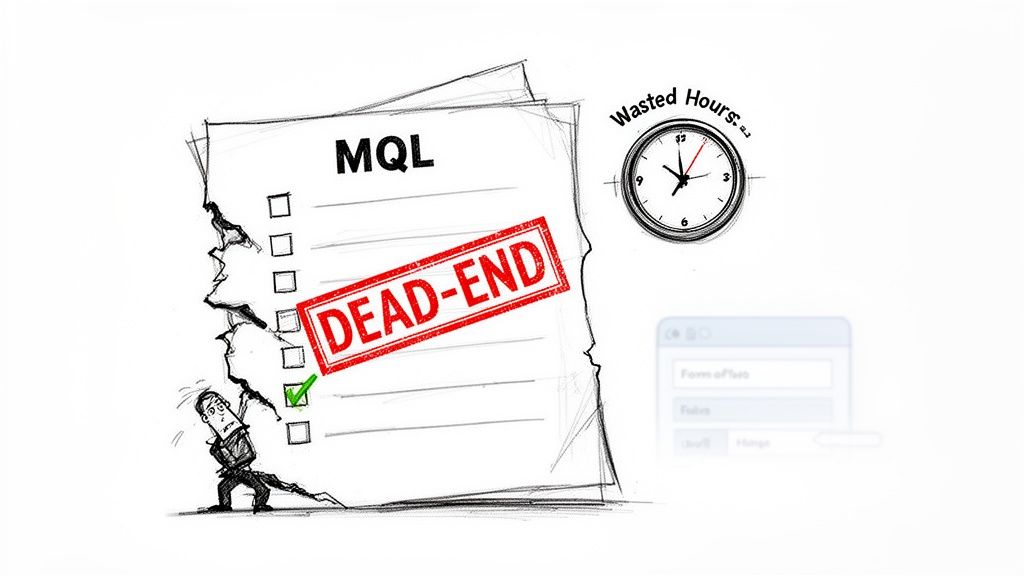
The old playbook for qualifying leads is, frankly, failing sales teams everywhere. Relying on a simple Marketing Qualified Lead (MQL) from a PDF download or a newsletter sign-up just doesn't work anymore. Why? Because today's buyers are smarter, their research process is longer, and those old signals are now completely unreliable.
This outdated approach creates a massive amount of friction. Sales Development Reps (SDRs) burn hours chasing ghosts—prospects with zero real intent—which leads to burnout and a pipeline that’s all smoke and no fire. Worse, your CRM gets clogged with low-quality contacts, making it impossible to see which opportunities are actually worth a damn.
The heart of the problem is what we choose to trust. Old-school methods value passive engagement, while modern, high-performing teams focus on signals of active buying intent. The difference isn't just semantic; it's the difference between a cold pipeline and a hot one.
Old Method (Passive Engagement)
Modern Method (Active Intent)
Actionable Difference
Downloading a general ebook
Visiting your pricing page multiple times
An ebook download is research. Pricing page visits signal budget consideration and active evaluation.
Subscribing to a newsletter
Starting a free trial or product demo
A subscription is passive interest. A trial start is active product engagement and a desire to solve a problem now.
Liking a social media post
Viewing specific case studies or integrations
A 'like' is fleeting. Viewing a case study shows the prospect is trying to visualize your solution in their world.
Attending a high-level webinar
Adding team members to a trial account
A webinar is top-of-funnel education. Adding colleagues signals a team evaluation and a move toward purchase.
See the shift? An ebook download just means someone is in research mode. But multiple visits to your pricing page? That person is actively evaluating you against competitors. One is a whisper; the other is a shout. The latter is a far more reliable sign of a sales-ready lead.
"A staggering 67% of lost sales are a result of sales reps not properly qualifying their potential customers before taking them through the full sales process."
That stat should be a wake-up call. When your team operates without a modern qualification framework, you aren't just losing time—you're actively bleeding revenue by chasing the wrong conversations.
The fallout from a bad qualification process poisons the entire sales organization. SDRs get slammed with rejection from people who never should have been called, managers can't forecast accurately to save their lives, and marketing gets blamed for sending "bad leads."
It’s a vicious cycle of frustration where:
Time is wasted: Reps are stuck doing research instead of selling.
Morale drops: Who wants a job where you get told "no" all day by unqualified prospects?
Pipeline suffers: The whole funnel gets clogged with dead-end deals.
Moving to a process driven by real buying signals isn't just a "nice-to-have" anymore. It's absolutely essential for building a high-quality pipeline that actually fuels growth. While old methods fall short, a robust approach is essential; dive deeper with a comprehensive guide on how to qualify sales leads effectively.
Building Your Signal-Based Qualification Framework
Pouring the foundation for a skyscraper is a high-stakes job. Get it right, and you can build something massive. Get it wrong, and the whole thing crumbles. Building a durable qualification framework is no different. It's time to finally retire outdated, static models like BANT and build a dynamic system that actually understands how modern buyers behave.
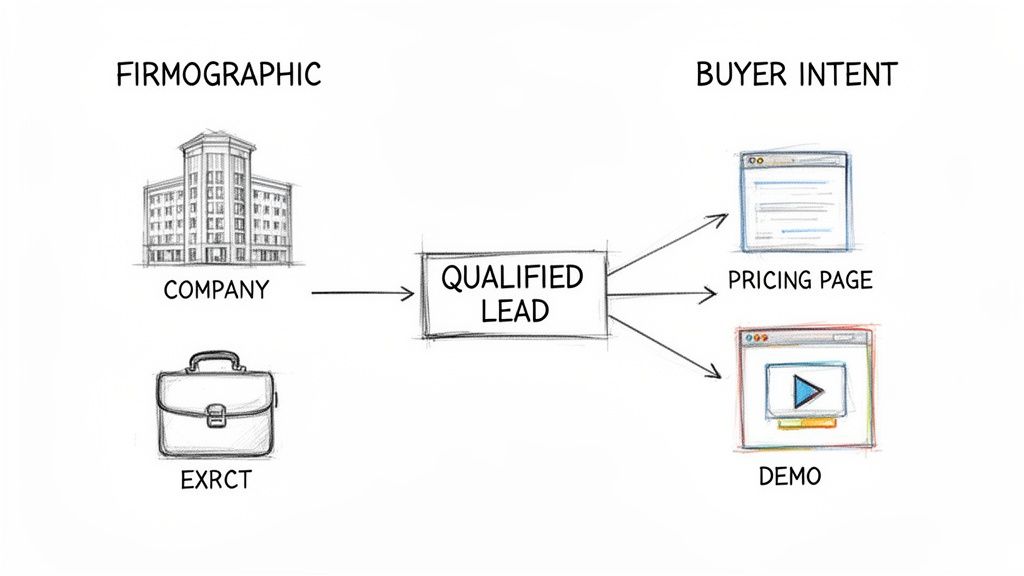
What does that look like? It means blending two critical data types: firmographics (who they are) and intent signals (what they’re doing). Sure, a lead from a Fortune 500 company is interesting. But a lead from that same company who just binge-watched your entire product demo library? That’s a conversation you need to have right now.
This synergy—combining the who with the what—is the absolute core of a signal-based framework that works. It’s how you separate the window shoppers from the real buyers.
Define Your Ideal Customer Profile with Precision
Before you can spot the right signals, you have to know who you’re looking for. Your Ideal Customer Profile (ICP) is the North Star for your entire go-to-market motion. This isn't a one-and-done exercise you knock out in an afternoon; it’s a living document that describes the perfect-fit company for your solution.
A weak ICP is vague and useless. A strong one is ruthlessly specific.
Weak ICP: Tech companies in North America.
Actionable ICP: B2B SaaS companies with 100-1,000 employees, a dedicated sales development team of at least 5 SDRs, and a tech stack that includes Salesforce and a sales engagement platform.
Action Step: To build your actionable ICP, analyze your top 10 best customers. Look for commonalities in industry, company size, revenue, and technology used. Document these criteria and make them the non-negotiable filter for all new leads. Your SDRs should be able to look at a company and give a hard "yes" or "no" to the ICP criteria in under 60 seconds.
Your Ideal Customer Profile isn’t a suggestion; it’s a non-negotiable filter. If a lead doesn’t fit your ICP, their buying signals are irrelevant. They are, by definition, a poor fit and a drain on your resources.
Not all buyer actions are created equal. This is where most teams get it wrong. The secret to a killer signal-based framework is mapping specific activities to different levels of buying intent. This simple comparison helps you prioritize who gets a call now versus who gets nurtured.
Low-Intent Signals (Informational)
High-Intent Signals (Transactional)
Following your company on social media
Visiting your pricing page three times this week
Downloading a top-of-funnel ebook
Requesting a personalized product demo
Attending a general industry webinar
Watching a 20-minute on-demand demo video
Opening a marketing newsletter
Exploring your integrations or API documentation
Action Step: Create a two-column list like the one above for your own business. Under "High-Intent," list the top 3-5 actions a prospect takes right before they become a customer. These are the signals your sales team must be alerted to immediately.
A lead showing low-intent signals is still in the "learning" phase. But one showing high-intent signals has moved into the "evaluating" phase. Making this distinction is critical for qualifying leads efficiently and ensuring your sales team only spends time on conversations with active buyers. To go deeper, check out our guide on what is intent data.
The historic tug-of-war between sales and marketing over lead quality ends here. A unified definition of a qualified lead, agreed upon by both teams, is the single most important document in your framework. This Service Level Agreement (SLA) must be clear, documented, and enforced. No exceptions.
It should precisely outline what constitutes each lead stage. Here’s a practical example you can steal:
Marketing Qualified Lead (MQL): A lead that fits our ICP (demographics and firmographics) and has taken at least one high-intent action, like viewing a case study.
Sales Accepted Lead (SAL): An MQL that an SDR has reviewed, confirmed meets all ICP criteria, and shows legitimate buying intent. It's now flagged for immediate outreach.
Sales Qualified Lead (SQL): An SAL that has engaged in a discovery call, confirming a specific pain point and a potential project within the next six months.
This tiered approach creates a clean, unambiguous handoff. Marketing knows exactly what to deliver, and sales knows exactly what to expect.
The focus is shifting fast from broad marketing engagement to tangible product interaction. In today’s B2B world, Product Qualified Leads (PQLs) are proving far more valuable than their MQL cousins. A recent survey from Databox highlighted this trend, showing that 46.4% of respondents identified PQLs as the most qualified lead type. That significantly outpaced SQLs (37.5%) and left MQLs in the dust (16.1%). The data confirms what top teams already know: leads who have actively used your product are the ones most likely to buy. They are the ultimate signal.
So, you've nailed down your ideal customer and you know what their buying signals look like. Now what? The next move is to turn that intel into a system that can actually keep up with your business. That's where a sharp lead scoring model comes in—it’s the engine that powers an efficient qualification machine.
A good model assigns points to leads based on who they are (firmographics) and what they're doing (behaviors), giving your sales team a crystal-clear, prioritized list of who to call next.
Prospecting is tough. No one's debating that. A recent SPOTIO report even flagged it as the top challenge for 42% of salespeople. But the real battle is won or lost in qualification. It’s shocking how many companies fumble here: only 44% use a lead scoring system, and a measly 39% even bother to apply consistent criteria. The result? A jaw-dropping 55% of leads get completely ignored. You can see the full breakdown in these crucial sales statistics from SPOTIO.
Without a scoring model, your reps are flying blind. They're treating a CEO who just requested a demo with the same urgency as an intern who downloaded an old ebook. A great model fixes this by turning qualification from a guessing game into a science.
Point-Based vs. Predictive Models: Which Is Right for You?
When you start building your model, you’ve basically got two paths: a classic point-based system or a more advanced predictive one. The right choice really just depends on your team's size, technical chops, and how many leads you're juggling.
A point-based model is the perfect place to start. Your team sits down and manually assigns positive or negative points to different attributes and actions. It’s transparent, simple to tweak, and you have total control over the logic.
A predictive model, on the other hand, is the next level up. It uses machine learning to comb through your historical CRM data, identifying the common threads between leads who actually became customers. New leads are then scored based on how closely they match those winning patterns. It's incredibly powerful, but it needs a ton of clean historical data to do its job.
The real magic of a point-based model is in the numbers you choose. Each score should directly reflect a lead's potential value and how serious they are about buying. This means looking at both who they are (firmographics) and what they do (behaviors).
Let’s walk through a real-world example for a B2B SaaS company that sells to sales teams.
Positive Scoring Examples (Adding Points):
Firmographic Fit:
Company size is 100-1,000 employees: +10 points
Industry is "Software" or "Business Services": +10 points
Job title contains "Sales," "Revenue," or "Business Development": +15 points
High-Intent Behaviors:
Requested a product demo: +25 points (This is the gold standard!)
Visited the pricing page more than twice in one week: +20 points
Viewed a customer case study: +10 points
Negative Scoring Examples (Subtracting Points):
Just as important is docking points for actions that signal a poor fit. This is how you keep your reps focused on real opportunities, not distractions.
Used a student or personal email address (e.g., @gmail.com): -50 points
Company size is less than 10 employees: -20 points
Job title contains "Intern" or "Student": -30 points
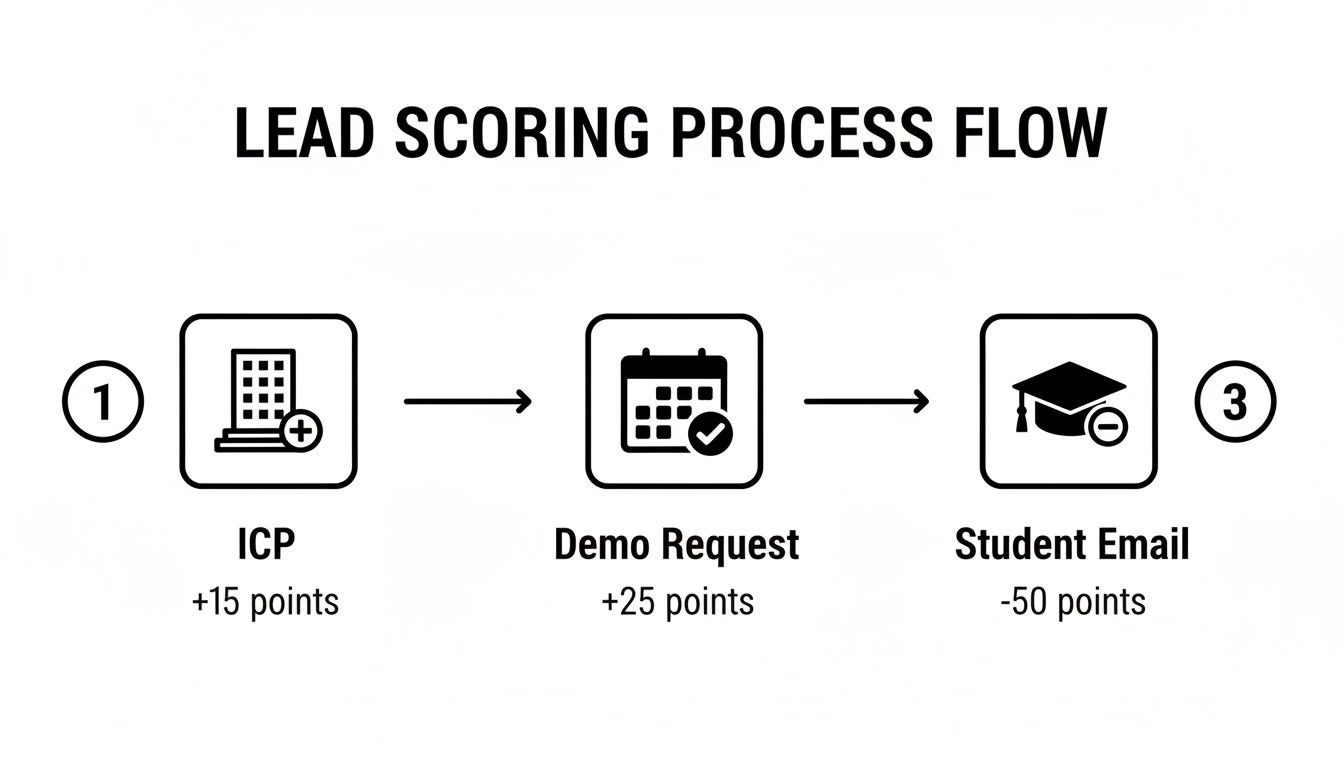
By combining these, you get a full picture. A "VP of Sales" (+15) at a 500-person software company (+10, +10) who requested a demo (+25) hits a score of 60. That's a hot lead. Meanwhile, an intern (-30) from a tiny startup (-20) ends up with a negative score, keeping them safely off your SDR's radar.
Your lead scoring model shouldn’t be a "set it and forget it" project. Think of it as a living system that needs regular check-ups to stay effective. The goal is simple: make sure your scores are accurately predicting who turns into a customer.
Action Step: Put a recurring quarterly meeting on the calendar titled "Lead Score Model Review" and invite sales and marketing leaders. The agenda should cover these three questions:
Are high-scoring leads actually converting? Pull a report of all closed-won deals from the last 90 days. If your best new customers came in with low scores, your model is broken.
Is sales happy with the quality? Get direct feedback from the reps. Are leads with scores over 50 consistently ready for a real conversation? If not, why?
Do we need to adjust any point values? Maybe you launched a new integrations page and you're noticing that visitors there are converting at a higher rate than pricing page visitors. Time to adjust the scores to reflect that new insight.
This constant feedback loop is what makes a lead scoring model truly powerful. And for teams ready to take the next step, you can explore how to use AI for advanced lead scoring to make your model even smarter and more predictive over time.
Your framework and scoring model are the blueprints. Now, it's time to build the engine that brings it all to life. This is where you connect your strategy to your sales tech stack, using AI to put the entire qualification process on autopilot.
Imagine this: a Director of Sales from one of your top-tier target accounts hits your pricing page. Instantly, an AI engine enriches their profile with fresh firmographic data, runs your scoring model, and flags them as a hot lead. Before they even click to another page, a task lands in your CRM for the right SDR, complete with a personalized email draft referencing their company’s recent Series B.
This isn’t science fiction; it’s how the sharpest sales teams operate right now. These automated workflows cut out the soul-crushing hours reps waste on manual research, letting them connect with qualified leads in minutes, not days.
Let's be honest, the old way of qualifying leads is a massive bottleneck. It’s slow, riddled with human error, and just doesn't scale. Your reps are stuck juggling browser tabs, digging through LinkedIn profiles, and manually punching data into the CRM—all while the lead's buying intent is cooling off.
The difference between the old way and the new way is night and day.
This table compares the practical impact on your team's time.
Qualification Step
Manual Process (Time/Effort)
AI-Powered Workflow (Time/Effort)
Data Enrichment
10-15 mins per lead: Reps manually search for company size, tech stack, and contact details.
Instant: AI pulls and validates data from multiple sources, appending it to the CRM record.
Lead Scoring
5 mins per lead: Reps mentally calculate or use a clunky spreadsheet, often inconsistently.
Instant: The system automatically applies your scoring model based on firmographic and behavioral data.
Prioritization
Ongoing guesswork: Reps scan a long list of leads, often defaulting to the newest or most familiar names.
Automatic: The highest-scoring leads are pushed to the top of the queue or into a dedicated "hot leads" view.
Task Creation
2-3 mins per lead: Reps manually create a task, add notes, and set a due date in the CRM.
Instant: A task is auto-created and assigned based on pre-set rules (e.g., territory, account owner).
AI doesn’t just make the process faster. It makes it smarter and way more consistent, ensuring a high-potential lead never slips through the cracks because a rep was having a busy day or missed a notification.
You don't need a team of data scientists to set this up. Modern platforms are built around simple, trigger-based rules that you can configure to run the whole show.
Action Step: Map out a simple workflow on a whiteboard. Start with a trigger, then define the action. Example: Trigger: "Lead Score > 50." Action: "Create task in CRM for assigned SDR with 'High Priority' flag."
Your workflow will usually have a few core components working together:
Triggers: These are the events that kick everything off. A trigger could be a prospect hitting your pricing page, a new lead from a specific G2 campaign, or a contact’s title changing to a decision-making role.
Enrichment: Once triggered, the system automatically fetches critical data points—think employee count, industry, funding status, and the tech they use. This gives you the context for accurate scoring.
Scoring & Routing: With that enriched data, the lead gets scored against your model. Based on that score, you can set rules to route them to the right SDR, drop them into a nurture sequence, or create an urgent task.
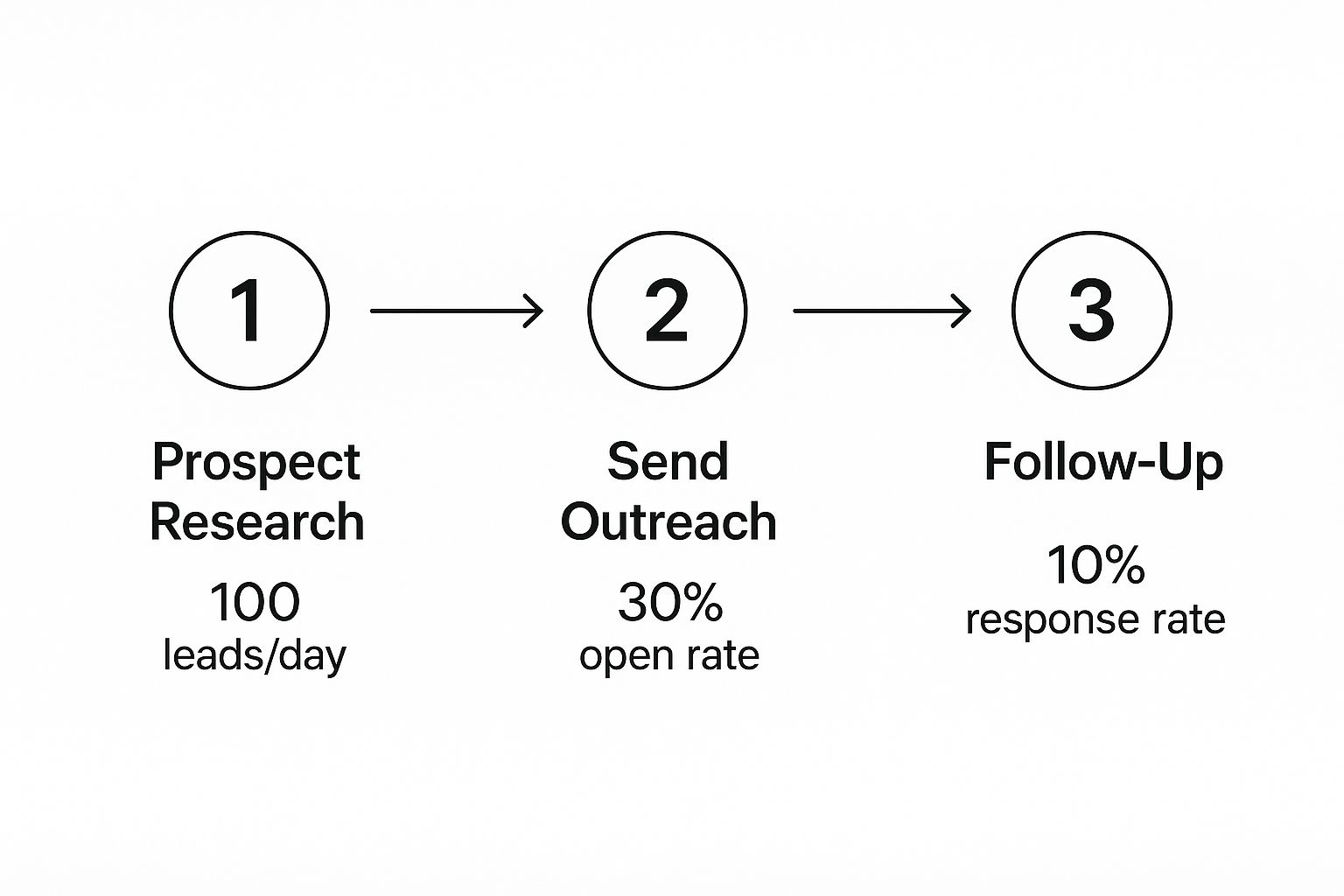
This flow chart shows how just a few simple rules can instantly separate the signal from the noise.
This is how AI applies both positive and negative scoring to qualify leads in real-time. To see this in action, it's worth checking out some of the top AI SaaS companies building solutions specifically for this.
The point of automation isn’t to replace your sales reps. It's to free them from low-value, repetitive tasks so they can spend their time on what humans do best: building relationships and closing deals.
A huge—and often overlooked—benefit of an AI-driven process is its effect on your data hygiene. Manual data entry is a disaster waiting to happen, full of typos, outdated info, and inconsistent formatting. An automated system that enriches and updates records keeps your CRM as a reliable source of truth.
Clean data feeds directly into your analytics, giving you a much clearer picture of what's actually working. You can finally answer the big questions with confidence:
Which lead sources are actually generating our highest-scoring leads?
What behaviors are most correlated with a closed-won deal?
How fast are my reps really getting to high-priority leads?
This feedback loop lets you constantly tweak your ICP, scoring model, and overall sales strategy. Lead quality is everything, yet the data shows a massive disconnect: only 5% of sales reps rate their marketing leads as 'very high quality,' while 34% see qualification as their biggest challenge. This is the exact problem AI automation was built to solve.
By hooking your qualification framework up to a smart automation engine, you turn it from a static document into a living system that actively builds your pipeline. For a deeper dive, check out our guide on integrating AI for marketing automation.
Measuring and Refining Your Qualification Process
Your lead qualification process isn't a museum piece—you don't build it once and admire it from behind glass. It’s a living, breathing system that needs constant attention to stay sharp. Without tracking the right numbers, you're flying blind, unable to tell if your shiny new framework is actually building pipeline or just creating busywork.
This is where you move from theory to results. Measuring your process is how you prove its value and, more importantly, find opportunities to make it even better. The goal is to create a tight feedback loop that keeps your entire go-to-market engine perfectly tuned.
Forget vanity metrics like the total number of MQLs. They're distracting. You need to focus on the KPIs that directly measure the health and efficiency of your qualification engine. These are the numbers that tell you if your efforts are turning into actual revenue.
Here are the essentials to build your dashboard around:
Lead-to-Opportunity Conversion Rate: This is the big one. It measures the percentage of leads that successfully convert into a legitimate sales opportunity. If this number is low, it’s a bright red flag that your definition of a "qualified lead" is out of sync with reality.
Sales Cycle Length by Lead Source: Are leads from your G2 campaign closing twice as fast as those from webinars? This metric helps you understand which channels are delivering not just leads, but highly-motivated buyers. It’s how you learn where to double down.
Win Rate from Qualified Leads: Of all the opportunities that came from qualified leads, what percentage are you actually winning? A high conversion rate but a low win rate might mean you're qualifying on surface-level interest but missing true purchase intent or budget realities.
To really understand performance, you have to know the difference between lagging and leading indicators. One tells you what already happened; the other helps you see what's coming. A healthy process tracks both.
Indicator Type
Lagging Indicators (The Result)
Leading Indicators (The Predictor)
What It Measures
Historical outcomes and past performance.
Future performance and pipeline health.
Example Metrics
- Revenue from qualified leads (last quarter) - Average deal size by lead source
- Number of demo requests this week - Percentage of leads hitting a high score threshold
Use Case
Proving ROI and reviewing past strategy.
Forecasting future pipeline and making real-time adjustments.
Focusing only on lagging indicators like quarterly revenue is like driving while looking in the rearview mirror. Leading indicators give you the forward-looking view you need to steer the ship.
A common mistake is to obsess over the total number of MQLs (a leading indicator of activity) without tying it to the lead-to-opportunity conversion rate (a lagging indicator of quality). A successful team knows that quality trumps quantity every time.
Data is crucial, but it's only half the story. The other half is communication. A structured, consistent feedback loop between your sales and marketing teams is what turns good data into great strategy. Without it, you’ll just have two teams working from different playbooks.
This isn't about blaming marketing for "bad leads." It's about collaborative refinement.
Hold Weekly Huddles: Get your SDR and marketing leaders in a room for 30 minutes every week. No exceptions. Review the top leads that were passed over. What were the specific reasons a lead was accepted or rejected? Was the data wrong? Did they not fit the ICP? Get into the weeds.
Use a "Lead Status" Field: Add a simple, mandatory dropdown in your CRM for reps to mark why a lead was disqualified. Use concrete reasons like "Not a decision-maker," "No budget," or "Unresponsive." This turns anecdotal complaints into structured data you can actually analyze.
Share the Wins: When a lead that marketing sourced turns into a closed-won deal, broadcast it. Send a Slack message. Mention it in the all-hands. This reinforces what a perfect lead looks like and keeps both teams motivated and aligned on the real goal: creating more revenue.
Free Tool
Try our AI Lead Generator — find verified LinkedIn leads for any company instantly. No signup required.
Even with the best game plan, questions always pop up. Here are some of the most common ones we hear from sales and marketing leaders, along with some straight answers from our experience.
What’s the Real Difference Between MQLs, SQLs, and PQLs?
Getting the alphabet soup of lead types straight is non-negotiable. They sound alike, but they represent totally different stages of interest. Messing them up is a classic way to create friction between sales and marketing. Here’s a comparative breakdown:
Lead Type
Definition
Source of Signal
Conversion Potential
MQL
A lead who fits your ICP and has engaged with top-of-funnel marketing content (e.g., ebook download).
Interest in your content.
Lowest
SQL
An MQL that a sales rep has spoken to and verified has a legitimate need, budget, and timeline.
Interest in a conversation.
Medium
PQL
A user of your product (trial/freemium) who has taken high-value actions (e.g., invited a teammate).
Interest proven through product usage.
Highest
The difference boils down to the source of the signal. MQLs show interest in your content. SQLs confirm interest in a conversation. PQLs demonstrate interest through their actions in your product. In today's market, PQLs crush other lead types on conversion rates because the product has already done the heavy lifting.
How Often Should We Revisit Our Lead Scoring Model?
Your scoring model isn't a "set it and forget it" document. Think of it as a living system that needs regular tune-ups to stay sharp. A full review at least once a quarter is a solid baseline.
In that quarterly review, you're looking at your closed-won deals and working backward. Are the leads that turned into your best customers actually scoring high? If your biggest new logo last quarter came in with a score of 35, something is broken. That's a huge red flag that your points are misaligned with what actually drives revenue.
But don't wait for the quarterly review if something big changes. Launching a new product, overhauling your ICP, or pivoting your GTM strategy all demand an immediate update.
Absolutely. You don't need a massive tech stack and a team of data scientists to get this right. The trick for smaller teams is to prioritize clarity over complexity. Start with a strong foundation and build from there.
For a lean team, the path is simple:
Get ridiculously specific with your ICP. This costs zero dollars and has the single biggest impact.
Pick just 3-5 high-intent signals. Don’t boil the ocean. Start with the obvious ones like "Requested a demo," "Visited the pricing page 3+ times," or "Started a free trial."
Build a simple scoring model in a spreadsheet or your CRM's basic scoring feature. Give points to your ICP criteria and those key intent signals.
The goal is to create a documented, repeatable process first. A simple framework that everyone on the team understands and follows will always beat a complicated system nobody uses. You can add more sophisticated tools and automation later as you grow.
Ready to stop wasting time on unqualified leads? marketbetter.ai turns buyer signals into prioritized SDR tasks, complete with AI-generated emails and a dialer that lives inside your CRM. See how you can build a consistent outbound motion without the busywork at https://www.marketbetter.ai.
Let's be real—most B2B marketing feels like trying to find a needle in a haystack. You're constantly chasing leads, hoping a few are actually ready to talk.
B2B demand generation flips that entire model on its head. Instead of just scrapping for the few buyers who are ready to pull the trigger right now, you play the long game. It's about building awareness and creating genuine desire across your entire market, so when they are ready to buy, you’re the only name they think of.
Most B2B marketing teams are playing with a massive handicap and don't even know it. They pour their entire budget into capturing immediate leads, but this completely ignores how markets actually work.
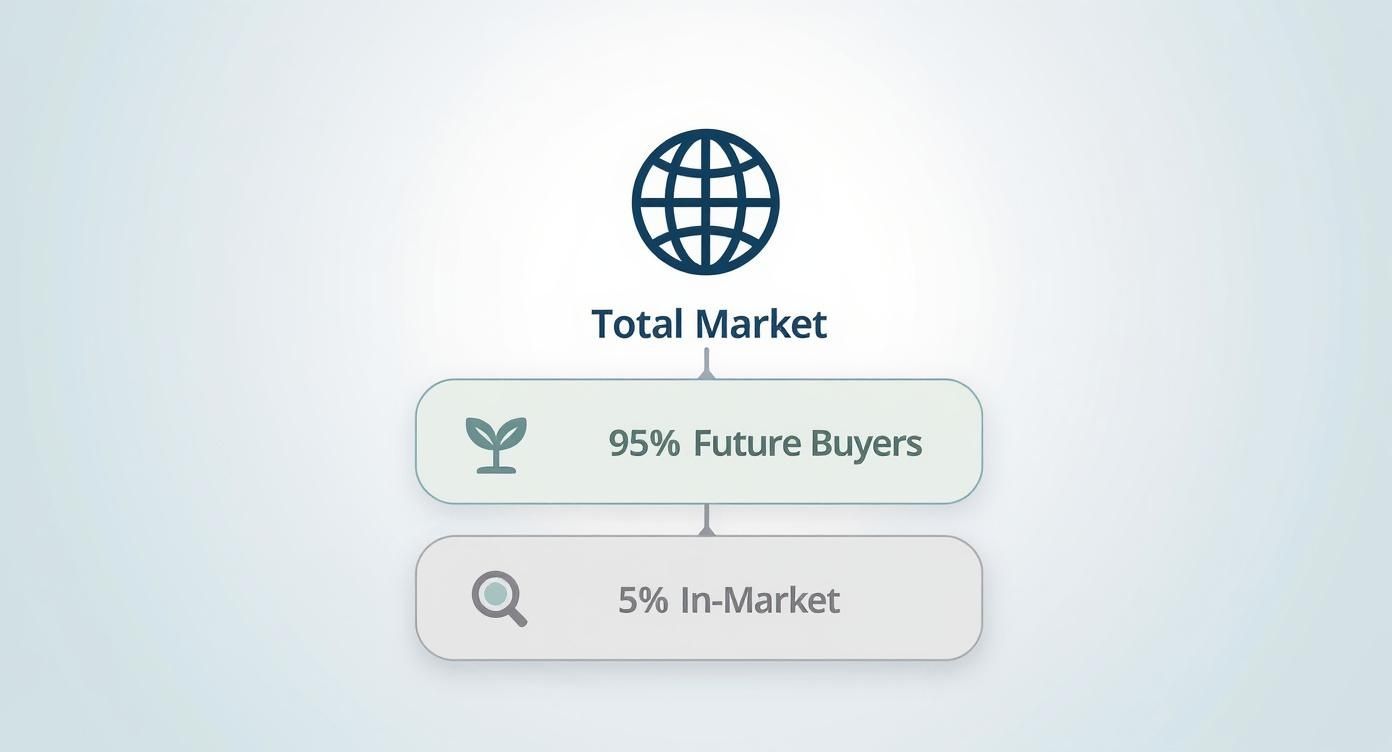
Here’s the hard truth: only 5% of your total addressable market is actively 'in-market' at any given moment. That means a whopping 95% of your potential future customers are out there, but they just aren't ready to buy yet. This single stat should change how every B2B marketer thinks.
When you focus all your energy on that tiny 5%, you’re jumping into a hyper-competitive, high-cost cage match with every other company in your space. Everyone is bidding on the same keywords, targeting the same handful of prospects. The result? A mess of predictable problems that stall growth.
When marketing's only job is to capture that 5%, you create a vicious cycle that burns out your team and your budget. This tunnel vision leads directly to:
Sky-High Acquisition Costs: The fierce competition for those few active buyers drives your ad spend and customer acquisition costs (CAC) through the roof, crushing your margins.
Sales Team Burnout: Marketing gets desperate and starts passing off low-quality, barely-qualified contacts just to hit a number. Your sales team wastes precious time chasing ghosts who have no real intent, leading to missed quotas and serious frustration.
Unpredictable Revenue: A pipeline that relies solely on the tiny fraction of the market buying today is shaky at best. It’s a recipe for wild, unpredictable swings in revenue.
A modern B2B demand generation strategy stops marketing from being a reactive cost center and turns it into a predictable revenue engine. You build a reservoir of future customers by educating and engaging the 95%, ensuring a steady, consistent flow of high-intent buyers for the long haul.
The first step is a mental shift. Stop asking, "How do we get more leads today?" Start asking, "How do we become the go-to solution for our entire market tomorrow?"
This is the philosophy that builds sustainable growth. To get a better handle on the fundamentals, it’s worth exploring what demand generation marketing entails. This approach builds brand equity and trust, so when the time is right, the sales conversation is a hell of a lot easier.
To build a B2B demand generation engine that actually works, you have to get one thing straight: the difference between creating demand and capturing demand. It’s the single most common blind spot I see. Too many marketers focus only on one side of the equation, which is like a farmer only showing up at harvest time without ever planting a single seed. A strategy that lasts requires you to master both.
Think of it like this: demand creation is the patient work of tilling the soil and planting seeds for a future harvest. It's about educating and building trust with the overwhelming majority of your market—the 95% of people who aren’t looking to buy today but will be someday.
On the flip side, demand capture is about harvesting the crops that are ripe for the picking right now. This is where you engage the tiny 5% of your market that is actively searching for a solution. They know they have a problem, and they're looking for a fix.
This breakdown isn't just a theory; it's how your market actually works.
That image makes it painfully clear. If you only focus on capturing the 5%, you're in a knife fight with every competitor for the smallest slice of the pie. The real, long-term growth comes from nurturing the other 95%.
Demand creation is a long game. It's an investment in your brand’s authority and your audience’s trust. The goal isn't to get a lead today; it's to be the only company they think of when a problem comes up six months from now. This means showing up where your ideal customers hang out to learn, long before they're in a buying cycle.
Here’s an actionable plan to start:
Launch a Niche Podcast:Action: Identify 3 industry experts your ideal customers admire. Invite them to discuss a common pain point. This positions you as a connector and thought leader, not just a vendor.
Dominate Thought Leadership on LinkedIn:Action: Task your internal experts with sharing one non-promotional, genuinely helpful tip or insight each week. Engage in comments on other leaders' posts to build visibility and trust.
Build an Online Community:Action: Start a free Slack or Discord channel focused on a specific industry role (e.g., "B2B SaaS Marketers"). Your job is to facilitate valuable conversations and connections, not to pitch your product.
You don't measure these efforts in MQLs. You measure them with metrics that matter for brand building, like audience growth, share of voice, and direct traffic.
While you're building that future pipeline, you still need to hit this quarter's number. That's where demand capture comes in. These are the tactics aimed squarely at prospects who are waving their hands in the air, signaling they have a problem and are ready to talk solutions. The trick is to be right there, with the right message, the moment they're looking.
Here’s an actionable plan to start:
Run High-Intent Google Ads:Action: Instead of bidding on broad terms like "CRM software," bid on long-tail phrases that signal immediate need, such as "[Your Competitor] alternative" or "best CRM for small business."
Optimize Your G2 and Capterra Profiles:Action: Launch a campaign to get 10 new, positive reviews from happy customers this quarter. A profile packed with recent social proof is non-negotiable for buyers in the comparison stage.
Use Surgical Retargeting Ads:Action: Create a specific ad campaign targeting only visitors who viewed your pricing or demo pages in the last 14 days. This keeps you top of mind during their final decision-making window.
The core difference is timing and intent. Demand creation educates those who might have a problem in the future. Demand capture converts those who know they have a problem today.
The table below breaks down the practical differences in how you approach these two critical functions.
Comparing Demand Creation and Demand Capture Tactics
Aspect
Demand Creation (Targeting the 95%)
Demand Capture (Targeting the 5%)
Objective
Build brand awareness, trust, and authority over the long term. Educate the market.
Convert existing buying intent into pipeline and revenue now.
Channels
Social media (LinkedIn), podcasts, communities (Slack), content hubs, organic search (informational).
- Hosting an industry podcast - Publishing original research reports - Building a thought leader's LinkedIn presence
- Bidding on "bottom-of-funnel" keywords - Optimizing software review site profiles - Running demo request landing pages
Ultimately, a winning B2B demand generation strategy doesn't choose between them—it balances them. You have to create future demand while you efficiently capture the demand that already exists. This dual focus is the only way to not only crush this quarter's target but also build a predictable revenue engine for years to come.
Your Playbook for High-Impact Channels and Tactics
Alright, let's move from theory to action. A successful B2B demand generation program hinges on a smart playbook—picking the right channels and running tactics that build real authority and fill your pipeline.
Forget the old "spray-and-pray" method. The goal here is surgical precision. You need to show up exactly where your ideal customers are already learning, connecting, and making buying decisions. It’s about understanding the specific job each channel has, whether that's creating future demand or capturing the intent that’s already out there today.
Content is the bedrock of any serious demand gen effort. It’s how you educate the 95% of your market that isn't actively buying right now, slowly but surely positioning your brand as the go-to expert.
A common mistake is creating content just to please search engines. This leads to sterile, keyword-stuffed articles that might rank but don't actually connect with a human reader. The real key is to build your content around pillar pages or content hubs.
Actionable Step: Identify the single biggest, most complex problem your ideal customer faces. Create a comprehensive "pillar page" that acts as the ultimate guide to solving it. Then, plan 5-7 "cluster" blog posts that dive deeper into specific sub-topics, all linking back to your main pillar. This strategy signals topical authority to search engines and provides immense value to your audience.
A winning B2B content strategy doesn't just answer questions; it shapes the entire conversation. Your content should be the resource your competitors' customers secretly use to get their jobs done better.
This is a long-term play, but the payoff is huge. Companies that keep up an active blog generate 67% more leads per month on average than those that don't.
For B2B marketers, LinkedIn isn't just another social network. It's the digital town square where your entire industry hangs out. Just posting company updates won’t move the needle. The real power is in activating the personal brands of your in-house subject matter experts.
Instead of your company page broadcasting messages, imagine your CEO, Head of Product, or a top engineer sharing genuine insights from their day-to-day. Have them ask thought-provoking questions and jump into real conversations in industry groups. This human-to-human connection builds trust in a way a corporate logo simply can't.
Actionable Step: Take your latest research report or webinar recording and have a subject matter expert repurpose the key takeaways into a 5-post LinkedIn series. Each post should share one valuable insight and ask a question to encourage comments. This multiplies the reach of your core content and puts it directly in front of a highly relevant audience.
Webinars and Virtual Events: Creating Fans, Not Just Leads
Webinars are still a powerhouse for demand generation, but the game has changed. The era of dry, hour-long product pitches is officially over. Today's best webinars feel more like live, educational shows.
These events should focus on a tangible problem and feature industry experts—not just your own team. Bringing in outside voices broadens your reach and adds a ton of credibility. The data backs this up: 53% of marketers say webinars are the top-of-funnel format that generates the highest quality leads.
Here’s a look at how the approach has shifted:
Feature
The Old Way (Lead Gen Focus)
The Modern Way (Demand Gen Focus)
Primary Goal
Collect as many registrants (MQLs) as possible.
Deliver an exceptional educational experience to the right audience.
Content Focus
Heavily product-focused, often a thinly veiled sales demo.
Focused on solving a specific audience pain point; the product is only mentioned for context.
Promotion
"Register for our webinar" plastered everywhere.
Promote the topic and the expert speakers to create genuine interest.
Success Metric
Number of MQLs passed to sales.
Audience engagement, post-event feedback, and influence on the pipeline.
When you shift your focus from simply collecting emails to delivering real value, you don't just get a lead—you create a genuine fan of your brand.
This strategy is a cornerstone of many successful B2B demand generation programs. It works hand-in-glove with other efforts, like those we explore in our complete guide to inbound marketing and lead generation. Ultimately, the right channel mix depends on where your audience lives and how they like to learn, but these three pillars are a powerful and proven place to start.
Your tech stack shouldn't be a Frankenstein's monster of disconnected tools. Think of it as the central nervous system for your entire demand gen strategy. It's what connects data, automates the grunt work, and gives you the insights to make smarter bets with your budget.
Get it right, and everything flows. Get it wrong, and you're stuck with data silos, operational headaches, and a fuzzy picture of what's actually driving revenue.
Let's break it down with an analogy. Your Customer Relationship Management (CRM) is the brain, the single source of truth. Your Marketing Automation Platform (MAP) is the nervous system, executing the commands. And your Analytics tools are the eyes and ears, telling you what's happening in the real world. All three have to work together.
Every solid demand gen stack is built on a few non-negotiable pillars. These are the foundational tools for tracking engagement, nurturing relationships, and finally proving marketing's impact on the bottom line.
CRM (The Brain): This is where every piece of customer and prospect data lives—contact info, interaction history, deal stages, you name it. It has to be your single source of truth. Think HubSpot (often an all-in-one choice) and Salesforce.
Marketing Automation (The Nervous System): This is the engine that runs your campaigns. It handles email nurturing, builds landing pages, and powers your lead scoring models. Common players include Marketo, Pardot, and the automation built right into HubSpot.
Analytics and Attribution (The Eyes and Ears): These tools answer the golden question: "Is this working?" Google Analytics is the baseline for web traffic, but more advanced platforms like Dreamdata or HockeyStack connect the dots directly from a marketing touchpoint to a signed contract.
As you build out your stack, remember to account for specific channels. For example, if webinars are a key part of your strategy, choosing the best webinar software for small businesses ensures your content delivery is just as polished as your data tracking.
The perfect tech stack isn't one-size-fits-all. It has to scale with your company's complexity and budget. What works for a lean startup would grind a global enterprise to a halt, and an enterprise stack would be overkill for a small team.
Company Stage
Key Focus
Example Tech Stack
Lean Startup
Affordability, ease of use, and all-in-one functionality. The goal is speed and efficiency.
CRM/Automation: HubSpot Starter/Pro Analytics: Google Analytics Social: Buffer or Hootsuite
Established Enterprise
Scalability, deep customization, and robust integrations. The goal is managing complex campaigns.
CRM: Salesforce Automation: Marketo or Pardot Analytics: Dreamdata, Bizible ABM: 6sense or Demandbase
For startups, an all-in-one platform like HubSpot is almost always the right call. It bundles the CRM, marketing automation, and analytics you need to get started, minimizing integration headaches and keeping costs down.
Enterprises, on the other hand, usually need best-in-class point solutions that can handle massive data volumes and complex workflows, even if it means a higher price tag and more heavy lifting on the integration front.
The most important principle is integration. Your tools must speak to each other seamlessly. A disconnected stack creates blind spots, making it impossible to see how a LinkedIn ad or a blog post ultimately influenced a closed-won deal.
AI isn't some futuristic concept anymore; it's a practical, powerful layer you can add to your stack right now. AI-powered tools are becoming essential for getting an edge in personalization and efficiency, analyzing huge datasets to spot patterns a human marketer could easily miss.
Here’s an actionable comparison of manual vs. AI-powered approaches:
Task
Manual Approach
AI-Powered Approach
Lead Scoring
Relies on simple demographic rules (e.g., company size, job title).
Analyzes thousands of behavioral and firmographic signals for a predictive score.
Content Personalization
Create a few different landing pages for broad segments.
Dynamically changes website copy and CTAs for each individual visitor in real-time.
Campaign Optimization
A marketer manually checks performance and adjusts ad bids weekly.
The AI algorithm automatically adjusts bids and reallocates budget 24/7.
Getting started doesn't require ripping and replacing your entire system. You can explore a variety of AI marketing automation tools designed to plug right into your existing workflows, giving you an immediate boost without a massive overhaul.
In B2B demand generation, what you measure is what you get. For too long, marketing teams celebrated vanity metrics like social media likes and website traffic that mean very little to the C-suite. To prove your value and secure bigger budgets, you have to start speaking the language of revenue.
This means shifting your focus from top-of-funnel activity to bottom-line business outcomes.
When you report on pipeline and customer acquisition cost instead of clicks, you completely change the conversation. Marketing is no longer seen as a cost center but as a primary driver of predictable business growth.
Vanity metrics feel good, but they don’t pay the bills. A spike in website visitors is meaningless if none of them are qualified buyers. True success in B2B demand generation is measured by its direct contribution to the sales pipeline and closed-won deals.
This isn't just a trend; it's a fundamental shift in how B2B marketing is held accountable. A recent study shows that 42% of B2B marketing teams now cite revenue generated as their top KPI—a stark contrast to the old days of clicks and impressions. With marketing budgets hovering around 7.7% of overall company revenue, the pressure is on to show a clear return on that investment. You can see more on these demand generation statistics and their impact here.
To demonstrate your impact, get laser-focused on these actionable metrics:
Marketing-Sourced Pipeline: This is the total dollar value of sales opportunities that came directly from marketing activities. It's the cleanest indicator of your team's contribution to future revenue.
Sales Cycle Length: Track how long it takes, on average, for a marketing-sourced lead to become a paying customer. An effective demand gen strategy should shorten this cycle by delivering better-educated, higher-intent leads to sales.
Customer Acquisition Cost (CAC): This is the total cost of your sales and marketing efforts divided by the number of new customers acquired. Your goal is to keep this number as low as possible while maintaining lead quality.
The difference in focus is night and day. One approach reports on activity, while the other reports on actual business impact.
The Old Way (Vanity Metrics)
The New Way (Revenue Metrics)
Website Traffic: "We had 10,000 visitors this month."
Pipeline Contribution: "Marketing generated $500k in new sales pipeline this quarter."
Lead Volume: "We generated 500 MQLs."
Lead-to-Customer Rate: "1 in 10 marketing-sourced leads became a paying customer."
Click-Through Rate (CTR): "Our ad campaign had a 3% CTR."
Customer Acquisition Cost (CAC): "Our CAC from the ad campaign was $5,000."
This new approach aligns marketing directly with sales and executive goals, which is how you build trust and prove your team's indispensable role. You can explore a deeper dive into key performance indicators for lead generation to build out your own reporting dashboards.
To make your reporting rock-solid, it helps to have a clear view of which KPIs tell the best story. Here's a breakdown of the metrics that truly matter.
The number of leads deemed ready for sales follow-up based on their behavior (e.g., downloaded an ebook).
Measures the volume of potential buyers your demand capture efforts are generating.
Sales Qualified Leads (SQLs)
MQLs that the sales team has accepted as legitimate opportunities with real buying intent.
Shows the quality of your MQLs and the alignment between marketing and sales.
MQL-to-SQL Conversion Rate
The percentage of MQLs that become SQLs.
This is a critical health check on your lead quality. A low rate signals a disconnect.
Pipeline Contribution
The total dollar value of sales opportunities that originated from marketing efforts.
The single most important metric for proving marketing's direct impact on future revenue.
Customer Acquisition Cost (CAC)
Total sales and marketing spend divided by the number of new customers acquired in a period.
Measures the efficiency of your demand generation engine. Lower is better.
Customer Lifetime Value (CLV)
The total revenue a business can expect from a single customer account throughout the relationship.
Provides context for CAC. A high CLV justifies a higher acquisition cost.
Sales Cycle Length
The average time it takes for a lead to become a paying customer.
Effective demand generation should shorten this by delivering more educated, ready-to-buy leads.
Tracking these metrics gives you a 360-degree view of your performance, from initial interest all the way to closed revenue. It’s the difference between guessing and knowing.
You don’t need expensive, complicated software to start connecting marketing efforts to revenue. Revenue attribution is simply the practice of assigning credit to the marketing touchpoints a customer interacted with before they bought something.
While complex multi-touch models exist, you can get started with a simple, practical approach.
A great starting point is the First-Touch Attribution Model. This model gives 100% of the credit for a new customer to the very first marketing interaction they had with your brand.
Actionable Example: A prospect reads one of your blog posts they found through a Google search. Six months later, after attending a webinar and having multiple sales calls, they become a customer. With first-touch attribution, that blog post gets all the credit.
This model is simple to implement and powerfully demonstrates the value of your demand creation activities—like content and SEO—which often get overlooked. It helps you justify the long-term investments that build your brand and create future demand, proving that what you do today directly impacts the revenue you see tomorrow.
4-Phase Action Plan to Launch Your Demand Gen Engine
Alright, theory's one thing, but revenue comes from execution. Let's turn all this talk into a practical, step-by-step roadmap for launching or overhauling your B2B demand generation engine. I’ve broken this down into four clean phases designed to build momentum and get real results on the board.
Forget the "boil the ocean" approach. Trying to do everything at once is a recipe for wasted budget and burnout. This plan ensures you build a solid foundation first, then scale.
Before you spend a single dollar on a campaign, you need absolute clarity on who you're talking to and what you're saying. This is the unsexy, non-negotiable work that makes everything else click. Skipping this step is the #1 reason demand gen initiatives die on the vine.
Your only mission here is to:
Nail Your Ideal Customer Profile (ICP):Action: Schedule 3-5 interviews with your best customers. Ask them about their "before" and "after" state, what triggered their search for a solution, and what other tools they considered.
Craft Your Core Messaging:Action: Based on those interviews, write a single paragraph that describes the problem you solve, for whom, and what makes your solution unique. Test this messaging with your sales team for feedback.
With your foundation poured and set, it's time to start creating some demand. This phase is all about planting seeds with the 95% of your market that isn't shopping today. The goal isn't lead capture; it's to build awareness, authority, and an audience that trusts you.
This isn’t about harvesting emails. It’s about building an audience that sees you as the go-to expert. Your first move should feel like a Trojan horse of value—give away so much insight that your brand becomes impossible to ignore.
Here’s where to start:
Launch a Content Series:Action: Pick one format you can execute consistently (e.g., a monthly webinar with guest experts). Commit to producing it for at least 3 months to build momentum and an audience.
Activate a Key Opinion Leader:Action: Choose one person inside your company with strong expertise. Their only goal for this phase is to post twice a week on LinkedIn, sharing insights from your content series and engaging in industry conversations.
While you're building future demand, you can't ignore the people ready to buy right now. This phase is about setting up the plumbing to efficiently catch the 5% of the market that's actively looking for what you sell.
Phase 2 (Creation) Focus
Phase 3 (Capture) Focus
Educating the market
Converting existing intent
Building an audience
Generating qualified meetings
Long-term brand building
Near-term pipeline impact
Your initial setup should be lean and mean:
Targeted "Bottom-of-Funnel" Ads:Action: Launch one Google Ads campaign with a small budget ($500-$1000/mo). Target a maximum of 10 high-intent keywords like "[Your Competitor] alternatives" or "[Your Product Category] pricing."
Conversion-Optimized Landing Pages:Action: Create a single, simple landing page for your ads. It should have a clear headline, 3-5 bullet points on value, and a form to request a demo. That's it.
Phase 4: Establish Your Measurement Framework (Weeks 11-12)
Finally, you need to prove it's all working. This last phase ensures you can track progress, show ROI, and make smarter decisions with real data. Start simple. Focus on the metrics that the C-suite actually cares about: pipeline and revenue.
Build a Core Metrics Dashboard:Action: In your CRM, create a dashboard with three reports: Marketing-Sourced Pipeline by Month, MQL-to-SQL Conversion Rate, and Average Sales Cycle Length for Marketing Leads. Review it weekly to track progress and identify bottlenecks.
Free Tool
Try our Marketing Plan Generator — generate a complete AI-powered marketing plan in minutes. No signup required.
If you're digging into the world of B2B demand generation, a few practical questions always come up. Here are some straight answers to help you build a smarter strategy from day one.
What’s the Real Difference Between Demand Generation and Lead Generation?
It’s easy to get these two tangled up, but the distinction is critical. Think of it as the difference between farming and hunting.
Aspect
Demand Generation (Farming)
Lead Generation (Hunting)
Goal
Cultivate the entire market over time, building awareness and desire.
Identify and capture specific individuals who are ready to buy now.
Timeframe
Long-term strategy focused on building a sustainable pipeline.
Short-term tactic focused on hitting immediate targets.
Analogy
Demand generation is making the market hungry for what you sell.
Lead generation is taking the order from those who are ready to eat.
One builds your future pipeline; the other harvests today's opportunities. A healthy strategy needs both.
Let's be clear: B2B demand generation is a long-term investment, not an overnight hack. The timeline really depends on where you're focusing your energy.
Demand Capture (like Paid Ads): You can start seeing direct responses—think demo requests or content downloads—within a few weeks. You're catching people who are already looking.
Demand Creation (Content, Brand, Community): This is the foundational work. Building real authority and trust takes time, and you should expect it to take 6-12 months before you see a significant, predictable impact on your sales pipeline and revenue.
But you don't have to wait a year to know if it's working. Look for early signs like an increase in your brand's search volume, more engagement from people at your target accounts on social, and your sales team telling you the quality of inbound leads is getting better. Those are the green shoots that prove your strategy is taking root.
How Can I Start Demand Generation if My Budget Is Tiny?
You don’t need a huge budget to get started—you need focus. The best first moves cost you time and expertise, not a ton of cash.
Actionable Plan for a Tiny Budget:
Identify Your ICP: Get ruthlessly specific about the one type of company and role you want to reach.
Choose One Channel: Don't try to be everywhere. Pick the one place your ICP hangs out most (for B2B, it's almost always LinkedIn).
Activate One Expert: Find one person at your company with deep expertise. Their only job is to post two valuable, non-salesy insights on that channel per week.
Repurpose Everything: Turn one blog post or customer story into five different social posts, a short video, and an email newsletter snippet. This maximizes your effort without creating net-new content.
Building authority this way is free, and it makes every dollar you eventually spend on paid ads infinitely more effective.
Ready to supercharge your entire marketing process with AI? The marketbetter.ai platform helps you create content 5x faster, improve campaign conversions, and prove your team's impact on revenue. Learn more about our AI-Powered Marketing Platform.
In a world drowning in content, it’s easy to think that the only way to win is to publish more, rank higher, and wait for people to find you. That’s the inbound game.
But what if you didn’t have to wait?
That's where outbound lead generation comes in. It’s the art of proactively starting conversations with potential customers who haven't raised their hand yet. Instead of setting up a shop and hoping for foot traffic, your sales team is out there knocking on the right doors.
While a solid inbound strategy builds a great foundation over time, outbound is the catalyst for immediate growth. It gives you control.
Think of it this way: inbound is like setting up a fantastic storefront and hoping the right people wander in. Outbound is like sending your best ambassador to a high-stakes business conference to talk directly to your ideal buyers. You aren’t waiting for opportunities; you're creating them.
This direct approach puts you in the driver's seat of your sales pipeline. You're no longer at the mercy of search engine mood swings or the slow burn of content marketing. You decide exactly who you’re talking to, and when.
The real magic of outbound is its precision. You can zero in on specific companies, job titles, and industries that perfectly match your Ideal Customer Profile (ICP). This is a game-changer in B2B, where deals are bigger and the right decision-makers are notoriously hard to reach.
While inbound often casts a wide net, outbound uses a spear.
This proactive approach delivers a few key wins:
Immediate Feedback Loop: You find out fast what messaging hits home with your target market. This lets you sharpen your value proposition on the fly.
Predictable Pipeline Growth: Because you control the volume of outreach, you can forecast your lead flow and sales opportunities with much greater accuracy.
Market Penetration: It’s your ticket into new markets or a direct line to high-value accounts that might never stumble across your blog posts.
Outbound isn't about annoying people. It's about starting relevant conversations with the right people, at the right time. When you lead with genuine value and personalization, you build relationships just as strong as any other method.
The smartest strategies today don't pit outbound against inbound—they weave them together. A thoughtful outbound campaign can warm up a cold account long before they even start searching for a solution.
Imagine a prospect receives a sharp, helpful cold email from your team. A few weeks later, when they see your brand’s content pop up, they’re far more likely to recognize and engage with it.
Lots of people will tell you that tactics like cold calling are dead. But for anyone questioning the raw power of picking up the phone, a look at some crucial cold calling statistics proves it’s still incredibly effective, especially when you arm your team with modern data and a personal touch.
The key is to stop seeing outbound as a standalone tactic. It’s a vital engine for creating predictable, scalable revenue.
Choosing Your Growth Engine: Outbound vs. Inbound
Trying to decide between outbound and inbound lead generation isn't an "either/or" question. It’s more like choosing between two different engines for your business. One is a rocket ship—built for speed and precision. The other is a locomotive—designed for steady, long-term momentum. The right one for you depends entirely on where you're trying to go.
Outbound is your rocket ship. It’s a proactive strategy where you kick things off, reaching out to prospects you've specifically chosen. You’re not waiting for them to stumble upon you; you're heading straight to them through cold email, social selling on LinkedIn, or direct calls. This gives you a ton of control over who you talk to and when.
Inbound, on the other hand, is your locomotive. It works by drawing potential customers in with valuable content and helpful experiences. They find you through your blog posts, social media updates, or search results. This method is fantastic for building your brand's authority and creating a consistent, reliable flow of leads over time.
The whole game boils down to one simple question: who starts the conversation? With outbound, you start it. With inbound, your prospect starts it. That single distinction changes everything—from speed to cost to how you scale your efforts.
Need to land a few high-value enterprise clients, and fast? An aggressive outbound campaign is your best bet. If you’re selling a high-ticket B2B service, sitting around and hoping the CEO of a Fortune 500 company finds your blog just isn't a strategy. Outbound lets you cut through the noise and get straight to the decision-makers.
But if your goal is to build long-term brand equity and a sustainable lead-gen machine, an inbound content strategy is the way to go. By consistently putting out helpful content, you become the trusted resource in your industry. That trust translates into a steady stream of warm, qualified leads who already see you as an expert.
The smartest growth strategies don't pick one over the other—they integrate both. Use outbound to spark immediate opportunities and break into key accounts, while your inbound engine builds the foundation for sustainable, long-term growth.
This integrated approach is where the magic really happens. B2B markets still rely heavily on outbound, and the data shows it works even better when paired with inbound. For instance, a major software company saw a 28% jump in quarterly sales and a much shorter sales cycle after mixing inbound lead capture with outbound outreach on LinkedIn and email. Another B2B logistics firm slashed its sales cycle by 20% by combining its content marketing with targeted outbound plays. You can find more examples of this synergy in recent case studies on Martal.ca.
To help you figure out where to put your time and money, let's break down how these two approaches stack up across the business metrics that actually matter.
Outbound vs. Inbound Lead Generation: A Strategic Comparison
This table breaks down the key differences between outbound and inbound lead generation across critical business metrics to help you choose the right approach.
Factor
Outbound Lead Generation
Inbound Lead Generation
Speed to Results
Fast. You can see initial results and book meetings within days or weeks of launching a targeted campaign.
Slow. It typically takes 6-12 months of consistent effort to build authority and see significant lead flow.
Targeting Precision
High. You can hand-pick the exact companies and job titles you want to engage, making it ideal for ABM.
Moderate. You target personas, but you can't control which specific individuals find your content.
Cost Per Lead (CPL)
Higher initially. CPL can be high at the start but becomes more predictable as you optimize campaigns.
Lower over time. The initial investment is high, but as content assets mature, CPL drops significantly.
Scalability
Linear. To get more leads, you must increase outreach volume (more emails, more calls), which requires more resources.
Exponential. A single piece of high-performing content can generate leads for years with minimal ongoing effort.
Best For
Quickly validating a new market, targeting high-value enterprise accounts, and generating predictable pipeline now.
Building brand trust and authority, creating a sustainable long-term lead source, and lowering customer acquisition costs over time.
By really understanding these trade-offs, you can start building a smarter, more balanced growth strategy. Stop thinking of it as outbound versus inbound. Start thinking of it as outbound and inbound, working together to create an unstoppable engine for your business.
Knowing you need to do outbound is one thing. Knowing which strategies actually move the needle is another ballgame entirely. The days of spraying and praying with generic, high-volume blasts are long gone. Success today is all about precision, genuine personalization, and delivering value from the very first hello.
So, let's get out of the theory and into your practical playbook. These are the outbound methods that are consistently delivering results for B2B teams right now. We'll break down not just what they are, but how you can actually execute them effectively.
Cold email isn’t dead. But lazy, template-driven cold email absolutely is. The chasm between an email that gets instantly deleted and one that earns a reply is deep personalization.
This goes way beyond plugging in a {FirstName} tag. It's about proving you've done your homework.
Hyper-personalization means you’re referencing a recent company win, a specific point they made in a LinkedIn post, or a challenge you know their industry is wrestling with. The whole point is to make your email feel like it was written for an audience of one.
Your Action Plan:
Do Your 5-Minute Homework: Before you type a single word, spend five minutes on your prospect's LinkedIn profile and their company's "News" section. Find one specific, relevant hook.
Write a Real Subject Line: Ditch the clickbait. Try something human, like "Question about [Prospect's Recent Project]" or "An idea for [Their Company Name]."
Lead with Them, Not You: Your opening sentence should be about them, not your product. "Saw your post on scaling sales teams—your point about coaching was spot on."
Connect Their Pain to Your Solution: In one or two sentences, build a bridge from their world to what you offer. "Many fast-growing teams we work with hit a wall with [specific problem]. Our platform helps by..."
End with a Low-Friction Ask: Don't ask for a 30-minute demo right away. Go for a simple, interest-gauging question like, "Is tackling this a priority for you right now?"
LinkedIn is no longer an online resume cabinet. It's the most powerful B2B database and networking platform on the planet. Strategic social selling isn't about spamming connection requests; it's about building authority and nurturing real relationships where your prospects already spend their time.
This approach is less about the hard sell and more about becoming a trusted resource. It’s a slower burn than cold email, but the conversations you start are infinitely warmer. In fact, 78% of salespeople who use social selling outsell their peers who don't.
The core principle here is simple: give, give, give, then ask. Provide value through insightful comments, helpful content, and smart DMs long before you ever think about pitching.
To really scale this, many teams use automation thoughtfully. If you want to expand your reach without sounding like a robot, a good guide on LinkedIn prospecting automation can give you a proven framework to follow.
Account-Based Marketing (ABM) flips the traditional sales funnel on its head. Instead of casting a wide net to catch as many leads as possible, you hand-pick a small list of high-value "target accounts" and treat each one like its own market. This is a highly coordinated dance between your sales and marketing teams.
ABM vs. Traditional Outbound: The Key Differences
Aspect
Traditional Outbound
Account-Based Marketing (ABM)
Focus
Volume of individual leads
Quality of target accounts
Approach
Casting a wide net
Spear-fishing for specific companies
Messaging
Broad, persona-based
Hyper-personalized to the account
Metrics
Leads, MQLs, conversion rates
Account engagement, pipeline velocity
A killer ABM play might involve a multi-touch sequence that combines personalized emails to different stakeholders, LinkedIn ads targeted only to employees at that company, and maybe even some high-impact direct mail. You're surrounding the account with value from every possible angle.
In a world of overflowing digital inboxes, a physical package can cut through the noise like nothing else. We're not talking about sending generic flyers. For high-value outbound, this is about sending something thoughtful, creative, and memorable to a key decision-maker at a dream account.
Think of it as a "shock and awe" box. It could be a fantastic book on a topic you know they care about, a custom gift related to one of their hobbies, or a clever package that directly illustrates the problem your product solves. The goal is simple: be unforgettable and earn the follow-up call.
Sure, this strategy has a higher cost-per-touch, but it can deliver an insane ROI when you're targeting enterprise accounts with six- or seven-figure potential. It's the ultimate pattern-interrupt.
Let’s be honest: successful outbound today isn't about brute force. It's about smart execution, and that comes down to having the right technology. Trying to do it all manually is a slow, tedious grind that just doesn't scale. A modern tech stack turns that grind into an efficient, personalized, and measurable engine for starting conversations.
Think of it like upgrading from a hand drill to a precision power tool. Sure, both make holes, but one does it faster, more accurately, and with way less effort.
This section will demystify the essential tools you need. We'll walk through how to assemble a stack that automates the repetitive stuff without killing the human touch that actually closes deals.
Your tech stack really boils down to three fundamental pieces. Each has its own job, but they all work together to create a smooth workflow, from finding a prospect to booking a meeting.
Customer Relationship Management (CRM): The Central Hub
This is the brain of your entire sales operation. A CRM like HubSpot or Salesforce is non-negotiable. It’s your single source of truth, holding all your prospect data, tracking every interaction, and managing your sales pipeline. Without it, you're flying blind.
Sales Intelligence: Finding the Right People
Think of these platforms as your sonar for finding ideal prospects. Tools like ZoomInfo or LinkedIn Sales Navigator give you accurate contact data, company insights, and buying signals. They help you build hyper-targeted lists so you’re not wasting outreach on people who can’t buy.
Sales Engagement: Automating the Outreach
This is where you scale personalized communication. Platforms such as Outreach.io or Lemlist let you build multi-touch sequences that combine email, social media, and calls. They automate the follow-ups, making sure no lead ever falls through the cracks.
So, how does this actually look in practice? Imagine your goal is to target VPs of Marketing at SaaS companies.
First, you’d jump into LinkedIn Sales Navigator to build a precise list based on title, industry, and company size. Next, you'd run that list through a tool like ZoomInfo to get verified email addresses and direct-dial phone numbers.
Then, you import this clean list into an engagement platform like Outreach.io. Here, you design a sequence that might include a personalized email, a LinkedIn connection request, and a follow-up email a few days later. The best part? Every interaction—every open, click, and reply—is automatically logged back into your CRM, giving you a complete picture of your campaign's performance.
A well-integrated tech stack does more than just save time. It empowers your team to focus on high-value activities—like crafting compelling messages and having meaningful conversations—instead of getting bogged down in manual data entry.
Artificial intelligence is changing the outbound game in a big way. We're seeing a major shift where AI-driven platforms make personalization at scale a reality. Companies using AI see much higher engagement because the tech helps adapt outreach on the fly. For instance, when over half of an email's content is personalized using AI, email providers like Google are less likely to flag it as spam, which is a huge win for deliverability. You can dig into more AI insights on lemlist.com.
AI is also becoming crucial for prioritizing your team's effort. By analyzing engagement data, these systems can pinpoint which prospects are heating up and most likely to convert. For a deeper dive, check out our guide on how AI lead scoring works to see how you can focus your team’s energy where it matters most.
By carefully choosing and connecting your CRM, intelligence, and engagement tools, you build a powerful system for modern outbound lead generation. This isn’t about replacing salespeople; it’s about giving them the technology to be more strategic, efficient, and ultimately, more successful.
Theory is great, but talk is cheap. Results come from having a smart, repeatable process. Building a successful outbound machine isn’t about finding a single magic bullet; it’s about executing a series of well-defined steps, over and over again, driven by data.
This framework breaks the whole messy process into five clear, manageable stages. Think of it as your roadmap from a blank slate to a pipeline full of qualified leads.
This visual shows how the funnel works—starting broad and narrowing down at each step.
The big takeaway here is that outbound is a numbers game rooted in quality. Even with great open and reply rates, you need a healthy volume of the right people at the top to get meaningful results at the bottom.
Before you write a single email or make one call, you have to know exactly who you're talking to. Your Ideal Customer Profile (ICP) is a painfully specific description of the perfect company for your product or service. This isn't a vague persona—it's a data-backed blueprint.
And don't confuse your ICP with a buyer persona. An ICP defines the perfect company (industry, size, revenue, what tech they use), while a buyer persona describes the people inside that company (their job title, headaches, and goals). You need both, but the company profile comes first.
For example, "we sell to tech companies" is useless. A sharp ICP is "B2B SaaS companies with 50-200 employees, using HubSpot, that have recently hired a VP of Sales." That level of detail makes every other step a thousand times easier.
With that crystal-clear ICP in hand, your next job is to build a list of companies and contacts that match it perfectly. This is probably the most critical step of all. Why? Because the quality of your list sets the ceiling for your campaign's success. A brilliant message sent to the wrong person is just spam.
You'll hear a lot of debate about buying lists versus building them.
Buying Lists: It's fast, sure, but you're often getting stale, low-quality data. It can be a starting point, but you risk high bounce rates and torching your domain reputation.
Building Lists: This takes more time, but the result is a hyper-accurate, targeted list. Using tools like LinkedIn Sales Navigator alongside data enrichment services gives you complete control over quality.
My advice? Build your list. The upfront effort pays for itself many times over with higher engagement and better conversations. Your goal is quality over quantity—a list of 200 perfect-fit prospects is infinitely more valuable than a list of 2,000 generic ones.
Now it’s time to think about your messaging. A "sequence" is just a series of coordinated outreach attempts across different channels—email, LinkedIn, maybe a call—spread out over several days or weeks. Anyone can ignore a single email. A thoughtful, multi-touch sequence shows polite persistence.
Your sequence should tell a story, with each touchpoint building on the last. You might start with a hyper-personalized email, follow up with a LinkedIn connection request a couple of days later, then send another email referencing a different pain point.
The goal isn't to bombard your prospect. It's to show up in different places with a helpful perspective, increasing your chances of starting a conversation when the timing is right. Remember, it often takes 8 or more touches to get that first meeting.
If you want to get more advanced, think about adding video to your outreach. Our guide on video email automation breaks down how to embed personalized videos to make your emails impossible to ignore.
With your list built and your sequence written, it's time to hit "go." A sales engagement platform can automate the sending schedule, but your work is just beginning. The most important part is how you manage the replies that start trickling in.
You need a system. Triage every response into a few key buckets:
Positive: "Sounds interesting, tell me more." Get these to a sales rep to book a meeting, fast.
Neutral: "Can you send more info?" Fulfill the request immediately and add them to a longer-term nurture track.
Objection: "Not the right time." Thank them for the reply and ask for permission to check back in a few months.
Negative: "Not interested / Unsubscribe." Respect their wishes. Remove them from all lists immediately. No exceptions.
You can't improve what you don't measure. The final stage is a continuous feedback loop of digging into your campaign data and figuring out how to make it better. Focus on the metrics that actually matter for outbound lead generation.
Open Rate: Are your subject lines grabbing attention? (Aim for 40%+)
Reply Rate: Is your message actually connecting with people? (Aim for 5%+)
Positive Reply Rate: How many of those replies are real leads vs. "no thanks"? (Aim for 1-2%)
Meetings Booked: This is the ultimate bottom line.
Use this data to A/B test everything. Try new subject lines. Tweak your call to action. Change the timing of your follow-ups. This constant cycle of testing and optimizing is what turns a decent campaign into a predictable revenue engine.
Free Tool
Try our AI Lead Generator — find verified LinkedIn leads for any company instantly. No signup required.
Frequently Asked Questions About Outbound Lead Generation
Even with the best game plan, a few questions always pop up when you start digging into outbound lead generation. It's totally normal. Here are the most common hurdles I see teams run into, along with some straightforward answers to help you sharpen your approach.
Yes and no. It used to be. The old "spray and pray" model of blasting thousands of generic emails is not just dead—it's dangerous. It’ll wreck your brand’s reputation and get your domain blacklisted in a heartbeat.
Modern outbound is a game of quality at scale.
Success isn’t about how many people you hit up; it’s about how many of the right people you connect with using a message that actually means something to them.
The real goal is to start as many high-quality conversations as possible, not just to smash an arbitrary outreach number. A tight list of 100 perfectly matched prospects will crush a list of 1,000 random ones. Every time.
Think of it like this: are you sending a mass-produced flyer or a handwritten invitation? One is designed for volume, the other for impact. Your outbound needs to feel like that invitation.
How Do I Know If Outbound Is Right for My Business?
Outbound lead generation isn't a silver bullet for everyone, but it’s incredibly powerful in the right situations. It’s probably a perfect fit if you find yourself nodding along to any of these:
You have a high-value product or service: If your average deal size is chunky, the ROI on targeted, personal outreach is a no-brainer.
You sell to a well-defined niche: When you can pinpoint your ideal customers by their industry, company size, or job title, outbound lets you walk right up to their digital front door.
You need predictable revenue, fast: Inbound is a long game that can take months to build momentum. A solid outbound campaign can start booking meetings in weeks.
You're breaking into a new market: Got zero brand recognition in a new territory? Outbound is the fastest way to get your name in front of the key players who matter.
On the flip side, if you're selling a low-cost, high-volume product to a huge consumer audience, inbound marketing will likely give you better bang for your buck long-term.
Setting the right expectations is everything. It keeps you from getting discouraged when you don't get a 50% reply rate on day one.
For cold email, a solid benchmark is a reply rate between 5% and 10%. If you’re clearing 10%, you're killing it. If you’re dipping below 2%, something’s off with your list, your message, or both.
But the raw reply rate isn't the whole story. You need to obsess over the positive reply rate—the percentage of responses that are actual signs of interest. A 1-2% positive reply rate is a great goal. It tells you the campaign is generating real, qualified opportunities, not just "unsubscribe" messages.
How Does Outbound Compare to Modern Digital Marketing?
A lot of people mistakenly think of outbound as some old-school, outdated tactic. That couldn’t be further from the truth. Modern outbound is completely woven into the digital fabric.
Sure, the perception can be skewed—only 18% of marketers believe outbound delivers high-quality leads.
But look at the data. Today, 78% of businesses use email marketing for lead generation. And 66% of marketers are successfully pulling in leads from social media with very little time invested. This shows that a multi-channel outbound strategy, using both email and social selling, is a powerhouse. You can dig into more of these lead generation statistics on ExplodingTopics.com.
The core difference is simple: inbound marketing pulls people in with content, while outbound marketing proactively starts the conversation on the platforms where your prospects already live.
Ready to stop the manual grind and build a predictable revenue engine? marketbetter.ai uses AI to create hyper-personalized campaigns, automate your follow-ups, and pinpoint your most promising leads. Our platform frees up your team to do what they do best: close deals.