4 posts tagged with "digital marketing"

View All Tags

Top 12 Marketing Channels B2B: A Complete 2025 Guide

· 29 min read

In the complex B2B landscape, selecting the right marketing channels is the difference between stagnation and exponential growth. While the options are vast, from traditional trade shows to sophisticated ABM plays on LinkedIn, a handful of channels consistently deliver measurable ROI. Choosing where to invest your budget and team's energy is a critical strategic decision that directly impacts lead quality, sales cycle length, and ultimately, revenue.

This guide moves beyond generic advice to provide a comprehensive breakdown of the top marketing channels B2B leaders are leveraging today. We'll offer a direct comparison of each channel's strengths and weaknesses, helping you build a multi-channel strategy that aligns perfectly with your business goals. You won't just learn what the channels are; you'll understand how and when to deploy them effectively.

For each of the twelve channels covered, you will find:

  • Practical Use Cases: Clear scenarios detailing when a specific channel is most effective.
  • Target Audience Alignment: Guidance on matching the channel to your ideal customer profile.
  • Essential KPIs: The key metrics you must track to measure success and justify investment.
  • Actionable Workflows: Step-by-step implementation frameworks to get you started quickly.

Furthermore, we will explore how AI-driven platforms like marketbetter.ai are revolutionizing these channels. You'll see how to use AI to scale content creation, personalize engagement, and optimize campaign performance with unprecedented efficiency, turning your marketing efforts into a predictable growth engine. Let's dive into the channels that will define your success.

1. LinkedIn Marketing & Account-Based Marketing (ABM)

LinkedIn stands as the undisputed champion of B2B social media, but its true power is unlocked when combined with a targeted Account-Based Marketing (ABM) strategy. While broad LinkedIn marketing casts a wide net, ABM focuses marketing and sales resources on a predefined set of high-value target accounts, treating each one as a market of its own. This hybrid approach transforms one of the most effective marketing channels b2b has to offer from a lead generation tool into a precision-guided revenue engine.

Instead of just broadcasting content, ABM on LinkedIn involves creating hyper-personalized campaigns for key decision-makers within specific companies. For example, a company like Salesforce might use LinkedIn Matched Audiences to serve case studies about financial services transformation directly to C-suite executives at major banks, while simultaneously having their account executives engage through personalized InMail.

Strategic Implementation

  • When to Use: Ideal for B2B companies with high-value, long sales cycles where multiple stakeholders are involved in the buying decision. It’s particularly effective for breaking into enterprise-level accounts or specific, lucrative industry verticals.

  • Sample Workflow:

    1. Account Selection: Sales and marketing collaboratively build a target account list using firmographic data and revenue potential. Actionable Tip: Use your CRM data to identify closed-won deals with the highest lifetime value and shortest sales cycles to model your ideal target accounts.
    2. Contact Identification: Use LinkedIn Sales Navigator to map out the buying committee at each target account.
    3. Campaign Activation: Launch a multi-touch campaign featuring sponsored content tailored to the account's pain points, personalized InMail from sales reps, and retargeting ads. To further empower your team, explore practical advice on writing effective LinkedIn posts for B2B sales managers to enhance organic reach.
    4. Measurement & Refinement: Track account-level engagement (not just individual leads) using KPIs like account penetration, engagement score, and pipeline velocity. For those looking to streamline their outreach, you can learn more about automating LinkedIn prospecting on marketbetter.ai.

2. Email Marketing & Nurture Campaigns

Despite the rise of social media, email remains one of the highest-ROI marketing channels b2b offers, especially when paired with automated nurture campaigns. This strategy moves beyond simple email blasts by using segmented, automated sequences to guide prospects through the buyer's journey. Instead of a one-size-fits-all message, nurture campaigns deliver the right content at the right time, building trust and moving leads from awareness to conversion methodically.

For instance, a company like Marketo might use a multi-touch nurture campaign to guide an enterprise prospect who downloaded a whitepaper, sending them a case study a week later, followed by an invitation to a relevant webinar. This is a stark contrast to simply adding them to a generic newsletter, as it tailors the journey to the user's initial interest and engagement level, significantly increasing the likelihood of a sales-qualified lead.

Lead Nurture software dashboard displayed on laptop screen with notebook on wooden desk workspace

Strategic Implementation

  • When to Use: Essential for B2B companies with a considered purchase process and a steady flow of inbound leads. It is highly effective for educating prospects, re-engaging cold leads, and warming up marketing-qualified leads (MQLs) before they are passed to the sales team.

  • Sample Workflow:

    1. Lead Capture & Segmentation: A user downloads a top-of-funnel asset (e.g., an ebook) and is tagged based on their industry, job title, and the content's topic. Actionable Tip: Use hidden fields on your forms to capture source data (e.g., "Source=LinkedIn Ad") to tailor the first nurture email to the context of their visit.
    2. Nurture Sequence Activation: The contact is automatically enrolled in a pre-built 5-7 touchpoint email sequence. The first email delivers the requested asset, subsequent emails offer related case studies, blog posts, and webinar invites.
    3. Lead Scoring & Hand-off: The automation platform tracks engagement (opens, clicks, website visits). Once a lead reaches a predefined score threshold, they are flagged as an MQL and assigned to a sales representative for personalized follow-up.
    4. Optimization: Continuously A/B test subject lines, CTAs, and send times to improve open and click-through rates. Monitor unsubscribe rates to ensure content remains relevant and valuable.

3. Content Marketing & Thought Leadership

Content marketing and thought leadership are foundational marketing channels b2b companies use to build trust and authority long before a sales conversation begins. Instead of a direct sales pitch, this strategy focuses on creating and distributing valuable, relevant content like in-depth blog posts, original research reports, and insightful webinars. This approach attracts and educates target audiences, positioning your brand as the go-to expert in your industry and drawing prospects to you organically.

A prime example is HubSpot, which built its empire by providing an extensive library of free marketing and sales resources, attracting millions of visitors who later become customers. Similarly, McKinsey & Company uses its proprietary research and industry insights to engage C-suite executives, building credibility that directly supports its high-value consulting services. This channel works by trading expertise for attention and trust.

Thought leadership workspace with laptop, microphone, open book, and coffee on wooden desk

Strategic Implementation

  • When to Use: Essential for B2B organizations with complex products or services, long sales cycles, and a need to educate the market. It is particularly powerful for building a long-term, sustainable pipeline and differentiating from competitors on expertise rather than just features or price.

  • Sample Workflow:

    1. Audience & Topic Research: Identify your ideal customer profile's primary pain points and conduct keyword research to find topics with high search intent. Actionable Tip: Interview your sales team and ask, "What are the top 5 questions prospects ask on every demo call?" Turn those answers into your next blog posts.
    2. Content Creation & Pillar Strategy: Develop a "pillar" piece of content, like an ultimate guide or research report, then break it down into smaller assets (blog posts, social media updates, video clips) to maximize its reach.
    3. Gated & Ungated Distribution: Promote ungated content (blogs, articles) broadly to build brand awareness. Use high-value gated content (whitepapers, webinars) to capture leads for nurturing.
    4. Performance Measurement: Track metrics like organic traffic, keyword rankings, time on page, and conversion rates on gated assets. Use tools like Google Analytics to measure how content contributes to lead generation and pipeline influence.

4. Trade Shows, Conferences & Events

Despite the digital shift, in-person and virtual events remain one of the most impactful marketing channels b2b offers for direct engagement. Events provide a unique opportunity to connect with high-intent prospects, demonstrate complex products, and build tangible relationships that are difficult to replicate online. Unlike digital channels that rely on asynchronous communication, events create a focused environment for real-time interaction, competitive analysis, and partnership building, making them a high-stakes, high-reward channel.

From massive industry gatherings like Salesforce's Dreamforce, which attracts over 170,000 attendees, to niche vertical-specific symposiums, events allow companies to get in front of key decision-makers actively seeking solutions. This direct access compresses the sales cycle by enabling on-the-spot qualification and relationship nurturing, moving beyond lead generation to create genuine pipeline momentum.

Strategic Implementation

  • When to Use: Best suited for B2B companies with complex products or services that benefit from in-person demonstrations. It is highly effective for penetrating new markets, strengthening relationships with existing customers, and generating high-quality leads in industries where face-to-face trust is paramount.

  • Sample Workflow:

    1. Event Selection: Research and select events based on the quality and relevance of the attendee list, not just the total number of participants. Prioritize events where your ideal customer profile (ICP) is highly concentrated.
    2. Pre-Event Outreach: Launch a targeted campaign weeks in advance to schedule meetings with key attendees and prospects. Use email and social media to promote your booth number and any special offers. Actionable Tip: Offer a high-value, exclusive "event-only" demo or consultation to incentivize pre-booked meetings.
    3. On-Site Execution: Staff your booth with well-trained team members who can qualify leads effectively. Use lead capture technology to scan badges and immediately segment contacts for follow-up.
    4. Post-Event Nurturing: Initiate a follow-up sequence within 24-48 hours of the event. To maximize your ROI, you can learn more about crafting an effective post-event follow-up strategy on marketbetter.ai.

5. Paid Search Advertising (SEM/Google Ads)

Paid Search Advertising, often called Search Engine Marketing (SEM), is the practice of placing ads on search engines like Google and Bing. This channel captures high-intent prospects at the exact moment they are actively searching for solutions, making it one of the most direct and measurable marketing channels b2b has available. Unlike SEO, which builds organic visibility over time, SEM offers immediate placement at the top of search results for critical keywords.

This channel's power lies in its precision. A company like HubSpot can bid on "CRM software for small business" to capture users in the final stages of their buying journey. Similarly, a specialized SaaS provider like ServiceTitan can run highly targeted ads for keywords such as "HVAC dispatch software," ensuring their budget is spent only on reaching their ideal customer profile. This direct approach delivers qualified traffic straight to dedicated landing pages, accelerating the sales cycle.

Strategic Implementation

  • When to Use: Essential for capturing bottom-of-the-funnel demand where prospects show clear purchase intent. It’s also highly effective for launching new products, promoting time-sensitive offers like webinars, or quickly testing messaging and value propositions in a live market environment.

  • Sample Workflow:

    1. Keyword Research: Build comprehensive keyword lists mapped to different stages of the buyer journey, from problem-aware (e.g., "how to improve customer support") to solution-aware (e.g., "Zendesk competitors").
    2. Campaign Structuring: Organize campaigns using tight themes, such as Single Keyword Ad Groups (SKAGs), to maximize ad relevance and Quality Score. Aggressively use negative keywords to filter out irrelevant clicks. Actionable Tip: Create a negative keyword list from your site search data to see what irrelevant terms users are already searching for on your own website.
    3. Ad & Landing Page Creation: Write compelling ad copy that speaks directly to the searcher's pain point and create a dedicated, high-converting landing page for each ad group to ensure a seamless user experience.
    4. Tracking & Optimization: Implement robust conversion tracking for every stage, from initial form submission to a qualified demo request. Continuously analyze performance data, A/B test ad copy, and adjust bids to maximize return on ad spend (ROAS).

6. Webinars & Virtual Events

Webinars and virtual events have evolved from simple online presentations into powerful, interactive platforms for lead generation and nurturing. Unlike static content like a whitepaper, webinars offer a dynamic, real-time channel to demonstrate expertise, answer questions directly, and build personal connections with a qualified audience. This makes them one of the most effective marketing channels b2b has for engaging prospects in a high-value, educational setting, guiding them from awareness to consideration within a single session.

For instance, a company like HubSpot leverages webinars to attract thousands of marketing professionals by offering expert-led training on relevant topics. Similarly, Gartner uses its webinars to showcase its analyst expertise, reinforcing its authority and generating leads for its research services. The key is to provide genuine value, solving a specific prospect problem rather than delivering a thinly veiled sales pitch.

Strategic Implementation

  • When to Use: This channel is ideal for B2B companies looking to educate prospects on complex solutions, generate high-quality leads, and accelerate pipeline movement. It works exceptionally well for mid-to-bottom-of-funnel engagement, where prospects are actively seeking solutions and detailed information.

  • Sample Workflow:

    1. Topic Selection: Identify a critical pain point your target audience faces and frame the webinar as the solution. Use compelling, benefit-driven titles.
    2. Promotion & Registration: Promote the event across email, social media, and paid channels at least two weeks in advance. Use a dedicated landing page to capture registrations.
    3. Engagement Strategy: During the event, use interactive elements like polls, Q&A sessions, and chat to keep the audience engaged. Present for 45 minutes, leaving 15 minutes for questions. Actionable Tip: Launch a poll at the 10-minute mark asking about attendees' biggest challenge related to the topic; use the results to tailor the rest of your presentation.
    4. Post-Event Follow-up: Within 24 hours, send the recording to all registrants (both attendees and no-shows), segmenting the messaging. Offer attendees a clear next step, like a demo booking, and offer no-shows another chance to engage.
    5. Content Repurposing: Maximize ROI by turning the webinar content into blog posts, short video clips for social media, and a downloadable slide deck.

7. Direct Sales & Outbound Prospecting

Direct sales and outbound prospecting represent one of the most traditional yet enduring marketing channels b2b offers. This hands-on approach involves sales development representatives (SDRs) proactively reaching out to potential customers through channels like phone calls, personalized emails, and direct mail. While often seen as purely a sales function, modern outbound prospecting is a highly strategic marketing channel that combines data intelligence, deep personalization, and multi-touch sequences to engage cold prospects and convert them into qualified opportunities.

This method moves beyond generic cold calling, focusing instead on a value-driven, consultative approach. For instance, a company like Gong uses its own conversation intelligence software to train its SDRs, enabling them to analyze call recordings and refine their objection handling for better outcomes. Similarly, HubSpot’s sales team uses a highly coordinated strategy of warm outreach, leveraging inbound content engagement to fuel their personalized prospecting efforts, demonstrating the powerful synergy between inbound and outbound tactics.

Strategic Implementation

  • When to Use: This channel is indispensable for companies with a high average contract value (ACV), complex products requiring education, or when targeting specific, hard-to-reach enterprise accounts. It is most effective when your ideal customer profile (ICP) is clearly defined and you need to generate high-quality pipeline proactively rather than waiting for inbound leads.

  • Sample Workflow:

    1. ICP & List Building: Define your ideal customer profile and build a highly targeted, verified list of prospects and key decision-makers. Actionable Tip: Don't just build a list; tier it. A-tier gets hyper-personalization, B-tier gets semi-personalized, C-tier gets automated outreach.
    2. Research & Personalization: Before any outreach, research each prospect and their company to identify pain points, recent achievements, or industry trends to tailor your message.
    3. Multi-Touch Cadence: Launch a structured outreach sequence across multiple channels (e.g., email, phone, LinkedIn) over several weeks. A typical cadence involves 5-8 touches.
    4. Engage & Qualify: Focus initial conversations on understanding the prospect's challenges and qualifying their fit. Lead with value and insights, not a hard product pitch.
    5. Measure & Optimize: Track key metrics like connection rate, reply rate, meetings booked, and pipeline generated. Use this data to A/B test messaging and refine your outreach cadence for continuous improvement.

8. Sponsorships & Partnerships

Beyond creating your own content, strategically aligning your brand with established platforms and complementary companies can be one of the most powerful marketing channels b2b has to offer. This channel moves beyond simple advertising by borrowing trust and accessing highly-curated audiences through sponsorships of industry podcasts, newsletters, and events, or through deeper co-marketing partnerships. This approach provides a powerful endorsement, placing your brand directly within the ecosystem your target audience already trusts.

For instance, a cybersecurity firm might sponsor a popular IT leadership podcast, gaining direct access to engaged CIOs and CISOs. Similarly, a project management software like Asana might partner with a time-tracking tool like Harvest for a co-branded webinar, offering a comprehensive productivity solution to a shared audience. This symbiotic relationship provides immediate credibility and a targeted distribution channel that would take years to build independently.

Strategic Implementation

  • When to Use: This channel is highly effective for building brand awareness and credibility within niche markets. It's ideal for startups looking to gain a foothold, or established companies aiming to penetrate a new vertical. Partnerships are particularly valuable when your product's value is enhanced by integration with another tool.

  • Sample Workflow:

    1. Audience & Partner Identification: Pinpoint podcasts, newsletters, and events where your ideal customer profile (ICP) is highly engaged. Simultaneously, identify non-competing companies that serve a similar customer base.
    2. Opportunity Vetting: Analyze the potential partner's audience demographics, engagement rates, and brand alignment. For sponsorships, request a media kit and past performance data. For partnerships, outline a clear joint value proposition. Actionable Tip: Before committing, ask the potential partner for an anonymous case study or reference from a previous sponsor to verify their ROI claims.
    3. Campaign Co-Creation: Work with the sponsor to create an authentic ad read or sponsored segment. For partnerships, develop a joint marketing campaign, such as a co-authored whitepaper, integrated product feature, or a shared booth at a trade show.
    4. Performance Measurement: Track referrals using unique URLs or promo codes. Measure impact through brand lift studies, direct traffic from partner sites, and the number of leads generated from co-marketing activities.

9. Display Advertising & Programmatic Display

Display advertising, often seen as a B2C staple, has evolved into a sophisticated tool for B2B marketers, especially when powered by programmatic technology. Programmatic display uses AI and real-time bidding to automate the purchase of ad space, ensuring visual ads are placed on websites, apps, and networks to reach highly specific professional audiences. This moves beyond simple brand awareness, turning display into one of the more versatile marketing channels b2b marketers can use for retargeting, account-based advertising, and top-of-funnel engagement.

Instead of just blanketing the web, a B2B company like HubSpot can use programmatic display to retarget website visitors who downloaded an e-book, serving them ads for a product demo across relevant industry publications. Similarly, a company like G2 can target users who have recently searched for specific software categories, placing ads on tech news sites they frequent. This targeted approach ensures ad spend is focused on audiences already showing interest or fitting a precise ideal customer profile.

Strategic Implementation

  • When to Use: Excellent for building brand awareness in new markets, retargeting engaged website visitors, and supporting ABM campaigns by keeping your brand in front of target accounts. It is most effective for top-of-funnel and mid-funnel activities where visual reinforcement is key.

  • Sample Workflow:

    1. Audience Definition: Define your target audience using first-party data (website visitors, CRM lists) and third-party data (job titles, company size, industry). Actionable Tip: Build a retargeting audience of users who visited your pricing page but didn't convert, and serve them a testimonial ad to build social proof.
    2. Creative Development: Design multiple ad creative variations (3-5 per campaign) with clear calls-to-action tailored to different stages of the buyer's journey.
    3. Platform & Targeting Setup: Choose a demand-side platform (DSP) and set up campaigns using a mix of targeting methods like contextual (placing ads on industry-relevant sites), lookalike audiences, and direct retargeting.
    4. Optimization & Measurement: Monitor performance using KPIs like view-through conversions, click-through rates (CTR), and cost per acquisition (CPA). Implement frequency capping to prevent ad fatigue and A/B test ad copy and visuals to improve engagement.

Search Engine Optimization (SEO) is the long-game strategy for dominating the digital shelf. Unlike paid channels that stop delivering once the budget runs out, a well-executed SEO strategy builds a durable asset that generates compounding returns over time. It’s about making your website the most authoritative and helpful answer for the complex questions your B2B buyers are asking, transforming organic search into one of the most cost-effective and sustainable marketing channels b2b practitioners can leverage to drive high-intent traffic.

For B2B, SEO isn't just about ranking for product names; it's about capturing intent across the entire buying journey. A company like Stripe, for instance, doesn’t just rank for "payment processing"; it also dominates developer-focused queries like "API documentation for payments," capturing both executive and technical audiences. This approach establishes deep topical authority and builds a moat against competitors.

Computer monitor displaying organic growth chart with upward trend line and colorful pie graph

Strategic Implementation

  • When to Use: Essential for B2B companies in established markets with a high volume of problem-aware search queries. It's a foundational channel for businesses aiming for long-term, scalable growth and brand authority, particularly when the cost-per-click in paid channels is prohibitively high.

  • Sample Workflow:

    1. Buyer Persona Keyword Research: Go beyond simple keywords. Map the entire customer journey and identify the questions, pain points, and comparison terms used by each persona at every stage. Actionable Tip: Use tools like AlsoAsked.com to find the "People Also Ask" questions related to your core keywords and build content that answers them directly.
    2. Pillar & Cluster Content Creation: Develop comprehensive "pillar" pages (e.g., "The Ultimate Guide to CRM Implementation") supported by in-depth "cluster" articles that target niche, long-tail keywords (e.g., "how to migrate data to a new CRM").
    3. Technical & On-Page Optimization: Ensure your site is technically sound with a logical structure, fast load times (Core Web Vitals), and strong internal linking. Optimize every page for its target search intent.
    4. Authority Building: Execute a targeted backlink strategy, focusing on acquiring links from reputable industry publications, partners, and directories to build your site's domain authority and trustworthiness in the eyes of search engines.

11. Customer Referral Programs & Word-of-Mouth

While many B2B marketing channels focus on acquiring new customers from scratch, referral programs leverage your most valuable asset: your existing satisfied clients. This channel transforms happy customers into a powerful extension of your sales team, driving high-quality, high-trust leads through structured incentives and organic advocacy. Unlike colder outbound tactics, referred leads enter the sales process with a pre-established level of trust, drastically shortening sales cycles and increasing conversion rates.

This approach capitalizes on the inherent credibility that comes from a peer recommendation. For example, Dropbox's famous referral program rewarded both the referrer and the new user with extra storage, creating a viral loop that fueled its initial growth. Similarly, B2B companies can offer service credits, gift cards, or exclusive features to incentivize referrals. This transforms word-of-mouth from a passive benefit into an active, scalable one of your core marketing channels b2b.

Strategic Implementation

  • When to Use: Best for B2B companies with a strong base of satisfied, long-term customers and a product or service that delivers clear, demonstrable value. It is particularly effective for businesses looking to lower their customer acquisition cost (CAC) and improve lead quality.

  • Sample Workflow:

    1. Identify Advocates: Use Net Promoter Score (NPS) surveys or customer satisfaction (CSAT) scores to identify your most enthusiastic customers. Actionable Tip: Automatically trigger a referral program invitation email to any customer who gives you a 9 or 10 on an NPS survey.
    2. Define Incentives: Create a clear, compelling two-sided incentive structure that rewards both the referrer for their effort and the new customer for signing up.
    3. Launch & Promote: Make the program highly visible on your website, in email signatures, and through customer newsletters. To effectively manage and scale these programs, consider leveraging the right tools, such as the top referral marketing software platforms that automate tracking and reward fulfillment.
    4. Track & Nurture: Integrate referral tracking into your CRM to attribute new business correctly. Immediately follow up with referred leads with a personalized message acknowledging the referrer.

12. Marketing Automation & Lead Nurturing Platforms

Marketing automation platforms are the central nervous system for modern B2B marketing, orchestrating and scaling personalized communication across multiple touchpoints. Far more than just an email tool, these systems integrate CRM data, web behavior, and content engagement to nurture leads from initial awareness to sales-readiness. They are the engine that powers many other marketing channels b2b professionals rely on, ensuring no qualified lead falls through the cracks.

For instance, a platform like HubSpot can automatically trigger a personalized email sequence when a prospect downloads a whitepaper. Meanwhile, a more enterprise-focused tool like Marketo can build sophisticated, branching nurture streams based on a lead’s industry, job title, and specific content interactions, ensuring each prospect receives the most relevant information at the right time. This automated, intelligent nurturing is crucial for managing long and complex sales cycles.

Strategic Implementation

  • When to Use: Essential for B2B companies with a consistent flow of inbound leads that need systematic nurturing over time. It is particularly powerful for businesses aiming to align sales and marketing teams by creating a standardized, data-driven process for lead handoffs.

  • Sample Workflow:

    1. Define a Lead Scoring Model: Collaboratively with sales, assign point values to demographic data (e.g., job title, company size) and behavioral actions (e.g., webinar attendance, pricing page visits). Actionable Tip: Schedule a quarterly review of your lead scoring model with the sales team. Analyze closed-won deals to see if the scoring accurately predicted success and adjust accordingly.
    2. Build Nurture Streams: Create segmented email and content workflows tailored to different buyer personas and their stage in the funnel. For example, a "Technical Evaluator" gets case studies, while a "C-Suite" contact receives ROI reports.
    3. Set MQL Criteria: Establish a lead score threshold that, once met, automatically qualifies a lead as "Marketing Qualified" and assigns it to a sales representative in the CRM.
    4. Monitor and Optimize: Regularly analyze workflow performance, A/B test email subject lines, and refine lead scoring rules based on which leads convert to customers. To stay ahead of the curve, you can discover a new generation of AI-powered marketing automation tools on marketbetter.ai that further enhance personalization.

B2B Marketing Channels — 12-Point Comparison

ChannelImplementation Complexity 🔄Resource Requirements ⚡Expected Outcomes 📊Ideal Use Cases 💡Key Advantages ⭐
LinkedIn Marketing & ABMHigh — multi-channel setup, personalization workflowsHigh cost + dedicated team; Sales Navigator & ad spendHighly qualified pipeline; strong enterprise ROITargeting C‑suite and named accounts, account expansionPrecise decision‑maker targeting; measurable conversions
Email Marketing & Nurture CampaignsMedium — automation + segmentation setupLow–Medium tool cost; content and list maintenanceHigh ROI; predictable lead progression and conversionsLead nurturing, onboarding, cross‑sell campaignsDirect inbox access; excellent attribution and scale
Content Marketing & Thought LeadershipHigh — editorial strategy and production cadenceHigh time and creative resources; SEO investmentAuthority building, organic traffic, long‑term leadsInbound growth, brand differentiation, sales enablementEvergreen value; improves SEO and trust
Trade Shows, Conferences & EventsHigh — logistics, booth and staffing coordinationVery high cost (booth, travel, materials); time‑intensiveHigh‑quality, relationship‑driven leads; brand visibilityProduct demos, industry leadership, large‑scale networkingFace‑to‑face trust building; immediate feedback
Paid Search (SEM / Google Ads)Medium — campaign structure and ongoing optimizationVariable budget; requires skilled PPC managementImmediate high‑intent traffic and measurable ROICapturing active demand and short‑term lead generationFast visibility; precise intent targeting and tracking
Webinars & Virtual EventsMedium — platform setup and content productionModerate cost; promotion and presenter prep neededEngaged leads; demo-ready prospects; repurposable assetsProduct demos, educational lead capture, thought leadershipHigh engagement; scalable and repurpose‑friendly
Direct Sales & Outbound ProspectingHigh — team hiring, training, and sequence designHigh human resource cost; CRM and data toolsDirect conversions; relationship-driven dealsComplex sales, enterprise or passive prospectsPersonalized outreach; immediate objection handling
Sponsorships & PartnershipsMedium — partner selection and negotiationVariable cost; coordination with partner teamsTargeted brand exposure and third‑party credibilityNiche audience reach, co‑marketing and integrationsEndorsement effect; access to engaged audiences
Display Advertising & ProgrammaticMedium — audience setup and creative testingModerate media spend; programmatic platform feesTop‑of‑funnel awareness and retargeting reachBrand awareness, remarketing, wide reach campaignsScalable reach and frequency; advanced targeting options
SEO & Organic SearchHigh — technical and content strategy over timeModerate ongoing investment in content & devSustainable qualified traffic and improved SERP presenceLong‑term inbound acquisition and competitive categoriesCost‑effective long‑term traffic; high trust signals
Customer Referral Programs & Word‑of‑MouthLow–Medium — program design and trackingLow cost per lead but needs satisfied customersVery high conversion rates and LTV; low CACProduct‑led growth, satisfied customer bases, communityHighest conversion and retention; strong advocacy
Marketing Automation & Lead Nurturing PlatformsHigh — integration, workflows, and data hygieneHigh platform costs + marketing ops resourceScaled personalization, better lead-to-opportunity ratesComplex multi‑channel journeys and enterprise orchestrationScales nurture, analytics, and marketing‑sales alignment

Integrating Your Channels for Maximum Impact

Navigating the landscape of B2B marketing channels can feel like standing at a complex crossroads with a dozen different paths. We've explored the unique strengths of twelve powerful avenues, from the precision of LinkedIn ABM and the authority of content marketing to the direct impact of trade shows and the scalability of SEO. Each channel offers a distinct advantage, whether it's building brand awareness, generating high-quality leads, or nurturing long-term customer relationships.

However, the most crucial takeaway is not which single channel is "best," but how you can weave them together into a cohesive, revenue-generating engine. Treating your marketing channels b2b strategy as a collection of isolated tactics is a recipe for wasted budget and disjointed customer experiences. The real power is unlocked through strategic integration, creating a system where each component amplifies the others.

From Silos to Synergy: Building Your Integrated Strategy

Think of your marketing channels as members of a high-performing team. SEO doesn't just bring in organic traffic; it populates your email nurture campaigns with highly relevant leads. The thought leadership content you create becomes the cornerstone for your webinar presentations, LinkedIn posts, and even the talking points for your direct sales team.

Here’s a practical comparison of a siloed versus an integrated approach:

  • Siloed Approach: A paid search campaign runs to generate leads. Separately, an email team sends out a monthly newsletter. The sales team makes cold calls from a purchased list. The efforts are disconnected, the messaging is inconsistent, and lead quality is often poor because there's no shared context.
  • Integrated Approach: A high-value whitepaper is created (Content Marketing). Its landing page is optimized for search engines (SEO). A targeted Google Ads campaign (Paid Search) drives traffic to it. New leads are entered into a specific nurture sequence (Email Marketing & Automation) that references their initial interest, and high-fit accounts are flagged for personalized outreach by the sales team (ABM & Direct Sales).

This integrated model ensures a seamless journey for your prospects. They encounter your brand across multiple touchpoints, each one building on the last, reinforcing your message and moving them closer to a purchasing decision. This synergy is the hallmark of a mature and effective B2B marketing function.

Actionable Next Steps: Your 30-Day Integration Plan

Mastering the orchestration of these marketing channels b2b is what separates market leaders from the competition. It’s about creating a predictable system for growth. Here’s how to start building that system today:

  1. Conduct a Channel Audit: For the next week, map out every channel you currently use. Identify the primary goal for each (e.g., lead generation, brand awareness, customer retention). More importantly, identify where they overlap and where gaps exist. Are your social media and email content completely separate? Does your sales team know what webinars a prospect has attended?
  2. Identify One Integration "Quick Win": Don't try to connect everything at once. Choose two channels and create a simple workflow. For example, create a dedicated email nurture track specifically for leads who downloaded a guide from a recent paid search campaign. Measure the difference in engagement and conversion.
  3. Centralize Your Data: The biggest barrier to integration is fragmented data. Your CRM, email platform, and ad accounts need to communicate. Explore tools that can unify this data, giving you a single view of the customer journey. This is where AI-driven platforms become invaluable, as they can process cross-channel signals to identify patterns and opportunities you might miss.

By embracing an integrated mindset, you transform your marketing from a series of disjointed activities into a strategic, multi-channel dialogue. You create a more compelling customer experience, shorten your sales cycle, and ultimately prove marketing’s direct and undeniable contribution to the bottom line.


Ready to break down your channel silos and build a truly integrated B2B marketing machine? marketbetter.ai uses AI to unify your data, automate cross-channel workflows, and provide the holistic insights you need to optimize your strategy. See how our platform can connect your marketing channels b2b for maximum impact by visiting marketbetter.ai today.


How to Conduct AB Testing: An Actionable Growth Guide

· 19 min read

A/B testing isn't just a buzzword; it's a fundamental shift in how you make decisions. Forget guesswork. This is about comparing two versions of a single variable—Version A (the control) versus Version B (the variation)—to see which one actually gets you more clicks, sign-ups, or sales.

The process is straightforward and highly actionable: you start with a data-backed hypothesis, create a new version to test against the original, and then show each version to a random slice of your audience. The results provide concrete proof of what works, allowing you to implement changes with confidence.

Why A/B Testing Is Essential for Growth

A person pointing at a whiteboard with two different designs, A and B, illustrating the concept of A/B testing.

Let’s be real. At its heart, A/B testing is your best defense against making choices based on ego or opinion. It single-handedly kills the "I think this blue button looks better" conversation.

Instead of debating preferences, you can compare the data. Imagine a scenario: one team member prefers a blue "Sign Up" button, another prefers green. An A/B test settles it. You run both versions and find that the green button drives 15% more sign-ups. That's not a small shift—it's the bedrock of sustainable growth and true data-driven decision making. Without it, you're just flying blind.

The Power of Incremental Improvements

Never underestimate the small wins. A minor tweak to a headline on a high-traffic landing page can have a massive ripple effect. Consider the comparison: a complete page redesign might take months and yield a 5% lift, while a simple headline test could take an hour and deliver a 2% lift in conversions. When applied to thousands of visitors, that small, fast win can easily translate into thousands of dollars in new revenue.

This is exactly why so many companies have woven testing into their DNA. Today, roughly 77% of companies are running A/B tests on their websites. Their primary targets? Landing pages (60%) and email campaigns (59%). The industry has clearly moved on from opinion-based marketing to data-backed optimization.

When you start treating every design change and marketing message as a testable hypothesis, you build a culture of continuous improvement. The learnings—from both wins and losses—become a powerful asset that fuels smarter decisions down the road.

A Roadmap for Successful Testing

To get real value from your tests, you need a repeatable system. Every successful experiment follows a structured path that ensures your results are reliable and your insights are actually useful. This guide is your map, designed to walk you through each critical phase and help you turn good ideas into measurable wins.

Before we dive in, here’s a high-level look at the key stages involved in any successful A/B test. Think of this as your cheat sheet for the entire process.

Key Stages of a Successful AB Test

PhaseObjectiveKey Action
1. Identify OpportunitiesPinpoint high-impact areas for testing.Use analytics and user behavior data to find leaks.
2. Formulate a HypothesisCraft a clear, testable statement.Define the change, the expected outcome, and why.
3. Design & ExecuteBuild your variation and launch the test.Use the right tools to create and run the experiment.
4. Analyze & ActInterpret the results and turn them into growth.Determine the winner and implement the changes.

This table lays out the fundamental workflow we're about to unpack. Getting these four stages right is the difference between random testing and strategic optimization that actually moves the needle.

Finding High-Impact Testing Opportunities

A magnifying glass hovering over a digital analytics dashboard, highlighting areas for improvement in a user journey.

The best A/B tests aren’t born from brainstorming sessions about button colors. They start long before you even think about building a variation. The real wins come from finding a genuine, measurable problem to solve.

Your goal is to become a detective—to pinpoint the exact moments of friction in your user journey that are costing you money.

This diagnostic phase is non-negotiable. Throwing spaghetti at the wall to see what sticks is a slow, expensive way to learn. Compare these two approaches: randomly testing your homepage CTA versus finding a pricing page with an 80% exit rate and testing its layout. The latter is a targeted, data-informed approach that ensures every test you run has a real shot at moving the needle.

Digging for Data-Driven Clues

The first place to look is your analytics. User behavior leaves a trail of digital breadcrumbs, telling you exactly where your funnel is leaking.

Start by hunting for pages with unusually high drop-off rates. These are flashing red lights, signaling that something on the page is frustrating visitors or failing to meet their expectations. Once you have a problem page, you need to figure out why people are leaving.

  • Heatmaps: These show you where users are clicking—and, more importantly, where they aren't. A heatmap might reveal that your primary call-to-action is practically invisible compared to a non-clickable graphic that gets all the attention.
  • Session Recordings: Watching recordings of real users is like looking over their shoulders. You can see them rage-clicking a broken button or scrolling endlessly because they can’t find what they need.

Analytics tells you what is happening. Heatmaps and recordings help you understand why.

Prioritizing Your Test Ideas

You’ll probably end up with a long list of potential problems. Don't just start at the top. You have to prioritize. Not all opportunities are created equal.

Focus your energy on changes that will have the biggest potential impact on your bottom line.

A small copy change on your high-traffic checkout page will almost always deliver more value than a complete redesign of a low-traffic "About Us" page. Compare the potential: a 2% conversion lift on a page with 10,000 monthly visitors is far more valuable than a 10% lift on a page with 500 visitors. It’s also critical to look at your data through different lenses; what frustrates new visitors might not bother returning customers. Digging into various customer segmentation strategies will give you a much clearer picture.

A great test idea isn't about what you think will work; it's about what the data suggests is broken. Let your users' behavior guide your experimentation roadmap.

Crafting a Powerful Hypothesis

With a problem identified and prioritized, it’s time to build your hypothesis. This isn't just a guess. It’s a structured, testable statement that connects a change to an outcome, with a clear reason why. This is your test’s North Star.

Use this simple but powerful framework:

By changing [Independent Variable], we can improve [Desired Metric] because [Rationale].

Let's compare a weak hypothesis to a strong, actionable one.

  • Bad Hypothesis: "Testing a new CTA will improve clicks." (This is too vague and doesn't explain anything.)
  • Good Hypothesis: "By changing the CTA button text from 'Submit' to 'Get Your Free Quote,' we can improve form submissions because the new copy is more specific and value-oriented."

This structure forces you to link a specific action to a measurable result, all backed by clear logic. That clarity is what helps you learn from every single test—win or lose.

Choosing the Right AB Testing Tools

Picking the right software is one of those decisions that can quietly make or break your entire testing program. Seriously. The right tool becomes your command center for spinning up variations, launching tests, and digging into the results. Without it, you’re left wrestling with clunky manual processes that are slow, error-prone, and just plain frustrating.

The decision usually comes down to a trade-off: power, simplicity, and cost. If you’re a solo founder testing a headline on a landing page, your needs are worlds apart from an enterprise team optimizing a complex, multi-step user journey. The good news? There’s a tool for just about every scenario.

Let’s break down the main categories to help you find the perfect fit for your budget, team, and technical comfort level.

Integrated Platforms vs. Dedicated Tools

One of the first forks in the road is deciding between an all-in-one marketing platform and a specialized testing tool.

Integrated platforms, like HubSpot, bake A/B testing right into their larger suite of tools. This is a huge win for convenience. You can test an email campaign or a landing page in the exact same environment you used to build it. The learning curve is usually flatter, and you aren’t juggling yet another piece of software. The trade-off is that their testing features can be less robust, offering limited control over advanced targeting compared to dedicated solutions.

Dedicated tools, on the other hand, live and breathe experimentation. Think platforms like VWO or Optimizely. They are built from the ground up for one thing: running tests. This means you get immense power and flexibility—complex multi-page tests, sophisticated audience segmentation, and hardcore statistical analysis. Of course, all that specialization often comes with a higher price tag and a steeper learning curve.

You can see the difference just by looking at the dashboard. A dedicated tool like VWO gives you a much richer view of what’s happening.

This kind of dashboard gives you an immediate, at-a-glance view of how your variations are stacking up against the control, complete with conversion rates and confidence levels.

The Rise of AI-Powered Testing

There’s a new player on the field: AI-driven testing platforms. These tools go way beyond just comparing Version A to Version B. They use machine learning to suggest test ideas, automatically generate copy and design variations, and even predict which user segments will respond best to certain changes. This can slash your experimentation cycle time.

This isn't just a gimmick; it's a major trend. It’s predicted that by 2025, AI-driven testing will dramatically speed up experimentation by helping ideate variables and generate content. But let’s be real—the initial cost and the need for skilled analysts can be a hurdle, especially for smaller businesses.

If you're curious about how AI is reshaping the entire marketing toolkit, our guide on AI marketing automation tools is a great place to start.

The best tool for you is the one your team will actually use. A super-powerful platform that gathers digital dust is far less valuable than a simpler tool that’s wired into your daily workflow.

Your choice really hinges on where you are in your journey. Just starting out? An integrated solution might be the perfect entry point. As your testing program matures and your questions get more complex, a dedicated or AI-powered tool will likely become a smart investment.

Comparison of AB Testing Tool Types

To make the decision a bit clearer, I've put together a table that breaks down the different types of tools. Think of it as a cheat sheet for matching your needs to the right software category.

Tool TypeBest ForProsConsExample Tools
Integrated PlatformsBeginners & teams wanting simplicity and an all-in-one solution.Lower learning curve; convenient workflow; cost-effective if you already use the platform.Limited testing features; less control over targeting; basic analytics.HubSpot, Mailchimp, Unbounce
Dedicated ToolsMature testing programs & teams needing advanced features.Powerful analytics; advanced segmentation; flexible test types (MVT, server-side).Higher cost; steeper learning curve; can require developer support.VWO, Optimizely, AB Tasty
AI-Powered ToolsHigh-volume testing & teams looking to accelerate the ideation process.Automated variation generation; predictive analytics; faster experimentation cycles.Can be expensive; may feel like a "black box"; requires skilled analysts to interpret.Evolv AI, Mutiny

Ultimately, the goal is to find a tool that removes friction, not adds it. Whether you're a team of one or one hundred, the right platform will feel less like a taskmaster and more like a trusted lab partner, helping you find the answers you need to grow.

How to Run Your Test and Avoid Common Mistakes

Alright, you've pinpointed a high-impact opportunity and picked your tools. Now it's time to move from theory to practice. Actually launching your A/B test is where the rubber meets the road, but this stage is also littered with common pitfalls that can easily invalidate all your hard work.

Getting this right means setting up a clean, reliable experiment from the get-go.

One of the first big decisions is your sample size. This isn't a number you can just guess. It needs to be large enough to give you statistically significant results, meaning the outcome is genuinely due to your changes, not just random chance. Most testing tools have built-in calculators to help, but the principle is simple: higher-traffic sites can run tests faster, while lower-traffic sites need more time to gather enough data.

The obsession with data-driven marketing has made this process more critical than ever. The global A/B testing software market was valued at around $517.9 million in 2021 and is on track to blow past $3.8 billion by 2032. That explosive growth isn't just hype; it reflects a universal need for reliable, data-backed optimization.

Setting Your Test Duration

A classic mistake is running a test until it hits a certain number of conversions or a set number of days. Don't do it. Instead, you should aim to run your test for at least one full business cycle—typically one or two full weeks. This helps smooth out the natural peaks and valleys of user behavior.

Why is this so important? Compare these scenarios:

  • Scenario A (Bad): Run a test for 3 days. It captures high-intent traffic from a weekday email blast, making the variation look like a huge winner.
  • Scenario B (Good): Run a test for 7 days. It captures both the high-intent weekday traffic and the more casual weekend browsing traffic, giving you a truer, more balanced picture of performance.

Stopping a test the moment it hits 95% statistical significance is another tempting but dangerous shortcut. Early results can be incredibly misleading. Let the test run its planned course to ensure your data is stable and trustworthy.

Think of statistical significance as your confidence score. A 95% level means you can be 95% sure that the difference between your control and variation is real and not just a fluke. But this number needs time to stabilize.

Avoiding Cross-Contamination and Bias

Once your test is live, the single most important rule is this: don't peek at the results every day. Seriously. Constantly checking the numbers creates confirmation bias and a powerful temptation to end the test early if you see a result you like. This is one of the fastest ways to get a false positive.

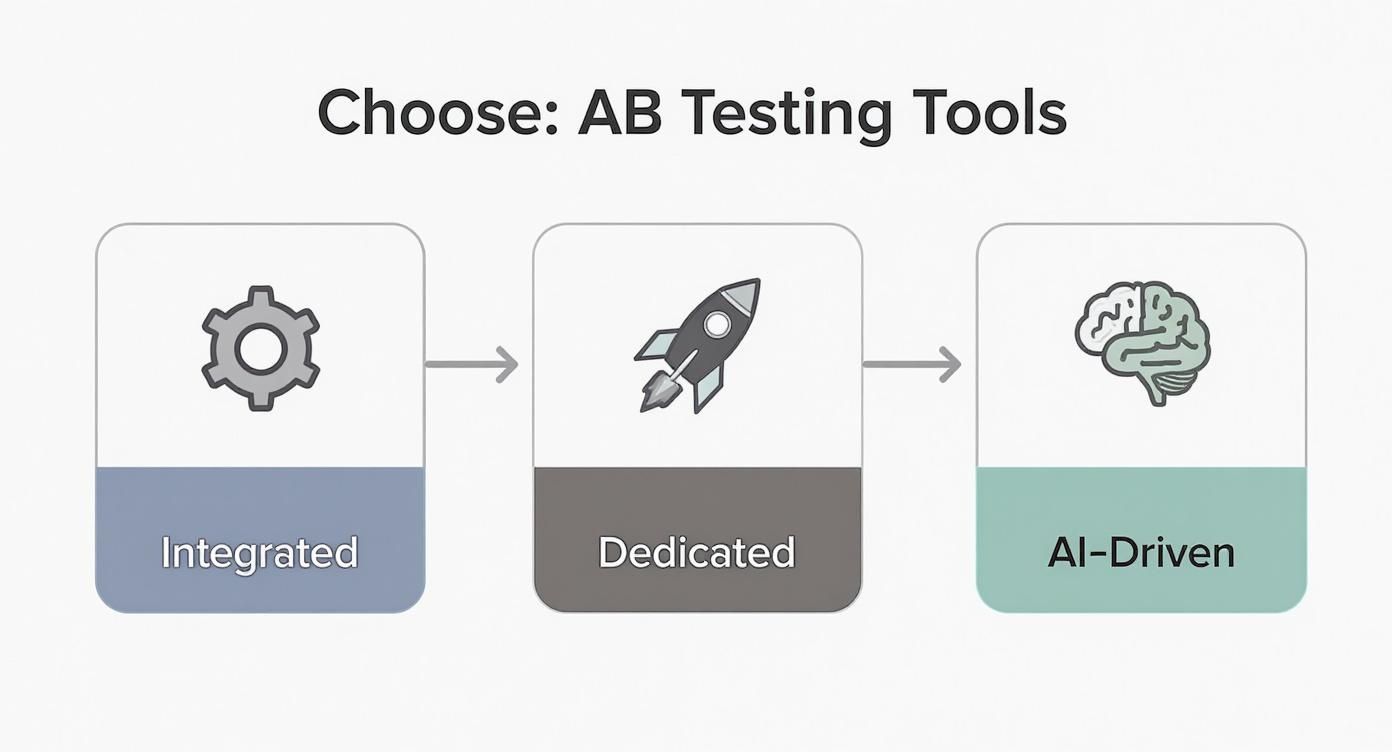
The infographic below shows the different paths you can take when selecting tools, which is a foundational step you should have already sorted before running your test.

Infographic comparing Integrated, Dedicated, and AI-Driven AB testing tools in a process flow format.

As you can see, your choice of tool—from a simple integrated solution to a complex AI-driven platform—directly impacts how you execute and monitor your experiment.

Finally, make sure your test is technically sound. Double-check that your variations render correctly across different browsers and devices. A broken element in your "B" version will obviously perform poorly, but it won't teach you anything useful about your hypothesis.

And once you master the basics, you can get more advanced. For instance, you might consider multivariate testing for video creatives to simultaneously optimize multiple elements and scale your results. But no matter the complexity, a clean setup is the foundation of a reliable conclusion.

Turning Test Results Into Actionable Insights

An A/B test is only as good as what you do after it’s over. Once the experiment wraps up and the data is in, the real work starts. This is where raw numbers become a strategic edge—the moment of truth for your hypothesis.

Sometimes, you get a clean win. The variation beats the control with statistical significance, and the path forward is clear: roll out the winner. When this happens, document the lift, share it with the team, and build momentum for the next round of testing.

But what happens when the results aren't so black and white?

Analyzing the 'Why' Behind the Numbers

Even with a clear winner, don't stop at the primary conversion metric. A test that bumps up sign-ups but also sends your bounce rate through the roof isn't a victory—it's a warning sign. To get the full story, you have to dig into the secondary metrics.

Look at the data that adds context and color to the main result.

  • Time on Page: Did the winning version actually get people to stick around and engage more? Compare the average time on page for Version A and Version B.
  • Bounce Rate: Did your brilliant change accidentally make more people hit the back button? If the bounce rate for Version B is significantly higher, you may have a problem.
  • Average Order Value (AOV): For an e-commerce site, did the new design lead to bigger carts, even if the conversion rate stayed flat?

Looking at these secondary data points helps you understand the qualitative ripples your changes created. For a deeper dive on this, check out our guide on how to measure marketing effectiveness. This is what separates a basic testing process from a mature, high-impact optimization program.

When a Test Fails or Is Inconclusive

It's easy to write off a "failed" or flat test as a waste of time. That’s a huge mistake. A losing variation or an inconclusive result is one of the most valuable things you can get. It proves your hypothesis was wrong, which is just as important as proving it was right.

A failed test isn't a failure to optimize; it's a success in learning. It stops you from rolling out a change that would have hurt performance and gives you rock-solid intel on what your audience doesn't want.

Instead of just tossing the result, ask what it taught you. Compare the losing variation against your original hypothesis. Did the new headline completely miss the user's intent? Was that "simplified" design actually harder to navigate? Document these learnings like they're gold.

This creates an invaluable knowledge base that makes your next hypothesis smarter and more targeted. Every single experiment, win or lose, deepens your understanding of what makes your audience tick. This cycle—test, learn, refine—is the engine that drives real, sustainable growth.

Common A/B Testing Questions, Answered

Even with the slickest testing plan, you’re going to hit a few bumps. It happens to everyone. Let’s walk through some of the most common questions that pop up once you actually start running experiments.

Getting these right is what separates the teams that get real results from those who just spin their wheels.

So, What Should I Actually Be Testing?

It’s tempting to go for the big, flashy redesign right out of the gate. Resist that urge. The most powerful tests are often the most focused ones. Start small, learn fast, and build momentum.

  • Calls-to-Action (CTAs): This is the classic for a reason. Compare specific, value-driven copy like "Get Your Free Quote" against a generic "Submit." Also test high-contrast colors (e.g., orange vs. blue) to see what stands out.
  • Headlines: Your headline is your five-second pitch. Test different angles. Pit a benefit-driven headline ("Save 2 Hours Every Week") against one that pokes at a specific pain point ("Tired of Wasting Time?"). You’ll quickly learn what language actually grabs your audience.
  • Images and Media: The visuals create the vibe. Compare an image of your product in action against a photo showing a happy customer. Or, test a static image against a short, punchy video to see if it boosts engagement metrics like time on page.

Can I Test More Than One Thing at Once?

This is a big one, and it’s where you hear people throw around terms like A/B testing and multivariate testing (MVT). It’s crucial to know the difference and when to use each.

A/B testing is your workhorse. It’s clean, simple, and direct. You’re testing one variable at a time—one headline against another, one button color against another. This simplicity is its strength; when you get a winner, you know exactly what caused the lift.

Multivariate testing (MVT) is the more complex cousin. It lets you test multiple variables and all their combinations at the same time. For instance, you could test two headlines and two hero images in a single experiment, which creates four unique variations for your audience to see.

The catch with MVT? It’s a traffic hog. To get statistically significant results for every single combination, you need a massive amount of volume. For most teams just starting out, sticking with classic A/B tests is the smarter, more practical path to getting actionable insights.

How Do I Know When a Test Is Really Done?

This is where discipline comes in. The golden rule is to run your test long enough to capture a full cycle of user behavior. For most businesses, that means at least one full business week. This smooths out the data, accounting for the natural peaks and valleys between a busy Monday morning and a quiet Saturday afternoon.

Whatever you do, don't stop a test just because it hits 95% statistical significance on day three. Early results are notoriously fickle. A variation that looks like a world-beater on Tuesday can easily regress to the mean by Friday.

Let the test run its planned course. This is what separates professional testers from amateurs. It’s how you ensure your data is solid and the decisions you make actually lead to growth.


Ready to stop guessing and start growing? marketbetter.ai uses predictive analytics and automated A/B testing to help you find winning variations faster. See how our AI-powered platform can improve your campaign conversions by 15% and give you back hours for strategic work. Get your demo today at marketbetter.ai.

what is behavioral targeting: A quick guide to targeted ads

· 18 min read

Think of it like a great shop assistant who remembers what you like. The one who doesn't show you sweaters when you're clearly looking for running shoes. That's what behavioral targeting does online. It's a strategy that looks at your digital footprint—the articles you read, the products you click on, the videos you watch—to show you ads that actually make sense for you.

Unpacking Behavioral Targeting

At its heart, behavioral targeting is about moving away from the old "spray and pray" method of advertising. Instead of blasting a single generic message to millions, it’s about listening to what people's actions are telling you and tailoring the experience accordingly. The whole idea is built on a simple truth: what you've done in the past is the best clue to what you'll do next.

This marketing strategy analyzes how users behave online—their search queries, the content they consume, their purchase history—to deliver personalized ads. It works by collecting data from websites and apps to group audiences based on things like buying intent and browsing habits. And it works. This kind of targeted advertising pulls in, on average, 2.7 times more revenue per ad compared to ads that aren't targeted. You can dig into more data on behavioral advertising results on Jake Jorgovan's blog.

Behavioral Targeting Compared to Other Methods

To really get what makes behavioral targeting unique, it helps to see it side-by-side with other common ad strategies. Each one uses different data to find an audience, but their aim and accuracy are worlds apart.

Targeting MethodWhat It TracksPrimary GoalActionable Example
BehavioralIndividual user actions (clicks, views, purchases)Personalize ads based on proven interests and intent.Showing ads for running shoes to a user who recently read articles about marathon training.
ContextualWebsite or page content (keywords, topics)Place ads alongside relevant content, regardless of the user.Displaying an ad for a new video game on a game review blog.
DemographicUser attributes (age, gender, location, income)Reach broad audience segments based on static characteristics.Advertising luxury cars to individuals in high-income postal codes.

As you can see, each method has its place, but they operate on fundamentally different assumptions about the user.

The Actionable Difference: From Guessing to Knowing

The real takeaway here is the level of personalization. Demographic targeting is basically an educated guess (“people in this age group probably like this”). Contextual targeting aligns with a topic (“someone reading about cooking might need new pans”). But behavioral targeting acts on proven interest.

Behavioral targeting doesn't just guess what you might like; it responds to what your actions have already told it you're looking for. This makes the ads you see less of an interruption and more of a helpful suggestion.

This direct line to user behavior is what makes the strategy so powerful. It lets brands connect with potential customers at the precise moment their interest peaks, turning a passive browse into a real chance to engage.

How Behavioral Targeting Technology Works

To really get what behavioral targeting is, you have to peek behind the curtain at the tech making it all happen. Think of it as a digital detective story. It follows clues—your clicks, your views, your time spent on a page—to solve the mystery of what you actually want. The whole thing is a slick cycle of data collection, analysis, and action that unfolds in milliseconds.

It all starts with data collection. When you land on a website, tiny text files called cookies get stored in your browser. These cookies are like digital breadcrumbs, remembering where you've been, what you looked at, and what you tossed in your shopping cart. Marketers also use pixels—basically invisible, single-pixel images embedded in web pages or emails—to track specific actions, like opening a message or finishing a purchase.

From Raw Data to Audience Segments

All this raw behavioral data is interesting, but its real magic is unlocked through organization. The next step is audience segmentation, where the system groups users with similar patterns into distinct buckets. At its core, behavioral targeting tech is all about analyzing and categorizing user actions, which requires a deep understanding of user segments and events.

For example, someone who’s constantly reading articles about marathon training and buying athletic gear might land in an "Active Runner" segment. Another person browsing mortgage calculators and local real estate listings? They could be flagged as a "Potential Home Buyer." This lets marketers ditch generic assumptions and instead target groups based on what they've proven they're interested in. It’s the engine that powers real personalization, something we dig into deeper in our guide to marketing personalization strategies.

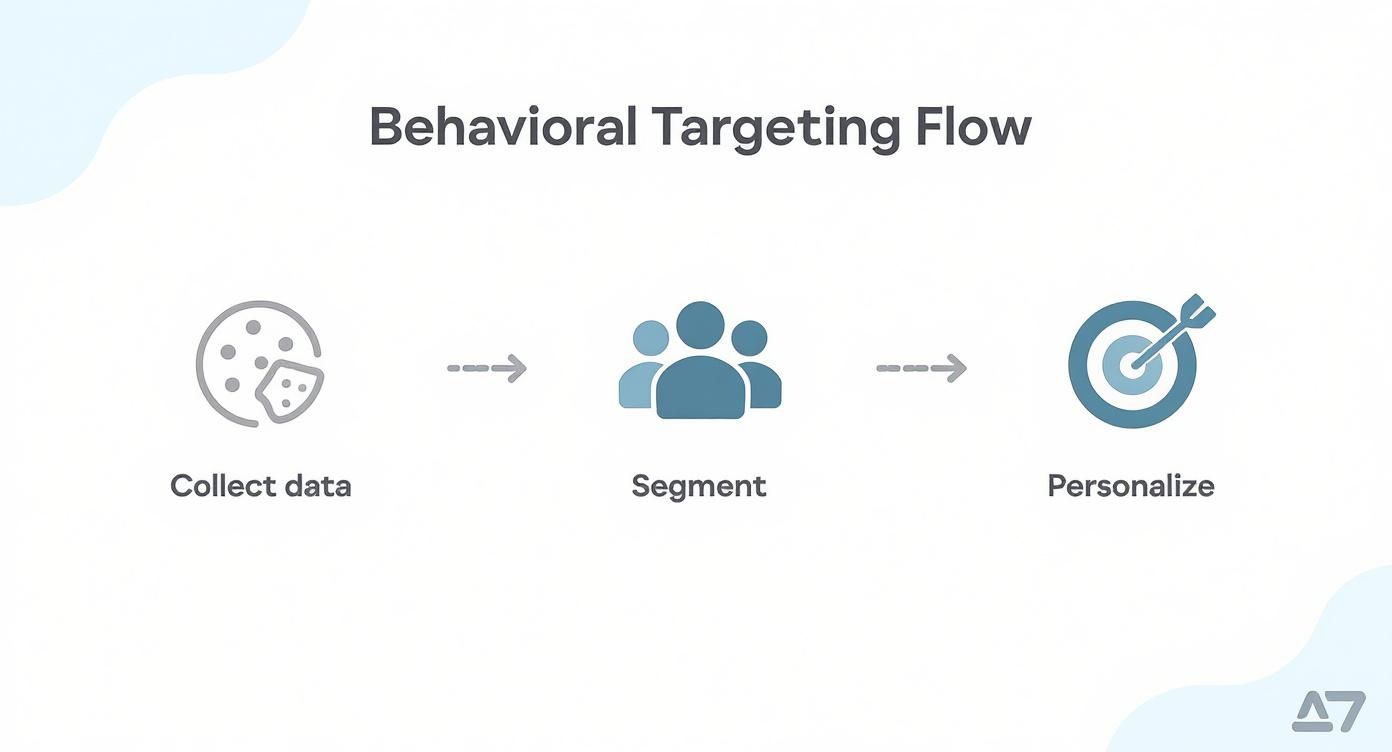
This flow chart gives you a bird's-eye view of how user data is collected, segmented, and ultimately used to show you ads that feel relevant.

Infographic about what is behavioral targeting

As you can see, the whole point is to turn a bunch of scattered actions into focused, actionable audience groups you can actually do something with.

Matching Ads and Optimizing Performance

Once those segments are defined, the ad platforms can start doing their ad matching in real-time. When a user from that "Active Runner" segment visits a website with ad space, an automated auction kicks off behind the scenes. Brands that want to reach this audience place bids to show their ad, and the winning ad—maybe for a new pair of running shoes—is displayed instantly.

Finally, the process comes full circle with campaign optimization. Marketers watch the performance data to see which ads are actually driving sales and which ones are falling flat. This constant feedback loop allows them to tweak their segments, test out new ad creative, and sharpen their targeting to get better results over time.

This explosion in targeting tech is tied to the broader behavior analytics market, which was valued at $1.10 billion in 2024. It’s projected to hit $10.80 billion by 2032, which shows just how much companies are betting on understanding exactly what their customers want.

Real-World Examples of Behavioral Targeting

The theory is one thing, but seeing behavioral targeting out in the wild is where it really clicks. You’ve run into it hundreds of times, probably without even noticing. It's woven so deeply into the fabric of the modern internet that it quietly shapes what you see on your favorite sites every single day.

From the running shoes that follow you from site to site to the next binge-worthy show that magically appears in your queue, behavioral targeting is the engine personalizing your digital life. It works by connecting a specific action you take to a tailored, automated response.

E-commerce Personalization

Online retail is where behavioral targeting really flexes its muscles. Think about the last time you landed on Amazon. That homepage wasn’t a generic storefront; it was a unique display built specifically for you based on your recent digital footprint.

  • Product Recommendations: If you spent Tuesday browsing for a new tent and a sleeping bag, you can bet that by Wednesday, your "Recommended for You" section will be filled with camping gear. Amazon's algorithm saw your interest and immediately adjusted its suggestions to match.
  • Abandoned Cart Reminders: Ever add something to your cart, get distracted, and leave? A few hours later, you’ll probably get an email or see an ad for that exact product on social media. That’s not a coincidence; it's a direct, automated nudge to bring you back and complete the purchase.

This kind of hyper-relevant experience is a core pillar of modern marketing personalization strategies, turning a generic shopping trip into a guided journey.

Travel and Hospitality Offers

Travel sites like Expedia are absolute masters of this. Booking a trip isn’t a single action—it’s a whole series of them. You research flights, then hotels, then maybe a rental car. Each step leaves a breadcrumb trail of intent, and these platforms are brilliant at following it.

Let's say you search for flights to Miami for the first week of December. The system doesn't just show you flights; it logs that intent. Over the next few days, you'll start seeing targeted ads on Instagram and other sites for hotels and car rentals in Miami for those exact dates. The system correctly read your flight search as a strong signal and responded with relevant, timely offers to help you build out the rest of your trip.

Entertainment and Content Curation

Streaming services have literally built their empires on sophisticated behavioral targeting. Platforms like Netflix and Spotify don't just dump a library of content on you; they meticulously curate it based on what you’ve watched and listened to before.

Netflix’s interface is a perfect example, showcasing personalized recommendations that are a direct result of analyzing your viewing habits.

Screenshot from https://about.netflix.com/en

This is your past behavior in action. If you watched three sci-fi thrillers in a row, the algorithm takes that as a cue and bumps similar titles to the top of your "Top Picks for You" row. It’s all designed to make sure the content you see is exactly what you’re likely to click next.

To see how this plays out in even more industries, check out these 7 powerful behavioral targeting examples.

With great targeting power comes great responsibility. Yes, behavioral targeting can create shockingly relevant experiences for users, but it also walks a very fine line. The difference between a helpful suggestion and an invasive ad is paper-thin, and crossing it is the fastest way to demolish customer trust.

Let's be clear: successfully using behavioral targeting means putting user privacy first. This isn't just a "nice to have"—it’s a legal minefield. Regulations like Europe's General Data Protection Regulation (GDPR) and the California Consumer Privacy Act (CCPA) have completely changed the rules of the game for how businesses collect and use consumer data.

These laws hand the controls back to consumers, giving them the right to know what's being collected and, crucially, the right to say "no." For marketers, that makes transparency non-negotiable.

Building Trust Through Ethical Practices: An Actionable Framework

Operating ethically here isn't about dodging fines. It's about building real, sustainable relationships with customers who feel respected, not tracked. It requires a proactive game plan.

Here’s an actionable framework to make your campaigns both effective and ethical:

  • Be Radically Transparent: Your privacy policy shouldn't read like a legal textbook. Clearly explain what data you're collecting and exactly how you plan to use it. No jargon, no excuses. Action: Create a simple, one-page summary of your data practices that users can easily find.
  • Make Opting Out Easy: A hidden unsubscribe link or a confusing preferences page is a dark pattern. Give users a clear, simple way to manage their data and opt out of tracking. Action: Place a "Manage My Data" link in your website footer and email footers.
  • Lock Down Your Data: You're the guardian of your customers' information. Invest in serious security to protect it. A data breach is a disaster for your customers and a potential death blow to your brand's reputation. Action: Conduct regular security audits and use encryption for all stored customer data.

When regulations use terms like "fundamental rights and freedoms," you know it's about much more than just ticking a compliance box. It’s about building your marketing on a foundation of respect.

The Future in a Cookieless World

This entire conversation around privacy is forcing massive technical changes, with the biggest being the death of the third-party cookie. As major browsers phase them out, marketers have to get smarter and move away from rented third-party data toward more sustainable methods.

The end of third-party cookies doesn’t kill effective targeting. It just kills lazy targeting. This is a massive shift toward higher-quality, consent-based data that actually strengthens customer relationships.

This new reality puts a huge spotlight on first-party data—the information you collect directly from your audience on your own website, app, or CRM. It's cleaner, more accurate, and gathered with explicit user consent, making it the most powerful and privacy-friendly asset you have for creating personalized experiences.

This isn't just a hypothetical shift; it's already shaping the market. For instance, North America is still the leader in behavioral targeting, but growth in Europe is slower precisely because of strict GDPR rules. Yet, European consumers still want personalized experiences—they just have to be delivered with privacy at the forefront. You can get more insights on how privacy is shaping the behavioral targeting market over on dataintelo.com.

How to Implement a Behavioral Targeting Strategy

A person working on a laptop, surrounded by data visualization icons, representing the implementation of a marketing strategy.

Alright, let's move from theory to action. Putting behavioral targeting into play isn't magic; it's a structured process of turning raw user data into real business results. Think of this as your playbook for launching a campaign that actually works.

It all starts with a simple question: What are you trying to accomplish? Are you fighting to slash abandoned cart rates, trying to boost repeat purchases from loyal customers, or hunting for brand-new users who are ready to buy?

Your answer to that question shapes every single decision that follows. It dictates the platforms you use, the audiences you build, and the ads you write. Without a goal, you're just hoarding data. With one, every click has a purpose.

Setting Your Technical Foundation

Before you can target a single soul, you need the right plumbing in place. This is the technical backbone of your entire strategy, and it starts with installing tracking pixels or tags on your website from platforms like Meta or Google Ads.

These tiny snippets of code are your eyes and ears. They anonymously track how people interact with your site—what pages they view, what they add to their cart, and what they ultimately purchase. This information is the fuel for your targeting engine.

Getting this setup right is non-negotiable. If your data collection is flawed, your targeting will be, too. That means wasted ad spend and missed opportunities.

Building and Activating Your Audience Segments

With your pixels firing and data flowing in, the real fun begins: audience segmentation. This is where you stop shouting at everyone and start having meaningful conversations with specific groups based on what they’ve done.

Instead of a one-size-fits-all message, you can create distinct buckets of users who have shown different levels of interest.

Here are a few essential segments every business should start with:

  • Website Visitors: This is your broadest group—everyone who stopped by your site in the last 30-90 days. It’s a solid choice for general brand awareness campaigns.
  • Product Viewers: These folks browsed specific product pages but never added anything to their cart. They’re curious but need a gentle nudge back.
  • Cart Abandoners: The holy grail of retargeting. This high-intent group added items to their cart but got distracted. They are your warmest leads, so don't let them get away.
  • Past Purchasers: Your existing customers. You can re-engage them with complementary products, special offers, or loyalty rewards to encourage repeat business.

To make this work across all your channels, you need a single source of truth. A deep customer data platform integration is often the key to ensuring your email, ads, and on-site messaging are all working from the same playbook.

Launching and Optimizing Your Campaigns

Once your segments are ready, it's time to craft ads that speak directly to each group. The ad you show a cart abandoner should feel completely different from the one you show a first-time visitor. Personalize your copy, images, and offers to reflect where they are in their journey.

For a cart abandoner, you might show them the exact product they left behind, maybe with a small discount to seal the deal. For a new visitor, you’d introduce your brand’s big-picture value or showcase your best-selling items.

But launching the campaign is just the beginning. The real work is in the continuous measurement and optimization. Keep a close eye on your key metrics, like conversion rate and return on ad spend (ROAS). This data is your feedback loop, telling you which segments are hitting the mark and which ads are falling flat. Use those insights to shift your budget and refine your approach for maximum impact.

Actionable Checklist for Your First Campaign

To tie this all together, here's a simple checklist to guide you through setting up your first behavioral targeting campaign.

StepKey ActionTool/Platform Example
1. Define GoalPinpoint a specific outcome (e.g., "Reduce cart abandonment by 15%").Your internal strategy document or project management tool.
2. Install PixelsAdd tracking tags to every page of your website.Google Tag Manager, Meta Pixel Helper (Chrome Extension).
3. Build SegmentsCreate core audiences like "Cart Abandoners (7 Days)" or "All Visitors (30 Days)."Google Ads Audience Manager, Meta Ads Audiences.
4. Create AdsDesign unique ad copy and visuals for each segment.Canva for creative, your ad platform's native ad builder.
5. Launch & MonitorGo live and track key metrics like ROAS and conversion rate daily.The analytics dashboards within Meta Ads or Google Ads.
6. OptimizePause underperforming ads and reallocate budget to winning segments.Use A/B testing features within your ad platform.

Following these steps provides a clear, repeatable process for turning user behavior into tangible growth. Don't overcomplicate it at first—just get the fundamentals right, and you'll be well on your way.

Got Questions? We've Got Answers

Once you start wrapping your head around behavioral targeting, a few questions almost always come up. Let's tackle them right now so you have a crystal-clear picture of how this all works in the real world.

Behavioral Targeting vs. Retargeting: What's the Real Difference?

This is a classic, and for good reason. It’s easy to get them mixed up, but the distinction is actually pretty simple. Think of retargeting as a specific tactic and behavioral targeting as the overall strategy.

  • Retargeting is about showing ads only to people who have already visited your website. It's a follow-up conversation.
  • Behavioral targeting is the entire playbook. It includes retargeting but also uses browsing habits across the wider web to find new audiences who have never heard of you but fit your ideal customer profile.

So, all retargeting is a form of behavioral targeting, but not all behavioral targeting is retargeting.

Is This Still a Thing Without Third-Party Cookies?

Absolutely, but the game is definitely changing. The slow fade of third-party cookies doesn’t kill the strategy; it just makes your first-party data—the information you collect directly from your audience—insanely valuable.

The end of third-party cookies isn't an obstacle. It's an upgrade—a shift toward higher-quality, consent-based marketing that builds real trust with customers.

Smart marketers are already leaning into this. They're using the data they own, combining it with contextual targeting, and exploring new privacy-first technologies that keep users in control. The actionable takeaway is to start building your first-party data assets now, through things like email newsletters, user accounts, and loyalty programs.

How Do I Know If It's Actually Working?

Clicks and impressions are easy to count, but they don't pay the bills. If you want to know if your campaigns are truly making a difference, you need to measure the metrics that tie directly to business results.

Instead of getting lost in vanity numbers, zero in on these three:

  • Conversion Rate: What percentage of people are actually taking the action you want them to take, like buying a product or signing up?
  • Cost Per Acquisition (CPA): Simple and powerful. How much does it cost you, on average, to win a new customer?
  • Return on Ad Spend (ROAS): For every single dollar you put into your advertising, how many dollars in revenue do you get back?

Focusing on these tells you the real story. They give you a clear, actionable picture of how your campaigns are impacting the bottom line.


Ready to turn user insights into measurable growth? marketbetter.ai provides an integrated AI platform to optimize your audience segmentation, content personalization, and campaign management. Discover how you can build more effective campaigns by visiting https://www.marketbetter.ai.

Best Campaign Management Software Compared — Pricing & Features

· 23 min read

If you’ve ever felt like your marketing efforts are a chaotic jumble of spreadsheets, social media schedulers, and email platforms that refuse to talk to each other, you’re not alone. Marketing campaign management software is the command center designed to bring order to that chaos.

Think of it as the central nervous system for all your marketing. It’s a single platform where you can plan, launch, track, and tweak everything—from social posts and email drips to digital ads and content marketing—all in one place. It’s the difference between a dozen musicians playing their own tune and a conductor leading a symphony.

What Exactly Is Campaign Management Software

Imagine trying to build a house. You have plumbers, electricians, and framers, but they never speak to each other. The result? A disaster of crossed wires, pipes that go nowhere, and a structure that’s fundamentally broken. This is precisely what happens when marketing teams operate in silos.

Marketing campaign management software exists to solve this exact problem. It’s the blueprint and the on-site foreman, all rolled into one, making sure every single activity is coordinated and pushing toward the same goal.

Moving Beyond Disconnected Tools

Without a central platform, a typical campaign is a messy, disjointed process:

  • The Problem: The content team writes a blog post in Google Docs. The social media manager schedules posts in a separate app. The email marketer designs a newsletter in another tool. The ads specialist is buried deep inside the Google Ads interface.
  • The Actionable Fix: A unified platform connects these dots. It lets you see that a specific blog post led to an email signup, which then warmed up a lead who finally converted from a retargeting ad—all within a single dashboard.

Each tool has its own island of data. Trying to stitch it all together to see the big picture is a manual, soul-crushing nightmare. You’re left guessing which channel actually brought in the sale. A proper campaign management platform connects these dots.

The real magic of campaign management software is its ability to turn fragmented tasks into a cohesive, measurable strategy. It shifts the conversation from, "What did we do?" to "What worked, and why?"

This isn't just about making life easier; it's about driving tangible business results. And the market reflects this. The advertiser campaign management software market was valued at a hefty USD 10,327.4 million in 2021 and is projected to skyrocket to USD 25,710.1 million by 2033. That explosive growth shows just how vital this kind of centralized control has become. You can dig into the numbers yourself in this comprehensive market report.

Solving Critical Marketing Challenges

This kind of software hits the biggest marketing pain points head-on. It provides real solutions for those chronic problems that keep teams from growing, like inconsistent brand messaging across channels, wasted effort from team members accidentally doing the same work, and the endless struggle to prove ROI to the higher-ups.

By bringing your tools and data under one roof, it helps you finally get a grip on the complexity and focus on what really matters: creating campaigns that make an impact.

What Features Actually Matter in a Marketing Campaign Tool?

Picking the right marketing campaign software can feel like a chore. Every platform flashes shiny features and promises the world, and it’s easy to get lost in the sales pitches. To cut through the noise, you need to ignore the fluff and zero in on the core functions that actually move the needle on your campaigns.

Think of it like this: without these key features, a platform is just a fancy to-do list. But with them, it becomes the central engine powering your entire marketing strategy, turning a bunch of separate tasks into a coordinated, high-impact machine.

Let's break down the non-negotiables you should look for.

H3: Multi-Channel Campaign Orchestration

Modern marketing isn’t a one-trick pony. Your campaigns live across social media, email, paid ads, and your blog all at once. True multi-channel orchestration lets you manage all these moving parts from a single command center.

  • Comparison: A basic project management tool might let you list tasks for email and social, but a true campaign management platform lets you execute and track them from one place.
  • Actionable Takeaway: When evaluating software, ask to see a demo of a single campaign's calendar view. If you can't see the email send dates, social post schedules, and ad flight times all on one screen, it lacks true orchestration.

H3: Intelligent Workflow Automation

Repetitive tasks are the enemy of good marketing. Workflow automation is your secret weapon, letting you put all that manual drudgery on autopilot so your team can focus on big-picture strategy. In fact, smart automation can boost marketing productivity by 20%.

The infographic below shows this in action—how automated workflows can create a perfect sequence of events, which is the whole point of modern marketing efficiency.

  • Comparison: Simple automation might just send a thank-you email. Intelligent automation can create branching logic: if a lead opens the email but doesn't click, send a follow-up with a different subject line in two days. If they do click, notify a sales rep immediately.
  • Actionable Takeaway: Ask vendors for specific examples of "if-this-then-that" logic their platform supports. Can it trigger actions based on website behavior, email engagement, and CRM data?

H3: Centralized Digital Asset Library

"Hey, where can I find the latest logo?" If you’ve heard that question one too many times, you need a centralized digital asset library (or DAM). It puts an end to the chaos by creating a single source of truth for every creative file—from images and videos to ad copy and brand guides.

  • Comparison: Using a tool like Google Drive is better than nothing, but a native DAM within your campaign software adds version control, usage rights, and the ability to link assets directly to specific campaigns for performance tracking.
  • Actionable Takeaway: During a demo, test the search functionality of the asset library. Can you find an image by its color, orientation, or the campaign it was used in? This level of detail separates a basic folder system from a professional DAM.

A centralized asset library doesn't just save time; it protects your brand's integrity. It's the difference between a polished, professional presence and a fragmented, inconsistent one.

This feature often integrates with or completely replaces many of the top content marketing tools, helping you consolidate your tech stack and work more efficiently.

H3: Robust Analytics and Reporting

You can't improve what you don't measure. Solid analytics and reporting are probably the most important features of any marketing software because they turn your marketing from a guessing game into a data-driven science.

With good reporting, you can see which email subject lines get the most opens, which social channels bring in the best leads, and how your ad spend is actually turning into revenue. Some platforms even have predictive analytics to help you forecast results. To get a better sense of how data can sharpen your focus, check out our guide on using https://marketbetter.ai/playbooks/ai-lead-scoring to prioritize your best prospects.

A solid platform should give you the core features needed to track and optimize your entire funnel. Here’s a quick breakdown of what to look for.

Essential Features of Marketing Campaign Management Software

FeatureCore FunctionalityKey Benefit
Multi-Channel OrchestrationManage email, social, ads, and content from one dashboard.Creates a consistent customer experience and unified campaign view.
Workflow AutomationSet up "if-then" rules to automate repetitive marketing tasks.Frees up team time for strategic work and reduces human error.
Centralized Asset LibraryA single, searchable hub for all brand and creative assets.Ensures brand consistency and stops version control nightmares.
Analytics & ReportingTrack KPIs, attribute results to specific channels and campaigns.Provides clear data to measure ROI and make smarter decisions.
Budget & Expense TrackingAllocate and monitor spending for campaigns in real-time.Prevents overspending and proves the financial impact of marketing.

Ultimately, these features work together to give you a complete, 360-degree view of your marketing operations, from the initial idea to the final sale.

H3: Granular Budget and Expense Tracking

Finally, you have to know where the money is going. Granular budget tracking lets you assign funds to specific campaigns, channels, or even individual ads, then watch your spending in real time.

Think of this feature as your financial command center. It helps you stop overspending before it happens, pinpoint which channels deliver the best return on ad spend (ROAS), and confidently walk into any meeting ready to justify your marketing budget with cold, hard data.

An Actionable Comparison of Top Platforms

Picking the right campaign management software isn't about finding the one with the longest feature list. It’s about matching a tool to your team's real, day-to-day problems. What works for a scrappy startup could easily bog down a massive enterprise, and the reverse is just as true.

So, instead of a generic rundown, let's look at this through the lens of actual business needs. Once you understand the core philosophy behind the leading platforms, you can connect your team's specific pain points to the right software and make a decision you won't regret.

For Teams Focused on Project Management and Visibility

Your Problem: "I have no idea who is working on what. Deadlines are a suggestion, and our campaign launches are pure chaos." The Solution: Platforms like Monday.com and Asana are built to solve this exact collaboration headache.

Think of these tools as the mission control for your projects. Their superpower lies in visual task management, crystal-clear timelines, and making team collaboration feel effortless.

  • Monday.com vs. Asana: Monday.com excels in visual, customizable dashboards—it’s like building with LEGOs for your workflow. It's ideal if you want to design your process from scratch. Asana is the master of task dependencies and structured projects; it’s perfect for complex campaigns where Step B cannot start until Step A is complete.
  • Actionable Use Case: If you are a creative agency juggling 20 client projects, Monday.com's visual boards can give each client a unique workflow. If you are launching a multi-stage product, Asana's timeline and dependency features ensure a smooth, sequential rollout.

These platforms are less about deep customer data and more about getting the work done efficiently. They’re the right call for creative agencies, content teams, or any marketing department where the biggest challenge is managing the production line of campaign assets.

For Organizations Needing All-in-One CRM and Marketing

Your Problem: "Our sales and marketing teams are strangers. We get leads, but we have no idea which ones are good or what happens to them after we pass them over." The Solution: An all-in-one platform with a CRM at its core, like HubSpot, is designed to bridge this gap.

HubSpot’s strength is its unified view of the customer. By combining marketing, sales, and service tools around a single CRM, it provides a complete timeline for every contact.

With a platform like HubSpot, you can trace a lead's entire story without jumping between tabs. You see the blog post they read, the email they opened, the sales call they had, and the support ticket they submitted—all in one timeline.

  • Actionable Use Case: Use HubSpot's lead scoring to automatically notify a sales rep when a prospect visits your pricing page three times. This simple automation, powered by the integrated CRM and marketing tools, turns a marketing action into a direct sales opportunity.

This integrated approach is a game-changer for businesses focused on lead nurturing, aligning sales and marketing, and proving how marketing actually contributes to the bottom line. It's a fantastic choice for mid-market companies that have outgrown their mess of scattered tools and just need one source of truth.

For Enterprises Demanding Powerful Automation and Analytics

Your Problem: "We have massive amounts of data and complex customer journeys. We need to execute highly personalized campaigns at scale and prove revenue attribution down to the dollar." The Solution: A marketing automation powerhouse like Adobe Marketo Engage delivers the necessary power and granularity.

Marketo’s strength is its raw power and flexibility. It offers some of the most advanced automation workflows, lead nurturing capabilities, and revenue attribution models you can find.

  • HubSpot vs. Marketo: While both platforms automate, HubSpot is generally more user-friendly and built for the entire customer lifecycle. Marketo offers deeper, more complex automation and analytics capabilities, making it the preferred choice for data-driven enterprises with dedicated marketing ops teams who can leverage its full potential.
  • Actionable Use Case: Use Marketo to build a multi-path nurturing campaign. If a user from a Fortune 500 company downloads a whitepaper, route them to an enterprise sales rep and a specific email track. If a user from a small business does the same, route them to a self-service demo track. This level of granular control is where Marketo shines.

Choosing the right tool is a strategic call. For a detailed look at how different platforms compare for specific jobs, our MarketBetter vs. Sendspark comparison gives a focused analysis that can help bring your needs into focus.

Software Comparison for Different Business Needs

To make the choice even clearer, here's a quick breakdown of how these platforms stack up against each other based on what you're trying to accomplish.

SoftwareBest ForKey StrengthPricing Model
Monday.comProject & Task ManagementVisual workflow customizationPer-user subscription
AsanaComplex Project CollaborationTask dependencies & timelinesPer-user subscription
HubSpotAll-in-One GrowthIntegrated CRM & marketing suiteTiered, based on contacts/features
MarketoEnterprise AutomationAdvanced automation & analyticsCustom, based on database size

Ultimately, the best platform is the one that solves your most pressing problem today while giving you room to grow tomorrow.

The market for these tools is heating up for a reason. The global campaign management system market is expected to jump from USD 5.50 billion in 2025 to USD 10.86 billion by 2032, which is a compound annual growth rate of 10.2%. You can dive into the numbers in this insightful industry report. This trend shows just how critical it's become for businesses to get their campaigns organized on a central platform if they want to stay in the game.

How to Pick the Right Software for Your Team

Choosing the right marketing campaign management software can feel like you're staring at a wall of TVs, each one shouting different promises. Every vendor claims their tool will change the game, but here’s the secret: the best tool is the one that solves your team's actual problems, not just the ones on a feature checklist.

The process doesn't start with demos. It starts with a hard look in the mirror. Before you even glance at a product page, you need to be brutally honest about your team's biggest headaches.

Actionable First Step: Get your team in a room for 30 minutes and ask one question: "What is the single most repetitive or frustrating task in our marketing process?" Write every answer on a whiteboard. The most common themes are your starting point for evaluating software.

First, Audit Your Current Tech Stack

No tool is an island. Your shiny new platform has to play nice with the software your team already lives in every day. So, the next critical step is to take inventory of what you’re already using.

Make a simple list of every tool your marketing, sales, and customer service teams touch. That means your CRM, email platform, social media schedulers, analytics tools, and whatever project management system you’re using to hold it all together.

For each one, ask these questions:

  • What does it actually do? Get specific about its main job.
  • Is it a "must-have" or a "nice-to-have"? Be honest. Which tools would cause a riot if they disappeared tomorrow?
  • How does it connect to other things? Does it have an open API? Does it offer pre-built integrations?

This audit gives you a blueprint for your integration needs. A powerful campaign platform that can't talk to your CRM is a complete non-starter. You’re looking for a central hub, not another silo.

Involve Your Stakeholders Early On

Choosing software by committee can be a slog, but making the decision alone is a recipe for disaster. If you want people to actually use the tool you pick, you have to bring them into the process from the jump.

Get people from sales, creative, and even finance in the room (or on the Zoom). The sales team knows exactly what they need from marketing to help them close deals. Your creative team can tell you what they need to manage hundreds of assets without losing their minds.

By bringing other departments into the fold, you’re not just picking a marketing tool; you're choosing a central growth engine for the whole company. It’s a collaborative move that ensures the software solves problems across teams, which pays off big time in adoption rates later.

Ask the Right Questions During Demos

Alright, you’ve got your shortlist. Now it's demo time. This is your chance to slice through the polished sales pitch and see how the software holds up in the real world. Don't let the sales rep drive the whole time. Come armed with a list of sharp, specific questions based on your earlier pain-point audit.

Instead of asking a lazy question like, "Do you have analytics?" try this instead: "Show me exactly how your platform tracks ROI from a campaign running on Google Ads, LinkedIn, and email."

Here are a few other critical questions to have in your back pocket:

  1. On Workflows: "Can you walk me through building an automated workflow for a new lead who just downloaded an ebook? Show me every step."
  2. On Integrations: "Don't just tell me you integrate with Salesforce. Show me how the data syncs between the two platforms live."
  3. On Support: "What does your onboarding process actually look like for a team our size? What level of support is included, and what costs extra?"

This kind of direct, hands-on questioning forces vendors to prove their claims in the context of your challenges. It shifts you from being a passive viewer to an active evaluator, making sure you end up with a tool that doesn’t just look good on paper but truly helps your team win.

Implementing Your New Software for Maximum Impact

Alright, you’ve picked your new marketing campaign management software. That’s a huge step. But the real work? It starts now. The success of this whole thing doesn't ride on the feature list—it hinges on how well you weave the tool into your team’s daily rhythm. A sloppy rollout turns a powerful platform into just another ignored login.

The goal isn't to add another chore to everyone's plate. It's to make the software an indispensable part of their job. That takes a thoughtful plan, one focused on getting people on board smoothly and proving the tool's value from day one.

Start with a Pilot Team and Phased Rollout

Going for a big-bang, company-wide launch is a recipe for chaos. Don't do it. Start small with a hand-picked pilot team instead. This could be a single campaign squad or a mix of marketers from different functions who are generally good with tech and open to change.

Think of it as a controlled experiment. This small group can stress-test workflows, find weird bugs, and give you honest feedback in a low-stakes environment. Their experience is gold—you’ll use it to polish your training materials and create a solid process before you roll it out to everyone else.

A phased rollout is just as important for your data. Instead of a massive, one-time data dump, moving things over gradually lets you:

  • Clean As You Go: Find and ditch outdated contacts or duplicate assets before they clutter up your shiny new system.
  • Test Connections: Make sure integrations with your CRM and other critical tools are working perfectly without putting your entire database at risk.
  • Minimize Disruption: Keep the day-to-day operations running smoothly while you methodically bring your information across.

Build Standardized Templates from Day One

One of the biggest wins you'll get from this software is consistency. Don't wait to figure out best practices later—build them directly into the platform from the very beginning with standardized campaign templates.

Think of these templates as pre-built playbooks for your most common marketing moves. A product launch template might include tasks for blog posts, email announcements, a social media schedule, and ad creation. A webinar template could have pre-set timelines for promo emails and follow-ups.

Standardizing your campaigns with templates does more than save time. It creates a unified process that ensures no critical step is ever missed, regardless of who is running the campaign.

Actionable Step: Your first template should be for your most frequent campaign type. If you run monthly webinars, build that template first. This guarantees an immediate win and demonstrates the value of standardization to the entire team. You can learn more about how to systemize your processes and never miss a follow-up again.

Focus on Adoption by Demonstrating Value

The single biggest hurdle to any new tool is user resistance. To get past it, you have to show each person on your team how the software makes their specific job easier. Frame the entire training around solving their personal pain points.

  • For the Content Writer: Show them how the central asset library means they’ll never have to hunt through messy folders for the latest logo again.
  • For the Social Media Manager: Demonstrate how the scheduler lets them knock out a week's worth of posts in an hour, freeing them up for more creative work.
  • For the Marketing Leader: Walk them through the automated dashboard that proves campaign ROI without spending hours wrestling with spreadsheets.

This user-first approach changes the conversation. The tool stops being a mandate from management and starts being a genuine benefit. This is critical in a market that's blowing up. The marketing campaign management software market size was valued at USD 5.3 billion in 2024 and is expected to hit USD 12.3 billion by 2033. This growth shows just how much teams need tools that can tame complex, multi-channel marketing—a key selling point for your team. You can dive deeper by checking out the full market growth report.

By focusing on these practical steps—a pilot launch, smart templates, and value-driven training—you'll ensure your new software becomes the growth engine it was meant to be.

A Few Common Questions

Jumping into the world of marketing campaign software can feel like a big step. It's a decision that touches your team's day-to-day work, your budget, and ultimately, your results. We get it. Here are some of the most common questions we hear, answered straight up.

Wait, Isn't This Just a CRM?

It’s an easy mistake to make. Both handle customer data, but they have completely different jobs. A simple comparison: a CRM is a database, while a campaign management platform is an action engine.

  • A Customer Relationship Management (CRM) platform is your system of record. It’s a digital filing cabinet answering the question, "Who is this person and what's our entire history with them?"
  • Marketing campaign management software, on the other hand, is a system of action. It uses CRM data to answer the question, "How do we talk to this specific group of people, right now, to get them to do something?"

The two are a power couple:

  • The CRM knows a lead is in the "consideration" stage and has clicked on three pricing-page emails.
  • The campaign software uses that info to automatically send them a case study and show them a targeted social media ad.

Can a Small Business Actually Afford This?

This is the big one, isn't it? The short answer: yes, absolutely. The old idea that this kind of software is only for massive companies with eye-watering budgets is dead. The market is full of scalable, surprisingly affordable options built for businesses on the way up.

Most of the best platforms use tiered pricing. You can start with a basic plan that covers the essentials and add more firepower as your company grows. Some even have generous free plans to get you off the ground.

Here's the mental shift you have to make: this software isn't a cost. It's an investment. A good platform pays for itself by automating tasks that used to eat up dozens of hours a month and by fine-tuning campaigns to bring in more revenue.

Actionable Tip: Calculate the hourly rate of your marketing team members. Then, estimate how many hours per month are spent on repetitive tasks like reporting or manual posting. Compare that "cost of inefficiency" to the price of the software to see the potential ROI.

What Are the Most Important Metrics to Track?

You can’t prove marketing is working if you aren't measuring the right things. Every platform will throw a sea of data at you, but if you want a clear picture of success, you have to ignore the noise. Forget vanity metrics like "likes" and focus on the numbers that connect directly to business goals.

Your campaign software absolutely must help you track these three heavy hitters:

  1. Customer Acquisition Cost (CAC): This is the bottom line on what it costs you—in both marketing and sales effort—to land one new customer. The goal is simple: get this number as low as you can. A great first step is comparing the CAC from different channels. Is Google Ads cheaper than LinkedIn? Now you know where to double down.

  2. Return on Marketing Investment (ROMI): This is the ultimate proof. It calculates the revenue your campaigns generated divided by what you spent to run them. Anything over 1.0 means you're making money. If you spend $1,000 on a campaign that brings in $5,000 in new business, your ROMI is a beautiful 5.0.

  3. Lead-to-Customer Conversion Rate: This metric tells you what percentage of your leads are actually becoming paying customers. A low number here is a huge red flag. It often points to a disconnect between what marketing is promising and what sales is delivering, giving you a crystal-clear problem to solve.

Nailing these core metrics is how you turn your marketing department from a cost center into a predictable revenue engine.


Ready to bring clarity, efficiency, and powerful AI to your marketing efforts? marketbetter.ai integrates content creation, campaign management, and customer engagement into a single, intelligent platform. Stop juggling disconnected tools and start driving measurable results. Discover how marketbetter.ai can transform your campaigns today.