Why Drift Users Are Switching to MarketBetter (Not Breakout or 1mind)

ยท 7 min read
MarketBetter Team
Content Team, marketbetter.ai

nWhy Drift Users Switch to MarketBetter

Drift is being sunset. After Salesloft acquired it in 2024 and subsequently merged with Clari, the combined entity announced they're winding down the Drift platform โ€” directing customers to 1mind for AI-powered conversational agents.

But here's what's actually happening: most Drift teams aren't moving to 1mind. They're using this forced migration as an opportunity to rethink their entire inbound pipeline โ€” and they're choosing platforms that do more than Drift ever did.

The two most common alternatives teams evaluate are Breakout (getbreakout.ai) and MarketBetter. Here's why the majority are landing on MarketBetter.

The Problem With "Like-for-Like" Drift Replacementsโ€‹

When your chatbot vendor shuts down, the natural instinct is to find the closest replacement. But that's the wrong approach.

Drift was built in 2015. The B2B sales landscape has fundamentally changed since then:

What Drift Was Built For (2015)What B2B Teams Need (2026)
Chat widget on websiteMulti-channel engagement (chat + email + phone + LinkedIn)
Decision-tree chatbot playbooksAI that understands context and adapts
Book meetings from chat onlyBook meetings across every channel
Inbound form/chat captureAnonymous visitor identification before they engage
Separate tools for everything elseOne platform that replaces 3-5 tools

The opportunity: Don't just replace Drift. Replace Drift + your email tool + your dialer + your visitor ID tool โ€” with one platform.

Why Not 1mind?โ€‹

Clari + Salesloft is officially directing Drift customers to 1mind's AI "Superhumans." Here's why most teams are looking elsewhere:

  • Narrow focus โ€” 1mind builds conversational AI agents. No email sequences, no dialer, no visitor identification, no SDR workflow management.
  • Early stage โ€” 1mind is positioning for the future but lacks the mature feature set Drift users depend on today.
  • No migration tooling โ€” There's no direct Drift โ†’ 1mind migration path with feature parity.
  • Vendor risk โ€” Moving from one vendor being sunset to a less-established vendor feels like repeating the same mistake.

Why Not Breakout?โ€‹

Breakout (getbreakout.ai) is the most obvious "modern Drift replacement." Both are AI-powered chat tools for inbound pipeline. But Drift users who evaluate Breakout find three key problems:

1. Breakout Is Expensive for What You Getโ€‹

Drift (Legacy Pricing)BreakoutMarketBetter
Basic plan~$2,500/mo$1,500/mo (no AI SDR!)All features included
Full-featured plan~$5,000/mo$2,500/moAll features included
Includes dialerโŒโŒโœ…
Includes email automationโŒโš ๏ธ Growth onlyโœ…
Includes visitor IDโš ๏ธ ABM add-onโœ…โœ…
Total stack cost (10 reps)$6,000โ€“$10,000/mo$4,000โ€“$5,500/moSignificantly lower

Drift users are already paying for a fragmented stack. Switching to Breakout means paying $2,500/mo AND keeping your dialer, outbound tool, and other add-ons. The total cost doesn't improve much.

2. Breakout Doesn't Solve the Fragmentation Problemโ€‹

The #1 complaint from Drift users isn't "my chatbot stopped working." It's:

"I have 5 tools, none of them talk to each other, and my SDRs waste 2 hours a day switching between dashboards."

Breakout adds another tool to the stack. MarketBetter replaces the stack.

3. Breakout's Pricing Isn't Transparentโ€‹

Drift users already experienced opaque pricing โ€” enterprise-only quotes, annual contracts, surprise renewal increases. Many are specifically looking for transparent pricing as a requirement in their next vendor:

  • Breakout: "Starts at $1,500/mo" / "Starts at $2,500/mo" โ€” must request demo for actual pricing
  • MarketBetter: Transparent per-user pricing, no hidden fees, no mandatory demo to see costs

What Drift Users Actually Needโ€‹

After talking with dozens of teams migrating from Drift, here's what they're actually looking for:

1. Chat + More (Not Just Chat)โ€‹

Drift was a chatbot. Most teams had added Outreach, a dialer, RB2B, and a meeting scheduler on top. They don't want to rebuild that stack โ€” they want one platform that combines all of it.

MarketBetter delivers: AI chatbot + email sequences + smart dialer + visitor ID + smart scheduling + daily SDR playbook โ€” one platform.

2. AI That Actually Learnsโ€‹

Drift's chatbots used rigid decision trees. SDRs spent hours building and maintaining playbooks that broke every time the product changed. Modern teams want AI that:

  • Learns from your product documentation
  • Adapts to new questions without manual playbook updates
  • Understands context and nuance
  • Gets better over time

MarketBetter's AI chatbot is trained on your knowledge base and adapts automatically. No decision tree maintenance.

3. Smart Scheduling (Not Just "Book a Meeting" Button)โ€‹

Drift booked meetings when someone asked. That's table stakes. What teams actually need:

  • AI-optimized timing โ€” when is this prospect most likely to accept a meeting?
  • Form routing โ€” instant meeting booking from HubSpot or Webflow forms
  • Round-robin with rules โ€” territory, specialization, availability
  • Rep availability โ€” never book a meeting when a rep is at capacity

MarketBetter's Smart Scheduler does all of this โ€” analyzing engagement patterns to suggest optimal outreach and meeting times.

4. Outbound Capabilityโ€‹

Here's Drift's biggest limitation that nobody talks about: Drift was inbound-only. If a prospect didn't come to your website and open chat, Drift couldn't help.

But most B2B pipeline comes from outbound. Drift users always needed Outreach, Salesloft, or Apollo alongside Drift. Now they want one platform that handles both.

MarketBetter handles inbound + outbound: visitor intelligence triggers automated outreach workflows. GTM signals (job changes, funding, news) create prioritized SDR tasks. Outbound sequences run alongside inbound chat โ€” all in one system.

5. No More Vendor Riskโ€‹

Drift's shutdown taught teams a painful lesson: don't build your pipeline on a platform that might disappear.

When evaluating replacements, teams are checking:

  • โœ… Is the company self-sustaining (not acquisition bait)?
  • โœ… Is the product actively developed?
  • โœ… Can I export my data if I need to leave?
  • โœ… Are there fair contract terms (no 3-year lock-in)?

Migration Timeline: Drift โ†’ MarketBetterโ€‹

Most teams complete the full migration in 2-4 weeks:

WeekWhat Happens
Week 1Audit Drift setup, export data, set up MarketBetter account
Week 2Configure AI chatbot, smart scheduler, CRM sync, Slack alerts
Week 3Run Drift + MarketBetter in parallel, compare metrics
Week 4Remove Drift script, deploy MarketBetter across all pages, activate full SDR workflows

For a detailed step-by-step guide: Drift Migration Guide โ†’

The Numbersโ€‹

MetricDrift (Before)MarketBetter (After)
Tools in stack5-7 (Drift + email + dialer + visitor ID + scheduler + CRM + analytics)1-2 (MarketBetter + CRM)
Monthly tool cost$6,000โ€“$10,000Significantly lower
SDR daily setup time30-60 min (logging into multiple tools)5 min (one daily playbook)
Channels coveredChat only (via Drift)Chat + email + phone + LinkedIn
Visitor identificationAfter they open chatBefore they take any action

Don't Wait for the Lights to Go Offโ€‹

Drift's sunsetting timeline means existing customers will see reduced support, slower bug fixes, and eventually, complete shutdown. The security incident in August 2025 already showed what happens when a sunsetting product has problems โ€” response times suffer.

Start your migration now while you still have time to run platforms in parallel and compare results.


Free Tool

Try our AI Lead Generator โ€” find verified LinkedIn leads for any company instantly. No signup required.

Ready to Replace Drift With Something Better?โ€‹

MarketBetter doesn't just replace Drift โ€” it replaces Drift + your email tool + your dialer + your visitor ID tool. One platform. One login. One daily playbook.

Book a Demo โ†’

See how MarketBetter turns your entire SDR workflow into a single AI-powered platform.

11 Best Lead Enrichment Tools for B2B Sales Teams [2026]

ยท 9 min read
MarketBetter Team
Content Team, marketbetter.ai

Your SDR team just got a new lead. An email address. Maybe a company name. Now what?

Without enrichment, that lead is just a name in a spreadsheet. Your rep doesn't know the company size, industry, tech stack, or whether this person is even a decision-maker. They're flying blind.

Lead enrichment tools fill in the gaps โ€” turning anonymous contacts into complete profiles your sales team can actually work with.

But here's the problem most teams discover too late: enriched data without clear next steps is still just data. You need tools that not only enrich leads but help you act on them.

In this guide, we'll break down the best lead enrichment tools for 2026 โ€” what they do well, where they fall short, and which ones actually help your SDRs close deals.

What to Look for in Lead Enrichment Toolsโ€‹

Before diving into the list, here's what matters most:

FactorWhy It Matters
Data AccuracyBad data = wasted outreach. Look for verified contacts, not scraped databases.
CoverageDoes it work for your target market? Global? SMB? Enterprise?
Real-Time EnrichmentBatch enrichment is fine for lists. Real-time matters for inbound leads.
IntegrationNeeds to work with your CRM, not require manual exports.
ActionabilityGreat data is useless without clear next steps for your SDRs.

The Best Lead Enrichment Tools for 2026โ€‹

1. MarketBetterโ€‹

Best for: SDR teams who need enrichment + workflow in one platform

MarketBetter takes a different approach to enrichment. Instead of just adding data fields to your leads, it combines visitor identification, contact enrichment, and a daily playbook that tells your SDRs exactly what to do next.

Key Features:

  • Website visitor identification with contact-level data
  • Automatic enrichment of inbound leads
  • Daily SDR playbook with prioritized tasks
  • Built-in smart dialer for warm outreach
  • CRM sync with HubSpot and Salesforce

What Sets It Apart: Most enrichment tools give you data and say "good luck." MarketBetter tells you WHO to contact, WHEN to reach out, and WHAT to say. It's enrichment that actually drives action.

Pricing: Custom pricing based on team size

Ideal For: B2B companies with 3-20 SDRs who want to consolidate their tech stack

Book a Demo โ†’


2. Clearbit (Now Part of HubSpot)โ€‹

Best for: HubSpot users who need seamless enrichment

Clearbit was acquired by HubSpot in 2023, making it the go-to enrichment tool for HubSpot customers. It offers real-time enrichment, form shortening, and IP-based visitor identification.

Key Features:

  • Real-time form enrichment
  • Company and contact data append
  • IP intelligence for visitor identification
  • Native HubSpot integration
  • Lead scoring data

Strengths:

  • Extremely tight HubSpot integration
  • Reliable company data
  • Good for marketing automation triggers

Limitations:

  • Best value if you're already on HubSpot
  • Limited phone number coverage
  • No built-in outreach tools

Pricing: Bundled with HubSpot plans; standalone pricing available


3. Apollo.ioโ€‹

Best for: Outbound-heavy teams on a budget

Apollo combines a massive B2B database with outreach sequencing. It's one of the most feature-rich tools at an accessible price point.

Key Features:

  • 275M+ contact database
  • Email verification built-in
  • Sequence automation
  • Chrome extension for LinkedIn prospecting
  • Intent data signals

Strengths:

  • Generous free tier (50 credits/month)
  • All-in-one prospecting and outreach
  • Strong LinkedIn integration

Limitations:

  • Data quality varies (crowdsourced)
  • Can feel overwhelming for small teams
  • Limited visitor identification

Pricing: Free tier available; paid plans from $49/user/month


4. ZoomInfoโ€‹

Best for: Enterprise teams with big budgets

ZoomInfo is the 800-pound gorilla of B2B data. It offers the most comprehensive company and contact database, plus intent data, website visitor tracking, and more.

Key Features:

  • 100M+ business profiles
  • Intent data from Bombora
  • Website visitor tracking
  • Org chart mapping
  • Technographic data

Strengths:

  • Best-in-class data coverage
  • Strong intent signals
  • Comprehensive org charts

Limitations:

  • Expensive ($15K+ annual contracts)
  • Long sales cycles to buy
  • Overkill for SMB teams

Pricing: Custom pricing; typically $15,000-$50,000+/year


5. Cognismโ€‹

Best for: Teams targeting European markets

Cognism excels in GDPR-compliant data for European prospects. Their "Diamond Data" offers phone-verified mobile numbers โ€” critical for outbound calling.

Key Features:

  • Diamond Dataยฎ (phone-verified mobiles)
  • GDPR-compliant database
  • Intent data (12 topics included)
  • Job change alerts
  • Technographic data

Strengths:

  • Best European data coverage
  • Phone verification = higher connect rates
  • Strong compliance focus

Limitations:

  • Weaker US coverage than Apollo/ZoomInfo
  • Pricing not transparent
  • No built-in dialer

Pricing: Custom quotes; packages include Grow and Elevate tiers


6. Lushaโ€‹

Best for: Individual contributors and small teams

Lusha offers a simple credit-based model that works well for individual SDRs or small teams who need quick contact lookups.

Key Features:

  • Browser extension for LinkedIn
  • Credit-based pricing (1 credit = email, 10 credits = phone)
  • CRM integrations
  • Bulk enrichment
  • Team management

Strengths:

  • Simple, predictable pricing
  • Easy to get started
  • Good mobile number coverage

Limitations:

  • Credits add up fast
  • Limited enrichment depth
  • No workflow tools

Pricing: Free plan (70 credits/month); Pro plans from $49/user/month


7. Clayโ€‹

Best for: Growth teams who love automation

Clay is the Swiss Army knife of enrichment โ€” it combines 50+ data providers and lets you build custom enrichment workflows with AI.

Key Features:

  • 50+ data provider integrations
  • AI-powered research
  • Custom workflow builder
  • Waterfall enrichment (tries multiple sources)
  • Spreadsheet-like interface

Strengths:

  • Incredible flexibility
  • Best data coverage (aggregates sources)
  • AI can research anything

Limitations:

  • Steep learning curve
  • Requires technical setup
  • Can get expensive at scale

Pricing: Starter from $149/month


8. Demandbaseโ€‹

Best for: Account-based marketing teams

Demandbase is an ABM platform with strong enrichment capabilities. It's built for marketing and sales alignment on target accounts.

Key Features:

  • Account identification
  • Intent data
  • Advertising integration
  • CRM enrichment
  • Journey analytics

Strengths:

  • Excellent for ABM strategies
  • Strong intent signals
  • Good for marketing-sales alignment

Limitations:

  • Enterprise pricing
  • Complex implementation
  • More marketing than sales focused

Pricing: Enterprise custom pricing


9. LeadIQโ€‹

Best for: SDRs doing outbound prospecting

LeadIQ focuses on making prospecting fast. Its Chrome extension lets SDRs capture and enrich contacts directly from LinkedIn.

Key Features:

  • LinkedIn prospecting extension
  • One-click capture to CRM
  • Email verification
  • Sequence integration
  • Team collaboration

Strengths:

  • Fast prospecting workflow
  • Good Salesforce integration
  • Affordable for individuals

Limitations:

  • Limited to prospecting use case
  • Smaller database than competitors
  • No visitor identification

Pricing: Free tier available; paid from $39/user/month


10. FullContactโ€‹

Best for: Identity resolution and customer data

FullContact specializes in identity resolution โ€” connecting fragmented customer data across touchpoints.

Key Features:

  • Identity resolution
  • API-first approach
  • Privacy-compliant enrichment
  • Real-time data append
  • Multi-source matching

Strengths:

  • Best for customer data platforms
  • Strong privacy focus
  • Reliable API

Limitations:

  • Not built for sales teams
  • Requires technical implementation
  • Limited sales-specific features

Pricing: API pricing based on usage


11. Kasprโ€‹

Best for: European SDRs on LinkedIn

Kaspr is a LinkedIn-focused tool popular in Europe. It offers a Chrome extension with real-time data extraction.

Key Features:

  • LinkedIn Chrome extension
  • Phone and email extraction
  • GDPR compliance
  • Team management
  • CRM integrations

Strengths:

  • Strong LinkedIn integration
  • Good European data
  • Affordable pricing

Limitations:

  • LinkedIn-focused only
  • Limited automation
  • Smaller database

Pricing: Free tier; paid from โ‚ฌ49/user/month


Quick Comparison: Lead Enrichment Tools 2026โ€‹

ToolBest ForStarting PriceKey Strength
MarketBetterSDR workflowCustomEnrichment + daily playbook
ClearbitHubSpot usersBundledReal-time form enrichment
ApolloBudget teamsFree/$49All-in-one platform
ZoomInfoEnterprise$15K+/yearBest data coverage
CognismEuropean marketsCustomPhone-verified mobiles
LushaSmall teamsFree/$49Simple credit model
ClayGrowth teams$149/moWorkflow automation
DemandbaseABM teamsEnterpriseIntent + advertising
LeadIQOutbound SDRsFree/$39Fast prospecting
FullContactIdentity resolutionUsage-basedAPI reliability
KasprEuropean LinkedInFree/โ‚ฌ49LinkedIn extraction

The Real Question: Enrichment vs. Actionโ€‹

Here's what most lead enrichment comparison articles won't tell you:

Data alone doesn't close deals. Action does.

You can have perfect enrichment โ€” every field filled in, every phone number verified, every intent signal captured. But if your SDR still has to:

  1. Log into 5 different tools
  2. Decide who to call first
  3. Research what to say
  4. Manually log the activity

...then enrichment is just creating more work.

The SDR teams seeing the best results in 2026 aren't just enriching leads โ€” they're using tools that turn enriched data into specific daily actions.

That's why MarketBetter combines enrichment with a daily playbook. Instead of giving you data and wishing you luck, it tells your SDRs: "Call this person first. Here's why they're hot. Here's what to say."

Enrichment should be the beginning of the workflow, not the end.

How to Choose the Right Enrichment Toolโ€‹

Choose based on your actual workflow:

  • HubSpot all-in? โ†’ Clearbit makes sense
  • Tight budget, need everything? โ†’ Apollo is hard to beat
  • Enterprise with ABM strategy? โ†’ ZoomInfo or Demandbase
  • Targeting Europe? โ†’ Cognism or Kaspr
  • Want enrichment + SDR workflow? โ†’ MarketBetter

Questions to ask vendors:

  1. What's your data accuracy rate? (Ask for specifics, not marketing claims)
  2. How do you handle data decay? (B2B data goes stale fast)
  3. What happens after enrichment? (Do they help you act on it?)
  4. What integrations matter to you?
Free Tool

Try our AI Lead Generator โ€” find verified LinkedIn leads for any company instantly. No signup required.

The Bottom Lineโ€‹

Lead enrichment is table stakes in 2026. Every serious B2B sales team needs it.

But the winners aren't the teams with the most data โ€” they're the teams that turn data into action fastest.

If you're still jumping between enrichment tools, CRMs, and dialers, you're leaving money on the table. Look for solutions that combine enrichment with clear next steps for your SDRs.

Ready to see enrichment + workflow in action?

Book a MarketBetter Demo โ†’


Looking for more SDR tool comparisons? Check out our guides to the best website visitor identification tools and best sales dialers for SDR teams.

7 High-Conversion Cold Email Templates & Platforms for SDRs in 2026

ยท 29 min read

In B2B sales, a generic cold email is a deleted email. Sales Development Representatives (SDRs) are under immense pressure to generate pipeline, yet they often spend hours on manual research and crafting messages that get ignored. The problem isn't a lack of effort; it's a broken workflow that fails to scale personalization. A great template is a starting point, but true success comes from combining a proven structure with deep personalization and executing it efficiently within your CRM.

This guide moves beyond simple copy-paste solutions. We will provide an actionable framework for turning high-performing cold email templates into repeatable revenue. You'll get a direct comparison of the top platforms and resources, from static template libraries to dynamic AI-powered generation engines. We'll show you exactly how to implement these strategies and sequences within a real-world SDR workflow to get more replies and book more meetings. For a deeper understanding of the fundamental principles and strategies behind effective cold outreach, explore this comprehensive guide.

Each entry in our list includes screenshots, direct links, and a breakdown of its core strengths, so you can quickly identify the best fit for your team's specific needs. Weโ€™ll compare platforms like MarketBetter.ai for its AI-driven personalization, HubSpot for its integrated CRM templates, and Mailshake for its straightforward automation, giving you the insights needed to refine your outreach process. This isn't just a list; it's a playbook for building a more effective, scalable, and successful cold email strategy.

1. marketbetter.aiโ€‹

MarketBetter.ai secures its position as our top choice by fundamentally redefining how sales teams approach cold outreach. Instead of offering a static library of cold email templates, it provides a dynamic, AI-powered task engine that turns buyer intent signals into perfectly timed, highly relevant outreach sequences directly within your CRM. This execution-first model addresses the core challenge of modern outbound: not just what to say, but when and why to say it, ensuring every email is rooted in context and data.

For SDRs, BDRs, and sales leaders, this platform is a significant upgrade from standalone AI writers or template repositories. It transforms the often-chaotic process of prospecting into a streamlined, prioritized workflow, significantly reducing the manual research and administrative busywork that consumes up to 70% of a rep's day.

Core Features and Strategic Advantagesโ€‹

MarketBetter.ai's strength lies in its cohesive, end-to-end workflow designed for high-performance outbound teams. Itโ€™s not just a tool for generating emails; itโ€™s an operational system for executing a smarter, faster GTM strategy.

  • AI-Generated Cold Email Sequences: The platform's AI goes beyond generic templates. It produces short, sequence-ready first touches and follow-ups based on the prospect's persona, industry, and recent intent signals (like website visits or content engagement). It also generates subject line and CTA variants, allowing for A/B testing and continuous optimization.
  • Intent-Driven Task Prioritization: This is the key differentiator. MarketBetter automatically creates a daily task inbox for each SDR, pulling in leads from intent data, ICP triggers, and engagement signals. It then ranks these tasks by account fit, activity, and timing, ensuring reps always focus their energy on the most promising opportunities first.
  • Native CRM Execution: With a built-in dialer and seamless integration, reps execute all tasks (emails and calls) directly inside Salesforce or HubSpot. This eliminates the need to switch between tabs, ensures 100% of activity is auto-logged, and maintains pristine CRM data hygiene for accurate reporting and coaching.
  • AI-Assisted Cold Calling: Complementing its email capabilities, the AI Cold Call workflow provides reps with contextual research, relevant talk tracks, and automated post-call summaries. This comprehensive approach ensures message consistency across all touchpoints.

Practical Application: From Signal to Meetingโ€‹

Hereโ€™s an actionable workflow for how a BDR would use MarketBetter.ai to operationalize cold email templates and outreach:

  1. Prioritized Tasks Appear: The SDR logs into Salesforce and finds their daily task queue, pre-populated and ranked by MarketBetter. A top task might be a Marketing VP at a target account who just downloaded a whitepaper.
  2. Context is Served: The task includes key research points: the prospect's LinkedIn activity, company news, and the specific content they engaged with.
  3. AI Crafts the Email: With one click, the AI generates a concise, relevant cold email referencing the whitepaper topic and connecting it to a relevant pain point for a Marketing VP.
  4. Execution is Instant: The SDR reviews the email, makes a minor tweak to match their personal style, and sends it directly from the Salesforce interface. The activity, including the email body, is logged automatically.
  5. Follow-up is Scheduled: The system queues up the next step in the sequence, whether it's a follow-up email or a call, ensuring no lead falls through the cracks.

Key Insight: The value of MarketBetter.ai isn't just in the quality of the AI-generated templates but in its ability to connect those templates to a specific, timely reason for outreach. This relevance is what drives a reported 5x increase in response rates for its users.

Pricing and Onboardingโ€‹

MarketBetter.ai does not list public pricing, opting for a consultative sales process with custom quotes based on team size and feature requirements. They offer a free trial and a personalized demo to showcase the platform's value.

The company emphasizes fast time-to-value, with easy integrations for Salesforce, HubSpot, Gmail, Outlook, Slack, and Teams included at no extra cost. Their strong social proof, including a 4.97 G2 rating and awards for implementation support and ROI, suggests a smooth and effective onboarding experience.

Why It Stands Outโ€‹

Feature ComparisonStandard Template LibraryStandalone AI WriterMarketBetter.ai
Primary FunctionStatic content repositoryOn-demand text generationEnd-to-end SDR workflow
CRM IntegrationManual copy/pasteManual copy/pasteNative Execution & Auto-Logging
PersonalizationRelies on manual researchRequires user-provided promptsAutomated from Intent Signals
WorkflowDisconnected from CRMDisconnected from CRMPrioritized, In-CRM Task Queue
Rep ProductivityLowModerateHigh (70% less manual work)

Ultimately, MarketBetter.ai is more than a source for cold email templates; itโ€™s a strategic platform built to make your entire outbound engine more efficient, relevant, and effective. By embedding AI-powered content generation within a native CRM workflow driven by buyer intent, it empowers sales teams to act on the right signals at the right time with the right message.

Website: https://www.marketbetter.ai

2. HubSpotโ€‹

HubSpot is a powerhouse in the sales and marketing world, and its resources for cold email templates are no exception. Far more than just a blog post with a few examples, HubSpot offers a comprehensive ecosystem that combines high-quality, free template packs with a powerful, integrated CRM and sales automation platform (Sales Hub). This makes it an ideal choice for sales teams who want to move from simply copying templates to operationalizing them within a structured, data-driven workflow.

Unlike standalone template libraries or specialized outreach tools like Mailshake, HubSpot's primary advantage is its native integration into a full-funnel CRM. You can access and deploy templates directly from your Gmail or Outlook inbox, track opens and clicks in real-time, and enroll prospects into multi-step sequences without ever leaving your CRM. This unified approach eliminates the friction of switching between tools and provides a single source of truth for all your outreach activities.
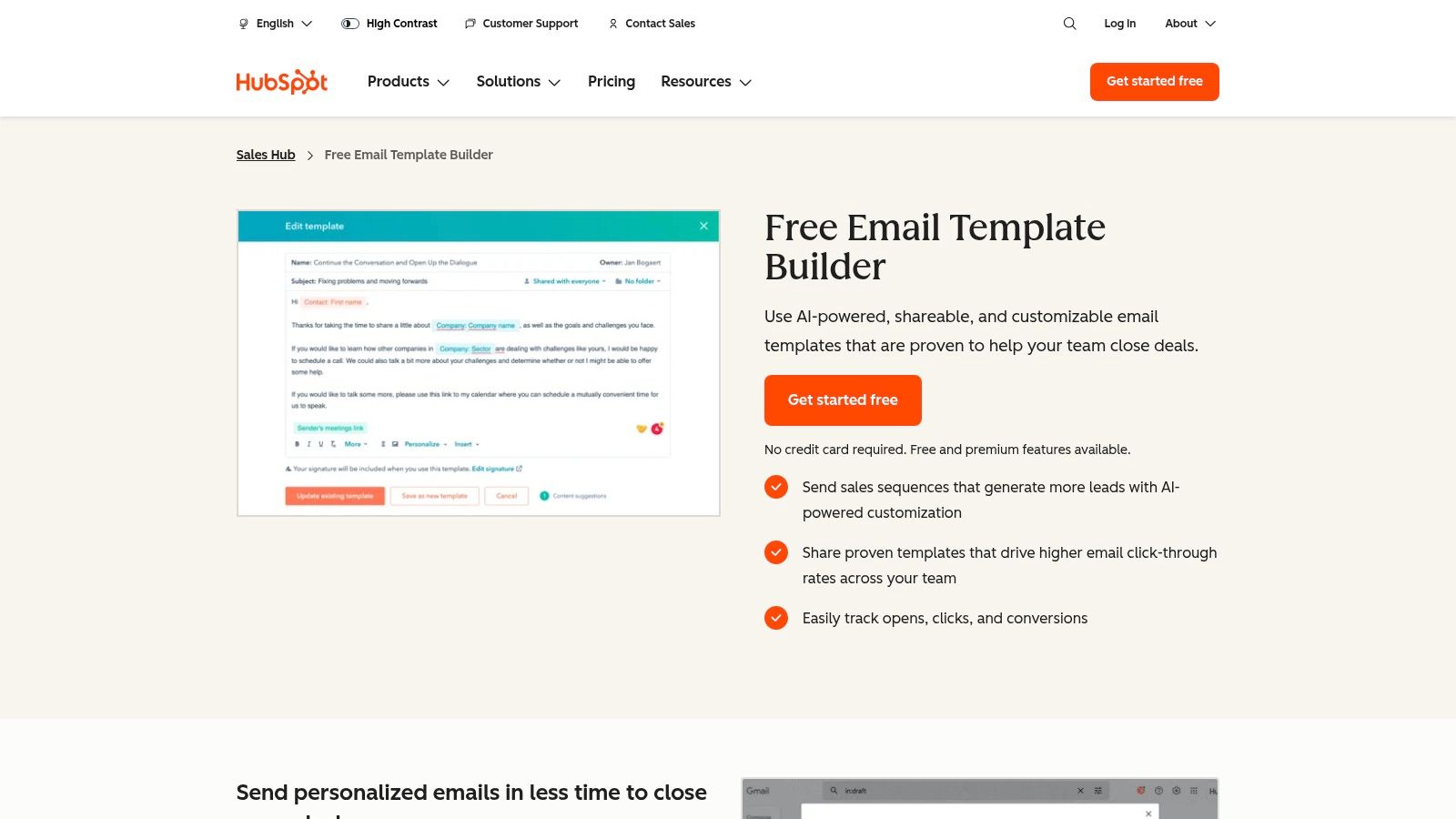
HubSpot's email template builder, which allows for easy creation and personalization of cold email templates.

Key Offerings and Featuresโ€‹

HubSpot's template resources are split into two main categories: downloadable assets and in-product tools.

  • Free Downloadable Template Pack: HubSpot offers a popular pack of over 50 sales email templates. This collection covers the entire sales cycle, from the initial cold outreach and follow-ups to re-engagement and breakup emails. While access requires submitting your email (gated content), the quality is consistently high and provides a solid foundation for any SDR.
  • In-Product Templates & Sequences: Within the HubSpot Sales Hub, users can create, save, and share an unlimited number of templates. The platform supports personalization tokens that pull data directly from contact records in the HubSpot CRM, making it easy to customize emails at scale.
  • Built-in Analytics: Each templateโ€™s performance is tracked automatically. You can monitor open rates, click-through rates, and reply rates to identify your top-performing messages and continuously optimize your approach.

Pricing and Accessโ€‹

HubSpot's approach to templates is tiered, making it accessible for individuals while offering robust features for growing teams.

Feature/TierFree ToolsSales Hub Starter (from $15/mo/seat)Sales Hub Professional (from $90/mo/seat)
Template Access5 templates1,000 templates1,000 templates
Email SequencesNoYesYes (with advanced features)
Email Tracking200 notifications/monthUnlimited notificationsUnlimited notifications
Downloadable PacksYes (requires email signup)YesYes

How to Use HubSpot Templates Effectively: An Action Planโ€‹

  1. Start with the Free Pack: Download HubSpot's free sales email template pack. Don't just copy-paste; identify 2-3 templates that align with your specific use case (e.g., "Referral Request" or "Problem-Agitator-Solve").
  2. Adapt and Import: Rewrite the chosen templates in your own brand voice. Then, import them into the HubSpot templates tool (even the free version allows for five).
  3. Connect to Your CRM: Use HubSpotโ€™s personalization tokens (like {{contact.firstname}} and {{contact.company}}) to dynamically insert prospect data. This is a critical step for scaling your outreach without sacrificing personalization.
  4. Test and Measure: Send your templates to a small, targeted list of prospects. Use the built-in analytics to see which subject lines get the most opens and which body copy generates the most replies. The data doesn't lie.

Website: https://www.hubspot.com/products/sales/email-templates-sales

3. Mailshakeโ€‹

Mailshake is a dedicated sales engagement platform designed to streamline and automate cold outreach. While it offers a complete suite of tools for running campaigns, its foundation is built on a powerful system for managing and deploying effective cold email templates. Unlike general-purpose CRMs like HubSpot where templates are one feature among many, Mailshake puts the outreach sequence front and center. This makes it an excellent choice for sales development teams and individuals whose primary goal is to book meetings through scalable, multi-touch email campaigns.

The platform's core advantage is its focus on the entire outreach workflow, from creation to deliverability. Instead of just providing static examples, Mailshake integrates template management directly into campaign sequences, which can include phone calls and social media tasks. This holistic approach ensures your templates are part of a cohesive strategy, not just one-off messages.
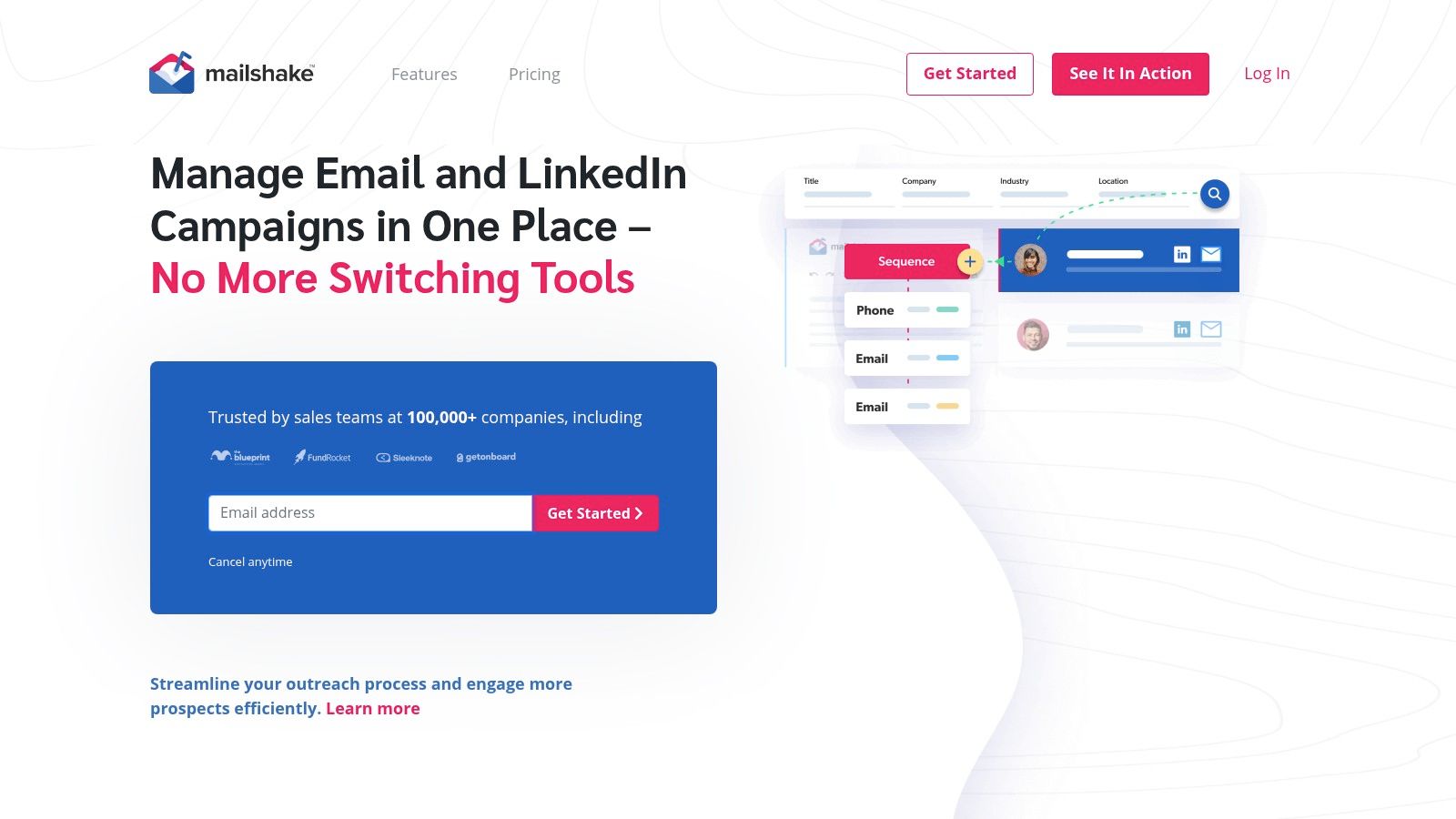
Mailshake

Key Offerings and Featuresโ€‹

Mailshake combines a rich resource library with powerful in-app tools to help users master cold outreach.

  • Blog & Template Library: Mailshake maintains an extensive blog and resource center filled with tested cold email templates, playbooks, and strategies. These resources are freely available and cover a wide range of scenarios, from link building to enterprise sales.
  • AI Writing Assistant (SHAKESpeare): Integrated directly into the platform, this AI copywriter helps you generate new email ideas, rewrite existing templates for a different tone, or overcome writer's block. It's a practical tool for quickly creating personalized variations.
  • Built-in Deliverability Tools: Mailshake includes an email warm-up tool and list-cleaning integrations to ensure your templates land in the primary inbox. This focus on deliverability is a key differentiator from platforms that don't manage the technical side of sending.
  • Multichannel Sequences: You can build templates not just for the initial email but for every follow-up, and even add steps for phone calls and LinkedIn engagement, all within a single campaign view.

Pricing and Accessโ€‹

Mailshakeโ€™s pricing is straightforward, with two primary tiers for sales-focused users. Unlike some competitors, there is no free-forever plan or free trial; payment is required upfront.

Feature/TierEmail Outreach (from $58/mo/seat)Sales Engagement (from $83/mo/seat)
Email CampaignsYesYes
Template StorageUnlimitedUnlimited
AI Writing Asst.YesYes
Phone DialerNoYes
LinkedIn AutomationNoYes (Add-on)
Blog/Resource AccessYesYes

How to Use Mailshake Templates Effectively: An Action Planโ€‹

  1. Start with Proven Examples: Explore Mailshake's public blog to find a battle-tested cold email template for sales that matches your campaign goal. These serve as a great starting point.
  2. Use SHAKESpeare for Personalization: Once you have a base template, use the AI writing assistant to create 3-4 variations. Ask it to rewrite the template with a more casual tone, or to focus on a specific pain point.
  3. Build a Multi-Step Sequence: Don't rely on a single email. Import your template into a Mailshake campaign and build a sequence of 3-5 follow-up emails. Use slight variations of your core message for each step.
  4. A/B Test Your Subject Lines: Create two versions of your campaign that are identical except for the subject line. Mailshake's analytics will show you which one gets a higher open rate, allowing you to optimize for performance.

Website: https://mailshake.com/

4. lemlistโ€‹

lemlist is a major player in the sales automation space, but its unique contribution to cold email templates comes from its community-driven and data-backed approach. Instead of just offering a static list of examples like a blog, lemlist provides a public hub of cold outreach sequences, many of which are submitted by its user community and include real-world performance benchmarks. This makes it an invaluable resource for SDRs who want to see what's actually working in the wild, not just what sounds good in theory.

The platform's core advantage is the direct bridge between inspiration and execution. You can browse templates filtered by goal (e.g., lead generation, link building) or industry, see their reported open and reply rates, and then, with a single click, duplicate an entire campaign sequence directly into your lemlist account. This seamless workflow is designed for action, helping teams move from learning best practices to implementing them with minimal friction.
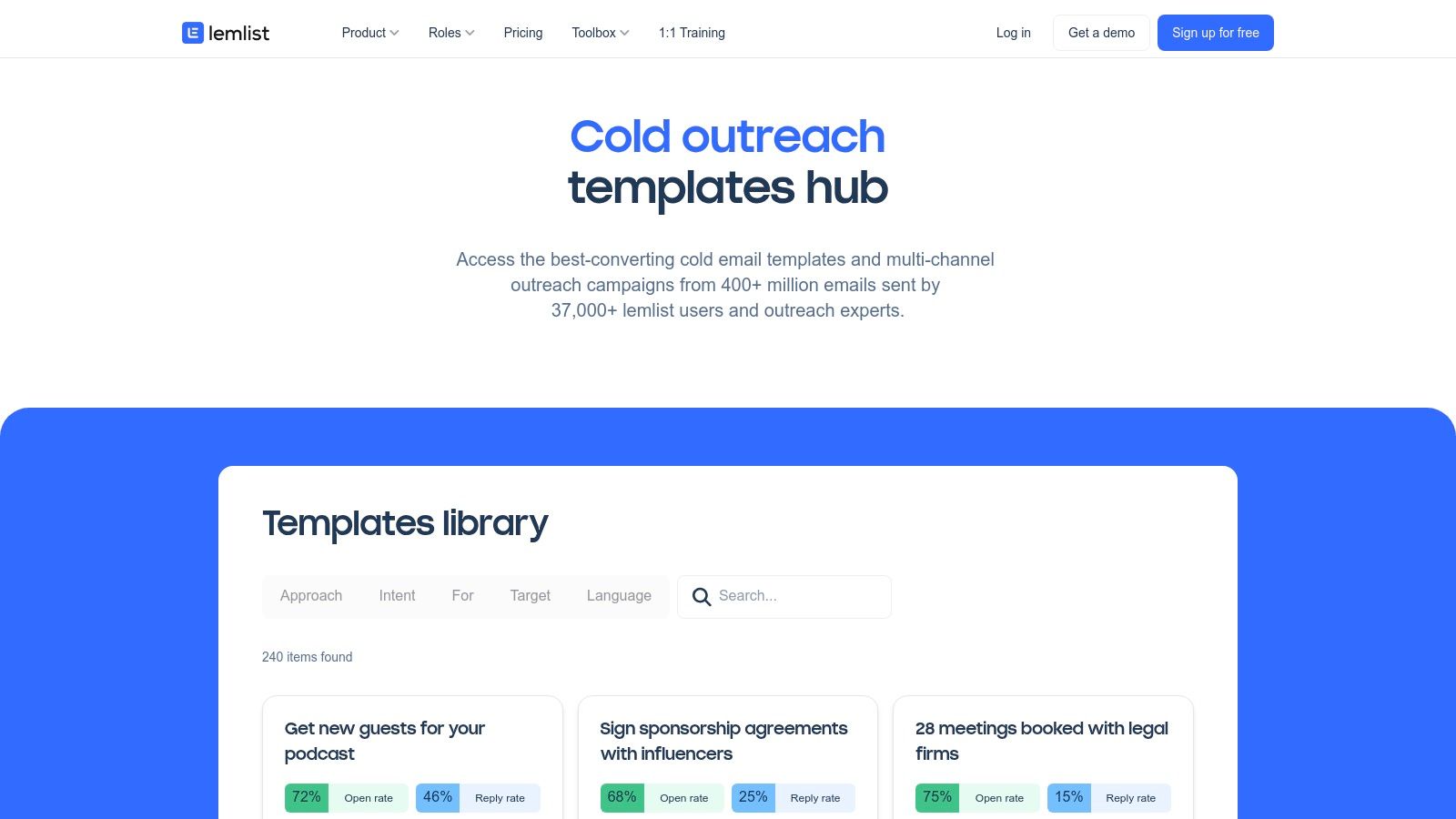
lemlist's cold outreach templates hub, showcasing community-submitted campaigns with performance data.

Key Offerings and Featuresโ€‹

lemlistโ€™s resources are a blend of community-sourced templates and expert-led educational content, making it a well-rounded platform for outreach professionals.

  • Public Template Hub: This gallery features hundreds of cold email templates and multi-step sequences. The key differentiator is that many include performance data like open rates and reply rates, offering a baseline for what you can expect.
  • One-Click Campaign Duplication: For lemlist users, this is a game-changer. Found a sequence you like? You can import the entire thing, including all follow-up steps and timing, directly into your lemlist account to start a new campaign.
  • Educational Resources: Beyond templates, lemlist provides extensive free resources, including playbooks, guides, and ebooks. These materials offer deep dives into the strategy behind successful outreach, helping users understand the "why" behind the "what." For more foundational knowledge, our guide on how to write cold emails is an excellent starting point.

Pricing and Accessโ€‹

While the template gallery is free to browse, its full power is unlocked with a lemlist subscription.

Feature/TierFree AccessEmail Starter (from $39/mo)Email Pro (from $69/mo)
View Template HubYesYesYes
Duplicate CampaignsNoYesYes
Educational ResourcesYesYesYes
Performance BenchmarksYes (on select templates)Yes (on select templates)Yes (on select templates)

How to Use lemlist Templates Effectively: An Action Planโ€‹

  1. Browse with a Goal in Mind: Use the filters in the template hub to find sequences that match your specific objective, such as "SaaS sales" or "event invitation." Pay close attention to the reported performance benchmarks.
  2. Analyze the "Why": Don't just look at the template; analyze its structure. Why is the first follow-up a simple bump? Why does the third step use a different angle? The community data helps validate these strategic choices.
  3. Duplicate and Adapt: If you're a lemlist user, duplicate your chosen campaign. Immediately begin rewriting the copy to fit your unique brand voice, value proposition, and persona. The structure is your starting point, not the final product.
  4. A/B Test Against the Benchmark: Use the community-provided reply rate as your initial benchmark. Run an A/B test with your adapted version against the original to see if you can improve upon the results.

Website: https://www.lemlist.com/cold-email-templates

5. Yeswareโ€‹

Yesware is a sales productivity platform built directly into your inbox, making it a standout choice for sales reps and SDR teams who live in Gmail or Outlook. Its approach to cold email templates is focused on accessibility and immediate application. Instead of being a separate tool, Yesware integrates template management, tracking, and analytics into the native email-writing experience, drastically reducing friction for busy sellers.

The core advantage of Yesware is its in-inbox workflow. Sales reps can create, access, share, and analyze templates without ever leaving their email client. This is a significant differentiator from standalone platforms like Mailshake or Reply.io that require constant context switching. For small to mid-sized teams looking to standardize their messaging and get quick insights on what works, Yesware offers a powerful, low-overhead solution.
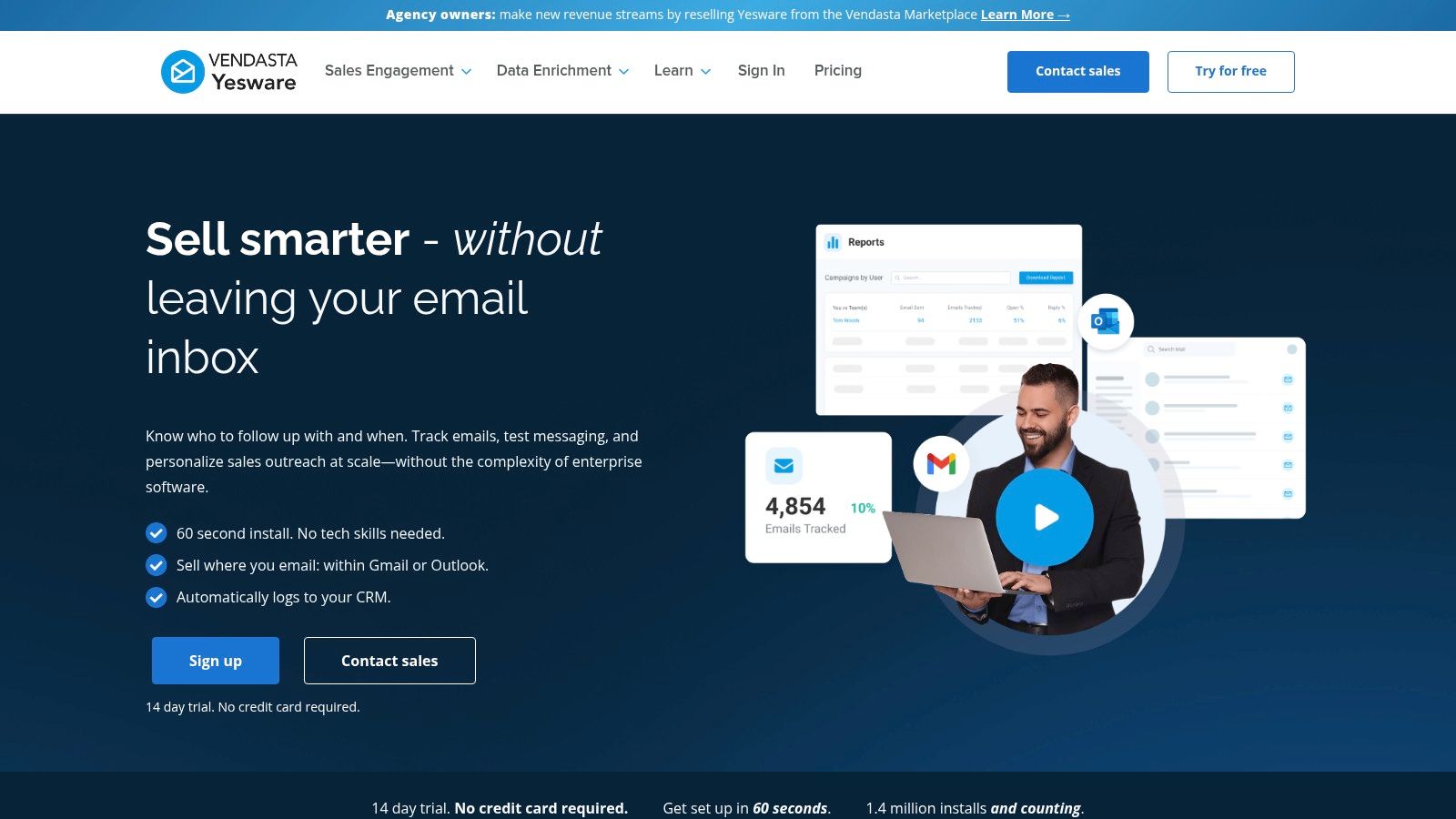
Yeswareโ€™s in-inbox template library, which allows sales reps to access and personalize cold email templates directly within Gmail or Outlook.

Key Offerings and Featuresโ€‹

Yesware's template functionality is designed for speed and team collaboration within the familiar environment of an inbox.

  • In-Inbox Template Library: Create and save your best-performing cold emails directly within Gmail or Outlook. The library is easily searchable and allows for team-wide sharing, ensuring message consistency.
  • Template Performance Reporting: Yesware provides detailed analytics on a per-template basis. You can track open rates, reply rates, and link clicks to objectively determine which messages are driving results and which need to be refined.
  • Public Resources & Guides: Beyond the tool itself, Yesware offers a public library of proven templates and downloadable guides. These resources are excellent for inspiration and cover various scenarios, from initial outreach to follow-ups.
  • Team Collaboration: Managers can create and share a set of approved templates with their team, promoting best practices and accelerating the onboarding process for new reps.

Pricing and Accessโ€‹

Yesware offers a tiered pricing model that scales from individual users to enterprise teams, with template features becoming more robust at each level.

Feature/TierFreePro (from $15/mo/seat)Premium (from $35/mo/seat)
Template AccessYes (Limited)Unlimited Personal TemplatesUnlimited Personal & Team Templates
Email TrackingYes (Limited)UnlimitedUnlimited
Team ReportingNoNoYes
Downloadable GuidesYesYesYes

How to Use Yesware Templates Effectively: An Action Planโ€‹

  1. Start with Proven Examples: Explore Yeswareโ€™s public template library or free guides to find a structure that fits your outreach goal. Pay attention to how they frame the value proposition.
  2. Build Your Core Templates: Adapt 3-4 of these proven templates and save them in your personal Yesware library. Use clear naming conventions like "Cold Outreach - VP Marketing - Pain Point A" for easy access.
  3. Use Personalization Fields: Leverage Yeswareโ€™s dynamic fields to insert prospect details like {{First Name}} and {{Company}}. This is crucial for maintaining a personal touch while working efficiently. To make your messages stand out even more, craft compelling subject lines. Discover how to create your own by reading our guide on witty email subject lines.
  4. Monitor Team-Wide Performance: If you are on a team plan, use the template reporting feature to see which messages have the highest reply rates across the entire team. This data-driven approach helps everyone adopt the most effective messaging.

Website: https://www.yesware.com/email-templates/

6. Reply.ioโ€‹

Reply.io is a comprehensive sales engagement platform designed for multichannel outreach, and its approach to cold email templates is deeply integrated into its automation workflow. Unlike platforms that just offer a static library, Reply.io treats templates as dynamic assets within a larger sequence of touchpoints that can include email, LinkedIn interactions, calls, and even SMS messages. This makes it a powerful choice for sales teams looking to execute sophisticated, multi-pronged outreach campaigns from a single hub.

The core advantage of Reply.io is its focus on sequence-based selling. Compared to an inbox tool like Yesware, Reply.io manages the entire outreach cadence from a central platform. You can build entire sequences, embedding various email templates for different stages, such as the initial touch, follow-ups, and re-engagement. The platform's AI capabilities can then suggest improvements to these templates, help personalize them at scale using prospect data from LinkedIn or your CRM, and provide detailed analytics on whatโ€™s working and what isnโ€™t.

Key Offerings and Featuresโ€‹

Reply.ioโ€™s template functionality is woven directly into its sales engagement tools.

  • In-App Template & Sequence Library: The platform provides a library of pre-built, proven templates and multi-step sequences directly within its interface. These are categorized by goal (e.g., "Outbound Prospecting," "Inbound Lead Nurturing") and can be customized and saved for your team.
  • AI-Powered Personalization: Reply.io's AI can analyze a prospect's LinkedIn profile to generate highly personalized icebreakers and value propositions, which can be inserted directly into your templates to boost reply rates.
  • Multichannel Sequence Builder: Templates are not just for email. You can build sequences that automatically send an email, then schedule a LinkedIn connection request, and then create a call task for the sales rep, all from one visual builder.
  • Built-in Analytics & A/B Testing: Every template and sequence comes with detailed performance tracking. You can monitor open, click, and reply rates, and easily set up A/B tests to optimize subject lines, calls-to-action, or entire email bodies.

Pricing and Accessโ€‹

Reply.io offers flexible pricing plans that cater to both individuals focused on email and teams running multichannel campaigns.

Feature/TierFreeStarter (from $60/mo/user)Professional (from $90/mo/user)
Email Accounts122+
Templates & SequencesLimited accessYesYes
AI FeaturesLimited creditsYesYes (more credits)
MultichannelEmail onlyEmail, LinkedIn, Calls, SMSAdvanced multichannel features

How to Use Reply.io Templates Effectively: An Action Planโ€‹

  1. Choose a Sequence, Not Just a Template: Instead of looking for a single email, browse Reply.io's sequence library. Select a pre-built sequence that matches your goal, like the "Outbound Prospecting to C-level" cadence.
  2. Personalize with AI: Use the built-in AI assistant to generate personalized opening lines for your first-step email template. Connect your LinkedIn account to allow the AI to pull relevant details from your prospect's profile.
  3. Build a Multichannel Flow: Adapt the sequence to include more than just email. Add a LinkedIn profile view as step two and a connection request as step three. This surrounds the prospect and increases the likelihood of a response.
  4. Analyze and Optimize: After launching your campaign, review the sequence analytics. If you notice a high open rate on the first email but a low reply rate, A/B test the call-to-action in that specific template to improve its performance.

Website: https://reply.io

7. Saleshandyโ€‹

Saleshandy is a dedicated cold outreach platform that focuses on delivering high-volume campaigns while maintaining personalization and deliverability. Its approach to cold email templates is practical and deeply integrated into its sending workflow, making it a strong contender for sales teams and agencies that prioritize affordable sending limits alongside robust template management. The platform is designed for users who want to move beyond basic email blasts and operationalize their outreach with features like spintax and team-sharing.

What sets Saleshandy apart from more generalist CRMs is its specialized focus on the technical aspects of cold emailing. While a platform like HubSpot bundles templates with a full suite of marketing and sales tools, Saleshandy centers its features around the core needs of an SDR: creating variable templates, ensuring they land in the primary inbox, and managing multi-stage follow-ups efficiently. This makes it an excellent choice for teams whose primary goal is to scale outbound prospecting.
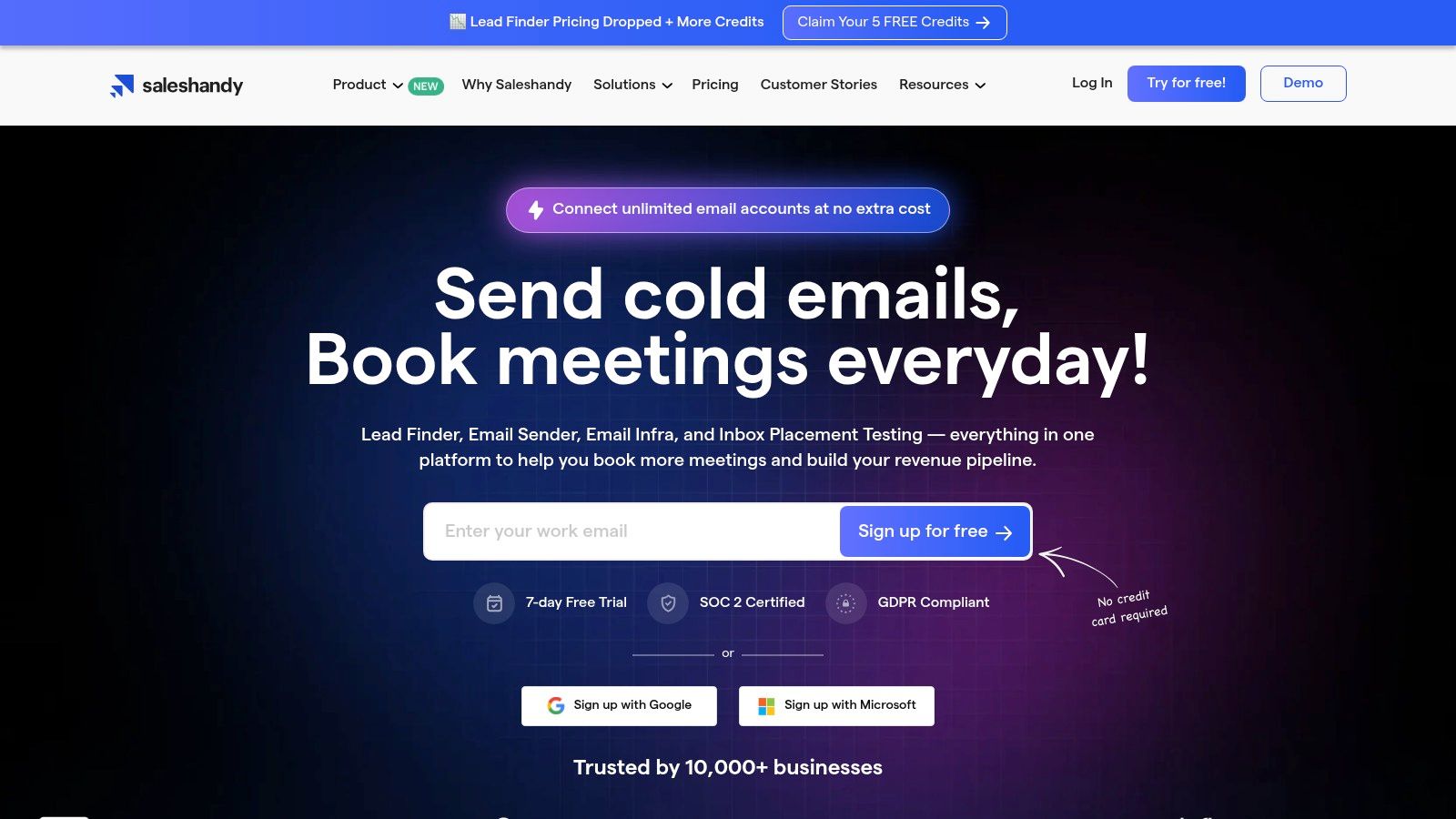
Saleshandy's email outreach dashboard, showcasing sequence performance and analytics.

Key Offerings and Featuresโ€‹

Saleshandyโ€™s template features are built directly into its outreach and sequence tools, providing a seamless user experience.

  • Public Template Collections: Saleshandy provides several "playbooks" and blog posts featuring dozens of ready-to-use cold email templates for various scenarios, including B2B sales, link building, and recruitment. These serve as a great starting point for new campaigns.
  • In-App Template Management: Users can create, save, and share templates with their team directly within the platform. The editor supports merge tags for personalization (e.g., {{FirstName}}, {{Company}}) and, crucially, spintax. Spintax ({Hello|Hi|Hey}) allows you to create multiple variations of words or phrases within a single template, which helps avoid spam filters.
  • Integrated Deliverability Tools: Higher-tier plans include email warm-up and inbox placement testing. This unique offering allows you to not only use great templates but also ensure they are being delivered and seen by your prospects.

Pricing and Accessโ€‹

Saleshandy's pricing is competitive, offering high sending limits and a clear feature progression across its tiers.

Feature/TierOutreach Starter (from $36/mo)Outreach Pro (from $94/mo)Outreach Scale (from $187/mo)
Email Accounts2 per user5 per user10 per user
Active Prospects6,00030,00060,000
Template SharingYesYesYes
Email Warm-upAdd-onIncludedIncluded

How to Use Saleshandy Templates Effectively: An Action Planโ€‹

  1. Leverage the Playbooks: Start by browsing Saleshandy's public template collections. Find a playbook that matches your industry or goal (e.g., "SaaS Sales") and select a high-performing first-touch email.
  2. Enhance with Spintax: Import the template into the Saleshandy app. Use the spintax feature to create variations for common greetings, opening lines, and calls-to-action. This is a key step to improve deliverability for larger campaigns.
  3. Build a Multi-Step Sequence: Don't rely on a single email. Use the template as Step 1 in a multi-touch sequence within Saleshandy. Add 2-3 follow-up steps using different templates that reference the initial message.
  4. Warm Up Your Domain: Before launching a large campaign, use Saleshandyโ€™s email warm-up feature. This builds your sender reputation and ensures your carefully crafted templates don't land in the spam folder, maximizing their potential impact.

Website: https://www.saleshandy.com/cold-email-templates/

Cold Email Template Platform Comparisonโ€‹

ToolIdeal User ProfileKey StrengthHow it ComparesActionable Takeaway
marketbetter.aiEnterprise & mid-market SDR teams using Salesforce/HubSpotIntent-driven workflow. Turns signals into AI-generated outreach directly in the CRM.Goes beyond templates to provide a full execution engine. Less about a static library, more about dynamic, timely outreach.Use this if your biggest problem is reps wasting time on manual research and failing to act on buying signals quickly.
HubSpotTeams already invested in the HubSpot ecosystem.Seamless CRM integration. Templates are part of a unified sales, marketing, and service platform.A great all-in-one solution but less specialized on advanced outreach tech (like deliverability) than dedicated tools.Perfect for centralizing your sales efforts. Use its built-in analytics to find your team's winning templates.
MailshakeSales teams focused on scalable, email-first campaigns.Deliverability and simplicity. Strong focus on email warm-up, A/B testing, and an easy-to-use AI writer.More focused on the technical aspects of sending emails than HubSpot, but less of a full CRM.Use this to scale your email volume confidently, knowing you have tools to protect your sender reputation.
lemlistCreative outreach teams looking for proven campaign structures.Community-backed templates. Provides sequences with real performance data from other users.Differentiates with creative personalization (images/videos) and transparent community data, unlike more private libraries.Don't just copy the templates; clone a high-performing sequence and use its structure as a proven blueprint for your own campaign.
YeswareIndividual reps or small teams living in Gmail/Outlook.Inbox-native workflow. All features (templates, tracking, scheduling) are accessible without leaving the inbox.Offers maximum convenience for inbox-centric sellers but lacks the advanced sequencing of Reply.io or Saleshandy.Implement this to boost individual rep productivity with minimal disruption to their existing workflow.
Reply.ioSales teams executing sophisticated, multi-channel cadences.Multichannel automation. Builds complex sequences involving email, LinkedIn, calls, and SMS from one platform.More robust for multi-channel than Mailshake or Yesware. Its AI personalization is a key differentiator.Go beyond email. Build a sequence that warms up a prospect on LinkedIn before the first cold email even lands.
SaleshandyAgencies and high-volume teams needing affordability at scale.Scalability with deliverability. Offers high sending limits and technical features like spintax.A more technical, volume-focused tool compared to the all-in-one nature of HubSpot or the creative angle of lemlist.Use spintax on every template you create to maximize deliverability and avoid spam filters when sending at scale.

From Templates to Pipeline: Your Next Moveโ€‹

We've journeyed through a comprehensive collection of high-conversion cold email templates, from piercing first-touch messages to persistent follow-up sequences. Youโ€™ve seen how to tailor outreach for different personas, adapt to various use cases, and integrate these frameworks into a modern sales workflow. But the most critical takeaway is this: a template is merely a starting point, not a final destination.

The true power of these cold email templates is unlocked when you treat them as strategic blueprints. The success of your outreach hinges not on blindly copying and pasting text, but on your ability to operationalize these blueprints efficiently. This means personalizing at scale, automating thoughtfully, and continuously iterating based on performance data. The goal is to build a repeatable system that empowers your SDRs and BDRs to spend less time on manual tasks and more time building relationships.

Synthesizing the Tools: How to Choose Your Engineโ€‹

Choosing the right tool is the bridge between having a library of templates and actually generating pipeline. Your decision should be guided by your team's specific needs, existing tech stack, and strategic goals.

  • For Deep CRM Integration and AI-Powered Personalization: If your team lives in Salesforce or HubSpot and your primary goal is to leverage AI for hyper-relevant, real-time email generation, MarketBetter.ai is designed for this exact purpose. It excels at turning intent signals directly into AI-assisted, personalized outreach within your CRM, minimizing context switching.
  • For All-in-One Sales Engagement: Platforms like Reply.io and Saleshandy offer robust, multi-channel sequencing (email, calls, social touches) and are great for teams needing a comprehensive sales engagement platform that handles the entire outreach process from a central hub.
  • For Simplicity and Email-Centric Campaigns: If you're primarily focused on email and want a straightforward, easy-to-use tool for sending campaigns and tracking basic metrics, Mailshake is a strong contender. Its simplicity is its core strength.
  • For Creative, Visual Personalization: Teams that want to stand out with dynamic images, videos, and unique landing pages will find lemlist to be their ideal creative partner. Itโ€™s built for breaking through the noise with highly memorable, personalized visuals.
  • For Inbox-Native Productivity: If your reps prefer to work directly from their Gmail or Outlook inbox, Yesware provides excellent tracking, template management, and scheduling features without forcing them to leave their familiar environment.

The key is to evaluate where your biggest bottleneck lies. Is it the time spent researching and writing? AI-driven tools are your answer. Is it managing multi-step, multi-channel cadences? A full sales engagement platform is what you need. Is it simply a lack of visibility into email performance? An inbox-native tool might be the perfect first step.

Your Action Plan for Implementationโ€‹

Having the right templates and the right tool is only half the battle. Execution is everything. Here are your actionable next steps to turn this knowledge into revenue.

  1. Benchmark Your Current State: Before you change anything, document your current open rates, reply rates, and meeting booked rates. This baseline is crucial for measuring the impact of your new strategy.
  2. Select and Adapt 3-5 Templates: Don't try to implement everything at once. Choose a handful of cold email templates from this guide that best fit your ideal customer profile and core value proposition. Adapt them with your own voice and personalization tokens.
  3. Run a Controlled A/B Test: Assign a small group of reps to use the new templates and workflow within your chosen tool. Compare their results against the control group (using the old method) over a two-to-four-week period.
  4. Analyze, Iterate, and Scale: Review the data. Which subject lines won? Which calls-to-action generated the most replies? Use these insights to refine your templates, and then roll out the winning strategy to the entire team.

Ultimately, the most successful sales teams are not those with a secret stash of "perfect" templates. They are the ones who build a scalable, data-driven system for outreach. They use templates as a foundation, technology as an accelerator, and personalization as their competitive edge to consistently start valuable conversations that become a predictable, growing pipeline.


Ready to stop manually adapting templates and start generating hyper-personalized emails in seconds, right inside your CRM? See how marketbetter.ai uses AI to turn sales signals into revenue-generating conversations. Explore the future of sales outreach at marketbetter.ai.


MarketBetter vs Clearbit (Breeze Intelligence): B2B Data Enrichment Comparison [2026]

ยท 5 min read

If you've been researching B2B data enrichment tools, you've likely come across Clearbit โ€” or more recently, Breeze Intelligence, since Clearbit was acquired by HubSpot and integrated into their ecosystem.

The acquisition has left many sales teams wondering: Should we stick with Clearbit/Breeze, or explore alternatives that offer more than just data?

This comparison breaks down how MarketBetter and Clearbit (Breeze Intelligence) differ โ€” and helps you decide which fits your sales workflow better.

The Core Difference: Data vs. Directionโ€‹

Here's the fundamental distinction:

  • Clearbit/Breeze Intelligence: Enriches your records with company and contact data. You get firmographics, technographics, and IP-to-company identification.

  • MarketBetter: Enriches your records AND tells your SDRs exactly what to do next. You get the data plus a prioritized playbook of actions.

The analogy: Clearbit hands you a map. MarketBetter hands you the map AND turn-by-turn navigation.

Feature-by-Feature Comparisonโ€‹

CapabilityClearbit (Breeze)MarketBetter
Data Enrichmentโœ… Strong (firmographics, technographics, industry)โœ… Included (company + contact data)
IP-to-Company IDโœ… Core featureโœ… Real-time visitor identification
Intent Scoringโš ๏ธ Basic (page views)โœ… AI-powered intent + ICP scoring
SDR Task AssignmentโŒ Not includedโœ… Daily prioritized task list
Personalized OutreachโŒ Data onlyโœ… AI writes emails based on research
Smart DialerโŒ Not includedโœ… Built-in with call prioritization
Chatbot + Live HandoffโŒ Not includedโœ… Qualified-style engagement
CRM Integrationโœ… HubSpot native (others limited)โœ… HubSpot + Salesforce bidirectional
Pre-Meeting BriefsโŒ Manual researchโœ… Automated before every call

Pricing Comparisonโ€‹

Clearbit / Breeze Intelligence Pricingโ€‹

Clearbit's pricing has always been enterprise-oriented and has become even more opaque since the HubSpot acquisition:

  • Now bundled within HubSpot's higher tiers
  • Standalone pricing typically starts at $15,000-$20,000/year for basic enrichment
  • Visitor identification (Reveal) adds additional cost
  • Per-record pricing can add up quickly at scale

The catch: If you're not already on HubSpot, getting Clearbit's full value means committing to HubSpot's ecosystem.

MarketBetter Pricingโ€‹

  • Transparent pricing starting at $39/month for visitor identification
  • All-in-one plans include enrichment, tasks, outreach, and dialer
  • No per-record fees for standard usage
  • Works with HubSpot OR Salesforce

Who Should Choose Clearbit (Breeze Intelligence)?โ€‹

Clearbit is a good fit if you:

  • Are already deeply invested in HubSpot's ecosystem
  • Need data enrichment primarily for marketing operations (scoring, segmentation)
  • Have a mature RevOps team to build workflows around enriched data
  • Want best-in-class firmographic accuracy and don't need SDR automation
  • Have budget for enterprise pricing

Common Clearbit use cases:

  • Form shortening (auto-fill fields from email)
  • Lead scoring based on firmographics
  • Account-based marketing segmentation
  • Data hygiene and deduplication

Who Should Choose MarketBetter?โ€‹

MarketBetter is a good fit if you:

  • Have an SDR team that needs clear direction on daily priorities
  • Want visitor identification + action in one platform
  • Need AI-powered outreach that writes personalized emails
  • Are looking for a Clearbit alternative with more sales execution features
  • Want transparent, accessible pricing

Why teams switch from Clearbit to MarketBetter:

  1. "We enriched 10,000 leads but SDRs still didn't know who to call first"

    • Clearbit tells you WHO the lead is
    • MarketBetter tells you WHO to call, WHEN to call, and WHAT to say
  2. "We're not ready to go all-in on HubSpot"

    • Clearbit's future is HubSpot-native
    • MarketBetter works with your existing CRM without lock-in
  3. "We need more than data โ€” we need workflow"

    • Data enrichment alone doesn't move pipeline
    • SDRs need prioritized tasks, not more data to interpret

The Visitor Identification Questionโ€‹

Both platforms identify companies visiting your website. Here's how they differ:

Clearbit Reveal:

  • Shows company name, industry, size
  • Requires separate workflows to action the data
  • Best when feeding into HubSpot for marketing automation

MarketBetter Visitor Intelligence:

  • Shows company + estimated buying intent
  • Automatically creates SDR tasks for high-intent visitors
  • Prioritizes visitors against your ICP criteria
  • SDRs see exactly who to contact and what to say

Example workflow:

Clearbit: VP of Sales at 500-person SaaS company visits your pricing page โ†’ Record created โ†’ You build a HubSpot workflow โ†’ Lead gets scored โ†’ SDR eventually sees it in a queue

MarketBetter: Same visitor โ†’ System identifies high-intent signal โ†’ SDR gets a task: "Call John at Acme Corp - visited pricing page 3x this week, ICP match: 92%" with suggested talking points

Making the Switchโ€‹

If you're currently on Clearbit and considering MarketBetter:

  1. Data continuity: Your enriched CRM records stay intact. MarketBetter adds to your data, doesn't replace it.

  2. HubSpot compatibility: MarketBetter integrates with HubSpot bidirectionally โ€” you don't lose your HubSpot investment.

  3. Pilot approach: Many teams run MarketBetter alongside existing tools first, then consolidate once they see SDR productivity gains.

Free Tool

Try our AI Lead Generator โ€” find verified LinkedIn leads for any company instantly. No signup required.

The Bottom Lineโ€‹

Choose Clearbit (Breeze Intelligence) if you need best-in-class B2B data enrichment for marketing operations and are committed to HubSpot's ecosystem.

Choose MarketBetter if you want data enrichment PLUS an AI-powered SDR command center that tells your team exactly what to do with that data.

The reality: Data alone doesn't close deals. The teams hitting quota in 2026 aren't the ones with the most data โ€” they're the ones turning signals into actions fastest.


Ready to see the difference? Book a demo and we'll show you how MarketBetter turns website visitors into SDR tasks in real-time.

MarketBetter vs Cognism: B2B Sales Intelligence Comparison [2026]

ยท 6 min read

Looking for a Cognism alternative? You're not alone.

Cognism is a premium B2B data provider with excellent European coverage. But at $1,500-$25,000+ per year, many teams wonder: is there a better way to spend that budget?

Here's the core difference:

Cognism gives you contact data. MarketBetter gives you contact data AND tells you exactly what to do with it.

Let's break it down.

What Is Cognism?โ€‹

Cognism is a UK-founded B2B sales intelligence platform specializing in contact and company data. Their key differentiator is Diamond Dataยฎ โ€” phone-verified mobile numbers with claimed 98% accuracy.

Cognism's strengths:

  • 400 million business profiles globally
  • 200 million verified business emails
  • Best-in-class European data coverage (EMEA, DACH, UK)
  • GDPR-native compliance from the ground up
  • Bombora intent data integration

Cognism is built for: Sales teams that need accurate contact data for cold outreach, particularly in European markets.

What Is MarketBetter?โ€‹

MarketBetter is an AI-powered SDR platform that combines visitor identification, contact data, and workflow automation into a unified system.

MarketBetter's strengths:

  • Website visitor identification (person-level)
  • AI-powered Daily SDR Playbook
  • Smart Dialer for outbound calls
  • AI Chatbot for real-time visitor engagement
  • Email automation with AI personalization
  • Built-in enrichment and sequencing

MarketBetter is built for: SDR teams that need an all-in-one platform to find, prioritize, and engage prospects.

Feature Comparison: Cognism vs MarketBetterโ€‹

FeatureCognismMarketBetter
Contact Databaseโœ… 400M+ profilesโœ… Integrated enrichment
Phone-Verified Mobilesโœ… Diamond Dataยฎโœ… Via enrichment
Website Visitor IDโŒ Not includedโœ… Person-level identification
Daily SDR PlaybookโŒ Not includedโœ… AI-prioritized task list
Smart DialerโŒ Not includedโœ… Built-in
AI ChatbotโŒ Not includedโœ… Real-time visitor engagement
Email SequencesโŒ Not includedโœ… AI-personalized
Intent Dataโœ… Via Bomboraโœ… First-party visitor signals
European Coverageโœ… Industry-leadingโœ… Good
GDPR Complianceโœ… Nativeโœ… Compliant

Pricing Comparisonโ€‹

Cognism Pricingโ€‹

Cognism doesn't publish pricing publicly. Based on market research:

TierPlatform FeePer UserAnnual Total (3 users)
Platinum$15,000/year$1,500/user/year~$19,500
Diamond$25,000/year$2,500/user/year~$32,500

Additional costs:

  • Implementation fees: $500-$1,500
  • Contact volume tiers: Price increases with exports
  • Renewal increases: 10-15% annually

MarketBetter Pricingโ€‹

MarketBetter offers transparent, predictable pricing:

PlanMonthly
Standard$99/user/month
EnterpriseCustom

Add-ons: +$200/5K actions | +$150/extra seat | +$100/500 enrichment credits per seat

What's included: All features โ€” visitor ID, playbook, dialer, chatbot, email automation. No per-seat fees. No contact export limits. Free trial available โ€” book a demo to get started.

The Mathโ€‹

For a 5-person SDR team:

  • Cognism Diamond: ~$37,500/year (platform + seats)
  • MarketBetter: $3,588/year

You save $33,900/year with MarketBetter โ€” and get visitor identification, a dialer, and a chatbot that Cognism doesn't offer.

The Real Difference: Data vs. Actionโ€‹

This is where Cognism and MarketBetter fundamentally diverge.

Cognism: Pure Data Playโ€‹

Cognism is excellent at what it does โ€” providing accurate contact data. But once you have the data, you need separate tools to:

  • Prioritize who to contact first
  • Write personalized outreach
  • Make calls (need a separate dialer)
  • Engage website visitors (need a chatbot)
  • Track engagement and follow up

You're buying ingredients, not the meal.

MarketBetter: Data + Executionโ€‹

MarketBetter starts where Cognism ends. Yes, you get contact enrichment. But you also get:

  1. Visitor identification โ€” Know who's on your site right now
  2. Daily SDR Playbook โ€” AI prioritizes your entire task list
  3. Smart Dialer โ€” Make calls without switching apps
  4. AI Chatbot โ€” Engage visitors in real-time
  5. Email automation โ€” AI-personalized sequences

You're buying the complete system, ready to drive pipeline.

When to Choose Cognismโ€‹

Cognism makes sense if you:

  • Need best-in-class European data โ€” Cognism's EMEA coverage is genuinely excellent
  • Already have your sales stack built โ€” You have a dialer, chatbot, sequencing tool, and just need data
  • Have enterprise budget โ€” $15K-30K+ per year for data alone
  • Focus purely on outbound โ€” No need for inbound visitor engagement

When to Choose MarketBetterโ€‹

MarketBetter makes sense if you:

  • Want one platform, not ten โ€” Tired of juggling visitor ID + data + dialer + sequences + chatbot
  • Need to act on signals, not just see them โ€” Daily Playbook tells you exactly what to do
  • Have an SDR team that needs prioritization โ€” Stop wasting time figuring out who to call
  • Want predictable pricing โ€” No surprise fees, no per-seat charges
  • Value speed-to-lead โ€” Website visitors get engaged immediately via chatbot and playbook

Real-World Scenarioโ€‹

Day in the life with Cognism:

  1. Export contact list from Cognism
  2. Upload to your CRM
  3. Check your website analytics separately
  4. Open your sequencing tool
  5. Open your dialer
  6. Figure out who to prioritize
  7. Start making calls

Day in the life with MarketBetter:

  1. Open MarketBetter
  2. See your Daily Playbook with prioritized tasks
  3. Start executing

The difference: 20 tabs vs. one task list.

What Cognism Users Sayโ€‹

From G2 and Capterra reviews:

Pros:

  • "Diamond Data mobile numbers are highly accurate"
  • "Best European B2B database I've used"
  • "GDPR compliance gives us peace of mind"

Cons:

  • "Pricing lacks transparency โ€” had to sit through demos"
  • "Outdated records and missing mobile numbers sometimes"
  • "Renewal processes felt misleading"
  • "US data coverage isn't as strong as European"

Common Questionsโ€‹

Does MarketBetter have European data?โ€‹

Yes. MarketBetter provides contact enrichment globally, including European markets. However, if your primary focus is EMEA and you need the absolute best European mobile coverage, Cognism specializes there.

Can I use both?โ€‹

Some teams use Cognism for data enrichment and MarketBetter for workflow/execution. This works, but you're paying for overlapping features. Most teams find MarketBetter's built-in enrichment sufficient.

What about intent data?โ€‹

Cognism partners with Bombora for third-party intent signals. MarketBetter uses first-party intent โ€” actual visitors on your website. First-party signals (someone visited your pricing page) are often more actionable than third-party signals (someone at that company searched "sales tools" somewhere).

Is Cognism better for enterprise?โ€‹

If you have an enterprise budget and an existing tech stack that just needs data, Cognism delivers. If you're an SMB/mid-market team looking for a complete solution, MarketBetter is more practical.

The Verdictโ€‹

Choose Cognism if:

  • European data coverage is your #1 priority
  • You already have dialer, chatbot, and sequencing tools
  • Budget isn't a constraint

Choose MarketBetter if:

  • You want one platform for SDR workflow
  • You need visitor identification + data + execution
  • You want transparent, predictable pricing
  • You're tired of managing multiple tools

Free Tool

Try our AI Lead Generator โ€” find verified LinkedIn leads for any company instantly. No signup required.

Ready to See the Difference?โ€‹

Stop paying premium prices for data you can't easily act on.

MarketBetter combines visitor identification, contact enrichment, AI-powered prioritization, smart dialing, and chatbot engagement โ€” all in one platform.

Book a Demo โ†’

See why SDR teams are switching from data-only tools to complete platforms.

MarketBetter vs Leadinfo (+ VisitorQueue): Complete Comparison [2026]

ยท 7 min read

Breaking news: On January 20, 2026, Leadinfo acquired VisitorQueue, creating a transatlantic visitor identification powerhouse serving 9,000+ customers across Europe and North America.

If you were evaluating either tool, you're now looking at one combined entity. The question is: does bigger mean better for your SDR team?

This comparison breaks down what the Leadinfo + VisitorQueue combination offers versus MarketBetter's all-in-one SDR platform โ€” so you can make an informed choice.

The Acquisition: What It Meansโ€‹

Leadinfo (Netherlands-based, team.blue backed) absorbed VisitorQueue (Canada-based) to expand its North American footprint. This is Leadinfo's fifth acquisition since joining team.blue in 2022, following Futy and Leadcamp.

What changed:

  • VisitorQueue's website now redirects to leadinfo.com
  • Combined customer base: 9,000+ across EU and NAM
  • Positioning: "Global visitor intelligence platform"

What didn't change:

  • Still company-level identification only
  • Still no SDR execution tools (no playbook, no dialer, no chatbot)
  • Still a single-purpose visitor tracking tool

Quick Comparisonโ€‹

FeatureMarketBetterLeadinfo (+ VisitorQueue)
Starting Price$99/user/monthโ‚ฌ69/mo (~$75/mo)
Visitor IDโœ… Company + person-levelโœ… Company-level only
Daily Playbookโœ… Prioritized task listโŒ Manual workflow
AI Chatbotโœ… 24/7 visitor engagementโŒ None
Smart Dialerโœ… Built-inโŒ Requires separate tool
Email Sequencesโœ… Native automationโŒ Requires separate tool
CRM Integrationsโœ… Salesforce, HubSpot, Pipedriveโœ… 70+ integrations
GDPR Focusโœ… Compliantโœ… GDPR-native
Geographic StrengthUS-primaryEU-primary (expanding NAM)

What Leadinfo Does Wellโ€‹

The Leadinfo + VisitorQueue combination has genuine strengths:

GDPR-Native Architectureโ€‹

Built in the Netherlands, Leadinfo was designed for European privacy requirements from day one. If your visitors are primarily EU-based, their compliance positioning is solid.

Transparent, Volume-Based Pricingโ€‹

Starting at โ‚ฌ69/month (~$75), scaling based on visitor volume. No per-seat fees. Transparent, predictable costs.

Extensive Integrationsโ€‹

70+ integrations including Salesforce, HubSpot, Pipedrive, and major EU CRMs. The acquisition adds VisitorQueue's existing integration ecosystem.

Strong European Company Dataโ€‹

Leadinfo's database excels at identifying European companies. The VisitorQueue acquisition adds North American coverage, though it remains to be seen how the data merges.

Team.blue Backingโ€‹

As part of team.blue (major European SaaS holding company), Leadinfo has resources and stability that smaller visitor ID startups can't match.

Where Leadinfo Falls Shortโ€‹

The acquisition makes Leadinfo bigger. It doesn't make it complete.

Company-Level Onlyโ€‹

Neither Leadinfo nor VisitorQueue identifies individuals โ€” only companies. You know "someone from Acme Corp visited your pricing page." You don't know WHO at Acme Corp.

Your SDRs still need to:

  1. Research the company
  2. Find the right contact
  3. Figure out what to say
  4. Decide which channel to use

That's hours of work Leadinfo doesn't help with.

No Execution Layerโ€‹

After Leadinfo tells you "Company X visited," you need:

  • A contact database (Apollo, ZoomInfo, Cognism)
  • Email automation (Outreach, Salesloft)
  • A dialer (Aircall, Nooks, Orum)
  • A chatbot (Drift, Intercom, Qualified)
  • A task manager

That's 4-5 additional tools, 4-5 additional subscriptions, and the "20 tabs problem" SDRs know too well.

~30% Match Rateโ€‹

Both Leadinfo and VisitorQueue have historically reported approximately 30% of website visitors identified. That's decent for the industry โ€” but it means 70% of your visitors remain unknown.

More importantly: even for the 30% you DO identify, you still need other tools to act on that intelligence.

Post-Merger Growing Painsโ€‹

Acquisitions create integration challenges. Expect some turbulence as:

  • VisitorQueue customers migrate to Leadinfo systems
  • Two different data pipelines merge
  • Support teams consolidate
  • Pricing potentially adjusts

If you're a VisitorQueue customer today, watch for changes.

How MarketBetter Is Differentโ€‹

MarketBetter includes visitor identification. But that's just the starting point.

The Daily SDR Playbookโ€‹

Every morning, your SDRs get a prioritized task list:

  1. Call John at Acme Corp โ€” visited pricing page 3x this week, decision-maker
  2. Email Sarah at TechCo โ€” engaged with AI chatbot, requested case study
  3. Follow up with Mike โ€” opened yesterday's email twice

No guessing. No prioritization paralysis. No "let me check 5 different tools."

Just: "Here's what to do next."

AI Chatbot That Engages Visitorsโ€‹

While Leadinfo tracks who's on your site, MarketBetter's AI chatbot engages them in real-time:

  • Answers product questions 24/7
  • Books meetings directly into your calendar
  • Qualifies visitors before they bounce
  • Captures intent signals that feed the playbook

The visitors Leadinfo would just log? MarketBetter converts them.

Built-in Dialer and Emailโ€‹

When the playbook says "call," you call from MarketBetter. When it says "email," you send from MarketBetter.

One platform. One login. Full context on every interaction.

Person-Level Identificationโ€‹

When possible, MarketBetter identifies individual contacts โ€” not just companies. Combined with our data enrichment, your SDRs get names, titles, and contact info ready to act on.

Pricing Comparisonโ€‹

Leadinfo Pricingโ€‹

PlanMonthly CostNotes
Starterโ‚ฌ69/mo (~$75)Scales with visitor volume
Growth tiersโ‚ฌ99-299/moHigher limits, more features
EnterpriseCustomLarge volume, dedicated support

All prices scale based on identified visitors

The Hidden Cost: Your Execution Stackโ€‹

Leadinfo identifies visitors. To actually DO something with them, add:

Tool TypeMonthly Cost
Contact database$50-200/user
Email automation$50-150/user
Dialer$50-150/user
Chatbot$100-500/mo
Stack total$250-1,000/user/mo

MarketBetter (All-In-One)โ€‹

PlanMonthly Cost
Standard$99/user/month
EnterpriseCustom

Add-ons: +$200/5K actions | +$150/extra seat | +$100/500 enrichment credits per seat

All plans include: visitor ID + daily playbook + dialer + email + chatbot. Free trial available โ€” book a demo.

No additional tools needed. No stack to manage.

When to Choose Leadinfoโ€‹

Be honest โ€” Leadinfo makes sense when:

  • Your visitors are primarily European and GDPR-native compliance is non-negotiable
  • You already have a complete execution stack (Outreach, Salesloft, Apollo) and just need visitor data piped in
  • You're marketing-focused โ€” want analytics on traffic patterns, not SDR workflow
  • Budget is extremely tight โ€” their โ‚ฌ69/mo starter plan is accessible

When to Choose MarketBetterโ€‹

MarketBetter wins when:

  • You want SDRs executing, not tool-juggling โ€” one platform replaces 4-5 tools
  • Speed-to-lead matters โ€” AI chatbot engages visitors before they bounce
  • You're building or scaling an SDR team โ€” need the full workflow, not just identification
  • ROI depends on action, not just intel โ€” knowing who visited doesn't pay the bills; booked meetings do

The Bottom Lineโ€‹

The Leadinfo + VisitorQueue acquisition creates a larger visitor identification company. It doesn't create a more complete one.

Leadinfo answers: "Which companies visited my website?"

MarketBetter answers: "Which companies visited, who should you contact, what should you say, and here's the dialer to make the call."

If you already have 4-5 SDR tools humming and just need visitor data, Leadinfo works.

If you want to consolidate your stack and give SDRs a daily playbook that actually drives meetings, try MarketBetter free.


Free Tool

Try our AI Lead Generator โ€” find verified LinkedIn leads for any company instantly. No signup required.

Frequently Asked Questionsโ€‹

What happened to VisitorQueue?โ€‹

VisitorQueue was acquired by Leadinfo on January 20, 2026. The VisitorQueue website now redirects to leadinfo.com. Existing VisitorQueue customers are being migrated to the Leadinfo platform.

Does MarketBetter work in Europe?โ€‹

Yes. MarketBetter is fully GDPR-compliant and works globally. While Leadinfo has stronger European company data coverage, MarketBetter's execution capabilities work regardless of geography.

Can I identify individual visitors, not just companies?โ€‹

Leadinfo identifies companies only. MarketBetter identifies both companies and individual contacts when possible through a combination of first-party tracking and data enrichment.

How does pricing compare for a 5-person SDR team?โ€‹

Leadinfo: โ‚ฌ69-299/mo for visitor ID + $1,000-5,000/mo for your execution stack = ~$1,100-5,300/mo total

MarketBetter: $299-699/mo for everything (visitor ID + playbook + dialer + email + chatbot)

MarketBetter typically costs 70-80% less for equivalent functionality.

Will the Leadinfo acquisition affect VisitorQueue pricing?โ€‹

Unknown. Acquisitions often lead to pricing changes, especially when migrating customers to a new platform. If you're a current VisitorQueue user, watch your renewal terms carefully.


Ready to stop tool-juggling? Book a demo and see how MarketBetter turns website visitors into booked meetings โ€” not just analytics.

MarketBetter vs Seamless.AI: B2B Sales Tools Comparison [2026]

ยท 6 min read

The core difference: Seamless.AI helps you find people you're already looking for. MarketBetter helps you find people who are already looking for YOU.

These tools solve fundamentally different problems. Seamless.AI is a contact database with real-time searchโ€”great for building outbound lists. MarketBetter is an SDR workflow platform that identifies anonymous website visitors and turns them into prioritized tasks with AI-powered outreach.

Let's break down where each tool wins.

Quick Comparisonโ€‹

FeatureMarketBetterSeamless.AI
Primary Use CaseInbound visitor โ†’ SDR workflowOutbound contact search
Website Visitor IDโœ… Yes (person + company)โŒ No
Daily SDR Playbookโœ… AI-prioritized tasksโŒ No
Smart Dialerโœ… Built-inโŒ No
AI Chatbotโœ… 24/7 visitor engagementโŒ No
Email Sequencesโœ… Hyper-personalizedโŒ No
Contact Databaseโœ… B2B enrichmentโœ… 700M+ contacts
Starting Price$99/user/month~$147/month (250 credits)
Pricing ModelFlat rateCredit-based

What is Seamless.AI?โ€‹

Seamless.AI is a real-time B2B contact search engine. You search for prospects by title, company, industry, or location, and Seamless uses AI to verify and return email addresses and phone numbers on the spot.

Seamless.AI's strengths:

  • 700M+ contacts in their database
  • Real-time verification โ€” searches return fresh data
  • Chrome extension โ€” prospect directly from LinkedIn
  • CRM integrations โ€” Salesforce, HubSpot, Outreach

What Seamless.AI does well: If you know WHO you want to target and need their contact info, Seamless can find it fast.

What is MarketBetter?โ€‹

MarketBetter is an AI-powered SDR platform that turns website visitors into pipeline. Instead of searching for contacts, MarketBetter tells you who's already interestedโ€”visitors on your site right nowโ€”and exactly what to do next.

MarketBetter's strengths:

  • Website visitor identification โ€” see who's browsing your site
  • Daily SDR Playbook โ€” AI-prioritized task list
  • Smart Dialer โ€” make calls without leaving the platform
  • AI Chatbot โ€” engage visitors 24/7
  • Hyper-personalized sequences โ€” AI writes the outreach

What MarketBetter does well: If you want to catch buyers while they're researching and give your SDRs a clear action plan, MarketBetter handles the full workflow.

The Fundamental Differenceโ€‹

Seamless.AI: "Here are 1,000 contacts that match your ICP. Go prospect them."

MarketBetter: "A VP of Sales from a target account just viewed your pricing page. Here's their contact info, a personalized email draft, and they're at the top of today's call list."

Seamless gives you data. MarketBetter gives you data + direction + execution.

Pricing Breakdownโ€‹

Seamless.AI Pricingโ€‹

Seamless.AI uses credit-based pricing. Every contact you reveal consumes credits.

PlanPriceCredits
Free$050 credits (one-time)
Basic~$147/month (annual)250 credits/month
Pro~$79-149/user/month1,000 daily credits (5+ users required)
EnterpriseCustom ($20K-100K+/year)Custom credits

The credit burn problem: Users report running out of credits within weeks. One Reddit user shared spending $177/month after top-ups when the plan was supposed to be $79. Another calculated they were paying $0.18 per verified contact.

Additional costs for:

  • AI Writer
  • Buyer intent data
  • Job change alerts
  • Prospecting automation
  • Data enrichment

Contract concerns: Seamless requires 60-day cancellation notice and auto-renews for a full year. Trustpilot has hundreds of complaints about billing surprises.

MarketBetter Pricingโ€‹

MarketBetter uses flat-rate pricing starting at $99/user/month with no credit limits on core features.

  • Visitor identification included
  • Daily SDR Playbook included
  • Smart Dialer included
  • AI Chatbot included
  • Email sequences included

No surprise overages. No credit burn. One price for the complete SDR workflow.

Feature Deep Diveโ€‹

Website Visitor Identificationโ€‹

CapabilityMarketBetterSeamless.AI
Identify website visitorsโœ… YesโŒ No
Company-level IDโœ… YesโŒ No
Person-level IDโœ… YesโŒ No
Real-time alertsโœ… YesโŒ No

Winner: MarketBetter

Seamless.AI doesn't offer visitor identification at all. It's a search tool, not a tracking tool. MarketBetter shows you exactly which companiesโ€”and often which individualsโ€”are browsing your site right now.

SDR Workflow & Prioritizationโ€‹

CapabilityMarketBetterSeamless.AI
Daily task listโœ… AI-prioritizedโŒ No
Lead scoringโœ… Behavior-basedโŒ No
Pre-meeting briefsโœ… AutomatedโŒ No
Activity trackingโœ… Full visibilityโŒ No

Winner: MarketBetter

Seamless finds contacts. What happens after that is on you. MarketBetter tells your SDRs exactly who to contact, in what order, and whyโ€”every single day.

Contact Data & Enrichmentโ€‹

CapabilityMarketBetterSeamless.AI
Contact databaseโœ… B2B enrichmentโœ… 700M+ contacts
Real-time searchโœ… Yesโœ… Yes
Email verificationโœ… Yesโœ… ~85% accuracy
Phone numbersโœ… Yesโš ๏ธ "Hit or miss" per reviews
Company dataโœ… Yesโœ… Yes

Winner: Tie (for different use cases)

Seamless has a massive database optimized for outbound list building. MarketBetter enriches inbound visitors and provides data for prioritized accounts.

Outreach & Engagementโ€‹

CapabilityMarketBetterSeamless.AI
Built-in dialerโœ… Smart DialerโŒ No
AI chatbotโœ… 24/7 engagementโŒ No
Email sequencesโœ… Hyper-personalizedโŒ No
LinkedIn automationโŒ NoโŒ No

Winner: MarketBetter

Seamless is data-onlyโ€”you need separate tools for calls, chat, and email. MarketBetter includes the dialer, chatbot, and sequences so your SDRs can act immediately.

What Customers Sayโ€‹

Seamless.AI Reviewsโ€‹

From G2 and Capterra:

"Sometimes the data isn't 100% accurate, so I have to double-check contacts. Also, the pricing can feel a bit high for smaller teams."

"It was very easy to run out of credits quickly."

From Reddit:

"The credit burn rate is real. I was doing about 40 lookups per day and constantly running out mid-month. What finally made me switch was when I calculated I was spending $0.18 per verified contact."

Common complaints:

  • Data accuracy issues (especially phone numbers)
  • Credits run out quickly
  • Contract/cancellation difficulties
  • Hidden costs add up

MarketBetter Reviewsโ€‹

From G2:

"MarketBetter tells us who's on our site and exactly what to do about it. Our SDRs actually follow the playbook because it works."

"We went from 20 tabs to one task list. Response times dropped from hours to minutes."

MarketBetter is rated 4.97/5 on G2 with recognition for Best Support, Easiest Setup, and Best ROI.

When to Choose Each Toolโ€‹

Choose Seamless.AI if:โ€‹

  • You're building outbound lists from scratch
  • You know your ICP but need contact info
  • Your team has a separate sales engagement platform
  • You need a large US contact database
  • You're okay with credit-based pricing

Choose MarketBetter if:โ€‹

  • You want to identify anonymous website visitors
  • Your SDRs need a daily prioritized task list
  • You want calling, chat, and email in one platform
  • You prefer flat-rate pricing without credit limits
  • You want to catch buyers while they're actively researching

The Bottom Lineโ€‹

Seamless.AI is a contact search engine. It helps you find prospects you're already looking for. Great for building cold outbound lists.

MarketBetter is an SDR workflow platform. It identifies visitors who are already looking at you and turns them into prioritized tasks with built-in outreach tools.

They're not really competitorsโ€”they solve different problems. But if you had to choose one:

  • For cold outbound at scale: Seamless.AI
  • For inbound-to-outbound conversion: MarketBetter

The real question: Would you rather chase cold contacts, or catch warm buyers who are already on your site?


Free Tool

Try our AI Lead Generator โ€” find verified LinkedIn leads for any company instantly. No signup required.

See MarketBetter in Actionโ€‹

Want to see how MarketBetter identifies visitors and prioritizes your SDR's day?

Book a Demo โ†’

Average response time: under 5 minutes. Because speed-to-lead matters.

OpenAI Codex vs Claude Code for Sales Automation [2026]

ยท 7 min read
MarketBetter Team
Content Team, marketbetter.ai

GPT-5.3-Codex dropped three days ago. Claude Code has been the go-to for AI-powered development. If you're building sales automation, which one should you use?

The honest answer: Both. For different things.

Codex vs Claude Comparison

This isn't a "which is better" post. It's a practical guide to when each tool excelsโ€”specifically for GTM use cases.

The Core Differenceโ€‹

Here's the fundamental distinction:

OpenAI Codex is optimized for building software. It excels at:

  • Writing code from scratch
  • Multi-file refactoring
  • Creating integrations
  • Building applications

Claude Code is optimized for reasoning and judgment. It excels at:

  • Analyzing unstructured data
  • Writing persuasive copy
  • Making nuanced decisions
  • Understanding context

For sales automation, you need both capabilities.

Head-to-Head: Sales Automation Tasksโ€‹

Let's get specific. Here's how each performs on common GTM automation tasks:

Task 1: Build a CRM Integrationโ€‹

Goal: Create a script that syncs data between HubSpot and your custom database.

CriteriaCodexClaude Code
Code qualityโญโญโญโญโญโญโญโญโญ
Speedโญโญโญโญโญโญโญโญ
Error handlingโญโญโญโญโญโญโญโญ
Documentationโญโญโญโญโญโญโญโญ

Winner: Codex

Codex was literally built for this. It understands API patterns, handles edge cases well, and the new mid-turn steering lets you course-correct as it builds.

Task 2: Analyze Sales Call Transcriptsโ€‹

Goal: Extract action items, objections, and next steps from call recordings.

CriteriaCodexClaude Code
Comprehensionโญโญโญโญโญโญโญโญ
Nuance detectionโญโญโญโญโญโญโญโญ
Context retentionโญโญโญโญโญโญโญโญ
Output qualityโญโญโญโญโญโญโญโญ

Winner: Claude Code

Claude's 200K context window and superior reasoning make it far better at understanding long, nuanced conversations. It catches subtleties that Codex misses.

Task 3: Write Personalized Cold Emailsโ€‹

Goal: Generate custom outreach based on prospect research.

CriteriaCodexClaude Code
Personalization qualityโญโญโญโญโญโญโญโญ
Tone consistencyโญโญโญโญโญโญโญโญ
Creativityโญโญโญโญโญโญโญ
Template variationโญโญโญโญโญโญโญโญ

Winner: Claude Code

Writing persuasive copy requires understanding human psychology. Claude consistently produces more natural, compelling emails.

Task 4: Build a Lead Scoring Modelโ€‹

Goal: Create a system that scores leads based on behavioral data.

CriteriaCodexClaude Code
Algorithm designโญโญโญโญโญโญโญโญโญ
Implementationโญโญโญโญโญโญโญโญ
Data pipelineโญโญโญโญโญโญโญโญ
Iteration speedโญโญโญโญโญโญโญโญ

Winner: Codex

Building a scoring model means writing code, connecting data sources, and iterating on logic. Codex handles this better.

Task 5: Prioritize Accounts for SDRsโ€‹

Goal: Analyze a list of accounts and rank them by likelihood to convert.

CriteriaCodexClaude Code
Data processingโญโญโญโญโญโญโญโญ
Qualitative assessmentโญโญโญโญโญโญโญโญ
Reasoning explanationโญโญโญโญโญโญโญโญ
Pattern recognitionโญโญโญโญโญโญโญโญโญ

Winner: Claude Code

Account prioritization requires judgmentโ€”understanding market signals, company trajectory, buying patterns. Claude's reasoning shines here.

The Winning Stack: Use Bothโ€‹

Sales Automation Workflow

Here's the pattern that works best for most GTM teams:

Data Processing / Infrastructure โ†’ Codex
Analysis / Judgment / Writing โ†’ Claude
Orchestration / 24/7 Operation โ†’ OpenClaw

Real Example: Automated Competitive Intelโ€‹

Let's say you want to monitor competitors and alert sales when relevant changes happen.

Step 1: Build the monitoring system (Codex)

  • Create web scrapers for competitor pricing pages
  • Set up alerts for their job postings
  • Build RSS feed aggregation for their blogs
  • Store everything in a database

Step 2: Analyze and prioritize (Claude)

  • Read new competitor content and extract key messages
  • Identify changes that affect specific deals
  • Generate briefings for sales team
  • Write custom battle card updates

Step 3: Orchestrate everything (OpenClaw)

  • Run scrapers on schedule
  • Route data to Claude for analysis
  • Send alerts to appropriate channels
  • Maintain state across sessions

Real Example: SDR Research Assistantโ€‹

Step 1: Build data pipelines (Codex)

  • LinkedIn profile scraper
  • Company database enrichment
  • News aggregation system
  • CRM integration layer

Step 2: Generate insights (Claude)

  • Analyze prospect's recent activity for conversation hooks
  • Identify likely pain points based on company signals
  • Write personalized research summaries
  • Suggest specific talking points

Step 3: Deploy as always-on agent (OpenClaw)

  • Trigger research when new lead enters pipeline
  • Deliver summary to rep via Slack
  • Update research weekly for active deals

Speed vs. Quality Trade-offsโ€‹

When Speed Matters Mostโ€‹

Use Codex when:

  • You need working code fast
  • You're iterating on infrastructure
  • The task is well-defined
  • You'll review the output anyway

Codex's 25% speed improvement over the previous version makes it noticeably faster for rapid prototyping.

When Quality Matters Mostโ€‹

Use Claude when:

  • The output goes directly to prospects
  • You need nuanced judgment
  • Context is complex or ambiguous
  • Mistakes would be embarrassing

Claude's longer context window (200K tokens) means it can hold entire conversation histories, deal contexts, and company profiles in memory.

Cost Comparisonโ€‹

Both tools charge by token usage. Here's a rough comparison for typical sales automation tasks:

TaskCodex CostClaude Cost
Build CRM integration~$0.50~$0.80
Analyze 10 call transcripts~$2.00~$1.50
Generate 50 personalized emails~$1.00~$0.75
Weekly competitive analysis~$0.30~$0.50

Monthly estimate for active GTM automation: $30-80 (using both tools for their strengths)

Compare this to enterprise sales automation platforms at $35-50K/year.

Integration Considerationsโ€‹

Codex Strengths for Integrationโ€‹

  • Native support for most programming languages
  • Better at handling API authentication flows
  • Superior error handling for production code
  • Mid-turn steering allows real-time debugging

Claude Strengths for Integrationโ€‹

  • Better at explaining what it's doing (self-documenting)
  • More reliable for structured output (JSON formatting)
  • Superior at following complex, multi-step instructions
  • Better at handling ambiguous requirements

The OpenClaw Layerโ€‹

Both Codex and Claude are powerful, but they're toolsโ€”not agents.

OpenClaw turns them into always-on systems that:

  • Run on schedules
  • Respond to events
  • Maintain memory
  • Connect to your channels

The architecture:

Your Sales Process
โ†“
OpenClaw
โ†“
Routes to:
โ”œโ”€โ”€ Codex (for building/coding tasks)
โ””โ”€โ”€ Claude (for analysis/writing tasks)
โ†“
Delivers via:
โ”œโ”€โ”€ Slack
โ”œโ”€โ”€ Email
โ””โ”€โ”€ CRM updates

Practical Recommendationsโ€‹

If You're Just Startingโ€‹

Pick one tool first. Claude is more forgiving for beginners because it explains its reasoning. Once you're comfortable, add Codex for infrastructure work.

If You're Building Production Systemsโ€‹

Use both from the start. Design your architecture to route tasks to the appropriate model. The cost difference is negligible compared to the quality improvement.

If You're Budget-Constrainedโ€‹

Start with Claude. It's more versatile for sales tasks specifically. Add Codex when you need to build more complex integrations.

If You Need Maximum Speedโ€‹

Lead with Codex. The 25% speed improvement in GPT-5.3-Codex makes it noticeably faster for iteration. Use Claude for final review of customer-facing content.

Common Mistakes to Avoidโ€‹

1. Using Codex for Copywritingโ€‹

Codex can write functional copy, but Claude writes persuasive copy. For anything customer-facing, use Claude.

2. Using Claude for Complex Infrastructureโ€‹

Claude can write code, but Codex handles multi-file projects and API integrations more reliably.

3. Not Combining Themโ€‹

The tools complement each other. Building with one while ignoring the other limits what you can achieve.

4. Manual Orchestrationโ€‹

Without OpenClaw (or similar), you're manually running prompts. Automation requires an agent layer.

Future-Proofing Your Stackโ€‹

Both OpenAI and Anthropic are shipping improvements constantly. The pattern that will survive:

  1. Keep your prompts modular. You should be able to swap models without rewriting your entire system.

  2. Abstract the orchestration layer. OpenClaw (or your own framework) should handle routing, not your application code.

  3. Store your context externally. Don't rely on model memory. Keep prospect data, conversation history, and preferences in your own database.

Free Tool

Try our AI Lead Generator โ€” find verified LinkedIn leads for any company instantly. No signup required.

The Bottom Lineโ€‹

Use CaseBest Tool
Build integrations and pipelinesCodex
Analyze conversations and dataClaude
Write customer-facing contentClaude
Create automation infrastructureCodex
Make judgment callsClaude
Rapid prototypingCodex
Always-on operationOpenClaw (orchestrating both)

Don't pick a side. The teams winning with AI automation in 2026 are using the right tool for each job.


Want to see how MarketBetter combines visitor intelligence with AI automation? We identify who's on your site and what they care aboutโ€”then help you act on it. Book a demo โ†’

Why General AI Won't Replace Your SDR Stack (Claude Cowork Analysis)

ยท 6 min read

On February 1, 2026, Anthropic launched 11 new plugins for Claude Coworkโ€”including a Sales plugin that can connect to CRMs, research prospects, and handle follow-ups.

Wall Street panicked.

$285 billion evaporated from software stocks in a single day. Salesforce, ServiceNow, and DocuSign fell 6-8%. Jefferies dubbed it the "SaaSpocalypse"โ€”the moment investors realized AI might not just help software companies, but replace them.

But here's what the panic missed: General-purpose AI and purpose-built SDR tools solve completely different problems.

Let me explain why Claude Cowork won't replace your SDR stackโ€”and might actually make it more important.

What Claude Cowork Actually Doesโ€‹

Claude's new Sales plugin is impressive. It can:

  • Connect to CRMs like Salesforce or HubSpot
  • Research prospects using web search and company data
  • Draft follow-up emails with context from previous conversations
  • Log activities back to your CRM

For a general-purpose AI, this is genuinely useful. But notice what's missing?

What Claude Cowork Can't Doโ€‹

โŒ Identify Anonymous Website Visitorsโ€‹

Claude has no visibility into who's visiting your website right now. It can't tell you that a VP of Sales from a target account just spent 4 minutes on your pricing page.

That's not a plugin limitationโ€”it's an architectural impossibility. Website visitor identification requires pixel tracking, IP intelligence, and identity resolution infrastructure that no general AI has.

โŒ Prioritize Your Dayโ€‹

Claude can help you research a prospect once you know who they are. But it can't:

  • Rank your 200 open accounts by buying signals
  • Tell you which 5 calls to make first
  • Alert you when a hot lead goes cold
  • Sequence your outreach for maximum efficiency

A general AI answers questions. A purpose-built SDR platform tells you what to do next.

โŒ Make Callsโ€‹

Claude can draft a call script. It can't pick up the phone. It has no dialer, no click-to-call, no local presence numbers, no voicemail drop.

For SDRs who live on the phone, this is kind of important.

โŒ Engage Visitors in Real-Timeโ€‹

A prospect lands on your site at 2:47 PM. They're browsing use cases, clearly evaluating solutions.

Claude is sitting in a tab somewhere, waiting for you to prompt it.

A purpose-built AI chatbot is already saying: "Hey! I noticed you're looking at our enterprise features. Want me to schedule a quick call with someone who can walk you through them?"

Speed-to-lead matters. Inbound leads contacted within 5 minutes have dramatically higher conversion rates. General AI can't interceptโ€”it can only respond when asked.

โŒ Execute Multi-Channel Sequencesโ€‹

Claude can draft one email at a time. It can't:

  • Execute a 12-touch sequence across email, phone, and LinkedIn
  • A/B test subject lines automatically
  • Pause sequences when a prospect engages
  • Manage deliverability across domains

These aren't AI problemsโ€”they're infrastructure problems. And general AI doesn't come with infrastructure.

The "Swiss Army Knife vs. Surgical Scalpel" Problemโ€‹

Claude is brilliant at general tasks. Need to summarize a document? Excellent. Draft a strategy memo? Great. Research a company before a call? Perfect.

But SDR productivity isn't about general tasks. It's about specific workflows executed at scale:

  1. Identify โ†’ Who should I call?
  2. Prioritize โ†’ Who should I call first?
  3. Prepare โ†’ What context do I need?
  4. Execute โ†’ Dial, email, messageโ€”now.
  5. Track โ†’ What worked? What didn't?

General AI can help with step 3. Purpose-built tools handle all five.

The Real Lesson from the SaaSpocalypseโ€‹

Here's the nuance Wall Street missed:

General AI makes individual contributors more productive. It doesn't replace specialized systems.

Claude Cowork will make SDRs better at research, writing, and preparation. That's genuinely valuableโ€”especially for the 47% of sales teams still struggling with basic personalization.

But it won't:

  • Replace your CRM (Claude needs somewhere to log activities)
  • Replace your dialer (Claude can't make calls)
  • Replace your engagement platform (Claude can't execute sequences)
  • Replace your visitor ID tool (Claude can't see anonymous traffic)

AI agents are entering the Gartner "trough of disillusionment" in 2026. MIT Sloan Management Review predicts we'll see a reality check as companies realize that autonomous agents require significant technical and compliance work.

The winners won't be pure AI plays. They'll be platforms that combine AI intelligence with execution infrastructureโ€”the companies that give SDRs both the insight AND the tools to act on it.

What This Means for Your Tech Stackโ€‹

If you're evaluating AI SDR tools in 2026, here's the framework:

CapabilityGeneral AI (Claude, GPT)Purpose-Built SDR Platform
Prospect researchโœ… Goodโœ… Great (built-in enrichment)
Email draftingโœ… Goodโœ… Great (knows your sequences)
Website visitor IDโŒ Noโœ… Yes
Daily task prioritizationโŒ Noโœ… Yes
DialerโŒ Noโœ… Yes
Real-time chatโŒ Noโœ… Yes
Sequence executionโŒ Noโœ… Yes
Deliverability managementโŒ Noโœ… Yes

The question isn't Claude vs. SDR tools. It's Claude + SDR tools vs. SDR tools alone.

How MarketBetter Approaches Thisโ€‹

Full transparency: We built MarketBetter as a purpose-built SDR platform.

We don't think general AI is the enemyโ€”we think it's a complement. Here's our approach:

AI for intelligence:

  • AI-powered email personalization based on intent signals
  • Smart lead scoring that learns from your wins
  • Automated research enrichment at scale

Infrastructure for execution:

  • Website visitor identification (company + person level)
  • Daily SDR playbook that ranks and sequences tasks
  • Built-in smart dialer with local presence
  • AI chatbot that engages visitors in real-time

Human judgment where it matters:

  • SDRs approve messaging before it sends
  • Reps control call cadence and timing
  • Managers see performance at a glance

The result? Your SDRs spend less time figuring out what to do and more time doing it.

Free Tool

Try our AI Lead Generator โ€” find verified LinkedIn leads for any company instantly. No signup required.

The Bottom Lineโ€‹

Claude Cowork is a powerful tool. Use it for research. Use it for drafting. Use it as a thinking partner.

But don't expect it to replace the infrastructure that actually makes SDRs productive. General AI tells you things. Purpose-built tools help you do things.

The companies that win in 2026 won't be the ones betting everything on autonomous AI agents. They'll be the ones that give their reps:

  1. The right intelligence (AI-powered insights)
  2. The right tools (dialer, email, chat)
  3. The right workflow (prioritized daily playbook)

That's not a bet against AI. It's a bet on AI + humans + infrastructure beating AI alone.


Ready to see what a purpose-built SDR platform looks like? Book a demo โ†’

10 Codex Prompts That 10x SDR Productivity [2026]

ยท 9 min read
MarketBetter Team
Content Team, marketbetter.ai

GPT-5.3-Codex isn't just for developers. It's the most capable AI assistant for anyone willing to describe what they want in plain English.

These 10 prompts are battle-tested. Copy them, modify them for your workflow, and start saving hours every week.

SDR Productivity Prompts

Before You Start: Quick Setupโ€‹

Install the Codex CLI:

npm install -g @openai/codex

Or use Codex directly in the OpenAI dashboard at codex.openai.com.

Pro tip: Use mid-turn steering. When Codex starts going in the wrong direction, just interrupt with corrections.


Prompt 1: Instant Company Research Summaryโ€‹

Use case: Before reaching out, get a 60-second briefing on any company.

Research [COMPANY NAME] and create a sales briefing. Include:

1. What they do (2 sentences max)
2. Recent news (funding, acquisitions, product launches, leadership changes)
3. Their likely tech stack (based on job postings)
4. Pain points companies like them typically face
5. Potential conversation starters based on recent events

Format as bullet points. Be specific. Skip anything you can't verify.

Output example:

Acme Corp Briefing

  • B2B logistics software for mid-market freight companies (Series B, 200 employees)
  • Recent: Raised $45M in January, expanding to European markets
  • Tech stack: Salesforce, Snowflake, AWS (based on job postings)
  • Likely pains: Scaling customer support, data integration complexity, international compliance
  • Conversation starter: "Congrats on the European expansionโ€”how's the team handling GDPR compliance for your customer data?"

Time saved: ~15 minutes per prospect


Prompt 2: LinkedIn Profile Analyzerโ€‹

Use case: Understand your prospect's priorities and communication style.

Analyze this LinkedIn profile and tell me:

[PASTE LINKEDIN PROFILE TEXT]

1. What they care about (based on posts, interests, experience)
2. Their communication style (formal/casual, technical/business)
3. Best topics to lead with
4. What NOT to mention (based on their apparent values)
5. Suggested subject line for a cold email

Be specific. Don't guessโ€”only include what's supported by the profile.

Why it works: Codex picks up on subtle signals in how people present themselves. The "what NOT to mention" is often the most valuable insight.

Time saved: ~10 minutes per prospect


Prompt 3: CRM Data Cleanup Scriptโ€‹

Use case: Fix inconsistent data in your CRM without manual editing.

Write a script that:
1. Connects to HubSpot using their API (I'll provide API key later)
2. Finds all contacts where:
- Job title is blank but company is filled
- Phone number format is inconsistent
- Email domain doesn't match company domain
3. For job titles: Enriches using the company's LinkedIn page
4. For phone numbers: Standardizes to E.164 format
5. For mismatched emails: Flags for review (don't auto-change)

Output a report of what would change before actually making changes.

Use Node.js with proper error handling.

Why it works: Codex handles the tedious API work. You get a working script instead of spending hours in the HubSpot UI.

Time saved: 5+ hours of manual cleanup


Prompt 4: Meeting Prep One-Pagerโ€‹

Use case: Walk into every meeting prepared without the prep work.

I have a meeting with [PROSPECT NAME] at [COMPANY] about [TOPIC/PRODUCT].

Create a one-page meeting prep doc:

1. **Key Facts** โ€” Company size, industry, recent news (3-5 bullets)
2. **Likely Objections** โ€” What will they push back on?
3. **Discovery Questions** โ€” 5 questions that uncover real pain
4. **Competitive Position** โ€” Who else might they be talking to?
5. **Success Metrics** โ€” What would make this a "win" for them?
6. **Next Step Options** โ€” 3 logical next steps if the meeting goes well

Keep each section to 3-5 bullets. Prioritize actionable info.

Time saved: ~20 minutes per meeting


Prompt 5: Objection Response Generatorโ€‹

Use case: Never get caught off-guard by common objections.

Generate responses for these sales objections in [INDUSTRY].

For each objection, provide:
1. A brief acknowledgment (show you understand)
2. A reframe (shift the perspective)
3. A proof point (specific example or stat)
4. A question to continue the conversation

Objections:
- "We're already using [COMPETITOR]"
- "We don't have budget this quarter"
- "We need to talk to [OTHER STAKEHOLDERS] first"
- "Can you just send me some info?"
- "The timing isn't right"

Keep responses conversational, not scripted. SDRs need to sound human.

Why it works: You get battle-tested frameworks, not generic scripts. The "question to continue" keeps the conversation moving.


Prompt 6: Email Sequence Builderโ€‹

Use case: Create a multi-touch sequence in minutes.

SDR Prompts Checklist

Build a 5-email sequence for [ICP DESCRIPTION] selling [PRODUCT/SERVICE].

Sequence structure:
- Email 1: Pattern interrupt (day 1)
- Email 2: Social proof (day 3)
- Email 3: Pain agitation (day 6)
- Email 4: Different angle/use case (day 10)
- Email 5: Breakup email (day 14)

Requirements:
- Subject lines under 40 characters
- Body under 100 words each
- One clear CTA per email
- Personalization placeholders marked with [BRACKETS]
- Tone: professional but not corporate, direct but not pushy

Don't use: "Hope this email finds you well," "Just following up," or "Checking in"

Why it works: The constraints force quality. Specifying what NOT to include prevents generic AI-speak.

Time saved: 1-2 hours per sequence


Prompt 7: Call Script Frameworkโ€‹

Use case: Structure your cold calls without sounding robotic.

Create a cold call framework for calling [ICP TITLE] at [COMPANY TYPE].

Structure:
1. **Opening** (5 seconds) โ€” Pattern interrupt, state name/company
2. **Permission** (5 seconds) โ€” Brief reason for call + ask for 30 seconds
3. **Hook** (15 seconds) โ€” Specific pain point or insight
4. **Qualify** (30 seconds) โ€” 2-3 questions to confirm fit
5. **Bridge to meeting** โ€” How to transition if qualified
6. **Objection handlers** โ€” Top 3 objections and responses
7. **Exit** โ€” Graceful close if not interested

Include exact language options, not just concepts. Make it sound natural.

Time saved: 30+ minutes crafting talk tracks


Prompt 8: Lead Prioritization Logicโ€‹

Use case: Build a scoring system for your specific pipeline.

Create a lead scoring model for my sales process.

Context:
- We sell [PRODUCT] to [ICP]
- Average deal size: [AMOUNT]
- Average sales cycle: [LENGTH]
- Our best customers tend to have: [CHARACTERISTICS]

Build a scoring system (1-100) that weighs:
- Company fit signals (industry, size, tech stack)
- Behavioral signals (website visits, content downloads, email opens)
- Timing signals (funding, hiring, tech changes)

Output as a decision matrix with specific thresholds:
- 80+ โ†’ Hot lead, prioritize
- 60-79 โ†’ Warm lead, nurture
- 40-59 โ†’ Potential, needs more info
- Below 40 โ†’ Low priority

Include the logic so I can implement it in my CRM.

Why it works: Codex creates a customized scoring model based on YOUR sales process, not a generic template.


Prompt 9: Competitive Battle Cardโ€‹

Use case: Win more deals against specific competitors.

Create a battle card for competing against [COMPETITOR NAME].

Include:

1. **Positioning Summary** โ€” How they describe themselves vs. how we do
2. **Their Strengths** โ€” What they're actually good at (be honest)
3. **Their Weaknesses** โ€” Where they fall short (with specific examples)
4. **Common Objections** โ€” What prospects say when evaluating them
5. **Discovery Questions** โ€” Questions that expose their weaknesses
6. **Landmines to Plant** โ€” Things to mention early that hurt them later
7. **Proof Points** โ€” Specific wins/case studies against them
8. **Quick Comeback Sheet** โ€” 5 common competitor claims and how to respond

Be specific and tactical. This is for reps who encounter them weekly.

Time saved: 2-3 hours of competitive research


Prompt 10: Proposal Customization Engineโ€‹

Use case: Customize templates instantly for each prospect.

I have a proposal template for [PRODUCT]. Customize it for [COMPANY NAME].

Original template sections to customize:
- Executive summary (make it about THEIR goals)
- Problem statement (reference THEIR specific challenges)
- Solution overview (connect features to THEIR use case)
- Timeline (adjust for THEIR urgency)
- Investment section (frame ROI for THEIR situation)

Context about this deal:
- [DEAL CONTEXT]

Maintain my company's voice and formatting. Only change the content to reflect this specific prospect's situation.

Output the full customized proposal with changes highlighted.

Why it works: You keep your proven template structure but personalize the substance. Prospects feel like it was written for themโ€”because it was.

Time saved: 45+ minutes per proposal


Bonus: Combining Prompts with OpenClawโ€‹

These prompts are powerful on their own. They're unstoppable when automated.

With OpenClaw, you can:

Trigger prompt 1 automatically when a new lead enters your CRM

Run prompt 3 on a weekly schedule to keep data clean

Chain prompts together:

  1. New deal created โ†’ Run company research (Prompt 1)
  2. Meeting scheduled โ†’ Generate prep doc (Prompt 4)
  3. Proposal requested โ†’ Customize template (Prompt 10)

The prompts become agents that work while you sleep.


Tips for Better Prompt Resultsโ€‹

1. Be Specific About What You Don't Wantโ€‹

Listing exclusions ("don't use buzzwords," "no generic openers") improves output more than adding requirements.

2. Include Examplesโ€‹

When asking for a specific format or style, paste an example of what good looks like.

3. Use Mid-Turn Steeringโ€‹

GPT-5.3-Codex lets you redirect while it's generating. If you see it going off-track, just tell it.

4. Iterate in the Same Sessionโ€‹

Codex maintains context within a session. Follow up with "make it more concise" or "add more specific data points" instead of starting over.

5. Save Your Best Promptsโ€‹

Build a library of prompts that work for YOUR sales process. They get better as you refine them.


Free Tool

Try our AI Lead Generator โ€” find verified LinkedIn leads for any company instantly. No signup required.

The Productivity Mathโ€‹

TaskManual TimeWith CodexWeekly OccurrencesWeekly Time Saved
Company research15 min2 min204.3 hours
Meeting prep20 min3 min82.3 hours
Email sequences90 min15 min22.5 hours
CRM cleanup3 hours30 min12.5 hours
Proposal customization45 min10 min31.75 hours

Total weekly time saved: ~13 hours

That's 13 hours back for actual sellingโ€”calls, meetings, relationship building.


Want to supercharge these prompts with real buyer intent data? MarketBetter shows you who's on your site and what they care about, so your AI-powered outreach hits even harder. Book a demo โ†’