
We Researched Pricing for 70+ B2B Sales Tools: 30% Hide It Entirely [2026]


Over the past year, we published detailed pricing breakdowns for more than 70 B2B sales tools — dialers, data providers, sequencers, CRMs, intent platforms, AI SDRs, conversation intelligence. For each one, we pulled vendor pricing pages, Vendr contract data, G2 and Capterra reviews, Reddit threads, and real customer quotes.
Individually, each breakdown answers "what does this tool cost?" Put all 70+ side by side, and a much more interesting picture emerges: a systematic pattern in how sales software vendors price, hide, and inflate.
Here's what the full dataset shows.
Key Findings at a Glance
- Roughly 3 in 10 tools don't publish usable pricing at all. You cannot budget for them without a sales call.
- Where pricing is published, the advertised entry price typically runs 2-4x below what a real team pays. The worst case we found was 13-18x.
- Add-ons are the primary inflation mechanism — dialers, phone credits, onboarding fees, and module stacking routinely add 40-300% to the base price.
- Credit systems are the new hidden fee. Tools that meter by credits are consistently the hardest to budget and the most likely to triple on you.
- Quote-only pricing means negotiable pricing. We found discounts of 26-41% off list for buyers who pushed, and 5x price spreads between similar-sized customers.
- Platform fees before seats are spreading. Several vendors now charge five figures before a single rep logs in.
- Contract structure is where the real traps live: annual-only billing, auto-renewals, quarterly minimums, and mandatory bundles.
Let's go through each with the receipts.
Finding 1: 3 in 10 Tools Hide Pricing Entirely
Of the 70+ tools we researched, 21 publish no usable pricing — no numbers, no ranges, just "Book a demo." That list includes some of the biggest line items in a typical GTM budget:
- 6sense — real quotes run ~$25K to $120K+/year
- ZoomInfo — starts around $14,995/year, annual contracts only
- Gong — $5K-$50K platform fee plus $1,300-$1,920 per user per year
- Salesloft — ~$165/user/month via Vendr data, never published
- Demandbase — $18K to $300K+ depending on tier
- Bombora — $30K entry, $300K enterprise
- Lead Forensics — $6K to $80K+ with no public list
- UserGems — $20K-$30K entry, $100K+ enterprise
- Seamless.AI — $147-$299/user/month, sourced from customer reports
- 11x and Artisan — AI SDRs at roughly $60K/year, pieced together from buyers
This tracks with the broader market. SBI's 2025 State of SaaS Pricing report found that 69% of sales-led SaaS companies hide pricing entirely, and enterprise-focused vendors publish pricing only 35% of the time. Meanwhile, buyer research shows 69% of B2B buyers are frustrated by exactly this — and Gartner found 61% of B2B buyers now prefer a rep-free buying experience.
The pattern is not random. In our dataset, hidden pricing correlates almost perfectly with one variable: average contract value above ~$15K/year. Below that line, vendors compete on published price. Above it, they compete in the sales call — where the price is whatever they think you'll pay.
Finding 2: The Sticker Price Is Off by 2-4x
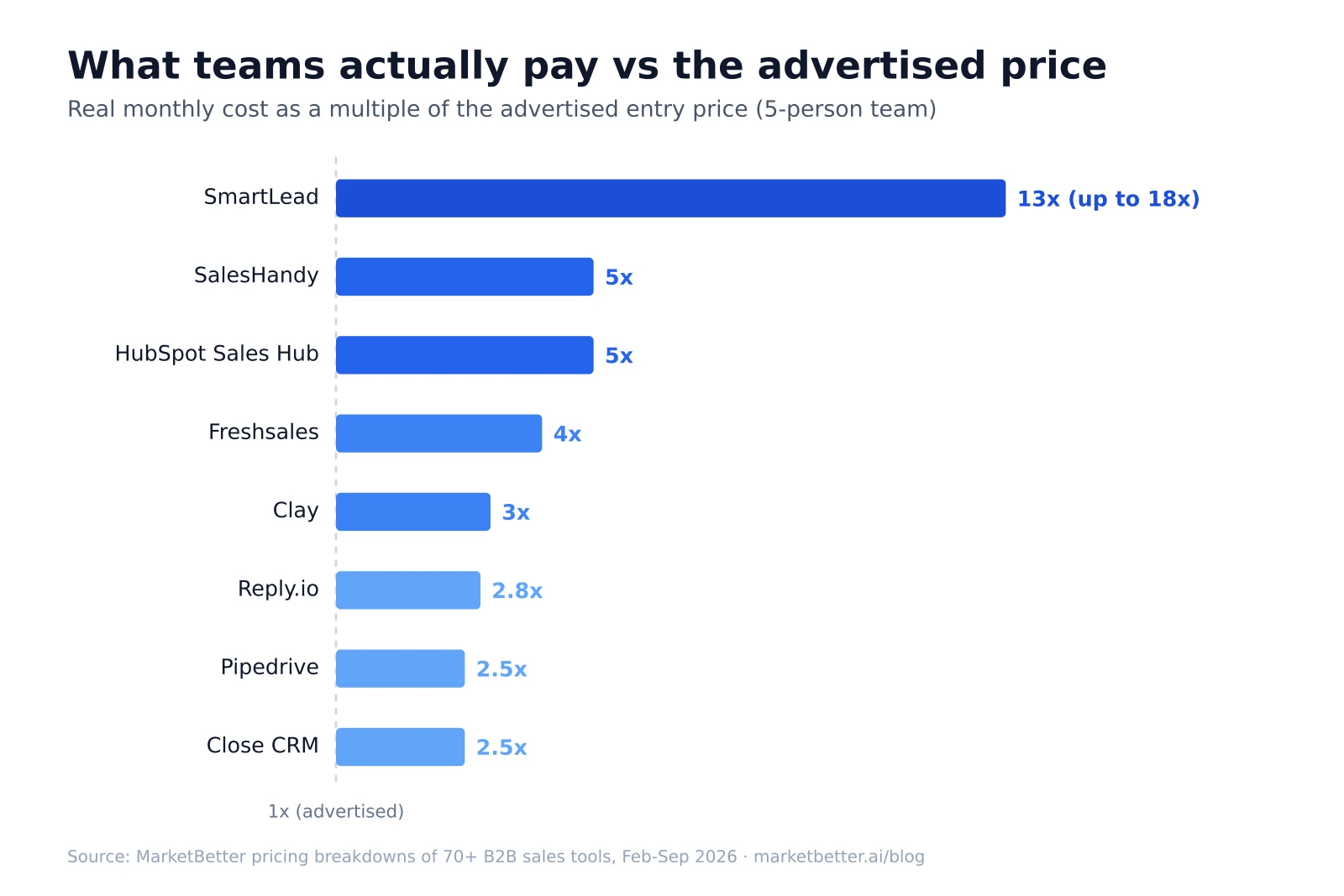
For the ~50 tools that do publish pricing, we compared the advertised entry price against what a realistic 5-person SDR team actually pays once required tiers, add-ons, and usage are included.
| Tool | Advertised | What Teams Actually Pay | Gap |
|---|---|---|---|
| SmartLead | $39/mo | $500-$700/mo with mailboxes + warmup | 13-18x |
| HubSpot Sales Hub | $20/seat/mo | $100/seat/mo Pro tier + onboarding fees | 5x |
| SalesHandy | $25/mo | $695-$995/mo for a 5-person team | 5x+ |
| Freshsales | $9/user/mo | ~4x after AI scoring and sequence add-ons | 4x |
| Clay | $149/mo | ~3x after real credit burn | 3x |
| Reply.io | $49/user/mo | $139/user/mo for the AI SDR tier | 2.8x |
| Pipedrive | $14.90/user/mo | $500+/mo team cost with visitor ID, chatbot, dialer | 2-3x |
| Close CRM | $9/user/mo | $99 plan required for Power Dialer, phone credits add 40-75% | 2-3x |
The mechanics differ — required tier upgrades, per-mailbox charges, credit metering — but the outcome is the same: the number on the pricing page is a marketing asset, not a budget input.
A useful rule of thumb from the dataset: multiply the advertised entry price by 2.5 for a realistic budget number. For cold email infrastructure tools specifically, multiply by 5 or more.
Finding 3: The Add-On Tax
The single most common inflation mechanism is unbundling core functionality into add-ons:
- Dialers and phone credits. Close locks its Power Dialer behind the $99 plan and phone credits add 40-75% on top. Mixmax stacks dialer, Salesforce sync, and AI Compose on top of its $29 headline.
- Module stacking. Clari starts at $100/user for Core — add Copilot and Groove and you're at $400+/user/month.
- Onboarding and implementation fees. HubSpot charges mandatory onboarding on Pro. Conversica adds $5K-$15K setup on top of its $2,999/month minimum. Gong implementation comes before you've recorded a single call.
- The "everything you actually need is one tier up" pattern. Yesware's campaigns need Premium. Salesforce's useful automation lives several tiers above the $25 Starter. Outreach now sells quote-based Amplify tiers plus AI credits on top of $100-$160 seats.
Finding 4: Credits Are the New Hidden Fee
Credit-based pricing showed up in over a third of the tools we researched — and it is consistently where budgets die. Clay teams routinely burn 3x their plan in credits. Lusha starts at $0 and scales fast. Albacross starts at €59 until the credit limits hit. Autobound runs $1,033-$8,250/month on credit-based billing.
Credits do two things for the vendor: they make the entry price look small, and they make month-to-month costs unpredictable enough that overage becomes the norm. If a tool prices in credits, ask for the median customer's actual monthly spend — not the plan price.
Finding 5: Quote-Only Pricing Means Negotiable Pricing
Here's the upside of hidden pricing: it's soft. Every quote-only vendor in our dataset showed significant spread between what similar customers pay.
- Qualified lists at ~$68K/year for 25 users — most teams negotiate to $40K-$50K. That's 26-41% off list.
- 6sense quotes ranged from $25K to $120K+ for comparable deployments.
- Demandbase contracts run $18K to $300K+.
- Revenue.io's median contract is $59,460/year per Vendr — with wide variance around it.
- LeadIQ's real cost data from 93 purchases shows a median of $26,400/year — far above its published per-seat rates.
If the price isn't on the website, the price isn't real. Treat the first quote as the ceiling, get a competing quote from an adjacent vendor, and negotiate at quarter-end.
Finding 6: Platform Fees Before You Add a Single Seat
A growing pattern at the top of the market: five-figure platform fees that exist before per-seat pricing starts.
- Gong: $5K-$50K/year platform fee, then $1,300-$1,920 per user per year
- Chorus.ai: $8K/year base covering 3 seats, then $1,200/seat
- Chili Piper: $15K/year for Routing & Scheduling, $42K/year for Experiences, no monthly billing
- Drift: ~$2,500/month floor with mandatory tier minimums since the Salesloft acquisition
Platform fees punish small teams hardest: a 5-rep team absorbing a $15K platform fee is paying a 100%+ per-seat premium versus a 50-rep team on the same contract.
Finding 7: The Contract Is the Trap
The most expensive surprises in our research weren't prices — they were terms:
- Annual-only billing: ZoomInfo, Amplemarket, and Orum won't sell you a month.
- Auto-renewal traps: Seamless.AI's renewal and cancellation complaints dominate its review pages; Gong contracts auto-renew unless cancelled in a narrow window.
- Quarterly minimums: AiSDR bills $900/month quarterly — a $2,700 minimum commitment to try it.
- Mandatory bundles: Drift now requires a Salesloft relationship. Clearbit only exists inside HubSpot as Breeze Intelligence, with HubSpot tier requirements that push teams past $30K/year.
Before signing anything, get three answers in writing: What's the renewal notice window? What happens to unused credits? What's the price at renewal, not just year one?
What This Means If You're Buying
Pulling the seven findings together into a buying playbook:
- Budget 2.5x the advertised price for any tool with published pricing; 5x for cold email infrastructure.
- Treat quote-only prices as opening offers. The data shows 26-41% discounts are routinely achievable.
- Ask for median actual spend, not plan price, for anything credit-metered.
- Read the renewal terms before the feature list. Auto-renewal windows and annual lock-ins cost more than any feature gap.
- Count the platform fee against your team size. Five-figure base fees make small-team economics brutal.
- Total the stack, not the tool. Most teams run 5-10 of these products simultaneously. Our full GTM stack cost analysis and AI SDR pricing meta-analysis break down what the combined bill actually looks like.
Why We Publish This
We sell against many of these vendors, so discount accordingly — but every number above is sourced in the linked breakdowns, from vendor pages, Vendr data, G2, Capterra, and real customer quotes, and we correct posts when vendors change pricing.
Our position is simple: buyers should know what things cost before the sales call. MarketBetter combines visitor identification, signal intelligence, and SDR playbooks in one platform — and instead of showing you a dashboard and a "Book a demo" wall, we'll walk you through exactly what it costs for your team size in the first conversation.
Want the number for your team? Book a demo →
Methodology: This analysis aggregates 70+ individual pricing breakdowns published on this blog between February and September 2026. Sources per tool include vendor pricing pages, Vendr contract data, G2 and Capterra reviews, Reddit buyer reports, and customer-shared quotes. Counts and multipliers reference the linked per-tool breakdowns; pricing changes after publication are corrected in the individual posts. External market data: SBI 2025 State of SaaS Pricing (Part 2), Gartner June 2025 buyer survey, Mixology Digital 2025 B2B Buyer Report.