
2 posts tagged with "demand generation playbook"

View All Tags

How to Build a B2B Demand Generation Strategy That Fills Pipeline (Step-by-Step)

· 23 min read

Let's be honest, the term "demand generation" gets thrown around a lot. But a modern B2B demand gen strategy is much more than just a fancy new name for lead gen. It's a completely different way of thinking.

We're talking about a full-funnel approach designed to create genuine interest in what you do long before a prospect even thinks about filling out a form. The goal isn't just to chase leads; it's to build a predictable revenue engine by becoming the go-to resource in your space.

Moving Beyond Leads to Create Real Demand

A group of professionals collaborating on a strategic plan for demand generation.

The old playbook is broken. Gating every piece of content and hammering MQLs is a fast track to burning out your sales team and annoying your potential customers.

Today’s B2B buyers are in the driver's seat. They do their own research, read reviews, and talk to peers. A huge chunk of their decision is made before they ever want to talk to a sales rep. A smart demand generation strategy not only accepts this reality but leans into it.

Instead of just capturing contacts, the focus shifts to creating a groundswell of interest with your Ideal Customer Profile (ICP). It’s about being so consistently helpful and insightful that when a need finally arises, your brand is the only one they think of.

Demand Generation vs. Lead Generation

Getting this distinction right is everything. It dictates your entire marketing motion.

Think of it like this: lead generation is like fishing with a giant net, hoping to catch anything that swims by. Demand generation is like creating the perfect, irresistible habitat that attracts the exact fish you want.

  • Lead Generation (The "Old Way"): This is about capturing contact info. The primary metric is the quantity of leads (MQLs), and it's often a volume game.
    • Action: Gate content, run lead forms, measure cost-per-lead.
    • Outcome: A CRM full of low-quality contacts who aren't ready to buy. Your sales team wastes cycles on dead ends.
  • Demand Generation (The "Modern Way"): This is about educating the market and building brand love. The primary metric is the quality of engagement, which ultimately drives pipeline and revenue.
    • Action: Ungate valuable content, build community, measure pipeline influence.
    • Outcome: A pipeline of educated, high-intent prospects who already understand your value.

"A powerful B2B demand generation strategy helps in building brand awareness while producing highly valuable, engaging content that drives interest and nurtures leads."

This guide is your roadmap for building a strategy that does exactly that. We'll walk through the pillars of this modern approach, from defining your ICP to measuring what actually matters.

For a deeper dive, check out this excellent Full Cycle B2B Marketing Playbook). It’s a fantastic resource for building out your entire marketing function from the ground up.

Build Your Demand Gen on a Bedrock of First-Party Data

Before you even think about launching a campaign, let's talk about the single most critical piece of your B2B demand generation strategy: knowing exactly who you're aiming at. Too many marketers take the easy route, buying third-party data lists. It's a trap. Those lists are often stale, inaccurate, and a great way to burn cash.

The real gold isn't out there—it's already in your systems. Your first-party data is the ground truth.

We're not just talking about basic firmographics like company size or industry. This is about rolling up your sleeves and digging into your CRM, your analytics, and customer feedback to find the rich, behavioral clues that define your absolute best customers.

First-Party vs. Third-Party Data: Not Even a Fair Fight

It's crucial to understand the difference here. Third-party data is basically a commodity. It’s scraped together from countless sources and sold to anyone who will buy it. It's wide but incredibly shallow, lacking any real context about your specific audience.

First-party data, on the other hand, is information you've earned directly from your audience through their actions—website visits, purchase history, webinar sign-ups, and direct conversations.

Data TypeReliability & AccuracyDepth of InsightActionability
First-Party DataHigh (collected directly)Deeply contextual and specificHighly actionable for personalization
Third-Party DataLow to moderate (often outdated)Generic and lacks nuanceLimited for precise targeting

Trusting third-party lists is like trying to find a specific person in a packed stadium with a blurry photo. Using your own data is like having their direct phone number and knowing exactly what they care about.

Actionable Step: Mine Your CRM and Analytics for Gold

Your CRM isn't just a digital Rolodex; it's a collection of stories about your most successful customer relationships. Start right there. Pull a list of your top 10-20 customers and get ready to go deep. The goal is to build a hyper-specific Ideal Customer Profile (ICP), and to do that, you have to ask the right questions.

Look for the hidden patterns:

  • Business Pains: What fire were they trying to put out when they found you? Your sales team's discovery notes and call recordings are treasure troves for this.
  • Buying Committee: Who really signed the check? And who championed the deal internally? Pinpoint the roles of the champion, the economic buyer, and the end-user. This tells you who you actually need to win over.
  • Tech Stack: What other tools are they using? This isn't just trivia—it signals their technical maturity, budget, and potential integration needs, which can qualify them as a great fit.
  • Content Consumption: Which pages did they visit on your site right before they became a customer? Your web analytics will show you which blog posts, case studies, or webinars did the heavy lifting.

Actionable Takeaway: By piecing this together, you stop chasing vague personas like "Marketing Manager at a tech company." Instead, you get a razor-sharp ICP like, "A Marketing Ops Leader at a Series B SaaS company with 50-200 employees, using HubSpot, and struggling to prove marketing ROI." That level of clarity changes everything.

Turning Raw Data Into Actionable Segments

Once you have this rich profile, you can stop shouting one message to everyone. Instead, you can build powerful segments and create tailored content that speaks directly to the specific pains of each group. Your messaging for an enterprise CFO focused on cost savings should be worlds apart from how you talk to a mid-market content manager focused on productivity.

This isn't just theory. Businesses that get serious about their first-party data strategies see a 2x increase in conversion rates and a 30% reduction in customer acquisition costs. S2W Media, for example, reported a 35% jump in engagement rates and a 50% improvement in audience segmentation just by leaning into its own data. You can read more on how first-party data is shaping B2B marketing to see the full picture.

Of course, this data is useless if it's trapped in different systems. This is where a Customer Data Platform (CDP) becomes essential. A well-implemented CDP unifies all those scattered data points—from your website, CRM, and support tools—into a single customer view. This powers everything from smarter ad targeting to more relevant sales outreach. For a practical look at making this happen, check out this guide on Customer Data Platform integration.

Ultimately, grounding your strategy in first-party data isn't just a "best practice." It's your single biggest competitive advantage. It ensures every dollar you spend is aimed squarely at prospects who look just like your best customers, making your entire demand gen engine more efficient and predictable.

Matching Your Content And Channels To Buyers

Once you have a rock-solid Ideal Customer Profile built on real, first-party data, it's time to show up where your buyers actually are. But it’s not about blasting the same generic message everywhere. A smart B2B demand generation strategy is about precision—matching the right content, to the right channel, at the right moment in their journey.

Think of your channels like different tools in a toolkit. Each one has a specific job.

  • LinkedIn is where you build community and establish yourself as an authority. It's the place for nuanced conversations, sharing deep insights, and getting in front of decision-makers at your target accounts. It’s a long game for creating demand.
  • SEO, on the other hand, is your engine for capturing active, high-intent demand. When someone searches "best accounting software for mid-market," they have a problem and they're looking for a solution right now. Ranking for those terms puts you directly in their path when it matters most.

Framing it this way helps you move from "spray and pray" to strategic investment. You use LinkedIn to create demand by educating the market, and you use SEO to capture the demand that's already out there.

Aligning Content Formats With The Buyer's Journey

The goal is to create a content ecosystem that seamlessly guides a prospect from "I think I have a problem" all the way to "this is the solution I'm buying." This means mapping specific assets to the three core phases: Awareness, Consideration, and Decision. A mismatch here can kill a deal before it even starts.

You wouldn't hit someone at the top of the funnel with a detailed pricing sheet. That’s like asking for a commitment on a first date—it’s just too much, too soon.

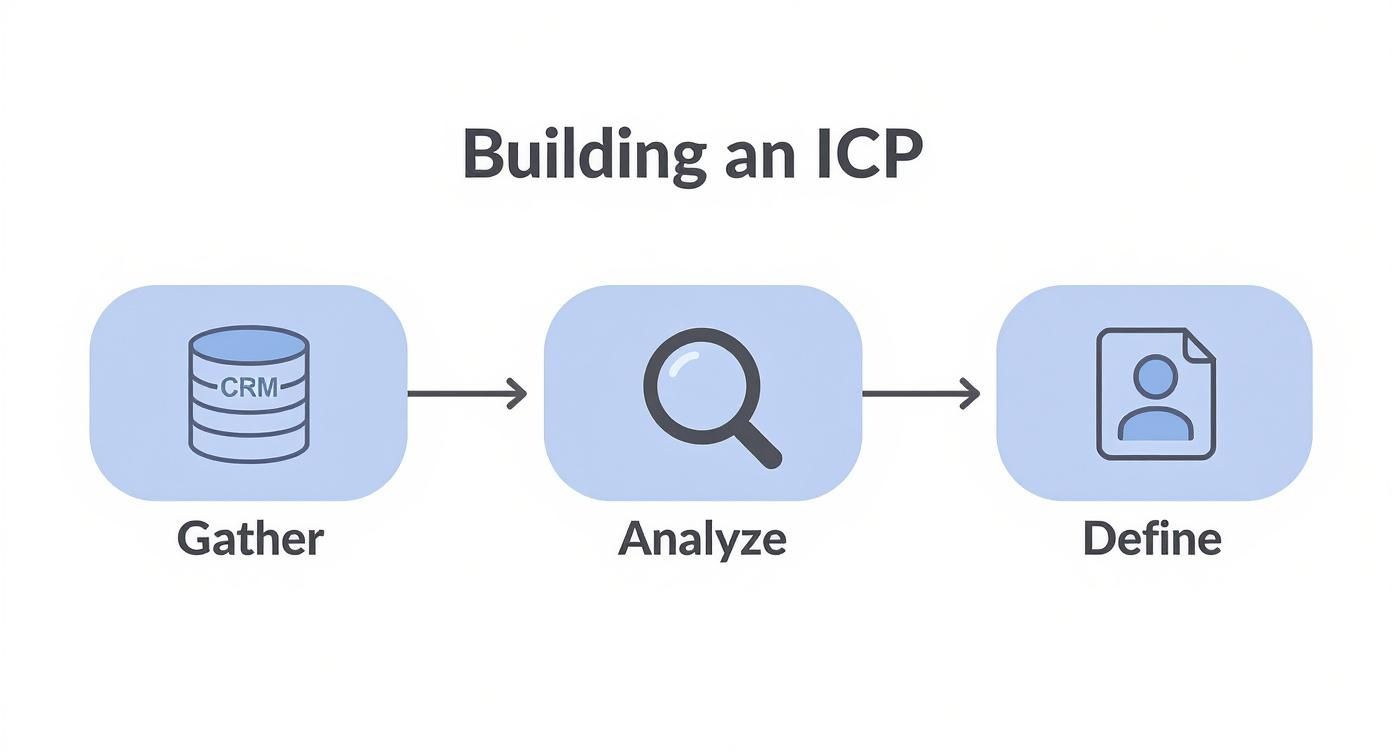
The infographic below shows how to use your internal data to lay the groundwork for this targeted content strategy.
Infographic about b2b demand generation strategy

This process of gathering data, analyzing it, and defining your ICP ensures that every piece of content you create is aimed squarely at the right audience.

To help visualize this, here’s a breakdown of how different content formats fit into the buyer's journey.

Content Format vs Buyer Journey Stage

Buyer's Journey StagePrimary GoalEffective Content FormatsKey Metrics
AwarenessEducate & inform; generate initial interestBlog posts, research reports, infographics, short videos, social media contentWebsite traffic, social shares, backlink acquisition, brand mentions
ConsiderationBuild trust & showcase expertise; provide solutionsWebinars, whitepapers, ebooks, solution briefs, checklistsLead magnet downloads, webinar registrations, email sign-ups, time on page
DecisionValidate choice & remove final barriers; drive actionCase studies, customer testimonials, product demos, comparison guides, ROI calculatorsDemo requests, free trial sign-ups, sales inquiries, conversion rates

By mapping your content this way, you create a logical path for buyers to follow, building their confidence at every step.

Content For The Awareness Stage

At the top of the funnel, you're a teacher, not a salesperson. People in this stage are just starting to put a name to their problem or see a new opportunity. Your content needs to be genuinely helpful and insightful, without a heavy sales pitch.

Here’s what works well:

  • Research Reports & Industry Surveys: This kind of content positions you as an authority. Better yet, others will cite your data, earning you valuable backlinks and organic traffic.
  • Blog Posts & Articles: These are your SEO workhorses. By answering the common questions your ICP is typing into Google, you draw them to your site naturally.
  • Infographics & Short Videos: These are perfect for social channels like LinkedIn. They make complex ideas easy to grasp and are highly shareable.

Nurturing Interest In The Consideration Stage

Okay, they understand their problem. Now they're actively looking at solutions. Your content has to shift gears from general education to showing how your solution helps solve their specific challenges.

This is where you introduce your brand as a credible option. The goal is to build trust and showcase expertise, guiding them deeper into your ecosystem without a hard sell.

This middle stage of the funnel is the perfect home for:

  • Webinars & Virtual Events: These let you do a deep dive on a specific topic and engage with prospects directly, answering their questions in real-time.
  • Whitepapers & Ebooks: Gated assets like these are a classic value exchange. You provide in-depth expertise, and they provide their contact information, turning an anonymous visitor into a known lead.
  • Solution Briefs: These are the bridge between high-level content and product-specific details. They clearly outline what your product does and the exact problems it solves.

Driving Action In The Decision Stage

We're at the bottom of the funnel. Prospects are comparing you against competitors and looking for proof that they're making the right call. Now your content needs to be laser-focused on proving your value and knocking down any final hurdles. This is where social proof and product deep dives are king.

Case studies are the heavyweight champion here. A staggering 57% of marketing leaders point to them as their most effective tool for influencing buyer decisions. The same report also found that 29% of organizations now have a fully integrated approach to brand and demand, which is exactly why this strategic alignment is so critical. You can discover more insights from the 2025 Demand Generation Benchmark Survey to see how top performers are pulling this off.

Content that gets the deal signed includes:

  1. Case Studies & Customer Testimonials: Nothing beats a real success story from a happy customer. It’s concrete proof that your solution delivers on its promises.
  2. Product Demos & Free Trials: Let them get their hands on the wheel. A direct, hands-on experience is one of the fastest ways to show value and de-risk the purchase.
  3. Comparison Guides & ROI Calculators: These tools tackle last-minute objections head-on. They show exactly how you stack up against the competition and demonstrate the tangible financial upside of choosing you.

When you thoughtfully map your content and channels to each stage, you build a journey that feels natural and persuasive, turning strangers into your biggest fans.

Activating Your Strategy With ABM and Intent Data

Having a sharp Ideal Customer Profile and a library of perfectly mapped content is a fantastic start. But a plan sitting on a shelf doesn’t generate pipeline. Now comes the critical part: activation. This is where you use data to find the right accounts and engage them with a level of precision that feels almost unfair to the competition.

This is the moment the game shifts from broad marketing to surgical execution. It’s all about spotting the faint signals of buying intent and acting on them before your competitors even know an opportunity exists.

Spotting Buyers With Intent Data

Imagine knowing which of your target accounts are actively researching solutions like yours right now. That’s the magic of intent data. It tracks the digital footprints companies leave across the web, flagging signals like spikes in research on specific topics, visits to review sites, or even engagement with a competitor’s content.

This insight changes everything. Instead of your sales team burning cycles on a cold list, they can pour their energy into accounts that are already in-market and problem-aware.

You'll encounter two main flavors of intent data:

  • First-Party Intent: This is the gold you mine from your own properties—your website, your marketing channels. Think of someone who downloaded a whitepaper, attended your webinar, or spent a suspicious amount of time on your pricing page. These are the strongest signals you’ve got.
  • Third-Party Intent: This data comes from providers who monitor activity across millions of online sources. It gives you that crucial wider view, showing you which of your target accounts are researching relevant keywords or topics across the broader internet.

When you blend both, you get a powerful, 360-degree view of an account's real interest level. Our guide on what is behavioral targeting digs deeper into how you can read these digital tea leaves to inform your outreach.

Traditional Demand Gen vs. Account-Based Marketing

With solid intent data in hand, you can pick the right activation model. The two heavy hitters in B2B are traditional demand generation and Account-Based Marketing (ABM), and they’re built for different jobs.

ApproachTarget FocusPrimary GoalBest For
Traditional Demand GenBroad (ICP)Generating a high volume of individual leads (MQLs)High-velocity sales models, lower ACV products, building broad brand awareness
Account-Based Marketing (ABM)Narrow (Named Accounts)Engaging the entire buying committee at high-value accountsComplex sales cycles, high ACV products, breaking into strategic accounts

One isn’t better than the other; they're just different tools. In fact, most of the smartest companies I've seen use a hybrid approach. They run broad demand gen programs to build awareness and catch inbound interest, while simultaneously running hyper-focused ABM plays against a shortlist of their most strategic, high-value accounts.

Actionable Step: Tier Your Accounts for a Hybrid Approach

A really practical way to pull off this hybrid model is to tier your target account list. This lets you allocate your resources—time, budget, and creative energy—where they’ll make the biggest dent.

Here's a simple way to think about it:

  • Tier 1 (The "Big Fish"): These are your top 10-20 dream accounts. They get the full, bespoke, 1:1 ABM treatment. We're talking deep research, highly personalized content, slick direct mail, and tightly coordinated outreach from both sales and marketing.
  • Tier 2 (The Lookalikes): These 50-100 accounts look a lot like your Tier 1 targets. They get a "one-to-few" ABM approach. You might create industry-specific content or run small, targeted digital ad campaigns aimed at the key personas within these companies.
  • Tier 3 (The Wider Net): This is everyone else in your addressable market who fits your ICP. These accounts are handled by your broader, "one-to-many" demand gen efforts—SEO, content marketing, and general social media campaigns.

This tiered system creates a balanced portfolio. It makes sure you're still feeding the top of the funnel with broader programs while giving your most important target accounts the white-glove treatment they deserve.

Aligning Sales and Marketing for Execution

Let's be clear: this entire activation strategy completely falls apart without tight alignment between your sales and marketing teams. They absolutely have to agree on the target account list, the definition of a qualified account, and the rules of engagement.

This is where data becomes the ultimate peacemaker. Research shows that a staggering 98% of B2B marketers believe intent data is essential for finding and engaging high-potential accounts. When both teams are looking at the same intent signals and CRM data, the conversation shifts from "we need more leads" to "how can we best engage the buying committee at Account X?"

By activating your strategy with intent data and a smart ABM framework, you stop marketing at people and start creating meaningful engagements with the right accounts at the perfect time.

Measuring Success and Proving Your ROI

A dashboard displaying key performance indicators and ROI metrics for a B2B marketing campaign.

Getting a sophisticated B2B demand generation strategy off the ground is a massive win, but it’s only half the job. If you can't prove it's actually working, you'll be fighting an uphill battle for budget, trust, and the resources to scale.

The secret is to stop talking about marketing activities and start talking about business outcomes. Your leadership team isn’t losing sleep over clicks or MQLs. They care about one thing: revenue. To prove your worth, you have to speak their language.

Moving Past Vanity Metrics

It's incredibly easy to get lost in a sea of data. Website traffic spikes and social media engagement feel good, but they don't pay the bills. The real story of your success is written much deeper in the funnel.

To show you're making a real impact, your dashboard needs to be built around three metrics that carry serious weight:

  • Marketing-Sourced Pipeline: This is the big one—the total dollar value of every sales opportunity that started with one of your marketing efforts. It's the cleanest line you can draw from your team's work to future revenue.
  • Pipeline Velocity: How quickly are deals moving from that first touchpoint to a signed contract? Speeding this up means a more efficient sales cycle and cash in the bank sooner.
  • Customer Acquisition Cost (CAC): Simply put, how much does it cost you in sales and marketing to land one new customer? If this number is going down over time, your demand engine is getting more efficient.

Focusing on these KPIs completely changes the conversation. You’re no longer saying, "We got 1,000 clicks." You're saying, "We generated $500,000 in new pipeline this quarter." That’s a conversation every executive wants to be a part of.

Choosing The Right Attribution Model

To accurately claim that marketing-sourced pipeline, you need a clear way to connect the dots between your actions and a closed deal. This is where attribution models come into play, and your choice here can completely change the story your data tells.

A first-touch attribution model gives 100% of the credit to the very first interaction. Maybe it was a blog post someone read six months ago. It's simple, but it’s also wildly misleading because it ignores everything that happened in between.

On the other hand, a multi-touch attribution model spreads the credit across several key touchpoints in the buyer's journey. This paints a far more realistic picture of what's actually driving results. For instance, it recognizes that the initial blog post, a mid-funnel webinar, and the final demo request all played a role.

For any B2B company with a sales cycle longer than a few weeks, a multi-touch model is the only way to go. It acknowledges the reality that a single piece of content rarely closes a six-figure deal. If you want to dive deeper, this is a great breakdown of the different multi-touch attribution models available.

Actionable Takeaway: Choosing the right attribution model isn't just a technical exercise. It fundamentally shapes how you value your channels and content, directly influencing your budget allocation and strategic focus.

Actionable Step: Building Your ROI Dashboard

Your goal isn't to build a dashboard with 50 different charts that no one understands. It’s to create a single source of truth that tells a clear, compelling story about performance.

Here's a look at the essential metrics to include in your dashboard.

Key Demand Generation Metrics and Their Business Impact

This table breaks down the metrics that matter most, showing you exactly what they measure and why they're critical for proving the financial return on your efforts.

MetricWhat It MeasuresWhy It Matters for ROI
Marketing-Sourced Pipeline ($)The total value of sales opportunities created by marketing campaigns.Directly ties marketing spend to potential revenue, answering the "what did we get for our money?" question.
Customer Acquisition Cost (CAC)The total cost of sales and marketing to acquire a single new customer.Measures the efficiency of your go-to-market engine; a decreasing CAC shows improving ROI.
Pipeline Velocity (Days)The average time it takes for a lead to become a closed-won deal.Indicates the speed of your revenue cycle. Faster velocity means marketing is delivering more sales-ready opportunities.
Lead-to-Opportunity Rate (%)The percentage of leads that are accepted by sales and converted into a qualified opportunity.A key indicator of lead quality. A high rate proves marketing is delivering prospects who are genuinely interested and a good fit.

Tracking and reporting on these core numbers shifts you from a position of defending your budget to one of demonstrating your value. You'll be armed with hard data that proves your B2B demand generation strategy isn't just a cost center—it's a predictable engine for business growth.

Free Tool

Try our Marketing Plan Generator — generate a complete AI-powered marketing plan in minutes. No signup required.

Common B2B Demand Generation Questions

Even the sharpest marketers run into a few tricky questions when they're deep in the demand generation trenches. Let's tackle some of the most common ones I hear and get you clear, straightforward answers.

Demand Generation vs. Lead Generation: What Is The Real Difference?

This is the big one. Get this wrong, and your whole strategy can go sideways. The simplest way I've found to explain it is creating demand versus capturing it.

  • Lead Generation is purely transactional. It’s about getting contact info to fill the top of the funnel. The key question here is, "How many MQLs did we get?" It's a numbers game, often focused on volume.

  • Demand Generation is the whole strategy. It’s about teaching your market something valuable and building a brand they trust. The goal is to create a pipeline full of educated, high-intent buyers who actually seek you out. The question becomes, "How much qualified pipeline did we create?"

Think of lead generation as a single tactic inside your broader demand generation strategy. If you only chase leads, you end up with a huge list of low-quality contacts that just exhausts your sales team. A real demand gen approach means that when a lead does come in, they already know who you are and understand the problem you solve. If you really want to nail the fundamentals, this guide on What Is Demand Generation Marketing is a great deep dive.

How Do I Get Budget and Buy-In From Leadership?

You have to stop talking like a marketer and start sounding like the CFO. Your leadership team cares about revenue, pipeline, and how efficiently you're spending money—not the marketing activities themselves.

So instead of saying, "I need $50,000 for a new content campaign," you need to reframe it.

Try this: "I'm requesting a $50,000 investment to generate an estimated $500,000 in marketing-sourced pipeline over the next two quarters."

Actionable Takeaway: The key is to connect the dots with a clear, data-backed forecast. Dig into your historical conversion rates and build a model that links every dollar you plan to spend directly to revenue goals. Show them the math.

How Long Until I See Results?

Patience isn't just a virtue here; it's a requirement. This isn't a paid search campaign where you can see results in a few days. A true B2B demand generation engine is a long-term investment.

You'll probably start seeing leading indicators—like a bump in website traffic or more people searching for your brand name—within the first 3-6 months.

But for the metrics that really matter, like marketing-sourced pipeline, you're looking at a 9-12 month timeline. This is especially true if you have a long sales cycle. The most important thing you can do is set this expectation with your leadership team right from the start.


Ready to build a predictable revenue engine? marketbetter.ai uses an integrated AI approach to scale your content creation, optimize campaign performance, and prove your marketing impact with powerful analytics. Transform your demand generation strategy by visiting https://www.marketbetter.ai today.


B2B Demand Gen: 9 Strategies That Drove $2M Pipeline (2026)

· 32 min read

In the crowded B2B landscape, simply generating 'leads' is no longer enough. The real goal is creating consistent, predictable demand from your ideal customers. This requires moving beyond simple lead capture and building a comprehensive system designed to foster awareness and interest long before a prospect is ready to buy. But which b2b demand generation strategies actually move the needle? From hyper-targeted Account-Based Marketing to scalable Content Marketing, the options are vast and often confusing.

This guide cuts through the noise. We will dissect 10 proven strategies, comparing their strengths and weaknesses and providing actionable frameworks you can implement immediately. You won't find generic advice here. Instead, you'll get practical steps for choosing the right mix of tactics for your specific business goals, measuring success accurately, and leveraging AI to amplify your results. While demand generation focuses on creating awareness and interest, it's built upon the core principles of identifying and engaging potential customers. For a deeper dive into the fundamental concepts that underpin successful demand generation, explore this article on What Is B2B Lead Generation Explained.

Our focus is on building a high-impact demand engine that doesn't just fill the funnel with unqualified names but drives sustainable revenue growth. We will cover a range of approaches, including:

  • Account-Based Marketing (ABM)
  • Content Marketing and Thought Leadership
  • Marketing Automation and Lead Nurturing
  • Paid Search (SEM) and Social Media
  • Webinars, Influencer Marketing, and Direct Outreach

Let's build an engine that truly fuels your business.

1. Account-Based Marketing (ABM)

Account-Based Marketing (ABM) flips the traditional demand generation funnel on its head. Instead of casting a wide net to capture as many leads as possible (a broad-based inbound marketing approach), ABM concentrates marketing and sales resources on a predefined set of high-value target accounts. This strategy treats each account as a market of one, enabling hyper-personalized campaigns that address their specific business challenges and objectives.

Account-Based Marketing (ABM)

The core principle of ABM is the tight alignment between sales and marketing teams. Together, they identify key accounts, map out the decision-making unit within each, and develop coordinated, bespoke messaging delivered across multiple touchpoints. This focused approach is one of the most effective b2b demand generation strategies for companies with long sales cycles and high-value contracts because it eliminates wasted resources on prospects who will never become customers, unlike broader strategies that can attract low-quality leads.

How to Implement ABM

For a comprehensive understanding and effective implementation of ABM, refer to this complete guide to B2B Account-Based Marketing. Here are actionable steps to get started:

  • Actionable Step 1: Identify & Prioritize High-Value Accounts. Collaborate with your sales team to define your Ideal Customer Profile (ICP). Use firmographic data (industry, company size, revenue) and behavioral intent data to select a pilot list of 10-50 target accounts. Your action item: Schedule a workshop with sales to build your ICP and initial account list.
  • Actionable Step 2: Research & Personalize. Go beyond surface-level data. Investigate each account's recent news, strategic goals, and key stakeholders on LinkedIn. Create persona-specific content, such as a tailored case study featuring a similar company or a personalized ad campaign addressing their specific pain points. Your action item: For your top 5 accounts, find a recent press release or executive quote to use as a personalization hook in your outreach.
  • Actionable Step 3: Coordinate Multi-Channel Outreach. Design a unified "play" for each account. For example, launch targeted LinkedIn ads to key decision-makers, followed by a personalized email from a sales rep referencing the ad, and conclude with an invitation to a custom webinar addressing their industry's unique challenges. Your action item: Map out a 3-touch sequence for one target account, defining the channel and message for each step.
  • Actionable Step 4: Measure & Optimize. Shift your focus from individual lead scores to account-level engagement. Track KPIs like the number of engaged contacts within an account, pipeline velocity, and average deal size. Your action item: Set up a dashboard to monitor account engagement metrics instead of just lead volume.

Platforms like 6sense and Demandbase leverage AI to help identify accounts demonstrating purchase intent, making this targeted approach more scalable and precise than ever before.

2. Content Marketing and Thought Leadership

Content Marketing and Thought Leadership is the strategic practice of creating and distributing valuable, relevant, and consistent content to attract and retain a clearly defined audience. Unlike outbound strategies like cold email that interrupt potential customers, this approach draws them in by addressing their pain points, answering their questions, and providing expert insights. This method builds trust and credibility long before a sales conversation ever begins.

By establishing your company and its leaders as go-to experts in your domain, you create a powerful inbound engine. This is one of the most sustainable b2b demand generation strategies because it builds a long-term asset. While paid ads stop delivering results the moment you stop paying, a high-value whitepaper or an authoritative blog post can generate qualified leads for years. Companies like Gartner have built their entire business model on this principle, using their research reports and Magic Quadrant analysis to become an indispensable resource.

How to Implement Content Marketing and Thought Leadership

To build a content engine that drives demand, focus on quality, relevance, and consistency. For a deep dive into creating a successful program, consider the resources from the Content Marketing Institute. Here are actionable steps to get started:

  • Actionable Step 1: Align Content with the Buyer's Journey. Create a content map. A top-of-funnel blog post might address a broad industry challenge (Awareness), a mid-funnel webinar could compare different solutions (Consideration), and a bottom-of-funnel case study can showcase your specific results (Decision). Your action item: List three content ideas, one for each stage of the buyer's journey.
  • Actionable Step 2: Develop a Content Calendar. Plan your content 3-6 months in advance using a shared calendar tool like Asana or Trello. This ensures a consistent publishing schedule and allows you to align content themes with product launches or industry events. A calendar prevents reactive, low-quality content creation. Your action item: Block out your content topics for the next month, assigning deadlines and owners.
  • Actionable Step 3: Use Data and Original Research. Differentiate your content by creating something unique. Conduct a survey of your customers or analyze internal data to produce a proprietary "State of the Industry" report. This type of original research is highly shareable and establishes true thought leadership. Your action item: Identify one piece of internal data that could be turned into a unique industry insight.
  • Actionable Step 4: Repurpose and Distribute. Maximize the value of each content piece with a "create once, distribute forever" mindset. Turn a webinar into a blog post series, create an infographic from a whitepaper's key stats, and share short video clips from an interview on social media. Your action item: Take your last major piece of content and list 3 ways you can repurpose it for different channels.
  • Actionable Step 5: Optimize for Conversion. Every piece of content must have a clear next step. Optimize blog posts with relevant keywords to attract organic traffic and include clear calls-to-action (CTAs) that guide readers to download an ebook, register for a webinar, or schedule a demo. Your action item: Review your top 5 blog posts and ensure each has a relevant and compelling CTA.

3. Marketing Automation and Lead Nurturing

Marketing automation is the engine that powers modern B2B demand generation strategies, allowing you to scale personalized communication without sacrificing quality. It involves using software to automate repetitive marketing tasks, such as email marketing, social media posting, and ad campaigns. This technology, combined with strategic lead nurturing, guides prospects through the sales funnel with targeted messages triggered by their specific behaviors and engagement levels.

The core principle is to deliver the right message to the right person at the right time, automatically. A key comparison is manual vs. automated follow-up: instead of a salesperson manually sending one-off emails, you can build sophisticated workflows that educate and build trust with leads over time. This approach ensures that your sales team engages with prospects only when they are warm, informed, and genuinely ready for a conversation, dramatically improving conversion rates and sales cycle efficiency.

How to Implement Marketing Automation & Lead Nurturing

Platforms like HubSpot, Marketo, and ActiveCampaign are foundational tools for this strategy. For a deeper dive into qualifying leads within these systems, you can explore this playbook on AI lead scoring. Here are actionable steps to get started:

  • Actionable Step 1: Segment Your Audience. Don't send the same message to everyone. Group your contacts based on persona, industry, or specific behaviors (e.g., downloaded an ebook vs. visited the pricing page). This allows for highly relevant messaging. Your action item: Create two audience segments in your marketing platform right now: "Engaged Contacts (Last 90 Days)" and "Unengaged Contacts."
  • Actionable Step 2: Develop Nurture Workflows. Create automated email sequences for key segments. A common workflow is a "Welcome Series" for new subscribers or a "Topic-Specific Nurture" for leads who engaged with content about a particular pain point. Your action item: Outline a simple 3-email welcome series for new newsletter subscribers.
  • Actionable Step 3: Implement Lead Scoring. Assign points to leads based on their attributes (e.g., job title, company size) and actions (e.g., opening an email, requesting a demo). This system helps you prioritize the most sales-ready leads for your team to follow up with. Your action item: Define 5 simple lead scoring rules (e.g., +10 points for visiting the pricing page).
  • Actionable Step 4: Balance Automation with Personalization. Use personalization tokens (like [First Name] and [Company Name]) and dynamic content to make automated communications feel one-to-one. The goal is efficiency, not robotic interaction. Your action item: Review your current automated emails and add at least one new personalization token.
  • Actionable Step 5: Monitor & Optimize. Regularly analyze your workflow performance. Track metrics like email open rates, click-through rates, and conversion rates to identify which messages resonate and which need adjustment. Your action item: Schedule a monthly review of your automation analytics and A/B test one subject line in your highest-volume campaign.

Search Engine Marketing (SEM) is a cornerstone of modern B2B demand generation strategies, focusing on capturing high-intent prospects precisely when they are actively searching for solutions. Unlike content marketing (SEO) which builds organic visibility over time, SEM provides immediate visibility by placing your business in front of motivated buyers on search engines like Google and Bing. This is achieved through paid search campaigns where companies bid on keywords relevant to their products or services.

![Search Engine Marketing (SEM) and Paid Search](https of the most effective b2b demand generation strategies for generating qualified, bottom-of-the-funnel leads. For example, a company like Salesforce bids on keywords such as 'CRM software' to connect directly with businesses ready to invest in a customer relationship management solution.

How to Implement SEM

A successful SEM strategy hinges on precision, relevance, and continuous optimization. While organic SEO builds long-term authority, paid search offers speed and control, allowing you to test messaging and target specific segments with unmatched accuracy. For a deeper dive into platform specifics, this beginner's guide to Google Ads is an excellent starting point.

Here are actionable steps to get started:

  • Actionable Step 1: Target High-Intent Keywords. Focus on commercial and transactional keywords that signal a user is close to making a purchase decision. Think "ServiceTitan pricing" or "best marketing automation platform" rather than broad, top-of-funnel terms like "what is marketing." Your action item: Brainstorm 10 "bottom-of-funnel" keywords that include terms like "software," "platform," "pricing," or "alternative."
  • Actionable Step 2: Structure Your Campaigns Logically. Create highly specific ad groups for different product features or solutions. This allows you to write ultra-relevant ad copy and direct users to dedicated landing pages, which significantly improves conversion rates. Your action item: Sketch out a campaign structure with one campaign and at least three distinct ad groups based on your product's core features.
  • Actionable Step 3: Optimize for Quality Score. Google's Quality Score is a crucial metric that impacts your ad rank and cost-per-click. Improve it by ensuring tight alignment between your keywords, ad copy, and landing page experience. Higher relevance leads to lower costs and better ad positions. Your action item: Review one ad group and ensure the primary keyword appears in the ad headline and on the landing page.
  • Actionable Step 4: Leverage Negative Keywords. Actively build a list of negative keywords to prevent your ads from showing for irrelevant searches (e.g., "free," "jobs," "training"). This simple step is vital for eliminating wasted ad spend. Your action item: Add at least 15 negative keywords to your campaign to filter out unqualified searchers.
  • Actionable Step 5: Measure & Refine. Constantly track key metrics like Click-Through Rate (CTR), Conversion Rate, and Cost Per Lead (CPL). Use A/B testing on ad copy and landing pages to identify what resonates most with your audience. Your action item: Set up conversion tracking for a key action, like a demo request form submission, before you spend a single dollar.

5. Social Media Marketing and LinkedIn Strategy

Social Media Marketing in a B2B context is about more than just broadcasting updates; it's a strategic platform for building brand authority and engaging directly with industry decision-makers. While platforms like Twitter and Facebook have their place, LinkedIn stands out as the cornerstone for most B2B demand generation strategies due to its professional focus and sophisticated targeting capabilities.

This strategy involves sharing valuable content, such as industry insights and educational resources, to attract and engage a relevant professional audience. The key comparison here is B2C vs. B2B social media: while B2C often focuses on viral trends and broad appeal, B2B social media is a long-game focused on establishing credibility and trust. Companies like Slack excel at this by sharing engaging content about their company culture, while executives at Microsoft leverage their personal profiles to share high-level industry insights, positioning the company as a thought leader.

How to Implement a Social Media and LinkedIn Strategy

For B2B marketers looking to automate and scale their outreach, understanding the nuances of platforms like LinkedIn is crucial. For an in-depth look at leveraging automation effectively, explore this guide to LinkedIn prospecting automation. Here are actionable steps to get started:

  • Actionable Step 1: Establish a Consistent Content Cadence. Aim to post 3-5 times per week on LinkedIn to maintain visibility. Mix your content types to keep your feed interesting, including text-based insights, educational videos, company stories, and relevant industry news. Your action item: Create a simple weekly schedule: Monday (Insight), Wednesday (Video), Friday (Company News).
  • Actionable Step 2: Focus on Value, Not Sales (80/20 Rule). Your primary goal should be to educate and inform. Follow the 80/20 rule: 80% of your content should be valuable and non-promotional, while only 20% should directly promote your product or service. This builds trust and positions your brand as a helpful resource, not just a vendor. Your action item: For your next 5 posts, ensure at least 4 are purely educational or insightful.
  • Actionable Step 3: Leverage Employee Advocacy. Your employees are your most powerful brand ambassadors. Create a dedicated Slack channel where you share company posts and encourage team members to engage with and reshare the content to amplify its reach exponentially. Your action item: Ask three colleagues to share your latest company post on their LinkedIn profiles.
  • Actionable Step 4: Engage Authentically. Don’t just post and ghost. Dedicate 15 minutes each day to actively participate in industry-specific groups, respond promptly to comments on your posts, and engage in relevant discussions. This humanizes your brand and builds genuine connections. Your action item: Find two relevant LinkedIn groups in your industry and leave a thoughtful comment on a post.
  • Actionable Step 5: Utilize LinkedIn Ads. Supplement your organic efforts with targeted LinkedIn advertising. Use its powerful demographic and firmographic filters to run awareness campaigns, promote gated content (like an ebook) for lead generation, or drive traffic to a high-value webinar. Your action item: Create a saved audience in LinkedIn Ads Manager that precisely matches your Ideal Customer Profile.

6. Webinars and Virtual Events

Webinars and virtual events are powerhouse b2b demand generation strategies for educating an audience at scale. By hosting live or on-demand sessions, companies can showcase deep subject matter expertise, demonstrate complex products in a controlled environment, and engage directly with hundreds of potential customers simultaneously. This format builds trust and credibility by providing tangible value upfront.

Webinars and Virtual Events

Unlike static content like blog posts, virtual events offer a dynamic, interactive experience that captures high-intent leads. Attendees willingly provide contact information in exchange for access to expert insights, making webinars a highly efficient mechanism for lead capture. A key comparison is lead quality: a webinar registrant who dedicates an hour of their time is often a much more qualified lead than someone who briefly scans a blog post. Industry leaders like HubSpot and Gartner have built massive audiences by consistently delivering high-quality virtual summits and educational webinars.

How to Implement Webinars and Virtual Events

A successful webinar requires more than just a presentation; it demands strategic planning, promotion, and follow-up. While a single event can generate leads, the key is building a consistent program that nurtures prospects over time.

  • Actionable Step 1: Plan and Promote Strategically. Select a topic that solves a specific pain point for your Ideal Customer Profile (ICP). Begin promotion 3-4 weeks in advance using a multi-channel approach that includes email marketing, social media announcements, and paid ads. Your action item: Partner with a complementary business or industry influencer to co-host your next webinar to double your promotional reach.
  • Actionable Step 2: Design for Engagement. Keep the core presentation to 45 minutes to respect attendees' time, leaving 15 minutes for Q&A. Use a mix of high-quality slides, live polls, and Q&A sessions to maintain audience attention. The goal is a two-way conversation, not a one-way lecture. Your action item: Prepare 3 poll questions to launch during your presentation to re-engage the audience.
  • Actionable Step 3: Execute a Powerful Follow-Up. The work isn't over when the webinar ends. Send the recording to all registrants and segment your follow-up based on attendee engagement (e.g., attended live vs. watched replay). For a detailed approach, explore this complete guide to post-event follow-up sequences to convert attendees into qualified opportunities. Your action item: Create two separate follow-up email templates: one for attendees and one for no-shows.
  • Actionable Step 4: Repurpose and Amplify. Maximize your investment by repurposing the event content. Edit the recording into short video clips for social media, convert key insights into a blog post, and use attendee questions to fuel future content ideas. Your action item: Pull out the 5 most interesting audience questions from your Q&A and turn them into a "Top 5 Questions Answered" blog post.

7. Influencer and Partner Marketing

Influencer and Partner Marketing expands your demand generation efforts by leveraging the credibility and reach of third-party voices. Instead of solely relying on your own brand to build trust, you collaborate with industry influencers, analysts, complementary tech vendors, and channel partners who already have an established audience and authority within your target market.

This approach is one of the most scalable b2b demand generation strategies because it creates a network effect. A key comparison is earned vs. owned media: while your blog is owned media, a favorable mention from a respected partner is earned media, acting as powerful social proof that significantly shortens the buyer's consideration phase. Companies like Salesforce and HubSpot have built massive ecosystems around their partner programs, turning their app marketplaces and partner networks into formidable demand generation engines.

How to Implement Influencer and Partner Marketing

To build a program that generates consistent demand, focus on creating mutually beneficial relationships. Here are actionable steps to get started:

  • Actionable Step 1: Identify Strategic Partners. Look for partners with complementary, non-competing solutions and a similar Ideal Customer Profile (ICP). Technology partners and value-added resellers are excellent starting points. Your action item: Make a list of 10 companies that integrate with your product or sell to the same audience.
  • Actionable Step 2: Establish a Co-Marketing "First Date". Before committing to a full partnership, propose a simple, low-effort joint marketing activity. Co-hosting a webinar, writing a joint blog post, or swapping newsletter features are great ways to test the relationship. Your action item: Reach out to one potential partner with a specific proposal for a co-hosted webinar.
  • Actionable Step 3: Build Relationships with Key Analysts. Identify analysts at firms like Gartner or Forrester who cover your industry. Engage them with regular briefings and product updates, well before you need anything from them. Your action item: Follow 3 key industry analysts on LinkedIn and engage with their content.
  • Actionable Step 4: Enable and Empower Your Partners. Don't just sign a partnership agreement and walk away. Provide your partners with a "partner pack" that includes dedicated marketing materials, sales training, and technical support. A well-enabled partner is far more likely to actively promote your solution. Your action item: Create a one-page document that clearly explains your value proposition for a potential partner's customers.
  • Actionable Step 5: Track and Measure Partner ROI. Implement a system to track leads and revenue generated from each partner. Use unique tracking links, dedicated landing pages, or a Partner Relationship Management (PRM) platform to measure the effectiveness of your program. Your action item: Create a unique UTM link for a specific partner to use in their next promotional effort.

8. Paid Advertising (Display, Programmatic, Retargeting)

Paid advertising, particularly through display and programmatic channels, extends your reach far beyond search engine results pages. This strategy places visual ads across a vast network of websites and apps, allowing you to engage with prospects while they are consuming relevant content. This approach moves beyond keyword-based intent to capture attention based on audience characteristics, firmographics, and online behavior.

Unlike paid search which captures existing demand, programmatic and display advertising excel at creating it. Programmatic buying uses automated technology and AI to purchase ad space in real-time, targeting specific user segments with precision. This makes it a highly efficient B2B demand generation strategy for building brand awareness, retargeting website visitors, and supporting Account-Based Marketing (ABM) campaigns by keeping your solution top-of-mind across multiple digital touchpoints.

How to Implement Paid Advertising

Effectively leveraging paid advertising requires a data-driven approach to targeting, creative, and optimization. Here are actionable steps to get started:

  • Actionable Step 1: Define Your Audience & Channels. Use platforms like the Google Display Network for broad reach or more specialized B2B platforms like LinkedIn for precise professional targeting. Layer firmographic data (company size, industry) with behavioral and intent data to create highly specific audience segments. Your action item: Build a target audience on LinkedIn using job titles and industries that match your ICP.
  • Actionable Step 2: Implement Strategic Retargeting. Install tracking pixels (e.g., the LinkedIn Insight Tag or Google Ads tag) on your website to build retargeting audiences. Serve tailored ads to users who have visited specific pages (like your pricing page) but did not convert. Your action item: Create a retargeting audience of all visitors to your "Request a Demo" page who did not complete the form.
  • Actionable Step 3: Align Creative with Funnel Stage. Don't show a "Book a Demo" ad to someone who has never heard of you. Use top-of-funnel ads (brand videos, educational content) for cold audiences and bottom-of-funnel ads (case studies, demo offers) for retargeting lists. Your action item: Design two separate ads: one offering a free guide and another offering a free trial.
  • Actionable Step 4: Test and Optimize Creatives. Develop multiple variations of your banner ads and video ads with different messaging, calls-to-action (CTAs), and imagery. Continuously test to identify which combinations resonate best. Your action item: Launch an A/B test with two different headlines for your highest-traffic ad campaign.
  • Actionable Step 5: Measure Performance & ROI. Implement conversion tracking to attribute leads and pipeline to specific campaigns. Monitor key metrics like viewability, click-through rate (CTR), and cost-per-acquisition (CPA). Your action item: Set up a dashboard to track post-click conversions, not just clicks, for your display campaigns.

Platforms like Demandbase and 6sense integrate predictive intelligence, allowing you to target accounts that are actively researching solutions like yours. This predictive advertising approach transforms display from a purely brand-building tool into a powerful, high-intent demand generation engine.

9. Direct Sales Outreach and Cold Email Campaigns

Direct sales outreach, particularly through cold email, remains a potent and proactive B2B demand generation strategy when executed with precision and personalization. This method involves strategically contacting potential customers who have not previously expressed interest in your product or service. The key comparison is Inbound vs. Outbound: while inbound marketing waits for prospects to come to you, outbound outreach goes directly to them. Modern outreach is a far cry from generic spam; it's a data-driven science focused on creating genuine, one-to-one conversations with a highly targeted audience.

The success of this approach hinges on deep research and hyper-personalization. Sales development teams identify key decision-makers, understand their specific business challenges, and craft compelling messages that offer clear value. Rather than leading with a sales pitch, effective outreach focuses on the prospect's pain points, positioning the sender as a helpful problem-solver. When done correctly, this strategy cuts through the noise and directly generates qualified sales opportunities.

How to Implement Direct Sales Outreach

Building a successful outreach program requires a blend of technology, process, and copywriting skill. Here are actionable steps to get started:

  • Actionable Step 1: Build Hyper-Targeted Prospect Lists. Quality over quantity is paramount. Use tools like Apollo.io or ZoomInfo to build lists based on your Ideal Customer Profile (ICP) and specific "trigger events," like a company hiring a new executive or receiving a round of funding. Your action item: Build a small, high-quality list of 25 prospects who perfectly match your ICP.
  • Actionable Step 2: Craft Personalized, Value-Driven Messages. Avoid feature-dumping. Your email should be short (3-5 sentences) and focused entirely on the prospect. Personalize the opening line by referencing a recent company announcement, a LinkedIn post, or a shared connection. Your action item: Write a cold email template that includes a personalized {IntroLine} placeholder to force customization.
  • Actionable Step 3: Develop a Multi-Touch Sequence. A single email is rarely enough. Create a 5-7 step sequence that mixes channels. A typical flow might be: Email 1 > LinkedIn Connection Request > Email 2 > LinkedIn Message > Call. Use platforms like Outreach or Salesloft to automate the cadence. Your action item: Map out a 4-step sequence on a whiteboard, defining the timing and channel for each touchpoint.
  • Actionable Step 4: Track, Analyze, and Iterate. Meticulously track your open rates, click-through rates, and reply rates. A positive reply rate (over 2-3%) is a key indicator of success. Your action item: Set up A/B testing on your email subject lines in your outreach tool to see what drives higher open rates.

10. Customer Referral and Case Study Marketing

Customer Referral and Case Study Marketing transforms your happiest customers into a powerful engine for demand generation. Instead of relying solely on your own marketing messages, this strategy leverages the authentic voices of satisfied clients to build trust and credibility. It centers on showcasing real-world success and using social proof to validate your solution's value proposition for prospective buyers.

This approach is one of the most cost-effective b2b demand generation strategies because it taps into your most valuable asset: your existing customer base. Comparing referral leads to other sources, they almost always have a higher conversion rate and lower acquisition cost. A strong case study from a peer company often carries more weight with a B2B decision-maker than any polished ad campaign, generating high-quality leads that enter the sales cycle with a higher level of trust.

How to Implement Customer Marketing

Effectively turning customer success into a lead-generation machine requires a systematic approach. Companies like Salesforce have built empires on showcasing customer stories, proving the model's scalability. Here are actionable steps to get started:

  • Actionable Step 1: Systematize Your Request Process. Don't wait for advocacy to happen organically. Build triggers into your customer journey to ask for reviews, testimonials, or case study participation after key success milestones, like a positive Quarterly Business Review (QBR) or achieving a target ROI. Your action item: Create an automated email that goes out 90 days after a customer signs up, asking for a review if their usage metrics are high.
  • Actionable Step 2: Build a Tangible Referral Program. Create a program with clear, appealing incentives for both the referrer and the referred (e.g., "Give $100, Get $100"). This could range from service credits and gift cards to exclusive access to new features. Your action item: Provide referrers with a simple toolkit, including a pre-written email and a unique referral link, to make sharing easy.
  • Actionable Step 3: Quantify Success in Case Studies. Go beyond vague praise. The most effective case studies feature hard metrics. Focus on quantifiable results like "reduced operational costs by 35%" or "increased pipeline by 200%," providing concrete proof of your impact. Your action item: During your next customer interview for a case study, ask specifically: "Can you put a number to that improvement?"
  • Actionable Step 4: Diversify Your Proof Points. Not all prospects are moved by a PDF. Convert your customer stories into multiple formats: create short video testimonials for social media, feature customers in webinars to share their journey, and build an easily searchable case study library on your website. Your action item: Take your best written case study and create a one-page slide summarizing the key results for your sales team to use.

By strategically amplifying your customers' voices, you create a self-sustaining cycle of trust and validation that consistently fuels your pipeline with warm, high-intent leads.

B2B Demand Gen: 10-Strategy Comparison

StrategyImplementation Complexity 🔄Resource & Tech Requirements ⚡Expected Outcomes ⭐📊Ideal Use Cases 💡Key Advantages ⭐
Account-Based Marketing (ABM)High — cross-team orchestration, long setup 🔄Very high — account data, ABM platforms, dedicated teams ⚡High-value wins, higher ROI, shorter close times ⭐📊Enterprise/multi-stakeholder deals, named accounts 💡Hyper-personalization, stronger sales-marketing alignment ⭐
Content Marketing & Thought LeadershipMedium — ongoing editorial process 🔄Medium — skilled creators, SEO/tools, time ⚡Improved authority, organic traffic, long-term leads ⭐📊Top-of-funnel education, brand positioning, inbound growth 💡Evergreen content, lower CPL over time ⭐
Marketing Automation & Lead NurturingHigh — complex workflows, continuous tuning 🔄High — automation platform, CRM integration, data ops ⚡Higher conversion rates, scalable personalization ⭐📊Lead qualification, multi-stage nurture programs 💡Personalization at scale, improved sales efficiency ⭐
SEM & Paid SearchMedium — campaign setup and constant optimization 🔄Medium — ad spend, analytics, landing pages ⚡Immediate visibility, measurable high-intent leads ⭐📊Capture-demand moments, product/service search queries 💡Fast testing, predictable ROI with optimization ⭐
Social Media & LinkedIn StrategyMedium — content cadence and community management 🔄Low–Medium — content, employee advocates, paid boosts ⚡Brand awareness, executive reach, engagement with decision-makers ⭐📊Thought leadership, recruiting, relationship building on LinkedIn 💡Direct access to pros, organic amplification via employees ⭐
Webinars & Virtual EventsMedium–High — production, promotion, scheduling 🔄Medium — event platform, presenters, marketing support ⚡High-quality leads, deep engagement, repeatable content ⭐📊Product demos, education, mid-funnel conversion events 💡Direct interaction, rich lead capture, strong ROI ⭐
Influencer & Partner MarketingMedium — partnership negotiation and coordination 🔄Low–Medium — partner enablement, co-marketing resources ⚡Expanded reach, credibility boost, channel leads ⭐📊Market expansion, co-selling, analyst influence 💡Leverages trust of partners, cost-efficient reach ⭐
Paid Advertising (Display / Programmatic / Retargeting)Medium — targeting, creative testing, placement control 🔄Medium — DSPs, creative production, ad budget ⚡Broad reach, brand recall, retargeted conversions ⭐📊Awareness, remarketing, lookalike audience scaling 💡Scaleable targeting, automated bidding and optimization ⭐
Direct Sales Outreach & Cold EmailMedium — sequence design, personalization effort 🔄Low–Medium — SDRs, prospect data, outreach tools ⚡Predictable pipeline, meetings set, short-term opportunities ⭐📊Targeted prospecting, account entry, early-stage pipeline 💡Direct control of message, quick iterations and feedback ⭐
Customer Referral & Case Study MarketingLow–Medium — program setup and case collection 🔄Low — customer success time, incentives, content production ⚡Highest-quality leads, strong conversion and retention ⭐📊Expand through satisfied customers, trust-driven purchases 💡Best conversion rates, authentic social proof, cost-efficient ⭐
Free Tool

Try our Marketing Plan Generator — generate a complete AI-powered marketing plan in minutes. No signup required.

Unifying Your Strategy: From Tactics to a Revenue-Generating Machine

We’ve explored a comprehensive arsenal of ten powerful B2B demand generation strategies, from the hyper-focused precision of Account-Based Marketing to the broad-reaching influence of Content Marketing and the immediate impact of Paid Search. Each tactic holds immense potential on its own, but viewing them as isolated checklist items is the most common mistake that stalls growth. The true acceleration happens when these individual components are woven into a cohesive, interconnected engine.

The most successful demand generation programs are not just a collection of activities; they are a symphony of orchestrated efforts. Think of it this way: your insightful thought leadership content isn't just a blog post. It's the fuel for your LinkedIn strategy, the core topic for a deep-dive webinar, and the foundational asset for your lead nurturing email sequences. The data from your SEM campaigns, which reveals high-intent keywords, should directly inform your next content cluster. Attendees from your virtual events become the perfect audience for targeted retargeting ads, keeping your brand top-of-mind long after the session ends. This synergy transforms disparate actions into a powerful, self-reinforcing loop that guides prospects seamlessly through their buying journey.

From Silos to Synergy: Actionable Next Steps

To move from tactical execution to strategic orchestration, you must prioritize integration and measurement. A scattered approach where your paid media team, content team, and sales outreach team operate independently will inevitably lead to wasted budget, inconsistent messaging, and missed opportunities. The goal is to build a system where insights from one channel actively improve the performance of another.

Here are your actionable next steps to unify your B2B demand generation strategies:

  • Conduct a Channel Audit: Start by evaluating your current efforts. Which of the ten strategies discussed are you currently using? Map out how they currently interact, or more importantly, where they fail to connect. For instance, is the list from your last webinar being used for a targeted cold email campaign, or is it just sitting in a spreadsheet?
  • Select Your Core Pillars: Don't try to boil the ocean. Choose two or three strategies from this list that best align with your Ideal Customer Profile (ICP), available resources, and business goals. A startup with a limited budget might focus on building a strong foundation with Content Marketing and Direct Sales Outreach, whereas a larger enterprise might prioritize a sophisticated ABM and Marketing Automation stack.
  • Establish a Centralized "Source of Truth": Whether it's a CRM, a marketing automation platform, or a dedicated analytics dashboard, you need one place to view the entire customer journey. This holistic view is critical for attributing revenue correctly and understanding how a lead first discovered you via a paid ad, then engaged with content, and was finally qualified through a webinar.

The Intelligent Future of Demand Generation

This is where technology, particularly AI, becomes a transformative force rather than just an operational tool. Manually connecting these dots, analyzing cross-channel data, and constantly optimizing campaigns is a monumental task. AI-powered platforms are designed to bridge these gaps and elevate your team’s focus from mundane execution to high-level strategy.

Imagine leveraging predictive analytics to identify which accounts in your ABM list are showing the strongest buying signals right now, based on thousands of data points. Picture automatically generating A/B test variations for your paid search ad copy and landing pages, allowing you to find the winning combination exponentially faster. This level of intelligence and automation is no longer a futuristic concept; it’s the new competitive standard for high-performing b2b demand generation strategies. By embracing an integrated, data-driven, and intelligent approach, you transform your marketing from a cost center into the primary engine of predictable, scalable revenue growth.


Ready to stop juggling disconnected tactics and start building a truly intelligent demand generation engine? marketbetter.ai uses advanced AI to help you unify your strategy, from generating high-performance content ideas to predicting which leads will convert. Discover how to orchestrate your marketing efforts and drive measurable results by visiting marketbetter.ai today.