
2 posts tagged with "demand gen tactics 2026"

View All Tags

9 Demand Generation Strategies That Build Pipeline — Not Just MQLs [2026]

· 27 min read

Demand generation is all about creating genuine interest and awareness for what you do. It's not just a fancy term for collecting email addresses. It’s about building a brand and an audience that actively seeks you out, turning casual browsers into loyal fans who are actually excited to hear from you.

Done right, this approach moves you away from unpredictable, one-off campaigns and toward building a reliable engine for long-term revenue growth. To make that happen, you need an actionable plan.

What Is Demand Generation and Why It Matters Now

Let's use an analogy. Imagine your business is a new band trying to make it.

You could stand on a street corner, shoving flyers into the hands of everyone who walks by. That's a lot like traditional lead generation—a pure numbers game focused on grabbing as many contacts as possible, hoping a few are a good fit. This approach is reactive and volume-based.

Demand generation is different. It’s like booking a gig, dialing in your sound, and playing music so good that a crowd starts to form on its own. People are drawn in. They start talking about you. They want to know when your next show is and where they can buy your album. You're creating a buzz, a genuine demand, not just interrupting people. This strategy is proactive and quality-based.

This isn’t just a marketing tactic; it's a complete shift in mindset. Today's B2B buyers are smarter and more skeptical than ever. They’ve done their research. They don't want a cold call or a hard sell. They want answers to their problems. A solid demand generation program focuses on educating and helping your ideal customers, building trust long before a sales rep ever enters the picture.

The Big Difference: Demand Generation vs. Lead Generation

It’s easy to get these two mixed up, but they play very different roles in getting a customer from "who are you?" to "take my money."

  • Demand Generation (The "Why"): This is the long game. It’s about building brand awareness and positioning your company as the go-to expert in your space. It answers the question, "Why should I even care about this company or their solution?" The goal is to make the market aware of a problem and excited about your way of solving it.

    • Actionable Step: Start a podcast series interviewing industry leaders about the biggest challenges in your field. Don't mention your product; just provide value.
  • Lead Generation (The "Who"): This is much more direct and short-term. It's about capturing the contact information of people who have shown interest. It answers the question, "Who is interested right now?" The goal is to convert that existing interest into a qualified name and email for your sales team to follow up with.

    • Actionable Step: Offer a downloadable checklist, like "10 Things to Look for in a New SaaS Vendor," behind a simple email form on your highest-trafficked blog post.

Think of it this way: demand generation creates the fertile ground where high-quality leads can actually grow. To see how that second piece works in practice, you can dig into some effective B2B lead generation strategies.

The Evolution Toward a Smarter Funnel

Demand generation has come a long way from just stuffing the top of the funnel with as many names as possible. Over the last decade, it’s matured from a simple volume play into a sophisticated, data-driven strategy that spans the entire customer journey. It's now laser-focused on lead quality and tight alignment with sales.

The massive shift to digital, especially after 2020, cemented this change. Personalized digital experiences became the standard, forcing marketing efforts to be more precise and genuinely helpful than ever before.

The Core Pillars of a Modern Demand Strategy

To build a machine that consistently drums up interest, you need a blueprint. The best demand generation strategies aren't a single action item on a checklist; they're a structured system built on three core pillars: Attract, Engage, and Delight. This isn't just marketing jargon—it’s a framework for moving customers from "Who are you?" to "Where do I sign up?"

Each pillar has a specific job, and each one builds on the last. Think of the Attract stage as your opening act, Engage as the main performance, and Delight as the unforgettable encore that has the crowd chanting your name.

This visual shows you exactly how the pieces fit together—creating awareness, sparking real interest, and ultimately building a sales pipeline you can count on.
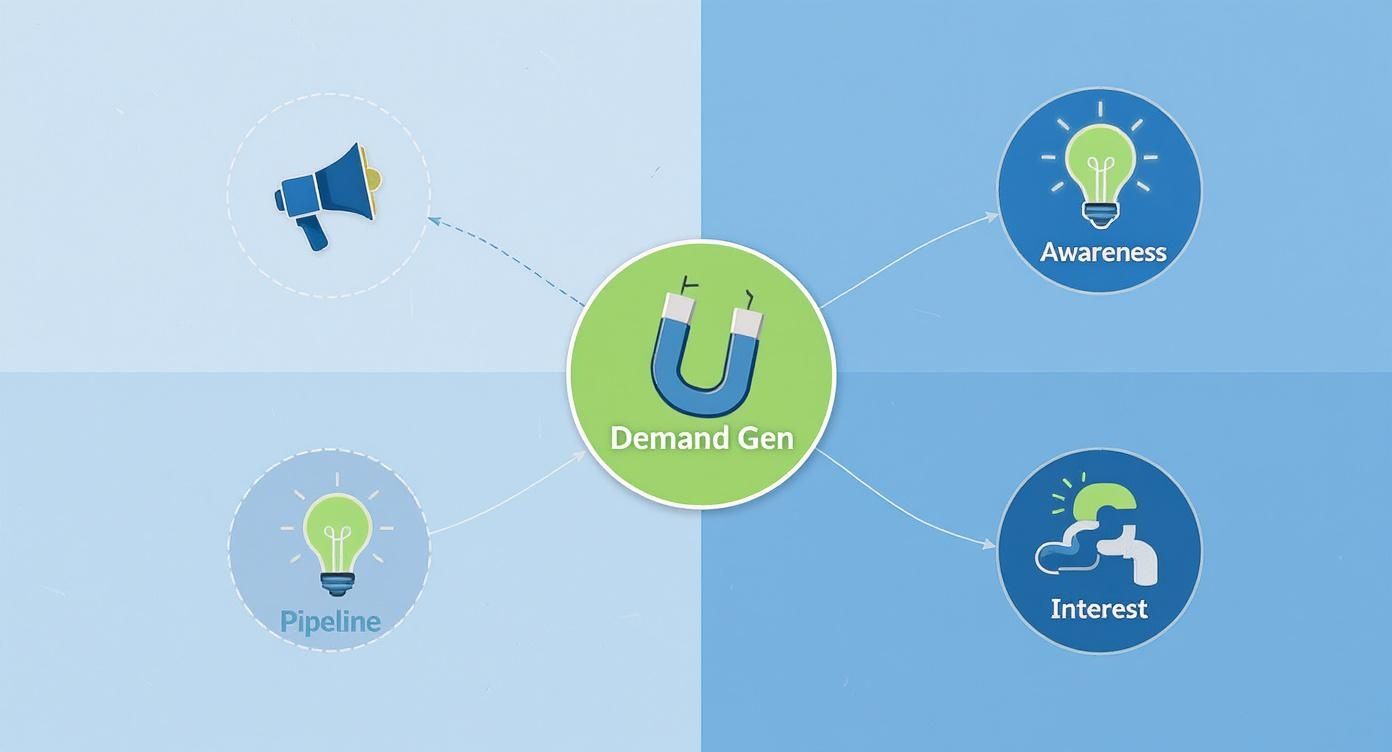
Infographic about demand generation strategies

As you can see, a central demand generation engine is what fuels awareness. That awareness then cultivates genuine interest, which in turn feeds a healthy, predictable sales pipeline. It’s a flywheel, not a funnel.

Attract Your Ideal Customers

The first pillar, Attract, is all about capturing attention at the very top of the funnel. This is where you connect with people who might not even realize they have a problem yet, let alone know that you sell the solution. The goal isn't a sales pitch; it's to be genuinely helpful.

Forget about the old-school outbound tactics that interrupt people’s day. This is about drawing them in naturally by solving their problems with valuable, ungated content that proves you know your stuff. Every B2B company that consistently shows up on page one of Google for helpful searches is nailing this pillar.

Key tactics to put to work here include:

  • SEO-Optimized Blog Content: Write articles that directly answer the questions your ideal customers are typing into search engines. This makes you a trusted expert from the very first click.
  • Social Media Advocacy: Get your team involved. When your own experts share company content and their insights on platforms like LinkedIn, it comes across as authentic and builds trust way faster than a branded post.
  • Podcast Appearances or Hosting: Share your knowledge on industry podcasts. It’s a fantastic way to reach new, highly relevant audiences who are already dialed into topics in your niche.

Engage and Nurture Interest

Once you have their attention, the Engage pillar takes over. This is where you turn that flicker of curiosity into a real relationship. You do this by offering even more valuable resources that help prospects dig deeper into their challenges and explore potential solutions.

This stage is all about building trust and showing off your expertise in a more direct way. It's the difference between someone stumbling upon a single blog post versus them subscribing to your newsletter because they can't afford to miss what you say next.

The trick to demand generation is to have no expectation of anything back from your prospects. Only the knowledge that you’re creating a good feeling between them and your brand.

To really nail the engage phase, you have to provide undeniable value. This often means offering more in-depth content or interactive experiences, usually in exchange for a little bit of information, like an email address.

This quick table breaks down the crucial differences between the broad approach of demand gen and the more targeted action of lead gen. Understanding this distinction is key to building a balanced strategy.

Demand Generation vs Lead Generation: A Strategic Comparison

AspectDemand Generation (Building an Audience)Lead Generation (Capturing Contacts)
Primary GoalCreate awareness and educate the market about problems and solutions.Identify and capture contact information from interested prospects.
Audience FocusBroad; targets an entire ideal customer profile (ICP).Narrow; targets individuals who have shown specific buying signals.
Core TacticsSEO, blogging, social media, podcasts, brand advertising.Gated content (eBooks, webinars), contact forms, free trials, demos.
MeasurementWebsite traffic, brand search volume, social engagement, share of voice.Leads, MQLs, SQLs, cost per lead (CPL), conversion rates.
Funnel StageTop of the Funnel (TOFU).Middle of the Funnel (MOFU) and Bottom of the Funnel (BOFU).
TimelineLong-term relationship building; a continuous process.Short-term results-focused; often campaign-based.

In short, demand generation makes people want your solution, while lead generation gives them a way to get it. You can't have one without the other.

Delight and Convert with Proof

The final pillar is Delight. This is where you transform that nurtured interest into real, qualified opportunities for your sales team. By now, your prospects know they have a problem and are aware of the solutions out there. Your job is to convince them that your solution is the best one.

This is all about proof. You stop talking about theoretical problems and start showing how you've solved them for real companies just like them.

Great delight tactics make the decision to talk to sales feel like the obvious next step, not a risky leap. This is where you bring out the heavy hitters: compelling case studies, tailored product demos, and customer testimonials that provide the social proof needed to turn a warm prospect into a new customer.

Building Your Content Engine for Demand

Content is the fuel for every great demand generation strategy. It’s the real, tangible value you give your audience long before they even think about buying. A solid content engine isn't about just churning out random articles; it’s about systematically creating assets that attract, educate, and pull your ideal customer through their entire decision-making process.

Think of it like building a library. A single book is nice, but a well-stocked library with sections covering every possible interest? That becomes an indispensable resource for the entire community. Your content needs to do the same thing—become the go-to resource in your industry, the one future customers learn to depend on.

This requires a real plan, not just a sporadic publishing schedule. You have to map your content to where people are in their journey, from the moment they first realize they have a problem to the point where they’re actively comparing vendors like you.

People collaborating on content creation around a large desk with sticky notes and laptops

Matching Content to the Buyer's Journey

The sharpest content engines align every single asset with a clear purpose. You wouldn’t hand a dense, technical whitepaper to someone who isn’t even sure they have an issue yet. That’s just a waste of everyone’s time. Matching the content format to the funnel stage is how you build real momentum.

Here’s a simple way to break it down:

  • Top of Funnel (Awareness): Your goal here is to attract a broad audience and teach them about the problems you solve—not your product. The content should be easy to find and even easier to share. Think blog posts that nail common questions, snappy short-form videos for social, or infographics that make complex ideas simple.
  • Middle of Funnel (Consideration): Okay, now your audience knows they have a problem and they're starting to look for answers. This is your chance to offer deeper, more practical value. Host webinars, publish detailed guides or eBooks, and create interactive tools like checklists that help them sort through their options.
  • Bottom of Funnel (Decision): By now, they're solution-aware and are sizing you up against the competition. Your content needs to build trust and prove you're the right choice. This is prime time for compelling case studies, customer testimonials, product demos, and no-fluff comparison guides.

Choosing the Right Content Format

Picking between a blog post, a video, or a podcast isn't just a matter of taste. It's a strategic decision based on your audience and what you're trying to achieve. Each format has its own strengths, and making the right call can be the difference between content that lands and content that flops.

A classic debate is video versus written content. They're both incredibly powerful, but they shine in different scenarios.

Comparing Video vs. Blog Posts

FactorVideo ContentBlog Posts (Written Content)
EngagementDelivers a higher emotional punch and grabs attention fast. Perfect for product demos and storytelling.Lets readers skim for highlights or dive deep. Better for technical details, data, and complex info.
SEO ValueA powerhouse for YouTube and Google video results. Descriptions and transcripts can be packed with keywords.The foundation of traditional SEO. It's much easier for search engines to crawl and index for a huge range of keywords.
ComplexityBest for showing how something works and building a personal connection with the presenter.Ideal for explaining complex ideas with charts, data, and step-by-step instructions readers can follow at their own pace.
Action StepUse video to walk someone through your product's UI or to feature powerful customer stories.Use blog posts to create the definitive guide on a topic or to break down industry trends with hard data.

When you get these differences, you can build a much more dynamic and effective content plan. To get even deeper into structuring this, check out our complete guide on building a powerful content marketing strategy.

Scaling Your Content Creation Workflow

Creating great content consistently is tough. The solution? A scalable workflow. It’s what turns the chaos of reactive content creation into a predictable, efficient system that just works.

Here are the four steps to get it done:

  1. Ideation and Research: Start a central backlog for every content idea that pops up. Use tools to dig into keywords and see what your competitors are doing to spot the gaps you can fill.
  2. Prioritization: Score your ideas based on their potential impact, relevance to your audience, and how well they line up with your business goals. A simple scoring system keeps you focused on the topics that will actually move the needle.
  3. Creation and Review: Assign topics to your creators with crystal-clear briefs. Outline the target audience, keywords, and the main takeaways. Set up a straightforward review process to keep quality high and your brand voice consistent.
  4. Distribution and Promotion: Your job isn't over when you hit "publish." That's when the real work starts. Have a distribution checklist for every piece—share it on social, send it to your email list, and think about how you can slice it up into other formats.

The data is clear: content is the absolute cornerstone of modern demand generation. A 2024 survey found that 83% of marketers see content marketing as their single most effective demand gen tactic.

This isn't a niche opinion. 73% of businesses around the world say content is a critical piece of their overall strategy. The most popular formats? Blogs and videos, used by about 95% of marketers, with case studies right behind at 90%. You can dig into more trends and stats on the future of demand generation.

At the end of the day, building a content engine is an investment. You're creating a long-term asset. Every article, video, and guide you create acts like a digital salesperson, working for you 24/7 to attract and educate the customers you haven't even met yet.

Amplifying Your Reach with Multi-Channel Distribution

Creating incredible content is only one side of the coin. The other, arguably more important side, is making sure the right people actually see it. This is where so many strategies fall flat. A "publish and pray" approach just doesn't cut it anymore. Real growth comes from a smart, multi-channel distribution plan that squeezes every last drop of value out of the assets you work so hard to create.

Think of your content as a powerful message you've crafted. You wouldn't just write it down and leave it on your desk, right? Of course not. You need to broadcast it across every channel where your ideal customers are already hanging out. It’s time to stop waiting for them to find you and start actively pushing your content into their world.

SEO vs. Paid Social: A Tale of Two Channels

Two of the heaviest hitters in your distribution arsenal are organic search (SEO) and paid social media. They’re both incredibly powerful, but they play completely different games. Figuring out their unique roles is the key to spending your time and money wisely.

SEO is the long game. It’s all about capturing intent. When someone types a query into Google, they are actively hunting for an answer or a solution to a problem they have right now. By ranking for those keywords, you put your brand directly in their path at the exact moment of need. It's a slow burn, but it builds lasting authority and a steady stream of highly qualified traffic.

  • Actionable Step: Use a keyword research tool to find a long-tail question your customers ask, like "how to integrate CRM with marketing automation," and write the most comprehensive blog post on the internet about it.

Paid social, on the other hand, is built for precision. Platforms like LinkedIn let you bypass the waiting game and put your content directly in front of people based on their job title, industry, or company size. These are folks who perfectly fit your ideal customer profile but probably aren't searching for you... yet. It's the perfect tool for creating awareness and getting in front of niche audiences, fast.

  • Actionable Step: Take your best-performing blog post and run a LinkedIn ad campaign targeting job titles that match your ideal customer, driving traffic to that ungated content.

The secret isn't picking one over the other. The best demand gen programs use SEO to capture existing demand and paid social to create new demand—at the same time.

Expanding Your Distribution Playbook

While SEO and paid ads are your cornerstones, a truly dominant strategy uses a mix of channels to create a surround-sound effect for your brand. This is how you connect with your audience across multiple touchpoints, making your brand feel familiar and credible.

Here’s how a few other channels fit into the puzzle:

  • Email Marketing: This is your home turf. You own this channel, and it’s the best place to nurture the relationships you've already started. Use it to send out your latest blog posts, promote upcoming webinars, or deliver hyper-relevant resources to specific audience segments.
  • Community Engagement: Stop just broadcasting on social media and start participating. Dive into relevant LinkedIn Groups, Slack communities, and niche forums where your audience is already asking questions. Share your content when it’s genuinely helpful, not just as a cheap plug.
  • Strategic Partnerships: Team up with non-competing companies that serve the same audience. Co-hosting a webinar or co-authoring a guide lets you tap into their hard-won audience, giving you an instant reach and a powerful dose of third-party credibility.

A truly integrated strategy weaves these channels together into a seamless customer journey. For a closer look at how the pros pull this off, you can check out these detailed omnichannel marketing examples to see how leading brands connect all the dots.

Key Demand Generation Channels and Their Primary Role

Making smart decisions about where to invest your energy starts with understanding what each channel is best at. This table gives you a quick breakdown of where each channel delivers the most punch in your demand generation funnel.

ChannelPrimary Funnel StageKey ObjectiveActionable Tip
SEO & BloggingTop of Funnel (TOFU)Attract users actively searching for solutions and build organic authority.Create a "pillar page" on a core topic and surround it with related blog posts.
Paid Social MediaTop/Middle of FunnelTarget specific personas with educational content to generate awareness and interest.Retarget website visitors with an invitation to a relevant, high-value webinar.
Email MarketingMiddle/Bottom of FunnelNurture existing contacts with valuable content and guide them toward a decision.Set up a 5-day email course that solves a specific problem for your subscribers.
Community & ForumsTop/Middle of FunnelEstablish expertise and build trust by answering questions in relevant online spaces.Spend 15 minutes a day answering one question in a key LinkedIn Group or subreddit.
Partnerships & Co-MarketingTop of Funnel (TOFU)Access a new, relevant audience and borrow credibility from a trusted partner.Identify one partner and pitch a joint webinar on a topic you both care about.

At the end of the day, a multi-channel approach isn't about being everywhere all at once. It's about being in the right places with the right message, creating a consistent and valuable presence that makes you the only logical choice when your audience is finally ready to buy.

Measuring Demand Generation That Drives Revenue

Creating great content and pushing it out across a dozen channels is a strong start, but it's only half the story. If you can't connect your demand generation strategy to the bottom line, you're just flying blind. It's time to stop chasing vanity metrics like social media likes and start focusing on the KPIs that prove your marketing is actually making the cash register ring.

This isn't just about justifying your budget to the CFO. It's about making smarter, data-backed decisions. By tracking the right key digital marketing performance metrics, you can see exactly what's working, kill what isn't, and fine-tune your entire engine for predictable growth.
A person analyzing charts and graphs on multiple computer screens, representing data-driven marketing decisions.

From Leads to Revenue: The Metrics That Matter

To really get a grip on performance, you have to follow the money. That means tracking a prospect's entire journey, from their very first interaction with your brand all the way to the final sale. The sharpest demand gen teams are obsessed with a handful of core metrics that draw a straight line from marketing activity to sales outcomes.

Here are the essentials you should have on your dashboard:

  • Marketing Qualified Leads (MQLs): This isn't just any lead. It's a prospect who has taken a specific action—like downloading an eBook or joining a webinar—that signals they're more likely to become a customer. They've raised their hand.
  • Sales Qualified Leads (SQLs): An SQL is an MQL that the sales team has looked at and agreed is a legitimate opportunity worth pursuing. That handoff is a make-or-break moment, and the MQL-to-SQL conversion rate tells you how well marketing is setting sales up for the win.
  • Pipeline Velocity: Think of this as the speedometer for your sales process. It measures how quickly leads are zipping through your pipeline and becoming revenue. A faster velocity means a shorter sales cycle and a more efficient money-making machine.
  • Customer Acquisition Cost (CAC): This is the bottom-line number: the total cost of your sales and marketing efforts divided by the number of new customers you brought in. A healthy demand gen strategy should constantly be pushing your CAC down.

A rookie mistake is treating every lead the same. The real win isn't just generating more leads; it's generating leads that convert faster and cost less to acquire. That's how you drive profitability.

Multi-Touch Attribution: The Key to True Insight

For years, marketers lived in a "last-click" world. If a prospect requested a demo after clicking a Google Ad, the ad got 100% of the credit for the sale. Simple, right? But it's also dangerously wrong. This model completely ignores all the other crucial steps, like the blog post that first caught their eye or the webinar that built their trust.

This is where multi-touch attribution changes the game. It’s a way of looking at the entire customer journey and giving credit to the multiple touchpoints that influenced the final decision. It gives you a much clearer, more honest picture of what’s actually working.

Comparing Attribution Models: Last-Click vs. Multi-Touch

FactorLast-Click AttributionMulti-Touch Attribution
FocusGives 100% credit to the final touchpoint before conversion.Distributes credit across multiple touchpoints in the buyer's journey.
Insight LevelSimple to track but highly misleading. Overvalues bottom-funnel tactics.Complex to set up but provides a true, holistic view of what works.
Impact on StrategyLeads to over-investment in direct-response channels like search ads.Allows you to justify and optimize top-of-funnel investments like content and social.
Actionable StepUse for basic, directional insights if you're just starting out.Your Goal: Implement a U-shaped or W-shaped model to properly value both the first and last touches, as well as key mid-journey interactions.

Imagine a buyer who reads three of your blog posts, follows you on LinkedIn for a month, and then finally clicks a retargeting ad to book a demo. Last-click gives all the glory to the ad. A multi-touch model recognizes that the blog and social media work were absolutely essential in getting them to that point.

This kind of insight is a superpower for budget allocation. You might discover that your top-of-funnel content, while not a direct conversion driver, is the secret ingredient filling your pipeline with qualified buyers. To go deeper, you can explore various multi-touch attribution models and find the one that fits your business. Once you understand the whole journey, you can double down on the strategies that deliver real value, every step of the way.

How to Align Sales and Marketing for a Seamless Funnel

Let's be honest. Even the slickest demand generation strategy will completely fall apart if your sales and marketing teams are speaking different languages. When they're not in sync, it's not just a small hiccup—it's a critical failure that bleeds qualified leads, stalls deals, and kills momentum.

The only real fix is to stop thinking of them as two separate departments. You need one unified revenue team, plain and simple.

This whole process kicks off with getting on the same page about what a "good lead" actually is. If marketing's definition is different from sales', you're already set up to fail. This is where a Service Level Agreement (SLA) becomes your best friend.

Forging a Service Level Agreement

Think of an SLA as a peace treaty. It’s a formal contract between sales and marketing that lays out exactly who is responsible for what. This isn't about pointing fingers; it's about creating crystal-clear expectations.

A solid SLA should nail down the specific criteria for a Marketing Qualified Lead (MQL) and what, exactly, sales has to do once that lead is handed over.

A strong SLA must include:

  • A Bulletproof MQL Definition: Get granular. What are the exact demographic, firmographic, and behavioral signals that say a lead is truly ready for a sales conversation?
  • The Handoff Protocol: Map out the literal process of moving a lead from your marketing automation tool into the sales CRM. No gray areas.
  • The Follow-up Cadence: Agree on how fast and how many times sales will attempt to contact each MQL.

This simple document gets rid of the classic back-and-forth—"marketing's leads are junk" versus "sales never follows up." It swaps out assumptions for firm, mutual commitments.

Creating a Unified System

Once you're speaking the same language, it's time to build transparency with the right tech and processes. A shared CRM isn't a nice-to-have; it's non-negotiable. It becomes the single source of truth, giving both teams a complete, real-time picture of every prospect’s journey.

Marketing finally sees which campaigns are creating leads that actually close. And sales gets the full backstory on a lead's every interaction.

This shared view is what makes consistent feedback possible. Sales needs a dead-simple way to give feedback on lead quality right inside the CRM. That data flows back to marketing, who can then sharpen their targeting and messaging. Your demand engine gets smarter with every cycle.

Without this, you're just throwing leads into a black hole. Misalignment is incredibly wasteful; stats show that 44% of sales reps feel they're too swamped to follow up on leads, and old-school tactics are DOA when 97% of people flat-out ignore cold calls. Tightly integrated demand generation strategies are the only way forward. You can dig deeper into these challenges over at Exploding Topics.

Free Tool

Try our Marketing Plan Generator — generate a complete AI-powered marketing plan in minutes. No signup required.

Got Questions About Demand Generation? You're Not Alone.

Even with the best plan laid out, you're going to hit a few forks in the road when you start running a real demand generation playbook. It happens.

Here are straight answers to the two questions that come up most often, designed to give you clarity and keep you moving forward.

How Long Does This Stuff Actually Take to Work?

It's the million-dollar question, and I'll give you the honest answer: it's not an overnight fix. If you're looking for instant form fills, you're thinking about lead gen. Demand gen is a different game entirely—it’s about building an asset, not just running a transaction.

I like to think of it like this:

  • Lead Generation is picking a flower. You get an immediate, tangible result. You run an ad, you get a lead. Simple.
  • Demand Generation is planting a tree. It takes time to grow roots. You have to consistently show up, publish great content, build real authority, and earn the trust of your audience.

You'll see the first green shoots—like more website traffic and better social engagement—within 3-6 months. But the real harvest, the impact on metrics like sales pipeline and customer acquisition cost, usually takes 9-12 months of sticking with it. The reward for your patience? A predictable, sustainable engine that brings you high-quality opportunities month after month.

Should I Gate My Content or Let It All Run Free?

Ah, the great gate debate. The truth is, it's not a simple "either/or" choice. The smart move is "both, but strategically." It all boils down to your goal for a specific piece of content and where your buyer is on their journey.

Let's break it down.

Gated vs. Ungated: The Simple Breakdown

ApproachUngated ContentGated Content
Your Main GoalGetting your name out there, building brand awareness, and being genuinely helpful.Pinpointing interested buyers and getting their contact info.
When to Use ItPerfect for top-of-funnel stuff that educates and attracts: blog posts, infographics, short-form videos.Best for high-value, deep-dive assets that signal buying intent: eBooks, webinars, detailed case studies.
The Bottom LineLeave it ungated when you want to reach the widest possible audience and position your brand as the go-to expert.Gate it when you're offering something so valuable that someone is willing to trade their email for it. This tells you they're serious.

The most effective demand generation strategies don't pick a side; they use both. Ungated content builds your audience. Gated content helps you identify the people in that audience who are ready to talk business.


Ready to stop guessing and start growing? The marketbetter.ai platform uses AI to help you create better content faster, optimize your campaigns for revenue, and personalize every customer interaction. See how you can build a smarter demand engine at https://www.marketbetter.ai.


B2B Demand Gen: 9 Strategies That Drove $2M Pipeline (2026)

· 32 min read

In the crowded B2B landscape, simply generating 'leads' is no longer enough. The real goal is creating consistent, predictable demand from your ideal customers. This requires moving beyond simple lead capture and building a comprehensive system designed to foster awareness and interest long before a prospect is ready to buy. But which b2b demand generation strategies actually move the needle? From hyper-targeted Account-Based Marketing to scalable Content Marketing, the options are vast and often confusing.

This guide cuts through the noise. We will dissect 10 proven strategies, comparing their strengths and weaknesses and providing actionable frameworks you can implement immediately. You won't find generic advice here. Instead, you'll get practical steps for choosing the right mix of tactics for your specific business goals, measuring success accurately, and leveraging AI to amplify your results. While demand generation focuses on creating awareness and interest, it's built upon the core principles of identifying and engaging potential customers. For a deeper dive into the fundamental concepts that underpin successful demand generation, explore this article on What Is B2B Lead Generation Explained.

Our focus is on building a high-impact demand engine that doesn't just fill the funnel with unqualified names but drives sustainable revenue growth. We will cover a range of approaches, including:

  • Account-Based Marketing (ABM)
  • Content Marketing and Thought Leadership
  • Marketing Automation and Lead Nurturing
  • Paid Search (SEM) and Social Media
  • Webinars, Influencer Marketing, and Direct Outreach

Let's build an engine that truly fuels your business.

1. Account-Based Marketing (ABM)

Account-Based Marketing (ABM) flips the traditional demand generation funnel on its head. Instead of casting a wide net to capture as many leads as possible (a broad-based inbound marketing approach), ABM concentrates marketing and sales resources on a predefined set of high-value target accounts. This strategy treats each account as a market of one, enabling hyper-personalized campaigns that address their specific business challenges and objectives.

Account-Based Marketing (ABM)

The core principle of ABM is the tight alignment between sales and marketing teams. Together, they identify key accounts, map out the decision-making unit within each, and develop coordinated, bespoke messaging delivered across multiple touchpoints. This focused approach is one of the most effective b2b demand generation strategies for companies with long sales cycles and high-value contracts because it eliminates wasted resources on prospects who will never become customers, unlike broader strategies that can attract low-quality leads.

How to Implement ABM

For a comprehensive understanding and effective implementation of ABM, refer to this complete guide to B2B Account-Based Marketing. Here are actionable steps to get started:

  • Actionable Step 1: Identify & Prioritize High-Value Accounts. Collaborate with your sales team to define your Ideal Customer Profile (ICP). Use firmographic data (industry, company size, revenue) and behavioral intent data to select a pilot list of 10-50 target accounts. Your action item: Schedule a workshop with sales to build your ICP and initial account list.
  • Actionable Step 2: Research & Personalize. Go beyond surface-level data. Investigate each account's recent news, strategic goals, and key stakeholders on LinkedIn. Create persona-specific content, such as a tailored case study featuring a similar company or a personalized ad campaign addressing their specific pain points. Your action item: For your top 5 accounts, find a recent press release or executive quote to use as a personalization hook in your outreach.
  • Actionable Step 3: Coordinate Multi-Channel Outreach. Design a unified "play" for each account. For example, launch targeted LinkedIn ads to key decision-makers, followed by a personalized email from a sales rep referencing the ad, and conclude with an invitation to a custom webinar addressing their industry's unique challenges. Your action item: Map out a 3-touch sequence for one target account, defining the channel and message for each step.
  • Actionable Step 4: Measure & Optimize. Shift your focus from individual lead scores to account-level engagement. Track KPIs like the number of engaged contacts within an account, pipeline velocity, and average deal size. Your action item: Set up a dashboard to monitor account engagement metrics instead of just lead volume.

Platforms like 6sense and Demandbase leverage AI to help identify accounts demonstrating purchase intent, making this targeted approach more scalable and precise than ever before.

2. Content Marketing and Thought Leadership

Content Marketing and Thought Leadership is the strategic practice of creating and distributing valuable, relevant, and consistent content to attract and retain a clearly defined audience. Unlike outbound strategies like cold email that interrupt potential customers, this approach draws them in by addressing their pain points, answering their questions, and providing expert insights. This method builds trust and credibility long before a sales conversation ever begins.

By establishing your company and its leaders as go-to experts in your domain, you create a powerful inbound engine. This is one of the most sustainable b2b demand generation strategies because it builds a long-term asset. While paid ads stop delivering results the moment you stop paying, a high-value whitepaper or an authoritative blog post can generate qualified leads for years. Companies like Gartner have built their entire business model on this principle, using their research reports and Magic Quadrant analysis to become an indispensable resource.

How to Implement Content Marketing and Thought Leadership

To build a content engine that drives demand, focus on quality, relevance, and consistency. For a deep dive into creating a successful program, consider the resources from the Content Marketing Institute. Here are actionable steps to get started:

  • Actionable Step 1: Align Content with the Buyer's Journey. Create a content map. A top-of-funnel blog post might address a broad industry challenge (Awareness), a mid-funnel webinar could compare different solutions (Consideration), and a bottom-of-funnel case study can showcase your specific results (Decision). Your action item: List three content ideas, one for each stage of the buyer's journey.
  • Actionable Step 2: Develop a Content Calendar. Plan your content 3-6 months in advance using a shared calendar tool like Asana or Trello. This ensures a consistent publishing schedule and allows you to align content themes with product launches or industry events. A calendar prevents reactive, low-quality content creation. Your action item: Block out your content topics for the next month, assigning deadlines and owners.
  • Actionable Step 3: Use Data and Original Research. Differentiate your content by creating something unique. Conduct a survey of your customers or analyze internal data to produce a proprietary "State of the Industry" report. This type of original research is highly shareable and establishes true thought leadership. Your action item: Identify one piece of internal data that could be turned into a unique industry insight.
  • Actionable Step 4: Repurpose and Distribute. Maximize the value of each content piece with a "create once, distribute forever" mindset. Turn a webinar into a blog post series, create an infographic from a whitepaper's key stats, and share short video clips from an interview on social media. Your action item: Take your last major piece of content and list 3 ways you can repurpose it for different channels.
  • Actionable Step 5: Optimize for Conversion. Every piece of content must have a clear next step. Optimize blog posts with relevant keywords to attract organic traffic and include clear calls-to-action (CTAs) that guide readers to download an ebook, register for a webinar, or schedule a demo. Your action item: Review your top 5 blog posts and ensure each has a relevant and compelling CTA.

3. Marketing Automation and Lead Nurturing

Marketing automation is the engine that powers modern B2B demand generation strategies, allowing you to scale personalized communication without sacrificing quality. It involves using software to automate repetitive marketing tasks, such as email marketing, social media posting, and ad campaigns. This technology, combined with strategic lead nurturing, guides prospects through the sales funnel with targeted messages triggered by their specific behaviors and engagement levels.

The core principle is to deliver the right message to the right person at the right time, automatically. A key comparison is manual vs. automated follow-up: instead of a salesperson manually sending one-off emails, you can build sophisticated workflows that educate and build trust with leads over time. This approach ensures that your sales team engages with prospects only when they are warm, informed, and genuinely ready for a conversation, dramatically improving conversion rates and sales cycle efficiency.

How to Implement Marketing Automation & Lead Nurturing

Platforms like HubSpot, Marketo, and ActiveCampaign are foundational tools for this strategy. For a deeper dive into qualifying leads within these systems, you can explore this playbook on AI lead scoring. Here are actionable steps to get started:

  • Actionable Step 1: Segment Your Audience. Don't send the same message to everyone. Group your contacts based on persona, industry, or specific behaviors (e.g., downloaded an ebook vs. visited the pricing page). This allows for highly relevant messaging. Your action item: Create two audience segments in your marketing platform right now: "Engaged Contacts (Last 90 Days)" and "Unengaged Contacts."
  • Actionable Step 2: Develop Nurture Workflows. Create automated email sequences for key segments. A common workflow is a "Welcome Series" for new subscribers or a "Topic-Specific Nurture" for leads who engaged with content about a particular pain point. Your action item: Outline a simple 3-email welcome series for new newsletter subscribers.
  • Actionable Step 3: Implement Lead Scoring. Assign points to leads based on their attributes (e.g., job title, company size) and actions (e.g., opening an email, requesting a demo). This system helps you prioritize the most sales-ready leads for your team to follow up with. Your action item: Define 5 simple lead scoring rules (e.g., +10 points for visiting the pricing page).
  • Actionable Step 4: Balance Automation with Personalization. Use personalization tokens (like [First Name] and [Company Name]) and dynamic content to make automated communications feel one-to-one. The goal is efficiency, not robotic interaction. Your action item: Review your current automated emails and add at least one new personalization token.
  • Actionable Step 5: Monitor & Optimize. Regularly analyze your workflow performance. Track metrics like email open rates, click-through rates, and conversion rates to identify which messages resonate and which need adjustment. Your action item: Schedule a monthly review of your automation analytics and A/B test one subject line in your highest-volume campaign.

Search Engine Marketing (SEM) is a cornerstone of modern B2B demand generation strategies, focusing on capturing high-intent prospects precisely when they are actively searching for solutions. Unlike content marketing (SEO) which builds organic visibility over time, SEM provides immediate visibility by placing your business in front of motivated buyers on search engines like Google and Bing. This is achieved through paid search campaigns where companies bid on keywords relevant to their products or services.

![Search Engine Marketing (SEM) and Paid Search](https of the most effective b2b demand generation strategies for generating qualified, bottom-of-the-funnel leads. For example, a company like Salesforce bids on keywords such as 'CRM software' to connect directly with businesses ready to invest in a customer relationship management solution.

How to Implement SEM

A successful SEM strategy hinges on precision, relevance, and continuous optimization. While organic SEO builds long-term authority, paid search offers speed and control, allowing you to test messaging and target specific segments with unmatched accuracy. For a deeper dive into platform specifics, this beginner's guide to Google Ads is an excellent starting point.

Here are actionable steps to get started:

  • Actionable Step 1: Target High-Intent Keywords. Focus on commercial and transactional keywords that signal a user is close to making a purchase decision. Think "ServiceTitan pricing" or "best marketing automation platform" rather than broad, top-of-funnel terms like "what is marketing." Your action item: Brainstorm 10 "bottom-of-funnel" keywords that include terms like "software," "platform," "pricing," or "alternative."
  • Actionable Step 2: Structure Your Campaigns Logically. Create highly specific ad groups for different product features or solutions. This allows you to write ultra-relevant ad copy and direct users to dedicated landing pages, which significantly improves conversion rates. Your action item: Sketch out a campaign structure with one campaign and at least three distinct ad groups based on your product's core features.
  • Actionable Step 3: Optimize for Quality Score. Google's Quality Score is a crucial metric that impacts your ad rank and cost-per-click. Improve it by ensuring tight alignment between your keywords, ad copy, and landing page experience. Higher relevance leads to lower costs and better ad positions. Your action item: Review one ad group and ensure the primary keyword appears in the ad headline and on the landing page.
  • Actionable Step 4: Leverage Negative Keywords. Actively build a list of negative keywords to prevent your ads from showing for irrelevant searches (e.g., "free," "jobs," "training"). This simple step is vital for eliminating wasted ad spend. Your action item: Add at least 15 negative keywords to your campaign to filter out unqualified searchers.
  • Actionable Step 5: Measure & Refine. Constantly track key metrics like Click-Through Rate (CTR), Conversion Rate, and Cost Per Lead (CPL). Use A/B testing on ad copy and landing pages to identify what resonates most with your audience. Your action item: Set up conversion tracking for a key action, like a demo request form submission, before you spend a single dollar.

5. Social Media Marketing and LinkedIn Strategy

Social Media Marketing in a B2B context is about more than just broadcasting updates; it's a strategic platform for building brand authority and engaging directly with industry decision-makers. While platforms like Twitter and Facebook have their place, LinkedIn stands out as the cornerstone for most B2B demand generation strategies due to its professional focus and sophisticated targeting capabilities.

This strategy involves sharing valuable content, such as industry insights and educational resources, to attract and engage a relevant professional audience. The key comparison here is B2C vs. B2B social media: while B2C often focuses on viral trends and broad appeal, B2B social media is a long-game focused on establishing credibility and trust. Companies like Slack excel at this by sharing engaging content about their company culture, while executives at Microsoft leverage their personal profiles to share high-level industry insights, positioning the company as a thought leader.

How to Implement a Social Media and LinkedIn Strategy

For B2B marketers looking to automate and scale their outreach, understanding the nuances of platforms like LinkedIn is crucial. For an in-depth look at leveraging automation effectively, explore this guide to LinkedIn prospecting automation. Here are actionable steps to get started:

  • Actionable Step 1: Establish a Consistent Content Cadence. Aim to post 3-5 times per week on LinkedIn to maintain visibility. Mix your content types to keep your feed interesting, including text-based insights, educational videos, company stories, and relevant industry news. Your action item: Create a simple weekly schedule: Monday (Insight), Wednesday (Video), Friday (Company News).
  • Actionable Step 2: Focus on Value, Not Sales (80/20 Rule). Your primary goal should be to educate and inform. Follow the 80/20 rule: 80% of your content should be valuable and non-promotional, while only 20% should directly promote your product or service. This builds trust and positions your brand as a helpful resource, not just a vendor. Your action item: For your next 5 posts, ensure at least 4 are purely educational or insightful.
  • Actionable Step 3: Leverage Employee Advocacy. Your employees are your most powerful brand ambassadors. Create a dedicated Slack channel where you share company posts and encourage team members to engage with and reshare the content to amplify its reach exponentially. Your action item: Ask three colleagues to share your latest company post on their LinkedIn profiles.
  • Actionable Step 4: Engage Authentically. Don’t just post and ghost. Dedicate 15 minutes each day to actively participate in industry-specific groups, respond promptly to comments on your posts, and engage in relevant discussions. This humanizes your brand and builds genuine connections. Your action item: Find two relevant LinkedIn groups in your industry and leave a thoughtful comment on a post.
  • Actionable Step 5: Utilize LinkedIn Ads. Supplement your organic efforts with targeted LinkedIn advertising. Use its powerful demographic and firmographic filters to run awareness campaigns, promote gated content (like an ebook) for lead generation, or drive traffic to a high-value webinar. Your action item: Create a saved audience in LinkedIn Ads Manager that precisely matches your Ideal Customer Profile.

6. Webinars and Virtual Events

Webinars and virtual events are powerhouse b2b demand generation strategies for educating an audience at scale. By hosting live or on-demand sessions, companies can showcase deep subject matter expertise, demonstrate complex products in a controlled environment, and engage directly with hundreds of potential customers simultaneously. This format builds trust and credibility by providing tangible value upfront.

Webinars and Virtual Events

Unlike static content like blog posts, virtual events offer a dynamic, interactive experience that captures high-intent leads. Attendees willingly provide contact information in exchange for access to expert insights, making webinars a highly efficient mechanism for lead capture. A key comparison is lead quality: a webinar registrant who dedicates an hour of their time is often a much more qualified lead than someone who briefly scans a blog post. Industry leaders like HubSpot and Gartner have built massive audiences by consistently delivering high-quality virtual summits and educational webinars.

How to Implement Webinars and Virtual Events

A successful webinar requires more than just a presentation; it demands strategic planning, promotion, and follow-up. While a single event can generate leads, the key is building a consistent program that nurtures prospects over time.

  • Actionable Step 1: Plan and Promote Strategically. Select a topic that solves a specific pain point for your Ideal Customer Profile (ICP). Begin promotion 3-4 weeks in advance using a multi-channel approach that includes email marketing, social media announcements, and paid ads. Your action item: Partner with a complementary business or industry influencer to co-host your next webinar to double your promotional reach.
  • Actionable Step 2: Design for Engagement. Keep the core presentation to 45 minutes to respect attendees' time, leaving 15 minutes for Q&A. Use a mix of high-quality slides, live polls, and Q&A sessions to maintain audience attention. The goal is a two-way conversation, not a one-way lecture. Your action item: Prepare 3 poll questions to launch during your presentation to re-engage the audience.
  • Actionable Step 3: Execute a Powerful Follow-Up. The work isn't over when the webinar ends. Send the recording to all registrants and segment your follow-up based on attendee engagement (e.g., attended live vs. watched replay). For a detailed approach, explore this complete guide to post-event follow-up sequences to convert attendees into qualified opportunities. Your action item: Create two separate follow-up email templates: one for attendees and one for no-shows.
  • Actionable Step 4: Repurpose and Amplify. Maximize your investment by repurposing the event content. Edit the recording into short video clips for social media, convert key insights into a blog post, and use attendee questions to fuel future content ideas. Your action item: Pull out the 5 most interesting audience questions from your Q&A and turn them into a "Top 5 Questions Answered" blog post.

7. Influencer and Partner Marketing

Influencer and Partner Marketing expands your demand generation efforts by leveraging the credibility and reach of third-party voices. Instead of solely relying on your own brand to build trust, you collaborate with industry influencers, analysts, complementary tech vendors, and channel partners who already have an established audience and authority within your target market.

This approach is one of the most scalable b2b demand generation strategies because it creates a network effect. A key comparison is earned vs. owned media: while your blog is owned media, a favorable mention from a respected partner is earned media, acting as powerful social proof that significantly shortens the buyer's consideration phase. Companies like Salesforce and HubSpot have built massive ecosystems around their partner programs, turning their app marketplaces and partner networks into formidable demand generation engines.

How to Implement Influencer and Partner Marketing

To build a program that generates consistent demand, focus on creating mutually beneficial relationships. Here are actionable steps to get started:

  • Actionable Step 1: Identify Strategic Partners. Look for partners with complementary, non-competing solutions and a similar Ideal Customer Profile (ICP). Technology partners and value-added resellers are excellent starting points. Your action item: Make a list of 10 companies that integrate with your product or sell to the same audience.
  • Actionable Step 2: Establish a Co-Marketing "First Date". Before committing to a full partnership, propose a simple, low-effort joint marketing activity. Co-hosting a webinar, writing a joint blog post, or swapping newsletter features are great ways to test the relationship. Your action item: Reach out to one potential partner with a specific proposal for a co-hosted webinar.
  • Actionable Step 3: Build Relationships with Key Analysts. Identify analysts at firms like Gartner or Forrester who cover your industry. Engage them with regular briefings and product updates, well before you need anything from them. Your action item: Follow 3 key industry analysts on LinkedIn and engage with their content.
  • Actionable Step 4: Enable and Empower Your Partners. Don't just sign a partnership agreement and walk away. Provide your partners with a "partner pack" that includes dedicated marketing materials, sales training, and technical support. A well-enabled partner is far more likely to actively promote your solution. Your action item: Create a one-page document that clearly explains your value proposition for a potential partner's customers.
  • Actionable Step 5: Track and Measure Partner ROI. Implement a system to track leads and revenue generated from each partner. Use unique tracking links, dedicated landing pages, or a Partner Relationship Management (PRM) platform to measure the effectiveness of your program. Your action item: Create a unique UTM link for a specific partner to use in their next promotional effort.

8. Paid Advertising (Display, Programmatic, Retargeting)

Paid advertising, particularly through display and programmatic channels, extends your reach far beyond search engine results pages. This strategy places visual ads across a vast network of websites and apps, allowing you to engage with prospects while they are consuming relevant content. This approach moves beyond keyword-based intent to capture attention based on audience characteristics, firmographics, and online behavior.

Unlike paid search which captures existing demand, programmatic and display advertising excel at creating it. Programmatic buying uses automated technology and AI to purchase ad space in real-time, targeting specific user segments with precision. This makes it a highly efficient B2B demand generation strategy for building brand awareness, retargeting website visitors, and supporting Account-Based Marketing (ABM) campaigns by keeping your solution top-of-mind across multiple digital touchpoints.

How to Implement Paid Advertising

Effectively leveraging paid advertising requires a data-driven approach to targeting, creative, and optimization. Here are actionable steps to get started:

  • Actionable Step 1: Define Your Audience & Channels. Use platforms like the Google Display Network for broad reach or more specialized B2B platforms like LinkedIn for precise professional targeting. Layer firmographic data (company size, industry) with behavioral and intent data to create highly specific audience segments. Your action item: Build a target audience on LinkedIn using job titles and industries that match your ICP.
  • Actionable Step 2: Implement Strategic Retargeting. Install tracking pixels (e.g., the LinkedIn Insight Tag or Google Ads tag) on your website to build retargeting audiences. Serve tailored ads to users who have visited specific pages (like your pricing page) but did not convert. Your action item: Create a retargeting audience of all visitors to your "Request a Demo" page who did not complete the form.
  • Actionable Step 3: Align Creative with Funnel Stage. Don't show a "Book a Demo" ad to someone who has never heard of you. Use top-of-funnel ads (brand videos, educational content) for cold audiences and bottom-of-funnel ads (case studies, demo offers) for retargeting lists. Your action item: Design two separate ads: one offering a free guide and another offering a free trial.
  • Actionable Step 4: Test and Optimize Creatives. Develop multiple variations of your banner ads and video ads with different messaging, calls-to-action (CTAs), and imagery. Continuously test to identify which combinations resonate best. Your action item: Launch an A/B test with two different headlines for your highest-traffic ad campaign.
  • Actionable Step 5: Measure Performance & ROI. Implement conversion tracking to attribute leads and pipeline to specific campaigns. Monitor key metrics like viewability, click-through rate (CTR), and cost-per-acquisition (CPA). Your action item: Set up a dashboard to track post-click conversions, not just clicks, for your display campaigns.

Platforms like Demandbase and 6sense integrate predictive intelligence, allowing you to target accounts that are actively researching solutions like yours. This predictive advertising approach transforms display from a purely brand-building tool into a powerful, high-intent demand generation engine.

9. Direct Sales Outreach and Cold Email Campaigns

Direct sales outreach, particularly through cold email, remains a potent and proactive B2B demand generation strategy when executed with precision and personalization. This method involves strategically contacting potential customers who have not previously expressed interest in your product or service. The key comparison is Inbound vs. Outbound: while inbound marketing waits for prospects to come to you, outbound outreach goes directly to them. Modern outreach is a far cry from generic spam; it's a data-driven science focused on creating genuine, one-to-one conversations with a highly targeted audience.

The success of this approach hinges on deep research and hyper-personalization. Sales development teams identify key decision-makers, understand their specific business challenges, and craft compelling messages that offer clear value. Rather than leading with a sales pitch, effective outreach focuses on the prospect's pain points, positioning the sender as a helpful problem-solver. When done correctly, this strategy cuts through the noise and directly generates qualified sales opportunities.

How to Implement Direct Sales Outreach

Building a successful outreach program requires a blend of technology, process, and copywriting skill. Here are actionable steps to get started:

  • Actionable Step 1: Build Hyper-Targeted Prospect Lists. Quality over quantity is paramount. Use tools like Apollo.io or ZoomInfo to build lists based on your Ideal Customer Profile (ICP) and specific "trigger events," like a company hiring a new executive or receiving a round of funding. Your action item: Build a small, high-quality list of 25 prospects who perfectly match your ICP.
  • Actionable Step 2: Craft Personalized, Value-Driven Messages. Avoid feature-dumping. Your email should be short (3-5 sentences) and focused entirely on the prospect. Personalize the opening line by referencing a recent company announcement, a LinkedIn post, or a shared connection. Your action item: Write a cold email template that includes a personalized {IntroLine} placeholder to force customization.
  • Actionable Step 3: Develop a Multi-Touch Sequence. A single email is rarely enough. Create a 5-7 step sequence that mixes channels. A typical flow might be: Email 1 > LinkedIn Connection Request > Email 2 > LinkedIn Message > Call. Use platforms like Outreach or Salesloft to automate the cadence. Your action item: Map out a 4-step sequence on a whiteboard, defining the timing and channel for each touchpoint.
  • Actionable Step 4: Track, Analyze, and Iterate. Meticulously track your open rates, click-through rates, and reply rates. A positive reply rate (over 2-3%) is a key indicator of success. Your action item: Set up A/B testing on your email subject lines in your outreach tool to see what drives higher open rates.

10. Customer Referral and Case Study Marketing

Customer Referral and Case Study Marketing transforms your happiest customers into a powerful engine for demand generation. Instead of relying solely on your own marketing messages, this strategy leverages the authentic voices of satisfied clients to build trust and credibility. It centers on showcasing real-world success and using social proof to validate your solution's value proposition for prospective buyers.

This approach is one of the most cost-effective b2b demand generation strategies because it taps into your most valuable asset: your existing customer base. Comparing referral leads to other sources, they almost always have a higher conversion rate and lower acquisition cost. A strong case study from a peer company often carries more weight with a B2B decision-maker than any polished ad campaign, generating high-quality leads that enter the sales cycle with a higher level of trust.

How to Implement Customer Marketing

Effectively turning customer success into a lead-generation machine requires a systematic approach. Companies like Salesforce have built empires on showcasing customer stories, proving the model's scalability. Here are actionable steps to get started:

  • Actionable Step 1: Systematize Your Request Process. Don't wait for advocacy to happen organically. Build triggers into your customer journey to ask for reviews, testimonials, or case study participation after key success milestones, like a positive Quarterly Business Review (QBR) or achieving a target ROI. Your action item: Create an automated email that goes out 90 days after a customer signs up, asking for a review if their usage metrics are high.
  • Actionable Step 2: Build a Tangible Referral Program. Create a program with clear, appealing incentives for both the referrer and the referred (e.g., "Give $100, Get $100"). This could range from service credits and gift cards to exclusive access to new features. Your action item: Provide referrers with a simple toolkit, including a pre-written email and a unique referral link, to make sharing easy.
  • Actionable Step 3: Quantify Success in Case Studies. Go beyond vague praise. The most effective case studies feature hard metrics. Focus on quantifiable results like "reduced operational costs by 35%" or "increased pipeline by 200%," providing concrete proof of your impact. Your action item: During your next customer interview for a case study, ask specifically: "Can you put a number to that improvement?"
  • Actionable Step 4: Diversify Your Proof Points. Not all prospects are moved by a PDF. Convert your customer stories into multiple formats: create short video testimonials for social media, feature customers in webinars to share their journey, and build an easily searchable case study library on your website. Your action item: Take your best written case study and create a one-page slide summarizing the key results for your sales team to use.

By strategically amplifying your customers' voices, you create a self-sustaining cycle of trust and validation that consistently fuels your pipeline with warm, high-intent leads.

B2B Demand Gen: 10-Strategy Comparison

StrategyImplementation Complexity 🔄Resource & Tech Requirements ⚡Expected Outcomes ⭐📊Ideal Use Cases 💡Key Advantages ⭐
Account-Based Marketing (ABM)High — cross-team orchestration, long setup 🔄Very high — account data, ABM platforms, dedicated teams ⚡High-value wins, higher ROI, shorter close times ⭐📊Enterprise/multi-stakeholder deals, named accounts 💡Hyper-personalization, stronger sales-marketing alignment ⭐
Content Marketing & Thought LeadershipMedium — ongoing editorial process 🔄Medium — skilled creators, SEO/tools, time ⚡Improved authority, organic traffic, long-term leads ⭐📊Top-of-funnel education, brand positioning, inbound growth 💡Evergreen content, lower CPL over time ⭐
Marketing Automation & Lead NurturingHigh — complex workflows, continuous tuning 🔄High — automation platform, CRM integration, data ops ⚡Higher conversion rates, scalable personalization ⭐📊Lead qualification, multi-stage nurture programs 💡Personalization at scale, improved sales efficiency ⭐
SEM & Paid SearchMedium — campaign setup and constant optimization 🔄Medium — ad spend, analytics, landing pages ⚡Immediate visibility, measurable high-intent leads ⭐📊Capture-demand moments, product/service search queries 💡Fast testing, predictable ROI with optimization ⭐
Social Media & LinkedIn StrategyMedium — content cadence and community management 🔄Low–Medium — content, employee advocates, paid boosts ⚡Brand awareness, executive reach, engagement with decision-makers ⭐📊Thought leadership, recruiting, relationship building on LinkedIn 💡Direct access to pros, organic amplification via employees ⭐
Webinars & Virtual EventsMedium–High — production, promotion, scheduling 🔄Medium — event platform, presenters, marketing support ⚡High-quality leads, deep engagement, repeatable content ⭐📊Product demos, education, mid-funnel conversion events 💡Direct interaction, rich lead capture, strong ROI ⭐
Influencer & Partner MarketingMedium — partnership negotiation and coordination 🔄Low–Medium — partner enablement, co-marketing resources ⚡Expanded reach, credibility boost, channel leads ⭐📊Market expansion, co-selling, analyst influence 💡Leverages trust of partners, cost-efficient reach ⭐
Paid Advertising (Display / Programmatic / Retargeting)Medium — targeting, creative testing, placement control 🔄Medium — DSPs, creative production, ad budget ⚡Broad reach, brand recall, retargeted conversions ⭐📊Awareness, remarketing, lookalike audience scaling 💡Scaleable targeting, automated bidding and optimization ⭐
Direct Sales Outreach & Cold EmailMedium — sequence design, personalization effort 🔄Low–Medium — SDRs, prospect data, outreach tools ⚡Predictable pipeline, meetings set, short-term opportunities ⭐📊Targeted prospecting, account entry, early-stage pipeline 💡Direct control of message, quick iterations and feedback ⭐
Customer Referral & Case Study MarketingLow–Medium — program setup and case collection 🔄Low — customer success time, incentives, content production ⚡Highest-quality leads, strong conversion and retention ⭐📊Expand through satisfied customers, trust-driven purchases 💡Best conversion rates, authentic social proof, cost-efficient ⭐
Free Tool

Try our Marketing Plan Generator — generate a complete AI-powered marketing plan in minutes. No signup required.

Unifying Your Strategy: From Tactics to a Revenue-Generating Machine

We’ve explored a comprehensive arsenal of ten powerful B2B demand generation strategies, from the hyper-focused precision of Account-Based Marketing to the broad-reaching influence of Content Marketing and the immediate impact of Paid Search. Each tactic holds immense potential on its own, but viewing them as isolated checklist items is the most common mistake that stalls growth. The true acceleration happens when these individual components are woven into a cohesive, interconnected engine.

The most successful demand generation programs are not just a collection of activities; they are a symphony of orchestrated efforts. Think of it this way: your insightful thought leadership content isn't just a blog post. It's the fuel for your LinkedIn strategy, the core topic for a deep-dive webinar, and the foundational asset for your lead nurturing email sequences. The data from your SEM campaigns, which reveals high-intent keywords, should directly inform your next content cluster. Attendees from your virtual events become the perfect audience for targeted retargeting ads, keeping your brand top-of-mind long after the session ends. This synergy transforms disparate actions into a powerful, self-reinforcing loop that guides prospects seamlessly through their buying journey.

From Silos to Synergy: Actionable Next Steps

To move from tactical execution to strategic orchestration, you must prioritize integration and measurement. A scattered approach where your paid media team, content team, and sales outreach team operate independently will inevitably lead to wasted budget, inconsistent messaging, and missed opportunities. The goal is to build a system where insights from one channel actively improve the performance of another.

Here are your actionable next steps to unify your B2B demand generation strategies:

  • Conduct a Channel Audit: Start by evaluating your current efforts. Which of the ten strategies discussed are you currently using? Map out how they currently interact, or more importantly, where they fail to connect. For instance, is the list from your last webinar being used for a targeted cold email campaign, or is it just sitting in a spreadsheet?
  • Select Your Core Pillars: Don't try to boil the ocean. Choose two or three strategies from this list that best align with your Ideal Customer Profile (ICP), available resources, and business goals. A startup with a limited budget might focus on building a strong foundation with Content Marketing and Direct Sales Outreach, whereas a larger enterprise might prioritize a sophisticated ABM and Marketing Automation stack.
  • Establish a Centralized "Source of Truth": Whether it's a CRM, a marketing automation platform, or a dedicated analytics dashboard, you need one place to view the entire customer journey. This holistic view is critical for attributing revenue correctly and understanding how a lead first discovered you via a paid ad, then engaged with content, and was finally qualified through a webinar.

The Intelligent Future of Demand Generation

This is where technology, particularly AI, becomes a transformative force rather than just an operational tool. Manually connecting these dots, analyzing cross-channel data, and constantly optimizing campaigns is a monumental task. AI-powered platforms are designed to bridge these gaps and elevate your team’s focus from mundane execution to high-level strategy.

Imagine leveraging predictive analytics to identify which accounts in your ABM list are showing the strongest buying signals right now, based on thousands of data points. Picture automatically generating A/B test variations for your paid search ad copy and landing pages, allowing you to find the winning combination exponentially faster. This level of intelligence and automation is no longer a futuristic concept; it’s the new competitive standard for high-performing b2b demand generation strategies. By embracing an integrated, data-driven, and intelligent approach, you transform your marketing from a cost center into the primary engine of predictable, scalable revenue growth.


Ready to stop juggling disconnected tactics and start building a truly intelligent demand generation engine? marketbetter.ai uses advanced AI to help you unify your strategy, from generating high-performance content ideas to predicting which leads will convert. Discover how to orchestrate your marketing efforts and drive measurable results by visiting marketbetter.ai today.