
Why Most Signal-Based Selling Rollouts Fail in 90 Days (And the 4-Phase Playbook That Doesn't) [2026]

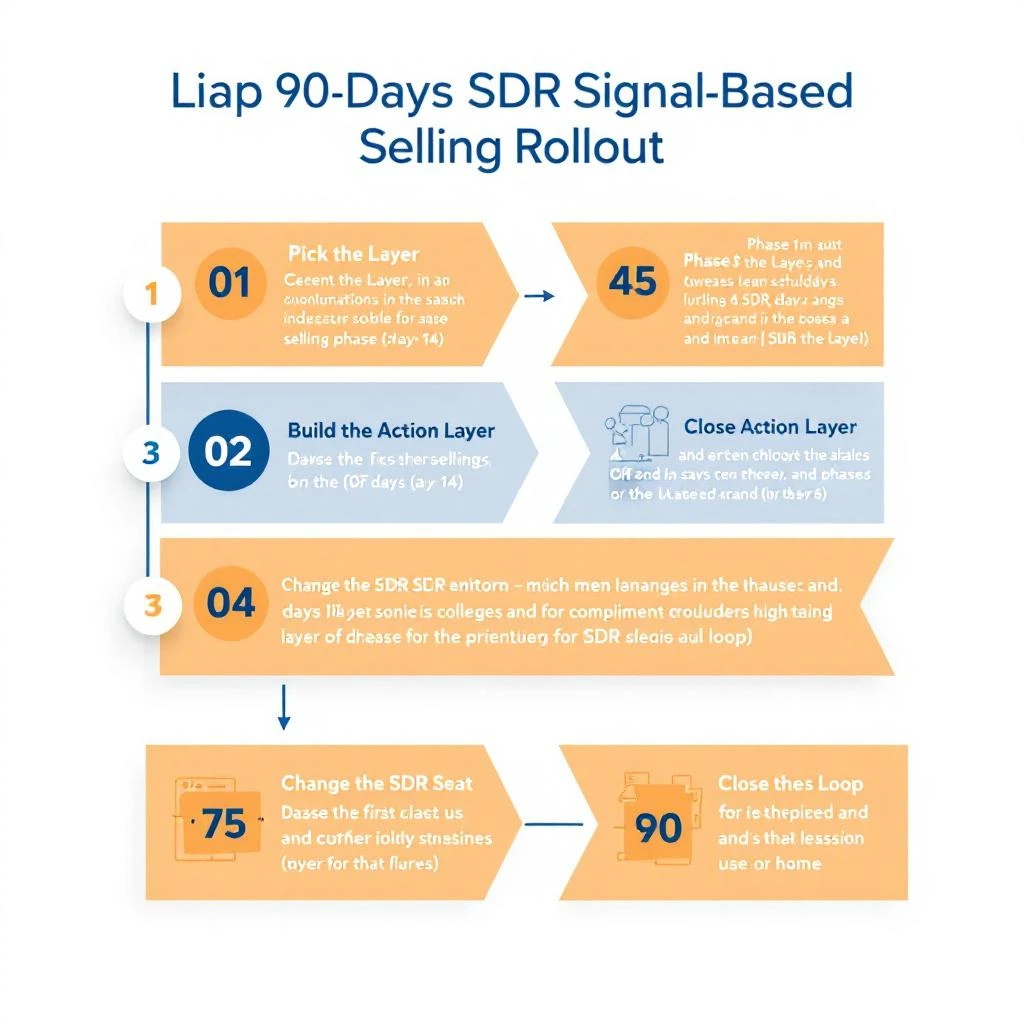
Every VP of Sales we talked to in Q1 2026 was buying into signal-based selling. By Q2, most of them were quietly pulling the plug.
Not because the thesis was wrong — buyer signals genuinely do predict pipeline. The thesis is fine. The rollouts are broken.
Here's what actually happens. A signal tool gets purchased in January. Twenty SDRs get a training session in February. Slack alerts start firing in March. By April, the SDR team is back to running the same flat outbound sequences they ran before, and the tool sits as a $48K/year line item that nobody opens. The VP of Sales doesn't kill it — that would be admitting it failed — so it just rolls into next year's renewal and quietly dies.
We've watched this pattern in over a hundred teams now. The failure modes are predictable. So is the fix.
This is the 90-day rollout playbook that actually changes SDR behavior, in four phases. Read this before you cut the PO.
The Four Failure Modes Every Signal Program Hits
Before the playbook, the pathology. Signal-based selling rollouts die for four reasons, almost always in this order:
1. Tool stacking instead of architecture. The team buys a signal tool but already has Bombora, ZoomInfo, Apollo, and a visitor ID vendor. Now they have five signal sources, no ranking, and SDRs who get 40 alerts a day across five inboxes.
2. No signal hierarchy. Every signal is treated as equally important. A demo request and an ad click both show up as "an alert." SDRs spend the same energy on Tier 5 noise as on Tier 1 buying intent. Not all signals predict closed-won deals equally — but the program is structured as if they do.
3. No behavior change in the SDR seat. Reps were told the program would "make their day easier." Instead it added a new tab to open, a new dashboard to check, and zero changes to their compensation, their cadence templates, or their pipeline reviews. So they ignore it.
4. No measurement loop. Nobody is tracking whether signal-sourced opportunities convert better than cold ones. After 90 days the VP has no evidence that the program is working, so when the budget conversation hits, the tool gets cut.
Every failed rollout we've seen tracks back to at least three of these four. The playbook below is built specifically to defuse all of them in order, on a four-phase timeline.
Phase 1 (Days 1–14): Pick the Layer, Not the Tool
The first failure mode — tool stacking — happens before the SDRs ever see a signal. It happens in the procurement conversation.
When most teams "implement signal-based selling," they buy a signal tool. That's the wrong unit of decision. The right unit of decision is the layer of the signal stack you're operating in.
There are three layers: collection (where signals come from), correlation (how they get scored and joined to accounts), and action (what gets pushed to the SDR seat). Most stacks are heavy on collection and empty on action. You don't need another collection tool. You need a correlation layer.
In Phase 1, do exactly these four things and nothing else:
- Audit existing signal sources. Pull every tool that fires an alert into a spreadsheet. Bombora, 6sense, Apollo, ZoomInfo, your visitor ID vendor, LinkedIn Sales Navigator, your CRM activity log. Most teams find 6–8 sources they're already paying for.
- Tag each source by signal tier. Map each one against the closed-won signal hierarchy. Demo requests are Tier 1. Visitor ID with intent is Tier 2. Job changes are Tier 3. Surge topics are Tier 4. Ad engagement is Tier 5.
- Identify the missing layer. If you have 6 collection tools, you don't need a 7th. You need correlation. If you have correlation but no action layer, that's the gap.
- Pick one tool that fills the layer. Not five. One. The wrong move is to buy the most-features platform. The right move is to buy the thing that fills your specific hole.
The output of Phase 1 is a one-page document that says: Here are the 6 signal sources we already have, here's how they rank by predictive value, and here's the one thing we're adding to make them usable. If you can't write that document in 14 days, you're not ready to roll out anything.
Phase 2 (Days 15–45): Build the Action Layer Before You Tell SDRs
This is where most rollouts already go off the rails. The signal tool gets configured by RevOps, Slack alerts get turned on, and the SDRs get a 30-minute training on "the new signals dashboard." Three weeks later, the alerts are muted.
The fix is to build the action layer before SDRs see any alerts. The action layer is the thing that takes a signal and produces a specific instruction: Sarah from Acme Corp visited the pricing page twice this week, here's the 4-line LinkedIn message to send her by 11am.
Action layer beats dashboard every time. SDRs don't need more data — they need to know who to contact, when, and what to say. Until you can produce that instruction reliably, don't turn the alerts on.
What to do in Phase 2:
- Define your three "must-act" signal patterns. Not 15 patterns. Three. Examples: (a) named account visits pricing page + has open opportunity, (b) champion of past customer changes jobs to ICP company, (c) new G2 review mentions a competitor we displace. Three patterns, written down, with a named owner.
- Write the SDR playbook for each pattern. For pattern (a), what's the message template? What's the LinkedIn approach? What's the cadence if no response? Write it. Test it on five accounts manually before automating anything.
- Decide the SLA. Is the SDR expected to act within 1 hour? 4 hours? 24 hours? Pick a number. Without an SLA, "act on signals" becomes "act on signals whenever you feel like it."
- Pre-wire the alert delivery. Signals should land in the channel SDRs already live in. If your team works out of LinkedIn and Salesforce, that's where alerts go. Not a new Slack channel they haven't opened yet. Not a new dashboard URL.
The output of Phase 2 is three signal patterns, three written playbooks, one SLA, and a delivery channel that already exists. Now you're ready to actually involve the SDRs.
Phase 3 (Days 46–75): Change the SDR Seat, Not Just the Toolkit
Failure mode #3 is the one that kills the most programs and surprises the most VPs. The math is uncomfortable: you can drop the world's best signal tool on top of an unchanged SDR workflow and nothing will happen.
If reps are still measured on dials per day, they'll keep dialing the same lists. If their cadences still start with a generic "checking in" email, they'll keep using it whether the signal is hot or cold. If the pipeline review still asks "how many meetings did you book?" without asking "what % came from signals?", the program is invisible to the people doing the work.
Phase 3 is about behavior change at the rep level. Three moves:
Move 1: Replace activity quotas with signal-response quotas. Don't kill activity tracking entirely — but the headline number on the dashboard changes. Instead of "150 activities per day," it's "respond to 80% of Tier 1 signals within SLA." This is the single highest-leverage change. It rewires what reps optimize for overnight. (The traditional SDR metric stack needs an overhaul anyway.)
Move 2: Rebuild cadence templates around signal context. A signal-sourced touch should not look like a cold touch. The opener references the signal — "Saw your team posted three Salesforce admin roles this week" — and the cadence is faster and shorter. Three touches in five days, not eight touches in 21 days. Train the team on this in a live working session, not a slide deck.
Move 3: Add a signal column to pipeline reviews. Every weekly pipeline review now has a column: signal source. Was this opportunity sourced from a signal, or was it cold outbound? Within 60 days you'll have data on which channel actually produces revenue. Within 90 days that data becomes undeniable, and the program defends itself.
The output of Phase 3 is a different-looking SDR week. Less dialing, more responding. Shorter cadences for signal-sourced contacts. A pipeline review that knows the difference between signal-sourced and cold opportunities. If your SDRs' days look the same on day 75 as they did on day 1, the program has already failed and you just don't know it yet.
Phase 4 (Days 76–90): Close the Loop With Data
Failure mode #4 — no measurement — is the one that kills programs at renewal time. The CFO asks: what did we get for $48K? The VP of Sales says: the reps love it. The CFO says: cut it.
Phase 4 is the answer to that conversation. By day 90, you need a single dashboard that answers four questions:
- What % of meetings booked this quarter came from signal-sourced contacts?
- What's the conversion rate of signal-sourced opportunities to closed-won, vs. cold outbound?
- What's the average deal size of signal-sourced deals vs. cold?
- What's the SLA compliance rate — what % of Tier 1 signals got an SDR response within the defined window?
These four numbers, on one page, every week. Not a 12-tab spreadsheet. Not a Looker dashboard nobody opens. One page.
The pattern we see in successful rollouts:
- Signal-sourced meetings convert 2–3x better than cold outbound. Not because signal tools are magic, but because the buyer is already in market.
- Signal-sourced deals are 20–40% larger. Same reason — these are buyers with active projects, not lukewarm tire-kickers.
- SLA compliance starts at 40% and climbs to 75% by week 12. If it doesn't climb, your Phase 3 behavior change didn't take.
If the numbers come in below those benchmarks, you have a diagnosable problem — wrong signal hierarchy, broken action layer, or unchanged SDR behavior. You can fix any of those. What you can't fix is a program with no measurement, because by the time you notice it's failing, it's already been cut.
The Pattern: It Was Never About the Tool
Notice what didn't show up in any of the four phases: a recommendation for a specific signal vendor.
That's deliberate. The vendor question is downstream of the architecture question, and the architecture question is downstream of the layer question. Get those right and almost any competent vendor in your chosen layer will work. Get them wrong and the most expensive vendor on the market will still die in your stack by day 90.
The teams that win with signal-based selling in 2026 share three traits we've seen consistently:
- They run a lean signal stack — not the most tools, the right tools, with a clear ranking. The math on signal stack spend is brutal once you add it up.
- They invest more in the action layer than the collection layer. Most teams do the opposite.
- They change the SDR scorecard to match the new motion. The reps follow the scorecard. Always.
Everything else is theatre.
What to Read Next
If you're serious about getting this right, work through these in order. They're built to be read as a cluster:
- The Buying Signal Hierarchy — Which of the 14 most common B2B signals actually predict closed-won. Read this before you tag your existing signal sources in Phase 1.
- The 3-Layer Signal Stack — Collection, correlation, action. The framework Phase 1 is built on.
- Signal to Meeting in 24 Hours — The SDR-level workflow that maps to Phase 2's action layer.
- Visitor ID to First Outreach in 30 Minutes — A concrete worked example of one signal pattern, end-to-end.
- The True Cost of an SDR Stack in 2026 — Use this to justify killing redundant collection tools in Phase 1.
- The Best Website Visitor Identification Tools, 2026 — If visitor ID is the layer you're missing.
- Best Warmly Alternatives in 2026 — If you already have a visitor ID tool and want to compare.
- Reopening Closed-Lost Deals — A signal pattern most teams overlook.
How MarketBetter Plugs In
A note on the obvious. MarketBetter sits in the action layer of the signal stack — the part most teams under-invest in. We take the signals your existing collection tools already produce (Bombora, your CRM, your visitor ID vendor, job change feeds, G2) and produce the specific instruction an SDR needs: who, when, what to say.
We don't replace your collection tools. We make them usable.
If you're in Phase 1 of a rollout and you're realizing the gap in your stack is the action layer, book a 20-minute demo. We'll walk you through what a signal-sourced SDR day actually looks like in our platform — and if it's not a fit, we'll tell you which layer of your stack to fix first instead.
The fastest way to fail a signal-based selling rollout is to skip the architecture and buy a tool. The fastest way to succeed is to read this article before signing the PO.