
607 Outreaches, 3 Replies, 1 Meeting: What Devon Hennig's Monaco Experiment Reveals About AI-Native Outbound [2026]

Most AI-sales-platform reviews are theater. A founder gets a free seat, posts a screenshot, calls it "magic," and disappears. So when Devon Hennig — captain of Ship Rats and incurable side hustler (Writhm.io, Grammar Ghosts, and a long list of prototypes) — announced he was going to document his Monaco rollout in public, week by week, with the actual numbers, that was already a more honest piece of content than anything Monaco's own marketing will produce this year.
Two episodes in, the experiment is doing something even better than promised. It's putting hard numbers on a question every VP of Sales is quietly trying to answer in 2026:
If you hand outbound to an AI-native, managed go-to-market platform — does the funnel math actually work?
Devon's documented numbers say: not yet, and not at this volume tier. That's not a takedown of Monaco. It's the most important data point AI-native outbound has produced this year, and it has direct implications for how teams should think about the SDR stack they're building in 2026.
This post is our take. We're not Monaco's competitor in the way the headlines want to frame it. We sit at a different layer of the stack. More on that at the end — first, the math.
The Setup: A Real Founder Stress-Testing a Real Product
Here's what Devon has published on Monaco Corner so far.
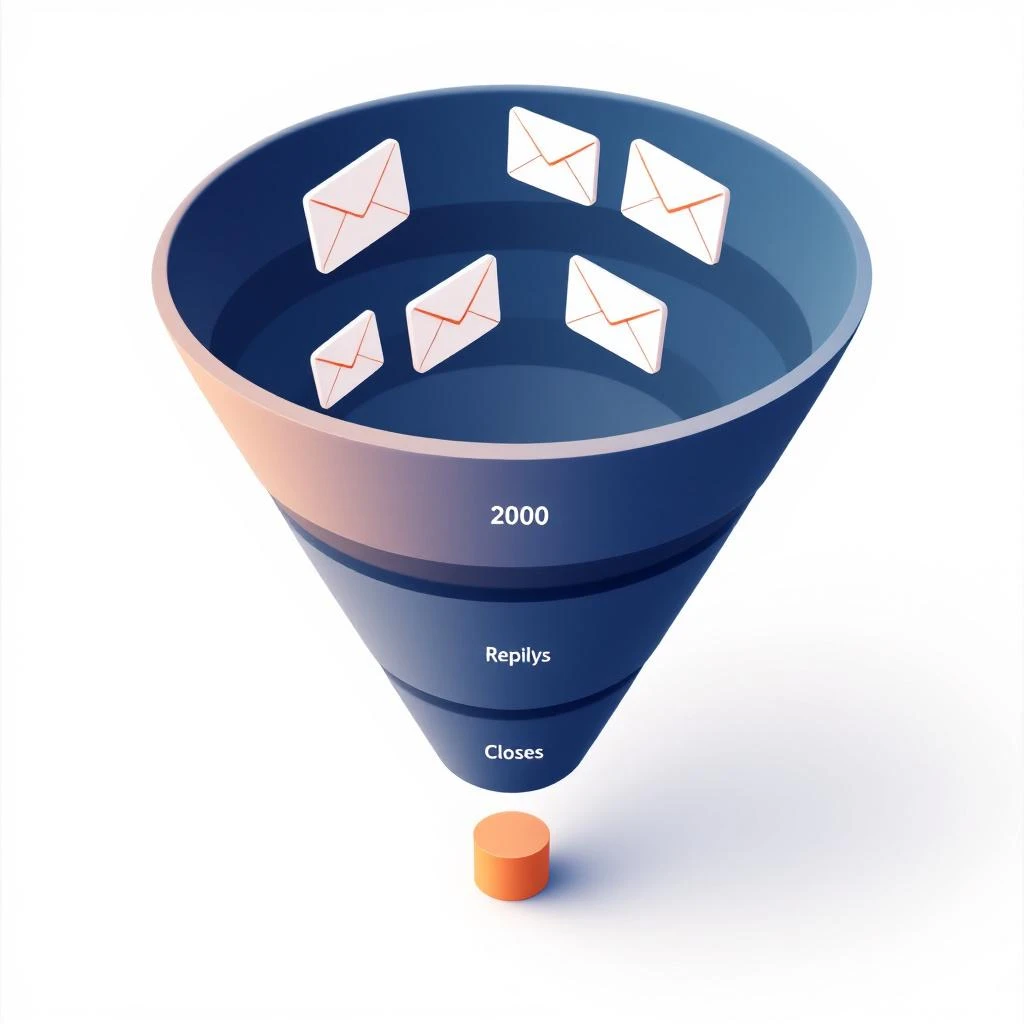
Week 1: kickoff. Monaco's "forward-deployed AEs" — Shira and Hannah — onboarded him white-glove. They wrote the campaigns. They scoped the total addressable market (TAM) and came back with about 5,500 accounts that fit his ICP. They mapped signals to chase (SEO traffic decline, GEO/AIO hiring spikes — both excellent proxies for "this account just realized AI broke their content engine"). They hooked up five inboxes, each sending 20-30 emails per day, for roughly 100 emails/day or ~2,000/month total send volume.
Devon then did something almost no founder does on camera: he opened a calculator and walked the funnel math live.
He assumed roughly:
- 40% open rate (high but possible with new, warm domains and tight targeting)
- 2-5% reply rate (right at the edge of the 2026 benchmark band of ~3.4% average)
- 50% of replies positive
- 50% of positives book a meeting
- 80% show rate
- 20% close rate
Multiply that through and you need approximately 3,300 emails to produce one closed-won deal. At ~2,000 emails per month, that's roughly one customer every seven weeks — before you adjust for the fact that most of those numbers are aspirational, not earned.
Devon said the quiet part out loud: at this volume, the math is tight. Not impossible. Tight.
Week 2: the check-in. After 11 completed sequences and 607 outreaches across the five inboxes, the result was 3 replies and 1 booked meeting. And the one meeting only happened because someone replied "did you get hacked?" to a sequence — and Hannah turned that thread into a real conversation. Praise where it's due: Hannah and Shira rewrote campaigns the same day, responded over the weekend, and clearly worked their asses off. The managed-service half of Monaco is performing.
Devon then announced phase two: pitting Monaco against a traditional human lead-gen agency, "Leads That Show," whose pitch is 20 booked calls in 60 days or money back. Robots vs. humans. He calls it "Biggest Closer." It's the most useful AI-sales experiment running on the internet right now.
The Funnel Math, Honestly
Let's sit with the math instead of explaining it away.

At 2026 benchmarks — 27.7% average open rate, 3.4% average reply rate, 5-8% reply considered strong, 10-18% elite — the gap between Devon's modeled funnel and the actual public benchmark is bigger than it looks. He assumed 40% open. Industry average is 28%. He assumed 2-5% reply. Industry average is 3.4%.
If you re-run the math at industry average instead of optimistic targets:
- 2,000 emails × 28% open = 560 opens
- 560 opens × 3.4% reply = ~19 replies
- 19 replies × 50% positive = ~9 positive
- 9 positives × 50% book = ~5 meetings booked
- 5 × 80% show = ~4 meetings held
- 4 × 20% close = less than 1 close per month
You need roughly double the volume to clear a customer per month at industry-average performance. And here's the structural problem: doubling volume isn't free. Each additional inbox needs a warmed domain, a real persona, and clean deliverability hygiene — or your reply rate craters and you're worse off than you started.
Now layer on TAM. Devon's TAM is ~5,500 accounts. At 2,000 emails per month per his current setup, he'll cycle the entire TAM in about 11 weeks. After that, the funnel doesn't scale by sending more — it scales by sending better to the same accounts, which is an entirely different problem than the one Monaco is solving on day 1.
This is the bind every managed-service AI-CRM model is about to discover, and it's not unique to Monaco. It would be the same with 11x or Artisan if they ran the same experiment publicly:
- The inbox ceiling is real. Five inboxes at 20-30/day is roughly the responsible ceiling on a single brand before deliverability degrades. Going to 10 or 20 inboxes requires domain diversification, which means more brands, more provisioning, more babysitting. Volume doesn't scale linearly with the platform — it scales with operational overhead.
- Narrow TAMs starve volume models. A 5,500-account TAM is sharp targeting (good) but small (challenging for a volume-based send model). The platform's economics work better at TAMs of 50,000+. Devon's TAM is 10x smaller than the model wants.
- Reply quality is more sensitive to message than to send volume. When 1 of your 3 replies in two weeks comes from someone asking if you got hacked, the system isn't broken — it just hasn't found the angle yet. That's a campaign problem, not a volume problem. Pouring more emails through the same angle doesn't fix it.
The honest verdict on Devon's first two weeks: the managed-service team is doing the work, the platform is sending, the math is just hard. He could absolutely turn the corner — Hannah and Shira are clearly competent and the iteration speed is real. But the funnel math is telling you something about the shape of this category that nobody who's selling AI outbound platforms wants to say out loud.
What This Tells Us About the Shape of the 2026 Outbound Stack
The Monaco Corner experiment is forcing a useful question: when you buy an AI-native sales platform, what are you actually buying?
You're buying three different things bundled together:
- A database + signals layer. TAM building, account scoring, intent overlays, signal capture.
- An execution layer. Inboxes, sequences, send orchestration, reply handling.
- A managed-service layer. Humans who write the campaigns, iterate, and handle the messy edges.
The bundle is appealing for founders without sales backgrounds — Monaco's stated ICP — because it removes every lever they don't know how to pull. But the bundle is a problem for teams that already have SDRs, already have inboxes, already have an opinion about messaging, and already have a CRM they're not going to rip out.
For those teams, you don't want layers 2 and 3 from a vendor. You want layer 1, sharper and faster than you can build it yourself, and you want layer 2 to fire when layer 1 sees something, not on a generic cadence.
That's where signal-based selling actually wins — and where most rollouts also quietly fail when the platform doesn't translate signals into a specific SDR action within the same day.
Where MarketBetter Sits (And Where We Don't)
We are not "a better Monaco." We're not a managed-service AI sales platform. We don't run your campaigns for you and we don't hire forward-deployed AEs to sit inside your team. If that's what you want — and there are real reasons a founder might want exactly that — Monaco is a serious option and Devon's experiment is the best public data you can find on whether it lands for your shape of company.
MarketBetter is the signal-to-action workflow layer for teams running their own outbound. Concretely:
- You bring your own inboxes. Whatever you're already sending from, however many domains you've already warmed, MarketBetter doesn't replace that fleet. We orchestrate on top of it.
- You bring your own CRM. Salesforce, HubSpot, Attio — we plug in, we don't ask you to migrate.
- We surface the WHO + WHAT TO DO in real time. Visitor identification, intent signals across third-party data, hiring signals, technographic shifts — layered into a single signal stack — then turned into a daily playbook each rep can actually work.
- We tell your SDRs which 3% of your TAM is in-market today, so they spend their day on the accounts where reply math actually pencils out, instead of cycling 2,000 cold emails through a 5,500-account list and hoping.
Said differently: Devon's experiment is showing you what AI looks like when it owns the whole funnel. MarketBetter is what AI looks like when it owns the decision layer and leaves the execution layer to the humans who already have it set up.
Honest takes on managed AI-CRM models like Monaco, while we're being honest:
- Where managed works: founders with no sales infrastructure, no SDRs yet, no inbox fleet, and a willingness to outsource the entire GTM motion. The white-glove activation Devon is getting from Hannah and Shira is genuinely valuable for that buyer.
- Where managed hits a wall: narrow TAMs (under ~20K accounts), teams with existing SDRs and CRM investments, and any company that wants to A/B their own messaging and own their own pipeline reporting end-to-end.
That second buyer is who MarketBetter is built for. Different shape, different sale, different best customer. Both can exist.
The Watch-List for Devon's Next Episodes
Things we'll be watching as Monaco Corner unfolds:
- Does volume increase? If Monaco pushes Devon past 5 inboxes, watch deliverability and reply rate together. Going to 10 inboxes without a reply-rate drop is the real proof point.
- Does the message iterate? The "did you get hacked?" reply is a gift — it's telling Hannah exactly what's off. Week 3-4 messaging changes will reveal how fast the managed-service iteration loop actually closes.
- Does the agency beat the AI? Liam at Leads That Show is offering 20 calls in 60 days, money-back. If a traditional human agency wins this head-to-head, it's not a death sentence for AI outbound — it's a signal that AI-native still needs human iteration to close the funnel-math gap, which is also our thesis.
- What does week 8 look like? TAM cycle time matters. Once Monaco has touched the full 5,500 accounts, the question stops being "how do we send more" and starts being "what do we do with the accounts that already saw us." That's the signal-loop problem, and it's the harder problem.
We'll write that follow-up when the data is in.
The One-Line Take
AI-native outbound platforms aren't broken. The funnel math just doesn't bend the way the pitch decks suggest, and the first honest public experiment is making that visible. The teams who win in 2026 will be the ones who treat AI as a signal-to-action layer on top of their existing motion — not a managed service that replaces the motion entirely.
Devon Hennig deserves the credit here. He's the rare operator running the experiment in public, with real numbers, on a real budget. If you're a VP of Sales evaluating any AI sales platform in 2026 — Monaco, 11x, Artisan, Apollo, Common Room, Warmly, or any of the rest — watch Monaco Corner. The data is doing the talking.
For the deeper read on how we think about this, see our earlier honest write-up: MarketBetter vs Monaco for B2B Sales Teams and the longer Monaco Sales Platform Review 2026.
Running your own outbound on your own inboxes, but tired of cycling cold accounts and hoping? That's the gap we close. We tell your reps which accounts are in-market today and what to do about it — without taking over your campaigns. Book a demo →