4 posts tagged with "sales technology"

View All Tags

The 12 Best AI Tools for Sales Prospecting in 2026

· 30 min read

Prospecting has become a numbers game of diminishing returns. Sales reps spend countless hours on manual research, data entry, and crafting outreach that often gets ignored. This inefficiency doesn't just hurt quotas; it leads to burnout and a stagnant pipeline. The core problem is clear: too much time is spent on low-value tasks instead of high-impact selling conversations. Artificial intelligence offers a powerful solution, but simply adopting any AI platform can introduce more complexity than it resolves, forcing teams to juggle disconnected systems.

This guide cuts through the noise. We provide an actionable, in-depth analysis of the top AI tools for sales prospecting designed to solve this very problem. Our goal is to help you find the right platform that integrates directly into your existing sales process, automates the tedious work, and delivers measurable results. We will move beyond generic feature lists to give you a real-world perspective on how these tools function day-to-day.

Inside this comprehensive resource, you will discover:

  • Honest pros and cons for each tool based on practical usage.
  • Specific use-case scenarios for Sales Development Representatives (SDRs), Sales Leaders, and Revenue Operations (RevOps) teams.
  • A detailed feature comparison matrix to quickly identify which platform best suits your needs, highlighting CRM-native advantages.
  • Actionable insights on pricing, implementation, and how each tool stacks up against the competition.

Each review includes screenshots and direct links to help you evaluate the options efficiently. For teams looking to expand their outreach channels, it’s also useful to know how different platforms can work together. For instance, to efficiently scale prospecting efforts, businesses can explore various types of LinkedIn automation tools for lead generation. Our focus here, however, is on the core AI-powered sales platforms that form the foundation of a modern, high-performing sales engine. Let's find the right tool to fill your pipeline.

1. marketbetter.ai

For sales teams seeking a direct path from buyer intent to meaningful outreach, marketbetter.ai stands out as a powerful execution engine. It's built to operate directly within Salesforce and HubSpot, transforming disparate buyer signals like website visits and ICP triggers into a prioritized, actionable task list for SDRs. This CRM-native approach eliminates the common friction of switching between separate engagement tools and the core system of record.

An AI-powered sales prospecting dashboard showing prioritized tasks and contact information, illustrating how to use ai tools for sales prospecting effectively.

MarketBetter excels by providing a clear “next best action” with all the necessary context, ensuring reps engage the right leads at the right time. Its AI-generated outbound copy is a key differentiator, producing concise, account-specific first-touch emails and subject lines that are ready for immediate use. This isn't generic content; it's designed for high-relevance warm outbound. The platform's built-in dialer, which also lives natively in Salesforce, further accelerates this workflow. It provides talk tracks for call prep and automatically summarizes outcomes back to the CRM, maintaining clean data and clear attribution for RevOps. For a deeper dive into how this compares to other platforms, our guide on the best sales prospecting tools offers additional context.

Why It's Our Top Pick

MarketBetter directly addresses two of the biggest challenges in modern outbound: signal noise and poor CRM adoption. Instead of just identifying intent, it makes that intent actionable within the systems reps already use. The combination of an AI-driven task inbox and a native Salesforce dialer is a potent formula for increasing daily outreach activities while improving connection rates.

Key Advantages:

  • CRM-Native Execution: Turns intent signals into prioritized tasks inside Salesforce/HubSpot, reducing context switching.
  • Actionable AI Copywriting: Generates sequence-ready, persona-specific emails and subject lines for high-relevance outreach.
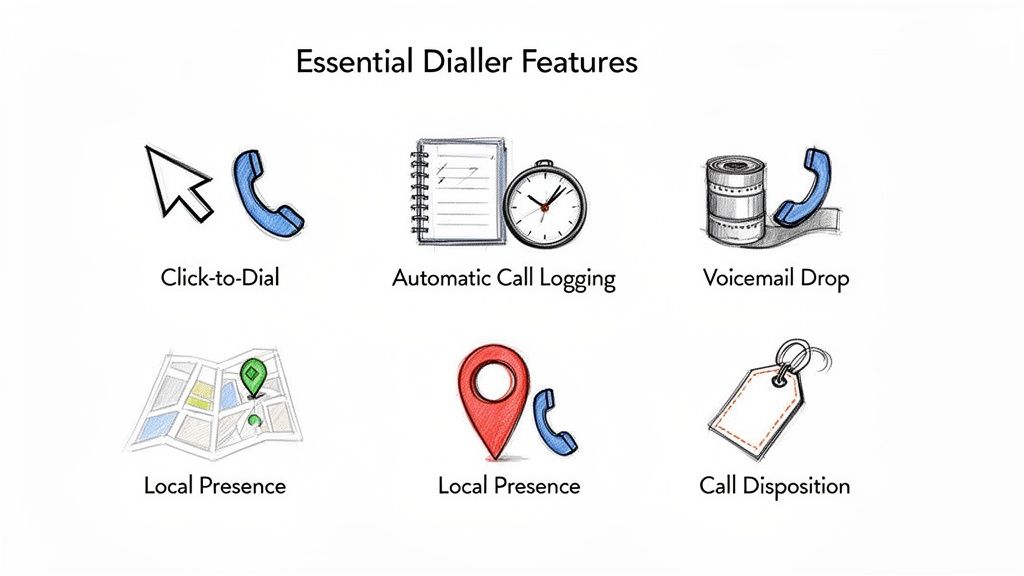
  • Integrated Dialer & Auto-Logging: Features a click-to-dial function within Salesforce with automatic call disposition and note syncing.
  • Fast Implementation: Setup is quick via a tracking code and CRM connection, with templates available to speed up SDR onboarding.

Potential Considerations:

  • Demo-Required Pricing: The lack of public pricing requires a sales conversation, which may not suit teams in early-stage evaluation.
  • Overlap with Existing Tools: Teams with established engagement platforms like Outreach or Salesloft must carefully evaluate how MarketBetter’s CRM-native layer integrates with or replaces their current stack.

Website: https://www.marketbetter.ai

2. Outreach

Outreach is a powerful enterprise-grade sales engagement platform that uses AI to guide revenue teams through the entire sales cycle, from prospecting to closing. It excels at helping large, distributed teams standardize their outbound activities, ensuring every Sales Development Representative (SDR) and Account Executive (AE) follows a proven playbook. The platform surfaces high-intent prospects, automates time-consuming research, and recommends the next-best action, so reps know exactly what to do and when.

Outreach

Unlike point solutions that only address one part of the prospecting puzzle, Outreach provides an end-to-end workflow. Where a tool like MarketBetter focuses on executing tasks within the CRM, Outreach acts as a comprehensive command center living outside of it. This is a key advantage for organizations looking to reduce their tech stack and unify their sales process. Its AI conversation intelligence tool, Kaia, transcribes and analyzes sales calls to provide real-time coaching and post-call insights, helping managers improve team performance at scale. This comprehensive approach to sales automation software makes it a top choice for mature sales organizations.

Key Considerations

Pricing: Outreach uses a custom, quote-based model typical for enterprise software. Expect premium pricing, as it’s designed for larger teams needing extensive functionality and support.

Implementation: The setup can be complex and lengthy, especially for organizations with intricate sales processes and multiple team roles. This is not a plug-and-play tool but a strategic platform investment.

Actionable Use Case: A VP of Sales at an enterprise company wants to standardize the outbound prospecting motion for a 100-person SDR team.

  1. Build Playbooks: Create and enforce multi-step, multi-channel sequences to ensure consistent messaging.
  2. Track Engagement: Use Outreach's analytics to monitor which sequences have the highest reply rates and adjust accordingly.
  3. Coach at Scale: Leverage Kaia for remote coaching sessions to identify talk tracks that lead to booked meetings and ramp new hires faster.

3. Salesloft

Salesloft is a complete revenue orchestration platform that provides sales teams with a structured framework for every stage of the customer lifecycle. It excels in helping sellers execute multi-channel outreach, understand buyer engagement, and manage their pipeline from first contact to renewal. The platform’s core strength lies in its Cadence feature, which guides Sales Development Representatives (SDRs) and Account Executives (AEs) through a prescribed series of email, phone, and social selling tasks, ensuring consistent execution across the team.

Salesloft

Compared to other enterprise tools, Salesloft offers a highly connected workflow that bridges the gap between prospecting and deal management. Its AI-powered engine, Rhythm, prioritizes a seller’s daily tasks by analyzing buyer signals, while the Conversations module provides call intelligence for coaching. While Outreach and Salesloft are direct competitors, Salesloft often differentiates with a user interface praised for its ease of use and strong analytics for forecasting. The recent integration with Drift allows teams to capture website intent directly, making it a powerful choice for organizations looking to connect their top-of-funnel activities with their core sales process. This makes it one of the leading ai tools for sales prospecting for teams needing a single pane of glass.

Key Considerations

Pricing: Salesloft does not offer public per-seat pricing. Access to the platform requires engaging with their sales team for a custom quote, which is typical for enterprise-grade solutions of this scope.

Implementation: While supported by extensive customer education resources, the setup can be a significant project. It’s best suited for organizations ready to invest time in configuring workflows and integrating them with their existing CRM and marketing automation tools.

Actionable Use Case: A Director of Sales Enablement aims to align SDR and AE activities.

  1. Define Cadences: Create distinct Cadences for SDR prospecting and separate ones for AE deal-cycle follow-up.
  2. Identify Best Practices: Use the Conversations module to analyze top performers' calls and codify their talk tracks into templates.
  3. Monitor Pipeline Health: Track deal progression and identify at-risk opportunities using the integrated forecasting tools to proactively intervene.

4. Apollo.io

Apollo.io stands out as an all-in-one sales intelligence and engagement platform, effectively bundling a massive B2B contact database with the tools needed to act on that data. It combines data enrichment, sequencing, and deal execution into a single, cohesive workflow. This unification is a major advantage for sales teams, especially startups and SMBs, looking to minimize their tech stack and get new reps productive quickly.

Apollo.io

Unlike platforms that specialize only in engagement (like Salesloft) or data (like ZoomInfo), Apollo’s strength lies in its integration of both. Its native AI Assistant aids in prospect research and generates personalized messages directly within the platform, making it a fast and efficient option among ai tools for sales prospecting. This ability to move from finding a contact to engaging them in a sequenced campaign without switching tools is a significant workflow improvement. For teams that need both a data source and an outbound engine, Apollo presents a compelling, cost-effective solution.

Key Considerations

Pricing: Apollo offers a free-forever starter plan, which is excellent for trial and very small teams. Paid plans are published and are more accessible than enterprise-grade tools, but the credit-based model for contacts and emails requires careful management as you scale.

Implementation: Getting started is relatively fast, particularly for users familiar with prospecting tools. The Chrome extension makes it easy to integrate into daily browsing and LinkedIn activities, allowing for a swift ramp-up.

Actionable Use Case: A demand generation manager at a growing startup needs to equip a new 5-person SDR team.

  1. Build Lists: Use Apollo's database to create targeted contact lists based on company size, industry, and technology used.
  2. Launch Campaigns: Deploy multi-channel outbound sequences using the built-in engagement tools.
  3. Personalize at Scale: Instruct the SDRs to use the AI Assistant to generate personalized opening lines for their top-tier prospects, improving reply rates.

5. ZoomInfo SalesOS

ZoomInfo’s SalesOS is an enterprise-grade B2B intelligence platform that functions as a foundational data layer for go-to-market teams. While not an engagement tool itself, its AI-driven database provides the critical contact data, firmographics, technographics, and buying signals that power other prospecting tools. Its primary function is to help sales teams identify and prioritize high-potential accounts and contacts with unparalleled scale, feeding this rich data directly into CRMs and sales engagement platforms.

ZoomInfo SalesOS

The platform distinguishes itself with its deep data coverage and "Scoops," which are timely intent signals indicating leadership changes, funding events, or technology purchases. These signals are crucial for crafting relevant and timely outreach. Unlike an all-in-one like Apollo.io, ZoomInfo specializes solely in providing best-in-class data. It supplies the necessary intelligence for sales teams to build targeted account lists and ensures that downstream engagement tools like Outreach or Salesloft are populated with accurate, actionable information, making it one of the most important ai tools for sales prospecting for data-driven organizations.

Key Considerations

Pricing: ZoomInfo does not publish its pricing. Contracts are customized, typically requiring annual commitments and multi-seat licenses. It represents a significant investment geared toward organizations prioritizing data accuracy and breadth.

Implementation: Integrating ZoomInfo requires careful planning, especially when connecting it to a CRM and other sales tools. Setup involves configuring data mapping, user permissions, and credit allowances to ensure teams use the data effectively and within budget.

Actionable Use Case: A Demand Generation Manager needs to build a target account list for a new campaign.

  1. Define Your ICP: Filter companies by industry, size, and specific technologies used (e.g., "companies using Marketo").
  2. Identify Contacts: Find contacts with relevant job titles within those accounts (e.g., "VP of Marketing").
  3. Prioritize with Intent: Layer on intent data to find accounts actively researching your solution category and export these high-value leads directly into Salesforce for immediate SDR follow-up.

6. 6sense Revenue AI

6sense operates as a Revenue AI and Account-Based Marketing (ABM) platform that excels at identifying which accounts are actively in-market for a solution like yours. It moves beyond simple firmographics by analyzing anonymous web traffic and third-party intent data to predict which companies are showing buying signals right now. This makes it a critical tool for sales teams looking to prioritize their outreach efforts and focus only on accounts with the highest propensity to buy, feeding SDRs a qualified list of targets.

6sense Revenue AI

The platform’s core strength is its ability to create a tight alignment between sales and marketing. While ZoomInfo tells you who to target based on firmographics, 6sense tells you when to target them based on behavioral intent. While marketing uses 6sense to run targeted ad campaigns and content syndication, sales teams receive alerts and prioritized task queues directly in their CRM. This coordinated approach ensures that when an SDR reaches out, the prospect has already been warmed up by marketing activities, making for a much more effective conversation. Among the various AI tools for sales prospecting, 6sense is particularly strong for organizations that have adopted a full-funnel ABM strategy.

Key Considerations

Pricing: 6sense follows a quote-based, enterprise-focused pricing model. You will need to engage with their sales team to get a quote, as pricing is not publicly available and depends on the scope of implementation.

Implementation: Setting up 6sense requires a strategic partnership with their team. It involves integrating with your CRM, marketing automation platform, and ad networks, which demands significant technical and operational resources.

Actionable Use Case: A Demand Generation Manager at a B2B tech company wants to run a coordinated campaign.

  1. Identify Intent: Use 6sense to generate a list of 500 target accounts showing intent signals for their product category.
  2. Run Air Cover: Launch a marketing play where display ads are served to key personas at these accounts.
  3. Activate Sales: Simultaneously, have the BDR team receive automated tasks in their CRM to begin personalized outreach, referencing the specific topics the account is researching.

7. Cognism

Cognism is a B2B data provider that carves out its niche with a strong emphasis on data compliance and accuracy, particularly for mobile and direct-dial phone numbers. For sales teams building outbound programs in regions with strict privacy regulations like the EU and California, Cognism provides a layer of assurance with its GDPR and CCPA-aligned data collection practices. Its "Diamond Data" feature, which signifies a phone-verified mobile number, is a key asset for call-heavy prospecting teams looking to improve connect rates and bypass traditional gatekeepers.

Cognism

Unlike competitors who may mix various data sources without clear verification, Cognism’s focus on governance and verification makes it a strategic choice for regulated industries or those targeting senior-level decision-makers. Compared to ZoomInfo, Cognism's database might be smaller in scale, but its value proposition is higher data quality and compliance, especially for European markets. The platform’s Chrome extension allows reps to access this compliant contact data directly on LinkedIn or company websites, integrating into their existing workflow. This focus on providing high-quality, verified mobile numbers makes it a standout among the AI tools for sales prospecting when the primary outreach channel is the phone.

Key Considerations

Pricing: Cognism does not offer public pricing and operates on a quote-based subscription model. Contracts are typically sold on an annual basis, which can be a significant upfront investment.

Implementation: Onboarding is generally straightforward, focusing on integrating the platform and training the team to use the Chrome extension and web application. The main effort is aligning data usage with internal compliance protocols.

Actionable Use Case: A demand generation manager for a FinTech company is launching a campaign targeting C-level executives in both the US and the UK.

  1. Build a Compliant List: Use Cognism to build a highly targeted list of prospects, filtering for C-level titles in the financial sector.
  2. Prioritize Mobile Dials: Instruct SDRs to prioritize contacts with the "Diamond Data" tag for their call blocks to maximize connect rates.
  3. Ensure Compliance: Rest easy knowing the data collection methods meet GDPR and CCPA standards, reducing risk for the campaign.

8. Seamless.AI

Seamless.AI is a real-time search engine for B2B contact and company data, positioning itself as a direct line to accurate emails and, notably, mobile numbers. Its AI-powered platform and Chrome extension help sales teams find prospect information across websites and social platforms, making it a go-to for reps who need to build targeted lists quickly. The core strength of Seamless.AI lies in its accessibility, offering a generous free tier that provides annual credits, lowering the barrier to entry for small teams or individual contributors.

Seamless.AI

Unlike all-in-one engagement platforms, Seamless.AI focuses squarely on the top of the funnel: data acquisition. It’s one of the few ai tools for sales prospecting that emphasizes direct-dial mobile numbers, which is a significant advantage for call-heavy sales motions. While Apollo.io offers a similar "data + engagement" model, Seamless.AI is often seen as a more direct competitor to pure-play data providers like ZoomInfo, but with a more accessible price point and a "real-time search" positioning. The platform's AI Pitch Intelligence feature analyzes company and contact data to suggest talking points, helping reps personalize their outreach. This makes it a practical tool for SDRs who need to quickly gather intel and start dialing without a lengthy research process.

Key Considerations

Pricing: A free plan is available with a limited number of annual credits. Paid plans are required for higher volume needs, CRM integrations, and advanced features, with pricing based on credit and user counts.

Implementation: Getting started is simple, especially with the Chrome extension. Users can begin finding contacts in minutes. However, integrating it into a CRM and establishing a data verification process is necessary to maintain database hygiene.

Actionable Use Case: A small, scrappy SDR team at a startup needs to build a pipeline from scratch with a limited budget.

  1. Start for Free: Have each rep sign up for Seamless.AI’s free plan to start building lists of key decision-makers at target accounts.
  2. Find Direct Dials: Use the Chrome Extension on LinkedIn profiles to find direct mobile numbers.
  3. Craft Opening Lines: Leverage the Pitch Intelligence feature to get quick talking points for cold calls, increasing relevance.

9. Clay

Clay is a GTM engineering platform that gives teams surgical control over their list-building and data enrichment processes. Instead of providing a static database, Clay acts as a central hub where you can connect over 100 data sources, build cascading enrichment workflows, and use AI to automate web research and craft hyper-personalized messaging. This makes it one of the most powerful and flexible ai tools for sales prospecting for technical sales operations teams.

Clay

The platform’s core strength is its "waterfall" enrichment model, where you can query multiple providers sequentially until you find the data point you need, minimizing costs. You can bring your own provider keys, giving you direct control over your data budget and coverage. Unlike any other tool on this list, Clay doesn't provide data itself; it orchestrates data from other sources like Apollo, ZoomInfo, or Clearbit. Clay’s AI agent, Claygent, can be instructed to perform research tasks like visiting a prospect's LinkedIn profile to find a recent post or checking their company’s careers page for open roles relevant to your solution, then drafting personalized first lines based on that research. This approach allows teams to build highly targeted and qualified prospect lists that are then passed to a separate sales engagement tool for execution.

Key Considerations

Pricing: Clay uses a credit-based pricing model, with plans starting around $149/month. Actions like enriching data or running AI agents consume credits, so costs can be variable and require careful management to avoid unexpected expenses.

Implementation: This is not a simple plug-and-play tool. Clay requires a strong understanding of data operations and process design. The learning curve is steep, and it functions more like an engineering canvas than a one-click database.

Actionable Use Case: A demand generation manager wants to build a hyper-personalized GTM motion for a new market segment.

  1. Build a Base List: Pull a list of companies from a source like Apollo into a Clay table.
  2. Enrich with a Waterfall: Run a waterfall enrichment to find marketing contacts, trying three different data providers in sequence to maximize fill rate.
  3. Automate Research: Use Claygent to visit each contact's LinkedIn profile, find a recent post, and write a personalized email intro referencing that post before exporting the final list to an outbound tool.

10. Amplemarket

Amplemarket is an AI-native sales engagement platform that combines a B2B contact database with multichannel outreach capabilities. Its core advantage lies in unifying data, intent signals, and execution into a single workflow, which helps sales development teams bypass the need to toggle between separate prospecting and engagement tools. The platform uses AI to identify ideal customer profile (ICP) accounts based on real-time signals and generates highly personalized, multithreaded sequences for email, phone, and social channels.

Amplemarket

Unlike platforms that require you to bring your own data, Amplemarket provides it, creating a more cohesive process from discovery to outreach. This makes it a direct competitor to Apollo.io, but it often targets a more mid-market audience with a stronger emphasis on AI-driven personalization and email deliverability. This makes it one of the better ai tools for sales prospecting for teams that want to consolidate their tech stack. A key differentiator is its serious focus on email deliverability, offering robust tools and onboarding support, including its "Amplemarket University," to ensure outbound campaigns don't damage a company's domain reputation. The AI copywriter also allows reps to control the tone and voice, ensuring messages align with brand guidelines.

Key Considerations

Pricing: Amplemarket does not list pricing publicly. Interested teams must contact the sales department for a custom quote, which suggests it is geared toward teams with a dedicated budget rather than individual users.

Implementation: The platform's unified nature can simplify setup compared to integrating multiple disparate systems. However, teams will need to invest time in the initial configuration and learn how to best use the integrated data and sequencing features.

Actionable Use Case: A Demand Generation Manager at a mid-market SaaS company wants to scale outbound without hiring more reps.

  1. Identify New Accounts: Use Amplemarket’s database and signal intelligence to find net-new accounts fitting their ICP.
  2. Deploy AI Sequences: Launch AI-generated, multi-channel sequences to book meetings, letting the platform handle the personalization.
  3. Monitor Domain Health: Use the built-in deliverability dashboard to ensure a high volume of outreach doesn't harm their sending reputation.

11. Gong Engage

Gong Engage is Gong's AI-powered sales engagement module, designed to turn conversational insights into effective outreach. It connects the data from Gong's core revenue intelligence platform directly to the top-of-funnel activities of SDRs and AEs. By analyzing real customer calls and meetings, Engage recommends what to say, who to target next, and which talk tracks are converting, creating a direct feedback loop between conversations and prospecting actions.

Gong Engage

Unlike standalone sales engagement tools, Engage’s primary advantage is its native integration with Gong's massive repository of conversation data. Where Outreach and Salesloft use AI to optimize generic sales processes, Gong Engage uses AI to optimize your specific sales process based on your team's calls. This allows its AI to provide contextually rich personalization suggestions and guided workflows based on what actually works with your buyers. Reps can execute multi-channel sequences with an integrated dialer and email, all while the system provides AI-generated recommendations. This model is very different from generic AI sales assistants because its guidance is derived from your team’s unique customer interactions, not broad-market data.

Key Considerations

Pricing: Gong Engage is sold via a custom, quote-based model. It delivers the most value when bundled with the broader Gong Revenue Intelligence platform, so pricing will reflect a more strategic, platform-level investment.

Implementation: If you are already a Gong customer, adding Engage is relatively straightforward. For new customers, implementation involves setting up the core revenue intelligence platform first, which can require significant time to integrate with your CRM, dialer, and web conferencing tools.

Actionable Use Case: A sales manager for a team already using Gong for call recording wants to arm their BDRs.

  1. Identify Winning Language: Use Gong to analyze the last quarter's successful discovery calls.
  2. Create a Sequence: Build a new outreach sequence in Engage for a product launch.
  3. Arm the Reps: Let Engage's AI recommend specific phrases and value props for emails and calls, pulled directly from the winning language identified in step one.

12. HubSpot Sales Hub

HubSpot Sales Hub is a widely adopted platform that combines a full-featured CRM with integrated sales engagement tools. Its strength lies in providing an all-in-one environment where prospecting activities are native to the core contact record. AI assistance is woven into the workflow, helping reps draft personalized emails, automate follow-up tasks, and generate reports without toggling between different applications. This native integration is a significant advantage for teams already using HubSpot's ecosystem, as it eliminates data sync issues and reduces administrative overhead.

HubSpot Sales Hub

Unlike standalone prospecting tools that require complex integration projects, HubSpot offers a more direct path to unifying sales and marketing data. The platform's clear, public pricing tiers make procurement straightforward, a notable contrast to the custom quote models of many enterprise competitors. Its primary differentiator is its existence as part of a complete GTM platform (Marketing Hub, Service Hub), making it the default choice for companies committed to the HubSpot ecosystem. Features like built-in sequences, call logging, and email templates are available directly within the CRM, providing a cohesive experience. This makes it a strong contender for organizations looking for transparent packaging and a single source of truth for their entire revenue operation.

Key Considerations

Pricing: HubSpot provides clear, public pricing with Starter, Professional, and Enterprise tiers. While transparent, the seat-based model means costs can increase substantially as teams grow, so it is important to model the total cost of ownership carefully.

Implementation: Getting started is relatively simple, especially for teams already familiar with the HubSpot interface. The all-in-one nature simplifies the tech stack, but migrating from an existing CRM can require significant planning and data management.

Actionable Use Case: A demand generation manager for a mid-market company wants to align sales and marketing efforts within HubSpot.

  1. Automate Inbound: Create automated lead nurturing sequences in Sales Hub that trigger when a prospect downloads an e-book from a Marketing Hub landing page.
  2. Track Engagement: Monitor the prospect's entire journey from first touch to close within a single contact record.
  3. Ensure Consistency: Use the AI content assistant to help SDRs draft consistent, high-quality follow-up emails for MQLs.

Top 12 AI Sales Prospecting Tools — Comparison

ProductCore features ✨UX / Quality ★Pricing & Value 💰Target & USP 👥
marketbetter.ai 🏆SDR Task Inbox, AI cold emails, native Salesforce dialer, auto‑logged CRM ✨★ 4.97 (G2); fast adoption, low rep friction💰 Demo/quote; fast time‑to‑value, strong ROI claims👥 Mid‑market→Enterprise SDRs & RevOps; USP: CRM‑native execution (tasks → send/call)
OutreachEnterprise engagement, AI next‑best‑actions, convo intelligence ✨★ Enterprise‑grade governance & scale💰 Premium, quote‑based👥 Large SDR/AE orgs; USP: end‑to‑end workflow & controls
SalesloftMultichannel cadences, conversation AI, Rhythm tasking ✨★ Mature cadence UX, good analytics💰 Quote/enterprise pricing👥 SDR→AE pipelines; USP: cadence + analytics for handoffs
Apollo.ioB2B contact DB + enrichment + native AI assistant ✨★ Accessible; fast ramp for reps💰 Free tier + paid plans; credit limits👥 SMBs & scaling SDR teams; USP: data + engagement in one
ZoomInfo SalesOSDeep contact + technographics + intent (Scoops) ✨★ Data‑rich; enterprise standard💰 Annual contracts; quote👥 Demand gen/RevOps; USP: breadth/depth of buyer data & signals
6sense Revenue AIPredictive intent, account timing, ABM orchestration ✨★ Strong prioritization accuracy💰 Enterprise, quote‑based👥 ABM/mid‑enterprise GTM; USP: timing + account prediction
CognismGDPR/CCPA‑aligned data, verified mobile numbers ✨★ Compliance‑focused accuracy💰 Quote/annual contracts👥 EU/reg‑sensitive outreach; USP: compliance + mobile accuracy
Seamless.AIContact search, mobile numbers, AI prospector + extension ✨★ Good for quick prospecting & trials💰 Free starter; credit model👥 Small/scrappy SDRs; USP: low barrier to trial and mobile data
ClayMulti‑source enrichment, web research, AI personalization canvas ✨★ Extremely flexible but ops‑heavy💰 Credit‑based; variable👥 GTM ops/engineering; USP: unify many data sources & BYO keys
AmplemarketAI‑native engagement + built‑in B2B data & deliverability ✨★ Focused on deliverability & personalization💰 Quote‑based👥 Outbound teams; USP: unified data + deliverability tooling
Gong EngageConversation‑driven outreach, AI tasks from call intelligence ✨★ High visibility when paired with Gong RI💰 Quote; best value with Gong stack👥 Gong customers & enablement; USP: direct convo→outreach feedback loop
HubSpot Sales HubCRM + sequences, AI email drafting, built‑in calling ✨★ Integrated CRM UX; transparent tiers💰 Published plans (Starter→Enterprise)👥 HubSpot‑centric teams; USP: all‑in‑one CRM + engagement

From Tools to Strategy: How to Make Your Final Decision

We've explored a dozen powerful AI tools for sales prospecting, from comprehensive platforms like Outreach and Salesloft to specialized data providers like ZoomInfo and Seamless.AI. The sheer volume of options can feel overwhelming, but making the right choice isn't about finding a single "best" tool. It's about diagnosing your sales team's most significant bottleneck and selecting the software that directly solves it.

Your next step is to move from reviewing features to defining your strategic needs. A powerful tool implemented against the wrong problem will only add complexity, not revenue. It's time to conduct a frank audit of your team's day-to-day operations.

Diagnosing Your Core Prospecting Challenge

Before you book a single demo, gather your sales leaders, SDRs, and BDRs. Ask them to identify the single biggest time-waster in their prospecting workflow. The answers will likely fall into one of these three critical areas. Use this framework to narrow your focus and pinpoint the right category of solution.

1. Is your primary problem CRM data integrity and hygiene? If your reps complain about "logging my calls," "updating Salesforce," or "finding the right contact record," your core issue is data friction. Manual data entry is not just a time sink; it leads to incomplete records, poor follow-up, and inaccurate forecasting.

  • Your focus should be: Tools with deep, native CRM integration and automatic activity logging. A solution that lives inside your CRM, rather than a separate tab, drastically reduces this friction. Look for features like automatic call logging, email tracking, and disposition capture directly within the contact record. Solutions like MarketBetter, Gong Engage, and HubSpot Sales Hub are built with this CRM-centric philosophy in mind, making data capture a background process, not a manual chore.

2. Are your reps drowning in manual research and guesswork? Do your sellers spend more time searching for who to contact and why than actually making contact? If so, you have an intelligence and prioritization problem. Without clear signals, reps resort to spray-and-pray tactics, wasting effort on low-intent leads.

  • Your focus should be: Platforms that serve up prioritized, intent-driven tasks. You need a system that analyzes market signals, identifies buying committees, and tells your reps, "Contact Jane at Acme Corp today about their recent funding round." Account-based intelligence platforms like 6sense and intent data specialists like ZoomInfo excel here. For execution, look at how tools like MarketBetter can translate these signals into a prioritized task queue directly within your CRM, guiding reps to their next best action.

3. Is your dialer adoption failing due to workflow disruption? You've invested in a dialer, but reps aren't using it. Why? It often comes down to usability. If a dialer forces reps to leave their primary workspace (the CRM), toggle between tabs, and manually log outcomes, they will inevitably revert to using their phones.

  • Your focus should be: A truly CRM-native dialer. This is more than just an "integration." It means the click-to-call button, the call script, and the disposition fields are all embedded directly within the Salesforce or HubSpot interface. This unified workflow makes dialing seamless and efficient. MarketBetter’s core design as a CRM-native task and dialer system directly addresses this common failure point, driving adoption by making the right way to work the easiest way to work. While Salesloft and Outreach offer robust dialers, their operation outside the primary CRM window can still create the friction you're trying to eliminate.

Final Thoughts: From Implementation to Adoption

Choosing from the best AI tools for sales prospecting is just the first step. True success is measured by adoption. The most feature-rich platform is useless if your team finds it too complicated or disruptive.

As you evaluate your options, ask vendors not just what their tool does, but how it fits into a rep's existing day. Prioritize the solution that removes the most clicks, automates the most tedious tasks, and makes it easiest for your sellers to do what they do best: sell. Your goal is to find a partner that simplifies, not complicates, their path to quota.


Ready to eliminate CRM busywork and give your sales team a clear, prioritized path to their next customer? marketbetter.ai is the CRM-native task management and dialing platform that guides reps to their next best action without ever leaving their CRM. See how you can increase sales activity and improve data hygiene by booking a demo at marketbetter.ai today.

Sales Lead Generation: Mastery of sales lead generation Strategies

· 25 min read

At its core, sales lead generation is the engine of your sales machine. It’s the entire process you build to find and attract potential customers, with the ultimate goal of turning their initial interest into a closed deal. This isn't just about finding names; it's about creating a predictable flow of qualified opportunities for your team.

The New Reality of B2B Sales Lead Generation

Diagram illustrating buyer intent flowing through a task engine, leading to first-to-respond, response, and conversion.

The game has changed. The old playbook of building static prospect lists and blasting them with generic outreach just doesn't cut it anymore. Winning in 2026 comes down to two things: speed and relevance. It’s no longer enough to find leads. You have to build a system that engages the right person at the exact moment they’re ready to talk.

This is where the 'first-to-respond' principle becomes your biggest competitive advantage. Today’s buyers do their own research and move fast. The vendor who shows up first to answer their questions is the one who usually wins.

The Critical Role of Speed

You can't overstate how much response time affects your chances of winning a deal. When a prospect signals interest—maybe they visit your pricing page, download a whitepaper, or click an ad—a stopwatch starts. And it’s ticking fast.

The data is pretty staggering. Responding to a new lead within 5 minutes can boost your contact rates by an incredible 900%. What’s more, 78% of buyers will end up going with the company that responded to their inquiry first. This means your sales development team needs a rock-solid process for acting on these buying signals the second they appear. If you want to dig deeper, you can explore more data on how speed impacts sales success.

Actionable Comparison: The old model of sales lead generation was like fishing with a static net, hoping prospects would swim into it. The new reality is more like precision hunting, where you detect movement and react instantly with the right tools.

Of course, knowing you need to be fast and actually being fast are two different things. This new reality creates some serious hurdles for most sales teams.

Overcoming Modern Sales Challenges

Even when buyer intent is crystal clear, many sales development representatives (SDRs) are stuck in neutral. They get bogged down by the same frustrating obstacles that kill momentum and let good leads go cold:

  • Administrative Overload: Reps burn hours just jumping between their CRM, email, phone dialer, and various research tools. All that context-switching is time they aren't spending selling.
  • Inconsistent Outreach: Without a clear, unified workflow, the quality of outreach is all over the place. One rep's messaging is sharp, another's is off-brand, and the buyer gets a confusing, disjointed experience.
  • Manual Task Management: Figuring out who to call next, what to say, and when to follow up becomes a manual guessing game. Great opportunities inevitably fall through the cracks.

To break this cycle, you need a different kind of operational backbone—what you might call a 'task engine' built for pure execution. This is where platforms like marketbetter.ai come in. They act as the bridge, taking those fleeting buyer intent signals and instantly turning them into a prioritized to-do list for your SDRs. This is how you move from reactive chaos to proactive, intelligent outreach—and it’s the foundation for everything we'll cover next.

Choosing Your Lead Generation Strategy

Think of your lead generation strategy like a fishing expedition. You wouldn't use a massive deep-sea net in a tiny creek, and you wouldn't try to catch a specific trophy fish with a worm on a hook. The tools and techniques you use have to match the fish you're after, the water you're in, and how much time you have.

Your approach to finding B2B leads is no different. We'll break down the three core models: Inbound, Outbound, and the game-changing Intent-Driven approach. Understanding how they operate—and how they can work together—is your first real step toward building a pipeline you can count on.

Inbound Lead Generation: The Wide Net

Inbound is all about attracting customers to your front door. You put valuable, helpful content out into the world, and it draws the right people to you naturally. This is your wide-net strategy; you create a strong presence in a productive part of the ocean and let interested prospects swim right in.

This is a long game, for sure. It’s about building brand authority and earning trust, which doesn't happen overnight. But once you get an inbound machine humming, it can become an incredible, self-sustaining source of high-quality leads. A crucial piece is making it incredibly easy for those prospects to take the next step. Looking at high-converting lead generation form examples is a great way to see what works for capturing that interest effectively.

Actionable Inbound Tactics:

  • Content Marketing: Publish blog posts, whitepapers, and guides that solve a specific problem for your target audience. Action Step: Survey your existing customers about their biggest challenges and build your content calendar around those themes.
  • Search Engine Optimization (SEO): Getting your website to the top of Google for the terms your prospects are searching for. If they can't find you, you don't exist.
  • Social Media: Build a community and share your content where your audience already spends their time. Action Step: Identify the top 3 LinkedIn groups or online forums where your ideal customer hangs out and start by answering questions, not pitching.

Outbound Lead Generation: The Spear

On the flip side, you have outbound. This is a direct, proactive hunt. Instead of waiting for leads to find you, your sales team goes out and finds them. This is spear fishing—you identify a very specific, high-value target and go right after it with precision.

Outbound is often the quickest way to get some runs on the board, especially if you're a new company or breaking into a new market. You have total control over who you're talking to, making it perfect for targeting accounts that fit your Ideal Customer Profile (ICP). The catch? It demands real skill and personalization. A generic, mass-sent email is the equivalent of throwing your spear into an empty patch of water and hoping for the best.

Actionable Tip: Never send a "just checking in" email. Use an AI-powered tool to find a trigger event—a recent funding round, a new executive hire, a major company announcement—and lead with that in your outreach. It instantly shows you've done your homework and aren't just spamming them.

Intent-Driven: The School of Jumping Fish

Now, this is where things get really interesting. The intent-driven approach focuses on prospects who are already showing you they're in the market. It’s like spotting a school of fish literally jumping out of the water. These people are actively researching solutions, visiting your competitors' pricing pages, or searching for highly specific keywords.

This model combines the best of both worlds. You use data to pinpoint these motivated buyers and then deploy targeted, outbound-style tactics to engage them at the perfect moment. This is precisely where tools like the SDR Task Inbox from marketbetter.ai are so critical. They turn those faint signals into concrete tasks, empowering your team to act within minutes, not days.

Comparing Inbound vs Outbound vs Intent-Driven Strategies

So, which one is right for you? The honest answer is that the most successful go-to-market teams don't just pick one; they build a system that blends all three. A startup might lean heavily on outbound to land its first 10 customers, while a market leader can rely on its massive inbound engine.

This table breaks down the core differences to help you decide on the right mix for your team's goals and resources.

StrategyMethodologyBest ForProsCons
InboundAttract leads with valuable content and SEOBuilding long-term brand authority and a scalable lead flowHigh-quality, educated leads; builds trust; cost-effective over timeSlow to start; requires significant content creation resources
OutboundProactively target and contact ideal customer profilesFast results; market testing; targeting specific, high-value accountsPredictable and controllable; immediate feedback loopCan be perceived as intrusive; lower response rates without personalization
Intent-DrivenEngage prospects who are actively showing buying signalsCapitalizing on timely opportunities and high-intent buyersExtremely high conversion potential; hyper-relevant outreachRequires intent data tools; can be more expensive; needs a rapid response process

Ultimately, understanding these models is the foundation. A strong inbound presence fills the top of your funnel, a sharp outbound motion allows you to target dream accounts, and an intent-driven layer ensures you never miss a buyer who's ready to talk right now.

How to Build a Modern SDR Workflow That Actually Works

Having a great strategy is one thing, but turning it into results on the ground requires a solid, repeatable workflow. For Sales Development Representatives (SDRs), their daily process is what separates hitting quota from total burnout. An effective workflow for sales lead generation isn’t about working harder; it’s about focusing your team’s energy where it truly matters.

Unfortunately, I see too many sales teams stuck in the past. The "old way" is a frustrating grind of manual tasks and disconnected tools that just kills momentum. Reps waste hours bouncing between their CRM, LinkedIn, a separate dialer, and their email inbox. All that context switching is a massive productivity drain, which leads to sloppy CRM data and, you guessed it, missed opportunities.

Contrasting Old vs. New SDR Workflows

The traditional SDR workflow is reactive and painfully inefficient. A rep starts their day by staring at a static list in Salesforce, randomly picks a name, and then opens five more browser tabs to piece together who the person is and what their company does. By the time they’ve found a tidbit of information, written a semi-personalized email, and logged the activity, a huge chunk of their morning is gone.

The modern workflow, on the other hand, is proactive, integrated, and built for speed. It completely flips the script.

The Old Way (Manual & Fragmented)The New Way (Automated & Integrated)
Manual Lead Research: SDRs burn hours hunting for trigger events or contact details.Automated Signal Detection: The system flags high-intent signals for you.
Guesswork Prioritization: Reps decide who to call next based on gut feelings or just going down a list.Automated Task Prioritization: Tasks are created and ranked based on real data and buying intent.
Disconnected Tooling: Juggling a CRM, dialer, email, and research tabs is the daily reality.Integrated Execution: All actions—calling, emailing, researching—happen in one unified workspace.
Inconsistent Logging: Manually tracking activities leads to messy data and useless reports.Automatic Logging: Every touchpoint is logged to the CRM automatically, keeping your data clean.

This shift takes the SDR role from being a glorified data-entry clerk to a strategic operator focused on having high-value conversations.

The 5 Steps of a Modern SDR Workflow

A truly modern workflow isn't random; it follows a logical, automated sequence. This process ensures every action a rep takes is timely, relevant, and directly connected to a real buying signal. That alone dramatically improves the odds of successful sales lead generation.

This visual breaks down the ideal flow, moving from casting a wide net to targeting the right accounts and engaging them at the perfect moment.

A diagram illustrates the lead generation process: 1. Attract (net), 2. Target (arrow), 3. Engage (fish).

This process shows how modern lead generation funnels broad attraction into precise, high-intent engagement—the very heart of an effective SDR workflow.

Actionable Takeaway: The core principle is simple: convert buying signals into a prioritized to-do list. The system should tell the SDR what to do next, not the other way around.

Platforms like the MarketBetter.ai SDR Task Inbox are built to make this happen. They act as a central command center where signals from different sources—like someone visiting your pricing page or downloading a whitepaper—are automatically converted into prioritized tasks right inside your CRM, whether it's Salesforce or HubSpot. This eliminates the guesswork and administrative drag that slows reps down.

The good news is that AI and automation are fundamentally reshaping how sales teams work. The right tools can slash research time by 50% and have been shown to improve response rates by up to 300% by enabling personalization at scale. The winning formula is human-AI collaboration: let automation handle the grunt work, and free up your reps to focus on creativity, strategy, and building relationships. If you want to dive deeper into the numbers behind this shift, you can discover more insights on emerging lead generation trends here.

This new approach puts your SDRs back in control, letting them do what they do best: connecting with people and filling the pipeline. By embracing an integrated, signal-based workflow, you give your team the tools they need to win.

Crafting Outreach That Actually Gets a Reply

Let’s be honest. In a world drowning in automated noise, the single biggest hurdle in sales lead generation is simply getting someone to reply. Prospects' inboxes and voicemails are under constant attack, and generic outreach gets deleted in the blink of an eye. This is where a lot of sales teams get nervous, worrying that using AI will just make their messages sound even more robotic and out of touch.

But here's the secret: the goal isn't to avoid automation. It's to use it for surgical precision, not for carpet bombing. A smart, modern outreach strategy throws out the tired, old templates. Instead, it focuses on short, relevant, and context-aware messages that respect a prospect’s time and intelligence.

The Simple Framework for Better Cold Emails

Most cold emails are dead on arrival because they're selfish and lazy. They drone on about the sender's product without giving a single thought to the recipient's world. A powerful email, on the other hand, is built on a simple three-part framework that immediately signals you've done your homework.

The structure is refreshingly straightforward:

  1. Observation: Kick things off with a specific, recent, and relevant trigger. This is your "why I'm reaching out now."
  2. Value Proposition: Connect that observation directly to a problem you can help them solve.
  3. Call-to-Action (CTA): Suggest a clear, low-effort next step.

This simple shift turns your email from an annoying interruption into a timely, and potentially helpful, suggestion. Getting this right is a game-changer, and a big part of it is mastering the fundamentals of the cold email itself. If you're looking to go deeper on this, you can check out our guide on cold email outreach.

Before and After: Putting the Framework to Work

Let's make this real. Say you're selling a project management tool and you notice a target company just announced a major expansion.

Before (Generic & Doomed to Fail):

Subject: Boost Your Team's Productivity

Hi Jane,

I’m John from ProjectFlow. We offer a best-in-class project management solution that helps teams like yours improve efficiency.

Can we schedule a 15-minute demo next week?

This email is all about John and his product. It’s generic, offers zero specific value, and gives Jane no reason to care. Delete.

After (Observation -> Value Prop -> CTA):

Subject: Your recent expansion plans

Hi Jane,

Saw the news about your plans to double the engineering team in Q3. Managing that kind of rapid growth without clear project visibility can often lead to missed deadlines.

Our platform is built to help scaling teams keep complex projects on track as they grow.

Worth a brief chat to see if this is a priority for you?

See the difference? This version is about Jane's world. It uses a real observation (the expansion) to tee up a relevant problem (missed deadlines) and then offers a solution with a simple, no-pressure CTA. This is the line between spam and professional B2B communication. With tools like marketbetter.ai, AI can draft these context-aware emails for your reps in seconds, keeping your brand's quality high without the hours of manual research.

Preparing for Calls with an AI-Powered Ritual

These same principles are just as critical for cold calls. A great call doesn't come from winging it; it comes from a quick but powerful "pre-call ritual" that gives the SDR the right context. The problem is, trying to do this manually for every single call is a massive time-drain, which is why most reps end up skipping this crucial step.

Here's a look at how things change:

The Old Way (Manual Prep)The New Way (AI-Assisted Ritual)
10-15 mins of frantic research hopping between browser tabs.30 seconds to review AI-generated talking points.
Generic, one-size-fits-all opening lines that get you hung up on.A specific opening line based on the prospect's company or role.
Forgetting key points or fumbling through objections.Pre-loaded objection handling points and key context snippets.

This ritual makes sure every call starts with confidence and relevance. AI-powered tools can instantly pull together a brief with key talking points, like a recent company announcement or a common pain point for that specific industry. This gives your SDR the exact ammunition they need to make the first 30 seconds of the call count. The goal isn't a rigid script; it's a set of smart prompts that helps guide a natural, informed conversation.

Building Your Sales Lead Generation Tech Stack

Diagram showing a CRM system central to intent data, task execution, dialer, email, and reporting.

Even the most brilliant strategy will fall flat without the right tools to bring it to life. When it comes to sales lead generation, you're not just buying a few apps; you're building a high-performance engine. The only way to do this right is with a "hub-and-spoke" model, where one piece of software acts as the undisputed center of your sales world.

That non-negotiable hub is your Customer Relationship Management (CRM) system. Whether you’re running on a powerhouse like Salesforce or a versatile platform like HubSpot, the CRM is your single source of truth. Every other tool you use must plug into it. If it doesn't, you're just creating data chaos and operational headaches down the line.

Fragmented Stacks vs. Unified Workflows

So many sales teams end up with a messy, fragmented tech stack without even realizing it. They’ll have one tool for finding emails, a different dialer for calls, a separate app for sending sequences, and task lists living in random spreadsheets. While each tool might do its one job well, the setup creates enormous friction.

This fragmentation is the number one enemy of adoption and clean data. When your reps have to constantly jump between tabs, copy-paste information, and manually log every single activity, they’re going to cut corners. It's not that they're lazy—it's that the workflow is actively working against them and pulling them away from what they should be doing: selling.

A unified, CRM-native approach flips the script entirely. It brings all the essential tools directly into the CRM interface where your reps spend their day. This is the thinking behind a platform like MarketBetter.ai, which embeds the task engine, AI-powered email, and dialer right inside Salesforce or HubSpot.

Fragmented Stack (The Old Way)Unified Stack (The Modern Way)
Reps constantly switch between 5+ browser tabs.Reps work from a single, unified inbox within the CRM.
Activity logging is manual, inconsistent, and often forgotten.All calls, emails, and outcomes are logged automatically.
Reporting is inaccurate due to messy or missing data.Data is clean and reliable, enabling trustworthy reports.
Onboarding is complex, requiring training on multiple tools.Onboarding is simpler with a focus on one core workflow.
Tool adoption is low because of high workflow friction.Adoption is high because the tool simplifies the rep's job.

This comparison drives home a critical point for any sales leader or RevOps pro: the best tech stack isn't the one with the most bells and whistles. It’s the one your team will actually use day in and day out.

The Three Pillars of a Modern Tech Stack

To build a truly seamless system for sales lead generation, you need to get three core components working in perfect harmony. Think of it like building a race car—you need a chassis, an engine, and fuel.

  1. The CRM (The Chassis): This is the foundation holding everything together. It houses all your customer data and provides the structure for every sales activity.
  2. Intent Data Source (The Fuel): This tells you where to point your car. Intent data provides the crucial signals—like website visits or keyword searches—that identify which accounts are actively looking for a solution like yours right now.
  3. Task & Execution Engine (The Engine): This is what actually turns the fuel into forward motion. It takes the intent signals, converts them into a prioritized list of tasks, and gives reps the tools (dialer, email) to act on them instantly.

Actionable Takeaway: When these three pillars are tightly integrated, that's when the magic happens. An intent signal is captured automatically, a prioritized task pops up in the SDR's CRM-native workspace, and they can make a call or fire off an email with a single click. Every action is logged back to the CRM without a second thought. This is how you get speed, relevance, and scale.

For teams looking to get more out of their technology, understanding how these pieces fit together is the first and most important step. To explore this further, you can read our complete SDR tech stack guide for a deeper look at choosing and integrating the right tools. The ultimate goal is to create a frictionless workflow that lets your reps focus on what they do best: building relationships and generating pipeline.

Measuring the Metrics That Actually Matter

You’ve probably heard the old saying, “If you can’t measure it, you can’t improve it.” In B2B sales, that’s not just a cliché—it’s the absolute truth. The catch is that tracking a bunch of numbers isn't the goal. You need to focus on the key performance indicators (KPIs) that tell you what’s actually working, not just the vanity metrics that make a dashboard look busy.

To get reliable data, everything has to talk to each other. Your dialer, your email tools, all of it needs to live inside your CRM. When every touchpoint is logged automatically, you can finally ditch the messy spreadsheets and stop guessing. This is how you get clean data that lets you diagnose performance issues, coach your team effectively, and make decisions that actually move the needle.

Moving Beyond Vanity Metrics

It's so easy to get fixated on big, impressive-looking numbers. A sales rep sending 1,000 emails a week might look incredibly productive on paper. But if none of those emails are getting a reply or booking a meeting, all that activity is just noise.

The secret is to think about your metrics in layers. This approach helps you see the complete story of your team’s performance. I like to break them down into three simple groups:

  • Activity Metrics: This is the raw effort. Think calls made and emails sent.
  • Efficiency Metrics: This tells you how good that effort is. Are people picking up the phone? Are they replying to emails?
  • Outcome Metrics: This is the bottom line. Are you booking meetings and generating real pipeline?

Actionable Metrics for Your Sales Team

Let's look at how these three types of metrics work together. Seeing them side-by-side really clarifies how to spot problems and opportunities in your sales lead generation process.

Metric CategoryKey ExamplesWhat It Tells You
Activity Metrics• Emails Sent, • Dials MadeThis is all about volume—the "how much" of your team's daily grind. It's the starting point.
Efficiency Metrics• Email Reply Rate, • Call Connect RateThis measures the quality of that work. It's the "how well" that tells you if your activity is effective.
Outcome Metrics• Meetings Booked, • Pipeline GeneratedThis is the ultimate impact on the business. It’s the "so what?" that proves your ROI.

Here’s a real-world example: say Dials Made (Activity) are through the roof, but your Connect Rate (Efficiency) is terrible. Your reps are probably calling bad numbers or dialing at the wrong time of day.

On the flip side, what if your Email Reply Rate (Efficiency) is great, but it’s not leading to Meetings Booked (Outcome)? That’s a strong signal that your reps’ call-to-action is weak or they aren't pushing for the meeting. If you want to dig deeper into this, you might be interested in our guide on lead generation KPIs.

When you track these metrics together, you stop guessing and start seeing exactly where your process is breaking down. It gives you the data-driven insights you need to coach your reps and fine-tune your entire sales strategy.

Frequently Asked Questions About Sales Lead Generation

As you start putting all these pieces together, some practical questions always pop up. We hear them all the time. Let’s walk through the most common ones so you can build your process with confidence and sidestep a few common headaches.

How Do I Build a Sales Lead Generation Process from Scratch?

Getting started can feel overwhelming, but it boils down to a few key steps. First things first: get crystal clear on your Ideal Customer Profile (ICP). Who are you actually trying to sell to? Everything else flows from that answer.

Once you know your ICP, you can pick the right channels to find them—maybe that’s inbound content, aggressive outbound prospecting, or tapping into intent data. Then, build a simple tech stack that revolves around your CRM. Don't overcomplicate it. Your CRM is your source of truth, so add a task engine and any execution tools that plug right into it.

Finally, give your SDRs a playbook. It doesn’t have to be perfect, but it should clearly outline the workflow from spotting a signal to starting a conversation. And make sure you’re tracking the core metrics (Activity, Efficiency, and Outcomes) right from the start.

What Is the Difference Between a Sales Engagement Platform and a Task Engine?

This is a great question, and the distinction is really important for building a modern sales motion.

  • Sales Engagement Platforms (SEPs), like Salesloft or Outreach, are designed for orchestrating complex, long-term outreach campaigns. Think of them as campaign builders. They're fantastic for managing intricate, multi-touch sequences over weeks or months, but they often force reps to work in yet another browser tab, away from the CRM.

  • A Task Engine, like marketbetter.ai, is all about acting on what’s important right now. It takes buying signals and turns them into a simple, prioritized to-do list that lives directly inside the CRM. The goal isn't to build a 12-step sequence; it’s to empower the rep with the context and tools to take the best next action instantly.

Comparative Summary: The core difference is focus. SEPs are for orchestrating long-term campaigns, while a Task Engine is for executing prioritized, signal-based actions in real-time. Use an SEP to nurture a list of 100 target accounts over a quarter; use a Task Engine to ensure you call the one lead who visited your pricing page 5 minutes ago.

How Can I Ensure My Team Adopts a New Sales Tool?

Great tools are useless if nobody uses them. The secret to adoption is simple: make the rep's job easier, not harder. Any tool that adds friction, requires them to switch between tabs, or forces them to do manual data entry is dead on arrival.

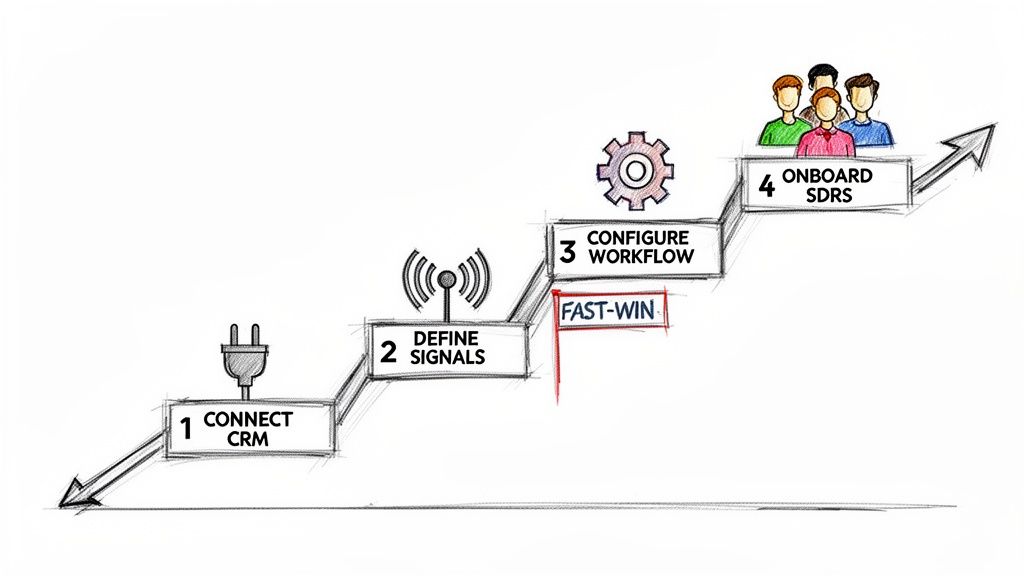
The best bet is to choose tools that live entirely inside your CRM, whether that's Salesforce or HubSpot. This kills the friction of context-switching. When you roll it out, start small with a single use case that gives them a quick win, show them exactly how it saves time, and connect its use to the metrics they care about, like booked meetings.


Ready to transform your sales team's productivity? marketbetter.ai turns buyer signals into a prioritized SDR task engine with AI-powered email and calling—all inside your CRM. Get your demo at https://www.marketbetter.ai.

A Guide to AI Sales Assistants for High-Performing SDRs

· 22 min read

Let's cut through the noise. When you hear "AI sales assistant," don't picture a robot replacing your top SDR. It's not about that. The reality is much more practical—and a lot more powerful.

What Are AI Sales Assistants and Why Do They Matter Right Now?

Think of an AI sales assistant as an execution engine that lives right inside your CRM, whether that's Salesforce or HubSpot. Its job is brutally simple: take all the data, buyer signals, and noise, and turn it into a clear, prioritized list of actions for your reps. It’s the co-pilot that handles the grunt work so your sellers can focus on selling.

This isn't just another nice-to-have tool. It's become essential. Your SDRs are probably drowning in admin tasks—logging calls, researching prospects on LinkedIn, and just trying to figure out who to contact next. The AI assistant slices right through that chaos.

To make this actionable, let's compare a standard CRM to one enhanced with an AI assistant.

A standard CRM, on its own, is like a map. It shows you all the possible leads, but it doesn't tell you the best route to your destination (hitting quota). An AI sales assistant acts like a GPS for that map. It does a few critical things:

  • Analyzes real-time traffic: It monitors buyer signals like website visits, content downloads, or email opens.
  • Finds the fastest route: It prioritizes the leads most likely to convert right now, showing you the most efficient path to a closed deal.
  • Warns you about dead ends: It helps de-prioritize unresponsive or disqualified leads so reps don't waste time.
  • Gives you turn-by-turn directions: It serves up the "next best action" for your rep, removing all guesswork.

This shift from a passive database to an active guide is what eliminates the wasted time that plagues most sales floors.

The Big Shift Toward Intelligent Automation

The explosion of these tools isn't a random trend. It's a direct answer to a sales world that can't afford to have expensive sellers buried in manual data entry. We need smarter, more efficient workflows, and that need is driving insane growth. The market for this software is set to jump from USD 3.46 billion in 2026 to a wild USD 20.5 billion by 2035.

This isn't just hype. Modern AI can finally deliver on its promises inside the messy reality of B2B sales. If you want to dig deeper into the "why now," this podcast on why AI could replace your sales team is worth a listen, as it unpacks how these roles are fundamentally changing.

The real magic of an AI sales assistant isn't just automation. It’s prioritization at scale. It makes sure every single action a rep takes is the most strategic one they could be taking at that exact moment—based on data, not just a gut feeling.

At the end of the day, these assistants are about making your human talent better. By taking over the repetitive, soul-crushing tasks, they free up your SDRs to do what they were hired for: building relationships, having real conversations, and closing deals. And that's how you build a high-performing sales team today. Learn more about how to apply AI for sales prospecting in our deep-dive guide.

Comparing AI Sales Assistants to Your Existing Sales Tools

Your sales stack is probably crowded. With so many tools promising to boost productivity, it’s fair to ask where another one could possibly fit. Is an AI sales assistant just a fancier email writer? Or another flavor of your sales engagement platform?

The short answer is no. It fills a very specific—and very important—gap that other tools simply weren't built to address.

The key difference is that a true AI sales assistant is execution-focused and CRM-native. It isn't another tab your reps have to open. Instead, it lives right inside Salesforce or HubSpot to turn buyer signals into immediate, actionable tasks. That subtle shift, from a separate app to an embedded co-pilot, completely changes how your SDRs work.

This map gives you a good visual of how it all connects.

As you can see, the assistant’s whole job is to automate the grunt work, surface the next best action, and deliver insights without making the rep leave their main workspace.

Let's break down how this is different from the tools you're already using.

AI Assistants vs. AI Email Writers

Plenty of sales teams use AI tools like HubSpot's Breeze Assistant to draft email copy. These are great for getting past writer's block or quickly spinning up a first draft. But at their core, they're content creation tools.

An AI email writer helps you answer the question, "What should I write?"

An AI sales assistant answers a much bigger question: "Who should I contact right now, why should I contact them, and what's the fastest way to get it done?"

Actionable Comparison: An AI writer can help you polish a follow-up email. By contrast, an AI sales assistant sees that a key prospect just hit your pricing page, automatically creates a "High-Priority Follow-Up" task in your CRM, drafts a smart email that references their visit, and queues it up for your rep to send with a single click. No context switching, just action.

AI Assistants vs. Sales Engagement Platforms

Sales Engagement Platforms (SEPs) like Salesloft or Outreach are absolute beasts for managing large-scale outbound sequences. They’re designed for structured, multi-step campaigns and are fantastic for casting a wide net.

But their focus is on the pre-planned sequence, not on reacting to new buyer signals in real time. Reps end up living inside the SEP, which often leads to annoying data sync issues and a workflow that feels disconnected from your CRM—the actual system of record.

An AI sales assistant doesn't replace your SEP; it makes it smarter. It acts as the intelligent front-end that tells your sequences who to engage right now, ensuring reps strike at the moment of peak interest.

AI Assistants vs. Standalone Dialers

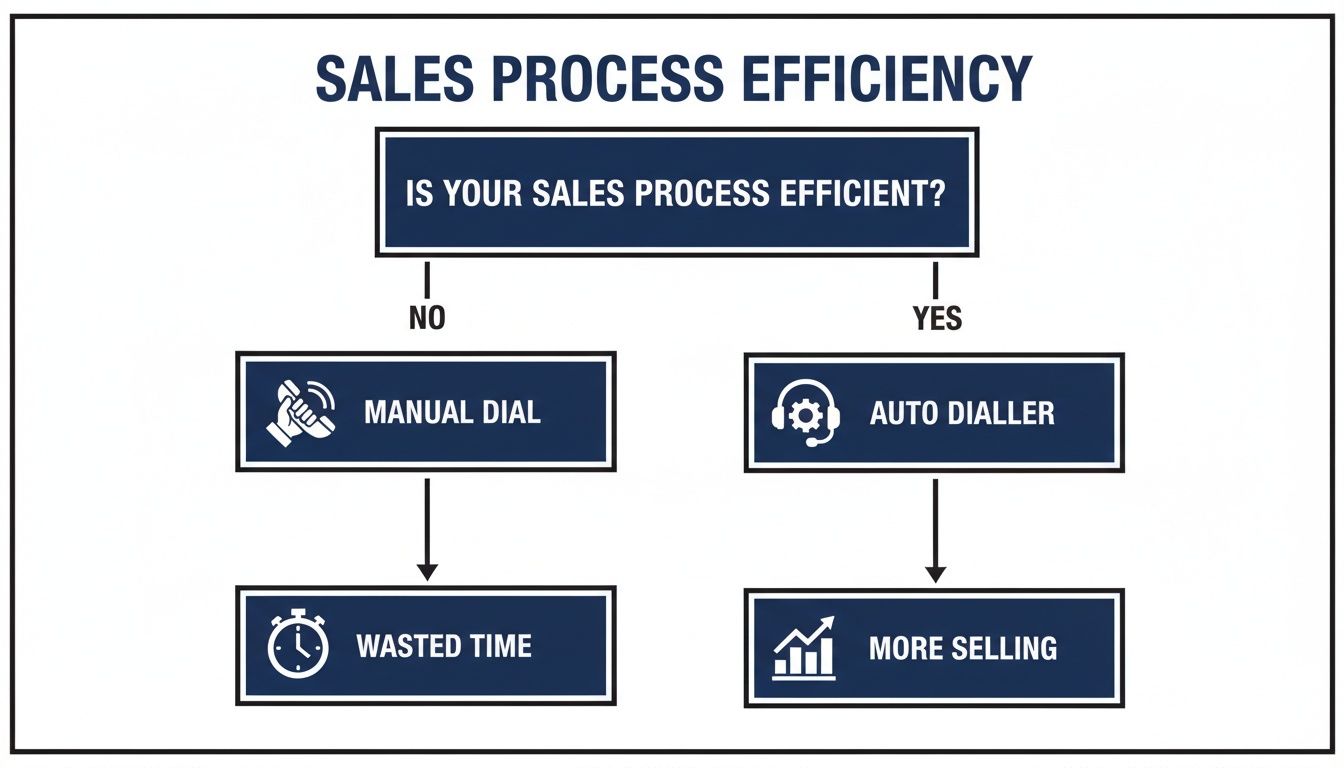
Standalone dialers are built to do one thing: make a ton of calls, fast. They excel at that. Their biggest limitation, however, is that they're isolated. They’re another app, another login, and another place where reps have to manually log call notes and outcomes back into the CRM. All that friction leads to messy data and wasted time.

An AI sales assistant with a CRM-native dialer completely eliminates this problem. The dialer is just part of the workflow. A rep sees a prioritized task, clicks to call directly from the contact record, and the assistant automatically logs the call, outcome, and notes. No more app-switching.

To make these differences crystal clear, here’s a quick comparison of how these tools stack up.

AI Sales Assistants vs Standard Sales Tools

Tool CategoryPrimary FunctionWorkflow IntegrationKey Limitation Addressed by AI Sales Assistants
AI Email WriterGenerates email copy based on prompts.Often a separate tool or feature within a larger platform.Lacks context-driven task prioritization and seamless CRM execution.
Sales Engagement Platform (SEP)Manages and automates pre-built outreach sequences.A separate platform that syncs with the CRM, but reps work within the SEP UI.Relies on static sequences rather than dynamic, real-time buyer signals.
Standalone DialerFacilitates high-volume calling.A separate application requiring manual data transfer back to the CRM.Creates workflow friction and leads to inconsistent activity logging.
AI Sales AssistantPrioritizes tasks and assists with execution.CRM-native, embedding tasks, email, and calling directly into Salesforce or HubSpot.Unifies the workflow, eliminates app-switching, and ensures perfect data hygiene.

When you look at it this way, you can see that AI sales assistants aren't here to replace your stack. They're here to provide the intelligent execution layer it's been missing, finally connecting the dots between your data, your tools, and your reps' daily actions.

The Core Capabilities That Supercharge SDR Productivity

So, beyond the buzzwords, what does an AI sales assistant actually do to make a sales development representative (SDR) more effective? The real magic isn't in one killer feature. It's how a few core capabilities work together to take the friction and guesswork out of an SDR's day, freeing them up to have more, better conversations.

Think about the typical salesperson's day. It's a mess of non-selling activity. One recent analysis found that reps spend just 25% of their time actually selling. The other 75% gets eaten up by manual data entry, prospect research, and logging notes in the CRM.

This is exactly where AI assistants step in. They can automate up to 65% of that administrative slog and cut the time spent on manual work by 40%. The result? Teams often see a 25% jump in sales productivity and find 25-35% more qualified leads.

The Prioritized Task Engine

The single biggest time-waster for most SDRs is staring at a long list of leads and asking, "Okay, what now?" They scroll through their CRM, check their inbox for replies, and try to stitch together a plan for the day. It's inefficient and riddled with missed opportunities.

A core feature of any modern AI sales assistant is a prioritized task engine. This isn't just another to-do list. It's a dynamic, living queue that pulls in buyer signals from all over the place—website visits, content downloads, CRM data, and third-party intent signals—to automatically build and rank the next best actions.

  • Pain Point Solved: It kills indecision and "analysis paralysis."
  • Actionable Example: Instead of a generic list of 100 leads to call, the AI surfaces a single task: "Call Jane Doe at Acme Corp. She just viewed the pricing page for the second time this week." The rep knows exactly who to call, why, and has the context to open the conversation with confidence.

An engine like this transforms your CRM from a passive library of data into an active coaching tool. It serves up the "next best action" based on what's happening right now, making sure reps are always focused on the accounts most likely to engage.

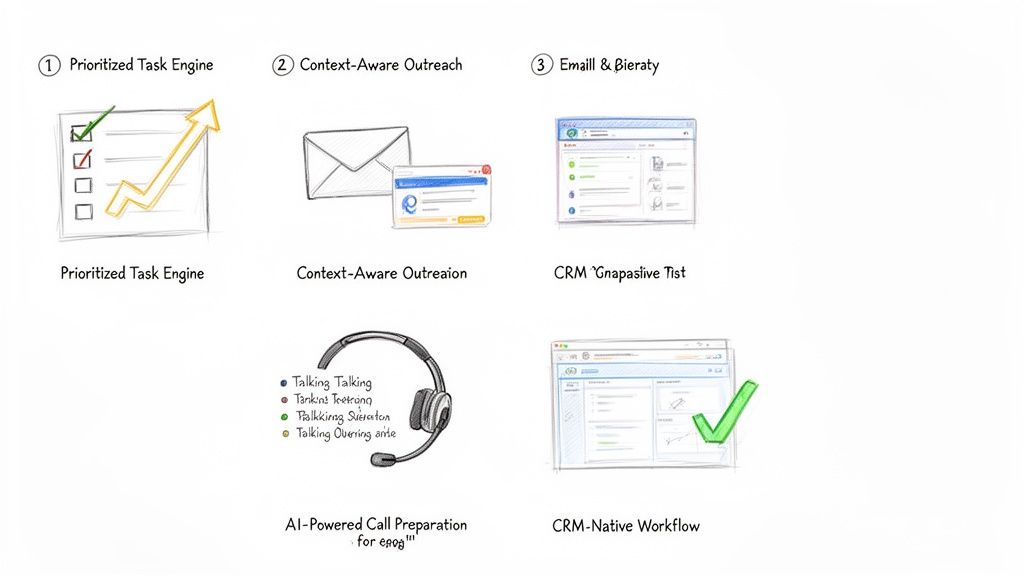
Diagrams illustrating AI-powered sales tools, including prioritized tasks, context-aware outreach, call preparation, and CRM workflows.

The real power here is the blend of clarity and context. The rep doesn't just see the "what" (call or email); they see the "why" (the buyer just did something important). That's what allows them to act decisively.

Context-Aware AI Outreach

We all know it: generic, templated emails go straight to the trash. Real outreach needs to be relevant. But who has time to write dozens of highly personalized messages every single day? It's a massive time sink.

AI sales assistants fix this with context-aware AI outreach. The system connects directly to your CRM and pulls in key details—the prospect’s title, their industry, recent activities, or past account history—to draft hyper-relevant emails and call scripts on the fly. It's not just generating random copy; it's using your own data to make the message land.

  • Pain Point Solved: It crushes writer's block and the temptation to blast out generic messages.
  • Actionable Example: Let's say the prospect is in manufacturing. The AI drafts an email that references a common challenge for plant managers, pulls in a link to a relevant case study, and suggests a specific, pointed call to action. The SDR just has to give it a quick review, maybe add a personal touch, and hit send.

AI-Powered Call Preparation

Nothing kills a cold call faster than a rep who sounds like they're winging it. Fumbling for information or getting stumped by a basic objection destroys credibility in seconds. This is why the best platforms now include AI-powered call preparation.

Before a rep even picks up the phone, the assistant generates a quick, scannable brief. It includes key talking points, likely objections with suggested responses, and the latest company news or LinkedIn activity. If you want to go deeper on this, we've covered how to streamline your workflow with AI sales call prep automation in another guide. This feature turns what used to be a 15-minute research task into a 30-second review.

CRM-Native Workflow

Finally, and this might be the most important part, is the CRM-native workflow. Too many sales tools force reps to live in a nightmare of open tabs: the CRM, the dialer, their email client, a research window. Every time they switch contexts, they lose a little focus and momentum. Worse, data gets lost along the way.

An AI sales assistant that lives inside your CRM—whether that's Salesforce or HubSpot—keeps reps in one place. They can click-to-call, send an AI-drafted email, and log every touchpoint without ever leaving the contact record. This simple change ensures every single activity is captured perfectly, which gives sales leaders a crystal-clear picture of what's working and keeps the CRM the undisputed source of truth.

A Practical Guide to Implementing an AI Sales Assistant

Bringing new tech into the sales floor can feel like open-heart surgery. Productivity is on the line, reps are skeptical, and nobody has time for a three-month science project. But rolling out an AI sales assistant isn't like that. It’s less of a massive overhaul and more like giving your team a cheat sheet.

The key is to aim for quick, noticeable wins. We're not talking about a "rip and replace" of your CRM. This is about adding a layer of intelligence right on top of what you already use, making your SDRs smarter and faster from day one. A good rollout plan cuts through the noise and gets your team productive, fast.

A four-step sales process diagram showing 'Connect CRM', 'Define Signals', 'Configure Workflow', and 'Onboard SDRS'.

Here’s a simple, four-step playbook to get it done right.

Step 1: Securely Connect Your CRM

Everything starts here. An AI sales assistant is only as good as the data it can access, which means it needs a solid, secure connection to your CRM—whether that’s Salesforce or HubSpot. Think of your CRM as the central nervous system of your sales motion; the assistant needs to plug directly into it.

Actionable Tip: Before connecting, perform a quick data audit. Check for duplicate contacts or outdated account information. Clean, reliable CRM data is the fuel for the AI engine; a bad connection or messy data will starve it before it can even get started. This part is usually simple, often using secure OAuth. Loop in your RevOps or IT team to confirm the tool gets read-and-write access to the right objects—Leads, Contacts, Accounts, and Activities.

Step 2: Define Your High-Impact Buyer Signals

Once you're connected, you have to tell the AI what to look for. What are the tell-tale signs that a prospect is ready for a conversation? Don't try to boil the ocean. Start with just a handful of high-impact triggers that are easy to spot and even easier to act on.

Actionable Tip: Pick signals that scream "intent" and map directly to a specific SDR action. Start with these three:

  • Website Engagement: A prospect from a target account hits your pricing page.
  • Content Downloads: Someone from a key account downloads a bottom-of-funnel case study.
  • Time-Based Triggers: It’s been 90 days since you last talked to a high-value account.

The goal is simple: turn your sales playbook's "if-then" logic into automated triggers. If a prospect does X, the AI creates a task for an SDR to do Y. This gets reps out of the business of manual monitoring for good.

Step 3: Configure Your First High-Value Workflow

Now it's time to build something. For your first workflow, pick a simple, high-impact use case that solves an SDR's biggest daily headache: figuring out who to call next. An AI-prioritized task list is the perfect place to start.

Actionable Tip: Configure the assistant to take the signals from Step 2 and automatically create and rank tasks. For example, a "Pricing Page Visit" signal should instantly generate a "High-Priority Call" task, complete with context about what that person looked at. This first workflow needs to feel like an immediate upgrade from a generic CRM task list. It’s a quick win that proves the tool's value by saving SDRs time and pointing them straight to the warmest leads. For a deeper look at how this fits into your tech strategy, check out the build vs. buy debate for your AI SDR stack.

Step 4: Onboard and Coach Your SDRs

A tool is only as good as its adoption. A great rollout starts with the "why," not the "how." Show your SDRs that this assistant is here to kill their most boring tasks so they can focus on what matters—and hit their numbers faster.

  1. Launch with a Pilot Group: Start small. Pick a few of your most motivated SDRs to be the pioneers. Their feedback and success stories will build momentum and help you iron out the kinks before going team-wide.
  2. Focus on One Workflow: In the first training session, talk only about the prioritized task list. For the first week, their only job is to work through their new, intelligent to-do list. Nothing else.
  3. Provide a Cheat Sheet: Give them a one-page guide that shows the new workflow. Make it visual, simple, and focused on the exact actions they need to take.
  4. Coach, Don't Just Manage: Use your 1:1s to review their AI-powered task list. Ask questions like, "Why do you think the AI flagged this account?" This builds their trust in the system and reinforces the data-driven mindset.

Measuring the ROI of Your AI Sales Assistant

Look, any time you bring a new tool into the sales floor, the CFO is going to ask one question: "What's the ROI?" It's not enough to say the team feels more productive. You need to show leadership the hard numbers that connect the dots between the software and real business results.

To build a rock-solid business case, you have to move past vanity metrics. The trick is to track KPIs across three critical areas, showing a clear progression from daily rep activity all the way to bottom-line pipeline growth.

Activity and Efficiency Gains

The first place you'll see a return is in pure, raw output. An AI sales assistant is built to kill the tedious, time-sucking tasks that drain an SDR's day. We're talking about removing the friction that keeps them from their most important job: selling.

Actionable Metrics to Track:

  • Daily Outbound Actions Per Rep: How many calls are they making? How many emails are they sending? Compare the before-and-after numbers. A good task engine should light a fire under these metrics.
  • Time Spent on Manual CRM Logging: This one is huge. When call notes, outcomes, and task updates log automatically, you get time back. Even saving 30 minutes per rep per day adds up to a massive payroll saving across the team.

The real goal here is to quantify reclaimed time. If your AI assistant helps each SDR make 15 more calls and send 20 more emails every single day, you have a direct, powerful metric that proves its value from week one.

Quality and Engagement Improvements

More activity is great, but smarter activity is what wins deals. This is where an AI sales assistant starts to separate itself from a simple dialer. It gives reps the context they need, right when they need it, so they can have truly relevant conversations.

Actionable Metrics to Track:

  • Connect Rate: When reps call a prospect the moment they hit the pricing page, guess what? More people pick up the phone. You're no longer just burning through a cold list; you're calling with intent.
  • Meeting Booked Rate: Keep a close eye on the percentage of conversations that turn into a booked discovery call. Higher-quality outreach and better talking points should push this number up.

This is where the assistant's intelligence really pays off. It's arming your reps with AI-powered talking points and objection-handling tips, helping them turn more cold "hellos" into qualified meetings.

Pipeline and Revenue Impact

At the end of the day, every sales tool lives or dies by its ability to generate pipeline. This is the final, most important piece of the ROI puzzle. While more calls and better conversations are great leading indicators, new pipeline is the metric that gets executives to sign the check.

Actionable Metrics to Track:

  • Qualified Opportunities Sourced: How many new, sales-accepted opportunities is the SDR team generating? This is the clearest measure of their contribution to the business.
  • Sales Cycle Velocity: Track how quickly leads sourced by the AI assistant move through the early funnel stages. Faster is always better.

Actionable Tip: Build a custom dashboard in Salesforce or HubSpot. Create a report that pits a group of SDRs using the assistant against a control group that isn't. Tracking their KPIs side-by-side creates a powerful, data-backed story that leaves no doubt about the tool's impact on the bottom line.

Common Questions on AI Sales Assistants

Even with all the excitement, it's smart to ask tough questions before bringing a new tool into your sales motion. Here are the straight answers to the questions sales and RevOps leaders ask us most.

Will an AI Sales Assistant Replace My SDRs?

Absolutely not. The real goal is to make your existing team better, not smaller. An AI sales assistant is like a co-pilot for each rep, handling the soul-crushing admin work that eats up their day—logging calls, updating fields, and basic research.

This frees your SDRs to do what humans do best: build real relationships, have smart conversations, and crush their quota. Think of it as giving every rep a personal operations assistant, allowing them to be more strategic and way more effective.

We Already Use a Sales Engagement Platform. Do We Need This Too?

Yes, because they solve two different problems that actually feed each other. A Sales Engagement Platform (SEP) like Salesloft or Outreach is fantastic for building and managing long-term, pre-planned sequences. It’s a system for campaigns, but it forces reps to live in a separate tab, pulling them away from their CRM.

An AI sales assistant is the execution layer that sits inside your CRM and makes your SEP sequences even smarter. While your SEP runs the long-term plan, the assistant uses real-time buyer signals to tell reps the single most important action to take right now. It helps them execute that call or email instantly from within Salesforce or HubSpot and logs everything perfectly, closing the gap between your planned campaigns and the opportunities that pop up today.

How Do AI-Generated Emails Avoid Sounding Robotic?

The good ones don't use generic templates. The key is the data they pull from. Instead of working off a simple prompt, a modern AI assistant dives deep into your CRM, analyzing account history, buyer personas, recent company news, and past conversations.

The best platforms don't just spit out a finished email. They provide a smart first draft that the SDR can review and tweak in seconds. This preserves their unique voice and expertise while still saving a ton of time.

This ensures the outreach is hyper-relevant right from the get-go, not just another piece of generic spam.

How Quickly Can We Expect to See a Return on Investment?

You'll see an immediate ROI on pure efficiency, often in the first few weeks. This shows up as a jump in the number of outbound activities per rep, per day, and a massive improvement in your CRM data quality as tasks like call logging get automated.

The bigger, strategic ROI—the stuff your CFO cares about, like more pipeline and revenue—starts to become clear within one to two quarters. That's the result of your reps consistently connecting with more of the right people and turning those conversations into qualified meetings. We always suggest tracking the initial efficiency gains first, then mapping them directly to pipeline growth to build an undeniable business case.


Ready to stop the busywork and start building more pipeline? marketbetter.ai turns buyer signals into prioritized tasks and helps your SDRs execute instantly with an AI-powered dialer and email writer inside Salesforce and HubSpot. Learn more and book a demo.

A Guide to Automated Dialler Software for Sales Teams

· 24 min read

Imagine your best sales rep is stuck playing switchboard operator for half the day. Manually digging up numbers, dialing, waiting, listening to voicemails, and then logging every single attempt. It’s a soul-crushing grind and the exact problem that automated dialer software was built to solve.

At its core, this software is a strategic lever that takes the entire outbound calling process off your reps' plates, freeing them up to focus on what they were hired to do: have high-value conversations.

What Is Automated Dialer Software?

Think of automated dialer software as an intelligent system that surgically removes all the manual, repetitive junk from an SDR's workflow. Instead of reps burning precious minutes on admin, the software handles the dialing and only connects them when a real, live human picks up the phone.

It transforms a slow, clunky process into a high-speed workflow for generating conversations.

A manual setup is like a messy workshop. A rep has to find the raw materials (the contact number), operate the machinery (dial the phone), wait for it to run (the ringing), and then package the final product (log the call). An automated dialer turns this into a clean assembly line, handling the first three steps instantly and delivering a ready-to-talk prospect right to your rep.

This shift has a massive impact on daily output. Industry studies consistently show that sales reps spend only about 30% of their time actually selling. The rest gets eaten up by non-revenue tasks like data entry and call prep—precisely where a dialer creates its value.

How The Automation Process Works

The magic behind the software is simple but incredibly powerful. It connects to a list of contacts, usually sitting in your Customer Relationship Management (CRM) system, and starts placing calls for your reps. As soon as a person answers, the system instantly routes the call to an available agent.

This solves several critical pain points in one go:

  • No More Manual Dialing: Reps aren't typing or clicking numbers anymore. Those seconds saved on every single attempt add up fast.
  • Filters Out the Noise: The system automatically weeds out busy signals, disconnected numbers, and voicemail boxes. Reps only spend time with live prospects.
  • Kills Idle Time: By teeing up the next call the second one ends, the software wipes out the downtime between conversations, keeping reps in a productive rhythm.

The whole point of this technology is workflow optimization. It’s not just about making more calls; it's about radically increasing the number of meaningful conversations per hour by removing every last bit of friction from the process.

Comparing Manual vs. Automated Dialing

Let’s make this real. A sales rep dialing by hand might muscle through 60-80 calls in a day. Most of that time is spent listening to phones ring and fumbling around in the CRM. It’s a slog.

Now, give that same rep automated dialer software. They can easily triple that volume. But more importantly, the quality of their time skyrockets. They aren't just making more dials; they're having more conversations.

This efficiency lets teams cover more ground, follow up relentlessly, and build more pipeline without having to hire more people. The entire focus shifts from "How many numbers can I dial?" to "How many meetings can I book?"—which is the only metric that really matters.

Comparing the Different Types of Automated Diallers

Picking the right automated dialler isn't about grabbing the one with the most bells and whistles. It's about matching the tech to your sales motion. A high-octane dialer built for a hundred calls an hour will absolutely crush a team doing deep, research-heavy outreach. On the flip side, a one-call-at-a-time system is a guaranteed bottleneck for a team that lives and dies by call volume.

The first step is understanding the core logic behind each type. They're all built for different jobs—some for pure speed, others for rep focus, and the best ones for deep, seamless workflow integration.

This isn't just a minor upgrade; it's a fundamental shift in how a sales floor operates. Moving from manual dialing to an automated system is the first real step toward a truly efficient workflow.

Flowchart illustrating sales process efficiency, comparing manual dialing leading to wasted time with auto dialler for more selling.

As you can see, sticking with the old way—clicking numbers one by one—is a direct path to wasted time. Adopting an auto dialler clears the runway, giving your reps more time for what actually matters: selling.

Predictive Diallers: The Volume Kings

Think of predictive diallers as the speed demons of the calling world. They use an algorithm to dial multiple numbers for every single available agent, gambling on when a rep will be free to take the next live conversation. The entire system is engineered to slash agent idle time to almost nothing.

But that raw efficiency has a sharp edge. If two people pick up before an agent is free, the system has to drop one of them. That "ghost call" creates a terrible experience for a potential customer and can land you in hot water with compliance regulations.

The demand for this kind of speed is undeniable. The global predictive dialer market was valued at USD 3.20 billion in 2024 and is expected to grow at a blistering 42.3% CAGR from 2025 to 2030. It's a massive market for a reason, but it's not a fit for everyone.

Power and Progressive Diallers: The Pacesetters

For a more controlled rhythm, you have power diallers. The logic here is simple and effective: as soon as a rep hangs up, the system immediately dials the next number on the list. No predictive algorithm, just a steady, sequential cadence that keeps reps focused and moving.

Progressive diallers are a slight but important variation. They also dial one number at a time for each rep, but they pop the contact's record on screen just before the call connects. This gives the rep a precious few seconds to scan key details and add context to the conversation without killing the momentum.

The Modern Choice: The In-CRM Dialler

For most modern sales teams, the smartest move is the In-CRM Dialler. This isn't a standalone piece of software you have to patch into your workflow. Instead, it operates as a native function right inside your CRM, like Salesforce or HubSpot. It turns your CRM from a simple database into the central command center for your entire outbound operation.

The whole point of an In-CRM Dialler is to kill context switching. Your reps live in one system. They work from a prioritized task list, click a button to call, log the outcome, and instantly move to the next task—all without ever leaving the CRM.

This approach is a massive win for efficiency, but its real superpower is data hygiene. Every call, every note, every outcome is automatically and perfectly logged to the right record, every single time. No exceptions.

Automated Dialler Comparison Chart

To make the decision crystal clear, it helps to see how these diallers stack up side-by-side. Each one has a time and a place, but for a typical B2B sales team, the differences are stark.

Dialler TypeHow It WorksIdeal ForProsCons
PredictiveDials multiple numbers per agent, connecting only live answers.High-volume, low-complexity B2C call centers where talk time is the only KPI.Maximizes agent talk time and raw call volume like nothing else.High risk of dropped calls, which annoys prospects and can lead to compliance issues.
PowerDials one number immediately after the previous call ends.SDRs who need to maintain a consistent, fast pace through a targeted list.Wipes out manual dialing and keeps reps in a productive rhythm.Can feel relentless and leaves no room for pre-call prep.
ProgressiveDials one number at a time, showing the contact record just before the call.Sales teams that need a moment for context before each dial.Balances speed with the context needed for more thoughtful outreach.Slower than a power dialer, which means a lower daily dial count.
In-CRM DiallerReps execute calls from a task list directly inside the CRM.Any B2B sales team that lives in their CRM (e.g., Salesforce, HubSpot).Guarantees perfect data logging and eliminates all context switching.Its effectiveness is tied to the quality of your CRM data and workflows.

While these four are the main players, you'll sometimes run into more specialized tools. For instance, voice broadcast software lets you send pre-recorded messages to large lists automatically. But for the day-to-day grind of B2B sales, your decision will almost always come down to one of the core four diallers we've compared here.

What Makes a Modern Dialer Actually Work?

A great automated dialer isn't just about making more calls; it's a productivity engine for your sales team. The real difference between a basic tool and something that truly multiplies performance comes down to a core set of features. These are the tools designed to erase friction and keep reps focused on what they do best: having high-value conversations.

When you're looking at different options, it's easy to get distracted by flashy add-ons that don't actually move the needle. The features that really matter are the ones that slide right into a rep's daily workflow, making their job faster, simpler, and way more effective. Let's break down the non-negotiables.

Icons representing essential dialler features: Click-to-Dial, Automatic Call Logging, Voicemail Drop, Local Presence, Call Disposition.

Core Workflow Accelerators

These are the foundational pieces that give you immediate time back and, just as importantly, keep your CRM the single source of truth. Think of them as the automation that kills manual drudgery, freeing up your reps to focus purely on selling.

  • Click-to-Dial from the CRM: This is the absolute baseline. Instead of fumbling with copy-pasting or manually typing numbers, reps just click a button in Salesforce or HubSpot. That tiny action saves 5-10 seconds per dial, which quickly adds up to hours of reclaimed selling time every single week.

  • Automatic Call Logging: Manually logging calls is a notorious productivity black hole and the number one reason CRM data gets messy. A modern dialer must automatically log every single attempt, conversation, and outcome to the right contact record. This is how you get activity reports you can actually trust for coaching and forecasting.

  • Configurable Call Dispositioning: After a call, a rep needs to tag the outcome with a single click—"Connected," "Left Voicemail," "Meeting Booked." These dispositions are mission-critical for triggering the next step, like adding a prospect to a follow-up sequence or taking them off a list. It’s how you make sure no lead ever slips through the cracks.

High-Impact Productivity Boosters

Once you've automated the core workflow, the next layer of features is all about making every dial count. These tools directly juice up key metrics like connect rates and conversation quality, turning good outreach into great results. A solid dialer makes it easy to learn more about advanced cold calling techniques to really level up performance.

One of the biggest time-sinks for any SDR is leaving voicemails. Voicemail Drop is the antidote. It lets reps leave a perfectly recorded, studio-quality message with a single click. The second they hear the beep, they click "drop," and the system leaves the message while the rep is already dialing the next number.

This isn't just a time-saver; it’s about consistency. Every prospect gets the exact same polished, on-brand message, freeing up your reps' mental energy for the live conversations that matter.

Another game-changer is Local Presence Dialing. This tech automatically shows a local area code when calling a prospect, which has been proven to boost answer rates by as much as 400%. People are just far more likely to pick up a number they recognize, giving your team a much better shot at actually starting a conversation.

Advanced Capabilities and Integrations

Top-tier dialers don't just stop at making calls; they help you analyze and coach on them, too. Call recording is pretty standard, but the real value is in how you use it. Managers can jump into recordings to pinpoint coaching opportunities or share examples of a perfect pitch with the rest of the team.

Many modern platforms also bring in advanced tools like speech-to-text to make sense of all those recordings. You can check out a great professional's guide to speech to text software to see how deep this technology goes. It can automatically transcribe calls, making it dead simple to search for keywords, spot trends, and give reps specific, actionable feedback. This turns your call recording archive into a priceless coaching library.

Why Deep CRM Integration Is a Non-Negotiable

Let's be blunt: an automated dialer that lives outside your CRM is a recipe for operational chaos. Raw dialing speed and flashy features might look good on a demo, but they mean absolutely nothing if the tool forces your reps to constantly jump between screens.

This is where deep, native integration stops being a nice-to-have and becomes the single most critical factor for success.

Think about a sales rep’s day. It’s a relentless cycle of researching, calling, and logging notes. A standalone dialer shoves another clunky step right in the middle of that flow. The rep has to export a list from the CRM, import it into the dialer, make their calls, and then—if you’re lucky—manually dump the results back into the CRM. This workflow is fundamentally broken.

The real killer here is context switching. Every time a rep has to toggle between their CRM and a separate dialing app, they lose focus and momentum. It might feel like a tiny interruption, but multiply that by hundreds of calls a day, and you're looking at a massive productivity sinkhole.

The True Cost of a Disconnected Workflow

In the world of sales operations, there's a simple mantra that holds true: "If it's not in Salesforce, it didn't happen." When your automated dialer software operates on its own island, your CRM data integrity immediately starts to crumble.

Standalone tools almost always lead to the same set of crippling problems:

  • Poor Adoption: Reps are wired to find the path of least resistance. If a tool makes their job more complicated, they'll find a way around it, reverting to old, less efficient habits that feel easier in the moment.
  • Messy Data: Manual call logging is a disaster waiting to happen. Reps forget to log calls, enter the wrong disposition notes, or simply don't have the time between dials. The result is an incomplete and untrustworthy picture of your sales activity.
  • Broken Workflows: Your RevOps team builds sophisticated processes that depend on accurate data triggers. A disconnected dialer snaps those chains, killing automated follow-up sequences, lead routing, and everything else that relies on good data hygiene.

On the other hand, a dialer that lives and breathes inside your CRM turns it into the central nervous system for all outbound activity. It becomes the single source of truth, not just a passive database. This alignment unlocks a powerful, frictionless workflow that actually drives results.

An in-CRM dialer isn't just a feature; it’s a strategy. It prioritizes the rep's workflow above all else, recognizing that seamless execution is the key to unlocking sustainable ROI from your sales tech stack.

How In-CRM Execution Changes Everything

When the dialer is part of the CRM, the whole game changes. Reps no longer see two separate tools; they see one unified workspace designed to make them faster and smarter. This tight integration delivers real, tangible benefits across the entire revenue team.

For Sales Reps The biggest win is working from a single, unified task list. Reps see their prioritized calls for the day, click a button to dial directly from the contact record, and log the outcome—all without ever leaving their CRM screen. This keeps them in a state of flow, which means more focus and better conversations. You can see how this ripples across the entire customer lifecycle by understanding customer data platform integration strategies.

For Sales Managers Suddenly, managers get accurate, real-time reporting they can actually trust. Since every single call is automatically logged with a precise timestamp and disposition, they can see what’s really happening on the ground. This data is gold for coaching, performance reviews, and building a forecast that isn't just a wild guess.

For RevOps Teams RevOps can finally build and maintain a clean, reliable data environment. Automated logging ensures every touchpoint is captured correctly, providing the pristine data needed for attribution models, workflow automation, and strategic planning. This is where you see efficiency gains really start to multiply. In fact, some sources suggest that predictive dialer software can boost agent productivity by as much as 300% just by cutting out wasted time.

How to Choose the Right Automated Dialler for Your Team

Picking the right automated dialer is more than just a software purchase. It's a strategic bet on your team's productivity. The market is absolutely flooded with options, and it’s way too easy to get lost in a sea of feature lists that don't actually solve your core problems. To make a smart call, you need a clear, no-nonsense evaluation framework.

This guide is your step-by-step vendor scorecard. We’ll cut through the marketing fluff by focusing on five critical criteria. The goal is to help you find a partner whose tech actually fits your day-to-day sales process, ensuring your team actually uses it and you see a real return.

A hand-drawn vendor scorecard showing ratings for CRM integration, user experience, and support.

1. Depth of CRM Integration

Let's be blunt: this is the single most important factor. How deeply does the automated dialer software actually live inside your CRM? A surface-level integration that just logs calls isn't good enough. It creates data chaos and forces reps to constantly switch between tabs, which kills momentum and guarantees poor adoption.

True integration means the dialer drives workflows within the CRM. Your reps should live in Salesforce or HubSpot, hammering out their call blocks from a prioritized task list without ever leaving their main screen. This is the only way to ensure perfect data hygiene and max out their efficiency.

Critical Questions to Ask Vendors:

  • "Show me, click-by-click, how a rep runs their entire call block without leaving the CRM."
  • "How do your call dispositions automatically kick off the next step in our sequence?"
  • "Can you demonstrate your dialer updating custom fields on our contact records in real-time?"

2. User Experience and Adoption

The most powerful features in the world are completely useless if your team finds them clunky or confusing. The user experience (UX) has to be so intuitive that a brand-new Sales Development Representative (SDR) can get the hang of it in less than an hour. Anything more complicated is an adoption killer. Period.

Look for a clean, simple interface that screams "next best action." The whole point is to remove cognitive load, not add to it. A great UX lets reps focus on the conversation, not on fighting the software.

Your dialer should feel like a natural extension of the CRM, not a bolted-on accessory. If it takes more than a few clicks to start a call, log an outcome, and jump to the next task, the workflow is fundamentally broken.

3. Reporting and Analytics

You can't fix what you can't see. A solid dialer gives you clear, actionable analytics that tell you what’s really working. You need to get past vanity metrics like "dials made" and zero in on the data that actually builds pipeline.

The reporting should be easy to pull up and customize. Can you quickly build a dashboard showing connect rates by time of day? Can you A/B test the performance of different call scripts? The right analytics turn managers into better coaches and give RevOps the insights they need to fine-tune the entire sales motion.

Key Metrics to Track:

  • Dials-to-Connection Rate: How many dials does it take to get a human on the line?
  • Conversations per Hour: What’s the real conversational output for each rep?
  • Connection-to-Meeting Rate: Of the conversations you're having, how many turn into booked meetings?

4. Scalability and Future-Proofing

Your team is going to grow, and your process will change. The automated dialer software you pick today needs to be able to handle your team tomorrow. This isn't just about tech—it’s about the business model, too.

Will the platform choke when you add more users and ramp up call volume? How does the pricing change as you scale? Look for a partner with a transparent product roadmap and a track record of listening to customers. You aren't just buying a tool; you're getting into a long-term relationship.

5. Vendor Support and Implementation

Getting your team up and running fast depends entirely on a smooth implementation. A great vendor acts like a partner, not just a software provider. They should offer structured onboarding, solid training resources, and technical support that actually responds.

Before you sign anything, get a clear picture of what the first 90 days will look like. What resources will be available? Who is your go-to person for help? Strong support is often the difference between a tool that collects digital dust and one that becomes the backbone of your sales team's success.

Measuring Success and Avoiding Common Implementation Pitfalls

Putting new automated dialer software in place is the easy part. The real test is knowing if it's actually working and steering clear of the common traps that can sink your investment. Success isn't just about cranking up the call volume; it's about building more qualified pipeline. That means you need to be laser-focused on the right metrics from day one.

The first big mind-shift is moving beyond raw dial count. Sure, seeing that number jump is an early win, but the metrics that truly matter are the ones tied to outcomes. Your job is to get the team focused on what happens after the phone connects.

Defining Your Key Performance Indicators

To figure out the real return on your investment (ROI), your dashboards need to tell a story about both efficiency and effectiveness. The big question is simple: are your reps having more of the right conversations?

  • Connect Rate: This is your dial-to-conversation ratio. If it’s low, you might have a problem with your list quality, the time of day you're calling, or even your numbers getting flagged as spam.
  • Conversations Per Hour: This is a pure productivity metric. It tells you exactly how much dead air the dialer is cutting out for each rep.
  • Meeting-Booked Rate: This is the money metric. Out of all those conversations, how many are turning into actual demos or meetings? This KPI ties your team's activity directly to pipeline.

Focusing only on call volume is a trap. It just encourages reps to burn through calls without thinking. The real goal is to drive up meaningful interactions that lead to tangible sales outcomes.

Common Pitfalls and How to Avoid Them

Even the slickest software will collect dust if it's rolled out poorly. Getting ahead of these common failure points is the key to making sure the tool sticks.

Pitfall 1: Poor Rep Training Just dropping a new tool on your reps and expecting them to figure it out is a recipe for disaster. They need to understand not just how to click the buttons, but why this new workflow is better and how it’s going to help them crush their quota.

  • Actionable Solution: Block off time for hands-on training that’s all about workflows, not just a feature tour. Create quick-reference guides and run role-playing drills to build their confidence. For more ideas, you can check out our guide to effective outbound strategies.

Pitfall 2: Quantity Over Quality If the only thing managers cheer for is high dial counts, reps will quickly learn that speed is all that matters. This leads straight to sloppy conversations, zero discovery, and a terrible meeting-booked rate, completely defeating the purpose of the dialer.

  • Actionable Solution: Build your spiffs, commission plans, and recognition around outcome-based metrics like meetings booked or opportunities created. Use call recordings to coach on quality, not just activity numbers from a dashboard.
Free Tool

Try our AI Lead Generator — find verified LinkedIn leads for any company instantly. No signup required.

A Few Common Questions About Automated Dialers

If you're a sales leader or an SDR evaluating new tech, you've probably got some sharp questions. That's a good thing. Here are the straight answers to the questions we hear most often about automated dialer software.

Power Dialer vs. Predictive Dialer: What’s the Real Difference?

The difference boils down to one thing: control versus raw volume.

A power dialer is your methodical workhorse. It calls one number at a time for one specific rep. This guarantees your SDR is on the line the second a prospect answers, which is crucial for the kind of targeted, high-value B2B conversations where context is everything.

A predictive dialer, on the other hand, is a high-volume machine. It dials multiple numbers at once and uses an algorithm to route any answered calls to the next free agent. While it absolutely maximizes talk time, it introduces the risk of "ghost calls"—when a prospect picks up but no one is there. That’s a fast way to burn your reputation.

For most B2B sales teams running a strategic outbound motion, the focused approach of a power or progressive dialer wins. It strikes the right balance between efficiency and the control you need to have a real conversation.

Will an Automated Dialer Get My Numbers Flagged as Spam?

This is a huge concern, and rightly so. Reputable automated dialer software is built with features to help you avoid this, like local presence dialing and automatic phone number rotation. These tools are designed to keep your caller reputation healthy.

But the software is only half the story. The two most important factors are the quality of your calling list and your team’s discipline in following compliance rules like the TCPA. At the end of the day, smart, responsible calling practices are your best defense against getting flagged.

What Kind of Productivity Lift Can I Realistically Expect?

Teams moving away from dialing by hand often see a 60-300% increase in live conversations per rep, every single day.

The biggest gains don't come from dialing faster, but from clawing back all the hidden time-wasters. Those few seconds spent manually typing a number, clicking around the CRM, and logging a call note might seem small. But add them up, and you're losing hours of prime selling time every week. A dialer gives that time back to your team so they can focus on what they were hired to do: talk to people.


Ready to stop wasting time and start having more conversations? See how marketbetter.ai integrates an AI-powered task engine and an in-CRM dialer to keep your SDRs focused on what matters most—booking meetings. Learn more at marketbetter.ai.