Salesforce Sales Cloud is the most reviewed B2B software product on the planet. 25,415 G2 reviews. 4.4/5 stars. G2's #1 Best Software Product in 2025. Those numbers don't happen by accident.
But aggregate ratings hide the nuance. A CRM that's perfect for a 500-person AE team managing $10M in enterprise pipeline might be terrible for a 5-person SDR team doing outbound prospecting.
This review looks at Salesforce Sales Cloud specifically through the lens of SDR teams and sales development — the people who need to prospect, dial, email, and book meetings, not manage complex deal cycles.
Quick Verdict
| Category | Score | Notes |
|---|
| CRM & Pipeline | 9.5/10 | Industry-leading, unmatched |
| SDR Workflow | 4/10 | Not built for outbound prospecting |
| Pricing Value | 5/10 | Expensive when you add what SDRs need |
| Ease of Use | 5/10 | Powerful but steep learning curve |
| AI Features | 7/10 | Agentforce is promising but early |
| Integration Ecosystem | 10/10 | Nothing compares |
| Overall for SDR Teams | 5.5/10 | Great CRM, mediocre SDR tool |
What Salesforce Sales Cloud Does Exceptionally Well
1. Pipeline Management Is Unmatched
This is Salesforce's home turf. No other CRM gives you this level of pipeline visibility:
- Opportunity stages with customizable sales processes
- Forecast categories with collaborative forecasting
- Einstein Deal Insights that predict which deals will close
- Path guidance that shows reps what to do at each stage
- Kanban and list views with inline editing
If your sales org's primary challenge is "we don't know where our deals are," Salesforce solves it completely. Every enterprise AE team we've talked to says the same thing: pipeline management is where Salesforce earns its price tag.
2. The Ecosystem Is Unbeatable
7,000+ apps on AppExchange. Native integrations with virtually every business tool. A developer community measured in millions.
This matters because even when Salesforce doesn't do something natively, someone has built an app for it. Need visitor ID? There's an app. Need a dialer? There's an app. Need email sequences? There's an app.
The trade-off: you end up with a stack of add-ons that each cost $50-200/user/month, turning your $175 CRM into a $400+ platform. But the ecosystem exists.
3. Customization Depth Is Unrivaled
Flow Builder for no-code automation. Apex for custom code. Lightning components for custom UI. Custom objects, fields, and page layouts for literally anything.
One Gartner reviewer noted: "Salesforce is infinitely customizable, which is both its greatest strength and biggest weakness."
If you have a dedicated Salesforce admin (or team), you can build almost any sales process imaginable. If you don't have an admin, you'll spend months frustrated by things that seem like they should be simple.
4. Reporting and Analytics Are Enterprise-Grade
Salesforce reports and dashboards are genuinely powerful:
- Custom report types with cross-object relationships
- Real-time dashboards with drill-down
- Einstein Analytics for AI-powered insights
- Joined reports for complex analysis
- Scheduled report delivery
For CROs and VPs of Sales who need board-ready revenue reports, Salesforce delivers. Nothing in the market comes close for enterprise reporting depth.
Where Salesforce Falls Short for SDR Teams
1. No Daily Playbook
This is the biggest gap. SDRs don't need a database of leads — they need someone to tell them: "Call these 5 people first, here's what to say, and here's why they're hot right now."
Salesforce gives you list views and task queues. That's like giving a chef a warehouse of ingredients instead of a recipe. The data is there, but the prioritization and action guidance isn't.
SDRs using Salesforce spend 30-45 minutes every morning figuring out what to do. Purpose-built SDR tools automate this entirely.
2. No Website Visitor Identification
98% of website visitors leave without converting. Identifying them is one of the highest-ROI activities in B2B sales. Salesforce doesn't do this — at all.
You need a third-party tool (Clearbit, 6sense, Warmly, or MarketBetter) to identify anonymous visitors. That's an additional $200-1,000/month that Salesforce's pricing page never mentions.
3. Email Sequences Are Locked Behind Expensive Tiers
Sales Engagement (email sequences, cadences, A/B testing) is only included at the Unlimited tier ($350/user/month) or as an add-on on Enterprise. For SDR teams, email sequences aren't a nice-to-have — they're the core workflow.
Compare this to tools like Apollo ($49/user), Instantly ($30/month), or MarketBetter (included) that bundle sequences at a fraction of the cost.
4. No Built-in Smart Dialer
Salesforce includes basic click-to-call at higher tiers but no native power dialer, parallel dialer, or AI coaching. Most SDR teams buy separate dialers:
- Dialpad: ~$80/user/month
- RingCentral: ~$45/user/month
- Nooks: ~$400/user/month
- Orum: ~$200/user/month
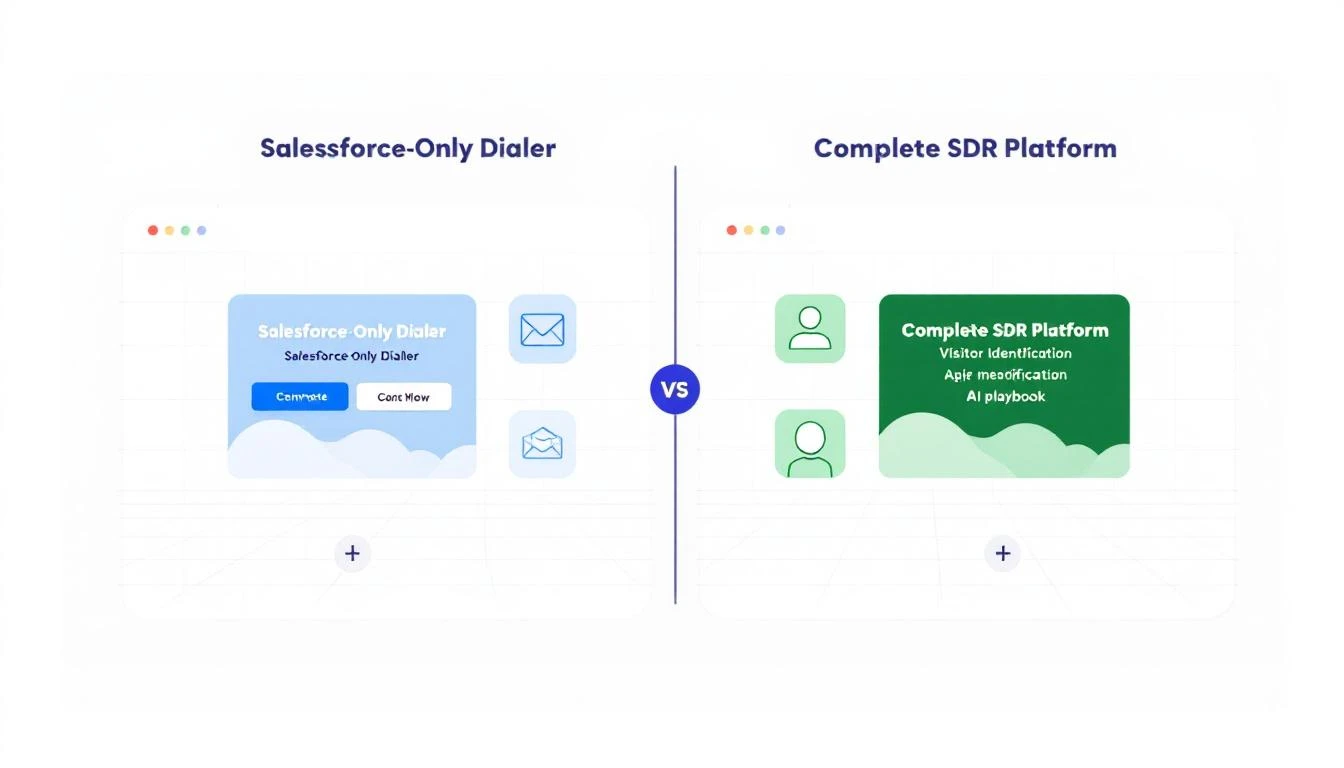
These aren't Salesforce's fault — dialing isn't their product. But it means your "Salesforce stack" for SDRs is always Salesforce + dialer + sequencer + visitor ID = 4+ contracts.
5. Complexity Tax on Small Teams
From Capterra reviews:
"Our organization had required data points for us to fill daily, some of which were not as helpful for meaningful sales progress as others."
This is the Salesforce paradox: the customization that makes it powerful also makes it overwhelming. Small SDR teams (3-10 reps) don't need custom objects, Apex triggers, and Flow automations. They need a tool that works out of the box.
Setting up Salesforce properly for an SDR team takes:
- 2-4 weeks with a dedicated admin
- $10,000-25,000 with a consultant
- Ongoing maintenance and optimization
Compare to tools like Close CRM (setup in a day), Pipedrive (hours), or MarketBetter (days).
Agentforce: Salesforce's AI Bet
Salesforce's Agentforce platform launched in late 2024, including an Einstein SDR Agent that can:
- Autonomously engage inbound leads
- Send personalized emails based on CRM data
- Qualify prospects through conversation
- Book meetings on behalf of reps
- Work 24/7 across languages
Our take: Agentforce is impressive technology with a pricing problem. The per-conversation model caused confusion in 2024-2025, and the current credit-based system is still opaque. At $550/user/month for unlimited AI usage, it's priced for enterprise — not for the 5-person SDR team that would benefit most from AI automation.
The bigger issue: Agentforce operates within Salesforce's data. It can't identify anonymous website visitors, can't pull intent signals from outside the CRM, and can't orchestrate multi-channel outbound across email, phone, and LinkedIn in one workflow. It's an AI layer on top of CRM data — powerful, but narrow.
G2 Review Patterns (What 25,000+ Reviews Tell Us)
Most common positives:
- "Centralized all our customer data in one place"
- "Pipeline visibility transformed our forecasting"
- "The ecosystem and integrations are unmatched"
- "Highly customizable to our specific process"
Most common negatives:
- "Expensive when you add everything you actually need"
- "Steep learning curve — takes months to feel comfortable"
- "Requires a dedicated admin to maintain"
- "The mobile app is clunky compared to competitors"
- "Too complex for our small team's needs"
The pattern: Reviews from enterprise AE teams (50+ reps) skew very positive. Reviews from small SDR teams (5-15 reps) skew mixed-to-negative, usually citing cost and complexity.
Who Should Use Salesforce Sales Cloud
Ideal customers:
- Enterprise companies (200+ employees) with dedicated sales ops
- AE teams managing complex, multi-stage deal cycles
- Organizations that need Salesforce's ecosystem integrations
- Companies with Salesforce admins already on staff
- Teams that need enterprise-grade reporting and forecasting
Who should look elsewhere:
- Small SDR teams (3-15 reps) focused on outbound prospecting
- Teams without a dedicated Salesforce admin
- Companies where cost predictability matters more than customization
- Organizations that want visitor ID, dialer, and sequences in one tool
- Startups that need to be productive in days, not months
The Bottom Line
Salesforce Sales Cloud earns its 25,000+ reviews and industry dominance because it's an exceptional CRM. For pipeline management, enterprise reporting, and ecosystem breadth, nothing beats it.
But a CRM is not an SDR tool. If your team's daily job is prospecting, dialing, emailing, and booking meetings — Salesforce gives you a database when you need a playbook. You'll spend $175-550/user/month on the CRM, then $200-500/user/month more on the tools your SDRs actually use every day.
For SDR teams, the question isn't "is Salesforce good?" (it is) — it's "is it the right tool for what my SDRs do?"
Looking for a purpose-built SDR platform that works with (or without) Salesforce? Book a demo →