
12 posts tagged with "sales-strategy"

View All Tags

Outbound Lead Gen in 2026: The Playbook That Books 15+ Meetings/Week

· 26 min read

Let's be honest, waiting for leads to wander through your digital front door isn't a strategy—it's a hope. Outbound lead generation is the exact opposite. It's about proactively hunting for your ideal customers and starting the conversation yourself, using channels like cold email, LinkedIn, or a good old-fashioned phone call. This is how you target high-value accounts with surgical precision.

What Is Outbound Lead Gen and Why It Still Matters

A woman uses a laptop to research profiles for proactive prospecting, with a bulletin board in the background.

Think of it like this: your business is a professional sports team. You can hold open tryouts and just see who shows up. That's inbound marketing. It works, but you get what you get.

Or, you can send a talent scout to find the exact all-star player you need to win the championship. That focused, proactive search is the soul of outbound lead gen.

Instead of writing a blog post and hoping the right VP of Engineering stumbles upon it, outbound flips the script. You identify the specific companies and decision-makers who are a perfect fit for what you sell, and you reach out directly. For B2B companies with a crystal-clear Ideal Customer Profile (ICP), this approach is pure gold.

The Inbound vs Outbound Mindset

The difference here isn't just about tactics; it's a completely different way of thinking. Inbound is a magnet. You're creating valuable content to attract prospects who are already aware of their problem and actively looking for answers. It's a long game that builds authority and pulls people into your orbit over time.

Outbound, on the other hand, is a hunter's game. It’s all about precision and control. You don’t wait for your dream customers to find you; you go out and find them. This makes it an absolutely critical strategy when you're:

  • Targeting specific, high-value accounts: You can literally build a list of your top 100 dream clients and focus every ounce of your energy on landing them.
  • Breaking into new markets: When nobody knows who you are, outbound lets you introduce yourself directly to the key players who need to know you exist.
  • Selling to people who aren't searching: Let's face it, many C-level executives aren't Googling for solutions to their biggest problems. But they will absolutely respond to a compelling, relevant offer that lands in their inbox and solves a massive headache.

The Strategic Importance of Outbound

In a world drowning in content, simply being loud isn't enough. While inbound is fantastic for building a reliable, long-term flow of leads, it just doesn't have the speed or the focus of a well-run outbound campaign. A proactive strategy gives you control over your own destiny—and makes your sales pipeline far more predictable.

Outbound lead generation is about creating opportunities, not just waiting for them. It allows you to engage decision-makers who might never have discovered your brand through traditional inbound channels.

This direct approach is still a vital part of any modern growth plan. Sure, the raw conversion rates might be lower than for inbound leads, but the strategic value is off the charts. In fact, depending on the industry, outbound-sourced leads often make up 40-60% of all marketing-sourced leads. It's a powerful engine for building your brand and zeroing in on the accounts that matter most.

You can dig into more lead generation statistics to see just how big of an impact this can have on modern sales pipelines.

Inbound vs. Outbound: Let's Settle the Debate

When you're trying to build a predictable growth engine, the whole inbound vs. outbound argument misses the point. It’s not about which one is "better." It’s about knowing what tool to pull out of the toolbox for the job at hand. The real magic happens when you blend them together, creating a system that’s both aggressive and sustainable.

Think of it like fishing.

Inbound lead generation is like casting a massive net in a busy channel. You publish blog posts, dial in your SEO, and build a social media presence to attract prospects who are already out there looking for answers. It’s a fantastic way to catch a high volume of leads over time, but you're waiting for the fish to come to you.

Outbound lead gen is the complete opposite. It’s spear-fishing. You identify the exact high-value fish you want—that ideal customer profile—and you go right after it with a laser-focused approach. It’s all about precision, control, and getting results now.

Who’s in the Driver’s Seat?

The biggest difference comes down to one thing: control.

With inbound, the buyer is firmly in control. They decide when they want to search on Google, what content they want to read, and if or when they’ll ever fill out a form on your website. You're attracting people who are already problem-aware and hunting for a solution on their own time.

Outbound flips the script entirely. You are in the driver's seat. You get to proactively pick the market, the company, and even the specific person you want to talk to. This kind of surgical precision is just not possible with inbound alone, which is why outbound is non-negotiable when you’re targeting a list of dream accounts or trying to break into a new market where no one knows your name.

The core difference is simple: Inbound marketing earns a prospect's attention, while outbound lead gen goes out and captures it directly. One builds a magnetic brand over time; the other creates targeted opportunities right now.

Cost, Speed, and Getting to the Close

Now, let's talk about the practical stuff: your budget and your timeline. How you approach lead gen has a massive impact on your resources and when you can expect to see a return.

On paper, inbound often looks more efficient. The numbers don't lie: inbound channels typically produce leads at a lower cost and boast higher close rates. In fact, some reports show inbound leads can be ~62% cheaper to acquire than outbound ones. Conversion rates tell a similar story, with some studies putting inbound lead close rates as high as 14.6%, dwarfing the typical 1.5–1.8% seen from outbound. You can discover more insights about lead generation costs to dig deeper into the numbers.

But that’s not the full picture.

What outbound lacks in raw conversion stats, it makes up for with sheer speed and predictability. You can spin up an outbound campaign and start booking meetings in a matter of days. A solid inbound engine, on the other hand, can easily take 6-12 months to gain real traction with SEO and content.

The sales cycle is another piece of the puzzle. Inbound leads have usually done their homework, so once they engage, they tend to move through your pipeline faster. Outbound leads might need a bit more nurturing since you're often the one starting the conversation, sometimes before they were even actively looking.

Inbound vs Outbound Lead Gen At a Glance

To make this crystal clear, let's stack them up side-by-side. This table should help you figure out how to allocate your team's time and money based on what you need to achieve today versus what you’re building for tomorrow.

AttributeOutbound Lead GenInbound Lead Gen
Primary GoalProactively target and engage specific high-value accounts.Attract a broad audience of interested prospects over time.
ControlYou control who you target, when, and with what message.The buyer controls their journey, discovering you on their terms.
Speed to ResultsFast. You can see initial results and book meetings in days or weeks.Slow. It often takes months to build authority and organic traffic.
TargetingHighly precise. You can select individual companies and people.Broad. You target personas or keywords, attracting anyone who fits.
Cost Per LeadGenerally higher due to the direct resources required.Generally lower over the long term as content assets mature.
ScalabilityCan be scaled quickly by adding more reps or tools.Slower to scale, as it depends on content and domain authority.

At the end of the day, the smartest companies don't pick a side. They build a hybrid engine. They use outbound to light a fire under the pipeline right now while their inbound machine is warming up. That's how you create a powerful, resilient model for growth that delivers today and builds for the future.

Key Channels for a Modern Outreach Strategy

Picking the right channels for your outbound strategy is like packing a toolkit for a job. You wouldn't bring just a hammer if you needed to build a house. You need a variety of tools that work together. A modern strategy doesn't just rely on one channel; it blends several to create a presence that's impossible for your ideal customer to ignore.

The three pillars of any strong B2B outbound campaign are cold email, LinkedIn outreach, and the trusty cold call. They can each get results on their own, but their real power is unlocked when you weave them together into a single, cohesive sequence that surrounds your prospect with value.

Cold Email: The Digital Handshake

Cold email is still a cornerstone of outbound for one simple reason: it works. It's direct, you can scale it, and it lets you put a highly personalized message right in a decision-maker's inbox. But let's be clear—the days of "spray and pray" with generic templates are long gone. Success today is all about relevance and respect.

A great cold email isn't a sales pitch. It’s the start of a conversation. Your only job is to prove you’ve done your homework and have a legitimate reason for showing up in their inbox.

An actionable framework for emails that get replies:

  1. Subject Line: Compare a generic subject like "Quick Question" with a specific one like "Question about [Their Company]'s recent project". The specific version shows research and sparks relevant curiosity.
  2. Opening Line: Make it about them, not you. Reference a recent company announcement, a LinkedIn post they wrote, or something you both have in common. This proves you aren't just blasting a template.
  3. Value Prop: State a problem you solve that actually matters to their role. Use a quick data point for proof, like, "We helped a similar company in your industry cut X by 25%."
  4. Call-to-Action (CTA): Keep the ask small and easy. Compare a "hard CTA" like Book a 30-minute demo with a "soft CTA" like Open to learning more?. The soft CTA lowers the barrier to a reply.

LinkedIn Outreach: Building Social Capital

LinkedIn isn't just a digital Rolodex anymore; it’s where professional relationships are built. Smart LinkedIn outreach is less about the hard sell and more about "social selling"—engaging with people in a genuine way before you ever ask for their time.

This is the perfect channel to add a human touch to your outreach. A well-timed comment or a thoughtful connection request can dramatically warm up a cold lead before you send that first email or make a call. For a deeper look at how to systemize this, check out our playbook on LinkedIn prospecting automation.

An actionable multi-touch LinkedIn strategy:

  • Step 1: View their Profile. It’s a quiet, non-intrusive first touch that lets them know you've stopped by.
  • Step 2: Engage with their Content. Like or, even better, leave a thoughtful comment on a post they shared. This shows you're paying attention.
  • Step 3: Send a Connection Request. Add a short, personalized note that references your shared interest or that recent post you commented on.
  • Step 4: Follow-up Message. Once you're connected, send a message that continues the conversation, not one that immediately pitches your service.

Cold Calling: The Direct Connection

Despite what you may have heard, cold calling is far from dead—it has just grown up. A modern cold call isn't about brute-forcing your way through a script. It's about being a sharp problem-solver who can quickly identify a potential need and connect it to a relevant solution.

Preparation is everything. Before you even think about dialing, you should know the person's role, what their company has been up to, and have a solid guess about the challenges they’re likely facing.

The goal of a modern cold call isn't to sell something on the first touch. It's to earn the next conversation by showing you're credible and relevant in under 60 seconds.

An actionable framework to replace rigid scripts:

  • Opener: State your name and company, then immediately pivot to why you're calling. "Hi [Name], this is [Your Name] from [Your Company]. I saw your company just launched [New Initiative], and I had a quick question about it."
  • Problem Hypothesis: Ask a question that gets them thinking about a pain point. "A lot of leaders in your role tell me that [Common Challenge] is a real bottleneck. Is that something on your radar?"
  • Value Statement: If they agree, briefly explain how you help solve that exact problem.
  • CTA: Don't ask for a long demo. Just ask for a dedicated discovery call later in the week.

The Power of an Omnichannel Sequence

The real magic happens when you stop thinking about these channels in silos and start conducting them like an orchestra. Relying on a single channel just doesn't cut it anymore. In fact, sales teams that use three or more outreach channels see a massive spike in engagement. Many report up to a 50% increase in prospect interactions when using a multi-channel approach versus email alone.

Combining channels creates a series of professional touchpoints that reinforce your message without being annoying. It shows you’re persistent and serious, which dramatically increases the odds of getting a response.

Here’s a practical look at how you can blend email and LinkedIn into a simple but effective sequence.

Example 5-Step Omnichannel Outreach Sequence

DayChannelAction
1LinkedInView the prospect's profile. A subtle, non-intrusive first touch.
3EmailSend your personalized Email #1 with a strong, relevant opening line.
5LinkedInEngage with a recent post (like or comment).
8EmailSend Email #2, referencing a new angle or providing a short case study.
12LinkedInSend a personalized connection request with a brief, relevant note.

This kind of structured, multi-channel approach respects the buyer's time while ensuring your message is seen. It's about being thoughtfully persistent, not just loud.

How to Build Your Outbound Lead Gen Engine

Building a powerful outbound engine isn't about just sending a few campaigns and hoping for the best. It's about engineering a repeatable, measurable system. Think of it like assembling a high-performance car—every single part has to be chosen carefully and fitted perfectly to make the whole machine run smoothly.

The goal isn't just to "do outreach." It's to build a system that consistently finds the right people, says the right thing to them, and uses technology to do it all efficiently at scale. From finding that first prospect to booking the meeting, every step needs a process.

Define Your Ideal Customer Profile

Before you write a single line of a cold email, you have to know exactly who you're talking to. This is your Ideal Customer Profile (ICP). An ICP isn't some vague marketing persona; it's a razor-sharp, data-backed definition of the perfect company for what you sell.

If you try to sell to everyone, you’ll end up connecting with no one.

To nail down your ICP, look at your best customers right now. What do they all have in common? Get specific and focus on hard data points:

  • Firmographics: Company size, industry, annual revenue, and where they're located.
  • Technographics: What tech stack are they already using? Are they a Salesforce shop or a HubSpot user? This tells you a lot about their priorities.
  • Behavioral Data: Did they just get a round of funding? Are they hiring for a specific role? Did they just expand into a new market? These are massive buying signals.

A solid ICP is your North Star. It guides every single decision you make and ensures your team's energy is only spent on prospects who can actually become great customers.

Building Your Prospect List

With a crystal-clear ICP, you can now build your prospect list. This is where so many teams fail. A bad list will kill your campaign before it even starts, tanking your engagement rates and landing you in spam folders. Quality over quantity, every single time.

Your mission is to get accurate contact info for the key decision-makers inside your ICP accounts. This isn't just about scraping names from a website; it’s about verifying and enriching that data so you know it's reliable. This is where tech comes in. You’ll absolutely need the right tools—check out the best lead generation tools to see what’s out there.

A great outbound list isn't just a collection of contacts; it's a curated portfolio of future customers. Each name should be there for a specific, strategic reason.

Crafting Personalized Messaging

Generic, one-size-fits-all emails are dead. They were dead ten years ago. Today, your outreach has to feel like it was written for an audience of one. And personalization means a whole lot more than just dropping in a [First Name] tag.

It's about proving you understand their world. Your message has to connect a specific challenge they're facing with the solution you provide. Mention something real about their company—a recent press release, a product they just launched, or even a podcast their CEO was on.

This one simple step proves you've done your homework. It gives you a legitimate reason to be in their inbox. You're not just pitching; you're starting a conversation.

This diagram shows a common multi-channel flow that weaves together email, LinkedIn, and phone calls into one cohesive campaign.
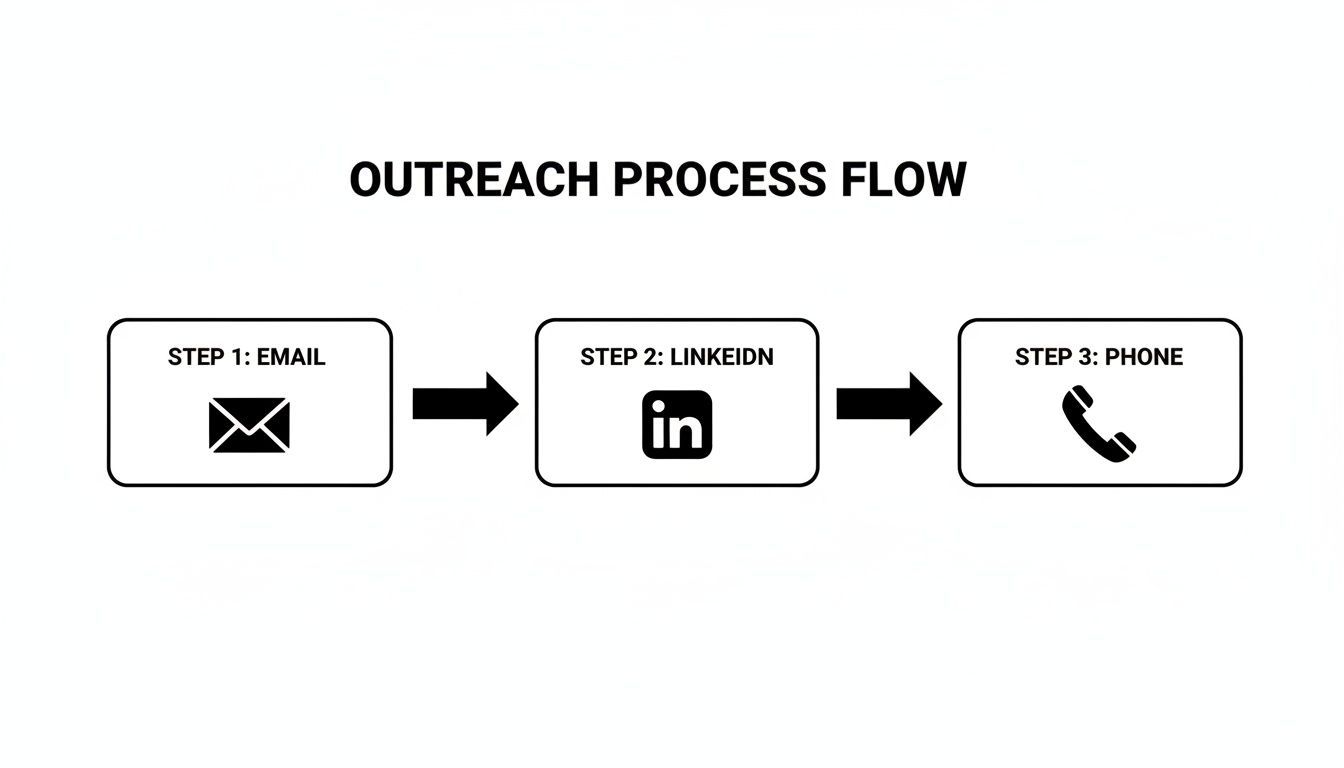
Outreach process flow diagram showing three steps: Email, LinkedIn, and Phone contact.

By hitting them on different channels, you create multiple touchpoints that reinforce your message and keep you top-of-mind.

Choosing Your Tech Stack

To make this whole engine run without burning out your team, you need the right tools. A smart, integrated tech stack handles all the repetitive grunt work, gives you the data you need to make decisions, and frees up your reps to actually sell.

Don't look for a single unicorn tool that does everything. Instead, build a stack with a few best-in-class solutions that work together.

Here are the three core components you can't live without:

  1. List Building & Data Enrichment: Tools like ZoomInfo, Apollo.io, or Clearbit are your go-to for finding and verifying contact data for your target accounts.
  2. Sales Engagement Platform: This is your mission control. Platforms like Outreach, Salesloft, or Mixmax let you build and automate your multi-channel sequences of emails, calls, and social touches.
  3. CRM (Customer Relationship Management): Your CRM, like Salesforce or HubSpot, is the central source of truth. It tracks every interaction and manages your entire pipeline from the very first touch to a closed deal.

These three pieces form the operational backbone of your outbound machine, creating a seamless workflow from prospect discovery to a meeting on the calendar.

Using AI for Smarter Outbound Personalization

A laptop displaying 'AI Personalization' on its screen, surrounded by a smartphone, notebooks, and a plant on a wooden desk.

Personalization at scale used to be a fantasy. Sales teams had to make a tough choice: go wide with a generic message or go deep with a handful of accounts. You couldn't do both.

That trade-off is officially dead. AI is completely changing the outbound game, letting teams send thousands of hyper-relevant messages that feel like they were written one by one.

Think of AI less as a robot and more as the world's best research assistant for your sales team. It handles the tedious work of finding the right people, figuring out what to say, and even learning when to say it. This gives your reps a level of precision that used to take hours of manual digging for a single prospect.

Find the Right People with AI Prospecting

Every great outbound campaign starts with a killer prospect list. The old way involved endless hours of scrolling through LinkedIn and company databases—a slow process where it was easy to miss the mark.

AI-powered tools tackle this with surgical accuracy. They chew through thousands of data points—financials, hiring sprees, tech stacks, press releases—to pinpoint companies that are a perfect match for your ideal customer profile (ICP). This goes way beyond simple filters.

Manual vs. AI-Powered Prospecting:

  • Manual Prospecting: You filter by industry, employee count, and maybe location. It’s a good start, but you’re flying blind when it comes to timing. For example, you find a great company, but they just signed with a competitor last month.
  • AI-Powered Prospecting: The AI spots subtle buying signals in real-time. It flags a company that just announced a huge funding round, started hiring a dozen engineers, or whose executive just spoke about a problem you solve. These are the accounts with budget and a problem to solve right now.

This smarter targeting means your team stops wasting time on dead-end leads and focuses only on accounts ready to convert.

Write Better Messages with AI Content Generation

Once you know who you're talking to, you have to break through the inbox noise. This is where generative AI becomes your secret weapon.

Modern AI tools can scan a prospect’s LinkedIn profile, company news, and recent podcast appearances to draft a personalized opening line in seconds. Instead of the tired "Hope you're having a great week," AI can generate an intro that references a specific quote from an article they wrote.

That kind of detail immediately shows you've done your homework.

AI doesn't replace the human touch; it scales it. It does the grunt work of research and drafting, freeing up your reps to focus on strategy, building relationships, and actually closing deals.

For a deeper dive into this, plenty of great resources cover the nuts and bolts of AI for Lead Generation.

Optimize Your Campaigns with AI

Outbound is never "set it and forget it." It demands constant tweaking to get the best results. AI and machine learning can analyze your campaign data in real-time, pulling out insights that would take a human analyst days to find.

These systems can automatically A/B test subject lines, calls-to-action, or different value props to see what actually connects with your audience. AI can even figure out the best time of day to email a CFO versus a marketing manager, making sure your message hits their inbox at the perfect moment.

If you want to get into the weeds on this, our guide on AI for marketing automation is a great place to start.

When you bring AI into your workflow, your outbound engine becomes a learning machine. Every email sent and every reply received makes the entire system smarter, faster, and more effective over time.

Measuring Success and Optimizing Your Campaigns

Running an outbound campaign without tracking the right numbers is like driving blind. You're definitely moving, but you have no idea if you're getting closer to your destination or just burning gas. To build a reliable growth engine, you have to measure what matters and never stop tweaking.

Too many teams get hung up on what we call vanity metrics. These are the numbers that look impressive on a slide deck but don't actually tell you if you're on track to hit your revenue goals.

Actionable Metrics vs. Vanity Metrics

The real trick is to shift your focus from what feels good to what actually drives business. A high open rate is nice, but a booked meeting is what keeps the lights on.

It's about trading ego-boosting stats for metrics that have a direct line to your bottom line.

Vanity Metric (What to Deprioritize)Actionable KPI (What to Obsess Over)Why It Matters
Open RatesPositive Reply RateThis tells you if your message actually connects, not just if your subject line was clever enough to earn a click.
Email ClicksMeetings BookedThis is the clearest signal that you've created a real sales opportunity. It's the ultimate goal of B2B outreach.
ImpressionsCost Per Acquisition (CPA)This measures the actual financial efficiency of your efforts and helps you prove a positive return on investment (ROI).

These are the KPIs that give you an honest, unfiltered look at your campaign's health. For a more exhaustive list, check out our deep dive on lead generation key performance indicators.

Creating a Continuous Feedback Loop

Killer results don't happen by accident. They're born from a relentless cycle of testing, measuring, and iterating. The best outbound teams live in this loop. This is where strategic A/B testing becomes your best friend.

A/B testing is simple: run two slightly different versions of your outreach to see which one gets a better response. The golden rule? Don't test everything at once. Isolate one variable at a time so you know exactly what moved the needle.

Here are a few actionable A/B tests to run now:

  • Subject Lines: Test a question-based subject line ("Question about X?") against a benefit-driven one ("A new way to manage X").
  • Value Propositions: Compare a hard data point (e.g., "reduce overhead by 15%") against a pain point (e.g., "tired of inefficient workflows?").
  • Calls-to-Action (CTAs): Test a direct "hard" ask ("Book a 15-minute demo") against a softer, interest-based "soft" ask ("Open to learning more?"). Log the reply rates for each to find your winner.

A weekly review of your A/B test results should be non-negotiable. This simple habit is what turns raw data into smart decisions, making your outbound engine more efficient with every send.

When you zero in on revenue-driving KPIs and build a culture of constant testing, you stop throwing darts in the dark. Instead, you start building a fine-tuned, predictable machine for growth. This is what separates the good campaigns from the great ones.

Free Tool

Try our AI Lead Generator — find verified LinkedIn leads for any company instantly. No signup required.

Common Questions About Outbound Lead Gen

Even the best-laid plans run into questions on the ground. When you're in the trenches with outbound, a few common hurdles always seem to pop up, whether you're just starting or trying to hit the next level. Let's tackle them head-on.

How Much Outreach Is Too Much?

This is the classic balancing act. You have to be persistent to cut through the noise, but you can't be so aggressive you burn your list to the ground. There's no single magic number here. The real answer is to focus on the value of each touchpoint, not the sheer volume.

Think about it like a real-world conversation. You wouldn't walk up to someone and ask the same question ten times in a week. The same rules of professional courtesy apply here. A solid, well-paced sequence often involves 5-8 touches spread over 3-4 weeks, mixing channels like email and LinkedIn to stay on their radar without being a nuisance.

The key isn't the number of touchpoints, but the quality of each interaction. If every message provides a new piece of value or a different perspective, you earn the right to stay in their inbox.

How Long Until I See Results?

This is where outbound really shines compared to its inbound cousin. Inbound marketing is a long game; it can easily take six months or more to build momentum and see a real return. A sharp outbound campaign, on the other hand, can deliver results much, much faster.

You should start seeing initial signs of life—opens, clicks, and a few replies—within the first couple of days of launching. But the metric that really matters is meetings booked. It’s totally reasonable to expect your first qualified meetings to land on the calendar within 2-4 weeks. Of course, this all hinges on the quality of your list, how sharp your messaging is, and how consistently your team executes the plan.

Should My Sales Team Do Their Own Prospecting?

Ah, the age-old debate. Should your closers also be your prospectors? Let's break down the two models everyone talks about.

ModelDescriptionProsCons
Full-Cycle RepOne person handles it all, from finding the lead to closing the deal.Reps have total control and deep knowledge of their accounts.It's inefficient. Every hour spent prospecting is an hour not spent selling.
Specialized RolesSales Development Reps (SDRs) find and qualify leads, then pass them to Account Executives (AEs) to close.Hyper-efficient. Everyone focuses on what they do best.Requires a bulletproof handoff process so nothing gets lost in translation.

For most teams looking to scale, specialization is the only way to fly. It lets your AEs—your closers—focus their energy on the one thing that brings in revenue: closing deals. Meanwhile, your SDRs become absolute experts at starting valuable conversations. This division of labor creates a far more powerful and scalable outbound lead gen engine.


Ready to build a smarter, more efficient outbound engine? marketbetter.ai uses AI to help you find the right prospects, craft personalized outreach at scale, and optimize every campaign for maximum ROI. Discover how our AI-Powered Marketing Platform can transform your lead generation.

7 Sales Enablement Best Practices That Cut Ramp Time by 40% [2026]

· 25 min read

In today's competitive market, providing your sales team with the right tools, content, and training isn't just an advantage; it's the foundation of sustainable growth. The term 'sales enablement' is frequently used, but what does it actually mean to implement it effectively? It’s about transitioning from inconsistent, ad-hoc support to a strategic, data-driven framework that empowers every sales representative to perform at their peak. A robust strategy ensures your team has precisely what it needs to engage buyers, close deals, and drive revenue consistently.

This article cuts through the noise to deliver a comprehensive guide to sales enablement best practices that top-performing organizations are using right now. We move beyond theory to provide actionable steps you can take to build a powerful enablement function. Instead of just listing concepts, we will compare different approaches, offering clear implementation frameworks and real-world examples to illustrate how these strategies work in practice.

You will learn how to:

  • Centralize content for maximum accessibility and impact.
  • Implement continuous coaching that elevates seller skills.
  • Harness data to make smarter sales decisions.
  • Achieve true sales and marketing alignment.
  • Map the buyer journey for hyper-personalized outreach.

We’ll dive deep into each practice, providing step-by-step guidance to help you transform your sales function from a cost center into a predictable revenue engine. Get ready to learn not just the 'what,' but the 'how' and 'why' behind proven strategies that deliver measurable results.

1. Centralized Content Management and Repository

Imagine your top sales representative is minutes away from a crucial demo and can't find the latest case study. They waste 15 minutes digging through emails, shared drives, and old Slack channels, finally settling for an outdated version. This scenario is all too common and highlights a fundamental breakdown in sales efficiency. A centralized content management repository is one of the most impactful sales enablement best practices because it directly solves this problem, creating a single source of truth for all sales and marketing collateral.

Compare the approaches: A disorganized system relies on tribal knowledge and scattered folders, leading to wasted time, inconsistent messaging, and frustrated reps. In contrast, a centralized repository acts as an intelligent, accessible hub where sales teams can instantly find the right content for the right stage of the buyer's journey. Instead of reps recreating materials or using off-brand messaging, a centralized system ensures everyone uses approved, up-to-date, and on-brand assets, from pitch decks and battle cards to testimonials and pricing sheets.

Why It's a Game-Changer

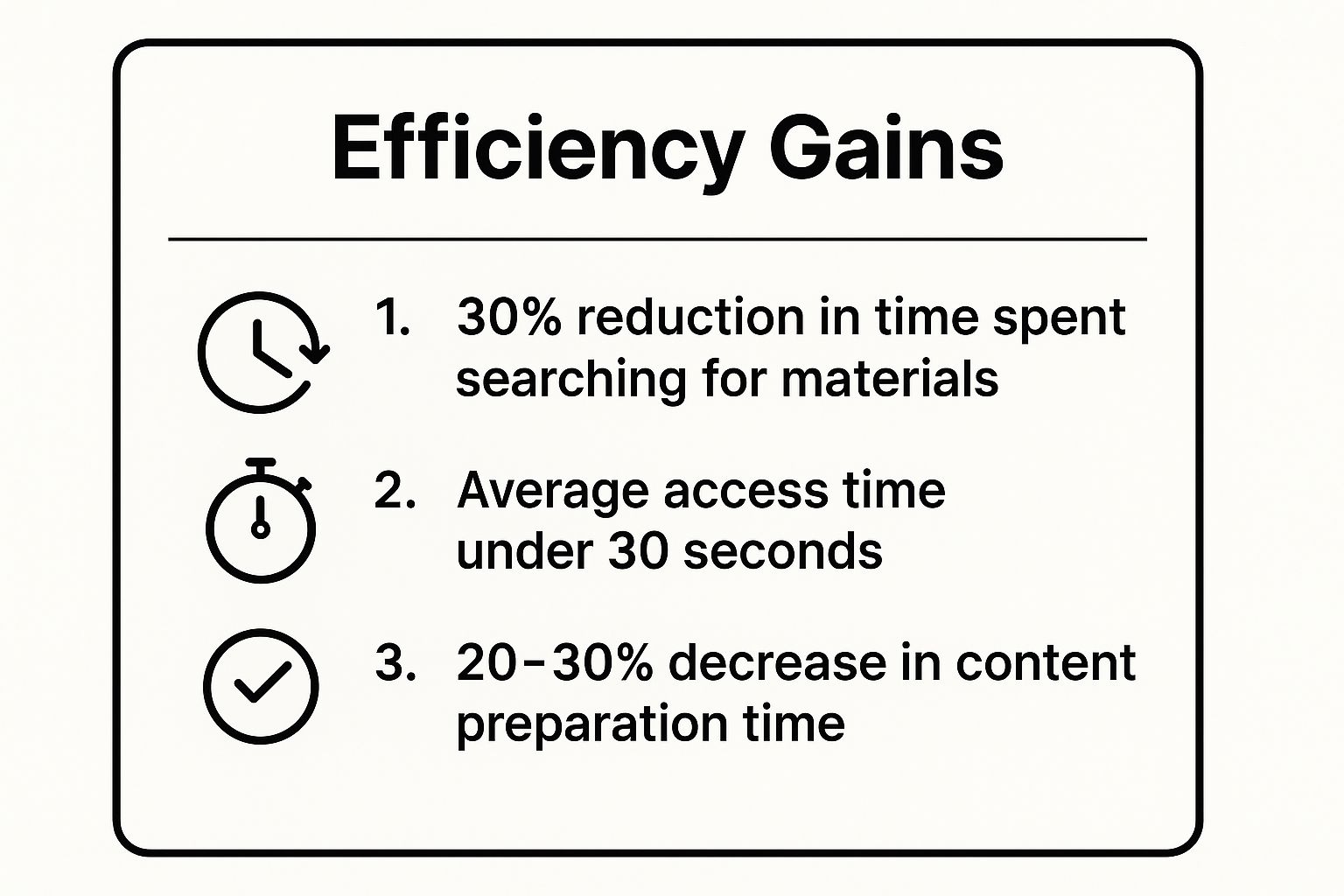
Companies that master content centralization see significant returns on their investment. For example, Salesforce leverages Highspot to empower its massive global sales team, ensuring consistent messaging and quick access to relevant materials across different regions and languages. Similarly, HubSpot's internal content library is so efficient that its reps can typically find and share relevant content in under 30 seconds, dramatically shortening their sales cycle preparation time.

This infographic summarizes the quantifiable impact of adopting a centralized content strategy.

Infographic showing key data about Centralized Content Management and Repository

As the data shows, the primary benefit is reclaiming valuable selling time by drastically reducing administrative friction.

How to Implement It

Getting started doesn't require an immediate, large-scale overhaul. Follow these actionable steps to build an effective repository:

  • Actionable Step 1: Conduct a Content Audit & Catalog High-Impact Assets. Before you build anything, know what you have. Start by cataloging your top 10-20 most-used pieces of content. Focus on high-impact assets like your main sales deck, key case studies, and product one-pagers. This gives you a quick win and a foundation to build upon.
  • Actionable Step 2: Establish a Simple, Scalable Governance Model. Create a logical folder structure and a strict naming convention (e.g., AssetType_Topic_Version_Date). For robust content governance and accessibility, explore effective digital asset management best practices.
  • Actionable Step 3: Implement Quarterly Content Reviews. Schedule reviews to archive outdated materials and identify content gaps. This ensures the repository remains trustworthy and relevant. To dive deeper into optimizing your content strategy, you can find valuable insights by learning more about leveraging AI for advanced content analysis.
  • Actionable Step 4: Run an Adoption Campaign, Not Just a Training. A system is only as good as its adoption. Host training sessions focused on search functionality and tagging, but also gamify the launch. Create a scavenger hunt for key documents or reward the first rep to share a new asset with a prospect. Set up automated notifications to alert reps when new or updated content is published.

2. Continuous Sales Training and Coaching

Many companies treat sales training as a one-time event, an intensive onboarding boot camp that reps are expected to remember for the rest of their tenure. This "set it and forget it" approach ignores a critical reality: markets evolve, products update, and skills atrophy. Continuous sales training and coaching is one of the most vital sales enablement best practices because it transforms training from a single event into an ongoing process, fostering a culture of perpetual improvement and adaptation.

Compare the approaches: One-time training results in an estimated 87% of knowledge being forgotten within a month. Continuous coaching, on the other hand, integrates learning into the daily workflow with bite-sized modules, personalized coaching, and relevant skill development. Instead of relying on outdated knowledge from their initial onboarding, salespeople receive timely updates on products, competitors, and sales methodologies, ensuring they are always equipped to handle the modern buyer's objections and questions.

Continuous Sales Training and Coaching

Why It's a Game-Changer

Organizations that commit to continuous development see a direct correlation with revenue growth. For instance, IBM's targeted sales training program famously increased its deal closure rates by 25%. Similarly, Oracle implemented a continuous coaching model that improved quota attainment by 18% across its sales teams. Modern tools like Gong.io exemplify this practice by using conversation intelligence to analyze sales calls and provide managers with targeted, data-driven recommendations for personalized coaching.

This shift from episodic training to a continuous loop of learning, application, and feedback is what separates top-performing sales organizations from the rest. It ensures that every member of the team, from rookie to veteran, is constantly sharpening their skills.

How to Implement It

Building a culture of continuous learning is a strategic initiative that pays long-term dividends. Follow these actionable steps to get started:

  • Actionable Step 1: Create a "Deal of the Week" Breakdown. Instead of generic quarterly training, pick one recent win (or loss) and have the rep walk the team through the key decision points and tactics. This makes learning hyper-relevant and peer-driven.
  • Actionable Step 2: Establish Peer-to-Peer "Skill Pods." Group reps into small pods of 3-4 to practice specific skills, like objection handling or negotiation. Have them role-play and give each other feedback in a low-stakes environment.
  • Actionable Step 3: Use Technology for "Just-in-Time" Learning. Use sales enablement platforms or learning management systems (LMS) to push short quizzes and reinforcement exercises to reps over time. For example, if a rep adds a specific competitor to a deal in the CRM, automatically send them the latest competitor battle card. One key area for reinforcement involves consistent client communication; you can explore expert strategies for crafting the perfect follow-up email to learn more about mastering follow-up cadences.
  • Actionable Step 4: Gamify Skill Certification. Introduce leaderboards, badges, and rewards for completing training modules or demonstrating new skills on calls. Friendly competition is a powerful motivator that can dramatically increase engagement with training materials. For example, offer a bonus for the rep with the most improved talk-to-listen ratio in a given month.

3. Data-Driven Sales Analytics and Insights

Consider a sales manager leading a team meeting, asking why Q3 numbers are lagging. One rep blames the market, another points to weak leads, and a third suggests the pricing is off. Without data, this is just a collection of opinions. This common scenario is where gut-feel selling hits a wall. Implementing data-driven sales analytics is a critical sales enablement best practice that replaces guesswork with strategic intelligence, giving teams a clear roadmap to success.

Compare the approaches: A gut-driven sales culture relies on intuition and past experiences, which are often biased and not scalable. In contrast, a data-driven culture transforms raw data from your CRM and other tools into actionable insights. It helps answer crucial questions like: Which lead sources generate the highest conversion rates? What specific behaviors indicate a prospect is ready to buy? At what stage do most deals stall, and why? By leveraging analytics, you empower reps to focus their energy on the most promising opportunities and tailor their approach based on proven patterns.

Why It's a Game-Changer

Organizations that embed analytics into their sales process gain a significant competitive advantage. For instance, Salesforce Einstein uses AI-powered insights to analyze customer data and predict which deals are most likely to close, reportedly helping some customers increase deal closure by up to 30%. Similarly, LinkedIn Sales Navigator provides powerful analytics that help teams understand their prospecting effectiveness, with users reporting up to 40% improvement in finding the right decision-makers.

These tools don't just report numbers; they provide prescriptive guidance. Imagine your system automatically flagging an at-risk account because customer engagement has dropped or highlighting an upsell opportunity based on a client's product usage data. That's the power of transforming data from a historical record into a forward-looking strategic asset.

How to Implement It

You can build a data-driven culture incrementally without needing a team of data scientists from day one. Follow these actionable steps:

  • Actionable Step 1: Define Your "One Metric That Matters" (OMTM). Don't try to track everything. Focus on a single, core metric that directly impacts revenue for the quarter, such as lead-to-opportunity conversion rate, sales cycle length, or average deal size. Build your initial dashboard around this primary KPI.
  • Actionable Step 2: Implement a CRM "Data Hygiene" Sprint. Your insights are only as good as your data. Dedicate one week to a team-wide effort to clean up the CRM. Run a contest for who can update the most contacts or close out old opportunities. Implement simple rules like "no contact without an email address" to maintain quality.
  • Actionable Step 3: Run "Data Storytelling" Sessions. Provide training that goes beyond how to read a dashboard. Teach your sales team how to find a "story" in the data. For example, show them how to use engagement scores to prioritize their daily outreach by focusing on the prospects telling the most promising story with their actions.
  • Actionable Step 4: Create Actionable Dashboards, Not Data Dumps. Instead of just showing that "Q3 deals are down 10%," build a dashboard that shows why. For instance, a component could show "Deals are stalling 40% more often at the proposal stage compared to last quarter," giving your team a specific problem to solve.

4. Sales and Marketing Alignment (Smarketing)

Your marketing team celebrates a record-breaking month for lead generation, yet the sales team complains that the leads are low-quality and a waste of time. This disconnect is a classic symptom of sales and marketing misalignment, a costly problem that sabotages growth and creates internal friction. True sales enablement best practices must bridge this gap, transforming two separate functions into a single, cohesive revenue engine. This unified approach is often called "Smarketing."

Compare the approaches: Misaligned teams operate in silos with separate goals (MQLs vs. closed deals), leading to finger-pointing and wasted resources. Aligned teams, or "Smarketers," collaborate seamlessly with shared revenue goals, processes, and communication channels. This ensures consistent messaging from the first ad a prospect sees to the final closing call, directly impacting lead quality, conversion rates, and the overall customer experience.

Why It's a Game-Changer

Organizations that master smarketing gain a powerful competitive advantage. HubSpot, a pioneer in this space, attributed much of its early 100%+ annual growth to its tight internal smarketing culture. Similarly, after focusing on alignment, marketing automation giant Marketo achieved a 10% increase in revenue. Adobe also saw significant returns, improving its lead quality scores by 25% by creating a unified approach between its sales and marketing departments.

When marketing understands precisely what a "sales-ready" lead looks like and sales provides feedback on campaign effectiveness, the entire revenue funnel becomes more efficient. Marketing delivers higher-quality leads, and sales can close them faster because they are better informed and more engaged. This synergy eliminates wasted effort and maximizes ROI on both marketing spend and sales time.

How to Implement It

Building a strong smarketing foundation requires intentional effort and structural change. Use these steps to foster genuine collaboration:

  • Actionable Step 1: Launch a Weekly "Smarketing Huddle." Schedule regular, mandatory cross-team meetings (weekly or bi-weekly) to discuss pipeline health, campaign performance, and potential roadblocks. The agenda should be collaborative: marketing presents upcoming campaigns, and sales shares real-time feedback from the field.
  • Actionable Step 2: Build a Unified Funnel Dashboard. Move beyond separate MQL (Marketing Qualified Lead) and SQL (Sales Qualified Lead) targets. Instead, focus on shared revenue goals. Build a single dashboard that tracks the entire funnel from initial touchpoint to closed-won deal, giving both teams visibility into their joint impact.
  • Actionable Step 3: Draft a Two-Way Service Level Agreement (SLA). Formally document the commitments each team makes to the other. Define what constitutes a qualified lead, the exact process for handoffs, and the expected follow-up time from sales. Crucially, include a sales commitment to provide structured feedback on lead quality within a specific timeframe.
  • Actionable Step 4: Mandate Sales Involvement in Content Creation. Involve sales in the creation of key marketing content like case studies, blog posts, and email campaigns. Their frontline insights are invaluable for crafting messaging that truly resonates with buyers and addresses common objections. This also increases the likelihood that sales will actually use the content marketing produces.

5. Buyer Journey Mapping and Personalization

Consider a sales rep sending a technical implementation guide to a new lead who just became aware of your brand. It’s like proposing marriage on a first date-the timing is completely off. This common misalignment happens when sales teams operate without a clear understanding of the customer's mindset and needs. Buyer journey mapping and personalization is one of the most critical sales enablement best practices because it shifts the focus from a company-centric sales process to a customer-centric buying experience.

Compare the approaches: A generic sales process uses a one-size-fits-all pitch for every prospect. A personalized approach, guided by a buyer journey map, tailors the conversation and content to the prospect's specific stage—from awareness to consideration to decision. This transforms generic outreach into a helpful, relevant conversation, building trust and guiding prospects toward a confident purchase decision.

Why It's a Game-Changer

The masters of personalization have built empires on this principle. Amazon attributes an estimated 35% of its revenue to its recommendation engine, a direct result of understanding user behavior and personalizing the experience. Similarly, Netflix’s content personalization engine is so effective that it drives 80% of all viewer activity, keeping users engaged by predicting what they want to watch next. These B2C giants prove that anticipating customer needs based on their journey is incredibly powerful.

In a B2B context, this means delivering a case study to a prospect in the consideration phase rather than a broad industry report, or offering a targeted demo that addresses specific pain points they've already revealed. This strategic empathy accelerates the sales cycle by removing friction and making the buyer feel understood.

How to Implement It

You can begin personalizing your sales approach without a massive data science team. Start with a focused strategy and build from there:

  • Actionable Step 1: Map the Journey for One Key Persona. Don't try to map every possible customer journey at once. Begin with your ideal customer profile (ICP). Interview 3-5 recent customers from this segment to understand their "aha!" moments, their research process, and their decision-making criteria. Document the key stages.
  • Actionable Step 2: Identify "Trigger Actions" for Each Stage. Leverage data from your CRM and marketing automation platform. Key actions like downloading a specific whitepaper, visiting the pricing page multiple times, or watching a product demo are strong indicators of a prospect's stage in the journey. List these triggers for your sales team.
  • Actionable Step 3: Create a "Content Playbook" for Each Stage. For each stage, define the key questions prospects are asking and map specific assets (blog posts, case studies, battle cards) to answer them. This creates a simple playbook for your reps to follow. For a deeper understanding of how to prioritize prospects based on their behavior, explore insights on leveraging AI for intelligent lead scoring.
  • Actionable Step 4: Automate with a Human Touch. Use sales enablement tools to automate the delivery of personalized content based on CRM triggers. However, train your reps to add a human touch. A personal note in an automated email like, "Saw you checked out our case study on X, thought you might find this related article useful," makes the interaction feel authentic, not automated.

6. Mobile-First Sales Enablement

Today’s sales professional is rarely chained to a desk. They are in the field, meeting clients, traveling between appointments, and working from anywhere. A sales enablement strategy that doesn't prioritize mobile access is a strategy designed for a bygone era. Mobile-first sales enablement means designing tools, content, and processes with smartphones and tablets as the primary platform, ensuring reps have everything they need at their fingertips, exactly when they need it.

Compare the approaches: A desktop-centric strategy forces reps to save administrative tasks for the end of the day, leading to inaccurate CRM data and delayed follow-ups. A mobile-first approach integrates these tasks into the rep's real-time workflow. They can pull up a battle card seconds before a meeting, update the CRM on the spot, and share a case study from their phone, making them more agile and prepared.

Why It's a Game-Changer

Adopting a mobile-first mindset yields immediate and measurable results in productivity and responsiveness. For instance, when Salesforce launched its enhanced mobile experience, it saw an 85% increase in adoption among its field sales teams, leading to more accurate data and faster deal cycles. Similarly, Dropbox's mobile sales tools empowered its reps to deliver proposals and contracts 40% faster, directly impacting their ability to close deals ahead of competitors.

These companies recognize that mobile isn't an afterthought; it's the main stage for sales activity. By reducing the friction between a rep and the information they need, you empower them to be more agile, prepared, and effective in every customer interaction.

How to Implement It

Transitioning to a mobile-first strategy requires a deliberate and user-centric approach. Follow these actionable steps to ensure your team is equipped for success on the go:

  • Actionable Step 1: Survey Your Field Team on Their Top 5 Mobile Needs. Don’t guess. Ask your reps to rank the most critical actions they need to perform on the go (e.g., logging calls, accessing contacts, viewing dashboards). Optimize those features first for a quick adoption win.
  • Actionable Step 2: Test Real-Time Synchronization. Have two team members work on the same record, one on mobile and one on desktop. Ensure that data flows effortlessly between platforms in real time. A rep updating a deal stage on their phone should see that change reflected instantly on their laptop, eliminating duplicate data entry.
  • Actionable Step 3: Simulate an "Offline Day." Test your platform's offline capabilities. Ask a rep to go into airplane mode for an hour, access key documents, and update information. Then, have them reconnect to ensure the app syncs automatically and correctly.
  • Actionable Step 4: Create Mobile "Micro-Trainings." Don't use a desktop-based webinar to train on mobile. Create a series of 60-second video tutorials that reps can watch on their phones, covering specific workflows like "How to log a meeting in 30 seconds" or "How to share a case study from the mobile app."

7. Conversation Intelligence and Call Analytics

Picture your top-performing salesperson. What makes them so effective? For most sales leaders, the answer is a mix of intuition, skill, and experience that feels impossible to replicate. Conversation intelligence and call analytics platforms are designed to demystify this "magic," turning every customer interaction into a rich source of data and a powerful coaching tool. This practice uses AI to record, transcribe, and analyze sales conversations, revealing what truly works and what doesn't.

Compare the approaches: Traditional call coaching relies on a manager randomly listening to a few calls and providing anecdotal feedback. Conversation intelligence analyzes 100% of calls, providing unbiased, data-driven insights. Instead of a manager saying, "I think you talk too much," the data can show, "Your talk-to-listen ratio is 70:30, while our top performers average 45:55." This transforms coaching from subjective advice to objective, actionable guidance.

Why It's a Game-Changer

The impact of conversation intelligence is direct and quantifiable. For instance, Zendesk used Gong.io to analyze its sales calls and discovered that discussing pricing later in the conversation led to better outcomes. By operationalizing this insight, they increased their win rate by 22%. Similarly, Qualtrics leveraged Chorus.ai to identify and replicate the behaviors of its top reps, ultimately reducing its sales cycle length by 18%. These tools turn every call into a learning opportunity, creating a feedback loop that continuously improves performance.

These platforms move coaching from abstract advice to concrete, evidence-based guidance. A manager can say, "Instead of mentioning our competitor here, try this framing that we saw work on three other deals this week," and provide a direct link to the call recording as an example.

How to Implement It

Successfully integrating conversation intelligence requires a focus on trust and improvement, not just oversight. Follow these actionable steps to roll it out effectively:

  • Actionable Step 1: Launch with a "Coaching Pilot" for Volunteers. Introduce the tool to a pilot group of trusted reps who are eager to improve. Their positive experiences and success stories will build buy-in and help ease concerns from more skeptical team members.
  • Actionable Step 2: Frame It as a "Game Tape" for Sales. Position the technology as a tool for personal and professional development, just like athletes reviewing game footage. Use insights to highlight what reps are doing well and to identify specific, coachable moments for improvement. This fosters a culture of learning rather than one of micromanagement.
  • Actionable Step 3: Create a "Greatest Hits" Playlist. Build a library of successful calls or key moments. Share short clips that demonstrate effective objection handling, compelling value propositions, or successful negotiation tactics. Make this a core part of your onboarding and continuous training.
  • Actionable Step 4: Run a Compliance and Transparency Briefing. Be transparent with both your team and your customers. Hold a dedicated meeting to explain how the tool works and review all local and international call recording laws and privacy regulations, ensuring everyone understands their responsibilities regarding consent.

7 Sales Enablement Best Practices Comparison

ItemImplementation Complexity 🔄Resource Requirements ⚡Expected Outcomes 📊Ideal Use Cases 💡Key Advantages ⭐
Centralized Content Management and RepositoryMedium - significant setup & ongoing maintenanceModerate - tech integration and content curation20-30% less prep time; up to 30% time saved searchingSales content organization and rapid onboardingConsistent messaging; quick access to materials
Continuous Sales Training and CoachingHigh - ongoing programs, management supportHigh - time, cost, and coaching resources15-20% sales performance boost; 50% higher net sales per employeeSkill development and performance improvementMeasurable skill gains; retention increase
Data-Driven Sales Analytics and InsightsHigh - complex integration and data quality needsHigh - analytics tools and training10-30% conversion increase; better forecasting accuracySales performance optimization and forecastingProactive strategies; objective measurement
Sales and Marketing Alignment (Smarketing)Medium to High - requires cultural shiftModerate - shared processes and tech stack20%+ annual revenue growth; 67% more qualified leadsCross-team collaboration and lead qualityImproved lead conversion; consistent brand message
Buyer Journey Mapping and PersonalizationMedium to High - research, continuous updatesModerate to High - content personalization efforts50-80% engagement increase; shorter sales cyclesPersonalized prospect engagementHigher conversion rates; enhanced CX
Mobile-First Sales EnablementMedium - mobile tech and security challengesModerate to High - mobile tools and training25-85% productivity increase; 60% faster response timeField sales and remote access to infoWork anywhere; real-time info access
Conversation Intelligence and Call AnalyticsHigh - AI tools plus legal/privacy complianceHigh - AI tech and cultural adoption20-30% win rate improvement; 50% onboarding time reductionSales coaching and conversation optimizationData-driven coaching; scalable performance insights
Free Tool

Try our AI Lead Generator — find verified LinkedIn leads for any company instantly. No signup required.

Putting Enablement into Action: Your Path to Higher Revenue

Navigating the landscape of sales enablement best practices can feel like assembling a complex engine without a manual. We've journeyed through seven critical components, from building a centralized content repository and fostering continuous coaching to harnessing data-driven analytics and aligning sales with marketing. We’ve explored the nuances of buyer journey mapping, the necessity of a mobile-first approach, and the transformative power of conversation intelligence. Each of these practices represents a powerful lever for growth, but their true potential is unlocked when they work in concert.

The path forward isn't about a revolutionary, all-at-once overhaul. Attempting to implement all seven strategies simultaneously is a recipe for organizational fatigue and diluted results. Instead, the most successful enablement transformations begin with a focused, diagnostic approach. The key is to identify the single greatest point of friction in your current sales process and start there.

From Silos to Synergy: A Strategic Comparison

Consider the contrast between a reactive and a proactive enablement strategy. A reactive organization might invest in a new content management system because reps complain they can't find materials (addressing Practice #1). While helpful, this is a point solution.

A proactive, strategic organization sees the bigger picture. They understand that a content repository isn't just about storage; it's about performance. They connect it to their CRM data and buyer journey maps (Practices #3 and #5) to automatically recommend the most effective asset for a specific deal stage and persona. They then use conversation intelligence (Practice #7) to analyze which pieces of content actually resonate on calls, creating a data-driven feedback loop that informs future content creation and sales coaching (Practice #2). This shift from isolated tools to an integrated ecosystem is where sustainable revenue growth is born.

Your Actionable Roadmap to Enablement Mastery

To translate these concepts into tangible results, you need a clear plan. Don't let this list remain a collection of ideas; turn it into a strategic initiative.

  1. Conduct an Enablement Audit: Start by gathering feedback. Survey your sales team to identify their biggest time sinks and roadblocks. Is it finding relevant content? Is it a lack of confidence in handling objections? Use this data to prioritize which best practice to tackle first.
  2. Define a Pilot Program: Select one or two of the practices discussed that directly address your audit's findings. For example, if your team struggles with inconsistent messaging, focus on a pilot program combining a centralized content library (Practice #1) with targeted coaching sessions (Practice #2) for a small group of reps.
  3. Measure and Iterate: Define your key performance indicators (KPIs) before you begin. For the example above, you might track metrics like the sales cycle length, win rates for the pilot group versus a control group, and qualitative feedback from the reps. Use these insights to refine your approach before rolling it out company-wide.

Ultimately, mastering these sales enablement best practices is about creating a culture of continuous improvement. It’s about empowering your sales team not just with what they need to sell today, but with the skills, knowledge, and tools to adapt and win tomorrow. This strategic investment also means equipping your team for top-of-funnel success. To truly realize higher revenue, sales enablement must equip teams with the knowledge and tools for effective lead generation, including these proven lead generation best practices that ensure a healthy pipeline.

By committing to this journey, you’re not just supporting a department; you are building a predictable, scalable, and intelligent revenue engine that becomes your company’s most significant competitive advantage.


Ready to transform your sales enablement strategy from a series of disconnected tasks into a unified revenue engine? marketbetter.ai integrates AI-powered content creation, sales analytics, and campaign automation into a single platform designed to implement these best practices seamlessly. See how you can empower your team and drive predictable growth by visiting marketbetter.ai today.