
AI Agents Are Searching Google: 23,000 Impressions of Machine Queries [2026]


Sometime in the past year, a new kind of visitor started showing up in our Google Search Console — one that never clicks, searches in complete sentences, and occasionally types "yes" into Google.
We dug into 90 days of Search Console data (June 27 – September 25, 2026) across our blog, and found that on some pages, the overwhelming majority of search impressions are no longer generated by humans at all. They're generated by AI agents — coding assistants, research agents, and buying copilots — using Google as a tool call.
This post shares the raw numbers, the three distinct query patterns we found, and what it means for anyone doing B2B marketing in 2026.
The page where 89% of "searchers" are machines
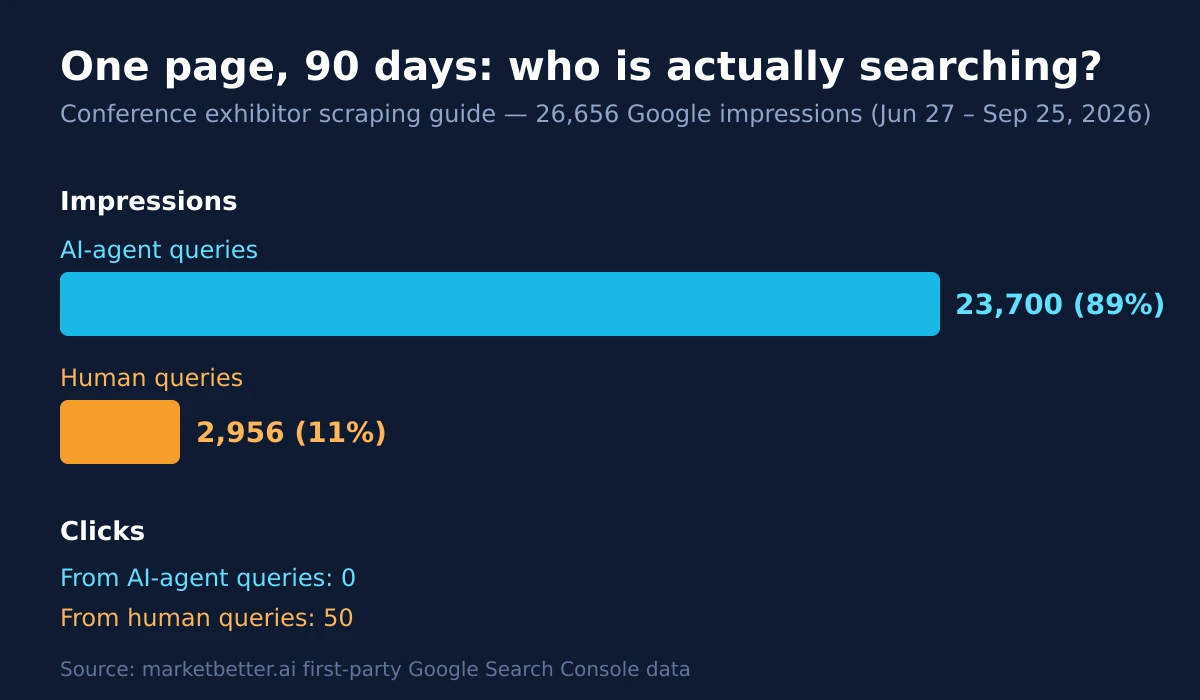
Our guide on scraping conference exhibitor lists for sales prospecting pulled 26,656 impressions over the 90-day window, ranking at an average position of 7.5.
A page with that many impressions in the top 10 should generate hundreds of clicks. It got 50 — a 0.19% CTR.
The query report explains why. Roughly 23,700 of those impressions (89%) came from queries that no human being would ever type:
| Query | Impressions | Clicks |
|---|---|---|
| scrape exhibitor details from tbse26.mapyourshow.com | 3,353 | 0 |
| scrape company information from tbse26.mapyourshow.com | 3,070 | 0 |
| extract company details from tbse26.mapyourshow.com exhibitor page | 2,281 | 0 |
| parse exhibitor data from tbse26.mapyourshow.com | 2,274 | 0 |
| structured data extraction from tbse26.mapyourshow.com | 2,237 | 0 |
| parse exhibitor details from tbse26.mapyourshow.com | 1,988 | 0 |
| tbse26.mapyourshow.com exhibitor 373068 data extraction | 1,696 | 0 |
| extract product categories from tbse26.mapyourshow.com exhibitor 1017433 | 1,481 | 0 |
And then a long tail of near-identical variants, each referencing a specific exhibitor ID: "extract company details from tbse26.mapyourshow.com exhibitor 906394" (836 impressions), "...exhibitor 954105" (634), "...exhibitor 971223" (606), and so on.
Think about what that pattern means. Someone pointed an AI agent at a trade show's exhibitor directory and told it to build a lead list. The agent worked through the directory page by page, and for each exhibitor it hit a wall — so it did what agents do now: it searched Google for help, once per exhibitor, thousands of times. Each search was machine-composed ("extract X from URL Y"), machine-executed, and machine-read.
Every single one of those queries produced zero clicks. The agent read the search results page, took what it needed (or didn't), and moved on. No visit. No pageview. No analytics event. From our web analytics' point of view, none of this ever happened.
The three types of agentic queries we found
Once you know what to look for, agent queries are easy to spot. Across our Search Console data, they fall into three buckets.
1. Tool-command queries: Google as a function call
These read like API calls written in English — verb + object + source URL:
- "scrape exhibitor details from [domain]"
- "structured data extraction from [domain]"
- "find company website and phone number from [domain]"
- "get company info from [domain] exhibitor 982044"
The tell: humans search for categories ("conference attendee scraper" — a real human query on the same page, 352 impressions). Agents search for operations on specific resources, often with IDs a human would never memorize, let alone type.
2. Full-sentence buying prompts: the agent as researcher
Our Qualified review and comparison pages surface a different species — complete, structured buying questions:
- "ai sdr tool that can score replies and push only qualified meetings to my sales team what should i buy"
- "best ai sales agent tools for qualifying inbound leads and booking meetings pricing included"
- "1mind vs qualified vs sable: which is best for smb sales?"
- "alternatives to qualified for enterprise ai sales assistants?"
- "ai agent that can handle inbound leads 24 7 and route them to sales what are the best options"
These are not keywords. They're prompts — requirements documents compressed into one sentence, with constraints ("pricing included", "for smb", "faster to deploy") that a human searcher would split across five separate refinements. Someone asked their AI assistant to shortlist vendors, and the assistant ran the research through Google.
We first wrote about this buyer-side shift in our B2B GEO playbook for AI buying agents. What's new is seeing it at volume in first-party data: vendor evaluation queries that arrive fully formed, get answered from the results page, and convert (or disqualify you) without a click.
3. Conversation leakage: chat turns fired as searches
The strangest bucket. Scattered through our query report are fragments that only make sense as turns in a conversation with an AI assistant, accidentally routed to Google's search box:
- "yes"
- "more"
- "another"
- "which one should i try first"
- "are there any other alternatives?"
- "can you give me numbers"
- "its not allowing me to paste"
- "devami?" (Turkish for "continue?")
Each of these registered impressions against our pages. "Its not allowing me to paste" is someone talking to their agent mid-task. "Which one should i try first" is a follow-up question after the agent listed tools. These utterances are leaking into Google's query stream — presumably from agent frameworks and browser assistants that pass user input straight to search — and Google is dutifully matching them against indexed pages.
Amusingly, this bucket is the only one that clicks: "more" earned 3 clicks, "another" and "are there any other alternatives?" one each. When there's a human in the loop, even one keystroke deep, clicks come back.
Why this breaks the metrics you report on
Three uncomfortable implications fall out of this data.
1. Impressions are inflated, and CTR is broken as a quality signal. If 89% of a page's impressions come from agents that structurally never click, that page's "bad CTR" isn't a title problem — it's a measurement artifact. We see the same decoupling on our pricing breakdowns: pages ranking at position 3–5 with six-figure impression counts and near-zero clicks, because the answer gets absorbed upstream — by AI Overviews, by agents reading snippets, by assistants summarizing the SERP. Before you rewrite a title for CTR, read the actual query report and ask who is searching.
2. Rankings now have an invisible audience. Your position 6 result isn't just competing for human eyeballs. It's being read, parsed, and quoted by agents assembling answers for their users. The click never happens, but the influence does — the agent recommends (or eliminates) you based on what it read. This is the core argument for generative engine optimization: the SERP is becoming an API, and your content is the response payload.
3. Your analytics undercount your actual reach. None of these 23,700 agent impressions show up in web analytics, and neither do the recommendations that flow from them. If a buying agent shortlists you from a search snippet and its user books a demo two days later, your attribution model calls that "direct traffic." The dark funnel just got a lot darker — which is exactly why we lean on website visitor identification to recover the human end of these journeys when they finally do land on the site.
What to actually do about it
This isn't a doom post. Agents reading your content is a distribution channel — one most of your competitors are ignoring. Here's what the data pushed us to change.
Write answers, not teasers. Agents quote what they can extract. Put the direct answer — the price, the step list, the comparison verdict — in the first screen of content, in plain declarative sentences. We saw this work firsthand: our post on Codex's mid-turn steering feature captured thousands of impressions within days of the feature shipping because it answered the exact question people (and their agents) were asking, in the exact words they used.
Structure for machines. Tables, consistent headings, explicit entity names. An agent parsing "best AI SDR tools with pricing" rewards the page that states "Tool X costs $Y/month for Z seats" over the one that says "pricing varies by needs." Our pricing transparency study exists partly because concrete numbers are what both humans and agents are starving for.
Cover the workflow, not just the keyword. The agent queries on our conference post are task queries — the searcher (human or machine) is mid-workflow. Content that walks through the actual task end to end, like our SDR playbook template guide or our guide to automating LinkedIn Sales Navigator with Claude, gets matched against these long operational prompts far more often than thin listicles do.
Expect the buyer's first touch to be an agent. The full-sentence buying prompts above are early evidence of a shift we think defines the next few years of B2B: frontier models are getting good enough to run real GTM work, and buyers are handing them the vendor research. Your "first meeting" increasingly happens between your content and someone else's AI. Make sure your content performs well in that meeting.
Methodology
All data is first-party Google Search Console data for marketbetter.ai, June 27 – September 25, 2026, web search type, query dimension. We classified queries as agent-generated based on structural patterns: imperative verb + source URL construction, embedded database-style resource IDs, full-sentence multi-constraint prompts, and conversational fragments with no standalone search intent. Ambiguous queries were counted as human. The 89% figure for the conference-scraper page is therefore a floor, not a ceiling.
We'll rerun this analysis as the data grows. If the trend holds, "share of agent impressions" may become a metric worth tracking on every B2B content dashboard.
MarketBetter identifies the companies visiting your site — including the humans who show up after their AI did the research — and tells your SDRs exactly what to do next. Book a demo →