
Claude Opus 5.5 for Sales Teams: Pricing + What Changed


Anthropic released Claude Opus 5.5 on September 22, 2026. The headline for developers is benchmark scores. The headline for sales teams is different: the cost of running AI agents on your pipeline just dropped roughly 40%, and the specific pricing change most people are skimming past — 60% cheaper cache reads — is the one that matters most for always-on sales automation.
We've been running Claude-based SDR workflows in production since early 2025 (here's the complete guide to Claude for SDRs if you're starting from zero). This post covers what actually changed in Opus 5.5, what it costs, and where it moves the needle for GTM work — with real math, not vibes.
What launched, in 30 seconds
- Claude Opus 5.5 is Anthropic's new flagship, available now via API (
claude-opus-5-5), on claude.ai, in Claude Code, and on AWS, Google Cloud, and Azure. - 20% cheaper per token than Opus 5: $4 per million input tokens and $20 per million output (down from $5/$25).
- 60% cheaper cache reads: $0.20 per million tokens, down from $0.50.
- ~40% cheaper in practice on typical workloads, because it also uses fewer tokens and fewer tool calls per task.
- 1M token context window, 128K max output.
- Adaptive thinking is always on, controlled by a five-level
effortparameter (low → max, medium default). - Included in Pro ($20/mo), Max, Team, and Enterprise plans, with a 20% bump to five-hour usage limits.
The pricing table (and the line that matters)
| Pricing (per 1M tokens) | Opus 5 | Opus 5.5 | Change |
|---|---|---|---|
| Input | $5.00 | $4.00 | −20% |
| Output | $25.00 | $20.00 | −20% |
| Cache write | $6.25 | $5.00 | −20% |
| Cache read | $0.50 | $0.20 | −60% |
| Batch input / output | — | $2.00 / $10.00 | 50% off standard |
| Fast mode input / output | — | $8.00 / $40.00 | 2.5x speed |
Why cache reads are the sleeper: a one-off chat barely touches the cache. A production sales agent is almost all cache reads. Every run of a lead-research agent re-reads the same system prompt, ICP definition, qualification rubric, messaging playbook, and CRM field schema — 15-30K tokens of identical context, hundreds of times a day. That repeated context now costs $0.20 per million instead of $0.50. If you've built anything like an AI SDR that runs on a schedule, this is where your bill actually lives.
Real cost math: a nightly 200-account research run
Take a concrete workflow — the kind we walk through in automating lead research with Claude Code: every night, an agent researches 200 accounts against your ICP and writes a brief for each.
Assume per account: ~20K tokens of cached context (playbook, rubric, schema), ~10K tokens of fresh input (scraped pages, CRM data), ~2K tokens of output.
Opus 5: $0.05 fresh input + $0.01 cache reads + $0.05 output ≈ $0.11 per account → ~$22 per night, ~$660/month.
Opus 5.5: $0.04 fresh input + $0.004 cache reads + ~$0.02 output (it genuinely writes about half the tokens for the same task) ≈ $0.064 per account → ~$13 per night, ~$385/month.
Opus 5.5 via Batch API (overnight enrichment doesn't need real-time responses): ≈ $0.034 per account → ~$7 per night, ~$205/month.
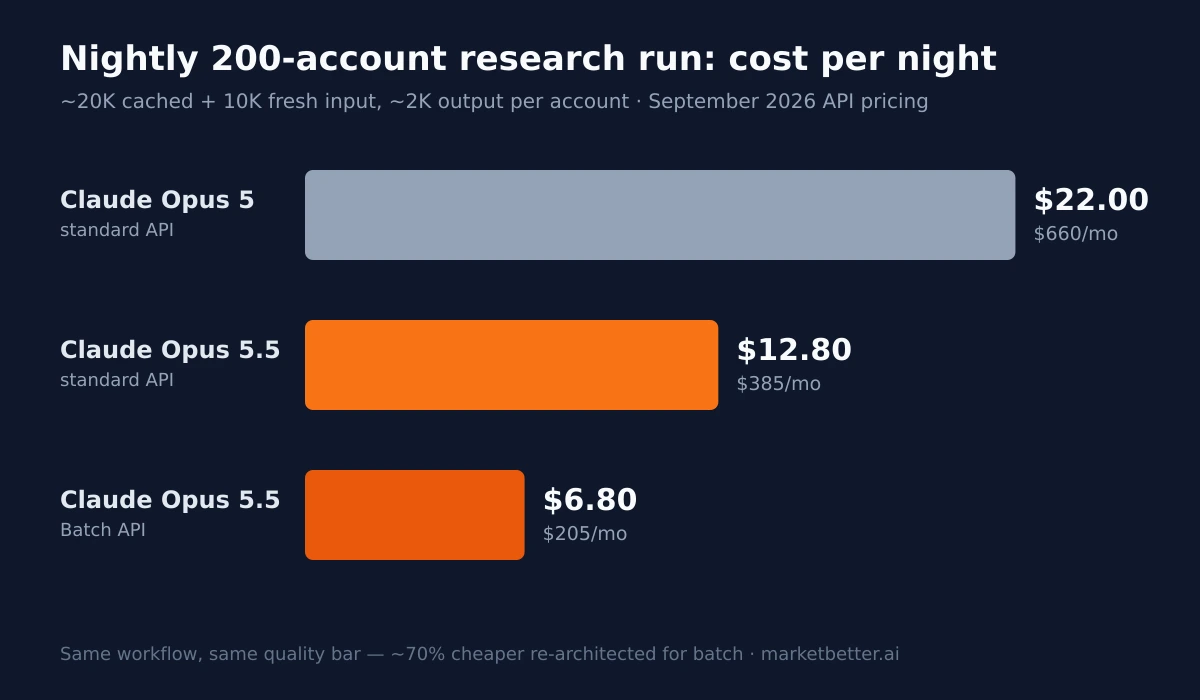
Same workflow, same quality bar, roughly 70% cost reduction if you re-architect for batch. That's the difference between "pilot budget" and "run it on the whole territory." For comparison against what enterprise AI SDR vendors charge for equivalent throughput, see our real cost comparison of $35-50K AI SDR tools.
Effort levels: match the dial to the sales task
Adaptive thinking can't be turned off in Opus 5.5 — instead you set effort: low, medium (default), high, xhigh, or max. Effort is a behavioral signal, not a hard token budget: at low effort the model still thinks on genuinely hard problems, it just spends less.
The published efficiency numbers are striking: medium effort on Opus 5.5 matched or beat Opus 5 at high effort while using roughly half the tokens, and on a financial-analysis benchmark the lowest effort setting beat Opus 5's high effort with ~60% fewer output tokens.
Here's how we'd map effort to GTM work:
| Effort | Sales tasks | Why |
|---|---|---|
| Low | Reply triage, lead routing, CRM field classification, dedupe | High-volume, well-defined. Yesterday's "cheap model" tier now runs on flagship quality. |
| Medium (default) | Account research, email personalization, call prep, meeting follow-ups | The daily SDR workload. Default is tuned for exactly this. |
| High | Territory planning, win/loss synthesis, competitive deep dives | Multi-source reasoning where a wrong conclusion costs real money. |
| Xhigh / Max | RFP analysis, pricing strategy, quarterly pipeline reviews | Rare, high-stakes, worth every thinking token. |
The practical shift: teams used to split workloads across a cheap model for triage and a flagship for reasoning. With effort levels this collapses into one model with a dial — one prompt library, one set of guardrails, less glue code. (If you're on the OpenAI side of the fence, the equivalent control lever is different — we covered how Codex mid-turn steering works separately.)
The benchmarks that actually matter for GTM
Ignore the coding leaderboards unless you're shipping software. Three results are relevant to revenue teams:
1. Agentic tool use: fewer calls, fewer tokens. On real command-line task benchmarks, Opus 5.5 solved more tasks than Opus 5 with about 40% fewer tool calls and half the tokens (Terminal-Bench 4.0: 66.4% vs Opus 5's 52.3%). For a sales agent, tool calls are CRM lookups, web fetches, and enrichment API hits. Fewer calls means faster runs, fewer rate-limit collisions, and fewer places to fail mid-workflow.
2. Computer use: 81.8% on OSWorld 2.0 (partial credit). This is the "operate an app through screenshots, mouse, and keyboard" benchmark. Plenty of prospecting surfaces have no API — vendor portals, event platforms, LinkedIn Sales Navigator. Computer-use agents for these workflows are moving from demo to dependable. Note the strict full-completion rate is lower than the partial-credit score — budget for human review on anything customer-facing.
3. Knowledge work: an 1846 Elo on GDPval-AA v2.1. In one published example, the model built a complete merger-analysis Excel model with an executive presentation in 63 minutes versus 93 for Opus 5, at half the cost. Translate that to RevOps: board-deck pipeline analysis, comp modeling, QBR prep.
The honest caveat: AutomationBench, which tests full end-to-end business workflows, came in at 40%. The best agentic model in the world still fails the majority of complete, multi-system business processes unattended. Models are engines, not employees. The gap between "great at each step" and "reliable across the whole workflow" is exactly why orchestration — the layer that decides who to target, what to do next, and when to hand off to a human — still determines whether AI sales automation produces pipeline or embarrassment.
Opus 5.5 vs GPT-6 Astra for sales stacks
OpenAI shipped GPT-6 Astra three weeks before this release, so the comparison is live. On the agentic benchmarks, Opus 5.5 leads: Terminal-Bench 4.0 66.4% vs 57.9%, and about 10 points ahead on tool-enabled research tasks — at roughly 40% of the cost per task on Anthropic's numbers.
Our standing advice from testing Claude vs ChatGPT on real SDR workflows holds: run your own bake-off on your accounts and your playbook, because aggregate benchmarks hide task-specific gaps. But if your stack is agent-heavy — scheduled research runs, multi-step enrichment, CRM automation — the token-efficiency and cache-pricing math currently favors Opus 5.5, independent of quality.
If your team is on subscriptions, not the API
- Pro ($20/mo) now includes Opus 5.5 and Claude Code. A single SDR can run the workflows in our Codex-style prompt library for SDRs without an API key.
- Max (5x or 20x Pro usage) fits heavy daily users — think an SDR running research blocks all morning.
- Anthropic also raised five-hour usage limits ~20% across Pro/Max/Team and added a saveable rate-limit reset.
One quiet retirement worth noting: back when a 200K context window was the ceiling, we wrote about sales workflows that a big context window finally unlocked. Opus 5.5 carries 1M tokens of context — an entire quarter of call transcripts for a segment fits in a single prompt. The constraint has fully moved from "can the model hold the context?" to "does your team have the data plumbed in?"
What to actually do this week
- If you run Claude-based agents via API: switch the model string to
claude-opus-5-5, leave effort on medium, and watch your cost dashboard. Most teams should see 30-45% reduction with zero prompt changes. - Re-tier your workloads. Anything you routed to a cheaper model for cost reasons — triage, routing, classification — test it on Opus 5.5 at low effort. You may get flagship quality at commodity prices.
- Move overnight jobs to the Batch API. Enrichment, scoring, and research runs that finish by morning don't need real-time pricing. That's another 50% off.
- Maximize prompt caching. Structure agents so stable context (ICP, playbook, schema) sits at the front of the prompt where it caches. At $0.20 per million cache reads, well-structured agents are dramatically cheaper than naive ones.
- Don't confuse a better engine with a working system. A 40% AutomationBench score means unattended end-to-end workflows still fail more than they succeed. The teams getting results pair strong models with an orchestration layer that knows the difference between a signal and an action. That's the entire thesis behind our AI BDR tools ranking: the model matters less than what directs it.
FAQ
What does Claude Opus 5.5 cost? $4 per million input tokens and $20 per million output via API — 20% below Opus 5. Cache reads dropped 60% to $0.20, batch pricing is $2/$10, and Anthropic measured ~40% lower cost on typical workloads overall. It's included in Claude Pro, Max, Team, and Enterprise subscriptions.
Is Opus 5.5 better than GPT-6 Astra? On agentic benchmarks, yes — 66.4% vs 57.9% on Terminal-Bench 4.0 and ~10 points ahead on tool-enabled research, at a lower cost per task. For pure writing or chat, differences are smaller; test on your own workflows.
What are effort levels? A five-setting dial (low, medium, high, xhigh, max) controlling how much thinking the model spends per response. Medium is default and matches the previous flagship's high-effort quality at roughly half the tokens. Adaptive thinking is always on and can't be disabled.
Does Opus 5.5 change what AI SDR tools can do? It lowers the cost floor and raises reliability per step, but end-to-end business workflow success (AutomationBench) is still 40% — orchestration and human handoffs remain mandatory for production sales automation.
Models keep getting cheaper. Pipeline still doesn't build itself. MarketBetter is the orchestration layer that turns signals into a daily playbook — who to contact, why, and what to say — with AI doing the research and your team doing the selling. Book a demo →