
Claude Haiku 5.5 for Sales Teams: Pricing + What Changed


Anthropic released Claude Haiku 5.5 on October 7, 2026, and the number that matters is the price: $0.10 per million input tokens and $0.50 per million output — down from $1.00 and $5.00 on Haiku 4.5. That's not a discount. That's a different category of spend. Two weeks after Opus 5.5 cut flagship costs 40%, the budget tier just dropped roughly 75%.
For sales teams, the practical translation: the per-unit cost of high-volume pipeline work — scoring leads, triaging replies, extracting fields, summarizing calls — just fell below the threshold where anyone needs to approve the budget. Scoring your entire 100,000-lead database now costs about as much as one DoorDash order. We ran the math below.
What launched, in 30 seconds
- Claude Haiku 5.5 is live via API (
claude-haiku-5-5) and on AWS Bedrock, Google Cloud Vertex, and Microsoft Foundry. - $0.10 / $0.50 per million tokens (input/output) for requests up to 100K tokens — a 90% list-price cut from Haiku 4.5's $1 / $5. Anthropic says ~75% cheaper in practice on average workloads.
- Above 100K tokens per request, pricing steps up to $0.50 / $2.50 — still half of Haiku 4.5. More on this trap below.
- 1M token context window (up from 200K) and 128K max output.
- Cache reads at $0.01 per million. Batch API is another 50% off.
- Positioned explicitly for classification, extraction, and routing — adaptive thinking with a medium default effort.
- Benchmarks jumped generationally: OSWorld computer use went from 15.7% → 72.4%, Terminal-Bench agentic coding from 0% → 39.2%, GDPval knowledge work from 735 → 1,620.
The pricing table
| Pricing (per 1M tokens) | Haiku 4.5 | Haiku 5.5 (≤100K) | Haiku 5.5 (>100K) |
|---|---|---|---|
| Input | $1.00 | $0.10 | $0.50 |
| Output | $5.00 | $0.50 | $2.50 |
| Cache read | $0.10 | $0.01 | $0.05 |
| Cache write | $1.25 | $0.125 | $0.625 |
| Batch API | 50% off | 50% off | 50% off |
Two things to internalize:
1. The cheap tier has a ceiling. The $0.10/$0.50 rate applies to requests up to 100K tokens. Go over, and the 5x multiplier applies to the entire request, not just the overage. With a 1M context window it's now easy to stuff a whole CRM export into one prompt — and quintuple your bill doing it. For high-volume sales work, chunk requests to stay under 100K. The cheap tier is the whole point.
2. Cache reads cost a penny per million. A production agent re-reading a 20K-token scoring rubric on every call now pays effectively nothing for it. If you structure prompts so stable context caches (the same advice we gave for Opus 5.5), repeated context is a rounding error.
Real cost math: scoring 100,000 leads
Take the workflow from part 6 of our SDR playbook — building a lead scoring model: score every lead in your database against your ICP with a reasoned 1-100 score and a one-line justification.
Assume per lead: ~2K tokens of input (lead record, firmographics, recent activity), ~100 tokens of output, plus a cached 15K-token rubric.
- Haiku 4.5: 200M input + 10M output ≈ $200 + $50 = ~$250
- Haiku 5.5: $20 + $5 ≈ ~$25
- Haiku 5.5 via Batch API: ~$12.50
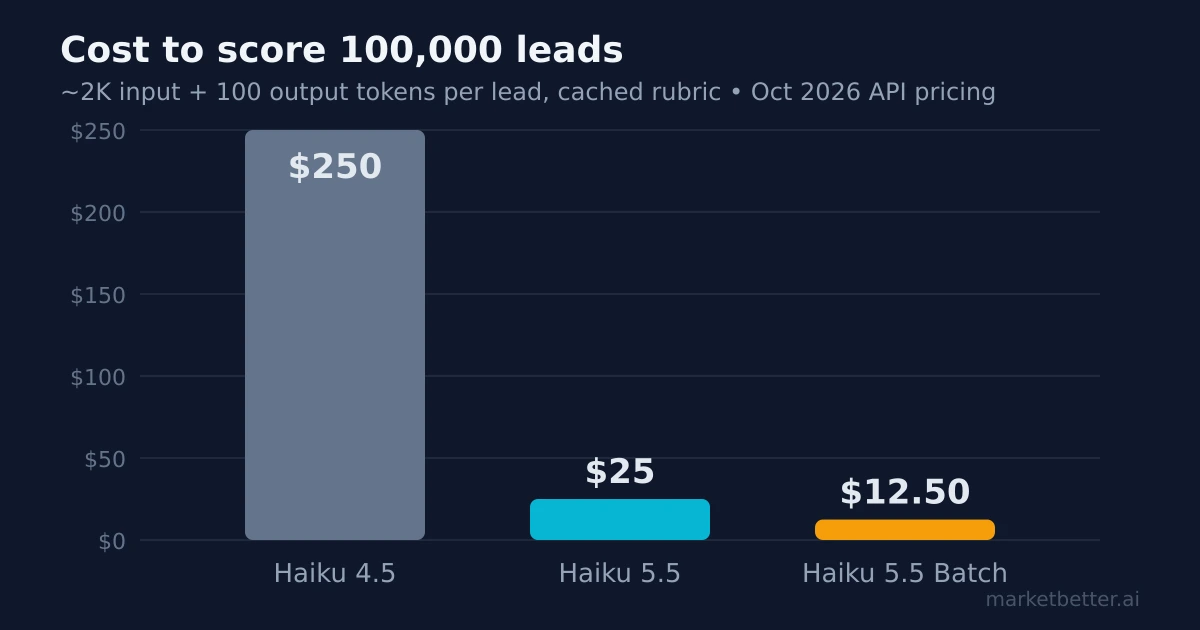
Re-scoring your entire database weekly — something nobody did because it cost real money — is now ~$50/month on batch. Same story for the other volume workloads:
| Workload | Volume | Haiku 5.5 cost (approx) |
|---|---|---|
| Inbound reply triage (classify intent, route) | 10,000 replies | ~$0.75 |
| Call summary + CRM field extraction | 1,000 calls (30 min each) | ~$6 |
| Enrichment extraction from scraped pages | 50,000 pages | ~$35 |
| Email personalization first drafts | 5,000 emails | ~$3 |
At these prices the model cost disappears from the decision entirely. What's left is the part that was always harder: data plumbing, prompt quality, and orchestration — deciding what's worth doing at all. That's been our consistent finding across every AI BDR tool we've ranked: the model is the cheapest component in the stack.
The benchmark that actually matters: computer use went from broken to usable
Most Haiku 5.5 coverage leads with coding scores. For GTM teams, the sleeper result is OSWorld 2.1: 72.4%, up from 15.7% on Haiku 4.5. That's the "operate an app through screenshots and clicks" benchmark — and 72.4% on a budget model is within shouting distance of what flagship models scored a generation ago.
Why it matters for sales: the surfaces you prospect on often have no API — vendor portals, event platforms, LinkedIn Sales Navigator. Browser-driving agents were previously flagship-only territory because cheap models couldn't reliably click the right thing. A budget model that can operate a browser changes the cost structure of scraping-adjacent workflows — with the usual caveat that a 72% benchmark still means budgeting for failures and human review on anything customer-facing.
The other notable jump: Humanity's Last Exam went from 10.2% to 45.9% (57.4% with tools). This is not last year's "fast but dumb" small model. It reasons well enough to trust with judgment calls like "is this reply a genuine objection or an unsubscribe?"
Haiku 5.5 vs GPT-6 Luna
OpenAI's budget model GPT-6 Luna matches Haiku 5.5's list price at the low tier, so the comparison comes down to quality and token efficiency:
- Quality: Haiku 5.5 leads on the published benchmarks, including agentic tasks — consistent with what we found when testing Claude against ChatGPT on real SDR workflows.
- Token efficiency: Luna reportedly completes comparable tasks with roughly one-third the output tokens. Identical list price does not mean identical cost per task — a verbose model at $0.50/M output can cost more than a terse one.
Our advice stands: benchmark on your replies and your lead records. For classification and extraction, output lengths are short either way and the difference is noise. For summarization-heavy work, measure tokens per completed task, not price per token.
The subagent pattern: where Haiku 5.5 actually fits
The architecture Anthropic is pushing — and the one that shows up in launch-customer stories — is a flagship orchestrator delegating narrow tasks to Haiku subagents. Opus 5.5 plans the account research; Haiku 5.5 pulls the revenue line from the 10-K, classifies the tech stack, extracts the org chart.
One practical warning from early multi-agent cost breakdowns: delegation has overhead. In one published example, twenty Haiku 5.5 subagent calls accounted for just 7% of a workflow's total cost — the orchestrator's planning and handoffs consumed the rest. Passing work to a subagent and back can cost several times the work itself. The pattern pays off when the delegated task is genuinely high-volume (hundreds of extractions), not when you're routing a single lookup through three layers of agents.
If you're building this kind of system, the structure matters more than the models — our complete guide to Claude for SDRs covers the workflow design, and the nightly research-run pattern is the natural place to slot Haiku in for the extraction steps.
What to actually do this week
- Re-route your volume workloads. Anything currently running on Haiku 4.5, GPT-6 Luna, or a flagship at low effort — triage, scoring, extraction, routing — test on
claude-haiku-5-5. The price floor moved; your model routing should too. - Keep requests under 100K tokens. Chunk big jobs. The 5x long-context multiplier applies to the whole request, and almost no classification task needs 100K tokens of context.
- Move overnight jobs to batch. Scoring and enrichment runs that finish by morning get another 50% off — that's the $12.50 full-database score.
- Re-score things you stopped scoring. Weekly full-database re-scores, re-classification after ICP changes, backfilling old call summaries — jobs that were "not worth the spend" at $250 are impulse purchases at $25.
- Don't promote it past its weight class. Haiku 5.5 is built for narrow, well-defined tasks. Multi-step account strategy, win/loss synthesis, and anything where a wrong conclusion costs money still belongs on Opus 5.5. The subagent split exists for a reason. And as OpenAI's Dots launch and Gemini 4 Argon showed the same month: every vendor is racing to make the engine cheaper, and none of them are solving what to point it at.
FAQ
What does Claude Haiku 5.5 cost? $0.10 per million input tokens and $0.50 per million output for requests up to 100K tokens; $0.50/$2.50 above that. Cache reads are $0.01 per million and the Batch API is 50% off. Anthropic estimates ~75% lower cost than Haiku 4.5 on typical workloads.
Is Haiku 5.5 better than GPT-6 Luna? On published benchmarks, yes — Haiku 5.5 leads across the board, including agentic coding and computer use. Luna is more token-efficient on output, which can close the cost gap on verbose tasks. Test both on your own workload.
What's the difference between Haiku 5.5 and Opus 5.5 for sales work? Haiku 5.5 ($0.10/$0.50) is for high-volume, narrow tasks: classification, extraction, triage, scoring. Opus 5.5 ($4/$20) is for multi-step reasoning: account research, territory planning, deal strategy. Production stacks increasingly use Opus as the orchestrator and Haiku for the volume work.
Can Haiku 5.5 do computer use? Yes — 72.4% on OSWorld 2.1, up from 15.7% on Haiku 4.5. Browser-operating agents on a budget model are now viable for internal workflows, though error rates still require human review for anything customer-facing.
Tokens are approaching free. Pipeline isn't. MarketBetter is the orchestration layer that decides what all that cheap inference should actually do — turning signals into a daily playbook of who to contact, why, and what to say. Book a demo →