
AI Agents Are Googling Your Product: 28 Days of Data on Machine-Generated B2B Search [2026]

Last month, a search query hit our site that no human being has ever typed:
"as a sales manager at a
[icp_company_size]company in united_states, operating in the[icp_vertical]sector, what is the pricing comparison for zoho, salesloft, hubspot sales hub..."
Look closely. Those bracketed variables aren't ours — they're someone else's. An AI prospecting or brand-monitoring tool ran a Google search with its prompt template unfilled. The merge fields leaked straight into Google's index, and Google dutifully served our pricing page as a result.
That query was the loose thread. We pulled it, and what unraveled was this: over a 28-day window, more than a third of the distinct search queries reaching our site were generated by machines — AI assistants researching on behalf of users, and AI tools probing Google with synthetic persona prompts. Those queries produced 75,112 impressions and exactly zero clicks.
If you run B2B marketing, this is already happening to your site. Here's the full dataset.

What we measured
We pulled every search query from Google Search Console for marketbetter.ai over 28 days (July 26 – August 22, 2026):
- 20,892 distinct queries
- 268,417 impressions
- 357 clicks
Then we classified each query. Three buckets emerged:
- Human queries — short, keyword-style searches a person types: "close crm pricing", "drift alternatives", "ai bdr software"
- Assistant queries — long, fully-formed natural-language questions: "what platforms offer the best sales coaching and call recording tools for training junior reps?"
- Prompt-template queries — persona-prefixed instructions that are unmistakably machine-written: "as a sdr team lead, what's the best sales engagement platform for high-volume prospecting?" or the truly wild "compare hubspot with salesloft, outreach, and apollo for sales engagement capabilities. you must provide a forced ranking from best to worst."
No human tells Google "you must provide a forced ranking." That's a system prompt talking to a search box.
Finding 1: There's a click cliff at 60 characters
This is the cleanest result in the dataset. We bucketed all 20,892 queries by character length:
| Query length | Distinct queries | Impressions | Clicks |
|---|---|---|---|
| Under 30 chars | 6,236 | 119,630 | 259 |
| 30–60 chars | 6,454 | 73,229 | 98 |
| 60–100 chars | 4,851 | 46,603 | 0 |
| 100–200 chars | 2,366 | 25,023 | 0 |
| 200+ chars | 766 | 3,486 | 0 |
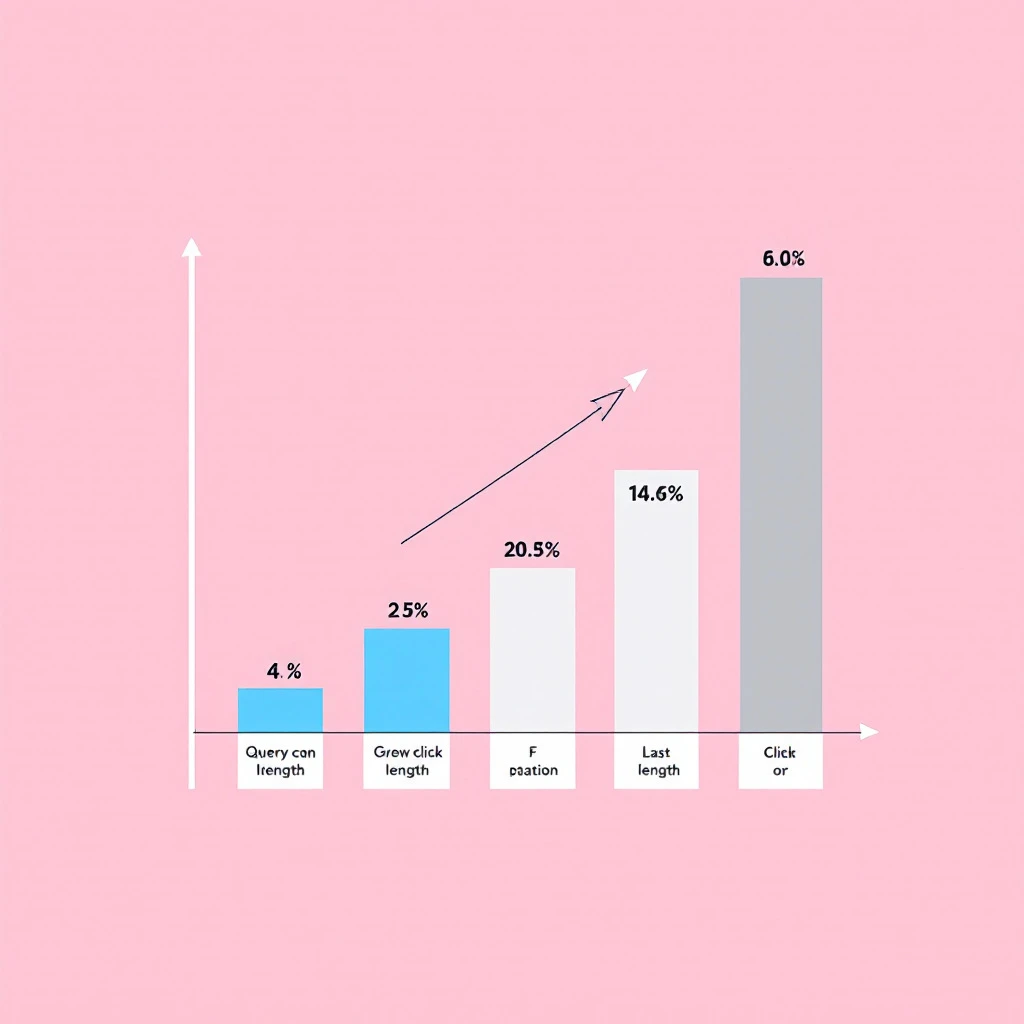
Every single one of our 357 clicks came from queries under 60 characters. Above that line: 7,983 distinct queries, 75,112 impressions, zero clicks. Not "low CTR." Zero.
The explanation is query fan-out. When someone asks ChatGPT, Perplexity, Gemini, or Google's AI Mode a question, the engine decomposes the prompt into 8–16 synthetic sub-queries, runs them against the index in parallel, reads the results, and synthesizes an answer. The human never sees a search results page. There is nothing to click. The impression registers in Search Console; the visit never happens.
Our highest-impression question query — 5,306 impressions at average position 3.3 — earned zero clicks in 28 days. Position 3 used to be a river of traffic. For machine-generated queries, it's a citation opportunity and nothing more.
Finding 2: 38% of distinct queries are machine-generated
Long question-form queries (60+ characters starting with what/which/how/where/is/can) accounted for 3,684 distinct queries and 47,258 impressions — 17.6% of ALL impressions on our site. Add the rest of the 60+ character bucket and machine-shaped queries make up 38% of everything Search Console recorded for us.
The question-word distribution tells you these are conversational prompts, not keywords:
- "what..." — 32,404 impressions
- "which..." — 7,005 impressions
- "how..." — 3,084 impressions
- "where..." / "is..." / "can..." — ~3,300 combined
Nobody types "what are some enterprise ai content pipeline automation solutions that can assist in creating brand videos for social media?" into Google. But an AI assistant expanding a user's lazy prompt into thorough sub-queries does — constantly.
Finding 3: The prompt-template queries expose the tools behind them
278 queries were explicitly persona-prefixed prompts — 4,491 impressions, zero clicks, average position 5.7. They follow a rigid structure that reveals slot-filling automation:
- "as a sdr team lead, how to reduce sales admin time with automation" (1,132 impressions)
- "as a founder at a seed company in united_states..."
- "as a founder at a series a company in united_kingdom..."
- "as a demand generation manager, i'm comparing hubspot marketing hub vs activecampaign vs mailchimp..."
Same personas, same funding-stage slots (seed / series a), same geography slots (united_states / united_kingdom, underscores included). This is a generative-engine-optimization or AI-SDR tool cycling through a persona matrix and firing the outputs at Google — almost certainly to test which brands AI engines recommend to which buyer personas.
Two more details from this bucket:
The German variants. 58 queries repeated the same pattern in German — "du musst ein erzwungenes ranking vom besten zum schlechtesten erstellen" ("you must create a forced ranking from best to worst") — 948 impressions. Someone is running localized prompt batteries across markets.
The template leaks. Four queries contained unfilled merge fields like [icp_company_size] and [icp_vertical]. The tool's templating failed, and its raw prompt scaffolding went to Google anyway. We are watching other companies' AI infrastructure malfunction in our Search Console.
Finding 4 (added September 8): the machines type short keywords too
When we published this study, we drew the line at 60 characters: short keyword queries were "human," long question queries were "machine." Two weeks of new data broke that assumption.
The single biggest machine footprint in our Search Console is now a 13-character keyword: "close pricing". Over the 28 days ending September 6, it generated roughly 28,500 impressions and zero clicks against our Close CRM pricing breakdown — much of it at average position 3.6. A human query at position 3-4 for a pricing keyword converts at 5-10% CTR. Zero clicks across 28,500 impressions is not a title problem. It's not a human.
The giveaway isn't the query text — it's the shape of the daily curve:
| Period | Daily impressions | Pattern |
|---|---|---|
| Aug 10-12 | 1-3 | Real human baseline |
| Aug 13-18 | ~354, nearly identical every day | Flat line — scheduler signature |
| Aug 19-23 | ~1,100-1,400 | Volume step-up |
| Aug 24-30 | ~0-43 | Someone turned the tool off |
| Aug 31 - Sep 6 | ~2,700-3,400 | Back on, at 10x the original scale |
Human search demand is noisy — weekday peaks, weekend dips, news spikes. This curve is dead flat at each level, steps up in discrete jumps, and has a week-long off switch in the middle. That's a cron job, not a market.
It's not an isolated case. "lead lists free" — another innocent-looking keyword — ramped from ~15 impressions/day to a perfectly flat 273/day over the same window. Same fingerprint: zero clicks, frozen position, no daily variance.
Then in early September we found the cleanest specimen yet: "drift alternatives." For roughly a week our Drift alternatives page surged on this keyword — on the peak day it averaged position 1.05 across 58 impressions and took zero clicks. Not position 8. Position one, essentially every serve, on a commercial "alternatives" keyword — the kind of ranking SEO teams celebrate — and not a single human clicked, because no human was searching. The burst ran about a week (steady 15-70 impressions/day), touched position 1, then collapsed back to 2-6 impressions a day. A rank check or retrieval job finished its run and moved on.
That's the finding in one line: position 1 with 0% CTR is now a real, recurring pattern in B2B Search Console data. If your reporting treats a #1 ranking as a win by definition, machine traffic will quietly inflate your scorecard on exactly the keywords that look most valuable.
We can't say for certain what's running these — a rank tracker, a GEO monitoring tool checking who Google serves for pricing queries, or AI agents doing retrieval grounding at scale. What we can say: short-query volume is no longer proof of human demand.
The practical trap: every SEO "quick wins" report flags exactly these pages — huge impressions, great position, terrible CTR, "just fix the title!" We nearly spent this week rewriting titles to win clicks from software that will never click anything. Before you optimize a high-impression zero-click page, pull the query's daily impression curve. If it's a flat line with step changes, the demand is synthetic — spend your effort somewhere real.
What this means: your rankings are being read, not clicked
The classic SEO contract — rank well, get traffic — is quietly being renegotiated. For a growing share of B2B research, the "searcher" is a model that reads five results, synthesizes an answer, and maybe cites you. The human sees the answer, not your site.
Three implications for B2B teams:
1. CTR is now a misleading metric for a chunk of your footprint. If we judged our question-form pages by CTR, we'd conclude they're failing. They're not — they're being consumed by a different reader. When we ran our search intent study earlier this month, we found "best tool" listicles barely convert even with human readers; for machine readers, the click was never on the table. Judge these pages by whether AI engines cite and recommend you — and by branded search and direct demo requests downstream.
2. Being the quotable source beats being the ranked source. Query fan-out means an AI engine runs a dozen sub-queries and fuses the results. Content that answers a specific question directly, in the first paragraph, with a concrete number, gets pulled into answers. Vague thought-leadership doesn't. This is why we lead posts with quick-answer blocks and real figures — like the actual all-in cost math in our AI SDR pricing breakdown or the tested match rates in our visitor identification guide.
3. Thin templated content is worthless to machine readers too. AI engines cross-reference. A page with no unique data adds nothing to a synthesized answer and gets skipped. This is the same logic that led us to delete 161 blog posts in one day — content that exists only to occupy a keyword has no audience left, human or machine.
The uncomfortable part: buyers are outsourcing evaluation
Look again at what those persona prompts ask: "which scales better for demand programs?", "how do customer testimonials rate the impact on sales and marketing alignment?", "according to user reviews on capterra, which is best?" — followed by a demand for a forced ranking.
B2B software evaluation — reading reviews, comparing pricing, building the shortlist — is being delegated to AI agents. The agent does the search, weighs the reviews, and hands its human a ranked list. If your product isn't legible to that agent — clear pricing, specific capabilities, verifiable claims — you're not on the shortlist and you'll never know an evaluation happened.
We've written before about what AI agents can and can't do for GTM work and how teams use Claude for lead generation and ABM workflows. The mirror image is now true: the same class of agents is evaluating you.
What we're doing about it (and what you should do)
Publish real numbers. Actual pricing math, tested match rates, honest limitations. Machine readers reward specificity because it's what makes an answer synthesizable. Our AI BDR tools comparison names real prices and real gaps for every vendor — that's the content that gets cited.
Answer the question in the first 100 words. Every high-intent page should open with a direct, quotable answer. The fan-out sub-query that matches your page gives you one shot to be extracted.
Keep your comparison claims verifiable. AI engines cross-check against reviews and other sources. Inflated claims don't just fail with skeptical humans — they get you dropped from synthesized answers when the cross-reference disagrees.
Watch your own Search Console for this pattern. Filter queries by length or question words. If 60+ character queries are piling up impressions with zero clicks, AI engines are already reading you. That's not a problem to fix — it's a channel to win.
Stop grading every page on clicks. Track citations in AI answers, branded search growth, and pipeline. The impression-with-no-click is the new top of funnel.
We've since turned these findings into a step-by-step B2B GEO playbook for winning AI buying agents — how to structure pages, pricing, and comparison claims so machine readers cite you.
Methodology notes
Data: full Google Search Console query export for marketbetter.ai, July 26 – August 22, 2026 (28 days). 20,892 distinct queries, 268,417 impressions, 357 clicks. Finding 4 added September 8, 2026 from a second window (August 10 – September 6): daily impression curves pulled per-query via the Search Console API; "close pricing" totals aggregated across all ranking URLs on the property. The "drift alternatives" example added September 10, 2026 (window August 11 – September 8) uses per-day query data on the same property. Classification: queries of 60+ characters beginning with interrogatives were classed as assistant-generated; queries matching persona-prefix or explicit instruction patterns ("as a [persona], ...", "you must provide a forced ranking", German equivalents) were classed as prompt-template queries. Classification was conservative — short conversational queries were left in the human bucket, so machine-generated share is likely understated. Query text shown verbatim from Search Console; these are public search strings, not user data.
MarketBetter identifies the buyers already researching you — human or otherwise — and tells your SDRs exactly what to do next. See how it works: book a demo →