3 posts tagged with "sdr training"

View All Tags

A Modern Playbook for Overcoming Objections in Sales

· 22 min read

Overcoming objections isn't about winning a debate. It's about getting to the heart of what’s really making a buyer hesitate.

The real shift happens when you stop thinking in terms of reactive rebuttals and start building a proactive, empathetic approach. This isn’t about having a clever comeback for everything; it’s about building trust and uncovering the genuine issues behind their concerns. The modern playbook is all about preparation and real dialogue.

Why Traditional Objection Handling Fails Sales Teams

Let's be honest: the old playbook for handling sales objections is toast. Today’s B2B buyers are incredibly well-informed. They’ve done their homework. When a rep meets a thoughtful concern with a generic, canned response, they don't sound confident—they sound completely out of touch.

That outdated method treats objections like roadblocks to plow through, not opportunities to actually understand the buyer's world. This reactive mindset immediately creates friction, turning the conversation into a battle of wills. You end up eroding the very trust you need to build. Instead of moving the deal forward, you get stalled conversations and burnt-out reps stuck reciting lines from a script.

The Shift from Reactive to Proactive

A modern, empathetic approach completely flips the script. The entire focus shifts from winning an argument to genuinely understanding the buyer’s hesitation. This takes real preparation, not just a list of pre-approved comebacks. A truly prepared rep walks into a call already understanding the account’s context, likely pain points, and specific industry challenges.

This proactive strategy is all about anticipating, not just reacting. It transforms the sales process from a confrontation into a collaboration. Let’s compare the two mindsets side-by-side:

  • Traditional (Reactive) Approach: Waits for an objection, then fires back with a pre-written, often irrelevant, rebuttal. The goal is to just "handle" it and move on.
  • Modern (Proactive) Approach: Uses data and research to anticipate likely concerns and weave them into the conversation early. The goal is to build a business case so strong that major objections never even surface.

Sticking to the old way has real consequences. Poor preparation is a direct line to revenue leakage. In fact, a staggering 55% of US sales leaders report losing revenue simply because their sales processes are poorly defined. And within that chaos, objection handling is a massive weak point. Without a system, conversion rates plummet as the same common doubts derail deal after deal. You can get more insights on how process gaps kill revenue over at The Sales Collective.

This image perfectly captures the difference between the old-school, aggressive tactics and a modern, data-driven strategy.

A side-by-side comparison of old, aggressive sales tactics versus a modern, data-driven approach.

The evolution is clear: we’ve moved from pushy sales tactics to a consultative partnership, where understanding and data are the bedrock of the relationship.

The Four Common Types of Sales Objections and How to Spot Them

The secret to handling any sales objection is knowing what you're really up against. A prospect’s first reason for saying "no" is almost never the real one. It's just a smokescreen for a deeper concern.

If you can learn to diagnose the real issue behind the initial pushback, you stop reacting and start solving. It's the difference between a conversation hitting a brick wall and having a breakthrough. Most objections you'll ever hear fall into one of four buckets.

Decoding Common Sales Objections

Before we dive into the specifics, here's a quick-reference guide to help you translate what you're hearing on a call into what the prospect is actually thinking. This is the first step—correctly identifying the problem.

Objection CategoryWhat You HearWhat It Often Means
Price & Budget"It's too expensive."
"We don't have the budget."
"I don't see enough value to justify this cost."
"You haven't made this a priority for me."
Authority & Timing"I need to talk to my boss."
"Call me back next quarter."
"I'm not the final decision-maker."
"I'm not convinced this is urgent enough to deal with now."
Need & Fit"We're happy with our current solution."
"I don't think we have that problem."
"You haven't connected your solution to a pain I actually feel."
"I don't understand how this is different or better."
Trust & Credibility"I've never heard of your company."
"How do I know this will work?"
"I'm worried about the risk of making a bad decision."
"You haven't proven that I can count on you or your product."

Think of this table as your field guide. Once you've identified the category, you can deploy the right strategy instead of just guessing.

Price and Budget Objections

This is the one every rep hears, but it's rarely about the money. A price objection is almost always a value objection in disguise.

When a prospect says, "We don't have the budget for this," what they’re really communicating is, "You haven't convinced me the value of your solution is worth the cost right now." Don't jump to offering a discount—that just validates their belief that your price was too high to begin with. Your first move is to explore that value gap. The goal is to re-anchor the entire conversation around the high cost of inaction.

Actionable Step: Instead of defending the price, ask: "Setting the price aside for a moment, do you believe our solution can solve [specific pain point]?" This pivots the conversation from cost back to value.

Authority and Timing Objections

This bucket covers anything related to a prospect’s power to sign the check or their timeline for doing so. Hearing "I need to run this by my boss" or "Call me back next quarter" can feel like a total shutdown. But these are usually just signals of internal uncertainty or a lack of urgency.

Let's compare two ways to handle this:

  • The Weak Response: "Okay, when would be a good time to follow up?" This just accepts the delay at face value.
  • The Strong Response: "That makes sense. To help you have that conversation, what specific metrics are most important for your boss when evaluating new tools?"

See the difference? The second response positions you as a helpful advisor, not just a persistent vendor. You're giving your champion the tools they need to sell for you internally. To learn more about this, check out our guide on asking better sales discovery questions to uncover the real decision-makers and timelines early on.

Need and Fit Objections

"We're happy with our current provider." "I don't think we really need this right now." These are classic need-based objections. They're a direct sign that you haven’t connected your solution to a real, pressing pain point. The prospect simply doesn’t see a meaningful gap between where they are today and the better future you're promising.

Actionable Step: Don't list features. Instead, ask about their current process. For example: "That's great you have a solution in place. Could you walk me through how your team handles [specific task] right now?" This uncovers hidden inefficiencies and creates an opening to discuss improvement.

Trust and Credibility Objections

This last category is probably the most sensitive. Objections like, "I've never heard of your company" or "How do I know this will actually work for us?" come from a fundamental lack of trust. This has nothing to do with your product's features. It’s all about their confidence—in your company, in your product's promises, and in you.

Building credibility requires a completely different playbook than defending your price. You have to show, not just tell.

  • Share a case study from a customer they'll recognize.
  • Offer to connect them with a current user in their industry.
  • Point to objective, third-party reviews on sites like G2 or Capterra.

Every move you make should be focused on one thing: reducing their perceived risk and proving you’re a safe bet.

Mastering the AERC Framework for Any Objection

If you're still relying on rigid scripts, you're losing deals. It's that simple. When a prospect raises a concern, they aren't looking for a canned rebuttal; they want to feel heard and understood. The secret to handling objections isn't about memorizing the perfect line—it's about having a repeatable process that works for any curveball they throw your way.

That’s where the AERC framework comes in.

AERC stands for Acknowledge, Explore, Respond, and Confirm. Think of it as your universal key for unlocking any objection. This simple, four-step approach completely changes the dynamic of the conversation, turning a potential confrontation into a collaborative problem-solving session. You stop fighting the objection and start working with the prospect to get to the root of it. This is how you build real trust and uncover what's actually holding them back.

A four-step diagram outlining how to master sales objections: Price, Authority, Need, and Trust.

Whether they’re hung up on price or questioning if they even have the authority to buy, this framework gives you a path forward.

Acknowledge and Validate Their Concern

The second a prospect objects, most reps jump straight into defense mode. Huge mistake. Your first move, always, is to acknowledge what they’ve said and validate their perspective. You don’t have to agree with them, but you do have to show them you’re listening.

This simple act of empathy works wonders. It instantly disarms them and proves you respect their point of view.

Phrases to have in your back pocket:

  • "That's a fair point. I can see why you'd feel that way."
  • "I appreciate you bringing that up. It's a valid concern."
  • "I hear that a lot, and it makes complete sense why you'd ask."

Notice the subtle but critical difference here. You aren't agreeing with the objection itself. You're just agreeing that the feeling behind it is legitimate. That nuance is everything—it builds rapport while keeping you in control of the call.

Explore the Root Cause

Okay, you've acknowledged their point. Now, you have to fight the urge to launch into your pitch. The next, and most important, step is to explore the "why" behind their objection. The first thing they say is almost never the real issue; it’s just the tip of the iceberg.

To get to the truth, you need to ask thoughtful, open-ended questions that get them talking. Patience is your best friend here. Data from Gong shows that top-performing reps pause for a noticeably long time after hearing an objection. We're talking 2-3 seconds or more. This gives the prospect space to elaborate, and it leads to 20-30% higher win rates in deals where objections are common.

Let’s see it in action: Prospect: "Your price is just too high." Average Rep: "But we offer way more value than our competitors..." (Wrong move.) Top Rep: "I appreciate you sharing that. So I can understand better, when you say the price is too high, could you tell me what you're comparing it to?"

See the difference? The top rep is digging for context.

Respond with a Tailored Solution

Now you can respond. Once you've truly understood the root cause of their hesitation, you can connect your solution directly to the specific problem they just shared with you. A generic feature dump is a waste of everyone's time. A response tailored to the problem they just articulated? That’s what gets their attention.

This isn't about winning an argument. It's about showing them how your product or service directly solves the very specific concern they just laid out. If they revealed the real issue is long-term ROI, you talk about ROI—not some shiny new feature they don't care about.

Confirm and Move Forward

You're almost there. The final step is to simply confirm you've actually addressed their concern. Never assume their silence means they're on board. You have to close the loop and get their explicit buy-in before moving on.

Asking a quick confirmation question solidifies the progress you’ve made and stops that same objection from popping up again five minutes later. While AERC is a fantastic all-purpose tool, it's also smart to dig into more specific, proven frameworks for handling B2B sales objections for different scenarios.

Effective ways to get confirmation:

  • "Does that help clarify things for you?"
  • "Did I address that concern to your satisfaction?"
  • "With that in mind, does this seem like a more viable path forward?"

This final check ensures you're both on the same page and gives you the green light to take the next step.

Your Actionable Playbook for Specific Objections

Having a framework like AERC in your back pocket is great, but theory goes out the window when a prospect hits you with a real-world objection mid-call. So let’s get practical. We’re going to break down exactly how to handle the objections you hear all day, every day.

This is about more than just having a clever comeback. It’s about fundamentally reframing the conversation. A weak response sounds defensive and generic. A strong one, on the other hand, is curious, specific, and opens the door to a real discussion. You're not trying to win an argument; you're trying to understand their world.

Scenario 1: "We Already Use a Competitor"

This is probably the most common brush-off in the book. A rookie rep hears this and immediately jumps into a feature-by-feature battle, which just makes the prospect dig their heels in. A top performer sees this for what it is: an opening.

Weak Response (The Old Way): "Oh, okay. Well, we're actually better because we have X, Y, and Z features that they don't." This immediately forces them to defend a decision they've already made. Dead end.

Strong Response (The MarketBetter Way): "That's great to hear, they're a solid company. Since you're already up and running with a solution like this, could you tell me what you like most about their platform? And maybe one thing you wish it did better?"

See the difference? This approach is completely disarming. You start by validating their choice, which builds rapport. Then, you use their existing expertise to pinpoint specific gaps or frustrations that your solution is perfectly designed to fix. You’re not trying to rip and replace; you’re looking for a way to add value.

Actionable Step: Position yourself as a complementary tool, not a full-on replacement. Try this: "A lot of our customers actually use us alongside [Competitor] because we solve a very specific problem around X. Is that a workflow your team has run into?" This reframes the conversation from "switch" to "add."

Scenario 2: "Call Me Back Next Quarter"

Ah, the classic timing objection. Let's be honest, this is usually just a polite way of saying, "You haven't convinced me this is a priority." If you just accept it and set a reminder, you're letting a potential deal go cold. Your real job here is to figure out why they want to delay.

Weak Response (The Old Way): "Sure thing, I'll put a note in my calendar to reach out in three months. Have a great quarter!" You’ve just handed over all control and momentum.

Strong Response (The MarketBetter Way): "I'm happy to do that. Just so I can come prepared for our next chat, what's slated to change for your team between now and then?"

This is a simple, respectful question that often cracks the code. It helps you uncover the real bottleneck.

  • Is a budget cycle about to end?
  • Is a key decision-maker out of office?
  • Is there another massive project eating up all their time?

Getting that context is everything. It lets you tailor your follow-up so you stay relevant. Sometimes, just asking this question clears up a misunderstanding, and the prospect realizes the conversation is more urgent than they first thought. To keep the momentum going between calls, you can lean on strategies like social selling to build your relationship and stay top-of-mind.

Scenario 3: "We Don't Have the Budget Right Now"

This one feels like a brick wall, but it's almost never about a literal lack of funds. It's a value objection. They're really saying, "I don't believe the return on this is worth the investment." The worst thing you can do is jump straight to a discount. That just cheapens your product and confirms their suspicion that it wasn't worth the list price.

Weak Response (The Old Way): "I understand. Well, we can offer a 15% discount if you sign this month. Would that help?"

Strong Response (The MarketBetter Way): "That's a fair point, and budgets are tight everywhere right now. If we set the price aside for just a moment, do you feel our solution could actually help solve the challenges we talked about with [mention their specific pain point]?"

This is a masterful pivot. You’re taking the conversation away from cost and putting it squarely back on value.

If they say "yes," the problem shifts from "buying a product" to "finding a way to afford a necessary solution." If they say "no," you’ve just learned the real objection isn't the budget at all—it’s that you haven’t sold them on the impact. For more ways to navigate these critical moments, check out these battle-tested sales call scripts for inspiration.

Before we move on, let's look at a quick comparison that really drives home the difference between a reactive approach and an informed, tool-assisted one.

Objection Handling Comparison: Old Way vs. The MarketBetter Way

ObjectionThe Old Way (Generic Rebuttal)The MarketBetter Way (Informed Response)
"We already use Competitor X.""We're better because of features A, B, and C.""Great, they're a good company. What do you like most, and what's one thing you'd change?"
"Call me back next quarter.""Okay, I'll set a reminder.""Happy to. To prepare, what's changing between now and then?"
"We don't have the budget.""What if I offer you a 15% discount?""Fair point. Price aside, do you believe this solves [pain point]?"
"Just send me an email.""Sure, what's your email? I'll send it now.""I can do that. To make it relevant, what should I focus on? The part about [benefit 1] or [benefit 2]?"

As you can see, the "old way" is reactive and often leads to a dead end. The MarketBetter way is proactive, turning objections into opportunities for deeper discovery. It's about changing the entire dynamic of the conversation.

How to Scale Objection Handling Across Your Team

Having a few rockstar reps who can dance around any objection is great, but it’s not a strategy for growth. To really scale, you need a system that lifts the entire team's game. This means ditching the one-off coaching sessions and building a repeatable process for sharing what works, tracking performance, and making smart, data-driven improvements.

A man analyzes sales objection trends on a laptop, connected to an objection library used by multiple users.

It all starts with a centralized objection library—a set of battle cards, if you will. Instead of every SDR fumbling to come up with a response on their own, this shared playbook captures new objections and the exact talk tracks that have proven to work. Suddenly, tribal knowledge becomes a team asset.

But a library is just a library. It's static. You have to bring it to life with active practice, and that means running role-play sessions that don't suck.

From Theory to Action

Let's be honest, most role-playing feels awkward and forced. The key to making it work is to get hyper-specific. Forget generic situations and zero in on the top three objections your team is actually hearing this week. Pull the data straight from your CRM to see what's really tripping people up.

  • Weak Role-Play: "Okay, pretend I'm a prospect who says we're too expensive. Go." This is lazy. It’s a vague prompt that doesn’t mirror the pressure or specifics of a real call.
  • Actionable Role-Play: "Team, 'bad timing' objections are up 15% this week. Let's dig in. Sarah, you're the prospect who just signed a contract with a different vendor. John, use the AERC framework to uncover what's really behind that timing issue."

See the difference? That specificity makes the practice immediately relevant. It gives your reps concrete tactics they can use on their very next call and shifts the focus from a cringey performance to a genuine practice session. It’s about creating a safe space to fail, learn, and get better. For this to truly stick, these practices need to be part of a bigger sales enablement strategy that supports reps from day one.

Using Data for Targeted Coaching

This is where your tech stack becomes your secret weapon. When every call's outcome and objection is logged automatically, you stop guessing where the problems are. You get a crystal-clear view of team-wide trends and can pinpoint exactly who needs help with what.

A perfect example of this comes from Outreach. They noticed one of their SDRs, Katie, was getting hit with the 'bad timing' objection on 15% of her calls—way above the team average. Instead of just telling her to "get better," her manager used call intelligence to review those specific conversations and give targeted feedback. A few months later, Katie's bad-timing objection rate plummeted to 5.9%. That’s a 60% improvement that directly boosted her pipeline.

That’s the power of a scalable system. The manager didn't need to listen to hundreds of hours of calls; the data led them right to the coaching opportunity. When you combine a shared playbook, targeted role-play, and data-backed insights, you create a powerful feedback loop that turns objection handling from an art into a science.

Your Burning Questions About Handling Objections, Answered

Even with the best frameworks in your pocket, the real world always throws curveballs. Let's tackle some of the most common questions and "what-if" scenarios that pop up when teams start getting serious about objection handling.

What's the Single Biggest Mistake Reps Make?

Easy. They treat an objection like a fight.

The moment a prospect raises a concern, so many reps go into full-on debate mode, trying to prove the prospect wrong. It's a natural instinct, but it’s a deal-killer. They jump straight to a defensive rebuttal without ever stopping to figure out why the prospect feels that way.

This immediately puts the buyer on the defensive and makes them feel like you aren't listening. The best reps I've seen make a simple but profound mindset shift:

  • Losing Approach: Tries to "convince" the prospect their objection is invalid. This creates an adversarial dynamic.
  • Winning Approach: Seeks to "collaborate" with the prospect. It's all about understanding their world and figuring out if there's a path forward together.

It's the difference between a battle and a partnership.

How Do You Prepare for Objections You Can't Predict?

You can't have a script for everything, and you shouldn't try. The goal isn't to memorize a million responses; it's to internalize a single, flexible process so deeply that it becomes muscle memory.

When a truly unexpected objection comes out of left field, your framework is your safety net. Don't panic—just fall back on your process.

Actionable Step: Acknowledge their point immediately. Say, "That's a fair question, I hadn't thought about it from that angle." This buys you time. Then, pivot to exploration: "To make sure I understand, can you walk me through what's driving that concern for you?"

This simple one-two punch does two critical things: It buys you a few precious seconds to think, and more importantly, it ensures you’re responding to the real issue, not just the one on the surface.

How Do We Get Better at This Across the Whole Team?

Scaling this skill means moving away from relying on a few star performers and building a system that elevates everyone. If you want to see team-wide improvement, focus your energy on three key areas.

  1. Build a Living "Battle Card" Library: Create a shared, central document where reps can drop new objections they hear and, crucially, the responses that actually worked. This turns every individual learning moment into a resource for the entire team.
  2. Run Targeted Role-Play Sessions: Don't just "do role-play." Get specific. Dedicate 15-20 minutes in your weekly team meeting to practice the top one or two objections the team is actually struggling with this week. Keep it focused and relevant.
  3. Use Your CRM as a Coaching Tool: This is where the magic happens. By having reps log call dispositions and objection types, you suddenly have real data. Managers can see exactly which objections are killing the most deals and deliver targeted coaching that solves actual pipeline problems.

Ready to turn objections from roadblocks into opportunities? MarketBetter.ai gives your SDRs the AI-powered task engine they need to master every part of their outreach, from AI-driven call prep to instant CRM logging, all inside Salesforce or HubSpot. See how we help you build a consistent, high-performing outbound motion at https://www.marketbetter.ai.

8 Actionable Sales Call Scripts That Convert in 2026

· 24 min read

In a world of automated emails and endless noise, a great sales call is your ultimate advantage. But generic, outdated scripts get you hung up on. Prospects are smarter, more informed, and have less time than ever. The difference between a booked meeting and a dial tone often comes down to the quality of your framework. Effective sales call scripts aren't about robotic, word-for-word recitation; they are strategic conversation guides that give you the structure to be authentic and agile.

This guide moves beyond theory and provides 8 battle-tested, scenario-based sales call scripts designed for modern SDRs. We'll break down the strategy behind each one, compare their strengths and weaknesses, and provide actionable tips for implementing them directly within your Salesforce or HubSpot workflow. Whether you're making a cold call, running a discovery session, or preempting objections, these frameworks will help you build rapport, uncover pain, and book more qualified meetings. Ultimately, the goal of upgrading your sales call scripts is to significantly boost sales in your call center, ensuring every conversation moves you closer to your targets. Let's dive into the scripts that will get you there.

1. The MEDDIC Discovery Call Script

The MEDDIC framework is less a word-for-word script and more a structured methodology for conducting high-value discovery calls. It's a qualification system designed to systematically uncover critical deal information, ensuring your team pursues opportunities with a real chance of closing. For SDRs, using MEDDIC-based sales call scripts shifts the conversation from a generic feature pitch to a diagnostic business consultation. Where a simpler script might focus only on booking a meeting, MEDDIC is designed to determine if a meeting is even worthwhile.

MEDDIC is an acronym that guides the conversation:

  • Metrics: What are the quantifiable business outcomes the prospect needs? (e.g., "increase revenue by 15%," "reduce customer churn by 10%")
  • Economic Buyer: Who has the ultimate authority to approve the budget and sign the contract?
  • Decision Criteria: What specific requirements must your solution meet for them to buy?
  • Decision Process: How does the organization evaluate, select, and purchase new solutions?
  • Identify Pain: What is the core business problem driving the need for a solution?
  • Champion: Who inside their organization will advocate for your solution and sell on your behalf?

Why This Script Works

Unlike scripts focused on a product pitch, the MEDDIC approach forces a deep understanding of the customer's world. Enterprise software teams at SAP and Oracle partners standardized on MEDDIC to build a predictable pipeline because it roots every deal in tangible business impact. Studies by Gong show that sales reps who consistently apply MEDDIC principles often see 15-20% higher win rates.

Key Insight: MEDDIC prevents "happy ears" by forcing reps to ask the tough qualifying questions early. It answers "Can they buy?" and "Will they buy?" instead of just "Do they like our product?"

Actionable Tips for Implementation

  • Integrate with your CRM: Build MEDDIC qualifying questions directly into your Salesforce or HubSpot opportunity fields. This prompts reps to gather the data and allows AI call summaries to auto-populate the information.
  • Train for Conversational Flow: Coach SDRs to listen for unprompted mentions of pain or metrics. The goal isn't to robotically check off each MEDDIC letter but to have a natural conversation that uncovers these details. For a deeper dive, review our guide to effective sales discovery questions.
  • Use Call Coaching AI: Combine this framework with AI tools that can flag when a rep consistently skips a key step, like identifying the Economic Buyer. This provides targeted, data-backed coaching opportunities.

2. The SPIN Selling Cold Call Script

SPIN Selling, a framework developed by Neil Rackham, provides a structured approach to consultative questioning. Rather than pushing a product, it uses a specific sequence of open-ended questions to guide a prospect toward identifying their own problems and recognizing the value of a solution. This makes it one of the most effective sales call scripts for complex B2B sales where trust and deep problem discovery are critical. While MEDDIC focuses on deal qualification, SPIN excels at problem identification and building the business case from the ground up.

Diagram illustrating the Situation, Problem, Implication, and Need-Payoff sales or problem-solving framework.

The SPIN acronym represents the four stages of questioning:

  • Situation: Gathering facts and background information about the prospect's current state. (e.g., "How do you currently manage your lead-to-opportunity process?")
  • Problem: Probing for challenges, difficulties, or dissatisfactions. (e.g., "What are the biggest bottlenecks you face when handing off MQLs to the sales team?")
  • Implication: Exploring the consequences and effects of the identified problems. (e.g., "If leads are not followed up on quickly, what impact does that have on your pipeline conversion rates?")
  • Need-Payoff: Encouraging the prospect to articulate the benefits of a solution. (e.g., "What would it mean for your team if you could automate that handoff and see a 15% faster response time?")

Why This Script Works

SPIN shifts the dynamic from selling to helping. Rackham's original research demonstrated that successful sellers focus on developing value rather than just handling objections. Enterprise sales teams at Salesforce and LinkedIn Sales Solutions adopt SPIN as a foundational methodology because it positions reps as trusted advisors, not just vendors. This consultative stance is crucial for building the long-term relationships needed for high-value deals.

Key Insight: SPIN selling is effective because it makes the prospect the hero of their own story. By asking the right questions, you help them connect the dots between their small frustrations and significant business consequences, creating a powerful internal motivation to change.

Actionable Tips for Implementation

  • Prep Implication Questions: The most challenging yet powerful part of SPIN is uncovering implications. Before a call, brainstorm at least three potential "so what?" consequences related to the problems your solution solves. Don't try to invent these on the fly.
  • Use Intent Data for Situation: Start your cold call with more credible Situation questions by referencing recent company news or signals. For example: "I saw you recently expanded into the EMEA market; how are you managing international sales territories in your CRM today?"
  • Log Problems in Your CRM: Create custom fields in your Salesforce or HubSpot opportunity for "Identified Problem" and "Key Implication." This allows you to personalize follow-up emails using the prospect's own words, making your communication far more relevant.
  • Coach the Pause: Train SDRs to become comfortable with silence after asking a Problem or Implication question. This pause gives the prospect crucial space to think deeply and provide a more thoughtful, revealing answer.

3. The Value-First Opener (No Pitch) Script

This modern approach flips the traditional cold call on its head. Instead of opening with your name, company, and product, you lead with a specific, relevant insight to immediately justify the interruption and earn the prospect's attention. The goal of these sales call scripts is not to pitch, but to demonstrate value in the first 20 seconds, proving you've done your research and are calling for a good reason. This contrasts sharply with pitch-heavy scripts by focusing entirely on earning the next moment of conversation.

A hand holding a glowing lightbulb labeled 'INSIGHT' above a stopwatch asking for 20 seconds.

The conversational flow is simple and effective:

  1. Greeting & Permission: "Hi [Prospect Name], this is [Your Name]. I know I'm calling you out of the blue, but I saw [compelling insight]. Can I get 20 seconds to tell you why I'm calling?"
  2. Deliver Insight: "I noticed your company just announced funding to expand into the APAC region, and typically, new market entry puts a huge strain on GTM enablement. I have an idea that could help your new reps ramp 30% faster."
  3. Micro-Ask: "Is this a priority for you right now, or is there someone else on the expansion team I should talk to?"

Why This Script Works

This opener respects the prospect's time and intelligence by replacing a self-serving pitch with a prospect-centric observation. Gong's research shows that successful cold calls often involve the rep speaking less and asking thought-provoking questions. This framework, championed by intent-data platforms like 6sense and modern sales communities like Pavilion, is built to do just that. It shifts the dynamic from a sales pitch to a peer-level business conversation.

Key Insight: The value-first opener works because it bypasses the brain's natural "salesperson filter." By leading with an insight about their business, you trigger curiosity instead of skepticism.

Actionable Tips for Implementation

  • Prepare Your Insight: Before dialing, identify a specific trigger event (e.g., a key new hire, funding announcement, poor earnings report). Write this insight into your call prep notes in your CRM so it's readily available.
  • Log the 'Why': In Salesforce or HubSpot, create a custom field called "Call Insight Used." Logging the specific trigger allows you to track which types of insights generate the most callbacks and meetings, refining your team's approach over time.
  • Practice the Flow, Not the Script: The power is in the natural delivery. Coach reps to internalize the structure but not to read word-for-word. This helps them sound authentic. For more guidance on this, check out these cold calling best practices.

4. The Challenger Sales Opening Script

Grounded in CEB/Gartner research on what separates top performers, the Challenger approach is a bold strategy that leads with a contrarian teaching point. Instead of asking about problems, the script reframes the prospect's world by introducing a new or overlooked perspective. These types of sales call scripts shift the rep's role from a seller to a credible expert, sparking curiosity rather than a standard sales defense. It’s a more assertive alternative to the Value-First Opener, aiming not just to offer value but to disrupt the prospect's current thinking.

A person points at a puzzle piece, with a "What if..." speech bubble leading to "Contrarian Insight" and a bar chart.

The Challenger script follows a distinct sequence:

  1. Warm Opening: A brief, personalized introduction.
  2. Teach: Introduce a commercial insight or a different way of looking at their market or business.
  3. Reframe: Connect that insight to a hidden or misunderstood problem they likely have.
  4. Position: Present your solution as the best way to solve that newly illuminated problem.

Why This Script Works

Unlike approaches that validate a prospect's current thinking, the Challenger method builds credibility by teaching them something valuable. SaaS leaders like Slack and Stripe use Challenger-style openers to teach prospects about internal communication bottlenecks or payment processing inefficiencies they hadn't considered. Gartner's research famously documented that this methodology is consistently used by the highest-performing sales reps across industries.

Key Insight: The Challenger model moves the conversation away from price and features. By reframing the problem, you make your specific solution uniquely relevant and differentiate it from competitors who are still addressing the old, surface-level issues.

Actionable Tips for Implementation

  • Build Your "Teaching" Library: Don't improvise your insights. Research and document 3-5 proven teaching points specific to each prospect's industry and role. These should be surprising yet relevant.
  • Deliver with Curiosity: Frame your insight as an observation, not an accusation. Use phrases like, "I've been talking with other VPs of Marketing, and a surprising trend I've noticed is..." instead of "You're probably doing this wrong."
  • Track What Resonates: Log the specific teaching point you used in your Salesforce or HubSpot call notes. This allows you to analyze which perspectives generate the most pipeline and which ones fall flat, refining your approach over time.
  • Prepare for Pushback: A good Challenger insight might be met with skepticism. Be prepared for disagreement and have follow-up data or questions ready to explore their perspective. This shows you're a consultant, not just a preacher.

5. The Assumptive Close / Soft Close Phone Script

The assumptive close is a high-velocity technique built on confidence and momentum. Instead of asking for a meeting, this script assumes the prospect will agree and moves directly to scheduling. It’s a powerful tool for SDRs whose primary goal is to book initial appointments, especially when working with high-intent or pre-qualified leads. The focus is on minimizing friction and getting a "yes" to a meeting, not on deep qualification during the initial call. This script is the opposite of a discovery framework like MEDDIC; its sole purpose is to convert intent into a calendar event quickly.

This approach strips the conversation down to its essentials:

  • Brief Opener: Get straight to the point without excessive rapport-building.
  • Concise Value Prop: A single, impactful sentence explaining why you’re calling.
  • Direct Ask: Instead of asking if they want to meet, you ask when. (e.g., "I have 15 minutes open on Tuesday at 2 PM or Wednesday at 10 AM, which works better for you?")

Why This Script Works

This script works by reframing the interaction psychologically. High-velocity sales teams at companies like Salesloft and Outreach use it to accelerate pipeline generation because it projects confidence and respects the prospect's time. By offering specific times, you reduce the cognitive load for the prospect and make it easier for them to say yes. Gong's research confirms that for inbound-ready leads, sales call scripts using an assumptive close have one of the highest meeting-set rates.

Key Insight: The assumptive close short-circuits the "let me think about it" objection. By presenting the meeting as a foregone conclusion, you steer the conversation away from deliberation and toward simple calendar logistics.

Actionable Tips for Implementation

  • Use on Qualified Leads Only: This approach is most effective on leads with clear intent signals or a strong ICP fit. Using it on a completely cold, unqualified list can come across as overly aggressive and backfire.
  • Deliver with Certainty: Your tone is critical. Any hesitation or uncertainty in your voice will break the assumptive frame and invite objections. Coach reps to deliver the closing line as a confident statement, not a question.
  • Prepare Time Slots in Advance: Have two to three specific time slots ready before you even dial. This prevents awkward pauses while you "check your calendar" and keeps the momentum going.
  • Log Outcomes in Your Dialer: Track meeting-set rates tied to this script in your dialer. This data will help you understand which openers and value props are most effective at converting prospects into meetings.

6. The Resonance-Based Cold Call Script

This modern approach moves away from the product pitch and instead leads with a specific, timely observation designed to create immediate resonance. The structure is based on pattern recognition: you identify a trigger event at the prospect's company and connect it to a similar challenge faced by a peer company you've helped. For SDRs, using these sales call scripts makes outbound calls feel less like an interruption and more like a relevant, informed check-in. It serves as a middle ground between the insight-driven Value-First opener and a more direct problem-focused script.

The core conversational flow is straightforward:

  • Permission-Based Opener: "Hi [Name], it's [Your Name] from [Your Company]. Got a moment?"
  • The Resonance Statement: "Reason for my call is I saw your team recently [launched a new product / announced expansion into EMEA]. We noticed a similar move over at [Peer Company]..."
  • Connect to a Challenge: "...and they were running into issues with [specific, relevant business problem]."
  • Transition to a Question: "Curious if you’re navigating a similar challenge as you scale?"

Why This Script Works

Instead of leading with your solution, you're leading with the prospect's world. This demonstrates research and contextual awareness, which immediately builds credibility. Intent data providers like 6sense and Demandbase advocate for this approach because it directly capitalizes on buying signals, making cold outreach feel warm. Communities like Pavilion and Outbound Collective champion this method as it turns a generic script into a pointed business conversation.

Key Insight: This script changes the dynamic from "I want to sell you something" to "I see what you're doing and might have a relevant insight." It earns the right to ask questions by first offering a compelling observation.

Actionable Tips for Implementation

  • Identify Relevant Triggers: Use company research tools to find recent, meaningful triggers like a new funding round, an earnings miss, or a key executive hire. The more specific the trigger, the stronger the resonance.
  • Select Respected Peers: When referencing another company, choose one the prospect knows and respects. Citing an obscure or smaller competitor undermines your credibility and weakens the connection.
  • Refine Your Delivery: Practice the resonance statement until it sounds natural and conversational, not like you're reading a script. The goal is to convey genuine curiosity about their situation. For more ideas on framing your value, see our guide on crafting a strong unique value proposition.
  • Track Your Triggers: In your CRM, log which resonance statements and peer comparisons lead to the most meetings. This data allows your entire team to replicate what works and abandon what doesn't.

7. The Problem-Agitation-Solution (PAS) Cold Call Script

Borrowed from classic copywriting, the Problem-Agitation-Solution (PAS) framework is a powerful structure for cold calls. It focuses on making the prospect feel understood by articulating a common business pain, exploring its negative consequences, and then introducing your product as the specific remedy. The flow of these sales call scripts is direct and emotionally resonant. Compared to SPIN selling, which guides the prospect to discover the pain themselves, PAS is more direct—you state the problem and then twist the knife.

PAS guides the conversation through three distinct stages:

  • Problem: State a common, relevant problem your prospect likely faces. (e.g., "I'm calling because most sales managers struggle with inconsistent CRM data hygiene.")
  • Agitation: Magnify the pain by highlighting the specific, negative outcomes of that problem. (e.g., "This usually leads to inaccurate forecasts and wasted SDR time chasing bad leads.")
  • Solution: Introduce your offering as the clear path to resolving that agitated pain. (e.g., "We built a tool that automates data entry to fix that. Is that something you'd be open to learning more about?")

Why This Script Works

The PAS framework is effective because it mirrors how people make decisions. It starts with a problem they recognize, builds urgency by focusing on the consequences, and then offers relief. Sales training organizations like Sandler Training teach similar pain-based methodologies because they shift the focus from the product to the prospect’s world. It's particularly useful in competitive displacement campaigns where you can agitate the known pains of a rival's solution.

Key Insight: PAS gets to the "why" before the "what." By making the prospect feel the pain of their problem, you create a natural pull for the solution you're about to present. The goal is an emotional "yes" before a logical one.

Actionable Tips for Implementation

  • Be Specific with Agitation: Vague agitation falls flat. Instead of saying it "costs money," quantify it: "On average, that costs teams 15-20% in lost productivity." This adds credibility and weight to the problem.
  • Deliver with Empathy: The agitation phase should not feel like an attack. Use an empathetic, consultative tone. You are a doctor diagnosing a known ailment, not an alarmist.
  • Validate Your Problem Statement: Use intent data signals from your sales intelligence platform to identify companies actively researching the problem you solve. This ensures your opening line lands with a prospect who is already feeling the pain.

8. The Objection-Preemption Call Script

This strategic approach flips the standard call on its head by anticipating and neutralizing common objections before the prospect has a chance to raise them. Instead of waiting for a "we don't have the budget" or "I'm too busy," the rep acknowledges the likely hesitation upfront, disarming the prospect and earning credibility. These sales call scripts show you've done your homework and understand their world. It’s a proactive strategy, contrasting with reactive objection handling that happens later in other scripts.

The core structure is a five-step conversational flow:

  1. Brief Intro: State your name, company, and the reason for your call.
  2. Acknowledge Hesitation: Address the elephant in the room. (e.g., "I know you're likely busy and skeptical of unexpected calls like this.")
  3. Differentiate Your Call: Explain why this call is different. ("But I found something specific about your team's project pipeline that I thought was worth a 30-second chat.")
  4. Provide the Insight: Deliver a specific, valuable piece of information.
  5. Low-Friction Ask: Ask for a small next step, not a 30-minute demo.

Why This Script Works

This script works because it demonstrates high emotional intelligence and empathy. By preempting an objection, you show the prospect you understand their perspective, which instantly lowers their guard. Enterprise sales teams targeting C-level executives and high-ticket consultants use this method to bypass gatekeepers and establish peer-level authority from the first sentence. It changes the dynamic from a sales pitch to a consultative conversation.

Key Insight: Preempting objections isn't about being defensive; it's about leading with empathy. It communicates, "I get it, your time is valuable, and I wouldn't be calling unless this was important." This builds trust faster than any product feature can.

Actionable Tips for Implementation

  • Be Specific: Name the exact objection you're preempting. Instead of a generic "I know you're busy," try "You're probably thinking this is just another SaaS tool you don't need."
  • Follow with Immediate Value: The preemption must be followed by a valuable, research-backed insight. "But I saw your team is hiring five new account managers, and our data shows that ramp time is costing teams like yours over $50k per rep."
  • Track Preemption Success: In your CRM, create a disposition for "Objection Preempted." This helps you measure which preemptive lines are most effective at preventing knee-jerk rejections. For a deeper look at handling resistance, see our guide on overcoming sales objections.
  • Coach for Authenticity: This technique can sound robotic if not delivered with genuine curiosity. Role-play this script with experienced reps to nail the tone before rolling it out to newer SDRs.

8-Point Sales Call Script Comparison

ScriptImplementation Complexity 🔄Resource Requirements ⚡Expected Outcomes 📊Ideal Use Cases 💡Key Advantages ⭐
The MEDDIC Discovery Call Script🔄 High — structured diagnostic flow; training to avoid checklist tone⚡ Medium-High — CRM fields, manager coaching, 15–20 min call capacity, MarketBetter prep📊 Strong qualification; reduces pipeline waste; +15–20% win-rate for practitionersEnterprise/complex SaaS SDR teams; deals needing early buyer/criteria clarity⭐ Consistency; early economic-buyer ID; rich CRM data for scoring
The SPIN Selling Cold Call Script🔄 Medium-High — requires practiced listening and probing⚡ Medium — training, call prep, MarketBetter intent/context feeds📊 Higher credibility and rapport; improves conversion in long-cycle dealsComplex/consultative B2B sales; long sales cycles⭐ Consultative questioning; prospect-led need articulation
The Value-First Opener (No Pitch) Script🔄 Low — simple structure but requires a real insight⚡ Medium — good pre-call research, intent data, MarketBetter task inbox📊 Higher answer/engagement; more micro-commits and callbacksModern outbound, email-fatigued prospects, intent-driven outreach⭐ Fast, scalable, permission-based; low objection rate
The Challenger Sales Opening Script🔄 High — deep market insight and careful framing required⚡ High — subject-matter research, coaching, MarketBetter insight shaping📊 Very high engagement and longer conversations; +25–40% close lift reportedDisruptive/high-value solutions; inbound replies; enterprise accounts⭐ Reframes problems; builds credibility; creates curiosity
The Assumptive Close / Soft Close Phone Script🔄 Low — direct, scripted close with limited discovery⚡ Low-Medium — high-quality lists, dialer, calendar links, MarketBetter prioritization📊 Highest meeting-set rate for pre-qualified/high-ICP leadsHigh-velocity SDR teams; early-stage, high-fit accounts⭐ High meeting conversion; easy to coach and QA
The Resonance-Based Cold Call Script🔄 Medium — personalization around a peer/trigger needed⚡ Medium — accurate account triggers, MarketBetter research, relevant peer examples📊 Lower hang-ups; quicker relevance recognition and longer dialoguesIntent-driven outbound; accounts with visible triggers/peers⭐ Natural personalization; builds trust via peer credibility
The Problem-Agitation-Solution (PAS) Cold Call Script🔄 Low-Medium — formulaic but needs correct problem diagnosis⚡ Low-Medium — problem research, supporting data for agitation📊 Highly persuasive when problem matches; creates urgency and motivationCompetitive displacement, well-understood pain areas, B2B SaaS⭐ Creates urgency; scalable template; intuitive for new reps
The Objection-Preemption Call Script🔄 Medium-High — anticipatory framing and confident delivery required⚡ Medium — research to identify likely objections, coaching, MarketBetter signals📊 Fewer objections; more productive conversations with senior/guarded prospectsSenior-level outbound, high-value/long-cycle deals⭐ Defangs resistance; builds psychological safety; reduces reactive handling

From Script to System: Making Great Calls Repeatable

Moving from theory to practice is where the real value of any sales methodology is proven. We've explored a powerful arsenal of eight distinct sales call scripts, from the deep, diagnostic questioning of MEDDIC and SPIN to the direct, assertive approaches of the Challenger and Assumptive Close models. Each framework offers a unique pathway to engaging prospects, but they are not interchangeable magic wands. Their true power emerges when you understand the strategic "why" behind each one.

The Problem-Agitation-Solution script, for instance, excels when you have strong evidence of a common pain point, creating immediate urgency. In contrast, the Value-First opener is designed for a softer entry, building trust before making any sort of ask, making it ideal for skeptical or saturated markets. The key takeaway is not to simply memorize lines, but to build a diagnostic capability within your sales team. Your SDRs must learn to quickly assess the context: Is this a cold outreach based on a trigger event? Is it a follow-up call where a soft close is appropriate? The script must match the moment.

Operationalizing Your Playbook

A great script on a document is useless if it doesn't translate to a live conversation. The difference between a good call and a great one often comes down to execution and adaptation. This is where you must build a system around your scripts.

  • Integrate and Automate: Embed these frameworks directly into your CRM dialer workflows. Use tools to surface key talking points and objection-handling notes for the specific persona and scenario, reducing the cognitive load on your reps.
  • Practice and Refine: Role-playing these scripts is non-negotiable. It helps reps internalize the flow, moving from robotic reading to authentic conversation. Record and review calls to identify where reps deviate and why, then refine the script or coaching based on that data.
  • Master the Delivery: The most well-crafted words can fall flat without confident delivery. To transform a written script into a persuasive conversation, reps must learn how to speak with impact and avoid vocal habits that can undermine their message. Tonality, pacing, and inflection are just as critical as the script itself.

Ultimately, the goal is to equip your sales team with a repeatable process for success. By selecting the right sales call scripts for your specific scenarios and building a system that makes them easy to use, analyze, and refine, you create a foundation for consistent pipeline generation. You empower your team to stop worrying about what to say next and start truly listening to the prospect, turning every dial into a meaningful opportunity.


Ready to turn your scripts into a systematic, data-driven sales engine? marketbetter.ai integrates directly into your workflow, surfacing buyer signals, providing real-time talking points from your best playbooks, and auto-logging call outcomes. Stop guessing and start converting with an intelligent system that makes every SDR a top performer.

How do you handle objections in sales: Master proven responses that close

· 21 min read

Hearing "no" is just part of the job description in sales. Let's be real—nobody loves getting pushback. But how you handle those objections is what really separates the top reps from everyone else.

The secret? Stop seeing objections as dead ends. Start treating them as opportunities. They’re valuable signals that tell you exactly what a prospect is thinking and where their priorities lie.

Why Objections Are Opportunities, Not Roadblocks

It's easy to get defensive when a prospect pushes back on price or timing. It feels like the door is slamming shut. But that mindset is precisely what kills deals. A much better way to think about it is this: an objection isn't a rejection; it's a request for more information.

When a prospect raises a concern, they're actually engaging with you. The real deal-killer is apathy, not a bit of pushback. An objection gives you a direct line into what matters to them and what hurdles you need to help them clear. This simple mental shift can turn a tense, confrontational moment into a collaborative problem-solving session.

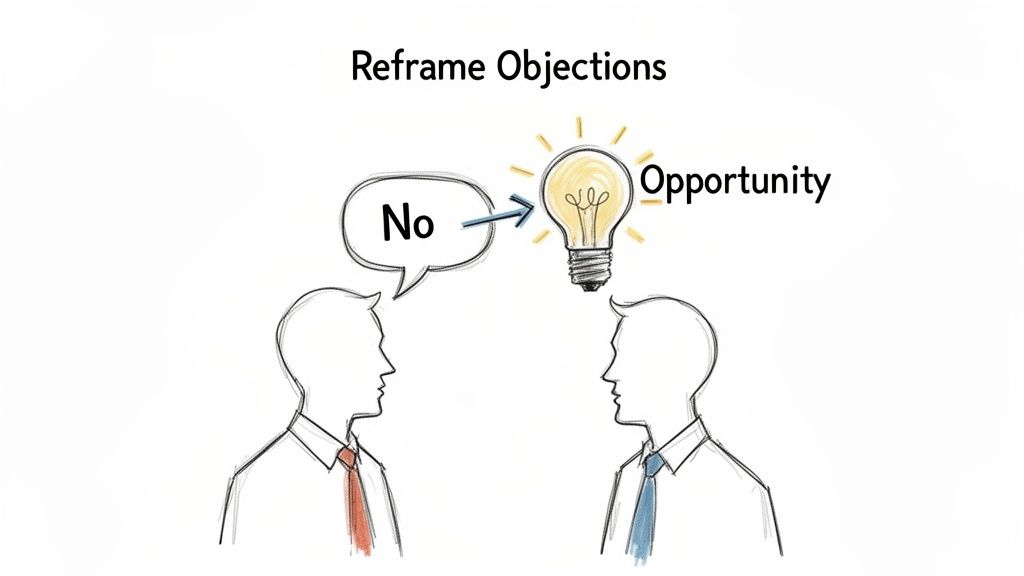
Two people, one with a 'No' thought bubble pointing to a lightbulb labeled 'Opportunity', illustrating how to reframe objections.

From Defensive to Diagnostic

A reactive SDR hears, "It's too expensive," and immediately starts defending the price tag. A strategic SDR hears the same thing and thinks, "Okay, they don't see the value yet. I need to ask some smarter questions to connect our price to their ROI."

This diagnostic approach is where the magic happens. Instead of arguing, you start probing. Compare the two approaches:

  • Reactive Response (Ineffective): "But our product has all these features that justify the cost." This creates friction and puts you in a defensive position.
  • Diagnostic Response (Actionable): "I get that. To make sure I'm on the right track, which part of the proposal felt out of line with the value you were hoping to see?" This opens a dialogue and positions you as a problem-solver.

The data backs this up. Research from Gong and SalesHive shows that reps who master this diagnostic approach can boost their win rates by up to 30%. Top performers do this by listening way more than they talk—maintaining a 43:57 talk-to-listen ratio—which helps them uncover the real problem. You can dig into the full research on how top sales reps handle objections to learn from their playbook.

An objection is not a rejection; it is a request for more information. When you see objections as opportunities to clarify value and build trust, you stop selling and start solving.

Master the Fundamentals First

To consistently turn these moments into pipeline, you need a framework you can rely on. One of the most effective and straightforward models out there is LAER: Listen, Acknowledge, Explore, and Respond. It’s simple, memorable, and it just works.

To make it even easier to recall in the heat of a call, here's a quick cheat sheet you can put into practice today.

The LAER Framework Quick Reference

PhaseActionExample Phrase to Use
ListenLet the prospect finish their thought without cutting them off. Focus on their words and tone to truly hear their concern.(Silent, active listening)
AcknowledgeValidate their feeling to show you heard them and you're on their side. This instantly lowers their guard."That's a fair point." or "I can definitely see why you'd be concerned about that."
ExploreAsk open-ended, clarifying questions to get to the root of the issue. This is the most important step."Can you tell me a bit more about what's driving that feeling?"
RespondOnce you fully understand the problem, offer a tailored answer that speaks directly to their specific concern."Based on what you've shared, it sounds like the main issue is X..."

Having a simple structure like LAER in your back pocket ensures you stay in control of the conversation. It helps you turn what could be a deal-breaker into a productive discussion about creating real value for them.

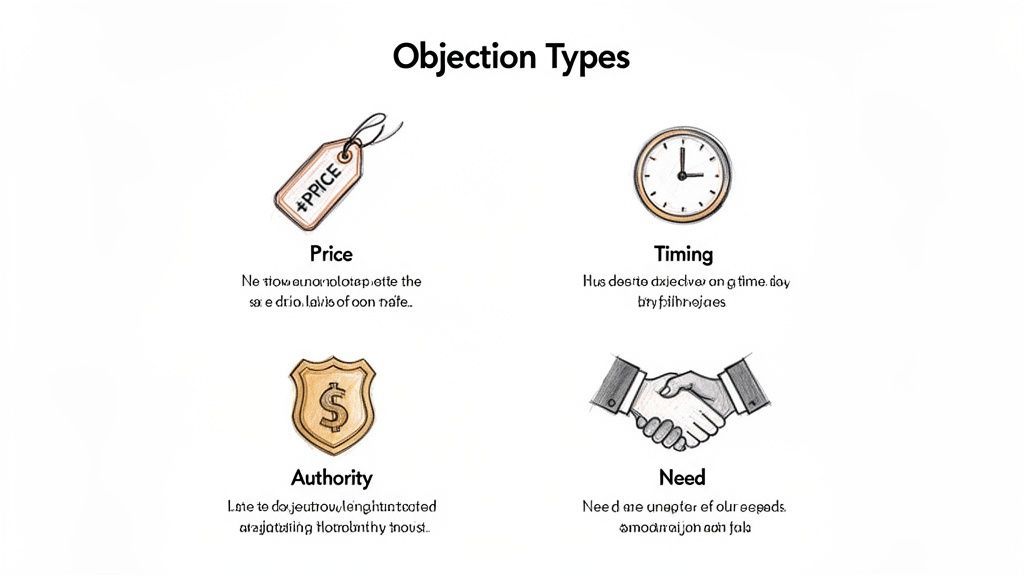
Diagnosing the Four Core Types of Objections

Let’s be honest. A canned, one-size-fits-all response to an objection is the fastest way to get a dial tone. Before you can ever hope to handle an objection, you have to know what you’re really up against.

Most objections are just the tip of the iceberg. They're vague shields prospects throw up to avoid a real conversation. The best reps I know don't just react; they diagnose. They listen to the words, but they hear the real problem underneath. Almost every objection you'll ever hear falls into one of four buckets. Learning to sort them on the fly is your first step from playing defense to running the conversation.

Illustration depicting four sales objection types: Price, Timing, Authority, and Need, with explanations.

Price and Budget Objections

This is the classic. It's the one everyone fears, but it’s rarely about the money. When a prospect says, "It's too expensive," what they’re almost always saying is something else entirely.

What they really mean is, "I don't see enough value here to justify that number." This isn't a cost problem; it's a value gap. You haven't connected the dots for them yet.

  • What it sounds like: "We just don't have the budget for this right now," or "I can get something that does the same thing for a lot less."
  • Your Actionable First Move: Don't defend the price. Instead, get curious about the value gap. Acknowledge it, then ask a clarifying question. Try this: "That's a fair point. Could you help me understand which part of the proposal felt out of sync with the value you were expecting?"

Timing and Priority Objections

This one is all about urgency—or the lack of it. When someone says, "Now isn't a good time," it means you haven't made a strong enough case for why now. Your solution simply isn't a top-tier priority in their world.

They're saying, "I have bigger fires to put out than the one you're talking about." Your job isn't to argue with their schedule; it's to connect your solution directly to one of those bigger fires.

  • What it sounds like: "Call me back next quarter," or "I'm buried right now."
  • Your Actionable First Move: Empathize, then pivot to their known priorities. For example: "I totally get it. Most of the execs I talk to are laser-focused on [mention a common top priority, like 'improving team efficiency']. Our platform is designed to give your team 5 hours back a week. Is that something worth a 15-minute chat next week?"

Authority and Influence Objections

This objection pops up when you're talking to the wrong person—or at least, not the final decision-maker. It’s a clear signal that you need to do some discovery on the internal buying committee and find a way to build a consensus.

The prospect is literally telling you, "I can't say 'yes' even if I wanted to." Don't treat this as a dead end. See it for what it is: an opportunity to find an internal champion.

Key Takeaway: An authority objection isn't a roadblock; it's a roadmap. The person you're speaking with just gave you directions to the real buyer. Your job is to turn them into an internal guide who can make the introduction for you.

  • What it sounds like: "I need to run this by my boss," or "That's not my decision to make."
  • Your Actionable First Move: Empower your contact; don't go around them. Your goal is to turn them into an advocate. Say, "That makes perfect sense. To make that conversation as productive as possible, what information would be most helpful for me to provide you with before you talk to your boss?"

Need and Competition Objections

This is the status quo objection. The prospect either doesn't believe they have a problem worth solving or they’re perfectly happy with how they're doing things now, whether that's with a competitor or a messy internal spreadsheet.

What they're really communicating is, "The pain of changing feels greater than the pain of staying where I am." Your mission is to gently shine a light on the hidden costs and risks of doing nothing.

  • What it sounds like: "We're happy with who we're using," or "We've got it handled internally."
  • Your Actionable First Move: Validate their current setup, then create curiosity. Try this: "That's great that you have a system in place. A lot of our best customers felt the same way until they saw how they could [mention a specific, compelling outcome, like 'cut their reporting time in half']. Would you be against taking a quick look at how they did it?"

Your Actionable Objection Handling Playbook

So, you’ve diagnosed the objection. Now what? This is where having a playbook separates the pros from the rookies. Without a framework, you’re just improvising under pressure, which usually means you’re letting the prospect drive the conversation straight into a ditch.

The two most battle-tested frameworks are LAER and Feel-Felt-Found. But they're not interchangeable. Using the wrong one is like bringing a hammer to a job that needs a screwdriver—you’ll just make a mess.

Knowing which one to grab is the real skill. One is for dissecting logic, the other is for building an emotional bridge.

Choosing Your Framework: LAER vs. Feel-Felt-Found

Think of these as different tools in your sales toolkit. Each one is designed for a specific job.

  • LAER (Listen, Acknowledge, Explore, Respond): This is your scalpel. Pull this out for logical, data-driven objections. When a prospect starts questioning specific features, the ROI math, or your integration capabilities, LAER helps you methodically unpack their concern and address it head-on with facts. It's an investigative tool.

  • Feel-Felt-Found: This is your bridge-builder. It’s perfect for emotional or skeptical objections. When you hear fear about switching, frustration from a bad experience with a past vendor, or just general uncertainty, this framework builds instant empathy. It uses social proof to lower their guard and show them a safe path forward. It's a reassuring tool.

Let’s put them side-by-side so you can see how to choose in the heat of the moment.

Framework Comparison: LAER vs. Feel-Felt-Found

This table breaks down the core differences, helping you make a split-second decision on a live call.

FrameworkBest ForCore StrategyExample Use Case
LAERLogical, specific concerns (e.g., price, features, implementation).Deconstruct the objection with clarifying questions before presenting a solution."I'm not sure your tool integrates with our existing tech stack."
Feel-Felt-FoundEmotional resistance, skepticism, or fear of change.Validate their feeling with empathy and use a story to reframe their perspective."This feels like a huge change for our team; I'm worried about adoption."

Choosing the right approach isn’t just about sounding smart—it's about connecting with the real reason behind the objection, whether it's rooted in logic or emotion.

Scripts for Common Objections

Okay, let's put these frameworks into action. Here are some scripts you can adapt and make your own, starting today. Notice how each one follows the designated framework to get to the root of the issue, not just the surface-level complaint.

Objection 1: "It's too expensive." (Using the LAER Framework)

This is almost never really about the price tag. It's about a value gap. Your job is to find that gap and fill it.

  1. Listen: Let them say their piece. Don't jump in or get defensive. Just listen.
  2. Acknowledge: "I appreciate you sharing that. It’s a significant investment, and it's fair to question the cost."
  3. Explore: "Help me understand a bit better—when you say it's expensive, are you comparing it to a specific competitor, or is it more about the budget you had in mind for this kind of problem?"
  4. Respond: "That makes sense. A lot of our customers look at the initial cost, but the real story is in the ROI. For instance, we see teams like yours cut SDR admin time by 40%. For a team your size, that could mean generating 20% more pipeline without adding headcount. Can we spend two minutes on what that math would look like for you?"

HubSpot data shows reps who master this kind of value-framing see close rates up to 64% higher. They're also 81% better at holding margins because they anchor the conversation on outcomes, not discounts.

Objection 2: "We already use a competitor." (Using the Feel-Felt-Found Framework)

This is a classic "status quo" objection. They're comfortable. Your job isn't to bash the competition; it's to spark curiosity about a better way.

  1. Feel: "I totally get that. It makes sense you're with them; they're a solid company and a well-known name in the space."
  2. Felt: "You know, many of our best customers today felt the exact same way when we first connected. They were comfortable and honestly saw no compelling reason to even look at an alternative."
  3. Found: "But what they found was that while their old tool was great for X, it wasn't built to solve for Y [mention a specific pain point your solution crushes]. They discovered they could slash [a specific negative metric] by 30% just by making the switch. Would you be open to a quick 15-minute call next week to see if you might be in a similar boat?"

By structuring your responses like this, you shift from being a reactive debater to a strategic guide. For a deeper look at crafting your entire messaging strategy, check out our guide on building effective outbound playbooks.

Adapting Your Strategy for Calls, Emails, and Follow-Ups

Knowing what to say when an objection hits is only half the battle. The other half is knowing where and how to say it. An approach that lands perfectly on a live call can fall completely flat in an email, and vice versa.

The secret is adapting your playbook to the medium. Each channel has its own rhythm and rules of engagement. A phone call is all about speed and composure, while an email gives you the space for a more measured, precise response. And a follow-up? That’s a delicate dance between persistence and adding genuine value.

On a Live Call: Stay in Control

When you’re on a live call, your tone and pacing are everything. The second you hear an objection, the worst thing you can possibly do is rush to counter it. That signals panic.

Actionable Tip: Pause. Take a breath. Let the silence hang for a second. This small move shows you’re in control, not flustered. From there, lean on a framework like LAER (Listen, Acknowledge, Explore, Respond) to guide the conversation without getting defensive.

Your goal here is to be a doctor, not a debater. Diagnose the root of the issue with clarifying questions. A calm, curious question shows you're a confident expert trying to solve a problem, not just a rep pushing a product.

In an Email: Invite a Dialogue

Email is a completely different game. You lose all the nuance of tone and body language, so your words have to do all the heavy lifting. The biggest mistake reps make here is writing a five-paragraph essay defending their product. It's overwhelming, defensive, and almost guarantees you won't get a reply.

Your email response should be short, respectful, and focused on one simple goal: reopening the conversation.

Actionable Tip: Acknowledge their concern, validate it, and then ask a simple, open-ended question that makes it easy for them to reply.

Here’s an example template:

Subject: Re: Our chat

Hi [Prospect Name],

Thanks for being candid about the budget. I appreciate the honesty.

Just so I'm on the right track, what would a more comfortable budget look like for a solution that solves [Problem X] for you?

Best,

[Your Name]

See how that works? It’s not confrontational. It turns a potential dead-end into a continued discussion. For more tactics tailored to live conversations, check out our guide on AI-powered cold call workflows.

In a Follow-Up: Add New Value

So, what happens if they raise an objection and then go quiet? A follow-up isn't just a "checking in" message—that’s a waste of everyone’s time. It's your chance to re-engage by providing fresh value that tackles their previous concern without even mentioning it.

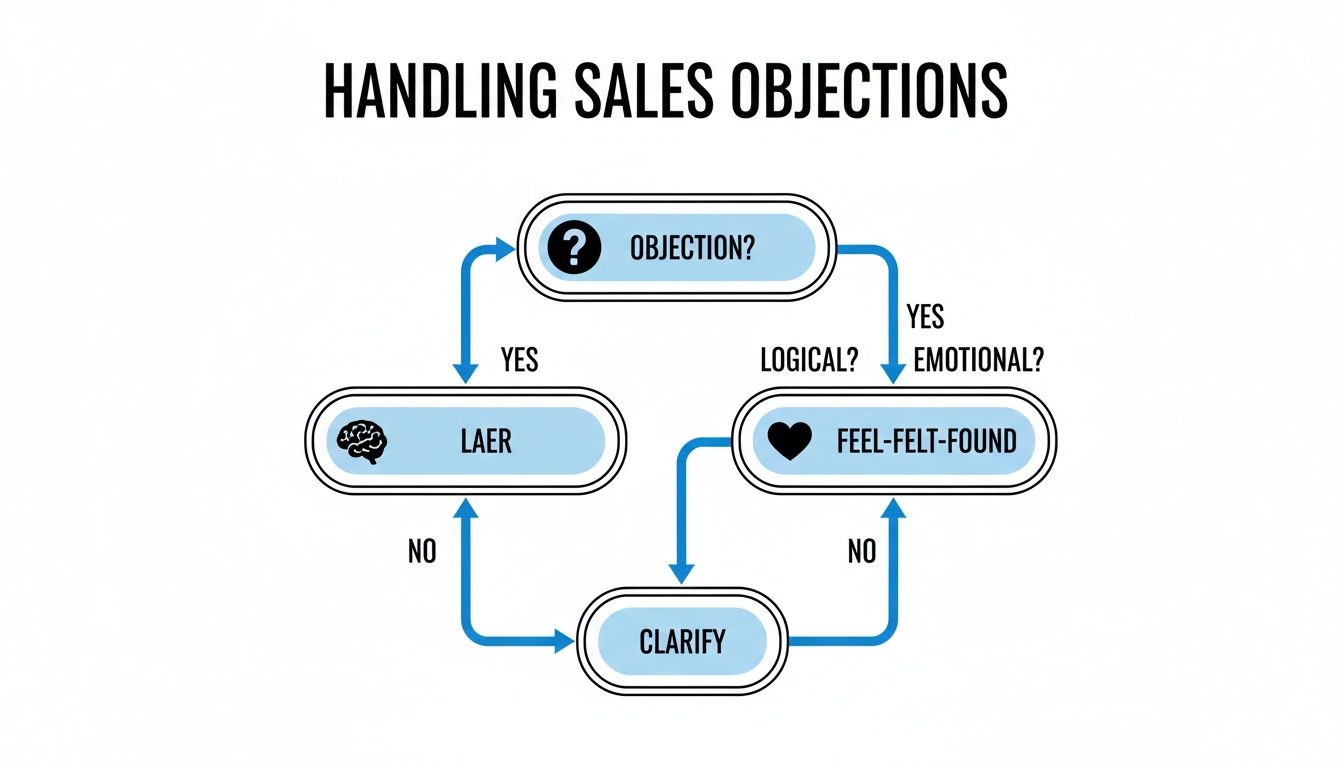
This quick decision tree helps visualize how to diagnose whether an objection is coming from a logical place or an emotional one.

Flowchart outlining methods for handling sales objections, differentiating between logical LAER and emotional Feel-Felt-Found responses.

Actionable Tip: If they objected on price, your follow-up could be a case study showing how a similar company achieved a massive ROI. If they were worried about a missing feature, send a one-minute video showing exactly how that feature delivers value. By bringing something new and relevant to the table, you give them a real reason to reconsider.

Using AI and Your CRM to Finally Master Objection Handling

Look, proven techniques are the engine of great sales, but modern tech is the rocket fuel. When you connect your objection handling frameworks to the tools you live in every day—your CRM and AI assistants—the entire game changes. It transforms this skill from a reactive art into a proactive, data-driven science.

It’s the difference between improvising under pressure and running a flawless, pre-planned play.

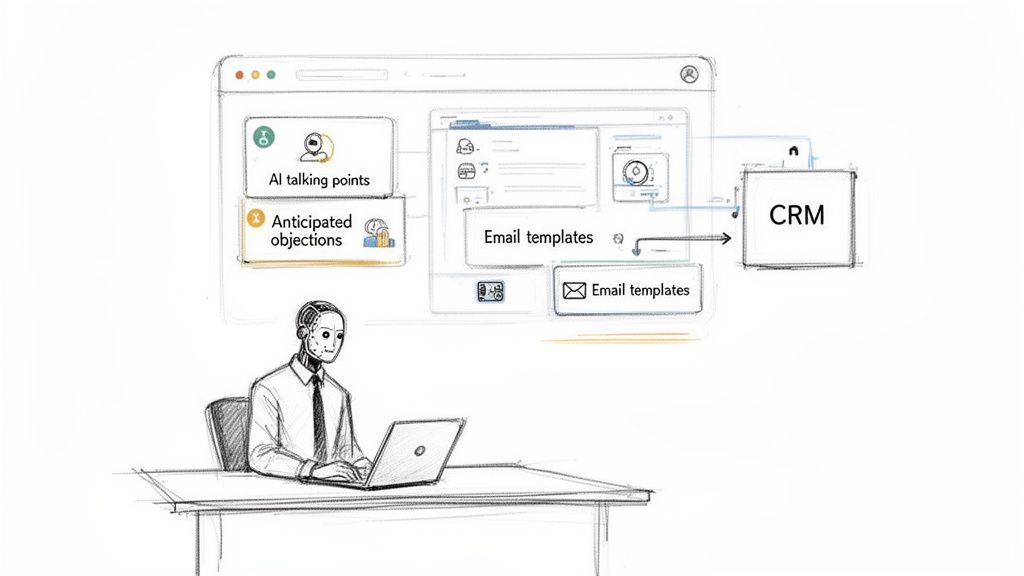
This is where an SDR Task Engine like marketbetter.ai comes in. It’s designed to help reps execute perfectly by automatically prepping for calls. We’re talking AI-generated talking points and a list of anticipated objections based on the prospect's actual industry and persona. This completely eliminates that frantic, last-minute research that leaves reps walking into calls feeling unprepared.

Instead of raw data, reps get an actionable workflow with key insights and clear next steps, right at their fingertips.

AI robot assisting with sales tasks, displaying AI talking points, anticipated objections, and email templates integrating with CRM.

By plugging directly into your CRM, the system makes sure every rep has the right context and content before they even dial.

From Manual Logging to Intelligent Feedback Loops

Let’s be honest: one of the biggest drags on SDR productivity is manual data entry. After a tough call gets shot down, the absolute last thing a rep wants to do is spend ten minutes filling out CRM fields.

An integrated system kills this problem by automatically logging call outcomes and objection types straight into Salesforce or HubSpot.

But this automation does way more than just save time—it creates a powerful feedback loop. When you have clean, structured data on which objections your team faces most often, you can tailor your coaching and build scripts that actually work. You move from guessing where reps are struggling to knowing with certainty.

Here's a hard truth from thousands of B2B deals: repeatedly seeing the same objection is a flashing red light that you're failing to address it proactively. On the flip side, data shows that successfully resolving objections is directly tied to a 64% lift in close rates.

Proactive Preparation vs. Reactive Scrambling

Let's put the two workflows side-by-side to see just how different the day-to-day feels. This comparison highlights the actionable difference an integrated AI system makes.

Manual Workflow (The Common Struggle)AI-Powered Workflow (The Strategic Advantage)
Rep scrambles to research the prospect minutes before the call.AI auto-preps the call with talking points & anticipated objections.
Rep improvises responses based on memory or generic scripts.Rep has specific, tailored rebuttals ready for likely concerns.
Rep spends 5-10 minutes post-call on manual CRM logging.Outcomes and objection types are logged automatically.
The manager gets inconsistent, messy data for coaching.The manager gets clean, actionable data to spot team-wide patterns.

This execution-first workflow frees you up to focus entirely on the conversation, not the mountain of admin work surrounding it.

To get your tech stack right, check out some of the Best AI Tools for Sales and see how they can streamline your process. With the right systems in place, every single interaction becomes a chance to learn and get better.

Free Tool

Try our AI Lead Generator — find verified LinkedIn leads for any company instantly. No signup required.

Common Questions About Handling Objections

Even with the best scripts and frameworks, the real world of sales calls is messy. Theory is great, but reps and managers run into the same practical questions day after day. Let's get straight to the stuff that actually comes up on the floor.

What's the Single Biggest Mistake Reps Make?

Easy. Talking too much and listening too little.

It's a reflex. A prospect throws out an objection, and the rep's heart rate spikes. They get defensive and immediately launch into a pre-canned rebuttal without ever digging into what the prospect really means. This instantly turns a conversation into a confrontation.

Let's compare the two approaches. A rookie hears "it's too expensive" and immediately starts listing features to justify the price. A pro, on the other hand, leans in. They pause, then ask something like, "Help me understand, which part of the proposal felt out of sync with the value you were expecting?" One approach builds a wall; the other opens a door.

Top performers consistently talk less than half the time when an objection comes up. That's not a guess; the data backs it up. They use questions to find the root cause before they even think about offering a solution. Actionable Step: Always acknowledge and explore before you respond.

How Do You Tell a Real Objection from a Brush-Off?

This is a critical skill. Getting it wrong means wasting time on people who will never buy or, worse, giving up too early on someone who's actually interested.

A brush-off is lazy. It’s vague and designed to get you off the phone quickly. Think "Just send me an email" or a flat "Not interested." It’s a shield, nothing more.

A genuine objection has substance. It’s specific and tied to their reality. You'll hear things like, "Our budget for new software is frozen until Q4," or "We just signed a one-year contract with Competitor X." See the difference? Real roadblocks.

Actionable Tip: To sort them out, gently probe. When you get a classic brush-off, don't just accept it. Try asking, "Is the timing not right, or is this just not a priority for your team right now?" That simple question often forces a more honest answer and can uncover the real objection hiding just beneath the surface.

How Can Sales Managers Actually Coach This Stuff Effectively?

Good coaching is about data and practice, not just motivational speeches. A manager who relies on gut feelings is flying blind. Here is a two-step actionable plan:

  • Step 1: Stop Guessing, Start Measuring. First things first, you need clean data. Make sure every call outcome and every objection type is logged automatically in your CRM. This is the only way to spot real patterns. Is your whole team getting stuck on price objections? Are the new hires folding every time a competitor's name comes up? The data will tell you where to focus.

  • Step 2: Make Role-Playing Real. Once you know the problem areas, dedicate time in your weekly one-on-ones to role-play those exact scenarios. Don't invent fake objections. Pull from the data and even use snippets from real call recordings. Walk them through the frameworks in this guide, give pointed feedback, and run it again. This is how you build muscle memory.


Turn your SDRs into execution experts with marketbetter.ai. Our AI-Powered SDR Task Engine helps reps prep faster, handle objections with confidence, and automatically logs every activity in Salesforce or HubSpot, giving you the data you need to coach effectively. See how it works at marketbetter.ai.