2 posts tagged with "lead conversion"

View All Tags

Master the b2b sales funnel: Turn Leads into Revenue

· 24 min read

Let's be honest, the term "sales funnel" feels a bit dated. It brings to mind a simple kitchen funnel—pour leads in the top, get customers out the bottom. But for B2B, that's not how it works at all. A modern B2B sales funnel is less of a funnel and more of a sophisticated assembly line for building relationships and, ultimately, revenue.

What a Modern B2B Sales Funnel Really Is​

The whole game is different when you're selling to a business. A consumer buying a pair of shoes makes a quick, personal, often emotional decision. A business buying new software is making a high-stakes investment. They're navigating a committee of decision-makers, each obsessed with logic, ROI, and not getting fired for making the wrong choice.

This is exactly why B2B sales cycles drag on for so long. It’s not a single transaction; it's a campaign to build consensus. In fact, a staggering 83% of B2B buyers admit to changing their minds about which vendor they prefer after they've already started their research. Your funnel can't just grab their attention—it has to hold it, educate them, and guide them for weeks or even months.

B2B vs. B2C Funnels: It’s All About the Buyer​

The core difference boils down to the buyer's mindset and just how complex the deal is. A B2C funnel is a straight line designed for a single player, while a B2B funnel is a multi-lane highway built for a convoy. This distinction isn't just academic—it dictates every choice you make, from your marketing channels to your sales tactics.

Here is a practical comparison:

FactorB2C Funnel (e.g., selling sneakers)B2B Funnel (e.g., selling CRM software)
Buyer ProfileAn individual consumer.A buying committee (IT, Finance, End-Users, Execs).
Sales Cycle LengthMinutes to days.Weeks, months, or even years.
Decision DriverEmotion, desire, brand loyalty, immediate need.Logic, ROI, efficiency gains, long-term value.
Risk FactorLow (a bad purchase is a minor annoyance).High (a bad purchase can cost millions and careers).
Content StrategyFocus on lifestyle, trends, and user reviews.Focus on case studies, whitepapers, ROI calculators, and demos.

Mapping the Core Stages and Handoffs​

While the classic funnel stages (Awareness, Interest, etc.) are still useful concepts, buyers don't move through them in a neat, orderly line anymore. They jump around, doing their own research and consuming content on their own schedule. Your real job is to have a rock-solid internal process that can keep up.

This flow shows the critical handoffs, moving a prospect from a curious onlooker to a closed deal.
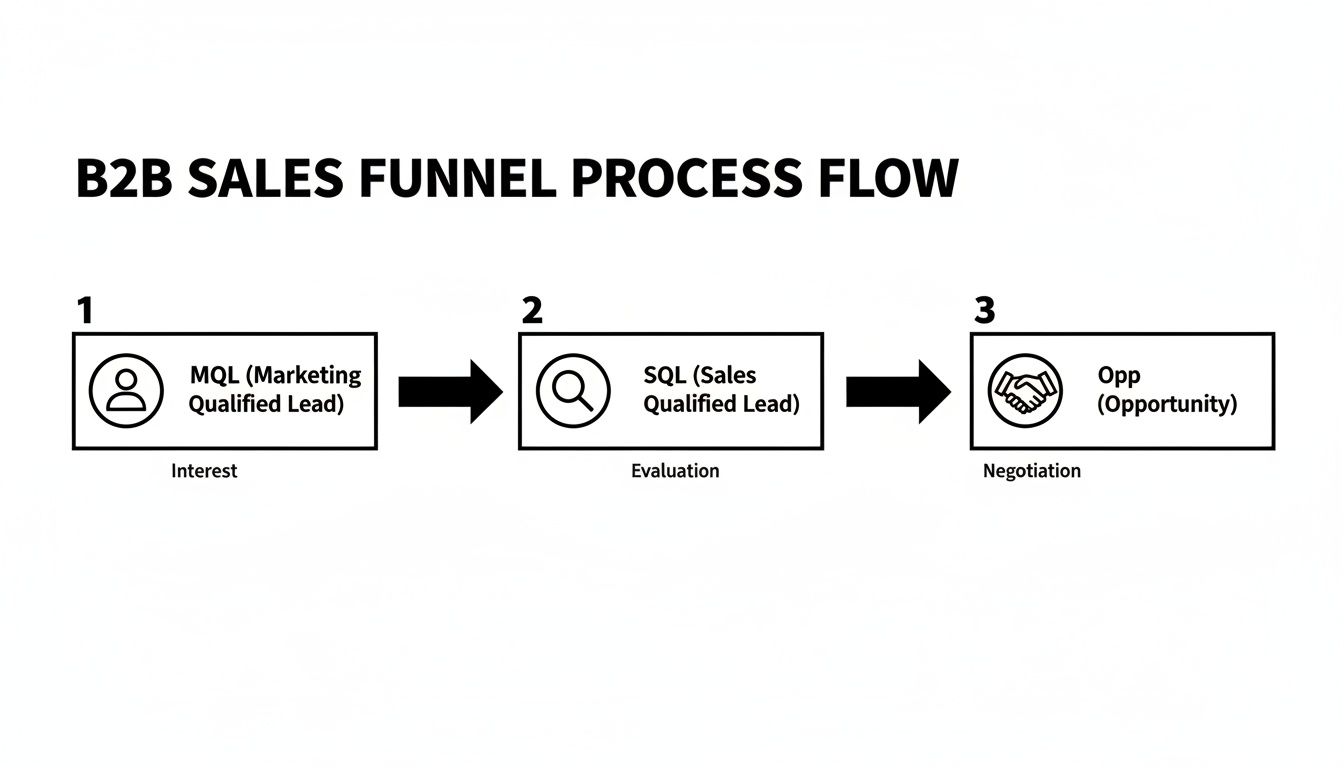
Diagram illustrating the B2B sales funnel process flow with MQL, SQL, and Opportunity stages.

Every one of those arrows is a moment of truth where a lead gets validated and passed deeper into your revenue engine. Get them right, and you have a smooth-running machine. Get them wrong, and everything grinds to a halt.

The two most critical handoffs on this assembly line are:

  1. Marketing to Sales Development (MQL → SQL): This is the first pass. A Marketing Qualified Lead (MQL) is someone who has shown interest by, say, downloading an ebook. The baton is passed to a Sales Development Representative (SDR), who digs in to see if they're a real potential buyer. The SDR checks them against your ideal customer profile—company size, industry, technology used—to turn them into a Sales Qualified Lead (SQL).
  2. Sales Development to Sales (SQL → Opportunity): The SDR's main job after qualifying the lead is to book a meeting. Once that meeting happens and an Account Executive (AE) confirms there's a real project, a clear pain point, and a potential budget, the SQL officially becomes a sales Opportunity. This is where the active, one-on-one sales cycle truly begins.

Getting these handoffs right is the absolute foundation of a predictable revenue engine. Any fumbles here lead to leaky funnels, stalled deals, and a whole lot of friction between your marketing and sales teams.

How to Measure Your Funnel's Performance​

You can't fix what you don't measure. That old saying is the gospel in B2B sales. A healthy funnel isn't just about feeling busy; it's about seeing real, measurable progress as a potential customer moves from one stage to the next.

Tracking the right Key Performance Indicators (KPIs) is what turns your funnel from a vague concept into a predictable, data-driven engine for revenue. This isn't about vanity metrics like website traffic. It’s about zeroing in on the critical conversion points where a prospect either moves forward or leaks out.

Think of these metrics as the dashboard for your sales machine. They’ll help you spot a problem long before it torpedoes your revenue forecast.
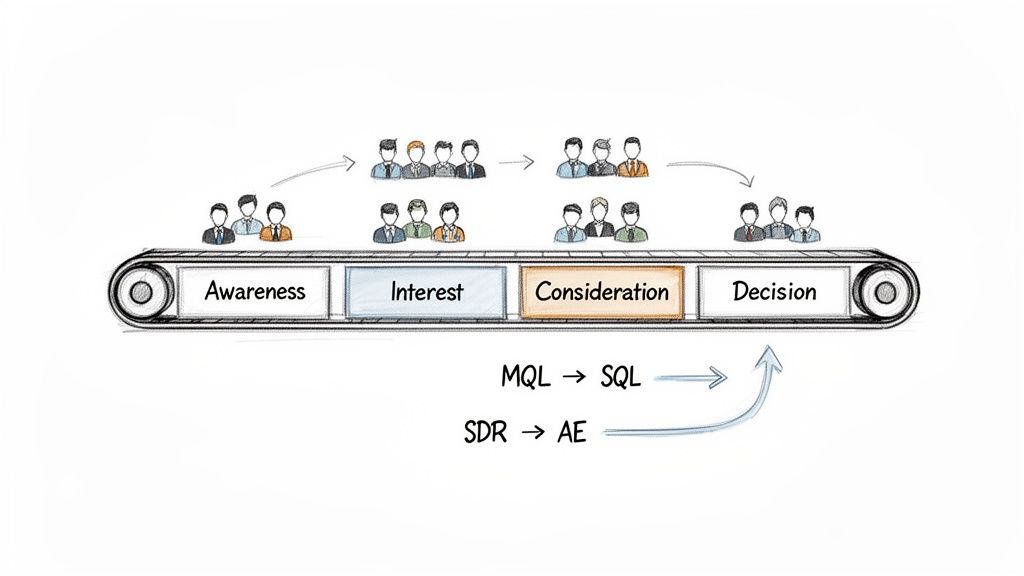
Diagram of a B2B sales funnel on a conveyor belt, showing stages from Awareness to Decision, with lead and role transitions.

Top-of-Funnel Conversion KPIs​

The earliest stages of your funnel are almost always the leakiest. It's a numbers game, and measuring your efficiency right from the jump is absolutely critical. Success here means you’re not just attracting an audience—you’re attracting the right audience and doing a good job of capturing their initial interest.

The metric that matters most here is your Visitor-to-Lead Rate. It's simple but powerful: what percentage of unique website visitors take a meaningful action to become a lead? This could be filling out a form, downloading a guide, or requesting a demo. It tells you, point-blank, how compelling your initial pitch is.

Don't be discouraged by the numbers. The B2B world is a tough nut to crack, with average visitor-to-lead rates hovering between just 2% and 5%. That’s because B2B buying cycles are long and complicated, often involving a whole committee of decision-makers. Out of 10,000 visitors to your site, you might only get 200-500 actual leads, which sets a pretty narrow base for the rest of your funnel.

Mid-Funnel Handoff Metrics​

Once a lead is in your system, the game changes. Now, it's all about qualification and the critical handoffs between marketing and sales. This is where things so often fall apart, making it non-negotiable to measure the flow.

Your primary KPI here is the MQL-to-SQL Conversion Rate. This tracks the percentage of Marketing Qualified Leads (MQLs) that your sales team actually accepts and qualifies as Sales Qualified Leads (SQLs). If this number is low, you have a massive red flag.

A poor MQL-to-SQL rate almost always points to a fundamental misalignment between marketing and sales. It might mean marketing's lead-scoring model is off, or maybe the sales team has an overly rigid definition of a "good" lead. Fixing this is foundational to building a funnel that can actually scale.

Another one to watch closely is the SQL-to-Opportunity Rate. This measures how many of those qualified conversations turn into a legitimate sales opportunity with a clear need, budget, and timeline. This KPI is a direct reflection of your SDR team's skill in qualifying prospects and booking solid meetings for the Account Executives.

Bottom-of-Funnel Closing KPIs​

As a qualified opportunity enters the active sales cycle, your focus shifts again. We're moving away from lead volume and now care about deal velocity and, of course, win rates. These are the metrics that tie directly to your bottom line.

Two KPIs are king at this stage:

  • Opportunity-to-Win Rate: This is the ultimate report card for your sales team's closing ability. It calculates the percentage of qualified opportunities that end up as a closed-won deal. Simple as that.
  • Average Sales Cycle Length: This tracks how long it takes, on average, for an opportunity to go from creation to close. If this number starts creeping up, it can signal friction in your sales process, ineffective negotiation tactics, or even a shift in the market itself.

To help you track these metrics, here's a simple breakdown of each stage and its core KPI.

B2B Sales Funnel Stages and Core KPIs​

Funnel StagePrimary GoalCore KPIIndustry Benchmark
Top-of-Funnel (ToFu)Generate awareness and capture initial interest.Visitor-to-Lead Rate2%-5%
Middle-of-Funnel (MoFu)Qualify leads and create sales opportunities.MQL-to-SQL Rate10%-30%
Bottom-of-Funnel (BoFu)Convert opportunities into closed deals.Opportunity-to-Win Rate20%-30%

Tracking these benchmarks gives you a realistic baseline to compare your own performance against.

Whether you're using Salesforce, HubSpot, or another CRM, building a dashboard around these core metrics is essential. It gives you a clear, actionable view of your entire B2B sales funnel so you can see not just what's happening, but why. For a more detailed breakdown, check out our guide on the top KPIs for lead generation.

Finding and Fixing Common Funnel Bottlenecks​

Every B2B sales funnel leaks. That’s just a fact of life. The real difference between a top-performing revenue team and an average one isn’t a leak-proof funnel—it’s how fast they find and plug the holes.

These leaks, or bottlenecks, are the friction points where good leads stall out, get lost in the shuffle, or just plain disappear. They’re the silent killers of your forecast.

Think of your funnel like a plumbing system. A clog in one pipe doesn’t just stop the flow there; it builds up pressure and causes problems down the line. A bottleneck in your sales process works the same way. It doesn't just slow down one stage—it starves the next one, creating a ripple effect that hits the one number everyone cares about: revenue.

To fix these issues, you have to look past the obvious symptoms. If your SDRs are missing their meeting quota, the problem might not be with their effort. It could be a mess further upstream.

The Low-Quality MQL Flood​

This is one of the most common—and most damaging—bottlenecks. It happens right at the handoff from marketing to sales. Marketing hits their MQL number and celebrates, while the SDR team is drowning in leads that are going absolutely nowhere. It’s not just a waste of time; it's a morale crusher for reps who spend all day disqualifying contacts.

The culprit is almost always a poorly defined MQL. Marketing might be scoring leads based on a single ebook download, but sales needs to talk to people from specific industries who are actually showing signs they want to buy something. You end up with a flood of "qualified" leads that are really just a drain on your SDRs' precious time.

The Actionable Fix: Get marketing and sales in a room (virtual or otherwise) and redefine what an MQL actually is. And don't just talk about it—get it in writing in a Service Level Agreement (SLA).

  • Firmographics: Nail down your Ideal Customer Profile (ICP). What are the non-negotiables? Company size, industry, location—get specific.
  • Behaviors: Agree on what actions signal real intent. A demo request is a blazing hot signal. Reading a blog post is not. Assign different scores to different actions so the hottest leads rise to the top.
  • Disqualification Reasons: Give SDRs a clear, standardized list of reasons in your CRM to explain why a lead was rejected. This creates a feedback loop built on data, not feelings, so marketing can fine-tune their campaigns.

High No-Show Rates for Demos​

There are few things more frustrating than a high no-show rate for demos. An SDR grinds to qualify a lead and book a meeting, only for the prospect to ghost them. The Account Executive's calendar slot is wasted, and any deal momentum dies before it can even start.

This usually points to a weak qualification process or a simple failure to build value. If the prospect doesn’t truly get why they should show up or what problem this meeting solves for them, they have zero reason to protect that time on their calendar.

A booked meeting is not the same as a committed meeting. The SDR's job isn't just to get a "yes" for a time slot but to build enough perceived value that the prospect sees the meeting as a priority they cannot miss.

Stalled Mid-Funnel Opportunities​

This is maybe the most painful bottleneck of all. A promising deal that felt like a sure thing just… stalls. The prospect goes dark, pushing back meetings and ignoring your follow-ups. This is the pipeline graveyard where deals go to die a slow, painful death, wrecking your forecast in the process.

More often than not, this happens because of a flimsy or non-existent qualification framework. That first discovery call might have felt great, but if the AE didn't dig in and confirm the critical details, they're flying blind. It's a tough world out there—B2B funnel benchmarks show how hard conversions are. Even the top channel, paid search, only converts at 3.2% on average, and B2B tech is even lower at under 2%. This just screams for a rigorous qualification process to avoid chasing deals that were never going to close. You can dig into more data on industry-specific conversion hurdles to see how you stack up.

The Actionable Fix: Bring in a formal qualification methodology. It gives everyone a common language and a checklist to make sure no crucial details are missed during discovery.

FrameworkWhat It IsBest For
BANTA classic framework focusing on Budget, Authority, Need, and Timeline.Simpler, more transactional sales cycles where you can identify these four things pretty easily.
MEDDPICCA more robust framework covering Metrics, Economic Buyer, Decision Criteria, Decision Process, Paper Process, Identify Pain, Campion, and Competition.Complex, high-value enterprise deals with lots of stakeholders and a formal procurement gauntlet.

By using a framework like MEDDPICC, you force your AEs to map out the entire buying process, find their internal champions, and truly understand the economic impact your solution will have. Qualification stops being a simple checklist and becomes a strategic tool for navigating complex deals and keeping them from getting stuck in the mud.

Actionable Strategies to Optimize Funnel Conversion​

Knowing where your sales funnel is leaking is one thing. Knowing how to actually patch the holes is something else entirely. This is where the rubber meets the road—where we move from diagnosing problems to deploying fixes that actually work.

Optimizing your funnel isn't about telling your team to work harder. It’s about working smarter, replacing guesswork with data-driven plays that give you an edge at every single stage. The big shift happening right now is moving away from reactive, manual sales tasks and into proactive, intelligent workflows. It's a night-and-day difference.
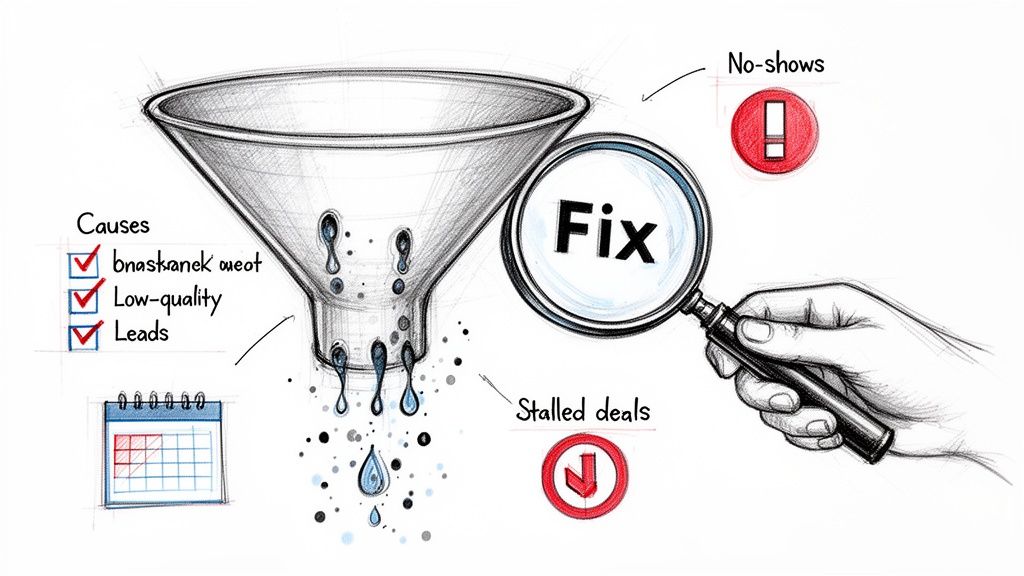
A hand holding a 'Fix' magnifying glass analyzes a leaking sales funnel with low-quality leads, no-shows, and stalled deals.

This image nails it. Low-quality leads, no-shows, stalled deals—these are the symptoms. Targeted optimization is the cure. The goal isn't just to spot these issues but to build a process that stops them from happening in the first place.

From Manual Guesswork to AI-Powered Precision​

Think about a typical SDR's morning. They log in, stare at a giant list of leads in the CRM, and start guessing. Who seems like a good person to call? Who might actually open this email? It’s a process fueled by caffeine and gut feelings—slow, inefficient, and wildly inconsistent.

The modern approach completely flips that script. Instead of the SDR asking, "Who should I contact?" an intelligent system tells them. By analyzing real-time buyer intent signals—like someone from a target account revisiting your pricing page or downloading a whitepaper—an AI engine can instantly surface the hottest opportunities and prioritize the SDR's to-do list.

This changes the SDR's job from a glorified list-checker to a strategic closer. The system serves up the "next best action" and provides all the context needed to make the outreach timely and ridiculously relevant.

This directly impacts the metrics that matter most. Sales call conversion rates from qualified leads to closed deals can be all over the map, typically hovering between 13% and 25%. Some simpler industries might see conversions north of 26%, while complex enterprise sales can dip below 9%. An AI-guided process helps close that gap by ensuring your reps spend their precious time only on the accounts ready to talk.

Manual vs. AI-Powered SDR Workflow Comparison​

Let's get practical. The difference in the day-to-day grind is huge. A manual workflow is bogged down by admin tasks and constant context switching. An AI-powered workflow is built for speed and relevance.

Here's a quick breakdown of what that actually looks like for your SDRs:

SDR ActivityTraditional Manual ApproachAI-Powered Approach (e.g., marketbetter.ai)
Task PrioritizationReps scroll through CRM views, using gut instinct to pick who to call. This leads to cherry-picking the "easy" leads while high-value ones go cold.The system automatically creates and ranks tasks based on real-time buyer signals and ICP fit. Reps get a clear, prioritized list of the highest-impact actions.
Outreach PersonalizationSDRs burn hours toggling between LinkedIn, the company website, and their email client, trying to craft a personalized message from scratch.AI drafts context-aware emails using account data, news, and persona details. This frees up reps to focus on executing great calls and follow-ups.
CRM Data EntryEvery call, email, and outcome has to be logged by hand. It's tedious, often gets skipped, and leads to a messy CRM with unreliable data.All activities are automatically logged back to Salesforce or HubSpot, ensuring data hygiene is perfect and reporting is accurate.

This isn't about replacing your SDRs; it's about making them superhuman. The AI-powered approach turns their CRM from a dusty old database into a proactive engine that drives relentless, consistent outbound motion.

Embedding Intelligence Directly into Your CRM​

The final piece of the puzzle is making all this intelligence dead simple to use. The best tools don't add another tab to your team's browser; they live right inside the CRM where your reps already spend their day.

For example, a platform like marketbetter.ai works as an intelligent layer inside your CRM. When it detects a strong buyer signal, it doesn't just send a Slack notification. It creates a high-priority task directly in the SDR's queue in Salesforce, complete with a pre-drafted email or a call script loaded with key talking points.

This native integration is what drives adoption. When the dialer, task list, and AI assistant are all in one place, the friction just disappears. Reps are faster, managers have a clear view of what’s working, and the entire B2B sales funnel runs like a well-oiled machine. If you want to go even deeper, you can explore our detailed guide on conversion rate optimization best practices.

Unifying Your Funnel from Marketing to Close​

A high-performing B2B sales funnel isn’t a series of disconnected stages; it's a single, cohesive revenue machine. We've all seen the classic disconnect: marketing celebrates hitting its MQL target, while the sales team is drowning in low-quality leads that go nowhere.

This friction is more than just annoying. It wastes budget, burns out your team, and lets perfectly good opportunities die on the vine. The fix isn't another round of meetings—it's building a process where seamless collaboration is the only option. It starts by treating the handoffs between teams with the same seriousness as a product launch.

Forging an Ironclad Marketing and Sales SLA​

The most common point of failure in any funnel is the handoff from marketing to sales. The best way to patch this leak for good is with a Service Level Agreement (SLA). Think of this less as a dusty legal document and more as a practical, written rulebook that defines the entire engagement and creates mutual accountability.

A weak SLA is vague and just leads to finger-pointing. A strong one is specific, measurable, and lives right inside your CRM.

Actionable Comparison: Weak vs. Strong SLA

ElementWeak SLA (The "We'll Try" Approach)Strong SLA (The Actionable Approach)
MQL Definition"A lead who downloads our content.""A lead from an ICP account (100+ employees, Tech/Finance) who requests a demo or visits the pricing page 3+ times."
Follow-up Speed"SDRs should follow up in a timely manner.""SDRs must attempt first contact within 10 minutes for all demo requests and within 4 hours for all other high-intent MQLs."
Follow-up Depth"SDRs will attempt to contact leads.""SDRs will execute a 10-touch sequence over 14 days (email, call, LinkedIn) before disqualifying a lead for non-response."
Feedback Loop"Sales should let us know if leads are bad.""SDRs must select a standardized 'Disqualification Reason' from a dropdown in Salesforce for every rejected MQL, triggering an automated report to marketing."

This level of detail kills ambiguity. Marketing knows exactly what a "good" lead looks like, and sales has a clear playbook for what to do with it. You can learn more about how to get these systems running by reading about the power of marketing automation workflows.

Mastering the SDR to AE Handoff​

The second critical handoff happens when a Sales Development Representative (SDR) passes a qualified opportunity to an Account Executive (AE). A clumsy handoff is a deal killer. It forces the prospect to repeat themselves and makes the AE start from square one, destroying any momentum the SDR built.

The goal is a seamless transition where the AE walks into the first meeting armed with all the context needed to have a strategic conversation, not a basic discovery call.

To make sure nothing gets lost in translation, build a handoff checklist directly into your CRM. Before an opportunity can even be transferred, the SDR has to complete a set of required fields.

The Essential Handoff Checklist

  • Confirmed Qualification Criteria: Don't just say it's "qualified." Show the proof. Was a framework like BANT or MEDDPICC used? The AE needs to see confirmed Need, Authority, and Timeline right in the notes.
  • Key Pain Points: What is the actual business problem they're trying to solve? List the top one or two pains, ideally using the prospect's own words.
  • Critical Business Context: What is the AE walking into? Include details like other stakeholders who have been identified, the software they're using now, and any competitors they've mentioned.
  • Next Steps Confirmed: The meeting must be on the calendar with a clear agenda that the prospect has already seen and agreed to.

By making these fields mandatory in Salesforce or HubSpot, you make it impossible to pass an under-qualified or context-free opportunity. This simple workflow creates accountability and, more importantly, ensures your AEs spend their valuable time on deals that are actually primed to close.

Your Blueprint for a Predictable Revenue Engine​

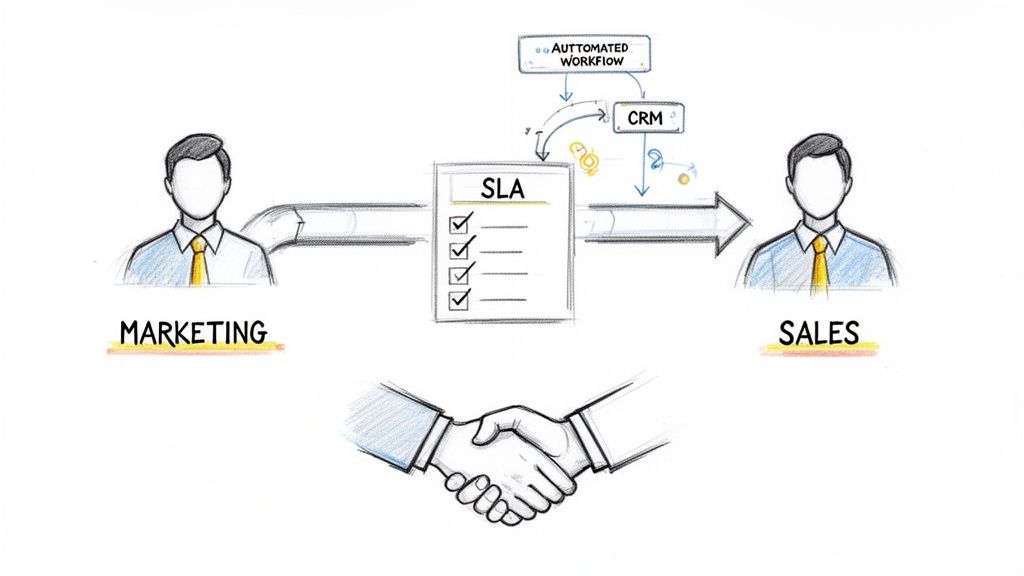
Diagram illustrating marketing and sales alignment through an SLA, automated workflow, and CRM, ending in a handshake.

Building a high-performing B2B sales funnel isn’t a one-and-done project. It’s a constant process of tuning and improvement. Think of it less like a static flowchart gathering dust on a server and more like a predictable revenue engine you’re actively engineering for growth.

That means treating your funnel like a living system. A reactive team waits for deals to stall before asking why. A proactive one is already watching lead quality and conversion rates, spotting bottlenecks before they ever have a chance to form. That mindset shift is everything.

The real goal here is predictability. When you can look at your funnel’s performance and confidently forecast your pipeline, you’ve officially graduated from reactive selling to strategic revenue generation.

To get there, you need a solid framework to improve sales productivity and a clear plan of attack. The blueprint involves a few non-negotiable steps:

  • Map Your Stages: Define every single step of the journey, from the first touchpoint to a closed-won deal. No ambiguity allowed.
  • Define Your KPIs: Settle on the core metrics that tell you if each stage is healthy or bleeding.
  • Diagnose the Bottlenecks: Use your data to methodically find and fix the leaks in your funnel.
  • Optimize & Align: Roll out targeted improvements and, most importantly, make sure marketing and sales are perfectly in sync.

Common Questions from the Field​

Revenue leaders are always fine-tuning their funnels. Here are a few questions that come up all the time when building out a high-performance B2B sales machine.

What’s the Real Difference Between a B2B and a B2C Sales Funnel?​

The biggest split comes down to two things: complexity and time. A B2C funnel is usually a short, straight line driven by a single buyer making an emotional choice. You're selling to one person, and you're doing it fast.

A B2B sales funnel, on the other hand, is a long, winding road. It involves multiple stakeholders, a logical ROI-based decision, and a whole lot of consensus-building. You're not just trying to convince one person; you're helping an entire buying committee agree on a strategic partnership.

B2C is a sprint to a transaction. B2B is a marathon to a partnership. Your funnel has to be built for the right race.

How Can I Actually Improve My MQL to SQL Conversion Rate?​

Getting this handoff right is all about alignment and speed. The first move? Get marketing and sales in a room and hammer out a crystal-clear, shared definition of a "qualified lead." Then, write it down in an SLA so there's no confusion.

Next, take a hard look at your lead scoring. Prioritize actions that scream intent—like a demo request—over basic firmographics. This gets your sales team focused on people who are ready to talk now, not just those who look good on paper. And finally, be fast. The time it takes you to follow up on that initial signal is a massive factor in whether an MQL ever becomes a real conversation.

My Team Practically Lives in Salesforce. Why on Earth Do We Need Another Tool?​

That’s exactly the right way to think about it. The goal is never to add another login or another tab to keep open. The best tools don't pull your reps out of their CRM; they work right inside it to make it smarter.

Think of it this way: Salesforce is the map. It holds all the locations, all the data. An intelligent task engine is the GPS. It takes all that raw data on the map and turns it into a prioritized, turn-by-turn to-do list for your reps. It handles the admin grunt work—logging calls, drafting emails—without ever making them leave the CRM. Your team stays focused on selling, your data stays clean, and you actually get the full value out of the system you already pay for.


Ready to turn your CRM from a database into a revenue engine? marketbetter.ai embeds an AI-powered task engine directly into Salesforce and HubSpot, turning buyer signals into prioritized tasks your SDRs can execute instantly. Learn how to build a predictable outbound motion with marketbetter.ai.
How to Create a Landing Page That Converts for SDRs

· 23 min read

For a Sales Development Representative, a dedicated landing page isn't just a marketing asset; it's a closing tool. It’s what you use to turn a warm conversation into a booked demo, cutting through the noise and friction of a generic company homepage. This isn't just theory—it's a tactical advantage that top-performing SDRs use to crush their quotas by making the prospect's decision to meet a no-brainer.

Why Your SDRs Need a Dedicated Landing Page​

The standard SDR playbook is packed with email cadences and call scripts. But what happens after you nail the call or send that perfect, witty email? You send them a link. All too often, that link points to your company's homepage, and that's a momentum-killer.

Sending a prospect to your homepage after a great conversation is like giving them a map of the entire city when all they need is the address of one building. They're suddenly forced to navigate menus, case studies, and blog posts that have nothing to do with the specific problem you just discussed.

It’s a jarring experience. The journey goes from a personalized, one-on-one discussion straight into a one-size-fits-all digital maze. More often than not, this leads to confusion, drop-off, and a lost opportunity. The prospect who was moments away from booking a demo is now gone, and all that hard work just evaporated.

The Homepage vs. Landing Page Showdown for SDRs​

A homepage is built for exploration. It has to serve everyone—potential investors, job seekers, existing customers, you name it. A landing page, on the other hand, is built for one specific action. For an SDR, that action is almost always booking a meeting. The difference in results is stark.

FeatureHomepageSDR Landing PageSDR Benefit
GoalExploration & brand awarenessA single action (book demo)Higher conversion, less friction
AudienceEveryoneOne specific prospect/accountHyper-relevant, personal message
NavigationMany links (menu, footer, etc.)Zero links, one buttonKeeps prospect focused, no distractions
OutcomeBrand education, potential confusionBooked meeting, clear next stepMore qualified meetings in the pipeline

Let’s walk through the two paths a prospect can take:

  • The Homepage Detour: An SDR sends a follow-up email linking to the company homepage. The prospect clicks, gets overwhelmed by navigation options, and tries to find info relevant to their pain point. They get distracted by a blog post, their phone buzzes, and they leave without booking a meeting. The conversation dies right there.
  • The Landing Page Expressway: An SDR sends an email linking to a custom landing page. The page’s headline mirrors the exact pain point they discussed. The content speaks directly to their industry, a relevant testimonial builds trust, and a single, unmissable "Book a Demo" button is the only path forward. The prospect feels understood. They book the meeting.

This direct approach isn't just about making things easy; it’s a crucial part of modern sales enablement. By creating a frictionless path, you respect the prospect's time and keep control of the narrative. If you're looking to sharpen your team's process, understanding broader sales enablement best practices can show you how to weave this tactic into your larger strategy.

Real-World Scenarios Where SDR Landing Pages Win​

This isn't a one-trick pony. A dedicated landing page is a versatile tool that can be deployed at different stages of the sales cycle to make an SDR dramatically more effective and help them crush their quota.

Think about these common situations:

  • Account-Based Marketing (ABM): For a high-value target account, an SDR can spin up a landing page personalized with the company's name, logo, and colors. The copy can reference specific industry challenges or even mention the prospect's role, showing you’ve done your homework.
  • Post-Demo Follow-Up: After a great discovery call, the landing page can summarize the key discussion points and give the prospect a direct link to book the next meeting with the Account Executive. No more email tag to get something on the calendar.
  • Event or Webinar Follow-Up: Instead of a generic "thanks for attending" email, send attendees to a page with the event recording, key takeaways, and a clear CTA to discuss how those ideas apply directly to their business.

By creating a hyper-relevant, frictionless experience, a dedicated landing page transforms from a simple marketing tool into a strategic sales asset. It’s the difference between saying "go find what you need" and "here is exactly what we discussed."

The Blueprint for a High-Converting SDR Landing Page​

Before you even think about copy or design, you need a blueprint. For an SDR, that blueprint has one job and one job only: book a demo. Anything that doesn't directly serve that goal is just noise—and noise kills conversion rates. Your prospects are busy. They don't have time to solve a puzzle. They need a straight line from their problem to your solution.

This isn't about throwing information on a page; it's about building a rock-solid argument that convinces a prospect a meeting is worth their time, and doing it in under a minute.

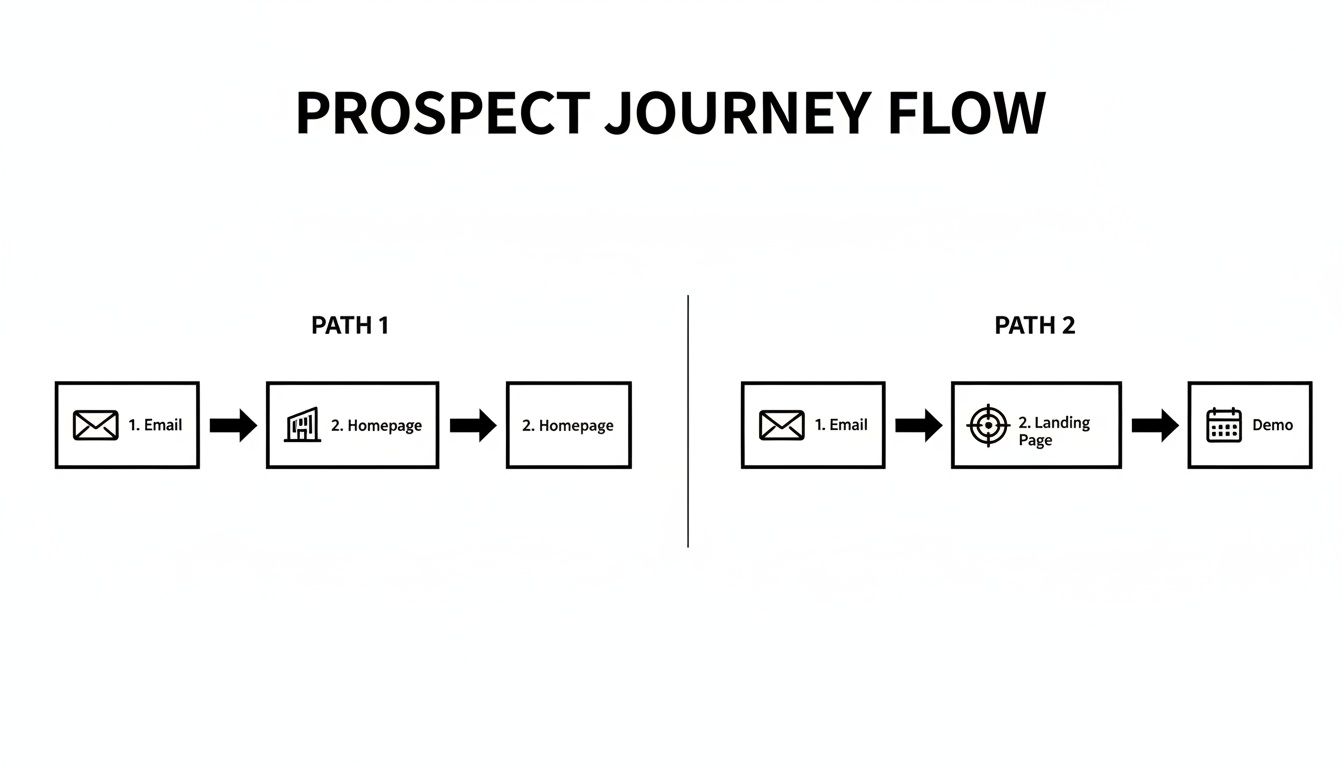
This flowchart shows exactly why that direct path matters. Sending a prospect to your homepage from a targeted email is a recipe for a dead end. A dedicated landing page, on the other hand, creates a frictionless journey straight to a booked demo.

Flowchart showing two prospect journey flows: email to homepage, and email to landing page then demo.

Without this focused structure, you’re just hoping for the best. With it, you're engineering a specific outcome.

The Five Pillars of an SDR Landing Page​

Think of your landing page as a short, sharp conversation. You need to grab their attention, show them the value, earn their trust, make it ridiculously easy to say yes, and then ask for the meeting. Each of these five pillars handles one part of that conversation.

  • The Problem-Centric Headline: This is your hook. It has to hit home instantly. Stop talking about your product and start talking about their pain. "The Future of Sales Software" is generic and gets skipped. But "Tired of Reps Wasting Hours on Admin Work?" That speaks directly to a Sales VP's daily headache.

  • The Solution-Oriented Value Proposition: Right below the headline, you need to answer the silent question: "What's in it for me?" This isn't a feature list. It’s a promise of results. Instead of saying, "We have an AI dialer," say, "Help your team make 2x more calls without ever leaving Salesforce." See the difference?

A great landing page answers a prospect's unasked questions before they even think of them. It anticipates their needs and guides them to the logical conclusion that a demo is the next best step.

  • Targeted Social Proof: Prospects are naturally skeptical. You have to build credibility, and you have to do it fast. The key is relevance. If you're targeting a tech company, a testimonial from a manufacturing firm won't land with the same impact. Use logos of companies they recognize, a quote from someone in their role, or a hard-hitting stat like, "Trusted by 500+ sales teams."

  • The Frictionless Form: This is where so many landing pages fall apart. Your goal is to book a meeting, not to pre-qualify the entire lead. Every single field you add is another reason for them to leave. The best "form" isn't a form at all—it's an embedded calendar from Calendly or Chili Piper. If you absolutely must use a form, ask for their work email. That's it. You already know who they are.

  • A Singular, Compelling Call-to-Action (CTA): Your page has one goal, so it gets one CTA. Period. Strip out everything else. No navigation menu, no links to your blog, no "About Us" page. Nothing. The button text needs to be clear and action-oriented. "Submit" is weak. "Book Your 15-Minute Demo" is strong, direct, and sets clear expectations.

To help tie this all together, here’s a quick cheat sheet for the core components every SDR page needs.

Core Components of a High-Conversion SDR Landing Page​

ComponentSDR-Specific PurposeConversion Goal
Problem HeadlineInstantly mirror the prospect's biggest pain point.Grab attention and establish relevance.
Value PropositionClearly state the specific outcome or benefit.Answer "What's in it for me?" quickly.
Relevant Social ProofBuild immediate trust with logos or testimonials.Overcome skepticism and add credibility.
Frictionless Form/SchedulerRemove every possible barrier to booking a meeting.Maximize form completions/booked demos.
Single, Clear CTAFocus the prospect's attention on the one desired action.Drive a click to the scheduler or form.

Getting these five elements right is the foundation. They work together to guide the prospect’s eye and their decision-making process straight toward that final, all-important click.

For a deeper dive into the fundamental principles, it's worth reviewing a complete guide on how to create high-converting landing pages that boost sales. Mastering these basics is what separates SDRs who consistently hit their numbers from those who don't.

Writing Compelling Copy That Books More Meetings​

Your landing page is your best sales pitch, working 24/7. But for an SDR, it's more than that—it's a direct continuation of a real conversation. Generic marketing fluff just won't cut it. The copy has to feel personal, solve the exact problem you just discussed, and drive one specific action: booking that next meeting.

The difference between copy that gets ignored and copy that converts often boils down to empathy. Does your headline mirror the pain point they mentioned on your call? Or does it sound like a generic brochure? Prospects are tired of being treated like a number. Your landing page is your chance to prove you were actually listening.

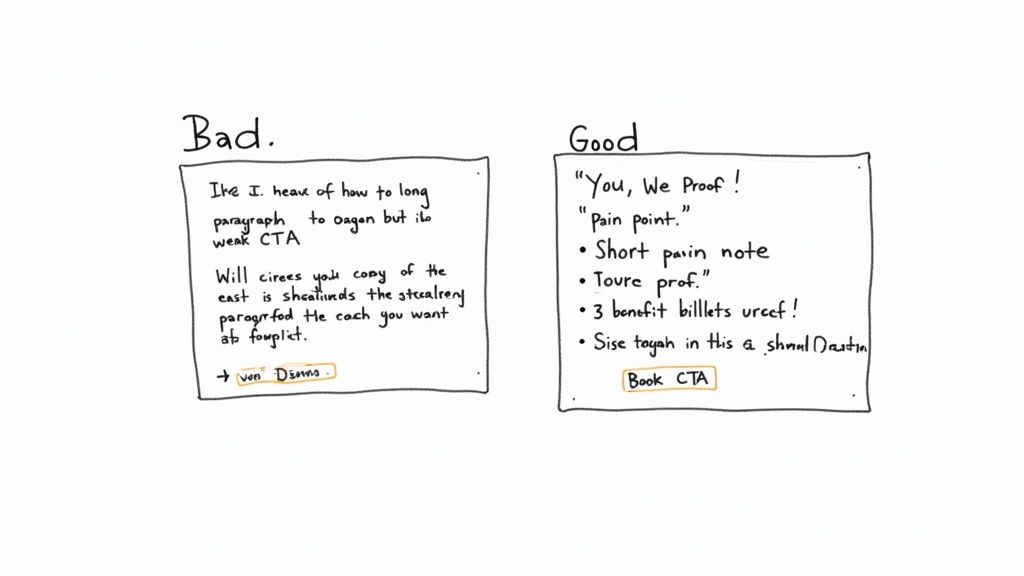
Two handwritten notes comparing bad and good landing page copy with a weak versus a strong call to action.

From Generic to Specific: A Framework for SDRs​

Stop talking about features and start talking about your prospect's reality. A simple but powerful way to structure your landing page message is the 'You, We, Proof' model. It creates a conversational flow that builds a rock-solid case for taking the next step.

  • You: Start with them. Hit their specific challenge or goal right out of the gate. This proves you get their world.
  • We: Position your solution as the bridge from their current problem to their desired outcome. This is where you connect their pain to your value.
  • Proof: Back it up. Slap a relevant customer logo, a targeted testimonial, or a hard-hitting statistic on the page to build instant credibility.

This structure forces you to write from the customer's perspective, which is the whole game. It's a subtle shift that makes your copy feel helpful, not pushy.

Writing Headlines That Hit Home​

The headline is 80% of the battle. If it doesn't grab them, nothing else you've written matters. As an SDR, you have a massive advantage here: you've already spoken to the prospect. Use that intel.

Let's say you're talking to a prospect whose team is buried in manual CRM data entry.

  • Weak Headline: "The #1 CRM Automation Platform" (This is all about you.)
  • Strong Headline: "Cut Your Team's Salesforce Admin Time in Half" (This speaks directly to their problem and offers a tangible outcome.)

The second headline isn't just better; it’s a direct echo of a real conversation. That personal touch immediately signals that this page is for them, not for everyone.

Your best headlines are probably sitting in your call notes right now. Pull direct quotes or summarized pain points from your conversations to create headlines that are impossible to ignore.

Crafting a Call to Action That Creates Urgency​

Your call-to-action (CTA) is the final shove. It needs to be clear, compelling, and feel immediate. Vague, lazy buttons like "Submit" or "Learn More" are absolute conversion killers because they offer zero value and create uncertainty.

A great CTA tells the user exactly what happens next and reinforces the benefit they're about to receive. Think of it as a value exchange, not just a command.

Weak CTAStrong CTAWhy It Works Better
SubmitBook Your 15-Min DemoIt sets clear expectations for time and action. No surprises.
DownloadGet My Free Sales Playbook"My" feels personal, and "Playbook" is more valuable than a generic "download."
Contact UsSee How Much You Can SaveIt focuses on the outcome (saving money), not the task (contacting you).

Notice how the strong examples are all benefit-driven? They answer the "what's in it for me?" question one last time before the click. This is especially crucial for SDRs who need to keep the momentum going. Digging into the motivations behind why prospects act can make your copy even sharper. For a deeper dive, check out these powerful customer segmentation strategies that can help you tailor your message.

Ultimately, great landing page copy isn't about clever wordplay. It's about clarity, relevance, and a genuine understanding of the person on the other side of the screen. By using insights from your sales calls and structuring your message around the prospect's world, you can turn a simple webpage into your most effective tool for booking more meetings.

Designing for Trust, Action, and Credibility​

Great design isn’t about flashy animations or artistic flair; it’s about psychology. For a Sales Development Representative (SDR), your landing page has one job: build instant trust and guide your prospect’s eye straight to the "Book a Demo" button. Think of it as a silent partner in your sales pitch, reinforcing the credibility you’ve already started building.

Many SDRs think design is a marketer’s job, but you don't need to be a designer to understand the basics. A cluttered, confusing page screams disorganization and makes a prospect second-guess your professionalism. In contrast, a clean, focused design communicates competence and respect for their time.

This isn't just about looking good; it's about making it ridiculously easy for the prospect to say yes. Smart design choices directly impact meeting booking rates by removing friction and building confidence with every scroll.

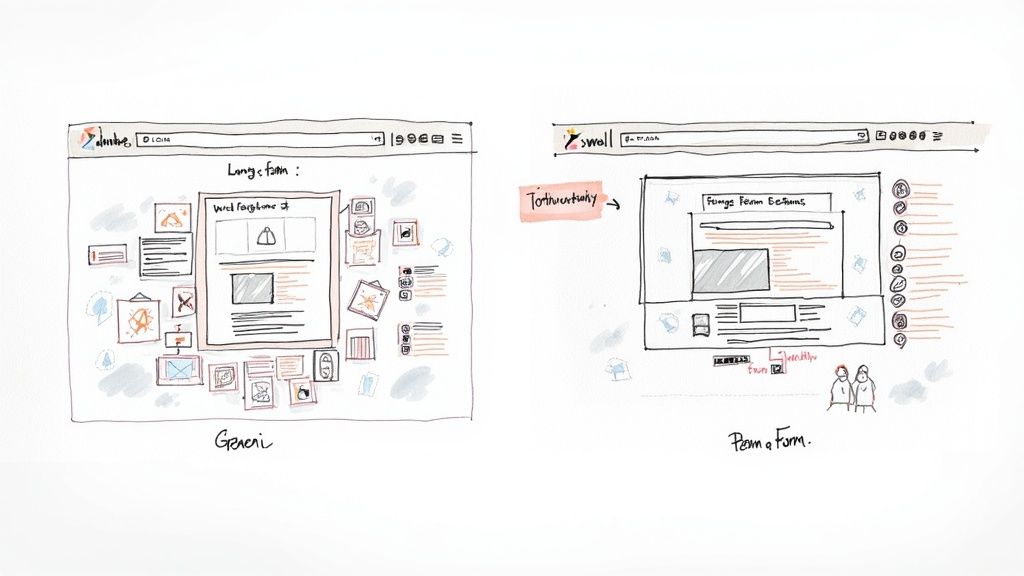
Two hand-drawn web page layouts illustrating a generic long-form versus a concise, to-the-point form.

Guiding the Prospect's Eye with Visual Hierarchy​

Visual hierarchy is just a fancy way of saying you’re arranging elements to show their order of importance. It’s what tells the visitor what to look at first, second, and third. For an SDR’s page, the hierarchy should be dead simple: headline, value prop, social proof, and finally, the call-to-action (CTA).

You create this hierarchy with a few simple tools:

  • Size: Your headline should be the biggest text on the page. Your CTA button should be large and impossible to miss.
  • Color: Use a bold, contrasting color for your CTA button so it pops. If your brand color is blue, an orange button will naturally draw the eye.
  • Whitespace: Don’t cram everything together. Whitespace (or negative space) is the empty area around your text and images. It kills clutter and makes your most important elements stand out.

A cluttered page is like a loud, crowded room where you can’t hear what one person is saying. A clean page with plenty of whitespace is like a quiet, one-on-one conversation—clear, focused, and persuasive.

Choosing Images That Build Credibility​

Generic stock photos of smiling business people in a boardroom are a credibility killer. Your prospects have seen them a thousand times, and they instantly signal "corporate brochure." To build genuine trust, your images have to feel authentic.

Ditch the stock photos and use visuals that actually support your message.

  • Product Screenshots: Show, don't just tell. A clean screenshot of your platform in action is way more convincing than a paragraph of text.
  • Team Photos: A simple, professional photo of your team (or even just you) adds a human touch. It reminds the prospect there are real people behind the software.
  • Customer Logos: This is powerful visual social proof. A row of recognizable logos builds immediate trust before they’ve read a single word.

The rule is simple: if the image doesn't add value or build credibility, get rid of it. Every single element on the page should serve your one goal of booking that meeting.

Optimizing the Lead Form for SDRs​

This is where the rubber meets the road. The goal is to make saying "yes" as frictionless as possible. Every single field you add increases the odds of abandonment. A prospect might be willing to give you their email, but asking for their phone number, company size, and annual revenue will make them hit the back button faster than you can blink.

Look at the difference between these two approaches:

Ineffective Form (High Friction)SDR-Optimized Form (Low Friction)
First NameName
Last NameWork Email
Work Email(That's it. Seriously.)
Phone Number
Company Name
Company Size
Job Title

Remember, your landing page isn't for qualifying the lead; it's for securing the meeting. You can gather all that extra information on the discovery call. The only data you need right now is what's required to book the demo.

For a deeper dive into visual guidance, these 10 Landing Page Design Best Practices are a great resource for making sure your page is both appealing and effective.

How to Measure and Optimize Your Landing Page Performance​

Launching your landing page isn’t the finish line. Honestly, it’s just the starting block. For a Sales Development Representative (SDR), the real magic happens next: turning that live page into a repeatable, predictable source of booked demos. This is where you shift from building to optimizing, using data to systematically improve your results.

Without tracking, you’re just guessing. You might think a headline is brilliant, but if prospects aren't clicking, it's not doing its job. Measuring performance lets you move beyond opinions and make data-driven decisions that directly impact your quota.

This process transforms your landing page from a static brochure into a dynamic sales asset that gets smarter over time. You don't need a dedicated marketing team to do it, either. You just need to know what to look for and how to test your assumptions.

Key Metrics Every SDR Should Track​

You don't need to get lost in a sea of analytics. For an SDR, only a handful of metrics truly matter. They tell you exactly what's working and where prospects are dropping off.

  • Conversion Rate: This is your North Star. It’s the percentage of visitors who actually book a demo. A low conversion rate is a blaring alarm that something in your message or design isn't connecting.
  • Bounce Rate: This one tracks the percentage of visitors who land on your page and leave without doing anything. A high bounce rate usually means your headline and initial value prop aren't strong enough to hold their attention for more than a few seconds.
  • Time on Page: This shows how long visitors are sticking around. If your conversion rate is low but the time on page is high, it could mean your copy is engaging but your call-to-action (CTA) isn't strong enough to close the deal.

Getting a handle on these numbers is non-negotiable; they're the vital signs of your landing page's health. For a deeper dive, check out our guide on essential lead generation key performance indicators.

The Power of A/B Testing for SDRs​

A/B testing is your secret weapon for continuous improvement. The concept is simple: you create two versions of your page (Version A and Version B), change just one single element, and see which one performs better. By isolating one variable at a time, you can scientifically figure out what resonates most with your prospects.

The core principle of A/B testing is simple: Don't guess. Test. A small change, like rephrasing a CTA button from "Book a Demo" to "Get a 15-Min Demo," can have a surprisingly large impact on your booking rate.

This approach is incredibly effective. Landing pages have become powerful tools, with the average conversion rate across all industries sitting around 6.6%. They outperform other signup methods by a staggering 160%. What's more, companies that use between 31 and 40 landing pages generate seven times more leads than those with just a handful. You can discover more about these landing page statistics and how to apply them.

What Should You Test on Your Landing Page​

To keep from getting overwhelmed, focus your A/B tests on the elements that have the biggest impact on a prospect's decision to act.

Elements to A/B Test for Higher Conversion

Element to TestWhy It Matters for SDRsExample Test (A vs. B)
HeadlineIt's the first thing a prospect reads. It determines if they stay or leave.A: "The Future of Sales Automation" vs. B: "Cut Your Team's Admin Work by 5 Hours a Week"
Call-to-Action (CTA)The button's text, color, and placement directly influence clicks.A: "Submit" (button color: blue) vs. B: "Book My Demo" (button color: orange)
Hero Image/VideoA visual can build trust or cause confusion. It needs to be relevant and credible.A: Generic stock photo of an office vs. B: A short video of you explaining the value proposition.
Social ProofThe type of proof you use—testimonials, logos, case studies—can make or break your credibility.A: Testimonials from SMBs vs. B: Logos of enterprise customers.

The key is to run each test long enough to get a statistically significant result—usually a few hundred visitors, depending on your traffic. Once you have a clear winner, you implement that change and move on to testing the next element. This iterative process is how you build a landing page that doesn't just look good, but consistently books more meetings and helps you crush your sales goals.

Your Top SDR Landing Page Questions, Answered​

Even with a solid game plan, you're going to hit a few snags building your first landing page. That's just part of the process. As an SDR, your time is your most valuable asset, and getting bogged down by a technical hiccup or a design debate is a total momentum killer.

This section is your quick-reference guide for those moments. I’ve compiled the most common questions sales reps ask and provided straight, actionable answers to get you unstuck and back to booking meetings.

What’s the Easiest Way to Build a Landing Page Without Knowing How to Code?​

Good news: you absolutely don't need to be a developer. The market is packed with user-friendly builders made for people who care more about the message than the code behind it.

The single most important thing to look for is a tool that plays nice with your CRM or sales software. You need lead data and booked meetings to flow right into your workflow, no manual copy-pasting required.

Here are a few popular choices I’ve seen teams use successfully:

  • Unbounce & Instapage: These are the industry heavyweights. They come with powerful templates, serious A/B testing features, and deep integrations. They're perfect for teams that want total control and are obsessed with optimization.
  • Leadpages: Known for being incredibly easy to use and more affordable. Leadpages is a fantastic starting point if you just need to get a solid page live fast without a massive learning curve.
  • Carrd: If you need a dead-simple, one-page site, Carrd is brilliant. It's the go-to for a super-focused page with a single call-to-action, maybe for a specific account or a niche campaign.

How Do I Actually Personalize a Page for One Specific Account?​

This is your secret weapon. Personalization is the biggest advantage you have over generic, one-size-fits-all marketing pages. It instantly shows the prospect you’ve done your homework and makes them feel like you get them. This is the heart of any real account-based marketing (ABM) play.

Start with the simple stuff:

  • Slap their company name right in the headline. Something like "A Better Workflow for [Company Name]" works every time.
  • Drop their logo next to yours. It creates an immediate visual cue of a potential partnership.

For a high-value account, you need to go deeper. Reference a specific challenge you uncovered during your research. Use images that reflect their industry—don't show a picture of a software dashboard to a manufacturing plant manager. Tailor your entire value prop to solve a problem you know they have.

For an SDR, a personalized landing page is the digital equivalent of a firm handshake and direct eye contact. It proves you're not just another automated email—you're a focused problem-solver.

Seriously, How Many Form Fields Should I Use?​

The answer is brutally simple: as few as humanly possible.

Your goal is to book a meeting, not pre-qualify their entire business. Every single field you add is another reason for them to click away. Think of each box as a little bit of friction.

For most SDR pages, you only need a Name and Work Email. And honestly, you probably already have their name from your outreach, so you might get away with just asking for an email confirmation.

The best-case scenario? No form at all. Embed a scheduler like Calendly or Chili Piper directly on the page. This completely removes the barrier and lets a prospect book a time in just a couple of clicks. Fight the urge to ask for their phone number, company size, or job title. Save that for the discovery call.

Where Can I Get Social Proof That Actually Works?​

Social proof is what makes your pitch believable. Without it, you're just making claims. Your first stop should always be your marketing team—they usually have a goldmine of approved customer logos, quotes, and case studies ready to go.

Here are the types of social proof that hit hardest on an SDR's landing page:

  • Customer Logos: Don't just throw any logo up there. Use logos from companies in your prospect's industry. Seeing a familiar competitor or partner builds instant trust.
  • Short Testimonials: A quote from someone with the same job title as your prospect is incredibly effective. It's someone they can relate to.
  • Hard Data: Concrete numbers are persuasive. Something like "Trusted by 5,000+ sales teams" shows scale and proves you're not a risky bet.
  • Third-Party Badges: If your company has great reviews on sites like G2 or Capterra, use their badges. It's unbiased validation you can't fake.

At marketbetter.ai, we turn this entire process into a seamless workflow. Our platform helps you identify the right accounts, generates the tasks, and provides the AI-powered tools to create compelling outreach—all inside your CRM. See how you can build a consistent outbound motion without the busywork at https://www.marketbetter.ai.