In today's crowded inbox, a generic cold email template for sales is a direct path to the trash folder. Prospects are smarter, more skeptical, and have less time than ever. Winning their attention requires more than just a template; it demands a strategy. This article breaks down eight battle-tested cold email frameworks, not just what to write, but why each one works, how to compare them, and how to make them actionable for your sales team.
We'll dissect the psychology behind each approach, from problem-first hooks that agitate a pain point to multi-touch sequences designed for long-term engagement. Understanding these fundamentals is crucial. To truly master high-reply cold emails, it's vital to understand the broader sales landscape, including the distinction between inbound and outbound sales, where this tactic is a key pillar of outbound strategy.
Each template comes with subject-line options, personalization hooks, and CTA variants. We will also provide short, actionable notes on how you can adapt and execute these strategies using AI-powered tools like MarketBetter.ai. This will help you turn market signals into high-value conversations without drowning your SDRs in manual prep work. Forget copy-and-paste tactics; you're about to learn how to build a repeatable outbound motion that actually generates pipeline.
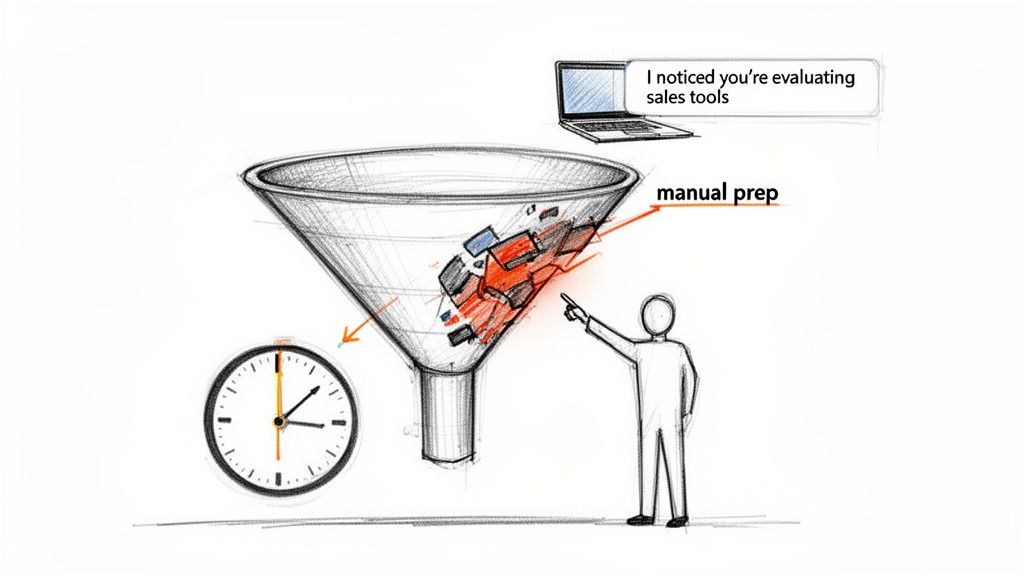
The Problem-First approach is a powerful cold email template for sales because it immediately shifts the focus from your product to the prospect's world. Instead of leading with a generic "My name is..." or "We do X," this template opens by identifying a specific, high-stakes business problem relevant to the prospect's role or industry. This strategy demonstrates empathy and research, showing you understand their challenges before you even mention a solution.
Actionable Comparison: While the Social Proof template builds trust with external validation, the Problem-First approach builds it by demonstrating internal understanding. It's more direct and works best when you have strong intelligence on a prospect's potential pain points. Platforms like HubSpot and Outreach.io popularized this signal-based strategy, with customer studies reporting reply rates over 35% when the opener is tied to a specific business trigger.
1. Identify a High-Value Problem: Use tools like MarketBetter.ai to surface account context and buyer signals. For example, if intent data shows a company is researching CRM tools, your problem statement could focus on the inefficiencies of manual data entry.
Actionable Step: Create a "Pain Point Matrix" that maps your top 3 buyer personas to their top 3 business problems. This gives your SDRs a quick-reference guide.
Example Opener: "Saw your team is evaluating new sales tools. Most growing sales teams we speak with find their reps waste 15+ hours weekly on manual outreach prep. Is that a challenge your team is tackling?"
2. Position Your Solution Subtly: After stating the problem, connect it to your solution with a soft call-to-action (CTA). Avoid a hard sell; instead, ask a question to start a conversation.
Actionable Step: Your CTA should propose a conversation about the problem, not a demo of your product. Frame it as a brief "strategy call" or "idea exchange."
Example CTA: "If so, would you be open to a 15-minute call to share how we helped [Similar Company] automate this and reclaim 10 hours per rep weekly?"
3. Test and Iterate: Don't rely on a single pain point. A/B test 3-5 different problem statements for each prospect segment to see which one resonates most. Use reply data to refine your approach, a key tactic in modern email marketing to generate leads.
2. The Social Proof / Case Study Cold Email Template
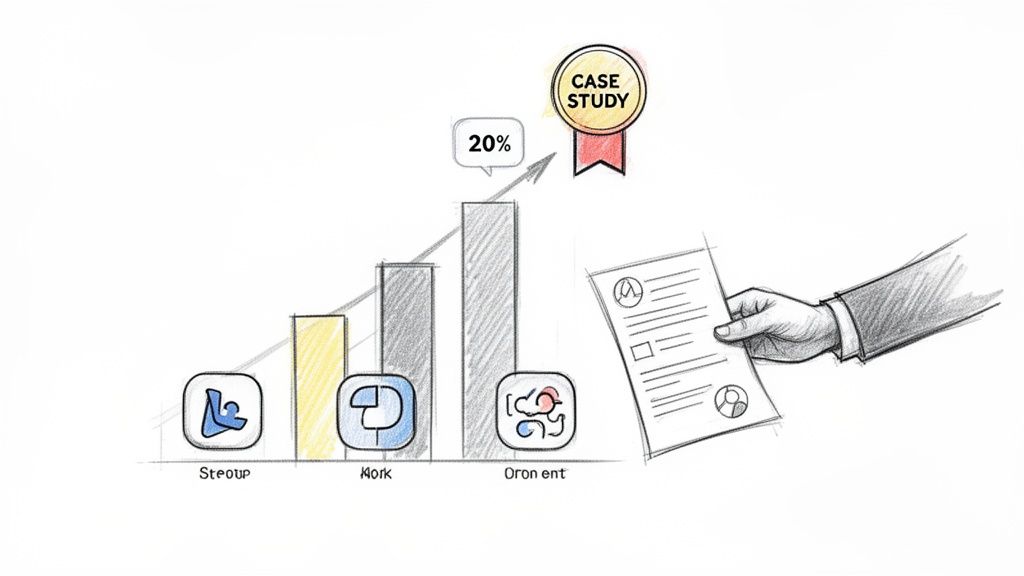
The Social Proof / Case Study approach is a powerful cold email template for sales because it leverages third-party validation to build instant credibility. Instead of asking a prospect to believe your claims, you show them concrete results achieved by a similar company. This template opens by referencing a specific customer success story, immediately anchoring your value proposition in tangible outcomes rather than abstract features.
Actionable Comparison: Unlike the Curiosity template, which creates intrigue through ambiguity, this method builds trust through transparency and tangible proof. It's less about asking a clever question and more about presenting an undeniable result. Platforms like Salesloft and Gong have popularized this strategy, with data showing that emails citing specific customer metrics can increase reply rates by over 20% compared to generic outreach.
1. Select a Hyper-Relevant Case Study: Use your CRM data or a tool like MarketBetter.ai to match a prospect with your most relevant customer story. Filter by industry, company size, or technology used for the strongest alignment.
Actionable Step: Build a filterable case study library in a tool like Notion or your sales enablement platform. Tag each story with the customer's industry, size, and the specific problem solved.
Example Opener: "We recently helped [Similar Company Name], another SaaS company in the marketing automation space, reduce SDR prep time by 6 hours/week. I’m reaching out because your team's structure seems very similar."
2. State the Outcome and Create Curiosity: Focus on the "what" (the result), not the "how" (your product). Frame the result as a one-sentence benefit and follow up with a soft, curiosity-driven call-to-action (CTA).
Actionable Step: Translate every case study into a one-sentence "punchline" that highlights the most impressive metric (e.g., "40% increase in qualified meetings," "25% reduction in onboarding time").
Example CTA: "Curious if your team faces similar admin overhead? If so, would you be open to learning how [Similar Company Name] achieved this efficiency gain?"
3. Rotate Your Assets and Test: To avoid message fatigue across your target accounts, maintain a library of 5-7 proven case studies. A/B test different outcomes (e.g., "increase revenue" vs. "reduce cost") to see which metric resonates most with a particular persona. This makes it a versatile cold email template for sales outreach.
3. The Curiosity / Question-Based Cold Email Template
The Curiosity-Based approach is a cold email template for sales that prioritizes engagement over pitching. Instead of presenting a problem or a solution, it leads with a thought-provoking question or an unexpected statement designed to pique the prospect's interest. This strategy disrupts the typical sales cadence by creating a knowledge gap, compelling the recipient to reply to satisfy their curiosity.
Actionable Comparison: This is the polar opposite of the Value-First template. Instead of laying out all the facts and figures upfront, this method withholds information to provoke a response. It’s a high-risk, high-reward play that can generate exceptional reply rates when the question is perfectly tuned to the persona. Popularized by sales leaders like Steli Efti and methodologies from Drift, it leverages the psychological principle of cognitive curiosity to bypass the recipient's automatic "delete" reflex.
1. Craft a Persona-Specific Question: The question must be sharp, insightful, and directly relevant to the prospect's role. A generic question will fail; it must show you understand their world deeply enough to ask something they haven't fully considered.
Actionable Step: Brainstorm five "uncommon but true" observations about your target persona's job. Turn these observations into questions. For example, "Did you know the average VP of Sales only hits their quota 2 out of 4 quarters?"
Example Opener: "Most sales leaders we speak with find their top reps talk differently on calls, but can't pinpoint the pattern. Have you noticed this?"
2. Keep the Email Body Lean: This template works best when it's extremely short, often just two or three sentences. The goal is to get a reply, not to explain your entire value proposition. The question should do all the heavy lifting.
Actionable Step: Set a hard limit of 50 words for the entire email body. If it's longer, it's not a true Curiosity template.
Example CTA: "We analyzed 2 million sales calls to find that pattern. Curious to hear what we learned?"
3. Test and Sequence Your Questions: Don't bet on a single question. Use a tool like MarketBetter.ai to A/B test 3-5 different curiosity-driven questions for each segment. Plan a follow-up sequence that gradually reveals your perspective, turning the initial curiosity into a qualified conversation. Strong questions are also crucial for your email subject lines; you can find more detail in these email subject line best practices.
4. The Value-First / Before-After Cold Email Template
The Value-First, or "Before-After," template is a highly effective cold email template for sales that cuts through abstract claims by presenting a concrete transformation. Instead of listing features, it frames your solution within a clear narrative: "This was the painful reality before; this is the valuable outcome after." This method is ideal for technical or process-heavy solutions where demonstrating tangible impact is more persuasive than an emotional appeal.
Actionable Comparison: This template is more direct and data-driven than the Permission-Based approach. While the soft-ask template requests permission to share value, the Before-After template delivers the core value proposition upfront, aiming to persuade with a clear ROI story from the very first sentence. Sales engagement platforms like Outreach and Salesloft have championed this model, often showcasing case studies with reply rates boosted by 25-40% when specific before-after data is used.
1. Quantify the "Before" State: Use real customer data to establish a baseline. Pull reports from Salesforce or your product analytics to find concrete numbers that represent the initial challenge.
Actionable Step: Interview 3-5 of your best customers. Ask them, "Before you used our product, how did you measure X? What was the number?" Use their exact language and data.
Example Opener: "Most BDR teams we work with spend 6+ hours daily on manual research and prep. Your recent hiring push for new reps suggests you might be feeling this admin strain."
2. Present the "After" State as an Achievable Outcome: Connect the "before" pain to the "after" gain with a clear, metric-driven statement. This makes the value of your solution undeniable.
Actionable Step: Create a simple ROI calculator or a one-sheet that visually shows the "Before vs. After" transformation. You can link to this in your email for added impact.
Example Pitch: "After implementing our platform, similar teams automate this work and reallocate that time to log 25+ extra conversations per rep, per week."
3. Make the CTA Outcome-Focused: Your call-to-action shouldn't be a generic request to "connect." Instead, it should offer to map the "after" state directly onto the prospect's team, making the next step feel both tangible and valuable.
Example CTA: "Would a 15-minute call be worthwhile to map how your team could reclaim those hours and increase call volume by 30%?"
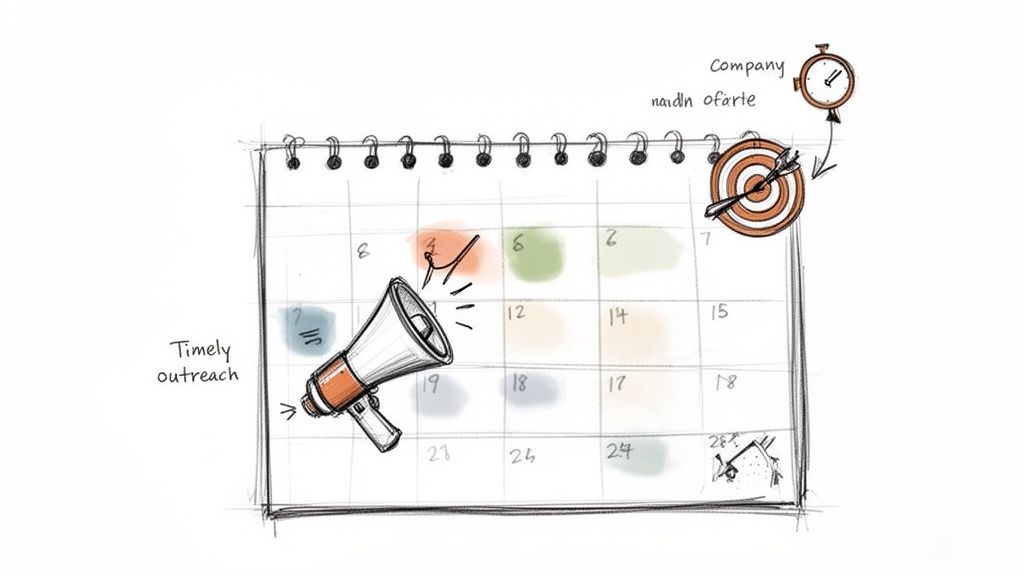
The Event / Newsjack approach is a highly effective cold email template for sales because it capitalizes on timeliness and relevance. This strategy involves monitoring for specific company or industry triggers, like funding announcements, new executive hires, or product launches, and using that event as the reason for your outreach. By referencing a recent, specific event, you instantly show the prospect that your email is not a generic blast but a targeted message based on real-time developments.
Actionable Comparison: This approach is faster and more opportunistic than the Referral template. While a referral relies on an existing relationship, a newsjack creates relevance from a public event. It's the perfect strategy for breaking into an account where you don't yet have an internal champion. Platforms like 6sense, Demandbase, and ZoomInfo have built their models on this intent-based strategy, proving that emails tied to trigger events can achieve significantly higher reply rates.
1. Identify a Relevant Trigger Event: Use intent data platforms or even simple alerts to track key events. For example, if a target account announces a Series B funding round, that’s your cue.
Actionable Step: Set up Google Alerts or use a platform like marketbetter.ai to create automated notifications for your top 20 target accounts for keywords like "funding," "new hire," and "expansion."
Example Opener: "Saw [Company] just closed its Series B round on TechCrunch, congrats to the team. With that kind of growth, I'm curious: is streamlining your SDR motion on the agenda for Q1?"
2. Connect the Event to a Business Need: The event is the hook, but you must connect it to a likely challenge or priority. A new VP of Sales is probably evaluating their tech stack; a funding round means pressure to scale efficiently.
Actionable Step: For each trigger event you track, pre-write a "challenge hypothesis." For a funding announcement, the hypothesis is "They now have pressure to scale efficiently." For a new executive hire, it's "They will be reviewing their current tech stack."
Example CTA: "We've helped 3 other post-Series B SaaS companies cut sales ramp time by 40%. Would a quick call to share what's working for them be helpful as you plan your expansion?"
3. Act with Urgency and Automation: Timing is everything. The signal loses potency after 72 hours. Integrate tools like MarketBetter.ai's SDR Task Inbox with intent signals so tasks auto-populate with a newsjack email template the moment an event occurs. Log these emails separately in your CRM to track which event types drive the most replies.
6. The Permission-Based / Soft Ask Cold Email Template
The Permission-Based approach is an effective cold email template for sales because it flips the traditional dynamic. Instead of pushing for a meeting, it asks for permission to share value, which significantly lowers the prospect's psychological resistance. This method respects the recipient's time and inbox, framing your outreach as helpful rather than demanding. It's a low-friction strategy designed to start conversations, not force demos.
Actionable Comparison: This method is the opposite of a hard-sell template that pushes for a 30-minute demo. It’s more consultative and is a safer play than the high-risk Curiosity template, as it offers tangible value upfront instead of relying purely on intrigue. Modern sales platforms like HubSpot have championed this conversational approach, as it aligns perfectly with inbound principles and often yields higher engagement rates than aggressive, high-pressure CTAs.
1. Offer Value First, Ask for Permission Second: Your opener should identify a relevant context, then offer a valuable resource. Use MarketBetter.ai to find triggers, like a company's recent hiring push, to make your offer highly specific and timely.
Actionable Step: Create a "Value Menu" for your sales team—a list of 3-5 high-value, non-gated assets (e.g., a benchmark report, a checklist, an insightful article) that they can offer prospects.
Example Opener: "Saw your team is hiring SDRs. Our team learned a few things about cutting ramp time from 60 to 30 days. Would it make sense to send those over?"
2. Make the Ask Low-Commitment: The core of this template is a soft call-to-action (CTA) that requires a simple "yes" or "no." Avoid asking for time on their calendar; instead, ask for permission to send information or to continue the dialogue.
Actionable Step: A/B test your soft CTA. Compare "Happy to send it over?" with a more direct "Mind if I send over the one-pager?" Track reply rates to see which phrasing performs better for your audience.
Example CTA: "If that sounds useful, would you be open to me sending over a one-page summary? It's a 2-minute read."
3. Prepare a Multi-Threaded Follow-Up: Segment your follow-up sequence based on the prospect's response. If they say yes, deliver the promised value immediately. Use MarketBetter.ai's AI-generated follow-ups to adapt your next steps based on whether their reply is enthusiastic or lukewarm, ensuring your next touchpoint is just as relevant.
7. The Multi-Touch / Sequence-Based Cold Email Template
The Multi-Touch / Sequence-Based approach is a powerful cold email template for sales because it recognizes that a single email is rarely enough. Instead of a one-off attempt, this strategy uses a coordinated sequence of 5-7 emails sent over 2-3 weeks. Each email serves a distinct purpose, building a compelling narrative from awareness and education to social proof and urgency. This method builds familiarity and delivers value over time, dramatically increasing the odds of getting a response.
Actionable Comparison: This is not a template but a system that combines other templates into a cohesive campaign. A single Problem-First email is a tactic; a sequence that starts with a Problem-First email, follows up with a Case Study, and then uses a Permission-Based ask is a strategy. This structured persistence is what separates amateur outreach from professional pipeline generation. This strategy was popularized by sales engagement platforms like Outreach.io and Salesloft, whose frameworks often see reply rates climb on the third or fourth touchpoint.
1. Map Your Narrative Arc: Plan your sequence with a clear goal for each email. A common flow is: Awareness (Email 1), Education/Value (Email 2), Proof/Case Study (Email 3), Objection Handling (Email 4), and a final "break-up" or urgency-based CTA (Email 5).
Actionable Step: Storyboard your sequence. For each touchpoint, define "What is the one thing I want the prospect to learn or feel?" This ensures your sequence tells a coherent story.
Example Email 1 Opener: "Noticed your team is hiring for [Role], which often signals a new focus on [Business Challenge]. We help with that."
Example Email 3 Snippet: "Following up on my last note, I thought you'd find this case study on how [Similar Company] solved [Business Challenge] insightful."
2. Automate Execution with AI: Use a tool like MarketBetter.ai's AI Cold Email to generate the entire 5-7 email sequence, including subject lines and variants, in one go. This ensures a consistent voice and message. Integrate it with an SDR Task Inbox to automate the sending and follow-up reminders.
3. Vary Timing and Test Angles: Space emails at least 3-4 days apart and vary send times to avoid seeming robotic. A/B test different sequences for different prospect segments. To master this, you can learn more about the best practices for email campaigns and discover how to optimize send times and content for maximum engagement.
4. Integrate with Other Channels: A sequence shouldn't be email-only. By the third or fourth touchpoint, if email engagement is low, use MarketBetter's integrated dialer to place a call. This multi-channel approach significantly boosts connection rates.
The Referral / Warm Intro approach is a standout cold email template for sales because it instantly dissolves the "cold" aspect of the outreach. By leveraging a mutual connection, shared event, or direct referral, you create immediate trust and relevance. Instead of fighting for attention as a stranger, you enter the conversation with a degree of familiarity and social proof, dramatically lowering the recipient's natural guard.
Actionable Comparison: This is the highest-converting template, but it's the least scalable. Unlike the Event/Newsjack, which can be automated based on public data, this requires manual relationship mapping. Prioritize this template for your Tier 1, high-value accounts where the time investment is justified. This strategy, popularized by platforms like LinkedIn Sales Navigator, consistently delivers the highest reply rates, often exceeding 50% because it relies on human connection.
1. Identify a Legitimate Connection: Use tools like MarketBetter.ai's account mapping or LinkedIn Sales Navigator to find mutual connections, past colleagues, or shared event attendee lists. A genuine connection is non-negotiable for this template's success.
Actionable Step: Before every key sales call, spend 5 minutes on the prospect's LinkedIn profile looking for shared connections, schools, or past employers. Note these down for potential future outreach within the account.
Example Opener (Mutual Connection): "Sarah Smith and I were discussing SDR enablement, and she mentioned your team is hiring. She thought you'd find this insight on ramping reps 30% faster useful."
2. State the Connection and Value Immediately: Lead with the referral in the very first sentence to capture attention. Immediately follow up with a concise value proposition that relates directly to the prospect's context.
Actionable Step: Ask your referral for the "one-sentence intro" they would use. This ensures the message is authentic and aligns with how your connection would naturally communicate.
Example Opener (Referral): "Kevin at [Similar Company] suggested I reach out. He mentioned your team is evaluating ways to streamline outbound without adding headcount, which is a challenge we've helped several post-Series-B teams solve."
3. Use a Soft, Conversational CTA: Since the introduction is already warm, the call-to-action can be low-pressure. Focus on continuing the conversation or providing further value rather than pushing for a meeting.
Example CTA: "I found some research on Salesforce integration challenges your team might find relevant, based on our brief chat at SaaStr. Happy to send it over if you're interested?"
⭐ Highest legitimacy/trust; fastest path to meetings
Free Tool
Try our AI Lead Generator — find verified LinkedIn leads for any company instantly. No signup required.
From Template to Pipeline: Making Your Outreach Actionable
We've explored a powerful arsenal of eight distinct frameworks, from the directness of the Problem-First Cold Email Template to the subtlety of the Permission-Based / Soft Ask. Each template serves a unique purpose, designed to resonate with a specific prospect mindset and sales situation. But the most critical insight is this: the best cold email template for sales is not a static script. It is a dynamic starting point for a conversation.
Comparing these templates reveals a common DNA for success. The direct, value-driven approach of the Value-First / Before-After template shares the same core principle as the timely Event / Newsjack template: relevance is king. Both prove you've done your homework and aren't just sending another generic blast. Similarly, whether you are leveraging the credibility of the Social Proof template or the curiosity of the Question-Based template, the goal is always to earn the prospect's next three seconds of attention, not to close the deal in a single email.
Reading about effective templates is one thing; building a predictable pipeline is another. The real challenge lies in bridging the gap between theory and execution. Your next step is to move from simply having a library of templates to building an operational system around them.
Categorize and Test: Don't try to implement all eight templates at once. Start by selecting two or three that best align with your current GTM strategy. For example, pair the Problem-First template for your core ICP with the Event / Newsjack template for high-value accounts showing specific buying signals.
Measure Relentlessly: Track open rates, reply rates, and meeting booked rates for each template variant. A low open rate might point to a weak subject line, while a high open rate but low reply rate often indicates a disconnect between your hook and your call-to-action. Use these metrics to iterate and refine.
Build a Workflow, Not a Document: A Google Doc of templates is a start, but it doesn't scale. The goal is to embed these strategies directly into your sales team's daily workflow, making the "right" action the "easy" action. This is where you can transform your SDR team’s efficiency.
Ultimately, the goal of using a cold email template for sales is to create a repeatable engine for revenue growth. This requires consistency, personalization at scale, and flawless execution. You must ensure that every sales rep knows their next best action and has the perfect, context-aware message ready to go without spending hours on manual research.
This is precisely where technology acts as a force multiplier. Instead of just handing your team a list of templates, you can use an AI-powered platform to analyze buyer signals, prioritize the most engaged accounts, and generate personalized email variants on the fly. By integrating these templates into a smart execution platform, you transform a list of good ideas into a system that consistently generates pipeline and drives revenue.
Ready to turn these templates into a predictable revenue engine? marketbetter.ai integrates directly into your CRM, using AI to analyze buying signals and generate hyper-personalized email variants based on proven frameworks. Stop copying and pasting and start building a smarter, more efficient outbound process today at marketbetter.ai.
In a world drowning in content, it’s easy to think that the only way to win is to publish more, rank higher, and wait for people to find you. That’s the inbound game.
But what if you didn’t have to wait?
That's where outbound lead generation comes in. It’s the art of proactively starting conversations with potential customers who haven't raised their hand yet. Instead of setting up a shop and hoping for foot traffic, your sales team is out there knocking on the right doors.
While a solid inbound strategy builds a great foundation over time, outbound is the catalyst for immediate growth. It gives you control.
Think of it this way: inbound is like setting up a fantastic storefront and hoping the right people wander in. Outbound is like sending your best ambassador to a high-stakes business conference to talk directly to your ideal buyers. You aren’t waiting for opportunities; you're creating them.
This direct approach puts you in the driver's seat of your sales pipeline. You're no longer at the mercy of search engine mood swings or the slow burn of content marketing. You decide exactly who you’re talking to, and when.
The real magic of outbound is its precision. You can zero in on specific companies, job titles, and industries that perfectly match your Ideal Customer Profile (ICP). This is a game-changer in B2B, where deals are bigger and the right decision-makers are notoriously hard to reach.
While inbound often casts a wide net, outbound uses a spear.
This proactive approach delivers a few key wins:
Immediate Feedback Loop: You find out fast what messaging hits home with your target market. This lets you sharpen your value proposition on the fly.
Predictable Pipeline Growth: Because you control the volume of outreach, you can forecast your lead flow and sales opportunities with much greater accuracy.
Market Penetration: It’s your ticket into new markets or a direct line to high-value accounts that might never stumble across your blog posts.
Outbound isn't about annoying people. It's about starting relevant conversations with the right people, at the right time. When you lead with genuine value and personalization, you build relationships just as strong as any other method.
The smartest strategies today don't pit outbound against inbound—they weave them together. A thoughtful outbound campaign can warm up a cold account long before they even start searching for a solution.
Imagine a prospect receives a sharp, helpful cold email from your team. A few weeks later, when they see your brand’s content pop up, they’re far more likely to recognize and engage with it.
Lots of people will tell you that tactics like cold calling are dead. But for anyone questioning the raw power of picking up the phone, a look at some crucial cold calling statistics proves it’s still incredibly effective, especially when you arm your team with modern data and a personal touch.
The key is to stop seeing outbound as a standalone tactic. It’s a vital engine for creating predictable, scalable revenue.
Choosing Your Growth Engine: Outbound vs. Inbound
Trying to decide between outbound and inbound lead generation isn't an "either/or" question. It’s more like choosing between two different engines for your business. One is a rocket ship—built for speed and precision. The other is a locomotive—designed for steady, long-term momentum. The right one for you depends entirely on where you're trying to go.
Outbound is your rocket ship. It’s a proactive strategy where you kick things off, reaching out to prospects you've specifically chosen. You’re not waiting for them to stumble upon you; you're heading straight to them through cold email, social selling on LinkedIn, or direct calls. This gives you a ton of control over who you talk to and when.
Inbound, on the other hand, is your locomotive. It works by drawing potential customers in with valuable content and helpful experiences. They find you through your blog posts, social media updates, or search results. This method is fantastic for building your brand's authority and creating a consistent, reliable flow of leads over time.
The whole game boils down to one simple question: who starts the conversation? With outbound, you start it. With inbound, your prospect starts it. That single distinction changes everything—from speed to cost to how you scale your efforts.
Need to land a few high-value enterprise clients, and fast? An aggressive outbound campaign is your best bet. If you’re selling a high-ticket B2B service, sitting around and hoping the CEO of a Fortune 500 company finds your blog just isn't a strategy. Outbound lets you cut through the noise and get straight to the decision-makers.
But if your goal is to build long-term brand equity and a sustainable lead-gen machine, an inbound content strategy is the way to go. By consistently putting out helpful content, you become the trusted resource in your industry. That trust translates into a steady stream of warm, qualified leads who already see you as an expert.
The smartest growth strategies don't pick one over the other—they integrate both. Use outbound to spark immediate opportunities and break into key accounts, while your inbound engine builds the foundation for sustainable, long-term growth.
This integrated approach is where the magic really happens. B2B markets still rely heavily on outbound, and the data shows it works even better when paired with inbound. For instance, a major software company saw a 28% jump in quarterly sales and a much shorter sales cycle after mixing inbound lead capture with outbound outreach on LinkedIn and email. Another B2B logistics firm slashed its sales cycle by 20% by combining its content marketing with targeted outbound plays. You can find more examples of this synergy in recent case studies on Martal.ca.
To help you figure out where to put your time and money, let's break down how these two approaches stack up across the business metrics that actually matter.
Outbound vs. Inbound Lead Generation: A Strategic Comparison
This table breaks down the key differences between outbound and inbound lead generation across critical business metrics to help you choose the right approach.
Factor
Outbound Lead Generation
Inbound Lead Generation
Speed to Results
Fast. You can see initial results and book meetings within days or weeks of launching a targeted campaign.
Slow. It typically takes 6-12 months of consistent effort to build authority and see significant lead flow.
Targeting Precision
High. You can hand-pick the exact companies and job titles you want to engage, making it ideal for ABM.
Moderate. You target personas, but you can't control which specific individuals find your content.
Cost Per Lead (CPL)
Higher initially. CPL can be high at the start but becomes more predictable as you optimize campaigns.
Lower over time. The initial investment is high, but as content assets mature, CPL drops significantly.
Scalability
Linear. To get more leads, you must increase outreach volume (more emails, more calls), which requires more resources.
Exponential. A single piece of high-performing content can generate leads for years with minimal ongoing effort.
Best For
Quickly validating a new market, targeting high-value enterprise accounts, and generating predictable pipeline now.
Building brand trust and authority, creating a sustainable long-term lead source, and lowering customer acquisition costs over time.
By really understanding these trade-offs, you can start building a smarter, more balanced growth strategy. Stop thinking of it as outbound versus inbound. Start thinking of it as outbound and inbound, working together to create an unstoppable engine for your business.
Knowing you need to do outbound is one thing. Knowing which strategies actually move the needle is another ballgame entirely. The days of spraying and praying with generic, high-volume blasts are long gone. Success today is all about precision, genuine personalization, and delivering value from the very first hello.
So, let's get out of the theory and into your practical playbook. These are the outbound methods that are consistently delivering results for B2B teams right now. We'll break down not just what they are, but how you can actually execute them effectively.
Cold email isn’t dead. But lazy, template-driven cold email absolutely is. The chasm between an email that gets instantly deleted and one that earns a reply is deep personalization.
This goes way beyond plugging in a {FirstName} tag. It's about proving you've done your homework.
Hyper-personalization means you’re referencing a recent company win, a specific point they made in a LinkedIn post, or a challenge you know their industry is wrestling with. The whole point is to make your email feel like it was written for an audience of one.
Your Action Plan:
Do Your 5-Minute Homework: Before you type a single word, spend five minutes on your prospect's LinkedIn profile and their company's "News" section. Find one specific, relevant hook.
Write a Real Subject Line: Ditch the clickbait. Try something human, like "Question about [Prospect's Recent Project]" or "An idea for [Their Company Name]."
Lead with Them, Not You: Your opening sentence should be about them, not your product. "Saw your post on scaling sales teams—your point about coaching was spot on."
Connect Their Pain to Your Solution: In one or two sentences, build a bridge from their world to what you offer. "Many fast-growing teams we work with hit a wall with [specific problem]. Our platform helps by..."
End with a Low-Friction Ask: Don't ask for a 30-minute demo right away. Go for a simple, interest-gauging question like, "Is tackling this a priority for you right now?"
LinkedIn is no longer an online resume cabinet. It's the most powerful B2B database and networking platform on the planet. Strategic social selling isn't about spamming connection requests; it's about building authority and nurturing real relationships where your prospects already spend their time.
This approach is less about the hard sell and more about becoming a trusted resource. It’s a slower burn than cold email, but the conversations you start are infinitely warmer. In fact, 78% of salespeople who use social selling outsell their peers who don't.
The core principle here is simple: give, give, give, then ask. Provide value through insightful comments, helpful content, and smart DMs long before you ever think about pitching.
To really scale this, many teams use automation thoughtfully. If you want to expand your reach without sounding like a robot, a good guide on LinkedIn prospecting automation can give you a proven framework to follow.
Account-Based Marketing (ABM) flips the traditional sales funnel on its head. Instead of casting a wide net to catch as many leads as possible, you hand-pick a small list of high-value "target accounts" and treat each one like its own market. This is a highly coordinated dance between your sales and marketing teams.
ABM vs. Traditional Outbound: The Key Differences
Aspect
Traditional Outbound
Account-Based Marketing (ABM)
Focus
Volume of individual leads
Quality of target accounts
Approach
Casting a wide net
Spear-fishing for specific companies
Messaging
Broad, persona-based
Hyper-personalized to the account
Metrics
Leads, MQLs, conversion rates
Account engagement, pipeline velocity
A killer ABM play might involve a multi-touch sequence that combines personalized emails to different stakeholders, LinkedIn ads targeted only to employees at that company, and maybe even some high-impact direct mail. You're surrounding the account with value from every possible angle.
In a world of overflowing digital inboxes, a physical package can cut through the noise like nothing else. We're not talking about sending generic flyers. For high-value outbound, this is about sending something thoughtful, creative, and memorable to a key decision-maker at a dream account.
Think of it as a "shock and awe" box. It could be a fantastic book on a topic you know they care about, a custom gift related to one of their hobbies, or a clever package that directly illustrates the problem your product solves. The goal is simple: be unforgettable and earn the follow-up call.
Sure, this strategy has a higher cost-per-touch, but it can deliver an insane ROI when you're targeting enterprise accounts with six- or seven-figure potential. It's the ultimate pattern-interrupt.
Let’s be honest: successful outbound today isn't about brute force. It's about smart execution, and that comes down to having the right technology. Trying to do it all manually is a slow, tedious grind that just doesn't scale. A modern tech stack turns that grind into an efficient, personalized, and measurable engine for starting conversations.
Think of it like upgrading from a hand drill to a precision power tool. Sure, both make holes, but one does it faster, more accurately, and with way less effort.
This section will demystify the essential tools you need. We'll walk through how to assemble a stack that automates the repetitive stuff without killing the human touch that actually closes deals.
Your tech stack really boils down to three fundamental pieces. Each has its own job, but they all work together to create a smooth workflow, from finding a prospect to booking a meeting.
Customer Relationship Management (CRM): The Central Hub
This is the brain of your entire sales operation. A CRM like HubSpot or Salesforce is non-negotiable. It’s your single source of truth, holding all your prospect data, tracking every interaction, and managing your sales pipeline. Without it, you're flying blind.
Sales Intelligence: Finding the Right People
Think of these platforms as your sonar for finding ideal prospects. Tools like ZoomInfo or LinkedIn Sales Navigator give you accurate contact data, company insights, and buying signals. They help you build hyper-targeted lists so you’re not wasting outreach on people who can’t buy.
Sales Engagement: Automating the Outreach
This is where you scale personalized communication. Platforms such as Outreach.io or Lemlist let you build multi-touch sequences that combine email, social media, and calls. They automate the follow-ups, making sure no lead ever falls through the cracks.
So, how does this actually look in practice? Imagine your goal is to target VPs of Marketing at SaaS companies.
First, you’d jump into LinkedIn Sales Navigator to build a precise list based on title, industry, and company size. Next, you'd run that list through a tool like ZoomInfo to get verified email addresses and direct-dial phone numbers.
Then, you import this clean list into an engagement platform like Outreach.io. Here, you design a sequence that might include a personalized email, a LinkedIn connection request, and a follow-up email a few days later. The best part? Every interaction—every open, click, and reply—is automatically logged back into your CRM, giving you a complete picture of your campaign's performance.
A well-integrated tech stack does more than just save time. It empowers your team to focus on high-value activities—like crafting compelling messages and having meaningful conversations—instead of getting bogged down in manual data entry.
Artificial intelligence is changing the outbound game in a big way. We're seeing a major shift where AI-driven platforms make personalization at scale a reality. Companies using AI see much higher engagement because the tech helps adapt outreach on the fly. For instance, when over half of an email's content is personalized using AI, email providers like Google are less likely to flag it as spam, which is a huge win for deliverability. You can dig into more AI insights on lemlist.com.
AI is also becoming crucial for prioritizing your team's effort. By analyzing engagement data, these systems can pinpoint which prospects are heating up and most likely to convert. For a deeper dive, check out our guide on how AI lead scoring works to see how you can focus your team’s energy where it matters most.
By carefully choosing and connecting your CRM, intelligence, and engagement tools, you build a powerful system for modern outbound lead generation. This isn’t about replacing salespeople; it’s about giving them the technology to be more strategic, efficient, and ultimately, more successful.
Theory is great, but talk is cheap. Results come from having a smart, repeatable process. Building a successful outbound machine isn’t about finding a single magic bullet; it’s about executing a series of well-defined steps, over and over again, driven by data.
This framework breaks the whole messy process into five clear, manageable stages. Think of it as your roadmap from a blank slate to a pipeline full of qualified leads.
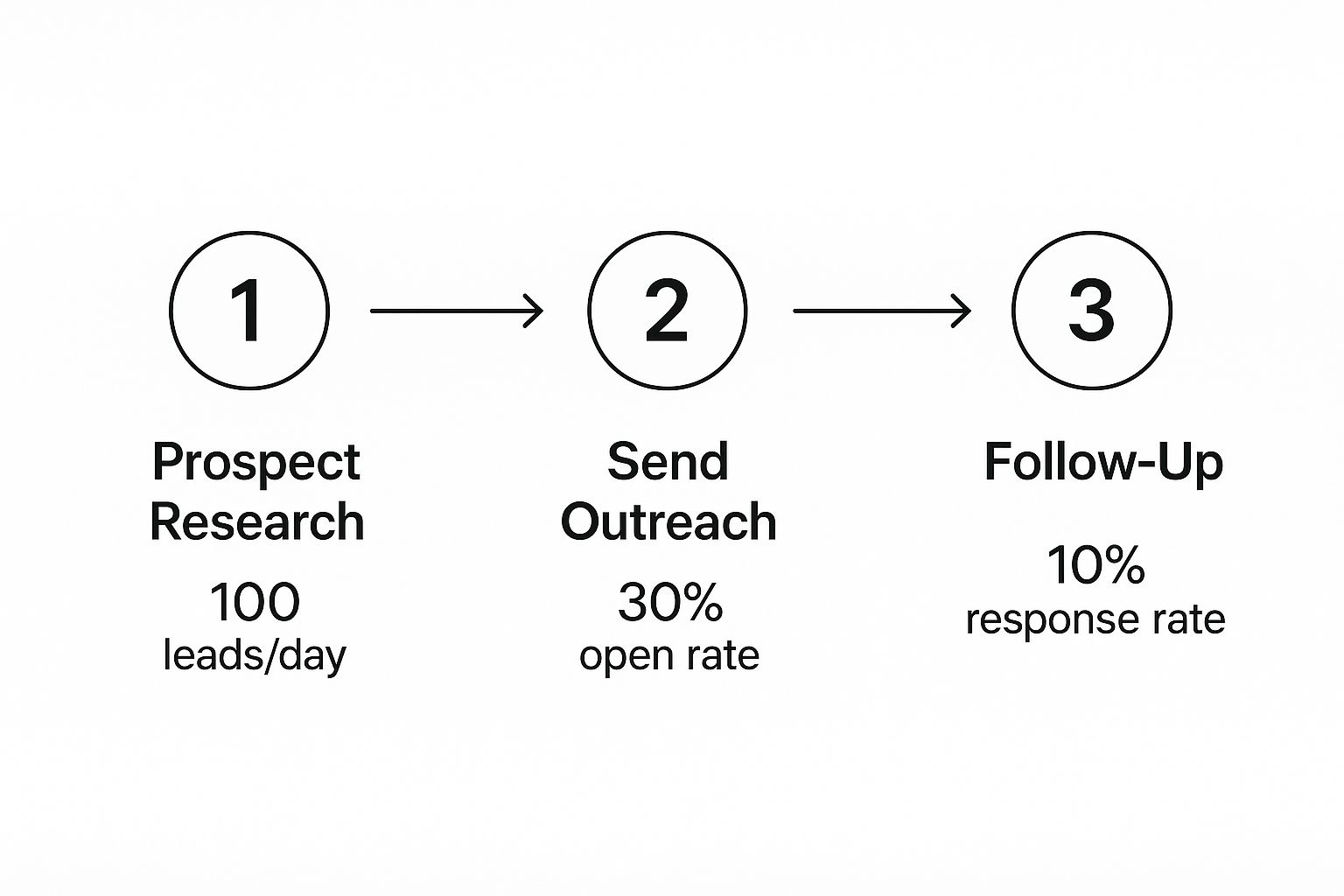
This visual shows how the funnel works—starting broad and narrowing down at each step.
The big takeaway here is that outbound is a numbers game rooted in quality. Even with great open and reply rates, you need a healthy volume of the right people at the top to get meaningful results at the bottom.
Before you write a single email or make one call, you have to know exactly who you're talking to. Your Ideal Customer Profile (ICP) is a painfully specific description of the perfect company for your product or service. This isn't a vague persona—it's a data-backed blueprint.
And don't confuse your ICP with a buyer persona. An ICP defines the perfect company (industry, size, revenue, what tech they use), while a buyer persona describes the people inside that company (their job title, headaches, and goals). You need both, but the company profile comes first.
For example, "we sell to tech companies" is useless. A sharp ICP is "B2B SaaS companies with 50-200 employees, using HubSpot, that have recently hired a VP of Sales." That level of detail makes every other step a thousand times easier.
With that crystal-clear ICP in hand, your next job is to build a list of companies and contacts that match it perfectly. This is probably the most critical step of all. Why? Because the quality of your list sets the ceiling for your campaign's success. A brilliant message sent to the wrong person is just spam.
You'll hear a lot of debate about buying lists versus building them.
Buying Lists: It's fast, sure, but you're often getting stale, low-quality data. It can be a starting point, but you risk high bounce rates and torching your domain reputation.
Building Lists: This takes more time, but the result is a hyper-accurate, targeted list. Using tools like LinkedIn Sales Navigator alongside data enrichment services gives you complete control over quality.
My advice? Build your list. The upfront effort pays for itself many times over with higher engagement and better conversations. Your goal is quality over quantity—a list of 200 perfect-fit prospects is infinitely more valuable than a list of 2,000 generic ones.
Now it’s time to think about your messaging. A "sequence" is just a series of coordinated outreach attempts across different channels—email, LinkedIn, maybe a call—spread out over several days or weeks. Anyone can ignore a single email. A thoughtful, multi-touch sequence shows polite persistence.
Your sequence should tell a story, with each touchpoint building on the last. You might start with a hyper-personalized email, follow up with a LinkedIn connection request a couple of days later, then send another email referencing a different pain point.
The goal isn't to bombard your prospect. It's to show up in different places with a helpful perspective, increasing your chances of starting a conversation when the timing is right. Remember, it often takes 8 or more touches to get that first meeting.
If you want to get more advanced, think about adding video to your outreach. Our guide on video email automation breaks down how to embed personalized videos to make your emails impossible to ignore.
With your list built and your sequence written, it's time to hit "go." A sales engagement platform can automate the sending schedule, but your work is just beginning. The most important part is how you manage the replies that start trickling in.
You need a system. Triage every response into a few key buckets:
Positive: "Sounds interesting, tell me more." Get these to a sales rep to book a meeting, fast.
Neutral: "Can you send more info?" Fulfill the request immediately and add them to a longer-term nurture track.
Objection: "Not the right time." Thank them for the reply and ask for permission to check back in a few months.
Negative: "Not interested / Unsubscribe." Respect their wishes. Remove them from all lists immediately. No exceptions.
You can't improve what you don't measure. The final stage is a continuous feedback loop of digging into your campaign data and figuring out how to make it better. Focus on the metrics that actually matter for outbound lead generation.
Open Rate: Are your subject lines grabbing attention? (Aim for 40%+)
Reply Rate: Is your message actually connecting with people? (Aim for 5%+)
Positive Reply Rate: How many of those replies are real leads vs. "no thanks"? (Aim for 1-2%)
Meetings Booked: This is the ultimate bottom line.
Use this data to A/B test everything. Try new subject lines. Tweak your call to action. Change the timing of your follow-ups. This constant cycle of testing and optimizing is what turns a decent campaign into a predictable revenue engine.
Free Tool
Try our AI Lead Generator — find verified LinkedIn leads for any company instantly. No signup required.
Frequently Asked Questions About Outbound Lead Generation
Even with the best game plan, a few questions always pop up when you start digging into outbound lead generation. It's totally normal. Here are the most common hurdles I see teams run into, along with some straightforward answers to help you sharpen your approach.
Yes and no. It used to be. The old "spray and pray" model of blasting thousands of generic emails is not just dead—it's dangerous. It’ll wreck your brand’s reputation and get your domain blacklisted in a heartbeat.
Modern outbound is a game of quality at scale.
Success isn’t about how many people you hit up; it’s about how many of the right people you connect with using a message that actually means something to them.
The real goal is to start as many high-quality conversations as possible, not just to smash an arbitrary outreach number. A tight list of 100 perfectly matched prospects will crush a list of 1,000 random ones. Every time.
Think of it like this: are you sending a mass-produced flyer or a handwritten invitation? One is designed for volume, the other for impact. Your outbound needs to feel like that invitation.
How Do I Know If Outbound Is Right for My Business?
Outbound lead generation isn't a silver bullet for everyone, but it’s incredibly powerful in the right situations. It’s probably a perfect fit if you find yourself nodding along to any of these:
You have a high-value product or service: If your average deal size is chunky, the ROI on targeted, personal outreach is a no-brainer.
You sell to a well-defined niche: When you can pinpoint your ideal customers by their industry, company size, or job title, outbound lets you walk right up to their digital front door.
You need predictable revenue, fast: Inbound is a long game that can take months to build momentum. A solid outbound campaign can start booking meetings in weeks.
You're breaking into a new market: Got zero brand recognition in a new territory? Outbound is the fastest way to get your name in front of the key players who matter.
On the flip side, if you're selling a low-cost, high-volume product to a huge consumer audience, inbound marketing will likely give you better bang for your buck long-term.
Setting the right expectations is everything. It keeps you from getting discouraged when you don't get a 50% reply rate on day one.
For cold email, a solid benchmark is a reply rate between 5% and 10%. If you’re clearing 10%, you're killing it. If you’re dipping below 2%, something’s off with your list, your message, or both.
But the raw reply rate isn't the whole story. You need to obsess over the positive reply rate—the percentage of responses that are actual signs of interest. A 1-2% positive reply rate is a great goal. It tells you the campaign is generating real, qualified opportunities, not just "unsubscribe" messages.
How Does Outbound Compare to Modern Digital Marketing?
A lot of people mistakenly think of outbound as some old-school, outdated tactic. That couldn’t be further from the truth. Modern outbound is completely woven into the digital fabric.
Sure, the perception can be skewed—only 18% of marketers believe outbound delivers high-quality leads.
But look at the data. Today, 78% of businesses use email marketing for lead generation. And 66% of marketers are successfully pulling in leads from social media with very little time invested. This shows that a multi-channel outbound strategy, using both email and social selling, is a powerhouse. You can dig into more of these lead generation statistics on ExplodingTopics.com.
The core difference is simple: inbound marketing pulls people in with content, while outbound marketing proactively starts the conversation on the platforms where your prospects already live.
Ready to stop the manual grind and build a predictable revenue engine? marketbetter.ai uses AI to create hyper-personalized campaigns, automate your follow-ups, and pinpoint your most promising leads. Our platform frees up your team to do what they do best: close deals.