4 posts tagged with "cold email subject lines"

View All Tags

10 Proven Subject Lines for Sales Emails That Get Opened in 2026

· 25 min read

In the world of outbound sales, your email is one of thousands competing for attention in a crowded inbox. The single line of text that determines whether you get a chance to make your case or get instantly archived is the subject line. Mediocre subject lines directly cause poor open rates, which means wasted sales development representative effort and a pipeline that never reaches its potential. Think of it this way: a brilliant email body with a terrible subject line is like a locked treasure chest with no key. It doesn't matter what's inside if no one can open it.

This guide moves beyond generic advice like "keep it short." We will break down 10 specific, battle-tested frameworks for writing subject lines for sales emails that consistently perform. You will get actionable templates for different scenarios, from a cold first touch and persistent follow-ups to securing demos and re-engaging cold leads. We’ll compare the strengths of a curiosity-driven approach versus a direct, value-based one, helping you choose the right strategy for each specific prospect and situation.

Ultimately, this article provides a strategic playbook for crafting subject lines that demand to be opened. You will learn how to personalize at scale, trigger curiosity, and communicate value before the prospect even clicks. We’ll also cover how to use modern tools to generate effective variants and deploy them directly within your existing CRM, turning theory into immediate, measurable action for your sales team.

1. The Curiosity Gap / Open Loop

This technique hinges on a powerful psychological principle: humans are wired to seek closure. A curiosity gap subject line intentionally withholds key information, creating an "open loop" in the reader's mind that can only be closed by opening the email. Unlike a direct value proposition, which gives the answer upfront, this approach makes opening the message feel like a necessary next step to satisfy a mental itch. It's one of the most effective strategies for cold outreach because it breaks through the noise of predictable sales pitches.

A hand-drawn illustration featuring a large question mark above a 'Subject...' field being examined by a magnifying glass.

The key to making this work without appearing like clickbait is grounding the curiosity in relevance. A generic "I have an idea" is weak, but a specific, research-based hook is compelling.

How to Implement This Strategy

The best curiosity-driven subject lines for sales emails feel personal and hint at insider knowledge. They make the prospect wonder, "What do they know that I don't?"

  • Compare This: "Quick question" (vague and overused)
  • With This: "[Prospect Name], quick question about [Company]" (specific and personalized)
  • Mention a Competitor: Did [Competitor] approach you about this? (creates immediate intrigue and urgency)
  • Hint at an Insight: Found something interesting about [Company]'s [process/tech]
  • Show Humility (and Intrigue): Probably not the right person, but…

Key Insight: The goal isn't to be mysterious for the sake of it. The goal is to create a gap between what your prospect knows and what they want to know, positioning your email as the bridge.

Actionable Tips for SDR/BDR Teams

When using this approach, timing and context are everything. It’s most effective for the first touch in a sequence. Once the conversation is started, pivot to more direct value.

Your Action: Go to your sent folder and find five emails with the subject line "Quick question." Now, rewrite each of them using a more specific curiosity hook, like [Name], question about your [tech stack name] setup. The goal is to make the question feel tailored, not generic. Always A/B test a curiosity subject line against a direct value prop to see what converts best for your specific audience.

2. The Personalization + Trigger Event

This approach combines two powerful elements: the prospect's name or company and a timely, specific event. A trigger event, such as a funding announcement, key new hire, product launch, or even a technology migration, provides a legitimate and compelling reason to reach out. This strategy immediately proves you’ve done your research and aren't just sending a mass blast.

Comparison: A generic Congrats on your success is easily ignored. In contrast, a subject line tied to a concrete business action like Congrats on the Series B signals you understand the prospect's current priorities and answers the silent question: "Why me, and why now?" To effectively personalize these emails and find trigger events, gathering specific information is crucial. Learning how to properly scrape LinkedIn data can provide the valuable insights needed for this high-impact approach.

Hand-drawn calendar showing dates, a red pushpin, a note with 'Series B', and a building sketch.

How to Implement This Strategy

The best trigger event subject lines for sales emails feel like they were written just for one person. They reference a specific achievement or change that directly connects to the value you can provide.

  • Reference Funding: [Name], congrats on the Series B
  • Acknowledge a New Hire: Saw you just hired [Title] — smart move
  • Connect to a Launch: [Company]'s [Product] launch. Thought of you.
  • Mention M&A Activity: Smart acquisition of [Acquired Company]
  • Note a Tech Stack Change: [Name], your [Platform] migration caught my eye

Key Insight: This isn't just about name-dropping an event. It's about connecting that event to a specific business pain or opportunity that your solution addresses, making your outreach incredibly timely and relevant.

Actionable Tips for SDR/BDR Teams

Your Action: Set up a Google Alert for three of your target accounts with keywords like "funding," "new hire," and "product launch." The next time an event occurs, your action is to send an email within 24 hours using one of the templates above. The context must also align perfectly with the email body. You can learn more about how to connect your subject line to the rest of your message by exploring our guide on how to write cold emails. Timing is critical; these are most effective within 48 hours of the event.

3. The Problem/Pain-Based Subject Line

Instead of leading with your solution, this technique leads with your prospect's problem. A pain-based subject line immediately acknowledges a specific, relatable business challenge tied to the recipient's role or industry. This approach builds instant relevance and positions you as a thoughtful problem-solver, not just another vendor.

Comparison: A subject line focused on your product, like Demo of MarketBetter.ai, forces the prospect to figure out why they should care. A pain-based subject line, such as Struggling with SDR ramp time?, does the work for them by immediately connecting to a potential issue. By articulating their pain point clearly, you demonstrate that you've done your research and understand their world.

How to Implement This Strategy

Effective problem-based subject lines are specific, timely, and directly address a challenge the prospect is likely facing now. They are less about guessing and more about making an educated, research-backed statement about a common operational friction point.

  • Tie to a Role-Specific Issue: [Name], most [Title]s we talk to are drowning in manual SDR admin
  • Frame it as a Question: Slow sales cycles at [Company]?
  • Connect Two Business Functions: Managing pipeline visibility when leads aren't logging activity?
  • Focus on a Known Industry Trend: [Company], revenue leaders tell us toolstack bloat kills SDR adoption—sound familiar?

Key Insight: People are more motivated to act to avoid pain than to gain a benefit. A well-crafted subject line that hits a nerve is more compelling than one promising a vague positive outcome.

Actionable Tips for SDR/BDR Teams

Your Action: Talk to your account executives or customer success managers and ask for the top three pain points they hear from new customers. Turn each of those pain points into a subject line using the templates above. Now you have three proven, customer-validated subject lines to test in your next sequence. The more specific and validated the problem, the higher your open and reply rates will be. Always ensure the email body expands on the pain point mentioned in the subject, showing you have a deep understanding of the challenge.

4. The Social Proof / Authority Subject Line

This approach leans on the psychological principle of trust by association. A social proof subject line immediately establishes credibility by referencing a mutual connection, a recognizable peer company, or an impressive case study. Instead of asking a prospect to trust a complete stranger, you're borrowing credibility from a source they already know or respect.

Comparison: A cold email from an unknown sender is inherently skeptical. However, a subject line like [Mutual Contact] suggested I reach out transforms it into a warm referral. This method is exceptionally effective because it reduces the friction and skepticism inherent in cold outreach.

The power of social proof is in its specificity. A vague "we have customers" is weak, but mentioning a direct competitor or a well-regarded company in their industry is a powerful hook that demands attention.

How to Implement This Strategy

The best social proof subject lines for sales emails are direct, name-drop with purpose, and connect that proof to a potential benefit for the prospect. They answer the subconscious question, "Why should I listen to you?" before the email is even opened.

  • Reference a Mutual Connection: [Name], [Mutual Contact] suggested I reach out
  • Highlight a Peer's Success: Like [Competitor/Peer], we helped them with [outcome]
  • Showcase a Relevant Case Study: [Name], we just helped [Peer Company] reduce ramp time by 40%
  • Connect to Their Tech Stack: Saw [Prospect Company] is using [Technology]—we specialize in that stack

Key Insight: Social proof isn’t just about name-dropping. It's about demonstrating relevance and showing you understand the prospect’s world because you already work with others just like them.

Actionable Tips for SDR/BDR Teams

Your Action: Identify your top five happiest customers. For each, find three prospects on LinkedIn that share a similar industry, company size, or role. Craft a specific, peer-focused subject line for each prospect, like [Prospect Name], we just helped [Happy Customer] solve for [pain point]. This creates a repeatable, scalable way to leverage your existing success. Always ensure the social proof is genuine and directly relevant to the person you are contacting.

5. The Urgent/Time-Sensitive Subject Line

This approach creates a sense of scarcity or time-bound relevance, compelling the recipient to act now rather than later. By framing the conversation around a specific deadline or limited opportunity, it taps into the fundamental fear of missing out (FOMO).

Comparison: Many sales subject lines are easy to archive for "later." An urgent one, like Before Q4 budget closes, provides a concrete reason to prioritize your email over the countless others that can be dealt with anytime. However, the urgency must be genuine. Fabricated scarcity like "offer ends today!" damages credibility, while authentic urgency tied to a real business event (budget cycles, a competitor's move) adds value.

How to Implement This Strategy

A successful urgent subject line connects a real business event to a potential benefit for the prospect, making it feel like timely, helpful advice rather than a pushy sales pitch. The goal is to make them think, "If I don't look at this now, I might lose a competitive edge or a key opportunity."

  • Tie to a Deadline: Before [Q3 budget cycle] closes: [Outcome] ROI opportunity
  • Reference a Limited Window: [Name], your [Platform] migration window is closing
  • Highlight a Hiring Surge: [Company] is hiring rapidly - we support these transitions once a quarter
  • Offer Limited Slots: We're taking on 3 more accounts in your space - want the strategy?

Key Insight: Authentic urgency is a service, not a sales trick. You are not creating pressure; you are highlighting existing pressure your prospect is already feeling and offering a path to relieve it.

Actionable Tips for SDR/BDR Teams

Your Action: Identify a common, time-sensitive event in your industry (e.g., end-of-quarter, major conference, typical budget season). Draft two subject line templates based on that event. The next time the event approaches, run an A/B test with those subject lines in your outreach sequence. This technique is often best reserved for a second or third touchpoint after establishing initial context. The email body must immediately justify the urgency mentioned.

6. The Specific Metric / Outcome-Driven Subject Line

This approach cuts through the ambiguity of typical sales promises by leading with a hard, quantifiable result. Instead of vague benefits like "improve efficiency," an outcome-driven subject line presents a concrete number, such as "reduce manual data entry by 90 minutes daily."

Comparison: A subject line like Improve your sales process is a weak, unproven claim. In contrast, Reduce SDR ramp time by 40% is a specific, compelling metric that connects directly to key performance indicators (KPIs). For roles like sales operations or leadership, where performance is measured in numbers, these subject lines are exceptionally powerful because a specific number implies you have proof to back it up.

Hand-drawn bar chart showing increasing data with an upward arrow and 'X%' growth.

How to Implement This Strategy

The key is to connect your product's impact to a metric the recipient personally cares about. A front-line rep is motivated by dials and commissions, while a VP of Sales is focused on team ramp time and revenue targets.

  • For Sales Leaders: [Name], teams using MarketBetter ramp new SDRs 40% faster
  • For Operations: [Company], reclaim 90 min/day from activity logging
  • For Reps/Managers: [Name], average SDR goes from 8 to 15 daily dials-no extra admin
  • For Data-Focused Roles: activity logging adoption jumps to 95%

Key Insight: Vague benefits invite skepticism. A precise, relevant metric sparks curiosity and positions your email as a source of valuable business intelligence, not just another sales pitch.

Actionable Tips for SDR/BDR Teams

Your Action: Pull up your top three case studies. For each one, extract the most powerful metric. Now, turn that metric into a subject line targeted at the same role as the person in the case study. For example, if a case study with a VP of Sales highlights a 25% increase in meetings booked, your new subject line is [Prospect Name], 25% more meetings booked. Before you send, be prepared to prove it. The body of your email should immediately validate the claim.

7. The Reference + Value Proposition

This subject line template powerfully combines social proof with a direct benefit. It works by mentioning a company similar to the prospect's (a peer or competitor) and immediately connecting that reference to a specific, desirable outcome you provide.

Comparison: A "Social Proof" subject line (We work with [Peer]) is good. A "Value Proposition" subject line (Boost your pipeline) is okay. This formula combines them into something better: Like [Peer], we help teams boost pipeline. For B2B sales, this is exceptionally effective because it answers two critical questions in a single glance: "Who else trusts you?" and "What's in it for me?".

How to Implement This Strategy

The best subject lines using this method are concise and link a familiar name to a specific, metric-driven result. They create an immediate sense of, "If it worked for them, it could work for us."

  • Metric-Driven Outcome: [Name], like [Peer Company], we help SDR teams reduce ramp time by 40%
  • Aspirational Goal: [Company], revenue teams using us typically see 3x more qualified conversations
  • Pain Point Solution: Similar to [Peer], we help Salesforce teams eliminate manual activity logging
  • Broad Social Proof: We've worked with [3 similar companies]—most see faster pipeline creation

Key Insight: The reference provides the credibility, while the value proposition provides the motivation. The combination turns a cold email into a warm introduction by association.

Actionable Tips for SDR/BDR Teams

Your Action: Create a two-column list. In the left column, list five of your best-known customers. In the right column, list the main value proposition they achieved (e.g., "cleaner CRM data," "faster ramp time"). Now, combine them into five powerful subject line templates you can use for prospects in the same industry. A/B test a hard metric (e.g., reduce ramp time by 40%) against a softer benefit (e.g., cleaner activity data) to see which resonates most.

8. The Question-Based Subject Line

This approach turns a typical sales pitch on its head by leading with a genuine question. Instead of pushing a solution, a question-based subject line prompts the reader to pause and reflect on their own challenges.

Comparison: A statement like We can improve your SDR workflow is a sales pitch. A question like Are your SDRs bogged down in admin? is the start of a conversation. It works by sparking a moment of self-assessment, which immediately makes the email feel more consultative. This technique is highly effective because it bypasses the brain's "sales pitch" filter and engages the recipient on their own terms.

How to Implement This Strategy

Effective question-based subject lines for sales emails are specific, tied to a known business problem, and personalized to the recipient's role. They should feel like they were written for an audience of one, not a thousand.

  • Focus on Key Metrics: [Company], what's your SDR ramp time looking like?
  • Highlight Common Pain Points: [Name], are your reps actually logging activity to Salesforce?
  • Pose a Strategic Challenge: [Company], where's your biggest pipeline creation bottleneck right now?
  • Frame a 'What If' Scenario: If your team could reclaim 2 hours/day, what would they do with it?

Key Insight: The best questions don't ask for a "yes" or "no." They encourage a thoughtful pause by pointing directly at a business challenge or opportunity, positioning your email as a source of potential answers.

Actionable Tips for SDR/BDR Teams

Your Action: Look at your most recent sales call notes. What questions did the prospect ask you about their own process? Those are pure gold. Turn the best one into a subject line. For example, if a prospect asked, "How do we get better visibility into rep activity?" your subject line becomes [Name], better visibility into rep activity?. Always follow up the question in the email body with a quick insight or data point.

9. The Comparison / Competitive Context Subject Line

This strategy positions your solution by framing it against a competitor, an industry-standard approach, or a common pain point associated with the status quo. It works by tapping into a prospect's existing knowledge and frustrations, creating a mental shortcut to understanding your value.

Comparison: Saying We are a better solution is an unsubstantiated claim. A better approach is to highlight a known limitation of the alternative: Outreach/Salesloft are powerful, but [Specific limitation] - we solve that. This is a powerful way to write subject lines for sales emails aimed at educated buyers in a crowded market because it shows you understand their world.

How to Implement This Strategy

The goal is to draw a clear contrast that makes the prospect think, "Yes, that's exactly the problem we have." The key is to frame the comparison so your solution becomes the obvious, superior alternative. Avoid being overly aggressive; focus on the limitation of the approach, not just the competitor.

  • Highlight a Key Differentiator: [Company], typical SDR task management wastes reps' time
  • Contrast with an Industry Norm: [Name], most sales platforms live outside Salesforce - here's why that fails
  • Call Out a Specific Limitation: Outreach/Salesloft are powerful, but [Specific limitation] - we solve that
  • Focus on a Better Outcome: Unlike generic AI writers, ours uses real account context

Key Insight: The most effective comparisons don't just state that you're different; they articulate why that difference matters to the prospect's bottom line. Connect your unique approach to a tangible business outcome.

Actionable Tips for SDR/BDR Teams

Your Action: Identify your number one competitor. What is the single biggest frustration your customers have with their product? Turn that frustration into a subject line. For example, if your competitor has poor CRM integration, a great subject line is [Name], tired of syncing data from [Competitor] to Salesforce?. The email body must then quickly substantiate the claim made in the subject line with a clear, concise explanation of your alternative.

10. The Pattern Interrupt / Unexpected Angle Subject Line

Most inboxes are a stream of predictable formulas: "quick question," "15 mins for [Company]?," and "[Value Prop] for you." The pattern interrupt technique succeeds by deliberately breaking this formula.

Comparison: The standard subject line Meeting request is easily ignored. An unexpected angle like I'm not going to ask for a meeting jolts the reader out of their autopilot "scan and delete" mode. By violating the unwritten rules of cold outreach, these subject lines earn a moment of genuine attention, creating a window for your message to land. The goal isn't to be weird, but to be refreshingly direct and insightful.

How to Implement This Strategy

A successful pattern interrupt subject line must be grounded in real insight; a gimmick will be spotted immediately. The email body must then deliver on the promise of the subject line, maintaining the same non-formulaic tone.

  • Challenge a Common Practice: [Company], your Salesforce dialer is costing you $X/year in friction (the math inside)
  • State a Bold, Non-Salesy Intention: [Name], I'm not going to ask for a meeting—but I think you'll want to read this
  • Point Out a Hidden Flaw: [Company], every SDR tool you bought is missing this one thing
  • Reframe a Common Problem: [Name], your last 10 SDR hires probably ramp slower than they should—want to know why?

Key Insight: Pattern interrupt subject lines work because they trade a generic request for a specific, thought-provoking observation. You are selling insight first, not your product.

Actionable Tips for SDR/BDR Teams

Your Action: This strategy is best reserved for high-value accounts where you have done deep research. Find one high-value prospect and research one non-obvious problem they likely have. Craft a bold, insightful subject line that frames that problem in a new way. The goal is to make them stop and think, "I hadn't considered that." This is a high-effort, high-reward play.

Top 10 Sales Email Subject Line Comparison

TemplateImplementation 🔄Resources ⚡Expected outcomes ⭐ / 📊Ideal use cases 💡Key advantages
The Curiosity Gap / Open LoopMedium — creative copy + careful follow-through⚡ Low–Moderate — quick to craft, aided by AI⭐⭐⭐ — very high open rates (45–60% 📊), moderate reply conversionFirst-touch cold outreach where intrigue is appropriatePromotes opens without gimmicks; scalable with AI
The Personalization + Trigger EventHigh — requires real‑time signal integration⚡ High — intent data, automation, low latency⭐⭐⭐⭐ — very high reply rates (60%+ 📊) when timelyOutreach immediately after funding, hires, launches (48–72 hrs)Highly relevant and credible; reduces spam perception
Problem / Pain‑Based Subject LineMedium — needs accurate account pain discovery⚡ Moderate — persona and account context required⭐⭐⭐ — strong perceived relevance and trust (good replies)Early‑stage/awareness outreach; consultative conversationsFeels consultative; bridges to value without pitching
Social Proof / Authority Subject LineMedium — research mutuals or customer wins⚡ Moderate — CRM/LinkedIn integrations useful⭐⭐⭐⭐ — very high trust and open rates (65%+ 📊)SMB / mid‑market outreach with identifiable peersBuilds rapid credibility; lowers gatekeeping
Urgent / Time‑Sensitive Subject LineMedium — must validate genuine urgency⚡ Moderate — timing signals and clear context⭐⭐⭐ — encourages immediate action (40–55% clicks 📊), faster repliesTime‑bound offers, budget windows, hiring surgesDrives quicker responses when urgency is real
Specific Metric / Outcome‑Driven Subject LineMedium–High — needs validated metrics & case studies⚡ Moderate–High — customer data & proof required⭐⭐⭐⭐ — high credibility and qualified responses (data‑driven)Mid‑stage outreach where KPIs matter (ROI conversations)Defensible claims that attract in‑market buyers
Reference + Value PropositionMedium — pair relevant peer + clear benefit⚡ Moderate — customer database + concise messaging⭐⭐⭐⭐ — high opens (50–65% 📊) and clear CTAICP‑targeted outbound for SMB/mid‑marketCombines social proof with explicit benefit
Question‑Based Subject LineLow–Medium — craft role‑specific, genuine questions⚡ Low — fast to author and personalize at scale⭐⭐⭐ — high Opens (45–60% 📊); invites engagementFirst‑touch or follow‑up discovery emailsCollaborative tone; prompts mental engagement
Comparison / Competitive Context Subject LineMedium — requires competitor insight & nuance⚡ Moderate — research on market/competitors⭐⭐⭐ — strong differentiation for aware prospectsMid‑market/enterprise switching or evaluation phasesClarifies differentiation and highlights gaps vs. peers
Pattern Interrupt / Unexpected Angle Subject LineHigh — creative, high‑touch execution required⚡ Low scalability — resource‑intensive personalization⭐⭐–⭐⭐⭐ — high novelty and memorability, variable conversionExecutive/founder outreach and very targeted sequencesStands out in crowded inboxes; highly memorable when well‑executed

From Theory to Action: Implementing Your Subject Line Strategy

We've explored a wide range of frameworks for crafting compelling subject lines for sales emails, from sparking curiosity with open loops to establishing authority with social proof. You now have a full arsenal of templates and psychological triggers designed to cut through the noise of a crowded inbox. But recognizing a good subject line and consistently deploying effective ones are two very different challenges. The true test lies in moving beyond the theoretical and into the practical, day-to-day execution of your sales outreach.

The difference between a top-performing sales team and an average one often comes down to this execution gap. An average team might find a subject line they like, such as the "Personalization + Trigger Event" formula, and use it sporadically. A great team, however, operationalizes it. They build a system to track trigger events, create a library of proven subject lines for each scenario, and train their SDRs to deploy them with the right context at the right time. They don't just know what works; they have a process to ensure it happens every single time.

Key Takeaways for Your Sales Outreach

Mastering the art of the subject line isn't about finding a single "magic bullet" phrase. It’s about building a strategic, data-informed process. Here are the core principles to focus on as you implement what you've learned:

  • Context is King: A subject line like "{Mutual Connection} suggested we connect" is powerful, but it’s useless without a system for tracking and surfacing referrals. Similarly, a pain-based subject line falls flat if it isn't targeted at a persona who actually experiences that specific problem. Your CRM data and buyer intelligence are the fuel for every great subject line.
  • A/B Testing is Non-Negotiable: You cannot rely on assumptions. Does a question-based subject line outperform a direct, outcome-driven one for your ideal customer profile? The only way to know is to test. Set up controlled experiments, even small ones, to compare two different approaches. Track your open rates and reply rates meticulously to find what truly resonates with your audience.
  • The Subject Line is Just the Hook: A brilliant subject line earns you an open, but the email body earns you a reply. Ensure that the promise made in the subject line is immediately paid off in the first sentence of your email. A disconnect between the two is a quick way to lose a prospect's trust and attention.
  • Empower, Don't Prescribe: Give your sales team frameworks, not just rigid scripts. The templates in this article are starting points. Encourage your SDRs to adapt them based on their research and the specific context of each prospect. This fosters a culture of ownership and critical thinking, leading to more authentic and effective outreach.

Your Action Plan for Better Subject Lines

Reading about great subject lines for sales emails is the first step. The next is putting that knowledge into practice. To avoid letting these insights fade, commit to the following actions this week:

  1. Conduct a Subject Line Audit: Review the last 10-20 unique outbound emails your team sent. Categorize the subject lines based on the frameworks we discussed. Are you overly reliant on one type? Are there clear opportunities to introduce more variety and personalization?
  2. Launch a Simple A/B Test: Choose one of your standard email templates. Keep the body the same, but create two different subject lines using two distinct formulas from this article, for instance, a "Problem-Based" subject line versus a "Specific Metric" subject line. Send them to a statistically significant segment of your list and measure the results.
  3. Integrate Strategy with Workflow: The biggest barrier to execution is friction. A great idea is often ignored if it's too difficult to implement. This is where modern sales tools become critical. Instead of just generating content, you need a platform that connects buyer signals, AI-assisted drafting, and CRM logging directly within your workflow. This ensures your team can act on insights instantly, turning a great subject line strategy into a consistent, trackable, and revenue-driving reality.

Ready to turn your subject line strategy into a seamless, high-performance workflow? See how marketbetter.ai embeds context-aware AI, buyer signal alerts, and a native dialer directly inside Salesforce and HubSpot to help your team execute flawlessly. Stop juggling tools and start closing deals by visiting marketbetter.ai today.
The Top 10 Email Subject Line for Sales Strategies That Win in 2026

· 30 min read

In a world of automated outreach and overflowing inboxes, the email subject line for sales has evolved from a simple curiosity trigger into a critical strategic tool. A great subject line doesn't just earn an open; it sets the stage for the entire conversation. It signals relevance, establishes credibility, and aligns your solution with a prospect's most urgent priorities before they even read the first sentence of your message.

Getting this first touchpoint right is foundational. Understanding the strategic importance of your email subject line for sales is key to mastering customer communication, a tech-driven skill every online seller needs. The difference between a subject line like "Quick Question" and one like "Idea for [Prospect's Goal]" is the difference between being ignored and starting a meaningful dialogue. The former is generic and self-serving, while the latter is specific, valuable, and prospect-centric.

This guide goes beyond generic templates that get your emails deleted. We'll dissect 10 battle-tested subject line categories, providing actionable comparisons and tactical breakdowns for each. You will learn:

  • The psychological principles behind high-performing subject lines.
  • How to craft compelling copy for both first-touch and follow-up emails.
  • Actionable strategies for personalizing outreach at scale.
  • Practical A/B testing methods to identify what resonates with your audience.

We will provide specific, replicable examples and analyze why they work, comparing effective and ineffective approaches side-by-side. Get ready to turn your subject lines into your sharpest outbound weapon and book more meetings.

1. Curiosity Gap Subject Lines

Curiosity is a powerful psychological trigger, and a well-crafted email subject line for sales can leverage it to dramatically boost open rates. This strategy, often called creating an "open loop," works by intentionally withholding a key piece of information, compelling the recipient to click and discover the answer. Instead of revealing the full benefit upfront, you create a mystery that can only be solved by opening the email.

A hand-drawn sketch of an open envelope revealing a glowing question mark, with 'Company' label.

Strategic Breakdown

The key to a successful curiosity gap subject line is relevance. Generic clickbait like "You won't believe this" is transparent and damages credibility. Instead, anchor your curiosity in something specific to the prospect's world, such as their company, industry, or a recent action they took. This approach shows you've done your homework and aren't just sending a mass blast.

Examples in Action

  • Weak: "A quick question"
  • Strong: "[First Name], one thought on [Company Name]'s recent launch" — This is highly specific and timely, making the recipient wonder what insight you have about their big news.
  • Weak: "Checking in"
  • Strong: "A question about your [Department]'s process" — This directly targets the recipient's professional role and implies you've identified a potential gap or opportunity.
  • Weak: "Some ideas for you"
  • Strong: "Is this your top priority for Q3?" — This feels personal and urgent, prompting the prospect to open the email to see what "this" refers to.

Actionable Takeaways

To make this strategy work, follow these specific tactics:

  • Deliver Immediately: The email's first sentence must immediately satisfy the curiosity. If you promise a question about their company, ask it right away. Action: Draft your email body first to ensure your subject line has a clear payoff in the opening line.
  • A/B Test Against Benefits: Compare curiosity-driven subject lines (e.g., "A thought on your MQL process") against benefit-driven ones (e.g., "A way to double your MQL conversion"). This helps you understand what resonates with your audience. Action: Run a 100-email test, sending 50 of each type, and measure the reply rate, not just opens. Tools like marketbetter.ai can automate this testing.
  • Context is King: Never use a curiosity gap subject line in a completely cold email without context. It’s most effective when you can reference a recent blog post they read, a webinar they attended, or a mutual connection. Action: Before sending, find one piece of context (LinkedIn post, company news) to anchor your subject line.

2. Personalized Trigger-Based Subject Lines

Moving beyond basic personalization like a first name, trigger-based subject lines reference a specific, recent event related to the prospect or their company. This approach transforms a cold email into a timely, relevant conversation starter. By tying your outreach to a real-world signal like a funding round, new hire, or content download, you demonstrate that you've done your research and have a legitimate reason for reaching out now.

Strategic Breakdown

The power of a trigger-based email subject line for sales lies in its immediacy and context. Unlike a generic benefit-focused subject line, a trigger-based one answers the prospect's unspoken question: "Why are you emailing me today?" This strategy is highly effective because it aligns your solution with a moment of change or growth for the prospect's company, making your message feel less like an interruption and more like a well-timed opportunity.

Examples in Action

  • Weak: "Congratulations!"
  • Strong: "Congrats on the Series B funding, [Company Name]" — This acknowledges a major milestone and positions your outreach as supportive, implying you have a solution that can help them manage their new growth.
  • Weak: "Your new product"
  • Strong: "Saw your new [Product] launch yesterday" — This is incredibly timely and shows you're paying close attention to their business. It creates a natural entry point to discuss how you can support their new offering.
  • Weak: "Hiring update"
  • Strong: "Just noticed [Company Name] is hiring for [Role]" — Referencing a specific job posting allows you to connect your value proposition directly to a stated need, such as improving efficiency for a growing team.

Actionable Takeaways

To execute this strategy effectively, focus on precision and speed:

  • Pair Signal with Substance: The signal you reference in the subject line must be immediately connected to the value you offer in the email's opening sentence. Action: Use this template for your first line: "Saw you [trigger event], which often means companies struggle with [problem you solve]. We help by..."
  • Test Signal Freshness: The impact of a trigger event diminishes over time. A signal from yesterday will almost always outperform one from three weeks ago. Action: Create two email templates—one for signals <48 hours old and another for signals 1-2 weeks old. Measure the difference in reply rates.
  • Leverage Intent Data: Use tools that provide real-time intent signals, such as website visits or content engagement, to automate and scale this process. Action: Set up alerts using a tool like marketbetter.ai to get notified of fresh signals for your target accounts, allowing you to act within hours, not days.

3. Benefit-Driven Subject Lines with a Twist

Leading with a clear, quantifiable benefit is a classic sales approach, but it often gets lost in a sea of generic promises. This strategy revitalizes the benefit-driven email subject line for sales by adding a specific, personalized twist. It moves beyond vague claims like "Increase your ROI" and instead presents a tangible, relevant outcome tied directly to the prospect's company, role, or industry, making it impossible to ignore.

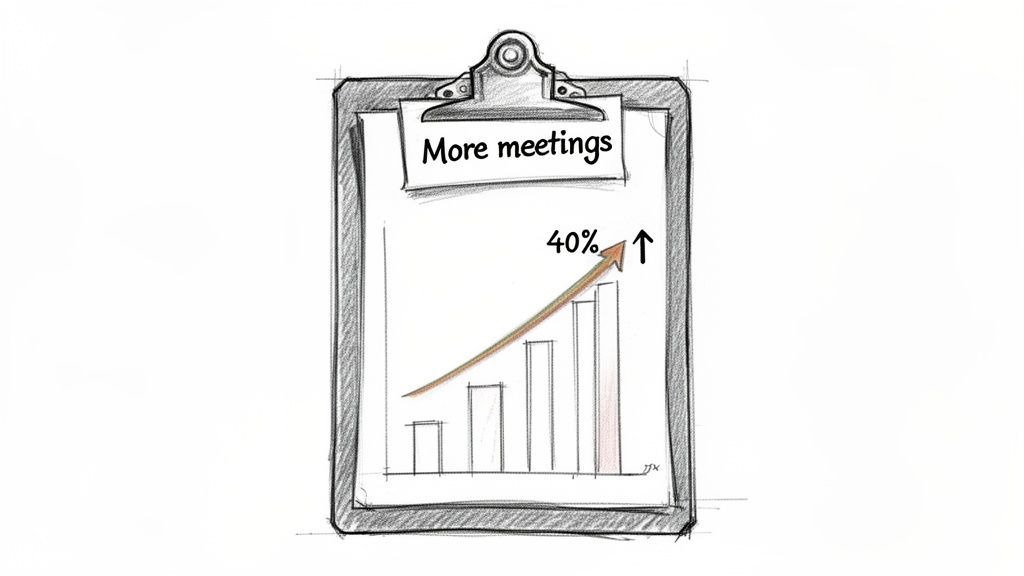
A hand-drawn clipboard displays a chart illustrating a 40% increase in meetings over time.

Strategic Breakdown

The power of this technique comes from its blend of value and specificity. A generic benefit is easy to dismiss, but a benefit grounded in the prospect's reality creates instant credibility and relevance. By including a detail like their industry, a competitor they know, or a metric their role is judged on, you signal that this isn't a mass email. You're speaking their language and promising a solution to a problem they actively face.

Examples in Action

  • Weak: "Increase meetings and save time"
  • Strong: "[Company Name] SDRs: 40% more meetings, 20% less prep time" — This is highly targeted, calling out the company and the specific roles (SDRs) while offering two compelling, quantifiable outcomes.
  • Weak: "How companies save time"
  • Strong: "SaaS companies like [Competitor] cut dialing time by 50%" — This uses social proof by naming a competitor, making the benefit feel achievable and directly relevant to their market.
  • Weak: "Improve team efficiency"
  • Strong: "Cut cold email research time in half for your team" — This focuses on a common pain point (time-consuming research) and promises a significant efficiency gain, which is a key priority for any sales leader.

Actionable Takeaways

To execute this strategy effectively, use these precise tactics:

  • Reinforce Immediately: The first sentence of your email must connect directly to the benefit promised in the subject line. Action: If your subject line claims "40% more meetings," start your email with: "Companies like yours use our platform to get 40% more meetings by..."
  • Segment Your Data: Pull success metrics from customer segments that mirror the prospect's company profile. A claim is more believable if it's from a peer. Action: Create a simple spreadsheet mapping your case studies to industries and company sizes. Refer to it before every outreach sequence.
  • Test Benefit Magnitude: A/B test different numbers. Does "35% more pipeline" get a better open rate than "40% more pipeline"? Sometimes a slightly more conservative number can feel more credible. Action: Run a test comparing a specific number (e.g., 37%) versus a rounded one (e.g., 40%) to see which performs better with your audience.

4. Problem-Agitator Subject Lines

This approach to writing an email subject line for sales goes straight for the pain point. Instead of hinting at a solution, you lead by naming a specific, frustrating problem your prospect likely faces. This strategy works by creating instant relevance and demonstrating empathy, making the recipient feel understood and more inclined to see what you have to say. When you accurately diagnose a prospect's challenge in the subject line, you position yourself as a problem-solver from the very first interaction.

Strategic Breakdown

The power of a problem-agitator subject line lies in its accuracy. A generic guess will fall flat, but a well-researched, specific problem makes your outreach feel less like a cold email and more like a timely intervention. This technique is especially potent for sales development representatives (SDRs) targeting personas with well-defined, industry-standard challenges. By articulating their pain better than they can, you immediately establish credibility and authority.

Examples in Action

  • Weak: "Time management issues?"
  • Strong: "SDRs still spending 3 hours on research daily?" — This is highly specific and quantifiable, calling out a common time-wasting activity that resonates with sales leaders.
  • Weak: "Email problems"
  • Strong: "Cold emails not getting replies? Let's talk why" — A direct and conversational subject line that targets a universal frustration for anyone in a sales or marketing role.
  • Weak: "CRM challenges"
  • Strong: "[Company Name] struggling with call logging in Salesforce?" — This shows you've done your homework by naming the prospect's company and a common CRM-related issue, making it highly personalized.

Actionable Takeaways

To effectively implement this strategy, focus on precision and empathy:

  • Validate the Problem: Before sending, use context clues from job descriptions, LinkedIn posts, or case studies to validate the prospect is likely facing this issue. Action: Spend 2 minutes reviewing the company’s recent job postings for roles you impact. The job description is a goldmine of stated problems.
  • Use Qualifier Language: Avoid absolutes that can seem presumptuous. Words like "likely," "struggling with," or posing it as a question soften the claim and invite dialogue. Action: Change "You are losing deals because..." to "Struggling with [problem]?" to be less accusatory.
  • Compare Against Curiosity: Test a problem-focused subject line like "Low MQL to SQL conversion?" against a curiosity-based one like "A thought on your MQL process." Action: Split your next prospect list in two and send each a different version. Track which one generates more qualified meetings using a platform like marketbetter.ai.
  • Align with High Intent: This strategy is most effective for prospects showing high-intent signals, such as visiting your pricing page or downloading a problem-focused whitepaper. Action: Set up an automated sequence with problem-agitator subject lines that triggers only for high-intent website visitors.

5. Question-Based Subject Lines (Provocative)

Posing a provocative question in an email subject line for sales directly engages the prospect's analytical mind. Unlike curiosity gaps that create a mystery, this approach frames a specific, relevant business problem as a direct question, prompting introspection and positioning your email as a potential solution. It assumes the prospect is already aware of the challenge and invites them into a dialogue about it.

Strategic Breakdown

The power of a question-based subject line lies in its ability to immediately qualify the reader. If the question resonates with a real pain point, the recipient is compelled to open the email to see if you understand their problem and have a credible answer. This method is rooted in consultative selling principles like SPIN, focusing on the problem before ever mentioning a solution. It's a direct challenge to the status quo.

Examples in Action

  • Weak: "Question about your tech stack"
  • Strong: "Is your dialer actually inside Salesforce?" — This is a hyper-specific technical question that instantly segments the audience. A sales leader using a disconnected dialer will feel this pain point immediately.
  • Weak: "Thinking about your challenges"
  • Strong: "[First Name], what's your biggest blocker with cold outreach?" — This open-ended, personalized question invites a genuine response and opens the door for a consultative conversation rather than a hard pitch.
  • Weak: "Can you improve your team?"
  • Strong: "Want to cut your SDR ramp time from 3 months to 6 weeks?" — While a yes/no question, this frames a powerful benefit in a way that feels less like a claim and more like a challenge, daring the recipient to find out how.

Actionable Takeaways

To effectively use this provocative email subject line for sales, apply these tactics:

  • Focus on Measurable Outcomes: Your question should point to a specific business metric or operational inefficiency. Action: Frame your question around time, money, or risk. For example, instead of "Is your process slow?" ask, "How many hours a week do your reps lose to manual data entry?"
  • Prioritize Open-Ended Questions: Questions that can't be answered with a simple "yes" or "no" are more likely to elicit a thoughtful response. Action: For your top-tier accounts, change yes/no questions like "Are you struggling with X?" to open-ended ones like "How are you approaching X in Q3?"
  • Personalize with Persona Data: Tailor your question to the recipient's role. A VP of Sales cares about ramp time, while an SDR manager is focused on daily workflow blockers. Action: For each of your key personas, write down their #1 KPI. Craft three questions that directly relate to improving that KPI.
  • Test Against Direct Statements: Compare a question like "Is your team hitting quota?" against a statement like "A new way to hit quota." Action: Run an A/B test to see if your audience responds better to direct inquiry or bold claims. The results may vary by seniority level.

6. Time-Sensitive / Scarcity Subject Lines

Urgency is a powerful motivator that drives immediate action. A time-sensitive email subject line for sales taps into the psychological principle of scarcity, signaling that an opportunity is limited or a deadline is approaching. This method compels prospects to prioritize your email over others by linking your message to a specific, tangible timeline, preventing it from being archived for "later."

Strategic Breakdown

The effectiveness of this strategy hinges on credibility. Artificial urgency, such as a "limited-time offer" with no real deadline, can erode trust and make your outreach feel like generic marketing spam. The most successful scarcity-based subject lines are anchored to real-world events that are verifiable and relevant to the prospect, such as an upcoming industry conference, a company earnings call, or the end of a fiscal quarter.

Examples in Action

  • Weak: "Urgent: Read now"
  • Strong: "[Company Name] is hiring: quick question about your outbound strategy" — This connects your outreach to a public signal of growth (hiring), creating a timely and relevant reason to discuss their strategy now.
  • Weak: "Meeting before the event?"
  • Strong: "Before [Industry Conference] next week, let's align on your pipeline goals" — This creates a hard, non-negotiable deadline (the conference date), making a pre-event conversation a logical priority.
  • Weak: "End of quarter"
  • Strong: "[First Name], closing window for Q4 planning - 3 weeks left" — This is highly relevant for decision-makers, as it ties directly into their own internal planning cycles and responsibilities.

Actionable Takeaways

To execute this strategy without damaging your reputation, follow these tactics:

  • Anchor to Real Events: Tie your urgency to verifiable public information. Use signal data like hiring trends, technology adoption, or event attendance to justify your timing. Action: Set up Google Alerts for your top 20 accounts for terms like "hiring," "funding," and "launch."
  • Be Transparent: Clearly state the deadline or event in the subject line. Ambiguity undermines the entire premise. Action: Compare "Before the end of the month" with "Before the Nov. 30th deadline." The specific date is almost always more effective.
  • Perfect Your Timing: Send the email 3-5 days before the actual deadline or event. This provides enough time for the prospect to see, open, and act on your message without feeling rushed. Action: Schedule these emails in your sales engagement platform to go out automatically at the optimal time.
  • Pair with Value: The email body must deliver on the urgency. Offer a specific insight or resource that is genuinely more valuable before the deadline passes. Action: Create a "pre-event" one-pager with insights relevant to the conference and attach it to your email to justify the time-sensitive outreach.

7. Social Proof / Authority Subject Lines

Leveraging social proof is a fundamental principle of influence, and it translates powerfully into an email subject line for sales. This strategy works by referencing a credible third party, a well-known customer, or a specific achievement to build instant trust and reduce the recipient's perceived risk. Instead of asking a prospect to believe your claims, you're showing them that their respected peers or competitors already do.

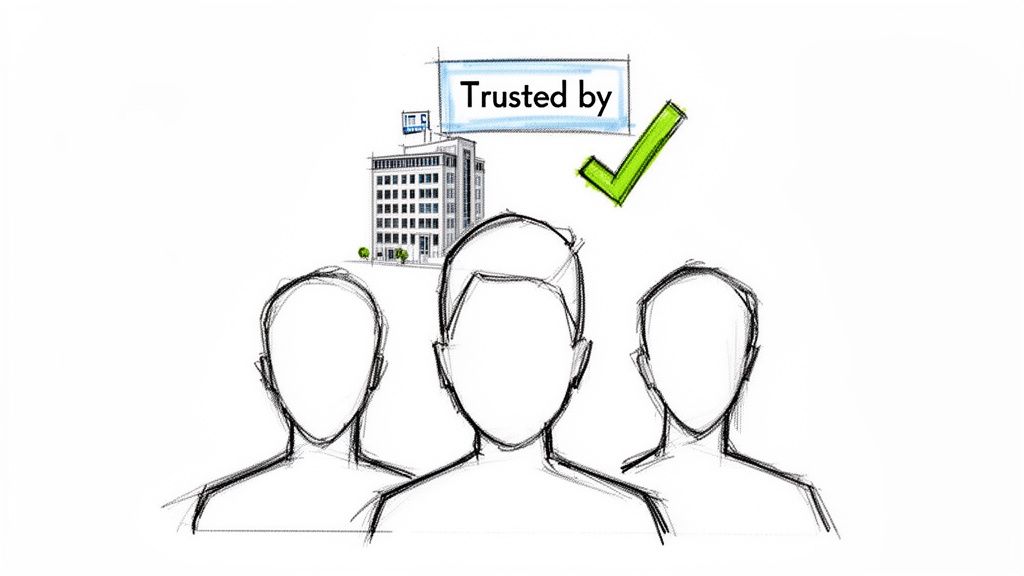
Sketch illustrating trust with a building, three people, a 'Trusted by' banner, and a green checkmark.

Strategic Breakdown

The effectiveness of a social proof subject line hinges on relevance and specificity. A generic "Trusted by thousands" is weak, but mentioning a direct competitor or a similar-tier company in the prospect's industry creates an immediate connection. The prospect's thought process shifts from "Who is this?" to "If my competitor is using this, I need to know why." This tactic borrows authority, making your cold outreach feel more like a warm, relevant introduction.

Examples in Action

  • Weak: "How we help our customers"
  • Strong: "Helps teams at [Competitor/Peer Company] close 30% more deals" — This is a double-win. It names a direct competitor and ties it to a quantifiable, high-value result.
  • Weak: "See how we help companies like yours"
  • Strong: "[Company Name] & [Similar Tier Company] cut SDR ramp time by 50%" — Mentioning a company of similar size or status makes the results feel achievable and directly applicable to the prospect's own challenges.
  • Weak: "As seen in the news"
  • Strong: "Recommended by [Industry Authority or Publication]" — This borrows credibility from a trusted source within the prospect's ecosystem, positioning your solution as vetted and reliable.

Actionable Takeaways

To make this strategy work, follow these specific tactics:

  • Get Permission: Always ensure you have permission before name-dropping a customer. A case study or public testimonial is your best source of approved proof. Action: Create a central repository of approved customer logos and case studies for your sales team to easily access.
  • Test Specificity: A/B test a specific customer name against a broader category. Action: Compare "How [Competitor Company] solved X" with "How SaaS leaders solve X" to see which resonates more with your target persona. The former works best when you have a direct, well-known competitor.
  • Connect to the Body: The social proof in the subject line must be the focal point of your email's opening. Action: Immediately expand on the result you referenced, providing a link to a case study or a direct quote in the first two sentences.

8. Contrarian / Challenger Subject Lines

Inspired by "The Challenger Sale," this advanced email subject line for sales is designed to disrupt the prospect's status quo. Instead of agreeing with common assumptions, it introduces a provocative, contrarian viewpoint that challenges their current thinking. This positions you not as a vendor selling a product, but as a strategic partner with a unique and valuable perspective.

Strategic Breakdown

The goal of a challenger subject line is to make the recipient pause and reconsider a deeply held belief about their business. It works by creating cognitive dissonance, sparking enough curiosity and professional intrigue to earn an open. This approach is not about being aggressive; it's about being insightful and demonstrating that you understand their world so deeply you can identify a flaw in their common strategy.

Examples in Action

  • Weak: "A better way to email"
  • Strong: "Cold email isn't dying. Your approach is." — This directly confronts a common industry complaint and promises a new perspective, making it irresistible for a sales leader struggling with outreach.
  • Weak: "How to grow your sales team"
  • Strong: "[Company Name], you don't need more SDRs - you need better systems" — This challenges a typical solution (hiring more people) and suggests a more efficient, systemic fix, appealing to leaders focused on scalability.
  • Weak: "Sales tips"
  • Strong: "Forget outreach volume. Here's what actually moves the needle." — This speaks directly to the "more is better" mindset and offers a smarter, alternative path to achieving key results.

Actionable Takeaways

To execute this strategy effectively, follow these precise tactics:

  • Earn the Right: Only use this on well-researched, high-value accounts. You must have evidence to support your claim. Action: Reserve this for Tier 1 accounts where you've spent at least 15 minutes researching their specific situation.
  • Back It Up Immediately: The first line of your email must substantiate the claim with a compelling data point or a sharp insight. Action: After "Forget outreach volume," start with "Our data from 1M+ emails shows personalized multi-touch sequences outperform high-volume cadences by 3x."
  • Test Against Safer Bets: A/B test your challenger subject lines against benefit-driven or curiosity-based alternatives. This will show you which segments are receptive to a provocative approach. Action: Use a tool like marketbetter.ai to track which messaging drives meetings, not just opens, as this style can sometimes generate opens from curiosity without buying intent.

9. Reciprocity / Value-First Subject Lines

The principle of reciprocity is a fundamental aspect of human psychology: when someone gives you something of value, you feel an innate obligation to give something back. A well-executed email subject line for sales can trigger this response by leading with genuine, no-strings-attached value. This strategy positions you as a helpful resource rather than just another salesperson, building trust and rapport from the very first interaction.

Strategic Breakdown

The core of this approach is to offer a valuable insight, resource, or piece of data directly in your subject line. Unlike curiosity-based subject lines that create a mystery, this method is transparent about the benefit. The key is that the value must be specific, relevant, and genuinely useful to the prospect's role or industry. Generic offers are easily dismissed, but a targeted piece of analysis shows you understand their challenges and have something tangible to contribute.

Examples in Action

  • Weak: "Some data for you"
  • Strong: "[Company Name]: How your SDR productivity compares" — This offers a competitive benchmark, a highly valuable piece of information for any sales leader looking to optimize their team.
  • Weak: "Free resource"
  • Strong: "[First Name], free analysis of your website's lead capture" — This is incredibly specific and promises a personalized assessment of a critical business function, making it almost irresistible to open.
  • Weak: "Tips for your strategy"
  • Strong: "3 reasons your cold email strategy isn't working (+ fix)" — This subject line not only identifies a common pain point but also promises a solution, framing the email as immediate, actionable advice.

Actionable Takeaways

To effectively implement value-first subject lines, follow these guidelines:

  • Deliver Value Instantly: The value promised must be delivered immediately in the email body. Don't use it as bait to get a click to a blog post. Action: If you promise an analysis, include 2-3 bullet points of your findings directly in the email text itself.
  • Be Hyper-Specific: Vague offers like "Helpful resource inside" are ineffective. Action: Instead of "A report on your industry," try "Data on [competitor]'s marketing spend for Q3."
  • Test Against Pain Points: Compare value-driven subject lines (e.g., "A benchmark for your SDR team") against pain-point-driven ones (e.g., "Frustrated with low SDR meeting rates?"). Action: Use a tool like marketbetter.ai to determine if your audience responds better to a promised gain or the solution to a current problem.
  • Use as a Nurture Tactic: While it can work for a first touch, this strategy is exceptionally powerful in a follow-up sequence. Action: Create a 3-step sequence. Step 1: Intro. Step 2 (if no reply): Follow up with a value-first subject line like "A resource for your [Job Title] role."

10. Role-Specific / Segmented Subject Lines

Speaking directly to a prospect's job function is one of the most effective ways to craft a compelling email subject line for sales. This strategy moves beyond simple name personalization and tailors the message to the specific challenges, goals, and language of a particular role or department. It demonstrates immediate relevance and shows the prospect that you understand their unique world, instantly setting your email apart from generic, one-size-fits-all blasts.

Strategic Breakdown

The power of role-specific subject lines comes from leveraging buyer persona research. Instead of sending the same message to a VP of Sales and a RevOps Manager, you create distinct messaging that addresses their different priorities. A sales leader cares about ramp time and quota attainment, while a RevOps manager is focused on data integrity and process efficiency. Acknowledging this difference in the subject line proves you've done your homework and have a relevant solution.

Examples in Action

  • Weak: "A tool for sales leaders"
  • Strong: "VP of Sales: Cut SDR onboarding from 3 months to 6 weeks" — This subject line combines the recipient's title with a specific, quantifiable outcome directly tied to their responsibilities.
  • Weak: "Fix your Salesforce data"
  • Strong: "RevOps Manager: Salesforce call logging-solved" — This is incredibly direct, naming a common, frustrating pain point for this specific role and offering a definitive solution.
  • Weak: "Help for your SDRs"
  • Strong: "Head of SDR: Your team might be missing this obvious win" — This creates curiosity while speaking the language of a sales development leader who is always looking for an edge to improve team performance.

Actionable Takeaways

To make this strategy work, follow these specific tactics:

  • Create Persona-Specific Variations: Develop 3-5 distinct subject line templates, each one mapped to a key buyer persona. Action: Build a simple "persona card" for each role that lists their top 3 priorities. Write one subject line for each priority.
  • Mirror the Message: The promise made in the role-specific subject line must be the immediate focus of the email body. Action: If your subject line is for a RevOps Manager about Salesforce logging, the first sentence must address that exact topic. Don't bury the lead.
  • Test Against Generic Messaging: A/B test your role-specific subject lines against more general, benefit-driven ones. Action: For your next campaign, send 50% with a generic subject like "A new way to boost sales" and 50% with a role-specific one like "VP of Sales: A new way to boost sales." Measure the reply rate difference.
  • Update Personas Quarterly: Business priorities and pain points shift. Action: Set a recurring calendar reminder to review your persona messaging with your marketing and product teams each quarter to ensure it remains relevant.

10 Sales Email Subject Lines Compared

Subject Line TypeImplementation 🔄 (complexity)Resources 💡 (requirements)Expected Outcomes ⭐📊Ideal Use CasesKey Advantages ⚡
Curiosity Gap Subject LinesModerate — simple copy but needs contextual personalization and strong follow-upLow–Medium — copywriting + some account/context signals⭐📊 Large open lift (often 35–50%+); CTR may be lower if body doesn't deliverCold outreach to new accounts; follow-ups after no response; intent-signaled prospects⚡ Quick to craft, mobile-friendly, drives opens
Personalized Trigger-Based Subject LinesHigh — requires real-time signal integration and validationHigh — intent data, automation, real‑time feeds, verification⭐📊 Very high open/relevance (40–60%+); better replies/connects when accuratePriority accounts, first-touch on fresh intent, signal-driven campaigns⚡ Extremely relevant; reduces unsubscribe risk and fuels conversations
Benefit-Driven Subject Lines with a TwistMedium — needs credible metrics and tailored benefit framingMedium — customer metrics, account research, persona fit⭐📊 Strong open→reply conversion when claims are believableBusy C‑level and manager personas; persona-targeted campaigns; follow-ups⚡ Clear value reduces friction; easy to A/B test
Problem-Agitator Subject LinesMedium–High — needs accurate diagnosis and careful toneMedium — task/context checks, intent signals, persona insight⭐📊 High engagement for accurately identified pains; risk of misfiresMid‑market+/warmed prospects; sequences targeting known pain points⚡ Triggers emotional resonance and prompts conversation
Question-Based Subject Lines (Provocative)Low–Medium — templatable but must be specific and thoughtfulLow–Medium — persona data, focused copywriting⭐📊 Higher cognitive engagement vs. statements; variable opens if genericStrategic accounts, consultative selling, multi‑touch outreach⚡ Invites replies and discovery; easy to personalize at scale
Time‑Sensitive / Scarcity Subject LinesMedium — must tie to real events and timingMedium — event calendars, signal tracking, honest deadlines⭐📊 Increased CTR and immediate action when urgency is genuine; short shelf lifeFollow‑ups tied to events (funding, conferences), seasonal campaigns⚡ Drives fast action and reduces procrastination
Social Proof / Authority Subject LinesMedium — requires verifiable proof and careful selectionMedium–High — case studies, customer lists, approvals, relevant examples⭐📊 Lowers trust barriers; higher replies from decision‑makers evaluating optionsEnterprise/mid‑market outbound; competitor-targeting; evaluation-stage prospects⚡ Builds credibility quickly; boosts reply rates from influencers
Contrarian / Challenger Subject LinesHigh — needs strong research and confident, evidence-backed claimsMedium–High — data, thought leadership, tailored messaging⭐📊 High opens/replies with receptive audiences; risk of alienation if wrongStrategic/high‑value accounts; forward‑thinking personas; thought leadership outreach⚡ Differentiates from competitors; sparks dialogue
Reciprocity / Value‑First Subject LinesMedium — requires creating & delivering genuine value up frontHigh — bespoke analysis, reports, actionable insights⭐📊 Higher trust and engagement; slower path to conversion but better relationshipHigh‑value/complex deals, C‑level relationship building, warmed prospects⚡ Builds rapport and triggers reciprocity; lowers unsubscribe risk
Role‑Specific / Segmented Subject LinesMedium–High — needs segmentation strategy and template maintenanceHigh — persona mapping, list hygiene, dynamic templates, testing⭐📊 Significant relevance lift (20–30%+ open increases) and improved reply qualityMulti‑threaded outreach, complex B2B deals, campaigns targeting multiple stakeholders⚡ Targets the right buyer; improves conversion and reply relevance

From Theory to Execution: Activating Your Subject Line Strategy

You've just explored ten distinct, powerful frameworks for crafting an effective email subject line for sales. We’ve moved beyond generic templates, diving deep into the psychological triggers that drive opens, clicks, and, most importantly, replies. From sparking intrigue with the Curiosity Gap to leveraging timely Personalization and agitating problems your prospect is actively trying to solve, the goal is clear: your subject line is the tip of the spear in your entire sales motion.

The difference between a mediocre and a masterful subject line isn't just a few percentage points on your open rate. It's the difference between being deleted and starting a conversation that leads to a closed deal. The key is to stop thinking in terms of one-off "tricks" and start building a strategic, adaptable system.

Synthesizing the Strategies: From List to Live Cadence

The true power of these examples is unlocked when you see them not as a menu to pick from, but as a toolkit to combine and deploy based on context. A new SDR might start with a straightforward, Benefit-Driven subject line. It's a low-risk, high-clarity approach. In contrast, a seasoned BDR targeting a C-level executive who has ignored previous outreach might deploy a bold Contrarian or a hyper-specific Question-Based subject line to break through the noise.

Actionable Comparison: For a first touch, a Trigger-Based subject line ("Saw you're hiring SDRs") is often superior to a generic Benefit-Driven one ("Improve SDR performance"). The trigger provides immediate, undeniable relevance that the benefit alone lacks. For a follow-up, a Value-First line ("A benchmark for your new SDR team") can re-engage a prospect by offering help instead of just asking for their time again.

Your subject line strategy must be as dynamic as your prospects themselves.

The Litmus Test: Moving Beyond Open Rates

Let’s be brutally honest: open rates are a vanity metric if they don't lead to action. An intriguing subject line that leads to a disappointing email body creates a negative brand impression. Your primary metrics for subject line success should be reply rate and meetings booked. These are the indicators of true engagement.

To get there, you must embrace systematic testing. Don't just test random ideas; test entire strategies against each other. For your next campaign targeting a specific persona, try this:

  • Group A (Control): Use your current best-performing subject line style.
  • Group B (Challenger): Test a completely different framework. If you normally use Benefit-Driven lines like "A better way to manage X," test a Curiosity Gap approach like "question about your Q3 goals."

Actionable Step: Create a simple tracking sheet with columns for "Subject Line," "Strategy Type," "Emails Sent," "Opens," "Replies," and "Meetings Booked." After sending 100 emails for each group, calculate the reply and meeting rates. This data, not just opens, will tell you the real winner.

Activating Your Strategy with Intelligent Workflows

The final, critical piece is operationalizing this intelligence. A brilliant subject line is useless if it’s sent to the wrong person at the wrong time. This is where modern sales tools bridge the gap between theory and revenue. An SDR shouldn't spend an hour searching for the perfect trigger event and another 30 minutes crafting the perfect personalized subject line. The process must be scalable.

Platforms like marketbetter.ai are designed for this exact purpose. They integrate with your CRM to monitor buyer signals, such as a prospect's company posting a relevant job or a key executive engaging with your content. The system then prompts your sales team with an AI-generated, context-aware email and subject line, turning a powerful strategy into a repeatable, daily workflow. This ensures that every high-impact email subject line for sales you've learned about is delivered with perfect timing and relevance, transforming your outbound efforts from a guessing game into a data-driven science.


Ready to stop guessing and start executing a world-class sales email strategy? marketbetter.ai turns the buyer signals and subject line tactics from this article into a prioritized, AI-powered workflow directly inside your CRM. See how you can build a repeatable pipeline-generating machine by visiting marketbetter.ai today.
How to Write Cold Emails That Get 38% Open Rates (7 Templates + Subject Lines)

· 25 min read

Here's the truth about writing a cold email that actually gets a reply: be relevant, be specific, and solve a problem for the person on the other end.

It really is that simple. The best cold emails I've ever seen—and the ones my teams have had the most success with—all ditch generic templates. Instead, they favor a short, personalized message that proves you’ve done your homework and respect the recipient's time. This value-first mindset is the foundation of every single high-performing outreach campaign.

Why Most Cold Emails Are Dead on Arrival

Let's be honest: the average B2B professional's inbox is a warzone. Attention is the prize, and the delete button is the most-used weapon. Most cold emails don't just fail; they're deleted before they're even read, disappearing into the digital noise.

So why do they fail so spectacularly? It’s a fundamental disconnect. The sender wants a meeting, but the recipient is too busy to care about a stranger's pitch.

The main culprit is the old spray-and-pray playbook. Blasting thousands of generic, self-absorbed emails is a numbers game that almost always loses. It’s built on interruption, not engagement. It prioritizes sheer volume over quality, hoping something eventually sticks.

That strategy is broken. Imagine firing off hundreds of emails only to watch them vanish without a trace. It’s soul-crushing. According to recent benchmarks, a staggering 95% of cold emails fail to get a response, leaving average reply rates stuck in a dismal 1% to 5% range. You can see the full, painful numbers in this breakdown of cold email statistics. This is the tough reality sales teams are up against every day.

To give you a clearer picture, let's contrast the old way with the new.

Traditional vs Modern Cold Emailing At a Glance

The difference between a failing campaign and a successful one often comes down to the philosophy behind it. Are you interrupting or engaging? Pushing or pulling? Here's how the two approaches stack up.

TacticTraditional Approach (Low Reply Rate)Modern Approach (High Reply Rate)
TargetingLarge, generic lists. "Anyone with a pulse."Highly specific, based on intent signals.
Personalization"Hi {\{first_name\}}, I saw you work at {{company}}."Mentions a recent project, post, or shared connection.
Value Prop"We do X, Y, and Z." (Features-focused)"I saw you're hiring SDRs, here's an idea for that."
The "Ask""Can I get 30 minutes on your calendar?""Mind if I share a resource that might help?"
Mindset"How can I sell my product?""How can I be immediately helpful?"

The takeaway is simple: the modern approach isn't about volume; it's about precision and genuine value. It respects the recipient's time and intelligence, which is precisely why it works.

The Shift to Modern, Value-First Outreach

Winning at cold email today demands a complete mental shift. Stop asking, "How can I sell my product?"

Instead, ask yourself, "How can I be genuinely helpful to this person, right now?" This one change reframes your entire outreach from a pitch into a conversation. It’s the difference between showing up to a party with a megaphone and quietly offering someone a drink because you noticed their glass was empty.

This modern, value-first approach stands on three pillars:

  • Action Step 1: Target with Signals. Instead of broad lists, focus your energy on prospects who are already showing signs of needing what you have. This could be anything from a recent funding round, a key executive hire, or even them engaging with your content. You’re meeting them where they are.
  • Action Step 2: Personalize Deeply. This goes way beyond {\{first_name\}}. Reference a specific project they mentioned on a podcast, a recent post they shared on LinkedIn, or a shared connection. Prove you're not a robot.
  • Action Step 3: Make Low-Friction Asks. Instead of demanding a 30-minute meeting out of the blue, make the next step easy. Propose sharing a relevant resource, or just ask a single, insightful question that gets them thinking.

The real goal of a cold email isn't to close a deal. It's to start a conversation. When you lead with value and demonstrate true relevance, you earn the right to their attention. That’s how you turn a cold outreach into a warm opportunity.

Mastering Pre-Outreach Research and Prospecting

A killer cold email is won or lost long before you type a single word.

The biggest mistake I see reps make? They dive straight into writing. It's like trying to navigate a new city without a map. Success isn’t about finding some magical template; it's about doing the hard work upfront—the meticulous research that uncovers why your prospect should give a damn right now.

This groundwork is what separates the top 1% from everyone else. It’s the difference between an email that feels like a targeted, helpful solution and one that gets nuked on sight. Before you can hope to craft a message that resonates, you have to understand who you're talking to and what's happening in their world.

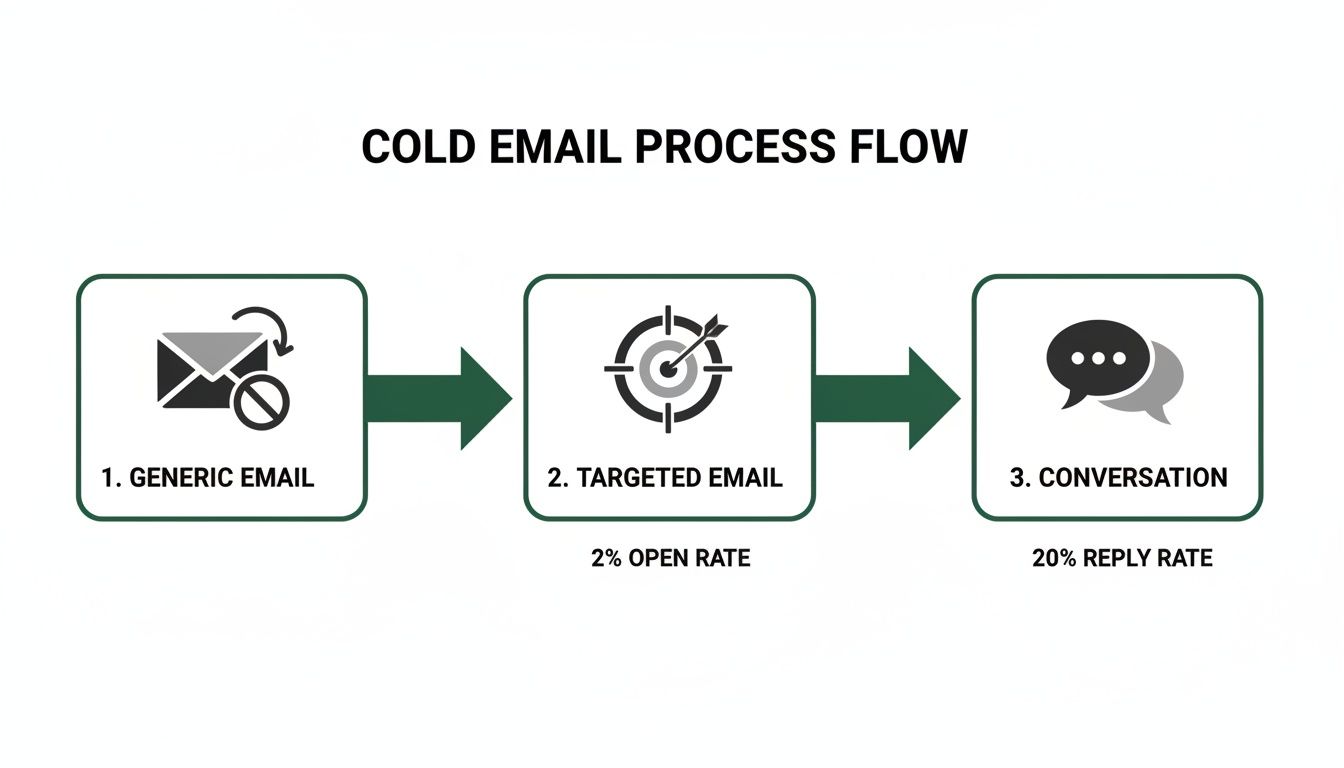
This flowchart nails the journey: you move from generic spam to a targeted message that actually starts a conversation.

Flowchart illustrating a three-step cold email process from generic to targeted emails and conversation.

Effective outreach isn't a random shot in the dark. It’s a deliberate process where solid research turns a cold contact into a warm lead.

Moving Beyond Generic Personas

Most sales teams have buyer personas, but let's be honest, they’re usually too high-level to be useful. "Marketing Manager at a SaaS company with 500+ employees" is a starting point, not a hit list.

Truly effective prospecting goes deeper. It’s about hunting for real-time buying signals that scream, "This person has a problem I can solve today."

Instead of just filtering by title and company size, look for specific trigger events. These are the shifts and changes that create an urgent need for what you sell.

  • Key New Hire: A company just brought on a new VP of Sales. You know they'll be looking to make an impact fast.
  • Recent Funding Announcement: A startup just closed their Series B. That means fresh capital to pour into growth and efficiency tools.
  • Technology Change: You notice they just adopted a tool that integrates perfectly with your platform. That’s your in.
  • Content Engagement: A prospect from a target account downloaded your latest whitepaper or showed up to a webinar. They're already raising their hand.

These signals transform your outreach from a speculative guess into a timely, relevant conversation. Nailing down who you're targeting is crucial. For a deeper dive, check out our guide on https://www.marketbetter.ai/blog/2025/10/22/how-to-create-buyer-personas/ to really sharpen your focus.

Contrasting Manual Workflows with Signal-Based Prospecting

The old way of prospecting is a soul-crushing time sink. It usually involves mindlessly scrolling through LinkedIn Sales Navigator, hoping you stumble upon someone who looks like a decent fit. This is wildly inefficient and almost never uncovers the timely triggers that actually get replies.

Let's break down the difference:

Prospecting MethodManual LinkedIn ScrollingSignal-Based Prospecting
FocusStatic info (title, company size)Dynamic events (hiring, funding, tech stack)
EfficiencyLow; you generate a huge list of low-quality leadsHigh; you build a smaller, hyper-qualified list
RelevanceGeneric and almost always poorly timedHighly relevant and perfectly timed
OutcomeLow reply rates, high rep burnoutHigher reply rates, actual conversations

A signal-based workflow forces you to prioritize your outreach based on who is most likely to buy now. You spend less time digging and more time engaging with prospects who have an active need. The impact on your efficiency and results is massive.

Your Pre-Flight Checklist Before Every Email

Before you even think about hitting "send," run through this quick mental checklist. This simple discipline keeps you honest, stops you from falling back on generic templates, and makes sure every single message has a purpose.

  1. Identify a Specific Pain Point: Based on their role and recent company news, what problem are they likely dealing with right now? Actionable Step: Write it down in one sentence. Example: "The new VP of Sales is under pressure to increase pipeline with the new funding."
  2. Find a Relevant Company Trigger: What just happened that makes your outreach timely? Actionable Step: Link to the press release, job posting, or LinkedIn post in your CRM notes.
  3. Look for a Personal Connection: Did you go to the same school? Follow the same influencers on LinkedIn? Actionable Step: Find one non-work-related detail to build rapport.

The point of research isn't to collect a bunch of random facts. It's to find the one perfect reason to start a conversation. A single, powerful insight is worth more than a dozen generic talking points. It’s the hook that proves your email is worth their time.

Of course, finding the right people is only half the battle. Once you’ve pinpointed your targets and their triggers, knowing how to find business email addresses quickly is what makes sure your perfectly researched message actually gets delivered. This is where your strategy meets execution.

Anatomy of a High-Performing Cold Email

Think of a great cold email less like a work of art and more like a piece of precision engineering. Every single component—from the subject line down to the signature—has a job to do. If one part fails, the whole thing falls flat.

Understanding this anatomy is what separates emails that get replies from those that get archived.

Hand-drawn sketch illustrating email anatomy with sections for subject, opening, value, and call to action.

We're going to dissect a high-performing email, piece by piece, to see what makes it tick. This isn't about finding some magic template. It's about mastering the principles so you can build your own effective outreach, every single time.

The Subject Line: Your Gateway to the Inbox

The subject line has one job and one job only: get the email opened. That’s it. It’s not the place to sell your product, cram in your value prop, or make a grand pitch. Its sole purpose is to spark just enough curiosity to earn a click.

The most common mistake is writing subject lines that scream "marketing email." Anything that feels like a broadcast—using words like "demo," "offer," or a bunch of exclamation points—is a dead giveaway. The best ones are short, feel personal, and read like a quick note from one human to another.

Let's look at the difference.

Subject Line TypeWeak Example (Gets Ignored)Strong Example (Gets Opened)
The Generic Pitch"Quick Question about {{Company}}'s Software""idea re: your new SDR hires"
The "Helpful" Offer"Resource for Sales Leaders at {{Company}}""that podcast w/ Sarah Jones"
The Clickbait Attempt"URGENT: Don't miss this opportunity!""Quick question"

Actionable Step: Before sending, read your subject line aloud. Does it sound like something you'd send to a coworker? If not, rewrite it until it does. For a much deeper dive, our guide on email subject line best practices is worth a read.

The Opening Line: The First Five Seconds

Once they open it, you’ve got about five seconds to prove this isn’t another generic blast. The opening line is where you show you’ve actually done your homework. This is your chance to connect the dots between the research you did and the reason you’re in their inbox.

A weak opener just mashes together personalization tokens like {\{company_name\}} with a vague, empty compliment. A strong opener, on the other hand, references something specific and timely that proves you have genuine interest.

Here’s what that looks like in the wild:

Weak Opener: "Hi Jane, I saw that you're the VP of Sales at Acme Corp and I was impressed by your company's growth."

Why it fails: This is lazy. Anyone with a LinkedIn account can find this info in ten seconds. It builds zero connection and feels completely templated.

Strong Opener: "Hi Jane, Heard your interview on the SaaS Breakthroughs podcast last week—your point about scaling SDR teams without sacrificing quality really stood out."

Why it works: It’s specific, timely, and shows you actually engaged with their work. It instantly proves this email was written for Jane and Jane alone, earning you the right to her attention for another few sentences.

The Value Proposition: Connect Their Problem to Your Solution

Okay, you have their attention. Now it’s time to build a bridge from their world to yours. Your value prop isn't about rattling off product features; it’s about connecting a problem they have with a solution you provide.

This is where you bring in the trigger event or pain point you uncovered during your research. Your goal is to articulate a clean, concise "problem-solution" statement that hits home.

Let's compare a bad vs. good value prop:

  • Weak Value Prop (Company-Centric): "We provide an AI-powered sales dialer with features like local presence dialing and call recording."
  • Strong Value Prop (Prospect-Centric): "I saw you're hiring five new SDRs in Austin. Teams I work with often find that onboarding so many reps at once stretches their enablement resources thin. We help cut ramp time by 30% by giving them prioritized, signal-based tasks each morning."

Notice how the strong example is grounded in their specific context. It’s not "We do X." It's "Given your situation, you might be facing this problem, and here’s how we solve it."

The Call-to-Action: Ask for Interest, Not a Meeting

This is where most cold emails stumble right at the finish line. After building a great case, reps get greedy and ask for a 30-minute meeting. For a busy executive who has no idea who you are, that’s a high-friction ask. It forces them to open their calendar, find a time, and commit a chunk of their day.

A much better approach is a low-friction call-to-action (CTA). Your goal isn't to book a meeting; it's simply to get a "yes" and start a conversation. You're asking for interest, not a commitment.

Let’s compare the two styles.

CTA TypeHigh-Friction (Weak)Low-Friction (Strong)
The Meeting Ask"Do you have 15 minutes to connect next week?""Mind if I send over a short video explaining how it works?"
The Vague Ask"Let me know your thoughts.""Is this something you’re currently focused on?"
The Open-Ended Ask"When would be a good time to talk?""Worth exploring?"

Actionable Step: End your email with a simple question that can be answered with "yes," "no," or one word. This makes it incredibly easy for your prospect to respond. You aren't trying to close the deal in the first email—you’re just trying to get a signal that they’re open to learning more.

Building Follow-Up Sequences That Convert

Most sales aren't won on the first email. They're won in the follow-up.

It’s a simple truth, but it's exactly where most reps drop the ball, letting perfectly good leads go cold. Your first email is just the opening act. The real work—and the real results—come from a thoughtful sequence that shows persistence without being a pest.

A great follow-up isn't about nagging. It's a strategic, multi-touch effort designed to build familiarity and keep delivering value. You have to assume your prospect is busy and give them multiple, easy ways to engage when the time is right for them.

Diagram illustrating a follow-up sequence with steps: Email 1, Follow-up, Social touch, and Final, spread over 14 days.

This isn’t about just sending more emails. It's about making every single touchpoint count. The goal is to stay top-of-mind by being helpful, not annoying.

The Art of the Value-Added Follow-Up

The cardinal sin of following up is the lazy "just bumping this" email. It adds zero value. All it communicates is, "I want something from you." It’s a selfish, ineffective approach that gets you deleted instantly.

A powerful follow-up does the complete opposite. It offers something new, re-engaging the prospect with a fresh insight or a relevant resource. It proves you're still thinking about their specific challenges, not just your own quota.

Let's look at the difference.

Follow-Up TacticThe Lazy "Bump" (Annoying)The Value-Add (Effective)
Email 2 (Day 3)"Just wanted to bump this to the top of your inbox.""Saw your company was featured in TechCrunch for the new launch—thought this case study on post-launch scaling might be useful."
Email 3 (Day 7)"Following up on my last email.""You mentioned hiring new SDRs on LinkedIn; here's a short video on how our top clients cut ramp time by 30%."
Final Email (Day 12)"Is this still a priority for you?""Assuming now isn't the right time. If you ever revisit your outbound strategy, I'm here to help."

The value-add approach repositions you from a random salesperson to a helpful resource. Every touchpoint is a chance to teach, share, or congratulate. That’s how you build trust and make a future conversation feel natural, not forced.

Designing Your Follow-Up Cadence

Your cadence—the timing and channels you use—is just as crucial as the message itself. There's no single magic formula, but a balanced, multi-channel approach consistently crushes a simple email-only sequence.

Actionable Step: Build a simple 14-day, multi-channel cadence in your CRM or sales engagement tool. Here's a proven template:

  • Day 1: Personalized Email 1
  • Day 3: LinkedIn Connection Request (with a brief, non-pitchy note referencing your email)
  • Day 5: Follow-Up Email 2 (offering a new resource)
  • Day 8: LinkedIn Post Like/Comment (genuine engagement, not just a thumbs-up)
  • Day 10: Phone Call (referencing your previous emails and LinkedIn touchpoint)
  • Day 14: Final Follow-Up Email (the friendly breakup)

This multi-channel strategy surrounds the prospect in a subtle, professional way. They see your name in their inbox, on LinkedIn, and maybe hear it on a call, creating a sense of familiarity a linear email sequence just can't match. To get these systems humming, a well-defined workflow is essential. For a deeper dive, this Practical Guide to Workflow Marketing Automation offers great insights into building them.

The goal of a sequence isn't to bombard someone until they surrender. It's to find the right person at the right time with the right message, using different channels to increase your odds of connecting.

Timing and Data-Driven Sequencing

Optimizing when you send your emails can give you a surprising edge. Research shows that smart timing can swing reply rates by up to 30%, with Thursdays often being a sweet spot for engagement. Don't count out the evenings, either; sends between 8-11 PM can catch executives clearing their inboxes.

But the real magic is in the sequence itself. Moving from a single email to a three-email sequence can almost double your chances of getting a response.

This data hammers home why a structured follow-up plan is non-negotiable. For sales teams that can't afford to let opportunities slip through the cracks, our playbook on how to never miss a follow-up provides a battle-tested framework for building and managing these critical sequences right inside your CRM.

By combining a multi-channel approach with smart timing, you turn follow-ups from a chore into a reliable engine for creating conversations and booking meetings.

How to Optimize and Scale Your Outreach Engine

Writing one great cold email is a skill. Building a predictable pipeline from thousands of them? That’s a system. This is where we shift gears from individual art to scientific, scalable execution—a process that separates the high-growth sales teams from everyone else stuck on a revenue rollercoaster.

Scaling isn't about brute force. It's not just "send more emails." It’s about building an intelligent feedback loop where every single send, every call, and every reply makes your entire outreach engine smarter and more efficient. That requires a real commitment to testing, measuring, and integrating your tools.

A/B Testing Your Way to Higher Replies

Guesswork is the enemy of scale. You can't improve what you don't measure, and that’s why disciplined A/B testing is the bedrock of any serious outbound program. The entire game is about isolating one variable at a time, running it against your control, and systematically adopting the winner.

Forget about throwing random ideas at the wall. Focus your tests on the highest-impact elements of your emails.

  • Subject Lines: Test a curiosity-driven subject like "your recent podcast" against a benefit-driven one like "idea for your SDR team." The winner tells you whether your prospects are more motivated by personalization or by a clear value statement.
  • Value Propositions: Pit a problem-focused angle against a gain-focused one. For example, compare "Struggling to keep CRM data clean?" with "A way to get 30% more selling time for your reps." This reveals which pain points really hit home.
  • Calls-to-Action (CTAs): Compare a low-friction "interest check" like "Worth exploring?" against a resource offer like "Mind if I send over a case study?" This helps you find the path of least resistance to starting a real conversation.

The most common mistake in A/B testing is changing too many variables at once. If you test a new subject line and a new CTA in the same email, you'll have no idea which change drove the results. Be patient. Be methodical.

Moving Beyond Vanity Metrics

Open rates feel good, but they're a notoriously unreliable indicator of success. A catchy subject line might get an open, but it doesn’t mean your message actually landed. To truly understand what’s working, you need to track metrics that measure genuine engagement and intent.

This screenshot from marketbetter.ai shows how modern platforms visualize a sales funnel, giving you a clear picture of what's happening at each step.

The real insight comes from tracking the drop-off from one stage to the next. That’s how you pinpoint exactly where your process is breaking down.

To help you diagnose your funnel, we’ve put together a quick guide to the metrics that actually matter.

Key Cold Email Metrics to Track in Your CRM

This table breaks down the essential metrics for measuring your cold email effectiveness. Use it to diagnose problems and find opportunities in your funnel.

MetricWhat It MeasuresActionable Insight
Reply RateThe percentage of recipients who replied.The most basic measure of engagement. If it's low, your core message or CTA is likely off.
Positive Reply RateReplies that express interest, not objections.This filters out the "not interested" noise to show true engagement. A high reply rate but low positive rate means your targeting or value prop is wrong.
Meetings BookedThe ultimate goal—how many conversations were generated.This is your North Star metric. If positive replies don't lead to meetings, your follow-up process or handoff to AEs needs work.
Bounce RateEmails that failed to deliver.A high bounce rate (over 5%) points to a problem with your email list quality or your technical domain setup.

Tracking these numbers in your CRM gives you a clear, honest view of performance. It turns your outreach from a guessing game into a predictable system.

The Technical Side of Deliverability

You can write the world's best cold email, but it's worthless if it lands in the spam folder. Email deliverability is the non-negotiable technical foundation of your entire outreach strategy. Getting it right ensures your messages actually reach the primary inbox.

Three critical records—SPF, DKIM, and DMARC—work together to prove to receiving email servers that you are who you say you are.

  1. SPF (Sender Policy Framework): This is a list of approved servers allowed to send emails on behalf of your domain. Think of it as a bouncer's guest list for your email.
  2. DKIM (DomainKeys Identified Mail): This adds a digital signature to your emails, which the recipient's server can verify. It’s like a tamper-proof seal on an envelope.
  3. DMARC (Domain-based Message Authentication, Reporting & Conformance): This tells receiving servers what to do with emails that fail SPF or DKIM checks—like sending them to spam or rejecting them outright.

Actionable Step: Use a free tool like MXToolbox to check your domain's SPF, DKIM, and DMARC records today. If any are missing or misconfigured, work with your IT team to fix them immediately. This is table stakes for any serious cold email campaign.

Operationalizing Your Playbook in a CRM

Scaling your outreach demands more than just a collection of tools; it requires a truly integrated system. This is where so many teams fall down. Their workflow is a disjointed mess—one tool for prospecting, another for writing, a separate dialer, and then reps manually log everything (or don't) in the CRM.

This fragmented approach is a recipe for chaos. Data gets lost, coaching becomes impossible, and reps waste hours on admin work instead of selling.

A much better way is to operationalize your entire playbook inside your CRM, whether it's Salesforce or HubSpot. By using an integrated task engine and dialer that lives directly inside your system of record, you create a seamless workflow. Reps get prioritized tasks, execute calls and emails with AI assistance, and all activity is automatically logged. This keeps your data clean, gives leaders the visibility they need, and lets you scale a consistent, high-quality process across the entire team.

Free Tool

Try our AI Lead Generator — find verified LinkedIn leads for any company instantly. No signup required.

Your Cold Email Questions, Answered

Even with the best playbook, the real world throws curveballs. When you're in the trenches, practical questions always pop up. Here are some quick, straight-to-the-point answers to the challenges I see reps wrestle with the most.

How Many Emails Should I Send a Day?

When you’re just starting out, forget volume. Quality over quantity isn't just a nice phrase; it's the only thing that works.

Aim for 25 to 50 highly personalized emails per day. That number is the sweet spot—small enough that you can actually do your homework on every single prospect, ensuring every email feels like it was written just for them. It’s a world away from the old "spray and pray" approach of blasting hundreds of generic templates, which is a surefire way to kill your domain reputation and get ignored.

The goal isn't to send the most emails. It's to start the most conversations. A handful of sharp, well-researched emails will beat a hundred lazy ones every single time.

Should I Use a Separate Domain for Outreach?

Yes. Absolutely. Using a secondary domain (like getcompany.com instead of company.com) is one of the smartest defensive moves you can make.

Think of it as a firewall for your brand. If your outreach domain gets flagged for spam—which can happen by mistake or just from high volume—your main corporate domain is completely insulated. That means your critical business emails to customers, partners, and investors keep flowing without a hitch.

It’s just good strategy. Your main domain is your corporate headquarters; the outreach domain is a pop-up shop. You can afford to be more aggressive with the pop-up without risking the entire brand.

How Should I Handle Objections in a Reply?

First, an objection is not a "no." It's a request for more information, and how you handle it is what separates the pros from the amateurs. The key is to validate their point, gently reframe the discussion, and offer a next step that requires almost zero effort on their part.

Let’s look at a couple of common scenarios:

ObjectionThe Weak Response (Defensive)The Strong Response (Empathetic)
"We already have a solution for this.""But our solution is better because of X, Y, and Z.""That's great to hear. Most teams we talk to are using something. We often find we can complement their existing tools by helping with [specific niche problem]. Worth a quick look?"
"Now isn't the right time.""When would be a better time to reconnect?""Totally understand, timing is everything. Mind if I send over a short case study for you to keep on file if priorities shift?"

See the difference? The strong response validates their reality. It keeps the door open by offering value, not by pushing for a meeting. You instantly shift from being a pesky salesperson to a helpful resource, turning a dead end into a long-term opportunity.


Ready to turn your sales team into a predictable pipeline engine? marketbetter.ai embeds an AI-powered task engine and dialer directly inside Salesforce and HubSpot, helping your reps execute faster and smarter. Stop the busywork and start more conversations. Learn more at https://www.marketbetter.ai.

43 Email Subject Lines With 40%+ Open Rates — Copy-Paste Templates

· 24 min read

In a crowded inbox, the subject line is your one chance to make a first impression. It's the gatekeeper to your message, the single line of text that determines whether your carefully crafted email gets opened, ignored, or sent straight to the trash. Mastering this element isn't just a nice-to-have skill; it's a critical component of any successful email campaign and a core tenet of email subject line best practices. An exceptional subject line can dramatically increase open rates, while a poor one guarantees your message will go unread, no matter how valuable its content.

This guide moves beyond generic advice to provide a comprehensive roundup of 10 actionable, data-backed strategies. We will dissect what works and why, comparing different approaches with clear, real-world examples. You will learn not just the "what" but the "how," with specific steps you can implement immediately to see a measurable lift in your campaign performance. Whether you're a seasoned marketer looking to refine your approach or an entrepreneur trying to cut through the noise, these proven practices will equip you to write subject lines that command attention and drive results. Let's dive into the tactics that will get your emails opened.

1. Keep It Under 50 Characters for Mobile Optimization

With well over half of all emails now opened on mobile devices, brevity isn't just a suggestion; it's a necessity. Mobile email clients like Gmail, Apple Mail, and Outlook have limited screen space, often truncating subject lines after just 25-50 characters. This means a longer subject line like, "Don't Miss Out on Our Biggest Annual Sale Event This Weekend with Exclusive Deals" gets cut off, burying the most compelling information. One of the most critical email subject line best practices is to craft a message that respects these mobile constraints, ensuring your core value proposition is seen immediately.

Keep It Under 50 Characters for Mobile Optimization

This approach directly combats the risk of being ignored in a crowded inbox. A concise, powerful message that displays fully on a smartphone is far more likely to capture attention and earn a click. Research from marketing data leaders like HubSpot and Mailchimp consistently shows a correlation between shorter subject lines and higher engagement, a key factor when you want to improve email open rates.

How to Implement This Strategy: A Comparison

To put this into practice, focus on front-loading your message with the most crucial words. Start with the action, the offer, or the urgency. Compare the following:

  • Weak (71 characters): "A Special Offer for You: Get 25% Off Your Next Purchase Before It Expires"
  • Strong (42 characters): "Jane, claim your 25% off before it's gone"

The strong version is not just shorter; it's more actionable. It personalizes, creates urgency, and communicates the core benefit within the mobile character limit, making it far more effective.

Actionable Tips for Brevity

  • Front-Load Keywords: Place the most impactful words (e.g., "Sale," "Alert," "Free") at the very beginning.
  • Test on Mobile: Use your email marketing platform's preview tool to see exactly how your subject line appears on different devices.
  • Count Every Character: Remember that spaces and punctuation count toward your total.
  • Focus on a Single Goal: Don't try to say everything. The subject line's only job is to get the email opened. The email's body does the rest.

2. Personalize with Recipient's First Name or Company

In an overflowing inbox, a generic subject line is easily overlooked. Personalization cuts through the noise by using recipient data like a first name or company to create a direct, one-to-one connection. This simple act of addressing someone by name leverages a powerful psychological principle: we are hardwired to pay attention when we hear or see our own name. It transforms a mass broadcast into what feels like a personal conversation, making it one of the most effective email subject line best practices for boosting engagement.

Personalize with Recipient's First Name or Company

The data overwhelmingly supports this approach. Studies consistently show that subject lines personalized with a recipient's name can increase open rates by over 26%. This tactic signals to the recipient that the content inside is relevant specifically to them, not just another generic marketing blast. For a deeper dive into making your outreach feel more individual, explore these marketing personalization strategies.

How to Implement This Strategy: A Comparison

To use personalization effectively, integrate merge tags from your CRM or email platform directly into your subject line. The key is to make it feel natural, not automated.

  • Weak (40 characters): "Exclusive beta access for new users"
  • Strong (49 characters): "Michael from Acme Corp: exclusive beta access"

The strong version immediately establishes context and relevance. Michael knows this message is specifically for him and his company, making him far more likely to open it than the generic alternative.

Actionable Tips for Personalization

  • Verify Data Accuracy: Always clean your contact list to avoid embarrassing errors like "Hi [FNAME]" or using outdated company information.
  • Set Fallback Text: Configure a default value (e.g., "there" instead of a first name) to prevent awkward blank spaces if data is missing.
  • Combine Personalization Points: Go beyond the first name. Combine it with their company, city, or a recent action for greater impact (e.g., "John, an idea for your team at Acme").
  • Match Your Brand Voice: Ensure the personalization style fits your brand. A formal B2B brand might use a full name, while a casual B2C brand can stick to a first name.

3. Use Numbers and Statistics to Create Curiosity

Incorporating specific numbers, percentages, or statistics into subject lines makes them feel more concrete, credible, and compelling. The human brain is naturally drawn to digits, which stand out visually in a sea of text. This specificity transforms a vague claim into a tangible promise, triggering curiosity and establishing trust before the email is even opened. This is one of the most effective email subject line best practices for boosting engagement and demonstrating clear value.

This data-driven approach directly counters the ambiguity that often causes readers to skip an email. A subject line like "Improve your workflow" is easily ignored, but "3 hacks to cut your workflow by 45%" presents a specific, measurable outcome that demands attention. Companies like BuzzFeed and Copyblogger have mastered this technique, proving that numbers create headlines that are nearly impossible to ignore.

How to Implement This Strategy: A Comparison

To use this strategy effectively, ground your subject line in a specific, quantifiable benefit you offer inside the email. The number should act as a hook that promises a clear, easy-to-digest solution or piece of information.

  • Weak (42 characters): "Tips to help you save more on your bills"
  • Strong (41 characters): "5 ways to save an extra $200 per month"

The strong version is far more powerful. It provides a specific number of tips ("5") and a quantifiable outcome ("$200 per month"), making the value proposition clear and highly motivating.

Actionable Tips for Using Numbers

  • Front-Load the Number: Place the digit or statistic near the beginning for immediate visual impact (e.g., "5 tips..." vs. "...in 5 steps").
  • Use Odd Numbers: Studies suggest that odd numbers (like 3, 5, or 7) often feel more authentic and less manufactured than even ones.
  • Be Specific with Data: Instead of "Big savings," use "Save 37% this weekend only" to create urgency and credibility.
  • Match the Promise: Ensure the content of your email delivers exactly what the numbered subject line promises. A mismatch will destroy trust.

4. Create Urgency with Time-Bound Language

Tapping into the psychological trigger of FOMO (fear of missing out) is one of the most powerful email subject line best practices you can employ. Time-sensitive language that references deadlines, limited availability, or the need for immediate action motivates subscribers to act now rather than later. Words like "today only," "24 hours left," "final chance," and "expires tonight" create a sense of urgency that can dramatically increase open and click-through rates by compelling readers to prioritize your email over others in a crowded inbox.

Create Urgency with Time-Bound Language

This tactic, popularized by e-commerce giants like Amazon and daily deal platforms such as Groupon, effectively shortens the customer's decision-making cycle. An email with a vague offer might be saved for later and eventually forgotten, but one with a clear, impending deadline demands immediate attention. When a subscriber knows an opportunity is about to disappear, they are far more likely to open the email to avoid missing out.

How to Implement This Strategy: A Comparison

The key is to be specific and genuine with your time constraints. Vague urgency can feel like a marketing ploy, while a concrete deadline feels like a real event.

  • Weak (42 characters): "Our big sale is ending sometime soon"
  • Strong (41 characters): "Final hours: 40% off sale ends at midnight"

The strong version clearly communicates the benefit (40% off) and the specific deadline (midnight), prompting immediate action instead of procrastination.

Actionable Tips for Creating Urgency

  • Be Specific: Use exact times and dates like "ends at 9 PM EST" or "today only" instead of the vague "soon."
  • Maintain Trust: Only create genuine urgency. Using fake deadlines can erode subscriber trust and lead to unsubscribes.
  • Combine with Scarcity: Pair time limits with limited quantities for maximum impact (e.g., "Only 12 spots left & registration closes Friday").
  • Time Your Sends: Send a reminder email 24 hours before and a "final hours" email on the day the offer expires to capture last-minute interest.

5. Ask a Compelling Question to Drive Engagement

Posing a question in a subject line instantly transforms a passive statement into an active invitation for engagement. This technique taps into natural human curiosity, creating a "curiosity loop" that compels recipients to seek the answer inside your email. Unlike a declarative statement, a question feels like the start of a two-way conversation, making your message more personal and less overtly promotional. This is one of the most effective email subject line best practices for cutting through inbox noise.

A question-based subject line encourages subscribers to pause and self-reflect, connecting your email's topic directly to their own challenges or goals. Instead of telling them what you offer, you prompt them to consider a problem they might be facing, making the solution within the email feel like a timely discovery rather than a sales pitch. This approach is highly valued by direct response marketers and platforms like Copyblogger for its ability to drive immediate interaction.

How to Implement This Strategy: A Comparison

The key is to ask a question that resonates with a specific pain point or desire your audience holds. A generic question will be ignored, but one that hits a nerve demands attention.

  • Weak (Statement): "Our software can help you ship 50% faster"
  • Strong (Question): "What if your team could ship 50% faster?"

The question version is more powerful because it encourages the reader to visualize the outcome and its impact on their business, making them far more likely to open the email to learn how.

Actionable Tips for Asking Questions

  • Focus on Pain Points: Frame questions around problems your audience wants to solve (e.g., "Are you losing money on customer churn?").
  • Use 'You' and 'Your': Make the question about the reader by using second-person language for maximum relatability.
  • Keep It Concise: Aim for short, punchy questions that are easy to read and understand on any device.
  • Answer the Question: Your email body must directly address and provide a clear answer or solution to the question asked.
  • A/B Test Vigorously: Test question-based subject lines against benefit-driven statements to see what resonates most with your specific audience.

6. Avoid Spam Trigger Words and Phrases

Even the most brilliantly crafted subject line is useless if it lands in the spam folder. Internet Service Providers (ISPs) use sophisticated algorithms to filter out unwanted mail, and certain words and phrases are major red flags. Using spam triggers like "$$$", "Free gift," or "Act now!" can significantly decrease your deliverability, making this one of the most critical email subject line best practices to master. Think of it as a gatekeeper; avoiding these words helps ensure your message gets a chance to be seen.

This practice is non-negotiable for maintaining a healthy sender reputation and maximizing your campaign's reach. While a single trigger word might not doom your email, a combination of them, especially with excessive punctuation or all-caps, sends a strong signal to spam filters that your message is low-quality. In addition to carefully avoiding spam triggers in your subject lines, understanding the broader reasons for why your emails are going to spam and how to fix it is essential for overall campaign success.

How to Implement This Strategy: A Comparison

The key is to shift from pushy, sales-heavy language to value-driven, benefit-oriented phrasing. Instead of telling subscribers what to do, show them what they'll gain.

  • Weak (Spammy): "FREE!!! Click Here to Claim Your Prize NOW!"
  • Strong (Optimized): "A special reward is waiting for you, Alex"

The strong version removes the aggressive triggers, capitalization, and excessive punctuation. It focuses instead on a personalized and intriguing message that encourages a click without setting off spam filter alarms.

Actionable Tips for Spam Avoidance

  • Focus on Benefit Language: Instead of "Buy now," try "Discover the benefits." Replace "Limited time offer" with "Your discount expires Friday."
  • Limit Punctuation and Symbols: Avoid using multiple exclamation points (!!!), dollar signs ($$$), or unusual special characters. A single exclamation point is usually safe.
  • Use a Spam Checker Tool: Before sending, run your subject line and email copy through a tool like Litmus or Mail-tester.com to get a spam score and identify potential issues.
  • Avoid Deceptive Prefixes: Don't start your subject line with "Re:" or "Fwd:" to trick recipients into thinking it's part of an ongoing conversation. This is a common spam tactic.

7. Segment Audience and Customize Subject Lines by Group

Sending the same generic message to your entire email list is a missed opportunity. Segmentation is the practice of dividing your audience into smaller, specific groups based on demographics, purchase history, or engagement level. One of the most impactful email subject line best practices is tailoring your message to these distinct segments, dramatically increasing relevance and open rates. Instead of a one-size-fits-all approach, you deliver a message that speaks directly to the recipient's relationship with your brand.

This strategy works because a message for a first-time buyer should be fundamentally different from one for a loyal VIP customer. A "Welcome to the family!" subject line would feel out of place for someone who has purchased from you ten times. By customizing your subject line, you acknowledge the customer's unique journey, making them feel seen and valued, which is crucial for building long-term loyalty. To dive deeper, you can explore various customer segmentation strategies to refine your approach.

How to Implement This Strategy: A Comparison

Start by identifying logical segments in your audience. Even simple divisions can yield significant results. Consider the difference in messaging needed for each group.

  • Weak (Generic for all): "Check Out Our Latest Collection & Deals"
  • Strong (Segmented):
    • New Subscribers: "Welcome to the club! Here's your 15% off"
    • VIP Customers: "Alex, your VIP early access starts now"
    • Cart Abandoners: "Did you forget something? Your items are waiting"

The segmented versions are far more personal and contextually relevant, directly addressing the recipient's current status and likely interests.

Actionable Tips for Segmentation

  • Start with 2-3 Core Segments: Begin with simple groups like "new subscribers," "repeat customers," and "inactive users" before adding more complexity.
  • Use Behavioral Triggers: Create automated campaigns for segments based on actions like abandoned carts, products viewed, or recent purchases.
  • Test Segment-Specific Offers: Experiment with different subject line angles for each group. For example, test an urgency-based subject line for cart abandoners versus an exclusivity-based one for VIPs.
  • Monitor Segment Performance: Track open rates, clicks, and conversions for each segment separately to identify your most responsive groups and refine your strategy.

8. A/B Test Subject Lines Systematically and Iteratively

Guesswork has no place in a high-performing email strategy. A/B testing, also known as split testing, is a data-driven method for discovering what truly resonates with your audience. It involves sending two or more variations of a subject line to small, random segments of your email list to see which one performs better. The winning version is then sent to the remainder of your audience, maximizing your campaign's potential. This systematic approach is one of the most powerful email subject line best practices for achieving consistent, measurable improvement over time.

Relying on data instead of intuition removes subjectivity and helps you understand the subtle nuances that drive engagement. By systematically testing elements like personalization, urgency, or question-based phrasing, you build a repository of insights specific to your subscribers. This iterative process ensures your subject line strategy evolves with your audience's preferences, leading to sustained growth in open rates and conversions.

How to Implement This Strategy: A Comparison

The core principle of effective A/B testing is to isolate a single variable. Testing too many changes at once makes it impossible to know what caused the difference in performance.

  • Version A (Statement): "New arrivals: The Spring Collection is here"
  • Version B (Question): "Ready for Spring? See our new collection"

Here, the only significant variable is the format: a direct statement versus an engaging question. By sending each to 10% of your list, you can see which format gets more opens and then send the winner to the remaining 80%.

Actionable Tips for A/B Testing

  • Isolate One Variable: Test only one element at a time (e.g., word order, emoji use, personalization, statement vs. question).
  • Define Success: Decide beforehand if you're measuring opens, clicks, or conversions as your key performance indicator.
  • Use a Significant Sample Size: Test with a large enough segment (ideally at least 1,000 recipients per version) to ensure your results are statistically significant.
  • Document Everything: Keep a log of your tests, including the hypothesis, variations, results, and key learnings to inform future campaigns.
  • Make it a Habit: Make A/B testing a standard part of your pre-send checklist for every major campaign, not a one-off task.

9. Match Subject Line Tone to Brand Voice and Campaign Type

Your subject line is often the first "hello" from your brand in a subscriber's inbox, and its tone sets immediate expectations. A subject line that feels disconnected from your brand's personality or the email's content can create a jarring experience, eroding trust. Aligning your tone consistently is one of the most fundamental email subject line best practices because it builds brand recognition and manages subscriber expectations effectively.

This alignment ensures your message feels authentic and appropriate for its purpose. A playful, emoji-filled subject line for a security alert would feel unprofessional and alarming, just as a dry, corporate tone for a fun holiday promotion would fall flat. The key is to match the energy of the subject line to both your established brand voice and the specific goal of the campaign, whether it’s to inform, sell, or entertain.

How to Implement This Strategy: A Comparison

The first step is to have a clearly defined brand voice. From there, you can adapt it to fit different campaign scenarios, ensuring the core personality remains intact.

  • Brand Voice (Playful & Energetic):
    • Promotional Campaign: "🎉 Psst... Your next favorite outfit is 30% off!"
    • Transactional Email: "🚀 Your order is on its way! Get ready."
  • Brand Voice (Professional & Authoritative):
    • Promotional Campaign: "Q3 Report: Unlock New Industry Benchmarks Today"
    • Transactional Email: "Confirmation: Your Registration for the Annual Summit"

Notice how both examples maintain their core brand identity while adjusting the tone to fit the specific purpose of the email. This consistency builds trust.

Actionable Tips for Tonal Consistency

  • Define Brand Voice: Document your brand’s personality traits (e.g., witty, supportive, formal) and create written guidelines for your team.
  • Match Tone to Intent: Use a serious, direct tone for security updates or policy changes. Employ an enthusiastic, benefit-driven tone for sales and promotions.
  • Audit Past Campaigns: Review your last 10 sent emails. Do the subject lines feel like they all came from the same brand? If not, identify the outliers.
  • Create Campaign Templates: Develop a library of subject line templates for different email types (e.g., newsletters, flash sales, webinars) that are pre-aligned with your brand voice.

10. Front-Load Value and Lead with Benefits, Not Features

Recipients don't open emails to learn about your product's technical specs; they open them to solve a problem or achieve a goal. A core principle of effective email subject line best practices is to immediately answer the recipient's unspoken question: "What's in it for me?" Leading with the outcome or value (the benefit) is far more compelling than describing the mechanism that delivers it (the feature).

This strategy shifts the focus from what your product is to what your customer becomes or achieves by using it. An email recipient in a busy inbox is scanning for relevance and value, not a list of product attributes. A benefit-driven subject line connects directly with their aspirations and pain points, making your message feel less like an advertisement and more like a solution.

How to Implement This Strategy: A Comparison

To apply this, translate every feature into a tangible benefit for the user. Ask yourself how a feature like "AI-powered analytics dashboard" actually helps your customer. The answer might be "Make smarter decisions, faster" or "Uncover hidden revenue opportunities."

  • Weak (Feature-Focused): "Our new software includes a Zapier integration"
  • Strong (Benefit-Focused): "Automate your workflow in 5 minutes"

The second example doesn't even mention the feature by name. Instead, it highlights the ultimate, desirable outcome: saving time and reducing manual effort, which is what the user truly cares about.

Actionable Tips for Benefit-Driven Subject Lines

  • Start with Action Words: Begin with verbs that promise a positive outcome, such as Achieve, Save, Grow, Unlock, or Simplify.
  • Quantify the Benefit: Whenever possible, add specific numbers. "Save 10 hours weekly" is more powerful than "Save time."
  • Translate Features to Benefits: For every feature on your product sheet, write down the corresponding benefit it provides to the customer. Use that benefit in your copy.
  • A/B Test Feature vs. Benefit: Run tests to prove the concept to your team. Pit a feature-led subject line against a benefit-led one and let the data show you what your audience values most.

Top 10 Email Subject Line Best Practices Comparison

Strategy🔄 Implementation Complexity⚡ Resource Requirements📊 Expected Outcomes⭐ Key Advantages💡 Ideal Use Cases
Keep It Under 50 Characters for Mobile OptimizationLow — simple constraint on copyMinimal — copywriting + preview testingBetter mobile visibility; fewer truncations; higher mobile opensEnsures full subject visibility across devicesMobile-heavy audiences, flash promotions, short alerts
Personalize with Recipient's First Name or CompanyMedium — requires merge tags & setupCRM data cleanliness, email platform integration~+26% open rate (average); improved engagementCreates personal relevance and higher CTRsWelcome flows, targeted offers, high-value segments
Use Numbers and Statistics to Create CuriosityLow–Medium — craft & verify dataAccess to accurate metrics/analyticsHigher opens (≈10–30% reported); stands out visuallyAdds specificity and credibility to subject linesListicles, savings offers, data-driven content
Create Urgency with Time-Bound LanguageLow — writing technique but must be truthfulCampaign coordination, timing controlDrives faster clicks/conversions; CTRs +22–42% reportedAccelerates decision-making and conversion velocityFlash sales, limited spots, event reminders
Ask a Compelling Question to Drive EngagementLow — copy-focusedMinimal; A/B testing recommendedOften lifts opens by 20–45%; boosts engagementEncourages mental participation and curiosityRe‑engagement, educational content, problem‑solving offers
Avoid Spam Trigger Words and PhrasesMedium — requires testing & governanceDeliverability tools, authentication (SPF/DKIM/DMARC)Fewer spam placements; improved deliverabilityProtects sender reputation and inbox placementAny high-volume campaign or brand-sensitive sends
Segment Audience and Customize Subject Lines by GroupHigh — segmentation setup and upkeepRobust CRM, data analytics, ongoing maintenanceOpen rates +14–100%; CTRs +50%+ for targeted segmentsHighly relevant messaging; improved ROILifecycle campaigns, VIP offers, churn prevention
A/B Test Subject Lines Systematically and IterativelyMedium–High — disciplined processTesting-capable platform, stat tools, timeContinuous optimization; measurable lift over timeData-driven decisions; reduces guessworkLarge lists, ongoing optimization programs, major sends
Match Subject Line Tone to Brand Voice and Campaign TypeMedium — needs brand guidelines & reviewBrand documentation, team trainingBetter recognition and trust; higher opens when alignedConsistency strengthens brand and recipient trustBrand campaigns, transactional emails, audience-specific sends
Front-Load Value and Lead with Benefits, Not FeaturesMedium — requires customer insightCustomer research, persuasive copywritingOpen rates +25–40% when benefit-focusedAligns expectation with value; attracts quality engagementProduct launches, onboarding, conversion-focused offers
Free Tool

Try our AI Lead Generator — find verified LinkedIn leads for any company instantly. No signup required.

Turn Best Practices into Consistent Results

The journey from a good subject line to a great one is not about finding a single magic formula. Instead, it’s about building a systematic, data-driven approach. Throughout this guide, we've explored ten essential email subject line best practices, moving from foundational principles like mobile-first brevity (under 50 characters) and personalization to more advanced strategies such as audience segmentation and rigorous A/B testing. Each tactic serves a distinct purpose, yet they all work together toward a common goal: earning your audience’s attention in a crowded inbox.

Think of these principles as ingredients in a recipe. A compelling question might drive initial curiosity, but combining it with a specific number can make it irresistible. For example, "Are you making this mistake?" is good, but "Are you making this #1 marketing mistake?" is far more compelling. Similarly, creating urgency with time-bound language is powerful on its own, but when layered with audience segmentation, it becomes laser-focused. A generic "Sale ends Friday" is less impactful than a targeted "Final hours for finance VPs to claim their discount." The true artistry lies in knowing which elements to combine for a specific audience and campaign goal.

From Theory to Action: Your Next Steps

Mastery comes from application. Reading about best practices is the first step, but consistent implementation is what drives real-world results. To transform this knowledge into measurable improvements in your open rates and engagement, consider these actionable next steps:

  • Commit to One New Tactic: Don't try to implement all ten practices at once. For your very next campaign, choose just one new strategy to focus on. If you've never used questions, start there. If personalization has been limited to [First Name], try incorporating their company or industry.
  • Establish a Testing Baseline: Before you can measure improvement, you need to know where you stand. Document your current average open rate. This number will be your benchmark for every A/B test you run, providing clear, quantitative feedback on what works.
  • Build a "Swipe File" of Success: When you see a great subject line in your own inbox, screenshot it and save it. When one of your own A/B tests produces a clear winner, document it. Over time, you'll build a personalized library of proven concepts that resonate specifically with your audience, making future brainstorming sessions faster and more effective.

Ultimately, a powerful subject line is a critical component, but its success is magnified when it's part of a well-oiled machine. To fully leverage the impact of effective subject lines, consider integrating them into a broader, comprehensive B2B email marketing strategy that aligns your messaging, targeting, and goals. By consistently applying and refining these email subject line best practices, you move beyond guesswork and begin to strategically engineer high-performing campaigns that capture attention and drive meaningful action.


Ready to stop guessing and start optimizing? marketbetter.ai uses AI to instantly generate dozens of high-performing subject line variations tailored to your message and audience. Eliminate the manual effort of A/B testing and discover what truly resonates with your customers by visiting marketbetter.ai today.