2 posts tagged with "b2b marketing automation"

View All Tags

A Practical Guide to Business to Business Marketing Automation

· 24 min read

Let's be honest, trying to build a genuine relationship with thousands of potential customers at once is a recipe for disaster. No human team, no matter how dedicated, can remember every single interaction, follow up at just the right moment, or serve up the perfect piece of content to every person, every time.

This is where business-to-business marketing automation comes in. It's not just software; it’s your team's tireless digital 'relationship builder' that works 24/7.

What B2B Marketing Automation Actually Does

Instead of your team getting bogged down in repetitive but critical tasks—like sending follow-up emails, tracking website visits, or segmenting lists by hand—this technology handles it all. It’s the engine that frees up your marketing and sales pros to focus on what they do best: thinking up brilliant strategies, launching creative campaigns, and closing deals with prospects who are already warmed up and engaged.

It’s the secret to scaling your outreach without having to scale your headcount.

From Manual Grind to Automated Nurturing

The real leap here is the shift from one-off actions to a continuous, intelligent system. A manual approach is like sending out individual letters one by one—it’s slow, error-prone, and impossible to scale. Automation, on the other hand, is like building a smart, responsive postal service that delivers personalized messages based on what each recipient actually does.

This flowchart gives you a glimpse into a pretty standard automated workflow. It shows how a system can guide a prospect from their first touchpoint all the way to becoming a sales-ready lead, no hand-holding required.

Person viewing a 'Relationship Builder' flowchart diagram on a laptop, showing business processes.

You can see how the system uses triggers (like a download or a page visit) to kick off specific actions. Trying to manage that kind of logic manually across hundreds or thousands of leads? It would be a nightmare.

This power is why its adoption is through the roof. By 2025, it's expected that 76-79% of B2B marketers will be using automation to steer their customer journeys. That's not just a trend; it’s a fundamental shift in how modern B2B marketing gets done, especially with the long, complex sales cycles we all know and love. You can dig into more marketing automation adoption statistics on emailvendorselection.com.

Core Functions and Their Impact

So, what do these platforms really do under the hood? It’s more helpful to think about them not as a list of features, but as solutions to the daily headaches your team faces. The table below compares these core functions to their manual counterparts, highlighting the real-world business impact.

Core Functions of B2B Marketing Automation Platforms

Core FunctionManual Approach (The "Before")Automated Approach (The "After")Business Impact Example
Lead NurturingSending sporadic, one-size-fits-all emails and hoping something sticks.Building a relationship with prospects over time through targeted, automated communication.Sending a series of educational emails to a new lead who downloaded a whitepaper, keeping your brand top-of-mind.
Lead ScoringSales reps manually sift through a list of leads with little context.Automatically qualifying leads by assigning points based on their behavior and demographics.Prioritizing a lead who visited the pricing page and has a "Director" title over a student downloading a single blog post.
Email MarketingSending a generic "e-blast" to your entire contact database.Sending personalized email campaigns at scale, triggered by specific user actions or segments.A prospect who abandons a demo request form receives an automated follow-up email asking if they need help.
Analytics & ReportingGuessing which marketing activities are actually driving revenue.Tracking campaign performance and measuring marketing's contribution to revenue.Identifying which content assets are most effective at converting marketing-qualified leads into sales opportunities.

Ultimately, each of these functions works together to create a smarter, more efficient system that aligns your marketing efforts directly with sales outcomes. It’s about doing more of what works and less of what doesn't.

Calculating the Real ROI of B2B Automation

While the features of marketing automation are great, the question every leader really asks is simple: what’s the return? A new tech investment needs to move past buzzwords and show a clear, bottom-line impact.

Let’s be clear: automation isn’t just about making a marketer’s job easier. It's a revenue engine. It directly boosts the metrics that matter, from the raw number of leads you generate to how good those leads actually are.

From Volume to Value

One of the first things you'll see with automation is an uptick in lead volume. But more leads don't automatically equal more revenue. The real magic is in nurturing those leads with precision until they are genuinely ready for a sales conversation.

This is where automated workflows shine. No one falls through the cracks. The system methodically engages prospects with the right content at the right time, turning lukewarm interest into active buying signals. This process dramatically increases the number of sales-qualified leads (SQLs) you can hand over to your sales team.

Marketing automation isn't a cost center; it's a massive financial multiplier for B2B companies. On average, businesses see a 544% ROI over three years. Put another way, that's about $5.44 back for every $1 you put in.

These aren't just vanity metrics. Businesses that use automation to engage prospects report an 80% increase in leads and a staggering 451% increase in qualified leads. The data speaks for itself.

Accelerating the Sales Cycle

The B2B sales cycle is notoriously long. It often involves a whole committee of decision-makers and a ton of "thinking it over." Marketing automation acts as a powerful accelerator by ensuring reps spend their time on conversations that are most likely to close.

Here's an actionable comparison of a sales cycle with and without automation:

  • Without Automation: A sales rep gets a long list of "leads." They start at the top and call each one, spending valuable time on prospects who aren't ready to buy, while a hot lead at the bottom of the list grows cold.
  • With Automation: The system tracks what people do—like visiting the pricing page or downloading a case study—and scores them accordingly. As soon as a lead hits that "ready" score, they're automatically routed to a sales rep along with a full history of every interaction. Your reps walk into every call with complete context. No more generic pitches. They can have meaningful discussions from the very first hello.

This whole process shaves days, weeks, or even months off the sales cycle. But beyond just understanding the benefits, you have to prove them. The best way to do that is by accurately calculating the return on investment for your marketing.

Ultimately, showing the dollars-and-cents value of your work is what gets you more budget and a seat at the table. For a detailed breakdown of the math, check out our guide on how to calculate marketing ROI. It gives you a clear framework to make the case for automation undeniable.

Choosing Your B2B Automation Platform

Picking the right business-to-business marketing automation platform isn’t just about buying software. It’s a strategic move. Think of it as installing the central nervous system for your entire marketing and sales operation. Get it right, and it will amplify everything you do. Get it wrong, and you're stuck with data silos, frustrated teams, and endless bottlenecks.

Your choice really boils down to your company's specific needs, where you are on your growth journey, and where you want to go. Are you just trying to get foundational tasks like email nurturing and basic segmentation off the ground? Or are you aiming for predictive insights and customer journeys that feel like they were built for one person at a time? Nailing that answer is the first step.

The market is crowded, and every vendor promises the world. Just a quick glance shows how many options are out there.

Two business professionals analyzing a platform checklist and data on tablets during a collaborative meeting.

Each platform offers a different cocktail of features, integrations, and pricing models. That’s why having a clear evaluation plan before you ever book a demo is so critical.

Actionable Checklist for Platform Evaluation

Don't get hypnotized by long feature lists. Instead, tie every feature back to a strategic goal. Use this checklist during your research and demo calls to stay focused on what matters.

  • [ ] CRM Integration: Is it a seamless, native, two-way sync with your CRM (like Salesforce or HubSpot)? This is non-negotiable for aligning sales and marketing.
  • [ ] Lead Scoring Flexibility: Can you build custom scoring models based on both demographics (job title, company size) and behavior (pages visited, content downloaded)? Test its limits.
  • [ ] Reporting and Analytics: Does it have intuitive dashboards that can track campaign performance and, critically, attribute revenue back to your marketing efforts? Can it measure your MQL-to-SQL conversion rate easily?
  • [ ] Workflow Builder Usability: Is the interface for building automated campaigns a drag-and-drop visual editor, or does it require technical expertise? Your marketing team needs to be able to use it without constant help.
  • [ ] Scalability and Pricing: Does the pricing model punish you for success (e.g., steep jumps in cost per contact)? Ensure it can grow with your business without breaking the bank.

If you're trying to weigh your options, a good marketing automation tools comparison guide can be a huge help for seeing how different platforms stack up side-by-side.

Comparing Traditional vs AI-Native Platforms

The biggest shift happening in automation right now is the rise of AI. Traditional platforms are great at following orders—they run on pre-set, rule-based workflows you have to build and maintain. But AI-native systems bring an entirely new layer of intelligence to the table, one that can adapt and optimize on its own.

An AI-native platform doesn't just execute the commands you give it; it learns from your data to suggest better strategies, predict customer behavior, and personalize content at a scale that is impossible for a human team to manage manually.

This isn’t just a minor upgrade; it’s a fundamental difference in how the machine thinks. Here’s a quick breakdown to help you understand the practical differences.

Comparing Traditional vs AI-Native B2B Automation Platforms

FeatureTraditional AutomationAI-Native Automation (e.g., marketbetter.ai)
Workflow LogicFollows rigid "if-this-then-that" rules set by a marketer.Dynamically adapts journeys based on real-time behavior and predictive models.
PersonalizationUses basic segmentation (e.g., by industry or job title).Creates 1:1 personalization using dynamic content and predictive recommendations.
Lead ScoringRelies on manually assigned point values for specific actions.Uses predictive models to score leads based on their likelihood to convert.
AnalyticsProvides historical reports on past campaign performance.Offers predictive insights, forecasting future trends and identifying opportunities.

While a traditional platform can make you more efficient, an AI-native system is built to make your entire marketing operation smarter. You can explore a curated list of modern AI marketing automation tools to see how these advanced capabilities are already being used.

Ultimately, the choice comes down to this: do you need a tool that just follows instructions, or one that helps you write a better playbook?

An Actionable Implementation Roadmap

A beast of a marketing automation platform is like a race car engine sitting on a pallet. It’s got all the power in the world, but it’s useless without a chassis, wheels, and a driver who knows the track. Just buying the software won’t get you to the finish line. Winning depends on a smart, strategic rollout that connects the tech to your team and your process.

This roadmap breaks it all down into simple, manageable phases. The goal isn’t to try and automate everything on day one—that’s a recipe for disaster. It’s about nailing an early, high-impact win to get some momentum and prove this thing actually works.

Phase 1: Laying the Foundation (Weeks 1-2)

Before you even think about building a workflow, you have to decide what a "win" looks like. The number one reason these projects fail is that teams jump into the software without a clear plan. This first part is all about strategy.

Your first few steps need to be focused and collaborative:

  1. Pick One Big Problem: What’s the single most important thing you need to solve? Is it getting more sales-qualified leads (SQLs)? Slashing the time it takes to close a deal? Getting better quality leads in the door? Choose one primary goal for your first pilot project.
  2. Get Sales and Marketing on the Same Page: This is absolutely non-negotiable. Both teams have to agree on exactly what a marketing-qualified lead (MQL) and an SQL are. When everyone shares the same definitions, you kill the classic "marketing keeps sending us junk leads" argument before it starts.
  3. Audit Your Content Arsenal: You can’t nurture anyone without having something valuable to say. Map out your existing assets—whitepapers, case studies, blog posts—and see how they line up with different stages of your buyer’s journey. Find the gaps you’ll need to fill before you launch anything.

The smartest automation strategies start small. Instead of trying to automate the entire customer journey at once, just pick one high-value process. A simple "welcome" series for new subscribers is a perfect place to start. It's easy to build and gives you immediate, measurable engagement right out of the gate.

Phase 2: Data and Technical Setup (Weeks 2-3)

Okay, with the strategy locked in, it’s time to get your hands dirty with the technical stuff. Your automation platform is only as smart as the data you feed it. If it’s garbage in, it will be garbage out, and your entire effort is doomed.

This phase is where you make sure the system actually runs and your messages get delivered.

  • Data Cleanup and Integration: Make this your top priority. Go through your existing contact list and clean it up—get rid of duplicates, fix typos, and standardize your fields. Then, set up a solid, two-way sync with your CRM. This is crucial for making sure marketing and sales are always looking at the same, up-to-the-minute info.
  • Technical Configuration: Grab someone from your IT team to help with the essentials, like setting up your sending domains (SPF/DKIM) to make sure your emails actually hit the inbox. This one step keeps your carefully written messages from getting flagged as spam.

Phase 3: Building Your First Campaign (Weeks 3-4)

Finally, it’s time to build something. Remember that goal from Phase 1? Here’s where you bring it to life. We’ll stick with the lead welcome series example.

Think of this workflow as your digital handshake. It’s the very first impression a new lead gets of your brand, so you want to make it a good one.

Here’s a no-nonsense way to get it done:

  1. Map it Out: Grab a whiteboard and sketch out the journey. What kicks off the sequence (like a form fill)? How many emails are you sending? What’s the timing between each one?
  2. Create Your Assets: Write the email copy, design the templates, and build any landing pages you need. Make sure every single piece of content pushes the user toward a specific action.
  3. Start Simple with Lead Scoring: Don't go crazy here. Just assign points for a few key actions inside this one workflow. For example: +5 points for opening an email, +10 for clicking a link to a case study, and +25 for checking out the pricing page.
  4. Test. Test. And Test Again: Send it to yourself. Send it to your team. Make sure every link works, every personalization tag pulls the right data, and the whole thing fires off exactly as you planned.

By starting with a simple but meaningful campaign, you get a tangible win that builds confidence across the company. That early success becomes the bedrock for all the more complex business to business marketing automation you’ll build later, turning that new software into an engine that actually drives revenue.

Measuring What Matters with Automation KPIs

Putting a new marketing automation system in place without knowing how to measure success is like flying a plane blind. You’re moving, but you have no idea if you’re gaining altitude or heading for the mountains. In the world of B2B marketing automation, success is written in data. You absolutely have to track the right Key Performance Indicators (KPIs) to prove the value of your investment and fine-tune your strategy.

To make this practical, let's break the metrics down into three critical areas. This structure helps you build a performance dashboard that tells a clear story, from the first touchpoint all the way to a closed deal.

This simple flow shows the core steps to getting your automation engine running.
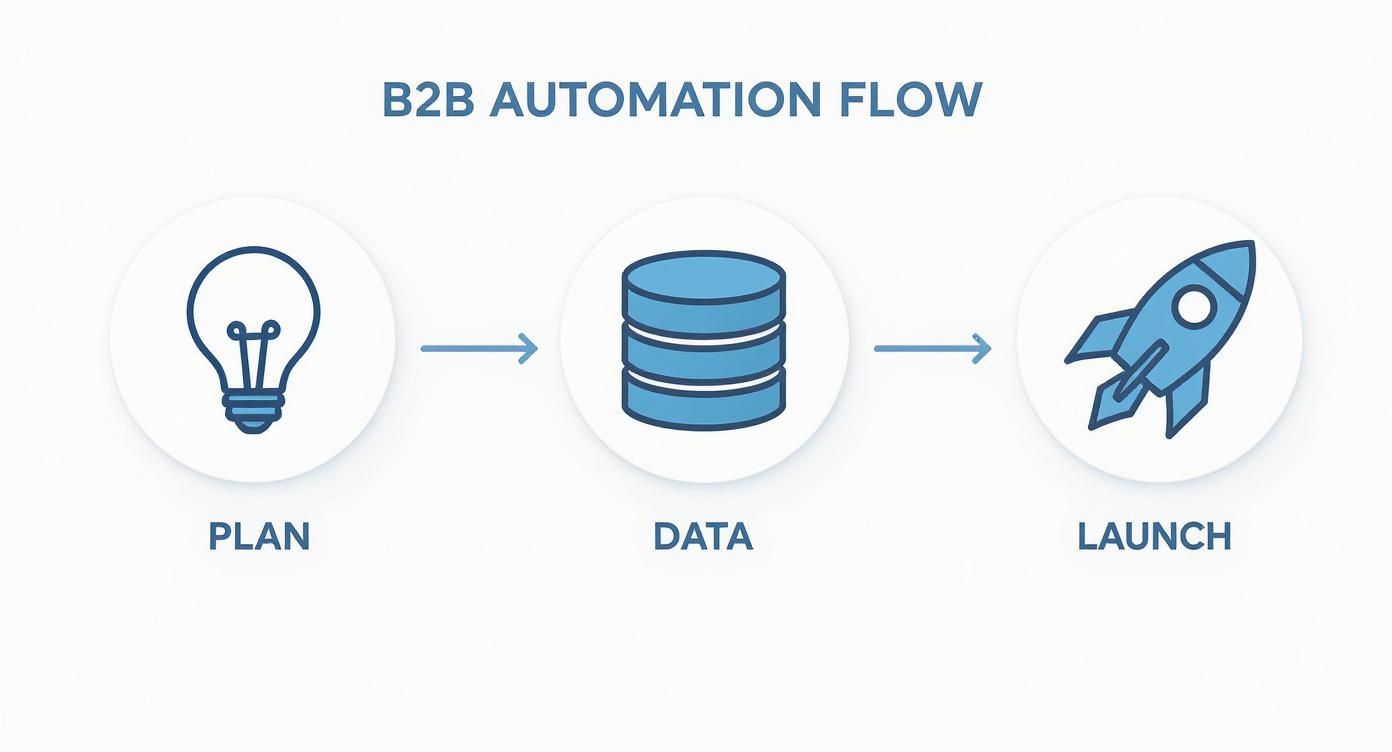
A diagram illustrating the B2B automation flow with three steps: Plan (lightbulb), Data (database), and Launch (rocket).

Each stage builds on the last, making sure that when you finally hit "launch," your campaigns are backed by a solid plan and clean, reliable data.

Gauging Lead Generation Health

This first bucket of KPIs tells you if the top of your funnel is actually working. We're looking at both the volume of leads coming in and, far more importantly, the quality of those leads your automation platform is attracting and sorting.

  • Cost Per Lead (CPL): Think of this as your efficiency baseline. Just divide your total campaign spend by the number of new leads you got. If your CPL is creeping up, it’s a red flag that your targeting might be off or your creative isn't landing.
  • Marketing-Qualified Lead (MQL) to Sales-Qualified Lead (SQL) Conversion Rate: This is the big one. It’s the ultimate test of whether marketing and sales are on the same page. A low conversion rate here almost always means marketing’s idea of a “good lead” isn’t what the sales team needs to actually close business.

These metrics are your foundation. To go a level deeper, check out our guide on essential lead generation key performance indicators.

Analyzing Campaign Effectiveness

Okay, so you've got leads in the door. Now you need to know if your nurture campaigns are doing their job. These metrics measure engagement and tell you if your content is actually resonating with your audience.

An effective automation strategy isn't just about sending emails; it's about starting conversations that guide prospects through their buying journey. If your engagement numbers are flat, your message isn't connecting.

A couple of key metrics to keep a close eye on:

  • Email Engagement Rates: Go beyond basic open rates—they can be misleading. The real story is in your click-through rates (CTR) and, even better, the conversion rates from those clicks. That tells you who’s taking action.
  • Landing Page Conversion Rates: Your landing pages are where value gets exchanged. A low conversion rate is a clear sign of a disconnect between your ad, your offer, and the on-page experience.

Connecting Automation to Revenue

This is where the rubber meets the road. These KPIs draw a straight line from your marketing activities to the company’s bottom line, making the value of your automation platform impossible for leadership to ignore.

The pressure to prove this connection is only growing. By 2025, digital channels are expected to handle about 80% of all B2B sales interactions. On top of that, 74% of sales professionals believe AI will fundamentally change how they work, cementing automation as a non-negotiable part of the sales process. You can discover more insights about sales automation trends from Kixie.com.

To show the real financial impact, focus on these two metrics:

  • Sales Cycle Length: How long does it take to convert a brand-new lead into a paying customer? A good automation system should shrink this timeline by handing off better-qualified, sales-ready leads.
  • Marketing-Influenced Revenue: This metric tallies up the total revenue from all the deals that marketing touched. It’s a powerful way to show exactly how your team’s efforts are fueling the company’s growth.

Common B2B Automation Traps (and How to Sidestep Them)

Even the slickest marketing automation platform can turn into an expensive, dust-gathering subscription if you're not careful. The dream is efficiency and scale. The reality, for many, is a mess of broken workflows and frustrated teams.

So, how do you avoid the potholes? It's not about working harder; it's about starting smarter. Most teams stumble not because of a lack of effort, but because they skip the foundational work.

Fortunately, the biggest traps are well-known, and each one has a clear escape route.

Mistake 1: Trying to Boil the Ocean on Day One

It’s so tempting. You get the keys to your new platform and immediately try to map every "if-then" scenario for the entire customer journey. You sketch out a monstrous, multi-branched workflow that accounts for every possible click, download, and email open.

This is a classic rookie move, and it almost always ends in disaster. What you're left with is a system that's a nightmare to build, impossible to debug, and takes months to produce a single result.

The better way? Start with a single, quick win.

  • Actionable Fix: Pick one high-impact process and nail it. A simple welcome series for new demo requests is a perfect candidate. So is a re-engagement campaign for leads that have gone cold. Get a simple, clean workflow live, prove its value, and build momentum from there.

Mistake 2: Ignoring Your Data Problem

Think of your automation platform as a high-performance engine. Your data is the fuel. Pumping it full of garbage—duplicates, missing fields, inconsistent formatting—is like pouring sand in the gas tank.

It grinds everything to a halt. Worse, it leads to cringe-worthy personalization fails, like calling a CEO by the wrong first name or sending a case study about the wrong industry. Automation doesn't fix bad data; it puts a megaphone to it.

Crucial Takeaway: Your marketing automation tool will only amplify the data problems you already have. Cleaning up your data isn't a "nice-to-have" pre-launch step. It's non-negotiable.

  • Actionable Fix: Before you even think about migrating contacts, do a ruthless data audit. Merge duplicates, standardize job titles, normalize company names, and fill in the blanks. Just as important, set up validation rules on your forms to stop bad data from getting into your system in the first place.

Mistake 3: Using Your New Tool as a Spam Cannon

You just bought a sophisticated platform designed for personalization at scale. The absolute worst thing you can do is upload your entire database and blast everyone with the same generic newsletter.

This is the fastest way to torch your email list and tank your sender reputation. It completely misses the point of automation, which is to deliver the right message to the right person at the right time. Treating your platform like a glorified email-blasting service will send your unsubscribe rates through the roof.

Your goal is to make every touchpoint feel personal, even when a machine is doing the work.

Here’s your actionable plan to avoid being a spammer:

  1. Segment Like a Pro: Don't talk to a CFO the same way you talk to a Head of Engineering. Use your buyer personas to create different communication tracks with content that actually speaks to their specific pains and priorities.
  2. Use Dynamic Content: Most platforms let you swap out blocks of content in an email—like a specific customer quote or a relevant case study—based on the recipient's industry or title. It’s a simple move that makes your outreach feel instantly more relevant.
  3. Map Content to the Buyer’s Journey: Someone who just downloaded their first-ever whitepaper isn't ready for a pricing sheet. Make sure the content you send matches where they are in the decision-making process. Nurture them; don't shove them.
Free Tool

Try our Marketing Plan Generator — generate a complete AI-powered marketing plan in minutes. No signup required.

Got Questions About B2B Automation? We've Got Answers.

Even after you see the potential, diving into the world of marketing automation can bring up a few "what ifs" and "how does thats." It's totally normal. Here are the straight answers to the questions we hear most often.

How Much Does B2B Marketing Automation Actually Cost?

This is usually the first question out of the gate, and the honest answer is: it really depends. The price tag is almost always tied to two things: how powerful the platform is and, more importantly, how many contacts you have in your database.

Here’s a rough breakdown:

  • For startups and small businesses: You can get started with core features like email nurturing and simple workflows for $50 to $300 a month.
  • For mid-market companies: As your needs grow, so does the price. Expect to pay somewhere between $800 and $3,000 per month for platforms with deeper CRM integrations, lead scoring, and solid analytics.
  • For enterprise teams: The sky's the limit. Top-tier platforms with predictive AI, custom reporting, and white-glove support can easily run $3,000+ per month.

But remember, cost is only half the equation. If a $1,000-per-month platform helps your team land just one extra $10,000 deal, it’s already paid for itself ten times over.

How Long Will It Take to Get This Running?

This isn't like flipping a switch. A successful rollout is about much more than just the software—it's about your strategy, your data, and getting your team on board. The best approach is always to start small and build from there.

One of the biggest mistakes we see is trying to build the "perfect" system right from day one. Instead, aim for a quick win. You can get a pilot campaign up and running in as little as 2-4 weeks, while a full, company-wide implementation might take 3-6 months.

Your timeline will really hinge on a few key things:

  1. Your Data Quality: Be honest—is your contact data a clean, well-oiled machine or a bit of a mess? Data cleanup can easily be the most time-consuming part of the whole process.
  2. Team Readiness: Is your team excited and trained for new ways of working, or is there some hesitation?
  3. Integration Complexity: Hooking into a standard CRM like Salesforce or HubSpot is usually straightforward. Custom-built systems or complex integrations will definitely add time.

Is Automation Really a Good Fit for a Small Business?

Absolutely. In fact, for a small team, automation isn't just a nice-to-have; it's a force multiplier. It gives a handful of people the power to execute a marketing strategy that would normally require a much, much bigger team.

A small business doesn't need a sprawling enterprise system. A basic platform can handle the crucial but repetitive stuff—like lead follow-ups, welcome emails, and data entry—freeing up your team to focus on building relationships and closing deals. Those are the things you can't automate. The trick is to pick a platform that can grow with you.


Ready to see how an AI-native platform can accelerate your growth without all the complexity? marketbetter.ai brings content creation, campaign optimization, and personalization together in one smart system. Discover the future of B2B marketing.

10 Marketing Automation Best Practices: Stop Burning Leads [2026]

· 24 min read

Marketing automation is no longer just about sending scheduled emails; it's a dynamic engine for scalable, personalized customer experiences. However, the difference between a high-performing automation strategy and a noisy, ineffective one lies in the details. Many organizations implement powerful platforms but treat them like simple schedulers, missing out on their full potential to drive revenue and build lasting customer relationships. Getting it right means moving beyond basic "set and forget" workflows to a strategic approach that anticipates customer behavior and delivers tangible results.

This guide outlines ten actionable marketing automation best practices designed to elevate your strategy from foundational to exceptional. We will move beyond generic advice and focus on what truly works. You will learn how to:

  • Compare different segmentation models to find what best fits your audience.
  • Implement dynamic lead scoring that aligns directly with sales criteria.
  • Create personalized journeys based on real-time behavioral triggers, not just static lists.

Each point provides concrete implementation steps and practical examples, showing you how to transform your automation platform from a simple tool into your most valuable marketing asset. Let's dive into the practices that create measurable growth.

1. Build and Maintain a Clean, Segmented Database

The quality of your marketing automation is directly tied to the quality of your data. A disorganized, outdated contact list leads to poor deliverability, irrelevant messaging, and wasted resources. Conversely, a clean, well-segmented database is the bedrock of effective personalization, enabling you to send the right message to the right person at the right time. This foundational step is one of the most crucial marketing automation best practices you can implement.

Build and Maintain a Clean, Segmented Database

Why Segmentation is Non-Negotiable

Sending a generic email blast to your entire list is like shouting into a void. Segmentation allows you to divide your audience into smaller, more manageable groups based on shared characteristics. This ensures your automated campaigns resonate on a personal level.

Comparison: Static segmentation (e.g., based on job title) is a good start, but dynamic, behavioral segmentation is far more powerful. A static list of "CEOs" misses context, while a dynamic list of "CEOs who visited the pricing page in the last 7 days" is a high-priority segment for sales outreach. The former is a description; the latter is a signal of intent.

Actionable Tips for Implementation

  • Audit and Clean Regularly: Action: Schedule a quarterly task to run your database through a list cleaning service (e.g., NeverBounce) to remove invalid emails. Create a segment of contacts who haven't opened an email in 90 days and enroll them in a re-engagement campaign.
  • Implement Smart Segmentation: Action: Move beyond simple demographics. Create three new dynamic lists today: one for users who have visited your pricing page, one for those who have downloaded a specific lead magnet, and one for customers who have purchased more than once.
  • Use Progressive Profiling: Action: Convert one of your high-traffic, top-of-funnel forms to a progressive profiling form. On the first submission, ask for name and email. On the second, ask for company name and size.
  • Enforce Double Opt-In: Action: Go to your form settings and enable double opt-in for all new subscribers. This simple step filters out typos and spam traps, ensuring a higher-quality list from the start.

2. Define Clear Goals and Key Performance Indicators (KPIs)

Launching marketing automation without clear objectives is like setting sail without a destination. You'll be active, but you won't know if you're making progress. Establishing specific, measurable goals before you build any workflow ensures you can accurately track success and justify your investment. This is one of the most fundamental marketing automation best practices, transforming your efforts from a cost center into a predictable revenue driver.

Define Clear Goals and Key Performance Indicators (KPIs)

Why Measurement is Non-Negotiable

Without KPIs, you're flying blind. You won't know which campaigns are effective and which are draining your budget. Clear goals allow you to connect marketing activities directly to business outcomes, demonstrating tangible value to stakeholders. This data-driven approach is what separates high-performing marketing teams from the rest.

Comparison: Consider two goals. Goal A is "Increase engagement." Goal B is "Increase the MQL-to-SQL conversion rate by 15% in Q3." Goal A is a vague vanity metric. Goal B is an actionable, revenue-focused KPI that directly measures the effectiveness of your lead nurturing and qualification process. Always choose goals like B.

Actionable Tips for Implementation

  • Align Marketing and Business Goals: Action: Ask your Head of Sales or CEO for their top 2-3 revenue targets for the quarter. Tie every new automation workflow you build directly to one of those targets.
  • Establish a Baseline: Action: Before launching your next nurturing campaign, pull the current conversion rate for that segment and save it in a shared document. This becomes your benchmark for success.
  • Focus on Core Metrics: Action: Choose one primary KPI for each major workflow. For a welcome series, it might be the 30-day activation rate. For a lead nurture sequence, it's the MQL-to-SQL conversion rate.
  • Schedule Regular KPI Reviews: Action: Create a recurring calendar invite for the first Monday of each month titled "Automation KPI Review." Use this meeting to review a pre-built dashboard and decide on one A/B test to launch based on the data.

3. Implement Lead Scoring and Qualification

Not all leads are created equal. Lead scoring is the process of assigning a numerical value to each lead based on their attributes and actions, allowing you to prioritize the ones most likely to convert. This crucial practice bridges the gap between marketing and sales, ensuring that sales teams focus their energy on high-potential prospects while marketing continues to nurture cooler leads. Implementing a robust scoring model is one of the most impactful marketing automation best practices for improving sales efficiency and ROI.

Implement Lead Scoring and Qualification

Why Qualification is Non-Negotiable

Handing off every new lead to your sales team is a recipe for wasted time and strained relationships. Lead scoring automates the qualification process, creating a clear threshold for when a lead becomes "sales-ready." This prevents sales reps from chasing prospects who have only shown minimal interest while ensuring hot leads receive immediate attention.

Comparison: A manual lead qualification process relies on a marketer's gut feel to decide when to pass a lead to sales. An automated lead scoring system is a data-driven, consistent process. The manual method is unscalable and prone to bias, while the automated system ensures every lead is evaluated against the same objective criteria, 24/7.

Actionable Tips for Implementation

  • Align with Sales: Action: Schedule a meeting with your top sales reps. Ask them: "What are the top 5 signals—actions or attributes—that make you excited to call a lead?" Build your initial scoring model around their answers.
  • Use Negative Scoring: Action: Create a rule that subtracts 50 points from any lead that fills out a form using a "gmail.com" or "yahoo.com" email address (if you're B2B). This instantly de-prioritizes lower-quality contacts.
  • Start Simple and Iterate: Action: Begin with a 100-point model. Assign points for key demographic data (e.g., job title = +20) and key behaviors (e.g., pricing page view = +15, demo request = +50). Set the MQL threshold at 75 points. Review and adjust quarterly.
  • Incorporate AI: Action: After establishing a baseline model, upgrade your process with AI lead scoring to analyze historical data and predict which leads are most likely to close, often revealing non-obvious conversion signals.

4. Create Personalized Customer Journeys and Workflows

Effective marketing automation moves beyond sending one-off emails and embraces the full customer lifecycle. Building personalized journeys and workflows guides prospects from initial awareness to loyal advocacy, delivering tailored content based on their specific actions, preferences, and funnel stage. This strategic approach ensures every interaction feels relevant and timely, significantly boosting engagement and conversion rates. This is one of the most impactful marketing automation best practices for turning leads into customers.

Why Workflows are Mission-Critical

A static campaign fails to adapt to individual user behavior. Automated workflows, however, are dynamic systems that react in real-time. This creates a scalable, one-to-one conversation with your audience.

Comparison: A generic "newsletter blast" sends the same message to everyone, regardless of their history with your brand. A personalized workflow sends a new customer an onboarding tip, a prospective customer a relevant case study, and a loyal customer an exclusive offer. The blast is a monologue; the workflow is a tailored conversation.

Actionable Tips for Implementation

  • Map Before You Build: Action: Use a free tool like Miro or Lucidchart to visually map out one key customer journey before building it in your automation tool. Identify the entry trigger, decision points (if/then branches), and the end goal.
  • Start with Core Workflows: Action: Don't try to boil the ocean. Build and launch a 3-email welcome series for new subscribers this week. Once it's running, move on to building a 4-email abandoned cart sequence next week.
  • Use A/B Testing: Action: In your most important workflow email, create an A/B test on the subject line. Let it run until it reaches 1,000 sends, then analyze the open rate to declare a winner and apply the learning to future emails.
  • Set Frequency Caps: Action: Go into your platform's settings and implement a global frequency cap that prevents any contact from receiving more than 3 marketing emails in a 7-day period. To learn more about this, explore these advanced marketing personalization strategies.

5. Leverage Behavioral Triggers and Real-Time Personalization

Static campaigns are a thing of the past. Modern marketing automation excels when it reacts instantly to user behavior. By setting up triggers based on real-time actions like website visits, email opens, or abandoned carts, you can deliver immediate, contextually relevant responses. This approach moves beyond scheduled sends, creating a dynamic conversation with your audience at the exact moment they are most engaged, making it one of the most powerful marketing automation best practices.

Why Real-Time Reactions Win

Timing is everything in marketing. Behavioral triggers enable you to capitalize on a user's intent in the moment it is expressed. This immediacy transforms your marketing from a monologue into a responsive dialogue, dramatically increasing the likelihood of conversion.

Comparison: A scheduled email promoting a webinar is sent at the marketer's convenience. A triggered email sent immediately after a user downloads a related ebook is sent at the customer's moment of highest interest. The former is an interruption; the latter is a helpful next step.

Actionable Tips for Implementation

  • Prioritize High-Value Triggers: Action: Set up your top-priority trigger today: create an automation that sends an internal notification to a sales rep the moment a known lead visits your pricing page.
  • Identify Key Behavioral Signals: Action: Go to your website analytics. Find the top 3 most visited pages by converting customers (excluding the homepage and pricing page). Use visits to these pages as triggers for new nurturing workflows.
  • Combine Triggers for Sophistication: Action: Create a "High Intent" dynamic list. The criteria for entry should be: (Visited pricing page in last 14 days) AND (Opened at least 1 email in last 30 days) AND (Lead score is > 60). Use this list for your most aggressive offers.
  • Test Your Timing: Action: In your abandoned cart workflow, set up an A/B test on the timing of the first email. Send Version A after 30 minutes and Version B after 4 hours. Measure which version has a higher recovery rate after 1,000 entries.

6. Align Sales and Marketing Teams with Shared Goals

Marketing automation is not just a marketing tool; it's a revenue engine that breaks down when the sales and marketing teams operate in silos. Misalignment leads to lost leads, frustrated teams, and a disjointed customer experience. By aligning both departments with shared goals and clear processes, you transform your automation platform from a lead-generation tool into a powerful, end-to-end conversion machine. This collaborative approach is one of the most impactful marketing automation best practices for driving sustainable growth.

Why Alignment is Crucial for Automation

When marketing and sales are misaligned, automation can actually amplify problems. Marketing might generate thousands of leads that sales deems low-quality, while sales fails to follow up on promising prospects nurtured by marketing. This friction creates a "leaky funnel" where potential revenue is lost.

Comparison: In a misaligned company, marketing's goal is "number of leads," and sales' goal is "revenue." This leads to marketing generating low-quality leads to hit their number, which sales then ignores. In an aligned company, both teams share the goal of "pipeline revenue," forcing them to work together on lead quality and follow-up.

Actionable Tips for Implementation

  • Establish a Service-Level Agreement (SLA): Action: Create a one-page document. On it, state: "Marketing will deliver X MQLs per month. Sales will contact 95% of MQLs within 24 hours." Get both department heads to sign it.
  • Create a Unified Lead Definition: Action: Host a 1-hour workshop with marketing and sales leaders. The only goal is to agree on and write down the exact definitions of a Marketing Qualified Lead (MQL) and Sales Qualified Lead (SQL).
  • Implement a Lead Feedback Loop: Action: Add a mandatory picklist field in your CRM for sales to use when they disqualify a lead (e.g., "Not a decision-maker," "Bad timing," "Low budget"). Review a report of these reasons with sales weekly.
  • Hold Regular Alignment Meetings: Action: Schedule a recurring 30-minute weekly meeting with key stakeholders from both sales and marketing. The agenda is simple: review the MQL-to-SQL pipeline, discuss blockers, and celebrate wins.

7. Test and Optimize Continuously (A/B Testing and Experimentation)

Even the most thoughtfully designed automation workflow can be improved. Continuous optimization through systematic testing is what separates good marketing automation from great marketing automation. By treating your campaigns as ongoing experiments rather than one-time deployments, you can make data-driven decisions that compound into significant gains in engagement, conversions, and ROI. This commitment to iterative improvement is a core tenet of modern marketing automation best practices.

Why A/B Testing is Crucial

Guesswork has no place in a high-performing marketing strategy. A/B testing, also known as split testing, allows you to compare two versions of an asset to see which one performs better. This data-driven approach removes subjectivity and provides clear evidence of what resonates most with your audience, enabling you to refine your strategy with confidence.

Comparison: The "HiPPO" (Highest Paid Person's Opinion) approach to marketing relies on seniority and intuition to make decisions. The A/B testing approach relies on data. The HiPPO might think a green button looks better, but testing might prove a red button converts 20% higher. Data beats opinion every time.

Actionable Tips for Implementation

  • Test One Variable at a Time: Action: For your next email campaign, decide to test only the subject line. Keep the "from" name, email body, and CTA identical in both versions to ensure your results are valid.
  • Ensure Statistical Significance: Action: Use a free online A/B test significance calculator. Don't stop a test and declare a winner until the confidence level is 95% or higher.
  • Document and Learn: Action: Create a simple spreadsheet with four columns: "Test Hypothesis," "Version A," "Version B," and "Result & Learning." Log every test you run. Before launching a new test, review this log.
  • Implement Winners Quickly: Action: Once an A/B test concludes with a statistically significant winner, immediately update the control version of your email or landing page to the winning variation. Don't let valuable insights sit unused.

8. Integrate Your Marketing Stack Strategically

Your marketing automation platform is powerful, but it becomes exponentially more effective when it doesn’t operate in a silo. A disconnected tech stack leads to data inconsistencies, manual data entry, and a fragmented view of the customer journey. Integrating your tools creates a unified ecosystem where data flows seamlessly, providing a single source of truth and enabling sophisticated, cross-channel automation. This integration is one of the most impactful marketing automation best practices for scaling your efforts.

Why Integration is Essential for Growth

A fully integrated stack empowers every team with the data they need. When your marketing automation platform syncs with your CRM, the sales team gets real-time alerts on hot leads, complete with a full history of their marketing interactions. This alignment ensures no lead is left behind and that sales conversations are context-aware and highly relevant.

Comparison: An unintegrated stack is like a company where departments don't talk to each other. Marketing knows a lead read 10 blog posts, but sales doesn't see that history in the CRM. An integrated stack is like a perfectly aligned team where sales sees every marketing touchpoint, leading to a much smarter, more contextual conversation.

Actionable Tips for Implementation

  • Prioritize Core Integrations: Action: If your marketing automation platform and CRM are not yet connected, make this your number one priority for the quarter. This is the foundational integration for all revenue operations.
  • Use Native Connectors First: Action: Before exploring complex third-party tools like Zapier, check your platform's app marketplace for a direct, pre-built integration. These are almost always more reliable.
  • Map Your Data Flow: Action: Before enabling an integration, draw a simple diagram. Which system is the source of truth for contact data? Which is the source for deal data? Decide this upfront to prevent data conflicts. Learn more about customer data platform integration for a deeper dive.
  • Test and Monitor Relentlessly: Action: Create a test lead in your marketing platform. Push it to the CRM and verify that all data fields mapped correctly. Set up an automated alert to notify you if the integration sync fails.

9. Focus on Value-Driven Content and Educational Messaging

Effective marketing automation is less about selling and more about educating. Pushing constant sales messages alienates prospects, whereas providing genuine value builds trust and establishes your brand as a credible authority. Content-driven automation focuses on delivering helpful, educational messaging that addresses customer pain points, answers their questions, and guides them naturally toward a purchase decision. This approach is a cornerstone of modern marketing automation best practices.

Why Education Outperforms the Hard Sell

Automated campaigns built around educational content position your brand as a partner, not just a vendor. This is the core principle of inbound marketing, famously championed by HubSpot. Instead of a generic "Buy Now" email, you might automate a sequence that delivers a relevant ebook, followed by a case study, and then an invitation to a webinar. This value-first strategy nurtures leads by solving their problems, making them more receptive to a sales conversation when the time is right.

Comparison: A hard-sell automation sequence is like a pushy salesperson who only talks about features and price. A value-driven sequence is like a helpful consultant who first seeks to understand your problem and then offers solutions. The consultant builds trust and wins the deal long-term.

Actionable Tips for Implementation

  • Map Content to the Buyer's Journey: Action: Create a simple 3x3 grid. Label the columns "Awareness," "Consideration," and "Decision." Label the rows with your top 3 buyer personas. Fill in each box with at least one existing piece of content that fits. Identify the gaps.
  • Create Buyer Personas: Action: Interview one sales rep and one customer support rep. Ask them to describe your ideal customer's biggest daily challenges. Use these insights to create a one-page "persona" document to guide your content creation.
  • Repurpose High-Performing Content: Action: Take your most popular blog post from the last six months. Record a short 5-minute video summarizing its key points and embed it in a new email nurture campaign.
  • Use Soft Calls-to-Action (CTAs): Action: Review your current lead nurturing emails. Replace every "Buy Now" or "Contact Sales" CTA with a softer alternative like "Read the Case Study" or "Watch the On-Demand Webinar."

10. Respect Privacy Regulations and Implement Preference Management

In an era of heightened data scrutiny, respecting user privacy is not just a legal obligation; it's a critical component of building customer trust. Adherence to regulations like GDPR, CCPA, and CAN-SPAM is non-negotiable, and integrating robust preference management into your strategy demonstrates respect for your audience. This practice turns a compliance requirement into a powerful tool for customer engagement, solidifying its place among essential marketing automation best practices.

Why Preference Management Builds Trust

Simply having a one-click unsubscribe link is the bare minimum. A modern preference center allows users to choose what they hear from you and how often. This granular control empowers your audience, reduces unsubscribe rates, and ensures the messages you do send are more welcome and effective.

Comparison: A global unsubscribe link is an all-or-nothing ultimatum. A preference center is a conversation. The global unsubscribe forces a user to break up with you completely, while the preference center allows them to say, "I'd like to see you a little less often," saving the relationship.

Actionable Tips for Implementation

  • Get Explicit Consent: Action: Audit your lead capture forms. Ensure that any checkbox for subscribing to marketing communications is unchecked by default.
  • Provide a Preference Center: Action: Instead of linking directly to the unsubscribe page in your email footer, link to your platform's built-in subscription preference page. Make sure you have at least two options for users to choose from (e.g., "Monthly Newsletter" and "Product Updates").
  • Make Unsubscribing Easy: Action: Click the unsubscribe link in your own marketing email. Does it take more than two clicks to complete the process? If so, simplify it immediately.
  • Audit Your Practices Regularly: Action: Set an annual calendar reminder to review the latest privacy regulations (like GDPR and CCPA) and audit your company's consent management practices against them.

Marketing Automation: 10 Best Practices Comparison

ItemComplexity 🔄Resources ⚡Expected Impact 📊Use Cases 💡Key Advantages ⭐
Build and Maintain a Clean, Segmented Database🔄 Medium–High: ongoing validation & segmentation effort⚡ Moderate: CRM/CDP, data ops, regular audits📊 High: better deliverability, targeting, conversions💡 Email programs, lifecycle nurturing, targeted campaigns⭐ Improves engagement, reduces marketing waste
Define Clear Goals and Key Performance Indicators (KPIs)🔄 Low–Medium: planning and alignment up front⚡ Low: analytics tools, tracking setup, reporting cadence📊 High: measurable direction and optimization signals💡 Campaign planning, budget justification, performance reviews⭐ Enables data-driven decisions and alignment
Implement Lead Scoring and Qualification🔄 Medium: model design + ongoing tuning⚡ Moderate: CRM, scoring engine, sales input📊 High: prioritizes leads, improves conversion rates💡 Sales handoffs, MQL/MQL qualification, account-based workflows⭐ Increases sales efficiency and conversion
Create Personalized Customer Journeys and Workflows🔄 High: mapping, branching logic, testing⚡ High: automation platform, content, integrations📊 High: stronger engagement and higher conversions💡 Welcome series, cart recovery, onboarding flows⭐ Scales personalized experiences, reduces manual effort
Leverage Behavioral Triggers and Real-Time Personalization🔄 High: real-time tracking and rule complexity⚡ High: real-time analytics, CDP, APIs/webhooks📊 Very High: timely messages boost response and conversions💡 Product recommendations, immediate follow-ups, dynamic site content⭐ Captures high-intent moments; increases responsiveness
Align Sales and Marketing Teams with Shared Goals🔄 Medium: organizational change and governance⚡ Low–Moderate: shared CRM, dashboards, meeting cadence📊 High: smoother handoffs and better revenue attribution💡 B2B sales-driven programs, SLA-driven lead routing⭐ Reduces friction; improves lead conversion and accountability
Test and Optimize Continuously (A/B Testing)🔄 Medium: experiment design and analysis overhead⚡ Moderate: A/B tools, traffic volume, analyst time📊 Medium–High: incremental improvements compound over time💡 Subject lines, CTAs, landing pages, send-time experiments⭐ Delivers data-backed improvements and learning
Integrate Your Marketing Stack Strategically🔄 High: technical integration and data mapping work⚡ High: engineers, middleware, CDP/ETL tools📊 Very High: unified data enables advanced automation💡 Enterprise stacks, CRM + analytics + e‑commerce sync⭐ Eliminates silos; enables cross-platform workflows
Focus on Value-Driven Content and Educational Messaging🔄 Medium–High: ongoing content strategy & production⚡ High: content team, creative resources, distribution📊 High: builds trust and generates higher-quality leads💡 Inbound programs, nurture sequences, thought leadership⭐ Establishes authority and long-term engagement
Respect Privacy Regulations and Implement Preference Management🔄 Medium: compliance processes and policy management⚡ Moderate–High: CMP, legal counsel, preference center, audits📊 High: compliance, improved list quality, reduced risk💡 Global marketing, regulated industries, consent-driven lists⭐ Ensures legal compliance and builds customer trust
Free Tool

Try our Marketing Plan Generator — generate a complete AI-powered marketing plan in minutes. No signup required.

From Automation to Intelligent Orchestration

Navigating the landscape of marketing automation can feel like managing a complex machine. You have numerous moving parts, from data hygiene and segmentation to lead scoring and A/B testing. As we've explored, success isn't about simply flipping a switch and letting the software run. True mastery lies in transforming these disparate functions into a cohesive, intelligent system that anticipates customer needs and drives measurable growth. Adopting these marketing automation best practices is the critical step in moving from basic task execution to strategic, data-driven orchestration.

The core takeaway is that technology alone is not a strategy. A pristine, segmented database (Practice #1) is useless without clear goals and KPIs (Practice #2) to guide your efforts. Likewise, a sophisticated lead scoring model (Practice #3) only delivers ROI when it’s seamlessly integrated with personalized customer journeys (Practice #4) and a tightly aligned sales team (Practice #6). Each practice builds upon the others, creating a powerful flywheel effect. Ignoring one area, such as continuous optimization (Practice #7) or strategic integrations (Practice #8), creates a weak link that can undermine your entire operation.

Actionable Next Steps: From Theory to Implementation

To put these principles into practice, avoid trying to overhaul everything at once. Instead, adopt a phased approach focused on high-impact areas.

  • Start with an Audit: Begin by evaluating your current database and segmentation strategy. Is your data clean and actionable? This is the foundation for every other best practice. A simple comparison between your most engaged segments and your least engaged can reveal immediate opportunities for re-engagement campaigns or list pruning.
  • Prioritize One Workflow: Select a single, critical customer journey to refine, such as new lead nurturing or customer onboarding. Apply the principles of personalization, behavioral triggers, and value-driven content to this specific workflow. Measure its performance against your old system to demonstrate clear value and build momentum.
  • Bridge the Sales and Marketing Gap: Schedule a workshop between sales and marketing leaders. The sole focus should be to define a universal definition of a "qualified lead" and agree on the specific criteria for the marketing-to-sales handoff. This single action can resolve countless points of friction and dramatically improve conversion rates.

Ultimately, the goal is to create a customer experience that feels human, not automated. It's about delivering the right message, through the right channel, at the precise moment of need. This requires a commitment to respecting customer privacy (Practice #10) while leveraging data to be profoundly relevant. By mastering these marketing automation best practices, you're not just improving campaign metrics; you're building lasting customer relationships, fostering brand loyalty, and creating a sustainable engine for business growth. The future isn’t just about automation; it’s about building an intelligent, responsive, and deeply customer-centric marketing ecosystem.


Ready to elevate your strategy from simple automation to intelligent orchestration? marketbetter.ai integrates with your existing marketing stack to unify data and layer on predictive AI, helping you optimize campaigns and anticipate customer needs in real-time. Discover how you can implement these best practices more effectively at marketbetter.ai.