
How Law Schools Use AI Chatbots to Convert More Prospective Students into Enrolled JDs

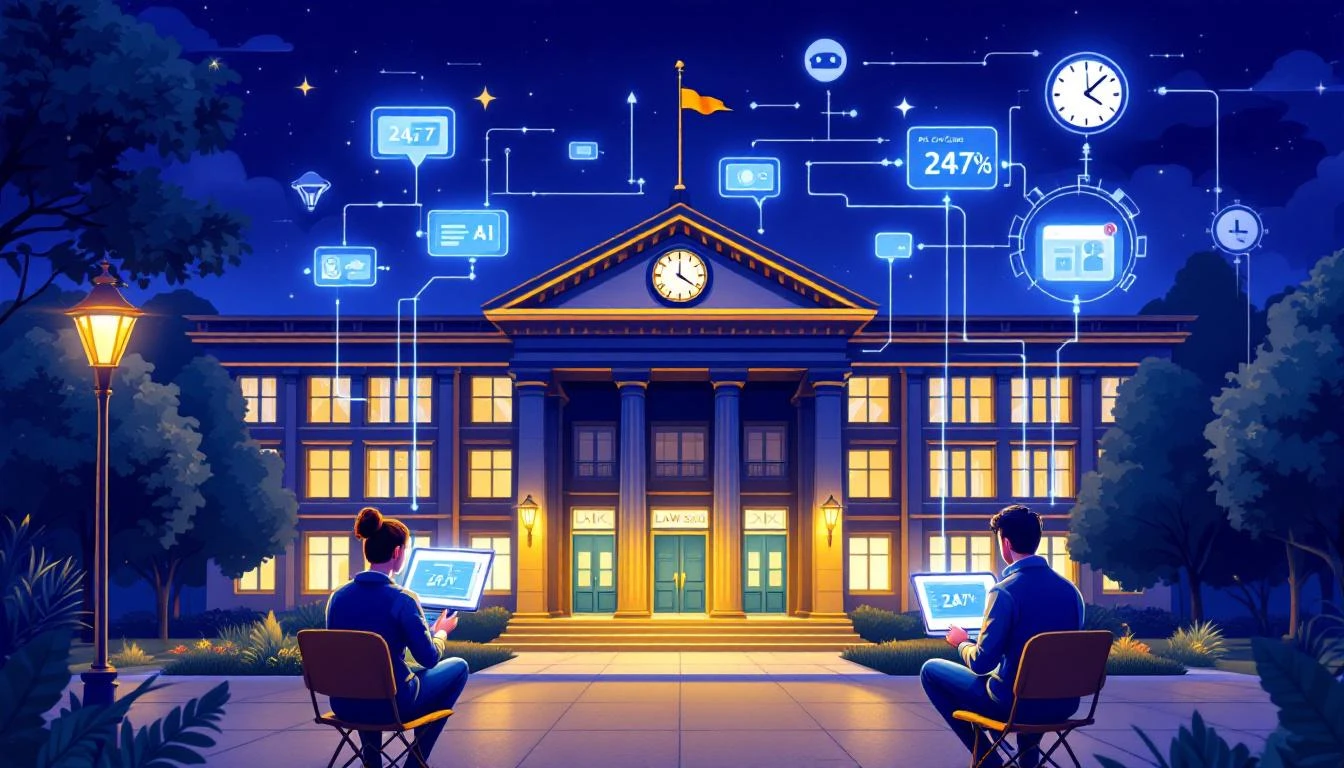
Law school admissions offices are in crisis mode. Applications are surging — the Law School Admission Council reported double-digit application increases in recent cycles — but admissions staff hasn't grown to match. The result? Prospective students submit inquiries and wait days (or weeks) for responses. They visit the website at 11 PM on a Tuesday, read about the JD program, have questions about financial aid or clinic opportunities, and find... a contact form. By the time someone replies on Thursday, they've already scheduled visits at two competing schools.
In higher education, speed-to-response isn't a sales metric. It's an enrollment metric. And most law schools are losing candidates they've already attracted simply because they can't respond fast enough.
This is where AI chatbots are quietly transforming admissions — not as gimmicks, but as genuine operational infrastructure that handles the 80% of inquiries that follow predictable patterns, freeing admissions counselors to focus on the 20% that require human judgment.
The Admissions Pipeline Problem in Legal Education
Law school enrollment is a funnel, even if admissions offices don't always think of it that way:
- Awareness: Prospective students discover the school (rankings, events, word of mouth, search)
- Interest: They visit the website, request information, attend an open house
- Application: They submit their LSAT scores, transcripts, personal statement
- Admit: The school extends an offer
- Yield: The admitted student actually enrolls
Most schools obsess over stages 3-5 (application volume, admit rate, yield rate) while stage 2 — the interest-to-application conversion — leaks like a sieve. And the leak isn't because prospects aren't interested. It's because the school doesn't engage them fast enough or thoroughly enough during the exploration phase.
Why Law Schools Specifically Struggle
Law school admissions has unique characteristics that make traditional outreach models break down:
Long decision cycles. A prospective law student might spend 6-18 months researching schools before applying. During that time, they visit dozens of websites, attend multiple events, and develop questions that are highly specific to their situation. They're not buying software — they're making a 3-year, $150,000+ commitment.
Complex information needs. Prospective students ask about bar passage rates, clinical programs, specific faculty research areas, employment outcomes by practice area, dual-degree options, part-time vs. full-time tracks, scholarship criteria, and cost of living in the school's city. No FAQ page covers all of this. Each student's combination of questions is unique.
After-hours engagement. Law school prospects are often working professionals or college seniors. They research schools in the evening and on weekends — precisely when admissions offices are closed. A student browsing your employment outcomes page at 9 PM on Sunday is actively comparing you to competitors. If your website offers nothing but a form, you've lost the moment.
Small admissions teams. Unlike large undergraduate admissions offices with dozens of counselors, law school admissions teams are typically 3-8 people handling everything from recruitment events to file review to yield activities. They don't have the bandwidth to monitor website traffic and respond to inquiries in real-time.
What "Before" Looks Like: A Typical Law School's Inquiry Process
One law school we've studied was running a process familiar to most admissions professionals:
- Website: Static pages with program information, a "Request Information" form, and basic FAQs
- Response time: 2-4 business days for form submissions (longer during peak application season)
- Inquiry handling: One admissions coordinator managed all incoming requests, manually triaging by program interest and sending templated email responses
- After-hours: Zero engagement capability — prospective students visiting the site between 5 PM and 9 AM received no interaction whatsoever
- Event follow-up: Attendees of open houses and info sessions received a generic "thanks for attending" email 3-5 days later
- Data capture: The school knew who submitted forms but had zero visibility into who visited the site without submitting
The numbers told the story: approximately 3,200 unique visitors per month to admissions-related pages, but only 180-220 form submissions — a conversion rate under 7%. The school knew, intuitively, that many more qualified prospects were visiting and leaving without engaging. They just had no way to reach them.
Enter the AI Chatbot: 24/7 Admissions Intelligence
The transformation started with deploying an AI-powered chatbot trained specifically on the law school's programs, policies, and admissions data. This wasn't a generic "How can I help you?" widget — it was a purpose-built conversational agent that could:
Handle Complex, Multi-Turn Inquiries
Real prospective student conversations don't follow scripts. They meander. A student might start by asking about the part-time JD program, then pivot to asking about scholarship availability for part-time students, then ask whether clinical placements are available for evening students, then ask about the bar passage rate for part-time graduates specifically.
The AI chatbot handles these multi-turn, branching conversations naturally — drawing from a knowledge base built from the school's catalog, website, admissions materials, financial aid policies, and even recent faculty publications. When it doesn't know the answer, it captures the question and routes it to a counselor for follow-up — with full conversation context.
Engage Every After-Hours Visitor
The impact was immediate and dramatic. Within the first month:
- 62% of chatbot conversations happened outside business hours (before 9 AM or after 5 PM)
- Sunday evenings became the highest-engagement period — prospective students researching after weekend visits to other schools
- Average conversation length: 4.2 messages (not one-and-done — genuine exploration)
These weren't tire-kickers. They were motivated prospective students actively comparing programs. Before the chatbot, 100% of these after-hours visitors left with zero engagement. Now, each one gets a substantive conversation and a path to next steps.
Qualify and Route Prospects Automatically
The chatbot doesn't just answer questions — it gathers qualifying information naturally during the conversation:
- Program interest (JD, LLM, dual degree, certificate)
- Timeline (applying this cycle vs. next year)
- LSAT status (already taken, studying, considering)
- Geographic preference (local, relocating, distance learning interest)
- Financial considerations (scholarship-dependent, self-funded, employer-sponsored)
This data flows directly into the school's CRM, creating rich prospect profiles that admissions counselors can act on — without having manually extracted any of it. A counselor logging in Monday morning doesn't see a list of form submissions. They see qualified, contextualized prospect profiles ranked by engagement level and fit indicators.
This is the same principle behind website visitor identification in B2B sales — knowing who's on your site and what they care about before you pick up the phone. In higher ed, the "phone" is a personalized email from an admissions counselor, but the signal is the same.
Provide Instant Event and Campus Visit Booking
One of the highest-converting chatbot interactions is event booking. When a prospect asks about visiting campus, attending an info session, or meeting with a specific faculty member, the chatbot can:
- Show available dates and times
- Confirm the booking in real-time
- Send a calendar invite with parking directions and preparation materials
- Trigger a pre-visit email sequence with relevant content based on the student's stated interests
No more "fill out this form and we'll get back to you." The student goes from curiosity to confirmed campus visit in under 60 seconds — at 10 PM on a Wednesday night if that's when they're browsing.
The Visitor Identification Layer
The chatbot is the engagement layer, but it works in concert with website visitor identification to capture intelligence even from prospects who don't initiate a chat.
Here's the operational reality: even with a chatbot, not every visitor will engage with it. Some students are in early research mode — they're comparing rankings, reading faculty bios, checking bar passage data. They visit 3-4 pages and leave. Without visitor identification, those visits are invisible.
With visitor identification, the admissions team can see:
- Which organizations are generating visits (important for employer-sponsored LLM programs and undergraduate feeder schools)
- Which pages receive the most attention (employment outcomes vs. curriculum vs. financial aid — each tells a different story about where the prospect is in their decision)
- Return visit patterns (a prospect who visits three times in a week is further along than one who visited once a month ago)
This data feeds into what B2B sales teams call a daily playbook — a prioritized list of accounts and contacts that deserve outreach today, based on behavioral signals. For a law school admissions team, it looks like this:
Monday Morning Playbook:
- 🔥 3 prospects had chatbot conversations over the weekend requesting scholarship info → personalized email from financial aid
- 📈 7 prospects visited the employment outcomes page 2+ times → send alumni success stories from their industry
- 🏢 2 companies had multiple visitors to the part-time JD page → possible employer-sponsored cohort opportunity
- 📅 12 prospects booked campus visits this week → prep personalized visit agendas
This is light-years ahead of "check the CRM for new form submissions."
Results: What the Numbers Show
After two full admissions cycles with the AI chatbot and visitor identification system in place:
Inquiry-to-Application Conversion
- Before: 7% of website visitors who submitted a form eventually applied
- After: 14% of chatbot-engaged visitors eventually applied
- The chatbot didn't just capture more inquiries — it produced higher-quality inquiries because the conversational format surfaced genuine interest and fit
Response Time
- Before: 2-4 business days average
- After: Under 30 seconds for chatbot-handled inquiries (24/7)
- Counselor-escalated inquiries still responded within 1 business day — but with full conversation context, so responses were substantive instead of generic
After-Hours Engagement
- Before: Zero
- After: 62% of all chatbot conversations occurred outside business hours
- Net new engaged prospects: ~140 per month who would have previously received zero interaction
Event Booking
- Before: 15-20 campus visit bookings per month via form submission
- After: 45-55 per month via chatbot instant booking
- Show rate: 78% (vs. 61% for form-booked visits) — because instant confirmation and pre-visit content reduced no-shows
Admissions Team Efficiency
- The chatbot handled approximately 73% of all incoming inquiries without human intervention
- Counselors reported spending 60% less time on routine information requests
- That time was redirected to high-value yield activities — personalized outreach to admitted students, alumni connection calls, and scholarship negotiations
Lessons for Higher Education Institutions
Whether you're a law school, business school, medical school, or undergraduate institution, the principles apply:
1. Speed is Your Enrollment Lever
The data is unambiguous: prospective students who receive engagement within minutes are dramatically more likely to apply than those who wait days. AI chatbots deliver that speed without requiring 24/7 staffing. This mirrors what B2B companies have learned about lead response time — the first responder wins.
2. After-Hours is Prime Time
Your prospective students research schools in the evening and on weekends. If your engagement strategy only works during business hours, you're invisible during the highest-intent browsing periods. A chatbot doesn't sleep, doesn't take weekends off, and doesn't need coffee to be helpful at 11 PM.
3. Conversational > Transactional
A form submission is transactional — name, email, program interest, submit. A chatbot conversation is relational — it lets prospects explore, ask follow-ups, change direction, and build understanding. The quality of data captured in a 5-message conversation vastly exceeds what any form collects. And the prospect feels heard, not processed.
4. Train on YOUR Data, Not Generic FAQs
The chatbot's value comes from being trained on your specific programs, policies, faculty, and outcomes. A generic higher ed chatbot that says "check our website for more information" is worse than no chatbot at all. Invest the time to build a comprehensive knowledge base — catalog data, policy documents, recent curriculum changes, faculty research summaries, alumni outcome data. The more specific the bot can be, the more trust it earns.
5. Visitor Identification Reveals the Invisible Pipeline
Most schools have no idea who's visiting their website. Visitor identification tools designed for B2B sales work equally well for institutional enrollment — they reveal which companies, organizations, and undergraduate institutions are generating traffic to your admissions pages. For employer-sponsored programs (executive LLMs, evening MBAs, part-time JDs), this intelligence is gold.
6. Connect the Chatbot to Your CRM
A chatbot conversation that doesn't flow into your CRM is a missed opportunity. Every interaction should create or enrich a prospect record — with conversation transcripts, stated interests, qualifying data, and engagement scores. Counselors should never ask a prospect to repeat information they already shared with the chatbot.
The Enrollment Imperative
Higher education is facing a demographic cliff. The number of traditional college-age students is projected to decline in many regions over the coming years. Professional schools — law, business, medicine — will compete more intensely for a smaller pool of qualified applicants.
In this environment, the schools that win won't necessarily be the ones with the best rankings or the lowest tuition. They'll be the ones that engage prospects fastest, provide the best pre-application experience, and use data to personalize every interaction.
AI chatbots and visitor identification aren't futuristic technology. They're operational infrastructure that leading institutions are deploying right now. The question isn't whether to implement them — it's how quickly you can get them working before the next admissions cycle.
Your best prospective students are on your website right now. At this moment. What are you telling them?
MarketBetter's AI chatbot and visitor identification platform works for any organization with a website pipeline — including higher education institutions. See how it works and learn what your website traffic reveals about prospective student interest.