
Three AI-Native Demand Gen Plays We're Running Right Now (That Aren't Outbound)

Almost everything I read about AI-native GTM right now ends the same way: an AI agent drafts an email to a prospect.
Closed-lost re-engagement → email. Champion tracking → email. Micro-campaign → sequence. The plays are good. They are also all the same shape — outbound, one-to-one, sales-led — and they assume you already have a list of accounts worth talking to.
Nobody is writing about the demand gen side of this. The half of GTM that has to fill the top of the funnel, build the brand, and earn the right to send any of those clever emails in the first place. That side is moving too, and the plays look completely different.
These are three we are actually running at marketbetter.ai right now. Each one either was not possible eighteen months ago or used to take ten times longer. None of them end in an email.
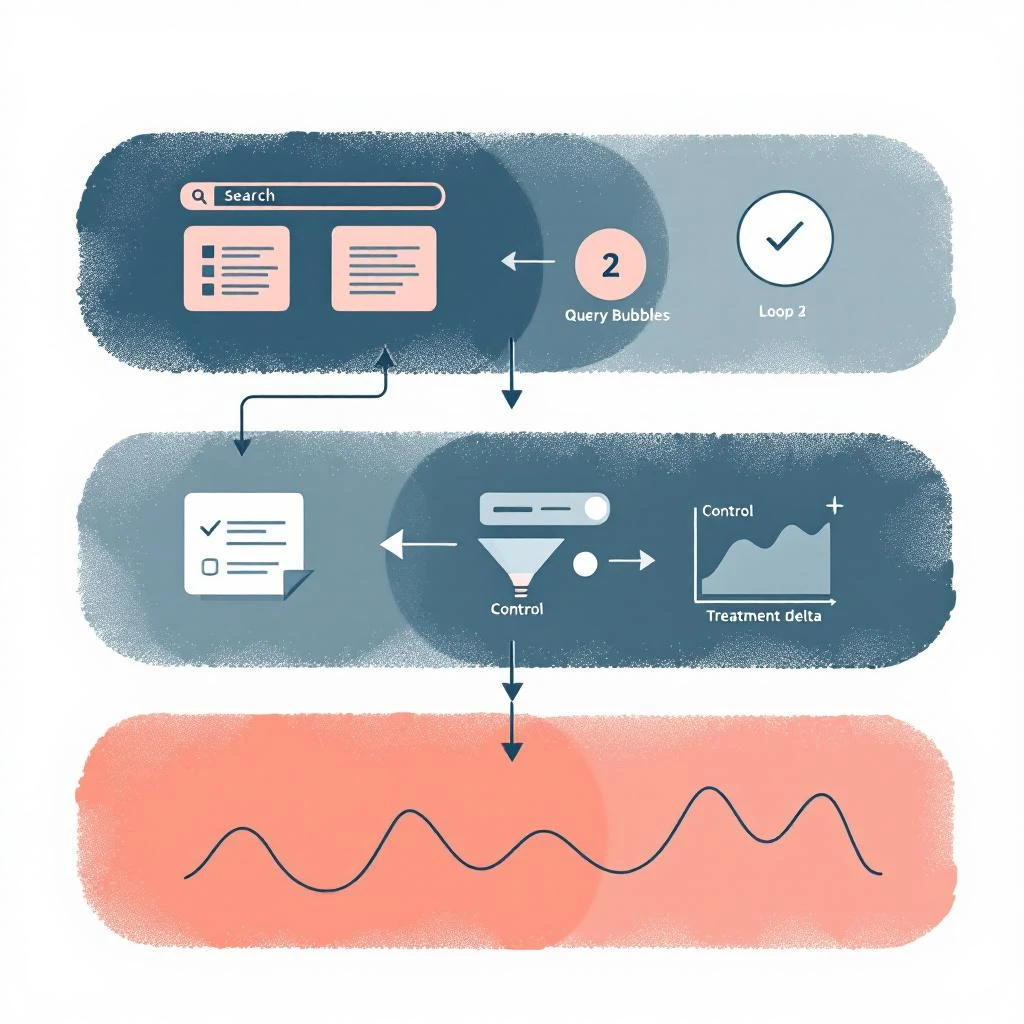
Play 1: Citation-Gap Discovery in AI Engines
The old SEO play was: pick keywords humans search on Google, write content, hope you rank.
The new demand gen play is: figure out which topics ChatGPT, Perplexity, Claude, and Gemini surface to your buyer when they ask a category question — and which competitors get cited in those answers while you do not. Then go close the gap.
This was not a play eighteen months ago. AI answer engines were not material in B2B research workflows. They are now. We are watching buyers walk into demos and quote, almost verbatim, an answer they read in Perplexity the night before, with the competitors named, the differentiators framed, and the buying criteria already set.
If your category gets crowded in those answers without you, you are losing the deal before the SDR ever fires a sequence.
Here is how the play works in practice.
We log every response that the major AI engines return for a defined set of category prompts — "what are the best AI BDR tools," "how do I shorten speed to lead," "buying signal platforms for B2B," and another fifty or so for our space. We capture not just the answer, but the citation domains the engine pulled from. Over a few hundred prompts, a frequency map emerges. Some domains get cited fifty, sixty, eighty times. A small handful — usually the category leaders plus two or three category-defining writers — show up everywhere.
The discovery move is the diff. For every cited domain, look at what topics it owns. Then check whether your own site has equivalent depth on those topics. The gaps fall into three buckets:
- Topics where competitors are cited and you have no page at all. These are pure greenfield. Often mid-funnel category vocabulary that the engines have decided is the canonical way to talk about the space — words your team uses internally but never bothered to write a pillar page about. We had this problem with phrases like "buying signal tools" and "AI BDR." We had product capabilities for both. We had no rankable page for either.
- Topics where you have a page but the engine never cites it. Either the page is too thin, the schema is wrong, the headline does not match the way buyers actually phrase the question, or the page exists but nothing else on the internet links to it as evidence. Usually some combination.
- Topics where the engine cites a third-party listicle that does not include you. This is the most actionable bucket. The listicle exists. The prompt is well-defined. Your absence is the problem. You do not need a new page; you need to be on someone else's page.
The play is to systematically work down that gap list. Not by writing more comparison content — the era of churning out "best X tools" listicles is finished, both because Google penalizes it and because the AI engines see right through it. By writing original, deep, citable pieces on the gap topics, plus an outreach motion to the listicle owners with a real reason to add you. (This is essentially what we ended up building into our own AI SEO workspace after seventeen thousand wasted impressions taught us the hard way.)
Where to start. Pick twenty category prompts that a buyer would plausibly type into Perplexity tonight. Run them. Capture the cited domains. For each, find one topic where that domain ranks in the engine's answer and you do not. That list — even at twenty topics — is more honest demand gen homework than any SEO tool will give you, because it reflects what your buyers are actually being told.
Play 2: GSC Striking Distance With An Intent Filter
Search Console striking distance has been a play forever. The premise: queries where you rank somewhere in positions five through fifteen, with non-trivial impressions, but a click-through rate near zero. The promise: tighten the title and meta, maybe rewrite the intro, watch the rank rise and the clicks follow.
The problem is the data is mostly garbage.
If you pull striking distance honestly, what you get is a long list of queries that fall into one of these patterns:
- Quoted exact-match phrases people are using to verify a stat — "78% of customers buy from the first responder" — where they want the cited source, not your blog post.
- Queries with file paths or HTTP status codes —
crm/v3/objects/contacts/search 500— where the searcher is a developer trying to debug, not a buyer with intent. - Domain lookups —
salesfloor.video,painpointmatch.com— where the searcher already knows the destination and has no interest in your interpretation of it. - Branded queries for your own product —
marketbetter crm— where you already rank, the click is already yours, and there is nothing to optimize. - Queries about specific people —
clari transcription malay desai— which are essentially LinkedIn searches that leaked into Google.
A pure striking distance pull will dump all of those into your "opportunities" list at the same priority level as a real informational query. If you let your team rewrite titles based on the raw output, you waste a week of editorial effort for fractional CTR gains, because you cannot raise CTR on a query whose searcher does not want a blog post in the first place.
The play is to put an intent filter between Search Console and the editorial calendar.
The rules are not exotic. Exclude any query containing a quoted phrase. Exclude any query containing a domain extension like .com, .io, or .video. Exclude branded terms — your own brand and any product name you own. Exclude technical fragments — slashes, equal signs, HTTP status codes, file extensions. Exclude proper nouns that look like specific person searches. Set an impressions floor — anything under ten impressions over ninety days is noise, not signal.
Then layer in a lightweight informational-intent classifier. For each remaining query, ask: would a searcher typing this expect to find a blog post answer, or a product page, or a Stack Overflow thread, or a specific destination? Only the blog-post bucket goes onto the editorial calendar.
What is left after that gauntlet — for most B2B sites — is a small number of high-value, real-content opportunities. Page-three rankings on category vocabulary. Mid-funnel comparison queries where you have a thin page that needs to become a real one. Brand-adjacent terms where the searcher genuinely wants your perspective. (The broader AI SEO play around this is less about volume and more about which queries deserve real editorial weight at all.)
That is the list worth working. A team of one editor can get through it in a quarter. A team of three can rebuild every page on the list in a month.
This was technically possible before AI. It just was not economically possible. Manually intent-classifying a few thousand queries took weeks. Now it takes an afternoon.
Where to start. Pull your last ninety days of Search Console queries where you rank between positions four and fifteen and have at least ten impressions. Run them through a simple classifier with the exclusions above. Whatever survives is your real striking distance list. Almost certainly five to ten times shorter than the raw export. That is the point.
Play 3: Closed-Loop Content Outcome Tracking
Most content programs are open loop. You publish a piece, it ships, the author moves on, and the only feedback signal is total organic traffic six months later — a lagging, aggregated metric that cannot tell you why this post worked and that one did not.
The AI-native demand gen play is to close the loop on every shipped piece against a synthetic counterfactual.
Here is the move.
When a piece publishes, snapshot every signal that matters for that specific piece — current ranking position, AI engine citation count, impressions, click-through rate, page authority — for the page itself and for a peer cohort of unshipped pages on adjacent topics. The peer cohort is your counterfactual baseline. It is everything you could have shipped instead of this piece, on similar themes, for the same audience.
Then, on a schedule — seven days later, fourteen days later, twenty-eight days later — re-snapshot. Compare the published piece's deltas to the peer cohort's deltas over the same window.
If your shipped piece moved up four positions and the peer cohort moved up three over the same period, you did not learn that your piece was good. You learned that the entire neighborhood was rising and your piece rose with it. That is not a win, that is a tide.
If your piece moved up four positions while the peer cohort stayed flat — or worse, declined — that is a real signal that something about that piece, on that topic, in that style, is winning.
After enough shipped pieces — fifteen, twenty, thirty across a customer or a category — patterns emerge. Long-form pillar pieces consistently beat short ones for this audience. FAQ-formatted pages outperform narrative-formatted ones for that audience. Pages with a comparison table near the top win. Pages with a quote in the first hundred words win. Specific writers consistently outperform other writers on specific topic clusters. The combinations get more interesting from there. (This is structurally the same loop we recommend for signal-to-meeting SDR workflows — measure outcomes against a peer cohort, feed the patterns back into the next briefing.)
The patterns then feed back into the brief generator. Future briefs for that customer or category lean toward the structures and shapes that have actually moved rank, in evidence, against a counterfactual — not because somebody on the team has a hypothesis, but because the data says so.
There are two failure modes to watch.
The first is sample size. Three published pieces is not a learning, it is a vibe. Ten is borderline. Twenty is where you can start trusting that the signal is not just one runaway winner skewing the average.
The second is cross-vendor leakage. The lessons that hold for a fintech audience do not hold for a manufacturing audience. The structures that work for a developer audience do not work for an executive one. Keep the loops vendor-scoped and audience-scoped. The prompt that says "in our last twenty wins for this customer, FAQ pages outperformed pillars" is useful. The prompt that says "FAQ pages outperform pillars in general" is dangerous, because it averages out the variance that is actually doing the work.
Where to start. Pick your last fifteen published posts. For each, pull current ranking, AI citation count, and impressions. For each, pick five unshipped peer pages on adjacent topics and pull the same. Look at the deltas. You will discover, immediately, that some of your "wins" were tide, and some of your "duds" actually outperformed their peer cohort and just happened to be in a sinking neighborhood. That alone reorders your editorial priorities. The system that automates this becomes the second-order play.
What Ties These Together
If you read these three plays end to end, the pattern underneath is the same:
You are no longer guessing what to write. You are reading evidence — from AI engines, from Search Console, from your own published outcomes — and only acting where the evidence is real. AI is the thing that makes the reading economically possible. Without it, every one of these plays would either die in the manual analysis step or get diluted by noise.
Outbound AI gets the headlines because it produces a visible artifact — an email, a sequence, a meeting booked. Demand gen AI is quieter. It mostly tells you what not to write, which topic not to chase, which keyword to ignore, which already-published post is being carried by a tide rather than carrying itself.
That is harder to demo on stage. It is also where the leverage is.
If you are running AI-native demand gen plays we did not cover here — the unglamorous, evidence-led, not-an-email kind — we want to hear about them. The category is being defined right now, and most of it is going to come from the people quietly building these loops, not from the people with the loudest framework decks.
Related reading
- We Built AI SEO Inside Our Marketing Platform — The 17,000-wasted-impressions story that became the AI SEO workspace we now ship to customers.
- Why Most Signal-Based Selling Rollouts Fail in 90 Days — The outbound equivalent of these demand gen plays: evidence-led, hierarchy-driven, not vibes-driven.
- The Buying Signal Hierarchy — Which signals actually predict closed-won. The same diff-against-counterfactual logic Play 3 uses, applied to intent data.
- The 3-Layer Signal Stack — Collection, correlation, action. The architectural pattern most signal stacks get wrong.
- Signal to Meeting in 24 Hours — What the closed-loop logic looks like when you apply it to SDR workflows instead of content.
- Visitor ID to First Outreach in 30 Minutes — A concrete worked example of the demand-side-to-outbound handoff.
- AI SEO Optimization Content — The original deep dive on optimizing for AI engines, which Play 1 builds on.
Want to see the loops we run for our own pipeline? Book a demo →