
2 posts tagged with "marketing automation software 2026"

View All Tags

10 Best Marketing Campaign Management Software in 2026 (Real Pricing — HubSpot vs $12/mo Alternatives)

· 22 min read

You're juggling email sequences in one tool, social posts in another, ad campaigns in a third, and reporting in a spreadsheet that nobody trusts. Sound familiar?

Marketing campaign management software brings it all under one roof — planning, execution, tracking, and optimization across every channel. We tested 10 platforms head-to-head on what actually matters: pricing transparency, automation depth, cross-channel attribution, and how fast your team can launch campaigns without calling in a consultant.

What we found: HubSpot dominates mid-market but costs $3,600+/month for full features. Monday.com is surprisingly strong for project-heavy teams. And most "enterprise" tools charge 5x more for features you'll never use.

The real magic of campaign management software is its ability to turn fragmented tasks into a cohesive, measurable strategy. It shifts the conversation from, "What did we do?" to "What worked, and why?"

This isn't just about making life easier; it's about driving tangible business results. And the market reflects this. The advertiser campaign management software market was valued at a hefty USD 10,327.4 million in 2021 and is projected to skyrocket to USD 25,710.1 million by 2033. That explosive growth shows just how vital this kind of centralized control has become. You can dig into the numbers yourself in this comprehensive market report.

Solving Critical Marketing Challenges

This kind of software hits the biggest marketing pain points head-on. It provides real solutions for those chronic problems that keep teams from growing, like inconsistent brand messaging across channels, wasted effort from team members accidentally doing the same work, and the endless struggle to prove ROI to the higher-ups.

By bringing your tools and data under one roof, it helps you finally get a grip on the complexity and focus on what really matters: creating campaigns that make an impact.

What Features Actually Matter in a Marketing Campaign Tool?

Picking the right marketing campaign software can feel like a chore. Every platform flashes shiny features and promises the world, and it's easy to get lost in the sales pitches. To cut through the noise, you need to ignore the fluff and zero in on the core functions that actually move the needle on your campaigns.

Think of it like this: without these key features, a platform is just a fancy to-do list. But with them, it becomes the central engine powering your entire marketing strategy, turning a bunch of separate tasks into a coordinated, high-impact machine.

Let's break down the non-negotiables you should look for.

Multi-Channel Campaign Orchestration

Modern marketing isn't a one-trick pony. Your campaigns live across social media, email, paid ads, and your blog all at once. True multi-channel orchestration lets you manage all these moving parts from a single command center.

  • Comparison: A basic project management tool might let you list tasks for email and social, but a true campaign management platform lets you execute and track them from one place.
  • Actionable Takeaway: When evaluating software, ask to see a demo of a single campaign's calendar view. If you can't see the email send dates, social post schedules, and ad flight times all on one screen, it lacks true orchestration.

Intelligent Workflow Automation

Repetitive tasks are the enemy of good marketing. Workflow automation is your secret weapon, letting you put all that manual drudgery on autopilot so your team can focus on big-picture strategy. In fact, smart automation can boost marketing productivity by 20%.

The infographic below shows this in action-how automated workflows can create a perfect sequence of events, which is the whole point of modern marketing efficiency.

  • Comparison: Simple automation might just send a thank-you email. Intelligent automation can create branching logic: if a lead opens the email but doesn't click, send a follow-up with a different subject line in two days. If they do click, notify a sales rep immediately.
  • Actionable Takeaway: Ask vendors for specific examples of "if-this-then-that" logic their platform supports. Can it trigger actions based on website behavior, email engagement, and CRM data?

Centralized Digital Asset Library

"Hey, where can I find the latest logo?" If you've heard that question one too many times, you need a centralized digital asset library (or DAM). It puts an end to the chaos by creating a single source of truth for every creative file-from images and videos to ad copy and brand guides.

  • Comparison: Using a tool like Google Drive is better than nothing, but a native DAM within your campaign software adds version control, usage rights, and the ability to link assets directly to specific campaigns for performance tracking.
  • Actionable Takeaway: During a demo, test the search functionality of the asset library. Can you find an image by its color, orientation, or the campaign it was used in? This level of detail separates a basic folder system from a professional DAM.

A centralized asset library doesn't just save time; it protects your brand's integrity. It's the difference between a polished, professional presence and a fragmented, inconsistent one.

This feature often integrates with or completely replaces many of the top content marketing tools, helping you consolidate your tech stack and work more efficiently.

Robust Analytics and Reporting

You can't improve what you don't measure. Solid analytics and reporting are probably the most important features of any marketing software because they turn your marketing from a guessing game into a data-driven science.

With good reporting, you can see which email subject lines get the most opens, which social channels bring in the best leads, and how your ad spend is actually turning into revenue. Some platforms even have predictive analytics to help you forecast results. To get a better sense of how data can sharpen your focus, check out our guide on using https://marketbetter.ai/playbooks/ai-lead-scoring to prioritize your best prospects.

A solid platform should give you the core features needed to track and optimize your entire funnel. Here's a quick breakdown of what to look for.

Essential Features of Marketing Campaign Management Software

FeatureCore FunctionalityKey Benefit
Multi-Channel OrchestrationManage email, social, ads, and content from one dashboard.Creates a consistent customer experience and unified campaign view.
Workflow AutomationSet up "if-then" rules to automate repetitive marketing tasks.Frees up team time for strategic work and reduces human error.
Centralized Asset LibraryA single, searchable hub for all brand and creative assets.Ensures brand consistency and stops version control nightmares.
Analytics & ReportingTrack KPIs, attribute results to specific channels and campaigns.Provides clear data to measure ROI and make smarter decisions.
Budget & Expense TrackingAllocate and monitor spending for campaigns in real-time.Prevents overspending and proves the financial impact of marketing.

Ultimately, these features work together to give you a complete, 360-degree view of your marketing operations, from the initial idea to the final sale.

Granular Budget and Expense Tracking

Finally, you have to know where the money is going. Granular budget tracking lets you assign funds to specific campaigns, channels, or even individual ads, then watch your spending in real time.

Think of this feature as your financial command center. It helps you stop overspending before it happens, pinpoint which channels deliver the best return on ad spend (ROAS), and confidently walk into any meeting ready to justify your marketing budget with cold, hard data.

An Actionable Comparison of Top Platforms

Picking the right campaign management software isn't about finding the one with the longest feature list. It's about matching a tool to your team's real, day-to-day problems. What works for a scrappy startup could easily bog down a massive enterprise, and the reverse is just as true.

So, instead of a generic rundown, let's look at this through the lens of actual business needs. Once you understand the core philosophy behind the leading platforms, you can connect your team's specific pain points to the right software and make a decision you won't regret.

For Teams Focused on Project Management and Visibility

Your Problem: "I have no idea who is working on what. Deadlines are a suggestion, and our campaign launches are pure chaos." The Solution: Platforms like Monday.com and Asana are built to solve this exact collaboration headache.

Think of these tools as the mission control for your projects. Their superpower lies in visual task management, crystal-clear timelines, and making team collaboration feel effortless.

  • Monday.com vs. Asana: Monday.com excels in visual, customizable dashboards-it's like building with LEGOs for your workflow. It's ideal if you want to design your process from scratch. Asana is the master of task dependencies and structured projects; it's perfect for complex campaigns where Step B cannot start until Step A is complete.
  • Actionable Use Case: If you are a creative agency juggling 20 client projects, Monday.com's visual boards can give each client a unique workflow. If you are launching a multi-stage product, Asana's timeline and dependency features ensure a smooth, sequential rollout.

These platforms are less about deep customer data and more about getting the work done efficiently. They're the right call for creative agencies, content teams, or any marketing department where the biggest challenge is managing the production line of campaign assets.

For Organizations Needing All-in-One CRM and Marketing

Your Problem: "Our sales and marketing teams are strangers. We get leads, but we have no idea which ones are good or what happens to them after we pass them over." The Solution: An all-in-one platform with a CRM at its core, like HubSpot, is designed to bridge this gap.

HubSpot's strength is its unified view of the customer. By combining marketing, sales, and service tools around a single CRM, it provides a complete timeline for every contact.

With a platform like HubSpot, you can trace a lead's entire story without jumping between tabs. You see the blog post they read, the email they opened, the sales call they had, and the support ticket they submitted-all in one timeline.

  • Actionable Use Case: Use HubSpot's lead scoring to automatically notify a sales rep when a prospect visits your pricing page three times. This simple automation, powered by the integrated CRM and marketing tools, turns a marketing action into a direct sales opportunity.

This integrated approach is a game-changer for businesses focused on lead nurturing, aligning sales and marketing, and proving how marketing actually contributes to the bottom line. It's a fantastic choice for mid-market companies that have outgrown their mess of scattered tools and just need one source of truth.

For Enterprises Demanding Powerful Automation and Analytics

Your Problem: "We have massive amounts of data and complex customer journeys. We need to execute highly personalized campaigns at scale and prove revenue attribution down to the dollar." The Solution: A marketing automation powerhouse like Adobe Marketo Engage delivers the necessary power and granularity.

Marketo's strength is its raw power and flexibility. It offers some of the most advanced automation workflows, lead nurturing capabilities, and revenue attribution models you can find.

  • HubSpot vs. Marketo: While both platforms automate, HubSpot is generally more user-friendly and built for the entire customer lifecycle. Marketo offers deeper, more complex automation and analytics capabilities, making it the preferred choice for data-driven enterprises with dedicated marketing ops teams who can leverage its full potential.
  • Actionable Use Case: Use Marketo to build a multi-path nurturing campaign. If a user from a Fortune 500 company downloads a whitepaper, route them to an enterprise sales rep and a specific email track. If a user from a small business does the same, route them to a self-service demo track. This level of granular control is where Marketo shines.

Choosing the right tool is a strategic call. For a detailed look at how different platforms compare for specific jobs, our MarketBetter vs. Sendspark comparison gives a focused analysis that can help bring your needs into focus.

Software Comparison for Different Business Needs

To make the choice even clearer, here's a quick breakdown of how these platforms stack up against each other based on what you're trying to accomplish.

SoftwareBest ForKey StrengthPricing Model
Monday.comProject & Task ManagementVisual workflow customizationPer-user subscription
AsanaComplex Project CollaborationTask dependencies & timelinesPer-user subscription
HubSpotAll-in-One GrowthIntegrated CRM & marketing suiteTiered, based on contacts/features
MarketoEnterprise AutomationAdvanced automation & analyticsCustom, based on database size

Ultimately, the best platform is the one that solves your most pressing problem today while giving you room to grow tomorrow.

The market for these tools is heating up for a reason. The global campaign management system market is expected to jump from USD 5.50 billion in 2025 to USD 10.86 billion by 2032, which is a compound annual growth rate of 10.2%. You can dive into the numbers in this insightful industry report. This trend shows just how critical it's become for businesses to get their campaigns organized on a central platform if they want to stay in the game.

How to Pick the Right Software for Your Team

Choosing the right marketing campaign management software can feel like you're staring at a wall of TVs, each one shouting different promises. Every vendor claims their tool will change the game, but here's the secret: the best tool is the one that solves your team's actual problems, not just the ones on a feature checklist.

The process doesn't start with demos. It starts with a hard look in the mirror. Before you even glance at a product page, you need to be brutally honest about your team's biggest headaches.

Actionable First Step: Get your team in a room for 30 minutes and ask one question: "What is the single most repetitive or frustrating task in our marketing process?" Write every answer on a whiteboard. The most common themes are your starting point for evaluating software.

First, Audit Your Current Tech Stack

No tool is an island. Your shiny new platform has to play nice with the software your team already lives in every day. So, the next critical step is to take inventory of what you're already using.

Make a simple list of every tool your marketing, sales, and customer service teams touch. That means your CRM, email platform, social media schedulers, analytics tools, and whatever project management system you're using to hold it all together.

For each one, ask these questions:

  • What does it actually do? Get specific about its main job.
  • Is it a "must-have" or a "nice-to-have"? Be honest. Which tools would cause a riot if they disappeared tomorrow?
  • How does it connect to other things? Does it have an open API? Does it offer pre-built integrations?

This audit gives you a blueprint for your integration needs. A powerful campaign platform that can't talk to your CRM is a complete non-starter. You're looking for a central hub, not another silo.

Involve Your Stakeholders Early On

Choosing software by committee can be a slog, but making the decision alone is a recipe for disaster. If you want people to actually use the tool you pick, you have to bring them into the process from the jump.

Get people from sales, creative, and even finance in the room (or on the Zoom). The sales team knows exactly what they need from marketing to help them close deals. Your creative team can tell you what they need to manage hundreds of assets without losing their minds.

By bringing other departments into the fold, you're not just picking a marketing tool; you're choosing a central growth engine for the whole company. It's a collaborative move that ensures the software solves problems across teams, which pays off big time in adoption rates later.

Ask the Right Questions During Demos

Alright, you've got your shortlist. Now it's demo time. This is your chance to slice through the polished sales pitch and see how the software holds up in the real world. Don't let the sales rep drive the whole time. Come armed with a list of sharp, specific questions based on your earlier pain-point audit.

Instead of asking a lazy question like, "Do you have analytics?" try this instead: "Show me exactly how your platform tracks ROI from a campaign running on Google Ads, LinkedIn, and email."

Here are a few other critical questions to have in your back pocket:

  1. On Workflows: "Can you walk me through building an automated workflow for a new lead who just downloaded an ebook? Show me every step."
  2. On Integrations: "Don't just tell me you integrate with Salesforce. Show me how the data syncs between the two platforms live."
  3. On Support: "What does your onboarding process actually look like for a team our size? What level of support is included, and what costs extra?"

This kind of direct, hands-on questioning forces vendors to prove their claims in the context of your challenges. It shifts you from being a passive viewer to an active evaluator, making sure you end up with a tool that doesn't just look good on paper but truly helps your team win.

Implementing Your New Software for Maximum Impact

Alright, you've picked your new marketing campaign management software. That's a huge step. But the real work? It starts now. The success of this whole thing doesn't ride on the feature list-it hinges on how well you weave the tool into your team's daily rhythm. A sloppy rollout turns a powerful platform into just another ignored login.

The goal isn't to add another chore to everyone's plate. It's to make the software an indispensable part of their job. That takes a thoughtful plan, one focused on getting people on board smoothly and proving the tool's value from day one.

Start with a Pilot Team and Phased Rollout

Going for a big-bang, company-wide launch is a recipe for chaos. Don't do it. Start small with a hand-picked pilot team instead. This could be a single campaign squad or a mix of marketers from different functions who are generally good with tech and open to change.

Think of it as a controlled experiment. This small group can stress-test workflows, find weird bugs, and give you honest feedback in a low-stakes environment. Their experience is gold-you'll use it to polish your training materials and create a solid process before you roll it out to everyone else.

A phased rollout is just as important for your data. Instead of a massive, one-time data dump, moving things over gradually lets you:

  • Clean As You Go: Find and ditch outdated contacts or duplicate assets before they clutter up your shiny new system.
  • Test Connections: Make sure integrations with your CRM and other critical tools are working perfectly without putting your entire database at risk.
  • Minimize Disruption: Keep the day-to-day operations running smoothly while you methodically bring your information across.

Build Standardized Templates from Day One

One of the biggest wins you'll get from this software is consistency. Don't wait to figure out best practices later-build them directly into the platform from the very beginning with standardized campaign templates.

Think of these templates as pre-built playbooks for your most common marketing moves. A product launch template might include tasks for blog posts, email announcements, a social media schedule, and ad creation. A webinar template could have pre-set timelines for promo emails and follow-ups.

Standardizing your campaigns with templates does more than save time. It creates a unified process that ensures no critical step is ever missed, regardless of who is running the campaign.

Actionable Step: Your first template should be for your most frequent campaign type. If you run monthly webinars, build that template first. This guarantees an immediate win and demonstrates the value of standardization to the entire team. You can learn more about how to systemize your processes and never miss a follow-up again.

Focus on Adoption by Demonstrating Value

The single biggest hurdle to any new tool is user resistance. To get past it, you have to show each person on your team how the software makes their specific job easier. Frame the entire training around solving their personal pain points.

  • For the Content Writer: Show them how the central asset library means they'll never have to hunt through messy folders for the latest logo again.
  • For the Social Media Manager: Demonstrate how the scheduler lets them knock out a week's worth of posts in an hour, freeing them up for more creative work.
  • For the Marketing Leader: Walk them through the automated dashboard that proves campaign ROI without spending hours wrestling with spreadsheets.

This user-first approach changes the conversation. The tool stops being a mandate from management and starts being a genuine benefit. This is critical in a market that's blowing up. The marketing campaign management software market size was valued at USD 5.3 billion in 2024 and is expected to hit USD 12.3 billion by 2033. This growth shows just how much teams need tools that can tame complex, multi-channel marketing-a key selling point for your team. You can dive deeper by checking out the full market growth report.

By focusing on these practical steps-a pilot launch, smart templates, and value-driven training-you'll ensure your new software becomes the growth engine it was meant to be.

A Few Common Questions

Jumping into the world of marketing campaign software can feel like a big step. It's a decision that touches your team's day-to-day work, your budget, and ultimately, your results. We get it. Here are some of the most common questions we hear, answered straight up.

Wait, Isn't This Just a CRM?

It's an easy mistake to make. Both handle customer data, but they have completely different jobs. A simple comparison: a CRM is a database, while a campaign management platform is an action engine.

  • A Customer Relationship Management (CRM) platform is your system of record. It's a digital filing cabinet answering the question, "Who is this person and what's our entire history with them?"
  • Marketing campaign management software, on the other hand, is a system of action. It uses CRM data to answer the question, "How do we talk to this specific group of people, right now, to get them to do something?"

The two are a power couple:

  • The CRM knows a lead is in the "consideration" stage and has clicked on three pricing-page emails.
  • The campaign software uses that info to automatically send them a case study and show them a targeted social media ad.

Can a Small Business Actually Afford This?

This is the big one, isn't it? The short answer: yes, absolutely. The old idea that this kind of software is only for massive companies with eye-watering budgets is dead. The market is full of scalable, surprisingly affordable options built for businesses on the way up.

Most of the best platforms use tiered pricing. You can start with a basic plan that covers the essentials and add more firepower as your company grows. Some even have generous free plans to get you off the ground.

Here's the mental shift you have to make: this software isn't a cost. It's an investment. A good platform pays for itself by automating tasks that used to eat up dozens of hours a month and by fine-tuning campaigns to bring in more revenue.

Actionable Tip: Calculate the hourly rate of your marketing team members. Then, estimate how many hours per month are spent on repetitive tasks like reporting or manual posting. Compare that "cost of inefficiency" to the price of the software to see the potential ROI.

What Are the Most Important Metrics to Track?

You can't prove marketing is working if you aren't measuring the right things. Every platform will throw a sea of data at you, but if you want a clear picture of success, you have to ignore the noise. Forget vanity metrics like "likes" and focus on the numbers that connect directly to business goals.

Your campaign software absolutely must help you track these three heavy hitters:

  1. Customer Acquisition Cost (CAC): This is the bottom line on what it costs you-in both marketing and sales effort-to land one new customer. The goal is simple: get this number as low as you can. A great first step is comparing the CAC from different channels. Is Google Ads cheaper than LinkedIn? Now you know where to double down.

  2. Return on Marketing Investment (ROMI): This is the ultimate proof. It calculates the revenue your campaigns generated divided by what you spent to run them. Anything over 1.0 means you're making money. If you spend $1,000 on a campaign that brings in $5,000 in new business, your ROMI is a beautiful 5.0.

  3. Lead-to-Customer Conversion Rate: This metric tells you what percentage of your leads are actually becoming paying customers. A low number here is a huge red flag. It often points to a disconnect between what marketing is promising and what sales is delivering, giving you a crystal-clear problem to solve.

Nailing these core metrics is how you turn your marketing department from a cost center into a predictable revenue engine.


Ready to bring clarity, efficiency, and powerful AI to your marketing efforts? marketbetter.ai integrates content creation, campaign management, and customer engagement into a single, intelligent platform. Stop juggling disconnected tools and start driving measurable results. Discover how marketbetter.ai can transform your campaigns today.
11 Best AI Marketing Automation Tools in 2026 (With Real Pricing — HubSpot Starts at $800/mo)

· 25 min read

Picture this: your marketing team is drowning. They’re swamped with manual tasks, trying to make sense of data from a dozen disconnected systems, and their attempts at "personalization" feel clumsy and generic. It's a common story, and it’s exhausting.

This is exactly the problem AI marketing automation tools are built to solve. Think of them less as software and more as a strategic partner—one that doesn't just execute tasks but actually learns, predicts, and adapts in real-time.

Welcome to the New Era of Smart Marketing

Traditional marketing automation is a lot like a pre-programmed robot on an assembly line. It’s reliable and efficient at doing the same thing over and over based on fixed rules. Someone signs up, they get a welcome email. Simple, useful, but incredibly limited.

AI marketing automation, on the other hand, is like a master craftsman who hones their technique with every single interaction. It takes the "automation" part (the system that sends emails or posts on social media) and bolts on an "artificial intelligence" brain to make every action smarter. This guide will cut through the noise and give you a practical playbook for putting these platforms to work.

From Manual Effort to Automated Success

The real shift here is in the decision-making. Instead of relying on rigid "if this, then that" logic, AI brings predictive analysis and machine learning into the mix. This lets the system make intelligent choices on the fly, turning a static workflow into a dynamic marketing engine that responds to customers as individuals.

The true power of AI in marketing isn't just about doing things faster. It's about turning a mountain of data into a single, decisive action. It’s the difference between following a paper map and using a GPS that reroutes you around traffic you can't even see yet.

This isn’t just a passing trend; it's a fundamental change in how businesses connect with people. And the market is moving fast. The AI marketing space is on track to hit $40 billion by the end of 2025—doubling from $20 billion in 2022. That growth is being driven by small and mid-sized businesses, which are cranking up their AI investments by 25% every year. You can dig deeper into what these marketing trends mean for the industry.

Why This Evolution Matters

Getting on board with AI automation isn't just about keeping up; it’s about gaining a serious competitive advantage. It tackles real, tangible problems that have been holding marketing teams back for years.

  • Solving Data Overload: AI can sift through oceans of customer data to spot meaningful patterns that a human team could never hope to find manually.
  • Enabling True Personalization: It’s about more than just slotting a first name into an email. We’re talking about dynamically changing your website content for every single visitor.
  • Boosting Team Efficiency: By taking over the repetitive analytics and grunt work, it frees up your team to focus on what they do best: high-level strategy and creative thinking.

This guide will show you exactly how these tools solve these problems, turning raw data into smart decisions and manual effort into automated success. It's all about connecting with customers in a more meaningful way.

What Exactly Are AI Marketing Automation Tools?

Image

To really get what makes AI marketing automation tools a big deal, you first have to understand what they aren't. They aren't just a faster, shinier version of the software you’re already using. This is a fundamental change in how marketing decisions get made.

Let's try a simple analogy. Think of your standard marketing automation as a basic sprinkler system you set with a timer. You program it to turn on at 7 AM every day, and it waters the whole lawn—rain or shine. It follows the command perfectly, but it’s completely rigid and has zero awareness of what's actually happening.

An AI marketing automation tool, on the other hand, is like a smart irrigation system. It has sensors in the soil checking for moisture, it pulls the local weather forecast, and it learns over time which spots in the yard need more water than others. It only waters when and where it’s needed, constantly adjusting its plan for the best possible result.

Moving Beyond Simple Rules

That jump from rigid to responsive is the heart of the matter. Traditional automation runs on simple, pre-written rules: "if this happens, then do that."

IF a user downloads our new ebook, THEN send them this specific 3-part email sequence.

It’s a linear, predictable workflow. And while it’s fine for basic tasks, it can’t adapt when a user does something unexpected or shows a subtle hint they’re ready to buy. It treats every single person who downloads that ebook exactly the same, which is a massive missed opportunity.

AI-powered platforms break out of that box by blending two key components:

  • Marketing Automation: This is the engine. It's the part of the system that actually does the work—sending emails, scheduling social posts, or managing ad campaigns.
  • Artificial Intelligence: This is the brain. It's the smart layer that analyzes data, spots patterns, and makes predictions to guide what the engine does next.

By folding in machine learning and predictive analytics, these tools can make sense of huge amounts of data—website clicks, email opens, purchase history, even social media comments. The goal isn't just to see what a customer did, but to predict what they’re likely to do next.

A Practical Comparison

Let’s put this into a real-world context to see how each system would handle a common marketing scenario.

ScenarioTraditional Automation ApproachAI-Powered Automation Approach
A User Visits a Pricing PageTriggers a generic follow-up email with a discount or a link to book a demo. Every single visitor gets the same message.Analyzes the visitor's entire history, scores their likelihood to buy, and triggers a specific action based on that score. A high-intent lead might get a personal email from a sales rep, while a low-intent browser sees a targeted ad on social media a few hours later.
Managing Ad SpendSpends a fixed budget across pre-defined audiences. To make any changes, a human marketer has to manually dig through performance data and shift the money around.Constantly monitors campaign performance in real-time. It automatically pulls budget from underperforming ads and pushes it toward the ones driving the highest ROI, often discovering valuable new audience segments all on its own.
Email NurturingA new lead gets a fixed, 5-email welcome series sent over two weeks, regardless of their actions.The AI dynamically adjusts the nurture sequence. If a lead clicks on a case study about a specific feature, the next email automatically focuses on that feature's benefits. If they don't open two emails, the system might pause the cadence and try re-engaging them on another channel.

At the end of the day, AI marketing automation tools change the game from a static set of rules into a dynamic, learning system. Instead of just running the playbook you wrote, they help you write a new, more effective one for every single customer, every single time. This is what lets marketers move from just managing campaigns to orchestrating intelligent, self-tuning customer journeys.

What AI Marketing Platforms Can Actually Do

If traditional automation is like a script—following a fixed set of "if-then" rules—then AI marketing automation tools are like improv actors. They learn, adapt, and react in real-time. They’re built with a set of core capabilities that change marketing from a series of rigid commands into a dynamic, intelligent conversation with your customers.

These aren't just minor upgrades. They represent a fundamental shift in how we can understand and interact with people. Instead of just reacting to triggers, these platforms start to anticipate needs, delivering experiences that feel genuinely personal.

Let's break down the most impactful capabilities you'll find under the hood.

Predictive Lead Scoring

In a standard system, lead scoring is simple math. Open an email? +5 points. Visit the pricing page? +10 points. It's a decent start, but it's a blunt instrument. It treats every action as if it has the same weight and misses all the nuance.

Predictive lead scoring, on the other hand, is more like a seasoned detective. An AI model sifts through thousands of data points all at once—company info, behavioral patterns, on-site engagement, and historical conversion data from customers who look just like your new lead. It doesn't just count the actions; it understands the pattern of actions that screams "this person is ready to buy."

For example, the AI might discover that prospects who download a specific whitepaper and then watch a demo video within 24 hours have a 90% higher conversion rate. It instantly flags these high-intent leads for your sales team, so they can stop chasing cold trails and focus their energy where it counts.

Hyper-Personalization at Scale

Basic personalization usually stops at dropping a {{first_name}} into an email subject line. Hyper-personalization powered by AI goes miles deeper. It gives platforms the ability to dynamically change website content, product recommendations, and special offers for every single visitor based on their real-time behavior.

Think about an e-commerce store. A brand-new visitor might see a homepage highlighting the overall best-sellers. But a returning customer who spent ten minutes browsing hiking boots last week? They’ll see a homepage featuring new outdoor gear and maybe a blog post about the "Top 5 Trails to Hike This Fall."

This isn't based on a handful of pre-set rules. It’s a fluid, one-to-one journey that changes with every click, which is a proven way to boost engagement and, ultimately, sales.

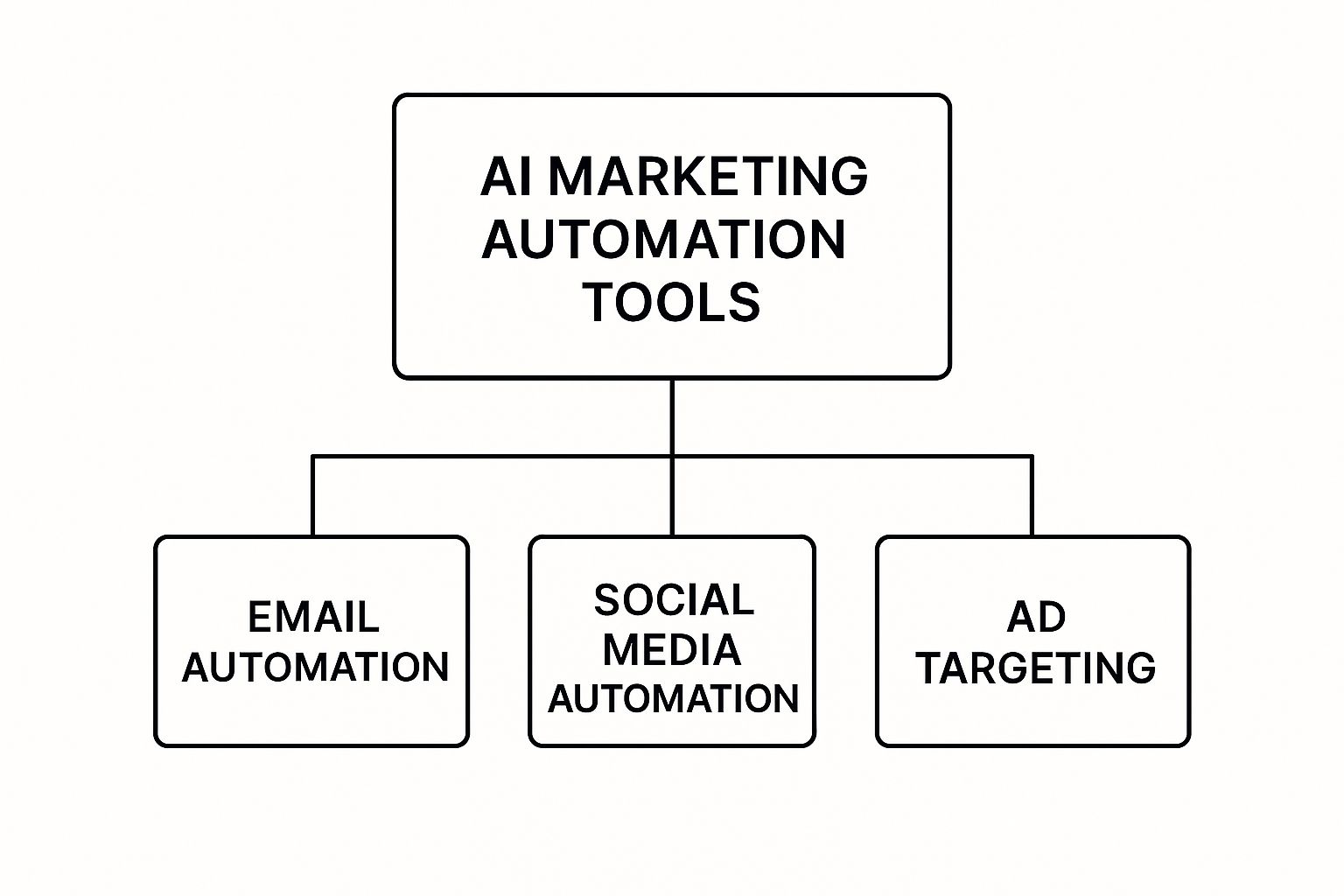
This image breaks down how these AI capabilities branch out into the marketing disciplines you already know.

Image

As you can see, core functions like email, social media, and advertising are all supercharged by the intelligent features we're talking about.

AI-Powered Content Generation

Let's be honest: content creation can be a massive bottleneck. AI helps break through that logjam by lending a hand with everything from brainstorming ideas to polishing the final copy. These tools can generate topic ideas based on what's trending, draft a dozen social media posts, create compelling ad copy variations, and even outline entire blog posts for you.

The goal here isn't to replace human creativity. It's to augment it. AI can handle the repetitive, formulaic parts of writing, freeing up marketers to focus on strategy, storytelling, and adding that human touch that truly makes a message connect.

By analyzing what's already working, these systems can even suggest headlines and article structures that are likely to resonate with your audience. To see how this really works, you can get a better sense of how to use AI content analysis to sharpen your strategy.

Intelligent Customer Segmentation

Traditional segmentation is a rearview-mirror approach. It groups customers based on what they've already done or on static info like their age or location. It's useful, but it's not forward-looking. AI introduces predictive segmentation, which groups audiences based on what they're likely to do next.

An AI model can spot a group of customers who are at high risk of churning long before they hit the "unsubscribe" button. It can also identify "lookalike" audiences of your best customers, finding new prospects who share subtle behavioral traits with the people who already love your product. This lets you run proactive retention campaigns and find new customers with startling efficiency.

Traditional Automation vs AI-Powered Automation

To really grasp the leap these tools represent, it helps to see a side-by-side comparison. The table below lays out the difference between what standard automation can do and what AI-powered platforms bring to the table.

FeatureTraditional AutomationAI-Powered Automation
Lead ScoringRelies on manual, point-based rules that treat most actions equally.Uses machine learning to analyze thousands of data points and predict conversion likelihood.
PersonalizationLimited to basic merge tags (like first name) and simple segmentation rules.Delivers dynamic, 1-to-1 experiences by altering content in real time based on user behavior.
SegmentationGroups audiences based on past actions and static demographic data.Creates predictive segments based on likely future behavior, such as churn risk or purchase intent.
Content CreationRequires 100% manual effort for brainstorming, drafting, and optimizing copy.Assists with ideation, generates drafts for ads and social media, and suggests optimizations.
OptimizationDepends on manual A/B testing and analysis performed by a human marketer.Automatically runs micro-tests, reallocates ad budgets, and optimizes campaign elements in real time.

When you put these capabilities together, you don't just get a more efficient marketing department. You get a smarter, more responsive engine for building real, meaningful relationships with your customers.

Measuring the Tangible Business Benefits

It's one thing to hear about flashy features like predictive analytics and hyper-personalization. It's another thing entirely to see how they actually move the needle. Let's get past the buzzwords and talk about what AI marketing automation tools do for your bottom line.

The real goal here is to build a rock-solid financial case for bringing one of these platforms into your world.

Image

These tools aren't just about doing things faster; they’re about doing things smarter. They draw a straight line from every marketing action to a result you can actually count—whether that’s saving time, making customers happier, or just plain growing revenue. That's how a marketing department stops being a cost center and starts becoming a predictable growth engine.

Increased Efficiency and Productivity

One of the first things you'll notice is that your team suddenly has more time. I mean, a lot more time. AI automation grabs all the repetitive, soul-crushing tasks that eat up hundreds of hours a month, freeing up your best people to think, create, and strategize.

Think about the old way of doing things. The manual A/B testing, the tedious audience segmentation, the late nights pulling performance reports. An AI tool can run thousands of micro-tests at once, find the perfect audience segments on its own, and spit out insightful reports in seconds. This isn't just a small step up; it's a total game-changer for your team's capacity.

Here’s how to make that tangible:

  • Actionable Step: For one week, ask your team to track time spent on manual data tasks (e.g., pulling reports, segmenting lists, A/B test setup). Multiply that weekly number by 52. This is the annual hour-cost you can directly reduce with an AI tool, creating a powerful ROI metric based on salary savings alone.

That saved time is a direct return on your team's salary. It lets your sharpest minds focus on innovation instead of administration.

Enhanced Customer Experience

A better customer experience isn't some fuzzy, feel-good metric. It's a direct line to revenue. When AI drives personalization, it creates a journey for each customer that actually feels relevant and engaging. And that has a clear, proven link to loyalty and lifetime value (LTV).

So, instead of blasting a generic "You left something behind!" email to every abandoned cart, an AI can figure out the right next step. A high-value customer might get a personal follow-up from a support agent. A price-sensitive shopper might get a unique, limited-time offer on the exact product they were eyeing.

This is the big shift: you move from broadcasting generic messages to having meaningful, one-to-one conversations at scale. That's what builds real brand affinity and turns one-time buyers into your biggest fans.

You can measure this impact directly with hard numbers:

  • Higher Engagement Rates: Personalized content gets more opens, more clicks, and more interaction. Period.
  • Increased Customer LTV: Relevant experiences keep people coming back, buying more, and churning less.
  • Improved Net Promoter Score (NPS): Customers who feel like you "get" them are far more likely to recommend you to others.

Improved Marketing ROI and Revenue Growth

At the end of the day, this is what it's all about: a stronger return on investment (ROI) and faster revenue growth. Predictive analytics lets you put your budget where it will have the biggest impact. The system can automatically pull ad spend from channels that are lagging and push it toward campaigns that are converting like crazy.

The result is a huge reduction in wasted ad spend and much more effective campaigns across the board. There's a reason AI-powered marketing automation has become a must-have. As of 2025, 91% of decision-makers see a growing demand for automation, and 77% of marketers are already using AI for personalized content.

The numbers back it up: businesses are seeing an average return of $5.44 for every $1 invested in this tech. If you want to dig deeper, these marketing automation statistics and their impact paint a very clear picture.

By connecting every feature to a financial outcome, you can show exactly how these tools pay for themselves and drive sustainable growth for the business.

How to Choose the Right AI Marketing Tool

With so many powerful AI marketing automation tools out there, picking the one that will actually move the needle for your business can feel overwhelming. But here’s the secret: you aren't looking for the "best" platform. You're looking for the best platform for you.

A structured, methodical approach can turn a complex decision into a series of manageable steps. This framework is designed to help you cut through the marketing fluff and evaluate tools based on what you actually need. The goal is to invest in a tool that becomes the engine of your growth, not just another line item on your credit card statement.

Audit Your Current Stack and Goals

Before you even think about booking a demo, you need to look inward. This is the most critical step. Jumping into vendor conversations without this clarity is like going to the grocery store hungry without a list—you’ll end up with a cart full of things you don’t really need.

First, map out your current marketing tech stack. What CRM, analytics platforms, and content management systems are you using? This exercise will immediately define your non-negotiable integration requirements.

Next, get brutally honest about the specific, measurable problems you need this new tool to solve. Are you drowning in low-quality leads? Is your team wasting hours on manual campaign setup? Do you lack the ability to truly personalize customer journeys at scale?

Frame these problems as concrete goals.

  • Bad Goal: "We need to get better at personalization."
  • Good Goal: "We need to increase customer lifetime value by 15% by delivering AI-driven product recommendations in our email campaigns."

This kind of specificity acts as your compass, keeping you on track through the entire selection process.

Evaluate Core Features and Integrations

Once you know your goals, you can start digging into features. It’s easy to get distracted by flashy AI capabilities, but you have to stay focused on the functions that directly solve your problems. Create a simple checklist that separates your "must-haves" from your "nice-to-haves."

  • Actionable Step: Create a comparison scorecard. List your top 3-5 potential tools in columns. In the rows, list your "must-have" features (e.g., predictive lead scoring, native Salesforce integration, AI ad copy generator). Score each tool from 1 to 5 on each feature. This creates an objective visual comparison instead of relying on memory from demos.

If improving lead quality is your primary goal, then predictive lead scoring becomes a must-have. You can get a deeper look into how AI-powered lead scoring works to understand how it could plug into your current process.

Integrations are just as important—maybe even more so. An AI tool that doesn’t talk to your existing systems, especially your CRM, will create more work than it saves. You'll end up with data silos and manual exports, completely defeating the purpose of automation.

Verify that the tool offers native, well-documented integrations with your core platforms. Don't just take the salesperson's word for it—ask for technical documentation or customer case studies that prove the integration works in the real world.

User review sites like G2 can give you a quick lay of the land.

This kind of grid is great for quickly comparing user satisfaction and market presence, but treat it as just one data point in your broader research.

Assess Scalability for Future Growth

The tool you choose today has to support your business two, three, or even five years from now. Think about where you're headed. Will your contact list double in the next 18 months? Are you planning to expand into new markets or launch new product lines?

Scalability isn't just about handling more data; it's about the platform's ability to evolve with you.

  • Pricing Tiers: Does the pricing model get crazy expensive as your database grows?
  • Feature Roadmap: What's on the vendor's roadmap? Does their vision for the future of AI in marketing align with where you want to go?
  • Support: As your needs become more complex, will the level of support you receive scale accordingly?

Picking a platform that can't scale with you means you'll be facing a painful migration down the road—a project far more costly and disruptive than making the right choice upfront.

Analyze the Total Cost of Ownership

Finally, look beyond the monthly subscription fee. The sticker price is rarely the whole story. The Total Cost of Ownership (TCO) includes all the hidden and associated costs required to actually get value from the tool. For those exploring options, a solid breakdown of the best marketing automation tools for e-commerce can shed some light on different pricing models.

To calculate the real cost, you need to factor in:

  1. Implementation Fees: Are there one-time setup or mandatory onboarding costs?
  2. Training Costs: Will your team need specialized training to use the platform effectively?
  3. Support Packages: Is premium support an extra fee, or is it included?
  4. Integration Costs: Will any of your must-have integrations require custom development or third-party connectors?
  5. Internal Resources: How much of your team's time will be dedicated to managing and running the platform?

Taking this complete view of the costs will help you make a financially sound decision that lines up with your budget and truly sets your team up for success.

An Actionable Plan for Successful Implementation

Image

So you've bought one of the top AI marketing automation tools. Great. But the real work starts now. Getting a real return on that investment isn't about the purchase—it's about a smart, well-planned rollout. Get this right, and your new software becomes a core part of your growth engine, not just another line item on the budget.

This roadmap will walk you through the process, making sure your team actually adopts the tech and gets the most out of it from day one. Avoiding the common screw-ups is just as important as following the rules.

Prepare and Cleanse Your Data

First things first: your data. Before you even think about importing a single contact, you have to get your data house in order. An AI is only as smart as the information it learns from. Feeding it messy, incomplete, or outdated data is like trying to cook a gourmet meal with rotten ingredients. It just won't work.

  • Actionable Step: Use a spreadsheet to perform a data audit. Pull a sample of 1,000 contacts from your database. Create columns for "Duplicate?", "Missing Key Info (e.g., job title)?", and "Standardized Format?". This gives you a tangible percentage of bad data to fix and a benchmark to measure against.

This cleanup job ensures your AI starts learning from a clean slate. The result? More accurate predictions, better personalization, and a foundation that pays you back for the entire life of the tool.

Launch a Focused Pilot Project

Don't try to boil the ocean with a company-wide, "big bang" launch. That's a recipe for chaos. Instead, start small with a focused pilot project. This approach lowers the risk and gives your team a safe space to learn the platform. Pick one specific campaign or workflow to test out the new tool.

A successful pilot project builds crucial momentum. It creates internal champions who have seen the benefits firsthand and can help drive broader adoption across the organization.

  • Actionable Step: Choose a pilot that is low-risk but high-impact. A good example is an AI-powered email subject line optimizer for your next newsletter. It's easy to implement, simple to measure (open rates vs. your baseline), and provides a quick, visible win for the team. To really nail this, it pays to dive into some core marketing automation best practices for extra guidance.

Train Your Team to Drive Adoption

A tool is useless if nobody uses it. But effective training is about more than showing people where to click. It's about explaining the "why" behind the new system. Show them how it will make their jobs easier, kill off repetitive tasks, and help them hit their numbers faster.

You need to connect the tool's features directly to their daily headaches. For the content team, show them how AI can smash through writer's block. For the demand gen folks, demonstrate how automated sequences mean they’ll never miss a follow-up again and can boost response rates.

Define Clear KPIs to Measure Success

Last but not least, you need to know what winning looks like before you start. Define your Key Performance Indicators (KPIs) from the get-go. These metrics should tie directly back to the business goals you had when you started looking for a tool in the first place.

Your KPIs might look something like this:

  • Increase marketing-qualified leads (MQLs) by 20%.
  • Cut down time spent on manual reporting by 10 hours per week.
  • Improve email campaign click-through rates by 15%.

Tracking these numbers gives you cold, hard proof of the tool's impact. It’s how you justify the investment and show everyone that this wasn't just another shiny object.

Free Tool

Try our Marketing Plan Generator — generate a complete AI-powered marketing plan in minutes. No signup required.

Got Questions About AI Marketing? We've Got Answers.

Jumping into AI marketing automation tools always stirs up a few good questions. It's smart to have clear answers before you move forward. Here’s a quick rundown of what we hear most often from marketing leaders.

Will AI Marketing Tools Replace Our Marketing Team?

Nope. Think of it this way: you're not replacing a skilled carpenter, you're just upgrading them from a handsaw to a full set of power tools. That's what AI does for your team. It handles the heavy lifting—sifting through mountains of data, automating repetitive tasks, and spotting patterns a human just can't see at that scale.

  • Comparison: A human marketer can maybe review 5-10 campaign variables to decide what worked. An AI can analyze 5,000 variables in seconds to find hidden correlations, like how the time of day combined with a specific customer segment affects conversion rates on weekends.

This frees your people up to do what they're truly great at: strategy, creativity, and relationships.

How Much Data Do We Need to Get Started?

Less than you probably think. While a massive, perfectly organized dataset is nice to have, it's not a must-have. Most modern AI platforms can start delivering value with a moderate amount of customer information.

What really matters is data quality over sheer quantity. A smaller, clean dataset is infinitely more valuable than a huge, messy one.

The best tools are designed to learn on the fly. They start with what you give them and get smarter with every single customer interaction they process. The key is to just start with the clean data you have and let the system grow alongside your business.

Are These Tools Difficult to Implement and Use?

The learning curve isn't what it used to be. The days of clunky, year-long enterprise software rollouts are fading. Today's top vendors get that usability is everything, so they’re building tools with intuitive interfaces and guided onboarding.

The smartest way to get going is to start small. Don't try to boil the ocean.

  • Actionable Step: During the sales process, ask for access to a sandbox or trial environment. Have the team members who will actually use the tool day-to-day spend an hour trying to build a simple workflow. Their direct feedback is more valuable than any sales pitch.

Launch a focused pilot project—maybe an AI-powered email campaign for just one customer segment. This lets your team learn the ropes in a low-pressure environment, build confidence, and prove the value before you go all-in.


Ready to see how a single AI platform can pull it all together for your business? marketbetter.ai combines content generation, campaign optimization, and deep personalization into one powerful engine. Get a demo today and start making smarter marketing decisions.