13 posts tagged with "lead nurturing"

View All Tags

How to Generate Leads for B2B: A Proven & Actionable Playbook

· 26 min read

Generating B2B leads isn't just about blasting emails and hoping for the best. It's a two-part play: first, you build a rock-solid strategic foundation, and then you execute hyper-targeted campaigns. The whole process starts with knowing your ideal customer inside and out and ends with handing off sales-ready relationships. Get this right, and lead gen stops being a guessing game and starts being a predictable revenue engine.

Building Your B2B Lead Generation Foundation

Jumping straight into tactics without a plan is like building a house without a blueprint—it’s destined to crumble. To get a steady stream of high-quality B2B leads, you have to lay the groundwork first. This phase isn't about flashy campaigns; it’s about deep strategic work that makes every future marketing dollar you spend more effective.

And this foundational work is critical. Lead generation is still the lifeblood of B2B marketing, with a staggering 91% of marketers calling it their most important goal. Yet, the data shows that up to 80% of new leads never convert into sales. That’s a massive disconnect, and it screams for a quality-first approach, not just chasing volume.

Defining Your Ideal Customer Profile

First things first: you need a razor-sharp Ideal Customer Profile (ICP). This goes way beyond surface-level details like company size or industry. A truly useful ICP is a detailed portrait of the perfect company to sell to—the one that gets the most value from your solution, sticks around the longest, and is your most profitable.

Think of it as the difference between a blurry photo and a high-resolution image. A weak ICP says, "tech companies with 50-200 employees." A strong, actionable one gets specific: "SaaS companies between 75-150 employees in the FinTech space that just hired a VP of Sales and are struggling with CRM data integration." See the difference?

To get that level of clarity, here's what to do:

  • Action Step 1: Analyze Your Best Customers. Pull a list of your top 10 happiest, most successful clients. Interview them. Find the common threads—their business model, their tech stack, the exact problems they were trying to solve before they found you.
  • Action Step 2: Talk to Sales and Success. Schedule 30-minute interviews with your top sales rep and a customer success manager. Ask them: "What are the real pain points that make someone buy?" and "What are the objections that kill a deal in its tracks?"
  • Action Step 3: Map Their Buying Journey. Who’s actually involved in the decision? What content do they need at each stage? Create a simple flowchart that outlines who needs what information, and when, to move a deal forward.

For a deeper dive into organizing your target audience, check out our comprehensive guide on customer segmentation strategies.

Uncovering Market Gaps with Competitor Analysis

Once you know exactly who you're targeting, you need to understand the competitive landscape. The goal isn't to copy your competitors. It's to find the gaps they've left open—the underserved customer needs, the marketing channels they’re ignoring, or the messaging they haven't claimed.

For example, if all your competitors are banging the drum about "enterprise-grade security," you might find an opening by positioning your solution around "effortless implementation for mid-market teams."

Actionable Tactic: Don't just read your competitors' websites. Go to G2 or Capterra and filter their reviews for 1, 2, and 3-star ratings. This is a goldmine for finding unmet needs and common frustrations you can solve. Note down the exact language customers use to describe their problems.

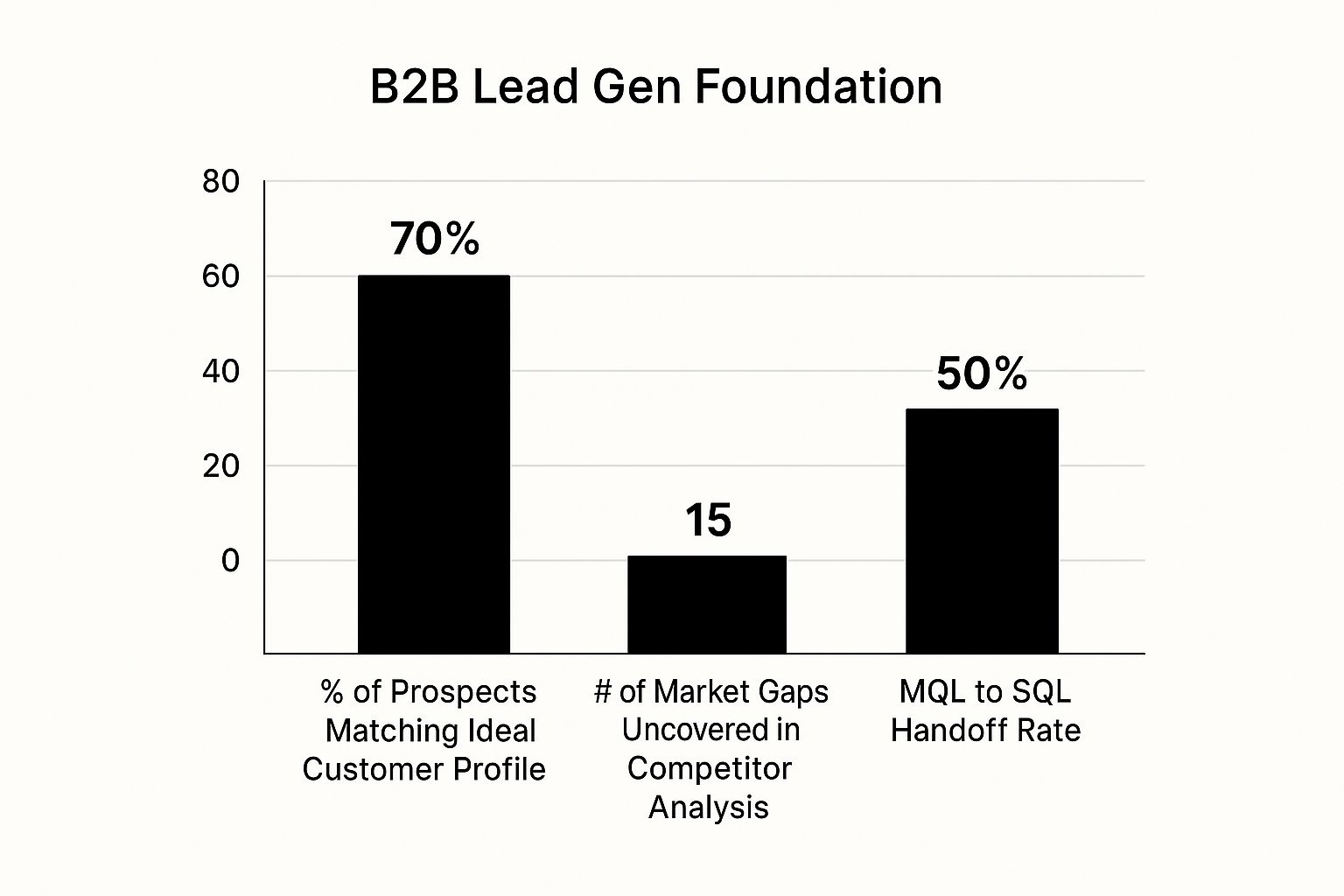
This chart shows what happens when you nail these foundational pieces, comparing metrics like ICP match rate against the crucial MQL-to-SQL handoff.
Infographic about how to generate leads for b2b

The data is clear: a stronger foundation—meaning better ICP alignment and competitor insight—leads directly to a more efficient sales handoff and plugs the leaks in your funnel.

Creating a Sales and Marketing Service Level Agreement

Finally, let's talk about the most common point of failure in B2B lead gen: the chasm between sales and marketing. Marketing generates leads, sales says they’re junk, and the whole process grinds to a halt. This friction kills momentum and wastes a ton of money.

The fix is a formal Service Level Agreement (SLA). This isn’t just a document; it’s a pact between the two teams that defines the rules of engagement. It answers the hard questions:

  • What exactly qualifies a lead as a Marketing Qualified Lead (MQL)? (e.g., Downloaded an eBook AND works at a company of 50+ employees).
  • What actions turn an MQL into a Sales Qualified Lead (SQL)? (e.g., Attended a demo OR requested a price quote).
  • What’s the agreed-upon time for sales to follow up on an SQL? (e.g., 24 hours maximum).
  • What’s the process for handing leads back to marketing for more nurturing? (e.g., A specific "Nurture" status in the CRM).

Getting this shared language and process down on paper eliminates the finger-pointing. It ensures a seamless handoff and transforms your lead generation efforts into a cohesive, revenue-focused machine.

Mastering Inbound Marketing for a Sustainable Lead Flow

Outbound is about chasing. Inbound is about attracting. It’s the difference between knocking on doors and having your ideal customers line up at yours. When you get it right, inbound marketing becomes a powerful magnet—a system that pulls in, engages, and qualifies leads 24/7. It’s no longer a nice-to-have; it’s the core of any predictable B2B growth engine.

A professional working on an inbound marketing strategy on a laptop

The data tells the story. Confidence in old-school outbound is cratering, with just 18% of marketers believing it delivers high-quality leads. The real action is online, where a sharp digital presence is fueling modern B2B growth. If you want to dive deeper, check out these complete B2B sales statistics to see just how much the game has changed.

Before we get into the inbound weeds, it helps to see how it stacks up against its outbound counterpart. They're two sides of the same coin, each with its own strengths.

Inbound vs Outbound Lead Generation Strategies

Here’s a quick breakdown of how these two core approaches compare, from how they work to what they cost and where they shine.

StrategyApproachCost Per LeadSales CycleBest For
Inbound Marketing (SEO, Content)Attracts prospects with helpful content and resources, pulling them into your orbit.Lower over timeLongerBuilding long-term brand authority and a sustainable, scalable lead pipeline.
Outbound Marketing (Cold Calls, Email)Proactively reaches out to a targeted list of prospects, pushing a message out to them.Higher upfrontShorterGenerating immediate meetings and targeting specific high-value accounts (ABM).

Ultimately, the strongest B2B strategies don't choose one or the other—they blend both. But for creating that sustainable, always-on engine, inbound is where you lay the foundation.

B2B SEO: Finding Keywords That Signal Buying Intent

Getting tons of website traffic is a B2C game. For B2B, the only traffic that matters is the right traffic. That means targeting keywords that scream "I have a business problem and I need to solve it now"—the exact problem your product fixes.

A comparison highlights the difference. Someone searching "what is CRM" is just kicking tires (informational intent). But a search for "CRM for manufacturing companies" shows someone actively looking for a solution in their industry (commercial intent). That's a warm lead.

To dig up these high-intent keywords, here's your action plan:

  • Action Step 1: Brainstorm Problem-Based Searches. List the top 5 pain points your product solves. Turn them into "how to" or "fix" queries (e.g., "how to reduce sales cycle length" or "improve marketing attribution").
  • Action Step 2: Hunt for Comparison Keywords. Use an SEO tool to find searches like "[Your Competitor] alternative" or "[Your Product Category] pricing." Anyone searching these is deep in the buying cycle.
  • Action Step 3: Identify Feature-Specific Terms. Look for queries like "salesforce integration for email marketing" that signal a very specific technical need you can fulfill.

Once you have these keywords, don't just throw them on your blog. Your core service and solution pages are your money pages in B2B. Optimize them. This is where serious buyers land to see if you can actually solve their problem.

Content Marketing That Converts

A blog is table stakes. Real B2B content marketing creates high-value assets that prospects will gladly trade their contact information for. These are your lead magnets, and you need to match the format to the buyer.

An engineer will download a dense, 20-page technical white paper. A CFO? They want to plug numbers into an ROI calculator and see the business case in 60 seconds.

Here's a look at how three popular lead magnets stack up in the real world:

Lead Magnet FormatBest ForWhy It WorksDownside
White Papers & eBooksEstablishing deep expertise on complex topics.Positions your brand as a thought leader. Perfect for prospects in the early research phase.Can be a slog to create and might feel less urgent or interactive than other options.
WebinarsDemonstrating your product to an engaged live audience.The real-time interaction is gold. You can answer questions and build personal connections at scale.Takes serious promotion to get people to show up and a confident speaker to keep them engaged.
ROI Calculators & ToolsGrabbing the attention of bottom-of-funnel prospects.These give instant, personalized value and help buyers build a solid business case for your solution.Can be tricky to develop and requires a deep understanding of your customer's financial drivers.

Choosing the right format isn't a trivial decision—it directly impacts the quality and type of leads you generate.

Leveraging LinkedIn for Genuine Authority

LinkedIn isn't just a digital Rolodex. For B2B, it's a powerhouse for building authority, talking directly with prospects, and getting your best content in front of the right eyeballs. The numbers back it up: B2B companies with active blogs generate 67% more leads, and LinkedIn is the number one place to amplify that content.

Actionable Tactic: Don't just post a link and run. Pull a key insight, stat, or quote from your content. Turn it into a native LinkedIn text post that starts a conversation. Then, drop the link to the full article in the first comment. The algorithm favors native content and this approach sparks more engagement.

Let's compare the two approaches:

  • The Passive Approach: A company posts a link: "Check out our new case study!" It gets a handful of likes, mostly from their own employees. Crickets.
  • The Authority-Building Approach: A marketing director pulls the single most surprising statistic from that case study. They write a short post on what that stat means for the industry, ask a smart question, and then drop the link to the full study in the comments. This sparks debate, positions them as an expert, and drives clicks from people who are genuinely interested.

This is how you turn a passive content library into an active conversation starter—generating leads who already see you as someone they can trust.

Executing Targeted Outbound and Paid Campaigns

Inbound marketing is a fantastic long-term play, like planting an orchard. But sometimes, you need fruit now. This is where targeted outbound and paid campaigns come in. They give you the speed and precision to spark conversations with high-value accounts, test new messaging, and keep the pipeline full while your inbound engine gets up to speed.

A digital marketing campaign dashboard showing performance metrics on a screen

Let's be clear: this isn't about spamming the masses. Modern outbound is a surgical strike, not a carpet bomb. When you learn how to generate leads for B2B, you realize it’s all about controlling your timing and targeting with absolute accuracy. Forget those stale, impersonal templates. Success today is built on real personalization and coordinating your outreach across multiple channels.

Crafting Outbound Sequences That Actually Get Replies

The first rule of modern outbound? Stop selling and start a conversation. Your only goal with that first email isn't to close a deal—it's just to get a response. That means shifting away from generic pitches and toward genuinely helpful, personalized outreach.

It all starts with a rock-solid, curated list. Stop buying massive, stale contact databases. Instead, fire up tools like LinkedIn Sales Navigator or ZoomInfo to build a small, hyper-focused list of people who are a perfect match for your Ideal Customer Profile (ICP).

With your list in hand, you can build a multi-step sequence that uses a few different touchpoints. Here's an actionable template:

  • Day 1: Email 1 (The Hook). Lead with a personalized insight. Did their company just announce something? Do you have a shared connection? Did you notice a problem relevant to their role? Start there.
  • Day 3: Email 2 (The Value Add). Send over a helpful resource. This isn't a sales pitch. It’s a relevant case study, a benchmark report, or an interesting article.
  • Day 4: LinkedIn Connection. Send a connection request. Add a short, personalized note that references your email so they have some context.
  • Day 7: Email 3 (The Gentle Nudge). One last, brief follow-up. Just a quick check-in to see if your initial message resonated.

The key is being persistent without being a pest. Every single touchpoint has to deliver some kind of value.

Paid campaigns are your direct, scalable line to buyers, right at the moment they’re looking for what you sell. For most of us in B2B, the two main battlegrounds are Google Ads and LinkedIn Ads. They both get the job done, but they serve completely different strategic purposes.

Figuring out the core differences is the key to spending your budget wisely.

PlatformBest ForAudience TargetingUser Intent
Google AdsCapturing high-intent demand.Based on keywords and search behavior.Active Intent: Users are actively searching for a solution to a problem.
LinkedIn AdsGenerating new demand and ABM.Based on firmographics like job title, industry, and company size.Passive Intent: Users are not actively searching but fit your ideal customer profile.

Actionable Takeaway: Use Google Ads to target people already looking for you (or a solution like yours). Use LinkedIn Ads to target the specific people at the specific companies you want to do business with, even if they aren't looking yet. A mature strategy uses both.

Optimizing Your Paid Campaigns for Maximum ROI

Anyone can launch a campaign. Making it profitable is the hard part. The gap between burning cash and generating quality leads is closed by relentless, obsessive optimization.

Here are actionable tips for each platform:

For Google Ads:

  • Action Step 1: Focus on Long-Tail Keywords. Don’t waste your budget bidding on broad, expensive terms like "CRM software." Get specific. Target phrases like "CRM for small manufacturing firms." The search volume is lower, but the intent—and the lead quality—is sky-high.
  • Action Step 2: Create Hyper-Relevant Landing Pages. Your ad copy and your landing page need to be perfectly in sync. If your ad promises an "ROI calculator," the landing page better have an ROI calculator front and center, not your generic homepage.
  • Action Step 3: Use Negative Keywords Aggressively. Actively block your ads from showing up for search terms you don't want. Add terms like "free," "jobs," or "training" to your negative keyword list. This is one of the easiest ways to protect your budget.

For LinkedIn Ads:

  • Action Step 1: Get Granular with Audience Targeting. Layer those targeting options. Don't just target "Marketing Managers." Target "Marketing Managers" at "SaaS companies" with "100-500 employees" who are members of specific industry groups. The more specific, the better.
  • Action Step 2: Test Compelling Offers. A "Request a Demo" CTA is a big ask. Instead, try offering high-value content—a webinar, an exclusive report, or a free assessment tool. Give them something valuable in exchange for their contact info.
  • Action Step 3: Use Retargeting. Install the LinkedIn Insight Tag on your website. This is crucial. It lets you run specific campaigns targeting people who have already visited your site, keeping your brand top-of-mind with a warm audience.

Leveraging AI and Technology to Scale Your Efforts

Let's be honest: manual effort alone won't get you there. In B2B lead generation, technology is the great equalizer. It’s the force multiplier that lets you work smarter, not just harder.

The right tech stack can turn a series of disconnected actions into a cohesive, humming system. It automates the grunt work and digs up the data insights that actually matter.

A graphic showing AI-powered technology scaling B2B marketing efforts

This isn’t about chasing every shiny new tool. It’s about building a solid foundation with a few core platforms, then layering in AI to get a real competitive edge. The goal is simple: automate the mundane so your team can focus on what humans do best—building relationships.

The Essential B2B Tech Trio

Every serious B2B marketing team runs on a foundational tech stack. This trio is the central nervous system for your entire operation, responsible for capturing data, managing relationships, and figuring out what's actually working.

  • Customer Relationship Management (CRM): This is your single source of truth for every prospect and customer. Think of it as your team's collective memory.
  • Marketing Automation Platform: This is the engine that drives your campaigns, handling everything from email nurturing and lead scoring to landing pages.
  • Analytics Tools: These platforms cut through the noise to show you what’s driving results and what’s a waste of time, helping you make decisions based on data, not guesses.

Many platforms now bundle these functions. HubSpot, for example, is a fantastic all-in-one solution for small to mid-sized businesses that need a system that just works out of the box. On the other end of the spectrum, a platform like Marketo (Adobe) offers incredibly deep customization, making it a better fit for enterprise teams with dedicated ops staff.

It boils down to the classic "ease of use vs. raw power" debate. If you need to get running quickly with a less technical team, HubSpot is a no-brainer. If you have complex workflows and need granular control over every little detail, Marketo provides that power.

Game-Changing AI Applications in Lead Generation

Once your foundation is solid, AI is where you really start to pull away from the competition. It goes way beyond simple automation to make intelligent predictions and personalize interactions in ways that just weren't possible a few years ago.

AI doesn't replace marketers; it gives them superpowers. It handles the repetitive, data-heavy lifting, freeing up your team to be more creative and strategic. The real win is using AI to deliver a better, more relevant experience to your prospects at scale.

Here are three practical ways B2B teams are using AI right now to generate more qualified leads:

  1. Predictive Lead Scoring: Traditional lead scoring relies on rules you set up manually (e.g., "add 10 points if they visit the pricing page"). Predictive scoring is different. It uses AI to analyze historical data from all your won and lost deals, identifying the subtle patterns of your best customers. It then automatically scores new leads based on their likelihood to close, letting your sales team focus only on the absolute hottest prospects.
  2. AI-Powered Personalization: Writing truly personalized emails for hundreds of prospects is a massive time sink. AI tools can analyze a prospect's LinkedIn profile, company news, and industry trends to suggest hyper-relevant opening lines or talking points for your outreach. This gives you the scale of automation with the personal touch that actually gets replies.
  3. Intelligent Chatbots: Forget the clunky, rules-based chatbots of the past. Modern AI chatbots understand natural language, answer complex questions, and qualify visitors in real-time on your website. They can even book meetings directly on a sales rep's calendar, ensuring you never miss an opportunity with a high-intent visitor—even at 2 AM.

Building Your Tech Stack Without Creating Chaos

Adding new tools is exciting, but it can quickly lead to a messy, disconnected system if you're not careful. The key is to start with a clear problem you're trying to solve. Don't buy an AI personalization tool just because it's trendy; buy it because your sales team is struggling to personalize outreach effectively.

Here’s a look at the core categories that make up a powerful B2B lead gen stack.

Essential B2B Lead Generation Tech Stack

Tool CategoryCore FunctionalityExample Tools
CRMManages all prospect and customer interactions and data.Salesforce, HubSpot CRM, Zoho CRM
Marketing AutomationAutomates email campaigns, lead nurturing, and scoring.Marketo, Pardot, ActiveCampaign
AI PersonalizationCreates personalized outreach content at scale.Lavender, Jasper, Regie.ai
Analytics & BITracks and visualizes marketing performance and ROI.Google Analytics, Tableau, Looker Studio

By building your tech stack one piece at a time, you ensure each tool serves a distinct purpose. This strategic approach helps you create an efficient machine for generating B2B leads. To see how these pieces fit together, you can learn more about how to use AI for marketing automation in our detailed guide.

Turning Interest Into Revenue: Funnel Nurturing and Measurement

Getting a lead is the starting line, not the finish line. The real work—and where most deals are won or lost—is in the careful process of guiding that initial flicker of interest into a signed contract. This is where smart nurturing and relentless measurement come into play.

Just tossing a raw lead over the fence to the sales team is a recipe for wasted effort. You need to build trust, educate your prospects, and move them through the funnel until they're not just qualified, but genuinely ready for a sales conversation.

Designing Automated Nurturing Sequences That Actually Work

Good nurturing isn't about spamming prospects with random emails. It’s a strategic, automated sequence designed to deliver the right message at exactly the right time. Your goal is to be a helpful guide, not just another pushy salesperson in their inbox.

One of the biggest mistakes I see is treating every lead the same way. A prospect who downloaded a top-of-funnel eBook needs a completely different conversation than someone who just sat through a 45-minute product demo.

Here’s a direct comparison of how that plays out:

Nurturing ScenarioPrimary GoalContent Focus
Post-Webinar Follow-UpCapitalize on high engagement and drive immediate action.Send the recording, share related resources, and offer a direct call-to-action for a demo.
Cold Lead Re-engagementReignite interest from leads who have gone dark.Offer a new, high-value asset, share a compelling case study, or invite them to a different event.

Think of these sequences as conversation pathways. If someone clicks on a case study about ROI, your next touchpoint should probably focus on financial benefits. If they downloaded a technical white paper, send them more feature-focused information next. It’s all about relevance.

Moving Beyond Vanity Metrics

Knowing how to generate leads for B2B is only half the battle; you have to measure what actually matters. It's way too easy to get mesmerized by vanity metrics like total lead volume or website traffic. Sure, they look great on a slide, but they don’t tell you if you're actually making money.

Actionable Takeaway: Connect your marketing platform to your CRM. This is non-negotiable. You must be able to track performance from the first click to the final close. This allows you to tie every dollar spent back to a measurable business outcome.

To get serious about performance, you need to focus on KPIs that truly signal business health. This isn't just a trend; it's a fundamental shift. A recent look at B2B lead generation metrics shows that while things like clicks are still tracked, 28.6% of marketers now consider direct sales or revenue generated as their most important metric. That’s a clear signal that the focus is on bottom-line impact. You can see more B2B lead generation stats over at databox.com.

This means zeroing in on a handful of business-critical KPIs.

Pinpointing KPIs That Signal Business Health

To really understand if your marketing is working, you need metrics that connect your activities directly to sales outcomes. These are the numbers your CFO and CEO actually care about.

Here are the three you absolutely can't ignore:

  1. Lead-to-Customer Rate: This is the ultimate sniff test for lead quality. It tells you exactly what percentage of the leads you generate become paying customers. If this number is low, you either have a targeting problem (Action: Revisit your ICP) or your nurturing process is broken (Action: Analyze your email sequence performance).
  2. Cost Per Acquisition (CPA): This is the bottom line. It calculates the total cost to acquire one new customer, rolling up everything from ad spend and software licenses to salaries. A healthy business ensures the CPA is significantly lower than a customer's lifetime value (LTV). (Action: If CPA is too high, audit your ad spend for inefficient campaigns).
  3. Sales Cycle Length: How long does it take for a lead to become a customer? Tracking this helps you forecast revenue and spot bottlenecks in your funnel. If your sales cycle is getting longer, it could mean leads aren't being properly qualified before the sales handoff. (Action: Review your MQL/SQL definitions with sales).

When you focus on these metrics, the conversation shifts from "we generated 500 leads" to "we generated $250,000 in new pipeline with a CPA of $5,000." For a comprehensive look at what to track, check out our guide on essential lead generation key performance indicators. This is how you start speaking the language of business impact and prove real marketing ROI.

Common B2B Lead Generation Questions

You're not alone. The world of B2B lead generation is full of the same recurring questions and challenges. Here are some straight answers to the hurdles most marketers hit on the path to building a predictable sales pipeline.

How Long Until I See B2B Lead Generation Results?

This really comes down to a classic speed vs. sustainability trade-off. The timeline depends entirely on the channels you pick.

  • Inbound Marketing (SEO & Content): Think of this as a long-term investment. You're building an asset—organic authority—and that just takes time. Realistically, expect to see a consistent flow of high-quality leads after 6 to 12 months of dedicated effort.
  • Outbound & Paid Ads: These tactics are built for pure speed. A well-tuned LinkedIn or Google Ads campaign can start pulling in leads within a few days. The catch? The moment you turn off the budget, the leads stop.

The smartest approach is usually a blended one. Use paid campaigns to get some immediate wins and sales pipeline flowing while your more sustainable inbound engine is warming up in the background.

What Is the Biggest Mistake in B2B Lead Generation?

The single most common—and most expensive—mistake is the disconnect between sales and marketing. It’s a classic story: marketing generates leads that sales immediately dismisses as unqualified. This misalignment doesn't just waste budget; it creates massive internal friction.

It's no surprise that 85% of B2B marketers point to lead generation as their number one challenge. This siloed thinking is a huge reason why.

Actionable Fix: Implement a formal Service Level Agreement (SLA). Don't think of it as just another document. It's a pact. Schedule a meeting with sales and marketing leadership to agree on the exact definition of a "qualified lead" and map out the handoff process step-by-step.

Getting this alignment in place ensures everyone is pulling in the same direction: revenue.

Should I Focus on Lead Quality or Quantity?

For pretty much every B2B business out there, the answer is simple: quality trumps quantity, every single time.

A massive volume of leads might look great on a marketing dashboard, but it often just buries the sales team in dead-end conversations. That tanks both their morale and their efficiency.

It’s far more effective to focus on attracting a smaller number of high-quality leads who are a perfect match for your Ideal Customer Profile (ICP). This leads to a much smoother sales process and a way higher chance of landing valuable, long-term customers.

Which Lead Generation Channel Has the Best ROI?

There's no magic bullet that works for every single industry, but a couple of channels consistently deliver the best bang for your buck.

Organic search (SEO) and email marketing frequently come out on top. Why? Because they're owned channels. Once you build them up, the long-term costs are significantly lower than paid alternatives.

For companies that need results faster and have the budget for a higher cost per lead, targeted LinkedIn Ads can provide a fantastic return by letting you reach specific decision-makers with surgical precision.

The real key is to test a few channels, see what resonates with your specific audience, and then double down on what works.


Ready to transform your marketing with a platform that scales content, optimizes campaigns, and personalizes customer journeys? marketbetter.ai integrates AI across your entire strategy to drive measurable growth. Discover how our AI-powered marketing platform can help you generate higher-quality B2B leads by visiting us at https://www.marketbetter.ai.
A Modern Guide to Inbound Lead Generation

· 26 min read

Inbound lead generation isn't about chasing customers. It's about drawing them in.

Think of it as earning attention instead of renting it. In a world saturated with interruptive ads and cold calls, an inbound lead generation strategy focuses on creating genuinely helpful content and experiences that solve your ideal customers' problems. This approach builds trust from the very first interaction, turning strangers into interested prospects and laying the foundation for a sustainable growth engine.

The Magnetic Approach to Attracting Customers

Let's be honest, old-school marketing often feels like shouting into a void. You blast out a generic message and just hope someone, somewhere, is listening. This is the core of outbound: pushing a message out.

Inbound is the polar opposite. It’s a powerful magnet. It pulls in the right people—the ones who are already out there actively searching for the exact solutions you offer. Instead of shoving a sales pitch in their face, you're offering up a helping hand, a useful piece of advice, a solution. You build a relationship first.

This shift completely changes the customer's journey. They find you on their own terms, which makes them far more receptive to what you have to say. It’s a trust-based approach that doesn’t just get you a lead; it creates a loyal customer who might just become your biggest fan.

The Three Stages of the Inbound Flywheel

The whole inbound methodology is powered by a simple, continuous cycle with three stages. Each part is designed to build on the last, creating momentum and a seamless experience that keeps people coming back.

  • Attract: This is all about pulling in the right crowd. You’re not trying to get just any traffic; you want the people who are a perfect fit for your business. Your action item: Start by building a content plan around the problems your ideal customers are trying to solve. Use tools like AnswerThePublic or Google's "People also ask" feature to find the exact questions they're typing into search engines. This is the foundation for valuable blog posts, social media updates, and smart SEO strategies.

  • Engage: Okay, you've got their attention. Now what? The goal here is to offer solutions that line up perfectly with their needs and goals. This is where you might offer a compelling ebook, a deep-dive webinar, or a helpful template in exchange for their contact info. It's the start of a real conversation. Your action item: For every "Attract" stage blog post you create, design a corresponding "Engage" stage asset. For a post on "10 Social Media Tips," offer a downloadable "Social Media Content Calendar Template."

  • Delight: The job isn't done once they become a customer. This final stage is about delivering such an incredible experience that they can't help but tell others about you. Your action item: Set up an automated check-in email 30 days post-purchase asking for feedback or offering advanced tips. This simple action turns a transaction into a relationship and fuels positive reviews.

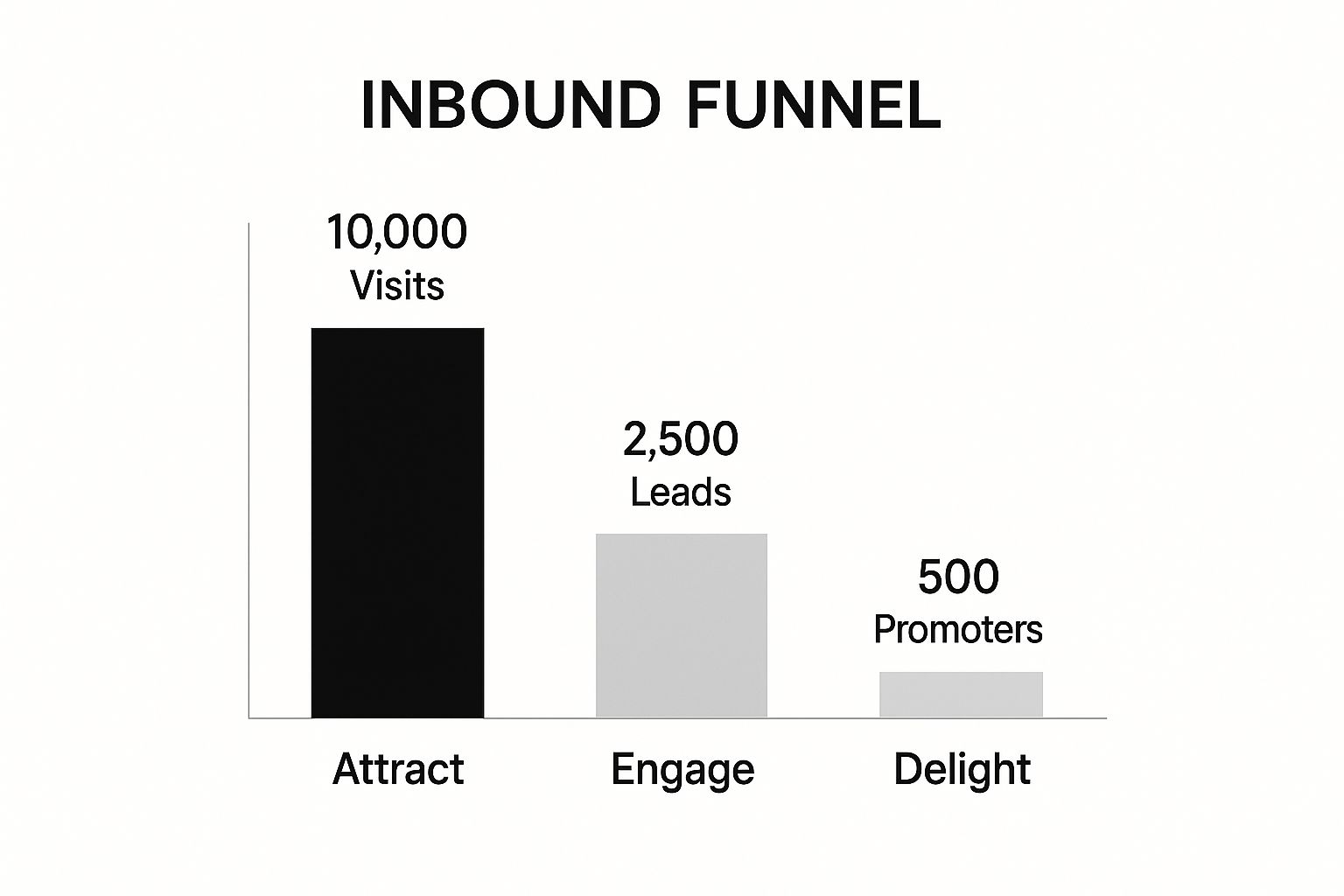
This chart gives you a real-world look at how this plays out, showing what can happen with an initial 10,000 website visitors as they move through the funnel.

Infographic about inbound lead generation

As you can see, people naturally drop off at each stage. That's totally normal. But it also shows just how critical it is to nail every single interaction, turning more of those initial visitors into leads, and eventually, into your most passionate brand advocates.

Choosing Your Approach: Inbound vs. Outbound

Two arrows pointing in opposite directions representing the different approaches of inbound and outbound lead generation

When you're trying to fill your pipeline, every dollar counts. Getting a handle on the core difference between inbound and outbound lead generation is the first step to spending your budget wisely.

Think of it this way: inbound is a magnet, and outbound is a megaphone.

Inbound marketing acts like a magnet, pulling in prospects who are already out there looking for answers you can provide. Outbound marketing is the megaphone, blasting your message out to a broad audience, hoping to catch the attention of a few.

Both can work, sure. But their methods, costs, and the kind of value they create over time couldn't be more different. An outbound strategy is all about initiating contact—think cold calls, email blasts, or paid ads that interrupt someone's day. It's designed for immediate, if sometimes unpredictable, results.

On the other hand, an effective inbound lead generation strategy is about building valuable assets. We're talking about blog posts, in-depth guides, and webinars that organically attract people who have a problem you can solve. This approach isn't just about getting a lead; it's about building trust and positioning yourself as the go-to expert.

Evaluating Key Business Factors

So, where do you put your money? It really comes down to the quality and longevity you're after.

Outbound campaigns, especially things like paid ads, have a simple on/off switch. The second you stop pumping money into them, the leads dry up. You're essentially renting attention.

Inbound marketing is different. It's about building assets that pay dividends for years. A single, high-ranking blog post can keep attracting qualified leads month after month, long after you hit publish. This is why content marketing consistently delivers three times more leads than traditional marketing, and at a much lower cost. It's an investment that compounds.

The real split is between permission and intent. Inbound leads come to you—they’ve raised their hands by downloading your guide or reading your blog. Outbound often means showing up uninvited, forcing you to convince someone they have a problem in the first place.

This distinction has a massive impact on lead quality. Inbound leads have already done their homework. They've found you. They're naturally warmer and more educated, which almost always leads to shorter sales cycles and better conversion rates than you'll see from a cold outbound list.

A Strategic Comparison of Inbound vs. Outbound Lead Generation

To really nail down which approach (or what mix) is right for you, it helps to see them side-by-side. This table breaks down the core differences between inbound and outbound marketing across key business metrics to inform your strategic planning.

MetricInbound Lead Generation (The Magnet)Outbound Lead Generation (The Megaphone)
ApproachAttracts interested prospects by providing valuable content and solutions. The buyer initiates contact.Proactively reaches out to a broad audience, often interrupting their day. The company initiates contact.
Lead QualityLeads are generally higher-quality and more qualified as they have self-identified a need.Leads are often colder and require significant nurturing and qualification to determine interest.
Cost-EffectivenessTends to be more cost-effective over time, with a lower cost per lead as content assets mature.Can be expensive, with costs directly tied to campaign activity (e.g., ad spend, call volume).
Long-Term ValueCreates sustainable, long-lasting marketing assets (SEO, content) that generate leads continuously.Provides short-term results that typically stop when the campaign ends. It doesn't build lasting assets.
ScalabilityHighly scalable. A single piece of content can serve thousands of prospects without increased effort.Can be resource-intensive to scale, often requiring more budget or a larger sales team to expand reach.
Buyer ControlEmpowers the buyer, allowing them to research and engage on their own terms, building trust.The seller is in control of the interaction, which can sometimes feel intrusive or pushy to the buyer.

Ultimately, a strong marketing engine often uses a blend of both. But understanding where each one shines helps you build a smarter, more sustainable plan for growth.

The Three Pillars of an Inbound Strategy

Three interlocking gears representing SEO, Content, and Social Media as the pillars of an inbound strategy

A powerful inbound lead generation engine isn’t something you just switch on. It’s built on three core pillars that have to work in lockstep: Search Engine Optimization (SEO), Content Marketing, and Social Media Engagement.

Think of it like a three-legged stool. If one leg is shaky or missing entirely, the whole thing topples over. To build a system that reliably pulls in qualified leads, you need to understand how these three elements feed and amplify each other.

Pillar 1: Search Engine Optimization

SEO is what makes you discoverable. It’s the foundation. Without it, the most brilliant content on earth is just shouting into the void. The mission is simple: when your ideal customer types a problem into Google, you need to be one of the first solutions they see.

This work starts way before you write a single headline. The first step is to perform effective keyword research. This isn't just about chasing high-volume terms; it's about getting inside your audience's head to understand the exact questions, pain points, and phrases they use.

For instance, a keyword like "marketing software" is a battleground. But a more specific, high-intent phrase like "AI-powered content creation for B2B tech" is much more likely to attract someone who has a real, immediate need.

Actionable On-Page SEO Checklist

Once you know what terms you're targeting, you have to optimize your content. Here’s a quick checklist to run through for every piece you publish:

  • Title Tag: Get your main keyword in there, preferably near the start. But make it sound human—it needs to earn the click.
  • Meta Description: This doesn't directly impact rankings, but it's your sales pitch in the search results. Write it to persuade someone to choose your link over the nine others on the page.
  • Headings (H1, H2, H3): Use your primary keyword in the main H1 heading. Sprinkle variations throughout your subheadings (H2s, H3s) to give the page a logical structure for both people and search engines.
  • Internal Linking: Weave in links to other relevant blog posts and service pages on your site. This shows search engines how your content is connected and keeps visitors on your site longer.

Pillar 2: Content Marketing

If SEO is the foundation, content is the actual house you build on it. This is where you deliver real value that turns a random visitor into a genuine lead. Here’s the secret to inbound lead generation: great content isn't about selling your product; it's about solving your audience's problems.

The trick is to create different assets for different stages of their journey. A prospect who is just starting to realize they have a problem needs something very different from someone who's already comparing vendors. This is where knowing your audience becomes non-negotiable. To nail this, you have to master identifying and understanding your audience segments. Our guide on customer segmentation strategies is a great place to start.

Creating valuable content isn’t a one-off task; it’s a commitment to becoming the most trusted resource in your industry. When you consistently answer your audience’s questions, they stop seeing you as a vendor and start seeing you as a partner.

Your content library needs variety. Blog posts are fantastic for pulling in top-of-funnel traffic, but you need meatier assets to actually capture leads. Action item: Map your existing content to the buyer's journey (Awareness, Consideration, Decision). You'll likely find you have plenty of "Awareness" content (blogs) but are thin on "Consideration" (comparison guides) or "Decision" (case studies). This gap analysis instantly builds your next content calendar.

  • Ebooks and Whitepapers: These offer a deep dive into a specific topic and are perfect for gating behind an email sign-up form.
  • Webinars: A live, interactive training session establishes your authority like nothing else and lets you engage directly with potential customers.
  • Templates and Checklists: Give away practical, hands-on tools that solve an immediate problem for your audience. They're incredibly effective lead magnets.

Pillar 3: Social Media Engagement

Social media is the megaphone for your content and the handshake for your brand. And for B2B companies, one platform consistently punches above its weight for inbound leads: LinkedIn.

This is where you graduate from just dropping links. It’s about building authority, joining real industry conversations, and funneling highly relevant traffic back to your website. Unlike other platforms built for entertainment, LinkedIn is where professionals and decision-makers go looking for solutions.

The numbers don't lie. Content marketing can generate three times more leads than old-school marketing, and it does so at up to 62% less cost. Pair that with LinkedIn, where 89% of B2B marketers go to generate leads, and you've got a powerhouse combination. In fact, LinkedIn's own Lead Gen Forms boast an average conversion rate of 13%—more than five times higher than what you'd typically see on a landing page.

Here’s how to put it into action:

  1. Share Content with Context: Never just post a link and walk away. Pull out a juicy quote, a surprising stat, or a challenging question to kickstart a conversation.
  2. Engage in Relevant Groups: Find the LinkedIn Groups where your ideal customers hang out. Answer questions and offer real insights, but don't be spammy.
  3. Activate Your Team: Encourage your sales and leadership teams to share company content and build their own professional brands. A post from a person will almost always get more reach than a post from a company page.

Your Essential Inbound Lead Generation Toolkit

A digital illustration showing a toolbox filled with software logos representing CRM, SEO, and marketing automation tools.

Trying to run a modern inbound strategy without the right tech is like trying to build a house with only a hammer. You might get a few boards nailed together, but you’re not building anything that will last. If you want to scale your efforts, manage relationships effectively, and actually prove your ROI, you need to stock your toolbox.

Building the perfect tech stack isn’t about grabbing the most expensive software off the shelf. It’s about picking tools that actually talk to each other, automate the grunt work, and give you clear insights. For any serious B2B team, there are three non-negotiables: a CRM, SEO tools, and Marketing Automation software.

Choosing Your Core CRM Platform

Think of your CRM as the central nervous system for your entire inbound machine. It’s the single source of truth where every bit of lead data lives—from their first anonymous website visit to their most recent call with sales. Getting this decision right is foundational; it impacts everyone.

HubSpot vs. Salesforce: A Quick Comparison

FeatureHubSpotSalesforce (Marketing Cloud)
Core StrengthAn all-in-one platform built from the ground up for inbound marketers. It just works.An incredibly powerful and customizable platform built for complex, large-scale enterprises.
Best ForSMBs and mid-market companies that need a single, unified solution for marketing, sales, and service.Large enterprises with dedicated admin teams who need deep customization and complex integrations.
Learning CurveLow. The interface is intuitive, so teams can get up and running fast without tons of training.High. You often need a certified administrator just to set it up and manage it properly.

For most teams just dipping their toes into inbound lead generation, HubSpot is usually the path of least resistance. Its real power is how seamlessly everything is integrated. The marketing, sales, and service hubs feel like one cohesive system because they were built that way. Salesforce is a beast, but it can often feel like you’re duct-taping different systems together, which takes a lot more technical know-how.

Mastering Visibility with SEO Tools

You can pour your heart into creating the best content in your industry, but if no one can find it, it might as well not exist. SEO tools are your eyes and ears on the ground. They show you what your audience is actually searching for, how your competitors are ranking, and where your biggest opportunities are hiding.

The two heavyweights in this arena are Ahrefs and SEMrush. They both cover the basics—keyword research, backlink analysis, site audits—but they each have their own personality.

  • Ahrefs: This is the gold standard for backlink data. If your strategy is heavily focused on building links and reverse-engineering your competitors' link profiles, Ahrefs gives you an undisputed advantage. It's a specialist's tool.
  • SEMrush: This platform is more of a comprehensive digital marketing suite. It has powerful features that go beyond SEO, covering PPC, content marketing, and social media analytics. It’s a great pick if you want an all-in-one platform to manage your online visibility.

Your choice really comes down to focus. Are you a link-building purist? Go with Ahrefs. Do you need a versatile toolkit that covers the whole marketing landscape? SEMrush is your powerful generalist.

Scaling Engagement with Marketing Automation

If your CRM is the nervous system, marketing automation is the engine that drives everything forward. This is the software that lets you deliver the right message to the right person at the right time, turning lukewarm leads into sales-ready prospects without you having to lift a finger for every email.

It's no surprise the demand for this tech is exploding. The lead generation solutions market in North America was valued at over US$1.22 billion in 2021 and is projected to hit US$3.62 billion by 2028. This growth is being driven by AI-powered lead scoring and automation that makes the whole process more efficient. You can see more on the growth of lead generation technology on growthlist.co.

Automation isn't about replacing the human touch. It's about saving it for the moments that truly matter. It handles the repetitive follow-ups so your team can focus on building real relationships with your most engaged leads.

This is where AI is really starting to shine, especially with intelligent lead scoring. By crunching thousands of data points, these platforms can predict which leads are most likely to buy, helping your sales team focus their energy where it counts. To go deeper, check out our guide on how predictive analytics in marketing is changing the game.

Tools like Marketo or Pardot (now Marketing Cloud Account Engagement) are leaders here, giving you the power to build complex nurturing workflows and align tightly with sales for a seamless handoff.

Measuring Your Inbound Marketing Success

Running an inbound strategy is one thing. Proving it actually works? That’s a whole different ballgame.

To show the real value of all that content, SEO, and social media effort, you have to look past the easy-to-find vanity metrics. Things like social media likes or raw website traffic feel good, but they don't pay the bills. The real focus needs to be on Key Performance Indicators (KPIs) that tie directly to business growth.

Think of it like this: website traffic is just the number of people window-shopping at your store. It’s nice to have a crowd, but it doesn’t tell you who’s actually ready to buy. True measurement for inbound lead generation hones in on the actions that turn those window shoppers into paying customers.

To really nail this, you have to learn how to measure SEO success beyond rankings. It’s a critical shift in mindset that moves the conversation from "Are we visible?" to "Are we profitable?"

Key Metrics That Actually Matter

To get a clear picture of your inbound ROI, you need a dashboard that tracks the right stuff. Forget the noise and start with these three core metrics. Together, they tell the full story, from a prospect's first click to the final sale.

  • Lead Conversion Rate: This is your gut check. It’s the percentage of visitors who take the action you want them to, like filling out a form for an ebook. It tells you flat-out if your content and landing pages are hitting the mark. A low rate? Your offer might be weak, or your form is a pain to fill out.

  • Cost Per Lead (CPL): This one is simple but powerful. It’s how much you’re spending to get one new lead. Just divide your total marketing spend by the number of new leads you generated in that period. This is how you spot which channels are efficient and which ones are just eating your budget.

  • Customer Acquisition Cost (CAC): Here it is—the metric that matters most to your CFO. CAC measures the total cost of winning a new customer, blending all your marketing and sales expenses. For a business to be healthy, your CAC has to be way lower than the lifetime value (LTV) of a customer. No exceptions.

From Metrics to Business Impact

Tracking these numbers is just step one. The real magic happens when you connect them to actual revenue, and that’s where a good CRM is non-negotiable.

There’s a reason 67.8% of marketers use a CRM to store and track their leads. They’re trying to close the gap. While 91% of marketers say lead generation is their top priority, a sobering 80% of those new leads never become customers. That’s a massive disconnect between effort and results.

Let's look at two common scenarios that show why connecting the dots is so important:

ScenarioMarketing's FocusThe ProblemThe Fix
Scenario ADriving huge traffic numbers to the blog.Traffic is high, but no one's converting. The sales team complains the leads are junk.Stop chasing traffic. Focus on Lead Conversion Rate. Go back to your top-performing posts and add stronger calls-to-action and better lead magnets.
Scenario BGenerating a high volume of leads.The lead count is up, but the Customer Acquisition Cost is through the roof. Deals are taking forever to close.Stop treating all leads equally. Use lead scoring to flag the ones ready to talk and use nurturing workflows to warm up the rest.

When you analyze these metrics together, you can diagnose what's broken and make decisions based on data, not guesswork. If your CPL is low but your CAC is high, that’s a red flag waving over the handoff between your marketing and sales teams.

For a deeper dive into setting up these tracking systems, our guide on essential lead generation key performance indicators has you covered. This is how you turn your marketing from a cost center into a predictable revenue engine.

How to Build Your Inbound Lead Generation Plan

Alright, let's get practical. Moving from inbound theory to an actual, documented plan is where the magic happens. A killer inbound lead generation strategy isn't something you stumble into; it’s built, piece by piece, with a clear framework. This is the process that turns your big-picture goals into daily tasks your team can actually run with.

Think of your plan as the architectural blueprint for your marketing engine. Without one, you're just bolting random parts together and hoping for the best. A solid plan ensures every blog post, every keyword, and every email serves a purpose.

Start with Your Ideal Customer Profile

Before you write a single headline, you have to know exactly who you're talking to. Your Ideal Customer Profile (ICP) is more than a vague persona—it’s a razor-sharp portrait of the perfect-fit customer for your business. This is your north star.

To make an ICP that actually works, you have to go deeper than the usual demographics. Dig into the real-world details that define a high-value account for your company.

  • Firmographics: What's the sweet spot for company size, industry, and annual revenue? Are they all in a specific region?
  • Technographics: What’s in their tech stack right now? Are they using tools that compete with yours, or ones that complement it?
  • Pain Points: This is the big one. What specific, nagging business problems are they dealing with that your product was built to solve?

An unfocused plan tries to be everything to everyone and ends up being nothing to anyone. A sharp ICP ensures your resources are aimed at prospects who are most likely to convert, stay, and grow.

The most common mistake I see is an ICP that’s way too broad. "Mid-sized tech companies" is a starting point, not a target. Contrast that with something like: "B2B SaaS companies in North America with 50-200 employees, using Salesforce, who are struggling with slow, inconsistent content creation." Now that gives your team a clear target to aim for.

Audit and Map Your Content

With your ICP locked in, it's time to take stock of your content arsenal. A content audit isn't about judging what you've done in the past. It's a strategic look at what you already have, what you can repurpose, and where the glaring holes are. The whole point is to map every piece of content to a specific stage of the buyer's journey.

Actionable Content Mapping Checklist:

  1. Inventory Your Assets: Get a spreadsheet going and list everything you've got—blog posts, whitepapers, case studies, webinars, the works.
  2. Align with Buyer Stages: Tag each piece of content with its corresponding buyer stage: Awareness, Consideration, or Decision. Does that blog post answer a high-level question? Or does that case study help someone compare their options?
  3. Find the Gaps: Now, where are the holes? It's common to find you're flush with awareness-stage blog posts but have almost nothing for the consideration stage, like comparison guides or ROI calculators. This is your new to-do list.
  4. Build a Content Calendar: Map out your content creation for the next quarter. Assign topics, formats, and due dates to fill the gaps you just found. This ensures you’re consistently publishing valuable stuff for your ICP, no matter where they are in their journey.

Design Your Lead Nurturing Workflow

So, a prospect just downloaded your ebook. Great! But the journey has just begun. A lead nurturing workflow is your automated system for guiding them from that initial interest toward a real sales conversation. This is where your marketing automation platform really earns its keep.

Your workflow needs to feel like a conversation, not a sales pitch. Instead of just spamming them with product features, deliver more value that builds on why they came to you in the first place. For instance, if someone downloaded an ebook on "SEO Basics," your nurture sequence could follow up with an invite to a webinar on "Advanced Link Building," and then maybe offer a free "Content Audit Template."

This step-by-step approach builds trust and quietly qualifies leads over time. By the time that person gets handed off to sales, they're not cold—they're educated, engaged, and ready for a much more productive chat. And that, right there, is how you dramatically improve your conversion rates.

Got Questions? We've Got Answers.

Switching to an inbound strategy always kicks up a few big questions. That's a good thing. Getting clear on the timeline, budget, and team dynamics upfront is the difference between a program that flies and one that fizzles out. Let's tackle the questions that come up most often when B2B teams start this journey.

How Long Until This Inbound Thing Actually Works?

This is always the first question, and the answer requires a total mindset shift. You're not flipping a switch on a paid ad; you're planting an orchard.

You can expect to see the first green shoots—some initial traction—within 3-6 months. But for a predictable, steady harvest of leads, you’re looking at the 6-12 month mark. Why so long? The first few months are all foundational work: deep keyword research, publishing your first pillar pages and blog posts, and getting your lead capture forms dialed in.

Think of it like this: Outbound is a sugar rush. It gives you a quick spike, but it's gone the second you stop spending. Inbound is building a lead-generating asset that works for you 24/7, compounding its value month after month, long after you hit "publish."

How Do We Even Budget for This?

Budgeting for inbound isn't like buying media. You're investing in assets, not ad space. The two biggest line items are almost always talent and technology.

  • Content Creation: This is the fuel for your entire engine and your biggest variable. Are you using in-house experts? Hiring freelance writers? Partnering with an agency? Don't skimp here. Top-tier, genuinely helpful content is non-negotiable.
  • Technology Stack: You'll need a solid CRM and marketing automation platform (like HubSpot), an SEO tool for insights (like Ahrefs or SEMrush), and maybe a few other tools for design or video.
  • Team Resources: You need real people to steer the ship—to manage the strategy, create the content, analyze what's working, and talk to people on social media.

The classic mistake is buying a Ferrari of a tech stack and then trying to run it on lawnmower gas. A powerful platform is useless without high-quality content to feed it.

How Do We Get Marketing and Sales to Actually Work Together?

This is where the rubber meets the road. If marketing is high-fiving over 1,000 new leads but sales is complaining they're all junk, your program is dead on arrival.

The single most powerful thing you can do is lock both teams in a room until they hammer out a Service Level Agreement (SLA).

This isn't just another corporate document. It’s a peace treaty. It forces everyone to agree on a crystal-clear definition of a "qualified lead" and dictates exactly how and when sales will follow up. It replaces finger-pointing with a shared playbook and is the absolute bedrock of any inbound program that actually drives revenue.


Ready to stop chasing leads and start attracting them? marketbetter.ai uses an integrated AI approach to accelerate content creation and scale your inbound efforts. Discover how our platform can help you build a predictable revenue engine by visiting https://www.marketbetter.ai.

Boost Efficiency with Marketing Workflow Automation

· 18 min read

Let's be honest, "marketing automation" often just means scheduling social media posts. But that's not what we're talking about here. Real marketing workflow automation is about building an intelligent, interconnected system. It’s where one action automatically triggers the next logical step, creating a seamless journey that nurtures leads and keeps customers engaged without you lifting a finger for every little task.

This is the shift from manual, often chaotic processes to a strategic, data-informed approach that actually scales.

Beyond Efficiency: Why Automation Is No Longer Optional

Image

Forget the simple "save time" argument for a second. Yes, efficiency is a huge plus, but the real magic of automation is its ability to run complex, personalized customer journeys at a scale that is flat-out impossible for a human team. Today's customers expect you to be on the ball with relevant, timely communication. Every single time.

A manual approach guarantees you'll drop that ball.

Imagine a hot lead downloads one of your whitepapers. Manually, it might take hours—or even a full day—for a marketer to see the notification and follow up. By then, the lead has moved on. Their initial spark of interest is gone. An automated workflow, on the other hand, can fire off a thank-you email, slot that lead into a specific nurture sequence, and ping a sales rep in Slack, all within seconds. That’s the difference between a missed opportunity and a potential new customer.

The Strategic Shift from Manual to Automated

The numbers don't lie. Right now, 50% of companies are already using marketing automation. Digging deeper, marketing teams are adopting it 76% more than sales teams, which tells you just how critical it's become for managing complex campaigns and guiding leads from curiosity to conversion.

Here's the core difference: Manual marketing is reactive and capped by how many hours your team has in a day. Automated marketing is proactive, endlessly scalable, and works 24/7. It never misses an opportunity.

Where Manual Processes Break Down

Relying on manual processes doesn't just slow you down; it actively stunts your growth and creates a clunky, inconsistent experience for everyone involved.

  • Inconsistent Lead Nurturing: Manually, one lead gets a detailed follow-up while another gets radio silence, depending on who's on duty. An automated workflow ensures every lead gets the same high-quality, on-brand experience, building trust from the first touchpoint.
  • Lack of Personalization: It's a fantasy to think you can manually tailor content for thousands of contacts based on their specific behaviors. Automation makes true one-to-one personalization a reality by using data to send the right message at the right time.
  • Delayed Sales Handoffs: The dead space between marketing qualifying a lead and sales actually reaching out is where deals go to die. Automation closes that gap instantly, ensuring a smooth, immediate transition that boosts conversion rates.

Ultimately, marketing workflow automation isn't just a tool; it's the strategic foundation for any business serious about building a resilient and scalable marketing engine. For a deep dive into putting these systems to work, check out this guide on mastering marketing workflow automation.

How To Build Your First Automated Workflow

So, you’re ready to jump into marketing workflow automation. It feels a bit like standing at the edge of a pool, right? You can dip a toe in, or you can dive.

Actionable Tip: Start with a high-impact, low-complexity task. Don't try to automate your entire customer journey at once.

A perfect first candidate is a simple lead nurturing sequence for people who sign up for your webinar. It's a defined process with a clear starting point and a specific goal. This approach lets you learn the ropes and see a tangible return quickly, without getting tangled in a complex web of "if this, then that" logic right out of the gate.

Start by Mapping Your Process on a Whiteboard

Before you even think about touching any software, grab a whiteboard or open a simple flowchart tool. The goal here is to visually map every single step of the process just as it exists today. Don't skip the small stuff.

Actionable Step: For our webinar example, your map should include:

  • Trigger: Someone submits your webinar registration form.
  • Immediate Action: Add them to a "Webinar Registrants" list.
  • Confirmation: Send an email with event details.
  • Reminder 1: Send an email 24 hours before the webinar.
  • Reminder 2: Send a final reminder 1 hour before showtime.
  • Post-Webinar: Send a follow-up email with the recording.
  • Goal: Include a call-to-action to book a demo.

This visual map becomes your blueprint. It shows you exactly where the manual touchpoints are and clarifies the logic you need to build into your automation platform.

Image

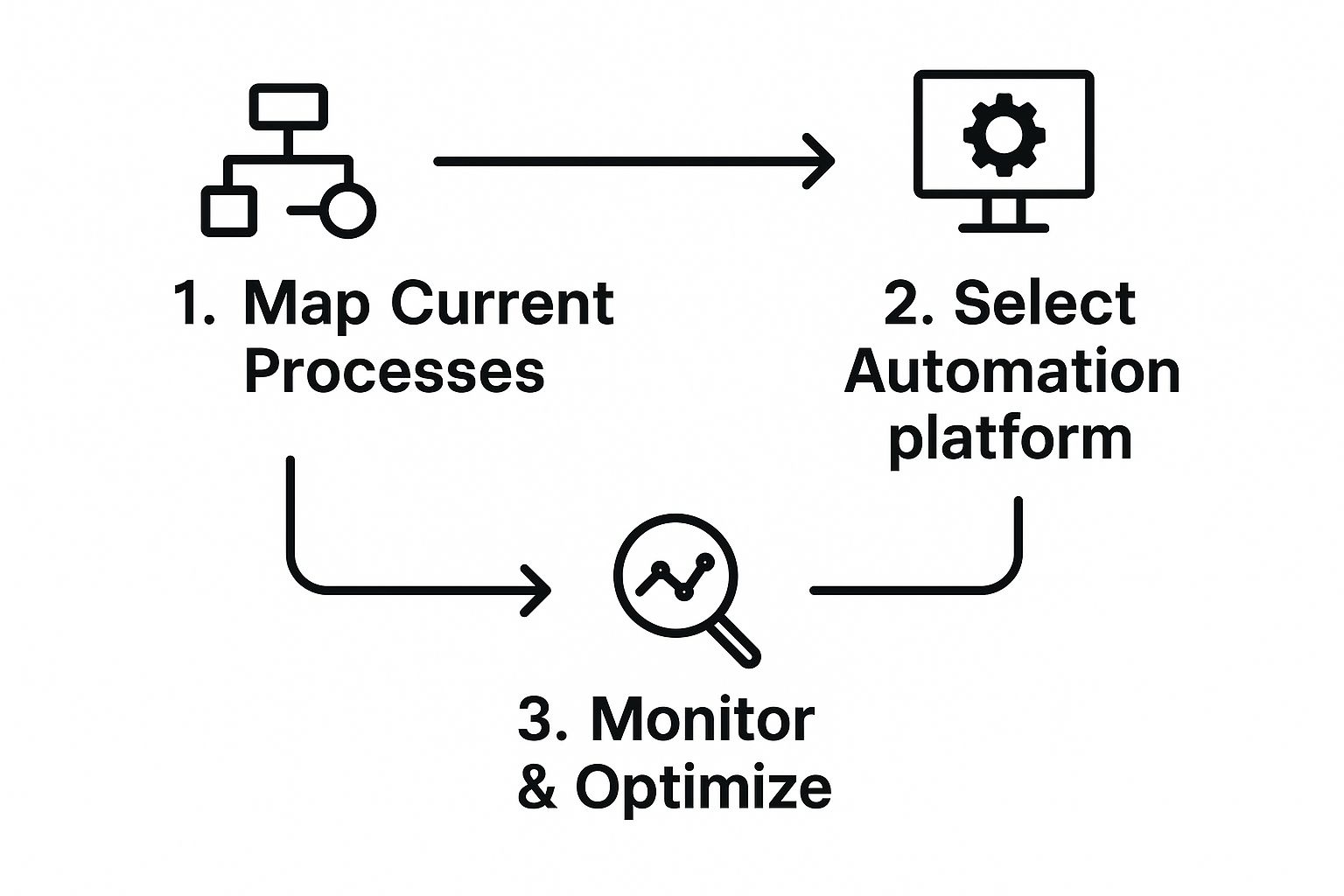
This diagram gets to the heart of it: you map what you do now, pick the right tool to do it automatically, and then keep an eye on it to make it better over time. Successful automation isn't a "set it and forget it" task; it's a continuous cycle of refinement.

Define Your Triggers, Conditions, and Actions

With your map in hand, it's time to translate it into the language of automation. Every automated workflow, no matter how simple or complex, is built from three core components. Get these down, and you can build anything you can imagine.

  1. Triggers: The specific event that kicks off your workflow. This is the "if this happens..." part. Example: A form submission, a link click, or a product purchase.

  2. Conditions: The rules that steer the workflow down different paths. Example: "Lead score is above 50" or "Contact's industry is 'Technology'."

  3. Actions: The tasks the system performs. Example: Send an email, wait for a set period, create a task in your CRM, or update a contact's profile.

A well-built workflow has one, and only one, clear goal. For our webinar follow-up, the goal might be to get attendees to book a demo. Every single email, every delay, and every action should be designed to move that person closer to that single objective.

This structured approach delivers real results. I've seen teams implement workflow automation and increase their lead quantity by 80% and boost conversions by 75%. Most impressively, it can drive a 451% increase in qualified leads. These aren't just vanity metrics; you’re not just saving time, you’re building a much more effective sales pipeline.

Building a great workflow is also about being relentlessly consistent. For more on that, check out our guide on how to never miss a follow-up with a prospect again.

Choosing The Right Marketing Automation Platform

Picking the right software to automate your marketing is one of the most important calls you'll make. This isn't just about buying a tool; it's about choosing the engine that will power your entire strategy. Get it wrong, and you’re stuck with friction, a wasted budget, and a system your team actively avoids.

The trick is to look past the flashy feature lists and get brutally honest about what your business actually needs. A platform that's a dream for a B2B SaaS company could be a total nightmare for a direct-to-consumer e-commerce brand. It's all about matching the tool to the job.

Matching The Platform To The Business Need

Different platforms are built with specific playbooks in mind. Think of it like buying a vehicle: you wouldn't get a two-seater sports car to haul lumber. The same logic applies here.

  • For E-commerce: A platform like Klaviyo is an absolute beast. It’s designed from the ground up to integrate deeply with Shopify and other e-commerce systems, making it dead simple to build workflows around purchase history, abandoned carts, and browsing behavior.

  • For B2B Lead Generation: HubSpot is often the gold standard. Its marketing hub and free CRM are so tightly connected that you get a seamless view of a lead from their first anonymous website visit all the way to a closed deal. Its real strength is in content marketing and sales alignment.

  • For Small Businesses (All-in-One): This is where a tool like ActiveCampaign really shines. It delivers a powerful, affordable mix of email marketing, serious automation muscle, and a surprisingly capable CRM. You get enterprise-level segmentation and workflow logic without the enterprise price tag.

Most of these tools offer some kind of visual builder, letting you map out customer journeys with "if/then" logic. Here's what that looks like inside HubSpot.

Image

You can see how a simple action—like someone clicking a link—can send them down a completely different, more relevant path. That's the core of effective automation.

Core Factors For Your Decision

Beyond your specific business model, a few universal truths should guide your choice. Getting these wrong will cause major headaches later.

The best automation platform isn't the one with the most bells and whistles. It's the one that plugs into your existing tech stack, is intuitive enough for your team to actually use, and won't break as you grow.

To help you cut through the noise, here's a quick comparison of the top platforms, framed around what really matters for day-to-day use.

Marketing Automation Platform Comparison

PlatformIdeal ForKey StrengthsIntegration Focus
KlaviyoE-commerce brandsDeep data sync with stores, predictive analytics for CLV, pre-built e-commerce flows.Shopify, BigCommerce, Magento, WooCommerce.
HubSpotB2B, inbound marketingAll-in-one CRM, marketing, sales & service hub. Strong content and SEO tools.Salesforce, and a massive app ecosystem.
ActiveCampaignSMBs, startupsPowerful "if/then" logic, affordable pricing, combines email, CRM, and automation.Great for connecting various small business tools.
Pardot (Salesforce)Enterprise B2BNative Salesforce integration, advanced lead scoring, robust analytics for complex sales cycles.Deeply embedded within the Salesforce ecosystem.

Ultimately, no single platform is "the best"—there's only the one that's best for you. It needs to align with your team's skills, your budget, and where you plan to be in three years.

For a more granular look at how different tools compare on very specific features, our Marketbetter vs. Sendspark comparison dives into the weeds on video personalization and outreach automation. It's a great example of how to frame your own evaluation.

Advanced Strategies to Fine-Tune Your Workflows

Getting your first few workflows live is a huge win. But once the foundational pieces are humming along, the real fun begins. Basic automation saves you time, but advanced marketing workflow automation is where you start printing money.

This is where you graduate from simple, linear sequences to building a smart, data-driven conversion machine. A machine that actually learns and gets better on its own.

The goal shifts from just doing tasks to making every single automated touchpoint more effective than the last. You stop asking "Did the welcome email send?" and start asking, "Which welcome email gets more clicks?" That simple mindset shift is the key to unlocking the real power of your platform.

A/B Testing Your Automated Emails

One of the most powerful things you can do is build A/B testing directly into your sequences. Never just set an email and assume it's the best it can be. Test it.

Most modern automation platforms let you create a split path right inside a workflow. You can send 50% of your audience one version of an email and 50% another. Or, even better, send a 10/10 split, find a winner, and then send that winning version to the remaining 80%.

Actionable Tip: Pick one variable to test at a time for clear results. Common tests include:

  • Subject Lines: Try a direct, benefit-driven line ("Your webinar recording is inside") against one that sparks curiosity ("Did you see this?").
  • Call to Action (CTA): Test a button that says "Book a Demo" against one that says "See Pricing."
  • Email Copy: Pit a short, punchy email against a longer, more detailed one that's packed with value.
  • Sender Name: Does an email from "Sarah at Marketbetter" get more opens than one from "The Marketbetter Team"?

This creates a constant feedback loop. Your workflows aren't just running; they're actively improving with every single person who enters them.

Implementing Dynamic Content Personalization

While A/B testing makes your overall message stronger, dynamic content takes personalization to a whole new level. It's about showing different content blocks, offers, or images to different people—all within the same email. This is way beyond just using a {first_name} tag.

Imagine sending out one promo email. Leads in the tech industry see a case study about a SaaS company, while leads in healthcare see a testimonial from a hospital network. You're not sending two separate emails; you're using one smart template with rules based on the data in your CRM.

It's a subtle but critical distinction from A/B testing.

Personalization MethodHow It WorksBest Use Case
A/B TestingSends two distinct versions (A and B) to a sample audience to find a winner.Optimizing a single element like a headline or CTA for the entire audience.
Dynamic ContentShows or hides specific content blocks within one email based on segment rules.Tailoring offers, images, or testimonials to different audience segments in one send.

Using Lead Scoring to Prioritize Your Hottest Leads

Lead scoring is the secret ingredient that connects your marketing engine directly to your sales team's pipeline. It's a system for assigning points to leads based on who they are and what they do.

A VP of Marketing gets more points than an intern (demographics). Someone who visits your pricing page gets a massive point bump compared to someone who only reads your blog (behavior).

The core idea is simple: a lead's score reflects their sales-readiness. By setting a threshold—say, 100 points—you can create a rule that automatically routes leads to the sales team for immediate follow-up the moment they become a Marketing Qualified Lead (MQL). This completely eliminates the manual guesswork and ensures sales reps only spend time on prospects who are genuinely interested and engaged.

How to Measure Automation Success and ROI

Image

If you can't prove your marketing automation is making money, you can't justify paying for it. It’s really that simple. Measuring success isn’t just about clawing back a few hours for your team; it's about drawing a straight line from your automated workflows to actual revenue and customer growth.

The trick is to stop obsessing over surface-level metrics like email opens and start digging into the KPIs that tell the real story of the customer journey.

Pinpointing the KPIs That Actually Matter

Too many teams get bogged down tracking vanity metrics. They’re easy to see, they look good on a chart, but they don't mean much. Real success is measured by how your automation impacts pipeline velocity and bottom-line results.

It’s time to shift your focus. Instead of just tracking clicks, start monitoring how your automation directly influences key business outcomes.

Instead of This (Vanity Metric)Focus on This (Impact Metric)
Email Open RateStage-by-Stage Conversion Rate (e.g., Lead to MQL)
Number of Emails SentLead-to-Customer Conversion Time
Social Media LikesCustomer Lifetime Value (CLV) of nurtured vs. non-nurtured leads

These are the metrics that matter. They show you exactly how well your workflows are moving leads from a flicker of interest to a signed deal. For instance, if you can show that your automated nurture sequence shortens the sales cycle by 15%, that’s a powerful story to tell leadership.

Building Your Real-Time Automation Dashboard

Most automation platforms come with solid reporting features. Your job is to wrangle them into a dashboard that gives you an at-a-glance view of these critical KPIs. Don't clutter it. Create a clean, focused view of the metrics that directly reflect the health of your automated engine.

Actionable Step: Build a simple dashboard answering these questions:

  • How many MQLs did our nurture workflow generate this month compared to last month?
  • What’s the average time from first touch to becoming a customer for an automated lead vs. a manual one?
  • Which automated email in our welcome series has the highest click-to-open rate?

This real-time feedback loop is your secret weapon for making smart, data-backed adjustments. It helps you see which parts of your marketing workflow automation are driving growth and which ones need a tune-up. For more strategies on proving business value, it’s worth exploring resources on maximizing the ROI of marketing automation.

Calculating a simple ROI is straightforward. Sum your automation software costs and the time spent managing it. Then, calculate the new revenue generated from automated campaigns or the cost savings from efficiency gains. A positive result builds the business case for continued investment.

And if you really want to connect the dots, tying automation success back to individual customer data is incredibly powerful. Our guide on using person-level identification shows you how to get a much more granular view of each customer's automated journey.

Common Questions About Marketing Automation

As you start mapping out your marketing automation strategy, some practical questions always come up. Let's tackle the big ones I hear most often from marketing teams.

How Much Does Marketing Workflow Automation Cost?

There’s no single price tag. The cost swings wildly depending on the platform’s horsepower, how many contacts you have, and the features you absolutely need.

For small businesses just dipping their toes in, entry-level tools often start in the $50-$100 per month ballpark. Then you have the mid-tier players like HubSpot or ActiveCampaign, which can run from a few hundred to several thousand dollars a month. Enterprise platforms like Marketo or Pardot are in a different league entirely, built for large-scale operations with a price to match.

But here’s the thing: looking only at the monthly subscription is a classic mistake. You have to factor in the total cost of ownership. That means adding any one-time setup fees, the cost of training your team, and any specialized support you might need down the line.

Can I Integrate Automation Tools with My Existing CRM?

Yes, and you absolutely must. This is non-negotiable.

Pretty much any respectable marketing automation platform has native, easy-to-configure integrations with popular CRMs like Salesforce, Zoho, and Microsoft Dynamics. This connection is the central nervous system for a healthy sales and marketing relationship.

It’s what ensures a seamless, real-time flow of data—syncing everything from new lead info and their engagement history to critical lead scores. Before you even think about committing to a tool, confirming it plays nice with your current tech stack should be at the very top of your checklist.

What Is the Biggest Mistake to Avoid When Starting Out?

The most common pitfall I see is trying to automate everything all at once. It comes from a good place—ambition—but it’s a direct path to frustration and a messy, ineffective system. Don't try to build a massive, multi-branched workflow for the entire customer journey on day one. It's just too much, and it almost never works right out of the gate.

A much smarter approach is to think small and build momentum.

  • Start with one simple, high-impact process. A welcome email series for new subscribers is a classic for a reason. It’s self-contained, easy to build, and you can measure its success clearly.
  • Absolutely nail that one workflow. Get obsessive about it. Monitor its performance, tweak the subject lines, adjust the timing between emails, and truly understand the impact it’s having.
  • Expand from there, methodically. Once you have a proven win under your belt, take what you’ve learned and apply it to your next automation. This phased approach keeps things manageable, builds confidence, and secures those crucial early successes that get everyone excited.

Ready to build smarter, more effective automated workflows with the power of AI? With marketbetter.ai, you can move beyond simple sequences and create data-driven customer journeys that boost conversions and prove your ROI. See how our integrated platform can transform your marketing engine by exploring our solutions.