Close CRM is excellent at what it does — phone-based selling with a clean, fast CRM. But teams leave Close for three consistent reasons:
- Per-user pricing gets expensive as teams scale past 10 reps ($99-139/user/month adds up)
- No visitor identification or AI lead scoring — Close tells you how to call, not who to call
- Single-channel limitation — great at phone + email, missing LinkedIn, chatbot, and multi-channel orchestration
Whatever's driving your search, here are 10 alternatives that solve what Close doesn't.
Quick Comparison
| Tool | Starting Price | Best For | What It Does That Close Doesn't |
|---|
| MarketBetter | $99/user/month | SDR teams needing full execution | Visitor ID + AI playbook + chatbot |
| HubSpot Sales Hub | $20/user/mo | Marketing-led sales teams | Deep reporting + marketing alignment |
| Freshsales | $9/user/mo | Budget-conscious teams | AI lead scoring at $39/user |
| Apollo | $49/user/mo | Data-driven prospecting | 275M+ contact database |
| Salesforce | $25/user/mo | Enterprise teams | Unlimited customization |
| Pipedrive | $14/user/mo | Pipeline-focused teams | Better pipeline visualization |
| Outreach | ~$100/user/mo | Multi-channel outbound | Enterprise sequence engine |
| Nooks | ~$5K/user/yr | Parallel dialing teams | Virtual salesfloor + AI dialer |
| Zoho CRM | $14/user/mo | Budget maximizers | More features per dollar |
| Instantly | $30/mo | Cold email specialists | Unlimited email accounts |
1. MarketBetter — Best for Complete SDR Execution
Price: $99/user/month (Standard plan) | G2 Rating: 4.97/5
Close answers "how do we make more calls?" MarketBetter answers "who should we contact, why, and through which channel?"
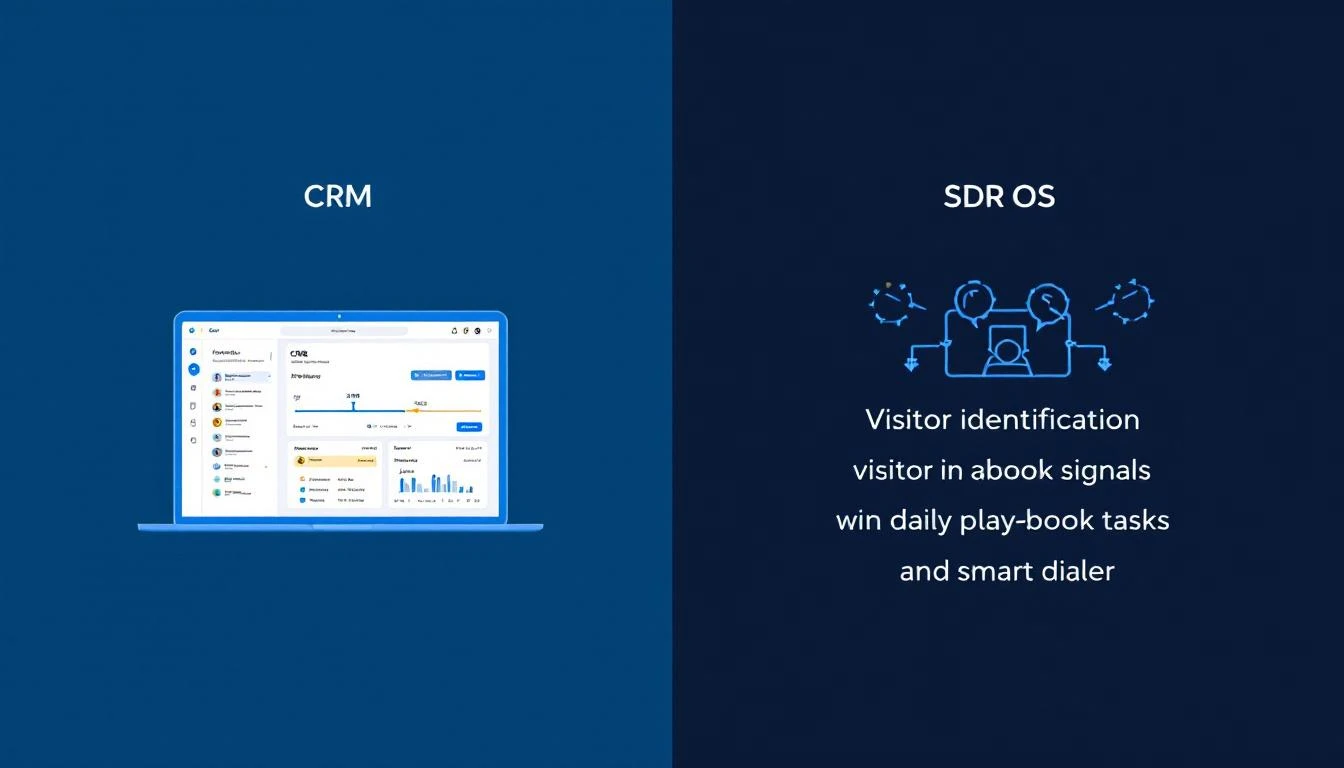
MarketBetter is a complete SDR operating system: website visitor identification reveals who's browsing your site, the daily AI playbook prioritizes who to reach out to, AI-personalized email sequences warm leads automatically, a smart dialer handles phone outreach, and an AI chatbot engages visitors in real-time.
Switch from Close when: Your team's problem isn't call volume — it's knowing who to call. If SDRs spend 30+ minutes daily figuring out their call list, MarketBetter eliminates that.
What you gain:
- Website visitor identification (Close: ❌)
- AI-prioritized daily playbook (Close: manual Smart Views)
- AI chatbot for website engagement (Close: ❌)
- Flat pricing — no per-user scaling (Close: $99-139/user)
- Multi-channel orchestration (Close: phone + email only)
What you trade: Close's Power/Predictive Dialer is more sophisticated for raw call volume. MarketBetter's smart dialer prioritizes intelligence over speed.
Book a demo →
2. HubSpot Sales Hub — Best for Marketing Alignment
Price: Free / $20 / $100 / $150 per user/month | G2 Rating: 4.4/5
The natural upgrade for teams that need CRM + marketing in one ecosystem. HubSpot's reporting is dramatically better than Close's — custom dashboards, pipeline analytics, multi-touch attribution, and revenue forecasting. Plus a marketplace with 1,500+ integrations.
Switch from Close when: Marketing generates a significant portion of your leads and you need seamless MQL-to-SQL handoff with attribution tracking.
What you gain: Superior reporting, marketing automation, massive integration ecosystem, content management.
What you trade: Calling features are basic compared to Close. No Power Dialer or Predictive Dialer. Per-user pricing is similar ($100/user for Sales Pro).
3. Freshsales — Best Budget CRM with Phone
Price: Free / $9 / $39 / $59 per user/month | G2 Rating: 4.5/5
Freshsales offers a built-in phone at a fraction of Close's price. At $39/user/month (Pro), you get AI lead scoring (Freddy AI), sales sequences, multiple pipelines, and custom reports. That's 60% cheaper than Close's Standard plan.
Switch from Close when: Close's per-user pricing is too high and you don't need Power/Predictive Dialing. Freshsales Pro at $39/user covers most CRM + calling needs.
What you gain: AI lead scoring (Close lacks this entirely), lower pricing, Freshworks ecosystem integration.
What you trade: Dialer quality — Freshsales' built-in phone is click-to-call only, no Power or Predictive Dialer.
4. Apollo — Best for Data + Outbound Combined
Price: Free / $49 / $79 / $119 per user/month | G2 Rating: 4.7/5
Apollo combines a 275M+ contact database with email sequences, a basic dialer, and CRM functionality. If you're using Close + a separate data provider (ZoomInfo, Lusha), Apollo consolidates both.
Switch from Close when: You're paying separately for lead data and want prospecting + CRM in one tool.
What you gain: Massive prospect database, enrichment, intent signals, LinkedIn integration.
What you trade: Apollo's CRM is basic compared to Close's. Dialer exists but isn't Power/Predictive level.
5. Salesforce Sales Cloud — Best for Enterprise Scale
Price: $25 / $100 / $165 / $330 per user/month | G2 Rating: 4.4/5
If you're outgrowing Close because of customization limits, integration needs, or enterprise compliance requirements, Salesforce is the platform that scales infinitely.
Switch from Close when: You have 50+ users, complex multi-product sales processes, and need a platform your RevOps team can customize without limits.
What you gain: Unlimited customization, AppExchange (thousands of integrations), enterprise security, Einstein AI.
What you trade: Implementation takes weeks to months. Requires dedicated admin. Much more expensive at full feature set.
6. Pipedrive — Best for Pipeline Visualization
Price: $14 / $24 / $49 / $59 / $79 per user/month | G2 Rating: 4.3/5
Pipedrive has the best pipeline visualization in the CRM market. The drag-and-drop kanban view, activity-based selling methodology, and visual deal tracking make it intuitive for teams that want to see their pipeline at a glance.
Switch from Close when: You want a simpler, cheaper CRM with better pipeline UX and a larger integration marketplace.
What you gain: Superior pipeline visualization, 400+ integrations, activity-based selling framework, AI assistant.
What you trade: No built-in phone (requires add-on). Less sophisticated calling features than Close.
7. Outreach — Best for Enterprise Multi-Channel Sequences
Price: ~$100/user/month (contact sales) | G2 Rating: 4.3/5
Outreach is the enterprise standard for sales engagement. Multi-channel sequences (email + call + LinkedIn + SMS), A/B testing, AI-powered send-time optimization, and sophisticated analytics go far beyond Close's email sequences.
Switch from Close when: Your outbound motion is multi-channel and you need enterprise-grade sequence management with detailed analytics.
What you gain: Multi-channel sequences, conversation intelligence, enterprise analytics, AI optimization.
What you trade: Outreach isn't a CRM — you'll need another tool for pipeline management. Pricing is enterprise-level ($100+/user).
8. Nooks — Best for Parallel Dialing at Scale
Price: ~$5,000/user/year | G2 Rating: 4.8/5
If you love Close's calling focus but want next-generation dialing, Nooks is the upgrade. AI-powered parallel dialer, virtual salesfloor for team collaboration, and real-time coaching make it the most advanced calling platform available.
Switch from Close when: You want Close's calling philosophy taken to the extreme — AI-powered parallel dialing with team collaboration and coaching built-in.
What you gain: AI parallel dialer (faster than Close's Predictive), virtual salesfloor, real-time coaching, battlecard delivery.
What you trade: Nooks is a dialer, not a CRM. At ~$5K/user/year, it's expensive. You'll need a separate CRM.
9. Zoho CRM — Best Value Per Dollar
Price: Free / $14 / $23 / $40 / $52 per user/month | G2 Rating: 4.1/5
Zoho CRM packs more features per dollar than any competitor. At $40/user/month (Enterprise), you get workflow automation, AI assistant (Zia), web forms, inventory management, custom modules, and multi-channel communication — features that require Close's Scale plan ($139/user) or don't exist in Close at all.
Switch from Close when: Budget is your primary constraint and you need more features at a lower per-user cost.
What you gain: AI lead scoring (Zia), broader feature set, 40+ Zoho ecosystem apps, lower pricing.
What you trade: Less polished UI. Calling features are basic compared to Close. Can feel overwhelming with too many options.
10. Instantly — Best for Cold Email at Scale
Price: $30 / $77.6 / $286.3 per month | G2 Rating: 4.8/5
Instantly is the opposite of Close's approach: instead of phone-first, it's email-first. Unlimited email accounts, automatic warmup, inbox rotation, and cold email templates designed for deliverability.
Switch from Close when: Your outbound motion is primarily cold email and you need to send personalized emails at scale with high deliverability.
What you gain: Unlimited email accounts, email warmup, inbox rotation, deliverability optimization.
What you trade: No CRM, no phone dialer, no pipeline management. Instantly is a pure cold email tool — you'd need Close (or another CRM) alongside it.
Decision Framework
| If Your Priority Is... | Choose |
|---|
| Complete SDR execution (visitor ID + playbook + all channels) | MarketBetter |
| Better reporting + marketing alignment | HubSpot |
| Same features, lower price | Freshsales or Zoho |
| Prospect data + outbound in one tool | Apollo |
| Enterprise-grade customization | Salesforce |
| Better pipeline visualization | Pipedrive |
| Multi-channel sequences at enterprise scale | Outreach |
| Next-gen parallel dialing | Nooks |
| Cold email volume at scale | Instantly |
The deeper question: Are you leaving Close because you need a better CRM (HubSpot, Pipedrive, Freshsales) or because you need a better SDR execution platform (MarketBetter, Outreach, Apollo)? The answer determines which category to shop in.
Close is a great CRM with a great dialer. If your problem is beyond CRM — generating pipeline, identifying intent, multi-channel execution — you need a platform built for that. MarketBetter is where most Close users land when they realize they need an SDR OS, not just a CRM upgrade.